VIDEO BLOG #77: “The Blog of Frankenstein” ““
The angry villagers of Sacred Heart are out in full force to take down Frankendorian in this behind-the-scenes look at episode 6×09, “My Perspective”.


Download Scrubs Video Blog #77:
##
VIDEO BLOG #77: “The Blog of Frankenstein” ““
The angry villagers of Sacred Heart are out in full force to take down Frankendorian in this behind-the-scenes look at episode 6×09, “My Perspective”.
Download Scrubs Video Blog #77:
##

 Only last week, in the course of my month-long consideration of Dr. Peter Coogan’s book Superhero: The Secret Origin of a Genre (MonkeyBrain Press, 2006), I hypothesized that despite the surface realism of the television series 24, its hero Jack Bauer is what I called a megahero. That is my name for what the late literary critic Northrup Frye called the hero of romance, by which he meant a tale of extraordinary adventure. According to Frye a romance hero is “superior in degree to other men and to his environment,” and “moves in a world in which the ordinary laws of nature are slightly suspended” (Frye, Anatomy of Criticism, pgs. 33-34).
After I posted last week’s column, I purchased the new issue of TV Guide (Feb. 12-18, 2007), which contained a special section on 24, including a “guest column” by Kiefer Sutherland, who plays Bauer. Sutherland writes about Jack, “Sure, there’s a superhuman element to his character, too. . . .” It’s great getting one of my ideas confirmed, and so quickly!
Before starting my critique of Dr. Coogan’s book, I was working my way through Neal Gabler’s recent biography of Walt Disney (see “Comics in Context” #158, 160-161). You may recall that Gabler contends that Disney had little interest in his feature films following World War II; the major exception was Mary Poppins (1964).
Last weekend Turner Classic Movies showed two of Disney’s live action films for the first time: 20,000 Leagues under the Sea (1954), based on the novel by Jules Verne (whose name, unless I missed it, oddly never appeared in the movie) and The Absent-Minded Professor (1961). I hadn’t seen the first one since childhood, and I believe I had never seen the second.
Something that struck me about Leagues was that it didn’t conform to the popular image of a Disney movie. Yes, there was a cute animal, Esmerelda the seal, and since it was a Disney movie, it made certain that Esmerelda escaped the destruction of the Nautilus, Captain Nemo’s submarine, at the movie’s end. But, following Verne’s novel, the movie unhesitatingly portrays Captain Nemo, played by James Mason, as a mass murderer, ramming and sinking ships. The film’s narrator, Professor Aronnax, played by Paul Lukas, seems intended to be the point of view character for the audience, and Aronnax never wavers in his condemnation of what today we would call Nemo’s terrorist attacks.
Yet the movie allows the audience to understand and empathize with Nemo’s own point of view. He only attacks warships or ships carrying munitions. Moreover, he was once a prisoner of an unnamed nation which murdered his wife and children. (In a previous column I speculated that Captain Nemo, who rules beneath the waves, was a partial inspiration for Namor the Sub-Mariner, the noble prince of an undersea kingdom who also attacks a warlike surface world. See “Comics in Context” #22.)
Furthermore, Aronnax admires Nemo as a creative genius who designed the Nautilus, discovered its power source, which in the Disney version is obviously nuclear energy, and mastered the ocean depths. The film invites the audience to marvel at Nemo’s wonders, as well. Ned Land, the sailor played in the film by Kirk Douglas, is presented as a more conventional adventure hero, with more brawn than brain, and he condemns Nemo as a killer. Aronnax disapproves of the killings, but argues that Nemo must be persuaded to share his secrets with the world. During the movie’s titanic battle between the Nautilus crew and a giant squid, Land finds himself saving Nemo’s life, much to his own surprise. It seems we are meant to agree with Aronnax’s opinion of Nemo; even Land does, subconsciously. When the unnamed nation’s armed forces attack and fatally wound Nemo at the film’s end, surely our sympathies are with him, and the movie gives Nemo the last word, repeating his prophesy that some day, when the world is ready for them, humanity will rediscover his secrets. Nemo is a creative visionary who was ahead of his time.
On seeing Leagues and Absent-Minded Professor on successive evenings, I realized that both movies are about misunderstood creative geniuses, even though one is a science fiction drama with an antihero who meets a tragic end, and the other is a science fiction romantic comedy. Both Nemo and the latter film’s Professor Brainard are technical innovators, like Walt Disney himself. When we meet Nemo, he no longer has a family and is entirely devoted to his mission. Professor Brainard is so intensely dedicated to his scientific research that he neglects his personal life, and repeatedly fails to attend his own wedding. Gabler’s book depicted Disney as similarly neglectful of his marriage, and instead devoting most of his energies to his creative work at the studio. The unnamed nation imprisons Nemo and kills his family in a vain effort to force him to reveal his secrets to them (notably his discovery of nuclear energy). In Gabler’s book, the darkest moment in Disney’s early career came when his distributor took his star character, Oswald the Rabbit, and most of his staff away from him. The villain in Absent-Minded Professor is Alonzo P. Hawk, the head of a finance company. Having made a large loan to Professor Brainard’s college that the school cannot repay, Hawk threatens to foreclose and take possession of the campus. Subsequently, Hawk steals Brainard’s Model-T Ford which contains his discovery, flubber, which enables the car to fly. In Gabler’s biography one of Walt Disney’s foremost nemeses is the Bank of America, which made loans to the Disney company and then restricted his freedom of action in running his own studio.
In other words, Captain Nemo and Professor Brainard each embody aspects of Walt Disney himself. So, Mr. Gabler, is it really true that Walt Disney had little to do with his live action movies except for Poppins? The stamp of Walt the auteur, expressing his own personality through his lead characters, is clear in both Leagues and Absent-Minded Professor. (TCM’s own article about Leagues demonstrates that Walt Disney was very much personally involved in the film.)
Watching Professor Brainard bounding up and down in his flubber-soled shoes, I found myself thinking about Spring-Heeled Jack, a character from “penny dreadfuls” in Victorian England, who wore boots containing steel springs that enabled him to make superhuman leaps into the air. Dr. Coogan admits that Jack “very likely can be considered the first hero character to fulfill the core definitional elements of the superhero” (Superhero p. 176). Coogan’s primary criteria for a superhero are mission, powers, and identity. Spring-Heeled Jack had a mission, as what Coogan calls “an all-round do-gooder” (p. 175), his boots provided him with artificial super-powers, and he scores three out of three in the “identity” requirements of codename, costume and dual identity.
Indeed, the only persuasive reason that Coogan can give for not considering Jack to be the first superhero is that “he did not inspire the imitation and repetition necessary to initiate a genre” (p. 176), as Superman did over a century later. Hence Spring-Heeled Jack’s adventures remained an “anomaly” in his own time (p. 177).
Maybe the difference is that super-powers are usually based in science fiction, and the more technologically advanced world of the 1930s was therefore more conducive to the popularity of the superhero concept. Perhaps Jack’s “spring-heels” were too much of a gimmick; Superman’s powers bore more mythic resonance because they were innate. Besides, while Superman also traveled via superhuman leaps (before he was upgraded to flying), he also had more impressive powers like super-strength. There seems to be an archetype of a leaping or bouncing man underlying Spring-Heeled Jack, but, significantly, it reemerges in characters who are comedic or partly comedic, like the Legion of Super-Heroes’ Bouncing Boy, Looney Tunes‘ baby kangaroo Hippety Hopper, Marvel’s Frog-Man and Leapfrog characters, and, yes, the Absent-Minded Professor. Even the Hulk’s repeated leaping, like a big green frog, looks undignified compared to Superman’s flying.
I’ve lately received some e-mails with relevance to my recent columns. For example, Roy Thomas informs me that despite what it says on the boxes our copies of Marvel Vault, the book we co-authored for Becker and Mayer, the book is still only in its first printing.
Peter Coogan has been sending me e-mails about my columns on his book. Not surprisingly, he disagrees with my contention that the Spirit is a superhero, and says that the Spirit “is just a masked pulp detective in comics.” I see Coogan’s point, and certainly Spirit stories more often resemble film noir than conventional superhero sagas.
But if Spring-Heeled Jack is not a true superhero because he did not inspire any imitations or variations, then can’t we apply similar logic to the Spirit? If the Spirit had been created before Superman’s debut, then he would fall into the same category of pulp-style masked vigilantes as the Green Hornet, DC Comics’ original version of the Sandman, and even Zorro. But did the debut of Superman and the early comic book superheroes radically alter the public perception of masked heroes? Would the newspaper readers of the 1940s have perceived the Spirit as one of the new breed of superheroes, or as a pulp-style hero?
The newspaper syndicate for which Eisner did The Spirit certainly insisted that the character conform to the new genre. By Eisner’s own admission,
“They wanted an heroic character, a costumed character. They asked me if he’d have a costume. And I put a mask on him and said, ‘Yes, he has a costume!'” (The Jack Kirby Collector #16). So the mask, and presumably the iconic blue suit, became signifiers of a superhero costume.
Yet Eisner went further and gave the Spirit a superhero-style origin, complete with a “death” (via suspended animation) and resurrection, thereby metaphorically putting him on a superhuman level.
If there had been no comic book superheroes, would the Spirit have been entirely the same character? Would Eisner have given him the science fictional origin involving suspended animation, the cemetery lair, the dual identity, or even the codename? Might the Spirit have been more like Eisner’s later, similar character, John Law, who lacked mask and codename, and worked as a policeman? Did anyone ever ask Eisner this?
Eisner did as little as he needed to make the Spirit look like a superhero, and yes, Spirit stories typically resemble film noir more than conventional superhero tales. But to my mind, anyway, the Spirit just meets the minimum requirements to be considered a superhero. Just as Buffy is a Displaced Superhero operating in the supernatural horror genre, maybe the Spirit is a Technical Superhero, whose stories include a wide number of genres, from comedy to noir mystery, and even outright superhero stories like Darwyn Cooke’s Batman/Spirit comic.
With regard to whether the TV series Heroes is in the superhero genre, Dr. Coogan wrote to me that “All Heroes has to do is show one costume and employ one codename.” I don’t know if that’s sufficient if most of the super-powered characters don’t use costumes or codenames. If only one of the Heroes dresses in a costume, he may come off as an eccentric. In the superhero genre, wearing a distinctive costume is typically presented as a reasonable choice.
One of the Heroes, Hiro Nakamura, is a superhero comics buff and perceives himself as a superhero. The Wikipedia entry on the character observes that Hiro is “the one character that aspires to the pure heroism of comic book crime fighters.” In other words, he is the only one who has the same kind of sense of mission that conventional superheroes have, but so far this makes him an anomaly in the cast of characters.
Coogan contends that Hiro’s future counterpart “has a costume” that isn’t doesn’t “strictly” conform to genre expectations, “but it’s clear that Hiro intends it as a superhero costume.” But a “declaration of intent” isn’t always sufficient. This “costume” consists of a black overcoat. According to Coogan’s book, the superhero costume should express the character’s biography, powers, and/or identity, and should have a “chevron,” an insignia that stands for the superhero identity. All that Future Hiro’s overcoat expresses is that he develops better fashion sense. I can’t accept this as a true superhero costume any more than I do Neo’s long black coat in The Matrix.
Coogan also points out that a new character on the show, Hana Gittleman, who first appeared in comics on NBC’s Heroes website, has a codename: “Wireless.” Now this does seem to be a real move towards the direction of conforming to superhero genre conventions.
Thinking further about this, I realized that Heroes’ first season may be one long origin story for the principal characters. Perhaps it is evolving slowly but surely into what would clearly be recognized as a superhero series, with the Heroes fulfilling Coogan’s major criteria. Maybe the true test is to see how many of the Heroes will have adopted codenames and a selflessly altruistic sense of mission by this point in the second season.
I doubt that Coogan would consider the Captain Nemo of Alan Moore and Kevin O’Neill’s League of Extraordinary Gentlemen to be a superhero. “Nemo” is an alias, meaning “no one,” and is a kind of codename, but Moore and O’Neill dress their Nemo in conventional garments from India, not a superhero-style costume. Nemo’s sense of mission in League seems inadequate: he angrily quits the team by the end of Volume 2. While Coogan makes clear that advanced technology can fill his criterion of super-powers, Nemo’s primary “powers” reside not in his body or his personal weaponry and equipment, but in his vehicle, the Nautilus. The League of Extraordinary Gentlemen‘s supreme annotator Jess Nevins says that “Nemo was the archetypal Man With The Machine, the inventor/engineer character who created scientifically advanced machines and used them on their adventures.”
But would the Captain Nemo of the Disney movie and Verne’s novel qualify under Coogan’s definition of supervillain? On his “Fantastic Victoriana” website, Jess Nevins places Nemo in the context of 19th century Romanticism: “The ostracized Romantic genius is unappreciated, his talent unvalued, and his intellectual and spiritual values rejected by the soulless materialistic society which does not appreciate his naturally superior talents.”
This reminds me of Coogan’s three categories of characters from 19th and early 20th century fiction that are forebears of the 20th century superhero: the “science-fiction superman,” beginning with Frankenstein’s monster in 1918; the “dual-identity avenger-vigilante” and what Coogan calls “the pulp ubermensch,” beginning with Tarzan in 1912 (p. 126). Concealing his true identity behind an alias, Nemo fits the second category, striking out at the warships of the nations of the world. Coogan links the first and third categories of philosopher Friedrich Nietzche’s concept of the ubermensch, which Coogan defines as “a revolutionary figure, operating beyond the traditional notions of good and evil, following his will to power, and embodying the master morality while abandoning the slave morality of Christian teaching and platonic ideals” (p. 130). Now consider this speech by Nemo that Nevins takes from Verne’s novel: “I am not what you call a civilized man! I have broken with society entirely, for reasons which I alone have the right to assess. I therefore do not obey its laws. . . .” Nemo isn’t physically a “superman” but his “machine” enables him to exercise the power of one.
Whereas Coogan limits the definition of superheroes to characters in the superhero genre, he contends that supervillains exist in numerous genres, and predate the creation of the first superhero. He divides supervillains into five basic types, while noting that a particular character can belong to one or more of these types.
First is the Monster, a type including Grendel from Beowulf, Frankenstein’s monster, Dracula, and even beasts without any aspect of humanity, such as the Nemean Lion and the Lernaean Hydra from the Twelve Labors of Hercules.
Second is the Enemy Commander, a category in which Coogan includes not only Darth Vader but also historical figures such as Xerxes, the Persian king at the Battle of Thermopylae (who figures in such disparate works as Herodotus’ Histories and Frank Miller’s 300). Coogan considers John Milton’s Satan in Paradise Lost (1667) as “the very model of the enemy commander supervillain” (p. 63). Coogan even maintains that Americans think of real life figures Adolf Hitler and Osama bin Laden as supervillains.
Third is the Mad Scientist, a self-explanatory category that Coogan traces back through Dr. Victor Frankenstein to what we might call “mad alchemists” like Doctor Faustus (as in Christopher Marlowe’s play, published in 1604).
Fourth is the Criminal Mastermind, a type prominently represented by Sherlock Holmes’ nemesis Professor Moriarty, who debuted in Arthur Conan Doyle’s “The Final Problem” (1893).
The fifth and final category is what Coogan somewhat awkwardly calls the Inverted-Superhero Supervillain. By this Coogan means the familiar kind of costumed supervillain that we see in comics; indeed, he says that this is the only category of supervillain that is limited to the superhero genre. Like superheroes, the “inverted-superhero” type of supervillain can be identified by mission (an antisocial one), powers, and identity, expressed through codename and costume. Coogan identifies the Joker and Catwoman, who both debuted in Batman #1 (1940) as the first true “inverted-superhero” supervillains. Actually, that honor should go solely to Jerry Robinson’s creation, the Joker. In Batman #1 the Catwoman appears as “the Cat,” a comely female thief who is a master of disguise. This character later evolved into the Catwoman, complete with full costume and cat-themed weaponry and equipment. But in her first appearance, she’s a more ordinary sort of criminal that one could easily find in a conventional detective story.
Captain Nemo would fall under the headings of Enemy Commander (leading his own one-ship navy, the Nautilus) and Mad Scientist (as its inventor). But we should note that Verne’s and Disney’s Nemo is more precisely of a character type that Coogan does not discuss: the supervillain as antihero. The Sub-Mariner fit into the same category when he was revived in Fantastic Four #4 (1962). Of course, Milton’s Satan is one of the greatest antiheroes in literature.
Coogan proposes that Ian Fleming, the creator of villains such as Blofeld, Doctor No, and Goldfinger in his James Bond novels, “might be called the poet laureate of supervillainy.”
There is one more recent character in both popular literature and film who is such a towering figure of what Coogan calls “supervillainy” that I am astounded that he never receives a mention in Coogan’s book. Who else but Dr. Hannibal Lecter, who was created by novelist Thomas Harris in his book Red Dragon (1981, released as a film as Manhunter in 1986 and under its original title in 2002), became a pop culture icon in The Silence of the Lambs (published in 1988, released as a film in 1991), and has reappeared in Hannibal (published in 1999, released as a film in 2001) and currently in Harris’s new novel Hannibal Rising, and the 2007 film thereof. The American Film Institute’s 2003 poll of movie professionals, critics and historians named Dr. Lecter as the greatest villain in film history. (in the Online Film Critics’ 2202 poll about great movie villains, Dr. Lecter placed second, after Darth Vader.)
Dr. Lecter would fit two of Coogan’s categories of supervillains; the Monster (as a cannibal) and the Mad Scientist (as a psychiatrist).
Whereas Coogan listed three main criteria for defining a superhero, he lists seven for determining who is a supervillain. Let’s go down the list and see how Nemo and Lecter fit.
First, as with the superheroes, is Mission, which in the supervillain’s case is “selfish” and “anti-social.” Nemo has turned his back on society, and certainly the nations of the world regard his mission to destroy warships as antisocial. (But we may sympathize with his mission to some extent, and consider him to be an antihero.) In Hannibal Rising, the young Lecter embarks on a mission of vengeance against the men who murdered–and devoured–his sister. In his review of this novel in The New York Times Sunday Book Review (December 31, 2006), film critic Terence Rafferty points to “the doctor’s strong avenging-angel impulse, which since The Silence of the Lambs has sometimes manifested itself as a grisly kind of gallantry. In both Silence and Hannibal, he often functions as the protector, rescuer and champion of Clarice Starling, the comely young F.B.I. agent who strangely interests him.” Rafferty contends that real life serial killers murder merely to satisfy their sexual desires, and not out of a sense of mission. Rafferty asserts that Harris’s backstory for Lecter, as his sister’s avenger, “emphasize[s], by the very similarity to superhero origin stories, the character’s utter impossibility, his pure does-not-occur-in-nature absurdity.” Lecter isn’t a realistic character.
Thus Rafferty inadvertently acknowledges that Lecter is what Coogan would call a “supervillain.” Lecter is not “one of us,” not what Frye would call a high or low mimetic character. Despite the surface realism of Harris’s novels, Lecter is a villain of what Frye calls the mode of romance, in which the rules of strict realism do not apply. Indeed, the rules of strict psychological realism are inapplicable to Lecter. That’s not Harris’s mistake; that’s the point.
When he is not avenging his sister or aiding Clarice, Lecter has no ongoing mission, but Coogan points out that “It is possible, and even typical, for a monster to act without malice. Destructiveness comes out of its nature. . . .Most monsters express a force of nature in their destructiveness.” That seems to me to be a reasonable description of Lecter.
Second, there is Criminal Artistry: “The supervillain’s dream reaches far beyond the acquisitive scheme of the ordinary crook.” Lecter definitely sees his crimes as art: specifically, he regards cannibalism into gourmet dining. Nemo may not regard his sinking of warships as art, but he is portrayed both by Verne and by Disney as an artist: both the novel and the film repeatedly portray him playing the organ. The portrayal of the extraordinary villain as having an interest in high culture is familiar. In the film of The Silence of the Lambs Lecter waves his hand to a recording of classical music, as if conducting, during the scene in which he murders his guards, and in Hannibal he has settled in Florence as an art historian.
Rafferty perceives that “In Silence, Harris [added] a pitiless aesthetic objectivity to the list of Hannibal’s improbable properties: his taste is so impeccable it seems demonic. But the decisive leap in the evolution of Hannibal Lecter turned out to be his, let’s say, appreciation of Clarice Starling, whose beauty meets his high standards and whose tantalizingly inchoate sense of herself arouses his clinical curiosity.” So Lecter’s interest in Starling is driven not only by sexual urges but by his aesthetic sense and by his scientist’s pursuit of knowledge.
Third is mania, or fanaticism: “The blindness that comes from a maniac singleness of purpose permits the supervillain to not see the inhumanity of what he does or to perceive what he does as beneficial to the world” (p. 82). Nemo: check. Lecter: check.
Fourth is “the wound”: “This grandiose self-aggrandizement arises from a sense of victimhood, originating in a wound that the supervillain never recovers from” (p. 83). Coogan states that supervillains are “in love with the story of their wound, unable to get past whatever happened in their past and turn their energies toward healing or redemptive therapy” (p. 84). In the Disney film Nemo is haunted by the death of his family.
Of course, there are also superheroes who are driven by psychological “wounds.” Take the Punisher, who embarked on his vigilante career because gangsters slaughtered his family. Coogan believes that the Punisher is a superhero only in stories in which he interacts with other superheroes. Often characters like Spider-Man collaborate with the Punisher on specific missions. But it seems to me that the Punisher becomes a supervillain in stories in which the superhero refuses to tolerate the Punisher’s killing of criminals, such as Frank Miller’s Daredevil #183-184 (June-July 1982).
Batman is unquestionably a superhero, and yet he is famously driven by the “wound” of the murder of his parents. Rafferty compares Lecter to Batman: “In Hannibal Rising, Harris. . . .gives his popular fiend the kind of “˜origin story’ that comic-book writers bestow on their impossibly righteous superheroes: how, say, a certain caped crusader against crime acquired his steely resolve and cool paraphernalia.” although he has repeatedly attempted to give up his superhero career, Spider-Man is forever driven by his own “wound,” his guilt over his failure to prevent the murder of Uncle Ben, to return to his crimefighting mission. Even Superman has been interpreted as being dedicated to making sure that his adopted world, Earth, does not suffer destruction as Krypton did.
Various reviewers, including Rafferty, have objected to Hannibal Rising on the grounds that revealing Lecter’s past and delving into his motivations reduces him as a character. Rafferty believes that Dr. Lecter’s power as a character resides in his “fundamental and impenetrable opacity.” I haven’t read Harris’s new book or seen the film adaptation. But Coogan’s analysis of the importance of the supervillain’s “wound” persuades me that by providing Lecter with an origin, Harris is simply following the logic of developing a supervillain.
Fifth is “monologue and soliloquy.” As Coogan acknowledges, “monologuing” is a term invented by Brad Bird’s 2004 superhero movie The Incredibles (See “Comics in Context” #62) to refer to supervillains’ familiar trait of talking at great length about their own alleged greatness. As Coogan notes, Fleming is the great master of villains’ monologues. Coogan points out that the villain respects the hero, and tells him about his life or his master plans, in order to win the hero’s” respect and approval–the respect and approval he s missed in his early life” (p. 69).
Nemo qualifies here: he allows Professor Aronnax to live because he respects Aronnax’s intelligence and believes that the professor can appreciate the significance of his achievements. Although Dr. Lecter famously insists on “quid pro quo” with Starling, he dominates their conversations. Here, too, Lecter perceives Starling as someone he can respect, and someone who can respect him, in contrast with the doctors and lawmen for whom Lecter feels utter contempt.
As Coogan points out, “soliloquy” and “monologue” are theatrical terms, and therefore are further indications of the “artistic” side of the supervillain’s crimes: “they are impresarios, putting on a show of sorts, and the heroes who oppose them are their audience” (p. 89).
Coogan distinguishes between the “monologue,” delivered to the hero, and the “soliloquy,’ delivered to unspeaking underlings or “without an audience.”
Ah, but there is always an audience: the readers of the story, or the watchers of the film or TV show.
This made me realize that there are other forebears of the modern supervillain whom Coogan has missed. What about the soliloquies of Shakespeare’s Richard III and Iago, as well as some of his lesser villains, all of whom are descended from the “vice” figure of medieval drama, who likewise addressed the audience? Are Shakespeare’s great villains the forefathers of Doctor Doom and his ilk?
Obviously, I am not yet finished with the topic of supervillains, and will continue my own version of monologuing in the near future.
ADVERTISEMENTS FOR MYSELF
The second New York Comic Con will be held at Manhattan’s Javits Center from Friday, February 23 through Sunday the 25th. I’ll be doing signings of the Marvel Encyclopedia and The Ultimate Guide to the X-Men at the DK Publishing booth on Saturday from 2 to 3 PM and on Sunday from 11 AM t 12:30 PM.
On Saturday from 5 to 6, I’m supposed to be moderating the convention’s “Behind the Panels: The Classic Age of Comics,” featuring Golden and Silver Age greats Murphy Anderson, Arnold Drake, Irwin Hasen, Carmine Infantino, and Jerry Robinson.
But the biggest news is that I am the co-curator of “Stan Lee: A Retrospective,” an exhibit surveying his entire career, that opens on the weekend of the New York Comic-Con and runs through July 3. The opening reception, which Stan Lee will attend, is at 8:30 PM on the evening of Friday the 23rd. The reception is a benefit for the Museum, and tickets are still available (see www.moccany.org). After the opening, you can visit the exhibit on Fridays through Mondays at the regular admission fee. And for the next few months the Museum is also still holding “Saturday Morning,” curator Matt Murray’s wonderful retrospective of the history of Saturday morning television animation.
–Copyright 2007 Peter Sanderson

Usually I reserve this space for unloading on whatever seems stuck between my two ears and is in need for some happy ending releasing. It’s also meant to be light, airy, refreshing and devoid of any serious emotion; that is unless I’m talking about THE FOUNTAIN, in which case, it is coming out on DVD in May so be forewarned. It has come to my attention, however, that there is something that has raised my ire and I am in need to discuss things for the way I see it and for what I believe is blatant thievery and a rip-off of what I do here.
A long time ago, in December of 2005, I sent an e-mail to some individuals at Premiere a note with regard to finding out what I could do in order to get into their magazine. I thought, at the time, that the publication was one of only a few that catered to a certain film fan, not the casual fan who needs gossip mixed in their 5 paragraph essay-style reporting, and I believed it was their dedication to giving something more than just the glitz and glamour of your everyday type of entertainment magazine.
And everything pointed in that direction when I inquired about freelance work at Premiere, if even Premiere.com, and, being green behind the ears of traditional print journalism goes, what I could do in order to be considered as a possible stringer of some kind. Basically, it was me begging but using a whole lot of superlatives in order to confuse and obfuscate the issue. It happened to work, coincidentally, and I was put into contact with a very nice, very eager beaver who wanted to talk with me. Her name is irrelevant but what she did was indescribable. When this woman at Premiere heard who I was, who recommended me and that, golly-gee, already wrote for a pretty successful movie web site, she treated me exceptionally nice. It was great. For the first time, upon the prodding of a fellow writer at Poop Shoot, I sucked in my gut and stood behind the work I did and told someone in the position to look at me, “I write well enough and have compelling work to prove it.”
This was a first.
I’ve written a book that I am quite proud of but have never hocked it here because it’s a little weird for me to boast about my abilities. Sure, I can, and have, sold everything underneath the sun, including Property/Casualty Insurance to people in the manufactured housing market which, while very difficult, was one of the best positions I’ve ever had. It’s hard work, selling, but when it comes to my work I don’t do so well. I do, however, have a great ability in selling the site I write for to someone who wants to know what it is. Whether it’s some PR flunky who has zero clue about Poop Shoot or Quick Stop I have turned being reticent into a persona that has stumped hard to being content here. And this contact of mine at Premiere was all ears to hear how and what I could do for their website in order to make it better than it was. We had phone tags, she would try to get a hold of me, I was trying to get a hold of her. We had went back and forth with dates to get together and we finally, finally, settled on a day and date to talk. I had notes, for God sakes, scribbled down on a piece of paper and as I rattled off what I’ve done to make Poop Shoot a nice diversion for those who visit me on a weekly basis and that I believed that it’s important to be relevant to the audience you’re trying to reach and that a Podcast with the Premiere imprint would do well in a landscape that was, until then, untapped by any meaningful alternative for a weekly outlet that would speak to the demographics. I went on and on. I could tell she was interested. “Uh-huh, go on” or “Yeah, anything else?” she said. I thought I hit a nerve, a good one, somewhere with her. I had envisioned being able to pay an electric bill with a paid story or even having a Premiere.com address. We talked and talked for a while about every idea I had until my well went dry. She was thankful and said she be in touch.
“It was decided that we’re going to do everything in-house,” was what came back to me soon after we had our chat.
She asked me to “keep in touch” in case there were any openings. I did. I was, and am, a sales guy and if I’m given that little sliver of door to get into I follow-up. She thanked me for my time, my energy and for keeping on top this as it sounded like I was really passionate about it. Yeah, everything that an ex-girlfriend would tell you to keep things on a serious tip was what I got. But, the thing of it is, I was fine with it. These things happen. Zero times zero doesn’t mean a whole lot when your list of paying gigs represent a big, thick O. I let the thought go and admitted to myself that even though I thought I had the winning lottery ticket it was better to have gone through it than just living my life without ever knowing what pitching my ideas to someone who was interested in hearing them was like.
Like a guy who should have known better, when I followed-up my calls weren’t answered. My phone messages weren’t returned, my e-mail wasn’t responded to and it was only after a sensible time passed when I went from Johnny Persistent to Get A Clue, You Fuck. And so I did. I stopped calling or trying to get in.
And then I see this. Premiere‘s answer to “Trailer Park.” It was downright upsetting when I saw what passed for their interpretation on what I’ve built, what Bob Klein started, really, because I know enough to give credit where credit is due, and frankly it’s just awful that when I wrote to the person who I initially talked to last year regarding what a trailer column could look like Premiere.com I got the same response I did after I was pumped for all the information I had: Nothing. Not an explanation about how “Yeah, it’s kind of similar” or “No, it’s not similar at all” in kind. I guess it’s good enough to thieve, crib and pass along your own ideas as yours just as long as you’re big enough. I, also, am fully aware that there might not be any kind of impropriety at all going on, however, I am also aware that brushing me off and not exchanging common courtesy when its extended doesn’t make them look good, either.
I won’t bag on the writer who they have writing the column because I am sure she’s a nice person and doesn’t deserve any of my ire whatsoever, although she would do a lot better with it if she… Well, my ideas aren’t free; they are to everyone who is close enough to me to ask but what does a mega corp care about a little writer from Arizona who writes a weekly column without fail (Her column isn’t weekly, a shame) and who toils for free with only a stand-up editorial support system keeping him from slitting his wrists on the latest issue of Everyday With Rachel Ray that the wife keeps around the house?
Enough to give the impression that they’ve pilfered an idea and have tried to make it their own. If the adage is to let the work speak for itself then I think it’s fairly clear that while I don’t have the balls to say I’m canceling my subscription (Again, it’s not the writers I have a problem with) but it just disappoints me to have been taken for a sucker without me being any the wiser.
While the idea can be enjoyed anywhere enjoy the original taste of 100% goodness below.
UPDATE: I have since been contacted by Premiere regarding this situation and I hope to give their side soon.
ACROSS THE UNIVERSE (2007)
 Director: Julie Taymor
Cast: Evan Rachel Wood, Joe Anderson, Dana Fuchs, Martin Luther, T.V. Carpio, Bono
Release: T.B.A.
Synopsis: A romantic musical told mainly through numerous Beatles songs performed by the characters. A young man from Liverpool comes to America during the Vietnam War to find his father. He winds up in Greenwich Village, where he falls in love with an American girl who has grown up sheltered in the suburbs. Together they experience the sweeping changes of America in the late 60’s.
View Trailer:
* Large (QuickTime)
Prognosis: Negative. Hmm, what I find curious is that the description only mentions the Beatles as a cursory addition to this film when it’s really the single most important element to this trailer.
I don’t understand the marketing, then. Is this a Beatles musical or is this a musical that just HAAAAPPPPENS to use Beatles music, in which case, the cost to license the tunes would’ve represented a large enough portion of the film’s budget if, in fact, the filmmakers had to pay for the use it. It’s a bit strange and so is the trailer if you’re high enough. This isn’t to say, though, that this is a bad trailer. It’s not at all but there are issues I have which should be clear as we get along in this review.
Kind of going along the theme, and my postulation, that this film’s marketing suffers from an identity crisis of sorts we open on some dude, not just any dude, but a dude who is going for that wet hair, slo-mo, lip-synch that James Blunt and Chris Martin of Coldplay made famous in their respective videos of saccharine love. I don’t get why this unnamed guy is singing the song or what it has to do with a movie in general but I don’t feel one way or the other about it. I’m kind of just, well, bored by it. I get it, though, that the guy is emoting about some lass he likes but this is show business after all and I don’t see why I should part with my money for it.
The next scene, though, the narrative really kicks in but it’s not so much a kick as it is one of those maneuvers where you wait until one of your buddies are walking in front of you and you give the foot they’ve just picked up a good old-fashioned boot that forces him to take a clomp-step and he punches you either in the shoulder or wang, depending on proximity. The story, I guess, is that this guy is going to school at an Ivy League institution and he’s a newcomer to America. The very fact that the guy’s name is Jude and the woman he’s interested in is named Lucy shouldn’t induce too much groaning but it does nonetheless.
Cue “With A Little Help From My Friends”
College chicks in their cheerleader bloomers are cavorting, other schoolboys are sliding down stone rails in jolly frivolity while one of the main instigators of the F-U-N that college people like to do, slides down a bowling alley while standing up. (Hey, is that Bono?)
THEY LIVED WITHOUT RULES
Cue “All You Need Is Love”
Now we get these same people running like free spirits through a forest in loose fitting clothing. Free love is flowing like the wine I never had a chance to partake of and it’s all tre 60’s while skirting the very sharp line of self-parody and it feeling anachronistic. Our Limey gets himself a piece, good for him, damn near swallowing Evan Rachel Wood in the process.
Now, here is the stuff I actually do like. The guy who welcomed the Brit happens to get shipped off to war and the trailer just explodes in a psychedelic pop of color, weirdness and oddity.
Cue “Hey Jude”
As you’re ralfing from the cheap sentimentality of our protagonist getting his heart broken the only relief is the laugher you feel at reading one of the cards that this movie is the of the, “MOST”¦ORIGINAL”¦EXHILARATING”¦SPECTACULAR”¦ GROUNDBREAKING”¦motion picture of the year.” Please. That is not for you to decide and it’s rather presumptuous and gauche to declare in all caps. I mean, yes, the set pieces look absolutely astounding with their construction and creativity but this trailer needs a better pitch than this.
Cue “Across The Universe”
 Director: Joel Schumacher
Cast: Jim Carrey, Virginia Madsen, Danny Huston, Logan Lerman, Maile Flanagan, Patricia Belcher, Lynn Collins, Rhona Mitra, Mark Pellegrino, Tara Karsians
Release: February 23, 2007
Synopsis: The psychological thriller THE NUMBER 23 stars Jim Carrey as a man whose life unravels after he comes into contact with an obscure book titled The Number 23. As he reads the book, he becomes increasingly convinced that it is based on his own life. His obsession with the number 23 starts to consume him, and he begins to realize the book forecasts far graver consequences for his life than he could have ever imagined.
View Trailer:
* Large (QuickTime)
Prognosis: Positive. So, I’m watching SIDEWAYS.
I’m being floored by the copious amounts of male nudity, the ass and wang combo that is so rare in today’s cinema, and being entertained quite nicely but I reflected on the backlash against the film that I am still scratching my head at even today. You can see this in more recent terms with regard to LITTLE MISS SUNSHINE. Some people are using that as a whipping post for decrying its pseudo intellectualism but for those who have an issue with the film’s overriding theme, as simplistic as it is, I think they would do well to stuff their narrow-minded comments up their collective bung holes. On that point, then, it was Virginia Madsen who really snuck up in that film and surprised me.
Jim Carrey, as well, surprised me and pleased me with regard to his serious turn in ETERNAL SUNSHINE OF THE SPOTLESS MIND. Never has a movie been more poignant as it deals with love and loss, and the pursuit of trying to forget that person completely. The guy surprised me and I have nothing but love for that film.
Fast forward to FUN WITH DICK AND JANE. I’d like to think I wouldn’t hold future projects against a performer but that movie was damn close in annihilating any goodwill I had for Jim.
I am hoping this movie does a little more for me than DICK. The trailer does a lot though in promising this could be a return to form for Carrey, serious actor.
As we come into the trailer, the singular moment of Virginia finding the used red book that is going to drive the plot for the rest of the movie is adequately captured. I am amazed at how forgiving I am at the ham-fisted presentation of information but it’s still good.
Things ramp up even better as Carrey gets sucked into the world of reading really far into things dealing with the number 23. Now, even though we don’t get a real good idea as to why this book takes a serious foothold into his psyche but I’m along for the ride.
“All numbers have a pattern”
Now, while Carrey begins to descend into a PERFECT MIND-like obsession with tying all things back to 23, and ignoring the shit explanation by some scholarly wag about the nature of the number, even hinting that Satan is behind one meaning, I’m riveted to know where we’re going with all this.
When the quick cuts start being slapped together, Jim mentioning the 19rd as the day when both Waco (P.S. Janet Reno lied to the American people. Enjoy being mindless sheep for whatever your Government tells you.) and Oklahoma City took place with April being the 4th month in that equation, all adding up to 23.
And, lastly, what the hell is up with the Carrey donning the tats in the last moments of this trailer? It’s creepy as all hell, Virginia looking like a stand-in for Morticia Adams, and I am completely lost as to how it is supposed to fit into the overall theme of the movie.
I know this flick, coming to us from Nipple-Gate himself, Joel Schumacher, is going to be more likely closer to mainstream with regard to how much you’re going to have to think I am giving thumbs-up to this trailer for the reason that I am genuinely contemplating spending some scratch on an original Schumacher.
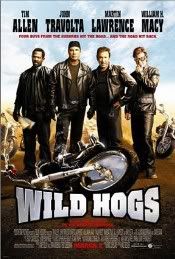 Director: Walt Becker
Cast: Tim Allen, John Travolta, Martin Lawrence, William H. Macy, Marisa Tomei, Jill Hennessy, Ray Liotta
Release: March 2, 2007
Synopsis: Tim Allen, John Travolta, Martin Lawrence and William H. Macy hit the road in this rollicking comedy-adventure about a group of middle-aged friends who decide to rev up their routine suburban lives with a freewheeling motorcycle trip. Taking a long dreamed-of breather from their stressful jobs and family responsibilities, they can’t wait to feel the freedom of the open road.
When this mis-matched foursome, who have grown far more used to the couch than the saddle, set out for this once-in-a-lifetime experience – they encounter a world that holds far more than they ever bargained for. The trip begins to challenge their wits and their luck, especially during a chance run-in with the Del Fuegos, a real-life biker gang who are less than amused with their novice approach. As they go looking for adventure, they soon find that they’ve embarked on a journey they will never forget.
View Trailer:
* Large (QuickTime)
Prognosis: Can’t Someone Protest This Film? Perhaps Appeal To The Hague? I don’t do this often but I was struggling to find what angle to come in at this and I found something that perfectly couches the rest of the explanation below.
[Taken from 1996’s TRAINSPOTTING. Used without permission but attributed thusly]
Sick Boy: It’s certainly a phenomenon in all walks of life.
Renton: What do you mean?
Sick Boy: Well, at one time, you’ve got it… and then you lose it… and it’s gone forever. All walks of life: George Best, for example. Had it, lost it. Or David Bowie, or Lou Reed…
Renton: Some of his solo stuff’s not bad.
Sick Boy: No, it’s not bad, but it’s not great either. And in your heart you kind of know that although it sounds all right, it’s actually just… shite.
I just don’t know what to make of this steaming pile of box office poison.
When you’ve had guys who have obviously done well for themselves years ago in great films: PULP FICTION, FARGO, BOOMERANG (I know, it’s stretching) and even mass-consumed sitcom pap like Home Improvement was a commercial success by any staunch critic’s list of popular sitcoms in the 1990’s.
Now, when you harness these guys who are on the downslide of their careers, Bill Macy being the one big pink elephant anomaly of the bunch, you have something that looks like a schmear of the thickest cream cheese and dick.
I can appreciate, though, the opening. I can. This is a film that needs to connect with my parents, not so much me, so for that it wins points for being knowledgeable of who its audience is supposed to be and doesn’t reach any further. I mean, hell, Travolta giving shit to the leaf boy is the kind of absurd, sophomoric funny-funny that moms and dads love; it’s a great hook.
Macy comes in, then, and notches the cock humor up a notch by having a big public display of misunderstanding not seen since the anticipated release of Windows Vista and its voice command capabilities. Again, it’s absurd, goes straight to the lowest common denominator and leads perfectly to Lawrence and Allen’s failed amusement park game where, surprise surprise, Allen gets a wayward softball in the nuts.
Can’t we stop with the obligatory nut shots? Hasn’t America’s Funniest Home Videos taught us anything about the shelf-life for this kind of gag? I guess if you’re white and over 40 it never gets old.
Speaking of which, I don’t know how we get from crotch shot to motorcycle ridin’ to the recent Top 40 chart topper, Collective Soul’s “Shine”, (Is that the best that some wag in the audio department could do? The song doesn’t even have anything to do with motorcycling yet, here it is, providing the soundtrack to our lives”¦) but I do know that the one laugh I will admit to having at the expense of this trailer is Bill Macy’s stunt double who wipes the fuck out after unsuccessfully executing a fist pump. (Physical humor that might be at the detriment to some sap’s health? Now that’s funny.)
Awful stereotypes follow of what it’s like to ride a combustible engine with no windshield to protect you from cow crap or wayward birds (???) but I am ballasted by John C. McGinley’s appearance at the end of this thing; It’s hard to try and resist the power of this poorly ignored actor. He’s great but the movie looks like all sorts of ass.
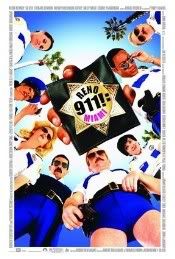 Director: Ben Garant
Cast: Thomas Lennon, Carlos Alazraqui, Robert Ben Garant, Kerri Kenney-Silver, Wendi McLendon, Niecy Nash
Release: February 23, 2007
Synopsis: The brave men and women of the Washoe County Sheriff’s Department — the thin khaki line that keeps Reno, Nevada on the straight and narrow ““ star in their first feature film, based on the hit Comedy Central television series. The deputies of the Reno Sheriffs Department attend a law enforcement convention in Miami Beach, where the motley crew is charged with protecting the city after bioterrorists attack the convention.
View Trailer:
* Large (QuickTime)
Prognosis: Made Me Laugh Over and Over. I am sorry, I am sorry. I am sorry.
One of the best parts of Comic-Con 2006 was being allowed to be a fly on the proverbial cow patty that was an interview my EIC had with Thomas Lennon and Ben Garant. The two stars of Reno 911 couldn’t have been more affable and enjoyable to talk to on a Sunday morning. The guys go beyond just sharing a brain, they share something you rarely even see in normal life: a bond. They seemed genuinely pleased to be in one another’s company and you could see why the show does as well as it does. When you’re doing any sort of ensemble project it’s utterly necessary to have faith in one another and it showed.
That said, the opening of this trailer is, perhaps, one of the best for a comedy I’ve seen in months. Forget all that voiceover bullshit at the beginning as throaty VoiceOver Guy tries to bait-and-switch, I think we all could agree that we’re all wise enough to know it’s a waste of all of our time to try and sell an action movie and then, ta-da, give us something else; it’s, frankly, in poor form and a piss poor attempt at comedic trickery. When we meet up with Dangle and Junior, Junior snapping out of a nap while behind the wheel, it’s not so much Dangle making it known that Junior shouldn’t be sleeping while driving, and it’s not so much the port-a-potty that they barrel into in one long tracking shot (because that was fucking hilarious) but it’s Dangle’s “nobody in it” that gets the payoff from me.
Further, the task of bringing up everyone who isn’t familiar with the show up to rapid speed is done quite successfully with the chicken that’s on the loose as Dangle nearly blows his foot off, Junior’s comparison of Reno to Mayberry is done without a drip of irony and then a hazed Junior walking into a door jamb whilst carrying a cigarette between his lips completes the trifecta.
I don’t know how else to say that even though the plot kind of hinges on the outrageous premise that a hotel has to be quarantined and that Reno 911’s cops are the only ones left able to patrol but the shot of the cars leaving the garage and one of them being T-boned inadvertently, probably Junior again, makes for some good humor.
I, as well, enjoyed the snippet of Dangle investigating a noise complaint from the residence of “a Suge Knight” and the alligator moment that, for me anyway, surprised even me; the results of which are where the real comedy comes from and this doesn’t look to disappoint in any way.
Plus, two things that would be awful if I had to explain why they were funny: Kerri Kenny’s mishap in the po-po helicopter and Junior’s “mishap” with a dead whale. Comedy platinum.
I’m sorry I haven’t kept up with this show on my Tivo. This problem will be rectified immediately.

Hannibal Rising is like a pretty model at a fashion show – she’s alluring until she opens her mouth.
If Hannibal Rising had simply kept quiet, its icy surface might have been alluring. But the film finds that it must explain, express emotion, tell us what it thinks and what we should think. As soon as the blank calm of the film is broken by real (or “real”) emotion, the audience begins to titter.

It’s well known that novelist Thomas Harris has either cynically or through personal inclination drifted away from portraying the hardships and psychological cost of being in law enforcement. In his first book, Black Sunday, weight was evenly distributed between hunters, a coalition of FBI and Israeli agents, and the hunted, terrorists targeting the Super Bowl. In the Hannibal Lecter series that more or less began with Red Dragon, where Lecter was a minor character and really a part of the back story, Harris has shown himself to be increasingly fixated on Lecter. In The Silence of the Lambs he bubbles back up to the surface like an old tire in a garbage dump, taking possession of both the book and the movie made from it (a film which still maintains its regal priority over other adaptations by hewing closing to a semblance of reality). Its two sequels, Hannibal and now Hannibal Rising (a film written by Harris and released just a few months after the book on which it is based), are virtually all Hannibal, with diminishing returns. Ridley Scott and his collaborators wisely changed the ending of Hannibal the book. There, Clarice Starling became the drugged love slave of Lecter. In the film he escapes her clutches, sans a hand, to do battle with her again in some future yet unimagined continuation.
But instead of going forward, Harris has spun backward, into the past, first with a remake of Red Dragon that makes it reasonably consistent with Silence, and now with this evocation of Hannibal’s career up until his arrival in America. In essence he is going over already chewed fat. Hannibal Rising is an expansion of material already covered in the course of Hannibal. It results in a justification and apologia for Hannibal’s wicked ways.

Told strictly chronologically, Rising introduces us to the aristocratic Lithuanian Lecter family, fleeing the advance of, it appears, both the German and the Russian armies. Hiding out in their country lodge, which seems to be about two miles from their castle, the bulk of the family is cut down by a coincidence of both Germans and Russians. Alone with his beloved sister Mischa (there is no hint here of incest), Hannibal tries to survive but the lodge is soon invaded by Nazi aspirants, roving scavengers who, in a fit of dietary pique, consumed Mischa.
The rest of the film is a long revenge narrative, with Hannibal receiving some mentorship here and there as he methodically hunts down the five crude gourmands. As is to be expected in such tales, the kills start easy and increase in hardship as the villains become more complex and evil. In the end he heads off to Canada to cancel his final foe (which we don’t see) and the last shot shows his car merrily driving off, presumably to the American border, where he will eventually end up in Baltimore.
The film is an elaborate cat and mouse game, with Lecter down for a while, before getting a great boost from a near relative, Lady Murasaki Shikibu (Gong Li), who gives him martial arts lessons among other things. Lady Murasaki Shikibu is the modified, modern “conscience of the film, shrinking when Hannibal goes too far. Her equivalent is the Nazi hunter Inspector Pope (Dominic West), who is in competition with Lecter to find Mischa’s killers first. The result of the cat and mousiness, however, is that Lecter is imbued with moral certitude and higher justice on his side. This is hard to reconcile with both the sheer scary evil of the character in Red Dragon, and with the moral compass we are used to in movies. Maybe Lecter is a great guy, riding the world of “free range rude,” but in the end is little more than a more dynamic, physically stronger version of the cranky older teacher in Notes on a Scandal.

Problems with the film come in such moments as when the adult Lecter (Gaspard Ulliel, of A Very Long Engagement) dons a samurai mask off of a dummy in Lady Murasaki’s storeroom. Harris and / or director Petter Webber (The Girl with a Pearl Earring) seem to think that we all require this evocation of Silence, and its famous bite-prevention face wear. But this is a mask that he puts on intentionally, to commune with the spirits of samurai warriors. The first mask was designed to make transfer easier on his carriers. He didn’t like the prison mask, but seems to like the samurai mask. These confused intentions, or inability to maintain consistency with the materials at hand has always been one of the problems with the Lecter books and films, born perhaps from Harris’s adopting the villain as an avatar for his own cranky opinions on modern life.
Ulliel’s unusual visage, long and lean, evokes less Mr. Lecter than Mr. Sardonicus, or the Joker. He’s got a half moon of a dimple or scar on his left cheek and a smile that sharpens instead of curves. I think he is a good actor, but this is an impossible role, one already acted by two of Britain’s top actors. But by shearing any moral ambiguity from Lecter, Harris and Co. have reduced the character to a straw man, half-hero and half-villain and impossible for probably most actors to portray, what with so many fussy hands molding him and so many audience expectations. True connoisseurs of the villain will probably, as this slow-paced, glacial, and ultimately irrelevant film progresses, feel their tempers rising.

The weekend’s here. You’ve just been paid, and it’s burning a hole in your pocket. What’s a pop culture geek to do? In hopes of steering you in the right direction to blow some of that hard-earned cash, it’s time for the Quick Stop Weekend Shopping Guide – your spotlight on the things you didn’t even know you wanted…
 Long before Comedy Central’s The Daily Show was a glimmer in creator Lizz Winstead’s eye, there was another program that brilliantly satirized programs like 60 Minutes and 20/20 – it was Michael Moore’s TV Nation. One of the TV Nation correspondents that caught my eye was a Brit by the name of Louis Theroux, whose segments included memorable visits with the “new” Klu Klux Klan and NRA rocker Ted Nugent. In fact, it was exactly those profiles of subculture and celebrity that Theroux would explore with his post-TV Nation series Louis Theroux’s Weird Weekends, which originally aired on Bravo in the US and the BBC in the UK. In it, Louis traveled around America, seeking out and trying to make sense of fascinatingly oddball American subcultures such as professional wrestling, rappers, swingers, UFO enthusiasts, etc. In addition, he’s spent face-to-face time with various unique, somewhat eccentric celebrities in his series When Louis Met…. Sadly, the Best of Louis Theroux’s Weird Weekends volumes available in the UK have not made their way to the US yet, but his recent companion book thankfully has. The Call of the Weird: Travels In American Subcultures (Da Capo Press, $24.00 SRP) finds Theroux following up on some of the subjects of those Weird Weekends, and it’s a positively wonderful read. I just hope that a network in the US sees fit to begin airing his work Stateside – particularly as he’s just begun a brand new series of specials for the BBC, the first of which took him to Las Vegas in an effort to understand the siren call of gambling.
 After a long and storied career, Martin Scorsese proves that he’s still got what it takes with his adaptation of the Hong Kong crime thriller Infernal Affairs, The Departed (Rated R, DVD-$34.99 SRP). Not since Goodfellas has Scorsese made a film that positively crackles – from the script to the cast and Scorsese’s direction itself, which holds it all together. Here’s your quick plot primer – the state of Massachusetts is keen to finally take down crime boss Frank Costello (Jack Nicholson), and they plant a rookie cop (Leonardo DiCaprio) into Costello’s organization to feed them info to bring it down. What they don’t know, however, is that a rising rookie in their own department (Matt Damon) is a mole for Costello – and what follows is a marvelous series of double-crosses, feints, bluffs, and pure cinematic joy. It’s great to see a filmmaker reclaim their crown, and with this flick, Scorsese most certainly has. The 2-disc special edition features 9 additional scenes (with intros from Scorsese), TCM’s career profile of the director, a featurette on the real-life mobster that inspired Nicholson’s character, a look at the early neighborhood influences of Scorsese’s work, and the theatrical trailer.
 Of course, now that you’ve viewed Scorsese’s take, I’d recommend you grab yourself a copy of the original via the handy all-in-one Infernal Affairs Trilogy box set (Genius, Rated R/Not Rated, DVD-$39.99 SRP). All three films in the trilogy are loaded with bonus features, including behind-the-scenes featurettes, trailers, deleted scenes, and even a commentary (on Infernal Affairs 2).
 Oh, and while you’re at it, pick up the new special edition of Jackie Chan’s incredible Police Story 2 (Genius, Not Rated, DVD-$19.95 SRP), featuring an audio commentary, interviews, behind-the-scenes featurettes, outtakes, trailers, and more.
 It’s an oft-told tale, but documentarians David Leaf & John Scheinfeld (who also produced the criminally unseen doc Who Is Harry Nilsson & Why Is Everybody Talking About Him? – look it up) have managed to create an illuminating, engaging, altogether fresh take on the legendary case of The US Vs. John Lennon (Lionsgate, Rated PG-13, DVD-$27.98 SRP). If you’re unaware of this slice of Lennon history, it was the multi-year struggle against the U.S. government to stay in his beloved New York and avoid deportation – a politically motivated action due to Lennon’s fiercely public antiwar stance. The DVD features additional cut footage and interviews.
 While many have compared Clint Eastwood’s American side of his Iwo Jima chronicle unfavorably to the Japanese-centered Letters From Iwo Jima, Flags of Our Fathers (Paramount, Rated R, DVD-$29.99 SRP) is just as assured a film, and in may ways is more honest in its portrayal of war and the sacrifice and the accomplishment of the soldiers on the ground than Spielberg’s far bigger and more expensive Saving Private Ryan. That unadorned, matter-of-fact portrayal is an Eastwood hallmark, and a much welcome one in a flick that portrays an iconic battle in military history. Here’s hoping a future edition makes up for this bare bones release – it deserves a bevy of supplemental material, particularly of a historic nature.
 As much as I enjoyed the deluxe, lavishly-illustrated behind-the-scenes chronicle of costuming in the Star Wars franchise courtesy of last year’s must-have tome Dressing a Galaxy, there’s no denying that I was even more geekily jazzed by this year’s companion volume, Sculpting A Galaxy (Insight Editions, $50.00 SRP). The title is rather self-explanatory, but if you’re having trouble figuring it out, this equally massive tome spotlights all of the intricate, maddeningly meticulous model and creature work featured in the dual trilogies.
And on the subject of that meticulous work, Sideshow – as part of their distribution agreement with Japan collectible manufacturer Medicom – has been importing select items from their line of “VCDs” (Vinyl Collectible Dolls). The latest of which is a tribute to those amazing special effects mavens – Stuart Freeborn, in this case – who brought Yoda to life. The Medicom VCD Yoda ($59.99) stands approx. 4″ tall, and is in scale with Sideshow’s 12″ Star Wars line. And, as you can see from the pictures below, the sculpt, clothing, and paint job are amazing.

 Warners has more themed releases than you can shake a stick with, including their banner “Signature” collections, and to that impressive pedigree you can add their new “Director’s” series. The inaugural quartet consists of some quality titles – Nicolas Roeg’s Performance, Fellini’s Ginger & Fred, Neil Jordan’s The Butcher Boy, and Tony Richardson’s The Loneliness Of The Long Distance Runner (Warner Bros., Rated PG-13/R, DVD-$19.98 SRP each). Bonus features on Loneliness and Ginger & Fred are limited to the original theatrical trailers, while Performance sports both brand new and vintage behind-the-scenes featurettes, and Butcher Boy has an audio commentary from Roeg and additional scenes.
 A perfect companion piece to This Film Is Not Yet Rated, producer/director Steve Anderson has produced a beautiful portrait of a word that can cause the faint of heart to flutter and the closed of mind to blow their tops – FUCK (Thinkfilm, Not Rated, DVD-$19.99 SRP). With animation from Bill Plympton and an amazing list of commentators – including Billy Connolly, Drew Carey, Janeane Garofalo, Bill Maher, Hunter S. Thompson, Kevin Smith, and more – it’s worthy subject and worth a spin. Bonus features include an audio commentary, extended interviews, deleted scenes, and more.
 While Philip Seymour Hoffman’s turn as Truman Capote got most of the buzz, I think the largely overlooked (by nature of losing the race to the screen) Infamous (Warner Bros., Rated R, DVD-$27.98 SRP) features a much more nuanced performance from Toby Jones as the larger-than-life author whose journey to write In Cold Blood forms the crux of this outing as well. Bonus features include an audio commentary and the theatrical trailer.
 Better than both Ocean’s 11 & 12 combined, the second series of the UK’s con drama Hustle (BBC, Not Rated, DVD-$34.98 SRP) is just as engagingly high energy and intelligent as its inaugural run. Heck, any series smart enough to cast Robert Vaughn as an aging pro is aces in my book. The 2-disc set features all 6 episodes, plus an in-depth documentary on the smashing final episode.
 The 6th season of All In The Family (Sony, Not Rated, DVD-$29.95 SRP) was to prove to be a transitional one for the show, setting the stage for a major shake-up to come. That major event was Gloria’s pregnancy, coupled with Mike and Gloria moving out of the Bunker household and into the house next door (which would eventually lead to the Stivics departing the show altogether). Regardless of what was to come, this was still a banner year for the show, and still consistent with the incredible level of quality they were able to maintain for the bulk of the show’s legendary run. In particular, the episode “Joey’s Baptism” is a true classic, and one of the series’ most powerful. The 3-disc set features all 24 episodes, but no bonus features. Is it that hard to get Sally Struthers on the line?
 Few thought that something as off-the-beaten track as a prime time soap about, well, about the surprisingly romantic adventures of Beauty and the Beast (Paramount, Not Rated, DVD-$50.99 SRP) would ever fly on network TV, but fly it did, as millions of viewers tuned in to see the blossoming romance between the noble man-beast Vincent (Ron Perlman, in his breakthrough role) and assistant New York D.A. Catherine (Linda Hamilton). Long after Dark Shadows left the airwaves and before The X-Files made odd chic, there was the star-crossed adventures of Vincent and Catherine – the complete first season of which is now available on DVD, sans any bonus features whatsoever. Not even a make-up featurette! I do want to point out, though, how much I love the case the set comes in – it features all 6 discs, safe and secure, in a regular single-disc size case. Brilliant!
 Though it sank from sight rather quickly, there’s an endearing, oddball charm to School For Scoundrels (Genius, Not Rated, DVD-$29.95 SRP), starring Jon Heder as a unconfident schlub who enrolls in the confidence-building seminar of a decidedly extreme Billy Bob Thornton – only to have the lessons turn into a quickly escalating all-out war between the two of them to prove who’s the manliest. The unrated special edition features additional footage, an alternate ending, audio commentary, a making-of featurette, gag reel, and the theatrical trailer.
 Long before ER brought viewers into the high stakes, adrenaline-loaded atmosphere of emergency rescue and the emergency room itself, there was a little show in the 70’s called Emergency! (Universal, Not Rated, DVD-$39.98 SRP), which followed paramedics Ray DeSoto (Kevin Tighe) and John Gage (Randolph Mantooth) as they arrive at scenes of near-death and often violent destruction, and must get their patients to the doors of Rampart Hospital alive. Great stuff. So pick up the complete third season, now available.
 If you’d like your weekend to lean a little bit more high-brow, partake of a pair of BBC miniseries making their way to DVD, the first of which is World War II: When Lions Roared (Koch, Not Rated, DVD-$29.98 SRP), whose biggest selling point is its cast – Michael Caine as Stalin, John Lithgow as Roosevelt, and Bob Hoskins as Churchill. Also available is the Beeb’s epic adaptation of James Fenimore Cooper’s The Last of the Mohicans (Koch, Not Rated, DVD-$29.98 SRP). Both are worth a spin (although my preference will always lie with the powerhouse trio of Roared).
 Are we already at the end of The Golden Girls on DVD? Well, with the release of the seventh and final season (Buena Vista, Not Rated, DVD-$39.99 SRP), it certainly seems we are. In addition to all 26 episodes, the 3-disc set also contains the retrospective documentary Thank You For Being a Friend: A Look Back With The Golden Girls.
So there you have it… my humble suggestions for what to watch, listen to, play with, or waste money on this coming weekend. See ya next week…
-Ken Plume
##


Here are today’s top entertainment headlines:
 Tickets to this year’s Coachella Valley Music and Arts Festival have already sold out, two months before the event. The news has left local drug dealers scrambling to bolster their inventory while local shop keepers have been forced to remove “unwanted yet essential” items, like soap, from the shelves to make room for more Doritos, Funyons and Oreo’s.
That’s all for today’s news, stay tuned to this channel for all the news that matters least but you still care about.
(Compiled by J. Allen)
##

The web. It’s a big place, full of plenty of distractions ““ some funny, some informative, some ludicrous, some disturbing, some inane, some profound. Each and every weekday, we present links to a few of our favorite finds”¦
Have a THINGAMABOB? Send it in!
##


It may not be a trip to the mountains, but a visit to Hembeck.com is ALWAYS a vacation – and remember, footwear is optional!
-Copyright 2007 Fred Hembeck

Guten Morgen sehr geehrte Damen und Herren! Welcome back to another edition of Music for the Masses. Now, before we begin, I’d like to announce to you all that… umm, I think I might be the father of Anna Nicole’s baby. Seriously. I mean, who’s to say that Anna Nicole didn’t sneak into my room one night, accidentally trip and land twat-down on my “Maria Sharapova/Kate Beckinsale/Lindsay Lohan” sock that I keep next to my bed?

Tennis hasn’t been THIS sexy since Boris Becker retired.

The Cat Empire
Album: Two Shoes
Sounds like: Two Cats fuckin’… a skinny, funky-smelling latin one and a nappy-looking, pot-smoking rasta cat.

Seriously… I’m not joking when I tell you that I fucking (yes, I just typed “fucking”) hate cats. I always have. There really is no “defining” moment here and no, “I’m not allergic” which is really just code for “I hate your fucking (yes, I just typed “fucking”) cat.” Why do I hate these creatures of the night/pure evil? Hmmm… interesting question. You know, I can’t quite put my finger on it, but I CAN tell you that the loathing started after I first witnessed, at a tender young age, the way a cat can make it’s butthole “wink” as it walks out of a room. I’m convinced that’s a cat’s way of saying “fuck you” and, besides, it’s “Creepy” with a capitol “K.” What??!! Oh… come on now, don’t “pretend” you’ve never seen a kitty’s “stinkin’, blinkin’ balloon knot. “That’s like telling your girlfriend/wife/mom that “you’ve never jacked off.” Remember kids… Satan and Anna Nicole are reserving a special place in hell for liars.

Whatever. But as much as I may hate these corn-hole flaunting little bastards, (no, silly… not Satan or Anna Nicole…the cats!!) I can honestly tell you that I have never been compelled to exact revenge on one… unlike my buddy Tom. But more on that in a minute. First, we have to exact revenge on ANOTHER type of cat… The Cat Empire. How’s that for a segue? Slicker than shit through a goose, eh?

The Cat Empire
Sooo… as the minority of you heard on last week’s pod cast, the U.S. debut of Australia’s very own and EXTRAORDINARILY successful, The Cat Empire, dropped last week and was, without a doubt, one of the new releases in February (or as my retarded cousin likes to call it… “HNNNNGGGHHH”) that I was greatly looking forward to. “So,” I’m sure you’re asking, “how did Two Shoes fair, M.C.?” Well, my fine young cannibals… I’m glad you asked.

The Cat Power
Two Shoes is, without a doubt, one of the most uneven and disappointing discs I’ve heard in quite some time. There are some exceptionally melodic and endearing moments here, as well as some groovy beats and rhythms, but nothing on this new disc comes close to being as infectious as the band’s first hit, 2003’s “Hello.” Consistent with their previous outings, the music on Two Shoes is an enthusiastic combination of ska, funk, latin, humor and hip hop, and again, The Cat Empire gets high marks for “mixing things up.” However, the combination of “mixing things up,” typically tired, British reggae-affectations, odd time signatures and Felix Riebl’s mediocre vocals (see “In My Pocket,” “Lullaby” and “Saltwater”) proves more toxic than intriguing on this particular outing.

The Cat Stevens
If you are looking for a silver lining here, the six piece PLUS ensemble (featuring Oliver McGill on keyboards, Riebl on drums/vocals, Ryan Monroe on double bass, Harry James Angus on trumpet, Will Hull-Brown on drums, DJ Jamshid “Jumps” Khadiwala and various other horn players, dancers and guests) does offer up a few outstanding tracks, specifically, the album opener “Sly,” “The Car Song” and the Santana-esque “Sol Y Sombra.””Unfortunately, the majority of the tracks come off sounding like muddled outtakes from a Sublime recording session, pre-Brad Nowell’s-untimely-heroin-overdose. If you are looking for unique, especially in the realm of latin/reggae fusion, The Cat Empire’s Two Shoes is ABSOLUTELY your disc. Ummm. . .emphasis on “unique” there. If you are looking for “time-less” and “ultimately listenable” ska in the vein of a Tosh or a Marley or hell, even a Sublime, skip this fucker like an episode of “Studio 60.”

So, as I was saying before we were so RUDELY interrupted, my buddy Tom had an asshole roommate in college who had an even bigger asshole of a cat. According to Tom, the cat was “just a dick,” assuming cats can be such things, and had taken up the nasty habit of pissing in, on and around Tom’s room/things. Ever smell cat piss? Yeah, well, understandably, this didn’t sit well with my buddy Tom.

Even the cat couldn’t stand the smell of it’s own piss…
So, after cleaning up after the hairy little fucker for the umpteenth time and realizing that no level of Febreeze® was going to remove this special brand of “pussy stank,” Tom decided that it was time for the cat’s owner to do “a little cleaning up.” So, without further ado, my pal dropped trough and took a mighty shit in the cat’s litter box. Now, this part of the story is merely conjecture, but I’m guessing that the entire time, Tom is thinking “yeah buddy… scoop THIS up with your little, slotted spatula!!”

But Tom wasn’t done for, as many of you may or may not know, after dropping a nutty, fat kid into the cat’s pool, one is in need of a wipe. And THAT is EXACTLY what Tom did… with his roommate’s “face only” towel… using a hearty, front-to-back/back-to-front sawing motion…before refolding the towel neatly on the rack to hide the offending stain. Now, I’m not sure what happened with that towel, but I do know the roommate entered the abode and spied that mighty loaf perched atop the mound of TidyCat®; never ONCE suspecting it was human fecal mater in his kitty shitter. And, much to Tom’s chagrin, the roommate did not immediately pluck that gargantuan turd out of the box with the afore-mentioned slotted spatula and vow to amend his ways.

On the contrary, the roommate screamed like a chick, sobbed hysterically and whisked the cat off to an emergency vet clinic. Now, in all fairness to this clown, if I had a cat and I saw a mythically-sized turd wedged in it’s box, I’m not sure I’d immediately think, “Hey… somebody shit in my cat box. No fair! Oh well, I guess I’ll scoop it up and keep a better eye on the cat!” but I guess we’ll never know. I’ll tell you this, though, where I, too, would have most likely assumed that there was something tragically wrong with the animal, I guarantee you I wouldn’t have screamed like a chick. But I digress.
So friends, what’s the moral of this story? Honestly, I have no fucking clue, but I’ll tell you this… don’t fuck with my buddy Tom. Oh yeah, and if he comes to visit? After he leaves, burn your towels.


Me likey the Wu-Tang Clan. I always have too. Back in the day when all the kids I knew were into Extreme or god knows what else, I was bumpin Wu Tang’s Forever. I never went as far as to buy any articles of Wu Wear, but I have bought enough of their CDs to feel somewhat financially responsible for Ol’ Dirty Bastards drug habit and eventual death. Sorry Dirt. Anyways, as far as the Wu-Tang Clan goes, it’s been a pretty tough run over the last several years. Sure we’ve seen some great discs released by individual members, but nothing really from the group as a whole. That is until now. Well, kinda.

To call Mathematics Presents Wu-Tang Clan & Friends: Unreleased a true Wu-Tang release is stretching it a bit. Yes there are several tracks with Clan members on it and there are even two tracks with at least four members on it, this just doesn’t seem like a Wu-Tang record. I’m not saying that this is bad, far from it. It just doesn’t have the same magic that the previous records have had. Maybe it’s the fact that The Rza had nothing to do with the production. Maybe not.
I can say that there are no bad songs on this album, but some definitely stand out more than others. Oddly enough, most of the songs that feature a Clan member are good, especially the Wu-Tangy track “Wu Banga Remix,” which features Gza, Ghostface Killa, Raekwon, Cappadonna and Masta Killa. Out of all the “& Friends” there really isn’t much that is really gripping. “Wanna Believe” by Allah real and Bad Luck is the best track without the Wu.

Be it the orange drink preferred by (non diaper wearing and pepper spraying) astronauts, or the slang for a ladies Va-J, I’m totally down with the Tang. Luckily, if this album gives us a clue into what the future holds for the Wu-Tang Clan, the groups next album just might be the greatest rap album ever created. Well, at least the greatest rap album that ODB didn’t have a part in.


Reverb. . .with J.D.
Last Sunday night, JD watched the Grammys”¦every last soul-sucking moment of it. Here then, is his blow-by-blow account:
7 O’Clock Hour:
–Ladies and Gentlemen, opening the show tonight”¦.The Police! Like everyone else I can’t wait to see how well the Gibb brothers have aged”¦.especially Sting Gibb.
–Song choice: “Roxanne”. Wow! Who would have guessed??
–Sting really seems to have a special glow about him tonight – either he’s delighted to be back with his boys, or he just had sex for eight hours.
–The person happiest about this little reunion has to be Policeman #3. Sting sold out to Madison Avenue ages ago and Stewart Copeland at least had a nice little run with the supergroup Oysterhead. Andy Summers though – you’d have to think that his royalties from Zenyatta Mondatta dried up a long time ago.

The Police in younger days
******
–Tony Bennett and Stevie Wonder take down the first award, and Stevie’s voice breaks as he dedicates the award to his mom. Geez, we’re only 4 minutes into this thing and I’m already choked up.
–Tony follows that up by slipping in a plug for “Target, the best sponsor of my life” during his acceptance speech. So much for the tender moment.
******
–Next up, The Dixie Chicks, performing “I’m Not Ready To Make Nice.” I’m going to bypass the obvious fashion/talent/Natalie Maines jokes here and give them a begrudging tip of the cap. They faced major public vitriol in 2003, all on account of Maines making a disparaging comment about President Bush – ‘fans’ bulldozed their CDs at a demonstration against them and country radio stations banned their music from the airwaves. But regardless of what you think of them, this actually kind of sucks”¦given, you know, The First Amendment and all.
–Not to mention Duhbya’s current approval ratings”¦but I digress”¦
******
–Back from a commercial, we have our first surprise guest of the night: Prince!
–As I’ve mentioned before, he is one stylie mofo – except tonight it looks like he borrowed Nicole Richie’s sunglasses”¦and hairstylist.
–(Does anyone else ever wonder how many women Prince ‘purified in the waters of Lake Minnetonka’ before he got all Jehovah witnessy on us? I’d like to know.)

We know Appollonia was baptized
–He introduces Beyonce, who sounds and looks as beautiful as ever. A nation of men simultaneously curses Jay-Z.
******
–In the best R&B song category, Mary J. Blige beats a fine field (Prince, Jamie Foxx, India.Arie, and Lionel Richie) for the win–and takes the early lead in the clubhouse for longest acceptance speech. She spilled into the ‘exit’ music by at least 30 seconds”¦I was sure they were going to bring Chuck Barris out on her”¦

That’s “Gong Show” Chuck Barris”¦not “Assassin” Chuck Barris
******
–Our next presenter is Queen Latifah – voice of the Pizza Hut commercials! From the looks of things, it appears that they pay her in P’zones”¦.handsomely”¦.
******
–Justin Timberlake hits the stage. Say what you what you want about JT, but he’s no cheeseball bubblegum popster, a la Britney or Clay Aiken. He’s cool, and a legit talent.
–Okay, right after I wrote that, he breaks out the “JT Cam,” filming himself performing with a handheld video-cam. Thank you, JT, for promptly refuting my ‘he’s cool, not-a-cheeseball’ argument.
–Okay then, how about this? Cameron Diaz and Scarlett Johannson.
–(Jerk.)
******
–Pink comes out to present a Lifetime Achievement Award to The Doors.
–(I’m afraid to make any jokes about Pink).
–Someone named “T.I.” follows that up with an unintelligible segue into the Best Soul Female R&B Performance.
–Excuse me, stewardess”¦.do you speak jive?
******
–MJB wins again. I love Mary J. and all, but if we have to sit through her fake tears all night, I might have to reconsider.
******
8 O’Clock Hour:
–Stevie Wonder introduces Corrin Bailey Rae, John Legend, and John Mayer.
–Somewhere out there, MC Bell is jumping up and down in anticipation of Mayer playing “I Wanna Run Through the Halls of My High School”¦”
–Everyone brags about John Mayer’s prowess as a blues guitarist, and he shows off some impressive chops here”¦but I’m sorry, the Statute of Limitations on “Your Body Is A Wonderland,” “Daughters,” and “The High School Song” has NOT run out. It’s going to take a while.

Sorry, White Boy”¦your reincarnation as a Blues Man is going to have to wait.
–Mayer wins the next award, and thanks Michael McDonald first. That explains a lot.
–p.s. He’s also dating Jessica Simpson.
–On the bright side, though, how about Corrin Bailey Rae?? She’s a siren!
******
–Before the commercial break, they tease the upcoming Shakira performance, which inspires the following quote from my buddy Wolfeman: “Oh, Shakira, please wear something nice.”
–Shakira comes on”¦and our wish has been granted! She’s in a tube-top and is busting her Egypto/Latina belly-dance thing”¦and it is HOT! Wyclef Jean can hardly keep himself from rubbing up on her. He’s adjusted his junk three times already – I’m not even kidding.
–I’m in love! (With Shakira I mean”¦)
–CBS cameras cut straight from her performance to a shot of The Dixie Chicks. That’s one way to cool things off real quick.
–Next up, Burt Bacharach makes a pass at Seal. The Shakira fire has officially been extinguished.

Shakira tiene una moda muy sabrosa.
******
–Two ladies from “How I Met Your Mother” (??) introduce The Grateful Dead as Lifetime Achievement Award winners. Hippies everywhere regurgitate kind rainbow goo-balls in their mouths. Wasn’t Bill Walton available?
–Good try by The Grammys though. And nice footage of Jerry Garcia and Pigpen.
******
–Now the song you’ve all been DYING to hear”¦.”Crazy,” performed live by Gnarls Barkley!! Seriously, they should play that song more often.
–Okay, okay”¦I’ll admit it. Best song of the millennium so far.
******
–Afterwards, cutaway #7 to the three finalists for the “My Grammy Moment” award”¦(a.k.a the “Let’s Rip Off American Idol Contest”).
–The young ladies once again hold hands and preen for the camera, inspiring The Wolfeman to say “I hope they start making out!”
–It’s official: Grammy loopiness has set in upon us.
******
–Next presenters are Common and Kanye “George Bush Doesn’t Like Black People” West. This could be fun.
–Alas, no such luck. However, during his acceptance speech, Ludacris–best-dressed man of the night–thanks Bill O’Reilly and Oprah! That was worth it.
******
8:30 pm
–Okay, confession time. This is not a ‘live’ blog. We tivoed it. And this is the point of the show where things went CAREENING downhill. So let’s just play Tivo and fast-forward through the ‘highlights’:
Another PYT camera shot (alas, no making out). MJB performs. Dixie Chicks win again–Natalie Maines quotes Nelson Munsch in her acceptance speech (Please”¦make it stop”¦). Reba McEntire introduces a “Roots of Country Music” medley, then wipes ‘Red Man’ off her chin. Carrie Underwood – meow – sings an old-time country song. (Sadly, no camera shots of the crowds’ mass exodus to the restroom). Then, the low point of the night: Rascal Flatts does their best bar-karaoke version of “Hotel California.” The lead singer plays air-guitar at the end”¦ and there’s three minutes of our life we’ll never get back. How in the hell are these guys popular?? Oh wait”¦.NASCAR crowd”¦Now Carrie Underwood does “Desperado.” It looks surprisingly nice on ‘mute!’ Then, more “Guantanamo Bay Torture Music” from Rascal Flatts”¦ I’m pretty sure he’s singing “Life in the ‘Fat’ Lane.” Ladies and Gentlemen, The Roots of Country Music”¦ featuring The Eagles! The Grammys sure have their fingers on the pulse of music.
On a positive note, Lionel Richie is coming up (Thank God!!). In the meantime, Samuel L Jackson comes out in a beret”¦again. When the hell are his male buddies going to have a ‘beret-intervention’?? He introduces Smokey Robinson, who manages to move his lips through the Botox, a very impressive feat. And finally, Lionel”¦.and he’s singing “Hello”!! I couldn’t be happier. That’s followed by youngsters in Mexi wrestling masks, breakdancing. Very upsetting. But in keeping with the manic, up-and-down pace, Christina Aguilera comes out for a James Brown tribute”¦ resplendent in a white camel-toe suit, she KILLS “This is a Man’s World.” Afterwards, you can see Jamie Foxx nodding and saying “That was good stuff right there.” Can we just pretend like the Rascal Flatts thing never happened?
The ‘in-memoriam’ segment is next, properly capped off by a stylish tribute to James Brown. They hang his “Godfather of Soul” cape on a microphone and fade to black. Hard to believe, but every now and then the Grammys get it right.
It’s downhill from there. Amazingly, David Spade gets some airtime, MJB switches to her hair from 1994 for her performance with Ludacris, and James Blunt sings “You’re Beautiful” (while we frantically search for the ‘MUTE’ button). Then, former rock band The Red Hot Chili Peppers perform one of their new Adult Contemporary hits, and in the annual “The Grammys Have Zero Credibility” moment, The Dixie Chicks beat “Crazy” for Song of the Year”¦which is followed up by them beating four more deserving artists for “Album of the Year.” So in the end, the last three hours were an agonizing prelude to the Grammys Big Wet Kiss of the Dixie Chicks.
If you’ve lasted this long with me you probably feel as dirty and spent as I did after watching it. Please don’t hesitate to write MC and tell him I deserve a raise.
UPCOMING RELEASES… 2/20/07
| ARTIST | TITLE | GENRE |
| EXPLOSIONS IN THE SKY | ALL OF A SUDDEN I MISS EVERYONE | ALTERNATIVE |
| PERKINS, ELVIS | ASH WEDNESDAY | ALTERNATIVE |
| BARSHEM | GHETTONOMETRY | Not Provided |
| BOB & GENE | IF THIS WORLD WERE MINE | Not Provided |
| CALL ME LIGHTNING | SOFT SKELETONS | Not Provided |
| CULTURE | RAW TRUTH EXTENDED PLAY | Not Provided |
| CURSED | BLACKOUT AT SUNRISE | Not Provided |
| DANIELS, DAVID KARSTEN | SHARP TEETH | Not Provided |
| ECHOES OF ETERNITY | THE FORGOTTEN GODDESS | Not Provided |
| ERASURE | ON THE ROAD TO NASHVILLE | Not Provided |
| FU MANCHU | WE MUST OBEY | Not Provided |
| HANDSHAKE MURDERS | USURPER | Not Provided |
| HELL RAZAH | THE RENAISSANCE CHILD | Not Provided |
| HIGH LLAMAS | CAN CLADDERS | Not Provided |
| IAMTHETHORN | YOU ARE THE LAMB | Not Provided |
| JIN | ABC | Not Provided |
| JOAKIM | MONSTERS & SILLY SONGS | Not Provided |
| KNIFE | MARBLE HOUSE | Not Provided |
| LAIBACH | VOLK | Not Provided |
| LYMBYC SYSTYM | LOVE YOUR ABUSER | Not Provided |
| METALIUM | NOTHING TO UNDO-CHAPTER SIX | Not Provided |
| NEIN | LUXURY | Not Provided |
| OH NO NOT STEREO | OH NO NOT STEREO | Not Provided |
| P.G. SIX | SLIGHTLY SORRY | Not Provided |
| PAGANIZE | EVILUTION HOUR | Not Provided |
| RED HARVEST | A GREATER DARKNESS | Not Provided |
| RODIGAN, DAVID & STING INTL. | KINGS OF REGGAE | Not Provided |
| SAMAMIDON | BUT THIS CHICKEN PROVED FALSE | Not Provided |
| SINNER | MASK OF SANITY | Not Provided |
| SLATER, LUKE | FABRIC 32 | Not Provided |
| TA’RAACH | ELOVEE | Not Provided |
| THIRSTON HOWL III & RACK LO | LO DOWN & DIRTY | Not Provided |
| TIME FLYS | REBELS OF BABYLON | Not Provided |
| ELECTRIC LIGHT ORCHESTRA | OUT OF THE BLUE | Not provided |
| FERREIRA, ZACARIAS | DIME QUE FALT | Not provided |
| FINGER ELEVEN | THEM VS. YOU VS. ME | Not provided |
| GOOD CHARLOTTE | GOOD MORNING REVIVAL | Not provided |
| FIFTY CALIBER KISS | ARMOR CLASS INVINCIBLE | POP |
| VICCTOR KRUMMENACHER | THE COCK CROWS AT SUNRISE | POP |
| CLASSIC CASE | LOSING AT LIFE | ROCK |
| CONN, BOBBY | KING FOR A DAY | ROCK |
| COOL HAND LUKE | THE BALANCING ACT | ROCK |
| FRAMES, THE | THE COST | ROCK |
| JESU | CONQUEROR | ROCK |
| ONE AM RADIO | THIS TOO WILL PASS | ROCK |
| STERN, MARNIE | IN ADVANCE OF THE BROKEN ARM | ROCK |
| SWIFT, RICHARD | DRESSED UP FOR THE LETDOWN | ROCK |
| TRANS AM | SEX CHANGE | ROCK |
Well, there you have it friends… another one in the bank. Until next week, keep wearing it proud and playing it loud.
Send pictures of your liter box, review copies, hate mail and assorted presents to:
M.C. Bell
P.O. Box 1222
Arvada, CO 80001

Hey… it appears that Paris has a cat, too, because it clearly states this prescription is for her pussy.

 So a few weeks ago I woke up hip to Imani Coppola, a multi talented musician who is 10 years deep in the game. Her sound crosses every style imaginable; Alternative, Rock, Classical, Hip Hop, R & B – you name it! I never heard of her until I heard her song “Woke Up Hwite” on somebody’s myspace profile, and fell in love with her sound immediately. After listening to a few of her other songs, it affirmed the best things come unexpectedly. Imani’s put out nine albums, her first being Chupacabra, released in 1997 on Columbia Records. Her most recent disc, The Black and White Album, was released this past January on her own label, having songs showing the authentic, soulful strength of this now independent artist.
The whole Black and White Album is a musical journey in self exploration. The melodies and lyrics are unpredictable, but still allow the listener to follow Imani on her journey, as they tap into their own being. The irony hits you like “damn,” like in “The Black and White Jingle #1” when she says “Sometimes life may feel like it’s sucking you up/but it’s not, it may just be you sucking . . .” All around, this CD should be ranked among the classics. Pick it up and get ready for the ride! If you still need convincing check out some tracks on her MySpace Page.
When doing the phone interview I was on a local college campus – a place where people learn new ideas, and attempt to find their place in the real world. Respectively, in the school of the entertainment industry, Imani learned many lessons, knows her place in the “music world,” and expresses a style all of her own. “When I first got signed I was confused by the business conflicting with creating musical art,” Imani explained. “An up and coming artist with a message can break in the mainstream, but they’ll have to make a single where they’ll more likely be saying something they don’t want to. It sucks, that if the major label you are on doesn’t like what you say in a song, you are screwed.”
There were certain songs she couldn’t put out when signed because her label didn’t think they had enough commercial, mainstream appeal. Determined to get her musical message out, she released Little Red Fighting Mood independently in 2001. This CD was made up of songs not picked for her first two albums. Making positive of any situation and a strong will are not only reflected in her music, but her personality as well. Despite being under the weather, she schooled me on her experience in the industry, and was just as witty and insightful as her songs.
As a businesswoman she wears multiple hats, acting as her own manager, and promoter. She personally answers all business emails, and sends CDs herself to the online sites that sell them. “Every artist will need outside help eventually, but being independent helps boost one’s self worth as an artist. You make goals, achieve them, and celebrate – it’s like playing an instrument, and getting better as you practice.” That she has experience with as she writes, composes, and arranges all the music she does.
Her goal for this current album is to get it out to the masses, and start working on another CD. She also wants to continue composing and branch off into composing music scores, and even voiceover work.
People can buy her music and find out more about her at www.imanicoppola.net.

–Copyright 2007 Keneteph Entertainment
Here are today’s top entertainment headlines:
Iron Maiden is set to become the first metal band to ever play in India with an upcoming show at the Bangalore’s Palace. This event confirms that India does not realize that it’s not 1986 anymore.That’s all for today’s news, stay tuned to this channel for all the news that matters least but you still care about.
(Compiled by J. Allen)
##
The web. It’s a big place, full of plenty of distractions ““ some funny, some informative, some ludicrous, some disturbing, some inane, some profound. Each and every weekday, we present links to a few of our favorite finds”¦
Have a THINGAMABOB? Send it in!
##
Here are today’s top entertainment headlines:
British actress, Michelle Ryan, a virtual unknown, has landed the lead role in the upcoming Bionic Woman movie. Sources close to the production said that Michelle easily won the role because she “totally did that slow-motion running ‘WA-WA-WA’ sound better than the chicks.”That’s all for today’s news, stay tuned to this channel for all the news that matters least but you still care about.
(Compiled by J. Allen)
##
The web. It’s a big place, full of plenty of distractions ““ some funny, some informative, some ludicrous, some disturbing, some inane, some profound. Each and every weekday, we present links to a few of our favorite finds”¦
Have a THINGAMABOB? Send it in!
##

This week is Toy Fair, or more specifically,Winter Toy Fair. This is traditionally the opportunity for the toy makers to get their goodies out in front of the retailers and press, and make all kinds of big announcements.
The power of Toy Fair has diminished in recent years. This started with Toy Fair being split into two shows a couple years ago – a fall show designed primarly for the big retailers, and the more traditional winter show for smaller retailers and press. And then the San Diego Comic-Con started to erode the importance, first by duplicating much of the info, and then by supplanting the show entirely. This year it’s more evident, with important announcements of late year releases by even large companies like Hasbro and Mattel being held for SDCC.
But Toy Fair is still important, especially for smaller companies. With retailers continuing to dry up at an alarming rate, Toy Fair may be the only chance smaller companies get to convince those remaining to carry their product. I’ll be doing a ‘state of the industry’ column once again this year in a couple weeks, and I’ll be discussing the changing face of Toy Fair more then. But for now, let’s just say it’s still Toy Fair.
I didn’t go this year. My twins birthday is the 12th, which landed smack in the middle of this years dates, and as much as I love toys, I love them a whole lot more. But the coverage of Toy Fair by a wide variety of websites gets better and better every year, so let’s chat about what I (and you) have seen so far.
Sideshow Collectibles
One of my favorite companies, Sideshow always uses Toy Fair to the best advantage. They’ve announced over 30 new items through their site, and you can go there to get the full coverage right from the horse’s mouth.
Unfortunately for the sixth scale collector’s, there’s not much Sideshow product so far. They are announcing a number of Medicom and Hot Toys figures though, including the uber cool (and probably uber expensive) Aliens Power Loader. Premium Format collectors get a crack at Elvis Presley, a new Buffy, and the very cool Darth Maul. And Sideshow is also showing off several of their new ‘diorama’ statues, including one for Star Wars and one for Lord of the Rings.
Mcfarlane Toys
McToys hasn’t been at a Toy Fair in the last 4 or 5 years, but they are returning this year. They’ve discussed the Simpsons movie line, but have yet to show any images. Likewise, they announced they’ll be doing figures for Beowulf, a new film based on the epic poem, but have no photos yet. However, they are showing several of the Lost series 2 figures, including Sawyer, Ecko, and Sun. While you can get some of the info at the official Mcfarlane site, I recommend Figures.com for shots of Ecko and the regular upcoming Simpsons figures.
Mattel
The big boys have a big showing this year, and Mattel has some great Four Horsemen sculpts in the DC Superheroes line, including Clayface (who you can see at Action Figure Insider) and Man-Bat (who you can see at Toy News International). Unfortunately, they aren’t showing much for Justice League or The Batman, but they have some other surprises, like Ratatouille. Action-Figure.com has a pretty good coverage of the overall Mattel line up.
DC Direct
While DCD is announcing several DC themed lines, their big announcement is around DC Unlimited, a new brand that will be covering non-superhero lines. They’re first two announcements are big ones – Afro Samurai and World of Warcraft. Wizard Universe has great shots up of both lines.
Diamond Select
DST has lots of new Buffy, Battlestar Galactica, and Stargate, but they’ve announced some new cool stuff too. There’s Mouse Guard, Back to the Future mini-mates, Marvel Zombies, and even Office Space! That’s sure to be the cubicle figures of the year.
NECA
NECA has some big licenses this year, including 300, and Harry Potter. Let’s jump back over to Figures.com to check out a ton of photos of all their lines. I’m particularly happy to see how great the Harry Potter stuff is looking. There’s also some good additions to the Pirates of the Caribbean and Nightmare Before Christmas lines, both big licenses for them.
Marvel Toys
One of the most anticipated lines this year is the Legendary Comic Book Heroes, from Marvel Toys. You know Marvel Toys…they used to be Toybiz back when they made Marvel toys. Now they’re Marvel Toys, and don’t make Marvel toys. Yea, I know.
But they are making a fantastic set of action figures based on independent comic books, old and new. Check out Wizard Universe for some terrific photos and info. Many of the things we saw with Marvel Legends, including great articulation and Build A Figures, will continue with this series. Fans of books like Pitt, Monkeyman and O’Brien, Savage Dragon, Madman and others are going to be thrilled!
Mezco
For fans of Family Guy and South Park, Figures.com has some photos of the upcoming series. Mezco didn’t have much in the way of new announcements though, but at least we’ll be seeing the Hellboy animated Abe Sapien, and another wave of Attack of the Living Dead. They’ve also picked up New Line Horror line, and they’ll be doing a caricaturized version of old favorites like Freddy and Jason.
Hasbro
Marvelousnews.com has lots of coverage up of Hasbro’s Marvel lines, although far less was shown than many would have liked. The 12″ Dr. Doom in the Marvel Icons line up looks good, but that’s about it at this point.
That’s about it for the highlights so far. As the show progresses through today and tomorrow, keep your eyes peeled on the above sites for additional coverage.
Here are today’s top entertainment headlines:
Lindsay Lohan’s mother says her daughter is doing really well, “great” in fact, with her current stint in rehab. Lohan herself was unavailable for comment as she was passed out in her room after a hard night of partying at Hyde.That’s all for today’s news, stay tuned to this channel for all the news that matters least but you still care about.
(Compiled by J. Allen)
##
The web. It’s a big place, full of plenty of distractions ““ some funny, some informative, some ludicrous, some disturbing, some inane, some profound. Each and every weekday, we present links to a few of our favorite finds”¦
Have a THINGAMABOB? Send it in!
##

SModcast is the meandering palaver of a pair of dudes whose voices are so dull, they don’t deserve to be on the radio (and, hence, aren’t). Kevin Smith and Scott Mosier are SModcast.
The best thing about SModcast? It don’t cost nothing.

SModcast 2: A Dubious Super-Power –
In which our heroes ponder about C U Next Tuesdays, discuss the death of a human train wreck, compare amateur porn to Elmo, create a platform for Walt Flanagan’s mayoral candidacy, contemplate dalliances with the famous, do bad Salma Hayek impressions, and discern exactly how spineless the fat one is as they relate tales of criminal victimization in major metropolitan areas.
[CONTENT WARNING] SModcast features harsh language and even harsher notions of propriety. Listener discretion is advised.
DOWNLOAD: (right click to save)
SModcast 2 (MP3 format) – 52.5 MB
[display_podcast]
SUBSCRIBE
Subscribe to this Podcast via iTunes
Subscribe to this Podcast via FeedBurner
Wanna add your two cents? Spend it here, in the SModcast mailbag.
CLICK HERE FOR THE SMODCAST ARCHIVES
##
Here are today’s top entertainment headlines:
Kevin Costner and his wife are expecting their first child together. While the couple is happy about the news, Mrs. Costner is not looking forward to drawn out labor and thinly conceived plot.That’s all for today’s news, stay tuned to this channel for all the news that matters least but you still care about.
(Compiled by J. Allen)
##
The web. It’s a big place, full of plenty of distractions ““ some funny, some informative, some ludicrous, some disturbing, some inane, some profound. Each and every weekday, we present links to a few of our favorite finds”¦
Have a THINGAMABOB? Send it in!
##
 When Dr. Peter Coogan appeared at New York’s Museum of Comic and Cartoon Art last September to talk about his book Superhero: The Secret Origin of a Genre (MonkeyBrain Press, 2006), he said that of all the characters who possibly might be superheroes, he was most asked whether the Shadow and Joss Whedon’s Buffy the Vampire Slayer qualified under his definition. Coogan’s answer in both cases was no.
I agree that the Shadow fits under the heading of pulp novel mystery men, rather than superheroes; indeed, he and Doc Savage are the foremost exemplars of the heroes of that genre.
But what about Buffy? With her new Dark Horse comics series, recounting what Whedon says represents what could have been the “eighth season” of her seven-season television series, on the horizon, that question takes on new relevance. Now that her primary venue is comics, is Buffy a comics superhero?
For the last two weeks I’ve been examining Coogan’s definition of the superhero in my column. Coogan establishes three major criteria for determining whether or not a character is a true superhero: a mission, which is altruistic, benefiting society rather than the hero, and long term; the super-powers; and a heroic identity, expressed through a codename and costume, and usually involving a secret identity.
Buffy has a mission, certainly: she is the Slayer, the “Chosen One,” selected by destiny to battle vampires and other supernatural menaces. At the end of her television series, she succeeded in activating the super-powers of all other potential Slayers in the world. But even though there are now other people who can follow the Slayer’s mission, she continues to do so, from choice, and has become the other Slayers’ leader.
Buffy has super-powers, which include superhuman strength and agility, and even that power Wolverine popularized, the ability to recover from injuries at superhuman speed.
It’s in the area of identity that Coogan believes that Buffy falls short. He states that “Buffy has an identity as the Slayer. But this identity is not a superhero identity like Superman or Batman. This identity is not separate from her ordinary Buffy identity the way Superman is from Clark Kent, whose mild-mannered personality differs greatly from Superman’s heroic character. The Slayer is not a public identity in the ordinary superhero sense. . . .Buffy does not wear a costume, and while such a costume is not necessary, it is typical” (Superhero, p. 48).
In discussing in his book why Luke Cage is a superhero, Coogan uncovered a precept which I have dubbed “declaration of intent”: Coogan demonstrated not only that Cage’s early editors and writers intended to make Cage a superhero, but the character himself expressed the intent to be a superhero. Last week I showed that a creator’s “declaration of intent” does not mean that his creation really is a superhero. The creator’s understanding of what a superhero is may be flawed. Hence, Tim Kring, the creator of NBC’s Heroes, believes it is a superhero show, but by Coogan’s definition, it isn’t. Nevertheless, as Coogan showed in his examination of Luke Cage, the intent of both the creator and the creation, as expressed in the work, is worth looking into.
Coogan claims that “The producers of Buffy the Vampire Slayer do not seem to regard it as a superhero show” (p. 48). Perhaps that is so, but do they consider Buffy a superhero? Buffy’s creator, Joss Whedon, clearly thinks of her as a superhero. Consider this exchange from the interview that Brian Bendis recently conducted with Whedon for Wizard. First, Whedon says that, “People long before I started writing Astonishing X-Men pointed out the similarities between Buffy and the X-Men that I hadn’t even noticed. I hadn’t even noticed that all her friends had turned into superheroes.” (Whedon is referring to the fact that several of Buffy’s friends, who aided her in combatting supernatural foes, had supernatural powers as well; hence they formed a super-powered team.) A little later, Bendis says, “I actually, in the first seasons of Buffy, saw the similarities between Buffy and Spider-Man.” Whedon replies, “Yes,” and Bendis clarifies, “The early [Steve] Ditko years of Spider-Man,” and Whedon does not disagree.
But it’s not just in retrospect that Whedon regards Buffy as a superhero. In interviews Whedon gave around the time he began writing the Astonishing X-Men comic (see “Comics in Context” #42-43), he stated that he has based Buffy in part on X-Men‘s teenage heroine Kitty Pryde. He told New York Magazine (June 7, 2004), “If there’s a bigger influence on Buffy than Kitty, I don’t know what it was. . . .She was an adolescent girl finding out she has great power and dealing with it”.
In the Buffy television series there are frequent references to Buffy’s “super-powers,” as when in the episode “End of Days” her fellow Slayer Faith memorably and truthfully commented to Buffy, “Thank God we’re hot chicks with super-powers.” Buffy is explicitly called a “superhero” by her friend (and superhero comics buff) Xander in “The Harvest” (the second half of the two-parter that started the TV series) and by her mother Joyce in “Dead Man’s Party,” and is called “a superhero or something” by a supporting character in “Tabula Rasa.”
In the episode “Inca Mummy Girl” Buffy’s “Watcher,” her mentor Giles, tells her, “Your secret identity is gonna be difficult enough to maintain while this exchange student is living with you.” (Since Whedon is a known Marvel aficionado, his use of the term “Watcher” seems to be a homage to Stan Lee and Jack Kirby’s Uatu the Watcher, a character from the superhero genre.)
So Whedon explicitly endowed Buffy with a “secret identity.” As Coogan states, Buffy’s dual identity is not as clearly defined as Superman’s. Coogan notes that “The Slayer is not a public identity”; the public is not aware that there is a Slayer, or that vampires are real. But Whedon’s point is that Buffy leads an alternate life as the Slayer that she has to keep secret from public knowledge. Whereas Clark Kent has to prevent the public from learning he is Superman, Buffy is like a Clark Kent who has to prevent the public from even knowing there is a Superman. In the show’s early seasons Buffy even kept her Slayer career secret from her oblivious mom, Joyce. At the time this reminded me of Peter Parker’s efforts for years to conceal his Spider-Man identity from his equally oblivious Aunt May. Whedon’s acknowledgment of similarities between Buffy and Spider-Man may mean that this specific parallel was intentional.
It strikes me that Buffy’s situation is also somewhat like that of Marvel’s Doctor Strange. Former surgeon Dr. Stephen Strange uses his real name in as Doctor Strange, Master of the Mystic Arts; again, his everyday identity and heroic persona are not as sharply differentiated as those of Superman and Clark Kent. But the general public of Marvel-Earth does not believe in magic, and considers Doctor Strange to be an eccentric, or even a charlatan. Only Strange’s allies–and enemies–know that he has actual magical abilities, and Strange considers it part of his mission to prevent the general populace from learning about the supernatural terrors from which he protects them.
Buffy’s adversaries, notably the vampires, usually know her “civilian” name but refer to her as the Slayer; this further underlines the idea that she has a dual identity.
Coogan contends that whereas Clark Kent and Superman have distinctly different personalities, Buffy’s personality is the same in her everyday life as it is when she acts as the Slayer. First, although the “mild-mannered” persona of Clark Kent is traditional (as in the Superman movies), there have been successful versions of Superman in which his personality is not noticeably different in his Clark Kent and Man of Steel personae: neither George Reeves on television nor John Byrne’s Superman in the comics feigned timidity or shyness as Clark. Second, there was a difference between Buffy’s personality as the Slayer and the way she behaved as an ordinary student. In high school and college, Buffy was usually more insecure and less assertive than she was as the independent, aggressive Slayer. In fact, I suspect it may have been a mistake when Whedon had Buffy drop out of college in the later seasons: without a “normal ” life to balance her Slayer career, her personality grew harder-edged, more solitary, and less appealing.
Of course Buffy does not wear a distinctive costume, but she does characteristically wear a cross around her neck, which to some extent fills the functions of the superhero insignia that Coogan terms a “chevron.” Since vampires are repelled by the sight of a cross, Buffy’s cross signifies her role as vampire slayer. Moreover, although Whedon is not religious, Buffy’s cross inescapably suggests that she is on God’s side, or at least on the side of moral right, and perhaps even that her Slayer career is a spiritual quest.
Let me tentatively suggest the following classifications for superhero double identities. Superman has a First Level Dual Identity, in which his heroic persona and everyday persona are clearly defined, distinct public identities: the general public does not know that Superman and Clark Kent are one and the same person. Mister Fantastic has a Second Level Dual Identity, in that the general public knows that his heroic identity (Mister Fantastic) and everyday identity (Reed Richards) belong to the same person. Buffy has a Third Level Dual Identity, in that the general public not only does not know that Buffy has a heroic persona (the Slayer), but does not even know that that heroic identity exists.
In Superhero Coogan establishes that a genre can exert what he likens to a gravitational pull. Notice the effect of such “gravity” on the vampires that Buffy battles. In various ways Whedon downplays the supernatural nature of vampires. Compare Whedon’s vampires to that more traditional pop culture vampire, Barnabas Collins of Dark Shadows (see “Comics in Context” #11, 149). Barnabas can transform into a bat, and, by staring into people’s eyes, can place them under his mental control; Whedon’s vampires lack these powers. Even more importantly, Barnabas, as a vampire, is literally dead during the daylight hours, during which time he must lie in his coffin, and returns to his undead sort of life at dusk. Whedon’s vampires remain active during the day, although they must avoid direct sunlight, have no dependence on coffins (although Spike still made his home in a cemetery crypt), and can actually sleep rather than revert to true death during the daytime. But Barnabas, while his grip was indeed strong, was not usually portrayed as superhumanly strong. In contrast, Whedon continually emphasized that his vampires were superhumanly strong and agile, and nearly invulnerable. In other words, Whedon treated his vampires as if they were super-strong super-villains. While Buffy uses her stake to deliver the coup de grace, her principal weapon in combat is her own superhuman strength. Hence Buffy’s battles with vampires resemble fight scenes from the superhero genre. (The episode “Buffy vs. Dracula,” which pitted Buffy against a vampire with traditional supernatural attributes, was the exception to the rule that underlined how very different Whedon’s vampires are from the conventional model.)
Then there are explicit references to the superhero genre within the Buffy television series. The “Trio” of wannabe villains in the sixth season refer to themselves as “supervillains,” and even invent a freeze gun reminiscent of the weaponry of numerous comics supervillains, notably Batman‘s Mr. Freeze and Flash‘s Captain Cold. In the sixth season Buffy’s friend Willow, a witch, becomes addicted to magic and turns into a villain. Not only has Whedon repeatedly referred to this version of Willow as “Dark Willow,” but one of the Trio, Andrew, explicitly says in one episode that Willow has gone “Dark Phoenix.” Hence the “Dark Willow” arc is an explicit homage to X-Men‘s “Dark Phoenix Saga,” one of the most celebrated storylines in the history of the superhero genre (see “Comics in Context” #134-135).
I believe that Buffy the character does fit the definition of superhero. Nonetheless, Buffy the television series (or movie or comics series) is not part of the superhero genre.
Earlier in his book Coogan stated that “If a character basically fits the mission-powers-identity definition, even with significant qualifications, and cannot be easily placed into another genre because of the preponderance of superhero conventions, the character is a superhero” (p. 40). This means that, according to Coogan’s rules, a character could fit the “MPI” definition yet still not be a superhero, if this character can indeed be “easily placed into another genre.” Therefore we must examine which genre provides the “preponderance” of genre conventions in the character’s series. We must not simply study the character, but the context in which that character exists. “Generic distinction,” Coogan asserts, “is a crucial element of the superhero. . . .” (p. 48).
Coogan correctly argues that “the Slayer is a hero-type that predates the superhero, fitting firmly within the larger horror genre and specifically within the vampire sub-genre” (p. 48), and cites Dr. Van Helsing from Bram Stoker’s Dracula as the first version of this hero-type in literature. Marvel buff Whedon credits Kitty Pryde as an inspiration for Buffy, but surely the blonde vampire slayer Rachel Van Helsing from Marvel’s Tomb of Dracula was a direct influence. Come to think of it, Tomb of Dracula‘s small band of vampire hunters, led by an older British man, Quincy Harker, and including Rachel, resembles Buffy’s own vampire-hunting “Scooby Gang,” whose father figure is another Englishman, Giles. Coogan points out that “historically, the [vampire hunter] hero-type descends from actual vampire hunters, including the dhampir, the supposed male progeny of a vampire who is particularly able to detect and destroy vampires” (p. 48). That sounds like a sometime member of Harker’s band, Blade, who mother was attacked by a vampire while giving birth to him, and who wields stakes as weapons the same way that Buffy does. Janus, Dracula’s son in Tomb of Dracula who became his adversary, would also fall into this category of modern day dhampir.
Though Coogan concedes that “the writers of Buffy draw on superhero conventions,” he also points out that “They also make references to Scooby Doo and the show fits within the Scooby Doo formula” (p. 48). Well, it does to the extent that Buffy has a band of friends and allies, all of whom are young, who help her combat supernatural evil; in a stroke of metafictional wit, they even refer to themselves as “Scoobies.” But the Scooby Doo formula entails a solving a mystery, and Buffy doesn’t follow the detective story pattern. The Scooby formula also entails exposing the supposed supernatural menace as a fraud, but in Buffy supernatural evil is indeed real.
What Coogan is getting at is that the Buffy writers draw on conventions from various genres, including the superhero genre. Whedon has described Buffy as “My So-Called Life meets The X-Files“, and the show obviously draws on the high school/college comedy and “dramady” for its setting during the first four seasons. There are elements of science fiction, such as the cyborg Adam and robots like the Buffybot, and the Bondian superspy subgenre through the Initiative. Buffy is not just a vampire slayer, but a monster slayer, and thereby fits into a long line of characters going back to Gilgamesh and encompassing dragon slayers like St. George. Buffy is a television version of a bildungsroman, which is defied by the American Heritage Dictionary as “A novel whose principal subject is the moral, psychological, and intellectual development of a usually youthful main character.” Buffy’s fight scenes are obviously influenced by Asian martial arts movies. Wikipedia’s Buffy entry correctly observes that “The show blends different genres, including horror, martial arts, romance, melodrama, farce, comedy, and even, in one episode, musical comedy.” As noted on the BBC’s Buffy website, in the fifth season episode “Spiral,” the sequence in which Buffy, standing atop a moving RV, combats pursuing knights on horseback “is reportedly the Buffy production team’s homage to [the] classic Western film Stagecoach [1939].”
Combining elements of different genres is a Joss Whedon trademark; his television series Firefly and its movie spinoff Serenity (2005) are fusions of science fiction with the Western genre. Whedon was more explicit in incorporating Western elements than was Gene Roddenberry, who famously pitched Star Trek as “Wagon Train to the stars”.
But the “preponderant” genre conventions are those of the genre of supernatural horror and fantasy. Whedon has made that clear in his repeated descriptions of his original concept for Buffy, explaining that he took the genre formula of “the little blonde girl who goes into a dark alley and gets killed in every horror movie” and intended “to subvert that idea and create someone who was a hero.” (Billson, Anne, Buffy the Vampire Slayer [BFI TV Classics series] pp. 24-25).
Whereas Coogan believes that Buffy is not a superhero, I’ve invented a special category for her, which I suspect reflects Whedon’s intentions for the character. To my mind, Buffy is a Displaced Superhero, which is to say that she is a superhero who operates outside the superhero genre. If someday, somehow, Whedon manages to do a Buffy-Batman or a Buffy-X-Men crossover, it will be interesting to see how well she fits into an actual superhero genre story.
Having defined what he considers to be a true superhero, what then does Coogan do with all the characters, like Buffy, who have super-powers but don’t fit his definition? Having declared that Buffy is not a “superhero” (one word), Coogan states that she is instead a “super hero” (two words), “as are heroic characters from other genres that have extraordinary abilities such as the Shadow, the Phantom, Beowulf, or Luke Skywalker. They are superior to ordinary human beings and ordinary protagonists of more realistic fiction in significant ways.” However, “they are not superheroes, that is they are not the protagonists of superhero genre narratives” (pages 48-49).
I see the point of Coogan’s distinction between “superheroes” (one word) and “super heroes” (two words), but his terminology presents problems. For one thing, the difference between the two terms does not work in spoken conversation, since you cannot hear whether there is a gap between the “super” and the “heroes.” Even in print (or on the computer screen), a simple typographical error can turn “super heroes” into “superheroes” or vice versa. Second, I understand that DC and Marvel have jointly trademarked both “superhero” (as one word) and “super hero” (as two words). DC and Marvel perceive no difference in meaning between the two forms of the term, so there is no legal distinction between them, either.
At this point Coogan does something in his book that delighted me: he quotes from the late literary critic Northrop Frye’s Anatomy of Criticism (1957). I first encountered this book when I was in college and immediately recognized that his ideas could be applied to superhero fiction. (Another academic turned comics pro, Peter Gillis, paid tribute to Professor Frye by giving him a posthumous cameo in Defenders #133 [July 1984].)
As Coogan recounts, Frye identified the hero of myth as “superior in kind both to other men and to the environment.” Then there is what Frye terms the literary mode of romance. Among the definitions that the American Heritage Dictionary gives for “romance” are “A long fictitious tale of heroes and extraordinary or mysterious events, usually set in a distant time or place” and “The class of literature constituted by such tales”; this is what Frye meant by the term. According to Frye, the hero of romance is “superior in degree to other men and to his environment,” but is still a human being, who “moves in a world in which the ordinary laws of nature are slightly suspended.” In the high mimetic mode, the hero is “superior in degree to other men but not to his natural environment,” the hero of the low mimetic mode is “one of us,” and the hero of the ironic mode is “inferior in power or intelligence to ourselves” (Anatomy of Criticism, pgs. 33-34).
Coogan then declares that his “super heroes” (two words) are all “romance heroes.” Since, as he points out, nowadays the meaning of “romance” as love story is more common than its meaning as a tale of extraordinary adventure, calling these characters “romance heroes” would be confusing. So he calls them “super heroes” (two words) instead, which, as I’ve pointed out, is perhaps even more confusing.
Moreover, by stating that his “super heroes” (two words) are “romance heroes,” Coogan may, perhaps inadvertently, be leading readers to think that true superheroes are not romance heroes. But I think that Frye’s definition of the romance hero as a human being who is “superior in degree to other men and to his environment,” and who “moves in a world in which the ordinary laws of nature are slightly suspended” is a nearly perfect description of the true superhero.
A superhero’s superpowers account for his superiority to his “environment.” This slight “suspension” of the laws of nature could account for what Coogan calls “superhero physics,” whereby superpowers, which do not exist in the real world, can exist in the Marvel Universe, for example. Hence, for example, thanks to the way that physics works in the DC Universe, Superman can fly, thereby demonstrating his superiority to an element of his environment, the law of gravity.
Frye’s description of the romance hero needs to be modified slightly to include those superheroes who are not literally human beings (like Superman, or the Silver Surfer, or the Vision), but all of them resemble Earth humans sufficiently, physically and psychologically, to be included. Also, as I’ve pointed out in previous installments, some superheroes, like Batman, lack actual super-powers; these characters are figuratively “superior in degree”: to other humans and to their environment.
Frye’s theory of modes also enables me to show further why Neil Gaiman’s Morpheus is not a superhero. Morpheus fits Frye’s description of the hero of myth, who is “superior in kind both to other men and to the environment.” A superhero is “superior in degree” to other humans, due to his powers, but is still a human being. Morpheus is “superior in kind” to humans: he is not human, but is one of the Endless, a different, higher form of being.
Elements of the superhero genre turn up at times in Gaiman’s Sandman, such as Element Girl and Doctor Dee (Justice League villain Doctor Destiny) in early issues, Batman and Clark Kent in “The Wake,” and the references to the Green Lantern and Superman mythos in Sandman: Endless Nights (see “Comics in Context” #17). But the predominant conventions in Gaiman’s Sandman are those of the fantasy genre.
Notice how Gaiman treats the character of Lyta Hall, who was the superheroine Fury in Roy Thomas’s Infinity, Inc. series. The “gravitational” pull of the fantasy genre is so strong in Sandman that Lyta’s superheroic identity is never mentioned in Gaiman’s series, nor her superpowers. Perhaps, however, Gaiman made an unspoken in joke by having Lyta (a. k. a. Fury) send the Furies of Greek mythology to punish Morpheus.
I also realized that the typical superhero is “superior in degree” to ordinary humans in his heroic identity, but in his alternate identity he is “one of us.” Superman is a romance hero, but as Clark Kent he is a “low mimetic” hero. Buffy is a romance hero when she acts as the Slayer, but when she is attending high school classes, she is acting as a low mimetic heroine.
While Morpheus is a hero of myth, different in kind than humans, Gaiman’s Sandman series can be read as the story of how Morpheus discovers he has an emotional capacity that is not so different from that of humankind. The series begins with Morpheus as a captive, reduced to being a “naked man” in a glass cage. He comes to acknowledge his friendship for the human Hob Gadling; he feels guilt and responsibility over the fate of his human son Orpheus. Ultimately Morpheus forfeits an aspect of his godhood by surrendering to death (or his sister Death, if you prefer). His successor, the new Dream, is somehow simultaneously Lyta’s human son Daniel and Morpheus himself reborn.
This is not to say that either Morpheus or the new Dream are superheroes. But notice that whereas a superhero typically has a double identity, one heroic and one that of a low mimetic “ordinary” human, the new Dream has a dual nature, making him simultaneously god and man. In the course of Sandman Morpheus discovers a “high mimetic” side to his nature, complete with a tragic flaw, enabling him to make himself vulnerable to death, sacrificing his life and becoming a tragic hero in the end.
Jack Bauer of television’s 24 presents an interesting case. On the surface he is a low mimetic hero, “one of us,” an operative of a United States government agency. Audience members who prefer realism to explicit fantasy would therefore be more likely to accept Bauer; thus Bauer also fits into the democratic ideal of American society, wherein everyone is equal.
In practice, however, Bauer is a high mimetic figure, “superior in degree to other men but not to his natural environment.” Bauer is unquestionably CTU’s top operative, who usually takes a leadership position in field operations. Bauer has saved America for five seasons going on six, and, though the show never actually says so out loud, it consistently presents Bauer as the only one who can defeat each season’s terrorist conspiracy. (Like Buffy or Anakin Skywalker or Neo in The Matrix, Bauer is, in effect, the Chosen One.) Since Bauer is not superior “to his natural environment,” he can be severely injured (as we have seen time and again on the show) or even killed. According to Frye, the hero of tragedy, such as Hamlet, is a high mimetic figure. This helps explain why each season of 24 usually ends tragically for Bauer: for example, his wife is killed, or he is forced into hiding, or he is captured and tortured by enemies.
Ultimately, though, I think that Bauer is a romance hero, “superior in degree to other men and to his environment,” who “moves in a world in which the ordinary laws of nature are slightly suspended.” Not only does he repeatedly outfight and outshoot his opponents, but he recovers from even severe injuries at unusual speed. In one season Bauer was tortured so badly that his heart actually stopped: he literally died and returned to life. Heck, the “suspension” of the “ordinary laws of nature” even explains how Bauer can drive back in forth in Los Angeles so quickly, as if its notorious traffic didn’t exist!
At present 24 and Heroes are on at the same time on Monday nights. One reason that I watch 24 rather than Heroes is that 24 feels to me much more like a heroic “romance” than Heroes, the supposed superhero series.
Until and unless I find a better term, I am going to call the heroes of romance (as Frye defines it) “megaheroes.” This category encompasses all the characters that Coogan calls “super heroes” (two words) as well as true “superheroes” (one word). Superheroes therefore form a subset within the larger category of megaheroes.
Having defined superheroes in his book, Coogan goes on to define supervillains. Here he takes what strikes me as a very different approach. In defining the superhero, Coogan went taken the approach that Superman is the first true superhero, who inaugurated the superhero genre. Therefore, Coogan sought to discover what distinguished Superman from his many megaheroic predecessors (drawing upon Judge Learned Hand’s perceptive court decision). In contrast, Coogan’s definition of the supervillain embraces characters from various different genres.
In Coogan’s view the supervillain long predates the first superhero (Superman) and the superhero genre. Indeed, Coogan counts the monsters Khumbaba and the Bull of Heaven, both slain by the title character of the Babylonian Epic of Gilgamesh, as supervillains, thereby making the super-villain concept at least over three thousand years old! Another of Coogan’s supervillains is the monster Grendel from the Old English poem Beowulf (circa 700-1000 A. D.). (When the Beowulf movie co-written by Neil Gaiman comes out this fall, I will surely have much more to say about this early romance.) Coogan also identifies as a supervillain Sherlock Holmes’s archenemy Professor Moriarty, who was introduced in Arthur Conan Doyle’s “The Final Problem” (1893). (Oddly, Coogan states that Moriarty only appears in “The Final Problem” and “is mentioned again only in the novel The Valley of Fear“ [p. 71]. Rather, besides “The Final Problem,” Moriarty plays an active role, albeit behind the scenes, in The Valley of Fear, and is mentioned in five other Sherlock Holmes stories by Doyle, most notably “The Adventure of the Empty House” [1903], which describes how Holmes survived his battle with Moriarty at the Reichenbach Falls.)
In his introduction to Superhero, Coogan explains that its chapter on “The Supervillain” grew out of his contribution to The Supervillain Book, which was published last year by Visible Ink Press; I was another of The Supervillain Book‘s contributing writers. The Supervillain Book likewise took the approach that supervillans are not restricted to the superhero genre, and included not just Professor Moriarty but James Bond villains like Blofeld and Goldfinger. When I was working on the book, I agreed with this idea.
However, now that I’ve read Coogan’s Superhero, I’m not so sure. I suspect that just as true superheroes represent a subset of the category metaheroes, there are true supervillains who are part of the overall category of what I’ll call megavillains. Next week I’ll explain the distinction.
ADVERTISEMENTS FOR MYSELF
Now on sale from Image Comics is the second issue of The Official Handbook of the Invincible Universe, to which I was a contributing writer. Just seeing the cover, which is a homage to the covers to Mark Gruenwald’s original version of The Official Handbook of the Marvel Universe, made me smile.
VIDEO BLOG #76: “My Blog To Nowhere” ““
The night is long, everyone’s a bit punchy, and they’re filming in a three-walled motor home sitting in a soundstage while first time director Mark Stegemann reveals how “first-timers” symptoms have frightened his wife. Enjoy!

Download Scrubs Video Blog #76:
In the end the letter would sit there until I finished this piece. More on that in just a moment.
When I stumbled upon Belly, most known to many as the group who made “Feed The Tree” a part of so many mix tapes in the early 90’s, I was emerging from my chrysalis of musical ignorance. My diet, until then, consisted of a milquetoast cadre of hip-hop, rap, R&B and every bland, vanilla, soul-crushing Top 40 hit you could ostensibly name. It was my senior year in high school and I was, understandably so, teased and publicly harangued for my taste in music. When other students pined for tickets to see U2 during their Zooropa tour I was steeped in the rhythm and soul of the musical choreography put on by Janet Jackson when she came through town in support of her JANET album.
It wasn’t until after I graduated high school, nearly 18 years of age, in the spring of 1993 when a friend took me to see 10,000 Maniacs at a huge outdoor amphitheater in Illinois. You want a definition of “watershed”? That was it. The musicianship, lyrical richness, passion, energy, all these things collided in my body and I knew I had a conversion of some profound kind.
It wasn’t until a few weeks had passed when I leaned of the Maniacs’ demise. Just as I thought it would be a good idea to dip a toe into this brave new world it was all I could do to try and keep myself from slipping back into old BPM habits. You have to understand that it is not a joke when I say that I still hadn’t yet purchased a Rock album, not even after the Maniacs show, once in my life. Ever.
But, it was Tanya Donelly who wrested my wallet free from my stingy pocket and it couldn’t have happened in the most odd way.
 It was strange but as I was channel surfing one afternoon Tanya gave an interview to a local reporter in Chicago about an upcoming show she was getting ready to do with her band Belly. During the story they played a clip from the “Feed The Tree” video. While I took enough notice that I’ve never forgotten about it, and this is the important part of the story, it didn’t do a whole lot for me. Nothing, in fact. What happened, though, during the following weeks is notable in that the news segment stayed with me. The clip replayed over and over again in my head. I was humming “Feed The Tree” to myself every now and then when it played on the radio. The tune had such internal resonance for me that Belly’s STAR would be the very first Rock album I would ever purchase in the USED section of a small record store and, to this day, represents where my musical renaissance began.
I started purchasing mass quantities of CDs, eschewing the latest urban additions as if they were the ugly girlfriend I was happy to have cheated on, and I can tell you there has never been a time in my life, from the Summer of 1993 to the Summer of 1995 where I assimilated so many different variations on an alternative theme. From Juliana Hatfield, The Blake Babies, The Mighty Mighty Bosstones, Stone Temple Pilots, Pearl Jam, Soundgarden, Alice in Chains, to KMFDM, Curve, Elastica, Rage Against The Machine, I was just insatiable. Although, I never forgot about Belly and, in fact, I was voracious in my consumption. From $30 imports from Japan, a special order vinyl that had just one notable song on it that I just had to have and pestered some poor record store owner as to whether it arrived, rough sounding bootlegs of Belly shows, to say nothing of the singles, magazines, tickets, of buying everything at their merchandise table when they finally came back to Chicago, I was enamored to the point of fiscal bankruptcy when it came to Belly. The music just did something to me that I still can’t explain very well without sounding like a complete geek. It was the mixture of lyrics and melody that defied you to listen to a world that wasn’t controlled by Cock Rock Neanderthals who only wanted to sing about the superfluous nature of their “dark” and “misunderstood” lives. Tanya had a grip on these things and, instead, used her music to work out more thought-provoking issues.
I remember standing in line, a line of one actually, during a bitterly cold October afternoon in 1995 as I kept my place in line for a show that would be one of Belly’s last. Determined to be the first person through that door to see the General Admission show, only to recede to the back bar area after the first song, it was at show I learned I had a condition that I didn’t know about: claustrophobia. However, I still remember the three times I did see the band to be on par with the arena rockers I would later measure everyone else against; being in a small club didn’t matter, it was more intimate and I remember Tanya always leaving the stage with a smile, not a sneer and splintered musical equipment, in her wake.
The band’s demise shortly after the tour that year and Tanya’s eventual solo career has been one, for me anyway, of evolution. I think I would’ve grown embarrassed as I reflect on the amount of my spending, my stumping, my need to collect everything, my unadulterated support for a band that just played musical notes and chords if it wasn’t for the book I wrote that was inspired by those two years of self-exploration and unwavering devotion. Tanya evolved as well. She got married to the bassist of Juliana Hatfield’s band, Dean Fisher, had two children, Grace Bee Fisher and little Harriet Pearl Fisher, and still turns out some of the most evocative and melodic that no one I know seems to be listening to.
Her latest, THIS HUNGRY LIFE, is a live album that puts to shame any live album you have in your collection for the simple fact that this is sold as a live album, yes, but it sounds unbelievably sharp. I would dare any casual listener to try and take a taste test of this album and, save for the clapping at the end of songs, try and pick out the imperfections. It’s that precise and it was good enough to get me riled up enough after sensing, again, no one cared about me talking about it in public, and I decided to see what I could do in devoting an entire column to Tanya and this work.
It’s not often I get to talk to someone who has been the basis for so much of my own creative endeavors, who really is at the core, the nexus, of who I hold up as the litmus test for any artist who wants to preen, whine, play dress-up, break a guitar or two or do anything less than make great music and enjoy the station they’ve been given in life. In fact, I count this interview as the completion of a circle she started drawing for me in the ephemera almost 14 years ago; damn near ½ of my entire life on this planet.
She was an absolute joy and delight to talk to, my hand was getting numb from inserting so many “(Laughs)” into the piece, as I played the part of journalist and geeky fanboy all at the same time; she managed to top Lost’s Josh Holloway as the person who exuded the greatest sense of joy while talking to me, a complete stranger. We talk about her music, her passions, her kids, her inspirations and I even manage to take a jab at her procrastination that, unless it was just great timing, yielded the motherload of every Belly nerd out there.
It was at the end of the conversation, though, that Tanya inquired about the book I wrote and it’s involvement of her music in it. She insisted that she send payment for a copy of her own even after my heart sank as I tried to stop that nonsense (I would’ve sent every other copy I had for free), feeling not only like I was the kid in the Mean Joe Green Coke commercial who is overcome with gratitude for that sweaty jersey, but when that envelope came to my house it sat on my desk unopened until this week, only after the construction of this piece had been completed. It was only after the work was done did I ever feel entitled to enjoy the spoils of my labor and thankfully with Tanya’s consistent output of music she is still amazing me in a way that makes me feel 18 again when I wait for that special New Music Tuesday to roll around in anticipation of a new album and I can see what else is on her mind this time.
Here’s to hoping she never stops trying to part me with my money.
CHRISTOPHER STIPP: Hi, is Tanya there?
TANYA DONELLY: Yup, that’s me.
CS: This is Chris.
DONELLY: Hi, how are you?
CS: I’m fine. How are you doing?
DONELLY: Doing very well, thanks”¦I’ve got a new baby.
CS: Yes, congratulations on that.
DONELLY: Thank you so much. There’s a lot of juggling going on in that department.
CS: I just put my one-year old down for her morning nap.
(Laughs)
DONELLY: That’s what mine is doing right now.
CS: And I don’t think she was really ready yet, either. I just knew this interview was coming up and said to her, “You’re going down within the next twenty minutes.”
DONELLY: That’s what I did too. Hopefully that’ll work out.
CS: It’s an odd thing, trying to coordinate their schedules around my schedule. Life doesn’t feel like it’s about me anymore but I’m fine with that. But let’s get into it with the fact that this album, THIS HUNGRY LIFE, has been out for a few months. I bought it the day it came out and have been loving listening to it ever since.
 DONELLY: Thank you very much.
CS: And it’s weird insofar that when I heard this was going to be a live album I was expecting something less than what this record actually is. The clarity, sharpness and precision on THIS HUNGRY LIFE trumps any live recording in my collection.
DONELLY: Well, we did the multiple takes of things. It was more that we wanted people to be there while we were recording so they suffered through us starting over sometimes, multiple takes and lots of tuning because that’s what I really wanted to do rather than just taping a show. I really wanted it to be people in the studio with me, sort of speak. It was fun.
CS: Now, was it the ten core songs that eventually made it onto the album or were there other”¦
DONELLY: No, we also did a set”¦We also recorded a set of”¦Because we went straight to Bellows Falls from touring the record before that so there’s actually live recordings of WHISKEY TANGO that we did on tour which I will probably put up on the site.
CS: You know, since you went there, I did my homework preparing this interview and I know I’ve read that in a few places. “When I get to it”¦” “When I get to it”¦” What is up with”¦.
(Laughs)
DONELLY: I just have to give my web mistress just a ton of stuff and let her struggle with it. I’ll find some of the archived material and hand it over and”¦she can deal with it.
CS: And, because I am an uber nerd, and I’ve been a fan for a long time, I’ve known that you’ve said you were looking to put out a children’s album. Where is that? I have a child that’s nearly four and I flatly REFUSE to allow the Wiggles anywhere near my stereo.
DONELLY: I know!
(Sighs)
It’s just been”¦It’s the kind of thing where we put it together, a bunch of us, and then we were really excited about it at the time and then it just got passed over and passed over and passed over and everybody started losing their enthusiasm, which happens”¦The main thing people are saying is that it is all over the place. Too much different”¦I mean that’s what we liked about it.
CS: Right.
 DONELLY: It’s very varied but it’s what labels don’t like. I guess”¦I don’t know”¦Children’s music, so we’re told, except for a few very lucky instances, children’s music doesn’t really sell well. Stuff like The Wiggles will because it’s completely catered”¦and this is not at all. This is like regular rock music with just lyrics that are appropriate. So, people are just having a hard time figuring out just how to market it. At this point, the woman who started the whole project, Chris Tappin, she’s probably going to put it up on CD Baby and we’re waiting to hear”¦she’s going to let me know if that happens and then I’m going to let people know.
CS: Good. Good to hear. I am just not down with a lot of children’s music that’s out there.
DONELLY: I know”¦
Well, neither is my daughter. She just listened to what we listened to”¦she never really listened to the kids music, per se. In fact, the other day, just to give you a little window into her perspective on the world, I said as we were looking at something to listen to, I said, “Do you want to listen to The Beatles?” And she said, “Mom, that’s a little baby-ish for me.”
CS: Geez”¦What is she really into then nowadays?
DONELLY: She likes Blondie a lot. She likes Smoosh. You know who they are?
CS: No.
DONELLY: Is your oldest a girl?
CS: Yup.
DONELLY: You should check them out. It’s S-M-O-O-S-H. They’re an indie band of two sisters”¦and I don’t even want to say they’re four kids because they have a huge adult following. I wouldn’t even say it’s kid’s music, it’s just music that just happens to be made by kids. And they’re great.
[Chris’ note: I hope this doesn’t get me on NBC’s To Catch A Predator but I checked them out and this is a really great band of girls who know how to rock the mic.]
CS: Was that important to you as a parent when you became one, coming from a fairly rich musical pedigree, to give your kids a full exposure to different kinds of music?
DONELLY: I was less focused on what I wanted her to listen to than what I did NOT want her to listen to. Our attitude from the beginning was if it’s driving us crazy, it’s not good for the family. (Laughs)
So, we sort of played her the stuff we liked and she likes that. She likes that stuff”¦She’s a big Vic Chesnutt fan. She loved him”¦When she was little she called him “Vic Ketchup.” And Big Star, she really likes, and she also has her”¦she and her friends listen to things like “High School Musical.” She has to have SOMETHING that doesn’t belong to”¦has nothing to do with us.
CS: Of course.
DONELLY: Hanna Montana.
CS: Not Hanna Montana. The child of Tanya Donelly and Dean Fisher “¦Hanna Montana.
DONELLY: I just don’t say anything. You know, I listened to Shaun Cassidy when I was her age so”¦That’s the kind of stuff that you laugh at affectionately. It’s not harmful; there’s no harm in it. It doesn’t really bug me as long as she still”¦she’s good at compartmentalizing. (Laughs)
 CS: And that wasn’t difficult? Exposing her to that kind of music as a kid? I only ask because I’m thinking of mounting some kind of campaign to get my kid to listen to Wilco, Neko Case”¦
DONELLY: No! It’s amazing how they get it. Like Gracie loves the fact that David Bowie is always dressed up. He’s cool, he’s a different person all the time, he dresses up, he has all these songs and characters. They get into that you know what I mean? They way that she listens to stuff”¦I find things in it that I had forgotten about when I was a kid. There’s so much that they can re-introduce YOU to when you’re introducing music to them.
CS: One of the things, and it makes me feel old to say it, of being a fan now for fifteen years, the lyrical content of your music, while it has always been rich and melodic, there has always been a dark undercurrent of things you’ve said have been auto-biographical, things you’re dealing with, I’m speaking here presently of a great example off of THIS HUNGRY LIFE, “Kundalini Slide”. That’s a dark song but unbelievably deceptive with how delicate it sounds. Is motherhood helping to make sense of the world, life, in general?
DONELLY: I think motherhood makes me focus on hope more than I did but it doesn’t but”¦it’s not a cure-all for what ails me or anyone in this world. I don’t know, that’s a tough one because sometimes I feel like it really changes the way I write and, other times, when I actually sit down and listen to stuff I’m like, “Nah, not really.” (Laughs) “Not so much.” But, I think that stuff stays in my music more than it used to now that I am functioning for people other than myself.
And it still comes out. On a song like “Kundalini Slide” those concerns, I think, are more global than just my own little”¦shit. And I do tend to think more outside of myself, obviously, that’s what happens, as you know, so that manifests itself rather differently now, it’s more concerned for everyone else. “How can I fix things for my children?” It’s making sure that I function well for my children and do what I can to make this a better place.
CS: And how is the writing process for you now? Do you have the same kind of groove, methodology, you’ve always had?
DONELLY: No, it’s completely different because it’s so much more structured. Especially with two kids there’s no such thing as “˜drop everything and write’ anymore. I have no books in my diaper bag.
(Laughs)
I do what I can! You just don’t have the luxury anymore of saying, “I think I’ll write today.” It’s more like little scraps of paper everywhere and when I have time in the evening, if I’m not exhausted, I’ll put it together.
CS: I believe you’re deserving of a lot of credit. Not so much for just creating the music you did that put you in the public sphere years ago but because you’ve been so prolific since then with your recordings you’ve released with the amount of responsibility you’ve had in the last few years. Has that been a conscious decision, to stay on top of your art?
DONELLY: Yeah. We are very fortunate in that we’re still are managing to get by without day jobs. And I think that being the case it gives us the opportunity to still make this work. As a result, I can still release more than I might if I had to be working all the time.
It sounds like you have a day that’s similar to mine”¦
CS: Yeah, you’re right. I absolutely find that I am able to write better after everyone has gone to sleep. I do my column late at night or trade in eating a lunch to get in some good, solid writing. Just with trying to start my second book it has been very difficult because I just don’t have that kind of quality time anymore.
 DONELLY: Yeah, I know, I know. You just have to mourn that and go, “Alright, how do I get it done now?”
And, speaking of that, I heard about your book but I haven’t had the chance to hunt it down”¦
CS: Oh”¦You know, I’ll make this a brief story: It was written about six years ago, it had Belly as a sub-plot but only in the sense that I had the germ to write it when I learned of Belly’s demise. I almost am loathe to admit that my iPod is jammed full of Belly bootlegs, B-Sides, Singles, albums, tribute albums from other fans circa 1995, everything and anything; the band meant a lot, artistically, to me as a listener of music.
DONELLY: Oh, that’s cool.
CS: Yeah, but that’s also strays into Uber Nerd territory. The story itself, the core of which deals with the demise of things you never know about until it’s too late to do anything about, was just too tempting not to weave the band into the narrative.
DONELLY: Wow, that’s amazing.
CS: I self-published it, got a well-known artist to draw the cover for me and when it was all said and done I sent a copy your way, just as a cosmic way to say “Thanks” for the muse-like inspiration.
DONELLY: You know, things used to be so”¦I’ll say that there isn’t hardly any filter between my mail and me.
What is it called?
CS: “Thank You, Goodnight.” At the end of the day it’s a story of people when it’s post-coming of age and they’re in that nebulous area of when it’s pre-adulthood. It was kismet when I wrote it because I did this all right before my first daughter was born.
DONELLY: That is so great.
CS: It’s amusing…We actually talked, twice before this, during Belly’s last tour in 1995. You did a show at the University of Illinois and then a show in Chicago a few days later in late October. The first time, at UOI, you were enjoying a book and I intruded lightly. And then, in Chicago, I was standing in line, the first, from about noon until show time. That’s borderline lame and sad at the same time. It’s damn near embarrassing for me to even think about.
DONELLY: No, believe me. I have had plenty of those.
(Laughs)
I just spent the weekend with Gail [Greenwood, Belly’s former bassist] and we had a big, mushy, sentimental time so it’s completely ripe for this conversation.
CS: How is she doing?
DONELLY: She’s awesome. She’s great. She’s still making music with her mate but mostly she’s doing graphic design right now. They have a graphic design company that’s extremely successful. She’s just busy, busy, busy.
CS: Since we’re kind of on the topic, I know you’ve said that there were so many other songs Belly has done that no one has heard and it’s come back to the line, “When I get the time”¦”
 DONELLY: Well, the main thing that I want to release are the demos. For STAR, which are actually Breeder’s demos, which, unfortunately, when I went back to try to mix it down the integrity of the tape is a little bit compromised”¦because they’re so freakin’ old”¦but I think Ivo Watts-Russell, who used to run 4AD, I think he has a CD of it. I’m going to see if I can wrestle that away from him and just put it up as-is.
CS: I’d like to know…When I was looking back at the period when Belly was nominated for a Grammy, when you were probably at that critical and media saturation point where it was nonstop attention, and now you’re at the point where you can comfortably do whatever you want is there some acceptance of that time for what it was?
DONELLY: Oh yeah. I do and for a long time I wrestled”¦there were a few years there where I was like, “Why am I so OK with this?” With the fact that I’m not famous anymore because I do have a tendency to push things down until they”¦start to form cysts.
(Laughs)
And so I thought, “Oh, here I go”¦” where I go around with my hippy-dippy face on and just say, “Oh, it’s OK. The universe has given me so much and I’m fine”¦” And I was trying to just, “Let’s get this out. Let’s weep. Let’s grieve.” And I did. Briefly.
But, I am fine.
And it took me years to kind of figure out, “Oh, I’m just fine and let’s accept the fact.” It’s not like I couldn’t handle fame anyway. I mean, that was so cool that I got to do that and we had such a blast and now I get to do other stuff that I wouldn’t be able to do if I was still doing that. I’m a full-time mother to my children and I still get to make music”¦I have time to write and time to do other things that I want to do and do projects with other people. And, you know, I really do feel like I’m fine and especially with raising kids I would rather do that under the radar, so to speak. I think everything has worked out.
 The only thing is”¦is sometimes I wish I could get this music to more people. That’s the only thing but it’s never a lifestyle issue for a second.
CS: I think that’s one of the nicest things of being in the place I’m in today, after following the band as long as I have, for as much as I care about the music and what it means to me, is that I can honestly state that I don’t know of an artist who has matured and evolved as well as you have.
DONELLY: Well, thank you. My gosh”¦
CS: When you get down to it, you can be as experimental as you want, but it does all come down to the music and the quality of it.
DONELLY: Yeah, I know, and that’s definitely true. And when you are in the thick of it and you’ve got A LOT of people involved in your music, it gets convoluted. You can have as much integrity as a person can have and you still have twenty people constantly in your ear telling you what’s going to happen next and your process and how you’re going to do it and when they need it and how they need it. It doesn’t matter how shut-in you try to be, it gets in there. And I don’t have to deal with that.
CS: Did that happen with KING‘s creation?
DONELLY: KING was not so much”¦not so much with KING because, at that point, everyone just trusted us implicitly because STAR was such a fluke. There was no buzz around STAR until it happened. The label was not like, “Oooh, this is going to be so amazing.” And because that was such a big surprise they essentially said, “Ok, just do it again.”
 And when Belly broke up, and with my first solo record, they sent me back in a few times, it was mixed a couple of times, they made me write more and take songs off and put songs on. They were very”¦on top of that one. Which, at the time, I was kind of in a panic myself, that was my year of panic, and then after that I calmed down.
CS: Do you think you’re calmer about the process?
DONELLY: Yeah, because music is in a very different place in my life now. It’s a part of my life, it’s not the theme anymore; it’s in there, it’s a part of a larger holistic picture now and it’s not the only thing that I have.
CS: Is the process as therapeutic as it has been or is there a shift in it’s ability to”¦
DONELLY: Oh, definitely. Absolutely therapeutic.
Writing a song is still one of my greatest joys and it’s how I stay healthy”¦it’s like anything you do for your health. I need to do that and I enjoy doing it. It’s weird, and it’s such a great position to be in too, as the whole family is in on it. Dean and I write together and play together and Gracie is right there with her suggestions. It’s really nice because it’s part of our life together.
CS: To that point, on one of my favorite songs “White Belly” is just saturated in darkness but it’s so melodic and peaceful to listen to. Do you take a song like that, something that’s really quite heavy and then try to find a way, pushing the content aside, to make it digestible?
DONELLY: Yeah, you know, that’s a really good question because for years”¦and I think this one of those un-self-aware things that, when you’re young, because I said, “Oh, no, no, no, it’s just natural. It’s the way I write.” And I do think that to a certain extent that’s true. I’m much more attracted to melody even though the stuff I’m interested in singing about is not always pretty but I’m very attracted to melody. But, as a person”¦(Laughs)”¦the older I get the more I realize as a person I tend to, when I’m dealing with something, past or present, I do tend to do it in a very “How can we make this easy?” sort of way. I’m not a head-on, confrontational person. I’m more of a “Let’s all sit down and talk about it”, “Let’s go to the beach”, “Let’s figure this out,” kind of person. So, musically, that’s how it happens for me too. It goes, “I have to say something very ugly right now so I’m going to make it really pretty to listen to.”
 CS: And your husband, Dean, is an amazing musician as well. I remember seeing him play live when he toured with Juliana Hatfield, has he been a good sounding board for your music or do you have your own way of doing things?
DONELLY: It depends on the song. He’s a great arranger.
Some of the things I do pop out full-blown and there it is, that’s it, it’s done. And sometimes I definitely will say “Can you help me with this one?” and more and more, I have to say, he has become sort of the musical director when we’re recording. Like he and I will hash things out at home and he’ll actually do a lot of the showing people the song, what’s going on with it, because I’ve always got a baby on the hip or”¦I mean I haven’t handed it over completely but, to be honest, the places where I excel are more during the songwriting process and playing live and, as far as being in the studio goes, I have shorter and shorter patience with it.
I’ll go in on the first day and say, “This is the song, this is what I kind of want to do”¦” and then Dean will hash things through and bring it back to me. He’s become sort of liaison in a way. Which works out GREAT for both of us because that the stuff he loves and I get to do the things I love and it just works out real well; it’s been very fortuitous that we have the kind of strength and interest we have.
CS: You mentioned playing live. I know you’ve said you’ve had issues with stage fright in the past. Has that waned a little bit?
DONELLY: It has, a little bit. I still get very nervous but I don’t get”¦(Laughs)”¦It’s not a pathological condition. I think it’s just more natural stage fright that anyone would have and it’s not so horrible as it used to be.
CS: Any hint that you’re going to be touring a little bit more than you have been?
DONELLY: Well, we’re going to do something in the summer, is what we’re going to do and I’m hoping”¦and I don’t know if I should”¦Kristen and I are sort of talking”¦ it’s SO beginning stages”¦and probably silly”¦but we’re trying to hash out something to experience something together this summer. Manly, because we miss each other and, also, I just think it would be fun for people and fun for us. I can’t see why it wouldn’t work out at this point. It would be mid- to late-summer we’re thinking.
CS: And where is that children’s book of yours?
DONELLY: That has fallen so far”¦
CS: D.O.A?
DONELLY: I just took it out a few weeks ago and I wrote another chapter and I kind of worked on some stuff and then I put it back and, at this point, that’s how it’s going. I have this image of myself, breastfeeding on the couch while I write my book. (Laughs) It’s not quite panning out.
CS: Oh, come on. Did you really think that would work? I could have told you that years ago!
DONELLY: It’s not going to work at all.
 CS: Then what’s the deal? They’re like ten pages long. I read them every night. It’s the biggest con in the book business. Just write ten sentences and you’re golden, you’re done”¦
DONELLY: Right! But this is a young adults book.
CS: Ah, OK”¦
DONELLY: Not even young adults, more like ten to twelve year-old girls. Adventure girls kind of stuff. That one’s going to be a long time coming”¦Actually, at one point I was thinking, “I wonder if could make this a much littler kids book?” but there’s too much I wanted to do in it.
CS: Any good inspirations, then? I know you’re a voracious reader”¦
DONELLY: Yeah, Gracie is at the point where she’s starting to read really interesting stuff so I have been reading a lot of, I pre-read things for her, so I read a lot of interesting”¦There’s a lot of good young adult work out there.
CS: Lemony Snicket?
DONELLY: She doesn’t like that….She’s not crazy about that yet. She really wants to be but she gets creeped out.
CS: What have you been into?
DONELLY: I’ve been reading a lot of travel non-fiction lately just because I’m interested in the world right now and”¦I’ve been reading just really weird, weird stuff. Like I just finished a book on the Moors of al-Andalus. Something will pique my interest and I’ll go to the library and read a book on it. I’m mostly into non-fiction right now but the last real good piece of fiction I read was “The Curious Incident of the Dog in the Night-Time.” And I was just going to start the new John Irving book my mom just got me, “Until I Find You.”
CS: Irving has been a rather strong writer. He’s produced a lot of good work.
DONELLY: He wrote one of my very favorite books, “A Prayer for Owen Meany.” Some of his stuff I just really love.
CS: Since I only had a couple more questions I just wanted to know, because I’m getting older and these things are getting harder to find, what new music should I be listening to? What has rocked your boat lately?
DONELLY: What a bad question”¦only because it makes me feel so guilty. I really like the new Cat Power record.
CS: I’m a huge Mazzy Star fan and a friend said based on that I should find something enjoyable on the album.
DONELLY: Oh, you would. Absolutely. And, Joanna Newsom; I like all her stuff, actually.
[Tanya asks Hattie what mom listens to. Other than a gurgle and a coo, no new information is forthcoming.]
I know that my husband is a big jazz fan. He is a big everything fan.
 CS: Does he have like the big, expensive high fidelity set-up in the house?
DONELLY: No. No, no, no. He’s not like that but he has been collecting a lot of stuff lately. What else? Hmm”¦What else? Those two are really the only things I can think of. I know, though, as soon as I get off the phone I am going to think”¦
CS: Of a few, right. Gary Smith asked me that question and it put me in such a quandary because it’s hard for me, nowadays, to find good music. The musical landscape, when I open Rolling Stone [Evidenced by the current issue with Panic! At the Disco on the cover] and realize that I can’t relate to the mascara wearing boys preening and emo’ing their hearts out.
DONELLY: Yeah, Dean keeps up with it. He’s impressive because he listens to all”¦he just got an iPod and he listens to everything, all kinds of stuff but, me, I don’t really as much. It’s annoying to say but I’ve been listening to a lot of African music.
CS: Really? Like Ladysmith Black Mambazo?
DONELLY: No, no”¦Yeah, a lot of compilations because, what I am doing right now, is trying to figure out what I like”¦OH! I know something! Joan as Police Woman. It’s my friend, Joan, Joan Wasser, who played violin on the record, the new record of mine and she has her own record out which is really beautiful. It’s called REAL LIFE. So, I have been, actually, listening to that. A lot of nepotism going on in our house.
CS: Where do you see yourself evolving in the next few years, musically? To read your lyrics you’ve already run the gamut of life, death, religion and everything in between. Is there light at the end of all this or are there always those things which will gnaw at you?
DONELLY: Oh everything, that’s going to happen. For the most part I am a person who walks in the sun in my daily life and the only place where I can process, aside from conversations with my husband, that’s where I process my anger. One thing I have been doing, though, is doing a project here and there with other people which may or may not see the light of day so I have to stop talking about all these possibilities.
CS: Because it’s evident you can’t follow-up on anything you talk about!
(Laughs)
DONELLY: Exactly!
(I laugh)
CS: You’re awful and I have no problem saying that from the side of a frustrated fan who needs more good music in their lives. You’re a disappointment as a woman of inspiration to so many, namely me.
DONELLY: It just takes me years to do these things but it’s fun because it brings out stuff I don’t usually do, that wouldn’t come out of me otherwise. More collaborations, maybe, in my future.
CS: Well, thank you so much for talking with me, Tanya.
DONELLY: Thank you so much.
The weekend’s here. You’ve just been paid, and it’s burning a hole in your pocket. What’s a pop culture geek to do? In hopes of steering you in the right direction to blow some of that hard-earned cash, it’s time for the Quick Stop Weekend Shopping Guide – your spotlight on the things you didn’t even know you wanted…
 While I thought the big-screen adaptation of Mike Mignola’s Hellboy was a bit hit or miss (though more hit than miss), it’s not often that the entire live action cast and director take their act to the small screen – and succeed. Both Mignola and director Guillermo del Toro have returned as creative producers for the first in a series of Hellboy: Animated films, Sword of Storms (Anchor Bay, Not Rated, DVD-$19.98 SRP). Even better than the tight, Asian-influenced story (our hero must tackle a pair of ancient Japanese demons) is the streamlined, evocative adaptation of Mignola’s art style for animation. Combined, they make the kind of fun yet adult action-adventure series that Spawn only wished it could have been. Bonus features include an audio commentary, behind-the-scenes featurettes, interviews, and much more.
 Dark Horse has also jumped on the Hellboy: Animated bandwagon with a whole slew of merchandise, including collectible character magnets ($7.99 SRP each), stationary ($4.99 SRP), and journals ($9.99 SRP).
 It’s not very often that you get a DVD release that contains just a single episode of a show – the pilot, in fact, but that is exactly what you get with the DVD release of the pilot for the animated adaptation of Mike Mignola’s steampunk adventure The Amazing Screw-On Head (Lionsgate, Not Rated, DVD-$14.98 SRP), about an articulate, seemingly immortal head (voiced by Paul Giamatti) that uses a series of robotic bodies to defend the country against supernatural threats – such as his maniacal former manservant, Emperor Zombie (David Hyde-Pierce) – at the behest of President Abraham Lincoln, with only his current manservant, Mr. Groin, and his dog, Mr. Dog, at his side. It’s offbeat and fun, and with a little more development it probably would have been an adventure in the vein of The Venture Bros., but sadly this seems like all we’ll get. The DVD features an audio commentary, a featurette on the adaptation process, storyboard comparisons, and trailers.
 TwoMorrows, I love ya. Not only have you given me entries in your Modern Masters artist spotlight series featuring John Byrne, Walt Simonson, George Perez, and Alan Davis, but you’ve added Kevin Maguire to the list (TwoMorrows, $14.95 SRP), and for that I thank them. In fact, flipping through the selection of artwork contained in the volume, it reminded just how much I adored his run on the Justice League, bringing to brilliant life the scripts of Keith Giffen & J.M. DeMatteis – a run, sadly, that has been completely destroyed by the incompetent mooks at DC (I’m looking at you Dan Didio… ya schmuck). Until Blue Beetle, Booster Gold, Max Lord, and the Dibneys find a way back from DC’s idiocy, at least we can remember the good times.
 It’s a shame that Hollywoodland (Universal, Rated R, DVD-$29.98 SRP) largely came and went from cinemas, because Ben Affleck turned in quite a memorable performance as the late George Reeves – an actor whose most memorable role, much to his chagrin, was that of TV’s Superman, and whose life ended either in suicide or murder at the height of his TV fame. The film itself is largely the story of a P.I. (Adrien Brody) who tries to piece together the pieces of the puzzle, even though the LAPD has already ruled it a suicide. Was it a scheming fiancée that killed Reeves? A jealous husband (Bob Hoskins)? Or perhaps the police were right after all, and a despondent Reeves – a serious actor who lamented the typecasting his superheroic role brought him – did take his own life. Bonus features include an audio commentary with director Allen Coulter, deleted scenes, behind-the-scenes featurettes, and more.
 It’s aged rather awkwardly in some sections, but by and large, Eddie Murphy’s Delirious (Anchor Bay, Not Rated, DVD-$19.98 SRP) remains a legendary bit of stand-up, and is a wonderful document of a performer at the height of his powers. Not only does the DVD feature additional bonus footage, but a brand new interview with Murphy as well.
 It’s been almost 3 years since the last full season release of Mad About You, and when the “Best Of” collection was released a few years back instead of another season, I despaired of seeing things back on track anytime soon. Thankfully, things are back on track with the arrival of the complete third season (Sony, Not Rated, DVD-$39.95 SRP), featuring all 24 episodes. For the recurring appearances from Cyndi Lauper alone, this is a great season – and it’s the era just before things went downhill when the once brilliant sitcom decided to do “very special” episodes.
 If you’re under that yellow journalism and political mudslinging in the American press is an invention of the 20th century, let Eric Burns’s Infamous Scribblers: The Founding Fathers and the Rowdy Beginnings of American Journalism (Public Affairs, $15.95 SRP) set you straight. The title itself comes from a George Washington quote describing the journalists of his day, and the portrait of the Fourth Estate painted by this tome – and the politicians that both manipulated and were mauled by it – is far livelier and altogether surprising that one would expect.
 You know, you think there’d more themed releases like Van Morrison: At The Movies (EMI, $18.98 SRP). The disc collects 19 Van Morrison tracks featured in movies ranging from An Officer and a Gentleman to The Departed. It’s a great idea, and hopefully it inspires other artists to follow suit… If only to get that McCartney release containing both “Band on the Run” and “Spies Like Us.”
 In the early 90’s, an odd thing happened – Richard Lewis and Jamie Lee Curtis co-starred in a network sitcom called Anything But Love (Fox, Not Rated, DVD-$39.98 SRP) as a pair of best friends and co-workers who set aside their long-standing refusal to give in to their attraction for each other for fear of ruining their friendship, only to discover it’s every bit as tricky as they’d feared. Thankfully, it was actually quite a funny sitcom, as you’ll discover with the 28 episodes contained in this first 3-disc volume, that also features commentary from the stars on select episodes, plus brand-new featurettes. I do, however, want to also mention that Fox has become maddeningly cheap with their packaging choices, and it’s leading to damaged discs. It’s bad enough that they insist on continuing their use of double-sided discs, but when you combine that with lousy DVD cases, you get loose, scratched discs. Please, Fox, stop doing this crap to good releases.
 Love is in the air and a brand new batch of themed catalogue releases are out just in time for Valentine’s Day, as Warners rounds up a batch of oft-requested titles from the vaults. The 5 tittles include Sandra Dee and Troy Donahue in A Summer Place (Warner Bros., Not Rated, DVD-$19.98 SRP), George Segal as an ex-wife obsessed lawyer keen on rekindling romance in Blume In Love (Warner Bros., Rated R, DVD-$19.98 SRP), Judy Garland and Robert Walker as wartime paramours in The Clock (Warner Bros., Not Rated, DVD-$19.98 SRP), Amy Irving as the object of her matchmaker grandmother’s attentions in Crossing Delancey (Warner Bros., Rated PG, DVD-$19.98 SRP), and Jane Wyman and Van Johnson as two lovestruck strangers in Miracle In The Rain (Warner Bros., Not Rated, DVD-$19.98 SRP). All 5 discs features the original theatrical materials, while The Clock gets vintage shorts and the radio adaptation, and Miracle contains a pair of vintage behind-the-scenes segments.
 I’ve watched it twice – just because I loved Eternal Sunshine of the Spotless Mind so much – but Michel Gondry’s solo writer/director effort The Science Of Sleep (Warner Bros., Rated R, DVD-$27.98 SRP) is a largely incomprehensible visual exercise about a dedicated young dreamer (think a French version of Brazil) that is quite nice to look at, but very hard to care about. It’s a shame, because there’s obviously a lot of brilliant ideas in Gondry’s head – I just think he needs a collaborator to bring them out in a form an audience can connect with. Bonus features include an audio commentary with Gondry, behind-the-scenes featurettes, a music video, and more.
 Based on numerous recommendations from friends (and a healthy plug from the likes of Derren Brown and Penn & Teller), I finally sat down and read Richard Dawkins’s treatise on religion, The God Delusion (Houghton Mifflin, $27.00 SRP). Regardless of which side of the religion debate you fall on, I can’t recommend this highly enough to those with an open mind.
 Of all the kids TV out there, very little of it is suitable for adult consumption. On that very short list, I can add the adventures of 10-year-old Ben Tennyson, whose discovery, while on holiday, of a mysterious wristwatch buried in a meteorite gives him the ability to transform into any of 10 alien heroes – a handy thing now that he has to fight the villainous Vilgax and his alien hordes. The 2-disc set features all 13 first season episodes of Ben 10 (Warner Bros., Not Rated, DVD-$19.98 SRP), plus commentary, drawing lessons, and a sneak peek into the future.
 Speaking of palatable kid’s shows, another that fits the bill is Teen Titans, and you can now pick up their feature-length adventure Trouble In Tokyo (Warner Bros., Not Rated, DVD-$19.98 SRP), as our heroes take on the seedy underworld of Japan’s big city and the villain Brushogun. The disc features an additional “lost episode,” “Robin’s Underworld Race Challenge.”
 While watching The Grudge 2 (Sony, Not Rated, DVD-$28.95 SRP), I couldn’t help but be nagged by the feeling that I had already seen the movie. I had, of course, and it was called The Grudge. Just swap out the quickly dispensed with Sarah Michelle Gellar for Amber Tamblyn, and hit “repeat” – there you go, instant sequel. It’s certainly an acceptable diversion, but nothing to remember 5 minutes after the credits roll. The unrated edition features the obligatory extra gore, plus an intro from Sam Raimi, deleted scenes, and behind-the-scenes featurettes.
 It’s no When Harry Met Sally, but as romantic comedies go, Trust The Man (Fox, Rated R, DVD-$27.98 SRP) is likeable enough. Most of that is due to the cast, which includes Julianne Moore and David Duchovny as a New York City married couple whose marriage is in serious trouble – but so is the relationship of Moore’s brother-in-law, played by Billy Crudup, who’s having trouble committing to his novelist girlfriend (Maggie Gyllenhaal). Bonus features include an audio commentary, a making-of featurette, and deleted scenes.
 Those wanting to complete their Hitchcock collections will probably want to snag a copy of the 3-disc Alfred Hitchcock: Collector’s Edition (Lionsgate, Not Rated, DVD-$39.98 SRP), featuring 5 of the master’s earliest films – The Ring, The Manxman, Murder!, The Skin Game, and Rich and Strange. The set also features the documentary Pure Cinema: The Birth of the Hitchcock Style.
 If you’re addicted to sites like “The Smoking Gun” and “Defamer,” then odds are that you’ll get a kick out of Celebrity Secrets: Government Files on the Rich and Famous (Paraview Pocket Books, $14.00 SRP). The title is pretty self-explanatory, as author Nick Redfern dives into the files of celebs like Lennon, Hemingway, Costello, Presley, Monroe, Princess Di, and many more. Prurient, but engaging, reading to be sure.
 Shopping for a toddler in the family (as I constantly am for my nephew Cameron)? You can’t go wrong with a pair of new collections from two of Nickelodeon’s most popular shows – The Backyardigans: The Legend of the Volcano Sisters and Dora the Explorer: Musical School Days (Paramount, Not Rated, DVD-$16.99 SRP each). Both discs feature 4 episodes, plus additional songs, games, and sneak peeks.
 And speaking of DVDs for toddlers, the BBC has put out the third volume of Charlie and Lola (BBC, Not Rated, DVD-$14.98 SRP), which features outtakes, games, and hidden surprises.
 Proof that not everything he touched turned to gold, Darren Star’s stab at soapy sitcom – about a group of 6 young actors forced to cope with instant stardom when their show becomes an unexpected success – met with much indifference after only 17 episodes, but the great age of DVD means you can get that complete run of Grosse Pointe (Sony, Not Rated, DVD-$29.95 SRP) for your very own library. Bonus features include audio commentaries on select episodes and an interview with Star.
 I know somewhere there’s an audience of a touchy-feely tale of a rebellious 16-year-old and her horse, but I know I’m not it. Still, for those of you who fit that category, there’s Flicka (Fox, Rated PG, DVD-$29.99 SRP), starring Tim McGraw, Maria Bello, and Alison Lohman. Bonus features include an audio commentary, deleted scenes, bloopers, and a music video.
The release of Sideshow Collectibles‘s massive 12″-scale Jabba the Hutt is fast-approaching, so you’d better get on the ball and start picking all of the characters necessary for making an incredible display piece, starting with the “inclusive” edition Salacious Crumb Creature Pack ($32.99) – containing Jabba’s favorite cackling toadie, plus Ghoel Wol Cabashite (with bendy tongue and magnetic body), Worrt, a Sand Skitter, and a Dwarf Varactyl. Get them now before you’re outta luck.


So there you have it… my humble suggestions for what to watch, listen to, play with, or waste money on this coming weekend. See ya next week…
-Ken Plume
##
Here are today’s top entertainment headlines:
That’s all for today’s news, stay tuned to this channel for all the news that matters least but you still care about.
(Compiled by J. Allen)
##
Powered by WordPress