FRED Entertainment

March 31, 2008

TV Or Not TV: 3/31 – 4/6

Filed under: TV Or Not TV — admin @ 3:46 am

tvornottv2.jpg

Welcome back TV viewers. We find ourselves here again; same bat-time, same bat-channel.

This week is one of the bleakest yet, but it also represents the light at the end of the tunnel for those of us suffering through the after effects of the WGA strike. I’d love to try to lie to you but Tuesday and Wednesday are not going to be very fun if you aren’t in to American Idol. If you don’t like Survivor or sitcoms then Thursday isn’t going to be very exciting either. I also have to say that you can pretty much write off the weekend for being able to watch much of anything very good. Fans of LOST also get to let out a collective groan because they still have another four weeks to wait for a new episode.

I did, however, say something about a light at the end of the tunnel. That tiny glimmer of hope comes from the fact that we are starting to see many shows return with new episodes. This is going to be a trend that we see happen every week of the month, with new shows being in full effect for May. It’s kind of like winter ending all over again isn’t it?

The biggest event this week, which is noted below, is that Battlestar Galactica is returning on the SCIFI channel. This is a mixed bag of good news/bad news because it is the show’s final season; however it doesn’t really matter because one should just be happy to get any bit of a show that has this much quality and caliber. The writing on this show is amazing, the acting is great, and they ended last season on one heck of a cliff hanger. I would be more than willing to bet that Friday will give the SCIFI channel some of their biggest ratings ever, and I predict they will definitely deserve them. In other words, don’t call me Friday night because I’ll be watching BSG and the ringer will be turned off.

So let’s all let out a collective sigh of relief because April is upon us and we’ll soon be knee deep in new shows.

Now, on with the countdown.

MONDAY

FOX ““ 9:00 PM: Tonight on New Amsterdam a homicide victim looks like one of the 63 kids that John has fathered in his 400 years of life. With that many kids what are the odds that someone in New York isn’t related to him?

NBC ““ 10:00 PM: Last week on Medium we saw one of the creepiest scenarios that Alison has had to deal with yet, and the perpetrator for once is a woman. This week she goes head-to-head with this serious sociopath, and I’m hoping for a serious cat fight.

TUESDAY

FOX ““ 8:00 PM: Tonight on American Idol the contestants sing the songs of Dolly Parton and she’ll be on hand to coach them. I can’t wait to hear Dave Cook sing 9 to 5. I bet you’re waiting for me to say, “April Fools!” aren’t you? Sorry.

FOX ““ 9:00 PM: Fifteen new people sign up for the torture and honor of trying to become the Executive Chef at a Gordon Ramsey’s new restaurant in the latest installment of Hell’s Kitchen. This show is pure sadomasochism for those too scared to actually put on a ball gag.

WEDNESDAY

FOX ““ 9:00 PM: An event I’m sure you’ve all been dying to see on American Idol; Dolly Parton SINGS! Tune in for 42 minutes of pain and watch another young hopeful’s dream get shattered.

HIST ““ 9:00 PM: I think the producers of MonsterQuest are stuck in a rut. Last week it was the Skunk Ape, this week they look at Josef Stalin’s attempts at breeding man and ape. Next week they’ll try to track down the elusive Grape Ape.

THURSDAY

NBC ““ 8:00 PM: The good news is that My Name is Earl is back and it’s a full hour. The bad news is that stunt casting is in full effect with Paris Hilton playing herself. If it were two days earlier I would be hoping this was an April Fool’s joke.

ABC ““ 8:00 PM: I hope you didn’t blink because the season finale of Miss/Guided is already here. You start to like a new show and just like Keyser Souze… poof… it’s gone.

NBC ““ 9:00 ““ 11:00 PM: After Earl why not take in four back to back episodes of The Office?

FRIDAY

CBS ““ 8:00 PM: Ghost Whisperer is back from the afterlife of the WGA Strike tonight. What can I say? At least it’s not a repeat or reality TV.

SCIFI ““ 9:00 AM: Because I missed mentioning it last week I’m going to bring up both Battlestar Galactica: Revealed and Battlestar Galactica: The Phenomenon for this lovely Friday morning. The former is hosted by Executive Producers Ronald D. Moore and David Eick to get us caught up on all the important things that happened in the previous seasons. The latter is a collection of celebrities talking about the impact the new Galactica has had. These are all a great primer for…

SCIFI ““ 10:00 PM: Finally, the return of Battlestar Galactica! “˜Nuff said?

SATURDAY

FOXREAL ““ 12:00 PM: One of the funniest and cruelest reality shows that FOX ever put out was My Big Fat Obnoxious Fiancé. Today FOX REALITY is airing back to back episodes of the shows entire run. It is mean, it is cruel and it is FABULOUS! Drink it in.

SCIFI ““ 3:00 PM: Relive the terror of 10.5 and 10.5: Apocalypse. No, the terror isn’t from the earthquakes; it’s from the writing, the acting, and Beau Bridges eyebrows!

ABC ““ 8:00 PM: Tune in for one of the two blandest adaptations of JK Rowling’s books with Harry Potter and the Sorcerer’s Stone. I’ve got a soft spot for the books so if you have no idea what a Muggle is than tune in, won’t you?

SUNDAY

TNT”“ 12:30 PM: It’s Lord of the Rings Sunday on TNT as all three films in the trilogy are shown back-to-back-to-back. This should be TNT’s highest ratings score for males 18 to 35… living in their parents basements.

ABC ““ 8:00 PM: Tonight the Extreme Makeover: Home Edition team goes all the way to Billings, Montana to build a new home for a family living in a refurbished chicken coop. I’m dying to see what a refurbished chicken coop looks like. I bet it’s still better than most New York apartments.

FOX ““ 9:00 PM: I’m very hesitant to recommend Family Guy tonight, but if you didn’t catch their Star Wars special episode than tonight is your second chance to see it. It will elicit at least a few laughs.

Will Wilkins didn’t know what the frak to put here this week.

Trailer Park: Kids In The Hall 2008 Tour NEWSFLASH

Filed under: Trailer Park — admin @ 12:05 am

By Christopher Stipp

Archives? Right Here…And The Way Way Back Archives Are Here


First things first: The Kids In The Hall are on tour this Spring. Head on over to their MySpace page to get a list of dates and start planning.

That said, there’s not much that grabs my attention these days.

When I first started out doing this I used to be enamored by all sorts of press releases announcing marginal projects. I was new, I didn’t know better and I had yet to learn the nuances and lengths some PR companies will go to make you believe the hype. After years of experience and after just as long a time to figure out that not everyone is who they say they are you honestly become a little jaded. You can’t find it in your heart to get excited by projects because you’re always being pitched this thing which will “be the hottest thing this year” or this movie because “it’s garnering lots of positive buzz.”

That’s when a little e-mail announcing the latest Kids In The Hall tour landed in one of my random in-boxes set me off like an ape that smells a pile of bananas nearby.

I couldn’t wait to jump on the phone to track down those in charge of this latest road show to find out how I could be of some service. It’s really not hard to see why I would react like this when you consider the cultural and professional contributions the KITH has made to sketch comedy and how there hasn’t been a troupe since that can match the level of quality for the five seasons they were on television. They balanced the base with the intelligent, the socially aware with sketches like The Power Of My Cock; the vacillations between these two within any given episode was what still remains as testament to the quality of writing. It’s like every episode was a mix tape and they had the wherewithal to know how to lead it off, what belonged in the middle and how to end things proper.

I would be lying if I said that for the five seasons these guys were on television that I was right there for every episode. It wasn’t until 1991 when I taped a KITH episode for a friend, on VHS no less (man, I feel old), and a sketch called “One Of These Five Men…” was unlike anything I had seen as a young man. I immediately connected with the troupe’s sensibilities and I “got” their sense of humor and what they thought was funny. Too many superlatives could fill this space but I was a fan. I could go on and on about stories related to what would be the basis and genesis for my writing career but I’ll leave it be at that I have seen two of the Kids In The Hall live shows and they’re every bit as good as the show. If you get a chance you could buy a copy of the very great Same Guys, New Dresses show or even their Tour Of Duty show to get a feel for how they translate their sketch comedy for the stage.

And, for those who want the latest taste in what to expect when they roll into a town near you click below to watch a sample of a Q&A when Scott Thompson and company explain their very macabre, but very amusing, connection to Kurt Cobain.

Comics in Context #220: The King of the Silver Age

Filed under: Comics in Context — admin @ 12:03 am

comicsincontext4.jpg

cic2008-03-25.jpgNow, in my continuing commentary on Mark Evanier’s Kirby: King of Comics, published by Harry N. Abrams, I arrive at the peak of Jack Kirby’s career: the 1960s, in the Silver Age of Comics, when Kirby collaborated with Stan Lee in creating the Fantastic Four and so many of the other classic characters of the Marvel Universe. As Mark Evanier reminds us in this book, Lee and Kirby launched a “revolution” in heroic fantasy comics with Fantastic Four #1, which he rightly says “changed the rules” more than any comic book since Action Comics #1, in which the superhero genre was born (Evanier, Kirby: King of Comics, p. 122). Fantastic Four #1 marked a true renaissance of this genre, which has not only thrived ever since in comics, but found new popularity in film and television.

But this is also the period in Kirby’s career that stirs the most controversy. As Evanier explains, Marvel’s editor and principal writer, Stan Lee, collaborated with Kirby and other artists in what was then an unusual way. Burdened with the duty to write so many comics, Lee devised the “Marvel method” to draw upon the considerable talents of artists like Kirby and Steve Ditko to create story ideas. Typically, Lee and Kirby would hold a conference to devise the basic plot of a story, then Kirby would draw the story, elaborating upon and adding to that plot, and then Lee would script the dialogue and captions.

But what actually happened during those plot conferences? What elements of the plots were Lee’s and which were Kirby’s? Which man first conceived of which of the scores of characters who emerged at Marvel during this amazing period of creativity?

In his book Mark Evanier carefully attempts to be fair to both Lee and Kirby in treading through this mine field. At one point Evanier sagely assets that “Among those who worked around them at the time, there was a unanimous view: that Fantastic Four was created by Stan and Jack. No further division of credit seemed appropriate. Not on that, nor on all the wonderment to come” (Evanier, p. 122). That strikes me as correct. It is the combination of Lee and Kirby’s individual talents, the synthesis of the words and the pictures, that made these characters and series so successful, both commercially and creatively. We have seen plenty of work that Stan Lee has done with other artists, and entire series that Jack Kirby both wrote and drew himself. It’s hard for me to imagine that a Fantastic Four by either man without the other could have achieved the heights they reached in that series together.

Yet in the 1960s and 1970s Kirby’s role in co-plotting–and in some cases, entirely plotting–his collaborations with Stan Lee was known to very few. (As a Marvel reader during those years, I was certainly unaware of it.) Kirby understandably felt unjustly deprived of both his rightful credit for co-creating a stable of such commercially valuable characters and the financial rewards that should in a more just world have been his.

So the question of who did what did become an issue. As Evanier recounts, Stan Lee and Jack Kirby each claimed to be the one who first came up with the idea for the Incredible Hulk. Lee asserted that he originated the idea of doing a series about the Norse god Thor as a superhero; Kirby contended that it was his own idea. Lee says he first conceived of the X-Men; Kirby contended that the credit belonged to him instead. And so it goes. Lee and Kirby each had notoriously bad memories, and they were trying to remember who came up with which idea decades ago.

And there are no witnesses and no physical evidence to settle the disputes. Nobody made records of the plotting sessions at the time. That suggests that, at the time, nobody thought it was important to do so. After all, back then there was little money in comics and no prestige, and no one could have anticipated that Marvel would grow into a multimillion dollar media empire.

Reading this section of Evanier’s book set me wondering about many aspects of this controversy. Is it possible that in the early 1960s not even Kirby or Ditko fretted about getting more credit or compensation for their work with Lee? Evanier states that it was “later” that Kirby and Ditko would claim that Lee contributed little or nothing to the plots. “Since he received the total writing fee and (usually) the total writing credit, that would be a sore point in years to come” (Evanier, p. 112).

Did Kirby, Ditko and the other artists ever confront Lee about this? If they did, how did he respond to their arguments? Or did they just stew in silence, believing that Lee should have known enough to give them money and credit for writing without their asking him? Ditko eventually was billed as sole plotter on his later Amazing Spider-Man work. Why did Ditko get credit when Kirby did not?

What was Stan Lee’s position at the time? Lee has always praised Kirby and Ditko as artists, and certainly in recent years he has acknowledged their plot contributions to his collaborations with them. When Lee and Kirby co-plotted as a story, did Lee assume that Kirby’s fee covered both drawing and co-plotting, and that his own covered co-plotting and scripting? Was Lee somehow blind to the reasons for Kirby’s growing resentment? Or, again, did the subject never come up at the time? Evanier suggests that was the case, writing that “But at the time, everyone was happy just to have work and the “˜Marvel Method,’ as it would come to be known, produced some fine comics” (Evanier, p. 112).

Surely if Lee and Kirby had realized at the time there would have been such a mess over who did what, they would have tape recorded their plotting sessions or had someone transcribe them!

(I know what this is like. Looking back at entries for The Official Handbook of the Marvel Universe in the 1980s, I sometimes find myself wondering if I wrote the entry or the series’ editor and creator Mark Gruenwald did. Mark probably kept records, but where are they now? Complicating the problem is the fact that I often revised and expanded entries that Mark had originally written. But how can one tell twenty years later which sections of an entry are Mark’s and which are mine?)

Indeed, no one kept proper records of what one day would be regarded as significant history. Evanier recounts the “industry legend” that Marvel publisher Martin Goodman learned about the sales of Justice League of America from DC’s Jack Liebowitz during a golf game, but Evanier then points out that Liebowitz denied he ever played golf with Goodman.

In any event, Goodman instructed Stan Lee to start a new superhero book to compete with DC’s Justice League, and Fantastic Four #1 was the result.

I was surprised that Evanier claims that the FF discovered their new super-powers on the moon in their first issue (Evanier p. 114), though he has corrected the mistake at his website. Once their spaceship was hit by the unexpectedly intense radiation, they turned back and returned to Earth, where their powers first manifested. Furthermore, it’s a common error that in their origin story the FF were heading to the moon. The story actually states they were journeying “to the stars”; hence, the real-life moon landing in 1969 hasn’t dated the origin story.

The most revolutionary creation among the members of the Fantastic Four was Ben Grimm, the Thing: the monster depicted as semi-tragic hero. I had assumed that Kirby and Ben Grimm’s personalities had much in common, but Evanier quotes Kirby spelling it out: “the Thing is really Jack Kirby. . . .He has my manners, he has my manner of speech, and he thinks the way I do” (Evanier, p. 122).

But wait! Even if Kirby made notes in the borders of the original art pages, suggesting what the Thing was saying, it was Stan Lee who wrote the Thing’s dialogue. As Evanier points out, sometimes Lee followed Kirby’s border notes and other times he didn’t. Certainly Lee reworked Kirby’s suggested dialogue, and as Evanier acknowledges, Lee is superb at depicting characterization through dialogue.

So is the Thing really purely an expression of Jack Kirby? Did Stan Lee think that in scripting the Thing, he was portraying a version of Kirby? Or is it more likely that the Thing we see in the Lee-Kirby FF issues expresses parts of both creators’ personalities?

The biggest puzzle is who came up with the idea for Spider-Man. Evanier reports that Stan Lee claims that, inspired by the pulp vigilante called the Spider, he came up with the idea to do a character called Spider-Man. Kirby claimed that he and Joe Simon had devised the name Spider-Man (or “Spiderman” minus the hyphen), and that he–Kirby–suggested doing a character by that name at Marvel.

Evanier notes that Simon contends that his “Spider-Man” was a different name he had devised for his character the Silver Spider, but that Kirby had nothing to do with its creation. Simon and Kirby had reworked the Silver Spider into the Fly, an orphan boy who used a magic ring to transform into an insect-themed adult superhero, for Archie Comics.

So Kirby began drawing the first Spider-Man story for Marvel, in which the title character was a young boy who used a magic ring to transform into a spider-themed adult superhero. After he’d finished the first few pages, Lee decided to reassign the story to Steve Ditko. Lee has long claimed that Kirby made Spider-Man look too muscular and traditionally heroic. Evanier casts doubt on this story, pointing out that Kirby could easily have redrawn the few pages to make Spider-Man look less muscular, and that, after all, Kirby drew Spider-Man on the cover for Amazing Fantasy #15, his first appearance (Evanier p. 126).

This is true, but I wonder if Stan Lee’s explanation still points to the real reason for the change in artists, even if it wasn’t perfectly phrased. I’ve heard John Romita, Sr. say that when he took over drawing Spider-Man from Steve Ditko, he initially attempted to draw Spider-Man in a Ditkoesque style, but proved unsuccessful at it; instead, Romita followed his natural tendencies as an artist and made Peter Parker/Spider-Man a much more handsome figure than the one Ditko had drawn, and Stan Lee went along with this. Lee may well have recognized that Kirby’s natural tendency was to draw superheroes with heroic builds, and that whatever their original intentions, a Lee-Kirby Spider-Man would inevitably evolve away from the concept of a normal-looking guy with super-powers. Even on Kirby’s Amazing Fantasy #15 cover, Spider-Man looked more massive and conventionally heroic than the typical version drawn by Ditko.

Besides, the difference between Kirby and Ditko doesn’t just lie in how muscular they make their superheroes look. Kirby and Ditko portray very different visions of the world. Think of Jack Kirby’s superhero art, and you imagine godlike heroes in spectacular action scenes set against fantastic landscapes. On the other hand, Steve Ditko’s strength is in depicting ordinary-looking people in mundane, everyday settings (or else sorcerers in hallucinatory, surrealistic environments, but that’s another series). By saying that “Jack could never draw Spider-Man the way I wanted him to look” (Evanier p. 127), maybe Stan Lee was referring not just to the way Kirby drew Spider-Man the character, but the way that he drew the entire environment of the Spider-Man series–the supporting cast, the neighborhoods,

Moreover, it wasn’t just that Lee changed the way Spider-Man was drawn; he also tossed out the original concept of who Spider-Man was. In the revised origin story that Ditko drew, Spider-Man was no longer a small boy but a high school student, there was no magic ring, and he did not transform into an adult but was an adolescent superhero.

Evanier convincingly argues that the Spider-Man concept was radically revised in order to make the character different from the Fly. That would also provide another reason for taking Kirby off the series, since Kirby had drawn the Fly. As Evanier states, Marvel would have wanted to avoid a lawsuit from Archie.

Furthermore, was it fair to Joe Simon for Kirby to be recycling elements of The Silver Spider into Marvel’s new Spider-Man series? I’m going to assume that Kirby had no bad intentions in this case. Rather, I wonder if this recycling is simply a sign that in 1961 and 1962, comics professionals simply didn’t care as much about issues of originality and credit as they would later on. There wasn’t that much money in comics back then, and comics writers and artists rarely got their names on a story; Stan Lee pioneered regularly giving writers (including himself, of course), artists, and even letterers credits.

Moreover, for decades Lee has stated that in 1961 he was frustrated with comics and was ready to quit, but his wife urged him to start writing comics he would want to read himself; that suggestion inspired the Marvel revolution. It’s clear from looking at these early Silver Age Marvel stories that Stan Lee was consciously breaking new ground. He must have taken pride in this radical new direction he and his collaborators were setting for the superhero genre. As Evanier notes, it was Ditko who informed Lee about the resemblances between the Kirby version of Spider-Man and the Fly. I wonder if it was a matter of pride for Lee, now that he was attempting to raise the level of the superhero genre, not to be seen as imitating another comics character.

Or was it that, once he had embarked on the process of creating a new kid superhero, Lee began to envision ways of making him as different as the Fantastic Four were from previous superhero teams. As Evanier points out, the original version if Spider-Man also resembles the original Captain Marvel–a little boy who magically turns into a superhero. Isn’t it possible that once Lee saw Kirby’s first few pages, he realized he wanted to go in a different, more realistic direction, one for which Ditko’s grittier, quirkier art style would be more appropriate?

The Lee-Ditko Spider-Man is older than the previous Lee-Kirby version, has a different costume, and has nothing to do with magic (at least not until J,. Michael Straczynski recently established that Spider-Man draws his power from the “spider-totem”!). Evanier reports that Kirby “felt he’d at least contributed something” to Spider-Man’s creation, “for which he received neither pay nor acknowledgment” (Evanier p. 128). But the two versions are so different that I wonder if it’s credible to claim Kirby was one of Spider-Man’s co-creators. Rather, it seems that Kirby contributed to a proposed “Spider-Man” character that Lee ended up rejecting. Even if it was Kirby who proposed the “Spider-Man” name, that was based on Joe Simon’s Silver Spider. And certainly one thing that Marvel has shown is that there is a lot more to a superhero character than his name.

Evanier reveals that Kirby disliked another early Marvel super hero, Ant-Man, asserting that “No one fantasizes about being the size of an ant” (Evanier p. 128). “Years later,” Evanier goes on, “Jack would be both incensed and amused by a scholarly article that suggested that because he was not tall, the Marvel hero with whom he most closely identified had to be Ant-Man” (Evanier p. 128). I fear that as comics increasingly receive academic and critical attention, we’re going to see many more cases of scholars and reviewers making these sorts of unfounded assumptions. A proper critic would probably steer clear of committing the “intentional fallacy” in any event. But now asserting that people will doubtless speculate that Kirby hated being short and that’s why he so disdained Ant-Man–and joined with Stan in turning him into Giant-Man, as if overcompensating!

The character with whom Kirby did identify strongly was Nick Fury, saying that the invincible war hero turned superspy “Nick Fury is how I wish others saw me. Ben Grimm [The Thing] is probably closer to the way they do see me” (Evanier p.131). Does that mean Kirby thought others regarded him as bad-tempered? Or comical? Or monstrous? And again, did Stan Lee think of Nick Fury as an avatar of Jack Kirby? Or did Stan put some of his own personality into Fury? And did Jim Steranko think of Fury as an idealized Kirby surrogate when he took over the Nick Fury, Agent of SHIELD series?

You might think that today’s comics pros might have already figured out that Fury has a lot in common with Kirby. But considering that Marvel’s Ultimates line depicts Nick Fury as a lookalike for Samuel L. Jackson, perhaps not. Think of Fury as Kirby’s idealized self-portrait, and Fury’s use of profanity in Marvel’s MAX line becomes even more offensive. But the writers who really don’t get it are the ones who, over the decades, insist on portraying Fury as a Machiavellian spymaster, defending an authoritarian reestablishment. What does this have to do with Jack Kirby’s idealized self-portrait? Or with the running theme of Kirby’s career, in which he struggled against corporate power rather than aligning himself with it?

Evanier describes how Kirby participated in the creation of Iron Man: even though it was Don Heck who drew the original story, Heck was following “some concept sketches” and a cover that Kirby had done. To my surprise, Kirby even had a hand in the genesis of Daredevil, apparently contributing plot ideas to Daredevil’s early issues and even coming up with the design for his billy club. Kirby drew the first Daredevil covers: does that mean he designed DD’s original yellow-and-black costume? “Often, on a comic where he did not do the interiors,” Evanier states, “he’d draw the cover and, in so doing, design a villain or other new character who’d appear within” (Evanier p. 133). Is there any way at this point of compiling a list of how many Silver Age Marvel characters Kirby thus designed, whom comics historians have presumably been crediting to other artists instead?

How much compensation did Kirby get for this helping to create characters in series and stories that he did not draw? It doesn’t appear that anyone at Marvel kept official records of Kirby’s contributions to creating characters in such circumstances. Again, it seems that in the early 1960s, before anyone realized that someday this would be of historical and financial importance, there was a much more lax attitude about apportioning credit for creating characters and series or contributing to plots. No one was getting royalties in comics back then, and it was assumed that the companies owned everything. Why would Kirby design characters for series he did not draw, and got no credit for, even a lead character like Iron Man, unless he thought at the time that it wasn’t a matter of importance?

Perhaps Kirby’s dissatisfaction with the status quo grew as Marvel became more successful and the commercial value of the characters grew considerably. Evanier writes that “Almost nothing about Jack’s working relationship with Marvel was on paper–not even, at the time, any delineation of what rights he had or was giving up to the material. Jack didn’t much like that, but he didn’t see an alternative” (Evanier p. 136).

Evanier doesn’t think much of Lee and Kirby’s revelation in Avengers #4 that Captain America had been in suspended animation, frozen within a block of ice, since the end of World War II: “The science was ridiculous,” complains Evanier, adding that “Stan and Jack would each later blame the other for it” (Evanier p. 131). But regardless of its scientific validity, Lee and Kirby concocted a brilliant image: Captain America as the blonde sun god, trapped in the realm of winter (and symbolically death), until he is resurrected by the warm waters of life. This may not make sense in terms of science, but it makes perfect sense in the metaphorical language of myth, and that is far more important to the superior genre.

Evanier disputes the familiar notion that Lee and Kirby’s “Galactus trilogy” in Fantastic Four #48-50 was founded on the premise of the FF fighting God: “it’s hard to see how Galactus, who consumed life instead of creating it, resembled either’s notion of the Almighty” (Evanier p. 138).

But Lee and Kirby had already done stories about evil “gods,” notably Loki in Thor. Kirby would go on to create The New Gods and his other “Fourth World” series at DC, in which the most memorable figure is Darkseid, the evil god who rules the hellish planet Apokolips and seeks the “anti-life formula.” in the 1970s Kirby returned to Marvel and created The Eternals, which featured the “space gods” known as the Celestials who might annihilate the Earth in fifty years for reasons that are utterly inscrutable to humanity. Lee and Kirby may have believed in a more benign God, but that doesn’t mean they could not imagine a malevolent or destructive deity.

Moreover, as I’ve argued in my column here (see “Comics in Context” #184: “Clobbered Again”) and here (“Comics in Context” #185: “Get Off of My Cloud”), the Galactus trilogy can be read as dealing with three different aspects of God. Galactus is the God of Wrath, who has sentenced all living beings to inevitable death, and who cares nothing for inferior beings like humans. Uatu the Watcher is a benevolent, fatherly God, who nevertheless ordinarily refrains from intervening in human affairs, preferring to help mortals to succeeded through their own efforts. Then there’s the Silver Surfer, who, whether or not Lee and Kirby consciously intended it, acts as a Christ figure, sacrificing himself to save humanity. Ultimately the good aspect of God–the Watcher–makes it possible for humanity–Reed Richards–to assert their right to exist, overcoming the destructive aspect of God.

Evanier contends that Kirby thought of Galactus as a metaphor for “corporate raiders” who would “drain” a company of “its assets, and move on, “leaving a hollow, inert shell” (Evanier p. 138). Might Kirby have subconsciously expressing a fear that Marvel or the comics industry in general was draining his own creativity, leaving him a “hollow shell” without either credit or sufficient compensation? Indeed, Evanier reports that Kirby was concerned about his own health, and was seeking “health insurance and maybe a pension” from Marvel at this time, but in vain (Evanier p. 138).

Stan Lee has repeatedly acknowledged that when he received the original art pages for Fantastic Four #48, he was surprised to see the Surfer for the first time. He and Kirby had not discussed the Surfer beforehand; Kirby got the idea to give Galactus a herald and inserted him into the story. So now the Silver Surfer is generally regarded as having been created solely by Kirby.

But is that quite right? In the BBC documentary In Search of Steve Ditko (see “Comics in Context” #208: “Creative Differences”), Stan Lee explains that since he came up with the idea for a superhero called Spider-Man, then he should be acknowledged as the character’s sole creator. For the sake of argument, let’s assume here that Lee’s memory is correct and he did originate the idea. But comics is a visual medium. and Ditko devised the visual aspect of Spider-Man. Shouldn’t Ditko then be credited as Spider-Man’s co-creator?

Now let’s apply a similar argument to the Silver Surfer. Kirby introduced the character into Fantastic Four #48, designed his visual appearance, and gave him the role of Galactus’s herald: Kirby plotted the Surfer’s role in the first comic in which he appeared. But the Galactus trilogy is a three-part story. Once Kirby had introduced the Surfer, did Stan Lee co-plot the Surfer’s scenes in FF #49 and 50, including his meeting with Alicia Masters and his rebellion against Galactus, both of which defined the Surfer’s characterization? Does anyone know? Even if we assume that Kirby is solely responsible for plotting the Surfer sequences throughout the entire Galactus trilogy (And why should we?) and did border notes suggesting what the Surfer was talking about, it is still Stan Lee who wrote the Surfer’s dialogue throughout the Galactus trilogy. And one of Stan Lee’s greatest talents is the ability to delineate characterization through dialogue. Lee is ultimately responsible for creating the way in which the Silver Surfer speaks, and in defining his personality through that dialogue, in his initial appearances. Doesn’t Lee therefore merit credit as the Surfer’s co-creator? If Kirby created the pictures, Lee created the words.

Evanier draws a distinction between Kirby’s vision of the Surfer as a truly alien being, to whom human emotions are new concepts, and the origin that Lee gave him–without Kirby’s participation–in Silver Surfer #1 (August 1968) as a being who had once been a man like ourselves, but had vowed to serve Galactus in order to save his home world and the woman he loved. “That may have been the Surfer that Stan had been writing,” comments Evanier, “but it wasn’t the one that Jack had been drawing” (Evanier p. 141). That’s an interesting way to phrase it. It suggests that Lee and Kirby were indeed co-creators of the Surfer as he had appeared in previous stories in Fantastic Four, with Lee endowing the Surfer with a personality that contradicted Kirby’s intentions for the character. Since Lee was in charge, his interpretation of the Surfer’s personality won out. (Was Lee even aware that Kirby interpreted the Surfer differently? Had they discussed the subject? I’ve seen Lee recently say that Kirby considered the Surfer a “throwaway” character, and that he therefore adopted him. So it seems that even nowadays Lee is unaware of what the Surfer meant to Kirby.)

The Surfer’s origin was perhaps the most blatant case of Lee overruling Kirby’s intentions for a character or story. By the end of the 1960s, Evanier states, Kirby was completely plotting the stories he did with Lee, but “Sometimes Stan would deviate wildly from what Jack had intended. . . . [Kirby] loved the stories he developed. and would often feel that Stan’s word balloons stripped some issue of its meaning or inverted a key concept” (Evanier p. 147). It’s easy to see why Kirby would feel frustrated by this. He had obviously reached the point at which it was necessary for him to break off his collaboration with Lee and, if he could find the opportunity, either write his own stories or find a scripter who would more closely follow his ideas.

But I find myself sympathizing with Lee, as well. He was not only the credited writer but also the editor, the boss responsible for the entire Marvel line of comics. I imagine that Lee regarded his role as not simply to follow Kirby’s instructions in the border notes, but to mold the material in ways that he felt would make it better and more appealing to readers. Lee and Kirby weren’t equals in their collaborations in terms of their roles at Marvel: Lee was the editor, so that meant he had the final word.

Marvel recently published Fantastic Four: The Lost Adventure #1, containing one of the final FF stories that Kirby drew, which Marvel had not previously published in complete form. The original artwork is reproduced with Kirby’s border notes; then you can read the “restored” version of the story with new dialogue by Stan Lee. And you can see for yourselves that Lee’s scripting consistently improves upon Kirby’s suggestions in the borders.

By the late 1960s Marvel was making money from merchandising superheroes that Kirby had co-created, putting his artwork on toys and such, there was a Fantastic Four TV show in 1967, and the year before there was a Marvel Super Heroes television series that reproduced Kirby artwork on screen. But Kirby wasn’t seeing any money from any of this.

Evanier reports that around this time Kirby learned that Bob Kane, the officially credited creator of Batman, had just made a “million dollar deal” with DC, but that DC had just fired a number of its veteran writers, including Bill Finger, who had written most of the early Batman stories and conceived most of the character’s basic mythos (see “Comics in Context” #94: “Back to Brigadoon”). “The lesson was not lost on Kirby,” Evanier writes: “Bob Kane, who’d been recognized as the creator of a successful property, had gotten rich. Bill Finger, who hadn’t, had gotten fired” (Evanier p. 150)

But was that the real lesson? Wasn’t it not just that Kane was recognized as Batman’s creator, but that DC wanted to make sure that Kane didn’t claim ownership of the copyright on Batman and take this valuable property away from them? Having been employed by Kane to write Batman, Finger presumably couldn’t pose that kind if threat to DC, so the DC Comics administration of that period obviously felt they could get away with treating Finger like dirt.

Did Kirby have any legal claim on the Marvel characters he co-created? Apparently Marvel didn’t think so back in the 1960s. Kirby kept hoping that Marvel would give him a better deal out of a simple sense of fairness. But the corporate mindset doesn’t believe in giving money better deals unless its forced to do so. Evanier writes that “All he [Kirby] wanted was a little more money, some kind of long-term financial security for himself and his family and an official acknowledgment of his status as co-creator” (Evanier p. 153). These are miniscule prices to pay for everything that Kirby had done for Marvel in the 1960s.

But Marvel’s new corporate owners saw no reason to pay for what they already possessed. Rewarding loyalty isn’t a reason that made sense to them. Unlike Kane, Kirby had no leverage, or did not think he did. All that Kirby could do is threaten to quit, depriving the company of his talents.

But, according to Evanier, Marvel’s new owners in 1970 believed that Stan Lee, presumably since he was the writer and editor, generated all the creative ideas at Marvel, and that the artists were interchangeable and simply implemented Lee’s ideas. Marvel had gone corporate, and the new bureaucrats were characteristically willfully blind to any reality that conflicted with their preconceptions. They apparently neither knew about the “Marvel method” of creating characters and stories, nor cared to find out, nor felt any need to learn enough about the comics business to discover why Jack Kirby was an irreplaceable creative resource. Back in 1970 it’s likely none of them considered comics to be anything more than crap to sell to kids. Marvel’s owners did not feel threatened whatsoever by the prospect of Jack Kirby quitting.

And so in 1970 Kirby did quit rather than suffer further mistreatment. He went to DC, where he created a masterwork, his “Fourth World.” But beyond that lay an astonishing downturn in his career, as we shall see next time.

ADDENDUM: Speaking of copyright challenges, as I was above: shortly after I finished writing this installment of my column, I discovered this March 29, 2008 article in The New York Times revealing that the heirs of Superman co-creator Jerry Siegel–including his widow Joanne, the model for Lois Lane–has just been granted partial ownership of the character by a federal court. Well, well, well. I didn’t realize just how formidable Lois Lane can be. . . . .

LINKS IN THE AMAZON CHAIN

Here’s a new feature that I should have thought of long ago. From now on, I’m going to supply links to Amazon for any books or DVDs that I review in my column. Here’s where you can go to order a copy of Mark Evanier’s Kirby: King of Comics for only $26.40, discounted from the list price of $40 (CLICK HERE TO ORDER).

cic2008-03-31.jpgNot only that, but I’m going to start rotating links to my own books at Amazon. com. The proper place to begin is with my most recent book, The Marvel Comics Travel Guide to New York City from Simon and Schuster (CLICK HERE TO ORDER). This is a handbook to the real, fictional, and fictionalized locations in stories throughout Marvel history: everything from the United Nations complex (site of appearances by Magneto and the Sub-Mariner) to the Daily Bugle building (both the comics and the movie versions, which are in very different sections of town!). If you’re a Marvel fan and you’ll be visiting New York City, this book will serve as your guide both to the Manhattan of real life and the Manhattan of the imagination, where superheroes swing high among the skyscrapers.

Copyright 2008 Peter Sanderson

Win TERRY JONES’ MEDIEVAL LIVES on DVD!

Filed under: Contests — UncaScroogeMcD @ 12:02 am

contestheader.jpg

We’re giving away, in conjunction with BBC Home Video, five (5) copies of TERRY JONES’ MEDIEVAL LIVES on DVD.

Contest ends at 11:59pm EST on Monday, April 7th.

CLOSED! THANKS FOR ENTERING!

Official Rules

No member of Quick Stop Entertainment or their immediate families may enter.

No Purchase necessary to win.

Must be 18 years of age or older to enter.

One entry per day, per person.

All submitted entries must be received by 11:59pm EST on Monday, April 7th.

The winner must allow 4-6 weeks after notification of win to receive the product.

Quick Stop Thingamabobs: 3/31/2008

Filed under: Thingamabobs — UncaScroogeMcD @ 12:01 am

thingamabobs.jpg

The web. It’s a big place, full of plenty of distractions — some funny, some informative, some ludicrous, some disturbing, some inane, some profound. Each and every weekday, we present links to a few of our favorite finds…

————————————————

March 29, 2008

Ken P. D. Snyde-Cast #36: The Snydes

Filed under: Ken P.D. Snydecast — UncaScroogeMcD @ 12:50 am

snydecast-header.png

snydecast-logo2.png

Adult Swim’s Dana Snyder and FRED’s Ken Plume set out to have a literate conversation between two pals, but inevitably devolve into a verbal, and funny, free-for-all full of bickering, infighting, and the special kind of male bonding that comes from conflict expressed through the podcast medium.

Actor/comedian/raconteur Dana Snyder, you’re certainly aware, is Aqua Teen Hunger Force’s Master Shake, Squidbillies‘ Granny, Minoriteam’s Dr. Wang, and The Venture Bros.‘ Alchemist. Available for weddings and bar mitzvahs (bat availability pending), you can keep tabs on him via his website, www.eyeofthesnyder.com.

Ken Plume is the editor-in-chief here at FRED. He is a friend of Dana’s, as well as his arch-nemesis.

VISIT THE SNYDECAST EXPERIENCE

linesm.gif

KEN P.D. SNYDECAST #36: The Snydes – Ken & Dana return with a brilliant new take on a Saturday Morning staple, plus diversions into woodworking, limericks, Dom Deluise, celebrities showing their age, Dana’s relationship with his brother, and even John Hodgman.

[CONTENT WARNING]: This podcast may contain some foul language and horribly off-color jokes. Don’t say we didn’t warn you.

DOWNLOAD: (right click to save)
Episode #36 (MP3 format)

[audio:http://traffic.libsyn.com/snydecast/ken_p_d_snyde_cast-36.mp3]

SUBSCRIBE
Subscribe to this Podcast via iTunes

Got something to say? E-mail Dana & Ken at the Snydecast mailbag.

line.gif

CLICK HERE FOR THE SNYDECAST ARCHIVES

line.gif

##

March 28, 2008

Weekend Shopping Guide 3/28/08: The First Cut Is The Deepest

Filed under: Shopping Guides — UncaScroogeMcD @ 3:56 am

weekendshopping.jpg

The weekend’s here. You’ve just been paid, and it’s burning a hole in your pocket. What’s a pop culture geek to do? In hopes of steering you in the right direction to blow some of that hard-earned cash, it’s time for the Quick Stop Weekend Shopping Guide – your spotlight on the things you didn’t even know you wanted…

Every once in a awhile, a nicely quirky romantic flick will come down the pike and reassure me that there’s still some life in cinema, and my cynical outlook is only 99.9% correct. The latest movie to keep things from redlining is Wristcutters: A Love Story (Lionsgate, Rated R, DVD-$26.98 SRP), a unique tale of love in the not-quite-afterlife – a drab location where those who commit suicide are sent to. Into this humdrum existence enters, improbable love springs into the heart of Zia (Patrick Fugit)… And to say anymore would spoil it. Just give it a spin. Bonus materials include an audio commentary, behind-the-scenes featurettes, delete scenes, and more.

blankguide.gif

A rather beautiful tale about a pair of young boys, Amir and Hussan, in pre-Soviet Afghanistan whose friendship is torn apart, leading the now-adult Amir to try and set things right, The Kite Runner (Dreamworks, Rated PG-13, DVD-$29.99 SRP) was certainly an enjoyable flick, and worthy of a spin. Bonus features include an audio commentary, a featurette, images, and the theatrical trailer.

blankguide.gif

I’ve been waiting a long time for a proper remastered special edition of Bonnie and Clyde (Warner Bros., Rated R, DVD-$20.98 SRP) and we’ve finally got it. In addition to the aforementioned remastering (and it does look sweet), the 2-disc set features a newly-produced suite of documentaries celebrating the film’s 40th anniversary, the History Channel profile on the real couple, wardrobe tests, additional scenes, and trailers.

blankguide.gif

In some ways, age has not been kind to Ang Lee’s The Ice Storm (Criterion, Rated R, DVD-$39.95 SRP). This suburban soap opera set at the height of an emotionally repressed winter in 1973 – powerful when I first saw it years ago – now seems heavy-handed and almost farcical in its plot twists. Still, it’s compulsive viewing, and Criterion has done a wonderful job in the remastering process. The 2-disc edition features an audio commentary from Lee and producer/screenwriter James Schamus, a newly-produced documentary, deleted scenes, an interview with novelist Rick Moody, and more.

blankguide.gif

Unexpectedly, an extended cut of Walk The Line (Fox, Not Rated, DVD-$26.98 SRP) has hit DVD. It’s not a fundamentally different film, and largely just allows the narrative to breathe a little more. Of note, though, is that the 2-disc edition is loaded down with bonus features, including an audio commentary, extended musical sequences, deleted scenes, featurettes, and more..

blankguide.gif

Spend some quality time with the seedier side of the law with the third volume of Warners’ Gangsters Collection (Warner Bros., Not Rated, DVD-$59.98 SRP). Fully remastered and straight from the vaults, the set features Smart Money, Lady Killer, Picture Snatcher, Brother Orchid, The Mayor Of Hell, and Black Legion. Bonus features include audio commentaries, vintage featurettes and newsreels, cartoons, and more.

blankguide.gif

US Secret Service Agents James West and Artemus Gordon face off for the last time with the evil Dr. Loveless in the fourth season of The Wild Wild West (Paramount, Not Rated, DVD-$49.98 SRP). The 6-disc set features all 24 classic episodes that go a long way towards washing away the bitter taste of that horrid big screen take on the material from a few years back.

blankguide.gif

I think it’s a sign of how little good sci-fi comes down the cinematic pike nowadays that there is a fondness for the decent – tho far from exceptional – Gattaca (Sony, Rated PG-13, DVD-$19.94 SRP). It’s a slick flick and features a fine, blunt moral about the strength of the human spirit and such, but it could just as well be a TV movie. The new special edition does, at least, feature a new transfer, as well as new interviews with the cast in addition to the bonus materials from the previous release.

blankguide.gif

For years, it seemed like the 3 available seasons of Sliders were going to be it. In quite a surprising move, the 4th, penultimate season is now available (Universal, Not Rated, DVD-$59.98 SRP) – making the release of the 5th and final season seem like a plausible reality. The 5-disc set features all 22 episodes, but sadly no bonus materials.

blankguide.gif

Fox releases a trio of new noir flicks from deep in the vaults – Dangerous Crossing, Daisy Kenyon, and Black Widow (Fox, Not Rated, DVD-$14.98 SRP each). Special featurettes include audio commentaries, featurettes, galleries, trailers, and more.

blankguide.gif

Birds are in the air and the green is coming back to the trees, which means it’s time for Baseball-themed films to make their way to DVD. A pair of classic Baseball flicks – one old school and one modern – have gotten new special editions just in time for spring fever. Pride Of The Yankees & Eight Men Out (MGM/UA, Not Rated/Rated PG, DVD-$14.98 SRP each) contain behind-the-scenes featurettes, an audio commentary (from John Sayles on Eight Men Out, and more.

blankguide.gif

Okay, I’ve watched it twice now, and I still don’t know what the hell Richard Kelly is trying to say with his future-LA-after-the-fall ensemble piece that plays like Stanley Kubrick channeling Robert Altman. I dug Donnie Darko something fierce when I first saw it, but Southland Tales (Sony, Rated R, DVD-$24.96 SRP) just leaves me – not so much cold, but bewildered. By all means, give it a spin and see if you can figure it out. Bonus features include a behind-the-scenes featurette and an animated short (Boy, what I wouldn’t give for an illuminating commentary…).

blankguide.gif

Robert Stack returns as G-Man Eliot Ness in the first volume of The Untouchables‘ second season (Paramount, Not Rated, DVD-$39.98 SRP). The 4-disc set features 16 Capone-hounding episodes and more fedoras than you can shake a stick at.

blankguide.gif

By the time it reached its third season, the Party of Five (Sony, Not Rated, DVD-$39.95 SRP) had pretty much grown to a cast of 7 regulars, including the core Salinger clan. Honestly, the show never did a thing for me, but I know there are fans out there that loved it during its heyday. The 5-disc set features all 25 episodes, plus “minisodes” of The Facts Of Life and Silver Spoons.

blankguide.gif

Have a Yul Brynner-thon with a trio of catalogue releases – one of which actually finds him with hair – with Kings of the Sun, Solomon and Sheba, & Taras Bulba (MGM/UA, Not Rated, DVD-$19.98 SRP each). The discs are all bare bones, but the flicks are at least a nice flash back to old school epic filmmaking with only the slightest of hyperbolic touches.

blankguide.gif

So there you have it… my humble suggestions for what to watch, listen to, play with, or waste money on this coming weekend. See ya next week…

-Ken Plume

##

Comics & Comics: The Con of Man

Filed under: Comics and Comics — admin @ 3:41 am

COMics & Comics 31208- lOGO

Howdy Inter-Webbers. I’m Matt Cohen, and I dig comic-cons.

Where else on earth can a group of like minded folks converse about the things they love without fear of persecution or ridicule?

Thats right… Nowhere (I made some calls.)
What is traditionally a “Uber Nerd” mecca, has quickly transitioned over the years to a socially acceptable activity, maybe even “cool” in some circles. The difference between a con now, and one ten years prior is immense. This is a great thing for con fans, but may have begun to backfire, just a bit. With this sudden “hip” version of a comic con, could we the fan be losing what it is that made Cons so appealing in the first place? Well, I attended a comic con recently, in what is arguably the “Hippest” city on earth (if you don’t count Gorilla City… Grodd knows how to party), and was frankly, shocked at what I found. And what I found, was hardly anything. More after this weeks stand-out picks.

DC

All-Star Superman #10 Yet again, Grant Morrison has outdone himself with the sheer level of ingenuity and quite frankly, brilliance of his writing. This issue is fantastic from panel one to the last page. Episode 10 of the series finds Kal dealing with his apparent and imminent death, and all the ramifications said event will have upon the people and planet he loves. Kal basically flies around the Earth (and beyond) spending all his time trying to adjust wrongs and plant the seed of his legacy. There are some extremely touching and heartfelt moments in this book, which is rare in mainstream comics and even more hard to find in Super Hero books. And though this book is out of current continuity, it doesn’t make the effects of Kal’s journey any less monumental or worth reading about. There is a particular moment with Lex Luthor where Morrison manages to pretty much sum up his entire character without saying one word. Powerful stuff and a great read. Check it out

Teen Titans V.3 #57: With the relaunch of the series (Penned by Green Arrow’s and The Real Worlds Judd Winnick) impending, its about time to clean house and make things fresh for the changeover. Issue 57 served that purpose, and then some. The majority of the issue finds the Titans facing against their new aptly named rivals, The Terror Titans with the focus being on one of my favorite women in all of comicdom, Ravager. Most of the action is mainly with Rose, but there is one panel in particular with Kid Devil that is pretty shocking. This book definitely feels like its leading someplace, and the last page only reinforces that feeling. Something big is brewing for the Titans. And there’s only one place to catch it.

Notable: Spirit V.6 #15, Blue Beetle V.7 #25
———————————–

Marvel

New Avengers #39: Ah, New Avengers. At least there is still one Avenger title worth reading (Ive never checked out Marvel Adventures, so no passing judgement). This week we see the aftermath of the teams total dissolution. The Skrull was is nearing and everyone has gone their own separate ways. In this book, we find Wolverine and Maya together, confronting their past and the Skrull invasion. This is one of the more cerebral book in Super comics right now, and this issue is sort of like the Luke Cage/Jessica “talking” issue in its tone, though definitely not in its level of action. Secret Invasion is coming, have no doubt. And this is going to be the flagship book to launch the event. If you have any interest in the future of the Marvel Universe, I strongly suggest you pick up New Avengers. That is, if you’re not a Skrull
*casts suspicious glance in your direction

Wolverine First Class #1: Leave it to Marvel to always try to clone (Spidey Joke!) success, and luckily, this time they succeed. I know what alot of you are thinking, “No way! Not another Wolverine title!” but this one is unique and well developed, and therefore merits checking out. With X-Men:First Class a bona fide hit (and for good reason, its a fantastic book) we knew it would be sooner before later that Marvel tryed its hand at the First Class book again. This time, the treatment goes to perennial favorite (and the definition of over saturation) Wolverine. In issue one, Logan and new X-member Kitty are dispatched to a bizarre town to handle some violent anti-mutant activities. Though this book reads very much like the other First Class titles, it also reads like “Kitty Pryde: First Class” and not a book about Wolverine, as advertised. For the premiere issue its not too big a deal, but sooner or later this book better focus on Logan. A promising new series.

Notable : X-Men First Class V.2 #10, Daredevil V.2 #106,
—————————————-

Indie

Usagi Yojimbo V.3 # 10: Despite how many decades this book has or will be published it will never get stale. It still is simply, one of the best comic series I have ever read. Its hard to differentiate each issue week to week in terms of level of quality, because in my opinion they are all the same degree of amazing art, courtesy of the genius that is Stan Sakai. This week, everyones favorite Ninja Rabbit is wandering the long and winding roads with his Rhino compatriot Gen en tow and it is a fairly typical issue until about the halfway point, and that is what makes this issue stand out. The turning of Gen. The ensuing battle between Usagi, Usagi (too cool for me to explain and ruin) and Gen is epic and something I will always remember. Things in the Usagi universe are seemingly in turmoil. And then in typical Sakai fashion, everything winds up okay and our rabbit friend lives to fight another day. Very good issue of what is one of the greatest comics of all time, in my not so humble opinion.

————————————
Wizard World Los Angeles 08…The Con that wasn’t:As I walked through the big double doors, leading from the parking lot to the main exhibition area of the Los Angeles Convention Center, a strange sight hit my weary, road-tired eyes. “Where is everyone?”. I am a veteran of the annual New York Comic-Con at the Javitz Center, and though its no San Diego the sheer number of people in attendance is usually pretty staggering. Now, I wasn’t expecting quite that, but was quite shocked when I realized that the L.A equivalent was about a tenth the size (and an even smaller percentage of the fun) of its NY counterpart. Im not complaining because of the lack of crowd, heck, Im all for that… Less people equals easier walking and a more palatable crowd odor). What seemed to happen though, is less people means less artists/exhibitors which means less things to keep you busy while walking around the con floor. Upon entering the actual con, a feeling of “This is it?” was hard to keep bottled down. What is usually the grand entrance to the “comic world” if you will, complete with an army of security, was basically one lady sporadically checking badges. Upon entering, where one would typically be greeted with more free handouts then they can carry, I met nothing. Not even as much as a person in costume handing out stickers! What kind of con was this? I thought Wizard had their stuff in order.
Things quickly went from bad to worse when I took my initial stroll around the con floor. “Thats odd” I though to myself, “I can find the Marvel booth but cant seem to locate any of the other major companies… Theres Marvel and theres Aspen, but I cant see anyone else!”. Then I found out the most troubling news of the day… There was no one else.
No D.C, No Image, No Wildstorm, No IDW, No Dark Horse, hell even newbie to the scene Virgin was absent from the floor. If the people who make the comics I come to these things to celebrate dont even bother to show up, why the heck should I be here?

IMG_0087

This picture pretty much sums up the vibe of the day.After strolling past the empty front of the con floor, I was greeted with the circus of vendors that usually greet one at this sort of an event. Yet, at an event with no real content, to have this many vendors sort of seemed unfair. Its like all you got with the purchase of a badge was the opportunity to purchase more stuff while inside the con. That is a backwards way to do business.
Artist Alley was unfortunately pretty sad as well. Only about three rows strong and not alot of fans perusing said rows. It was really weird to look into the faces of so many lost and confused attendees, not knowing where to go or what to do to make the price of admission worthwhile. The panels offered were meager and spread out way too far (and Seth Green appeared at 90 percent of them… Not that I dont like Seth Green, but that the dude doesn’t even write comic books!) to be enjoyable, and with hardly any of the heavy hitters in the industry present, most events were made up of unknowns or glorified fans.

The one thing that seemed to actually excite people was something entirely non comic related. Summer Glau’s autograph line stretched the entire length of the space, and seemed to contain at least 80 percent of the people in attendance. When an attractive girl can overshadow the entire rest of your con, you know something is wrong. In my few hours spent wandering the floor, I came to a sad conclusion… No one really cared. The fans, the exhibitors, the artists… It seemed like everyone was just going through the motions. Like this was a shell of a con, it looked like one from all outside accounts, but once inside you quickly find it hollow and devoid of any real substance.

Well, its been real folks. Check back next week for a review of the live comedy taping “Comedy by the Numbers” performed by Bob Odenkirk and a cast of improv and T.V greats.

And as always,

“Keep em’ bagged and boarded”

Matt Cohen is currently trying to recreate Kandor in a Fresca bottle.

Trailer Park: Aaron Yoo

Filed under: Interviews,Trailer Park — admin @ 3:36 am

By Christopher Stipp

Archives? Right Here…

I’m awesome. I wrote a book. It’s got little to do with movies. Download and read “Thank You, Goodnight” right HERE for free.

Note Bene: If anyone within the sound of my voice is anywhere near Phoenix next week then I cordially invite you to check out the Phoenix Film Festival. Normally a place where I went to see average or above par films the selection has genuinely ripened with age since its inception.

If you’re around you can see early peeks, and films I am amped to go preview before their actual release date in other theaters across the country, for flicks like Quick Stop’s exclusive THE ART OF TRAVEL, SON OF RAMBOW, FORBIDDEN KINGDOM and even a theatrical screening of FERRIS BUELLER’S DAY OFF.

This will be my 4th year attending what I can only describe as an intimate festival and I am looking forward to finding a gem or two in this desert oasis so if you’re around these parts let me know.

Now, on to the column at hand…

I homogeneously suck at math.

It’s not some false sense of modesty I have about my abilities, believe me, but I am terrible enough at adding and subtracting that in order for me to graduate with my English degree I had to complete the bare minimum of math competency, MAT 101, aka College Algebra. I was, and am, plum terrible at realizing anything that has to do with numbers. That said it is movies like 21 that puts me face to face with this eternal truth about myself and I suck wicked bad at these things.

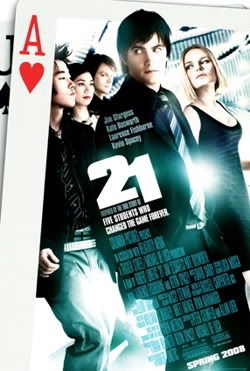
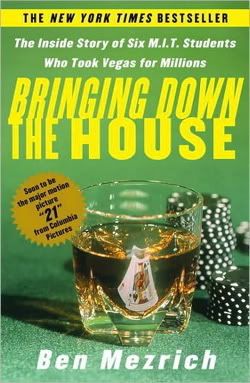
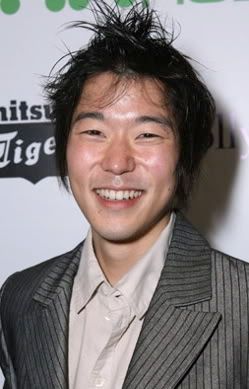
Opening today, 21, based on Ben Mezrich’s nonfiction book ‘Bringing Down The House’, stars Kevin Spacey, Kate Bosworth, Laurence Fishburne and Aaron Yoo and deals with the Hollywood retelling of how a pack of young upstarts started to turn the proverbial tables on the casinos.

Talking with one of the stars of the film, Aaron Yoo (DISTURBIA, ROCKET SCIENCE), I was reminded how nice it was to talk with an actor who became familiar with the material and just interpreted the role in a way that embraced the nature of what these young men and women were out to accomplish. Further, even beyond 21, Aaron has the kind of casual, breezy conversational way about him that I was struck by how verbose he was. Too many times you can get caught with an actor/actress who wants to stay on point and will not waver and will give you short, pointed answers bereft of anything special. Aaron is a giver. He expounded and I was more than happy to let him run with it. In fact, the conversation doesn’t even begin talking about the movie but his thoughts on Moment of Truth was too good to not include here as it leads into talking about the very real story behind this film.

CHRISTOPHER STIPP: How are you doing?

AARON YOO: I’m doing well. How are you?

CS: I’m doing alright.

YOO: What’s going on? What are we talking about?

CS: Well, I think we’re going to talk about a couple of things. 21 I guess.

YOO: 21 ““ what’s that?

CS: It’s a prime number.

YOO: And legal age in drinking. My first arrest.

CS: Really?YOO: Wouldn’t that be a funny coincidence? Probably should have been for all sorts of things but no, I’ve never been arrested. I’ve managed to get away from them. I lived near Runyon Canyon in West Hollywood and there was this eclipse, full lunar eclipse, one night and we jumped the fence into the canyon and went to a high level on the hills in the park and police helicopters were sent in, and they were yelling, “Get the hell out of the park. You are trespassing.” We were people in a park. Made no sense ““ go chase a car.

CS: Every time I see a car chase on TV it’s usually some dude from LA.

YOO: I remember I was reading about that stuff before I got out here and I felt like obsessed about car chases and how absurd they are. They put these car chases on TV. If you are in a bar it’s on TV so we’re drinking beer and watching the car chase. It’s ridiculous.

CS: Doesn’t anyone get it that there is a 100% failure rate? I almost feel sorry for these ignorant people who try to flee.

YOO: Yeah, they are really stupid or they are the same people who go on that show Moment of Truth. So desperate for attention ““ certain level of stupidity to get on the show.

CS: I’m embarrassed that I watched it last night.

YOO: I seldom see the show, but I’m obsessed with it.

CS: I feel it is the visual decline of western civilization.

YOO: It is. We have hit rock bottom. Sacrifice your child”¦.but no one should ever see it. The original show, the European show”¦.they said that it got canceled because they asked this woman a question “Would you ever put a hit out on your husband?” and the lie detector went nuts. Come to find out that she hired somebody to kill her husband.

(I laugh)It’s ridiculous.

CS: There needs to be more of that. You just have to spin it in your own mind that these people should make us feel better about our lives.

YOO: At least we are not them.

CS: Exactly.

YOO: Rational. But yeah, it sort of speaks to the movie. That sort of thing. If someone gave you an opportunity. Class? Oh, “f” that. Here’s a ticket on the Vegas express, go be a pimp for 3 days and then come back to class…

CS: That launches me into asking you why these students are so special. Why were they so successful? Anyone with a math kind of brain could have figured it out. What made them so different?

YOO: Part of it isn’t just math.

They kept joking ““ I heard a rumor there was some concern from casino owners that those who see the movie would learn how to card count and whatnot. But you can pick up an actual book fully explaining how to card count ““ we just simplify it. The actual rules are still the same but we use a very stripped down version of a plus and minus system. They don’t get that complex but they are very hard to ““ if you’ve ever tried to count through a deck at the speed that a casino dealer is going to deal cards out to you it’s extremely hard. I’ve tried ““ it’s very hard to play and, at the same time, to maintain anonymity. I met someone who works as a producer in LA who has friends who still run a 12 million dollar team. They get 10 to 12 million dollars and, with recommendations, they train people for 6 weeks, like 20 people and do a three day test. If you screw up once in three days you are off. So you just wasted several weeks of your life. But when they end up with the 6 or 8 people that make it and it takes about 4 to 6 months before they are burned out through facial recognition software.

But in those 4 to 6 months they return a minimum of 50 percent ““ sometimes 100 percent. The crazy thing is these guys are being paid like bankers, like investment bankers. They get a base salary and a percentage. They are making money that people make on Wall Street. It’s just a little bit more glamorous. And when they are done they can go to some strip club or open a bottle of Cristal champagne poolside out at the Wynn. That’s really the major difference.

It seems like maybe it’s a combination of simple mathematical intelligence like a way ““ a gamblers demeanor ““ poker face ““ there’s a thing when you know the deck is hot through the roof, blazing hot, and we have this thing when we were shooting…just to kill time…there’s a thing in the movie where they associate numbers with words. Like a plus 8 is pool (like 8 ball) or a plus 12 count would be eggs (like a dozen eggs) so we used to try and come up with ““ there’s a little snippet that we knew would not make it into a Sony Pictures film but what the heck, we got to shoot it anyway, we were just messing around. This little bit ““ we have a new one and Jacob’s character says something to the effect of “What’s that?” and we said “statutory” and when he asks for clarification we said plus 17.

(Laughs)

But it is just one of the things you do.

The reality is these guys go for a week and barely sleep. They fly in Friday after classes and start gambling Friday night, you hit the tables at prime time, 11 PM -Midnight and go all the way through to 10 the next morning ““ cash out, get some sleep, wake up, eat some food, and do it again. In some ways it an unhealthy lifestyle, but by the time you are home you are jetting home late Sunday night thousands of dollars up and really, really short on sleep. But what you’re doing is sitting at these tables for 12 hours sometimes.

Someone asked me if I was a good poker player and I told them truthfully that I’m good for 4 hours but then I don’t have the patience to be a really good poker player. Maybe it is something you learn. But I start taking risks after 4 hours just out of boredom and that is when you get canned. You throw into the pot that you shouldn’t be into that sort of thing. Just like in blackjack. It requires a lot of concentration and patience because, truthfully, for a deck to get hot like a true count of plus 6 or more you get so many shoes ““ even four or five people playing different tables you might get one hot shoe an hour if you are lucky or even two. And you play that in 10 minutes and make a lot of money. You go back in the bar and wait again. You stumble off, you bide your time. You have to keep alert and if you are a counter at a table for 12 hours. You switch tables and switch rooms. You don’t want to make it look like you are sitting at a table for 12 hours. You might even go to a different casino but it takes a lot of decisions. You have to be competitive too. You have to want to win. It becomes a need to make more money this weekend than you did last weekend.

I don’t care how grueling it becomes. We’re going to come out on top.

CS: Did you think that when you started to explore these characters, was it based on greed or was it based on something else underneath it?

YOO: Having met some of the guys and having my own understanding of some of these things, if you are just greedy, there are faster and easier ways to make money.

You can, if you just want money, you actually will make money faster by jumping on currency markets or even playing stocks or hedge funds. You can make really extreme investments with other people’s money that will make you a lot of more money a lot faster. There is just a dangerous thrill to this. Especially when these guys were playing before big corporations were buying up ““ like two thirds or three quarters of casinos are the MGM Grand. Back in the day before there were public traded companies owning all of these things, it was dangerous. It’s a competitive thing.

No one is going to beat the crap out of you for making a killing in the stock market.

But in the casinos, truly, like the amount of money these people take from the casinos ““ I had a friend who used to apprentice with Siegfried and Roy and the two weeks that those guys were not working, the casino grossed 2 million less a night when the show was dark because fewer people were coming in and gambling. They make so much money, these places, that what they were taking from them, as much as it was, which is all the card counters in the world are taking from the casinos, is a drop in the pond.

It’s just a competitive thing. “You are not pulling one over on us.” It’s bulls locking horns in each direction. The card counters go in there with like I don’t care how many cameras you have, I don’t care how many employees you have watching (there’s a security booth, a pit boss, a dealer) ““ and it’s like, “I’m going to beat you.” And then you have the casinos basically saying, “No, I’m smarter than you and there’s no way you are going to pull this off.” The kind of person who would do something like this is the kind of person who is missing something and it’s not money. A lot of the kids who go to MIT come from a lot of money. And what they are missing is ““ the character that I play, Choi, he is trying to find himself by everything that he is not supposed to be.

The person who values the things, how can I put this – he’s the kind of person who doesn’t care how much money you win or what that money is getting you or what that winning of it is doing for you. The game itself is the kind of thing he feeds off of most and I think that most of the people that did this fed off the winnings more than the actual monetary increments of what they were getting.

The majority of the money went back to the investors. So, for them, it’s like if you play basketball you know what your stat line is. It’s not that they don’t know what their scoring average is to the 10th of a point or a hundredth, but at the end of the day you care if you win but a part of you takes a lot of pride in the fact that this is what my scoring average is. So for these guys, yeah, I have to return all this money but part of it was I made X amount of dollars more this weekend than last weekend. That’s all they care about. It’s more money, especially at the age of 19 or 20 that they know what to do with but its more of a top dog kind of thing. So like people like my character, Choi, I think it was the bad ass factor of it. The fact is that you are going to cards because that’s the life you are supposed to have and you have this brain that is good at doing this plus you’re desperate for doing something dangerous.

CS: Did they get their fill at the end? These kids didn’t grow up and continue to be this way so how did everyone cycle out?

YOO: You think they grew up to be normal people?

No.

That’s the weird thing. I bet you ““ I feel like all these guys probably thought I’ll do this for a few years and once I get my fill I’ll go to my normal life and normal job and then I’ll have those four years of craziness from when I was in college. But from what I know about where they are, what they are like”¦

Think about it ““ like you said, there are lot of people who have the brains to handle this…it takes a lot of dedication and takes a lot of other things…you might think you can at least handle the math of it. But, for example, when I was in high school and they wanted to find pole vaulters, they took the entire team and said take this pole and run full speed and then jump. Immediately 95 percent of the kids left. At least you have an option.

There is a scene in the movie where Jim’s character, Ben, gets led by Jacob Pitt’s character, Fisher, to team practice with him for the first time and the door opens and the room is dimly lit and it looks like a conspiracy of sorts. The vast majority of people would say “You people are nuts” and leave but that’s the whole point of it. What you want is people to come into a casino with hundreds of thousands of dollars and have the balls to play with the threat of either A ““ losing all the money or B ““ getting caught. You want the person who is crazy enough to say, “Oh, you want me to go to Vegas and gamble with hundreds, thousands, millions of dollars and doing something that is semi legal though not illegal but they will try to kill you for it if they catch you?” You want that person who would say, “Yeah, I don’t care about that, let’s just do it.” And those kinds of people those people don’t leave a normal life.

I think a couple of them have.

I think the girl that Jill is based off of…she’s a pretty stable one ““ job and everything. But I know a lot of those guys still go back to Vegas all the time. Even if they have normal jobs. Some of them don’t. Like the guy my character is based on is such a sketch ball ““ they love him but it’s like “We can’t get a hold of him. We think he’s in Boston. Maybe he tried to start another team but it’s like we started that way and it’s always going to be that way. ” Some of them did start another team but there is something at the end of the day something is missing.

CS: This opportunity didn’t start it, they already had it in them.

YOO: Yeah. It’s something they’re parents didn’t give them. It’s something their life growing up didn’t give them. Somebody said the same thing about actors in this town recently and they said everyone who comes here to LA chasing a one in a million dream ““ we are all missing something. It’s a little bit insane.

It’s a good point, actually. And I think these people really are missing something. I think they are the kind of person ““ I always look at it as a competitive thing. Someone like Michael Jordan, competitive as he is, is missing something. Probably still is. The hunger comes from somewhere. It’s not that you can’t be fed ““ it’s that you can’t get enough.

CS: Do you think this plan satisfied them? For the people who have written a book about it and come back the other side did it top them off like a fuel tank? Almost as if, “That’s what I needed to move forward.”

YOO: No, man. I know a couple of them and they ““ the fact that they can’t go back to those blackjack tables ““ you can see it in their eyes. They would rather be still playing. The cool thing is the guy that Jim’s character is based on, Ben, they still let him in the casino but they just don’t let him anywhere near the blackjack tables. He’s a high roller and he’ll just run thousands of dollars at a crap table but he would rather be at a blackjack table. It’s like all those things of like, “I used to be the best at this and now I can’t do it anymore.” Can you imagine that? It must just be crazy.

CS: Did these people operate on a different mental level? Like Aspergers syndrome ““ are they completely normal? Are their brains hardwired in a different way?

YOO: They are normal people ““ highly intelligent, but totally normal. It’s funny – you see a visible change when they walk into a casino. They are very charming, amiable people but you walk them into a casino and they are in their element. Something goes off and you see a spark in their eyes. They own the place. It’s really fascinating to see that. It’s one of the things we were playing with in the movie ““ little things like wardrobe and stuff like that ““ I’m pretty sure from what I read and my experiences when they were in Boston, they lived in pajamas. They didn’t brush their hair, they didn’t shower. They were late to class ““ just chilling. They were just normal kids walking the halls and, the characters we play, don’t stand out but you can see that we have a secret ““ the first time we roll into the Hard Rock ““ it’s on. That sort of thing. Not everyone but I think a lot of people get that in different ways. I have friends who are brilliant amazing magnetic actors and awkward in real life but on a stage they are amazing. They are just in their element.

CS: Do they need to be around it?

YOO: Do they need to be around it? I guess. It’s weird to say but someone’s mother said that every job has details and when you find one that you don’t mind the details and actually enjoy them, then that’s what you are supposed to be doing.

Everyone has a place where they are at home. Maybe because they need it or crave it or would you deny them that in a way? Maybe they are in their element when they are at a casino playing the house. They are the reason the casinos have facial recognition software. The shuffle machines ““ in the early 90’s when they were raiding the casinos, they didn’t have any of this stuff. Especially stuff like facial recognition software which was really high end military security technology and way beyond what casinos wanted to spend for security, especially with the amount of cameras and all that stuff. There wasn’t just one team and 6 guys. At MIT I’m told, there was 80 something people. There were a dozen team. They were in and out raiding. It was big business.

A lot of these casinos are old school. Like you’re not going to pull one over. It’s very easy to stop card counting. It’s sort of a game you play. If you are a card counter, hell, if you get a single deck dealer shuffle, but you can’t, but if you can get a four to 8 deck shoe dealer shuffle you can count that.

CS: Is it moot now to try and count cards, then?

YOO: Truly it is”¦ the guy I was talking to about the team they set up with a 10 to 12 million dollar buy-in, they get new people, they pay them and they run them”¦they take them to river boat casinos to the Caribbean and Asia where there is less policing and technology is not as good and will run them and run them until they get recognized and once they get burnt they let them go but they all made a lot of money.

The people made a lot of money, the investors made a lot of money. Then they will wait a while a year and then create a new team. Back in the day, these kids would try and do it for several years. Card counters would make a career out of it. I don’t think you can make a living at it. It’s too difficult. The book I was reading about how to do it explained it in full detail. That guy avoids Vegas ““ the guy that wrote that book he doesn’t play in Vegas but there are places in the world you can go and it won’t be as difficult for you to play. Also, that system he was using was incredibly complex just to master that system. It can make you a lot of money but it takes a lot of brut brain power to wrap your head around just to master that stuff. I mean there are charts about player advantage percentages and all that stuff. We’d be rehearsing and I’d try to throw some of that stuff in and they said I was reading way to much of that book.

It’s difficult to make a career out of this anymore.

If you try to card count by yourself it’s almost impossible to do it successfully. The odds of getting caught are so high. The pattern you have to bet is so obvious. You bet when the count is high in your favor and you play the minimum or close to when it’s not. Any pit boss with half a brain can catch that. What made these guys so great is that they were able to separate the two things. Logically a simple thing but no one had thought about it before 1979 and”¦.so I don’t know. I know people do still make money doing it. There are teams still out there. They don’t want you to think that but the funny thing is, what I’m curious to know is whether people think they can still do this after seeing the movie. There are teams still out there; it’s a lot in strictly an objective sense relative to how many people go to the casinos and gamble a tiny minute fraction of a percent is what people are touting but it takes a lot of work and dedication.

And counting is not illegal and people do it in different degrees.

There are professional blackjack players who are truly counting, even if they say they are not. You have a feeling and general sense of how many face cards have come up and how many low cards have come up, so you can know when the deck is generally in your favor. You can pay a little more attention and know when it’s in your favor and if they think they can catch you doing that they have no legal recourse but they can bar you from the premises. Back in the early 80’s 90’s there was still a big mafia presence in Vegas and there might be still but certainly not to the extent where you hear about people getting backroomed. But they did back then ““ people got backroomed. And that’s part of it too. It’s all happy-go-lucky, they can’t do anything to you but that thug can take you in the back and knock all your teeth out.

CS: Right.

YOO: And if you go to these other places, they may not have face recognition software and may not be quite as savvy but if they catch you there are still places where they will backroom you. People go to Native American casinos and do this sort of thing because in general the casinos are not as high tech or savvy as the ones in Vegas. I know there are triad owned underground casinos in different cities around the world. And if you have the balls to go to one of those places and card count, you should get a prize.

CS: They just don’t have any fear? Or do they think they are better ““ no fear at all?

YOO: I don’t think people that people that do this sort of thing are commando crazy or whatever, I think that fearlessness comes from willful ignorance. If you want something so badly you sort of like in your own head you don’t mind the risk. I don’t think these guys are cliff jumpers and have no sense of self preservation but they want to win so badly they don’t think about the consequences. I think there is something in the movie about that that as well. Especially if you are 19 years old and somebody offers you that and you are hungry enough for it, you don’t even think about”¦.”Yeah, yeah, yeah, we might get caught and blah blah blah we might get caught” and whatever “¦. until you get caught you never think you are going to get caught.

If you read Ben’s book or talk to them you can play two or three years and after a while you get the sense invincibility which is dangerous because then you start to takes risks that you shouldn’t. They guy that Jim’s character, Ben, is based on—we were at the Hard Rock and there’s a scene at the Hard Rock and he goes, “Yeah this is the..” What’s the name of the high roller room? “The Lotus Lounge.” The high stakes room at the Hard Rock, and we were in there doing a scene and he says this is the first place I got burnt out of. Way back in the day when it opened he was playing craps and he had lost 80 grand and was spending his own money and a little bit drunk and they didn’t know what they were doing really, they just opened, they could stretch their own rules because they were taking the Hard Rock to the bank they were still figuring out what they were doing ““ Anyway, he was drunk and walks into the high stakes room and says “I’m going to win my money back” and he sits at the table and knew the count was high, not even caring, and sits at this table and puts $2,000 which was the limit on every available circle and let it go for a few minutes and was raiding this table.

That is, until someone walked up and said, excuse me sir, you have to leave. So he got blacklisted out of the Hard Rock. Just stupidity. He was a little bit drunk and shouldn’t have been playing but he wasn’t being subtle about it. That’s just it”¦.getting a little careless. Maybe you do need a Laurence Fishburne around every once in a while keeping your head on straight.

Quick Stop Thingamabobs: 3/28/2008

Filed under: Thingamabobs — UncaScroogeMcD @ 3:15 am

thingamabobs.jpg

The web. It’s a big place, full of plenty of distractions ““ some funny, some informative, some ludicrous, some disturbing, some inane, some profound. Each and every weekday, we present links to a few of our favorite finds…

————————————————

  • Paul and Storm – Randy Newman Theme Songs… (Thingamabob)

March 27, 2008

Paul and Storm / Jonathan Coulton – Show Review

Filed under: Widge Goes Off — widge @ 10:03 pm

wgoheader.jpg

3/22/08 – Variety Playhouse, Atlanta

Paul, Jonathan Coulton & Storm; Photo by Aaron Haley
Photo by Aaron Haley, not from this show though. From another show. But they still basically look like this. Honest. Source.

I was at the show last year when Paul and Storm and Jonathan Coulton hit Atlanta for the first time. It was pretty much a packed house at a smaller club called the Five Spot, which was an excellent venue, seeing as how you couldn’t be more than fifty feet from the stage, it seems.

The success of that show brought them back to a larger venue, the Variety Playhouse, and from what I could tell, they filled more than 2/3 of the seats. This will no doubt increase on their next visit: during a show of hands as to who had seen them at the previous show, enough people raised their hands that I swear the entire audience from that first show came back and brought friends. So by that math, within four years time, and given a show every six months, a Paul and Storm/Coulton show will be on a scale that even Hotblack Desiato would find impressive.

Paul and Storm and Coulton (which is this close to sounding like a demented law firm) make for a great team. Coulton’s songs have a surprising amount of sadness in them. Not to sound like one of those over-analyzing pricks who try to ruin everything, but I mean, damn, “Shop Vac,” for all of its bouncy fun, is about two profoundly miserable people who bought into what they figured was the American dream only to get to their destination and say, “Um.” I mean, honestly, “You can cry and I probably won’t hear you because it’s loud with the shop vac on.” We laugh at the song but we also understand where the characters are coming from. Perhaps a little too well.

Some songs stay at that level of almost what we would call morbid whimsy, but some start off with a great profound message and then veer into the profoundly silly. “The Future Soon” is a geek revenge anthem that goes from the standard geek alienation to dreaming about the future and when we’ll be able to change ourselves however we want to”¦killer robots stomping over mankind. Is there a single man in that audience who wasn’t nodding on some level and thinking, “See, Laura, this was all your fucking fault.”

That’s not to say Coulton is a somber individual. Far from it. He’s a crapload of fun, even when jetlagged from flying back from London. And there’s no other musician alive who can have, at the previous gig, people singing along perfectly with a song called “Mandelbrot Set.” This time around, two young ladies got up and spontaneously danced up towards the stage left side of the house.

Yes – dancing to songs about fractals. People wearing animated pong shirts and the animated reacting-to-sound-levels shirts and distracting the musicians (where, at any other gig, they would have asked politely, would you please turn that shit off). The guy with the animated sound shirt was using the light of it to sign Paul and Storm’s mailing list signup. Coulton can get a laugh at a line about a “taxonomical hit and run.” Or “Laugh it up, vertebrates.” A song about Pluto and Charon (the planets, mind you) is actually an excellent love ballad and goes over perfectly with the crowd. Welcome to the audience for one of these shows.

Update: Well, somebody had posted a song from this show, but then they had to go and freaking remove it. Weasels. Here’s something from another show that makes me feel fan-fucking-tastic.

Here they are now. Doing that singing thing.

What was I saying? Oh yes, teamwork. You see, Coulton is great, but for a “nerd” musician, his songs are surprisingly deep. Paul and Storm make a great counter to that.

Now – before I get anybody pissed off at me, I’m not saying Paul and Storm crank out nothing but fluff. But they are a Comedy with a capital C duo, and they know what’s funny. Putting Bob Dylan down a well is funny. Jingles about kitty litter are funny. References to “Storm Juice” are funny. Sea chanties that inspire the audience to bring along a visual aid (letters spelling out ARRR! – and yes, somebody was holding up an exclamation point). That’s pretty goddamn funny.

So together they’re”¦well, they’re the Reese’s Peanut Butter Cups of nerdcore music. You got your peanut butter in my”¦wait, I don’t have to explain that reference with this crowd. Anyway.

(Although for future reference, folks: you missed a golden opportunity to turn the damn ARRR! around to make RRRA! for “Re: Your Brains.” I mean, come on.)

Paul and Storm actually open with a song called “Opening Band” which caused a pantystorm to erupt from the audience. The line is “And, sad to say, as of today, no panties have been thrown,” which was quickly updated to be “eleven panties.” (Atlanta now holds the record.) They play with the audience well, and get lots of response to songs like “Nun Fight” (well, it’s a gregorian chant, but that counts).

They also played a song I hadn’t heard live before, called “A Better Version of You.” This song relates the story of parents breaking it to their five year old son that he’s going to be a big brother soon. “Thanks to the five years we’ve had you to practice on/ Now we know what not to do”¦ Can you imagine the things he’ll achieve/ As a doctor or lawyer or Indian chief?”

For the record, my younger brother is five years younger and an extremely successful lawyer. Me? I write for websites like this. Conferring with Paul and Storm after their set, I learned that they are both younger siblings. And for writing that song, they are also both bastards. And I cried myself to sleep. I hope they’re happy.

The high point of the evening was “Soft Rocked,” where Paul and Storm (who take the stage with Coulton to provide back up vocals and other shenanigans) were doing vocals and also acting as horn section. Now, I can’t tell if this was staged or not, or planned, but Storm hijacked the song. Suddenly, the song became “Tequila Sunrise.” I don’t think it was planned, or if so, what followed certainly was not, as Paul and Storm dragged Coulton laughing through a medley of hits, including “Blue Bayou,” “Hey Jude” and finally finishing up with “Stairway to Heaven.” They never even made it back to the original song. It might be the funniest thing I’ve seen so far this year.

Seeing the three of them perform is an absolute hoot. It’s no wonder that everybody (or seemingly so) came back for the second Atlanta show. They are having a blast on stage and it’s infectious. There’s nothing like the feeling of having a huge sing along, in a room full of geeks, of “Sweet Caroline.” Where else can that happen? No place else.

If they’re coming to your town, you do yourself a disservice by not going. Paul and Storm’s website is here. Give them love. Jonathan Coulton’s website is here. He needs love too. Their tour schedules are here and here respectively. Tell them we said hi.

Widgett Walls is the chief cook and bottle washer for Needcoffee.com. He’s also the author of Mystics on the Road to Vanishing Point and Magnificent Desolation. His personal blog is at WidgettWalls.com, which he updates when he feels like it. He lives and works in Atlanta, Georgia. He hardly ever sleeps.

March 26, 2008

Cabin Fever #18: Use Your Delusion II

Filed under: Cabin Fever — UncaScroogeMcD @ 7:44 pm

cabinfeverheader.png

cabin.jpgOh no! Just when you thought it was safe to hang out at the Quick Stop…

Cabin Fever (hosted by the twisted souls Brian Fitzpatrick and Aaron Poole) is the result of having too much time on your hands and access to your local community radio station.

Over the course of an hour, they manage to trawl the depths of good taste, plus throw some music in. How much more could you want from a podcast?… Quality? Oh… we didn’t think of that.

Enjoy! And we hope our cross Atlantic friends can understand the Irish accent 😉

Hugs and Kisses,
Aaron P. + Rev. Fitzy

linesm.gif

CABIN FEVER #18: Use Your Delusion II – As if his abandonment issues weren’t bad enough, Brian was left to fend for himself this week. And so, along with guest-host Shona Conway, he went out the night before in order to drown his sorrows. The following 40-minutes are a result of their shared hangovers. Expect bile to be spat about sexuality, nakedness, transsexualism, novelty panties, fight-starting lesbians and fish tacos. Also, there’s a belt of something awkward in some poor unfortunate’s hair for good measure.

[CONTENT WARNING]: Explicit contents! We say every naughty word you can think of. You have been warned!

DOWNLOAD: (right click to save)
Episode #18 (MP3 format)

[audio:http://traffic.libsyn.com/cabinfever/cabin_fever_18.mp3]

SUBSCRIBE
Subscribe to this Podcast via iTunes

Got something to say? E-mail Aaron & Brian at the Cabin Fever mailbag.

line.gif

CLICK HERE FOR THE CABIN FEVER ARCHIVES

line.gif

##

The Fred Hembeck Show: Episode 104 – It’s All Relative

Filed under: The Fred Hembeck Show — UncaScroogeMcD @ 12:07 am

fredhembeckheader.jpg

hembeck2008-03-26-01.gif

hembeck2008-03-26-02.gif

hembeck2008-03-26-03.gif

hembeck2008-03-26-04.gif

hembeck2008-03-26-05.gif

hembeck2008-03-26-06.gif

hembeck2008-03-26-07.gif

hembeck2008-03-26-08.gif

hembeck2008-03-26-09.gif

hembeck2008-03-26-10.gif

hembeck2008-03-26-11.gif

hembeck2008-03-26-12.gif

hembeck2008-03-26-13.gif

hembeck2008-03-26-14.gif

hembeck2008-03-26-15.gif

hembeck2008-03-26-16.gif

hembeck2008-03-26-17.gif

hembeck2008-03-26-18.gif

hembeck2008-03-26-19.gif

hembeck2008-03-26-20.gif

hembeck2008-03-26-21.gif

hembeck2008-03-26-22.gif

hembeck2008-03-26-23.gif

hembeck2008-03-26-24.gif

hembeck2008-03-26-25.gif

hembeck2008-03-26-26.gif

hembeck2008-03-26-27.gif

hembeck2008-03-26-28.gif

hembeck2008-03-26-29.gif

hembeck2008-03-26-30.gif

hembeck2008-03-26-31.gif

hemomni.jpg

If you’re at all interested in reading the confessional piece that put this whole set of events into motion, may I point you towards “The Secret Origin of Fred Hembeck”!!

Now, about those links mentioned above. If you want to know more about the (still) impending Image Comics’ publication, The Nearly Complete Essential Hembeck Archives Omnibus – including how to get either a simple autographed copy or one with my signature AND a custom drawing!- just use that link! And as always, check out my blog, Fred Sez, or my whole gosh darn website, Hembeck.com!! And before you know it, we’ll see you all back here at the Quick Stop bistro!

Copyright 2008 Fred Hembeck

Cabin Fever #17: Use Your Delusion I

Filed under: Cabin Fever — UncaScroogeMcD @ 12:05 am

cabinfeverheader.png

cabin.jpgOh no! Just when you thought it was safe to hang out at the Quick Stop…

Cabin Fever (hosted by the twisted souls Brian Fitzpatrick and Aaron Poole) is the result of having too much time on your hands and access to your local community radio station.

Over the course of an hour, they manage to trawl the depths of good taste, plus throw some music in. How much more could you want from a podcast?… Quality? Oh… we didn’t think of that.

Enjoy! And we hope our cross Atlantic friends can understand the Irish accent 😉

Hugs and Kisses,
Aaron P. + Rev. Fitzy

linesm.gif

CABIN FEVER #17: Use Your Delusion I – Aaron arrives in Texas and decides to take the opportunity by the hairy ones and do a show sans-Brian. Old friends of the show, The Tastydactyls, hang out with some of their buddies and things get a little messy. There’s talk of state-shaped breakfast, bear suits, and the ability to hypnotize free money out of shops. Despite the fact that we had several musicians in the studio, we have a song from guys who weren’t there – Veloura. Keep an ear out for another Cabin Fever competition to win a free CD and come back real soon for Brian’s response to Aaron’s absence.

[CONTENT WARNING]: Explicit contents! We say every naughty word you can think of. You have been warned!

DOWNLOAD: (right click to save)
Episode #17 (MP3 format)

[audio:http://traffic.libsyn.com/cabinfever/cabin_fever_17.mp3]

SUBSCRIBE
Subscribe to this Podcast via iTunes

Got something to say? E-mail Aaron & Brian at the Cabin Fever mailbag.

line.gif

CLICK HERE FOR THE CABIN FEVER ARCHIVES

line.gif

##

Toy Box: Harvey Dent In Your Town – Or At Least Mine

Filed under: Toy Box — admin @ 12:04 am

toybox.jpg

Back in the good old days, politicians traveled the country to drum up support. These trips, often by train and then later by bus, were the ideal opportunity to drum up grass roots support. When television and the Internet came along, much of the value was lost, although politicians still rack up the frequent flyer miles.

So how do you add some spicy marketing to a new movie today? Why not combine the old time thrill of the traveling politician with the current Internet viral marketing process? That’s what Warner Brothers has done for the new Batman flick – The Dark Knight. Harvey Dent is in this second film in the current franchise, played by always smooth and political Aaron Eckhart. To help promote the film, they put together a campaign for Harvey, which is supported by a very well done website at isupportharveydent.com. For one week or so, the ‘Dentmobile’ traveled across the U.S., stopping in various towns (especially college towns) to hand out t-shirts, bumper stickers, and other goodies so that you can show your support for the DA of Gotham City and his fight to take back the city.

I live in Ann Arbor, Michigan, a town blessed by not one but TWO large universities. You couldn’t get a town more ripe for this sort of nerdfest, and the promoters knew it, scheduling three separate stops around town. At 11am, I headed over to the Briarwood Mall, the first stop on their route around the city. Now, while Warner Brothers knew AA was a town to hit, apparently the Briarwood Mall didn’t see the value. They booted them off the property, but the Dentmobile found a home in the furniture store parking lot connected to the Mall parking lot anyway.

Being the intrepid reporter that I’m not, I managed to forget my camera. However, a fellow Dent supporter named Daniel Pearson was kind enough to take some exceptional shots and allow me to use them. Thanks, Daniel!

toybox_032508_1.jpg

Once they had the logistics worked out, the folks in the van started setting up and handing out goodies. There was the usual stickers, buttons, signs, and t-shirts, and they even had the t-shirts in multiple sizes, rather than the usual “I got any size you want as long as it’s XL” routine.

toybox_032508_2.jpg

A quick word about the weather – we were freezing our asses off. March in Michigan is a weird month. The weather varies wildly, with unseasonable warm and unseasonably cold days more common than average temperature days. Unfortunately for us Michiganders, the whole month has been unseasonably cold, with no real break. Last Friday, when temps in the 50’s wouldn’t have been unusual, it was closer to 30 with a nasty wind chill. Not really weather for standing out in the parking lot in your new free t-shirt.

toybox_032508_3.jpg

Just to keep things lively, a few of the Joker’s supporters showed up as well, all carrying protest signs of their own. My favorite was “Dent is Two Faced”, but they were all amuzing in their own right.

toybox_032508_6.jpg

toybox_032508_4.jpg

Both the Dentmobile folks and the Joker supporters did a fine job remaining in character, even partaking in a bit of the playful banter. Earlier the Brinks truck was making the rounds at the mall, but unfortunately the Joker henchmen weren’t there at the same time. Brink’s guards carting large sacks of money out of the building while guys wearing white covers over their faces cavorted around them would have made for a potentially amusing situation.

toybox_032508_5.jpg

The Dentmobile guys rallied people to show their support, waving their signs as cars went by. Okay, so a mall parking lot on a Friday morning isn’t exactly Grand Central Station, but they managed to get a few honks.

toybox_032508_7.jpg

toybox_032508_8.jpg

They also had us signing petitions, and some of the folks represented larger groups who had already signed petitions that they were delivering. All in the name of taking back Gotham City! They didn’t want to discuss the vigilante Batman…

toybox_032508_9.jpg

toybox_032508_10.jpg

All in all, it seemed like a relative success. I got a free t-shirt, as well as a nifty sign to hang in my office. Sure, it makes absolutely no real sense – why would a guy running for DA in some city be traveling the country, when your vote doesn’t count? – but they aren’t trying to get votes, they’re trying to get ticket sales. And who knows, perhaps Dent and his running for office has far more to do with the actual plot of the film than we realize now. I know I’ll be there on opening day…but being the Bat-whore I am, I didn’t really need a free t-shirt to convince me to do that.

Since you never know how these things might turn out, I made sure I smoozed up the Joker henchmen as well…

toybox_032508_11.jpg

So remember, believe in Harvey Dent! He’s going to take back Gotham City…or at least help Warner Brothers make a hundred million bucks or so.

toybox_032508_12.jpg

Opinion In A Haystack: Mad Maxine Plissken

Filed under: Opinion In A Haystack — admin @ 12:03 am

haystackheader.jpg

The following may contain *****SPOILERS***** for the following films: Doomsday, Into The Wild, Southland Tales

One of the oddest feelings in the life of a moviegoer is when you know a movie is awful, but you can’t help but love it anyway. This is what the term “guilty pleasure” refers to. However, I am a member of the camp that loathes that term; our motto is “IF YOU LIKE IT, LIKE IT, NO GUILT REQUIRED.” Please believe me when I say I love a lot of awful movies. Movies that even I will admit are just downright muck (still don’t feel guilty.) I like watching Bad Boys, Armageddon, and Troll 2, but there is no way in hell I’m going to say they’re “good.” However, I am one of those outcasts who also loves unjustly excommunicated films that no one ever gave a chance. I will not only defend the likes of Last Action Hero, but will go on the offensive and actually prove its merit as a genius satire of the 80s/90s action movie scene. Once again, no guilt consumes me at all. If anything, I take pride in defending such movies. This brings me to a few words on Doomsday.

eden-copy.jpg

It’s a bad movie. It moves at a silly-fast pace, the narrative is stuck together with watery chewing gum, and God only knows who the intended audience is supposed to be. The plot, as if it needed to be explained, revolves around a virus breaking out in Scotland which is sealed off from the rest of the planet. Years later, the government sends in a female version of Snake Plissken to find the cure for the virus, which she only has 48 hours to do until her team is left for dead. It’s a bad movie. Yet, I liked it. Though, my positive feelings toward the flick are not that of a normal nature. Doomsday is kind of writer/director Neil Marshall’s John Carpenter/George Miller fan film that just so happens to have made it into theaters. I don’t even know if I am comfortable calling it a homage or a satire, I much prefer the term “fan film” for this movie. The reason being that while watching it I felt the whole time like Marshall was just saying “hey, I worship Escape from NY and The Road Warrior! check out my version, dude!!!”

wezsol.jpg

The similarities are so thick between Doomsday and those two films that honestly I don’t know why he did not just title it Mad Maxine Plissken Escapes from Glasgow. Our main heroine, Eden, starts out the movie with an eye patch for fuck’s sake, dressed nigh identical, to Kurt Russell’s Plissken. The villain, Sol, was an exact representation of the younger version of Vernon Wells’s character from The Road Warrior. There was even a character named “Carpenter.” Like I said above, who in the hell is the audience for this thing? I couldn’t imagine anyone that didn’t grow up on a firm diet of John Carpenter or George Miller’s MAX trilogy seeing this and not just passing it off as garbage. Hence, it’s completely a fan film, from the Escape from NY title font, to its awesome Carpenter-style-synth music, right down to the blatantly similar Mad Max car chase scene. It is simply like one hardcore 80’s sci-fi/horror action geek ejaculating all over the screen. A screen probably being viewed by people too young to recognize the warm globs of classic films oozing southbound.

chase-copy.jpg

Luckily for me, I, much like Neil Marshall, worship Mr. Carpenter and grew up on a solid diet of The Road Warrior. Thus, I just answered my own question. I am the audience. The problem with that being that fellow lovers of these old films could react in two ways: either like me, or in complete rage over someone ripping off material from older, better, classics. My mind never instantly jumped to the words “rip-off” and the only explanation is Neil Marshall’s track record. His werewolf movie Dog Soldiers is solid as hell, and The Descent was one of the coolest horror flicks I had seen in the past decade. Perhaps my love of his résumé gave me the positive spin I needed going into Doomsday, because without that I might have thought it was just hackneyed slop. Another theory that was boiling in my brain is that he was trying to do a Tarantino and take all the best parts of old films he loves and make a Frankenstein creation out of them and his own oeuvre. In this case, just change Quentin’s love of 70’s kung fu/exploitation schlock to Neil Marshall’s love of 80’s sci-fi/horror. Though, perhaps due to way too much direct homage and frenzied cliché camera work, he never quite makes Doomsday the Kill Bill triumph that I (and probably he) wish it was. As a fan film, it’s fucking genius. As a film, it’s just lukewarm poop. I am going to give Marshall the benefit of the doubt and say that he is fully aware of the film he has made and it’s place in the pantheon of homage, satires, and spoofs”¦also acknowledging that the classics he has intentionally aped from are much better then anything he could have ever hoped to accomplish with Doomsday. Viva La John Carpenter.

Into The Wild

into_the_wild_movie_poster_090720070508.jpg

It warms and chills my heart knowing this film is based on a true story. A masterful work, directed by Spiccoli himself, about a young student named Chris McCandless, who abandons all his money, family, and possessions so he can live in the wilderness. Some people would say it’s a journey to find himself, however I say it’s a journey to save himself from the lies he sees around him. Emile Hirsch does an amazing job here, playing Chris as a kid too smart for those in his life, but aware enough to know he hasn’t got it all figured out. Hence why he leaves the life that his parents, materialistic social nightmares caught in a loveless marriage, are trying to guide him toward. He packs up, gives all his money to charity and just disappears.

They make good note of the fact that he is on the rather intelligent side. He has the opportunity to succeed in the academic and business world, yet is obviously disgusted, or possibly more confused, by the shallow nature of it all. This is obvious from the get-go when he is almost insulted that his parents offer to buy him a new car so he doesn’t have to drive around in his old piece of junk. He reacts with outrage toward them for even suggesting it, not because he is spoiled, but because he sees no need to fix what isn’t broken, nor does he understand his parent’s, or society’s, obsession with aesthetics. He goes on a journey to the wilderness, heading for Alaska, meeting folk along the way, but ultimately on a one-way ticket to be alone with nothing but trees and sky to keep him company. He ends up shacking up in an abandon bus in the middle of nowhere, only to die alone from starvation.

story-copy.jpg

Depressing? Yes. However, he learns the two truths about life. One, Society is nothing more then an illusion that dampens the mind and kills the soul. Two, sadly that (society) is the greatest resource for the one thing all of us need the most”¦other people. It’s a very long movie, very quiet, yet beautifully directed. Nothing is overly stylistic. Hell, even the simplistic title font (Arial?) is in keeping with McCandless’s entire lifestyle. I can honestly say that no movie in such a long time, perhaps with the exception of the ending of Clerks 2, has spoke to me on such a direct, agreeable level. This is a film for any one that is frustrated with those around them that don’t seem to get the fact that this is all just a big chunk of fabrications and falsities. It’s for people that look at a building and see a bunch of walls stuck together with nails, or a car as just a structured pile of metal, glass and rubber. It’s a film for anyone that questions from a young age if gold, diamonds, or money are actually worth something or is it just because we humans have place value on them. I realize that might be a little out there, but if you watch the movie you should get the gist of what I’m blabbering about. For a similar foray into the same type of material, try the Albert Brooks’ classic Lost In America, which is based on Easy Rider. It’s easier on length, it’s a comedy, and the ending isn’t as heart wrenching. Sean Penn has done a masterful job here. It succeeds as a film, a message, and most of all, a beautiful tribute to an interesting, clear-minded man.

Southland Tales

6288z2p.jpg

Wikipedia defines “glory hole” as

A glory hole (also spelled gloryhole and glory-hole) is a hole in a wall, or other partition, often between public lavoratory stalls or video booths for men to engage in sexual activity

A former co-worker once described to me why he loved David Lynch movies. I guess he felt as though he had to defend liking movies that made almost no sense to the common person. He said “Bob, if I walk into a public bathroom and see a glory hole, then proceed to stick my penis in the glory hole, then just wait and exist in that moment of wonderment where I either could get my dick sucked or get castrated”¦that is what it feels like to watch a Lynch film.” Odd as that statement may seem, I totally got what he was saying, and subsequently enjoyed Mulholland Dr. all the more because of it. I honestly love movies that are a labyrinth of storytelling, even when they go nowhere. I dug Richard Kelly’s Donnie Darko for that very reason. I guess what I’m saying is I love glory hole films. A lot of people don’t, which is understandable, but there’s some pleasure in being able to pen in your own meaning behind a movie. If you can go back and think of what it meant, it kind of makes you feel smarter then you know you are, or you’ve figured something out that no one else has. These movies have their audience, and their merit. Often, in the case of Lynch or Cronenberg, they are beautifully shot, edited, and if anything, encompass the total and complete vision of their masters. No studio heads trudging around stomping on all the wonderful weird that they loathe oh so much.

sarah-michelle-gellar-southland-tales.jpg

Writer/director Richard Kelly’s Southland Tales is most certainly a glory hole. The problem is that it’s so small that anyone who isn’t a newborn can’t use it. The narrative is such a destructive mess that I can barely even give you a synopsis of what happens. It’s about the end of the world, Buffy being a porn star, and two Stiflers being separated souls that come together as one and float an ice cream truck that belonged to Connor Macleod of the Clan Macleod. Oh yeah, and The Rock is in it and he does some vague stuff, and his hands shake a lot, and”¦yeah. It’s a complete mess. It has an amazingly diverse cast, comprised of comedic faces from the B-list of the past 20 years. You even get to see a dead serious, blonde, homicidal Jon Lovitz ask Cheri Oteri if she wants to fuck. Was it supposed to be funny? I wasn’t laughing. All I was doing was standing next to the bathroom stall repeatedly banging my tiny dick against the miniscule glory hole trying to figure out what the hell Kelly was thinking. The movie fails for me in that I have no interest in sitting through it again, I don’t feel the “want” to figure out what it all means, and I really don’t want to talk about it after this sentence.

tn2_southland_tales_4.jpg

Real quick, my top 5 extreme sport’s movies:

5. RAD (1986) ““ Such beautiful schlock. If BMX gets you hot, this movie is the center of the sun!

rad.jpg

4. Side Out (1990) ““ I realize that there could be a strong debate on whether or not volley ball is an “extreme sport.” Either way, this movie SERVES up the action. What? You think of a better pun.

51vsmf1swcl__aa280_.jpg

3. Thrashin’ (1986) ““ Planet Terror and No Country for Old Men have now made this Josh Brolin classic all the more relevant and fun to watch. Not until 300 did this showcasing of male abdominal muscles get surpassed in the confused homosexuality department. It’s so worth a watch if only for the music and the painfully extended skateboarding scenes that were obviously used as time filler.

thrashin.jpg

2. Airborne (1993) – I legitimately love this movie. It introduced me to Seth Green and Jack Black. The end rollerblading race down the “devil’s backbone” is probably one of the greatest rollerblading achievements in film ever, and the greatest triumph in Elektra director Rob Bowman’s career! Yeah, I guess that really isn’t saying much.

airborne.jpg

1. Gleaming the Cube (1989) ““ The greatest skateboarding movie ever made. See Christian Slater ollie over an entire highway on his skateboard. See Tony Hawk drive a pizza truck. Seriously, this movie holds up after time. Great plot, great acting, and some serious 80’s spice really make it work. Also should be a contender for most befuddling tagline in film history: “All he cared about was Gleaming the Cube”¦until the night they killed his brother.”

mpw-13517.jpg

That’s all for Column 3, thanks for reading and let me know of any great “extreme sports” movies that you would put on your list.

Win MICHAEL PALIN’S NEW EUROPE on DVD!

Filed under: Contests — UncaScroogeMcD @ 12:02 am

contestheader.jpg

We’re giving away, in conjunction with BBC Home Video, five (5) copies of MICHAEL PALIN’S NEW EUROPE on DVD.

Contest ends at midnight EST on Wednesday, April 2nd.

CLOSED! THANKS FOR ENTERING!

Official Rules

No member of Quick Stop Entertainment or their immediate families may enter.

No Purchase necessary to win.

Must be 18 years of age or older to enter.

One entry per day, per person.

All submitted entries must be received by 11:59pm EST on Wednesday, April 2nd.

The winner must allow 4-6 weeks after notification of win to receive the product.

Quick Stop Thingamabobs: 3/26/2008

Filed under: Thingamabobs — UncaScroogeMcD @ 12:01 am

thingamabobs.jpg

The web. It’s a big place, full of plenty of distractions ““ some funny, some informative, some ludicrous, some disturbing, some inane, some profound. Each and every weekday, we present links to a few of our favorite finds…

————————————————

March 25, 2008

Party Favors: Totally Pauly

Filed under: Interviews,Joe Corey's Party Favors — UncaScroogeMcD @ 2:23 am

partyfavors1.jpg

pauly-01.jpgENCINO – They call him the Weasel! And he finally called the Party Favors.

After nearly twenty years since Pauly Shore decimated MTV with his Totally Pauly, he dialed up the Dynamite Massage hotline for a brief chat about his Pauly Shore: Natural Born Komics Sketch Comedy Movie: Miami DVD. This follow up to Pauly Shore Is Dead has him spoofing various reality shows. He also does a Scarface sketch with Steven Bauer as Manny.

The most controversial of the sketches is his impersonation of John McEnroe as a guest star on To Catch A Predator. He has the tennis superstar demanding young women “goober my balls.” Seeing how John is not exactly known as a guy who takes a joke with a hearty laugh, has Pauly heard from McEnroe or his representatives?

“I’m sure I will. I’m sure I’ll hear from everyone,” Pauly said. He didn’t seem scared about the consequences of making the hotheaded Wimbledon champ the star of NBC’s hottest show. “It turns me on comedically to go to unsafe territory. I’m not Jerry Seinfeld.”

We joked about how MSNBC has 24 hour marathons of To Catch A Predator. Does he get sucked into watching the creeps arrive at the house with their teddy bears and condoms? “I watched it when it first came out. Now I’m bored of it. Now it’s its own sitcom,” Pauly declared.

The discussion turned to Predator‘s host, Chris Hansen. We joked about how Chris almost seems heartbroken when the sexual predators aren’t happy to see him instead of the promised 14 year old boy. In this era of public crusaders turning into perverted culprits (like Eliot Spitzer who busted all those call girl rings, but didn’t mind using their services) is there a potential scandal brewing behind Hansen’s own kitchen door? “It’s almost like he’s getting turned on,” Pauly described the host’s confrontations before the cops apprehend the potential child molesters.

Another segment in the show is “Spunk’d” where Pauly twists around MTV’s now canceled Punk’d. We joked about how Ashton Kutcher’s new Pop Fiction series plays with “Spunk’d.”

“I did it first. He stole that idea from me. They all steal from me, but that’s OK,” Paul joked. “What’s he doing on his show is basically what I did on my show which is the opposite of Punk’d. His (series) is a celebrity punking the paparazzi. Mine is a celebrity punking the average person.”

Pauly has a valet fooled into thinking a thief has stolen Charlie Murphy’s car. The stunt goes into overdrive when the fake cops discover Charlie’s stash, but he goes state’s evidence against the valet. Pauly was amazed at how well the stunt worked on the valet. “We got him good. He was crying.”

Pauly swears that over the last decade the swarms of paparazzi photographers swarming Los Angeles has skyrocketed. I joked that the digital revolution has made being a photographer so easy that the folks who used to panhandle the stars are now stalking them with a camera to make a fast buck.

“I wonder how much a picture of Pauly Shore gets them. It couldn’t be that much,” Pauly pondered.

pauly-02.jpgWhile Natural Born Komics spoofs reality shows, Pauly is a veteran of the genre. Minding the Store dealt with him running The Comedy Store. How real was the reality on the show?

“No reality shows are reality,” Pauly declared. “The only one was the Tom Sizemore show where he’s doing crack on the side of the road. Reality shows are based in reality, but it would be horrible to continually shoot someone with no plan. You got to have some sort of structure.”
?Reality shows are the new version of the sit-com except it doesn’t require true comic timing and a studio audience. During our chat we figure the father of this new “realiticom” was Larry David with his improvising “real moments” using a plot outline.

“I think Curb Your Enthusiasm did a good job of a reality kinda sitcom” Pauly said. He hears the pitches of potential star based reality shows. “Everyone is like ‘It’s like Curb.’ No it’s not. Curb is good.”

Does Pauly have any interest in using a reality show to find a new party pal like Paris Hilton is doing? “No. If they’re going to be my party pal, we’re just going to be watching TV. We’re not going to be really doing anything.” Although sitting back and relaxing with Pauly while watching the widescreen action would be a fun evening. Wonder if he has the missing Lancelot Link: Secret Chimp episodes? They could have a challenge of figure out the remote.

Although speaking of actors who come off as apes barely dressed as human; how freakish was Andy Dick when he co-starred with Pauly while making In the Army Now? Was Andy always as insane or has it built over the years?

“I think it definitely has built. When I had him, I had him directly before he became weird. Everyone I work with always turns weird. (After making Bio-Dome,) Stephen Baldwin found Jesus. Andy Dick lost his mind. I probably have something to it,” Pauly conceded.

While critics and academics scoff at Pauly’s cinematic legacy, there’s plenty of women who secretly embrace Son-in-Law as a guilty-pleasure movie. I know one lady who lists it in her Top 10 next to Dirty Dancing and Ever After. “It’s one of those movies that plays and still holds up. It has a lot of heart. It’s a funny movie with great characters. It was a joy to work on. I’m happy that she amongst others are enjoying it. It’s one of those movies that people just enjoy.”

Did his time on location entice Pauly to start up a farm? “Oh no. I’m a city slicker.”

Occasionally you’ll see Pauly Shore appear amongst the guests at Playboy Mansion parties. What’s it like when he enters the house of Hugh Hefner and The Girls Next Door? “It’s like Willy Wonka and the Chocolate House of Pussy,” Pauly described. The curious mind has to ask about the action in the infamous Grotto. Is it still the watery home to debauchery? “Things don’t really go on in there as much. People go in there as a tourist site. People just stare at it instead of participating in it,” Pauly said.

How sad. James Caan must be crying at this news.

Pauly’s hoping to make a second Natural Born Komics movie in Las Vegas. A project he’s currently putting together is Pauly Shore Adopted in which he tries to follow the lead of Madonna and Angelina Jolie. You can follow the progress at Paulyshoreadopted.com.

As Pauly Shore enters his third decade in showbiz, he’s still as wild as ever. You can’t stop the weasel.

pauly-03.jpg

FRIENDLY FESTIVAL

The Full Frame Documentary Film Festival serves up another healthy dose of truthful filmmaking from April 3-6 in Durham NC. Unlike Sundance, you won’t have to stand in a blizzard praying they have enough seats for you after Paris Hilton’s entourage hordes the best views. It’s just a fine dose of Southern Hospitality in the city that brought you Bull Durham. Plus they serve BBQ near the lobby!

There are three biographical films screening this year that I’ll be doing my best to see. Glass: a portrait of Philip in twelve parts is directed by Scott Hicks. You might remember his last movie about a pianist called Shine. It’ll be interesting to see how he captures live piano action. Gonzo: The Life and Work of Dr. Hunter S. Thompson focuses on the man who made “Fear and Loathing” a buzz word for reaching political truth through the help of pharmaceuticals. Johnny Depp reads Hunter’s works. Good Ol’ Charles Schulz looks at the man who drew Peanuts for 50 years. I’ll attempt to ask the director if he ever found out what happened to Sherman? Did Patty get pissed off when Peppermint Patti arrived on the scene?

This year’s career award goes to William Greaves. They’ll be screening quite a few of his films including Ralph Bunche: An American Odyssey and Symbiopsychotaxiplasm: Take One. Is Symbiopsychotaxiplasm covered under Blue Cross? The big opening night film is Trumbo. The documentary mixes actors reading the blacklisted screenwriter’s scripts with testimonials.

If you’re in the area, drop by Full Frame. For more info such as parking visit www.fullframe.org. This is the friendliest film festival in America.

DVD SHELF

Father Knows Best: Season One shocks with its purity. How often do you turn on a family sitcom only to be barraged by tons of sex jokes? What do we expect with Charlie Sheen playing a “dad?” But once there was a time in America where parents didn’t talk about sex or drugs or even cussing. Robert Young and Jane Wyatt never worried about improving their orgasms during dinner conversation. The kids weren’t smoking dope and taking Prozac. Nobody feared child predators raping their youngest via internet seduction. Dad lit up a cigarette and nobody complained about cancer. Father knew best because there was no worst lurking outside.

The masters used on this Shout! Factory release came from Robert Young’s estate. This unfortunately means that only half of the episodes are their original running length. What’s amazing is “24 Hours in Tyrantland.” This special episode was to promote buying savings bonds. Dad decides to teach the kids the meaning of freedom by adopting the Soviet mindset. He breaks their souls. There’s also new interviews with the daughters, Elinor Donahue and Lauren Chapin. Father Knows Best is a nostalgic good time for people who want a moment of unreality.

Sweeny Todd gives you a great idea of what Edward Scissorhands: The Musical will look like on Broadway. This was the most bloody musical of the year since Hairspray played it safe by removing the song “Baltimore, City of Grizzly Murders.” Don’t show this to small children in the hopes that they’ll embrace musical theater. Johnny Depp plays the title role of a demon barber who gets his revenge on London by giving them an extra close shave. Helena Bonham Carter helps dispose the bodies and make a tidy profit. The Two-Disc Special Edition features a full disc of behind the scenes featurettes. Learn all the movie magic that went into the meat pies.

There Will Be Blood is Daniel Day-Lewis going into overdrive as a pioneer in the oil drilling business. There’s more to the film than the “I drink your milkshake” catchphrase. Day-Lewis is just shocking as he nearly explodes on the screen. It’s an intense experience. You might lose a filling as he confesses in church. Paul Dano continues his career as becoming the next John Cazale. The two DVD set includes “The Story of Petroleum,” a silent documentary from 1923. There’s also plenty of little bonus shorts dealing with the production and a few deleted scenes. Before you play this disc, go down to Hardee’s for a real milkshake.

NO ONE ESCAPES

Ivan Dixon passed away. Even though he went on to have a very successful career as a director of hour long dramas, he’ll always be Sgt. Kinchloe on Hogan’s Heroes to me. He was the radio operator that spent plenty of time in the tunnels beneath Stalag 13.

Dixon was part of a trio of actors who redefined the role of black males on TV. He, Greg Morris on Mission: Impossible and Mod Squad‘s Clarence Williams III made middle America understand they didn’t have to fear minorities in the office.

If you get a chance, witness Dixon’s amazing work in Nothing But a Man.

Comics in Context #219: Kirby at the Crossroads

Filed under: Comics in Context — admin @ 12:02 am

comicsincontext4.jpg

cic2008-03-25.jpgJust before Christmas I began my extended commentary on Mark Evanier’s Kirby: King of Comics, his eagerly awaited book that serves as both a biography of Jack Kirby, the greatest adventure and fantasy artist in 20th century American comic books, and as an art book showcasing his work (see “Comics in Context” #207: “Royal Retrospective”), Right after New Year’s I did another installment of this column about the Kirby book, though half of it was actually about the BBC documentary In Search of Steve Ditko (see “Comics in Context” #208: “Creative Differences”). Then I agreed to postpone the rest of my commentary until Harry N. Abrams published the book in late February.

In the meantime I’ve devoted this column to other worthy subjects, such as Bob Clampett (“Comics in Context” #213), Steve Gerber (#214, 215 and 216), Darwyn Cooke (#217), Stephen Sondheim, of all people (#218), and Mephisto’s marriage counseling (#210). But now it’s March, Kirby: King of Comics is in stores, and I’ve received to go-ahead to resume what I consider not so much a review as my series of critical annotations on this landmark book.

Those of you who have read my contribution to the Beat’s annual survey this year know that I am interested in seeing how much coverage Kirby: King of Comics receives in the mainstream media. This would be a useful sign of just how wide and deep the mainstream culture’s new interest in the comics medium actually is.

So far I haven’t found much. But on Sunday March 23 The Washington Post ran a review by novelist Glen David Gold, a Kirby admirer who had already written about him in the catalogue for the “Masters of American Comics” exhibition (see “Comics in Context” #155: “Two American Masters”).

In his review Gold refers to David Michaelis’s recent biography Schulz and Peanuts that portrayed cartoonist Charles M. Schulz as a deeply troubled man (see “Comics in Context” #204: “Was It a Dark and Stormy Life?”). “Evanier, in contrast, presents Kirby as a decent and generous soul with some understandable fits of frustration. . . .but a reader”–by which Gold really means a specific reader, himself–“hungers for something deeper to explain his violent and angry imagery.”

Evanier refers to the nightmares that plagued Kirby after his return from World War II. Alluding to these, Gold continues, “Kirby seems to have had post-traumatic stress disorder after World War II, and I suspect that certain recurrent figures in his artwork came from his unconscious attempt to work out the horror of the battlefield.”

Well, perhaps the last part of the statement is true, although all one need do is look at the Captain America artwork from the early 1940s in Evanier’s book to see that Kirby was already creating explosively violent imagery before he ever entered the army. Gold may be overstating the case by claiming that Kirby had “post-traumatic stress disorder.” Yes, his nightmares were a symptom, but is there any evidence that Kirby’s behavior when he was awake was altered by his war experiences? The National Institute of Mental Health’s website states that people afflicted with this disorder “avoid situations that remind them of the original incident” that induced the severe mental stress. Then why did Kirby continually draw on his war experiences in his stories, as Evanier points out in the book?

On the other hand, Gold may be underrating Kirby’s “fits of frustration” as a source for his anger. In his book Evanier pointedly reprints Kirby’s full-page close-up of an enraged Silver Surfer from Silver Surfer #18 (September 1970) as an expression of the intensity of the feelings that led Kirby to quit Marvel for DC (see Evanier, Kirby: King of Comics, p. 162).

Moreover, I should think that Kirby’s childhood as a gang member on Manhattan’s Lower East Side, continually getting into fights, as Evanier describes in his first chapter, and as dramatized through the book’s reprinting of Kirby’s story “Street Code,” easily provides part of the explanation for the “violence” in Kirby’s comics.

Certainly Kirby, the co-creator of the Hulk must have known what it was like to feel anger, even rage. But to characterize Kirby’s visual imagery as “violent and angry” seems to me misleading. I wonder about the mindsets of various contemporary comics editors, writers and artists who inflict rape, mutilation and murder on longrunning characters. But I never have the sense that Kirby inflicts unwarranted cruelty upon his characters. (Even violence inflicted upon “Terrible” Turpin in The New Gods, unusually brutal for a Kirby book, ultimately serves to heighten the courageous cop’s heroism.) Ben Grimm’s battle cry, “It’s clobbering time!”, is more often than not an expression of joy. There is an exuberance about the heroes’ fight scenes in Kirby’s work, like Douglas Fairbanks or Errol Flynn dueling in swashbuckler movies. Captain America’s action scenes embody the classic American spirit, striving for freedom, triumphing over oppression. Other Kirby heroes may not be explicitly patriotic in theme, but they represent a similar spirit.

Besides, if you pay attention, Kirby doesn’t draw that much actual violence. He characteristically takes an abstract approach to it: he draws a flash of light representing impact, rather than actually showing a fist connecting with a jaw, as we shall see in the course of my commentary.

In other words, whereas recent superhero comics, at their worst, exhibit a sadistic fascination with pain and suffering, Kirby’s comics use images of the human body in action–running, leaping, flying, and even fighting–to convey sheer, uplifting joy. Far from exuding anger, Kirby’s comics communicate a positive outlook on humanity and the prospects for the world.

At the point in Kirby: King of Comics where I left off in January, World War II had ended, and DC Comics’ editorial had lost interest in having anyone–even the brilliant team of Joe Simon and Jack Kirby–act as outside suppliers for them. So, after a few commercial misfires at Harvey, Simon and Kirby launched the romance comic genre by creating Young Romance, which became a tremendous hit. So much for the foresight of the DC bureaucracy circa the late 1940s.

Although Evanier doesn’t make a point of this, the illustrations in this section of the book show that Kirby was rapidly growing as an artist in the postwar years. Look at the stoical face of the figure in the electric chair in the cover from Justice Traps the Guilty #8 (1948) (Evanier p. 73) and the classically handsome build of the half-crouching diver (as a school of fish drift past him, in a lovely grace note) in the cover of Black Magic #189 (1952) (Evanier p. 77).

An impressive page by Kirby and Simon from Boys’ Ranch #2 (1950) (Evanier p. 81) demonstrates their skill in enabling their characters to “act.” One usually thinks of Jack Kirby as drawing situations, emotions and characters that are larger than life, on an operatic scale. But consider the subtlety he shows on this page.

In the second panel a Native American, Running Bear, races from a burning cabin, carrying a white boy he has rescued. There are no words in this panel, nor the speed lines so often used to indicate motion in comics. The figure of Running Bear is positioned as if running, but has a stillness about him as well. His face concealed, pressed against the baby, to shield both the child and himself from the flames, his arms firmly wrapped around the boy, Running Bear seems like an iconic figure of parental concern. Pieces of wood are falling from the cabin, yet they seem to hover around Running Bear, as if time has stood still for a moment as he makes his escape. Rather than give us a conventional look at flames, Kirby takes a nearly abstract approach. as if Running Bear has emerged from a portal of light and shadow. In the right foreground we see the back of another Native American’s head, with his left hand raised, watching. Again, we are shown no facial expressions, and read no dialogue, yet the onlooker’s sense of concern comes across simply from the position of his hand and the tilt of his head. He stands in for the reader, reacting as we should, with a certain awe, to the sight of this heroic rescuer of the child escaping this inferno.

In panel three the rescued child wails silently, venting emotion as openly as an infant, but his rescuer is far more reserved, looking outward, presumably at the burning cabin, as he states that the child’s parents are dead. There is a look of quiet melancholy in hs eyes, reinforced by the darkness beneath his eyebrows and the thin lines indicating shadows along his cheeks.

Running Bear declares he will adopt the white child, but another tribesman insists that he return the boy to the flames. This is a serious clash, but Kirby and Simon continue to underplay effectively: in panel five Running Bear looks grimly at the other Indian, clenching his jaw in quiet anger, as he states, simply but firmly, “I keep the papoose!” Bawling only a moment (and two panels) before, the baby is now quiet, looking warily at the other Indian while seeming comfortable in Running Bear’s grasp, apparently recognizing him as his new protector.

The final panel of the page is a little masterpiece of “acting,” as running Best looks down at his newly adopted son, with parental warmth, the child responds, smiling up at him, and the other Indian watches, his jaw set in a tight frown, clearly resentful of Running Bear’s decision.

Longtime Marvelites may realize that Kirby later restaged this scene of a warrior adopting an orphaned son of his enemies, in the Tales of Asgard story in which Odin found and adopted the infant Loki (in Journey into Mystery #112, 1964).

Then there’s the cover to Simon and Kirby’s war comic Foxhole #1 (1954) (Evanier p. 85). Recently a friend and I were leafing through a copy of Kirby: King of Comics at a bookstore and came across this page, whereupon my friend declared it to be one of the greatest comics covers ever. (In his Washington Post review, Gold says he was stunned by it as well.) In the foreground is a soldier, his face wrapped in bandages, save for one eye, and his mouth, holding a cigarette. The bandages on the side if his head are stained with blood. He wears a helmet with two thick dents caused by bullets. He looks something like DC’s later war comics character, the Unknown Soldier. But the man on the foxhole cover is another of Kirby’s iconic figures, this one representing both the horrors suffered in war and the survivors’ ability to endure. The soldier is writing a letter to his mother, and we see part of it floating above a scene of the aftermath of battle, with corpses on a shore and medics attending a wounded man. The letter provides easy irony: the war is “a day on the beach.” But the soldier isn’t smiling or even looking at what he’s writing. His single eye stares emptily, as if he is lost in his own thoughts about the war, disconnected from the brave, witty front he is putting up for his mother back home. This cover is an entire story in itself.

Simon and Kirby and their studio kept busy and prospered during this period, but Evanier quotes Kirby as saying it was “too good to last” (Evanier p. 80) and it didn’t. I’ve learned from my own experience and observing those of others that when you–and your colleagues–are in a successful period in your life and career, it may seem as if it will last forever, but everything changes, and success can be surprisingly fleeting. Kirby had enough insight to realize this even this early in his career, with greater triumphs and equally great disappointments still lying before him.

Apart from “Street Code,” the only complete story reprinted in Kirby: King of Comics is “The League of the Handsome Devils!” from Simon and Kirby’s Fighting American #2 (1954). Fighting American and Speedboy were variations on Captain America and Bucky: the patriotically-themed hero and his kid sidekick. Evanier points out that by 1954 the superhero genre was mostly “passe.” Indeed, as I noted two weeks ago, except for the Big Three of Superman, Batman and Wonder Woman, superheroes had virtually vanished from comics, and the superhero phenomenon must have seemed like a passing fad that had run its course. Hence, Simon and Kirby thought that taking a tongue-in-cheek approach might breathe new life into it. However, Evanier points out that “Fighting American. . .just got sillier and sillier, prompting one critic to suggest that Joe and Jack were deliberately screwing with the formula they’d invented, just to see if anyone would notice” (Evanier p. 88).

A sign that a genre has run its course in its current form is when it degenerates into self-parody. Hence, for example, Universal”˜s versions of Dracula and Frankenstein originated in serious horror films in the 1930s, but were reduced to playing villains to Abbott and Costello by the late 1940s. I’ve also seen it said that you know when a genre has run out of steam when Mel Brooks gets around to parodying it. With Fighting American it seemed that not even two of the foremost creators of the Golden Age of superheroes could take the genre seriously any more.

But thinking about Fighting American, I realized that in one way Simon and Kirby were once again ahead of their time with that series. Didn’t Fighting American in 1954 anticipate the “camp” treatment of superheroes in American pop culture a dozen years later, most notably through the 1966 Batman TV show? Wasn’t the Batman show really a parody of the superhero comics of the 1940s and 1950s, viewed from the ironic perspective of the 1960s, as if the genre had failed to adapt to changing times?

But I don’t believe that any major genre truly dies. Rather, it may languish until an inspired creator finds a way to revitalize it for a new generation and time, as, say, George Lucas did for the “space opera” with Star Wars or the adventure movie serial with the Indiana Jones movies.

When Simon and Kirby created Fighting American, the birth of the Silver Age of Comics, with the debut of editor Julius Schwartz’s revamped Flash in Showcase #4, was only two years away. But the true revolution in the superhero genre would come about in the early 1960s through Stan Lee’s collaboration with Kirby, Steve Ditko and others on “the Marvel Age of Comics.”

Thus Kirby would be in large part responsible for the resurrection and reinvention if the superhero genre which transformed it from a wartime fad into an enduring component of American popular culture that has now spread from comics into novels, cinema and television.

But, it appears, it was Stan Lee who was the essential catalyst in the Marvel revolution. Simon and Kirby were content in Fighting American to mock a genre that had seemingly run its course. They did not come up with a way of revitalizing the superhero genre for the postwar era. It was Stan Lee who instigated taking the superhero genre in a new direction that led to its great success in many media today.

Evanier explains that the particular Fighting American story he reprints was originally published just before the institution of the Comics Code Authority, the comics industry’s self-censorship board, and was subsequently republished in 1966. He provides “before” and “after” versions of the first panel after the introductory splash, showing a murder victim being seized from behind, as his hat falls off to one side. In Kirby and Simon’s original, a menacing hand extends from the right, holding an ice pick, about to thrust it into the victim’s chest. A hand from the left grips the man’s throat. The victim’s eyes are tightly shut, and his tongue extends outward as he screams: “AAAA!” In the Code-approved 1966 version, the ice pick, the sound effect for the scream. and even the hand that gripped the victim’s throat have all vanished. The man’s eyes are now open, and his tongue is no longer visible (Evanier p. 88).

But I find I prefer the second version to the first. Kirby puts such anguish into the murder victim’s face, and creates such a vivid sense of movement –the way the man’s head tilts back, the way his hat falls away–that he creates a powerful image of desperation, pain, and distress. The hand on the right may no longer hold a weapon, but clenched into a fist, it remains both ominous and mysterious. The deleted scream, ice pick and tongue seem like gilding the lily. The later, simpler version is perfectly sufficient, again demonstrating Kirby’s ability to capture iconic imagery on the page.

The rest of the story has some striking visual images. Take panel four of page two (Evanier p. 90), in which the two gentlemanly murderers bow, hats in hand, to an elderly lady. The two men do not look alike, and yet their identical poses and expressions make them comical mirror images of one another. The top of a skyscraper rises above each man’s head, adding to the sense of duality.

The topmost panel of the story’s fourth page might be the archetypal Kirby image of a punch (Evanier p. 92). Kirby doesn’t actually show Fighting American’s fist connecting with the bad guy’s jaw; rather, Kirby has created a picture of the sheer energy of the punch. Fighting American’s left arm is at the bottom of a half-circular arc tracing the movement of his fist. There is a flash of light, signifying the energy released by the force of Fighting American’s blow. The villain is catapulted away, so powerfully that he seems to fly through the air, and collides with a wooden post, which snaps and shatters from the impact. Kirby and Simon have given us not the punch itself but its immediate aftermath, which provides the more dramatic image.

The most remarkable visual sequence in the story comes in the bottom tier of the fifth page (Evanier p. 93). On first glance it seems to be a cinematic sequence in which a single villain pulls off his face mask over the course of three panels. Look again and you’ll find that each of the three panels depicts a different man, each ugly in a different way. But Kirby and Simon have staged the sequence so that in the first panel a man begins pulling off his mask, which still covers the top of his head; in the second, a different man has pulled his mask entirely off, and in the third, an unmasked man grotesquely smiles in triumph as he lifts his mask up high. It looks like a single continuous action divided among three men. This serves a thematic purpose, as well, linking the three men together as members of the “Handsome Devils” by having them act in unison, just like the handsome bowing murderers on the second page. But this tine the effect is not comedic but eerily bizarre.

In the middle tier of the next to last page of the story, Kirby and Simon devise a variation on the classic pyramidal composition in art. This time the pyramid consists of the three bad guys, bunched together, framed in either side by Speedboy and Fighting American, each delivering knockout blows. The plots in Fighting American might not have been serious, but Simon and Kirby’s devotion to the craft of visual storytelling was.

But despite Simon and Kirby’s mastery of their artform, the comics industry was in sharp decline, in large part due to the widespread allegations in the 1950s that comics fomented juvenile delinquency. Simon and Kirby’s own company, Mainline, went under, and Simon became an editor at Harvey. One of the greatest artists in the business, Jack Kirby, who had been riding high only a short time before, was now on his own and out of work. World War II aside, it was the scariest time of his life,” Evanier recounts, literally giving Kirby nightmares about being unable to support his wife and children. This man of extraordinary talent found himself figuratively on the edge of an abyss. Considering the economic news in the papers lately, and commentators likening the present day to 1929, perhaps it is easier for many of us today to comprehend what that must feel like.

Some of us might also identify with Kirby in that, like many creative people who are best suited to working in their art, he was temperamentally unsuited to networking and self-promotion. Simon had been the businessman in their partnership; “as skillful as he [Kirby] was with stories and art, he was still weak in the area of salesmanship” (Evanier p. 99).

People in today’s comics industry might further see parallels in their own lives with Kirby’s dilemma in looking for work outside comics. “No luck,” reports Evanier. “His skills only seemed marketable in one line of radically diminishing work. If he could do anything else, he didn’t know what it was” (Evanier p. 99). Kirby was one of the greatest masters of his chosen artform, yet the rest of the world regarded him as useless.

After a short stint doing the Yellow Claw for Stan Lee at the company that would later become Marvel, Kirby briefly reunited with Simon to create Challengers of the Unknown at DC. Silver Age artist Gil Kane asserted that the DC production department “kept demanding Jack strip his work of all the sharp edges and stylistic innovations that gave it its power and energy” (Evanier p. 101). This is an example of corporate conventional wisdom at its worst: unable or unwilling to perceive Kirby’s true artistry, these champions of mediocrity demanded that Kirby reduce his creative standards to their level. Evanier quotes Kirby as saying, “They kept showing me their other books–books that weren’t selling–and saying, “˜This is what a comic book ought to be'” (Evanier p. 101). This is the measure of their blindness: they would rather go down with the ship rather than try something different that might save them in a changing market. Yet Kirby, who had had so many hits over two decades by this point, was hardly a radical newcomer! And, to pose a rhetorical question, just how do the artistic reputations of the majority of DC’s pencilers of the 1950s compare to Kirby’s nowadays?

Perhaps you are telling yourself that the world of comics is much more enlightened now, a half century later. Is it? Ask yourselves which of your favorite artists or writers–newcomers or veterans–isn’t getting enough work in comics right now, perhaps because his or her work doesn’t fit the conventional wisdom at the major companies about “what a comic book ought to be” in today’s market. Who’s being unjustly ignored now?

Next came Kirby’s remarkable collaboration with another legend, Wally Wood, on Sky Masters, a newspaper comic strip about space travel: Wood’s inking endowed Kirby’s visions of the fantastic with the look of precise, detailed realism.

It might have seemed an ideal project, except for the fact that Kirby was getting paid so little for it. The real life villain of this piece was DC’s Batman editor Jack Schiff, who demanded an undeserved cut of the earnings. It’s bad enough for Schiff’s reputation that he presided over Batman during the series’ creative nadir, but that merely makes him guilty of having bad taste. The Kirby book casts Schiff as a greedy, vengeful man who did his best to sink Kirby’s career; Superman editor Mort Weisinger also comes across quite poorly in Evanier’s telling.

A half century ago Schiff and Weisinger doubtless thought that no outside party would ever learn about their mistreatment of Kirby, and even if anyone did, no one cared about people who worked in comic books. But today’s comics company executives and editors should take notice. There will be more biographies about major figures in American comic books, and autobiographies by some of them as well. Kirby: King of Comics will be far from the last book that probes the history of the American comics industry. If film histories provide an example, these scholars are far more likely to take the side of the creative artist in a dispute with one or more of the “suits.” Today, for example, who defends the RKO studio’s corporate decision to take The Magnificent Ambersons (1942) away from its director Orson Welles, severely cut it, and shoot a new ending? People at comics companies should now ask themselves: how will their decisions look to historians ten, twenty or fifty years from now? The present administration at Marvel had nothing to do with the company’s poor treatment of Kirby in the 1960s, 1970s and 1980s, yet that still stains the company’s reputation, and probably will continue to do so for years to come.

In 1959 Kirby briefly collaborated again with Simon on two projects, including Adventures of the Fly, a revision of a previous series concept of Simon’s, The Silver Spider. Since Schiff had slammed DC’s doors sit on him, Kirby had only one place left to find work: the company once called Timely, then known as Atlas, and that would soon take the name Marvel. Kirby, it seems, would have preferred not to work for Lee, who had been his former office “go-pher.” But Stan Lee recognized Kirby’s greatness as an artist, and, however obvious that may seem to us today, it appears to have been a rare insight back in 1960. Give Stan Lee credit as a visionary who could see back then what the editors at DC–and, indeed, the world at large at that time–could not.

Back then, Marvel, now this corporate monolith, was so small that, Evanier remarks, “some felt that he [publisher Martin Goodman] only kept the comics going so Stan Lee would have a job” (Evanier p. 111). Goodman had nearly shut the comics line down in 1957, and Kirby recalled Goodman briefly terminating the comics in 1961, although Evanier casts doubt on this.

What would have happened if Martin Goodman had closed down his comics line for good? If Stan Lee and Jack Kirby had never had the chance to collaborate on the Marvel revolution? If instead Lee and Kirby had both ended up leaving the comic book business–although what they would have done instead is a good question–and had never teamed up again? Would there be superhero comics today? Would there be superhero movies today? Would there be comic books of any kind, or the specialty stores that sell them? Would the graphic novel revolution of the last few decades have occurred without the comics shops and a prosperous American comics industry? Or would American comic books have simply died as the “mom and pop” stores that sold them to kids faded away. as did the 1960s head shops that sold the undergrounds?

Without Lee and Kirby’s Marvel revolution, which redefined and reenergized the superhero genre for a new generation of older readers, this column would not exist, nor would most of the Internet sites about comics, and most of us in America who have devoted our careers to comics as an art form would be doing something else.

How easily the course of American popular culture would have been different if Martin Goodman had given up publishing comics as a dead end, or if Stan Lee, feeling creatively frustrated, had quit comics in 1961 as he once intended, or even if Jack Schiff had not blackballed Jack Kirby from DC. How many lives would have been changed over the last four decades?

These are questions that Mark Evanier does not address in his book. What if circumstances had been different and Jack Kirby had taken a different path when he reached this crossroads in the history of popular culture? Now there’s a “What If?” story for Marvel!

But Lee and Kirby did come together at the right time and the right place, and in 1961 they jointly created Fantastic Four #1, the Big Bang of the Marvel Universe. Look at the familiar final pages of the FF’s origin story reprinted in this book (Evanier pgs. 116-117). We’ve ready seen in Kirby: King of Comics that Jack Kirby could masterfully draw action scenes, visually render characterization, and even draw monsters like the FF’s Thing. But in this collaboration of Lee and Kirby, both in the words and in the pictures, there is a sense of drama, rooted in character, expressed through dialogue and action, that is unlike anything Evanier showed us earlier in his book. Here at the crossroads, Stan Lee and Jack Kirby laid out the new road for the superhero genre and for American comics, as we shall see next week.

Copyright 2008 Peter Sanderson

Quick Stop Thingamabobs: 3/25/2008

Filed under: Thingamabobs — UncaScroogeMcD @ 12:01 am

thingamabobs.jpg

The web. It’s a big place, full of plenty of distractions ““ some funny, some informative, some ludicrous, some disturbing, some inane, some profound. Each and every weekday, we present links to a few of our favorite finds…

————————————————

March 24, 2008

TV Or Not TV: 3/24 – 3/30

Filed under: TV Or Not TV — admin @ 3:13 am

tvornottv2.jpg

Welcome to another week of abysmal television viewing.

I don’t mean to start this column off on a negative note, but there really isn’t a lot to look forward to for decent boob tube-ry this week. Right now we are adrift in a sea of reality television and program repeats. The shows that are new are either mid-season replacement shows (another term for “crap we didn’t have enough faith to put on the air unless the other crap that we put on the air fails”) or sitcoms, which aren’t everyone’s cup of tea.

Amidst all of this one of the quality television shows out there is coming to an end. For the second time Jericho has been canceled by CBS. It doesn’t really come as a big surprise, but at least fans of the show got something that most don’t get now a day: closure. We will never know the fate of John Doe, we’ll not know where the baby came from on Lois and Clark, and we won’t ever find out exactly what happened to The Nine. Jericho fans at least know what happened in the battle with New Bern and will be given an appropriate series finale (as the producers had two endings shot to cover the show continuing or ending here).

In last week’s article I also mentioned that the jury is still out on Reaper being renewed, even though the CW did renew some shows earlier this year. I have to tell you folks that the show just keeps getting better and better each week. Ray Wise plays the perfect Devil who somehow makes a simple smile one of the more intimidating things you’ll see on TV. Last week we were also introduced to Michael Ian Black and Ken Marino as our hero’s neighbors… who need belt sanders to wear down their horns. That’s right, the perfect gay couple next door are demons. Let’s just hope there is no subtext going on here.

This week we really just have the usual suspects to take in, so without further ado…

MONDAY

CBS ““ 8:30 PM: It’s here! It’s here! The stunt casting I’ve been waiting for is finally upon us… Britney Spears will be on How I Met Your Mother tonight. Panties and emotional stability are optional for tonight’s viewing. Let’s also hope her acting is better than her guest spot on Will & Grace.

FOX ““ 9:00 PM: My sources tell me that only 7 episodes of New Amsterdam were actually shot, so we’re nearing the end of the road for the run on this show. Last week John was able to hook up with the woman who might very well be the one soul that will make him start aging again… so where will it go this week? Oh yeah, there’s also a homicide investigation.

CW”“ 9:00 PM: Pussycat Dolls Present: Girlicious… um… what else do you expect me to recommend? The Robin Williams back-to-back films (Jumanji/RV) on Encore or Constantine on FX? I told you, it is pretty bleak out here.

TUESDAY

FOX ““ 8:00 PM: We’re finally out of Lennon/McCartney/Beatles territory on American Idol and the top 10 will be performing songs from the year of their birth. I’ll be the one in the corner drinking to try to ignore how old the song selections are going to make me feel tonight.

CW ““ 9:00 PM: A repeat tonight of Reaper presents one of the shows unanswered questions. What is on the page of the contract that Sam’s father put in the fireplace?

CBS ““ 10:00 PM: The aforementioned final episode of Jericho airs tonight. Grab a bowl of peanuts, sit back, and send it off right.

WEDNESDAY

TLC ““ 8:00 ““ 10:00 PM: Sit back and watch in both amazement and horror as the Kate of Jon & Kate Plus 8 yells at and berates her husband. I am constantly amazed at how much she lets loose on this guy.

HST ““ 9:00 PM: Tonight on MonsterQuest the monster of choice is the Skunk Ape. I am only bringing this up because I wanted to type Skunk Ape. I also imagine a giant ape with Amanda Overmyer’s hair do (to soon?).

THURSDAY

NBC ““ 9:00 PM: It’s between the Brit and the Hick on Celebrity Apprentice tonight. I’m pulling for Trace Adkins if for no other reason than he brought the world Honky Tonk Badonkadonk.

CW ““ 8:00 PM: Purportedly Kara will teach Clark to fly tonight on Smallville in order to fight Spik…er… I mean Braniac. If this is true I can only say IT IS ABOUT FRICKIN’ TIME!

FRIDAY

TNT ““ 8:00 PM: The touching tale of a man and his volleyball plays out tonight on Cast Away. This movie will make you swear off flying, and possibly carbs after you see Hanks in the latter part of the film.

ENCORE ““ 8:00 PM: The Rock for me is one of life’s guilty pleasures.

SATURDAY

AMC ““ 8:00 PM: Everything you need to know in life you can learn from watching The Godfather. “˜Nuff said? If you really want to write off the evening you can also take in The Godfather, Part II right after.

SUNDAY

AMC ““ 5:30 PM: If you didn’t make it through both films last night you can watch The Godfather, Part II tonight instead. Don’t say I never gave you any options.

HST ““ 7:00 PM ““ 10:00 PM: It’s an Ax Men triple header tonight, giving you a great opportunity to get caught up on this amazing show.

ABC ““ 8:00 PM: It’s a two for one deal tonight when the Extreme Makeover: Home Edition team rebuild the home of a single mom as well as the families “adopted” grandma next door. I hope you have an extra box of tissue handy.

Will Wilkins did not harm any animals in the writing of this column.

Win SWEENEY TODD on DVD!

Filed under: Contests — UncaScroogeMcD @ 3:02 am

contestheader.jpg

We’re giving away, in conjunction with Dreamworks Home Video, five (5) copies of SWEENEY TODD: THE DEMON BARBER OF FLEET STREET on DVD.

Contest ends at midnight EST on Monday, March 31st.

CLOSED! THANKS FOR ENTERING!

Official Rules

No member of Quick Stop Entertainment or their immediate families may enter.

No Purchase necessary to win.

Must be 18 years of age or older to enter.

One entry per day, per person.

All submitted entries must be received by 11:59pm EST on Monday, March 31st.

The winner must allow 4-6 weeks after notification of win to receive the product.

Quick Stop Thingamabobs: 3/24/2008

Filed under: Thingamabobs — UncaScroogeMcD @ 2:47 am

thingamabobs.jpg

The web. It’s a big place, full of plenty of distractions ““ some funny, some informative, some ludicrous, some disturbing, some inane, some profound. Each and every weekday, we present links to a few of our favorite finds…

————————————————

March 23, 2008

Game On! 3-23-2008: Vegas, baby!

Filed under: Game On! — admin @ 4:51 am

gameon.jpg

So, it’s kinda funny how whenever I mention a game I’m planning on reviewing…it doesn’t show up. Well, it doesn’t happen that often, mind, but yeah…I should stop that. I end up jinxing myself and don’t post a column for a few weeks while I wait. So, I’m not going to do that anymore, thank you very much FRONTLINES. However, I do have a good amount of stuff for you all this time around, so maybe it’s for the best.

NO, THIS IS VEGAS

r6v2_1.jpgI may not have reviewed it, but I was a big fan of the first RAINBOW SIX: VEGAS…so much so that me and friends from work still play it online every Thursday. Well, we would, but now RAINBOW SIX: VEGAS 2 is out for Xbox 360 and PS3, and that will take up more time. The direct sequel to the previous game, this new title has you picking up where the Rainbow squad left off with terrorists taking over the Vegas strip. This time out, however, your character is one you create, and how you look (as well as how your stats increase) caries through both the single and multiplayer experiences.

With an updated version of the Persistent Elite Creation system, combined with the new A.C.E.S. (Advanced Combat Enhancement and Specialization) system, players can gain experience points across both modes. Even if you don’t play multiplayer (or don’t play the single player game, as the case may be) you’ll still increase you skill, and the A.C.E.S. system does it beautifully, depending on how you dispatch your foes. Enough shots from up close, long range, or even while they (or you) are descending fast ropes build your skill, and you level up much faster here than in the previous game. The character creation also allows for quite a lot of customization, but once again, all the good stuff is unlocked after gaining a few levels.

The story mode is where the meat and potatoes of the experience lies, with your team going in to bail Keller and his squad out of the cliffhanger of the last game. While this clears up a good amount of the plot points from the last game, there’s honestly not much new here, content wise. It’s still the same kind of tactical squad based combat, and while the graphics are polished a bit and the maps are new, it’s basically just an update more than a sequel. Still, the last game was so strong, this isn’t really much of hindrance.

If the story is the meat and potatoes, the multiplayer is the cherries jubilee. Terrorist Hunt is back with some excellent maps, as are two new adversarial modes. Hostage Rescue is just how it sounds (rescue them before the opposing team kills them) and Team Leader (which has you escorting your team’s leader to the extraction point, as well as stopping the other team from doing the same) round out the typical deathmatch, item extraction and demolition. A new addition for this sequel (and any RAINBOW SIX game period) is the addition of a sprint button, and while it seems like a small feature, it’s certainly a welcome one. You never know how much you want to catch up to team mates until you realize all your equipment weighs you down and running would really help you not get your ass shot.

r6v2_2.jpg

Co-op is good and bad all in the same breath, however. Finally, we get all the cut scenes and story elements in the co-op game, so that we can actually follow along with what’s happening. However, the number of friends you can play with now has been dropped from 4 to 2, with you controlling your two AI squadmates while your buddy is basically a gun-for-hire. If you bite it, they have no one to give them orders until you respawn. What’s the point in that? Still, if you can’t beat RAINBOW’s notoriously difficult storyline by yourself, a buddy is a welcome addition that won’t skimp on the story part of the story mode.

For most, R6V2 won’t be too different from the previous title, but for others still that isn’t such a bad thing. It still has the great squad tactics, excellent maps, killer multiplayer modes and tons of fun. A few more improvements over the last title would have been nice, but when that close to greatness, it’s hard to improve. At least we have something new to keep us busy on Thursdays.

One Gamer’s Opinion:

lib2_1.jpg

OOH OOH, SMASH IT UP

ssbb.jpgI’ll be honest with you…I’m not a big SUPER SMAHS BROS. fan. When MELEE came out on Gamecube, I picked it up and had fun playing the game myself, but frankly, with friends (especially if four of us are playing) I can’t really tell what the fuck is happening…I just know I’m getting my ass kicked. Now with the release of SUPER SMASH BROS. BRAWL on the Wii, I feel the same way…but it comes in such a pretty package with so many extras, I may not care as much.

The standard game is here, with you choosing one of your favorite Nintendo characters and beating the snot out of any on-comers. With the addition of third party character such as Solid Snake from the METAL GEAR series, as well as long time Nintendo (and Mario) rival Sonic the Hedgehog, this game aims to be every fanboys wet dream. The multiplayer franticism is the game’s selling point, and the hardest of the hardcore can beat it out with one of four controller set-ups (wii-mote, wii-mote and nunchuck, classic controller or Gamecube controller) so the core hasn’t changed.

Now, however, there’s the addition of the Smash ball. This little icon floats in only occasionally, and whichever fighter cracks it gets the ability to perform a “final smash” a screen filling move that usually (though not always) annihilates all opponents. These are great to watch and most matches have the players stop wailing on each other as they all try to grab the icon and close in for that final win.

ssbb2.jpg

So what else is new? Well, the single player adventure mode has now become the (slightly) story driven SUBSPACE EMMISARY game, complete with fan service cut scenes and unlockables galore. This where most will spend their time as it not only unlocks the majority of the characters for the game, but also features some of the best scenes in the game. Sadly, this not just the longest mode, but also the weakest, as the story mode (for me anyway) was just a bit on the tedious side. A lot of the side scrolling missions just wouldn’t control right, and the repetition was a bit to drag out for the mode’s 8 to 10 hours. Still, if you want to unlock R.O.B., Mr. Game and Watch, and even Sonic, this is the way to go. At least you can play this co-op with a friend online and off.

Online is a new component here too, but sadly, Nintendo is keeping this mode hindered with obscure friend codes and no way to communicate with opponents. If you happen to have a friend’s code, you can spout some custom taunts, but if you don’t know who you’re playing, you REALLY don’t know who you’re playing. No screen name appears, there’s no way to talk to them…you may as well be playing the computer. I will say, connections are great and there’s no noticeable lag, so…there’s that.

With 32 fighters, an insane number of classic and new stages, a decent if flawed online and single player story modes, and even some challenge modes, BRAWL is the one to beat them all. If you can see past what the heck is happening on screen, that is. I still loose myself in the crowd.

One Gamer’s Opinion:

lib2_1.jpg

QUICKSHOT OF THE WEEK

bully.jpgOne of my favorite games of the past year has been re-released for the Xbox 360 and Wii, and I couldn’t be happier. BULLY: SCHOLARSHIP EDITION is out now and features a good many improvements over the original game. While the main story remains the same, there are an additional 8 missions, 4 new classes (math, biology, geography and music) and even a couple of new characters. The same awesome voicework and cut scenes are here and these new missions fit right in, thanks to the stellar writing of the characters. In fact, it almost seems like some of these missions (and especially the classes) were just omitted from the original PS2 version due to space constraints. Hell, the teachers of these classes are seen in some of the existing scenes, and now you actually HAVE Mr. Hattrick’s math class! The Wii version has the usual waggle control with the combat, but the precision in biology class is great when dissecting your experiments. The 360 version has the clear advantage, however, with its much more polished graphics and, of course, achievements. Still, there were some freezing and frame rate issues, but thankfully Rockstar issued a downloadable patch which corrected (most of) the problems. If you missed it on PS2, now is a great time to pick up this “director’s cut”, and even if you played through it before, the story is so great and the characters so well defined, it’s worth hitting Bullworth Academy again.

One Gamer’s Opinion:

lib2_1.jpg

GAMER NEWS

In case you haven’t heard, they’re doing ANOTHER live action STREET FIGHTER movie. As if being the last Raoul Julia film wasn’t enough, the previous film also features some of the most laughable scenes and sequences in a gaming film ever. This new flick aims to erase all those memories (hopefully) by hitting a serious story…and not hiring the Muscles from Brussels. This time the focus is on ol’ Thunder-Thighs herself, Chun Li. Here’s the press release from Capcom:

_________

STAR-STUDDED CAST ANNOUNCED FOR CAPCOM®’S LIVE-ACTION STREET FIGHTER MOVIE
2008 World-Release In Celebration of Street Fighter’s 20th Anniversary
SAN MATEO, Calif — March 19, 2008 — Capcom®, a leading worldwide developer and publisher of video games, is proud to confirm the main cast for its live-action Street Fighter movie based on the hugely popular video game series.

The story revolves around fan-favorite Chun-Li, who will be portrayed by actress Kristen Kreuk (of Smallville fame). Michael Clark Duncan, Neal McDonough, and Taboo of Black Eyed Peas are also on board to round out this all-star cast. The film will be made in conjunction with Hyde Park Films, and will be distributed by 20th Century Fox for a scheduled 2009 worldwide release.

The Street Fighter movie is only one of many projects Capcom has planned to celebrate the 20th anniversary of Street Fighter®. Summer 2008 will see the Japanese arcade release of the much-anticipated Street Fighter® IV.

Street Fighter was first released in 1987 to critical acclaim for its innovative features. This was followed up in 1991 with the smash hit Street Fighter® II, which broke records by being available in 500 thousand arcade cabinets and selling over 25 million units on home systems. These records cemented Street Fighter’s reputation as one of the most popular fighting game series of all time and ensured that the fighting genre would become a staple of the gaming world.

The cast so far includes:
“¢ Chun-Li: Kristin Kreuk. Plays the role of Lana Lang in the WB television series Smallville .

“¢ Balrog: Michael Clarke Duncan. The Island (2005), Sin City (2005), Daredevil (2003), The Scorpion King (2002), Planet of the Apes (2001), See Spot Run (2001), The Whole Nine Yards (2000), The Green Mile (1999), Breakfast of Champions (1999), Armageddon (1998)

“¢ M. Bison: Neal McDonough. The Hitcher (2007), Flags of Our Fathers (2006), The Guardian (2006), Timeline (2003), Minority Report (2002), Band of Brothers (2001)

“¢ Vega: Taboo. Member of popular R&B music group Black Eyed Peas and recipient of three Grammy Awards.

“¢ Charlie Nash: Chris Klein. We Were Soldiers (2002), American Pie (1999)

_________

Sounds interesting, right? Now if only that rumored TEKKEN movie had such good news.

In portable news, the phenomenon that is GUITAR HERO is hitting the DS later this year with GUITAR HERO: ON TOUR. When I first heard this a few months ago, I was concerned as to how this would work. Now, the first screens have been released, and I have to say, I like the way it looks:

gh-on-tour-wds-open-side.jpg

Still, it does raise some questions. I mean, sure, you can press the buttons like on the normal GH guitar, but…you’ll be strumming in the palm of your hand, right? Didn’t they learn anything from JAM SESSIONS? Still, I’ll reserve judgement until it’s released. If you listen to CABIN FEVER here on QSE, you already know my opinion on GUITAR HERO anyway.

Alright, friends… we’ll see you next week. I feel safe in saying I’ll review CONDEMNED 2 and FINAL FANTASY CRYSTAL CHRONICLES: RUNES OF FATE as I’ve actually received them. “˜Til then…

THE GAME ON! RATING SYSTEM


gameonratingscomplete.jpg

Ratings From Greatest to Least:

Kick Ass, Right On, Okay, Eh, and Stinker (aka CRAPTACULAR)

Older Posts »

Powered by WordPress