FRED Entertainment

January 31, 2008

Win TORCHWOOD: SEASON 1 on DVD!

Filed under: Contests — UncaScroogeMcD @ 1:21 am

We’re giving away, in conjunction with Warner Bros. Home Video, two (2) copies of TORCHWOOD: SEASON 1 on DVD.

Contest ends at midnight EST on Thursday, February 7th.

CLOSED! THANKS FOR ENTERING!

Official Rules

No member of Quick Stop Entertainment or their immediate families may enter.

No Purchase necessary to win.

Must be 18 years of age or older to enter.

All submitted entries must be received by 11:59pm EST on Thursday, February 7th.

The winner must allow 4-6 weeks after notification of win to receive the product.

Quick Stop Thingamabobs: 1/31/2008

Filed under: Columns,Thingamabobs — UncaScroogeMcD @ 1:02 am

thingamabobs.jpg

The web. It’s a big place, full of plenty of distractions ““ some funny, some informative, some ludicrous, some disturbing, some inane, some profound. Each and every weekday, we present links to a few of our favorite finds”¦

————————————————

  • Craig Ferguson takes his citizenship test… (Thingamabob)

January 30, 2008

Trailer Park: Dane Cook Interview

Filed under: Columns,Interviews,Trailer Park — admin @ 12:03 am

By Christopher Stipp

Archives? Right Here…

I’m awesome. I wrote a book. It’s got little to do with movies. Download and read “Thank You, Goodnight” right HERE for free.

How do you like your romantic comedies?

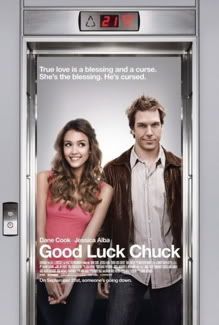
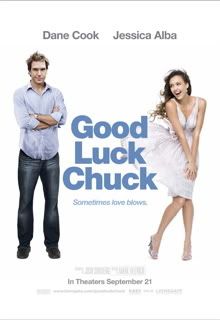
Me, the less I have to think and/or engage the better. What made GOOD LUCK CHUCK a solid entry into the genre was that it knew what it was and didn’t over-extend its grasp. It was a breezy film that brought together two notables in pop culture, Dane Cook and Jessica Alba, and smooshed them into an Oreo of gooey love.

Love it or leave it the movie did well enough in its theatrical run and it went on to do well in the international market. When the movie was released on DVD mere weeks ago I had the chance to talk to Dane Cook about everything you wish you could ask him regarding his swift rise to pop consciousness and all the slagging that goes along with being such a high profile target for people like Saturday Night Live during the World Series and the video, Dane Cooks, which showcase why this is best form of flattery for a man who has taken stand-up comedy from the peripheral of society to the mainstream with his best selling CD, television show and concert specials.

If I could pay Dane the best compliment I can it would be that his honesty during this brief, brief interview just cemented my respect for one of the prolific comics in the business today.

*****For those who would like to win a copy of the DVD to taste the GOOD LUCK CHUCK goodness just leave a message below. It can’t get any easier than this…*****

line.gif

CHRISTOPHER STIPP: Hey Dane, quick question regarding your comedic performance in GOOD LUCK CHUCK ““ Did this experience teach you anything at all about how to translate what people love most about your live shows as to what they should be able to appreciate about your film work? Has it changed your philosophy about how to approach romantic comedy or comedy in general?

DANE COOK: Yes, very much so. I definitely feel like, the term, within your wheelhouse, in figuring out how ““ I love guys like Steve Martin, THE JERK, or when Sandler did WATERBOY ““ we can look at so many comedians and ask what role finally put their pin on the map. I don’t know up until GOOD LUCK CHUCK if I found that fit ““ the physicality and language. So when I signed on for GOOD LUCK CHUCK I got to explore a lot of broad comedy ““ physical comedy, slapstick, to bring all the elements of stand up comedy performance together that’s very difficult to do. I don’t think I have done that yet. I don’t think I’ve had that role quite yet that perfectly combines many of the elements I’ve done on stage. I’ll continue to seek that out. It’s great to pick and choose and incorporate bits and pieces.

CS: I am curious as to get your thoughts on the cult of celebrity after doing some high profile projects like EMPLOYEE OF THE MONTH and GOOD LUCK CHUCK, having the media surrounding you and your relationships and parodies of you like Dane Cooks. How do you feel about what celebrity does to a person ““ what a big spotlight can do to you ““ to a person?

COOK: This question is difficult to answer in one felt swoop because celebrity is tricky man. I’ve seen everything happen to people. I’m a person who sticks close to ““ I’ve had the same friends for 20 years, I have a big family ““ I have 5 sisters and a brother in my family. I’m pretty quiet away from performing. I love to create and when I go home I love to just be in the real world.

The celebrity thing is so foolish, so bizarre the way the laser once in a while hits a person and just evaporates them. You see it all the time. These people start to believe the stuff that’s written about them or even become what the media wants you to become. It’s ping-pong. I never had a career that was so instant success-wise that it was like overnight sensation. Although people might say he came from out of no where but for a long time I had a slow steady trajectory and I got to kind of step around some of that.

But to be in a position now where sometimes people take shots it’s always cool to have an SNL or somebody want to send you up but I think when you start becoming a parody of yourself, that’s when things start to spiral out of control. I know my answer is a mess and all over the place but I try to stick around people who are into the create and not the drama because it’s so easy to participate in that and then suddenly you are caught up in lies and crap.

So, yeah, I stay close to home and I don’t want to end up being one of those people sitting on the side of it after the machine chews you up and spits you out. Here’s one thing about the machine that I, and again different for everybody, different answers, you do have control of the machine, you do have your hand on a button or a lever. You can control the speed. There is no one in this industry that can’t, unless they have really crazy people around them, you can be like, “Hey, I think I’m going to hop on a plane and leave for a minute.”

Anyone that stays in it I question that sometimes.

You have the ability to say “You know what, I think I’ll take a break” or go to Europe”¦you don’t have to stay in this bizarre oasis. It’s like if I start feeling weird I go back to Boston, hang out with people who don’t give a crap about Hollywood, I take out the trash, I eat at the old stomping ground. I feel like a regular guy again.

So, good luck with how you handle editing that one!

(Laughs)

There will be a lot of parenthesis in that like (Dean gets very serious). Quite a hypothesis on that answer”¦sorry about that.

CS: Quick question about your comedy as a whole. You said you were taking a break ““ you’re taking a step back, when you do take a break between these sorts of projects and what have you, does it change your overall spin on how you want to change the way you do your comedy when you do come back, or for lack of a better term, do you have a formula regardless of how long or how much you do touring or stand up?

COOK: You are asking a fantastic question because these are things I am exploring in myself. To be really honest, I don’t even really know what a break is.

I love working.

I find that some people say you should take a break and I say I kinda am but I’m still working. I love being on stage and yet after doing it straight through for so many years ““ I’ve done stand up for so many years every night didn’t take a night off unless it was a holiday or I was sick, and then finally to have “boom” kind of broken through it was like, this is my time, I don’t know how long it’s going to last “Can I turn this into a full career?” so I spent three years making movies and still making the families happy so I’m actually at the point right now where stepping back on stage regardless of the 7 hour set I did just a little while ago.

I finished this big tour, I put out my latest CD and now I’m in a period where I’m kind of reinventing the wheel. I’m going back”¦some of the new stuff I have is sort of a departure”¦I’ve always looked at my comedy in general and it should be an evolution ““ that you are never done, so I’m at a point right now that it’s fun to be a little scared of stand up. I hit the reset button. I’m not doing anything old. I’m working on all new ideas. So having stepped away from comedy in that sense doing films I’m bring a new life perspective back. It’ll be interesting here as I’m piecing it together I could probably speak to you more at the end of this year. Right now I’m fitting in with your question in figuring out what is it that I want to say now and how do I want to entertain people in the world of comedy.

CS: Dane, if I could close with the final question ““ I’m paraphrasing but Chris Rock said there’s the Stand Up Comedian’s Success Kit. Included in the kit is a movie, a book, a television show, now while you’ve said you’ve done pilots of a television show do you think that you will write a book? Do you think you will find success in a television show or do you think you’ve honed your craft well enough where you don’t have to spread your brand of comedy over different forms of media?

COOK: I think this is a time for me ““ I just want to – like Steve Martin’s book, for example ““ he’s a guy I really wanted to emulate in certain areas of my career. I’ve achieved this year everything I set out to do in my life that I said I wanted to do. I wanted to make movies, I dreamed about doing an arena tour when I was very young ““ I saw Steve Martin at Madison Square Garden and I had the “Wild and Crazy Guy” album, which I still have and am staring at the original album which I still have in my office right here.

So this year I finally, after many many years, have completed everything I set out to do. And I’ve done a couple movies that have been successful on different levels so now I’m really in a metamorphis now. I have another movie coming out this year with Kate Hudson. I’m really proud of it it’s a greater step in a direction of what I want to do and how I want to do my comedy in film. But I’m really interested in telling all kinds of stories.

So I think yes, you are right, there’s the book, the TV show, the movies, and certainly seems to be the path that has been laid for the successful comic. I’m leaving that path now. I’ve traveled that path, I’ve had different levels from marginal to great successes and now I’m daring myself to do more. Go see me on stage and after this rest I’ll get into the new evolution of my stand up, but I’ve got some irons in the fire that are quite different ““ a couple documentaries that are far from anything comedic and producing. I look at fine young talent and try to nurture this young talent. I’m going to dare myself to get off that path and take some risks that are outside the traditional kit that comes with comedy. So, we’ll go with that and see what comes next.

CS: Brillant ““ thanks so much Dane.

COOK: No worries ““ you got it!

Win THE COMEBACKS on DVD!

Filed under: Contests — UncaScroogeMcD @ 12:02 am

We’re giving away, in conjunction with Warner Bros. Home Video, five (5) copies of THE COMEBACKS on DVD.

Spoofing some of the most inspirational sports films of all, The Comebacks is the story of an out-of-luck coach (David Koechner, Anchorman, Thank You for Smoking) trying to lead a ragtag team of fumbling footballers to victory before his long-suffering wife (Melora Hardin, The Office, 27 Dresses) leaves him and his sexy gymnast daughter (Brooke Nevin) gets bent out of shape.

Contest ends at midnight EST on Wednesday, February 6th.

CLOSED! THANKS FOR ENTERING!

Official Rules

No member of Quick Stop Entertainment or their immediate families may enter.

No Purchase necessary to win.

Must be 18 years of age or older to enter.

All submitted entries must be received by 11:59pm EST on Wednesday, February 6th.

The winner must allow 4-6 weeks after notification of win to receive the product.

Quick Stop Thingamabobs: 1/30/2008

Filed under: Columns,Thingamabobs — UncaScroogeMcD @ 12:01 am

thingamabobs.jpg

The web. It’s a big place, full of plenty of distractions ““ some funny, some informative, some ludicrous, some disturbing, some inane, some profound. Each and every weekday, we present links to a few of our favorite finds”¦

————————————————

  • Prepare for Chuck Jones Tuesday… And where better than with “Rabbit Seasoning”… (Thingamabob)

January 29, 2008

Comics in Context #211: The Silent Rabbit

Filed under: Columns,Comics in Context — admin @ 1:00 pm

comicsincontext4.jpg

cic2008-01-291.gifOne of the questions on The Beat’s annual survey for her Publishers Weekly blog is to ask what “guilty pleasures” her contributors are anticipating in the new year. Last year I named the forthcoming Disney DVD release of The Adventures of Oswald the Lucky Rabbit, collecting the silent cartoon series that Walt Disney made just before the creation of Mickey Mouse. This DVD set finally came out in December, and I now realize that there’s nothing “guilty” about the pleasures these cartoons provide. I expected they’d be interesting as foreshadowings of Disney’s later work, but not particularly good in and of themselves. But the Oswald cartoons turned out to delightful period pieces from the early history of animation. Watching these, you can see that Disney was already well on his way to the success he would achieve only a year later with Mickey Mouse.

The Disney company hadn’t released the Oswald series on home video earlier because it didn’t own the cartoons or the character until recently. Back in the 1920s Walt Disney made the Oswald series for distribution by Universal. But then, as a featurette on the DVD explains, Universal sprang surprises on the young Disney: not only did they own Oswald, but they had also hired Disney’s animation staff away from him–except for his best animator, Ub Iwerks, who remained loyal–and would produce the Oswald series without him. This proved to be a blessing in disguise, since Disney was now determined to remain independent and own his own intellectual property; soon he and Iwerks jointly created Mickey Mouse, and Disney was on his way to becoming a cultural colossus. Recently, Disney’s new, enlightened management made a deal with NBC Universal in which Disney regained control of Oswald, and this DVD set soon followed.

Not only does the Oswald DVD set contain copies of all the extent Disney Oswald cartoons (which apparently took some hunting), but also some 1920s Disney cartoons that preceded and followed the making of the Oswald shorts.

The three cartoons that preceded Oswald are from Disney’s Alice Comedies series. Whereas in Max and Dave Fleischer’s silent animated series Out of the Inkwell, a cartoon character, Koko the Clown, entered the real (live action) world, in the Alice shorts a live action girl, Alice, appears within a cartoon world populated by anthropomorphic animals. Hence the evocation of Lewis Carroll’s Alice in the series’ title is quite appropriate.

In watching the first Alice short included in this set, Alice Gets Stung (1925), I was initially surprised by how little Alice appeared in it, though perhaps I shouldn’t have been, since I presume that it was harder and more expensive to combine live action footage of the girl portraying Alice with the animation than it was to do the animation alone.

Making Alice’s regular costar, Julius, a cat who looks an awful lot like Felix the Cat seems too much like imitating the competition. (It seems that Disney’s distributor insisted on having a cat in the cartoons: see here) But, as noted, even the premise of Alice is simply taking the Fleischers’ idea for Inkwell and reversing it. At this point Disney is still reacting to his competitors’ ideas rather than heading in a brand new direction.

Alice Gets Stung begins with a lengthy sequence with Julius the cat chasing a rabbit (which doesn’t strike me as being a cat’s natural prey) and the rabbit’s efforts at thwarting him. For example, Julius reaches down into one rabbit hole, while the rabbit emerges from another hole behind him. This is a variation on what became a standard gag in Bugs Bunny-Elmer Fudd encounters. Watching this cartoon, I felt that Disney had stumbled onto the idea of the rabbit as trickster–but perhaps didn’t yet know what he had. Shouldn’t the rabbit be the star animal of this cartoon, not the cat, who, as the predator, seems to be playing the bad guy? Maybe this rabbit points to the creation of Oswald, though it would be Warners that perfected the idea of the animated trickster rabbit with Bugs Bunny.

Even though Daffy Duck can get blasted by Elmer Fudd over and over without suffering greater harm than a temporarily displaced beak, many classic Warners cartoons still depend on the audience’s belief that the hunter or predator could potentially do harm to the animal hero: Wile E. Coyote does indeed want to eat the Roadrunner, and Elmer Fudd does indeed want to kill the wabbit. In the world of Alice Gets Stung, there seems to be no real threat of death or even injury. At one point Julius pulls off the lower half of the rabbit, but the halves soon rejoin, and the rabbit seemingly suffers no pain whatsoever. Later, Julius removes his own eyes and mouth and positions them over one of the rabbit holes; when the rabbit emerges from the other hole, the eyeless cat captures her. This is a rather grotesque extension of the convention of the Felix the Cat silent cartoons, whereby Felix can detach part of his body, like his tail: at another point in this cartoon, the rabbit uses her tail to powder her face. Amusing as this sort of thing can be in silent cartoons, it also makes the characters seem overly unreal, and one can see why later funny animal cartoons mostly disposed of this convention of detachable body parts.

You’ll notice I refer to the rabbit as “she”: this was a surprise, too. Once caught, the rabbit pours out a sob story about her infant children–whom we see in a brief vignette, all in the same cradle and wailing for “Mama”–as two other rabbits play violins, with heart and flowers appearing onscreen as substitutes for music. Moved, Julius lets the rabbit go, whereupon the rabbit laughs at the cat–presumably her story was all a lie–and the chase resumes. This time Julius pursues the rabbit down the rabbit hole where, with no evident cause, the rabbit suddenly grows to giant size and the tables are turned. There is no logical reason why this should happen, but I suppose the rabbit’s increased size might be a metaphor for growing braver and more aggressive, having gaining the advantage once she is on her home ground.

The live action Alice shows up and, in a neat trick, is shown carrying a cartoon fire hydrant. which she and Julius then use literally to flush the rabbit out of her hole. But again this struck me as misjudgment by Disney. Why is our heroine joining the cat in pursuing the rabbit? Shouldn’t we root for the rabbit, as the predator’s potential victim, and admire her cleverness?

The “hearts and flowers” sequence suggests that Disney might already have been longing for the opportunities that sound could provide for his cartoons. So does the next major sequence in Alice Gets Stung, which shows animals playing music as members of a band. This prefigures Disney’s The Band Concert a decade later. Moreover, in Alice Gets Stung animals’ tails get pulled to cause them to emit musical notes, a gag that would be much more famously used in the first Mickey Mouse cartoon to be released, Steamboat Willie. Alice Gets Stung also uses the image of the conductor–in this case, a bear-that would keep recurring in classic Hollywood theatrical cartoons, including The Band Concert.

Alice shoots a gun at one of a pair of dancing bears. This is another misjudgment by Disney; why should the heroine attack an animal that has been entertaining the audience? In the world of the Alice shorts, however, even being shot repeatedly does not harm the bear, who begins dancing in time to the (silent) gunshots. But after bullets sever his head and limbs, once his body parts rejoin, the bear is understandably enraged. Frightened, Alice and Julius shrink in size (reversing the previous bit of the rabbit growing gigantic with courage) and Alice becomes a cartoon character herself. In the end she and the cat are beset by bees, thus finally providing an explanation for the cartoon’s title.

Death seems to be real in the next Alice cartoon included, Alice in the Wooly West (1926), although the rules by which it operates are unclear. This time Julius looks even more like Felix and he is cast as a Western gunfighter. Bandit mice hold up the passengers of a stagecoach, but Julius rides to the rescue and shoots the mice dead. This is even more startling if you consider that with the creation of Mickey Mouse, Disney would soon firmly establish the convention that in funny animal cartoons, mice are the good guys and cats are the bad guys.

The head of the bandits looks like a bear in a top hat, who seems to be, yea, the forebear of the principal villain in the Oswald cartoons, the top-hatted Putrid Pete. The bear kidnaps Alice, and in the ensuing battle, Julius separates the bear’s head from his body with repeated blows. This causes the bear no harm, his head and body rejoin, and the conflict continues.

In a reworking of a gag from the previous cartoon, this time Julius removes not his eyes but his black fur to use as a decoy. Julius not only clobbers the bear from behind but actually buries him on camera, leaving a flower on his grave! It’s as if Bugs Bunny literally killed Yosemite Sam! So here’s another mistake that Disney would avoid in years to come.

But Alice rejoices, although Julius is embarrassed at her seeing him in his underwear. It’s an odd gag if you think about it, since it evokes the human taboo on nudity by using an animal, to which the taboo would not apply. Variations on this gag would get stranger still in the Oswald series.

The third Alice cartoon in the set, Alice’s Balloon Race (1925), foreshadows the airplane race in the Oswald cartoon, and in both the villain is a bear in a top hat whom the Oswald series would call Putrid Pete. (What an unfortunate adjective to apply to someone with such an appealing first name!)

I was particularly impressed by a bit in which Alice’s balloon crashes in the background and she bounces out into the foreground. Running the sequence back on my DVD player, I could see the point at which the tiny cartoon Alice who is bounced out of the balloon turns into the live action Alice who lands in the foreground. But it happens so quickly that the audience surely had the illusion that it was the real Alice all the time.

Bodies are even more malleable and unkillable in this short than in the others. Falling from the sky, Julius smashes into bits upon hitting the ground, and immediately resumes shape and life. Later Julius enacts a typical Felix-style gag, detaching his tail and turning it into an umbrella. But then this cat goes way further into the grotesque: he eats his tail, which then emerges from the back of his head and then slides down his back until it reaches its proper position. Even the animation experts on this cartoon’s commentary track reacted as if they nearly couldn’t believe their eyes.

The first Oswald cartoon in the DVD set, Trolley Troubles (1927) presents its hero as the driver of a means of public transportation, picking up passengers, just as Steamboat Willie does with Mickey. Oswald looks chubbier here than heroes in the other cartoons. He’s also the visual missing link between Felix the Cat and Mickey Mouse. All three are short and black, with white “faces,” black noses, and round heads: the major difference is in the shape of the ears. In Trolley Troubles Oswald also proves to have detachable body parts, using his tail as a brush. More disturbingly, he detaches his lucky rabbit’s foot and rubs it on his head for luck.

In these cartoons Oswald displays a range of emotions that foreshadows Mickey and later animated characters. Unlike many later animated stars, with the major exceptions of Donald and Daffy Duck, Felix, Oswald and the early Mickey were easily prone to anger. In Trolley Troubles Oswald literally hits an obese passenger off the vehicle.

In the most striking sequence, Oswald’s trolley plummets through a series of tunnels. Oswald stands in the foreground, his back to the audience, so we are essentially watching the sequence from his point of view, or, to put it differently, it is as if we are riding the trolley along with him, as the cavernous openings to the tunnels engulf the screen. It’s reminiscent of riding a roller coaster; it’s an early version of the sort of effect that today one might expect to find in a video game.

With the next cartoon, Oh Teacher (1927) Oswald embarks upon a theme that was not often to be found in Felix or Inkwell cartoons: love. here Oswald has a girlfriend, a female rabbit; this obviously prefigures the relationship between Mickey and Minnie Mouse, which is so important to the early Mickey cartoons.

When she accidentally tumbles into a lake, the unnamed girlfriend cries “HELP!”; not only do the letters appear onscreen, but Oswald rides them. as if they were a horse, to the lake to try to rescue her. Earlier in the short a question mark, used to denote a character’s puzzlement, was employed as a hook by the cartoon’s villain. These silent cartoons thus emphasize their own artificiality by taking an written word or a punctuation mark and turning it into a physical object. Maybe the detachable body parts in these cartoons serve a similar purpose: reminding the audience that Oswald and company are pen and ink creations, just as when Koko devolves back into ink at the end of his cartoons.

The girlfriend mistakenly thinks that it was the cat who saved her and snubs Oswald. The cat literally knocks Oswald’s head off, and though the head bounces back onto Oswald’s body, this still seems unintentionally disturbing. It is somehow easier to suspend disbelief and accept an anthropomorphic rabbit as real than it is to accept the idea that a living being can survive beheading.

In the standout sequence of Oh Teacher, Oswald angrily waits behind a schoolhouse to clobber the bullying cat with a brick. The cat unexpectedly comes up behind him, and Oswald nervously tries to hide the brick behind his back, switching it from one hand to the other. When the cat spots the brick, Oswald desperately starts lifting the brick with one hand, as if he is using it for weightlifting exercise. All of this happens in pantomime without a single word onscreen. This is real animated acting; the three Alice cartoons did not even attempt anything like this.

The next cartoon, Great Guns! (1927), suggests that even a decade after the devastation of World War I, Americans had a different attitude towards war than they do today. When war is declared in this cartoon, animals immediately enlist in the armed forces en masse, including Oswald.

Oswald is very much in love in this cartoon: in its most astonishing segment, the shot of Oswald kissing his girlfriend goodbye dissolves into a shot of Oswald kissing a photograph of his girlfriend, as he sits in a World War I-style trench, with rain pouring down around him.

There’s a good touch of Fleischer-style risqué visual humor that I hadn’t expected to find in a Disney cartoon: as soon as the enormous war cannons fire, they immediately collapse into a flaccid state.

Most of the cartoon is taken up by an aerial battle between Oswald and an enemy combatant, each piloting a plane; once again, Disney has cast a mouse as the bad guy.

At this cartoon’s end Oswald is reduced to what looks like shrapnel by a cannonball. His girlfriend, serving as a nurse, sweeps up Oswald’s remains, pours them into a giant shaker, as if she were mixing a drink, and pours out a pool of black ink, which (in the manner of Koko in the Inkwell cartoons) takes form as Oswald. Thus Oswald undergoes death and resurrection, and he gets the girl!

Walt Disney and his principal animators came from Kansas City, and the early Mickey cartoons have rural or barnyard settings. So it’s not a surprise that the next Oswald cartoon teams the rabbit with a cow, but the title character of The Mechanical Cow (1927) is, inexplicably, also a robot! Can we see the seeds of Disney’s future interest in audio-animatronics here? The flaccid cannon joke is repeated here, and Oswald again has a rabbit girlfriend, who is abducted by the bad guys.

In this cartoon the bad guys are ultimately devoured by sharks. I suppose that, considering that characters can survive dismemberment and beheading in the silent Disney cartoons, we shouldn’t take deaths in them seriously. Still, the Alice and Oswald cartoons certainly operate on a harsh moral code.

In The Ocean Hop (1927) Oswald competes against Putrid Pete, with top hat and peg leg, and others in an airplane race across the Atlantic. This updates the theme from Alice’s Balloon Race while probably alluding to Charles Lindbergh’s groundbreaking transatlantic flight, which also inspired the later Mickey Mouse cartoon Plane Crazy. Putrid Pete uses chewing gum to glue Oswald’s plane to the runway so it can’t take off. Instead, Oswald and some mice–friendly ones, this time–turn an unusually long dachshund into a substitute plane, utilizing balloons to lift him into the air. In another Felix-style gag, Oswald uses a word balloon containing a question mark as one of the balloons, employing the question mark to hook it onto the dachshund. (This is a more elaborate version of a similar flying dachshund gag from Alice’s Balloon Race.)

In the best moment of this film, a title card announces, “Then Night Falls,” and we see huge black raindrops falling around Oswald’s plane, which then merge into a sort of black sea of night. This has nothing to do with how night falls in the real world, but it makes a lovely alternative.

At the end Oswald falls from the sky to land safely in Paris, where he looks distinctly uncomfortable as Frenchmen congratulate him by kissing him on the cheek. Was Disney hinting at homosexuality here?

In All Wet (1927), set at the beach, Disney tries an interesting experiment with Oswald’s leading lady. Usually Oswald’s girlfriends, who are sometimes rabbits and sometimes, strangely, cats, are flat-chested; lacking breasts, they tend to go topless, like the early Minnie Mouse. What identifies them as female are things like hats with flowers or skirts and even visible panties. But the lady rabbit in All Wet not only wears a dress but is drawn with the suggestion of a bust. Indeed, at one point in the cartoon, she hides from the camera in order to change from her dress into a one-piece swimsuit. She even strikes flirtatious poses. She’s by no means built like a Jessica Rabbit or even Betty Boop, but she’s certainly preferable to the androgynous female leads of so many early cartoons.

Trying to impress her, Oswald bribes (!) the lifeguard into letting him substitute for him; she rows out to sea and feigns distress, but ends up in real danger. In a clever sequence, Oswald and the girl rabbit are continually being separated as waves lift him or her high up out of the other’s reach. But the girl rabbit seems less than real when Oswald, in giving her artificial respiration, rolls up her body and legs, as if she were a rug!

The Rival Romeos (1927) are Oswald and Putrid Pete, this time without a peg leg. Early Fleischer cartoons depict a world in which everything could be alive and mobile. The silent Disney cartoons in this set generally steer away from this approach, but in Rival Romeos Oswald and Putrid Pete drive cars with faces and personalities. Putrid Pete’s car refuses to drive into mud, and Oswald’s car joins Oswald in laughing at Pete.

With the opening of Bright Lights (1928), Disney and his team are obviously setting themselves new visual challenges and meeting them. This short opens with an animated version of an electric sign such as one might have seen in Times Square, with dancing stick figures, advertising “Mlle. Zulu, shimmy queen,” an exotic dancer. Then we go inside the theater to find yet another example of a conductor in classic animation, this time an ape leading an animal orchestra. There’s a chorus line of scantily clad dancing girl cats, followed by Mlle. Zulu herself, who performs her shimmy dance in an impressively animated serpentine manner.

All of this is before Oswald even makes his entrance. When he does, Oswald proceeds to demonstrate his growing range as an animated actor. His heart bulges from his chest as he thinks about the sensuous Mlle. Zulu, and he grows embarrassed when he unconsciously rests his hand on the derriere of a poster image of Mlle. Zulu, which then angrily comes to life.

Though Oswald’s personality grows fuller and more believable, the characters bodies remain unbelievably malleable. A theater guard hits Oswald so hard that he turns into a mass of tiny Oswalds, which merge back into the full size version; this is a recurring gag in the Oswald series. Oswald retaliates by tying the guard’s legs around a lamppost, as if he were made of rubber. I also like the clever bit in which Oswald tries to sneak into the theater by hiding under a patron’s enormous shadow as if it were a carpet.

With Ozzie of the Mounted (1928) Disney shows ambition as a storyteller by moving away from familiar rural and urban settings into the Canadian wilderness, parodying the same tales of the Royal Canadian Mounted Police that later served as fodder for Jay Ward’s Dudley Do-Right. In this cartoon the familiar furry villain in the top hat is identified as Putrid Pete alias Kid Pete alias Peg Leg Pete, a name later given to Mickey Mouse’s feline adversary. Oswald’s horse is another robot, although why Disney was so interested in mechanical farm animals remains a mystery.

My favorite of the Oswald cartoons in this set is Oh What a Knight (1928). On the commentary track Leonard Maltin and Mark Kausler suggest that this is a parody of Douglas Fairbanks’ Robin Hood (1923), which makes sense since the early, adventurous Mickey has also been compared to Fairbanks. So Oh What a Knight is a parody of the swashbuckler genre in film, with Oswald as a kind of heroic singing troubadour: we can’t hear him sing, but there are plenty of musical notes drawn on screen, as Oswald makes his entrance, singing, while his donkey dances along. Robert Israel, a veteran composer of scores for silent films on video, created the musical accompaniment for the Oswald cartoons. I’m especially pleased that he sets Oswald’s singing entrance in Oh What a Knight to music from Richard Wagner’s Die Meistersinger von Nurnberg, which deals with medieval singers. Later in the cartoon, Israel quotes from Tannhauser, another Wagner opera about a singing knight (and possibly Israel’s nod to Chuck Jones’s What’s Opera, Doc?, which extensively uses music from Tannhauser).

It’s been two decades since I saw Fairbanks’ Robin Hood, but the most astounding segment in Oh What a Knight reminds me of Errol Flynn’s much more familiar The Adventures of Robin Hood (1938), co-directed by Michael Curtiz, which was made a full decade after this cartoon. Both the Flynn Robin Hood and Curtiz’s The Sea Hawk (1940) culminate with swordfights in which the combatants cast enormous shadows on the walks behind them. Was this a swashbuckler movie tradition that predated Curtiz’s films? For, lo, in the greatest segment of Oh What a Knight, Oswald and an armored Putrid Pete wage a swordfight complete with ominous shadows behind them. Moreover, at one point Oswald exits the battle to go kiss the leading lady, while his shadow continues the duel with Putrid Pete in his place!

As the cartoon’s commentary track says, Oswald “recharges” his energies during the battle by continually returning to his lady love for a kiss. In this cartoon and some others, Oswald’s leading lady is not a rabbit but a cat. It would seem strange if Mickey Mouse’s girlfriend were not also a mouse, but then again, in more recent times Kermit the Frog and Miss Piggy have gotten away with interspecies romance. I like the way that Disney and his animators kept devising new ways in these cartoons to portray Oswald’s sexual arousal. For example, at one point in Knight, his leading lady’s kiss causes Oswald’s feet to rotate in ecstasy.

Like Bright Lights, Sky Scrappers (1928) places Oswald in a then-contemporary urban setting: a skyscraper under construction. Putrid Pete sexually harasses Oswald’s girlfriend, a female cat, leading to an energetically staged battle between Oswald and Pete on a girder suspended high above the ground. Still, the cartoon disappointingly fails to evoke the suspense of the live action “thrill comedies” with similar settings that surely inspired it, like Harold Lloyd’s Never Weaken (1921) and Safety Last (1923) or Laurel and Hardy’s later Liberty (1929). It certainly pales in comparison to the split second timing of Popeye and company sleepwalking on and off girders in A Dream Walking (1934), whose complex visual choreography and split second timing was presumably beyond the capability of animators in the 1920s. The main problem, though, is that there’ not enough sense of potential sense of danger from falling in Sky Scrappers. At one point Oswald, climbing a rope, falls several stories, squashes on impact, but immediately resumes normal form, seemingly feeling no pain. He’s so rubbery that if he fell off the girder, one wouldn’t be surprised if he bounced.

The Fox Chase (1928) is another example of misjudging audience sympathies. Surely the audience would side not with Oswald the fox hunter but with his intended victim, the clever fox who outwits him. This fox is not only a trickster but a shapeshifter, adopting a disguise in the cartoon’s final moments that thwarts his hunters once and for all. In the high point here, Oswald tries to drive the fox out of a log by rolling it up like a rug–or like his leading lady from All Wet.

The last Oswald short, Tall Timber (1928), utilizes another ambitious setting, opening with Oswald rowing a canoe down a river, past a wilderness, down waterfall and, excitingly, through rapids. This time Oswald is a duck hunter, but, once again, I found my sympathies going to the duck. But then the cartoon resumes thrill comedy mode. Oswald finds himself riding a moose and being catapulted towards the screen–and the audience–until his face fills the frame. Then Oswald flees from an onrushing, rolling boulder, which finally, literally flattens him against a tree. The result is that Oswald is literally rail thin, but far taller. Oswald tries to restore his true shape by hitting himself with another heavy rock, but this impact distorts his body to the opposite extreme. An amazingly weird closeup shows Oswald’s head, inflated like a balloon. In long shot Oswald now looks short and obese, and his ears are no longer long but rounded: in fact, he looks like a fat Mickey Mouse! Two bear cubs seize either end of Oswald and pull, finally causing the rubbery rabbit to snap back to normal shape. Nevertheless angry, Oswald pursues the bear cubs to what looks like an immense black rock, but proves to be their huge, ferocious mother. But after an offscreen battle in a cave, the mother bear flees, with a furless body in bra and panties (yet another of the various animal “nudity” gags in the Oswald series that falls flat). Oswald then reenters, wearing a resplendent fur coat; he dons a top hat and lights a cigar in triumph. That seems an appropriate final image for what amounts to his curtain call in this final Oswald cartoon.

On the second disc are three key cartoons, animated by Ub Iwerks, that Walt Disney made independently, after Universal took Oswald away from him. They include the Mickey Mouse cartoons, Plane Crazy (1928) and Steamboat Willie (1928). The opening credits for each cartoon call it “a Walt Disney comic by Ub Iwerks,” a description that’s interesting for two reasons. First, the phrasing indicates that Walt Disney was in charge, but that Iwerks was the actual hands-on creator of the film. Second, the phrase “Walt Disney comic” suggests that at this point Disney–and perhaps his audience, as well– regarded the animated cartoon as a cinematic kind of comic strip, rather than as a separate artform.

Plane Crazy was the first Mickey Mouse cartoon that Disney made, and it was originally created as a silent cartoon. But it was the third Mickey cartoon, Steamboat Willie, with its groundbreaking synchronized sound track of music, dialogue and sound effects, that was the first to be released. But watching Plane Crazy, I found myself thinking that even apart from the question of sound, it was a good thing that Mickey actually made his debut in Steamboat Willie instead.

Opening in a barnyard, Plane Crazy presents Mickey as rural rodent who, with hep from other animals, builds his own plane and models himself after Charles Lindbergh, the first pilot to fly solo across the Atlantic. (We even see a surprisingly realistic picture of Lindbergh in the film, which sharply contrasts with the “cartoony” style in which the animal characters are drawn; Mickey even musses his hair in imitation of Lindbergh’s.) Mickey invites Minnie Mouse to join him on his flight. Eventually Mickey starts flirting with her and puts his arm around her; she wags her finger and tells him no. Looking devilish, Mickey speeds up the plane and puts it through aerial maneuvers that frighten Minnie. then he forcibly kisses her, Minnie slaps his face and she jumps out of the plane to escape him, her skirt billowing into a makeshift parachute. In other words, Plane Crazy portrays Mickey Mouse as guilty of sexual harassment, acting no differently than Putrid Pete in Sky Scrappers!

Watching Steamboat Willie after the Oswalds, I realized that much of the first half of the cartoon and its final scenes is conventional for its time, nowhere nearly as inspired as the best of Felix, Inkwell and Oswald. Mickey is the pilot of a steamboat, and his boss is an enormous cat with a high hat, an early version of his archfoe Black Pete (whom we can now see as Putrid Pete’s descendant). The bullying Pete pulls Mickey’s body, as malleable as Oswald’s, out of shape, stretching it till Mickey’s midsection looks like a rubber hose. There’s some vulgar comedy business with Pete spitting. Too late to board the steamboat, Minnie runs alongside it until Mickey uses a winch and hook to lift hold of her panties, a rather demeaning way to treat the leading lady, and deposit her on the boat. At the end of the cartoon Pete forces Mickey to peel potatoes, a parrot laughs mockingly at the mouse, and Mickey gets angry, beans the parrot with at grown potato, and laughs. This material seems all too conventional. sometimes crass and even mean-spirited.

But the opening image of Mickey at the wheel of the steamboat shows why Steamboat Willie fired the public imagination. Mickey is smiling, happy, and whistles a tune we hear on the soundtrack. It’s not just the fact that Steamboat Willie had synchronized sound that made it a breakthrough: it’s the way that Disney adapted his characterizations and stories to the opportunities that music provided. By making music, either by whistling or by playing his improvised instruments later in the cartoon, Mickey becomes a source of pure joy.

The middle of the cartoon has no story: it’s just Mickey playing his instruments, whether they are spoons and pots or various animals. For example, the musical sequence begins when a goat eats the sheet music for “Turkey in the Straw”; Mickey discovers that by turning the goat’s tail like a crank, the goat becomes a living gramophone, with the music coming from his mouth. Steamboat Willie has incurred criticism for Mickey’s supposed sadism, pulling a cat’s tail, or stretching a goose’s neck, or, startlingly, pressing a female pig’s udders in order to produce musical sounds. But in the context of the Oswald cartoons, in which characters’ rubbery bodies rarely sustain any harm, this doesn’t seem so bad to me. Presumably viewers in the 1920s would accept the convention of the period’s cartoons that these animals are not really being hurt. Instead, the audience would be carried along by the music Mickey is playing with these animals, in an effect that is simultaneously comedic and pleasurable simply as music. The cartoon’s ending, with the reversion to expressions of violent anger, is a letdown: it would have been better had Steamboat Willie ended with a musical gag of some sort. It’s Mickey the music maker who first won audience’s hearts.

The final cartoon in this DVD set is The Skeleton Dance (1929), animated by Ub Iwerks, the first of Disney’s Silly Symphonies series. This cartoon is a little masterpiece even though it has no actual story. Whereas the “Turkey in the Straw” segment in Steamboat Willie was an extended interlude between more conventional story sequences, The Skeleton Dance is entirely founded on music. The cartoon begins as a sort of visual tone poem, establishing an eerie mood both through the music and through classic visual elements from horror tales: lightning, the ominous eyes of an owl, a seemingly deserted church and graveyard, a howling dog (who looks like Pluto in silhouette!), and flying bats. Soon the cartoon introduces notes of humor as well, with black cats battling by pulling each other’s noses as if they were rubber bands. This reversion to Oswald-style visual humor is abruptly interrupted when a skeleton looms from behind a tombstone separating the cats and then leaps directly at the “camera,” invading the viewer’s space. Four skeletons then begin their dance, which takes up the rest of the cartoon, sometimes entertainingly silly, sometimes macabre, sometimes both at once.

The success of The Skeleton Dance led to Disney’s long series of Silly Symphonies which were built around music, frequently classical music. I’ve written about a number of Silly Symphonies before after seeing them at Lincoln Center (see “Comics in Context” #136: “Before There Were Cars”). Last December I attended the Museum of the Moving Image’s four-part retrospective of Silly Symphonies, including The Skeleton Dance and demonstrating how Disney further developed his new invention, the musical cartoon, but that is a topic for a future installment.

Copyright 2008 Peter Sanderson

The Greatest Movie Blog Of All Time: No Joke

Filed under: Columns,The Greatest Movie Blog of All Time — UncaScroogeMcD @ 12:49 pm

greatestmovieblog.jpg

It’s No Joke

When I first heard that Heath Ledger would be playing The Joker in the upcoming Batman movie, “The Dark Knight” I was less than thrilled. He seemed too serious, his voice was too deep, too grounded, too brawny. To me this wasn’t ideal casting for a character we’ve often thought of as lanky, psychotic, and with a high-pitched giggle. Really? Ennis Del Mar is the Joker? I didn’t see. Then I saw the trailer and realized I knew nothing and Christopher Nolan knew everything. In those 2 ½ minutes Ledger’s Joker was everything I thought he wouldn’t be and more. And that was just 2 ½ minutes! I was stoked (and still am).

ledger.jpg

This week Heath Ledger gave us a reason to be so serious.

Last Tuesday afternoon, on the day the Oscar nominations were announced, the man who I was now eagerly awaiting to see play the clown prince of crime was found dead in his NYC apartment. He was only 28 years old.

I’ll admit it the first thing that popped into my head was what a cruel publicity campaign Warner’s was trying to run. Now I wish that had been true. He was truly becoming a master of his craft. He was just beginning to produce some truly remarkable work. Sadly, thats all gone now. And more importantly, a family has lost a father and a son.

Warner’s has said that all of Ledger’s work on “The Dark Knight” was completed before his death. So come July we’ll all get to enjoy his complete performance and try to forget that it was his last. Life is sadly temporary, but film is immortal. My thoughts go out to his friends and family. He will be missed.

The 2007 Oscar Nominations

As I said above, the Oscar nominations came out last Tuesday. I can’t say I’m surprised by any of the nominations. Two of my favorite films of 2007, “Gone Baby Gone” and “Charlie Wilson’s War”, only managed get 1 nomination each (well deserved supporting nods for Amy Ryan and Philip Seymour Hoffman). “300” was shut out completely (a film I would’ve thought would be a shoo-in for technical awards at the very least).

But none of it truly bothers me. I still dig the movies I put on my top 10 list and stand by them. The Academy Awards are a very political process because studios believe that an Oscar nomination gives their film credibility (“Transformers” got three nominations, by the way). Nominations and awards are stamped onto DVD packaging so the average consumer will be “informed” as to what are the “good” movies. It’s ridiculous.

prime

Star of a 3-time Oscar nominated film.

Steven Spielberg didn’t win a Best Director award until 1993. Martin Scorsese got his first last year. Alfred Hitchcock never won an award for one of his films (he was given a lifetime achievement award).

It’s impossible to choose one great film over another as being the best (or one actor or actress, or one screenplay, and so on). Some years, one film or performance truly does stand above the rest but most years there are easily a half dozen films that are all on the same level. Just because your favorite film of the year wasn’t nominated for an award doesn’t mean it wasn’t a good film. It entertained the hell out of you, didn’t it? That should be success enough for you. Besides, might not even be an Academy Awards show this year.

The Room

Onto the lighter side of things. There’s an odd phenomenon going on at the Sunset 5 theaters here in LA on the last Saturday of every month. At midnight, one of their theaters is packed for this little (and quiet terrible) movie called, “The Room” which was made in 2003. I set out in a rare Los Angeles monsoon to give it a look.

Make no mistake, this movie is AWFUL. A true vanity project for writer-director-star Tommy Wiseau. Wiseau plays Johnny, a creepy looking guy with long black hair and pale skin whose fiancee Lisa cheats on him. Plot elements and characters come out of left field. The dialogue is cringingly bad, the performances even worse. Wiseau’s Johnny looks easily 20 years older than his costars and appears sedated through most of the movie. It’s misogynistic. It’s discombobulated. It’s often out of focus. I’ve rarely had a better time watching a movie.

This is a rare film that you HAVE to see it in a crowded theater. It’s an experience where shouting at the screen is downright encouraged (don’t worry, you won’t miss any crucial plot twists, there aren’t any). Most of the loyal fans have seen the movie dozens of times. They shout out lines, point out obvious plot holes, and inexplicably throw plastic spoons in the air. And they cheer from the moment the film starts and stay right through the end credits. It’s really a great time.

All the best.

(and Godspeed, Heath).

Brett Deacon has spent much of his spare time this week in Los Angeles lining up animals two by two.

Toy Box: Masters of the Universe – King Randor Classic Colors

Filed under: Columns,Toy Box — admin @ 12:45 pm

toybox.jpg

NECA and the Four Horsemen have been producing the very cool series of ‘staction’ figures (better known as ‘statues’) based on the Masters of the Universe line for the past few years. In 2005 at Comic-Con, they had an exclusive of King Randor. Those sold out long, long ago, but now Action Figure Express has a slight variant called the Classic Colors version.

Along with slightly different paint (in a 1980’s scheme), there’s a new head sculpt, new cape, and new shield accessory! This is much more than the usual repaint variant, with plenty to make it unique. It’s a limited edition of 2500, and is $30.

If you have any questions, drop me a line at mwc@mwctoys.com, or swing by and check out my website at mwctoys.com. Now on to the review!

NECA Masters of the Universe King Randor exclusive statue

toybox_012908_1.jpg

Packaging – **1/2
Unlike the regular release ‘stactions’ which came carded, these come in a box. The styrofoam insert is one of the annoying ones though. You know, the type with the soft big chunk styrofoam that falls apart when you try to pull it out of the box and makes a mess all over the carpet that requires a Dyson to get out. But at least it keeps him safe til you do pull him out!

toybox_012908_2.jpg

Sculpting – ****
As usual, the sculpting is top notch. The Four Horsemen do an outstanding job on this series, and this one is no different.

The new head sculpt looks good, with some very nice detail work. The battle damaged shield looks terrific, and the new cape has actual fur! Yes, it’s fake real fur, but it’s certainly unique. He might shed a bit more than the normal statue, but he makes up for it by looking far more realistic.

toybox_012908_3.jpg

The stance and pose are dynamic enough to be interesting, but aren’t over done or extreme. He’s done in a 6″ scale, and looks terrific with the other figures released previously in the series.

Paint – ***1/2
The paint isn’t quite as nice as the excellent sculpt, but it’s close. These are quite well done for the price point.

There’s a bit of a slip up around the beard on mine, where the hair line isn’t quite as clean as it should be, but considering the $30 price, I’m not complaining too much. The 80’s colors are pretty cool, and he sports a nice combination of flat and gloss finishes to give the impression of different materials.

toybox_012908_4.jpg

Accessories – ***
Oddly enough, he’s a statue with accessories. The sword, shield and base are all removable.

The base fits in with the rest of the line, sporting a similar design. His feet fit well on the pegs, and there’s no danger of him toppling over under normal circumstances. The bases are a little dull, but they do make sense in the context of the series.

toybox_012908_5.jpg

The sword fits easily in the left hand, while the shield attachs to the wrist of the right. The sculpts and paint on both are in line with the rest of the statue.

Value – ***
Statues, even 6″ statues, don’t cost $30. Compare these to the similarly styled Batman Black and White statues from DC Direct, which cost $45 – $55 a pop, and you can see what I mean. And this guy even has a fuzzy cape!

toybox_012908_6.jpg

Things To Watch Out For –
Not much. Take your time putting the feet on the base, just to make sure you don’t chip anything.

Overall – ***1/2
Had the paint been just a hair better (pun intended), this guy would have hit the four stars. I really do like the MOTU stactions, even not being a huge MOTU guy. Fans of the 80’s show will appreciate this repainted King Randor, and I’d suggest picking it up while you can. These will be statues that folks will wish they’d picked up a few years down the road.

Where to Buy –
This is a limited edition exclusive to Action Figure Express, so that’s your best bet right now.

Related Links –
I have a few other reviews of past MOTU Stactions:

– this guest review covered the series 5 figures, while this one covers series 2, and this one on series 1.

Win AQUA TEEN HUNGER FORCE on DVD!

Filed under: Contests — UncaScroogeMcD @ 12:32 pm

We’re giving away, in conjunction with Warner Bros. Home Video, three (3) copies of AQUA TEEN HUNGER FORCE: SEASON 5 on DVD.

Contest ends at midnight EST on Tuesday, February 5th.

CLOSED! THANKS FOR ENTERING!

Official Rules

No member of Quick Stop Entertainment or their immediate families may enter.

No Purchase necessary to win.

Must be 18 years of age or older to enter.

All submitted entries must be received by 11:59pm EST on Tuesday, February 5th.

The winner must allow 4-6 weeks after notification of win to receive the product.

Quick Stop Thingamabobs: 1/29/2008

Filed under: Columns,Thingamabobs — UncaScroogeMcD @ 12:14 pm

thingamabobs.jpg

The web. It’s a big place, full of plenty of distractions ““ some funny, some informative, some ludicrous, some disturbing, some inane, some profound. Each and every weekday, we present links to a few of our favorite finds”¦

————————————————

  • Today, we’ve got Donald Duck Tuesday… Starting with Donald & his nephews in “Sea Scouts”… (Thingamabob)

January 28, 2008

The Fred Hembeck Show: Episode 103 – Once Bitten

Filed under: The Fred Hembeck Show — UncaScroogeMcD @ 2:02 am

fredhembeckheader.jpg

hembeck2007-12-17-01.gif

hembeck2007-12-17-02.gif

hembeck2007-12-17-03.gif

hembeck2007-12-17-04.gif

hembeck2007-12-17-05.gif

hembeck2007-12-17-06.gif

hembeck2007-12-17-07.gif

hembeck2007-12-17-08.gif

hembeck2007-12-17-09.gif

hembeck2007-12-17-10.gif

hembeck2007-12-17-11.gif

hembeck2007-12-17-12.gif

hembeck2007-12-17-13.gif

hembeck2007-12-17-14.gif

hembeck2007-12-17-15.gif

hembeck2007-12-17-16.gif

hembeck2007-12-17-17.gif

hembeck2007-12-17-18.gif

hembeck2007-12-17-19.gif

hembeck2007-12-17-20.gif

hembeck2007-12-17-21.gif

hembeck2007-12-17-22.gif

hembeck2007-12-17-23.gif

hembeck2007-12-17-24.gif

Today’s episode was for all you folks who’ve said, “The Fred Hembeck Show sucks!!”. Yes, this time around it did. Well, at least, it pretended to…

Now, about those links mentioned above. If you want to know more about the impending Image Comics’ publication, The Nearly Complete Essential Hembeck Archives Omnibus – including how to get either a simple autographed copy or one with my signature AND a custom drawing!–just use that link! And as always, check out my blog, Fred Sez, or my whole gosh darn website, Hembeck.com!! And before you know it, we’ll see you all back here at the Quick Stop corral!
Copyright 2008 Fred Hembeck

Win THE INVASION on DVD!

Filed under: Contests — UncaScroogeMcD @ 1:06 am

We’re giving away, in conjunction with Warner Bros. Home Video, two (2) copies of THE INVASION on DVD.

Contest ends at midnight EST on Monday, February 4th.

CLOSED! THANKS FOR ENTERING!

Official Rules

No member of Quick Stop Entertainment or their immediate families may enter.

No Purchase necessary to win.

Must be 18 years of age or older to enter.

All submitted entries must be received by 11:59pm EST on Monday, February 4th.

The winner must allow 4-6 weeks after notification of win to receive the product.

Quick Stop Thingamabobs: 1/28/2008

Filed under: Columns,Thingamabobs — UncaScroogeMcD @ 12:54 am

thingamabobs.jpg

The web. It’s a big place, full of plenty of distractions ““ some funny, some informative, some ludicrous, some disturbing, some inane, some profound. Each and every weekday, we present links to a few of our favorite finds”¦

————————————————

  • What the hell… Let’s make it Gonzo Monday, starting with some dancing cheese… (Thingamabob)
  • I’m Going To Go Back There Someday… (Thingamabob)

January 25, 2008

Trailer Park: THE HOLLYWOOD REPORTER’s James Greenberg Seems To Have No Problem With Polanski’s Pedophilia

Filed under: Columns,Trailer Park — admin @ 3:59 am

By Christopher Stipp

Archives? Right Here…

I’m awesome. I wrote a book. It’s got little to do with movies. Download and read “Thank You, Goodnight” right HERE for free.

There is little I take contention with when people talk about what’s on their minds.

I appreciate that we live in a country where people can say what they want and not fear that their government will put them in jail or, worse yet, put them to death for expressing themselves. However, James Greenberg of the Hollywood Reporter is genuinely testing my tolerance for ignorant, stupid, misinformed, shallow and despicable scribblings. How one person can be given a platform where he can can say that Roman Polanski has done his time by having to leave this country, fleeing his rightful (however of a gross miscarriage of justice one person thinks has happened to another) conviction for having sex with a minor.

I wanted this to be a column about a film that’s rocking the Sundance boat, ROMAN POLANSKI: WANTED AND DESIRED, how it was nice that there was a documentary out there that explored the effects of media attention and the way in which justice is meted out. No one would argue the effects of this during the O.J. Simpson case in the 90’s where prime time punditry, media spotlights, the legal system and the insatiable need some have for celebrity caused such a hallmark for academics who are still discussing its effects today.

Even though I haven’t seen this film I have read that filmmaker Marina Zenovich’s documentary opens on the predatory pedophile who, as Yahoo! reports, is shown in archival footage talking about his predilection for really young girls. I initially thought this would be an excellent story about someone has finally taken the time to examine the way the justice system and media have coalesced in this odd amalgam of the saying “separate but equal” with regard to people getting a fair trial but then I read what James Greenberg had to say about the film’s message. And, to my satisfaction, he takes an admirably tough peek at what the film’s thrust actually is but then the guy has to say this:

Most people remember that Polanski left the country, but few know why and under what circumstances. “Wanted and Desired” finally sets the record straight, and, if there is any justice in the world, Polanski will be allowed to return to this country not as a pariah but as someone who made a mistake and has more than paid for it.

What fucking country do you live in James where it’s OK to have sex with a little girl and, all you have to do to be absolved of it, is to leave the country for a while without ever having to step into a prison to atone for the crime? Better yet, you ignorant asshole, how about you stop thinking like a media whore who thinks that because this guy had a media circus to deal with but then fled like the pussy he is because he knew he was going to jail where, if I’m not mistaken, they don’t look too kindly on men who pump and dump into little kids that he has “more than paid for it”? No, that would be asking too much because even though his victim has long since reconciled the event in her life and, because of that, there should be a de facto kind of settlement between the rapist and his victim it I am sure you would be better served getting the opinion of the many women’s organizations whose sole mission is to help young women deal with traumatic events like this, some of whom never get over it. I believe a lot of these groups would love to be able and sit you down to talk you about how twisted and poor your thought process is if you were to hear the stories of other women who might of had this happen if only once in their lives.

I get it.

You’re willing to look past this monster’s past in order to have this human reject grace the soil of America as a free man. I wish I could say something else about the kind of life he’s been allowed to live “in exile” but there is a problem with your flawed, broken logic: he’s never served his time. He’s been allowed to roam free all these years, living the kind of life those who are convicted sex offenders never get the chance to do because they don’t have well-heeled friends help then ESCAPE this country. I may think I’m getting a raw deal if I’m famous and am being treated too harshly but, if I’m not mistaken, having the book thrown at you only means that any and all things you can rightfully be charged with are applied; they’re not making up shit.

I could go on and on about how utterly shitty your 2nd grade logic is by comparing rape of a 13 year-old is to a “mistake” but it’s obvious that even if you are the parent of little girls I weep for their fate if any of them are dealt the same fate as Samantha Geimer. I think you wouldn’t be calling it a “mistake” but calling it for what it was: rape.

You, along with a lot of other critical eggheads who love Polanski’s work without weighing this aspect of his life fairly, are what’s truly amazing about this country. I may not like what you have to say but it’s a delight that you are allowed to speak your mind without the repercussions if you were to say these things in a country where they actually do care about the safety and welfare of their women.

Soooo….I heard the U2-3D film is all sorts of awesome.

You may not like the Messiah Bono but I have read review after review extolling this movie’s immersing sensation. I happen to be a marginally big U2 fan but I understand where someone might get the notion that Bono needs a little throttling every now and then. I happen to also understand when you’ve got to look at something like this as an opportunity to see this movie as a step forward in movie going and it could make the argument as to what it would take to get people back into the theater.

New opportunities.

Few know and even less care but I have been listening to some of the comments below (Yes, you can now publicly call me out if you’d like to. I’m an equal opportunity offender) and some of the e-mail I’ve received about the deluge of interviews I’ve been doing in lieu of the trailer column here. As an aside, really, of all those I’ve come in contact with who wield some kind of power at the various studios or PR houses, no one really seems to care that I have been doing this now for over 4 years.

I have been approached where all I’m needed to do is churn out interviews (1 a month or so) with directors, writers and/or actors. The best part is that it’s for the writer of Fight Club’s Chuck Palahniuk’s web site, The Cult.

This not only represents more work I’ll be doing on the side when not properly employed at my day job but it’ll also mark the chance for me to finally be writing for the same site as Joshua Jabcuga, writer extraordinaire of the latest and greatest Scarface graphic novel “Scarface: Devil in Disguise” from IDW, and again represents the chance for the Wonder Twins to churn out some of the greatest milquetoast writing since the days of MoviePoopShoot.com.

This is truly a blessing to be a part of a site which is owned by the kung-fu master of explosive, focused fiction and I hope it shows you how multi-faceted my musings actually are; at the very least I hope you don’t think it sucks.

Have you seen the slow build-up for Sam Rockwell’s CHOKE? You should. I hope to bring you something big out of it.

SPEED RACER (2008)

Director: Andy Wachowski, Larry Wachowki
Cast:
Emile Hirsch, Christina Ricci, John Goodman, Susan Sarandon, Matthew Fox, Hiroyuki Sanada, Richard Roundtree, Ji Hoon Jung (aka “Rain”)
Release: May 9, 2008
Synopsis:
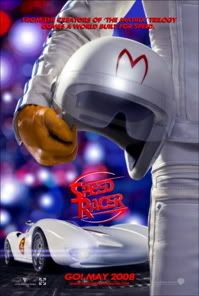
Born to race cars, Speed Racer (Emile Hirsch) is aggressive, instinctive and, most of all, fearless. His only real competition is the memory of the brother he idolized – the legendary Rex Racer, whose death in a race has left behind a legacy that Speed is driven to fulfill. Speed is loyal to the family racing business, led by his father, Pops Racer (John Goodman), the designer of Speed’s thundering Mach 5. When Speed turns down a lucrative and tempting offer from Royalton Industries, he not only infuriates the company’s maniacal owner (Roger Allam) but uncovers a terrible secret – some of the biggest races are being fixed by a handful of ruthless moguls who manipulate the top drivers to boost profits. If Speed won’t drive for Royalton, Royalton will see to it that the Mach 5 never crosses another finish line. The only way for Speed to save his family’s business and the sport he loves is to beat Royalton at his own game. With the support of his family and his loyal girlfriend, Trixie (Christina Ricci), Speed teams with his one-time rival – the mysterious Racer X (Matthew Fox) – to win the race that had taken his brother’s life: the death-defying, cross-country rally known as The Crucible.

View Trailer:
* Large (QuickTime)

Prognosis: Negative. If you’ve got LSD, take it, and if you have an epileptic sensitivity to flashing lights look away now.

I am really unable to put into words just how this movie breathes by itself but this film definitely has its own style, I will give it that. There’s a hyper-accelerated, kinetic vibe that just drips off the screen but I am really unsure how that will translate to middle America. I think kids of a certain age will dig this for the most part but, for those of us who are all too familiar with one of the brothers’ erotic predilection for stretched laxtex, there are elements of this trailer that make you scratch your head in wondering why the Wachowski’s don’t tone down their need to inject latent and overt sexuality in their pictures. Of course, I could be wrong but I’d like one person to try and make an opposing viewpoint after seeing Emile Hirsch’s overly tousled locks, his brow spray bottled with a hint of glistening moisture and Matthew Fox’s George Michael inspired facial hair in that black leather.

I almost think this is a promo video for how to become someone’s gimp.

Save that, though, there is an issue of the trailer at hand and who here isn’t a little crazed at the full-tilt CGI of the opening sequences of what looks like the latest racing game for the PS3? The cars looping around on a track that looks cobbled together by someone who was obviously colorblind while putting in the hued pieces of the roadway but I am drawn in. That much I have to concede.

The voiceover that comes over the speakers, the monologue that says our titular hero needs to race, here I’m thinking I wandered in some NASCAR bio pic, but the visuals don’t relent. The flames coming out of the back of Racer’s white Batmobile at the very least feels real, it feels like it’s couched in a land governed by physics.

I do have to roll my eyes by the Superboy curly Q haircut that Hirsch in which Emile says, without irony, that racing is a form of religion for his family. I mean he looks like he is about to cry me a river. Seriously, that curl is about as aggravating as Frank Whaley’s curl in CAREER OPPORTUNITIES; at least John Candy had the brass balls to tell the kid to lose it before working at the local Target.

I dig the baddie in the film that tries to have Speed sign a contract, the shot dissolving in a 360-degree rotation that almost leaves you queasy, but coherent enough to see some of the other cartoon characters that are no doubt racing against our young lad. Ricci, as Speed’s biggest athletic supporter, looks just delicious as Trixie so I do have to, Psh!, high five for that creation.

Really now, Emile’s admission in a breathy, laughable, parlance that this is all he knows how to do is just painful to watch. Thankfully we’re whisked promptly away by the same kind of Matrix hard rockin’ techno which made those films at least listenable but Ricci’s wickedly bright pink outfit, pink headphones and pink seatbelt and pink seats in what is probably a pink helicopter and fake concern for Speed to “move it” is only matched by the wickedly homoerotic fight between Racer X and some masked interloper who’s shirtless (of course”¦).

I just don’t know what to make of the unrelated cut scenes of the racing, the comedic blocking for these people who are supposed to be acting against overly saturated backgrounds and Fox’s overly dramatic line that “if they don’t destroy him first” that is unintentionally hilarious.

I just don’t know about this film’s potential as a viable theatrical vehicle; it’ll probably do well as one of those movies where you recommend to someone by starting out, “Well, first you’ve got to be really high”¦”

KILLER AT LARGE (2008)

Director: Steven Greenstreet
Cast:
Arnold Schwarzenegger, George W. Bush, Bill Clinton, Neil LaBute, Mike Huckabee, Walter Cronkite and many many more…
Release: Coming Soon to a festival near you in 2008
Synopsis:
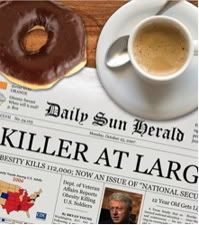
An overview of the politics, social effects and problems associated with the rising epidemic of American obesity.

View Trailer:
* Large (QuickTime)

Prognosis: Shockingly Positive. I’m a Kids in the Hall fan. HUGE.

They did one scene where Scott Thompson, Kevin McDonald, Bruce McCulloch and Dave Foley play off one another for a song that’s performed in a restaurant called “Liposuction.” It, perhaps, perfectly encapsulates the issue with what modern obesity is doing to people who cannot stop the need to gorge themselves. Regardless of the health problems, regardless of the problems that it creates, regardless of a person’s likelihood to die from eating a bag full of warm barf from any number of fast food restaurants if done consistently enough there is no stopping this epidemic.

I am perfectly in tune with the focus on the right hand before being socked with the left of this trailer’s opening. I usually frown on this practice from the standpoint that it can sometimes be used as a trailer crutch but it works because of the inclusion of Dr. Richard Carmona, the Surgeon General of the United States. The music is perfectly chosen; it’s genuinely tense and it leads you down a path you think you’re familiar with even though you know there’s the fist just waiting to impale your jaw.

Carmona gives an excellent description of what his daily activities usually are with regard to his dealings with the press corps and how route the practice of giving answers to the populist inquiries of the day. The visuals are just as compelling when you consider what reporters are more inclined to talk about: war, plague, death. The screen fades and we get one statistic.

“In 2006, the U.S. State Department reported that terrorism killed 28 American citizens.”

The left you don’t expect comes as Carmona recounts being asked his opinion on what is on his mind. The answer that comes, and the silence it causes, is telling from the position that you wouldn’t think that Carmona would say “obesity.”

“It’s a terror from within”

The 112,000 people who died from being seriously overweight is telling. What’s more is Carmona’s rhetorical trick in twisting the idea of terrorism and “terrorist killers,” and the mind meld that we all have from events that have seriously shaped our lives since September 11th with the nomenclature we all understand, to ourselves is sharp. The requisite shot of overweight people, no doubt Americans, helps to illustrate his message but it’s something of a needless tactic because if you don’t know that we are the heaviest country on the planet for reasons that are all to easy to understand then you’re probably one of the people in the file footage.

I’m touched by the graphics that show the factual information about how this problem has spread across the country like a virus. The weigh-in, no pun intended, from pundits who have a stake in making people aware of how serious this is can’t be understated but I am telling you I don’t think anything will ever be as effective in putting up a mirror to our culture than the introduction of a 12 year-old girl who is shown getting ready for liposuction.

The paint shaker sound in the background as the doctor explicitly shakes the body of this young, sedated girl to complete this procedure should be nothing less than shocking, depressing and sad.

I could go on to explain what else bookends this trailer but nothing is as effective as seeing the youth of a girl being altered because of not only what she’s done to herself but to a culture that has slowly crept its way towards obesity with open arms and mouths.

Weekend Shopping Guide 1/25/08: All-Starr

Filed under: Shopping Guides — UncaScroogeMcD @ 3:52 am

weekendshopping.jpg

The weekend’s here. You’ve just been paid, and it’s burning a hole in your pocket. What’s a pop culture geek to do? In hopes of steering you in the right direction to blow some of that hard-earned cash, it’s time for the Quick Stop Weekend Shopping Guide – your spotlight on the things you didn’t even know you wanted…

The persnickety relationship between divorcees Oscar & Felix continues in the complete third season of the original Odd Couple (Paramount, Not Rated, DVD-$38.99 SRP), featuring another 23 episodes fully remastered and just as funny as always. This is the season that found the duo arrested and put on trial, and even getting Murray the Cop as a temporary roommate.

blankguide.gif

Long the most artistically underappreciated of the Beatles, I’m tired of people slagging on Ringo Starr. Frankly, his albums have been the most consistently enjoyable and fun. Not every piece of music has to be an artistic opus, and Ringo always comes back to remind us that sometimes you just want a strong backbeat and a sing-along. There’s plenty of that to be found on his new album, Liverpool 8 (Capitol, $18.98 SRP). Also, there’s a very touching tribute track to the equally underappereciated Harry Nilsson, who was a good friend of Ringo’s.

blankguide.gif

Newly remastered and with new bonus materials, the 40th Anniversary Edition of Gerry Anderson’s Thunderbirds (A&E, Not Rated, DVD-$129.95 SRP) rockets onto DVD at a reduced price, in a smaller package, and just as wonderfully kitschy as it’s always been. The 12 disc box-set features all 32 episodes, plus an exclusive pop-up episode, making-of featurettes, an interview with Anderson, and still galleries. Fab!

blankguide.gif

I can give or take the modern colorization process, but I appreciate the fact that it requires an often pristine restoration of the original black & white print. Such is the case with the new 2-disc editions of Ray Harryhausen’s sci-fi classics It Came From Beneath The Sea & Earth Vs The Flying Saucers (Sony, Not Rated, DVD-$24.96 SRP each), which feature both pristine black & white and the colorized versions, plus audio commentaries, featurettes, interviews, and more.

blankguide.gif

As light as a bubble and just as dense intellectually, I admit that the modern teen comedy take on Snow White – Sydney White (Universal, Rated PG-13, DVD-$24.98 SRP) – is watchable only because the oddly effervescent presence of star Amanda Bynes. Bonus features include featurettes, deleted scenes, a gag reel, and more.

blankguide.gif

Things are heating up as story elements begin to come together in the second volume of Avatar: The Last Air Bender – Book 3: Fire (Paramount, Not Rated, DVD-$16.99 SRP) with the invasion of the Fire Nation and the Day of Black Sun. Bonus materials include audio commentaries and a packed-in mini comic.

blankguide.gif

If catching a wave is unreasonable, at the very least you can catch the complete third season of Hawaii Five-O (Paramount, Not Rated, DVD-$49.99 SRP). The 6-disc set features all 24 of Steve McGarrett’s crime-solving adventures in the land of the luau. Bonus features are limited to the original episode promos.

blankguide.gif

It’s been years, but the second season of Barney Miller (Sony, Not Rated, DVD-$29.95 SRP) has finally dropped. The 3-disc set features all 22 episodes from the classic cop comedy’s sophomore outing. If you’ve yet to discover Barney Miller, now the time to pick up both sets.

blankguide.gif

The clever cons of the UK’s Hustle (BBC, Not Rated, DVD-$34.98 SRP) are back with a 4th season and a potential new addition to the team when Mickey Bricks goes on sabbatical. The 6 episodes are full of the usual robbing from the filthy rich to feed themselves, this time including a porn baron, a charity crook, and a nasty nursing home owner – and even make their way to LA and Vegas. The sole bonus feature of the 2-disc set is a behind-the-scenes featurette.

blankguide.gif

Setting action pics aside, Dwayne Johnson (aka The Rock) steps into the family comedy milieu in The Game Plan (Walt Disney, Rated PG, DVD-$29.99 SRP), starring as an egotistical pro footballer living la vida single whose bacchanal gets a dose of cold water when the 8-year-old daughter he never knew existed shows up on the doorstep of his bachelor pad. What follows is inoffensive, affable hijinks and heartwarming developments aplenty. Bonus materials include behind-the-scenes featurettes, bloopers, deleted scenes, and more.

blankguide.gif

If you were expecting the soundtrack to Juno (Rhino, $13.98 SRP) to be a goofy collection of indie tunes, then you’re expectations have been met, as the disc features tracks from Belle & Sebastian, The Moldy Peaches, Antsy Pants, Kimya Dawson, and Cat Power – but there’s also tunes from The Kinks, Sonic Youth, and Buddy Holly.

blankguide.gif

Erudite and dryly, slyly witty, the British TV adaptations of Noel Coward have been brought together in one box via The Noel Coward Collection (BBC, Not Rated, DVD-$79.98 SRP). The 7-disc set features 7 of Coward’s plays, and 6 dramatized short stories. Bonus features include a documentary interview with Coward, additional interviews and performances, radio plays, and more.

blankguide.gif

The next generation of Hong Kong action star arrives in the US in Fatal Contact (Genius, Not Rated, DVD-$24.95 SRP), and that man is Jacky Wu Jing. After watching this tale of a Kung Fu Olympian who finds himself competing in an underworld fighting circuit, I think we may have the next Jet Li on our hands. The 2-disc special edition features an audio commentary, interviews, featurettes, and more.

blankguide.gif

Not nearly the camp nightmare of the second film but not quite the gothic beauty of the comic in its golden period, the first season of Swamp Thing (Shout! Factory, Not Rated, DVD-$39.99 SRP) is still a relatively faithful – and respectful – adaptation of the avenging spirit of the swamp. The first season set contains all 22 episodes, plus exclusive interviews with co-creator Len Wein and actor Dick Durock.

blankguide.gif

As offbeat and passionate as the flick itself, the soundtrack to Wristcutters: A Love Story (Lakeshore Records, $18.98 SRP) features select cues from Bobby Johnston’s score, as well as tracks from Gram Parsons, Gogol Bordello, Artie Shaw, and Joy Division.

blankguide.gif

For the most part, I’ve enjoyed the relaunch of Doctor Who. I think it’s fun science fiction, even if it’s a bit hamfisted and plothole-ridden at times. With that in kind, was looking forward to the spinoff series Torchwood (BBC, Not Rated, DVD-$79.98 SRP), which brought the character of Captain Jack Harkness (John Barrowman) to the forefront as the head of the Cardiff, Wales branch of the super-secret extraterrestrial investigation unit that was formerly a big baddie in the Who-niverse. Think of it as a cross between MI5 and The X-Files with a much more adult slant towards it’s storytelling than Who, which is aimed for a more family-friendly level of storytelling. Unfortunately, in reality, Torchwood wound up being a poorly written, poorly executed mishmash of contrived characters in convoluted, often contradictory stories that lacked any internal logic. It’s like a slow motion trainwreck, stretched across 13 episodes. The only saving grace – and it’s not enough to save the series – is Barrowman, who deserves a much better show than this. Here’s hoping they can pull this out if the pit in series 2. The 7-disc set features all 13 episodes, plus audio commentary, behind-the-scenes featurettes, outtakes, video journals, and deleted scenes.

blankguide.gif

I dig that the soundtrack to the upcoming Mama’s Boy (Lakeshore Records, $18.98 SRP) focuses almost exclusively on a New Wave vibe. What that means is we’ve got The Jam, Scanners, The Rheostatics, Billy Bragg, and Mark Mothersbaugh. Excellent.

blankguide.gif

Finally, if you want to make sure your weekend viewing contains a bit o’ culture, there’s the recent BBC adaptation of Jane Austen’s Persuasion (BBC, Not Rated, DVD-$19.98 SRP), starring Rupert Penry-Jones and Sally Hawkins as starcrossed lovers Frederick Wentworth and Anne Eliott.

blankguide.gif

So there you have it… my humble suggestions for what to watch, listen to, play with, or waste money on this coming weekend. See ya next week…

-Ken Plume

##

Quick Stop Thingamabobs: 1/25/2008

Filed under: Columns,Thingamabobs — UncaScroogeMcD @ 12:01 am

thingamabobs.jpg

The web. It’s a big place, full of plenty of distractions ““ some funny, some informative, some ludicrous, some disturbing, some inane, some profound. Each and every weekday, we present links to a few of our favorite finds”¦

————————————————

  • Mel Brooks Friday begins with “The Spanish Inquisition”… (Thingamabob)

January 24, 2008

The Greatest Movie Blog Of All Time: Prepare For Greatness

Filed under: Columns,The Greatest Movie Blog of All Time — UncaScroogeMcD @ 3:53 am

greatestmovieblog.jpg

Okay, maybe it’s not the greatest of all time. It may very well be the worst, but it’s the one you’re reading now so you can decide how ironic the title is. I’m a movie freak (a movie super-freak actually). I’m such a movie freak that a few months ago I did the unthinkable: I packed up all of my belongings and moved them west from Chicago to Los Angeles. I know, unheard of right? But films have been a big part of my life and for a film junkie there is no better town to live in.

There’s a quote from Lawrence Kasdan’s underrated film, “Grand Canyon” in which the character of Davis (a film producer played Steve Martin) imparts these words of advice to a friend: “That’s part of your problem: you haven’t seen enough movies. All of life’s riddles are answered in the movies.” I’ve always taken those words to heart (probably to a fault).

In this column I’ll provide many unsolicited opinions, you’ll just have to deal with it. There’ll be reviews, commentary, observations, and whatever else they get away with (hopefully I won’t have to resort to hard core nudity). So as they say in the business, on with the show.

CLOVERFIELD
Director: Matt Reeves

“Cloverfield” is a high-concept movie which claims to be simply an unedited tape found in the area that used to be known as Central Park. And we know it’s a used tape because it begins with footage a month prior to the events that apparently wiped out Central Park, a simple morning between young Manhattenites Rob and Beth. Cut to (or rather the tape jumps to) one month later and it’s Rob’s going away party. We learn Rob and Beth have broken up and he’s been promoted to a new job in Japan. His best friend Hud begrudgingly takes on the task of recording testimonials from Rob’s friends. A clever device that enables us to be introduced to most of the main characters before a 200 foot creature quite literally crashes the party. From then on, it’s a survival story as we follow these young 20-somethings as they try to escape the island of Manhattan (a task that is much harder than “I Am Legend” would lead you to believe).

cloverfield monster
The Cloverfield Monster. Maybe.

The execution of the concept is a little too slick. We’re lead to believe that the footage is presented to us unedited and if this was really the case, the in-camera editing is way too convenient. Plus, at several points during the film, the tape “cuts back” to Rob & Beth’s date on Coney Island. And the events take place over 7 hours, yet there is only one tape lasting 84 minutes. In the midst of a monster attack on New York City, Hud manages to capture every key dramatic moment. But hey, it’s a movie about yuppies trying to survive a monster attack, these are the least of the logistical problems.

The movie is genuinely entertaining, gripping, and the effects are nothing short of jaw-dropping. The script is smart and the characters are likeable. I particularly enjoyed the party scene at the beginning (which would’ve been an entertaining film if itself it weren’t for the monster attack and all.) And I liked how they never explain what the monster is or why it came to wreak havoc (it doesn’t really matter). “Cloverfield” is never boring and the concept does make the events seem more personable than any other monster attack in cinema history.

THE BUCKET LIST
Director: Rob Reiner

Auto mechanic Carter Chambers (Morgan Freeman) has been diagnosed with terminal cancer, but has the good fortunate to be roomed with the hospital’s owner Edward Cole (Jack Nicholson). Edward has lived a selfish, greedy life but rooming with Carter and facing his own death makes him become quick friends and when Edward learns of Carter’s “Bucket List” he encourages Carter to accompany on a once in a lifetime (and as it so happens last of a lifetime) trip around the world to see and do everything they wanted to do in their lives before kicking the bucket.

bucket list pic
“We’re too talented for this shit.”

The Bucket List is the cutest movie about death I’ve ever seen. And therein lies the problem because it lacks the depth and sadness that a film dealing with terminal illness should carry. Morgan Freeman is rock solid (as always), but always seems to be running away from his problems rather than dealing with them. Jack Nicholson is entertaining but a bit of a goof. Their trip doesn’t reveal any great truths about life and death, but rather plays like a travelogue show you’d see on The Discovery Channel (though I suspect such a show would deal with more human insight). There are some genuinely funny moments in the film, but again it’s too cute for its own good.

Speaking of lists, and this may seem odd seeing as how this is my first column, here are my top 10 favorite films of 2007.

1. No Country For Old Men – As close to perfect as any film has been in recent memory (though I still have a few issues with the third act, they’re minor quibbles at best.) And Javier Bardem’s Anton is perhaps the most terrifying and cold-blooded villain in recent film history.

2. Juno ““ In a year that seemed to be dominated by fantastic male performances, Ellen Page’s effort in this film’s title role was as good if not better than any of them. This is a rare film that manages to balance honest humor, sharp dialogue, and heart. We need more of these.

3. Gone Baby Gone ““ A brilliant debut by Ben Affleck and terrific performance by his brother Casey Affleck. A lot has been said about it’s gritty, realistic depiction of Boston, but I appreciated the overall tone of the film, which in my opinion is the hardest thing for a director to pull off and Affleck did a phenomenal job.

4. There Will Be Blood ““ A great film anchored by an iconic performance by Daniel Day-Lewis, old-fashioned direction by Paul Thomas Anderson (who remembers that this guy directed “Boogie Nights”?) and a mesmerizing original score from Radiohead’s Johnny Greenwood. It’s perhaps a bit too long, but it does have my favorite last line in any movie this year.

5. Charlie Wilson’s War ““ It’s great to see Aaron Sorkin back writing screenplays, though the script may be a little too glib for its own good. A highly entertaining film. Tom Hanks and Phillip Seymour Hoffman had fantastic chemistry.

6. 3:10 to Yuma ““ One of my favorite trends of 2007 was the return of the Westerns and the remake of “3:10 to Yuma” pulled off the rare achievement of being better than the original, anchored largely by an incredible performance by Russell Crowe as one of cinema’s bad guys you like to root for.

7. 300 ““ Visually the most impressive film of the year also the most ass-kickiest (see now if I had an editor, he would’ve flagged that word). This is the film I hoped Gladiator would’ve been.

8. Ratatouille ““ I went into this film with low expectations. I know, it’s Brad Bird and it’s Pixar, but it’s also a film about a rat in Paris who can cook. But I should’ve known better as it has a lot of heart, great voice performances, and features incredible animation (Pixar still produces far and away the best computer animation out there). And Anton Ego’s solemn monologue about criticism was particularly memorable.

9. The Kingdom ““ Some may dub it “CSI: Saudi Arabia”, but I thought it was the best political thriller of the year. The first and last 20 minutes of this film were absolutely fantastic. I know, that’s only 40 minutes, but they were really that good and the bits in the middle weren’t half bad either.

10. Michael Clayton ““ Another strong directorial debut this year, this one from Tony Gilroy (writer of this film along with the Bourne films). Who knew he had this in him? Anchored by a strong cast, George Clooney continues to show a knack for finding the right projects for him, something which more actors should take note.

I also really enjoyed “Live Free or Die Hard” (in a very weak summer for so-called blockbusters, this was one that really delivered), “Knocked Up”, “The Bourne Ultimatum”, “Sicko”, “Seraphim Falls” (another great and overlooked Western this year), “Hot Fuzz”, “Waitress” (outstanding performance from Keri Russell and a heartbreaking reminder of Adrienne Shelly’s tragic death), “American Gangster”, and “The Savages”.

A few films that I did not see that may very well have made this list include: “The Assassination of Jesse James by the Coward Robert Ford”, “Once”, “Rescue Dawn”, “In The Valley of Elah”, “Into The Wild”, and “I’m Not There”. Give me a break, I just started. I’ll get to them eventually.

Anyway, that’s all I’ve got for a first swing. I hope you dug it and I hope you continue checking back in with this inappropriately named column.

All the best.

Brett Deacon continues to plug away in Los Angeles despite having the foresight to arrive in the middle of the Writer’s Strike. He spends his ample free time ducking deadlines, spending way too much time in line waiting for In-N-Out burgers, and trying to remember where he left his Thomas Guide.

Quick Stop Thingamabobs: 1/24/2008

Filed under: Columns,Thingamabobs — UncaScroogeMcD @ 2:49 am

thingamabobs.jpg

The web. It’s a big place, full of plenty of distractions ““ some funny, some informative, some ludicrous, some disturbing, some inane, some profound. Each and every weekday, we present links to a few of our favorite finds”¦

————————————————

  • Today is Groucho Marx Thursday, just because. Starting with the 7 cent nickel… (Thingamabob)

January 23, 2008

Quick Stop Thingamabobs: 1/23/2008

Filed under: Columns,Thingamabobs — UncaScroogeMcD @ 3:35 am

thingamabobs.jpg

The web. It’s a big place, full of plenty of distractions ““ some funny, some informative, some ludicrous, some disturbing, some inane, some profound. Each and every weekday, we present links to a few of our favorite finds”¦

————————————————

  • And now, it’s Orson Welles Wednesday – starting with a few drunken takes… (Thingamabob)

January 22, 2008

Toy Box: Batman Black and White – Andy Kubert

Filed under: Columns,Toy Box — admin @ 3:43 am

toybox.jpg

One of the most successful lines of statues for DC Direct has been the Batman Black and White series. The concept is simple enough – have different comic book artists design a Batman in black and white that is then translated into a 6″ scale statue by a capable sculptor. I’ve lost count of how many they’ve done so far, but almost every one has been interesting and unique, if not always to your personal taste.

The latest was released last week, and is based off the artwork of Andy Kubert. Andy comes from the extremely well known family of comic book artists that includes his dad Joe and his brother Adam. He’s been working on the Batman titles for a couple years now, and his art style has been widely acclaimed by fans. As I said, this came out to your LCS last week, and should be available there, or you can pick it up from one of the fine folks in my Where To Buy section.

Any comments or questions, just drop me an email. Now on to the review!

Batman Black and White Andy Kubert

toybox_011508_1.jpg

Packaging – ***
This is one of the most carefully packaged statues or busts I’ve ever seen. There’s foam stuffed between every crevasse, wrapped around the cape and body, and tucked in places you wouldn’t want to go. They’ve done all they can to reduce the chance of any sort of damage in transit, and it’s very much appreciated.

toybox_011508_2.jpg

Unlike some companies, DCD doesn’t do Certificates of Authenticity, but they do put the edition number on the bottom of the statue. This is an edition size of 4000.

Sculpting – ****
While this is based on Andy’s design, the actual sculpting was done by Jonathan Matthews, one of my favorite DCD sculptors. He’s done a fantastic job capturing the feel of Andy’s work and translating it into three dimensions, and I think this is now one of my top 3 or 4 statues in the series.

toybox_011508_4.jpg

Paint – ***1/2
The paint is generally clean, with no bleed and very clean cut lines. There was a hint of slop around the eyes and mouth, but it’s still quite a bit above average for a statue in this price range.

toybox_011508_8.jpg

The color scheme that is the theme of this line is fairly restrictive of course, but DCD has found ways to make even the basic colors more appealing. I particularly like the use of the high gloss black on the gloves and boots, while the cape and cowl are matte finish. This gives the impression of different materials, and adds to the visual interest.

Design – ***1/2
This was a statue that I had really no expectations about going in. Early photos hadn’t done much to sway me one way or the other, and so it was a very pleasant surprise to open it up. The design turns out to be very strong, with a very dynamic and fluid pose. Nothing about it appears excessive, extreme, or inhuman, avoiding those pitfalls in many ‘action’ poses. But it’s certainly not static either, and there’s just the right amount of fluid movement implied to give it a ‘split second in time’ quality.

toybox_011508_3.jpg

Value – **
DC Direct is going to have to be careful here – they’re edging the price up, but the edition sizes are still huge. They’ve jumped up from around $45 – $50 to the $50 – $55 range, hurting the overall value a bit. If you can still get this guy for around $50, add another half star, but I’m grading it on the $5 hike.

toybox_011508_7.jpg

Things to Watch Out For –
This is one you’ll want to take care freeing from his prison. The foam is packed in tight around the cape, and for good reason. Don’t go nuts pulling and tearing it out – take your time, as the cape could easily be broken by excessive force.

Overall – ***1/2
I was very pleasnatly surprised by this statue. As I said, I was expecting it just to end up one of those middle of the road versions, not bad, but certainly not outstanding. Instead, what I got was one of my favorites of the series. He’s not going to unseat Mignola or Jones, but for a relatively straight version of Bats, they managed to make him unique and interesting.

toybox_011508_6.jpg

Where to Buy –
If your LCS is lacking or too expensive, your online options include:

Alter Ego has him at $55.25.

CornerStoreComics has him for $51.

Amazing Toyz has him in stock for $51.

Related Links –
I’ve covered a few of these, including the Jim Lee, Matt Wagner version, Mike Mignola version, and Kelly Jones version.

Also, one of the better action figure lines from DC Direct was Batman and Son, also based on Andy’s art.

Quick Stop Thingamabobs: 1/22/2008

Filed under: Columns,Thingamabobs — UncaScroogeMcD @ 3:33 am

thingamabobs.jpg

The web. It’s a big place, full of plenty of distractions ““ some funny, some informative, some ludicrous, some disturbing, some inane, some profound. Each and every weekday, we present links to a few of our favorite finds”¦

————————————————

  • How about Neil Innes Tuesday? Here’s “I’m The Urban Spaceman”, jazz-style… (Thingamabob)
  • “Mr. Eurovision Song Contest Man”… (Thingamabob)

January 21, 2008

SModcast 44

Filed under: SModcast — UncaScroogeMcD @ 2:09 am

newhead2.jpg

Your TextSModcast is the meandering palaver of a pair of dudes whose voices are so dull, they don’t deserve to be on the radio (and, hence, aren’t). Kevin Smith and Scott Mosier are SModcast.

The best thing about SModcast? It don’t cost nothing.

line.gif

SModcast 44: Thuffering Thucotash –

In which one of our heroes is accompanied by a special guest making his triumphant return with tales of orthodontia, long distance love, the bare necessities, cultural understanding, and talk of “Zack and Miri”. Plus, a quiz!

[CONTENT WARNING] SModcast features harsh language and even harsher notions of propriety. Listener discretion is advised.

DOWNLOAD: (right click to save)
SModcast 44 (MP3 format) – 47.42 MB

[display_podcast]

SUBSCRIBE
Subscribe to this Podcast via iTunes
Subscribe to this Podcast via FeedBurner

Wanna add your two cents? Spend it here, in the SModcast mailbag.

line.gif

CLICK HERE FOR THE SMODCAST ARCHIVES

line.gif

##

Comics in Context #210: Divorce, Marvel Style

Filed under: Columns,Comics in Context — admin @ 2:00 am

comicsincontext4.jpg

cic2008-01-21.jpgBack in 1987 there was a party at a Manhattan nightclub called the Tunnel to publicize the wedding of Peter Parker, better known as Spider-Man, to Mary Jane Watson. Actors portraying Spidey (in mask and tuxedo) and MJ (in wedding gown) were present as was Stan Lee, as himself, and I attended as well. This week I informed my companion for that evening that Marvel had just retconned Peter Parker’s life so that he had never been married. So, I told her, I guess we never attended that party either. Too bad, because she was really proud of the dress she wore for the occasion. I then explained to her that Peter Parker had made a deal with the devil to save his aunt’s life, and the price was changing history so his marriage never happened. Not a comics fan, her reaction was, in effect, say what? Exactly.

It was Stan Lee’s idea to have Peter Parker marry Mary Jane Watson. As Marvel editor in chief Joe Quesada told Comic Book Resources, “It was a stunt.” Quesada explained to CBR that “Around 1986, circulation on the Spider-Man newspaper strip had begun to drop.” So Stan Lee and an editor from King Features Syndicate came up with the idea of having Peter marry Mary Jane to boost circulation.

Quesada continued, “So, at a certain point, Stan called up Marvel and let the folks there know that he was planning to marry Peter and Mary Jane in the newspaper strip at such-and-such a point. At the time, Mary Jane wasn’t even dating Peter in the series, but [then editor in chief] Jim Shooter, not wanting the comics to get scooped by the newspaper strip or whatever, decided that the publicity surrounding the marriage (there was talk of a faux wedding ceremony taking place at Shea Stadium to commemorate the event) and the fact that this was Stan made it worth doing in the books as well.” (And I wonder if Peter and Mary Jane will remain married in the Spider-Man comic strip, and if not, how Stan will explain it.)

But after Peter and Mary Jane got hitched, Marvel editors and writers regretted the decision. But why? After twenty-plus years of Spider-Man stories, wasn’t it about time for Peter Parker to get married?

When Stan Lee was writing The Amazing Spider-Man comic book in the 1960s, Peter Parker started out as a 15-year-old high school student who eventually graduated and entered college. Later writers had Peter graduate college and enter graduate school where (as I know from firsthand experience) people can remain students for years and years. Spider-Man/Peter Parker was supposed to be a young guy, a student who had not yet begun an adult career. This distinguished him from “adult” superheroes like Daredevil, who in his secret identity was one of Manhattan’s leading lawyers, and certainly from Iron Man, who was really multimillionaire C. E. O. Tony Stark. If Peter Parker was married, the argument ran, that made him seem too old.

That, it was argued, was a problem because Marvel’s target audience was perceived as being high school and college age kids, who, supposedly would be less able to identify with a Spider-Man who was older than they were. (By that logic, I suppose, they couldn’t identify with Daredevil or Iron Man because they weren’t kids. And for a brief, terrible time in the 1990s Iron Man was indeed replaced with a “teen Tony” version.)

But what is the median age of Marvel readers nowadays? Looking around at comics stores and conventions, I see mostly adults. The owner of one Manhattan comics store tells me that he never sees customers who are kids.

Yet I can see the point that readers well into their twenties, thirties, or middle age might prefer that Peter Parker remain fixed in his early twenties, because he reminds them of themselves when they were that age.

Another, probably greater problem with Peter’s marriage is that the essence of Spider-Man is that he is the “hard luck Harry” (to use Stan Lee’s phrase) of the superhero world. Despite his triumphs over his supervillain adversaries, nothing else ever goes right for Spider-Man either in his costumed identity or as Peter Parker. Therefore, it is argued, the marriage is a mistake because being married to a gorgeous supermodel makes Peter Parker just too happy.

I agree that it was a mistake in the immediate aftermath of Peter and MJ’s wedding to portray her as a wealthy, famous and highly successful model and actress. Peter Parker has always suffered from money problems, and this removed them. Later writers and editors recognized this and gave MJ considerable career setbacks; Todd McFarlane drew an amusing symbolic cover of Spider-Man being literally kicked out of an upscale apartment building where the Parkers were living in the lap of luxury (Amazing Spider-Man #314, April 1989).

It’s certainly a naive view of married life to picture it as a constant source of blissfulness. I suspect there may even have been a certain sexism in this attitude towards Peter’s marriage, as if MJ were defined principally by her looks and her presumed prowess in bed. Why couldn’t Peter and Mary Jane be portrayed as partners in the struggles, personal, financial, and so forth, that Peter had formerly faced on his own? This is the direction in which Sam Raimi’s Spider-Man movies appear to be moving.

But is nostalgia the real reason that these Baby Boomer editors and writers prefer that Peter Parker be single? Peter was single when they were growing up reading Spider-Man, so they feel that he shouldn’t be married now. I confess that I wonder if this sort of nostalgia clouds my judgment in the issue.

After all, Peter and MJ got married in Amazing Spider-Man Annual # 21, published in 1987. In real time they were married for twenty years, nearly half of the Spider-Man series’ nearly forty-six (!) year history. So that means that anyone who started reading Spider-Man comics (apart from reprints) in the last two decades only knows the character as a married man. Yet Spider-Man remained highly popular among comics readers over that period. Isn’t it possible that post-Boomer generations of Spider-Man readers consider Peter’s marriage to MJ one of the sources of the series’ appeal? Since the comic book audience has been much older over the last twenty years than it was back in the 1960s, isn’t it possible that male readers aren’t put off by the marriage? Young kids might think that a married superhero is more like their father than like themselves. (Reed Richards is the father figure of the Fantastic Four, so Stan Lee and Jack Kirby probably had no qualms about alienating FF readers by having him marry Sue; there was still Johnny Storm to serve as an identification figure for the kids.) But wouldn’t many teenage and twentysomething male readers wish they had a girlfriend or wife like Mary Jane themselves? Spider-Man’s marriage might therefore make the character more appealing to them.

Moreover, there has been a visible growth of the numbers of female readers for American comic books in recent years. Last year’s uproar over the allegedly lurid statuette of Mary Jane pointed to how important and iconic the character has become to female fans of Spider-Man comics–and the Spider-Man movies, in which Mary Jane plays such an important role (see Comics in Context” #178: “The Whole World Is Watching”). To what extent is that role responsible for a significant portion of the blockbuster commercial success of those films? Don’t the love story and Kirsten Dunst’s performance as MJ bring in a considerable female audience who might not otherwise be interested in superhero movies?

If so, then is Marvel alienating present and potential women readers by putting an end to Peter and MJ’s marriage, thereby arguably suggesting that the marriage wasn’t a positive development, that MJ was an inessential character, and even that the heroic male is better off alone?

Then again, one could argue that the essence of Spider-Man is that he is loner, and not by choice. As both Spider-Man and Peter Parker, he continually strives to do the right thing, only to be rewarded with mistrust, misunderstanding, lack of appreciation, and even hatred. In the classic Stan Lee Spider-Man stories of the Silver Age, Peter/Spider-Man was operating entirely on his own, unable to confide in anyone else: even Gwen Stacy, his first great love, turned against Spider-Man, mistakenly holding him responsible for her father’s death.

Therefore, it makes sense to me that Spider-Man/Peter Parker should be single, and that the series works best when he must face his troubles on his own. Peter/Spider-Man would meet mistrust and lack of appreciation wherever he turned, whether it was the public at large, or J. Jonah Jameson, or even, at times, from his girlfriends.

One of the traditional themes of the series is that carrying out his responsibility to do good as Spider-Man continually complicates and damages Peter Parker’s personal life, and this would be true of his romantic relationships as well. This point was most powerfully made by the death of Gwen Stacy at the hands of the original Green Goblin.

Well then, if Peter’s marriage to Mary Jane was a mistake, why not just find a reason for them to get divorced? They could still remain friends, and possibly at some point return to being lovers. This was the simplest solution, and yet Marvel editors refused to take it.

Thankfully, Marvel did not go for the other obvious solution, which was to kill off Mary Jane. Perhaps this was a case of Been There, Done That, since Peter’s first true love, Gwen Stacy, had been killed off. Perhaps Marvel editors and writers over the last twenty years recognized that she was too appealing a character to kill off.

If Spider-Man were published by DC Comics, DC would simply have done of its long series of reboots, casting all past continuity into oblivion and starting the series over from scratch. Traditionally, though, Marvel keeps its continuity intact perhaps because it is founded in the classic stories that Stan Lee, Jack Kirby, Steve Ditko and company created in the 1960s, and which no new version is likely to equal or surpass. I agree with this policy. As the late Mark Gruenwald used to say about reboots, Marvel got its characters right the first time.

So, rather than use any simple solutions, Marvel has resorted to complicated and convoluted schemes to undo Peter and MJ’s marriage.

A decade ago there was the now infamous Clone Saga in the Spider-Man books, founded upon a story in Amazing Spider-Man #149 (1975) in which the criminal geneticist, the Jackal, had created a clone of his foe, Spider-Man. By the end of that issue the clone had seemingly been killed. But in the 1990s a Peter Parker lookalike named Ben Reilly surfaced. The readers were made to wonder, was Ben the Spider-Man clone–or was he the original Spider-Man? Could it be that the Peter Parker who had starred in Spider-Man comics from 1975 onward was actually the clone?

As the Clone Saga evolved, the Spider-Man editors and writers saw it as a means of simplifying Spider-Man continuity and eliminating the marriage. They identified the Peter who married MJ as the clone and shipped them off to Portland, Oregon to live happily ever after; MJ even became pregnant. Ben Reilly was identified as the original Spider-Man and reassumed his Spider-Man identity. Hence, the “Spider-Man” who starred in stories from Amazing Spider-Man #150 into the mid-1990s was an unwitting impostor.

And readers rebelled, quite understandably. The Baby Boomer writers and editors of the Spider-Man books might have been happy since the Spider-Man stories from 1962 into 1975, which they had grown up with, were left intact.

But what if you had started reading Spider-Man in 1976 or later, and Marvel had just told you that you had been reading about a phony Spider-Man? Even if you were a Boomer Spider-Man fan you might be outraged. The Clone Saga was effectively discarding twenty years of Spider-Man comics. Unintentionally, Marvel was telling its audience that they had wasted the last two decades reading about the wrong character!

So Marvel hurriedly sought to undo the damage. Peter and MJ rushed back to New York, Ben was proven to be the the clone and was killed off, and Peter returned to his role as Spider-Man. As for MJ’s pregnancy, she gave birth and was told the baby was stillborn, and the baby was abducted by an operative of the original Green Goblin. Was the baby live or dead? There was no answer, and thus the baby became a continuity time bomb, liable to detonate at some point in the future.

The Clone Saga also failed in its objective of providing a Spider-Man who was unmarried. And so Peter and MJ’s marriage survived for another decade, not alienating readers, as far as I know, until editor in chief Joe Quesada and company devised their solution to the alleged problem in the recent “One More Day” story arc which culminated in Amazing Spider-Man #545, whose writing is credited to J. Michael Straczynski and Joe Quesada.

During Civil War, which, as regular readers know, is not my favorite series, Spider-Man publicly revealed his other identity of Peter Parker. He was subsequently reminded of the reason he had a secret identity in the first place, when his Aunt May was shot and fatally wounded. It seemed that there was no way to save he life until the demon Mephisto, Marvel’s counterpart to the Biblical Satan, made Peter and Mary Jane an offer: he would save her life if they agreed to allow him to alter history so that they had never been married. Realizing that May’s life would still be in danger if the world knew that Peter was Spider-Man, Mary Jane insisted that Mephisto make Peter’s dual identity secret once more. Mephisto, Peter and Mary Jane agreed to the terms of this bargain, and history was changed. Peter and Mary Jane no longer remembered being married, and no one knew that Peter was Spider-Man. (It’s now obvious that Marvel only publicly revealed Spider-Man’s double identity in Civil War because they intended to restore it to secrecy again in “One More Day.”)

Oddly, Mephisto threw in some bonuses. He further altered history so that Harry Osborn had never died. Well, since Harry once followed in his father’s footsteps as the second Green Goblin, perhaps Mephisto intends for Harry to cause trouble in the future.

But what motivation did Mephisto have for removing Peter’s new “organic web-shooters” and having him return to his original, mechanical ones? I assume that Marvel gave Spider-Man the power to shoot webbing out of his hands because he can do so in the Raimi movies. Was Marvel’s comics division under pressure from the movie division to make the comics Spider-Man conform to the movie version? (That could well be yet another reason why Marvel put an end to the Peter-MJ marriage, since they’re not married in the movies.) Did the comics division restore the mechanical web-shooters because that pressure was off, or because fans–or even Marvel pros–had protested?

I applaud the fact that Quesada and company did not kill off Mary Jane. Now that the world knows about the character from the movies, if they killed her off there would be outrage in the mainstream media. And besides, she may be in future Spider-Man movies and certainly in licensing and merchandising spinoffs of the movies and comics.

I’m also glad that Quesada and company didn’t do a reboot of Spider-Man. I wish that they’d refrain from reboots altogether. Is J. Michael Straczynski’s Strange miniseries that radically revised the Lee-Ditko Doctor Strange stories (without coming close to matching them) meant to be canonical?

Although I’d prefer not altering past continuity at all, I am relieved that the changes to past Spider-Man stories are less than I’d expected:

COMIC BOOK RESOURCES: So, to get this straight, OMD [One More Day”] doesn’t actually negate the previous 20 years of Spider-Man stories?

QUESADA: Exactly, that’s precisely what we wanted to avoid. What didn’t occur was the marriage. Peter and MJ were together, they loved each other–they just didn’t pull the trigger on the wedding day. All the books count, all the stories count–except in the minds of the people within the Marvel U, Peter and MJ were a couple, not a married couple. To me, that’s a much fairer thing to do to those of us who have been reading Spider-Man for all these years. Like I said, is it perfect? No. As far as we investigated, short of divorcing Peter, nothing really is.”

(http://www.comicbookresources.com/news/newsitem.cgi?id=12681)

Thus Marvel avoided making the Clone Saga’s mistake of telling readers that the previous two decades of Spider-Man stories are now irrelevant.

But if a divorce would be the “perfect” solution, why didn’t Marvel go for it? Quesada claims to be protecting Spider-Man’s younger readers. He told Newsarama last year, “divorcing them to me sends out completely the wrong message. Imagine you’re a mom and you’re buying little Bobby or little Betty Spidey Adventures or maybe Spidey Loves MJ and you’re watching the news one day and the broadcaster looks right at you and says, “˜Spider-Man is getting divorced, more on that after these messages.’ Let’s just say that as a parent, I’d be upset by the sound bite, I could only imagine how the rest of the world would feel”.

Well, yes, I can see that small children might be afraid that their own parents would split up, so the idea of Spider-Man getting divorced might disconcert them. Then again, small children who are Spider-Man fans might be even more upset if they found out that his eye had been brutally gouged out, as it was in 2006 (see “Comics in Context” #118: “O Other, Where Art Thou?”). Okay, that wasn’t widely reported in the mainstream media, and Marvel was lucky that it wasn’t. But what the mainstream media did make a big fuss over was the assassination of Captain America in 2007 (see “Comics in Context” #168: “O Captain! My Captain!”). Gee, if I were a small child who read comics about Captain America, I bet that would upset me. Why, reading about Cap’s death might even be the first time that little Bobby and little Betty grapple with the meaning of death. And Cap’s still dead in the comics.

Here’s something else. Divorce is far more widespread and accepted in this country than it was back when we Boomers were children. I recall when people claimed that Nelson Rockefeller’s campaign to be nominated for President in the 1960s wouldn’t succeed because he’d been divorced, and it didn’t. But two decades later Ronald Reagan was elected president, and no one cared that he had been divorced and remarried.

I expect that little Bobby and little Betty who read Spidey Adventures may well have friends whose parents are divorced. Maybe little Bobby and little Betty have an aunt or uncle who is divorced, or maybe their own parents are divorced. The traditional nuclear family unit is not as common as it used to be. So maybe these children wouldn’t be as upset by the idea of divorce as Joe Quesada thinks they would be.

But you know what? I bet that if little Bobby and little Betty are being brought up to be religious, they might be really upset by Peter Parker making a deal with the devil. Mommy, mommy, is Spider-Man going to hell?

Spider-Man has a tradition of dealing with disturbing subjects. Consider that Spider-Man’s origin not only centers on the death of Uncle Ben, Peter’s father figure, but makes clear that Spider-Man feels responsible for allowing the murder to happen. And yet somehow for over four decades kids have been able to handle the notion that their hero Spider-Man is partly guilty of patricide. Spider-Man likewise feels guilty for the death of Gwen: the Green Goblin pushed her off the bridge, but her neck snapped when Spider-Man caught her.

Besides, have we forgotten how Stan Lee defied the Comics Code to publish his groundbreaking anti-drug storyline in Amazing Spider-Man #96-98 (1971), which showed Peter’s friend Harry deathly ill from drug addiction? What about that 1986 Spider-Man & Power Pack special, aimed at small children, that revealed that as a young boy Peter Parker was a victim of child abuse? Marvel has a tradition of dealing with such hard issues. Is divorce, then, really too much for Spider-Man’s young readers to handle?

In the year 2008 Quesada’s attitude towards divorce seems, at the very least, quaint. He told Comic Book Resources, “Sure, divorce is a reality of life, but Peter Parker and Spider-Man are not the types of characters that would do that. Spider-Man is a worldwide icon and is considered one of the good guys, like Superman”. So the “good guys” don’t get divorced, presumably because divorce is evil. So anyone who gets divorced is a bad guy?

Quesada has also said that he opposed divorcing Peter and Mary Jane because he wanted to present them as a “strong loving couple”. Well, by breaking them up via Mephisto’s magic, Marvel has put an end to that theme, at least for now. Isn’t it possible that Peter and Mary Jane could continue to love each other but still get a divorce because it is simply too dangerous for Spider-Man to be married, as the assault on another of his loved ones, Aunt May, demonstrated?

Isn’t it also possible that Marvel’s writers could have crafted a storyline that maturely and sensitively handed a divorce between Peter and Mary Jane, written in a way that could explain to younger readers that divorce is sad but sometimes necessary? Maybe reading such a storyline could actually help children of divorced parents reconcile themselves to the idea of divorce.

On reading the conclusion of “One More Day” in Amazing Spider-Man #545, I wasn’t as upset about Peter Parker’s deal with Mephisto as I thought I’d be. Spider-Man is the everyman as superhero, and how would you or I react if the only way to save a loved one’s life was to make a bargain with the devil? Could you justify allowing a loved one to die by refusing to make such a deal?

Moreover, I like the grand, operatic romanticism of Mary Jane’s speech to Peter that not even the devil can destroy their love for one another, and that even if he makes them forget what they meant to each other, they will inevitably be reunited. It puts me in mind of the 2004 film Eternal Sunshine of the Spotless Mind, or stories about reincarnated lovers reunited, from Hawkman to Dark Shadows, which deal with a similar concept.

But still, I remain repulsed by the idea of Spider-Man making a deal with the devil. In his CBR interview Quesada points out that “One More Day” is based on the myth of Faust. Yes, indeed, and the point of Faust and the many variations on it is that making a deal with the devil is always wrong.

Just look at Marvel’s previous leading version of the Faust myth: the origin of Ghost Rider (in Marvel Spotlight #5, 1972). Like Peter Parker, Johnny Blaze was desperate to save the life of the person who had acted as a parent to him: “Crash” Simpson, who was succumbing to cancer. Blaze made a bargain with the devil, who was subsequently identified as Mephisto, and who did indeed prevent Simpson from dying of cancer, only to let him die soon thereafter performing a motorcycle stunt. Then Mephisto transformed Blaze into the human host of the demon Zarathos, turning him into the Ghost Rider. The Ghost Rider’s origin follows the standard pattern of the Faust myth. The moral is that making a deal with the devil leaves you far worse off than you were before, and that you do not even gain the original goal for which you sacrificed your principles and perhaps your soul.

Therefore, the truly heroic choice for Spider-Man to make may have been to resign himself to letting Aunt May die rather than provide Mephisto with the opportunity to wreak even greater harm.

Indeed, as soon as Peter and Mary Jane agree to the bargain, Mephisto shows them a vision of the daughter that he claims they now will not have. This, presumably, is Marvel’s way of disposing of that “time bomb’ baby: if Peter and Mary Jane were never married, they never had that child. In Tom DeFalco’s Spider-Girl series, set in the future, that child grew up to become the teenage title heroine. But “One More Day” suggests that Spider-Girl takes place in the future if an alternate reality, not that of the “mainstream” Spider-Man.

So there is one consequence of Peter and Mary Jane’s satanic bargain that is arguably worse than the death of his elderly aunt: it’s like an abortion via black magic. And just how many lives would Spider-Girl have saved if she existed in the “mainstream” Spider-Man’s reality? You can expect that Spider-Man writers will be tempted to do still more stories about how far Mephisto has sunk his claws into Spider-Man’s life, if not now, then in the future.

How dense do Peter and Mary Jane have to be not to realize any of this? Have they never seen any version of the Faust story–not even something like Damn Yankees or Bedazzled? There are already mainstream media reports about “One More Day.” How can making a deal with the devil possibly be good for the public image of Marvel’s flagship hero?

Furthermore, to my knowledge, Mephisto has never before demonstrated such power to restructure reality and even resurrect the dead (Harry). But there are plenty of Marvel characters who do, who could have been used to retcon the marriage without morally sullying Peter and Mary Jane’s characters. Over at his online forum, John Byrne has explained how he and writer Howard Mackie would have used the alien Shaper of Worlds to undo the marriage. I find myself leaning towards using the Grandmaster, who has been established as having powers to control time, space, life and death.

For twenty years Marvel writers and editors thought that Peter and Mary Jane’s marriage was a mistake and longer to undo it, and finally Marvel did. And you know what? Right now I expect there are people who are professional comics writers and editors, and people who will someday become professional comics writers and editors, who are outraged that Marvel had Spider-Man make a deal with the devil. And these present and future writers and editors will be determined to undo it. We shall see whether it takes twenty years this time, or much less.

Still, despite my qualms about Marvel brought it about, maybe Peter Parker and Spider-Man should be single. But I don’t feel any enthusiasm about this. Over the last twenty years I have grown very, very weary of reboots, resets, and revisionism.

One reads fiction on two levels. The reader knows that it is fiction and can admire and analyze the craft of the author. But the fiction should also persuade the reader simultaneously to suspend his or her disbelief, to pretend that the story and its characters are real, and to become emotionally involved with them.

But why should we invest ourselves emotionally in the Marvel Universe–or the DC Universe, for that matter–any longer?

For twenty years Marvel has sought to make its readers care about the marriage–and about the love–between Peter Parker and Mary Jane Watson. Did they succeed with you? Too bad, because they just retconned the characters’ past so that their marriage never happened. So why should you care about any other romance in Marvel stories, since it too could disappear from Marvel history with the snapping of an editor’s fingers?

When Spider-Man revealed his secret identity in Civil War, did you think that this would change his life permanently? Did you wonder if and how Spider-Man could ever find a new secret identity? Well, Mephisto just wiped out everyone’s knowledge of Spider-Man’s dual identity through magic. So why should we ever care about any disastrous situation that befalls a Marvel character in the future? All they have to do is hit the magical reset button.

Did you feel moved by J. M. DeMatteis’s well-crafted story of the death of Harry Osborn in Spectacular Spider-Man #200 (1993)? Surprise! Harry’s death was retconned away! Now that Bucky has turned up alive, it is clear that no death is sacrosanct at Marvel. It’s as if every character had a version of Wolverine’s fast healing power; it just takes some of them longer to recover from the dreaded deading (as The Goon Show used to put it) than others. Death has just turned into a means of demeaning noble characters–like, say, Captain America, symbol of our nation–and exasperating longtime readers we wait, sometimes years, for Marvel to get around to bringing them back.

One of the main points of the Marvel Revolution was that Stan Lee wanted to explore what would happen if a superhero existed in what was basically our world. In the real world death is irreversible, one’s problems cannot be made to disappear by magic, and reality is not malleable, capable of being shaped and reshaped at will.

How can a reader continue to suspend disbelief when the stories make it all too clear that the characters are merely puppets, and we are all too aware of the puppeteers pulling their strings?

ADVERTISEMENTS FOR MYSELF

To my astonishment, Marvel has just released Essential Marvel Saga Vol. 1! This is a paperback collection of a series that I wrote in the 1980s which outlined the history of the Marvel Universe from Fantastic Four #1 through the Galactus trilogy, with appropriate illustrations from the original stories. It was abruptly canceled with issue 25, back when conventional wisdom had begun to decree that no one wanted books like Marvel Saga and The Official Handbook of the Marvel Universe. i am glad to see that history has proven them wrong.

Copyright 2008 Peter Sanderson

Quick Stop Thingamabobs: 1/21/2008

Filed under: Columns,Thingamabobs — UncaScroogeMcD @ 12:35 am

thingamabobs.jpg

The web. It’s a big place, full of plenty of distractions ““ some funny, some informative, some ludicrous, some disturbing, some inane, some profound. Each and every weekday, we present links to a few of our favorite finds”¦

————————————————

  • “Bitchin’ In The Kitchen” from Shock Treatment(Thingamabob)

January 18, 2008

Weekend Shopping Guide 1/18/08: Ship Ahoy

Filed under: Shopping Guides — UncaScroogeMcD @ 4:01 am

weekendshopping.jpg

The weekend’s here. You’ve just been paid, and it’s burning a hole in your pocket. What’s a pop culture geek to do? In hopes of steering you in the right direction to blow some of that hard-earned cash, it’s time for the Quick Stop Weekend Shopping Guide – your spotlight on the things you didn’t even know you wanted…

As a fan of Mystery Science Theater 3000 from “back in the day”, for years I’ve hoped for the return to performing of MST creator Joel Hodgson and writer/performer Trace Beaulieu (Dr. Forrester & Crow T. Robot). Though we’ll probably never see MST return for various intractable reasons, Both Joel and Trace have returned – along with fellow alums Frank Conniff, Mary Jo Pehl, and Josh Weinstein – to form Cinematic Titanic. For all intents and purposes, it’s pretty much MST – only all 5 members are silhouetted onscreen at the same time, stationed on a tiered series of platforms on either side of the screen and commenting on the flick. Speaking of their first flick, it’s the delightfully awful The Oozing Skull ($15.94 SRP). Skull and all forthcoming titles are available via www.cinematictitanic.com. The magic is back, my friend. Snap it up, post haste.

blankguide.gif

It’s been a long time coming – 20 years, in fact – but the history of Pixar has been laid down in print courtesy of To Infinity And Beyond!: The Story Of Pixar Animation Studios (Chronicle Books, $75.00 SRP). As one would expect from Chronicle, it’s an impressive, massive, well-crafted tome that draws upon the interviews and notes from filmmaker Leslie Iwerks’s documentary about the studio. If you’re a fan of Pixar and want to read the official take on their rise and success, this is it.

blankguide.gif

Following close on the heels of it’s holiday wrap-up, you can pick up Ricky Gervais & Stephen Merchant’s Extras: The Complete Series (HBO, Not Rated, DVD-$49.99 SRP). The set features the previously released first and second seasons, plus the special series finale (which they claim is exclusive to this set, but which Ricky Gervais has said will be made available separately in a few months, in response to fans’ cries that they were being bilked). There aren’t any new bonus features that weren’t already on the already-available sets, so consider this the perfect time to jump in and catch up if you’re unfamiliar with the trials and tribulations of jobbing actor Andy Millman… But if you’ve already got both seasons, it’s probably best to hold off until the separate release of the holiday special.

blankguide.gif

Family Guy‘s big character-recast send-up of Star Wars gets a rather speedy DVD release courtesy of the uncensored 2-disc Family Guy: Blue Harvest (Fox, Not Rated, DVD-$22.97 SRP) – featuring an audio commentary, a making-of featurette, an animatic version, a Family Guy Star Wars clip show, a fight scene in 3-D, and even a conversation with George Lucas. Also available is a deluxe box-set ($34.98 SRP), which features the 2-disc set, 3-D glasses, a t-shirt (XL) a collector’s booklet, and trading cards done in the style of the classic Star Wars cards.

blankguide.gif

Swap Paul Rudd for Chuck Heston and The State‘s David Wain & Ken Marino for Cecil B. DeMille and you’ve essentially got The Ten (City Lights, Rated R, DVD-$26.98 SRP) – a loopy comedy about one flawed man’s quest to introduce the world to the contents of two massive stone tablets. Packed with more cameos than you can shake a bundle of sticks at, it’s worth a spin. Bonus materials include an audio commentary, interviews, alternate/deleted scenes, featurettes, and more.

blankguide.gif

Brian Froud is the man responsible for the visual look that defined both The Dark Crystal and Labyrinth, and for years his artwork detailing the world of Faeries has been collected in this book or that. The ultimate tome exploring his work is now available, titled appropriately enough Brian Froud’s World Of Faerie (Insight Editions, $40.00 SRP), and it’s a lavish hardcover packed full of Froud’s illustrations. It’s a visual treat, and well worth snagging.

blankguide.gif

As one of the many kids that absolutely loathed the demoralizing embarrassment of PE class, I found much that familiar about the enjoyable if marginal comedy Mr. Woodcock (New Line, Rated PG-13, DVD-$28.98 SRP), which stars Sean William Scott as a formerly chubby kid whose school PE years were made hellish by the demonic Mr. Woodcock (Billy Bob Thornton). As a slim adult, he returns home to find that his mother (Susan Sarandon) is now dating his old nemesis – a development he decides must be undone. Bonus features include featurettes and deleted scenes.

blankguide.gif

Still a downer – albeit a classy downer – all these years later, Leo McCarey’s An Affair To Remember (Fox, Not Rated, DVD-$19.98 SRP) gets a snazzy 2-disc edition in celebration of its 50th anniversary. The new set features an audio commentary (with Marnie Nixon and film historian Joseph McBride), a clutch of newly-produced featurettes, AMC Backstory‘s spotlight on the film, Fox Movitone News, galleries, and the original theatrical trailer.

blankguide.gif

So far, Julia Louis-Dreyfus has been the only castmember to chalk up a post-Seinfeld success on TV, and she’s done it with The New Adventures Of Old Christine (Warner Bros., Not Rated, DVD-$29.98 SRP). The title comes from the fact that her ex husband is now dating a woman with the same first name, which he has dubbed “New Christine” – leaving her with the not quite flattering sobriquet of “Old Christine”. Louis-Dreyfus is endearing in her attempts to adjust to her new life of single motherhood and what her new nickname means in her life. The first season set features an interview with Julia, unaired scenes, and a gag reel.

blankguide.gif

What’s New Scooby-Doo? continues to be a nicely faithful updating of the adventures of Mystery, Inc. – as you can see in the complete 3rd season (Warner Bros., Not Rated, DVD-$19.98 SRP). The 2-disc set features all 13 episodes, including run-ins with cowboy robots, gargoyles, sea monsters, and more. The set also contains a bonus episode, “A Scooby-Doo Christmas”.

blankguide.gif

Often treated as an odd bastard child of his oeuvre, Martin Scorsese’s New York, New York (MGM, Rated PG, DVD-$19.98 SRP) – his big band tale starring Robert DeNiro & Liza Minnelli – gets the 2-disc special edition treatment with a brand new introduction from Scorsese, an audio commentary, alternate takes/deleted scenes, a two part documentary, an interview with Minnelli, select scenes commentary by cinematographer, and a photo gallery.

blankguide.gif

Every so often, a comedy aimed at teens also manages to pose some interesting questions about our society, wrapped beneath a funny wrapper. The indie comedy Zerophilia (TLA Releasing, Not Rated, DVD-$24.99 SRP) certainly fits that bill. First and foremost, it is a fun watch, as Luke – a virgin – discovers that upon losing his virginity one night (to Kelly LeBrock, no less), he starts exhibiting some decidedly feminine characteristics. Come to find out Luke is a “Zerophiliac” – a person who changes sex upon achieving orgasm… Which complicates his burgeoning love affair with the comely Michelle… Particularly when his female incarnation begins exhibiting feelings for Michelle’s brother. The DVD features a behind-the-scenes featurette, deleted scenes, an interview with Kelly LeBrock, and the theatrical trailer.

blankguide.gif

Also getting a special edition is Rob Reiner’s perennial Rom-Com, When Harry Met Sally (MGM, Rated R, DVD-$19.98 SRP). The new edition features an audio commentary (with Reiner, Nora Ephron, & Billy Crystal), deleted scenes, 7 featurettes, and the theatrical trailer.

blankguide.gif

In an age where sci-fi has largely turned to crap (I’m looking at you, JJ), it’s nice that a flick like Sunshine (Fox, Rated R, DVD-$29.99 SRP) can come down the pike. Sadly, it was largely ignored at the box office, but I have no doubt that this tale – of a brave crew sent to reignite a dying sun and save humanity who are faced with a life or death struggle of their own – will have a nice second life on video. Bonus features include a pair of audio commentaries (one with director Danny Boyle and the other a scientific track with University of Manchester Professor Brian Cox), production diaries, deleted scenes, and an alternate ending.

blankguide.gif

Although the flicks vary greatly in quality, it’s nice to know that there’s finally a Bob Hope: MGM Movie Legends Collection (MGM/UA, Not Rated, DVD-$39.98 SRP) available. The 7 films included in the set are Alias Jesse James, Boy, Did I Get A Wrong Number!, The Facts Of Life, They Got Me Covered, I’ll Take Sweden, The Princess And The Pirate, and The Road To Hong Kong. Sadly, no bonus features.

blankguide.gif

Another remastered Peanuts special edition is here, and just in time for the holiday it addresses. Be My Valentine, Charlie Brown (Warner Bros., Not Rated, DVD-$19.98 SRP) has been fully remastered, and the new disc also contains the specials It’s Your First Kiss, Charlie Brown and You’re In Love, Charlie Brown, as well as a new featurette (“Unlucky In Love: An Unrequited Love Story”).

blankguide.gif

James Garner’s ex-con-turned-P.I. Jim Rockford returns in the 5th season of The Rockford Files (Universal, Not Rated, DVD-$39.98 SRP). The 5-disc set features all 22 episodes, but why oh why can’t we have bonus features with Garner?

blankguide.gif

So there you have it… my humble suggestions for what to watch, listen to, play with, or waste money on this coming weekend. See ya next week…

-Ken Plume

##

Older Posts »

Powered by WordPress