FRED Entertainment

September 29, 2006

Game On! 9-3-2006

Filed under: Game On! — admin @ 11:33 pm

gameon.jpg

Well, we went from one week of amazing games to a week of…well, practically nothing. I was expecting a few titles in my mailbox this week, but sadly, didn’t get a thing. Thankfully, Xbox Live Arcade didn’t let me down, and I’ve been playing the crap out of some old classics, while looking forward to the next coming weeks full of the finest games the holiday season will offer, beginning with next week’s release of SCARFACE. Sadly, I’ll be out of town next week, so my review of the game (and my subsequent interview with one of the voice actors, a certain Mr. Jason Mewes) will have to be postponned. Until then, however, let’s take a look at some old school fun, recently released on Xbox Live Arcade on 360.

DOOM

boxdoom.jpgThis week on Live, we saw one of my favorite games released, the OG of FPS’, DOOM. The classic PC shooter is back, featuring 4 player deathmatches and 2 player co-op, as well as fancy new upgrades like a remixed soundtrack in 5.1 digital surround sound and redone in High Def…not that you’d really notice.

The game retains all the finest moments from the classic shooter, finally adding dual analog control, as well as multiplayer on either Xbox live or splitscreen (two things that were sadly missing from the titles release with the various versions of DOOM 3 on regular Xbox). Also included is co-op, where two friends can battle the hordes of hell together through the main game’s story mode.

Everything is just as you remember it, which is both a good and a bad thing. While all the secrets and tricks have stayed, so have the muddy graphics. No amount of high def can smooth over those grainy walls. And while overall there is a new feeling of smoothness, it still looks like 1993. It plays like it too, with still no option to aim up or down, just hoping your random wild shots will hit those demons on the upper balconies.

doomxbox.jpg

Still, the online fragging is about as fun as it gets. This is the OG, and for folks like me who suck at pretty much every shooter out there on live, it’s nice to have a game that I can dominate in once in a while. While most of the sessiosn have been pretty lag free, there still are moments where the occasional hiccup does occur. All in all, nostalgia fans should rejoice with this title. Good shooting fun, lots of levels and a decent amount of achievements will bring folks back for more time and again, just like it did as shareware all those years ago. The only drawback is that $10 (or 800 microsoft points) seems a bit steep to play a game that we’ve all owned at one time or another (and mostly for free) but it should pay off in the long run, with plenty of extra levels and missions to add later. Can anyone say ULTIMATE DOOM?

One Gamer’s Opinion:

kickass.jpg

STREET FIGHTER II’ HYPER FIGHTING

boxstreetfighter2.jpgI know this was released quite a few weeks ago, but sadly, my Xbox Live has been down for a bit, so I missed this when it was first released. Still, I’m no stranger to the game. Taking the 12 World Warriors into battle brings back some great yet strange memories of my youth, and some of them actually aren’t that happy.

The main game is a true to the original as ever. Choose your fighter, then beat the crap out of the other guy using a series of punches, kicks, and crazy special moves. Gameplay works fairly well with the Xbox controller, but my kingdom for an arcade stick. Also, playing this again just reminds me of how cheap the game got as you progressed. Fight Ryu early on and he’s a push over, but if you don’t get to him until after the first bonus round and he’ll mop the floor with you. Lame.

sfiiscreen.jpg

The biggest draw here however is the Xbox Live multiplayer. With the all new “quarter match” set up, folks can scream “I got next” by placing thier virtual quarter down and playing the winner of a match that they’re spectating on, just like those arcade days of old. The only problem here is that most games tend to have a HUGE amount of lag, making timed attacks virtually impossible to accomplish correctly. It’s been fixed as of late with most games, but there are still times where it just gets downright jaggy, and therefore annoying as all get out.Still, again, for nostaligia’s sake, it’s a good amount of fun. I would have preferred a newer version of the game (more along the lines of NEW CHALLENGERS rather than SUPER SFII due to the crazy combo meter) but for what we got, I’m not complaining too much. Get a patch out to handle the lag and you’ve got a quality fighter that’s still king.

One Gamer’s Opinion:

righton.jpg

Short but sweet this week, folks. That’s all I had to review this time. Like I said, no column next week, but I’ll be back after that, more than likely with a shitload of titles (naturally). One man’s dry spell is another man’s tsunami. ‘Til then, gamers…

Nocturnal Admissions: DVD Review, Brian Clemens’s Thriller

Filed under: Columns,Nocturnal Admissions — UncaScroogeMcD @ 8:29 pm
nocturnalheader5.gif
Brian Clemens

Brian Clemens is one of those many prolific British writers who toiled in radio, TV, and / or movies from the 1950s well into the present, but whose aesthetic roots hark back to the pulp magazines of the 1920s and 1930s. Seasoned professionals, they liked tight narratives, solid dialogue, and cunning twists. Others in his vast and varied fraternity include, at one end of the scale or the other, Dennis Potter, who wrote many original TV dramas including The Singing Detective, and Nigel Kneale, whose career ranges from The Quatermass Experiment (which inspired Hooper’s Lifeforce), to Halloween III: Season of the Witch (recently mimicked in Stay Alive). Clemens worked in movies and television simultaneously, penning such films as Hammer’s Dr. Jekyll and Sister Hyde, as well as See No Evil, Kronos and The Watcher in the Woods. For TV he was involved with Danger Man, and later The Professionals. But for spy fans, humor buffs, and fetishists alike, his crowning achievement is The Avengers, that show that agitated the febrile minds of adolescents through the 1960s.

Thriller title

Clemens is also the brains behind the series Thriller. Not to be confused with the NBC series with host Boris Karloff that aired from 1960 to 1962, Clemens’s Thriller is nevertheless also an anthology series of horror tales with a twist, but different from Twilight Zone and Alfred Hitchcock Presents in that all of the shows were either written or outlined by one person, Clemens. Made for ATV, it aired from 1973 to 197x and comprised some 42 tales. But what would be a burden for most writers with Clemens seem seemed to be a joyous, easy task. Ideas just seemed to pour out of him. As he says in introduction to one of his tales, “The Color of Blood,” when people ask him how he comes up with his ideas, he tells the story of visiting Europe for a conference and being picked up at the station by a young student. In the car, she asked him the same question, and he turned to her and said, “How do you know I’m Brian Clemens?”One doesn’t know the fate of that young girl, but we do know the fate of the reply: it got him to thinking and resulted in the story “Color of Blood,” in which a bank employee unwittingly picks up a serial killer at the train station. The story has even more twists, but they shan’t be spoiled here.

Thriller box

A&E has now released the first season (of six, lasting through 1976) of Thriller, in a four disc set that hit the street Tuesday, September 26 (for $79.95), and would make the perfect Hallowe’en gift for budding Hitchcocks or Harlan Ellisons. Thriller collects the 10 episodes of the first season, with the addition of three interviews, first with Clemens, discussing how he came up with the series, the next with director Shaun O’Riordan, who discusses the techniques of staged, videotaped episodic television, and the finally one with producer John Cooper. Packaging for the set is good, with a nice ghostly yellow logo, a horrific image on the cover, and the discs in individual flat packs. (Several of the shows were retitled and aired on ABC late at night.)

Each hour long episode (divided into three parts) begins with a quasi-comical Tales from the Crypt style intro by Clemens, followed by a few screens of text trivial about the ep, and then a video interview except in which Clemens discusses its genesis and trivial about the cast. The credit sequence to the show features a haunting, Herrmann-esque theme, composed by Laurie Johnson, the same man behind the catchy, memorable Avengers theme. The shows appear to be a blend of 16mm exteriors and videotaped interiors, but the interiors might be multicamera 16mms.

Robert Powell

The stories themselves are a blend of Hitchcockian (TV Hitchcock, that is) domestic crime and creepy tales of innocents stumbling into a dire enviroment. The first, “The Lady Killer,” concerns a Honeymoon Killers type story about a serial marrier and murderer (Robert Powell), whose partner is the divine Linda Thorson (sadly underrated and denigrated as Diana Rigg’s Avengers replacement all because of her haircut). This show sets the tone. The dialogue is sharp, but there is also a feeling that it is padded out to fill the hour; there are several sharp twists in the plot; and the setting is rural and quaint.

Judy Carne

The third ep, “Someone at the Top of the Stairs,” is about two students, Judy Carne and Donna Mills, who rent a small room only to learn, eventually, that the house, the very house itself, is a malevolent entity.

Certain themes recur. Clemens is obsessed with blindness. The condition has appeared in several of his other works. Here it figures in one of the best tales, about assassins who take over a school of the blind because it offers the best vantage to kill a visiting dignitary. Clemens, perhaps for budgetary reasons, is interested in the small, out of the way rural areas that might harbor evil. He is fascinated by the chronology of murder, as in the tale, “Murder in the Mind,” and “second wives,” especially those who suspect that something odd happened to the first one.

Clemens’s tales are clever, but also comforting. They take their time to establish settings, relationships, and potentialities. Thriller is right up the alley of those who relish tales of suspense in the Hitchcock Presents mode.

Take Me Home Blog #10 – Blogging Is For Weenies

Filed under: Production Blogs,Take Me Home Blog — UncaScroogeMcD @ 3:47 pm
takemehomeheader.jpg

CLEARLY THERE’S SOMETHING WRONG WITH ME
I know, it’s been a few weeks since I last posted, but I assure you all it’s for good reason: I was procrastinating. True, I did fly back to Ohio, then to New Hampshire for a wedding, but the bottom line is I am a sultan of procrastination. I wrote an essay on procrastination that got me an invite to the Library of Congress in D.C.. No, really. My thesis was: DON’T PROCRASTINATE BECAUSE PEOPLE WILL THINK YOU’RE PUTTING THINGS OFF. It was compelling, if I do say so myself.

So what exactly would drive me to slack off so? I think I felt a little bit like I was letting you all down if I didn’t have something enthralling to say. It holds with my rules for this blog, one of the biggest being “I PROMISE NOT TO WRITE ABOUT WIPING MY ASS”. In other words, I don’t want to bore you with the day-to-day. I realize that the day-to-day is EXACTLY what a blog is a record of, but that point had been lost on me the last couple of weeks. Nevertheless, the black sheep has returned with a newfound purpose: TO CREATE.

NO, NOT LIKE GOD. LIKE KIRK CAMERON.
This site was intended to be an intimate discourse on film. While I don’t think it’s a failure in that department, I think we’ve strayed from one of the key objectives of me writing this and you reading this: TO MOTIVATE US. Si? So here’s what I propose: let’s make October THE MONTH WHERE IT ALL HAPPENS. If you’ve been sitting on an idea for a while, this is the month when you get it done. Brush the dust off that script! Call your buds! Set a date! I’ll do the same. Because until “Take Me Home” finds its funding once again, I’d rather have something to show for the year in waiting. Enough blogging! It’s time we made a film! If Kirk Cameron can do it (and oh man, can he!), then so can we. So let’s get to it!

SO EXACTLY WHAT HAPPENS IN “THE MONTH WHERE IT ALL HAPPENS”?
That depends on you. I am finally shooting that short film I wrote you all about back in Ohio. Now, because of actor scheduling, that won’t happen until October 30th. Which leads me to a bit of advice: give yourself as much prep time as possible. Yes, it’s a blast getting together with the gang and seeing what you can whip up, but keep in mind you’ve got a whole month (I’m discluding editing time. Just shooting something in one month is a huge task). But take the month to get it right: storyboard the whole film, study like-minded films, study how they’re lighting their actors, try replicating their style, find a good camera for a good price (to rent or buy), get your crew, get your cast, get your ass movin’! I am a firm believer in the notion that films are only as good as their pre-production.

Meanwhile, I’m going to figure out a place where we can post our shorts to share with each other. In the meantime, here are a few storyboards from my short, “Untold”. By this time next week, let’s have our shorts fully formulated and as taught as Joan Rivers face. Pass it out to a few folks you trust. Listen to their feedback, weigh it, and make any adjustments. But when Friday comes, you’ve got a rock-steady shooting script. I’m shooting for the same deadline. And we’ll take it from there. OCTOBER WON’T KNOW WHAT HIT HER!!

takemehome-10-29-storyboards

(Author’s note: The author would like to clarify that his last statement was in no way, shape, or form a promotion of physical violence. He would like to point out that “October” is actually a month of the year and not a former girlfriend. The author has a deep respect for all women, even the ones who set out to ruin his life like his fiancee and his mother. He thanks you in advance for your understanding on this matter.)

-Sam Jaeger

jaeger.jpg

Melonpool Quickcast #15: Sammy’s Apartment

Filed under: Melonpool Quickcast — admin @ 3:41 pm
melonpool.gif

-By Steve Troop

Based on Steve Troop’s classic webcomic of the same name, the Melonpool Quickcast features puppet versions of Troop’s alien cast, who are desperately trying to make heads or tails out of Earth culture.

quickcast15

We haven’t seen a lot of Sammy the Hammy here at the Melonpool Quickcast. Mayberry catches up with everybody’s favorite 220-lb hamster as he shows off his new residence….

Don’t forget to comment on this and other Melonpool Quickcasts over at the official Melonpool Quickcast Forum!

Mayberry Avatar Ralph Avatar Sam Avatar Sammy Avatar Roberta Avatar

Melonpool Quickcast #15: Sammy’s Apartment:

  • Large (560 x 420 – QuickTime – 21 MB)
  • Small (320 x 240 – QuickTime – 9 MB)

Quick Stop Thingamabobs: 9/29/2006

Filed under: Columns,Thingamabobs — UncaScroogeMcD @ 7:39 am
thingamabobs.jpg

The web. It’s a big place, full of plenty of distractions ““ some funny, some informative, some ludicrous, some disturbing, some inane, some profound. Each and every weekday, we present links to a few of our favorite finds”¦

————————————————

  • Have you experienced Zefrank’s The Show yet? You should. (Thingamabob)
  • Life is so very, very short – thank jebus it’s not lived like this. (Thingamabob)
  • Kangaroo fight! Kangaroo fight! Kangaroo fight! (Thingamabob)
  • If you’ve been living in the bowels of the earth, you can now see why everyone has called the final moments of Bob Newhart’s second sitcom, Newhart, one of the funniest moments in TV history. (Thingamabob)
  • I don’t know why, but I really and truly want one of these. (Thingamabob)

Have a THINGAMABOB? Send it in!

Ken P. D. Snyde-Cast #15: The Prodigal ‘cast Returns

Filed under: Ken P.D. Snydecast — UncaScroogeMcD @ 1:04 am

snydecast-header.png

snydecast-logo2.png

Adult Swim’s Dana Snyder and FRED’s Ken Plume set out to have a literate conversation between two pals, but inevitably devolve into a verbal, and funny, free-for-all full of bickering, infighting, and the special kind of male bonding that comes from conflict expressed through the podcast medium.

Actor/comedian/raconteur Dana Snyder, you’re certainly aware, is Aqua Teen Hunger Force’s Master Shake, Squidbillies‘ Granny, Minoriteam’s Dr. Wang, and The Venture Bros.‘ Alchemist. Available for weddings and bar mitzvahs (bat availability pending), you can keep tabs on him via his website, www.eyeofthesnyder.com.

Ken Plume is the editor-in-chief here at FRED. He is a friend of Dana’s, as well as his arch-nemesis.

VISIT THE SNYDECAST EXPERIENCE

linesm.gif

KEN P.D. SNYDECAST #15: The Prodigal ‘cast Returns – After a far too long break, [adult swim]’s Dana Snyder and Ken Plume’s weekly chat podcast returns from the road, eager to get back to a normal routine”¦ Which means telling travel stories, catching up on mail, and probably arguing.

[CONTENT WARNING]: This podcast may contain some foul language and horribly off-color jokes. Don’t say we didn’t warn you.

DOWNLOAD: (right click to save)
Episode #15 (MP3 format)

[audio:http://traffic.libsyn.com/snydecast/ken_p_d_snyde_cast-15.mp3]

SUBSCRIBE
Subscribe to this Podcast via iTunes

Got something to say? E-mail Dana & Ken at the Snydecast mailbag.

line.gif

CLICK HERE FOR THE SNYDECAST ARCHIVES

line.gif

##

Weekend Shopping Guide 9/29/06: You Blockhead

Filed under: Shopping Guides — UncaScroogeMcD @ 12:47 am

weekendshopping.jpg

The weekend’s here. You’ve just been paid, and it’s burning a hole in your pocket. What’s a pop culture geek to do? In hopes of steering you in the right direction to blow some of that hard-earned cash, it’s time for the Quick Stop Weekend Shopping Guide – your spotlight on the things you didn’t even know you wanted…

Fall has come, and that means another volume of The Complete Peanuts (Fantagraphics, $28.95 SRP). The sixth collection contains strips from the years 1961 to 1962, and is the first volume that I can fully state that Charles Schulz’s comic universe had fully matured into a form – both in writing and art – easily recognizable as modern Peanuts. This was a span that found Lucy entrenched in her psychiatrist booth, Charlie Brown as the world’s most maligned baseball manager, Sally finally coming of age, Charlie making a habit of writing to his pen pal, Snoopy at home on top of his doghouse, and the return of the Great Pumpkin. If you haven’t been picking up these collections, catch up while it’s still manageable – there’s a reason why Peanuts became a classic so quickly.

I’ve been a fan of Scrooge McDuck’s adventures ever since I began reading comic books as a kid, many of whose stories were crafted by the legendary Carl Barks (who created Scrooge in 1947). It was natural that, as soon as it premiered, I became an instant fan of Disney’s animated DuckTales, which adapted many of Barks’ stories. With that in mind, I recommended to the good folks at Gemstone that they collected those Barks tales that were adapted and release them as such. Well, they took my idea, giving us two volumes of Carl Barks’ Greatest DuckTales Stories (Gemstone, $10.95 SRP), featuring a dozen classics from The Duck Man.

Without The Chris Rock Show (HBO, Not Rated, DVD-$34.98 SRP) to pave the way, I doubt we would have seen Chappelle’s Show. Rock took edgy, matter-of-fact – and deeply funny – social observations about culture and race and built a show around talking frankly. Through sketches, guests, and musical performances, Rock was able to present a show were anything went, opening the door for Dave Chappelle to truly blow the rest of the walls down on basic cable. When watching the episodes found in this 3-disc set collecting seasons 1 & 2, it’s interesting to see just how much slower the pace was compared to what Chappelle would later do, but there’s no denying that the material is still strong and quite funny. The set also features commentaries from Rock.

During the 80’s, running across and watching an episode of Mama’s Family (Warner Bros., Not Rated, DVD-$26.99 SRP) was like comfort food – no matter when I switched it on or ho much of the episode had already gone by, I couldn’t help but watch it. Spun off from The Carol Burnett Show and featuring Vicki Lawrence’s caustic-but-loving Mama character, the show always featured that old-school sitcom writing – always dependable for a solid belly-laugh. The 2-disc first season features all 13 episodes, but sadly no bonus features. Where’s our Mama commentary?

The more I watched of Comedy Central’s Stella (Paramount, Not Rated, DVD-$26.99 SRP) – starring Michael Ian Black, Michael Showalter, and David Wain – it gradually dawned on me exactly what the show was… it’s a postmodern version of the Monkees TV show. The trio room together in a Manhattan apartment and engages in various absurd, often wacky, adventures in the face heavily-caricatured authority figures. They are the Monkees, and I love it. The 2-disc set features all 10 first season episodes, plus audio commentaries, Comedy Central Presents: Stella, deleted scenes, a history of Stella, and a blooper reel.

If Rushmore‘s Max Fischer had been more inclined towards becoming a stand-up rather than a filmmaker, then he probably would have an act and delivery like Demetri Martin’s. As dry as Steven Wright and as skewed as Mitch Hedberg, his comedy is definitely a grower, but once you get swept up in the absurd observations and view of reality, it’s definitely worth the ride. See if you agree by picking up Demetri Martin: These Are Jokes (Comedy Central Records, $15.98 SRP), containing not only his CD, but also a DVD of his Comedy Central stand-up special and various bonus features including animations and rare footage.

If you think the muck-racking, sensationalistic, celeb-fueled, vindictive journalism of people like Drudge is a recent invention, then you’ve never heard of the titular subject of Winchell (HBO, Rated R, DVD-$14.98 SRP). Stanley Tucci plays Walter Winchell with the verve and vigor of a man possessed by a desperate need for the attention his control of the airwaves in the 1930’s gave him – and the power it brought over both his friends and enemies, including stars and politicians. If history is cyclical, than Winchell’s legacy is still very much with us today.

One of the BBC’s best literary adaptations – Jane Austen’s Pride and Prejudice – gets a deluxe 10th anniversary box set (A&E, Not Rated, DVD-$59.95 SRP), featuring not only the full 5-hour miniseries, but also a newly produced retrospective documentary with the cast and crew, and the new Jane Austen episode of Biography. If that weren’t enough, the gold-embossed cloth slipcase also includes a 120-page companion book packed with photos and behind-the-scenes information.

Dave Smith’s The Official Encyclopedia of Disney (Disney Editions, $40.00 SRP) is one of those tomes that find a welcome slot in the library of any nerdy fan, packed with trivia and information about every scrap of minutiae you can imagine ever wanting to know about all things Disney – from the films to the theme parks. Heck, it even has an entry for Honker Muddlefoot. That, my friends, is one comprehensive book.

First off, let me say that the soundtrack album for Running With Scissors (EMI, $18.98 SRP) is one of those wonderful mix tapes we’ve come to expect from an indie flick – including tracks like Manfred Mann’s “Blinded By The Light,” Elton John’s “Bennie and the Jets,” Phoebe Snow’s “Poetry Man,” the Vince Guaraldi Trio’s version of “O Tannenbaum,” Crosby Stills Nash’s “Teach Your Children,” and more. That being said, the film’s poster image (found on the cover) is the most disturbing use of an anthropomorphized hand since the poster for M*A*S*H.

You want a new way to plan a weekend’s cinema experience? This past June, Docurama released a batch of amazing documentaries to DVD that had only been seen at select festivals around the country, inaugurating a DVD-based “Docurama Film Festival”, giving many of these films a shot at the spotlight and audiences. Encouraged by the success of the first go-round, they’re doing it again, and I’m going to take a moment to recommend the first trio of flicks I’ve seen from this go round, starting with Paul Devlin’s Power Trip (Docurama, Not Rated, DVD-$26.95 SRP), which chronicles American power company AES’s attempts to transform the dilapidated electrical infrastructure of Tbilisi (the capitol of the former Soviet Republic of Georgia), in the face of a political, economic, and social instability. It’s a quite touching portrait of the formerly Communist populace – who never had to pay for power under the old system – and the company’s attempts to get the people back on their feet in the face of open mutiny at the concept of paying for power. The disc features deleted scenes, Georgian PSAs, and more.

The Education of Shelby Knox (Docurama, Not Rated, DVD-$26.95 SRP) focuses on one young girl’s attempt to bring sex education courses to her oppressively conservative Texas town, which is filled with religious fervor and raging hormones, plus the usual social ills and stigmas facing kids in any town, but which are amplified by the fanatical blindness of community leaders, parents, and even some of Shelby’s fellow teenagers.

Finally, there’s Parallel Lines (Docurama, Not Rated, DVD-$26.95 SRP). On September 11, 2001, filmmaker Nina Davenport was in California. Her apartment was thousands of miles away in New York, overlooking the World Trade Center. Unable to book a flight back home, she was forced to rent a car and drive cross country – during which she decided to get out her camera and document her trip across America, and the people and opinions and hopes and dreams she encountered along the way. As the media went maudlin with their 9/11 anniversary coverage and Washington tried to use it as a political tool, Davenport’s film is a much-needed reminder that America isn’t about symbols – it’s about people. The disc also features an interview with Davenport.

While most people might only know of The Byrds for “Mr. Tambourine Man” or “Turn Turn Turn,” listening to the 4-disc The Byrds: There Is A Season box set (Sony Legacy, $54.98 SRP) firmly establishes their place in music history, including soaring harmonies, folk transitioning to country-rock sound, and members who went on to seed other 60’s super-groups (including David Crosby). In addition to all of their album tracks, the set also features rarities, demos, and live cuts, plus a bonus DVD of rare TV appearances. Oh, and let’s not forget the nearly 100-page photo-filled booklet. Great, great stuff.

I love peeks behind-the-scenes of the often absurd, unexpected realities behind-the-scenes of the entertainment industry, which is probably why I got a kick out of I Killed: True Stories of the Road from America’s Top Comics (Crown, $23.95 SRP). As you can guess from the title, it’s a collection of anecdotes and experiences culled from stand-ups including Chris Rock, Brett Butler, Larry David, Drew Carey, Tom Arnold, Ron White, Jay Leno, Mike Myers, and more, all about their time criss-crossing the country from club to club.

I will say this – regardless of how kiddie-friendly the story itself may be, I found the character design and animation in Curious George (Universal, Rated G, DVD-$29.98 SRP) to be absolutely stunning. I mean, this is some of the most appealing design work I’ve seen from any studio in years, and that includes the biggies at Disney and even Pixar. Like I said, the story is slight and mainly for the youngsters, but adults can get quite a few visual oohs and ahs of their own. Bonus materials include deleted scenes, behind-the-scenes featurettes, and a sing-along Jack Johnson music video.

I’ve always been interested in the story of Bettie Page – the legendary 1950’s pin-up model whose erotic photos in that straightlaced era led to a Senate investigation. In particular, what motivated her to become an icon of sensuality in an age of repressed sexuality, and even more than that, what happened to her? The Notorious Bettie Page (HBO, Rated R, DVD-$27.98 SRP) attempts to answer many of those questions, and features an amazing performance by Gretchen Mol as Page. Bonus materials include an audio commentary, a featurette on the “Pin-Up Queen Universe,” “Presenting Bettie Page,” and the theatrical trailer.

The Art of Winnie The Pooh (Disney Editions, $35.00 SRP) is a collection of dozens of pieces featuring the denizens of the Hundred-Acre Wood done by Disney artists. While that may seem pretty straightforward, what’s surprising about the artwork is just how diverse the styles are – no one was restricted to a house style or thematic, but were instead allowed to interpret Pooh and friends in their own style, making for a page-turning range with plenty of surprises.

To his day, I can think of no crueler – and honestly, no sadistically funnier – joke than to make an aspiring actor of 20 years believe that he has finally landed the lead in an epic movie. That the victim is a completely clueless, incredibly deluded man who could never land such a role – with good reason – is only half the joke, with the remainder made up by his unbelievable faith that the elaborate fantasy around him is actually deserved. Windy City Heat (Paramount, Not Rated, DVD-$19.99 SRP) deserves its place as a cult classic, and watching Perry – the victim – actually develop a star complex over the course of “filming” is truly priceless. The DVD features an extended cut of the film, footage from when Perry found out about the joke, audio/video commentary from Perry, deleted scenes, and more.

I’ve said it before, but it’s absolutely true that practically every season of Everybody Loves Raymond (HBO, Not Rated, DVD-$44.98 SRP) is virtually interchangeable, and that goes for the show’s 7th season, as well. The antics of the Barone family were pretty consistent across its run, making for the perfect escapist sitcom – like a latter day Honeymooners, with clearly defined characters and conflicts. And I mean that in the best possible way. It’s like the Law & Order of sitcoms. The 5-disc set features all 25 episodes, plus a quartet of audio commentaries, deleted scenes, and a blooper reel.

A Slight Case of Murder (Warner Bros., Not Rated, DVD-$19.98 SRP) is wonderfully comic noir-throwback, starring William H. Macy as on-air film critic Terry Thorpe, a man in the wrong place at the wrong time who’s seen one-too-many crime movies. With a supporting cast that includes Adam Arkin, James Cromwell, and Felicity Huffman, you know it’s got to be at least worth checking out.

I always sit down with one of the University of Mississippi Press’s “Conversations With Filmmakers” books with the intention of reading just an interview or two before going off to do something else, but I always find myself engrossed by the in-depth discussions – and before I know it, I’m done. The latest volumes are Woody Allen: Interviews and Howard Hawks: Interviews (University of Mississippi Press, $20.00 SRP each).

If you were to cross The A-Team with Magnum PI, their bastard child would have been the 80’s series Riptide (Sony, Not Rated, DVD-$39.95 SRP). It was everything an 80’s action-medy should, featuring two pals, a detective agency in LA, and a nebbish 3rd wheel solving mysterious cases. The 30-disc set features all 13 first season episodes, but not a single bonus feature.

In what can only be described as a Stephen King fest, you can blow some of your hard-earned cash picking up special editions of both The Dead Zone and Pet Sematary (Paramount, Rated R, DVD-$14.99 SRP each) – both featuring audio commentaries and newly-produced featurettes – as well as King and director Mick Garris’s adaptation of Desperation (Lionsgate, Rated R, DVD-$26.98 SRP), featuring commentary and King’s “Postcards from Bangor, ME.”

On the bubble after it was announced that UPN and The WB would be merging to form The CW, fans of One Tree Hill can breathe a sigh of relief knowing that their show will be back, and can relive senior year via the new 3rd season box-set (Warner Bros., Not Rated, DVD-$59.98 SRP). The 6-disc set features unaired scenes, a gag reel, and both commentary and a behind-the-scenes featurette for the episode “With Tired Eyes, Tired Minds, Tired Souls, We Slept.”

If you’ve been collecting the DVDs of Cosgrove Hall’s beautiful stop-motion Wind in the Willows series, you’ll want to make sure you add the 2-disc Wind in the Willows: Feature Film Collection (A&E, Not Rated, DVD-$29.95 SRP), containing the original features that started it all, including the adaptation of Kenneth Grahame’s original tales, plus A Tale of Two Toads. Bonus features include an interview with Brian Cosgrove, an episode from season 3, and a photo gallery.

If the full season box sets are a little too financially intimidating – or you’re completely unfamiliar with their work – than The Best of The Kids In The Hall: Volume 1 (A&E, Not Rated, DVD-$14.95 SRP) is probably your best bet. The first volume contains the 4 best-of shows created for the first two seasons, and also features the audio commentaries with the Kids from the full box sets.

While the movie is pretty run-of-the-mill, I found myself being carried forward by Down In The Valley (Lionsgate, Rated R, DVD-$27.98 SRP) almost entirely by its cast – Edward Norton, Evan Rachel Wood, and David Morse. Faced with troubled teen (Wood), a suburban cowboy (Norton) falls head over boots in love despite a dark secret and a father (Morse) intent on keeping the two apart. Bonus features include a filmmaker Q&A and deleted scenes.

Knowing there were some structural pitfalls, I paid extra-close attention during The Lake House (Warner Bros., Rated PG, DVD-$28.98 SRP) – which finds Keanu Reeves and Sandra Bullock as two would-be lovers who trade letters while living in the same house by the lake… The catch being they’re two years apart and the mailbox is magic. Or something. I don’t know. No matter how hard I paid attention, I never really understood the whole concept of the thing. Don’t get me wrong – it’s not a bad film at all, it’s just… Well, come on… Magic Mailbox. Bonus features include additional scenes, outtakes, and the theatrical trailer.

Relatively brief, the latest Danger Mouse collection (A&E, Not Rated, DVD-$39.95 SRP) sports the show’s final 4 seasons – 21 episodes in total – across its 3 discs. As if that weren’t enough, there’s also a bonus episode of Count Duckula (“Town Hall Terrors”), alternative theme song options, and a theme song karaoke.

If you want proof of close-mindedness, look no further than the case of NBC’s *extremely* short-lived The Book Of Daniel (Universal, Not Rated, DVD-$29.98 SRP). Once religious extremists in this country heard that the show featured a priest (Aidan Quinn) who actually had the temerity to question the church hierarchy and – you know – actually live in the world with his family, the sirens went a-wailing (sight unseen, mind you) and NBC buckled by canceling the show almost immediately. Some people might want to look up the word “tolerance,” while those looking for a thought-provoking show yanked before its time should check out this DVD set, featuring all 5 episodes, plus deleted scenes.

Okay, who can possibly resist a Thunder In Paradise Collection (Lionsgate, Not Rated, DVD-$19.98 SRP)? I mean, it’s 3-discs full of Hulk Hogan and speedboats. Hulk Hogan and speedboats!!! I am so there.

For the life of me, I can’t understand what anyone sees in the Fast and the Furious franchise. To me, it’s hyperactive crap in fast cars – which I guess, when I think about it, must be the appeal. For those who get off on it, there’s the third installment – Fast and the Furious: Tokyo Drift (Universal, Rated PG-13, DVD-$29.98 SRP). Bonus features include deleted scenes, commentary, a location featurette, and a look at the car customization.

So there you have it… my humble suggestions for what to watch, listen to, play with, or waste money on this coming weekend. See ya next week…

September 28, 2006

Trailer Park: Greg Grunberg Has Something In Mind Part 2

Filed under: Columns,Trailer Park — admin @ 11:56 pm

By Christopher Stipp

Archives? Right Here…

I swear I only had 2 glasses of wine at dinner last Saturday night.

It was a rare evening where I was able to relax a little bit with my wife and not have to worry about making sure there was room enough to squeeze in a high chair and, perhaps, whether the restaurant was equipped with Crayolas to keep the 3 year-old occupied.

No, this was an evening I shared with an old friend and his wife where I mentioned that I used his “situation” in passing with Greg Grunberg, the man of the hour in NBC’s HEROES.

“What situation is that,” he asked.

“Well, things were going along fine,” I said, “but he was talking about his son with epilepsy and somehow I told him I have a friend who came out of the shower one morning and all of a sudden you started to have a seizure.”

I knew he wouldn’t mind, he didn’t, but I told him that I talked about it because it illustrated the whole point about why it is that Greg does what he does: because epilepsy isn’t something that’s talked about in an open way. Greg mentions that epilipsy is the 2nd most common neurological disorder next to migranes but that it’s not really put out there in the public discourse sphere as one would share about the trials and tribulations of dealing with a migrane headache.

The moment between all of us at the table was a real honest one. Apart from my friend’s wife being the only person present who knew who Greg was, she knew him from his work to help raise awareness for epilepsy, the discussion dipped down into what medications my friend was on to keep his afflication at bay since it reared its head only a couple of years ago when he was well past 30. The discussion ranged from what caused his seizures, no one knows, the medication he’s been using to keep from having seizures, there’s a couple that make up his drug cocktail, and, perhaps, one of the most telling statements, that the seizures were actively trying to come back after he decided that his medication wasn’t really needed anymore.

There are few things that really don’t make for good dinner conversation but this did. It took an interview with the man who is trying to establish HEROES as a genuine gem in the arsenal of free television. From big budgets to big projects that he’s linked to in an effort to help his son Greg is a very occupied father. He talks openly about getting that life/work balance but it is his frankness, the honesty with which he talks, that made for an interview that was exciting to listen to while being actively engaged in it.

And while I know that most of the readers here have the kind of cabbage that is ear-marked for other things, like eating meals, it would behoove some of you out there with a beating heart to check out Greg’s involvement with the Pediatric Epilepsy Project and think about donating a a couple bucks by buying something in the celebrity store.

As well, check out Greg’s musical project called Band From TV, stocked well with luminaries from the small screen, which you can also see here, and just seems like something that could do well when played in the presence of those in the need for another spirited rendition of Mustang Sally with something else fueling it other than a karaoke machine and a case of Schlitz. And with Bob Guiney from THE BACHELOR as your lead singer does it really get any better than this? I think not, sirs.

We pick up where we left off, talking about the shooting schedule for HEROES.

And how’s the shooting schedule been like? Different cast, different director”¦

Yeah, it’s pretty much the same as it’s been, for me”¦I mean it’s heavier for me than it was on ALIAS. When I’m working, it depends. Like the episode I’m about to start is a big episode for my character so I’ll be working 6 or 7 of the 8 days it takes to shoot the episode. Usually I’m on an episode for 3 or 4 days and it’s not so bad.

Any adjustments you’ve had to make because of you being front and center and not just the background, character actor you’ve been”¦

No, not really. I enjoy that role. A lot. I really, really enjoy it.

You know, the playing field, like right now, is like me and Adrian and Milo and we have a lot of TV experience but all of that changes, just like it did on LOST. As soon as the show airs”¦everyone will have their favorite character. It’s like 8 shows in one, really. You follow Masi, which Masi will be the break-out character, everyone will love the character of Hiro, He’s unbelievable. He’s the only character in the pilot, at least, who is loving his ability and is relishing it. And people love that. That’s what I love watching it. As soon as the show gets up and running everyone is going to have their favorite character that they love.

For me, like I did these pilots where I starred, I was the main star of GRAND UNION and of THE CATCH. That’s where I want to be. I love doing that but I also love being part of a great ensemble like this.

I’m happy just working.

Just being employed.

(Laughs)

Yeah. Absolutely. And with good material! I’ve been really, really, really fortunate and I know it and I never take one script, one day, one part, anything for granted. I’m so lucky that I met Tim. We already working with each other and he’s absolutely all about the work”¦he has an incredible team. He’s been doing this for a long time so he’s like J.J. I mean, the crew? Incredible. We had the great crew coming from FELICITY and ALIAS, and a lot of these people stick together and J.J. likes to use the same people and Tim too. They know to make a show. They know how to”¦They don’t freak out if we’re running hours over in a day, we’ll make it up”¦He’s got an executive producer, Dennis Hammer, if you want to make a TV show, he’s the guy you want working with you. He’s just amazing.

There’s so much to worry about and so much that happens, making a show, and there’s so much money involved, but these guys are unfazed. They know how to do it, they’ve done it so much and even on a show that has a production budget that this has, they know they’re going to be able and bring it every week. And they do.

And how much of that is going into effects and the like?

They’ve got a lot of effects, a lot of really cool shots. This show balances that kind of visual candy and character development like no other show I’ve seen. LOST is a good example of that. This has many more special effects shots than LOST.

Yeah, I’ve seen people flying around”¦

Yes, exactly. There’s flying around”¦there’s Hayden, her character I love because she’s indestructible and that’s cool and they’ve got a lot of that going on but it gets expensive. It’s hard”¦You’ve got to plan ahead. They need lead time to be able and do those effects. I haven’t been disappointed at all. After the pilot I thought there could be no way, “How are they going to keep this up?” And they do it every week.

You seem to be able and strike a nice balance with both work and life, some people in your profession take this a little too seriously, but is there a temptation to delve too much into work and not paying attention to the periphery?

Um”¦I think there can be but I was really lucky in that my family, I started a family, my wife keeps me incredibly grounded, and I hate to use the word “grounded,” my head starts swelling, it’s not my personality but”¦you can get lost in all that stuff. The truth is that’s a job like anything else. I love what I do, I’m so lucky in that I don’t consider it work at all and I have had my family, we started a family and got married before I was ever acting on a regular basis. I had so many jobs and small businesses, crazy stuff just to keep the rent paid before I was fortunate enough to really call myself an actor, where I was just making a living acting”¦I can look back and know how lucky I am. I don’t take anything for granted.

Also, on ALIAS, working with Victor Garber and Ron Rifkin and Jen and Michael”¦We’ve all had our ups and downs, we’ve all been in the business for long enough that you go a year without having anything steady you kind of go, “Uh, man.” You look back and think, “How lucky was I to be on a TV show?” So, I don’t ever forget that. Again, I’m just so lucky to be a part of this and I think this has the potential to go for many years.

In between those slow times, I don’t purport to know how long you’ve had HEROES in the hopper, even with THE CATCH and GRAND UNION was there a period of time when nothing was catching or did you ever feel that, “I want to do something but nothing seems to be working right now?”

Yeah, I mean the last few years it’s been”¦Where I kind of compare every script that’s sent to me or scripts that I get a hold of I compare it to the quality of the stuff I’ve done and I want to keep that quality up. I know Keri Russell had that problem after FELICITY, every script you get you compare it to J.J. and it’s not fair to do that. I hopefully am versatile enough in the decision makers’ minds that they can use me for comedy and they can use me for this or that because I like to do it all but I’ve also started this band, this celebrity band”¦

I was just about to bring that up”¦

That’s what”¦I love balancing all that stuff. I’ve got this charity, my oldest son has epilepsy, he’s being treated at UCLA and they’ve got a foundation there that I’ve become a big part of called the Pediatric Epilepsy Project.

I’d like to know where has the latest Band From TV played to raise money.

We had a big event the first year and it’s so much work to have an event that people come to and have live music and arrange all that stuff it costs so much money to put the event on and you have to charge so much money so what I’ve done is that when I did HOUSE Hugh [Laurie] and I became good friends, James Denton and I have known each other because we’ve both been on ABC for a long time and James plays guitar, Hugh plays keyboards and I play the drums. I’ve been playing in a garage band for years and years and I decided to invite these guys to one of the rehearsals and, all of a sudden, Bonnie Summerville, through a mutual friend, Bonnie shows up and she has got the most incredible voice. Honestly, she’s an incredible singer. Hugh is incredible on the keyboards, I can hold my own on the drums, to watch James Denton play the guitar and sing a Garth Brooks tune is just fun. And we blow people away because they’re not expecting this. And the band I play with, and the guys that really back us up are really good musicians so suddenly we’ve got something that people really respond to.

TV Guide just paid us a couple hundred thousand dollars to play their post-Emmy party.

I just read about that”¦

It was amazing. Pink, she didn’t open for us but she played before us, then we played and then all that money, part of it goes to my charity, part of it goes to James’ and Hugh’s and Bonnie’s”¦And we’ve got Bob Guiney who’s the bachelor Bob, who couldn’t be more of a sweeter guy, who’s also got a great voice”¦so we’ve got this band now and we’re making a DVD and a CD, this place, Rehersals.com has backed us.

The St. Louis Rams asked us to play the national anthem and then the half-time show which is going to be crazy. I don’t know when or what game but we’ve been asked to do that, we’ve been asked to play”¦Schwarzenegger has this, the governor has this After School All Stars, which is a part of his physical education program for the public schools, they have a huge event coming up in Beverly Hills next month and he’s asked us to play that. There’s this meeting of the Middle East, and I don’t even know exactly what it is, but it’s like sort of a coalition of all the delegates from the Middle East showing we can get along”¦world musicians and we’ve been asked to play and sort of represent the Hollywood side of it. So, all these offers are coming in and hopefully the DVD, we’ve been shooting it, and CD, hopefully it’ll be huge. If we make a ton of money on it these charities will benefit so much.

I sent a check to PEP just yesterday and they called me back in tears. They couldn’t believe it. And, so, this is how I intend to raise money for them instead of putting on a big event.

What kind of tracks can we expect?

Right now, the first album is going to be called “Hogging All The Covers” and it’s just a bunch of cover songs. We play anything from “Shake Your Tail Feather” to “Mustang Sally”, you know, “Hard To Handle”, “Take Another Piece of My Heart””¦great songs..,””You’ve Really Got Me” by Van Halen and the set, our set, is so much fun and it’s like one song after another “Hit Me With Your Best Shot” like all these songs you love”¦And I’ve tried to keep control of the music, thankfully we’re all of the same mind set, which is that we’re familiar faces that people are comfortable with, let’s keep the music the same, you’re having a good time and you’re rocking out”¦

When we played this TV Guide party everyone was dancing and singing. We had a few rehearsals leading up to it that we invited the public down to and so it’s great seeing people having a great time and they’re happy to dole out, whatever, the 10 bucks just to come see us and it all goes to charities. It’s a lot of fun.

And Hollywood Hands. Is it still around?

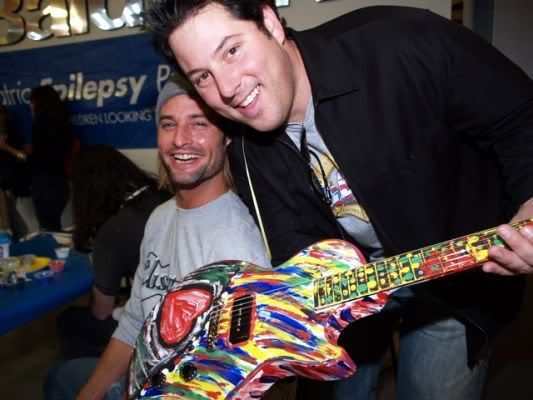
That was the first fundraiser attempt and that raised a lot of money, like 300 grand, for UCLA and that was those guitars, hand painted guitars, and people can still go to CelebrityCars.com. We took that artwork and made the greeting cards out of them. So, people can go to Celebrity Cards, they can buy the greeting cards and that money goes to PEP.

There a few different ways that I am generating”¦if they can get a few different revenue streams going then they’ll be fine. It’s not like UCLA needs, of course if someone gave them 50 million dollars they would be happy, but they don’t need that much money. They need operating costs for their research and treatment and their staff”¦the hardest thing for them”¦they don’t work on billable hours. I call the doctor when Jake has a seizure. I call and I say, “What do I do? He just had a seizure. I gave him the medicine”¦” Then they talk me through it, they don’t bill me for that conversation. So, there’s so much time spent helping families who need help and they don’t make the money you expect them to make and they don’t drive the cars you expect these doctors to drive, they’re not making a lot of money at all. They really do need help. And then, the other charity that’s a benefit, Hugh Laurie’s charity, Save the Children, that’s an incredible charity. Jamie just helped Cure Autism Now with his money, The Coalition Against Domestic Violence is Bonnie’s. So, there’s some really important charities that we’re helping out and we get to be rock stars”¦

(Laughs)

I have a question about PEP, if you don’t mind”¦

No, not at all”¦

Is there, and I don’t want to say cure because I am deeply ignorant on the subject”¦

I think, through stem cell research, how they’ve helped with Parkinson’s patients, that, and I kind of pray this, I really do think Jake, my son who’s 10, will not have to deal with epilepsy for the majority of his life. This is what I am really hoping for. Years ago they didn’t have ways of going in and operating, even if it was localized, even if they could find it in the brain, but now they can. The medications”¦there’s a medication that Jake has that every single child with epilepsy should carry with them and every parent should carry with them, it’s called Diastat, it’s like his emergency medicine. And that, I know, stops seizures. I know it stops it. If he has a grand mal seizure, that will stop the seizure. He’s on a series of 6 medications. These medications weren’t available years ago so it’s one of those where, yeah, I think they’re moving a lot quicker, the FDA is allowing these drug companies to use these medications”¦Let’s say a medication was originally used to treat migraine headaches but it benefits epilepsy patients. They’re letting that crossover happen as long as they do the clinical trials. These scientists, these researchers, the doctors, they need our help. They need the research funds.

Epilepsy is not a glamorous disease. It’s not talked about as much as it should. People are embarrassed to talk about it and they shouldn’t be. The awareness”¦it’s the second most common neurological disorder behind migraine headaches.

It’s odd you say that because I have a friend who is in his early 30’s and, a couple of years ago, it was just an onset. He started to have seizures all of a sudden. No warning. He had his life flipped as he was prohibited from driving a motor vehicle for months following that. Eventually it waned but it was terrifying.

Was it grand mal seizures?

I”¦just don’t know. I wish I could say that I was inquisitive enough to really find out what happened but I felt kind of odd bringing it up if he wasn’t going to talk about it. I don’t know whether I felt uncomfortable talking about it or”¦

It’s amazing. The way I compare it”¦your brain has a lot of wiring that send messages, it’s like two lightning bolts have to meet, and in your brain and in my brain they meet all the time, messages are sent the way they should. Well, what happens if one lightening bolt is pointed up and the other one is pointed down? The brain just goes “Whoa!” and it starts shaking and the message is not going where it’s supposed to go. With Jake, luckily, he developed epilepsy at age 7, his brain was fully developed. But kids who get it, as infants, while their brain is still developing, you can see how it’s affected them. In their speech, in their learning”¦Jake has an incredible team at school working with him and we just encourage him to do everything that a normal kid would do but we just have to be right there. I mean, we have a pool and Jake swims, I’ve got to be right there with him. If you have a seizure when you’re swimming? You could drown, easily. But I can’t not let him swim, he loves to swim.

He’s on a restricted diet, Jake has an implant that stimulates his brain, we’re doing everything we possibly can to stop his seizures. Jake is a very difficult case to treat, but if you were to meet him you would never know he has epilepsy. You’d never know.

But a lot of people, like you say, don’t know what it is.

We just started school, grand mal seizure out on the yard in front of all the kids”¦and Jake is truly my hero because what happens is he has a seizure, we pick him up, we bring him home, and he says, “I want to go back to school. What are you doing? Let’s go back, I want to go back.”

(Laughs)

I’d want to stay at home”¦

If I had a seizure at work it would be like, “I’m staying at home for a few days.” It’s just the way we’ve been raising him and it’s just amazing. It’s amazing to see him like that. I thought that kids would make fun of him.
No. They don’t. They take his lead. It’s amazing. It’s like anything else”¦if you believe in yourself other people are going to believe that. You’re dictating how you want people to perceive you. He does”¦that’s the way he perceives himself.

We all have something to deal with. Everyone’s got something. This is his thing and take it or leave it, you know?

And do you draw strength from that?

For sure.

It puts everything into perspective. It really does. Everything else is just”¦it’s important in its own way, but, especially what I do, but how can I worry about a scene that I’m shooting when this, this is big stuff. This is the stuff of challenges that you’re faced with. I can do anything. Put me in front of 60,000 people, I’ll pull my pants down.

(Laughs)

It all doesn’t mean anything to me. When I see my son have the courage to go through what he’s going through”¦that’s real strength. That’s the real thing.

Comics in Context #148: Radio City Rowling

Filed under: Columns,Comics in Context — admin @ 11:55 pm
comicsincontext4.jpg

Merely eight days after my return from this year’s San Diego Comic Con, I attended an event that outdid any of the presentations in the convention’s Hall H, an occasion that the Con is unlikely ever to duplicate, and it was right here in my home base of New York City.

On August 2, 2006, I attended An Evening with Harry, Carrie and Garp at Radio City Music Hall. This was the second of two nights of readings, performed on behalf of charities, by three best-selling novelists. And just who in the literary world could pack a venue the size of Radio City Music Hall? There was John Irving, author of The World According to Garp, The Cider House Rules, and nine other novels. There was the organizer, Stephen King, the modern master of horror. I do not know how often Irving makes public appearances, but King has become a familiar face in New York, appearing at the New Yorker Festival and this season at Manhattan’s Symphony Space. But the third author lives in Britain, rarely makes public appearances and had not visited the United States in six years: J. K. Rowling, writer of the Harry Potter series. I never expected to see her in person, but I did at Radio City Music Hall that night.

The usually ubiquitous Beat was aghast that I succeeded in attending when she did not. I was surprised myself at how easy it was to get in: I merely stopped by a Ticketmaster outlet two nights before. But on the night I attended, the Music Hall did indeed look sold out, as far as I could tell.

King came up with the idea for the two “Evenings” were and invited Irving and Rowling to join him. King selected one of the charities that would benefit, the Haven Foundation, which aids writers and performing artists who are prevented from working by serious illness or injury. Rowling chose the other charity, Doctors Without Borders, a humanitarian organization that provides medical aid worldwide. At a press conference King said he hoped the two nights would raise a quarter of a million dollars for each charity.

I wondered how Rowling reacted to flying across the ocean to arrive in New York City in the midst of one of this summer’s unusually intense heat waves, with heat indexes of one hundred degrees or more during her stay. When I arrived at Radio City Music Hall in the early evening of August 2, the weather was reasonably endurable, and the building’s air conditioning quickly put me at ease.

The show began with a welcoming speech by actress Whoopi Goldberg, who got off to a bad start by making the common error of mispronouncing Rowling’s name. (It doesn’t rhyme with “howling,” though that might seem appropriate, but with “bowling.” Since this was the second night she had given the speech, you’d think someone might have corrected her beforehand.) Nonetheless, it was an entertaining speech, in which Goldberg declared that “These three writers are forces of nature equal to or greater than any of the supernatural events you can find in their books.” Goldberg commented that “somebody should have put them all together a long time ago. Because. . .if that little wimpy boy [Harry?] had asked that poor girl [definitely King’s Carrie] to the prom, it would have stopped a whole lot of crying.”

Goldberg noted the large contingents of fans for Irving, King, and Rowling who were present in the audience. “There are plenty of J. K. Rowling fans here tonight,” Goldberg said, “and I think I know why they’re screaming,” as indeed they were., “It’s because all of the Stephen King fans are whispering to them all of the ways that Harry could possibly die.” As for those King fans, Goldberg maintained that “we hardly ever get together because so many of us are angry loners.” (Neither angry nor alone, the audience appreciatively laughed.)

Goldberg introduced the next celebrity, who was in turn to introduce King. It was Tim Robbins, who played the lead in The Shawshank Redemption (1994), the film adaptation of King’s prison story, Appropriately, Robbins wore a striped shirt and pants that evoked prison garb. Among the celebrities making introductory speeches that night, Robbins was far and away the best, thanks to his running gag. Observing that the movie’s “title has been a source of confusion for its many fans,” Robbins proceeded to mispronounce it every time the name turned up in his speech, and each time more elaborately (e. g. “Shankshaw Redaction,” “Shinkshank Reduction“). You might think this would become tiresome, but the gag instead kept building in impact on the audience, and prevented Robbins’ speech from becoming mired in the expected tributes to King’s authorial prowess.

After each author was introduced, there was a brief overview of his or her life and work shown on the videoscreens hanging over the stage, including clips from films adapted from the author’s books. I noted that in King’s case there was no excerpt from perhaps the best known film adaptation of his work, Stanley Kubrick’s The Shining (1980), which King is on record as detesting.

Then each author would come out and read from a miniature set that was apparently designed to evoke his or her work. King got to sit on a replica of a backwoods back porch, although he soon became restless and moved about the stage.

The three authors exemplified the dress code that I witnessed at the Eisner awards at the San Diego Con: the women dress up, and the men dress down.
King represented one end of the evening’s fashion spectrum, wearing a blue sweatshirt, looking as casual as could be without slipping over into sloppiness.

King began by thanking the audience for their hearty applause. “I think all the muggles are home tonight watching TV. The real people are here.” Damn straight. Then he looked warily at the chair. “You don’t think this thing’s electrified, do you?”

King told us, “Well, so that was a really nice introduction, and people said very nice things, and now I think I’ll read a really gross story. Because it’s what I do. Hope you enjoyed your supper because you may not for long.”

King chose to read “The Revenge of Lardass Hogan” from his novella The Body, which was adapted into the movie Stand by Me (1986). “Revenge” is about a small town pie-eating contest for which which the title character prepares by drinking a bottle of castor oil. During the contest, once Hogan has devoured enough pie, he starts to throw up, inducing an epidemic of vomiting from everyone (and on everyone) present, ending in Hogan’s triumph: tying with his chief competitor.

King gave a bravura performance, at one point interrupting the story to exult, “I actually get paid for writing this stuff!” Listening to the tale, I realized that this was a comedic variation on the notorious prom scene from King’s Carrie: the protagonist uses his or her special talents to wreak grotesque havoc on a gathering of the community that have treated him or her as an underdog.

King was followed by actor Stanley Tucci, who gave a serious and perhaps too formal speech introducing John Irving. I had expected that the KIng and Rowling fans would overwhelmingly outnumber any Irving readers who had shown up, so I was surprised by the widespread, enthusiastic applause that greeted his entrance. Irving represented the middle of the evening’s fashion spectrum, in an open-necked shirt and white pants, seated in a comfy chair in a set with a lamp, old, bound volumes, and ornate fireplace, that suggested a prosperous man’s study.

Irving read a sequence from his novel A Prayer for Owen Meany, dealing with an annual Christmas pageant, for which the title character, an undersized schoolboy with a high-pitched voice, is usually sentenced to play an angel, ignominiously suspended above the stage; Owen, however, is determined to play the starring role, that of the infant Jesus, even though that role is assigned to actual babies.

This was definitely the best of the three readings. Like King’s story, Irving’s passage kept building in comedic impact as it proceeded. Moreover, Irving, who has been a wrestler as well as an author, assumed a falsetto voice for Owen’s dialogue, which added to the hilarity, being utterly incongruous with Irving’s physique. Irving even broke himself up a few times during the reader, much to the audience’s delight. Oh, and by the way, Irving’s reading also contained a reference to vomiting, the evening’s unexpected recurring motif.

The next introductory speech was made by Kathy Bates, who received a rousing welcome from the audience: the King fans know her as the star of the 1990 film adaptation of his book Misery. She had introduced King the night before; tonight she was there to introduce Rowling, who had been introduced on Tuesday by The Daily Show‘s Jon Stewart.

“Tonight,” Bates began, “our next author makes her much-anticipated return to the United States, the first visit in six years. And that’s why at this moment I feel like Ed Sullivan when he was about to introduce the Beatles. Some of you kids be sure to ask your parents what I’m talking about in the way home. The Beatles were in a band called Wings.” Well, actually, anyone who grew up after the 1970s isn’t going to get that joke, either. Time passes more quickly than we may like to think. Describing the passion for Rowling’s work as “Pottermania,” Baker went on to praise her books for fostering a new generation’s enthusiasm for reading “just when it seemed that technology had infiltrated every last aspect of our lives. . . .” Baker summed up, “With words on a page, J. K. Rowling lured kids away from the screens and into the quiet of their rooms and took them to places where Google does not go.”

Then there was a video overview of Rowling’s career, some of which was drawn from the BBC special Harry Potter and Me, which was repackaged in the United States as an episode of A & E’s Biography. The audience stirred when the onscreen Rowling showed the BBC interviewer the folder which contained the final chapter of the final Harry Potter book. When the face of Alan Rickman as Professor Snape flashed onto the screen, the audience applauded. Since I’ve always thought of Snape as the archetypal nasty teacher, this reaction surprised me. I had no idea he had so many supporters, and Rowling seemed taken aback by the audience’s response to him, too.

Then Rowling came onstage, displaying a fashion sense that decidedly showed up the men’s. With her long blonde hair, wearing a little black dress, and responding to the enormous applause with a brilliant smile, she cut a very striking figure onstage. Her set consisted of a large chair, resembling a throne, standing between a small table, atop which was a Japanese-style fan, and a tall lampstand, holding a candelabra-like arrangement of lights at the top. The scene evoked a British castle, perhaps Hogwarts itself.

Someone shouted out, “Don’t kill Harry!” “No pressure there,” said Rowling, sounding pressured indeed. “I feel slightly like I’m Herman’s Hermits having to go on after the Stones and the Beatles.” (My gosh, not only won’t kids in the audience get that reference, but Rowling herself is too young to remember Herman’s Hermits in their mid-1960s heyday!) The audience, the press, and even King and Irving may have considered Rowling to be the star of the show, but she seems to have considered the two veteran writers her superiors.

She continued, “My consolation is I have the most interesting shoes.” It turns out that she used the same line the night before, so the video cameramen were ready. An enormous close-up of Rowling’s feet appeared on the videoscreens, and she had on these high-heeled silver sandals with serpent-like straps. She was right to be pleased.

“I notice you like Snape,” Rowling observed in an amused tone. Then she said she would do a reading from the most recent of her books, last year’s Harry Potter and the Half-Blood Prince. (Those of you who have not read this book hereby receive a spoiler warning.) After that, she said, she would take some questions inasmuch as “in my experience my readers like me to answer questions and like me to hasten on to that part. . . .” In this particular sequence from the book, “Harry goes back in time and watches as Albus Dumbledore,” his mentor, “goes to inform another famous pupil of Hogwarts School of Witchcraft and Wizardry that he has a place at the school.” The audience cheered at her reference to Tom Riddle, who would become the Potter books’ archvillain, Lord Voldemort. “And you really shouldn’t be cheering that particular one,” she responded. “Snape I can kind of see. . . .”
(But only “kind of,” you’ll note.)

Rowling’s reading went decently enough, and she even successfully essayed a lower class voice for a female character. But King and Irving had selected pieces that were brilliant comedy set pieces, and gave them tour de force performances. Rowling’s selection instead dealt in a quietly ominous mood, and, since she only rarely makes public appearances, she is presumably less practiced at doing such performances of her work.

Upon concluding her reading, Rowling dryly remarked that “nobody told me the theme of the readings was to be vomit. So I could have done something with the puking pastilles, but. . .I didn’t know.” And then she turned to questions from the audience.

The first question came from a girl who identified herself as Christina, a thirteen-year-old from Staten Island. She wanted to know, “If you could bring one Harry Potter character to life, other than Harry, who would it be?”

“Personally,” Rowling began, “although it’s a really tricky one: Hagrid, if I could have anyone.” The audience applauded the choice of Harry’s gigantic friend. “Because I think. . .we’d all like a Hagrid in our life, liability though he often is. . . . It would be really great if I met a fundamentalist Christian,” Rowling said, clearly referring to those parties who claim the Harry Potter books advocate satanism, “to say, “˜Would you like to discuss the matter with Hagrid?'”

The next questioner was an eighteen-year-old New Yorker who pointed out that in the most recent Potter book, Harry’s “Aunt Petunia is said to be oddly flushed when Dumbledore announces that Harry will be returning only once more to Privet Drive,” where she lives. “Does this mean that Aunt Petunia harbors a hidden love or fondness for Harry and the connection he provides her to the wizarding world?”

“That’s an excellent question,” replied Rowling, perhaps playing for time while she mulled over her answer. “And like all the best and most penetrating questions, it’s difficult to answer. But I will say this. There is a little more to Aunt Petunia than meets the eye and you will find out what that is in Book Seven.” At this the audience clapped and roared in excitement. They were present when J. K. herself had granted that rarest of valuables: a hint about what happens in the next book! (But what I want to know is, did she name Harry’s Aunt Petunia after Ben Grimm’s Aunt Petunia in Fantastic Four?)

That small hint, though, had not sated the audience’s appetite to know more.
Questioner #3 was a boy from New Jersey who gave his age as nine, enthused over the Harry Potter books, and then dropped a bombshell. Bringing up Dumbledore, the boy asked, “Since he is the most powerful wizard of all time and Harry Potter is so loyal to him, how could he really be dead?” The audience applauded and cheered, but Rowling buried her head in her hands and groaned. This very private writer was now having to answer to her readers en masse–including a small child–for the apparent death of a beloved character. “I feel terrible,” she said. “The British writer Graham Greene once said that every writer had to have a chip of ice in their heart,” she began to explain, but then dismay took over. “Oh, no,” she said, “I think you may just have ruined my career.”

“I really can’t answer that question because the answer is in Book Seven, but you shouldn’t expect Dumbledore to do a Gandalf. Let me just put it that way,” she said. I now wonder if this nine-year-old would have understood this reference to the wizard of Lord of the Rings who literally undergoes the traditional mythic device of death and resurrection. I had myself wondered if Dumbledore would “do a Gandalf,” but now it seems not. “I’m sorry,” she told the boy. But Rowling wasn’t out of the woods on the Dumbledore matter yet.

The next in line were a boy and his father, and you might expect that the boy was going to ask the question, but you would be wrong: the father did all the talking, and looked strangely familiar. “Hello,” said the father, “We are Salman and Milan Rushdie,” whereupon the audience burst into applause for the famous author. Not so very long ago, Rushdie was marked for death by Muslim fanatics and could not possibly have appeared in a huge public venue like Radio City Music Hall.

“I’m not sure this is fair, Salman,” said Rowling, seriously. “I think you might be better at guessing plots than most.” Rushdie, indeed, writes children’s fantasy himself, such as Haroun and the Sea of Stories, and did a book on MGM’s The Wizard of Oz (1939) for the British Film Institute.

Following the precedent set by the previous questioners, the elder Rushdie stated, “We are nine and fifty-nine.” He explained, “And this is really Milan’s question and it’s kind of a follow-up to the previous one.”

“All right, okay,” conceded Rowling, unable to escape the trap.

“Until the events of Volume 6,” Rushdie began, “it was always made plain that Snape might have been an unlikable fellow, but he was essentially one of the good guys.” The audience audibly agreed.

“I can see this is the question you all really want answered,” observed Rowling, vastly outnumbered.

“Dumbledore himself had always vouched for him,” Rushdie pointed out, like a debater marshaling his evidence.

“Yes,” agreed Rowling.

“Now we are suddenly told that Snape is a villain and Dumbledore’s killer,” asserted Rushdie. “We cannot, or don’t want to believe this. Our theory is that Snape is, in fact, still a good guy.” The audience applauded, as if Rushdie were Snape’s attorney, mounting his defense. “From which it follows that Dumbledore can’t really be dead,” Rushdie argued, “and that the death is a ruse cooked up between Dumbledore and Snape to put Voldemort off his guard, so that when Harry and Voldemort come face to face, Harry may have more allies than he or Voldemort suspects.” (This thought had occurred to me, too, when I read the book.) “So,” Rushdie summed up, delivering his coup de grace, “is Snape good or bad? In our opinion everything follows from it,” presumably meaning that if Snape is good, then Dumbledore lives.

Rushdie had said all this in a perfectly reasonable tone, without raising his voice, but the audience was nonetheless aroused, reacting with laughter and applause. One account of the evening claims that Rowling “chuckled” but from my vantage point I detected no sign of this. She was on the spot.

Instead, she replied quite cautiously, “Well, Salman, your opinion, I would say, is. . .right.” His opinion about what? That Snape is a good guy? If so, I’m surprised that Harry Potter fans haven’t made a greater fuss about this revelation. Or was his opinion that “everything follows” from the answer to whether or not Snape is a good guy?

Rowling then asserted, “But I see that I need to be a little more explicit and say that Dumbledore is definitely dead.” Both apologetically and defensively, she noted that “I do know that there is an entire website out there [named] DumbledoreIsNot Dead.com, so I’d imagine they’re not pretty happy right now.” Concerned, Rowling continued, “But I think. . .all of you need to move through the five stages of grief, and I’m just helping you get past denial.” Perhaps due to nervousness, she added, “I can’t remember what’s next” in the five stages. “It may be anger so I think we should stop it here. Thank you,” she bid the Rushdies, and the audience applauded.

Perhaps it was a relief for her that the time had come in the program for her to bring King and Irving back onstage to join her in taking further questions. Then King introduced Soledad O’Brien of CNN’s American Morning, who acted as moderator. She explained that over 1,000 questions had been submitted (via e-mail from ticket holders), from which twelve had been chosen. “The lucky dozen” questioners had been seated close to the stage and hence to the microphones; four of them had been the questioners during Rowling’s solo segment.

This was clever. The organizers knew that there would be more questions for Rowling than for King and Irving, so she got to take four before the men joined her onstage. Moreover, it’s clear that someone had carefully selected the questions. Salman Rushdie didn’t get picked by sheer chance. There were neither stupid questions nor the sort of embarrassing social misfits one sees in San Diego question lines. The San Diego Con and other conventions could learn from this event’s example.

The first questioner, a man from Alabama, asked. “Mr. King, do the contents of your head ever just scare the crap out of you?”

“No,” replied King: “I pass the savings on to you.” After the audience’s laughter subsided, King went on, “I’ve said this before: there are people out there that pay a psychiatrist, you know, ninety dollars an hour, they only get a fifty minute hour, and those guys take all of August off and they go somewhere it’s cool.” (There was an obvious reference to our heat wave.) King continued, “I vent the same terrible feelings of fear and inadequacy and phobic reactions, and people pay me. It’s a great way to live, man,” King concluded to applause.

Next came a woman from Connecticut who asked John Irving if he would describe any other sources for “events or characters” in A Prayer for Owen Meany.

Irving replied that “I’m a very slow processor with those things that have affected me personally or emotionally. . . .If Owen Meany is, it’s fair to say. . .my Vietnam novel, it was written twenty years after the war. . . . And I wrote my most autobiographical novel about my childhood and my adolescence most recently, when I was already in my late 50s and early 60s. I work better by waiting,” he concluded. in other words, he gains perspective with the passage of time.

As for the origin of Owen Meany, Irving said that when he was “back in my home town” one Christmas he got together with “two or three friends that, in some cases, I hadn’t seen since they were eight or nine or ten years old,” and they started discussing their friends who had either died in Vietnam or who had “thoroughly altered the course of their lives” through the steps they took “not to go.”

One of his friends mentioned a name that Irving did not recognize. “They said to me, “˜Well, in Sunday school you used to pick him up by his ankles and shake him until all of the money fell out of his pants.’ And then I remembered this very little boy who was smaller than all of us. And we loved him but we liked to infuriate him because he had a voice like this,” Irving said, shifting back into Owen’s falsetto, “and we’d love to hear him get mad., He was so small that whenever you were around him you just had to pick him up, which he hated.”

Then, Irving related, “I said one of the stupidest things I’d ever said in my life. I said to my friends, “˜Oh, he couldn’t have gone to Vietnam. He’s too small,’ having last seen him at the age of eight. And one of my closest friends said, “˜You moron, he probably grew!'” After the audience stopped laughing, Irving went on, “I went home and thought, what if he didn’t grow?. . .And that became Owen Meany.”

As a victim of bullying myself as a child, I wondered about Irving’s claim that he “loved” this boy that, by his own admission, he and his friends would bully and manhandle. With time comes maturity and perspective, and Irving turned this unnamed boy into a sympathetic central figure in his book. But is there still an element of condescension and mockery in the way that Irving imitates Owen’s high-pitched voice? And did we in the audience share that attitude by laughing at that imitation?

The next question was from a librarian from Pennsylvania who began by telling Rowling, “thank you for attracting so many students and adults as well to reading.” (Now there is something a little disturbing. It’s well known that Rowling’s books have inspired kids to become readers, but one might have hoped that people would have picked up the reading habit by the time they became adults.) The librarian wanted to know what Rowling would be writing after the final Harry Potter book.

Perhaps previous questions had put Rowling on guard, because she began, “I thought you were going to attack me for Madam Pince, and I would like to apologize to you and any other librarians present here today.” She explained that “if they’d”–her heroes–“had a pleasant, helpful librarian, half my plots would be gone. Because the answer invariably is in a book but Hermione has to go and find it. If they’d had a good librarian, that would gave been that problem solved. So, sorry.” Gosh, this is becoming J. K. Rowling’s penance tour of New York.

Then Rowling said upon completing the last Potter novel, she may go back to working on a shorter book “for I think slightly younger children that’s half-written.” But that won’t be soon. “I think I’ll need a short mourning period, though. You have to allow me to get past Harry.”

A woman from Milwaukee said that her mother, who lives in Maine, says that King has been “a tremendous contributor to the community” in Bangor and that the townspeople treat him as “a regular Mainer,” and asked King how he “managed” to do this.

“I’m just a regular guy, that’s all,” King replied (unlikely as that may seem). King explained that “if [people] only see you on a stage at Radio City Music Hall. . .for one night you get to be a big deal, but I’ll tell you something. . . Saturday I’m going to be home and my wife’s going to be there and she’s going to say, “˜Walk the dog and empty the dishwasher.’ And immediately your feet go back on the floor where you are.”

King continued, “We’ve lived in Bangor since 1979, which means we have one other set of neighbors on the street who have lived there longer than we have, but they’re senile and they don’t remember us, so that almost doesn’t matter anymore.”

King observed, “So we’ve been around. People know us. They’ve gotten used to us.” He noted that “they say familiarity breeds contempt, and before it breeds contempt, it breeds neighborliness, and that’s the nice thing about living in a small town.”

He went on, “We live in a neighborhood. We have an ice cream parlor around one corner and a forest around the other corner. . .It’s like the village that you write about in the Harry Potter books,” King told Rowling, “and it’s like the towns that John writes about in a lot of the New England settings in his books, and it’s great.” So there is a link among these three writers that I had not previously considered: they share an affinity for chronicling small town life.

A man from New York wanted to know if Irving would like to write a sequel about any of his characters.

“That’s a good question,” Irving said. “I think I will never write a sequel for a very simple reason. I need to know the ending of my novel before I begin. Not just the ending but the tone of the voice of the ending. What’s happened of major emotional importance. Who the main characters are. Who even the major minor characters are. Where their paths cross. I make a kind of street map of the novel.” He summed up, “I’ve always written the last sentence first and I work my way back.” Hence, “it’s impossible for me to imagine that anything happens after the ending because the ending has meant so much to me that it’s where I begin.”

This is very different from the world of comics, where serial publication rules, and longrunning characters go from one storyline to the next for years, and even decades. In contrast, Irving’s books would be plot-driven rather than character-driven.

But then Irving added something even more intriguing. “On the other hand, here’s what’s comparable to a sequel, and it happens to me . . .unconsciously many times. Characters come back as other characters in subsequent novels. And I don’t even recognize their reincarnation while they’re emerging. It’s only when I finish a book that I realize, “˜Oh, this character is just another version of this character from a previous book.’

He gave examples: “the physical description of Owen Meany, who is first described as looking embryonic, not yet born, was a passage I lifted from the physical description of the orphan Fuzzy Stone. . .in The Cider House Rules. . .” Here’s another: “Why is it Dr. Larch in The Cider House Rules, Jenny Fields in The World According to Garp, and eventually Johnny Wheelwright, the narrator of A Prayer for Owen Meany, all decide that they’ll never have sex? You know, I don’t know a lot of people like that.” He concluded, “So those are the curses of my sequels.”

As a critic I’m well aware that there are thematic similarities among the works of any writer, and that a writer will tend to endow his protagonists, say, with similar character traits. Irving not only admits the latter, but has found a provocative image for describing the phenomenon. I always admire his acknowledgment of the role of his own subconscious in devising his characters.

A woman from Toronto (Are you noticing how far some people came to attend this event?) asked King, “what kind of scary stories keep you up at night? Maybe your own? Maybe another author’s?”

King said that “I think our idea of what scares us changes as we get older. As a young person, one of the scariest things I ever read was Lord of the Flies, because . . .the idea of those kids turning feral just scared the dickens out of me.”

“Sometimes you get surprised into fright. When I picked up the Harry Potter books, I was not prepared for the depth of some of the frightening passages in there. Frankly, I was surprised by how scary the Death Eaters were.”

“I scared Stephen King,” Rowling declared, beaming with pride.

“Don’t be proud of yourself,” King warned her, in (mock?) annoyance, but it was too late: Rowling was obviously delighted.

A woman from Indiana asked Irving if he ever gets “so involved in a character’s storyline that it affects your personal life?” Irving’s response further illuminated his previous answer about needing to distance himself from his past in order to write about it. In his most recent book, Until I Find You, “it was my childhood, my adolescence, and as much as I had thought I had waited long enough, and that I was old enough to deal with those things, I just remembered a lot of stuff that I would have been happier not to.”

Next was a girl from Pennsylvania, who asked Rowling, “what is the one question your fans have never asked you and should have?” The audience loved this, since it was an invitation for Rowling to spill the beans on some other secret of the Harry Potter saga, as Rowling well realized.

“Oh, God!” Rowling lamented. “How can I answer that? I can think of a couple of things that give away the ending of Book Seven. . . .Having got sixteen years down the line, I kind of feel that would throw it away.” Rowling would not take the bait: “I’m sorry.”

As ever, she tried to explain by way of apology. “You see, people think that it’s all so fixed in my head. It’s not that obsessively plotted out.” (Not like Irving’s books, then?) “For example, this afternoon I believe I changed my mind on the title of Book Seven.” (The audience was audibly aroused.) “Having been quite convinced that I had the title, I suddenly thought, “˜No, that would be better, wouldn’t it?’ in the shower just before coming out here. . . .

“But you know what,” she said, “I’m not going to tell you either version,” and the audience moaned in disappointment. Finally, Rowling had reached the end of her capacity for contrition, although she seemed more defensive than angry, as if asking for understanding from her six thousand pampered children arrayed before her. “Oh, come on! Now really! Have I not given you enough? I gave you Aunt Petunia. I told you Dumbledore is really–“ whereupon she drew her finger across her neck in a slashing motion. There’s the chip of ice.

But her goodhearted sense of guilt immediately returned. “So I am trying to give something to you. Anyway, I’m sorry. I suppose it’s that question. Everyone’s really pleased you asked that question. It’s me who’s let everyone down, not you. Sorry.” Perhaps in part to cheer Rowling up, the audience applauded.

To end the evening O’Brien addressed her own question to all three authors” “If you were to have dinner with any five characters from any of your books. . .who would you invite and why would they be on your list?”

“Any five characters from any of my books?” asked King. “Honey, I’m eating alone.”

“You could just invite all the dead ones and then they wouldn’t come,’ offered Irving. (Now, really, there are plenty of good, even heroic characters in King’s books, too!)

“I would eat with Harry, Hermione, and Ron,” King said. “And Owen. . . .I can think of other people’s characters I’d eat with. And I can think of other people’s characters I’d eat.”

Rowling went next: “Well, I’d take Harry, to apologize to him.” Contemplating further, she said, “I’d have to take Harry, Ron, and Hermione.” But then it became clear that she had fallen into another trap. “See, I know who’s actually dead.” Ah, so does this mean that Harry, Ron and Hermione all survive the end of Book Seven, as we all hope?

King urged Rowling to “Pretend you can take them anyway,” whether the characters are alive or dead. “Well, then I would definitely take Dumbledore,” Rowling said. People in the audience called Hagrid’s name, and Rowling acceded to their wishes: “I’d take Hagrid, yeah. And Owen because he wouldn’t take up much space.”

Irving put Dr. Larch, Owen, Patrick Wallingford from The Fourth Hand, on his guest list. He also listed three of his female characters, “Melanie, Hester, and Emma, who would probably burn the house down, but I’d be interested in meeting them.”

Then O’Brien thanked the authors and questioners, King thanked the audience on behalf of the two charities, and the festivities were over. As the lights went up, I discovered I was seated right near a side door that opened directly onto the sidewalk outside, so I was able to make a quick exit without being swallowed up by the thousands who were all leaving at once.

I’m not the only person who took a long time to write about the evening. On Sept. 13 in the diary on her official website (http://www.jkrowling.com/), Rowling started off by apologizing for not writing on it for so long (“Sorry, sorry, sorry, sorry, sorry.”) Despite her onstage trials, she declared that the shows with King and Irving “were so much fun” and “I would have happily done a third night. . .the crowds, both nights, could not have been more wonderful.” Likewise characteristically, she also “belatedly” came up with the question she had never been asked, and posted it elsewhere on her site (http://www.jkrowling.com/textonly/en/extrastuff_view.cfm?id=23). But Rowling doesn’t answer the question, because apparently it would indeed give away an important plot point.

People have rightly marveled that three authors could draw an audience that filled the vast Radio City Music Hall and that reacted as if they were rock stars. Only afterwards did I reflect that The Music Hall seats 6000 people, but the San Diego Con’s infamous Hall H holds 6500. Ah, but could any Comic-Con guest fill Hall H nearly twice over? That’s what Irving, King, and Rowling accomplished over two nights.

ADVERTISEMENTS FOR MYSELF
Only a week after the previous session of my lecture series, “1986: The Year That Changed Comics,” I’m doing another one, on Monday, October 2, at the Museum of Comic and Cartoon Art in New York (www.moccany.org), this time about Art Spiegelman’s Maus.

-Copyright 2006 Peter Sanderson

Nocturnal Admissions: DVD Review; The Texas Chainsaw Massacre with Gunnar Hansen interview

Filed under: Columns,Nocturnal Admissions — UncaScroogeMcD @ 11:50 pm
nocturnalheader5.gif

If you’re like me – that is, barely able to keep up with the new movies and DVDs, thus without the luxury to dip back into the past – than you probably haven’t seen The Texas Chainsaw Massacre in a long time. I know I haven’t. Therefore the film came as a renewed surprise. Not only was it even better than I remembered it, but the film is surprisingly, at least by today’s standards, minimal in its violence and gore. What TCSM does accomplish, however, and still effectively, is to create a mood, at atmosphere of unrelenting terror.

Chainsaw box

Joe Bob Briggs has probably written the definitive history-analysis of TCSM, reprinted and expanded for his book, Profoundly Disturbing, and there is at least one whole book, an oral history, dedicated to the film ( The Texas Chain Saw Massacre Companion, by Stefab Jaworzyn, from Titan books), and Robin Wood has explored its implications as far back as the early 1980s. All that I can do, on the occasion of the film’s reissued on DVD by Dark Sky Films in a two disc ultimate edition, restored and re-mastered according to the box (street date Tuesday, September 26, $29.95), is to explore some of its discreet effects.

Chainsaw gagged victim

Joe Bob points out that TCSM reverses the traditional trajectory of cautionary tales people watched in the first part of the century, in films such as Sunrise, i.e., that the country is pure and that the city is corrupt and destructive. Here, a band of teens take a trip into the country and are, mostly, destroyed by the corruption and isolation of the vast plains of Texas. Briggs might have added that in its way TCSM is a film soleil, that is, a horror noir like Val Lewton’s horror noirs, but set in the bright sunshine of the suddenly ominous great outdoors, with lawn mowers in the background and breezes rustling the hay and the wash drawing on a line. Very little of TCSM actually takes place in the dark, indeed even indoors. Cars, woods, country roads – these are the sites of most of TCSM‘s horrific events.

Not only is the film a horror soleil, but it is a comedy. As with Hitchcock’s Psycho, there are in jokes, perhaps put in place to relieve the tension of the set. But ultimately like horror films, or at least the best horror films, are really comedies, or, in the case of Frankenstein, tragi-comedies. In fact I might be willing to argue that the greatest horror film of all time is Abbott and Costello meet Frankenstein, because it so explicitly a balancing act between authentic humor and legitimate horror.

Chainsaw's Neal

In TCSM, the whole of the state is nuts. The film starts out with eerie noises (the film’s music and sound production is superb, one is delighted to be reminded), and a man is apparently creating a sculpture out of recently unearth human parts, the same incident reported on the news simultaneously. Soon we learn that the whole of Texas is crazy, and the film creates a mood that links the current events of the film with Charles Whitman and the JFK assassination. This is a state, in the film’s view, in which bored citizens start visiting graves when the desecration hits the news, turning the event into the occasion for a festival. The scuzzy man (Edwin Neal) who created the body part art gets into the teen’s van shortly thereafter and scares the heck out of them with his odd way of talking and his ritual worship of and fascination with blood (yet he is also strangely appealing to at least one of the passengers).

Chainsaw lawn

One of the best sequences of brooding suspense occurs when two of the kids make their way at last to the house of horror (in the past a neighbor of relatives of some of the kids). As they trod up through the yard to the house, they pass benign house hold items, yet a buzzing in the air is ominous, and The 2003 remake produced by Michael Bay got this part of the film just right.

The comedy elements of the film come into full view, as it were, behind closed doors, where the family is truly horrific, as well as unpredictable, and funny in their outrageous way, bickering as if they were a normal American family, and didn’t have bones and bodies and stuff corpses littering the rooms. The effect of the film lingers for hours, if not years, later, as Sally (Marilyn Burns) manages to escape but is reduced to a quivering heap, while the Chainsaw family is injured but still there. Tobe Hooper and his collaborators leave it there, stopping in media res as so many subsequent horror films were to do, hinting at sequels and letting the horror living beyond any false conclusions on the screen.

Dark Sky offers up this DVD of The Texas Chainsaw Massacre (the film’s fourth iteration in the medium) in a widescreen anamorphic, 1.78:1 frame taken from the original 16mm elements. The disc has subtitles in English and Spanish under English, Dolby Digital 5.1, Dolby Digital 2.0 Stereo, and English Dolby Digital 1.0 tracks.

Chainsaw Tobe Hooper

Disc one of the two disc set has several supplements, beginning with a new audio commentary by actors Marilyn Burns, Paul A. Partain, Allen Danziger, and art designer Robert A. Burns, which is moderated and highly informative (two of the participants later died). The disc also reprises an earlier commentary with director Tobe Hooper, cinematographer Daniel Pearl, and actor Gunnar Hansen. The supplements conclude with trailers, and TV and radio spots.Disc two includes the 73 minute documentary “Texas Chain Saw Massacre: The Shocking Truth” plus the 74 minute documentary “Flesh Wounds,” which would tell you all there is to know about the film were it not for the existence of a third making of doc out that not included on this box. In other extras, Gunnar Hansen takes the viewer on a tour of the Texas Chainsaw Massacre house, and the disc ends with deleted scenes and outtakes, a blooper reel, a stills gallery, and even outtakes from “The Shocking Truth,” which provide even more information.

Chainsaw Gunnar Hansen

I had the chance to interview Gunnar Hansen via email on the occasion of the film’s 32 anniversary release. Hansen, who was born in Iceland, is now a poet and editor living in Maine, with a sideline in acting and documentary making. Here are the results of the interview:

What is the role of the horror film in mass culture these days? And if that role has changed in 30 years, how has it altered?

These days horror films are big again, with bigger and bigger budgets, after a long period of decline. I don’t think that horror ever declined for real fans, but it certainly did for the general public. I think these cycles of interest are what horror has to suffer through. At the time Chainsaw came out, horror movies were pretty much moribund after a couple of brilliant flashes in the 1960s – Psycho and Night of the Living Dead. Chainsaw changed all that. Horror movies got interesting again. Then as the cycle came all the way around, most horror fillms started getting dull again. (Call me old fashioned, but Scream just doesn’t do it for me.). Now, finally, we seem to be in a strong revival, and once again horror films are back into the mass culture. What excites me about this is that their popularity means that maybe soon a new Tobe Hooper will come along and redefine horror again. It’s about time.

What do you think of the fact that the movie is both a cult hit among horror fans and a darling of high brow critics such as Robin Wood? It suggests that despite its roots in horror it has great universal appeal.

I’m glad to see that the movie holds up well for both ends of the critical spectrum. From a horror fan’s point of view, it delivers the goods – it is disturbing and scary and entertaining. At the same time, for the critic, it has resonance (as a critic might say). It can be seen as being about more than just the surface story, and it has enough substance (and technical niceties) to it that it bears up to close examination. It’s well constructed and compelling – and it is appealing on so many levels. Rex Reed called it the scariest movie he had ever seen. At the same time there were plenty of people who hated the movie. In 1977, Harper’s published an article called “The Pornography of Violence,” in which the writer called Chainsaw, “A vile little piece of sick crap with literally nothing to recommend it.” And this kind of attention, of course, only gave it more exposure and extended its audience. But it’s funny to me that so many high-brow critics now want to claim it as their own. I have read articles saying, in effect, “When Chainsaw came out, it was almost universally ignored. Only a few of us perceptive film theorists understood its depth.” Which of course is a load of road apples. The movie was a hit with the public from the first day; the high-brow film academics had to play catch-up.

Since you are masked throughout the movie, I imagine that few people “recognize” you on the street or within the biz. Has that been a help or a hindrance in your subsequent career?

I don’t think that the mask has meant much one way or another for my career. (It has, though, been a convenience, since I like not being recoginized on the street.) I never really intended to have a career as an actor. I tried out for the part of Leatherface because I was curious to learn about what it was like to work on a movie. Once the movie came out, I continued to pursue a writing career. The mask didn’t affect that. But, of course, Chainsaw‘s success meant I was getting offered new roles. I finally gave in, and in 1987 started working in films again. And, again, the mask didn’t matter. What mattered was that I had played in a very successful horror movie, and I was being offered horror roles. And that was just fine with me.

The cult flavor of Chain must have taken all of you by surprise. By this time, though, over 30 years later, do you wish the film would just go away?

Yes, Chainsaw‘s cult following really did surprise me. I had hoped that the movie would be successful enough that after a few years a few hard-core fans would remember it. I never imagined more for it. All these years later, though, I really don’t wish the movie would go away. I’m proud of it and my chance to be part of it. Its cult status has allowed me to act in other films and now and then attend a horror fan convention. And at the same time, I am able to do the other work I love – writing.

Who is your favorite poet? If there is only one. Or, rather, Who is your favorite poet right now?

Right now it’s probably Wallace Stevens. But there are others whose names have been popping up lately: Andrew Marvel, Donald Hall, Philip Larkin.

Who are some of your favorite writers in general?

Non-fiction writers: Bruce Chatwin, E.B. White, John McPhee. I don’t know whether I have favorite fiction writers, other than the obvious, Herman Melville. Some favorite novels include Par Lagerkvist’s The Sybil, Jerzy Kosinski’s Painted Bird, and Gabriel Marquez’s One Hundred Years of Solitude.

Which is worse: pretending to kill people with a chainsaw, or editing the copy of writers for publication?

Editing copy. At least bad copy does now and then make me dream of oiling-up the saw.

Once you got into it, what was one big thing about the movie business that took you by surprise?

I assume we’re talking about the movie business, rather than movie making. So often it seems to me that people in the business really don’t say what they mean. You either learn quickly to devine the meanings, or you spend a lot of time wondering what really got said at that last meeting. To slightly rephrase George Burns, “The secret to success in Hollywood is sincerity. Once you can fake that, you’ve got it made.”

Interview: Jonathan Coulton

Filed under: Interviews — UncaScroogeMcD @ 11:36 pm

-By Ken Plume

coulton 01.jpgCyber-troubadour Jonathan Coulton is an evil, evil man who must be destroyed.

Why this call to action? Because he’s immensely talented, an amazingly gifted songwriter, and his incredible creativity both intimidates a normal, ungifted person like myself and drives me to distraction with catchy tunes and wordplay.

Damn him to hell, I can’t stop listening to his music.

That includes his first album Smoke Monkey, his first EP, Where Tradition Meets Tomorrow, and the first collection of his online songwriting experiment, Thing-a-Week.

Coulton ends his epic, year-long “Thing a Week” series of songs today with #52 (which makes sense, when you think about it).

He’s also currently criss-crossing the country with legendary raconteur, humorist, DAILY SHOW correspondent, humanitarian, and author of The Areas Of My Expertise, John Hodgman. Like The Monkees before them, they could be coming to your town.

You can purchase all of his discs, plus other merch, as well as partake of more sonic goodness at www.JonathanCoulton.com. While you’re over there, be sure to check out the other 51 Things – and pick up his CDs. And pledge your life to him. That talented bastard.

I had a chance to talk to Coulton about all things Thing, his groundbreaking use of the internet, and how the paradigm shift affects him as an artist. Of course, this was after I mistakenly called him on his cell instead of his land line, allowing me to immediately launch into completely self-effacing mode…

—————————————————————–

JONATHAN COULTON: Hello?

KEN PLUME: I did get the correct number now, right?

COULTON: Ah. There we go. Perfect.

KP: See, that’s how we start off an interview poorly on my end.

COULTON: (laughing)

KP: Can’t follow directions, probably did very little research…

COULTON: That’s right. I’ve deducted all sorts of points already.

KP: Yes. I did not know I’d be judged.

COULTON: (laughing)

KP: It’s like so many other things in my life.

COULTON: Always, always.

KP: Now I see how this is going to go…

COULTON: Yeah.

KP: Well, now that I know I’m being judged…

COULTON: You gonna rewrite some of your questions?

KP: You’re quite uh, a witty, handsome fellow.

COULTON: (laughing)

KP: And I brought an apple. Well, I’ll have to work on that, I guess.

COULTON: Yeah, do your best.

KP: Well, I’ve already completely thrown that out the window, so I’m just gonna coast now. Uh, so, as far as, have you ever… you’ve obviously read the interview that I did with John (Hodgman), so…

COULTON: I have, yes.

KP: You’ve got a sense of how poorly these things can go.

COULTON: Yes.

KP: So, really, it’s all on your shoulders.

COULTON: Yeah. No pressure though, right?

KP: No, none at all.

COULTON: Yeah.

KP: It’s not like writing a song a week for a year.

COULTON: Yeah. For instance.

KP: Which I think is a lot more pressure, when you come down to it.

COULTON: Yeah, it was a lot of pressure. There were some weeks that were absolutely excruciating. I mean, there were certainly some times when an idea would come to me early on in the week and it came together by itself and I was done by late Thursday morning, and I could relax. But then there were other weeks where Friday at 2 in the afternoon I still had no ideas. Or maybe one idea that I hated.

KP: What would you do with the hated idea? How many of those actually made it to finished form?

COULTON: Quite a few of them. I found that a pattern developed near the end of the cycle, which is that I would get an idea, and I would recognize the moment when I was at the bottom of the trough. When I hated the idea the most, when I doubted myself the most… when I was entirely confident that this would never ever become a song. And I actually learned to recognize that moment as not a true thing. Because even the ones that I hated, when I plowed through, and when I wrote them – when I forced them to become full songs – most of the time I liked them pretty well.

KP: So, was that just a feeling born of stress more than anything else?

COULTON: Yeah, I think it’s stress, and I also think it’s just the…

KP: Standard artistic doubting?

COULTON: Well yeah, it’s that, and it’s also when you see any nugget of a song out of context, it’s not that great. You know? Every piece of a song is strengthened by the rest of it, so when you have one silly line about somebody who likes to… “Mr. Fancy Pants, who always has the fanciest pants.” It’s easy to say, “Oh, well, that sucks. You can’t make anything of that.” And then a few stressful hours later, you have a song a minute and a half long.

coulton 02.jpgQS: So what would be the biggest turnaround in your feelings on a song? If you were to choose one that completely went a 180 on you?

COULTON: Good question. I have to look in my songlist. I have to go to my website. What’s my website now?

KP: I believe it’s jonathancoulton.com.

COULTON: Ah, yes, thank you. I’m going to the songs page, where I can see all of the songs that I’ve written and listened to, because I like…

KP: I believe people can even purchase CDs of those songs on that page…

COULTON: Yeah, you can even purchase CDs from there if you want to. Oh, you know what the biggest turnaround was? I know the answer to this question, actually. It was a song called “When You Go,” which was one of those things where late in the week I didn’t have very many ideas. I had one that I really liked very much, that was sort of dull and hokey, and I wrote it all the way through and that song… I love that song. And I really was, I think a very… it’s not a very upbeat song. It’s a pretty sad breakup song. And I think that the sadness within that song came from the sadness in me not being able to write anything that week.

KP: I think one of the interesting things when you look at the 52 song cycle, is that you pretty much cover just about every emotion, genre, thought…

COULTON: Well, you would have to.

KP: You would think.

COULTON: (laughing)

KP: Considering the construction process, what would be then the easiest song that came to you? One that you had done by, let’s say, Monday?

COULTON: “Shop Vac” came to me that way. “Shop Vac” was… of course, that was early on in the process. That was when I wasn’t feeling much pressure at all, but yeah, that song came to me when I was actually using a shop vac on the roof to vacuum up some leaves and mud and stuff, and just kind of whistling to myself, enjoying my time alone with my shop vac.

KP: As men are wont to do.

COULTON: As men are wont to do. And it occurred to me, “When did I become this person?” The chorus sort of popped into my head fully formed, and then the rest of it came pretty easily. That was a quick one.

KP: Where do you find inspiration comes from most – a lyric or a melody?

COULTON: I found myself writing two kinds of songs. There are ones that spring from a lyric and a character, and that moment of inspiration is usually one of these fully formed things where there’s a… I’ll get a lyric and I know who’s speaking and I know what’s motivating them and why they’re saying that. And then I can write around that character.

KP: Like a “Mr. Fancy Pants” kinda thing.

COULTON: Like “Mr. Fancy Pants,” right. Or “Shop Vac,” or also the… “Re: Your Brain” was like that, too. The chorus of that, all we want to do is eat your brain. That came to me, and I pretty much knew who was talking. I knew that it was a zombie. I was imagining a zombie saying that and I was imagining that his attitude was, “What’s the big deal? Why can’t we work this out?” And so the rest of it just became fleshing out that character.

KP: No pun intended.

COULTON: And there are other songs that are much more musically based, and a lot of these came later in the year when I had sort of run the gamut of all the robot and monkey songs I could think of.

KP: And yet you still surprised yourself.

COULTON: (laughing) And I still surprised myself. And sometimes it’s the music that… it starts with the music, and then I sort of fill in words until I get some sort of a story.

KP: Do you find yourself gravitating musically towards certain kinds of chords or progressions that are sort of an identifier of a “Jonathan Coulton song”?

COULTON: Oh, god, absolutely. I’m so sick of them. I’m so sick of writing sad songs in D, I can’t stand it.

KP: Yeah, that should be the title of an album.

COULTON: (laughing) Yeah, I have a… I’m sure it’s the same for every guitarist, but I have what I consider to be a bag of cheap tricks that I use over and over again in different ways. And certainly writing a song a week, you start to see your patterns pretty quickly. So I would find myself, to keep from writing the same song over and over again, I would have to just put a cap on the guitar and just play the same chords but way high up on the neck. Or I would have to force myself to write a song in the key of E this week. “Let’s do E. We haven’t done E in a while.” (laughing)

KP: You should have just gone for the key of life.

COULTON: Well, that’s true, that’s worked out well for someone, didn’t it?

KP: Yes, I believe it did.

COULTON: That was Stevie Wonder.

KP: You need to go that direction. Not the blind direction.

COULTON: (laughing) No, not the blind direction.

KP: But you keep vacuuming up on the roof like that who knows what could happen.

COULTON: Yes, it could fly into your eyes.

KP: Yeah, see? Have some kind of vac accident.

COULTON: (laughing)

KP: Would you say that you made any musical discoveries about yourself during the process? Like, “Oh, it surprised me that I can go to that place…”

COULTON: I did. There were a couple of songs… I feel like I’ve learned a lot about my voice through all of this. Maybe part of that is learning to record it better. I don’t know. But I feel like I’ve discovered both the highs and the lows. I discovered that I can… how to really work a slow sad song with my voice, and also how to push it a little bit and make it sound a little more… oh, I don’t know, rock ‘n’ roll. Not that I sound very rock ‘n’ roll ever, but there were a couple of songs that I surprised myself at how much more dangerous I was able to get my voice to sound than usual.

KP: So you think it was just a matter of forcing yourself to go to those places?

COULTON: Yeah, that it was really just having the confidence to sing out loud and scream when necessary, and not worry about the neighbors hearing me.

KP: Is that what had prevented you before then?

COULTON: I think that’s a lot of it. It’s very hard recording in Brooklyn in an apartment building. It’s noisy. There’s noise coming in from everywhere. And it’s also, you can hear people through the wall on the other side, so you know that when you’re singing at the top of your lungs for the fifth time in a row because you can’t get the lyric right, a line about zombies wanting to eat brains, you know that somebody on the other side of the wall is saying, “What is going on?” It can be a little intimidating.

KP: But that’s what gives New York its character.

COULTON: (laughing) That’s true. And the museums are terrific.

KP: And now they’ve lost at least one of those things.

COULTON: I know! What’s happening?

KP: It’s people who want to go off and have roofs.

COULTON: I know (laughing). Totally unreasonable.

KP: I know. You’re gonna have to someday rectify to them. Now they miss you, I’m sure.

COULTON: I’m sure, I’m sure.

KP: They’re probably visiting your site every day.

COULTON: Yeah…

KP: “Remember the zombie guy? We go visit his site.”

COULTON: (laughing)

KP: Going back to the beginning, what was the initial impetus for doing the “Thing a Week”?

COULTON: Well, you know it actually came from… when I was wrapping up my day job – I had this day job writing software – it was the last few weeks that I was working there…

KP: What kind of software were you writing?

COULTON: I wrote in Visual Basic.

KP: Oh, I remember that well.

COULTON: Microsoft SQL server. It was a database for executive recruiting firms.

KP: Wow. Accounting wasn’t good enough for you, huh?

COULTON: No, no. I’m not an accounting schmuck.

KP: No, no.

COULTON: I’m about the recruiting.

KP: Numbers – no.

COULTON: I’m a people person. Which is why I wrote software for people.

KP: Yes. For people to use to find other people.

COULTON: Yeah. And so I was near the end of my time there and everybody knew that I was going, and I was talking to a coworker of mine, and he said, “What are you gonna do?” And I said, “I don’t know. I really don’t know!” ‘Cause I didn’t have any plan at all.

KP: Starve…

COULTON: Yeah. I sort of wanted to starve and not do anything for a little while. I was leaving specifically to try to do some music, but I didn’t have any specific plan. And he said, “You should write a song a week for a year.” And I said, “Ha ha, that’s insane, you could never do that.”

KP: “And now I leave you. Good day, sir.”

COULTON: Yeah! (laughing) And I sort of laughed it off and said, “Oh that would be amazing, but I can’t imagine that I could possibly do that.” And then a few weeks after I had stopped working, I said “Well, why not try doing a song a week for a little while, and see what happens?” And it wasn’t even gonna be a song, it was gonna be maybe an idea or a little sketch. A little interesting guitar part that I liked.

KP: Hence the “Thing” part instead of…

COULTON: I didn’t want to call it “Song a week” ’cause I felt like there was too much pressure. And I think the very first one was kind of this throwaway experimental thing… and then the second one was a song, and then the third one was a song, and then it was all over. I couldn’t go back.

KP: At what point did you feel locked into it?

COULTON: You know, I think not until… not until maybe 15 songs in. When I could actually see the halfway mark to a year… when I could actually start thinking about, “Oh, I might write 20 songs, I might write 25 songs, I could write 26 songs. That’s half a year.” Then it actually felt like a possibility to me.

KP: So, in other words, when you stopped looking for an easy way out.

COULTON: Exactly. Yeah. And that’s actually when it became a lot more difficult, I think. I think I was writing a lot more easily in the beginning.

KP: When you thought you did have an exit.

COULTON: Yeah, when I thought I could stop at any time, and when nobody was really paying any attention. And then every week more and more people were listening, and every week it was closer and closer to the possibility that I could go for an entire year.

KP: Well, I mean, the beautiful thing is that you also hit this perfect zeitgeisty moment with the rise of stuff like Boing Boing and YouTube and ScreenHead, and blogs in particular, to where you have this entire sort of rapid fire network by which these things can be shared with people.

COULTON: Yeah. I wish I could say that I thought that through and that that was part of my plan, but…

KP: It’s not like you were recording stuff on an answering machine or something.

COULTON: Yeah! (laughing)

KP: I mean, that’s so low tech.

COULTON: What kind of fool would do that?

KP: It’s so twentieth century.

COULTON: Yeah, exactly. But they did that every day.

KP: Yeah, well, that’s just nuts.

COULTON: Yeah, but it was also – they were not full songs.

KP: Yeah, not until you bought the album.

COULTON: Yeah, right. Then you realized that they… (laughing)!

KP: No but you really just hit this unique pocket whereby.. I mean, look at something like the Second Life concert you did, where that wasn’t even feasible technologically a year ago.

COULTON: Yeah. No, that’s very true. And it’s funny to see… and I’m not trying to claim credit for this movement, but…

KP: No, go ahead.

COULTON: I think that independently I think a lot of people have come up with the same idea of doing any sort of art on a regular… on a suicidally regular basis. There’s people who do a painting every day.

KP: Well I’m doing “Chat a Week” now.

COULTON: You’re doing “Chat a Week”?

KP: Yeah.

COULTON: What’s that?

KP: I have no idea yet.

COULTON: Oh. Fantastic.

KP: But get back to me in a year.

COULTON: (laughing)!

KP: You can buy the book.

COULTON: I mean, you can call it web 2.0 or whatever you want to call it, but I agree that the blogging world has gotten really big in the last couple of years, and podcasting has had this meteoric rise. And I credit those guys a heck of a lot for the number of listeners that I now have. I mean, it’s basically airplay on national radio, except there’s no radio involved.

KP: Well it’s not even national, it’s international.

COULTON: It’s international, yeah.

KP: At what point did you feel the momentum being taken from something that you were having to sort of push to all of a sudden it had a life of its own?

COULTON: I think when… well, early on, “Baby Got Back” was sort of a phenomenon. That was my first real taste of what a viral hit could do. By which I mean, take down your site. And that was very exciting, but it was like crack. Because it felt so good while it was happening, and then 24 hours later it was just gone. (laughing) It was this huge spike, and then back down to the levels where I was before. And so that was my first taste. And then I think somewhere after Christmas… well, there was “Flickr,” which was the next really big hit. And that’s when I started to notice that the tone had changed a little bit, and that people were speaking of me, writing of me, as if they expected the reader to know who I was. You know what I mean?

KP: Right.

COULTON: It wasn’t like, “Here’s this guy Jonathan Coulton and here’s what he does.” It was like, “Oh, Jonathan Coulton just did this.”

KP: “Here’s his latest.”

COULTON: Right. And that’s when I started to feel like there was definitely something going on out there.

KP: How does that feel?

COULTON: It felt terrific. It really was so, so validating. That’s why it’s so hard to stop Googling yourself, because you… if you’re lucky, you come across a complete stranger who’s saying these nice things about you who thinks that you’re a famous person. And it’s really…

coulton 03.jpgQS: So what was the longest, most disturbing Googling session you’ve ever done…

COULTON: (laughing)!

KP: Because we all know that’s where it leads. Sitting there for three hours going, “Oh, I’ll go to Classmates.com. See if they…”

COULTON: Yeah. No, it’s true. Well, you know, I have a whole routine that I go through every morning, which involves pushing as many things back out of my inbox as I can. Making a list of the things I don’t get to so that I can get to them later. And then doing the same on MySpace. Getting emails, accepting friendship requests…

KP: That’s a horrible phrase when you actually think about it.

COULTON: Oh, I know. It’s gross. It’s disgusting. I hate MySpace. You know, I feel like I gotta do it. Um, and then… then I’ll go to Technocrati, see what posts have come through, and of course you know that every time I get alerted about a trackback to an entry on my site I check out the context, ’cause I have to see what they’re saying about me. So yeah, it’s easy to get lost.

KP: I often wonder in this day and age of stuff like MySpace and approving friends and Googling yourself, what would Charles Schulz have written if he had done Peanuts and Charlie Brown now…

COULTON: (laughing)!

KP: Would it be a Valentine’s Day card, or would it be, “Why haven’t you approved me?”

COULTON: (laughing)! I think you’re absolutely right. Although you know, I gotta say, I don’t know…

KP: “No one approves Charlie Brown.”

COULTON: (laughing)! No one approves Charlie Brown. “I’m not gonna approve that blockhead.”

KP: Yeah! Meanwhile, Snoopy’s friend list is stratospheric. “How do you even get a laptop up there?”

COULTON: Yeah. I don’t even know if MySpace is gonna last long enough to have that kind of cultural resonance. I mean, I guess there’s always gonna be a thing like MySpace, but I don’t know if it’s always going to be MySpace.

KP: I think it’s gonna be one of those things where eventually it’ll collapse, but the idea of it will carry forth and people will always refer to it as a MySpace kinda thing.

COULTON: Yeah, that’s probably true.

KP: There’s a chance Google could disappear.

COULTON: Yeah, sure.

KP: Remember searching with Hotbot?

COULTON: Absolutely! Nobody could imagine Hotbot ever going away.

KP: That’s the smart one. You don’t use Yahoo.

COULTON: No, Yahoo sucks.

KP: And Google, what the hell is that? Not even a word. And this is just, what, 10 years and all this has gone by the wayside?

COULTON: I know. And it’s just gonna get faster and faster until we’re all replaced by robots.

KP: I find it encouraging that when you have so many flash in the pan endeavors on the internet, that you could have the consistency for “Thing a Week” over what, in modern time, is quite a huge span – and actually build the audience and build the reputation. Now you have people waiting with baited breath as to how it’s all going to end and what you’re going to do next.

COULTON: Right. Yeah, it’s been great. I would quibble with you on the suggestion that I’ve been consistent. I certainly don’t feel like I’ve been very consistent at all.

KP: Here’s the way I look at it: in this day and age, if you’ve finished it, you’ve been consistent.

COULTON: (laughing) Right!

KP: Because look at all the abandoned husks across the net.

COULTON: It’s true.

KP: Of Danny Bonaduce and Willie Aames fan sites.

COULTON: That’s very true. Just lasting for a year doing anything is a pretty…

KP: Actually completing a stated goal…

COULTON: Yeah, that’s true. A friend of mine who’s a professor of English literature, of all things, was talking about these shows, CSI, and he said, “It’s interesting – the heroes of the stories that we’re telling ourselves now, these are people who solve these crimes by using the tools that they have in an effective way, and by going over every inch… and all they have really is competency. But that somehow has become the heroic thing to do, is to be competent.”

KP: It has elevated them above the new norm.

COULTON: Yeah. They’re the only ones that have the patience to go over a room inch by inch with an ultraviolet light looking for blood splatter.

KP: That should be your byline: “Jonathan Coulton, Competency in the Modern Age.”

COULTON: (laughing)! Yeah! I like that.

KP: That’ll be the box set.

COULTON: That’ll be the box set, right.

KP: Which you have just about enough for at this point.

COULTON: I do.

KP: Are there plans to collect all four volumes?

COULTON: I’m trying to figure out a way to do it from a manufacturing perspective. I’m going to make all four CDs, and they’ll all be available for sale separately. I’m trying to… I haven’t actually begun to investigate this in any real way, but I’d like to find a way to have a box that I can put these CDs into and that will also have enough space for… Len Peralta is the guy who has a podcasting job on radio, who’s been doing a drawing for each song. He hasn’t done them all, but he started pretty early on. And what he and I would like to do is put those into a booklet, a sort of program guide. And then put that in the box with the four CDs. I need to find somebody who will be able to make that box and… it can’t be too expensive.

KP: No. And it’ll say Born to Run on the front.

COULTON: And it’ll say Born to Run on the front. It’ll say The Beatles.

KP: The Coulton Album. Surely there must be somebody out there.

COULTON: I’m sure that there is, I just have not begun to Google it.

KP: Or there’s always Tupperware.

COULTON: That’s an interesting idea. Just get those Glad disposable Tupperware containers.

KP: Yes. In fact, the uniqueness alone might be worth it.

COULTON: Or maybe a Ziploc bag.

KP: It’s got to be with the slide zip.

COULTON: It would certainly be cheap.

KP: It would be cheap. Especially with the holiday season coming up, are there any plans for anything special along those lines? You’ll have the first two out by the end of the year, right? The first one’s out, second one’s about to be out…

COULTON: The first one is out, the second one will be available for sale in a matter of days. Numbers three and four I hope to have within a month or so. I’m trying very hard to get all four of them out in time for the holidays.

KP: So, basically, it’s the perfect gift.

COULTON: Oh, it would make such a great gift for almost anyone.

KP: And anyone who doesn’t want it as a gift can certainly find someone who would.

COULTON: Yeah. Even if you give it to somebody as a gift and they don’t like it, I’m sure they know somebody who’d like it, and they could give it to them as a gift.

KP: Yes.

COULTON: You can’t go wrong.

KP: In fact, it’s the perfect re-gift.

COULTON: It’s the perfect gift, it’s the perfect re-gift, it’s the perfect thing to give somebody just to make the guilt go away, and they can throw it in the garbage.

KP: I like that as a tag line; “Makes the guilt go away.”

COULTON: “Makes the guilt go away. Throw it in the street, I don’t care. I’ve got your money.”

KP: Yes. That’s also a good tagline.

COULTON: “I’ve got your money.” – Jonathan Coulton.

KP: Yes, in fact, all of your receipts, when people actually order the stuff, should say that.

COULTON: Right. “Thanks, sucker.”

KP: I thought that’s what the secret track is on the end of every album. That’s the backwards one.

COULTON: (laughing)!

KP: So, everything out by the end of the year. What’s your sense now, coming to a close after you’ve run this gauntlet?

COULTON: It’s very complicated. I feel very proud to have done it, and sort of amazed that I was able to do it at all. And very glad that I did it, because there are so many good songs in there that I think I never would have written otherwise. But I’m also a little afraid… I’m relieved to stop because it’s exhausting, but I’m also a little afraid to stop, because this has become my thing now. And I’m not sure exactly what I do after this. The business model such as it is, I don’t know to what extent it’s worked because I was writing a song every week. I don’t know what happens to the money and the fans and the blog links when there’s not new content every week. There certainly will be new content. I will continue to write songs, just not on a certain schedule.

KP: So you think “Thing a Fortnight”…

COULTON: I think a fortnight or maybe something every now and then.

KP: I like that title.

COULTON: Catchy.

KP: Yes.

COULTON: And explanatory.

KP: Actually kinda whimsical.

COULTON: It is a little whimsical, you’re right. And so I don’t know what exactly to do next. One of the things I would like to do is sit back and take a little break, and let whatever happens next emerge as organically as possible. That’s how I got doing the “Thing a Week” is by quitting my job without any plan and letting myself sit still for a couple of weeks.

KP: So basically just letting it gestate and emerge when it feels like it.

COULTON: Yeah, exactly.

KP: Is there any worry about taking that approach again? It’s not like you’ve emerged out of doing programming again. You essentially did what you wanted to do…

COULTON: Yeah. Yeah, I think there’s… there’s definitely a feeling like, I need to keep pushing and pushing and pushing. So yeah, it doesn’t feel 100% correct to lay off. But I may find that what comes next is actually going back and pushing and pushing again. And take a few weeks vacation and then a “Thing a Week 2.”

KP: So you’re gonna write that rock opera then, is that what you’re saying?

COULTON: Right. I’ll do the rock opera, and then I’ll do a song for every site on the internet.

KP: Or do it as a film. A modern Rocky Horror.

COULTON: Thinking of this cyclical stuff, Ze Frank’s The Show, it’s just amazing. He does that every day. Or every weekday.

KP: I can barely do a podcast every couple of weeks.

COULTON: Yeah. I have a lot of respect for that.

KP: Of course, I’m inherently lazy.

COULTON: Me too.

KP: Yes, but you still managed something.

COULTON: Yeah, but I feel like a week, you got a little leeway. You can do it on any of those five days. But every weekday it’s like, oh god, the days when you wake up and you don’t want to do anything, too bad.

KP: Yeah. But I guess that’s how normal people work.

COULTON: Maybe that’s true. Maybe it’s just you and me that have trouble.

KP: Yeah. Now I’m kinda feeling bad. Anyone reading this is gonna go, “Buncha assholes!”

COULTON: “Why don’t they just do their damn job?”

KP: “And then they complain! ‘Oooo! I don’t know if I want to work today, creating…’ “

COULTON: (laughing)! You’re right, that’s pretty loathsome…

KP: “I might just sleep in or go up and vacuum, I don’t know.”

COULTON: “Yeah, I don’t know, whatever.”

KP: “Look at a tree.”

COULTON: “Let’s see what’s on television. I’ll wait for the next thing to come to me.”

KP: “I’ve never seen this Law & Order.”

COULTON: “Oh wait, yes I have. Zzzzzz….”

KP: “Well, no Thing this week. Got some sleep.”

COULTON: “At least I made all those meatballs.”

KP: “Ran into town. Got some mail. Catching up on email.”

COULTON: You’re describing my life.

KP: “And approving friends.”

COULTON: Yeah. That’s pretty much it.

KP: “So you work, what, 12 hours a day? Oh, I’m sorry. How did you lose the arm? You think they’d have a sign. Must make the work harder, no arm and such. Have you heard my music?”

COULTON: “Check it out. Last year I worked on it pretty hard. This year, not so much.”

KP: “I got four CDs worth.”

COULTON: Yeah. “Now I’m just gonna coast.”

KP: Now I feel really guilty. Not only have I made myself feel bad, but I’ve made you feel bad.

COULTON: You’ve made me look bad, too.

KP: Yeah I kinda did that, too…

COULTON: Yeah, take out all that stuff where we bash the working man. Leave that out if you would.

KP: Yeah, well, you have association with a friend of the working man, John Hodgman.

COULTON: Yes. An interesting way to describe him, yes.

KP: Actually, you can pretty much describe him as anything.

COULTON: That’s true. He’s an expert on all things.

KP: He’s kinda like Galactus that way. I think everyone perceives John differently.

COULTON: Yeah. I would agree with you.

KP: I don’t think there’s any one true John Hodgman.

COULTON: No. It’s hard to pin him down, ’cause he’s a true chameleon.

KP: How did that association between the two of you begin?

COULTON: Well, we went to college together. We were in the same dormitory. We were friends starting freshman year, and friends all through college, and…

KP: What was he like in freshman year?

COULTON: The same. He was pretty much the same. John Hodgman has always been sort of an old man. I didn’t know him, but I understand that when he was a freshman in high school he carried a briefcase to high school.

KP: Wow.

COULTON: I know!

KP: And yet he’s not British.

COULTON: And yet he’s not British.

KP: He seems like the type that would love a dormitory type school.

COULTON: Oh, sure. He was always very well spoken and very funny and devastatingly dry. But he did have incredibly long hair.

KP: That, I can’t imagine.

COULTON: Yeah. Which he always kept in a tight little bun in the back of his head.

KP: That’s kinda disturbing me.

COULTON: Yeah, it was really weird.

KP: If you’re gonna have long hair as a man, I’ve never seen the bun look really catch on.

COULTON: No. Grow it and show it, you know?

KP: Ponytail, yes. But bun?

COULTON: Yeah, it was… he’d hate that I was saying this.

KP: I gotta know if there’s photos.

COULTON: I’m sure there are plenty of photos. But it was always incongruent, because occasionally you would see him with it down, it was like, “Wow, who are you?” Because he always seemed like the button-down smarty pants. But, of course, we’ve been great friends for a long time, and my circle of friends and loved ones here in New York contains many people that I have met through John. In fact, I’m married to a woman who went to high school with John.

KP: So, really, he’s a master matchmaker as well.

COULTON: Yeah. He’s the hub of the giant wheel on which we all spin around. My wife is saying, “No, I’m the hub.”

KP: Yeah, you’re married now. You better get it right.

COULTON: (laughing)!

KP: So in other words one day someone’s gonna construct this John Hodgman Venn diagram.

COULTON: Yeah.

KP: With John at the center.

COULTON: It’s gonna be like that Kevin Bacon game.

KP: I think it’s already the Kevin Bacon game.

COULTON: Yeah.

KP: In fact… my god… now I’m part of it.

COULTON: Yeah, except it’s just John in the center of a circle, and that circle’s in the center of another circle, and it’s just circles within circles, all the way down.

KP: It’s like the most disturbing MCI commercial ever.

COULTON: Yeah. Friends and family, and in every one of those circles is John Hodgman.

KP: Yes. “Do you know John Hodgman? Do you know THE John Hodgman?” In fact, that should be the new campaign – “Of course you know this man.”

COULTON: He needs to get an American Express ad, that’s what he needs.

KP: If they still did those.

COULTON: They should go back and do those ads just so they can give one to him.

KP: He should just do that as a viral video for the books.

COULTON: He should do it anyway and see if he can get paid after the fact.

KP: Yes. You need to suggest that to him.

COULTON: Yeah.

KP: ‘Cause he doesn’t listen to me anymore.

COULTON: No. Well, me either.

KP: How could he not listen to you? You’re going to be sharing a road trip together.

COULTON: Well, that’s true. I’m actually looking forward to this a great deal. It’s a fortuitous thing is that the song 52 is posted on Friday the 29th, as the very next day I fly to Chicago to be on tour with John for about a month. It’s like the end of the old thing, and then this great vacation around the country.

KP: Perhaps you should write a song a city, like They Might Be Giants did.

COULTON: Oh, like the Venue Songs.

KP: Yes. But for the book tour instead.

COULTON: But for the book tour, yeah. I’m really looking forward to it. It’s always fun…

KP: See, that’s the sad thing, and I just did it to you. Be brutally honest – does it irritate you a little bit that, from now on, people are gonna be asking you, “So what’s the next “Thing a Whatever”?

COULTON: Yeah, well, I am a little worried about that.

KP: And I’m guilty of it, and I apologize.

COULTON: No, not at all. I think that it’s only natural to ask that kind of question. I wish that I did have another fantastic project to do, but I don’t have one yet. I may come up with one, but we’ll see. I might just sink into obscurity.

KP: No.

COULTON: I don’t know.

KP: No… Websites never die.

COULTON: I guess that’s true.

KP: You might not produce a single new thing, but all those songs will still be out there.

COULTON: That’s true.

KP: If Geocities sites can still be out there…

COULTON: Right.

KP: Your stuff will still be around in perpetuity. Or at least the cyber equivalent of it.

COULTON: One of the benefits of being something of a small fish is that there are always new fans. I think somebody like U2, they’re not gonna get a lot of new fans over the next year. Maybe they are, but not as many as I am. I’ve got nothing but new fans.

KP: It’s also the type of thing that, again, utilizing the technology the way it is, all someone has to do is drop an email or an IM to somebody and say, “Hey, check this out.”

COULTON: Exactly.

coulton 04.jpgQS: Are you going to continue to archive the “Thing a Week” songs as free downloads, or are you going to take them down as the CDs go up?

COULTON: I think I’ll probably leave them up there. I can’t see much of a reason to take them down. I do believe that having this stuff available for free – optionally, you can buy it if you want. I think that that has certainly helped me, and the whole creative commons license, you know, it’s licensed in such a way that you can, in fact, put it on a mix CD and send it to your friends. And I wish you would. I wish every one of my fans would do that right now. Then I would have almost twice as many fans. Presumably there would be some people who didn’t like it.

KP: Yeah, but that’s one of the main points of a mix CD – just to expose someone to something.

COULTON: Exactly. You can pass that one. But I think that there’s no question in my mind that the place that I’m in, being an independent musician and not having a huge marketing engine behind me, having that stuff available so that people can listen is just incredibly valuable to me.

KP: Well, it seems also in this day and age, and maybe you’ve experienced this, that the need for something like a publicist has been greatly reduced.

COULTON: Yeah.

KP: Because you have a lot more one-on-one interaction, and people seek you out who actually want to do features.

COULTON: Yeah.

KP: So you know that whoever contacts you is going to want to definitely do something with you.

COULTON: Right, exactly. I think a lot of the traditional pieces of the puzzle are no longer…or less necessary. I’ve had some discussions with some label type of people here and there… or not label people, but people in traditional parts of the industry. And I always come away from it… you know, I’m always excited by hearing from somebody official, you know?

KP: Right.

COULTON: That’s always nice, just for the establishment to say, “Oh, you’re doing good stuff, let’s talk,” you know? But then I always come away from it saying, “Well, huh, I wonder if doing something official like this would benefit me, or if it would be worse.”

KP: Do you find that you crave that sort of traditional legitimization?

COULTON: I do. I do. I crave that kind of validation from the establishment.

KP: Because I noticed the link on your website, that if you’re someone official, please contact me.

COULTON: Yeah (laughing)! Yeah.

KP: Which I’m surprised doesn’t flash or something.

COULTON: (laughing)! Well I think it’s still… I’m torn about what the role of those people is going to be. I don’t know. I think it’s all still in flux.

KP: It seems like it’s now come down to almost adding an unnecessary middle man.

COULTON: Yeah.

KP: Your interaction with the public is right there now for you.

COULTON: Yeah, it’s true. And so the question is, how much value do you actually get from a middle man?

KP: Which is also based on a traditional retail model, where labels were needed get the record in the stores …

COULTON: Right.

KP: When now there’s no need for bricks and mortar.

COULTON: Yeah. I make so much more money off the MP3s than I do off the CDs. An enormous amount. Much more. So yeah, the idea of moving CDs is not as important. But at the same time, having somebody who can be a booking agent, and call venues and set that up and negotiate that stuff – you know, that’s worth something to me. I’m not particularly interested in spending my time on the phone and talking about money and stuff.

KP: Right.

COULTON: And I also think radio is still pretty important. It’s very hard to get airplay on the actual radio without this crazy direct cold-calling thing. You have to send your CD out and follow up, and, “Have you played it? Are you gonna play it?” You know you have to really push and push and push. Or pay somebody to play it. That’s done all the time as well. I think there are still ways that the establishment can benefit an artist. I haven’t figured out exactly what I want my relationship to be with that part of the business, but luckily it hasn’t come up yet.

KP: Do you feel that need for validation has lessened over time, or is it still pretty constant?

COULTON: Well, it’s pretty deep rooted. You know, it’s like wanting a parent to love you. It’s hard to give it up. (laughing) I certainly have started to think, “Oh wow, maybe this way of doing things actually can work.”

KP: You’re not on a rivet gang.

COULTON: Well, it’s true. And in some parts of the country, I’d be making a decent living. I chose to live in one of the most expensive cities in the country. I don’t know why I did that, but…

KP: Particularly doing what is essentially an internet-based thing. You could live anywhere.

COULTON: I could live in a hut on the top of a mountain somewhere. Well, I’d need broadband.

KP: Yes, and approval from your wife.

COULTON: (laughing)! But yeah, it’s true, I could do this anywhere. As I say, if it were a different part of the country, it’d be a pretty good living.

KP: But it’s not bad.

COULTON: No, it’s not bad at all. I have nothing to complain about, believe me.

KP: I mean, you’re not in the apartment building.

COULTON: That’s right.

KP: If you were to identify a handful of goals besides the mainstream validation, is there anything that’s left unfulfilled for you right now that you’re still chasing down?

COULTON: Uh… uh… huh. That’s a good question. I would like… I would like to be right. I would like to be undeniably correct about the idea that giving music away like this is beneficial. One of the reasons that I did it is I was… I saw Larry Lessig speak about Creative Commons. He was the founder of Creative Commons. And it was the most moving Power Point slideshow I’d ever seen. I was really just so jazzed about the idea, and it was such a beautiful idea, that I really wanted to be part of that change. I felt the need to be a kind of pioneer. I don’t know that I am a pioneer. There are plenty of people who have been doing this long before I’d even heard of it, but I like the idea that I’m part of something new, and I want for that new thing to continue being the new thing.

KP: Why do you believe that it has worked? If you’re looking for proof that it has, why do you believe it hasn’t? What in your experience so far gives you doubt?

COULTON: Well, I think it has worked for me. Maybe it’s just my own self doubt. I think the place that I’ve gotten to is pretty amazing, given the amount of work I actually did. I think the business model has shown itself to be pretty effective.

KP: What do you mean by the work you actually did?

COULTON: Well, I mean, you know, I didn’t do all this traditional knocking on doors and…

KP: Yeah, but the fact is that when you are a creative person and your endeavors are creative, then the measure of the creativity is in the output.

COULTON: Right.

KP: And by any stretch of the imagination… I mean, there are some bands and artists that can’t get an album out in a year, let alone 52 songs…

COULTON: Sure.

KP: … plus already having an album and an EP in a catalogue.

COULTON: Yeah. When I say work, I’m talking more about phone calls, live shows, sending CDs. Trying to get publicity, that sort of thing.

KP: But you also had a concert recently that just sprung up practically out of nowhere that surprised you, didn’t it?

COULTON: It did, yeah. That was really nice.

KP: Was it Seattle?

COULTON: Seattle, yeah. I was going to Seattle to do something with John for Bumbershoot, and at the last minute I discovered that I was actually gonna be there for the whole weekend. I thought that I was gonna come back to the east coast, but that fell through, and so on Wednesday I posted on my site, “Hey, if anybody can find me a venue that’s open on Saturday night, I’ll play it,” and several people came back to me with several different options, and they had already called the booking people and said, Yeah, they’d love to have you play, just give ’em a call,” you know? And so I picked one of them, and decided to do it there, and it was a packed house. It was great. It was like 80 people there.

KP: So, then, what makes you think that the process isn’t working?

COULTON: It just needs to be more overwhelming. I need to have overwhelming evidence. That’s what it is. I want to be able to show these statistics to somebody, and have them go, “Oh my god. We were so wrong.”

KP: So, then, why don’t you do a city experiment? Look at what your open days are, pick a handful of cities, and do the same experiment with those cities?

COULTON: That’s one of the things I’d like to try, and actually, as I’m going on this tour with John Hodgman over the next month, I’m setting up shows in a few cities that I’ll be in anyway, and I’m doing that based on this site called Eventful.com, which is where people can go and sign up to indicate that they would like to see me perform a show in their city.

KP: And there’s a link off your site to that.

COULTON: There’s a link off my site for that, right.

KP: I believe it’s the “dance, monkey” link.

COULTON: The “dance, monkey” link, that’s right. And so I’m gonna pick the biggest cities, or the cities with the most number of demands, and when the schedule works out and when I can find a place to play, I’ll play there. And yeah, I want to continue that experiment and see if that can continue to be as successful as it was in Seattle. Because that’s the other thing, is I feel like, you know, I’ve only been attacking one angle, and that is the music distribution side, and sort of this viral promotion. But I think there’s also room for this same kind of model, a web 2.0 model if you will, in the area of live performance.

KP: I think it takes the guessing game out of a traditional tour.

COULTON: Yeah. Absolutely. And it’s like anything else, Metcalfe’s Law, the value of the network increases exponentially with the number of users, or something?

KP: I obviously stopped at the Peter Principle.

COULTON: The more people that actually use this model, the more valuable it becomes. If venues know that they can depend on that number translating into actual…

KP: They’re not dealing with empty seats on a night…

COULTON: Right. ‘Cause that’s the whole thing, it’s convincing a venue who’s never heard of you that you’re actually gonna be able to put asses in seats.

KP: Right.

COULTON: And so, you know, suddenly if the venue believes in it, and if the fans believe in it, and if the artists believe in it, then suddenly it’s real.

KP: Have you ever gone to the UK to do any shows?

COULTON: No I haven’t. There’s a fan of mine who I’ve never met who actually started a website called the Jonathan Coulton Project, which is dedicated to collecting and posting music videos for my songs. And he lives in the UK, and he has been trying to set up a tour in November for me. I’m not sure it’s gonna come through.

[Interviewer’s Note: What followed was a long exchange during which I discovered that Jonathan did not know who Neil Innes – the songwriter behind the Rutles, member of the Bonzo Dog Band, and tunesmith of many a Monty Python song – was… I was shocked.]

COULTON: Nope.

KP: Oh, come on!

COULTON: I don’t know! I’ve been writing a song a week for a year.

KP: You make it sound like a hermitage!

COULTON: It is! It’s terrible! So glad it’s over.

KP: Your musical monastery.

COULTON: That’s right. Only listening to my own music.

KP: Yes.

COULTON: And Cookie Monster singing “C is for Cookie.”

KP: How could you not?

COULTON: Yeah.

KP: Where’s your cover of that?

COULTON: Yeah (laughing)! I kind of wanted to do Mr. Rogers’ “You are Special.”

KP: Oh, that would be beautiful.

COULTON: I love that song.

KP: So have you had any thoughts whatsoever as to what immediately will follow the end of “Thing”? I mean, what do you think of the people going, “Well, we wanted you to end with one of your original songs for #52 instead of a cover…”?

COULTON: I say to those people, “Why don’t you write a song a week for a year, and then see if you can finish with an original song. And then get back to me.”

KP: It wasn’t a criticism as much as a hope, in that people thought it would be more poignant.

COULTON: You know, it would be, but it also… I can’t… I just can’t imagine it not being sort of a let down. For me, anyway. And it would just be so hard to do. I had such a hard time writing this last one because I knew that it was going to be the last original song of “Thing a Week.”

KP: And yet you couldn’t tell. I have to admit, it seemed pretty effortless, and is actually a very nice tune. So I could not tell the blood and sweat that went into it.

COULTON: Oh, thank you for saying that. That’s nice of you. It turned out okay, but it was really… it was pretty hard. And it was just the pressure of knowing it was the last one that… you know, it’s like, whenever you look at a series of things, you’re gonna look at the first one and the last one.

KP: Do you see a progression between the first and the last you’ve done? If you look at week one and then week 51?

COULTON: Yeah, I do. I feel like a very different songwriter from when I started. It’s hard to put my finger on how exactly.

KP: Would you characterize it as better?

COULTON: I would characterize it as better. I’ve gotten better in a number of places. I feel like I’m playing the guitar better, I feel like I’m singing better. I’m much better at recording things than I was when I started. The production and mixing has gotten better. And I’m also better at… I feel… I don’t want to sound too high-falutin’, but I feel like a better craftsman. I feel like I’ve sort of gotten the handle on some of my skills that I didn’t have before. And that now I know that if I need to I can sit down and actually make a song out of nothing. Whereas I think when I started, I was used to just waiting for things to happen.

KP: So at what point are you doing tune for hire?

COULTON: (laughing)! I don’t know about that. That’s even more pressure.

KP: “Hundred bucks, I’ll walk away and give you a thirty second tune.”

COULTON: I just set up a booth at a county fair.

KP: Yes, yes. That’d be perfect.

COULTON: Yes. Come back in an hour, I’ll have a thirty second song for you.

KP: Yes. “No change.”

COULTON: Yeah, no change.

KP: “Oh dangit, the musician’s gone…”

COULTON: “I was gonna buy a song…”

KP: “Time for skee ball.”

COULTON: “Ah, he’ll be back.”

KP: A hundred bucks worth of skee ball. That kid could have walked away with a tune.

COULTON: That’s right. Oh well.

KP: And now it’s just disappointment in his heart.

COULTON: Now it’s just 25 or 30 tickets and a cheap plastic ring.

KP: That’s an heirloom.

COULTON: If you take care of it.

KP: Pass that down to your kids. What are you gonna do with a song? A song that’s all written in D.

COULTON: Yeah. The same boring crap.

KP: “What the hell’s all this about a robot? I wanted to be about my girlfriend.”

COULTON: (laughing)! “Dude, it is about your girlfriend. It’s deep, it’s deep.”

KP: Yes, you gotta look for the layers.

COULTON: Right.

KP: It’s all about layers.

COULTON: It’s a metaphor.

KP: “No refunds. Did you see that sign?”

COULTON: Yeah, “No refunds. Get out of here.”

KP: It’s right below “No change.” So, I mean, overall – what’s your overriding emotion? Accomplishment, sadness…

COULTON: Accomplishment, I would say. It’s a combination of the pride of accomplishment and the relief of not having to do it anymore (laughing)! I’m going to be very happy to have a few weeks where I don’t have to have a new song on Friday. It’s just gonna be nice not to have it hanging over my head. I also am very proud of this work. I think there are a lot of great songs in there.

KP: I was listening to the entire lot of them over the weekend…

COULTON: It’s a lot of music.

KP: It is a lot of music. It’s a lot of music to do work by.

COULTON: (laughing)!

KP: I mean that in a good way!

COULTON: Oh, thanks.

KP: You know, there’s music that you don’t want to do work by.

COULTON: Right, right.

KP: But this was music that you could actually… there’s nothing I skipped, let’s put it that way.

COULTON: No, I understand.

KP: Which coming from someone who’s skip-happy and has 70,000 songs sitting here…

COULTON: Yeah, it’s a huge compliment.

KP: Yeah. I could have easily have turned on a George Harrison tune, maybe some Paul Simon.

COULTON: Sure.

KP: AC/DC. Well, probably not. Probably some Simon & Garfunkel. So no, there were other options there.

COULTON: These are all my niggas…

KP: Yes, your peeps.

COULTON: My peeps.

KP: Your posse.

COULTON: Yeah.

KP: Your songsmithing posse.

COULTON: Yeah.

KP: We’ll have to work a better terminology for all this. You know, for when you have that big charity concert, or one of those horrible middle-of-the-night jam sessions…

COULTON: Oh god.

KP: Where everyone gets together and fights for dominance.

COULTON: Yeah, where there’s like eight guitars on stage at the same time.

KP: 14 drummers.

COULTON: Yes.

KP: And Ringo.

COULTON: Right! (laughing) Poor Ringo.

KP: Who I hear is doing “Snare a week.”

COULTON: (laughing)!

KP: Really, I think you’ve started a trend.

COULTON: I would be thrilled if a real rock star did a weekly song. It would be amazing!

KP: I will make you a gentleman’s bet – a single dollar – that within the next, let’s say… wanna go three or six months? Your choice.

COULTON: Let’s do six. ‘Cause I’d like you to win.

KP: Within six months, that will happen.

COULTON: Alright.

KP: You will have a major person step forth, and claim the idea as their own.

COULTON: (laughing)!

KP: In international press.

COULTON: It could be.

KP: And that man will be Elton John.

COULTON: (laughing)!

KP: And it’s all gonna be versions of “Candle in the Wind.”

COULTON: (laughing)!

KP: So, a gentleman’s bet.

COULTON: Gentleman’s bet, alright, you’re on.

KP: And if I lose, I will Paypal it to you instantly.

COULTON: You can send me a dollar.

KP: And if I win, I want some kind of elaborate design on mine. And a signature so I can frame it on my wall of shameful deeds.

COULTON: You got it. You’re on.

KP: So was the interview painful?

COULTON: Uh, no, it was not very painful at all.

KP: Was it what you were expecting?

COULTON: I can’t remember a single thing we talked about.

coulton 05.jpgQS: Even better. Because I honestly wasn’t listening to you.

COULTON: Good, good, That’s a relief. I don’t think I said anything. Did I?

KP: No. I think at one point you did pretty much insult just about every single race there was.

COULTON: That’s fine, I do that from time to time.

KP: But hey, they’re fine with it.

COULTON: Hey, I’m just bein’ real, man.

KP: It’s all about people living together.

COULTON: Yeah.

KP: And nobody’s gonna read this anyway. So, really, you’re not sticking your neck out.

COULTON: Right, right.

KP: Do you want to say anything else about economic policy or the war?

COULTON: Um, no thank you. No thank you to the war, and no thank you to the economic policy.

KP: You know, all criticism in this country should take a more gentlemanly approach like that.

COULTON: Yeah!

KP: “No thank you.”

COULTON: “No thank you.”

KP: No “War is bad,” or “Stop the war” – just, “No thank you.”

COULTON: “No thank you, we would not like to go.” That’s what they should have said about Vietnam.

KP: Or, “I’ve had my fill.” No one uses that phrase anymore.

COULTON: (laughing) I’ve had my fill.

KP: It’s the kind of thing you should say with white gloves on.

COULTON: “I don’t care for it.”

KP: Yes. “It’s not my cup of tea.”

COULTON: Right.

KP: Another phrase that’s fallen into disuse. You know, if we ever let this into John’s hands, they’d be full chapters in his book.

COULTON: Oh, that’s true. Well, they will be anyway, even if we don’t tell him about it.

KP: Because the other thing is, he knows all.

COULTON: Yeah, that’s true.

KP: You know, inclosing, you really should just throw down the gauntlet to everyone else, and have them do a “Thing a Week.” Everyone else in the world.

COULTON: Yeah.

KP: “Hey. Bring it. I brought it. A year.”

COULTON: “Shut the fuck up, motherfuckers.”

KP: “I did a year of bringing the shit. What are you bringing?”

COULTON: Right.

KP: “Show me.”

COULTON: Give me something.

KP: “Justify your existence to me now.”

COULTON: Do it for two weeks. Do it for one.

KP: Do a thing, period.

COULTON: Yeah! (laughing)!

KP: That should be your drive for, like, the nation’s children.

COULTON: Get everybody to do a thing a week?

KP: Yes. Or just a thing, period.

COULTON: Just a thing, period… Yeah.

KP: “Jonathan Coulton’s Do Something.”

COULTON: Do Something.

KP: That’s a campaign that could take off. You could be on the Today Show, on CNN…

COULTON: Yep.

KP: “So how’d this all start?” “Oh, I did this music thing and it’s like, you know what? Other people should do things.”

COULTON: Right.

KP: “You know, the people are just sitting there doing nothing.”

COULTON: Just like that Pay it Forward movie.

KP: Yes, exactly. It can be just as treacly as that.

COULTON: My fingers crossed.

KP: And Haley Joel Osment can actually work with you as part of his work release.

COULTON: Oh, god bless that sweet beautiful boy.

KP: Yes. And the telephone pole that took him out. I didn’t say that. I’m sorry. It was actually the alcohol that took him out. The telephone pole had nothing to do with it.

COULTON: Yeah yeah. An innocent bystander.

KP: So I guess I’ll be seeing you sometime next month.

COULTON: Yeah. I’m back literally the 31st…

KP: Are you in a neighborhood now? Are you going to be doing the whole Halloween thing?

COULTON: Well, we’re in Park Slope, so there’s actually a Halloween parade that goes on here. So yeah, there may be some festivities happening.

KP: You’ll be the only guy giving out songs to kids.

COULTON: Yeah, right? “Hey kid, you like monkeys?”

KP: A little CDR to each of them. “Yeah, put this up on your MySpace.”

COULTON: “Link back to me, okay kid?”

KP: “I know you got ’em. And approve me, for chrissakes.”

COULTON: “Thanks for the add.”

KP: Well listen, it’s been a real joy talking to you.

COULTON: Well, it’s been fun. I certainly appreciate the willingness to say important things about me on your important website.

KP: Well I’m all about lies.

COULTON: (laughing)!

KP: Seriously, though, I would not have done it unless I actually wanted to feature you and get the word out.

COULTON: That’s very nice.

KP: And did fully respect and get a kick out of the music.

COULTON: Well that’s good.

KP: So know that I don’t feature people that I dislike.

COULTON: That’s even better. 100%.

KP: So yes, your songs are in full rotation, and I hope that you get something planned for the future. Because I can only listen to this stuff so much.

COULTON: You’re gonna need another 52 songs pretty soon.

KP: Yes, I need that sequel to “Re: Your Brains.” Like Harry Chapin did with “Taxi.”

COULTON: Oh god. Oh god.

KP: You know, revisit it a couple of hours down the line.

COULTON: Yeah, just see what happens.

KP: Yeah, why not? Some kind of post-apocalyptic, Omega Man kinda thing.

COULTON: Yeah.

KP: You know, he set up a house, and yet his coworker’s still coming after him. Every once in a while he’ll see him outside the gate when he’s up there shop vaccing.

COULTON: Yeah. Or maybe the tables have turned.

KP: You know, maybe the tables have turned.

COULTON: Maybe he’s got the zombie captive now.

KP: Yes, so actually it’s a memo replying to the reply.

COULTON: Yeah. “Re: Re: Your Brain.”

KP: Yes!

COULTON: Song #53.

KP: Yeah, I’ll pay you a dollar.

Quick Stop Thingamabobs: 9/28/2006

Filed under: Columns,Thingamabobs — UncaScroogeMcD @ 6:02 am
thingamabobs.jpg

The web. It’s a big place, full of plenty of distractions ““ some funny, some informative, some ludicrous, some disturbing, some inane, some profound. Each and every weekday, we present links to a few of our favorite finds”¦

————————————————

  • I find bloopers delivered in a British accent to be doubly funny. (Thingamabob)
  • What in the hell is Mattel thinking? What exactly is the audience for this toy? I fear what lies behind the door this product is opening. (Thingamabob)
  • Screech. Sweet Jebus, please say this is some elaborate joke. Some horrible, horrible, horrible joke. Please. (Thingamabob)
  • I still don’t know what to make of the film behind this trailer, but I think I like what I’m seeing. (Thingamabob)
  • Vintage Beastie Boys, circa License To Ill. (Thingamabob)
  • I spent over an hour here. I’m not proud. Roger Wilco fans represent. (Thingamabob)

Have a THINGAMABOB? Send it in!

Music For The Masses: September 28th, 2006

Filed under: Columns,Music for the Masses — UncaScroogeMcD @ 5:43 am
musicmasses2.jpg

Hello there, friends! Welcome back! I hope all is well. Boy, I gotta tell you that, me personally, I am absolutely tickled pink right now. Know why? Of course you don’t… unless you have some kind of satanic, mind reading skills like that Chriss Angel (here’s a “MindFreak” for you… I think that MIGHT be a guy!) or one of them Scientologists. No… I’m tickled pink that I was actually able to find the PERFECT gift for my new girlfriend with absolutely ZERO help from anybody… including her. Yep, I did it all on my own. I’m a big boy today! How cool is that? Seriously, friends, she has NO idea how close she came to getting the old, M.C. “standard…” a George Foreman® grill and some Isotoner® gloves. Whoops! With Kwanzaa just around the corner, maybe I shouldn’t have written that. Oh well, screw it. This is just too cool… I have to share. After all, it’s not everyday that you can find a gift for a “loved one” that will help them share in your personal passions. Here… check it out:

M4M-IBUZZ-SEP28

That’s right, friends… you are looking at an iBuzz®, the first, music-activated sex toy. Pretty cool, huh? Here’s what it says on their web-site: “iBuzz® is the musical orgasm machine! The music-activated vibrating bullet stimulates you in time with your favorite music. Which song pushes your buttons?” Gee. . .that’s a hard question, iBuzz©, but I have an answer. . .anything from Michael Bolton’s “Sexual Mullet” phase. Time, Love & Tenderness? I’m almost “there” just thinking about it.

M4M-BOLTON-SEP28

Seriously, how cool is this gift? Rhetorical question! It’s damn cool. Oh, and in case you’re wondering, those two, purple, “jellied things” up there… the ones that look like something a smoker would hack up. . .yeah, well those are actually a “knobbled, stimulating sleeve for her enjoyment©” and a “spiked, cock ring sleeve for his enjoyment©.” Two gifts for the price of one!! Now don’t get me wrong, friends. This isn’t one of those gifts that I really wanted and just “saying” that I’m getting for her. I really am buying it just for her. You see, now she can find her own, damn “little man in the canoe,” because frankly, I’m sick of trying. Hell, I’ve been looking for a week now and the only help she’s given me are the shouts of “IT’S NOT IN MY BUTT!! IT’S NOT IN MY BUTT!!!” Leave no stone unturned, says I.

I’m telling you, she’s going to LOVE this. And the best part of this gift, by far, is that it’s going to open the door for some other “items” I’ve been kicking around getting her like that Sybian®-thing Howard Stern is always talking about or even… umm, horseback riding lessons. Hey, whatever gets her where she needs to get going without wasting all MY time. Know what I’m saying? The way I figure… I’m set for gift ideas through Valentine’s Day.

But enough about all of that. It’s time to check out some new releases. This week, we spin the new ones from New Found Glory and Mozella, Double A checks in with the soundtrack to a video game and, as a special treat, my meth-cookin’ cousin, Jay Dee, checks in with a review of the new Mars Volta. Should be fun. So, what do you say? Let’s get to it, shall we??!!

M4M-MOZELLA-SEP28 Artist: Mozella
Album: I Will
Bastard Love Child of: David Gray, Macy Gray and a drum machine.
Best for: Massaging your emotional wounds at the demise of the WB and UPN.

About a week ago, I was smack dab in the middle of an hour long, commercial-free drive home sponsored by Ford Motor Company when I get a call from Keifer Sutherland. The following events take place between 5:00 PM and 6:00 PM. . .

M4M-24-SEP28

“Dammit M.C.! Pick up your Motorola phone!!” shouts Keifer.

“I did pick up my phone, Kweefer!” I shout back, giggling like a school girl at our little, inside joke.

“Dammit M.C.!! I don’t have time for this, dammit! I’ve just been shot, electrocuted, brought back to life and I’ve killed 18 people and it’s not even dinner time yet… Dammit! AGHHH. . .My 2007 Ford Excusion is about to run out of gas and the battery on my new Motorola Slivr is almost out of juice.”

“Ummm… okay,” I respond tentatively, unsure where Keifer is going with this.

“I need you to re-position the Sirius satellite for me… now… so that you can pick up the signal that I’m sending you.”

“Dude… I have no…”

“Dammit, M.C. … just do it!! And don’t tell Chloe about this… lord knows I don’t need her being an even bigger gash because I asked you to do something for me instead of her.”

“Gash?”

M4M-KEIF-SEP28

“Dammit, M.C. … pay attention!!! We don’t have time for this. I still need to sneak on that plane, kill 24 more people, get blown up… twice… brought back to life… hell, I still have to save that small village before noon!!!”

Playing along, I respond, “Okay, man, sure. Whatever you want. What’s up?”

“You gotta check out this song I just heard. I’m uploading it now.”

“Okay… got it.” I lie.

“Pretty sweet, huh? Her name is Mozella…”

“Yeah, sweet. I love that movie where she’s fighting Mothra and…”

“Dammit, M.C. Quit messing around. I need you to go and check out her whole…”

“HA!” I interrupt.

“… album… Dammit M.C!… listen to her whole disc and do a review. If you don’t…” his words hung… umm, well?

“Okay, Kweef… whatever you say. I’ll get right on it. Consider it done.”

“Yeah… thanks.” His voice softer now, “Look, M.C. … I gotta go. Tell Kim… tell her I love her…”

“Sure thing, man…” I say into the dead phone.

M4M-MOZ-SEP28

So, mostly out of fear of getting shot in the knee-cap by Keifer, I picked up the new Mozella CD, I Will, and listen to it I did… a bunch… and, I gotta say, pretty impressive, Keifer. Sure, her sound is reminiscent of Norah Jones, specifically Come Away With Me, but no wonder you picked her song “Amazed” to be on your Celebrity playlist and that Mercedes Benz picked the song to back their 2005 ad campaign. Mozella’s overall sound is “Klassy” with a capital “K.” Hell, I would have picked that song, too. Of course, I probably would have put “Amazed” on this debut disc, but, hey… what the hell do I know? After all, up until last month, I thought Lance Bass was straight. Who knew? I just thought he had a keen fashion sense, solid hair-product knowledge and a butt-load of flair. I’ll refrain from getting into what he has a butt load of now. Hey Oh!!!

Seriously, folks, with Mozella’s look, her sophisticated and slightly “pop-y sound,” impressive vocals, colored with soul and drifting between bluesy ingénue and jazzy seductress and those hip, urban beats. . .there’s a lot here to enjoy, whether you’re picking these tunes up for your play list or your national, marketing campaign. I tend to prefer my music with a bit more crunch, but the grooves on this disc are undeniable. Good stuff all around. The disc, as a whole, is solid with each track flowing easily into the next, but my personal favorites are the slow-grinding songs “Killing Time” and “Love Is Something.” But don’t take my word for it. If you want to get a good taste of what Mozella is all about and to see for yourself if you are into her sound, check out the first single, “Amnesia.”

Mark my words… you’re going to be hearing this song everywhere here in a couple of weeks.

M4M-MOZ2-SEP28

Rating: 3.5 out of 5. Giant Hoop Earings: 5 out of 5

M4M-NFG-SEP28 Artist: New Found Glory
Album:Coming Home
Bastard Love Child of: Blink-182 and Fall Out Boy
Best for: Proving that there is no good reason to stop beating a dead horse.

A few weeks ago, I saw a marquee, advertising an upcoming concert, which actually made me laugh out loud. You see, right there, in big, black letters, high above one of the busiest streets in Denver, a marquee proudly proclaimed “THE QUEERS w/ HARD-ON’s COMING SOON!!” I shit you not. What a double bill, huh? I was completely blown away… well, not literally. Never before had I seen two band names more perfectly suited to one another. And, as this type of shit usually does, it got me thinking of other bands I would like to see paired on a marquee like the “The PUSSYCAT DOLLS AND BUSH!!”, “THE FLYING BURRITO BROTHERS WITH THE FARTZ,” and, of course, “NEW FOUND GLORY-HOLE”. (By the way, if you don’t know what a Glory Hole is, ask a trucker… or former New Jersey Governor James McGreevey.)

M4M-CIRCLE-SEP28

Speaking of New Found Glory (nice segue, eh?), the “punk-lite,” Warped Tour darlings from Florida just released their 5th disc, Coming Home. And, being the giant sucker that I am, I bought a copy figuring what the hell, I’ll give it a spin for you, my internet friends because, well, because that’s what I do. . .when I’m not shopping on-line for used, celebrity panties. Now, before going any further, let me state for the record that I was not a fan of the band going in and, after several spins of this new disc, I can honestly say that I’m sure as hell not a fan now. In fact, after listening to this disc, I am now convinced, more than ever, that New Found Glory, A Simple Plan, Hawthorne Heights, Fall Out Boy and Taking Back Sunday are actually the same band and, if ever they should meet, there would be a tear in the time space continuum like that TimeCop movie with Jean-Claude Van Damme. Seriously.

M4M-TIME-SEP28

Now, to be fair, I fully realize that I’m not New Found Glory’s target market. I don’t wear wrist bands, I don’t wear a straight-brimmed baseball hat at a jaunty angle, both testicles have fully descended and I’ve never shopped at Hot Topic. Okay… I shopped there once. Bought a sweet ass bumper sticker that says “I Wish My Lawn Were Goth So It’d Cut Itself,” but I digress. But I honestly can’t see how even fans of this band would find this latest offering even mildly entertaining. Nothing on this album grabs you… not a beat, not a guitar lick, vocal harmony or melody. Nothing. Sadly, it’s like the band spent too much time trying to sound like everyone else, they forgot how to make music. Or at least they forgot how to make good music. Wait, what am I saying? They never knew how to make good music (see: Sticks and Stones, Catalyst or Head On Collision).

If you are a fan of the band, I know you’ve already lapped this album up. . .and for that, I am truly sorry. For the rest of you, especially those of you considering buying this crap, listen to the first single “Oxygen.” Like that? Not so much? Yeah, well, consider that track the shiniest peanut in the turd.

Rating: 2 out of 5

M4M-DOUBLEA-SEP28
M4M-DAN-SEP28

Let me get one thing out of the way so there is no confusion later on. I hate basketball. I hate it with a passion. I would rather go to an Indigo Girls concert than a basketball game. I would rather watch re-runs of the Rosie O’Donnell show than watch a basketball game. I would rather die than play basketball. Well, that’s not too much of a stretch, as being of the portly persuasion, playing anything would most likely kill me. But that’s neither here nor there. The basic fact is that if it doesn’t involve a helmet and grass or ice, I don’t consider it a sport. So imagine my surprise when I got excited about and ran out to purchase the soundtrack to the NBA video game 2K7. Go figure.

The only reason that I bought this album is that it was put together by Dan “The Automator” Nakamura. I’ve been a fan of Dan The Automator for a while now, and you should be too. Seriously, if you haven’t heard anything that he did with the Handsome Boy Modeling School, get off your ass and check it out. It’s more magical than something that is really magical. Like crack. Anyways, Dan the Automator is a production genius and I will heartily buy anything that he slaps his name on. Which is why I bought a basketball themed album. Sure there are a ton of great artists on this album but lets get one more thing out of the way, this IS strictly a Dan The Automator album. Guests like Ghostface, Mos Def and Hieroglyphics only make good things better.

M4M-NBA-SEP28

There are two main problems that I have with this album, the main being that all the songs are about basketball. All of them. I will refrain from going over how much I hate the game again. Luckily, a few of the songs seem more like “normal rap” than basketball tributes. The rhythms are great, but I may be a little tainted since I have a little “hetero man crush” on Dan the Automator. And for the most part, with a few exceptions, the rhymes are good. The song “Don’t Hate the Player” by Hieroglyphics is the best on the disc, mostly because the basketball references are more in the background rather than the main focus.

For a soundtrack to a video game, this is a damn fine disc. As a stand alone rap or hip hop disc, there are better out there. If you dig basketball and rap, then you will probably shoot your load all over this like Kobe on a white girl. If not, it is still worth a listen. Now if only the worlds of hip hop and hockey could form a cohesive unit. I know it’ll never happen, but a fat kid can dream, cant he?


Rating: 4 out of 5

REVIEWS. . .

by JAY DEE BELL

M4M-JEFF-SEP28

M4M-MARS-SEP28

Mars Volta

Amputechture

Mars Volta! Hell yeah! WHOOOO!!! Oh man”¦ this CD is crazy! I was there and doing the”¦ damn”¦ the CD just kicks ass. I mean, when I’m out there going crazy, totally all lit you know, the CD is going all over the place and crazy. Man!! And when I’m comin’ down the music is all slow and like”¦ you know, slow. That’s the thing man ““ it’s just there. And I’ll be talking to Gary and he’ll say some bullshit about how he knew the guys in Slipknot and I tell him he don’t know shit from shit man. That’s the thing. Gary thinks he knows all these famous types but he’s just a nobody man. He’s like that guy”¦

Yeah, so”¦ I just wish I knew what the chick was singing on this Mars Volta CD man. Fuckin’ crazy!! She’s all talkin’ and I’m like “what?” I always yell at my stereo “speak English motherfucker! Or get outa the country!” You know. Piss me off. That’s the thing. The guitars make me feel like I’m alive but not always ““ you know? WHOOOO!!!

Someday man I’ll get my band back together and we’ll cover some of these songs man. Like that one song “Viscera Eyes” or whatever. Man I love that shit. I was”¦ that’s the thing. You know? WHOOOO!!! Mars is the best!! That movie with Arnold Schwats”¦ man, I don’t even know how to pronounce that dudes name man. You know The Terminator. Shit man. That’s the thing.

Rating: 4 out of 5

Well, there you have it friends. That’s going to do it for me and the gang this week, so, until next time, keep wearing it proud and playing it loud!

Send the songs you’d most like to masturbate to, review copies, presents and assorted hate mail to:


M.C. Bell
P.O. Box 1222
Arvada, CO 80001

M4M-IBUZZ2-SEP28

E-MAIL THE AUTHOR | ARCHIVES

The Fred Hembeck Show: Episode 74 – Soapy Slick

Filed under: The Fred Hembeck Show — UncaScroogeMcD @ 5:36 am

fredhembeckheader.jpg

Over the nearly four years I’ve been posting my blatherings on the Internet – not only here at “The Show,” but also at my Fred Sez blog – I’ve recounted both a wide range of personal minutia and offered up a hefty amount of unsolicited opinions, much of it centered on aspects of the pop culture of the past fifty years. Comics, movies, music, the tube, bat invasions – I’ve shared it all.

Well, ALMOST all. There is one little portion of my day to day life I’ve been consciously holding back. Holding back, that is, until now…

Confession time, friends: I regularly watch a daytime drama.

You know – a soap?

I’ve been reluctant to cop to this fact for any number of reasons, not the least of which is that, by admitting I faithfully follow a daily sudser, it pretty much negates my ability to convincingly strike a critical pose regarding any OTHER corner of the video landscape. Look, I don’t care all that much for reality programs, for game shows, for forensic and/or police procedurals, for trumped up wrestling match scenarios, or even low-grade sit-coms, but well, how can I possibly criticize ANY of these genres with any sort of presumed intellectual authority once my soap addiction has been entered into the equation? I mean, how could I, for instance, possibly badmouth any of the CSI programs (putting aside for a moment the mildly relevant fact that I’ve never actually SEEN any of them) and expect to be taking seriously?

“Aw, what’s HE know?”, folks will sneer, “HE watches soap operas!”

T’wasn’t always the way, effendis, but it has been for long enough now. To follow, then, an explanation of how such a thing came to be, and the somewhat surprising manner in which it affected several of my later key prime-time viewing decisions (and what I happen to think is a pretty nifty piece of trivia bringing this episode of “The Fred Hembeck Show” to a stunning conclusion! Yeah, yeah – I’m overselling, but how ELSE am I gonna get you to wade through all of this?…)

Ahem. Well, back to our subject.

My mother watched the soaps. She called them her “sketches”. If memory serves, Another World, Days of Our Lives, and the long-defunct The Doctors – NBC productions all – comprised her regular daily slate when I was growing up. Whenever I was around and they were on – summers mostly – I generally ignored the drone of the melodramas piping out of the tube, focusing instead on reading my beloved comics while mom’s attention was riveted on the video serials. Of course, while I maintained a silent contempt for mom’s viewing choice, the funny books I was immersing myself in – sixties’ Marvels most prominently – were little more than spandex-suited soap operas themselves, with the emphasis leaning a tad bit more towards the action than towards the romantic angle. So, looking back, it comes as little surprise that I eventually became hooked on the television equivalent of one of Stan Lee’s multi-issue epics. But it wasn’t one of my mom’s sketches that did it…

Mary Hartman, Mary Hartman, Norman Lear’s controversial syndicated soap-opera satire debuted in the fall of 1975, but not, as luck would have it, on any Buffalo, New York television stations. That’s where I was living at the time, finishing up my college education while sharing a ramshackle off-campus two story house over at 280 Stockbridge Avenue with five other fellows (new gal pal Lynn was also seen frequently in the environs). Although I had been a loyal viewer of much of Lear’s previous ground-breaking output (most especially All In The Family), there wasn’t much TV watching going on in that edifice in those days, so initially, the lack of access to this increasingly popular new show was hardly noticed.

fredhembeck 2006-09-28 01.jpg

Until one especially boring Saturday night, when a bunch of us were gathered around the tube, flipping through a far more limited array of channel choices than one is afforded these days. Suddenly, we stumbled upon the pig-tailed visage of star Loise Lasser, and out of curiosity – and frankly, because nothing else good was on – we backed away from the knob (no remotes for college students in those days, gang), sat back, and watched in fascination as Lear’s repertory company subversively turned soap opera conventions on their head – and better yet, offered viewers a sitcom with NO LAUGH TRACK!! Listening to each line, trying to pay close attention so as not to miss the absurd payoff to a typically banal conversation – this was just the kind of edgy entertainment that hip college students (and brother, that was us!) was looking for! Who knew we’d also get hooked into the serial viewing habit along the way?

(Y’see, MH2 was being broadcast from a Canadian border station, running the daily half hour show twice a week, with two episodes late Friday, and the remaining three on Saturday. Since we came in mid-story – and it wasn’t just me and Lynn watching, though we were probably the most loyal pair of viewers in the house – when news came that a Buffalo station would FINALLY be picking up the program and would be running it from the very beginning, the move was roundly applauded! The only drawback came later, when, in an effort to get on the same page with everyone else nationwide as the show’s second season commenced, they blithely skipped over Mary’s nervous breakdown on The David Susskind Show and subsequent stay in a mental health facility. I’ve always regretted being denied that heralded sequence, as well as a far less well known one: the final weeks of the retitled Forever Fernwood – revamped due to Lasser’s exit – which never played on their flagship New York City station (we’d moved downstate by early 1978, y’see) as the series Herculean 325 episodes drew to a close with little or no fanfare. Nearly thirty years later, I STILL wonder about the source of Mary’s daughter Heather’s visions that she was having down at the town gazebo, a dangling plot point the WNEW didn’t have the decency to allow hardcore viewers like myself to ever learn. Bah. And YOU thought my head was just filled with meaningless comics trivia! Hah! Little you know!…)

Naturally, since I’d found something I liked, I needed more. Lear himself provided it when, shortly after MH2 took the country by storm, he offered up “All That Glitters”, another five times a week soap satire, only this one had an extra helping of social commentary and fantasy heaped upon it: the premise here had all the women characters in positions of power, and all the men in subservient ones. In other words, a complete role reversal. The show was well done, and had a stellar cast – Gary Sandy, pre-WKRP In Cincinnati as the office boy toy, Linda Gray, pre-Dallas, as a transsexual, hunky ex-LA Dodger Wes Parker, and, in the role of the needy if somewhat slovenly “wife”, Chuck McCann!! – but the joke got pretty tiresome pretty quickly, and the show didn’t last past its inaugural season.

(Yes, I watched Soap too, the sitcom that brought Billy Crystal to prominence, but I don’t consider it quite the same thing, as only a couple of dozen episodes of that show were produced each season. It’s the unrelenting quantity as much as anything that marks the true soap viewing experience. And I never became a regular viewer of any of the prime-time sudsers (save for the latter seasons of Melrose Place) like Dallas or Dynasty – though many of the serialized night-time dramas I have watched – Hill Street Blues, ER, Gilmore Girls, Desperate Housewives, even Buffy the Vampire Slayer – all have undeniable soapy aspects.)

January 1980 saw a final, non-Lear, attempt at a satirical soap: L.A.T.E.R.. Here’s something that baffles me – I sometimes have to think twice to determine just what S.H.I.E.L.D., U.N.C.L.E., or T.H.U.N.D.E.R. stand for, but L.A.T.E.R.? Life and times of Eddie Roberts, naturally! And the thing only lasted three months! Geez, talk about your useless information….

At this point, there was only one sure way to feed my insatiable hunger for serials (as opposed to for cereals – mmm, cereals…) – turn the TV on during the DAY! Lynn was going to grad school at the time, and had a flexible enough schedule to take off a half hour around lunch to cozy on up alongside her cartooning hubby to tune into the daily trials and tribulations of ABC’s Ryan’s Hope.

I’m not sure how we settled on this particular series – it was never one of mom’s sketches – except that it was one of the few half hour soap being broadcast, and it had garnered a fair amount of praise for storylines tackling more contemporary issues than its video brethren. Revolving around an Irish family and their NYC bar, we soon discovered this essentially meant that something plot-worthy would happen to one or more of the regular characters one day, and then, for the next week or so, the OTHER characters would sit around the bar, discussing the possible implications of what had just happened! And then something ELSE would happen, and the cycle would be repeated! Given the genre, it wasn’t a bad show, really, just a whole lot slower than one might’ve liked. Which might well be why it was canceled back in 1989…

(Funny thing about the actors who appear on daytime soaps – you just never know how their careers are going to turn out. Shortly before he achieved sex symbol status on LA Law, Corbin Bernsen was saddled with the thankless role of being a third tier buddy on Ryan’s Hope. He played the police officer partner of one of the show’s ostensible heartthrobs (who always struck me as a big galoot, but hey, what do I know from beefcake?…), and his job was simply to sit in the patrol car and provide an ear for the star to unload about his romantic problems. Corbin’s character had absolutely no back-story, had no other interaction with the remainder of the cast, he was simply there to give the hunk a forum to emote. A year later, Bernsen was a prime time star, and the only other time I saw his one time uniformed buddy was in the opening minutes of an episode of Lois and Clark, as he ran cravenly into a dark alley, only to be gunned down by gangsters, after spouting maybe two lines of dialog! Showbiz sure is funny – you just never know…)

So anyway, we settled into our Ryan’s Hope habit, but the one thing I was determined not to do was to slip into watching a whole afternoon’s worth of soaps. Lynn wasn’t quite so adamant, though, and began to leave the tube on after RH closed up shop for the day, spurred on no doubt by the teaser scenes broadcast everyday during the serial’s final commercial break. That’s how she began watching All My Children

fredhembeck 2006-09-28 02.jpg

Me? Well, I resisted, honest I did, but I saw the commercials too, and even though I got up and left the room immediately after my daily visit with the Ryan clan concluded, our place wasn’t all that big at the time, the drawing board wasn’t all that far away, so while I may not’ve seen things, I sure HEARD ’em! Oh , the things I heard! Was Brooke’s mother REALLY the evil crime-boss Cobra? (Yes – though we also found out it wasn’t REALLY her mother…) After awhile, just to make conversation, I’d casually ask Lynn, hey sweetie, so what exactly happened on All My Children today, hmmm? Initially, she dutifully filled me in, but eventually, she just tired of the daily recap sessions and point-blank declared, look buddy, if you’re so interested, why don’t you just watch the show yourself?

And so – God help me – I DID…

fredhembeck 2006-09-28 03.jpg

That was way back in 1981 – to give you some perspective, diva icon Erica Kane (Susan Lucci) had only been to the altar twice by then, though she was currently involved with a married man with the quintessential soap moniker of Brandon Kingsley – and I’ve been watching ever since! Twenty-five years, a full quarter century! Five days a week, fifty-two weeks a year, one hour a day (though that latter total is essentially shaved down to a more manageable forty minutes per episode thanks to the miracle of the VCR – a miracle that, beginning in the spring of 1983 meant the Hembeck household NEVER had to miss an episode again!!) (But just try watching a week or two’s worth in one or two sittings after you’ve returned from vacation – if things are at a hot point, plot wise, you’re in pretty decent shape. Otherwise, it’s the video equivalent of driving the New York Thruway from Buffalo to Long Island – wholly necessary to get from point A to point B, but barren and mind numbing nonetheless…) – that’s a LOT of All My Children!!

And those of you who never developed a similar habit probably have one question screaming in your mind right about now:

WHY?

Well, I’m not really sure. Truth is, for the first five – maybe even ten – years, AMC seemed like a really good show to me! Honest! The characters (and actors) were interesting and appealing, while the melodramatic situations seemed clever and well conceived. Whether or not this was the actual truth or just the fact that the genre’s many cliches were new to us, I can’t say for certain. However, over the last dozen years, with the numerous improbable resurrections of long “dead” characters, the myriad of heretofore unknown sons, daughters, and half-siblings popping up at an alarming rate – not to mention murder mysteries that drag on for weeks, with the prime suspect ALWAYS found innocent during his or her trial – things have gotten a tad bit wearisome. But still I watch.

WHY?

Habit. And it really is the television equivalent of comfort food. There’s something reassuring about seeing the same characters day in day out, some of whom have been with the show for decades. (Despite being there since day one – years before me even – I’ve never cared much for Lucci’s Kane character, finding her more annoying than entertaining. Long term-wise, David Canary’s (Bonanza‘s Candy) meglomaniacal billionaire, Adam Chandler (and his sweet, simple minded twin, Stuart, who’s been criminally under used in recent times), is reason enough to justify tuning in.

fredhembeck 2006-09-28 04.jpg

Never off center stage (save for the occasional fortnight vacation) since joining the cast in 1983, his memorable portrayal has justifiably earned him a half dozen Leading Man Daytime Emmy Awards. I always got a special kick out of it when circumstances called for him to play Stuart pretending Adam, or vice versa – or that one unforgettable time he played Adam playing Stuart playing Adam! Okay, reading that sentence may’ve well made your head hurt, but if you’d seen him pull it off, trust me, you would’ve been impressed too! Michael E. Knight’s Tad Martin is another old friend I’d sorely miss if I quit watching…).

fredhembeck 2006-09-28 05.jpg

Let’s make something clear here – for me, the soaps aren’t really about the romances. Oh, I like me a good love story as much as anyone, but you’re far more likely to find a truly emotionally affecting romance in a movie. There have been some sweet couples on AMC over the years (Tad and Dixie USED to fall into that category – but then she came back form the dead, and well, you can just imagine the rest…), but I think the real appeal of following a daily soap boils down to two things:

Secrets and confrontations.

Everyone on a soap – unless you’re Corbin Bernsen – has a secret at one time or another. And while that secret is sometimes known to the viewer right from the outset, while other times it’s only slowly revealed to the audience at home, it’s a certainty that the character who’s MOST effected by said secret (like the mother whose baby was switched at birth, let’s say – hey, it happens!!…), they’re always the LAST ones to find out, after virtually everyone else in Pine Valley knows the bitter truth! And that leads inexorably to part two of this equation – the confrontation!

WHAT exactly is the mother who fell victim to the baby switch going to say when she confronts the guilty infant snatcher – just coincidentally her erstwhile best friend, natch – when she finally learns the truth? THIS is the moment you’ve been primed, Pavlovian-like – to anticipate for months on end, and when it finally arrives, well, you really, really hope there’s no breaking news story to deny you the important stuff, dig? (I STILL don’t know why Julie Chandler left for the Far East years ago, thanks to Peter Jennings interrupting the festivities at just the wrong moment, and as the future Mrs. – and later ex – Jim Carrey’s exit was more low key than most, Lauren Holly’s 1989 departure was never, ever mentioned again! ANOTHER dangling plot thread taking up crucial space in my slowly atrophying noggin! Damn you, ABC News!)

Yeah, I know – this all sounds pretty lame. And it probably is – but as addictions go, save for a few eroding braincells, happily, one’s health isn’t compromised! Sometimes, it’s just fun – in a rueful sort of way for loyal viewers – to simply sit back and mock the absurdity of it all. And in a crazy way, it even makes you appreciate other TV more. Check this out – a lot of folks labeled the second season of “Desperate Housewives” as substandard, but to these eyes, it was Masterpiece Theater compared to the thirty-sixth season of All My Children! And I’ve heard plenty of wailing about the perceived illogic of my beloved “24”, but friends, next to the wildly careening plot turns taken by the denizens of Pine Valley, Pennsylvania, the antics of Jack Bauer and company make plenty of sense to me!

One of the outgrowths of watching AMC over the years has been the way it’s affected my OTHER TV viewing. First and foremost, it taught me never to watch any other soaps, as Id likely never be able to stop, but it’s also pointed me towards several prime time programs I might’ve otherwise passed on (and no, LA Law, which I’ve never watched, wasn’t one of them – I didn’t even realize who Bernsen was until I stumbled across his soap credit somewhere).

Sarah Michelle Gellar joined the cast in 1993 as Kendall Hart, the grown daughter Erica Kane didn’t know she had (quite a trick – and Ms.Kane even more recently discovered a son she didn’t know about as well! As to HOW that was possible, don’t ask…). When she left to do Buffy the Vampire Slayer, I tuned in simply out of pure curiosity. wondering how a soap vet was gonna turn a little regarded horror flick into a weekly TV series. I didn’t even figure I’d be coming back for the second episode, but once I saw the debut, I was almost immediately transformed into a life-long Joss Whedon fan, and I’ve followed everything he’s done since!

fredhembeck 2006-09-28 06.jpg

Another actress in that role and I’d’ve most likely passed entirely (it didn’t seem, on the surface, my sort of show), probably wondering these many years later, what the fuss was all about. Far less the critical darling, but still a lot of fun, Las Vegas wouldn’t’ve even have been a blip on my radar, despite Jimmy Caan starring, if it weren’t for AMC’s ex-Leo, Josh Duhamel , being featured right alongside the Godfather vet as Danny. And even though I always found Kelly Ripa’s Hayley Vaughn either too shrill or too self-pitying, I couldn’t resist checking in to see how she’d make out sitting alongside Regis back when they were having on-air auditions to replace Kathie Lee Gifford several years back. Much to my surprise, I found her engaging, witty, and genuinely amusing, all the things that had never came across in her AMC work, and when she finally settled into the co-host seat five years ago, I became a regular viewer of a show that had gotten along just fine without me entirely for decades! the last time i had watched Reege was when he hosted a short-lived seventies gossip based game show, The Neighbors – who knew he was such a character? (I also watched Ripa’s sitcom, Hope and Faith, which I considered a well performed but dumb comedy, not something I would’ve otherwise followed, and shed no tears over its cancellation after three seasons…).

So yeah, I watch a soap – and you might well say, if it weren’t for Mary Hartman, Mary Hartman, I never would’ve watched Firefly! And you might well be right…

Let me leave you with this curious little bit of cross-network trivia. As stated above, Sarah Michelle Gellar went directly from playing Erica Kane’s daughter, Kendall Hart, to playing Buffy. At the same time she was on AMC, future Buffy cast mate – who would play a heretofore unknown younger sister to the Slayer (actual magic was used to accomplish THIS oddball plot point, making it slightly more credible than typical AMC plotting…) thrust into the mix midway during the series run – Michelle Trachtenberg was also a cast member on the soap. She played Lily Montgomery, the autistic step-daughter of long-time (and perennial Kane paramour) cast member (and comic fan!) Walt Willey.

fredhembeck 2006-09-28 07.jpg

She was more of a plot device than a fleshed out character at the time, however, and Jackson Montgomery (Willey) was involved with her birth mother, and nowhere near the then current Erica-based storyline, so the Gellar and Trachtenberg characters never crossed paths during their time spent simultaneously in Pine Valley.

Then, a few years back, as is often the case, a new actress was brought in to assume the role of Kendall on AMC, and maybe a year later, another one to take on the task of bringing Lily from out of the halls of the special (but never seen) school she’d attended for nearly a decade off camera (her mom, y’see, had been killed awhile back). Jackson and Erica – who’d been on and off for nearly two decades, but who’d never actually tied the knot – FINALLY got married about a year ago, meaning that – just like Gellar and Trachtenberg on Buffy – the two characters originated by the aforementioned actresses, Kendall and Lily were now sisters too!

Ain’t that something? Aren’t you glad you read all this way for THAT? Hey, my head’s filled with useless information, no argument there, but I’d like to think that at least some of it is INTERESTING useless information!!

Well, gotta go. Lynn’s calling me – it’s time to watch today’s episode. I wonder when Adam’s gonna find out that his daughter Colby didn’t perish in that boat wreck (the one that served as a capper to her extravagant Sweet Sixteen Birthday party, shortly after she lost her virginity on board to Erica’s step-nephew!) and is instead hiding in the secret tunnels at the Chandler Mansion, listening in on everyone’s secrets? Hey, forget about how Marvel’s Civil War is gonna turn out – THIS is what I wanna see!..

May Rao help me…

Hembeck.com – c’mon over!

-Copyright 2006 Fred Hembeck

September 27, 2006

Brat-halla #147: Norse Force – Special Tutoring

Filed under: Brat-Halla,Comic Strips,Spook'd — UncaScroogeMcD @ 8:00 am

by Jeffery Stevenson and Seth Damoose with colors by Anthony Lee

Larger Comic Version | ARCHIVES | OLDER ARCHIVES


Brat-halla #147: Norse Force - Special Tutoring


For extras, visit the Brat-halla Web site!

Check out the preview to the Image comic Jeff writes…

E-MAIL WRITER | ABOUT JEFF | ABOUT SETH | BRAT-HALLA BLOG | BRAT-HALLA FORUM | ARCHIVES

Quick Stop Thingamabobs: 9/27/2006

Filed under: Columns,Thingamabobs — UncaScroogeMcD @ 5:48 am


thingamabobs.jpg

The web. It’s a big place, full of plenty of distractions ““ some funny, some informative, some ludicrous, some disturbing, some inane, some profound. Each and every weekday, we present links to a few of our favorite finds”¦

————————————————

  • If you’ve yet to experience Neil & Emmy Cicierega‘s “Potter Puppet Pals”, now’s the time to finally jump on the bandwagon with their latest adventure, as the formerly flash-animated vignettes make their transition to live action with “Potion Class.” (Thingamabob)
  • Mark Evanier gives some background and introduces a clip of The Pendragons doing their legendary version of the classic magic trick “Metamorphosis.” (Thingamabob)
  • Peep the tour dates for legendary raconteur, humorist, DAILY SHOW correspondent, humanitarian, and author of The Areas Of My Expertise, John Hodgman. Accompanied by cyber-troubadour Jonathan Coulton, like The Monkees before them, they could be coming to your town (Thingamabob)
  • Go take a look at some of the stunning art crafted with old world skill by The Venture Bros.‘ own Doc Hammer. (Thingamabob)
  • A turtle singing Robbie Williams’ cover of “Ain’t That a Kick In The Head.” A turtle named Tibby. (Thingamabob)
  • Herman’s Hermits and Phyllis Diller. ‘Nuff said. (Thingamabob)

Have a THINGAMABOB? Send it in!


September 26, 2006

Quick Stop Thingamabobs: 9/26/2006

Filed under: Columns,Thingamabobs — UncaScroogeMcD @ 6:11 am


thingamabobs.jpg

The web. It’s a big place, full of plenty of distractions ““ some funny, some informative, some ludicrous, some disturbing, some inane, some profound. Each and every weekday, we present links to a few of our favorite finds”¦

————————————————

  • Cyber-troubadour Jonathan Coulton nears the end of his epic year-long “Thing a Week” series of songs with #51: “Summer’s Over”. While you’re over there, be sure to check out the other 50 ““ and pick up his CDs. And pledge your life to him. (Thingamabob)
  • Some viral videos you can guarantee, without a doubt, will haunt your dreams. This is one such video. This is a dance of pure, unadulterated evil. (Thingamabob)
  • If you you’re at all like me (or if you are me, which would be terribly disturbing marvel of physics), just the idea of the Richard Donner cut of Superman II seeing the light of day is enough to brighten the day. That it’s coming out on DVD this November is a cause for celebration. How about a preview of Donner’s original opening for the film (replaced by the Richard Lester’s Eiffel Tower sequence in the theatrical release)? (Thingamabob)
  • James Urbaniak (who many know as the voice of The Venture Bros.‘ Dr. Venture, or American Splendor‘s R. Crumb, or dozens of other roles, and can currently be seen as a stone cold hitman on NBC’s Kidnapped) has one of the finest “blogging actor” blogs around, “Voucher Ankles.” (Thingamabob)
  • Comics writer/historian Mark Evanier contextualizing a historical evening in Broadway history, concerning one Ms. Julie Andrews. (Thingamabob)
  • Surely you must know that the 4th series of the best (and most informative) panel show ever to grace a TV set (or computer monitor) begins this Friday, September 29th on BBC2. You know – QI, hosted by Stephen Fry, featuring regular panelist Alan Davies and a trio of top flight comedians and humorists exploring nuggets of “Quite Interesting” knowledge. The show that has yet to find a US network smart enough to pick it up (I’m looking at you, BBC America). Thank jebus for bittorrent. (Thingamabob)

Have a THINGAMABOB? Send it in!


Toy Box: The Hanging Goblin

Filed under: Toy Box — admin @ 3:26 am


toybox.jpg


To become a true, card carrying geek, there are certain requirements.  It’s not enough to like Star Wars or Lord of the Rings – God knows, just anyone does that these days.  Oh no, to become truly one with your inner nerd, you must be a master of other films.  And while Monty Python is a good start, you can’t skimp on the 80’s fantasy.

This 1986 film was produced by George Lucas, directed by Jim Henson, and starred the cool geek, David Bowie.  It also starred a young Jennifer Connolly, who went on to star in other top 10 flicks on the nerd-o-meter like The Rocketeer, The Hulk, and even Dark City.

Labyrinth involved goblins, and the Goblin King Jareth.  Not all Goblins are alike of course, and when Plan-B picked up the license to produce some statues based on the film, they had several to choose from.  They are producing a mini-bust of Jareth, as well as status of a sitting goblin and a hanging goblin – we’ll take a look at the hanging goblin today.

If you have any questions or comments, feel free to drop me an email at mwc@mwctoys.com.  Now, on to the goblin!

“The Hanging Goblin – Labyrinth”

In the maze that was Jareth’s ‘labyrinth’, the goblins liked hanging out on the spires and columns.  The hanging goblin is doing just that…hanging out.


toybox_092406_1.jpg


Packaging – ***
It’s a box – but it’s a relatively attractive box that does job number 1, keeping the statue safe, extremely well.  They use the good styrofoam here, not that crap that falls apart and gets all over the house.  And while the box does lack a window, it provides some reasonably accurate photos of the production statue.


toybox_092406_2.jpg


And of course, like pretty much all boxes for statues and busts, it’s collector friendly, allowing you to put the statue back in for transport or storage without tearing anything up.

Sculpt – ***1/2
The goblin is a distinct entity from the column, appearing to be made from completely different materials with a different texture, when in reality it’s all the same stuff.  The stoney texture of the column is offset by the smoother appearance of the goblin, although that doesn’t mean there isn’t small detail texture work there as well.


toybox_092406_3.jpg


There’s a malevolence in the eye and expression, something creepy and awful about such a small creature.  They’ve managed to capture the movie interpretation extremely well, and fans of the film should be happy with the likeness.

These statues aren’t big however, and overall it stands just 7 inches tall, with the goblin himself about three and a half.

Paint – **1/2
If I have one complaint, it’s with the paint application.  In the prototype photos we saw some areas with a gloss finish, but here almost the entire goblin is glossy.  While this works well for his eyes and mouth, and to a lesser extent his face, it seems out of place for his clothing and boots.  It reduces the reality of the overall look, by making the entire goblin seem too consistent.


toybox_092406_4.jpg


That aside, the basic quality of the paint application is excellent.  There’s little to no slop, and even the smallest details are clean and neat.  It’s also a colorful piece, with lots of variety in the goblin’s outfit.

Design – ***
The design is somewhat basic, but true to the film.  People who aren’t fans, or who don’t remember the movie well, are unlikely to recognize this character right away, but card carrying members of the geek patrol will pick up what Plan-B is laying down right away.


toybox_092406_5.jpg


I like the basic black base as well, which is simple yet effective.  It doesn’t take away from the rest of the scene, but in it’s simplicity makes the texturing of the stone all the more obvious and interesting.

Value – **1/2
Suggested retail is $40, which isn’t cheap.  However, most mini-busts are at that price point currently, with some companies pushing things up into the $50 – $60 range.  Considering the likely low runs on these, and the uniqueness of the license, the price is right about where you’d expect it.


toybox_092406_6.jpg


Things to watch out for –
Not much.  I’d be careful when handling the goblin that you avoid tapping the spike on his hat on anything, since it’s the single most likely break point.  But other than dropping him on a concrete floor, you should be good.

Overall – ***
The statues are a little small, and the heavy gloss on the entire goblin was a bit disappointing.  But the sculpt is excellent, and fans of the movie have been starved for any product. Combine this hanging goblin with the sitting goblin, and put them on either side of the very cool Jareth mini-bust, and you’ll have one hell of a Labyrinth display.

Where to Buy –
Online is your best bet:

– Plan-B has their own store, where you can pick this up for $40. 

Related Links:
You’ll want to check out some of Plan-B’s other goodies:

– You’ll want to check their own website, of course.

– I reviewed some of their WWII Special Forces figures awhile back.

– They’ve produced several mini-busts for the Dark Crystal license, including the Skeksis.

– the also produced the special Rex Gannon figure.

– and they did the very hard to find Ladder 49 figures, based on the movie of the same name.


Nocturnal Admissions: Book Reviews, Nicole Kidman and Ava Gardner: “Love is Nothing”

Filed under: Nocturnal Admissions — UncaScroogeMcD @ 3:23 am


nocturnalheader5.gif


To what degree do we need to know about an actor’s life to appreciate his art? Are actors “artists” the way a writer is? Does the more we learn about his background inform our appreciation of the intentions behind the resulting work?

Actors are obviously important to a successful movie, yet at the higher levels of film studies it is the directors and sometimes writers who are granted full length critical studies, examinations of their careers film by film, or even book length studies of individual films. Sure, stars get their books. But they tend to be bios, usually derived, if the star is still living, from old interviews, gossip columns, and other bios.

Yet arguably the only reason ordinary non-academic movie viewing people go to movies is to see stars. Secondary they want a good story, or what is hoped will be a good story, based on the premise hinted at in the trailer or by word of mouth or seasonal lists in Sunday previews. But they use stars – to learn how to smoke, to flirt, to make snappy comebacks, and to hunt for others models. For me, Marlon Brando and James Dean got me through adolescence, providing characters though which to channel angst. From them, I transitioned to Jack Nicholson as an avatar of existential isolation. In my maturity, I’ve turned to a wide variety of actresses, from the obscure (Eleonore Klarwein in Peppermint Soda to the famous (such as Sandra Bullock in While You Were Sleeping), as lures to the exploration of ideas and feelings.

Kidman BMX Bandits


David Thomson is to be lauded for at least attempting to explore the weird hold that stars have on us in his new book Nicole Kidman (Knopf, 284 pages, $24.95. ISBN 1.4000.4273.9). It’s not a biography of the actress so much as a book length chronological meditation on her career, its meaning, his intellectual and emotional involvement in it from afar, and his interpretation of what her roles “mean,” and about “what happens to any one beholding an actress.”

It’s new terrain, even though Thomson (author of the Biographical Dictionary of Film, and books on Welles and Selznick, among many others) has done it before, in his book on Warren Beatty. There, Thomson did much the same thing, pondering Beatty’s career and choices film by film, but he also alternated those chapters with a fictional account of a “critic” meeting up with the charismatic “actor” whom he calls Desert Eyes.

Kidman Dead Calm


Personally, I like the early, fun Kidman much better, for the most part, than the late Oscar anointed super serious later Kidman. And I wonder if across the board the Australian born actress is really all that popular, lusted after or admired enough to “open” a picture such as, say, The Interpreter, the way that Julia Roberts can open something like My Best Friend’s Wedding. Kidman herself has been the subject of several quickie bios already, including Nicole Kidman: The Biography, by Lucy Ellis and Bryony Sutherland from a few years ago, and a couple since then. I have no idea how many copies these books sold, but I am guessing that they were commissioned on an assumption of popularity not born out by reality. I never hear Kidman talked about the way Roberts, or Meg Ryan, or Uma Thurman or her pal and regional colleague Naomi Watts is talked about, as idle chatter amongst film buffs and civilians. But I am still interested enough to read a whole book about her, especially one by someone with an interesting mind engaged with her on multiple levels.

Kidman Malice


This is a confessional book. Thomson is digging deep within himself to pull out all possible reactions, fantasies, hopes, and demands about, for, and of the star. It’s a form of mental mauling, and it’s perhaps understandable that Kidman, on September 11th, publicly announced her disapporval of the book, willfully misinterpreting it as an “unauthorized biography” written about her “after only having one brief phone chat with her,” but anyone who had read Thomson before, especially his “history,” The Whole Equation: A History Of Hollywood, in which he dedicates a chapter to her, an ab ovo version of the current book. Having seen that chapter, some editors approached Thomson to turn it into his next book, but it’s not really a book in the conventional sense, or even the literal sense. Wide margins, a large typeface, and tricks with kerning bulk out a text that is in actuality quite a quick read.

Kidman Eyes Wide Shut


And I am not even sure it’s the right time for it. Thomson is just close enough to squeeze in some comments on her next film, Fur, about Diane Arbus, but Kidman has a whole raft of films coming up that could significantly alter what we think about what has come before (as all films do to all careers). She’s got a sci-fi film, The Visiting, about an alien virus, co-starring Daniel Craig and Jeremy Northam (one Bond playing against a should-been); a Noah Baumbach film opposite Jack Black; a role in New Line’s post Rings franchise, His Dark Materials, based on the Philip Pullman books; a Bourne Identity for chicks; a new Baz Luhrmann film, with Hugh Jackman, about a pre-WW II cattle drive; a Kar Wai Wong film, The Lady from Shanghai, again with Jackman; and Headhunters, a Gentlemen Prefer Blondes-sounding comedy. Would Thomson’s views on Kidman be significantly different, instead of ending on the rather low point of Bewitched?

Kidman Birthday Girl


Probably not, because Thomson has made it clear that he doesn’t even really like movies all that much anymore. He wrote in the most recent edition of his Biographical Dictionary that he has found that he loves “books more than films,” didn’t appear to update the book fully, and for some of the newer listees didn’t even bother to comment on the young subject’s career. Nevertheless, books on movies sell more than books on books, and he continues to write about movies. Knopf publishes his books every two years or so, and he receives lavish space and, presumably money for appearing there, in Independent, the New Republic, and other publications.

Thomson’s tendency to rewrite old movies or fantasize new ones, as he does throughout his Kidman book, is perhaps a symptom of his dislike of movies rather than a sign that he still engages with the medium. The movies in his mind are better than most of the Kidman films he has to deal with. Thus he imagines kinky remakes of Rebecca and Belle du jour with Kidman in the central roles (does Thomson fantasize throwing mud on a tree-bound Kidman?), and rewrites some of her actual movies, like To Die For and Birth.

Kidman The Peacekeeper


A book about Kidman is inevitably a book about Cruise, and here Thomson’s and my taste begin to diverge. They made three movies together, and Thomson argues that the last one ended the marriage, as a love sick Kubrick gleefully needled them by basing their characters on what he observed in their private lives. Thomson undervalues Cruise, but says some clever things about him, such as that “Cruise sounds like a young man still so anxious not to offend he would sooner not think,” on page 44.

He continues to deviate. He doesn’t praise Dead Calm enough, he ridicules the clever Malice than praises the overrated To Die For on grounds for which he just mocked Malice. He doesn’t attack the politics of The Peacemaker enough (does George Clooney look back on it with fondness?), and goes on and on about how much he dislikes Eyes Wide Shut, even putting thoughts in the head of Kubrick and imaginary grins on his face. Early on he quotes the famous Bernstein speech about the girl on the ferry from Kane but later doesn’t even connect it to the similar thoughts that Kidman’s wife has about a naval officer. He loves the bombastic Moulin Rouge, in which Kidman stuck me as terribly miscast as a sex siren, and he spends a long chapter on the atrocious Cold Mountain (it appears that Anthony Minghella has become a friend of his), where he praises the source book’s novelist for attention to detail and patient rewrites, the sort of thing for which he criticized Kubrick earlier. He likes her in the bad The Human Stain. By the end of the book he doesn’t have much beyond simple reporting to say about her recent projects such as The Interpreter or Bewitched.

Kidman The Interpreter


We really only agree on admiring both Birthday Girl and Birth, as well as Dogville, a modern masterpiece, like Eyes Wide Shut. I guess he likes The Hours but I came away from that chapter not really knowing (I don’t care for the film, really).

But being thorough, or obsessed, Thomson also critiques Kidman’s stage appearances (though it is not clear if he actually saw The Blue Room), her published interviews and TV talk show appearances, and even some of her photo spreads. He waxes agonistes over the possibility of her having had face work. He even knows her shoe size (six).

He is not above score settling. He complains about a bad review of his last book in the New York Times, and then weaves a weird conspiracy theory about that paper’s treatment of Eyes Wide Shut. He takes potshots at what he lables “beaverish subtextual critics,” without explaining what they are, while sounding like one himself.

Kidman book cover


Thomson has taken on the weary mood of the old film buff, growing censoriousness with age, even calling for a moratorium on new films. He can still conjure up the witty insight (“While the medium is founded on fantasy involvement, still so much of its material is held up to shortsighted and depleting schemes of what is plausible,” page 203), but he is too often given over to cliches (“give up the ghost”), or worse, in order to avoid cliche, he indulges in convoluted rewrites of common phrases, such as “pressures on the mouse” for “mouse clicks” and “past their best dates for eating” for “sell-by date (page 223). He likes to list a series of qualifications and then go, “Never mind,” like Roseanne Roseanadana. Thomson engages in whole pages of throat clearing, telling us what he is not going to talk about. He changes tenses, drifting into the lofty future tense. He often has the humorlessness heaviness of John Updike, and sometimes sounds like Kael, as on page 76. Passages on pages 43 and 104 made absolutely no sense to me.


Kidman Thomson


You can tell he is fed up with movies, viewers, and maybe even readers from his author photo. He stands sideways, his arms resistingly, defiantly crossed, his bearish torso covered in a black sweater. Thomson is a writer obsessed with eyes, and his own are caught in a posture of skeptical impatience with the gazer. They seem to say, “What do you want? What can you tell me? Nothing.”

Gardner book cover


Thomson’s book makes an interesting contrast with Lee Server‘s more straightforward biography of Ava Gardner, Ava Gardner: “Love is Nothing” (St. Martin’s Press, 551 pages, $29.95, ISBN 0 312 31209 1). Thomson’s Kidman is a happy narcissist who loves the camera. Gardner was a woman with animal charisma who personally didn’t know what all the fuss was about. Once Mickey Rooney introduced her to sex, her life was changed, and she appeared in movies primarily to fund her hedonism and work in political causes. She rejected America, hated the movie business, and was kicked out of more European hotel bars than a drunken sailor on a binge.

Server, who compiled a terrific book on screenwriters as well as a previous bio on Mitchum, writes in an engaging quasi hardboiled style, and never grows tired of his subject as so many biographers do. Yet Gardner does not thrive in the posthumous pantheon, like Hepburn or Monroe. Today she’s more like an Ella Raines, the object of slavering cults among film buffs. Gardner made “important” films, such as The Barefoot Contessa and On the Beach, but a viewing of The Killers usually makes the otherwise ignorant viewer realize that Gardner was not only one of the greatest screen presences but sadly under utilized, thanks to Hollywood’s inability to showcase her and her own eventual disenchantment with the industry. Server’s book is a wonderful combination of testimonial, obit, and resume.

Kidman is an odd cinematic icon. She is sexy despite herself. There is something icy about her manner. She doesn’t exude sex, she subtracts it, especially in her later roles. Part of the reason she was miscast in  Moulin Rouge is because she does not invite sensuality. She has rarely done love scenes, and when she has, they have been acts of aggression (see  Malice). On the other hand, she is a girl who likes to dress up and play roles, while also being a cunning businesswoman, with a large streak of lovable self-doubt in her (she seems to have backed out of as many movies as she’s been in). She’s a tomboy who wants to be piss elegant. Personally, I like the tomboy, and haven’t favored the elegance. She is the opposite of Gardner, who couldn’t give a damn about her career, and would let it all go for a man. Kidman comes across as someone who holds it all in. She wouldn’t swoon. She seems like a dedicated careerist, and the role of the hustler in  Malice may in the end be the part most like her, the initiator of careful, intricate schemes of profit. I don’t mean to sound like I don’t like her, because I do, a lot. I will always go see the new Kidman film, but these days more in hopes of reclaiming the Kidman of the past.


September 25, 2006

Spook’d #96: Extreme Lair Makeover – Secret Room

Filed under: Spook'd — UncaScroogeMcD @ 6:00 am

by Jeffery Stevenson and Seth Damoose with colors by Anthony Lee

Larger sized comic | ARCHIVES | OLDER ARCHIVES


Spook'd #96: Secret Room


To see Spook’d host Alastor’s blogging silliness and more fun Spook’d stuff,visit the Spook’d Web site!

Check out the preview to…

E-MAIL WRITER | ABOUT JEFF | ABOUT SETH | SPOOK’D BLOG | SPOOK’D FORUM | ARCHIVES | OLDER ARCHIVES

Disclaimer: All material in Spook’d is fictitious and intended solely for the purpose of entertainment. Names are fabricated and any similarity to real people or places is purely coincidental except in those cases where public figures are being satirized.

Widge Goes Off #13: Welcome, Listener – Hope You Survive the Experience!

Filed under: Widge Goes Off — widge @ 5:38 am
widgegoesoff.jpg

widgepic.jpgHowdy folks. Hope you survived the weekend with a quorum of brain cells intact. Let’s do this.

[CONTENT WARNING] This podcast contains foul language and subliminal advertising for Cheez Whiz.

DOWNLOAD: mp3 Format (25.8 MB)

As for your Monday Morning Quarterbacking session, I’m doing that in the podcast now. Only fair to those listeners in drivetime. Find the full skinnee at Box Office Mojo.

Tuffley’s column at Needcoffee.

Warner Music signs with YouTube.

Special thanks to Exit Mindbomb for letting me use “Godzilla Will Rule You” from their album Happy Accident for my new WGO music. Check them out on MySpace here and I tried to link up as many songs as I could here.

Widgett Walls is the chief cook and bottle washer for Needcoffee.com. He’s also the author of Mystics on the Road to Vanishing Point and Magnificent Desolation. His personal blog is at OneTusk.com, which he updates when he feels like it. He lives and works in Atlanta, Georgia. He hardly ever sleeps.

September 23, 2006

Game On! 9-23-2006

Filed under: Game On! — admin @ 10:04 pm

gameon.jpg

All right – for me, the gaming season has officially started. This is signified by the release of titles that have seen praise at various trade shows like E3, or games that have a good deal of buzz around them prior to release. This season usually starts around this time anyway, as most publishers release their best and hottest titles just in time for the holiday season. This week, we’ve got a number of goodies for you, including a wolf God with an affinity for painting, a slimy little dude who packs a mean punch, and a look back at a popular series of games, just in time for it’s newest iteration. And also, just because I get to do what I want in this column”¦we’re going to take a look at the new “Weird Al” Yankovic album. Honestly, what gaming nerd DOESN’T like Al? On with the reviews”¦

OKAMI IS O.K.

okami.jpgI hope the state of Oklahoma doesn’t mind me using their slogan for this review’s title, but it was all I could think of. OKAMI, just released for PS2, is Capcom’s big “art” game ““ a game that has significant buzz for the past TWO E3 shows, not just for it’s look, but it’s gameplay. Developed by Clover Studios (the team responsible for the VIEWTIFUL JOE games), OKAMI takes you on a journey unlike any seen in games yet, and will hopefully spark a new age of unique gameplay and non-Western themed storytelling for games in the states.

As the God Amaterasu, you have been revived in the form of a wolf, a hero to the land of Nippon who must once again aid in the banishment of an evil 8-headed creature named Orochi. Supported by Issun, a bug-sized “artist”, you roam the lands, helping out the villagers and eventually working your way to defeating Orochi. As you progress, you learn new techniques for your main “weapon”, the Celestial Brush. With it you can rejuvenate dead trees, create wind, make the sun appear in a cloudy sky, slash at things to break them, and more. It’s application and use in the gameplay comes as second nature, controlling with just the R1 button to access the “canvas”, then square or triangle to paint and the left analog stick for movement. The triangle button is pressure sensitive too, so if you want a thick or thinner line, this is the way to go.

okami2.jpg

Visually, the game is beautiful. Looking like no other game you’ve ever played, OKAMI mostly resembles a painting brought to life, as each area looks like a new canvas, freshly covered and not even yet dry, as the blacks and grays tend to run near the edges. Bosses can loom high in the sky, and each area has some new tasks to perform and people to help. The main character of Amaterasu is also animated very well, as she runs from place to place, flowers seem to spring up at the touch of her paws. The game is truly a sight to behold.

The game’s combat and puzzles all utilize the Celestial Brush in one way or another, which is how it becomes an integral part of the gameplay. Slashing at enemies or creating bridges out of thin air to get to other areas sometimes feels a bit contrived, as you can only do these things when prompted, but still the feeling of awe remains, as the lush world and vibrant look of the game retains that “artsy” feel. At the outset, however, there seems to be a good deal of handholding as you learn how to use the brush, and lasts far longer than I would have liked. Still, it’s a small trifle indeed when one looks at the large scope of the entire game. There’s much to do beyond the main story missions, and the various tasks around the towns will keep gamers occupied for quite a while.

So, my review title isn’t quite as apt as I’d hoped. OKAMI is much more than OK. It’s a beautiful, engaging, unique gaming experience that anyone who enjoys fantasy or just wants to try something new should partake in. Once again we have an argument for Roger Ebert that games CAN be a form of art ““ not just for looking at, but an interactive form of entertainment that aren’t just a game, but an experience meant to be had in order to fully appreciate it. In OKAMI’s case, art is a literal term, not just for the style of the images, but how you manipulate the world and the gameplay. This will be one of the best games you will ever play.

One Gamer’s Opinion:
kickass.jpg

S(UB)LIME

dqhrocketslime.jpgNext up is an unexpectedly fun little adventure for the DS named DRAGON QUEST HEROES: ROCKET SLIME. In it, you take the titular hero (that would be a slime named “Rocket”) on a adventure to save his brethren. The Plobfather has kidnapped all 100 residents of Rocket’s town and it’s up to him to rescue them. Sounds a bit kiddie-fied, yes, but don’t let the goofy names and cutesy cartoon graphics fool you. There’s an incredibly deep adventure waiting here beyond some simplistic cosmetic functions.

In a bizarre hybrid of ZELDA, POKEMON and FINAL FANTASY, Rocket sets out across the land with one goal in mind: save the slimes. To do so, he has one attack and one attack only, and that is launching his little blue body into things to send them skyward. By holding down the A button and pressing the d-pad in a direction, you can stretch your hero out and slingshot him into his foes. This “elasto blast” in just about your only attack, but works surprisingly well. By positioning yourself under the falling objects (be they items or enemies) Rocket can catch them on his head and throw them at will, carrying up to three things at a time. When rescuing slimes, for example, all he needs to do is catch them on his head, then chuck them onto a rolling platform to transport them back to town. Simple enough, but fun none the less.

When it comes to the main battles, however, Rocket needs a bit more firepower, and that’s where his “Monster Tank” comes in. His Schlieman Tank can fire just about any item Rocket finds for ammo, and these battles to bring down the enemy tank’s HP are both strategic and fun as you decide which items to shoot from which cannon. You can either choose to knock way the opposing tanks attacks, or concentrate or strikes of your own with your heavier artillery. Any item you find in your travels can be send back home and used for ammo, so it makes the exploration all the more fun.

dqhrocketslime2.jpg

The POKEMON aspect comes into play even more when trying to find your blobby buddies. There are 100 lost slimy souls in the game, and as you find them, they each reward you with and item that can be used for ammo or help you clear up the mess back home. The game is VERY tongue in cheek, as there are numerous goofy slime references, and even references to other Square Enix games (such as the tank “˜Chrono Twigger”). There’s even some multiplayer, where friends with the game can link up and do battle with tanks outfitted with whatever best ammo you’ve found in the game.

Surprisingly deep and amazingly fun, ROCKET SLIME is goofy, yet full of heart. While the creatures you meet on your travels won’t be much of a challenge thanks to your cool “elasto blast”, the tank fights are where the real skill lies. However, for a DS game, I was surprised that there was absolutely NO touch screen support, even when stretching out Rocket to send him bouncing around in battle. Ah well, it’s still more fun than I ever expected, so I can’t complain too much.

One Gamer’s Opinion:
kickass.jpg

VIDEO GAMES 101 ““ SPY HUNTER

Back in 1983, a game hit the arcades with a unique gameplay style for racing fans and shooting fans alike to get into. With its top-down view and twitch action, SPY HUNTER became a quarter muncher almost from the start, and the Peter Gunn theme became instantly droned into gamer’s brains. As the series has progressed through the ages, it has changed and expanded from that simple arcade title. This week, we’re looking at the series over time, culminating with it’s newest entry, SPY HUNTER: NOWHERE TO RUN and see how the series has evolved from just driving and shooting into much more.

SPY HUNTER ““ ARCADE ““ 1983

SpyHunterNES2.gifIt began with a car. The Interceptor. Folks would plunk down their 25 cents and drive the coolest car imaginable. Outfitted with guns, missile launchers, oil slicks and more, this car would make James Bond soil his tux. With the top-down view gamers would pilot this vehicle of ultimate craftsmanship against the evil BADGUYS that roamed the land, and shoot them down without hesitation, all while the Peter Gunn theme played endlessly in the background.

spyhunterNES.jpgYeah, gaming was simpler then. Enemy approaches, shoot it down. But the fast action and twitch gameplay proved to be a challenge as the onslaught of enemies never seemed to let up. The corners became sharper, the supply vans fewer and overall the sense of speed and urgency became greater. While your hero character had no name or face (we never saw who drove the car in the game) you almost empathized with him. I mean, here he is, just driving around when he has to unload his guns on every vehicle that crosses his path. Well, Californians can empathize at least.

With home versions on Atari 800, 2600, the NES, Commodore 64 and more, the game’s legacy had been saturated into gaming history pretty much from the start. Often imitated but never quite duplicated, it was the definitive driving/shooting game, and it was a blast to play on almost any console. Now gamers can experience it again in the collection MIDWAY ARCADE TREASURES VOLUME 1 on PS2, Gamecube and Xbox.

One Gamer’s Opinion:

righton.jpg

SPY HUNTER II ““ ARCADE ““ 1987

For the arcade-only sequel, the angle of the screen dropped a little bit, but the style didn’t change much at all. Using two screen, it became a multiplayer event, with two players battling it out co-operatively to see who could rack up the most points, each using their own screen for the action. The camera was now positioned a bit behind the car, so enemies seemed to be approachable rather than approaching. In the single player game, the second screen tallied your score, showing you bonuses for defeating specific foes.

spyhunterIIarcade.gif

While it never made it to the home consoles until recently (with MIDWAY ARCADE TREASURES VOLUME 2 on PS2 and Xbox) it’s still a monument to gaming, as the tradition of the series continued in fine fashion. The weapons were better, the cars seemed faster, and the graphics improved greatly over the original. Still, we could sue some music other than the Peter Gunn theme endlessly. Kind of getting tired of that.

One Gamer’s Opinion:

righton.jpg

SUPER SPY HUNTER ““ NES ““ 1992

This seldom seen sequel the game jumps to the future”¦and even introduces more of a plot. According to the game’s manual, in the year 2525, an international terrorist by the name of ”X” is building an all-powerful war weapon threatening worldwide chaos. The UN sends out several men to try and stop X, but without success. They then send their best agent Rachel (?) in to try and stop X. She fails as well. In one last attempt, they send a rookie, code-named ”Super Spy Hunter” or ”S.S.H”. Contrived, yes, but this was still the early 90’s and gaming hasn’t gotten to the Hollywood levels it is today. Futuristic terrorism was all we had.

superspyhunter2.gif

From there on, it was pretty much business as usual. The car seemed a bit more supped up, but beyond that, there didn’t seem to be many innovations. The weapons upgrades were different, but it was starting to feel same-y at this point, which explains why not many know about this title, which was released near the end of the NES’s lifespan. If you’re looking to complete you SPY HUNTER collection it’s worth tracking down, and doesn’t cost much, but only get it if you feel you need to complete the collection, as the gameplay doesn’t change much from what we’ve known. That’s not really a bad thing, as the action here once again doesn’t let up, but it doesn’t offer anything new either.

One Gamer’s Opinion:

ok.jpg

SPY HUNTER ““ PS2, GAMECUBE, XBOX, GBA ““ 2001

spyhunternew.jpgWith nearly ten years behind the last game’s release, MIDWAY decided to relaunch the series in 3D with the current generation of systems. Now SPY HUNTER has stepped into the new millenium and has gotten much more than a prettier facelift. The game now pits you as an IES agent trying to stop a terrorist group known as NOSTRA (no longer the generic BADGUYS) from attacking from space with a giant EMP. How? By driving and shooting, of course! While the game gets a major cosmetic makeover, the core gameplay remains, and it’s as awesome as ever. The Interceptor now has many more upgrades and weapons, which the player can cycle through using the shoulder buttons. Also, the vehicle can change forms, depending on the situation. Jump in the water and the car becomes a boat. Sustain too much damage, and the hull of the car breaks off and it becomes a motorcycle. Finally, the series shows some innovation.

spyhunternew2.jpg

Control wise, the series had never been better. With it’s step into 3D, the environments, challenges and skill needed to best these have all been amplified, and the game controls well throughout. Of course, the Peter Gunn theme is back, but redone numerous ways so it’s not a s grating as before, with modern rock band Saliva adding it’s own touch to it (with two remakes, and even one with lyrics about the game!). All in all, this iteration showed just how remakes should be done, and once again brought the name SPY HUNTER back into home consoles for millions to enjoy (even with offering the original SPY HUNTER as an unlockable).

One Gamer’s Opinion:

kickass.jpg

SPY HUNTER 2 ““ PS2, XBOX ““ 2003

spyhunter2_1.jpgPicking up where the last game left off, you once again battle the forces of NOSTRA in your Interceptor car, only this is the next model number, featuring more upgrades and weapons, including a turret and better armor. While the graphics and control have improved once again, the gameplay has taken a turn for the worse.

Sure, there are upgrades galore and more weapons to collect and shooting to be done, but now the difficulty has taken a strange turn. Each upgrade you get is vital to your progress, as it virtually renders the last weapon obsolete, thereby making it more about collecting the next upgrade AS WELL as defeating the foes. The difficulty is just amped way beyond what we’re used to, and while it still enjoyable, seems to take away from the core gameplay. Still, it’s SPY HUNTER at its heart, and that’s what we truly need: mindless shooting and explosions. The first remake is better, but overall, the series has come a long way.

One Gamer’s Opinion:

ok.jpg

SPY HUNTER: NOWHERE TO RUN ““ PS2, XBOX ““ 2006

spyhunterNTR.jpgNow, with the series newest iteration, we finally get to see who’s been DRIVING the damn car. And apparently, he looks and sounds a lot like Dwayne “The Rock” Johnson. Actually, for this game, The Rock has not only provided the voice, but the likeness and even did the motion capture for the driver’s moves. The driver even has a name, Alex Decker, and a history. As a former test pilot for the CIA he’s joined the IES to rid the world of international terrorist group NOSTRA. The game is actually the basis for an upcoming film starring The Rock, and is the first time an actor has been hired to play a character in the game BEFORE the film.

So, what’s new with this title? Well, not only are there missions outside of the Interceptor, but there’s close quarters combat as well as gunplay. Alex has a variety of moves, though strangely they all resemble wrestling moves. Alex can stun punch an enemy, then chokeslam, body slam or suplex them down for the count. Yeah, ok. Or, he can dispatch them the way most spies do, by picking up a gun and shooting them. Sadly, the controls for these sections is difficult, with the targeting reticule difficult to aim and most foes picking you off from afar.

spyhunterNTR2.jpg

Still, what the game does best is the driving sections. This version of the Interceptor I feel is the best yet, with weapons galore and switching from form to form as the situation calls. Oil spills, land mines, spikes on the wheels, missiles, rocket launchers and more, this thing is the Swiss Army Knife of cars. In the levels that feature the core gameplay you’ll have the most fun, guaranteed.

Sadly, they’re broken up by some basic third person shooting missions. While these levels offer either own challenges, most are from trying to mess with the poor targeting system. While Alex is strong enough to take on the foes with his punches and slams, he’s really just not very good with guns. Still, it’s nice to see the series try something wholly new (for them anyway).

It’ll be interesting to see how the movie performs based on this game. The driver of the car hasn’t even had a name until now, let alone the interesting backstory they’ve given him here. While the Rock is certainly charming enough and able to fill the action hero shoes, in the game his wrestling moves seem strangely out of place. Still, all in all it’s a cool effort for the aging series to try and tackle. With some adjustments to the targeting outside of the car, it could truly be as great as it was by trying something new for the series.

One Gamer’s Opinion:

ok.jpg

ALBUM REVIEW ““ “˜WEIRD AL” YANKOVIC: “STRAIGHT OUTTA LYNWOOD”

weirdalSOL.jpgAlright, you’ll have to indulge me here for a second. When the opportunity arose for me to check out and review the newest CD from the prince of parodies, I couldn’t turn it down. I’ve been a “˜Weird Al” fan for almost 20 years, and every new CD from him is an event in my household. This time around, the polka master has found himself with a newest batch of parodies and originals, spanning many different musical styles. While many of the parodies are going for a decidedly more “urban” feel than previous albums, the comedy still hits head on, and there’s lots for fans of all types of music to enjoy here.

The original single was to be a parody of James Blunt’s sappy ballad “You’re Beautiful”, to which Blunt gave permission for Al to do (Al always asks, despite it no longer being copyright infringement for an artist to parody another’s song). However, Atlantic Records (Blunt’s label) stepped in, claiming Al would have to pay royalties to THEM as well as Blunt in order to do the parody. Seeing as they weren’t entitled (only Al and Blunt were as the original and parody songwriters) and not wanting to strain the relationship between Blunt and his record label, Al instead took it off the album and placed it on his website (http://www.weirdal.com) as a free download. This set the album’s release back from July to next week (September 26th) as Al now had to find a new hot song to parody. (In the meantime, sine the song wasn’t to be featured on an upcoming album, and therefore wouldn’t have a video, I took matters into my own hands.)

Now, Al’s album is completed and set to be unleashed upon the world with dead-on parodies of artists like Usher, American Idol’s Taylor Hicks, Green Day, and a lead single parodying Chamillionaire’s “Ridin'” as “White and Nerdy”, a song that I’m sure at least half of my readership can identify with. Al’s rhymes match the original artist’s with such skill and flow that one is amazed that he’s as white as he claims. The video is even better, featuring Al looking much the same way he did in high school, offering cameos with Seth Green, Donny Osmond and Chamillionaire himself. The standout parody, however, would have to be “˜Trapped in the Drive-Thru”, a rip on R. Kelly’s unintentionally funny epic “Trapped In The Closet”. Not to spoil anything, but I hope this 10 minute epic is broken into at least three videos to match R. Kelly’s video opus. It is probably the single funniest song I’ve ever heard, and even if you’ve only heard snippets of the original, you’ll find it quite hilarious.

Actually, that was one thing I was worried about with this release. Many of the artists that Al is parodying this time around, I’m not familiar with their singles. This is no fault of Al’s but rather a fault of mine, as I don’t keep up with pop music the way he does, selecting the most popular songs of the day to satire. Still, despite having never heard of Chamillionaire, or Usher’s “Confessions Part II”, Al’s versions still elicit a chuckle, and are just as catchy as the original, while still containing his trademark outlandish humor.

The originals are no slouch either. Many folks forget that Al and his band are extremely talented musicians, tackling many style of music in each album. Sometimes, while a song may not be a direct parody of an artist’s song, it will ape the style of that artist’s catalogue. These are called “˜style parodies” and in the past Al has managed to sound like Nine Inch Nails, Bob Dylan, Frank Zappa, The Beastie Boys, Elvis Costello and more. This time around, the focus of his emulation ranges from the mainstream like Rage Against the Machine (“I’ll Sue Ya”) to obscure 70’s pop band Sparks (“Virus Alert”). My favorite original, however, would have to be the love song “Close, But No Cigar”, done in the style of the band Cake. Not only does Al and his band (Steve Jay on bass, Jim West on Guitar, Jon “Bermuda” Schwartz on drums) perfectly capture the sound and feel of a Cake song, but they do it with such ease that you’d almost think Al was performing WITH Cake. Copying John McCrea’s vocal nuances perfectly, he even does that thing where he agrees and disagrees with himself in a song (“aw yeah”¦oh, no”).

The album is actually being offered as a dual disc, with one side of the disc being the album on CD, and the flipside offering DVD features. For this release, Al has gone all out, including animated music video for all 6 original songs on the album, as well as the entire album in 5.1 digital surround sound and even karaoke mixes of the entire CD. The animated videos feature some of the best talent around, from Bill Plympton (“I Married A Strange Person”), John Kricfalusi (of “Ren & Stimpy” fame) and the crew of the Cartoon Network Adult Swim show “Robot Chicken” (who will feature their video for “Weasel Stomping Day’ on their show this weekend).

While this may not be my favorite Al album, it certainly offers a great deal of stuff for fans to enjoy, and newcomers to get into. The parodies may not be instantly recognizable if you don’t spend 24 hours watching MTV or listening to the Top 40 stations, but the comedy is where the action is and the satire is dead on. Listening to the album (and watching the brief “making of the album” video on the DVD side) will show folks that Al isn’t just a comedian with a band, but a talented musician himself, a dedicated producer, and a man with a group of talented individuals with him. Al and his band have been together and performing for almost 27 years, way longer than any of the artists he’s emulated or parodied. It’s that kind of longevity that showcases what an amazing talent he is, only amplified by the quality of his writing and his music.

One Gamer’s Opinion:
righton.jpg

Well, that’s it for another week, kids. Hope you enjoyed it, and thank you for allowing me my brief step into comedy nerdiness. See you next time.

Melonpool Quickcast #14: Melonpool’s a Comic, Too!

Filed under: Melonpool Quickcast — admin @ 9:58 pm
melonpool.gif

-By Steve Troop

Based on Steve Troop’s classic webcomic of the same name, the Melonpool Quickcast features puppet versions of Troop’s alien cast, who are desperately trying to make heads or tails out of Earth culture.

melonpool 2006-09-23.jpg

Once upon a time, Melonpool wasn’t just the puppet show you’ve all come to know and love — he was the subject of over 10 years of daily comics at Melonpool.com! Enjoy a few moments, set to the music of Jalea Bates, the hottest protocol droid since Dot Matrix!

Don’t forget to comment on this and other Melonpool Quickcasts over at the official Melonpool Quickcast Forum!

Melonpool Quickcast #14: Melonpool’s a Comic, Too!:

  • Large (560 x 420 – QuickTime – 20 MB)
  • Small (320 x 240 – QuickTime – 9 MB)

September 22, 2006

Weekend Shopping Guide 9/22/06: Instant Karma

Filed under: Shopping Guides — UncaScroogeMcD @ 3:17 am

weekendshopping.jpg

The weekend’s here. You’ve just been paid, and it’s burning a hole in your pocket. What’s a pop culture geek to do? In hopes of steering you in the right direction to blow some of that hard-earned cash, it’s time for the Quick Stop Weekend Shopping Guide – your spotlight on the things you didn’t even know you wanted…

I admit that the pre-launch marketing blitz that preceded the premiere of My Name Is Earl turned me off to the show, so much so that I actually let my screener of the pilot sit on my desk, unwatched, for over two months. When I finally did get around to watching it, I realized that I had made a mistake in believing that something must be rotten in Denmark, and Earl was, in fact, a quirky little comedy worth watching – much to my surprise, considering NBC’s recent track record of ignoring its own comedy gems in favor of some real stinkers. If you want to see what I was so impressed by, pick up a copy of the first season set (Fox, Not Rated, DVD-$49.98 SRP). Bonus features include commentaries on select episodes, deleted scenes with optional commentary, a behind-the-scenes featurette, a blooper reel, and a bizarro “what if” feature that presents an alternate universe version of the show called “Bad Karma.”

One of the more appealing aspects of My Name Is Earl is its use of music – a trait found amongst many of the more memorable shows of years past. Even better, it’s an eclectic mix of everything from Harry Nilsson’s “Joy” to Uncle Kracker covering The Band’s “The Weight” – with stops featuring Sammy Davis, Jr., Jerry Reed, and Matthew Sweet along the way. All of those tunes and more are features on My Name Is Earl: The Album (Shout! Factory, $18.98 SRP). A volume 2 would be nice, too.

Formerly bare-bones, the complete fourth season of The Bob Newhart Show (Fox, Not Rated, DVD-$29.98 SRP) actually manages some decent bonus features in addition to the season’s 24 episodes. Those bonus materials include commentaries on 4 episodes, “A Second family” featurette, and a gag reel.

If that’s not enough Newhart for you, then you’ll also want to pick up his return to the stand-up stage he left in the 60’s in Bob Newhart: Button-Down Concert (Fox, Not Rated, DVD-$19.98 SRP). What’s great is that even after all these years, he’s still great on stage, and the delivery is every bit as sharp as the material.

It’s always a dicey proposition when an artist returns to a past success and decides to sequalize it. Sometimes it’s a success, and sometimes it’s an abysmal failure – it seems there’s very little in-between to be had. Luckily for fans of Elton John and Bernie Taupin’s legendary Captain Fantastic and The Brown Dirt Cowboy, their thirty-years-on sequel The Captain and The Kid (Interscope, $13.98 SRP) is a successful return to a once-powerful well, exploring the lives of its creators in the period since their autobiographical epic. What’s more, Elton has retained the less-schmaltzy tunes and production methods of his last few albums, returning to the edgy, memorable sound of his hit-making past – which is perfectly complemented by some of Taupin’s strongest lyrics in years. Together, they produce a worthy successor and a solid listen.

Everyone knows of the various attempts that Salvador Dali and Walt Disney made over the years to work on a project, but did you know that there was also a shelved collaboration between Disney and Roald Dahl? Written by Dahl long before his classics, the wartime story The Gremlins (Dark Horse, $12.95 SRP) was optioned by Disney with the intention to turn it into a full-length feature. That film never came to be, but the Disney artists did wind up lavishly illustrating a hardcover edition of the story in 1943 – an edition that has been unavailable for the past 60 years. Dark Horse has lovingly restored every piece of artwork and is re-releasing that original hardcover (with a brand-new introduction from Leonard Maltin), and any fan of Dahl or Disney absolutely will kick themselves if they don’t snap up a copy of their own.

The sixth and final season of The Flintstones (Warner Bros., Not Rated, DVD-$44.98 SRP) may be best remembered for giving pop culture the gift of that interstellar imp, The Great Gazoo. This season also featured a take-off on Bewitched (with guest stars Elizabeth Montgomery & Dick York), movie spoofs, and the return of “Stoney Curtis.” The bonus materials this go wrong are awfully mediocre – do we really need a featurette with Stephen Baldwin? Still, at least we’ve now got the entire run of this classic primetime cartoon.

It can be quite embarrassing to admit a deep, dark secret. Especially one that is so incredibly embarrassing as to make you an instant object of ridicule as soon as the hidden shame is uttered aloud – but to hell with it, I’ll admit it… I actually enjoy watching America’s Funniest Home Videos. Like cocoa on a cold winter night or lemonade in summer, it’s a reliable, comfortable thing to spend an evening with. That, and I still find balls to the crotch, wedding guests tumbling on a dance floor, mugging babies, and piano playing cats quite funny. For those who share my guilty pleasure, there are 6 brand-new themed AFV releases to keep you company as the days grow shorter this Fall – AFV: Sports Spectacular, AFV: Nincompoops & Boneheads, AFV: Love & Marriage, AFV: Battle of the Best, AFV: Looks At Kids & Animals, and AFV: Home For The Holidays (Shout! Factory, Not Rated, DVD-$ SRP each).

While the quality of the work itself varies – and much of the enjoyment stems largely from how you feel about a given artist – there’s no denying that Palm’s series collecting the work of various directors is a must-have investment for any aspiring filmmaker. Collecting their music videos, short films, animations, promos, TV spots, and much more – along with interviews, commentaries, and a deluxe illustrated book – the latest batch of discs to pick up are The Work Of Director Stephane Sednaoui, The Work Of Director Anton Corbijn, The Work Of Director Jonathan Glazer, and The Work Of Director Mark Romanek (Palm, Not Rated, DVD-$24.98 SRP each). Trust me – you want these discs.

I admit to really loving the deluxe, hardcover, archival editions that Dark Horse has been releasing of titles I never thought would get that kind of treatment. In the past, it was Doctor Solar and Magnus: Robot Fighter. Now, it’s the entire run – spanning four volumes – of Mike Baron & Steve Rude’s Nexus (Dark Horse, $49.95 SRP), all lovingly restored and presented, and ready for a place of honor on your shelf.

The more I watch of Avatar (Paramount, Not Rated DVD-$64.99 SRP) – whose entire 20-episode first season (“Book 1: Water”) has been released via a 6-disc, feature-laden box set – I can’t help but think that it feels more like a Cartoon Network series than its actual home network, Nickelodeon. Maybe that’s because it’s layered, action-adventure-mysticism-based mythology seems more like the pre-teen boy fare you’d find on CN. Regardless of where it’s berthed, it’s a beautifully designed, engaging show worth checking out, regardless of your age. Bonus features include a behind-the-scenes featurette with the cast & crew, commentary on the pilot, and two making-of featurettes focusing on the sound and the Korean animation studios.

It will probably come as a surprise to many children of the 80’s that Bill Cosby had a sitcom long before he played the head of the Huxtable clan. In 1969’s The Bill Cosby Show (Shout! Factory, Not Rated, DVD-$39.98 SRP), Cosby played gym teacher Chet Kincaid. It features many of Cosby’s indelible idiosyncrasies and comedic nuances, but is a wholly different experience from his later hit series. This first season set features all 26 episodes, plus a new interview with Cosby.

Battlestar Galactica fans salivating over the impending third season can catch up with the 11 episodes of what is being billed as Season 2.5 (Universal, Not Rated, DVD-$49.98 SRP). The 3-disc set features an extended version of the “Pegasus” cliffhanger, as well as deleted scenes, podcasts, and producer David Eick’s video logs.

Every time I dig into another set of Dick Cavett Show episodes, I’m left wanting more of his in-depth interviews with the icons of years past. The latest set is The Dick Cavett Show: Hollywood Greats (Shout! Factory, Not Rated, DVD-$39.98 SRP), featuring 12 uncut episodes from Cavett’s show, with guests including Orson Welles, Mel Brooks, Kirk Douglas, Groucho Marx, John Huston, Marlon Brando, Frank Capra, Alfred Hitchcock, Peter Bogdanovich, Bette Davis, Robert Mitchum, Debbie Reynolds, Fred Astaire, Katharine Hepburn, and Robert Altman. Quite a list, no? The 4-disc set also features brand new introductions and an interview with Cavett.

The 70’s was an era of profoundly unhip people hosting talk shows that booked some incredibly hip guests, often providing a forum that many mainstream shows wouldn’t allow decidedly “unique” personalities. These “unhipsters” included Cavett, Mike Douglas, and Tom Snyder. It’s Tom Snyder’s Tomorrow program that has gotten the latest themed release with The Tomorrow Show: Tom Snyder’s Electric Kool-Aid Talk Show (Shout! Factory, Not Rated, DVD-$29.98 SRP), which collects interviews with Dr. Timothy Leary, The Grateful Dead, Ken Kesey, and Tom Wolfe. Pick up the disc and pay careful attention to Snyder’s often bewildered – yet somehow delighted – face.

Though often dismissed as a lesser follow-up to Rocky Horror Picture Show, it’s a little bit disconcerting just how prescient Richard O’Brien’s Shock Treatment (Fox, Rated PG, DVD-$19.98 SRP) has turned out to be, with its meta-concept of a small Texas town as reality show… Imagine The Truman Show with Rocky Horror‘s brad & Janet all set to music. The new 25th anniversary edition includes a pair of retrospective featurettes, as well as the film’s theatrical trailers.

Before Oscars and the mountain life found him, Heath Ledger starred in the short-lived sword & sorcery series Roar (Universal, Not Rated, DVD-$39.98 SRP), all 13 episodes of which have made their inevitable way to DVD. Surprisingly enough, it’s actually an enjoyable show that might have grown into another Hercules or Xena if given the chance.

If it wasn’t for the presence of Dennis Haysbert, I probably wouldn’t watch The Unit (Fox, Not Rated, DVD-$49.98 SRP), about an autonomous special forces unit of the U.S. military operating both Stateside an abroad. I could watch Haysbert read the phone book… And the fact that Robert Patrick is there to read it with him in this series – well, I’m sold. The complete first season set features all 13 episodes, plus commentary on the episode “SERE” and an “Inside Delta Force” featurette.

It’s hard to remember a time when the brand of “National Lampoon” upon a film actually meant a mark of quality (as opposed to a direct-to-video, groan-worthy cheapie), but during the 70’s, Lampoon was a synonym for the highest, and most subversive, comedy to be found. One of the key architects of the Lampoon style was Doug Kenney, a brilliant comic writer and thinker whose far-too-brief life is chronicled in A Futile and Stupid Gesture: How Doug Kenney and National Lampoon Changed Comedy Forever (Chicago Review Press, $24.95 SRP).

In an age of the US “spreading democracy,” then Our Brand Is Crisis (Koch, Not Rated, DVD-$29.98 SRP) should be required viewing. The documentary follows a team of political consultants – including James Carville – as they head to Bolivia to manage the campaign for Bolivian presidential candidate Gonzalo Sanchez de Lozada, including everything from ads to speeches to smear campaigns. It’s a sobering view of just what kind of influence we’re bringing to the world stage.

If I’m going to be completely honest with you, I never watched Hart to Hart (Sony, Not Rated, DVD-$49.95 SRP) for the jet-setting adventures of Jonathan & Jennifer Hart (Robert Wagner & Stafanie Powers). No, I used to watch the show strictly for the lovably gravely-voiced retainer of the Harts, Max (played by the great Lionel Stander). Crikey, I miss him. Every show needs a Max. The 5-disc seasoned season set features all 20 episodes, but bonus features are nowhere to be found.

Honestly, any flick that stars Robert Culp has got a leg up in my book. That Eric Fleming’s The Almost Guys (Karma Films, Not Rated, DVD-$15.00 SRP) is also a very funny tale – about a pair of repo men (Culp and Fleming) who find a major league baseball pitcher bound & gagged in the trunk of a repo three days before the World Series and hatch an absurd plot to come out ahead on the deal – is icing on the cake. Bonus materials include an audio commentary, Fleming’s short films, and the theatrical trailer.

Known largely for his hit “Secret Agent Man,” is takes the 2-disc Secret Agent Man: The Ultimate Johnny Rivers Anthology (Shout! Factory, $24.98 SRP) to fully present just how many memorable tunes we owe to Rivers rocking delivery, including “Midnight Special,” “Poor Side of Town,” and more. Give it a spin and find out for yourself…

They’d done the deed, and the fourth season of Moonlighting (Lionsgate, Not Rated, DVD-$39.98 SRP) is when you could feel the cracks beginning to form, as Bruce Willis’s film career heated up and Cybil Shepherd’s ego began to expand exponentially. At least we got more Curtis Armstrong. The 3-disc set features all 14 episodes, plus commentaries select episodes.

Before he was a superstar with the power to bankrupt studios with his asking fee, Jim Carrey was the star of high-concept, low-budget comedies that struck a chord with audiences, propelling him to the fiscal superstardom he enjoys today. A pair of those early flicks comprise the Ace Ventura box set (Warner Bros., Rated PG, DVD-$19.98 SRP), featuring newly remastered (and widescreen) versions of Pet Detective and When Nature Calls. Pet Detective contains an audio commentary with director Tom Shadyac, TV spots, and the trailer, while When Nature Calls is limited to that flicks’ trailer. The set does, however, contains a 3rd disc with 3 episodes from the Ace Ventura animated series. Aaaaaaallllrighty then.

Packed with trivia, artwork, rarities, and more information about the man of Steel than you can shake a forest full of sticks at, The Krypton Companion (Twomorrows, $24.95 SRP) more than lives up to its name as a veritable cornucopia of Superman trivia and minutiae. As always, Twomorrows has released a tome that will excite and interest fans both hardcore and casual, celebrating comics as entertainment first and foremost.

If you’ve been fretting over exactly how you can pull off the perfect schlock horror filmfest this Halloween, rest your weary brow and snag the first three volumes of Elvira’s Movie Macabre double features (Shout! Factory, Not Rated, DVD-$14.98 SRP each). Hosted by the Mistress of the Dark, this 1981 series featured our ghoulishly beautiful host introducing the worst of the worst – films like Count Dracula’s Great Love, The Werewolf Of Washington, The Devil’s Wedding Night, The Doomsday Machine, Legacy of Blood, and Frankenstein’s Castle of Freaks.

Although I’m sure the added bonus features – including a sing-along, deleted scenes, interviews with Travolta & Newton-John, footage from the DVD launch party, and more – the real stand-out of the “Rockin’ Rydell Edition” of Grease (Paramount, Rated PG, DVD-$19.99 SRP) is the miniature leather jacket that adorns the DVD case. It’s a truly nifty, very frightening collectible.

The Live at Montreux series of concert releases rolls along with a 1986 Eric Clapton performance and a 1973 set from Canned Heat (Eagle Vision, Not Rated, DVD-$14.98 SRP each).

It was only a matter of time before a book was written that catalogues and celebrated that most popcorn of movie genres – the disaster flick. Disaster Movies (Chicago Review Press, $18.95 SRP) contains write-ups on everything from The Poseidon Adventure to The Hindenburg – no cinematic disaster is too obscure.

I wouldn’t call them classics, but no self-respecting horror fan will want to pass up the five films featured in the 3-disc Boris Karloff Collection (Universal, Not Rated, DVD-$29.98 SRP) – Night Key, Tower of London, The Climax, The Strange Door, and The Black Castle. And with Halloween coming up, it’s time to start lining up flicks for those ghoulish fests.

I have never been a fan or Ron Howard as a director – as a Taylor and a Cunningham, sure, but as a director, not so much. One of his more palatable flicks, for me, was Backdraft (Universal, Rated R, DVD-$19.98 SRP). Honestly, I’m not sure why. Maybe it was Kurt Russell. Either way, it’s now got a 2-disc anniversary edition, with an intro from Howard, documentaries, behind-the-scenes featurettes, deleted scenes, and more.

Like an old workhorse, the 6th season of King of Queens (Sony, Not Rated, DVD-$39.95 SRP) is simply a sitcom that knows its characters and its parameters, and is dependable week-in and week-out. No big surprises, just a reliable chuckle-fest that doesn’t feel the need to aim any higher than what’s proven successful.

Adhering closer to the source material than the feature films it spun out of, the animated Return To The Planet Of The Apes (Fox, Not Rated, DVD-$19.98 SRP) had a trio of astronauts arriving on the simian planet, which now featured a civilization of cars and planes, in addition to Cornelius, Zira, and General Urko. Lasting only 13 episodes, the complete run is now available separate from last year’s mega-box set.

There’s nothing like viewing a low-rent 80’s cheesefest like Hunk (BCI, Rated PG, DVD-$9.98 SRP) to bring back find memories of a simpler time in American cinema, where a pitch like “Faust reimagined as the Devil offering a dweeb the ability to become a hunk in exchange for his soul” gets – not only made, but made with James Coco as the Devil. Oh, the 80’s…

With the 2nd volume of its second season, the complete run of He-Man and The Masters of the Universe (BCI, Not Rated, DVD-$49.98 SRP) has now been immortalized on those shiny, data-packed discs for fanboys the world over to place upon their shelves. The 6-disc set features those final 32 episodes – but like previous sets, it’s positively packed to the rafters with bonus materials, including a trio of episode commentaries, a pair of episode storyboards, and 2 brand-new behind-the-scenes documentaries (as well as the two artist postcards). Never in a million years did I think that He-Man – He-Man! – would get this kind of deluxe treatment, but it just goes to show what an amazing company BCI is when it comes to their releases (Disney could learn a thing or three from them).

And speaking of series I never thought I’d see on DVD, add BCI’s complete series release of both Blackstar and Space Sentinels/Freedom Force (BCI, Not Rated, DVD-$19.98 SRP each). Not only do we get all 3 series, but both sets also contain commentaries, documentaries, interviews, galleries, and more. Do you hear that, Disney? That’s the sound of another company doing animated series releases *right*. My one gripe, though, was BCI’s use of double-sided discs, which I detest… So kudos on the bonus materials and releasing the series, but nega-kudos for the choice of medium.

Final Resting places of horror luminaries, haunted houses, eerie locales, and more are detailed in Creepy Crawls (Santa Monica Press, $16.95 SRP), author Leon Marcelo’s handy guide to taking a fiendish road trip of your own, following in the footsteps of all things macabre.

When every franchise under the sun is getting its own box set (hello, Leprechaun!), you knew that the killer doll with the overalls wasn’t far behind – which is to say yes, there is a Child’s Play collection featuring all 4 sequels (the first flick is not included), titled Chucky: The Killer DVD Collection (Universal, Rated R, DVD-$29.98 SRP). Containing Child’s Play 2, Child’s Play 3, Bride of Chucky, and Seed of Chucky, the set also features audio commentaries on Bride and Seed, plus featurettes.

Give it enough time, and everything, everyone, and every property under the sun will eventually be made into an action figure. Cinema buffs might want to adorn their desks with Dark Horse’s Movie Icons collection ($24.99 SRP each). Below, you’ll see Oliver Hardy, Stan Laurel, Charlie Chaplin, and Steve McQueen (with baseball – you know the flick). Each figure comes in a film canister package, and is ready for you to finally enact that Chaplin/Laurel & Hardy brawl.

weekendpicks20060922-40.jpg

So there you have it… my humble suggestions for what to watch, listen to, play with, or waste money on this coming weekend. See ya next week…

Comics in Context #147: San Diego 2006 – Is This Trip Really Necessary?

Filed under: Comics in Context — admin @ 3:05 am


comicsincontext4.jpg


The following events took place between Saturday, July 22 at 6:40 PM and the present.

“You’re still living in San Diego!” exclaimed the Beat in shock (and an admirable metaphor) a few weeks ago. But as Ed McMahon might have said to Carnac the Magnificent, “I hold in my hand”–metaphorically speaking–“the final installment of this year’s San Diego Con reports,” whereupon applause sounds through cyberspace. Some of you may be thinking, “Didn’t he tell us that he’d be spending fewer pages writing about the San Diego Con this year? But in 2003 and 2005 he took only six weeks to do it, and this year it’s eight.” Ah, I reply, sneaking through a well-planned loophole, but you’ll find that most of this year’s installments are shorter than last year’s.

This week, therefore, marks my final attempt this year to persuade my fellow Quick Stop columnist, Fred Hembeck, who, despite being the Consummate Comics Fan, has never, ever been to the San Diego Con, that he should, nay, must go there someday. Fred already replied to my campaign on his blog (http://www.hembeck.com/FredSez.htm) on August 18: “Sorry, Peter–as long as I can’t carry on polish for my Stan Lee Press On Nails, I ain’t getting aboard!” But, Fred, there are other ways to go than by plane! You could follow the example of Lewis (not Lois) and Clark by undertaking a cross-country road trip. Driving out to Comic-Con, staying its length, and then driving back: why it’d only take roughly three weeks out of your life. Bring a laptop and you can blog en route.

SATURDAY 6:40 PM
If you read last week’s report, then you recall that I waited over two hours to get into the San Diego Convention Center’s cavernous Hall H, hoping to see director Sam Raimi give a presentation about the forthcoming Spider-Man 3 movie. (The Comic-Con asserts that being a member of the press does not ensure admission to Hall H. Well, why not?) But instead I got to see this other guy, who looked a lot like that character Silent Bob in those Clerks movies, who bestowed his wisdom about life upon the crowd. For convenience’s sake, let us continue to call him Mr. Smith.

At the point at which I pick up my report, Smith had already been asked
“what made you want to direct?” Smith said it was seeing Richard Linklater’s movie Slacker (1991), which has no plot in the conventional sense and consists of a series of dialogues between different characters. “God, if this counts as a film,” Smith said; the connection to Clerks is clear.

Now another audience member asked Smith, what would he have done if directing hadn’t worked out for him as a career. “Before I wanted to be a filmmaker, I thought I wanted to own a deli,” Smith replied. (This too illuminates the Clerks movies.) “I didn’t really have a backup plan,” he confessed. it’s a good thing that following his dream paid off.

The next fan wanted to know if Smith would be writing more comic books.
“Me and comics, not a great mix,” Smith began. “Mostly because I–Where the fuck’d you go?” The fan had already obliviously wandered away from the microphone. “We were having a conversation,” protested Smith. You can become prosperous and famous and still end up with people walking away from you while you’re still talking to them.

Smith pressed onward: “Because I have a hard time sticking on schedule.” He brought up his Spider-Man/Black Cat limited series, whose final issue was a full three years late. “You’re not supposed to take three years off,” he pointed out. Then he told us the price of missing deadlines: “For three years I was fuckin’ persona non grata at comic book conventions. “˜Where’s Spider-Man/Black Cat, tubby? Jersey Girl fuckin’ bombs and Spider-Man/Black Cat isn’t finished!'”

Smith concluded, “Dude, I’m gonna get you laid and you won’t care about Spider-Man.” (This obviously hasn’t worked for Mr. Smith.) The fan, continuing to demonstrate his lack of manners, asserted that he’d heard Smith say that before. “I do,” Smith retorted proudly: “That’s one of my bits.”

Next Smith was asked what he thought of being badmouthed recently on the HBO series Entourage. “I thought that was a compliment,” Smith contended. But wasn’t that negative publicity? “No fuckin’ such thing,” Smith declared. “They said my name on TV.”

The next audience member in line spoke in praise of Jersey Girl, Smith’s film that centers on the relationship between a widowed father and his young daughter. “People who are not parents don’t get Jersey Girl,” she said. “People who are parents do get it.” Smith thanked her and the others who liked Jersey Girl. Despite its bad reputation, I rather liked Jersey Girl, too, and I’m not a parent. Maybe it’s because I’m middle–uh, I mean, have a mature outlook.

Another fan asked what was Smith’s inspiration for Clerks II. “I opened up my mortgage bill,” Smith said, adding, “Back to the well.” (Smith and Bruce Timm have the same problem.) Then Smith said that he wanted to examine “what it was like to be in my thirties,” since the original Clerks was about life in his twenties. So I wonder if in ten years there will be a Clerks III about entering middle age.

The next questioner wanted to know how “first time filmmaker” could break into the business. Smith said, “I don’t know the way in. I just made Clerks. So my advice to you is just make Clerks.”

Smith wound up by talking about his recent dispute with Joel Siegel, the movie reviewer for Good Morning America. Siegel, Smith told us, “walked out of our movie the other day.” In Clerks II, as the centerpiece of lead character Dante’s bachelor party, his friend Randal arranges for “the donkey show,” which one might describe as bestiality as performance art. (Gee, whatever happened to hiring strippers?) This offended Siegel’s delicate sensibilities. “He said, “˜That’s it! I haven’t walked out of a movie in thirty-seven years!” Smith told us, but Siegel walked out of this one.

Now it seems to me that the strange thing about this is that Clerks II shows us the two participants in the donkey show, but does not actually show them Doing It. Smith knows where to draw the line. So Clerks II is therefore no more or less offensive than The Aristocrats, in which bestiality, among other non-G-rated activities, is repeatedly mentioned but never shown onscreen. Did Siegel walk out of that movie, too?

“It was weird,” Smith told us. “I grew up watching this dude on TV.” What upset Smith was not that Siegel walked out but that he was rude enough “to be disruptive in the middle of the press screening.” Smith was on the Opie & Anthony radio show and they asked him if he wanted to call up Joel Siegel and so they did. “It was one of the rare times I got to confront” a critic, Smith said. “I felt like I was arguing with my father,” Smith told us, “if my father had a big cowcatcher mustache.”

And thus the day’s events in Hall H came to an end, and the campers could at last decamp. I may not have seen Sam Raimi and the Spider-Man 3 leads, but had it not been for my lengthy wait outside, I would not have seen Kevin Smith perform for the first time. Convention presentations should entertain as well as inform. Smith is a master of the con appearance as stand-up comedy act, and his casual way with profanity even gave me a bit of a sense of what it must have been like to see Lenny Bruce perform live.

And then, as we filed out of Hall H, we were all handed Spider-Man 3 caps. It was as if that really had been the Sam Raimi panel after all.

SATURDAY 8:00 PM
But since I stayed to hear Kevin Smith, I was late getting to the restaurant in
the Gaslamp Quarter restaurant where the Comic Arts Conference was holding its annual Saturday night dinner. In fact I arrived just as the Conference attendees were divvying up the check. So I headed over to Horton Plaza to get a quick dinner and then turned back towards the Convention Center.

SATURDAY 9:00 PM
I arrived back in the Sails Pavilion to watch the annual Masquerade, which was already in progress. Actually, the Masquerade took place in Room 20, the site of the Eisner Awards the previous night. But there is such demand to attend the Masquerade that tickets are now required to get in, and people without tickets can instead watch the proceedings on large video screens in the Sails Pavilion and Room 6A. Last year there was only a relative handful of people watching the show on the Sails Pavilion screen, but this year virtually every seat at the many tables arranged in front of the screen was occupied. This was yet another sign of how Comic-Con attendance continues to grow at so rapid a pace. This also set me thinking about why the entertaining but empty-headed Masquerade is so popular and yet the Eisner Awards, which are much more significant, could not even fill half of the same venue, Room 20.

Among this year’s contestants were a group who purportedly enacted the plot of the first Pirates of the Caribbean movie within five minutes or so. At the end the names of the masqueraders were projected onscreen, and, to my astonishment, they all turned out to be women! How aware is Disney of the gender-bending appeal of their current flagship films? SpongeBob SquarePants cavorted onstage, perhaps in the vain hope that his number one fan Fred Hembeck would be there. At another point, a human-sized Pikachu was beheaded onstage, to tumultuous applause from the audience. Justice had triumphed at last.

SUNDAY 10:30 AM
There was no crowding at all on the main convention floor when I entered this morning. it’s a pleasure walking around. Well, Sunday is supposed to be a “slow” day at Comic-Con.

SUNDAY 11:00 AM
I returned to the DK Publishing booth to do another signing for my book X-Men: The Ultimate Guide. This time I was seated at the front of the booth. Carrie Fisher wasn’t at the next booth this morning, but directly in front of me, at the Lego display, a Lego version of SpongeBob was grinning at me, as if he considered me the next best thing to Fred.

Again I found myself enjoying doing the signing and experiencing a small sliver of what it must feel like to be famous. Two young women even asked if they could have their photograph taken with me. See, Fred, here’s another reason you should come to Comic-Con: you too could get to feel like a celebrity for an hour!

As I sat at the booth, I saw the traffic in the aisle in front of me grow heavier. It wasn’t even noon yet and the crowds looked like Saturday’s.

On Friday night I’d spoken by phone to Quick Stop editor Ken Plume, and we had arranged that either he would stop by the DK booth between 11 and 12, or I would borrow a cell phone, call him, and find out where to meet him. He didn’t show up, and when I phoned his number, I got a recorded message that he was unable to take my call. This was strange. (Ken later informed me that he had to leave unexpectedly early for Los Angeles.)

Once more I stayed longer than my allotted hour. I had a goal: I would keep on signing until we sold the last remaining copies of X-Men: The Ultimate Guide at the DK booth. And I’m happy to say we succeeded!

SUNDAY 12:30 PM
On Thursday my friend Meloney had told me I should go to the Inkworks area (since she freelances for them) on Sunday to locate her for our traditional Sunday afternoon get-together at the Con. But she wasn’t there, nor did the
people on duty know where she was.

Yet again I was forced to recognize that unless you set a definite time and place to meet someone during the Con, you are likely never to run into that person. My tentative plans for Sunday afternoon–getting together first with Ken and then with Meloney–had fallen apart. What could I do instead?

SUNDAY 1:00 PM
I would have felt my 2006 Comic-Con experience was incomplete had I attended only one of Mark Evanier’s panels. Mark has attended the San Diego Con every year starting with its very first, long before Hollywood publicists discovered it. I consider the panels he hosts to be the heart of Comic-Con, carrying on its tradition of honoring classic comics and animation. However gratifying it is to see movie directors and stars coming to San Diego to acknowledge us as their audience, to my mind they remain a sideshow. Panels like Mark Evanier’s are the main event.

I arrived in Room 6CDEF shortly after 1 PM for Evanier’s final panel of this year’s Comic-Con, “Cartoon Voices II.” I’d attended one of his panels of voice actors for animation back in 1997, and in the intervening years they’ve justifiably grown so popular that this year Comic-Con held two of them, each with a different lineup of actors. Today’s panel had the largest audience in the largest room I’d ever seen for an Evanier-led panel.

Since by his own account Mark has been losing a pound a day, Sunday he was two pounds lighter than when I’d last seen him at the Eisners. But then, we may have all lost weight waiting through the Eisners, and, for that matter, getting through the crush of people at Comic-Con.

Evanier introduced the panelists, who included Bob Bergen, who recreates the voice of Porky Pig/the Eager Young Space Cadet for the Duck Dodgers TV show; Wally Wingert, who does voices for Family Guy; the attractive April Stewart, who performs voices on South Park; Quick Stop editor Ken Plume’s good buddy Billy West, who is not only the original Stimpy but also took over Ren, who performs Fry and other members of the Futurama cast, and who has on occasion been Bugs Bunny, Daffy Duck, Elmer Fudd and Popeye; and another pretty voice actress, Kimberly Brooks, who performs on Mucha Lucha.

Ms. Brooks said that for the direct-to-video animated feature Batman: Mystery of the Batwoman (2003), she voiced the character of Kathy Ducaine, who “kinda sounds like me but very breathy,” as she proceeded to demonstrate. Evanier observed, “There are people who would pay $19.95 to hear that,” whereupon Wingert began breathing hard.

Then the panel turned to some of the odder aspects of the voice acting profession. Take the Hanna-Barbera character Captain Caveman, whose only comprehensible dialogue consisted of yelling his name. Evanier said that Mel Blanc “yelled it once,” and Hanna-Barbera simply played the recording “over and over.” Then Evanier told us how Ted Cassidy did the roars for Godzilla on the character’s animated show. After Cassidy passed away, Evanier continued, the show “auditioned soundalikes until somebody realized” that they had “three hours” of Cassidy’s recorded roaring that they could simply recycle. So, Evanier concluded, “people who auditioned got beaten out by a dead guy,” who, he added, “didn’t get health benefits.”

Bob Bergen recounted how he used to do voice work on Star Wars videogames and “got memos from George Lucas” saying he sounded as if “I didn’t believe in the Force. And I couldn’t argue with those memos,” Bergen said with deadpan irony.

Then came the centerpiece of the panel: the actors would perform an old time radio script that they had never seen before in what Evanier termed an “ice cold reading.” In past editions of this panel, Evanier said, they had performed a Superman radio script, but this time they were doing Flash Gordon. In fact, this seemed to be Flash‘s first episode.

Evanier then assigned the roles. Bergen would be Flash. Wingert would play “Announcer #2″ who should “talk very fast.” Stewart would portray the heroine Dale Arden, whom Evanier characterized as a “good girl” in her “mid-20s.” Evanier assigned Brooks to do Aura, whom he described as “the sluttier woman in this,” whereupon Brooks fixed the audience with a look of understated irony. Evanier told Billy West, “You’re going to be everyone else,” including “Announcer #1,” Dr. Zarkov, whom he described as having “a slight German accent” (But wouldn’t “Zarkov” be a Russian name?), “Slave #1″ (who West made sound something like Droopy) and the archvillain Ming the Merciless.

Evanier explained that in assigning roles his intent was to “try not to have an actor talk to himself,” although he confessed that he once asked the late Paul Winchell if he minded talking to himself (in separate roles) and Winchell said, “What do you think I did for a career for 55 years?” (The answer: being one of the world’s most famous ventriloquists.)

To enliven things further, Evanier introduced what he called “an improv game”: whenever he said “change,” the voice actor would “read the same line again in a different voice,” and then return to the original voice thereafter. Perhaps taken aback by the complexity, Bergen asked, “Are we getting paid for this?”

Since my column doesn’t have an audio track, there is no way I can convey to you just how much fun this reading proved to be. The actors took every opportunity to play the script for laughs. For example, when Flash and Dale’s aircraft was being knocked about, April Stewart emitted groans that sounded somewhat suggestive. “Was it good for you, too, Dale”? ad libbed Flash/Bergen.

Many laughs resulted from Evanier’s well-placed orders to “change.” For example, when West was performing Dr. Zarkov, whose “slight German accent” was, in practice, amusingly over the top, Evanier called “Change!” and Zarkov immediately morphed into a perfect imitation of a laid back George W. Bush, who had just located “a new planet, Ah guess.” At another “Change!” command, Kimberly Brooks’ sultry Princess Aura shifted into a villainous Valley Girl: “You are going to totally love me or you are so going to die.” Similarly, Wingert’s fast-talking Announcer #2 briefly became Paul Lynde, noting about two characters, “They’re both bitches.”

Following the well-received reading, the panel took questions from the audience. Inevitably, the topic of getting into the voice acting profession came up. Bergen asserted that “Everybody in this room has a great voice,” but that is not enough: it’s necessary to study acting. Stewart agreed that the voice alone isn’t sufficient, saying, “It’s like saying I have a pencil, I should be a writer.” West urged people to “Keep trying. Don’t listen to what anyone tells you,” that there was “so much media out there” that are “always looking for voice people.” Stewart warned, “Don’t listen to any negativity” and to “walk out of the room” if you get any. Stewart and Brooks agreed that you should “Believe in yourself,” which is good advice for any field of endeavor.

Evanier then singled out five great people in the history of voice acting for animation. The first was the late Mel Blanc, the voice of Bugs Bunny and so many other Warners characters, “who invented” the “kind of voice acting” used in animation today. Next was the late Daws Butler, whose name was applauded by the audience, the voice of Yogi Bear and the majority of early Hanna-Barbera characters, whom Evanier called “a wonderful actor and teacher.” Evanier contended that the “quality of a Hanna-Barbera cartoon” is “proportionate to the amount of work” Butler did in it. This is not as much of an overstatement as it might at first seem. The third was Butler’s frequent Hanna-Barbera colleague Don Messick, also deceased, whose name also received applause. So did that of the fourth, June Foray, the voice of Bullwinkle‘s Rocky and Natasha and Nell, whom Evanier said he was assisting in writing her autobiography; he said that next year she will be at Comic-Con signing the book. The fifth was Lennie Weinrib, the voice of H. R. Pufnstuf, among many other characters, who had recently passed away.

One audience member told the panelists, “You guys have the coolest job in the world.” Subsequently, Bob Bergen recounted an anecdote that illustrates one reason why. He said that shortly after the 9/11 attacks, “four of us went to Krispy Kreme,” where he ordered donuts in the voice of Porky Pig. They ended up being given two dozen donuts for free, because, one of the Krispy Kreme staffers told them, “That’s the first time we’ve laughed in days.”

By the panel’s end, one could agree with the audience member who told the panelists, “I came here for Billy West and found out I’m a huge fan of everyone else.”

Even so, I was paying particular attention to West, whom Ken Plume has been praising for years in his phone conversations with me. West revealed on the panel that the following week he would start working on a new Futurama series that Comedy Central will air in early 2008, and that there will also be a Futurama movie. At one point West talked about being a Three Stooges fan and did a perfect imitation of Larry Fine’s voice for us. He explained that Futurama‘s “Fry sounds like a 25-year-old me” and described himself thus: “I’m 55 years old and I’ve got the body of a 16-year-old. . . in the trunk of my car.” What an amusing and talented guy.

But it appears that voice acting, like freelance writing in the comics biz, isn’t the most stable of careers. Wingert noted that “videogames have saved a lot of us” when voice work for animation was scarce. West then said, “I didn’t go to college, I feel grateful for any work.”

And then I had an epiphany. Fred and I only know Ken Plume as a voice on the telephone. We’ve never actually seen him. Lately Ken has started to compare himself to Charlie, the unseen boss of his Angels. (Well, Misty looks the part but not Paul Dini, Fred or me.) Mysteriously, I keep missing seeing Ken when we’re both in San Diego, or so I thought. It’s no wonder that when I asked Mark Evanier if he had seen Ken Plume, he gave me a meaningful look and told me to look for Billy West. For all I know, Billy West is moonlighting at Quick Stop to supplement his income, and “Kenneth Plume” is no more than one of West’s innumerable voices. Ken, it is now up to you to prove this isn’t true. The ball is in your court.

SUNDAY 2:30 PM
I decided that before Comic-Con ended, I should make my way across the sections of the gargantuan main floor that I hadn’t yet explored this year, including Artists’ Alley, which was way off to one end, against the far wall. I wouldn’t be surprised if many attendees never found it.

If Sunday is still the “slow” day at Comic-Con, it’s only in the sense of how long it takes to move along the main floor. The aisles were so congested that it was like Saturday afternoon at its height. (Indeed, I learned that the Con stopped selling tickets on Saturday because the Convention Center was so packed with people.)

Amidst this sea of humanity, I sighted a reminder of conventions past. Back in the 1970s, before women dressed in Princess Leia’s slave girl costume at comics conventions, some female attendees came wearing Red Sonja’s iron bikini. There, moving slowly through the masses of fans ahead of me was a shapely 21st century Sonja. Though she was surrounded by male fans, no one, to their credit, was hassling her; on the other hand, no one seemed to notice her either. Are convention attendees becoming too jaded?

I spend most of my time at Comic-Con attending panels, in Hall H or the upper floors, and this year, when I ventured onto the main floor, it was to sit at a booth and sign books. Now, trying to move through the swarms of people on the main floor wasn’t pleasant at all. At San Diego Cons in the 1980s I was rather sad to leave the main floor on Sunday afternoon. This year it came as a relief.

SUNDAY 4:00 PM
The convention would end in an hour, but I was already out of the building.
Instead I was sitting at an outdoor restaurant at the nearby Marriott, looking out over the pleasure boats docked at the harbor, and the blue water and bright sky beyond. I was here for a Publishers Weekly meeting, attended by editor (and Bob Clampett Humanitarian Award winner) Calvin Reid and his wife, manga reviewer Kai-Ming Cha, and the ubiquitous Beat to discuss our coverage of the con for PW‘s online newsletter Comics Week.

It turned out I didn’t get to write any Comics Week pieces about the con. Mark Evanier has sagely observed on his blog (on Friday, July 21 at www.newsfromme.com) that “one of the problems with covering this mega-gathering is that it’s really about forty conventions in one.” Comics Week‘s limited space would be devoted to news about Marvel and DC, manga, and alternative comics from panels I had not attended: those conventions were more important to them than the con I had attended. The Beat used my observation about “pirates, pirates everywhere” observation but that was it. As for what I’ve chosen to report on here in my column, my readers should decide for themselves how significant it is.

SUNDAY 5:00 PM
It was closing time for this year’s Comic-Con, when traditionally a swarm of Daleks are released to exterminate any congoers who hadn’t heeded the commands to Convention Center. Seated in the Marriott’s outdoor restaurant, looking out over the peaceful harbor, I was just too far away to hear the fans’ high-pitched shrieks. I had other things on my mind. Having planned to spend the evening writing Comics Week articles, what would I do instead?

I chose to do some San Diego things I’d never done before. First on my list was finally taking a ride in a pedicab, the combination bicycles and rickshaws that are used as open-air taxis. My pedicab driver was an attractive and strong-legged young woman, who was a much better conversationalist than your typical New York City cabbie. She was from Poland, and had only been in America for six months, but since Europeans put more importance on being multilingual than Americans do, she had become fluent in English before arriving here.

SUNDAY 9:00 PM
After dinner at Horton Plaza, I returned to my hotel on Coronado Island after dark. Discovering that the swimming pool was open at night, and that it was heated, I decided to spend a few hours out there. This was one of my best experiences on the trip. Although the pool seemed nondescript by daylight, at night it was magical, lined by silhouetted palm trees, with the lights of the San Diego skyline, including the Convention Center, off in the distance. There were only a relative handful of other guests using the pool, so it was quiet and peaceful. Wondering where guests kept disappearing to around a corner, I finally discovered the outdoor jacuzzi/spa, and I’d never been in one of them before either until that night.

The whole experience was so soothing and relaxing, banishing the accumulated stress of the Con. Even returning to my room and discovering that the hotel bill had been screwed up again did no more than briefly interrupt my blissful state.

MONDAY
Last year I fantasized that after 5 PM on Sunday the entire Comic-Con is swept up in a gigantic tornado and vanished into a hole in the sky. Looking around on Monday morning, it was if there really had been such a storm. After checking out of the hotel, I was the sole passenger on the water taxi that took me to the mainland. There was not a single person on the sidewalk outside the Convention Center. Indeed, during my entire last day in San Diego, I saw no more than three people who gave some sign like commenting on my Dark Horse bag, that they had been to the Con. (By the way, remember those TokyoPop bags from last year’s Comic-Con, that were big enough to hold small children? They were missing from this year’s San Diego Con, so I had to find substitutes. Warner Brothers’ bags had handles that broke almost immediately. But my Dark Horse bag remained intact until I got all the way back home.)

Did Annette, my new acquaintance from my flight to San Diego, follow up on my offer to show her the sights of the city on Monday. Of course not; I’m not that lucky.

So, since I don’t believe in going to Southern California and spending all the time inside, I went off to the San Diego Zoo on my own. Unusually for San Diego, there was a downpour for an hour, and afterwards some of the animals seemed oddly, ah, frisky. I found myself standing in front of the enclosure for large African tortoises, two of whom were engaged in what Kevin Smith might call the Tortoise Show while another tortoise looked on. He wasn’t the only voyeur. Other zoogoers, some of them children, were watching the Show; photographs were taken. I wondered: what would Joel Siegel think? Life is a Film by Kevin Smith. (Like myself, you may have assumed that turtles have no voices. But now I have heard the grunting of a male tortoise in the ecstasy of love.)

Then it was off to the airport, where in the security line I had my first encounter with one of the new “puffer” machines. They emit bursts of compressed air, presumably to upset any snake that may be hiding on your person in order to smuggle itself onto a plane. I would discover that the friendly white-haired gentleman at the ticket counter had listed the wrong gate for both my departing redeye flight from San Diego and my connection at Philadelphia. As I wearily logged all of my heavy carry-ons all the way across each terminal, I told myself: good thing I brought this laptop with me to no reason, eh?

TUESDAY
When I arrived home I was welcomed by an array of unexpected problems: my phones had gone dead, my desktop computer’s keyboard no longer worked, a record-shattering heat wave was about to begin, and so much more.

NOW
So I think back over all the hassles and hardships I endured preparing for my trip, flying out, dealing with problems at the hotel, missing connections with friends, inching through crowded convention aisles, dealing with more trouble on the way back, and I wonder: Is Fred Hembeck right after all? Is going to the San Diego Con more trouble than it’s worth?

In the line outside the Convention Center on Saturday afternoon, I discussed with people around me how the Con could deal with overflow crowds for Hall H events. Should they pipe the audio outside, as Symphony Space did with the Whedon-Sondheim meeting I missed? Should they telecast the panels into another room, as they do with the Masquerade? (But it was pointed out to me that then it would be harder to stop people from making bootleg videos of the preview footage.) If attendance for Comic-Con continues to grow at this rate, what will happen next year? ( I think of the new stadium across the street from the Convention Center. Could they use that?)

Michael Eury and I were recently commiserating over the unpleasantness of cross-country travel. Ken Plume has told me he doesn’t intend to return to the San Diego Con since it is so hard to get business done there nowadays. (But I bet Billy West will continue to show up.) On her blog (http://trishm.blogspot.com/) in August, colorist Patricia Mulvihill explained why she didn’t go to the Comic-Con this year: “at a certain point last year it became more wearying than wonderful. It was all just TOO MUCH. So when I decided to skip this year, it was as if a giant weight had been lifted.” She pointed out, “So much preparation goes into attending it almost feels like training for an endurance event. . . .just traversing the con floor has become a test of will.”

I’ve already decided that it is simply too expensive to attend Comic-Con unless I can get one of my clients to pick up part of the bill. Besides, within five years, the new New York Comic-Con may evolve into the East Coast equivalent of the San Diego Con, and even Fred is seriously considering attending the next New York Con.

And yet, what little I know about next year’s Comic-Con already makes it seem like something I’d want to see: Neil Gaiman and Roy Thomas as special guests, June Foray publicizing her autobiography.

Mark Evanier, as always, is right about the San Diego Con: “once you get to the convention center here, you pretty much have to find the parts of the convention that matter to you. If you do, I think you can have a very good time.” I really liked the parts of the convention that mattered to me. Maybe one of my publishers will want me to go next year. I just hope that Comic-Con follows Mark’s example: the time has come for Comic-Con to do something drastic about cutting down its size.

ADVERTISEMENTS FOR MYSELF
On Monday evening September 25 the Museum of Comic and Cartoon Art (www.moccany.org) in New York City will hold another session in my lecture series “1986: The Year That Changed Comics.” This time my topic is Will Eisner’s semi-autobiographical graphic novel The Dreamer, about the early days of the comics industry. And my New York University course “The Graphic Novel as Literature” will commence two days later–if enough people sign up for it.

-Copyright 2006 Peter Sanderson

Older Posts »

Powered by WordPress