FRED Entertainment

November 12, 2007

Comics in Context #202: Stung

Filed under: Columns,Comics in Context — admin @ 1:54 am

comicsincontext4.jpg

cic2007-11-12.jpgOver the last few weeks I have been examining Danny Fingeroth’s new book, Disguised as Clark Kent, which examines how the superhero genre reflects the Jewish-American background of many of the genre’s founders. As a lapsed Catholic, I have no trouble spotting the religious imagery in say, fellow Catholic Frank Miller’s Daredevil: Born Again, but I can use the help of Fingeroth’s book in understanding how Jewish-American culture influenced the work of Stan Lee (who wrote the book’s introduction), for example.

A measure of Fingeroth’s success is that he has opened my eyes to looking for such influences even in works outside the scope of his book, which is devoted to the superhero genre. For example, the Jewish Museum in Manhattan, which was hosting half of the “Masters of American Comics” exhibit last year at this time, is now presenting “From the New Yorker to Shrek: The Art of William Steig,” marking the centennial of his birth. One of Fingeroth’s themes is that being Jewish in American society confers an “outsider’s” perspective. It is therefore illuminating to consider Shrek, both in Steig’s book and in the movies, as a representative of the minority group member as outsider. In Steig’s book, Shrek embodies an adamant refusal to conform to mainstream society’s norms: it is a fable that takes a defiantly comedic stand against assimilation (see “Comics in Context” #186: “Le Petit Chef”).

Then there’s the new computer-animated film about anthropomorphic bees, Bee Movie, whose auteur is unmistakably comedian and television icon Jerry Seinfeld. Various reviewers have mentioned the exchange of dialogue that obviously signals that Seinfeld’s bees are, in part, metaphors for Jewish-Americans. On an expedition outside the hive, protagonist Barry B. Benson (voiced by Seinfeld) meets Vanessa Bloome (voiced by Renee Zellweger), a kindly human with a symbolic last name: she is the flower to his pollinating bee. (She even owns a flower shop.) On a literal level, though, they start a platonic romance. (Computer-animated films have had varying levels of success in depicting humans. DreamWorks Animation has succeeded in making Vanessa look appealingly pretty and even sexy.) Back in the hive Barry’s mother asks, “Was she beeish?” and Barry states that his new friend isn’t a “wasp.”

A delightful surprises in Fingeroth’s book is his discovery of parallels to Jewish-American culture in what initially seems a highly unlikely source: Marvel’s Thor, which is about the gods of Norse–and Germanic–culture. Back in the 1960s, series creators Stan Lee and Jack Kirby devised a longrunning subplot in which Thor had fallen in love with the mortal woman Jane Foster, despite the opposition of his father Odin, monarch of the gods.

When I interviewed him for Publishers Weekly‘s Comics Week, Fingeroth told me, “Immigrant families are often concerned that their children will marry within the group. Jews, with their small numbers, are famous for this concern. So when I reread the Thor stories about Odin forbidding Thor to “˜intermarry’ with mortal Jane Foster, it just seemed plain to me that this was reflective of the conflicts that Stan Lee and Jack Kirby. . .had to have experienced in their own lives and families.”

Fingeroth also points out in his book that the initially forbidden romance between Johnny Storm of the Fantastic Four and Crystal. who belongs to a different racial community, the Inhumans, similarly reflects this conflict. (Of course, this theme isn’t restricted to Jewish-American creators: William Shakespeare’s Romeo and Juliet find themselves in similar situation.)

So, then, Barry’s leaving the hive to explore the outside world is like someone moving beyond his ethnic community to investigate the majority culture. Barry’s platonic romance with Vanessa is a metaphor for a Jewish-American man falling in love with a Gentile woman.

But, although the mainstream reviews I’ve read take no notice, the Jewish-American themes extend much further than this in Bee Movie. Barry discovers that humans are “stealing” honey from the bee population. This is a metaphor for the majority culture’s exploitation of the labor of a minority group. It’s not surprising to find this as a subject of an animated film for families. But, startlingly, Seinfeld and his collaborators go further.

Bee Movie establishes that humans harvest honey from hives in what the dialogue calls “work camps” for bees. Of the mainstream critics whose Bee Movie reviews I read, only Rex Reed in The New York Observer came close to finding the buried subtext, referring to “a honey farm that is like a Nazi work camp staffed by slaves”. The movie shows us that before the humans remove the honey, they gas the bees. We see smoke get released and watch the bees collapse. It’s not lethal, but, considering that the Vanessa subplot has already likened bees to Jews, the metaphorical implications should be obvious.

Horrified by the exploitation of the bees, Barry fights back by initiating a class action suit against the human race. During the trial the racial subtext becomes more explicit. The opposing lawyer is a caricature of the stereotype of the racist Southerner, who openly argues against granting bees “equal rights” and publicly exposes the relationship between Barry and Vanessa to foment bigoted reactions. In the trial sequence Seinfeld and company appear to be likening bees to African-Americans as well, as Barry refers to the bees as the humans’ “slaves.” The climactic point of the trial comes when Barry produces a “bee smoker” in court, which gets triggered: in full view of everyone present, bees in the audience are gassed and collapse. even in the context of a “funny animal” movie, it struck me as startling, even somewhat shocking. For a moment Bee Movie had become Maus.

Do you think I’m reading too much into this? In his review in The Onion (Nov. 8-14, 2007) film critic Nathan Rubin missed the Holocaust imagery but nonetheless observed, “Yet the darkness endemic to Seinfeld [the TV series] manifests in some satisfying, unexpected twists” such as “a loopy dream sequence that ends tragically”. He’s referring to a strange sequence in which Barry dreams of Vanessa attempting to fly, as he does, but in a one-woman aircraft which crashes in flames. Watching this I wondered why this sequence was in the movie, since Vanessa is in no danger in the story. But Rubin may be right that there is a dark undercurrent beneath Bee Movie‘s bright, shiny surface.

Moreover, Seinfeld told PBS’s Charlie Rose (on the latter’s show on November 5, 2007) that he was surprised that children liked Bee Movie so much because he had principally aimed it at adults. He told Roger Ebert, “To be honest. . .I wrote it for adults”. It seems strange that he would think that there was a large enough adult audience for what is basically a funny animal animated film to make Bee Movie a commercial success, but this does indicate that Seinfeld wasn’t averse to dealing with “adult” subjects in the film.

Despite its ambitions, I still found Bee Movie disappointing. Seinfeld and his co-writers labored for over two and a half years on the screenplay, but to my mind the story still seems deeply flawed.

The initial premise is that Barry is a young bee who, having just finished bee college is expected to commit to a job in the hive, which is depicted as a company town run by a corporation called Honex: we are told that once he makes his choice, he will never be able to switch to another job, he will never get a day off, and he will literally work until he drops dead. A Honex orientation guide cheerfully declares, “You’ve worked your whole lives so you can work your whole lives.” Barry rebels at this prospect, as well he should.

Brad Bird’s great animated film Ratatouille starts with a somewhat similar premise: the protagonist, Remy the rat, is pressured to conform to the lifestyle of the rest of his species, which is basically to eat garbage for the rest of their lives. (Again see “Comics in Context” #186: “Le Petit Chef”). But Remy has a driving passion to eat and create fine foods, and he envisions a different, better life for himself, which he successfully achieves.

In contrast, Barry has no ambition or dream he pursues from the start of his movie. Moreover, Bee Movie and Seinfeld himself seem to have contradictory feelings about Barry’s future in the hive. Seinfeld told Entertainment Weekly that “I love utopian societies, which is what they [bees] live in — it seemed like a very ’60s corporate environment to me, where people believed in the company, and government, and society. I love that. To me, utopia is an old Jack Lemmon movie. Growing up, I thought that would be the ultimate life, to have a convertible and work in an office in Manhattan”. Somehow I think that writer/director Billy Wilder would not have considered Jack Lemmon’s character’s corporate life in his film The Apartment (1960) as utopian.

Even though Barry is tempted by the life of a “pollen jock,” one of the macho bees who flies out of the hive to gather honey (a task actually performed by female bees in real life, by the way), he still balks at making any choice that would commit him for the rest of his life.

But this storyline takes a back seat to Barry’s evolving relationship with Vanessa. In speaking to her and thereby initiating the relationship, Barry says he is violating the rules of bee society. Metaphorically, Barry is breaking a taboo about close association with people outside his community. Now you might think that the Barry-Vanessa storyline, with its strong subtext, would become the main plotline of the movie. But no, except for the very brief uproar at the trial over it, and the occasional fits of anger from Vanessa’s human boyfriend, Barry and Vanessa’s relationship doesn’t hold onto center stage. It’s as if Barry had picked up a sidekick to provide him with moral support for the next half of the movie. It’s as if after the balcony scene Romeo and Juliet took off to star in an entirely different play.

So if Bee Movie isn’t really about finding an alternative career or finding love outside your community, maybe it’s about an oppressed people (the bees) revolting against their oppressors (the humans). Here I must issue the requisite spoiler warning: if you don’t want to learn about the last act of the film, skip the next fourteen paragraphs.

Barry triumphs in court, the bees are legally granted possession of all their honey, and this turns out to be disastrous. With all the honey they could want, the bees stop pollinating flowering plants, apparently all over the world. From her apartment overlooking Central Park (And just how can the owner of a one-woman flower shop afford this?), Vanessa shows Barry that all of the plants there are dying. As she explains, this will destroy the entire ecosystem of Earth: if flowering plants die, there’ll be no food, and animals and the human race will perish as well. (Yes, it’s another end of the world movie.) The only flowering plants left alive, she informs him, are the roses that were saved for the Tournament of Roses Parade in Pasadena, California.

All right, let’s stop here. Is the movie suggesting that Barry was wrong to sue the human race, and that humans should have continued to exploit, enslave and gas the bees? (By the way, in real life, “Centuries of selective breeding by humans has created honey bees that produce far more honey than the colony needs.”).

Once Barry won the lawsuit, wouldn’t humans have negotiated with the bees to obtain some of their honey? People don’t just use honey for food; it also has medicinal benefits. Since Seinfeld and company have portrayed a bee society that has its own tiny automobiles and television shows, among other trappings of human-style civilization, surely some sort of trade agreement could have been worked out, wherein the bees would exchange honey with the humans for consumer goods. So why would honey production grind to a halt? Besides, even though honey has a long shelf life, wouldn’t the bees eventually have to replenish their stores?

Wouldn’t lots of human beings–and Seinfeld’s intelligent bees as well–have realized, as early as the trial, that if the bees stopped pollinating plants, ecological catastrophe would strike? Wouldn’t scientists have realized this before it got to the point that all the plants in Central Park were dead? Wouldn’t the human and talking bees have reached some sort of agreement to start pollinating plants again long before this point? And if plants all over the world were dying, why would humanity only save the roses for the Tournament of Roses Parade!?! Isn’t food–like wheat–more important?

Does Seinfeld mean to suggest that the bee community (metaphorically representing a minority group) is so lazy that none of them would want to continue working after they won the lawsuit? Considering that he and his co-writers had established that bee society was perfectly happy never taking any time off in their entire lives, wouldn’t retirement be anathema to most of them?

And just how stupid is Barry, the protagonist, that he didn’t notice the ecological catastrophe until it was nearly too late to reverse it? If this movie was aimed at adults, then it has to deal with the kind of logical questions that adults would ask.

Once Barry sees the light, does he first try to persuade the rest of the bees in his local hive that they have to start pollinating again? No, instead he and Vanessa embark in a scheme to steal a truckload of roses from the Tournament of Roses Parade and fly it to New York City. When the plane is in danger of crashing, the rest of Barry’s hive goes to his rescue, and only then does he fill them in on his master plan.

And so the bees use the pollen from the stolen roses to restore the plant life of Manhattan to health. Meanwhile, I found myself thinking, wouldn’t it have been easier if Barry had organized the bees that live in California to use the pollen from all the roses in Pasadena to pollinate plants out there, first? And since presumably there are talking bees out in California too, wouldn’t they have already figured this out? If Earth’s entire ecosystem is in danger, why is it important to start the repollination process in New York City? Okay, granted, as a New Yorker myself, I can sympathize with Mr. Seinfeld’s Manhattan-centric world view, but in this case it’s still wrong.

So, with Story Arc #4 resolved, Bee Movie moves into its happy ending, in which Barry not only runs a law office in the back of Vanessa’s flower shop, but also has become a member of the “pollen jocks.” This brings the movie full circle back to Story Arc #1, but the movie seems to have lost sight of that storyline’s initial point. What about not wanting to be stuck in the same job for the rest of hs life? What about never getting time off or working toll one drops dead? Barry does have his new legal career, but he doesn’t seem enthused about it, and tell the “pollen jocks” that he couldn’t wait to get out of the office.

I suppose that Bee Movie could be interpreted as a fable about a youth who rebels against the ways of his community, but then learns to value them when the community is endangered (by the humans’ oppression), and ultimately rejoins the community. That interpretation would certainly have resonance for the members of a minority group within a larger society. But to me, Bee Movie ends up seeming like a parable about giving up one’s dreams and settling for the status quo.

In Entertainment Weekly Owen Gleiberman writes, “It’s also a fable for our 24/7 worker-bee age. We’re used to animated films like Ratatouille that salute those who don’t go with the flow, but Bee Movie takes a paradoxically fresher tack. In this movie, the power of the individual turns out to be overrated. It’s the system that’s precious, and if that message sounds a tad…reactionary, Bee Movie finds a touching beauty in it. Who’d have guessed that Jerry Seinfeld, the maestro of nothing, would spearhead a fairy tale about the inspiring glory of punching the clock?”
I’d put it differently. Who’d have guessed that Jerry Seinfeld, who did not pursue a conventional career, like that of a lawyer or doctor, but instead followed his muse into the realm of stand-up comedy, and triumphantly beat the odds, co-creating a masterwork of television comedy and becoming fabulously wealthy as a result, would spearhead a fairy tale about punching the clock? He told Charlie Rose in that November 5 show that he is still motivated by the quest to unearth “nuggets of comedy.” Seinfeld’s life is more like Ratatouille, and yet he told Roger Ebert that “I was myself on the TV show and I am in this too, except if I were born as a bee, this is what I would be like”. Really?

I’ve been following my muse into middle age. I may not be rich, but I’m proud of my growing body of work, and think I would have been bored and felt unfulfilled had I not pursued ny fascination with comics and cartoon art, a subject that mainstream culture is finally beginning to take seriously. At the end of Ratatouille, Remy loses his chance at great commercial success, but he continues to pursue his art, and thus the film comes to its satisfyingly happy conclusion. Given a choice between Bee Movie and Ratatouille as a fable for my life, I unhesitatingly choose the latter.

Oh, yes, and at the end of Bee Movie it trns out that cows talk, too, and one of them complains to lawyer Barry that humans exploit them for their milk. Perhaps this is a can of worms that Seinfeld and the other writers should have left unopened, since humans don’t just milk cattle. So would Barry B. Benson put folks like J. Wellington Wimpy and myself on trial for eating hamburgers?

Let’s return to my chapter by chapter survey of Danny Fingeroth’s Disguised as Clark Kent. Fingeroth is good at evaluating and explaining away mistaken pieces of conventional wisdom on his subject. For example, he notes that the second syllable of the Kryptonian names for Superman–Kal-El–and his father –Jor-El–sound “like one of the Hebrew names for God” (Fingeroth, Disguised as Clark Kent, p. 45). Fingeroth points out that Superman’s co-creator Jerry Siegel is on record as revealing that “Jor-El” is simply a shortened version of his own full name, Jerome Siegel. But Fingeroth acknowledges that “it’s quite possible” that Siegel and artist Joe Shuster’s “memories of childhood Hebrew school lessons” could have “inspired” these Kryptonian names (Fingeroth p. 45). Here we should remind ourselves of one of Fingeroth’s guiding principles in writing this book: the power of the subconscious on the creative mind. Isn’t it possible that while Siegel consciously believed that he named Jor-El after himself, that the name sounded right to him because it subconsciously reminded him of a Hebrew name for God? We can never know for certain, but we should recognize the possibility.

As I argued last week, examining the work of the original creators of the superhero genre may show us whether and how its contemporary practitioners have strayed from the essential elements of the superhero concept.

For example, at one point Fingeroth speculates about Siegel and Shuster’s intentions in creating Superman: “they would have their creation embody the best of the Good Immigrant qualities. “˜Everyone says all Jews care about is money? Well, look at this: we’ve invented the most powerful man in the history of the world–and he still insists on having a day job at The Daily Planet. He is selfless and, by extension, so are we.’ He’s a tzaddik, literally “˜righteous man’ in Hebrew” (Fingeroth p. 47).

The early Superman treated criminals brutally at times, but the character quickly developed a strict moral code of behavior, truly becoming a “righteous man,” as Fingeroth says. In recent years, however, there was Marvel’s X-Statix team, mutant superheroes who were motivated primarily by seeking fame and fortune. More importantly, the “grim and gritty” trend in superhero comics that began in the 1980s and continues through the present day has brought the superhero who is quite willing to kill. Is such a character truly an archetypal “righteous man,” or is he morally compromised? The “goddamn Batman” of Frank Miller’s current All Star Batman and Robin takes a sadistic pleasure in injuring his criminal opponents (see “Comics in Context” #119; “Bats and Spats” and “Comics in Context” #178: “The Whole World Is Watching”). For the genre to progress creatively, the characterizations of superheroes must be portrayed with more complexity and sophistication. But writers must beware of diluting and subverting the superhero concept and genre in the process.

Speaking of Batman, Fingeroth references Rabbi Simcha Weinstein’s hypothesis that Batman’s origin was inspired by Kristallnacht, the 1938 anti-Jewish pogrom in Germany. As Fingeroth puts it, “Like the Jews in Europe, Bruce Wayne and his family thought they had all they needed to be insulated from the vagaries of life. Yet, like the Jews of Europe, it was all taken away from them in an instant” (Fingeroth p. 56). It’s certainly possible that this provided the inspiration for Batman’s origin.

But who created Batman’s origin? Was it Bob Kane, whom DC Comics officially credits as Batman’s creator, or Bill Finger, who, like Kane, was Jewish, and who co-created most of the original Batman mythos, or even Gardner Fox, who wrote some of the earliest Batman stories? My guess is that it was Finger, who generated most of the concepts for the early Batman, right down to the name Bruce Wayne and major elements of Batman’s costume design. Moreover, Finger’s body of comics work has a darker edge than Fox’s. In his great Silver Age work, Fox never approaches the bleak, haunting quality of the origin story in Detective Comics #33.

Then again, as Fingeroth demonstrates, Batman co-creator Bob Kane went to great lengths to conceal his Jewish background; reading this, it seems to me that Kane may even have been in a state of denial. Since, in the early days of Batman, Finger and Fox worked for him, why would Kane approve the origin story if he thought it was a parable about the plight of European Jews?

Fingeroth also wonders if Joe Chill’s shooting of Bruce Wayne’s parents was inspired by the murder of Jerry Siegel’s father. This is possible, too. Then again it appears that Kane lifted the scene of the murder of Thomas Wayne directly from a 1938 “Big Little Book” called Gang Busters in Action, illustrated by Henry Vallely. So maybe Kane wasn’t copying reality, but another artist.

But here I believe that Fingeroth comes close to a simpler answer to the question. Why couldn’t the story of Batman’s origin simply be a response to the widespread urban crime of Depression-era America? It was the lawlessness of that period that similarly inspired Dick Tracy and the classic gangster movies of the 1930s. The simple concept of a mugger appearing, seemingly at random, and gunning down a prosperous couple is a perfect image of the dangers of a lawless urban environment. It could equally well be an iconic image of the big city in the 1970s, which, not coincidentally, is the decade when the Batman returned to his late 1930s roots as a grim, avenging figure in the comics.

Following the lead of comics historian Gerard Jones, Fingeroth argues that Joe Simon and Jack Kirby’s creation Steve Rogers a. k. a. Captain America was “a kind of surrogate Jew” (Fingeroth, p. 58). “If Steve Rogers was blond, well, there are blond Jews. . . . “˜Rogers’ could have been a fake name, too. So, maybe despite all outward appearances, an argument could be made for Captain America as some sort of Jewish-inflected character, the “˜weary, old-country survivor reborn as the new fighting Jew,’ as interpreted by Gerard Jones” (Fingeroth, p. 60).

I think that Fingeroth may be pushing this point further than is justified. But he’s on target when he writes that “Perhaps the most “˜Jewish’ thing about Captain America’s stories is the concerted attempt by the creative staff to make every story universal” (Fingeroth p. 59). Since Simon and Kirby intended Captain America to be a symbol of America, then it made sense that they would cast him as a member of the largest ethnic group in the country in that time before multiculturalism: in other words, as a white Anglo-Saxon Protestant.

But yes, it’s true that the earliest Captain America stories reflect Simon and Kirby’s Jewish background. On the cover of Captain America Comics #1 the title character punches Adolf Hitler in the jaw. Though Fingeroth doesn’t, it should be noted that the first issue was cover-dated March 1941, nine months before America’s entry into World War II. Back then there was considerable isolationist sentiment against becoming involved in the war, and so Simon and Kirby’s open opposition to Hitler was rather daring.

Fingeroth is also correct to point out that the creator of Captain America’s “super-soldier serum” was “Professor Reinstein,” whom Simon and Kirby obviously based on the Jewish scientific genius Albert Einstein. Hence, the subtext is clear when, in the origin story, a Nazi agent guns down the Jewish Reinstein, and Captain America then avenges Reinstein’s death.

It’s surprising that Fingeroth doesn’t do more with his observation that the “super-soldier serum” transforms Steve Rogers into “a one-of-a-kind, perfect, Aryan-looking specimen of humanity” (Fingeroth p. 58). Ironically, Captain America physically matches the Nazis’ idealized vision of a member of the Aryan “master race.”

Were Simon and Kirby conscious of the irony? Decades later, the late Marvel writer Mark Gruenwald seemed to be, when he transferred the consciousness of Captain America’s Nazi archfoe, the Red Skull, into a cloned copy of the Captain’s own body: thus the Red Skull became Captain America’s literal evil twin.

Whether consciously or not, Simon and Kirby had turned the Nazis’ image of the Aryan superman to their own purposes. Captain America was not fighting for the dominance of a master race, but for the freedom of a democratic society in which immigrants from other ethnic groups could find refuge from fascist tyranny.

Fingeroth perceptively points to Reinstein’s declaration that Captain America will be “one of America’s saviors” and comments that “the metaphor system at work here is as much Christian as Jewish” (Fingeroth p. 58). So Captain America is a Christ figure, but couldn’t he also be viewed as a Messiah? And since Professor Reinstein remodels the once frail Steve Rogers into a physically perfect soldier, to go out and combat tyranny, couldn’t Captain America also be seen as a variation on a golem? I’ll let you ponder all of this until I continue my review of Dressed as Clark Kent next week.

ADVERTISEMENTS FOR MYSELF AND OTHERS

I will be interviewing Tim Sale, the artist who has frequenty collaborated with writer Jeph Loeb (on Batman: The Long Halloween, Daredevil: Yellow and Hulk: Gray, among other projects) and who does artwork for the television series Heroes, on Saturday, November 17 onstage at the Big Apple Con‘s annual “National” convention. The convention runs from Friday afternoon, November 16 through Sunday, November 18 at the Penn Plaza Pavilion at 33rd Street and Seventh Avenue in Manhattan.

Writer/artist Richard Howell has moved his Claypool Comics series about vampires, Deadbeats, to the Internet, and recently reintroduced a character named Edwin, who first appeared in Richard’s indie comic Portia Prinz of the Glamazons. Take a look at strips 79, 80, and 81 and see if you can figure out what they have in common with “Comics in Context.” Here’s a hint: in strip 81 Edwin delivers one of the best worded defenses of continuity I’ve ever read.

And I am pleased to welcome Fred Hembeck back to Quick Stop Entertainment, where he has resumed work on “The Fred Hembeck Show” with episode 101.

Copyright 2007 Peter Sanderson

Quick Stop Thingamabobs: 11/12/2007

Filed under: Columns,Thingamabobs — UncaScroogeMcD @ 12:01 am

thingamabobs.jpg

The web. It’s a big place, full of plenty of distractions ““ some funny, some informative, some ludicrous, some disturbing, some inane, some profound. Each and every weekday, we present links to a few of our favorite finds”¦

————————————————

November 9, 2007

Party Favors: Block-Balled

Filed under: Columns,Joe Corey's Party Favors — UncaScroogeMcD @ 3:57 am

partyfavors1.jpg

DALLAS – James W. Keyes is no longer on my Christmas card list. What did the CEO and Chairman of Blockbuster do? Let’s take a look at what he said during his little webcasted third quarter earnings report:

“A second move was to modify the offerings under our Total Access program to provide better value for by-mail only customers while also capturing greater returns from those seeking unlimited access,” said Keyes. “This was a conscious effort to prune the tree and in other words, we were willing to walk away from some of our subscribers, those at the far end of the usage scale who are not willing to pay a higher price for unlimited free exchanges.

One of those customers in fact was quoted in Newsweek saying, “in the nine months since I joined Total Access,” he said, “over 200 titles have been mailed to me. That is 200 titles that I returned to the store and got a freebie off of. It worked out to about 36 cents per DVD which means they lost a fortune on me just on postage fees.”

“Well, when we read that we challenged his math a bit; it is not exactly correct but he does certainly raise a good point. And the net result of the quarter, after our changes, was in fact a decline of about 500,000 subscribers, some of whom were in that category and whom we were happy to see move to the competition.”

In case you’re wondering, that was my quote from the Newsweek Online article. Thanks for trash talking me to the money. First off, Mr. Keyes, give me proper credit if you’re going to use my quote. My name was attached to the article. You didn’t have to do any real research. It’s called respect. Are you afraid to say my name, Mr. Keyes? Are you Shaq refusing to say Kobe’s name to the press?

My math deserves to be challenged. During the 8 months that I paid for Blockbuster’s Total Access, they shipped me 234 DVDs. And I exchanged them at the nearby brick and mortar store for new titles that rented for $4.25 a pop. So I paid Blockbuster $144 to be part of their club and borrowed 468 DVDs. I ended up paying 31 cents per DVD. Was Blockbuster paying less than 31 cents to mail me each DVD? And 31 cents to get it back? I also denied the cash register at my Blockbuster $994.50 when I walked out with my freebie DVDs. That doesn’t include the monthly free rental coupons and free rentals for Netflix envelopes. Throw those in deals and I made off with over a grand in “savings.” I never once paid for a rental.

I also never paid a late fee. I took advantage of their “No Late Fees” grace period. Those new rentals sat on my coffeetable for at least a week. I denied my local store 2 additional rentals when these titles were fresh and hot. That’s at least another $1,000 that didn’t work its way into Keyes’ Christmas bonus math. For my $144, Blockbuster paid for 468 stamps and was denied at least $2,000 in revenues. How many people not in my “category” were needed to balance me out in the books?

I’m curious about the “correct numbers” in Keyes’ math. How close was I to the accounting truth? He won’t confess since their special postage rate is a trade secret. No need to waste the facts on a former subscriber. But don’t tell me I’m wrong if you won’t confess what’s right.

It must burn Keyes that I’m the first customer to walk away from Blockbuster with the advantage. Millions of customers before me stormed away in a huff over an unexpected late fee that destroyed their children’s college fund. I could have sent a kid to Harvard on my Blockbuster savings. I’m speaking of Harvard Community College in Lower Botswatastan. Two grand doesn’t go far in the Ivy League. If you look at the brick and mortar register scoreboard, it was me “renting” 234 DVDs while the Blockbuster store collected ZILCH from my wallet. 234 to 0. Bill Belichick is disgusted that I at the lopsided score. How does the reverse burn feel, CEO Keyes?

Our final days as customer and CEO were pretty nasty. Keyes wants to act like I cheaped out and quit. He ignores the fact that with nearly two weeks left on my monthly payment, he froze my account. It took a threat of a class action lawsuit to get Blockbuster to give me my remaining two weeks of rentals. He was way too eager to kick me out of his little club. He didn’t want me to pay a little more. He wanted me banned for life.

About a week ago, I contemplated rejoining Blockbuster Total Access so I could nab the summer movies when they finally arrive on DVD. Thanks to Keyes acting like a jerk towards me, I won’t give him my business. Is this how you’re supposed to treat a customer? Who taught this guy business ethics? Did he skip the manners lecture? Does Keyes not understand that I’m his customer and he needs to treat me with respect and courtesy. Maybe he needs to take one of those customer service sensitivity courses? He should at least learn not talk while his mouth is full of his ass.

He might not like the fact that I rented 468 DVDs, but his company set the rules. He’s the one that signed off on commercials telling me all the marvelous things I can do with Blockbuster Online’s Total Access. I took full advantage of the deal. And now CEO Keyes wants me to look like the bad guy? Don’t take the conversation into that court, Keyes. Don’t make me look like a bad customer. You’re a lousy CEO, Keyes. You advertised an all you can eat buffet and threw a sissy fit when I went back for seconds. I beat you at your game and now you’ve taken your ball and ran home crying to momma like a little baby. Now you want to look tough around your toadies. Look at the scoreboard. You owe me a trophy for the pounding I gave your marketing team.

As far as Netflix goes, I never quit them because I sensed Total Access wouldn’t last. Reed Hastings hasn’t talked crap about me during his earnings report. Hopefully CEO Keyes can survive the holidays without finding my Seasons Greetings in his mailbox. Although if he approves another genius idea like Total Access, he’ll be found enjoying turkey at the rescue mission sharing a table with the brains behind New Coke, Analog HD and the XFL.

DVD-MANIA

With the writer’s strike in full swing, my normal late night TV viewing has been altered. Luckily there’s a ton of DVDs piling up on the coffeetable to hold back my Colbert withdrawals.

Ratatouille shows that Pixar has once again kicked Disney’s ass when it comes to feature animation. This is such a heartwarming story about a little rat who discovers he has a knack for French cooking. After watching it, I had to hit the Underground for Chef Daniel Taylor’s tempting sweet breads. Peter O’Toole needs to do more animated voice work. He was the perfect tone for the food critic. If I ever found a rat cooking in my kitchen, I’m still going to beat it to death with a frying pan. Ratatouille is my favorite film of the year.

When I have memories of turning on the TV in the 1970s, do you know what show appears on the fuzzy antenna attached tube in my mind? Why it’s Love American Style. This anthology series allowed sitcom actors to assume roles outside of their iconic characters. It was like The Love Boat without all the nautical nonsense. Love American Style, Season One, Volume One reunites the passion with the original hour long version of the show. In the last four decades, the show has been syndicated in 30 minute cuts. The three DVD set has the first dozen episodes which aired in 1969. They also restored the original Cowsills’ version of the theme song.

The DVD transfers look stunning when compared to the syndicated prints used Retro TV Network. On “Love and the Advice-Givers” Tina Louise’s red hair sizzles on the shiny disc. It looks mucky brown on RTN.

“Love and the Roommate” features Ted Bessell and his impeccable hair. Donald from That Girl finally dumps Ann Marie and hooks up with a Southern stewardess. He gets extra randy when he puts a move on her roommate, also a flight attendant. But since this is broadcast TV, Bessell can’t pull off the flying threesome. He plots to have his best buddy, played by John Beck (Moonpie from Rollerball, seduce his Dixie chick and leave the roommate in his direct flight path. Between Bessell and Beck, there’s enough studs to hang a mantelpiece.

“Love and the Modern Wife” has Bob Crane doing his greatest acting performance ever. How are we supposed to believe that he can’t score at a singles’ bar? Anyone who saw Autofocus knows that no lady ever escaped Col. Hogan’s stalag of lust. “Love and the Hustler” gives us the amazing trio of Flip Wilson, Eddie Anderson (Rochester from The Jack Benny Show) and Mantan Morland. Flip’s an out of control pool hustler who has to impress his new lady. Mantan is his usual brilliant self. Love American Style is a must for pop culture fiends.

If you’re looking for a holiday gift for the law student wrapping up their final semester, please deliberate over Perry Mason, Season 2, Volume 2 . I’ve grown addicted to watching this classic legal series on DVD. The new digital transfers are rich with the details flowing from the black and white frames. It’s like watching the show for the first time. If you’re a law student, Perry Mason is a good reference when it comes to the Bar Exam. After reading the question, ask yourself, “What would Perry Mason do?” And then eliminate that answer. In each episode Perry does something that should get him disbarred. How did Hamilton Burger keep getting re-elected district attorney since Perry burned his ass each week? Wouldn’t this be a great mudslinging point for his opponent? Or were other lawyers so fearful of getting their cases torched by Perry that they decided the job wasn’t worth it? My favorite episode from the second half of the sophomore season is “The Case of the Dubious Bridegroom.” Perry gets to tackle the subject of accidental bigamy.

CORRECTIONS & TIPS

Here’s a tip for young journalists: Don’t trust rock musicians when you meet them at Hooter’s around midnight. First off, Leif Garrett was kidding when he said he had an autobiography due out in 2008. His people told me he has no such book in the works.

Also Ian Mitchell was not part of the Bay City Rollers when they made their Saturday morning show with the Kroffts. Why did he answer my questions about working with H.R. Pufnstuf? I bet the Vito sisters would have known this fact. Why did Leif and Ian have to tell me stories?

Although here’s a story that our waitress Mandy told us. One night this guy comes in and sits in her section. He opens his wallet and pulls out ten $100 bills. “At the end of my meal,” he tells her, “You’re either going to go out with me on a date or I’m going to tip you a thousand dollars.” She thought he was lying, but he kept the money on the table. Mandy kept talking to him as only a Hooter’s waitress can. When he asked for a check, she asked for the date and sacrificed the money. Her thinking was that if he’s willing to blow a grand on a tip; he’s got to know how to treat a woman right.

Turns out he was lackluster as a dater although she went out with him a few times to make sure it was true. She got pissed off when he pulled the same $1,000 tip stunt at a crosstown Hooter’s during lunch before they were supposed to go out for dinner. Those Hooter’s waitresses like to talk.

If she had to do it again; Mandy would take the cash. If you ever wondered what’s the difference between a stripper and a Hooter’s waitress, it is this: A stripper always goes for the money.

NO ROYALTY

There will be no more talk here about the short guy in purple and heels from Minnesota since he promises to slap me with a court order. We’re not even allowed to use the color purple on this page since he owns the color. Although rumor has it that Donnie Osmond will be suing him for joint custody.

GEORGE PAID FOR THE SWARM

When will Hollywood stars stick it to Time-Warner for TMZ? How can you make a deal with a studio that unleashes their horde of video crews on Hollywood every night hoping to see you screw up? Does George Clooney understand that his Ocean’s 11 profits fund that greaseball stalking him outside your favorite watering hole? Will George and the TMZ cameramen share a table at the company Christmas party?

DOG BARKS

Why exactly is America shocked that Dog the Bounty Hunter uses racist language? Did I miss the memo that somehow the guy who dresses as if he’s an extra in Escape From New York is a model citizen? The guy is an ex-con and he spends his days hunting down criminals. Of course he’s not going to have the highest opinion of humanity.

The funny part of this meltdown is that he told his son exactly what to do with an audiotape of him dropping the N Bombs as if Michael Richards was auditioning for the Samuel L. Jackson role in The Quentin Tarantino Story. And for that he deserves to have his show yanked off A&E. The “E” is for Education and if you aren’t smart enough to stay out of the scandal sheets, you need to get off the channel.

It’s not like he quit his dayjob for showbiz. It’s back to keeping the scum off the sidewalks of Honolulu for Dog. Or are all the bail jumpers sent over from central casting? Was it all a made for TV fraud?

What it’ll take for Gene Simmons to get tossed into the vault? Confirmation of the rumor that Gene and Shannon Tweed were secretly married a decade ago? Or exposing that Gene has been faithful to her since they met? Could Gene’s notorious Polaroid collection be borrowed from the ghost of Bob Crane?

We all know that nothing can stop Criss Angel since his Mindfreak stunts have been exposed on Youtube and nobody cares. If Criss Angel was a real magician, shouldn’t he have a live stage show? Instead he does TV magic which features tons of cut aways and edits. Penn and Teller hit the stage and prove their slight of hand every night. The greatest trick Angel ever pulled was the invisible wife while he was getting kissy face with Cameron Diaz. I heard reports that when the cameras aren’t rolling, Criss’ accent disappears and he sounds like Edwin Newman.

Can someone explain why VH1 hasn’t yanked Hogan Knows Best? The son nearly killed a guy in a car wreck. He gets charged with reckless driving and drinking. The Hogan family issued a craptacular press release that declared among other things, “The tragedy to both families is compounded by the fact that unfortunately John was not wearing his seatbelt. Thankfully, Nick was wearing his.” Wow, it takes balls to blame the victim. One should always wear a seatbelt when the driver is drunk and driving like a maniac. Nice to know we live in an entertainment world where if you use naughty language, you’re banished from the boob tube. But if you put a man into a coma; your regular broadcast schedule will not be interrupted.

SING TO MY NUTS

MTV’s broadcasting of Legally Blonde: The Musical from Broadway disappointed me. While the singing and dancing was fun, the big moment from the movie wasn’t given a show stopping moment. Where was the song when the scummy Professor Callahan puts the moves on Elle Woods?

I was waiting for Callahan to lock the office door and break into a warm melody reminding Elle that “You gotta go down if you want to make it to top. There’s no glass ceiling between your head and my crotch! You’re going to do things that won’t feel right. Let’s start now so you won’t be tight.” Also there should be the lines: “I’m not old enough to be your father, but I’ll make you call me daddy.” “The jury in my pants is hung!” “I gotta cross examine all over your torts!” Imagine Callahan strutting around the stage to excite Elle with his thrusts. When Elle slaps him, you’ll swear he just blew his load.

We need a great Broadway song about sexual harassment. Pervs need theme music, too.

A SECOND TAKE?

The trio of girls from The Hills hosted the MTV broadcast of Legally Blonde. They kept giving this look to the side of the camera as if to say, “You want us to make an effort?” Is this part of their disguise to make us think they are somehow “real” and not actors playing roles on a scripted MTV series? Remember when MTV personalities had so much enthusiasm that we wanted them to shut up?

WRAP THEM UP

Why is every reality star that I despise shown decorating Macy’s for Christmas? Are they trying to completely alienate a consumer base that doesn’t want to contribute to the ego worship of Donald Trump, Jessica Simpson, Sean Combs and Kimora Lee Simmons?

How come Gene Hackman doesn’t have his own line of pants? I’d trust a pair of Hack’s Slacks for being comfortable and well fitting.

HELLISH

Who is this Diablo Cody and why must she walk the SWG strike line in Lolita glasses?

QSE News: Week In Review – 11/9/2007

Filed under: Columns,News — UncaScroogeMcD @ 2:15 am

quickstopnews.jpg

line1.gif

Here are today’s top entertainment headlines:

  • qsnews.jpg
  • Hollywood writers are on strike. So yeah… that means us too. We are on strike because we want fair pay (or just pay) and it has nothing to do with the fact that we are lazy and can barely be considered writers anyway…

Note: QSE News Producers have hired scab writers to complete the rest of this week’s new stories.

  • Shela LaBoof, the guy from that Transfarmers movie waz totally busted by the cops for being all drunk n shit in a drug store. That guy is stupid yo!
  • The white strips have made some more songs and a new video for ppeps to check if they want to but its not up yet. Those white stips are stupid! Yo!
  • That fat guy Meatloaf has canceleled his tour in Europe cus hes all sick.  Meatloaf is sick yo!
  • The mans gone all crazy n shit and is kicking Michael Jackson out of his crib. Michael Jackson is crazy yo! LOL! And hes stoopid!
  • Prince is all treatin his fans like shit n shit cus now he wont let them put pictures of him on their sites. That’s whack yo! Prince just needs to chill.
  • A bunch of people one awards at the CMA show. I didn’t watch it cus country music is lame yo!

line1.gif

That’s all for today’s news, stay tuned to this channel for all the news that matters least but you still care about.

(Compiled by J. Allen)

##

Quick Stop Thingamabobs: 11/9/2007

Filed under: Columns,Thingamabobs — UncaScroogeMcD @ 12:01 am

thingamabobs.jpg

The web. It’s a big place, full of plenty of distractions ““ some funny, some informative, some ludicrous, some disturbing, some inane, some profound. Each and every weekday, we present links to a few of our favorite finds”¦

————————————————

November 8, 2007

Quick Stop Thingamabobs: 11/8/2007

Filed under: Columns,Thingamabobs — UncaScroogeMcD @ 2:48 am

thingamabobs.jpg

The web. It’s a big place, full of plenty of distractions ““ some funny, some informative, some ludicrous, some disturbing, some inane, some profound. Each and every weekday, we present links to a few of our favorite finds”¦

————————————————

  • Mitchell & Webb on the farming racket, Part 1… (Thingamabob)
  • And finally, a very, very bad waiter… (Thingamabob)

November 6, 2007

Quick Stop Thingamabobs: 11/6/2007

Filed under: Columns,Thingamabobs — UncaScroogeMcD @ 4:05 am

thingamabobs.jpg

The web. It’s a big place, full of plenty of distractions ““ some funny, some informative, some ludicrous, some disturbing, some inane, some profound. Each and every weekday, we present links to a few of our favorite finds”¦

————————————————

  • And finally, Kermit and Linda Ronstadt… (Thingamabob)

November 5, 2007

Comics in Context #201: Secret Lives

Filed under: Columns,Comics in Context — admin @ 12:02 am

comicsincontext4.jpg

cic2007-11-05.jpgLast week I began my commentary on Danny Fingeroth’s new book Disguised as Clark Kent: Jews, Comics, and the Creation of the Superhero. The book demonstrates that Fingeroth, a former editor and writer at Marvel Comics, has realized two principles that, in my experience, most mainstream superhero comics editors and writers don’t grasp.
One is that the superhero genre works through metaphor. For example, Superman was sent from his home planet of Krypton through outer space to Earth, where he was raised as an American by Jonathan and Martha Kent. This can be read as a metaphor for the immigrant experience; it also parallels the Biblical tale of the infancy of Moses, who was born of Jewish parents, was cast adrift for his own safety, and was found and raised by Egyptians.

The second principle is related to the first. This is that stories may have meanings that their authors did not consciously intend. When I interviewed Fingeroth for Publishers Weekly‘s online newsletter Comics Week, I asked him, “Were any of the Jewish comics creators of the Golden and Silver Ages consciously aware of putting themes that specifically reflected their ethnic background in their work?”

Fingeroth, who is himself Jewish, replied, “I don’t think so. I think they were, if anything, trying to divest their work of any such content and make it as “˜all-American’ as possible. But the human mind is a strange and wonderful thing, and years later we can look at the work and tease out all sorts of below the surface meanings that weren’t intended to be there.”

The In his book Fingeroth asserts that “there are and were–for the most part unconscious and subconscious–true Jewish content, meaning, and themes in various seminal superhero works.” (Fingeroth, p. 19). He recognizes that such “content,” reflecting the Jewish-American experience, is present even if the authors deny its presence. “There was nothing overt or conscious about this, of course,” Fingeroth writes about such “Jewish content”: “Even creators who do not share [Will] Eisner’s disavowal of Jewish intent have only come to see it in retrospect” (Fingeroth, p. 18).

Fingeroth declares that “the creation of the superhero seems to have been more than a function of happenstance. The creation of a legion of special beings, self-appointed to protect the weak, innocent, and victimized a a time when fascism was dominating the European continent from which the creators of the heroes hailed, seems like a task that Jews were uniquely positioned to take on” (Fingeroth, p. 17).

Jerry Siegel stated that the Nazi persecution of Jews was one of his motivations for co-creating Superman, although he also points to the economic devastation of the Great Depression, which affected Americans of all ethnic backgrounds: “being unemployed and worried during the depression and knowing hopelessness and fear. Hearing and reading of the oppression and slaughter of helpless, oppressed Jews in Nazi Germany. . .I had the great urge to help . . . help the downtrodden masses, somehow. How could I help them when I could barely help myself? Superman was the answer” (Fingeroth p. 41). However, since Siegel wrote that in 1975, perhaps this is a case of a Jewish-American creator coming “to see it in retrospect.”

Another Hewish comics creastor of note, Neil Gaiman, told Fingeroth that “Jews had been culturally and for so long the underdog that dreams of wish-fulfillment and dreams of power crystallized into superheroes. . . .the oppressed have their stories and fantasies. Those in power don’t need fantasies” (Fingeroth pgs. 143-144).

Fingeroth maintains that, whether Jewish or not, “immigrants have an outsider’s view of a society and so understand it, in many ways, more clearly than someone born into that society” (Fingeroth p. 23). In my interview with Fingeroth, he stated “that the Jewish and other immigrants, as outsiders, were able to see what was important to the majority society, then distill those values and ideas and reflect them back through the vehicle of popular culture.”

The problem here, I suggest, is that the founding fathers of the Golden and Silver Ages of superhero comics were the children of immigrants, not immigrants themselves. Right now America is going through another great period of immigration, with New York City once again as one of its centers. Looking through my New York City neighborhood, I see Asian and Latino immigrant families all around me. What I notice is that the immigrants’ children, who were born and raised in this country, seem thoroughly Americanized. I assume that the superhero genre’s founders, who grew up within American culture, would not have had the same perspective on it as their immigrant parents would have had.

Nonetheless, second and third generation Jewish-Americans would still have felt themselves to be outsiders to some extent since they did not follow the same religion as the majority of Americans. Moreover, anti-Semitism was more overt and widespread in America in the 1930s than today. In his introduction to Fingeroth’s book, Stan Lee writes that he encountered “very little” bigotry in his life, but states that “I certainly had read, heard and known about the prejudice so many Jewish people faced”; significantly, Lee says, “I was very lucky” to have experienced so little of it (Fingeroth p. 10).

Jules Feiffer grew up reading the superhero comics of the Golden Age of the 1940s and began his own career in comics at the Golden Age’s close as Will Eisner’s assistant on The Spirit. Fingeroth quotes Feiffer’s observation that “Superman was the ultimate assimilationalist fantasy” (Fingeroth p. 24). As noted, Superman was an immigrant from another world who was raised out in the countryside, the traditional cradle of American values, to be an American himself. He even acquired a WASP-sounding name, Clark Kent. Feiffer goes on to say that “The mild manners and glasses that signified a class of nerdy Clark Kents was [sic], in no way, our real truth. Underneath the schmucky facade, there lived Men of Steel!” The “fantasy,” then, is that Superman the Kryptonian, who represents Jewish-Americans’ true ethnicity, is not only vital, powerful and downright cool, but that he is also hailed as a hero by the majority culture. (However, as Fingeroth points out later in the book, it was not until 1948 that Superman himself first discovered he was from Krypton. In the 1930s and 1940s the general populace in Superman comics had no idea he was an alien!)

I wonder if Clark represents another side of the “ultimate assimilationalist fantasy” for a minority group: being able to blend into mainstream society so perfectly that one’s true background–one’s inner identity–is undetectable. Part of the fantasy is that all you have to do is put on the glasses, adopt the proper set of “mild manners,” wear the same business suit as everyone else, and not draw attention to yourself, and voila! The disguise–and the assimilation– are complete!

As Fingeroth observes, “It’s the traditional immigrant attitude of keeping a low profile, not standing out. To stand out is to be a target, and who needs that?” (Fingeroth, p. 25).

Later, Fingeroth states that “Oddly, or perhaps not so oddly, it was the desire to escape from the Jewish past that in many ways led to the creation of the superhero” (Fingeroth p. 34). He points out that “For the Jewish immigrant families like those from which Siegel and [Superman co-creator Joe] Shuster came, the dual identity was more than a convenience. When your history tells you that you can be murdered because of who your parents happened to be, the freedom provided by being able to blend into the mainstream culture is essential to survival” (Fingeroth p. 49).

Last week I showed how John Byrne subtly but sharply revised the treatment of Superman’s dual identity in The Man of Steel (1986). In the traditional view, Clark Kent is the “facade,” as Feiffer puts it, and people cannot see through to his true self, which is Superman. In The Man of Steel Superman is the public persona, and people cannot see through it to his true self, which is Clark Kent.

In justifying Superman’s dual identity in Man of Steel, Byrne appears to be using as his model the celebrity seeking privacy, rather than the immigrant assimilating in order to escape becoming the target of prejudice. But in both the traditional approach to Superman’s dual identity and Byrne’s, there is the sense that the secret identity is protection against a palpable threat. In The Man of Steel Clark Kent adopts his public persona of Superman after he is mobbed by a grateful public after publicly using his powers to save a space plane from crashing. As I noted last week, Clark tells his foster parents that “They were all over me! Like wild animals. Like maggots. Clawing. Pulling. Screaming at me” and confesses to feeling “fear” (Byrne, The Man of Steel #1, p. 28) He describes a physical threat that seems not unlike that posed by a mob of bigots attacking a member of a minority group.

Despite recasting Superman/Clark as a beleaguered celebrity, Byrne still seems to have realized, consciously or not, that the motivating force behind adopting a secret identity is fear of persecution.

Fingeroth recognizes that “To modern sensibilities, that unquestioning need for a disguise flies in the face of, if nothing else, our current ideal of the whole, integrated, non-hypocritical, complete human” (Fingeroth p. 35).

In recent years superhero comics have become more lax in their treatment of the secret identity motif. Think of all the superheroes who have been “outed” or have “outed” themselves lately, including such major figures as Spider-Man, Daredevil, Iron Man and the X-Men. As Fingeroth says, this may reflect a contemporary idealization of the “integrated” human personality. It surely also reflects an American society that has become more tolerant towards racial and ethnic differences than it was in the 1930s and 1940s. Today’s superhero writers grew up in a very different circumstances than the founders of the genre did.

There is also the more recent phenomenon of “identity politics.” The Jewish members of the superhero genre’s founding generation tended to play down their Jewish identities, in many cases even to the extent of adopting new names, in order to fit into a Christian-dominated society. (In his book Fingeroth examines how Batman co-creator Bob Kane continued to conceal his Jewish background as late as 1989 in his autobiography.) As Fingeroth points out in his book’s later chapters, starting with the Baby Boom generation, comics creators such as Howard Chaykin and Peter David are not only open about their Jewish background but even explicitly portray comics characters, like Dominic Fortune and Doc Samson, as Jewish. Fingeroth’s Disguised as Clark Kent and other books on the same subject, including Michael Chabon’s novel The Amazing Adventures of Kavalier and Clay, are efforts by Jewish-American writers to openly claim the superhero genre as a product of Jewish-American culture. Indeed, nowadays, at least some immigrant groups seek to retain elements of their native culture while settling into American society.

Marvel’s original version of X-Factor may have marked a turning point. This series’ original premise was that the original members of the X-Men posed as humans who hunted down mutants. In actuality, the original X-Men would then train the mutants they found not only how to manage the use of their powers but also to “pass” as ordinary non-mutant humans. Indeed, the original X-Men had “passed” as humans in their civilian identities from the beginning of the original X-Men comic book. But comics fans objected to this premise, recognizing that “mutants” at Marvel were metaphors for members of minority groups, and contending that it was immoral to insist that they hide their true group identities. X-Factor‘s second writer, Louise Simonson, reached the sane conclusion, created a storyline showing that X-Factor’s public stance that mutants were dangerous played into the hands of bigots, and finally had X-Factor publicly renounce it.

Years later in New X-Men, writer Grant Morrison took the next step by “outing” Professor Charles Xavier as a mutant, and thus exposing his Xavier Institute as a school for mutants (see “Comics in Context” #28: “Adapt and Assimilate”). Morrison portrayed this turn of events as a blessing in disguise, enabling the X-Men to openly campaign on behalf of mutant rights.

Since X-Men is about a team of superheroes who represent a minority group, rather than about an individual superhero, Morrison may have been correct in disposing of secret identities in this case. Having Xavier go public may well have been a necessary move in keeping X-Men relevant to 21st century America’s multicultural society.

But as I wrote last week, contemporary writers in the superhero genre may be making mistakes by downplaying or ignoring elements that were inspired by the Jewish-American culture of many of the genre’s founders.

The secret identity trope did not originate with Superman; the Scarlet Pimpernel and Zorro, among others, had used it earlier. But it’s clear that the secret identity motif had particular resonance, even if unconscious, for Jewish-Americans. As Fingeroth indicates, such elements of the superhero genre that reflected Jewish concerns also proved to have great appeal to the wider audience. Feiffer’s quotation goes on to state that “America cloned itself into a country made up of millions of Clark Kents. and day after day, you could hear them muttering to themselves, I’m not really like this. If they only knew my true identity” (Fingeroth p. 24).

Fingeroth concludes, “The concept that in a modern technological society we all had inner Supermen and Superwomen yearning to be revealed was an idea that the world was waiting for even if it didn’t know it” (Fingeroth, p. 42). This society still exists. In a modern nation that encompasses millions of people, in which each of us may seem to be only a cog in the capitalist system’s wheels, in which the power of technology dwarfs that of the individual, the superhero makes sense as a fantasy by which the individual can assert himself and achieve recognition.

Fingeroth argues that “The Siegel-Shuster Superman concept was in its way the diametric opposite of the contemporary [meaning the 1930s and 1940s] fascist and communist solutions to the modern dilemma of finding meaning and identity in mass society. As expressed through Superman, the self was not to be subsumed to the collective” (Fingeroth p. 42). Nietzche didn’t believe that his ubermensch should “be subsumed to the collective,” either, and, of course, the German fascists adapted the ubermensch concept to their ideology. Nonetheless, I think that Fingeroth makes a good point that the American superhero stood for the potential value of the individual in a period when people sought solutions in ideologies that led to totalitarian systems that would crush individual liberty. “The primacy of the individual was what so many immigrants, including Eastern European Jews, came to America to partake of and conribute to” (Fingeroth p. 43).

But I think that the secret identity would have an appeal in a society of any size. You don’t have to be Jewish or a member of a minority group to identify with Clark Kent; all you need is to feel that other people don’t fully understand the real you, and that is probably a universal sentiment. Fingeroth writes of “the fantasy that having a second self touches in all of us. We all want to think there is greatness in ourselves that the world cannot see, or that we cannot allow it to see, that the facades we display in everyday life are just that–masks that society forces us to wear” (Fingeroth, p. 49).

As I have written many times in the past, the duality of human nature, whether it is between one’s “good” and “evil” sides, or between one’s public and private selves, is one of the dominant themes of the superhero genre.

The dual identity also serves as a metaphor for everyman as he is (the “civilian identity,” like Peter Parker) and everyman’s potential to become a success, to achieve his dreams, to become a “hero” (the superhero, like Spider-Man).

Moreover, the dual identity represents the necessary duality in the superhero, who is at once demigod (or demigoddess) and man (or woman). As Dr. Peter Coogan shows in his book Superhero: The Secret Origin of the Genre, the “science-fiction supermen” before Siegel and Shuster’s creation were often threats to society (see “Comics in Context” #165: “The Supervillain Defined”). The concept of Nietzche’s ubermensch, the superman “beyond good and evil,” was easily twisted by the Nazis to their own purposes. Because the American superhero is grounded in humanity through his “civilian” persona, he is our benefactor, rather than a potential tyrant: he is one of us. (Coogan notes that the secret identity is a “customary” element of the superhero genre. See “Comics in Context” #162: “The Superhero Defined.”)

Looking at Silver Age superhero comics, the contemporary reader might be surprised to see how many “normal” people appear in their pages. For example, Stan Lee and Jack Kirby loved to show their thunder god Thor interacting with ordinary folks on the streets of Manhattan. This is in part because Lee and Kirby must have recognized the necessity that their superheroes must be part of the society that they defend. The secret “civilian” identity makes the superhero into a member of that society.

In contrast, nowadays, not only have secret identities fallen out of fashion, but it often seems that virtually everyone in a contemporary superhero comic is a costumed character. This is the situation that Mark Waid and Alex Ross critiqued in Kingdom Come, which depicts a world in which there are too many superheroes, and they fall to fighting among themselves. Back in a 1996 interview for Westfield Comics, Ross said, “I would criticize modern superheroes as being little more than gangs fighting gangs. When they’re removed into their own environments that are all these techno-babble, Kirby-derived playgrounds and you’ve got characters upon characters and not one person looks like they live in the real world, after a while it feels like another planet.” When the Westfield interviewer suggested that “It’s the contrast between real life and the life they lead, in other words, that is the source of what’s interesting about them,” Ross responded, “Yeah, because ultimately, as far as I’m concerned, once you remove them to their own environment, where it’s just a land of superheroes, then it’s literally become as boring as real life [laughter].”

As my regular readers know, I dislike DC’s Identity Crisis and Marvel’s Civil War. But I recognize that each represents a backlash to the fashion of disposing of secret identities and separating superheroes from the rest of society.

In Identity Crisis writer Brad Meltzer directs readers’ attention back to the impetus for adopting dual identities: fear of persecution. He shows that when superheroes publicly reveal their dual identities, they expose their loved ones–“ordinary” people–to attack.

Civil War pulls in different directions at once. By having Spider-Man and Iron Man publicly reveal their secret identities, Civil War actually separates them from the rest of society, since they can no longer lead normal lives within it. (Spider-Man‘s current “One More Day” storyline makes the negative consequences clear.) On the other hand, the climax of Civil War comes when a group of ordinary citizens emerge from seemingly out of nowhere and restrain Captain America from further assaulting Iron Man. These citizens claim that Captain America has lost sight of what the people want, which is greater government supervision of superheroes. I disagree with the idea that Captain America was wrong to fight for individual freedom in Civil War. Yet it is appropriate that the “ordinary” people on the street, who were so visible in Silver Age Marvel Comics, should reemerge to remind the superheroes, who were behaving like what Ross called “gangs fighting gangs,” of their duty towards them.

The psychological appeal of the dual/secret identity should be more evident in this age of the Internet, in which people masquerade behind screen names and adopt alternate personas in virtual worlds like Second Life.

I’m writing this only a few days after Halloween, which is society’s annual celebration of alternate identities. At the annual Halloween parties at the Museum of Comic and Cartoon Art (MoCCA), “ordinary” people dress as costumed superheroes, thus expressing more assertive, liberated sides of their personalities for an evening. This year, at the party and outdoors on Halloween, I saw examples of that contemporary Halloween trend in which adult women dress in a more erotically charged manner than they would ordinarily attempt.

It is wearisome to see newspaper or television reports on San Diego’s Comic Con that give the impression that everyone there is in costume, rather than the one percent or less who actually are. But New York Times film critic Manohla Dargis, who attended this year’s San Diego Comic Con, has the right perspective on Comic-Con cosplay (July 28, 2007). “Every day we wake up to navigate through a faceless, inhuman, Made-in-China existence,” she wrote, with a certain political incorrectness, but “events like Comic-Con. . . give men, women and children of all ages permission to dress up and act out.” Like Halloween, Comic Con suspends the normal rules of society, enabling people to outwardly assume different identities. Dargis described Comic-Con as a place “where people can give physical form to the passions that the rest of the year remain safely hidden from the cruel world.” (So what happens at Comic-Con stays at Comic-Con?)

Yes, this happens at fantasy and science fiction cons, too. But the superhero genre, which originated in comics, is the area of pop culture that is most identified with the concept of alternate identities. Writers and editors of the superhero genre should be wary of departing from one of the major factors in the genre’s psychological appeal.

New Yorker dance critic Joan Acocella recently wrote that “Art is personal; it makes people think about their secret lives” (Nov. 5, 2007). Intelligently handled, the superhero genre can deal with exactly that: the “secret lives” of the characters, the writers, and the readers. This, Acocella is saying, lies at the heart of art.

Turning to the creation of the superhero genre, Fingeroth observes that “There are the legends surrounding the golem, and surely these were part of the superhero mix” (Fingeroth p. 33), noting further that Michael Chabon deals extensively with the golem in Kavalier and Clay. In Jewish folklore a golem is a superhuman being created from clay (as in the name of Kavalier’s partner?), soil or mud by a holy man (thereby paralleling God’s creation of Adam) to serve him. Golems are of low intelligence and are potentially dangerous. In the most celebrated golem story, Rabbi Judah Loew creates a golem to protect the Jews of Prague from persecution; the golem eventually begins attacking and killing people, and the rabbi deactivates him. Fingeroth asserts that the golem legend was “riffed on in Frankenstein,” meaning the 1931 movie, though he doesn’t demonstrate a direct connection. I see that Mary Shelley’s Frankenstein novel was first published in 1818, whereas the story of Rabbi Loew’s golem first appeared in print in 1847. In any case, the two tales parallel each other.

I wonder how much the golem legend really is applicable to the superhero genre. Although the “science-fiction supermen” (like Frankenstein’s monster) that preceded Siegel and Shuster’s Superman could be dangerous, like the golem, the American superhero isn’t a threat to the public at large. I suppose that one could say that Siegel and Shuster, in creating Superman, were comparable to the holy men of legend creating a golem to combat evil and protect the innocent, albeit in a fictional world. But within the context of the stories, the superhero is usually neither unintelligent nor a servant of a master who created him. Perhaps one could say that the typical superhero is his own golem, creating a heroic identity for himself in which he goes out to perform good deeds.

In fact, it seems to me that the early superhero who is most like a golem may be Wonder Woman, whose creator, William Moulton Marston, wasn’t Jewish. Wonder Woman originated as the figure of a child, molded from clay by the Amazon queen Hippolyta, and endowed with life by the Olympian gods. But was Marston thinking of the golem, or of the creation of Adam? Considering the role of Greek mythology in the Wonder Woman mythos, Marston may have been thinking of the story that Prometheus created the first human beings out of clay. (It suddenly strikes me that in Jack Kirby’s The Eternals, the Forgotten One, a benefactor of humanity who was punished by Zuras, may in part be based on Prometheus.)

Fingeroth contends that “there’s little evidence of [Carl] Burgos’s Jewish roots” in his stories about his creation, the original Human Torch (Fingeroth p. 65). But the original Torch’s origin (in Marvel Comics #1, 1939) certainly parallels the golem legend: a modern version of the wise man of legend, a scientist named Professor Horton, creates an android with superhuman powers, which breaks free and goes on a rampage before finally settling into his career as a superhero.

In writing about Jerry Siegel, Fingeroth reveals something that had escaped my notice before this: that Siegel’s immigrant father, Mitchell (born Michel) Siegel, died during a robbery of his store, either from being shot or from a heart attack. Fingeroth correctly argues that the loss of his father gave Jerry Siegel strong psychological impetus to create a fictional superhero. Oddly, Fingeroth overlooks the fact that Siegel wrote not one but two deaths of father figures into the pre-Byrne Superman legend: Jor-El dies in saving his son from the destruction of Krypton, and Clark Kent’s foster father makes a deathbed speech instructing Clark to use his powers to benefit humanity.

At the MoCCA Halloween party, I was taken aside and asked my expert opinion: is Superman like Moses or Jesus? I gave the same answer that Fingeroth does in his book: Superman has parallels to both. Fingeroth says that “Moses is viewed by some theological thinkers as a precursor to Jesus, both figures having been sent as babies to save their people and change the world” (Fingeroth p. 44).

Here I can draw upon my background as a Catholic. Not just “some theological thinkers,” but also the whole Catholic Church finds many parallels in the Old Testament to the life of Jesus, and interprets them as precursors to Christ. Hence, for example, Jonah’s stay in the belly of the whale for three days foreshadows Christ’s death and subsequent resurrection on the third day.

What’s really going on is that Biblical figures like Moses and Jonah and even Jesus are following archetypal mythical patterns, and it should be no surprise that Superman, a figure from modern “mythology,” likewise parallels elements of the lives of Moses and Jesus.

Next week I will further explore the ideas in Danny Fingeroth’s Disguised as Clark Kent, which should be a key book for students of the superhero genre.

ADVERTISEMENTS FOR MYSELF

Titan Books has just published Steve Saffel’s lavishly illustrated coffee table book Spider-Man: The Icon, which covers the web-slinger’s history in comics, movies, television, records, toys, and every other relevant form of media and merchandising. You can read my interview with him for Publishers Weekly‘s Comics Week here.

Copyright 2007 Peter Sanderson

Quick Stop Thingamabobs: 11/5/2007

Filed under: Columns,Thingamabobs — UncaScroogeMcD @ 12:01 am

thingamabobs.jpg

The web. It’s a big place, full of plenty of distractions ““ some funny, some informative, some ludicrous, some disturbing, some inane, some profound. Each and every weekday, we present links to a few of our favorite finds”¦

————————————————

  • Last week’s Black Books marathon left me wanting to share at least one more episode – and so I will. Here’s the second series premiere, Part 1… (Thingamabob)
  • Bill Bailey on the influence of Cockney music… (Thingamabob)

November 2, 2007

Trailer Park: This Page Intentionally Left Blank

Filed under: Columns,Trailer Park — admin @ 12:59 pm

By Christopher Stipp

Archives? Right Here”¦

Instead of manning-up and actually going the emotionally hard route of being outrightly rejected by publishers, I’m rejecting them first and allowing you to give my entire book a preview, let you read the whole thing or, if you like, download the whole damn thing at no cost. Download and read my first book “Thank You, Goodnight” for FREE.

With the kind of week I had I still managed to muster a little something new.

This is about the only thing worth talking about in the last seven days:

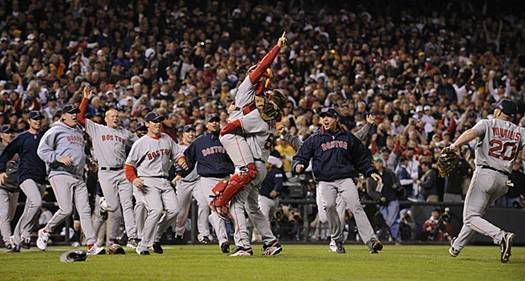
Go Sox…

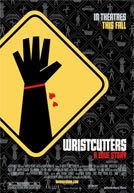
WRISTCUTTERS (2007)

Director: Goran Dukic
Cast:
Patrick Fugit, Shannyn Sossamon, Shea Whigham, Tom Waits,
Leslie Bibb
Release: November 2nd, 2007
Synopsis:
Zia (Patrick Fugit), distraught over breaking up with his girlfriend, decides to end it all. Unfor- tunately, he discovers there is no real ending, only a run-down afterlife that is strikingly similar to his old one, just a bit worse. Discovering that his ex-girlfriend has also “offed” herself , he sets out on a road trip, with his Russian rocker friend, to find her. Their journey takes them through an absurd purgatory where they discover that being dead doesn’t mean you have to stop livin’.

View Trailer:
* Medium (QuickTime)

Prognosis: Really Positive. One of the things I really enjoy about trailers like this is that there’s a voice that someone found and went with it.

I can think if all the ways in which someone could have taken an amalgam of scenes and turned this into an arty, obtuse trailer that I would immediately eschew in all its indulgence but you don’t get that here. This is a trailer that actually sustains itself on an interesting premise and tosses in enough weirdness that genuinely triggers interest and curiosity.

I didn’t know quite what they were thinking with the title of the film, it’s awful, but when we enter this film’s universe we’re greeted with a breathy beat box as a soundtrack and a thin understanding as to why the young up and comer, now older and not so visible, Patrick Fugit is cleaning his place up before collapsing on the bathroom floor in a pool of his own blood; the dust bunny was an excellent detail.

The premise is played quite well, slightly subdued, and when we see that this is a world inhabited by other people who have died as well and that it looks like earth, only a little different, it’s where all the interesting things start happening to Sir Fugit.

We get introduced to the best friend, every movie needs one, and then are told that the girl who Patrick killed himself over”¦also killed herself shortly after he did. So, what are you going to do? Have a road trip in the underworld!

You get the requisite giddy music to go along with the adventure that’s about to take place, as all the exciting things happen on the road, you get the mysterious (but hot, of course) wild card, played by Shannyn Sossamon, and you’re all set.

What I really dig, though, about this trailer is that even though everything to this point was a little hackneyed with regard to the set up it is after the establishment of all this when it steps above the common. You’ve got an interesting mix of people and premise when Tom Waits of all people get involved.

The movie seems less about the destination, of course, but the journey along the way deals with life as it used to be in order to define where these people are now. To say nothing, as well, about Will Arnett’s presence in this movie; dressed in white, playing the part of what seems like king, seeing Fugit and company stuck in some latter-day jail it’s bizarre and I love it.

I dig the cheap joke at the end and the music that rides this trailer out but I think what’s important to see is that this seems like a flick that wants to take the road trip genre and give it a fresh twist. It’ll be interesting to see whether these people can.

QSE News: Week In Review – 11/2/2007

Filed under: Columns,News — UncaScroogeMcD @ 12:04 am

quickstopnews.jpg

line1.gif

Here are today’s top entertainment headlines:

  • qsnews.jpg
  • David Dobkin, director of the upcoming Paul Giamotti vehicle Fred Claus, is set to direct a feature film of the Flash. Contrary to popular belief, the film will actually be about the scarlet, comic-book speedster and not the amount of time George Clooney can last in a woman.
  • In continued comic-to-movie news, another actor has turned down a role in the upcoming Justice League film. Actor Columbus Short will not be playing the role of Green Lantern in the film. The five people who know who Columbus Short is are extremely upset by the news.
  • Oasis will be heading back to the studio next month to begin recording a new album. A spokesperson for the band said the group will be sequestered at the famous Abby Road studios beginning Nov. 5th. Discussing the sound of the new album, Noel Gallagher said “[expletive deleted] this [expletive deleted] [expletive deleted] you [expletive deleted] [expletive deleted] [expletive deleted] guitar, maybe some [expletive deleted] [expletive deleted] [expletive deleted] piano and [expletive deleted] [expletive deleted] [expletive deleted] [expletive deleted] [expletive deleted] [expletive deleted] [expletive deleted] [expletive deleted] mother [expletive deleted].”

line1.gif

That’s all for today’s news, stay tuned to this channel for all the news that matters least but you still care about.

(Compiled by J. Allen)

##

Quick Stop Thingamabobs: 11/2/2007

Filed under: Columns,Thingamabobs — UncaScroogeMcD @ 12:01 am

thingamabobs.jpg

The web. It’s a big place, full of plenty of distractions ““ some funny, some informative, some ludicrous, some disturbing, some inane, some profound. Each and every weekday, we present links to a few of our favorite finds”¦

————————————————

  • We wrap up the week and wrap up the first series of Black Books with episode 6, Part 1… (Thingamabob)
  • Dylan Moran telling an audience member off… (Thingamabob)

November 1, 2007

Quick Stop Thingamabobs: 11/1/2007

Filed under: Columns,Thingamabobs — UncaScroogeMcD @ 12:01 am

thingamabobs.jpg

The web. It’s a big place, full of plenty of distractions ““ some funny, some informative, some ludicrous, some disturbing, some inane, some profound. Each and every weekday, we present links to a few of our favorite finds”¦

————————————————

  • More Black Books – episode 5 of series one, Part 1… (Thingamabob)
  • Dylan Moran from Stop, You’re Killing Me, Part 1… (Thingamabob)
  • Dylan Moran from Stop, You’re Killing Me, Part 2… (Thingamabob)

October 31, 2007

Quick Stop Thingamabobs: 10/31/2007

Filed under: Columns,Thingamabobs — UncaScroogeMcD @ 12:01 am

thingamabobs.jpg

The web. It’s a big place, full of plenty of distractions ““ some funny, some informative, some ludicrous, some disturbing, some inane, some profound. Each and every weekday, we present links to a few of our favorite finds”¦

————————————————

  • More Black Books – episode 4 of series one, Part 1… (Thingamabob)
  • Dylan Moran at The Comedy Store, Part 1… (Thingamabob)
  • Dylan Moran at the Comedy Store, Part 2… (Thingamabob)

October 30, 2007

Quick Stop Thingamabobs: 10/30/2007

Filed under: Columns,Thingamabobs — UncaScroogeMcD @ 12:01 am

thingamabobs.jpg

The web. It’s a big place, full of plenty of distractions ““ some funny, some informative, some ludicrous, some disturbing, some inane, some profound. Each and every weekday, we present links to a few of our favorite finds”¦

————————————————

  • Our Black Books marathon continues with the third episode of Series 1, Part 1… (Thingamabob)
  • Dylan Moran on Arnold Schwarzenegger… (Thingamabob)

October 29, 2007

Comics in Context #200: My First Million

Filed under: Columns,Comics in Context — admin @ 12:02 am

comicsincontext4.jpg

cic2007-10-29.jpgHow time flies when you’re having fun. I started writing “Comics in Context” back in the summer of 2003, and now I’ve reached this column’s bicentennial. Each installment runs at least 5000 words, so by now I’ve written over a million words for “Comics in Context.”
Originally the column appeared at the IGN website, and, at the point that I’m writing this, you can still find the first 134 installments over there through Googling. When my redoubtable editor, Ken Plume, left IGN for Quick Stop Entertainment, my column and I followed. As I write this, Ken is in the process of posting the entire run of “Comics in Context” on its Quick Stop archive page: he’s already put the first thirty up. All of my Quick Stop columns (135 through the present) are available there, of course. Towards the end of my stay at IGN, it began altering the titles for my column; when Ken posts them here at Quick Stop, the original titles I gave them will be restored.

Reaching a hundredth or two hundredth anniversary of a column is a good point at which to take stock of what I’ve done in the past, and to determine what I should do in the future. As “Comics in Context” neared its hundredth installment, I told Ken that I realized that I hadn’t yet written about the most important figure in cartoon art. “Jack Kirby?” he asked. No, I meant Walt Disney, and with “Comics in Context” #100 I began a good number of installments about Disney and other important figures of the Golden Age of Hollywood animation. But Ken was right that I should have written about Kirby more than I had, and I took the opportunity with my recent columns about the “Galactus trilogy” and The Eternals.

For my readers’ benefit and my own, I have compiled an incomplete index of the many writers and artists about whom I’ve written in “Comics in Context” so far. Each person’s name is followed first, usually by the name of at least one of his or her works that I’ve mentioned, and then by the numbers of the columns in which he or she appears. Longtime readers will not be surprised that Neil Gaiman is far out in front of the competition.

Adams, Neal (Batman): 129
Adams, Scott (Dilbert): 66
Addams, Charles (The New Yorker cartoonist): 72
Arno, Peter (The New Yorker cartoonist): 157
Arriola, Gus (Gordo): 66
Austin, Terry (sketchbook): 90
Avery, Tex (MGM animated cartoons): 100, 101, 173, 188, 189
Bails, Jerry (comics historian): 157
Baker, Kyle (Plastic Man): 27
Barks, Carl (Uncle Scrooge): 24, 114
Baum, L. Frank (The Wonderful Wizard of Oz [prose novel]): 25
Bird, Brad (The Incredibles, Ratatouille [animated films]): 62, 186
Blake, William (illustrator): 72
Block, Herbert (“Herblock”) (editorial cartoons): 159
Bolland, Brian (Batman: The Killing Joke): 193
Boreanaz, David (Bones [TV]): 144
Bradbury, Ray (science fiction author): 8, 98
Brinkley, Nell (illustrator): 159
Brunetti, Ivan (“Speak: Nine Cartoonists” exhibit): 122
Burns, Charles (“Speak: Nine Cartoonists” exhibit): 122
Burroughs, Edgar Rice (Tarzan of the Apes [prose novel]): 132
Burton, Tim (Tim Burton’s Corpse Bride [film]): 103
Bushmiller, Ernie (Nancy): 66
Busiek, Kurt (Astro City): 14, 21, 37, 63, 70, 178
Byrne, John (Generations 2): 25, 66, 200
Caniff, Milton (Terry and the Pirates): 66, 71, 154
Capp, Al (Li’l Abner): 66, 71, 177
Chabon, Michael (JSA All-Stars): 21
Cho, Frank (Liberty Meadows): 66
Clampett, Bob (Warners animated cartoons): 101
Claremont, Chris (The Uncanny X-Men): 37, 39, 124, 134, 135, 172
Cleese, John (True Brit): 66
Clowes, Daniel (Eightball): 64, 122
Cockrum, Dave (X-Men): 156, 172
Colan, Gene (Daredevil): 170, 171
Cole, Jack (Plastic Man): 27
Coogan, Peter (Superhero: The Secret Origin of a Genre [prose book]): 98, 141, 162, 163, 164, 165, 166
Cooke, Darwyn (The New Frontier): 30
Cornwell, Dean (illustrator): 131, 159
Crane, Roy (Wash Tubbs): 71
Cronenberg, David (A History of Violence [film]): 111
Cruikshank, George (Charles Dickens’ illustrator): 159
Crumb, Robert (Mr. Natural): 64, 122, 156
Curtis, Dan (Dark Shadows [TV]): 11, 12
Daumier, Honore (caricaturist): 159
David, Peter (Hulk: The End): 2, 38, 81
Davis, Stuart (painter): 159
DeFalco, Tom (Comic Creators on Spider-Man [book]): 44
Dini, Paul (Zatanna): 24, 27, 29, 180
Dirks, Rudolph (The Katzenjammer Kids): 59, 71
Disney, Walt (animated feature films): 109, 110, 136, 157, 158, 160, 161, 165, 177
Ditko, Steve (The Amazing Spider-Man): 64, 113
Donner, Richard (Superman: The Movie [film]): 90, 143
Doran, Colleen (A Distant Soil): 6, 123
Drake, Stan (The Heart of Juliet Jones): 66
Dr. Seuss (Dr. Seuss’ How The Grinch Stole Christmas): 24
Dunst, Kirsten (Spider-Man [films]): 45, 46, 181, 182, 183
Dushku, Eliza (Tru Calling [TV]): 10, 120
Eisner, Will (The Spirit): 6, 25, 64, 66, 68, 69, 71, 80, 81, 94, 155, 159, 179, 180
Englehart, Steve (Batman: Dark Detective): 84, 87, 88, 90, 93, 104
Evanier, Mark (San Diego Comic Con panel moderator): 6, 8, 94, 95, 141, 145, 147
Feiffer, Jules (The Great Comic Book Heroes [book]): 26
Feininger, Lyonel (Kin-Der-Kids): 59, 71, 151, 152
Finger, Bill (Batman): 94, 97, 145
Fingeroth, Danny (Superman on the Couch [prose book]): 41, 200
Fisher, Bud (Mutt and Jeff): 71
Flagg, James Montgomery (illustrator): 131, 159
Fleischer, Max and Dave (Betty Boop and Popeye animated cartoons): 116, 117, 118, 152, 157, 177, 190
Foster, Hal (Prince Valiant): 71, 177
Franklin, Benjamin (political cartoon): 159
Freleng, Friz (Warners animated cartoons): 101
Frid, Jonathan (Dark Shadows [TV]): 11, 149
Gaiman, Neil (1602, Anansi Boys, Eternals)–5, 8, 13, 17, 18, 21, 25, 28, 32, 33, 35, 36, 65, 67, 72, 85, 105, 106, 107, 108, 129, 144, 164, 191, 192, 194, 195, 196, 197, 198, 199
Garis, Howard Roger (“Uncle Wiggily” books): 177
Geppi, Steve (Geppi’s Entertainment Museum): 176, 177
Gerber, Steve (Superman: Last Stand on Krypton): 27
Gibbons, Dave (Watchmen): 65, 193
Gillray, James (caricaturist): 71, 72
Gould, Chester (Dick Tracy): 66, 71, 153
Gray, Harold (Little Orphan Annie): 71, 177
Groening, Matt (The Simpsons [TV and film]): 8, 188
Gruelle, Johnny (Raggedy Ann and Andy [book illustrator]): 159
Gruenwald, Mark (Squadron Supreme): 150
Guisewite, Cathy (Cathy): 66
Guston, Philip (cartoon-like paintings): 20
Hamill, Mark (Comic Book: The Movie [film]): 7
Harris, Thomas (Hannibal [prose novel and film]): 165
Harvey, R. C. (The Art of the Comic Book [prose book]): 69
Hembeck, Fred (“The Fred Hembeck Show” [Quick Stop column]): 76, 79, 113
Henson, Jim (The Muppets): 47, 96, 114, 115
Hernandez, Jaime (Love and Rockets): 122
Herriman, George (Krazy Kat): 59, 71, 152, 177
Hinton, S. E. (Hawkes Harbor [prose novel]): 70
Hogarth, Burne (Tarzan): 66
Hogarth, William (18th century sequential artist): 71, 159
Homer, Winslow (illustrator): 159
Howell, Richard (Soulsearchers and Company): 38
Idle, Eric (Monty Python’s Spamalot [musical]): 82
Irving, John (“An Evening with Harry, Carrie and Garp”): 148
Jackson, Peter (King Kong [film]): 31, 99, 121
Jenkins, Paul (The Sentry): 63
Johnston, Lynn (For Better or for Worse): 66
Jones, Chuck (Warners animated cartoons): 24, 72, 101, 102
Kanigher, Robert (Enemy Ace): 64
Kelly, Walt (Pogo): 24, 66, 76, 177
King, Frank (Gasoline Alley): 122, 153
King, Stephen (The Dark Tower): 26, 148, 169
Kirby, Jack (The Eternals): 6, 59, 64, 95, 155, 184, 185, 194, 195, 196, 197, 198, 199
Kitchen, Denis (Will Eisner’s agent and publisher): 80, 145, 170
Kring, Tim (Heroes [TV]): 163
Kubert, Joe (Enemy Ace): 64, 193
Kuper, Peter (Metamorphoses): 28
Kurtzman, Harvey (MAD): 156
Landau, Juliet (Buffy the Vampire Slayer [TV]): 169
Lantz, Walter (Woody Woodpecker animated cartoons): 189
Lasseter, John (Cars [animated film]): 120, 137, 138
Lee, Ang (Hulk [film]): 2
Lee, Jim (All-Star Batman and Robin): 119, 178
Lee, Stan (Fantastic Four): 6, 15, 16, 59, 64, 71, 113, 142, 168, 170, 171, 184, 185
Leonardo da Vinci (caricatures): 159
Leyendecker, J. C. (illustrator): 131
Lichtenstein, Roy (comics-based paintings): 153
Loeb, Jeph (Hulk: Gray): 16, 27, 49, 75
Lucas, George (Star Wars [films]): 86
MacDonald, Heidi (“The Beat”): 167
Maguire, Tobey (Spider-Man [films]): 45, 46, 181, 182, 183
Mayer, Robert (SuperFolks [prose novel]): 63
McCay, Winsor (Little Nemo in Slumberland): 60, 71, 151, 157, 177
McCloud, Scott (Making Comics): 81, 156
McCracken, Craig (Foster’s Home for Imaginary Friends [TV]): 55, 103, 115
McDonnell, Patrick (Mutts): 24, 66
McFarlane, Todd (Spider-Man): 124
McKean, Dave (MirrorMask [film]): 10, 85
McManus, George (Bringing Up Father): 60
Meltzer, Brad (Identity Crisis): 57, 58, 63, 67
Mignola, Mike (Hellboy): 40
Miller, Frank (The Dark Knight Strikes Again, Sin City, 300): 30, 31, 34, 65, 78, 79, 83, 92, 119, 125, 146, 175, 178
Miyazaki, Hayao (Howl’s Moving Castle [animated film]): 91
Moore, Alan (The League of Extraordinary Gentlemen, V for Vendetta, Watchmen): 22, 23, 32, 65, 66, 126, 127, 128, 129, 130, 131, 193
Morrison, Grant (New X-Men): 28
Nast, Thomas (editorial cartoons): 24, 159
Nelson, Michael J. (RiffTrax): 185
Nevins, Jess (Heroes and Monsters [prose book]): 37
Nolan, Christopher (Batman Begins [film]): 89, 90
O’Donnell, Peter (Modesty Blaise): 61
Oliphant, Pat (editorial cartoons): 159
O’Neil, Dennis (Batman): 32
Opper, Frederick (Happy Hooligan): 60
Otomo, Katsuhiro (Steamboy [film]): 77
Outcault, Richard (The Yellow Kid): 59, 71
Panter, Gary (Jimbo): 122, 156
Park, Nick (Wallace and Gromit): 47, 112
Parker, Lara (Dark Shadows [TV and prose novels]): 149
Pekar, Harvey (American Splendor): 6, 64, 73, 111
Powell, Michael and Pressburger, Emeric (The Tales of Hoffman [film]): 85
Raimi, Sam (Spider-Man [films]): 45, 46, 181, 182, 183
Raymond, Alex (Flash Gordon): 71
Reeves, George (The Adventures of Superman [TV]): 48
Revere, Paul (political illustration): 159
Rigg, Diana (The Avengers [TV]): 52, 53
Robinson, Jerry (Batman): 94, 97, 141, 145
Rockwell, Norman (illustrator): 131
Rodriguez, Robert (Frank Miller’s Sin City [film]): 78, 79, 83, 92
Rogers, Marshall (Batman: Dark Detective): 84, 87, 88, 90, 93, 104, 171
Romita, John Sr. (The Amazing Spider-Man): 124
Rosa, Don (Uncle Scrooge): 114, 119
Ross, Alex (Justice): 29, 30, 66, 159, 193
Rowling, J. K. (Harry Potter [prose novels]): 148, 187
Sale, Tim (Hulk: Gray): 16, 27, 49
Schaffenberger, Kurt (Hero Gets Girl): 27
Schulz, Charles M. (Peanuts): 24, 66, 120, 154, 157, 177
Schumer, Arlen (The Silver Age of Comic Book Art [history book]): 26
Schwartz, Julius (Batman, Flash, Green Lantern, Hawkman, etc.): 32, 176
Segar, E. C. (Thimble Theatre Starring Popeye): 63, 71, 152, 157, 177
Seth (“Speak: Nine Cartoonists” exhibit): 122
Simon, Joe (Captain America): 125
Singer, Bryan (Superman Returns [film]): 139, 143
Sinnott, Joe (Fantastic Four): 170, 171
Smith, Jeff (Bone): 78, 167
Smith, Kevin (Quick Stop); 146, 147
Snicket, Lemony (Little Lit): 24
Sondheim, Stephen (composer): 77
Spiegelman, Art (Maus): 24, 59, 60, 61, 64, 80, 122
Starr, Leonard (Mary Perkins On Stage): 66
Steig, William (Shrek! [illustrated book]): 186
Steinberg, Flo (Marvel legend): 170, 171
Steinberg, Saul (illustrator): 159
Steranko, Jim (Nick Fury, Agent of SHIELD): 64, 124
Stern, Roger (Superman: The Never-Ending Battle [prose novel]): 90
Sterrett, Cliff (Polly and Her Pals): 71
Story, Tim (Fantastic Four movies): 93, 184, 185
Straczynski, J. Michael (The Amazing Spider-Man): 14, 58
Tarantino, Quentin (Kill Bill [film]): 10
Tartakovsky, Genndy (Star Wars: Clone Wars [TV]): 21, 55
Tenniel, Sir John (Alice’s Adventures in Wonderland): 159
Thomas, Roy (Alter Ego): 66
Thurber, James (The New Yorker cartoonist): 157
Timm, Bruce (Batman: The Animated Series): 144
Topffer, Rodolphe (19th century sequential artist): 71
Travers, P. L. (Mary Poppins [prose novels]): 158, 160
Trudeau, G. B. (Doonesbury): 66
Uslan, Michael (The Spirit [film]): 80, 169, 170, 193
Vess, Charles (Sandman): 65
Walker, Brian (“Masters of American Comics” exhibit): 66, 71, 145, 151, 152, 153, 154, 155, 156
Ware, Chris (Jimmy Corrigan): 122, 156
Watterson, Bill (Calvin and Hobbes): 66
West, Adam (Batman [TV]): 50
West, Billy (Futurama [TV]): 147
Whedon, Joss (Buffy the Vampire Slayer [TV]): 9, 13, 42, 43, 54, 58, 77, 98, 164
Zemeckis, Robert (The Polar Express [film]): 66, 83

This is an impressive list, even if I do say so myself. Even so, I see gaps. How is it that I haven’t gotten around to writing about Bill Sienkiewicz yet? Or Otto Messmer’s Felix the Cat animated cartoons? Someday, here or elsewhere, I intend to write about the work of the two great Silver Age DC writers John Broome and Gardner Fox. There are also major figures who have already made my list, but I feel I haven’t written enough about them yet: expect to see columns about Walt Kelly’s Pogo and Milton Caniff’s Terry and the Pirates in the foreseeable future. My main area of interest will remain American comics and animation, but I should make more forays into foreign language comics and cartoon art. The forthcoming Persepolis movie will afford one opportunity early next year, and since 2007 is the centennial of Herge’s birth, I should stop postponing taking a look at his creation Tintin. And of course there are always new projects on the horizon: Robert Zemeckis, Neil Gaiman and Roger Avary’s Beowulf film looms ahead, which will also give me the excuse to write about the original Beowulf, the earliest great megaheroic work in (archaic) English.

I will also continue exploring new creations by writers, artists, and even film directors whose work has interested me in the past. For example, back in “Comics in Context” #41 I wrote about former Marvel editor Danny Fingeroth’s book Superman on the Couch: What Superheroes Really Tell Us about Ourselves and Our Society. I recently interviewed him about his new book, Disguised as Clark Kent: Jews, Comics and the Creation of the Superhero, which was published this month (October) by Continuum.

Fingeroth’s book is about a subject that has been attracting attention of late: the role that Jewish-Americans had in originating the superhero genre in the 1930s and developing it right through the present day. Among the many important Jewish-American writers and artists whom Fingeroth discusses are Jerry Siegel and Joe Shuster, creators of the first superhero, Superman; Bob Kane, Bill Finger, and Jerry Robinson, the creators of the Batman mythos; Joe Simon, co-creator of Captain America; Will Eisner, creator of the Spirit; and Stan Lee and Jack Kirby, founding fathers of the Marvel Universe.

Lee, Eisner and Simon also worked as editors, and Fingeroth perceptively likens two other Jewish-Americans, Silver Age DC editors Mort Weisinger and Julius Schwartz, to auteur filmmakers. “In the same way that a John Ford or Orson Welles movie is always recognizable as such,” Schwartz and Weisinger projected “the personality of the editors” in their comics, as “interpreted through the skills of the writers and artists they employed” (Fingeroth, Disguised as Clark Kent, p. 82).

Michael Chabon’s Pulitzer Prize-winning novel The Amazing Adventures of Kavalier & Clay provided a fictionalized portrayal of Jewish-American comics creators of the 1930s and 1940s. In his excellent book Men of Tomorrow: Geeks, Gangsters and the Birth of the Comic Book, Gerard Jones revealed the true history of that generation, concentrating on Siegel and Shuster. Using that history as his basis, in Disguised as Clark Kent Fingeroth investigates how Jewish-American culture may be reflected in the thematic content of superhero stories over the decades, for example, through he sense of being an outsider (see Spider-Man) and concerns with coping against racial prejudice (see X-Men).

Fingeroth also looks beyond the superhero genre’s founding generation to Jewish comics creators of later generations. “As the Passover Seder. . . instructs Jews to tell the story of the Exodus as if they themselves were slaves freed from Egypt, then perhaps each generation of Jewish creators must define the superhero metaphor for itself” (Fingeroth p. 121).

But nowadays the population of superhero comics writers, artists and editors is not only far larger but also far more diverse in background than it was when the genre started out in the late 1930s. As Fingeroth told me (in a part that wasn’t included in the published interview), “I find it more interesting how many non-Jewish creators are attracted to superheroes these days. Thanks to the phenomenon of fandom, as well as other social factors, comics have become a business peopled, on the creative end, certainly, by people from all over the world, not just the highly Jewish New York metropolitan area.”

Moreover, it’s now been nearly seventy years since Superman first appeared. The first generation of creators in the superhero genre grew up during the Great Depression, in a world that was on the brink of war; many of them were the children of Eastern European immigrants. Today’s comics writers and artists have necessarily grown up in very different circumstances. How does this affect their approach to the genre and the characters that were created by a previous generation?

Let’s start by examining the familiar concept of Superman’s secret identity of Clark Kent. In his book Fingeroth repeats the familiar argument that the secret identity motif relates to the immigrants’ efforts at assimilation into mainstream American society. By giving him the WASPy name of “Clark,” “the Kents, literally and figuratively anglicized their newfound son,” (Fingeroth p. 46). Similarly, as Fingeroth pointed out earlier, Jacob Kurtzberg took the “Irish-sounding” name “Jack Kirby” (Fingeroth p. 31). Superman was the “real” identity; “Clark Kent” was the identity he and his foster parents invented so that he could blend in with mainstream society.

In “rebooting” Superman in the 1986 mini-series The Man of Steel, John Byrne followed his characteristic policy of going “back to the basics” with a longrunning superhero. But he was also sharply revising certain aspects of the Superman legend. Byrne rejected the tradition whereby “Clark Kent” was Superman’s disguise, in which he pretended to be not just “mild-mannered” but downright timid and clumsy, a “caricature” of humanity, in Jules Feiffer’s description (in his pioneering study, The Great Comic Book Heroes). In issue 1 of The Man of Steel, Clark and his foster parents devise the Superman persona as a means of preventing the general public from recognizing who he truly is: Clark Kent.

Byrne appeared to be thinking not of the immigrant’s problems with assimilation but of the contemporary concern for privacy in a culture that worships celebrity. (I refer you to Time TV critic Jamie Poniewozik’s description of Disney Channel character Hannah Montana as “Superman for tween girls”: a normal girl with a secret identity as a celebrity pop singer.)

Upon first publicly using his super-powers, Clark is mobbed by onlookers. Admitting to his “fear” of the mob, Clark tells his foster parents, “They were all over me! Like wild animals. Like maggots. Clawing. Pulling. Screaming at me” (Byrne, The Man of Steel #1, p. 28). That’s when Pa Kent comes up with the idea of the Superman persona and costume: the public will pay attention to Superman and leave Clark alone. Clark isn’t worried about assimilating into society; he is desperate to find privacy–a “fortress of solitude”–“where no one will ever think to look for me” (Byrne, The Man of Steel #1, p. 30)

The Man of Steel ends with Byrne boldly overturning another element of Weisinger-era tradition. In his book Fingeroth traces how editor Mort Weisinger and his writers (who included Jerry Siegel) portrayed Superman as longing for Krypton, as if it were a lost paradise. Fingeroth persuasively establishes that “survivor’s guilt” is a significant theme in Weisinger’s Superman, as well as in Batman and the Silver Age Captain America. These are concepts that would resonate with Jewish-Americans of Siegel and Weisinger’s generation, who were aware that they had survived, whereas the Jews of Europe perished in the Holocaust.

In the final issue of The Man of Steel, Superman discovers that he is from Krypton when one of his dead father Jor-El’s devices imprints that knowledge on his mind. At first Byrne seems to be evoking the theme of “survivor’s guilt” theme and even explicitly alluding to the Holocaust: Superman exclaims, ” A planet that died! Died in a terrible fiery holocaust that shattered the world. . .and left only one survivor. Me!!” (Byrne, The Man of Steel #6, p. 20).

But then, in an extraordinary speech, Superman denies that his Kryptonian background has anything to do with his sense of self: “I may have been conceived out there in the endless depths of space. . .but I was born when the rocket opened, on Earth, in America. I’ll cherish always the memories Jor-El and Lara gave me. . .but only as curious mementos of a life that might have been. Krypton bred me, but it was Earth that gave me all I am. All that matters. It was Krypton that made me Superman, but it is the Earth that makes me human!!” (Byrne, The Man of Steel p. 22). It’s not a question of assimilation. Byrne’s Superman was born and raised in America, and doesn’t consider himself truly Kryptonian at all.

Perhaps this shift in attitude was to be expected, nearly a half century after Superman’s 1938 debut. By 1986 perhaps the majority of Superman‘s readers were two or more generations removed from their immigrant forebears, and had no emotional connection to their ancestral homelands.

(I am well aware that the status of The Man of Steel in current DC continuity is questionable. My point is that it is an example of how contemporary creators in the superhero genre may view longrunning characters differently than a previous generation of creators did.)

Similarly, in the Smallville television series, Clark is the “real” person who is destined someday to adopt the Superman persona. Smallville‘s Clark clearly prefers to consider himself an Earthman, the show portrays Jor-El ambiguously, and its references to Krypton make it seem vaguely sinister rather than an idyllic lost world. Far from longing for Krypton, Smallville‘s Clark would probably be happier if he had no connection with the place (apart from his newly arrived cousin Kara).

Are these shifts in attitude towards Krypton necessary adaptations to changing times? Or is something important in the Superman concept being lost?

So I wonder what is the fate of the superhero genre seven decades after its start. Will it continue to be successfully reinvented and reenergized with each succeeding generation? Or is the superhero genre doomed inevitably to fade in vitality and purpose the further we get from the time and circumstances in which it originated in Depression-era New York City? I will return to this subject and explore Danny Fingeroth’s Disguised as Clark Kent further next week.

ADVERTISEMENTS FOR MYSELF AND OTHERS

You can read my interview with Danny Fingeroth about his book Disguised as Clark Kent in the October 23, 2007 edition of Publishers Weekly‘s online newsletter Comics Week.

Then go read Ken Plume’s interview with Monty Python’s Terry Jones, concerning topics ranging from Chaucer’s humor to the similarities between 21st century America and the Roman Empire, here at Quick Stop.

Now that I’ve written my two hundredth “Comics in Context,” “The Fred Hembeck Show,” which took a break at number 100, will never catch up with me! But the reason that Fred has taken a leave of absence from his Quick Stop column is that he’s been busy putting together a retrospective of his entire career in comics, The Nearly Complete Essential Hembeck Archives Omnibus, which comes out next February. You can find out more by visiting the Omnibus’s official site.

Copyright 2007 Peter Sanderson

Quick Stop Thingamabobs: 10/29/2007

Filed under: Columns,Thingamabobs — UncaScroogeMcD @ 12:01 am

thingamabobs.jpg

The web. It’s a big place, full of plenty of distractions ““ some funny, some informative, some ludicrous, some disturbing, some inane, some profound. Each and every weekday, we present links to a few of our favorite finds”¦

————————————————

  • We’re going to follow up last Friday’s premiere episode of the brilliant Britcom Black Books with episode 2 (logically enough), and will be running additional episodes all this week in anticipation of the complete series box set on DVD. Without further ado, here’s episode 2, Part 1… (Thingamabob)

October 27, 2007

QSE News: Week In Review – 10/26/2007

Filed under: Columns,News — UncaScroogeMcD @ 5:57 am

quickstopnews.jpg

line1.gif

Here are today’s top entertainment headlines:

  • qsnews.jpg
  • In one of the most shocking literary reveals of all time, author J.K. Rowling has admitted one of her most beloved characters from the wildly successful Harry Potter books is gay. During a stop at New York’s Carnegie Hall, Rowling told the gathered audience that master wizard Albus Dumbledore was a homosexual. Rowling was surprised that no one had picked up on what she thought were obvious clues throughout the series of books – including the fact that Dumbledore is constantly referred to in the book as “Albus ‘Reacharound’ Dumbledore.”
  • Kid Rock was arrested in Atlanta last weekend after an altercation at a Waffle House. Rock got into a fight with another Waffle House customer. Music insiders are arguing that the fight was premeditated to help further Rock’s “bad-boy” image. One of Rock’s own management team seemed to validate those rumors by saying “what’s more white-trash than getting in a fight over a girl at a Waffle House in the South? Nothing.”
  • The cast for the upcoming Star Trek reboot has been solidified with the addition of Chris Pine and Karl Urban. The two will play a young Captain James T. Kirk and Dr. Leonard McCoy, respectively. William Shatner offered some advice to Pine with regard to the approach to portraying Kirk, saying, “Forget… everything you’ve ever… learned… about acting. Instead… act like you’re… trying… to pass a giant kidney stone… out your wiener.”
  • Despite pleas from fans world-wide, Robert Plant has said the upcoming Led Zeppelin reunion show is not a precursor to a full-blown tour. Led Zeppelin will be performing November 26 at London’s O2 Arena. Plant went on to say, “If you want to see a bunch of geezers bouncin’ around and playin’ their oldies, go see the Stones or The Who.  Besides, all that bouncin’ around?  I might break me hip!!”
  • Casting has started for a live-action G.I. Joe film. The film’s producers are hoping to begin shooting in February. To stay true to the cartoon, casting agents are looking for one black person and 100 white people.
  • Actor Daniel Dae Kim was arrested in Hawaii on suspicion of drunken driving. Kim is a cast member of the show Lost. A spokesman for the actor claimed that Kim was trying to forget how boring the show had become and was only trying to “spice things up a bit.”

line1.gif

That’s all for today’s news, stay tuned to this channel for all the news that matters least but you still care about.

(Compiled by J. Allen)

##

October 26, 2007

Trailer Park: Henry Rollins

Filed under: Columns,Interviews,Trailer Park — admin @ 12:04 am

By Christopher Stipp

Archives? Right Here”¦

Instead of manning-up and actually going the emotionally hard route of being outrightly rejected by publishers, I’m rejecting them first and allowing you to give my entire book a preview, let you read the whole thing or, if you like, download the whole damn thing at no cost. Download and read my first book “Thank You, Goodnight” for FREE.

The first time I ever came across Henry Rollins was when I approached a co-worker who was listening to a cassette tape of Black Flag’s. I can’t remember the name of the album, the song or the rhythm or anything having to do with the band but I clearly remember being afraid, actually, of the aggression coming out of his headphones. The music was driving in a way that separated itself from the usual thrash metal I was accustomed to associating with punk. This was before I understood the intracity of lineages, styles and nuances of certain groups but one of the most appealing part of listening to Black Flag, as I would come to understand them, was that it gave rise to my interest in music that came from a visceral place. The message and thrust of the music was visceral.

And now, with his notable appearance in the recently released WRONG TURN 2: DEAD END where he plays, well, himself and does it extraordinarily well, to his program in IFC aptly enough titled THE HENRY ROLLINS SHOW, to his current spoken word tour which you can check out right here Henry is all about keeping things varied. Of all the criticisms that could be leveled at a man who would take constant aim at politicians and their dishonest politicking Henry knows how to stay true to what makes him tick; he gets involved with what makes him feel comfortable. There’s no rhyme or reason to what he chooses but it’s all Henry. To be able and pick and choose and not feel like there is a need to be in this or that seems like a liberating position to be in and, right now, Rollins is in control of his own manifest destiny. Consider me jealous.

Our conversation ranges from the political to the mundane but here’s the hook with any talk with Rollins: he has something to say. Too many times you can find yourself with someone who has nothing more than to chit-chat about irrelevancies. Henry has things on his mind and is not shy about taking them out of his wheelhouse to show you what he makes of them. He’s an absolute sharp fellow, one of the most well versed people I’ve ever had 20 minutes with, and he’s helped me understand my own ignorance about things with regard to the world around me.

CS: First let me say it is really an honor to be able to talk to you.

ROLLINS: Hey, thanks man.

CS: I’ve loved the show since season one. Frankly, it’s one of the freshest film and entertainment programs out there. At its most basic it’s at least an elevation from Jay Leno or Letterman.

ROLLINS: And I’ve been on Jay Leno before. Nice guy. But that’s not a pattern that interests me because it seems so contrived and so static. And, hopefully with our show, we are able to break out of that. We’re not sensitive and it’s a more laid back atmosphere. There’s no live audience so at least the guest can concentrate and so can I. And in a live audience you are always looking for the joke I guess and I’m so glad I’m not in that position. But, I wouldn’t do well in that environment.

CS: Well, I really want to get to the core because I know I only have 20 minutes and I want to hit it hard.

ROLLINS: Sure.

CS: Myself ““ let me give you a little background is I’m a salesman by day for a newspaper and by night I write. I don’t get anytime to do as much reading as you do. It’s hard to keep up with things and but when I’m able to catch up with what you are thinking I’m actually blown away so I’m absolutely intrigued to find out what your thoughts are on the latest with what’s been happening in the last couple weeks – with Alberto Gonzalez, Ted Haggard and of course the Larry Craig thing.

ROLLINS: It’s really interesting. But I think all that stuff it’s crazy. All these headlines coming across the papers, like, “Wow, this is an interesting week, tell me all about it.” But it’s not always the best news.

Larry Craig to me is a peripheral issue that speaks of a bigger issue in that here’s an adult man caught in a restroom, maybe or maybe not soliciting another man for a sexual encounter. I wasn’t there”¦I don’t know, but let’s just pretend he’s a homosexual looking to meet somebody in a bathroom. And it could be that that’s the case and he comes from that older school in the 50’s homosexual where it had to be in the park ““ this clandestine rendezvous. It just goes to show you, that this type of suppression is not good for people. They need to sneak around. And like I said, if he is gay, look at the lie he is living. Even if he’s not gay, there are many men in America watching who do exactly what he’s accused to doing. They are married, they are straight on the outside but on the inside they are something else and they have been living a lie since whenever it is they knew they were gay. And it’s too bad in this land of the free that someone would have to kind of eat that hand grenade and not be who they are because I’m sure you are how you are and you don’t hide it. I’m a heterosexual. I’m on the big team, you know. And ads are geared towards me. Look at all the women showing cleavage. Look at Sports Illustrated. That’s been made for me. That’s for a guy who loves women. And I went all the way through school and I remember a couple of guys saying, “Maybe he’s gay.” He can hide it but she can’t hide it as well. It was interesting watching students and teachers react. Some were cool and some weren’t so cool.

And it was too bad for the gay student when they weren’t so cool because you just had a bunch of guys staring at him calling him names. It must have been a really rotten way to go through school. The Larry Craig thing. No one seems to talk about the bigger problem: that we have a problem with homophobia in this country. But that was interesting.

Gonzalez ““ he was so carrying the letter for this administration that he was laughing through his testimony:”I can’t remember”, “I gotta say this”, “They got my kid in the trunk ready to drive her down to the river if I don’t do this right.” It’s just interesting to watch on that level in front of C-span cameras. The way he was using English: “Who called you? You don’t remember? The call came from the White House. Who called you? Wow, you are not answering very simple, very direct questions which is pretty obvious. ”

If you ever watch your girlfriend or whatever ““ everyone knows when you are lying. And then the fact that the country is watching and weren’t outraged on either side of he aisle. If it was some Democrat up there I’d be saying, “You bastard, tell the truth, man.”

CS: There actually was a news program that actually talked about the fact that every news organization used every other word but “liar”.

ROLLINS: Yeah, “You are not being truthful. You are not being clear.”

CS: Do you think that the word is a value judgment, as some reporters have said, or do you think it is OK to flat out call a spade a spade without it being perceived as a childish, cheap”¦..

ROLLINS: I think there is probably a great desire by the big news guys to not be so black and white to give themselves some wiggle room and to not offend these people they want to put on the Situation Room some day in the future. I also think the Bush administration is very cowed and intimidated by the US media. Because if you ever watch news or listen to news from other countries, like the BBC World News, they are just way more abrupt. They just go, look that, it looked like a lie to me. They just don’t have time to kiss ass like we do.

CS: Maybe this has always been a problem, maybe it’s me just getting older, but why don’t people care? Why doesn’t anybody care?

ROLLINS: Well, some people care. And I’ve been asked that before.

Here’s my answer: I think a lot of people who would be accused of not caring ““ they don’t have the time or the luxury of learning the information so they can be angry about it. And if you wanted to get into a conversation with someone who has three kids, not enough money and who works a shift and a half everyday trying to bring home the proverbial bacon. You say if you read this book or check out that book, the guy looks at you bleary eyed and says, “I got three kids and a wife, this is my crap car I don’t own, I don’t have time to read. I haven’t read a book for 5 years.”

“What do you think about the news? What do you think about what Seymour Hersh said in the Times…” and he says, “Pal, I look at the USA Today in the lunchroom and read the Sports section. ” If they get the news maybe on the radio while they are going through traffic if they listen to it…so they don’t have the time.

In this country, Americans are hard working people. And a lot of times, knowing a thing or two is almost coming from a vantage point of luxury. Like me, I guess I’m doing pretty good. I have the time to read those big books and chew through them the best I can. I study history and read this and that and download that article and I read it but I don’t have any kids or a dog and I will take the weekend and I’ll spend it reading this stuff because I can afford to. A lot of people can’t. So I think a lot of people ““ it’s not always apathy it’s like, “OK, nothing’s on fire, nothing’s blowing up, the President says the economy is strong and maybe that means me. And if I don’t want to do my job right now, I mean my kids crying and I think that’s the problem in America. ”

There is not enough time to know this stuff. That’s why people seem to be angry about gas prices than the things that’s chewing up their countrymen, that would be Iraq. And gas prices went up fifteen cents. When I see gas prices go up I think about what it means globally and what it means for America in the world a year from now. I don’t think today I just spent $4 more at the gas pump. Like it’s not an immediate concern. I look at the bigger picture because I’m privileged to have the vantage point. And to me, at this point, it is just a privilege. Which sucks. It should be if only the salt of the earth, the backbone of America people, you know, Wal-Mart enthusiasts, could be more conversant in global warming and water shortages in other countries then they could have a genuine concern about it because I don’t think any American wants any other person to suffer ““ themselves or strangers or anyone else ““ that’s not how America is wired, I don’t think.

I think people are absolutely altruistic if you give them the chance. But I think that’s what really plagues this country and I think some people have really jumped upon it and use it as an opportunity ““ to propagandize.

CS: Is that why a fifth of Americans can’t locate America on a map?

ROLLINS: Yeah, stuff like that. I love pulling out a map and finding countries. But you can catch me on a whole lot of stuff ““ I’m not any genius. But I work at it. I try to learn stuff everyday.

CS: You brought up a point about the people who are on the front line of this war. How did it affect you when you did the USO Tour when you go to these places and see these troops?

ROLLINS: The most emotionally affecting stuff of the USO Tour is the hospital visits at Walter Reed Medical Hospital in Bethesda. Those are the hardest visits I make. When we’re out amongst troops at a base, everything is moving , and “Hey man, couldn’t wait to see you” and all that but when you go to the hospital, it’s room after quiet room and you make these visits and this guy is missing two legs, this guy is missing an arm, this guy is missing an arm and a leg. It’s like very rare you meet someone who is completely intact who has a back injury. And you meet those people and it’s, “Yeah, I threw my back out I’m here recuperating.” Well, OK. Then in the next room the guy’s forehead has been replaced because it was blown off and those are the hardest visits because you see these people half your age. I’m 46. They are 20 something and sometimes the whole family is crammed into that room. Why can’t they stay in a hotel? They are trying to make it work ““ to be with their boy and keep the job and keep the home and you see what this is doing to their lives and how these people had to make these incredible adjustments to how they do their thing to live their lives because their son, their husband, their dad, is missing limbs or brutally mangled.

You see how amazing the cutting edge of technology is as far as what a surgeon can do re-constructively. These guys get the most amazing care and they deserve it, of course. But it’s hard to take. Do that for 5 to 6 hours and get back to me. And I’ve been to those hospitals many times and hopefully I’ll be there in early October. Whenever I’m in DC, where I come from, I’ll let the USO know a week in advance. “I can give you half the day here or here.” But if you need me, put me in coach, I’m ready to play. And sometimes they can arrange it sometimes they don’t need me. So it’s like a wait and see and they let me know a week before. So it’s made the military, all those voices, a very personal thing to me because now I get their letters. I meet them at shows. Like some guy will write me, “Hey, I met you in Iraq a few years ago and you are coming to my town” ““ hey, give me your name and I’ll put you on the guest list. I always put them on the guest list. But that military ““ of the fifty shows coming up I have military coming to at least 15 so far. And more will write as the tour goes on I’m sure. “Hey you hooked up my buddy man, can you hook me up? ” Yeah, sure. And I’ve been doing that for years now.

CS: This new tour for the fall ““ we can at least talk about that for a moment. Is there any sort of core ““ molten core – around which you are building this tour?

ROLLINS: I usually have one or two centerpiece stories but I have meat on the plate and I have the potato and the vegetable. So a lot of my big centerpiece stories are usually travel stories. Fly from this country to that country to that country and that was my big journey. Last tour the big centerpiece story was the Trans Siberian Express train ride I took from Moscow to Vladivostok. Again, it’s travel stories as it is usually. I get out there in the world, see a thing or two, learn a thing or two and this year it’s when I went to Iran earlier this year and recently I just returned from Syria and Lebanon. And those were interesting places to go.

At least one of them is on the Axis of Evil and when I came back from Syria and Lebanon the customs people at the San Francisco International Airport marched me into a room and asked me a whole lot of questions as to why I went to Damascus and Syria. “Why? I’m just curious. And if you notice, there is a legal visa in my passport and I’ve done nothing wrong.” And, after a while, I was asking them more questions than they were asking me. Basically, “What’s your problem?” “Why are you asking me these dopey questions?” And then, they were like, “OK, you can leave.” I said, “What’s with you guys?”

CS: What was the country like?

ROLLINS: Well, it’s a pretty hot country. You could melt butter on your head it’s so hot. Their government ““ is there a government. Want to get into that topic with me? No? Good, cause I’ll sit here ’til my next flight and talk about it. Don’t tell me we aren’t any better than some of these places. So it was just an interesting bit of language. “Here’s my suitcase, here’s my hard drive, search me”¦” So, they said, “You can go. ” I guess they researched me and said I’m no threat. Which I’m not. But the people I met in those countries were fantastic. Friendly. I’d ask, “What do you think of America? Syrinese and Lebanese are “Like America”¦like you guys.” Oh yeah. I walked all over Beirut and Damascus and no one said get out of here. No one looked at me twice. In Beirut I was invited by the cab driver to come over and meet his wife and join us for some coffee and we’ll hang out. That’s why I came here to meet someone like you. Just people. The whole family.

CS: Do you think that kind of openness that kind of laissez faire ““ come as you go – still exists in America or is this a culture that is now based on fear?

ROLLINS: No, I think you have some areas that are very stressed. Some cities that are very wound tight. But there’s a lot of parts of America where they don’t lock their doors. Essentially America is filled with very good people ““ some very trying times there is no doubt about that but by and large Americans are very cool. It’s just that cities perpetuate their own myths in a way and that’s what we’re up against. That’s why the bad neighborhoods are still pretty bad because some of the inhabitants groove on the fact that that it’s a bad neighborhood. And it might be somewhat resistant if you went in with your school books and your laptops.

So America, in my opinion ““ I’ve gotten arguments about this. I think America, at least parts of it, likes to perpetuate our own myths. We sometimes take the legend of ourselves as much as we like the reality or sometimes we go for the myth of ourselves quicker than what it really is. We have a culture that grew up in the movie theater. I think you can come and go as you please for the most part in America. I think it’s probably a little different than it used to be post 9/11. I’ve noticed America in some places there’s been a shift in the last 6 years. And when the going gets rough, the average gets conservative. You know that. And so there is a lot of good people who are sincerely terrified of things and make them jump to some stupid conclusions. Like we better take that Mosque down, yes, that will solve it.

CS: It’s almost like an adolescence…A phase that we’re going thorough?

ROLLINS: I don’t think America is used to getting attacked. That’s for sure. Every other country in the world can tell you, yea, we got invaded. Alexander came here, Attila the Hun came here, the IRA did this thing here. Every other country has been blown up, shot, raised, invaded, pilfered but not America. Then 9/11 happened and all of a sudden everyone said we got to…it was a wake up call. For those who travel abroad and have a sense of history 9/11 may not have been as surprising as it was to some.

CS: I don’t think it was. To be frankly honest, I don’t think it was. Like you said, people who pay attention to things that are happening in the world, there are other countries that have it a lot worse.

ROLLINS: And more often in the last century. And they can look back over centuries ““ this is our history. It goes back to…whatever. In America, the paint is still drying here. We are very new. And for a new country we sure seem to be hell bent on telling other cultures how it is. Like the young energetic kid at the dinner table with the grown ups saying, “Here’s how it’s going to be. ” And it’s amazing how tolerant the elders have been.

CS: But how does someone like yourself, and again I’m going back to yourself and how you get your own news in a day…A: How do you keep up with the most accurate things that are going on with Fox obviously having it’s own slant, CNN having it’s own slant, etc…how do you keep up with that and B) At the end of the day can you at least formulate for me if President Bush is the worst President we’ve ever had?

ROLLINS: OK, well where I get my information is I love to read printed journalism I like to read stuff on the Internet. I like to listen to the radio and hear other people talk, different politicians. I try to find non agenda journalists. I have to read and read between the lines. I cross reference and think “What’s the motivation? Why does America go into this country and do that? What’s the motivation?” Just follow the money and you can save yourself a lot of aggravation and a lot of time. So, with that in mind, that’s how I read the news. I put it all through a business filter.

Now, as far as how history will judge George W. Bush, I think he has shifted more funds and moved more mountains in his 6 years or soon to be 7 years in office than any president in my recollection. It was very different landscape of America before he came to town and America is a very different place. Americans live differently, he’s taken an amazing amount of money out of the public coffers and shifted to private companies, like billions of dollars, and on our watch and in your face so he’s been very successful and I think he’s done a lot of damage.

And, as far as the worst President, yeah, maybe that will be George W. Bush considering how many generations it’s going to take to undo what he has done. We can rectify a lot of problems quickly if we withdrew from some places in the world. If we pull out they say, “OK, cool”¦that’s all we want was for you to back off.” The genius thing about this administration is the phrase that if we don’t fight them over there we are going to have to fight them over here. And that just keeps the thing going and I think it’s completely untrue. If you stop fighting them over there the thing just kind of ends and drops off.

CS: Thank you, Henry, for your time. I look forward to seeing you perform live.

ROLLINS: I love doing these shows. I really love it. Love being up there. It’s fun.

Quick Stop Thingamabobs: 10/26/2007

Filed under: Columns,Thingamabobs — UncaScroogeMcD @ 12:01 am

thingamabobs.jpg

The web. It’s a big place, full of plenty of distractions ““ some funny, some informative, some ludicrous, some disturbing, some inane, some profound. Each and every weekday, we present links to a few of our favorite finds”¦

————————————————

  • Another one of those great Britcoms you should watch post haste is a little gem called Black Books. Think of it as Fawlty Towers in a book store, starring Dylan Moran, Bill Bailey, and Tamsin Greig. The entire three season run is being released in the US. Here’s the premiere episode, Part 1… (Thingamabob)

October 25, 2007

Party Favors: Turning Over A New Leif

Filed under: Columns,Joe Corey's Party Favors — UncaScroogeMcD @ 1:33 am

partyfavors1.jpg

RESEARCH TRIANGLE PARK, NC – You never know who you’ll meet at an airport Hooters when the clock hits midnight.

Dan Pawlowski and I were enjoying a fine night of teasing orange shorted women, when a large group of people straggled inside. Dan swore they were in a band. I didn’t care who they were. I was negotiating a hula-hoop demonstration with Amanda, our waitress. After the hip twirl, we paid the bill and said good night. As we headed out, we spotted one of the group on the front porch. He was a middle aged guy with a shaggy haircut. Dan asked what band he was in.

Turned out it was Ian Mitchell of the Bay City Rollers. He’s part of the Original Idols on Tour with The Cowsills, Bo Donaldson and the Heywoods, Leif Garret and Barry Williams (you’ll remember him as Greg Brady). They had just done a gig down in Fayetteville and were flying out of RDU. He shook my hand.

I got to touch a real Bay City Roller. (Insert montage of screaming girls in ’70s hairdos.) Back in the middle of Rollermania, the Vito sisters were rabid about the Scot group. Their bedroom back in 1976 was covered in a montage of Alan, Leslie, Derek and those other guys in plaid. The Vito sisters had made their own jumpsuits with various plaid patterns that I think signified which Roller was the cutest. When I mentioned the jumpsuits, Ian reminded us that in Scotland, they’re called Tartan. Do the people in Edinburgh put plaidan sauce on their fried fish? I wonder if the Vito Sister would get excited if I let them touch my hand that touched Ian’s hand?

My biggest memory of the band is when The Bay City Rollers Show debuted on NBC’s Saturday morning line up. The band that made us sing about “Saturday Night” were expected to wake up America’s youth with the help of H.R. Pufnstuf. They took over the slot from Kaptain Kool and the Kongs. Ian swears that Sid and Marty Krofft were not on drugs. How can no one have been high in Lidsville? Unlike other stars who have made pleas for their old shows to come out on DVD, Ian doesn’t have an online petition begging for The Krofft Superstar Hour with the Bay City Rollers to be released as a boxset.

Without any prompting, Ian asked, “Would you like to meet Leif?” We said sure, if it’s not a bother. Shortly thereafter we saw Leif approaching the door. We figured he’d come out, shake hands and head back inside to be with his crew. He shook our hands, joked about our haircuts and then sat down. He didn’t mind talking with us. It was like we were doing the pre-interview for Behind the Music – Nearly a Decade Later.

Leif doesn’t have cable so he had no clue how popular his pioneering episode of the VH1 series had or how many times they were rerunning it. Leif’s episode was more than just a series of clips. When he was 18, he got drunk and loaded on Quaaludes and wrecked his car leaving his best friend, Roland Winkler, a paraplegic. The two had become estranged and Winkler’s mom sued Leif for millions. The episode had Leif finally apologize to Winkler. It was a powerful moment. Leif promised that what was shown on Behind the Music was real and not dramatized for the camera. Since that time he’s appeared on numerous other reality shows which according to him, aren’t that real.

He was supposed to appear at the Reality Awards with Johnny Fairplay, but the tour kept him busy that night. Leif pointed out that Danny Bonaduce had no reason to toss Fairplay over his head and bust his teeth. Turns out Fairplay had jumped and humped Bonaduce twice before. It had become a routine with the two. Leif said if Danny didn’t want it to happen, he could have stepped aside or refused to turn around. This might turn out to be an interesting court case.

Leif was in good spirits for a guy who over the years has been noted for his self-destructive ways. Part of this calm might be from his recent sessions with various spiritual healers. His reunion with his estranged father led him to record Neil Young’s “Old Man.” Leif and his guitarist performed an acoustic version of the song for us on the Hooters’ patio. It sounded great. He reminded me of the classic quote, “Frank Sinatra never wrote a single lyric, but every word he sang came from his heart.” Leif’s Three Sides of… album is due out Nov. 6. It features his cover of Roxy Music’s “Love is the Drug.” And Leif has done good with love having dated Nicollette Sheridan, Justine Bateman, Bebe Buell and Kelly LeBrock, pre-Steven Seagal. While dating LeBrock, he never saw anyone hate her because she was beautiful.

The best performance story Leif described was a gig in front of 35,000 screaming girls at the Houston Astrodome. He rode a horse onto the stage and didn’t mess up his white shoes on the backstage cow patties. Ask him about the Guinness Book record he set on that night when he belted out “I Was Made for Dancin.'” For decades he has shied away from his Tiger Beat musical career. When he performed live, he only dished out his rock side. But for the Original Idols tour, Leif is dipping into his bubblegum songs for the ladies.

While he’s mostly remembered for his musical career, Leif got his start as a child actor. He was on Gunsmoke and Family Affair. Plus he was Buford Pusser’s son in Walking Tall. During the talk, I joked about having kids at 80 on the Tony Randall plan. Leif replied that he played Tony’s son on the final season of The Odd Couple. He only had praise for his time with Randall. He was the son of Felix and Buford.

He had a guest role on Wonder Woman. I’m jealous that he got so close to those golden eagle wings on Lyndia Carter’s chest. He’s a real actor in my book because if I had to do that role, there’s be no way I could stand up in front of her red white and blue outfit. I’d be needing the Burt Ward treatment. And I’d be begging her to use the golden lasso on me between takes.

Leif told many stories during his chat about Shaun Cassidy, David Cassidy and Danny Bonaduce. I’m not going to repeat them since he’ll probably use them in his autobiography. No need to spoil the book. He promised that his autobiography shall be more torrid and scandalous than both volumes on Motley Crue. While you won’t get Ozzy sniffing ants, there’s a strange moment in Switzerland with Michael Jackson that will make you feel buggy.

This was probably one of the best nights to hang out with Leif. He’s a man who over the decades has received more publicity for his troubles than his achievements. When Leif is in a mellow mood, he’s the coolest guy around. I hope he stays that way for a while.

MY SO-CALLED WEEKEND

Why do “smart” shows about high schoolers rarely survive a full season? Square Pegs and Freaks and Geeks were dumped before their students took final exams. And such was the fate of My So-Called Life. It lasted 19 episodes before the kids were assigned to hiatus detention.

My So-Called Life reminds us of an era when angst filled teens didn’t shop for black clothes at Hot Topic. This was a time before kids spent school days text messaging. There was no MP3 downloading. They were simpler times in 1994. All Angela Chase (Claire Danes) cared about was getting Jordan Catalano to notice her. How could he miss her deep red hair?

The fine folks at Shout! Factory have just released My So-Called Life: The Complete Series (SRP $69.99). Unlike the barebones collection that came out five years ago, this new edition is packed with enough bonus features to allow viewers to become fanatics. There’s a fresh interview with Claire Danes. A cast & crew panel discussion at Museum of Television and Radio from 1995 gives a sense how they viewed their show all those years ago. There’s a 40 page book that chronicles the series. Janeane Garofalo gives a testimonial about what the show meant to her.

My fondest memory of watching the series was during one of my significant birthdays. I was on a sofa in the student union flocked by a pack of teenage ballerinas watching a rerun of My So-Called Life on MTV. I explained to the girls that Jordan Catalano was no good for Angela since his primary relationship is with his hair gel. She needed to hook up with Brian cause he might be a putz, but he’d clean up nicely in a few years. I don’t think they believe me. The happy thought was I was a middle aged man hanging with teenage girls without fear of the cops slapping the cuffs on me. Good times.

My So-Called Life holds up as entertaining as it explores those traumatic times of moving up to high school and rubbing shoulders with the big kids. There’s a lot of heart in the characters. They don’t come off as teenage soap opera figures. Hopefully modern teens can relate to a show that doesn’t feature iPods.

HOW THEY ENDED

Tony Soprano didn’t get whacked at the end of the series. He moved to Fire Island with Dumbledore. Every morning they whip up a batch of Johnny Cakes.

TIM WAS RIGHT

Have you noticed that Tim Burton’s Nightmare Before Christmas predicted the Fall of 2007? Can I shop anywhere that doesn’t have Halloween and Christmas crap piled together in the aisles? The Home Depot had an inflatable skeleton riding a motorcycle positioned next to the fake Christmas trees. What sort of message is being sent to kids when merchants combine green faced witches with bearded Santas? Should kids be good to get presents or wicked to receive candy? You’ve got Dracula fighting for space with the Baby Jesus. That’s wrong. We need to have a little separation of commerce and holidays.

While shopping at the Home Depot, they already had Christmas music playing. Do we really need to hear “Jingle Bells” while there’s still leaves on the trees? If this was a Christmas shop at the beach, I could understand the early start on the holiday season. But we’re talking a mega-hardware store. I want paint not an inflatable snowman.

What the hell will happen to Thanksgiving now that these two holidays have been joined at the hip? Will it get squeezed out of existence like Columbus Day? We’ve been so guilted out of celebrating Columbus Day that it took three trips to the mail box on that day to realize it was a post office holiday. Now that Christmas sales are starting around Labor Day, will the Friday after Thanksgiving maintain its luster? Next year they’ll be selling fake Christmas trees and inflatable snowmen with the 4th of July fireworks. People are jumping the gun like states pushing their presidential primaries forward. Every morning I wake up and check the news to make sure I’m not expected to vote. By the way, I’m still holding out hope for the Ben Gazzara and Robert Loggia ticket. Rumor has it that John Saxon has agreed to be their Secretary of State. Bet Ben Gazzara would put a stop to this Christmas before Halloween crap.

John Gibson’s “War on Christmas” attack has now turned into a consumer siege. You’ll be so burned out on December 25th that you’ll merely be thankful that you survived the Christmas marketing assault as you eat candy corn with your turkey.

TRANSFORMERS COME ALIVE

My brother Russ caught Bumblebee at the corner of La Brea and Santa Monica.

Remember – Transformers is out on DVD. It’s a small art film so hopefully your town is large enough to have a store that carries it.

Next year they’ll have Transformers on Ice coming to a rink near you.

DING!

Criss Angel has gone from mystifying to irritating. Him and Uri Geller are now hosting Phenomenon, a search for the next great mentalist. See if any of them can predict when I’ll give a rat’s ass. And I want the color of the fur on that rat’s ass.

NOT IN THE EYES!

Rumors are circulating that another sex tape featuring Kim Kardashian will be released. Please let this be a cruel lie. The world would be better off with a director’s cut of Van Helsing than seeing Bruce Jenner’s stepdaughter being humped one more time.

Normally watching a celebrity sex tape makes me feel a little bit guilty that I had to peek into their extreme private life. After watching “Kim K. Superstar,” I felt guilty that I wasted bandwidth. If suicide notes are a cry for help. Kim’s porn tape was a cry for attention. She didn’t want attention from mommy or daddy, but from casting agents and people who think Nicole Ritchie is a star. This wasn’t pornography of the flesh, but of dreams. Mainly her dream to become a national sensation with less talent than William Hung. But there’s a difference between her and Mr. Hung. What he lacks in range, he makes up in enthusiasm. Kim has a nice curvy body, but she doesn’t come close to using it. She keeps her bra on for most of the action. Maybe in this rumored sequel, she’ll keep her socks on. Heaven forbid she shows ankle while being pounded from behind.

My sofa was more involved when Jake the Wonderdog humped its cushions. Kim doesn’t merely lie there. She just seems lost. It’s not about the passion of sex for her. She’s screwing for Q points. Perhaps this video was meant to be her screentest for Lars and the Real Girl? Although she dose a poor job of keeping her mouth in the “O” position.

She almost makes me think that Andrea Dworkin was right.

A pal who does occasional work for Vivid Video said if that tape had shown up on his desk and Kim was merely a farmer’s daughter in Iowa, he wouldn’t even slide it over to his worst friend. “Not worth a Kleenex,” he said. If she wanted to be the next Sunny Lane, she’d starve to death. Her path to fame would collapse.

But E! is treating America to the next level of Kim’s road to stardom with Keeping Up with the Kardashians. Why? Blame Ryan Seacrest. She must be sleeping with him. Kim has to share the spotlight with her large family. Somehow we’re supposed to care that they run a little boutique. Judging from the lack of customers, it seems to be an excuse to get clothes at a discount.

The horrifying part of the show is Bruce Jenner. He’s the man who “gave us” The Princes of Malibu. Now we must suffer through more of his offspring. Bruce’s plastic surgery face makes him look like he’s transitioning into being a middle age woman. Seeing Jenner whore his Olympic gold medal ass for fame makes me appreciate the noble pursuits of Eric Heiden.

The first episode shows a family that is so ready to ham it up for the camera and willing to say anything during the interview set ups. These people seem too ready to share their drama with America. They’re worse than the Hogans and Simmons clans. Kim gets upset when she’s invited to go on the Tyra Banks Show and the supermodel kept going on about her porn tape. Kim was under the impression that Tyra would want to know about all of Kim’s other projects. Who cares? And how is Kim going to overcome the stigma of her porn tape? By posing nude for Playboy Magazine! Nothing proves that you’ve moved beyond porn star aspirations than showing your ass for Hef’s crowd. Maybe they’ll get her to remove her bra. At least in the pages of Playboy, she doesn’t have to worry about doing anything, except being naked, staying still and holding an expression. She’s got experience with that.

Maybe next season Ryan Seacrest will create a reality show around Sunny Lane and her parents.

BOWL ME OVER

How come the National Defense University doesn’t have a football team?

A SHOT IN THE HEAD

Why hasn’t the universe collapsed on itself in the wake of an MTV black hole called A Shot At Love with Tila Tequila? Why exactly are dozens of boys and girls lining up to date this woman? She has a million Myspace friends. Why? She looks like a living bobblehead. She was on a cover of Maxim! Wow. That’s a career right there. None of the “contestants” should be allowed to mate with organic matter. Although non-organic seems to describe most of Tila’s body. This is what happens when starfuckers are left to screw each others fame whore asses. This crew is worse than the suitors on I Love New York. This is pornography of the soul.

The worst part of the show is that she’s claiming she’s bisexual, but her final choice will either be a boy or a lesbian. Shouldn’t she be putting together a bisexual harem like Monique Gabrielle? Where’s the Big Love for a little lady? Why must she eliminate rather than accumulate?

I flipped over to watch a minute of the show and it was two guy beating each other up. Why does MTV need to exploit violence caused by women? Doesn’t anyone at MTV want their kids to be proud of their work?

One hopes that the people who don’t win their shot of love, will receive numerous other shots after this experience. Odds are that the beds in Tila’s reality house were the breeding grounds for the super bugs.

This show reminds me of the evil brought unto the world by Myspace’s Tom – who still owes me money. Tom isn’t my friend.

MUSTARD TEARS

Jim McKay must shed a tear everytime he hears, “You’re watching ESPN on ABC.” The network with the most honored sports division let the cable operation brand their broadcasts as if somehow they’ve sold that time block. Once men wore those yellow sports coats with pride as they reported for The Wide World of Sports. Now they have to bow their heads whenever Tony Kornheiser enters the room. It’s a good thing Howard Cosell is dead cause otherwise he’d never stop bitching about how the legacy of Roone Arlege has been desecrated in the name of Mouse Synergy.

Remember that ESPN was where sportscasters clustered when they couldn’t cut it in the mustard blazer.

Speaking of tears, what’s more annoying during the baseball playoffs this season: Frank Caliendo’s Frank TV spots, Dane Cook’s holding back a fart promos or Joe Buck and Tim McCarver’s booth action? You have to truly be a devoted baseball fan to suffer through this quartet to capture the action.

Jacoby Ellbury of the Boston Redsox is about to challenge Tom Brady for hottest hunk in Beantown. Wasn’t it ironic that a Navajo outfielder would deny the Cleveland Indians a World Series shot? At least the tribe’s Ryan Garko can spend this offseason corking more bottles of road champagne.

IT’S NOT NEW

Why are they still “presenting Blue from American Express” as if it’s a new credit card? This piece of plastic has been out since 1999. Nothing from the 20th century should be treated as brand new.

Quick Stop Thingamabobs: 10/25/2007

Filed under: Columns,Thingamabobs — UncaScroogeMcD @ 12:01 am

thingamabobs.jpg

The web. It’s a big place, full of plenty of distractions ““ some funny, some informative, some ludicrous, some disturbing, some inane, some profound. Each and every weekday, we present links to a few of our favorite finds”¦

————————————————

  • Currently running for London mayor, Boris Johnson is one of the most fascinating verbal and manneristic trainwrecks you’ll ever witness. He’s a daft, absurd, and utterly lovable example of British eccentricity. Here he is hosting a 2005 episode of Have I Got News For You, Part 1… (Thingamabob)
  • How together is Boris? Here’s a news interview… (Thingamabob)

October 24, 2007

Toy Box: Star Wars Mini-Bust – Dengar

Filed under: Columns,Toy Box — admin @ 3:39 am

toybox.jpg

In every universe, there’s a Rodney Dangerfield, some poor schlupp that just can’t get any respect. In the Star Wars universe, that would be Dengar. While his colleague’s Boba Fett, Bossk, Zuckuss and even IG-88 were treated with admiration by fans for their cruel bravery, old Dengar was just some fat guy with a towel on his head. And the towel wasn’t even wrapped very neatly.

It should be no suprise then that all the aforementioned characters have been treated to mini-busts by Gentle Giant, and yet poor Dengar has been the excluded bounty hunter. That situation has finally been rectified however, and Dengar’s bust is now available online and perhaps at your LCS. He’s a limited edition of 4000 (although you could argue that it’s not particularly ‘limited’ at that kind of quantity), and will run around $45.

“Dengar – Gentle Giant Mini-bust”

While he might not get much respect, Dengar is definitely one of the crueler and rougher bounty hunters. Capturing the cold, emotionless danger was GG’s real challenge. How’d they do? Let’s see!

toybox_102307_3.jpg

Packaging – ***
When you’ve seen one recent GG Star Wars box, you’ve pretty much seen them all. While the basic look is still rather plain, this one benefits from having the window (occasionally they do not) which allows you to inspect your particular purchase. It also includes the cool baseball card style COA, which I’ve always thought was a bright move on GG’s part.

toybox_102307_2.jpg

Sculpting – ****
Yep, this is Dengar alright. He has enough of a unique look that he’ll be instantaneously recognized by any Star Wars fan, but isn’t a popular enough character to end up being scrutinized on every detail for screen accuracy.

toybox_102307_1.jpg

The head sculpt is excellent with the scarring etched realisticly into his face. He has Han Solo to thank for that. And GG of course. The cloth has a nice texturing added to it to differentiate it, and in fact, this bust has appropriate textures added everywhere. One of the flaws of some GG mini-busts is the lack of realistic texturing on clothing and skin, making the overall appearance too consistent. Here we see a nice break from that, with unique textures on the various pieces of cloth, the skin, and the leather pieces. It’s not perfect yet, and some of the areas still tend to blend in together, but it’s a big step forward.

toybox_102307_5.jpg

Some of the best sculpting on this bust is in back, where you rarely look. Dengar has his backpack, which I believe also worked with his cybernetic parts to help keep him alive. There’s tons of detail here, with a nice use of both the sculpt and paint to add visual pop to the basic character. Gentle Giant seems to take extra care with all the bounty hunters, and it’s nice to see Dengar get the same level of treatment.

Paint – ***
While the paint isn’t bad, there were a couple distinct issues I had that held him back from a higher score. The overall quality of the paint operations is solid, with clean cuts between colors and a nice, consistent application. There’s also a nice mix of color, which is a surprise considering how bland most folks assume this character is.

toybox_102307_4.jpg

My two issues revolve around the eyes and the lips. The eyes lack the shiny gloss application that gives them that wet, alive look. With a flat finish, the character looks more like a mannequinn than an actual person.

The other issue is the lips, which are a very bright red. The lines are also very clean, which actually adds to the appearance of lipstick. They needed to back off a bit on this dark color, giving him a more natural color.

Design – ***1/2
Dengar’s expression is well designed, giving him a cold, emotionless look. The poor guy had his emotions all mucked up with the surgeries on his brain, making him a pure killing machine. There’s just enough mean in his look to get the point across, and a feel of impending violence. The overall design isn’t overly dynamic, but has just the right style for the character.

toybox_102307_6.jpg

Value – **1/2
At an SRP of $50, with street prices closer to $40 – $45, these are about an average price for the current market. Considering how much other pop culture collectibles have risen over the last few years, it’s nice to see that mini-busts have remained fairly constant. Let’s hope that continues!

Things to Watch Out For –
As I mentioned, the hand/gun piece comes separate in the package and must be attached. To do so, you need to put the gun in between his posed left hand and body, and get the post for the right hand in *just* the right spot to slide it on. Once in place, it’s going to stay there, but you don’t want to get too impatient or you could damage the gun pretty easily.

Overall – ***1/2
Gee, with those scores above, do you think this is a ***1/2 star figure overall? Solid sculpting, clean paint and a terrific design all add up to a much nicer version of Dengar than we usually get. My only real quibble here is that they didn’t give his eyes that coat of shine that adds so much life and realism to the bust. Had they added that touch, this would have been a near perfect representation of a much ignored character.

Score Recap –
Packaging – ***
Sculpting – ****
Paint – ***
Design – ***1/2
Value – **1/2
Overall – ***1/2

Where to Buy –
There’s plenty of great options online:

Urban-Collector has this bust at just $38, and they have some of the new pre-orders like Shaak Ti and Aayla Secura at just $39! That’s an excellent price all around.

Fireside Collectibles has him at just $40.

Alter Ego Comics has him at $42.50.

Amazing Toyz has him at $43.

CornerStoreComics also has him at $43.

Andrews Toyz has him at $45.

Related Links:
I’ve reviewed plenty of Star Wars mini-busts, including:

– recently, I checked out Zuckuss right here at QSE.

– Other Star Wars mini-busts I’ve covered include Chewbacca and Darth Maul, Jedi Luke, Qui-Gon Jinn, Palpatine and Skiff Lando.

Quick Stop Thingamabobs: 10/24/2007

Filed under: Columns,Thingamabobs — UncaScroogeMcD @ 3:35 am

thingamabobs.jpg

The web. It’s a big place, full of plenty of distractions ““ some funny, some informative, some ludicrous, some disturbing, some inane, some profound. Each and every weekday, we present links to a few of our favorite finds”¦

————————————————

  • It seems that, at one time or another, Hanna-Barbera did a cartoon for everything. Here’s the opening to the animated Abbott & Costello… (Thingamabob)

October 23, 2007

Quick Stop Thingamabobs: 10/23/2007

Filed under: Columns,Thingamabobs — UncaScroogeMcD @ 4:15 am

thingamabobs.jpg

The web. It’s a big place, full of plenty of distractions ““ some funny, some informative, some ludicrous, some disturbing, some inane, some profound. Each and every weekday, we present links to a few of our favorite finds”¦

————————————————

  • For the past couple of weeks (longer, if you’ve been paying attention), I’ve been posting clips of one of my favorite shows that’s never aired in the US but damn well ought to – QI. If you find these clips (and the show itself) as funny as I do, please head over and sign the petition to get the show played over here. After all, we can’t let the Brits have all the fun. Now, here’s the 7th episode from the 4th series of QI, Part 1… (Thingamabob)
« Newer PostsOlder Posts »

Powered by WordPress