FRED Entertainment

May 18, 2007

Quick Stop Thingamabobs: 5/18/2007

Filed under: Columns,Thingamabobs — UncaScroogeMcD @ 12:01 am

thingamabobs.jpg

The web. It’s a big place, full of plenty of distractions ““ some funny, some informative, some ludicrous, some disturbing, some inane, some profound. Each and every weekday, we present links to a few of our favorite finds”¦

————————————————

  • The closest we’ll ever get to animated Calvin & Hobbes(Thingamabob)
  • The opening titles of The Odd Couple(Thingamabob)
  • Zach Galifianakis resists assimilation.. (Thingamabob)
  • Please, people – surely this is proof enough of the dangers inherent in breakdancing… (Thingamabob)

Have a THINGAMABOB? Send it in!

##

May 16, 2007

QSE News: 5/17/2007

Filed under: Columns,News — UncaScroogeMcD @ 11:59 pm

quickstopnews.jpg

line1.gif

Here are today’s top entertainment headlines:

  • qsnews.jpgActor Thomas Jane has announced that he has dropped out of the upcoming sequel to the movie The Punisher.  According to Jane, he dropped out of the movie because he will not “spend months of my life sweating over a movie that I just don’t believe in.”  Jane’s departure has sent studio executives scrambling to fill the role, but they are reportedly close to signing on Phil Spector as the gun toting homicidal maniac.
  • Reports indicate that Panic! At the Disco have already written eight new songs in preparation for the band’s next LP. The band’s debut album, A Fever You Can’t Sweat Out, has sold over a million copies. The band is trying to get a new record out as quickly as possible as many of their current fans are beginning to hit puberty and will soon be too old to think that the band is “way cool.”
  • Actor Elijah Wood has been cast as rocker Iggy Pop in a new movie about the musician’s life. Pop, who is the lead singer of the seminal punk band The Stooges, has been making music for several decades and has seen success both with his band and as a solo artist.  To prepare for the role, Wood has been consulting with model Kate Moss and her boyfriend Pete Doherty to ensure that he nails Pop’s emaciated appearance and storied drug usage.
  • And finally, CBS has announced its Fall Schedule and a couple of high profile shows did not make the cut.  Due to declining ratings, Jericho has been cancelled to make way for new shows.  According to network sources, the new shows will be “mainly stolen ideas from other networks and whatever successful European show hasn’t been re-done… and that NBC and ABC haven’t already taken.”

line1.gif

That’s all for today’s news, stay tuned to this channel for all the news that matters least but you still care about.

(Compiled by J. Allen)

##

QSE News: 5/16/2007

Filed under: Columns,News — UncaScroogeMcD @ 1:05 am

quickstopnews.jpg

line1.gif

Here are today’s top entertainment headlines:

  • qsnews.jpgTroubled starlet Lindsay Lohan has landed the number one spot on this year’s Maxim Hot 100, beating out other hotties such as Jessica Alba.  After the announcement of the list, the magazine did admit that many readers were confused and thought they were voting for the female with whom they’d most like to “snort a couple lines with while partying till 4 a.m. then bang in the back of a Jetta after puking in a really expensive hand bag.”
  • Pop star Britney Spears is out of rehab and ready to tour… kind of. Spears will be performing at the House of Blues in Orlando, FL this weekend. Spears said she is excited to get back to Florida and that she “will lip-synch better, louder and longer than she’s ever lip-synched before.”
  • And finally, ABC has announced its Fall Schedule, and a couple of high profile shows did not make the cut.  Due to declining ratings, George Lopez and Knights of Prosperity have been canceled to make way for new shows.  According to network sources, the new shows will be “mainly stolen ideas from other networks and whatever successful European show hasn’t been re-done… and that NBC hasn’t already taken.”

line1.gif

That’s all for today’s news, stay tuned to this channel for all the news that matters least but you still care about.

(Compiled by J. Allen)

##

Quick Stop Thingamabobs: 5/16/2007

Filed under: Columns,Thingamabobs — UncaScroogeMcD @ 12:59 am

thingamabobs.jpg

The web. It’s a big place, full of plenty of distractions ““ some funny, some informative, some ludicrous, some disturbing, some inane, some profound. Each and every weekday, we present links to a few of our favorite finds”¦

————————————————

  • Neil Cicierega on a rather insidious scam… (Thingamabob)
  • Did you know you can see TV’s Frank Coniff live at a recording of The Radio Adventures of Dr. Floyd(Thingamabob)
  • Roger Ebert gets some unexpected get well wishes… (Thingamabob)

Have a THINGAMABOB? Send it in!

##

May 15, 2007

QSE News: 5/15/2007

Filed under: Columns,News — UncaScroogeMcD @ 3:37 am

quickstopnews.jpg

line1.gif

Here are today’s top entertainment headlines:

  • qsnews.jpgNBC has announced its Fall Schedule and a couple of high profile shows did not make the cut. Due to declining ratings, both Crossing Jordan and Studio 60 on the Sunset Strip have been cancelled to make way for new shows. According to network sources, the new shows will be “mainly stolen ideas from other networks and whatever successful European show hasn’t been re-done.”
  • Smashing Pumpkins will headline 17 concerts in two cities to promote its upcoming CD. The shows will be split between San Francisco, CA and Asheville, NC. When asked why the band would choose Asheville for a series of shows, lead singer/songwriter Billy Corgan said “Let’s face it. There ain’t shit to do in that town so it’s almost a guarantee that the shows will sell out.”
  • It has been announced that Guy Ritchie will write and direct a new movie called RocknRolla.  The movie is said to be about several members of the London criminal underground all competing for a multi million dollar payday, and is being billed as an action comedy. Ritchie has said he will cast the film entirely using his and wife Madonna’s adopted children.

line1.gif

That’s all for today’s news, stay tuned to this channel for all the news that matters least but you still care about.

(Compiled by J. Allen)

##

Quick Stop Thingamabobs: 5/15/2007

Filed under: Columns,Thingamabobs — UncaScroogeMcD @ 3:29 am

thingamabobs.jpg

The web. It’s a big place, full of plenty of distractions ““ some funny, some informative, some ludicrous, some disturbing, some inane, some profound. Each and every weekday, we present links to a few of our favorite finds”¦

————————————————

  • The complete interview with animation legend Ward Kimball on Tom Snyder’s Tomorrow program.. (Thingamabob)
  • And Ward’s appearance alongside Groucho on You Bet Your Life(Thingamabob)

Have a THINGAMABOB? Send it in!

##

May 14, 2007

QSE News: 5/14/2007

Filed under: Columns,News — UncaScroogeMcD @ 12:48 am

quickstopnews.jpg

line1.gif

Here are today’s top entertainment headlines:

  • qsnews.jpgSpider-Man 3 continued to pummel the competition by raking in another $60 million. The Larry the Cable Guy film, Delta Farce, which openly mocks the U. S. Military, came in fifth with a meager $3.5 million. Delta Farce numbers were surprisingly low as many expected the entire state of Texas to see the film.
  • The Motion Picture Associate of America (MPAA) will begin considering smoking when it evaluates whether or not a film is suitable for younger audiences. The MPAA did confirm that grotesque violence will still only command a PG rating.
  • Hip Hop artist The Game has been arrested for suspicion of making criminal threats in relation to an event that happened in February. According to Mr. Game’s friends, The Game is confused as to which February incident he’s been arrested for because “He did a lot of [EXPLETIVE DELETED] up [EXPLETIVE DELETED] in February. He is a rapper you know.”

line1.gif

That’s all for today’s news, stay tuned to this channel for all the news that matters least but you still care about.

(Compiled by J. Allen)

##

Quick Stop Thingamabobs: 5/14/2007

Filed under: Columns,Thingamabobs — UncaScroogeMcD @ 12:01 am

thingamabobs.jpg

The web. It’s a big place, full of plenty of distractions ““ some funny, some informative, some ludicrous, some disturbing, some inane, some profound. Each and every weekday, we present links to a few of our favorite finds”¦

————————————————

  • Take a tour of the Mad Magazine offices, Part 1… (Thingamabob)
  • “School, Girls And You” – a Likely Stories educational film… (Thingamabob)
  • The first part of an interview with animation legend Ward Kimball on Tom Snyder’s Tomorrow program.. (Thingamabob)
  • UCLA has archived thousands of high resolution from the archives of the LA Times and the Los Angeles Daily News(Thingamabob)

Have a THINGAMABOB? Send it in!

##

May 11, 2007

Comics in Context #177: The Collector’s Eye

Filed under: Columns,Comics in Context — admin @ 6:24 pm

comicsincontext4.jpg

cic2007-05-07.jpgWhen I left off last week, I was being dazzled by the vast array of vintage comic books on display at Geppi’s Entertainment Museum (http://www.geppismuseum.com/), which opened last fall at the former Camden Station building in Baltimore, Maryland. Hundreds and hundreds of comic books from the Golden Age of the 1930s and 1940s to nearly the present day lined the walls of the gallery titled “A Story in Four Colors,” as you can see in this photo of just a sampling. There were also an enormous array of Big Little Books and a selection of pulp magazines, including The Shadow and The Spider.

But there was even more than just the actual comics and pulps on display beneath glass. For example, on a video monitor a documentary about the history of EC Comics was playing, presumably the same one that was a subject of a panel at the 2005 San Diego Con (see “Comics in Context” #95). Nearby were original copies of the legendary ECs themselves, and beyond them, high on a wall, the original artwork for various EC covers, including a stunning comics cover by Harvey Kurtzman.

At one end of the hall were a series of screens on which the very first Superman story from Action Comics #1 (1938) was projected, a few pages at a time. In front of the screens were two kiosks with touch screens, which enable the visitor to electronically page through this story, or Stan Lee and Jack Kirby’s Fantastic Four #1 (1961), or Lee and Ditko’s first Spider-Man story from Amazing Fantasy #15 (1962), or Carl Barks’s “Donald Duck Finds Pirate Gold,” from Four Color #9 (1942). First one touches the screen to select one of the comics, and then, through additional touching, cause the onscreen book to open and its pages to turn, through simple, appealing animation. This was entertaining, and I found myself wishing that there were a lot more selections in the kiosks, and, probably impracticably, that the museum people had scanned the backup stories for these comics as well. (Fantastic Four #1, which had no backups, was the only complete issue, but, of course, most visitors would probably not care about, say, the other features in Action #1.) While I was playing with the kiosks, the first Batman story, “The Case of the Chemical Syndicate” from Detective Comics #27 (1939) and the first Spider-Man story appeared on the big screens behind them.

As much fun as I had with these electronic toys, afterwards I wondered how much the museum visitor with little knowledge of comics history would get out of them. He or she might figure out that the stories on the screens are the debuts of Superman, Batman, the Fantastic Four and Spider-Man, and the latter two have credits for Lee, Kirby and Ditko. But no information is supplied about who these men are, or what made these stories so revolutionary in their time. Nor is there any information about Superman’s co-creators Jerry Siegel and Joe Shuster and their struggle to get their innovative strip published, or about Bob Kane and his long unacknowledged co-creator of Batman, Bill Finger (see “Comics in Context” #94).

In the case of Barks’s “Pirate Gold,” I recalled that this was one of his earliest comics stories, but it wasn’t until after returning home and researching it on the Net, that I discovered that (1) this was the first Donald Duck comics story produced by American publication, (2) it was Barks’s first work in Disney comics, following his stint as a story man for Disney animation, (3) the story was not written by Barks, but adapted by a writer named Bob Karp from a script for an animated cartoon that was never made, and (4) Barks only drew half the story, while his former Disney writing partner Jack Hannah drew the rest. Now, I’m pretty knowledgeable about comics, but all this came as news to me.

But of course I already knew who Carl Barks was, and his importance to Donald Duck’s history, and, indeed, to the comics medium (see “Comics in Context” #114). How many typical visitors to this museum have even heard of Carl Barks, whose comics work went uncredited for decades?

Furthermore, although the “Four Colors” room’s introductory wall text asserts the significance of comics as an artform, what the visitor principally sees in this gallery are the outside of comic books: their covers. Each cover is a single image, however iconic it may be, whereas the essence of comics is a succession of images that tell a story. Apart from some original artwork near the room’s entrance, only the screens and kiosks provide examples of comics storytelling in operation.

But all one need do is to step out into the main hall of the museum to find some brilliant examples of classic newspaper comic strips. To enter this splendid hallway with its high ceiling is like stepping back in time to the Victorian period when Camden Station was built. Artworks have been hung from waist level right up almost to the ceiling, in the fashion of art galleries and museums in the 19th century. But here the objects d’art range from an Alex Ross color print of the Justice League, with his trademark combination of realism and idealization, to a huge Joe Shuster drawing of Superman signed by Siegel and Shuster. There are an enormous 1933 RKO King Kong poster (in German, I think) and an original 1956 “half-sheet” for the movie Forbidden Planet, as well as lobby cards going all the way back to one featuring Mary Pickford from the silent movie era. Here is a page of Bob Kane’s 1930s funny animal series Peter Pupp, as well as a Joe Kubert page from the Viking Prince tale “Curse of the Dragon’s Moon” (from Brave and the Bold #24, 1959). There’s a genuinely amazing piece by Wally Wood entitled “Comic Strip Christmas Party,” with a multitude of interacting famous comic strip characters, drawn of the styles of their creators (apparently from MAD #68 in 1962). And down at one end of the hallway, instead of the Greek or Roman heroic statue one might expect in a Victorian museum, stands instead a statue of a modern hero, Superman.

cic2007-05-11-01.jpg

Then there’s animation art from the Golden Age of the Hollywood Cartoon. Amazingly, there’s a whole series of cels over backgrounds from the Max Fleischer Popeye cartoon Let’s You and Him Fight (1934): Popeye gets kicked in the chin by a mule, Popeye eats spinach, and the setting of his latest boxing match, “Yank’Em Stadium“. Here is the Wicked Queen from Disney’s Snow White and the Seven Dwarfs (1937), holding the box in which Snow White’s heart is to be placed, and her alter ego, the Old Witch, holding her own trademark, the poisoned apple. Nearby an underwater Jiminy Cricket tips his hat to a passing fish in a cel and background from Disney’s Pinocchio (1940), while another pairs the evil puppeteer Stromboli with Foulfellow, the con artist fox. Two other cel-and-background combinations aren’t properly identified, but this Mickey Mouse in bandleader’s uniform and long-billed Donald with a flute are obviously from the classic 1935 cartoon The Band Concert (see “Comics in Context” #110).

As for the original art for comic strips on view, here we see museum founder Steve Geppi’s collector’s eye at its best. My favorites in this main hall are two extraordinary Sunday pages by Hal Foster that persuaded me to rate this master even higher in my estimation. I usually think of Foster as creating formal, stately, handsomely drawn tableaus. But this 1933 Tarzan page, titled “The Woman and the Ape,” is a masterpiece of kinetic power, as Tarzan plunges and swoops among the tree trips, wresting a princess from the clutches of a great ape (probably it is no coincidence that this appeared the same year as the premiere of King Kong), only to confront a roaring lion in a climactic close-up.

Elsewhere along the hallway is a Prince Valiant page from August 2, 1953, in which Foster demonstrates his prowess at visual characterization. Here Valiant confronts Rory McColm, the king of Ireland. Foster communicates the king’s arrogance through a subtly imperious, condescending look. Then, with equal skill, Foster uses a different, more openly expressive approach to convey Valiant’s reaction: he bares his gritted teeth in anger, a surprising sight from this archetypically noble prince, alerting the reader as to just how evil Valiant considers his foe.

There are examples of Walt Kelly’s Pogo in different spots in the museum. I was especially pleased to find a 1960s Sunday page I remembered from my childhood: Albert the alligator, wearing a scoutmaster’s hat, and his troop of scouts, consisting of a single bug, are lost in the woods until in the final panel they see what Albert calls “Civilization!”: Beauregard Houn’Dog, moving to what seems to be a rock beat, with his transistor radio to one ear (the mid-20th century version of an iPod), as a commercial blares forth: “No ifs, no ands, no butts, no, no!/No cigarettes, no tobacco!” (This, children, is not just an example of Kelly as a master of nonsense poetry, but a cutting parody of contemporary cigarette commercials that attempted to delude the unwary into believing that some cigarettes were actually safe to smoke.)

There’s an unusual Peanuts strip from May 18, 1953, back in the early days before Charles Schulz had fully molded Charlie Brown’s personality into its now familiar form (see “Comics in Context” #66): after Charlie Brown typically blunders in a baseball game, Schroeder pointedly asks him if he’d mind going home, and Charlie Brown angrily roars back, “Yes, I would!”

A late example of Harold Gray’s Little Orphan Annie from the late 1960s features an intriguing character about whom I’d like to find out more; in one panel he seems to be a giant, but he has a philosophical bent, and calls himself Mr. Alpha Omega, after the Greek letters denoting the beginning and end: he tells Annie, “It’s what happens between these two terminals that’s important.” Considering that Gray died in 1968, Alpha Omega seems to be his response to facing mortality.

Examples of Al Capp’s Li’l Abner in display provide looks at two fabulous animal species he created. A 1948 strip showcases the Shmoo, the all-purpose animal that satisfies virtually all human needs (especially if it is killed and eaten): “There’s good Shmoos tonight,” the strip declares, burlesquing a 1940s catchphrase. A strip from the following year features the Kigmy, who relieves human tensions and aggressions by allowing itself to be kicked: in another parody of cigarettte commercials, the strip refers to “the kick that refreshes.” I wonder what contemporary animal rights activists would think about these two races of critters that exist to be humanity’s slaves.

And there are many more strips here of note. There’s one of Chester Gould’s Dick Tracy Sunday pages from 1943, in which a grotesquely disfigured woman shows the captive Tracy a locket bearing the visage of her deceased husband, one of his archfoes, and introduces herself as “Mrs. Pruneface.” (More original art from this storyline appeared in the “Masters of American Comics” show, as described in “Comics in Context” #153. And yes, I know, Max Allan Collins resurrected Pruneface decades later.) In a George Herriman’s Krazy Kat from Sunday, March 25, 1934, a solar eclipse seems to thwart Ignatz Mouse’s umpteenth effort to clobber Krazy with a brick, until the darkness is unexpectedly–and prettily–illuminated by a swarm of fireflies. In an E. C. Segar daily Thimble Theatre from 1936, Olive Oyl tests Eugene the Jeep’s oracular powers by repeatedly asking him if she is beautiful, to no response. Finally, exasperated, she demands, “Am I ugly?” and Eugene’s tail shoots straight up, his gesture denoting “yes,” as Popeye reacts with his barking laugh. And there is a gorgeous Sunday March 15, 1936 page by the great Alex Raymond, pairing his Jungle Jim strip, featuring a character called Bat-Woman (!), with a classic Flash Gordon featuring Flash, the archvillain Ming the Merciless, and leading lady Dale using MIng’s “paralyzo ray” against his underlings.

There are examples of Winsor McCay’s work in both the main hallway and the “Extra! Extra!” exhibit room. A 1906 Little Sammy Sneeze finds the little menace in the water at the seashore, as a nearby pair of adult swimmers dread his inevitable nasal assault. But the sneeze proves anticlimactic and disappointing; what’s remarkable here is McCay’s depiction of a wave which cascades over the swimmers yet is sufficiently transparent that we can still see them. Elsewhere, in a Dream of the Rarebit Fiend, another beachgoer wears a life preserver so large that he looks like an immense balloon; unsurprisingly, then, when a wave dashes him against the shore, it explodes. At the start of an astonishing 1909 Little Nemo, Doctor Pill already feels somewhat disoriented, having lost his hat. Matters quickly grow worse, as the characters find themselves standing on an immense face, with giant eyes. Then they are standing upon some enormous creature’s feet. Was McCay anticipating or commenting upon the movie close-up, which was developed around this period? Finally, McCay’s “camera” pulls back to a long shot, and we see that the eyes and feet belong to a creature resembling a flying dragon, which the various characters try to identify. (One calls it a “pusillanimous,” perhaps projecting his own reaction to the beast.)

However, my favorite McCay in the Geppi Museum is one of his editorial cartoons, hanging in the main hallway. A tremendous storm with billowing thunderclouds, lightning, and towering, crashing waves, rages about the Statue of Liberty. Yet the Statue stands firm, its torch alight, as if untouched by the storm, and looking somehow both melancholy and determined. McCay labeled the storm clouds “Futile Attacks,” and the Statue “Liberty of the Press”.

cic2007-05-11-03.jpg

From this grand corridor you can enter any of a series of rooms which trace the history of American pop culture collectibles, dividing it into a different set of “ages” than the history of comic books.

The first of these rooms, “Pioneer Spirit 1776-1894,” actually starts even earlier with the only privately owned copy of the May 9, 1754 Pennsylvania Gazette with Benjamin Franklin’s famous editorial cartoon “Join, or Die” (see “Comics in Context” #159). The room includes conventional playthings such as dolls and marbles. However, the stars of this gallery are the Brownies, created in illustrated children’s books by artist Palmer Cox (1840-1924). As a lengthy wall text satisfactorily explains to people like myself who knew nothing about them, the Brownies were the first cartoon characters to spin off commercially successful licensed products, such as these bowling pins.

The title of the next gallery, “Extra! Extra! 1895-1927″ refers to the competition between turn of the last century newspaper moguls Joseph Pulitzer and William Randolph Hearts which led to the first flowering of the American newspaper comic strip. The McCay strips are here, as is an autographed photograph of comics pioneer Richard Outcault and an array of merchandise based on his comics characters the Yellow Kid and Buster Brown. There’s even a cartoon in which Buster Brown tells off Theodore Roosevelt (circa 1904).

But what particularly enchanted me was the merchandise on display that was based on a character most of you have never heard of: Uncle Wiggily, a rabbit who was a gentleman, but still a trickster (like the later Bugs Bunny), who starred in illustrated children’s books written by Howard Roger Garis (1873-1962) in the 1910s and 1920s. No, no, I’m not that old: when I was a child and I visited my grandmother, I used to read Uncle Wiggily books at her home. (It’s like how members of my generation show Bugs Bunny DVDs to their offspring.) And here in the museum were an Uncle Wiggily crayon box from 1923, an Uncle Wiggily mug from 1924, and all sorts of Wiggily memorabilia I had never known existed. My sole disappointment was that I was hoping for a look after all these years at his archvillain, the dreaded Skillery-Skallery Alligator, who, if memory serves, was determined to “nibble Uncle Wiggily’s ears!”

The title of the next gallery, “When Heroes Unite 1928-1945,” surely alludes both to American soldiers in World War II and to the birth of the superhero genre. To look around this room is to recognize that the period of the Great Depression and World War II gave rise to some of the most important and enduring iconic characters in American popular culture.

The centerpiece of this room is a display of Mickey Mouse merchandise from the 1930s, including plush dolls, a toy circus train, a radio, and even underwear. There are also charming Walt Disney studio Christmas cards featuring Mickey from 1930 (in which Mickey merrily plays the piano out in the snow, oblivious to a huge snowball looming above him) and 1931 (with Mickey caroling). Other characters are represented by toy figures as well, ranging from Horace Horsecollar and Clarabelle Cow to the “Dance of the Hours” cast from Fantasia (1940). My favorite was the matador from Ferdinand the Bull (1938), a caricature of the young Walt Disney himself.

To look at all the early Superman merchandise on display is to realize how rapidly after his 1938 debut that the Man of Steel became an American icon; here are Superman buttons from 1939 through 1945, a Superman belt from 1940, a Superman hair brush from the 40s, and more. Popeye was no slouch in licensing, either: the museum has Popeye soap, a Jeep doll, and even Popeye Sunshine biscuits (but not spinach!).

Collectibles featuring other pop icons of the period turn up as well, some that you definitely know, such as coloring books based on the 1939 films of The Wizard of Oz and Gone with the Wind, and Little Orphan Annie decoder badges, and some that have been fading into obscurity, like statuettes of the radio characters Amos and Andy. There’s a toy of ventriloquist Edgar Bergen’s dummy Charlie McCarthy sitting in his car, and a doll of Bergen’s other famed dummy, Mortimer Snerd. And again I wondered how many visitors would know who they were.

The next gallery, “America Tunes In 1946-1960,” brings us to the start of television and the childhood of most of the Baby Boomers. As soon as you enter the room, you’ll see Howdy Doody puppets atop a series of TV screens showing not only Howdy’s show, but also The Honeymooners‘ “Chef of the Future” episode (“Better Living through TV,” 1955), Lucille Ball’s drunken encounter with “vitameatavegemin” on I Love Lucy (“Lucy Does a TV Commercial,” 1952), Hopalong Cassidy, and comedian Milton Berle interacting with, of all people, Ronald Reagan.

The Sixties get their own room, “Revolution 1961-1970,” but it’s not politics, rock music or fashion that dominates this gallery. Instead, on entering, you will face an imposing statue of the Batman, flanked on one side by the bright red Batphone from the 1960s TV series, and on the other by the bust of Shakespeare that concealed the device for opening the study wall to the Batpoles.

cic2007-05-11-02.jpg

It was “A New Heroic Age,” according to a wall text, the time of comics Silver Age, and there is Merry Marvel Marching Society memorabilia on exhibit, as well as the March 11, 1966 issue of Life magazine with Adam West as Batman on the cover. (Hey, I owned a copy of that myself! And remind me to tell you sometime how Jim Salicrup introduced me to Adam West last year.)

It was also the decade of the superspy, who was being marketed to both adults and kids: among the exhibits are a Get Smart lunch box from 1966 and Milton Bradley’s John Drake Secret Agent game featuring a good likeness of Patrick McGoohan. In contrast the rather repellent Honey West doll from 1965 on display comes nowhere close to the luminous looks of Anne Francis in the title role of this early feminist detective TV series.

Elsewhere in this gallery is another issue of Life, from August 28, 1964, featuring the Beatles on the cover. A copy of their Magical Mystery Tour album hangs on a wall above a toy version of the Yellow Submarine from the 1968 animated film of that same name. There are copies of The Monkees comics (and little did I know this was a prophetic sight, as you shall learn next week), along with a Woodstock festival poster from 1969.

The name of the next section, “Expanding Universe 1971-1990,” suggests to me how science fiction and fantasy grew from niche cults to genres with mass audiences over these years. My favorite piece in this room was an original “3-sheet” poster for Star Wars (1977), which was both memorably iconic and blatantly deceptive. There’s Luke baring part of his chest, while Princess Leia stands seductively, hand on hip, displaying both cleavage and long, bare legs: the poster was way sexier than the movie! I also wonder about the horizontal ray of light that intersects Luke’s raised lightsaber, creating a luminescent cross, suggesting Christian imagery.

The chronological survey ends with a section called “Going Global & Special Edition.” Here in a room at the end of the hallway was a small exhibit on African-Americans in comics, ranging from the usual suspects (Jack Kirby’s Black Panther, Will Eisner’s Ebony) to the unexpected (a Gasoline Alley Big Little Book called Skeezix in Africa, about which I’d like to know more).

I should think that the main problem with providing more information about the exhibits at the Geppi Museum is that there are so many of them. There is only room for the brief descriptions in the labels.

This reminds me of the newly opened Roman galleries at the Metropolitan Museum of Art, which I mentioned in critiquing the 300 movie (see “Comics in Context” #175). On a mezzanine level above the sculpture court is a long gallery containing “The Greek and Roman Study Collection,” an enormous assemblage of roughly 3500 numbered but otherwise unlabeled artworks. But the Metropolitan has installed several touch screen kiosks in the gallery that enable the visitor to access information about each item on display. This is the sort of system that the Geppi Museum could use, but it may be prohibitively expensive. Why pay for something that, at this point, not many people would use?

If you get the impression that I pretty much had the museum all to myself during my visit, well, I pretty much did. There were as many staff members present as visitors when I was there. Of course it was a Wednesday afternoon in April, when most potential visitors are at work or school, although Baltimore’s magnificent National Aquarium (www.aqua.org), which I visited later that afternoon, was far from deserted.

Reportedly, attendance levels for the Geppi Museum have been well below initial estimates. My initial reaction to this was that there isn’t sufficiently widespread interest in the museum’s niche subjects, the histories of comics and pop culture collectibles. But the Sports Legends museum on the first floor likewise suffers from low attendance.

The problem is blamed on the two museums’ location in Camden Station, next to the Baltimore Orioles’ stadium at Camden Yards. It is said that the Orioles’ attendance has been declining recently, and that few people pass through the stadium are outside the baseball season. Moreover, Camden Station is across the street from the Baltimore Convention Center, a number of hotels are being built nearby, and pedestrians allegedly avoid walking by the construction sites.

On my visit, however, there was no construction blocking my path. More importantly, my overwhelming impression was how close so many of Baltimore’s major attractions were to each other. One might think that museums that were directly across the street from a major convention center, and within short walking distance from the nearby major hotels, would attract plenty of tourists. When I left the Geppi Museum, it took me only ten to fifteen minutes to walk roughly six blocks from Camden Station to Baltimore’s Inner Harbor, the center of the city’s tourist activity. Walking from the Geppi Museum to the Inner Harbor’s National Aquarium was no different from going from one museum to another on the Mall in Washington, D. C.. And there’s a light rail stop directly across the street from Camden Station!

I just don’t understand why the Geppi Museum is so allegedly inaccessible. Is it that New York is a walking city, and I’m simply more used to foot travel?

The more knowledge about pop culture history that you bring to the Geppi Museum, the more you will get out of it. But even if you don’t know who, say, Uncle Wiggily is, the Geppi Museum covers so many subjects–superheroes, dolls, Disney cartoons, Star Wars, the Beatles, classic television shows–that you are bound to find something here that will not only interest but fascinate you. For anyone who grew up in the 20th century, no matter what your age, it is a treasure trove of memories. As for the subjects the museum covers that you are unfamiliar with, perhaps the toys and memorabilia on display will whet your interest so you’ll want to go home, get online, and look up their background. And then you can go back to the Geppi Museum and take another look.

I traversed parts of five different states over two and a half hours to get to Geppi’s Entertainment Museum, and not only did I have no trouble finding it, but I felt my visit was well worth the time and expense. I advise any of you with a serious interest in the history of American comics, who can get down to Baltimore and back within a day, to make the trip to Geppi’s; you won’t regret it. In fact, you should make it an overnight trip and see much more of this historic city while you’re at it.

ADVERTISEMENTS FOR OTHER PEOPLE
After it had been dropped by Diamond, writer/artist Richard Howell has resurrected his vampire series Deadbeats at Claypool Comics’ recently revamped website (www.claypoolcomics.com). By going here, you can start with the first online installment. New segments are posted each Monday, Wednesday, and Friday.

Copyright 2007 Peter Sanderson

Party Favors: Dennis Hof returns to the Party Favors!

Filed under: Columns,Interviews,Joe Corey's Party Favors — UncaScroogeMcD @ 4:24 am

partyfavors1.jpg

dennishof.jpgATLANTIC CITY – Dennis Hof called the other day to remind me that the next episode of Cathouse will be on HBO. “Why They Come” starts airing on Friday (May 12) and hits HBO OnDemand shortly thereafter. “The popularity of the show is so huge that rather than giving an 11 week series, they’re giving one show a month,” Hof said.

The new installment “interviews couples and guys about why they come to the Bunny Ranch. What’s the reason behind it. One of the things that I loved was a ring toss. That’s what a guy wanted. They have different sized rings and girls stand back and take aim. The girl that gets it, gets it.”

We start discussing how Dr. Ruth once talked about using large onion rings as an erotic ring toss. game. Hof lets me know that the Moonlite Bunny Ranch (in Carson City, Nevada) does cater to the food fetish inclined. He spoke of a regular that enjoys making the Bunny Babes sweeter.

“He will fax us a list and our driver goes down to our local grocery store, Albertsons, and buys about a couple hundred dollars worth of food,” Hof said. “It’s always different things. He spends a lot of time coming up with these ideas. Maintenance empties out a room. They put a plastic tarp down and he goes to work. It’s all fun and partying. Ice cream, sprinkles and syrups. You name it.”

Bunny Love has done the food fetish parties with the regular client. “I really appreciate the banana, ” she purred. “He likes it all. He likes the syrup. Anything that gets really messy.” Lobster? I suggest. “Would you pay to eat a lobster off me?” she asked this reporter. “Think of all the butter. You have to have real butter,” she demanded. Why did this interview have to be done over the phone. Bunny Love has no idea how nasty and messy I can destroy and pick clean a Maine lobster. Although such a moment would allow Anthony Bourdain to finally have a visual definition of Food Porn. Unfortunately the food fetish guy isn’t ready to step in front of the camera to share his dining tips.

A big note to Cathouse director Patti Kaplan: I’ll perform the lobster fest on Bunny if HBO picks up the tab. Have plastic bib, will travel!

How have people been reacting to her appearance on the show? “For the most part, people like me. They think I’m a goofy, buffy, dorky girl. That’s alright. I like it.” Thanks to the internet, Bunny has been keeping touch with old friends. “A lot of people from high school send me Myspace messages and emails. I was a big tomboy and had a mohawk for a majority of high school. They used to say, ‘Why don’t your dress like a girl. You’d be so cute.’ It wasn’t my thing. So now they see me on the show and send me messages saying, ‘I was right!'”

One of the big characters this season was Tiffany, the woman who tried to work as a hooker without having to give blow jobs. Bunny has very brief memories of this woman. “She made me look better. I had to handle her business.” The episodes were taped over a year ago, but some viewers think the show is nearly live. “I get people all the time saying, ‘You should fire that Tiffany girl!’ They think she’s still working here.” Tiffany lasted only two days. Bunny Love will be celebrating her second year at the ranch in July.

The show has made new clients think that the show is always being filmed. “People think we have cameras in our rooms,” she said. They’re always scoping the scene. They’re trying to find out where things are hidden. The only cameras that we have are surveillance for the girls’ protection in the hallways. When HBO is there, you know they’re there. You’re not going to accidentally end up on film.”

“Some people want to be on film. I don’t know if it’s for their 15 seconds of fame or so they can be a porn star and make a little money off it. What’s better than coming to the Bunny Ranch where you were going to pay for sex and in turn you’re getting paid to have sex?”

The big difference between Bunny now and when the shows were filmed can be found in her mouth. “I used to wear my retainer all the time so I sounded like a dork.”

For those of you folks (like myself), begging for an Isabella Soprano update, she’s not working at the Ranch although she is on the series. “She’s pretty much retired and hanging out with her vegetables,” Bunny reported.

Lately Bunny has been pondering entering the world of adult videos. “I’ve talked to people about it before. For a long time I wasn’t considering it. But I’ve been talking to folks in L.A. I’m thinking about seeing what they have to offer. I’m pretty picky. I’ve got it so well at the Bunny Ranch. It’s kinda dumb for me to branch into other areas if it isn’t financially worth it.”

We discuss the rift between hookers and porn stars. Bunny said., “Some of them are cool with us. There’s kind of a beef between porn stars and hookers. Unless you’re a contract girl, porn chicks make in one set what we can make in 30 minutes. There’s a beef there. For the most part I get along with no matter what.”

The Bunny Ranch was noted for being a crossover brothel when a few years back it started featuring porn stars as guest hookers. There was a lot of resistance in the porn community over this “meet your fans” opportunity. But quite a few crossed over.

“They love it, too. That’s why some porn stars are for it. They see all the money that can be made so they hop on the bandwagon. It’s also the same with hookers and strippers. (The Strippers) think they’re better. They think we sleep with more people than they do. It’s all the same. It’s all about money. And we’re getting more,” Bunny said. “We’re giving them satisfaction. We’re not giving them visuals.”

The success of Cathouse was something she saw coming. “I came into the Bunny Ranch right after they had finished the first season. I saw all the media attention. You could tell it was going to blow up. It was kinda a bummer that I missed the first season.”

The brothel hasn’t turned into place where hopeful actors appear to get face time on HBO, “I don’t think customers are concerned about screen time as much as being a part of the experience. I’ve never seen anyone adamant about being on camera,” Bunny said. “If you act like yourself and have fun, they’ll want to film you.”

Cathouse is directed by Patti Kaplan. I asked Bunny what it’s like to work with the most influential director in America. “Patti is a nice handful. She’s fun. She’s a kick in the pants.” Even though Patti has worked for years making HBO’s Real Sex series, she’s not jaded by filming in the Bunny Ranch. “You can tell sometimes that she gets excited when ideas come up. She says “What!” and you can see her jaw drop. I think she has a good time.”

The phone was passed over to Brooke Taylor, the newbie of the show has gone from a semi-innocent girl from Illinois to a queen of the Ranch. How does she react to those episodes showing her arrival in Carson City? “It’s kinda like looking at your junior high yearbook. Why did I wear my hair like that? It’s fun.”

She’s been doing more than just working at the Ranch. She seems to pop up in a variety of places with Dennis and Bunny Love. “It’s nice to travel and meet all the people. Everybody knows what I’m doing so there’s no reason why I can’t be open and honest about what I’m doing. I’m having a great time.”

Brooke appeared on Sean Hannity’s Fox special “I enjoyed it a lot. I felt I got a couple good digs on him.”

One person who had a dig on her was that Tom guy. “I had a Myspace page until it was deleted. I got deleted. They haven’t responded to tell me why. I didn’t have any nudity,” Brooke complained. None of the other Bunny Ranch women had their sites yanked. “The Myspace dude (Tom) is not my friend any more.” You hear that Tom?

Tiffany came up in the conversation. Brooke has finally seen all the footage since our first conversation. She too was taken aback by the blow job-free hooker-wannabe. “I thought she was planted. That’s like me saying I want to be a janitor, but I don’t want to touch trash. Pick a job that you like the job description. I want to be stripper, but I don’t want to dance.”

Stripping is a profession that Brooke had zero interest in pursuing. “There’s something about standing there naked and they don’t have to pay. Plus where I’m from, you get a lap dance for a dollar. I don’t work for a dollar bill. That’s why stripping didn’t appeal to me. If they put a dollar on the stage, you have to put your breasts in their face. Not for a dollar.”

When I ask about how things are going with her and Hof, she calls out, “Dennis, are we dating?” He says something I can’t make out. “Yes,” Brooke replies. “We are.”

The series shows the relationship develop between Hof and Brooke. “It is our courtship on film. HBO was just out there filming again. It was a completely different this time around since I’ve been with him for a little while now. There’s a little more security there then the first time around.

“I was a fan of the show and I was never impressed with Dennis’ choices. I always thought he could do better than that. I didn’t think Sunset Thomas treated him well. I thought the twins were just crazy. No girl that he’s been with is going to come back and be a threat. If the twins were great, they’d still be around. So would Sunset.”

While there’s no crossover episode in the works, the gals from Cathouse have paid a visit to The Girls Next Door. “We were at the Playboy Mansion not too long ago. We met Kendra,” Brooke said, “We told her we were doing a new show called The Girls Next Whore.

Brooke sees her show as having an advantage over Hef and his trio of girlfriends. “They don’t have sex on their show. Sex sells. We got it. They don’t. What people do is watch Girls Next Door to get the tease of it all. Then they come to us to get the release of it all.

“If we were on the E! channel, we wouldn’t be able to show what we are. They push their limits as far as they can. Being on HBO, it’s not television, it’s HBO. There’s not as many boundaries and rules.”

After over a year at the Ranch, Brooke is happy about her career choice. “I have the easiest job in the world. I have the job of being myself. People enjoy or they don’t. So far they enjoy it, so I can’t complain,” Brooke said.

When Hof gets on the phone, we also joke about The Girls Next Door. “We look at ourselves as the fulfillment center for Playboy, Penthouse, Hustler, Vivid and Wicked. let them tease them. We’ll please them,” Hof promised.

Hof’s business book for aspiring brothel owners is still in the works. “I really haven’t had much time cause of the TV show. Harper Collins wants to do a 4 book deal. I just have to sit down and spend some time on it.” A majority of his time lately has been devoted to the show. “HBO is in there 8 or 10 weeks a year and I spend almost as much time promoting it.”

Hof is proud that, unlike a recent trend in Reality shows that are secretly scripted, his show doesn’t outline the action. “We don’t create any drama. Any drama you see is real drama.” We speak of the trend of certain shows that are staged. He hates being compared to them.

“It’s not reality,” Hof declared. “I don’t have any editorial control at all. I didn’t ask for any. The attorney asked if I wanted it. I said no. HBO, they’re the monsters. Let ’em do their deal. Whatever they show they show. I think Brooke had it right; whatever we give ’em, we give ’em. Now I’m smart enough not to explode or go off on somebody during the show. I don’t do that anyway in my real life. If there’s a situation in the house of something negative, like too much alcohol or drugs with a girl, we’re not going to broach it with HBO there with a camera. It’s a personal thing with the girl and it’s my job to help her with it. We just do our deal and just have fun with it. The ratings are incredible and that’s way.”

He sees the segments where the girls and clients learning about new toys and sexual pleasures as vital to the show. “I think education is extremely important. We have shows where they’re educating girls and others where I’m talking to guys. There’s so much people want to learn about sex. They know so little. So it’s our job to give it them.”

He does have very little to give Deborah Jeane Palfrey, the alleged madam who turned over her customers’ phone numbers to ABC news. “She’s Madam Scumbag. That’s what she is. She’s outing her clients. That’s the first rule of our business, is privacy and discretion. She broke the cardinal rule. I hope she ends up with the ugliest girl in the penitentiary.”

Dennis was recently in the headlines when he had the firemen burn down the Mustang Ranch brothel that he had bought from the government.

“It was the right thing to do. It gave fireman many experiences in there that they can’t recreate,” Hof said. “They had a 20,000 square foot building with eight wings. They got to do a bunch of exercises to see how a fire acts within a building. They controlled the burn. Theory is one thing, but practical experience is priceless. It was the right thing to do.”

The burning brothel proved to be a news sensation as Dennis found his name all over the global media. “I was even in the South China Post!” he said. “I did the right thing for the fire department. I got a (tax) write off and I got giant media exposure for being a good guy.” He did get a nasty phone call from the former brothel owner who is hiding from the US government in Brazil. “He did call me and said some threatening things to me after it burned down. I said, ‘Bring it on.’ There’s nothing he can do.” This insures that we won’t be seeing Cathouse: The Rio Vacation.

Remember that each month will bring another episode of Cathouse to HBO. If you want to stop watching the show and live the dream, visit www.bunnyranch.com for details.

##

Trailer Park: Spider-Man 3, A Lesson In Convenience

Filed under: Columns,Trailer Park — admin @ 12:27 am

By Christopher Stipp

Archives? Right Here…

Inspired by those wacky geeks over at TWIT I have decided that instead of putting off and putting off and putting off my vow to somehow market my first book I would let people download and read it for free. Give it a preview, read the whole thing or, if you like what you see, send me some kind words or money for the actual book. Download and read my first book “Thank You, Goodnight” for FREE.

You’re wrong. All of you.

Yes, it wasn’t superb. Yes, there wasn’t enough Venom and there could be a case as to why there were too many cooks in the kitchen. Yes, the script suffered a case of Michael Chabon-less-ness and we paid for it in the form of needless scenes of Peter constantly crying, at one point I wondered if I had stepped into the Lifetime Network version of the film, but, BUT, you cannot take away from the fact that Sam Raimi created a two-plus hour film with enough going on that you feel an abundance of things could happen at any moment.

One gripe could be that Harry shifts allegiances more times than a Frenchman during a war or that MJ gives up far too easily on the man who has seen her through so much and that Venom is a mere flicker when he could, and should, have been one of the only focal points in this film, however, what should razzle-dazzle is the multiple storylines that were in constant motion throughout this picture. You had Sandman’s backstory, Brock’s ascension, MJ’s will-she or won’t-she struggle with how Harry gets her all tingly to Peter’s wrestling with what that black symbiote was doing to him. There was a lot to nosh on, yes, but Raimi conducts himself well enough that you forget about a lot of the film’s faults because there is a coherent narrative within all the battling and brusing.

Peter’s jive talking disco moment? Hilarious in ways that instantly wiped the concern I had that the eyeliner he sported just moments ago wasn’t an indication that this was going to become SPIDER-MAN 3: CURSE OF THE EMO. Topher Grace? One of the best parts of the film; the man embodied raw ambition if there ever was one. In every way Topher was perfectly set up when Peter stripped the black goo (an appalling push-to-the-back of the classroom plot device that was left to languish for far too long without anything done with it until it was way to convenient) but, again, there was too little done with the savage once he became a reality. And what a lame, in every sense of the word, bitch fight between Venom and Sandman? It lasted all of a few seconds, making me wonder if this was supposed to be like schoolboys on the playground who realize it hurts to have an actual fistfight.

One of the things that I believe, though, is that the film doesn’t suffer from its own largess. It doesn’t really suffer, period. What the issue is, though, is that the plot contrivances which are used just feel, well, comic-book-y; it’s all far too convenient for a lot of the things that happen. There are things that had to happen in order to carry things forward and many of them, MJ’s odd forced confession on the bridge that never gets “taken back” or smoothed over when she is finally able to do so and, again, so much bawling.

Seriously, I never knew superheroes could cry so much. Shit, even Wolverine and even Cyclops carried off the death of a hot piece of ass with much more stoicism than we were given. I mean, I get it. Bad things happen, you’ve got to show some some emotion and there has to be the sense that Peter is the moral compass of the whole film but come on.

Aside from all of this, though, you’ve got a movie that is a lot better than people are giving it credit for. I told one of my buddies, Amir, on the way out of the theater that I would absolutely give that film four stars out of five for what it gave me: a star for keeping me entertained for so long, a star for making Venom so damn creepy, a star for Bruce Campbell’s wicked cameo that steals the show and a full star for balancing everyone involved in the telling of a story that eventually limps across the finish line.

The one star it doesn’t get, though, is for its emotional heft. For the reasons that part 1 and 2 resonate with me even now is the same reason why part 3 collapses with its words. The film’s Teflon. You forget it just as soon as you see it but don’t mistake that for a bad film. There are plenty of films that do a worse job than this one did and, at the end of the day, the movie is everything that a summer film should be: breezy, loud, exciting, fun and completely forgettable. We just got greedy after two excellently written installments. This movie just happened to cash in its syllables for some sizzle on the screen. No matter what you think, though, this is everything that this movie could be. That, to me, is what a lot of people are having a hard time accepting.

Not me, though. I’m feeling like indulging in some more of what tasted like a cream puff but satiated me completely.

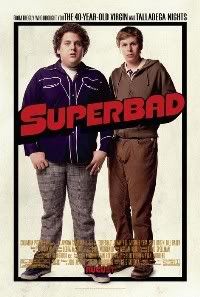
SUPERBAD (2007)

Director: Greg Mottola
Cast:
Jonah Hill, Michael Cera, Bill Hader, Seth Rogen, Emma Stone, Martha Macisaac
Release: August 17, 2007
Synopsis:
SUPERBAD follows a pair of co-dependent high school seniors, Seth (Hill) and Evan (Cera), as they close the chapter on their socially challenged high school years. Invited to the graduation party of the year by their crushes Jules (Emma Stone) and Becca (Martha Macisaac), the guys must outwit jealous boyfriends, unruly partygoers and a couple of very bored cops, Bill Hader and Seth Rogen, in order to get the girls and become the social giants they always wanted to be.

View Trailer:
* Large (QuickTime)

Prognosis: Negative. Some people are down on David Spade.

“Who killed Jesus Christ?”

“The Jews!”

Yeah, Spade seems like the kind of squirrelly little sack of annoyance that you’d like to put a boot up of but he did have his moment in PCU where he shined brightly and the moment where he had to answer a litany of questions just to get into his clubhouse was the first thing I thought of when I had to enter my name, birthday and zip code no less than five different ways just to watch this stupid thing. And it is stupid.

To get what I mean I am used to seeing Red Band trailers that were obviously blue in every sort of way, be it for language or the showing of some lady’s mammaries, and deserved a little heads-up notification just in case some wayward wanderer stumbled upon it but this isn’t even Red. It’s a green trailer, just like any other I would have to watch.

This ordeal pissed me off enough to rant and take up the deconstruction space here just to rail against this ostentatious grab at making unsuspecting dweeb think he’s about to see the Holy Grail of all naughty trailers. At least TEXAS CHAINSAW MASSACRE tossed in a little blood.

Now, when I was finally granted entrée into this trailer’s world, thinking that was a lot of work just to see a movie based on an Internet cartoon, but I guess this something else entirely. It was apparent that the low-hanging jigglies of some MILF in training is about as risqué as we’re going to get. Even though it nearly feels like a George Michael interlude for Arrested Development, go ahead and try and tell me that you can’t see the similarity, the odd set-up with George going off to college is a neither really funny or very interesting. It’s weak.

As well, the proclamation that this movie is coming to us via the brain trust that banked TALLADEGA NIGHTS and THE 40 YEAR-OLD VIRGIN doesn’t quite fit, either. You usually want to have that card to go by after something funny happens. As it stands, things are just out of place and I have yet to even realize where the plot is going.

Thankfully, I’m not helped at all by anything that comes after.

In an effort to be as obsequious and as obtuse as possible the trailer goes on to explain absolutely nothing. We’ve got George Michael lying to some high school girl about his drunken escapades in order to seem “cool”, a trope that has been there and done it in so many more appealing ways. Even the pedestrian fake id/outrageous fake identity joke, made infamous by WEIRD SCIENCE, REVENGE OF THE NERDS 2 and even (allow me to make the sign of the cross) VEGAS VACATION’s Papa Giorgio did better than the long, unnecessary, unfunny and, ultimately, bad segue for Seth Rogen’s awful jew joke that doesn’t make me want to see the film.

The rest? Well, it’s more of the same tired, old and busted jokes that made AMERICAN PIE a one hit wonder and a straight-to-DVD pariah. If there is something original to be said about this film is that George Michael’s accidental boob punch of some young girl was actually funny. If there was more of that going on in the film I was hard pressed to be able and find it.

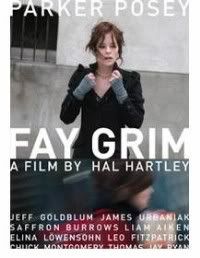
FAY GRIM (2007)

Director: Hal Hartley
Cast: Parker Posey, Jeff Goldblum, James Urbaniak
Release: May 18, 2007 (Theatrical), May 22, 2007 (DVD)
Synopsis: A ten-years-later continuation of Hal Hartley’s “Henry Fool”, where Fay Grim (Posey) is coerced by a CIA agent (Goldblum) to try and locate notebooks that belonged to her fugitive ex-husband (Ryan). Published in them is information that could compromises the security of the U.S., causing Fay to first head to Paris to fetch them…

View Trailer:
* Large (QuickTime)

Prognosis: Caught In The Middle Of The DMZ. Kooky.

In some ways, Parker Posey has developed some rather interesting, here meaning odd, choices when it comes to choosing movie roles.

She’s been an irresistible presence when she’s been in movie roles like PARTY GIRL and BEST IN SHOW but, like a dog that’s just been shown a card trick as it crooks its head in trying to decipher exactly what its seen, her roles in BLADE 3, SCREAM 3, JOSIE AND THE PUSSYCATS and even SUPERMAN RETURNS makes trying to contextualize her aims in film a real head scratcher. However, you can’t take away her talent when it’s shining like a cop’s blazing Mag-Lite and that’s what comes across in this trailer.

Immediately we’ve got some good information to go off of: she’s a mother and she has a son that is causing her nothing but pain. She has a mysterious husband that has done the kind of work to attract the attention of the CIA, namely Brundle Fly.

It’s a little hippity-dippity as you try and piece together the odd bits of how strange these people’s lives are when you account for the whole but it’s Posey’s projected sense of innocence and naivety that’s the real attraction here. But what’s happening here is all prelude to the exact midway point where some of these discordant threads start wrapping themselves into the main plot: Parker is caught up in some sort of esprionage where she is severely ignorant of what’s happening.

She’s jumpy as all get out, the plucky soundtrack works wonderfully to convey the Benny Hill-ness of what would happen if Jamie Lee Curtis’ role in TRUE LIES was actually tasked with a real mission prior to getting cornered and nearly schtupped in Chet’s double-wide; she’s a dolt in sheep’s clothing.

A positive nod goes to briefly attaching some kind words from Paper Magazine to at least assuage any layperson’s indifference as to whether this should even rate as a rental later on this year. James Urbaniak is used sparingly but it’s odd that his presence barely warrants any kind of context than what we’re given: he’s a dude that is caught up in this all.

What I like about the trailer is that while it doesn’t blow off anyone’s doors by any means it, nonetheless, establishes who Parker is, what the crisis is, how Brundle Fly is incorporated to what’s happening and, by the end, a strange sense that this movie is not your average Cat and Mouse, international thriller.

This is comedy infused with a hint of seriousness and the fact that this movie is being pimped as being available for you to check out from the comfort of your living room on May 18, the day when you can also see it in theaters, makes this a smashing good ad as to what I could spend my weekend doing: hauling ass to the cinema or pushing a button my remote. To have these choices it just entices me further to check it out.

YEAR OF THE DOG (2007)

Director: Mike White
Cast:
Molly Shannon, Regina King, Peter Sarsgaard, John C. Reilly, Laura Dern
Release: Hopefully it’s already come and gone from American cineplexes Synopsis: Peggy (Shannon) is a happy-go-lucky secretary – a great friend, employee, and sister who lives alone with her beloved dog. But when Pencil unexpectedly dies, Peggy must embark on a journey of personal transformation that is hilarious, poignant and heartbreaking. YEAR OF THE DOG marks the directorial debut for Mike White who has written Chuck & Buck, The Good Girl and School of Rock.

View Trailer:
* Large (QuickTime)

Prognosis: Euthanize It. Here’s a grand idea: Make a trailer that’s bland enough to be mistaken for a piece of stale Wonder Bread, sap anything interesting from it and then make people want to pay to see it.

This one’s downright awful.

I think that if you’re trying to boast that you’re one of the creative powerhouses behind CHUCK AND BUCK (a jolly comedy that’s dipped in pure pitch) and SCHOOL OF ROCK (a not so jolly comedy that’s pure retch) having Molly Shannon take up the first quarter or so running time of this movie just bawling her eyes out, the kind you don’t know whether to laugh at or feel sorry for, isn’t the wisest of business angles to take.

I mean, we have a great idea that she’s torn up over the loss of her dog, Laura Dern makes a lame attempt at capturing that real absurdist parental cliché, and John C. Reilly uses the word “bitch” in a way that infuses the moment with a little levity but the point of the first half of this trailer is to feel bad and miserable for Molly’s loss; it’s not funny, it’s not really interesting and by the time we really get going with what the point of this is all about I’m damn near ready to shove a pair of scissors in my eyes.

“Even retarded, crippled people get married.”

It’s about here when Regina King steps aboard this crazy train with all the thunder of a 9-volt battery on the tongue. I’m sure there is some reason why Molly needs to be consoled in this time of misery but I think this trailer misses the larger point: we all know deeply corroded people who, instead of seeking human companionship, use pets to fill their void. I’m not saying they’re any less loony than the rest of humanity but when you get your Christmas cards from these people, usually it’s them all alone with their depressed quadrupeds who’ve been made to wear a Santa hat or some kind of nonsense, it’s enough to make you wonder how else they fill their lives.

Peter Sarsgaard pops up to play the part of an equally odd pet owner and, of course, zaniness blooms between the two of them when they finally find each other. I would think, after Peter popped in there would be some kind of amplification of comedic or thoughtful talent but, instead, this plotline sort of just meanders by us.

There is no hook, no marketing angle to really grab a hold of; no, we’re given a lot of drawn out scenes that may very well work to the film’s narrative advantage within the context of the entire picture but when we’re trying to connect the story with the impulse to buy this trailer lacks in various ways.

One moment, in particular, sums up what happens when Peter and Molly come together as one: Peter admits to sleeping with his dog in bed and that he lets us know he relates more with pets than he does with people. Newsflash to anyone who cares: individuals like this do exist and none of them are nearly as charming as Molly and Peter exude or pretend to be. If I wanted to relive this story in real life I’ll just walk down the hall to Betty, in accounting, whose desk is slathered with photos of her and her Pomeranian and save myself the ten bucks.

THE SAVAGES (2007)

Director: Tamara Jenkins
Cast: Philip Seymour Hoffman, Laura Linney, Philip Bosco
Release: September 7, 2007
Synopsis: The last thing the two Savage siblings ever wanted to do was look back on their undeniably dysfunctional family legacy. Wendy (Linney) is a self medicating struggling East Village playwright, AKA a temp who spends her days applying for grants and stealing office supplies, dating her very married neighbor. Jon (Hoffman) is an obsessive compulsive college professor writing obscure books on even more obscure subjects in Buffalo who still can’t commit to his girlfriend after four years even though her cooking brings him tears of joy.

Then, out of the blue, comes the call that changes everything ““ the call that informs them that the father they have long feared and avoided, Lenny Savage (Bosco), has lost his marbles. And there is no one to help him but his kids. Now, as they put the middle of their already arrested lives on hold, Wendy and Jon are forced to live together under one roof for the first time since childhood, soon rediscovering the eccentricities that drove each other crazy. Faced with complete upheaval and the ultimate sibling rivalry battle over how to handle their father’s final days, they are forced to face the past and finally start to realize what adulthood, family and, most surprisingly, each other are really about.

View Trailer:
* Large (QuickTime)

Prognosis: It Made My Weekend. Inches away from giving up on this trailer, I was.

Sometimes it’s all about art for art sake and, while that’s fine for some French, impressionistic work that bleeds pomposity, this trailer scales it back and justifies its artistic feel. It’s in the justification and that’s what makes this movie noteworthy. When I saw YOU CAN COUNT ON ME it felt like it drifted more to the side of artistic imagination than it did reality but the subject matter here is made relevant by what many will be dealing with as Baby Boomers creep toward old age. COUNT ON ME didn’t really inform as it did just ramble. There seems to be a real point here.

One of the best things the trailer does here in order to disarm any notion that the film will be a fetid affair of hardcore seriousness is the exchange Hoffman and Linney have regarding the entire theme of the movie without saying it outright; comparing the seriousness of the situation with their ailing father to Bush’s color-coded threat warning system is just funny. It’s amusing and it contextualizes the nature and relationship this brother and sister have with one another. The graphics that display Hoffman and Linney’s name, with the aforementioned color bars, is a nice touch.

And, big ups for the brief and almost blink-you-missed-it graphic that states the movie was at the Sundance Film Festival; the red color matte behind the Sundance graphic takes the joke one step further and it was appreciated.

The siblings meet. They’ve been away from one another for quite some time, Hoffman makes a self-deprecating comment about his own weight, and the sense of place we’re brought into, where geezers get to ride the streets in their golf carts, feels genuine.

The ailing father that brought these kids together feels like he’s serving a perfunctory role, because it’s all about Linney and Hoffman, but the situation they find themselves in is where the real magic starts to brew. The cheeky music that plays behind Philip’s suggestion they stick pop in a nursing home, and Linney’s reaction to the comment, feels smooth and funny at the same time.

Eventually, the nursing home is the option that’s going to have to be the right one and the two trying to connect, like fingers of opposite hands coming together, is less absurd than it is illuminating. I like these people and they’re likeable.

The moment where the two of them play a game of indoor tennis? It lasts all of three seconds but it’s a succinct, telling piece of comedic drama that what follows, their reticence in actually sticking pop in a nursing home, he thinking it’s a hotel, just feels genuine.

In this age of fractured families, ripped apart by ever increasing numbers of divorce, it’s a curious thing to see how those who have drifted apart deal with having to come back together. It has sold itself well.

QSE News: 5/11/2007

Filed under: Columns,News — UncaScroogeMcD @ 12:24 am

quickstopnews.jpg

line1.gif

Here are today’s top entertainment headlines:

  • qsnews.jpgRapper Akon has apologized to his fans and the general public after dancing suggestively with a 14-year-old girl at a recent concert.  Video of the act was posted on the internet and upon discovery of the girl’s age, Verizon pulled its sponsorship of the tour, which also includes Gwen Stefani. Aside from the legal implications of the act, there is more trouble ahead of Akon as representatives for R. Kelly have issued a cease and desist letter, demanding Akon stop interacting with underage girls as it’s “R. Kelly’s thing.”
  • It appears that the sometimes sober actress Lindsay Lohan will be playing a stripper in her next movie, I Know Who Killed Me.  Lohan broke the news to a noticeably excited David Letterman on his late night television show.  After hearing the news, Jane Fonda, Lohan’s current co-star and past Lohan basher, promptly told reporters “A stripper, huh?  She should have went for the role of drunken whore… she could have played THAT in her sleep.”
  • In a post on his MySpace pace, New Order bassist Paul Hook has announced that New Order has broken up.  Seen as one of the most influential bands of modern rock, New Order has released eight albums since they formed in 1980.  The news of the breakup came as a shock to many fans who had assumed that the band had broken up in the 90s.

line1.gif

That’s all for today’s news, stay tuned to this channel for all the news that matters least but you still care about.

(Compiled by J. Allen)

##

Quick Stop Thingamabobs: 5/11/2007

Filed under: Columns,Thingamabobs — UncaScroogeMcD @ 12:01 am

thingamabobs.jpg

The web. It’s a big place, full of plenty of distractions ““ some funny, some informative, some ludicrous, some disturbing, some inane, some profound. Each and every weekday, we present links to a few of our favorite finds”¦

————————————————

  • Check out a little an unseen (until now) Coyote/Road Runner cartoon… (Thingamabob)
  • Notes on the first draft of Spider-Man 3(Thingamabob)
  • JAMES URBANIAK IS LEAVING THE VENTURE BROS.! OMG! He’s also running for president… (Thingamabob)

Have a THINGAMABOB? Send it in!

##

May 10, 2007

QSE News: 5/10/2007

Filed under: Columns,News — UncaScroogeMcD @ 2:19 am

quickstopnews.jpg

line1.gif

Here are today’s top entertainment headlines:

  • qsnews.jpgDisney has announced that it has acquired the rights to a film about the life of Penny Chenery, the owner of the Triple Crown-winning horse Secretariat.  The movie will detail the life of the woman who became known as “The First Lady of Racing” and will also explore the life of perhaps the most famous racing horse ever.  While the film has only just been announced, it is being reported that producers are actively pursuing Hilary Swank for the role of Secretariat.
  • In other Hilary Swank news, it is being reported that Swank has been cast in the new horror film Fangland.  Based on a novel by John Marks, Fangland is said to be a mixture of the films Dracula and Network, with blood thirsty vampires stalking the halls of a television studio.  Producers were excited to land Swank as the actress’s already ghoulish looks will save the production a lot of money on make-up.
  • Bidders have paid more than $1 million at an auction of Grateful Dead memorabilia this week. The top selling item was a guitar belonging to formerly alive lead singer Jerry Garcia that fetched $312,000. According to sources, the money secured in the auction will go towards various organs and transplants needed by the remaining members of the band.
  • Actor Tim Roth has been cast as the villain in the upcoming sequel The Incredible Hulk.  Roth joins a powerhouse cast that already includes Ed Norton as the title character and Liv Tyler as Betty Ross.  In the film, Roth with play the character Abomination, and was originally confused about the role as he thought it was a description of the movie, and not a character.

line1.gif

That’s all for today’s news, stay tuned to this channel for all the news that matters least but you still care about.

(Compiled by J. Allen)

##

Quick Stop Thingamabobs: 5/10/2007

Filed under: Columns,Thingamabobs — UncaScroogeMcD @ 1:09 am

thingamabobs.jpg

The web. It’s a big place, full of plenty of distractions ““ some funny, some informative, some ludicrous, some disturbing, some inane, some profound. Each and every weekday, we present links to a few of our favorite finds”¦

————————————————

  • Paul Dini & Misty Lee have a podcast. Go listen! (Thingamabob)
  • Oh, those wacky, copyright-ignoring Chinese strike again… (Thingamabob)
  • Have I Got News For You – Pot Noodle… (Thingamabob)

Have a THINGAMABOB? Send it in!

##

May 9, 2007

QSE News: 5/9/2007

Filed under: Columns,News — UncaScroogeMcD @ 1:14 am

quickstopnews.jpg

line1.gif

Here are today’s top entertainment headlines:

  • qsnews.jpgIt is being reported that director Robert Rodriguez will be helming a live action version of the classic cartoon The Jetsons.  A Jetsons movie has been rumored for years but has only recently been picking up speed.  Rodriguez is expected to stay close to the original feel of the cartoon but is also expected to add his own personal touches – including a scene where Mr. Spacely shoots Mr. Cogwell in the face with a gun shaped like a penis.
  • Fashion guru Isabella Blow has passed away at the age of 48.  Blow was well known in the world of high fashion and is often credited with discovering other designers such as Alexander McQueen and Philip Treacey.  While the fashion world was shocked at Blow’s passing, no one took it quite as hard as troubled rocker Pete Doherty, who mistook the designer for the drug of the same name.
  • The host of Extreme Makeover was arrested for driving under the influence this past weekend. Ty Pennington was picked up in Los Angeles after registering a 0.14 percent blood-alcohol level. Upon release, Pennington addressed his fans by proclaiming “I’m Ty Mother {EXPLETIVE DELETED] Pennington. No one is bigger than me! I can do whatever the hell I want and no damn pig is gonna stop me. [Expletive Deleted] the police!”

line1.gif

That’s all for today’s news, stay tuned to this channel for all the news that matters least but you still care about.

(Compiled by J. Allen)

##

Quick Stop Thingamabobs: 5/9/2007

Filed under: Columns,Thingamabobs — UncaScroogeMcD @ 1:09 am

thingamabobs.jpg

The web. It’s a big place, full of plenty of distractions ““ some funny, some informative, some ludicrous, some disturbing, some inane, some profound. Each and every weekday, we present links to a few of our favorite finds”¦

————————————————

  • Chris’s Invincible Super-Blog re-launches… (Thingamabob)
  • Oh, those wacky, copyright-ignoring Chinese… (Thingamabob)
  • I find this so much more interesting than the American version of Deal or No Deal(Thingamabob)
  • Why couldn’t we have gotten THIS Fantastic Four movie? Sigh… (Thingamabob)

Have a THINGAMABOB? Send it in!

##

May 8, 2007

Toy Box: Tohru Honda Mini-Bust

Filed under: Columns,Toy Box — admin @ 12:01 am

toybox.jpg

At this point, you’d think I was a Fruits Basket expert. About two months ago, I reviewed the Kyo Sohma statues from Southern Island right here at QSE. Then,

Tonight I’m covering Southern Island’s first mini-bust under the license. This one is of the main character herself, Tohru Honda. You can find it at a number of online retailers for around $40.

Tohru Honda mini-bust

Fruits Basket is one of those shows (and corresponding manga) about a young school girl (Tohru Honda) who’s an outsider, never quite fitting in. She ends up working for a family, the Sohma’s, who are definitely outsiders themselves. Each of the Sohma’s are possessed by the animals of the Chinese Zodiac, along with one extra – the cat. The theme of this show is the loneliness and pain when you’re not part of the crowd, a universal condition certainly but one that’s all the more poignant in Japan, where the population is so dense.

toybox_050807_1.jpg

Southern Island has also produced a statue of Tohru in the 6″ statue line, but this is the first of their mini-busts of any of the Fruits Basket characters. Tohru is a limited edition of 2000.

Packaging – ***
The bust comes in the standard window box, with a solid foam insert to protect it. The window is a big plus if you are lucky enough to see these on the shelf of your LCS, since they allow you to see what you’re buying before plunking down the cash. Unlike the statues though, there’s no Skybox playing card included this time.

toybox_050807_2.jpg

Also, there’s no marking on the box as to what number the included bust is in the limited edition, which is a bit unusual.

Sculpting – ***1/2
While anime characters tend to be quite basic, the sculpt here does everything it can to add detail and depth the the simple character design. The hair has a nice dynamic flow to it, with some of that dynamic movement translated into the clothing as well. There’s sculpted edges on the eyes, and the mouth isn’t merely painted on, but sculpted into the face.

toybox_050807_3.jpg

The bust is a tad small if you’re comparing it to other industry standards. Most (but not all) ‘mini-busts’ run in the 6″ range, while this one is closer to 4″ tall. It’s made of a very sturd polyresin, so it won’t break easily under normal handling, but still has the heft and feel of quality that you expect. And while the bust is a bit small overall, the internal proportions (head to body, hands to head, etc) are quite good.

Paint – ***
The majority of the paint work – especially the large areas – is very clean and consistent, with good coverage and an even finish. Southern Island picked attractive colors that match up with the appropriate look for the character (unlike Hasbro, who still seem to think Venom is purple), and key areas, like the eyes and mouth have clean edges and cuts. One question I had was in the choice of black for her hair color. It tends to be shown as more of a brown in the show, but that may simply be a liberty of the need for shading and highlighting.

Not every spot exhibits the same level of quality though, especially the thinner, finer lines in the costume. There’s a little slop here, and some bleed between the blue and the white, pulling the score down a bit.

Design – ***
Tohru is an upbeat, generally happy and optimistic character, and that general attitude is translated nicely into the general design. She’s happy, she’s animated (literally), and it all is clearly expressed in the overall look.

toybox_050807_4.jpg

My favorite touch is the edition of the rat and cat on either side of her body. Unlike the Sohma’s, Tohru has no animal counterpart to spice up her collectible. But rather than simply leave out that aspect, Southern Island decided to add the two characters who are most diametrically opposed on the show – the cat (Kyo Sohma) and the rat (Yuki Sohma). This adds quite a bit of visual punch to the bust and was a very smart move.

Value – **
Most current mini-busts run in the $40 – $45 range. This has been the average price point for a number of years now, and somehow most of the bust manufacturers have staved off the effects of inflation. The Tohru bust follows the price point, but it’s definitely smaller than the usual mini-bust on the market. It’s not a terrible value, but you are getting a little less for your dollar.

Things to Watch Out For –
If you’re picking her off the shelf, check those paint ops. Otherwise, you should be good to go.

Overall – ***
Fans of the Fruits Basket show don’t have a lot of high quality collectibles to choose from right now, so they are likely to be quite pleased with the work being done by Southern Island. This mini-bust does a nice job of capturing the look and character of Tohru, and is hopefully just the start of a full set of mini-busts.

toybox_050807_5.jpg

Where to Buy –
You have a couple online options:

Southern Island carries them themselves, for the srp of $40 each.

Circle Red has all the statues at $34 each, but hasn’t listed the mini-bust yet.

Entertainment Earth has her listed at $45.

Related Links –
As I said earlier, I reviewed the Kyo Sohma statues and the Shigure Sohma statue earlier. These are all being produced by Southern Island.

May 7, 2007

QSE News: 5/8/2007

Filed under: Columns,News — UncaScroogeMcD @ 11:59 pm

quickstopnews.jpg

line1.gif

Here are today’s top entertainment headlines:

  • qsnews.jpgThe popular TV show Lost now has a firm end date. The show will continue for three more seasons, wrapping up in 2010. Series writers and producers have been asking for an end point commitment from ABC since they ran out of good ideas in season two.
  • After learning that several sets of golf clubs were stolen from a girl’s high school golf team in Michigan, Kid Rock offered help. Rock will replace all the stolen clubs with custom-made sets. The only condition Rock held is that upon delivery, the girl’s team uses the clubs to either beat up Pamela Anderson or masturbate with. Video proof will be required in both cases.
  • The band Evanescence is down to one member from the lineup the brought about the breakthrough record Fallen. Guitarist John LeCompt has been fired and drummer Rocky Gray has quit the band in the last week. We here at QSE News would like to take a moment and thank God for answering our prayers and destroying this band, but – and we’re not being ungrateful here – Linkin Park is still around.  Just saying, God…
  • Makers of a new energy drink called Cocaine have pulled their product from the shelves here in the US, after complaints about the way the marketing of the drink was handled.  According to the product webpage, the makers of the drink call it “Speed in a Can” and “Liquid Cocaine,” implying a direct connection with the drug.  In related news, troubled rocker Pete Doherty has a new favorite drink.

line1.gif

That’s all for today’s news, stay tuned to this channel for all the news that matters least but you still care about.

(Compiled by J. Allen)

##

Comics in Context #176: Birthday In Baltimore

Filed under: Columns,Comics in Context — admin @ 12:36 am

comicsincontext4.jpg

cic2007-05-07.jpgLongtime readers know that I typically celebrate my birthday by going to see a Broadway show, including Monty Python’s Spamalot in 2005 (see “Comics in Context” #82) and Disney’s Tarzan in 2006. They may also recall that I spent the Friday after Thanksgiving last year making a day trip to see the “Cartoon America” at the Library of Congress in Washington D.C. (see “Comics in Context” #157 and 159).

That went so well that instead of seeing a play, this year I decided to go down to Baltimore on my birthday, a city I’d visited once before, in 1996. (The round trip train fare costs less than a pair of Broadway orchestra seats these days.) The principal reason for making the trip was to see Geppi’s Entertainment Museum, a showcase for pop culture collectibles, including comics, founded by Steve Geppi, the owner of Diamond Comics Distributors, the last significant English language comics distribution company standing. I hadn’t been one of the lucky people who were invited to the grand opening last fall, but I’d been waiting for the right opportunity to go ever since. And here it was, on a pleasantly warm and sunny day in the Northeast, following a few days in the 80s (highly unusual for April), and, before that, weeks of lingering winter cold.

I find train travel relaxing, and it spares me the hassles of dealing with taxi drivers and airport security. It proved remarkably easy to get from New York City down to Geppi’s Museum. After a two and a half hour journey from New York’s Penn Station, Amtrak train pulled into Baltimore’s own Penn Station, whose waiting room, with its beautiful stained glass skylights, was the first of many striking examples of local architecture I would see on this whirlwind trip. At this Penn Station I got aboard a light rail shuttle to a transfer point, where I chatted with a fellow passenger. (This, by the way, was a reminder of Baltimore’s friendly atmosphere. On my previous trip there, I was startled that total strangers would say hello to me on the street. This never happens in New York City, or Boston or Washington or even San Diego, for that matter.) Then I boarded the main light rail train and got off at the Convention Center stop, which is directly across the street from the Geppi Museum. I keep reading that the Geppi Museum is out of the way, but quite clearly it isn’t.

The Geppi Museum is housed in Camden Station, a magnificent Italianate brick building with a soaring tower, which stands next to Baltimore’s famous baseball stadium, Oriole Park at Camden Yards. The central section of Camden Station was opened in 1852, and Abraham Lincoln visited the building on four occasions; the rest of the original building, including the tower, was completed in 1867. This was the terminal for the Baltimore and Ohio Railroad, which continued to use Camden Station until 1971, by which time it was the oldest train terminal still in operation in a major American city. In the 1990s the building was restored to look as it had in 1867. In 2005 Sports Legends, a museum about the history of sports in Baltimore (the birthplace of Babe Ruth), opened on the first floor; Geppi’s Entertainment Museum opened the following year.

Entering through what I took to be the front of the building, I asked the folks at the Sports Legends admission desk where the Geppi Museum was, and was informed that its entrance is actually on the opposite side of the building. (Well, that seems appropriate: jocks and comics fans have separate entrances.) So I crossed to the other side of the lobby and ascended a staircase, past a handsome collection of vintage posters.

Then I found myself in the entrance hall for the Museum proper, whose walls were covered with even more impressive posters, my favorite being an enormous one for a Charlie Chaplin silent feature. Alongside one wall is a flatscreen TV monitor continuously running an introductory video narrated by Mr. Geppi himself, welcoming guests.

Here I was greeted by the museum’s curator, Dr. Arnold Blumberg. We had talked by phone in the past, but had never actually met until this year’s New york Comic Con. Knowing exactly what I most wanted to see, Dr. Blumberg escorted me into the museum’s largest gallery, the room titled “A Story in Four Colors.” He can doubtless attest to my reaction on entering this room, which must have involved bulging eyes and a dropping jaw.

Right in front of the room’s entrance stood a vitrine, a case with a glass top, holding beautifully preserved copies of Action Comics #1 (1938), the debut of Superman, complete with co-creator Joe Shuster’s iconic cover drawing of the Man of Steel lifting an automobile; Action Comics #2, which, though it now seems odd, does not have Superman on the cover; Adventure Comics #40 (1938), with the first appearance of DC’s original version of the Sandman, drawn on the cover by Creig Flessel; Adventure Comics #48 (1940), with the debut of the original Hourman; All-American Comics #16 (1940), in which the original Green Lantern first appeared; All-Star Comics #3 (1940), the initial saga of the Justice Society of America, the leading superhero team of the Golden Age of Comics of the 1940s; and two first issues that need no further description, Batman #1 (1940) and Captain America Comics #1 (1941).

I have seen Golden Age comic books before, and even own a few, and I have even seen copies of some of these particular landmark issues before. But to see them all together, all at once, is astonishing. And beyond the vitrine, there was a long wall lined with shelves, each filled with still more landmark issues of vintage comics. It was a treasure house! I was peering into the comics collector’s equivalent of Scrooge McDuck’s money bin, at the mother lode of this artform’s history, preserved within a single room!

Dr. Blumberg and I conversed for a while, comparing notes on our experiences teaching courses in comic books as literature, and discussing the obstacles and opportunities in persuading the culture at large that they should study comics just as people do with novels, plays and films. Eventually Dr. Blumberg had to leave for a scheduled meting, and as I faced the door to bid him goodbye, my eye was caught by a comic exhibited along another wall: Detective Comics #1 (1937), whose cover, drawn by Vin Sullivan, featured the face of the villainous Chin Lung, a ripoff of Dr. Fu Manchu! I ended up spending probably an entire hour in this room.

A wall text begins by quoting one of the Founding Fathers of modern comics, Will Eisner: “In the beginning, God made comics. . . .” Eisner was joking, but the quotation wittily sets the stage for the wall text’s version of the argument, familiar to comics scholars, that the comics artform has forebears going back to the prehistoric paintings on cave walls.

My friend and former comics editor Meloney Crawford Chadwick once pointed out to me a major reason why the mainstream culture still regarded comics with disdain. (This may seem a long time ago, but it was only in the 1990s that she told me this.) She observed that small children are considered to have grown more mature when they turn from reading illustrated storybooks to reading books with no pictures. Hence, comics enthusiasts are suspected of suffering from arrested intellectual development. The Geppi Museum wall text makes a similar point–“Although many people believe that reading words alone–prose lit–is a sign of intellectual maturity, the fact is that humans are a visual species. . . .”–and cites such early examples of sequential art (communication through a series of pictures) as the medieval Bayeux Tapestry.

The wall texts also explain Dr. Blumberg’s and the Overstreet Price Guide‘s division of comics history into nine different “ages,” expanding upon comics fandom’s traditional concepts of the “Golden Age” of the late 1930s and 1940s, in which the superhero genre was created, and the “Silver Age” of the late 1950s and 1960s, in which superhero comics were resurrected (see “Comics in Context” #58). First there is the “Pioneer Age” (1500-1828), during which many of the elements of comics–word balloons, stories told in sequential panels–were being developed. It was during the “Victorian Age” (1828-1883) that Switzerland’s Rodophe Topffer created the earliest graphic novels. Next comes the “Platinum Age” (1883-1938) when the history of the American newspaper comic strip begins with such pioneers as Richard Outcault (The Yellow Kid, Buster Brown), many strips are reprinted in comic book format, and by the end of the period American comic books begin to feature original material. The “Golden Age” begins with the debut of Superman in 1938, leading to the explosive creation of scores of classic superheroes over the next several years. Superheroes faded from popularity in the second half of the 1940s and the Overstreet Guide characterizes 1946-1955 as the “Atom Age”: this appropriately gives the heyday of EC’s horror, science fiction, war and humor comics their own “age” in between the first and second superhero-dominated “ages.” The superhero genre was reborn in the “Silver Age” (1956-1970) starting with the introduction of a reconceived Flash in Showcase #4 (1956), followed by Stan Lee’s Marvel revolution of the 1960s. This is followed by the “Bronze Age” (1970-1984), the “Copper Age” (1984-1992, my own period of activity at the Big Two comics companies of DC and Marvel), and the current “Modern Age,” specified as beginning in 1992.

In our conversation Dr. Blumberg and I agreed that these divisions into “ages” are subject to critical reevaluation, and that it is difficult to perceive which “age” is currently going on around us. Thinking further about the subject, I suspect that Overstreet’s “Modern Age” should be broken in two, and that various factors, such as the ascension of Bill Jemas and Joe Quesada at Marvel, the great expansion of the graphic novel and comics trade paperback market, accelerated mainstream acceptance, the manga revolution, and the increasing importance of alternative comics make the early 21st century landscape of American comics very different from that of the 1990s.

Overstreet’s division of “ages” applies to American comic books, not to comics worldwide, or even to American comic strips, and the “Golden,” “Silver,” “Bronze” and “Copper” Age titles traditionally apply to superhero comic books. (It is an appealing idea that the “Silver Age” was also the first age of underground comix.) The dominance of manga in the American comics market, and the high profile that alternative graphic novels now have in the culture surely show that superhero comics can no longer be the primary standard for defining American comics history.

So the Geppi Museum’s system of Nine Ages of comics may require modification, but it is still quite useful. Moreover, it is striking that this division into nine ages has moved from the pages of a collector’s price guide into the context of a museum. Just as Dr. Peter Coogan’s book Superhero: The Secret History of a Genre, serves as a first major attempt at defining the superhero genre, the Nine Ages provide a helpful tool for academic analysis of the history of American comics.

It’s also striking to see that nearly a hundred percent of the objets d’art in this room are actual comic books. There is original comic book art, too: the cover artwork for various EC comics, as well as the original art for covers of the Overstreet Price Guides, by such notables as Alex Ross and Joe Kubert. In the case of the latter, the covers portray comics characters, but the guides, of course, are not actual comics. The vast majority of what is displayed in this room are actual printed copies of comic books. I was surprised that last year’s “Masters of American Comics” show at the Jewish and Newark Museums, which mostly displayed original artwork, included so many printed copies of comic books and newspaper comics pages. But of course this was a means of exhibiting work for which the originals are unavailable, such as Lyonel Feininger’s comic strips and Jack Kirby’s “Galactus trilogy.” When Ken Wong and I co-curated “Stan Lee: A Retrospective” at the Museum of Comic and Cartoon Art, we similarly used photocopies of original artwork and even pages from reprint editions of 1960s comics when we could not obtain an actual original art page we would have liked to include. But in the case of both these museum shows, the main drawing card is the original art. At the Geppi, the printed comic book, the collectible, is the center of attention.

This reminds me of the question that New York Times art critic Michael Kimmelman asked about “Masters of American Comics”: “The show includes one of Mr. [Will] Eisner’s drawings for a “˜splash,’ or title, page of his Spirit strip, and the printed version of it, each of which has its own aura, and raises the issue central to comic art: What is an original?”. After all, it was the printed version that Eisner meant for his audience to see; the original drawing was arguably just a tool in the creation of that printed page.

Back during the infamous comics speculator “boom” of the late 1980s and early 1990s, the conventional “wisdom,” and I use that term ironically, was that various collectible comics would be worth big money someday. Now we begin to see that vintage comic books are potential museum pieces. Once I got to the Silver Age section of the “Story in Four Colors” gallery, I saw comic books on display that I have copies of in my own collection. It is now conceivable that I could exhibit forty-year-old comics that I own in a gallery at some point. Art museums court fine art collectors in the hope they will bequeath their paintings to them. I foresee the day when museum curators and librarians court comics aficionados with massive collections, like, say, Fred Hembeck, to donate them to their institutions. Imagine: the Fred Hembeck Collection at the New York Public Library. You may think I’m kidding. The New York Public Library holds an enormous collection of Charles Addams’ original cartoons (see “Comics in Context” #72) and has recently begun collecting comic books. Isn’t it possible that in decades to come they would be happy to acquire a major collection of comic books from the last half of the twentieth century?

Around the corner from the introductory wall text for the “Four Colors” room are examples of comics from the 19th and early 20th centuries, including Buster Brown, leading up to the aforementioned Detective Comics #1 from the close of the Platinum Age.

The vitrine with Action Comics #1 which I saw when I first entered the room marks the beginning of the Golden Age. Walking to the opposite side of the vitrine, I found even more landmark issues of that period: Captain Marvel Adventures #1 (1941); Detective Comics #27 (1939), with the first appearance of the Batman; Detective Comics #28 (1939), which, like Action #2, fails to feature its new star on the cover; Detective Comics #38 (1940), with the debut of Robin the Boy Wonder; Famous Funnies #1 (1934), said to be the first “true” comic book, published in the format that became standard for the industry; Flash Comics #1 (1940), and (if I remember correctly) Dell Comics’ Four Color (second series) #9 (1942) featuring “Donald Duck Finds Pirate Gold,” with artwork by Carl Barks, launching his long career in Disney comics, and his writing partner at the Disney studio, Jack Hannah.

To my right was a walk with shelves packed with Big Little Books, tiny (3″ by 4 1/2″) but thick illustrated books, published starting in 1932, many of which featured popular comic strip and animated cartoon characters of their time.

There were still more Golden Age comics in a case, including Marvel Comics #1 (1939), introducing the original Human Torch and featuring the Sub-Mariner, the first comic book from the company, Timely Comics, that would evolve into modern day Marvel; More Fun Comics #53 (1940) with the debut of the Spectre; and New York World’s Fair Comics #2 (1940), featuring Superman, Batman and Robin on its cover (the first time Superman and Batman were shown together) standing in front of the architectural symbols of the 1939-1940 World’s Fair, the Trylon and Perisphere.

The Golden Age collection continued in a bank of shelves along the wall, including Four Color (first series) #16 (1941), in which “Mickey Mouse Outwits the Phantom Blot,” his supervillain nemesis, as drawn by Floyd Gottfredson; Patsy Walker #1 (1945) with its delightful cover portrait of its heroine, seated with her legs in the air, and Daredevil Battles Hitler (1941), starring the first costumed superhero to bear that name (DD, not Adolf!). I was especially pleased to see Superman #14 (1942), with its artist Fred Ray’s iconic patriotic cover image of Superman standing with an American bald eagle on his arm: I had seen the original art for this cover at “Superheroes: Good and Evil in American Comics,” an exhibit curated by Jerry Robinson at the Jewish Museum last fall.

In the case of long rows of shelves such as these, I can only mention a handful of the comics I saw on display. There were many, many more, each bearing significance in the history of comics.

Next came an enormous set of shelves showcasing comics from the Silver Age, including Showcase #4 (1956) which inaugurated that period by successfully introducing a reconceived version of the Flash, one of DC’s leading Golden Age superheroes.

Mort Weisinger’s editorial reign over the Silver Age Superman family of comics was represented by such examples as Superman’s Girlfriend Lois Lane #1 (1958) with its pre-feminist title; Adventure Comics #247 (1958), which introduced the Legion of Super-Heroes; and Action Comics #252 (1959), featuring the debut of Supergirl.

Here too were the Superman comics in which President John F. Kennedy played a significant role: Action Comics #309, which was cover-dated 1964, but, by an ominous coincidence, went on sale the month of his assassination, and Superman #170 (1964), with the tribute story “Superman’s Mission for President Kennedy,” written by Batman co-creator Bill Finger and E. Nelson Bridwell. But the reason I remember issue #170 is its cover story, one of the weirdest of the Weisinger era, “If Lex Luthor Were Superman’s Father,” written by the Man of Steel’s co-creator Jerry Siegel, in which Luthor travels back in time to Krypton and nearly marries Superman’s future mother Lara!

DC’s most important and innovative Silver Age editor was the late Julius Schwartz (see “Comics in Context” #32), the man who started the Silver Age going with the new Flash. Among the comics on exhibit that represent his contributions are Brave and the Bold #28 (1960), the first appearance of the Justice League., memorably pitting them against the gargantuan alien starfish Starro the Conqueror, and Justice League of America #1 (1960). Here too was one of the first comics in the exhibit that I also own a copy of: Justice League of America #21 (1963), titled “Crisis on Earth-One,” inaugurating the celebrated team-ups of the Justice League with their forebears, the Justice Society. Similarly, the collection included Green Lantern #1 (1960), starring Schwartz’s Silver Age version of the character, and Green Lantern #40 (1965) in which the Golden Age and Silver Age Green Lanterns first teamed up. There too was Detective Comics #359 (1966), in which Schwartz introduced the new version of Batgirl, Barbara Gordon, who would go on to co-star in the 1960s TV series. Also on display were two comics in which Schwartz revived two Golden Age Batman villains: the Riddler in Batman #171 (1965) and the Scarecrow in issue 189 (1967). I was pleased to find Hawkman #1 (1964) and one of the 1966 Showcase issues in which Schwartz resurrected the Spectre, all with extraordinary cover art by Murphy Anderson.

Speaking of Showcase, it was fun to find here unexpectedly Showcase #43 (1963), DC Comics’ adaptation of the first James Bond movie, Doctor No. It now seems strange that DC never did another Bond adaptation or an ongoing James Bond comics series, though certainly back then they would have had to clean it up considerably for young readers.

There were plenty of landmark Silver Age Marvel comics on exhibit as well. Among them was Amazing Fantasy #15 (1962) the first appearance and origin of Spider-Man, by Stan Lee and Steve Ditko; Lee and Jack Kirby’s The Incredible Hulk #1 (1962), with old Greenskin in his original gray color; Lee and Kirby’s X-Men #1 (1963), the initial appearance of Thor in Journey into Mystery #83 (1962), Iron Man’s debut in his clunky gray armor in Tales of Suspense #39 (1963) and his sleek red and gold battle armor in Iron Man #1 (1968), testifying to how rapidly Marvel’s look evolved in the 1960s; plus Jim Steranko’s Nick Fury, Agent of SHIELD #1 (1968). Here too was the return of Golden Age great Captain America in Lee and Kirby’s Avengers #4 (1964).

The great comics of the 1960s inspired a new wave of young comics writers and artists who sought to build on the Silver Age’s foundation and push the creative envelope in new directions. Thus began the Bronze Age, and among the scores of comics on display in this section is Green Lantern #76 (1970), in which writer Denny O’Neil and artist Neal Adams, under Julius Schwartz’s editorial aegis, shook up the superhero genre by introducing realistic social and issues. In another comic on exhibit from the same year, Conan the Barbarian #1, writer Roy Thomas and artist Barry Windsor-Smith expand mainstream comics’ reach into the realm of sword and sorcery, a genre that is decidedly not for the small children who were once comic books’ principal audience. Another sign that the audience was becoming older was the debut of that ruthless vigilante, the Punisher in Amazing Spider-Man #129 (1974), also on display.

With a relaxation of the Comics Code, DC and Marvel ventured into the horror genre, as the museum shows with Marvel’s Ghost Rider #1 (1973) and DC’s The Demon #1 (1972), one of the 1970s projects with which Golden and Silver Age veteran Jack Kirby became an innovator in yet a third age of comics. Nearby is DC’s House of Secrets #92 (1971), in which Len Wein and Bernie Wrightson introduced Swamp Thing, and Wrightson immortalized the young Louise Simonson by portraying her on the cover as the story’s heroine.

Here too is the cult classic from Charlton Comics, E-Man #1 (1973), blending humor and superheroics. Elsewhere in this section, you can see the following classic issues. Artist Mike Kaluta unveiled his definitive visual take on the title character of The Shadow #1 (1973). Julius Schwartz turned his prowess at updating classic superheroes to Superman himself with the famous “Kryptonite No More!” story in Superman #233 (1971). Schwartz turned to co-creator C. C. Beck to help revive the long dormant original Captain Marvel in Shazam #1 (1973), with the right touch of whimsy that no one has recaptured until Jeff Smith’s current series. Stan Lee briefly returned to comic books with the origin story in The Savage She-Hulk #1 (1980).

Through several Bronze Age comics on exhibit, you can follow the radical shift turn in fortune for the X-Men series, which had been canceled at the close of the Silver Age. First, you’ll see Wolverine’s debut as a guest star in The Incredible Hulk #181 (1974). The following year, Wolverine joined Storm, Nightcrawler and other new mutant heroes in Len Wein and Dave Cockrum’s relaunch of the series in Giant-Size X-Men #1. Keep looking through the Bronze Age section and you’ll find Chris Claremont and John Byrne’s classic Uncanny X-Men #137 (1980), with the death of Phoenix.

You’ll also find Daredevil #168 (1981), in which Frank Miller not only began writing the series as well as drawing it, but also introduced Elektra to the world. The Bronze Age concluded as Walter Simonson launched his run on Thor, the best since Lee and Kirby, with the creation of Beta Ray Bill in Thor #337 (1983), also on display.

When I look over my notes on particular issues I singled out from the Bronze Age displays, I am struck by how many of them contain the seeds of the major changes we are currently witnessing in the comics artform, and business. There are few graphic novels on exhibit at the Geppi Museum, but the Bronze Age section holds three of major historical importance. There’s Will Eisner’s A Contract with God (1978), the first modern graphic novel, the forebear of all that followed. Here too is the pioneering independent comics company Eclipse’s first graphic novel, Sabre (also in 1978!), by Don McGregor and Paul Gulacy, and Marvel’s first venture into the new format, Jim Starlin’s memorable and gratifyingly adult 1982 Death of Captain Marvel (about Marvel’s version of the character, not to be confused with the Golden Age original in Shazam). The Big Two were clearly watching and adopting innovations from the new alternative comics companies that were popping up. Also on exhibit are Dave Sim’s pioneering indie comic Cerebus the Aardvark #1 (1977), Howard Chaykin’s political and sexual satire American Flagg #1 (1983) from First Comics, and the first issue of DC’s first limited series produced specifically for the new, growing direct sales comics market, Mike W. Barr and Brian Bolland’s Arthurian science fiction epic Camelot 3000 (1982).

At the far right end of the long wall with the Golden, Silver, and Bronze Age displays are the issues in exhibit from the Copper Age. Among them are Jim Shooter’s Marvel Super Heroes Secret Wars #1 (1984), which launched the reign of the company-wide crossover blockbuster limited series, which still plagues us today with the likes of Infinite Crisis and Civil War. In retrospect Marvel’s flagship series may have jumped the shark with Amazing Spider-Man Annual #21 (1987), also on display. (Good heavens, Peter Parker and Mary Jane have been married for twenty years!) The Copper Age is also the age of the Grim and the Gritty, as evidenced by the exhibited copies of Batman #428 (1988), with the brutal murder of the second Robin, Jason Todd, and the even more ghastly demise of Supergirl in Crisis on Infinite Earths #7 (1985). (Both deaths have recently been undone, but they were real enough for nearly two decades.) But among the Copper Age comics on the shelves are enduring classics, including Alan Moore’s Miracleman (1985), Frank Miller’s Batman: The Dark Knight Returns #1 (1986), John Byrne’s The Man of Steel #1 (1986), Moore and Dave Gibbons’ Watchmen #1 (1986), Moore and Bolland’s Batman: The Killing Joke (1988). From the vantage point of 2007, the mid-1980s now look to me like the high point of the evolution of the superhero genre in comics, which has subsequently slid into a dead end of Grim and Gritty shock effects and shark jumping.

There ae two doors leading from the museum’s main hallway. I entered through one, near the copy of Detective Comics #1, and I exited through the other, near the wall display of representative first issues of the Modern Age. I am surprised that the museum devotes little attention to graphic novels, underground comix and alternative comics, but Dan Clowes’ Ghost World #1 (2002) was on display in this section. I also found first issues of some recent favorites of mine: Kurt Busiek and Alex Ross’s Marvels #1 (1994), Mark Waid and Ross’s Kingdom Come #1 (1996), Buffy the Vampire Slayer #1 (1998), and Alan Moore and Kevin O’Neill’s League of Extraordinary Gentlemen #1 (1999).

So, to modify one of British comedienne Catherine Tate’s catchphrases: “Was I dazzled?” Oh, yes, indeed. It was as if the whole history of American mainstream comics had taken concrete form around me, flooding me with memories.

But, of course, I’m already an authority on comics history: I could put all these comics in context. Beneath each of the comics in these immense cases there is a line on the shelf explaining its significance, such as the first appearance of the Legion of Super Heroes. But what if you are like that young comics fan I encountered in San Diego last summer who had never heard of the Legion, whose most classic period, after all, was forty years ago? What if you are a casual visitor to the Geppi Museum, who may have seen some of the recent superhero movies, but knows little about comic books themselves? What would you then make of these hundreds upon hundreds of comics exhibited in this comprehensive gallery? These are questions I will explore further in my next installment.

ADVERTISEMENTS FOR MYSELF

You can read Dr. Arnold Blumberg’s erudite report on our recent encounter and conversation in his column at the Geppi’s Entertainment Museum website.

ADVERTISEMENTS FOR OTHER PEOPLE

In the course of the new documentary Will Eisner: Portrait of a Sequential Artist, Mr. Eisner discusses what he calls his “favorite story” from The Spirit, “The Story of Gerhard Shnobble” (see “Comics in Context” #68), about a little man who had the talent to fly, although he died without anyone ever seeing him doing it. Eisner observes that this is about “people who go through life, do great things, have moments of glory no one knows about.”

Watching the documentary I realized, of course, “Gerhard Shnobble” is a parable about the creative artist whose talents go unrecognized by the world at large. Surely Eisner must have identified with Shnobble, back in the days not so long ago when comics were still regarded as a “gutter” medium.

Lately I’ve been writing about comics artists who made a great impact on the medium in the 1970s, but who had unjustly fallen from popularity by the time of their recent deaths. What is even sadder is the case of a creative artist of remarkable talent who, for one reason or another, never received the career or the level of recognition that he deserved. Such a man is Tom Artis, a comics artist whom I only met once, but whose work I admired, and who passed away this week. I recommend that you read his friend and collaborator Peter Gillis’s tribute to him, and then take a look at Artis’s work for yourself by doing a search on the Internet. Not enough people paid attention, but Tom Artis flew.

Copyright 2007 Peter Sanderson

QSE News: 5/7/2007

Filed under: Columns,News — UncaScroogeMcD @ 12:36 am

quickstopnews.jpg

line1.gif

Here are today’s top entertainment headlines:

  • qsnews.jpgIt won’t come as much of a surprise to most Americans, but Spider-Man 3 was number one at the box office this past weekend with a record setting three-day total of $148 million. Spider-Man 3 broke the record previously held by Pirates of the Caribbean: Dead Man’s Chest. For those 23 people who have not seen Spider-Man 3, a van will be by shortly to take you to Spider-Man re-education camp.
  • Actress Liv Tyler will play the role of Betty Ross in the upcoming Hulk sequel. Tyler will join Edward Norton, who has taken over the role of Bruce Banner. Tyler’s character will be responsible for making Banner turn into the Hulk by forcing him to listen to her father’s band, Aerosmith.
  • It has been announced that a sequel to the film Wall Street is set to me made nearly 20 years after the first film was released.  The new film, called Money Never Sleeps, will feature Michael Douglas reprising his role of the infamous Gordon Gekko.  To get back into the character, Douglas has accepted positions with Enron, Tyco, WorldCom, Adelphia, Halliburton…
  • Finally, and in continued movie news, actor Sacha Baron Cohen will play Freddy Mercury in an upcoming biopic about the Queen frontman. Cohen himself is fresh off his breakthrough performance as Borat. Cohen is expected to play the role more seriously than his last several films by working in only one or two high fives.

line1.gif

That’s all for today’s news, stay tuned to this channel for all the news that matters least but you still care about.

(Compiled by J. Allen)

##

Quick Stop Thingamabobs: 5/7/2007

Filed under: Columns,Thingamabobs — UncaScroogeMcD @ 12:35 am

thingamabobs.jpg

The web. It’s a big place, full of plenty of distractions ““ some funny, some informative, some ludicrous, some disturbing, some inane, some profound. Each and every weekday, we present links to a few of our favorite finds”¦

————————————————

  • Two geniuses for the price of one – Jack Benny & Mel Blanc… (Thingamabob)
  • The opening credits to the first Hanna-Barbera hit, Ruff & Reddy.. (Thingamabob)

Have a THINGAMABOB? Send it in!

##

May 4, 2007

Trailer Park Interview: Missy Peregrym

Filed under: Columns,Interviews,Trailer Park — admin @ 1:43 am

By Christopher Stipp

Archives? Right Here…

One thing that struck me after I hung up the phone with HEROES’ Missy Peregrym is that she simply talks and thinks like someone who has better things to do than shoot the breeze about NBC’s greatest ratings superpowerhouse since MISFITS OF SCIENCE. Missy is just pleased to be working and didn’t show any signs of contemplating what the show means to her career or life right in this moment.

She has more pressing issues on her mind.

From eschewing the typical cookie cutter Actress label and all that entails to really opening up about what it is to be a woman in America, nevermind the fact that one of the unspoken rules of Women’s Fight Club in Hollywood is that you never let on that some of the images and affectations you’re expected to portray in any given role might drive some young lasses to develop an eating disorder.

What is clear, though, is that besides our mutual disdain and revulsion towards television shows like THE BACHELOR, which should be exterminated, not euthanized, Missy is not an evil shapeshifting mind bender in real life but what she is, though, is a woman who is deserving of the kind of accolades you would bestow on someone who does indeed possess a modicum of power and simply chooses to take the road that is not beset with hordes of Yes-Men and ass-kissers.

Missy just wants to live a life that’s free of scrutiny over what she chooses from her closet and free to think that while being on HEROES is a gift it’s what you give back, and what you’re willing to believe in, that makes life worth enjoying. She’s honest, direct and deeply insightful and is everything you wish more people in her line of work could be. From raising awareness to the plight of young women to eloquently iterating how it is that dysmorphia runs rampant through those who sup at the fountain of Cosmo Missy, quite simply, is the kind of woman you would hope every daughter could turn out to be. Makes you wonder whether she does possess something special in her DNA.

CHRISTOPHER STIPP: So, how are you doing?

MISSY PEREGRYM: I’ve been doing really good.

It’s beautiful in LA”¦it’s starting to get warm”¦I’m done filming”¦I don’t know what I’m doing with my life again”¦

(Laughs)

You know, the usual.

STIPP: Well then let me find out, tell me, how HEROES all came about. How long did it take for you to go from interested to having the part itself?

PEREGRYM: It all happened within two weeks. I auditioned”¦I auditioned on a Thursday or Friday, thought I did absolutely terrible, and I left feeling like, “Forget it. This sucks because this is a great show I want to be a part of but I blew it and I’ll just have to get over it.”

And then they called back. They said they wanted to see me again and it was between me and another girl and they wanted me back that following Monday. So, after that I think it was like three days and I found out. It was great. Even then we didn’t know how it was going to work out because we had to get my working papers in order as well.

STIPP: That’s right, you’re from up north.

PEREGRYM: Yeah”¦I’m an immigrant.

(Laughs)

STIPP: And had you been living in LA prior to that?
PEREGRYM: Oh yeah. I’ve been in LA ever since I came to train before filming STICK IT, I’ve been right here.

So, I’ve been staying here and I’ve had working papers but it’s only specific to which studio I’m working with at the time. Just because I have working papers, though, it doesn’t mean I can work every production. It’s tough because I’ve lost jobs over it.

STIPP: Really?

PEREGRYM: Yeah, there are things I can’t go out for because there’s not enough time to get them done. Recently, there was a pilot”¦it happens all the time.

STIPP: It must be an odd thing to contend with.

PEREGRYM: Yeah, it is. It’s incredibly frustrating but it’s so incredibly expensive to get your green card as well and it takes a long time. Eventually that’s really what I have to do and I should be putting in an application but I’m a procrastinator.

STIPP: Can’t you circumvent the whole thing by getting married in this country?

PEREGRYM: Yes, I think, but I don’t know how that all works. I think it’s still difficult but I believe if I get married here I have to stay here and can’t go back home for six months or I can go home but”¦it’s all just really confusing. I looked into it and I was proposing to people on the street. No one said yes.

(Laughs)

So, it didn’t work out that well.

STIPP: Has HEROES worked out a little better? How has filming been for you?

PEREGRYM: It’s been a lot of fun. Sometimes it’s tough because my character”¦I don’t get to do a lot of the stuff. I mean, my scenes, the way they’re written, are amazing. Now, sometimes it’s frustrating because I can’t act them out because everyone else is acting my part and I just pop up at the end and say, “Ha-ha.” So, believe me, it was great to be a part of it”¦I love the show so much and I love my character and I hope I’ll get to do a little more but it’s been a blast and I never thought I could love playing evil so much.
STIPP: I know you’re billed as a Guest Star”¦

PEREGRYM: You know, I don’t know what they’re planning for next season. The idea is that I’m coming back but nothing is contractually binding me to that.

STIPP: Since you’re saying that you don’t get to do much are you on the set a long time out of the shooting day or do you hang out to watch the production as it happens?

PEREGRYM: Well, no, not really. I’ll be around for my scenes. I have to be around for the entire scene whether or not if I’m in it but when you’re on set, you’re on set for 12 hours and that’s for your stuff. So, even though the camera time isn’t a whole lot it’s the process that takes a lot of time. And it’s important that I’m there as they’re there for my stuff because we both have to kind of interact. We have to do the same things and copy each other from the time that I morph to the time that it’s me. It’s fun, though. I think it’s a fun role for everyone else to play to because they get to step out of their character too and play it a little cheekier than usual”¦except for Ali Larter’s character because she’s already got that going on.

STIPP: Are you able to prospect for new jobs or is HEROES taking all of your time?

PEREGRYM: No, it doesn’t take a lot of my time. When it comes to the dates it’s really great”¦the only thing is because there is so much that’s going on, and since they’re really committed to making this the best show, they like to keep you around. They don’t like you leaving town. They like to keep you close. If a shot doesn’t work out or if they don’t complete their day, which happens a lot”¦why? Because it’s a tough show to film”¦That’s frustrating. Sometimes. Sometimes. But, other than that, it’s so easy and I’m really blessed to be a part of that.

It’s really difficult for those that are the stars of the show because they’re in it all the time and they’re the ones filming 12 hours a day and it’s so tiring but I don’t have to go through any of that. So”¦I kind of scored the best job there.

(Laughs)

STIPP: Now, to bring up a point, weeks and weeks ago when you were contemplating entering the fray with this show did you have an idea for how widespread the viewership for HEROES had become? The fanaticism of it all?

PEREGRYM: When I joined, I knew it was a hit, I knew it was doing really well. But, I don’t think I really understood because I don’t watch a lot of TV. The shows I was a part of LIFE AS WE KNOW IT, shows like that, things I was proud of, they did OK but it’s pretty incredible to be part of a show that’s taking off as much as it is.

What I’m proud of, really, is that everyone works so hard. The cast and crew are so nice. You just want the best for everyone that’s a part of the project. The actors really put in 100% all of the time and the writing is just genius. Every episode is interesting and I cannot even remember what is going on. I watched last night’s episode [.07%]. I had no idea what I was doing! I couldn’t remember anything because the show moves so fast. But the reason why the show is doing so well is because everyone involved is just so dedicated and creative and works hard.

STIPP: Is there extensive writing that’s done on the fly or is the script the script?

PEREGRYM: Yeah. They’re always changes. They’re always rewriting it, all the time. You’ll get the first draft the week before you go to shoot and then you’ll get 500 different colors of all the changes they make. And that’s good because once you’re there to film it, that’s it.

STIPP: This must also be the first time since you’ve been a part of something so big. Are you being recognized yet by geeks or fanboys of the show?

PEREGRYM: I really get recognized everywhere else but LA. They leave you alone out here which is great but it’s weird when I do leave I almost forget that I’ve done things and girls will come up to me and I’ll be, “Oh, yeah, I did do that movie”¦” But it’s cool because I have the best fans in the world.

STIPP: Really? Come on”¦

PEREGRYM: I have the cutest little girls coming up to me.

And you know, I thought about it, the only real comic books I read growing up were Archie comics. Like, I was a dork but I was never into that whole Sci-Fi thing, I didn’t watch a lot of TV but the one show that I really did watch was (Laughs)”¦Star Trek: The Next Generation. Every night, 7 o’clock, after dinner, with my family.

STIPP: No”¦

PEREGRYM: Yes!

It makes me laugh because I totally forgot about it until a couple of days ago. I’m down with Worf!

STIPP: Were you also down with Wesley Crusher, Wil Wheaton?

PEREGRYM: Yup! And it was only the Next Generation.

STIPP: What else, then, are you doing with your time while you’re here? Are you spending your summer doing anything in particular?

PEREGRYM: Well, nothing is confirmed, as of yet but filming for HEROES starts back up at the end of June. There’s not much time to do anything unless it starts right now.

It’s probably the effects work that’s contributing to that timeline; they are just unbelievable, to be able to do that week in and week out.

Incredible. They do such a job with it. It’s impressive.

STIPP: How are they able to churn through all the work that goes into it?

PEREGRYM: They have two crews, really, to be able and handle it. You can’t even call it 1st and 2nd unit. They have two units that are filming simultaneously because there is so much to do and everything takes a long time. It just takes an extra amount of time.

STIPP: So, what’s the lead-time then? From shooting a scene to when it airs”¦let’s take last night’s episode”¦nice boots and skirt combo, by the way”¦

PEREGRYM: Oh my God!

STIPP: I don’t and wouldn’t comment on something like that but it was obvious”¦and that was at the moment when I was telling my wife about who I was interviewing, obviously she doesn’t watch the show, and she had no clue but when you morphed back and you’re standing there”¦

PEREGRYM: That’s funny because”¦my character”¦I don’t have to commit to a lot of things. They can adapt me however they want. It’s funny because the wardrobe started out very different than that. And then, on the day of shooting, they’re like”¦we just improvised the outfit. I got a little confused. I was like, “Whoa! I’m kind of getting confused about my character. What’s going on with her? How old is she?” You kind of just have to go with the flow.

But to get back to when I shot it? Probably a month and a half”¦and not even that because I’m including the production break in-between that”¦when they weren’t airing any new episodes?

STIPP: Right.

I’m not looking for scoop, so let me preface the question like that, but without saying anything specific do you think the creators know where they want to go with the series? I’m just thinking of LOST where there’s a real sense that not even they know what’s happening on the island.

PEREGRYM: I think they have an idea of where they want to go with the characters but realize they don’t tell us very much at all”¦and when I entered they had so many other storylines going”¦and I don’t think they have a lot of time to focus on me when they have all these other things to tie up. I don’t feel my character has alliances with anybody and”¦I can tell you that I honestly have no idea what’s in store with my character.

Did that answer the question?

STIPP: Yeah, it did. I just see things from the angle that there are even more balls, characters, that have now entered the fray and, with the exception of a few quality kills, no one substantial has really exited.

PEREGRYM: And I think that’s why it’s complicated for the writers as well. I really commend them for being able to control that because I think it’s difficult to have intertwining storylines with old characters and new characters while making everything coordinate and make sense. I think it’s tough to do.

I also believe that what makes the show so enticing is that you never know who’s for good and who’s for bad, What makes the show interesting is that all the people have the capability to do good and bad things based on life experiences or temptations or normal human instincts. And it’s whether you’re going to step-up or back down, whatever the case calls for, and I think that’s what they want to do; they want to take something that’s comic book-y but keep it realistic so that people can relate to it. It’s interesting and it’s cool and it has all these effects of people with superpowers”¦but these people have some very personal, relatable issues that are happening which I think are very basic.

STIPP: It toes that line between nerdiness and drama”¦You’ve got a girl who’s adopted, you’ve got another who has daddy issues”¦

PEREGRYM: I think the writers are very good at doing that, keeping the foundation of the show rooted between those two things.

STIPP: Your parents live in Canada, right? Are they able to see your performance up there?

PEREGRYM: Yeah they do. Do you know they get it on Sunday night? They get it a day before it gets released here.

STIPP: I didn’t know that”¦.

PEREGRYM: Yup. My mom called me and said, “I saw you on HEROES” and I said, “What are you talking about? How did you see that?” “Oh, it’s on Sunday nights”¦” It makes no sense to me. I can’t imagine that whoever is in programming is OK with that because people can blog and say things on the Internet and spoil things for Monday night but I guess it’s not a huge problem. I thought for sure, at first, my mom watched the wrong show but she said, “Well, are you doing other things I don’t know about that are entitled HEROES?”

STIPP: Does she appreciate your work on the show?

PEREGRYM: Yeah. Both of my parents are incredibly supportive. I try to go back home as much as possible, get away from LA because it’s good for me”¦It’s nice that I have my family and friends to go to.

LA can be a wicked place”¦

You see that kind of thing a lot…I understand why…I can see how that happens but I know LA lives by different rules and standards compared to anywhere else I’ve ever been. I feel more comfortable anywhere else other than here. I just think it’s easy to get caught up in that whether you want to or not.

I mean I had an issue with the way people thought of me as an actress and everything that goes with that. I hated the stereotypes I was getting”¦and I hated telling people that’s what I did”¦and then with publicity, how you can get caught up with what I’m wearing now. As a result I don’t do a lot of publicity events and I eventually realized I had gone to the absolute extreme so now I have relented a little but there’s so little control over anything here. What you audition for and the jobs you get, that’s based on everyone else’s decision. Sometimes you feel like you’ve just got to let go and trust that things are going to work out.

And I’m not really speaking from personal experience but I’ve seen it as something I don’t ever really want to be a part of. It’s hard. The power of influence here is crazy, which can be a good thing, but I think it’s really tough to stand up for really good things here because that’s not what sells.

STIPP: How do you keep from being sucked into that? Is it just the support system that you have around you?

PEREGRYM: I think it’s perspective. It starts with you. What your priorities are”¦your morals and values and what you stand for. I think, with me, I am really careful about the work that I do and there’s not a lot of stuff that I love but my passion and my heart is for young girls.

I want young women to respect themselves. I want them to eat food, for God sakes, but I want them to take care of themselves. I want to inspire athleticism within young women”¦ for them to take care of their bodies and it all starts with how you think of yourself.

For me it’s about being focused on where I want to go and who I am as a person and everything else will fall as it should. But it’s frustrating. It’s definitely hard sometimes. I have my good days and I have my bad days. I live by the ocean and whenever I have a really crazy day I just go to the beach and that pretty much takes care of it.

STIPP: And I see what you mean. As someone now who is personally invested in how messages come across to young women, being the father of two girls, I can’t imagine how it must feel to be bombarded with mixed messages by how a woman should act and be.

PEREGRYM: I am so thankful for my parents, I love them for it, because it wasn’t like I had a lot of issues growing up, which I think a lot of them do now, looking at the magazines”¦how you’ve got to be skinny, so skinny”¦all the focus on the superficial”¦it doesn’t matter. It’s not going to help you grow as a person. It doesn’t help you build character and everything that magazines are talking about now will be irrelevant in five minutes; it’s not about developing as a woman, it’s about looking like one.

(Laughs)

My dad had three girls.

STIPP: Oh my”¦

PEREGRYM: I have two other sisters and we’re all very close. I’ll be 25 in June. So, it’ll be 25, 24 and 22. So”¦good luck. You will be stressed, I can promise you that.

STIPP: Well, no worries. I’ve already started an elopement fund.

PEREGRYM: And I think the reason why I have the standards that I do, especially in finding a companion, a man, I want in my life, a lot of that has to do with how my father was with my mom. He was strict but he loved my mom like crazy and I know all the things he put down in front of us as boundaries were to protect us. And, yeah, I hated it. A lot of the things, he wasn’t going to let me date until I was 16. It was like, “I’m not getting married. Let me have a boyfriend!” “It’s so unnecessary to have a boyfriend at that age,” he would say. Now that I do have one it’s very, very important to me that my parents approve of the person that I’m dating because I believe that they know what’s good for me. They know what it’s going to take to have a strong marriage and they’re going to see that I’m respected and loved and taken care of.

I think it’s important for girls to love and respect themselves and be excited to grow into everything that they are and I think that for them to do that it’s hard because the messages are so construed. I would hope girls try and see what’s really important. I think that when you respect yourself, and you’re happy with yourself, you raise a higher standard for yourself. And when you do that you allow strong people who also believe those things into your life and it’s about quality of life.

Everyone I know is, “If it’s fun, then just do it.” Yeah, it’s permissible but not everything that’s fun is good for you. It’s about women and girls actually caring what they really instead of being told what they want. Figuring those things out will help you meet better men and it’ll hopefully lead to you having better families, better children, it just goes from there. It’s a chain link really.

##

Nocturnal Admissions: TV Review, How I Met Your Mother v. Rules of Engagement

Filed under: Columns,Nocturnal Admissions — UncaScroogeMcD @ 1:30 am

nocturnalheader5.gif

A remarkable event occurred on Monday, February 19th, 2007. In fact, the evening may go down in television history. That was the night that How I Met Your Mother, on CBS at 8 pm, and the new sitcom Rules of Engagement, also on CBS, but at 9:30 PM, aired episodes that told the exact same story.

Now it is true that in the long history of television, many plot points tend to get repeated. After all, there are only so many stories, and a lot of hours to fill on way too many stations. In consequence, longterm TV viewers will see the repetitious use of certain season padding tropes. In dramas, there’s the “temporary blindness” trope (used in shows from The Untouchables to Dynasty), there’s the “loss of memory” trope (Miami Vice, among many others), the “false arrest” trope (soap operas since the dawn of time), and so forth. But, for two different shows to have the same plot premise on the same network on the same night, well, that’s historic.

Mother

In the How I Met Your Mother episode called “Stuff” a fight breaks out between the show’s young Manhattanite lovers, architect Ted Mosby (Josh Radnor) and TV newswoman Robin Scherbatsky (Cobie Smulders), over the amount of clutter in his apartment, junk that in fact had been given to him by numerous ex-girlfriends. She finds this disheartening and distracting and demands that he remove it all.

Rules

In the episode of Rules of Engagement, called “Young and the Restless,” a fight that breaks out between the show’s young lovers, Adam (Oliver Hudson) and Jennifer (Bianca Kajlich), professions unknown. Adam revealed in passing that the nice big bed he took out of storage to accommodate their sleeping needs is the same one he used while dating a predecessor, Sonya. This outrages Jennifer, her philosophy being, “I cannot sleep or do other things in a bed you bought with your ex.” She finds the presence of the old bed disheartening and distracting and demands that he remove it.

To have not only the same network air what amounts to the same story in two different sitcoms, but even worse, and against the odds, on the very same night is tantamount to, oh, say Universal and Fox releasing big budget volcano movies in the exact same year. Actually that did happened ““ both Volcano and Dante’s Peak came out in 1997, so maybe the proper stance to take is wonderment that such coincidences don’t happen more often, especially in that plot-hungry abattoir that is the network sitcom’s Writer’s Room.

In fact fans of both Mother and Rules should be grateful. CBS offered its viewers a perfect, almost laboratory level opportunity to compare and contrast the two sitcoms, to weigh and assess their virtues and faults in relation to each other.

How I Met Your Mother, now in its second season, is a congenial comedy about two couples and the fifth wheel single guy whose presence puts their intimacy in sharp relief. Rules of Engagement is (or was) a acerbic comedy about two couples and the fifth wheel single guy whose presence puts their intimacy in sharp relief. Hmmm, well, perhaps the differences are found deeper.

For one thing, Mother‘s cast is warmer. The two couples, Ted and Robin, plus kindergarten teacher Lily (Alyson Hannigan, from Buffy the Vampire Slayer) and lawyer Marshall (Jason Segel, a veteran of the cult favorite Freaks and Geeks), are warm and engaging people who actually like each other, unusual in a sitcom context where the modus operandi is generally insult humor, unattached to character motivation or plot logic. Neil Patrick Harris plays Barney Stinson, the power suited womanizer, but one can’t even take him seriously as a relationship threatening roué, because he, too, is ultimately soft and nice. The gimmick of Mother is that the events we are watching, set in the present, are the anecdotes told by Ted to his children about “how I met your mother,” with the older Ted voiced by Bob Saget. This allowed the writers to play a curious game: withholding information about just who it is Ted ends up marrying (though at least viewers know from the narration that it’s not Lily). This pitch-meeting level gimmick proved not to be essential to the show, however, and has been progressively minimized. Without it, How I Met Your Mother remains surprisingly funny and the characters are attractive and well-cast, helping the series earns viewer loyalty.

Rules of Engagement, by contrast, is a mid-season replacement that made its debut on February 5th, and is currently on hiatus after seven episodes (a common network practice employed as far back as Seinfeld, which went on to become a hit). Engagement‘s gimmick is to look at relationships from three different but simultaneously stages of love. David Spade’s Russell represents hedonistic singledom. Young love is represented by David and Jennifer. Long-term married life is embodied by Megyn Price’s Audrey and Patrick Warburton’s Jeff. With its single Casanova and its young and old couples in grumpy contrast, the show is a cross between the concurrent Mother and the Fox sitcom ‘Til Death, itself a variation on the earlier Fox show, Married … With Children. The problem with Rules, as highlighted by the two similar episodes, is that its characters aren’t very likable, being either skuzzy (Russell) or dumb (the young couple). Worse, it traffics in that same old and tired insult humor that has afflicted the worst sitcoms since the 1970s. The sole attraction Rules holds is in Warburton and Price, who immediately seemed convincingly cozy together. Warburton’s line readings are unpredictable, and Price, a veteran of earlier sitcoms, is endearing as a wised up “older” wife.

As the two shows played out their similar plots, it was clear that for Mother the premise of old-girlfriend-artifacts was a single step in a larger story, perhaps prepared long ahead by the writers, because at the end of the episode the pair decide to move in together (though there are subsequent episodic complications). For Rules the fight over first the bed and then some other romantic artifacts is just an excuse for an insult fest that results in the inevitable fake resolution hollow hug, the last refuge of the lesser sitcom. The couple has “learned” something, but only until their next contrived fight in a future episode.

So though it was a potentially embarrassing coincidence, the airing of same story sitcom episodes proved helpful. In fact, more shows should air the exact same stories. There should be a rule that at least once a season all sitcoms should build a story around the exact same premise, which viewers can use as aesthetic measuring sticks, the way film buffs compare different versions of Ben-Hur and Exorcist: The Beginning.

Party Favors: TIME 100

Filed under: Columns,Joe Corey's Party Favors — UncaScroogeMcD @ 12:13 am

partyfavors1.jpg

partyfavors2007-05-04.jpgYONKERS – Once again Time Magazine has put out its 100 Most Influential People issue and completely blew me off. In the interest of spite, can I make fun of all 100 people picked before me? David Spade does have permission to steal any material in this article. He needs the help.

Tina Fey: Did I miss 30 Rock being the ratings sensation of 2006 stories? The show is limping in for a second season. She’s the Sheriff had bigger numbers.

Youssou N’Dour: Isn’t this the 20th anniversary of him being pushed into the limelight? Not saying the guy doesn’t deserve a listen, but he’s a cult musician’s cult musician.

Anna Netrebko: The Russian soprano does look nice in red next to the piano. If only she was a mail order bride.

Justin Timberlake: What? He influenced a lot of people to avoid seeing Black Snake Moan.

Sacha Baron Cohen: Borat is so 2006.

Leonardo DiCaprio: I never bought him as a Southie in The Departed.

Nora Roberts: My mom doesn’t read her.

Rick Rubin: Another flashback to 1986.

Marin Scorsese: What a tough pick. Last year he was a flash in the pan.

Cate Blanchett: You know what you did.

Alber Elbaz: The pic made me think they nominated Peter Sellers.

America Ferrera: She doesn’t look Ugly in this picture, although she has the Betty thing working.

Simon Fuller: The man who killed the music.

Brain Grazer: After all the crap he pulled at the LA Times, why did they allow this man in their magazine.

John Mayer: All that matters is that he’s boffing Jessica Simpson. Screw her once, way to go. Keep the relationship going for longer than a month, I question your ability to exist in an intelligent universe. Has Joe Simpson given him notes?

David Mitchell: He wrote a book. I’ll judge him when the movie comes out.

Kate Moss: Do a lot of coke. Let your kids be watched by a junkie. Be a superstar! I don’t want to be influenced by this skank.

Rosie O’Donnell: I was disappointed when her feud with the Donald ended without mutual destruction.

Brad Pitt: He didn’t fight to have his name on the Oscar for The Departed. Too busy holding kids to fight for an Academy Award moment? Plus he’s making “Ocean’s 13.” The nightmare continues. Nice to see the writer skip over the fact that he was boffing Angelina Jolie while still married.

Sondra Rhimes: Grey’s Anatomy makes me fear visits to the hospital since I know my doctors would rather be screwing than stitching me up.

Kara Walker: I guess she’s an artist that does multi-media.

Brian Williams: He’s influential cause his name isn’t Katie Couric.

Queen Elizabeth II: Huh? I wanna get her haircut, right now!

Tzipi Livni: Anyone that Condoleezza Rice can gush about is on my suspect list.

Archbishop Peter Akinola: He’s going after America’s Episcopal Church for electing a gay bishop.

Liu Qi: If I say anything about a Chinese leader, this column will be banned in the Far East.

Condoleezza Rice: “As Secretary of State, Rice, 52, has consistently communicated to the world that although the U.S. is a great nation, it is not perfect.” This is especially come true when it comes to our intell when we invade your country. Pardon the dust we make of your citizens.

Omar Hassan al-Bashir: Any enemy of Don Cheadle is an enemy of mine.

John Roberts: At least he doesn’t have the stripes on his robe.

Sonia Gandhi: If I say anything about her, those call center folks will never let me get another outgoing phone line.

Raul Castro: The Tommy Aaron of dictators.

Arnold Schwarzenegger: Hopefully he’ll run for another 4 years instead of making “Terminator 4.”

General David Petraeus: John McCain gives him a sloppy kiss the mag. If it was anymore “loving,” the general would be kicked out.

Hillary Clinton: Don’t you already feel nostalgic for the Rodham?

Hu Jintao: Another Chinese leader. Another chance to get banned from taking part in the Olympics as part of the drinking team.

King Abdullah: Thanks for making me pay $3 a gallon to gas up. Hope you have enough gold plated toilet paper for your family.

Nancy Pelosi: Why does she have that hideous laugh? And why can’t she embrace Colbert?

Barack Obama: I think he might run for president.

Michael Bloomberg: He will buy you!

Ayatullah Ali Khamenei: I’m not in the mood to see me burned in effigy.

Pope Benedict XVI: He’s the Raul Castro of Popes. I keep imagining his name is written on masking tape on the Pope’s door bell.

Angela Merkel: Think she got teased about Merkle’s Boner?

Osama bin Laden: This is just a trap. Time expects him to show up at the party and then Obama and Pelosi will shoot him.

Oprah Winfrey: St. Oprah will save the world from evil rappers! She wants us to go green, but then she pimps gas guzzling cars to her audience.

Elizabeth Edwards: Best neighbor a rural guy will ever have in North Carolina.

Warren Buffett: He gave $31 billion to Bill Gates. Cause Bill really needs the bucks. I heard Melinda has been making Top Ramen for the last month.

Drew Gilpin Faust: Was this woman named by Thomas Pynchon?

Wesley Autrey: I always fear getting to close to the subway platform in case a nutjob wants to push people in front of the train. At least we know Autrey will save us.

Tony Dungy: If Rodney Harrison hadn’t been on the DL, Tony would be spending this summer wondering if Peyton will ever will the Superbowl.

Roger Federer: Does anyone really watch men’s tennis? Why not list the world’s Jokari champ?

Tyra Banks: Did you buy her record?

Youk Chhang: Eagerly waiting for Angelina Jolie to adopt him.

George Clooney: He’ll save the world, but he’ll still punish us with “Ocean’s 13.”

Michael J. Fox: When will Jason Bateman play him on Broadway?

Timothy Gittins: He drinks Bud Light. There goes his shot at being the face of Miller Lite.

Judith Mackay: She’s trying to stop smoking in Asia. What does she expect me to do with all my Godzilla ashtrays?

Chien-Ming Wang: Dice-K will destroy you!

Maher Arar: The Syrians told the Bush White House that this Canadian citizen wouldn’t be tortured. If you can’t trust a terrorist country, who can you trust?

Thierry Henry: He’s French and plays soccer. Two reasons to ignore him in America.

Zeng Jinyan: See the Chinese policy as stated above.

Garry Kasparov: Big Blue misses you.

Amr Khaled: They say he’s not a household name in the West. Really? I suggest a vowel to get him big in Iowa.

Al Gore: He knows how to go green with a little help from Willie Nelson.

Neil deGrasse Tyson: Brings science to “The Colbert Report.”

J. Craig Venter: I prefer to sample my microbes and proteins in day old peanut butter sandwiches.

Lisa Randall: I know about hidden dimensions. It’s inside the dryer and sucks down only one sock at a time. Sometimes they open up above my bed and leave a woman’s earring on my wife’s pillow. It’s science!

John Mather: He was never nicknamed “the Beaver.”

Elizabeth Blackburn: This woman works with ponds scum. I recommend her as the next manager of the New York Yankees.

Alan Stern: He’s in charge of NASA’s Science Mission. He’s the one hiding my jet pack!

Tullis Onstott: He finds organisms frozen in ice like Packer fans.

Svante Paabo: He’s in charge of evolutionary genetics. He’s making us all look like Elvis, like Mojo Nixon sang.

Steven Nissen: How can he be a big time doctor if he’s not pimping pills on TV?

Richard Dawkins: Never nicknamed “Chocolate Thunder.”

Chris Anderson: He came up with the idea that “Many of us see the same movies and read the same books because the bookstore can store only so many books and the movie theater can play only so many movies. There isn’t enough space to give us exactly what we want.” That why you have to put the DVDs in the binders and get rid of the plastic boxes. You can store more that way, Chris!

Paul Allen: They fixed his teeth in the drawing.

Monty Jones: Think he’s a fan of Monty Python?

Klaus Schwab: The man who banned me from Davos when I wanted to deal with the economy of dating Liz Taylor.

Nora Volkow: Tom Sizemore wrote her article. I didn’t recognize it since it didn’t feature him melting down mid-sentence and bitching about the prosecutor.

Frans de Waal: Does this primatologist have Lancelot Link Secret Chimp in his DVD player?

Douglas Melton: He works in stem cells. How come you never hear about petal cells?

Kari Stefansson: He believes “the more similar its members’ genetic profiles,” they have “the similar risk for certain diseases.” This explains why America still has bouts of Pac-Man Fever.

Richard Branson: Mark Cuban wrote the profile which is fitting since these two billionaires both hosted dud reality shows. Richard does have the better haircut. Maybe Mark should grow the Fu Manchu?

Cyril Ramaphosa: Remember when we had bold union leaders?

Erik Lie: What a great name for a lawyer. Eliot Spitzer writes that Lie “is the Mapquest for the SEC’s investigation.” Has Spitzer ever used Mapquest? The third to last direction is always bogus. What a recommendation.

Pony Ma: He created the “QQ” internet community in China. Thank goodness he didn’t go for “RR.”

Chad Hurley and Steve Chen: The makers of Youtube, the place that will let you break copyright, but gets ticked off if you show a little skin.

Katsuaki Wantanabe: When’s Michael Waltrip going to get into a race?

Bernard Arnault: Indie film guy Harvey Weinstein gushes about the head of Moët Hennessy Louis Vuitton. It’s just wrong. Harvey should be talking about the folks that run Yuengling beer. Enough with the expensive French crap.

Clara Furse: Runs the London Stock Exchange, where the economy is based on exporting Benny Hill shows.

Ken Lewis: When the CEO of Bank of America drops by my house, I charge him a $5 service fee to use my toilet.

Lakshmi Mittal: Who needs steel when we have plastic!

Shigeru Miyamoto: He invented the wii controller that destroyed your flat screen TV. Who knew cyber-badminton would be such a costly sport?

Rhonda Byrne: She came up with “The Secret.” I’m wishing she’d deposit her checks in my bank account. Make come true!

Steven Cohen: How come you never hear about Shrub Funds?

Steve Jobs: Mr. Snake Oil. Sure he wants to get rid of copy-protection on downloaded songs, but he won’t let netflix use Safari on the Watch it Now feature. How come people in Japan don’t have a problem hooking their video iPods into TV sets to watch on the big screen?

Philip Rosedale: Who needs “Second Life?” I’m waiting for “Fifth Life” where I’m a bottle of Jack Daniels.

Ho Ching: See the rule about anyone in China.

Indra Nooyi: Ever since KFC (owned by Pepsico) dumped their lunch buffet, I refuse to eat there.

Stephen Schwarzman: Ever since the Blackstone Group bought BMG Music Service and Columbia House, I’ve stopped getting the 12 for 1 CD offers. He’s a bad influence.

Michael Moritz: He backed Yahoo and Google. Perhaps he’d like to invest in Snide.com? The search engine allows you to find rude and negative things about a topic. In a matter of seconds, you can write David Spade’s Showbiz Show.

##

« Newer PostsOlder Posts »

Powered by WordPress