FRED Entertainment

July 6, 2007

Trailer Park: The Transformers Vs. Roger Ebert

Filed under: Columns,Trailer Park — admin @ 12:06 am

By Christopher Stipp

Archives? Right Here…

Because I’m too much of a puss to actively solicit this thing to publishers I was inspired to let people download my first novel and read it for free. Give it a preview, read the whole thing or, if you like what you see, send me some kind words. Download and read my first book “Thank You, Goodnight” for FREE.

God love Roger Ebert.

The man just is a workhorse with regard to film critism and while I vacationed in Chicago this week his review/article on THE TRANSFORMERS just serves to illuminate why you don’t have to be a stuffy intelectual to appreciate films that really do only serve one fan base that some would consider less than esteemed. Ebert slows things down, takes Bay’s kinetic visual orgasm down a notch and just speaks to why the film worked well enough to earn a three star review but why it did not achieve a fourth. His opinions were well-reasoned and actually removed any sense that this movie deserves to be treated like so many others that come out at this time of the year while couching everything in a casual tone that any bumpkin could relate to; it’s damn deceptive, as well, the way it seems like the review was written so fluidly. But that’s the reason why no one can come close to the man when it comes to film criticsm and why some pundits who are so sought after to appear on television shows once a week on Friday mornings are destined to become irrelevant and forgotten long after Ebert’s work soliders on within the literate community.

I can’t help but wonder whether we’ll get to hear Ebert back in the balcony, his hands scooping and circling as he makes his point as to why Richard Roeper’s opinion misses the mark (Really, Richard, LEGALLY BLONDE 2? A thumb-up that will live in infamy.), and once again restore order to the force that is chock-full of quote-tards from Rolling Stone to The Today Show. Intellegence while speaking aloud doesn’t have to be seen as something to be avoided just to appease Ma and Pa Kettle in the Red and Blue states but as long as the man can keep churning out reviews like this one it’s nice to be able and consume some film crit that is not only palpatable but doesn’t suppose those going to see this movie are deserving of anything less than an honest critique.

THE PLEASURE OF YOUR COMPANY; aka WEDDING DAZE; aka THE NEXT GIRL I SEE (2007)
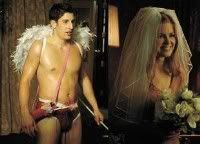
Director: Michael Ian Black
Cast: Jason Biggs, Isla Fisher
Release: August 17, 2007
Synopsis:
THE NEXT GIRL I SEE is a comedy that shows us that love has nothing to do with perfection. After losing the woman of his dreams, Anderson is convinced he’ll never fall in love again. But at the urging of his best friend, he spontaneously proposes to a dissatisfied waitress named Katie and an innocent dare evolves into the kind of love that both have been looking for all along.

View Trailer:
* Large (Flash)

Prognosis: Negative. Quick Memo to those running the campaign for this film: Pick a fucking title. It would be one thing if I was the jabrone running things but since you, MGM, insist on sloppily running your website like it’s 1996 and because you have public material out there that calls this film WEDDING DAZE, THE PLEASURE OF YOUR COMPANY and/or THE NEXT GIRL I SEE spanning IMDB and your own corporate site there is just no way around the idea that no one really cares about this film as a profitable vehicle. It’s sad that you have to let other people know that too with your laziness.

It’s rough when you want to like something but just can’t.

You’d like to grab any moment as reason enough to forgive what’s, ostensibly, a not-so-good film but even this trailer is an exercise in having lots of opportunities to try and snag something worthwhile but every time I just couldn’t muster enough forgiveness.

I didn’t appreciate, first of all, staring at Jason Biggs’ ass. I mean, really, did I really need to see his flashy red tuchas as it gingerly moves to and fro? On top of that I get that the premise of this comedy is just that: the guy’s almost-fiancé drops dead of a myocardial infarction and so he’s bummed as shit forever and day, even resorting to drinking pickle juice, until”¦da-da-daaaaa”¦he finds a complete stranger to propose to.

But here’s the best part! After his buddy, that creepy guy from Six Feet Under, who still oozes that slimy vibe, picks the random girl Biggs proposes to, and of course she’s one of the hottest waitresses that have never ever worked at any IHOP I’ve been at, the girl says yes.

Whoa! Comedy is sure to abound”¦

Yeah, Isla Fisher was great in WEDDING CRASHERS but as the trailer progresses, and she squeals with that very same squeal that made her such a draw to CRASHERS in the first place, you begin to sense something is amiss with the whole premise. You see, as we get further with the trailer this becomes a MEET THE PARENTS-esque kind of narrative.

The parents can’t believe that this crazy woman is now this dude’s fiancé, and vice versa, the quick bon mot tossed about by Isla’s mom asks us all, “Is he black?” Ha-ha, you dirty racist pig.

Then there’s the lingering shot of Jason’s raw, white ass. He looks like he was being caught for doing something but we’re not given a peek as to why this moment was included as I’m not sure if his new lady friend stumbles upon him, the girl’s black-hating mother or even his creepy friend. I guess it was just inserted to be ribald but whatever.

We then get treated to the wacky misadventures of getting to know one another, more parental awkwardness, some strange shenanigans while playing charades and I can’t help but feel a little queasy after Biggs shoots his wad, a pocket of toothpaste and saliva in his mouth, all over Isla’s face. I’m sure there are some people who would find that thing exotic or hot but I’m not having any of it. It’s just not amusing.

If there is one moment, just one moment, that actually feels like something that belongs in a mass-market comedy it is the moment where Isla asks to feel a fellow bus riders’ belly in hopes of finding out how long the woman has been with child. It’s not until Biggs puts his face to the chick’s pooch that we get the line, “I’m not pregnant.” That represents one moment of why I would see the film but that’s just one.

Like Booger trying to help Lane Meyer out in ONE CRAZY SUMMER, right before Jeremy Piven gets maced, I just can’t assist this trailer in any way.
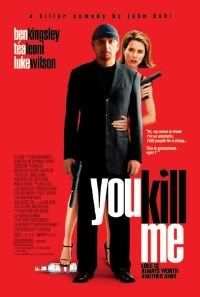
YOU KILL ME (2007)

Director: John Dahl
Cast: Ben Kingsley, Tea Leoni, Luke Wilson
Release: June 22, 2007
Synopsis: Frank Falenczyk (Ben Kingsley) is a man who loves his job. He just happens to be a hit man for his Polish mob family in Buffalo, New York. But Frank’s got a drinking problem and when he messes up a critical assignment that puts the family business in peril, his uncle (Philip Baker Hall) sends him to San Francisco to clean up his act. Played with gruff charm by Kingsley, Frank is not a touchy-feely kind of guy, but things start looking up for him. He gets a job at a mortuary, starts going to AA meetings and falls for Lauren (Téa Leoni), a quirky client he meets at the funeral home. Meanwhile, things aren’t going well in Buffalo where an upstart Irish gang is threatening the family business. When violence erupts, Frank is forced to return home and with an unlikely assist from Lauren, faces old rivals on new terms.

View Trailer:
* Large (QuickTime)

Prognosis: Negative. I liked THE MATADOR.

I realize that this was a flick that not many people were able to see but I can say that those who have saw a film that really tried to meld the axiom of “opposites attract” and pulled it off without it ever feeling terribly hokey. This seems like that kind of film: a mÈlange of situational writing mixed with some absolute absurdness.

Never minding that two of the greatest character actors working today, the honorable Dennis Farina of Old Style fame and Philip Baker Hall of every crotchety old cop part there ever was, play swift parts in establishing Sir Ben Kingsley’s role as a drunken hit man.

Regardless of you feelings about the premise on the whole I have to credit in swiftly going through what this story is about, establishing the reason why we’re here in the first place, and even making Ben seem like a funny fellow.

There is a little bit of warmth in the dude’s ability to seem like a likable hit man even in the opening moments he has with Luke “Perennial Best Friend” Wilson. Forget the easy joke about Kingsley being in San Francisco and the near requisite gay joke but when he enters a funeral home to start his new job as what looks like someone who prepares the decedent prior to the viewing the moment is handled with some aplomb.

While the narrative of the trailer suffers a bit from this point on, there is an odd moment between Tea Leoni and Ben where I think the two are flirting with one another (couldn’t he be her grandfather?) there is the moment where things come back up again where Ben confesses to his AA group that he in fact an alcoholic”¦and a hit man. Yes, it’s Middle America funny but it works.

And just like the submarine this trailer is we go back down again where I think Ben actively trains Tea on how to kill someone through a sensi/student kind of relationship. At first I think she protests about what Ben does but then she’s fully complicit in the ways in which Ben murders other people for a living. It doesn’t make sense and that’s part of the problem with the trailer. It feels like it doesn’t know what it wants to be: a funny ha-ha flick or a quasi-comedy with another gay joke tossed in there for good measure.

I can’t really pinpoint why this trailer just seems to lack any motivating call-to-action about why I should see it but I can say that it really fails to make me believe that Tea would have any romantic inkling for any other dude than one who is of her same age”¦or generation.

So, barring the love story, what we have here is a film about a hit man trying to go clean and make a go at sober living but, in the end, I don’t think this is going to be any MATADOR. It could be a buddy comedy but I can’t justify anything here that could even be close as to something I would want to pay money to see.
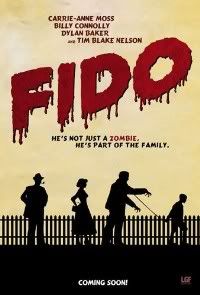
FIDO (2007)

Director: Andrew Currie
Cast:
Carrie-Ann Moss, Billy Connolly, K’Sun Ray, Henry Czerny, Dylan Baker
Release: June 15, 2007 (Limited)
Synopsis: Welcome to Willard, a small town lost in the idyllic world of the 50’s, where the sun shines every day, everybody knows their neighbor, and rotting zombies deliver the mail. Years ago, the earth passed through a cloud of space dust, causing the dead to rise with a craving for human flesh. A war began, pitting the living against the dead. In the ensuing revolution, a corporation was born: ZomCon, who defeated the legions of undead, and domesticated the zombies, making them our industrial workers, our domestic servants – a productive part of society. ZomCon would like the people of Willard to believe they have everything under control… but do they? Timmy Robinson doesn’t think so. At eleven, Timmy already knows the world is phony baloney – Mom and Dad just won’t admit it. Now ZomCon’s head of security has moved in across the street, and Timmy’s Mom refuses to be the only housewife on the block who doesn’t have a zombie of her own. When she brings a zombie servant home, Timmy discovers a new best friend, and names him Fido. And even though Dad has a bad case of zombie-phobia, Timmy is determined to keep Fido, even if he does eat the odd person…

View Trailer:
* Large (QuickTime)

Prognosis: Positive. Who would of thought that Billy Connolly would have come so far after being a replacement for Howard Hessman on HEAD OF THE CLASS? Not since Dan Schneider proved to the world that there is life after Ricky in BETTER OFF DEAD has that show produced such talent, you would’ve thought that he sunk everything with that video he made on the show to Timbuk 3’s “The Future’s So Bright I Gotta Wear Shades”.

One of the things that have really taken a foothold in America’s zeitgeist in the last few years is our propensity for and attraction to zombie films. We’ve seen zombies running fast through malls in Zack Snyder’s DAWN OF THE DEAD, we’ve seen “˜em move a little slow but with a beat you can dance to in SHAUN OF THE DEAD and we’ve even seen them remade a couple of times in the 28 WEEKS/DAYS series. What’s been missing, though, has been a real mesh between comedy and abject weirdness.

I believe this movie is exactly that.

What’s delightful, and utterly funny, is how things start. Never mind setting things up, people, let’s just get right into things with Ritter from CLEAR AND PRESENT DANGER, a film that deserves to be on the low-end of many Best Of acton/thriller lists, with asking a class filled with kids how many of them have ever had to kill a zombie. It’s said with such smoothness that the accompanying image of a zombie, in a requisite belt and shoulder strap get-up, holding a stop sign to halt oncoming traffic so the same kids can safely cross the street is a one two punch. And it works wonderfully to capture you in wondering what the hell is going on.

“What would we do without our zombies?”

The voiceover that pipes in isn’t what you would expect to chime in. It’s nice British accent that poses the above question and it’s immediate of what this question is supposed to imply. Sociologically speaking, the zombies have a role of performing all the tasks that no one else wants to do and the bigger picture of what’s been on everyone’s lips in this electoral season couldn’t be clearer. From an entertainment point of view, it’s outrageously effective. These zombies are washing cars, serving food, dropping shit on the floor accidentally, getting yelled at and not making an effort to catch the ball in a game of catch.

Never before has an embedded song been choicely picked as when The Ramones’ “I Wanna Be Sedated” starts up and when we get to the meat of what this movie is about. However, that’s not easily discernable considering that you already have a community that is using zombies as hired help.

Between the quotes from other outlets who have seen the film there is an issue I have with trying to understand where the problems arise. Where is the crux of the drama that somehow changes this sleepy hollow into something more? Do the zombies end up attacking, turning on their masters?

I think that between the quotes from others who have seen the film, the absurdity of having the youngest kid in the film taking a shovel to the rotting corpse of a zombie who he is obviously trying to do away with and the make-out session one human has with a member of the dead army is just part and parcel of a film that actually is going to take the recent obsession with zombies to the next level.

THE KING OF KONG: A FISTFUL OF QUARTERS (2007)
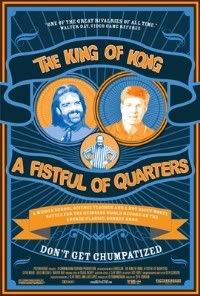
Director: Seth Gordon
Cast: Billy Mitchell, Walter Day, Nicole Wiebe and Robert Mruczek
Release: August 17, 2007
Synopsis: A middle-school science teacher and a hot sauce mogul vie for the Guinness World Record on the arcade classic, Donkey Kong.

View Trailer:
* Large (QuickTime)

Prognosis: Awesome. This has got to be one of the rad-est trailers to ever come down the pike. Ever.

One of the great things about not having to impress a lot of people with your trailer, the fact that you need to make money is a mere afterthought to what you decide to do with your preview money, is that it leaves the door open to innovative and creative ideas; an idea, then, that I have never really seen, or executed, before is the regressive trailer.

To feel like this is a movie straight from 1982 is an accomplishment, first of all, but to make the trailer also conform to the short attention spans of those watching these things is an amazement as well.

One of the first things you recognize, apart from the Fat Boy Slim-like techno drop, and the douche wearing that silly ass puffy yellow trucker hat that was obviously the norm, I’m betting dollars to doughnuts he was also rocking some of those striped socks that were pulled up at calf level, is that the blend between old and new is seamless. From the cheesy synth music to the slick documentary style footage of old guys reflecting on their youthful days as kids whose only ability was to rock a joystick it’s truly engaging.

I’m a little scared by dudes who sport some mullets, one of them who obviously owns a Remington beard trimmer and a copious amount of Just For Men beard darkening solution, but to hear them be straight-up serious about their sacrificing to be the best at video games is a little bittersweet.

What’s more is that we move from pathetic to hilariousness when the classical music starts in with the scroll that tells us that there is a Donkey Kong record that has stood unchallenged for 20 years and that this is really a movie about Dweeb vs. Dweeb.

The comedy that is these two dudes, one who should have found a more productive hobby in life in order to find a modicum of fame and another who should just cut that Goddamn mullet off his head, are going head to head in a race against”¦well, nothing really.

This trailer is just a good time, flat out. It makes me want to spend my money to see it, it stirs up that good ol’ nostalgia of when I was a wee lad and all I had was an Intellivision, and it surely ends on a note that not even I could have seen coming. It’s the perfect storm of idiocy and the notion that this could be a breezy way to pass 90 minutes; in an era where things can get self-indulgent real fast this is a welcome addition to the summer.

QSE News: 7/6/2007

Filed under: Columns,Thingamabobs — UncaScroogeMcD @ 12:04 am

quickstopnews.jpg

line1.gif

Here are today’s top entertainment headlines:

  • qsnews.jpgA Nebraskan micro-brewery is naming a beer in honor of Larry the Cable Guy. The beer will be named Git-R-Done. According to the micro-brew’s owner, the beer will taste like racism and stupidity.
  • In preparation for the release of its new album, the Smashing Pumpkins have announced plans for a fall tour.  Kicking off in Montreal on September 8th, the tour will run through November and hit many major US cities.  The tour has been affectionately called the “[EXPLETIVE DELETED] James and D’arcy World Tour.”
  • The film Transformers recorded the biggest Tuesday opening in history, raking in more than $27 million. The film, based on a popular line of toys, was directed by Michael Bay. Producers are pleased with the success of the film and are now looking forward to a sequel, saying, “maybe next time we’ll have money for a plot.”

line1.gif

That’s all for today’s news, stay tuned to this channel for all the news that matters least but you still care about.

(Compiled by J. Allen)

##

Quick Stop Thingamabobs: 7/6/2007

Filed under: Columns,Thingamabobs — UncaScroogeMcD @ 12:02 am

thingamabobs.jpg

The web. It’s a big place, full of plenty of distractions ““ some funny, some informative, some ludicrous, some disturbing, some inane, some profound. Each and every weekday, we present links to a few of our favorite finds”¦

————————————————

  • Fractured Fairy Tales – “Tom Thumb”… (Thingamabob)
  • Thurl Ravenscroft, and his well-known voice… (Thingamabob)
  • Rocky & Bullwinkle, Cocoa Puffs whores… (Thingamabob)

Have a THINGAMABOB? Send it in!

##

July 3, 2007

Quick Stop Thingamabobs: 7/3/2007

Filed under: Columns,Thingamabobs — UncaScroogeMcD @ 3:20 am

thingamabobs.jpg

The web. It’s a big place, full of plenty of distractions ““ some funny, some informative, some ludicrous, some disturbing, some inane, some profound. Each and every weekday, we present links to a few of our favorite finds”¦

————————————————

  • We all like bloopers, don’t we? And Don Rickles, too? Let’s see the first part of some bloopers from Rickles’s short-lived Fox sitcom Daddy Dearest(Thingamabob)

Have a THINGAMABOB? Send it in!

##

July 2, 2007

QSE News: 7/2/2007

Filed under: Columns,News — UncaScroogeMcD @ 1:30 am

quickstopnews.jpg

line1.gif

Here are today’s top entertainment headlines:

  • qsnews.jpgMovie critic Joel Siegel passed away on Friday at the age of 63. Siegel died from complications due to Cancer. We here at QSE News offer our condolences to the Siegel family, but we also feel that Siegel’s death was a little contrived with major plot holes and poor character development.
  • Pixar’s domination continues as the new film from the company, Ratatouille, was number one at the box office. The film, about a rat aspiring to be a chef, beat out Die Hard: Live Free or Die Hard for the top spot. To capitalize on the success of the film, New York City will allow rats to cook and serve food in all city restaurants.

line1.gif

That’s all for today’s news, stay tuned to this channel for all the news that matters least but you still care about.

(Compiled by J. Allen)

##

Party Favors: 100 Years – 100 Beers… The 100 Greatest Films to Watch While Wasted!

Filed under: Columns,Joe Corey's Party Favors — UncaScroogeMcD @ 12:08 am

partyfavors1.jpg

After reading way too many 100 Greatest movie lists from AFI, it’s time to come up with a list that truly reflects how a majority of people enjoy their cinema: Drunk on the sofa. But would those whores at AFI ask their blue ribbon panel to reveal their favorite films to watch with a six pack and a pizza? Screw ’em. Forget screwin’ those leatherskinned Lalaland puffy shirt wearing fools. We at the “Party Favors” have put together our own Pabst Blue Ribbon panel to vote and debate the greatest films to watch while wasted. Don’t argue too much about the ranking since we were drunk and our math skills went to hell. We’re still working on a TV special on Spike with Tom Sizemore hosting. Keep your fingers crossed that we can get him.

100. Borat (2006) – This would have scored higher, but a group of dorks decided to recite every line during breakfast.

99. Dr. Goldfoot and the Bikini Machine (1965) – Vincent Price makes an army of hot robot women in bikinis that are out to rule the world. Our only hope is Frankie Avalon. We’re doomed.

98. Night of the Living Dead (1968) – Anybody want some sausage?

97. The Black Cat (1934) – Boris Karloff, Bela Lugosi and a Satanic cult adds up to twisted times at a remote castle.

96. Zardoz (1974) – Sean Connery can’t be seen sober in his freaky wardrobe.

95. Damnation Alley (1977) – A bitchin’ van cruising around a post-apocalyptic world. We’re doomed, so get me another drink!

94. Fritz the Cat (1972) – R. Crumb’s little cat begging to be cool in the ’60s is brought to X-rated animation.

93. Viva Las Vegas (1964) – Ann-Margret shaking her thang at Elvis in scope is cinema!

92. The Abominable Dr. Phibes (1971) – Vincent Price is a monster without a face getting revenge on the Doctors that couldn’t save his wife. Wonder if Phibes is mentioned in Sicko?

91. Our Man Flint (1966) – James Coburn is going to save the world one lady at a time.

90. Cafe Flesh (1982) – After a nuclear war, most Americans have lost their sex libidos so they go to clubs to watch other screw. The M.C. played by Andy Nichols is a stunner.

89. Pee-Wee’s Big Adventure (1985) – This film is much better than The Bicycle Thief and it’s in English.

88. Blow (2001) – Johnny Depp hooks America on cocaine. But he doesn’t snort any lines off Penelope Cruz’s ass.

87. Cannonball Run (1981) – How come Hollywood doesn’t make great movies anymore? Damn you, Judd Apatow!

86. National Lampoon’s Vacation (1983) – The last time Chevy Chase was funny.

85. Big Lebowski (1998) – You better have all the makings for a White Russian before pressing play.

84. Freaked (1993) – The power of transformation at its peak.

83. This Is Spinal Tap (1984) – Your TV volume needs to go to 11.

82. Bachelor Party (1984) – Adrian Zmed rules the universe.

81. Airplane (1980) – Mrs. Cleaver knows how to talk jive.

80. The Godfather I & II (1972) – Do not watch III. No Fredo, no movie.

79. Orgazmo (1997) – The South Park boys mix crime fighting, Mormonism and porn into a tribute to The Sexorcist.

78. Goodfellas (1990) – Try matching your shots with Henry Hill’s shots.

77. Steamboat Bill, Jr. (1928) – The town falls down around Buster Keaton.

76. Dolemite (1975) – Has there ever been a badder pimp than Rudy Ray Moore? This film goes up a star with every beer.

75. Horse Feathers (1932) – Marx Brothers destroy a college.

74. Bill and Ted’s Excellent Adventure (1989) – Dude, we’re time traveling!

73. Sid and Nancy (1986) – So damn punk rock. You’ll never stop mocking Rod Stewart and limos after seeing this.

72. Clerks (1994) – Ron Jeremy used to be able to pleasure himself without snapping his neck.

71. Transformers (1984) – Orson Welles will destroy us all!

70. Breakfast Club (1985) – Ally Sheedy was hot before Molly Ringwald slathered her in whore paint.
69. Buffy the Vampire Slayer (1992) – Now she’s Buffy, the Husband with a Pregnant Wife Stealer.

68. Withnail & I (1987) – Do not attempt to match drinks with Danny.

67. Team America: World Police (2004) – Puppets having German style sex is all the rage.

66. Heavy Metal (1981) – The future of animation is rather raunchy.

65. Starship Troopers (1997) – Doogie Howser saves the Earth!

64. Raising Arizona (1987) – Randall “Tex” Cobb is coming for you, too.

63. 2001: a Space Odyssey (1968) – See you next Wednesday.

62. El Topo (1970) – This western is not to be viewed with a sober mind.

61. Blue Velvet (1986) – Frank Booth will rock your world.

60. The Party (1968) – Peter Sellers plays an Indian actor (from the country) that after destroying a movie, accidentally gets invited to a Hollywood big shot’s party. He turns this social event into a disaster zone. There’s even an elephant.

59. The Wedding Singer (1998) – The last time I thought Drew Barrymore was tempting. And I do want to hurt that Dead or Alive clone.

58. Spice World (1997) – The return and death of kitsch cinema. Did any English actor turn down a cameo gig?

57. Fight Club (1999) – You know who I want to fight? Arnold the Pig.

56. Last Tango in Paris (1972) – You’ll want to see this film with someone you love and plenty of butter.

55. Spy Who Loved Me (1977) – The birth of the cheesy Bond. Roger Moore is all quips and we get him fighting Jaws. Plus there’s sharks. Bonus comes with Caroline Munro.

54. Austin Powers: International Man of Mystery (1997) – Remember when Liz Hurley was hot in that Emma Peel leather jumpsuit?

53. Shaft (1971) – Don’t watch that weak remake. This is the real deal with John Shaft keeping the mob out of Harlem.

52. Beyond the Valley of the Dolls (1970) – Roger Ebert and Russ Meyer give us the true story of Josie and the Pussycats. The soundtrack is still groovy.

51. The Wild Bunch (1969) – Sam Peckinpah’s masterpiece about a crew of robbers that get tangled up in a Mexican arms deal. Forget Marty, this is Ernest Borgnine’s greatest screen role.

50. The Good, The Bad and the Ugly (1966) – Clint Eastwood’s final Spaghetti Western is an epic on all levels. We might know his name, but he’s so badass, you won’t want to get his attention.

49. Captain Kronos – Vampire Hunter (1974) – Enough of the blood sucking, bring on more Caroline Munro.

48. Creature from the Black Lagoon (1954) – Shame the video isn’t out on 3-D. Would be nice to be buzzed and having Julia Adams swim into my lap.

47. Man Who Fell to Earth (1976) – David Bowie is a space alien who….I’m not sure what the hell is going on. But after a little refreshment, the plot just flows over me.

46. Aguirre Wrath of God (1972) – Werner Herzog and Klaus Kinski go into the rain forest to show us pure insanity.

45. Taxi Driver (1976) – A lot of guys bring dates to see this movie.

44. Muppet Movie (1979) – You know the secret to the “Rainbow Connection?”

43. The Birds (1963) – Hitchcock reminds you why its important to eat chicken.

42. Slap Shot (1977) – The ultimate sports film. Paul Newman thinks he can save his minor league hockey team by bringing a brutal edge to their play. He trades for the Hanson brothers. While trio looks like helpless geeks, they put the “oon” in goon.

41. Hard-Boiled (1992) – Remember when you were pumped up to see a new John Woo film? Rumor has it that after making this film, John choked to death on a shell casing and his brother Ron Woo flew to America to make gems like Broken Arrow.

40. Super Fly (1972) – Big pimpin’ as the Priest makes the deal of his life.

39. Boogie Nights (1977) – Burt Reynolds is a porn filmmaker who likes to keep his work at home. What happened to Heather Graham? Get the bonus DVD to see her extra topless scene.

38. Barbarella (1968) – Jane Fonda stripping down in zero gravity. Stephen Colbert stole my DVD. Sci-Fi hasn’t looked any sexier. Bring on the future.

37. Blues Brothers (1980) – Make sure you only watch the extended cut with more John Lee Hooker.

36. Fast Times At Ridgemont High (1982) – Whenever anyone wonders what makes America so great; show them the clip of Phoebe Cates getting out of the pool.

35. Bad News Bears (1976) – Try to match Coach Buttermaker. And if you’re a tenderfoot, just equal Kelly Leak.

34. Ilsa, She Wolf of the SS (1975) – An epic of sex and violence. They’re going to
remake it with Jessica Simpson.

33. The Cook, The Thief, His Wife and Her Lover (1989) – Don’t order the special.

32. A Clockwork Orange (1971) – Caution: You will start speaking like Alex after one screening, my little droogies.

31. Friday the 13th (any of them) – Another reason to avoid working at summer camps.

30. Hellraiser (1987) after a couple shots, you might attempt the Pinhead look. Remember to take a pic and put it on your profile page.

29. Abbott and Costello Meet Frankenstein (1948) – All the monsters at one low price.

28. Commando (1985) Remember, Arnie, when I promised to pick you last? I lied.

27. Pink Flamingos (1972) – A great test for seeing who has the queasiest stomach.

26. Enter the Dragon (1973) – Bruce Lee’s defining film. He goes undercover to spy at a tournament of death. He’s saving the world with only his fists and feet. And a couple cool martial arts weapons that we used to buy at flea markets.

25. True Romance (1993) – Brad Pitt stole the film by smoking weed out of a honey bear.

24. Animal House (1978) – After the first round of refreshments, put on your best bed sheets.
Don’t follow these instructions while watching Birth of A Nation cause that might lead to trouble.

23. Cobra (1986) – The greatest opening 20 minutes in cinematic history. As Sly says, “You’re the disease, and I’m the cure.” Cure to sobriety!

22. Invasion U.S.A. (1985) – Chuck Norris saves us from the terrorists. How come Chuck isn’t in charge of Homeland Security?

21. On Her Majesty’s Secret Service (1969) – If there was one thing I learned from Raymond J. Regis, it was that this Bond adventure is criminally underplayed during Bond marathons. George Lazenby was the best Bond for this flick.

20. Orca (1977) – Best moment is when the Killer Whale nibbles off Bo Derek’s leg. “Like a pretzel,” my dad said in the theater.

19. The Silencers (1966) – Dean Martin is superspy Matt Helm. This might be the last film to glamorize drinking and driving. Dean has a wet bar in his car. This is where Austin Powers swiped the mojo.

18. Death Drug (1978) – An epic in the career of Philip Michael Thomas. This was supposed to be a short anti-drug film, but after Miami Vice, the producers padded the movie with every frame of film shot and new video footage in front of a curtain. PMT is a musician who gets his big break with the Gap band on the same night he gets hooked on PCP.

17. All Monsters Attack (1969) – Godzilla and the other monsters get mind controlled by aliens and rampage around the globe. Does Nationwide cover your car getting crushed by Rodan?

16. Scarface (1983) – You can’t get on MTV Cribs without this DVD in the collection.

15. Idiocracy (2006) – Mike Judge gives us a realistic view of America where we’ve evolved into one Springer Nation. I want a handjob when I go to Starbucks.

14. Any Three Stooges Short with Curly – Don’t settle for Joe Besser.

13. Death Race 2000 (1975) – A cross country race where drivers get bonus points for running over people. Paris Hilton will be in the remake as a pedestrian.

12. King of New York (1990) – Christopher Walken is a singin’ and dancin’ drug lord.

11. Better Off Dead (1985) – Curtis Armstrong is the greatest actor of his generation to never get called the greatest actor of his generation by Roger Ebert.

10. Eraserhead (1977) – Remember that Hostess Snowballs can be used as a beauty aid.

9. Harold and Kumar Go to the White Castle (Unrated) (2004) – Doogie Howser sniffing cocaine off a stripper’s ass while speeding down the highway. How are we supposed to believe Neil Patrick Harris is gay?

8. Friday (1995) – Another great performance from Tiny “Zeus” Lister Jr.

7. Saturday Night Fever (1977) – The irony of this film is that its anti-disco. You doubt me? What happens at the end of the film? Travolta discovers the disco lifestyle is false. He realizes that his dancing can go before

6. Disco Godfather (1980) – Put your weight on it! Rudy Ray Moore is the greatest disco DJ. But he has to stop the angel dust invasion when it ruins Bucky, a basketball superstar. Attack the Whack. Whack the Attack. Or Attack Whack.

5. Faster Pussycat Kill! Kill! (1965) – A trio of strippers terrorize the desert in their sports cars.

4. Drunken Master (1978) – Jackie Chan learns how to fight by getting boozed up. That’s the best way to kick ass, kids. The sequel is also worth watching if you’re still buzzed from the first round of fights.

3. Can’t Stop the Music (1980) – All bow down before the power of the Guttenchest!

2. Strange Brew (1983) – SCTV favorites Bob and Doug McKenzie arrive on the big screen. They go to work at the Elsinore Brewery and discover its dark secret.

1. Smokey and the Bandit (1977) – The greatest movie ever about a beer run. All must worship the treasure that’s Jerry Reed!

Keneteph’s Corner: My Favorite Things “Cali” – Hunnypot Radio

Filed under: Columns,Keneteph's Korner — UncaScroogeMcD @ 12:06 am

keneteph.gif

Broadcasting out of LA comes the sweet sounds of Hunnypot radio. This is a show that is all about the many genres of music, and the different emotions that it pulls out of life lovers. They play indie, underground, and mainstream artists and groups alike, so a diverse audience of listeners will find something that appeals to their tastes. Industry music supervisors DJ Hot Tub Johnnie, PJ Bloom, and Shok host the radio show. It is one light, live party, where the listener will be able to tell the DJs are having fun.

The great thing about this show is that although they are music industry professionals, they are truly about the music. It’s all about breaking new artists, playing great music, and not what some corporate guy in a suit wants them to play! DJ Hot Tub recently took some time out to tell me more about the radio show, and his experience as a music supervisor at Windswept Pacific.

keneteph2007-07-02-01.jpg

THAAHUM: How long have you been DJ-ing, and what do you do at Windswept?

keneteph2007-07-02-02.jpgDJ HOT TUB: All my life. At 15 I would DJ at different high school parties. I’ve been in the entertainment industry for 18 years, and now run the film & TV department at Windswept Pacific, which allows me to truly pursue my love of music & find new artists. At Windswept, I’m the Senior VP of TV and music – a lifestyle choice. Basically, I get to absorb the music scene. I enjoy finding opportunities for artists and know how to interact with people. The movie industry is helping out a lot of artists because they see great music as an opportunity to market films.

THAAHUM: How did you get your start in the industry?

DJ HOT TUB: Coming out to LA & developing business relationships by interning my way into music and film industry.

THAAHUM: How did Hunnypot Radio come about?

DJ HOT TUB: Hunnypot Radio was started as a way to find the best artists. It was a collaborative effort between me and other individuals in the film, TV, and music community.

THAAHUM: What has been the response since its debut?

DJ HOT TUB: Tremendous! Most of the response has been “inner industry,” from others involved in film and TV. We are a close community and close to our listeners. People like that we play what we play. We aren’t getting any money out of this, so it allows us to play a diverse amount of music, without having to go thorough any red tape.

THAAHUM: What is your opinion of the state of music right now?

DJ HOT TUB: As an art, its essence will never die. Humans connecting with what moves them will always be there. Music may be like water one day – abundant, with all different types easily accessed by all.

Hunnypot radio airs every Monday from 7-10 pacific time and rebroadcasts throughout the week. Go to www.myspace.com/hunnypotradio to check them out, and www.hunnypotunlimited.com to check out their show.

-Copyright 2007 Keneteph Entertainment

Quick Stop Thingamabobs: 7/2/2007

Filed under: Columns,Thingamabobs — UncaScroogeMcD @ 12:02 am

thingamabobs.jpg

The web. It’s a big place, full of plenty of distractions ““ some funny, some informative, some ludicrous, some disturbing, some inane, some profound. Each and every weekday, we present links to a few of our favorite finds”¦

————————————————

  • Let’s kick off the week with a classic dominoes bit from The Tonight Show with Johnny Carson(Thingamabob)
  • Wallace & Gromit in “The 525 Crackervac”… (Thingamabob)
  • A very funny sketch from a 1959 Sid Caesar special… (Thingamabob)
  • Chad Vader – Day Shift Manager: Episode 1… (Thingamabob)

Have a THINGAMABOB? Send it in!

##

June 29, 2007

Comics in Context #183: The Quality Of Mercy

Filed under: Columns,Comics in Context — admin @ 1:30 am

comicsincontext4.jpg

cic2007-06-18-1.jpgLast week I wrote about how in Spider-Man 3 director Sam Raimi and his collaborators used the alien sentient “black costume” from the comics as a means of investigating the dark side of the title hero’s personality. When he wears it, the black costume draws out and magnifies Spider-Man’s his capacity for rage and violence and his egotism, which Raimi calls his “pride”. Later, Spider-Man’s dark side takes externalized form in the figure of Venom, the bonding of Peter Parker’s rival Eddie Brock (who in the film looks something like him) with the black costume.

The “evil twin” is a standard motif of the superhero genre. But before the Marvel revolution of the 1960s, the heroes of the superhero genres, with few exceptions (such as the Sub-Mariner) were morally perfect, save for trivial faults like Barry Allen’s proclivity to be late whenever he wasn’t in costume as the Silver Age Flash.

It was Marvel that introduced the concept that the superhero had an inner “dark side” against which he must struggle, whether it is the Thing “going bad” in Stan Lee and Jack Kirby’s Fantastic Four in the 1960s or Wolverine striving to overcome his “berserker rages” in Chris Claremont and Frank Miller’s 1982 Wolverine limited series. In the classic Marvel tradition the superhero can overcome his dark side and achieve, or at least progress towards, redemption, as Peter Parker/Spider-Man does in Spider-Man 3.

Sam Raimi and his brother Ivan, who collaborated with him on the story for Spider-Man 3, intended to have the title character reevaluate his conception of both himself and his adversaries. In the previously quoted interview, Sam Raimi states that he and Ivan believe that Peter Parker “considers himself a hero and a sinless person versus these villains that he nabs. We felt it would be a great thing for him to learn a little less black and white view of life and that’s he not above these people. He’s not just the hero and they’re not just the villains. They were all human beings and that he himself might have some sin within him and that other human beings, the ones he calls criminals, have some humanity within them and that the best we can do in this world is to not strive for vengeance, but for forgiveness.”

The need for forgiveness is the great theme of Spider-Man 3, although each review of the film that I’ve read so far ignores it. (Most of the rest of this week’s column is about the ending of Spider-Man 3, so consider yourselves given a spoiler alert.)

Even before he dons the black costume, the Peter Parker of Spider-Man 3 engages in what Sam Raimi calls the sin of “pride,” becoming so swept up in his egocentric pleasure in the fame of his costumed persona to distance him from the woman he loves, Mary Jane Watson.

Perhaps it’s not just pride that is Peter’s failing, but also an inability to see and understand things from another person’s point of view. In the early part of the movie, even as Spider-Man reaches a new height of popularity among the people of New York City, Mary Jane suffers a serious reversal in her career. She is fired from a starring role in a Broadway musical right after opening night, and soon thereafter ends up working as a singing waitress in obscurity, as if she had become a nonperson in the acting profession. The Beat perceptively pointed out the similarity to A Star Is Born (albeit with the sexes reversed), with one lover rising in his career while the other descends.

When Mary Jane tries to explain her feelings about her career reversal to Peter, he cheerfully tells her that it’s not so bad, that it’s like the way Spider-Man used to be unpopular, but his fortunes changed for the better and so will hers. Peter is so swept up by his joy and, yes, pride, in Spider-Man’s new popularity that, despite his good intentions towards her, he is nonetheless oblivious to the emotional pain that she feels, that cannot easily be soothed by a blithe reassurance that things are bound to get better. Peter, as Spider-Man, has achieved the success, fame, and popularity that she presumably sought through her acting career. Now that she has failed, she presumably envies and perhaps resents Peter’s success, and his inadequate empathy for her runs the proverbial salt in her wound.

Perhaps this is the Raimi brothers’ point: that the self-centeredness of pride precludes empathy for the feelings of other people. The prideful man feels that the world revolves around him alone.

Although she does not go to the extremes that Peter does, under the influence of the black costume, Mary Jane arguably has similar character flaws. Why doesn’t she tell him about the bad reviews she received or that she was fired from the Broadway show? Is it her own pride? Moreover, she is so lost in her own sorrow over her failure in her own ambitions, that she doesn’t share Peter’s joy in Spider-Man’s new popularity. She shows him no more empathy and understanding than he does towards her.

Mary Jane’s Broadway catastrophe doesn’t make sense. If her singing voice is supposedly too weak to carry past the first row, wouldn’t the director or producers or conductor or someone have noticed before opening night? Like during her audition? Weren’t there any preview performances? And if no one can hear her past the first row, then why do we see and hear the entire opening night audience applaud after her number? More importantly, don’t the movie’s writers know that for many years all Broadway musical performances have been electronically amplified? Even if Mary Jane had a weak, soft voice, she would have been outfitted with a microphone so that she could be heard clearly even in the back of the balcony.

Furthermore, I’ve been following Broadway theater for decades, and I cannot recall ever reading that an actor was fired from a show immediately after the opening performance. The closest case I can think of was when British actor Henry Goodman was fired as Nathan Lane’s replacement in the Broadway musical version of The Producers, but that wasn’t because of Goodman’s singing ability, and it was during previews, not after the opening night for the new cast. For a leading actress to be fired the day after opening on Broadway is therefore so unusual that it would make headlines in New York newspapers, including The Daily Bugle. Doesn’t Peter Parker, Bugle freelance photojournalist, read the Bugle or some other paper? Wouldn’t he be interested in reading reviews of his girlfriend’s Broadway show? How could he not know that she had been badly reviewed and fired? Don’t Peter and Mary Jane have friends who would ask him about her being fired?

Moreover, Spider-Man 2 established that Mary Jane already had a burgeoning career as a model (with her face omnipresent on posters in one scene) and on stage (as one of the ingenues in that production of The Importance of Being Earnest). It seems odd that she would immediately be reduced to being a singing waitress. Doesn’t she have an agent? And if her voice isn’t that good, why would she be hired as a singing waitress? It’s not as if she would have no competition for the job in a city full of young, unemployed musical performers.

This is a paradox of the superhero genre. I, and moviegoers like me, am willing to suspend my disbelief sufficiently to accept a guy with super-strength who shoots webbing from his hands or a man who has been transformed into a sentient creature made of sand. But I won’t suspend disbelief when it comes to things from real life, like amplification in Broadway theaters.

Furthermore, some coincidences are more credible than others in superhero fiction. One of the coincidences upon which Spider-Man’s origin is founded is that the Burglar whom Spider-Man refused to stop is the same man who later murders his Uncle Ben. This coincidence derives its dramatic power in the origin story from its very unlikeliness. It is improbable that Spider-Man would have previously encountered his uncle’s killer, but it is not impossible. Spider-Man could not have foreseen that the Burglar would kill Uncle Ben, but he should have recognized that the Burglar would have gone on to commit other crimes, perhaps including murder. It is powerfully ironic that the Burglar’s next victim turned out to be Peter’s own uncle. (The first movie implies that the wrestling arena that the Burglar robbed was close to the spot where he encountered Uncle Ben, thus making the coincidence more credible.)

On the other hand, Spider-Man 3 presents a whopper of a coincidence: the meteor bearing the sentient symbiote just happens to land in Central Park right near Peter Parker.

The comics made the symbiote’s presence on Earth seem more logical, at least for a fictional world in which interstellar travel is possible: Spider-Man brought the “black costume” back from the planet that was the setting of Marvel Super Heroes: Secret Wars. One can hardly expect Spider-Man 3 to recap that series; in fact, as far as we know from the Spider-Man movies, the world it depicts has neither interstellar travel nor other superheroes. (With the movie rights to different Marvel heroes parceled out to different studios, as yet we haven’t seen “the Marvel Universe” in which they co-exist depicted in a live action film.) With its three villains Spider-Man 3 is already fairly long, so I can understand that the filmmakers didn’t want to spend time on a lengthy explanation of how the symbiote found Spider-Man. But surely they could have done better than this. Since Peter Parker, in both the comics and the films, is a brilliant science student, what if he had seen the meteorite on display in a laboratory or a museum or even at his alma mater, Columbia University, and the symbiote, hidden within it, emerged upon sensing the presence of a being with superhuman powers?

Even if the Broadway part of the movie’s plot is full of logical holes, what is more important is that it serves as a catalyst for distancing Peter and Mary Jane from one another. It is possible that Mary Jane reads too much into Peter’s friendship with Gwen Stacy in the movie and the fact that, as Spider-Man, he kisses her while suspended upside down, duplicating the famous kiss he gave MJ in the first film. On the other hand, once he is under the spell of the black costume, Peter flirts with Betty Brant and brings Gwen to the restaurant where Mary Jane works to make MJ jealous. Perhaps in watching Spider-Man kiss Gwen, Mary Jane recognized that Peter already was tempted to stray from fidelity, and the black costume amplified this tendency.

It may also be that Mary Jane reacts so strongly to suspicions of Peter’s infidelity because she feels the temptation herself. As she drifts away from Peter, Mary Jane draws closer to her former boyfriend Harry Osborn, although one they kiss, she realizes she has gone too far.

Before that kiss, there’s a charming sequence in which MJ and Harry spontaneously break into dancing the Twist. Both the Beat and The Village Voice have observed a retro feel to Spider-Man 3: consider, for example, that in her Broadway musical MJ sings an Irving Berlin standard, “They Say It’s Wonderful.” The Twist, which was popular from 1960 to 1962, was already dated when Mary Jane made her debut in the comics in 1966.

In the past I have complained that the movies’ Mary Jane lacks an important element of her comics counterpart: the party girl side of her personality, which first attracted Peter to her, and through which she escapes her own sorrows, just as Peter escapes his through the persona of the wisecracking Spider-Man. In the 1960s Stan Lee and John Romita Sr.’s Mary Jane got a job as a go-go dancer, which suited that side of her personality (see the cover to Amazing Spider-Man Vol. 1 #59. I suspect that the Twist scene in Spider-Man 3 is Sam Raimi’s long overdue acknowledgment of that side of the comics’ Mary Jane.

Under pressure from Harry, after he reverts to seeking vengeance on Spider-Man, Mary Jane breaks up with Peter. Harry has threatened to kill Peter if she didn’t, but her rejection still seems like a betrayal? (Why didn’t she just tell Peter that Harry was making her do it? Is this her pride yet again?) Later, after he brings Gwen to the restaurant where she works, Peter strikes MJ so hard she falls to the floor. It was inadvertent, but Peter nonetheless blames himself, and this is the turning point when he decides to rid himself of the black costume.

In the film’s last scene, Peter and Mary Jane make a new start to their relationship. They are thus forgiving each other, and perhaps each is also trying to make up for his or her own behavior towards the other.

More surprisingly, the movie extends forgiveness towards two of its villains.

In the first Spider-Man movie Harry Osborn’s father Norman is the Green Goblin, who dies in combat with Spider-Man when he is inadvertently impaled by his own flying glider, as in the comics. Harry blames Spider-Man for his father’s death. (Note the parallel: Peter and Harry each seek vengeance for the death of a father figure.) In the second movie Doctor Octopus captures Spider-Man for Harry, who unmasks him. Harry also has a vision of his father, who, like the ghost of Hamlet’s father, urges him to avenge his death, and Harry discovers a secret room with the Goblin’s arsenal.

Does Harry only imagine seeing and hearing his father’s ghost, in which case Harry is genuinely nuts? Or is the ghost of Norman Osborn real? I like the fact that Raimi keeps the matter ambiguous, whereas so many comics writers, intolerant of mystery, would insist on answering the question one way or the other. I don’t know if the filmmakers know this, but Norman appeared to Harry as a “ghost” in Spectacular Spider-Man #183 (1991). (At the time the comics writers and editors considered Norman to be dead, although, perhaps inevitably, he turned up alive years later.)

Early in Spider-Man 3 there is a spectacular aerial battle between the vengeful Harry, mounted on one of the Green Goblin’s gliders, and Spider-Man. Although the movie does not give Harry a supervillain alias, licensing tie-ins refer to him as “the New Goblin” (such as in the title of Danny Fingeroth’s children’s book Spider-Man 3: The New Goblin, which you can find here). Once again I find myself wondering why the filmmakers could not do better. They didn’t put Harry in a Green Goblin costume, presumably to keep the emphasis on his true identity: when this Goblin attacks Spider-Man, it is Harry Osborn attacking his longtime friend Peter Parker, who, for the same reason, is unmasked in this fight scene. If he wore the Green Goblin’s mask and costume, Harry would be seen as taking on the identity of his father, instead, as he did in the comics. So that’s why they don’t call Harry the second Green Goblin. But I can’t improve upon New Yorker film critic Anthony Lane’s comment about “the New Goblin, whose name sounds like a small-circulation poetry magazine”. I would have called Harry the Hobgoblin, even though in the comics that was the name of a different imitator of the original Green Goblin.

Severely injured in the battle, Harry develops amnesia, forgetting that Peter is Spider-Man and that Spider-Man supposedly killed his father. This seems too convenient for some reviewers to accept. But it is in the tradition of the Amazing Spider-Man comic books when Stan Lee wrote them, in which Norman Osborn repeatedly suffered amnesia, causing him to forget his Goblin identity and that Peter Parker was Spider-Man. In the comics Harry also blamed Spider-Man for his father’s death. learned that Peter Parker was Spider-Man, and became the second Green Goblin to avenge him; at one point Harry suffered a concussion, causing him to forget Spider-Man’s true identity.

In the comics Norman Osborn had Multiple Personality Disorder: an explosion of a green chemical (that was later credited with endowing him with super-strength) gave Osborn an alternate personality, that of the Green Goblin. When Norman suffered amnesia, that alternate personality disappeared into his subconscious. Notice that when this first happened, in Amazing Spider-Man Vol. 1 #40 (1966), Spider-Man decided not to turn Osborn over to the police, and to conceal the fact that he was the Green Goblin. Spider-Man reasoned that, as the Goblin, Osborn was mentally ill, and that Osborn, now that he has been restored to his normal self, should not be held responsible for the actions of his mad, alternate personality. In other words, Spider-Man showed mercy towards the man who was arguably his greatest foe.

Similarly, in Spider-Man 3, when Harry loses his memory of his actions as “the New Goblin,” Peter shows him forgiveness by once more treating him as his best friend.

Oddly, it appears in the film that Peter had never told Mary Jane that Harry knew he was Spider-Man and posed a danger to him. Why not? Didn’t he think she could handle the knowledge? Didn’t it occur to Peter that Harry might menace Mary Jane as well, as indeed he does later in Spider-Man 3? Another aspect of the self-centeredness of Peter and Mary Jane in Spider-Man 3 is that they don’t communicate with each other about subjects of importance to them both, indicating a lack of trust. After all, at the end of the first movie Peter left MJ at the cemetery, telling himself his unwillingness to share his secret with her was for her own safety. In Spider-Man 2 Mary Jane learns that Peter is Spider-Man by accident, not because he decided to tell her.

After Mary Jane kisses Harry but then immediately rejects him as a lover in Spider-Man 3, Harry’s full memories return, presumably because MJ’s rejection reawakened his resentment towards the man she does love, Peter Parker. Harry again becomes Peter’s enemy, threatening to kill him unless Mary Jane breaks up with Peter; Harry then boasts to Peter that Mary Jane now loves him instead. Under the black costume’s influence, Spider-Man engages in a brutal battle with Harry at his palatial apartment, ending in an explosion that might have killed him. Earlier Spider-Man had tried to kill the Sandman; now we see that Spider-Man has fallen so far into the “dark side” that he would leave his former best friend for dead. Harry survives, but half his face is scarred. Like the black costume for Spider-Man, this is a visual metaphor for the dark side of Harry’s soul, like the scars on Doctor Doom’s face, or, more to the point, the scarred half of Two-Face’s visage in Batman.

Sam Raimi and company blame Harry’s hatred of Spider-Man on yet another lack of communication. In their exchanges with each other, Peter/Spider-Man never explained to Harry exactly how Norman Osborn died. In Spider-Man 3, Harry’s butler, who used to work for Norman, finally tells him that he examined Norman’s lethal wound and discovered it was caused by accident.

This raises a batch of questions. Why did the butler wait until now, presumably years after Norman’s death, to tell Harry this? How could the butler, who presumably is not a physician, tell by looking at the wound that Spider-Man wasn’t responsible for causing it? When Spider-Man brought Norman’s body to the latter’s home, wouldn’t Harry have called doctors and morticians? If a butler could tell Norman was impaled accidentally, wouldn’t they have figured this out, too, and told Harry? What did Harry tell the police about his father’s death, and why didn’t he gave them hunt down Spider-Man as the accused killer? And if you were Norman Osborn’s butler, and knew he was the Green Goblin, wouldn’t you phone the police and then head for the hills?

As a result of the butler’s confession, Harry realizes he was wrong about Spider-Man. Later, Spider-Man persuades Harry to team up with him, as the “New Goblin,” to save the woman they both love, Mary Jane, from her captors, Venom and the Sandman. Harry and Peter effectively forgive one another, help each other during the climactic battle with Sandman and Venom, and Harry dies heroically in combat.

I found the conclusion of Harry’s story more satisfying in Spider-Man 3 than it was in the comics, where by the nature of endless comics continuity, it stretched out for decades, with Harry going back and forth between being Peter’s friend and Spider-Man’s enemy, as new writers and editors came and went. I prefer Harry’s redeeming himself through a heroic death in Spider-Man 3 to his death in bed, poisoned by the formula that had given him the Goblin’s powers, in Spectacular Spider-Man #200 (1993). But in the comics, too, Harry had redeemed himself just before his death by saving Mary Jane’s life, and was reconciled with Peter on his deathbed. Harry asks Peter for forgiveness and receives it in his final moments.

The most dramatic–and surprising–act of forgiveness in Spider-Man 3 comes when Peter/Spider-Man forgives the Sandman for what one might well have considered the most unforgivable act in the Spider-Man mythos: the killing of Uncle Ben. According to Spider-Man 3, it was not the Burglar from the first film –and from Spider-Man’s comics origin in Amazing Fantasy #15 (1962)–who killed Peter’s Uncle Ben, but the Burglar’s partner-in-crime, Flint Marko, who later is accidentally transformed into the Sandman, a being whose body has been converted into a sand-like substance. Upon learning that Marko was the killer, Peter Parker is bent on vengeance, just as he was when he confronted the Burglar in the first movie. Under the influence of the black costume, Spider-Man’s vengeful rage turns literally murderous, and he attempts to kill the Sandman in their battle in the subway. To avenge a murder, Spider-Man is willing to become a murderer himself, although, as noted, the Sandman turns out to be virtually indestructible.

The Sandman likewise tries to kill Spider-Man and in the movie’s final act teams up with Venom to endanger the life of Mary Jane. So Marko is hardly an innocent.

Here I’d like to add that the Sandman is the only case I can think of in which the movie version of a superhero comics character represents an improvement on the comics original. Computer animation gives a better sense of what it would be like to see a human composed of sand (or a substance like it), and despite all the amazing ways that Jack Kirby and Steve Ditko portrayed the uses of Sandman’s powers, I feel that the Kong-sized sand giant of Spider-Man 3 tops them all.

Towards the end of the film, the Sandman explains to Spider-Man, who is at that point unmasked, that he did not mean to kill Ben Parker: he was holding him up, but his partner, the Burglar, startled him, and Marko’s gun went off, killing Ben (as we see in flashback). Moreover, Marko says that he committed crimes in order to get money to pay for the medical treatment of his young daughter Penny, whom we saw earlier in the film. Peter believes Marko’s story, forgives him for Ben’s death, and allows him to escape. (So this time Spider-Man let Ben’s killer escape for what Sam Raimi and his co-writers believe is the right reason.)

Forgiveness may seem to be an odd theme for a work in the superhero genre, which so often features villains who incarnate evil in human form. It is inconceivable that, say, Jack Kirby’s supreme villain Darkseid should ever be forgiven for his crimes.

Nonetheless, forgiveness is a recurring theme in Stan Lee’s Silver Age comics. As I mentioned, there is the mercy that Spider-Man shows to Norman Osborn, once his Green Goblin personality has been suppressed. Before that, Lee and Ditko presented the case of Daily Bugle reporter Frederick Foswell, who was secretly Spider-Man’s foe, the criminal mastermind called the Big Man (in Amazing Spider-Man Vol. 1 #10, 1964). But after Foswell served time in prison, Bugle publisher J. Jonah Jameson gave him a second chance, Foswell went straight, and he ultimately repaid Jameson by dying heroically in saving his life (in Amazing Spider-Man Vol. 1 #52, 1967). But in Marvel’s Silver Age comics redemption did not necessarily require that the repentant character die in expiation of his sins.
Lee also showed forgiveness to three of his early supervillains, Hawkeye, Quicksilver and the Scarlet Witch, by having them reform and become members of his superhero team, the Avengers.

Sam Raimi and company may be aware of the Sandman’s own journey towards redemption in the comics. Various writers have pointed to Tom DeFalco’s story in Marvel Two-in-One #86 (1982), in which the Sandman becomes friends with his former enemy, the Thing. But it was Roy Thomas who first showed a morally decent side to the Sandman by revealing in Marvel Team-Up #1 (1972) this hardened criminal’s devotion to his aged mother, Mrs. Baker. Marko’s young daughter Penny is the movie’s counterpart for Mrs. Baker.

Looking back, we can now see that Raimi’s theme of forgiveness and redemption was emerging in Spider-Man 2. There was Peter’s confession to Aunt May that he had let the Burglar escape before he killed Uncle Ben; stunned at first, May later forgives Peter. Raimi even allows the film’s villain, Doctor Octopus, one of Spider-Man’s greatest archfoes in the comics, to become reconciled with Peter/Spider-Man and to redeem himself through sacrificing his life to save New York City.

If you carefully read Doctor Octopus’s origin story in the comics, you will see that, as with Norman Osborn, the explosive accident that endowed him with super-powers also gave him an alternate, evil personality. Norman Osborn and Dr. Otto Octavius are like Dr. Jekyll; the Green Goblin and Doctor Octopus are their Mr. Hydes (see “Comics in Context” #45). In Spider-Man 3 the black costume draws out a Hyde-like side of Peter Parker’s personality. Both Spider-Man 2 and 3 have as a supporting character Dr. Curt Connors, who in the comics transformed into his own version of Mr. Hyde, the Lizard; presumably this fate likewise awaits him in a future Spider-Man movie.

In the comics the fact that Doctor Octopus has a dual personality has usually been forgotten. A striking exception is Fantastic Four #267 (1984), in which writer/artist John Byrne showed Dr. Otto Octavius having reverted to his original personality and then shifting back into his villainous persona.

In Spider-Man 2 Dr. Octavius likewise has a dual personality. The movie establishes that it is his mechanical tentacles, which have artificial intelligence, which affect his mind, turning him into the villainous Doctor Octopus. This anticipates the way that the black costume affects Spider-Man’s mind in the third movie.

Extending forgiveness to all the Spider-Man films’ villains might suggest a different sort of fantasy world, in which no one is truly evil. But there are exceptions to Raimi’s sense of mercy. In the final act of Spider-Man 3, Eddie Brock is forcibly separated from the “black costume,” but Brock freely chooses to reunite with the symbiote, thereby bringing his final punishment–being obliterated along with the symbiote in an explosion–upon himself. If Norman Osborn’s ghost is real, then Norman is unrepentant even in death.

Watching the movie, I felt that Sandman got off too easily. Spider-Man/Peter believes Marko’s story that he accidentally shot Uncle Ben. But why should Peter take Marko’s word for it? The Sandman had just done his best to kill Spider-Man, though perhaps Peter feels they are even, since Spider-Man tried earlier to destroy Marko. But would a judge let Marko off for accidental murder, or for attempting to kill Spider-Man, or for endangering the life of Mary Jane, or for wreaking havoc in New York City? Even if the Sandman is trying to get money for his daughter’s medical care, that doesn’t legally excuse his robberies. So now Spider-Man has let the Sandman go, as he did the Burglar, and the Sandman may well commit further robberies. And what if the Sandman kills someone else, even if inadvertently, in the course of future battles with the police?

My biggest problem with making the Sandman into Uncle Ben’s killer is that it subverts one of the most important elements of the Spider-Man concept: his motivation.

Stan Lee and Steve Ditko’s first Spider-Man story (Amazing Fantasy#15, August, 1962) is a sort of pop tragedy. Afflicted by hubris, disdaining the problems of other people, Spider-Man allows that fleeing Burglar to escape capture. After Peter’s beloved Uncle Ben is murdered, Spider-Man captures the killer, only to discover that he is the same Burglar he earlier allowed to escape. Looking into the Burglar’s face becomes like looking into a mirror: Spider-Man recognizes that he–Peter Parker–bears partial responsibility for what amounts to patricide, the murder of his own father figure. Raimi contends that Peter Parker regards himself as “sinless”: the whole point of Spider-Man’s origin is that Peter Parker discovers he is a sinner.

But by establishing that it was the Sandman who actually slew Uncle Ben, Raimi and his collaborators absolve Spider-Man of guilt for this primal crime. If the Burglar was responsible for Ben’s death, it was only indirectly and accidentally, by startling Marko, who then fired his gun. If the Burglar had not been present, maybe something else would have startled the clearly nervous Marko. Uncle Ben might well have been killed even if the Burglar hadn’t been present. Capturing the Burglar beforehand might have made no difference.

This undercuts what Stan Lee himself tells Peter Parker in his cameo in Spider-Man 3: that “one man can make a difference.” Instead, this scenario suggests that Ben Parker was doomed to die no matter what Peter had done. (By the way, when I saw the movie, it was gratifying to hear the audience burst into applause as they recognized Stan Lee on screen.)

One of the factors that distinguishes Spider-Man as a character is the fact that he is driven by guilt. His war on crime is a neverending effort to expiate his sin of failing to prevent Ben’s murder. Sam Raimi acknowledged this in an interview: “with each criminal he brings to justice he’s trying to pay down this debt of guilt he feels about the death of Uncle Ben.” Whenever Peter Parker has doubts about his mission, or attempts to abandon it, as in Stan Lee’s own “Spider-Man No More” story in Amazing Spider-Man #50 (July, 1967), he recalls his origin, his failure to act, the death of Uncle Ben, and his discovery of his own guilt. The moment when Spider-Man recognizes Uncle Ben’s killer as the Burglar he previously allowed to escape is the moment of Peter Parker’s true loss of innocence, and the moment that Spider-Man as crimefighter is born. It is such a psychologically powerful story that Spider-Man writers in comics and other media retell it decade after decade for new generations.

In Raimi’s Spider-Man 2 Peter Parker gives up being Spider-Man, but returns to his costumed role when he realizes that he cannot stand by and allow innocent people to come to harm. So perhaps Raimi would argue that Peter does not need Uncle Ben’s death as his motivation to remain committed to his mission. But certainly Peter’s guilt over his father figure’s murder is more dramatically and psychologically powerful.

Raimi also stated that in Spider-Man 3 Peter Parker learns that life is less simple than he believed: “There are so many more truths than the simple truths of good or bad. . . . For instance, that man didn’t kill his uncle as he had thought. It was another man.” But Spider-Man 3 actually makes its hero’s psychology simpler than it is in the comics. Since “it was another man” whom he had never met who killed Uncle Ben, Spider-Man bears no responsibility for his uncle’s death.

In the movie Peter/Spider-Man symbolically exorcises the dark side of his personality when he tears off the black costume, it attaches itself to his “evil twin” Eddie Brock, and Venom is blown up into nothingness. It is as if Peter Parker has regained his lost innocence, something that never happens in reality. But in the comics it was indeed the Burglar who killed Uncle Ben, Peter recognizes his own sinful part in being the Burglar’s enabler, and Peter will carry the burden of that guilt for the rest of his life. In the comics Spider-Man learned that with great power must come great responsibility, not only to do good, but to acknowledge and expiate the evil within himself.

Copyright 2007 Peter Sanderson

Trailer Park: Mary Elizabeth Winstead

Filed under: Columns,Interviews,Trailer Park — admin @ 1:13 am

By Christopher Stipp

Archives? Right Here…

It’s just nice to talk to someone who has a firm grasp on things.

Mary Elizabeth Winstead is starring as Lucy McClane, all grown up and ready to become a target for Timothy Olyphant’s crazed masterplan, and is heading into summer that has already seen her starring in Quentin Tarantino’s GRINDHOUSE and now she’s a part of a franchise that has earned Fox hundreds of millions of dollars as one of the most financially profitable film franchises in action movie history.

Much could be made of the tabloid exposure surrounding Bruce Willis’ personal life or how the filmmakers have decided that PG-13 is the way John McClain will be coming into your life but, at the center of it all, there is an actress who is just stepping onto fresh ground as she tries to do her job, and do it well, with those same millions at stake. If she felt any kind of pressure to perform better than usual or is still reeling from being thrust into world of wire cable stunts and maximum violence you won’t be able to read in between the lines here. What does come into view, though, is that Mary has one of the most insightful heads on her shoulders of all her peers even after weathering the Internet scorn of hundreds who think that Yippie Kai-Yay should be followed with a few explicatives and that Death Proof wasn’t as good as Planet Terror.

To hear Elizabeth say it, there’s just too much to be learned when you’re on the set of a big budget bonanza like LIVE FREE OR DIE HARD but there is something to be learned regardless. When you hear of other young actors unable to conform to simply arriving on the set on time Mary just thinks about the part as any other person should: a job. A job that could or could not be there soon after the director has said cut or just as the confetti at last week’s premiere at Radio City Music Hall has been swept away. Mary has nothing to be worried about, however, as she starts work on her leading role in MAKE IT HAPPEN, set to start filming later this summer.

Her role as Lucy McClane can be seen in LIVE FREE OR DIE HARD, which opened on Wednesday.

CHRISTOPHER STIPP: The more I read about your part as Lucy McClane the more I hear that your part was on the verge of not even being part of the movie. What changed?

MARY ELIZABETH WINSTEAD: I’m not really sure. I know that there were some people who really against having that character in the film and then there were a couple of people, including the director, and a couple of the writers who really pushed for there being some family member in peril; that’s what McClane’s about. He’s not necessarily about saving the world. He’s about saving his family, his loved ones, so if you don’t have that then what’s he doing? I also know Len Wiseman really pushed for the character to be in there and”¦I’m glad he did.

[Laughs]

I got a job.

STIPP: And that job, if numbers are to be believed, made you a part of a billion dollar franchise. While you were making this project what made you realize this wasn’t your average independent feature?

WINSTEAD: It was entirely different for me”¦just the whole feel of the set was intimidating. It just felt like this was a big movie. There was so much going on all the time and also there wasn’t that sense, like on a smaller movie, that kind of intense pressure to get it done, get it done on time and get it in a small number of takes. Whereas this felt like we’ve got all the time in the world. “Let’s make it perfect if it takes forever.” There was pressure to get everything right but not so much the time crunch pressure.

There were a lot of days of just hanging out in the trailer, hanging out on set and maybe not even shooting anything until the very last hour of the day. It was a very different environment.

STIPP: I would’ve guessed the exact opposite considering that there was a finite date you had to get this movie out by, July 4th, and even then the movie is opening earlier than originally intended.

WINSTEAD: You would think so but it all worked out. They did it. At times it didn’t seem like anything was getting done because it was such a slow process, like when you have all these action sequences mapped out and if anybody thinks something’s off then”¦you’ve to go home and rethink it. You just can’t change one piece because then everything else falls apart. It was definitely an interesting process to watch.

STIPP: Bruce mentioned this film having a more old-school stunt kind of feel to it. Were you privy to see how Len went about pulling this off?

WINSTEAD: Yeah. I wish I had been there for some of the bigger sequences. I know I didn’t get to be around the bigger stunts because I was in the smaller parts because in the movie I’m kidnapped and trapped in a small space. But really it was so cool to see him in action and see how he works. He really pays attention to every detail and he really liked to make sure that everything that happened in the movie, and every decision was made, every move, was something John McClane would do.

STIPP: And of course, now that I’m thinking about it, what kind of discussion nowadays would be complete if we didn’t discuss how that feeds into Internet nerds crying fowl over the fact that the movie is PG-13.

WINSTEAD: Right.

STIPP: A lot of people, who were probably all dudes in their teens and early 20’s, got real heated over this.

WINSTEAD: You know, I understand”¦part of the initial appeal of DIE HARD was that kind of edge that it had to it. Where it was almost un-P.C. in a way, this character who would say things and do things that were almost shocking, heroic in a way. But I think that he still has that. He still says things that shock you a little bit. And there’s even a scene where he and Maggie Q are fighting to the death”¦and watching him beat this woman”¦

[I laugh]

It’s not a fluffy thing. It’s kind of hard to watch. You’re going, “Wow, this is kind of intense. I’m not sure if I should even be rooting for him at this moment.” He’s beating up a girl. You have to take a moment and wonder if it’s something that’s really P.C. So I feel like that’s all something that’s kind of in the DIE HARD spirit. John McClane is going to do whatever he’s got to do to protect his family and it works. For the people who have seen it, even though it’s PG-13, they’re saying, “I get it. I get it.” You can still make this kind of movie without the F-bomb. And that’s all that’s missing, really, to me. He just doesn’t swear as much. For me, that doesn’t take anything away from the film because I’m not sitting there going, “Man, he should’ve used the F-word! It would’ve been so much better!” You just don’t think of it that way.

STIPP: Even Willis decided to drop your name in an interview recently. To quote Willis: “Mary Elizabeth Winstead really did her homework on the character, and not only shows up with that kind of “˜fuck you’ attitude, she gets some laughs with it.” I’m curious to know”¦did you really show up and bring it with that “˜fuck you’ attitude?
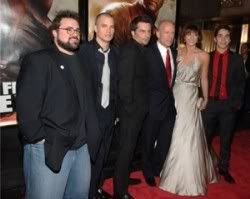
[Laughs]

WINSTEAD: I was really”¦I was cast at the last minute. I didn’t even really meet anyone beforehand: Len, Bruce or anybody. I was just sort of cast from a tape. I went in and saw the casting director months beforehand and suddenly they had seen some of my work and decided they wanted me for the role but I really didn’t know what they wanted. The script was very different from when I initially auditioned. The character was very different and it was a much bigger part. I was unsure of what they saw in me, it was a different casting process, but I knew that I couldn’t be some whiny, teenage daughter. It would have been really uninteresting.

I went back and watched all the other films. I just paid attention to Bruce’s mannerisms and that kind of Jersey attitude and the way he talks and moves. And his smirk, that sparkle in his eye. I knew I couldn’t do all of that. I couldn’t be John McClane but I thought it would be pretty cool if I could incorporate some of that into this young girl character and give her some of that tough, wise-ass attitude. I tried to do what I could.

It’s cool if people notice it because it wasn’t something that we talked about too much beforehand but it’s cool that it came out that way.

STIPP: When you went back to watch the movies”¦much in the same way that there were popular folk heroes of the 19th century”¦What has made John McClane, the impetus for so many rip-offs in the 90’s, such an endearing and enduring character in action movies?

WINSTEAD: There’s just something so entertaining about a character that he created. I think part of it is that he’s the reluctant hero and that, while he’s in the midst of everything, is just really angry that he’s having to save the day, that he’s having to take care of people, that he’s having to kill people. He wasn’t born to do that. It’s not his job but he’s put into this position where no one else is doing it and he has to step up. I also think there’s something entertaining about watching this hero that’s sort of hating it all along the way. Being a wise-ass”¦it’s just a more real character than the typical heroes that we see in action films who are so perfect and they always seem to be bouncing back effortlessly but when he gets knocked down it’s really hard for him to get back up. You can see his pain and you can see, even in this one, he’s getting older and it’s getting more difficult. You see all that and it kind of makes you root for him even more.

STIPP: The learning process on the set. I have to assume that this being one of the biggest films you’ve ever done, and there are some actresses who get soured on the big budget blockbuster once they do them, but what did you take away from the experience.

WINSTEAD:
It was kind of overwhelming while I was in it.

I didn’t see the big picture of it all. I was focused on doing my job and trying to do it well because there was so much more happening on that film than I even understood. It was kind of outside of my realm of understanding. I just had my little part to do and do it well and that was really all I could focus on. Now that I’ve stepped away from it and I’m part of this great”¦huge”¦film that everybody is really loving and going to the premiere and seeing the reactions of the fans and how much they love it and how sort of proud they were to be a part of the premiere. It’s just so amazing to be a part of a film that reaches so many people and excites them so I definitely would love to continue to do a movie every now and then that’s of that kind of stature and scale because it really is an amazing feeling when you get to step back and see what kind of big deal it is.

STIPP: Did Bruce impart anything worthwhile that you could apply to your own acting?

WINSTEAD: Watching him work was amazing to me because he’s incredibly subtle but it seems so much when you watch him on the screen. He’s so charismatic and it conveys so much with just the look in his eyes and that little smirk on his face”¦that sort of deadpan delivery. It’s amazing how effortless it is for him. And then, at the premiere, he would give these small tidbits of knowledge and wisdom. I was really overwhelmed, all I could do was take deep breaths and just say “This is insane”, and he just kept telling me to just take it in and appreciate it because you never know when you’re going to get another experience quite like that”¦and go back to your normal life the next day and you’re going to look back and think, “Wow, I was just at one of the biggest premieres at Radio City Music Hall.”

He’s just a really cool, laidback guy. He doesn’t try to impress himself on to you, try to tell you what you should do with your career, how you should behave but it was nice to be around him, be in awe of him at all times.

STIPP: It’s been a busy year for you with not only this but with GRINDHOUSE as well and has it informed your sense of how you want to take your career, going forward?

WINSTEAD: Yeah. I’ve just been having such a great time sort of playing these supporting roles in these great films where I get to be completely different. I’m just been so appreciative that I’ve had these kind of little nuggets of just really fun, interesting roles to play. I just want to do that as much as I can, find my way onto more great sets. GRINDHOUSE was one of the greatest experiences ever, just to be on the set with Quentin Tarantino who’s the most enthusiastic, joyous person to work with”¦and to see his child-like excitement about being on set and making a movie”¦I just kind of want that same thing. Just to have as much fun as possible and work.

STIPP: How are you handling, then, the preparations as the leading lady for your next film, MAKE IT HAPPEN?

WINSTEAD: It was a character that I was really drawn to”¦being from the dance world myself. Being able to play a dancer was really exciting for me and I feel like a lot of the dance movies that have come out in the last 10 years, not all, but some of them have been airy, sweet and simple. I’m just hoping to bring a more realistic edge to the character and show the more real-life”¦things that happen when you’re trying to become a dancer. My sister is a professional dancer and I used to be a dancer for a lot of my life and it’s really a tough life to live. I just want to show the less sweet side to it even though it will be a classic dance movie, a feel good girl movie. But I think we give it a little more interesting edge to it as well. It’s a challenge I’m taking on and I’ll see whether I can run with it.

STIPP: I was kind of surprised to see that one of your aspirations was to do a romantic comedy. Not surprise as if it’s a bad thing but you usually hear the words “art film” or “passion project” when you ask an actress what she’d like to do, going forward.

WINSTEAD: I think it would be a lot of fun. I also think it’s a lot more challenging than people would think. That’s why it’s really hard to find a really good romantic comedy because it’s really hard. A lot of great actors have a hard time doing that because there’s so much that goes into chemistry and comedic timing and I really kind of want to hone my skills as a comedic actress because I really admire that kind of performing.

And I’d really like to do a great art film but I don’t necessarily think that they’re all that great. Just because something is independent and dark and twisted does it make a good film. I’m not going to search out those kind of films”¦I’m going to search out films that are well written, well-crafted and that have interesting characters.

QSE News: 6/28/2007

Filed under: Columns,News — UncaScroogeMcD @ 12:50 am

quickstopnews.jpg

line1.gif

Here are today’s top entertainment headlines:

  • qsnews.jpgThe Spice Girls have announced that they will be reuniting and touring. The group will perform 11 shows in December and January. Religion has warned for centuries that there were four horsemen of the apocalypse. They were wrong – there’s five.
  • Fashion designer Liz Claiborne died Tuesday, at 78. Claiborne is credited with revolutionizing the working woman’s wardrobe. Claiborne died doing what she loved most… whipping 10-year-old Taiwanese children, while yelling at them, “So sew faster!”
  • Dark Horse Comics has joined forces with eBay for a chance to win dinner with superstar writer Joss Whedon.  Whedon, who’s best known for creating the character of Buffy the Vampire Slayer, will have dinner with the winning bidder during this year’s San Diego Comic Convention.  It is expected that the final bid on the dinner will be over $1000, or whatever the winner’s parents are willing to pay to finally get their 30-year-old child out of their basement.

line1.gif

That’s all for today’s news, stay tuned to this channel for all the news that matters least but you still care about.

(Compiled by J. Allen)

##

Quick Stop Thingamabobs: 6/29/2007

Filed under: Columns,Thingamabobs — UncaScroogeMcD @ 12:45 am

thingamabobs.jpg

The web. It’s a big place, full of plenty of distractions ““ some funny, some informative, some ludicrous, some disturbing, some inane, some profound. Each and every weekday, we present links to a few of our favorite finds”¦

————————————————

  • Wallace & Gromit in “Bully Proof Vest”… (Thingamabob)
  • A little clip from the Friday Night Project(Thingamabob)

Have a THINGAMABOB? Send it in!

##

June 28, 2007

Noctural Admissions: Movie Review – Live Free or Die Hard

Filed under: Columns,Nocturnal Admissions — UncaScroogeMcD @ 1:37 am

nocturnalheader5.gif

Die Hard poster

In Buster Keaton’s silent masterpiece, the civil war comedy The General from 1927, there is a marvelous scene where Buster gets himself out of yet another jam.

Contrary to popular belief, Keaton’s screen persona was not a sad sack constantly beaten down by life (later comics bore that responsibility). Rather, Keaton was an athletic, versatile, creative character, constantly innovating and thinking. In the scene in question, Keaton is engineering a train in an effort to catch up with his girlfriend, who has been kidnapped by the Northern army forces. Knowing that Keaton is behind them, the Northerners lay impediments on the track before him. At one point they are laying timber on the tracks. Keaton puts the train in first gear, so to speak, runs out, and picks up the first piece of lumber. But the train is still moving behind him, and before he can cast it aside, the cattle scoop plucks him up and carries him along. And there is another derailing piece of lumber just a head. What to do? We don’t know what is going to happen. But Keaton figures something out. He uses the lumber in his hand to catapult the one on the tracks out of the way, dispensing with both impediments simultaneously.

The audience response to this moment is to laugh. It’s a joyous laughter, an appreciation of Keaton’s cleverness. In essence, that what we are always doing when we laugh at a great witticism or muscular comeback in a comedy, admiring the speaker’s (or writer’s) achievement. Keaton and the other silent comedians took it to the physical level, speaking through their bodies and actions, a form of comedy that couldn’t really have existed before.

Die Hard Bruce

That’s why the Die Hard series and its new entry Live Free or Die Hard need to be viewed as fundamentally comedies. They hark back to Keaton and the physical comedians as improvisers out of cunningly constructed binds, where mind is as important as the body, where indeed it fuels the body.

Die Hard stunt

In Live Free or Die Hard Bruce Willis’s John McClane must: evade a helicopter chasing him through the canyons of DC, fight his way out of a SUV dangling down an elevator shaft, elude a jet fighter that is trying to blow him in in a semi, and get off the wings of said plane after it spins pilotlessly out of control. How he gets out of these and numerous other hair raising jams is the essence of the series, and of that type of comedy. Note at one point his use of a fire hydrant as chopper repellent. It’s a cartoon, the kind in a whole automobile can be used as a flying weapon.

Originally based on a Roderick Thorp novel, the series (which didn’t know yet that it was a series) established itself as a series in which a lone man in an enclosed setting uses only the improvised tools at hand to basically rescue his wife. The second film shifted the locale to an airport, maintaining the same decorum. But No. 3 went horizontal, spreading the area McClane has to manage to a whole city, New York. Now Live Free or Die Hard turns the whole eastern seaboard into Nakatomi Plaza, with McClane running from Rutgers to Camden to DC, to Virginia and Baltimore (what will the next film be? Live Fast, Die Hard, and Leave a Beautiful Corpse, with McClane globally fighting bad guys from outer space?). While the first film played with then current notions of terrorists (more German Eurotrash than true believers) and fears of Japanese encroachment upon the American economy, the second one was a take on Iran-Contra.

Die Hard Tim

The third film was a bit at sea, but this new entry is on more solid ground, with an acknowledgment of a post 9/11 world, with the villain Thomas Gabriel (Timothy Olyphant) presented as a variation on Robert Hanssen, with prime hacker Gabriel turning the system on itself to make about political point about the vulnerability of the system (or at least so it seems in the beginning). And here, McClane’s adult sized daughter Lucy (Mary Elizabeth Winstead) is the imperiled McClane who provides the plot’s engine in the final quarter.

Die Hard Justin Long

Like the third film, though, McClane has an unwanted partner, in this case a hacker named Matt Farrell, played by Justin Long, the Mac guy in the television commercials. But here he is John Hodgeman to McClane’s cool customer. It is Farrell who relates the essential premise of the film, the “fire sale” computer fiasco probably described in the news story on which the film is credited as being based (John Carlin’s piece “A Farewell to Arms”). It’s called virtual terrorism.

Die Hard Maggie

McClane, it turns out, doesn’t want to be a hero, he doesn’t like it, but he’s the guy who’s there at the time. McClane says this is a car as they are driving from one predicament to another as yet unknown one. It’s one of the few moments of tranquility and reflection in the film, and one of the few moments that really evokes the original Die Hard. In that film, McClane was an ordinary guy, an average Joe who ends up having to save a building, his wife, et cetera. Subtly with 2 and even more obviously with 3, McClane became an action hero, with all that means about circumscribing McClane’s character and what he feels about things.

Die Hard Maggie Q 2

Other random observations: There is an Agent Johnson joke “¦ Cliff Curtis (in the Reginald Veljohnson role) is, as usual, great, but not quite given enough to do “¦ Why do choppers get to fly around with impunity in movies such as this one and Lethal Weapon? If there is gunfire, don’t people complain, and anyway, isn’t all air traffic monitored? (though the situation is slightly different in this film, however) “¦ The secondary and tertiary villains aren’t as vivid as they were in Die Hard “¦ However, Maggie Q is excellent (though I doubt that fetish boots are standard issue when she is impersonating an FBI agent) and her fight scene with McClane is great “¦ Long’s characterization is perfect, ranging from his smart aleckyness, his living like a college student, his propensity to conspiracy theories, and his eating habits “¦ Zeljko Ivanek should play Vincent Bugliosi in a movie “¦ Is it unseemly to mention that Kevin Smith is great in a cameo? “¦ Director Len Wiseman (the Underworld series) does a satisfactory job, but does anyone really direct movies like this or like, say, Bad Boys 2? Don’t you really just have a meeting with the second unit director, then go off to walk Justin Long and Bruce Willis through a scene before clocking out for the day? “¦ The film has a hard, blue, grainy look throughout, like James Mangold’s Cop Land “¦ among the movies “quoted” are Speed, Independence Day, Jurassic Park 2, and Casino Royale (if that is humanly possible) “¦ The film has the best “knocked down stairs” moment since Joe Kidd “¦ This is a “modes of transportation” movie, in which McClane gets to drive about five different types of automobiles, including a chopper “¦ “Ode to Joy” does not appear in the film.

QSE News: 6/28/2007

Filed under: Columns,News — UncaScroogeMcD @ 1:32 am

quickstopnews.jpg

line1.gif

Here are today’s top entertainment headlines:

  • qsnews.jpgRock group Weezer is back in the studio recording its 6th album. Singer slash guitarist, Rivers Cuomo, posted a message on the band’s website. The bad news for fans is that the band is still not as good as they were 10 years ago.
  • During last night’s interview with former Beatles Paul McCartney, Ringo Starr and former-living Beatles wives Yoko Ono and Olivia Harrison, Larry King called Starr “George.” The mistake came as King asked about the passing of John Lennon. King recovered from the error by saying “what I meant was, why couldn’t it have been you?”

line1.gif

That’s all for today’s news, stay tuned to this channel for all the news that matters least but you still care about.

(Compiled by J. Allen)

##

Quick Stop Thingamabobs: 6/28/2007

Filed under: Columns,Thingamabobs — UncaScroogeMcD @ 1:31 am

thingamabobs.jpg

The web. It’s a big place, full of plenty of distractions ““ some funny, some informative, some ludicrous, some disturbing, some inane, some profound. Each and every weekday, we present links to a few of our favorite finds”¦

————————————————

Have a THINGAMABOB? Send it in!

##

June 27, 2007

QSE News: 6/27/2007

Filed under: Columns,News — UncaScroogeMcD @ 3:01 am

quickstopnews.jpg

line1.gif

Here are today’s top entertainment headlines:

  • qsnews.jpgIn a post on his Myspace blog, director Jon Favreau has seemingly confirmed that actress Hilary Swank will have a cameo role in the upcoming comic book movie Iron Man.  According to Favreau, Swanks’s scenes were filmed in Las Vegas at the Caesar’s Palace Casino.  While her official role is being kept a secret, many comic fans believe that Swank will be playing the role of the villain Horseface McGee.

line1.gif

That’s all for today’s news, stay tuned to this channel for all the news that matters least but you still care about.

(Compiled by J. Allen)

##

Quick Stop Thingamabobs: 6/27/2007

Filed under: Columns,Thingamabobs — UncaScroogeMcD @ 2:57 am

thingamabobs.jpg

The web. It’s a big place, full of plenty of distractions ““ some funny, some informative, some ludicrous, some disturbing, some inane, some profound. Each and every weekday, we present links to a few of our favorite finds”¦

————————————————

Have a THINGAMABOB? Send it in!

##

June 26, 2007

Toy Box: Ratatouille PVC figures

Filed under: Columns,Toy Box — admin @ 12:09 am

toybox.jpg

There are a lot of big movies hitting this summer. Which is sort of like the doctor saying ‘This might sting a bit’ before he amputates your right leg with nothing but a rag in your mouth and a bottle of whisky to make you feel better. Most (but not all) of these big summer blockbusters are sequels. And most are going to suck golf balls through a straw.

But hitting this weekend is one I’ve really been looking forward to, Ratatouille. Pixar’s latest film comes with less hype than last year’s Cars, and comes down a far less traveled story road. This is all about Remy, a little rat who longs to be a great chef in the city of great chefs, Paris. Early reviews are in, and so far every one loves it.

Last year’s Cars produced one of the hottest line of movie toys in years. Mattel continues to crank out the die cast cars, and kids and collectors continue to snap them up, a year after the movie hit. I don’t think Pixar and Mattel have any hopes that Ratatouille could possible produce the same situation, but you never know – remember how quickly that damn talking Buzz Lightyear disappeared after Toy Story hit movie screens.

Mattel has gone light with this movie, producing a basic set of action figures that look more like oversized Happy Meal toys than seven dollar figures, some animatronic Remy’s (including a RC version), and some PVC sets. I’ll be looking at the main PVC set tonight. Disney is doing another set of action figures to be sold only at their stores, but from early photos, I’m not holding my breathe on these.

If you have any comments or questions, feel free to drop me a line at mwc@mwctoys.com. Now let’s look at those little buggers:

Ratatouille PVC set

toybox_062607_1b.jpg

This PVC set contains 7 characters – Remy, Emile and Django (rats), and Linguini, Colette, Skinner and Gusteau (humans). There are also two playsets so far, which include another PVC each and which appear to be in scale (sort of) with these. I can’t comment for sure yet though, because I haven’t gotten one of these sets yet. I suspect I will though this week, along with the main animatronic Remy. I think once the movie hits, Remy is going to disappear quickly.

toybox_062607_1.jpg

Packaging – ***
While the box isn’t fancy, it does match up to the license well in color and graphics. It’s also collector friendly without trying, and you can easily remove the figures and put them back later if you are so inclined. I like boxes as well for the ability to store them, and there’s very little wasted space here.

toybox_062607_2.jpg

Sculpting – People ***1/2; Rats ***
I have to say that I haven’t seen any of the product so far capture the look of the rats perfectly. That being said, these PVC’s are the best I’ve seen so far. The rats aren’t in scale of course, standing about up to the waist of the humans, but considering how small the PVC’s are to begin with, that’s certainly forgivable. The expressions are good, and there’s decent detail here for the material and scale.

toybox_062607_3a.jpg

The humans are better than the rats, and look much more like their on screen counterparts. Like the Incredibles, this is a Pixar movie with a lot more humans in it than usual, but it looks like the style of animation is up to the task.

Overall the figures range in height from Remy, the shortest at about 2 inches tall in the chef hat, to the tallest, Linquini, at 4 1/2 inches.

Paint – ***
There are a ton of paint ops here, and you won’t see any serious small detail work. But the eyes are uniformly clean and straight, there’s little to no bleed between colors, and there’s even some nice dry brushing on the fur of Django. The paint work isn’t perfect, and there’s the usual sloppy lines around some of the shoelaces, eyebrows and hair lines. But considering the scale and the cost, the paint work ain’t bad.

toybox_062607_1c.jpg

Gusteau is a bit different. He’s cast in a translucent plastic, due to his, uh, ‘nature’ in the film. If you don’t know about him yet though, I won’t spoil it for you. Clear figures are always cool looking, but the downside is that the sculpt is very hard to make out.

Articulation – Bupkis
Did I mention these were PVC’s? Yea, I know, but I also like to include this category because occasionally there is a point or two of articulation, even with small PVC’s. That’s not the case here though, but this lack of articulation will have no effect on my personal overall score.

toybox_062607_6.jpg

It does appear that the neck on Colette and Linquini *might* be meant to turn, but mine seemed a bit stuck. The PVC is soft enough that tearing the head off is a very likely outcome, so I left things alone and figured it was best that way.

Accessories – **
Yep, these are PVC’s with accessories, so even a low score adds to the overall, since a Bupkis is assumed. The humans each include a small plastic display base, which is good since they can’t really stand without it. Making this a separate piece instead of part of the basic mold is also good, because if I’m a kid I might not want the base with me all the time. Of course, this also gives them one more thing to lose.

The fork and pile of…pickles? Tomato slices? Whatever it is…both of these come out of the hands of the other rats, and are also technically accessories. Sure, they look a *little* funny in those poses without them, but it’s not so far off that you actually couldn’t use them that way.

toybox_062607_5.jpg

Fun Factor – ***1/2
PVC’s are fun stuff, even without any articulation. Little green army men were the play staple of many a kid’s toybox, and they were even posed in some God awful ways. Did anyone like the ones that were laying down?

toybox_062607_4.jpg

There isn’t a lot of conflict with these characters, so action figures wouldn’t do all that well. These decorative figures, which can also be fun out in the sandbox or in the bathtub, are probably the best bet. They also go well with playsets, and I’m hoping we see more than just the two currently out.

Value – **1/2
At $15 for 7 PVC figures, you’re getting a pretty average value. These aren’t exceptional by no means, but they’re a sight better than those PVC sets that are so popular at the Disney stores and just as expensive (unless they’re having a sale) as these are.

toybox_062607_7.jpg

Things to Watch Out For –
Not a thing. They’re sturdy, well made, and very consistent.

Overall – ***
If you’re looking for some decent Ratatouille merchandise, I think your best bet are these PVC’s along with the playsets, at least at this point. The larger Mattel action figures are sad at best, and the early photos of the Disney figures doesn’t do much to alter my opinion on those either. You get a decent bang for your buck with these smaller figures, and both kids and adult fans can enjoy them.

Where to Buy –
I picked them up at Toys R Us, which appears to be the only retailer carrying much of anything for this flick. If you love the movie, I’d pick up the talking Remy early. I suspect he’s going to pull a Buzz Lightyear and disappear quick once the masses figure out how good the film is.

Nocturnal Admissions: DVD Review – This is Tom Jones: Rock ‘n’ Roll Legends

Filed under: Columns,Nocturnal Admissions — UncaScroogeMcD @ 12:06 am

nocturnalheader5.gif

OK, admit it. You love Tom Jones. How could you not? He is the “stage author” of at least five hit songs (“It’s Not Unusual” [1965], “What’s New Pussycat?” [1965], “The Green, Green Grass of Home” [1966], “Delilah” [1968], “She’s A Lady” [1971]), and his stage act is a blend of power balladry, sexual braggadocio, and good natured “I can’t believe this is happening to me” wonderment. If the self-mockery comes ultimately from Elvis, the forceful voice is wholly his own. Like many singers he was a force for only a short window of time, but the songs were so perfect, or he was so perfect for them, that he was able to dine out on them for decades. If the Wales-born coal miner’s son has an American equivalent it is Johnny Rivers, whose creative bulb burned brightly for a brief time with numerous late 1960s covers of ’50s hits, along with tunes such as “Poor Side of Town” and “Secret Agent Man,” but who then fell out of fashion or favor while yet still being able to have a career touring.

Jones is probably someone you need to see live. He is one of those rare performers whose voice outmatches the physical source. You can’t believe that a sound that powerful is coming out of a human being. But it is not a crude, inflexible instrument. As the new box set, This is Tom Jones, shows, the man, who had been singing since he was three years old, could belt out “What’s New Pussycat?” but also old standards such as “Danny Boy” and modern quiet numbers such as “I’ll Never Fall in Love Again.” Though by the time he began appearing in his own show Jones had been somewhat desexualized and turned into a Vegas style showman, This is Tom Jones‘s array of guests show that Jones could hold his own with Janis Joplin, Joe Cocker, and even Little Richard.

Despite his jokey-serious sexual swagger, Jones can’t help enjoying himself and his good luck, and while bejeweled and decked out like a ’50s crooner he has the virtue of sincerity. You can tell as he claps along and watches his guests that he really likes them. And they appreciated him. According to the box’s liner notes, Joplin normally hated doing television but consented to appear on his show because she liked his voice, a high compliment coming from a fellow power belter.

Tom Jones Box

This is Tom Jones (Time Life, Tuesday, June 26, 2007, three discs, $39.95) offers eight episodes of the variety show, which aired on ABC on starting Fridays from early 1969 through 1971. Guests that appear on the selected shows include Mary Hopkin, The Who, Burt Bacharach, Glen Campbell, Janis Joplin, Joe Cocker, Stevie Wonder, The Moody Blues, and Aretha Franklin (according to the Wikipedia, Crosby, Stills, Nash and Young were originally going to appear on the set, but due to rights issues, were replaced by Little Richard, which, as stated above, only serves to highlight Jones’s range better). Comedy acts include an early Richard Pryor appearance (which starts out awkward but gains speed), Peter Sellers, Anne Bancroft, Bob Hope, and the comedy troupes The Ace Trucking Company and the Committee, each troupe filled with now-familiar faces.

Tom Jones and Joe Cocker

As with other compilations, such as those of the Dick Cavett Show, half the joy of the set is the guest stars who often perform with more commitment than you’d expect. The Who really tear into “Pinball Wizard,” with the busy, brilliant Keith Moon in the background “mooning” the band itself by singing along with the song. Janis Joplin is also fully committed, and Jones acquits himself well in a later “duet” with her, if that term can be used for two vocal cannons aimed at each other. And I have to admit that when Jones joined Joe Cocker for “Delta Lady” I felt chills of appreciation and nostalgia. As shown on the show, they could have kept riffing on the song forever, and eventually time constraints lead a fade out. It was considered something of a joke back in the 1990s when Art of Noise tapped Jones for collaboration but as usual he surprised people who had forgotten that Jones’s singing roots were in R&B, soul, and blues ballads and that he was up to date with current songwriting. Other performers are Burt Bacharach (who, when he sings, does so into his chest cavity), and Glen Campbell, whose ephemeral appearance doesn’t even constitute a full song.

The other half of joy comes from Jones’s persona itself. The “concert” section of the show, which constituted the final portion of each episode and recreated Jones’s stage act (and which usually began with him waiting “backstage” with a “bird” in silhouette until announced, kissing her before grabbing a microphone [so that he would bounce onto the stage with a partial erection?]), shows the full range of his vocal ability, and Jones is one of the few singers who can do African-American music convincingly. He is also a fantastic dancer, and nerds who practice their moves in the bedroom mirror would do well to cut a few moves from Jones’s playbook.

Seeing Jones’s easeful screen presence – remarkable given that he had only broken into the business a few years earlier – I began to wonder why he didn’t make more of a go of it as a movie actor, the way his predecessors such as Sinatra (and by the way Jones does a terrific version of “Angel Eyes” on the disc) or his later friend Elvis did. With his swagger and gold chains and dashing appearance in a tux, Jones would have been terrific in any number of British crime dramas, and I can easily visualize him as the gangster in The Long Good Friday, or even as James Bond. I am guessing that the deal is that Jones wasn’t much interested in performing for a camera. He needs the juice of an audience. He hasn’t even recorded all that many records, relatively speaking. However, he has a real jones about being on stage, and his career has been almost wholly live performances since the 1980s.

The transfers are taken from original source materials but nothing was done to spruce them up, so they tend to be rather soft looking, and one episode only survives in a black and white version. It can be said for the English 2.0 mono audio track that it is audible.

Tom Jones extra

The extras are much more successful, however. Jones introduces most of the shows with an amusing anecdote and its airdate. Disc one contains three items. First, a short ABC commercial for the premiere that also cites the now forgotten The Generation Gap and Let’s Make a Deal game show the same night. Next, there’s one of those faked TV interviews, where the answers are shipped to local affiliates with the anchor reading from a list of questions (as also seen, for example, on the Dr. Strangelove extras). On this occasion, the noon time anchor for KATU-TV in my home town of Portland, Oregon, got the questions mixed up. Finally for disc one there is a new video interview with Jones in which he tells the story behind how he came to sing Burt Bacharach’s him to “What’s New, Pussycat?,” something he alludes to in one of the episodes. There are no supplements on disc two, but disc three offers a 30 minute video interview with Jones (shot on February 11, 2007), in which he discusses his own musical roots and the birth of the show. Finally, there is a 12-page illustrated insert with further information on each episode included.

QSE News: 6/26/2007

Filed under: Columns,News — UncaScroogeMcD @ 12:04 am

quickstopnews.jpg

line1.gif

Here are today’s top entertainment headlines:

  • qsnews.jpgTroubled actor Tom Sizemore has been sentenced to 16 months in jail for violating his probation on a prior drug arrest.  Sizemore, best known for his roles in Saving Private Ryan and Black Hawk Down, was arrested again last month on suspicion of possessing meth.  It is expected that while Sizemore is in jail, he will continue to act in such films as Dropping the Soap: Holing the New Guy and Tom Sizemore Becomes a Prison Bitch.
  • Singer Christina Aguilera is ready to make her film debut. According to the singer, she is actively reviewing scripts to find the right fit for her. Those closest to her reveal that she is looking for a totally unique script where a woman finds herself through either a road trip with her girlfriends or friends who encourage her to follow her dreams of singing.
  • It has been announced that Germany has banned the filming of the new movie Valkyrie because of the Scientology beliefs of the film’s star, Tom Cruise.  In a statement released to the press by the German Defense Ministry, officials have said that no filming will take place in Germany as long as Cruise is attached to star.  We here at QSE News applaud Germany for taking a stand against Mr. Cruise but warn them that Lord Xenu sees all and he will totally [EXPLETIVE DELETED] up your country. If you guys thought 1945 was bad… What? Too soon?

line1.gif

That’s all for today’s news, stay tuned to this channel for all the news that matters least but you still care about.

(Compiled by J. Allen)

##

Quick Stop Thingamabobs: 6/26/2007

Filed under: Columns,Thingamabobs — UncaScroogeMcD @ 12:02 am

thingamabobs.jpg

The web. It’s a big place, full of plenty of distractions ““ some funny, some informative, some ludicrous, some disturbing, some inane, some profound. Each and every weekday, we present links to a few of our favorite finds”¦

————————————————

  • A cereal called Twinkles… In color… (Thingamabob)

Have a THINGAMABOB? Send it in!

##

June 25, 2007

Comics in Context #182: The Red And The Black

Filed under: Columns,Comics in Context — admin @ 12:08 am

comicsincontext4.jpg

cic2007-06-18-1.jpgWriting this column nearly every week, I continually notice things that relate to installments I’ve already written, or to ones I’m planning to write.

For example, in the June 20 issue of The New York Times, columnist Thomas J. Friedman wrote about the masked members of Hamas, and about how masks can be both empowering and intimidating. Friedman also included a quotation by Oscar Wilde about masks that I found applicable to secret identities in the superhero genre. Here’s a longer version of Wilde’s characteristically paradoxical observation: “Man is least himself when he talks in his own person. Give him a mask, and he will tell you the truth”. Hence the Batman is more “real” than Bruce Wayne, and through their costumed personas, Clark Kent and Peter Parker can express aspects of their personalities that are concealed in their everyday lives.

This week I also watched Fritz Lang’s RKO film While the City Sleeps (1956) on Turner Classic Movies. The villain is a serial killer (played by Drew Barrymore’s dad) who turns out to be a fan of “so-called comic books,” a phrase used in the movie twice. It is one thing to be informed by books and documentaries about the attacks on comic books in the 1950s (see “Comics in Context” #95, 180). It is quite another to be ambushed unexpectedly with a slander against comics readers while watching a movie from that period. In the same year that DC Comics editor Julius Schwartz launched comics’ Silver Age, RKO Radio Pictures was instructing the moviegoing public that reading crime comics could turn you into a serial killer.

This seems a wee bit hypocritical of RKO and Mr. Lang. It is explained in the film that “comic books” are bad because they show readers how to commit crimes. The movie repeatedly demonstrates how one can surreptitiously adjust the “button lock” on an apartment door in order to break into the apartment later and kill the lady who lives there.

It’s also ironic that Fritz Lang, the director of this anti-comics movie, was the pioneer of the supervillain (as defined by Dr. Peter Coogan) in cinema (see “Comics in Context” #165) and his most celebrated film, Metropolis (1927), apparently inspired the name of Superman’s home city. (And would the name of Superboy‘s leading lady have been devised by combining the names of Fritz Lang and 1940s movie star Lana Turner?)

It turns out that Paul Dini was right (see “Comics in Context” #180): Boomerang has stopped showing even the pre-1948 Warner Brothers animated cartoons that the network’s parent Turner Broadcasting bought years ago, and has replaced its nightly Looney Tunes show with an MGM cartoon anthology. In the past I’ve praised Turner Classic Movies’ Cartoon Alley, which showcases classic Hollywood cartoons, including pre-1948 Warners shorts. I see from TCM’s online schedules that Cartoon Alley will cease at the end of July. Is this ominous?

Perhaps not. Recently on the Internet radio program Stu’s Show, animation historian Jerry Beck indicated that the classic Warners cartoons vanished from Boomerang because negotiations are afoot to show them Somewhere Else. But where?

In the season finale of NBC’s 30 Rock, Tina Fey’s character, Liz, has a cell phone that rings to the tune of the “Ride of the Valkyries.” Hearing this, another character, Phoebe, asks Liz if she likes Wagner. Liz says no, it’s a reference to Bugs Bunny, whereupon she and her friend Jenna merrily start chanting “Kill the wabbit!” I wonder, since the classic Warners cartoons are no longer on TV every day, if in twenty years a sitcom would portray two thirtysomething women knowing who Bugs Bunny is, much less quoting a specific Bugs Bunny cartoon (Chuck Jones’s 1957 What’s Opera, Doc?; see “Comics in Context” #102). At least these cartoons have been coming out on DVD, enabling parents to introduce them to their kids.

I am pleased that, after running the first two seasons of the animated Justice League series on a seemingly endless loop, Boomerang has finally begun showing its superior continuation, Justice League Unlimited. I hadn’t seen any of the “Cadmus” arc episodes before, in which the American government regards the Justice League as a possible menace. The episode I saw several days ago, “The Doomsday Sanction,” lived up to the arc’s high reputation. I was surprised and especially impressed by its conclusion, in which Batman agrees that the League could become a threat to the world, thus echoing the Batman of Kingdom Come and his counterpart, Nighthawk, in Mark Gruenwald’s Squadron Supreme (see “Comics in Context” #150), all of them wary of even well-intentioned individuals possessing near-absolute power.

This week I also realized I had forgotten to mention one of the celebrities I sighted at the premiere for Spider-Man 3 in Astoria, Queens (see “Comics in Context” #181): Micky Dolenz, who first came to fame in the same decade that Spider-Man did, the 1960s, as a member of the Monkees. (You can find pictures of Dolenz at the premiere at www.gettyimages.com). I suppose this supports J. Michael Straczynski’s theory in his run writing Amazing Spider-Man that Spider-Man keeps attracting other characters with animal totems.

The premiere was on Monday, April 30, as part of both the Tribeca Film Festival and “Spider-Man Week in New York,” as officially declared by New York Mayor (and possible presidential candidate) Michael Bloomberg. I resumed attending “Spider-Man Week” activities on Saturday.

The New York Public Library’s Humanities and Social Sciences Library (the famed building on 42nd Street and Fifth Avenue, guarded by the iconic lion statues) was displaying what was billed as “The Ultimate Spider-Man Comic Collection.” (No, there were no copies of Marvel’s Ultimate Spider-Man on exhibit.) The building is visible in the first Spider-Man movie, when Uncle Ben drops Peter off in front of the library, but I was still surprised that the library was participating in this big public relations spectacular promoting Spider-Man 3.

It was even more of a surprise because back in the mid-1990s I did research into the number of American libraries that collected comic books, and there were relatively few, with only a few noteworthy collections such as those at Ohio State and Michigan State Universities. Back then the New York Public Library’s website conceded it had a few boxes of old comics, but otherwise discouraged people from researching comics there. Matters have radically changed at America’s libraries over the following years.

In the McGraw Rotunda, a few flights up and outside the main reading room stood a few glass cases holding seventeen vintage Spider-Man comic books, primarily copies of those written by Stan Lee during the Silver Age of the 1960s: Amazing Spider-Man Vol. 1 #32 (January, 1966) was the earliest, and Amazing Spider-Man Annual #21 (1987), featuring the wedding of Peter Parker and Mary Jane Watson, was the most recent. You could easily see many of these comics in the dealer’s room in a large convention. I own copies of many of these comics. I again found myself reflecting that since nowadays museums and libraries display original printed comic books, why, I could turn my own comics collection into a museum exhibit! Moreover, the labels I’d write for my books would be more informative and analytical than the ones that the New York Public Library provided, which were content to credit the writer and artist, summarize the story, and quote some dialogue. As for literary or artistic analysis, there was none. In short, the New York Library’s exhibit was far from “ultimate.” I also found myself wishing that the people crowded around these glass cases knew about my Stan Lee retrospective exhibit down at the Museum of Comic and Cartoon Art, which is far more enlightening about the cultural import of Marvel in the 1960s, if I do say so myself (www.moccany.org).

My visit to the Library and perusal of the “Ultimate” exhibit took maybe fifteen minutes tops, much of which was consumed going up and down staircases. But upon exiting the Library, I entered a nearby discount DVD store, where I found and bought The Jean Renoir Collector’s Edition, an inexpensive three-disc collection of seven of the great director’s lesser-known films. So, visiting the Library hadn’t been a waste of time, after all.

Then I headed up to the American Museum of Natural History, which was contributing to “Spider-Man Week” with an exhibit called “Spiders: Alive!“ in what the museum now calls its “Grand Gallery” (it’s well designed, but hardly grand) on the first floor. On Tuesday the Beat, who always knows about such matters in advance, saw “Spiders: Alive!” when Tobey Maguire, Spidey himself, was making a personal appearance there. When I got there on Saturday afternoon, I had to content myself with the exhibit itself consisting of a row of glass cases holding rather large tarantulas. One of them was called the “Goliath birdeater tarantula,” which should give you some idea of its size.

A lengthy wall text asserted, among other things, that in endowing Spider-Man with the ability to shoot webbing, Spider-Man’s creators “must” have been inspired by a relatively little known kind of spider that can cast its webbing over a victim. Couldn’t the museum have contacted Stan Lee and asked him?
I rather think that if Stan Lee and Steve Ditko had been aware of this particular species of spider, Lee would have mentioned it in an interview, or even in “Secrets of Spider-Man” in the first Amazing Spider-Man Annual (1964).

Just because a scholar can find a real-world analogue to something in a creative writer’s work doesn’t mean that the writer “must” have been aware of the connection. Frank Miller put a scientist named Beaker in Elektra: Assassin. Years ago, I asked him if he named Elektra‘s Beaker after Dr. Bunsen Honeydew’s assistant Beaker on The Muppet Show: Miller replied he had never heard of the Muppet Beaker.

Unfortunately, as comics attract more interest from mainstream culture, we are probably going to see more of these unfounded scholarly assumptions.

For the magazine of Britain’s Tate art museums, academic John Carlin, co-curator of the “Masters of American Comics” exhibition, wrote a mostly excellent essay about members of the high art canon whose work foreshadows that of twentieth century comics artists. Like Alan Moore, artist Bryan Talbot, and myself (see “Comics in Context” #72), Carlin has noticed the similarities between the godlike and heroic figures drawn by the British artist William Blake (1757-1827) and those of contemporary comics. Ignoring Joe Simon’s and Stan Lee’s roles as co-creators, Carlin writes that “Echoes of his [Blake’s] flattened muscular style reverberate throughout the comic’s heroic phase, particularly by artists such as Jack Kirby (1917-1994), creator of Captain America, The Hulk, X-Men and the overall look of Marvel Comics. . . .Kirby used techniques pioneered by Blake to create a realistic sense of epic action through the combination of muscular figures with exaggerated patterned backgrounds. . . .” Was Kirby aware of Blake’s work? If so, it hasn’t yet been revealed in print, to my knowledge. Read that passage carefully, and you’ll see that Carlin is saying that Kirby and Blake used the same “techniques,” and not necessarily that Kirby was aware that Blake had used them. But someone could easily misread this to draw the latter conclusion. Carlin also misses a major (if probably coincidental) similarity between Blake and Kirby: each created his own mythology of fictional deities and heroes.

On the other hand, Danny Fingeroth recently pointed out to me that the full name of the Sub-Mariner’s creator Bill Everett was William Blake Everett. It turns out he was William Blake’s descendant, so perhaps Blake influenced the creation of one of Marvel’s first superheroes. (See this).

Going through “Spiders: Alive!” likewise took no more than ten to fifteen minutes, much of which was spent waiting for people in front of each glass case to move aside so I could get a look. The big spiders were interesting for a short look, but not worth the long trip into Manhattan.

However, just off the Grand Gallery was the newly opened Spitzer Hall of Human Origins, a handsomely designed new exhibit of fossils of mankind’s prehistoric ancestors, which I visited for the first time. (Over the decades since I first visited the museum, this is the third version of this gallery, which was once devoted to human biology, but it is by the far the best.) Up on the fourth floor I visited for the first time the museum’s newly opened and restored Audubon Gallery, which retains the look of a museum hall from the 1930s. John James Audubon is famous as a painter of birds, but the gallery displayed his lesser known but remarkable portraits of North American mammals, and as an X-Men enthusiast, I was delighted to see a stuffed wolverine, mounted as if roaring at the visitors. So the trip to the Museum had been well worth it, after all.

I intended the high point of this particular Saturday to be my viewing Spider-Man 3 itself, which I saw at Manhattan’s enormous Ziegfeld Theatre, and this time I was not disappointed. Director Sam Raimi’s Spider-Man movies are by far the best of the early 21st century wave of superhero genre movies. Richard Donner’s Superman movies (including the excellent new Superman II: The Richard Donner Cut on DVD) and Tim Burton’s first Batman film give the Raimi Spider-Man movies heavy competition for the honor of the best live action movie based on superheroes that originated in comics. I’m tempted to name The Incredibles, an animated film which is not based on a comics series, as the most successful realization of the superhero genre in a feature film (see “Comics in Context” #62). But the Raimi Spider-Man has now maintained its high level of achievement for three films in a row, whereas Warners’ 1980s Superman and 1990s Batman live action film series plummeted into uninspired camp by their third installments.

Much as I loved the first two Spider-Man films, I had trepidations before seeing the third. Sam Raimi is clearly a devotee of the Spider-Man comics of the 1960s, when Stan Lee, Steve Ditko and John Romita., Sr. defined the character, his world, and the series’ themes. Perhaps Raimi is an enthusiast for the superhero comics of the Silver Age, the years from 1956 to 1970, in general. To me Spider-Man and Spider-Man 2 were standard bearers for what I have dubbed the neo-Silver movement in the genre, the effort to resurrect the heroic, inspiring, entertaining spirit of the Silver Age comics while updating it for a 21st century audience. But Spider-Man 3 was said to feature Venom, one of the iconic figures of the darker comics of the 1990s, when the genre, to my mind, was losing its way. With Spider-Man 3, it looked as if the movie series might be taking a leap from the Silver Age into the era of the Grim and the Gritty.

For readers who do not already know, in the comics Venom ultimately derives from the new black costume that Spider-Man acquired on an alien planet in the landmark 1984-1985 crossover series Marvel Super Heroes: Secret Wars. Whether or not the Powers That Be originally intended the black costume to replace Spider-Man’s traditional red and blue one permanently, I have no idea But it certainly seemed that way at the time, boosting sales of Amazing Spider-Man #252, in which it first appeared, as surely they had intended. The black costume was nevertheless a mistake: not only was it less interesting than Steve Ditko’s original design, but the wisecracking, web-slinging Spider-Man should be represented by brighter colors than a somber black. It was yet another instance in which the discerning superheroes aficionado had to wait patiently for the Rubber Band Theory of Cartoon Art (see “Comics in Context” #75) to take effect. Eventually, Spider-Man got his original costume design back.

The black costume was revealed to be a sentient alien creature which bonded to its host and was taking mental control of Peter Parker as he slept, though it did not affect his personality when he was awake. Parker finally rid himself of the alien symbiote, and eventually reassumed his red and blue costume whenever he went into action as Spider-Man. Hating Parker for rejecting it, the symbiote bonded with disgruntled reporter Eddie Brock, who also hated Parker, forming the menace called Venom.

Visually Venom was a new variation on that archetypal figure, the superhero’s evil twin. But in the comics Venom was more massive than Spider-Man, with the steroid-style musculature seen on so many superhero genre characters in the 1990s. Venom also had a long, lascivious tongue, and students of the subtext of the cover for Heroes for Hire #13 (see “Comics in Context” #179) should be able to work out what that means. Venom also used to fantasize about not only killing Spider-Man and other victims, but also devouring them. In short, Venom was an utterly repulsive villain, and such was the mindset of tens of thousands of Marvel readers in the 1990s that they therefore embraced him as a hero. Apparently readers identified with this vicious, insane, musclebound cannibal. (Would I want to associate with readers like this? I don’t think so.) Venom starred in one miniseries after another, and since Venom had become a hero of sorts, Marvel felt obliged to create a new, even nastier version of the character, Carnage, whose human host was a serial killer. Now, you may think that it was harmless for Venom to talk about cannibalism, since he didn’t actually practice it. But in retrospect we can see that Venom set the stage for The Ultimates‘ version of the Hulk, who really does eat his enemies.

So you can see why I was not happy that Venom had found his way into Sam Raimi’s movie trilogy. It turns out that this wasn’t Raimi’s idea, either. According to Raimi’s interview at Comic Book Resources, he and his brother Ivan had already concocted a story for the third movie with the Sandman as the main villain. “When we were done, Avi Arad, my partner and president of Marvel at the time, came to me and said “˜Sam, you’re not paying attention to the fans enough.. . .You’ve made two movies now with your favorite villains and now you’re about to make another one with your favorite villains. The fans love Venom. He is the fan-favorite. All Spider-Man readers love Venom. Even though you came from ’70s Spider-Man, this is what the kids are thinking about. . . .'” Raimi told the Hall H crowd last year that “I had been objecting to the lack of humanity [in Venom].” But Arad and Alvin Sargent, a screenwriter on Spider-Man 2 and 3, educated Raimi in Venom lore, with the result that “‘”¦ in studying him I gained an appreciation for him,’ said Raimi. “˜Venom has always been a character that the fans love”¦ that’s why he’s in here'”.

I’m a Spider-Man fan, and I don’t love Venom, and I believe I have company in this respect. Moreover, Venom debuted in Amazing Spider-Man #299 (April, 1988) and his heyday was in the 1990s, when most of his miniseries were published. Raimi has reported that he did see e-mails from fans who wanted Venom to have a big role in the movie. But although the character is still around in the comics, I notice that a 2000 attempt to relaunch him in a regular series lasted only eighteen issues. Venom is really a creature of the period of the comics speculator boom, which now seems long ago. In contrast, Raimi’s choices for the villains of the first two Spider-Man movies, the original Green Goblin and Doctor Octopus, both Lee-Ditko creations, retain their hold on comics fans’ imaginations after over forty years.

Spider-Man 3 ends up with three major villains–the Sandman, presumably to satisfy Raimi’s fondness for the Lee-Ditko characters; Harry Osborn as “the New Goblin,” continuing Harry’s character arc from the first two movies (and echoing the 1970s Spider-Man comics, in which Harry succeeded his father as the Green Goblin); and Venom, whose presence keeps Avi Arad happy. Some reviewers thought this was too many villains for a single film, but I think that the screenplay makes them all fit, giving a part of satisfactory size to each. Then again, I’m not an admirer of Brock/Venom, and I can see that his fans might think that he got insufficient time and development onscreen: Eddie doesn’t become Venom until the film’s final act.

But had Arad not pushed Raimi to include Venom, Spider-Man 3 would have been a very different movie. The black costume–the symbiote–drives the plot. Peter Parker in the black costume plays a much more significant role in the story than Eddie Brock in the black costume does. Arguably Spider-Man 3 actually has four villains, and the foremost of these is Spider-Man himself in the black costume.

One of the principal themes of the superhero genre is the duality of the human personality. This duality can take the form of the division between the conventional introvert who blends into society (Clark Kent, Peter Parker) and his other identity, the heroic individualist who stands out from the society he protects (Superman, Spider-Man). Often the duality is that of the “good” and “evil” or violent sides within the same individual, as exemplified by characters like the Hulk and Two-Face. In other cases, a superhero’s “evil twin” or counterpart represents the hero’s own dark, evil or violent side. Thus, Venom, as noted above, is metaphorically Spider-Man’s “evil twin.”

Raimi makes the “evil twin” connection visually stronger by depicting his Venom without the exaggerated, gargantuan physique, making him look the same size as Spider-Man. (Though Raimi retains Venom’s sharp teeth, he omits Venom’s serpentine tongue and cannibalistic tendencies, probably out of good taste.) Moreover, Raimi cast Topher Grace, an actor who somewhat resembles Tobey Maguire, as Eddie Brock, further reinforcing the “evil twin” visual imagery. Did any of you see Maguire’s appearance on the Late Show with David Letterman on May 1 to promote Spider-Man 3? Initially Grace came out, pretending to be Maguire, until the real Maguire appeared, feigning anger, and supplanted him in Letterman’s guest chair. Whether or not they consciously intended it, the gag reinforced the “evil twin” imagery of the film.

For the middle section of Spider-Man 3, however, Spider-Man becomes his own evil twin when he dons the black costume. The black costume gives Raimi an opportunity that the Spider-Man comics writers did not take back in the 1980s: the sentient costume affects Peter Parker’s mind, drawing out the darker side of his personality.

This “Dark Spider-Man” storyline fits into Marvel tradition: it does not just resemble X-Men‘s “Dark Phoenix Saga” from the 1980s, which was adapted into X-Men: The Last Stand (see “Comics in Context” #134-135), but also Stan Lee and Jack Kirby’s own work from the Silver Age of the 1960s. The duality of Bruce Banner and the Hulk provide an obvious example. But I think especially of the two Lee-Kirby Fantastic Four storylines in which Ben Grimm, the Thing, temporarily went “bad” after his mind was tampered with (first by the Wizard in issues #41-43, and then by the Mad Thinker in #68-71).

The “Dark Spider-Man” storyline can also be seen as an extrapolation of an aspect of Stan Lee and Steve Ditko’s Spider-Man origin tale in Amazing Fantasy #15 (1962) that Raimi had omitted in adapting it in his first Spider-Man movie. In the movie when Peter Parker first encounters the Burglar (who will later be identified as the killer of Peter’s Uncle Ben), Peter has just been cheated out of the money due him from a wrestling promoter. After the Burglar robs the promoter, Peter lets him escape, as a petty act of vengeance against the promoter. In Lee and Ditko’s origin story, Spider-Man’s motivation for refusing to halt the Burglar is quite different. Having become a show business sensation in his masked identity, the formerly introverted, humble Peter Parker has let Spider-Man’s newfound fame go to his head. The egotistical Spider-Man simply can’t be bothered to (minimally) risk his neck by using his powers to try to stop a mundane robbery. In Lee and Ditko’s compact origin tale, this phase of Spider-Man’s personality lasts only a few pages: the murder of Uncle Ben, and the subsequent discovery that the same Burglar he let escape had killed him, shocks Peter out of his moral complacency. In Marvel’s What If. . .? Vol. 1 #46 (August,1984), Peter B. Gillis wrote a remarkable story, “What If Spider-Man’s Uncle Ben Had Lived?”, in which the swell-headed Spider-Man stays in show biz and evolves into a full-fledged, archetypal Hollywood asshole.

In effect, Raimi uses Spider-Man 3 to go back and explore the effects of fame’s temptations on Peter Parker. Raimi told one interviewer that “in this story, Peter Parker falls victim to his own pride. He starts to believe all the press clippings about himself, that he’s really this hero and someone great”. It’s interesting that Raimi characterizes Peter’s Achilles heel as pride. Pride was the sin that brought about the fall of Lucifer; overweening pride, or hubris, is the characteristic flaw of the protagonists of classical Greek tragedy.

In part because Spider-Man is now acclaimed as a hero in New York City (which rarely happens in the comics), Peter doesn’t sufficiently empathize with his girlfriend Mary Jane over the sudden downturn in her career. At first Peter seems touchingly overwhelmed at watching the enthusiastic crowds gathering for the city’s celebration of Spider-Man, hosted by Gwen Stacy, but once he’s in costume, he gets carried away by the occasion, letting Gwen kiss him as he hangs upside down, shocking Mary Jane, who considers that to be “their” kiss (from the first movie). At this point Raimi’s Peter/Spider-Man is not as self-centered as Lee and Ditko’s Spider-Man was at the midpoint of his origin story, but he’s lost perspective enough to be oblivious to the serious damage he is wreaking on his relationship with Mary Jane.

The black costume’s psychological effect intensifies these egotistical tendencies in Peter/Spider-Man: it loosens his moral inhibitions, and reduces his empathy towards others, so much that in a subterranean battle with the Sandman, Spider-Man actually tries to kill him. The dialogue makes this explicit. Of course, the Sandman, whose body has been converted to a sand-like substance, is virtually indestructible, so Spider-Man’s effort is in vain. Nonetheless, I was surprised that the movie allowed Spider-Man to go that far: he would have succeeded in killing almost anyone else in the same situation. Raimi seems surprised, too, telling an interviewer that “I didn’t like watching Spider-Man go bad. It was unpleasant and I kept worrying, “˜Gee, do I really have to do this to show how rageful and vengeful he is? Do we really have to show how pride can destroy you?’ But, my brother kept telling me, “˜Yes, because he’s going to find himself again.'”.

Recently I rewatched portions of Ethan and Joel Coen’s The Hudsucker Proxy (1994), which they co-write with Sam Raimi. Set in the late 1950s, its protagonist is Norvell Barnes, an innocent young man (and something of a fool) who becomes the head of a major company and unexpectedly becomes a great success, thanks to his invention, the wildly popular hula hoop. Barnes gets carried away with his power and success, unwittingly distancing himself from the woman who loves him. Graduate students of the future, here is the link between Raimi the screenwriter of The Hudsucker Proxy and Sam Raimi the auteur of Spider-Man 3! And although Danny Fingeroth has cautioned me against quoting Wikipedia, I feel I should mention that its entry on The Hudsucker Proxy observes that “A scene in the Sam Raimi directed film Spider-Man in which Norman Osborn (Willem Dafoe) addresses his board members is shot in an almost identical fashion to a similar scene in The Hudsucker Proxy and even reuses the same dialogue from the film: “˜Costs are down, revenues are up, and our stock has never been higher.'”

After Peter angrily strikes Mary Jane (which drew a gasp from the audience when I saw the movie), the damage he has been doing to their relationship takes a physical form. Like his recognition of the captured Burglar in the Lee-Ditko origin story, this shocks Peter out of his previous pattern of behavior. In a church, Peter literally tears the black costume from his body, as church bells sound. This scene echoes a sequence from the original black costume storyline in the comics, in which the sound of church bells weakens the symbiote. In the movie, however, since the black costume represents Spider-Man’s own “dark side,” the church bells sequence comes off more as a metaphorical exorcism of evil.

But it’s only a partial exorcism. The evil that was within Peter Parker now takes physical form as something outside him when the black costume attaches itself to his rival and semi-lookalike Eddie Brock, becoming Venom. (I suppose that you could say that in the movie, Peter in the black costume was the first Venom, and Brock in black is the second.) Peter’s internal struggle against his dark side, which ended with his rearing off the costume, is succeeded by an external struggle against his dark side, as metaphorically incarnated by Brock as Venom. Separated from Peter, the “dark side” embodied by Venom is now free of his conscience. Brock, the symbiote’s new host, is portrayed throughout the film as having a shallower personality than Parker. This makes Brock less interesting and developed as a character, but it fits his role in the movie. Whether as Venom or as his normal human self, the movie’s Brock is less a person than a representation of Peter Parker without his strong moral sense.

Since Peter, in the black costume, wreaked emotional harm on Mary Jane and finally physically struck her, it makes sense that his dark side, now represented by Brock/Venom, endangers her very life. Ultimately, using the church bells’ sounds again, Spider-Man performs a further “exorcism,” this time utterly destroying Venom, who is literally blown into nothingness.

In the comics of the late 1980s and early 1990s, Venom became a hero of sorts, reflecting the depressed moral standards of the Grim and Gritty era. In contrast, Spider-Man 3 introduces Venom in order to exorcise him. Peter Parker descends into the hell within his own psyche, represented by the black costume, only to reemerge and win redemption. That potential for redemption is what keeps Spider-Man 3 firmly in the neo-Silver movement, just like the previous two Spider-films.

In the previously quoted interview, Raimi states that he and his brother Ivan, who collaborated on Spider-Man 3‘s story, wanted their protagonist to learn that “he himself might have some sin within him and that other human beings, the ones he calls criminals, have some humanity within them”. In Spider-Man 3 the black costume brings out the “sin” within Peter Parker.

But why would this be a new discovery for Peter? In the comics Peter Parker has recognized the “sin” within himself since the end of Amazing Fantasy #15, as I shall explain next time.

ADVERTISEMENTS FOR MYSELF

I will be appearing at the Big Apple Con (www.bigapplecon.com) at Manhattan’s Penn Plaza Pavilion on Saturday, June 23, where I will be interviewing comics writer/artist Walter Simonson (Thor, Elric, Hawkgirl, Fantastic Four and more) and possibly artist Paul Gulacy (Master of Kung Fu, Catwoman, Sabre, Squadron Supreme, and others). Big Apple attendees will be able to take a shuttle bus down to the annual MoCCA Art Fest (www.moccany.org) at the Puck Building. Fest attendees, in turn, can walk two blocks to MOCCA itself, where the Fest’s panels will be held, and can look in on the exhibit I co-curated there, “Stan Lee: A Retrospective.” (I will probably drop in there myself!)

Copyright 2007 Peter Sanderson

Noctural Admissions: 2007 Season TV Roundup – The Hoarse Whisperers

Filed under: Columns,Nocturnal Admissions — UncaScroogeMcD @ 12:06 am

nocturnalheader5.gif

In late April, Alec Baldwin stunned both his fans and the followers of Tina Fey’s show 30 Rock when he announced to audiences on The View that, in the words of the USA Today headline, “I want off this show.”

The reasons for his distraction are now famous: an excoriating audiotape of a telephone message he left his daughter after a missed ‘phone call, all part of an ongoing custody battle between Baldwin and his ex-wife, Kim Basinger. Basically Baldwin, pled with NBC executives to release him from his contract.

Baldwin

To their credit, NBC’s honchos, as quoted in USA Today, said, “Alec Baldwin remains an important part of 30 Rock. We look forward to having him continue his role in the show,” sensibly ignoring the troubled actor, who also that week quit his agency, Creative Artists Management, which also represented his wife, Kim Basinger (Baldwin rejoined CAA just this week, late May).

But it’s not just for the sake of 30 Rock that fans rejoiced at the idea of Baldwin’s continual presence on the show. Baldwin is a member of a small, select group of actors who have but one thing in common. They all speak in a low, hushed, tone, all the better to attract attention to themselves within the hubbub of the moving image frame. We like to call them The Hoarse Whisperers.

Olmos

There are more Hoarse Whisperers than you suspect. If Baldwin is the granddaddy of the technique, its Pied Piper and its Pope, he has numerous followers and acolytes. Another key practitioner of this oral tradition is Edward James Olmos, who must drive the sound technicians on the set of Battlestar Galactica mad with his low rumblings, so similar to the constant roar of the Galactica itself. Another nominee is Anthony LaPaglia on Without a Trace. LaPaglia low tones may be sparked by the fact that he is really Australian (like seemingly everyone else on this New York-set show), and a growly, gravelly tone masks his struggle with the American accent.

Sutherland

But perhaps the king of the Hoarse Whisperers is Kiefer Sutherland in 24. His sonorous tones never rise above the level of a kat’s purr, even when he is applying electrodes to the testicles to his girlfriend’s brother on the off chance he knows something about terrorism.

More of an honorary Hoarse Whisper is David Caruso in CSI: Miami. Caruso is more of a low talker than a whisperer, or at least his whispering isn’t particularly hoarse. Caruso keeps his voice low because it lends his noble character gravitas and moral superiority. Michael Chiklis, on The Shield, is also of this school, the whispering elevated to a higher level by a lethal growl. James Spader on Boston Legal goes in and out of hoarse whispering. He can yell in a court room when he needs to, but for the most part, he likes to sit back, his oval face impassive, and hoarsely intone his lines – which, if they could be transcribed to a musical scale or a graph would resemble a swan’s neck, starting high and high pitched before cascading down to a punchline. Also in this league is Patrick Warburton on Rules of Engagement. The former Puddy on Seinfeld only occasionally lowers the register to a whisper, preferring for the most part to adopt a Slow Talkers of America pace. Warburton, who had the brilliance to realize that, looking like a cartoon character, he should only play such, carries to technique to his vocal instrument, which has also enhanced characters in shows such as The Tick and The Venture Brothers.

The phenomenon of the television Hoarse Whisperer mirrors a more dire trend in movies. There, older actors of some repute such as Paul Newman, Clint Eastwood and Al Pacino have been using faulty instruments in recent years, their voices curiously shredded (curiously because normally actors train their voices to last). These rasping actors have effectively cut down on their range thanks to these changes in their vocal cords. Even Clint Eastwood, whose career was staked on a lack of range, has had trouble uttering the simplest lines lately, thanks to the impediment of his scratchy throat. And Eastwood was the king of all Hoarse Whisperers since way back in the 1960s and the series of monosyllabic spaghetti westerns he made for Sergio Leone. Fortunately, his heir on big screen hoarse whispering, Sam Elliott, has evinced little difficulty in speech despite his own doddering age.

But the small screen is the proper venue for a Hoarse Whisperer. There, the practitioners of this near-silent art can plume new depths of hoarseness and quietude, in tones so low the viewer feels inclined to lean forward desperately in their Barcaloungers (that, or turn on the subtitles).

Alec and Will

Another great Hoarse Whisperer is Canadian comedian Will Arnett, late of Arrested Development, who adds an arch aggression to his low hum. An apotheosis of sorts, a croaking chorus of Hoarse Whisperers, was achieved in the April 5 episode of 30 Rock when Arnett showed up as Jack Donaghy’s corporate nemesis, Devon Banks, the Vice President of West Coast News, Web Content, and Theme Park Talent Relations, whom Jack thinks is gunning for his job. At a key moment toward the end of the show, where Jack and Devon face off on the set of The Girly Show, Tina Fey’s Liz Lemmon, acknowledging the existence of the Hoarse Whisperers, says, “Wow, if this turns into a showdown, you guys could settle it with a [switching to a coarse whisper] ‘talking like this’ contest.” At last! Someone within the media has finally stated the obvious! Ah, a very satisfying movement for students of the Hoarse Whisperers.

QSE News: 6/25/2007

Filed under: Columns,News — UncaScroogeMcD @ 12:04 am

quickstopnews.jpg

line1.gif

Here are today’s top entertainment headlines:

  • qsnews.jpgEvan Almighty debuted in the number one spot at this weekend’s box office. The film, which stars comedian Steve Carrell, pulled in $32.1 million. The film did not do as well as expected despite warnings from Christian leaders that if people do not see the film, they would go to hell.
  • Rapper 50 Cent is back in court but this time, it’s for child support. Marquise Jackson, the mother of Cent’s 10-year-old son is asking for more child support. Cent said that while he wouldn’t offer Jackson any more money, he would give her “a cap in her ass.”
  • Organizers for the Live Earth concert series have canceled the planned performance in Istanbul, Turkey.  The show was to be part of an eight site concert happening in different cities all over the world and featuring such artists as Snoop Dogg and Shakira.  According to insiders, the show was canceled due to confusion surrounding the location.  Istanbul was Constantinople, now it’s Istanbul not Constantinople, been a long time gone, why did Constantinople get the works?  That’s nobody’s business but the Turks.

line1.gif

That’s all for today’s news, stay tuned to this channel for all the news that matters least but you still care about.

(Compiled by J. Allen)

##

Quick Stop Thingamabobs: 6/25/2007

Filed under: Columns,Thingamabobs — UncaScroogeMcD @ 12:02 am

thingamabobs.jpg

The web. It’s a big place, full of plenty of distractions ““ some funny, some informative, some ludicrous, some disturbing, some inane, some profound. Each and every weekday, we present links to a few of our favorite finds”¦

————————————————

  • Jackie Gleason on LSD… Damn you, Otto Preminger!!… (Thingamabob)

Have a THINGAMABOB? Send it in!

##

« Newer PostsOlder Posts »

Powered by WordPress