FRED Entertainment

July 20, 2007

Quick Stop Thingamabobs: 7/20/2007

Filed under: Columns,Thingamabobs — UncaScroogeMcD @ 1:30 am

thingamabobs.jpg

The web. It’s a big place, full of plenty of distractions ““ some funny, some informative, some ludicrous, some disturbing, some inane, some profound. Each and every weekday, we present links to a few of our favorite finds”¦

————————————————

Have a THINGAMABOB? Send it in!

##

July 19, 2007

Nocturnal Admissions: DVD Review – Premonition

Filed under: Columns,Nocturnal Admissions — UncaScroogeMcD @ 4:28 am

nocturnalheader5.gif

When I told a colleague that I had to get off the phone in order to finish a review of the Premonition DVD, the question came up, “Why are you reviewing that film?” “Because I like Sandra Bullock.” “No you don’t! You told me you didn’t like her.” My reply was, “I have always liked her. It is unthinkable that I would ever say what you are attributing to me. It is simply not true.” My love for her may not run as deep as that for Lindsay Lohan, but it is sincere and consistent.

Premonition Sandy

And indeed I’ve been a fan of Bullock’s since Speed, like everyone else. Her spunkiness on the screen, where she more or less supplanted Meg Ryan in the kookiness wars, was not matched by business savvy off screen, evinced in her appearing in the sequel. Earlier, though, she was dignified in the otherwise girly role as the sidekick cop in Demolition Man, and powerful and underrated in the now ignored Wrestling Ernest Hemingway . My love I was especially taken with her in While You Were Sleeping, and subsequently Bullock has always excelled at lonely loners and oddball brainiacs, such as in The Net, which I also enjoyed. The kooky thing got old after a while ( Hope Floats, Forces of Nature), but one residue of them is that you almost always knew what a Sandra Bullock movie was going to be like. She was the author of a brand.

And as one must be, also a producer of her own movies, while still maintaining the kookiness franchise in the Congeniality movies. But, inevitably as it does to all actresses, maturity came to claim her. In recent years she was excellent in Crash, and better as Harper Lee in Infamous than Catherine Keener was in Capote. Earlier this year she had another serious role in Premonition, as a woman who finds her self in a time shift, a sort of Groundhog Day times two in which every other day she lives through a day in the future, after her husband has been killed in a car crash and other haphazard injuries have been inflicted on her kids and herself.

Though I respect what Bullock wants to do as she gets older (she is only 42, but that is something like 60 in Actress Years), I generally don’t relish seeing her in the serious stuff. The film ended up making almost $50 million dollars but these days that translate into a “disappointment,” and in any case, the trailers were not so hot, more confusing than intriguing. The Forgotten had enticing trailers, for example, but was a crappy movie; here, the opposite dynamic was in play. Premonition is an OK movie, not quite my thing, but Bullock is good in it, and it is movies like these, in which stars work so hard only to be more or less ignored, that must give them pause, make them stop and wonder why the hell they are doing this in the first place.

Bullock plays Linda Quinn Hanson, the female half of a perfect household. But one day she wakes up and time has shifted forward a week, after her husband, Jim (Julian McMahon), has died in a tragic highway accident right out of the Final Destination movies (in fact, Premonition reminds me of a film from the 1990s with a then-current flavor of the week starlet as a character who keeps waking up in a different world alternately with or without her boyfriend. I’ve been unable to remember the actress, the title, the plot, or the year, but I know it was out there). Of course, people think she is crazy, and she keeps picking up misleading hints as to her husband’s secret life (possibly with co-worker Amber Valletta). The script, credited to Bill Kelly, who likes time warp movies (he also wrote Blast from the Past and the forthcoming Enchanted), walks a delicate line between what Linda learns and what she really learns, but the film does demand that you mentally keep an accounting book going on the whole time. The cause of this disruption in time is never explained, just as it is also not explained in Me Myself I, one of numerous time warp movies from the 1990s that also include Sliding Doors and the movie I can’t remember.

For this reason, Premonition is probably idea for the home market, where you can pause, review, discuss amongst yourselves, and basically hash out the plot. What’s interesting about the film is how Linda’s moods and attitudes change with each new day, at one point deciding that Jim deserves to die and all she has to do is nothing. If the film has a major flaw, besides being confusing, it is humorlessness, although there is a scene of high comedy where Jim’s coffin falls and breaks and his head goes rolling down the street.

Premonition making of

As is to be expected from a major release from a big company, Premonition comes in a fine widescreen transfer (2.40 enhanced), with excellent Dolby Digital 5.1 sound in English and French, with English, French, and Spanish. The main supplement is the rather quite audio commentary with director Mennan Yapo ( Lautlos) and with Bullock herself, where the emphasis is on character motivation and shooting process.

Premonition alternate ending

There are also five deleted scenes with optional director’s commentary, most of the scenes excised for purposes of pacing (still not successful since Premonition still has a glacial pace), and an alternate ending, which turns out to be no ending at all. Following this, there are two making ofs, “Glimpses of the Future: Making Premonition,” about 15 minutes, and mostly boilerplate promotional material, and the slightly shorter “Bringing Order to Chaos,” which helpfully puts the days of the film in chronological order. This is followed by the two part “Real Premonitions,” about 30 minutes, and three minutes of gag reel material, mostly having to do with dead birds or pranks on the actors (which also show Bullock to be a fun person to have on the set). Finally there are trailers for Across the Universe (seemingly a cross between Hair and Sgt. Pepper’s Lonely Hearts Club Band), The Messengers, and Ghost Rider. I wish that they had also included her appearance on The Daily Show where she came across, as always, as a game girl who likes to have fun, and where she was quite forthright about getting lost in the labyrinth of the plot.

Premonition box

Premonition, in widescreen, full frame and Blu-Ray formats, comes in a keep case. The widescreen edition streeted on Tuesday, July 17th, and retailed for $28.95.

July 18, 2007

Nocturnal Admissions: DVD Review – Foyle’s War Set 4, Da Vinci’s Inquest Season 1

Filed under: Columns,Nocturnal Admissions,Quickcast Commentaries — UncaScroogeMcD @ 4:55 am

nocturnalheader5.gif

Foyle Da Vince boxes

In case you don’t know it yet, Foyle’s War is one of the best shows on the tube. There are several reasons for this. The program appears only intermittently, which gives the creator and writer Anthony Horowitz, time to research and develop each movie length script. The show is also perfectly cast, with Michael Kitchen as the reticent but firm Christopher Foyle, Anthony Howell as the dedicated Paul Milner, and Honeysuckle Weeks as Samantha Stewart, Foyle’s tomboyish red haired Police driver. And the mysteries themselves, always keyed to some long-forgotten but interesting aspect of life during wartime, are invariably clever.

Television fanatics have been retraining themselves over the past decade. In the old days, we watch prime time shows religiously from September to June, circling our itinerary in TV Guide (one of my favorite hobbies as a kid, anticipation always being greater than the reality). During the summer we moaned in agony, having to fall back on reading books (I used to methodically re-read all my Marvel comics from cover to cover, even the letters sections). Then, come autumn and school and the Fall previews issue of TV Guide, it would begin again.

Foyle title

But now we have adapted to different styles of programing. We can wait a year between episode samplings of The Sopranos, or follow shows that start only in January, like 24. I think it was the sequelitis of movies from the 1980s that helped train us, having to wait a year or two between Star Wars editions the way the kids today wait for Harry Potter movies. But in any case, the result is that we now accept the long waits between shows like Foyle’s War and so many other British crime imports.

Foyle intro

Now the fourth box of Foyle’s eps is out, thanks to Acorn Media (having just aired on PBS’s Mystery). Streeting on Tuesday, July 17th, the set contains four discs, each in a slim case, and retails for $59.99. It is a measure of the show’s increasing popularity that either the producers of the show or the DVD manufacturers are including more in the way of extras with each release. In this set, Michael Kitchen even steps forward to welcome the viewer to the DVD edition. It’s true that most of the supplements are still text features, such as cast bios and backgrounds to the episodes, but with each new box the producers offer longer and more interesting making ofs. The shortish doc included here lauds the show’s attention to period detail and emphasizes how each episode requires the time and effort of a feature film.

There is a modicum of confusion attached to this box, which is numbered 4, but which contains seasons four and five of Foyle’s War, which in England were only two episodes each. Series six, which is slated to air in the UK in 2008, will come to Americans as season five.

Foyle team

Taken all together, the Foyles will end up being a popular history of World War II from the viewpoint of those at home. For example, the first film in the set, “Invasion” takes place in 1942, and concerns the invasion of England by – the Americans. Aside from an exploration of the resulting tensions and opportunities, there is a clever mystery and a touching story of friendship. Also set in 1942 is “Bad Blood,” which concerns a biological warfare test that goes awry, and the murder hidden within it. Later in 1942 comes “Bleak Midwinter,” in which murders take place around a munitions works, and Milner’s ex-wife is also killed. Finally, “Casualties of War,” set in early 1943, concerns a fascinating aspect of experimental warfare that is also covered in the movie The Dam Busters, and also touches on issues such as a woman’s place in the world of men. But the mystery itself ends on a morally ambiguous note, and the plot itself concludes on something of a cliffhanger.

If you are coming late to Foyle, however, don’t start with this box. Like all the great shows, such as The Wire, The Shield, and BSG, it’s best to start at the beginning and work your way forward. You won’t be able to stop, and you won’t be able to not re-watch them.

Da Vinci title

No such problem with another show now on offer from Acorn Media. This is Da Vinci’s Inquest, the cult hit Canadian show now just introduced to American home video. Set in Vancouver, B.C., Da Vinci’s Inquest concerns the cases confronted by the bibulous, divorced coroner Dominic Da Vinci, played by Nicholas Campbell, perhaps best known in the states for playing parts in Cronenberg films such as The Brood. Da Vinci’s Inquest began airing in 1998 with the first of seven 13-episode seasons. This box from Acorn contains all of season one in full frame transfers (that look a little soft. It hit the street on February 27th, and retails for $59.99; for those impatient to see other seasons, Atlantis Alliance has released them in Canada).

The Acorn box doesn’t have much in the way of supplements, just cast bios and a trailer, but just having the shows all together in the right order should be enough for the series’s mounting fans. Da Vinci’s Inquest has been popping up on local stations over the past year or so, but out of order and with the seasons mixed up. But from its cozy jazz theme song to its wholly different world of law and order, Da Vinci’s Inquest has pulled in viewers. It’s mix of flawed characters, occasionally ambiguous endings (who killed the professional dominatrix at the end of episode 7, “The Stranger Inside,” even though the case had been solved?), and refreshingly different approach to now-familiar territory (forensic medicine doctors examining gross bodies) has appealed to intelligent viewers.

Da Vinci's Da Vinci

As a forensic show, Da Vinci’s Inquest appeared two years before the somewhat harder edged CSI: Crime Scene Investigations, but Da Vinci’s Inquest integrates the problems of the characters better into both the plots and the texture of the show. And Da Vinci is loosely based on a real guy, former chief coroner Larry Campbell, who ended winning a mayoral race in Vancouver in 2002 (an eventual spin off of Da Vinci’s Inquest was the short lived Da Vinci’s City Hall). Like presumably his real life counterpart, Da Vinci’s cares too much, is confrontational with bureaucratic ineptitude, and is prone to joining or starting causes, such as in one episode the use of teen agers as drug informants. He’s an admirable character but also a troubled one, and an episode in which Da Vinci fears that he is the perpetrator of a hit and run accident is painful to watch on his behalf. His “solution” to his problem, show in the last shot, will shock Puritanical American viewers.

Da Vinci’s Inquest is a great series and it is a comfort to know that there are six (or seven) more boxes in the pipeline.

Quick Stop Thingamabobs: 7/18/2007

Filed under: Columns,Thingamabobs — UncaScroogeMcD @ 4:49 am

thingamabobs.jpg

The web. It’s a big place, full of plenty of distractions ““ some funny, some informative, some ludicrous, some disturbing, some inane, some profound. Each and every weekday, we present links to a few of our favorite finds”¦

————————————————

  • And Popeye does the same for Cocoa Puffs… (Thingamabob)
  • And we close things with Wilson Fisk’s ball… (Thingamabob)

Have a THINGAMABOB? Send it in!

##

July 17, 2007

Toy Box: What you lookin’ at?

Filed under: Columns,Toy Box — admin @ 5:47 am

toybox.jpg

At first, the title of this review may not seem to make sense. With the Simpsons movie hitting in a couple weeks, Mcfarlane did the smart thing and got the toys out. I’ve already covered the four Movie Mayhem figures in the standard line up, but tonight I’ll look at the boxed set called… are you ready for it?… “What you lookin’ at?”.

If you’re one of those folks that is extremely adverse to spoilers, and want to know absolutely nothing about a film before it comes out, stop reading now. This set doesn’t give away any more about the plot of the movie (as far as I can tell) than the trailers have, but I just want to be sure you’re fully away that one of the three figures in this diorama but be considered spoilerific by some of the more anal retentive movie goers.

The set is hitting stores like FYE and Suncoast right now, but you can actually get a better deal online. I have some suggestions at the end of the review as always, and if you have any questions or comments drop me a line.

“What You Lookin’ At?”

I don’t know exactly what’s gone wrong in Springfield, but clearly something has. Just look at this playset and you can see that…why the Hell would Bart be fishing with Ned Flanders? Oh, the humanity!

review_moviesimps_1.jpg

Packaging – ***
This set comes in a box, and like the clamshelled individual figures, Mcfarlane has gone small and compact. I’m a big fan of small and compact, and the movie graphics look great. This box also shows off the diorama pretty well, and it certainly protects it. The back of the package gives you some Simpsons trivia and shows some hand drawn cels from the film, which is a nice plus.

review_moviesimps_2.jpg

Sculpting – ***1/2
Ned and Bart are standing behind what I originally thought was a bush, but now believe is a rock with mossy grass on it. They are peering over at the many eyed mutated squirrel in front, who has almost as many nasty sharp teeth as eyes. The sculpt on all three of these characters is great, managing to pull off the tricky switch from 2-D to 3-D with nary a hitch.

review_moviesimps_3.jpg

There’s the right amount of detail here for the style of animation, including the nicely done open faced spinning reel on Ned’s fishing pole, the nylon fishing line, and the size of Ned’s glasses. The scale between these figures is good, and if Ned were standing, he’d be about the same height as the Homer figures from Mcfarlane’s other releases (just over 4″ tall).

review_moviesimps_6.jpg

Clearly this is a very movie specific moment, and I’m cool with that. Their regular line should cover the show, but these figures should bring movie scenes to us as much as possible. I’m hoping that this particular scene is both memorable and critical to the plot of the show.

Paint – ***
The previous animated figures from Mcfarlane have been hit or miss in this category, but it looks like they went all out for the movie release. There’s still a spot of slop here or there, but the overall quality has gone up, and from looking at quite a few figures and dioramas on the shelves, the consistency of that quality also seems to have gone up.

review_moviesimps_4.jpg

There’s a liberal use of black outlining here, everywhere from Ned’s ears to Bart’s shoes. However, it works great on this set, and there’s only a bit of slop to be seen in these thin lines. Most of the slop that is here is on the base itself, in the paint work on the twigs and rocks, and not on the three figures.

Articulation – *1/2
There’s not much articulation here – remember, this is a ‘diorama’, and not really designed for a lot of posing. Bart has a cut neck, and Flanders has a cut neck and cut shoulders. That way you can get them in the best ‘shocked and in hiding’ pose possible.

Accessories – ***
How you score this area depends on what you consider the accessories. I’m grading it as though the base, rock and sign are the accessories, while the Bart, Flanders and squirrel are all the ‘figures’.

The “No dumping” sign fits nicely in a peg hole on the base, and the large rock pops onto a couple large pegs in the center. The base isn’t quite as nicely painted as the figures, with some sloppy edges and bleed on several of the rocks and twigs, but there’s plenty of little details sculpted onto the ground. One of the things I like about this base is that unlike some of the earlier ones from Mcfarlane, it doesn’t feel crowded. Everything is here that needs to be here, and while it’s compact, it doesn’t seem cramped.

The rock has some nice sculpted texturing too that doesn’t come through quite as well in photos as it does in person, hence my original confusion on what it was.

review_moviesimps_5.jpg

Talking Feature – ***
There’s no ‘try me’ feature on the sound chip, because these don’t come with the 2 AAA batteries necessary to make them work. Obviously, the negative there is that you need to spend some more cash to get them to talk. There is a positive though, at least for the MIBers, who won’t have to worry about battery corrosion over time.

The set says the following lines:

Ned – “You know, whenever my boys bake up a batch of frownies, I take ’em fishing”; “Well, this certainly seems odd, but who am I to question the work of the Almight!”; “If you look real close, you can almost YEEAAGHH!”
Bart – “Jabbity, jabbity, jab jab jab!”; “I’m troubled”;

That’s a fair number of lines for the price tag, and clearly right from the movie. The speaker (and button to activate it) is right on top, allowing the sound to be loud and clear. There’s no static or gabled sound, and the overall quality of the feature is quite good. I’m not big on sound features when there are no classic lines – Lost is a great example – but the Simpsons have always been a perfect license for this sort of gimmick.

Value – ***
The single figures are running $12 – $15 each depending on where you pick them up. I already ragged on what a lousy value that is, but this set (with three figures, sound, and a nifty boulder) is only running $16 – $20. That’s a much better value than the single figures.

Fun Factor – **
The talking feature is fun for your co-workers, at least the first fifty times they press the button. But these are intended as pop culture collectibles, not ‘toys’. This isn’t a category that will effect my overall impression, since I know that going in, but you might feel quite a bit differently.

Things to Watch Out For –
If you’re picking them off the shelf, watch the paint, but from what I’ve seen – and I’ve actually seen quite a few of these now – the paint ops have been much more consistently good this time around.

Overall – ***
I haven’t been thrilled to death with some of the early Mcfarlane Simpsons work – the Ironic Punishment set was an unfortunate way to start off the line – but the movie figures have all really been well done. I’m enjoying these, and would love an entire Simpsons universe, like WOS, in this scale. We’ve got a snowball’s chance in Hell of that actually happening, but it’s nice to see that what we are getting has improved in quality. I can’t wait to see the Manimals set now, and I hope that the interest in this line will be at least strong enough to get a few more of these diorama sets out.

Scoring Recap –
Packaging – ***
Sculpting – ***1/2
Paint – ***
Articulation – *1/2
Accessories – ***
Talking Feature – ***
Fun Factor – **
Value – ***
Overall – ***

Where to Buy –
Online options include:

Amazing Toyz has them in stock with most of the regular figures at $12 (I&S run $14) and the dioramas at $16.

CornerStoreComics hast the singles at $12, but the only way to get I&S is to order the full set of 6 figures for $68. They also have the dioramas at $16.

Clark Toys has most of the regular figures at $12 and the playsets at $18. For some reason they have Marge and Lisa at $30…?

Related Links –
I’ve covered an awful lot of Simpsons merchandise over the years. Hit this link for links to just about all of them!

Quick Stop Thingamabobs: 7/17/2007

Filed under: Columns,Thingamabobs — UncaScroogeMcD @ 5:42 am

thingamabobs.jpg

The web. It’s a big place, full of plenty of distractions ““ some funny, some informative, some ludicrous, some disturbing, some inane, some profound. Each and every weekday, we present links to a few of our favorite finds”¦

————————————————

  • Leonard Cohen & Sonny Rollins perform “Who By Fire” live… (Thingamabob)
  • And Cohen’s “Hallelujah”, live… (Thingamabob)
  • Rufus Wainwright’s take on the tune… (Thingamabob)
  • Surely you’ve heard of Captain Nice(Thingamabob)
  • And we end with Maxwell Smart meeting Siegfried… (Thingamabob)

Have a THINGAMABOB? Send it in!

##

July 16, 2007

Comics in Context #185: Get Off Of My Cloud

Filed under: Columns,Comics in Context — admin @ 1:54 am

comicsincontext4.jpg

cic2007-07-09-01.jpgEvery summer I watch a good deal of the Wimbledon tennis championships, which this year were particularly plagued by rain, forcing continual delays. Repeatedly ESPN2 would show the sky overhead, as ominous clouds moved into view. And this year I found myself thinking, oh, look, it’s Galactus. The version from the new movie Fantastic Four: Rise of the Silver Surfer, that is.

Why, this is the worst extraterrestrial threat to Wimbledon since the giant alien blancmange from Monty Python’s Flying Circus .

Last weekend I visited the Brooklyn Museum and stopped by my favorite painting in its collection, Albert Bierstadt’s “A Storm in the Rocky Mountains, Mt. Rosalie” (1866). Take a look for yourself. If the moviemakers were going to cast a cloud as Galactus, why couldn’t they have made it look as threatening as this thunderhead?

But as I explained last week would have preferred that the movie had given us the Stan Lee and Jack Kirby Galactus, that awe-inspiring god of wrath, rather than a puff of smoke with no dialogue, character or point of view.

In their greatest multi-part story, the “Galactus trilogy” (Fantastic Four Vol. 1 #48-50, 1966), Lee and Kirby presented three godlike beings: Galactus, the benevolent but normally passive Uatu the Watcher, and the Silver Surfer, a science-fictional version of an angel, who becomes a self-sacrificing Christ figure. Last week I dealt with the first two, and this week I address the problems in the movie’s treatment of the third.

One problem is that the film attempts but fails to resolve satisfactorily the contradiction between the conception of the Silver Surfer’s personality in Lee and Kirby’s “Galactus trilogy,” and the conception of the Surfer that Stan Lee evolved in the character’s series later in the 1960s.

In the trilogy the Surfer initially seems utterly alien, devoid of empathy for the lives of ordinary mortals, and of any other emotions. The Surfer does not question the morality of Galactus’s intended destruction of the human race, nor does the Surfer feel any guilt upon his own role as Galactus’s accomplice. The Surfer seems to share his master’s opinion that humans are lesser beings than themselves, with no more value than ants. “Earth is but a twinkling dot. . .a paltry pebble. . .in the vastness of space,” the Surfer says. How could its inhabitants have any significance?

By an incredible coincidence, which nonetheless fits the logic of a fable, the Surfer crash-lands into the home of Alicia Masters, the blind sculptress who was the girlfriend of Ben Grimm, the Fantastic Four’s Thing. It is the literally blind, metaphorically angelic Alicia who figuratively opens the Surfer’s eyes to the value of humanity. She argues on behalf of the human race’s worthiness to exist. But it is Alicia herself who is her own strongest argument. She treats the Surfer with kindness and concern when he falls into her home; he is impressed by her bravery in standing up to him. “Never have I heard such words. . .sensed such courage. . . or known this strange feeling. . .this new emotion!” the Surfer exclaims in wonder. ” There is a word some races use. . .that I have never understood. . .until now! At last. . .I know beauty!” The context indicates that he does not simply mean Alicia’s physical beauty; it is her personality that he finds beautiful. And in their meeting, Alicia is the spokeswoman and representative for the entire human race. In recognizing Alicia’s beauty, the Surfer perceives the “beauty” of humanity.

Earlier Alicia had shown pity to the Surfer: “Your face!” she exclaims as she touches his visage; “Never have I sensed such unimaginable loneliness in a living being!” Perhaps when the Surfer was talking about Earth’s insignificance in the universe, consciously or not he was voicing his own sense of the meaninglessness of his existence. But now, through his interaction with Alicia, the Surfer discovers his empathy for the human race: “never have I felt this new sensation. . .this thing some call. . .pity!” Stan Lee’s line may strike you as purple and corny, but it captures the Surfer’s struggle to comprehend this new emotion awakening within him. Alicia not only opens the Surfer’s eyes to humanity’s worth, but also to his own capacity for emotion and even nobility. “Then you are not just a soulless monster!” she tells him. “You too have emotions! I knew it! I felt it from the first!” Earlier the Surfer told her that the concept of “nobility” was meaningless to him, but you can read it in the poetic quality of the language that Stan Lee gives him. By the end of Fantastic Four Vol. 1 #49, the Surfer is acting on that nobility, willing to challenge his master on behalf of a race of mortals who to him are represented by that one blind young woman.

It is significant that it is Alicia who converts the Surfer to the side of humanity, not, for example, Fantastic Four leader Reed Richards. She is a woman, who in this story represents traditional “feminine” values, including compassion, mercy, and the life force. Moreover, whereas the Fantastic Four are warriors, Alicia is an artist. How fitting that an artist should open the eyes of this alien warrior to the concept of beauty.

Except for the final issue, Stan Lee collaborated with artist John Buscema, not Jack Kirby, on The Silver Surfer comics series of the late 1960s. In it Lee radically altered the Surfer’s backstory. He revealed that the Surfer was once a mortal humanoid named Norrin Radd who lived on the paradise-like planet of Zenn-La, where he was passionately in love with a woman named Shalla Bal. In order to save his homeworld from Galactus, Norrin Radd agreed to become his herald, and to lead him to other worlds to devour; Galactus therefore transformed him into the Silver Surfer.

The Surfer of the Galactus trilogy has never before experienced “pity.” The Norrin Radd of Silver Surfer Vol. 1 #1 feels “pity” and empathy for his fellow Zenn-Lavians that he gave up his world in order to save them. The Surfer of Fantastic Four #49 had not known what “beauty” is, but Norrin Radd of Silver Surfer #1 idealizes the gorgeous Shalla Bal. The Silver Surfer whom readers meet in Fantastic Four #48 seems devoid of emotion, and yet Norrin Radd in Silver Surfer #1 is a man of intense emotion, still longing for his lost love.

In the Galactus trilogy the Surfer learns to aspire towards the virtues of humanity: he recognizes that the human race possess qualities that are missing from his own existence. The Surfer proves willing to sacrifice his own life in order to save the lives of this race of mortals he has learned to admire. In contrast, in Lee and Buscema’s Silver Surfer series, the Surfer seems morally superior to humanity, and is continually bemoaning the sins and failings of the human race. In the Galactus trilogy humanity, as represented by Alicia, is the Surfer’s teacher; in the Lee-Buscema Silver Surfer series, the Surfer is a moral paragon who has much to teach humanity.

How can these two approaches to the Silver Surfer be reconciled? At Marvel it was finally established that “over time Galactus subtly altered the Surfer’s mind, submerging Radd’s emotions and repressing past memories“ which were reawakened by Alicia.

Fantastic Four: Rise of the Silver Surfer puts the Surfer in the same position he occupies in the Galactus trilogy (as Galactus’s herald who ultimately rebels), but allows him to retain his past memories: at one point he identifies himself as Norrin Radd and says that he had to serve Galactus to save his own planet. Can we imagine the idealistic, highly sensitive Silver Surfer of the Lee-Buscema series waiting until the last third of the movie to decide that planetwide genocide is a bad thing? Could that version of the Surfer live with himself after helping Galactus destroy a long series of planets, as the movie informs us he did?

These questions are especially important in that in the movie, rebelling against Galactus turns out to be no big deal. After all, the onscreen Galactus is just a cloud, and the Surfer manages to blow him up relatively easily and still succeed in surviving, apparently unharmed.

But let’s say that the filmmakers regarded the Surfer as having so little conscience that he was willing to help destroy other planets as long as his native world was spared. So what brings about the Surfer’s decision to rebel against Galactus?

In the movie the Surfer never encounters Alicia. That’s unfortunate, since it would have given Alicia (and Kerry Washington, the actress who plays her) a bigger, more significant role in the movie, and it is important in the Galactus trilogy that it is an ordinary person, not a superhero, who convinces the Surfer to spare the human race. Instead, the Surfer principally talks with Susan Storm, the Invisible Girl, a good alternate choice for representing traditionally “feminine” values.

But there is no equivalent in the film to the persuasion scenes between Alicia and the Surfer in the comics. I hope that you can tell from my description of them, and the quotations I’ve excerpted, that Lee’s dialogue for these scenes has the potential for great dramatic power. They would have provided insight into the complexity of the Surfer’s personality and made clear why he switches sides. Furthermore, Alicia’s embodiment of the finest attributes of humanity and the awakening of the Surfer’s conscience could have been both moving and inspiring. Their scenes together could have been the heart of the film.

But this was not to be. Although the filmmakers cast Laurence Fishburne as the voice of the Silver Surfer, they give him surprisingly little dialogue. In the comics Alicia can sense the Surfer’s nobility from the elevated language that Stan Lee gives him; I doubt that audiences can detect any such nobility in the sparsity of the movie Surfer’s dialogue. Lee was aiming at Shakespearean effects when he write for the Surfer; if only the screenwriters had similar ambitions.

Indeed, the Lee-Kirby Surfer suffers a tragic fate. In the comics Galactus is far more difficult to overcome than a storm cloud. I see that Jack Kirby explicitly referred to the Surfer as a “fallen angel”. In the Galactus trilogy the Surfer is like an angel rebelling against God. But in this case, Lucifer’s counterpart, the Surfer is in the right. Unlike the Biblical Lucifer, the Surfer is humanity’s friend and defender, and Galactus, in the role of God, is out to destroy humanity. Despite his best efforts, the Surfer cannot defeat Galactus, just as Lucifer had no chance of overthrowing God.

God punished Lucifer’s revolt by casting him from heaven into hell. Galactus punishes the Silver Surfer’s revolt by casting him from the heavens onto the Earth. Galactus removes the Surfer’s ability to travel through outer space. Lee and Kirby later altered this idea: the Surfer could still fly through outer space, but Galactus had erected an energy barrier around the Earth, attuned to the Surfer’s powers, imprisoning the Surfer there. For the Surfer, a creature of the heavens, this was like crippling a bird’s wings.

Moreover, the Surfer’s fate can be interpreted as an intriguing variation on the position of Christ in the Gospels. In Christianity, God the Father and God the Son were in accord: the Son willingly lived on Earth as a man among other men, and willingly acceded to his crucifixion and death to redeem humanity. In the Galactus trilogy, the Surfer’s confinement to Earth, to live among humans, is presented as a terrible punishment. Indeed, the Surfer becomes more obviously a Christ figure in the Lee-Buscema series: a literally unearthly figure of spiritual purity, who seeks to do good, but meets with incomprehension, fear, and even hatred from much (but not all) of mankind.

Does Rise of the Silver Surfer depict the Silver Surfer as a tragic figure? No. Does the film explore the Biblical analogies underlying Galactus and the Surfer? No, again.

The filmmakers also miss the point when they have the Surfer defeat the Galactus cloud. It is significant that Lee and Kirby did not allow the Surfer to overcome Galactus. Rather, Lee and Kirby’s point was that it was humanity itself which ultimately had to stand up to Galactus, the god of wrath, and to force him to acknowledge its right to exist. The Surfer provides aid, but the human race must win its own battles. In the Galactus trilogy, the Surfer battles heroically but finally falls before Galactus. It is Reed Richards, armed with Galactus’s own weapon, the Ultimate Nullifier, who finally compels Galactus to leave Earth.

Here is yet another problem with the Fantastic Four films. Pandering to American culture’s anti-intellectualism, these movies continually mock Reed Richards, a. k. a. Mr. Fantastic, the scientific genius who leads the team, as a nerd and a dork. In Rise of the Silver Surfer Reed finally asserts himself and tells off a general who has been pushing him around. But I cannot see the movies’ version of Reed summoning up enough of a sense of authority to successfully confront Lee and Kirby’s nearly omnipotent Galactus. Lee and Kirby might have Ben Grimm kid Reed from time to time, but they portrayed Richards’ towering intellect as worthy of admiration. Lee and Kirby depicted Reed Richards as a great leader and hero, never a fool, and at the climax of the Galactus trilogy, Richards effectively becomes humanity’s representative and leader, forcing their most formidable enemy to back down. A human being stares at God, and this time God blinks.

As the Watcher, who can be interpreted as the benign aspect of God, tells Galactus, these “children”–the humans–have earned their right to live on this planet. The Galactus trilogy is a parable about humanity rising from “children” who live in fear to adults who take charge of their own lives. But in Rise of the Silver Surfer, it’s the Surfer who confronts Galactus, not any of us humans, and so the point is lost.

Last week I stated that Fantastic Four: Rise of the Silver Surfer adapts three classic storylines from the comics. The third is the serial that runs from Fantastic Four Vol. 1 #56 through #60 (1966-1967), in which Doctor Doom steals the powers of the Silver Surfer. I’m particularly fond of this saga since Fantastic Four #58 was the first Fantastic Four comic I ever read. This storyline would have made a fine sequel to Rise of the Silver Surfer, but, no, the filmmakers cram it into Rise and bungle yet another classic Lee-Kirby story.

As in the Galactus trilogy, this storyline includes a memorable persuasion scene. Remember that the Lee-Kirby version of the Surfer was entirely alien, without knowledge or experience of the ways of humanity. He was an innocent, who, among other things, did not comprehend the concept of deceit. Hence, upon arriving at Doctor Doom’s castle, he naively believes Doom’s spiel about being a benefactor of humanity, or at least gives Doom the benefit of the doubt. Lee and Kirby have fun with the scene, as Doom goes over the top: he wouldn’t deceive any of us, but the unearthly Surfer has no experience of lying. But the scene soon turns very serious: Doom grants the surfer a telescopic view of outer space, and while the Surfer is rapt with joy at the sight of his lost paradise, Doom attacks him from behind, using his technology to forcibly absorb the alien’s cosmic energies. (Now that I’m writing about it, I realize this is like a metaphorical rape scene.)

If Galactus is God, and the Surfer is either Christ or a fallen angel, then Doctor Doom is metaphorically the Devil, who deceives and conquers the innocent Surfer. (Stan Lee would continue this theme, making it more explicit, when he introduced the Surfer’s literally demonic archfoe Mephisto in Silver Surfer Vol. 1 #3 in 1968.)

cic2007-07-16-02.jpgThe metaphorical premise of the rest of this storyline becomes: What if the Devil became all-powerful? What if Evil proved to be unstoppable? Fantastic Four Vol. 1 #58, my first issue, demonstrates that the Fantastic Four cannot defeat Doctor Doom, whose power now overwhelms theirs; the following issues show Doom wreaking havoc across the entire world, whose nations are likewise helpless to stop him. Ultimately it is Reed Richards, through his great intellect, who brings about Doom’s defeat by finding a way to turn the power of Galactus (that energy barrier enveloping Earth) against him.

In Rise there is no such dramatic persuasion scene: Doom does not trick the Surfer out of his power. In fact, in Rise the Surfer has no cosmic powers: the powers are said to be in his surfboard. All that Doctor Doom needs to do to steal those powers is hop on board. Thus the filmmakers diminish the Surfer. In the comics, by stealing his powers, Doctor Doom usurped the power of a god, while reducing the Surfer to the level of a helpless mortal. In the movie, the Surfer never had any innate godlike abilities to begin with. Presumably FF mailman Willie Lumpkin could have become cosmically powered if he stepped onto that cosmic surfboard. (Hey, now there’s a cameo role for Stan Lee that I wouldn’t mind seeing as a DVD special feature!)

The movie also fails to establish that the FF could not defeat a cosmically-powered Doom through physical force. The running gag in which Johnny Storm temporarily absorbs his teammates’ powers finally pays off dramatically when he uses those extra powers to battle and defeat the cosmic Doctor Doom. (I get it: Johnny and Doom are both using someone else’s powers.) In effect, Johnny becomes like the Super-Skrull, the Lee-Kirby villain who possessed all the same powers as the FF. But that still shouldn’t be sufficient to stop someone with the full powers of the Silver Surfer circa FF Vol. 1 #48-60. Thus the movie muffs the idea of Evil as omnipotent and invincible.

If you want to see that idea done right, watch for the final two episodes of the third series of the new Doctor Who, currently being telecast in the U.S. on the Sci-Fi Channel. Executive producer/writer Russell T. Davies’ epic, suspenseful, and thrilling series finales for Doctor Who should be required viewing for every director and screenwriter of superhero movies (See Ken Plume’s interview with Davies here.)

The worst problem with the film’s Doom storyline is Doom himself. With the possible exception of Darkseid, Doctor Doom is the greatest villain of the superhero genre, and yet in these two FF movies he comes across as a lightweight. Early on in Rise we see, through deep shadows, that Doom’s face is scarred, as is in the comics, but soon his face gets fixed. At least Doom is apparently no longer made of organic metal, as he was in the first film, but the scarred face, symbolizing his soul, is essential to the character. Since he has no scars, it doesn’t make sense for him to war that metal mask later in the film. Moreover, though the movie states Doom is from Latveria (So why doesn’t he have an Eastern European accent?), it doesn’t establish that he is its monarch, dwelling in a medieval castle: hence, Doom’s suit of armor and medieval costume make no sense, either. Actor Julian McMahon is simply miscast: his voice isn’t resonant enough for Doom, and he doesn’t project the character’s genius, obsessiveness, regality, charisma, and sheer menace.

How hard can it be to cast, write and direct a major supervillain correctly in the movies? There are so many examples of successful performances of megavillains: Ian McKellen’s Magneto; Christopher Lee’s Dracula, Saruman, and Count Dooku; Donald Pleasence’s Blofeld; and Anthony Hopkins’ Hannibal Lecter; and Peter Cushing’s Baron Von Frankenstein and Grand Moff Tarkin, to name just a few. There are those of us who think that Darth Vader was partly inspired by Lee and Kirby’s Doctor Doom. Would that the Fantastic Four movies would use Darth Vader as an inspiration for how to play Doctor Doom!

First, the Daredevil (2003) movie squeezed Frank Miller’s long “Elektra Saga” into a single film and drained it of intelligence and passion. Then X-Men: The Last Stand (2006) botched Chris Claremont and John Byrne’s “Dark Phoenix Saga” (see “Comics in Context” #134135). Now Fantastic Four: Rise of the Silver Surfer screws up Lee and Kirby’s towering achievement, the Galactus trilogy. Why does this keep happening? It’s understandable that filmmakers are drawn to some of the greatest storylines in Marvel Comics history, but the resulting screen adaptations show no sign that anyone involved truly comprehended what made them work in the comics.

I like to think that there are directors, screenwriters and producers out there, or people who will someday become directors, screenwriters, or producers, who know the original comics and are disappointed at how poorly the movies adapted them. Warner Brothers started its first series of Superman movies in 1978 and its first string of Batman films in 1989: both series degenerated into camp by the third installment. Now, in the first years of the new century, Warners has begun its Batman and Superman film series anew, in the hands of filmmakers who are intent on treating the material with understanding and respect and avoiding the mistakes of the past.

Perhaps in fifteen or twenty years there will be new series of Fantastic Four, Spider-Man and X-Men movies for a new generation. Maybe there will be a new film adaptation of the Galactus trilogy, either in live action or animation, that will be faithful to Lee and Kirby’s masterpiece. Possibly two decades hence we will listen to the commentary track on that film’s DVD (or whatever format is current then), in which the director and writers explain how disappointed they were with Fantastic Four: Rise of the Silver Surfer, and how they were determined to get the Galactus trilogy right this time.

It’ll be a long wait, but I’d like to think this would happen. Hey, did any of us back in the 1960s think that there would ever be a live action movie of the Galactus trilogy, even a bad one?

As you may recall, I didn’t like the 2005 Fantastic Four movie, either (see “Comics in Context” #93). But I finally found a good reason for finally acquiring the FF DVD (besdides the superb documentary about Jack Kirby on the new “Extended Edition”).

One was that I realized that watching the FF movie by itself is like eating a peanut butter and jelly sandwich without the jelly. The Fantastic Four movie is incomplete unless you are simultaneously listening to the RiffTrax audio commentary track that is designed to go with it.

cic2007-07-16-03.jpgLike Quick Stop editor Ken Plume and other individuals of discerning taste, I was a devoted fan of Mystery Science Theater 3000 (www.mst3kinfo.com/), the award-winning television series which ran on the Comedy Channel, Comedy Central and the Sci-Fi Channel in succession from 1988 to 1999. (Reruns continued on the Sci-Fi Channel into 2004, and many episodes are now available on DVD.)

MST3K specialized in transforming cinematic sow’s ears into postmodernist silk purses. Upon the foundation of an utterly godawful movie, usually an obscure, low budget genre film, MST3K‘s stable of writers built a dazzling structure of witty commentary, clever allusions to high and popular culture, jazz-like comedy riffs, and an appealingly ironic worldview. Thus the MST3K writer/performers converted the detritus of moviemaking into a dependably entertaining, and very often brilliant satire on American pop culture.

In recent years MST3K head writer and longtime performer Michael J. Nelson has resurrected the show’s comedic sensibility through RiffTrax (http://www.rifftrax.com/). These are MP3 commentary tracks, written and performed by Nelson and often some of his former MST3K cohorts, mocking various movies. For an inexpensive fee, you can download a RiffTrax MP3 from the site, and then play it on your computer or iPod or whatever while watching a DVD of the film that is RiffTrax’s chosen victim. When the MP3 and the DVD are properly synchronized, the comments by Nelson and his colleagues will pop up in between lines of dialogue in the film that is under attack.

Since this format doesn’t require obtaining the rights to the film being skewered, Nelson and company have been able to move upward to a better, bigger budget class of bad movies to heckle.

Sometimes RiffTrax selects a target that is actually a good movie, like The Lord of the Rings: The Fellowship of the Ring (2001), but still imposes a perspective on it that turns it humorous: it had not occurred to me before listening to the Rings RiffTrax MP3 that Galadriel looks like an attendee at a Lilith Fair, or that the Balrog resembles Rowlf the Muppet if he had been set on fire.

But RiffTrax, like MST3K, is at its best when its target is eminently deserving of being riffed to shreds. I have recently had the privilege of watching Fantastic Four with the appropriate RiffTrax commentary, and now I cannot imagine wanting to experience the film any other way.

It’s like the way many individual issues of comic books these days provide unsatisfactory reading experiences because they’re ultimately meant to be collected and read in trade paperback form. Now I realize that the Fantastic Four movie wasn’t finished until Nelson and his colleague Kevin Murphy had recorded their commentary. If you listen to the FF RiffTrax MP3 without watching them, you won’t appreciate the jokes. If you watch the FF movie without the RiffTrax MP3, you probably won’t appreciate the movie. Put them together, and the magic happens.

Except for a reference to Marvel’s What If. . .? comic, the FF commentary doesn’t indicate knowledge of the FF comics, which is a bit surprising since the full crew of MST3K writers were renowned for their seemingly encyclopedic knowledge of pop culture. Still, all that Nelson and Murphy need for this film are their well-trained eyes for absurdity. I needed their commentary to keep reminding me that Doctor Doom’s fearsome mask starts out in the movie as (believe it or not) a humanitarian award! (So charity isn’t pretty?) My favorite bit in the entire track is the comment on the cameo performance as FF mailman Willie Lumpkin by a certain familiar figure. But what I am most grateful for is that Nelson and Murphy share my feeling that the FF movie makes Johnny Storm, the Human Torch, utterly obnoxious, and they never let up on him. “Is Johnny really supposed to be the most loathsome character in all of fiction?” Murphy wonders aloud at one point.

You can find out more about RiffTrax from Ken Plume’s Quick Stop interview with Michael J. Nelson, which includes the tale of Ken’s legendary bet with Avi Arad about the first FF movie, and one of Quick Stop’s holiday shopping columns. And Nelson, Murphy and MST3K veteran Bill Corbett (interviewed by Ken here) are also joining forces as the “Film Crew” to heckle various movies on DVDs released by Shout Factory. I won’t be attending this year’s San Diego Con, but if you go, you can see them there at 5:45 PM on Saturday.

Meanwhile, I am looking forward to listening to the RiffTrax for the Daredevil flick and the first X-Men movie. And I hope there’ll be a RiffTrax treatment of Fantastic Four: Rise of the Silver Surfer to help us while away the years until a movie does the Galactus trilogy right.

Copyright 2007 Peter Sanderson

Nocturnal Admissions: DVD Review Going Under

Filed under: Columns,Nocturnal Admissions — UncaScroogeMcD @ 12:26 am

nocturnalheader5.gif

With increasingly regularity S&M scenes have been working their way into mainstream movies, so it was inevitable that a whole movie would be made on the subject. Going Under isn’t the first, technically, but it is surely the most realistic.

Back in 1973 when Lindsay Anderson included a scene in O Lucky Man! which a hypocritical judge gets a beating from a dominatrix the audience laughed, but 32 years later in Mr. and Mrs. Smith, when assassin in disguise Angelina Jolie shows up for an assignation in dominatrix gear ready to turn her paying submissive into a corpse, the audience response is somewhat different, deeply appreciative and turned on. It’s OK to like ladies in leather these days, and OK to ogle a domineering woman in such a get up. The 1973 audience laughed because the idea of a masochist, especially one who paid a professional to administer a beating, was a failure and a weakling in all manner of ways, from his presumed nerdiness to his having a secret life at odds with the dignity of his social standing, such as being a judge, and in conflict with the presumed morality with which he is supposed to conduct his business – such as being a judge. Nowadays a woman in kinky fetish gear announces that she is liberated, is out of the ordinary and uncaring as to who knows it, and is sexually active and creative if not downright aggressive. The reality is probably much different. It is unlikely, for example, that a university librarian such as Jill (Heather Stephens) in Tomkats can afford to outfit her bedroom with a revolving wall hiding an expensively equipped dungeon. But in movies of this sort, the S&M encounter is roughly equated with unrestrained lust.

Going Under salon

The reality appears to be quite different, according to director Eric Werthman’s Going Under, which he is credited with co-writing with Jessica Gohlke. Werthman is a therapist, and so is his main character, Peter, played bravely by Roger Rees. Peter is married to a somewhat dowdy woman his own age, and they have a college age daughter. Peter also suffers from dyslexia, a condition he appears to hide and which plagues him because it prevents him from enjoying the prestige of publishing books. Peter is also secretly a masochist, and currently patronizes the sadomasochistic salon of Suzanne (Geno Lechner, from Schlindler’s List). Suzanne is, appropriately for the masochistic imagination, is German and has rather hard, square-ish and unsmiling features. Going Under is unusual in that it goes into quite a bit of detail about Suzanne’s background, rather than simply dwelling on Peter’s neuroses.

Like many a client of a working girl, Peter wants to see Suzanne in the “real world,” because he fancies he is in love with her. Suzanne’s background is a little bit complex however. Her mother is ill, her brother appears to have some kind of weird sexual fixation on her (there is an awkward scene out of Annie Hall when Peter accompanies Suzanne on a visit to the family manse). She is also apparently a lesbian (her Asian girlfriend breaks up with her in the course of the story), she is an aspiring artist, and, like Bree Daniels in Klute, she is trying to get out of the S&M biz, only to have her admiring ex-Madam come around to lure her back for one more high paying encounter.

Going Under team

Peter has about four dungeon encounters with Suzanne and one with someone else at a public fetish club; Suzanne has that lucrative encounter out of town. These scenes feel realistic enough, in that they are tentative, awkward, negotiated openly and silently at the same time. Suzanne’s out of town date seems the most realistic because her client is a crabby gentleman whose tastes are extremely specific (the red leather dress, not the black!). The film suggests that for Suzanne, her profession has less to do with sex and more to do with unleashing anger on malekind. Her intimate partners tend to be women and she can’t bring herself to kiss Peter on the mouth. What the movie really seems to be about is the unbearable sadness of deluding yourself into liking someone who really isn’t interested. Ultimately, for all his training, Peter doesn’t really understand Suzanne. And she can’t be bothered to try and understand him. It’s only when she is unhappy in her own troubled relationships that she seeks solace with Peter, leading him on in a strained, unpleasant, perhaps unintentional manner. It’s not the dungeon scenes that are painful in this film – it’s the hopeless chats they have sitting outside coffee houses.

Going Under was shot in guerilla fashion around New York City back around 2003, but apparently wasn’t released to the theaters until summer of 2006, when a New York Times review appears, and appeared on DVD from Blue Underground on June 26th, 2007 (Blue Underground is just one of about three DVD distributors starting to dive into various levels of S&M fare). It’s realistically but well-shot by Vladimir Subotic, who doesn’t bother to glamorize anything in the film, from Rees’s bony buttocks to the waiting room of the S&M parlor. The acting is good all around and the script exudes realism. As is typical with BL, the disc is packed with supplements. The main extra is an audio commentary track by Werthman and Rees. Both sing chorus like praises for Lechner’s Potente-style beauty, but Rees isn’t particularly clear about why he wanted to do the movie in the first place. Rees’s chat is mostly about motivation and how he felt doing various things, while Werthman specializes in discussing the psychological background. His remarks are supplemented by a essay attached to the disc in an eight-page Word document, “Reflections on Going Under” by Marta Helliesen, Ph.D. “As the film ends there are again polarities, this time represented by Peter being unfinished while Suzanne is finished. Within the unfinished is the implicit need to seek completion, which for Peter might lead to repeated experience(s) as a paying submissive with one or several new dominatrixes. By standing up for herself and telling Peter to go, Suzanne experienced a clear sense of self. She is feeling the loss of Peter and of the idea of them as a unit, but she is also feeling a sense of freedom. Instead of repeating her old patterns she has reached a place where she is ready to explore new avenues that can support her continued process of developing a reliable sense of self.”

Going Under cover

Rees goes into more detail about his interest in the film during a new video interview with him and Miss Lechner; both are engaging and enthusiastic about the project. There is also a very short feature about the New York City Black and Blue Ball, which needs to be watched with the pause button in hand if you want to see anything, and a selection of BL trailers. Going Under retails for $29.95.

Quick Stop Thingamabobs: 7/16/2007

Filed under: Columns,Thingamabobs — UncaScroogeMcD @ 12:01 am

thingamabobs.jpg

The web. It’s a big place, full of plenty of distractions ““ some funny, some informative, some ludicrous, some disturbing, some inane, some profound. Each and every weekday, we present links to a few of our favorite finds”¦

————————————————

  • Dancers that appear and disappear?!? Impossible!!!… (Thingamabob)
  • Dean Martin gives Don Rickles the spotlight… (Thingamabob)
  • Conan the Barbarian punching a panther. ‘Nuff said… (Thingamabob)
  • Or maybe you just want to see Devil Dinosaur kick some ass… (Thingamabob)

Have a THINGAMABOB? Send it in!

##

July 13, 2007

Trailer Park: Adam De La Pena

Filed under: Columns,Interviews,Trailer Park — admin @ 12:03 am

By Christopher Stipp

Archives? Right Here…

I wasted a lot of my life playing video games.

I can tell you the simple joys of beating Castlevania or Metroid or the OG version of Mike Tyson’s Punch-Out and seeing the scroll of names, the designers and producers of the game itself, who I could thank for taking up every ounce of fresh free time I had. There is something rather strange about the time warp one goes through when you look at your watch after getting blasted, again, trying to make it past a level only to see hours evaporated like acetone.

I never thought what it must have been like for the men and women who were behind the keyboard, cranking out the 1’s and 0’s that made up engrossing hours of entertainment. Some of the people who were great went on to create corporations and empires based on the adolescent need to escape while some of the others who were, well, not so great would wind up driving their Ford into the side of their employer’s building in retaliation for them not recognizing their genius. More on that later.

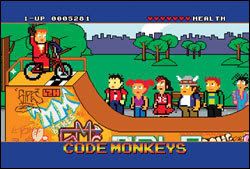
Adam De La Pena, the man and myth behind Minoriteam and the whipping post of every whim that Gary Busey had in I’m With Busey, is back with Code Monkeys, an 8-bit show dedicated to sending up the lives of programmers and the things they have to endure at the hands of ignorant management while forging the path that so many would follow after the 80’s introduced home video gaming to young men everywhere.

Adam was nice enough to take some time out of his hectic schedule, in between his brief stints in taking bets on Super Mario Brothers (more on that, as well, later), to explain how he got Steve Wozniak to add his voice to the program and whether programmers operate on a beta level different from the rest of us.

CHRISTOPHER STIPP: So…Why the hell do I have to see the commercial every time some program on G4 goes to break? Is the show going to take over the network?

ADAM DE LA PENA: I’ll tell you why the commercial is on all the time…It’s the only damn show on that network.

[Laughs]

Like”¦they don’t tell you anything when you’re doing television. It’s, “Hey, how many times is the show going to run?”

The show is going to be running like 20 times! I think at point even I’m going to fucking hate it. But, really, they’re going to run the crap out of it. But at least there’s 13 of them and it’s not like it’s a 6 episode order. And the first episode”¦Did they send you a screener or anything like that?

STIPP: No, no. This was kind of a last minute interview but I did make my way to the G4 site and then to Break.com where I was able to see the offered clips.

DE LA PENA: Oh yeah, Break. The classiest site on the web?

STIPP: Yeah, where you can see clips of Code Monkeys and then catch the brutality of some idiot kid on a skateboard landing on their face after some failed jump.

DE LA PENA: Break”¦I was first like, “Uh”¦what’s this site?” And then I go on to learn that around 200,000 people have seen the whole thing. I was kind of shocked by that.

STIPP: Wow.

DE LA PENA: Yeah, it’s pretty high for people who’ve sat and watched the whole thing.

STIPP: I did and I honestly thought it was really amusing. It’s kinetic but funny at the same time which I thing fits well with the ADD addled youth this program is aimed at.

DE LA PENA: My biggest victory is that Neil Diamond is a character. My biggest victory. That and I’m able to tell the story of two guys, Dave and Jerry, where I play Dave. These guys work at a game company and they’re perfectly comfortable there, they like it, and then the company gets sold to a crazy Texas guy, Larry, who is based on this guy in the early days of the video game industry that didn’t know a thing about video games but then he goes on to own this code factory, his son told him to invest money in it, and it suddenly becomes Atari or ColecoVision.

STIPP: And the episodes have a distinctive look to them; It’s not unlike video games that a lot of us Gen Xers grew up playing”¦

DE LA PENA: Yes”¦ It’s a mixture of Photoshop After Effects and Final Cut. I wanted to do something without interference from anybody so I kind of did it by myself with my friends. We did it and we were going to just throw it up on the Web”¦and we had a 7 minute piece of animation that we were happy with and we showed it around. A bunch of people were actually interested in it but G4 made the best offer of like, “Look, we’re not the biggest network but your show will actually find a home here.” And that was the most important thing to me so we said, “Yeah, give us some money and we’ll do a bunch of episodes.”

The thing is, they gave us money for a pilot, a half-hour pilot, and they were really cool about it. Essentially they made it clear like, “Just don’t screw up the pilot and it’s pretty much a forgone conclusion we’ll pick up the show.” So, the pilot, which is not really the first episode, because they can’t air the pilot because it would get a TV-14, which is something they can’t air on their network, we just went, “Fine, we’ll do another pilot.” I’m sure it’ll end up on the DVD or on the Internet.

I think they had a problem with a scene where this monkey skull humps this girl”¦[I laugh]

Yeah, a lot of horrible things happen in these episodes. But the pilot that does air has Steve Wozniak in it.

STIPP: That must have been a big coup”¦How did you land him of all people?

DE LA PENA: Here’s how I landed it: G4 gave us this list of all these people of we know, tech people, who would want to do the show. I was kind of like, “Yeah, ok, alright. But what about Steve Wozniak?” And they said, “Oh, we don’t know about him. He’s the founder of Apple”¦” Whatever. I literally found his number through some crazy chain on the Internet.

STIPP: You’re kidding.

DE LA PENA: I called it”¦And he answers the phone. Coolest guy in the world. Like no bullshit guy in the world, says he’d do it, and it was like the easiest thing to set up. We basically went to the Sunnyvale area, booked the recording studio, and the whole time I’m thinking, “He’s not going to show up.” He shows up, couldn’t be nicer, does an interview, does everything we ask for, says it’s one of the best things he’s ever done, being animated”¦He said, “It’s like when they asked me to program for Atari.” I was like, “What?!” “Yeah,” he said, “Like when I was making Pong”¦” And luckily I got this all on tape so no one can call “Bullshit” on me.

It’s awesome because Steve is playing himself but, in the show, he wants to concentrate on Apple but Dave is convinced that computers are a passing fad, like MTV”¦And that Dave thinks Wozniak lacks vision.

STIPP: What made you want to render the show’s visual appeal to that 80’s era, Atari/Intellivision style?

DE LA PENA: Well, I spent the vast majority of my childhood, like I’m sure many of those same people who visit your site, watching TV”¦and a lot of people talk about the influences of TV and movies but I also spent a lot of time playing video games when I wasn’t directly watching TV. And I’ve only done 2 animated shows but I’ve always known that you’ve got to have a reason for how it looks, not the other way around. When you do an animated script you’ve to ask, “Why does this have to be animated?” But the reason for me why it was going to be in the style that it’s in is that the games that these guys make are reflective of the way the show progresses. It has a really strong look. For example, when I was doing Minoriteam it had this very strong, Jack Kirby influenced, limited animation style. And even Adult Swim, who was notorious for giving everyone their space was like, “Are you sure want to animate it this way?” The answer was, “Of course! We don’t want it to be Superfriends. This is it.” We stuck to it, we stuck to that animation style and I’m really happy we did because it gave the show the look that it did.

STIPP: It was distinctive! Not to bag on Cartoon Network but after a certain hour of the night you could easily see how a lot of their various Japanimation incarnations could all run together and you wouldn’t even know what’s what.

DE LA PENA: Yeah, and one of the things is that, on paper, if you just read it you would be like, “It’s crazy, I guess, but how is this different from any other office comedy?” And I think once the show comes out you’ll be able to see how the story ideas are really influenced by video games and pop culture more so than the standard sitcom crap that’s on TV.

STIPP: And this show transpires in the 80’s? Are you going to be breaking out all the culture from back then or are you planning on incorporating modern”¦

DE LA PENA: It takes place in the 80’s but it was really important to not be like really overt with it. For example, E.T. That was a huge moment but that game sucked and people were pissed that it sucked and developers made a lot of these kinds of games. It’s incorporating these kinds of things with original ideas like one of the running themes in the show is that Larry fires people who will become the best game programmers, designers, in the world. Like he fires Dave Jaffe, the God of War designer, when he’s a little kid. Dave Jaffe does his voice and says, “Larry, I have this great idea for a game called God of War.” And Larry says “I don’t need no war games” and literally kicks him in the head. So Larry goes on to fire some of the best designers in the world; Nolan Bushnell from Atari, Steve Wozniak, all of them, so that’s one of the running gags. But, also, we’re taking modern video games and putting them in an 80’s context. Like we’ve got the guys from Red vs. Blue and they’re in our prison episode, they play prison guards.

STIPP: How did you sell the people on doing the show? Was it hard for them to go along with the idea?

DE LA PENA: Not really. I hate going through agents or managers so I’ll try and call them up. Like, I called Nolan Bushnell’s number and talked to him and he was totally cool. Setting up the time was the only hard thing. Dave Jaffe couldn’t have been nicer. Dave literally said, “Oh, I think I have time on Saturday”¦I don’t know if I can do it Saturday”¦” The last e-mail he sent me was, “I think I’ll be in town on Saturday.” I was just working on Saturday with my friend and he just shows up and says, “Want to record now?” Uh, yeah, great, thanks for coming”¦Steve Wozniak was relatively easy, the Red Vs. Blue guys”¦they’ve been great. I mean, we’re going to have a lot of other guest stars but those are the real guest stars for us. We’re more about going after the video game designers than we are going after Molly Ringwald.

STIPP: Since you’ve spent so much time surrounded by it, and since you’re probably like me with the way you grew up in the midst of all the evolution in video games, is there any one thing designers or programmers say about what’s changed for them as things have become more complex?

DE LA PENA: Well, I’ve talked to a bunch of designers and they say, “Yeah, we really like the show because, back then, it really was one guy designing a game.” A lot of the guys who came through that are now managers of people who make these games. It used to be 1 or 2 guys putting out a Pitfall or a Castlevania.

So, we have talked to designers who are still in the business that used to be around back in the day. And there’s this one guy who told us a great story that we’re using in the show”¦There was this one designer who was developing this one engine for game. He kept designing and kept designing, working all by himself for like months on end. They kept asking, “When’s it going to be done? When’s it going to be done?” “Ah! It’ll be done when it’s done!” he said. He was really cranky kind of guy. But they couldn’t wait! So, they bought an engine from another company, shipped the game, and never told him. He came out one day and was like, “What’s going on? I’m done with it.” And they said, “Well, we already shipped it.”

The guy lost his mind.

He ran out of the company, literally, and those who were there said all they saw was his tiny little Ford car running into the side of the building. But he kept working there later on. He was just a crazy guy and they put up with it.

STIPP: Are programmers just a different breed of people?

DE LA PENA: I don’t think they’re so different. I come from a directing and writing background and I can relate to locking myself in a room to work.

Like, in Code Monkeys, we have lots of different types of programmers. There’s Todd who does nothing but Quest games; he has a horn helmet and works alone and he’s designed his room like a lair and he’s all about the future of video games. There’s Dave, who’s really the best programmer but who spends his time putting turds in microwaves and blowing them up. There’s Jerry who is always worried about the ship date, the video game industry is all about ship dates. I was told this one story about a bunch of game designers who went to Japan, they were all working like crazy to meet the ship date and once they did they all got hammered and drunk and crazy. Obliterated for like 2 days and then went back to work on the next game. It’s just like any other industry”¦crazy pressure.

STIPP: Is there any loyalty to particular companies”¦

DE LA PENA: What happened, and it’s really interesting, the companies that started out small and would eventually become the players like EA”¦the game designers wanted their names on the boxes like Steven Spielberg. They thought their work was that important and they were right. They did this and they were a one man show. They started wanting more and more and eventually realized they could go and start their own companies. So, I think what happened was that early video game companies didn’t treat them very well.

STIPP: Did any of these guys point to any one thing that changed the industry on the whole?

DE LA PENA: I would have to say that it would probably be the Atari system because it was the first mass distributed home system that everyone had to have. Before then, these guys were designing games for upright cabinets that kids were putting quarters in. Atari opened”¦made it possible for a lot of these guys to work on games in general”¦different types of games, different titles. After that it would probably be the NES. Things took a big leap.

There were also things that were huge but just didn’t sell well for whatever reason. Like, the Sega had the Dreamcast system”¦Everything was incredible on the system but it just didn’t do well. The games, everything. It was just one of those things.

So, I think that’s the kind of thing they would say, when games came into the home. Now I think it’s the ability to be connected with other game players. That’s huge.

STIPP: Yeah. I think I’ve missed the boat on that because I haven’t really had the urge to be connected with kids from Guam.

[Laughs]

DE LA PENA: And you’re yelling at some kid in Puerto Rico you just beat the shit out of in Halo. The Internet is all about community but there’s these game clans that exist within games like Halo…really serious gamers.

STIPP: Some of these people take these things way too seriously.

DE LA PENA: Oh yeah. My friend literally has to, when he works, when he’s on a television show, or if he’s designing, he literally has to take his X-Box or whatever system he’s using”¦put the system in a box, tape the box up and send it to somebody’s house so he doesn’t use it.

STIPP: Seriously?

DE LA PENA: Because he would be consumed with it. One time we’re working and someone brought one in, like a GameCube or something, and he said, “What the fuck is that? Get it out of here! I can’t have it in the office!”

STIPP: Do you still play?

DE LA PENA: I do. Have I played in the last couple of months? No. But what we have been playing is a lot of the old games. I’ve always had an older system but now we’re really getting into the old NES games: Castlevania, Super Mario Brothers. Now we’re taking things a step further and now we’re playing for things like fastest time on the 1st level with the flag. We’re betting money and paychecks, which is getting sad. But it’s keeping everybody sane here so it’s good.

QSE News: 7/13/2007

Filed under: Columns,News — UncaScroogeMcD @ 12:02 am

quickstopnews.jpg

line1.gif

Here are today’s top entertainment headlines:

  • qsnews.jpgA theater in New York is offering free tickets to the new off-Broadway show “My First Time” to virgins.  In order to prove whether or not the people are really virgins, the producers have hired Sebastian Black, a mind reader and hypnotist who bills himself as “The Human Lie Detector.”  In related news, the staff at QSE News will be out next week, seeing a new show in New York.
  • The fifth movie in the Harry Potter franchise, Harry Potter and the Order of the Phoenix, earned the biggest Wednesday opening ever after it took in nearly $45 million.  The movie, which continues to follow the young wizard and his classmates, beat the previous record holder, Spider-Man 2, by over 4 million.  While it has been successful in the first few days, insiders are counting on a sharp drop in profits this weekend as NBC rolls out new episodes of “To Catch a Predator.”
  • Sam Rockwell and Anjelica Huston have been cast in the movie Choke, based on the novel by Chuck Palahniuk.  The movie centers around a sex addict who pretends to choke then sponges off of the people who save him.  While the movie hasn’t even started filming yet, the marketing department is already hard at work trying to convince people that the movie is not a film biography of legendary porn star Ron Jeremy.

line1.gif

That’s all for today’s news, stay tuned to this channel for all the news that matters least but you still care about.

(Compiled by J. Allen)

##

Quick Stop Thingamabobs: 7/13/2007

Filed under: Columns,Thingamabobs — UncaScroogeMcD @ 12:01 am

thingamabobs.jpg

The web. It’s a big place, full of plenty of distractions ““ some funny, some informative, some ludicrous, some disturbing, some inane, some profound. Each and every weekday, we present links to a few of our favorite finds”¦

————————————————

  • The Jolly Green Giant will kill you in your sleep… (Thingamabob)
  • So visit with the mellow, good time Colonel instead… (Thingamabob)

Have a THINGAMABOB? Send it in!

##

July 12, 2007

Party Favors: Frank Vincent

Filed under: Columns,Interviews,Joe Corey's Party Favors — UncaScroogeMcD @ 12:59 am

partyfavors1.jpg

vincent2007-07-12-01.jpgJERSEY CITY, NJ – After watching A Tale of Two Pizzas, I picked up the phone. In less than thirty minutes, star Frank Vincent delivered an interview to the “Party Favors”. The movie features Frank Vincent and Vincent Pastore as rival pizza parlor owners. Normally a film featuring two Sopranos veterans should climax with their enemies being turned into special sausage toppings. But amazingly enough, this is a date movie. No limbs are hacked off. There’s barely a beatdown.

Frank Vincent laughed when asked if this is one of those rare movies in his filmography that a woman can enjoy without having to hide her eyes to avoid the bloodshed.

“It’s a nice little escape from some of the insanity that they put in the movies these days,” Frank said. “The most violent thing was the fight with the paddles.” If your date can handle Frank and Pastore swatting each other with pizza paddles, you won’t have to worry about her squirming under the seat.

Frank has found himself becoming a bit of a sex symbol thanks to his role on The Sopranos. “Let me tell you something, Joe,” Frank said. “Phil Leotardo has got more women fans than anybody. I don’t understand it, but the women love Phil. Phil is a bad guy. But every woman I met says they love him. I say, ‘Why?’ They say, ‘Cause he’s bad and sexy.'”

But ladies, don’t think you can call up Frank Vincent and sweep him away for a romantic evening in Manhattan at Scott Sartiano’s Butter. He already has a date. “I go out with my wife,” the bad boy confessed.

You might spot Frank Vincent dining out with his wonderful wife. Feel free to give him a polite wave, but don’t be a pest. He’s not going to put up with it.

“If I go out socially with my wife someplace and I’m with people for dinner. somebody will come and say, ‘Can I take a picture with you?’ If I’m out socially, I don’t want to take a picture. Everyone in that room has a camera in their pocket (especially with most cellphones also being cameras). If I take a picture with you and somebody else asks me, and I deny them, then I’m not doing myself a service. If I take one. I got to take them all. If I’m out socially, I’d rather refuse than say yes and stand there for an hour and a half taking pictures. That’s not what I came out to do. I’m not working. If I go to a place that I’m there to sign autographs or whatever, then we take pictures. People don’t realize, but that’s what happens.”

He sounded pretty happy that he isn’t being hounded by the camera hordes that follow fellow sexy actor Brad Pitt. “I don’t have to worry about that level yet. I don’t know if I ever will get to that level. But I don’t particularly care to get to that level.”

For decades, Frank Vincent has been to crime movies what Strother Martin was to the western. Fans of the genre would spot him on the screen like a Where’s Waldo moment. He made his first major splash as a mobster in Raging Bull. He nabbed a quotable role in Goodfellas when, as Billy Bats, he said, “Hey, Tommy, if I was gonna break your balls, I’d tell you to go home and get your shine box.” He became part of Joe Pesci’s crew that terrorized Las Vegas in Casino. But when he assumed the role of hardcore mob boss Phil Leotardo on The Sopranos, Frank became a guest in America’s living room.

“It elevated my visibility a lot. I had some visibility with Raging Bull, Casino, Goodfellas and Spike Lee movies. But you can’t compare film visibility with television visibility,” Frank said. “Fifteen million would watch one episode. A movie couldn’t do that in 10 years.”

In a few weeks, Frank Vincent went from a cult star to a cultural icon. “People know my name now. Wherever I go. They know it’s Phil. They know it’s Frank Vincent. It’s raised my level of visibility a lot.”

vincent2007-07-12-02.jpgThe benefits of this visibility can be immediately seen in A Tale of Two Pizzas finally getting a DVD release after playing festivals a few years ago. For the longest time Frank Vincent made a living as a drummer, but has he ever worked in the world of slices and parmesan?

“No. I have not ever worked in pizza place,” Frank declared. “I was in the pizza place for two weeks making this movie.”

In the film, Frank’s character is trying to come up with a crust that matches his great sauce. He didn’t actually have to learn how to make pizzas to perfect the role of Frank Bianco, the pizzeria proprietor. “We weren’t making them from scratch. The pizza parlor owner was there. He would kneed the dough, lay it out and put it in the oven. During the shot, I had to take it out. I wasn’t actually making pizza dough.”

Did Director Vincent Sassone have him try to toss the pizza dough in the air and catch it like a scene from I Love Lucy?

“No. None of that stuff,” Frank said. “It would mess up my hair.”

A Tale of Two Pizzas has Pastore’s daughter (Robin Paul) and Frank’s son (Conor Dubin) having a Romeo and Juliet relationship. The fathers don’t completely disapprove since they expect their offspring to steal the trade secrets of their rival. While the movie now features two Sopranos legends, at the time of the shooting, only Pastore had the show on his résumé.

“He was in and out already,” Frank said. “I hadn’t gone in yet.”

Did Frank ever accidentally call Pastore by his old Sopranos name? Are there outtakes of him saying Big Pussy?

“No.” Frank said. “You call them by their real names sometimes when we’re shooting. If I’m doing a scene with Tony and I call him by his name, I might say, “Jim.” And they say, ‘Cut. It’s Tony; not Jim.’ When you’re friendly with people, occasionally that’s what happens.”

I proposed the idea that Tony Danza only plays characters named Tony so that his fellow actors don’t have that confusion on the set. Frank laughed. “Tony Danza is a good man,” he said.

While most of the people Frank Vincent went to High School with are pondering how to enjoy retirement, he’s going into career overdrive. “I’m busy. I’m busy. I have a couple of films that I’m waiting to hear about. I have my own cigars that just came out: The Frank Vincent Signature Series. They’re from the Dominican Republic. I sell my t-shirts on my website: Frankvincent.com. I sell Billy Bats “Go Home and Get Your Shinebox” t-shirts. We sell mugs, Phil Leotardo t-shirts and mousepads. We sell them all over the world. They buy them in Australia and Scotland. I’m a spokesman for a bank in Dublin, Ireland.”

Turns out the bank in Ireland uses him to promote their electronic services. Many characters played by Frank Vincent know how painful it can be when you’re late on a payment.

There had been a rumor that on the set of Nothing to Lose, Frank would occasionally juice newbie director Eric Bross by whispering, “That’s exactly what Marty would do” after a take. When confronted with this story, Frank Vincent admitted to doing this. “I would tease him,” Frank said.

Vincent still has a scene with a pre-Oscar Adrien Brody on his reel. But he rarely sends that tape out to casting agents. “I’m offer only. If you want to hire me, call my manager. Tell him what you want. Send the script. If we like the script, then make an offer,” Frank said.

Frank has a done voice work on the successful Grand Theft Auto video games. I asked if he’s ever done any voice over gigs in his pajamas.

“No. Why would I do that?” Frank asked. During every interview with a major star doing an animation voice, they talk about how they like the gig cause they could show up in their pajamas. “No. I do not wear pajamas in public like Vincent Gigante,” Frank said. Gigante was the mob boss who faked being nuts by wandering around Manhattan in his PJs.

Speaking of mobsters in pajamas, Frank almost had to wear pajamas for work.

“I was up for the pilot of The Sopranos. I didn’t get it because David didn’t want me in the show at that point because Billy Bats was too popular.” He almost became Tony’s uncle.

“We all read for the Uncle Junior role. I read it, Tony Sirico read it. And Dominic (Chianese) read it. Chase created the Paulie Walnuts role (for Tony) after it. A lot of times when you read, you don’t read for the role they want you for. You read a generic role. Directors just want to meet you and see what kind of style you have. David created Phil after the third or fourth season. He brought me in and said, ‘I want to find something for you.’ I said, ‘Whenever you’re ready, I’m ready.’ He called me in for season five for a recurring role. They bought me for three episodes. They just kept buying me and buying me. We did 12. The next season I was a regular. He had it planned all the while.”

The subject turns to how Phil proved to be Tony’s toughest rival on the series.

“You had Johnny Sack there before. Vincent Curatola did a nice role. He was respectable and believable in his character. Phil had a little more of an edge than Johnny,” Frank said. The other mobsters went weepy as they showed their human side. Phil might have backed down, but he never broke down. “I never went soft,” Frank said.

Phil kinda went soft when he met his fate in the final episode. Unlike many supporting actors who were taken out to dinner by David Chase prior to discovering their sad demise, Frank didn’t get a dinner with his funeral.

“That was the usual way,” Frank said. But instead he had to discover he’d be a human speed bump without an entree during the table read. “We sat down and read the script,” Frank said. Judging from the body count in the final episodes, they would have had to extend the shoot to squeeze in all the dinners.

Because he was wrapped long before the big finale, there was no need to ask Frank if he was part of any of the “other” final scenes or if the family eating at the restaurant was meant to end that way.

“You tell me what really what went on?” Frank asked. My theory is that the family sits around the table. AJ can’t get the ketchup out of the bottle. Tony grabs it and gives it couple hard slams. We see the onion rings covered in ketchup, blood and brains.

“Why do you think that?” Frank queried. My theory comes from the scene earlier in the episode with Tony forcing ketchup out of the bottle. It seemed like a moment to be replayed with gruesome results.

“You have a very vivid imagination, son,” Frank said. “Now your imagination of that and ten other people will have ten other endings. David (Chase) achieved what he wanted to achieve. He made everyone think what they wanted to think.”

In the past, Frank has acted on several Law and Order episodes. Will he be guesting on one of the CSI series in the near future? “No,” Frank said. “At this point, those shows might be out of reach for me because of the Phil character.”

Frank is in discussions about being part of a reality show. “It’s a question of what the reality show is. How the story is constructed.” He won’t allow a camera crew to live inside his house. “I don’t want none of that nonsense,” Frank said. He’s more up for the competitive reality show rather than challenge Gene Simmons and Hulk Hogan.

Bringing the conversation back to A Tale of Two Pizzas, I asked Frank what he thought of seeing himself turned into an animated character in parts of the film.

“I thought all the animation was great. I thought the music was great. They did a nice job for a little independent movie.”

QSE News: 7/12/2007

Filed under: Columns,News — UncaScroogeMcD @ 12:38 am

quickstopnews.jpg

line1.gif

Here are today’s top entertainment headlines:

  • qsnews.jpgNintendo Co. Ltd. Has issued a warning to future Wii consumers ““ get it now or don’t get it at all. Nintendo issued a statement saying that come this holiday season, the Wii will be harder to find than normal due to expected increase in demand and a launch of one hundred new games. We at QSE News are going to file this in the “No Shit” department.
  • A small town in Vermont has won the honor of hosting the preimer of The Simpsons Movie. Springfield, VT, competed with 13 other Springfields across the country to host the event. Producers of The Simpsons said Vermont was chosen because “Seriously… we have to give those people something to live for. What else do they have?”
  • Daredevil Evel Knieval and rapper Kanye West are going to a mediator to settle a pending lawsuit.  In December Knieval brought suit against the hip hop star, claiming West used his trademarks in the video for the song “Touch the Sky.”  According to those close to the case, West is willing to settle even though “(West) ain’s saying (Knieval)’s a gold digga, but he ain’t messing with no broke (Rapper).”

line1.gif

That’s all for today’s news, stay tuned to this channel for all the news that matters least but you still care about.

(Compiled by J. Allen)

##

Quick Stop Thingamabobs: 7/12/2007

Filed under: Columns,Thingamabobs — UncaScroogeMcD @ 12:14 am

thingamabobs.jpg

The web. It’s a big place, full of plenty of distractions ““ some funny, some informative, some ludicrous, some disturbing, some inane, some profound. Each and every weekday, we present links to a few of our favorite finds”¦

————————————————

  • Allan Sherman sings “Crazy Downtown”… (Thingamabob)
  • A virtual tour of the sets from Ratatouille(Thingamabob)

Have a THINGAMABOB? Send it in!

##

July 11, 2007

QSE News: 7/11/2007

Filed under: Columns,News — UncaScroogeMcD @ 3:58 am

quickstopnews.jpg

line1.gif

Here are today’s top entertainment headlines:

  • qsnews.jpgCable Network TNT has purchased the broadcast rights for the movie 300 for $17 million.  The move gives TNT the rights to broadcast the movie beginning in September of 2009.  TNT is excited about the move as they have been looking to fill the homo-erotic void that was left when the station lost professional wrestling.
  • It has been announced that Kevin Spacey will be reprising his role as Lex Luthor in the upcoming sequel to Superman Returns.  While plot details have not been released, it is expected that in the film Luthor will almost kill Superman only to have the Man of Steel come back at the last minute for a victory.
  • The goth gods The Cure will be releasing a new, double album, this October. The album will be the band’s thirteenth studio release. The band will continue to release the album despite being faced with the fact that the world stopped listening after Mood Swings.

line1.gif

That’s all for today’s news, stay tuned to this channel for all the news that matters least but you still care about.

(Compiled by J. Allen)

##

July 10, 2007

Toy Box: A Few Words with Edward Wires

Filed under: Columns,Toy Box — admin @ 12:42 am

toybox.jpg

There are lots and lots of aspects to any one action figure that contribute to it’s overall appeal, or it’s overall unappeal. Week after week I harp on the aesthetics of the sculpt, the usefulness of the articulation, or the play value of the accessories. But the single factor that can make or break even the best work in every other category (or on the flipside, carry some pretty weak work in every other category) is the paint.

Now obviously, the figure you get is painted by a machine or person working like a machine, doing the same few strokes over and over again. They use masks and forms and templates to get straight cuts and clean lines, and the final version may have fewer paint operations than expected. That’s often because cutting the paint is the quickest way to cut the unit cost at the last minute. But at the start of all this, at the very beginning, is a hand painted pre-production figure(s) that sets the stage for what they company HOPES the final product will look like. And when they want it to look it’s very best, they call in the man we’re talking with today.

One of the finest artists in this field is Edward Wires. He has worked for just about every toy company past and present, including Hasbro, Mattel, Toybiz, Diamond Select, Palisades, DC Direct and Art Asylum. If you’ve ever marveled at a Marvel Legends prototype, then you’ve been marveling at Ed’s work. I sat down with EW to ask him a few questions:

line.gif

MWC: So Eddie, how did this all happen? Painting houses, painting cars, painting nudes – these are all things the common world understands. But how does a man end up painting toys for a living?

WIRES: I grew up as the penultimate nerd (the term “fanboy” wouldn’t exist for at least another 10 or 15 years). Reading comics, collecting action figures, watching cartoons, jumping off my deck with a towel tied around my neck, and blowing up Star Wars vehicles. I also built model kits. Cars, planes, tanks, soldiers, knights, and then resin and vinyl character kits. It’s something I’ve been doing all my life. As I got older (and stopped blowing up everything I built), I really got into the rendering. Especially on monsters and creatures. And it’s one hobby I’ve always stuck to. Even now.

MWC: What do your family and friends think of your work?

WIRES: They all pretty much think it’s interesting and unique. And you have to understand, I was destined to be in construction, a plumber or a bartender (and there is absolutely nothing wrong with those professions. Did them all for years), so my family is especially surprised and excited. But of course, the hardest part is explaining to them exactly what I do. I guess they can’t wrap their heads around the fact that I don’t actually “play” with toys for a living.

MWC: There are lots of talented people in the world, but your work stands out every time I see it. What is it that gives you that edge?

WIRES: Thank you for that. Sincerely. I think though, it is because I am the epitome of the uber-nerd fanboy. I am completely immersed in the characters and comics, but at the same time I know this is a business and you are only as good as your latest project. I have a passion to do this, even after nine years, because it is not something I ever even dreamed existed as a profession, let alone as something I could make a career out of. And I have this obsessive compulsive personality (with a little bi-polar mixed in; ask anyone). And because of my love of toys, I want every piece I do (no matter what it is) to look like something I want to display in my collection.

MWC: You’re good friends with sculptor Bill Mancuso. How has that influenced you? And do you get the chance to collaborate a lot?

WIRES: We’ve been friends since first grade. He’s the one that encouraged me to put a portfolio together and do the comic-con thing. And after a whole summer of “No”, he encouraged me to go back the following summer and do it all over again. We’ve collaborated quite a bit on Palisades and Diamond projects.

MWC: Are there types of work or styles of figures that you prefer working with?

WIRES: I want to get my hands on everything. From flesh eating Trolls to Pokémon. In plastic, vinyl, or resin. Anime to portraiture. I want to work on everything for everyone. Like I said, I love this business and everything it has given me over the years. Of course, I like to work on the heavily rendered stuff the best, but that’s just icing on the cake.

MWC: You’ve worked on hundreds of figures in dozens of lines – any favorites that stand out?

WIRES: Believe it or not, I think I’ve actually past the thousands mark, and that to me is the greatest testament for my love of the industry. I mean sure, some projects are more challenging than others, but I’ve painted everything from fully rendered realistic to plastic coconut book danglers.

I say it all the time, but Marvel Legends is my favorite. It is the be-all-end all of mass market action figures. And growing up a Marvel Zombie, I got to work on a line of toys, which for decades only existed in my head. And then when it became a reality, all of my, “if this ever happens I’m gonna do this”¦” got to be applied. I got to work on some of my favorite characters of all time, and make them look like they existed in the real world, while staying faithful to their comic incarnations. And that’s what I was asked to do. And after the first few series, the push went harder and further against the envelope to outdo the series before it. And I think everyone involved accomplished just that. Even with the splinter lines (“Classics”). Years from now, people will still be excited about these. And I got to be a part of that magic collaboration.

One of the other things that stands out is the people I get to work with. I work with (and among) some of the most amazingly gifted and artistic people on the planet. Every single one of them adds something wonderful to my career.

MWC: Everyone likes to talk about their favorite work, but what about the stuff you weren’t happy with? Any figures that just didn’t turn out the way you envisioned them, or didn’t live up to your own expectations of your work?

WIRES: I can’t really think of anything. I mean yes, there are a few properties I wasn’t “in to”, or was indifferent to, but I approached them with the same excitement and enthusiasm as I would anything. I am just one cog in the gears that turn the wheel. And if someone is going to pay me money to paint something to look like their vision, I have to approach everything that way. After all, it is the toy “business”.

As far as product not turning out the way I did it, I can’t control that. I used to get upset that I put all of this work into something, and then the product came out very flat, but I got paid for the job, and then costs had to be cut somewhere. Paint application is always the first to get “cut” because it is the easiest way to wrangle your production costs back in. Ultimately, I do my part of the process, and whatever happens after that isn’t up to me.

MWC: What’s a day in the life of Eddie Wires really like?

WIRES: It’s like a day of sunshine filled with marshmallow clouds and fruit roll-up rainbows. Shattered by the deafening chatter of machine gun fire and the screams of those maimed and wounded and”¦

Sorry”¦

It’s actually a lot less exciting than most people would think. I know there is this illusion that toy people live and work like rock stars and set their own hours and “hang out and play” all the time, and that is furthest from the truth.
My day usually goes like this:

Get up around 7am. After getting the whole wake up, coffee, etc, out of the way, it’s a true work day. Phone calls, emails, more phone calls, lots of painting (yes, I’ll admit it, that is exciting no matter how you slice it), phone, paint, phone, paint, take pictures, more email, then FedEx. Ahh yes. The sweet sweet delivery system with by whose clock we live and die.

The actual breakdown of phase one could be pretty boring so I didn’t give a hit by hit account of it, but it is done pretty much every day. The only thing that really changes is what we’re actually working on.

So, now the FedEx drop-off has passed. Get a cup of coffee and drive home in rush hour traffic (but this is great for getting back in touch with west coast clients). No time to relax though. There’s a short bit of a break here for about an hour or so. I have to spend some time with the wife Y’know? I’m glad she is so understanding on those nights when I can’t though.

Then around 8 or 9pm after all of the phone calls and emails are done, this is when the real digging in honest to goodness no interruptions work gets done. Usually lasts til about till one or two in the morning. Another round of emails and voicemails and then it’s off to bed where I put something on the TV to fall asleep to.

I generally work around 60 to 70 hours a week, and as much as 100 hours or more a week before a big show (toy fair, comic con, etc). During those last few days before the shows it generally goes; work six hours, sleep two, work six hours, and sleep 2. But I wouldn’t change it for anything in the world.

MWC: Your experience has obviously taught you a great many tips and tricks to producing the best work. There are tons of customizers out there, and for many of them, getting the paint just right is the biggest battle. Any tips you can provide, or corrections to common mistakes that you see?

WIRES: I am absolutely blown away and amazed at some of the customized work I see (and I am always checking this stuff out), but the best advice I can give to anyone is; Always challenge yourself to find what works for you. Experiment with different paints (brands), different brushes, different techniques. Be your own worst critic. Don’t be afraid to redo something, even if it means starting completely over. Don’t ever look at something sloppy and say, “Well, that’s the best I can do.” Redo it. And redo it again, until it looks flawless. Straight lines, logos, cut lines (where one color meets another) should all look flawless. Push yourself to get there. You’re having fun along the way anyway. Take critique and advice when it is given. Then apply that to what you’re doing. Then do that over and over again.

“How do you get to Carnegie Hall?” Practice, practice, practice”¦

MWC: No action figure message board is complete without at least one thread on dream lines. C’mon, admit it – you’ve posted in those threads before. What’s your dream line?

WIRES: My absolute dream line would be a six inch Marvel Legends style line of”¦

I love that format and scale, and it can be applied to anything; Indiana Jones, Star Wars, G.I.Joe. I would love to see (and get to work on) that.

If I had answered this a year ago I would have said, “”¦style line of Conan, or Judge Dredd.” Someone in the heavens was listening to my wishes on that one. Wow. Now if I can just figure out how to get the other ones rolling.

MWC: What’s the hardest aspect of your job?

WIRES: The hardest part is the juggling. Work, life, work, marriage, work, yardwork, and all that jazz. I have so many interests outside of toys, and I just don’t have time to get to them. I used to play my guitar all the time, and now it actually has a layer of dust on it. I used to customize toys like crazy, now I have 3 filing cabinets full of “some day when I get around to it” projects. I love movies. I don’t get to really sit and watch them straight through anymore. It’s usually watching them for 30 or 40 minutes at a time over the course of several nights (sometimes I’ll buy a dvd, and before I even get a chance to watch it it is on broadcast cable), and in that time I have to spend time with my wife.

And I’m not complaining, mind you. I’ve chosen this life. I can turn work down if I want a little more free time. But why would I do that? Everything tends to work out how it should anyway. Sorry to ramble there on that one”¦

MWC: How does most of your work come in these days? Is it due to referrals within the industry, or do you still have to get out there and beat the bushes?

WIRES: It’s about 50/50. I find myself on the phone a lot. I try to keep in touch with people (in the industry), even if I am not working with them. You never know when they’re going to get a job they don’t have time for, and they need to subcontract it out. Better to be fresh in their minds. And then other times I’ll get a call out of the blue from someone I’ve never talked to who got a referral from someone I haven’t talked to in a year to do a project. It’s all a big part of this roller coaster ride of the toy industry. But this is where you as an individual comes into play, and you get to put your best foot forward.

MWC: I’m not a big fan of the personality test on Inside the Actor’s Studio, but there are two questions that are actually relevant here – what’s your favorite and least favorite color?

WIRES: Favorite color is black, because it generally goes on in one coat. Least favorite color is black because if you make a mistake with it, any other color is going to take several coats to cover it up.

MWC: You’re living the geek dream life. Any words of wisdom for those looking for that special place in the world?

WIRES: You have to keep the fanboy locked up inside you. All of your knowledge of specific issues and character appearances will come in handy, but no one will want to hear it unless they specifically ask for it. You have to read up on what everybody is doing. You have to remember that this is not about you and unless it is asked for, you should keep your opinion to yourself. You are doing work for hire.

In a nutshell, you have to be a well rounded person. You have to know more than just toys. You have to be able to hold your own in a conversation about anything and everything and be able to sell yourself at the same time. You have to be willing to take criticism and disappointment. You have to be able to network, and be willing to travel and spend money and cater to the needs of the company you are trying to get the work from. You have to be able to get the work done quickly, and efficiently at an affordable price. You have to be willing to learn all kinds of things you may not have an interest in. But, ultimately, you have to deliver. Against any and all odds. And you have to consistently deliver, so that the company or person who sends you the project has every confidence and assurance that you will get it done time and time again.

MWC: What do you do when you’re not working?

WIRES: I have rediscovered the joys of lifting weights and target shooting. I love reading and watching TV (thank gods for DVR) I play my guitar when I get the chance, but at the end of the day, as long as I get some time to spend each day with my wife, I’m happy.

MWC: Any final thoughts, political rants, social commentaries, or general ramblings you’d like to get off your chest?

WIRES: Oh I could on for hours about all of the above, but I’m not going to (but if you catch me in a bar after a few drinks; I just might).

I just want to thank you for letting me share my little piece of the pie in this wacky world we call the toy industry. And I want to thank all of the kids (young and old) who buy the toys. Keep buying them, so we can keep making them.

line.gif

Thanks to Eddie for taking the time to talk with me. If you’d like to see more of Ed’s work, hit his website, or hit the San Diego Comic Con in two weeks, where there will be lots and lots of new prototypes on display sporting a coat from Mr. Wires!

Party Favors: 100 Years – 100 Beers… Beer Run For The Missing 12 Pack

Filed under: Columns,Joe Corey's Party Favors — UncaScroogeMcD @ 12:06 am

partyfavors1.jpg

As the buzz of making “100 Years – 100 Beers” died down, our eyes adjusted to the light and we realized that a few titles were on various lists that became stuffed between the sofa cushions. We’re not going to be a bunch of AFI wusses and claim that these lost nominees and votes will get factored in a decade from now. We’re not going to sneak in and rewrite the list and have Tony Snow claim that you misread the list. We’re going to do what every good party requires – A Beer Run for one more 12 Pack of Cinematic Joy.

Don’t ask where these titles rank with the 100 list. I’m not willing to bounce 12 titles from the first list. When you’re wasted and lying in bed during an orgy, you don’t get kick out that extra potential lover. Unless they’re whiney and keep pointing and going “that’s not good.” But none of these 112 titles are prudes. Here’s a 12 pack that rivals a dozen chilled bottles of Yuengling:

12. Mystery of the Leaping Fish (1916) – Douglas Fairbanks plays Coke Ennyday, a detective who can’t solve a crime until he gets wasted on dope. This sounds like the basis of a Showtime series.

11. Fifth Element (1997) – Anytime you’re trashed and you turn on the TV set, TBS has this in marathon mode. Milla Jovovich with orange hair still makes me drool although that might just be from being on the verge of passing out. Am I wrong in thinking that if I had Bruce Willis’ cellphone number and called him at 3 a.m. and said, “Bruce!” He’d say, “Do you need more booze? I’m coming over to party!”

10. Akira (1988) if I could figure out this Japanese anime flick, I would have been able to pass organic chemistry.

9. Half Baked (1998) – Have you ever looked at the back of the DVD box? Jon Stewart is in the bushes. Look at it!

8. The Care Bears Movie (1985) – It’s not good to fall asleep with so much booze in your body. By watching five minutes of the Care Bears, you’re guaranteed to puke up all the demon booze in your belly. The best hangover cure is to not have one.

7. The Jerk (1979) – If you watch this on TV, you’ll never know Steve Martin’s dog’s name. We were wasted one night and it struck us that since Steve merely sold his invention to the company, he should have been able to not be sued since the company was liable for the safety of the product.

6. The 5,000 Fingers of Dr. T (1953) – Dr. Seuss shows us the evils of piano lessons. If you get the DVD, there’s the uncut Horton Hatches An Egg cartoon complete with Peter Lorre fish blowing his brains out.

5. Reefer Madness (2005) – Until White Trash Wins Lotto comes out at the cineplex, this is the best damn musical. You might also want to watch the original anti-drug flick.

4. Evil Dead 2 (1987) – This is the one where Bruce Campbell has the chainsaw arm? Or is the knights? Or the tree sexually attacks the woman? I can’t remember. Best to just play all three flicks. We call Army of Darkness, Evil Dead at my house cause were too lazy to remember the rebranding.

3. The Warriors (1979) – See it now before the lame remake ruins your memory.

2. Porky’s (1982) has the greatest movie trailer ever made. Remember kids that putting your dork through a hole in a girl’s shower can be hazardous to your health.

1. Cheech and Chong’s Up In Smoke (1978) is the gold standard of wasted cinema. Do not attempt to match the on screen intake. The DVD has amazing deleted scenes including how a guard played by Harry Dean Stanton doped up the boys before they went before the judge.

QSE News: 7/10/2007

Filed under: Columns,News — UncaScroogeMcD @ 12:04 am

quickstopnews.jpg

line1.gif

Here are today’s top entertainment headlines:

  • qsnews.jpgIt appears the upcoming Harry Potter and the Deathly Hallows may not be author J.K. Rowling’s last novel about the little wizard that could. Rowling’s responded to the question of future Potter books by saying “never say never.” The author continued saying that in a couple years she’d like to revisit the popular series and add extra Dewbacks and scenes with Jabba the Hutt.
  • Actress Toni Collette, famous for her role as the mother in The Sixth Sense, is expecting“¦ a baby! The child will be Collette’s first with husband slash rocker Dave Galafassi. It’s unclear if the child will be able to see dead Bruce Willis.
  • And finally in video game news, gamers will have the opportunity to play as and against Slash in the upcoming Guitar Hero III. Slash will be a boss character that players will have to defeat in the course of the game. Sony said that every Guitar Hero III will come with a syringe and a bottle of Whiskey to “heighten the experience.”

line1.gif

That’s all for today’s news, stay tuned to this channel for all the news that matters least but you still care about.

(Compiled by J. Allen)

##

Quick Stop Thingamabobs: 7/10/2007

Filed under: Columns,Thingamabobs — UncaScroogeMcD @ 12:02 am

thingamabobs.jpg

The web. It’s a big place, full of plenty of distractions ““ some funny, some informative, some ludicrous, some disturbing, some inane, some profound. Each and every weekday, we present links to a few of our favorite finds”¦

————————————————

  • Today we’ve got a special birthday theme, which will kick off with a song about how you celebrate the other 364 days a year – The Unbirthday… (Thingamabob)
  • Macca sings about your birthday (it’s my birthday too, yeah)… (Thingamabob)
  • Jack Black with an alternative birthday song… (Thingamabob)
  • And finally, the Queen calls on the teen wizards of Hogwarts for a birthday request… (Thingamabob)

Have a THINGAMABOB? Send it in!

##

July 9, 2007

Comics in Context #184: Clobbered Again

Filed under: Columns,Comics in Context — admin @ 12:10 am

comicsincontext4.jpg

cic2007-07-09-01.jpgI really wanted to like the new movie Fantastic Four: Rise of the Silver Surfer. After watching the trailer, with its spectacular sequence of the Human Torch pursuing the Silver Surfer over the Manhattan skyline, I had hopes that this movie might be superior to the disappointingly humdrum previous FF film (see “Comics in Context” #93). Though I still cannot long look at the movies’ version of the Thing without thinking, “This looks like a guy in a monster suit,” the CGI Silver Surfer looks better, more convincing, and more eerily alien than I would have imagined.

The early part of the new movie gave me further reason to hope. The depiction of the F. F. as hot new celebrities fit the team’s co-creators Stan Lee and Jack Kirby’s early work on the Fantastic Four comics. In the opening of Fantastic Four Vol. 1 #1 (1961) the general public does not recognize various team members, but by the start of the second issue the people of New York City treat their new superheroes as stars. The movie F.F.’s misadventures on a commercial air flight weren’t as funny as the filmmakers doubtless had hoped, but again they fit the style of Lee and Kirby’s early issues. In the 1960s Stan Lee, with or without Kirby, loved to bring his new superheroes down to Earth by having them cope with the mundane frustrations of every day life. In Fantastic Four Vol. 1 #9, Lee and Kirby had the FF, suffering from financial trouble, hitchhike cross-country; traveling coach in the new movie is a step up for them! I did wonder why the movie FF didn’t just take the Fantasti-Car, but it turned out that team leader Reed Richards hadn’t finished inventing it yet, and its debut onscreen is one of Rise‘s brighter moments. Similarly, there is a running plot device in which Johnny Storm accidentally and temporarily switches powers with his teammates, usually to comedic effect. That’s a clever idea, with some good funny payoffs, that Lee and Kirby could well have done in the comics had they thought of it first.

But as I continued watching Rise of the Silver Surfer, my hopes for the film faded. To judge from the reviews I’ve read, fewer film critics appear to have read any of Lee and Kirby’s Fantastic Four, including their monumental “Galactus trilogy,” than I would have thought. Indeed, the old argument that comics should know their place, which is to be stupid, has reared its head once more in some reviews of Rise. Justin Chang in Variety contends that “At a time when tortured superheroes like Spider-Man, Superman and Batman would benefit from some serious psychotherapy, it’s almost refreshing to see a comic book caper as blithe, weightless and cheerfully dumb as Fantastic Four: Rise of the Silver Surfer.” (June 14, 2007). Kevin Maher of Britain’s The Times Online doesn’t regard that dumbness as a virtue: “Fantastic Four: Rise of the Silver Surfer is everything you’d expect from a movie that began in the pages of a 1960s comic book ““ garish, giddy, emotionally simplistic, boldly idiotic and mercifully short”. Here is yet another reason to doubt the idea that the classics of the comic book medium have become part of mainstream English-speaking culture.

One critic who has read and appreciated Lee and Kirby’s “Galactus trilogy” is online reviewer James Berardinelli, who wrote that “For non comic book fans over the age of 13, Fantastic Four: Rise of the Silver Surfer is a tedious, incoherent bore. For comic book fans of any age, it is an atrocity – the cinematic desecration of one of the most storied and beloved of Marvel comic book epics”.

Exactly, except for one thing: Rise actually poorly adapts three of the greatest Lee-Kirby stories, not one.

The film does the least damage to the lead story of Fantastic Four Annual #3 (1965), “Bedlam at the Baxter Building,” better known as the wedding of FF teammates Reed Richards and Sue Storm. It is impossible to adapt this story into a live action FF film for legal reasons. Lee and Kirby’s “Bedlam” story is an unusual sort of wedding party; it is actually a celebration of the imaginative richness of the Marvel Universe that they, along with others such as Steve Ditko, had jointly created within (at that point) only four years. Seeking vengeance on his longtime rival Reed Richards, Doctor Doom uses a machine to compel what amounts to an army of super-villains to attack the Fantastic Four on Reed and Sue’s wedding day; almost all of New York City’s superheroes turn out to resist the invasion. Hence the story turns into a fast-paced series of battle scenes, with surprises for the readers every few panels, as yet another hero or villain from a different Marvel series makes his appearance. Even “girls’ comics” heroines Patsy Walker and Hedy Wolfe turn up as FF fans. In a time when “universe-wide” crossovers involving DC or Marvel’s major heroes and villains have become constant events, it may be difficult for readers to appreciate the impact that “Bedlam” would have had on comics fans in the 1960s, when a company’s characters had never appeared en masse before. Indeed, part of that impact came from the fact that “Bedlam” really was a special, one-time-only event: it wasn’t a multi-part story, and Lee and Kirby did not repeat this stunt of cramming every hero and villain into a single tale.

The Marvel Universe–the interconnectiveness of its various series–is one of Marvel’s strengths. But Marvel has licensed the movie rights to different characters to different Hollywood studios, making it impossible to portray “the Marvel Universe” onscreen. Maybe now that Marvel is producing its own movies, there can be crossovers between the series for which it currently controls the film rights, like Iron Man and Avengers. But right now, you can’t expect Spider-Man, who works for Sony Pictures, to appear in one of Fox’s Fantastic Four movies.

Of course, even apart from the expense, one couldn’t put all the characters from “Bedlam” into a single movie: moviegoers who weren’t staunch Marvel Comics fans wouldn’t know who they were. Moreover, if any other superheroes were in the wedding scene at the beginning of Rise, the film would have to explain why they didn’t help the FF combat the Silver Surfer. Still, wouldn’t it have been great if Fox had persuaded a few of the actors from the X-Men movies and Daredevil film (which were also from Fox) to make cameo appearances at the second wedding scene at the film’s end, even if their characters’ superhero identities were not acknowledged onscreen?

Rise‘s only special guest cameo is by Stan Lee, who once again gets thrown out of Reed and Sue’s wedding, just as he and Jack Kirby were at the end of he wedding story in Fantastic Four Annual #3. This is a wonderful touch by the filmmakers. Stan Lee is such an entertaining showman on stage at conventions (see “Comics in Context” #168, 170171) that it has been a shame that most of his Hitchcockian cameos in Marvel-based movies have been silent. But they’re getting better. I liked Stan’s cameo in Spider-Man 3, talking to Peter Parker, and his cameos in the FF movies (including playing his own character, Willie Lumpkin, in the first) are by far the cleverest of his cameo roles.

That final page from “Bedlam,” with Reed and Sue being pronounced man and wife, and Stan and Jack getting the boot, is on display “Stan Lee: A Retrospective,” the show I co-curated at the Museum of Comic and Cartoon Art (www.moccany.org). At the exhibit’s opening reception, Stan Lee, delighted to see this page again, told the guests that his cameo in Rise recreated that concluding scene, but swore us to secrecy in order to keep the gag secret until the movie opened. Indeed, for comics aficionados, that may be the high point of an otherwise disappointing film. James Berardinelli pointedly asked, “What does it say about a major motion picture when the Stan Lee cameo is the highlight? (That was the only time when I smiled.)”

So, no, Rise doesn’t do FF Annual #3 right, but I understand why the filmmakers can’t. They incorporate the idea that a menace interrupts the wedding, and Stan Lee’s cameo, as nods to comics aficionados who know the original story. I can easily cut the filmmakers some slack on this.

But not on their evisceration of Lee and Kirby’s “Galactus trilogy” (Fantastic Four Vol. 1 #48-50), the greatest multi-issue story in their entire body of work as collaborators with each other, and therefore one of the greatest storylines in the history of comics. (Their greatest single issue story was “This Man, This Monster” in the very next issue, Fantastic Four Vol. 1 #51).

First, the Galactus trilogy is a story about the end of the world. Of course, there seems to be no end of mediocre superhero or spy or science fiction tales about a threat to all humanity or even to the existence of the planet. But so often these threats are what Alfred Hitchcock called MacGuffins, merely plot devices designed to send the hero into action. In contrast, the Galactus trilogy makes the end of the world a thematic focus.

It starts with the people of New York City panicking at what they perceive as omens in the sky: flames and gigantic boulders. Lee and Kirby concoct science-fictional excuses for these apparitions, but they are obviously meant to evoke Biblical signs of an approaching apocalypse. I went to a Catholic grade school, and I can recall the nuns warning us naive students that the end of the world could come at any time, and that it would be preceded by signs in the heavens. (As a result, sighting unusual meteorological phenomena would shake me up back then.) The early Christians likewise believed that the end of the world could come at any time, quite possibly within their lifetimes, and today there are still those who believe that the “Rapture” may be imminent. In the Galactus trilogy Lee and Kirby depict the end of the world, not at some distant point in the future, but suddenly, unexpectedly, in the here and now.

The end of the world is a recurring theme in Kirby’s work. Consider Lee and Kirby’s forecast of Ragnarok, the twilight of the Norse gods, which can be postponed but not permanently, in Tales of Asgard in Thor #127 (1966). Possibly alluding to Ragnarok, Kirby’s The New Gods begins with the apocalypse that destroyed the “old gods,” and gave rise to the “new gods” and their two worlds, one of which is named Apokolips; in the course of his “Fourth World” series Kirby predicts that his hero Orion will have his final confrontation with his evil father Darkseid on the “plain of Armagetto,” a reference to Armageddon. In Kirby’s Eternals, the Celestials, called the “space gods” descend to Earth, where one of them, Arishem the Judge, is to spend the next fifty years weighing whether or not to destroy humanity. Kirby’s Kamandi, the Last Boy on Earth, is postapocalyptic fiction, set in a future in which human civilization has been destroyed, and most humans have reverted to the condition of animals, having lost the use of language.

For that matter the theme of the world’s end has been part of the superhero genre since Jerry Siegel and Joe Shuster presented the destruction of Krypton in Superman’s origin.

The final book of the Bible is the Book of Revelation, also known as Apocalypse, the saga of the end of the world, filled with fantastical events, supernatural beings (such as the Four Horsemen) and monsters. Works of fantasy, science fiction and the superhero genre dealing with the world’s end are thus following in the tradition of the Bible’s own book of fantastic literature.

I see that The Last Man (1826), by Mary Shelley, author of Frankenstein, is considered one of the earliest works of “apocalyptic fiction”: in it a plague wipes out all of humanity except for the title character, who proves to be immune.

H. G. Wells’s The War of the Worlds (1898) conjures a vision of the near destruction of human civilization by extraterrestrial invaders. This apocalypse is averted only by the Martins’ susceptibility to microscopic disease germs, whose presence Wells’s narrator attributes to God’s providence. (Compare this to how Lee and Kirby’s Godlike Watcher guides the Human Torch to the “Ultimate Nullifier” device that, despite its tiny size, proves powerful enough to threaten the mighty Galactus.)

Wells’s novel is considered to be an example of “invasion literature,” in which a nation is invaded by another. Such conquests happen in real life, but Wells’ War ups the ante by depicting events that could lead to the extinction of the entire human race.

Once the atomic bomb gave humanity the capacity to render itself extinct, it is no wonder that apocalyptic fiction took on new relevance; thus, for example, the Cold War produced films in which the world verges towards nuclear war, as in Fail-Safe and Doctor Strangelove (both 1964).

Similarly, in the current period of terrorist threats, in which we are all too aware that someday someone might set off an atomic weapon in New York City or another major city, it makes sense that people would turn to apocalyptic fiction to voice their fears.

It strikes me that even Al Gore’s documentary An Inconvenient Truth (2006), with its warnings of “tipping points” past which ecological damage cannot be reversed or stopped, and its nightmarish forecasts of major cities being submerged beneath rising seas, is an example of what one might term apocalyptic nonfiction.

But in those films the human race is responsible for its own potential destruction. The Galactus trilogy, like War of the Worlds, removes the responsibility for apocalypse from humanity. They instead posit more frightening scenarios: forces from outside will destroy the human race, and there is nothing that we can do to stop them. In the realm of supernatural fantasy, H P. Lovecraft creates a similar effect with his monstrous “gods” lurking in another reality, waiting to burst through the dimensional barriers to overwhelm our world.

Fantastic Four: Rise of the Silver Surfer gets some of the sense of approaching apocalypse. Reed Richards and the U. S. government learn that
each planet that the Silver Surfer has visited has been obliterated. (Just how they know this is a mystery, assuming that the Surfer and Galactus can travel faster than light through hyperspace, as in the comics. We cannot see planets in other solar systems as they are now, since light takes years to travel from there to Earth.) I was especially impressed by the gaping hole that the movie Surfer creates in London’s Thames River bank, an ominous sign of approaching Armageddon, indeed. (And how odd, considering that the FF are based in New York City, that London has a much stronger presence in their new film than New York.)

However, Lee and Kirby made a point of repeatedly showing the general public’s reaction to the growing signs of approaching doom in the Galactus trilogy. This is very important for conveying a sense of the planet in what are potentially its final hours. Now when I think of the panel of Fantastic Four Vol. 1 #49 in which ordinary citizens look up in bewildered fear at Galactus building his doomsday machine atop the Baxter Building, I remember how I and many New Yorkers looked up at the smoking towers on September 11, 2001, wondering what disaster might come next.

In Rise of the Silver Surfer we don’t see enough of the general population’s reaction to the approaching apocalypse; even the Fantastic Four seem to take it no more or less seriously than they would any other threat. The movie does not sufficiently dramatize the notion that this time the FF are really up against the ultimate threat, Doomsday itself.

Another example of apocalyptic invasion fiction is the hugely popular movie Independence Day, a sort of update of The War of the Worlds in which aliens lay waste to much of civilization, but are finally bested by a computer virus, rather than a disease-carrying virus, narrowly avoiding the end of humankind. This movie came out in 1996, long afer the Cold War and before the 9/11 attacks. It was a time when Americans felt safe from war, so why wwere so many moviegoers eager to fantasize about the annihilation of human civilization?

I suspect that the end of the world subconsciously servbes as a metaphor for one’s own death. After all, when you die, as far as you’re concerned, the world comes to an end. And this is a fate you are helpless to prevent.

This brings us to the being who is responsible for bringing about what threatens to be the end of the world in the Galactus trilogy: Galactus himself. It has been frequenly reported that Galactus resulted from Stan Lee’s direction to Jack Kirby to have the Fantastic Four “fight God” (for example, here & here).

The perennials question faced by the religious are, if God exists, why does He permit us to suffer? Beneath his science fiction trappings, Galactus is Lee and Kirby’s possible answer to the question: Galactus represents God as utterly insensitive to the fate of human beings. As Galactus tells the Fantastic Four, to a superior being like himself, they and other humans are comparable to ants. Galactus rhetorically asks, would you hesitate to step on an anthill? Galactus has decreed that all life on Earth, including humankind, must be destroyed, just as God has decreed that all human beings must inevitably die.

Lee and Kirby make Galactus more grotesquely horrifying by making him into a god that actually feeds on humanity. Galactus does so indirectly, by draining the “life energies” of a planet, but the effect is the same: we must perish to satisfy his never-ending hunger. Galactus is a god who demands human sacrifices.

A brilliant creation, Galactus has many aspects. You can regard him as an image of God as mankind’s enemy. But he is also like a fairy tale giant or ogre, who towers above the humans that he devours for his dinner (just as we tower above the ants). Children surely subconsciously associate giants with adults, who tower over them. Thus Galactus is also God as the ultimate cruel parent. Notice that in Fantastic Four Vol. 1 #50, Galactus tells the Watcher that allowing a human to possess the Ultimate Nullifier is like giving a dangerous weapon to a child, whereupon the Watcher observes that this world belongs to these “children.”

Galactus is also Lee and Kirby’s greatest portrayal of the dark side of Friedrich Nietzche’s ubermensch, the superior being who considers himself above human morality, and “beyond good and evil.” Galactus repeatedly and explicitly states in the trilogy that he is not bound by concepts of good and evil.

The superhero archetype represents a taming of the ubermensch figure: the superhero utilizes his superior abilities on behalf of his fellow man. The superhero typically risks his life to save the masses; Galactus will destroy the masses rather than risk his own death.

The ubermensch connection suggests that Galactus might also be a authoritarian ruler blown up to cosmic proportions. Uncaring about the lives or wishes or morality of “lesser” beings, Galactus follows only his own will. He simultaneously regards himself as a superior being far worthier of existence than these human “ants,” and as a victim of his own physical needs, rationalizing genocide in order to temporarily satisfy his endless hunger. It’s appropriate that Lee and Kirby later pitted Galactus against another of their creations, Ego the Living Planet (in Thor #160-162,1969), whose name indicates that, like Galactus, he represents the dangers of egocentrism linked to absolute power. They are two of a kind. The fact that Jack Kirby felt that Galactus should have a “herald,” namely the Silver Surfer, suggests that Kirby thought of Galactus as a kind of monarch.

Though I doubt that Lee and Kirby consciously intended it, you could also regard Galactus as the ultimate ecological threat, laying waste to planets, destroying their biospheres; or as a cosmic imperialist, caring nothing for the “natives” of the worlds he exploits for their resources. He is even like a cosmic vampire, driven by “hunger” to drain the life forces of entire biospheres, addicted to their energies.

But if Galactus regards himself as so superior in kind to the mere mortals of Earth, why does he bother talking to the Fantastic Four? Why does he bother justifying his actions to them? To use Galactus’s own analogy, do we talk to the ants? Methinks the Devourer of Worlds doth protest too much. Whether or not Lee and Kirby intended it, I get the feeling from Galactus’s dialogue in the trilogy that he is a conscious or unconscious hypocrite. He seems to feel obliged to justify his behavior to the Fantastic Four, and perhaps to himself.

The key sign of Galactus’s hypocrisy comes at the end of the trilogy in Fantastic Four Vol. 1 #50, in which he is thwarted for the first time in his long existence. Galactus declares that he bears no malice towards his opponents, but then literally strikes down the Silver Surfer, his herald who betrayed him, with energy beams from his eyes, stripping him of his ability to travel through outer space. Despite Galactus’s denial, this comes across as a brutal act of vengeance.

It makes sense that when Lee and Kirby eventually gave Galactus an origin story (Thor #168-169, 1969), they revealed that he was once a humanoid mortal himself, who “died” in the (what else?) apocalyptic destruction of a previous universe, to be “reborn” in our own as the godlike Devourer of Worlds, a figure of death on a cosmic scale. It is then no wonder that Galactus had to devise rationalizations for his mass slaughters of beings who resemble what he once was.

What an extraordinary creation Galactus is! But Lee and Kirby were able to depict the many sides of Galactus by portraying him as a being who could communicate with the Fantastic Four and the Slver Surfer. Through the dialogue that Stan Lee gave him, Galactus showed the readers his personality and philosophy, his views of himself, of his servant, the Silver Surfer, and of his potential human victims. But as film critic James Berardinelli points out, Fantastic Four: Rise of the Silver Surfer “turns one of the most ominous and dangerous of all villains into an interplanetary storm cloud.”

That might still have worked, if, say, a stentorian voice had issued from the cloud (like the God of the Old Testament speaking from the burning bush), giving the Surfer orders and threatening the world. The Beat suggests that “the image of a vast purple glove coming out of the cloud would have been 10 to the 12th power times cooler than anything else in the movie. But that would also have taken imagination, and there is very little of that on display here”. Nope, this is just a humongous cloud, with no voice, no sign of intelligence (despite the Surfer claiming that it threatened to destroy his homeworld), and no apparent personality. It’s as if the big, dark cloud you see just before a thunderstorm had an agent and got itself a movie deal. Claypool Comics editor/writer/editor Richard Howell suggested to me that the movie Galactus is actually a big puff of smoke from Jack Kirby’s cigar. More likely it’s just a lot of hot air. Maybe the next Fantastic Four movie will depict the Frightful Four as a rock, a table lamp, a #2 pencil, and a turnip.

One of the Beat’s readers e-mailed a comment that stated that the filmmakers intend to reveal what their Galactus really looks like in the projected Silver Surfer spinoff film. If that’s true, then, sorry, it’s still too late. I have no sympathy for doing the Galactus trilogy without giving Galactus a speaking part.

There are actually three “gods” in the Galactus trilogy. The second is Uatu the Watcher, who represents a much more benign vision of God, as well as a different answer to the question of why there is suffering. Uatu is fond of the Fantastic Four and of the people of Earth, but he is bound by an oath of non-interference in human affairs, and merely observes from his post on the moon.

In the Galactus trilogy Uatu intervenes in indirect ways to defend humankind from the threat of Galactus and the end of their world. Uatu never challenges Galactus directly, but initially attempts to hide Earth from Galactus’s herald, the Silver Surfer (through creating the aforementioned “omens” in the sky), and later guides the Human Torch to the key to defeating Galactus, the Ultimate Nullifier.

Uatu is like a God who cares about the human race and watches over them, but for his own reasons does not intervene in their lives Uatu’s aid is confined to helping those who help themselves: he guides the Torch to the Ultimate Nullifier, but it is Johnny who must bring it back to Earth and Reed who must determine how to use it against Galactus. (Similarly, in the comics story of Reed and Sue’s wedding, the Watcher enables Reed to find the machine that ends the threat posed by the army of super-villains, but it is Reed who must figure out how to use it.) Significantly, in Stan Lee and Larry Lieber’s story of the origin of the alien race of Watchers (Tales of Suspense #53, 1964), when the Watchers directly participated in the development of one world’s civilization, they inadvertently brought about the planet’s devastation by nuclear war (another apocalypse). Uatu thus is a Godlike being who does not interfere in human affairs because he is well aware that he is not infallible. That is an intriguing answer to the question of why God does not make His presence more clearly felt in the world.

On the second page of Fantastic Four Vol. 1 #49 Uatu and Galactus confront each other atop the FF’s headquarters, the Baxter Building. It is as if Uatu and Galactus each represent a different aspect of God, one benign and the other destructive, each looking at the other as if in a mirror. Like a futuristic war god, Galactus is garbed in armor and wears an immense helmet which conceals most of his humanoid features. (John Byrne would later establish that every race sees Galactus in its own image, and that he is not truly humanoid.) Uatu, whose garb resembles a Roman toga, does not seem warlike whatsoever, and his features are unmasked and open. Uatu is like a benevolent, paternal God, who informs Galactus that these “children”–the human race–have earned the right to life on their world. Uatu’s non-interference in the world of humans also means that he allows them freedom to govern their own lives.

Uatu’s importance to the Galactus trilogy is generally underrated, but he plays an essential role in it. Uatu does not turn up in Fantastic Four: Rise of the Silver Surfer at all. Perhaps the filmmakers felt that putting three godlike beings in the movie would overshadow the Fantastic Four themselves.
But the FF certainly hold their own as major players in the Galactus trilogy comics.

Moreover, the concept of humans–even super-powered humans–finding themselves in the middle of a conflict between good and evil “gods” is a recurring motif in Jack Kirby’s body of work, whether those “gods” are Thor and Loki, or Uatu and Galactus, or the New Gods of New Genesis and the gods of Apokolips, or the Eternals and the Deviants.

The third “god” in the Galactus trilogy is the Silver Surfer himself. He enters as a science-fictional version of an angel: a shining, literally unearthly figure, who flies through the air, not on wings but on the cosmic “surfboard” that Kirby gave him, which some film reviewers found laughable but which is nonetheless a powerful, iconic image. Like an angel, he is the servant of his God, who in this case is Galactus. At the trilogy’s beginning the Surfer is also an angel of death: he locates a world for his master to consume, and then signals him to come to destroy it. The movie gets this right, masking clear that the Surfer is a harbinger of the end of the world.

By the end of the Galactus trilogy, the Surfer has evolved from angel of death into a Christ figure, seeking to bring salvation to humanity, opposing Galactus, a “god” of wrath. In the comics as the Surfer and Galactus duel with bolts of cosmic energies, they also battle with words, making their clash of philosophies clear. Fantastic Four: Rise of the Silver Surfer cannot come close to tapping the dramatic power of this confrontation in the comics. In the Lee-Kirby trilogy the Surfer passionately argues on behalf of humanity’s worthiness to survive as he wages battle against his former master. How can the movie Surfer inspire and even move us with speeches about his newfound love of the human race when he has no adversary to debate–only a cloud?

Furthermore, the movie stumbles into a dangerous trap: Stan Lee’s and Jack Kirby’s differing interpretations of the Silver Surfer as a character, as we shall investigate next week.

Copyright 2007 Peter Sanderson

Nocturnal Admissions: DVD Review – Ace in the Hole

Filed under: Columns,Nocturnal Admissions — UncaScroogeMcD @ 12:06 am

nocturnalheader5.gif

Ace title

Billy Wilder’s Ace in the Hole is one of the greatest films ever made, and for a simple reason: it contains multitudes. The film constitutes one of the first critiques of modern mass media; it’s cynicism (or realism) runs counter to most Hollywood films of its time; it’s a forum for some great performances; biographically, it represented Wilder’s final break with his partner Charles Brackett, with whom he had written numerous earlier films; and, not least of all, it is one of the earliest examples of film soleil.

Probably one of the top 10 films people have been waiting to own on DVD since the commercial appearance of the format in 1997, the Criterion Collection’s new two-disc DVD (spine No. 396) of the film, which finally marks its first appearance on home video, doesn’t really go into all these matters within its supplements, but then, that’s what DVD reviewers are for. It’s a terrific set anyway, and a must-have for both admirers of Wilder and collectors of top notch American cinema.

Ace Kirk and cop

The story is simple enough and familiar in its broad strokes to Wilderians. Chuck Tatum (Kirk Douglas) arrives in Albuquerque, New Mexico, on the outs. He’s a journalist without portfolio, having been kicked off 16 other newspapers from New York to Chicago. After talking his way into a job, Tatum soon finds himself missing the ethnic delights of Manhattan, its food, lights, action, noise. All he needs is a story, that one big story that will make the New York editions come crawling to him. He stumbles upon that story while on a routinely dull assignment. At a lone trading post, he finds that its operator, Leo Minosa (Richard Benedict) has become trapped in a cave looking for Indian artifacts. Over the course of a week, Tatum manages to turn Minosa’s entrapment into a circus, his coverage luring journalists, ghoulish sightseers, and an actual circus to Minosa’s humble outpost. But at the height of his clever scheme’s success, Tatum finds that he has sickened himself. Paradoxically, no one wants to publish the real story of how he exploited Minosa’s plight.

Ace the scene

Minosa isn’t the only one trapped. Entrapment is the key visual metaphor of the movie, from Minosa’s dwarfed head poking out of dusk covered boulders to the rattlesnake that the corrupt Sheriff Kretzer (Ray Teal) keeps in a box. But the main prisoners are Mimosa’s wife Lorraine (Jan Stirling) and Tatum himself, who is metaphorically buried alive in the dull sand of the New Mexico desert. Tatum is mirrored by Lorraine, who feels she was luring falsely into a marriage. She’s about to abandon Minosa to the mine but Tatum manages to maker he see the profit in staying (and though there are no visual clues to this, one assumes that Tatum also cuckolds his new “friend” Minosa with her). Tatum is himself the ace reporter in the hole, trapped by his own excesses in a drink-water town, his least favorite beverage. As others have pointed out, Tatum refashions himself in a version of Cecil B. DeMille, Wilder’s fellow Paramount director and cameo actor in Sunset Boulevard.

Ace Jan Stirling

Kirk Douglas is amazingly adept, in his only outing in a Wilder film. All juts and points and arrows, he’s like a cubist painting of himself. Like Lancaster, George C. Scott and a few other actors the big screen isn’t big enough to contain his literally raging ego and his self-regard, and Douglas treads a fine line between chewing the scenery or merely sampling it to see if it’s worth the effort. Though William Holden seems to have been Wilder’s actor of choice for this kind of role, Douglas proves perfect at embodying The Wilder Character. This is the central personage in most Wilder films. A hustler, often a writer or newspaperman, he’s a guy with a knack for seeing the main chance. He has little hesitation in stepping over others to promote himself. Sunset Boulevard and Stalag 17 are the main texts of the Wilder Man philosophy but the character pops up in virtually every Wilder film. The director’s enthusiasm for the character is no doubt in part based on the fact that it’s based on Wilder himself. As a journalist himself in Germany before becoming a filmmaker Wilder must have seen, and occasionally been, the kind of hustler he is so adept at painting. The main knock against Wilder has always been that he doesn’t have the courage of his cynicism, always finding an “out” for him to show reform. But as Ace shows, the reform is inscribed in the very texture of the tale, this movies are really unimaginable with the character’s change of heart. It’s not the movie code that made Wilder make way for their reformation but his own desire to play that variation on the character in order to create a better story. Sterling, who has something of an older Sue Lyon quality to her features.

Because of its cynicism, its bleak outlook on life, its echoes of Postman Always Rings Twice and other films and mystery novels, Ace is widely categorized as a film noir. But in fact it is one of the earliest examples of a subtle shift in noir that was to reach its apotheosis in the 1990s. In her essay attached to the disc, Molly Haskell attempts to chart this shift, apparently unaware that someone else has already done so as she struggles to label it. Hey, lady, it’s already got a name, film soleil and the genre has been thoroughly gone over in the critical study of the same title. As Haskell reiterates redundantly, film soleil movies are otherwise noir-like takes of crime, greed, and seduction sat instead under the bright heat of the sun, usually in desert settings. But it’s not just a visual shift; it’s a moral change as well. From Chinatown to Confidence, film soleil examines crime with a more sympathetic eye, likely to make heroes of what would normally be villains and let them get away with their deeds, an option unimaginable in the days of the Production Code.

The lead off supplement on the first disc is a helpful audio commentary track by Neil Sinyard, author of Journey Down Sunset Boulevard: The Films of Wilder, a very good 1979 book on the director that gives equal attention to the films he wrote but didn’t direct. I sometimes get the feeling that Criterion prefers the dulcet tones of British film critics to the harsh, argumentative rasp of Americans. In this they resemble the Academy of Motion Picture Arts and Sciences, which so often passes out its coveted Oscars to prestige-emitting Brits. Sinyard’s yak track is in the spirit of Peter Cowie, Ian Christie, and Laura Mulvey, among other British commentators: poised, spoken rather than read, and seamlessly keyed to the events on the screen. With all due apologies to Mr. Sinyard, he is arguably the least known of Wilder’s celebrators. The disc could easily have carried instead of or in addition to him tracks by Wilder biographer Ed Sikov, collegial idolater Cameron Crowe, or early pioneering critic Leland Pogue. But in the end, Mr. Sinyard’s is fine, and a good introduction to Wilder’s concerns in this film. Disc one also has the theatrical trailer.

Ace Wilder

Disc two kicks off with “Portrait of a ‘60% Perfect Man’: Billy Wilder, is a 1980 documentary profile of Wilder that mostly follows his career arc, with added interviews featuring Walter Matthau, Jack Lemmon, and I. A. L. Diamond (00:58:26). It gives you a view of the inside of his art-filled apartment and his fabled office. Next are some excerpts from a 1986 appearance by Wilder at the American Film Institute (00:23:37), which touches on similar ground. This is followed by a 1984 interview with Kirk Douglas, conducted by Michael Thomas (00:14:14), in which he touches on Ace, and gives some acting tips. Next is an audio only chat with one of Ace‘s co-writers, ex-radio writer Walter Newman, talking to Rui Nogueira in 1970 (00:10:07). Lastly, there is a video after word by Spike Lee (00:05:37), who claims a special interest in the film (he borrowed its last shot for one of his movies), but in which nothing new is said, and in which there appears to be no connection between film and its extoller, the segment also padded out with clips from the movie. Finally there are about 24 black and white on set shots and pics from the premiere of the film.

Also included in the set is a cute four-page insert in the shape of a tabloid sized newspaper, with cast and crew, chapter titles, transfer specs, and essays by film critic Molly Haskell, discussed above, and by filmmaker Guy Maddin, who brings his usual collection of delirium and exclamation points to a consideration of Douglas as screen icon, in the course of which he reveals that a major character in his film Saddest Music in the World was based on Tatum.

Ace box

The Criterion Collection’s DVD of Ace in the Hole hits the streets Tuesday, July 17th, and retails for $39.95.

QSE News: 7/9/2007

Filed under: Columns,News — UncaScroogeMcD @ 12:04 am

quickstopnews.jpg

line1.gif

Here are today’s top entertainment headlines:

  • qsnews.jpgA Nebraskan micro-brewery is naming a beer in honor of Larry the Cable Guy. The beer will be named Git-R-Done. According to the micro-brew’s owner, the beer will taste like racism and stupidity.
  • The little movie that could, Transformers, was number one at the box office again this past week. According to Paramount, Transformers has scored the biggest nonsequel-opening of all time, beating out Spider-Man and The Passion of the Christ. Well… we guess that solves that age-old question: Optimus Prime totally kicks Jesus’s ass.
  • For the two of you in the world that actually care, actress Eva Longoria and basketball star Tony Parker were finally married over the weekend.  We at QSE News would like to congratulate the happy couple but would also like to warn Mr. Parker to watch out for Longoria sticking her [EXPLETIVE DELETED] into his [EXPLETIVE DELETED].
  • It is being reported that singer and former American Idol contestant Clay Aiken was involved in an altercation on airplane over the weekend.  According to reports, “a shoving match occurred between an unnamed woman and an unnamed man who was a former American Idol contestant.”  Publicists for Aiken neither confirmed nor denied the singer’s role in the fight, but insisted that if Aiken were involved, it certainly wasn’t a “lover’s spat.”  Yeah… about that. we’re pretty sure no one is going to think that it’s a lover’s spat because that dude is totally ga… This just in! Britney offers an apology!

line1.gif

That’s all for today’s news, stay tuned to this channel for all the news that matters least but you still care about.

(Compiled by J. Allen)

##

Quick Stop Thingamabobs: 7/9/2007

Filed under: Columns,Thingamabobs — UncaScroogeMcD @ 12:02 am

thingamabobs.jpg

The web. It’s a big place, full of plenty of distractions ““ some funny, some informative, some ludicrous, some disturbing, some inane, some profound. Each and every weekday, we present links to a few of our favorite finds”¦

————————————————

  • Bert Lahr, the Cowardly Lion in The Wizard of Oz, shills for Lay’s Potato Chips… (Thingamabob)
  • “It’s the Super Mario Bros. Sup-ah Show!”… (Thingamabob)

Have a THINGAMABOB? Send it in!

##

July 6, 2007

Keneteph’s Corner: An Interview With Cree Summer

Filed under: Columns,Interviews,Keneteph's Korner — UncaScroogeMcD @ 2:26 am

keneteph.gif

The Beauty Right in Front of Us

cree2007-07-06-01.jpgIt has been told to me many times that “the jewels you are looking for are always right in front of your face, you just have to know where to look.” For instance, if one looks closely, they will see an arrow in the Fed Ex symbol. Actress Cree Summer is one of those jewels who have always been in the entertainment business, with viewers bearing witness to this beauty’s talent and not even knowing it. She’s a triple threat, displaying her talents as an actress, singer/songwriter, and most of her entertainment career as a voice actress. In a recent interview I realized her mind and spirit are as free as the characters she’s portrayed.

She got her start into voice acting at the age of 11 as the voice of Penny on the popular show Inspector Gadget, and continued to do cartoon voiceovers even during her stay on the show A Different World as the character Freddie Brooks. As a matter of fact, she brought the voices of Elmyra from Tiny Toons and Susie Carmicheal from Rugrats to life during the last few years A Different World was on the air. In her early career, she was a part of such cartoon classics such as The Real Ghostbusters, The Care Bears Movie, Strawberry Shortcake, and The Ewok Adventures. For a more complete list of her works, just check out her IMDB page, and see that this is one hard working woman!

cree2007-07-06-02.jpgIn comparison to live acting, she said voiceover work has its benefits, but she still enjoys all aspects of the acting craft. “I love doing both voiceovers and on camera acting, but I really like the freedom I get in voice acting,” she explained. “I really get into a character, and use its traits, age, and even jaw and teeth type to determine how I should do its voice.” Another positive aspect of voiceovers, she told me, was the closeness of everyone in the whole community. “It’s like being a part of a unique club, where everyone respects one another. It’s not like the music business, or live acting, where certain people will see others as competition. I am blown away and humbled when I walk in the studio and see a woman who can do eight character voices and none of them sound the same! Another reason there’s no uptight attitude about competition is because all of us are silly people and love our job.”

cree2007-07-06-03.jpgDespite the competitive attitude in the music business, this doesn’t stop her from writing poems and songs, and creating musically. Since her 1999 album Street Faerie – produced by friend Lenny Kravitz – was released, she’s continued to stay inspired. “I get inspired to write songs from many things – fantasy or poetry books I’ve read, or even live performances where there is dancing and other visual art involved.” Musically she has very diverse, colorful taste, as she grew up on a reservation listening to Native American music. In her own collection one will find music from Frank Zappa, Diana Washington, or even music from independent hip hop crews like Freestyle Fellowship. Her own style has changed since her last album as she says she’s not as “angry” as she used to be. “I was such a zealot back then and was raging against the world. I now realize that there is a much softer way to transform the world for the better. I also realized that the more I know, the more I know I don’t know anything!”

cree2007-07-06-04.jpgEven with the diverse amount of roles she’s played, Summer still has things she would like to see and accomplish in the business. “One character I’d like to voice that I haven’t played yet is a fairy, and I’d really love to do that. As far as African-American roles, we’ve come a long way, but I’d still like to see more diverse roles for African Americans and other ethnicities being created in the cartoon world. I’m really excited about the remake of The Swan Prince that Disney is making, in which about half of the cast is black.”

With all the work she does, she is so talented that she can do her job quickly and effectively. A session may only last a couple of hours. Staying humble with her gift, she said that she feels very blessed to be able to do what she does and still have time to herself and her own personal creations.

If you want to know a little more about Cree, check out our recorded interview in the podcast edition of “Keneteph’s Korner”, with some questions asked by people from a Cree Summer myspace fan group

DOWNLOAD: (right click to save)
Keneteph’s Corner: An Interview With Cree Summer (MP3 format) ““ 11.24 MB

##

cree2007-07-06-05.jpg

Copyright 2007 Keneteph Entertainment

« Newer PostsOlder Posts »

Powered by WordPress