FRED Entertainment

September 8, 2006

Quickcast Commentary: Star Wars Episode III

Filed under: Quickcast Commentaries — UncaScroogeMcD @ 7:09 am

Always eager to try something different, we’re launching a new series of Quickcast Commentaries here at Quick Stop.Essentially, they’re audio commentaries for existing movies, TV shows, short films ““ whatever the case may be ““ that you can download and sync up to your own personal copies of said films, programmes, etc.

In the future, we’ll be offering commentaries from writers, artists, directors, actors ““ a whole range of creators ““ on films they’ve worked on, films they love, or films they loathe. We hope it will be a fun little corner of the Stop, and we’re eager to hear your feedback.

To kick things off, we’ve got a commentary for George Lucas’s Star Wars Episode III: Revenge of the Sith, featuring Quick Stop editor-in-chief Ken Plume and QS columnist (“Widge Goes Off”) Widgett Walls.

All you have to do is download the mp3 file below, cue up the film/episode/whatever on your TIVO, VHS, DVD, or computer, then hit play on the commentary (or you can download the free Sharecrow DVD player, which allows you to sync up commentaries on your computer). Hope you dig it”¦

DOWNLOAD:
mp3 Format (128 MB)


quickcast2006-09-08.jpg


Take Me Home Blog #9 – Reclaiming September

Filed under: Production Blogs,Take Me Home Blog — UncaScroogeMcD @ 7:05 am


takemehomeheader.jpg


“September, a time of in-between,
a lazy month of nothing.”
-Red House Painters, from the song “Michigan”

BIG CHANGE IN LITTLE RUSSIA
I bought a light meter this week off of Craigslist. After spending the weekend in an eBay frenzy (regret, coupled with unsatiated hope), I found this photographer who was moving to China with his wife and selling his equipment. This was at his studio on the east side of Hollywood, a part of town that somehow mingles Thailand with Russia. The studio was the type of great apartment that can be found, on rare occasion, inside one of the city’s millions of sad, dank apartment complexes.

“China, huh?”

He nodded.

“Big change,” I said.

He shrugged. “It’s time.”

Of course it is. Afterall, this is September. A month that, up until five years ago, was marked by it’s sheer unimportance.

SEPTEMBER
It’s a month of transition, isn’t it? We head back to school, back to work. The end of baseball, the start of football. The unveiling of many unfortunate television shows. The return to “important” films after a summer hiatus of explosions and sequels. The last fits of heat. The first scents of changing leaves.

If not for what happened on September 11th, 2001, this month would go unnoticed, dormant. Ushered in by Jerry Lewis and his timeless antics. Instead, we’re left to endure a string of “America Remembers” specials, salutes to the many brave and innocent whose lives were taken on that day. Not to say these don’t have a place (how, afterall, would we remember without the sweeping melodrama of the newsreel montage?). But every year at this time, you can feel the media gearing up for another assault. “‘Pet Goat’ Schoolkids Remember 9/11” is the headline on Yahoo. You get the feeling not even the media wants to jump back into this. And who can blame them?

FORGET 9/11
Hey, where’d I put my glasses? Have you seen my keys? Did terrorists ever bomb the World Trade Center? I don’t think it’s going to slip our minds. It’s not something we misplaced exactly. Rather, it has become an intrinsic part of our national lexicon, our heritage. It will be more than “remembered”; we’re still trying to figure what it’s done to us.

Are we more anxious? Fearful? Proud? Have these always been American traits, magnified by hysteria? We’re STILL responding to the attacks. We will be for decades.

PRETTY PLEASE
So I’d like to posit this: can we have our month back? We’ll give Katie Couric the day. But the whole month? How long did it take after Pearl Harbor before we gave December back to the holidays? If anything, 9/11 is an extension of what September has forever been: a symbol of change. The Great Transition. A period of repose, where we can forgive our past for the firm grip it’s had on us, let the future dangle a little further out there, and turn our attention to the here and now.

SO WHY THE LIGHT METER?
This has been marinating in my brain for the last week because with TAKE ME HOME pushed back I’ve turned my attention to a short film. It’s an adaptation of a chapter from Sherwood Anderson’s WINESBURG, OHIO (the book I mentioned not too long ago). It’s a wonderful little story and a project I’m going to helm on my own. Rather than spend the rest of autumn kicking myself for the financial missteps of TAKE ME HOME, I wanted to turn my attention to something within the realm of possibilities. My aim is to shoot it at the end of October back in Ohio. I should have something to show you all by the end of November. It’s a project I’m proud of, and one that I think will ready me for the feature. If anything, it’s something to do “in the meantime”. A transition, if you will.

-Sam Jaeger

jaeger.jpg

Nocturnal Admissions: DVD Review, Commander in Chief, Part 2

Filed under: Nocturnal Admissions — UncaScroogeMcD @ 7:00 am


nocturnalheader5.gif


So we end up right back where we started from.


Title


During the evolution of  Commander in Chief‘s first half-season, the villainous and ambitious Republican Florida rep and Speaker of the House Nathan Templeton (Donald Sutherland) went from an undermining enemy of politically independent President Mackenzie Allen (Gena Davis) to a close advisor, helping her through a crisis with North Korea. He almost became a friend, and Allen invited him to Thanksgiving dinner, where she handed over a tape of a racist speech he gave in the 1960s. Also, First Gentlemen Rod Calloway  (Kyle Secor) went from an emasculated House husband  to a close advisor, and Richard ‘Dickie’ McDonald (Mark-Paul Gosselaar) had been hired to do polls and be a close advisor, this change in a bid to match some of  The West Wing‘s insider sassiness. Also, Jayne Murray (Natasha Henstridge), Templeton’s chief of staff, had quit and moved on to a job as a consultant or lobbyist.

But by two or three episodes into the second half of season one, after Steve Bochco was summoned to save the show after its creator Rod Lurie, was dismissed, suddenly we are right back where we started from. Templeton was once again an outsider plotting to undermine the president as part of his own ambition for the highest office; Murray was back as his assistant, sitting by his side and saying the mean things he can’t say while receiving the benefit of his sage wisdom about political infighting. And the First Gentleman receded back to his old desk in the emasculation chamber, after an unmemorable phases as a co-chief of staff. And the pollster did hardly anything except stand around and speak a few irritating truths before getting fired and ending up working for Templeton.


Gena

And then there was yet  another confirmation hearing, this one for the Attorney General to match the earlier battle for the vice president. The show was beginning to repeat itself and it was only 15 episodes old. Meanwhile Bochco left. Putting  CiC out of its misery was probably the best thing the network could do for the show, although apparently Lurie is doing a TV movie based on the series (perhaps it will come in a white box to match the first two’s blue and red). 

I would mark that as a mistake. One of the problems with  CiC is that it was terribly cast. If   The West Wing tended to the wry insider joke Liberal casting, then  CiC was driven, after some initial problems, such as getting Joan Allen, whom Lurie wanted for the lead, to drawing on the well of old familiar TV faces and supporting actors, such as Polly Bergen and Adam Arkin and Robert Joy.

Natasha

Even more so than movies, where it is an issue of the highest order, good casting is crucial to a TV show. For one thing, a popular series is going to last for at least 10 years and people are prone to getting sick of mannerisms or people who are slightly off. Remember how for a long time viewers were mad about Helen Hunt? Now just the memory of her speaking style in the show inspires cringing. Sutherland was never quite right as the nefarious Speaker, Secor was way too soft, and Davis never warmed the viewer to her role. If I could have shuffled the deck for them, I would have put Peter Coyote in as the First Gentleman (instead of as VP), or made Natasha Henstridge the president. 

Be that as it may, the second half of  CiC creeps uninterestingly to its denouement, which consists of a debate between Allen and her nemesis. The eight episodes are strung across two discs, but unlike the previous release, which came out on June 27th and also retailed for $29.95, this half has some supplements. There are also audio commentary tracks by Rod Lurie, over the pilot, which is duplicated on this set (and in which he does not discuss the show’s troubles), and by writer and producer Dee Johnson over the “The Elephant in the Room,” the episode in which Allen suffers an appendix attack and Templeton becomes president for a day. Johnson basically walks the viewer through what the producers wanted to convey about Allen and others, that she is vulnerable, that she can be short with her staff, why there is no flashback in the story,  and so forth. There is no reference to the show’s cancelation, its troubled history, or its future. Also on hand is a six minute interview with Davis, shot obviously during the early days of the show,  20 deleted scenes, and bloopers that end with a joke shot of Davis vacuuming the Oval Office rug and show Davis as someone fun to work with. Finally there is a host of trailers for other BV shows and movies.

The question is whether fans of the show, such as they are, will be willing to spend as much as sixty dollars for something the equivalent of which or more can usually be had for forty. It’s moments like these when I realize why the DVD business is going “soft.” It’s because DVD distributors are either reselling the same thing over and over in different packages, or trying to squeeze the last bit of revenue out of failures, such as this show and numerous other cancelled programs that have recently flooded the market.

Box


Commander in Chief 2-Disc Inaugural Edition Part 2 comes in nice 1.78:1 anamorphic widescreen transfers, with Dolby Digital 5.1 audio and eight-chapter scene selection. It hit the street on Tuesday, September 5 for $29.95.


Melonpool Quickcast #12: Star Trekkin’

Filed under: Melonpool Quickcast — admin @ 6:04 am
melonpool.gif

-By Steve Troop

Based on Steve Troop’s classic webcomic of the same name, the Melonpool Quickcast features puppet versions of Troop’s alien cast, who are desperately trying to make heads or tails out of Earth culture.

Mayberry Denise

To celebrate the 40th anniversary of “Star Trek,” Mayberry interviews Denise Crosby (Tasha Yar from Star Trek: The Next Generation), and Star Trek: New Voyages alums John Kelley (Dr. Leonard “Bones” McCoy) and Jeff Quinn (Mr. Spock) at the 2006 Dragon*Con!

Also, watch for Special Guest Star, George Takei (Mr. Sulu from the original Star Trek)!

Don’t forget to comment on this and other Melonpool Quickcasts over at the official Melonpool Quickcast Forum!

Mayberry Avatar Ralph Avatar Sam Avatar Sammy Avatar Roberta Avatar

Melonpool Quickcast #12: Star Trekkin’:

  • Large (560 x 420 – QuickTime – 20 MB)
  • Small (320 x 240 – QuickTime – 9 MB)

Weekend Shopping Guide 9/8/06: Brazil

Filed under: Shopping Guides — UncaScroogeMcD @ 1:23 am

weekendshopping.jpg

The weekend’s here. You’ve just been paid, and it’s burning a hole in your pocket. What’s a pop culture geek to do? In hopes of steering you in the right direction to blow some of that hard-earned cash, it’s time for the Quick Stop Weekend Shopping Guide – your spotlight on the things you didn’t even know you wanted…

For years, Criterion’s 3-disc Brazil box set was the epitome of what the format had to offer, in terms of presentation and bonus materials (not one, but 2 cuts of the film, plus documentaries and deleted scenes, and more). As I became more aware of the technology, I realized that this amazing set had a single Achilles’ heel – the film itself was presented in the (then standard) non-anamorphic letterbox format. Seeking to rectify that one drawback, Criterion has released a new 16×9 anamorphic HD transfer of the film (Criterion, Not Rated, DVD-$29.95 SRP), while retaining that particular disc’s audio commentary with Gilliam and Jack Matthews essay – in other words, it completely replaces the now-outdated disc in that great box set. The transfer itself is absolutely stunning – in fact, when I spoke with Gilliam about it, he remarked it was so good that he was horrified to find that it revealed the wires during the dream sequences (don’t worry – they’ve been erased). Pick this disc up. Now.

The much-anticipated release of the second season of Jim Henson’s Fraggle Rock (HIT, Not Rated, DVD-$49.98 SRP) is a bittersweet affair, coming almost a year after the untimely passing of Muppet writer Jerry Juhl, an amazingly gifted scribe who gave voice, heart, and humor to Henson’s creations for over 30 years, which included guiding Fraggle Rock as its head writer. Thankfully, the producers of these DVD sets were able to conduct interviews with Juhl before he passed – and I’m thankful that we still have his remembrances. In addition to the 24 episodes comprising season 2, the 5-disc set also contains additional interviews, as well as a tribute to the late, great, very much missed Jerry Juhl.

Jerry Seinfeld cites it as the primary influence for his own show, and anyone who views the episodes featured in the inaugural season of The Abbott and Costello Show (Passport Video, Not Rated, DVD-$39.98 SRP) will clearly see the precedent it set for a comedy set in New York City and almost entirely about characters and everyday events, rather than your typical sitcom fare. It was also anchored by an amazing comedy duo who managed to reinvent themselves for the small screen without falling into the trap of other comedians making the transition, who seemed to believe they were back on a vaudeville stage rather than pioneers on a brand new medium. I can’t recommend this 5-disc set highly enough, which also features Lou Costello’s rare home movies, interviews with the duo’s children, and the DVD premiere of the Abbott & Costello short film 10,000 Kids and a Cop.

There’s something quite sad about the fact that Rhino has begun releasing the entire Monkees catalog as newly-remastered 2-disc deluxe editions, complete with both the mono and stereo versions plus bonus tracks, while the remastered Beatles catalog remains MIA. However, back to the subject at hand. Despite all the criticism they’ve taken over the years, I still think that the Monkees are a completely underappreciated act that have been unduly maligned – I mean, did Elvis write his songs or play any instruments? The Monkees did both (Michael Nesmith’s tunes being some of the standouts), in addition to recording tunes from songwriters like Boyce & Hart, Harry Nilsson, Neil Diamond, and more. The first two deluxe editions are their debut album, The Monkees, and its follow-up, More of the Monkees (Rhino, $24.98 SRP each).

Celebrating 75 years of Disney comic books, Disney Comics: The Classics Collection (Disney Editions, $49.95 SRP) features the original comics adaptations of Snow White, Bambi, Peter Pan, Alice In Wonderland, Dumbo, and a very odd adventure with Dumbo and the Seven Dwarfs. It’s a beautifully presented volume and a nice bit of nostalgia.

There was a time when I feared that the cancellation of Mystery Science Theater 3000 and the steady loss of rights to the various films featured in past episodes would mean I’d never get an official release of a series I loved so much. But with the release of the 10th MST3K Collection volume (Rhino, Not Rated, DVD-$59.95 SRP), it seems my fears were unfounded. The latest set features Teen-Age Strangler, The Giant Spider Invasion, Swamp Diamonds, and even Godzilla Vs. Megalon. We’ve also got outtakes and a video jukebox, but the real plus is that Godzilla flick – whod’ve thought they’d ever get the rights back to one of those? Where’s my Gamera?

In what seems like a bit of a drawn-out sentence, the 6th and final season of Oz (HBO, Not Rated, DVD-$64.98 SRP) makes its way to disc, with plenty of surprises awaiting the prisoners and keepers of Oswald State Penitentiary in the final 8 episodes. The 3-disc set features a trio of audio commentaries, deleted scenes, original cast audition tapes, and an extended cut of the finale.

Like Ocean’s 11 with a multigenerational group of cons substituting for the fabled thieves, Hustle (BBC, Not Rated, DVD-$34.98 SRP) is one of those confection dramas that you devour greedily, enjoying the dramatic cake and the sweet character icing all in one go, unable to stop with just one episode. So maybe the cake metaphor was a bit much, but this is still an amazing show worth a spin, if only for Robert Vaughn’s performance as an aging con with much wisdom to impart to the young, sometimes foolishly cocksure, turks. Bonus features include cast bios and a making-of featurette.

Despite their claims, it was disappointingly obvious as the second season progressed that there was no master plan in place for Lost, and that padding of what was most likely intended as a 3 season arc was creeping in. You can watch the faltering of a once-brilliant series via the 7-disc season 2 set (Buena Vista, Not Rated, DVD-$59.99 SRP), featuring extended episodes, all-new flashback sequences, examinations of some of the show’s mysteries and revelations, deleted scenes, behind-the-scenes featurettes, bloopers, and more.

Fully remastered and available on DVD for the first time in the US, monster movie fans (and aficionados of a certain big lizard) can finally lay their hands on a near-pristine print of the original Japanese version of Gojira (Classic Media/Toho, Not Rated, DVD-$24.98 SRP). The 2-disc special edition also features a restored edition of the American version of the film, which introduced the English-speaking world to Godzilla, King of the Monsters and his archenemy, Raymond Burr. The set also features a look at the construction of the Godzilla suit, audio commentaries by Godzilla historians Steve Ryfle & Ed Godziszewski, a featurette on the story development, and the original theatrical trailers.

I love books that you can pick up, flip upon to a random page, and be instantly entranced by whatever you discover there. A recent tome fitting that particular bill is Silent Traces: Discovering Early Hollywood Through The Films Of Charlie Chaplin (Santa Monica Press, $24.95 SRP). As the title suggests, it’s packed with photos and film frames detailing the locations both then and now of those Chaplin flicks. It’s a wonderful journey back in time, and it makes me feel good to know that some of these locations are still around.

I admit that I’m one of those people who is profoundly disinterested in viewing dramatizations of any of the events surrounding the events of 9/11, and that includes the doomed passengers and heroic actions depicted in United 93 (Universal, Rated R, DVD-$30.98 SRP). Writer/director Paul Greengrass has crafted a dignified, almost sterile, dramatization of that fateful flight that ended in a Pennsylvania field. As usual, make sure you seek out the 2-disc limited edition, which features additional behind-the-scenes features and interviews (mainly a feature on the military and civilian response teams) in addition to a commentary with Greengrass.

I’m sure there was a story in there somewhere, and a pretty good one, but I spent the entirely of District B13 (Magnolia, Rated R, DVD-$26.98 SRP) marveling at the art of Parkour, wherein amazing physical specimens navigate urban landscapes through constant motion – including scaling buildings. The film itself has something to do with a lawless section of Paris in the near-future, and an undercover policeman sent in to the walled area. Bonus features include outtakes, a making-of featurette, and extended fight scenes.

Although presented in paperback form, Viking Studio’s new series of illustrated novels pairs classic literature with modern comic artists for a refreshing spin on material that should be a cornerstone of any self-respecting home library. The novels are presented in their entirety, with periodic illos from the artists. The first two releases are Bram Stoker’s Dracula, with illustrations by Jae Lee, and Charlotte Bronte’s Jane Eyre, with illustrations by Dame Darcy (Viking Studios, $21.95 SRP each).

Do I still have to be embarrassed for actually laughing at – and liking – Jackass: The Movie (Paramount, Not Rated, DVD-$19.99 SRP)? Does that make me some kind of sad, pathetic person that I got a kick out of watching idiots do moronic things to both themselves and others? If you prick me, do I not bleed? Well, you can now peep an extended unrated cut of the flick just in time for the sequel’s release, which also contains much of the bonus features from the original release, including commentaries, deleted scenes, a making-of special, and additional footage.

How sad is it that the arrival of another 12 episodes of the original heroes on the halfshell gets me so geeky giddy? That embarrassing reaction greeted Teenage Mutant Ninja Turtles: Volume Five (Lionsgate, Not Rated, DVD-$14.98 SRP). Sad. So very sad. I feel like getting a pizza.

Okay… With Scary Movie 4 (Weinstein Company, Not Rated, DVD-$29.95 SRP), we have finally reached the limits of the Scary Movie franchise. No matter how much love I have for the still comedically brilliant Anna Faris, I simply can not see myself wringing any more enjoyment out of this franchise after this tired, strained affair. Maybe I’m wrong about the series’ future, but rest-assured, it needs a radical rethink (or at least a better script). The unrated special edition features an audio commentary, interviews, behind-the-scenes featurettes, deleted/extended scenes with optional commentary, and a blooper reel.

This week’s soundtrack is the album for Hollywoodland (Decca, $18.98 SRP), which features 14 standards from the 50’s – including tunes like “At Last,” “Elephant Walk,” “The Girl Can’t help It,” “The Great Pretender,” and more. I’m still on the fence about Ben Affleck as George Reeves, but the soundtrack disc is worth a spin.

Make Buffy a guy, and you’ve essentially got the premise of The WB’s… sorry, The CW’s… Supernatural (Warner Bros., Not Rated, DVD-$59.98 SRP), as a pair of supernatural-fighting brothers – one of which wants nothing more than a normal life – are pulled together on a quest to find their missing father. Like most W… CW shows, it’s a light confection sans particularly sharp writing. You can catch up on all 24 episodes via this 6-disc set, which also contains a pair of commentaries, extended scenes, behind-the-scenes featurettes, a still gallery, and a gag reel.

After four seasons and an indelible mark upon the culture psyche, ALF (Lionsgate, Not Rated, DVD-$39.98 SRP) wraps up its run with a memorable finale, as well as another 23 episodes across this 4-disc set. Is this the end of ALF? I hope not…

Not nearly as blasphemous as I was dreading, the preschool modernization of Gerald McBoing Boing for new sound-filled adventures is actually quite fun and clever, and has become required viewing for my young nephew. Now that there are 2 DVD volumes of his adventures available (Classic Media, Not Rated, DVD-$12.98 SRP each), I’m sure they’ll be in the Bob the Builder rotation.

He’s been incommunicado for a bit, but Norm MacDonald returns in fine form with a new stand-up CD, Ridiculous (Comedy Central Records, $12.98 SRP). It’d be nice if the wait for a follow-up wasn’t nearly as long an absence.

Lately, I’ve been plowing my through the “Smart Pop” series of completely unauthorized – but utterly engaging – series of pop culture analyses put out by Benbella Press ($17.95 SRP each). Basically, they’re collections of essays on a given pop culture subject, analyzing the given subject in some interesting ways – social, cultural, economic… All across the board. So far, they’ve released Getting Lost (edited by Orson Scott Card), The Man From Krypton (edited by Glenn Yeffeth), The Unauthorized X-Men (edited by Len Wein), Star Wars On Trial (Edited by David Brin & Matthew Woodring Stover), and Boarding the Enterprise (edited by David Gerrold & Robert Sawyer).

Even after months of tinkering and rejiggering, Geena Davis returned to finish out what would be the final episodes of her tenure as President of the United States in ABC’s Commander-in-Chief (Buena Vista, Not Rated, DVD-$29.99 SRP), the final 8 episodes of which are collected in this second 2-disc volume (leaving many to still wonder why they weren’t all collected in a single 4-disc set). Bonus features include an interview with Davis, deleted scenes, and bloopers.

Finally, how about a look at Gentle Giant’s uber-cool 1/6-scale Boba Fett statue, standing approximately 12.5 inches of bounty hunting badosity ($185.00 SRP)? The edition size is limited to 6500 pieces, so grab yours now before the secondary market puts a gun to your head and robs you blind.

weekendpicks20060908-25.jpg
weekendpicks20060908-26.jpg
weekendpicks20060908-27.jpg

So there you have it… my humble suggestions for what to watch, listen to, play with, or waste money on this coming weekend. See ya next week…

Comics in Context #145: San Diego 2006 – Masters and Eisners

Filed under: Comics in Context — admin @ 1:15 am


comicsincontext4.jpg


The following events took place at Comic-Con International in San Diego on Friday, July 21 between 5:30 PM and 11:30 PM.

FRIDAY 5:30 PM
“This is a snake-free zone,” proclaimed Michael Dooley, the moderator of the panel “Masters of American Comics,” about the landmark museum exhibition of the same name. Apart from people recording the panel with video cameras, including the ubiquitous Mike Catron, there were a mere eighteen people seated in the audience in Room 8 when it began. Mr. Dooley was implying that everybody else was attending a competing event going on at the same time over in the notorious Hall H dealing with that new threat to air travel security: “New Line Cinema Presents Snakes on a Plane,” complete with a personal appearance by Samuel L. Jackson. There was even going to be a “snake wrangler” onstage with live snakes from the movie. Snakes at a Comic-Con! (But I note David Letterman’s observation following the revelation of the Heathrow Airport terrorist plot that the threat of airborne serpents no longer seems as bad or as funny.)

I confess that I was tempted to see Mr. Jackson in person for myself. But I decided that the “Masters” panel was more important.

Dooley, the co-editor of The Education of a Comics Artist (and brother of former DC editor Kevin Dooley), commended us for being an “elite audience” and observed that at the “Masters” panel they would be “talking about comics at the Comic-Con, not action movies.”

“Masters of American Comics” is an exhibition that showcases the work of fifteen leading cartoonists, ranging from the early 20th century into the present day: Winsor McCay (Little Nemo in Slumberland), Lyonel Feininger (Wee Willie Winkie), George Herriman (Krazy Kat), E. C. Segar (Thimble Theatre Starring Popeye), Frank King (Gasoline Alley), Chester Gould (Dick Tracy), Milton Caniff (Terry and the Pirates), Charles Schulz (Peanuts), Will Eisner (The Spirit), Jack Kirby (Fantastic Four), Harvey Kurtzman (the original MAD), Robert Crumb (Mr. Natural), Art Spiegelman (Maus), Gary Panter (Jimbo) and Chris Ware (Jimmy Corrigan).

This show debuted last year in Los Angeles, and was so colossal that it was divided between two museums: the Armand Hammer Museum at UCLA and the Museum of Contemporary Art. “Masters” spent the summer in reduced size at a single venue, the Milwaukee Art Museum, but starting September 15 will be divided again between the Jewish Museum in Manhattan and the Newark Museum. There is also a comprehensive catalogue of the exhibition published by Yale University Press.

The panelists in San Diego included comics historian Brian Walker, who was co-curator of the exhibition (for reviews of his recent books on the history of American comic strips, see “Comics in Context” #66 and 71); Claudine Dixon of the Hammer Museum; and publisher/cartoonist Denis Kitchen and cartoonist/comics historian Craig Yoe, both of whom lent original artwork to the show.

As Dooley told the audience, the story of “Masters” actually began with another museum exhibition, the infamous “High and Low: Modern Art and Popular Culture” show, curated by Kirk Varnadoe and Adam Gopnik, that was held at New York City’s Museum of Modern Art a decade and a half ago. This exhibition “put great works of 20th century art” “side by side” with comics, advertising art, and even graffiti. Dooley said that “art people thought it was a desecration,” while “comics people were resentful at the secondary status given to [their] medium.” (That’s exactly why I didn’t go to “High and Low,” although now I wish I had.)

Dooley showed on screen Art Spiegelman’s “High Art Lowdown,” his critique of “High and Low,” done in comics form. In it Spiegelman quite bluntly asked why he and his friends (presumably the alternative cartoonists from his magazine Raw) weren’t in the show, as well as inquired about the absence of the early 20th century German artist George Grosz, whose illustrations, employing caricature, are now considered fine art, but are also arguably cartoons.

Spiegelman went further and invited museum curators to visit his studio, One of them was Ann Philbin, who was then the director of the Drawing Center in New York City, She agreed that the comics medium deserved museum exposure. She later became director of the Hammer Museum, where she instigated the “Masters” exhibition.

Claudine Dixon, the show’s catalogue coordinator, told us that she and the show’s coordinating curator Cynthia Burlingame were “drawn in against our will”: and “had no idea what comic art was about.” “I learned a lot in a year and a half,” Dixon said, and liked a lot of what she saw.

Walker said that he met the show’s other curator, John Carlin, in the early 1980s when Walker was working at the Museum of Cartoon Art in Rye, New York (which is someday to reopen as the National Cartoon Museum at the Empire State Building) and Carlin and Sheena Wagstaff were guest curating an exhibition “The Comic Art Show” at the downtown branch of the Whitney Museum of American Art in Manhattan. (I did attend this show, and recall being exasperated by its seeming premise that comics were not art, but that artists could create fine art by appropriating imagery from the comics. The work of Roy Lichtenstein provides the best known examples.)

Carlin invited Walker to work with him on the “Masters” show. From curating about sixty-five past exhibitions on comics, primarily for the Museum of Cartoon Art, Walker knew where to find collections of original comics artwork. The “Masters” show borrows from fifty different lenders, ranging from private collectors like Yoe to institutions including the Library of Congress and Ohio State University. (Later during the panel Walker said that he “kept running into dead ends” looking for Kirby originals. Someone asked if some collectors of Kirby artwork were wary of lending it out because so much of Kirby’s art had been stolen. “I couldn’t say,” Walker replied, perhaps diplomatically.)

Then Walker turned to what he called “the most controversial” aspect of the show: the selection of the “Masters.” (Most notably, there have been complaints that no women cartoonists were included. Herriman was African-American, so the show can’t be accused of confining itself to white guys. But to my mind the insistence on including female cartoonists smacks of political correctness. The criteria that the show’s organizers set for inclusion, as described at the panel, make sense to me.)

Rather than display works by hundreds of comics artists, it was decided to concentrate on fifteen cartoonists. A “lengthy” list of possible candidates was compiled. One of the goals was to “tell the story of the development of comics in the 20th century” through the specific artists who were selected. Another criterion was that each artist must have achieved “technical mastery.” Yet another was “formal innovation”: the organizers sought to determine “which artists most added to the form of the medium.” In other words, which artists proved most innovative in crafting the visual language of comics?

In the end, Walker asserted at the panel, the list of fifteen “Masters” was achieved through “compromise consensus.” In an online interview (http://journal.aiga.org/content.cfm?ContentAlias=%5Fgetfullarticle&aid=1398198) Walker had stated that “John [Carlin] helped me understand in the beginning that, in this type of [museum] environment, you really have to search for examples of work that are the most visual – graphically powerful – and not just the first time that Little Orphan Annie’s dress appeared or something. I’m probably a little more content-oriented, and he’s probably a little more form-oriented.” Walker told us at the panel that “Storytellers like Harold Gray [Little Orphan Annie] didn’t reinvent the form” and so they were not included. He said that Carl Barks (Uncle Scrooge) had also been on the list of possible artists, but “was not that innovative in layouts or design.” On the other hand, Lyonel Feininger, “whose comics career was only nine months long” did such “incredible” artwork that he was chosen. Walker said he had successfully advocated putting Milton Caniff in the show over the objections of Spiegelman, who had “a lot of input” into the selections. On the other hand, Walker told us he had “argued” for including Walt Kelly (Pogo) but failed. This show, it seems, is only about the visual dimension of comics, not abut comics as literature. Examining the idea of comics as the combination of words and pictures, or as Walker put it, “storytelling,” will have to wait for another show.

We were also told that at the opening of “Masters,” Spiegelman had said that they “should start working on “˜Masters II.'” In other words, one could tell the
story of American comics in the 20th century through an entirely different group of fifteen cartoonists. Later, an audience member asked “does this codification of Masters”–this designation of fifteen great cartoonists– “make it impenetrable” for other comics artists? Walker replied that “I hope this group of fifteen isn’t set in stone,” and that people don’t assume that these are the only cartoonists worth serious attention.

During much of the panel we were shown examples of each Master’s work from the exhibition, projected onto a screen, and even photos of the museum galleries in which the original artworks were displayed in Los Angeles.

Dooley informed the audience that the “critical reaction” to “Masters” was “a lot more favorable than” it had been to “High and Low” a decade and a half ago. Walker enthused that “the response to the exhibit was overwhelming,” leading to numerous articles in the media.

(Oddly, Walker remarked that “Art Spiegelman is not crazy about having his art exhibited at the Jewish Museum,” which is hosting part of “Masters” in New York, but Walker did not explain why. Then this week I read in New York Magazine‘s ” “Fall Preview” issue that Spiegelman had withdrawn from the show. If this is true, I wonder why.)

After the “Masters” exhibition opens in the New York area, I will be writing further about it in this column. This is a landmark event. Back in the 1980s the Whitney Museum held a brilliant exhibition on Disney animation art, but the world of art museums did not follow its lead; perhaps it was too early. Over the last several years, however, there has been increasing interest in the media and academia in the comics medium. Perhaps “Masters” is arriving in the New York area at a propitious time. I am interested in seeing how New York City’s art critics react to “Masters.” contemporary alternative cartoonists like Crumb and Spiegelman have already won favor in the fine art world. Will “Masters” open the eyes of the art world to the great works of American comics throughout their history?

Towards the end of the panel we were told that at the opening of “Masters” in Milwaukee, Kitchen had spoken with representatives of two museums who said they were interested in acquiring comics art for their permanent collections. Dooley asked, “Is this a watershed moment?” Will institutions such as art museums now compete with collectors to buy artwork by leading comics artists, thereby driving up the prices? Kitchen replied that he thought it would be a good thing if museums began collecting comics art and “I hope it’s a trend.”

And that is why this panel, with its miniscule audience, may prove to be the most historically significant at the 2006 Comic-Con. Graduate students of the future, take note. It’s not just that it predicted skyrocketing prices for original comics art by the greats. It’s the reason that those prices will increase. We may be on the brink of a new era of serious appreciation of comics by the world of fine art curators, scholars and collectors. “Masters of American Comics” might well prove to be the tipping point.

We were told at the panel how popular the “Masters” show was at its Los Angeles venues, and I believe it. So it’s strange, and perhaps telling, that there was such a dearth of people at Comic-Con who were interested in attending a panel about a museum exhibition that takes the comics artform seriously.

On the way back to the Convention Center, I saw Captain Jack Sparrow, lead character of the Pirates of the Caribbean movies, for the first time during my San Diego trip. It turned out that there were many Captain Jacks at Comic-Con, and, I am informed, many of them were disguised women.

FRIDAY 8:30 PM
“They don’t really need this big a room,” a woman behind me told the guy she was sitting with. I was seated in Room 20, the second biggest panel room at Comic-Con: the room can hold thousands of people. The 18th Annual Will Eisner Comic Industry Awards (named after one of the Masters of American Comics) were about to commence. Not counting the comic industry professional elite at the tables in front of the stage, I’d say there were roughly only two hundred people sitting in the audience when the ceremony began. Keep in mind that there were over a hundred thousand people at this year’s Comic-Con.

Why did so few people show up? Weren’t most Con attendees interested in seeing so many big names in the comics business? Weren’t they interested in learning who won? After all, the Comic-Con program refers to the Eisners as the Oscars of comics!

Indeed, the Beat told me that this year there was actually a video interviewer who was asking pros heading into the Eisners that familiar red carpet question, “Who are you wearing?” Now, I don’t expect that any of us proles who were sitting in the audience should dress up for the Eisners, but I have higher expectations for the pros who appear onstage or who sit at the tables up front. Will Eisner set an example by wearing a suit to the ceremony. But in many cases what happens is that the women dress up and the men dress down.

A prominent exception was the evening’s host, Bill Morrison, who was dressed formally and impressively. He was matched by his wife Carol, an attractive redhead in a yellow gown, who, as he put it, served the familiar award ceremony role of the “one beautiful woman who takes the winner offstage the opposite way in which he was going.” Morrison is creative director of Bongo Comics, which publishes Simpsons-related material. Introducing him, Comic-Con’s Jackie Estrada observed that “about anything you’ve seen with Matt Groening’s signature on it, Bill actually drew.” Ah, so ghosts still walk among us in the comics business.

The “Masters of American Comics” exhibit may ignore the writing component of comics, but the Eisners do not. The first award to be announced was the Bill Finger Award, which was inaugurated last year as a lifetime achievement award for comic book writers. Presenting the award were the late Bill Finger’s colleague, Jerry Robinson, who instigated the creation of the award, and Mark Evanier, who was a full pound lighter than he had been the day before. (Like Earth’s polar ice cap, Mark is disappearing at a disconcertingly rapid rate.)

Jerry Robinson reminded the audience of Finger’s “enormous creativity,” “love of the business,” and “perseverance in the face of the trials and tribulations of being unrecognized for his work.” Robinson observed that there are now “few survivors who remember him [Finger]” and that a reason for instituting the award was “to have new writers and young writers know of his accomplishments.”

Evanier continued along this theme, pointedly remarking in the presence of the comics business’s elite that “Bill Finger’s name is not on his greatest creation,” adding, “I wonder who that is.” (That co-creation is Batman; see “Comics in Context” #94.)

The plan is that each year two FInger Awards will be given out, one to a living recipient and the other to a deceased writer. This year’s posthumous prize went to Harvey Kurtzman. Evanier praised his work in the 1950s on EC’s Two-Fisted Tales and Frontline Combat as the “best war comics” in the medium’s history. “Then,” Evanier continued, Kurtzman “came up with MAD,” working on its first twenty-four issues, which Evanier declared to be the “single greatest body of humor writing ever,” which he said influenced movies, television and stand-up comedy. The award was accepted by Kurtzman’s daughter Nellie, who proved that the proverbial apple did not fall far from the tree in her acceptance speech: “My father got the finger from the comics industry many times in his career, but this is the first time I’ve been pleased about it.”

The other Finger award went to Alvin Schwartz, a Superman and Batman writer from the Silver Age of the late 1950s and early 1960s, whose health precluded his attending the Con. Schwartz is an obscure figure in comics history, but his most celebrated co-creation is not: Bizarro. Unlike other comic book writers of his period, Schwartz apparently recognized that superhero stories could have mythological and psychological subtexts. In the recently published book Superman Cover to Cover, Schwartz reveals that he conceived of Bizarro as what the psychologist Carl Jung would call a “shadow” figure for Superman. At the Eisners an excerpt of a videotape from Mike Catron’s invaluable collection, showing Schwartz on a 2001 convention panel speaking about Bill Finger. In it Schwartz contends that “mostly his [Finger’s] anger was repressed,” but the story of “the creation of Batman through the death of Bruce Wayne’s parents. . .was Bill’s psychological way of getting rid of his [own] parents.” I suspect that comics historians might find it rewarding to reinvestigate Alvin Schwartz’s superhero stories.

At one point Bill Morrison declared that this was “Couples Night” at the Eisners. The next presenters were examples of that: Amanda Conner, looking fetching in a silver dress, and Jimmy Palmiotti, wearing a black shirt with a palm tree motif. Among the awards they presented was the one for Best Digital Comic. (“Some guys don’t know what that is,” observed Palmiotti, who explained it as simply as he could: “That’s on a computer.”) The winner was PVP by Scott Kurtz, who was genuinely funny in his acceptance speech: after profusely thanking his wife, he added, “I also want to thank my girlfriend Nancy, because she made my marriage possible.” But Kurtz also gave the most moving acceptance speech, and broke into tears as he said the Eisner voters “make me feel included, like one of the cool kids.”

I’m not going to list all the Eisner recipients, since you can easily find that information elsewhere on the Net. I’ll just mention a few that I found interesting.

Accepting his award for best lettering, Todd Klein said, “This is one place I can come where I don’t have to explain what I do [and] that they actually still make comics.” Perhaps Mr. Klein still hadn’t gotten the memo that the comics, or should I say graphic novels, are recognized by the mainstream media as hip and cool. Or perhaps he was reminding us that the public at large still has little awareness of the continuing existence of comic books, much less their cultural value.

Nisha Gopolan, comics editor for Entertainment Weekly (in an attractive miniskirt) and Calvin Reid, my uberboss at Publishers Weekly‘s Comics Week (no jacket), presented the Eisner Award for Best Reality-Based Comic to Nat Turner by Kyle Baker, who showed up onstage wearing white shorts. (What did I tell you about the casual fashion styles of male Eisner attendees?) “I’m doubly thankful tonight,” Baker said in an effectively understated delivery, “in part because I just walked in ten minutes ago.”

Next Reid and Gopolan announced that the winner for “Best Archival Collection” of comic books was Absolute Watchmen, collecting the series by Alan Moore and Dave Gibbons. Apparently Gibbons wasn’t at Comic-Con, and Moore nearly never seems to leave Northampton, England nowadays. I did see Moore’s fiancee, Melinda Gebbie, at the About Comics booth, where the completed edition of their collaboration, Lost Girls, was making its debut. But I recall noticing how uncomfortable Moore looked when I saw him accepting awards at a comics convention in London back in the 1980s, so it was no surprise to me that Gebbie didn’t accept this Eisner on his behalf.

Instead Len Wein, as the original editor of Watchmen, went up to accept the award He told the audience that he had worked on “probably no project that was more challenging and gratifying than Watchmen.” Len Wein isn’t very visible in comics nowadays, but it was he, as an editor at DC, who hired Moore to write his first major American project, Swamp Thing, which Wein himself had co-created. Moore’s Swamp Thing, and his writing in general, is vastly different from Wein’s own work, but Wein nonetheless recognized Moore’s talent early on and encouraged him in breaking new ground in American mainstream comics. Len Wein is therefore an unsung hero in the history of the comics revolution of the 1980s, and it was absolutely appropriate that he got to take a bow by accepting this award.

The next pair of presenters were newlyweds Paul Dini and Misty Lee, who were introduced as the creators of “Monkey Talk” here at Quick Stop Entertainment, among their other credits. (Quick Stop got a plug in front of the Comics Elite! Huzzah!) This was the first time I’d ever seen Ms. Misty in person. But though she is a stage magician with a renowned resemblance to Zatanna, she came onstage in a long, white gown, not in a tuxedo and top hat, and did not pronounce a single word backwards. Nor, alas, was “Monkey Talk” co-host Rashy anywhere in evidence.

Winning as Best Cover Artist for Fables and Runaways, James Jean reminisced onstage that Amanda Conner, when she worked at a comics store, “sold me some of the first comics I ever read.” Considering that in the 1980s I encouraged Amanda in pursuing her comics career, and that now James Jean looks up to her as a helpful elder, I suddenly felt old.

Another general observation I have about the Eisners is that most of the speakers who think they’re being funny aren’t. There were exceptions to this rule, but, to my surprise, the next presenter wasn’t one of them. This was Dean Haglund, the comedian who is best known for playing Langly, the longhaired member of the Lone Gunmen on The X-Files. (His hair, by the way, is now short.) I saw Haglund perform at an “X-Files Expo” back in 1998, and he was quite funny, but not tonight: he didn’t seem to have a feel for the sensibility of this Comic-Con audience, and his jokes unfortunately fell flat. But he was right about one thing: “It’s a long night, isn’t it?” he asked the audience. Is this one reason so many Con attendees stay away?

Haglund announced the award for Best Comics-Related Book to the Eisner/Miller book of their transcribed conversations. Accepting were Charles Brownstein of the Comic Book Legal Defense Fund; Dark Horse editor Diana Schutz, looking glamorous in her long blonde hair and black dress, and Frank Miller, whom I didn’t recognize until he spoke. He has suddenly (as far as I know) adopted a new look, that strikes me as being a contemporary updating of a 1930s or 1940s period style: he had on a light gray suit and a white fedora.

Haglund also announced that there was a tie for the winner of “Best Publication Design”: Chris Ware’s Acme Novelty Library Report to Shareholders, and Sunday Press’s Little Nemo in Slumberland, which reprints the Winsor McCay classic at the enormous size in which it originally appeared in newspapers. Accepting on Ware’s behalf, Chip Kidd of Pantheon Books (in a suit!) said that “Chris would’ve voted for the Nemo book” and that “He’s very sorry he won this award and he apologizes profusely.” That prepared line didn’t fit the possibility of a tie, but it was pleasingly witty nevertheless. And while the organizers of “Masters” have presented McCay and Ware as equals, it’s rewarding to learn that Ware knows better.

Maggie Thompson of Comic Buyer’s Guide performed her annual duty of presenting another familiar component of industry awards shows: the “In Memorium” segment, listing significant figures who had died over the previous twelve months, such as comics artists Jim Aparo, Jack Jackson, and Alex Toth. I was shocked to learn from her presentation that Selby Kelly, widow of Walt, had passed away; somehow I’d never found out about this. Thompson included the late Joe Ranft, head of story at Pixar, and that seemed right, since animation is another form of cartoon art. But she also included Robert Wise, the director of the film version of The Sound of Music (1965) and co-director of the West Side Story movie (1961). What was he doing on the list? Wise did appear at Comic-Con years ago, and he directed the first Star Trek movie (1979) as well as the science fiction classic The Day the Earth Stood Still (1951). Perhaps his inclusion was yet another indication of how Comic-Con is metamorphosing into a Movie Con as well.

Watching the “In Memorium” tribute a macabre thought suddenly hit me: will I be included in this tribute someday?

The Bob Clampett Humanitarian Award was presented by the late animation director’s daughter Ruth to Publishers Weekly‘s Calvin Reid for being an “advocate of our medium” to librarians and others in mainstream culture. Calvin is a genuinely nice guy (and I’d say so even if he wasn’t my editor, trust me), though I’m not sure that his support of the comics medium really counts as humanitarianism. Maybe there should be an award specifically for spreading the word about the artistic value of the comics medium to the world at large. But until there is, the Clampett Humanitarian Award will do. Overjoyed, Calvin laughed that he “didn’t expect this”: indeed, his wife had already left the ceremony. (In retrospect, this must be one reason why he was asked to be a presenter: to ensure he would attend this underattended event.) But he seemed thrilled that “I’m a part of this now,” meaning the world of comics.

British writer Grant Morrison, also won awards at this year’s Eisners. He was definitely at the Con, so why didn’t he show up at the Eisners? It’s bad news when not even nominees attending Comic-Con show up.

In contrast, another Brit, artist Mark Buckingham, one of the recipients of the “Best Serialized Story” award for “Return to the Homelands” in DC/Vertigo’s Fables, exulted onstage that after “twenty years in the business” he “finally made it to Comic-Con.” He enthused about “how amazing and unlike anything in the world this is.” I wonder if he’s been to major European comics festivals such as France’s Angouleme and Italy’s Lucca. It’d be nice to think that the San Diego Con has outdone them.

Finally, Sergio Aragones, as always, announced the six new additions to the Eisners’ Hall of Fame.

First was the late Floyd Gottfredson, who wrote and drew the Mickey Mouse comics from 1930 to 1975, and was to Mickey what Carl Barks was to Donald Duck. A representative of Walt Disney Studios accepted, and I found that rather sad, since it suggested that Gottfredson has no living heirs.

The next new Hall of Fame was the late William Marston Moulton, the creator of Wonder Woman. (Shouldn’t Moulton be designated as “co-creator,” since he didn’t draw her?) Accepting on behalf of the Moulton family was their lawyer, Edgar May, who had appeared at the stamp ceremony the day before.

Reading remarks composed by Moulton’s son, May told us that William Marston Moulton had believed that “women were the more powerful sex.” There were cheers from the audience. May unwisely interjected, “I’m not convinced,” whereupon he was loudly booed.

Cartoonist Mark Bode accepted on behalf of his deceased father, the late underground cartoonist Vaughn Bode, creator of Cheech Wizard. The younger Bode reminisced about his father, who died when he was a boy, in a somewhat rambling but nonetheless affecting speech.

Dody Manning, the widow of Russ Manning, artist on Tarzan and Magnus, Robot Fighter, went to the opposite extreme, saying simply, “Thank you all., Thank you very much.”

One of the few female comic book artists of the Silver Age, Ramona Fradon, co-creator of Metamorpho, wasn’t in San Diego, so DC president Paul Levitz accepted for her, confessing that as an assistant editor he “had a crush” on her.

Then came the final addition to the Hall of Fame, Silver Age writer/artist Jim Steranko, in person, with silver hair, dark glasses, and a dapper white suit, in sharp contrast with other, all-too-casually dressed men participating in the ceremony. “I thought I was up for the Rob Liefeld Humility Award,” Steranko said; this joke didn’t go over. “I know this is the Moby Dick of award ceremonies,” he continued (More Tolstoy than Melville, I think), “so I’ll only keep you a moment.” Then he said something the audience very much liked: “I accept this award in the names of all the nominees tonight till they get their own gold.”

I still wonder why so few people showed up at the Eisners. As I observed last year (see “Comics in Context” #97), many of the nominated stories and series tend to be relatively obscure. I certainly don’t believe that artistic merit is necessarily commensurate with the level of sales. But is it possible that that the Eisners voting reflect a minority taste that is too idiosyncratic and unusual for the awards’ own good? Or is it that, as the attendance for the “Masters” panel showed, there still just aren’t enough people who take the artform truly seriously?

Towards the end of the ceremony, I turned around to check on the couple who were sitting behind me at the outset. They were gone.

FRIDAY 11:00 PM
After the Eisners, I engaged in some of the traditional milling about just outside Hall H, where live musicians were performing even before the annual post-Eisnerian party was about to start. I considered staying, since it might be my only opportunity to see some people, but it had been a long day, I was tired, and I still had to make my way back to Coronado Island. Maybe next year.

Copyright 2006 Peter Sanderson


Trailer Park: The Reports of Box Office Death Have Been Greatly Exaggerated… Ignorance and Stupidity To Blame

Filed under: Trailer Park — admin @ 1:14 am

By Christopher Stipp

Archives? Right Here…

LOS ANGELES, California (AP) — The Hollywood hand-wringing of 2005 has been forgotten. After a dismal box-office year and gloomy prophecies about its future, the movie business has rebounded with a solid — though far from spectacular — summer season.

One of the things that I love about my job here is that I have virtually no one listening to a word I say. I know it’s de regur on talk radio to be contrarian in order to get people all sorts of riled up, I can tell you that the real aim of politics is not effecting change but to make a career on stumping with sound bites, that a lot of stories are written without a clear respect for due dillegence and I can also tell you that this week marks a year since I wrote this column on the premature Chicken Little bullshit about the demise of modern cinemas.

I don’t suppose myself to be a very erudite person when it comes to the film industry. As a person I am able to churn out these columns on a weekly basis and, beyond that, keep a close eye on the major stories that break on a daily basis with regard to Hollywood happenings. I don’t read Daily Variety, I don’t ingest every story that The Hollywood Reporter puts out and, I hate to admit this to such a devoted crowd, I have a life beyond all this glitz, glamour and childish infighting. Movies aren’t the end-all be-all and, really, there is a world that’s worth being intensely interested in if you give it the chance and I think that’s why I responded last year with such vehemence regarding a lot of editorials on the dismal outlook of the movie as an art form. “It’s DVD sales!” “It’s the Goddammed Internets!” “It’s the decreasing choices people have because no one makes good movies anymore!” “It’s the lack of frontal male nudity!”

The fact of the matter is that in any healthy, economic endeavor you can expect that growth won’t always reflect greater and greater returns and that, at times, (gasp! clutch the pearls!) a dip can sometimes be a good thing for an industry. The lesson to be learned by seeing, really, what this mild stabilization was, not the catastrophic descent into Dante’s Inferno, is that there are some market forces driving these things. Is it a reflection of the quality of movies being made? Perhaps. Is it the lack of male nudity? Maybe. What I do know is that the movie industry needs to evolve with its client base. That doesn’t mean studios need to start offering downloads of their flicks mere weeks after their release and it doesn’t mean it needs to start thinking on appropriate action to take against Ming Na and his bootleg franchise deep within China’s mean streets; just be cognizant of what people respond to with their money. I figure it’s an easy enough strategy as open markets take care of themselves when all the variables are still equal but what the hell do I know? I loved BORAT and wish I could sink my life’s fortunes on the success of that movie so take all this blow-hard sassy talk with a few ounces of sea salt.

I’m still trying to wrap my head around how RV made the kind of money it did so until I figure out who the hell was reponsible all these pundits decrying the death knell for modern motion pictures can nuzzle on my sac.

In other, less head-shaking, opinions I have this week I have to suggest a movie. It’s not often when I chance upon something worth noting and usualy I keep these kinds of things to myself but I could not let another week go by without putting a rubber stamp embossed with an “APPROVED” in large Times New Roman font and red ink across LITTLE MISS SUNSHINE. If you have a lady at home, or dude, I’m not one to meddle in these sorts of things, I can tell you that this is a date movie you both can agree on. It’s hard to find something that won’t leave you poking at your eyes with a spork but I have to give it up where it’s due. The entire cast is endearing, the story, while not all that compelling, is firm and the ending is good enough to be placed on the endings that won’t leave you wondering where it is you left your brain after having to sit through it. My vote, though, has to go to Alan Arkin for his turn as the family’s elder statesman. Although most would include him as a footnote in the movie I have to slide all my kudos his way. While the direction is remarkably flat, uninspired and fairly rote, Valerie Faris and Jonathan Dayton suprisingly letting me down in ways that their music videos just never did, it’s the really the people that inhabit this film which turn this little indie into a little indie that could. It’s not going to change the world, your outlook on it or make you question your existence but it is very worthy of your cash and that’s enough reason for someone like me.

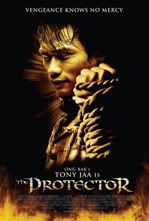
THE PROTECTOR (2006)

Director: Prachya Pinkaew
Cast:
Tony Jaa, Mum Jokmok, Xing Jing
Release: September 8, 2006
Synopsis:
THE PROTECTOR is the highly anticipated full bodied action film starring International Martial Arts superstar, Tony Jaa (Ong Bak). His world shaped by ancient traditions, a young Thai fighter (Jaa) is called to defend his people and their honor after outsiders ruin all that is sacred. Fueled by desire to protect a way of life and avenge the wrong done to his family, he will bring the fight to their city. This film is also known as TOM YUM GOONG.
View Trailer:

* Large (QuickTime)

Prognosis: Quasi Positive. When is anyone going to realize that trying to pepper my action trailers with exposition and helpful back stories of those in the movies is like going to whore only to have to listen to her blither on about how her day has gone before she’ll let you pitter-patter get-at’er?

Yeah, it’s like that.

I appreciate the effort, I do, especially in a movie starring Tony Jaa who, I might add, has made a tsunami sized impression into the hearts and minds of action aficionados state-side, but cut it. Get rid of it. I could care less about the road traveled by Jaa in order to become the ass-kicker exemplar of his peeps, I want to feel the noise and pain dropped down on my senses like a donkey punch to the gooch. But, since it’s there, I should point out why it just doesn’t do anything for those looking to blaze a few bucks at the megaplex.

First, talking about Jaa’s preferred form of martial arts, which seems to involve elephants and chicks who practice Tai-Chi in the mud, is kind of needless. Unless we see Jaa picking these skills up while practicing them on the scabbed and dirty underclass, delivering punches or exacting pain on the willing like it was free wet T-shirt night at the local nudie bar, I couldn’t care less. Actually, I could.

When we get to the emotional crux of how Jaa comes to be so consumed with ass-kickery of the Nth order I’m a bit let down. We just dwell on some hokey imagery of an old man dying in Jaa’s arms. Yes, this is perhaps needed in order to explain why he’s going from 0 ““ Pissed but we’re taking too long to get to the chewy center of what comes after all this explanatory BS.

It’s not until we are damn near a ¼ through this thing before we see Jaa leap in the air and deliver a double leg kick to two perfectly centered, perfectly equidistant, perfectly choreographed bad guys and that is really what’s at issue here. If we could get to the visuals first, fill in the back story later, I would be much more pleased at what follows and what follows is a whole lot of nonsense.

Who would ever ride their motorbike down an abandoned building’s narrow hallway and, if you were to do it, are you really the type to wear a helmet only to give Jaa the opportunity to sail over your swiftly approaching body and yank your ass off the seat by said helmet? I am delighted to ensconce myself in these sorts of perfect opportunities. To wit, Jaa cruising down a river that screams out pollution of the fecal variety only to be met with a helicopter that is loaded for bear and hovering mere inches above the water’s surface. This gives Jaa, again, the great opportunity to somehow situate one speedboat on its side while another swift moving boat conveniently launches into the body of the helicopter. It’s crap, sure, but I for one love it.

Oh, and who can deny the perfectly scored middle of this thing when some faceless, nameless opponent decides to fight hand-to-hand with Jaa in a room that’s a few inches deep with water? How the hell did this happen and why are we here? Who cares, right, when the result of these elements results in some more kinetic martial arts? By the way, I feel it’s my duty to also inform you that we also get a near subliminal flash of a lady’s skivvies and ample, ample, cleavage for no good reason at all; whatsoever. No need for it. But, hey, two thumbs up for the thought and much appreciated.

I am also a big, big fan of the moment here in this preview where Jaa screams out loud, with some muscle-bound whitey doing the same, the two of them yelling and running towards one another, with Jaa delivering a sweet double knee impact to this dude’s chest. The 13 year-old in me squeals with adolescent delight.

I’m not sure why or how you would get an off-road ATV on the second floor of an abandoned building, the same way that mo-fo on the motorcycle thought it was a good idea, but, again, this dude is also wearing a helmet for reasons that I realize but seem awfully absurd when you think of their line of work, but it all doesn’t matter when you see Jaa run and vertically run up the plate glass window in breathless slow-motion as ATV guy doesn’t think to throttle it back some before tossing his dumb ass out the window.

Again, it’s better if you don’t think these things through too hard.

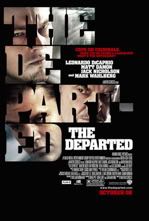
THE DEPARTED (2006)

Director: Martin Scorsese
Cast: Leonardo DiCaprio, Matt Damon, Jack Nicholson, Mark Wahlberg, Martin Sheen, Ray Winstone, Vera Farmiga, Anthony Anderson, Alec Baldwin
Release: October 6, 2006
Synopsis: The Departed is set in South Boston, where the state police force is waging war on organized crime. Young undercover cop Billy Costigan (Leonardo DiCaprio) is assigned to infiltrate the mob syndicate run by gangland chief Costello (Jack Nicholson). While Billy is quickly gaining Costello’s confidence, Colin Sullivan (Matt Damon), a hardened young criminal who has infiltrated the police department as an informer for the syndicate, is rising to a position of power in the Special Investigation Unit. Each man becomes deeply consumed by his double life, gathering information about the plans and counter-plans of the operations he has penetrated. But when it becomes clear to both the gangsters and the police that there’s a mole in their midst, Billy and Colin are suddenly in danger of being caught and exposed to the enemy ““ and each must race to uncover the identity of the other man in time to save himself.

View Trailer:
* Large (QuickTime)

Prognosis: Negative. Okay, I tried not to laugh. It was the second time I went through it and I couldn’t help myself.

I remember when I watched CAPE FEAR, seeing Robert De Niro getting all sorts of ripped inside his cell right before he brought hell with him into the world, or even TERMINATOR 2 when Linda Hamilton was showing ladies that doing a few dips could help that turkey gobbler which used to be their triceps, I was impressed. Physical toughness is a way to imply toughness of one’s character. Sure it’s shallow but it’s an effective way to express certain traits of an individual without having to explain it. That said, though, when the Rolling Stones start playing in the background and the trailer opens with Jack Nicholson slowly walking across what looks like a service garage I’m all straight faced and into the vibe. When I see Leonardo DiCaprio doin’ dips in his cell block, looking like his hypopituitarism is severely preventing any muscle development of any kind except that one eyebrow muscle that always gets a workout, I laugh a little.

Please. Have him put his shirt back on. No one believes he’s any threat to anyone else besides the Lollypop Kids and even then he’s not statistically favored.

Now, I get that we’ve got Matt Damon on the side of the po-pos, along with Leonardo who’s going to deep, deep, deep undercover (I still like that movie”¦poor Eddie) and I guess the point is that they’re on the hunt to bring down Nicholson. I also see that for a man running such a large crime syndicate Jack has some of the best dental work that illicit activity can buy. I’m very impressed.

Leo is frontin’ like he shits nails as he sits in his boss’ office as he’s told that his assignment is only going to pay him minimum wage but that there’s bonus opportunities available. I think this is supposed to be comedic but I’m too intrigued in the jaunty banjo-like music playing in the background to notice. Marky Mark gets into the jollyness as he cracks wise, Leo comes face-to-face with our crime boss, a sacrificial lamb, really, as who the f u c k believes that DiCaprio could hold his own with the exception of his ankled (wink, wink) and I am all sorts of confused at the change in tempo.

The trailer downshifts into a hip-hop, FOUR BROTHERS, kind of beat and we run pretty quickly into the particulars of Damon’s job. It’s nice to hear his Bean Town accent again, and I apologize that I laughed again when I heard it come out of his mouth, boorish of me I know, but of all the dialogue we are allowed privy to we get, “There are parts of my job I can’t talk to you about.” Great. Is this OFFICE SPACE where Peter can’t tell his lady about his secret plan to rip off Initech? No, seriously, he can’t.

We get that Matt is on the hunt for the cop that’s in Nicholson’s crew. Long story short: Damon is on the take, has kept Jack out of jail all these years and if Damon can’t find out who it is then Matt gets capped. Okay, how’s this, why not just kill the cherub that obviously could play the human version of One of These Things Are Not Like The Others?

The tempo shifts, again, and we’re launched into an oldie but goodie that’s set against a backdrop of dudes hitting one another, guns, explosions, hey, there’s a guy falling from a building, a lot of bombast from Leo that’s kind of cute and there’s an uncomfortable feeling that there will be a lot of dead people by the end of the movie.

The trailer feels a little bush league and there’s not a lot of wow to it but I know people will give Marty a pass solely because it’s Marty and, holy shit, the man can do no wrong. There is, however, fistfuls of wrong in this ad.

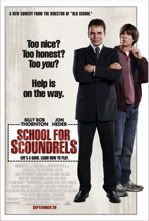
SCHOOL FOR SCOUNDRELS (2006)

Director: Todd Phillips
Cast: Billy Bob Thornton, Jon Heder, Jacinda Barrett, Michael Clarke Duncan, Dan Foglere
Release: September 29, 2006
Synopsis: In SCHOOL FOR SCOUNDRELS, Jon Heder plays Roger, a beleaguered New York City meter maid who is plagued by anxiety and low self-esteem. In order to overcome his feelings of inadequacy, Roger enrolls in a top-secret confidence-building class taught by the suavely underhanded Dr. P (Billy Bob Thornton). Aided by his assistant, Lesher (Michael Clarke Duncan), Dr. P uses unorthodox, often dangerous methods, but he guarantees results: Employ his techniques and you will unleash your inner lion. Soon enough, the teacher sets out to infiltrate and destroy Roger’s personal and professional life. Nothing is off limits for Dr. P, not even the object of Roger’s affection. In order to show Amanda Dr. P’s true colors, Roger must rally his new friends and find a way to beat the master at his own game.

View Trailer:
* Large (QuickTime)

Prognosis: Negative. What the hell?

Is this ANGER MANAGEMENT lite because this trailer just drips of uninspired tomfoolery, pratfalls and getting-smacked-in-the-nuts physical humor that should play well with the local yokels of Branson, Missouri, but should cause those who thought Todd Phillips was capable of razor sharp comedy just sigh and realize he’s dead-set on using one blade with no plans on changing it.

I think what’s wicked bad here is how we start off. I realize from the time Jane Austen could put pen to paper the notion of women and men not knowing how to come together in a way that’s anything less than awkward is just a trope that will never die but are we all that dense that we have to spend so long in the beginning to establish this?

Jon Heder, passing out from the complete and total and oh-my-gawd intensity of talking to a Real World starlet (how is she still getting work? I bet Milla Jovovich is pissed someone is taking all her 2nd tier roles), is socially inept and horribly incapable of acting like a positive contributor to the human race. He’s got no spine and needs one. Enter, stage left, David Cross, who tells him there is a class that hands out spines (wow, the timing!) and he should check it out. My buddies would relentlessly bust my balls until said spine would come in but since this is a movie our character is motivated by seeking 3rd party help let the wackiness ensue!

I give the trailer credit for allowing Thornton to use the pejorative “retard” to address the class of useless losers assembled to take this guy’s class; impressive as it is bold considering some group that will find that offensive.

So, establishing that this movie will need physical humor to set its jokes off we need a novel new way for dudes to hurt themselves in order to be amusing to the rest of us. Again, the trailer is heavy-handed in its presentation of this but the extended moment here of guys popping off a few paintballs at each other’s balls will ensure a few movie tickets are sold to that core demographic. Well done, sirs.

We move on through the movie’s progression, Heder actually grows a pair and gets the girl, but something happens as Thornton decides to movie in on his lady. Again, wasn’t this the basis for another directorially static production by a different name: ANGER MANAGEMENT? Enrage the other and watch all the zany things that are going to happen as a result? This isn’t a rhetorical question as the answer is yes to both queries.

So, the game is on between these two alpha males and, just like the paintball, (gasp!) we get more balls aimed at another dude’s balls. Great. I’m sure this is a quality comedy if all the physical humor involves high velocity objects entering another man’s twig and berries. Now, before I break bad completely on this flat, limp and uninspired comedy, I will give it a compliment. The scene of Heder and his cop buddies in the elevator who decide to try out a can of mace? The way they all retch and scream as the fumes and liquid invade all of their senses? That, friends, is funny. Nut smashing is so America’s Home Videos. Raise physicality to another level.

JACKASS 2 (2006)

Director: Jeff Tremaine
Cast:
Johnny Knoxville, Steve-O, Bam Margera, Chris Pontius
Release: September 22, 2006
Synopsis: Chris Pontius, Johnny Knoxville, Steve-O, Bam Margera, and the whole crew are up to it again with the sequel to Paramount’s 2002 highest grossing film Jackass: The Movie.

View Trailer:
* Large (QuickTime)

Prognosis: Shamefully Positive. I’ve got complaints, sure, but you know what I actually spent my money three times to see the first film. I can honestly state that since this movie’s release I hadn’t laughed as hard as I have at it until BORAT came around. It’s been a long time coming since the world has been given a full theatrical reason to bust a kidney or spleen from obnoxious and boorish behavior of fully grown men but I, for one, am hoping the second installment has the same element of surprise as the first one.

But first of all, come the fuck on.

This is the trailer and I have to endure nearly a ¼ of this thing’s running time just so Paramount and MTV Films can have their lame ass logo linger there, preventing me from getting some more of that infantile goodness?

“When it was released in 2002, People were outraged”

Yeah, easily forgiven as my man, the one who narrates most all of PBS’ Frontline shows (public television representin’, yo), uses his steely pipes to really drive home the absurd nature of how grandiose the first movie was.

“A new low” – Washington Times “¦. “A plunge into depravity” – Toronto Star

I like ads like this. The ones that flip pull quoting on its ear no matter how easy the joke is. This film embraces its obvious audience and I can’t imagine why any frat boy or 13 year-old kid wouldn’t find this an extra incentive to see the movie. Smart.

And just at the point where I was about to get ornery with there being no new footage I find, and I’ll just be upfront about it, I start giggling in that degenerative way when you know that 50% of the population is not about to get what is about to happen, I am looking at those possessing an XX chromosome here, as Knoxville sports a blindfold and then gets the horns of an attacking bull. Nice.

Party Boy pops up, always good for those moments when you need to stray into borderline homosexuality, as is the mark for all good male comedies; Steve-O offers his body to the science of human pincushioning; some asshole with more nuts than brains gets violently (read here: awesome!) yanked off a pier with a LOT of force; some fool decides to get wild with a fast moving shopping cart by riding one straight into a wall; I laugh out loud as Knoxville rides a bike strapped with a propellant of some kind; and I can’t believe that Don Vito, a much beloved side character from Bam Margera’s sideshow, is going to have a tooth yanked by having it attached to a string with the other end tied to a speeding car.

This movie fulfills some need in me; I admit it. I don’t know what that says about me as a person but when I see dudes behaving like this I can’t help a) to not care b) salivate at the notion that this movie is damn near here and c) watch this trailer again a couple more times.


September 7, 2006

The Fred Hembeck Show: Episode 71 – The Doctor Is In

Filed under: The Fred Hembeck Show — UncaScroogeMcD @ 4:45 am

fredhembeckheader.jpg

Think you could possibly imagine the late Rodney Dangerfeld decked out in a long red flowing cape, making funny gestures with his fingers?

That pretty much describes Dr. Strange back in the earliest days of Marvel’s sixties revolution. Because, in the forty-five issues featuring the work of his visual creator, Steve Ditko, within the pages of Strange Tales 110-146 (editor Stan Lee was apparently so unsure of the character’s initial appeal that after a mere two episodes, he held the Master of the Mystic Arts out of the next two issues in a rare instance of wait-and-see judgment), the good Doctor was afforded little respect and but a single cover all to his – and Ditko’s – own.

One.

Uno.

And not only was it the enigmatic illustrator’s last foray into Doc’s dark dimensions, he didn’t even actually draw it!

Well, yeah, okay, he did – but he clearly never INTENDED what was ultimately fronting the July 1966 issue of Strange Tales to be the book’s cover.

Here – take a look…

hembeck20060907-01.jpg

Nice, huh?

So was the interior story’s art – some of which might’ve looked mighty familiar to readers who’d immediately flipped open to Ditko’s baldly titled swan song after falling under the spell of that powerful cover.

Like this panel on page four…

hembeck20060907-02.jpg

And then, a page later, the sight of the Doctor on this impressive full-page tableau no doubt caused many a fan to experience an immediate sense of deja vu…

hembeck20060907-03.jpg

Take another, closer look at the masterful bit of production that is the cover of Strange Tales #146. Our hero was flipped, tilted and slightly enlarged (most noticeable on the leg shadings), while the ever inscrutable Eternity had his right arm flawlessly extended by some long forgotten Bullpenner (who also added some big black blobs of ink to flesh out the composition). A nice job, aided immensely by its rich color scheme .

I noticed all this recently when I decided to cobble up my own version of this Marvel Age classic…

hembeck20060907-04.gif

Dig this – Dr. Strange made it onto only eighteen of the Strange Tales‘ covers published during the Ditko era! Eighteen out of forty-five opportunities! Yeesh! The first one wasn’t until eight months in, either, on Strange Tales #118, and of that meager total, nine (including the big finale) consisted of small, smaller, and really teeny-tiny Ditko vignettes pasted up (check especially 137 – and all of the rest – over on this page at the Grand Comics Database). Eight of the others fell to the responsibility of lead feature Human Torch/Nick Fury cover artist, Jack Kirby – and as for the lone remaining one, well, we’ll get to THAT one later. More than once, Stan plastered a lamely apologetic blurb like the one found on the front of number 134: “Of course Dr. Strange is in this issue too – but we couldn’t find any place to put him on the cover!”.

Yeah? Well, I’m thinking maybe you coulda tried a little bit harder, Stan.

As it was, even with Kirby at the helm, Doc only managed to score equal or better pictorial billing on two of the King’s covers: 123 and 130. I’ve already drawn my own versions of both, writing them up to boot. (You can see for yourself by checking out these links to my gushing over the sublime delights of Strange Tales #123 #123 – and bitterly complaining about the Sorcerer Supreme upstaging the Beatles on the cover of Strange Tales #130 #130!)

No, Doc was afforded very little respect during the Ditko days, but after recently looking over all these covers, I think I’ve FINALLY figured out a mystery that’s been bothering comics fans for forty years now – why exactly DID Steve Ditko pack up and leave Marvel with no clear cut explanation back in mid ’66?

I’m thinking maybe it was THIS cover than pushed him over the brink…

hembeck20060907-05.jpg

C’mon, how lame was THAT? Yeah, yeah – there must’ve been some sorta monumentally insurmountable deadline crunch for Stan to stat the splash page of that issues S.H.I.E.L.D. story into the hands of a less-than-enraptured seeming Dr. Strange (drawn by future Doc artist, Marie Severin) – but even as big a fan of the Fury feature as I was at the time, it still just looked silly to me. Imagine then how Mr. Ditko, with his very specific views, reacted when he first spied this image:

“‘Almost everybody reads S.H.I.E.L.D.!”? I don’t think so, I don’t think so at all! Trying to suggest that we unmask the Green Goblin as Norman Osborn was bad enough, but THIS time, Lee has gone way, WAY too far! That’s it – I’m leaving!”

Well, y’know, it MIGHT’VE gone down like that – who can truly say?…

And as for this episode of “The Fred Hembeck Show”, in the words of that final Ditko Doc entry, yes friends, you’ve reached the end at last!

(If you haven’t already zipped on over there, check out Hembeck.com when you get the chance!)

Copyright 2006 Fred Hembeck

September 6, 2006

Widge Goes Off Giant-Sized Annual #1!

Filed under: Widge Goes Off — widge @ 3:15 pm
widgegoesoff.jpg

widgepic.jpgWelcome back. We survived DragonCon 2006, and as a result we provide you this very odd Giant-Sized WGO Annual with a slew of guest stars.

[CONTENT WARNING] This podcast contains foul language and a bunch of exhausted, punch drunk geeks.

DOWNLOAD: mp3 Format (66.9 MBs)

As for your Monday Morning Quarterbacking session, well…Jesus, did you see the box office? Boring as hell. Never mind. Go check out Box Office Mojo.

Special thanks to Exit Mindbomb for letting me use “Godzilla Will Rule You” from their album Happy Accident for my new WGO music. Check them out on MySpace here and I tried to link up as many songs as I could here.

Widgett Walls is the chief cook and bottle washer for Needcoffee.com. He’s also the author of Mystics on the Road to Vanishing Point and Magnificent Desolation. His personal blog is at OneTusk.com, which he updates when he feels like it. He lives and works in Atlanta, Georgia. He hardly ever sleeps.

Brat-halla #144: Norse Force – Special Honor

Filed under: Brat-Halla — UncaScroogeMcD @ 3:00 am

by Jeffery Stevenson and Seth Damoose with colors by Anthony Lee

Larger Comic Version | ARCHIVES | OLDER ARCHIVES

Brat-halla #139: Norse Force - Substi--

For extras, visit the Brat-halla Web site!

Check out the preview to the Image comic Jeff writes…

E-MAIL WRITER | ABOUT JEFF | ABOUT SETH | BRAT-HALLA BLOG | BRAT-HALLA FORUM | ARCHIVES

September 5, 2006

Preachin’ from the Longbox – It’s the Most Wonderful Time of the Year

Filed under: Preaching from the Longbox — UncaScroogeMcD @ 10:39 pm


longbox.gif

This Week’s Sermon – “It’s the Most Wonderful Time of the Year”

September 5, 2006

“It’s the hap-happiest season of all,
With those holiday greetings and gay happy meetings,
When friends come to call,
It’s the hap- happiest season of all”

Andy Williams, “It’s the Most Wonderful Time of the Year”

No, it’s not the thought of the upcoming snowy winter days now that fall is around the corner or even the beginning of the school year that has me humming this little ditty over and over in my noggin.  It’s the return of a column favorite of mine.

Last year, I had a jonesin’ for combining one of my long-time passions, comic books, with another albeit more recent one, fantasy football.  And before your ask – Yes, I don’t really have a life but I’ve already come to terms with that fact so let’s move on.

Now, last year, I was huge and offered a team that crossed all publishing companies; both big and relatively small.  This year, things will be a little different.  I wanted to scale down a bit and focus in on only one company’s cast of characters.  But the hard choice was which one I wanted to choose for this year.

I was initially leaning towards DC since I grew up on most of their stuff until I hit my early teens.  I’ve always thought that DC had the more top-line heroes and villains.  But when you think about it, DC’s high character depth is somewhat limited.  I mean, outside of even the second tier people like Nightwing, Tempest, Deadshot, Black Manta, and Blockbuster, you really have to think, which sometimes I’m not a fan of doing as my column proves.

Next, I looked at Image’s roster.  And while they initially started out as a super-hero company (does anyone remember “Brigade” ““ I try not to and yet, I still do.  Thanks Marat), they went away from it for some time and only are just now coming back to it.  And plus, in the early days, most of the characters were just bad rip-offs of characters and/or ideas that existed in the Big Two (outside of a couple characters like Spawn and Savage Dragon).

The not-intentional funny man of comicsYou know which one was left ““ The House of Ideas, otherwise known as Marvel.  It was my teenage years when I first started reading titles like “Uncanny X-Men”, “Avengers”, “Ghost Rider”, “Fantastic Four” and the rest that the House that Stan, Steve, Jack and the best Bullpen around built.  And yet with that history, I haven’t been as loyal to them as I have DC.  I can’t explain why.  The reason could’ve been as simplistic like when I first started back reading comics, Marvel was in the middle of a creative dearth.  Or it could just have been Bill Jemas’ fault.

Because my knowledge of Marvel is somewhat limited to be generous, I was still on the fence on using them for this year’s draft. Then, “Civil War” happened.  Then the shipping delays followed and my decision was made for me.  I had to come to Marvel’s rescue; if for no other reason than to give the Zombies a reason to talk about something other than a calendar.

Alright, I’ve explained enough.  Here’s the PftL Fantasy Superhero Draft Rules and Guidelines for 2006:

  • Teams can only consist of six members (known as “The Legion of Super-Heroes Decree” ““ basically, if you have to ask for a group roll call every time a crisis arises, you should definitely consider scaling back your team.)
  • You can only use characters that exist solely within the Marvel Universe.  That means no Ultimate, MAX, Marvel 2099, Epic, or Icon titles, people.  Not that I’m knocking those other imprints but I’m a purist at heart.  Also, since there is only one company, you can draft heroes and villains.  I’ll even allow you to designate the time-period for the character.  Say for instance that you would like to use Yellowjacket back when he was first introduced a bad-ass in Avengers #59 instead of when he was a nutjob in the mid 80’s.  Yes, yes, I am the most gracious commissioner that you will ever know in your lifetime.
  • Be realistic in making your picks. For your set of reference, “realistic” is defined as trying to create a team that doesn’t have too many of the company’s most powerful or even iconic figures.  If I can be brutally honest with you for a sec, it’s too easy to cherry pick those tried-and-true characters like Spider-Man, Iron Man, Wolverine, and Captain America to be on your team.  When you come right down to it, any comic featuring said type of super-heroes would make for a boring read, in my humble opinion (and no, that’s not a veiled reference to “New Avengers”.  Why would you ask?).  Also, don’t forget that as part of the “realism” (if such a word can be used in the context of “drafting” super-heroes), you must recognize that there would be other “owners” that would be participating in said draft.  So if you select Captain America in the Round One, there would be a sure bet that Iron Man wouldn’t last to your next selection in Round Two.
  • A team leader must be specified within in your picks.  A superhero team must have a leader or they would just be called the Great Lakes Avengers. But having too many leaders is probably not a good idea either since
  • And the best thing about this draft ““ there’s no real way to keep score outside of creating some sort of HeroClix/Magic: The Gathering-style scoring system.  And if you’re into that kinda stuff, you would be pasty, afraid of bright lights, and forever locked away in your mother’s basement playing and not expanding your mind by reading this column.

As always, have fun with the draft and try to be as original as you see fit.  Believe me when I say that most of the fun about fantasy games is not in the winning per se but in the drafting.  Also, the bragging rights and money comes in a very close second.  

The team that I would draft would be called The Twin Cities Replacements:


The 1st Pick in the 2006 Preachin' from the Longbox Draft 

1. Captain Marvel (Genis-Vell) ““ Team Captain 

I want to say that this selection is for the character that was inexistence during the initial Peter David/CrissCross run before U-Decide turned the test tube baby of Mar-Vell turned loony.  Prior that that fateful debacle by Jemas, Genis-Vell was like a guy who was trying to find his way as a superhero but had all of the powers cosmic that his father possessed.  Later in the run, he began to display some leadership skills albeit through the assistance of the guy who he was bonded to – Rick Jones, the permanent whipping boy of Marvel U.  Get this, not only is Jones responsible for Bruce Banner turning into the Hulk but he had to sacrifice himself just so reality wouldn’t implode on itself.  If that wasn’t enough, his wife at the time, Marlo, almost did a Ross Geller to him ““ with Moondragon.  When your wife comes close to changing teams with a six-foot bald headed psionic woman, you’ve got to wonder what more could the writers at Marvel do to him other than change him into a Giant Turtle?  This selection of Captain Marvel would be the one with Jones bonded to him and I would make him the team captain since two heads, even if one is as messed up as Rick Jones’ is, has to be better than one.  


 The Second Pick in the 2006 PftL Draft

2. Captain America (Isaiah Bradley)

Now, he’s more known for his grandson, The Patriot, but other than The Truth: Red, White & Black mini, what is known about Isiah’s time as Captain America.  While he may not be as polished as Steve Rogers could be at the same time in his career, Bradley would have the super-solider serum in his system, almost the same equipment, and he looked pretty bad ass in the revised uni.  My only reservation with this selection is that he more than likely would have a hard time taking orders from Genis-Vell but I’m willing to take that risk.


The 3rd pick in the 2006 Pftl Draft

3. Joseph (Magneto Clone)

While I wanted to get a villain that was formerly a hero with this pick, I just couldn’t find one that I liked.  That is until I remember a lame X-Men storyline that had a Magneto-clone called Joseph and I figured that was good enough.  Joseph is like getting all the magnetic powers of Magnus Lehnsherr but without the baggage.  And as cool as Magneto could be, he wouldn’t play second fiddle to anyone, he would be a disruptive force within the team and he would only do things that would benefit him unlike Joseph who would do anything that would be asked of him; kinda like the lovesick and desperate Ericka on “Big Brother All-Stars”.  Except that Joseph wouldn’t walk around the team HQ with a pillow under his shirt and saying that Mike Boogie will be the father of the child.  Hey, Ericka, if a nickname like “Boogie” for a guy in his mid-30s doesn’t tell you to stay away, girl, you deserve what you get.


The 4th pick in the 2006 PftL Draft

4. Marvel Girl (Rachel Summers)

If you want a good telepath on your team, you’ve got to go the best of the best as far as breeding grounds, which is up in Westchester, NY at the Xavier Institute for Higher Learning.  I figured that most of the real good ones like Professor X, Jean Grey, and Psylocke would’ve been taken by now.  So, the offspring of an alternate timeline version of Scott Summers and Jean Grey can most definitely fit the slot.  Plus, she still has the link to Phoenix Force, so she can be a heavy hitter in case the team needs her.


The 5th pick in the PftL Draft

5. Ant-Man (Scott Lang)

A size changer is almost like a speedster in the regards that they can be found everywhere.  Their powers are good for espionage and surprise attacks so getting one would be a good selection at the five spot.  Luckily, for me, that in the Marvel Universe, Pym Particles rule so you can find more than a few heroes that fit this requirement.  And at pick #5, Pym and his wife have probably left the board so I’ll go for the guy who replaced Pym in the Ant-Man suit and who is presently taking a dirt nap.  Before he was axed, Scott Lang was a decent third tier superhero; a little bit bland but he was a good teammate.  It’s just too bad that he didn’t get the same treatment that Luke Cage got with the whole Avengers reboot.  But, on the bright side, he got some from Jessica Jones before he kicked the bucket.  If you’re going to go out, at least he got to hit it before he could quit it.  (Really, I’ve been watching too many episodes of “Big Brother”.)


The last pick in the 2006 PftL Draft

6. Scarlet Spider (Ben Reilly)

I decided to save this last pick for the most infamous replacement in all of Marvel lore.  Everyone remembers certain landmarks in Spider-Man history ““ how he got his powers, the death of Gwen Stacy, and the Black Symbiote Costume.  But if you mention the name Ben Reilly to a Spider fan, you would think that all of those pale in comparison to the outrage that the whole Spider-Clone saga gets.  Sure, the plot was flawed in everyway and the series has been identified as a case study in what not to do with one of the most iconic characters in comics.  I mean, the clone could do the same things as Peter Parker and his powers were even better when you consider that Venom had no effect on his spider-sense.  But now, he’s known for giving his new Spidey costume to Spider-Girl.  Even still, while the Ben Reilly/Scarlet Spider name can bring up the most hatred and venomous words from the diehards fanboys, I still like the style and look of the only ghetto Spider-Man.  I may be the only one but I think that Ghetto Spidey looks way better than the new Iron Spidey that out there presently, which in a few years will probably make its way to the MC2 universe.
 

So, there’s my team.  Do you think that you have it in you to do better?  So good that you can actually win something?  Well – do ya, punk?  Then what are you waiting for?  Start drafting.  Here’s the legal mumbo jumbo:


The Preachin’ from the Longbox Fantasy Superhero Team Contest Rules:

  • Follow the PftL Fantasy Superhero Guidelines that were stated previously in this column.
  • Create your own team and submit your Marvel-flavored superhero lineup along with your physical mailing address to The 2006 PftL Draft HQ. (You can just send your superhero list only or you can add your reasoning as I have above.  Although from what was submitted last time, the reasoning brings that much more to the table, if you know what I’m saying.)
  • Contest deadline is September 30th, 2006 at 11:59.59 PM PST. Only two entries per person. The winner will be notified by Sunday, October 1st, 2006. The winner’s name will be included with the October 2nd edition of “Preachin’ from the Longbox”. Anyone is eligible to enter this contest (including the boss).  The winner will be determined by a panel of one (yours truly) by reviewing the entry’s originality, overall team build and variety of characters used.

The winner will receive the following haphazard cavalcade of prizes:

  • One (1) Micronauts Acroyear Figure (Devil’s Due Publishing Exclusive)
  • One (1) Sky Strike Batman Figure
  • One (1) Gen13 Fairchild Figure (Another Universe.com Exclusive)
  • Issues #1-4 of Micronauts (Image) plus ’02 Micronauts Convention Special & Micronauts Mini-poster
  • One (1) Batman: Dark Legends TPB
  • One (1) Batman/Deadman HC by James Robinson and John Estes
  • One (1) Savage Dragon: A Force To Be Reckoned With HC 1st Printing Signed & Numbered Edition (#550/1000)
  • Assorted Posters from the PftL Climate-Controlled Prize Vault

(Damn, that’s a ton of stuff”¦)

As was the case last year, the October 2nd column will be one that is totally devoted to the entries that I would consider have some merit or are just too funny for me not to include.  So, send early and send often.  Actually, only send two but in my household, more than once for me is considered often.

And in case you missed it last time, here’s the link that will take you to the Preachin’ from the Longbox archives.  As the saying goes, “If you haven’t read it, it’s new to you.”

Preachin' from the Longbox Archive

— ### —

A breaking PftL Update

I just got this email on Labor Day morning and thought that I would pass it along.  ACTOR – A Commitment To Our Roots, a non-profit organization that helps out comic creators from days past with medicals bills and with some financial support in an aspect that could be considered almost like a pension.  It’s a very noble cause and I try to support these causes since these guys are not benefitting from any type of ownership of the characters that they helped to create. 

Well, it seems that ACTOR has decided to change their name to The Hero Initiative.  While the loss of a cool acronym may affect the group’s identity initially, the change needs to happen since the organization’s golas are to help comics professionals, not those crazy Scientologists masked as Hollywood thespians.  (Or as Mel “A Few Too Many” Gibson would call them… Ah well, nevermind.)  Personally, I would compare this change somewhat similar to a change that happened in one of my fantasy football leagues - the name maybe new but the mission is still the same.  Okay, maybe they’re not totally compatible but you get the picture.

I’m off the Longbox this week. I’ll leave with the images of new logos for The Hero Initiative.  Remember, don’t forget to keep your bags and boards together and your continuity straight. Until next time”¦

-britt

The Hero Initiative Logos


Nocturnal Admissions: DVD Review, Desperate Housewives: The Complete Second Season

Filed under: Nocturnal Admissions — UncaScroogeMcD @ 10:36 pm


nocturnalheader5.gif
Title


Desperate Housewives‘s season two was the NBA basketball game of TV shows Ñ¿ only the final minutes counted. You find out what happened, then you’re done.

Well, it wasn’t quite  that bad. But still. Before its second season,  Desperate Housewives was a show that galvanize network broadcasting, which was on the ropes thanks to competition from HBO, cable in general, sports channels, sports in general, video games, and everything else that floods this self-amusement ridden culture, including counter-programing on the other four networks.   DH is one of the shows that people point to when they say that episodic television is now better than movies.

Or they used to anyway. Something happened to  DH in season two, yet no one has been able to say just what it was exactly. For example, the new issue of  Entertainment Weekly simply refers to No. 2 as lacking No. 1’s “humor and dramatic unity,” while also getting show creator Marc Cherry to admit that he “learned a lot” toiling on the troubled S2. While everyone was pondering the flaws in  DH2, the other ABC shows –   Lost 2 and  Grey’s Anatomy 2 – continued to garner more prestige and obsessive viewers. I happen to have a theory about what, if anything, went wrong,   which I’ll get to shortly.

The new  Desperate Housewives: The Complete Second Season, The Extra Juicy Edition will give students of the show a chance to sit down and watch its second frame in rapid succession, and doing so may allow viewers to glean clues as to why the second season is bad, or at least widely considered to be inferior to the first.

I’m baffled as to why people think that. After all, this is the season when Gabrielle (Eva Longoria) had a jealous fight with a nun in a church, eventually setting her on fire. And speaking of fire, this is also the season where the accidental pyromaniac of last season faces a conflagration in her own home. This is also the season where Lynette (Felicity Huffman) and her husband change jobs and roles, and  where Bree Van De Kamp (Marcia Cross) watches like an angel of death over hysterical pharmacist Roger, whom she lets die in what would have otherwise been a theatrical suicide attempt. Then she abandoned her psychopathic son on an isolated road in the woods. And Susan (Teri Hatcher) broke up with her “plumber” boyfriend and fall back in with her untrustworthy husband, if only temporarily. Not to mention the season-long mystery of the thing or creature in the basement of the hour that new neighbor Betty Applewhite (Alfre Woodard ) just moved into.

Mary Alice


There was quite a bit of action on Wisteria Lane in the season, starting with the resolution of the cliffhanger from S1, and golf carting through all manner of hospital visits, fights, spyings, and psychological games. Personally, I’m a little baffled as to why some critics detected a falling off. Maybe S2 was a little  too chaotic, I don’t know; too me it seemed of a piece with the first season, while progressing forward into dark areas, especially in the Van De Kamp family (but I am a sucker: I am continuously surprised at how show writers can come up with new and interesting twists). There are some nice twists in this season; the Danny Elfman music still makes the show by setting a certain tone, jaunty, puppet like, racing, and for me it was a delight to see the normally invisible, because she is dead, narrator Mary Alice (Brenda Strong) pop up in special flashbacks: she has a fantastic voice but also a beautiful smile.

But if so, if there really was something wrong with S2 I think I know what the source of the problem is: Emmy whoring.  DH won five Emmys out of numerous nominations for its first season. This may have gone to the head of the sort of people who run  DH,  that is, people obsessed with awards and award ceremonies. On the new DVD set, creator Marc Cherry mentions a couple of times how this or that scene should have won an Emmy. If your goal is to achieve personal or corporate validation from awards, then you are thinking outside the box in a bad way; your eyes are on the prize, not on the substance of the scene, its place in the show, and the show as a whole.  DH won no Emmys in 2006.

But you can make up your own mind. Season two of  Desperate Housewives comes in a lavish package, the six discs in a folding multi-disc digipak with a see-through plastic holder. The 24 episodes, in excellent widescreen transfers, are spread over five discs, with the final platter holding all the supplements.

Mom

These include a video interview with Marc Cherry and his mother, an inspiration for the show; a 10-minute segment on how a typical show (in this case, Ep 13) is created; a group interview with various contrasting TV moms from  Happy Days‘s Marion Ross to The Walton‘s Michael Learned. 


Making of


There are no audio commentary tracks, but Cherry provides one of sorts over a selection of his favorite scenes, plus over two story lines pulled from episodes for time; there is a profile of the show’s costumer, a promotional bit about the show’s sex scenes, a promotional summary of season one, a look at the  DH video poker game, and finally trailers for numerous other Disney shows and movies.

Box


Desperate Housewives: The Complete Second Season, The Extra Juicy Edition hit the stree on Tuesday, August 29, and retails for 59.95


September 4, 2006

Spook’d #93: Extreme Lair Makeover – The Right Materials

Filed under: Spook'd — UncaScroogeMcD @ 11:30 am

by Jeffery Stevenson and Seth Damoose with colors by Anthony Lee

Larger sized comic | ARCHIVES | OLDER ARCHIVES

Spook'd #93: Extreme Lair Makeover - The Right Materials

To see Spook’d host Alastor’s blogging silliness and more fun Spook’d stuff,visit the Spook’d Web site!

Check out the preview to…

E-MAIL WRITER | ABOUT JEFF | ABOUT SETH | SPOOK’D BLOG | SPOOK’D FORUM | ARCHIVES | OLDER ARCHIVES

Disclaimer: All material in Spook’d is fictitious and intended solely for the purpose of entertainment. Names are fabricated and any similarity to real people or places is purely coincidental except in those cases where public figures are being satirized.

Scrubs Blog: Picture Holiday

Filed under: Scrubs Blog — UncaScroogeMcD @ 3:02 am

scrubsheader.jpg

Things are still awfully busy now that production has resumed, with everyone running around a bit right now – so this week we’ve got a blast-from-the-past quartet of behind-the-scenes pics from the Zach Braff directed Episode #408: “My Last Chance” (all photos by Robert Cheung, Best Boy Electric).  

Let me remind you, though, that in support of the National Multiple Sclerosis Society, a Scrubs Scooter is being raffled off on October 7th. Tickets for the auction can be purchased online right now for $5.00, with all the money going to the National Multiple Sclerosis Society. You can head over to the MS site and enter by CLICKING HERE And now, the pics… First off, Scene 30...

scrubsblog-2006-09-03-01.jpg
EXT. FIELD – NIGHT  

J.D.
What are you doing?

JANITOR
It’s been four years. How do you
not get how this works?

scrubsblog-2006-09-03-02.jpg

Balloon Light by Lights Up…

scrubsblog-2006-09-03-03.jpg

 Rich Davis (Camera Operator), Zach Braff, John Inwood (Director of Photography), and Andy Rawson (Gaffer) entranced at Video Village

scrubsblog-2006-09-03-04.jpg
Night Lights by Bebee…

Party Favors: Motherf’n Snakes

Filed under: Joe Corey's Party Favors — UncaScroogeMcD @ 2:43 am


partyfavors1.jpg


DURHAM — My summer is complete now that I saw those Motherf’n Snakes on a Motherf’n Plane at the Motherluvin’ Starlite Drive-in. It was a beauty to behold above my hood ornament. The film started out rather slow which is good cause at the Drive-in, you want to get some make out time in the microbus. But when the plane took off and the snakes went after the passengers, it was pure bliss. The theater is beneath a flight path so periodically the lights of a plane would appear in the night sky. I wonder if those people knew that there could be snakes on their plane!

It’s a damn shame the film didn’t smash box office records. But maybe this is a film that is too scary for our times. People don’t want to imagine how they’d fight back against the snakes on a plane that has nothing more dangerous than a spork.

Maybe the weak box office is from putting together two things folks fear the most – poisonous reptiles and airplanes. In the future, studios will restrict their horror flicks to only one scary element. This dooms my new project about a Great White Shark eating people at the DMV.

Kevin Smith is supposedly wanting to get in on the horror action. I’ve got this new idea The Headhunter. It’s about a corporate headhunter who finds clients their dream jobs by locating the positions and killing the person that’s already in that job. Pinstripes and blood! Maybe a massacre at a corporate retreat. I got some twists for the script, but you have to pay to experience them. Unlike Paris Hilton, I don’t give away the money shots on the internet.

UNDERGROUND DELIGHTS

The Underground in Raleigh, North Carolina is now my favorite restaurant. It’s a small bistro tucked in the basement of Charlie Goodnight’s Comedy Club. And while that’s probably the set up to a joke about serving old watermelons smashed by Gallagher, I can assure you that it’s a land of serious dining.

It’s a small plate joint so there’s no doggy bags. Which normally causes me great pain when I leave a table without tomorrow’s lunch all wrapped up and ready to reheat. But the dishes are amazing. Chef Dan Taylor shops at the local farmers’ market so the menu changes with what’s really in season around here. There’s no usual favorites. And he’s very creative with his combinations. We had this crab cake that used potatoes so they puffed up. This is the type of food play I’d expect served up on Iron Chef episodes that aren’t about shark’s tale and otter claws. If you ever find yourself in Raleigh; don’t drop by my house. Instead, call up Dawn at  (919) 664-8704 and make a reservation at the Underground for dinner. Odds are you’ll find me savoring a tasty duck entree or the lobster ravioli.

It hurt me to watch Flavor Flav destroy the huge lobster on the new season of Flavor of Love. I could handle seeing the one girl take a dump in his living room. A mega-lobster is a dream dinner of mine (something I’ll eat after winning the Megabucks). Flav busting its claw like he was trying to remove a cellphone from the blister packaging is sacrilege.  I’m not sure how many pounds that lobster weighed, but I cried that much in tears. That lobster gave his life for fine eating and not to be turned into a Three Stooges prop.

Why does Spike have to butcher up the Stooges on the weekend? Sunday morning, I’d like to see a like Moe in motion, but everytime I turn t the channel, it’s a stinkin’ commercial. Would it kill Spike to treat its viewers with respect? I need to Netflix the Sony collections cause I’m not paying so much for so few episodes. I must see “Uncivil Warbirds.” That’s comedy. How come instead of that Ultimate Fighting show, they don’t have The Stooge Challenger where idiots attempt to recreate a Stooges episode without using stuntmen or fake props? I’d watch it. Of course if they make the show and don’t pay me, I’ll sue Spike TV and be able to afford a ten pound lobster. Wonder if they can cook that up for me at the Underground?

WHITE WASH TRASH

Is it only in Raleigh that people in trendy neighborhoods are covering their expensive brick homes with white paint? Is this a national trend or merely local idiots upholding a dork tradition?

LUX LIVE

Luxuriamusic.com now has live DJs playing those swank sounds. After five years, the dream is back. This is the internet radio station that was marked for death by Clear Channel and was stolen back by the fans. I’m so proud that for once, a small band of diehards were able to stick it to the man. And they did it with a funky beat.

THE EMAILS WERE LIES

I’m at a sorority house at 2:30 in the morning. Under normal circumstances, the story would involve the phrase: “and then after posting bail….” But not this time. I was helping with a live satellite feed to morning shows across America about campus fire safety. Did you know that there are plenty of stupid kids going to major colleges? My favorite was a guy who decided to defrost his mini-fridge in the dorm by using a candle. Did I mention he didn’t turn off the fridge? And get this, he left the room for a couple hours with the candle still going. And the funny part is that it burned down half the dorm. Damn shame that this wasn’t a question on the SAT so that dorks don’t get into schools.

While we were working at the sorority house until the sun came up, none of the girls asked me any questions about how they can improve the internet cameras in their shower room. How come I get email every day from sorority girls wanting me to see them showering at the house when these girls don’t have one? Is this just another internet lie on the scale of my wikipedia entry? The sad part is that I showed up for the shoot with a Bill O’Reilly approved falafel. He likes seeing women use them in the shower.

SAYING NO

Dr. Phil’s people have called me three times now begging for me to appear on his show. He really wants to explore my “Slacker WIth No Shame” lifestyle. But he can’t handle the truth. And I don’t think my life can fully be explored at 9 a.m. on broadcast TV. I’m late night HBO. I don’t want to scare sick children. Hopefully Dr. Phil’s weasel won’t try to suck up to me with a fruitbasket. I can resist a fresh pineapple. I will however accept a free trip to Cathouse. I can work out some issues with an intense therapy session with Bridget the Midget.

Can the IRS tax me for comp sex at a brothel? They’re going after the Oscar gift baskets. I’m delighted that the comp circus is getting screwed up. Too many E! specials about the freebies is pretty pathetic.

PARIS VS KFED

The loser of this battle of the golden throats: People with ears.

TRIPLE DIP DELIGHTS

Remember the first time your favorite movie came out on DVD? Think back all those five or six years. Weren’t you excited? And try to capture the feeling you had when they announced a few years later when they’d have a special edition hitting the shelves with tons of bonus features and the promise of a remastered video transfer? And you bought it because damn it, you wanted those kick ass bonus features. You tolerated the double dip into your wallet because they got it right this time.

Well this year the studios have gone for the triple dip! Scarface,, James Bond, and Frankenstein are begging to become triplets on your video shelf. How many times does New Line expect folks to repurchase the various Lord of the Rings titles? And George Lucas is about to pull an amazing fast one on Star Wars fans. This month he releases the first three films (Phantom Menace and its poor cousins get to the back of the line) with a bonus DVD containing the original theatrical cuts. It was all the buzz when it was announced. Of course Lucas immediately deflated the joy of those who wanted to see Han shoot Greedo first. He announced that he’ll be just yanking this transfer off the laserdisc master. It’d be non-anamorphic with no real retouching.

But this isn’t Lucas’ greatest sin against fans. What’s leaked out is that next year for the 30h anniversary, he’s going to once more buff up the films and put them out in a mega-boxset. The original cuts will be included. So those of you who run down to Best Buy this month for the limited edition DVDs, will be contemplating buying another DVD of Empire Strikes Back in less than a year. And they aren’t even talking about the upcoming boxset being in an HD format. What’s the point?

Right now I’m staring at the Frankenstein and Dracula DVDs that Universal is shipping out at the end of September. I bought the first versions that came out in 1999. And I was pretty happy with them. When they re-issued them in 2004, I didn’t mind because they also threw in all the follow-up movies in the collection at a low price. I want my House of Dracula in the collection. Plus they threw in mini-busts of Bela, Boris and Lon as their classic monsters. Hugh Hefner has them above his bed in the The Playboy Mansion. But now the monsters are back and I’m going to fight them off. The only real bonus on each seems to be documentaries on Boris and Bela. I can’t pull the trigger on this purchase. Mostly because I know Mrs. Corey is holding a gun if they show up in the mail. I’m not a wuss. Women have that “you already own two copies, what do you need a third one for?” look in their facial vocabulary. It’s followed by the “does your mom still have space for you in the basement” lip rise.

In a few years, I’ll be wanting to upgrade to HD on a lot of titles. What’s the point in rebuying outmoded technology? Do you see me waiting for Best Buy to stock The Best of Loverboy on 8-track? MGM will be releasing new versions of the James Bond DVDs in a few months. I’m still happy with my complete collection that bought four years ago. Do I really need to upgrade Octopussy? I’m holding out till it’s HD upgrade time for 007. And even then, it’s only going to be the Connery collection that needs the 1080i action along with On Her Majesty’s Secret Service. Are you laughing? It’s the most emotionally complicated Bond film. I don’t think we could have accepted Connery in the role. We’ll argue this out later. But for now let it be known that I won’t be getting any HD versions of The World Is Not Enough or Tomorrow Never Dies.

The funny thing is reading about a slowdown in DVD sales. Maybe studios could make a little more money if they wouldn’t keep recycling titles?  I shouldn’t be too harsh on Universal since they do have dipped into their vaults for a few more afternoon creeps that haven’t been warhorsed on DVD. 

The Boris Karloff Collection contains The Tower of London, The Black Castle, The Climax, The Strange Door and Night Key on three dvds.  It’s nice that Boris is getting the same treatment as Bela Lugois received last Halloween season. Although those five titles were crammed on one flipper DVD.  Inner Sanctum Mysteries: The Complete Movie Collection packs Calling Dr. Death, Weird Woman, Dead Man’s Eyes, The Frozen Ghost, Strange Confession and Pillow of Death onto 2 DVDs. These hour long chillers starred Lon Chaney Jr so it’s kinda his boxset. The folks at Universal have decided to be extra busy by putting out The Classic Sci-Fi Ultimate Collection with the science scary Tarantula, The Mole People, The Incredible Shrinking Man, The Monolith Monsters and Monster on Campus. All of these sets come out on Sept 19. How does Universal expect someone to still have money for the Dracula and Frankenstein DVDs that come out the next week? It must be noted that the Sci-Fi boxset is a Best Buy exclusive deal. But I’ll deal with the devil to see the Jack Arnold classics.

WES VS. THE DAN

Steely Dan’s intervention letter to Wes Anderson is posted in my discussion section. Why are the Dan more creative with their letters than their last two albums? I even grew to love Gaucho, especially after my girlfriend ran off with a latin american slimeball. My heart knew what those Babylon Sisters were shaking. But their comeback records just didn’t make me want to come forward in my passion for Donald and Walter. I blame the road for the quality of the music. They had to write music that they could play live. There could be no delicate moments that were found on Aja.

As far as their advice to Wes Anderson goes, someone needs to tell the guy that he’s working himself into that “only for the devoted” attitude. Wes has been on a creative decline since the second half of Rushmore. What was the point of the third act? Wes has mistaken artifice for entertainment. I’m still bitter at buying Life Aquatic instead of renting it. That film ruined my spoof of Blue Water, White Death that were had a production company nibbling to create.

There needs to be a reality show where Steely Dan shows up and saves artists who are in the process of screwing over their career with their genius. Of course the first episode would feature Walter and Donald shoving Kevin Federline into a wood chipper. Not that KFed is a rapping genius. We just need a ratings grabber.

WHY?

How could Fox dump Jillian Barberie as the NFL Weather gal? I’m blaming Joe Buck’s wife. I haven’t heard anything on the record, but I sense that Mrs. Buck knows that she can’t compete with Jillian’s heels. Damn all those at Fox that brought an end to an era. It’s a good thing my team is in the AFC so I won’t have to watch Fox’s pregame shows.

Nocturnal Admissions: DVD Review, Seven Samurai

Filed under: Nocturnal Admissions — UncaScroogeMcD @ 2:33 am


nocturnalheader4.gif

As I’ve noted elsewhere, we seem to be experiencing a rush of great DVD releases. This flowering, this elevation, of DVD content may be a coincidence, or it may be the last gasp of DVD before Blu-Ray or HD-DVD take over. Or it may just be “fall,” when, traditionally, the movie industry “gets serious.” But whatever the reason, DVD collectors are grateful for such recent notable titles as the box sets of Rohmer and Malle, Powell’s  A Canterbury Tale, the  Mr. Moto set, and the box of Jayne Mansfield movies. Also among them was  Apocalypse Now: The Complete Dossier, the latest version of a film that continues to reveal new facets and spark interesting commentary. It can be endlessly watched and endlessly debated.

SS Box


Another similarly rich movie is  Seven Samurai, coming out from Criterion in a new three disc set Tuesday, September 5 (and retailing for $49.95). Thanks to the new commentary track and the two big supplements, I learned this time around that the movie  should be called  Seven Ronin. It seems, if I understand the chat correctly, that the seven warriors coming to the aid of a small village annually raided by brigands, are masterless samurai, i.e., ronin. In fact, according to one of the experts on the disc, the real samurai, which made up five per cent of the population in the 16th century when  Seven Samurai is set, were often merely bureaucrats filing paperwork for their bosses.


SS child


But that is just one nugget amongst many. And the film is well worth seeing again anyway because  Seven Samurai is one of the great works of cinematic “existential humanism,” perhaps the best “philosophy” for making great, high art films, and most post war European films fall broadly into this category (you might also call it the Janus Films philosophy). Kurosawa’s innovation is to marry it to an action film, and his ability to elicit beautiful movement from his camera, from his cast, and, more theoretically, from his narrative, serve to, so to speak, embed his views, rather than make them the point of a given scene.


SS Create


I’ve just re-listened to the Michael Jeck audio commentary track, often heralded as the gold standard of audio commentary tracks, and which also appears on the original DVD, which bore spine number 2, and which also shares with the new set the movie’s theatrical trailer. Also included then but now missing were an essay by David Ehrenstein and, for those lucky enough to get the earliest pressings of the disc, a restoration demonstration that was later removed.

I’ve also listened to the new commentary track recorded for the new release, still labeled CC No. 2 so it supersedes the old disc. The new commentary is an edited group effort that begins with Stephen Prince, and proceeds through David Desser, Tony Rayns, Donald Richie (who emphasizes the influence of Soviet cinema on AK), and Joan Mellen. The set also comes with a 60-page booklet that includes essays by Kenneth Turan, Peter Cowie, Philip Kemp, Peggy Chiao, Alain Silver, Stuart Galbraith IV, Toshiro Mifune, Sidney Lumet, and Arthur Penn.


SS screentests


This is a three disc set and the first disc, which has the first half of the movie, also features a suite of trailers and teasers, and a production stills and poster gallery, combining to present about 40 images. The second disc, besides offering the second half of the film, features the 55-minute episode on  Seven Samurai from the Japanese television series  It’s Wonderful to Create (segments of this series also appear on other Criterions). From it, we learn that there was a first scene that was stuck from the film in which the brigands attack an earlier, different village, and then the doc runs through the script writing process, the film’s music, problems in shooting the “burning water mill” sequence, and other cruxes. It’s highly entertaining and informative, with many alum of the production telling funny anecdotes. It’s also filled with shots of the much-worked over script and costume test footage.

SS Interview


Finally, disc three has two big supplements.  My Life in Cinema is a two-hour TV interview with Kurosawa from 1993, probably arranged to help promote his then recent and it turns out last film  Madadayo. It’s conducted by fellow helmer Nagisa Oshima, a wholly different kind of director, but who acts with deference towards his elder. It’s a good nuts and bolts interview, talking about AK’s background and how he does what he does. Oshima begins by asking about Kurosawa’s ethnic background (the director was unusually tall), and Kurosawa avers that there may have been some Russian interbreeding way back in his family’s past (which makes an interesting connection with Richie’s points).

The second is  Seven Samurai: Origins and Influences. This is an original documentary, made by Criterion. It’s divided into three parts. The first covers the history of the samurai in Japanese culture. The second part covers earlier samurai films, with clips from early silent films featuring rather stagy, balletic sword fights. The final part covers the innovations to the genre that Kurosawa wrought. This effort provides a good grounding in all that goes into the samurai legend, thanks to the various commentaries, who make up the same scholars doing the commentary, with one exception, and should inspire newer fans to get caught up via such books as Alain Silver’s  The Samurai Film, along with books by the scholars summoned to commentate.

SS Poster

Criterion has a new, softer look and a new logo, introduced a few movies back, but this is the release that is probably going to introduce it to the consumer. This set will be a bestseller.


Game On! 9-2-2006

Filed under: Game On! — admin @ 2:29 am

gameon.jpg

Y’know what sucks? When you go to play a PSP game, only to find that the battery is dead. Then, even worse, you go to charge it, keeping it plugged in for about an hour or so, only to have it STILL not work. Apparently, the battery in my PSP no longer holds a charge. This sucks. So, there I was, with my portable gaming system, playing with it STILL plugged into the wall, making it highly less portable. Ah well, least the game was good. Let’s get one with this week’s reviews.

ROWS OF HOES

saintsrow.jpgThe sandbox genre is becoming a very popular style of gameplay nowadays, made famous of course by the free-roaming, do-anything GRAND THEFT AUTO series. Now, yet another young upstart is staking it’s claim to the open world genre, and it takes some big cues from the GTA series. Hell, more than cues, it outright copies many things flat out. I’m speaking of course of SAINTS ROW, the suped-up, next-gen heir to the throne of all things thugish AND rugish.

If imitation is the sincerest form of flattery, Rockstar must be blushing to beat the band. SAINTS ROW doesn’t even try to hide the fact that its inspiration comes from GTA’s most recent iteration, SAN ANDREAS, with it’s full on thug-culture and hip-hop heavy soundtrack. The gangsta lifestyle is in full effect here, and just as with SAN ANDREAS, it’s, yes, fun to play. Stealing cars, pimpin’ hoes, shooting rival gangs”¦yes, the game is violent, it’s unethical, and well”¦it’s just what you’d expect of a game that emulates GTA in every aspect.

It isn’t totally outright a copy though. No, there are actually some aspects of the series that it improves on. The targeting, for one, is much easier to handle in SAINTS ROW. Using an FPS style rather than GTA’s irritating lock-on system, you’ll be poppin’ caps in fools in no time. The driving also seems refined, and cars handle with accuracy and each drives differently than the last.

There’s some fairly deep customization here, too. Right from the start you can make your character look however you want, changing his face contours, race, hairstyle, whatever. Don’t like how your character looks midway through the game? Well, just take him to the local plastic surgeon. Hell, that even helps lower your notoriety with the local police and rival gangs! You can also outfit your character with clothing, bling and other accoutrements at the various shops around town, as pimp your ride too, with various body kits, paint jobs and rims.

The main story has you joining up with the 3rd Street Saints as they try to take back the row from three rival gangs. As you progress through the story missions, you must gain respect in order to go from mission to mission, which you do by taking out rival gang members or doing side activities. Some of these side activities are familiar, such as Hijacking and Mayhem, but there’re a few new ones for the genre, such as Insurance Fraud and the Escort missions. For Insurance Fraud, you basically go to a busy intersection in town and fall down in front of cars, collecting money if they hit you. The bigger the dive you take, the more you rake in. Escort missions have you driving a stripper and her client around town, avoiding the paparazzi so they can finish up their “business”. There’re a wide variety of things to do around town.

santsrow2.jpg

The main thing that will separate SAINTS ROW from GTA (until the next-gen version comes out next year that is), however, is its online game. SAINTS ROW boasts a robust variety of multiplayer games, from standard co-op to cool multiplayer missions such as “Protect The Pimp”, and “Drop the Chains”. In “Protect the Pimp”, two teams compete. One has the “pimp” and must protect him from the other team as they attempt to cross-town. Simple enough, except that the pimp has reduced health, but a single hit-kill “pimp hand” attack. “Drop the Chains” has teams collecting bling and dropping it off in certain areas for rewards. Carry more than four chains, and you show up on the radar to be taken out. There’s so much to do online that most players will find themselves whiling away the hours in online matches once they finish the game’s already deep 40-hour single player mode.

It may not be the most original game, but it certainly is a shitload of fun. And while it pushes the envelope in ways that GTA hasn’t (there seems to be an over abundance of the word “cock” that I have yet to see it’s equal in gaming) it certainly shows where it comes from. And while it’s pretty and controls well in high definition, there still remains the problematic pop-up of draw distance, but I guess we’re sued to that from this genre. All in all, it’s a good time being bad.

One Gamer’s Opinion:
righton.jpg

“ULTIMATE” IS ANOTHER WORD FOR “BALLS TOUGH”

ugng.jpgFans of the old school side scrollers be far warned; the master is back. The GHOSTS N GOLBINS series is notorious for being amazingly fun and amazingly difficult all at the same time, and its newest entry in the series, ULTIMATE GHOSTS N GOBLINS for the PSP is no different. It’s a fine example of what gaming has been before, and what it should always be. Entertaining, challenging and a great looking game.

Once again taking the mantle of Arthur, the knight in the boxers, you set out to rescue the fair Princess Prin Prin who once again finds herself captured by nefarious baddies. Arthur must run, jump and battle all the gruesome ghoulies across the countryside in an updated form of the classic games of old. In what is quickly becoming known as “2.5D”, two dimensional characters are being set against three dimensional backgrounds in a cool mesh of graphics that really look well on the handheld console (seen also with Capcom’s MEGA MAN X: MAVERICK HUNTER).

ugng2.jpg

This newest game updates the look with 2.5D, but the gameplay is wholly GNG. Arthur collects power-ups and new weapons, all the while fighting uglies and trying not to lose his armor and fighting in his skivvies. They’ve added a few new tricks to his repertoire, such as the ability to (finally) throw attack is just about any direction (not just forward, but above and below you as well), adding a shield (which degenerates over time) and magic attacks as well. Arthur can also grab ledges and climb up or drop down from overhangs as well. His arsenal of moves is increased by new weapons types (like boomerang scythes and multi-shot crossbows) and magic attacks.

And while there’s a wide variety of skills at his disposal, they still haven’t corrected the series main flaw. Arthur still has trouble jumping and running at the same time. Still, control is tweaked enough that this isn’t a huge problem. Never will you find a moment of holding still as you constantly roam the levels, killing everything in sight and running toward the end goal. The three selectable skill levels (Novice, Standard and Ultimate) all offer unique challenges for the familiar and unfamiliar to tackle, and Ultimate will truly challenge those who’ve even conquered the previous entries with ease.

For old school fans, this one is a no brainer. It’s quality gaming with and old school feel and a new school look. New moves, classic gameplay and all around amazing adventure. A must own.

One Gamer’s Opinion:
kickass.jpg

Strange how this week’s reviews worked out, eh? One emulates and outright copies one game, and one pays homage to another, while actually being a legitimate sequel. Imitation IS the sincerest form of flattery, even when you’re imitating yourself, I guess.

September 1, 2006

Take Me Home Blog #8 – LET THERE BE SITE

Filed under: Production Blogs,Take Me Home Blog — UncaScroogeMcD @ 6:41 am


takemehomeheader.jpg


I’M NOT GOING TO LIE TO YOU (because you aren’t family)
I’ve had a Take Me Home website done for about four months now. I was going to revamp it; make it a little more “user-friendly” for the whole lot of you. But then I realized that what was more important was that you guys and gals get to see how we’re trying to appeal to THE MAN. No, I don’t mean Randy “Macho-Man” Savage, I mean the people in power, our prospective investors. The site was designed to be professional, even (dare I say) tasteful. Regardless, I’m pretty excited about it; I think it’s a good site. If anything, it’ll give you all a little more perspective on exactly the type of film we’re making.

THE BIG TEASE
Not to mention, there’s actually a decent teaser trailer we made specifically for the site. We shot it in three days, edited it in two. It cost us under a grand, but I think you folks will agree it’s looks a heckuva’ lot pricier. Most importantly, it gives our investors something concrete; they can see this movie’s potential.

AND, FOR A LIMITED TIME ONLY
To give you a little more perspective on exactly how desperate we’d become with our ex-potential investors, take a look at the “FOR OUR INVESTORS” link on the main page. It’s basically a last-ditch effort to get these guys to put their money where their mouth is (or was”¦and then wasn’t).

Anyway,

TAKE A LOOK-SEE:

http://www.takemehomemovie.com

COMING NEXT WEEK:
“Well, the Hail Mary failed”¦ how “˜bout a first down?”

-Sam Jaeger

jaeger.jpg

Trailer Park: The Girl Who Moved Out of the House Next Door

Filed under: Trailer Park — admin @ 12:44 am
trailerpark.jpg

By Christopher Stipp

Archives? Right Here… and Over Here

Don’t get me wrong. The temptation was there.

I couldn’t believe that I was in the kind of position that many would have envied to be in. Sitting at my feet and almost asking, nay, begging, for me to pick up on the signals it was all too clear that what I needed to do was just clear my head and think of something else. It was all I could do to think of something constructive with the attraction we both knew was there.

I just could not bring myself to make a pun out of Amy Smart’s last name.

Sure, after talking with Amy about her eschewing of roles she is typically cast in in order to find projects that are out of the norm one would take a moment’s pause to see that Amy could make it her life’s work in playing that girl-next-door profile; Lord knows I never had any girl next door like that growing up in the part of Kansas where livestock and children consumed the same amount of calories. What made Amy’s comments regarding this engaging was the sense she was about looking forward and over the shoulder for things to come. She’s been there, has done that and wants something new, thank you very much. It would easy to make a snappy headline but that would really betray the sharpness of the vision for herself and future.

Her turn in CRANK, which opens nationwide today, has her embracing a role and genre that is fairly new to the action starlet. Being the romantic interest for Jason Staham, king of the 21st century, international action film market, came with a set of challenges that Amy was all too willing to throw herself in front of. There was the intimate love scene which was filmed in front of rougly 300 people, a first, and dealing with a couple of directors who were eager to get their vision captured on film no matter what the cost, their first as well.

Speaking about CRANK, answering questions about her new role on CBS’ “Smith” which is set to premiere next month, Amy had some suprising answers to questions regarding what she needs out of a script and why the move to television.

You go to where the work is and, judging by Amy’s estimation, it’s all about the writing to the point where she is willing to shred people’s assumptions of the roles she should be playing by trusting in those who trust her to make something out of the opportunity she’s given. I talked to Amy on location for “Smith.”

So, what are you out shooting?

Shooting the TV show “Smith.”

We shoot it in LA and then we go on location out here [in Reno] once in a while.

I read it was a pilot and so I assume it got picked up”¦

It got picked up and it premieres this fall. It’s got Ray Liotta, Virgina Madsen”¦

Yes, I’ve seen promos for it”¦So how often do you have to go back and forth?

This is the first time this season so far and we’re on episode four right now. Every few episodes means a little travel to another city.

Gotcha. So, let’s talk a bit about CRANK. Now, before this interview I did a little digging into previous interviews and you’ve said that in every role you take you want to be challenged but in a picture that lends itself so much to machismo I am wondering where the challenge came in.

Well, I’ve never done an action film. I also read the script and when I first read it I was not sure who Eve was, what made her tick. I thought, “Ok, I could do this.” It also offered a lot of fun elements because here were these two new directors that had a great reel, were wonderful with action, Jason Staham who is this top-notch, kick-ass, action guy who is a great actor as well and I just thought that this was going to be a great new experience for me.

And Eve, who you could perceive her as not the sharpest tool in the shed but she’s really, she just doesn’t live in the same reality as he does so she functions from a different place.

What’s hard is to try and get an idea of her character just based on the trailer because we only really see you screaming. What is Chev and Eve’s relationship like in the picture?

They have a real loving relationship, and he’s shot up with Chinese poison and only has an hour to live, and because he has to keep his adrenaline up he goes to every extreme to stay alive in order to come rescue me because he thinks that I’m in danger. Little do I know that I am, and little do I know that he’s a hit man. So, he has kind of been living a lie with me, the whole relationship, and now he’s coming clean, facing the truth.

So, my character, he kind of sweeps me up from my apartment and we go on this crazy, wild journey. I don’t think she understands the true danger of her situation.

Legitimately, this is really your first, true action movie. However, your “first” action movie, HIGH VOLTAGE, which really counts as the first”¦

(Laughs)

Didn’t go well”¦

No.

That was one of my first, first films.

Obviously, times have changed and your career has greatly evolved since then so was there any arm-twisting involved to get you to do this one?

No, there was this one scene that definitely I looked at and went, “Oh my God”¦Am I really going to do this?” And it’s this scene in Chinatown where we have sex in front of three-hundred people.

I just read a while ago where Jason was quoted as saying that it was a little weird”¦

It was definitely”¦I think it turned out to be a really good scene and it’s fun, it can be funny, and it’s not outright trying to be lustful or sexy or dramatic, it’s just trying to entertain you.

In a way she’s saving his life because that’s keeping his adrenaline up.

(Light bulb explodes over my head) Oh, I get it. Okay. I figured it out. Der!

That was the one scene where I thought, “Oh, okay, I am going to make a fool of myself.” I felt great comfort knowing that Jason and I had to do it together.

And because I don’t want to ask about what it was like to work with Jason because he seems to be someone who understands what needs to be done in front of the camera I’d like to know what kind of relationship you two had off the set.

He’s a pretty upfront, honest guy. He says what he feels and he’s pretty instinctual. We had a great relationship right off the bat where, for me, I don’t feel like I put on a front that’s going to turn people away (laughs) so I felt like, with Jason, he’s just a great person who’s down to earth and he’s got a British sensibility. And the way he talks about things in his life it’s so funny the way he chooses to use his words and I got along with him so well. We made each other laugh and had a great time together.

And the fact that the two of you now have an impressive list of directors you’ve worked for what kind of learning curve was there for these, ostensibly, new time directors?

There’s always hesitation. And if it wasn’t for”¦and I saw their reel where they were great with action sequences, they were really action oriented, and that kind of grabbed me because any first time director I think “Ugh. This is going to be the film where they are going to have to learn so much.” And I know people surround themselves with really experienced crews so that they can teach them along the way but I definitely resist working with first time directors. So, I found these guys to be very enthusiastic, they had been working on this for many years and they are so passionate about it, had such a vision for it, and, on top of that, got Lakeshore and Lions Gate to support them.

So, it really kind of felt like a good chance to take.

And speaking of taking risks, from your role in ROAD TRIP and even JUST FRIENDS, which I watched last week in preparation for this and was floored by enjoying it so much, I’m curious to know what kind of roles now are coming your way.

I’m kind of putting it out there about the kinds of roles I’m wanting to be challenged with now and”¦saying no to the roles where I’ve played similar characters.

I feel, for the most part, I’ve played the girl next door in a lot of different TV and film and different varieties of who they are. I think they’ve all been legitimate, real, good characters but, as an actor, I’ve done that now and I am ready to”¦well, you know, I am living it because I feel like I’m playing this really amazing character right now that’s, first off, so different than the characters I’ve played, she’s so complex, she’s a criminal. She has a lot of levels, a lot of colors to her.

So, I’ve been desiring, for the last couple of years at least, to play real characters that have real conflict and drama and struggle in their life. And I found one. I put it out there and it came.

And it’s interesting that it’s on television. I’ve seen the shift in film actors making the move to TV”¦

And for good reason. I’m not fixed on that it’s only going to be on television. It’s more of that a lot of actors are hungry for good work and with good writing and good directing and good character development. And primarily you now find that on television.

Was there hesitation where you thought, “Well, I want to stay with film”¦”?

Well, it’s also out of frustration for not finding any great film roles that feel satisfying, that can hold its weight.

Also, the whole way Smith came about is that I went to have a meeting with John Wells and he wanted to share with me his new idea for a show, so this is before he wrote a script, and it was a conversation that really inspired me because he is such a brilliant man. His concept for the show was so interesting and pushing the envelope by wanting to compete with what the cable networks are putting out there. Really, when he said that a lot of what all these shows focus on is the good guys beating the bad guys, all the FBI guys and the lawyer guys, and not that there is anything wrong with that, but if you ask me would I rather follow a person’s life who became an FBI agent or someone who became a criminal I’m more fascinated by what makes them become a criminal. And I think audiences are fascinated by criminals or by people who are doing bad things. On some level it’s a fantasy that people don’t live out but are intrigued by it all. So”¦we kind of are living it out for other people.

(Laughs)

I know that off screen you do a lot for some genuinely good causes and it seems you have an active role in doing what you can for the organizations you can help so I wonder if you ever weigh whether the roles you take have some weight to them (e.g. Sigourney Weaver in ALIENS) or whether that doesn’t matter because it’s just all make believe anyway.

As an actor the fun part is playing so many different kind of characters. I love that she’s such a strong woman. She’s smart and she knows how to get what she wants. I don’t agree with all her choices (laughs) but”¦I don’t need to. I think I understand why she does what she does and I’m not limiting myself from playing only these kinds of characters. I feel like I am definitely willing to playing all different kinds of characters. It just depends on who’s involved, who’s working on it and what the material is and do I feel like I’ll be challenged or exhilarated by playing this character.

And do you find your work fulfilling?

I feel so fulfilled right now playing this character. I do. I am enjoying every minute of it. And the shoot schedules I am sure took some getting used to.

It really, honestly, I feel like we’re shooting a film. It’s just a continuous kind of film.

Really?

Yeah, what I like actually more about is that there’s this air of being”¦unpredictable. Because each episode comes out and you’re kind of like, “Okay, where’s my character going for this episode? Oh my God”¦” (Laughs)

And so it’s this like unveiling of character that keeps coming up in these amazing scenes that keep getting written and I keep working on them and growing and developing who she is and showing different colors in different scenes with different characters. There’s just a lot to work with.

It’s interesting that as you’re progressing, all the scripts haven’t been written yet.

No, no, not at all.

And so as you’re reading these scripts you see where your character is going, you’re now at the writer’s will”¦

Exactly. But I haven’t been let down.

Well, that’s just it. Has there been a moment where you’re like, “Ohh”¦I’m not so sure”¦”

No, and in the few times any actor has felt like “Oh, I don’t know if I agree with that” John Wells is very willing to collaborate as well.

So, he’s not like, “Ok, this is what I wrote, this is set in stone, no one argue with me.” He’s very willing to listen what we have to say as well so it never feels like you’re doomed but, honestly, this is the best of the best for television.

Well, when you’ve got company like Ray Liotta”¦

Yeah, you could watch him in anything.

And now that you’re on episode four how many did you get picked up for?

We’re slated for twelve. And I think around November, this is all new to me, (Laughs) we find out more but we find out if it gets picked up for the rest of the season.

And are you holding off on a few film projects just to see whether it goes the distance?

No way, I believe in it. I do. I really believe we are going to do a full season. And everyone is like, “Don’t say that!”

That’s something interesting to bring up. Is there a level where you have to say, in the back of your head, “Well, we should prepare ourselves if it doesn’t get picked up.”

I’m not worried. Worst case scenario? It doesn’t go the entire season. I just think that it’s so good they would be crazy not to keep it.

And have you heard some initial feedback from people who have seen it?

Well, the directors and producers are very excited about the dailies and then a lot of people have seen the pilot because it’s pretty available that it’s gotten a lot of good feedback. I just really believe in it. It’s so high class. It looks like it’s really well made. They’ve put a lot of money into it, there’s great camera work, there’s great characters and they’re all intriguing.

You see the advent of shows like Arrested Development that were created with great writing in mind, and you want people to respond to good storytelling, but how did you get the idea of how it was going to look like?

This is a very stylized TV show. John really wanted it to look a certain way and come off in a certain way. He really sits down with the DPs and directors of each episode because he cares so much about keeping things consistent.

It looks like a film. It’s shot like a film. It doesn’t have that cheap television look. There’s lot of movement and parts where there are muted colors and parts that are bright. It’s just very stylized.

I love that we’re here talking about CRANK and I’m talking about”¦(Laughs)

I’m sorry. That’s my own sense of curiosity getting the better of my questioning”¦

No, no, no. I mean I’ve got these two projects and they’re both overlapping. (Laughs)

Well, to steer the boat back in the other direction once more I am wondering how you saw the movie progress with these two first-time directors. Were you able to see dailies?

I didn’t get to see any of them but I did get to see playback a few times just because when we were doing action scenes they kind of need that for security. So, when you’re doing these big action sequences you want to make sure you don’t catch a flag or a big light, you know?

So, I watched back some of them, which I liked seeing, because it helps me get a gauge for what I’m doing with my work. We didn’t get to see dailies but we kept hearing from the producers, “Oh, it looks so great”¦Everyone is loving this.” Just positive feedback. But they say that dailies are the best the film will ever get. And that the film will never be as good as the dailies.

It’s great to get positive feedback but, at the same time, that’s just a tiny glimpse of what it could be.

Anything in there get sliced out where you might have been, “Oh, no. Really? You cut that?”

For me, not really. There are a couple of moments where I was like, “Wha? What happened there?” (Laughs)

Did you go the test audience route? Go back and do a few reshoots”¦

Based on what people liked or didn’t like”¦

Right.

You know, no, we didn’t have to do any reshoots.

Really?

Yeah. Pretty suprising.

Bold.

Yeah, but both the directors were great. Mark was the most daring out of all of us. When he would shoot an action sequence he would put on his Rollerblades and, with the technology we were using, he had a camera and he had to strap it to himself”¦it was a 60 pound backpack. But he would literally weave in and out shooting the scene. He was a daredevil on wheels.

Just fearless and it was amazing to watch. And that was part of the fun and really says about who he is as a person.

And it’s two guys?

Yes, and they were both DPs before so they both shot the movie. That was another great element in that they were right there, behind the camera, and it felt very intimate that they were involved and had a great eye for what we were doing.

It sounds like they brought a freshness to it.

Yes. I felt like they were really connected to the piece, to what we were doing and that was comforting.

The final piece. Have you seen it?

Yes.

Honestly, what did you think of it?

I think, for the kind of film it wanted to be, it’s great. It’s fun, there’s lots of humor in it, some romance, non-stop crazy action”¦

And to that point after seeing Jason in the trailer riding on top of a motorcycle, Jason being held out of a helicopter, those sorts of things, was there any point where you hesitated to get involved with some stunts or was everything the two guys envisioned on the page put on film?

Oh, everything was filmed.

Every insane idea”¦

Yes, although, there was one insane idea, it was actually the first day I shot, that didn’t make it into the film but I guess it made it into the Japanese version.

What was it?

When Jason goes into a hardware store and drives a nail into his leg. (Laughs) That’ll probably make the DVD.

Nocturnal Admissions: DVD Reviews – Fox Film Noirs and Double Indemnity

Filed under: Nocturnal Admissions — UncaScroogeMcD @ 12:42 am


nocturnalheader3.gif

I’m growing rather weary of being quoted on noir DVD audio commentary tracks. I don’t mean to be blasé about it, but it happens ever so often. 

The first time was on James Foley’s track for Confidence, where he made reference to my earlier review of his film After Dark, My Sweet, which I dubbed a film soleil. Now, a commentator on one of the four noirs here under review (I think it is Eddie Muller on Double Indemnity) says something like “Someone once said that there are no bad noirs” “¦ and that was me again (in my book Film Soleil, from Pocket Essentials). Now, it is true that none of these people remember my name, and in fact the idea that there are no bad noirs is probably a pretty common one and someone else may have said it well before me. But still, all this attention is making my head hurt and I have to lie down.

But it is true. There are no bad noirs. Even the “bad” ones, such as a couple in the latest batch of Fox noirs, are still interesting, evocative, and can inspire comment.

Fox releases a trio of films in its series Fox Film Noir every three months or so, and the latest set brings the count up to 21. Universal has done a batch or two, but has slowed down considerably, and its new double disc set of Double Indemnity, published as part of its Legacy Series, seems more like a Billy Wilder production than an iteration of its noir catalog.


Shock box


Shock, from 1946, is No. 20 in the set and is a Gaslight – Snake Pit sort of deal in which Anabel Shaw, in San Francisco to meet her husband after a long separation due to the war, witnesses a murder and falls into a state of catatonia. She is rushed to an asylum by, of all people, the very murderer she observed, played by Price, who happens to be a psychiatrist having an affair with Lynn Bari, the film’s femme fatale.


Vincent Price


Like many a noir, especially the noirs influenced by Hitchcock, this one, directed by Alfred L. Werker from a script credited to Martin Berkeley, Albert DeMond, and Eugene Ling, shows a surprising amount of sympathy for its “villain.” Price’s Dr. Richard Cross is a man who momentarily loses control, and then tries to mop up after himself, harried by his Lady Macbeth, Bari. He is divided, doesn’t want to do many of the things he ends up doing, and Price, in one of his first villainous roles, manages to evoke great sympathy for Cross, despite a tendency to haminess, which afflicted Price throughout his career. Meanwhile, the heroine is asleep or unconscious most of the time, to be carted around from one venue to another (like Jodi Foster in most of the dreadful Five Corners), and her husband, when he arrives, spends most of his time trying to catch up with what the audience knows.

The Fox noirs have settled into a routine in which basically for supplements you get a yak track and the trailer. On Shock the track is by John Stanley, the Creature Features movie guide author, summoned because he is something of an authority on Price. Stanley is one of those unvarnished (he says “Eye-Talian”), somewhat mush-mouthed (he says “landschape” instead of “landscape”), and jokey film geeks who read too much of Famous Monsters of Filmland when he was a kid: his commentary is filled with excruciatingly bad puns (“What food these morsels be”) no doubt in mimicry of that magazine’s editor Forrest J Ackerman. The commentary is mostly about Price, whom Stanley had the advantage of meeting twice, but he is also good on almost all the actors on the screen, even those whose names don’t appear in the credits.


14 box


As others have noted, Fox seems to be stretching the definition of noir with its inclusion of Fourteen Hours (No. 21), the 1951 drama about a potential suicide that Howard Hawks famously hated. Directed by Henry Hathaway, it’s more like a social problem film, like No Way Out, the Sidney Poitier – Richard Widmark race-themed drama which was in an earlier batch of Fox noirs.


14 Hours


It comes across as a well meaning TV drama of the time, and could have been penned by Rod Serling. But it is also afraid to come out, so to speak, and say what it is really about. Richard Basehart’s potential suicide never says why he is depressed, but it is clear from the subtext, as Foster Hirsch points out in his detailed and interpretive commentary, that Basehart’s character is probably gay and wrestling with his identity. Besides the trailer, the disc also features the film’s press book.


Vicki box


Vickie is No. 19, came out in 1953, and is a remake of I Wake Up Screaming, which came out 10 years earlier and is considered to be the first Fox noir, if not one of the first films in the genre itself. Both films are based on Steve Fisher’s novel about a publicist accused of killing the client who was getting too big for her britches. Neither film captures the flavor of the novel, which has wonderfully cynical things to say about show business, but the earlier film (which is Fox Film Noir No. 18) is better cast. There it is Victor Mature as the publicist versus Laird Cregar as the cop who, Laura-like, secretly loved the victim (Carole Landis). Betty Grable, trying to escape musicals, plays the victim’s sister, who ends up aiding the publicist.


Vicki title


H. Bruce Humberstone directed Screaming, and imported noirish tones from his B movie work. Vicki is helmed by Harry Horner who had, if it is possible, an even less distinguished directorial career than Humberstone ( Red Planet Mars). After some 15 films, he gave it up to become a production designer, working on such films as The Hustler and The Driver.


Jean Peters


Vicki is also weakly cast. Elliott Reid is awfully light as the publicist, and Richard Boone is game but sluggish and miscast as the cop. Foster Hirsch in his commentary, favors Jeanne Crain as sister Jill over Jean Peters as victim Vicki (they look remarkably alike), but I had the opposite impression. Jean Peter struck me as a real find, an actress whose career might bear reconsideration. Hirsch’s commentary is efficient and informative, and the disc also comes with the trailer and three galleries of art and advertising.


Double Indemnity box


Double Indemnity is a long awaited DVD but it has in fact been on disc twice already, first by Universal in a bare bones release, then by Image in a transfer from a scratchy print. Still, that Image disc was hard to find when it went out of print, and in the video store down the street from me you had to put down a $200 dollar deposit in order to rent it, as if it were Salo. Curiously, though, I found a pristine used copy of the Image disc just a couple of weeks ago for seven dollars.

And what a pleasure it is to re-submerge oneself into this great film, with its crisp dialogue, brilliant acting from unlikely cast members, now in a nice package with an excellent (if soft) transfer and good supplements that honor the film.


Fred MacMurray


This two-disc set has an excellent full-frame transfer (1.33:1) transfer from a new source-print with an adequate DD 2.0 audio, plus English, French, and Spanish subtitles. The supplements on Disc One include an introduction by Robert Osborne of Turner Classic Movies, and two commentary tracks. The first is an enthusiastic, informative track by Richard Schickel, who wrote a BFI Classic monograph on the film, and here goes over the basics. The second has Nick Redman interviewing screenwriter Lem Dobbs on the film.


Barbara Stanwyck


Dobbs is the son of American born but British educated painter R. B. Kitaj, who in the late 1960s and early 1970s spent a lot of time in Los Angeles socializing with and painting famous directors, such as John Ford. Kitaj also happened to know Wilder who was a great art collector. Dobbs has several anecdotes to tell about meeting Wilder (once with Hockney and his dad), and nervously giving Wilder scripts to read that were later critiqued at Wilder’s independent office at the Writers and Artists building. Dobbs notes the sense of place given to Los Angeles, specific streets named and places shot, that he speculates would not fly with contemporary executives because they wouldn’t see the point of being so specific about a place that most viewers wouldn’t have been to. The most interesting thing that Dobbs says is to go against conventional thinking and charge I.A.L. Diamond with a degradation in Wilder’s output in the 1960s; he maintains that after his collaboration with Diamond began Wilder’s films more theatrical and more like sit coms.


Double title


The retrospective documentary, Shadows of Suspense (37 minutes) also on the first disc is a very good celebration of the film and it is also interesting to see the faces that go with a lot of the noir yak tracks one hears: the ubiquitous and bickersome Silver and Ursini look like twins. Finally there is the theatrical trailer.

Disc Two consists solely of the 1973 made-for-TV remake starring Richard Crenna in the MacMurray role, Lee J. Cobb as his boss, and Samantha Eggar as the femme fatale. It is exactly as good as it sounds.

As others have pointed out, not included on the set is the famous real ending, the gas-chamber sequence, which apparently did not test well at the time and may be lost, though stills exist. Paramount’s version of Sunset Boulevard had a version of the famous dropped opening, but there is not even an attempt to recreate it via stills and script here. But perhaps that is for the super deluxe HD-DVD 70th anniversary edition in 2014.


Weekend Shopping Guide 9/1/06: Areas Of My Expertise

Filed under: Shopping Guides — UncaScroogeMcD @ 12:37 am

weekendshopping.jpg

The weekend’s here. You’ve just been paid, and it’s burning a hole in your pocket. What’s a pop culture geek to do? In hopes of steering you in the right direction to blow some of that hard-earned cash, it’s time for the Quick Stop Weekend Shopping Guide – your spotlight on the things you didn’t even know you wanted…

It takes a lot for a book to make it onto my “By crikey, this is brilliant!!!” list. The Hitchhiker’s Guide to the Galaxy… Terry Jones’s Chaucer’s Knight… Huckleberry Finn… Green Eggs and Ham… and The Prydain Chronicles are just a few past honorees. Anyhoo, I come to celebrate (again) just such a work of literary brilliance – its name is The Areas of My Expertise (Riverhead Trade, $14.00 SRP), and its author is John Hodgman, a man of letters (26, to be exact – and he used every last one of them to write this book). Presented in the form of an ersatz almanac, it’s a hilarious journey into the secret Hobo culture (and the list of 700 Hobo names), the American presidents who had hooks for hands, little known facts about the 51 U.S. States, Lycanthropic Transformation Timetables (very important), and much, much more. Hodgman writes in an easily accessible, quite matter-of-fact style about matters most surreal – yet disturbingly plausible. I love this book, and I think you will, too… And now that it’s available in a newly expanded paperback edition and audiobook form ($29.95 SRP), you have absolutely no excuse not to pick it up.

A part of me is still pissed that Arrested Development – one of the most brilliant shows to ever grace the tube – was cancelled. There’s another part of me, though, that acknowledges that Fox did allow it to eke out three low-rated seasons, and that so finely-tuned a sitcom forever risks slipping off the knife-edge and falling into the abyss of mediocrity or – worst of all – self-parody. So let’s celebrate its all-too-brief life with the release of that third and final season (Fox, Not Rated, DVD-$29.98 SRP), featuring all 13 episodes, plus audio commentaries, deleted/extended scenes, a blooper reel, and a featurette on the last day on location.

While some shows start out brilliant than fade over the years, South Park has had the opposite trajectory, honing its satire and enriching the characters who inhabit the quirky mountain town, including our four leads – Kyle, Stan, Kenny, and Cartman. By the eighth season (Paramount, Not Rated, DVD-$49.99 SRP), the gloves were off and the targets were bigger, from Michael Jackson and illegal immigration to Wal-Mart and Mel Gibson (in a still relevant look at the sentiments of The Passion of the Christ). This was also the season of the anime role-playing that resulted in an ocularly injured Butters (and some memorable fantasy sequences). The 3-disc set has the usual run of mini-commentaries from Matt & Trey.

Growing up with the likes of Gummi Bears and DuckTales, the announcement that there would soon be an entire afterschool block full of these Disney cartoons – plus some new series – was met with an excitement that carried me right through to the premiere of “The Disney Afternoon” and its first original show, TaleSpin (Walt Disney, Not Rated, DVD-$34.99 SRP), starring Jungle Book veteran Baloo s a 1930’s era cargo pilot in a world full of air pirates (led by the delightfully deranged Don Karnage. The following year, we got another great addition with the superhero pastiche Darkwing Duck (Walt Disney, Not Rated, DVD-$34.99 SRP) – in fact, I still have an action figure of the villain Megavolt on my desk. While it’s great that the complete first seasons of both shows are now in DVD (with their pilot episodes – at least Disney occasionally listens to fans), they lack even a single special feature. Pathetic treatment for such great shows.

Speaking of memorable Saturday morning cartoons, the first season (sans one rights-issue episode) of Ben Edlund’s lovable superheroic oaf The Tick (Buena Vista, Not Rated, DVD-$34.99 SRP) has also hit DVD, but like the two Disney animated sets is completely featureless. Why is Disney so incredibly pathetic about this? No Edlund commentaries, no featurettes… no nothing. For criminy’s sake, come on!

Far more politically strident than the much-beloved (and missed) TV Nation, The Awful Truth found Michael Moore pulling no punches, from conducting a mock-funeral at the offices of an HMO to getting Crackers the Crime-Fighting Chicken locked in the Disneyland jail, including running a ficus plant for Congress. If the complete season sets frighten you, you can get 6 episodes selected from seasons 1 & 2 on The Best of The Awful Truth (Docurama, Not Rated, DVD-$19.95 SRP), featuring a pair of commentaries from Moore.

Released independently but now contained in one handy-dandy set, The Personal Best of Monty Python’s Flying Circus (A&E, Not Rated, DVD-$44.95 SRP) features 6 discs – one for each member of the troupe, who fills it with their personal selection of favorite sketches, plus some new material (making it a must-have for Python fans). Of the new material, my favorite is probably John Cleese’s crass look behind-the-scenes of his selections, filmed at his palatial California estate.

Finally remastered and presented with a decent, if slight, complement of bonus materials, Miyazaki fans will feel the irresistible compulsion to add the classic Lupin adventure The Castle of Cagliostro (Anchor Bay, Not Rated, DVD-$24.98 SRP) to their collections – probably after re-watching it a half dozen times. Those bonus materials include an interview with animation director Yasuo Ohtsuka, a photo gallery, and the complete animatic with the film’s soundtrack.

Looking to find common ground in a post-9/11 word, the USA secretly sends Albert Brooks to India and Pakistan to see if that common ground could be comedy in the aptly titled Looking for Comedy in the Muslim World (Warner Bros., Rated PG-13, DVD-$27.98 SRP), which mixes just enough reality into the absurdity to be believable, much like Brooks’ brilliant (and so ahead of its time) Real Life. Unfortunately, Brooks doesn’t have quite the same precision he once did, which is shame, because the concept is a valid one, and a source rife with potential that goes largely untapped in the film. Bonus materials are limited to additional scenes and the theatrical trailer.

The penultimate seventh season of The Andy Griffith Show (Paramount, Not Rated, DVD-$38.99 SRP) found the classic series mired in its color demise, with only occasional appearances by Don Knotts to relives the tedium of Andy’s courting phase. There’s still plenty of solid moments to make dismissing the show impossible, but it’s definitely not their high water period.

By the time its 5th season rolled around, Will & Grace (Lionsgate, Not Rated DVD-$44.98 SRP) had settled comfortably into the stunt-casting, easy-joke ensemble piece it had been longing to express itself as – which isn’t strictly a bad thing, but I wish they had tried a little bit hard to keep some of the freshness of the show’s early seasons. The 4-disc set features an outtake reel and a collection of those always pointless themed clip featurettes.

Though he’s looking like death warmed over and she was sadly believable playing Chandler Bing’s transgendered father, both Michael Douglas and Kathleen Turner made a string of memorable flicks in the 80’s, which all began with a good ol’ fashioned popcorn adventure, Romancing The Stone (Fox, Rated PG, DVD-$19.98 SRP), directed by Robert Zemeckis and featuring a then-modern day Indiana Jones pulp spectacular (with more of a romance flair, and heavy sax work from Alan Silvestri’s score). It was followed up by the not-nearly as original but still somewhat fun Jewel of the Nile (Fox, Rated PG, DVD-$19.98 SRP), which re-teamed the pair and had the good sense to bring back Danny DeVito (before all 3 would go on to finish out the decade with the wonderfully caustic War of the Roses). Both Stone and Jewel have gotten remastered special edition treatment, with both releases containing retrospective featurettes (with new cast and crew interviews), deleted scenes, and a commentary on Jewell from director Lewis Teague.

Not only does The Best of Mr. Bean (A&E, Not Rated, DVD-$14.95 SRP) feature over 2 hours of the best bits of Rowan Atkinson’s classic creation, but also the 40-minute documentary The Story of Bean. It’s a nice companion to that Mr. Bean box set that should already be sitting on your shelf.

Unlike the pre-packaged, lip-synced pap often found over its mainstream sister show Top of the Pops, the BBC’s Old Grey Whistle Test (BBC, Not Rated, DVD-$24.98 SRP) featured (from 1971-1987) artists that today would be considered indie (from Jackson Browne to Janis Ian) alongside more well-known artists and groups (including The Bangles and Roger Daltry). The key, though, was that the artists performed live – which is what makes the DVD releases, the latest being Volume 3, such a fun time warp. The new disc features over 2 dozen performances, plus audio commentary from the presenters and reminiscences about their appearances from the artists themselves.

It’s a sad, but all-too-common, story wherein a popular TV series that can do no wrong in its blockbuster first season suddenly stumbles and plants their face in the mud come their sophomore outing, and there are few who will argue that Desperate Housewives (Buena Vista, Not Rated, DVD-$59.99 SRP) didn’t lose its soapy way during it’s second season. Remind yourself of the mis-steps and hope for a 3rd season recovery this fall with all 24 2nd season eps, plus interviews, deleted scenes, and more.

It was only a matter of time before we got the first behind-the-scenes reality series about NASCAR, but thankfully we avoid Real World territory in the Biography Channel’s NASCAR: Driven to Win (A&E, Not Rated, DVD-$24.95 SRP), which focuses on the lives – both on and off the track – of a handful of up-and-coming drivers. All in all, it’s an interesting look at the determination needed to participate in a sport I care very little about. Bonus features include a behind-the-scenes featurette and a driver Q&A.

If purple’s your aural paradise and paisley’s your passion, then be sure to snag a copy of Prince and the New Power Generation: Diamonds and Pearls Video Collection (Rhino, Not Rated, DVD-$14.98 SRP). I think the title is pretty self-explanatory. It also features some bonus live performances.

Okay, the only thing – and I mean the ONLY thing – tolerable and even approaching enjoyable about the completely unwanted, unnecessary Brother Bear 2 (Walt Disney, Rated G, DVD-$29.99 SRP) is the presence – and enlarge roles – for the pair of Moose voiced by Rick Moranis and Dave Thomas. Everything else about this steaming waste is just a seemingly never-ending abyss of crap. The DVD features a behind-the-scenes look at the music, and the ever-useless games.

While not directed by Hughes, Some Kind of Wonderful (Paramount, Not Rated, DVD-$14.99 SRP) is definitely a Hughes film, with a script provided by the 80’s auteur , who also produced. And now we’ve got a special edition of the rom-com, featuring an audio commentary with director Howard Deutch and Lea Thompson, a making-of doc, and behind-the-scenes featurettes.

As the title implies, Washington The Warrior (History Channel, Not Rated, DVD-$24.95 SRP) is an examination of the young military officer from Virginia who fought in the French and Indian Wars and eventually rose to the rank of commander of the revolutionary army and our nation’s first president. Did you know that that path included a 17-year retirement? No? Then watch this doc.

Just when you thought they couldn’t find a new, trashier way to disgust audiences, the 3rd season of Nip/Tuck (Warner Bros., Not Rated, DVD-$59.98 SRP) carts out the 600-lb. woman fused to her sofa. Seriously. But that’s par for the course, and all in the spirit of the show – where the season really stumbled is the sadly ho-hum quality of the mysterious Carver, the knife-wielding worst nightmare of plastic surgeons Sean and Christian, It’s what happens when guilty pleasures get too daytime soap-y. The 6-disc set features unaired scenes, a Carver featurette, and a spotlight on the set design.

What could have been a great ensemble drama about a group of married women and their single friend instead plays like a half-hearted dramatic play on Desperate Housewives and Sex and the City. It’s unfortunate, because Friends With Money (Sony, Rated R, DVD-$28.95 SRP) has a fantastic cast (Jennifer Aniston, Catherine Keener, Joan Cusack, Frances McDormand) just itching to go, but they’re left with melodrama. Bonus features include an audio commentary, a premiere featurette, behind-the-scenes featurette, and a Sundance featurette.

As a TV junkie since childhood, I can’t help but compare the horrors of war and skill and sacrifice of the military medical personnel and soldiers in the documentary Baghdad ER (HBO, Not Rated, DVD-$24.98 SRP) with years of watching episodes of M*A*S*H. The humanity and grace under pressure are the same, even if the modern facilities and procedures provide for a much higher survival rate than the Korean War crises fictionalized in Hollywood’s take. Still, Baghdad ER is a sobering look at the cost of the war, and worth experiencing no matter which side of the political fence you fall on.

I can’t be the only one who, while finding his stunts mostly enjoyable, is still mildly disturbed by (magician? performer? devilspawn?) Criss Angel. Surely others must find him somewhat off-putting. Either way, he’s got a holiday DVD release with Criss Angel, Mindfreak: Halloween (A&E, Not Rated, DVD-$19.95 SRP), which contains not only the special, but also a pair of new-to-DVD episodes from the show’s first season (“Uncut” and “Up Close”).

If a star-studded jaunt with the Bard fits your agenda for the weekend, you’ll want to give spin to the Thames Shakespeare Collection (A&E, Not Rated, DVD-$49.95 SRP), featuring a quartet of classic plays (MacBeth, King Lear, Romeo & Juliet, and Twelfth Night) performed by the likes of Kenneth Branagh, Ian McKellen, Judi Dench, Patrick Magee, and more. Bonus features include interviews and a featurette on Romeo & Juliet.

So there you have it… my humble suggestions for what to watch, listen to, play with, or waste money on this coming weekend. See ya next week…

Nocturnal Admissions: DVD Review, Just My Luck

Filed under: Nocturnal Admissions — UncaScroogeMcD @ 12:30 am

nocturnalheader2.gif

Lindsay

Lohan, light of my life, fire of my loins. My sin, my soul. Lind-say-low-han: the tip of the tongue taking a trip of (three or) four steps (depending on how you pronounce her last name) down the palate to tap, at four, on the soft palate. Lin. Say. Lo. Han (or Loan). She was Lo, plain Lo, in the morning, standing five foot five in one boot. She was Lindsay in slacks. She was Linds at school. She was Lindsay on the dotted line. But in my dreams she was always Lohan.

If only she would stop making movies like  Just My Luck.

Not that there is anything wrong with it. It is not funny, but is supposed to be a comedy. It evokes no sentiment or tears, and it supposed to be a romance. It is set in Manhattan but does not capture the spirit of the city (but then, few of the recent comedies set there have, perhaps because they are usually shot in Toronto).

Lohan has herself been very lucky. She has had, in essence, nine lives. But is her luck running out?

There is a marvelous moment, a typically Lohanian moment in the middle of what at this point remains Lindsay Lohan’s magnum opus,  Mean Girls. Her character, Cady Heron, is a newcomer to school serving as something of an undercover agent or sleeper cell on behalf of her newfound nerd friends and against the school’s elite “Heathers” who have oppressed them.

Thanks to plot complications, Cady has joined the mean girls of the title in a Christmas talent show. Dressed in Santa hats, higher elf drag, and go-go boots, the four girls come out to dance to “Jingle Bell Rock.” It is a given within the history of the school that the mean girls always “win” the contest.


Mean Girls


Lohan as Cady dances the other girls off the fucking screen. It’s a moment of revelation, like Astaire, or Kelly, or Travolta in their first films, and one regret for her fans among Lohan’s tumultuous life and career direction is that dancing has been minimized (her mother was briefly a Rockette). Her co-stars are no mean achievers themselves. Chief meanie Rachel McAdams went on to pop fame in  A Walk to Remember and  Red Eye; Lacey Chabert will be seen shortly in the  Black Christmas remake; and the exotic looking Amanda Seyfried has appeared in  Veronica Mars and the HBO show  Big Love. And this is not to put them down, but none of them evince the absolute joy in movement, the confidence and sassiness that define both a great dancer and a mega star.

How many lives does Lohan have left? Has Lohan indeed not become a mean girl on her own (abusing Disneyland staff, for example) in what readers of magazines take to be her private life? If so, too bad, because Lohan has the potential to be the next great screen star, a new Julia Roberts, able to straddle romantic comedies and Oscar winning dramas.

Lohan built a lot of good will with that scene and that movie. But she wasn’t able to capitalize on it. What she needed to do was to solidify public love with another romantic comedy, just as Julia Roberts consolidated public affection generated by  Mystic Pizza and  Steel Magnolias by leaping into  Pretty Woman. She needed to appear across from a man of equal or higher stature so that she can share it and feed off it.Instead, she opted for serious indie-hood by appearing in a Robert Altman film, which is a crap shoot, since his films are so uneven and few people go see them. Normally I wouldn’t care to dwell on the career aspect of an actress (these thoughts, by the way, are a tacit admision of one’s real inferiorty in the face of the mean girl in Lohan), but I like her so much I want to see more of her movies (just as I want her mirror image, Storm Large, to keep going on  Rock Star even though I don’t want her to win). But of her forthcoming films –   Speechless, an updating of  Cyrano based on an  L. Sprague De Camp story;  Chapter 27, the second of two forthcoming movies about Mark David Chapman;  A Woman of No Importance, the Oscar Wilde play directed by the unpromising  Janusz Kaminski (and which will require a British acceent?),  Bobby, another assassination story, this one about the night Kennedy was shot  – only one,  Georgia Rule, sounds like they might fit this bill  sounds like it might fit the bill, partially because the cast is strong (Jane Fonda, Felicity Huffman, Dermot Mulroney, Cary Elwes) and is directed by  Pretty Woman‘s Gary Marshall (who has, unfortunately, been dreadful lately. In fact, he was dreadful in Pretty Woman but the movie transcended its ineptitude). In almost all of these productions, Lohan has garnered headlines about her behavior, on and off the set.

Lohan is a new breed of star whom most adults probably don’t understand. Like Mandy Moore, Jessica Simpson, and Hilary Duff, they are singer-actors, who feud with each other across the pages of competing tabloids. They have high school-ized the media and live their lives in contra-distinction to the “moral lessons” their movies tell, like the mean girls they play against. Even a  New York Times article in May of 2006 fretted out loud about Lohan burning herself out. But Lohan is clearly resilient. She has already had nine lives, and unlike the cat of the fable, may have nine more before she’s through.

Lohan


1) Started out as a young Natalie Wood, in the Shirley Temple – Lolita mode, a preternaturally talented and charismatic child actress.

2)  As a “Disney star” with all that means about living up to a certain style or standard of kid behavior and fealty to parents. (Are actors auteurs? Can a kid star be said to choose films that reflect her personality? Can thematic  similarities be found among the young star’s films?)

3)  As a “Tweener” star, hinting at sex and boys without explicit references.

4) In an alternate career as Lindsay the singer, with two albums out.

5) In the real world, as a “Law and Order” victim of her dad’s hi-jinks.

6)  As she matured, as the jilted lover pulling an Ava Gardner going to war with the tabloid and paparazzi and indulging in self-destructive behavior.

7)  Thanks to the Altman film and a few others coming up, as a future indie queen.

8)  As an actor – auteur. But are actors auteurs? Can a kid be said to choose films that reflect her personality?

9) But ultimately, there is Lindsay,  the sexy dancer, the new Ann-Margret, waiting first for her  Bye Bye Birdie, and then for her  Carnal Knowledge.


Just My Luck title

Just My Luck is directed by Donald Petrie, who was probably a good choice. He has had a few 100 million dollar hits, and he was the sherpa for one of Roberts’s best early performances in  Mystic Pizza. He has a knack for working with sex symbols (as in   The Favor), but is helpless before a bad or indifferent script, such as the one with which  Just My Luck is burdened, credited to a smorgasbord of writers, among them I. Marlene King (Senior Trip), Amy Harris (Sex and the City), Jonathan Bernstein, James Greer, and Mark Blackwell ( Max Keeble’s Big Move). 


Deleted


You can tell that many hands (but no Lohan) were involved in the composition because they can’t even keep straight the definition of look, as other reviewers have noted, as it tells of a curiously lucky girl (she was named homecoming queen of a high school she didn’t even go to) in one of those vague Manhattan comedy jobs whose luck is transfered to a loser (Chris Pine)  . The supplementary material doesn’t help much. There are three deleted scenes, only one of which is substantial and could have stood to remain in the movie, plus there is the short featurette “Look of Luck,” and a behind-the-scenes look at the band, McFly, that figures in the plot.

The disc has a fine widescreen transfer with a full frame transfer on the B side.  Just My Luck hit the street on Tuesday, August 22nd, and retails for $29.95.


Melonpool Quickcast #11: Mayberry meets Greg the Bunny

Filed under: Melonpool Quickcast — admin @ 12:29 am
melonpool.gif

-By Steve Troop

Based on Steve Troop’s classic webcomic of the same name, the Melonpool Quickcast features puppet versions of Troop’s alien cast, who are desperately trying to make heads or tails out of Earth culture.

Preview 11

Mayberry and Greg the Bunny (star of IFC and formerly of FOX) at the San Diego Comic-Con. They speak of shared puppet experiences, as well as some of their favorite movies. Watch for a special guest appearance by Warren the Ape and a cameo by Seth Green after the closing credits!

Don’t forget to comment on this and other Melonpool Quickcasts over at the official Melonpool Quickcast Forum!

Melonpool Quickcast #11: Mayberry meets Greg the Bunny:

  • Large (560 x 420 – QuickTime – 26 MB)
  • Small (320 x 240 – QuickTime – 11 MB)

Nocturnal Admissions: DVD Review and director interview, Head Trauma

Filed under: Nocturnal Admissions — UncaScroogeMcD @ 12:28 am

nocturnalheader1.gif

Director Lance Weiler can’t stay out of the woods.

You remember Lance Weiler don’t you? In 1998 he co-wrote and co-directed The Last Broadcast. That was the historic indie film that was simultaneously screened in numerous theaters around the country via then-groundbreaking satellite technology. It seemed to be the techno wave of movie exhibition’s future, and though occasionally someone in the movie business predicts that satellite broadcasts will soon supersede celluloid, it hasn’t yet come to pass, partially because DVDs and digital home download have edged it out.

The Last Broadcast was also famous for turning out to be a potential inspiration for The Blair Witch Project, sort of the way that City on Fire popped up surprisingly as a precursor to Reservoir Dogs. They tell similar tales. In The Last Broadcast, some filmmakers and a “psychic” take to the Pine Barrens in search of the Jersey Devil. The film features some beautiful footage of the woods by day and night The Last Broadcast proved to be a true indie film (made for $900 dollars), that proved to be a well-made and cleverly twisted tale of hubris and insanity.

His latest film, the excellent Head Trauma, also shows traces of the lure of the forest (as does his next film, but more about that in a minute), and Weiler, helming and writing alone this time (his cinematic partner, Stefan Avalos, has his own shot-on-and-sent-direct-to video film, The Ghosts of Edendale, from 2003. Those familiar with Last Broadcast will see similar themes: mysterious figures in the forest, interpersonal incompetence, hubris, and a narrative twist that takes the center of the film and points it back at itself (if that makes any sense).

Head Trauma title

Head Trauma tells the story of one George Walker (Vince Mola, a sort of Francis Ford Coppola clone). After living on the road or in the streets for some 20 years, he returns to the home of his late grandmother, now a condemned structure in a lower middle class neighborhood. With the help of Julian (Jamil A.C. Mangan) the African American youth next door, who is also a gifted cartoonist, George attempts to clean up the house and rescind the condemnation, in the face of obstacles from an old high school rival who stands to profit from its destruction. Also impeding George’s labors are the bad dreams he has, in which mysterious images rattle around in his head, among them a small feminine figure whose features are obscured by a large hood (like the running girl in Don’t Look Now), and some disturbing activity in a wooded field, a hanging and a large sleeping bag being hauled away.

George


Head Trauma </i> is a psychological thriller of precision and insight. George is a not particularly sympathetic character, it soon turns out, and he tends to destroy potential relationships before they even happen, especially with an old flame from the neighborhood, Mary (Mary Monahan). He doesn’t need his old rival to sabotage his house, as George is fully capable of sabotaging himself.

Head Trauma Mary

Although at first it seems like Head Trauma is going to be an “old dark house” horror film, it is in reality loosely part of the tradition of thrillers that include An Occurrence at Owl Creek Bridge, Jacob’s Ladder, and Angel Heart, speaking broadly, but with some of the suspense created by the unseen and by psychological tensions found in the films of Polanski and Roeg. Weiler has a knack for making empty rooms in daylight and the woods in the afternoon feel ominous.

Weiler’s script is a lean, mean machine, with no fat on it and with little or anything that can qualify as a subplot. The film is creepy, with additional help from the excellent music and sound production, and – in a phase that I hope will soon disappear from the reviewer’s syntax – for a film shot on HD video looks fantastic, very controlled and precise. There are even superb arial shots.

Lance Weiler

Head Trauma was released theatrically in several markets in mid-August, before its September 26 release on DVD on the Heretic label. Despite Weiler’s hectic schedule I managed to extract a brief interview with him about his cinematic past, present, and future. Weiler proved to be an ageless lad who could easily have a career in front of the camera as behind it, and is an articulate, passionate lover of movies of all kinds.

It seems to me that the movie industry is a little short sighted in not taking up the technological breakthroughs established in your first film. Having made the history-making The Last Broadcast, did you still find it hard to capitalize on its success to advance to the “next step” of your career, so to speak?

In some respects yes and others no. In a lot of ways we were ahead of the curve in terms of the way we made and distributed TLB. So we found ourselves at a strange place. On one hand people respected what we’d done on the other they had no clue. Sometimes people get hung up on aspects of the work. For instance they’d say TLB – that’s a nice documentary but can you do narrative? They miss the point. Sometimes the tech aspects got in the way of the story but I think it’s always some type of a struggle to get the work made and to get it seen.

What was the genesis of Head Trauma?
HEAD TRAUMA comes out of two life experiences that took me very dark places The first was a head on collision with a garbage truck that almost killed me. Twelve years ago I was laying in a hospital bed with a severe head injury and my jaw wired shut. I could have died that day, stupidly I wasn’t wearing my seatbelt – my jaw snapped the steering wheel and my head busted the windshield and thankfully I lost consciousness. After the accident I was plagued by vivid nightmares of the crash until one day they just stopped.

Flash forward to 2000 and I’m pitching a TV show to some major networks. After a year of pitching we land at a network and after a roller coaster ride that takes another two years of the show being on again / off again we received money to shoot a pilot. Working on the show ranks as one of the worst professional experiences I’ve had. At times it really felt like I was a tenant farmer not a co-creator executive of a major network show. In the end we shot a great pilot but it died a slow painful death and I felt like I went through the five stages of grief.So in the winter of 2003 when I was feeling like shit and unsure of what to do a couple simple words change my path. I owe a huge thanks to my wife Jennifer for simply saying “Do what you love just make another movie.” It’s so simple and obvious but at the time I was out of my head. And that’s the series of events that created HEAD TRAUMA.


Ghost

Why make a “horror” film? Why that genre,rather than another, or just a straightforward drama? What does horror offer you or inspire in you that, at least in this case, creatively you can’t get elsewhere?
I love the horror genre. There is something interesting to me about exercising those demons, those dark things that rest in one’s mind – it’s a way to get them out of your own head and do something productive with them. I’ve had some dark times in my life. When I was younger I drown and at the age of 14 my house burnt down, and then a number of years ago I was in a horrible car accident. I always like to have some autobiographical element within my films. Water and fire play an important role within HEAD TRAUMA as does the concept of a blow to the head.

Given that it is a lot easier to make movies these days, what remains the most difficult aspect of filmmaking?
By far the most difficult aspect of filmmaking these days isn’t a production issue it’s a promotion / distribution issue. With over 20,000 feature films being made due to the boom in digital production the chances of a film being seen past a film festival are rare. On top of that releasing a truly independent film into today’s market with out millions for P&A can be very difficult. But thanks to the web there are ways to build an audience and get the word out in very effective ways. For instance the web comic for HEAD TRAUMA is not a normal film site http://headtraumamovie.com – it is an interactive comic with some twisted stuff hidden under the surface. It becomes an extension of the story. Now more than ever it is important to create extra value for the fans. With HEAD TRAUMA I’m working hard to give a good presentation from start to finish. I’ve been on the other end and I know what type of things hook me in – that is really the issue knowing your audience and then the trick is finding a way to get the work to them.

Can you give us a hint about what you might be working on next?
Yeah it’s a really dark and twisted flick set in the remote wilderness. It’s based on an actual experience of my life that occurred while I hiked a part of the Application Trail called the “Wilderness.” The AT is a wild place and being alone for 10 to 12 days with no civilization in sight can be a very creepy.

Bissette

Here’s a preview of the supplements on the Head Trauma disc. Not only is there a detailed audio commentary track with Weiler, but there are several relatively short but informative makings ofs, one about how the crew blew up a car, another on the man who help shot the ariel shots, an interview with comic book artist S. R. Bissette and his son on the comics they created for the film, some cast interviews, and a piece on the film’s music. Bissette will be very familiar to readers of QuickStopEntertainment as one of the artists on Swamp Thing and numerous other comics, including some independent work in recent years.

John Madgic

As with the extras on The Last Broadcast, the supplements are uninhibited, and Weiler and his collaborators are articulate raconteurs. Finally, there are trailers for both Head Trauma and The Last Broadcast.

Comics in Context #144 – San Diego 2006 – Stardust Memories

Filed under: Comics in Context — admin @ 12:27 am


comicsincontext4.jpg


The following events took place on Friday, July 21, between 2:30 PM and 5:30 PM.

Attending Comic-Con International in San Diego means having to decide among a wealth of choices of things to do and see. The next panel on my must-see list was the Paramount Pictures presentation in Hall H at 2:30 PM, and I didn’t want to take the chance of being stuck in one of the infamous long lines outside. As it turned out, once again I was able to walk right into Hall H. So what’s the big deal?

FRIDAY 2:30 PM
The “Paramount Pictures” panel was entirely devoted to Stardust, the film adaptation of Neil Gaiman’s fantasy novel, which is currently being shot by director Matthew Vaughn.

Jeff Walker, who was once again acting as emcee, told the audience, “Guess you can see who we’re bringing out.” Indeed, there was Neil Gaiman, dressed, as always, as a Man in Black: he is the Johnny Cash of the graphic novel. He had been flown in just to appear on this panel and would be spirited away from Comic-Con immediately afterwards, sort of like President George W. Bush making one of his whirlwind visits to Iraq.

Also present onstage were Charles Vess, who had created the illustrations for the Stardust novel; writer Jane Goldman, a very pretty Englishwoman with long, bright red hair, who collaborated with Vaughn on the film’s screenplay; and the movie’s producer Lorenzo di Bonaventura.

Gaiman informed the audience that “People have been trying to make a Stardust movie since 1998.” He said that he finally let Matthew Vaughn have the movie rights “because I trust him.” Gaiman added that Vaughn and Jane Goldman “let me look over their shoulder and occasionally kibitz.”

The movie industry’s low regard for screenwriters is legendary: they may be highly paid, but their work is nearly always rewritten by other screenwriters, directors and even actors. Writers of the books from which screenplays are adapted are even lower on the proverbial totem pole, with no power to control how their stories are translated to the screen. So it was heartening to see Gaiman take such a prominent role on the Stardust movie panel, as it was to see Frank Miller in a similar role on the 300 movie panel the following day. It certainly makes sense for the studios to parade Gaiman and Miller before a Comic-Con audience, but the respect that the movie people showed to Gaiman and Miller on these panels seemed persuasively genuine. For that matter, it’s a happy surprise to see writers–Miller and Gaiman–so pleased with the translation of their work to the screen.

Nonetheless, the filmmakers rightfully put their own mark on the material. Introducing the first of the clips from the film, Gaiman observed that “some bits we’ll show are very faithful” to the book, but “some bits are new.”

In the initial clip, the young protagonist, Tristan Thorn, played by Charlie Cox, stands beneath the window of Victoria, who is the wrong woman for him but he doesn’t realize that yet. Tristan’s attempts to court her are interrupted by his rival Humphrey, who easily defeats him in a duel. There was a long pause after the clip before the audience gave it muted applause. (Were they taken aback by seeing the hero defeated? But it is, after all, only the beginning of this hero’s journey.)

“So. . .” continued Gaiman, who explained that Tristan plans to win Victoria’s heart by promising to bring her back a fallen star. In order to find it, he must cross the Wall which separates his village in the everyday world from the magical world beyond. In the second clip Tristan attempts to cross the Wall only to be thwarted by what Joseph Campbell would call a threshold guardian: an unusually agile old man who fights Tristan with his long staff and easily overpowers him. It struck me as the reverse of Siegfried’s confrontation with the Wanderer–the disguised god Wotan, his grandfather–in Richard Wagner’s Ring of the Nibelung: the young Siegfried slashes Wotan’s staff of power in two with his sword. (Hmm, Tristan is also a name associated with Wagner.)

You see a pattern of defeat emerging for Stardust‘s nascent hero, but he will eventually break it. As Goldman observed, “people don’t break out of the prescribed route they’re supposed to follow. Tristan is the exception.” He does get across the Wall to begin his adventure.

Gaiman cautioned us that “Matthew really wanted us to stress that nothing has been done to the footage you’re seeing,” meaning the addition of special effects. “He’s currently back in England shooting green screen stuff and worrying.”

This warning applied to the third clip, in which the lead witch, played by Michelle Pfeiffer, casts a spell on another character. The camera shook as Pfeiffer uttered her curse, and presumably CGI will be added later. Even so, the shaking of the image, as if an earthquake had been conjured up, together with Pfeiffer’s sinister performance, already created an unusual effect. We don’t see Pfeiffer much in new movies since she turned forty (at which point Hollywood believes they cease to exist), yet she has grown not one iota less beautiful.

Introducing the next clip, Gaiman said, “This is a character who’s not in the book. In fact, it’s one and a half characters who are not in the book.” The “half” is a character from Gaiman’s book who has been renamed Captain Shakespeare in the movie, has been given an expanded role, and is played by Robert DeNiro. The Captain is a “fearsome pirate” who commands a flying ship with which he captures bolts of lightning. (Whether the Captain’s new name of Shakespeare has any significance beyond sounding cool, I as yet have no idea.)

In this fourth clip Captain Shakespeare negotiates the sale of some lightning bolts to the whole “character who’s not in the book,” Ferdy the Fence, played by Ricky Gervais, the co-creator and star of the original BBC version of The Office.

In that series Gervais created a specific variation on a comedy archetype, the incompetent impostor who nonetheless brazens it out. The difference between Gervais and, say, Bob Hope or Woody Allen in their comedies is that Gervais’s characters have partly or wholly deluded themselves as well. It’s as if the world had unknowingly been waiting for Gervais to discover this character type, since now he turns up in so many different places, including the fantasy world of Stardust. Though it took a while for the audience to warm up to this clip, it finally, deservedly, got a big laugh.

(Gervais also turned up as a voice actor in last year’s British computer-animated feature Valiant, about homing pigeons during World War II. Though I agree that the title hero had a vacuum where his personality should have been, I found Valiant entertaining, and certainly not the disaster that reviews claimed. Perhaps as a Turner Classic Movies aficionado, I’m more kindly disposed to period war movie parodies. But I certainly agree with critics that Gervais’s performance as a proudly cowardly pigeon was the best thing in the movie.)

Goldman hailed the film’s “incredible cast,” which also includes Claire Danes as the fallen star herself, Peter O’Toole, Rupert Everett, and Sienna Miller. The one lesser-known actor in a major role is Charlie Cox as Tristan. “Lots of actors could do the nerdy side of Tristan,” Gaiman said. “Lots could do the later cool side of Tristan once he grows up. Charlie can do both.”

In the fifth clip Danes and Cox converse as they walk beneath cliffs; unmoved by the remarkable scenery, the audience again responded with only muted applause. (What’s wrong with them?)

Gervais returned in the final two excerpts. In the sixth clip Pfeiffer’s witch puts a spell on Fergy, so he cannot talk; instead all he can do is make strangulated sounds, to nonetheless humorous effect. In the seventh clip the villain Septimus interrogates Ferdy, who cannot answer due to the spell, so Septimus stabs him. I can understand why this received very low applause: no one wants to see a character who makes us laugh get (seemingly) killed.

But then we were shown a montage of excerpts from the film, and finally the audience got it and erupted into big applause.

Charles Vess praised the “beautiful visualization that they had done.” Then an audience member asked, “Neil, is it how you pictured it in your mind?” Gaiman responded, “No, it’s how Matthew and his set designers saw it in their minds.” He said that “The inn the witch magics up in the mountains was just like having walked into the thing that I had imagined,” but that’s an exception. But Gaiman obviously was content to let the filmmakers interpret the material their own way. He said he likes the way the movie looks, and that “It’s cooler” than what he imagined. “It doesn’t look like a fantasy movie. It looks like itself, whatever that means.”

Well, I agree that it doesn’t look like a fantasy movie, although perhaps that’s in part because the CGI are still missing. I think its visual charm, from what I saw, comes from looking like an enchantingly well-designed period piece. Goldman said it was set in Victorian England, and the clips convey a handsome, persuasive reality in which the fantasy elements are grounded.

Next Gaiman was asked about The Eternals series he is currently writing for Marvel, based on Jack Kirby’s 1970s creations. Gaiman said he was “currently writing issue 4,” but that he had “more plot and things I have in my head than I can fit in by the last page of issue 6,” when this miniseries is scheduled to end. Gaiman reported that artist John Romita, Jr. says he’s willing to keep going after issue 6, so “It’s going to be a matter of finding time” amidst Gaiman’s packed work schedule. (In case you’re wondering, yes, indeed, I have been reading Gaiman’s Eternals–and rereading Kirby’s Eternals–with interest, and I will have much to say about them in this column later this year.)

Gaiman then returned to the story of how Matthew Vaughn got to do Stardust. He said he first met Vaughn when Vaughn sought the film rights to Gaiman’s short story “Snow Glass Apples.” Later Vaughn produced the first film that Gaiman has directed, A Short Film about John Bolton. (That’s the artist, not the U. S. Ambassador to the United Nations, who is even scarier. See “Comics in Context” #5.)

Vaughn and Gaiman had lunch with Terry Gilliam to try to convince him to direct a movie of Stardust. But, Gaiman recounted, this was right after Gilliam had directed The Brothers Grimm (2005), and he didn’t want to do another fantasy film right away. Here Gaiman noted, “As I’m sure everyone here knows, Terry Gilliam is back on Good Omens,” the projected film version of Gaiman and Terry Pratchett’s comedy fantasy novel. Well, I didn’t know that, but I was glad to hear it. Gaiman added that Gilliam had not yet paid him or Pratchett the “option fee, which is one groat each, or about five pence.” The cheapskate!

After directing Layer Cake, Gaiman continued, Vaughn wanted to direct Stardust, and Gaiman put him in touch with Goldman, whom Gaiman had known for a long time.

As for other film projects based on his work, Gaiman first mentioned Coraline (see “Comics in Context” #67), which Henry Selick (The Nightmare before Christmas) is making as a stop-motion animated film, with Dakota Fanning as the voice of the title character, and the British comedy duo of Dawn French and Jennifer Saunders voicing the two old ladies. This, Gaiman said, will probably come out in 2008.

As for a movie of his novel American Gods, Gaiman said that “lots of producers and directors have approached me, and I tend to say, “˜Sure, sounds good,’ and then they look at me and say, “˜How would you make that into a movie?’ And I say, “˜I have no idea,’ and that’s usually how it ends.”

So what about a Sandman movie? Keep in mind that Sandman is a property owned by DC, that Gaiman doesn’t control. “Sandman is just floating in a void,” Gaiman said, asserting that “I’d rather no Sandman movie got made than a bad Sandman movie got made.” Gaiman voiced the hope that “sometime during our lifetimes” a director will come along who loves Sandman the way that Sam Raimi loves Spider-Man and Peter Jackson loves The Lord of the Rings, and who will make the Sandman movie.

On the other hand Gaiman himself has long been committed to writing and directing a film adaptation of his own Vertigo miniseries Death: The High Cost of Living. Gaiman told us there is a “script everyone likes” and “people would like to be in it” and that the project was “slowly moving through the system.” He summed up, “It doesn’t seem to be dead yet, which is the best thing you can say about Death, I suppose.”

Then there is the Beowulf movie that Gaiman and Roger Avary co-wrote for director Robert Zemeckis, which will be released on November 22, 2007. Gaiman announced that “Next year I will probably be a guest of Comic-Con for the whole four days” and will do a Beowulf panel with Roger Avary, actors Angelina Jolie, Crispin Glover, “maybe Anthony Hopkins,” but probably not Zemeckis, who “hates” doing panels. Zemeckis is doing the film using an advanced version of the techniques he employed for The Polar Express (see “Comics in Context” #66). Gaiman characterized the forthcoming movie as “a cheerfully violent, very, very strange take on the Beowulf legend which manages to be remarkably faithful while being deeply weird.”

Then, before the panel ended, Lorenzo di Bonaventura brought up another future film on which he is a producer: the Transformers movie. At the very mention of its name the audience broke into loud applause. We were informed that a new addition to the cast would speak to us via cellphone (the second guest I heard do this so far at this Comic-Con). Then the voice of actor Peter Cullen addressed the audience in his role as Optimus Prime, which he had played on the Transformers animated TV show, and Hall H resounded to the loudest, biggest applause I’d heard during the entire panel. I was puzzled: do Gaiman readers really get even more excited over the Transformers?

Not until I started writing these reports on the 2006 Comic-Con did I realize the answer. These Transformers fans were the “campers,” the people who sit in Hall H all day to watch all the panels about action-adventure movies. This wasn’t your typical Gaimancentric audience at all. Well, I hope the Stardust preview inspired some of them to try a movie that’s robot-free.

FRIDAY 3:30 PM
I decided to get over to Room 20 early for its 4 PM panel, arriving while the panel about the Fox television series Bones was still going on. Onstage was one of its stars, David Boreanaz, who previously played the heroic vampire Angel on Joss Whedon’s Buffy the Vampire Slayer and the Angel TV series. (And hey, this was the first Comic-Con I’d attended in years in which Whedon didn’t appear!)

The conventional wisdom is that Comic-Con and similar events are attended almost entirely by men. I offer the Bones panel as proof that this is not true; there was a large, vocal contingent of Boreanaz’s female fans there. One woman from the audience began her question to Boreanaz thus: “I admire your body of work.” She clearly intended the double entendre, and everyone, including Boreanaz, reacted to it.

Boreanaz chuckled appreciatively at that remark, but another fan presented him with a conundrum, asking him who he had “better chemistry” with: his Buffy co-star Sarah Michelle Gellar or his Bones co-star Emily Deschanel. Diplomatically, he said he couldn’t answer.

When Boreanaz’s panel ended, the audience was cautioned, “Do not rush the stage.” As much of the audience filed out, I noticed that among them was a young woman in that Princess Leia slave girl costume. No one seemed to pay attention. At Comic-Con one gets accustomed to such things.

FRIDAY 4:15 PM
Finally, starting fifteen minutes late in Room 20, was the next panel: Warner Brothers Animation’s presentation “Bruce Timm Retrospective/Legion of Super-Heroes.” It’s the first part that interested me: a salute to the man who did the principal character designs and was one of the producers for Warners Animation’s 1990s Batman, Superman, Batman Beyond and recent Justice League Unlimited series.

First Sander Schwartz, the president of Warner Brothers Animation, came onstage to introduce “This very special presentation we have for you.”

One guy in the audience shouted, “Cancel The Batman!” That, of course, is the current subpar successor to Timm’s great 1990s animated Batman. But I doubt that anyone onstage could have heard him.

Schwartz stated that Timm had been working at Warner Brothers Animation since 1979 with Tiny Toon Adventures. “He’s just a great soft-spoken, talented guy who is just as nice as he is talented.” Schwartz pronounced Timm “a great producer, a great filmmaker, and a great human being.”

Then Timm himself appeared, looking very much like the toy collector he voiced in the Batman episode “Beware the Grey Ghost.” Some members of the audience gave him a standing ovation.

Timm said, “This is really kind of weirding me out a bit because normally career retrospectives come at the end of a career. I still have twenty years to go on my mortgage.”

Timm said “I have to share credit” with Alan Burnett, Eric Radomski, Paul Dini, Dwayne McDuffie and others with whom he collaborated on these series. Then he concluded, “We’re talking about the end of my career today.”

Is it? Not really, although so far it did seem as if Timm was present to hear his own eulogy. I should observe that Justice League Unlimited concluded its final season earlier this year whereupon Cartoon Network dropped it without rerunning the new episodes. Moreover, Warners’ forthcoming Legion show, like Teen Titans, is done in an anime-influenced style (not to my taste), and Timm isn’t working on any new television series. I know that all good things must come to an end, but I don’t have to like it.

Timm introduced his friend Jason Hillhouse, who served as interviewer, and they started by discussing how Timm’s career with superheroes began. Tim Burton’s Batman movie came out in 1989. “My boss at the time, Jean MacCurdy, took a huge gamble,” Timm said. She chose him and Eric Radomski to produce a new Batman animated series. “Eric Radomski and I had never produced a show,” Timm said, although they both “had long animation careers.” “I don’t know if she was brave or under medication or something.”

“I’m a born and bred comic book geek,” Timm confessed, whereas Radomski “came from a non-geek background.” (I hate this sort of self-deprecation; when will comics aficionados unhesitatingly admit to taking pride in this artform?) However, Radomski “loved Batman” as a result of Burton’s movie, and wanted to recapture its “mood.”

“There are any number of ways the Batman show could’ve been really bad,” Timm asserted. Nevertheless, he continued, “Batman’s got all this great stuff. He’s got the best costume, the best rogues gallery, the best setting. You’d have to really try hard to mess that show up.” Timm recalled that MacCurdy instructed him and Radomski, “I’ll just tell you one thing: don’t screw it up.”

Casting Kevin Conroy as the voice of Batman “right out of the gate,” Timm asserted, set the mold for “how many amazing people we’ve had on all the different shows” over “fifteen years.” Timm told us, “We can’t watch TV for more than an hour without someone I’ve worked with” turning up onscreen. (What about on CNN? Oh, never mind.)

After production on this first run of Batman: The Animated Series ended, “we got off on a tangent with Freakazoid,” an animated superhero comedy show. Then, “years before Superman Returns,” there was talk at Warners about doing a new Superman movie, and MacCurdy asked Timm if he wanted to do a Superman animated series.

Whereas Timm described his Batman series as “grounded in a kind of reality,” he said that “Superman opened the floodgates to a more science-fictiony environment.” Timm stated that they “hadn’t thought of creating a universe” when they were doing Batman, but using the Flash and Green Lantern as guest stars on Superman “ultimately paved the way for Justice League.”

Timm admitted that he did not have “as clear a vision on how to handle Superman” as he had with Batman. The “tricky thing about Superman,” Timm explained, is “like Miss Teschmacher says [in Richard Donner’s Superman movie]: he doesn’t drink, he doesn’t smoke, he’s too good to be true.” Timm continued, “Batman’s conflicted, broody,” whereas “Superman’s a good guy. How do you make that dramatically compelling? You want to keep him pure, keep him the Boy Scout.”

Superman had “more action-adventure fantasy than Batman,” and Timm declared that “It was a fun show to do.”

But then when “finally we felt we had a handle on Superman,” then Warners “said let’s do some more Batman.” Timm didn’t want to return to Batman at first, but then he devised new “graphic designs” for the characters. As a result, he declared, “I like that show [the new Batman episodes] visually more than Batman: The Animated Series,” quickly adding, “but I liked that, too.”

At this point we were shown a clip reel from Batman, Superman, Batman Beyond, and Justice League Unlimited. I was surprised by the tremendous response from the audience to the Batman Beyond clips, and Timm said he found that reaction “interesting” as well.

Timm revealed that when Jamie Kellner, the head of the WB Network, proposed doing a series about a teenage Batman for the “6-to-11 year old” demographic, “we hated the idea, too!” (It does seem like a stereotypical wrongheaded corporate idea. I suppose we should be grateful he didn’t suggest Batman Babies.) But Timm said he and his collaborators found ways “to make it fun.”

“There were aspects of the show that were obvious demographic bait,” Timm conceded, “especially in the second season,” pointing to the “high school” and “sidekick.” But Timm said “That’s okay” because their goal was to “find ways” they would like “of doing what the network wanted to do.”

Timm pointed out that although the network intended Batman Beyond to be “a kid-oriented show,” “it’s the edgiest, nastiest show we did.” (Later during the panel Timm mentioned that Justice League Unlimited was “supposed to be a 6-to-11 year olds’ show, but everyone knows it’s a PG show.”)

Timm regards the direct-to-video feature Batman Beyond: Return of the Joker (2000) as “one of the highlights” of his career. “Lots say Mask of the Phantasm [1993] is the best Batman movie ever made,” he observed. “I like it, but I like Return of the Joker better.” Timm believes they “tried to hard to make Phantasm adult” and “it’s a downer,” whereas “Return of the Joker is effortlessly adult.”

Timm said he originally didn’t want to do the Justice League series, either, but “I was out of a job.” (Should Timm ever be out of work?) Timm recalled that Warners executive “Linda Steiner came to me and said we’re thinking of doing Justice League now” and he “bowed to the inevitable.”

Timm admitted “It took a while for it to get good” and claimed “It’s a tough concept to work with.” He said he was “reading Silver Age comics for inspiration” and stated they had “a lot of charm” but complained that “all the characters have the same voice, the same personality.”

Moreover, Timm maintained that “when we did Batman through Batman Beyond, we were used to being the class act in superhero TV.” But then, Timm noted, X-Men: Evolution came along, “and Samurai Jack kicked ass in art direction. So we realized the bar has been raised.”

After two seasons of featuring a team of seven members, Justice League morphed into Justice League Unlimited, and “now we give you fifty more characters.” Timm asserted that “Justice League Unlimited right now is ny favorite show of all I’ve worked on. . .probably because it’s more recent.” He described it as “almost an anthology show” which could move back and forth between “small stories” with “just a few characters” and “big stories.”

The first questioner from the audience asked if Timm, Dini and their other collaborators would ever do another animated series with DC Comics characters. Choosing his words carefully, Timm responded, “Never say never. I don’t really anticipate going back to that established version of the DC Universe” seen in his previous animated series. (And that, I realized, meant that he wasn’t ruling out working on some other version of the DC universe.)

Timm then said, “Nobody wants a repeat of the Brainiac Attacks experience,” referring to the recent direct-to-video Superman animated feature (see “Comics in Context” #139). Then he added, “I kid,” adding further, “Kind of.” Cautiously he told us, “There’s something I’m not allowed to talk about.” Finally, he said, “I tease [the guys] who did Brainiac Attacks a lot. They did the best they could.” There’s a mystery here, but I can’t figure it out.

Asked about influences on his art, Timm revealed he was a fan of Disney’s Sleeping Beauty (1959), which he said “has the most spectacular art direction of any Disney movie.” He said he “picked up things from Alex Toth.” (Here there was only a smattering of applause, suggesting that most of the audience didn’t know the work of this great comics artist, who died earlier this year.) Oddly, Timm said that he was influenced “after the fact” by the late Archie artist Dan De Carlo: he explained that he was “influenced by artists who were inspired by him,” specifically in “drawing cute, pretty girls,” before he discovered De Carlo’s own work.

Were there characters that he wanted to use on Justice League Unlimited but didn’t? Timm named the Blue Beetle and the Spectre, said he couldn’t use the Phantom Stranger, and said they had the rights to use Plastic Man (only once), Firestorm and Adam Strange, but never got around to them.

Timm mentioned the “rumor” that Warners is doing an animated adaptation of Darwyn Cooke’s comics series The New Frontier. “That’s miscommunication,” Timm insisted, and he claimed that they were actually doing a show called The New Fondue for the Food Channel. “It’s cheesy!” he said. No laughter ensued, and Timm buried his head in his hands.

So what is Timm really going to do next? “I am still at Warner Brothers,” he informed us, and “still working with DC characters.” He stated that there “should be an official announcement tomorrow at the DC panel.”

Just then a Superman insignia, dripping blood, appeared on the Room 20 video screen. It was an obvious reference to the 1990s “Death of Superman” story arc in the comics. Seemingly taken aback by this, Timm asked the audience if they had signed “confidentiality agreements.”

I did not attend the aforementioned DC panel, but later learned that during that presentation Paul Levitz announced a new series of direct-to-video animated films that would adapt stories from the comics. The first film will indeed be The New Frontier, with a story written by Cooke. Timm will direct Superman/Doomsday, an adaptation of the “Death of Superman” arc, and Marv Wolfman will co-write the film version of his The New Teen Titans: The Judas Contract. It was declared that the art style of the films will resemble the comics, rather than being in the style of the Timm animated series or the anime-like Titans and Legion shows.

I find myself in two minds about this. It seems like a dream come true for comics enthusiasts. Have you seen the Dark Knight Returns excerpt, executed in Frank Miller’s art style, in the animated Batman episode “Legends of the Dark Knight”? What if DC and Warners did an animated adaptation of the entire Dark Knight Returns in Miller’s style? Wouldn’t animation be the proper medium for adapting Watchmen?

On the other hand, doesn’t much of the appeal of the Timm animated series lie in the handsomeness of Timm’s character designs? And it seems that even when he directs one of these new films, he’ll be using character designs from the comics instead?

More importantly, doesn’t much of the rest of the appeal of the shows that Timm and his collaborators did lie in providing a positive alternative to the Grim and Gritty, Dark, Dismal and Depressing superhero comics of the 1990s and early 2000s? I always believed that the 1990s Batman and Superman animated series captured the spirit of the superhero genre better than the Batman and Superman comics of that time. At least The New Frontier is a leading entry in the Neo-Silver movement of restoring a positive outlook to the genre. I expect the film version won’t be cheesy at all.

Bruce Timm left the stage, and the other half of the presentation, previewing the new Legion of Super-Heroes animated series, commenced. But I took off for one of the most underattended panels at this year’s Comic-Con, but one which may prove to be the most historically significant, as you shall learn next week.

–Copyright 2006 Peter Sanderson

« Newer Posts — Older Posts »

Powered by WordPress