FRED Entertainment

August 28, 2007

Quick Stop Thingamabobs: 8/28/2007

Filed under: Columns,Thingamabobs — UncaScroogeMcD @ 12:01 am

thingamabobs.jpg

The web. It’s a big place, full of plenty of distractions ““ some funny, some informative, some ludicrous, some disturbing, some inane, some profound. Each and every weekday, we present links to a few of our favorite finds”¦

————————————————

Have a THINGAMABOB? Send it in!

##

August 27, 2007

Comics in Context #191: You Are My Lucky Star

Filed under: Columns,Comics in Context — admin @ 12:05 am

comicsincontext4.jpg

cic2007-08-27-01.jpgHere’s an example of how fast the culture is changing. As regular readers know, I’ve given many talks at New York City’s Museum of Comic and Cartoon Art (www.moccany.org). Two years ago I decided to hold a discussion of Stardust, the novel written by Neil Gaiman and illustrated by Charles Vess, both luminaries of the comics world. Nobody showed up. A month and a half ago, I was sitting in a local restaurant, gazing out the window, and saw a bus go by, bearing a advertisement for the Stardust movie on its side.

Last month I write about how the makers of the movie Fantastic Four: Rise of the Silver Surfer so disastrously failed in their attempt to translate classic stories by Stan Lee and Jack Kirby, notably their “Galactus trilogy,” to the screen. (See “Comics in Context” #184185, and Quick Stop contributor Paul Dini makes his own incisive attack on the film in his podcast “Dini Double Feature” #3.) In contrast, the Stardust movie is considerably more faithful to its source material. Neil Gaiman sold the movie rights to a director he trusted with the material, Matthew Vaughn, and persuaded him to hire Jane Goldman, who collaborated with Vaughn on the screenplay (see “Comics in Context”#144). In numerous recent interviews Gaiman, who is one of the movie’s producers, has made clear he is happy with the finished film.

The movie still differs from the book in numerous respects. The changes range from the slight (the hero is named “Tristran Thorn” in the book, but “Tristan,” like the Wagnerian hero, in the movie) to major (a radically revamped final act, in which various characters meet different fates than they do in the book). A short episode in the book, in which Tristran is befriended by Johannes Alberic, captain of a flying “sky-ship,” becomes an extended sequence in the film which metamorphoses Captain Alberic into the pirate Captain Shakespeare, a considerably more flamboyant character.

Sometimes changes were made for budgetary reasons. In the book there is a battle between a lion and a unicorn, but to save on the CGI budget, only the unicorn appears in the film. Some changes were made due to the demands of dramatizing a prose story onscreen. Hence, Stardust the book devotes its opening chapter to the story of Dunstan Thorn, leading up to his son Tristran’s birth; the movie greatly condenses this section in order to introduce Tristan more quickly. And sometimes it seems that Gaiman was simply overruled by Vaughn and Goldman, who wanted to take their own approach to an aspect of the story. (Gaiman entertainingly describes the process of adapting Stardust into film in an August 8, 2007 National Public Radio interview.)

While I can understand the reasons why various changes were made in adapting the book, it is my role as a critic and independent scholar to show how even minor changes to a significant work of fiction can result in the loss of valuable nuances in the book. (And if you haven’t either read the book or seen the film, consider yourselves given spoiler warnings.)

Take the lion and the unicorn episode, for example, from Chapter Five. It serves many purposes. For one thing, as Tristran realizes, the battle between the two creatures is a reenactment of a famous nursery rhyme (“The Lion and the Unicorn were fighting for the crown. . . .”). The book has already established that Tristran is journeying through the enchanted realm of Faerie: this episode further suggests that this is the world of fairy tales, in which children’s fantasy stories take on reality. The lion and the unicorn appear on the royal coat of arms of the United Kingdom, so their presence in Stardust marks its version of Faerie as a specifically British fantasy world. Moreover, Stardust‘s lion and unicorn may serve as an allusion to Lewis Carroll’s Through the Looking Glass, in which a battling lion and unicorn likewise appear. Alice and Tristran each recalls the nursery rhyme when he or she sees the battling lion and unicorn.

Although these subtexts are all worth notice, they are less important than what the episode conveys about the characters of Tristran and the book’s leading lady, Yvaine, the star in human form who has literally fallen to Earth. So far Yvaine has been utterly contemptuous towards Tristran, throwing mud at him and insulting him as soon as they first met in Chapter Four. Tristran doesn’t have Yvaine’s problem with anger management, but he is wrapped up in his quest to find a fallen star and bring it back to Victoria, the young woman whom he believes he loves. He is so obsessed with Victoria and his quest that he is rather lacking in empathy towards other people.

“”˜I broke my leg,” said the young lady [Yvaine].
“˜I’m sorry, of course,’ said Tristran. “˜But the star.'”
(Stardust, Harper Perennial edition, p. 103)

Tristran isn’t so “sorry” that he offers to do anything to relieve Yvaine’s pain or to comfort her. Moreover, once he realizes that Yvaine is the fallen star he seeks, he takes her prisoner, binding her to himself with a magical chain. He intends to give her to Victoria, as if she were not a person but an animal or object. Although the book never uses the word, this naive, innocent young man is nonetheless treating her as a slave.

But Tristran probably doesn’t realize the import of what he has done to Yvaine. Nor is he cruel: by the start of Chapter Five he makes a splint for her leg, offers to find her a doctor, and worries that she’ll starve. (Actually, according to the book, stars don’t eat.)

When they encounter the battling lion and unicorn, Yvaine demonstrates her own deep capacity for compassion, even for these fearsome beasts. “‘Stop them,’ whispered the star. “˜They will kill each other.'” (p. 114). When it becomes clear that the lion will kill the unicorn, Yvaine pleads with Tristran to try to stop the battle. Although Tristran knows that he cannot possibly stop the battling creatures by force, and that they would probably kill him as well, he nonetheless advances till he is only “an arm’s length from the beasts” (p. 115). Recalling the nursery rhyme, Tristran picks up a crown lying in the nearby grass and places it on the lion’s head; with that, the fight is over. Despite her own broken leg, Yvaine makes her way over to the unicorn and comforts it; she insists that they stay with the wounded animal, “and Tristran had not the heart to refuse her” (p. 116).

So through this episode the book first reveals Yvaine’s capacity for great empathy and kindness. It also depicts Tristran’s first important act of bravery in the story. Moreover, although at the end of Chapter Four, Tristran accepted Yvaine’s description of him as “a ninny, a numbskull, a lackwit and a coxcomb,” his solution for taming the lion is rather clever. (As with “The Tale of the Three Brothers” in Harry Potter and the Deathly Hallows, children’s stories and rhymes prove to contain genuine wisdom.) He may be naive, often unthinking and self-deluded, but Tristran can rise above these failings and display true intelligence. Further, why did he risk his life to save the unicorn? Was it simply his emerging capacity to care about other beings than himself and his idealized vision of Victoria? Or was Tristran also acting out of a growing unconscious affection for Yvaine? Tristran embarked on a quest to find the fallen star in order to please Victoria; Yvaine effectively asked him to go on a quest to save the unicorn, and he obeyed, even though his conscious mind warned him against it. Stardust is principally the story of Tristran’s development from callow boy to mature adult, and this episode presents a striking step in that development.

The sequence concludes with Yvaine and Tristran lying on opposite sides of the unicorn, but still joined by the chain, on which Tristran focuses his attention just before falling asleep. Yvaine and Tristran are separate but linked, and his efforts to hear her quiet singing suggest he wishes he were figuratively closer to her. Even though Yvaine had earlier warned Tristran that she would do anything she could to obstruct her quest, in saving the unicorn’s life, they have acted in unison, foreshadowing the emotional bond that will grow between them.

The chain reminds me of the handcuffs in Alfred Hitchcock’s 1935 film The Thirty-Nine Steps, which serve a similar thematic purpose: its hero on a cross-country quest is handcuffed to a woman who resents him and intends to thwart him, but they end up as both allies and lovers.

But a CGI lion was judged to be too expensive for a single scene, and the scene really isn’t essential to the story. So in the film Tristan and Yvaine encounter the unicorn, who is needed for subsequent plot developments, under more peaceful circumstances. And yet look how much the lion-and-unicorn sequence in the book contributes to the careful reader’s understanding of the main characters, the setting in Faerie, and some of the book’s themes. I wonder if the lion’s fascination with the crown might even serve to parody the obsessions of other Stardust characters–the old witch (played by Michelle Pfeiffer in the film) and the murderous Septimus–with power.

In order to find the fallen star for Victoria, Tristan/Tristran had to cross over from normal reality into a world of the supernatural.

In Joseph Campbell’s The Hero of A Thousand Faces, he describes the various phases of the archetypal “hero’s journey” monomyth that underlies adventure stories. Among these is the protagonist’s “crossing of the threshold” which separates the normal, ordinary world from the realm of adventure, which is often enchanted. To get past the threshold, the protagonist must contend against a “threshold guardian.”

Stardust the novel makes its threshold wonderfully explicit. Tristran lives in the British town of Wall, which is named after an actual wall, which separates the town from a literally enchanted realm, that of Faerie. There is only a single gap in the wall, which is guarded by the townspeople of Wall, who are determined not to allow any of Wall’s children or any visitors to the town pass through into Faerie; apparently, the adult townspeople of Wall have no intention of going there. The only exception to the prohibition comes once every nine years on May Day, when the townspeople of Wall cross through the gap to attend a fair that is held in the meadow immediately on the other side.

The nature of the wall raises questions in my mind. Does the wall, which comes out of the woods and reenters them, have end points, enabling someone to walk around it? Is the wall presumably some kind of dimensional barrier, and Faerie actually located in another dimension? That would explain why Captain Alberic/Shakespeare couldn’t just sail his flying ship over the wall.) Probably wisely, Gaiman leaves the answers to these questions as mysteries: fairy tales do not conform to scientific principles. But his narrator does explain in the book that “Faerie is bigger than England, as it is bigger than the world (for, since the dawn of time, each land that has been forced off the map by explorers and the brave going out and proving it wasn’t there has taken refuge in Faerie. . . ) ” (p. 63). This suggests that while Faerie seems on the surface to be part of our world, just over that wall, it is actually an alternate reality, constructed over the ages by the imaginations of storytellers.

The movie avoids referring to the enchanted realm as Faerie. Why? Was the name considered confusing because Tristan does not encounter any actual fairies in the film? Was it thought that movie audiences nowadays cannot separate the word “fairy” from its alternate meaning as a slur against gays? By using the term “Faerie” for the realm beyond the wall, the book suggests that this is a truly magical world which perhaps predates human civilization in Britain. Moreover, Stardust is set in the 19th century, and its use of the term “Faerie” connects the book with the tradition of depicting fairies in Victorian literature and art.

Most importantly, Gaiman’s use of the name “Faerie” in the book makes it immediately clear to the reader that this is indeed an enchanted realm on the other side of the wall. One of my problems with the movie is that the world on the other side of the wall never seems like a truly magical land to me. It looks beautiful, certainly, but it looks and seems real. Referring to it as “Stormhold” makes it sound like another nation, not a supernatural domain.

This may be a difficult distinction to make clear. Certainly the movie’s “Stormhold” has witches and ghosts and even a unicorn. But Macbeth has witches and ghosts, too, yet no one contends that Scotland is a literally enchanted realm comparable to the land of Faerie. The witches in Macbeth seem like anomalies in an otherwise normal world, or they represent supernatural forces that are normally hidden from mortal view. The Stardust movie makes Stormhold look so realistic that its witches and unicorn likewise seem like anomalies to me. At one point in the book (p. 63), Gaiman’s narrator recounts a legend that as mountain range in Faerie is actually the body of a sleeping giant. The reader can then imagine a mountain range with a vaguely humanoid form, adding to his sense of a magical world, but how could a film visually convey that?

Other recent movies successfully make their distinctions between the normal and magical worlds. Take The Chronicles of Narnia: The Lion, the Witch and the Wardrobe: as soon as the kids step through the wardrobe, they are surrounded by snow (at the wrong time of year) and sight a faun and talking beavers. The sheer number of unusual, supernatural phenomena plays a role. It’s always clear in the Harry Potter movies that Hogwarts is a magical place, what with ghosts and paintings with moving, talking figures, and staircases swinging about with minds of their own.

In Stardust the book Gaiman quickly establishes the supernatural feel of Faerie once Tristran crosses over there: he encounters a “hairy little man”–“if man he was,” notes the narrator-, as well as “tiny people” who emit a flickering light, who might be actual fairies. Later, memorably, there is a talking tree (acknowledged by Gaiman to be inspired by Tori Amos) and, much further on, a talking badger. None of them make it into the movie. As early as page 63, the book’s narrator assures us that “Here, truly, there be Dragons. Also gryphons, wyverns, hippogriffs, basilisks, and hydras.” But in the film’s Stormhold, the supernatural still seems to me to be the exception rather than the rule.

In the film, when Tristan and Yvaine first find Captain Shakespeare’s flying pirate ship soaring unto view, it initially seemed out of place to me: I hadn’t seen anything so massively, spectacularly supernatural in the film up to that point. In the book I accepted Captain Alberic’s flying ship right away. Having read about so many other impossible things by that point, I accepted the ship as a reasonable addition.

The most interesting aspect of the wall in the book for me is that the male townspeople of Wall take turns acting as guards–including Tristram himself and his father Dunstan, each of whom ends up violating his duty by crossing over into Faerie. In other words, this is the only case I can think of in which the protagonist is himself one of Campbell’s threshold guardians! In order to become a hero, he has to give up the role of threshold guardian and defy his former fellow threshold guardians.

In the book this also means freeing oneself from the townspeople’s own version of groupthink. The townspeople of Wall are devoted to not letting anyone cross the barrier either way between their world and Faerie. But why? Neither Dunstan nor Tristran seem to know, nor does anyone else in Wall say why.

The townspeople’s guardianship of the wall seems to me to be a metaphor for a mindset that fears and resents the unknown, that insists on conventional thinking and behavior, and that discourages all but the truly insistent on pursuing alternative paths through life. The only people whom the townspeople of Wall allow to pass through the gap have “a look in the eyes, and once seen it cannot be mistaken” (p. 4). Perhaps Tristran too developed this “look.” It’s as if Wall is a fairy tale version of an archetypal small town, whose citizens are crippled by provincial ways of thinking, and the land over the wall represents the archetypal big city, where those willing to embark on the quest can find “miracles and wonders” (p. 13).

In the movie there only seems to be one threshold guardian for the wall: an ancient man who is nevertheless amusingly formidable in preventing people from crossing the gap. (Does he never sleep?) I think that the movie misses something important here. The book has presented us with a powerful image of an entire community that devotes itself to preventing individuals from leaving and making a different kind of life. (Suddenly I find myself thinking of television’s The Prisoner.) In the movie it may well be that the community doesn’t even know that there is an enchanted world on the opposite side of the wall, and there is only this one aged, lone eccentric who shoos (or bears) people away from the threshold.

But what about that exception, on May Day every nine years, when the townspeople cross the threshold just far enough to attend the Faerie fair? This initially puzzled me, but I decided that these May Days are like Mardi Gras and Carnival, or Halloween or Saturnalia. There is a tradition of holidays when the normal rules of order and proper behavior are suspended. It is as if these holidays are outlets for emotions, for sides of our personalities, for activities, which are suppressed during the rest of the year in order that society may function in an orderly fashion. And so in Stardust the book, that outlet for the people of Wall comes once every nine years.

In the movie, though, the enchanted realm’s meadow and its fair are permanently off limits to the people of Wall. Perhaps the filmmakers didn’t want to puzzle the audience as to why there was an exception to the rule about not crossing the threshold.

As noted, Stardust‘s leading lady is Yvaine, a star in human form. who has fallen to Earth. The idea of a star in human form is not new. There is even a Marvel character, Cloud, a member of the Defenders in the 1980s, who was an entire nebula who took the form of a teenage girl (and sometimes a teenage boy) on Earth. I dealt with the concept in this column in my discussion of P.L. Travers’ first Mary Poppins book, in which one of the Pleiades appears as a young girl named Maia and even goes Christmas shopping in London (see “Comics in Context” #158).

What I found most intriguing about the Maia episode, and another one in which Mary Poppins hangs paper stars in the sky, is that they imply that in the world of Mary Poppins, science is wrong. Similarly, after meeting Yvaine, Tristran tells her “that he had always supposed stars to be, as Mrs. Cherry had taught them, flaming balls of burning gas many hundreds of miles across, just like the sun only further away” (p. 111). Mary Poppins and Stardust postulate that science is merely illusion, a notion that is appealing although not to be taken seriously. Science tells us that our planet is a miniscule part of a cosmos too vast for us to comprehend, to which we mean nothing. It is a bleak vision of reality. Wouldn’t the universe seem to be more benign if it had a more human scale, if the stars turned out to be people like ourselves, or to be tiny lights that we could reach out and touch just by climbing Mary Poppins’ ladder?

Still, one of the problems that I have with Stardust, both as a book and as a movie, is in accepting Yvaine as actually being a star. I don’t have trouble with Maia, because Mary Poppins is a more whimsical sort of book than Stardust, which takes a more dramatic tone. I feel that I should take Yvaine more seriously as a character than I do Maia. Are we to imagine that Yvaine and her fellow stars exist in humanoid form, albeit with the ability to shine, up in the heavens? Or do they exist in some other sort of form, and Yvaine took on human form when she fell into the realm of Faerie (just as the book and film tell us that she would transform into an unliving piece of rock–a meteorite–if she left Faerie and entered the “real” world)? Even if stars exist in the heavens in humanoid form, wouldn’t their native realm be very different from Earth’s? Yet Yvaine seems to have no trouble adjusting to Earth.

Certainly, Yvaine gives off light, but she does not seem to me to be a different kind of being in essence from Tristran/Tristan and the other humans. I find myself thinking back to Lee and Kirby’s “Galactus trilogy,” in which another celestial being literally falls to Earth–the Silver Surfer–and encounters a human being–Alicia Masters. Lee and Kirby depict the Surfer as initially not comprehending the ways and nature of humanity, until Alicia opens his eyes not just to the value of the human race, but to the potential for humanity–qualities such as nobility and compassion–within himself. The Silver Surfer is metaphorically an angel or god who has fallen into the world of mortals. That’s the metaphorical role that Yvaine too is intended to fill. Yet neither in the movie nor in the book do I get the sense that there is anything truly unearthly about Yvaine. She seems not like a fallen goddess, but like a dethroned princess, forced to put up with someone–Tristran/Tristan–whom she considers her social inferior.

I’ve thought of another parallel as well. In the book when Tristran and Yvaine first kiss, at last acknowledging their love for each other, the narration states, “He opened his eyes as he kissed the star. Her sky-blue eyes stared back into his, and in her eyes he could see no parting from her” (p. 234).

That last clause seems familiar. Charles Dickens wrote two endings for Great Expectations, and the final version of his second ending concludes thus: “I took her hand in mine, and we went out of the ruined place; and, as the morning mists had risen long ago when I first left the forge, so, the evening mists were rising now, and in all the broad expanse of tranquil light they showed to me, I saw no shadow of another parting from her.”

Is the similarity in phrasing only a coincidence? Tristran and Yvaine are like Dickens’ once naive Pip and the formerly disdainful Estella. In the Stardust book the narrator even points out to us in Chapter One that at the time of his story “Mr. Charles Dickens was serializing his novel Oliver Twist (p. 5), as if alerting the readers to be on the lookout for Dickensian parallels.

Dickens’ concluding lines for Great Expectations may suggest a happy ending, with Pip and Estella united in love. But they are actually ambiguous. Just before Dickens’ final paragraph, Estella, who admitted to have been changed by her experiences, told Pip that they “will continue friends apart,” which is hardly an expression of undying love. Just because Pip “saw no shadow of another parting from her” does not mean that they will not part. Indeed, Pip, as narrator recounting his past, may be phrasing it this way to suggest that there was such a “shadow” that he ignored at the time.

Moreover, in fine tuning this ending, Dickens had previously phrased the last line this way: “I saw the shadow of no parting from her but one.” It has been suggested that this “one” shadow would be that of the inevitable parting of lovers by death. (For more about Dickens’ ending, see here and here.)

This interpretation is relevant to Stardust the book, because, in retrospect, Tristran’s failure to see his “parting” from Yvaine is ironic. As we learn in the Epilogue, “Tristran and Yvaine were happy together.” But “Not foreverafter”–as fairy tales traditionally claim at their conclusions–“for Time, the thief, eventually takes all things into his dusty storehouse,” and Tristran inevitably dies.

Death is not such a bad thing in the world of Stardust. It’s instructive to be writing about Stardust so soon after doing a column about Harry Potter and the Deathly Hallows (see “Comics in Context” #187). (Spoiler alert through the end of this paragraph!) J. K. Rowling was insistent on the mystery and finality of death in her Harry Potter series until Harry makes his (apparent) journey to the borderline between the world of the living and the realm of the dead, where he (apparently) encounters Dumbledore’s spirit towards the end of Hallows. In Stardust the sons of the Lord of Stormhold, once they have been killed, immediately reappear as ghosts; in the movie, this is even treated as a running gag. At least for those in the realm of Faerie, death is not oblivion, so Tristran’s death in the book is not the end for him.

But Yvaine is an immortal, and Gaiman ends the book on a bittersweet note, with the description of Yvaine, still alive and still young, but parted from her true love by his death, standing “for hour after hour” at the top of her palace: “She says nothing at all, but simply stares upward into the dark sky and watches, with sad eyes, the slow dance of the infinite stars.” (It’s an image something like the final, enigmatic shot of Rouben Mamoulian’s 1933 film Queen Christina, whose title character has also lost her lover and is staring out into the unknown.) She has been parted both from her true love and from the other stars. Possibly in death Tristan has become part of the infinite; Yvaine is condemned to be separate from it.

But at the end of the movie the narrator informs us that Tristan did not die, but after he and Yvaine jointly ruled Stormhold for many years, they used a magic candle to transport themselves into the heavens, where they lived as stars, presumably for eternity. So, I wonder, did Tristan achieved immortality, did he remain a very old man? Or was he somehow rejuvenated? More importantly, what does it really mean for Tristan to become a star? Did he retain his human appearance, or was he transformed into a different, sort of being?

Despite the transformation of the hero into a star, this is in essence the conventional ending of a fairy tale: the hero and heroine live happily ever after, in this case, literally forever. But the book has an unconventional ending for the genre. For one thing, the narrator cautiously implies that Tristran and Yvaine’s life together was not entirely blissful: “they were happy, as these things go, for a long while.” The narrator acknowledges that Tristran inevitably died, and that Yvaine faced a life (perhaps eternal?) of loneliness. All good things come to an end.

This is a more realistic and thought-provoking ending, befitting a fairy tale for an adult audience. Indeed, I would say that what makes Stardust the book interesting is its unconventional approach to familiar tropes of fantasy and fairy tales, while many of the changes that the movie makes push the story in a more conventional direction. This is a subject I will explore further in next week’s column.

Copyright 2007 Peter Sanderson

Quick Stop Thingamabobs: 8/27/2007

Filed under: Columns,Thingamabobs — UncaScroogeMcD @ 12:01 am

thingamabobs.jpg

The web. It’s a big place, full of plenty of distractions ““ some funny, some informative, some ludicrous, some disturbing, some inane, some profound. Each and every weekday, we present links to a few of our favorite finds”¦

————————————————

Have a THINGAMABOB? Send it in!

##

August 24, 2007

QSE News: Week In Review – 8/24/2007

Filed under: Columns,News — UncaScroogeMcD @ 12:36 am

quickstopnews.jpg

line1.gif

Here are today’s top entertainment headlines:

  • qsnews.jpgIt is being reported that 11 extras have been injured while filming the new Tom Cruise movie, Valkyrie.  During a scene, the 11 German extras were riding in the back of a truck when a wood panel gave way causing them to tumble out.  None of the people were seriously hurt.  That being said, those Germans were lucky because, as we’ve said here TIME AND AGAIN, if you [EXPLETIVE DELETED] with Tom Cruise – like Germany tried to do a few months ago – Lord Xenu will take his mighty fist and [EXPLETIVE DELETED] you with it.  Sure, he’ll make you think everything is all cool, but right when you least expect it, he’ll swat your ass and knock it out the back of a [EXPLETIVE DELETED] truck.
  • It appears that a gun, once owned by the Evil Presley, was stolen from the Elvis After Dark museum. The theft apparently occurred as thousands of loony, mostly over-weight people descended on Memphis to “celebrate” the 30th anniversary of the death of the late pedo… er, singer. Authorities are concerned that the perpetrators will use the gun the same way that Elvis did back in the 50’s… to steal “black” music.
  • Senator Patrick Leahy, D-VT., has a role in the next Batman film. Leahy says he is a life-long fan of Batman and will donate his pay from the film to charity. Hoping to capitalize on his role, Leahy introduced legislation into congress asking for $3 billion to build a replica bat-cave under the Senate.
  • Actor Bill Murray was arrested in Sweden for drunk driving. Murray was picked up while driving a golf cart down a street in Stockholm, Sweden. Murray said he was sorry for the error in his judgment and stated that he got “a little carried away” celebrating the fact that he wasn’t Chevy Chase.
  • NBC is getting set to bring back the sports themed television classic American Gladiators.  The show, which features regular people going up against muscle bound athletes in various physical competitions, originally ran from 1989 to 1996.  The new show will feature a lot of the same physical challenges, but with updated technology and new twists.  Viewers can also expect to see some of their favorite Gladiators like Nitro and Turbo re-imagined, as well as new combatants The Cream, The Clear, Shrunken Balls and Roid Rage.
  • A new Justice League movie is being planned – but without the involvement of the current Batman and Superman actors. Christian Bale and Brandon Routh (Batman and Superman, respectively) have not been signed on to star in the film. While casting has yet to be confirmed for any of the characters, QSE News has learned that Adam West has been hitting the gym to get in shape for a “New, yet familiar, role.”
  • Fox has announced that it has canceled its new reality show Anchorwoman after only one airing. The unscripted show followed former World Wrestling Entertainment Diva Lauren Jones and her attempt to become a newscaster in Texas.  Jones released a statement to the press saying that the network didn’t give the show a chance and that she would “crush those puny Fox executives the way they crushed her dream of being a respected journalist who just happens to have killer cans and can do an Inverted Frog Splash off of the top rope. OHHHH YEAHHH!”

line1.gif

That’s all for today’s news, stay tuned to this channel for all the news that matters least but you still care about.

(Compiled by J. Allen)

##

Nocturnal Admissions: Book Review – Close-Up 2

Filed under: Columns,Nocturnal Admissions — UncaScroogeMcD @ 12:23 am

nocturnalheader5.gif

There’s a curious moment in the recent film Paris, je t’aime.

Paris, je t’aime, you will recall, is the omnibus film about the city of light in which prominent directors celebrate the burg through stories set in each of its arrondissements. “Tuileries,” the short by the Coen Brothers is set in the Metro.

“Tuileries” opens with a shot looking down the long tracks toward a tunnel. Suddenly Steve Buscemi’s face slides into the frame from the left, first looking down at the tunnel, then turning toward the viewer, his eyes gazing into the lens in extreme Fuller-esque close-up as he looks to see if his train is on the way. There is a quick POV show of what he sees “behind” the viewer.

Paris 1

Paris Steve

Steve's POV

Paris 4 Steve long shot

Then there is a cut to a long distance view of Buscemi from the other side of the tracks. In the distance we see Buscemi as we last saw him, bent over and looking in the distance. He uncrooks himself and turns to go sit down. The camera slowly zooms or tracks in for a second. Then the story, about Buscemi as a put-upon tourist abused by the locales, begins proper.

The curious thing about the long shot is that because of the shock of the extreme close up, we are hyperaware of where the camera was in proportion to Buscemi in the previous shot. But in the long shot, there is no visible camera. If in the first shot Buscemi was looking “through the camera,” in the long shot the camera simply doesn’t exist at all. But we the viewers just saw Buscemi via its agency. Where did the camera go? The shock of the cuts puts the viewer in the peculiar position of taking everything in the film suddenly literally.

One of the main goals of commercial filmmaking in the so-called classical Hollywood era was to avoid such camera consciousness. Occasionally, the camera would move or track or pan, but almost always such movements were “invisible” in the sense that the action being photographed was so vivid that the viewer was distracted from the operation of the camera. The lens was going where the narrative demanded it be in order to continue the tale with clarity. The viewer wants to see what is going to happen next, and rides the camera obliviously. One of the repellent features of modern academic film criticism to the average reader is that it creates self-consciousness about the camera, rendering it intrusive where it was suppose to be invisible.

Thus the Coens’ shot decisions appears to be self-defeating. The viewer is “taken out of the moment,” as movie biz people like to say.

But that’s nothing new with the Coens. They have done similar things from their first film on. Who can forget the tracking shot from above a saloon bar in Blood Simple in which the camera does a little hop over a drunk passed out on his stool? But such a sharp cut as the one found in “Tuileries” raises a larger question. Who in the film is doing the looking, the character or the camera? We leap from Buscemi’s POV to, so to speak, the film’s POV. We are both in Buscemi’s head and observing him simultaneously, the one thing that film can do that no other art form can. Thus the character’s POV, literal and figurative as the film progresses, gives way to the film’s attitude to Buscemi, at once both sympathetic and objective. It’s a matter of tone, a mysterious quality that we generally associate with a director’s vision.

Tone is at the center of a new approach to film studies that is beginning to make itself felt in a wealth of excellent books and articles. Well, it’s not exactly new, really, having roots in the work of the Movie writers from the early 1960s onward. And it’s not exactly sweeping the universities, as semiology, deconstruction, and other French imports did in the 1970s. But there is already a substantial body of work representing this new approach.

This field of film studies doesn’t have an official title yet, but it easily could be called Tonal Studies. As practiced by Douglas Pye, John Gibbs, George Wilson, Susan Smith, and Deborah Thomas, Tonal Studies, to put it very crudely, approaches a work of cinematic art as a series of choices, with achievements of, or fluctuations in, tone or mood providing the foundation for those choices, which in turn serve as a close reading of the film. The existence of tone implies that there is a speaker or author behind the work, but it need not necessarily be the actual, physical real world director.

Close-Up 2 cover

The best introduction to Tonal Studies is the new, second issue of a Close-Up, edited by Pye and Gibbs.

A magazine-annual in book form published by the prolific Wallflower Press (and distributed in the United States via Columbia University Press), Close-Up offers film analyses based on directorial choices. “The centrality of tone to our experience of film is indisputable,” writes Pye, adding quickly that as “a means of focusing on the film’s address to the spectator it feels as though it should be indispensable to film criticism.”

The current issue sets forth some codifying ideas about Tonal Studies, first in the fascinating lead off essay by Pye, which scrutinizes tone in The Deer Hunter, Desperately Seeking Susan, Strangers on a Train, Distant Voices, Still Lives, and Some Came Running. It’s followed by Jacob Leigh’s excellent survey of three late Rohmer films, an essay that is especially good on Le Rayon vert. Finally, there is a fascinating study by Susan Smith of the unique use of the human voice in Hollywood cinema, with special emphasis on Father of the Bride, Mr. Smith Goes to Washington, and Random Harvest. The utility of this approach is made clear. You see how films work, and you see how meaning is embedded not just in the dialogue, but in the decor, camera movements, and even the voice, which is sometimes at odds with the ostensible meaning of a moment.

It’s a pity that the paper or the printing process itself resulted in frame enlargement illustrations that are small and hard to see, but the exactitude of the descriptive prose of the contributors compensates, since they specialize in close readings of films, often going frame by frame. The emphasis is always on the movie as art object. In his lavish treatment of Some Came Running, Pye doesn’t cite the James Jones novel whence it came, and one wonders if Minnelli’s and the screenwriters’ deviations from the book might also offer clues as to the tone the director was aiming to achieve. Pye does cite Minnelli himself, however, from his memoir, in defiance of that brand of criticism that ignores authorial intentionality. Pye’s overall reading of Some Came Running is nuanced, detailed, and sensitive to fluctuations in tone that viewers are in fact likely pick up, but on which daily reviewer types often heap ridicule.

There are other key texts in the Tonal Studies canon. One might want to start with John Gibbs’s Mise en scene, which also includes an excellent descriptive bibliography of other books and magazines that generally use this approach. Also crucial are William Rothman’s The “I” of the Camera, Susan Smith’s Hitchcock: Suspense, Humor, and Tone, and Deborah Thomas’s Beyond Genre. Pye and Gibbs earlier anthology, Style and Meaning: Studies in the Detailed Analyses of Film has an impressive array of essays by various scholars.
Aside from writing by Robin Wood, especially in his book on Hitchcock, and the other Movie writers, the key early text is Narration in Light: Studies in Cinematic Point of View, a book by philosophy professor George Wilson first published in 1986. Narration in Light contains some of the best analyses I’ve ever read of ** North by Northwest, The Searchers, and Rebel Without a Cause, among many other movies.

One of the things that intrigues me about Tonal Studies is its emphasis on directorial choices. This includes such things as where to put the camera, when to cut, and how to orchestrate the sound elements around a moment, among numerous other elements that make up a film. Different directors approaching the same material, in a remake say (Carpenter’s Halloween versus Rob Zombie’s, say), will choose different camera placements, make different edits, offer different sounds.

Yet there is a vast gulf between the tones of Hitchcock’s and Gus Van Sant’s versions of Psycho even though Van Sant replicated the original almost frame for frame, and used the same music cues. Yet Van Sant’s is odder, less realistic even though in color, campier, and in general more “gay” by making explicit the sexual identities of various characters.

Kube's Shining

Steve King's Shining

Another comparison might be between Kubrick’s The Shining, which deviates greatly from the source novel, and the TV mini-series directed by Mick Garis, a “lesser” director but one more likely to be faithful to the source. Kubrick’s film twists the material into something strangely personal, as if he were re-imagining his real life as if it had gone in a wholly different direction, while also filling it with the types of scenes he is repeatedly drawn to, such as Jack and Lloyd in the bar, supplicant and officious servant. Kubrick’s hyper-realism, of setting and acting, makes the horror elements creepier, and he likes to play with audience expectation in a way that offends the horror geek. Meanwhile, Stephen King’s The Shining, is truer to the original, but is a rather typical TV movie sort of presentation, with lots of conversational padding, post-commercial scene-setting shots, and languorous pacing. If there is a tone, it is corporate. But SK’s Shining also makes Jack’s descent into madness clearer. Nicholson, as he prepares to dine on the scenery, seems crazy from the beginning. There is no moment where he ** decides to submit to the lure of the Overlook. SK‘s delineates the process of succumbing to madness much more clearly.

Is there a correlation, I wonder, between directorial choices and the choices of the characters in the movie? Does the film’s account of a character’s major decisions dictate the handling of a film, as processed through the director’s point of view? As I think about it almost every movie pivots on a key decision by a character, after which the movie is “different.” Is that a place where “tone” resides?

Take The Godfather. At one point, Michael Corleone, the one son who has never wanted to be a part of the “family business,” visits his father in the hospital, but finds all the family’s hired guards missing. Realizing quickly that his father is being isolated so that a rival mob’s gunmen can take him out, Michael hides his father and enlists another visiting innocent to play act at being his father’s guardians, standing on the hospital’s front steps. A car pulls up. The men inside see Michael and his unwilling confederate standing in silhouette. They drive away. In the aftermath of this close call, the other visitor starts to shake uncontrollably and can’t light a cigarette. Michael lights it for him, and then gazes at his hands, as if wondering, Why can I do this and he can’t? At that moment, Michael realizes that only he can inherit the role of the Don, and in the very next sequence, icily and calmly he puts forth the plan that saves the family by taking out their opponents’ leadership. His subsequent experiences in Sicily both reinforce his ethnic roots, and give him a brief and tragic experience of marital bliss. Henceforth his trusts no one, and works coldly on behalf of his family. But it all started with that non-shaking hand.

Coppola links the film to this life changing decision by ratcheting down its warmth. Night, bridges, diners, the sound of trains all take over. This is the world Michael is entering as a consequence of his life-changing decision. There is a respite. The sunny world of Sicily offers an alternative. But it is a doomed alternative. The long hand of his enemies reaches into the sacred bed chamber and snatches away his bride. Henceforth, he is closed down, and the Family supplants the family. The world becomes gray and urban, the houses emptying as bodies fall. Suddenly the camera cannot seem to penetrate Michael’s mind as it did in the cigarette lighting scene. That Coppola was able to achieve this is amazing. He watches Michael’s identity virtually shut down.

Tonal Studies doesn’t go in for character decision making per se. It concentrates on director decision making. Bu might character decision making also be a fruitful avenue of study, especially if the two are linked? Decisions, at root, are about preserving the self. Bad decisions can derail or destroy the self. Good decisions enrich it. An enriched self is one with many identities, as Charles Schwenk shows in his book, Identity, Learning, and Decision Making in Changing Organizations, a volume that has a broad application to film studies in this area despite the fact that it is geared to corporate decision-making issues. For example, Michael Corleone had many identities: son, brother, soldier, college student, fiance. The consequence of his decision on the steps of the hospital is that he comes to concentrate on only one of his identities, impoverishing his self (though it doesn’t hinder the effectiveness of his subsequent decisions as the new Don). The decisions that the director makes to present, shade, and underscore the material of the film may follow from the richness of the characters and the decisions they make.

In the interests of tracking down more information about point of view and tone, I contacted two of the subject’s primary critics, Douglas Pye, who is also a long time contributor to Movie, and George Wilson, of Narration in Light. Both were generous with their time in answering basically the same set of 10 or so questions.

ADDED FRIDAY, 31 AUGUST: Directorial decision making is also a subject investigated with great detail by David Bordwell in his many books. But for various reasons, there isn’t much communality between those who practice tone studies and Bordwell’s work, which strikes me as curious. The debate over Bordwell’s approach to film evokes memories of the debates between psychoanalysts and Behaviorists, or philosophical attacks on Logical Positivism. Though I myself wrestle with aspects of Bordwell’s writing, I am drawn to it as much as I am to the work of the tone critics.  In any case, I’ve added this paragraph in order to provide a foundation for the questions I ask the two writers about his work.

DOUGLAS PYE INTERVIEW

For starters, I’m hoping you can give me a few words about your background.

I began, many years ago, as a teacher of English in secondary schools and moved into teacher education “¦ teaching film, alongside literature “¦ at a time when a few teacher education colleges were developing some of the first film courses in British higher education. Film gradually took over from literature in my teaching and I also gradually moved out of teacher education as the college I was working in diversified.

Were you always interested in tone in movies or did the subject evolve over the course of your studies? Was there a particular moment when you realized that all these writers were all studying tone?

Pye cover

I don’t think I was always interested in it as a distinct concept “¦ in some ways I think that I just took its importance for granted. In literary theory tone had been a very important concept (pivotal for I.A.Richards, for instance) and it was a central dimension of much of the British and American literary criticism that I’d read and been influenced by. In close reading of novels or poems you couldn’t escape tone. It was also very much part of the wider interest in narrative point of view that I developed from reading Henry James and other late nineteenth and early twentieth century fiction. When I became involved in film, these approaches and assumptions carried over to some extent. And although tone wasn’t often directly addressed as such, it was importantly there in some of the writing that influenced me when I started thinking about cinema in the mid-1960s “¦ especially Robin Wood’s early work.

It was very much later that I started to formalise my thinking about point of view in film, and even later that an interest in tone led to a series of seminars on the topic, focused on a diverse group of movies. This was part of an informal film analysis seminar for postgraduates and staff that we run in the Department of Film, Theatre and Television at Reading. John Gibbs, who co-edited Style and Meaning and now co-edits Close-Up, was a founder member of the group when he was a research student. I think the impetus in relation to tone came out the fact that so many of the approaches and concepts that had been central to traditions of interpretive textual analysis had been discarded, displaced or actively rejected in the waves of theory that dominated ‘film studies’ from the early 1970s. In the way these things invariably happen, other people also started to think about tone around this time “¦ look, for instance, at Susan Smith’s book, Hitchcock: Suspense, Humour and Tone, which actually has ‘tone’ in its sub-title.

Could you clarify the differences been tone versus point of view?

In ** Close-Up 02 I talk about this a little and deliberately don’t come to a decisive position. These are terms that we’ve evolved to talk about complex narrative effects that can’t easily be broken down into neat categories. So many of the terms we need to use, including words like ‘narration’ as well as ‘point of view’, can seem to name specific features of a movie but the more we probe them and the movie the more problematic and slippery their referents become. There’s a danger in treating analytical distinctions and concepts as though they were things in the world. I tend to use point of view as a master term for talking about the varied relationships a film implies to its action, characters, its traditions and spectator, and so tone becomes part of that. Other people take perfectly coherent positions that see tone as somewhat distinct. In fact what happens in analysis is that as you try to trace the ways in which, for instance, attitude and emotion are embodied by a film you find that they are pervasive, affected by many areas of decision-making and the interaction between them. So whatever solidity concepts like tone and point of view might seem to have had tends to dissolve. And that’s fine.

Does focusing on the director’s decision making process re-affirm, in the end, the director as author of a given film? How do we know that a particularly cogent edit wasn’t made solely by an editor, without the input of the director?

Movie making is complicated and highly collaborative “¦ by definition films made in these ways can’t be thought of as ‘authored’ in the way that a novel normally is. An approach that wants to focus on detailed decision-making doesn’t need to commit itself to a view that the director actually made all the decisions that created the film (in fact it would be pretty mad to do so). We know how crucial the contributions of writer, cinematographer, editor and so on can be. Even so, in some areas of cinema, the primacy of the director has generally been accepted (think of the recent tributes to Bergman and Antonioni). That’s not to say that even there ‘authorship’ is uncomplicated, but it’s not generally contested. The big early battles over authorship were fought about Hollywood and were very much bound up (certainly in Britain) with attitudes to popular culture. It certainly doesn’t make sense, even in polemical terms, to affirm the director as author in a blanket way. But in the case of many films I have looked at in detail I think it does make sense to treat the director as the informing intelligence, the individual who oversaw and coordinated the different areas of decision-making but who was also responsible for the often complex interrelationships between elements that demonstrate skilful planning across the varied disciplines in film production. Skilled directors make decisions significant by making them work together. Victor Perkins writes in Film as Film that ‘film is a matter of relationships’ and it’s those relationships that detailed interpretive criticism focuses on.

How does, or ultimately how could, concentrating on tone change film studies in general?

Film Studies has many strands “¦ there are lots of things going on that tone and related matters would be pretty irrelevant to. But I believe that various forms of well argued, detailed interpretive criticism need to be central to the subject and when you become involved in those activities you have to deal with matters such as tone and point of view because they force themselves on you as you experience and analyse films. The impetus behind the Style and Meaning volume and the Close-Up series was a wish to reclaim this territory. Detailed analysis also throws up quite difficult conceptual issues that need to be addressed theoretically and there’s now quite a lot of really incisive work on narration, point of view and related matters that is also responsive to the detail of films (George Wilson’s Narration in Light is a pre-eminent example “¦ in fact, philosophers are currently providing a considerable body of interesting writing on film).

What does the “average viewer” get out of tone studies? How would this approach be utilized or applicable to a regular beat reviewer?

When we all watch movies we tend to engage quite naturally with tone “¦ it’s a decisive factor in how we experience films, as it is in conversation, our reading of novels and so on. It’s also not at all uncommon for reviewers to refer to tone. It’s academic film studies that for a long time cut itself off from these matters. So writing about tone partly involves an attempt to re-connect with something we instinctively rely on as viewers and to say that, however intangible it might feel, it isn’t just ‘subjective’ and can be sensibly discussed as part of a detailed criticism.

Tone studies bear a strong continuity with ’60s-era film criticism. At this late date, what would you say was valuable in the imported French theories of film in the ’70s?

I think you now have to consider not just imported French theory (and there were several strands in that, not just one), but later developments including the work of David Bordwell and his collaborators who were very critical (productively so) of some of the 70s paradigms and approaches. The overall landscape has changed completely. There have been very important developments in systematic film history and historiography, in the formalist analysis of film style (whatever its limitations, which I think are considerable). The period of ‘grand theory’ resulted in a greater degree of self-awareness about underlying values and assumptions in the study of film. The impact of ideological analysis has been pretty pervasive, and associated approaches to representation, especially in terms of gender, which completely transformed Hollywood studies in particular. Much of this work has been very productive.

Hitch Psycho

Van Sant Psycho

It strikes me than an ideal exercise in isolating tone as an interpretive quality in a film might be a project such as comparing Hitchcock and Van Sant’s Psychos (and even perhaps the sequels that fell between them) “¦ a fruitful path toward interpretation and evaluation. Or does one even need a “compare and contrast” approach? The in depth frame-by-frame close readings of specific films and moments from films may be illuminating enough.

I’m not sure about comparing the two Psychos “¦ it could be productive but you wouldn’t know until you tried it. I’m also not sure about ‘isolating tone’. I want tone to be a central dimension of interpretation but as part of the process, part of the pattern of relationships you explore, not a thing in itself. In that sense I don’t think it can be isolated. Although certain elements of a film (such as music) seem often to have a large bearing on tone, it’s actually pervasive, a product of the dynamic relationship between many or all the decisions that make up the film. I think compare and contrast approaches can be illuminating “¦ in teaching they can sometimes make certain decisions easier for students to ‘see’. I base one chapter of the tone study on a comparison of two openings, although it’s not a process sustained through the detailed analysis. But whether a comparison is likely to prove fruitful is sometimes difficult to anticipate. I wrote some time ago about The Paradine Case and it was only in doing the detailed work that I began to see how closely it was connected in certain respects to Under Capricorn.

Unlike some of the other Movie critics you find some uses for David Bordwell’s work. Is there anything else in Bordwell’s writings that you find valuable besides a scrutiny of directorial decisions?

I touched on this earlier on. I’m not sure I directly draw on David Bordwell’s work but it’s so extensive and substantial that it’s always there as you do your own stuff. The historical work he and his collaborators did on Hollywood cinema, his systematic analyses of film style, just the range and seriousness of his writing, are very impressive. I found and still find his critiques of some “˜70s theory very helpful, and I often refer back to some of the distinctions between forms of narration in Narration in the Fiction Film. But I’m not the only one to find some fundamental problems at the heart of the work. So I’m very uneasy, for instance, about the attempt to separate “˜representation’ from “˜narration’ that underpins Narration in the Fiction Film and the pervasive attempt to think about style in almost entirely formal terms. These are part of the hostility to interpretation that Bordwell addressed directly in Making Meaning. Before that book appeared I wrote a short piece for Movie expressing some of my reservations and I still find the attempt to separate discussion of style from meaning to be logically untenable.

You contributions to Movie began with issue No. 20, when the format changes. Did you know the Movie critics in person or only as a force, and how did you all know you were compatible with each other?

I taught with Victor Perkins throughout the 1970s and when I wrote a piece on genre he encouraged me to submit it to the new format Movie that was being planned (this was 1975, I think). I then started to attend meetings of the editorial board and joined it a little later. I’d met some at least of the Movie writers before this in various ways. The Board had evolved from the very early days. Some of the original members didn’t attend meetings regularly because of commitments elsewhere and some new people (like Jim Hillier and Michael Walker) had previously been invited to join. Invitations were extended to people who were known to have at least some interests in common and who were sympathetic to what Movie stood for “¦ it was very much a matter of personal contacts.

GEORGE WILSON INTERVIEW

Narration in Light was published in 1986. This is undoubtedly too broad a question, but have there been many changes in your thought about point of view since then?

narration in light cover

I’m sure I’d want to change a lot of formulations if I went through the book systematically and thought through what I said on particular points. The large issue that I have thought and written about since N in L is this: how should the concept of audio-visual narration in fiction films be conceived? There is an article called “Le Grand Imagier Steps Out,” which is reprinted in the Carroll and Chee anthology for Blackwells, that describes my newer but still somewhat tentative views on the subject. Given those views, I am now more sympathetic to the position that almost every movie has an implicit audio-visual narrator, although, in standard films, the narrator is substantially effaced. But, whether we say that there is always such a narrator doesn’t seem to me the important question. The important question is: what is the nature of audio-visual narration in film?

How did you first come upon point of view as a subject for research?

I had written a number of the essays on particular films (e.g., the discussion of You Only Live Once) before I’d written much of anything theoretical or thought about doing a book. As I looked over those essays, it struck me that the strategies that I took to be crucial in many of these movies pertained to “˜point of view’ “¦ at least if that concept was understood pretty broadly. I began to work from that intuition.

Point of view and tone appear to be used interchangeably by other writers. How would you differentiate been tone versus point of view?

For me ‘point of view’ in film has to do with the way in which a movie systematically structures the information it offers about the development of the story. Tone has to do with the emotional resonances that a film or part of a film expresses. But, two points here. This is just my sense of how I’d be inclined to use the terminology, and I don’t want to stipulate about how the terms should be used. Also, I think matters of tone and point of view are often significantly connected. Letter from an Unknown Woman is a good example of how this is so.

In the book you are careful to avoid necessarily attributing a film’s “point of view” to a director (at least if I read Chapter One correctly), while also being careful to acknowledge their contribution and the contributions of writers. If not the director, though, then whose POV are we seeing the film through? And if no one, does that make film “impersonal”? Does intentionality matter (i.e., the intentions of the filmmakers, solely or as a team)? Or am all I mixed up?

I think the best answer to this is still found in Victor Perkins’ chapter “Direction and Authorship” in Film as Film. In cases where the strategies of point of view (or other aspects of a films significance) depend crucially on the complex interrelations between different dimensions of the cinematic presentation, then it is highly likely (but not certain) that those interrelations were chiefly worked out by the director. This leaves lots of room for crediting, even in the relevant favorable cases, the great importance of the contributions of other collaborators. Even in those cases, however, I would be hesitant about saying that we are seeing the action “˜through’ the director’s point of view. Of course, a film can be set up, like Lady in the Lake, so that we are seeing the action through the Phillip Marlowe character’s point of view. But, in that sense, we normally are not seeing the action “˜through’ anyone’s point of view in a standard film. As many people have pointed out, the concept of “˜point of view,’ like the concept of “˜meaning,’ just has too many distinct but natural interpretations. The question of the importance of intentions to interpretation is very complicated. Let me say this much. If it turned out that Fritz Lang didn’t have in mind anything like the systematic unreliability that I impute to You Only Live Once, I would be extremely surprised. Given the character of the strategies I identify, I’m inclined to credit him with intending something like what I describe. However, even if I were wrong about this, it would not mean that the movie can’t be seen in detail along the lines I try to analyze. Just that possibility seems to me very striking.

Doesn’t focusing on the director’s decision-making process re-affirm, in the end, the director as author of a given film? And conversely, how do we know that a particularly cogent edit wasn’t made solely by an editor, without the input of the director?

As I say above, the elements and structures that I highlight may or may not be the result of “˜the director’s decision making process.’ But take a case where I would be inclined to say this is true, I’m uncomfortable about saying the director is the author of the movie in question. The director’s role is still quite different from the role of a person who has authored a literary work. Even in these cases I don’t want to seem to downplay the contribution of the people who “˜authored’ the screenplay. It is true that one often enough encounters a particularly striking device (a piece of editing, for example) where one is tempted to credit it to the director, and, as you suggest, this might easily be a mistake. This is why it is so important to look at systematic interrelationships that run through the film as a whole. You can still wind up giving too much credit to the director, but I think that the probabilities decline if you don’t focus on too few elements.

The chapter on You Only Live Once strikes me as a radical rethinking of Lang. Why do you think, though, that Lang has such an appeal to film scholars?

When I first wrote on You Only Live Once, I expected to find strikingly similar strategies running through a lot of his later work. So, I thought the essay did constitute a rethinking both of the movie and of Lang’s work as a director as a whole. Doug Pye has written some important articles on other Lang films in which the concept of “˜suppressive narration’ (his phrase) plays a crucial role in the overall narrational structures. However, I’d have to admit that my essay has not turned out to be as enlightening in this regard as I originally anticipated. In any case, Lang is certainly an unusually original and rigorous director.

The book seems to follow a quasi-Wittgensteinian practice, of analyzing how a film works, and then inferring “film practice” from that. Also, on page 50, the discussion of the kinds of questions that a film can raise about its characters, also strikes me as a Wittgensteinian position. You’ve taught and written on Wittgenstein: do you see any application of his ideas to cinema studies?

Yes, I have written on Wittgenstein, and he is a marvelous philosopher, but I haven’t seen much in Wittgenstein that has struck me as specifically helpful in connection with our understanding of film. Still, there are a number of excellent people who would disagree with me about this. Stanley Cavell is one, and it may be that I’m just missing some important possibilities.

Do you think that shifting attention to tone and point of view could significantly change film studies, and if so, how?

I think that there has been something of resurgence in interest in some of these topics. Obviously, I believe that this is a good thing. It is good to think through the issues in relation to more recent films. I don’t know how much this is likely to change film studies, but, of course, there are lots of perfectly valid projects that film studies quite properly encompasses. Overall, I would like to see a more careful deployment of argument and evidence in film discussions of all sorts. This just reflects, I guess, my training in analytic philosophy.

What does the “average viewer” get out of tone studies? And how could this approach be utilized or applicable to a regular beat reviewer or popular journalists?

I’ve been teaching for a lot of years, and naturally one gets a variety of responses from the “˜average’ and “˜not so average’ viewers in that setting. But a fair number of students are quite struck in a positive way by the fact that movies can have such a surprising richness and complexity. Some say, “I never would have dreamt that so much could be going on “¦ especially in a Hollywood film.” I also believe that for many these movies serve as case studies for the delicate ways in which our perception of a course of action can be affected by what we do and do not notice and by the way in which we process the information we gain. Still, I have to admit that other students find such analyses boring and fussy. There can be a real resentment at the idea that mere entertainments are getting over intellectualized in this way. One hopes that the analyses get people to see the movie in a notably different way, and then one hopes that they enjoy the perceptual shift.

Tone studies bear a strong continuity with ’60s era film criticism, and certainly seems like an endeavor that is much more fruitful and more interesting to read. At this late date, what would you say was valuable in its competing approaches, the imported French theories of film in the ’70s?

I suppose that the rise of theory in the 70’s brought a useful self-consciousness about theoretical and political commitments that were sometimes implicitly presupposed in certain interpretative projects. Unfortunately, I don’t have a lot of sympathy with most of the theoretical commitments that were favored during the period. But, that is a very long and familiar story. I also don’t believe that there is a coherent cognitivist account that I can endorse, although I feel much closer to a range of cognitivist researchers. Maybe this is a point where I have been influenced by Wittgenstein “¦ suspicious of the idea that fruitful theoretical frameworks are to be found very readily. I don’t have an argument for such a suspicion. It is probably a matter of my gut sense of the nature of the questions that interest me most.

Would an ideal exercise in isolating point of view as an interpretive quality in a film be to compare Hitchcock and Van Sant’s Psychos (and even perhaps the sequels that fell between them)? Or does one even need a “compare and contrast” approach, since the in-depth frame-by-frame close readings of specific films and moments from films may be illuminating enough?

It might be interesting to compare Hitchcock’s Psycho and Van Sant’s. I really just don’t know. I certainly do think that there is a range of comparisons and contrasts that one might carry out, but you can be concerned with a vast number of narrative and narrational parameters, and they will set the agenda for the comparative work you want to do. In one article, I compare Murder My Sweet with Fight Club because they both employ sequences in which we are shown certain narrative action taking place from an impersonal point of view where the sequences in question employ images that reflect the specific mode of perceptual experience of one of the key characters. It’s hard to know in advance just what range of films one would need to examine.

Your chapter on You Only Live Once also seems to suggest that movies do merit, require “interpretation,” contra the popular impression of Bordwell’s work. Bordwell seems to be something of a bete noire among writers on tone and point of view. Yet he seems to be in the same ball park, at least as far as scrutinizing directorial decision making. What do you find valuable in Bordwell’s writings?

I think that Bordwell’s anti-interpretative stance has been unfortunate and not in the end defensible. I have written at some length on this in the past (in the anthology on film and analytic philosophy edited by Allen and Smith for Oxford.) However, there is a great deal that I have found valuable in Bordwell’s various writings, and I really don’t know where to begin in making a list. He is a very important figure. I certainly envy him his vast knowledge of the history of film.

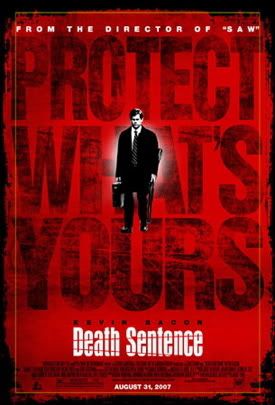
Trailer Park: DEATH SENTENCE

Filed under: Columns,Interviews,Quickcasts,Trailer Park,Video — admin @ 12:16 am

By Christopher Stipp

Archives? Right Here”¦

Instead of manning-up and actually going the emotionally hard route of being outrightly rejected by publishers, I’m rejecting them first and allowing you to give my entire book a preview, let you read the whole thing or, if you like, download the whole damn thing at no cost. Download and read my first book “Thank You, Goodnight” for FREE.

I’ll be upfront about it: it was a really nice breakfast.

Atop a pavilion, overlooking San Diego’s convention center and the trickling of the faithful waiting to get an early jump on the festivities, the intimate breakfast that was hosted to introduce the day’s events for Fox Atomic’s DEATH SENTENCE held the kind of curiosity I could not resist.

Here was a director, James Wan, known for his viscous visuals with the original that started a mega franchise, SAW, the likes of which no one was expecting to happen, and had continued on that trend with his other notable film, DEAD SILENCE before landing on a project that is slightly askew of what people would be expecting next.

The film delves into the kind of revenge convention that spans generations and continents and it was, honestly, the first time I saw a trailer that got me excited about a Kevin Bacon movie since THE WOODSMAN and reinvigorated my belief that a balls-out action film can’t hold a candle to kinetic action if it’s done with a sense of purposeful film making. I could be wrong on all sorts of levels, of course, but from the footage that I saw prior to the interview I was struck by the way Wan has taken the action convention and twisted it just enough to have the sense that there is something at stake for all involved. It’s no longer just one person against the world but what happens when that one person just gives in for once into the restorative power of getting a little payback.

The interviews themselves lend more credence to the idea that this is really a new interpretation of the trope which suggests the what if of a man taking things into his own hands and is really driven to take things to their ultimate end. James Wan couldn’t have been more open and eager to talk about the major things which drove him through the production of the film and Garrett Hedlund was equally engaging talking about what he did in order to find that space where he no longer was just the pretty faced love interest in GEORGIA RULE and had to be the guy that everyone loves to hate.

DEATH SENTENCE opens August 31st. See it and experience the vengeful love.

line3.gif

Clip #1: James Wan talks about the evolution from horror to dramatic action and what he felt should be the essence of the picture.

trailerpark-death-2007-08-24-01.jpg

Download SDCC Death Sentence Interview #1 – James Wan:

Large (560 x 420 – QuickTime – 65.41 MB)
Small (320 x 240 – QuickTime – 29.03 MB)

line3.gif

Clip #2: Garrett Hedlund spins a yarn about achieving a real sense of badass-ness in this film while reflecting on his experience in the picture.

trailerpark-death-2007-08-24-02.jpg

Download SDCC Death Sentence Interview #2 – Garrett Hedlund:

Large (560 x 420 – QuickTime – 83.27 MB)
Small (320 x 240 – QuickTime – 36.27 MB)

line3.gif

Quick Stop Thingamabobs: 8/24/2007

Filed under: Columns,Thingamabobs — UncaScroogeMcD @ 12:01 am

thingamabobs.jpg

The web. It’s a big place, full of plenty of distractions ““ some funny, some informative, some ludicrous, some disturbing, some inane, some profound. Each and every weekday, we present links to a few of our favorite finds”¦

————————————————

Have a THINGAMABOB? Send it in!

##

August 23, 2007

Quick Stop Thingamabobs: 8/23/2007

Filed under: Columns,Thingamabobs — UncaScroogeMcD @ 12:01 am

thingamabobs.jpg

The web. It’s a big place, full of plenty of distractions ““ some funny, some informative, some ludicrous, some disturbing, some inane, some profound. Each and every weekday, we present links to a few of our favorite finds”¦

————————————————

  • Tom Lehrer sings a song of pollution… (Thingamabob)

Have a THINGAMABOB? Send it in!

##

August 22, 2007

Quick Stop Thingamabobs: 8/22/2007

Filed under: Columns,Thingamabobs — UncaScroogeMcD @ 12:36 am

thingamabobs.jpg

The web. It’s a big place, full of plenty of distractions ““ some funny, some informative, some ludicrous, some disturbing, some inane, some profound. Each and every weekday, we present links to a few of our favorite finds”¦

————————————————

  • “I said ‘No’ meaning ‘Yes’!”… (Thingamabob)
  • “Hey Larry! Where’s the forklift?”… (Thingamabob)

Have a THINGAMABOB? Send it in!

##

August 21, 2007

Party Favors: Mayberry Joe

Filed under: Columns,Joe Corey's Party Favors — UncaScroogeMcD @ 12:02 am

partyfavors1.jpg

MANTEO, NC – The hunt for Andy Griffith is on. Sniff the air. There’s a touch of Mayberry amongst the salt.

We’ve arrived on this small island next to the Outerbanks to see the man who changed the world. We’re not stalking him. It would be so easy to camp out in front of his gated driveway. But that’s just wrong and would make us look like tourists. Instead, we crouch near the Ritz cracker aisle in the Piggly Wiggly. You know Andy loves his Ritz. There’s no way he can avoid us. Softly I whistle the theme to Matlock. He’ll be here soon.

After a week of opening to closing shopping, a store employee tells me that Andy hasn’t been around in a while. He’s in Waitress and is getting back into the acting game. We buy a box of Ritz Crackers and leave it by his mailbox as an offering to the icon. He’ll be hungry when he returns from Hollywood.

BUTCHIE, COME HOME!

How could they cancel John From Cincinnati? It was on the verge of making sense. During our time on the sand, my posse kept quoting John while on the waves. “I’ve got my eye on you!” “I don’t know, Butchie.” “Get back in the game, Mitch Yost.” “Did you dump out this morning?” Who knew this show was so damn catchy? And now after 10 episodes, it’s gone. But for those of us who wondered what would happen if Dylan took on Zack with Charlie Moore as the ref, we almost had it.

I’m still not sure if I liked John, but I’ll miss trying to figure out if I like it.

Well at least there’s a new season of Weeds on Showtime. And let’s not forget Californication. I think the show has a story about David Duchovny as writer. There was just so much boob action on the screen. There were more exposed breasts in that 30 minutes than the last 2 seasons of The L Word. Duchovny has returned to his Red Shoe Diaries roots.

CHECK OUT TIME

The nice part about the beach was a chance to check out Bravo. Amazing how in one weekend, you can see the last 2 months of original programming on the channel. Except when they run marathons of Major League. There new two hyped reality shows seem way too staged for their own good.

Welcome to the Parker is about a swanky and funky hotel in Palm Springs. The place used to be Gene Autry’s house and an original Holiday Inn. The first few episodes are a bit too unrealistic. They producers seem to be creating a cheaper version of Hotel without having to book character actors.

They line up four different plots that pay off at the end of the hour. It’s too cute. There was one episode dealing with a mysterious guy who keeps ordering loads of ice from room service. The guy hides under blankets as the room service guy fills the tub with ice. This goes on periodically through the show. It ends with the guy giving a $100 tip, but he never really appears on camera. It seems like they reenacted a story the room service guy told the producers. It’s easy to figure out that the guest had plastic surgery and was using the ice to recover.

Another thing had the manager of the hotel having a ping pong game with the hotel’s designer over letting dogs stay in the rooms. What are the odds that would have happened without the cameras?

Flipping Out follows a psychotic guy who flips houses. I swear this guy was the basis of the neighbor in Disturbia. He’s OCD and all about his pets. He also has a lot of spiritual weirdness going on. He has mystics purify his homes. The dramatics in his crew seem normal since he only hires drama queens. He has an assistant and then has two assistants who do the stuff the assistant refuses to do like clean turds from the litter box. I’d be more excited if he had to get Tanya Memme to help him sell a house.

Bravo seems to promise so much, but the channel just clunks on way too many days. On a Friday all they have scheduled is The Exorcist, Exorcist II, some promotional thing about Flash Gordon, Basic Instinct, Carlito’s Way and The Untouchables. That’s not a TV channel. That’s leftovers in Tupperware. I don’t need AMC Jr on my digital box. I’m not calling my cable company until Bravo brings it every day.

BRAIN DEAD

Andrew Keen, the author of The Cult of the Amateur: How today’s Internet is killing our culture really needs to write a follow up book called The Lengths of Poles that Fit Nicely Up My Ass. What makes him so great? Because he was able to able to sucker a publisher into buying his rant? Does anyone really want to read 228 pages? That’s a lot of time that could be spent downloading fresh internet porn from the amateur naked model at ellinude.com. She’s hotter than those whore painted, knife and silicone creations at Vivid Video. Can you really masturbate to the latest version of Jenna Jameson? She looks like what Joan Rivers imagines herself as.

Keen is completely off base when he says that you’re better off getting advice about music from record store clerks instead of your online musical pals. Is he serious? After the death of John Swain, the owner of the Record Hole; I have yet to encounter a single record store clerk that has any taste. Most modern record store clerks don’t seem to give a crap about talking to customers. They sit behind the counter, eating pizza and playing music to scare the squares out of the store. These guys have taken customer service lessons from Jack Black. Ask them a question? Why bother? You think the girl behind the counter has a clue about Herman’s Hermits? She’s there because the manager wants to scrogg her. Way to pick experts, Keen-o.

This guy doesn’t seem to know that things sucked before the internet took over. The internet didn’t bring us Hootie and the Blowfish or Yakov Smirnov. I bet if we investigate history, we’ll find a handwritten essay from a monk declaring that Gutenberg’s printing press will ruin society.

Andrew Keen is a professional – a professional killjoy. This man comes from the same country that gave us Simon Cowell. Haven’t we had enough of the English? Isn’t time we renew our 1776 action and dump them into Boston Harbor one more time? Remember that it was a bunch of amateurs who took up arms and defeated the mighty professional British army. We don’t need to listen to these people. If they knew that much, we’d still be eating crumpets and think that toothpaste is overrated. Do you want to live in a society that worships Camilla Parker Bowles as their next semi-Queen? His culture has given us Peter and Jordan. I still haven’t a clue why this duo has a reality show. Benny Hill died for England’s sins. How dare Andrew Keen do a superiority dance around us.

Maybe Keen will want to read my book The Cult of the English: How Today’s Brits are Sucking the Fun Out of Our Culture. This is not to be confused with my upcoming tome The Lethal Price of Nostalgia: How Today’s Living in the Past Has Destroyed Dreams of Tomorrow. Colbert, schedule me now before I actually start writing it.

GLICK NICK….

Why has Fox hitched its Business Channel’s fate on Alexis Glick? For the past year she’s been hailed as their stealth weapon whenever there’s been news about the launch. The former CNBC gal is supposed to destroy her old bosses. She’s the Eric Lindros of Wall Street reporters according to the hype.

When she substituted for Neil Cavuto on FoxNews, Glick sucked the life out of the show. She is not Fox News Material. She not nearly as striking as most of the Foxy News Women. She doesn’t sizzle. If Fox is the Red Bull of newscasters, she’s a really weak lemon-flavored water. She’s easy on the eye, but doesn’t draw you in. She does not command attention when she speaks. There’s no character to her voice. Listen to the other Foxy Newscasters. She doesn’t rank. According to unnamed sources, her voice isn’t easily heard by old people (a major viewing block for Fox). She’s doesn’t measure up against Rebecca Gomez and Jane Skinner.

During her time on Cavuto’s show, she nearly disappeared during the panel discussions. Guests talked with barely an interruption from the host. That’s a Fox no-no. And Glick committed a Cardinal sin when she allowed a guest to promote Bank of America stock as a hot buy. Doesn’t she understand that Cavuto has spent six months pumping up the torch and pitchfox crowd to lynch Bank of America? It’s not like last year when he called off his attacks on AARP after they started advertising on his show. It’d be like her going on John Gibson’s Big Picture and allowing guests to promote eliminating Christmas as a school vacation day without mocking them. Read the memos, Glick. Get with the Fox Program!

What’s really uncomfortable is when she botched a guest’s last name. She channeled Mary Tyler Moore’s breakdown voice when she begged forgiveness. Who wants a fear of that happening during a breaking quarterly report. She might as well do a Lucy “waahhhh” to make us cringe even more.

It’s easy to see that Fox is going to have a Katie Couric situation when the new business channel hits the satellites. She’s not an on-camera all star. Glick is the perfect fill in hostess on The Today Show since she isn’t threatening to a regular host’s job.

And is it creepy that Cavuto seems to promote Glick like his Captain of Industry buddies pimp their trophy wives? Gentlemen, wag your tongues!

NEWSIE TO WATCH

Michelle Kosinski on MSNBC is a reporter to watch in the field. Even though her breaking news interrupted my regular programming, I was impressed instead of cranky. She better be fast tracked on the food chain.

MESSAGE TO JOHN GIBSON

How dare John Gibson mock Jon Stewart’s emotions after 9/11. It’s disgusting to see the host of Fox’s Big Story be such a dick. But he does work for an organization that attempted to trademark “9/11.” If he was eaten by a shark, I’d feel bad that the shark had ingested a cancer causing agent.

We don’t mock Gibson’s defense of Christmas even though there are plenty of whispers on the internet that he belongs to a major Satanic cult.

During the same show, John Gibson claimed that America needs another 9/11 to set things right. Why does John Gibson want another 3,000 Americans to die? So he can have a hot topic on his TV? Gibson needs to volunteer himself and his family to be among the victims of his desired catastrophe. Maybe they should just take his family on a bicycle tour of Iraq.

HOT NEW SURGERY

According to my sources at a major Beverly Hills plastic surgeon’s office, this fall’s hot new procedure is a “Taint Lift.” About 30 patients a week are requesting them. “The ladies want to feel a tightness between the holes,” my unnamed source confided.

SCALP ME

According to Stubhub, the hottest college football ticket this year is DeVry vs. University of Phoenix.

PROJEKT REVOLTION

They call this music?

I made a deal with the devil by agreeing to do sound for a Myspace/Live Nation “live” broadcast of Linkin Park’s Projekt Revolution tour. Why did I think working for Fox and Clear Channel’s bitch project would be a good thing? First off, this deal was screwed. I only got the job because the Myspace weasels didn’t want to pay for a real sound guy. They merely wanted a PA who would hold the boom microphone and maybe twist a knob. They wanted PAs for the shoot, but they didn’t want to pay them. While I am the Creepy PA, I’m also a PA that likes to earn a few bucks for working a gig.

I’ll do a charity show if asked. But Fox’s News Corp and Clear Channel are not poverty cases. Although both of those companies have done their best to impoverish our culture.

My job during the shoot was to follow Myspace Superstar Metal Sanaz as she mingled with concert goers. She has over half a million friends on Myspace. I currently have 50. But my friends include the gals from HBO’s Cathouse, Bob Saget, George Takei and the ghost of Charles Nelson Reilly. Plus there’s that Tom guy. I’ve got quality friends.

Sanaz has hung out with Tom. This means Tom isn’t that good of a friend to me. I’m hurt that Tom doesn’t give a crap about me as a friend. He’s the one who put himself on my page as a friend. Lying bastard.

How did Sanaz have half a million friends? She has a street team. A street team? I don’t have a street team. And I’m thinking this is a good thing since I’d hate for them to decide to work I-95. Nothing would be worse than my team of streeters getting run over by the Bimbo Bakery truck. Who needs a street team for the information super highway? I’d fear seeing my cyber-street team chief appearing on TV. “Talk? What can you possibly talk about with a 14 year old girl at this hour?” Hansen would ask. “This week’s amazing Party Favors column, Chris!”

For those curious, Sanaz was full of energy as she did comic bits around the concert area that were supposed to be inserted into the “live” broadcast. She wore a very nice corset that got a lot of folks asking to hug her. And she didn’t mind hugging – especially the dozens of fans that were her Myspace friends. The corset proved to be a problem since it was over 100 degrees in the parking lot that had been set up with the second stage. Every so often she’d get soaked in the shower tent. We also took plenty of breaks. Luckily one of those breaks was during Placebo’s set.

This was the only band on the bill that I wanted to see. I’m not a big fan, but they were in Velvet Goldmine. The plus side of this gig was my “working” band pass. Those puppies are gold at a venue. Instead of just standing in the back of the venue, I marched into the pit. All the Live Nation ticket nazi flunkees had to step aside when I pointed at the magic pass. It was like giving them the middle finger as I stormed their checkpoints.

But there would be no finger for Placebo. They gave a great 35 minute set. Shame it was in broad daylight. They need a bit of darkness around them. Contrary to your mother’s fears, the pit itself was extra calm. You’ll be bashed around more in a ecstasy people puddle. The kids around me didn’t quite know what to make of the band. Too many of them were there for Linkin Park and My Chemical Romance. One moppet wore a “My Chemical Romance saved my life” t-shirt. Really? I don’t think a band has ever saved my life. There was the time Dana Kletter of the blackgirls made sure a roadie from Hole didn’t kick my ass during an afterparty.

Placebo seemed to be the only band that day that didn’t just suck. The second stage bands were just noise. Being the king of the noise guitar from my feedback antics in the BeatlesS, I feel bad debasing this new music. But not once did I say, “I need to get this record.” I didn’t even think about illegally downloading their songs. They were just horrible. The final band on the stage was Mindless Self Indulgence. They reminded me way too much of Oingo Boingo if Danny Elfman didn’t try to be too smart for the room. The lead singer reminded me of a character from Zippy the Pinhead. The constant barrage of bad noise wore on me as I kept trying to work sound on Sanaz. It felt like a nightmare as I kept adjusting knobs while keeping my boom out of the shot.

At the end of the day, it turned out that standing in the humid heat listening to all that crappy racket was a complete waste of time.

While things sounded OK while recording them in the field, when they downloaded the video onto the computer, the audio tracks were muck. Turns out that when you are near a speaker pile that’s blasting out crap, you can’t really mix it out. It also doesn’t help that instead of ordering a shotgun microphone which allows isolation to the person speaking near the boom, they had merely ordered a cardioid mic. This means that no matter where I placed my boom, I was screwed. The sound stage would leak onto the track. The director was furious that somehow this elevated space monkey didn’t twist enough knobs to get pure monkey chow. It also didn’t help that people kept screaming near the microphone. I had the level set for Sanaz’s speaking voice, but the roar blew out the levels. It is hard to hold a boom with two hands and mix sound with my third hand. Live sound under such conditions is a two person job and one of them really does need to be a fully paid sound guy with experience mixing at concerts.

The disgusted director gave me the look as if I was somehow supposed to cringe and beg for mercy. He acted as if I somehow give a crap about my career as a sound guy. My only thought as I looked into his fuming eyes was, “You went cheap and you paid for it.” He didn’t want a real sound guy. They were paying me about a third what a real sound guy cost for a day’s rental. And they got a third of the quality.

Unlike my normal response which is to immediately shout back “Listen, you cheap ass bastard – you didn’t ask for a real sound guy. Go F’ yourself, lil Michael Bay!” But I was nice and just handed my sound equipment over to another PA. It’s not like this dork would understand that he set himself up to fail. If sound mattered that much, they would have put it in the budget instead of thinking they could work around it.

If we were recording on a silent soundstage, I probably would feel like shit for what ended up as audiotracks. But what the hell do you do when you’re stuck on a concert field with a boom microphone. And a body microphone would have been a waste since half the time Sanaz was going into the shower tent to cool off.

After 12 hours in the hell hole called Projekt Revolution, I went home. The director will probably declare that I left in shame, but I split from a sham.

I hope production sound engineers understand what I did for them that day. You know what the Revolution of that Projekt was? Reminding a cheapskate producer/director that if you want a real sound guy, you better be willing to pay for a sound guy and not think you can fake it. Cheapass Tom, you are no longer my real friend at Myspace.

DO THE STRAND

Upon returning home, Netflix has delivered Roxy Music Live at the Apollo from their 2003 tour. Musically, this was a hot bath and a full body massage to my ears. Smooth and soulful music came from the speakers. Bryan Ferry didn’t go on about mothers and fathers fucking to the audience. The man has class. And if you’re listening to a Roxy Music record, odds are good that you’ll be getting laid.

Why aren’t Roxy Music in the Rock Hall of fame? Why aren’t we in a world where we can be sick of hearing Roxy Music?

NO JACK FOR EDDIE

The big talk from the venue employees was the upcoming Van Halen reunion tour.

Do not call it a Van Halen reunion. What’s going on tour this summer is a reunion of Eddie, Alex and David Lee Roth. But how dare they consider it a Van Halen reunion by replacing Michael Anthony with Eddie’s teenage son. Contrary to Eddie’s ego, Michael Anthony was the heartbeat of the band.

Back when Van Halen mattered, we would make fun of Michael Anthony. He was the odd man out on the stage. He kept his shirt on during the videos. He was husky with a beard. He wore the jumpsuits that made it look like he was an elevated roadie. We figured his way of picking up groupies was by saying, “You know, I’m in the band, too. Did you see me on stage? No. I wasn’t the guy who said, ‘Check one. Check one.'” He was the Rodney Dangerfield of hard rock.

Part of this blame was that Michael Anthony came along during a time when bass worship went to Geddy Lee of Rush, John Entwistle of The Who, Chris Squire of Yes and Phil Lynott of Thin Lizzy. Being kept on the fringe of the stage by his three bandmates, Michael Anthony looked like the lesser talent . We thought he was replaceable like a drummer in Spinal Tap. We were so wrong about him.

Over the years, Michael Anthony’s stock has grown. The man did serious work on those records. Like Entwistle, his bass was the rhythm guitar that allowed Eddie to go nuts. His background vocals made sure Diamond Dave didn’t sound like a complete screech. Plus we discovered he was the only person on that stage that wasn’t a complete prick. He was the guy who would have pounded down shots of Jack with us after the show. And he wouldn’t turn into a mean and bitter drunk. And as the sun rose and we crawled to a cab, we would have said, “We just partied with Michael Anthony” without it sounding like a consolation prize.

And so at this time, Party Favors would like to apologize to Michael Anthony for thinking he was the weakest link in Van Halen. We now know that there’s no such thing as a true Van Halen reunion without him and his Jack Daniels bass. Even though the band is playing a few dates in the area, we’re not going. We’re not tempted. David Lee Roth’s painful vocals from his tour with Sammy remind us that he just doesn’t have it anymore. Diamond Dave makes Tom Waits sound like an opera star. And who knows what Eddie will do without a buffer of booze and pills to insulate himself from Dave. We’re not paying $100 to see a trainwreck. Amtrak provides those for free.

Michael Anthony, if you knock on my door, I’ll break out a bottle of Jack. Cause you’re worth it.

SACK LUNCH

While watching No Reservations, Anthony Bourdain and Andrew Zimmer went to a place in Queens that served all the nasty bits of animals. They seemed delighted in their meal. How come you never hear a host of a freak eating show say, “These are great Mountain Oysters. Shame my wife isn’t here so she can tell me if they taste as good as my balls.”

Would that get you kicked off the Food Channel?

FINK NEWS

Why all the reporting of news organizations reaction to various political news? Do I care that the Seattle Times cheered Karl Rove splitting the White House? Then Joe Scarborough outs his own MSNBC colleges for supposedly booing during the president’s State of the Union address He said, “there were actually people in the newsroom that were booing the president actually from the beginning to the end.” Really? I doubt people at Yankee stadium can boo that hard for that long. Did they rotate they booing, Joe? We’re they foghorn booing? Was there a raspberry? Did anyone throw a beer at the screen? Did Joe stand at attention the entire time with his hand over his heart?

I heard a high placed reporter at the Party Favors farted when it was announced that the deputy undersecretary for the creation of committees that need secretaries had formed a subcommittee into creating a new brainstorming session title. Disgusting!

Just remember all you folks at MSNBC that Joe Scarborough is a fink and will rat you out to get an inch of ink. And isn’t it bad taste for a newspaper reporter to applaud a guy who is entering unemployment? What are the odds that the Times staff won’t get slashed in the near future and be in the cheese line behind Karl?

Quick Stop Thingamabobs: 8/21/2007

Filed under: Columns,Thingamabobs — UncaScroogeMcD @ 12:01 am

thingamabobs.jpg

The web. It’s a big place, full of plenty of distractions ““ some funny, some informative, some ludicrous, some disturbing, some inane, some profound. Each and every weekday, we present links to a few of our favorite finds”¦

————————————————

  • The only finished footage from Gilliam’s Don Quixote(Thingamabob)

Have a THINGAMABOB? Send it in!

##

August 20, 2007

Toy Box: Legendary Comic Book Heroes – Series 1

Filed under: Columns,Toy Box — admin @ 10:58 pm

toybox.jpg

Not too long ago, I reviewed 15 – yes, 15 – figures in a single review. That won’t be happening again any time soon. The first wave of LCBH figures from Marvel Toys includes 6 figures (along with 2 variants and a BAF), so I’ll be splitting them up tonight. I’ll be looking at 3 figures here: Savage Dragon, Ripclaw and Judge Dredd. Over at MROTW, I’ll be covering Witchblade, Super Patriot and Madman. And in both reviews I’ll talk about (and have photos of) Pitt, the BAF.

These figures are currently hitting Wal-mart first, and come with two variants in the first wave. There’s a Savage Dragon with t-shirt, and a Super Patriot without the mask. While these are technically variants, they are NOT chase figures or short packs. They appear to be evenly packed with the regular version.

Wal-mart is also getting a series 2 figure in their cases – Judge Death. The regular and variant (clear) version was a special pack out for them.

Expect to pay around ten bucks a pop for these, so if you’re looking to be a completist, there’s $100 you’ll need to spend just on the single figures currently available. The full series 2 should be hitting shelves very soon (if it hasn’t already in some places!) and will include Marv, Star, Darkness, Stryker and Anne O’Brien, who goes with the BAF of Monkeyman. The Judge Death also comes with this wave along with his variant, and there’s a variant on Marv.

Legendary Comic Book Heroes series 1 – Savage Dragon, Ripclaw and Judge Dredd

I’ll state my bias up front – of these three characters, the Dragon is easily my favorite. But will that translate into my favorite in plastic form? You can almost cut the anticipation with a knife…

toybox_082107_13.jpg

Packaging – ***1/2
Most of us assumed we’d never see collector friendly bubble/cardback packaging. Why? It’s just not cost feasible for mass market toys, where the bubble/cardback tends to be most predominate.

toybox_082107_2.jpg

But Marvel Toys has to be commended on coming up with a package design that IS collector friendly. The bubble is sealed to the cardback only around the top edges encircling the logo. The bottom square section has ‘lips’ that fold back around the cardback where they are taped. Cut the tape in back, and you can lift up the bubble and remove the interior tray without any real damage. If you want to put him back in the bubble, just slide it back in. You can even re-tape if you feel that strongly about it. It’s a nice design, and certainly a nod to the MOCers who would also like to take their figures out and stretch their legs.

BTW, I used a shot of the variant Dragon here so you could see what he looked like in his t-shirt. The rest of the review will show the normal, t-shirtless version.

Sculpting – Savage Dragon ****; Judge Dredd ***1/2; Ripclaw ***
Several figures in this line re-use parts from old Marvel Legends figures, but they do it extremely well for the most part.

You’ll notice some similarities between Judge Dredd and Longshot for example, and he actually has the hole in his back for the old ML clear display stand. But they’ve done such an exceptional job adding in the new armor pieces and additional sculpting that I’d bet if I didn’t tell you he had a re-used body under there, you wouldn’t realize it.

And Dredd looks terrific, with some terrific detail work on the armor and boots. He’s not super meaty, but a young Dredd wasn’t as beefy as Stallone made him appear in the film. All the figures are in a six inch scale, and Dredd will fit in well with the Marvel Legends figures. His hands are sculpted to hold his weapons, although you’ll have the most luck with the one gun and the knife – the other gun doesn’t fit quite as well in either hand.

toybox_082107_1.jpg

As good as he looks though, Savage Dragon has him beat. This is a great representation of Erik Larson’s artwork in 3-d form, and is easily my favorite of the wave. The head sculpt and expression are extremely well done right down to the overall size and shape of the fin, and the huge upper body is offset against the thin legs just like on the pages of the comic. The sculpt and articulation don’t work quite as well together as some of the other figures, but I can forgive him that flaw with such a terrific appearance. I liked the Mcfarlane version back in the day, but if i could only own one, I’d pick this one.

toybox_082107_5.jpg

Of these three, Ripclaw is my least favorite. He never did a lot for me as a character, and his design and appearance always seemed much too busy. That is true for this version as well, and I suspect only the die hard fans (or those looking to complete Pitt) will be grabbing him. If I had to choose between this version and the one done by Mcfarlane several years ago, Mcfarlane’s would win.

toybox_082107_4.jpg

As I mentioned earlier, these are a 6″ scale, and all three will fit in fine with most other 6″ lines including Marvel Legends. Dredd is 6 1/4 inches tall, Dragon is 7 1/2 inches tall (to the tip of the fin), and Ripclaw is 6″.

Paint – Judge Dredd ***1/2; Ripclaw, Savage Dragon ***;
The paint work on this series has generally been above average for the mass market, where it’s not uncommon to see some pretty serious slop.

Dredd is the cleanest of the three, with a paint application that could easily rival most specialty market toys. The colors are clean and consistent, with good cut lines and very little slop. The skin tone is even with no gloppiness, and the visor looks terrific. They’ve went with a wash on the boots and gloves to bring out some of the detail, and while it’s a tad heavy, it’s not terrible.

toybox_082107_3.jpg

Ripclaw isn’t quite as clean, particularly in the white piping on the boots. The black tends to show through and make it less white and more gray, unlike the face and body. It’s a fairly minor quibble though, and along with a few less than perfect cuts, is the only real issue.

toybox_082107_9.jpg

Dragon’s body hair looks decent, which is always tough to pull off well. Even with wax. Thank God there’s plenty of it too, proving that Dragon isn’t a shaver. They went with a wash on the jeans which is a tad heavy for my tastes, and there’s a bit more slop around the eyes and eyebrows than I’d like to see. But my biggest issue comes from the slightly different green on the torso and arms. This is often due to the different plastics absorbing the paint at different rates and amounts, and is tough for them to allow for. Fortunately in this case, it’s not extremely noticable if you’re not looking for it, so it’s not a huge negative for me.

toybox_082107_15.jpg

Articulation – Judge Dredd ***1/2; Savage Dragon, Ripclaw ***
As with Marvel Legends, super articulation is one of the main selling points of the Legendary Comic Book Heroes. All of them have far more articulation than the usual action figure these days, and most of it works great as well.

Savage Dragon has the usual pin/disk neck that allows forward and backward movement, along with turning. It can’t tilt to the side like a true ball joint, but it does tip back and forward quite a ways.

He also had ball jointed shoulders and hips, jointed on both sides of the ball, along with pin elbows and double jointed knees. There’s the pin chest and cut waist, pin/rocker ankles, pin and cut wrists, and not one but two pin joints on the fingers! There’s even a pin joint in the middle of the thumb. Oh, and a half cut foot pin joint…I told you they were super articulated.

Many of these joints are clicky style too, so that they hold poses quite well. The pins on all of them are quite solid and sturdy, and these joints seem to be using a better plastic for their pegs.

Judge Dredd’s neck doesn’t quite have the poseability of Dragon’s, due to the helmet and armor. Like Dragon, he has double jointed shoulders and hips, and they have a very good range of movement even with the armor. The chest and waist are there as well, as is the pin/rocker ankles, and double jointed elbows and knees. He doesn’t have the articulated fingers, but does add cut joints at the calves and forearms.

toybox_082107_10.jpg

Ripclaw has all the joints of Dredd, plus each finger has a pin joint. The joints don’t work quite as well on Rippy as they do on Dredd – they tended to be a tad sticky, and I had more trouble getting him to hold interesting poses – but he still blows away most other current action figures on the market in this category.

toybox_082107_8.jpg

Accessories – Judge Dredd ***1/2; Savage Dragon, Ripclaw ***
The main accessories with this wave are the six pieces to build the huge – and I’m talking HUGE – Pitt figure. He’s busted into two legs (with chains), two arms (with chains), a pelvis, and an upper torso. You’ll need six of the 8 figures (all unique figures) to complete Pitt.

toybox_082107_6.jpg

Judge Dredd gets the high score here, because not only does he come with not only one leg (and corresponding chains) for Pitt, but two guns and a knife as well! The knife fits in a sheath on his left leg, while one gun fits in a holster on his right leg and the other fits in the holster on his back.

toybox_082107_16.jpg

The plastic used on these accessories is a little soft, but the sculpt is still decent. The silver paint is a little inconsistent in coverage (as silver is often want to do), but considering these are a mass market item, I’m not too surprised.

toybox_082107_7.jpg

Ripclaw only comes with his BAF piece, the right arm of Pitt. The chains come on the arm (unlike the legs), so it’s one complete piece in the package. I’m not sure what else Ripclaw could have had, but if you aren’t interested in Pitt, you might feel a tad ripped.

I didn’t snap a shot of the Dragon with his BAF part (the other leg of Pitt), but that’s all he comes with. The chain and leg are actually separate, and the chains can be removed over the foot even after Pitt is assembled. Again, like Ripclaw, I appreciate just how cool this BAF is, but also realize that folks not particularly interested in the Pitt will find it fairly useless. Interestingly enough though, this is one of those cases where I expect more people to want the BAF parts than want each of the individual figures.

Pitt – ****
I decided to break Pitt out separately – there’s just too much about him that’s cool to not have his own section.

toybox_082107_11.jpg

If you need a reason to buy this entire wave, then you’re looking at it right now. Pitt is fantastic, one of the best BAF’s any company has produced to date. Hey, I love my Sentinal too, but Pitt has a truly amazing sculpt, with tons of detail. The paint work compliments it well, although it is a smidge sloppy in spots. Still, once you have him completely assembled, you’ll be blown away by his overall size and overall quality.

Many of the parts are rotocast of course, so he is a tad light. But if you’ve worked with other BAF’s (or even other superheroes in this scale), you won’t be put off by it. It takes a little work to get some of the pieces to snap together, particularly the pelvis and torso. But with enough ummpf, you can get them to pop into their proper position and hold tight. Once they’re actually together you’ll know it – they won’t come apart easily again.

toybox_082107_12.jpg

I mentioned that Pitt is huge, but even when I tell you he stands 10 inches tall, you won’t be able to appreciate his bulk until you see him. I’m not even convinced he was this huge in the comics, which would be a true first. Never before have I thought a large sized figure was too big for the scale! I can live with that, and prefer him being too big to being too small.

There’s some decent articulation here too, although the design of the figure makes some of the joints less useful than they might sound. The arms and hips are ball jointed with joints on both sides of the ball, and the neck is a cut joint. Oh, it might actually be a peg and pin joint like other ML and LCBH necks, but the design really only allows it the functionality of a cut joint.

The elbows and knees are pin joints, as are the wrists and ankles. The ankles have the rocker joint as well. The pin chest and cut waist work well, and each of the fingers has not one pin joint but two, allowing them to move independently at the hand and at the first knuckle.

Pitt isn’t going to take any extreme stances, but there’s plenty of articulation here to get him into some great poses and look great next to the other figures. Again, many of his joints are clicky joints, allowing them to stay in place over time.

Fun Factor – ****
Toy collectors are going to love these, and kids are going to love these. That’s the mark of a truly great toy – one that taps the imagination in the kid in everyone. To often companies skip on great sculpting and paint when it comes to a toy that’s ‘for kids’, because they believe either they won’t care or are too stupid to appreciate it. The fact is that kids love great looking figures too, and are certainly smart enough to weed out the crap from the treasure.

Of course, the big question is will kids care at all about these particular characters? And if they don’t, is the adult fan market large enough to make them succeed?

toybox_082107_14.jpg

Value – **1/2
At ten bucks a pop though, these are a bit over the usual mass market price. I’m going to cut them some slack here on the sore though, because I realize that the BAF pieces are huge and expensive, and that the run size on these can’t be nearly that of most mass market figures. There is a much smaller market for these characters, and I have no doubt that this was taken in to consideration when the run sizes were set.

Things to Watch Out For –
I had a little trouble with a sticky shoulder joint on the Dragon, and Ripclaw’s articulation was a bit sticky overall, but both freed up with a little work. The joints feel tighter and stronger than the later ML figures too, making them great toys for the kids.

Overall – Savage Dragon, Judge Dredd ***1/2; Ripclaw ***
If the Dragon had no paint issues, he would have been a four star figure. Yes, the articulation isn’t quite as wildly uninhibited as some other figures, but it’s good enough to make me happy overall. Judge Dredd is a close second, with a great overall appearance. I know some folks would have liked a removable helmet, but I think that would have just created a bobble head situation with little extra appeal.

Ripclaw ended up my least favorite of the bunch, although that’s partly due to my general apathy toward the character. While I wasn’t a huge fan of the over posed nature of the Mcfarlane version, I have to admit to prefering that sculpt. Still, if you’re looking for a version to bring him into the same universe as some of these other characters, this one will do just fine.

Where to Buy –
Wal-mart is the first local bricks and mortar store to get these in. Online options include:

CornerStoreComics has the singles in stock at $10 – $13 (depending on the character) or the full set of 8 including the two variants for just $80.

Amazing Toyz has them in at $10 – $13 as well, along with the 8 for $80 deal.

Related Links –
I’ve reviewed both of the twin packs, Conan/Wrarrl and Clownface/Panda, and I covered the rest of series 1 as well.

And if you’re looking for other versions of some of these characters, check out the Mcfarlane version of Savage Dragon and Ripclaw.

Comics in Context #190: Pop Eye-Con

Filed under: Columns,Comics in Context — admin @ 12:02 am

comicsincontext4.jpg

cic2007-08-20-01.jpgOne of the major event in cartoon art in 2007 is Warner Home Video’s release of Popeye the Sailor 1933-1938, a DVD set collecting the first sixty Popeye cartoons produced by the Max Fleischer Studios. This is everything that a DVD set of vintage animation should be.

First there is the handsome artwork on the case, depicting Popeye in the style of the Fleischers’ 1930s cartoons, adapted from the design by the character’s creator, comic strip artist E. C. Segar. The artwork, and even the simple orange color of the box, impart a wonderful vintage feel to the collection, as if this is what a DVD set would be like if it was produced seventy years ago. Picking my set up at a local Best Buy, I received an exclusive bonus: the chain sells its Popeye sets in a tin case bearing Popeye’s likeness, further reinforcing the appealing retro look.

Inside, the Popeye cartoons have been remastered, giving them sharp, clear image, enabling viewers to marvel at the beauty of their painted backgrounds, something to which I’d never paid attention when watching the shorts on television or even in theaters. Something I had noticed in the past was the Fleischers’ use of actual three-dimensional sets in some scenes, against which the animated characters would be filmed. Watching these DVDs I found myself thinking that these sets convey more of a sense of three-dimensional depth than even today’s computer animation can achieve (at least without making viewers wear 3-D glasses). After decades of seeing these cartoons start out with the logo of Associated Artists Productions (A.A.P.), which was their first television distributor, it is refreshing to see their original openings, with Paramount’s mountain logo, restored. Between the Paramount logos and the clarity of the restored prints, you can imagine that you are seeing these cartoons the way that they looked when they were first released during the Great Depression.

cic2007-08-20-02.jpgThen there are all the special features! The producers of this DVD cover Popeye’s history, in the comics, in animation, and even in Robert Altman’s 1980 live action film: its screenwriter, Jules Feiffer, and actor Paul Dooley, who played Wimpy, turn up in the set’s mini-documentaries.

What may be even more surprising is that the producers even feature material that has nothing to do with Popeye but which will be of interest to aficionados of early animation that led up to the Fleischers’ Popeye series. One of the documentary features on the set is “Forging the Frame: The Roots of Animation 1900-1920,” co-produced by Greg Ford, the curator of Lincoln Center’s retrospective of cartoon musicals, which I covered at such great length in this column starting with “Comics in Context” #100. This documentary goes all the way back to J. Stuart Blackton’s pioneering Humorous Phases of Funny Faces, made in 1906. (Hey, that means that last year was the hundredth anniversary of the animation medium. Shouldn’t there have been a major celebration in museums, revival film theaters, and comics conventions?) The documentary spotlights Winsor McCay, the first truly great creative figure in American comics and in animation, and offers excerpts from four of his landmark films, Little Nemo (1911); How a Mosquito Operates (1912), pointing out how it inaugurates animation that depicts a character’s personality; Gertie the Dinosaur (1914), in which McCay created the first great success in personality animation; and The Sinking of the Lusitania (1918), rightly characterizing it as a documentary in animated form. “Forging the Frame” provides excerpts from several other remarkable early cartoons, featuring such characters as Mutt and Jeff, Krazy Kat and Ignatz Mouse (adhering recognizably to George Herriman’s original versions), and the early Felix the Cat, and then you can watch the entire cartoons elsewhere in this amazing DVD set. My only complaint about these silent cartoons in the set is that, since silent films were originally shown with musical accompaniment, I wish that Warner Home Video had provided them with musical scores. Maybe there wasn’t enough money in the budget, but a simple piano accompaniment would do, and there are talented silent film pianists who regularly perform their own scores at New York’s Film Forum and Museum of Modern Art.

Two weeks ago I was disparaging special features on DVDs that provide no more than the most basic information that the animation buffs who buy the collection will already know, or will figure out for themselves on watching the cartoons. The “Popeye Popumentaries” and commentary tracks on this Popeye set do their job right. There is a wide array of experts on comics and animation history represented, including historians Jerry Beck (who played a major role in producing this set), Greg Ford, Michael Barrier and Leonard Maltin; animation professionals including Ren and Stimpy creator John Kricfalusi, former Disney director Eric Goldberg, omnipresent cartoon and comics authority Mark Evanier, and Quick Stop contributor Paul Dini; comic strip giants Mort Walker, Jules Feiffer and Mutts creator Patrick McDonnell, who get to speak about Segar; and the current voice of Popeye, Billy West, who provides an amazing on-screen demonstration of the difference between Popeye’s usual gravelly low voice and the higher voice that the great voice actor Jack Mercer used for improvising Popeye’s asides to the audience.

Throughout this four disc collection the commentators continually bring subjects to my attention that I hadn’t considered before: that the Fleischer Popeyes are mostly set in New York City, where their studio was located; the characters’ seedy apartments, reflecting Depression-era living conditions; the Fleischer studio’s skill at depicting the volume and solidity of their characters, and its prowess (which astonishes the present day animation pros) at animating characters in perspective, as in the great cartoon A Dream Walking (1934), in which Popeye, Olive and Bluto sleepwalk along the girders of a skyscraper under construction.

One major surprise in the commentaries is the reaction of Mexican-born animators Jorge Gutierrez and Sandra Equihua to the early Popeye cartoon Blow Me Down! (1933). Whereas a cautious, politically correct sort like myself would think that the Mexican stereotypes in this cartoon are offensive, Gutierrez and Equihua think they’re funny and happily reminisce about their delight as children in seeing Popeye visit their homeland.

Another big surprise comes in the featurette about “The Voices of Popeye,” which shows an excerpt from a wartime cartoon in which Mae Questel, the voice of Olive Oyl, substituted for Jack Mercer as Popeye. You have to hear it to believe it: it’s a good rendition of Popeye, yet it’s still believable that a woman managed to do it.

There are many cartoons in this set that I must have seen as a child but simply do not remember. Daniel Goldmark, an authority on the use of music in classic cartoons, provides the commentary on The Spinach Overture (1935), a cartoon I only vaguely recall seeing before. But I’m sure glad it’s here, since it features Popeye and Bluto as rival conductors, and fits a theme I’ve explored in several past columns: the use of the conductor as a figure of power, and symbol of the creative artist, in animated cartoons, as in Walt Disney’s The Band Concert (1935) (see “Comics in Context” #110) and Chuck Jones’s Long-Haired Hare (1949) (see “Comics in Context” #101).

I want to focus on two Popeye cartoons in this collection: the two-reel color featurettes Popeye the Sailor Meets Sindbad the Sailor (1936) and Popeye the Sailor Meets Ali Baba’s Forty Thieves (1937). I’ve been wanting to write about them since I saw them on the big screen during the aforementioned Film Society of Lincoln Center retrospective on cartoon musicals. I’m used to seeing these two cartoons in faded prints, but the restoration on these two-reelers in this set seems miraculous. Again, the familiar A. A. P. logos have been banished: Warner Home Video has located and restored the gorgeous original opening credits for both featurettes. The colors in the cartoons are now vividly bright. What is most astonishing is the way the 3-D sets now look, such as the intricately detailed outside of a cave in Sindbad and the seemingly infinite desert sands in Ali Baba. The interior of the Forty Thieves’ cave now has an extraordinary sense of reality, as does the solid-looking treasure chest, filled with gems, at the cartoon’s end. And as a commentator points out, somehow the colorful 3-D sets and the animated backgrounds blend together rather than looking entirely different!

These two color two-reelers, each twice as long as a typical Popeye black and white short, are based on stories from The Book of One Thousand and One Nights, popularly known as The Arabian Nights. Later, the Fleischers did another color Popeye featurette based in an Arabian Nights tale: Aladdin and His Wonderful Lamp (1939).

I wonder why the Fleischers decided on this Arabian theme. Did they decide to pit Popeye against another famous sailor, Sindbad, and since that was a success, continued with other famous Arabian Nights tales? Or were the Fleischers responding to the fact that Walt Disney was making an animated feature film of Snow White and the Seven Dwarfs? (Disney’s Snow White was released in 1937, but had began production three years earlier.) Since Disney had chosen a well known story from the Brothers Grimm’s collected fairy tales, did the Fleischers think that that they should build their Popeye featurettes around similarly famous tales, and picked The Arabian Nights?

The Fleischers’ Popeye featurettes are comedic examples of Orientalism, in the sense of the Western perception of the cultures of the Near East to the Far East. Obviously, events such as the September 11 attacks have altered the popular American conception of the Muslim nations of the Near and Middle East, but American versions of Arabian Nights fantasies persisted long enough to serve as the basis for Disney’s own animated Aladdin (1992). The Woody Woodpecker and Friends DVD set contains two inventive Swing Symphonies cartoons set in this imaginary Arabian Nights world: director James Culhane’s Abu Ben Boogie and The Greatest Man in Siam (both 1944). (Siam is actually an old name for Thailand, yet The Greatest Man in Siam is clearly set in an Arab country. Perhaps this serves as an example of just how accurate Western fantasies about Arab culture can be.)

Differing sharply from its two predecessors, the Fleischers’ Aladdin has a metafictional framing device in which Olive Oyl is writing a screenplay about Aladdin, and imagines Popeye playing the role: the main part of the two reeler is therefore the movie that Olive envisions. (This reminds me of Chuck Jones’ 1950 animated short The Scarlet Pumpernickle, which similarly has a framing device in which Daffy Duck has written a screenplay, and the rest of the cartoon is Daffy’s imagined movie, with himself in the title role.)

In contrast, in the Fleischers’ Sindbad and Ali Baba’s Forty Thieves, Popeye actually meets these legendary characters. Then again, Sindbad has opening cast credits, as if Popeye, Olive and company were actors playing parts in a movie, and certainly we are expected to recognize Bluto as “playing” Sindbad and the leader of the Forty Thieves. There’s an ambiguity here, in keeping with the Fleischers’ characteristic reminders to the audience not to suspend disbelief entirely and that they are watching a cartoon.

The main point is that Aladdin casts Popeye as an Arabian Nights character, whereas in Sindbad and Ali Baba, Popeye is presented as himself. One of the DVD commentators suggests that in Sindbad and Ali Baba Popeye has been displaced back to the time of the stories. I think not. Popeye, Olive and Wimpy wear their standard 1930s costumes in the two featurettes, and Ali Baba clearly establishes that Popeye sails a Coast Guard ship to Arabia. Somehow Popeye and friends, representing modern times, co-exist with the legendary Arabia of The One Thousand and One Nights.

To my mind it is fitting that Popeye should meet Sindbad and the Forty Thieves, because, whether or not the Fleischers consciously realized it, by 1936 the super-strong Popeye had become a modern American counterpart of the mythic figures of The Arabian Nights. It’s become a commonplace that the superhero genre embodies a modern mythology, and that superheroes are modern pop culture counterparts to heroes like Hercules and Samson. Popeye isn’t technically a superhero, but he is an iconic hero with superhuman abilities who also qualifies as a contemporary mythic figure.

On the commentary track for Sindbad, when the climactic battle between Popeye and Sindbad is about to begin, John Kricfalusi jokes that these cartoons represent what America is all about. The Fleischers did appear to regard Popeye as an iconic American figure. In Sindbad, as in many Fleischer Popeye cartoons, Popeye’s triumphant climactic battle is accompanied by the patriotic music of John Philip Sousa’s The Stars and Stripes Forever. The Fleischers obviously saw something particularly American in Popeye’s heroic battles against the bad guys.

The Fleischers’ Sindbad and Ali Baba pit Popeye, as American iconic hero, against iconic figures from The Arabian Nights, who are cast as villains. (In The Arabian Nights, Sindbad, whose name is usually spelled “Sinbad,” is a hero.) These highly entertaining but decidedly chauvinistic featurettes assert that Popeye–the pop culture hero of a relatively new nation–is not only merely the equal of the mythic figures of older, alien cultures (as opposed to Europe), but their superior. Does this parallel a patriotic sentiment in America in its new role as a world power between the two World Wars: the idea that America is superior to foreign powers and can best them if need be? I leave it to you readers to judge what connection these two cartoons pitting Popeye against Arab foes may have to current American attitudes towards the Muslim nations of the Middle East.

Whereas in these Fleischer featurettes Popeye conquers figures from mythic Arabic culture, Abu Ben Boogie and The Greatest Man in Siam take a different approach. These two cartoons anachronistically set 1940s swing music into an Arabian Nights-style setting, thereby recasting the Arabian fantasy world into a then-contemporary American mode. In these cartoons American culture doesn’t conquer traditional Arabian mythology, but coopts it.

Walter Lantz’s Swing Symphonies series demonstrates how different pop culture was in the 1940s than it is now. Would any major cartoon studio today do a series of cartoons built around, say, hiphop music, for a general audience? And the Fleischer Popeye featurettes leave me with yet another question: why didn’t producer Max Fleischer and director Dave Fleischer adapt one of Segar’s own Popeye stories from the comics as a two-reeler?

INTO THE INKWELL

I am especially happy that this Popeye DVD set includes ten episodes of one of my favorite animated series, the Fleischers’ silent Out of the Inkwell, most of which I had never seen before.

cic2007-08-20-03.jpgLike the Fleischers’ Popeye and Superman cartoons, the Inkwell shorts usually present variations on a basic formula. A cartoonist, who is almost always played by Max Fleischer himself in live action footage, uses pen and ink to draw a clown–who was eventually given the name Koko–who comes to life within the cartoon “world” on the paper on the drawing board. Hence, Koko has emerged “out of the inkwell.” (That an animator is more likely to draw a character in pencil goes unmentioned. As for Koko’s name, which some cartoons spell “Ko-Ko,” I wonder if it is a reference to Ko-Ko, the Lord High Executioner and principal comedy character in Gilbert and Sullivan’s most celebrated operetta, The Mikado.) After going through various escapades in the cartoon world, Koko emerges from the drawing board into the real world, often to get even with Max, who is both his creator and his tormentor. In the typical ending to these shorts, Koko enters the ink bottle, which Max then seals with its cap.

Over the last few weeks I have referred to the traditional pairing of a “white clown,” who represents order and authority, with an “Auguste,” a clown who rebels against authority and rules. The Out of the Inkwell cartoons magnify to an extreme the gap in power between its counterparts to the white clown and Auguste. Koko is explicitly presented as a clown: he is the Auguste. Max takes the role of the white clown, or might better be compared to the ringmaster. Max is not only in charge, but he is literally the creator of Koko and his animated world. Koko, even when he escapes into the real world (with his animated figure juxtaposed atop live action film), ordinarily remains the same size as he is on the drawing board; hence, Max towers over him as if he were a giant–or as an adult does over a small child. Max is the artist who created Koko and who attempts to control his creation. Max is also like a father and Koko like his son, whom he attempts to dominate. Ultimately, Max is to Koko as God is to us. Max created both Koko and the world in the animated sections of the shorts. Max stands outside Koko’s “reality” and dominates both it and him.

The usual formula of the Inkwell films has Max creating Koko out of nothingness with pen and ink. The films work different variations on Koko’s creation: in Modeling (1921), for example, Max draws a mass of small circles which, before our eyes, merge and form into Koko. In Trapped (1923) Koko emerges from Max’s hand, in a perfect image of the animator as godlike creator. (All of the Koko shorts that I mention in this week’s column can be found in the Popeye DVD set.)

Normally at the end of an Inkwell short Koko seeks refuge within the ink bottle. This leads to the question of whether Koko continues to exist “alive” within the ink bottle or whether he returns to being merely ink. At the end of Modeling, when Koko hides in the ink bottle, the angry Max pours the ink out onto the table in a tiny puddle. This strikes me as a macabre image of Koko having entered oblivion. If human beings’ lives proverbially go from “ashes to ashes and dust to dust,” Koko’s life goes from ink in the ink bottle back to ink. Of course, since Inkwell is a series, the audience knows that Koko will return to life in the next short, so, whether or not the Fleischers realized it, the Inkwell series represents a repeating cycle of “death” and resurrection.

The ending of Modeling, with Max pouring Koko’s inky “remains” onto the table, demonstrates that if Max is Koko’s “god,” he can be a cruel deity. In Invisible Ink (1921) no sooner has Max created Koko than he imprisons him by drawing chains and cuffs to bind him, as if he were in a dungeon. Then Max, like a bully teasing a child, forces Koko to hunt for his hat. (Koko seems to have a particular attachment to his hat, perhaps because his clothes are really his sole possessions.) In Jumping Beans (1922) Max unleashes Mexican jumping beans on Koko, initially frightening him. In Bed Time (1923) Max strands Koko on top of a cartoon mountain in order to get him out of the animator’s way. In Trapped Max draws a man-sized spider with a human head who pursues Koko, imprisons him in his webbing, and even tries to serve him as dinner to his family of similar creatures. (So would they be the first “spider-men” in cartoon art?) And in A Trip to Mars (1924) Max forces the unwilling Koko to ride a cartoon rocket to a cartoon version of the Red Planet.

Not only does Max expose Koko to danger in Trapped, but he also sets a mousetrap to catch a live action mouse in the same short. Koko and the live action mouse are roughly the same size, and the short seems to be drawing a parallel between then: both are Max’s potential victims.

Even though the shorts portray Max Fleischer himself as the animator, they are designed so that the audience will side with Koko against him. The payoff in the Inkwell shorts comes when Koko turns the tables on his creator, like a son striking back at his father, or a mortal taking revenge on God for his suffering in life. When Koko invades the real world in Modeling to play pranks, it seems to be merely out of a sense of mischief. But in other cartoons, such as Jumping Beans, Koko explicitly vows vengeance on Max.

What I find especially interesting in the Inkwell shorts selected for this DVD is that Koko himself turns “artist” in order to fight back against Max. In Modeling Max shares a studio with a sculptor, who is making a bust of a rather ugly man with a big nose. Perhaps Koko, a creation of one form of art, cartooning, is jealous that Max and the other people in the studio are paying more attention to the bust, the creation in a more highly regarded form of art, sculpture. It’s a sort of sibling rivalry, with a subtext of popular art versus fine art, and the Fleischers stack the deck by making Koko far more appealing than the rather repellent sculpture of the equally repellent client. Or perhaps the real rivalry is between Koko and the real life artists.

Max had outfitted Koko with skates and drawn a frozen pond for him to skate on. First Koko creates his own portrait of the sculptor’s grotesque subject by skating in such a way as to carve the impression of his face into the ice. Then Koko makes a gigantic snowball and molds it into a bust of the sculptor’s client, imitating what the sculptor did with clay. Max, the sculptor and his client are unimpressed, so Koko emerges from of the animated world–that is to say, the sheet of paper on which Max drew him and the frozen pond–and into the real world. Unnoticed, Koko crawls into the statue, causing it to move as if it were alive. This startles the three humans. In actuality, the Fleischers were using stop motion animation to cause the bust to seem to move on film. But in terms of the story, it is Koko who is moving the statue from within: Koko has thus become an animator himself. No wonder Max gets angry when he discovers what is happening: his own creation has become a rival animator.

As noted earlier, Max chains up Koko in Invisible Ink and subsequently taunts him. This time Koko as clearly seeking revenge, and he more explicitly becomes an animator. Having escaped from the drawing board into reality, Koko imitates a trick that Max played on him earlier: he leaves a message that if Max wants to find him, he should follow this line. The line leads Max on a long trail inside and outside his studio. Meanwhile Koko creates duplicate images of himself in many different poses. The line finally leads Max into a room filled with Kokos, among which the real Koko hides. However, Max casts aside the alternate Kokos, which do not move.

Obviously, Koko needs to improve on his plan of multiplying himself, and does so in the later cartoon, Jumping Beans. Again vowing revenge for Max’s mistreatment of him, this time using a stamp to create duplicates of himself which move, and which line up in formation, as if they were Koko’s private army. So Koko as artist has created his own image over and over, and as animator has brought them to life. The legion of Kokos attack and overwhelm Max, binding and tying him to the floor, as the Lilliputians did to Gulliver. So, yes, this image anticipates the animated feature film of Jonathan Swift’s Gulliver’s Travels which the Fleischers made over a decade and a half later. Luckily for Max, he is carrying a small blade which he uses to cut himself free, and the Kokos flee into the ink bottle.

As noted, Max is a giant in comparison to Koko, so it may be significant that in two of the cartoons in the Popeye DVD set Koko encounters menacing cartoon giants. In Jumping Beans a giant beanstalk sprouts, and Koko climbs up the stalk far into outer space, past the moon and sun, until he arrives in the land of the giant of “Jack and the Beanstalk,” who turns out to be an immense head atop a comparatively tiny body. Upon escaping–and falling– back to Earth, Koko vows vengeance on Max for exposing him to such danger. In Bed Time Max traps Koko atop a mountain where he is pursued by another giant, this one with more normal bodily proportions. Yet again Koko vows revenge on Max. After all Max is the “giant” who is Koko’s true nemesis.

That revenge takes an appropriate form in Bed Time. Koko again invades the real world and enters Max’s bedroom. As Max watches in horror, Koko grows bigger, achieving human size, and then continuing to grow further. Max escapes the building, but Koko has become a true giant, and we watch him stalk through New York City, towering over buildings, hunting for Max.

And then Max wakes up. Perhaps, even in an animated/live action short in which one might assume that anything can happen, the Fleischers drew the line at Koko turning into a giant. Another possibility is that the Fleischers were insistent that Koko could not be allowed to overturn the order of the real world; that’s why the shorts usually end with Koko returning to the inkwell, ending his disruptions of order, like Superman’s foe Mr. Mxyzptlk saying his name backwards and returning to his home dimension. Koko as a giant would be unstoppable. Therefore the short establishes that Koko only became a giant in Max’s nightmare; Max awakes and sees Koko safely immobile on his drawing board. It’s as if Out of the Inkwell had suddenly turned into Winsor McCay’s Dream of the Rarebit Fiend, which may well have been a partial inspiration for Bed Time.

The strangest of the Inkwell cartoons in this DVD set is A Trip to Mars, in which Max forces Koko to be the unwilling passenger on a rocket heading to the fourth planet. Before blasting off, Koko plants dynamite underneath Max’s chair. The rocket takes off with Koko aboard, and the dynamite explodes, catapulting Max into outer space as well (as the short shows a live action Max against an animation background). The Mars on which Koko lands seems like an anticipation of Bob Clampett’s Warners cartoon Porky in Wackyland (1938): a mad, surreal world where any impossible gag could happen. Koko’s Mars also looks as if it might be an absurd version of New York: Koko spends part of the cartoon in Mars’s subway. Meanwhile Max continues to hurtle through space. The cartoon ends with both Max and Koko landing on the rings of Saturn and running along the rings as if they were a treadmill. Finally both Koko and Max are removed from Saturn and dropped into an ink bottle, and a hand comes from offscreen and places the lid on the ink bottle, sealing them in.

This raises an obvious question: just whose hand is that? The finale of A Trip to Mars presents both Koko and Max as the pawns of a more powerful manipulator. Perhaps the hand represents Max Fleischer the filmmaker, as opposed to Max the character in the film.

Now I wonder if director Chuck Jones and writer Michael Maltese were consciously reworking the Out of the Inkwell premise when they created their celebrated cartoon Duck Amuck (1953). The She-Hulk’s annoyed comments directed at her unseen cartoonist, John Byrne, likewise seem to echo Inkwell, intentionally or not.

The Out of the Inkwell series is founded on drawing a line between the real world and the world of animation and watching Koko cross it. Commentators on the Popeye DVD make the point that while Walt Disney kept striving for greater realism in his animated cartoons through the 1930s, the Fleischers simultaneously reveled in the blatant “cartooniness” of their animated films. Popeye and his castmates don’t look like real people, and even in a later Fleischer cartoon like Sindbad inanimate objects will still occasionally come to life.

Some of the early cartoons on the DVD also acknowledge their own artificiality. In Bobby Bumps Puts a Beaner on the Bum (1918) the title character sits on the animator’s hand as he draws. In the first Felix the Cat cartoon, Feline Follies (1919), Felix (here called Tom) plucks musical notes out of the air and turns them into parts for carts he and his girlfriend ride.

So we can see two traditions in animation history. The Disney tradition moved towards greater realism. But the rival tradition, celebrating the “cartooniness” of the medium, is even older, and continued through the Fleischers’ body of work until they attempted to move towards Disneyesque realism in Gulliver’s Travels (1939) and a more successful heightened realism in their Superman series. Tex Avery’s MGM cartoons further explored how cartoons can bend and break and twist the laws of reality. From the late 1940s into the 1960s, the UPA animation studio rebelled against Disney realism in its own way, through emphasizing stylized designs in characters and backgrounds. The result again was to emphasize the artificial nature of animation rather than use it to imitate reality.

Today the “cartooniness” tradition is carried on by The Simpsons and South Park and, yes, SpongeBob. However, the “realism” tradition has triumphed through the dominance of computer animated films, which have nearly entirely displaced hand drawn animated films in early 21st century movie theaters. (When I was watching Ratatouille I found myself thinking that the backgrounds looked just like photographs of the real Paris.) Anime seems to me to be a mix of the two traditions, with simplified, stylized figures often juxtaposed against realistic backgrounds, as in Hayao Miyazaki’s films. It’s rather like the Fleischers filming Popeye and Olive against those actual 3-D sets.

Should you want to learn more about the Popeye and Woody Woodpecker DVD sets, listen to one of the people behind both sets, animation historian Jerry Beck of the Cartoon Brew blog (www.cartoonbrew.com), on Stu’s Show on Shokus Internet Radio (http://www.shokusradio.com/), live from 4 to 6 PM Pacific time (7 to 9 PM EST) on Wednesday, August 22.

Copyright 2007 Peter Sanderson

Quick Stop Thingamabobs: 8/20/2007

Filed under: Columns,Thingamabobs — UncaScroogeMcD @ 12:01 am

thingamabobs.jpg

The web. It’s a big place, full of plenty of distractions ““ some funny, some informative, some ludicrous, some disturbing, some inane, some profound. Each and every weekday, we present links to a few of our favorite finds”¦

————————————————

  • Science is Fun: Monday Edition… Frozen Smoke!… (Thingamabob)
  • Dr. Teeth loves money, and Stan Freberg… (Thingamabob)
  • Phil Silvers presenting an award to… Phil Silvers… (Thingamabob)

Have a THINGAMABOB? Send it in!

##

August 17, 2007

Trailer Park: MONSTER SQUAD

Filed under: Columns,Interviews,Quickcasts,Trailer Park,Video — admin @ 1:11 am

By Christopher Stipp

Archives? Right Here”¦

Instead of manning-up and actually going the emotionally hard route of being outrightly rejected by publishers, I’m rejecting them first and allowing you to give my entire book a preview, let you read the whole thing or, if you like, download the whole damn thing at no cost. Download and read my first book “Thank You, Goodnight” for FREE.

Before the advent of DVD audio rippers made it fun again to listen to a good audio commentary while not enslaved to your La-Z-Boy there was the good old cassette recorder.

When I was old enough to rent movies but not sophisticated enough to know how to rig them up to one another to make a copy of it (not that I ever did that, legally speaking) I used to take a portable boom box and actually *record* the audio of the movies I really liked. I don’t know why I did this, nor why I incessantly looped major portions of POLICE ACADEMY 4: CITIZENS ON PATROL on my GE Walkman. I do know, however, that I filled up a couple of tapes when it came to THE MONSTER SQUAD.

I loved this film.

I recorded the dialog, the up-tempo musical interlude as the squad gets ready to throw down, the great moments Rudy gets as the “tough kid”, everything. I never listened to a recording so many times as I did with my MONSTER SQUAD tape. The film, in an odd way, encapsulated of what it was like to be a goofy young kid admist an ostensibly scary situation; that’s the movie’s appeal all these years later. Fred Dekker walked that line of genuine scariness and abject absurdness with equal parts. You couldn’t have found a more balanced film of this variety and somehow I responded to it with rapt dedication for a while.

I guess, as the years went on, I kind of forgot about the film. I started watching other movies, evolved as a movie consumer, but there was always something about that story; it turned out to be a touchstone, though, and when decades later there was talk about bringing the movie to DVD I just couldn’t wait. The very same feelings I had as a youth came bubbling back when I was given the opportunity to interview director Fred Dekker and cast members Andre Gower, Ryan Lambert and Ashley Bank. It was a surreal moment, to be sure, and it was definitely a satisfying moment knowing that years ago this was a movie I told everyone about and now I’m in the position to be able and tell everyone that this is the DVD to own this year.

Halcyon days of youth don’t have anything on the experience of being able to revel in the geekery of revisiting this film 20 years later with those who made it so good to watch long ago.

line3.gif

Clip #1: Director Fred Dekker talks about the mechanics of getting MONSTER SQUAD filmed and whether the adage of working with kids and animals really holds any truth.

trailerpark-monster-01.jpg

Download SDCC Monster Squad Interview #1 – Fred Dekker:


Large (560 x 420 – QuickTime – 76.11 MB)
Small (320 x 240 – QuickTime – 34.45 MB)


line3.gif

Clip #2: Ashley Bank talks about what memories she has of the production and what it was like to be a part of the resurgence of the movie-that-would-not-die.

trailerpark-monster-02.jpg

Download SDCC Monster Squad Interview #2 – Ashley Bank:


Large (560 x 420 – QuickTime – 34.24 MB)
Small (320 x 240 – QuickTime – 15.60 MB)


line3.gif

Clip #3: Andre Gower and Ryan Lambert remember back about the experience of being young on the set of a major motion picture.


trailerpark-monster-03.jpg

Download SDCC Monster Squad Interview #3 – Andre Gower & Ryan Lambert:


Large (560 x 420 – QuickTime – 114.53 MB)
Small (320 x 240 – QuickTime – 50.23 MB)

##

QSE News: Week In Review – 8/17/2007

Filed under: Columns,News — UncaScroogeMcD @ 12:02 am

quickstopnews.jpg

line1.gif

Here are today’s top entertainment headlines:

  • qsnews.jpgChristina Applegate isn’t married anymore. Applegate officially ended her marriage to Johnathon Schaech late last week. In related news, the world still doesn’t care about the guy that played Applegate’s brother on the show Married… with Children, whatever his name is/was.
  • Actress Nichelle Nichols, who gained more weight than fame as Lt. Uhura on the original Star Trek series, is heading back to the small tube. Nichols will be joining the cast of Heroes next season as the grandmother to series character Monica.  Nichols was hesitant to join the popular show at first, but when she found out that she wouldn’t be the only cast member that William Shatner has had his penis in, she signed immediately.  In related news, George Takei is the only other cast member that has met William Shatner.
  • The video game Madden NFL 08 was released this week, as eager fans waited outside of stores across the country to be one of the first to get their hands on the game. Over the past 17 years, the series of football video games has sold more than 60 million copies. This year’s game serves up a special treat in the form of a mini game that allows players to live the life of their favorite NFL star by holding out at camp, injecting “The Clear” into their cranks, slapping prostitutes, committing murder, and organizing dog fights.
  • Counting Crows is wrapping up work on their new album, which is due out in November. The album will be titled Saturday Nights, Sunday Mornings and will feature songs that are both “loud and soft.” Geffen, the band’s current record company, is hoping to spur sales by offering a free pair of khaki Dockers with each CD purchase.
  • A (partially) reunited Van Halen is headed out on tour… for real this time. The band, which now consists of bat-shit crazy David Lee Roth, half-tongued guitarist Eddie Van Halen, Alex “Crypt Keeper” Van Halen and Valerie Bertinelli’s son, Wolfgang Van Halen, will be playing 25 dates across the country. The tour is scheduled to be canceled early next month after tickets for all shows have been sold out.
  • The HBO drama John from Cincinnati has been canceled. The show revolved around the struggles of a surfing family in California and never caught on with viewers or critics. Critics credit the shows unpopularity with the fact that it contains a character from Cincinnati and “as everyone knows, nothing good has ever come from Cincinnati.”
  • It is being reported that Marvel Comics is pursuing wrestler Hunter Hearst Helmsley for the title role of Thor in an upcoming movie.  Helmsley, whose real name is Paul Levesque, has had roles in several movies, including another Marvel property, Blade 3.  In casting the wrestler, Marvel hopes to capture a key demographic of 15-25 year old sexually confused males.
  • In a new film called The Wackness legendary actor Ben Kingsley has revealed that he shares an on-screen kiss with the food-phobic “actress” Mary Kate Olsen.  After shooting the scene, Kingsley had nothing but praise for his young, nubile co-star, claiming that the former Full House star “totally gave him a semi…”

line1.gif

That’s all for today’s news, stay tuned to this channel for all the news that matters least but you still care about.

(Compiled by J. Allen)

##

Quick Stop Thingamabobs: 8/17/2007

Filed under: Columns,Thingamabobs — UncaScroogeMcD @ 12:01 am

thingamabobs.jpg

The web. It’s a big place, full of plenty of distractions ““ some funny, some informative, some ludicrous, some disturbing, some inane, some profound. Each and every weekday, we present links to a few of our favorite finds”¦

————————————————

  • The Kids In The Hall get the heads of their solo careers crushed, Part 1… (Thingamabob)
  • Lennon & Garant’s newest – Balls of Fury(Thingamabob)

Have a THINGAMABOB? Send it in!

##

August 15, 2007

Quick Stop Thingamabobs: 8/16/2007

Filed under: Columns,Thingamabobs — UncaScroogeMcD @ 11:50 pm

thingamabobs.jpg

The web. It’s a big place, full of plenty of distractions ““ some funny, some informative, some ludicrous, some disturbing, some inane, some profound. Each and every weekday, we present links to a few of our favorite finds”¦

————————————————

  • Don’t be the guy who does the slow jerk… (Thingamabob)

Have a THINGAMABOB? Send it in!

##

Nocturnal Admissions: DVD Review, The First Films of Samuel Fuller

Filed under: Columns,Nocturnal Admissions — UncaScroogeMcD @ 12:54 am

nocturnalheader5.gif

Andrew Sarris once famously called Samuel Fuller an “authentic American primitive.” Sarris went on to write that the “excitement Fuller arouses in critics sensitive to visual forms is equaled by the horror he arouses in critics of the Left for the lack of social perspective in his films.”

Fuller box

The charge of primitivism, which also has a political component suggesting conservative views, became unfashionable as Fuller grew more famous, but seeing his first three films for the first time all in a row, thanks to the new Criterion-Eclipse set, The First Films of Samuel Fuller (Eclipse-Criterion, three discs in slim cases, $44.95, street date Tuesday, August 14, 2007), makes clear why Sarris held this opinion about Fuller back in 1967 when he was compiling his book The American Cinema, which appeared before Fuller became the darling of the German New Wave and before Fuller himself directed Tote Taube in der Beethovenstraße, The Big Red One (1980), White Dog (1982), Les Voleurs de la nuit (1984), Samuel Fuller’s Street of No Return (1989) and the TV movie The Day of Reckoning, which do little to undermine Sarris’s assessment. I don’t think that these films would necessarily modify the “accusation” of primitivism, but some of them were more prestigious. In any case, Fuller’s crude, bombastic style is the very thing that his fans like about him, his knack for cutting through the decorous crap with which most filmmakers drape their projects. Fuller was the original “in your face” director, both figuratively and literally.

I Shot Jesse James title

If Sarris overstates Fuller’s political conservatism, which is primarily based on the seeming anti-communist thread in Pick Up on South Street, made for Fox, he also overstates the number of close-ups in I Shot Jesse James. The western is not as dramatically awash in close ups as Sarris asserts, although maybe there were relatively more close ups in Fuller’s film than most of its contemporaries. But they also tend to be highly dramatic, so that, like the lions Potemkin, you tend to remember more of them than were actually there. One suspects that Sarris was going on memory here rather than on a recent reviewing of Jesse James. Fuller political views, as became obvious with later films, and which he enunciated cleaerly in his posthumous autobiography, A Third Face, are of what you might call the “macho Democrat” variety of Hemingway, Mailer, and other dogfaces turned writers.

Jesse James Ireland

It’s true that Jesse James opens with some rather impatient, menacing, disorienting close ups. And Fuller was prone to the shock close up, what Mike Nelson and the film crew call a rouchet. But there is a great deal of variety to Fuller’s visual style, as Sarris also points out. In The Steel Helmet, there is a great deal of camera movement, and Hollywood great James Wong Howe even photographed the low budget The Baron of Arizona.

Sarris places Fuller in that second tier of muscular filmmakers that includes Anthony Man, Robert Aldrich, Nicholas Ray, and Raoul Walsh (Boetticher is in the third tier, but should be up there with these other boys). The big mystery of Fuller’s career, however, is why he didn’t end up like Edgar G. Ulmer. Fuller’s roots had all the proper earmarks, including a vigorous, noirish visual style attached to diverse films labored upon in financially impoverished circumstances. Ulmer was “exiled” to Poverty Row because of his affair with a top executive’s wife. Fuller started there and clawed his way to the top, at at least near the top, with brazenness and sheer force of will.

All three of the films in the Eclipse box were produced by Robert Lippert, a minor if prolific mogul at the time. Lippert’s hefty catalog was recently picked up by Kit Parker films, and this Fuller box appears to be a collaboration between Criterion-Eclipse and Kit Parker. Fuller speaks warmly of Lippert in his memoir. Lippert had the guts to back a neophyte when it was still unusual for a screenwriter to take over the directorial reins.

Fuller makes it clear that he was utterly uninterested in the western aspects of his first film, I Shot Jesse James, released in 1949. Like many of Walsh’s films, it’s really a male love story, a man who killed the thing he loved, which he can only admit with his dying breath. Fuller didn’t care much for Jesse James, whom he called a pervert and a transvestite. But he didn’t share that view with Lippert, to whom he supplied what he was contracted to give, a western. For Fuller, though, it was a shadow play, a morality tale about the mistakes we make in our lurch toward what we take to be freedom.

In the case of Bob Ford (a sometimes visibly intoxicated John Ireland), it is marriage to Cynthy (an unexpectedly rounded and affecting Barbara Britton). His drive to be with Cynthy is so desperate and so inhuman that it screams for subterranean interpretation.

The play begins like all childlike morality plays. “I still have enough to get Cynthy a ring,” Ford mutters to himself idealistically. As Ford, Ireland is an uncertain, stoop shouldered figure, and he walks very much like Henry Fonda, his shirt, at least in the beginning, like John Wayne’s in The Searcher‘s

The film is called I Shot Jesse James, but the point of view is divided up among several protagonists. With whom should we lay our sympathy? In fact, there are no heroes or sympathetic figures in the movie. It is an objective study: and yet it isn’t. Fulller’s sympathy is expansive. He likes everybody. He cannot pick and chose among his characters the way that Hollywood conventionally demands that their directors do.

One thing I noticed from Jesse James was how exquisite a photographer of women Fuller ((in collaboration with his DPs) he happened to be. Britton has one of the longest, most kissable necks in all cinema, and Fuller makes full play with it. Other facets of Fuller’s pre-movie past, when he was a reporter, that are more recognizable are his penchant for headlines to advance the story. Less predictable are the theatrical aspects of the story, that is, that at one point Ford becomes an enactor of his own story on stage, though a poor one. There, he is booed for not killing James, while in the real world he is viewed as a coward and an opportunist. As in all of the Fuller films included in this set, there is a moment when the protagonist is subjected to a terrible public humiliation, in this case when Ford breaks down on stage, his guilt becoming a subject of public discourse.

Being a Lippert production, there is a lax attention to detail. For example, in one scene Ford, referring back to an earlier moment, gets the the number of guys he shot worng. And the day for night contrast in the final shoot out is unnerving. Otherwise, I Shot Jesse James is an efficient, psychologically complex film that is as ravishing a debut as Citizen Kane.

Steel Helmet title

With Steel Helmet, the second film on the disc, the viewer is in Stanley Kubrick territory: it’s like that director’s unviewable Fear and Desire. At the same time, it anticipates Fuller’s own Shock Corridor. At the same time it is like Fuller’s future Shock Corridor and The Big Red One.

Steel Helmet Gene Evans

What is interesting about the film is that one of the name of one of the main characters may have been borrowed by Spielberg for the second Indiana Jones film (“Short Round”), and that unlike most Hollywood films, there is no true heroically buffed main character at the center of the film. Gene Evans, as the man under the steel helmet, is at bottom not likable. That goes against Hollywood practice. But it is fully in line with Fuller’s personal view of what war is like, and what it does to people who fight it.

Fuller Baron title

The Baron of Arizona is probably one of Fuller’s least seen films, as well as one of the most unusual or unexpected works in his catalog. For those reasons, it is arguably the most revelatory addition to the box. What a bizarre story, and wholly based on actual events! The narrative tells the long, convoluted tale of one man’s attempts to pull the biggest scam in American history. Despite the fact that Vincent Price plays the “villain,” like Gene Evans in Steel Helmet, he sucks at cigars non-stop, like Fuller in real life. There is little doubt that there is an edge of identification by Fuller in the lead characters in these three films.

Baron Vincent Price

And Price sinks his teeth into a role that demands that he play in succession a bureaucrat, a step-father, a monk, a gypsy, a lover, and a baron. There is always something hammy about Price’s approach to roles but here the ham is an indice to the multiple layers of the plot as Price is always acting at being someone he isn’t. And what a lot happens in this plot-packed film, from gypsy raids to lynchings. Decor is subtly, or not to subtly, employed to underscore Price’s rise in power, from a small monk’s cell to a huge office that sports a fabulous map of Arizona behind it, the cake he is about to slice up.

And what a relief that the Eclipse films come shed of supplements. One can dive right into the movies. Many film buffs may demand more than the anonymous text on the inside cover of the slim cases, to me it was a holiday. Thank god I don’t have to either feel guilty for not reading what little there was (as I did not). What the lack of scholarly apparatus also means is that innocent viewers will be able to experience Fuller’s first three films the way original filmgoers did.

Quick Stop Thingamabobs: 8/15/2007

Filed under: Columns,Thingamabobs — UncaScroogeMcD @ 12:45 am

thingamabobs.jpg

The web. It’s a big place, full of plenty of distractions ““ some funny, some informative, some ludicrous, some disturbing, some inane, some profound. Each and every weekday, we present links to a few of our favorite finds”¦

————————————————

  • For anyone who purchased the Walt Disney Treasures: More Silly Symphonies Volume 2 last year, here’s Leonard Maltin with some information on corrected replacement discs… (Thingamabob)
  • How fast can Sergio Aragones draw? THIS fast… (Thingamabob)
  • And if you’re still in doubt, here’s more… (Thingamabob)
  • And we’ll close with a visit to a quiet mountain town… (Thingamabob)

Have a THINGAMABOB? Send it in!

##

August 13, 2007

Quick Stop Thingamabobs: 8/14/2007

Filed under: Columns,Thingamabobs — UncaScroogeMcD @ 11:49 pm

thingamabobs.jpg

The web. It’s a big place, full of plenty of distractions ““ some funny, some informative, some ludicrous, some disturbing, some inane, some profound. Each and every weekday, we present links to a few of our favorite finds”¦

————————————————

  • What? You’ve never seen the original ending to Little Shop of Horrors? Well, here’s Part 1… (Thingamabob)
  • Which might put you in the mood to see the dentist… (Thingamabob)

Have a THINGAMABOB? Send it in!

##

Quick Stop Thingamabobs: 8/13/2007

Filed under: Columns,Thingamabobs — UncaScroogeMcD @ 12:01 am

thingamabobs.jpg

The web. It’s a big place, full of plenty of distractions ““ some funny, some informative, some ludicrous, some disturbing, some inane, some profound. Each and every weekday, we present links to a few of our favorite finds”¦

————————————————

  • A rather unorthodox way to fix a flat tire… (Thingamabob)
  • This history of Hanna-Barbera Records… (Thingamabob)

Have a THINGAMABOB? Send it in!

##

August 10, 2007

Comics in Context #189: Woody’s Woodpeccadillos

Filed under: Columns,Comics in Context — admin @ 12:07 am

comicsincontext4.jpg

cic2007-08-10.gifUniversal Home Video’s Woody Woodpecker and Friends DVD set, which was released on July 24, provided me with a rare opportunity to get in touch with my early childhood memories. It was as a young boy that I first saw various Disney animated features, and many, many Warner Brothers and early Hanna-Barbera cartoons, as well as the Max Fleischer Popeyes. I also watched the syndicated half-hour Woody Woodpecker Show on television, hosted by his cartoons’ producer, Walter Lantz, which packaged Lantz cartoons from the 1940s.

Over the decades, I’ve rewatched many of these cartoons thanks to television, animation festivals at revival theaters, and, nowadays, DVDs. But I hadn’t reacquainted myself with the classic Lantz cartoons of the 1940s as an adult; I may have seen a few here and there, but I don’t remember. I recall seeing some of the later, uninspired Woody Woodpecker cartoons from the 1950s and early 1960s, in which the formerly dangerously madcap bird had turned cute and acquired nephew Knothead and niece Splinter. As the Wikipedia entry on Woody declares, “The domestication of Woody Woodpecker was complete,” and I was not impressed.

But though my memories of the 1940s Woody cartoons were dim, I retained warm feelings for them, and was eager to watch the new Woody DVD. It is amazing to be watching these cartoons and suddenly to encounter images that spark memories from my childhood, like Woody sticking a grease gun in nemesis Wally Walrus’s mouth and pumping grease out through his ears (in director Dick Lundy’s 1947 Well Oiled), or Andy Panda and his guardian angel (also a panda) dancing off towards the horizon at the end of Apple Andy (directed by Lundy in 1946). What’s even more amazing is to be watching one of these cartoons that I haven’t seen in decades and suddenly remember what the next gag is going to be. Obviously, the Lantz cartoons made a great impression on me way back when.

cic2007-08-10-02.jpgAs soon as I got the Woody DVD home, I immediately watched the Woody cartoon that I most clearly recalled liking as a child: The Barber of Seville, from 1944. This appears to be the most celebrated of the Woody cartoons, having been selected in a survey of a thousand animation professionals and historians as one of “The 50 Greatest Cartoons” for Jerry Beck’s 1994 book of the same name. This cartoon also inaugurated what looks to me to be the prime period in Woody Woodpecker’s onscreen career. It was the first Woody cartoon directed by former Disney animator James “Shamus” Culhane, and was co-written by Ben “Bugs” Hardaway, who had created Woody (as well as a prototype for Bugs Bunny at Warners, hence Bugs’s name) and was now supplying his voice. Moreover, this cartoon debuted Woody’s new, sleeker character design, which was considerably more appealing than the grotesque appearance he bore in his first cartoon (1940’s Knock Knock), without devolving into the cuteness of the 1950s Woody.

Rewatching Barber was full of surprises: I didn’t remember most of the cartoon at all. For one thing, it opens with World War II references which would have sailed over my head when I was a child, assuming that they were not cut from the syndicated Woody show. Woody decides to get a haircut, and, alas, it was not until I started working on this week’s column that I realized that, wait a minute, this premise makes no sense: Woody’s famed topknot consists of feathers, not hair! But I expect this doesn’t occur to 99.99% of the people who have seen this cartoon over the last sixty-three years. Anyway, Woody decides to get a “Victory” haircut (which would separate the topknot into a “V” formation) but is thwarted when he strides into the Seville Barber Shop and finds it deserted: the barber, named Tony Figaro, has left a note, “Gone to take my physical. Back soon.”

One of the lessons of these 1940s Woody cartoons is not to do anything that attracts Woody’s attention, lest chaos ensue. Finding himself in a barber shop, with apparently nothing better to do, Woody decides to play barber himself, a decision that cannot end happily for any unwary customers. Soon the first victim walks in, and here was surprise number two. Beck’s book gently refers to him as a Native American, but this first customer is a stereotypical caricature of an Indian chief that would never be allowed in mainstream animation today: he can’t speak English correctly, for one thing. The chief initially does nothing to provoke mistreatment, but Woody, perhaps more through incompetence than malevolence, swaths his head in towels that are so hot that Woody uses the overheated chief’s mouth to toast bread, and his feathered headdress shrinks into a badminton shuttlecock. Understandably furious, the chief threatens Woody with a tomahawk, in more stereotypical behavior, and Woody finally bests him by turning him into a living “cigar store Indian.” I suspect that this sequence was not cut from The Woody Woodpecker Show, but I am glad I did not remember it.

Next comes the section that I did remember, in which a construction worker, who vaguely seems Italian, enters the barber shop, asks to get “the whole works,” and certainly does. Woody turns a blowtorch on the man’s hardhat, lathers his whole face and even his feet, and then slashes at the terrified man with a razor while singing Figaro’s famous aria “Largo al factotum” from Gioachino Rossini’s opera The Barber of Seville. This is intended to be sung at high speed, like the famous Gilbert and Sullivan patter songs, and Woody does so, moving rapidly in time to the music. This is the part of the cartoon which earns its high reputation, with Culhane utilizing shots of Woody that last as little as a fraction of a second, and even putting three, four and finally five Woodys onscreen simultaneously, to signify that he is moving so fast that he seemingly appears in different places at once.

Unfortunately I didn’t enjoy the spectacle as much as I’d hoped, because I felt that the sequence hadn’t been set up properly. What had the poor customer done to be so beset by this razor-wielding madman–or madbird? At the very end of the cartoon the customer takes revenge by trapping Woody inside the barber pole (a fate echoing that of the Indian chief: being turned into a living version of an inanimate object). But that didn’t make the shaving sequence funnier for me in retrospect.

Can we assume that director Chuck Jones and writer Michael Maltese were aware of Culhane’s Barber of Seville when, only a half decade later, they did their 1949 animated short Rabbit of Seville, in which Bugs Bunny plays barber to Elmer Fudd, in this case to the accompaniment of the overture to Rossini’s Barber (see “Comics in Context” #102)? If so, then Jones and Maltese recognized the problem and corrected it. In the opening of Rabbit of Seville, a particularly nasty-looking Elmer fires his gun repeatedly at Bugs, who looks unusually desperate. More than in most Bugs Bunny cartoons, Jones and Maltese are thus emphasizing that Elmer is out to kill Bugs. Hence, Elmer’s murderous intent dramatically justifies the lengths to which Bugs goes to retaliate, even including slashing at Elmer’s face with a razor.

Maybe Culhane and company recognized the problem, too, because they solve it in their very next Woody cartoon, The Beach Nut (1944). This introduces the character who becomes Woody’s leading foil, Wally Walrus. Last week I wrote about the traditional pairing of the White Clown, who upholds order, and the Auguste, the buffoon who creates chaos: Wally and Woody fit these respective roles. The cartoon makers are still dealing in ethnic humor, since Wally inexplicably speaks with a Swedish accent, but in his case it seems harmless. Wally is physically much bigger than Woody, placing the woodpecker in the role of the underdog. More importantly, Wally is pompous, bad-tempered and overbearing, and takes a dislike to Woody even, as in this cartoon, when Woody initially has no malicious intentions towards him. In another cartoon on the DVD Wally even admits to the audience that he should just ignore Woody, but nevertheless takes action against him anyway. The Beach Nut even makes clear that Wally is a potentially greater threat to order than the irreverent Woody: at the cartoon’s end Wally inadvertently destroys an entire pier in his war on Woody, thereby plunging himself and numerous people into the ocean. Furthermore, Wally’s personality seems to embody stifling conventionality: he is a square, whereas Woody is a free spirit. Audiences will naturally side with the uninhibited Woody, who, in The Beach Nut, just wants to have fun, against Wally, who fills the archetypal comic role of the “refuser of festivity.”

So, at least on this initial reviewing, I didn’t enjoy Culhane’s Barber of Seville as much as I’d expected. Still, I found much that was interesting in it. For one thing, the cartoon links Woody to Figaro, the trickster barber and servant who was created by the French playwright Pierre de Beaumarchais and who famously became a symbol of the spirit of revolution against the aristocracy; Rossini’s Barber is an operatic adaptation of one of Beaumarchais’ plays about Figaro, as was Mozart’s The Marriage of Figaro. Figaro is probably the most famous example of the long tradition of the trickster servant that goes back to comedies in ancient Rome. I expect that Jones and Maltese, with their intellectual ambitions, meant to connect Bugs to Beaumarchais’ Figaro as fellow tricksters in Rabbit of Seville. I wonder if Lantz, Culhane, Hardaway and company likewise used Rossini’s music in their cartoon because they recognized that Woody fit the trickster tradition.

It’s also intriguing to me that Culhane’s Barber, like so many other cartoon shorts from Hollywood’s Golden Age, prominently uses classical music. Of course, one doesn’t have to be an opera buff to recognize the familiar “Largo al factotum,” although I wonder if many of us first heard it in animated cartoons. Still, how many cartoons have been made for television over the last fifty years that have been constructed around a piece of classical music? I can’t think of one. Culhane’s Barber was hardly an anomaly at the Lantz studio, either. Elsewhere in the DVD set is a 1946 cartoon featuring Woody and Andy Panda as musicians that bears the title Musical Moments from Chopin! In The Bandmaster (1947), a Lantz cartoon that appears to be inspired by Disney’s The Band Concert (1935), Andy Panda conducts the “Overture to Zampa,” a now obscure 19th century opera. Of course, Disney’s Fantasia (1940) is the most spectacular example of the use of classical music in classic Hollywood animation. All of this suggests to me that classical music played a larger role in American popular culture before the rock revolution of the 1950s and 1960s.

Woody’s singing in Barber turns out not to be unusual, either. He does it in numerous 1940s cartoons. For example, in Culhane’s The Dippy Diplomat (1945), Woody bamboozles Wally by masquerading as a Russian ambassador and singing a Russian-style melody. Another cartoon I partly remembered from childhood was Culhane’s Ski for Two (1944), which twice features a sequence in which Woody sings “merrily” (to quote the song) as he swiftly skis down a slope: once again Culhane combined speed and song as he did in Barber. (This cartoon featured a deja vu moment for me. In the second skiing sequence, Woody is escaping with a huge bag of what he thinks is food that he has stolen from Wally’s cabin. I found myself thinking: it’s really Wally in the bag, and he’s going to do Woody’s famous laugh at him. Yep. Some childhood memories are permanent.) I like Woody’s singing: it fits his character. The singing expresses his sheer pleasure in pulling off his tricks.

Ski for Two also gives Woody a new motive for his pranks: in this and later cartoons Woody is driven by hunger to pull his tricks on Wally Walrus or other adversaries. Thus, Woody is not just a trickster but he also fits another comedy character archetype: the parasite, forever hungry.

Yet another cartoon that I recalled from my childhood was Culhane’s Woody Dines Out (1945), whose title fits the parasite theme but does not hint at the short’s macabre content. I found this cartoon quite eerie when I was a child, both because of the dark settings and its sinister premise: a taxidermist is determined to make a fortune by capturing, killing, stuffing and mounting a “king-size woodpecker,” namely Woody. It’s well worth remembering that cartoons, and movies in general, can provoke different reactions in small children than they do in adults. Today I don’t find Woody Dines Out disturbing at all, although I still find its premise remarkable for a cartoon for family audiences.

A much bigger shock comes in Bathing Buddies, a 1946 short directed by Dick Lundy, in which Woody is Wally’s tenant and reads Wally’s list of regulations, which includes “No opium smoking.” I believe that if we are looking for proof that animated theatrical cartoons of the 1940s were aimed at adults, we have found it. Did Lantz and his coworkers assume that kids in the audience wouldn’t know what opium was?

What interests me more now about Woody Dines Out is a gag that is set up early in the cartoon, as the taxidermist imagines the fame and fortune to which he aspires. The cartoon shows us images in a thought balloon over his head, including one of the taxidermist surrounded by beautiful women. (The women are human, and the taxidermist is a cat, but we are apparently supposed to accept this.) At the cartoon’s end, after he has been soundly defeated by Woody, the taxidermist sadly reviews his previous fantasies of success. This time, when he gets to the thought balloon full of beautiful women, it is not the taxidermist sitting in their midst, but Woody, who triumphantly utters his trademark laugh. Here is the most startling example of Woody the trickster’s ability to defy the laws of reality: he has even invaded his enemy’s mind and commandeered his fantasy!

Now I find two other Culhane Woody cartoons far weirder than Woody Dines OutWho’s Cookin’ Who? (1946) and Fair Weather Fiends (1946). The first is set amidst the snows of winter, and the second on a desert island; in each one a ravenous, anthropomorphic wolf is trying to eat Woody. That’s not a surprising premise for an animated cartoon. The surprise is that Woody, driven to desperation by lack of food, is trying just as hard to eat the wolf! It’s as of the Roadrunner suddenly started trying to hunt and eat Wile E. Coyote! This takes the theme of Woody as parasite, driven by appetite, to its extreme.

It also makes Woody stand out among his fellow animated trickster heroes. Woody, Bugs Bunny and Daffy Duck all began as manic “screwball” characters. Bugs, however, evolved into a character who would not unleash his tricks against an opponent without provocation (“Of course you know this means war.”). In sharp contrast with the manic prankster versions of Bugs in his earliest cartoons, Bugs, beginning with Tex Avery’s A Wild Hare (1940), coolly manipulated his adversaries, who had less emotional control. Bugs resembles the eiron figure of ancient comedy, the self-deprecating trickster who maintains an ironic perspective on the world around him. Daffy started out as pure screwball but evolved into an exemplar of common human failings (including greed, egotism and cowardice).

In his own earliest cartoons, such as his first, Knock Knock (1940) and second, Woody Woodpecker (1941), which are both in the DVD set, Woody looks grotesquely goofy and acts insanely: in the second cartoon he even consults a psychiatrist. Appropriately, Woody was originally voiced by Mel Blanc, who famously did the voices of Woody’s fellow screwballs Bugs and Daffy. Even though Blanc’s voice was electronically speeded way up for Woody’s high-pitched voice, I find Blanc’s acting style still very identifiable at points in these early Woody performances, such as the scene in Knock Knock in which Woody mock threatens Andy Panda while swelling to gigantic size. Until recently I didn’t know that even after Ben Hardaway succeeded Blanc as the voice of Woody, the cartoons still recycled Blanc’s recording of Woody’s trademark laugh. (However, I’m rather fond of another laugh that Hardaway does as Woody, when he’s snickering at an adversary; you’ll hear it in all of the Culhane Woody cartoons.)

Even though Woody no longer seems insane in the Culhane cartoons, in the 1940s he remains an uninhibited prankster who freely follows his desires, whether they are for food or revenge or, as in Barber, simply to have fun, regardless of its effects on others. If Bugs and Daffy evolved into adults, one perfect and one imperfect, the Woody of the 1940s is still childlike. Many of the 1940s Woody cartoons end with Woody being punished for going too far: sometimes the retribution seems excessive and mean-spirited, as when Wally traps Woody in his “tit-for-tat” machine in 1947’s Smoked Hams, directed by Dick Lundy, but other times Woody seems to get the appropriate degree of comeuppance.

But it’s hard to get the better of Woody Woodpecker in these cartoons. The 1940s Woody can seem like a trickster as a force of nature, as when he whirls about giving that super-speed haircut and shave in Barber.

One of my favorite cartoons on the Woody set is Woody the Giant Killer, directed by Dick Lundy in 1947. After Culhane left the Lantz studio, Lundy took over the Woody cartoons, with Hardaway still co-writing them. The Lundy cartoons aren’t as sharp or inspired as the Culhane Woodys can be, but they’re still fun, and Giant Killer is remarkable. It starts disappointingly, with Woody being tricked into buying magic beans like those in the story of “Jack and the Beanstalk.” I’m aware that it’s part of the trickster tradition that the trickster can be tricked himself, but Woody normally seems too clever to fall for this con man’s spiel. As you expect, Woody ends up ascending a huge beanstalk into the realm of the giant, and here’s where the cartoon takes off. Despite his colossal size and strength, the giant never stands a chance against Woody for a moment, and with surprising ease, Woody not only bests the giant but makes him his servant. Perhaps I should object to the cartoon, because the giant didn’t provoke Woody, who, as in Barber, is once more the aggressor. But I was simply impressed by the sight of little guy Woody simply overwhelming this colossus. Once Woody sets his mind to go after someone, he is, as I said, like a force of nature, nearly unstoppable.

The Woody cartoons on the DVD set’s third disc, from late 1948 to 1952 are less entertaining and interesting than those on the first two discs, from earlier in the 1940s, and present Woody as a more conventional funny animal protagonist. Nonetheless, I was astonished by the ending of Disc 3’s Wild and Woody (which premiered on December 31, 1948), in which Woody kills another of his regular opponents, Buzz Buzzard, with exploding TNT, and then escorts Buzz’s ghost to two elevator doors. Woody waves aside the elevator operator heading “up” to heaven, and instead puts Buzz on the elevator operated by a devil, heading down to hell. Of course Buzz returns alive in subsequent cartoons, but nevertheless, Wild and Woody demonstrates that Woody Woodpecker is capable of inflicting damage on his adversaries that makes anything Bugs Bunny does to Elmer Fudd look tame.

After leaving MGM, the great cartoon director Tex Avery worked briefly at the Walter Lantz studio, and the Woody DVD set includes the four animated shorts he made there before leaving theatrical animation.

Chilly Willy, the little penguin who dislikes the cold, debuted a year before Avery used him in I’m Cold (1954), and this cutesy character seems like an anomaly in the world of an Avery cartoon. (For what Avery thinks of cute characters, witness the mayhem inflicted on one in his 1944 short Screwball Squirrel.) In I’m Cold Chilly Willy, seeking warmth, attempts to steal furs from the cartoon’s real star, a guard dog with a familiar Southern drawl, voiced by Daws Butler. This cartoon thus represents another step in the evolution of Butler’s laid-back Southern canine from the Wolf in Avery’s Three Little Pups (see last week’s column) to Hanna-Barbera’s late 1950s TV star, Huckleberry Hound. Whereas the Wolf was the villain in Three Little Pups, albeit a likable one, the dog in I’m Cold isn’t a bad guy at all, but is clearly just doing his job. Significantly, Avery doesn’t take sides and allows both the dog and Chilly Willy to win, each in his own way, at the cartoon’s end.

In Avery’s The Legend of Rockabye Point (1955), Chilly Willy keeps making loud noises in order to wake up a vicious bulldog and sic him on a polar bear, who is forced to keep rocking the bulldog back to sleep. Avery had already used the premise of one character trying to stop another from making loud noises in his MGM cartoons Rock-a-Bye Bear (1952) and Deputy Droopy (1955, the same year as Rockabye Point!). Deputy Droopy (which is on the new Droopy DVD set) is the superior cartoon, but I like the twenty-years-later ending of Rockabye Point, which suggests that a bond can evolve even between enemies over time.

cic2007-08-10-03.jpgIn Crazy Mixed-Up Pup (1955) a dog gets a transfusion of human blood, and his owner gets a transfusion of canine blood, with the result that the dog acts human, and the human acts like a dog. Each time someone witnesses this unusual behavior, the top of his or head springs open, a cuckoo emerges, and flags sprout from his or her ears, all to signify that the witness has just gone nuts. Avery keeps repeating this device, but it grows no funnier: I prefer the wild takes that wolves and other characters did in 1940s Avery cartoons.

My favorite of the four Avery cartoons is the final one, Sh-h-h-h-h-h (1955), in which a man, driven to the brink of madness by noises (a recurring theme, it seems), follows his psychiatrist’s advice and checks into a very, very quiet hotel. The patient ends up in a room next to a man and woman who keep playing a horn and laughing raucously. Though the patient never sees the couple (until the cartoon’s surprise ending), they somehow manage to thwart his every attempt to silence them. But what I like most about the cartoon is its middle section, before the obnoxious couple are first heard. The total silence of the sequence in which the patient checks into the hotel is genuinely eerie. It’s also disconcerting to realize that Tex Avery stopped making theatrical cartoons over a half-century ago. I have friends who were born the year that he stopped making cartoons for movie theaters, and they’re now middle-aged!

There are many other cartoons in the Woody DVD set, including some of Lantz’s remarkable Swing Symphonies, but I don’t have the time or space to get to them this week. Perhaps another time.

The Woody Woodpecker and Friends DVD set doesn’t have any commentary tracks, but it does have plenty of bonus features, principally featuring the late Walter Lantz, head of the studio that created the animated shorts in the set. There’s a short documentary about Lantz’s career, made towards the end of his life, a complete episode of The Woody Woodpecker Show, and various “behind the scenes” segments from the show.

After all these decades I was particularly interested in watching these segments. Lantz hosted the half-hour Woody Woodpecker Show, obviously following the example of Walt Disney, who hosted his own hour-long show in the 1950s and 1960s, first on ABC and then on NBC.

Even as a child I realized that Disney was the king of animation and that Lantz was a lesser figure, operating in Disney’s shadow. Walt Disney’s public persona was warm and friendly–very much “Uncle Walt”–as he acted as the television viewers’ guide to his pop culture empire. He may have been Uncle Walt, but I, and I assume, most viewers, recognized that it was an empire that he was showing us, and that he was the Great Man who had built it.

Recently rewatching the “Behind the Scenes” segments from The Woody Woodpecker Show confirms the impression that I recall having as a child. Walter Lantz lacked Walt Disney’s impressively charismatic presence as host. Lantz projected a gentler, quieter image. Whereas Disney welcomed us from what appeared to be his large, resplendent office, Lantz’s surroundings were clearly humbler.

In his host segments Lantz interacted with an animated Woody Woodpecker, just as Disney sometimes shared the screen with one of his studio’s animated characters on his show. (Woody continually taunts his “boss,” and there’s a nice moment on the DVD set in which Lantz, who normally projected a pleasant demeanor, gives the offscreen Woody a look subtly suggesting that the woodpecker had gone a bit too far.) Disney would also do shows in which he showed how animated cartoons were made, continuing a tradition begun by his 1941 feature The Reluctant Dragon. Lantz did this all the time in his host segments.

Now this reminds me of early animated cartoons, like Max and Dave Fleischer’s Out of the Inkwell series, which emphasized that the animated characters on screen were artificial creations: in the Inkwell series we see Max Fleischer (in live action footage) draw the animated character Koko onto a drawing board and they interact with each other. The audience is not encouraged to suspend its disbelief entirely; it’s as if this was the Max Fleischer counterpart of Bertolt Brecht’s alienation effect in theater. The audience simultaneously treats Koko as “real,” a living character, and recognizes him as a drawing “out of the inkwell.” (I will have much more to say about the Inkwell series in the coming weeks.)

Can you imagine an episode of Sesame Street, or, to go back to my childhood, Captain Kangaroo, in which the puppeteers came out from hiding and showed their young audience that Bert and Ernie or Mr. Moose were really just puppets animated by their arms? Now imagine yourself as a child watching The Woody Woodpecker Show. Walter Lantz shows you his cartoons, but in the host segments he shows you that Woody Woodpecker is really a series of drawings. Lantz is like a magician who shows the audience how his tricks are done. And yet this doesn’t spoil the tricks. I don’t recall being bothered as a child by seeing and hearing Lantz explain how Woody was not real; I found it interesting, and I assume that the rest of the show’s audience did, too, since this show lasted for years in syndication. Lantz obviously had enough respect for the intelligence of his younger viewers to have faith that they would accept the paradox.

In fact, even as Lantz explains the process of creating an animated cartoon in the host segments and the documentary, he continues to interact with the animated Woody Woodpecker, as if Woody were real. In one of my favorite moments on the DVD, Lantz explains that at one point his wife Gracie took over performing the voice of Woody Woodpecker, whereupon Woody–voiced by Gracie–expresses disgust that a “girl” is doing his voice! Woody’s appeal is so strong that the audience will happily continue to pretend that he is real even as Lantz is showing us that he is not.

In one host segment Lantz shows us how to draw Woody Woodpecker, using simple geometrical shapes as his basis. (Whether that is actually Lantz’s hand we see drawing in the closeups, I have no idea.) The segment suggests that it’s not that hard to draw Woody, and that you, the viewer, could do it, too, by following the same steps. In the other “behind the scenes” segments Lantz similarly explains other aspects of the process of making a cartoon, such as coming up with story ideas, so simply that grade school children can understand. Again. Lantz suggests that you, the viewer, could do this, too.

Surely Lantz’s “behind the scenes” segments must have inspired many kids to try their hands at drawing cartoons, and maybe some of them eventually became animation professionals. In watching these segments recently I realized that Lantz was, by extension, demystifying the creative process for any kind of art or writing. Through these segments Lantz was effectively telling children that they were capable of creative activity of any sort.

Here the difference between Lantz’s onscreen persona and Disney’s proves important. Watching him now on the DVD, I see that Lantz projected a gentler, more approachable, more intimate presence. Whereas Walt Disney seemed to be addressing a vast audience from his office, Walter Lantz conveyed the impression that he was speaking to you, personally, was letting you in on his secrets, and was encouraging you to follow in his footsteps and become an artist or writer yourself.

Copyright 2007 Peter Sanderson

Trailer Park: See SUPERBAD Next Weekend. It’s Good Just For McLovin.

Filed under: Columns,Trailer Park — admin @ 12:03 am

By Christopher Stipp

Archives? Right Here”¦

Instead of manning-up and actually going the emotionally hard route of being outrightly rejected by publishers, I’m rejecting them first and allowing you to give my entire book a preview, let you read the whole thing or, if you like, download the whole damn thing at no cost. Download and read my first book “Thank You, Goodnight” for FREE.

Before I launch into the mess of Comic-Con coverage that I have brought back with me, and as other people unleash their loads from the event in a spray without regard to any kind of context, I wanted to squeeze a few trailer reviews into this space.

This week marks the first time I was able to catch the NO COUNTRY FOR OLD MEN trailer and I cannot believe it took me this long to feel this movie’s flavor. While the title is a little thick to swallow I was absolutely taken by how much the movie looks like it’s the Coens back to their old tried and true ways. It’s one thing to bring the noise against these guys for films like LADYKILLERS, saying that they lost something along their way, but just looking at the trailer and nothing else you’ve got to admit there could be some kind of good-will offered as Javier Bardem slithers across the screen.

One movie I did see and have to absolutely make sure I make my opinion known about is SUPERBAD. Starting next week this movie is one that just has to be seen to be believed. While I won’t really get into a compare and contrast, SAT style, argument as to why I believe that KNOCKED UP really is not quite deserving of the title of greatest-est comedy of the summer I can give that honor to SUPERBAD. Infused with the kind of adolescent frivolity and sailor blue language I can definitely relate to the movie is an absolute raucous affair. From McLovin to the HOUSE PARTY style cops (read here: inept, a smidge racist and completely crazy) that made that hip-hop production one of my Top 10 of all time the movie just does not disappoint even as the movie strays into some unbelievable territory in the 3rd act. You cannot go wrong for a mid-August release when the landscape is littered with stink bombs that studios dump like it was a temporal landfill in need of crap films.

CHALK (2006)

Director: Mike Akel
Cast: Troy Schremmer, Jannelle Schremmer, Shannon Haragan
Release: Coming to a film festival near you Synopsis: In the comedic style of The Office and the films of Christopher Guest, Chalk is a spirited portrait of life in the trenches of that most honorable and frustrating profession…teaching. It’s the start of a memorable new year at Harrison High. The self-conscious Mr. Stroope is convinced that his time has come–this year he will be furnished with the golden title of “Teacher of the Year”, if only his smarter students would stop using words that he can’t understand. Peek into Mr. Lowrey’s History class and you’ll see that he’s struggling to even call himself a teacher. Woefully inept due to a complete lack of experience and social skills, he earnestly stutters his way through class. The only interaction his students offer him is when they steal his chalk. Men aren’t much interested in the spunky and officious Coach Webb, but “not all P.E. teachers are gay” and she pines for some romantic company. Her once best friend, the newly appointed assistant principal, Mrs. Reddell, doesn’t seem to have time for her either, as her new power post is all-consuming; battling egos, enduring teacher conferences and her lighthouse-obsessed boss. Coach Webb wonders if her former confidante has forgotten just how hard teaching really is. Director Mike Akel provides a rare and realistic teacher’s perspective into the absurd, provocative, and occasionally volatile world of public education. In a country where 50% of teachers quit within the first three years, CHALK delivers an enormous dose of heart, hilarity, and hope for America’s most important institution.

View Trailer:
* Large (YouTube)

Prognosis: Positive. When I graduated with my Master’s in Adult Education and Distance Learning I had dreams of being able to shape young minds at a collegiate level. I loved the idea of presenting ways in which to correlate literature with the human experience, no matter what decade or century the work was created. Timelessness, that was going to be my approach.

Then I saw the pay scale.

Thanks to my secondary abilities I have since held my educational dreams at bay if for the only reason than I could never hope to maximize the amount of money I could make and this trailer just puts that out there.

From the start we’re blasted with the starting pay for a teacher: roughly 30g’s. It’s pathetic but it’s the teacher who’s couched behind a piano we’ve all been exposed to, that orange-ish ghetto model that was never in tune, and is belting out her own ditty to the beat of “The Safety Dance.” It’s bizarre and funny at the same time.

Quickly, we’re inside a classroom where we get the daily chaos we expect these modern day saints to endure. Just as fast we’re sitting down with an assistant principal who explains the guilty verdict against the person who used to hold her position and, for an independent film, it’s obviously clear we’re going the faux verite route. Yes, it’s been done a few times before but no one’s explored the world of the public school system and it’s intriguing.

“Number of public school teachers: 3.066,270″¦Number of public school students: 48,369,740″

What’s of note here isn’t so much about the explosiveness of the trailer but the way in which it’s put together. We get to know some of the people who inhabit this world, the attitudinal maladjusted teacher, the gym teacher who everyone thinks is gay and the teacher who likes to shoot guns in order to relieve “stress.”

“50% of all teachers quit within the first 3 years.”

What becomes apparent is the various ways in which these teachers deal with the pressures that causes so many to leave within the first three years, the critical moments when they either see if they’ve got it for life or have enough of it before it gets too late.

And I have to point out, for anyone who can understand, the bit at the end where the teacher with a really bad attitude starts querying the students in his class as to the whereabouts of his chalk not only strikes a nostalgic vein from SUMMER SCHOOL but I can see these little minions of Satan’s underworld actually doing it in real life now; it’s no longer a bit but a full-fledged possible reality in which we live today.

What’s more about this trailer is the very end when one of the teachers declares, “I wish I had the guts to leave.” This not only hits a comedic chord but it also feels very real when you think back to your own youthful days remembering the moments when you were stuck with a teacher who you knew was not only completely inept but tragically stuck in a position they just couldn’t leave.

3:10 TO YUMA (2007)

Director: James Mangold
Cast:
Russell Crowe, Christian Bale, Peter Fonda, Gretchen Mol, Dallas Roberts, Ben Foster, Vinessa Shaw, Johnny Whitworthn
Release: October 5, 2007
Synopsis: In Arizona in the late 1800’s, infamous outlaw Ben Wade (Crowe) and his vicious gang of thieves and murderers have plagued the Southern Railroad. When Wade is captured, Civil War veteran Dan Evans (Christian Bale), struggling to survive on his drought-plagued ranch, volunteers to deliver him alive to the “3:10 to Yuma”, a train that will take the killer to trial. On the trail, Evans and Wade, each from very different worlds, begin to earn each other’s respect. But with Wade’s outfit on their trail ““ and dangers at every turn ““ the mission soon becomes a violent, impossible journey toward each man’s destiny.

View Trailer:
* Large (QuickTime)

Prognosis: Positive. For some, the answer is: Everything but country.

When asked what kind of music I like I usually resort to the answer above and then expound on the motifs and tropes of daddy hitting mama on the farm, wife leaving in the middle of the night, ol’ huntin’ dog being run over by your Ford-350 and that’s usually where I leave my feelings about country music.

You can’t get away from what the old west used to be and the trappings that went with it, the lifestyle, the pathos, the way Deadwood tried to capture it but I’ve always resorted to tossing Westerns in the sack with the kinds of films I would opt to watch last if ever given the chance to view something else. I haven’t seen DANCES WITH WOLVES, TOMBSTONE, UNFORGIVEN and scads of other horse-drawn classics just for the sheer nature of the world I am usually going to land in but this film feels different. It looks different.

Mangold made me a believer in the musical genre with WALK THE LINE and it feels here like he’s trying to spin something new that has old for far too long.

The opening sequence here is off-putting. The zig-zagging camera angles and use of black screen seem almost too much until you realize that there is a real sense of badness conveyed in the actions of Russell “I’ve Never Met A Phone I Didn’t Like”¦Or Mind Shattering On Some Bloke’s Skull” Crowe. There’s actually some momentum created in the act of the old time stick-up and the appearance of Christian Bale who feels like a genuine figure in his own right.

I’m not quite sure I get the reason or why Bale volunteers to bring the man to the, wait for it, 3:10 to Yuma, or why the hell Yuma of all places. I’ve been through Yuma, you can get some kick ass oranges and produce up in that piece, holmes. Regardless of the vegetable situation in that area I am stumped at why this train ride is so important but, nonetheless, there is a sense of trepidation about this prisoner transfer and Russell can’t help but be himself as he flashes that too good to be true Zoom Whitening smile when the idea of him getting away now becomes a possibility.

The mix in with Bale’s kid tagging along in an “Aw, shucks” sort of way, and this will obviously become a contentious issue when and if the kid gets shot, I put money on the fact he will, seems little forced and doesn’t make me more anxious to find out what happens next.

What does, though, make me want to know more is when we see the marauders, Russell’s old crew on the horizon as they plan to set their master free. The chaos that follows is what absolutely gets my attention.

There seems to be an emphasis in this trailer on the violent standoff that happens at the end, the falling off roofs is something I can relate to with all too nauseating clarity from all the faux western towns in this hell hole of a state I live in, and the guitar A-chord that’s struck doesn’t inspire true confidence but Mangold has bought my goodwill with WALK and there seems like a sliver’s chance that there’s something more to this film than just rolling tumbleweed.

.

NO COUNTRY FOR OLD MEN (2007)

Director: Joel Coen
Cast: Tommy Lee Jones, Javier Bardem, Josh Brolin, Woody Harrelson, Stephen Root
Release: November 21, 2007
Synopsis: Based on the Cormac McCarthy’s novel “Old Men”, the story begins when Llewelyn Moss (Brolin) finds a pickup truck surrounded by a sentry of dead men. A load of heroin and two million dollars in cash are still in the back. When Moss takes the money, he sets off a chain reaction of catastrophic violence that not even the law – in the person of aging, disillusioned Sheriff Bell (Jones) – can contain. As Moss tries to evade his pursuers – in particular a mysterious mastermind who flips coins for human lives (Bardem) – the film simultaneously strips down the American crime drama and broadens its concerns to encompass themes as ancient as the Bible and as bloodily contemporary as this morning’s headlines.

View Trailer:
* Large (QuickTime)

Prognosis: Positively Black. Funny thing about the Coen’s.

When they released RAISING ARIZONA in 1987 it wasn’t until it made its way to HBO before I ever came upon anything they’ve done theatrically. Most people remember the oddest things when they’re kids but I remember being 12 and being utterly enamored in not only their vibe, I instantly “got” their method of storytelling, but in the nuances that have made more hits than misses. I remember thinking that wherever in hell Tempe, Arizona was, the stated location for country lockup for H.I. McDunnough, that it must have been a barren wasteland of a few QuickTrips and home to the most hideous grocery store ever created. Who knew that I would someday move there and graduate from that fine city with a college degree? What I can be certain of, though, is that I can see the very same sense of place and time in this trailer that I did in ARIZONA.

“What’s the most you’ve ever lost on a coin toss?”

This trailer crackles with nuance and spatial permanence from the very moment Javier Bardem drawls across the screen. His voice scratches just slightly and the environment that’s interposed against it just quakes with desolation and isolation. What so many people in marketing camps all over Los Angeles vie for, garnering interest from people in their film, this trailer just achieves by setting a mood and letting it unspool like a fist of yarn.

I completely get what this movie is about and I didn’t need a voiceover to tell me. The film has a catchy premise, it’s so easy to understand that I can’t see how you can’t fall in love with the notion right from the start, especially how the car explosion mid-way through this thing lets you know we are not in FARGO country.

The tension is there, right in front of us, and as Javier chokes a man on a tile floor with his eyes crazed like a fox I am struck by how much idiosyncrasy this movie has but how that odd-ness translates into my buy-in that this is a very real place and a very real story.

I can believe fully in the quickening near the end that this movie is more of a cat and mouse thriller, that’s how it’s being sold, but I cannot help but see that what’s really at stake in this movie is not how much I believe that these people exist but that the Coen’s have found their way back after a string of detestable films that not even a die-hard could let pass as acceptable.

Having Javier end this thing in a creepy pose in a creepy chair in a creepy room? Brilliant. I haven’t seen one frame of this movie and already I’m afraid for my own life with this guy nearby.

Quick Stop Thingamabobs: 8/10/2007

Filed under: Columns,Thingamabobs — UncaScroogeMcD @ 12:01 am

thingamabobs.jpg

The web. It’s a big place, full of plenty of distractions ““ some funny, some informative, some ludicrous, some disturbing, some inane, some profound. Each and every weekday, we present links to a few of our favorite finds”¦

————————————————

  • A rather unorthodox way to fix a flat tire… (Thingamabob)

Have a THINGAMABOB? Send it in!

##

« Newer PostsOlder Posts »

Powered by WordPress