FRED Entertainment

September 17, 2007

Quick Stop Thingamabobs: 9/17/2007

Filed under: Columns,Thingamabobs — UncaScroogeMcD @ 12:01 am

thingamabobs.jpg

The web. It’s a big place, full of plenty of distractions ““ some funny, some informative, some ludicrous, some disturbing, some inane, some profound. Each and every weekday, we present links to a few of our favorite finds”¦

————————————————

  • Have you created your own Slanguage?… (Thingamabob)
  • So much better than the Spider-Man flick… (Thingamabob)

Have a THINGAMABOB? Send it in!

##

September 14, 2007

QSE News: Week In Review – 9/14/2007

Filed under: Columns,News — UncaScroogeMcD @ 12:47 am

quickstopnews.jpg

line1.gif

Here are today’s top entertainment headlines:

  • qsnews.jpg
  • As reported here last week, Britney Spears made her, albeit futile, comeback attempt at this year’s MTV Video Music Awards. The response to Spears’s performance was overwhelmingly negative as she lip-synched and danced her way through her new single “Gimmie More.” Music executives were quick to point out that Spears’s, bloated, half-hearted, over-hyped train wreck of a performance was in no way a reflection of American Pop Music.
  • Catholics are all pissed off at comedian Kathy Griffin. After winning an Emmy this past weekend for her reality TV show My Life on the D-List, Griffin said “a lot of people come up here and thank Jesus for this award. I want you to know that no one had less to do with this award than Jesus.” Jesus responded by saying, “You know, she’s right. Like I don’t have better things to do than sit around and make sure so and so wins some bullshit award or some team wins a football game.”
  • Rock star and renowned dirt bag Kid Rock was cited over the weekend after an apparent fight with fellow musician Tommy Lee in the crowd of MTV’s Video Music Awards.  Reports stated that the altercation began when Lee became upset that rock was ignoring him, and ended with Rock punching Lee in the face.  Authorities are contemplating bringing charges against the pair’s ex-girlfriend, Pamela Anderson, for “willfully staging a public cock fight.”
  • In continued Tommy Lee news, it appears that Lee is quitting Motley Crue. The rest of Motley Crue is upset with Lee and his manager after Lee chose to star in a reality TV show rather than tour with the band. Lee’s only comment regarding the split was “[EXPLETIVE DELETED] those guys. I’m not going to let those guys stand in the way of my efforts to completely destroy any credibility I have left. Besides, I’ve got to prepare for my new reality TV show called My D*ck is Longer Than My Career.”
  • According to a note posted on the band’s website, Coldplay is finishing up work on a new album. The album, produced by Brian Eno, may include the songs “Lost!,” “leftrightleftrightleft,” and “42” among others. Coldplay front man Chris Martin said this new album should complete the band’s mission of boring every single human being on the planet.
  • The White Stripes have canceled a planned UK tour due to drummer Meg White’s “acute anxiety.” The group apologized to disappointed fans “We hate to let people down and are very sorry.” Front man Jack White reportedly turned down the option of replacing Meg with a monkey saying “I don’t want Meg to feel like she’s being replaced by a better drummer.”
  • And finally this week, Daily Show host Jon Stewart will be hosting the 80th Annual Academy Awards. This will mark the second appearance hosting the awards show. Fathers across the country are already complaining about the announcement saying unanimously “I just don’t think he’s that funny.”

line1.gif

That’s all for today’s news, stay tuned to this channel for all the news that matters least but you still care about.

(Compiled by J. Allen)

##

Trailer Park: Ted Rall

Filed under: Columns,Interviews,Quickcasts,Trailer Park,Video — admin @ 12:28 am

By Christopher Stipp

Archives? Right Here”¦

Instead of manning-up and actually going the emotionally hard route of being outrightly rejected by publishers, I’m rejecting them first and allowing you to give my entire book a preview, let you read the whole thing or, if you like, download the whole damn thing at no cost. Download and read my first book “Thank You, Goodnight” for FREE.

It feels good to be in the presence of someone who makes you want to be a smarter person.

All through college I appreciated the chance to learn and appreciate what the collegiate system, I thought, was supposed to be about: to sit amidst the free flowing of ideas from various peer groups, the chance to gain wisdom from those who were hardwired to espouse thoughts related to lectures or, ultimately and hopefully, have the possibility to have your knowledge base raised a notch or two after the sixteen weeks was over.

For me, it was exactly like this. I learned and gleaned just as fast as I could. Unfortunately, I paid the social cost of turning my weekends into extended learning time but there’s something I was frustrated I couldn’t do after I was given my bachelor’s in English: tell you why the world has turned out the way it had. I don’t know why this was such a sticking point with me but, through divine intervention, as I crammed in 12 credit hours in one summer I had to take a sociology class entitled Social Problems. It was taught by Professor Pete Padilla at Arizona State University and it pushed my understanding of the underhanded things or government is capable of to its veritable limit. To understanding what Sea Lines of Communication means to our overall military strategy and how it will impact whether we’ll defend Taiwan in the case of a Chinese assault on that island to the blatant and glaring reality that as long as you have the control you can spin any story you want, even if it’s how the ATF and FBI had a hand with what ultimately happened in Waco, Texas some decade ago.

The thing is, though, I had my eyes opened to a whole new world and when the class was finished I felt there wasn’t a way for me to keep the intravenous information flowing into me. I was tossed into the Working World and lost my sense of sifting through the messages I was spoon-fed on a daily basis through all forms of media.

It was about 4 years later when I found Ted Rall.

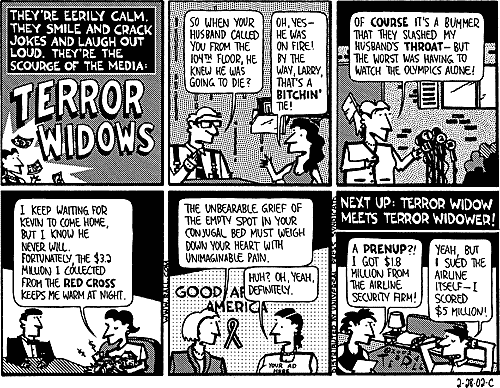
Ted was an instant touchstone for me from the standpoint that his cartoons, which somehow sounds awfully minute and insulting when I say it aloud as you compare his work to the other funnies out there for your base amusement, represented something more than just jokes. They were actionable in that they reached out and made you agree with what he was saying or it made you want to scribble down a death threat or two as evidenced by his “Terror Widows” comic which ran five months after September 11th:

His thoughts almost always have a heft to them when he has something to say. His book, America Gone Wild, showcases some of his own hits and misses with commentary to tell why he’s more than happy to say when he thinks his point wasn’t a very clear one or when something was written too hastily. Ted’s writing some of the most profound commentary on our modern society, with a voice that is unequaled in its ability to attract thunderous protestations from those on both sides of the political arena but, and here’s the most important part, he’s been an active voice against a presidency, the Bush presidency, that knows no limits with how far it will go to lie, cheat or steal its way into your hearts.

Rall’s disdain for the current administration is certainly out there for all to see in its Generalissimo El Busho glory but it’s also his essays that cut straight to the quick about what’s on his mind with the world or his books on what’s happening in the Mideast or Central Asia. And it’s the latter, entitled Silk Road to Ruin, that I read after picking up at the 2006 San Diego Comic-Con which not only kicked open my closed sensibilities with regard to caring for countries I couldn’t pronounce but it made me acutely and severely aware of what is coming on our political, military and, possibly, environmental horizon with things like Lake Sarez being poised to be our next great world disaster waiting to happen.

I had the privilege to talk to Ted for a few minutes regarding Lake Sarez, politics, whether Bush is, indeed, the worst president ever, airport security and what it takes to develop an acute sense of reading between the lines we’re fed by an anxious media.

line3.gif

trailerpark2007-09-14.jpg

Download SDCC Ted Rall Interview:

Large (560 x 420 – QuickTime – 187.88 MB)
Small (320 x 240 – QuickTime – 83.19 MB)

[display_podcast]

Quick Stop Thingamabobs: 9/14/2007

Filed under: Columns,Thingamabobs — UncaScroogeMcD @ 12:01 am

thingamabobs.jpg

The web. It’s a big place, full of plenty of distractions ““ some funny, some informative, some ludicrous, some disturbing, some inane, some profound. Each and every weekday, we present links to a few of our favorite finds”¦

————————————————

  • A minimalist version of the Super Mario Bros. theme… (Thingamabob)

Have a THINGAMABOB? Send it in!

##

September 13, 2007

Quick Stop Thingamabobs: 9/13/2007

Filed under: Columns,Thingamabobs — UncaScroogeMcD @ 4:36 am

thingamabobs.jpg

The web. It’s a big place, full of plenty of distractions ““ some funny, some informative, some ludicrous, some disturbing, some inane, some profound. Each and every weekday, we present links to a few of our favorite finds”¦

————————————————

  • Mark Evanier on the translation of Amos & Andy from radio to TV… (Thingamabob)

Have a THINGAMABOB? Send it in!

##

September 12, 2007

Quick Stop Thingamabobs: 9/12/2007

Filed under: Columns,Thingamabobs — UncaScroogeMcD @ 3:20 am

thingamabobs.jpg

The web. It’s a big place, full of plenty of distractions ““ some funny, some informative, some ludicrous, some disturbing, some inane, some profound. Each and every weekday, we present links to a few of our favorite finds”¦

————————————————

  • A great live set from a fellow Jacksonvillian, Ryan Adams… (Thingamabob)
  • A reminder why I still miss The Drew Carey Show(Thingamabob)
  • Ah, to be young and foolish again… maybe not this foolish, mind you… (Thingamabob)

Have a THINGAMABOB? Send it in!

##

September 11, 2007

Toy Box: Star Trek The Original Series Mini-Mates

Filed under: Columns,Toy Box — admin @ 4:32 am

toybox.jpg

I’m a bit TOS fan. Oh, TNG is fine, and Enterprise, DSN and Voyager have all certainly had their moments. But for me, TOS will always be the one true Trek.

I’m also a big minimates fan. Yes, I do like Mez-itz better in the land of mini figures, but that’s not to say I don’t like the uber-cute nature of these little blocky figures.

So it was a no brainer that I’d be picking up the new Star Trek TOS minimates from Diamond Select. There are three regular two packs – Kirk and Vina, McCoy and Scotty, and Pike and Spock. There’s a fourth variant set that includes Scotty again, but a ‘dress uniform’ version of McCoy. These have hit online retailers over the last couple weeks.

“Star Trek TOS mini-mates: Kirk, Spock, McCoy, Scotty, Pike and Vina”

These guys might look familiar to you. That’s because Art Asylum did do a set of TOS figures back in the very early days of minimates, but they were in the 3″ scale, not this new 2″ scale. So yes, you have to buy them all over again, and these don’t fit in with the old versions size-wise.

toybox_091107_1.jpg

Packaging – **1/2
The packaging is the new basic card bubble stuff you’ve seen with the DC minimates line. I like it because it’s nice and small, but on the downside, it’s not particularly attractive. Still, it does job 1 (keeping the figures safe) relatively well.

toybox_091107_2.jpg

Sculpting – ***
Sculpting is not exactly the strong suit of minimates. The style is supposed to be fairly basic and consistent, with only minor sculpt additions and changes (like the hair), and unique paint work.

toybox_091107_3.jpg

The Spock is perhaps the most distinctive and easily recognizable, although they did a better than expected job with Pike. I don’t know that Kirk looks all that much like Kirk, and Vina is fairly generic, but Scotty and McCoy benefit from fairly distinctive hair styles.

toybox_091107_4.jpg

My only complaint with the sculpt is the goofy added flairs on the bottom of the pants. Yes, they had bells on those pants back then, but these are too over done and look odd. I pulled them off Kirk in some of the photos, and I think he looks far better without them.

Paint – ***1/2
The key to good minimates is great paint. The tampo style paint work on the eyes, lips, and various ‘wrinkles’ in the clothing make all the difference in recognizing and distinguishing the characters.

toybox_091107_5.jpg

Vina’s paint job doesn’t make her all that less generic, although the green skin is pretty much the giveaway. Most of the characters have fairly distinct expressions, and Scotty is downright depressed. Again, Spock seems to do the best in this department, but overall the paint work is extremely clean and well done. That’s critical for the success of the design.

toybox_091107_6.jpg

Articulation – ***
Minimates have a ball jointed neck, shoulders and hips, along with pin elbows and knees, and cut wrists, waist and ankles. It’s pretty decent articulation in this scale and style.

One of the cool features is that the body parts all come apart, allowing you to mix and match if you feel the desire. This usually includes hair pieces, so even Shatner can try on new looks…just like in real life.

toybox_091107_7.jpg

Accessories – ***
All the two packs come with three or four accessories, depending on the set.

Spock and Pike come with four accessories – the tricorder and regular phaser, which come with a number of the other figures, along with the very specific old style phaser for Pike, and the very unique extra hand for Spock, posed in his well known greeting.

toybox_091107_9.jpg

Kirk and Vina only have three accessories, all for Kirk. Again, there’s the commonly used phaser, and the communicator, but Kirk also has the very specific phaser rifle. It fits well in his hand (as do all the accessories), and looks great. Too bad Vina doesn’t have anything, but that would have been pretty tough.

McCoy and Scotty have two of the common phasers, and the common tricorder and common communicator. Even with the reuse, these are pretty handy.

toybox_091107_8.jpg

Fun Factor – ***1/2
If there was a kid that had any idea who these characters were, they could actually have a great time with these guys. These are really toys first and foremost, which is what makes it tough to sell them to the adult collector market. Still, there’s enough big kids out there who like actual toys that the minimates market has been able to survive, particularly with the Marvel and DC lines. Whether they can pull that off with the many other licenses they have – like 24, Back to the Future, and these – remains to be seen.

toybox_091107_10.jpg

Value – ***1/2
You can get these basic six characters for around $18 at a lot of retailers. At just $3 each, that’s a great value. Most of the Marvel and DC stuff is running slightly higher, closer to $4 each even when you buy them in sets.

Things to Watch Out For –
Not much. Take some care with the tricorders, as they pop off the shoulder straps a tad easily, and once they do, they come off way, way too easy.

toybox_091107_11.jpg

Overall – ***
I’m a fan of TOS, and I’m a fan of minimates, so it’s no surprise I like these. Oh, they aren’t for everyone, especially of sculpt and accuracy is your game. If you like toys though – especially toys like Lego or Playmobil – then you’ll really enjoy these. It also helps that there is such a wide variety now of 2″ minimates, allowing you to put your TOS figures with Jack Bauer, Marty McFly, or Buffy Summers.

toybox_091107_12.jpg

Where to Buy –
There’s plenty of online options:

Alter Ego has the set of 6 for $17.82, and they are in stock.

CornerStoreComics has the two packs for $6 each, or the set of three two packs for just $16. They also have the full set of eight figures, including the ‘chase’ variant, for $30.

Amazing Toyz has the same excellent prices, and they are also in stock.

Related Links:
You can check out a guest review of teh 3″ versions from a few years ago right here.

Quick Stop Thingamabobs: 9/11/2007

Filed under: Columns,Thingamabobs — UncaScroogeMcD @ 12:01 am

thingamabobs.jpg

The web. It’s a big place, full of plenty of distractions ““ some funny, some informative, some ludicrous, some disturbing, some inane, some profound. Each and every weekday, we present links to a few of our favorite finds”¦

————————————————

  • The man behind Mario, Charles Martinet… (Thingamabob)
  • The case for war against the ultimate enemy… (Thingamabob)

Have a THINGAMABOB? Send it in!

##

September 10, 2007

Party Favors: Blockbusted

Filed under: Columns,Joe Corey's Party Favors — UncaScroogeMcD @ 12:06 am

partyfavors1.jpg

DALLAS – My affair with Blockbuster is over. I was cheating on Netflix with Blockbuster Online Total Access. And thanks to Newsweek online, it’s out in the public. You want to call me a cad now or wait till our drinks arrive so you can be extra dramatic? Remember to remove the umbrella from the glass – that hurts.

Why did I do it? And why should you believe it’s over?

It started last November when Blockbuster put up their offer of Total Access. It was pure temptation to a film fiend like myself. I used every bit of energy to build up resistance. But how can you top paying $17.99 each month for a three out plan that also allowed me to return my mailers to the nearby Blockbuster store to exchange for titles on the shelf. This guaranteed me the chance to rent the hot new titles on the Tuesdays that came out. If Netflix has one major drawback, it’s the fact that if you don’t get picked for a new title on the Tuesday release, you’ll be stuck on “Very Long Wait” for nearly 2 months. I wanted new so I grabbed the deal.

Can you blame me?

There are people who hate Blockbuster because of an outrageous late fee in their past. This has never been my reason to hate on them. I didn’t rent at Blockbuster because they were expensive. Back in the video days, my rental love was spread at a Phar-Mor. They rented titles for about a half of Blockbuster. How could they charge less? A major hint can be found in the fact that their Founder and CFO were sent to prison on fraud charges. Should I feel criminal for taking advantage of their extra low prices? I didn’t like Blockbuster because it stopped stocking straight to video masterpieces featuring William Katt and Andrew Stevens.

When I went inside a Blockbuster, it was to hunt through the used VHS tables. They’d have two dollar sales at least every other month. It used to be cheaper to buy a used tape than rent the copy on the shelf. But now I was renting titles.

Actually I wasn’t renting since there was no charge for me to swap out that DVDs. That’s when I knew Total Access wasn’t going to go on forever at $17.99 a month. My nearby Blockbuster charged $4.25 per 2 day rental for new titles Plus it had the “No Late Fees” policy. This means I had an extra week grace period before the store would slap a $1.50 restocking fee on my credit card. On Tuesday morning, I’d show up with three envelopes and walk out with three hot new titles. I was never tempted to grab a 4th DVD. I was denying the cash register $13.75. Plus I wouldn’t bring those hot titles back for at least a week. They could have rented my copy of 300 three times instead of having it sit on my coffeetable.

I averaged six swap outs a week. I walked out the store with $100 plus of free rentals per month. Blockbuster online also mailed me 6 DVDs each week. They paid for the postage to me and the return to their distribution center. If this was just an online rental service like Netflix, I paid about 70 cents an online rental. Is that even coming close to covering their stamp cost? If I had shown up at the store with a “this is a stick up” note, they would have lost less money than my nine month reign of terror.

You want to know why Blockbuster is bleeding red ink? Me. They ought to have my picture on the cover of the quarterly report.

It wasn’t a complete shock when last month Blockbuster decided to retool their online rental program. I just figured they’d let it last until 2008. The new deal for $17.99 lets me rent 3 DVDs at a time. But they’d only allow me to swap 5 titles at the store for free. If I wanted to keep the Total Access (now called “Premium”), it was going to cost $24.99 a month. What’s $7 bucks especially after all the damage I do per month? Why quit?

This is a protest. If Blockbuster is going to yank me this time; they’ll yank again to calm down investors when the quarterly numbers bleed. While it’s fun to get the new titles with the swap out, the pickings get slim fast. Lately I’ve found myself grabbing crap off the shelves in order to make the trade. Would I have spent $4.25 to rent Astronaut Farmer, Pathfinder or Ghost Rider? Or would I have waited a few more months for them to appear on HBO? Instead of renting titles because I’m curious about them, I checked them out because they were there. The pile of DVDs seemed more of a endurance test than an entertaining evening. The only good part was that if a film stunk, I didn’t feel too bad stopping it after 20 minutes and tossing it back in the box. This was done to The Breed, Black Christmas and pretty much anything that was a Blockbuster exclusive. I didn’t really waste $4.25 on a clunker. It’s not like I could have rented porn at Blockbuster.

The online version of Blockbuster did offer quite a few titles that Netflix refused to stop. The biggest thing BBO offered was Disney’s True Life Adventures series. Why couldn’t the lemmings arrive in the red envelope? Contrary to what Netflix wants you to think, they don’t buy every new title to put in circulation. And they are quick to pull titles that have gone out of print. Or is it a case that Netflix users have “lost” them in the mail? It was nice to be able to use both resources while working my way through the Psychotronic Encyclopedia of Film.

There are also a couple minor yet annoying reasons to quit. My nearby Blockbuster store shut down a few months back. It’s twice the drive to get to the new store. I’m trying to save gas so this war can end. Plus Blockbuster will only ship DVDs that are within 2 or 3 mailing days. This means that even though the website tells you a title is available, it might not be available to you. It got annoying waiting for rare titles to snail their way cross country through the distribution centers. Netflix ships me a title from Hawaii if its in their system. Plus every other week, a Blockbuster title would get lost in the mail. I’ve yet to have a Netflix title go MIA – not even Missing In Action with Chuck Norris. Rarely would a Blockbuster title arrive in the mail the day after shipping. This wasn’t bothersome when I had DVDs checked out of the store unless those DVDs were lame fare like Prey.

Now I’m just a Netflix customer. I won’t be getting all the new DVDs on Tuesday. The mailman will only have half the load to shove in my box each week. I should feel dirty for having made a deal with Blockbuster, but after they do the math, I’m the best worst customer they’ll ever have. As I told Newsweek‘s Brian Braiker, “when word gets out that I’m no longer with Blockbuster, their stock will soar $4 a share.”

BLOCKBASTARDS

After I decided not to do anything about reupping and just let my deal with Blockbuster lapse, those weasels decided to not wait until Sept 4 to end my account. When they didn’t ship me anything the other day, I wrote them asking if they were going to send me my next titles. This was the response:

Hello Joseph,

Thank you for contacting Blockbuster Online Customer Care.

I’m sorry to hear we haven’t shipped the DVDs you’ve requested. In looking at your account, it has automatically been cancelled as of 08/25/2007. Please reactivate your account by choosing new plans. You can find the details of other plans that are available via “My Account” in the “Subscription Plan” area.

Joseph, I hope this information has been helpful. Have a nice day.

Always here to help,

Ryan
Customer Care Associate
BLOCKBUSTER Online

They bill me for 30 days of rental action and are denying me 10 days of service. Sounds like it’s time to sue their asses. Anyone else get ripped off for a month? I have a really great class action lawyer. You think I’m joking, Blockbuster? Google “Joseph Corey” + “Class Action.”

CRYING AT COMEDY

Using one of my freebie swaps, I picked up The Ex since it’s a Blockbuster exclusive. This should have been funny. You have the three leads from excellent sitcoms teaming up on the silver screen. How can you go wrong with Zach Braff (Scrubs), Jason Bateman (Arrested Development and Donal Logue (Grounded For Life)? Guess it starts at the script and it’s downhill from there. This is a script that wouldn’t have escaped the writer’s room at any of these shows. It might have stood a chance at Charles in Charge. What was the point of casting Mia Farrow for a job that could have filled by a bottle of Mrs. Butterworth?

When Superbad came out, the hype kept saying it was the best comedy since Borat. Has there been any other funny comedies since Borat? Sure there was Idiocracy, but for a majority of Americans, they discovered it on DVD. What is wrong with cinematic comedies? There seem to be plenty of decent sitcoms in the past 10 years. But comedies? Is there a problem that after 25 pages, a comedy becomes a painful exercise that devolves into painful Kate Hudson vehicles? Or they just become Dipshit Comedies starring Will Ferrell. Way too many movies are prolonged Saturday Night Live sketches that are only funny in the sense of discovering your anal warts are actually parasite infections.

THE MAGIC IS BACK

How does one full appreciate R Kelly’s Trapped in the Closet: Chapters 13 – 22 with the knowledge that the auteur is still awaiting trial for peeing on underaged girls? The answer for me is Jack on the rocks. The new 10 chapters of this epic do not disappoint. I still haven’t a clue what R. Kelly is doing. But damned if it’s seriously messed up. His hot new character is a pimp at a church service. Plus we’re given a mobster shoot out that blasts away the finale of The Sopranos.

The shame is the lack of action for Michael K. Williams’ cop character. Give him screen time, R Kelly. The bad part of this new DVD is that we don’t get R. Kelly’s commentary track. I want to hear his genius at work. Watching R. Kelly watch and “explain” Chapters 1 – 12 took this project to the next level.

A REAL COMMENTARY TRACK

The Film Crew DVDs have been a fun way of keeping the joy of Mystery Science Theater 3000 alive. The deal of this show is that Mike Nelson, Kevin Murphy and Bill Corbett are hired to create commentary tracks for films that don’t have them. Their movie jokes are done only on the audio track. I miss their shadows on the screen. I do wish they’d retool the show so that at least one of the guy fakes being connected to the film. They could impersonate an actor who claims they were in the part of the screen eliminated by the pan and scan. Or they can play the Production Assistant who has worked 50 years in the industry. This way they can tell horrible stories of being on location. Give us fake insider tales of Hollywood, Mike Nelson!

Or they can bring in Rock and Roll legend Patti Smith. Her work on Aqua Teen Hunger Force Colon Movie Film For Theater For DVD deserves an award. She’s an amazing conversationalist with the various folks in the recording booth. And a fan of the show. Since R. Kelly didn’t create a commentary for Trapped in the Closet 13 – 22), Patti Smith can put on her resume “Best DVD Commentary Personality of 2007” under the honors section.

SCARY SEPTEMBER

The Midnite Movies Double Features return on Sept. 11! After a few years off, we’ll be treated to Return of Dracula/The Vampire, Phantom from 10,000 Leagues/The Beast with a Million Eyes, & Konga/Yongary, Monster from the Deep. Also Best Buy will be featuring Vol. 2 of Universal’s The Classic Sci-Fi Ultimate Collection. The five black and white features are Dr. Cyclops, Cult of the Cobra, The Land of Unknown, The Deadly Mantis & The Leech Woman. Now I await news to the day BJs stocks the Monsters Cereal multibox. Then it’s truly my favorite time of the year. Spooky time!

TVLAND HATES VINTAGE TV

An email showed up from TVLand looking for reality show contestants. Unlike their recent reality shows that featured acting icons from their older programs, TVLand’s new slate of shows have zero to do with classic television. They want women over 35 ready to be models. They want people who crave their outrageous 40th birthday parties broadcasted. They want couple between 45-55 that are dumping their old jobs to pursue a life long dream. What the hell does this do with me wanting to watch I Love Lucy? The dorks at TVLand want to turn the channel into MTV for Middle aged people.

The channel is now showing Extreme Makeover: Home Edition. While I enjoy the show and have worked on it in the past, it’s not a Classic TV show. It’s still on ABC primetime. And the same goes to them running movies that have nothing to do with TV like The Negotiator.

Do I have to sue your asses, TVLand? Your channel promises me a nice mix of vintage TV shows. Can you not do your job? I don’t pay for your channel in order to watch new shows. Stop trying to bait and switch. You are a niche channel and you need to remain true to your promise to me.

You want to do original programming that ties into your mission? How about a show that interviews the character actors that popped up in dozens of great shows. How about a little tribute to James Wong? Do we really need a show about a middle aged couple opening up a Bed and Breakfast in the wine country? Would that be Dean and Tori Get Old?

Thank goodness Paramount Home Video is putting out the first batch of Love, American Style episodes on DVD this November. They also have more Perry Mason, Happy Days, Laverne and Shirley, Mork and Mindy and Mission: Impossible. There’s going to be plenty of TV goodness on the shelf for the Christmas shopping season.

DIRTY POLITICS

Why do high profile Republicans have no sense of hygiene?

First off there’s that video footage of Mitt Romney at a pork cookout in Iowa. When he lifted the hunks of pork from the grill into a bag, one of the pieces fell off his spatula and onto the ground. Mitt picked the pork off the ground and put it back on the grill. “Five second rule!” he exclaimed. Is he psychotic? Will someone explain to Mitt the “five second rule” when it comes to large hunks of meat doesn’t mean you can just pick it off the ground and toss it back on the grill. You have pick the meat off the ground and wash the dirt away. You can’t serve people dirty meat. I bet if Mitt discovered his personal chef was serving him “five second rule” prime ribs, he’d be pissed off. But a voter in Iowa should be satisfied with his dirty slice of pork?

Should I really expect more from Mitt? Not really. This is a man who had a dog with the shits strapped to the family station wagon so that feces could drip off the back window and splatter onto motorcyclists. The Center for Disease Control needs to swab down Typhoid Mitt’s private plane to make sure he isn’t the reason the bees are disappearing.

The second big GOP Germy is Sen. Larry Craig. There’s no need to debate if he was really looking for a blow job in the Minneapolis airport bathroom. But there’s one thing that can’t be denied is his alibi that he reached into the adjoining stall to pick a piece of toilet paper off the tile. What? Who the hell picks anything off a men’s room floor? Do you know what is in that toilet paper? There is no five second rule when it comes to Public men’s restrooms. And there’s one major rule in the world of men’s restrooms, you never put your hand in another man’s stall. If your wedding ring falls off and rolls into another stall, you buy another one. He might as well have claimed he was tonguing the toilet seat to sanitize it for his ass.

At the next GOP convention, instead of having another “how great we are” speech, they must hire a nurse to explain proper hygiene techniques. Don’t let Mitt Romney kiss your baby. Who knows what he’ll allow his unwashed lips to touch for five seconds.

SUMMER’S GONE

What’s irritating about the year round school craze overtaking America is that right after a store removes the 4th of July fireworks display, they’re already slapping up the Back to School sales crap. We don’t get to enjoy summer since we have to worry about passing stopped yellow buses. Remember when summer lasted until Jerry Lewis sang, “You’ll Never Walk Alone?”

KILLING US SOFT SHOELY

After Mark Cuban goes off about how the internet is dead and boring, he signs up for Dancing with the Stars. Way to save civilization, Cuban. Guess he’s too much of sissy to be on my new show So You Think You Can Drink Nitro Glycerin and Do The Twist. It’s a tribute to Big Jim and Billy Sol on SCTV. Here’s a warning to Mark Cuban. According to my Magic 8 Ball, Marie Osmond will lead to the end of Cuban’s marriage!

THE DEATH OF COCK ROCK

Normally this would be the space to grouse about the music industry. But I’m feeling generous thanks to the latest albums by Amy Winehouse, Lily Allen and Feist. I’m not coming up with a fancy name to lump this trio into a genre. But it is quite obvious what’s lacking these days – bands with dicks. What happened to the cock rock? Why haven’t I heard a song and said, “Damn it! Those guys know what they’re doing!” Why does my lighter remain in my pocket instead of being waved over my head?

What happened to cock rock? I don’t want to think I’m turning into a pussy, but there’s very little alternative. Here we are in the midst of six years of war and the best we’re fed is Fall Out Boy and Nickleback. Why isn’t there a band filled with bile, blood dripping down their chin and with a riff that can’t be denied?

Where’s the next Black Sabbath with Paranoid 2? I’d settle for the second coming of Styx (or is already here as Maroon 5 and The Killers?). Is there any reason for Velvet Revolver to be considered a super group with their mediocre tunes? Velveeta Revolver is more like it.

Maybe the Hives will put balls back on the radio. But do they really have a new record or just pimpin’ Nike-iPod sneakers?

HAPPY TWENTY?

This is not a blog. It’s a column! This column has been around longer than the word blog has been in existence. This is the 20th anniversary of The Party Favors. At least we think it is. We were drunk in the mid-80s so that whole period of time is a blur. We were all doing lines of coke off Drew Barrymore’s ass between cameos on Miami Vice. Elvis the alligator was a mean drunk, but a lovable lush. Five a.m. would arrive when Epi would slide a live Nina Simone album onto the turntable. “Either get busy or fall asleep,” she’d insist. “The sun doesn’t take prisoners or excuses.” I miss Epi. I’d miss her more if I could only remember her last name. Or if Epi was her name or nickname. But since I stole her Nina Simone album, she’s always close to my heart and ears.

BACK TO SCHOOL

Did you know that Party Favors is taught in several leading universities? This column is used as a final exam in copyediting classes. And congratulations to Hank Ashbaum for winning last month’s “Spot the Typos” contest.

The nice thing about going to school in the 21st century is that you no longer have to worry about stashing your porn collection in the cramped dorm room. Or being soiled by your roommate. It’s all on the computer. That would have freed up at least five cubic feet in my old Turlington dorm room. Once a college official sent me a nasty letter pointing out that dorms should only be called residence halls. Dorms are what they call them in prisons, I was told. Oddly enough, a prison guard told me they don’t call them dorms, but residence halls. Nobody wins.

Comics in Context #193: Mystery In Montclair

Filed under: Columns,Comics in Context — admin @ 12:03 am

comicsincontext4.jpg

comicsincontext2007-09-10-03.jpgBack in February at the New York Comic Con, during the panel about the forthcoming movie Will Eisner’s The Spirit, executive producer Michael Uslan recommended that we all go see the exhibit “Reflecting Culture: The Evolution of American Comic Book Superheroes,” that was opening at the Montclair Art Museum this summer (see “Comics in Context” #170). it turned out that Uslan lent a good number of comics and original comics artwork from his own extensive collection to the show. At the convention Uslan assured us that the museum, in Montclair, New Jersey, was merely “a half hour train ride” from Manhattan. Regular readers may recall that, as a result of my expedition to the Newark Museum to see the first section of “Masters of American Comics,” I was suspicious even then of Mr. Uslan’s assurance.

And I was justified. I decided to head out to the Montclair Art Museum on the show’s bright, sunny and delightful opening day, Saturday, July 14, and discovered from website research that on weekends there is apparently no direct route via public transportation from Manhattan to the museum. Moreover, I ended up not arranging to stay overnight with a friend who lived in a nearby New Jersey town, so my journey to Montclair was going to be a day trip. Getting out to Newark, New Jersey by train was simple enough. Waiting a long time in a grungy area of Newark as the summer sun beat down for the bus heading to Montclair was less appealing. But I was pleased to discover that Montclair itself is a rather pretty, upscale town, and that the bus stopped directly across from the museum. I disembarked, notebook in hand, ready to gather information for my column.

An introductory wall text, on “Definitions and Origins,” began promisingly by quoting a definition of the term “superhero” from Dr. Peter Coogan’s remarkable book Superhero: The Secret Origin of a Genre (see “Comics in Context” #162). The wall text goes on to state one of the themes of the exhibition: that superheroes are modern successors of the title hero of the Babylonian Epic of Gilgamesh, of the heroes of ancient Greek mythology, and of legendary figures like Robin Hood. Moreover, “comic book superheroes became manifestations of American history, culture, and folklore.” And so, the exhibition shows visitors, during World War II superheroes battled the Axis powers. Wonder Woman became a feminist icon. In the 1960s Stan Lee and his collaborators created superheroes with more complex personalities, who felt alienated from the rest of society. In the 1970s superhero comics tackled social issues like drug addiction. The 1960s and 1970s saw the rise of non-Caucasian superheroes like the Black Panther and the John Stewart version of Green Lantern. The “deconstruction” of superheroes got under way in the 1980s, and numerous superhero comics stories were done about the 9/11 attacks. And I suspect that most of my readers are surprised by none of this.

Unfortunately, the Montclair show doesn’t move much beyond what one might term Superhero Comics 101, the most basic kind of course in the genre. Certainly there must be many visitors to the show who know little about the history of the superhero genre, to whom much of this information will be new. But walking around the exhibition, I was reminded of mainstream media articles about superhero comics circa 1970, marveling that they were dealing with social and political issues: comic books had suddenly become “relevant.” Over thirty-five years have passed, but the Montclair show delves little more deeply into the genre. “Masters of American Comics” raised the bar for museum shows about comics considerably. In co-curating a show dealing with Stan Lee’s superhero comics for MoCCA, the Museum of Comic and Cartoon Art (www.moccany.org), I was careful in writing the wall texts both to provide the basic information for people who knew little about the Marvel series of the 1960s, but also to provide insights that I hoped that even longtime Marvel aficionados would find illuminating and different.

What was most rewarding about “Reflecting Culture” was looking at the original artwork and vintage comic books on display. I continue to be amazed that actual comic books that I bought as far back as the 1960s–and even some comics from the early 21st century–are now displayed as museum pieces. But I was pleased with the selection of vintage comic books on display here, ranging as far back as the Golden Age of the 1940s, and, unlike in Geppi’s Entertainment Museum (see “Comics in Context” #176), the accompanying texts provided satisfying explanations of each book’s significance. There was original comics artwork on display by Neal Adams (from a Batman story and Green Lantern), Dave Cockrum (from Uncanny X-Men), Gene Colan, Amanda Conner, Steve Ditko (from The Amazing Spider-Man), Will Eisner (from The Spirit), Carmine Infantino (from The Flash), Gil Kane, Jack Kirby (from Captain America’s Bicentennial Battles), Joe Kubert, Frank Miller (from Batman: The Dark Knight Returns), Jim Lee, H. G. Peter (an unpublished Wonder Woman splash page), and John Romita Sr. (from The Amazing Spider-Man). Certainly there were many major superhero artists whose work was not represented, but the examples of art by the artists I’ve just named was all worthy of close inspection. There was even Superman co-creator Joe Shuster’s own 1971 recreation of the cover of Action Comics #1, Superman’s first appearance.

I was particularly delighted with Joe Kubert’s cover art for Batman #310 (1979), showing Batman battling the Gentleman Ghost atop a runaway horse-drawn carriage. Daringly, Kubert put the hero and villain in the background, while the horses powerfully hurtle into the foreground, as if to burst from the printed cover and trample the reader. The dynamic power of the galloping horses reinforces the sense of action conveyed by Batman’s fight with the Ghost. The accompanying label commends Kubert’s “powerful, naturalistic style” and “his masterful eye for realistic detail.” But the secret of Kubert’s artwork in “Reflecting Culture” is his ability to make his heroic figures, whether it is Batman, Hawkman, or Sgt. Rock, appear larger-than-life and iconic and simultaneously seem realistic and credible. In his own way, Alex Ross also achieves this same amazing alchemy. (During the run of “Reflecting Culture,” the Montclair Art Museum is also featuring a commendable exhibit, “Comic Book Legends: Joe, Adam, and Andy Kubert,” honoring these three New Jersey residents, just off the entrance lobby.)

comicsincontext2007-09-10-02.jpgAnother of my favorites was the original artwork for Gil Kane and Murphy Anderson’s cover for Green Lantern #26 (1964), in which Star Sapphire, shooting an energy beam into Green Lantern’s power battery, triggers another beam which unmasks the superhero as Hal Jordan. (It is reproduced on the cover of the recent Showcase Presents Green Lantern Vol. 2 paperback. It was a pleasure to be able to study Kane’s elegant linework, as inked by Anderson, up close. This also gave me the opportunity to consider the composition of the cover drawing. Star Sapphire’s downward descent, at a slight angle, is roughly echoed by her power beam. Green Lantern’s stance exactly parallels the other power beam which snatches off his mask. While Star Sapphire’s figure is nearly vertical and exudes confidence, Green Lantern/Hal stands at a decided slant, as if he is literally taken aback by his sudden unmasking. She is triumphant; unmasked, he is vulnerable and seems defeated. The two figures form a classical triangular composition, mirrored by their respective power beams.

The argument has been made that hanging pages of original comic book art on the wall of a museum distorts the experience of reading comics because each individual page is only a segment of a longer work. The “Masters of American Comics” exhibition displayed some entire Spirit stories by Will Eisner and an entire EC war story by Harvey Kurtzman, but only excerpts of one or a few pages from Marvel and DC stories drawn by Jack Kirby.

On the other hand, by displaying a single page, or a two-page sequence, a museum focuses the viewer’s attention on that specific segment of the overall story. Whereas in reading the comics story, the reader will probably get caught up in the narrative, if he sees one or two individual pages on a museum wall, he may notice details and nuances that might otherwise have slipped his conscious notice.

The pages in Montclair that most impressed me were pages 15 and 16 from issue 12 of Alan Moore and Dave Gibbons’ masterpiece Watchmen. In the Watchmen trade paperback, page 16 is the reverse side of page 15. Arguably, these two pages work better as a unit within the issue when they are seen side by side. This is how the Montclair Art Museum presents the original art for these pages.

These two pages make up a short scene within a larger story sequence in the twelfth issue. Since Alan Moore notoriously writes extraordinarily lengthy and detailed scene descriptions in his plots, I do not know which visual aspects of this scene should be attributed to writer Moore and which to artist Gibbons. Together, however, they created a two-page sequence that is a masterpiece of comics storytelling, and which whets my interest in someday embarking on a panel-by-panel analysis of the entire Watchmen series.

(And if you have not read Watchmen, I am about to give away one of the secrets of its plot, so you may wish to skip ahead twenty-seven paragraphs.)

In the first panel Adrian Veidt, alias Ozymandias, stands inside his Antarctic headquarters, gazing into a doorway. Veidt has modeled himself after Alexander the Great, his costume evokes the garb of classical civilization, and he looks rather like an ancient Greek statue as he stands in profile. He wears a placid expression, looking perhaps as if he is lost in thought. If you have the book, then you know the context: he is looking into his “intrinsic field subtractor” chamber, which he just employed to (apparently) disintegrate the godlike Doctor Manhattan, and in the last panel on the previous page he was mulling over the scientific aspects of destroying the Doctor, apparently oblivious to the moral cost of murder.

In the background of this first panel the alert reader will see the silhouetted figures of the superheroes Nite Owl and Rorschach, as if they embody Nemesis, out to avenge the murder of their colleague. They stand in another doorway, and perhaps are merely watching at this point, and not coming forward,

But revenge will come sooner than they could reach him. A balloon, containing the word “Veidt,” hovers to the right of his head, its tail leading offpanel, towards the second panel in the page’s top tier.

This second panel shows another of Watchmen‘s superheroes, Laurie, the Silk Spectre, who was once Doctor Manhattan’s lover, who has surely just witnessed Veidt’s seemingly successful attempt to murder him, and who knows (as do Nite Owl and Rorschach) that Veidt is the mastermind behind the massacre of half the population of New York City. (As I have pointed out in my “1986: The Year That Changed Comics” lectures at MoCCA, in the aftermath of the 9/11 attacks, issue 12 of Watchmen takes on new resonance.) Whereas Veidt was shown turned in profile, Laurie faces the reader, angrily aiming a gun and telling Veidt, “You’re an asshole” (a line which should confirm to the museumgoer who hasn’t read Watchmen that this isn’t a book for small children).

Circular lines curve around Laurie: these are the walls of a circular tunnel (as shown two pages earlier), leading in from the Antarctic snows (accounting for the puddles marking Laurie’s footsteps). The circular lines also serve to emphasize Laurie visually, perhaps harkening back to the occasional circular panels used in comics of the 1930s and 1940s. (Look at an early Batman story, for example.) If Laurie is enacting the role of avenging angel here, the circular lines might even suggest a halo.

Laurie is aiming her gun right at the reader. What this actually signifies is that in this one panel the reader has been given Veidt’s point of view as he, off-panel, turns his head and sees Laurie pointing the gun at him. Moore and Gibbons hardly encourage the reader to identify with Veidt in Watchmen, but by giving the reader Veidt’s literal viewpoint for this one panel, they encourage the reader to consider what it would feel like to see someone about to kill him or her.

Subtly the top tier heightens the intensity of the drama by bringing the reader closer to these two characters, panel by panel. The initial panel on the top tier shows Veidt from his head down to his knees. The second panel gives a closer view of Laurie, from her head to the top of her thighs. The third panel brings us even closer to Veidt, starting from the middle of his forehead, as he raises his left leg, as if that is the only way it could be seen in this close-up.

With the third panel the point of view shifts to Laurie’s. (The first panel was from an “objective” point of view, not that of any of the characters.) Veidt is in the process of turning from his profile position in the first panel to a position facing her. What is most notable about this panel, though, are the multiple images of his hand, held as if to administer a karate chop, and of his left leg, moving up as he is about to launch himself into the air. In contrast with the characters’ static poses in the first two panels, the third panel suggests that Veidt is moving to the attack so quickly that it his movement cannot be “caught” by the artist: it is the equivalent of a blurred movement in a photograph. It’s the kind of multiple image effect one might expect to see in The Flash, and presumably Moore and Gibbons are suggesting that Veidt, though he lacks super-powers, is somehow moving almost too quickly for the human eye to register fully. Even the transcription of Veidt’s battle cry (“Hhhhiiiiiii. . . .”) suggests movement.

The second tier consists of a single, long panel. It unites all four characters in the same visual space and serves as an establishing shot, marking the location of each within this chamber. The characters are divided into groups of two. In the background Nite Owl and Rorschach have moved forward, enough so that Nite Owl’s figure is now partly in the light, whereas Rorschach remains mostly in silhouette. The positions of their legs shows that they are now walking. In the foreground Veidt and Laurie are united by the bright blast of her gun, which not only connects the two figures visually but illuminates them both amid the shadows that have swallowed up much of the chamber (as well as Nite Owl and Rorschach).

The figures of Veidt and Laurie are sharply contrasted, and not simply because they are of different sexes. (This panel provides a clear view of Laurie’s microminiskirted legs, for example. Laurie becomes an archetypal female resisting Veidt’s personification of male aggression.) Veidt has no leapt into the air towards Laurie to attack her, thrusting forward his left leg (which he was raising in the previous panel), which looks as if it would have hit her in the lower abdomen (raising some nasty sexual implications). Veidt’s cape flows outward behind him. Hence Veidt is a basically horizontal figure here, whereas Laurie, firing her horizontal gunshot, stands vertically, in opposition to him.

Yet though Veidt and Laurie are in opposition to each other, their figures also echo each other. Veidt continues to utter his battle cry from panel three as Laurie fires her shot, whereupon it continues in the second tier as a cry of pain (“Yaaa. . .”). Whereas in panel three Veidt was extending his left arm to deliver a karate-style blow, in the second tier he holds his arms closer to his body, bringing his hands together, seemingly to clasp them over a gunshot wound. This pose echoes Laurie’s as she holds her arms together, as her hands hold her gun. As Veidt’s left leg extends forward in attack position, his right leg bends, perhaps in reaction to the pain he feels. Laurie extends her right leg forward, anchoring herself to the floor as she fires the shot, but her left leg bends back, perhaps in response to the recoil effect of the gunshot.

Moreover, whereas in the top tier Laurie and Veidt both wore facial expressions of anger, now their reactions are quite different. Veidt looks somber, as if reacting to the pain, while Laurie looks somewhat anguished, perhaps feeling some fear as she saw Veidt hurtling towards her, or perhaps distressed by the act of shooting at him, however much he deserves it.

The bottom tier continues the visual opposition of Laurie (vertical) and Veidt (horizontal): Veidt lies on the floor, seemingly dead, with his left hand over his heart, with blood staining his costume over his heart, and with his right hand, partly clenched, resting in a small puddle of blood on the floor. Laurie stands upright, although not entirely confidently: her head looks down towards Veidt’s body, and her left knee is bent. The bright light from the gun has been supplanted by smoke which curls eerily upward from the barrel.

In the background, Nite Owl and Rorschach continue their advance forward, both now mostly in the light. Shadow covers Nite Owl’s face, though, masking his reaction to what he’s seen; Rorschach, of course, wears a mask which conceals his facial expressions.

The first panel of the bottom tier hides the facial expressions of Veidt and Laurie as well. The seemingly dead Veidt’s face is turned away from us. Laurie has moved, standing beside Veidt’s head, with her back to the reader. We cannot see her face, but her body language–her stance, the position of her head–suggests her uncertainty as she carefully studies the seeming corpse.

Again, the “camera” is being moved subtly closer to the figures. Whereas the middle tier gave us a full figure shot of Laurie, in the third tier’s first panel we see her from the lower third of her head to just above her ankles. We still see the full length of Veidt’s body. In the second panel of the bottom tier, we draw still closer, seeing both Veidt and Laurie from the waist up. Now we can see Veidt’s face, which is once again in profile, but still not Laurie’s. This has the effect of focusing our attention more on Veidt. From the position of her head, Laurie is clearly looking at Veidt’s bloodied clenched hand, and we are being directed to do the same. The starlike points of the puddle of blood further emphasize Veidt’s hand, and oddly contrast with the rounder contours of the puddle of water marking Laurie’s path.

In the Watchmen paperback, one must turn the page to see what comes next, creating more of a feeling of suspense. But in the museum, pages 15 and 16 hang side by side, so the movement of the “camera,” coming increasingly closer to Veidt’s hand, is unbroken (save for having to shift one’s eyes to the top of page 16).

This pattern of slowly zooming in on something, or slowly pulling the “camera” back from it, is a characteristic Watchmen technique. Issue one begins, on the cover, with an extreme close-up of the Comedian’s trademark happy face button, with blood on it, as if from a head wound, and surrounded by a rivulet of blood, from the Comedian’s body. In each succeeding panel on page one the “camera” pulls further up and back, until it reaches the level of the window from which the Comedian fell to his death. Similarly, issue one closes with the “camera” pulling up and back from Laurie and Dan (Nite Owl) standing on a balcony.

The sequence with Veidt’s hand here in issue 12 creates a reverse effect from the opening page of issue 1. In the first issue the “camera” pulled up and back from a small object, amid blood, that was the symbol of the killing of one superhero (the Comedian) by another (Ozymandias). In issue 12, the “camera” step by step moves closer to Veidt’s clenched hand, lying amid blood, giving us a close-up of the hand in the first panel of the top tier of page 16. In the next panel the “camera” moves in still further, as Veidt opens his hand and reveals the bullet, covered with blood, that Laurie shot at him. Earlier, on page 9, Veidt had implied in conversation with a disbelieving Nite Owl that he was capable of catching a bullet that had been fired at him; now we see the proof. The blood-covered bullet becomes not the symbol of death but the symbol of one superhero’s (Veidt’s) ability to survive a murder attempt by another superhero (Laurie).

The third panel cuts to a closeup of Laurie, aghast at realizing what Veidt has done. Then the rhythm of three panels per tier is abruptly interrupted by the second tier, which consists of a single long panel, in which Veidt just as suddenly comes fully to life, raising himself on one hand and kicking Laurie in the abdomen with his left leg. Notice that this parallels the structure of the previous page, in which the top tier of three panels was followed by a second tier consisting of one panel, in which the figures of Veidt and Laurie were joined by the gunshot with which she attacked him. In the second tier of page 16 the figures of Laurie and Veidt are again joined, this time by Veidt’s leg connecting with her stomach. Thus Veidt succeeds in the kicking attack that Laurie thwarted on the previous page. Veidt still occupies a horizontal position and Laurie is in a vertical one, but Veidt is in the process of raising himself to a standing (vertical) position, and Laurie is toppling to a horizontal position, lying on the floor.

Thus Veidt and Laurie exchange positions, both literally and figuratively: he stands up, triumphant, while she lies down, in pain and defeat. This sequence is also a sinister variation on the archetypal pattern of symbolic death and resurrection, as Veidt, who sees himself as a hero but actually fills the role of Watchmen‘s primary villain, rises from apparent death.

In this second tier we see Veidt and Laurie from the same direction as Nite Owl and Rorschach do. This subliminally prepares us for the third tier of panels, in which Nite Owl confronts Veidt. With the violent assault over, the third tier returns to the steady three panel per tier pacing thatWatchmen usually employs.

Veidt’s first line in this tier is “There. Something else I wasn’t sure would work,” presumably about his success in catching the bullet, and echoing his comment about his seeming murder of Doctor Manhattan on page 14. This suggests that Veidt cares as little about Laurie’s pain as he did about the moral horror of murdering his former teammate Doctor Manhattan. Veidt’s figure is cropped in this panel so that we do not see his head, but we can imagine his indifferent expression from his dialogue. Instead the “camera” turns our attention to Laurie’s facial expression, reflecting her intense pain, as she lies on the floor, her arms positioned so that her unseen hands clasp her abdomen, just as Veidt’s seemed to cover his seeming wound on the previous page.

On rereading Watchmen the reader may observe that, despite Veidt’s confidence, he is as wrong in believing that he succeeded in killing Doctor Manhattan as Laurie was wrong in thinking she had shot Veidt.

Nite Owl and Rorschach have come much further into the chamber, while the “camera” looked elsewhere in the previous five panels, and they now stand fully in the light. As Laurie did in the first panel of the previous page, Nite Owl demands Ozymandias’s attention by calling his name: “Veidt!” But Veidt will defeat Nite Owl’s attempt at confronting him much more easily than he survived Laurie’s.

In the final tier’s second panel the “camera” radically changes position, so that we now seem to be standing behind Nite Owl and directly behind and to the immediate right of Rorschach. Whereas the previous page showed Nite Owl and Rorschach slowly advancing from the background, now we see Ozymandias advancing towards the foreground. This time the figure in the far background is Laurie, who begins to rise to her feet.

Nite Owl insults Veidt (“Veidt, you bastard. . . .”) and begins to threaten him, but his insult and threat seem standard melodramatic clichés, and his voice trails off (“I’ll. . .”). As if wearily scolding a child, Veidt calls him by his first name over and over (“Oh, Daniel, Daniel, Daniel, Daniel. . . .”), thereby failing to acknowledge his costumed persona. Then, in the page’s final panel, Veidt walks right past Nite Owl and Rorschach and out of the panel: the panel crops most of Veidt’s figure, as if he has already mostly passed out of the scene. “Do grow up. . . .” Veidt tells Nite Owl, who turns, looking bewildered at him. Not only has Nite Owl utterly failed to stop him, but Ozymandias has verbally reduced his would-be opponent to the level of a small child. Rorschach’s cropped figure has slightly turned to watch Ozymandias as he passes, showing us part of his mask: Rorschach’s thoughts on the scene he has witnessed these last two pages remain characteristically enigmatic. In the background Laurie stands upright, but her head is bowed, presumably in pain and defeat.

Nearby hung the original art for a page from another classic Alan Moore story, Batman: The Killing Joke (1988), illustrated by Brian Bolland. This page was from the sequence in which the Joker recounts his (possible) origin, based on the 1951 story “The Mystery of the Red Hood” from Detective Comics #168. In Moore’s version an unnamed comedian is forced by criminals to pose as their supposed masked leader, the Red Hood, but while they are robbing a chemical plant, they are confronted by the Batman. This page has numerous superb visual effects. In one panel we see double images of the Batman in the Red Hood’s goggles, magnifying the threat perceived by the frightened comedian. Bolland takes a surprising but effective minimal approach to the key moment when the Red Hood, desperate to escape Batman, falls into a vat of chemical wastes: the artist represents the two antagonists by only a glove and part of a cape. Best of all is the large panel in which the Red Hood, still masked, climbs out of the chemical wastes outside the factory. Bolland depicts the barbed wire and vegetation in highly detailed, naturalistic fashion, but what is most impressive are the concentric circles in the tainted water, marking when raindrops fall: the patterns are at once beautiful and eerie, thus setting the stage for what will happen on the next page, when the Red Hood unmasks to discover the wastes have given him the garishly colored hair and face of the Joker.

My final favorite artwork in the show was Alex Ross’s gorgeous painted cover for a reprint edition of The History of the DC Universe. Strangely, the accompanying label at the museum claimed that the painting exemplified the influence of Surrealism on Ross’s work, offering Salvador Dali’s work as an example. No, no, no, Ross does not deal in distortions of reality but in endowing the fantastic figures and places of comic book universes with a persuasive semblance of reality. His History of the DC Universe cover really demonstrates the influence on Ross of both the great artists of the Golden Age of Illustration, such as his hero Norman Rockwell, and of cinematic montage.

comicsincontext2007-09-10-01.jpg

There is so much in this painting to admire. My favorite section shows the head of the Batman; as usual, Ross makes him look like a real man, wearing a mask made of real fabric, his eyes visible through slits, and simultaneously like a formidable, iconic figure who is larger than life, rather than, say, a guy going to a costume party. Ross makes the bat “ears” on Batman’s cowl so long that they conjure the image of devil’s horns, for the Batman is a man who takes on the image of a fearsome bat–or a devil–to defend us from truly devilish menaces. Look how the tall, thin “horns” of Batman’s cowl are echoed by the tall, thin spires of Gotham City’s skyscrapers to the left of his head. Bats, his symbol, fly amid the skyscrapers, and simultaneously over a scene of the boy Bruce Wayne sitting in darkness behind the slain bodies of his parents. The bats hover over the scene, like omens of the boy’s eventual transformation into Batman. Ross’s positioning of this scene near the head of Batman may suggest that this is something that the adult Batman is constantly thinking about: it is his motivation for his endless war on crime. I am also struck by the pose of the kneeling young Bruce. His body language doesn’t suggest the initial shock and horror of witnessing the murders of his parents. Rather, this scene seems to be set moments later, when that initial shock has passed, and young Bruce has relaxed into a state of quiet mourning, and perhaps contemplation, which will eventually lead to the decision that will shape the rest of his life. The blue colors of the Batman section of the painting suggest both night, which is Batman’s realm, and the “blues”–his endless sorrow.

Ross places Wonder Woman’s head against a background of classical architecture, suggesting both her home among the Amazons on Paradise Island and her series’ background in Greek and Roman mythology. Ross pursues the mythological theme with the section of the painting devoted to Captain Marvel. I like his depiction of the Captain shouting as lightning dances over his body. It is as if moments before, young Billy Batson shouted the magic word “Shazam,” and the enchanted lightning transformed him into his superhuman counterpart. Even better is the background: pyramids amidst the desert, reminding us that the Captain derives his powers from the wizard Shazam, who came from ancient Egypt. The orange palette of this area of the painting suggests the desert sands.

For the section of the painting devoted to DC’s World War Ii heroes, including Sgt. Rock, the Haunted Tank (complete with the specter of the Civil War’s General Jeb Stuart), and the Blackhawks in their planes, Ross chooses the color red, perhaps as a reminder that war involved death and blood

I love the visual parallels and echoes in this painting, such as the way that the large foreheads of the Guardians of the Universe, who protect the cosmos from injustice and danger, parallel the enormous brow of Darkseid, the DC’s Universe’s foremost embodiment of all that the Guardians oppose.

I also greatly admire the way that Ross unifies the entire composition with circles: the twin planets New Genesis and Apokolips from Jack Kirby’s The New Gods, the time bubble holding three members of the Legion of Super-Heroes, the encircled swastika representing the foes of the World War II heroes, the circular body of the Guardians’ giant power battery, reflecting the images of their Green Lantern Corps. The right of the painting, which would have appeared on the front of this wraparound cover, is dominated by the face of Superman against what is really an exploding circle: the destruction of the planet Krypton. But shooting above the cataclysm is a small, nearly circular object: the tiny spacecraft bringing the future Superman to Earth.

There was more than just comics art to see at the Montclair Art Museum, and I also explored its galleries of 19th and 20th century American art, its gallery devoted to the Hudson River School painter George Inness, and its collection of Native American artwork. Pleased with my visit, I exited the museum, had only a short wait at the bus stop just outside, and embarked on my expedition back home.

But I got off the bus only about five minutes after I got on. Where was my notebook? It was not in my pockets or my bag or on the floor in front of me. I asked to get off the bus and trudged uphill back to the Museum (How did that bus cover so much ground in such a short time?). The notebook wasn’t at the bus stop, or along the path to the Museum, and although the Museum staff was very helpful, we couldn’t find it anywhere on the floors of the Museum either. So I ended up going back through the exhibit, reconstructing my notes on the pages of a magazine I’d brought. I left my phone number at the Museum, in case the notebook turned up, and checked with New Jersey Transit the next day, but the notebook had seemingly dematerialized.

Could it be that some museumgoer spotted it and gratuitously decided to steal it? But why? One of the guards suggested, “Maybe you take good notes.” Hmm.

To cheer myself up upon returning to Manhattan from Montclair, I went to see the movie Harry Potter and the Order of the Phoenix. In it Luna Lovegood tells Harry about nargles, creatures that she claims have stolen many of her belongings. Harry doesn’t believe in them, but he may be mistaken.

I say that Montclair suffers from an infestation of nargles, who are even now attempting to use my notes to become celebrated Internet columnists on comics! Readers, feel free to visit “Reflecting Culture,” which remains at the Montclair Art Museum through January 13, 2008 but beware: the nargles of Montclair may exact a heavy price.

Copyright 2007 Peter Sanderson

Quick Stop Thingamabobs: 9/10/2007

Filed under: Columns,Thingamabobs — UncaScroogeMcD @ 12:01 am

thingamabobs.jpg

The web. It’s a big place, full of plenty of distractions ““ some funny, some informative, some ludicrous, some disturbing, some inane, some profound. Each and every weekday, we present links to a few of our favorite finds”¦

————————————————

  • Who’s who in the classic Donald Duck short The Autograph Hound(Thingamabob)

Have a THINGAMABOB? Send it in!

##

September 7, 2007

Trailer Park: Blair Butler

Filed under: Columns,Interviews,Quickcasts,Trailer Park,Video — admin @ 4:54 am

By Christopher Stipp

Archives? Right Here”¦

Instead of manning-up and actually going the emotionally hard route of being outrightly rejected by publishers, I’m rejecting them first and allowing you to give my entire book a preview, let you read the whole thing or, if you like, download the whole damn thing at no cost. Download and read my first book “Thank You, Goodnight” for FREE.

One of the nice things about actually going to Comic-Con is that you can sometimes get opinions about comics that don’t come from your average, pale, emaciated comic book shop employee.

Blair Butler, of Fresh Ink on G4’s Attack of the Show, does readers for all genres of comics a great service by being an objective voice about what’s hype and what what’s hot within the illustrated world. Her thoughts are always interesting if for the reasons that they’re always well reasoned and come from a place of genuine affinity for the art form. The selections she chooses to champion and those that get her occasional barb help to sift through the wheat and chafe. Since there isn’t any one single platform where comics are given an objective arena to be talked about on television, and surely there could be the case that Blair could turn the segment into a full-length show with the amount of titles that are out and come out on a weekly basis, it’s her recommendations that hold the greatest weight with me; it’s due to her that I found DMZ, one of the best titles going today.

Prior to the interview she was signing autographs with some of the other members of Attack of the Show and it was interesting to see the number of fans that were clamoring for just a few moments with her. She’s the latter day equivalent of a rock star within the context of the convention but couldn’t have been a more interesting and engaging person to talk to about the state of the comic universe. When I finally sat down with her we talked about what’s been good to read, conventions in general and the nature of the superhero genre.

You can catch Blair with a varying degree of certainty on G4’s Attack of the Show which airs nightly or you can catch all her most recent installment of Fresh Ink over at G4’s website.

line3.gif

blairbutler-01.jpg

Download SDCC Blair Butler Interview:

Large (560 x 420 – QuickTime – 83.27 MB)
Small (320 x 240 – QuickTime – 36.27 MB)

[display_podcast]

Quick Stop Thingamabobs: 9/7/2007

Filed under: Columns,Thingamabobs — UncaScroogeMcD @ 12:01 am

thingamabobs.jpg

The web. It’s a big place, full of plenty of distractions ““ some funny, some informative, some ludicrous, some disturbing, some inane, some profound. Each and every weekday, we present links to a few of our favorite finds”¦

————————————————

  • Come with me now, as we explore the wacky world of video game speed runs – starting with the original Super Mario Bros.(Thingamabob)
  • Mario breaks the speed of sound going after the veggie-loathing Wart… (Thingamabob)
  • While Link takes down the evil Ganon in the distant past… (Thingamabob)

Have a THINGAMABOB? Send it in!

##

September 6, 2007

QSE News: Week In Review – 9/7/2007

Filed under: Columns,News — UncaScroogeMcD @ 11:44 pm

quickstopnews.jpg

line1.gif

Here are today’s top entertainment headlines:

  • qsnews.jpgAccording to Courtney Love, troubled singer Amy Winehouse is the worst drug addict she’s ever met. Love continued, saying that “Even I wasn’t that bad.” All that we can say here at QSE News is “Damn, Amy… that’s like the Pope telling you that you’re a better Catholic than he is.” We look forward to next year’s attempt at your record by Lindsay Lohan at the 2008 Coke-Whore Challenge.
  • Producers of the American Idol Idols Live Tour are beginning to get worried as ticket sales for the concerts are down when compared to previous tours. In addition, not a single show has sold out – most of the concerts to date have had attendance below 60% of capacity. Music insiders say that if the trend continues, performers may have to do something drastic, like write their own material.
  • Apple has announced the details of a new iPod that will be hitting stores soon. The new iPod is modeled after the widely popular iPhone and will have WiFi and touch-screen capabilities. In a press conference, Apple’s main man Steve Jobs said “This is an exciting time – and if aren’t lucky enough to get one of these new iPods, you might as well kill yourself, because you will be unpopular. But don’t worry, if you don’t have the courage to kill yourself, the new iTerminators will come by your house and kill you.”
  • Last week was a rough week for TV as overall ratings were at an all-time low. TV executives are blaming the drop in viewers on the warm weather and long Labor Day weekend. In response to the low ratings, all four major networks will meet with the fast food industry next week in order to develop a plan to make Americans even more fat and lazy “so they don’t leave the house and can’t do anything except sit there and watch TV.”
  • Legendary tenor Luciano Pavarotti passed away on Thursday after a long battle with cancer.  Since he began his career in 1961, Pavarotti has been one of the biggest stars, both literally and figuratively, that opera has ever seen.  The singer will be buried in Modena, Italy with representatives of Green Peace on hand to ensure that the carcass is disposed of properly and not just hauled back into the ocean.
  • Former child star Brian Bonsall was sentenced to two years probation after pleading guilty to third-degree assault charges. Bonsall, who starred on Family Ties, was arrest in March after his girlfriend called the cops and reported Bonsall had poured an alcoholic drink on her face while she slept, put her in a choke hold and threw her onto a bed when she tried to leave. This recent episode marks Bonsall’s first hit since the end of Family Ties… and with that QSE News would like to congratulate ourselves for our 100th tasteless domestic violence joke. We’d like to thank the little, abusive people – like Bonsall – that made this milestone possible.

line1.gif

That’s all for today’s news, stay tuned to this channel for all the news that matters least but you still care about.

(Compiled by J. Allen)

##

Quick Stop Thingamabobs: 9/6/2007

Filed under: Columns,Thingamabobs — UncaScroogeMcD @ 12:07 am

thingamabobs.jpg

The web. It’s a big place, full of plenty of distractions ““ some funny, some informative, some ludicrous, some disturbing, some inane, some profound. Each and every weekday, we present links to a few of our favorite finds”¦

————————————————

  • A. Whitney Brown supports the troops… (Thingamabob)

Have a THINGAMABOB? Send it in!

##

September 5, 2007

Quick Stop Thingamabobs: 9/5/2007

Filed under: Columns,Thingamabobs — UncaScroogeMcD @ 12:01 am

thingamabobs.jpg

The web. It’s a big place, full of plenty of distractions ““ some funny, some informative, some ludicrous, some disturbing, some inane, some profound. Each and every weekday, we present links to a few of our favorite finds”¦

————————————————

Have a THINGAMABOB? Send it in!

##

September 4, 2007

Quick Stop Thingamabobs: 9/4/2007

Filed under: Columns,Thingamabobs — UncaScroogeMcD @ 12:01 am

thingamabobs.jpg

The web. It’s a big place, full of plenty of distractions ““ some funny, some informative, some ludicrous, some disturbing, some inane, some profound. Each and every weekday, we present links to a few of our favorite finds”¦

————————————————

Have a THINGAMABOB? Send it in!

##

September 3, 2007

Comics in Context #192: You’re So Yvaine

Filed under: Columns,Comics in Context — admin @ 12:03 am

comicsincontext4.jpg

cic2007-08-27-01.jpgHere’s yet another marker of how much popular culture is changing. Sir Ian McKellen has a large repertory of roles that ranges from Richard III and King Lear to Gandalf and, of all people, Magneto in the X-Men movies. And now, as the narrator of the film adaptation of the fantasy novel Stardust, he has taken on the part of the voice of Neil Gaiman. Or, rather, the authorial voice that Gaiman adopted as the narrator of Stardust the novel.

This week I am continuing my comparison between Stardust the novel and Stardust the motion picture, which I began in last week’s column. As usual, I alert those who have not experienced them to go no further if they don’t want to encounter spoilers.

Before seeing the movie, I was wary about the reports at the 2006 San Diego Comic Con (see “Comics in Context” #144) and in the press about changes to the novel, notably the conversion of Gaiman’s Captain Alberic, a minor character who hunts and captures lightning from his flying ship, into Captain Shakespeare, a pirate captain with a fondness for dressing in drag. Upon seeing the movie, I rather enjoyed Robert DeNiro’s performance as the captain, with the comedic contrast between his threatening macho swagger when he is commanding his crew to his gentler, courteous manner talking with hero Tristan (Tristran in the book) and heroine Yvaine when they are alone in his cabin. In an August 5, 2007 article in The New York Times, Stardust director Matthew Vaughn compares the film to DeNiro’s 1988 comedy adventure film Midnight Run, so no wonder he cast DeNiro as the Captain.

I found Captain Shakespeare amusing, but only mildly so. For me his entertainment value is outweighed by the problems his presence creates for the movie. Stardust presents a world in which supernatural elements like magic and witches and a fallen star in human form (Yvaine) exist, but the book aims at giving the characters psychological credibility. To my mind, Captain Shakespeare just doesn’t fit.

If Captain Shakespeare is so thoroughly in the closet, why does he make Tristan and Yvaine his confidantes? I suppose that anyone who has kept a big secret for so long feels an urge to confess it to somebody. Moreover, the Captain just saved Tristan and Yvaine’s lives, so they owe him the obligation to keep his secret. But still, how can the Captain be sure that he can trust these two individuals whom he just met?

The Captain Shakespeare storyline strikes me as an example of anachronistically projecting contemporary attitudes into the past. Stardust is set in Victorian times, a period not generally associated with tolerance towards homosexuality. Moreover, Tristan is a youth from a small town, not from London, so his openmindedness on the subject seems more surprising. As for Yvaine, she presumably would not share any cultural prejudices towards sexual orientation. Here I again recall Cloud, the nebula who took the form of a teenage girl in Marvel’s Defenders series, who later shifted into male form, to her teammates’ surprise.

Later in the film Captain Shakespeare dances about in his cabin, wearing a tutu, while playing a recording of Jacques Offenbach’s music. I found myself wondering, if he’s trying to keep his sexual orientation secret from his macho pirate crew, why is he playing this music–the 19th century counterpart to Broadway show tunes–so loudly that the crew cannot help hearing it? Then I began wondering, if the Captain is unable to fulfill his wish of crossing over into the “real” world and visiting England, how did he get hold of a recording of French music? And why does the recording sound so good? Have you ever heard, say, the tinny sound of one of Enrico Caruso’s early recordings? Why does the Captain’s Offenbach recording sound as perfect as a 21st century CD? If this scene were actually as funny as it was surely intended to be, I wouldn’t be speculating about such matters while I was watching it.

Soon afterwards, when the Captain’s crew of macho pirates finally find the Captain wearing a tutu, it turns out to be no big deal. One of them tells the Captain that they always knew he was a “whoopsie.” Here I recalled the outing of the gay mobster Vito Spatafore in the first half of the final season of The Sopranos. Although Tony Soprano considers taking a tolerant attitude, since Vito is his best “earner,” the other mobsters’ reactions range from disgust to intense hatred, Tony gives in, and Vito is ultimately brutally beaten to death by other gangsters. So is it credible that a crew of pirates, who were perfectly willing to make Tristan and Yvaine walk the plank, would accept a “whoopsie” as their leader?

Besides, what is so funny in 2007 about a pirate captain in drag? For one thing, by the time the Stardust movie came out, there had already been three Pirates of the Caribbean movies centered on Johnny Depp’s sexually ambiguous pirate Captain Jack Sparrow. (In these films, furthermore, the suggestions of Jack’s bisexuality are less important than his ironic, antiheroic attitude towards the genre in which he finds himself.) Moreover, the basic joke of a figure of macho power and masculine authority turning out to be gay goes back at least thirty-eight years to the debut of Monty Python’s Flying Circus. The Pythons were continually revealing characters who were judges, policemen, or who held similar traditionally “masculine” roles as gay. Back in the 1970s, when Python arrived on American television, this sort of gag was groundbreaking in American popular culture. Now the joke seems predictable and tired. Instead of being subversive, Stardust‘s Captain Shakespeare seems all too conventional a comedic figure. In 2007 the idea of a gay pirate even seems rather old-fashioned as a comic conceit.

Then there’s a character who was invented for the movie, Ferdy the Fence, who is played by Ricky Gervais, co-creator of the original BBC version of The Office and of the BBC series Extras, which is seen in the United States on HBO. I’m always glad to see–or hear–Gervais doing comedy; his vocal performance was what I liked best about the animated film Valiant (see “Comics in Context” #144). In Stardust Gervais performs a variation of his familiar comic persona, attempting to hold his own (in negotiations with Captain Shakespeare) but unable to conceal that he is in way over his head. This is entertaining.

But I wish that the filmmakers had realized that just casting Gervais and having him play this sort of role already served as an allusion to The Office and Extras. Instead, they gild the lily by showing us a sign reading “Ferdy’s Office” (get it?), and having Gervais utter a variation on his “Are you having a laugh?” catchphrase from Extras. This blatant sort of winking to the audience seems to me to be inappropriate to Stardust. According to the August 8, 2007 article in The New York Times, the novel “Stardust is also written in a consciously old-fashioned manner. [Gaiman’s] aim was to evoke the manner of early-20th-century writers like Lord Dunsany and Hope Mirrlees, who wrote fantasy stories of a sort that was sometimes called “˜faerie’. Hence, Stardust the novel should convey the impression to the reader that it could have been written in the 19th century, and ideally the movie would seem to be adapted from a Victorian work. Explicit references to 21st century pop culture break the illusion.

Ferdy eventually gets killed onscreen when the evil Prince Septimus thrusts his sword into his gut. This sequence was shown during the Stardust preview panel at the 2006 Comic-Con in San Diego (also in “Comics in Context” #144), and I still do not understand why. Why would seeing a popular comedy actor, playing a variation on his usual comedy persona, getting brutally slaughtered onscreen want to make us go see the movie? This scene was a downer when I saw it in San Diego, and it was a downer when I saw it in the complete movie. It’s a miscalculation on the filmmakers’ part.

To digress for a moment, this reminds me of the promo on Warner Home Video’s great new Popeye DVD set for its forthcoming direct-to-video animated film Superman: Doomsday, based on the 1990s “Death of Superman” storyline in the comics. The promo tells us that in the story Superman will be beaten to death onscreen. Now, I expect that this is partly intended as a warning to parents that this film is not intended for small children. On the other hand, it also seems intended as a come-on: watch Superman get beaten to death! (And in animation, which will make it seem more real than it did in static panels on the comics page. The promo makes no mention of any triumphant resurrection for Superman; perhaps that is not considered a selling point.) So I ask myself, why would I want to see this? Why should I find the film’s logo–a Superman emblem dripping blood–appealing? I suppose I’m just not sadistic enough to be part of contemporary superhero comics’ intended demographic.

What I find intriguing about Stardust the book is Neil Gaiman’s unusual approaches to familiar elements of fairy tales and fantasy stories. What bothers me about Stardust the movie is that although it is admirably faithful to the novel in many respects, it makes changes that make the story feel much more conventional and ordinary. Even such seemingly eccentric personalities as Captain Shakespeare and Ferdy the Fence really embody conventional comedy ideas–the macho figure in drag and the TV character doing a walk-on–that one might expect to see in any standard issue comedy movie nowadays.

I can see why the fates of Stardust‘s two major villains, Septimus and the ancient witch, known as Lamia in the film, get changed in the movie. In the book Septimus sets fire to the witch’s hut and plans to beat her to death with a club; instead a small venomous snake bites Septimus’s heel, causing him to die in terrible pain. Since Septimus had posed such a formidable threat through the narrative, it is ironic that he should prove to have a proverbial Achilles’ heel and be brought down not by the sort of brute force he wields but by such a tiny foe.

As for the witch, she was rejuvenated by magic, but every expenditure of magic by her ages her until by the book’s end she has become more ancient than she was at the start. Having cast Michelle Pfeiffer as Lamia, the filmmakers are understandably averse to having her spend most of the movie in old age makeup. At one point she creates an entire inn and transforms a goat into a human being, with seemingly little or no physical effect on herself.

The witch is determined to find the star and cut out her heart in order to rejuvenate herself and her sisters. Towards the end of the book, the witch, having “shrunk by age and time to little bigger than a child” (p. 239), confronts Yvaine, who “realized that she felt nothing but pity for the creature who had wanted her dead” (p. 240). Yvaine explains to the witch that she cannot steal her heart because “I have given my heart to another” (p. 240), namely Tristran.

This is solving a problem through the manipulation of language. The witch intended literally to take Yvaine’s heart, by killing her and physically carving it out of her corpse. Yvaine is pointing out that she has figuratively given her heart to the young man she loves. Metaphor is treated as reality: the witch reluctantly accepts the defeat of her scheme.

I suppose there is a psychological subtext here. The witch may represent a Bad Mother figure, both for Yvaine and for Tristran. Recall that in Walt Disney’s Snow White and the Seven Dwarfs (1937), the Wicked Queen (who also ages into an ancient crone) initially not only orders the death of the younger Snow White but demands that her heart be removed from her body as proof that she has been slain. Stardust‘s old witch, as Bad Mother, proves unable to deprive Yvaine of her heart and thereby figuratively prevent Yvaine and Tristran from maturing and falling in love with each other.

The ending of Stardust the novel uses the manipulation of language to bring about other resolutions. Victoria had promised Tristran that if he brought back the fallen star she would give him “whatever I [Tristran] desire.” For most of the book, Tristran interpreted this as meaning Victoria’s hand in marriage. But upon realizing that Victoria loves someone else, Robert Monday, Tristran chooses to interpret the phrase differently: “Then I desire that you should marry Mister Monday” (Harper Perennial edition p. 226). It’s as if Tristran was a lawyer (or a critic), who carefully examines statements for alternate interpretations, as if looking for loopholes.

Similarly, Princess Una of Stormhold, Tristran’s mother, is bound to serve the old woman Madame Semele “until the day that the moon lost her daughter, if it occurred in a week when two Mondays came together” (p. 229). Yvaine is the lost daughter, and when Robert Monday marries Victoria, “there will be two Mondays together!” (p. 231). This is a typical fairy tale trope: the prophecy of a seemingly impossible event which nonetheless comes true. The key is to find the proper interpretation of the impossible-sounding prophecy. This is a lesson that Macbeth learns too late about the three witches’ prophecies about the seeming impossibility of his own downfall.

These examples of manipulating language to resolve plotlines reminds me of the denouements of various Gilbert and Sullivan operettas. At the end of The Mikado, the Lord High Executioner Ko-Ko concocts a justification for claiming he had executed the young hero Nanki-Poo when he hadn’t: “It’s like this: when your Majesty says, “˜Let a thing be done,’ it’s as good as done–practically, it is done–because your Majesty’s will is law. Your Majesty says, “˜Kill a gentleman,’ and a gentleman is told off to be killed. Consequently, that gentleman is as good as dead–practically, he is dead–and if he is dead, why not say so?”. Once sentenced, Nanki-Poo is figuratively dead, and Ko-Ko argues that for legal purposes, that’s the same as being literally dead. This logic doesn’t seem that much different from claiming that a witch can’t physically steal Yvaine’s heart because she has figuratively given it to someone else.

Moreover, Stardust the novel ends with a sense of forgiveness, even towards its principal villainess. The novel seems to argue that being reduced to a decrepit state of extreme old age is sufficient punishment for the old witch. It demonstrates how far Yvaine has evolved as a character that, although she was so consumed by ire against the comparatively inoffensive Tristran for much of the story, by the book’s end she feels only “pity” for the woman who sought to kill her, and even kisses her goodbye.

This fits with the way that Tristran saves the unicorn from the lion earlier in the book not through intervening with physical force but by simply offering the lion the crown for which the two beasts were fighting. Stardust the book seems to advocate nonviolent means of coping with potential danger.

This is an unusually merciful ending for the villain’s storyline in a fairy tale, and I don’t think it works. It’s a sweet idea that Yvaine has “given her heart” to Tristan, but I don’t find it psychologically credible that the witch would give up her quest so easily, when she was willing to murder to achieve her goal. I can certainly see how the witch’s simply abandoning her quest would seem anticlimactic in a dramatic medium like film.

Moreover, in both the book and the film Tristran/Tristan spends the last portion of his journey back to the town of Wall in an unusually passive state for a hero of a tale of adventure: Madame Semele transforms him into a dormouse. (This is yet another example of the manipulation of language: Tristran did not realize that his agreement with Madame Semele to guarantee his safety left a large loophole enabling her to turn him into an animal, as long as she turned him back at the end of their trip.) This provides Yvaine with further opportunity to show her growing affection for Tristran, since she watches over him in his dormouse form.

So it is no surprise that the filmmakers radically revised the ending of Stardust. In the movie Lamia captures Yvaine, a sword-wielding Tristan joins forces with Septimus to invade the witches’ lair, and there is a climactic battle in which Lamia hurls bolts of magical energy, Septimus and the other witches are killed, and Lamia even resurrects Septimus as a kind of zombie to do battle with Tristan the newly trained swordsman. Ultimately Yvaine defeats Lamia by embracing Tristan and glowing with bright starlight, which destroys the witch.

Well, light is certainly a familiar ploy to use against evil: sunlight disintegrates vampires, bright light would defeat the DC Silver Age villain Eclipso, Doctor Strange uses the light of his Eye of Agamotto to overcome his enemy Nightmare, and then there’s the effect that dawn has on the gargantuan devil Chernobog in the “Night of Bald Mountain” sequence in Fantasia (1940). But it seems rather unfair to use light to destroy Lamia when it hadn’t been established as her vulnerability earlier in the movie. I preferred it when Tristan hurled lightning at Lamia during the battle. Captain Alberic/Shakespeare used his skyship to capture lightning (presumably by magic), so it was reasonable to have Tristan carrying lightning that he had acquired on the ship, and anyone, witch or not, would be vulnerable to a ball of lightning; that was playing fair with the audience.

But Yvaine’s luminescence in the battle scene isn’t merely starlight: it is explicitly shown to be the expression of her love for Tristan. So it’s the power of love that destroys Lamia. But that strikes me as a sentimental notion, and the movie doesn’t come up with a sufficiently clever way of making it work for me. (Note that in the Harry Potter mythos, Harry’s mother’s love provides him with a measure of protection from Voldemort, but J. K. Rowling never contends that the power of love could utterly obliterate Voldemort or evil.)

But my biggest problem with this climactic action scene is that it seems–again–so conventional. Here’s Tristan, finally wielding a sword, just like so many other fantasy heroes, and there’s the witch, shooting her FX bolts of magic, and look, it’s a walking corpse, as if we’ve never seen that in a movie before. The only moment in this scene that surprised me was when Lamia abruptly claimed that the battle wasn’t worth it and called it off. I momentarily found myself astonished, wondering if the movie was going to echo the novel in letting the witch go free, and whether that would work dramatically. And then Lamia said, in effect, she was just playing a mind game with her opponents, and enthusiastically reentered the fray. The key to making these obligatory climactic battle scenes work is to find ways of making the audience forget that they’ve seen variations on this scene in every other action-adventure movie. Stardust the book simply omits the climactic battle in order to focus instead on the way that various leading characters–Tristran, Yvaine, and even the witch and Victoria–have changed over the course of the story. Stardust the movie only finds that one moment in the final combat when I didn’t think: been there, done that.

In the movie, before he embarks on his quest, Tristan knows that he has a rival for the affections of Victoria, the young woman he idolizes: a standard issue bully with a superior attitude. As soon as I saw this man appear onscreen, I sensed the presence of the all too familiar. So Tristan pledges to find the fallen star for Victoria in order to compete with this other man. In the novel Tristran is more naive and innocent, and makes grandiose offers to Victoria to perform extraordinary feats to win her love, out of an excess of romantic sensibility (which would fit the period in which the book is set, as well as the adolescent mindset). It comes as a surprise to both Tristran and the reader when towards the end of the book Victoria informs him that she had already fallen in love with his employer, Mr. Monday, when he offered to fetch her the fallen star. (Since Mr. Monday is a man in his forties, as well as an authority figure, I wonder if there is an Oedipal subtext here: Tristran could never marry Victoria because she is bonded to a father figure.) Is it possible that Tristran, had he been more emotionally and psychologically mature, might have figured this out before embarking on his romantic quest?

Stardust is about a quest that takes its protagonist from one place to another geographically, but it is also about a quest of the spirit, whereby Tristran matures from callow youth to responsible adult. Part of that quest entails learning how to see other people (figuratively speaking) clearly, and Yvaine and Victoria make this quest as well.

One aspect of the book that the movie entirely omits is the evolution of Victoria’s personality. During the months of Tristran’s absence, Victoria is tormented by guilt over “my foolishness, my idiocy, that sent you off on your journeyings,” in which she feared that he might lose his life (p. 223). Having developed a sense of obligation, Victoria pledges to keep her word and marry Tristran. This parallels Yvaine’s own sense of obligation to Tristran. After he saved her life, she is willing to journey with him out of Faerie into the normal world, even though she knows she will transform into an unliving meteorite in this world without magic. Although the film retains Yvaine’s decision to give up her life thus (though in neither book nor film does she have to go through with it), the movie never moves Victoria beyond her initial shallowness.

Just as Tristran is initially blind to Victoria’s true feelings towards him, he is at first blind to Yvaine’s worth as an individual person. Having realized that she is the fallen star in human form, Tristran makes her his prisoner, against her will, and intends to present her to Victoria as a gift. In effect, in the book Tristran makes Yvaine his slave, treating her as property.

In reading the book, I found it hard to sympathize with Tristran on this point. How could he treat someone who (apart from glowing) looked, talked and behaved like a human being like himself as if she were his pet or possession? I can understand why the filmmakers tweaked this plot point: in the movie Tristan tells Yvaine that he will use a magic candle to transport her back to the heavens once he has shown her to Victoria. (This doesn’t seem like a bad deal, making Yvaine’s initial resentment towards Tristan in the movie more difficult to understand.)

But Tristran’s enslavement of Yvaine in the book is probably necessary to making the story work. It’s a metaphor for Tristran’s immature attitude towards women. He idealizes and virtually worships Victoria, blind to the evidence that we readers see, that she is merely toying with his emotions. Obsessed with Victoria, Tristran ignores the good qualities of other women, and, through a kind of metaphorical hyperbole, even ignores the personhood of Yvaine. (As noted last time, Tristran is not cruel, and begins to develop a growing sympathy for Yvaine soon after making her his captive.) Tristran regards Victoria as if she were a goddess, whereas Yvaine, as a living star, is a true “goddess” whom he initially treats as if she were merely his prize.

In Stardust, Gaiman’s novel Anansi Boys (see “Comics in Context” #105, 106, 107 and 108) and his television series Neverwhere (see “Comics in Context” #18), the male protagonist starts out on the wrong part in life, having become involved with the wrong woman. A number of Gaiman’s protagonists find themselves confronting the choice of changing their life’s path or suffering death (like Morpheus in Sandman) or a kind of psychological stasis. Look at the contrast in Gaiman’s 1602 between Captain America, who remains set in his ways, and Nick Fury, who undergoes change and thus brings about redemption (see “Comics in Context” #35 and 36).

Stardust the novel isn’t about Tristran becoming a warrior (although he does so in its Epilogue). It is about Tristran becoming more mature emotionally and psychologically, outgrowing naive romantic fantasies and developing empathy for others. Before visiting Victoria on his return, Tristran realizes that “he could no longer reconcile his old idea of giving the star to Victoria Forester with his current notion that the star was not a thing to be passed from hand to hand, but a true person in all respects and no kind of a thing at all. And yet, Victoria Forester was the woman he loved” (p. 208). Tristan does not prove his heroism through physical combat but through his generous, mature response when Victoria confesses her love for Mr. Monday but nonetheless offers Tristran her hand in marriage. Rising above what was once his ruling obsession, Tristran releases her from her obligation to him and gives his “blessing” to her marriage to Mr. Monday (thereby, without realizing it, bringing about his mother’s release from her own enslavement).
Shortly thereafter, Tristran confesses to Yvaine that “Everything I ever thought about myself–who I was, what I am–was a lie, Or sort of. You have no idea how astonishingly liberating that feels” (p. 234).

I find it appealing that the realization that he is in love with Yvaine seems to take Tristan by surprise once he has been disillusioned about Victoria’s true feelings towards him. Similarly, Yvaine’s growing love for Tristran seems to sneak up on her: she once again calls him “a ninny, a lackwit, and a. . .a clodpoll” (p. 233) just before they agree that they will not part again and walk “hand in hand.” Again, the movie takes a more conventional approach, and Tristran and Yvaine seem well aware of their love for each other before the climactic battle. The movie shows Tristran fall in love with Yvaine, but does not communicate the sense that he undergoes a complete change of perspective about “everything I ever thought about myself.”

I also like that the book indicates that this is only the first major step in Tristran’s psychological development. The movie shows Tristan and Yvonne, crowned as rulers, before a vast audience that includes townspeople of Wall such as Victoria as well as Captain Shakespeare and his pirates. (So now it’s no big deal to cross the barrier separating Wall from the realm of Faerie? What happened?) Weren’t they acting like self-centered adolescents only a week earlier? But in the book’s Epilogue, Tristran postpones assuming the throne, and instead leaves his mother, Una, as ruler. He tells Yvaine, “there are still so many places we have not seen. So many people still to meet. Not to mention all the wrongs to right, villains to vanquish, sights to see, all that. You know” (p. 245). Not until five years later do Tristran and Yvaine ascend the thrones, whereupon he rules with wisdom and finally becomes more like the warrior hero of fantasy adventure, leading his people to victory over the Northern Goblins. The implication is that Tristran and Yvaine learned more about the world, and perhaps themselves, during those five years of travels, finally becoming worthy of ruling their land of Stormhold.

Numerous critics and director Matthew Vaughn himself, in the Times article, have compared Stardust the movie to The Princess Bride, the novel and film written by William Goldman. Perhaps this accounts for some of the blatant comedy elements in the film, like Captain Shakespeare and the treatment of the ghosts of the sons of the Lord of Stormhold, who are a more somber presence in the Stardust book. The novel Stardust can be witty but it isn’t a comedy, except in the sense that it has a happy (though ultimately bittersweet) ending. Gaiman said in a July 26, 2007 article in Time magazine that “It’s not like a comedy like Shrek that’s making fun of the thing,” meaning the fantasy and fairy tale genres. “It’s the thing itself.” This is my main problem with the film’s comedy elements, even the more diva-ish moments in Michelle Pfeiffer’s performance: they come too close for my taste to subverting “the thing itself.”

But that wouldn’t bother me if what should be the heart of the film–the character arcs and love story of Tristan and Yvaine–came across more powerfully in dramatic terms. The key to The Princess Bride lies in the movie’s metafictional framing sequence: the old man telling the storybook tale t his cynical young grandson, who stands in for all the adults in the audience who consider themselves too mature and sophisticated for such stuff. Goldman uses his postmodern satire of fairy tale tropes to disarm the contemporary viewer, and make it look as if he is mocking the genre. But beneath all these seemingly subversive trappings, the supposedly old-fashioned story of true love and true heroism comes through with palpable dramatic power, surprising and winning over the young boy just as it does the movie’s adult audience.

I didn’t find the love story in Stardust the movie personally moving, and it should be. Whether because of the acting or writing or direction, It seemed to me too predictable, too conventional, too superficial to be truly affecting. And the theme of Tristan’s and Yvaine’s awakening to their true selves never truly registered. The love story doesn’t come across in the book as powerfully as I might like, either, but it is there, and I can imagine passages in the book, such as those I have quoted, being staged much more dramatically than in the current movie. Maybe one day Stardust will be dramatized again, on stage, or radio, or television, or movies, and more of its potential will be successfully tapped.

Copyright 2007 Peter Sanderson

August 31, 2007

Party Favors: Living & Dying In A Kid Nation

Filed under: Columns,Joe Corey's Party Favors — UncaScroogeMcD @ 2:30 am

partyfavors1.jpg

SANTA FE, NM – Remember those pictures of small kids fresh from working 14 hours deep inside a coal mine that popped up on TV news specials? The network newscaster would give a little talk about the evils of forcing kids to work inhumane conditions for prolonged hours for little pay. CBS has pretty much threw that attitude away with Kid Nation.

The network that once brought us Harvest of Shame decided to stick 40 kids in the New Mexico desert for the sake of mining ratings gold. They worked 8 year old children for at least 14 hours in the brutal elements so they can have a weekly harvest of 40 minutes of prime time nuggets. These kids were removed from school and their parents for nearly two months.

The nice part is that CBS got around all the child labor laws by claiming these kids were going to camp instead of working on a TV show. A camp? Really? When I went to summer camp, I created potholders for my parents. I didn’t create hours of prime time entertainment for America. When I went to camp, I spent quite a bit of time sitting near the campfire just being quiet. These kids were expected to create a multi-million dollar franchise for CBS tyrant Les Moonves. Think they were allowed to merely sit around and read a book? That doesn’t make exciting television. Does it now, Les? Those kids weren’t allowed to do what kids might really want do at camp. Instead you had a mandate of what you needed them to do so the show didn’t flounder. Kids Nation is a 21st century video-taped child labor camp. And you, Les, are Strother Martin in Cool Hand Luke. Did you visit the “camp” wearing a pair of mirrored sunglasses? Was one of the money contests for the kids eating 50 eggs? You had 40 inmates on that work farm. Instead of shotguns, your Boss Paul kept a camera on their every move.

The funny part is hearing that if the kids didn’t like it, they could leave. They weren’t being held against their will. Really? Isn’t that what all sweatshop owners say when they get busted on 60 Minutes? What would Les do if the 40 kids decided this show was stupid and they wanted to go home? These kids came to play a game. They know what happens to quitters on reality shows. They get blackballed from any further network shows. And they get mocked on the school bus. What 8 year old wants to live with the stigma of being a network quitter? They want Survivor fame. And the fat dollars for winning.

Les Moonves raped the corpse of Jackie Coogan. Every TV production rule that deals with using children in a TV production was set on fire by Moonves. He claims these kids were not employed by CBS. They were merely contestants on a game show. Here’s a new rule that networks need to observe… if a person can’t go home at the end of a production shoot, they aren’t contestants – they’re employees of a show. The people who appear on The Price Is Right are contestants. At the end of a show, they go home. They aren’t locked inside the Bob Barker soundstage until the next game begins. They don’t have cameras in their faces 24 hours a day. Even though it was the middle of the school year when this was shot, CBS didn’t have to provide on location tutors for the kids. That would interfere with the illusion that these kids were left alone in the wilderness to build their own society. Did all these kids flunk their grade level? I don’t know too many school systems that let you skip two months for the sake of making a TV show. Or did Les Moonves hire Juan Epstein’s mother to write them all notes?

Reports are now out that several children drank bleach during the shoot. The network still claims that the show was supervised. Who allowed the second kid to drink bleach? And the ones after that kid? There’s a major difference between an adult supervised camp and a reality show location. You want these kids to drink bleach at the reality camp cause it makes an amazing video. You get drama, confusion and rescue. It’s like an episode of E.R.: On the Range. Maybe these kids were supervised by the same professionals credited on Jackass?

Even from a scientific standpoint, can we enjoy this show? These were kids taken from their families with the lure of fame and prize money. Notice that nobody from CBS is defending this project to the press. Is an academic in charge of this social experiment? There’s no Margret Meade working at the Tiffany Network. Instead we’re stuck with weaselly producers who have the same moral code as sub prime mortgage dealers. Kid Nation dips into the ethics of concentration camp science. Can we truly use the research of Nazi scientists from torturing others for their pleasure as true research? Can we take anything away from Kid Nation with the knowledge that 8 year olds were exploited for the end product? Remember when CBS went after Kathie Lee Gifford for the kids that worked on her clothing line? CBS doesn’t mind tossing children into a sweatshop of reality programming.

Reading the contract these kids signed to appear on the show reveals the inhumane mindset of Moonves and his ilk. Like a concentration camp, a child could be murdered by the show’s producer and the parents couldn’t sue since that right was waived when they agreed to let the kid appear on camera. A kid could be raped by an HIV infected CBS employee and the parents would have no recourse against the network hiring sexual predators thanks to this contract. And if these kids dare talk about the truth of this reality show, CBS could sue the family for $5 million. If Hitler had put film cameras into his camps, he could have described them as extreme reality competitions. And those survivors who dared to tell the truth to the Allies would have their asses sued. The Nazis could have claimed they weren’t committing genocide, they were merely having a competition to see who would be the last person standing in their concentration camp reality show.

Why not that be CBS’s next reality show, Les Moonves? Recreate a Nazi work camp and randomly pick the guards and prisoners from your applicants. Your network did get boffo ratings for Hogan’s Heroes. Let’s take the next step. Since you obviously have no gag reflex, why not see what happens after six months of one group of people being called the “Master Race” while they imprison the sub humans? Why not recreate the “Stanford Prison Experiment” with celebrities? Maybe next year you can just stick a bunch of 8 year olds “contestants” in a coal mine and let us know that Edward R. Murrow was a sissy.

QSE News: Week In Review – 8/31/2007

Filed under: Columns,News — UncaScroogeMcD @ 2:16 am

quickstopnews.jpg

line1.gif

Here are today’s top entertainment headlines:

  • qsnews.jpgRumor has it that Britney Spears will be performing at this year’s MTV Video Music Awards. The awards show will air Sunday September 9th. Spears is said to be dusting off “fan favorites” for the performance that will likely include shaving her head, flashing her VaJay, lip-synching and pretending that her career isn’t over.
  • The Cure have postponed fall tour plans in order to concentrate on finishing the band’s next album. The band is now set to crisscross America in April and May of next year. The band’s tour promoter also apologized for the cancellations and said “I guess those 30-year-old guys still wearing make-up and capes will have to get beaten up somewhere else for a little while.”
  • Former child-actor Scott Baio and his girlfriend are expecting their first child. Baio currently stars in the reality TV show Scott Baio is 45… and Single. Hollywood insiders are expecting Baio’s child to continue the Baio legacy by being unattractive but for some reason still able to bang the hottest chicks in Hollywood.
  • Actor Owen Wilson, friend of the vastly-more popular actor, Will Ferrell, was rushed to the hospital earlier this week after an apparent, and half-assed, suicide attempt.  Wilson could not be reached for comment, but when asked why the star “attempted” to take his own life, the attending doctor queried back “how many times can you be called ‘dick-nose’ before it starts to have an adverse affect on you?”
  • According to producer Daniel Lanois, the new U2 album is “making itself.” This is excellent news, as the last couple of albums U2 made have kinda sucked, so it’s nice to see they are letting something else write their albums.
  • The unfairly successful Dancing With the Stars has released its list of this season’s dancers. Included in the mix of the washed-up and talentless is former Beverly Hills 90210 actress Jennie Garth and Melanie Brown, aka “Scary Spice” from the Spice Girls.  Producers did say that for the third season in a row, their first choice, Stephen Hawking, was unavailable.

line1.gif

That’s all for today’s news, stay tuned to this channel for all the news that matters least but you still care about.

(Compiled by J. Allen)

##

Trailer Park: BALLS OF FURY

Filed under: Columns,Quick Cast Interviews,Trailer Park,Video — admin @ 12:07 am

By Christopher Stipp

Archives? Right Here”¦

Instead of manning-up and actually going the emotionally hard route of being outrightly rejected by publishers, I’m rejecting them first and allowing you to give my entire book a preview, let you read the whole thing or, if you like, download the whole damn thing at no cost. Download and read my first book “Thank You, Goodnight” for FREE.

Hijacked.

Hijacked is the only way I can explain how the final moments of this interview went. Specifically speaking, and without looking at the tape to be sure, I remember talking to Ben and Thomas about BALLS OF FURY and then a wandering James “David Lo Pan” Hong comes right into the room and just devolves the moment into one big question mark about what just happened.

The looks on both Thomas’ and Ben’s faces were priceless as I would say mine was with the exception that I was the guy working the camera. I know there was a lot of apologizing going around but it wasn’t necessary in the slightest; it was equal parts bizarre and hilarious.

Much like BALLS OF FURY.

The movie, which really seems like one complete extension of the idea of what would happen if you made a film about competitive table tennis, mixed in some classic Christopher Walken goodness and set the whole thing to a raging Def Leppard soundtrack. You can’t really go wrong with a comedy that takes itself so seriously when it comes to its premise and executes it with the subtle funny we’re used to getting out of the creative minds behind the production.

BALLS OF FURY is currently at theaters everywhere.

line3.gif

trailerpark-balls-2007-08-31.jpg

Download SDCC Balls of Fury Interview:

Large (560 x 420 – QuickTime – 83.27 MB)
Small (320 x 240 – QuickTime – 36.27 MB)

[display_podcast]

Quick Stop Thingamabobs: 8/31/2007

Filed under: Columns,Thingamabobs — UncaScroogeMcD @ 12:01 am

thingamabobs.jpg

The web. It’s a big place, full of plenty of distractions ““ some funny, some informative, some ludicrous, some disturbing, some inane, some profound. Each and every weekday, we present links to a few of our favorite finds”¦

————————————————

Have a THINGAMABOB? Send it in!

##

August 30, 2007

Toy Box: Batman Black and White – Alex Ross

Filed under: Columns,Toy Box — admin @ 1:23 am

toybox.jpg

DC Direct has had themselves a fair share of good ideas over the years, but none have been quite up my alley like the Batman Black and White statues. Being a huge Batman fan, it’s been a terrific pleasure to pick up and display all these various versions of the Caped Crusader, done by different artists and sculptors, yet unencombered by questions of color. Besides, the black and gray outfit has always been the best.

The latest release is based on the artwork of Alex Ross, one of the best known comic artists of the last decade. And when I say ‘best known’, I’m not talking about within comic circles, but rather within the wider audience of the ‘regular folks’. His work is also fairly controversial within the comic book reading world, and his style certainly doesn’t speak to everyone.

This statue based on his artwork shipped a couple weeks ago to your local comic shop, where you’ll pay around $50.

Batman Black and White – Alex Ross

While the style is based on the artwork of Alex Ross, the sculpt is by the talented Karen Palinko. This statue is a limited edition of 6000, which isn’t all that limited, so availability shouldn’t be an issue for quite some time to come.

toybox_082807_1.jpg

Packaging – **1/2
The box keeps the statue safe and sound, which is job 1. There’s no window, so you won’t be able to inspect the statue in store, and there’s no COA.

toybox_082807_2.jpg

Sculpting – ***1/2
Ms. Palinko has done a terrific job with the overall sculpt, and has managed to capture Ross’ style without caricaturizing it. This is a very classic appearance for Batman as well, without any over blown musculature or excessively dynamic pose.

The proportions are very natural and realistic, at least in comic book superhero terms. Bats has a gritty and determined expression, but thankfully doesn’t appear to be suffering from any sort of gastrointestinal dsyfunction. There’s enough detail work here to give the statue life, including the very realistic folding and wrinkling of the cape, and the aging of the face.

toybox_082807_3.jpg

The best results in bringing artist versions to three dimensions always occur when the sculptor’s and artist’s natural styles mesh. That seems to be the case here, where the sculptor brought in the right amount of detail and a clean, smooth style that matches well with Ross’ artwork.

toybox_082807_5.jpg

Paint – **1/2
Unfortunately, the sculpt is let down a bit by the paint ops this time around. Obviously, the figure is grayscale, so there aren’t a lot of issues with inconsistent colors or tones. Most of the cuts are fairly clean, with just a little slop around the cool huge bat symbol on his chest, and a few around the boots.

toybox_082807_6.jpg

However, the eyes are an issue, and of all the areas on any bust, statue or figure that has to be right to get the overall look right, it’s the eyes. If they are the windows to our souls, they are the key to realism on any artistic representation of us.

Here the eyes are a tad sloppy, and worse, quite flat in appearance. The iris and even the white of the eye itself are fairly large for the face, giving him a wide eyed appearance within the mask. They also lack any differentiating finish, so that the matte of the mask and the matte of the eyes blends in together. Human eyes are wet in appearance, and highly reflective in most light. This dull appearance hurts the overall apperance of the statue quite a bit for me, and is really not acceptable at this price point.

Design – ***
This is one of those weird designs, where I like the pose…but I’m not sure why.

toybox_082807_4.jpg

I know that I like that it’s not overly dramatic, and there’s some restraint in the design shown here that I appreciate. But the actual pose is one of those where if you think about it too much, as I am oft want to do, you start to realize that you have no idea what it is he’s actually doing. He appears intimidating, but not in a traditional sense. It’s almost like he’s half way into doing a Bela Lugosi style Dracula pose, caught mid-move.

toybox_082807_7.jpg

The more I study sculpture and portrait photograpy, the more I realize that some poses look as though they are truly a moment caught in time, more like photo-journalism. Others, while appearing cool, are more like posed portraits, where you asked the person to strike a particular pose and hold it, not because it looks particularly natural but because it simply looks cool in the end result. I think this design is more of the latter than the former, and how much you like it could depend on how much you prefer the one style to the other.

I didn’t mention it in the Sculpt section, but these are in a 7″ scale, or a large 6″ scale. This statue fits in pretty well with the rest of the series in terms of size and proportion.

Value – **
These statues are generally a tad high considering the huge edition sizes and the size of the statue itself. If you can find it in the $40 – $45 range, you can add another half star.

Things to Watch Out For –
Beyond the obvious with any statue, there’s nothing here to worry about. It is too bad though that the package lacks a window – it would make the concerns of the paint less of an issue.

Overall – ***
While the statue isn’t perfect, it is a good addition to the full display. It’s not the kind I’d buy all by itself, but in conjunction with the rest of the series, it makes a lot of sense to own. With several more statues already scheduled to be released in this series, it’s definitely getting to be a crowded shelf!

Where to Buy –
If you’re local comic shop didn’t order, or they’re charging an arm and a leg, you have plenty of online options:

Alter Ego has him available at $48.

CornerStoreComics has him in stock at $47.

Amazing Toyz has him at $47 as well.

Related Links –
I’ve checked out a number of the B&W statues, including the Mike Mignola version, the Matt Wagner version, and the Kelly Jones version.

Quick Stop Thingamabobs: 8/30/2007

Filed under: Columns,Thingamabobs — UncaScroogeMcD @ 12:01 am

thingamabobs.jpg

The web. It’s a big place, full of plenty of distractions ““ some funny, some informative, some ludicrous, some disturbing, some inane, some profound. Each and every weekday, we present links to a few of our favorite finds”¦

————————————————

  • A little bit of Goodness Gracious Me(Thingamabob)

Have a THINGAMABOB? Send it in!

##

August 29, 2007

Quick Stop Thingamabobs: 8/29/2007

Filed under: Columns,Thingamabobs — UncaScroogeMcD @ 12:01 am

thingamabobs.jpg

The web. It’s a big place, full of plenty of distractions ““ some funny, some informative, some ludicrous, some disturbing, some inane, some profound. Each and every weekday, we present links to a few of our favorite finds”¦

————————————————

  • Thanks to Dana Snyder, I’ve become addicted to the Wii, and this is my new go-to site for news… (Thingamabob)
  • And this is where I go for all my Zelda news… (Thingamabob)
  • This is where you can buy Link’s shield… (Thingamabob)

Have a THINGAMABOB? Send it in!

##

« Newer PostsOlder Posts »

Powered by WordPress