FRED Entertainment

July 7, 2006

Trailer Park: Your Friendly Neighborhood ‘Geek’… ‘Fanboy’

Filed under: Trailer Park — admin @ 4:34 am


By Christopher Stipp

Archives? Right Here…

What a difference two weeks can make here at the Trailer Park.

A couple of weeks ago I was name-dropped and put in The Hollywood Reporter’s coverage of The 35th annual Key Art Awards. It was such a delightful and satisfying thing to be recognized in one’s chosen field of media expertise that I was asked to judge the trailer competition alongside notables as, “the Reporter’s Kirk Honeycutt and Anne Thompson, the Los Angeles Times’ Kenneth Turan, Entertainment Weekly’s Owen Gleiberman and Lisa Schwarzbaum, the Washington Post’s Desson Thomson, AdWeek’s Gregory Solman,” and, “the Associated Press’ Gary Gentile.” It’s one of those little things in life where if you do something because you love and have passion for it there is something intrinsically validating about an external nod of affirmation to keep on doing what you believe you can do well. I’m here because I can’t imagine not writing something new every week of my life and because I want to see this site to become more than just a footnote in the vast history of the Internets. There is talent here brimming from all sides and it feels good to know that the site gets recognized along with me. I’m not a huge believer in all that corporate claptrap about no one being more important than the whole but I believe it here. So suck it, haters.

Along with that mention from the Reporter I was interviewed for a good 15-20 minutes last week with a reporter from The Washington Post on an article they were creating about movie trailers in general. (Yes, you have to register to read it but try this “authentic” NAME and PASSWORD: bill7000@msn.com, Password: bill) It was an excellent talk about movie trailers in general and, really, marked the first time I’ve ever discussed what I’ve done with someone at any great length. Most times at cocktail parties I just drop my day job and leave it at that because I’ve learned that watching movie trailers doesn’t really translate well to long, enriching conversation when you have to explain the ins and outs of deconstructing these little things. It’s only really interesting to me, I assume, so I try to bring it up only when pressed by other people to bring it up. I am disappointed, though, that I was reduced to a fraction of what I told the reporter if for the only reason that I had an epiphany while talking to her and came to the conclusion that watching trailers is still a very solitary experience. You can see the amount of traffic QuickTime gets from people looking at the new trailers that come out but where’s the dialogue? Where’s the break-down of what’s to come? The trailer for SPIDER-MAN 3 looks insanely good, even though it starts out a bit rocky, but where, besides message boards, are there people whittling these things down to their essence?

Nowhere is the correct answer.

Nowhere but here and it isn’t so much that I am happily boasting, I’m not, but I would visit *other* sites if someone else were to do it if they were examining these things critically. I’d like more peers in this segment of entertainment. I was a huge fan of literary criticism when I was going for my master’s if for the only reason than, as a consumer, you’re free to make any assertion you want about anything as long as you can back up what you’re saying. You think “Othello” is really a parable of homosocial relations between men? Fine, but prove your point (and big ups to Eve Kosofsky who made me see Shakespeare in a completely different context). And I’ve since learned that since not everyone wants this, and that everyone here merely wants to be entertained before going on to Fark.com or Digg.com, I like to couch everything I say with a mellow bent on things.

It makes me proud that I am a “31-year-old self-declared “˜fanboy’ and “˜geek’ from Arizona” because there’s an honest representation of why trailers matter. These things matter and, as readers, you matter. So many people say this is the best part of going to the movies and they are. I’m just glad to be one of the only people out here talking about them every week for your personal amusement. So a compliment for me is a compliment for you. Huzzah.

That said, let me now rip a new a-hole through prose to the buttfaces who were giving me jive for ordering some Child sized popcorn at the local theather. If any of you have had the same resistance I am sure you can relate to what I would like to put on fancy paper, put in a parchment envelope and sealed with a waxy clasp to the person in charge of these young’uns who are no doubt just doing what they’ve been told.

“To whom it may concern,

While I understand the need to up sell me when I visit your lobby to get myself some treats, as the talking popcorn admonished me to do in ONE CRAZY SUMMER, right before George Calamari does that funny thing where he scares Hoops McCann, do you have a clue that as a grown man I know what I’m getting myself into when I ask for something?

To wit, I visited your Harkins Scottsdale 101 location on two different occasions in the past week. Once was to see MISSION: IMPOSSIBLE 3 (Yeah, I know. Cruise is batshit crazy but the din was impossible to deny from those who saw it and gave it a favorable mention) and the other was to see THE BREAK-UP (Yeah, I know. But, seriously, the wife really wanted to see this movie and I made it a point to make sure we saw this on the first opportunity we had as I am a huge John Michael Higgins fan and he was just spectacular. Now I look like a champ, I got what I wanted and now it’s my pick when we’re allowed to leave the sanitarium which is my household.). I went to your amply stocked snack Valhalla and ordered a Child sized popcorn. While taking in your other menu choices (A dill pickle on a stick? Who the hell is ordering this that warranted a vendor to help you stock a vat of dill pickles on sticks?) I was asked by your just-older-than-Malaysian-child-labor employee working my order the following question:

“˜Are you sure that’s going to be enough?’

I was taken aback. I don’t think I was shocked more than I was a little reflective on the suggestion that maybe I hadn’t properly thought out what I might be able to pound down my gullet. I’ve never had someone question my ability to consume and, having an athletic build, maybe I looked a little emaciated and this hourly liege was just offering their professional opinion; Lord knows these kids nowadays can consume pure food poundage faster than the money being spent in Iraq on a daily basis.

And then it struck me as they started to tell me that I could make a much larger selection of popcorn for just”¦.

“˜No. I want the Child size, thank you.’

I don’t know why I added the thank you. I shouldn’t have if for the only reason than when I visited the same location, seven days later, and ordered it again because I found the portion size to be just perfect, I was given the same response by a girl who could barely get the sales pitch out due to the impedance of her rubber banded braces. I really, and honestly, should’ve called “shenanigans” on this bull-shiat tactic that you’re teaching these kids but I didn’t. I know it’s just something you’re doing because the snack bar is the one place where, like our modern rock stars and their $45 dollar t-shirts being sold across at mega arenas, you see profits. These kids are just unwitting pawns of your crap training scheme. Do you have sales material that explains that these kids should question the tolerance of people who order popcorn or fountain drinks? Do the people who order the biggest size in both these categories get serviced with a smile and “Will do!” chop-chop-iness? Have you thought about whether you’re partly to blame about why Americans are seeing their waistlines burgeon to alarming sizes?

As a sales guy myself, I can respect the fact you want to make more. You want to stay in business and up selling is all a part of the game we all know about when we go into the theater. However, don’t question my tolerance for the amount of popcorn I want and whether it’s going to be satisfactory to satiate my appetite. It’s just one more excuse why people might not be so hot to come to the theaters. If you’re not giving them sticker shock at the ticket booth then being harassed at the treat counter isn’t doing you any favors when thinking about the diminishing window between theatrical and home video release dates.

Now, I’m not about to make some threatening claim about not patronizing your establishment as you’re, really, the only drug dealer in town who can give me what I want the most but I am letting you know that I know that we all know what’s going on behind that counter of yours. I might start using my college ID from ten years ago to get a discount as recompense for my trouble but my beef isn’t with the studios. If you don’t want people buying the Child size then stop selling it next to your pickles on sticks.

I mean, good God, man, who are buying pickles on sticks as a snack to eat while watching a movie? I can’t think of one viewing for ABOVE THE LAW where the Vlasic stork and Steven Segal seemed like a pairing made in heaven.

Sincerely,

Christopher Stipp”
Yeah, it’s been a roller coaster of a couple weeks…
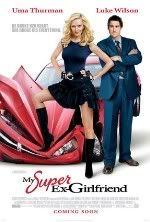
MY SUPER EX-GIRLFRIEND (2006)

Director: Ivan Reitman
Cast: Uma Thurman, Luke Wilson, Anna Faris, Rainn Wilson
Release: July 21, 2006
Synopsis: When a regular guy (Luke Wilson) dumps a superhero (Uma Thurman) because of her neediness, she uses her powers to make his life a living hell.

View Trailer:
* Large (QuickTime)

Prognosis: Why God…Why hast thou forsaken me? I’m not a huge fan of the American-ized The Office series on NBC.

It has nothing to do with my fondness for the UK version but, I feel, the series tries too hard to be amusing and it only feels like a forced display of how this little company of chimpanzees can fling their poo amusingly at the camera. That said, I am a fan of Rainn Wilson.

“Ooo”¦Check that out”¦Uptight librarian on the outside, ready to rumble on the inside.”

The trailer opens great, I’ll give it that much. Rainn does his dependable duties as the second banana by peeping Uma Thurman on a subway, makes his above comment and, oddly, we’re allowed to proceed to the next portion of this movie’s introduction without so much as a practiced voiceover from some kind of “wacky” perspective.

Luke, who really is an actor that seems to believe there are no small parts and is grossly underrated, does his best to impress Uma and, color me amused that she has the ability to be funny, shoots our man down ingloriously when he tries to nonchalantly pick her up for a date.

One of the problems I stumbled over, though, is I don’t know how we get from Uma being this cold, standoffish woman when he tries to ask her out to there being an extended scene here where the two of them are going at like crazed mules on Spanish Fly. She, of course, has super powers and rips off Luke’s clothes with savage aplomb.

There is some awkwardness in trying to get from her blowing him off, to the two of them doing it, to Luke navigating himself through a series of odd moments where Uma plays the part of the needy, psychotic girlfriend.

I just don’t get it. There’s no flow through any of these scenes. I’m all sorts of turned around and I don’t understand if it’s Luke that’s the rube, Uma the one who deserves to be dumped or if the two of them are somehow to blame for there being such an ill fit with regard to the relationship. I’m pretty sure it’s Uma who is to blame but, the trailer being so muddled, I can’t say for sure and that’s a problem when you’re trying to create some real regard for your characters that you hope people want to know more about and get to know. This trailer is having a personality disorder.

This when we get a useless tirade, a real time waster, from Rainn about how to break up with his lady friend which only drags my attention down with it. After the eventual “break up” happens it is now time for Uma to unleash her superpowers for us to witness.

I’m not sure if it’s the awkwardness of the trailer up to this point or if it’s an indication of something more serious to do with the movie but the displays of her abilities are kind of old and busted. We see her zipping around really fast, we see her using her super strength to do really bad things to Luke’s car, using her crazy vision to flash fry the fish in Luke’s tank (I think) and we get it all set to the modern sounds of Fine Young Cannibal’s “She Drives Me Crazy” (Awesome choice there, Trailer Maker! What was the runner-up “Girl You Know It’s True” by Milli Vanilli?).

Wanda Sykes is here to add to the racial tension of the movie as is her want in most everything she does, we get some really really bad effects of Uma tossing a shark into Luke’s bedroom as he’s trying to woo some young woman and, to end it, we have the two of them sharing a meal with Uma saying that she knew they’d be back to together and that’s why she didn’t kill him. Huh? I thought everyone determined she was some crazy broad who deserved to get punted yet Luke still goes back to her by the end?

This trailer is confusing, lame and does so many other things wrong that it should be sent back to the plant for some Quality Control testing. Where’s a thick slab of Kryptonite that could smother this thing when you need it”¦
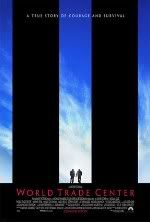
WORLD TRADE CENTER (2006)

Director: Oliver Stone
Cast: Nicolas Cage, Michael Peña, Maria Bello, Maggie Gyllenhaal
Release: August 11, 2006
Synopsis: Director Oliver Stone tells the true story of the heroic survival and rescue of two Port Authority policemen ““ John McLoughlin and Will Jimeno ““ who were trapped in the rubble of the World Trade Center on September 11, 2001, after they went in to help people escape. The film also follows their families as they try to find out what happened to them, as well as the rescuers who found them in the debris field and pulled them out. Their story shows how the best in people rose above the tragic events of that day.

View Trailer:
* Large (QuickTime)

Prognosis: Negative. I was sitting in grade school, math class, when one of the octogenarians who passed for a comprehensive disseminator of information to our nation’s youth busted into our discussion of fractions to say the Challenger had blown up.

Without the Internets in 1986 I had no way of really contextualizing what that moment meant until I went home and had it replayed for me later that day. Fast forward to 2001 and I was just getting into my lat routine in the very tiny country club workout room when the singular television in this 20′ x 20′ space filled with the announcement that some “˜tard had flown his tiny prop plane into the WTC. The news chopper CNN was using showed the image and, honestly, on television, it didn’t look bad. Economies of scale, I guess. It wasn’t until a few more minutes before the scope of what happened was realized: I watched the fast moving second plane slam into the side of the other WTC.

Is it too soon? Do we really need this movie? Can you really make an honest movie that doesn’t feel fabricated or false?

All these questions are valid but I think this is really a matter of whether this movie can be made well. If you can be respectful of the material, more power to Oliver and Co. The trailer gets some of the things right while, I think, in some areas plays too heavy on the schmaltz.

The opening is damn near requisite: you’ve got to have everyone waking up to a Folgers morning, everything crisp and in place. You’ve got the WTC delicately shown in the way way back in a shot of the New York skyline, you’ve got Nic Cage kissing his wife (Schmaltzy Moment # 1) while it’s still dark out, in their bed. I don’t about the rest of you married dudes but I usually don’t get a smiling wife first thing in the morning when I leave for work; I usually have to slide out of my bed like a ninja so I don’t wake her and am usually pushed away for a kiss in the morning because of my dragon breath.

I like that the voiceover for roll call at the NYPD is Nic doing his best to affect an accent that seems trapped between Brooklyn and The Jerky Boys. Kudos to the use of a fast moving shadow and the sound of a jet plane to establish the effect of how many would’ve come by the experience of what happened this day; the ZOOLANDER billboard in the background of one of the shots is oddly memorable.

We’ve already got the drama cranked up to a Lifetime Television level when Nic really pushes the moment as he and another popo are on their way to the WTC, Nic saying, “We’re prepared for everything (dramatic pause) Not this (another dramatic pause) not for something this size”¦There’s no plan”¦”

The violins are threatening to turn this trailer into something else besides a promotion for a movie and as Nic, at ground zero, asks for volunteers to go evacuate people the moment seems stuck as no one wants to volunteer and you’ve got a real cheesy thing happening when one guy does it and declares that he’ll do so and then another. Seems fabricated, not really in the realm of verisimilitude.

Cue Nic and a slo-mo moment as he yells “Run!” in that sort of John Rambo lip thing where it tries to be full of impact but looks like someone’s trying hard to evoke emotion out of me.

You’ve got Maria Bello sniffing the sheets of where her husband once slept (SM #2), you’ve got slo-mo of a mother hugging her daughter (SM #3) , you’ve got one of the trapped popo’s involved in a flashback with Maggie Gyllenhall as he’s spooning her and then as he’s writing I [heart] U on a piece of scrap paper (SM #4) and, again, what is being sold? Is it the idea of a dramatic piece or is it a truthful rendering of the events that transpired? I’m not quite sure but the marketing is all over the place on this and the tag line that “The world saw evil that day”¦Two men saw something else” is enough to make me scratch my head like an ape, wondering what in the hell they’re talking about.

If I was the teacher I would give it back and ask Oliver to work on it some more and give it back to me by next Monday because, as it stands, this is just not a very compelling trailer.
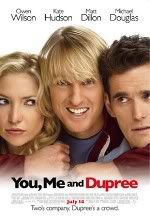
YOU, ME AND DUPREE(2006)

Director: Anthony Russo, Joe Russo
Cast: Owen Wilson, Matt Dillon, Kate Hudson, Michael Douglas
Release: July 14, 2006
Synopsis: The story of a newlywed couple (Hudson, Dillon) whose relationship problems boil over when the groom’s unemployed best man, Dupree (Wilson), moves in with them for a brief period and seems to have no intention of leaving.

View Trailer:
* Large (QuickTime)

Prognosis: Positive. So, I can relate to this.

Having a tenuous grasp on a job is just commonplace here where I live in the Southwest. Not only do I have to contend that since I live in a state that says either myself or my employer can terminate employment at any time for any reason (“Did I wear too much Aqua Velva today?” “Is the color of my Swatch watch going to be the beginning of the end for me?) I had a boss who once called me at home after the birth of my second child not only asking where I was but, after calling in to reiterate what was common knowledge, was given a lecture that even though my newborn was fragile his business interests were fragile and if I wanted a job I would recognize that. I didn’t stay there much longer. It is this reason that I can see why Owen “The Buttercup Stallion” Wilson would find himself in such a dire situation after being canned to attend Matt Dillion’s wedding. I don’t think I’d fall that fast, that quick, but this looks like a fun slip n’ slide ride at the theater.

The trailer, initially, goes through the motions of setting up the premise of the flick. Voiceover Guy does his due diligence in really hamming it up when we see the lush Hawaiian setting that is Matt Dillion and Kate “Overreact To Act” Hudson’s nuptials. You’ve got the word “perfect” tossed around here, there and everywhere before you almost feel you want to shout “I got it already!” before it moves on to establishing how Owen fits into this “perfect” situation.

Now, I wasn’t that plussed with STARSKY AND HUTCH and was marginally satisfied with his performance in THE WEDDING CRASHERS (It was really Vince’s movie to steal) so I am hopeful when Owen recounts what has happened to him since being canned for going to his buddy’s wedding. His protest to Dillion when asked if he’s living in his car is comedically rendered when he says he has a 10 speed and then gets hit by a car.

I think it’s important to state, however, that after we’re rushed to the moment when Hudson is told that Wilson is going to move into their house for a few nights, knowing full well that this wouldn’t be a movie if it were just for a few nights, it is Wilson’s holding of a mounted moose head as he thanks her which I think is a nice, humorous touch.

It is Wilson’s movie, though, as Dillion seems to just be the straight man in this vehicle and the gags keep coming when Owen barges into the room where a love is about to be made, sending Kate barreling onto the floor in surprise as Owen chants that the toilet downstairs is “on the fritz” and then follows that up with opening the bathroom door whilst on the bowl saying, “We’re going to need some matches.”

And, the capper, involves Wilson placing a tie on the doorknob of Dillion’s house as Kate, incredulous, ignores it and lets herself in the front door only to scream, leave, and then announce, “That butter dish was a wedding gift, Carl.”

It’s not as wild as Dillion’s THERE’S SOMETHING ABOUT MARY and it feels little more tame than MEET THE PARENTS but I think this movie will do well with the middle-of-the-road audience and, I would assert, means some nice profits to come.
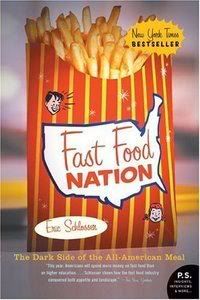
FAST FOOD NATION (2006)

Director: Richard Linklater
Cast: Patricia Arquette, Bobby Cannavale, Luis Guzman, Ethan Hawke, Ashley Johnson, Greg Kinnear, Avril Lavigne, Esai Morales, Lou Taylor Pucci, Ana Claudia Talancon, Wilmer Valderrama
Release: Fall 2006
Synopsis: A dramatic feature based on material from the incendiary novel “Fast Food Nation,” a no-holds-barred exploration of the fast food industry that ultimately revealed the dark side of the “All American Meal.”

View Trailer:

* Large (Flash)

Prognosis: Positive. Fecal coloforms?

I read this book and have to tell those who have not that not only does this look into fast food consumer culture provoke an especially appropriate debate but it is a whole lot of funny to know that vegans who would only eat the fries were really eating slices of potato fried in beef tallow.

One of the other things about this book is that is tries to be as nonfiction as possible. Whereas SUPER SIZE ME really mixed in fact with slanted science this book tries to be even handed. However, why would Linklater turn this decent examination into fast food into a drama? It confounds as it confuses when you try and reason the thought process on this one. Even the trailer sheds the serious tone of the book somewhat and it nearly feels like a sanitized version of what Schlosser tried to bring home.

“Millions of families”¦Millions of immigrants.”

The initial shots of this trailer play out in a nearly disconnected, rushed showing of the book’s main points. We, as Americans, love to consume our burgers and fries while we are blissfully ignorant of our local yokel immigrant population quietly braving the sinister conditions of meat processing plants so you can have it your way.

Does the trailer get this message across? No, you’ve got some Soccer Mom serving slop to their kiddies while some immigrant is flashed some money to, no doubt, be yet another casualty of the underpaid underclass who take jobs in processing plants because no American in their right red, white and blue hearts would have anything to do with these places. Yet, here we are, the trailer just glossing over these things in lieu for some teenagers dropping a frozen patty on the ground only to put it back on the grill. Thanks for visual. If this was 1984 and you were the first person to make light of this it would be amusing but like all sub-par comedies before this flick we’ve all been desensitized, I posit, to the notion that when crap hits the floor there is a full-on 10 Second Rule in full effect. Nice try, though.

And then, of course, we have to get the greedy bastards in corporate, played deftly by a pack of aging white men that is always a spot-on stereotype, dumbasses, commenting on how they’re really sticking it to their consumers by knowing how much allowable fecal coliform is in their product; I had a biology teacher, come to think of it, who discussed this very issue, a one Randy Shietzelt, a genuinely smart cat who I still admire, discuss how much you can have in a given body of water before it becomes dangerous to even wade through. It’s nice to know this trailer tosses out common knowledge like a discussion of coliform, I’m sure there are heads nodding all over this great land when they hear this portion of the trailer.

If it sounds like I’m being tough on this piece of advertising, I’m glad. This book is a serious indictment of an entire industry, which goes beyond the bush league histrionics of Morgan Spurlock and his documentary, but I am genuinely pleased by how this thing ends. We’ve got Greg Kinnear, playing one of the evil corporate suits who will no doubt be playing the part of the rube who will be the filter through which some of the book material be flowing, standing in a lab and tasting a small stick. The stick has a liquid on it which mimics the taste of real food. One of the biggest of these flavor savor companies, International Flavours and Fragrances, right off the New Jersey Turnpike, adjusts the taste on a hellacious number of things you stick in your mouth and consume. I really like how Kinnear is amazed, as you should be, that this mere liquid disguises itself into anything you desire.

I’m not convinced that this movie has done a service to the book by making it into a pseudo drama but I am hoping, at the very least, this once again raises awareness of how your corporate overlords are taking care of you as a consumer of their products. This trailer needs more focus on the reality and less on the dramatics.


Nocturnal Admissions: Book Review, Pretend We’re Dead

Filed under: Nocturnal Admissions — UncaScroogeMcD @ 4:30 am


nocturnalheader5.gif


In case you haven’t noticed, film book publishing is at its peak right now. There are more new books on cinematic subjects now then there were at it’s peak, which was from about 1968 to 1973 when all the (still) great film books were published. It all went to shit shortly thereafter, and throughout the 1980s, film topics couldn’t find a publisher. Fortunately, things have changed, and there are new books by the old guys, such as Robin Wood and David Bordwell, and great new books on diverse topics from writers as diverse as Linda Ruth Williams and Chris Fujiwara. 

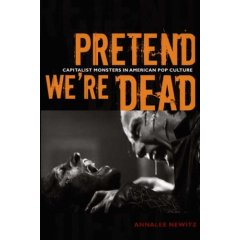
Pretend coverAnd if there is one vein of publishing that has proved to be the most fruitful, it is in genre and especially horror. FAB Press is doing a fantastic job, as are Reynolds and Hearn and numerous other independent presses. But mostly it’s been academic and university presses that have exploded in a wealth of books on horror films and other genres.
Into this mix comes Annalee Newitz’s Pretend We’re Dead: Capitalist Monsters in American Pop Culture (Duke University Press, 224 pages, $21.95, ISBN 0 8223 3745 2). It’s a terrific survey of “monster” movies of the last 20 or so years and pop culture well before that, and focusing on cannibals, robots, and serial killers.

Now, Newitz isn’t the typical college prof who has been mining the same narrow topic for a lifetime. She has written for The Believer and Salon.com, and has published two previous books on quasi sociological or American Studies topics. And she brings zest and wide ranging cultural references to her topic, plus a knack for presenting complex ideas out of Marx, Benjamin, Baudrillard, and Horkheimer, explaining them clearly and using them to illustrate how cinema has become a canvas upon which the culture has been grappling in fantasy with overwork, bad bosses, and meager returns. What she’s talking about is the horrific complement to what I called “Heroic Alienation,” films such as Clockwatchers, American Beauty, Office Space, and Fight Club, that take on the boredom and injustice of the workplace.


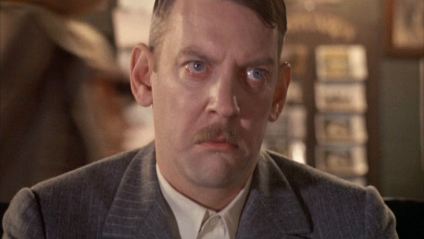
Donald Sutherland, Day of the Locust


For me, the most interesting part of the book is chapter 5, which, after chapters on serial killers, mad scientists, the undead, and robots in that order, focuses on “media” monsters. This is a wholly original contribution to film studies, in which Newitz collates together disparate tangents of the culture to show us in unified form what has been there the whole time. The other chapters are fine, and Newitz has new and interesting things to say about robot love and serial killers in films, but it is essentially old if still interesting ground, covered by many other books, including Philip L. Simpson’s Psycho Paths, Joan Hawkins’s Cutting Edge, Mikita Brottman’s Offensive Films, and Adam Lowenstein’s Shocking Representations. The chapter starts off with a placement of the audience in relation to the screen by some aspects of George Lucas’s THX Sound adverts in theaters. The catch phrase “The Audience is Listening” strikes Newitz as rather ominous, although I have to say that her argument didn’t really convince me, as the phrase can be interpreted in multiple ways with the context she gives in her book. She then goes on to provide an operating definition of what type of film she is trying to define here, i.e., “monsters of the culture industry,” narratives about people who use and consume or are used by mass media. These films have no consistent genre attributes as do mad scientist films (or women in prison films, for that matter), but there are recurrent themes or situations, such as how stars and directors are portrayed and how consumers are often reduced to muttering zombies by overuse.


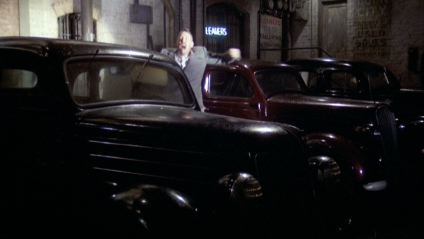
Day of the Locust stomp


This chapter is then sub-divided into four mini sections, each addressing different facts of “media horror” movies. Under consideration first are films set in Hollywood (that site of “crazed but meaningless productivity”) or in the movie business, including Day of the Locust (in which Homer Simpson, played by Donald Sutherland, is torn to pieces by a frenzied crowd outside the premiere of The Buccaneer), The Bad and the Beautiful, All About Eve, Sunset Boulevard (which suddenly makes sense if one views it as a gothic or a horror story), and Whatever Happened to Baby Jane, tales of people driven made by lust for fame or other inconveniences of show biz. Next she takes on films that play with ideas of the effects of pervasive media culture on citizens, including Logan’s Run, Videodrome, Scream, and Nurse Betty. Fantasies about people who drop into media productions follows: Pleasantville, The Truman Show, Tron, and The Matrix (films where the characters here are “eaten by a giant narrative”). Finally films such as The Last Starfighter, Galaxy Quest, and The Ring play with notions of belief in fantasy constructions that turn out to be real.

This is all fascinating stuff, a new way of seeing films about films and other media, as horror films. But because it is groundbreaking material, some of the connective tissue is a little tenuous. I found myself not entirely clear on just what the genre she is talking about, and the genres within it, really had to do with horror. At the same time, I could also come up with additional titles that seemed to fit into her descriptions and thesis that she doesn’t mention – not that a book has to mention everything, but these films might have buttressed her definition. For example, there’s Hollywood Boulevard, which is an actual horror film, and The Big Knife, another Hollywood tale about horrific people. In terms of the horror of media, I can also think of The China Syndrome, Rollerball, The Running Man, Freejack, and Halloween 3: Season of the Witch. In the media business realm, demonlover comes to mind, and in alternate realities and games, The Thirteenth Floor, Dark City, eXistenZe, Shocker, and Wes Craven’s New Nightmare seem pertinent.

And there is the occasional error. She has Margo Channing’s boyfriend in All About Eve, played by Gary Merrill, as a writer, rather than a director (Hugh Marlowe is the writer), and in general tends to credit the director with everything good in a movie. But Nurse Betty is anomalous in Neil LaBute’s work for being written by others, in this case, John C. Richards and James Flamberg, and The Truman Show was written by the interesting Andrew Niccol who went on to write and direct Gattaca.


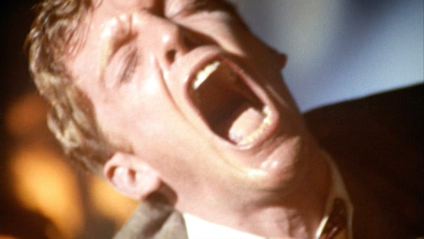
Bill Atherton screaming


But as I say it’s new territory. To make up for lapses and the odd mistake Newitz more than makes up in insight and wit. On Baby Jane: “When nobody wants to look at an actress anymore, she deliberately makes herself more or less deliberately hideous.” And, “The idea that audiences take pleasure in the degradation of their screen idols is one of the most disquieting parts of the horror narrative known as mass culture.”


Game On! 7-7-2006

Filed under: Game On! — admin @ 4:26 am

gameon.jpg

Hello again, friends, and welcome to another fun filled week here at Game On! We’ve got reviews of classic shooters, an anime-inspired game, as well as a look at the demo for an upcoimg title, and a quick word on a gaming tournament too. Let’s get started.

GRAD-ITUDE

gameon_7-7-06_gradiuspsp.jpgOne of my favorite genres for games has always been the twitch-shooter. fast, frantic gameplay, quick deaths, skill and strategy, and trail and error have always been the earmarks of a great twitch-shooter. None have done this better (argueably) than the GRADIUS series, which is now collected on the PSP’s aptly named GRADIUS COLLECTION. Here we’ll see the first four games from the series, as well as the unreleased (on US shores, anyway) GRADIUS GAIDEN collected onto one disc for the first time ever.


These games are presented in thier full arcade forms, so everything is intact, and the aspect ratio of the screen size can be adjusted to your liking, from filling the PSP’s wide screen, to normal size, to stretched out. Everything from the powerups to different shielding possibilities are included from the originals, and thakfully, as “save anytime’ feature has been added too, to alieviate strain on the eyes and thumbs when blasting in short burts of time (especially helpful for a handheld collection).

gameon_7-7-06_gradiuspsp.jpg

The collection also includes music and video from the series history, as well as some unlockable cinematics and tunes as you progress through the various stages of the games. Of all the titles, the first and GAIDEN seem to be the best and most well-rounded shooter experiences here, but each game is a testament to the genre, and this collection is a great one for fans and newcomers alike.While it would have been nice if they inclused Konami’s other shooter LIFEFORCE (which was called SALAMANDER in Japan, as evidenced in the opening of GRADIUS III) this is still a robust and well-done compilation. Now, let’s get a CONTRA one going and we’ll be all set for shooters.

One Gamer’s Opinion:

gameon1.jpg


NARUTO, NOISY NINJA

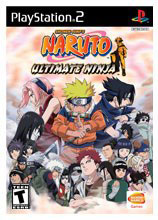
gameon_7-7-06_naruto.jpgLicensed games are usually a mixed bag when it comes tothose that are based on anime properties. Usually quality control is sacrificed for fan service, but on occasion, you’ll find a quality title out there for folks who may not be too familiar with the series to still enjoy with the fans. NARUTO: ULTIMATE NINJA aims to be one such of these titles, and succeeds in many ways, though it’s shortcomings are a bit obvious as well.



As it usually happens with these titles, NARUTO is a fighting game. Thankfully, it’s not a boring one, with the action occuring on several different planes, as well as the ability of the characters to teleport around the arenas, and even switch locales mid-fight. There’s also a fairly intuitive combo system in place here, with attacks knocking opponents across screen in high velocity fight sequences.

The graphics fair well when compared to the look of the show, and many of the main combatants from the series make an appearance, with more unlockable. There’s a mild story mode here called “Scenario” which allows the player to follow a series of fights as one specific character. There’s not much story for the story mode, but none of the “story” elements are repeated for each character, so it’s a nice diversion from just the normal arcade mode (which is also included). There’s also a mission mode, in which fights have to be completed with certain perameters in order to move to the next.

gameon_7-7-06_naruto2.jpg

My main problem with this title, however, is that there realy is only ONE attack button. Combos, while there are many, usually just occur with some variation of “attack, attack, attack, left plus attack” or “attack, attack, up and attack” and so on. I would have liked a little bit more variety there, but as it stands, it’s a little more than a single button masher, which i hate.The only other time you hit a button is the triangle to ready your special attack or “secret technique”. As you fight, you build up your special meter, up to three levels. You can cycle through these levels by pressing the triangle button (red for level one, purple for level two, and green for level three) and if you connect while glowing one of these three colors, you’ll begin your secret technique move. Here you can actually try some other buttons on the controller, as two meters appear on the sides of the screen. Press the apporpriate buttons as they reach the bottom of the meter, and your attack will be powerful, miss any one of them, and the attack is shortened. You opponent also has a meter, and if they time the button presses correctly, they can lessen the damage done to them.

While these elements thankfully break up the single button mash-fests, it still doesn’t help the times in between, when you’re pounding wildly on your foe to build up chakra to use your techniques. At least there are power-ups spread through the levels, gained by support characters (or beaten out of your oppoenents support characters).

All in all, however, fans of the series will certainly buy this in droves, and fighting fans who want something a little different than STREET FIGHTER will have something to enjoy. The combos, when done at all, are done well, and the attacks are cool, if with little variation in the buttons you press. One other thing i wouldn’t have minded if they included it would have been the original japanese voices for the characters, as the American voice dub for the character of Naruto is downright annoying. Believe it.

One Gamer’s Opinion:

gameon3.jpg

DEMO REVIEW: PREY

This past week online and on Xbox Live Marketplace, the demo for 3D Realms’ and 2k Games’ upcoming FPS PREY was made availble for free download. I took advantage of it and played around iwth it a little bit, which seems to cover a good chunk of the opening of the game.

You play the role of Tommy, a cherokee mechanic who longs to pick up his best girl and get off the rez (that’s reservation to you palefaces) for a life more exciting. Just as he’s quelled the braying of some drunks at the local bar, wouldn’t you know it but ALIENS show up and capture everyone around. Yeah, it’s about to get seriously strange.

What sets this FPS apart from the rest of the pack is the downright wierdness it throws your way. The ship you wind up on has a few features not standard to our ways of living. What appear to be pipes extending over random areas of the floor from one side appear to be just that, but on the otehr act as portals to other sections of the ship. Portals also show up randomly and spill enemies out at you. Then, there’s the walkways. When turned on, you can actually walk UP the walls and on the ceilings, offering a new vantage point to the combat, and another wierd way of getting around this already crazy ship.

gameon_7-7-06_preydemo.jpg

The weapons you find are fairly standard for an FPS (so far anyway) but when you shoot them at certain marks ofn the ship, it flips the orientation of the room…or where you can walk. This game has some serious fun with flipping the characters around, and will probably make a few players seasick from all the disorienting rooms.Add to that the fact that Tommy can leave his body and have his ethereal form move past obstacles and open doorways that he many not be3 able to get through from the side he’s on, as well as attcking with amystical bow and arrow, and you’re got one weird, spiritual shooter. Tommy is aided and abetted by his spirit animal Tallon (a haawk, of course) who flies around the levels and points out the parts where he can leave his body to advance.

While the demo offered up a good few missions, an d gave the main exposition of the story, it was still too little to form a full opinion on. What i played i liked, however, and the story driven moments in this FPS are a nice change, and the quirks it has offer a good deal of diversity for the FPS fan who may be tired on things on your normal solid ground. I didn’t have a chance to explore the multiplayer side of things, but from what i hear it’s fun for fans of the UNREAL series. Look for my full review of the game after it hits stores helves in a few weeks.

One Gamer’s Opinion:

gameon2.jpg

GAMING NEWS

Here’s a bit that a loyal reader named Vincent sent me a few weeks ago and i initially forgot to post about it when he sent it, but thankfully, there’s still time left on it. It’s about a Half Life 2 tournament from Verizon and Valve where players have a chance to compete for $100,000 cash. It’s called the FiOS Grand Tournament. Players that register will get a free copy of Half Life 2: Deathmatch to play during the tournament (which runs from June 15 to July 29) as well as a copy of Half Life 2: Lost Coast to try out while competing in the tournament.More info on the FiOS Grand Tournament can be found below and by visiting http://www.fiosgrand.com/

Well, that’s it once again for us this week. See you all next time with more reviews and news…and hopefully, a smile or two. Or something like that.

Scrubs Blog: Week 30 ““ The Todd’s Lunch

Filed under: Production Blogs,Quickcast Commentaries,Quickcasts,Scrubs Blog — UncaScroogeMcD @ 3:52 am


scrubsheader.jpg
       

It may be summer hiatus, but we roll out the next in a series of exclusive episode commentaries to hold you over the long wait for Season 6″¦

BLOG-COMMENTARY #6: Episode 5×20 – “My Lunch” –
The Todd himself, Rob Maschio, commentates on an episode marking some major revelations in his sex-crazed character. All you have to do is download the mp3 file below, cue up the episode on your TIVO, VHS, DVD, or computer, then hit play on the commentary (or you can download the free Sharecrow DVD player, which allows you to sync up commentaries on your computer). Hope you dig it”¦

scrubs-20060707-01.jpg

DOWNLOAD:
mp3 Format (21.2 MBs)


Weekend Shopping Guide 7/7/06: Dark Knight Dini

Filed under: Shopping Guides — UncaScroogeMcD @ 3:37 am

weekendshopping.jpg

This week’s a bit light, considering the holiday and a relative lack of DVD releases this week. Still, there’s a few things worth dropping a dime on, so let’s get movin’…

The first issue of Paul Dini’s run on the (thankfully) revamped Detective Comics (DC, $2.95) hit shelves this week, and you gotta run to your local comic shop and snatch it up, then hunt down Paul at Comic-Con in just a little over a week and get him to sign it. Or just stare at him from across a room, wondering why so few have such a brilliant handle on the Dark Knight like Paul does. You may also recall that Mr. Dini and his sock monkey son Rashy do their own talk show here at Quick Stop, “Monkey Talk”. You should really check that out, too. Hint. Hint.
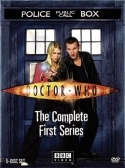
When most creative people view the re-launch of a venerable franchise as a 1,2,3 process of simply wiping out what came before and starting from scratch, it takes a delicate hand – and an often harrowing leap of faith – to decide to revitalize a franchise while still keeping its previous continuity intact. It’s rare that such an endeavor proves successful, but just such a creative miracle was achieved by Russell T. Davies, executive producer the rejuvenated Doctor Who (BBC, Not Rated, DVD-$99.98 SRP). Re-launched last year on the BBC to critical praise and fan approval, the Doctor’s adventures pulled in huge audiences of both old and new fans of all ages, proving that you don’t always have to throw the proverbial baby out with the bathwater. Starring Christopher Eccleston as the time traveling Doctor (the ninth in a line that’s included the legendary Tom Baker, Jon Pertwee, Patrick Troughton, Sylvester McCoy, Colin Baker, Peter Davison, William Hartnell, and Paul McGann) and Billie Piper as faithful and feisty companion Rose Tyler, it’s amazing how well it all pulled together. The 5-disc complete first season set features all 13 episodes, plus audio commentaries and behind-the-scenes featurettes.
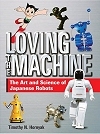
With a title like Loving the Machine: The Art and Science of Japanese Robots (Kodansha America, $26.95 SRP), how could I not crack this book open as soon as I laid eyes on it? Thankfully, its contents live up to the title, featuring everything from Astroboy to assembly line mechanical arms dueling with lightsabers at a trade show.

Tom DeFalco returns with another in his fascinating Comics Creators On… series, this time focusing on the writers and artists behind the long history of those mighty mutants, the X-Men (Titan Books, $17.95 SRP). Interviewees include Stan Lee, John Byrne, Chris Claremont, Alan Davis, Grant Morrison, Louise Simonson, Dave Cockrum, and more.

Hans Zimmer’s scores too often veer into sonic wallpaper for me, but I was duly impressed by his score for Pirates of the Caribbean: Dead Man’s Chest (Walt Disney Records, $18.98 SRP), a rousing, swashbuckling affair that captivated me from start to finish. Stunning, I know.
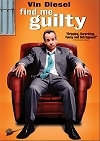
It took a film like Find Me Guilty (Fox, Rated R, DVD-$27.98 SRP) to remember that, when he tries and he has a solid director and script behind him, Vin Diesel can actually act. Here he plays Jackie Dee DiNorscio, a real life gangster who refused to rat out the Luccehese crime family and instead opted to defend himself – in what turned out to be one of the most surreal trials of al time. Wisecracking and affable, DiNorscio turned the court upside down, and Diesel delivers a memorable performance bringing it to cinematic life. The DVD features a conversation with director Sidney Lumet, TV spots, and the theatrical trailer.

Jack Kirby’s epic Fourth World gets the spotlight in the latest tabloid-sized issue (#46) of the Jack Kirby Collector (Twomorrows, $9.95 SRP), packed with original pencil sketches, rare pages, and so much more cool stuff that upholds Twomorrows rep as the best comics history torchbearer publishing today.
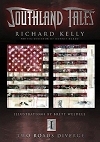
Also worth checking out is the first volume in the 3-volume arc of graphic novels acting as a prequel to director Richard Kelly’s Southland Tales, Two Roads Diverge (Graphitti Designs, $12.95 SRP). The film itself will comprise the final three volumes of the saga, so pick up a copy and get started on a most unique journey.

Farrah Fawcett had departed (save for a guest appearance), and you could tell that it was the beginning of the end for those femmes of the mission impossible set, Charlie’s Angels (Sony, Not Rated, DVD-$49.95 SRP). The 6-disc third season set contains all 24 episodes – one of which features a guest turn from Scatman Crothers. Scatman Crothers plusses anything he graces.
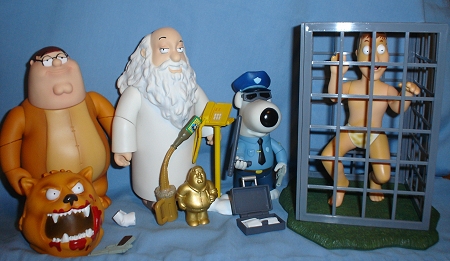
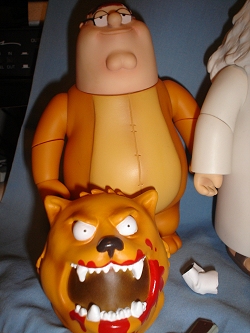
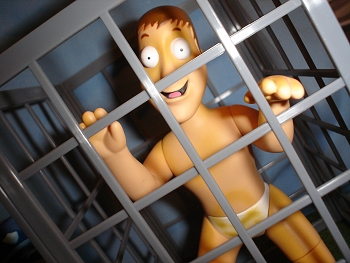
And finally, how about a look at a few characters from the latest series of Family Guy figures (Mezco, $12.00 SRP each), featuring Peter (as Gary the No Trash Cougar), The Sales Man, Tricia Takanawa, Greased-Up Deaf Guy, God, and McGriffen?

weekendpicks20060707-10.jpgweekendpicks20060707-11.jpg

weekendpicks20060707-12.jpg

weekendpicks20060707-13.jpg

So there you have it… my humble suggestions for what to watch, listen to, play with, or waste money on this coming weekend. See ya next week…

Comics in Context #136: Before There Were Cars

Filed under: Comics in Context — UncaScroogeMcD @ 1:52 am


comicsincontext.jpg

cic-20060707-01.jpgOne of the reasons I started doing “Comics in Context” was to criticize critics.  As the mainstream media grew more interested in comics and cartoon art in recent years, various film critics and other writers would make assertions about the subject that were condescending, prejudiced, or outright wrong.  
Matters have improved over the last three years, but the release of Pixar’s new animated feature Cars has drawn some very strange reactions indeed from certain major film critics, as I shall discuss next week.

One mistake by a major reviewer, however, gives me the opportunity to delve into a subject that has long been waiting to take its turn in this column. 

“The animation of the inanimate has been a staple from the dancing brooms of Fantasia right up to the talking clock in Beauty and the Beast and the remote-control car in Toy Story,” wrote Anthony Lane in his New Yorker review of Cars (June 19, 2006).  The brooms don’t dance, but lumber back and forth to music, but Lane has a bigger mistake to make.  He continues, “In each case, however, these were bit parts, put there to fidget and fuss while the humans, or humanoids, or the mice got on with their narrative tasks.”  And that’s not true.

In interviews, Cars director John Lasseter has repeatedly mentioned that he got the idea to put the cars’ eyes in their windshields from the 1952 Disney animated short Susie the Little Blue Coupe, whose title character is a living car. 

In fact, Disney has a tradition of doing animated cartoons that present an entire culture composed of animals or of objects that in real life are inanimate.   Except for The Incredibles, the Pixar features fall into this tradition, depicting communities of toys (Toy Story and Toy Story 2), insects (A Bug’s Life), monsters (Monsters, Inc.), fish (Finding Nemo), and now automobiles (Cars) that are analogues to human society.  (The Incredibles portrays a community of superhumans existing within a larger “normal” human society. See “Comics in Context” #62.)  Whereas the earlier Pixar features acknowledged that humans also exist in their worlds, Lasseter takes the concept further in Cars by depicting an alternate Earth dominated by automobile society, in which humans – or, for that matter, animals – do not exist.

This animation tradition is a subject that I originally intended to address in my reviews of last year’s retrospective by the Film Society of Lincoln Center, “I Love to Singa: Cartoon Musicals,” curated by animation historian Greg Ford.  Previously I wrote about the programs with cartoons directed by Tex Avery and Chuck Jones (“Comics in Context” #100, 101 and 102), cartoons from Max Fleischer Studios (“Comics in Context” #116 and 117), and classic Disney “Mickey Mouse” cartoons (“Comics in Context” #109).  I had to postpone my review of another Disney program, “‘Sillies’ and Other Symphonies,” but Cars provides me with an appropriate occasion.  Better late than never.

The main subject of this program was the “Silly Symphonies,”  a series of animated shorts that Disney produced alongside its “Mickey Mouse” shorts in the 1930s.  As their name suggests, the “Silly Symphonies” were often designed around musical themes. Other studios blatantly mimicked the “Silly Symphonies” name for their own cartoons:  hence, Warner Brothers’ “Looney Tunes” and “Merry Melodies,” which would evolve quite far away from the “Silly Symphonies” format.  The title of Bob Clampett’s 1943 Fantasia parody, A Corny Concerto (see “Comics in Context” #101), would be yet another variation on the “Silly Symphonies” name.

Disney used the “Silly Symphonies” to venture into subject matter that was very different from the “Mickey Mouse” shorts (and its spinoff “Donald Duck,” “Goofy” and “Pluto” cartoon series), such as fairy tales:  Disney’s Three Little Pigs was a “Silly Symphony,” as one might guess from the famous song it introduced, “Who’s Afraid of the Big Bad Wolf?” Disney also used the “Silly Symphony” series to experiment with new animation methods.  Many “Silly Symphonies,” including some that I mention in this column, can be seen on Walt Disney Treasures: Silly Symphonies, a DVD set released back in 2001. 

In his program notes for the “Sillies” program, Ford noted, in rather academic prose, that “From the outset, the “Symphonies” were apt to pictorialize self-enclosed communities of cartoon beings tied to fixed visual themes,” such as insects or cookies or even musical instruments.

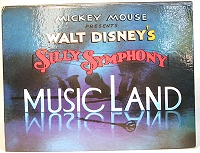
cic-20060707-02.jpgThe first “Silly Symphony” in the Lincoln Center program, Musicland (1935), provides a perfect parallel to Cars.  Musicland depicts a world, or at least a pair of islands, where humans and animals do not exist:  the Island of Symphony and the Isle of Jazz, separated by the Sea of Discord. Every character in Musicland is an anthropomorphic musical instrument.  The Queen of Symphony and her daughter are violins.  The King of the Isle of Jazz is a saxophone, caricatured to resemble Paul Whiteman, a famous orchestra leader of the time who conducted jazz; the King’s son is also a sax.  Musicland necessarily goes further than Cars, not only giving its characters eyes and mouths, but also hands and feet (so they can move).  On the other hand, Musicland has no dialogue:  its characters speak in musical sounds.  The princess sounds like a violin, and she even moves to classical music.
Furthermore, virtually everything else on the two islands is a musical instrument, or designed to evoke music.   A tree resembles a bass violin.  A park bench is shaped like notes of music.  When the prince writes a letter, he inscribes musical notes, not letters, on a sheet of paper.

Since there is no dialogue, Musicland is something like a silent movie with a musical score: the storytelling is done through entirely visual means.  Anyway, the story follows a familiar pattern: it’s basically Romeo and Juliet, albeit with a happy ending.  (It also foreshadows, and perhaps influenced, the romantic subplot of the Fleischers’ 1939 animated feature Gulliver’s Travels.)  Despite the rivalry between their nations, the Princess of Symphony and the Prince of Jazz fall in love with each other.
The queen discovers their tryst, and sends guards (more violins) wielding guns (their bows), who imprison the Prince (within a giant metronome). 

Soon war breaks out between the islands.  The King of Jazz conducts long horns, resembling guns, which fire bursts of music.  The Queen of Symphony conducts her own set of cannons:  enormous organ pipes, which play (what else?) Richard Wagner’s “Ride of the Valkyries.”  And here we once again have the image of the conductor, which turns up in so many musical cartoons.

Notice that there is no King of Symphony, nor a Queen of Jazz.  Is Musicland suggesting that classical music, and high culture in general, is a feminine domain, personified by the grim, humorless Queen,  while jazz is somehow “masculine,” as personified by the jolly, extroverted King?  Does the war between the King and Queen symbolize tension between one’s parents?  Or, metaphorically, are the King and Queen two sides of the same personality, which must be reunited?

Carrying a white flag of truce, the Princess rows across the Sea of discord in her boat, which is really a bass violin case.  The “boat” is hit and sinks as the Prince, escaped from prison, rushes to her rescue.  Seeing their children in danger, the King and Queen halt the battle.  (In Romeo and Juliet, sorrow over the deaths of the rival families’ favorite children puts an end to their feud.) The Prince rescues the Princess, and together they sink (in symbolic death), but are immediately rescued (and symbolically resurrected, unlike Romeo and Juliet), as a couple.  The King rises above his anger and extends his hand to the Queen, who reciprocates, and another couple is united:   Mom and Dad are no longer at odds.

The cartoon thus ends with a double wedding, presided over by a bass violin as preacher.  Now that she’s in love, one of the Queen’s violin strings breaks, presumably as a sign that she’s no longer so tightly strung.  The islands are now physically united by the “Bridge of Harmony,” and musically united by the playing of another Wagner theme, the Wedding March from “Lohengrin,” in a jazz arrangement.

Like Cars, Musicland has a love story at its center, although Musicland‘s is presented more like a parody of operetta-style romance, rather than evoking strong emotions in the audience.

The main parallel between Cars and Musicland is that each impresses the viewer with how much thought and imagination went into designing its alternate universe. Perhaps Musicland is even more remarkable, in that Walt Disney and company obviously put so much effort into the elaborate visual design for what was only an animated short subject.

Another important parallel with Cars is that Musicland shows the old (classical music) and the new (jazz) learning to accept each other and forge a union, just like Pixar’s Woody and Buzz becoming best friends.

Back in 1935, jazz represented the cutting edge of popular music:  an African-American form of music that was being popularized among the white majority by musicians such as the aptly named Whiteman.  But with time, the best of popular culture, whether in music or in animation, becomes part of the accepted cultural canon.  Now “Jazz at Lincoln Center” has become part of New York’s Lincoln Center for the Performing Arts, alongside the Film Society and such “high art” institutions as the Metropolitan Opera, the New York Philharmonic, and The New York City Ballet. 

Hence, today Musicland can’t have the same impact on audiences that it had back in 1935.  If Musicland were to be remade today (And why not?  Musical instruments would lend themselves to computer animation.), what two forms of music would be used instead?  Classical and rock? Classical and hiphop?  And what would a hiphop version of Wagner’s Wedding March sound like?

Then I realized that the pairing might well end up being rock and hiphop, which represent a generational shift in musical tastes from the Baby Boomers to today’s youth.  The use of classical music in Musicland (and, for that matter, Fantasia), suggests the more prominent role that it played in American culture back then than it does now.  Back then Leopold Stokowski and opera singers such as Lauritz Melchior and Rise Stevens appeared in Hollywood movies;  Arturo Toscanini conducted the NBC Symphony from the same Rockefeller Center studio now used by Saturday Night Live.  It’s hard to imagine comparable classical artists playing similar roles in movies and commercial network broadcasts today.

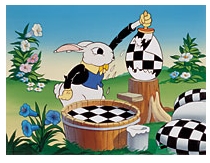
cic-20060707-03.jpgThe next cartoon on the bill was Funny Little Bunnies (1934), which isn’t a minor masterpiece like Musicland, but isn’t as infantile as its title suggests, either.  This time the Disney studio imagined an entire community of rabbits who work in a sort of factory outdoors (in an Impressionist-like forest) where they prepare the eggs and chocolates for children’s Easter baskets.  It’s as if there were not one Easter Bunny, but many, acting as a counterpart to Santa’s elves.   Like Mickey’s band in The Band Concert (see “Comics in Context” #109), the Easter egg “factory” could even be an analogue to Disney’s own animation studio, which also creates artistic products for children. 
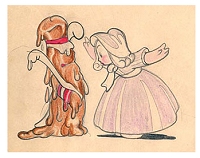
Once again there are various clever touches.  Most of the rabbits wear clothes, but some bunnies pose as “nude models” for other bunnies who are busily sculpting chocolates into rabbit shapes.  In yet another variation of conductor imagery, a chicken “conducts” her fellow hens in laying eggs in unison.  The bunnies paint the eggs with different patterns, which, oddly, are ready-made in the can:  there is spotted paint, and striped paint, and checkerboard paint.  The rabbit who uses “Scotch” paint wears a kilt, of course.

When you watch films from over seventy years ago, you should expect that every so often you will find disconcerting evidence of how the culture has changed over time:  in this short there are bunnies in blackface working on chocolate.

cic-20060707-04.jpgIn the next cartoon, The Cookie Carnival (1935), the Disney studio again created a civilization in which the inanimate become animate.  Just as Cars begins with an auto race held in a stadium packed with thousands of sentient cars, The Cookie Carnival opens with a marching band of cookies leading a parade straight towards the “camera,” set in “Cookietown.”  (This anticipates the parades that are a daily feature at the Disney theme parks.)
The Disney studio could give the cookies shapes that were more human than the Musicland cast, and considerably more so than Cars‘ title characters.  The cookie parade celebrates a beauty contest of sorts, whose winner is to be crowned Cookie Queen. So, following the marching band, there are a series of floats featuring the humanoid cookie contestants, “Beauties on Parade”:  there’s Miss Peppermint, atop a cake;  Miss Cocoanut (an Eskimo, accompanied by penguins, as if Disney had its poles mixed up); Miss Banana Cake;  Miss Strawberry Blonde;  and, surprisingly, Miss Licorice (a black girl).

Cookie motifs do not dominate The Cookie Carnival as completely as musically themed visual motifs did Musicland, but there are some clever ones:  a pretzel serves as a bicycle, and a dog biscuit acts like an actual barking dog.  Later lollipops project colored spotlights.  A Gingerbread Man is what Depression-era Americans would call a hobo, and what today we would term a homeless man, and he carries his knapsack on the end of a candy cane.

Foreshadowing a later Disney feature, The Cookie Carnival is an interesting variation on the Cinderella story.  The Gingerbread Man encounters an impoverished girl cookie who is crying because she wants to be in the parade but hasn’t any “pretty clothes.”  The Gingerbread Man declares that she will be the Cookie Queen. As if he were her Fairy Godfather, using ingenuity instead of magic (or maybe her version of Henry Higgins), he proceeds to create a fancy costume for her out of the materials to hand.  For example, he molds cookie dough into a wig, and turns a candy wrapper into a skirt.  The girl sees the result of her transformation by looking into a shiny lollipop, which shows her reflection like a mirror: she is “the sweetest one of all” (a phrase that refers to a cookie’s taste as well as her looks and personality).

Thus metamorphosed, the girl cookie enters the competition, whereupon the judges declare her to be “A pip! A peach! A wow!”  She ascends to the top of a wedding cake, where she is crowned Cookie Queen.

A wedding is the classic ending of a comedy, but obviously, something is missing from the top of the wedding cake.  The Judges tell the Cookie Queen that she must have a King, and tell her she can pick anyone she chooses.

So another competition begins, with various male singing cookies bidding for the Cookie Queen’s favor. 

There are “old-fashioned cookies,” dressed in 1890s costumes.  In 1935, that was not so very long ago.  It would be comparable to the 1960s from today’s vantage point!

Two Angel Food cakes wear halos and long gowns and come off as effeminate. Now there’s something one doesn’t expect to find in a Disney cartoon, but the unmistakably gay Reluctant Dragon will star in his own Disney feature only six years later. 

Next come Devil Food Cakes, scat-singing, obviously meant to be black people.  They’re described as “nice and naughty.”  Keep in mind that Disney theatrical cartoons were made for audiences of both children and adults.  That “nice and naughty” phrase would sail over the kids’ heads, but adults might pick up a sexual subtext there.  If you think I’m overreading the meaning of that phrase, just wait till we get to two later cartoons in the Lincoln Center program, each of which has – ahem! -  the word “cock” in its title.  

Guards try to stop the Gingerbread Man when he shows up.  But, of course, he is the one that the Cookie Queen chooses to be her king.  In Joseph Campbell’s “hero’s journey,” this is the scene of the recognition of the hero, who is rewarded for his kindness to the heroine.  What interests me most about this turn of the plot is that it is Cinderella with a sex change.  Now the heroine saves the hero, plucking him out of poverty and obscurity and elevating him to the roles of both husband and king.  This could even be seen as an improvement on the standard Cinderella story:  in this version the hero and heroine help each other equally.  Thus The Cookie Carnival ends with what Campbell called the “sacred marriage,” as the newly crowned Cookie King and Cookie Queen kiss, applauded by the entire community. The Gingerbread Man and the cookie girl are lonely outsiders no more.

After the 1930s and Fantasia in 1940, the Disney studio continued to do “Silly Symphony”-style musical material as segments of feature films, such as Make Mine Music, which were not full-length stories, like Bambi or Cinderella, but were effectively anthologies of short subjects. 

This is why the Lincoln Center program was titled “‘Sillies’ and other Symphonies”: along with the “Silly Symphony” shorts, curator Greg Ford included some of these musical segments, in which the Disney studio continued to experiment with the medium of animation.

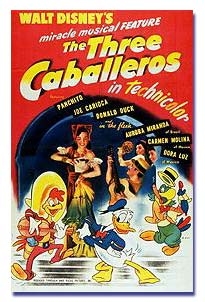
cic-20060707-05.jpgFirst up was a segment from The Three Caballeros (1945).  Asked by the federal government to foster awareness of the United States’s allies to the South, Disney produced both this film and Saludos Amigos (1943), both of which consist of loosely connected vignettes about Latin America.  These films also seem to have taken advantage of a growing popular interest in Latin music in 1940s America (hence the Hollywood career of Carmen Miranda, whose sister turns up in Caballeros).  

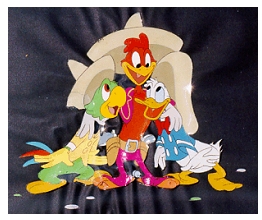
Demonstrating that he has already surpassed Mickey Mouse in popularity by this point, Donald Duck is the star of Three Caballeros who represents the United States.  The second Caballero is Jose Carioca, the Brazilian parrot who acts as Donald’s guide to South America.  The dapper, well-spoken Jose projects a sense of cool that contrasts sharply with Donald’s raucous persona:  Donald seems very much the naive, unsophisticated American tourist.  The third Caballero, who debuts in this film, is Panchito, the Mexican rooster, who compares quite favorably to the Mexican stereotypes in so many theatrical animated cartoons, who seem to be permanently on siesta.  Panchito, on the other hand, is hyperactive, as we shall see.

When I was a child, a shortened version of Three Caballeros would regularly turn up on the weekly Wonderful World of Disney, and even then I realized that Caballeros was much stranger than any other Disney animation.  For some reason, the Disney animators made Caballeros their vehicle for delving into pop surrealism, as in a musical segment in which a dancing (live action) woman in silhouette transforms (via animation) into a silhouetted cactus.

The Film Society showed a different part of the film, which set me wondering whether there are effects that hand-drawn “2D” animation can achieve that “3D” computer animation cannot.

The least celebrated sequence in Fantasia is the one with the sentient sound track, which ventures onscreen at narrator Deems Taylor’s invitation, and morphs into various abstract shapes and designs  representing different musical sounds.  

The visual sound track returns in this segment of Caballeros, taking a guitar-like shape.  Jose and Donald dance around the pulsing sound track, casting semi-abstract shadows of pure colors, as if the characters’ movements have become part of the music.  Then Donald somehow merges with the onscreen soundtrack.  As the music continues to play, Donald’s recognizable form distorts in ways meant to visualize the sounds.  Described in print, this may just seem weird, but in the Film Society theater, the audience burst into laughter at Donald’s surreal contortions to the music.

Afterwards I wondered if this gag could work in a computer-animated film.  Except for “3-D” movies watched through special glasses, film images exist in only two dimensions.  However, when we see a person onscreen (or in a still photograph), we understand that this is an image of a real human being who exists in three-dimensional reality.  This carries over to animated characters like Donald Duck:  he actually “exists” only in two-dimensions, but we interpret his image as that of a duck who exists in three dimensional reality.  After all, Donald is drawn to look as if he has three-dimensional volume, as well as height and length:  he doesn’t vanish when he turns to his side.

But we automatically accept elements of movies such as titles, credits, and subtitles as two-dimensional:  these letters have height and length but no volume.  The animated sound tracks in Fantasia and Caballeros likewise look “flat” and two-dimensional.

cic-20060707-06.jpgYet then Donald, the supposedly three-dimensional duck, merges seamlessly with the “flat” soundtrack, reminding us (if we bother to think about it after laughing) that Donald, being a cartoon character, is just as “flat” an image as the soundtrack clearly is.  After all, they are both drawings.

On the other hand, though computer-animated characters (except in literal 3-D films like the 3-D version of Chicken Little) are also flat images on a movie screen, computer animation creates a more persuasive illusion of depth and volume than hand-drawn animation does.  A CGI version of Donald couldn’t seamlessly merge with an obviously “flat” soundtrack:  if they merged, it would look as if Donald had suddenly been flattened by a steamroller.   

Nowadays we might term Caballeros a “meta-cartoon” (not unlike Chuck Jones’s renowned Duck Amuck), or postmodernist.  Most animated films encourage us to suspend our disbelief and pretend that the animated creatures onscreen are real.  In contrast, Caballeros keeps rubbing out collective noses in the artificiality of animation.  In part it does so through juxtaposing the animated Donald with live action humans.  The sequence with the onscreen soundtrack is another of Caballeros‘ “meta” tricks. Caballeros also openly exults in its own artificiality by heightening the unreality of conventional cartoon gags.   We see this in the late Ward Kimball’s celebrated animation for the performance of The Three Caballeros‘ title song, in which he seems bent on outdoing even Tex Avery at his wildest.

Donald’s purgatory as a living sound track comes to an abrupt end with an explosion and the entrance of Panchito, firing his pistols and bidding Jose and Donald (restored to normalcy), “Welcome to Mexico!”  Moments later, Panchito launches into singing the title song, with Donald and Jose acting as backup dancers, moving in rhythm, as all three stand in a spotlight.

A spotlight?  Just where are they supposed to be?  Panchito said they were in Mexico (but how did they get there?).  The spotlight suggests that they are on stage, but there is no real background.  The “stage” is really the screen.  The “story” of the movie, such as it is, has come to a halt, and the Three Caballeros are performing directly to the audience, breaking the fourth wall.

As the song proceeds, the laws of reality are bent way out of shape.  At one point Panchito’s gun momentarily comes to life and sings a line. The images in the lyrics get their visual equivalents.  When Panchito sings about rain, lightning flashes (but weren’t they inside?), and rain pours down, filling the rim of Panchito’s sombrero.

The song culminates with Panchito holding a high note interminably, thanks to Disney’s audio technicians, as Donald and Jose race about, frenetically trying to stop him.  They briefly trap Panchito in a coffin (some unexpected morbidity in a Disney cartoon);  they saw a circle around him in the floor, whereupon, according to the laws of cartoon physics, the floor falls away and Panchito remains, unaffected by gravity;  they plant a hedge around him, which within a fraction of a second grows taller than he is, and then burns away within another split second.  A gag like the one with the saw is standard fare in a “Bugs Bunny” cartoon.  It is the relentless, rapid fire pacing of this barrage of gags, all occurring while Panchito is holding the song’s final note, that makes this sequence extraordinary.  It revels in its own absurdity;  just where are Jose and Donald getting all these props?

So enthralled was the Lincoln Center audience that when the Caballeros’ song abruptly ended (it was only an excerpt of the film, after all), they went “awwwwwwww” in disappointment before breaking into applause at Kimball’s virtuosity.

cic-20060707-07.jpgNow the program returned to “Silly Symphonies” and the 1930s, with Cock o’the Walk (1935), which, as the title indicates, is about chickens and sex. 

Like The Cookie Carnival it starts with a parade, but this time the non-human community consists of farm animals:  mostly chickens, but also ducks, peacocks, and even caterpillars.

Atop a float covered with awards is the “Champion,” a rooster from the city who appears to be a champion boxer.  But he’s really being celebrated for his sexual power:  he is a big city alpha male.  Hens flock from their homes to see him in the parade, as if they wanted to form a harem for him.

Next we meet our hero and heroine: a country rooster, dressed like a stereotypical country bumpkin, and his girlfriend, a hen in a bonnet, who looks like a young version of Miss Prissy from Warners’ later Foghorn Leghorn cartoons.  The country rooster presents the shy hen with corn, as if it were a bouquet of roses.  We observe that when this country rooster feels sexual attraction, he moves quickly and excitedly and crows. 

However, the hen sees the Champ practicing his boxing and is fascinated by this display of macho prowess. The Champ takes a fancy to her and invites her into the ring, where they proceed to dance.  It has been observed that in 1930s musicals, dancing becomes a metaphor for sex, and that’s clearly what the Champ and hen have in mind here.

The Disney studio turns the dance into a big production number that seems to envelop this entire barnyard world. A scene of hens strutting down stairs unmistakably parodies the Busby Berkeley dance spectacles of the period.  Ducks swim in rotating circles; unhatched eggs sprout legs that tap dance.  Foreshadowing the later short, Woodland Café, caterpillars shimmy, and a chick with obvious predatory intentions dances with another caterpillar.  Perhaps that latter dance serves as a hint about the Champ’s attitude towards the heroine.

The country rooster sees his girlfriend dancing with the Champ, and gets angry.  The two roosters start fighting, using their sharp beaks like (phallic?) swords.  Then the Champ steps on the country rooster’s foot, pinning him in place, and starts beating him as if he were a punching bag:  not only is the country rooster defeated, but he’s been reduced to the level of an inanimate object. The country rooster flees, and the fickle heroine applauds the victor.

But then she sees a photo of the Champ with his wife and many children.  She finds the country rooster, lying beaten and unconscious.  In a role reversal version of Sleeping Beauty, she kisses the country rooster, awakening, and figuratively resurrecting him. 

And that’s not all her kiss did for him.  He turns red, crows ecstatically, and turns into a whirling dervish.  The conventional assumptions about Disney films once again prove to be wrong:  the country rooster has clearly been sexually aroused.  Full of energy, he beats up the Champ.

Then the country rooster and the heroine hen begin dancing, much more energetically than she did with the Champ.  If dance is a metaphor fir sex, the country rooster is proving to be the better lover.

They kiss passionately, and the country rooster crows, then coughs (His transition from the Clark Kent of chickens to SuperRooster isn’t completely smooth), and then crows again, and better than before:  the hen heroine looks delighted at his sexual display.

The Hollywood Production Code was in full force by now, but Cock o’the Walk provides a textbook example of how to get sexual subtext past it.  And in an animated cartoon for family audiences!  And in the 1940s Tex Avery would go even further in his MGM Cartoons (see “Comics in Context” #100).

cic-20060707-08.jpgThe next cartoon, Who Killed Cock Robin (1935), features a society comprised entirely of birds. This short uses the familiar nursery rhyme for building a musical satirizing the legal system.  The jury sings, “We don’t know who is guilty so/We’re going to hang ’em all.” One might compare this to the trial scenes in the Marx Brothers’ Duck Soup (1933) or the Gershwins’ Of Thee I Sing (1931), but I suspect that the ultimate source is the Gilbert and Sullivan canon of comic operettas, specifically Trial by Jury.  Like Musicland, Cock Robin shows how much American culture has changed.  How familiar are today’s audiences with the Gilbert and Sullivan style?
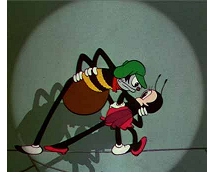
Another marker of cultural change is a blackbird who is a sleepy-eyed caricature of an African-American.  The Keystone Kop-like police and the courtroom guards hit the blackbird. I’d like to think that the Disney studio meant to mock the guards’ and cops’ racism and win audience sympathy for the blackbird.  But maybe they just thought that hitting blackbirds – or black people – was funny.

By the mid-1930s the Disney Studio was a successful part of the Hollywood community, and it was caricaturing movie stars in its cartoons. So Cock Robin sings like Bing Crosby, but in personality he comes off as a male ingenue;  Crosby hadn’t yet developed the laid back master of cool persona that later Crosby caricatures in cartoons mimic.  A cuckoo resembles Harpo Marx. The leading lady is named Miss Jenny Wren, which may be a reference to the 19th century singer Jenny Lind, the “Swedish Nightingale.”  However, she is drawn as an avian caricature of Mae West, whose movies were hardly family fare. She sounds like West, too:  her sultry command, “Fascinate me!”, got a big laugh from the Lincoln Center audience.

In the cartoon’s final moments, the bird who shot Cock Robin with his bow and arrow turns out to be Dan Cupid, depicted not only as a bird but as yet another caricatured gay.  Cupid’s presence sets up the romantic ending.  He reveals to the court that Cock Robin isn’t dead. Then, just as in Cock o’the Walk, there is a role reversal Sleeping Beauty scene, in which Jenny revives, resurrects and, presumably, sexually arouses Cock Robin by kissing him.  The cartoon ends with Jenny, in her Mae West voice, uttering an orgasmic “Ohhhh,” giving yet more proof of how different Disney cartoons were back in the 1930s.  

cic-20060707-09.jpgOne of the forerunners of Pixar and Lasseter’s A Bug’s Life (1998)  is the Disney masterpiece Woodland Café (1937).  Here is another one of Ford’s “self-enclosed communities of cartoon beings,” this one consisting entirely of insects and other “bugs,” such as a spider. 

The cartoon is set at the Woodland Café, which seems to be an all-bug version of the real life Cotton Club.  The band consists of brown grasshoppers, one of whom even sings that they’re “here in Harlem.”  Despite the grasshoppers’ thick lips, they seem acceptable caricatures of African-Americans by contemporary standards.  They’re not lazy or childlike:  they are accomplished musicians, whose vigorous performance drives the film.  Like the Fleischer studio, the Disney studio clearly appreciated African-American music of that period.  (R. Crumb fans will be pleased to hear the lead grasshopper announce, “Everybody’s truckin’!”)

Apart from the rhythmic patter of the band leader (perhaps meant to be Cab Calloway?), there is no dialogue in Woodland Café.  But there is continual music, which the characters’ movements usually match.  Even in the opening scene, customers arriving at the cafe are walking in rhythm. 

The cartoon concisely introduces a wide array of characters, such as a dancing pair of melancholy snails, whose presence slows down the otherwise bouncy score as long as they are onscreen.  Making recurring appearances are a large, elderly bee and his smaller, peppier trophy girlfriend: she dances up a storm atop a table but he ends up being carried out on a stretcher – yet still happy with his night out. 

The centerpiece of the cartoon is presented as a show within a show, complete with a theatrical curtain raised at the beginning.  This sequence was showcased in the Whitney Museum of American Art’s landmark exhibition of Disney animation art (also curated by Ford), which is where I first saw it. It’s a parody of an “Apache dance,” associated with French cabarets of the period, and here performed by a large male spider and a small female fly.

The casting itself satirizes the sexist ethos of an actual apache dance, in which a dominant male roughly treats his female partner. In this case the spider repeatedly chased the fly through his web, and at one point bounces her up and down as if she were a basketball.

The fly’s character design is reminiscent of Minnie Mouse, but also Betty Boop: she has a sultry walk, and invites the spider’s attention with a come-hither shake of her shoulder (all in time to the music).  However, the fly comes across as something of a proto-feminist heroine. She answers the spider’s initial predatory advances with a slap in his face, causing his head to spin around.  Even when he seizes her by her antennae and holds her aloft, she somehow forces him to back away through simply glowering at him. Ultimately the spider is tangled in his own web.  The fly snaps her fingers at him in contempt, poses under an overhead light in relaxed triumph, smokes a cigarette (!), and blows out the light, whereupon the curtain closes over her silhouette.  She’s a film noir heroine who arrived onscreen several years before her human counterparts would.

It is then that the grasshopper band leader first speaks/sings, launching the infectiously energetic concluding dance number, as the director cuts repeatedly between the bugs jitterbugging on the dance floor and the musicians vigorously playing their instruments.  The montage builds climactically to a crashing cymbal, and the Lincoln Center audience erupted into loud applause.

cic-20060707-10.jpgThe program again jumped ahead a decade to A Jazz Interlude Featuring Benny Goodman & Orchestra:  All the Cats Join In, subtitled, “A cariCature,” a sequence directed by Jack Kinney from the Disney feature Make Mine Music (1946). 
Here’s another instance of a sequence that hand-drawn animation can do, but seems unsuited to computer animation.  First we see a sketchbook, which is pushed open by a pencil, held by an unseen hand, presumably that of the animator.  The pencil then draws a cat, which, in typically feline manner, watches itself being drawn, until it is erased.  The pencil then redraws the cat as a teenage boy (a “cat” in 1940s slang).  The background is completely blank.  The boy decides to call his girlfriend.  (There is no dialogue:  the soundtrack consists of Goodman’s big band music, and, eventually, a song).

The pencil draws a wire leading to a phone, and then it draws a bobbysoxer girl, who answers the phone.  As you see, props, scenery, and even cast members appear onscreen only when needed.  The pencil draws a staircase, so the girl can leave her room;  the pencil then draws a railing, which her kid sister slides down.  Then the pencil draws a car, and the two girls get in, and pick up their friends at various houses, which are no more than unrealistic stick figures.  The pencil draws a malt shop, the “cats” go in, and the pencil draws stools for them just as they sit down. The pencil even draws a new girl with a large behind, and then, the animator reconsidering, erases part of her derriere, evoking laughter from the Film Society audience.

Just what would be the equivalent in CGI?  The filmmakers have gotten the audience to simultaneously think of these teenagers as real characters in a malt shop, and as drawings being created before their eyes by offscreen animators!  It’s amazing to me that the Disney studio was confident that the audience would accept this “metacartoon” approach.  This sort of sophisticated experimentation seems to foreshadow the stylized U. P. A. cartoons of the 1950s.

All the Cats Join In is intriguing in other ways, too.  Consider that Disney was able to get Goodman, one of the biggest names in 1940s popular music, to contribute the score.  Yes, nowadays Disney gets Elton John and Phil Collins to write scores for animated features, but long after they were at the top of the charts.  In the 1940s Disney, still a young studio, was embracing and celebrating current trends in popular music and dance. 

The sexuality in the sequence is remarkable, too.  There’s the shapeliness of the girls and the fiery energy of the dancing.  Early on, the sequence even teases the audience, having the lead girl get undressed behind a shower door, but getting hold of a towel in the split second before she emerges.  As in Woodland Café, the dancing builds in energy, until it finally ends in a climactic burst (with sexual subtext?), in this case with a juke box literally exploding into musical notes.

Yet at the same time All the Cats Join In seems so innocent.  These teenagers are at a malt shop, after all, having ice cream sundaes!  At one point the “cats” throw out a boy who shows up in a dated 1920s outfit, complete with ukulele, for the sin of uncoolness.  Now the “cats'” clothes look dated, yet the characters still feel vividly alive.

cic-20060707-11.jpgThe program then went back in time to the decidedly unhip Wynken, Blynken & Nod (1938), based on a children’s poem about three children sailing in a giant shoe through a dreamworld.  The kids try to catch fish, which appear as glowing stars.  Space is visualized as waterlike, and the moon is shown, as if in soft focus. An enormous cloud with a human face blows at the shoe/ship, and eventually the children tumble from their ship.
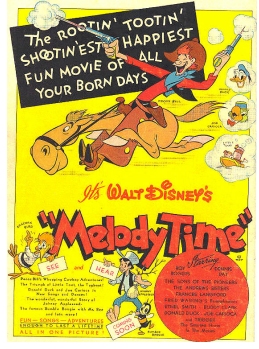
Were the filmmakers paying homage to pioneering cartoonist and animator Winsor McCay, whose Little Nemo’s beautiful dreams usually turn to nightmares?  It’s not a surprise that at the cartoon’s end the giant shoe turns into a bed,  but I was amazed that the three children merge into a single dreamer.  What could this mean?  That a solitary child’s imaginary friends are versions of himself?

cic-20060707-12.jpgThen the program swerved back to Disney’s pop surrealism of the 1940s, with Bumble Boogie, directed by Jack Kinney for the feature Melody Time (1948), and set to a “boogie” arrangement of Rimsky-Korsakov’s “Flight of the Bumblebee” that spotlights the piano.   An animated brush creates the protagonist, a bumblebee, before our eyes.  Again here’s the duality:  the bee is presented to us both as a character and as a drawing. This prepares us for the wild transformations to come, as piano keys turn into flowers, and horns, and butterflies, and menace the hapless bee, all to the racing rhythm of the music, winning a big round of applause from the audience. 
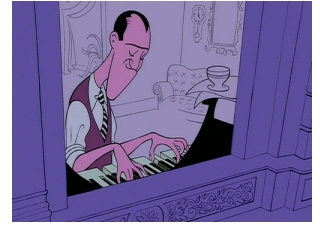
The Lincoln Center program concluded by moving decades ahead to the Rhapsody in Blue sequence, directed by Eric Goldberg, from Fantasia 2000, which I had originally seen at its New York City premiere in Carnegie Hall.   Set to George Gershwin’s music, the sequence is drawn in the style of the theatrical caricaturist Al Hirschfeld (and even quotes onscreen Hirschfeld’s celebrated caricature of Gershwin).  Both men are closely associated with New York City, and the sequence is set in Manhattan during the Great Depression, the same period in which Walt Disney was making his “Silly Symphonies.” 

Unlike most of the Pixar and Disney animated films discussed in this week’s column, this animated Rhapsody in Blue has a cast of human beings.  But it resembles them in other ways.

For one thing, the single note sounded by a clarinet that begins Gershwin’s “Rhapsody” is visually echoed by a single line on screen, which soon becomes the outline of Manhattan skyscrapers, and then fills in the outlines of the buildings, creating a stylized but recognizable setting.   It’s like the pencil in All the Cats Join In and the brush in Bumble Boogie:  an onscreen acknowledgment that what we see onscreen is both a representation of reality and the creation of offscreen artists.

The animated Rhapsody has no dialogue whatsoever:  like some of the cartoons mentioned earlier, it relies on visual means and the moods conveyed by the music to tell its story.

The segment swiftly introduces us to a variety of characters, representing a cross-section of New York.  First is a young African-American man who is a percussionist looking for his big break, but is making his living as a construction worker.  Considering the black stereotypes in early Disney cartoons, and the rarity of black characters in later Disney animated films, this character’s appearance is particularly noteworthy. 

There’s also an unemployed man, a victim of the Depression, who looks fairly desperate, and contemplates stealing an apple but is deterred by the nearby presence of a cop. (Having had my own employment worries, I found myself sympathizing with him.) 

The financially well off have their own problems.  A little rich girl has problems that perhaps relate more to those of today’s children.  The girl’s every moment seems programmed with after-school activities, as her severe tutor drags her from ballet class to a singing coach to swimming lessons to still more. 

A bespectacled, cherubic middle-aged man has similar problems:  dominated by his wife, he tries whenever he can to express the free spirited, childlike side of his personality.  Encountering an organ grinder, he even playfully imitates his monkey.

cic-20060707-13.jpgBeyond these four principals, the segment shows us many, many more city residents in passing.  We glimpse individuals briefly, such as a milkman and his horse, making their early morning rounds, and a tired, bored waitress.  To the rapid, bustling rhythms of Gershwin’s music, large numbers of people burst out from a hotel (named “The Goldberg”) or rush in and out of a subway station.  The drummer rushes to work; the little girl is taken from lesson to lesson; the wife drags her reluctant husband along.  Amidst the crowds and tumultuous movement of the big city, all four principal characters find themselves ironically isolated and unfulfilled.

As the music becomes slow and romantic and even wistfully melancholy, we find that all four of the principals are dreamers.  The sad little girl imagines herself skating with her parents (whom, it seems, she sees too seldom) at the Rockefeller Center rink. The unemployed man skates too, envisioning a dollar sign.  The middle-aged husband visualizes himself skating up into the sky, flying among the birds.  The construction worker imagines himself playing drums in a spotlight.

This segment of Fantasia 2000 is a contemporary reworking of the romantic image of New York City:  as a magical metropolis filled with opportunities, where dreams can come true. By sheer chance the unemployed man passes the construction site, is dragged in and given a job.  The little girl runs out onto the street after her ball and is nearly hit by cars, but is saved by her formerly absent parents, as the tutor faints away in symbolic death.  The drummer gets his chance at “Talent night” at a club in Harlem (perhaps meant to be the Cotton Club, the inspiration for Woodland Café?), where the husband turns up, freed from his wife, and finally able to enjoy himself.  As the Rhapsody moves into its final measures, the film cuts between the formerly unemployed man, ecstatic in his newfound job; the little girl reunited with her idealized parents; the drummer finally fulfilling his artistic ambitions; and the husband dancing with a more appealing female partner; before ending with a final shot of Times Square aglitter at night and the final, triumphal notes.   Earlier in the program, we had seen communities of musical instruments, insects, and cookies, among others.  this is a celebration of the community of New Yorkers, and the Lincoln Center audience erupted into applause.

I liked the animated Rhapsody in Blue when I first saw it, but it impressed me still further when I saw it at Lincoln Center.  In part that may be because, after the September 11, 2001 attacks, this sequence becomes emotionally moving as a celebration of New York City. 

It’s also because, in the context of Greg Ford’s program, it becomes clear that Goldberg’s Rhapsody fits solidly into long, honorable traditions of Disney animation:  in its use of music, in its depiction of community, and in its visual experimentation.  It shows that that tradition is still viable and still alive.

Writing about the “‘Sillies’ and Other Symphonies” shortly after seeing Cars similarly makes me aware of how much the Pixar films carry on the classic Disney tradition, more than Disney’s own animation division was in recent years.  

“I’ve always loved animating inanimate objects,” John Lasseter said in Fortune (May 17, 2006).  Twenty years ago he completed Pixar’s first computer animated short, Luxo, Jr., starring the bouncing lamp that has no anthropomorphic features whatsoever.  Yet it conveyed its personality to audiences, and continues to serve as part of Pixar’s logo on its films to this day.  With Cars Pixar and Lasseter finally bring us a feature film with an entire community of “inanimate” objects.  This is part of their tradition, and Disney’s, and Cars proves it to be still vital, as I shall discuss further in a forthcoming installment
of this column. 

Copyright 2006 Peter Sanderson
 

Noctural Admissions: Reflection, Mr. Smith Goes to Washington

Filed under: Nocturnal Admissions — UncaScroogeMcD @ 1:51 am
nocturnalheader4.gif

Mr. Smith boxAs I do every July 4th, I spent part of the afternoon, 129 minutes to be exact, watching Mr. Smith Goes to Washington. It strikes me as the perfect patriotic note to strike. And it includes the whole scale in its confrontation of back home idealism with big city cynicism. You can believe in Mr. Smith while laughing along with the wised up reporters and political operatives who use or observe him. Director Frank Capra pushes the buttons so well that I never fail to cry,especially at the parts that are the most treacly, such as when Smith first visits the Lincoln Memorial and watches a little kid read the Gerrysburg Address as an elderly African-American (old enough to remember the Civil War?) comes up and takes off his hat.
Every year I forget how perfectly Capra and his associates cast Mr. Smith. From Jack Carson on up, each role, no matter how big or small, is vivid and engaging. Claude Raines moves like a dancer. Jean Arthur’s voice is entrancing and has a wider range than I recall. And Edward Arnold, as the Penderast-style boss of the political machine, may have been the best actor in Hollywood, ever.

Mr. Smith

This time I read the script, credited to Sidney Buchman, after seeing the film, and was struck by how much was cut out of the (already long) movie. The script doesn’t appear to be on line anywhere but is available in a cleaned up reader’s version in the book 20 Best Film Plays, edited by John Gassner and Dudley Nichols. There are at least three major sequences deleted from the film and lots of little bits of the script are excised (as an example, look at the scene where Susan Paine calls up Saunders, very obviously edited down in the finished version). I get the impression that screenwriters wrote fuller texts back in the old days, and that in the editing room the films were trimmed down dramatically, the editors cognizant that the viewer could accept shorthand and make leaps. Riskin’s script to It Happened One Night kicks off the book and it actually reads better than it plays. Anyway, the script’s first introduction of Smith is elided, and at the end there is a whole sequence that takes place back in Jackson City, where Smith is feted and he introduces Saunders to his “¦ pets. It’s a fuller text and makes me as misty eyed as the finished version does.

At the end of the 4th this year I had occasion to see the wealth of fireworks that were going off around the city (and they are illegal in this town). Wealth in both senses. There must have been hundreds of thousands of dollars going up in smoke that night. It was like Bagdad on a bad night. I love fireworks (invented by the Chinese) and they are fun to watch and hear but in the caustic circumstances of a typical 4th they lose connection with the holiday they announce loudly, one that established the birth of a nation and a flag that survived, as the song says, the rocket’s red glare. In a time of trouble the bread and circuses are attended for their own sake. Next year take a tip from me and start the day with a shameless reminder of what the 4th stands for and revel in the exquisite beauty of Buchman and Capra’s Mr. Smith Goes to Washington.


July 6, 2006

International Intrigue: Best Foreign Films of the 90s, Part II – You Choose

Filed under: International Intrigue — UncaScroogeMcD @ 3:01 am


internationalintrigue.jpg

So two weeks ago I posted my Ten Best Foreign Films of the 90s. And then I asked you all to tell me what I was missing. And here is what you came up with, you clever folks: 

The Top 5 Foreign Films of the 90s (That Didn’t Make My List)

1. DELICATESSEN
Not to sound condescending, but I’m so proud of y’all for choosing this over CITY OF LOST CHILDREN. Many of you noted that DELICATESSEN had a greater impact which I believe. It was the world’s first exposure to Jeunet and his co-director Caro, and it was a bit of kick in the pants. This film is still the most out there and visceral of their oeuvre. It centers around a butcher, who is also the landlord of the building over his shop. His tenants are far from normal in a post-apocalyptic world where food is scarce. As you may imagine, the landlord has some creative ways for taking care of his tenant’s needs as the new janitor Louison (Dominique Pinon) is about to find out. This is a pleasantly disturbing film and one you’ll certainly remember.

2. TRAINSPOTTING
This film was on my original list until I realized I had 11 films and had to get rid of one. I dropped this one because it was a lot more well known than the other films on my list. Well, you guys weren’t having none of it. And rightly so. TRAINSPOTTING was huge upon it’s arrival here and is well-loved. If you haven’t seen it, you should. Although beware some disturbing imagery and ‘potty’ humor. The film, directed by Danny Boyle and based on Irvine Welsh’s novel, is about Renton (Ewan McGregor) and his group of drug addicted cronies — their lives, their ‘loves’, their addictions, their somewhat disturbing hallucinations (ew that baby), and an attempted large money illegal operation. If your wondering why that plot description is a bit lacking, watch the film and you try to summarize it — not easy is it? One of the things that’s so good about it is that you can’t entirely explain what’s so good about it. Just enjoy.

3. CHUNGKING EXPRESS
Wong Kar Wai’s international smash and the film that really introduced this innovative filmmaker to the world. The reason I didn’t include it on my original list is that I like some of WKW’s less touted 90s films better (his genre work like AS TEARS GO BY and ASHES OF TIME), but certainly a lot of people have love for this languid slice of life tale. It is essentially two stories of loneliness. One of Cop 223 (Takeshi Kaneshiro) a recently single fellow, whose story culminates in a mysterious meeting with a woman in a blonde wig (Bridgitte Lin). And Cop 663 (Tony Leung), also recently single, who doesn’t quite realize how big a crush the girl at the food stand (Faye Wong) has on him. Christopher Doyle’s cinematography is always worth the price of admission but the honest performances and simple but sympathetic storylines have turned many a viewer into a certified WKW groupie. And if you find yourself so enchanted then check out the loose prequel DAYS OF BEING WILD and loose sequel FALLEN ANGELS.

4. LA HAINE (HATE)
Mathieu Kassovitz’s black and white politically charged masterpiece is often compared to Spike Lee’s DO THE RIGHT THING. The French feature focuses on Vinz, a Jewish character played by Vincent Cassel, and his Arab friend Said and Black friend Hubert. They are all outsiders and the film represents their struggle against the rascist French police. The film was quite big in France and internationally upon it’s release. But the recent riots in France helped thrust this film back into the spotlight and people have been talking about it quite a lot lately. An emotionally charged viewing experience that any viewer will certainly remember.

5. FESTEN (THE CELEBRATION)
Thomas Vinterberg is not the most well known director to come out of the dogme movement, but this film, the first film that followed the minimalist manifesto, is the most ‘celebrated’ (excuse the pun) of the bunch. An exercise of how much you can do with with a little, the film centers around a 60th birthday party for the family patriarch Helge (Henning Moritzen) when a horrific accusation ruins the festivities and underlies all the relationships in the room. There is a lot of talking heads in this exercise of restraint but it still manages to be largely affecting and introspective.

Most Interesting Suggestions
Some people actually managed to suggest things I hadn’t seen. And these were the most fascinating….

EL DIA DE LA BESTIA (THE DAY OF THE BEAST)
This Spanish cult classic is about a priest who believes the anti-Christ will be born by Christmas. When no one believes him he’s decided to stop it all by himself, forsaking his vows and goodness in the process. And next thing you know you have anything you’ve ever wanted from a gun-totting priest and more. It’s dark, it’s funny, it’s gore-y — Miike through Almodovar’s lense. It may be a bit too weird, a bit too gross but it’s so truly unique and visionary you’ll probably keep watching. It’s hard these days to find anything that is like nothing you’ve seen before, but this film might fit the bill.

MEDITERRANEO
This film was pretty well received (it won an Oscar) and seen by a good amount of folks upon it’s release in 1991. But since I wasn’t watching foreign films yet in 1991, I had never heard of it and as it turns out, it is quite lovely. This Italian film is certainly of a foreign film type — a feel-good touristy romp. This film is equal parts fantasy and comedy with a beautiful setting. It takes place on an island during WW2, where a group of soldiers, being sent there, find the pluses of peace and find themselves and all that. These are some truly fuzzy lovable characters. Sometimes you just want to watch something that’ll make you smile and doesn’t bring you down and also not be stupid and this film should be the first place you look.

MISTER FROST
Well this would seem to be a movie that polarizes people. IMDB tells me the film is in fact from “France/UK” despite the starring presence of Jeff Goldblum. It also stars the always lovely Alan Bates and a whole host of French people. The premise is that a mass murderer (Goldblum) is sent to a mental institution where he’ll only talk to a female psychiatrist (Kathy Bates) and of course he attempts to manipulate her. As it turns out there’s a lot more to him then there seems. That’s vague but I don’t want to give away the ‘twist’ even though they reveal it to you relatively early on. Whether you enjoy this film or not depends a lot on whether you see it as a comedy or a drama and your ability to stand Goldblum at his Goldblumiest. But the film is nothing if not interesting…

The Professional’s Opinions
I know that I’m not the end all of foreign film criticism on the web, although I like to think I am. So here’s the opinion of some of the web’s most prominent bloggers and website maestros on the topic of the Best Foreign Film Of The 90s:

Filmbrain: Sátántangó, Bela Tarr, Hungary (1994)
“To select a single film from a very strong ten-year period was nearly an impossible task. Lars von Trier, Wong Kar-wai, Hou Hsiao Hsien (to name a few) released some of their finest works during the 90s, not to mention the myriad of films from newcomers such as Arnaud Desplechin and Takashi Miike. Yet of the many contenders, there is one film that rises to the surface ““ one that I’ve seen three times, which is quite a feat considering its seven-and-a-half hour length ““ Bela Tarr’s masterpiece, Sátántangó. Don’t let the running time intimidate you ““ this films grabs you from the first shot and doesn’t let go until the very end. And though a black and white portrait of a tiny village in post-Communist Hungary might not sound all that exciting, Tarr manages to create an uneasy tension that sustains itself all the way through. There are images in this film that, once seen, are not soon forgotten. But please, don’t ask about the kitten.”

Todd from Twitch: Jeunet et Caro’s Delicatessen.
“Again, many would point to City of Lost Children as a better film and in many ways I agree that it is, but for some reason Delicatessen just sticks with me in a way that City doesn’t. Domenique Pinon is at his best here and gives the high style of the directors its human heart. Unlike much of City, which is purely cerebral (ha, ha), the human relationships in Delicatessen actually work, which is what I think gives it the edge.”

Thanks for all your e-mails. Even if you suggestion didn’t make the list, many of you have given me fantastic ideas for future columns. There were a lot of Australian films represented in your e-mails (although not enough votes for any one movie for it to make it on here) and that’s certainly something I’ll cover in the future. Anyway, I hope this list will keep you all busy till I demand you watch something else in two weeks time….


The Fred Hembeck Show: Episode 64 – Laugh Lines

Filed under: The Fred Hembeck Show — UncaScroogeMcD @ 2:55 am


fredhembeckheader.jpg

Did you have a safe and happy Fourth of July, friends? Still got all the fingers you had on the THIRD of July? Here’s hoping.

Things were pretty busy roundabouts here at Chez’ Hembeck, so, begging your indulgence, we’re dipping into the Fred Sez archives once again. This time we feature a little piece I wrote in late 2003. I hope you’ll enjoy it…

Recently, the Bravo network ran several specials presenting what they opined to be the 100 Greatest TV Characters, EVER!

No, I didn’t watch, as I find these sort of things to be invariably frustrating, since at their core, they’re merely an accumulation of some faceless folk’s personal prejudices, and I’d rather not get myself all in an uproar barking at my poor, innocent television screen that, hey, Lucy Ricardo should be the number one choice, not Archie Bunker (yeah, I’ll admit it: I saw a list of the list. Believe me, that was far simpler than slogging through all those hours of clips…)

hembeck-20060706-01.jpg

Still, that doesn’t mean I’m not susceptible to trying a little of my own List-mania!…

(…as opposed to Lizstomania, that awful Ken Russell flick that had The Who’s Roger Daltrey cast in the title role – with Yes’s Rick Wakeman inexplicably cameoing in a Kirby designed Thor outfit! But THAT’S another topic altogether…)

But my list is simply MY list – and I’m certainly not going to attempt to name the Greatest, the Funniest, and most assuredly not the BEST characters ever to grace the tube. Uh uh. My focus concerns a baker’s dozen of characters who, whenever they show up on my television set, a smile immediately dances across my face, and I confess to pretty much laughing before they even DO anything! Now, these aren’t your beloved Ernie Bilkos, Rob Petries, or Frasier Cranes, all of whom possessed the force of personality to headline some of the best comedies in the medium’s more than half century history. Those comedic personas were inhabited by gifted performers who brought to life and greatly enhanced already top-notch material.

hembeck-20060706-02.jpg

The list I’M compiling is made up simply of actors (all male as it turns out) who, merely by way of their look, their voice, or their attitude, meant instant chuckles when they moseyed onto the scene. Most were second bananas, most were decidedly odd, and ALL of them still manage to break me up each and every time!

So, in no particular order, and with no additional commentary, I present you with my list of the 13 Characters Who Never Fail To Break Me Up Each And Every Time! (…okay, okay – so the title needs work. Don’t linger – just keep reading…)

hembeck-20060706-03.jpg

1. Ed Norton (Art Carney, The Honeymooners)

2. Count Floyd (Joe Flaherty, SCTV)

3. Eddie Haskell (Ken Osmond, Leave It To Beaver)

4. Mr. Bean (Rowan Atkinson, Mr. Bean)

5. Sgt. Rupert Ritzik/Officer Gunther Toody (Joe E. Ross, Sgt. Bilko/ Car 54, Where Are You?)

6. Pee Wee Herman (Paul Reubens, Pee Wee’s Playhouse and especially any and all appearances he made while strictly maintaining character guesting on various talk and variety programs)

7. Maynard G. Krebs (Bob Denver, The Many Loves Of Dobie Gillis)

8. Reverend Jim (Christopher Lloyd, Taxi)

hembeck-20060706-04.jpg

9. Sgt. Vince Carter (Frank Sutton, Gomer Pyle, USMC)

10. SpongeBob SquarePants (Voice of Tom Kenny, created by Steve Hillenburg, SpongeBob SquarePants)

11. Soupy Sales (Soupy Sales, The Soupy Sales Show)

12. Ted Baxter (Ted Knight, Mary Tyler Moore Show)

13. Barney Fife (Don Knotts, Andy Griffith Show)

hembeck-20060706-05.jpg

There you have it – a motley crew of goofballs if ever there was one. Please note that I consolidated Joe E. “Oo! Oo!” Ross’s two roles into one entry, as they were essentially the same character – both married to the same TV wife, and both working for the same producer, the legendary Nat Hiken. This was a unique circumstance, as the glory of Maynard G. Krebs did clearly not carry over for Bob Denver in his role as the just plain moronic Gilligan – and the less said about Ted Knight on Too Close For Comfort, the better!!

Soupy Sales, I realize, isn’t quite a character unto himself, but neither is he a stand-up comic or talk show host, folks I disqualified from consideration right off the bat, but he might just as well have been. Plus, he always, ALWAYS made me laugh, so…

Then there’s Gomer Pyle. He ALMOST made the cut, particularly when he was a supporting character on the Andy Griffith Show, but when he received his own spin-off, his personality became just a bit too candy-coated to be incessantly amusing – but the shift opened the way for the criminally under appreciated Frank Sutton to shine as the perpetually flustered Sgt. Carter. The Pyle show didn’t have the best writing (though they had far from the era’s worst), but the sitcom derived an awful lot of laughs from the pairing of this deliciously mismatched duo!

hembeck-20060706-06.jpg

And you’ve probably caught on by now, but I really DO like that SpongeBob fella!

Those who just missed making the list include Cosmo Kramer, Homer Simpson, Mr. Fields (Abbott and Costello’s belligerent landlord), Al Lewis’ Sgt. Leo Schnauser, and the Fonz – who would’ve easily earned himself a spot had Happy Days been cancelled after a mere two seasons! Instead, he went on to do that stunt where he jumped the shark, and well – THAT’S a whole ‘another website, one with their OWN set of lists!…

(And on YOUR list of things to do, I’m hoping visiting Hembeck.com (or Fred’s MySpace page, or sending me a personal message) is on or near the very top of it! Or at least not TOO close to the bottom…)

Copyright 2006 Fred Hembeck

Nocturnal Admissions: DVD Review, Equinox

Filed under: Nocturnal Admissions — UncaScroogeMcD @ 2:21 am
nocturnalheader3.gif

Equinox BoxSometime in the mid-1960s, Forest J. Ackerman, the editor of Famous Monsters of Filmland, indirectly introduced two of his readers, both aspiring horror filmmakers, to one another. David Allen ran an ad in FM asking to hear from anyone out there interested in stop motion animation. Dennis Muren, living not far away from the home base of FM in the San Gabriel Valley, responded. The two boys visited, became friends, and later collaborated on a low budget film, working under the lowest of low budgets, a mere $6000 dollars, back when $6000 dollars was a lot of money.

They were joined in their enterprise by two others, Mark McGee who lived in Arcadia and had written a screenplay, and Jim Danforth, a specialist in matte screens. All of them were horror and special effects fans, spun in the FM orbit, and loosely met to watch and critique horror films, and to write articles for and distribute ‘zines about their interests.

The boys went about things in an almost traditional manner. They held a casting call, which attracted 50 auditioners, shot the film a la the New Wave, on a 16mm Bolex without direct sound, built sets, created special effects, and even had a “premiere” sometime around 1966 to 1967. But far from being an instant calling card into Hollywood, the resultant film, Equinox: A Journey Into the Supernatural, and its makers went no where for several years. Eventually, however, Muren was able to place it in the hands of Jack H. Harris, who did some re-editing and re-shooting, adding a few new characters and requiring the old cast to find the clothes they wore during the shoot two years earlier. The new Equinox made its debut in 1970 and received wider distribution starting in 1971.

The Equinox team

It became a cult; but also rather difficult to see, unless one spent a lot of time up late watching movies on television in cities that had many, many channels. It became a cult probably because its special effects harked back to the style of Ray Harryhausen, and because it represented an act of will by the boys, who would not settle for being simply fans. McGee went on, after a long hiatus, to write screenplays for such as Stepmonster. Danforth, who had some 20 credits before Equinox, went on to work on over 60 films, while the late David Allen worked on Honey, I Shrunk the Kids and Young Sherlock Holmes. Muren hitched up with George Lucas and worked on the Star Wars films, and with Industrial Light and Magic won six Oscars, for The Abyss among many others.

As a late night film, Equinox must also have influenced other aspirant filmmakers. Among them may have been Sam Raimi or some of his Michigan collaborators who worked on The Evil Dead with him. The stories are quite similar, though the difference in tone between the two films shows how much the world and cinema changed between 1967 and 1981. In Equinox, four youths embark on a trip to the woods to meet a college professor. But the prof has gone mad, and they take off his body a Book of the Damned, which apparently is the cause of his demise. The four youths then find themselves victim to numerous preying monsters and demons, which try to possess or kill them. Only one escapes, and in the ’71 version’s book ends, David Fielding (played by Skip Shimer, credited as Edward Connell in his only role) makes his way to the highway, like Kevin McCarthy in Invasion of the Body Snatchers (a film that McGee had seen almost 100 times), and himself ends up in the madhouse.

Famous Monsters cover

Some filmmakers might find it embassassing to have so amateurish a work resurface late in life (Kubrick and now his estate won’t let anyone see Fear and Desire). But with Equinox it’s a fascinating peek into a an enclosed world of fans, privileged knowledge, and specialization. Equinox‘s acting is uneven, the special effects are obvious, the script is frequently incoherent. But they did it. The kids actually made a movie. Such serendipity makes me pine for the pre-internet days of horror magazines such as Famous Monsters and Castle of Frankenstein, and the first real ‘zines, mimeographed at home or at school and mailed to a small list of 100 or less “subscribers.” We are talking about kids who were very, very serious about thier fandom. It was harder to be a fan, and a Darwinian imperitive separated the wheat from the chaff. Only those with great drive, determination, and selfishness (don’t fora minute think that nerds are passive, feckless weaklings: amonst themselves they can be as aggressive, harsh and bullying as any random grouping of atheletes). Today, relatively speaking, it is easy to be a fan, and in fact the culture encourages it, as a profitable economy. In the late 1950s and early 1960s, lines of communication were limited and the films themselves were hard to watch. It is no coincidence that ’50s fandom rose along with TV and drive-ins, venues that gave the kids something to be fans of. At the same time, though, the buffs with the ‘zines wanted to do something with their fandom, wirte books, make movies, fashion horrific faces out of plastic or bring to fruition fantasies of space flight.

The Criterion Collection has a knack for singling out cheap horror films that have a pervasive influence on the film culture while themselves being forgotten, films such as Carnival of Souls, which influenced Night of the Living Dead. If Equinox influenced Raimi (and it is not at all clear that it did, since the premise is a common enough idea), than it helped gave birth to a number of important careers and films among its Michigan film geek viewers. Equinox (The Criterion Collection, No. 338, 1967, 1970, 82 minutes and 71 minutes, color, NR, full frame, DD mono in English with English subtitles, animated musical menu with 18-chapter scene selection. 16 for the 1967 version, 32-page insert with chapter titles, transfer info, pix, credits, and essays by George Lucas, Ray Harryhausen, and Brock DeShane, keep case, two discs, $39.95, released on Tuesday, June 20, 2006) is for fans, specialists, and historians only. Muren calls Equinox a “fossil.” I don’t think that a “regular” viewer stumbling upon it is going to get much out of the film. But a dedicated fan will enjoy the two versions of the movie, and the commentaries that go with them (Viewing Tip: watch the original version first, and then the re-editied mass-distributed version), plus all the extras.

Fritz Leiber

The 1970 commentary track is by veteran writer-co-director Jack Woods and producer Jack H. Harris. For the 1967 version, effects photographer, producer, and director Dennis Muren, writer-codirector Mark McGee, and matte artist, cel animator, and effects techinican Jim Danforth chat, though in two edited-together tracks. In this track, we learn that Robin Snider, billed as Robin Christopher, and who played Vickie, was a childhood friend of Stevie Nicks and influenced some of the songs she wrote. And we learn that part of the film was shot in Bronson Canyon, and it is clear that Equinox uses the same cave that Ford uses at the end of The Searchers. Also in the cast were the then Barbara Hewitt, later a Rose Queen and now a minister, as well as Frank Boers, Jr., later known as Frank Bonner and a cast member of WKRP in Cincinnati. We also learn why science fiction writer Fritz Leiber, of all people, appears in the film as Dr. Arthur Waterman. Disc round also includes a video introduction by Forrest J Ackerman.

Dennis MurenDisc two features a video interview with Muren, and an edited assembly of interview segments with of the actors from the show, Bonner, Hewitt, and James Duron. “Monstrous Origins” includes outtakes, deleted scenes (include a pool-side party scene that features a vixen worthy of Russ Meyer), and some monster test footage. Zorgon: The H-Bomb Beast from Hell, from 1972, is a silent eight and a half minute short film with some of the same people who worked on Equinox, plus Rick Baker. “David Allen Appreciation” is a section of the disc that contains The Magic Treasure, an early animated fairy tale by Allen, which comes with a textual history, and Allen’s King Kong homage Volkswagen commercial, plus test footage. “Equiphemera” gathers together an exhaustive gallery of stills, on set shots, promotional material, and so forth, under the headings, Origins of *The Equinox, On Location, Designing the Demonic: Special Effects, Publicity and Promotion, Beyond the Barrier, David Allen’s Kong, and Buried **Treasure. The final grouping, “Trailer and Radio Spots,” contains one 1970 trailer and two radio ads.

Equinox Poster

Music For The Masses: July 6th, 2006

Filed under: Music for the Masses — UncaScroogeMcD @ 2:06 am


musicmasses.jpg

Welcome back, friends!  Yeah, well. . .umm. . .so much for that weekly column idea, huh?  Hey, look. . .settle the hell down, will ya’?  In all fairness, I did warn you and I gotta be honest with you, the pursuit of my primary goal is proving tougher than I imagined.  Who knew?  Hell, I thought it would be a walk in the park becoming a Mormon prophet.   After all, this guy was able to land the job. . . 

m4m-july6-hink.jpg

The competition: He’s soooo going down.

So I ask you friends, why not me, huh?  Sure, the stiffs SAY you have to be an active “member” and “ordained by God” and some such bullshit, but screw the “old” thinking.  It’s time for some fresh, new ideas and a bold new direction, don’t you think?  Damn straight.  And I am just the person to do that.  Afterall, I went to BYU (seriously) for one, WHOLE semester and I’ll be God damned if I let that Sexual Repression major (with a minor in Masturbation!) go to waste.  Nope.  Not going to happen.

Now, you are probably asking yourself, “But M.C., how is one, such as yourself, by which we mean an agnostic, generally drunk and arrogant prick going to land the job of the most powerful man and living prophet in the Mormon church?  Two words. . .”dick out.”Â  That’s right friends, I’m going to go dick out with Mr. Hinkley up there.  “Do you mean literally, M.C.?”Â  Of course not, friends.  Besides, I’m a “grower,” not a “shower” and unless Mr. Hinkley wants to give me a “mouth hug” before we throw down on the table that might prove too close to call.  No, friends, I’m talking about putting our money where our mouths are.  His ideas versus mine.

For instance, I say it’s high time that the church diversify a bit.  As it stands now, finding a proud, African-American brother in a Mormon congregation is like playing “Where’s Waldo.”Â  I, brothers and sisters, promise to change that. . .with the help of my friends, Gnarls Barkley, hip hop missionaries.  With their blonde hair and penchant for dairy, they are non-threatening to the existing members, while appealing directly to today’s urban youth.  Oh yeah, and they are well-versed in the ways of the Lord. . .fo’ shizzle.  I’m building bridges here, people. . .that’s all I gotta say.

m4m-july6-gnarls.jpg

Gnarls Barkley:  hip hop missionaries, natural blondes, Clockwork Orange fans and milk drinkers.

Another idea that I have is to fully embrace and promote the whole “polygamy” thing.  Come on, now. . .let’s face it.  This was EASILY the coolest thing the church had going for it and they turned their collective backs on it (*WINK WINK*).  Silly Mormons, dicks are for (lotsa) chicks. . .just ask Brigham Young and. . .umm, Wilt Chamberlain.  As your new living prophet, my Mormon and non-Mormon friends, I promise that you can come home, each and every night, to this. . .

m4m-july6-model.jpg

*WARNING* ACTUAL SIZE, SHAPE AND APPEARANCE OF MODELS MAY VARY*
 
Now ladies. . .before you go getting all pissed thinking that I have forsaken YOU and YOUR needs, wants and desires, I promise to change ANOTHER, long-held church belief and give you some much needed relief.  Gone are the days of “late-night, sniper-sex,” rampant procreation and child-bearing “one-ups-manship.”Â  I am going to promote and institute a new program, aimed DIRECTLY at you, the tired, “busy” mom, with this very simple message. . .

m4m-july6-clown.jpg

Sorry, Mormon dads, but enough’s enough.  Don’t you think it’s high time that you gave the Mormon moms both a rest AND a break between pregnancy and uterine healing?  Let me answer that for you. . .”yes, it is.”Â  Take it out on your OTHER wives for cryin’ out loud, huh?  I’m telling you, folks, this idea here is golden and I’ll be honest with you it’s got mass appeal.  In fact, I’m also going to send a copy of this to the Pope.

So, what do you say?  You with me?  Do I have your vote?  Thought so.

But enough about all that. . .we have some new music to check out.  Since we last chatted, we’ve had some noteworthy new releases drop, namely the sophomore disc from Keane and one from Dashboard Confessional.  Also, Double A is back this week to check out the new one from Dr. Octagon.  So what do you say?  Let’s get to it, shall we?


m4m-july6-keanealbum.jpg Artist: Keane
Album: Under The Iron Sea
Bastard Love Child of: Coldplay and a Kleenex®
Best for: Resolving any issues you have with falling asleep.

m4m-july6-keane.jpg

After listening to the new album from Keane (pianist Tim Rice-Oxley, big-voiced Tom Chaplin and drummer Richard Hughes), I have devised the perfect cross-promotional event for their forthcoming tour. . .”Sominex® and the Sleep Number® Bed Present Keane.”Â  (Oh, and in case you are wondering. . .I’m a “43.”)  Think about it.  You have America’s top two sleep aides combined with England’s number one, sleep-inducing export.  I’m telling you, folks, this is marketing gold.  The way it would work would be like this. . .you show up to said venue, climb into one of the ready-made beds, Keane comes out and starts to play one of their coma-inducing songs and BAM!. . .you’re off to Nappy Land.  Don’t believe me?  Check out what happened, recently, when they played a track off the new disc at a local day care. .

m4m-july6-sleep.jpg

Seriously, Under An Iron Sea should come with a warning label:  “Do not operate heavy machinery.  Product may cause drowsiness.”Â 

Why is it so boring, you ask?  Good lord, where do I begin?  Should I start with the mid-tempo monotony of most of the songs on the disc?  No.  That’s a given.  After all, we ARE talking about Keane.  I know. . .how about we start with the melancholic and overwrought lyrics about England’s role in Iraq?  Hmmm, maybe.  Wait. . .I know. . .the inaccessibility of the music?  Umm. . .the lack of any discernable hooks?  On second thought, I guess I don’t know where to begin. 

I can honestly tell you that I was surprised as hell to hear how different the band sounds now.  Somewhere along the line, Keane decided to change things up and eschew the “Coldplay-Lite” musical meanderings found on their first disc, Hopes and Fears.  Honestly?  Not a bad move and I applaud the decision, if not the execution.  It’s always nice to see a band swing some giant, brass balls by taking some chances with their music and this turn towards a heavier, meatier and darker sound could pay off going forward. . .assuming, of course, Rice-Oxley can figure out how to drop a hook or two into a song. . .by making the band more distinct and exciting and not just a bunch of Chris Martin wanna-bes.  I guess we’ll see. 

Of course, it’s also going to be interesting to see if this new sound alienates long-time fans of the band.  For instance, the first single, “Is It Any Wonder,” with it’s up-front and edgy rhythms created through the use of some vintage guitar pedals, sounds more like a track lifted from a Strokes album than a mournful Keane tune and could come as quite a shock.  In fact, for the old-school fans, there is really only one track, “Nothing In My Way,” that recalls the comfortable and plodding drum, piano and vocal dynamic of Keane’s earlier work.

If you’re looking for a snappy, toe-tapping little disc to help get you through the day, skip this one.  However, if you’re the kind of person who enjoys watching paint dry, snails fuck or golf on TV, this is right up your alley.    

Rating:  3 out of 5
   

m4m-july6-dashboard.jpg Artist: Dashboard Confessional
Album: Dusk and Summer
Bastard Love Child of: The Cure and *INSERT EMO BAND HERE*
Best for: Hating your parents and writing poetry about the guy you like who doesn’t even notice you.

chris.jpg

All right. . .let’s get this out of the way right now.  A lot has been written about the mythical good looks of Dashboard Confessional’s lead singer, Chris Carrabba.  In fact, everything I have ever read about the guy mentions this fact at least once.  That’s him, right there. . .and yes, people, he is TOTALLY hot.  I would SOOO do him, all the sickest, most depraved, “illegal in Southern states” shit I could think of and I would do it to every single hole God gave him. . .if I were gay.  But I’m not.  So his “super dreamy” good looks are completely irrelevant to me. . .much like his music.

Now, I’m sure that I’ll probably end up getting (more) hate mail for saying this, lord knows the emo kids love to write. . .usually in a poetry journal. . .but I’m not a Dashboard Confessional fan.  Chris’s penchant for wrapping his vulnerable love poems in a warm and fuzzy pop blanket is just a little “too pussy” for my tastes.  But I will say this, if Dashboard Confessional was around when I was in high school, holy statutory, Batman, I would have gotten so much more “˜tang.  And I ain’t talking about the orange-flavored astronaut drink.  I’m talking about the high school chicks out there that eat this shit up with a spoon.  Not that I know from personal experience.  I’ve just heard.  That’s my story, Dateline.  I’m sticking to it.

m4m-july6-tang.gif

I wish ALL ‘Tang was Orange flavored. That would be soooo cool.  

Now, regardless of my feelings regarding D.C., as the kids like to call them, I really dig the Emo scene.  But holy crap, these guys take shoe-gazing Emo to a whole new level.  Take the lyrics from the latest disc, Dusk & Summer, which I firmly believe (but haven’t confirmed) to have been written by a 12 year old goth girl.   Seriously. . .”The sky glows/I see it shining when my eyes close?”Â  What the hell does that even mean, little 12 year old goth girl?  Not a clue.  But who am I kidding?  Cheesy, juvenile lyrics and off-the-chart “pussy” factor aside, the real reason that I’ve never been into these guys (well, really guy) is because all of their songs sound the same.  I’m not exaggerating.  It’s called variety, Chris, and I’m told that it is the “spice of life.”Â  Perhaps you should sprinkle some on your tear-stained acoustic to help me differentiate between your songs.  Oh yeah, and Chris?  Knock off the bad, Robert Smith imitation.  It’s irritating.

There are a few songs on Dusk and Summer that do “stand out”. . .sorta, with “So Long, So Long” coming immediately to mind.  Featuring some piano work tinkling in the background and guest vocals from the Counting Crow’s Adam Duritz, this is, hands down, the best song on the disc.  In fact, it’s so good in comparison to the rest of the album, I’m going to write a poem about it in my journal.  Sure, the lyrics suck harder then Jenna Jamison in “Up and Cummers 20,” but hey, I can look past that for this one song.  I also seem to recall that “Slow Decay,” with its heavier guitar sound, didn’t totally suck but that’s mostly because it helped to break up the monotony of the rest of the album.  For that, I am grateful.

This album isn’t terrible. . .no where NEAR being on par with Coulier. . .but it really isn’t that good either.  Suffice it to say, if you are NOT a 12 year old goth girl whose parents “TOTALLY don’t understand her,” you won’t get a whole lot out of Dusk and Summer. . .except maybe a gay fantasy and a craving for a powdered, orangey drink.

Rating:  2.5 out of 5

AND NOW. . .A WORD FROM DOUBLE A. . .

m4m-july6-droct.jpg Artist: Dr. Octagon/Kool Keith
Album: The Return of Doctor Octagon
Bastard Love Child of: Waylon Jennings & Herbie Hancock
Best for: Background music as you practice your Ventriloquist act


Ahhh, Dr. Octagon.  You all remember Dr. Octagon, right?  Fat guy?  Bowl haircut?  Eight arms?  Always fighting Spider-Man?  You know, this guy”¦

m4m-july6-octopus.gif

Oh, wait.  That’s Dr. Octopus, not Dr. Octagon.  My bad.  Dr. Octagon is a rapper, Dr. Octopus is a criminal mastermind that constantly tries to take over the world but is persistently thwarted by a guy in a spandex jumpsuit.  I always get those two confused.  Well I guess that’s to be expected, since by my count Dr. Octagon has 54 aliases.  See, he’s also know as Kool Keith.. .Dr. Dooom.  . .the Black Elvis.  Ok, I think that’s it.  I guess I exaggerated a little bit.  But the point is there is a veritable cornucopia of Octagon related goodness out there if you know where to look, but it’s very easy to get confused.

Now, on to the business at hand.  There are two key things that are very different about this album, The Return of Doctor Octagon, than many of the other Kool Keith-esqe releases.  First off, the beats are so much better.  Pretty much everything I have heard prior to this album all contained stagnant beats.  I’m not saying that the beats weren’t good, it’s just that there was no variation to them for the duration of the song.  Picture it like this.  Imagine your getting busy with your lady/guy/hand/inflatable doll.  Using the same move repeatedly gets old after a few minutes, right?  I mean it’s still sex, and that’s good, but it could be much better.  When you throw in a little dip, a twist or a tickle of the Tar-Star, things get that much more exciting.  That the same with the older Kool Keith stuff.  It serves the purpose, but it’s not that exciting.  The Return of Doctor Octagon has all the dips, twists and tickles one could want in a sex act, I mean rap disc.

m4m-july6-dummy.jpg

Now that little sex analogy brings me to the second difference.  Kool Keith is one dirty dude.  I am talking dirty, like, well, like something that’s really, really dirty.  Like the homeless guy in front of your local grocery store.  Well, no, not really dirty like that.  I’m talking dirty like an R. Kelly video.  The typical Kool Keith rap goes into so much detail that most porn stars would blush and cover their ears.  The Return of Doctor Octagon, however, is fairly tame

Doc Oct knows how to rap, plain and simple, and he proves it on this disc.  With the help of One Watt Sun, who supplied the beats, this album, from start to finish, is better than just about any other recent rap album out there.  By far the best songs on the disc are the first three, “Trees,” “Aliens,” and “Ants,” with “Aliens” being the strongest of those.  With great rhymes and a tempo that gradually increases as the song goes on, “Aliens” is a great tune that will get you moving. 

The only low points on The Return of Doctor Octagon are the obligatory “rap disc intro” and the silly, “in-between-song” skits.  While the intro and skits are funny, you really don’t need to listen to them more than once and they quickly become annoying.  However, the only real complaint that I have of this album is that it is way to short.  Clocking in at just over a half hour, there is way too much promise to be this short. 

Rating:  4.5 out of 5

SUPERMAN CONTEST WINNERS!!!

m4m-july6-supes.jpg


Well, folks, that was a fun little contest and I appreciate everyone who entered.  I especially appreciate the fact that those who DID enter, had to go through a little extra leg work to do so.  You see, it appears that the powers that be here dropped our email addresses from the bottom of the page. . .D’OH!!!  But alas, you, kind readers, are nothing if not resourceful.  So, without further ado, here are the winners, in no particular order. . .      

Chris R. ““ I was going to submit “Rainbow Kryptonite,” makes him dance faster than a speeding bullet, or “Red/yellow/green Kryptonite” makes him turn his one curl into a dreadlock and gives him very red eyes and makes him fly really slow and paranoid, but I rejected those as somehow offensive to someone somewhere.

So how about Brown Kryptonite, makes him feel like shit? Nah, maybe not.

Yellow Kryptonite, pisses him off? (You see the theme here).

Alright, maybe Vertically Striped Kryptonite, makes him taller? That one seems inoffensive to anyone…”
 

Aaron B. ““ “Blue Kryptonite – Also Known as “Viagra” Kryptonite.  Wont go into details, but lets just say that Lois wont be able to walk right for a week after exposure.”Â 

Dan L. ““ “The type of Kryptonite that I found is pink and if Superman comes in contact with it he is automatically whisked away to West Hollywood where he never has to take off his cape and tights, well unless he wants to, I suppose..
 A place where he can be Superman all the time and no one will question him or look at him strange.  Allegedly Robin has been trying to send this type of Kryptonite to Supes for years.”


Tony H. ““ While picking up fossilized dog crap in my backyard I was wondering why I had so much to pick up considering I don’t own a dog when I happened upon a chunk of Northwestern Black kryptonite.  How does it differ from the regular black kryptonite originally introduced in the comic?
 

 Well, it has this psychotropic effect on Kal-El:
“All the pictures have all been washed in black, tattooed everything…
All the love gone bad turned my world to black
Tattooed all I see, all that I am, all I will”
 

While this is running through his head in an endless loop it makes him susceptible to hoards of Pearl Jam fans that just can’t understand why he thinks their newest album isn’t as good as Vs.  They spent weeks and weeks making rambling arguments and counterarguments with Superman powerless to stop them.  Meanwhile, Lex and Braniac hold the bottled city of Kandor hostage rendering Superman powerless and unleashes on the world the most heinous crime in history:  The release of Frank Miller’s The Dark Knight Strikes Again.”
 

Nice work, gentlemen. . .and I use that term loosely.  Enjoy the discs!! 

Well, friends, that’s going to do it for this week, so, until next time, keep wearin’ it proud and playin’ loud!

Send Books of Mormon, review copies, presents and assorted hate mail to:

M.C. Bell
P.O. Box 1222
Arvada, CO 80001 


July 5, 2006

Brat-halla #135: Norse Force – Shellshocked

Filed under: Brat-Halla — UncaScroogeMcD @ 4:00 am

by Jeffery Stevenson and Seth Damoose with colors by Anthony Lee

Larger Comic Version

Brat-halla #135: Norse Force - Shellshocked

For extras, visit the Brat-halla Web site!

Check out the preview to the Image comic Jeff writes…

E-MAIL WRITER | ABOUT JEFF | ABOUT SETH | BRAT-HALLA BLOG | BRAT-HALLA FORUM | ARCHIVES

July 4, 2006

Nocturnal Admissions: Movie Review – Pirates of the Caribbean: Dead Man’s Chest

Filed under: Nocturnal Admissions — UncaScroogeMcD @ 3:12 am


nocturnalheader2.gif


Poster Pirates of the Caribbean


Here is my audio review of Pirates of the Caribbean: Dead Man’s Chest.


Running


When I came out of the screening for Pirates of the Caribbean: Dead Man’s Chest on Wednesday last week, the publicist’s rep, as is her mandate, asked me what I thought of the movie.

“I don’t know,” I replied. “It’s not over yet.”

For that is the big news for viewers who don’t keep up with all the details of the big summer releases on the chat boards and at AICN. Pirates doesn’t conclude. It just stops. It closes on a cliffhanger, while bringing back a major character from the previous film. If you happen to love the Pirates series, don’t make any other plans for May 25th, 2007.


The Team


IMPORTANT NOTE: Please do stay through the credits. Not only do you get to hear more of Hans Zimmer’s score, but also there is a narrative surprise in the final five seconds.

Anyway, Pirates 2 ends with disaster looming over everyone, in the fine tradition of cliffhangers since time immemorial, or at least since the Perils of Pauline. But I bow to the prevailing notion that people read the Internet not to know what’s going on in the world, and so I won’t describe these numerous poised disasters, on the off chance that you are reading this before seeing the film. Just visualize in your mind The Empire Strikes Back, and you’re in the same ballpark.


Indiana Jones style


Though the chances are good that while watching Pirates you will also think of Raiders of the Lost Ark, Lost, Apocalypse Now (when the travelers go up river to meet a new character, Tia Dalma, played by Naomie Harris), even SNL‘s Mr. Bill (during a moment when Jack Sparrow falls through a succession of rope bridges), and a few other movies that aren’t so much quoted as alluded to in passing, works which it seems are now so much a part of the culture that screenwriters draw upon them without thinking, as they might have a concentrating person jump when a friend comes up from behind and touches them, or as they might type “neither here nor there” or “be that as it may.”


Johnny Depp


Credited screenwriters Ted Elliott and Terry Rossio apparently thought that what everyone liked most about the first Pirates were the stunts, the thrills, the suspense. In a film that was built around Johnny Depp as “Captain” Jack Sparrow, and who brought great charm and wit to his Bob Hopian turn as a cowardly and opportunistic rogue, all its $653 million dollars intake told the producers was, “More monsters! More explosions! More hairbreadth escapes! More big scenes! Just big, big bigger!” Of course, the show is based on a Disneyland ride, but that’s not why people liked it. Instead the public enjoyed it because of its mature wit and integration of the “thrill ride” elements into a relatively well-crafted plot that mocked its genre without disparaging it and didn’t insult the adult viewer’s intelligence.


Knightley


But intelligence, it seems, is neither here nor there. The new film plunges the viewer into the story in media res as Elizabeth Swann (Keira Knightley) and Will Turner (Orlando Bloom) are arrested at the direction of a new character, the oily Cutler Beckett (Tom Hollander), local representative of the East India Trading Company at Port Royal, Jamaica. This arrest is really a bargaining chip to get Turner to get Jack Sparrow to get Beckett the key to the fabled Dead Man’s Chest, which doesn’t mean in this film what it means in seafaring lore.


Davy Jones


From there things fall apart. And we’re only five minutes into the film. Every character has a task or a goal. Sometimes they have tasks within goals. It’s hard to keep them straight, especially when the tasks are modified or expanded due to new circumstances or new characters. The goal of Governor Weatherby Swann (Jonathan Pryce, who talks the way Hilary Duff and every other teen pop idols sing) is to keep his daughter alive, to which end he must “¦ I forget. Elizabeth’s goal is to fetch Will, to which end she escapes from prison and stows away on a ship whose name, crew, purpose, and destination evaporate from the mind even as events are happening, like invisible ink. Will’s goal is already stated, and Jack’s is to rescue his soul or fate or something from the clutches of Davy Jones (Bill Nighy, unrecognizable beneath tentacles), who in this text is a deadly demon who haunts the seas and directs a huge monster to swallow the ships crewed by his enemies. I think so, anyway, and I forget what Jones’s goal is. Oh, yeah, to get Jack’s soul. I think.


Orlando Bloom


As I was watching the film, I couldn’t help but think that it was more like an animated movie than a fun, frolicsome yarn. All gags, emotions, and facial expressions are big, and set-ups and situations are like those in a cartoon, impossible and gravity defying. Of course, in a sense all films these days are animated, at least to a certain degree, and there is the merest bat-wing’s whisper of high seriousness in having a representative of corporate imperialism be the human villain. But otherwise this impression was confirmed in a way by the credits of the writers, who have been associated with *Shrek, Antz, Aladdin, and Little Monsters, making them obviously the Disney house scribes. Well, I guess in the eyes of corporate media we are all seven-yeas-old now, a perhaps justified assumption. For me, the film just wasn’t funny, except for a line of Jack’s when he is telling Elizabeth how she should dress and what he has, or doesn’t have, in his cabin for such purposes, or one of the two scenes on the beach (there’s two of everything in this film), with Elizabeth hopping around on the sand trying to get the attention of the fighting boys. Otherwise Pirates part two appears to have been constructed with a dead man’s hand.


DVD Late Show: Rockin’ Retro Horrors

Filed under: DVD Late Show — UncaScroogeMcD @ 2:54 am

dvdlateshow.jpg

July 04, 2006

Rapid advancements in high-definition digital filmmaking technology have made it a lot easier (or cheaper, anyway) for aspiring filmmakers to actually shoot full-length features that look like movies and not just home videos. Luckily, not only are some of these filmmakers talented, but as devoted fans of the schlocky B-movies of the past, they appear determined to keep the tradition alive with ambitious exploitation efforts that echo the cheesy movies they grew up with.

In the last couple of weeks, two such “retro” DVDs have shown up in my mailbox. And, while neither one knocks it completely out of the park, each has its charms.

It takes a lot of cajones to put your name into the title of your movie. Still, while William Winckler may have a hell of an ego, his heart’s in the right place.

dvdlateshow-july4-frank.jpg

WILLIAM WINCKLER’S FRANKENSTEIN VS. THE CREATURE FROM BLOOD COVE (2005) is a fun and funny attempt to craft a U-I or AIP-styled monster mash for a modern audience, and while it stumbles occasionally, it’s still pretty damned entertaining.

Three mad scientists (Larry Butler, Alison Lees-Taylor, and Rich Knight) create an amphibious monster with the intention of using it to assassinate terrorist leaders (“In the war on terror, the ultimate terror wins.”). But when it escapes from the lead scientist’s seaside home/laboratory and flees into the ocean, their leader is undeterred. If they’ve lost one monster, they’ll simply get another one. So he and his colleagues set out for “Shellvania” (somewhere East of Transylvania) to dig up the original Frankenstein Monster (former wrestler Lawrence Furbish). They find the brute pretty easily, and after a brief encounter with a wandering werewolf, they haul the carcass back to California.

Meanwhile, a photographer for a girlie mag (played by writer/producer/director Winckler ““ I guess if you do all that, it’s okay to put your name in the movie’s title) and his crew are shooting a nude model on the beach at Blood Cove when they’re attacked by the scientists’ original creature. They take shelter at the Doctor’s house, but soon find themselves prisoners of the scientists and unwilling witnesses to the ultimate battle between Monster and Creature.

Shot entirely in black & white on digital video, with a cool musical score by Mel Lewis that frequently incorporates the familiar strains of “Swan Lake” (in a melodic nod to Universal horror classics like DRACULA and THE MUMMY), FRANKENSTEIN VS. THE CREATURE is played pretty straight. There’s a lot of humor ““ some intentional, and some derived from the corny script ““ but it’s not an outright comedy spoof.

Winckler, frankly, isn’t a very visual director. As we watched the movie, my wife and I kept coming up with ways that various scenes and even specific shots could have been improved (without costing a cent more). For example, while the monster make-ups and creature suits by Rich Knight are quite nicely designed, Winckler rarely shoots them effectively. Everything is too brightly lit and the movie lacks “atmosphere.”

But ““ while the acting in the film tends to be either wooden or hammy, it’s appropriate to the genre and it works. Knight’s monsters are pretty cool. The various cult actor cameos are cute. And while Winckler’s filmmaking isn’t particularly stylish, he’s certainly ambitious. In one movie, he’s got an amphibious manfish, the Frankenstein Monster, the ghost of Victor Frankenstein, a werewolf, a trio of mad scientists, and a Ron Jeremy cameo. You gotta admire that!

For the most part, FRANKENSTEIN VS. THE CREATURE a fairly successful attempt to recreate the monster flicks of the late Forties and early Fifties. In fact, the only way this movie differs from those he’s paying homage to (exempting the modern settting, of course) is in the area of nudity. There are three T&A scenes in the film that, while fairly tasteful, go further than any of those old creature features would have gone. It didn’t bother me particularly ““ we all know how much I love naked girls ““ but it might be a problem for purists, parents or prudes.

The unrated DVD (available from Amazon and other online retailers) includes not only a full-frame presentation of the feature, but a plethora of bonus material as well. Aside from the audio commentary track by Winckler and Director of Photography Matthias Schubert, there’s a blooper reel, audition tapes, deleted scenes, a trailer, and two “Making Of” documentaries, one focusing on the movie’s composer. There’s also a brief clip of the Frankenstein Monster getting a lap dance from porn star Selena Silver at the flick’s strip club location. It’s cute, and would have made a great “Easter Egg,” if the disc’s producers had thought of it.

My only complaint about the disc (and it’s a very minor one) is that the main menu is slow to load and the type is small and difficult to read on my TV screen. Maybe if they had put the special features on their own sub-menu, it would have been easier to read and navigate.

Ultimately, for fans of the genre, it’s worth picking up. I’d like to see Winckler and other filmmakers keep doing these kinds of retro B-films, and I think his efforts are worth supporting.

dvdlateshow-july4-stomp.jpg

And, among the “other filmmakers doing these kinds of retro B-films,” we can include director Jay Wade Edwards. His low budget fright flick STOMP! SHOUT! SCREAM! (2006) is a delightful homage to/entry in the beach party/monster subgenre of Sixties drive-in fare, packed with rock & roll, bouffant hairdos, bikinis, and cheesy monsters (well, one, anyway).

Set in 1966, STOMP! SHOUT! SCREAM! chronicles the misadventures of an all girl garage rock band, The Violas, (Claire Bronson, Mary Kraft, Cynthia Evans) whose car breaks down in a small Southern beach community. Short on cash, the girls agree to play at the young garage owner’s (Travis Young) party in exchange for the necessary repairs. Little do the girls know, however, that a murderous Florida Skunk Ape has made its way to this quiet island community and is racking up a respectable body count. Will the hirsute hominid crash the beach party? But, more importantly, will The Violas’ lovely lead woman, Theodora, find true love with the handsome University biologist (Jonathan Michael Green, in a dead-on performance) or the charming mechanic?

While maybe a bit too talky and short on actual on-camera Skunk Ape action (the creature is played by a guy in a Halloween gorilla suit), STOMP! features surprisingly strong acting, slick camera work and lighting, authentic-looking production design and costumes, a clever animated title sequence, and a kickin’ soundtrack made up of some great, original Sixties-styled rock & roll songs by Catfight, The Woggles, The Penetrators and several other garage bands.

The movie could definitely use a little more action, a few more establishing shots and a slightly brisker pace overall, but it’s a genuinely funny flick with plenty of coolness, a bit more polished than FRANKENSTEIN VS. THE CREATURE FROM BLOOD COVE, and is well worth checking out.

The unrated (though no worse than a PG) DVD includes a solid non-anamorphic 1.66:1 widescreen transfer, an amusing, informative group commentary with director Edwards and various cast & crew, over an hour of behind-the-scenes vignettes, deleted scenes and raw footage, as well as a teaser trailer and still gallery. Even the DVD menus are stylishly designed. No chapter breaks, though, and that’s annoying.

If you’re interested in picking it up, the producers are selling the DVD directly from their website at www.stompshoutscream.com.

Recommended.

Short column this week as I try to get my work schedule re-organized (time management is not really one of my skills). I will probably be doing shorter columns from now on, and making a real effort to get them posted more frequently.

Next time”¦I’m not sure. Maybe I’ll finally get a chance to watch all those MASTERS OF HORROR discs I’ve been promising to review. You never know.

Toy Box: Megazone 23 – The Garland

Filed under: Toy Box — admin @ 2:51 am


toybox.jpg

If you collect any Japanese action figures or toys, then you know Yamato.  They make tons of cool high end and low end stuff, and when we’re lucky, it gets imported to the U.S.  We’re getting lucky with the new Megazone 23 line of transforming characters. 

Inspired by shows like Robotech and Macross, Megazone 23 is the story of the young motorcycle enthusiast Shogo Yahagi.  He comes across a government prototype bike that’s oh so much more than just a bike.  The government isn’t happy about him having it, and there’s more here that’s being covered up than just a prototype crotch rocket, so Shogo decides to expose the bike on a live television show hosted by the popular singer Eve. He figures that once he does that, those government goons won’t kill him.  But the mystery of the bike and what it really is turns out to be much more complex and dangerous than Shogo ever realized.

Yamato is releasing the Garland (the bike) in the U.S., in 1/15th scale.  That’s slightly bigger than Star Wars/G.I. Joe scale, and slightly smaller than the recent Batman and Superman figures from Mattel.  Of course the bike does a complete transformation into the mecha, so it has two modes – Maneuver Craft (bike) and Maneuver Slave (mecha).

If you have any questions, comments, or suggestions, you can always reach me at mwc@mwctoys.com. If you enjoy this review, take a minute to check out my other site at Michael’s Review of the Week, and let me know what you think. Now on to the review!

“Megazone 23 – Garland”

Since this is a transforming vehicle with figure, the review will have a few different catagories than the usual action figure.


toybox_070406_1.jpg


Packaging – ****
One thing that the Japanese toy companies tend to do really well is packaging.  They understand the added value and appreciation a buyer has for a toy that he can free from a really cool coffin.

The Garland box is completely collector friendly, and you can open it up, remove the goodies, play with him to your heart’s content, and always just pop him back in.  The outer box has some terrific graphics, but I’ll have to only assume the text is useful, since I’m a little rusty on my Japanese.

The inner tray and cover hold the bike and extras tight, but allow the casual observer a good look at them before buying the product.


toybox_070406_2.jpg


Sculpting – ***
I’m going to count the sculpt on Shogo here, while I’ll talk about the bike more in the Design section.

Shogo is designed to sit on the bike (or inside the robot), and is sculpted and articulated for that specific purpose.  The sculpt is fairly good, although he is pretty much your average anime/manga looking kid.  He’s got some serious Elvis hair, but generally looks like just about every other anime biker.


toybox_070406_3.jpg


Design – ***1/2
Ah, but the bike – now that’s something to see.  Sleek, solid, and sure to please the ladies.

The bike is much larger in proportion to Shogo than the artwork on the box makes it appear.  In bike mode it’s almost ten inches long, and in mecha mode it’s slightly longer.  That’s one big ass motorcycle, and it really looks more like a rocket than a Harley.

Shogo sits a little farther forward in the seat than I had expected, again due to the much larger size of the bike.  It’s well designed though, and looks great in either mode. There’s some nice touches too, like magnets to hold the bike together at key junctures, rubber tires, and enough room for Shogo to ride in the transformed Mecha (back behind the head).

Paint – ***1/2
There’s not a ton of small detail work, but that’s usual for this sort of transforming design.  Most of the pieces are cast in their color, without many additions.  There are some nice use of different plastics and materials though in different colors and levels of transparency, to give the bike (and robot) a colorful and unique design.

The paint ops that are here are well done, with almost no slop.  Shogo’s eyes are clean and straight, and while his outfit is bare bones, the paint quality is solid.  Some of the best small details are on the dash of the bike, where the various meters would be.


toybox_070406_4.jpg


Articulation – Mecha ***1/2; Shogo **1/2
There’s no shortage of articulation on a transformer of this quality.  There are joints on top of joints, right down to the individually articulated multi-jointed fingers on each hand.  The mecha can handle just about any pose, although his hips don’t move outward from the body quite as far as you might like.


toybox_070406_8.jpg


There’s also a plasma cannon included that the robot can handle with his hands quite well.

Shogo has a ball jointed neck, jointed at both the head AND the torso, pin elbows, pin knees, pin ankles and cut wrists.  He also has joints at the hips and shoulders, but these are designed to allow just enough range of movement to do sitting, bike riding poses – he can’t stand straight up or have his arms down straight at his sides.

Accessories – ***
Speaking of that plasma cannon, it’s one of several accessories.  It has a removable clip on the back, and the barrel can slide forward and back.  It looks good, although is a fairly basic gray with little in the way of extra color.

There’s also some additional parts for Shogo.  He comes with a set of shoulder pads that can replace his standard biker collar, and two more sets of ‘hair’.  The hair comes off the head in two pieces, front and back.  There are two more fronts included, both with glasses and headphone combo.  One has his hair in a headband, the other does not.


toybox_070406_5a.jpg
toybox_070406_5b.jpg
toybox_070406_5c.jpg


The two halves of the hair pop together easily enough, and the seam is fairly well hidden, although you will see it if you’re paying attention. 

Transformation – ***1/2
Ah yes, the bike is pretty, the robot cool, but does it make the transformation from one to the other as slick as spit on a door knob?

Now, I have something in my favor going in with a toy like this – I’m an engineer by education.  Unfortunately, I also have something going against me – I can’t read Japanese (the manual is not in English), and I don’t mess around with transforming toys very often.

Considering the pluses and negatives, and then judge whether the 15 minutes it took for me to get him completely from bike to robot the first time was bad or good.  Getting him back again the first time took a little while as well, because there’s a couple steps that have to be done in just the right order and way for them to work.  The fit was quite tight and solid though in both modes, and the engineering was quite impressive.  Because of the hidden hands and head, and the neat way the wheels are camoflaged in the mecha version, this is one of those rare transformers that looks very little like it’s original vehicle form when complete.


toybox_070406_7.jpg


It did seem though that some of the pieces felt as though I could have snapped them had I not taken my time and extra care.  Remember, this vehicle is plastic, not metal – torquing a piece in a direction it’s not supposed to go can be very, very bad.

Fun Factor – ***
Yep, it’s a fun toy.  Now, when you see the price tag, you might be less inclined to think of it as a toy or give it to a ten year old.  If you did, you’d also want to spend some time with him or her making sure they knew the ins and outs of the transformation, since it is possible to snap some pieces if you get impatient.

But for the kid that loves this style of toy and can show a little care, or the big kid that likes to play, er, transform a vehicle into a robot, this guy can be great fun.

Value – *1/2
Ah, here’s where it gets a tad tricky.  You see, this is an imported high end Japanese transformer.  You know what that means.  You best be ready for a little sticker shock, unless you’re already accostumed to the price something like this pulls in.

This guy has a SRP of $129.95.  No, that ain’t cheap, even if you’re the Donald.  Believe it or not, that’s actually below the Japanese SRP.  It is very nice, but it is predominately plastic.  You’re paying largely for the cool factor and engineering talent – it isn’t easy to design something this complex.  I’m also betting that the production run on these for the North American market won’t be huge, another factor contributing to the high price.

Overall – ***
Big fans of Macross or Robotech style figures are sure to be fascinated by this bike, and the engineering and style are great.  However, it carries a price tag that will scare off the casual buyers, leaving just the hard core Transformer geeks.


toybox_070406_9.jpg


Scoring Recap
Packaging – ****
Sculpting – ***1/2
Design – ***1/2
Paint – ***1/2
Accessories – ***
Articulation – Mecha ***1/2; Shogo **1/2
Transformation – ***1/2
Fun Factor – ***
Value – *1/2
Overall – ***

Nocturnal Admissions: Leonard Cohen: I’m Your Man

Filed under: Nocturnal Admissions — UncaScroogeMcD @ 2:46 am


nocturnalheader1.gif

It’s a given these days that Leonard Cohen is one of our great rock poets. Writer Larry “Ratso” Sloman classifies him with Bob Dylan and Kinky Friedman as key Jewish rock artists of the 20th century. And as one of my colleagues said after a screening of Leonard Cohen: I’m Your Man, Cohen’s album Songs of Leonard Cohen, must certainly be a seminal record of the 1960s, comparable to Highway 61 Revisited, Led Zeppelin 4, London Calling, and Trout Mask Replica. 

lenposterBut like many a cultural star, such as Jack Kerouac or David Lynch, Cohen is not much like what his fans take him to be. Far from the scruffy, hedonistic rocker or folkie, Cohen has always been a well-coifed, sartorially splendid specimen whose garb was at odds with the brooding sex-and-religion-obsessed songs he sang, or spoke-sang to be more accurate, the songs themselves born of his play with language as well as a deep depression he struggled with from the age of nine, when his father died (a trust fund financed Cohen’s artistic career). The depression lifted only when he submitted himself to the strict monk’s life of the Mount Baldy Zen Center but it reigned in his mental climate despite the fact of his liaisons with such beauties as Marianne Jensen, Suzanne Elrod, Rebecca De Mornay, and Anjani Thomas (he even banged Janis Joplin, and then wrote a song about it, “Chelsea Hotel No. 2”).

Still, Cohen wasn’t really a Dylan because he wasn’t given to experimentation or even change, and he wasn’t a Friedman because he wasn’t a rock and roller. He was more like a male Laura Nyro, his songs meant to be listened alone in a darkened bedroom as you gently rock back and forth on the bed with your eyes closed.

Ultimately, Cohen may be a musician’s musician and a writer’s writer, an avatar to be followed and a maker of lyrics of admirable but unique complexity. Thus rock musicians go nuts over him, and Cohen has enjoyed numerous tribute albums over the years, including 1991’s I’m Your Fan with the likes of R.E.M. and the Pixies, and 1995’s Tower of Song, featuring Sting, Elton John, and Willie Nelson.

Perhaps some day Cohen will get the documentary cum rock concert movie celebration he deserves, but Leonard Cohen: I’m Your Man is not it. This is a flaccid, dull, insufficiently informative film that has too many borderline pop stars pretending to love the songs and not enough of Cohen himself.


lenlen

The film comes in two parts that are shuffled together. The first part is excerpts from a series of interviews with Cohen, with comments by others on him. Cohen looking, if you’ll forgive me, like handsome Dustin Hoffman, speaks to someone off camera while in extreme close-up, close enough to expose the broken vessels in his nose, and director Lian Lunson sees fit to “play” with the image like a Stan Brakhage gone mad, with digital impositions and a general shakiness. Still, Cohen speaks in a clear, well-practiced voice, making charmingly self-deprecating remarks, such as that “I had the title poet, and maybe I was one for a while. Also the title singer was kindly accorded me, even though I could barely carry a tune.” 


lenu2

As a transitional device, Lunson also imposes a double exposure of what look like red lights or a curtain, which only makes sense at the end of the film, when the 74-year-old Cohen is finally granted leave to sing on his own behalf. Unfortunately he does so with U2. Bono and The Edge are getting to be like Spike Lee, who is hauled out as a talking head in every documentary about race, as if he is the sole spokesman for a people. As exemplars of a caring, political rock music, the U2 boys are the instant experts on all things musical. But since they admitted in (the utterly boring) Rattle and Hum that they knew little about music, these assignments must require a great deal of cramming with the Rolling Stone Album Guide to bring them up to speed before the camera rolls. 


lenantony


The second part of the film is a concert, titled “Came So Far For Beauty,” and staged at the Sydney Opera House in January, 2005 by producer Hal Willner, who may or may not understand the subject of his tribute. The performers include Rufus Wainwright (a painfully sloppy performer), his mom and aunt, Kate and Anna McGarrigle (folkies far from Cohen’s style, but like him raised in Montreal), Martha Wainwright, his sister, Nick Cave (in an adopted Cohenish suit and growl), Beth Orton, Antony (of Antony and the Johnsons) doing “If It Be Your Will”, Teddy Thompson (son of Richard), Jarvis Cocker (son of Joe), and Julie Christensen and Perla Batalla.

lenmartha

Most of these performers are appallingly bad, with no feel for the songs. Or it may be that producer Willner has no feel for the songs, despite his exclamations over them at the start of the movie. Only Antony, a sort of a gay Joe Cocker, with body twitches out of rhythm with the beat, evinces even the least bit of feeling for the words behind the songs. Wainwright Soeur also has weird body language, with a kind of leaning down onto a mike that is positioned low on the stage. Jarvis, despite his heritage, is the normal one.

Watching Thompson sing the Cohen song, “Tonight Will Be Fine,” made me feel like my parents. Why does he have to scrunch his face? Is he in pain? Why doesn’t he sell the song, like a Frankie or a Perry or a Wayne? And what’s with the hair? But badly done rock and roll can do that to you, take you outside the Dionysian celebration, and make you feel old and alienated. That Cohen isn’t really a rock and roller in the first place should have been obvious to the singers and producers involved in this show.


July 3, 2006

Clerks 2 InAction Short #2

Filed under: Clerks 2 InAction Shorts — UncaScroogeMcD @ 1:51 pm
clerksinaction.jpg

The countdown is on to the premiere of Clerks 2 (July 21st, natch) and we’ve got a special series of cyber-nuggets to keep you amped, featuring the plastic alter-egos of everyone’s favorite cast of characters (including a certain writer/director who shall remain nameless).

EPISODE #2: “Break Up To Make Up” – A tale of love lost, regrets, and a boom box.

Download here:

clerksinactionepisode02.jpg

CHECK OUT EPISODE #1: Click Here

Clerks 2 InAction is brought to you by Kevin Smith, Jeff Anderson, Brian O’Halloran, Ken Plume, and Zak Knutson & Joey Figueroa of Chop Shop Entertainment. Want to make Randal and Dante obey your every whim? Click here.

Interview: Russell T. Davies

Filed under: Interviews — UncaScroogeMcD @ 6:32 am

-By Ken Plume

doctorwho-20060703-01.jpgWhen most creative people view the re-launch of a venerable franchise as a 1,2,3 process of simply wiping out what came before and starting from scratch, it takes a delicate hand – and an often harrowing leap of faith – to decide to revitalize a franchise while still keeping its previous continuity intact.

It’s rare that such an endeavor proves successful, but just such a creative miracle was achieved by Russell T. Davies, executive producer the rejuvenated Doctor Who.

Re-launched last year on the BBC to critical praise and fan approval, the Doctor’s adventures pulled in huge audiences of both old and new fans of all ages, proving that you don’t always have to throw the proverbial baby out with the bathwater.

Starring Christopher Eccleston as the time traveling Doctor (the ninth in a line that’s included the legendary Tom Baker, Jon Pertwee, Patrick Troughton, Sylvester McCoy, Colin Baker, Peter Davison, William Hartnell, and Paul McGann) and Billie Piper as faithful and feisty companion Rose Tyler, it’s amazing how well it all pulled together.

The first series just wrapped up its debut airing on the Sci-Fi Channel here in the US, while the second series reaches its conclusion this weekend in the UK. You can pick up the complete first series on DVD this week from BBC Home Video, which is loaded with commentaries, documentaries, and more.

Quick Stop got a chance to chat with Russell Davies about Who past, present, and future.

——————————————————————–

KEN PLUME: Going back a couple of years, if you were to describe the goals you wanted to accomplish going into the new version of Doctor Who, what would those goals be?

doctorwho-20060703-02.jpgRUSSELL T. DAVIES: Well, the main goal, which we achieved, was to – and it’s different in this country than to your country – but to create a science fiction show for a prime time terrestrial slot… which I think is true of America, as well.  A lot of stuff gets into sort of niche channeling and slots for subscription markets – which are very, very popular in their own right – but I think that’s in danger of taking science fiction out of the mainstream and almost sort of preaching to the converted.  So right from the start we knew we were given *the* prime time slot on British television, which is a Saturday night.  I don’t think Saturday night is such a big battleground in America.

KP: In fact, I think it’s a dead night in America.

DAVIES: You watch! They’ll revive it soon!  I give you three years, and it’ll become a battleground as they fill… that’s what broadcasters do – they fill every available slot, so it won’t stay like that for long, I’ll say. So we knew that we were up against the British version of the slots that go to X Factor, Pop Idol – they’re the big huge slots.  That’s where we play our version of American Idol.  That’s where we play all our big entertainment shows and things like that.  But I was determined to make a science fiction show that wasn’t niche.  That got a whole new generation of people watching.  That got audiences that don’t watch science fiction to tune in – ’cause you could sort of more or less guarantee that that standard science fiction demographic would turn in.

KP: Right, that base level…

DAVIES: Yes, bless them. I thought the faithful few would be there, anyway.  And that worked.  That was what we set out to do, and we’ve got always got these aims and ambitions that very rarely work but that one did! (laughing)

KP: So, basically, you were looking for an Ant & Dec killer.

DAVIES: Yeah, well… no, we went up against Ant & Dec.  What was absolutely lovely was that they kept their audience. We got a bigger audience, but we didn’t actually rob any of the audience of Ant & Dec.

KP: So you created an audience.

DAVIES: I think television is healthy when channels all supplement each other and are not stealing from each other.

KP: That’s definitely not how TV has worked for the past couple of decades.

DAVIES: (laughing) No, exactly.

KP: It’s good to know that you actually brought an audience in who wouldn’t otherwise have been watching that evening.

DAVIES: Yes.  ‘Cause otherwise, you know, niche viewing gets smaller and smaller and smaller and more adult and more and more exclusive, and no program should be like that, I think.  No program whatsoever.

KP: Which is not to say that the Doctor couldn’t every once in a while give away a car…

DAVIES: Give away a car! (laughing) Well, on the BBC – no advertising.  No ad breaks. None at all.

KP: Well, it’d just have to be a generic car.

DAVIES: (laughing) Exactly!

KP:  Give away the Who-mobile or something.

DAVIES: (laughing) You do know your stuff!


doctorwho-20060703-03.jpg

KP: On a personal level, what did you want to accomplish, story-wise? 

DAVIES: Well, story-wise I was always absolutely determined that it was the same story. That it was the same doctor and the same Tardis having the same adventures.  I didn’t want it to be a reboot.  I wanted it to be a very a continuation of the 40 year history of a great institution.  You know if you do something like Robin Hood or Sherlock Holmes you tend to do it from scratch.  It’s what you do very well with Superman. You reboot it and start it from scratch every decade or so.

KP: That’s because we have no sense of history…

DAVIES: Yes, well, I thought that was impossible with the Doctor because he always… even within the show’s previous history, you always change his face so often. So whoever we cast as the Doctor would be seen as the ninth Doctor by the newspapers and by the media.  No matter what we did it would be impossible for us to say this is the first Doctor.  And plus, I love that old show and I wanted to continue it rather than write over it.  So very subtly I wanted to do that without hitting people over the head with lots of continuity or baggage and stuff like that, and again we pulled that off as well.  You know, because it wouldn’t be very welcoming for a new audience otherwise.  And you’ve got to remember that in this country, Doctor Who was partly loved but partly had a terrible reputation.  I love the old show, but its memory – it was remembered as a program that was cheap and somewhat silly and somewhat lightweight and a bit of a sort of kid’s run around, and I wanted to make it proper drama and give it proper standards, proper production standards and proper heart, and just welcome everyone in that way. So it was hard work to salvage the program’s reputation.

doctorwho-20060703-04.jpgKP: Well, the UK has Tom Baker, and we have William Shatner.

DAVIES: (laughing)! Do you think we’re better off?

KP: You know what, I’d like to see the two of them go head-to-head for an interview program.

DAVIES: I’d like to see the two of them kissing.  (laughing)!

KP: You know what?  You need to produce When William Shatner met Tom Baker

DAVIES: Can you imagine?  That would be brilliant! (laughing)!

KP: “One came from the US, one from the UK. They met. They fell in love…”

DAVIES: (laughing) It’s a classic boy meets boy story.

KP: I think you’re sold on this…

DAVIES: (laughing)!

KP: Forget Torchwood – here’s your spin-off.

DAVIES: Exactly.

KP: What was the biggest pitfall you saw in the re-launch?  The thing that you were desperate to try and avoid that you actually saw as a valid thing that could happen, despite all your best intentions?

DAVIES: I think the… whoo, there’s many, many pitfalls to avoid.  It’s a very careful balancing act with Doctor Who, which is to not make it look silly.  I think a lot of people just consider science fiction to be silly, and sort of all monsters running around. But at the same time – at exactly the same time – to keep Doctor Who‘s absolutely unique sense of humor.  Because I think that is a unique property.  There’s no point in replicating other shows… Shows like Stargate are excellent, but they have a very macho, military, hard-ass feel to them.  And Doctor Who is more charming and more witty and more eccentric.  So it’s to keep that lightness without being seen as a send-up, and it’s a very difficult balance act.  We have very good writers and a production team who pulled that off, really.

KP: The fascinating thing is you also made a show that is watchable by children and families.

DAVIES: Yes, absolutely.  Very much inspired by – I’m a very big fan of those modern cinema family blockbusters like Toy Story and Shrek. and stuff like that, and Harry Potter even.  I knew that families would gather ’round our stuff the way they gather around those.  I thought if we could make every episode that big each week, that much of an event each week, with the backing of a great big BBC publicity machine behind us as well, that there is a great family audience out there.  They were plainly and clearly going to the cinema.  I go ’round my friends’ houses and mum and dad would sit there with the kids and we’d watch Finding Nemo.  And everyone in the room would love it.  So that audience was clearly up for grabs, and had been completely neglected in the UK, and programs like that weren’t being made since Doctor Who. There’s 37 million of them coming along, because we proved that it can be done.

KP: Which is not to say that you haven’t tried to do it over the years.

DAVIES: Oh absolutely.  I’ve tried, and plenty of these new shows coming along will try and fail, bless them, but it’s exciting.  As a result of Doctor Who, there’s a new version of Robin Hood coming along by the BBC, which I’m really looking forward to.  I think that’s very exciting. I’ll be sitting watching that…

KP: It’s interesting that you have, over the course of your career… and I say this having just watched the Unscripted documentary, that this is definitely a genre that you’ve tried to resuscitate over the years.

DAVIES: Yes, I suppose so.  I mean, really I just keep moving genres all the time. When it was first announced that I was doing it, every tabloid newspaper announced that a gay man was going to do children’s programming…

KP: Obviously people who didn’t know the production history of Doctor Who

DAVIES: Yeah, exactly. But there were plenty of headlines saying “Doctor Queer” and stuff like that, and the entire press lined up to sort of say that a gay man couldn’t possibly do this – and, as ever, I proved them wrong. Hurray!

KP: I thought it was quite ludicrous just how far the press went in trying to make that an issue.

DAVIES: Oh, I’m used to it.  I’m used to it, and not one of them’s ever stopped me yet.

KP: The proof is in the pudding.

DAVIES: Absolutely, yes.


doctorwho-20060703-05.jpg

KP: The new Who has become a template. Over here in the US, there’s been a lot of failed relaunch attempts of various old shows… 

DAVIES: Oh yes, it’s a potentially deadly battleground.  There were plenty of people saying we were doomed to fail.  But I knew… because I loved the old show.  I still love the old show, and I knew how good it could be.  I never doubted that it could work.  But that’s no guarantee that you will actually make it work, because it’s much more complicated than that.  Everyone sets out to make a successful program, everyone wants everyone to watch – very few of them get through.  So we tried and somehow everything was in the right place this time.

KP: It really shows when you sit down and watch the program, that it’s coming from a position and a point of love and respect for the concept.

DAVIES: Yes, we truly have a team where everyone is dedicated to it.  It’s quite extraordinary, actually, and it is a British cultural thing.  There’s a genuine love of it, and there were hundreds of people on that show. You know what a film set is like, and it’s like they’re all putting in extra hours, extra bit of work – the design team particularly, especially the computer graphics people, are people who grew up with Doctor Who, who grew up loving science fiction, and it’s genuinely loved by the people making it.  And by its executives. The support we get from the head of drama is quite extraordinary.  She loves it.  She absolutely loves it.  So we’re in a very, very lucky position and we all know that.

KP: Was there any reticence on their part when you came to them saying, “I want to do a continuation, not a wholesale revamp of this…”?

DAVIES: No, they got me in, and again – I know I’m very, very lucky. They trusted me completely.  They didn’t get me in to give me 27 rules. They got me in to tell them how to bring it back.

KP: Was it known from the very beginning that the season would end with a regeneration?

DAVIES: Yes. It was always a possibility, and we discussed that right from the start.  Things could have changed and we kept everything fluid as we went along, but yeah, things happened as we planned them.

KP: Was it always your intention that David (Tennant) would be the replacement?

DAVIES: No, we didn’t know that until we were casting properly.  I mean, fortunately Julie Gardner, who’s the other executive producer, and I had just worked with David – while we were making Doctor Who – on a production of Casanova, which was the first time we’d ever met him or knew him.  I remember right at the beginning of Doctor Who his name was mentioned, and none of us knew who he was. (laughing) Gotta be honest, bless him! He wouldn’t mind me saying that!  So while we were doing Doctor Who, we worked with him at the same time and just loved him.  Plus it saved us having to do a great big casting call, because that would have been a nightmare, I think.  We were able to do it very quietly and very discreetly, so it was very, very lucky.

KP: So really, after 20 years, you made his career…

DAVIES: (laughing)!  Don’t say that!

KP: No Harry Potter if it wasn’t for you…

DAVIES: (laughing) Exactly…


doctorwho-20060703-06.jpg

KP:  Going into it, was it a transition that you were worried about, that, “Hey, we’ve got a winning formula, how is this going to affect it?”… 

DAVIES: Yes, sure… you always worry about everything. You worry about every new episode, to be honest, because the thing about Doctor Who is it’s very different every week, so every week you’re sitting there thinking, “Will people like this one?”  But we have to do it.  We’re confident.  We have to hope that it would work.  And the fact that it has has been brilliant.  But you never know.  You just try and do the best, really.

KP: It’s amazing – from someone who knew Doctor Who and knew the mythos but wasn’t fully invested in it over the years, to go into this with a knowing but fresh eye and be swept up in it… You really pulled it off for me. You’ve been able to carry on and reintroduce concepts with a spin, but have it still be valid – it continues to impress me, when I’ve seen so many other series crash and burn.

DAVIES: Yes, it’s easily done.  We keep a very close eye on it.  The nice thing is that after the success of the first year, not one of us relaxes.  We thought there would be time to relax, but we really haven’t.  And obviously the episode going out this week, coming on Saturday, you must download it as soon as it’s available. It’s astonishing. It’s absolutely lovely.

KP: Well, the preview alone already has me energized.  I really did enjoy last week’s episode.

DAVIES: Lovely, wasn’t it?  That’s what I mean by Doctor Who‘s charm. It’s a very charming episode, that one.

KP: I keep hoping you have some kind of American episode that doesn’t involve some crazy industrialist… 

DAVIES: (laughing)!

KP: You know, we’re not all mad…

DAVIES: We’ve got Captain Jack.  He’s American. He’s gorgeous. Bisexual. Fantastic.

KP: Yes, but we haven’t seen him for six episodes…

DAVIES: But we’re building a whole show around him. Don’t worry. We hope to sell that to the States as well, with a bit of luck.

KP: I’m sure eventually we’ll find out he’s from Canada.

DAVIES: (laughing)!  He’s not, though.  Bless him.

KP: Speaking of Torchwood, is that still slated to come out next year?

DAVIES: I think it’s going out at the end of this year, actually. I lose track of things like that, but no, it should go out on… yes it is.  Ah, October, end of October, something like that.  I think that’s the plan.

KP: Oh, excellent.

DAVIES: Yes, but it’s on target for that.  Of course they always shift things and change their minds and move things around, so that’s beyond my authority, but we’re on schedule for that, anyway.

KP: And honestly, since you’ve toyed around with people so much, do you have any intention whatsoever of bringing Liz Sladen back?

DAVIES: Oh bless her, I don’t know.  I mean, that was a beautiful one-off episode, but I don’t think you’d spoil it if she met the doctor again somehow, I think.

KP: Or if she was involved in a potential spin-off show you’re working on…

DAVIES: If we have time. If we have the living time to do that…

KP: It’ll run for years, come on….

DAVIES: (laughing)!

doctorwho-20060703-07.jpgKP: So now you’ve reintroduced the Daleks rather spectacularly…

DAVIES: Yes.

KP: You reintroduced the Cybermen rather spectacularly… That really only leaves on other villainous cornerstone…

DAVIES: Oh, which one’s that then?  Oh, the Master?

KP: The Master.

DAVIES: Oh right, no there’s a few. There’s Ice Warriors…

KP: But as far as the ones everyone remembers…

DAVIES: I’m not too keen on the Master, myself.  I remember when I was a kid he was probably my least favorite villain.  So I think I do believe in bringing back all the great icons of the series, but I think that if we’re gonna bring him back, we need to think very carefully about how to do it because he can be a bit of a moustache twirler sometimes – and that’s exactly what you want, but…

KP: I have to admit I was a bit disappointed when I saw “School Reunion,” because I thought, “You know, Tony Head would have been great as the Master, in the way he played that role”…

DAVIES: What a lovely man.  What an absolute delight to work with, that man.  I’ve admired him from afar.  Watched everything every single episode of Buffy all those years, but you don’t know what the man’s gonna be like until he actually arrives. He’s charming.  Absolutely gorgeous.

KP: I did a six hour interview with him a few years back.

DAVIES: Did you? He’s lovely, isn’t he?  Very clever, very witty, very wise.

KP: And amazing the stories he’ll tell when he’s giving an interview at the pub.

DAVIES: (laughing) I think I had a couple of them but maybe not as many as you.  Lovely man.  That’s one of the lovely things about working on this show, is getting to meet people like that. 

KP: Of course, who knows, in Doctor Who anyone can return in any form.

DAVIES: Absolutely. He was very popular. There are no plans, I must admit. There are no plans to bring him back, but he was wonderful.

KP: And Stephen Fry’s episode has been moved back to the next series?

DAVIES: Yes, the next series. Filming on series three starts in four and a half week’s time.

KP: Well, that’s good to know you’re starting on another series.

DAVIES: Yes. Oh, brilliant, yes. We’re very happy.

KP: Any hints as far as what can be expected for the third series?

DAVIES: No, it’s too early to start hinting about that, really. 

KP: Any ideas of where you want to go?

DAVIES: Oh yeah, it’s all storylined.  We’ve got about seven scripts underway and… more, probably… Eight scripts underway, actually.  So it’s all laid out and patterned and I know exactly what’s… I can tell you the ending of series three right now, but I’m not going to.

KP: But, I’m so nice…

DAVIES: (laughing)!  You could be sitting there naked in a bucket for all I know!

KP: Is that how you’re envisioning me?

DAVIES: (laughing)! It helps with the vocal piece!

KP: Whatever makes it easy.  It seems, with a 13 episode run, that there’s so much you want to do that things get a bit rushed towards the end.

DAVIES: Yeah, do you think?

KP: The last season, the Bad Wolf reveal didn’t strike me as wholly satisfying.

DAVIES: Well, that’s tough, Ken.

KP: I’m not saying it in an accusatory fashion…

DAVIES: No, I have to say, we loved it.

KP: Do you feel straight-jacketed in any way about, “I wish we had a little more time to tell story…”?

DAVIES: No, no… absolutely not, no.  It’s enough doing these episodes as it is.

KP: So you can’t ever envision doing a 26 episode series?

DAVIES: Oh no, thank you. Blimey.  No, we just wouldn’t have time to… admittedly wouldn’t have time.  The performing hours are very different over here. It’s like, I know things like Buffy and all those big shows, Angel – I know you do 22, 24 episodes a year, but your filming hours are extraordinary.  In fact, you will film 16 hours a day to get it shot because you have different union rules and rules about overtime and stuff like that.  We don’t. It’s an 11 hour filming day over here and that’s the end, and you do not film beyond that.  So we literally don’t have the scope to film like the Americans do. It’s illegal over here.

KP: Which leads to you not having the burnout rate we do…

DAVIES: No, I suppose so.  Well, I wouldn’t know, ’cause there’s no chance to burn out like that.  You literally cannot do it! (laughing)

KP: Can you ever envision doing an American show?

DAVIES: Oh, I suppose so, yes.  I mean, I had a fair bit of contact with that lovely team that did the version of Queer as Folk for Showtime, Ron Cowan, and it was a very exciting seeing them work and seeing the writer’s room and that sort of stuff.  So it’s attractive, yes.

KP: But not something that you foresee for the immediate future.

DAVIES: No, no I’m too busy.  I’m 43 years old, and it’d be a little bit like starting from scratch, you know? You bang on the door of American studios and they’d say, “Who the hell are you?” I’m getting a little bit old in the tooth to start from scratch.

KP: But you can’t tell me that they’re not banging on the door to get you.

DAVIES: No, they’re not actually.  None of them do.

KP: From what I’ve heard it’s doing very well on the Sci-Fi Channel…

DAVIES: That’s what they say.  I hope so, yes. It’s an unusual little show for Sci-Fi, and they’ve been very nice to us.  They’ve been very lovely to work with, actually, so I hope it works for them, because they deserve payback for the faith they’ve given us.

KP: It was faith they gave after realizing that they made a mistake not picking you up in the first place.

DAVIES: (laughing) I don’t know what happened there.

KP: Don’t worry – I’m not making you say that, I’m saying that.  There must be other projects besides the Doctor Who universe you want to do…

DAVIES: Oh, there are.  There’s a few things on hold for the moment.  I won’t do this forever, but at the same time it’s such a big set up.  We just moved to a brand new dedicated studio for Doctor Who and Torchwood, which is massive and huge and providing an awful lot of employment in South Wales, so it’s not a project I’m about to walk out of quickly.  Partly because I love it, and I think on British television I won’t have the chance to write anything like this stuff again.  But partly because of this huge investment in South Wales.  You know, South Wales is not a big television-making capital.  But we’re making it so with these programs, and work creates work.  We get other programs to follow us here, and that’s happening already.  So it’s not something to walk out on quickly. But at the end of the day, there’s a million shows that I want to write that wouldn’t fit into Doctor Who‘s brief or Doctor Who‘s universe at all. So like everyone, I’ll move on in the end.

KP: At what point would you realize it was time to move on?

DAVIES: I suppose really when I feel like I’m missing out on other work, to be honest.  When I see my peers writing stuff in 9:00 slots and 10:00 slots that I envy.  Because I absolutely love the Doctor Who world, but there’s certain things you simply cannot write in it.  And neither should you.  You shouldn’t impose it on Doctor Who.  So I could literally, when I get itchy feet – not at the moment – but there are various things lined up and they’re simply waiting.  I have people saying, “Well, just come back to us in a couple years when you’re ready.”  So I’ll let that filter down.  I’m literally enjoying it too much. Literally, we just finished episode 9 at the moment.  Episode 8 goes out on Saturday. I’ve just come from the meetings on the dub of episode nine, and I could not be more happy with the piece of work. I just think it’s absolutely stunning. But when you come out of something buzzing like that, you think, “Well, why look for work elsewhere?”  This is lovely.

KP: Well, you’ve done a fantastic job so far, against all odds…

DAVIES: Bless you, sir.


doctorwho-20060703-08.jpg

KP: And one geeky question that I’m being forced to ask you… 

DAVIES: (laughing)!  There’s someone else in the bucket with you, isn’t there?

KP: Yes, there’s someone else in the bucket.  It’s a rather large bucket, actually…

DAVIES: Hurray!

KP: They’re like that in America…

DAVIES: (laughing)

KP: One of the other staples of the past Doctor Who run was the occasion to run into previous doctors…

DAVIES: Yes.  I’m not too keen on that, I’ve got to say, because… I mean, if the perfect idea came along… I always tend to find that you’re watching the actors, not the Doctor.  I sort of think everything that happens to the Doctor and Rose should feel like something that you can correspond with yourself.  You know, when they’re in danger, when there’s fear, when there’s great love between them – you can feel that as an audience.  Meeting a different version of yourself doesn’t correspond in any sort of human equation.  You’re sitting there thinking, “Well, that’s never gonna happen to me.”  So it’s the one area where I tend to find it becomes a television show in inverted commas when they do that. I think it’s a little bit self-aware.

KP: And considering the aging factor of some of the actors…

DAVIES: Well, there is that, as well.

KP: Is there a potential, though, for them to play other roles?

DAVIES: I’m not too keen on that.  None of us has ever suggested that, because again, it becomes terribly self aware then.

KP: I noticed how quickly you shuttled off K-9.

DAVIES: Ah.  No, I love K-9.  I love it. It’s gorgeous.

KP: At least you gave licensees the ability to make new K-9 products.

DAVIES: (laughing) I’ve got one!

KP: Well I don’t want to keep you. I know you have a lot more to do today.

DAVIES: Bless you, Ken.

KP: I appreciate it, and I look forward to speaking with you in the future.  And remember, no more bad Americans!

DAVIES: (laughing) Okay!
 

Spook’d #84: Extreme Lair Makeover – A Needy Case

Filed under: Spook'd — UncaScroogeMcD @ 3:50 am

by Jeffery Stevenson and Seth Damoose with colors by Anthony Lee

Larger sized comic

Spook'd #84: Extreme Lair Makeover - A Needy Case

To see Spook’d host Alastor’s blogging silliness and more fun Spook’d stuff,visit the Spook’d Web site!

Check out the preview to…

E-MAIL WRITER | ABOUT JEFF | ABOUT SETH | SPOOK’D BLOG | SPOOK’D FORUM | ARCHIVES

Disclaimer: All material in Spook’d is fictitious and intended solely for the purpose of entertainment. Names are fabricated and any similarity to real people or places is purely coincidental except in those cases where public figures are being satirized.

Rabbit & Cat Adventures #1: The Rabbit-ing

Filed under: Rabbit & Cat Adventures — UncaScroogeMcD @ 3:04 am
Rabbit & Cat Adventures Header
Rabbit & Cat Adventures #1 (2006-07-04) Thumbnail

We promise next week’s comic won’t be as weird.

Becky and I also work on another comic called Combustible Orange that has been running for nearly 3 and a half years. I also worked on Movie Poop Shoot’s Action Datsun.

We’ll be debuting a new book, some t-shirts and minicomics at this year’s San Diego Comic Con at Booth #1034 near the other webcomics. Please come down and say hi! Don’t let your distant Viewaskew relatives get lonely. There will be free sketches and if you want us to sign something, we’ll do it. But no one has really ever asked us to do that before. The only time that has happened was when someone quite famous asked me to do that. It was awkward. But come see us!


Widge Goes Off #2: This Man, This Mango!

Filed under: Widge Goes Off — widge @ 2:46 am
widgegoesoff.jpg

widgepic.jpgWelcome back. Here we are, gathered together once more. First things first, there’s a Podcast, you know.

[CONTENT WARNING] This podcast contains foul language and has been known to cause dementia in ordinary office supplies.

DOWNLOAD: mp3 Format (22.9 MBs)

That’s right, kids, that means it’s time for another session of Monday Morning Box Office Quarterbacking. Make sure you follow along at Box Office Mojo.

Superman Returns took the top spot, and no surprise there. Still, they were hoping for more. The podcast goes into more detail, but suffice to say it underperformed. They were hoping for Spider-Man 2 numbers, or at least something close, and–since I’ve renewed my Box Office Mojo subscription, I can do this by creating a custom chart–comparing it to Batman Begins, Hulk and Fantastic Four it outperforms them thus far, but not by a healthy enough margin. Not for a flick that cost as much as two of those three put together, anyway. The true test will be next weekend, when we see what sort of legs it has: Batman legs or Hulk legs.

Devil Wears Prada came in second because Fox was smart and counter-programmed against Superman, and it paid off. I’m sure Fox is delighted at the take.

Click dropped a tad over fifty percent, which, you should know is pretty much standard for second weekend take. If you’re in wide release and drop less than fifty percent second weekend out, you’ve got a hit on your hands. Again, Sandler movies have excellent shelf life, so anything this thing doesn’t make back in the box office it’ll do well for you folks at home.

Cars stays strong in its fourth weekend, bringing its worldwide take to more than $200 million. It’ll at least break even and then kick ass on DVD. Of course, the real question is how do you bring the characters to the theme parks? Can you imagine walking around in a Lightning McQueen suit? And now that we have Star Wars Transformers, how long until we get some Cars Transformers?

With Nacho Libre we finally come across a film that’s now turning a profit. It’s still got a few weeks left in it and then it will hit DVD and it’s all gravy. I actually ran into somebody today in Second Life wearing a Nacho Libre avatar. That was kinda freaky.

As for The Lake House, Fast and the Furious 3, and Waist Deep, we have no idea how much they cost so we can’t say how well they’re doing. Sandra Bullock feels good about using all that collateral cred from Crash I’m sure. Fast and the Furious might give us a decent soundtrack, but my favorite commentary on this film came from the guy sitting behind me the other night in the cinema, “Great; how long you think before some damn kids start doing that here?” Yes, my thoughts exactly: Ford trucks are exactly the right kind of vehicle to dry drifting in. Good call! Waist Deep is actually probably already in the green, though, seeing as how it was no doubt made on the cheap.

The Break-Up is a money-making machine at this point and DaVinci Code is worldwide monster. It’s coming up on a quarter of a billion dollars. So yeah, you can bet everyone’s leaning on Brown to crap out another blockbuster novel. It’ll be the biggest thing to hit book sequels since The Lost World or…dare I say it…Hannibal!

Join us next time for when we’ll discuss Pirates 2 and some other stuff.

Special thanks to Exit Mindbomb for letting me use “Godzilla Will Rule You” from their album Happy Accident for my new WGO music. Check them out on MySpace here and I tried to link up as many songs as I could here.

Widgett Walls is the chief cook and bottle washer for Needcoffee.com. He’s also the author of Mystics on the Road to Vanishing Point and Magnificent Desolation. His personal blog is at OneTusk.com, which he updates when he feels like it. He lives and works in Atlanta, Georgia. He hardly ever sleeps.

Nocturnal Admissions: The Omen, The Hills Have Eyes

Filed under: Nocturnal Admissions — UncaScroogeMcD @ 2:44 am


nocturnalheader.gif

Sometime in the early 1970s, Harvey Bernhard met Robert L. Munger for lunch. They were an odd pair. Bernhard was a recent transplant from Las Vegas, where he had mounted innovative stage shows. Mugger was an L.A. based advertising man who was also a born again Christian. The topic of the lunch, as is so often in Los Angeles, was a pitch. How the Christian Munger came to pitch his idea to the presumably Jewish Bernhard remains something of a mystery, but presumably they were friends who had encountered each other at some point in their equally illustrious careers. Mugger may have been a neophyte, but the pitch he aired excited the otherwise stolid Bernhard, who abruptly left the meeting, made some plot outline notes on a napkin, and eventually approached Richard Seltzer to fashion a screenplay from those fevered notes. 

How Munger knew Bernhard, or Bernhard knew Seltzer, is unknown, as is so much else about the early history of The Omen, for that is the film that resulted from Munger’s pitch.

omentitle

Not that it was an easy path to movie fame. Initially titled Antichrist, the script was rejected, according to legend (and there is a lot of legend circulating around The Omen, some of it, apparently, true) rejected by every studio in town, including Fox. Finally, on the eve of the project’s destruction, the script came to Richard Donner via an agent friend. Donner, an experienced TV pro, was seeking entry into the illustrious realm of movie directing. Stories conflict, but Donner was about to have dinner with Alan Ladd, Jr., then head of production at Fox, and having sat and read the script in one enthralled sitting, took the opportunity of the dinner to re-pitch the film, which this time, Ladd accepted. Mutatis mutandis, the film went into production quickly thereafter, with Donner enjoining Seltzer to make significant changes in the text (including a couple more title changes, to The Birthmark, and then The Omen). Seltzer’s main mandate was to remove all evidence of hocus pocus, cloven feet, red tails, and other impedimenta of Satan tales since time immemorial, or at least Dante, all the way up to Rosemary’s Baby.

omenscare

Donner wanted a “clean” text, one that could be interpreted in numerous ways, not unlike The Exorcist, its obvious progenitor. Is Damien really the spawn of woman and wolf? Or is diplomat Robert Thorn (Gregory Peck) really crazy, in an escalatingly nutty trap with his wife Katherine (Lee Remick). Donner must have been right, as his film made some $28 million dollars upon initial release from a $2+ million dollar budget, spawning two sequels, a TV movie, a short-lived TV series, and a recent remake. The Omen it appears, is the franchise that Fox turns to in tough times, or whenever the date June 6 Something6 pops up in the calendar.

omenboxThe recent special edition The Omen (Fox Home Entertainment, No. 29 in its Collector’s Edition series, 1978, 111 minutes, color, R, 2.35:1 enhanced, two single sided dual layered discs, Dolby Digital Mono, Dolby Digital 5.1 in English, Spanish, and French, with English and Spanish subtitles, animated musical menu with 36-chapter scene selection, 6-page insert with chapter titles, trivia, pix, dual DVD keep case, $26.96, released on Tuesday, June 20, 2006; supersedes a DVD published in September 2000) disc’s celebratants, such as Wes Craven, recall how topnotch the film was. However, I recall that Omen was rather mocked by reviewers. Ebert in the Chicago Sun-Times wrote “The Omen takes all of this terribly seriously, as befits the genre that gave us Rosemary’s Baby and The Exorcist. What Jesus was to the 1950s movie epic, the devil is to the 1970s, and so all of this material is approached with the greatest solemnity, not only in the performances but also in the photography, the music and the very looks on people’s faces.” and Bill Kelley in Cinefantastique (Vol. 7, No. 3) perhaps put it best when he noted that it was a “flabby series of mechanical vignettes.” Some, like Kelley, thought that the sequel, directed by actor-turned-director Don Taylor, was better, which no doubt had to be bitterness and gall to Donner whose insight had established the future franchise’s credentials.

The jocular Donner mentions just about everything else but that in the wealth of chat that he serves up on this set. Donner appears in three or four featurettes and no less than two audio commentary tracks, the first with editor Stuart Baird, the second with writer-director Brian Helgeland, clearly a big fan of the director.

But that is not unusual in Hollywood. Civilians may not realize how esteemed a figure Donner is among his peers and other filmmakers. I recall interviewing Doug Liman during the time he was promoting Swingers back in 1996. Since he was hired on to direct something written and starring someone else, like John G. Avildsen on Rocky, I was wondering how he came up with visual ideas. He cited Donner. When the swingers are driving to Vegas, Liman had to figure out whether to shoot them in a car pulled on a trailer, or from a lead car. Turning to the opening scene of Lethal Weapon II he got his answer (use another car). Directors of Brian DePalma’s generation turn to Hitchcock for answers to their technical problems. Of Liman’s generation, they turn to Donner.

Given so much air time, Donner does tend to repeat himself. But then, like most directors would, he’s probably been saying the same 15 things about The Omen since 1977. Donner also provides an introduction to this collector’s edition, and in two other featurettes, “Curse or Coincidence,” he pops up to pooh-pooh the “curse of the film, which Bernherd likes to promote, as well as in “Jerry Goldsmith Discusses The Omen Score,” which gives a fairly detailed account of the music of the film, for which it won an Oscarâ„¢. The first disc also has the trailer, and trailers for five or six other Fox films.

omendeleted

Disc two commences with another intro by Donner, and proceeds to two lengthy documentaries: “666: The Omen Revealed” and “The Omen Legacy,” which goes into detail about the sequels and off shoots, and a healthy photo gallery. There is one deleted scene, which concerns the guardian dog attacking Peck as he arrives at the church with Damien for the kill. This comes with an optional yak track by Donner and Helgeland, in which Donner asserts his reasons for cutting it. There is also a “Screenwriter’s Notebook,” and “An Appreciation: Wes Craven on The Omen.

Personally, I find it puzzling that Craven thinks that The Omen is so good, but Craven, who pops again, of course, on the disc for the unrated version of Alexandre Aja and Gregory Levasseur’s The Hills Have Eyes, suggests that after Last House on the Left, he didn’t want to make a another horror film. It may be that Craven didn’t even see Last House as a horror film, perhaps more of a political commentary. It’s possible that the great tragedy of Craven’s creative life is that he is associated with a genre that he doesn’t care all that much about and is viewed as an expert on. The Omen came out a year after the first The Hills Have Eyes, long before Craven was not much more than a cult director among a few thousand horror geeks, but it seems to me that the first Hills is much superior to the first Omen.

hillsdaughter

The new Hills of course is based on Craven’s film, which Craven both wrote and directed. It’s about the 10th ’70s horror remake in the past three years and there are more to come. Bur surprisingly, like most of those remakes, it is better than the original, at least on a technical level.

That’s to be expected on one level, since technological and filmmaking skills have improved in 30 years, and anyway, The Hills Have Eyes was a low budget endeavor to begin with. The first one cost $250 thousand, the new one probably cost 50 times more (though it was shot in Morocco, doing an excellent stand in for New Mexico). But on another level, this version, which is produced by Craven and his company, seems more thought out in its particulars. It plays up the nuclear connection in more detail, and brings more complexity to the characters.hillsrapeAs is well known, The Hills Have Eyes tells of the Carter family, driving across country on vacation. It’s a large extended family. There is the patriarch, former cop Big Bob Carter (Ted Levine), and his wife, Ethel (Kathleen Quinlan). They have three children and two dogs, which are a matched pair of guard dogs. The kids are Lynn (Vinessa Shaw of a memorable scene in Eyes Wide Shut), married to cellular phone shop owner (and liberal democrat) Doug Bukowski (Aaron Stanford), daughter Brenda (Emilie de Ravin, of Lost, and here lost again), and Bobby (Dan Byrd), the youngest, and the one who most takes after Big Bob. The two Bobs get a lot of mileage from teasing Doug for his politics and pacifism. Doug and Lynn have a baby. The new version hews closely to the original. Out in the New Mexico desert, the family finds itself stranded far from help. Dad goes one way, back to the gas station they just stopped at, Doug the other direction, which leads him to the crater of an A-Bomb test, now used as the dumping ground of a family of mutants, who stalk the family, kill the dad, rape one daughter and kill another, and steal the baby. The surviving family members plot their rescue and revenge.

hillsdaughterax

The new HHE is better shot and better acted than the original. But possibly under the influence of Craven, Aja and Levasseur, who made High Tension, expand some of the ideas found in the original. Here, there is much more tension within the family (just as the characters in Scorsese’s version of Cape Fear are compromised much more than its anodyne source). Doug is downtrodden by the teasing. Brenda is bored. Ethel and Bob are at odds, partially for religious reasons. It is she who insists that they pray before breaking up to hunt for help.

Also, motivation for action is more carefully worked out. In this new one, the gas station operator (Tom Bower), who is also the grandfather of the diseased mutant family, intentionally sends the Carters down the wrong road, because Lynn happened to see the haul of booty that the mutant family has acquired from numerous other now dead families. In contrast, however, there is less motivation for Ruby (Laura Ortiz) who in the original was trying to escape her crazy family. Here it is Brenda who seeks escape, while Ruby is a cipher. The mirroring of the two families, which made Hills 1 so interesting and richly textured despite its drive-in origins, would have been enhanced in Hills 2 if both daughters were brought up to speed thematically.

Back in the 1970s, critics such as Robin Wood pointed out how horror films of the time, such as Hills Have Eyes, Night of the Living Dead, The Omen and others, with their emphasis on sexual repression, cannibalism, and the “terrible house” which serves as a locus for the morbid rituals of grotesque horror, seemed to be symptomatic of the American family as a social institution in crisis, of a collective nightmare from which Americans could not awaken. It was easy to infer that the foundation of society was rattled by social protest, the divisions brought on by the Vietnam war and the civil rights movement, though these films rarely explicitly referred to this social tremors. What Aja and Levasseur have done in this remake is to make explicit what was only implied in the first.”You made us this way “¦ we’re this way because of you,” complains one of the more disabled mutants in the movie. The mutant family lives in the prefab houses used on atomic test sites (the third cinematic use of these setting I can think of, the other two being Mann’s show Crime Story, and the end of Kalifornia). The crater of a bomb test is its auto wrecking yard, where the cars of the families they’ve attacked are deposited. The credit sequence and some dialogue make it clear that the Carter family, standing in for America, has brought this disaster onto itself, that the mutant family is the natural result of reckless imperialism. You couldn’t get an image less subtle than Doug ramming a pole with an American flag on it into the skull of the mutant who just tried to kill him, the flag another reminder of the policies that, in its name, caused the nuclear mutations.

The first film was really just about violence. It ended with a freeze frame of the Doug character in mid blow as he continues to smash in the skull of the mutant who took his baby. He was a normal, civilized American male reduced to the level of an animal by the animals who attacked him. The story and its conclusion were the product, it appears, of Craven, a free thinking hippie type and academic, pondering how he might behave in extreme situations. The new The Hills Have Eyes stretches out the climax with uplifting music and a reunion scene in which the survivors hug in a heartfelt (or grotesque, depending on how you view it) mirroring of Ethel’s group prayer, which at that time everyone resisted participating in. The Hills Have Eyes being ultimately a Craven film, it can’t resist the suggestion in the final image that the family is still being stalked. However, this image can be interpreted as a sign of the general American malevolence that the Carters have to beware of, not an immediate threat, or a hint at a sequel (though there was a sequel to HHE, famous for its over-reliance on “flashback” footage to the first film, as various survivors from the first, including the pet dog, remember the past). I’m not sure how much further a sequel to this one could go in terms of political commentary, but it would be hard to beat purely on the level of suspense.

Aja and Levasseur have complained about certain cuts made in the film to meet MPAA requirements, and made it clear that the DVD edition would be their version. The new Hills is 108 minutes long, compared to the theater’s 107 minute length, and the new material appears to come in the rape of xx and the final gunning down of the surviving bad family leader.

hillsboxThe unrated The Hills Have Eyes (Fox Home Entertainment, 2006, 108 minutes, color, NR, 2.35:1 enhanced, one single sided dual layered disc, Dolby Digital 2.0, Dolby Digital 5.1 in English and Spanish, with English and Spanish subtitles, animated musical menu, keep case, $29.95, released on Tuesday, June 20, 2006; published simultaneously with the R rated version) comes on an excellent disc with a great transfer and sound. There are two audio commentary tracks, the first with director Aja, art director and co-screenwriter Levasseur, and producer Marianne Maddalena, who are all very cozy with each other. The second track is from Craven and producer Peter Locke, who also starred in the first one. They mostly talk about doing the first one, so this would make an excellent voice over accompaniment to the first film. In addition, there is the 50-minute “Surviving the Hills: Making of The Hills Have Eyes, a better than average making of, plus seven “Production Diaries, with a play all option, which shows among other things how certain stunts were accomplished from conception to filming. Finally, there is the music video, “Leave the Broken Hearts,” by the Finalists.


« Newer Posts

Powered by WordPress