FRED Entertainment

July 10, 2007

QSE News: 7/10/2007

Filed under: Columns,News — UncaScroogeMcD @ 12:04 am

quickstopnews.jpg

line1.gif

Here are today’s top entertainment headlines:

  • qsnews.jpgIt appears the upcoming Harry Potter and the Deathly Hallows may not be author J.K. Rowling’s last novel about the little wizard that could. Rowling’s responded to the question of future Potter books by saying “never say never.” The author continued saying that in a couple years she’d like to revisit the popular series and add extra Dewbacks and scenes with Jabba the Hutt.
  • Actress Toni Collette, famous for her role as the mother in The Sixth Sense, is expecting“¦ a baby! The child will be Collette’s first with husband slash rocker Dave Galafassi. It’s unclear if the child will be able to see dead Bruce Willis.
  • And finally in video game news, gamers will have the opportunity to play as and against Slash in the upcoming Guitar Hero III. Slash will be a boss character that players will have to defeat in the course of the game. Sony said that every Guitar Hero III will come with a syringe and a bottle of Whiskey to “heighten the experience.”

line1.gif

That’s all for today’s news, stay tuned to this channel for all the news that matters least but you still care about.

(Compiled by J. Allen)

##

Quick Stop Thingamabobs: 7/10/2007

Filed under: Columns,Thingamabobs — UncaScroogeMcD @ 12:02 am

thingamabobs.jpg

The web. It’s a big place, full of plenty of distractions ““ some funny, some informative, some ludicrous, some disturbing, some inane, some profound. Each and every weekday, we present links to a few of our favorite finds”¦

————————————————

  • Today we’ve got a special birthday theme, which will kick off with a song about how you celebrate the other 364 days a year – The Unbirthday… (Thingamabob)
  • Macca sings about your birthday (it’s my birthday too, yeah)… (Thingamabob)
  • Jack Black with an alternative birthday song… (Thingamabob)
  • And finally, the Queen calls on the teen wizards of Hogwarts for a birthday request… (Thingamabob)

Have a THINGAMABOB? Send it in!

##

July 9, 2007

Contest: Win MST3K and Film Crew Swag!

Filed under: Contests — widge @ 3:41 am


In conjunction with Shout! Factory and Rhino, we’re celebrating the DVD releases of both the 11th collection of classic MYSTERY SCIENCE THEATER 3000 episodes and the first entry in the new venture featuring MST3K-alums Mike Nelson, Kevin Murphy, and Bill Corbett – THE FILM CREW – by giving away 4 combo-packs of MST3K: VOLUME 11 and THE FILM CREW: HOLLYWOOD AFTER DARK.

All you have to do is fill out the entry form below”¦

Contest ends at midnight EST on Monday, July 23rd.

Enter the contest!
Email:
First name:
Last name:
Street Address:
Address Line 2 (if needed):
City:
State/Province/Whatever:
Zip Code/Postal Code:
Country:
Birth Month:
Birth Day:
Birth Year:

Official Rules

No member of Quick Stop Entertainment or their immediate families may enter.

No Purchase necessary to win.

Must be 18 years of age or older to enter.

All submitted entries must be received by 11:59pm EST on Monday, July 23rd.

The winner must allow 4-6 weeks after announcement of win to receive the product.

Monkey Talk with Paul Dini: Stuffed Animal Stand-Up with Rashy #3

Filed under: Monkey Talk,Quickcasts,Video — UncaScroogeMcD @ 12:12 am

monkeytalkheader.jpg

-By Paul Dini & Rashy

Paul Dini’s “Monkey Talk” (co-hosted by his irrepressible sock monkey son, Rashy) returns with Rashy’s continued attempts to break into the dog-eat-dog world of Stuffed Animal Stand-Up. Be sure to check out Rashy’s official site at LittleRashy.com…

monkeytalk2007-06-12.jpg

DOWNLOAD:
Large
(560 x 420 – QuickTime – 12.86 MB)
Small (320 x 240 – QuickTime – 5.62 MB)

##

Comics in Context #184: Clobbered Again

Filed under: Columns,Comics in Context — admin @ 12:10 am

comicsincontext4.jpg

cic2007-07-09-01.jpgI really wanted to like the new movie Fantastic Four: Rise of the Silver Surfer. After watching the trailer, with its spectacular sequence of the Human Torch pursuing the Silver Surfer over the Manhattan skyline, I had hopes that this movie might be superior to the disappointingly humdrum previous FF film (see “Comics in Context” #93). Though I still cannot long look at the movies’ version of the Thing without thinking, “This looks like a guy in a monster suit,” the CGI Silver Surfer looks better, more convincing, and more eerily alien than I would have imagined.

The early part of the new movie gave me further reason to hope. The depiction of the F. F. as hot new celebrities fit the team’s co-creators Stan Lee and Jack Kirby’s early work on the Fantastic Four comics. In the opening of Fantastic Four Vol. 1 #1 (1961) the general public does not recognize various team members, but by the start of the second issue the people of New York City treat their new superheroes as stars. The movie F.F.’s misadventures on a commercial air flight weren’t as funny as the filmmakers doubtless had hoped, but again they fit the style of Lee and Kirby’s early issues. In the 1960s Stan Lee, with or without Kirby, loved to bring his new superheroes down to Earth by having them cope with the mundane frustrations of every day life. In Fantastic Four Vol. 1 #9, Lee and Kirby had the FF, suffering from financial trouble, hitchhike cross-country; traveling coach in the new movie is a step up for them! I did wonder why the movie FF didn’t just take the Fantasti-Car, but it turned out that team leader Reed Richards hadn’t finished inventing it yet, and its debut onscreen is one of Rise‘s brighter moments. Similarly, there is a running plot device in which Johnny Storm accidentally and temporarily switches powers with his teammates, usually to comedic effect. That’s a clever idea, with some good funny payoffs, that Lee and Kirby could well have done in the comics had they thought of it first.

But as I continued watching Rise of the Silver Surfer, my hopes for the film faded. To judge from the reviews I’ve read, fewer film critics appear to have read any of Lee and Kirby’s Fantastic Four, including their monumental “Galactus trilogy,” than I would have thought. Indeed, the old argument that comics should know their place, which is to be stupid, has reared its head once more in some reviews of Rise. Justin Chang in Variety contends that “At a time when tortured superheroes like Spider-Man, Superman and Batman would benefit from some serious psychotherapy, it’s almost refreshing to see a comic book caper as blithe, weightless and cheerfully dumb as Fantastic Four: Rise of the Silver Surfer.” (June 14, 2007). Kevin Maher of Britain’s The Times Online doesn’t regard that dumbness as a virtue: “Fantastic Four: Rise of the Silver Surfer is everything you’d expect from a movie that began in the pages of a 1960s comic book ““ garish, giddy, emotionally simplistic, boldly idiotic and mercifully short”. Here is yet another reason to doubt the idea that the classics of the comic book medium have become part of mainstream English-speaking culture.

One critic who has read and appreciated Lee and Kirby’s “Galactus trilogy” is online reviewer James Berardinelli, who wrote that “For non comic book fans over the age of 13, Fantastic Four: Rise of the Silver Surfer is a tedious, incoherent bore. For comic book fans of any age, it is an atrocity – the cinematic desecration of one of the most storied and beloved of Marvel comic book epics”.

Exactly, except for one thing: Rise actually poorly adapts three of the greatest Lee-Kirby stories, not one.

The film does the least damage to the lead story of Fantastic Four Annual #3 (1965), “Bedlam at the Baxter Building,” better known as the wedding of FF teammates Reed Richards and Sue Storm. It is impossible to adapt this story into a live action FF film for legal reasons. Lee and Kirby’s “Bedlam” story is an unusual sort of wedding party; it is actually a celebration of the imaginative richness of the Marvel Universe that they, along with others such as Steve Ditko, had jointly created within (at that point) only four years. Seeking vengeance on his longtime rival Reed Richards, Doctor Doom uses a machine to compel what amounts to an army of super-villains to attack the Fantastic Four on Reed and Sue’s wedding day; almost all of New York City’s superheroes turn out to resist the invasion. Hence the story turns into a fast-paced series of battle scenes, with surprises for the readers every few panels, as yet another hero or villain from a different Marvel series makes his appearance. Even “girls’ comics” heroines Patsy Walker and Hedy Wolfe turn up as FF fans. In a time when “universe-wide” crossovers involving DC or Marvel’s major heroes and villains have become constant events, it may be difficult for readers to appreciate the impact that “Bedlam” would have had on comics fans in the 1960s, when a company’s characters had never appeared en masse before. Indeed, part of that impact came from the fact that “Bedlam” really was a special, one-time-only event: it wasn’t a multi-part story, and Lee and Kirby did not repeat this stunt of cramming every hero and villain into a single tale.

The Marvel Universe–the interconnectiveness of its various series–is one of Marvel’s strengths. But Marvel has licensed the movie rights to different characters to different Hollywood studios, making it impossible to portray “the Marvel Universe” onscreen. Maybe now that Marvel is producing its own movies, there can be crossovers between the series for which it currently controls the film rights, like Iron Man and Avengers. But right now, you can’t expect Spider-Man, who works for Sony Pictures, to appear in one of Fox’s Fantastic Four movies.

Of course, even apart from the expense, one couldn’t put all the characters from “Bedlam” into a single movie: moviegoers who weren’t staunch Marvel Comics fans wouldn’t know who they were. Moreover, if any other superheroes were in the wedding scene at the beginning of Rise, the film would have to explain why they didn’t help the FF combat the Silver Surfer. Still, wouldn’t it have been great if Fox had persuaded a few of the actors from the X-Men movies and Daredevil film (which were also from Fox) to make cameo appearances at the second wedding scene at the film’s end, even if their characters’ superhero identities were not acknowledged onscreen?

Rise‘s only special guest cameo is by Stan Lee, who once again gets thrown out of Reed and Sue’s wedding, just as he and Jack Kirby were at the end of he wedding story in Fantastic Four Annual #3. This is a wonderful touch by the filmmakers. Stan Lee is such an entertaining showman on stage at conventions (see “Comics in Context” #168, 170–171) that it has been a shame that most of his Hitchcockian cameos in Marvel-based movies have been silent. But they’re getting better. I liked Stan’s cameo in Spider-Man 3, talking to Peter Parker, and his cameos in the FF movies (including playing his own character, Willie Lumpkin, in the first) are by far the cleverest of his cameo roles.

That final page from “Bedlam,” with Reed and Sue being pronounced man and wife, and Stan and Jack getting the boot, is on display “Stan Lee: A Retrospective,” the show I co-curated at the Museum of Comic and Cartoon Art (www.moccany.org). At the exhibit’s opening reception, Stan Lee, delighted to see this page again, told the guests that his cameo in Rise recreated that concluding scene, but swore us to secrecy in order to keep the gag secret until the movie opened. Indeed, for comics aficionados, that may be the high point of an otherwise disappointing film. James Berardinelli pointedly asked, “What does it say about a major motion picture when the Stan Lee cameo is the highlight? (That was the only time when I smiled.)”

So, no, Rise doesn’t do FF Annual #3 right, but I understand why the filmmakers can’t. They incorporate the idea that a menace interrupts the wedding, and Stan Lee’s cameo, as nods to comics aficionados who know the original story. I can easily cut the filmmakers some slack on this.

But not on their evisceration of Lee and Kirby’s “Galactus trilogy” (Fantastic Four Vol. 1 #48-50), the greatest multi-issue story in their entire body of work as collaborators with each other, and therefore one of the greatest storylines in the history of comics. (Their greatest single issue story was “This Man, This Monster” in the very next issue, Fantastic Four Vol. 1 #51).

First, the Galactus trilogy is a story about the end of the world. Of course, there seems to be no end of mediocre superhero or spy or science fiction tales about a threat to all humanity or even to the existence of the planet. But so often these threats are what Alfred Hitchcock called MacGuffins, merely plot devices designed to send the hero into action. In contrast, the Galactus trilogy makes the end of the world a thematic focus.

It starts with the people of New York City panicking at what they perceive as omens in the sky: flames and gigantic boulders. Lee and Kirby concoct science-fictional excuses for these apparitions, but they are obviously meant to evoke Biblical signs of an approaching apocalypse. I went to a Catholic grade school, and I can recall the nuns warning us naive students that the end of the world could come at any time, and that it would be preceded by signs in the heavens. (As a result, sighting unusual meteorological phenomena would shake me up back then.) The early Christians likewise believed that the end of the world could come at any time, quite possibly within their lifetimes, and today there are still those who believe that the “Rapture” may be imminent. In the Galactus trilogy Lee and Kirby depict the end of the world, not at some distant point in the future, but suddenly, unexpectedly, in the here and now.

The end of the world is a recurring theme in Kirby’s work. Consider Lee and Kirby’s forecast of Ragnarok, the twilight of the Norse gods, which can be postponed but not permanently, in Tales of Asgard in Thor #127 (1966). Possibly alluding to Ragnarok, Kirby’s The New Gods begins with the apocalypse that destroyed the “old gods,” and gave rise to the “new gods” and their two worlds, one of which is named Apokolips; in the course of his “Fourth World” series Kirby predicts that his hero Orion will have his final confrontation with his evil father Darkseid on the “plain of Armagetto,” a reference to Armageddon. In Kirby’s Eternals, the Celestials, called the “space gods” descend to Earth, where one of them, Arishem the Judge, is to spend the next fifty years weighing whether or not to destroy humanity. Kirby’s Kamandi, the Last Boy on Earth, is postapocalyptic fiction, set in a future in which human civilization has been destroyed, and most humans have reverted to the condition of animals, having lost the use of language.

For that matter the theme of the world’s end has been part of the superhero genre since Jerry Siegel and Joe Shuster presented the destruction of Krypton in Superman’s origin.

The final book of the Bible is the Book of Revelation, also known as Apocalypse, the saga of the end of the world, filled with fantastical events, supernatural beings (such as the Four Horsemen) and monsters. Works of fantasy, science fiction and the superhero genre dealing with the world’s end are thus following in the tradition of the Bible’s own book of fantastic literature.

I see that The Last Man (1826), by Mary Shelley, author of Frankenstein, is considered one of the earliest works of “apocalyptic fiction”: in it a plague wipes out all of humanity except for the title character, who proves to be immune.

H. G. Wells’s The War of the Worlds (1898) conjures a vision of the near destruction of human civilization by extraterrestrial invaders. This apocalypse is averted only by the Martins’ susceptibility to microscopic disease germs, whose presence Wells’s narrator attributes to God’s providence. (Compare this to how Lee and Kirby’s Godlike Watcher guides the Human Torch to the “Ultimate Nullifier” device that, despite its tiny size, proves powerful enough to threaten the mighty Galactus.)

Wells’s novel is considered to be an example of “invasion literature,” in which a nation is invaded by another. Such conquests happen in real life, but Wells’ War ups the ante by depicting events that could lead to the extinction of the entire human race.

Once the atomic bomb gave humanity the capacity to render itself extinct, it is no wonder that apocalyptic fiction took on new relevance; thus, for example, the Cold War produced films in which the world verges towards nuclear war, as in Fail-Safe and Doctor Strangelove (both 1964).

Similarly, in the current period of terrorist threats, in which we are all too aware that someday someone might set off an atomic weapon in New York City or another major city, it makes sense that people would turn to apocalyptic fiction to voice their fears.

It strikes me that even Al Gore’s documentary An Inconvenient Truth (2006), with its warnings of “tipping points” past which ecological damage cannot be reversed or stopped, and its nightmarish forecasts of major cities being submerged beneath rising seas, is an example of what one might term apocalyptic nonfiction.

But in those films the human race is responsible for its own potential destruction. The Galactus trilogy, like War of the Worlds, removes the responsibility for apocalypse from humanity. They instead posit more frightening scenarios: forces from outside will destroy the human race, and there is nothing that we can do to stop them. In the realm of supernatural fantasy, H P. Lovecraft creates a similar effect with his monstrous “gods” lurking in another reality, waiting to burst through the dimensional barriers to overwhelm our world.

Fantastic Four: Rise of the Silver Surfer gets some of the sense of approaching apocalypse. Reed Richards and the U. S. government learn that
each planet that the Silver Surfer has visited has been obliterated. (Just how they know this is a mystery, assuming that the Surfer and Galactus can travel faster than light through hyperspace, as in the comics. We cannot see planets in other solar systems as they are now, since light takes years to travel from there to Earth.) I was especially impressed by the gaping hole that the movie Surfer creates in London’s Thames River bank, an ominous sign of approaching Armageddon, indeed. (And how odd, considering that the FF are based in New York City, that London has a much stronger presence in their new film than New York.)

However, Lee and Kirby made a point of repeatedly showing the general public’s reaction to the growing signs of approaching doom in the Galactus trilogy. This is very important for conveying a sense of the planet in what are potentially its final hours. Now when I think of the panel of Fantastic Four Vol. 1 #49 in which ordinary citizens look up in bewildered fear at Galactus building his doomsday machine atop the Baxter Building, I remember how I and many New Yorkers looked up at the smoking towers on September 11, 2001, wondering what disaster might come next.

In Rise of the Silver Surfer we don’t see enough of the general population’s reaction to the approaching apocalypse; even the Fantastic Four seem to take it no more or less seriously than they would any other threat. The movie does not sufficiently dramatize the notion that this time the FF are really up against the ultimate threat, Doomsday itself.

Another example of apocalyptic invasion fiction is the hugely popular movie Independence Day, a sort of update of The War of the Worlds in which aliens lay waste to much of civilization, but are finally bested by a computer virus, rather than a disease-carrying virus, narrowly avoiding the end of humankind. This movie came out in 1996, long afer the Cold War and before the 9/11 attacks. It was a time when Americans felt safe from war, so why wwere so many moviegoers eager to fantasize about the annihilation of human civilization?

I suspect that the end of the world subconsciously servbes as a metaphor for one’s own death. After all, when you die, as far as you’re concerned, the world comes to an end. And this is a fate you are helpless to prevent.

This brings us to the being who is responsible for bringing about what threatens to be the end of the world in the Galactus trilogy: Galactus himself. It has been frequenly reported that Galactus resulted from Stan Lee’s direction to Jack Kirby to have the Fantastic Four “fight God” (for example, here & here).

The perennials question faced by the religious are, if God exists, why does He permit us to suffer? Beneath his science fiction trappings, Galactus is Lee and Kirby’s possible answer to the question: Galactus represents God as utterly insensitive to the fate of human beings. As Galactus tells the Fantastic Four, to a superior being like himself, they and other humans are comparable to ants. Galactus rhetorically asks, would you hesitate to step on an anthill? Galactus has decreed that all life on Earth, including humankind, must be destroyed, just as God has decreed that all human beings must inevitably die.

Lee and Kirby make Galactus more grotesquely horrifying by making him into a god that actually feeds on humanity. Galactus does so indirectly, by draining the “life energies” of a planet, but the effect is the same: we must perish to satisfy his never-ending hunger. Galactus is a god who demands human sacrifices.

A brilliant creation, Galactus has many aspects. You can regard him as an image of God as mankind’s enemy. But he is also like a fairy tale giant or ogre, who towers above the humans that he devours for his dinner (just as we tower above the ants). Children surely subconsciously associate giants with adults, who tower over them. Thus Galactus is also God as the ultimate cruel parent. Notice that in Fantastic Four Vol. 1 #50, Galactus tells the Watcher that allowing a human to possess the Ultimate Nullifier is like giving a dangerous weapon to a child, whereupon the Watcher observes that this world belongs to these “children.”

Galactus is also Lee and Kirby’s greatest portrayal of the dark side of Friedrich Nietzche’s ubermensch, the superior being who considers himself above human morality, and “beyond good and evil.” Galactus repeatedly and explicitly states in the trilogy that he is not bound by concepts of good and evil.

The superhero archetype represents a taming of the ubermensch figure: the superhero utilizes his superior abilities on behalf of his fellow man. The superhero typically risks his life to save the masses; Galactus will destroy the masses rather than risk his own death.

The ubermensch connection suggests that Galactus might also be a authoritarian ruler blown up to cosmic proportions. Uncaring about the lives or wishes or morality of “lesser” beings, Galactus follows only his own will. He simultaneously regards himself as a superior being far worthier of existence than these human “ants,” and as a victim of his own physical needs, rationalizing genocide in order to temporarily satisfy his endless hunger. It’s appropriate that Lee and Kirby later pitted Galactus against another of their creations, Ego the Living Planet (in Thor #160-162,1969), whose name indicates that, like Galactus, he represents the dangers of egocentrism linked to absolute power. They are two of a kind. The fact that Jack Kirby felt that Galactus should have a “herald,” namely the Silver Surfer, suggests that Kirby thought of Galactus as a kind of monarch.

Though I doubt that Lee and Kirby consciously intended it, you could also regard Galactus as the ultimate ecological threat, laying waste to planets, destroying their biospheres; or as a cosmic imperialist, caring nothing for the “natives” of the worlds he exploits for their resources. He is even like a cosmic vampire, driven by “hunger” to drain the life forces of entire biospheres, addicted to their energies.

But if Galactus regards himself as so superior in kind to the mere mortals of Earth, why does he bother talking to the Fantastic Four? Why does he bother justifying his actions to them? To use Galactus’s own analogy, do we talk to the ants? Methinks the Devourer of Worlds doth protest too much. Whether or not Lee and Kirby intended it, I get the feeling from Galactus’s dialogue in the trilogy that he is a conscious or unconscious hypocrite. He seems to feel obliged to justify his behavior to the Fantastic Four, and perhaps to himself.

The key sign of Galactus’s hypocrisy comes at the end of the trilogy in Fantastic Four Vol. 1 #50, in which he is thwarted for the first time in his long existence. Galactus declares that he bears no malice towards his opponents, but then literally strikes down the Silver Surfer, his herald who betrayed him, with energy beams from his eyes, stripping him of his ability to travel through outer space. Despite Galactus’s denial, this comes across as a brutal act of vengeance.

It makes sense that when Lee and Kirby eventually gave Galactus an origin story (Thor #168-169, 1969), they revealed that he was once a humanoid mortal himself, who “died” in the (what else?) apocalyptic destruction of a previous universe, to be “reborn” in our own as the godlike Devourer of Worlds, a figure of death on a cosmic scale. It is then no wonder that Galactus had to devise rationalizations for his mass slaughters of beings who resemble what he once was.

What an extraordinary creation Galactus is! But Lee and Kirby were able to depict the many sides of Galactus by portraying him as a being who could communicate with the Fantastic Four and the Slver Surfer. Through the dialogue that Stan Lee gave him, Galactus showed the readers his personality and philosophy, his views of himself, of his servant, the Silver Surfer, and of his potential human victims. But as film critic James Berardinelli points out, Fantastic Four: Rise of the Silver Surfer “turns one of the most ominous and dangerous of all villains into an interplanetary storm cloud.”

That might still have worked, if, say, a stentorian voice had issued from the cloud (like the God of the Old Testament speaking from the burning bush), giving the Surfer orders and threatening the world. The Beat suggests that “the image of a vast purple glove coming out of the cloud would have been 10 to the 12th power times cooler than anything else in the movie. But that would also have taken imagination, and there is very little of that on display here”. Nope, this is just a humongous cloud, with no voice, no sign of intelligence (despite the Surfer claiming that it threatened to destroy his homeworld), and no apparent personality. It’s as if the big, dark cloud you see just before a thunderstorm had an agent and got itself a movie deal. Claypool Comics editor/writer/editor Richard Howell suggested to me that the movie Galactus is actually a big puff of smoke from Jack Kirby’s cigar. More likely it’s just a lot of hot air. Maybe the next Fantastic Four movie will depict the Frightful Four as a rock, a table lamp, a #2 pencil, and a turnip.

One of the Beat’s readers e-mailed a comment that stated that the filmmakers intend to reveal what their Galactus really looks like in the projected Silver Surfer spinoff film. If that’s true, then, sorry, it’s still too late. I have no sympathy for doing the Galactus trilogy without giving Galactus a speaking part.

There are actually three “gods” in the Galactus trilogy. The second is Uatu the Watcher, who represents a much more benign vision of God, as well as a different answer to the question of why there is suffering. Uatu is fond of the Fantastic Four and of the people of Earth, but he is bound by an oath of non-interference in human affairs, and merely observes from his post on the moon.

In the Galactus trilogy Uatu intervenes in indirect ways to defend humankind from the threat of Galactus and the end of their world. Uatu never challenges Galactus directly, but initially attempts to hide Earth from Galactus’s herald, the Silver Surfer (through creating the aforementioned “omens” in the sky), and later guides the Human Torch to the key to defeating Galactus, the Ultimate Nullifier.

Uatu is like a God who cares about the human race and watches over them, but for his own reasons does not intervene in their lives Uatu’s aid is confined to helping those who help themselves: he guides the Torch to the Ultimate Nullifier, but it is Johnny who must bring it back to Earth and Reed who must determine how to use it against Galactus. (Similarly, in the comics story of Reed and Sue’s wedding, the Watcher enables Reed to find the machine that ends the threat posed by the army of super-villains, but it is Reed who must figure out how to use it.) Significantly, in Stan Lee and Larry Lieber’s story of the origin of the alien race of Watchers (Tales of Suspense #53, 1964), when the Watchers directly participated in the development of one world’s civilization, they inadvertently brought about the planet’s devastation by nuclear war (another apocalypse). Uatu thus is a Godlike being who does not interfere in human affairs because he is well aware that he is not infallible. That is an intriguing answer to the question of why God does not make His presence more clearly felt in the world.

On the second page of Fantastic Four Vol. 1 #49 Uatu and Galactus confront each other atop the FF’s headquarters, the Baxter Building. It is as if Uatu and Galactus each represent a different aspect of God, one benign and the other destructive, each looking at the other as if in a mirror. Like a futuristic war god, Galactus is garbed in armor and wears an immense helmet which conceals most of his humanoid features. (John Byrne would later establish that every race sees Galactus in its own image, and that he is not truly humanoid.) Uatu, whose garb resembles a Roman toga, does not seem warlike whatsoever, and his features are unmasked and open. Uatu is like a benevolent, paternal God, who informs Galactus that these “children”–the human race–have earned the right to life on their world. Uatu’s non-interference in the world of humans also means that he allows them freedom to govern their own lives.

Uatu’s importance to the Galactus trilogy is generally underrated, but he plays an essential role in it. Uatu does not turn up in Fantastic Four: Rise of the Silver Surfer at all. Perhaps the filmmakers felt that putting three godlike beings in the movie would overshadow the Fantastic Four themselves.
But the FF certainly hold their own as major players in the Galactus trilogy comics.

Moreover, the concept of humans–even super-powered humans–finding themselves in the middle of a conflict between good and evil “gods” is a recurring motif in Jack Kirby’s body of work, whether those “gods” are Thor and Loki, or Uatu and Galactus, or the New Gods of New Genesis and the gods of Apokolips, or the Eternals and the Deviants.

The third “god” in the Galactus trilogy is the Silver Surfer himself. He enters as a science-fictional version of an angel: a shining, literally unearthly figure, who flies through the air, not on wings but on the cosmic “surfboard” that Kirby gave him, which some film reviewers found laughable but which is nonetheless a powerful, iconic image. Like an angel, he is the servant of his God, who in this case is Galactus. At the trilogy’s beginning the Surfer is also an angel of death: he locates a world for his master to consume, and then signals him to come to destroy it. The movie gets this right, masking clear that the Surfer is a harbinger of the end of the world.

By the end of the Galactus trilogy, the Surfer has evolved from angel of death into a Christ figure, seeking to bring salvation to humanity, opposing Galactus, a “god” of wrath. In the comics as the Surfer and Galactus duel with bolts of cosmic energies, they also battle with words, making their clash of philosophies clear. Fantastic Four: Rise of the Silver Surfer cannot come close to tapping the dramatic power of this confrontation in the comics. In the Lee-Kirby trilogy the Surfer passionately argues on behalf of humanity’s worthiness to survive as he wages battle against his former master. How can the movie Surfer inspire and even move us with speeches about his newfound love of the human race when he has no adversary to debate–only a cloud?

Furthermore, the movie stumbles into a dangerous trap: Stan Lee’s and Jack Kirby’s differing interpretations of the Silver Surfer as a character, as we shall investigate next week.

–Copyright 2007 Peter Sanderson

Nocturnal Admissions: DVD Review – Ace in the Hole

Filed under: Columns,Nocturnal Admissions — UncaScroogeMcD @ 12:06 am

nocturnalheader5.gif

Ace title

Billy Wilder’s Ace in the Hole is one of the greatest films ever made, and for a simple reason: it contains multitudes. The film constitutes one of the first critiques of modern mass media; it’s cynicism (or realism) runs counter to most Hollywood films of its time; it’s a forum for some great performances; biographically, it represented Wilder’s final break with his partner Charles Brackett, with whom he had written numerous earlier films; and, not least of all, it is one of the earliest examples of film soleil.

Probably one of the top 10 films people have been waiting to own on DVD since the commercial appearance of the format in 1997, the Criterion Collection’s new two-disc DVD (spine No. 396) of the film, which finally marks its first appearance on home video, doesn’t really go into all these matters within its supplements, but then, that’s what DVD reviewers are for. It’s a terrific set anyway, and a must-have for both admirers of Wilder and collectors of top notch American cinema.

Ace Kirk and cop

The story is simple enough and familiar in its broad strokes to Wilderians. Chuck Tatum (Kirk Douglas) arrives in Albuquerque, New Mexico, on the outs. He’s a journalist without portfolio, having been kicked off 16 other newspapers from New York to Chicago. After talking his way into a job, Tatum soon finds himself missing the ethnic delights of Manhattan, its food, lights, action, noise. All he needs is a story, that one big story that will make the New York editions come crawling to him. He stumbles upon that story while on a routinely dull assignment. At a lone trading post, he finds that its operator, Leo Minosa (Richard Benedict) has become trapped in a cave looking for Indian artifacts. Over the course of a week, Tatum manages to turn Minosa’s entrapment into a circus, his coverage luring journalists, ghoulish sightseers, and an actual circus to Minosa’s humble outpost. But at the height of his clever scheme’s success, Tatum finds that he has sickened himself. Paradoxically, no one wants to publish the real story of how he exploited Minosa’s plight.

Ace the scene

Minosa isn’t the only one trapped. Entrapment is the key visual metaphor of the movie, from Minosa’s dwarfed head poking out of dusk covered boulders to the rattlesnake that the corrupt Sheriff Kretzer (Ray Teal) keeps in a box. But the main prisoners are Mimosa’s wife Lorraine (Jan Stirling) and Tatum himself, who is metaphorically buried alive in the dull sand of the New Mexico desert. Tatum is mirrored by Lorraine, who feels she was luring falsely into a marriage. She’s about to abandon Minosa to the mine but Tatum manages to maker he see the profit in staying (and though there are no visual clues to this, one assumes that Tatum also cuckolds his new “friend” Minosa with her). Tatum is himself the ace reporter in the hole, trapped by his own excesses in a drink-water town, his least favorite beverage. As others have pointed out, Tatum refashions himself in a version of Cecil B. DeMille, Wilder’s fellow Paramount director and cameo actor in Sunset Boulevard.

Ace Jan Stirling

Kirk Douglas is amazingly adept, in his only outing in a Wilder film. All juts and points and arrows, he’s like a cubist painting of himself. Like Lancaster, George C. Scott and a few other actors the big screen isn’t big enough to contain his literally raging ego and his self-regard, and Douglas treads a fine line between chewing the scenery or merely sampling it to see if it’s worth the effort. Though William Holden seems to have been Wilder’s actor of choice for this kind of role, Douglas proves perfect at embodying The Wilder Character. This is the central personage in most Wilder films. A hustler, often a writer or newspaperman, he’s a guy with a knack for seeing the main chance. He has little hesitation in stepping over others to promote himself. Sunset Boulevard and Stalag 17 are the main texts of the Wilder Man philosophy but the character pops up in virtually every Wilder film. The director’s enthusiasm for the character is no doubt in part based on the fact that it’s based on Wilder himself. As a journalist himself in Germany before becoming a filmmaker Wilder must have seen, and occasionally been, the kind of hustler he is so adept at painting. The main knock against Wilder has always been that he doesn’t have the courage of his cynicism, always finding an “out” for him to show reform. But as Ace shows, the reform is inscribed in the very texture of the tale, this movies are really unimaginable with the character’s change of heart. It’s not the movie code that made Wilder make way for their reformation but his own desire to play that variation on the character in order to create a better story. Sterling, who has something of an older Sue Lyon quality to her features.

Because of its cynicism, its bleak outlook on life, its echoes of Postman Always Rings Twice and other films and mystery novels, Ace is widely categorized as a film noir. But in fact it is one of the earliest examples of a subtle shift in noir that was to reach its apotheosis in the 1990s. In her essay attached to the disc, Molly Haskell attempts to chart this shift, apparently unaware that someone else has already done so as she struggles to label it. Hey, lady, it’s already got a name, film soleil and the genre has been thoroughly gone over in the critical study of the same title. As Haskell reiterates redundantly, film soleil movies are otherwise noir-like takes of crime, greed, and seduction sat instead under the bright heat of the sun, usually in desert settings. But it’s not just a visual shift; it’s a moral change as well. From Chinatown to Confidence, film soleil examines crime with a more sympathetic eye, likely to make heroes of what would normally be villains and let them get away with their deeds, an option unimaginable in the days of the Production Code.

The lead off supplement on the first disc is a helpful audio commentary track by Neil Sinyard, author of Journey Down Sunset Boulevard: The Films of Wilder, a very good 1979 book on the director that gives equal attention to the films he wrote but didn’t direct. I sometimes get the feeling that Criterion prefers the dulcet tones of British film critics to the harsh, argumentative rasp of Americans. In this they resemble the Academy of Motion Picture Arts and Sciences, which so often passes out its coveted Oscars to prestige-emitting Brits. Sinyard’s yak track is in the spirit of Peter Cowie, Ian Christie, and Laura Mulvey, among other British commentators: poised, spoken rather than read, and seamlessly keyed to the events on the screen. With all due apologies to Mr. Sinyard, he is arguably the least known of Wilder’s celebrators. The disc could easily have carried instead of or in addition to him tracks by Wilder biographer Ed Sikov, collegial idolater Cameron Crowe, or early pioneering critic Leland Pogue. But in the end, Mr. Sinyard’s is fine, and a good introduction to Wilder’s concerns in this film. Disc one also has the theatrical trailer.

Ace Wilder

Disc two kicks off with “Portrait of a ‘60% Perfect Man’: Billy Wilder, is a 1980 documentary profile of Wilder that mostly follows his career arc, with added interviews featuring Walter Matthau, Jack Lemmon, and I. A. L. Diamond (00:58:26). It gives you a view of the inside of his art-filled apartment and his fabled office. Next are some excerpts from a 1986 appearance by Wilder at the American Film Institute (00:23:37), which touches on similar ground. This is followed by a 1984 interview with Kirk Douglas, conducted by Michael Thomas (00:14:14), in which he touches on Ace, and gives some acting tips. Next is an audio only chat with one of Ace‘s co-writers, ex-radio writer Walter Newman, talking to Rui Nogueira in 1970 (00:10:07). Lastly, there is a video after word by Spike Lee (00:05:37), who claims a special interest in the film (he borrowed its last shot for one of his movies), but in which nothing new is said, and in which there appears to be no connection between film and its extoller, the segment also padded out with clips from the movie. Finally there are about 24 black and white on set shots and pics from the premiere of the film.

Also included in the set is a cute four-page insert in the shape of a tabloid sized newspaper, with cast and crew, chapter titles, transfer specs, and essays by film critic Molly Haskell, discussed above, and by filmmaker Guy Maddin, who brings his usual collection of delirium and exclamation points to a consideration of Douglas as screen icon, in the course of which he reveals that a major character in his film Saddest Music in the World was based on Tatum.

Ace box

The Criterion Collection’s DVD of Ace in the Hole hits the streets Tuesday, July 17th, and retails for $39.95.

QSE News: 7/9/2007

Filed under: Columns,News — UncaScroogeMcD @ 12:04 am

quickstopnews.jpg

line1.gif

Here are today’s top entertainment headlines:

  • qsnews.jpgA Nebraskan micro-brewery is naming a beer in honor of Larry the Cable Guy. The beer will be named Git-R-Done. According to the micro-brew’s owner, the beer will taste like racism and stupidity.
  • The little movie that could, Transformers, was number one at the box office again this past week. According to Paramount, Transformers has scored the biggest nonsequel-opening of all time, beating out Spider-Man and The Passion of the Christ. Well… we guess that solves that age-old question: Optimus Prime totally kicks Jesus’s ass.
  • For the two of you in the world that actually care, actress Eva Longoria and basketball star Tony Parker were finally married over the weekend.  We at QSE News would like to congratulate the happy couple but would also like to warn Mr. Parker to watch out for Longoria sticking her [EXPLETIVE DELETED] into his [EXPLETIVE DELETED].
  • It is being reported that singer and former American Idol contestant Clay Aiken was involved in an altercation on airplane over the weekend.  According to reports, “a shoving match occurred between an unnamed woman and an unnamed man who was a former American Idol contestant.”  Publicists for Aiken neither confirmed nor denied the singer’s role in the fight, but insisted that if Aiken were involved, it certainly wasn’t a “lover’s spat.”  Yeah… about that. we’re pretty sure no one is going to think that it’s a lover’s spat because that dude is totally ga… This just in! Britney offers an apology!

line1.gif

That’s all for today’s news, stay tuned to this channel for all the news that matters least but you still care about.

(Compiled by J. Allen)

##

Quick Stop Thingamabobs: 7/9/2007

Filed under: Columns,Thingamabobs — UncaScroogeMcD @ 12:02 am

thingamabobs.jpg

The web. It’s a big place, full of plenty of distractions ““ some funny, some informative, some ludicrous, some disturbing, some inane, some profound. Each and every weekday, we present links to a few of our favorite finds”¦

————————————————

  • Bert Lahr, the Cowardly Lion in The Wizard of Oz, shills for Lay’s Potato Chips… (Thingamabob)
  • “It’s the Super Mario Bros. Sup-ah Show!”… (Thingamabob)

Have a THINGAMABOB? Send it in!

##

July 6, 2007

Keneteph’s Corner: An Interview With Cree Summer

Filed under: Columns,Interviews,Keneteph's Korner — UncaScroogeMcD @ 2:26 am

keneteph.gif

The Beauty Right in Front of Us

cree2007-07-06-01.jpgIt has been told to me many times that “the jewels you are looking for are always right in front of your face, you just have to know where to look.” For instance, if one looks closely, they will see an arrow in the Fed Ex symbol. Actress Cree Summer is one of those jewels who have always been in the entertainment business, with viewers bearing witness to this beauty’s talent and not even knowing it. She’s a triple threat, displaying her talents as an actress, singer/songwriter, and most of her entertainment career as a voice actress. In a recent interview I realized her mind and spirit are as free as the characters she’s portrayed.

She got her start into voice acting at the age of 11 as the voice of Penny on the popular show Inspector Gadget, and continued to do cartoon voiceovers even during her stay on the show A Different World as the character Freddie Brooks. As a matter of fact, she brought the voices of Elmyra from Tiny Toons and Susie Carmicheal from Rugrats to life during the last few years A Different World was on the air. In her early career, she was a part of such cartoon classics such as The Real Ghostbusters, The Care Bears Movie, Strawberry Shortcake, and The Ewok Adventures. For a more complete list of her works, just check out her IMDB page, and see that this is one hard working woman!

cree2007-07-06-02.jpgIn comparison to live acting, she said voiceover work has its benefits, but she still enjoys all aspects of the acting craft. “I love doing both voiceovers and on camera acting, but I really like the freedom I get in voice acting,” she explained. “I really get into a character, and use its traits, age, and even jaw and teeth type to determine how I should do its voice.” Another positive aspect of voiceovers, she told me, was the closeness of everyone in the whole community. “It’s like being a part of a unique club, where everyone respects one another. It’s not like the music business, or live acting, where certain people will see others as competition. I am blown away and humbled when I walk in the studio and see a woman who can do eight character voices and none of them sound the same! Another reason there’s no uptight attitude about competition is because all of us are silly people and love our job.”

cree2007-07-06-03.jpgDespite the competitive attitude in the music business, this doesn’t stop her from writing poems and songs, and creating musically. Since her 1999 album Street Faerie – produced by friend Lenny Kravitz – was released, she’s continued to stay inspired. “I get inspired to write songs from many things – fantasy or poetry books I’ve read, or even live performances where there is dancing and other visual art involved.” Musically she has very diverse, colorful taste, as she grew up on a reservation listening to Native American music. In her own collection one will find music from Frank Zappa, Diana Washington, or even music from independent hip hop crews like Freestyle Fellowship. Her own style has changed since her last album as she says she’s not as “angry” as she used to be. “I was such a zealot back then and was raging against the world. I now realize that there is a much softer way to transform the world for the better. I also realized that the more I know, the more I know I don’t know anything!”

cree2007-07-06-04.jpgEven with the diverse amount of roles she’s played, Summer still has things she would like to see and accomplish in the business. “One character I’d like to voice that I haven’t played yet is a fairy, and I’d really love to do that. As far as African-American roles, we’ve come a long way, but I’d still like to see more diverse roles for African Americans and other ethnicities being created in the cartoon world. I’m really excited about the remake of The Swan Prince that Disney is making, in which about half of the cast is black.”

With all the work she does, she is so talented that she can do her job quickly and effectively. A session may only last a couple of hours. Staying humble with her gift, she said that she feels very blessed to be able to do what she does and still have time to herself and her own personal creations.

If you want to know a little more about Cree, check out our recorded interview in the podcast edition of “Keneteph’s Korner”, with some questions asked by people from a Cree Summer myspace fan group…

DOWNLOAD: (right click to save)
Keneteph’s Corner: An Interview With Cree Summer (MP3 format) ““ 11.24 MB

##

cree2007-07-06-05.jpg

–Copyright 2007 Keneteph Entertainment

Trailer Park: The Transformers Vs. Roger Ebert

Filed under: Columns,Trailer Park — admin @ 12:06 am

By Christopher Stipp

Archives? Right Here…

Because I’m too much of a puss to actively solicit this thing to publishers I was inspired to let people download my first novel and read it for free. Give it a preview, read the whole thing or, if you like what you see, send me some kind words. Download and read my first book “Thank You, Goodnight” for FREE.

God love Roger Ebert.

The man just is a workhorse with regard to film critism and while I vacationed in Chicago this week his review/article on THE TRANSFORMERS just serves to illuminate why you don’t have to be a stuffy intelectual to appreciate films that really do only serve one fan base that some would consider less than esteemed. Ebert slows things down, takes Bay’s kinetic visual orgasm down a notch and just speaks to why the film worked well enough to earn a three star review but why it did not achieve a fourth. His opinions were well-reasoned and actually removed any sense that this movie deserves to be treated like so many others that come out at this time of the year while couching everything in a casual tone that any bumpkin could relate to; it’s damn deceptive, as well, the way it seems like the review was written so fluidly. But that’s the reason why no one can come close to the man when it comes to film criticsm and why some pundits who are so sought after to appear on television shows once a week on Friday mornings are destined to become irrelevant and forgotten long after Ebert’s work soliders on within the literate community.

I can’t help but wonder whether we’ll get to hear Ebert back in the balcony, his hands scooping and circling as he makes his point as to why Richard Roeper’s opinion misses the mark (Really, Richard, LEGALLY BLONDE 2? A thumb-up that will live in infamy.), and once again restore order to the force that is chock-full of quote-tards from Rolling Stone to The Today Show. Intellegence while speaking aloud doesn’t have to be seen as something to be avoided just to appease Ma and Pa Kettle in the Red and Blue states but as long as the man can keep churning out reviews like this one it’s nice to be able and consume some film crit that is not only palpatable but doesn’t suppose those going to see this movie are deserving of anything less than an honest critique.

THE PLEASURE OF YOUR COMPANY; aka WEDDING DAZE; aka THE NEXT GIRL I SEE (2007)

Director: Michael Ian Black
Cast: Jason Biggs, Isla Fisher
Release: August 17, 2007
Synopsis:
THE NEXT GIRL I SEE is a comedy that shows us that love has nothing to do with perfection. After losing the woman of his dreams, Anderson is convinced he’ll never fall in love again. But at the urging of his best friend, he spontaneously proposes to a dissatisfied waitress named Katie and an innocent dare evolves into the kind of love that both have been looking for all along.

View Trailer:
* Large (Flash)

Prognosis: Negative. Quick Memo to those running the campaign for this film: Pick a fucking title. It would be one thing if I was the jabrone running things but since you, MGM, insist on sloppily running your website like it’s 1996 and because you have public material out there that calls this film WEDDING DAZE, THE PLEASURE OF YOUR COMPANY and/or THE NEXT GIRL I SEE spanning IMDB and your own corporate site there is just no way around the idea that no one really cares about this film as a profitable vehicle. It’s sad that you have to let other people know that too with your laziness.

It’s rough when you want to like something but just can’t.

You’d like to grab any moment as reason enough to forgive what’s, ostensibly, a not-so-good film but even this trailer is an exercise in having lots of opportunities to try and snag something worthwhile but every time I just couldn’t muster enough forgiveness.

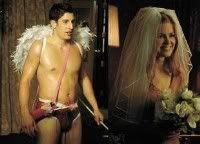
I didn’t appreciate, first of all, staring at Jason Biggs’ ass. I mean, really, did I really need to see his flashy red tuchas as it gingerly moves to and fro? On top of that I get that the premise of this comedy is just that: the guy’s almost-fiancé drops dead of a myocardial infarction and so he’s bummed as shit forever and day, even resorting to drinking pickle juice, until”¦da-da-daaaaa”¦he finds a complete stranger to propose to.

But here’s the best part! After his buddy, that creepy guy from Six Feet Under, who still oozes that slimy vibe, picks the random girl Biggs proposes to, and of course she’s one of the hottest waitresses that have never ever worked at any IHOP I’ve been at, the girl says yes.

Whoa! Comedy is sure to abound”¦

Yeah, Isla Fisher was great in WEDDING CRASHERS but as the trailer progresses, and she squeals with that very same squeal that made her such a draw to CRASHERS in the first place, you begin to sense something is amiss with the whole premise. You see, as we get further with the trailer this becomes a MEET THE PARENTS-esque kind of narrative.

The parents can’t believe that this crazy woman is now this dude’s fiancé, and vice versa, the quick bon mot tossed about by Isla’s mom asks us all, “Is he black?” Ha-ha, you dirty racist pig.

Then there’s the lingering shot of Jason’s raw, white ass. He looks like he was being caught for doing something but we’re not given a peek as to why this moment was included as I’m not sure if his new lady friend stumbles upon him, the girl’s black-hating mother or even his creepy friend. I guess it was just inserted to be ribald but whatever.

We then get treated to the wacky misadventures of getting to know one another, more parental awkwardness, some strange shenanigans while playing charades and I can’t help but feel a little queasy after Biggs shoots his wad, a pocket of toothpaste and saliva in his mouth, all over Isla’s face. I’m sure there are some people who would find that thing exotic or hot but I’m not having any of it. It’s just not amusing.

If there is one moment, just one moment, that actually feels like something that belongs in a mass-market comedy it is the moment where Isla asks to feel a fellow bus riders’ belly in hopes of finding out how long the woman has been with child. It’s not until Biggs puts his face to the chick’s pooch that we get the line, “I’m not pregnant.” That represents one moment of why I would see the film but that’s just one.

Like Booger trying to help Lane Meyer out in ONE CRAZY SUMMER, right before Jeremy Piven gets maced, I just can’t assist this trailer in any way.

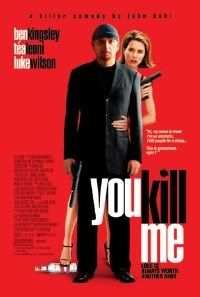
YOU KILL ME (2007)

Director: John Dahl
Cast: Ben Kingsley, Tea Leoni, Luke Wilson
Release: June 22, 2007
Synopsis: Frank Falenczyk (Ben Kingsley) is a man who loves his job. He just happens to be a hit man for his Polish mob family in Buffalo, New York. But Frank’s got a drinking problem and when he messes up a critical assignment that puts the family business in peril, his uncle (Philip Baker Hall) sends him to San Francisco to clean up his act. Played with gruff charm by Kingsley, Frank is not a touchy-feely kind of guy, but things start looking up for him. He gets a job at a mortuary, starts going to AA meetings and falls for Lauren (Téa Leoni), a quirky client he meets at the funeral home. Meanwhile, things aren’t going well in Buffalo where an upstart Irish gang is threatening the family business. When violence erupts, Frank is forced to return home and with an unlikely assist from Lauren, faces old rivals on new terms.

View Trailer:
* Large (QuickTime)

Prognosis: Negative. I liked THE MATADOR.

I realize that this was a flick that not many people were able to see but I can say that those who have saw a film that really tried to meld the axiom of “opposites attract” and pulled it off without it ever feeling terribly hokey. This seems like that kind of film: a mÈlange of situational writing mixed with some absolute absurdness.

Never minding that two of the greatest character actors working today, the honorable Dennis Farina of Old Style fame and Philip Baker Hall of every crotchety old cop part there ever was, play swift parts in establishing Sir Ben Kingsley’s role as a drunken hit man.

Regardless of you feelings about the premise on the whole I have to credit in swiftly going through what this story is about, establishing the reason why we’re here in the first place, and even making Ben seem like a funny fellow.

There is a little bit of warmth in the dude’s ability to seem like a likable hit man even in the opening moments he has with Luke “Perennial Best Friend” Wilson. Forget the easy joke about Kingsley being in San Francisco and the near requisite gay joke but when he enters a funeral home to start his new job as what looks like someone who prepares the decedent prior to the viewing the moment is handled with some aplomb.

While the narrative of the trailer suffers a bit from this point on, there is an odd moment between Tea Leoni and Ben where I think the two are flirting with one another (couldn’t he be her grandfather?) there is the moment where things come back up again where Ben confesses to his AA group that he in fact an alcoholic”¦and a hit man. Yes, it’s Middle America funny but it works.

And just like the submarine this trailer is we go back down again where I think Ben actively trains Tea on how to kill someone through a sensi/student kind of relationship. At first I think she protests about what Ben does but then she’s fully complicit in the ways in which Ben murders other people for a living. It doesn’t make sense and that’s part of the problem with the trailer. It feels like it doesn’t know what it wants to be: a funny ha-ha flick or a quasi-comedy with another gay joke tossed in there for good measure.

I can’t really pinpoint why this trailer just seems to lack any motivating call-to-action about why I should see it but I can say that it really fails to make me believe that Tea would have any romantic inkling for any other dude than one who is of her same age”¦or generation.

So, barring the love story, what we have here is a film about a hit man trying to go clean and make a go at sober living but, in the end, I don’t think this is going to be any MATADOR. It could be a buddy comedy but I can’t justify anything here that could even be close as to something I would want to pay money to see.

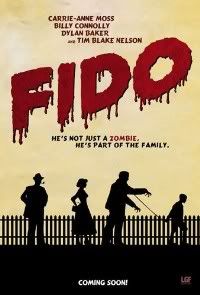
FIDO (2007)

Director: Andrew Currie
Cast:
Carrie-Ann Moss, Billy Connolly, K’Sun Ray, Henry Czerny, Dylan Baker
Release: June 15, 2007 (Limited)
Synopsis: Welcome to Willard, a small town lost in the idyllic world of the 50’s, where the sun shines every day, everybody knows their neighbor, and rotting zombies deliver the mail. Years ago, the earth passed through a cloud of space dust, causing the dead to rise with a craving for human flesh. A war began, pitting the living against the dead. In the ensuing revolution, a corporation was born: ZomCon, who defeated the legions of undead, and domesticated the zombies, making them our industrial workers, our domestic servants – a productive part of society. ZomCon would like the people of Willard to believe they have everything under control… but do they? Timmy Robinson doesn’t think so. At eleven, Timmy already knows the world is phony baloney – Mom and Dad just won’t admit it. Now ZomCon’s head of security has moved in across the street, and Timmy’s Mom refuses to be the only housewife on the block who doesn’t have a zombie of her own. When she brings a zombie servant home, Timmy discovers a new best friend, and names him Fido. And even though Dad has a bad case of zombie-phobia, Timmy is determined to keep Fido, even if he does eat the odd person…

View Trailer:
* Large (QuickTime)

Prognosis: Positive. Who would of thought that Billy Connolly would have come so far after being a replacement for Howard Hessman on HEAD OF THE CLASS? Not since Dan Schneider proved to the world that there is life after Ricky in BETTER OFF DEAD has that show produced such talent, you would’ve thought that he sunk everything with that video he made on the show to Timbuk 3’s “The Future’s So Bright I Gotta Wear Shades”.

One of the things that have really taken a foothold in America’s zeitgeist in the last few years is our propensity for and attraction to zombie films. We’ve seen zombies running fast through malls in Zack Snyder’s DAWN OF THE DEAD, we’ve seen “˜em move a little slow but with a beat you can dance to in SHAUN OF THE DEAD and we’ve even seen them remade a couple of times in the 28 WEEKS/DAYS series. What’s been missing, though, has been a real mesh between comedy and abject weirdness.

I believe this movie is exactly that.

What’s delightful, and utterly funny, is how things start. Never mind setting things up, people, let’s just get right into things with Ritter from CLEAR AND PRESENT DANGER, a film that deserves to be on the low-end of many Best Of acton/thriller lists, with asking a class filled with kids how many of them have ever had to kill a zombie. It’s said with such smoothness that the accompanying image of a zombie, in a requisite belt and shoulder strap get-up, holding a stop sign to halt oncoming traffic so the same kids can safely cross the street is a one two punch. And it works wonderfully to capture you in wondering what the hell is going on.

“What would we do without our zombies?”

The voiceover that pipes in isn’t what you would expect to chime in. It’s nice British accent that poses the above question and it’s immediate of what this question is supposed to imply. Sociologically speaking, the zombies have a role of performing all the tasks that no one else wants to do and the bigger picture of what’s been on everyone’s lips in this electoral season couldn’t be clearer. From an entertainment point of view, it’s outrageously effective. These zombies are washing cars, serving food, dropping shit on the floor accidentally, getting yelled at and not making an effort to catch the ball in a game of catch.

Never before has an embedded song been choicely picked as when The Ramones’ “I Wanna Be Sedated” starts up and when we get to the meat of what this movie is about. However, that’s not easily discernable considering that you already have a community that is using zombies as hired help.

Between the quotes from other outlets who have seen the film there is an issue I have with trying to understand where the problems arise. Where is the crux of the drama that somehow changes this sleepy hollow into something more? Do the zombies end up attacking, turning on their masters?

I think that between the quotes from others who have seen the film, the absurdity of having the youngest kid in the film taking a shovel to the rotting corpse of a zombie who he is obviously trying to do away with and the make-out session one human has with a member of the dead army is just part and parcel of a film that actually is going to take the recent obsession with zombies to the next level.

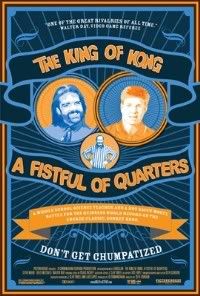
THE KING OF KONG: A FISTFUL OF QUARTERS (2007)

Director: Seth Gordon
Cast: Billy Mitchell, Walter Day, Nicole Wiebe and Robert Mruczek
Release: August 17, 2007
Synopsis: A middle-school science teacher and a hot sauce mogul vie for the Guinness World Record on the arcade classic, Donkey Kong.

View Trailer:
* Large (QuickTime)

Prognosis: Awesome. This has got to be one of the rad-est trailers to ever come down the pike. Ever.

One of the great things about not having to impress a lot of people with your trailer, the fact that you need to make money is a mere afterthought to what you decide to do with your preview money, is that it leaves the door open to innovative and creative ideas; an idea, then, that I have never really seen, or executed, before is the regressive trailer.

To feel like this is a movie straight from 1982 is an accomplishment, first of all, but to make the trailer also conform to the short attention spans of those watching these things is an amazement as well.

One of the first things you recognize, apart from the Fat Boy Slim-like techno drop, and the douche wearing that silly ass puffy yellow trucker hat that was obviously the norm, I’m betting dollars to doughnuts he was also rocking some of those striped socks that were pulled up at calf level, is that the blend between old and new is seamless. From the cheesy synth music to the slick documentary style footage of old guys reflecting on their youthful days as kids whose only ability was to rock a joystick it’s truly engaging.

I’m a little scared by dudes who sport some mullets, one of them who obviously owns a Remington beard trimmer and a copious amount of Just For Men beard darkening solution, but to hear them be straight-up serious about their sacrificing to be the best at video games is a little bittersweet.

What’s more is that we move from pathetic to hilariousness when the classical music starts in with the scroll that tells us that there is a Donkey Kong record that has stood unchallenged for 20 years and that this is really a movie about Dweeb vs. Dweeb.

The comedy that is these two dudes, one who should have found a more productive hobby in life in order to find a modicum of fame and another who should just cut that Goddamn mullet off his head, are going head to head in a race against”¦well, nothing really.

This trailer is just a good time, flat out. It makes me want to spend my money to see it, it stirs up that good ol’ nostalgia of when I was a wee lad and all I had was an Intellivision, and it surely ends on a note that not even I could have seen coming. It’s the perfect storm of idiocy and the notion that this could be a breezy way to pass 90 minutes; in an era where things can get self-indulgent real fast this is a welcome addition to the summer.

QSE News: 7/6/2007

Filed under: Columns,Thingamabobs — UncaScroogeMcD @ 12:04 am

quickstopnews.jpg

line1.gif

Here are today’s top entertainment headlines:

  • qsnews.jpgA Nebraskan micro-brewery is naming a beer in honor of Larry the Cable Guy. The beer will be named Git-R-Done. According to the micro-brew’s owner, the beer will taste like racism and stupidity.
  • In preparation for the release of its new album, the Smashing Pumpkins have announced plans for a fall tour.  Kicking off in Montreal on September 8th, the tour will run through November and hit many major US cities.  The tour has been affectionately called the “[EXPLETIVE DELETED] James and D’arcy World Tour.”
  • The film Transformers recorded the biggest Tuesday opening in history, raking in more than $27 million. The film, based on a popular line of toys, was directed by Michael Bay. Producers are pleased with the success of the film and are now looking forward to a sequel, saying, “maybe next time we’ll have money for a plot.”

line1.gif

That’s all for today’s news, stay tuned to this channel for all the news that matters least but you still care about.

(Compiled by J. Allen)

##

Quick Stop Thingamabobs: 7/6/2007

Filed under: Columns,Thingamabobs — UncaScroogeMcD @ 12:02 am

thingamabobs.jpg

The web. It’s a big place, full of plenty of distractions ““ some funny, some informative, some ludicrous, some disturbing, some inane, some profound. Each and every weekday, we present links to a few of our favorite finds”¦

————————————————

  • Fractured Fairy Tales – “Tom Thumb”… (Thingamabob)
  • Thurl Ravenscroft, and his well-known voice… (Thingamabob)
  • Rocky & Bullwinkle, Cocoa Puffs whores… (Thingamabob)

Have a THINGAMABOB? Send it in!

##

July 3, 2007

Quick Stop Thingamabobs: 7/3/2007

Filed under: Columns,Thingamabobs — UncaScroogeMcD @ 3:20 am

thingamabobs.jpg

The web. It’s a big place, full of plenty of distractions ““ some funny, some informative, some ludicrous, some disturbing, some inane, some profound. Each and every weekday, we present links to a few of our favorite finds”¦

————————————————

  • We all like bloopers, don’t we? And Don Rickles, too? Let’s see the first part of some bloopers from Rickles’s short-lived Fox sitcom Daddy Dearest… (Thingamabob)

Have a THINGAMABOB? Send it in!

##

July 2, 2007

Game On! 7-2-2007: Gamer News and Downloads

Filed under: Game On! — admin @ 7:23 pm

gameon.jpg

Has anyone noticed I’ve sort of eschewed the whole “intro” thing and gone straight into the news and reviews as of late? Huh”¦what’s up with that?

Well, another week, and another set of downloadable goodies on the Wii and Xbox Live Arcade. Today on the Wii, we’re offered up three more oldies but goodies, SUPER MARIO BROS. 2 (NES), ECCO: TIDES OF TIME (Genesis) and DRAGON SPIRIT (Turbografix 16). On XBLA this Wednesday, we have the classic MISSILE COMMAND to look forward to, just in time for Independence Day. Kinda says something, doesn’t it?

Also in the world of downloads, Tom Clancy fans may have noticed that the RAINBOW SIX: VEGAS map pack BLACK EDITION was offered and subsequently pulled, both last Wednesday. It seems it was mistakenly offered both too soon and for too much. As that was the same day that R6: VEGAS hit the PS3 (and, also offered the BLACK and previously offered RED EDITION maps included for free on the game’s disc) it’s timeliness and price were a bit of a hit to the fan’s hearts and wallets. Well Ubisoft didn’t want to hurt the Xbox loyal fans who already were playing the game to feel like the PS3 version got any perks over theirs”¦and thusly offered it again Saturday for the excellent price of FREE (much better than the previous 800 Microsoft points”¦$10 US). Apparently, this was their original intention. Not only that, but the previously offered RED EDITION will be dropped to the low, low price of FREE as well, next Saturday, July 7th. Not too shabby”¦

For those couch-bound rockers waiting for the next fret-filled entry into the GUITAR HERO series to hit multiple consoles, PS2 fans are getting a bit of an add-on with the expansion game GUITAR HERO ENCORE: ROCKS THE 80’s. While not a sequel in anyway, this expansion offers the same modes from GHII but with more spandex and lip-liner than any “Just Say No” generation kid can handle. The latest tracks announced are as follows:

  • Caught in a Mosh (as made famous by Anthrax)
  • Balls to the Wall (as made famous by Accept)
  • Electric Eye (by Judas Priest)
  • Los Angeles (as made famous by X)
  • Police Truck (as made famous by Dead Kennedys)
  • We Got the Beat (as made famous by The Go Go’s)
  • (I Think I’m) Turning Japanese (as made famous by Vapors)
  • Seventeen (as made famous by Winger)
  • Because, it’s Midnite (by Limozeen)Previously announced tracks include:
  • Hold On Loosely (as made famous by .38 Special)
  • No One Like You (as made famous by Scorpions)
  • Only a Lad (as made famous by Oingo Boingo)
  • Ballroom Blitz (as made famous by Krokus)
  • The Warrior (by Scandal)
  • What I Like About You (as made famous by The Romantics)
  • Wrath Child (as made famous by Iron Maiden)
  • I Wanna Rock (by Twisted Sister)
  • I Ran (by Flock of Seagulls)
  • Round and Round (as made famous by Ratt)
  • Metal Health (as made famous by Quiet Riot)
  • Holy Diver (as made famous by Dio)
  • Heat Of The Moment (as made famous by Asia)
  • Radar Love (as made famous by White Lion)
  • 18 and Life (as made famous by Skid Row)
  • Bathroom Wall (as made famous by Faster Pussycat)
  • Lonely is the Night (as made famous by Billy Squier)
  • Nothing But a Good Time (as made famous by Poison)
  • Play With Me (as made famous by Extreme)
  • Shaken (as made famous by Eddie Money)
  • Synchronicity II (as made famous by The Police)Personally, as a fan of 80’s music, I’m looking forward to this more than the new GUITAR HERO III.And lastly today, following the European launch of HOT PIXEL, Atari today announced the release of a playable demo of the mini-game title for PSP, available for free download now www.yourPSP.com. The HOT PIXEL demo is the first demo from another publisher ever to be made available on the site. HOT PIXEL features 200 riotous mini-games taking inspiration from old school gaming and the new school digital lifestyle. The player guides his skate geek character through an “average” day in his pixilated digital world, taking on a series of increasingly weird and comic quick-fire mini-games ranging from the subtly eccentric to the wildly outrageous, borrowing some choice moments from Atari’s colorful video game past along the way. According to Atari, the demo features “one full episode of HOT PIXEL comprising 10 mini games and a boss battle featuring tasks thrown at the player include catching marshmallows, skateboard odd-one-out and staying on a diet in the face of an onslaught of hamburgers.” Let the craziness ensue.
  • SModcast 18

    Filed under: SModcast — UncaScroogeMcD @ 1:38 pm

    newhead2.jpg

    SModcast is the meandering palaver of a pair of dudes whose voices are so dull, they don’t deserve to be on the radio (and, hence, aren’t). Kevin Smith and Scott Mosier are SModcast.

    The best thing about SModcast? It don’t cost nothing.

    line.gif

    SModcast 18: White Flight –

    In which our heroes get out of the office, debate purchasing a helper monkey, live free and “Die Hard”, get cut off in one-mile-an-hour traffic, investigate three generations of road rage, delve into the casual racism of old-timers, go “prison” with ice hooks and baseball bats, reveal mob ties, identify functioning alcoholics, reveal their hill-people secret origins, drink in the parking lot, learn the difference between “blue collar” and “white trash”, and get an iPhone.

    [CONTENT WARNING] SModcast features harsh language and even harsher notions of propriety. Listener discretion is advised.

    DOWNLOAD: (right click to save)
    SModcast 18 (MP3 format) – 35.96 MB

    [display_podcast]

    SUBSCRIBE
    Subscribe to this Podcast via iTunes
    Subscribe to this Podcast via FeedBurner

    Wanna add your two cents? Spend it here, in the SModcast mailbag.

    line.gif

    CLICK HERE FOR THE SMODCAST ARCHIVES

    line.gif

    ##

    QSE News: 7/2/2007

    Filed under: Columns,News — UncaScroogeMcD @ 1:30 am

    quickstopnews.jpg

    line1.gif

    Here are today’s top entertainment headlines:

    • qsnews.jpgMovie critic Joel Siegel passed away on Friday at the age of 63. Siegel died from complications due to Cancer. We here at QSE News offer our condolences to the Siegel family, but we also feel that Siegel’s death was a little contrived with major plot holes and poor character development.
    • Pixar’s domination continues as the new film from the company, Ratatouille, was number one at the box office. The film, about a rat aspiring to be a chef, beat out Die Hard: Live Free or Die Hard for the top spot. To capitalize on the success of the film, New York City will allow rats to cook and serve food in all city restaurants.

    line1.gif

    That’s all for today’s news, stay tuned to this channel for all the news that matters least but you still care about.

    (Compiled by J. Allen)

    ##

    Monkey Talk with Paul Dini: Lunch Time

    Filed under: Monkey Talk,Quickcasts,Video — UncaScroogeMcD @ 12:10 am

    monkeytalkheader.jpg

    -By Paul Dini & Rashy

    Paul Dini’s “Monkey Talk” (co-hosted by his irrepressible sock monkey son, Rashy) returns as Rashy and Super Rica learn a valuable lesson about pestering their mother, magician Misty Lee, to make them some lunch. Be sure to check out Rashy’s official site at LittleRashy.com…

    monkeytalk2007-07-02-03.jpg

    DOWNLOAD:
    Large
    (560 x 420 – QuickTime – 6.16 MB)
    Small (320 x 240 – QuickTime – 2.71 MB)

    ##

    Party Favors: 100 Years – 100 Beers… The 100 Greatest Films to Watch While Wasted!

    Filed under: Columns,Joe Corey's Party Favors — UncaScroogeMcD @ 12:08 am

    partyfavors1.jpg

    After reading way too many 100 Greatest movie lists from AFI, it’s time to come up with a list that truly reflects how a majority of people enjoy their cinema: Drunk on the sofa. But would those whores at AFI ask their blue ribbon panel to reveal their favorite films to watch with a six pack and a pizza? Screw ’em. Forget screwin’ those leatherskinned Lalaland puffy shirt wearing fools. We at the “Party Favors” have put together our own Pabst Blue Ribbon panel to vote and debate the greatest films to watch while wasted. Don’t argue too much about the ranking since we were drunk and our math skills went to hell. We’re still working on a TV special on Spike with Tom Sizemore hosting. Keep your fingers crossed that we can get him.

    100. Borat (2006) – This would have scored higher, but a group of dorks decided to recite every line during breakfast.

    99. Dr. Goldfoot and the Bikini Machine (1965) – Vincent Price makes an army of hot robot women in bikinis that are out to rule the world. Our only hope is Frankie Avalon. We’re doomed.

    98. Night of the Living Dead (1968) – Anybody want some sausage?

    97. The Black Cat (1934) – Boris Karloff, Bela Lugosi and a Satanic cult adds up to twisted times at a remote castle.

    96. Zardoz (1974) – Sean Connery can’t be seen sober in his freaky wardrobe.

    95. Damnation Alley (1977) – A bitchin’ van cruising around a post-apocalyptic world. We’re doomed, so get me another drink!

    94. Fritz the Cat (1972) – R. Crumb’s little cat begging to be cool in the ’60s is brought to X-rated animation.

    93. Viva Las Vegas (1964) – Ann-Margret shaking her thang at Elvis in scope is cinema!

    92. The Abominable Dr. Phibes (1971) – Vincent Price is a monster without a face getting revenge on the Doctors that couldn’t save his wife. Wonder if Phibes is mentioned in Sicko?

    91. Our Man Flint (1966) – James Coburn is going to save the world one lady at a time.

    90. Cafe Flesh (1982) – After a nuclear war, most Americans have lost their sex libidos so they go to clubs to watch other screw. The M.C. played by Andy Nichols is a stunner.

    89. Pee-Wee’s Big Adventure (1985) – This film is much better than The Bicycle Thief and it’s in English.

    88. Blow (2001) – Johnny Depp hooks America on cocaine. But he doesn’t snort any lines off Penelope Cruz’s ass.

    87. Cannonball Run (1981) – How come Hollywood doesn’t make great movies anymore? Damn you, Judd Apatow!

    86. National Lampoon’s Vacation (1983) – The last time Chevy Chase was funny.

    85. Big Lebowski (1998) – You better have all the makings for a White Russian before pressing play.

    84. Freaked (1993) – The power of transformation at its peak.

    83. This Is Spinal Tap (1984) – Your TV volume needs to go to 11.

    82. Bachelor Party (1984) – Adrian Zmed rules the universe.

    81. Airplane (1980) – Mrs. Cleaver knows how to talk jive.

    80. The Godfather I & II (1972) – Do not watch III. No Fredo, no movie.

    79. Orgazmo (1997) – The South Park boys mix crime fighting, Mormonism and porn into a tribute to The Sexorcist.

    78. Goodfellas (1990) – Try matching your shots with Henry Hill’s shots.

    77. Steamboat Bill, Jr. (1928) – The town falls down around Buster Keaton.

    76. Dolemite (1975) – Has there ever been a badder pimp than Rudy Ray Moore? This film goes up a star with every beer.

    75. Horse Feathers (1932) – Marx Brothers destroy a college.

    74. Bill and Ted’s Excellent Adventure (1989) – Dude, we’re time traveling!

    73. Sid and Nancy (1986) – So damn punk rock. You’ll never stop mocking Rod Stewart and limos after seeing this.

    72. Clerks (1994) – Ron Jeremy used to be able to pleasure himself without snapping his neck.

    71. Transformers (1984) – Orson Welles will destroy us all!

    70. Breakfast Club (1985) – Ally Sheedy was hot before Molly Ringwald slathered her in whore paint.
    69. Buffy the Vampire Slayer (1992) – Now she’s Buffy, the Husband with a Pregnant Wife Stealer.

    68. Withnail & I (1987) – Do not attempt to match drinks with Danny.

    67. Team America: World Police (2004) – Puppets having German style sex is all the rage.

    66. Heavy Metal (1981) – The future of animation is rather raunchy.

    65. Starship Troopers (1997) – Doogie Howser saves the Earth!

    64. Raising Arizona (1987) – Randall “Tex” Cobb is coming for you, too.

    63. 2001: a Space Odyssey (1968) – See you next Wednesday.

    62. El Topo (1970) – This western is not to be viewed with a sober mind.

    61. Blue Velvet (1986) – Frank Booth will rock your world.

    60. The Party (1968) – Peter Sellers plays an Indian actor (from the country) that after destroying a movie, accidentally gets invited to a Hollywood big shot’s party. He turns this social event into a disaster zone. There’s even an elephant.

    59. The Wedding Singer (1998) – The last time I thought Drew Barrymore was tempting. And I do want to hurt that Dead or Alive clone.

    58. Spice World (1997) – The return and death of kitsch cinema. Did any English actor turn down a cameo gig?

    57. Fight Club (1999) – You know who I want to fight? Arnold the Pig.

    56. Last Tango in Paris (1972) – You’ll want to see this film with someone you love and plenty of butter.

    55. Spy Who Loved Me (1977) – The birth of the cheesy Bond. Roger Moore is all quips and we get him fighting Jaws. Plus there’s sharks. Bonus comes with Caroline Munro.

    54. Austin Powers: International Man of Mystery (1997) – Remember when Liz Hurley was hot in that Emma Peel leather jumpsuit?

    53. Shaft (1971) – Don’t watch that weak remake. This is the real deal with John Shaft keeping the mob out of Harlem.

    52. Beyond the Valley of the Dolls (1970) – Roger Ebert and Russ Meyer give us the true story of Josie and the Pussycats. The soundtrack is still groovy.

    51. The Wild Bunch (1969) – Sam Peckinpah’s masterpiece about a crew of robbers that get tangled up in a Mexican arms deal. Forget Marty, this is Ernest Borgnine’s greatest screen role.

    50. The Good, The Bad and the Ugly (1966) – Clint Eastwood’s final Spaghetti Western is an epic on all levels. We might know his name, but he’s so badass, you won’t want to get his attention.

    49. Captain Kronos – Vampire Hunter (1974) – Enough of the blood sucking, bring on more Caroline Munro.

    48. Creature from the Black Lagoon (1954) – Shame the video isn’t out on 3-D. Would be nice to be buzzed and having Julia Adams swim into my lap.

    47. Man Who Fell to Earth (1976) – David Bowie is a space alien who….I’m not sure what the hell is going on. But after a little refreshment, the plot just flows over me.

    46. Aguirre Wrath of God (1972) – Werner Herzog and Klaus Kinski go into the rain forest to show us pure insanity.

    45. Taxi Driver (1976) – A lot of guys bring dates to see this movie.

    44. Muppet Movie (1979) – You know the secret to the “Rainbow Connection?”

    43. The Birds (1963) – Hitchcock reminds you why its important to eat chicken.

    42. Slap Shot (1977) – The ultimate sports film. Paul Newman thinks he can save his minor league hockey team by bringing a brutal edge to their play. He trades for the Hanson brothers. While trio looks like helpless geeks, they put the “oon” in goon.

    41. Hard-Boiled (1992) – Remember when you were pumped up to see a new John Woo film? Rumor has it that after making this film, John choked to death on a shell casing and his brother Ron Woo flew to America to make gems like Broken Arrow.

    40. Super Fly (1972) – Big pimpin’ as the Priest makes the deal of his life.

    39. Boogie Nights (1977) – Burt Reynolds is a porn filmmaker who likes to keep his work at home. What happened to Heather Graham? Get the bonus DVD to see her extra topless scene.

    38. Barbarella (1968) – Jane Fonda stripping down in zero gravity. Stephen Colbert stole my DVD. Sci-Fi hasn’t looked any sexier. Bring on the future.

    37. Blues Brothers (1980) – Make sure you only watch the extended cut with more John Lee Hooker.

    36. Fast Times At Ridgemont High (1982) – Whenever anyone wonders what makes America so great; show them the clip of Phoebe Cates getting out of the pool.

    35. Bad News Bears (1976) – Try to match Coach Buttermaker. And if you’re a tenderfoot, just equal Kelly Leak.

    34. Ilsa, She Wolf of the SS (1975) – An epic of sex and violence. They’re going to
    remake it with Jessica Simpson.

    33. The Cook, The Thief, His Wife and Her Lover (1989) – Don’t order the special.

    32. A Clockwork Orange (1971) – Caution: You will start speaking like Alex after one screening, my little droogies.

    31. Friday the 13th (any of them) – Another reason to avoid working at summer camps.

    30. Hellraiser (1987) after a couple shots, you might attempt the Pinhead look. Remember to take a pic and put it on your profile page.

    29. Abbott and Costello Meet Frankenstein (1948) – All the monsters at one low price.

    28. Commando (1985) Remember, Arnie, when I promised to pick you last? I lied.

    27. Pink Flamingos (1972) – A great test for seeing who has the queasiest stomach.

    26. Enter the Dragon (1973) – Bruce Lee’s defining film. He goes undercover to spy at a tournament of death. He’s saving the world with only his fists and feet. And a couple cool martial arts weapons that we used to buy at flea markets.

    25. True Romance (1993) – Brad Pitt stole the film by smoking weed out of a honey bear.

    24. Animal House (1978) – After the first round of refreshments, put on your best bed sheets.
    Don’t follow these instructions while watching Birth of A Nation cause that might lead to trouble.

    23. Cobra (1986) – The greatest opening 20 minutes in cinematic history. As Sly says, “You’re the disease, and I’m the cure.” Cure to sobriety!

    22. Invasion U.S.A. (1985) – Chuck Norris saves us from the terrorists. How come Chuck isn’t in charge of Homeland Security?

    21. On Her Majesty’s Secret Service (1969) – If there was one thing I learned from Raymond J. Regis, it was that this Bond adventure is criminally underplayed during Bond marathons. George Lazenby was the best Bond for this flick.

    20. Orca (1977) – Best moment is when the Killer Whale nibbles off Bo Derek’s leg. “Like a pretzel,” my dad said in the theater.

    19. The Silencers (1966) – Dean Martin is superspy Matt Helm. This might be the last film to glamorize drinking and driving. Dean has a wet bar in his car. This is where Austin Powers swiped the mojo.

    18. Death Drug (1978) – An epic in the career of Philip Michael Thomas. This was supposed to be a short anti-drug film, but after Miami Vice, the producers padded the movie with every frame of film shot and new video footage in front of a curtain. PMT is a musician who gets his big break with the Gap band on the same night he gets hooked on PCP.

    17. All Monsters Attack (1969) – Godzilla and the other monsters get mind controlled by aliens and rampage around the globe. Does Nationwide cover your car getting crushed by Rodan?

    16. Scarface (1983) – You can’t get on MTV Cribs without this DVD in the collection.

    15. Idiocracy (2006) – Mike Judge gives us a realistic view of America where we’ve evolved into one Springer Nation. I want a handjob when I go to Starbucks.

    14. Any Three Stooges Short with Curly – Don’t settle for Joe Besser.

    13. Death Race 2000 (1975) – A cross country race where drivers get bonus points for running over people. Paris Hilton will be in the remake as a pedestrian.

    12. King of New York (1990) – Christopher Walken is a singin’ and dancin’ drug lord.

    11. Better Off Dead (1985) – Curtis Armstrong is the greatest actor of his generation to never get called the greatest actor of his generation by Roger Ebert.

    10. Eraserhead (1977) – Remember that Hostess Snowballs can be used as a beauty aid.

    9. Harold and Kumar Go to the White Castle (Unrated) (2004) – Doogie Howser sniffing cocaine off a stripper’s ass while speeding down the highway. How are we supposed to believe Neil Patrick Harris is gay?

    8. Friday (1995) – Another great performance from Tiny “Zeus” Lister Jr.

    7. Saturday Night Fever (1977) – The irony of this film is that its anti-disco. You doubt me? What happens at the end of the film? Travolta discovers the disco lifestyle is false. He realizes that his dancing can go before

    6. Disco Godfather (1980) – Put your weight on it! Rudy Ray Moore is the greatest disco DJ. But he has to stop the angel dust invasion when it ruins Bucky, a basketball superstar. Attack the Whack. Whack the Attack. Or Attack Whack.

    5. Faster Pussycat Kill! Kill! (1965) – A trio of strippers terrorize the desert in their sports cars.

    4. Drunken Master (1978) – Jackie Chan learns how to fight by getting boozed up. That’s the best way to kick ass, kids. The sequel is also worth watching if you’re still buzzed from the first round of fights.

    3. Can’t Stop the Music (1980) – All bow down before the power of the Guttenchest!

    2. Strange Brew (1983) – SCTV favorites Bob and Doug McKenzie arrive on the big screen. They go to work at the Elsinore Brewery and discover its dark secret.

    1. Smokey and the Bandit (1977) – The greatest movie ever about a beer run. All must worship the treasure that’s Jerry Reed!

    Keneteph’s Corner: My Favorite Things “Cali” – Hunnypot Radio

    Filed under: Columns,Keneteph's Korner — UncaScroogeMcD @ 12:06 am

    keneteph.gif

    Broadcasting out of LA comes the sweet sounds of Hunnypot radio. This is a show that is all about the many genres of music, and the different emotions that it pulls out of life lovers. They play indie, underground, and mainstream artists and groups alike, so a diverse audience of listeners will find something that appeals to their tastes. Industry music supervisors DJ Hot Tub Johnnie, PJ Bloom, and Shok host the radio show. It is one light, live party, where the listener will be able to tell the DJs are having fun.

    The great thing about this show is that although they are music industry professionals, they are truly about the music. It’s all about breaking new artists, playing great music, and not what some corporate guy in a suit wants them to play! DJ Hot Tub recently took some time out to tell me more about the radio show, and his experience as a music supervisor at Windswept Pacific.

    keneteph2007-07-02-01.jpg

    THAAHUM: How long have you been DJ-ing, and what do you do at Windswept?

    keneteph2007-07-02-02.jpgDJ HOT TUB: All my life. At 15 I would DJ at different high school parties. I’ve been in the entertainment industry for 18 years, and now run the film & TV department at Windswept Pacific, which allows me to truly pursue my love of music & find new artists. At Windswept, I’m the Senior VP of TV and music – a lifestyle choice. Basically, I get to absorb the music scene. I enjoy finding opportunities for artists and know how to interact with people. The movie industry is helping out a lot of artists because they see great music as an opportunity to market films.

    THAAHUM: How did you get your start in the industry?

    DJ HOT TUB: Coming out to LA & developing business relationships by interning my way into music and film industry.

    THAAHUM: How did Hunnypot Radio come about?

    DJ HOT TUB: Hunnypot Radio was started as a way to find the best artists. It was a collaborative effort between me and other individuals in the film, TV, and music community.

    THAAHUM: What has been the response since its debut?

    DJ HOT TUB: Tremendous! Most of the response has been “inner industry,” from others involved in film and TV. We are a close community and close to our listeners. People like that we play what we play. We aren’t getting any money out of this, so it allows us to play a diverse amount of music, without having to go thorough any red tape.

    THAAHUM: What is your opinion of the state of music right now?

    DJ HOT TUB: As an art, its essence will never die. Humans connecting with what moves them will always be there. Music may be like water one day – abundant, with all different types easily accessed by all.

    Hunnypot radio airs every Monday from 7-10 pacific time and rebroadcasts throughout the week. Go to www.myspace.com/hunnypotradio to check them out, and www.hunnypotunlimited.com to check out their show.

    -Copyright 2007 Keneteph Entertainment

    Quick Stop Thingamabobs: 7/2/2007

    Filed under: Columns,Thingamabobs — UncaScroogeMcD @ 12:02 am

    thingamabobs.jpg

    The web. It’s a big place, full of plenty of distractions ““ some funny, some informative, some ludicrous, some disturbing, some inane, some profound. Each and every weekday, we present links to a few of our favorite finds”¦

    ————————————————

    • Let’s kick off the week with a classic dominoes bit from The Tonight Show with Johnny Carson… (Thingamabob)
    • Wallace & Gromit in “The 525 Crackervac”… (Thingamabob)
    • A very funny sketch from a 1959 Sid Caesar special… (Thingamabob)
    • Chad Vader – Day Shift Manager: Episode 1… (Thingamabob)

    Have a THINGAMABOB? Send it in!

    ##

    June 29, 2007

    Comics in Context #183: The Quality Of Mercy

    Filed under: Columns,Comics in Context — admin @ 1:30 am

    comicsincontext4.jpg

    cic2007-06-18-1.jpgLast week I wrote about how in Spider-Man 3 director Sam Raimi and his collaborators used the alien sentient “black costume” from the comics as a means of investigating the dark side of the title hero’s personality. When he wears it, the black costume draws out and magnifies Spider-Man’s his capacity for rage and violence and his egotism, which Raimi calls his “pride”. Later, Spider-Man’s dark side takes externalized form in the figure of Venom, the bonding of Peter Parker’s rival Eddie Brock (who in the film looks something like him) with the black costume.

    The “evil twin” is a standard motif of the superhero genre. But before the Marvel revolution of the 1960s, the heroes of the superhero genres, with few exceptions (such as the Sub-Mariner) were morally perfect, save for trivial faults like Barry Allen’s proclivity to be late whenever he wasn’t in costume as the Silver Age Flash.

    It was Marvel that introduced the concept that the superhero had an inner “dark side” against which he must struggle, whether it is the Thing “going bad” in Stan Lee and Jack Kirby’s Fantastic Four in the 1960s or Wolverine striving to overcome his “berserker rages” in Chris Claremont and Frank Miller’s 1982 Wolverine limited series. In the classic Marvel tradition the superhero can overcome his dark side and achieve, or at least progress towards, redemption, as Peter Parker/Spider-Man does in Spider-Man 3.

    Sam Raimi and his brother Ivan, who collaborated with him on the story for Spider-Man 3, intended to have the title character reevaluate his conception of both himself and his adversaries. In the previously quoted interview, Sam Raimi states that he and Ivan believe that Peter Parker “considers himself a hero and a sinless person versus these villains that he nabs. We felt it would be a great thing for him to learn a little less black and white view of life and that’s he not above these people. He’s not just the hero and they’re not just the villains. They were all human beings and that he himself might have some sin within him and that other human beings, the ones he calls criminals, have some humanity within them and that the best we can do in this world is to not strive for vengeance, but for forgiveness.”

    The need for forgiveness is the great theme of Spider-Man 3, although each review of the film that I’ve read so far ignores it. (Most of the rest of this week’s column is about the ending of Spider-Man 3, so consider yourselves given a spoiler alert.)

    Even before he dons the black costume, the Peter Parker of Spider-Man 3 engages in what Sam Raimi calls the sin of “pride,” becoming so swept up in his egocentric pleasure in the fame of his costumed persona to distance him from the woman he loves, Mary Jane Watson.

    Perhaps it’s not just pride that is Peter’s failing, but also an inability to see and understand things from another person’s point of view. In the early part of the movie, even as Spider-Man reaches a new height of popularity among the people of New York City, Mary Jane suffers a serious reversal in her career. She is fired from a starring role in a Broadway musical right after opening night, and soon thereafter ends up working as a singing waitress in obscurity, as if she had become a nonperson in the acting profession. The Beat perceptively pointed out the similarity to A Star Is Born (albeit with the sexes reversed), with one lover rising in his career while the other descends.

    When Mary Jane tries to explain her feelings about her career reversal to Peter, he cheerfully tells her that it’s not so bad, that it’s like the way Spider-Man used to be unpopular, but his fortunes changed for the better and so will hers. Peter is so swept up by his joy and, yes, pride, in Spider-Man’s new popularity that, despite his good intentions towards her, he is nonetheless oblivious to the emotional pain that she feels, that cannot easily be soothed by a blithe reassurance that things are bound to get better. Peter, as Spider-Man, has achieved the success, fame, and popularity that she presumably sought through her acting career. Now that she has failed, she presumably envies and perhaps resents Peter’s success, and his inadequate empathy for her runs the proverbial salt in her wound.

    Perhaps this is the Raimi brothers’ point: that the self-centeredness of pride precludes empathy for the feelings of other people. The prideful man feels that the world revolves around him alone.

    Although she does not go to the extremes that Peter does, under the influence of the black costume, Mary Jane arguably has similar character flaws. Why doesn’t she tell him about the bad reviews she received or that she was fired from the Broadway show? Is it her own pride? Moreover, she is so lost in her own sorrow over her failure in her own ambitions, that she doesn’t share Peter’s joy in Spider-Man’s new popularity. She shows him no more empathy and understanding than he does towards her.

    Mary Jane’s Broadway catastrophe doesn’t make sense. If her singing voice is supposedly too weak to carry past the first row, wouldn’t the director or producers or conductor or someone have noticed before opening night? Like during her audition? Weren’t there any preview performances? And if no one can hear her past the first row, then why do we see and hear the entire opening night audience applaud after her number? More importantly, don’t the movie’s writers know that for many years all Broadway musical performances have been electronically amplified? Even if Mary Jane had a weak, soft voice, she would have been outfitted with a microphone so that she could be heard clearly even in the back of the balcony.

    Furthermore, I’ve been following Broadway theater for decades, and I cannot recall ever reading that an actor was fired from a show immediately after the opening performance. The closest case I can think of was when British actor Henry Goodman was fired as Nathan Lane’s replacement in the Broadway musical version of The Producers, but that wasn’t because of Goodman’s singing ability, and it was during previews, not after the opening night for the new cast. For a leading actress to be fired the day after opening on Broadway is therefore so unusual that it would make headlines in New York newspapers, including The Daily Bugle. Doesn’t Peter Parker, Bugle freelance photojournalist, read the Bugle or some other paper? Wouldn’t he be interested in reading reviews of his girlfriend’s Broadway show? How could he not know that she had been badly reviewed and fired? Don’t Peter and Mary Jane have friends who would ask him about her being fired?

    Moreover, Spider-Man 2 established that Mary Jane already had a burgeoning career as a model (with her face omnipresent on posters in one scene) and on stage (as one of the ingenues in that production of The Importance of Being Earnest). It seems odd that she would immediately be reduced to being a singing waitress. Doesn’t she have an agent? And if her voice isn’t that good, why would she be hired as a singing waitress? It’s not as if she would have no competition for the job in a city full of young, unemployed musical performers.

    This is a paradox of the superhero genre. I, and moviegoers like me, am willing to suspend my disbelief sufficiently to accept a guy with super-strength who shoots webbing from his hands or a man who has been transformed into a sentient creature made of sand. But I won’t suspend disbelief when it comes to things from real life, like amplification in Broadway theaters.

    Furthermore, some coincidences are more credible than others in superhero fiction. One of the coincidences upon which Spider-Man’s origin is founded is that the Burglar whom Spider-Man refused to stop is the same man who later murders his Uncle Ben. This coincidence derives its dramatic power in the origin story from its very unlikeliness. It is improbable that Spider-Man would have previously encountered his uncle’s killer, but it is not impossible. Spider-Man could not have foreseen that the Burglar would kill Uncle Ben, but he should have recognized that the Burglar would have gone on to commit other crimes, perhaps including murder. It is powerfully ironic that the Burglar’s next victim turned out to be Peter’s own uncle. (The first movie implies that the wrestling arena that the Burglar robbed was close to the spot where he encountered Uncle Ben, thus making the coincidence more credible.)

    On the other hand, Spider-Man 3 presents a whopper of a coincidence: the meteor bearing the sentient symbiote just happens to land in Central Park right near Peter Parker.

    The comics made the symbiote’s presence on Earth seem more logical, at least for a fictional world in which interstellar travel is possible: Spider-Man brought the “black costume” back from the planet that was the setting of Marvel Super Heroes: Secret Wars. One can hardly expect Spider-Man 3 to recap that series; in fact, as far as we know from the Spider-Man movies, the world it depicts has neither interstellar travel nor other superheroes. (With the movie rights to different Marvel heroes parceled out to different studios, as yet we haven’t seen “the Marvel Universe” in which they co-exist depicted in a live action film.) With its three villains Spider-Man 3 is already fairly long, so I can understand that the filmmakers didn’t want to spend time on a lengthy explanation of how the symbiote found Spider-Man. But surely they could have done better than this. Since Peter Parker, in both the comics and the films, is a brilliant science student, what if he had seen the meteorite on display in a laboratory or a museum or even at his alma mater, Columbia University, and the symbiote, hidden within it, emerged upon sensing the presence of a being with superhuman powers?

    Even if the Broadway part of the movie’s plot is full of logical holes, what is more important is that it serves as a catalyst for distancing Peter and Mary Jane from one another. It is possible that Mary Jane reads too much into Peter’s friendship with Gwen Stacy in the movie and the fact that, as Spider-Man, he kisses her while suspended upside down, duplicating the famous kiss he gave MJ in the first film. On the other hand, once he is under the spell of the black costume, Peter flirts with Betty Brant and brings Gwen to the restaurant where Mary Jane works to make MJ jealous. Perhaps in watching Spider-Man kiss Gwen, Mary Jane recognized that Peter already was tempted to stray from fidelity, and the black costume amplified this tendency.

    It may also be that Mary Jane reacts so strongly to suspicions of Peter’s infidelity because she feels the temptation herself. As she drifts away from Peter, Mary Jane draws closer to her former boyfriend Harry Osborn, although one they kiss, she realizes she has gone too far.

    Before that kiss, there’s a charming sequence in which MJ and Harry spontaneously break into dancing the Twist. Both the Beat and The Village Voice have observed a retro feel to Spider-Man 3: consider, for example, that in her Broadway musical MJ sings an Irving Berlin standard, “They Say It’s Wonderful.” The Twist, which was popular from 1960 to 1962, was already dated when Mary Jane made her debut in the comics in 1966.

    In the past I have complained that the movies’ Mary Jane lacks an important element of her comics counterpart: the party girl side of her personality, which first attracted Peter to her, and through which she escapes her own sorrows, just as Peter escapes his through the persona of the wisecracking Spider-Man. In the 1960s Stan Lee and John Romita Sr.’s Mary Jane got a job as a go-go dancer, which suited that side of her personality (see the cover to Amazing Spider-Man Vol. 1 #59. I suspect that the Twist scene in Spider-Man 3 is Sam Raimi’s long overdue acknowledgment of that side of the comics’ Mary Jane.

    Under pressure from Harry, after he reverts to seeking vengeance on Spider-Man, Mary Jane breaks up with Peter. Harry has threatened to kill Peter if she didn’t, but her rejection still seems like a betrayal? (Why didn’t she just tell Peter that Harry was making her do it? Is this her pride yet again?) Later, after he brings Gwen to the restaurant where she works, Peter strikes MJ so hard she falls to the floor. It was inadvertent, but Peter nonetheless blames himself, and this is the turning point when he decides to rid himself of the black costume.

    In the film’s last scene, Peter and Mary Jane make a new start to their relationship. They are thus forgiving each other, and perhaps each is also trying to make up for his or her own behavior towards the other.

    More surprisingly, the movie extends forgiveness towards two of its villains.

    In the first Spider-Man movie Harry Osborn’s father Norman is the Green Goblin, who dies in combat with Spider-Man when he is inadvertently impaled by his own flying glider, as in the comics. Harry blames Spider-Man for his father’s death. (Note the parallel: Peter and Harry each seek vengeance for the death of a father figure.) In the second movie Doctor Octopus captures Spider-Man for Harry, who unmasks him. Harry also has a vision of his father, who, like the ghost of Hamlet’s father, urges him to avenge his death, and Harry discovers a secret room with the Goblin’s arsenal.

    Does Harry only imagine seeing and hearing his father’s ghost, in which case Harry is genuinely nuts? Or is the ghost of Norman Osborn real? I like the fact that Raimi keeps the matter ambiguous, whereas so many comics writers, intolerant of mystery, would insist on answering the question one way or the other. I don’t know if the filmmakers know this, but Norman appeared to Harry as a “ghost” in Spectacular Spider-Man #183 (1991). (At the time the comics writers and editors considered Norman to be dead, although, perhaps inevitably, he turned up alive years later.)

    Early in Spider-Man 3 there is a spectacular aerial battle between the vengeful Harry, mounted on one of the Green Goblin’s gliders, and Spider-Man. Although the movie does not give Harry a supervillain alias, licensing tie-ins refer to him as “the New Goblin” (such as in the title of Danny Fingeroth’s children’s book Spider-Man 3: The New Goblin, which you can find here). Once again I find myself wondering why the filmmakers could not do better. They didn’t put Harry in a Green Goblin costume, presumably to keep the emphasis on his true identity: when this Goblin attacks Spider-Man, it is Harry Osborn attacking his longtime friend Peter Parker, who, for the same reason, is unmasked in this fight scene. If he wore the Green Goblin’s mask and costume, Harry would be seen as taking on the identity of his father, instead, as he did in the comics. So that’s why they don’t call Harry the second Green Goblin. But I can’t improve upon New Yorker film critic Anthony Lane’s comment about “the New Goblin, whose name sounds like a small-circulation poetry magazine”. I would have called Harry the Hobgoblin, even though in the comics that was the name of a different imitator of the original Green Goblin.

    Severely injured in the battle, Harry develops amnesia, forgetting that Peter is Spider-Man and that Spider-Man supposedly killed his father. This seems too convenient for some reviewers to accept. But it is in the tradition of the Amazing Spider-Man comic books when Stan Lee wrote them, in which Norman Osborn repeatedly suffered amnesia, causing him to forget his Goblin identity and that Peter Parker was Spider-Man. In the comics Harry also blamed Spider-Man for his father’s death. learned that Peter Parker was Spider-Man, and became the second Green Goblin to avenge him; at one point Harry suffered a concussion, causing him to forget Spider-Man’s true identity.

    In the comics Norman Osborn had Multiple Personality Disorder: an explosion of a green chemical (that was later credited with endowing him with super-strength) gave Osborn an alternate personality, that of the Green Goblin. When Norman suffered amnesia, that alternate personality disappeared into his subconscious. Notice that when this first happened, in Amazing Spider-Man Vol. 1 #40 (1966), Spider-Man decided not to turn Osborn over to the police, and to conceal the fact that he was the Green Goblin. Spider-Man reasoned that, as the Goblin, Osborn was mentally ill, and that Osborn, now that he has been restored to his normal self, should not be held responsible for the actions of his mad, alternate personality. In other words, Spider-Man showed mercy towards the man who was arguably his greatest foe.

    Similarly, in Spider-Man 3, when Harry loses his memory of his actions as “the New Goblin,” Peter shows him forgiveness by once more treating him as his best friend.

    Oddly, it appears in the film that Peter had never told Mary Jane that Harry knew he was Spider-Man and posed a danger to him. Why not? Didn’t he think she could handle the knowledge? Didn’t it occur to Peter that Harry might menace Mary Jane as well, as indeed he does later in Spider-Man 3? Another aspect of the self-centeredness of Peter and Mary Jane in Spider-Man 3 is that they don’t communicate with each other about subjects of importance to them both, indicating a lack of trust. After all, at the end of the first movie Peter left MJ at the cemetery, telling himself his unwillingness to share his secret with her was for her own safety. In Spider-Man 2 Mary Jane learns that Peter is Spider-Man by accident, not because he decided to tell her.

    After Mary Jane kisses Harry but then immediately rejects him as a lover in Spider-Man 3, Harry’s full memories return, presumably because MJ’s rejection reawakened his resentment towards the man she does love, Peter Parker. Harry again becomes Peter’s enemy, threatening to kill him unless Mary Jane breaks up with Peter; Harry then boasts to Peter that Mary Jane now loves him instead. Under the black costume’s influence, Spider-Man engages in a brutal battle with Harry at his palatial apartment, ending in an explosion that might have killed him. Earlier Spider-Man had tried to kill the Sandman; now we see that Spider-Man has fallen so far into the “dark side” that he would leave his former best friend for dead. Harry survives, but half his face is scarred. Like the black costume for Spider-Man, this is a visual metaphor for the dark side of Harry’s soul, like the scars on Doctor Doom’s face, or, more to the point, the scarred half of Two-Face’s visage in Batman.

    Sam Raimi and company blame Harry’s hatred of Spider-Man on yet another lack of communication. In their exchanges with each other, Peter/Spider-Man never explained to Harry exactly how Norman Osborn died. In Spider-Man 3, Harry’s butler, who used to work for Norman, finally tells him that he examined Norman’s lethal wound and discovered it was caused by accident.

    This raises a batch of questions. Why did the butler wait until now, presumably years after Norman’s death, to tell Harry this? How could the butler, who presumably is not a physician, tell by looking at the wound that Spider-Man wasn’t responsible for causing it? When Spider-Man brought Norman’s body to the latter’s home, wouldn’t Harry have called doctors and morticians? If a butler could tell Norman was impaled accidentally, wouldn’t they have figured this out, too, and told Harry? What did Harry tell the police about his father’s death, and why didn’t he gave them hunt down Spider-Man as the accused killer? And if you were Norman Osborn’s butler, and knew he was the Green Goblin, wouldn’t you phone the police and then head for the hills?

    As a result of the butler’s confession, Harry realizes he was wrong about Spider-Man. Later, Spider-Man persuades Harry to team up with him, as the “New Goblin,” to save the woman they both love, Mary Jane, from her captors, Venom and the Sandman. Harry and Peter effectively forgive one another, help each other during the climactic battle with Sandman and Venom, and Harry dies heroically in combat.

    I found the conclusion of Harry’s story more satisfying in Spider-Man 3 than it was in the comics, where by the nature of endless comics continuity, it stretched out for decades, with Harry going back and forth between being Peter’s friend and Spider-Man’s enemy, as new writers and editors came and went. I prefer Harry’s redeeming himself through a heroic death in Spider-Man 3 to his death in bed, poisoned by the formula that had given him the Goblin’s powers, in Spectacular Spider-Man #200 (1993). But in the comics, too, Harry had redeemed himself just before his death by saving Mary Jane’s life, and was reconciled with Peter on his deathbed. Harry asks Peter for forgiveness and receives it in his final moments.

    The most dramatic–and surprising–act of forgiveness in Spider-Man 3 comes when Peter/Spider-Man forgives the Sandman for what one might well have considered the most unforgivable act in the Spider-Man mythos: the killing of Uncle Ben. According to Spider-Man 3, it was not the Burglar from the first film –and from Spider-Man’s comics origin in Amazing Fantasy #15 (1962)–who killed Peter’s Uncle Ben, but the Burglar’s partner-in-crime, Flint Marko, who later is accidentally transformed into the Sandman, a being whose body has been converted into a sand-like substance. Upon learning that Marko was the killer, Peter Parker is bent on vengeance, just as he was when he confronted the Burglar in the first movie. Under the influence of the black costume, Spider-Man’s vengeful rage turns literally murderous, and he attempts to kill the Sandman in their battle in the subway. To avenge a murder, Spider-Man is willing to become a murderer himself, although, as noted, the Sandman turns out to be virtually indestructible.

    The Sandman likewise tries to kill Spider-Man and in the movie’s final act teams up with Venom to endanger the life of Mary Jane. So Marko is hardly an innocent.

    Here I’d like to add that the Sandman is the only case I can think of in which the movie version of a superhero comics character represents an improvement on the comics original. Computer animation gives a better sense of what it would be like to see a human composed of sand (or a substance like it), and despite all the amazing ways that Jack Kirby and Steve Ditko portrayed the uses of Sandman’s powers, I feel that the Kong-sized sand giant of Spider-Man 3 tops them all.

    Towards the end of the film, the Sandman explains to Spider-Man, who is at that point unmasked, that he did not mean to kill Ben Parker: he was holding him up, but his partner, the Burglar, startled him, and Marko’s gun went off, killing Ben (as we see in flashback). Moreover, Marko says that he committed crimes in order to get money to pay for the medical treatment of his young daughter Penny, whom we saw earlier in the film. Peter believes Marko’s story, forgives him for Ben’s death, and allows him to escape. (So this time Spider-Man let Ben’s killer escape for what Sam Raimi and his co-writers believe is the right reason.)

    Forgiveness may seem to be an odd theme for a work in the superhero genre, which so often features villains who incarnate evil in human form. It is inconceivable that, say, Jack Kirby’s supreme villain Darkseid should ever be forgiven for his crimes.

    Nonetheless, forgiveness is a recurring theme in Stan Lee’s Silver Age comics. As I mentioned, there is the mercy that Spider-Man shows to Norman Osborn, once his Green Goblin personality has been suppressed. Before that, Lee and Ditko presented the case of Daily Bugle reporter Frederick Foswell, who was secretly Spider-Man’s foe, the criminal mastermind called the Big Man (in Amazing Spider-Man Vol. 1 #10, 1964). But after Foswell served time in prison, Bugle publisher J. Jonah Jameson gave him a second chance, Foswell went straight, and he ultimately repaid Jameson by dying heroically in saving his life (in Amazing Spider-Man Vol. 1 #52, 1967). But in Marvel’s Silver Age comics redemption did not necessarily require that the repentant character die in expiation of his sins.
    Lee also showed forgiveness to three of his early supervillains, Hawkeye, Quicksilver and the Scarlet Witch, by having them reform and become members of his superhero team, the Avengers.

    Sam Raimi and company may be aware of the Sandman’s own journey towards redemption in the comics. Various writers have pointed to Tom DeFalco’s story in Marvel Two-in-One #86 (1982), in which the Sandman becomes friends with his former enemy, the Thing. But it was Roy Thomas who first showed a morally decent side to the Sandman by revealing in Marvel Team-Up #1 (1972) this hardened criminal’s devotion to his aged mother, Mrs. Baker. Marko’s young daughter Penny is the movie’s counterpart for Mrs. Baker.

    Looking back, we can now see that Raimi’s theme of forgiveness and redemption was emerging in Spider-Man 2. There was Peter’s confession to Aunt May that he had let the Burglar escape before he killed Uncle Ben; stunned at first, May later forgives Peter. Raimi even allows the film’s villain, Doctor Octopus, one of Spider-Man’s greatest archfoes in the comics, to become reconciled with Peter/Spider-Man and to redeem himself through sacrificing his life to save New York City.

    If you carefully read Doctor Octopus’s origin story in the comics, you will see that, as with Norman Osborn, the explosive accident that endowed him with super-powers also gave him an alternate, evil personality. Norman Osborn and Dr. Otto Octavius are like Dr. Jekyll; the Green Goblin and Doctor Octopus are their Mr. Hydes (see “Comics in Context” #45). In Spider-Man 3 the black costume draws out a Hyde-like side of Peter Parker’s personality. Both Spider-Man 2 and 3 have as a supporting character Dr. Curt Connors, who in the comics transformed into his own version of Mr. Hyde, the Lizard; presumably this fate likewise awaits him in a future Spider-Man movie.

    In the comics the fact that Doctor Octopus has a dual personality has usually been forgotten. A striking exception is Fantastic Four #267 (1984), in which writer/artist John Byrne showed Dr. Otto Octavius having reverted to his original personality and then shifting back into his villainous persona.

    In Spider-Man 2 Dr. Octavius likewise has a dual personality. The movie establishes that it is his mechanical tentacles, which have artificial intelligence, which affect his mind, turning him into the villainous Doctor Octopus. This anticipates the way that the black costume affects Spider-Man’s mind in the third movie.

    Extending forgiveness to all the Spider-Man films’ villains might suggest a different sort of fantasy world, in which no one is truly evil. But there are exceptions to Raimi’s sense of mercy. In the final act of Spider-Man 3, Eddie Brock is forcibly separated from the “black costume,” but Brock freely chooses to reunite with the symbiote, thereby bringing his final punishment–being obliterated along with the symbiote in an explosion–upon himself. If Norman Osborn’s ghost is real, then Norman is unrepentant even in death.

    Watching the movie, I felt that Sandman got off too easily. Spider-Man/Peter believes Marko’s story that he accidentally shot Uncle Ben. But why should Peter take Marko’s word for it? The Sandman had just done his best to kill Spider-Man, though perhaps Peter feels they are even, since Spider-Man tried earlier to destroy Marko. But would a judge let Marko off for accidental murder, or for attempting to kill Spider-Man, or for endangering the life of Mary Jane, or for wreaking havoc in New York City? Even if the Sandman is trying to get money for his daughter’s medical care, that doesn’t legally excuse his robberies. So now Spider-Man has let the Sandman go, as he did the Burglar, and the Sandman may well commit further robberies. And what if the Sandman kills someone else, even if inadvertently, in the course of future battles with the police?

    My biggest problem with making the Sandman into Uncle Ben’s killer is that it subverts one of the most important elements of the Spider-Man concept: his motivation.

    Stan Lee and Steve Ditko’s first Spider-Man story (Amazing Fantasy#15, August, 1962) is a sort of pop tragedy. Afflicted by hubris, disdaining the problems of other people, Spider-Man allows that fleeing Burglar to escape capture. After Peter’s beloved Uncle Ben is murdered, Spider-Man captures the killer, only to discover that he is the same Burglar he earlier allowed to escape. Looking into the Burglar’s face becomes like looking into a mirror: Spider-Man recognizes that he–Peter Parker–bears partial responsibility for what amounts to patricide, the murder of his own father figure. Raimi contends that Peter Parker regards himself as “sinless”: the whole point of Spider-Man’s origin is that Peter Parker discovers he is a sinner.

    But by establishing that it was the Sandman who actually slew Uncle Ben, Raimi and his collaborators absolve Spider-Man of guilt for this primal crime. If the Burglar was responsible for Ben’s death, it was only indirectly and accidentally, by startling Marko, who then fired his gun. If the Burglar had not been present, maybe something else would have startled the clearly nervous Marko. Uncle Ben might well have been killed even if the Burglar hadn’t been present. Capturing the Burglar beforehand might have made no difference.

    This undercuts what Stan Lee himself tells Peter Parker in his cameo in Spider-Man 3: that “one man can make a difference.” Instead, this scenario suggests that Ben Parker was doomed to die no matter what Peter had done. (By the way, when I saw the movie, it was gratifying to hear the audience burst into applause as they recognized Stan Lee on screen.)

    One of the factors that distinguishes Spider-Man as a character is the fact that he is driven by guilt. His war on crime is a neverending effort to expiate his sin of failing to prevent Ben’s murder. Sam Raimi acknowledged this in an interview: “with each criminal he brings to justice he’s trying to pay down this debt of guilt he feels about the death of Uncle Ben.” Whenever Peter Parker has doubts about his mission, or attempts to abandon it, as in Stan Lee’s own “Spider-Man No More” story in Amazing Spider-Man #50 (July, 1967), he recalls his origin, his failure to act, the death of Uncle Ben, and his discovery of his own guilt. The moment when Spider-Man recognizes Uncle Ben’s killer as the Burglar he previously allowed to escape is the moment of Peter Parker’s true loss of innocence, and the moment that Spider-Man as crimefighter is born. It is such a psychologically powerful story that Spider-Man writers in comics and other media retell it decade after decade for new generations.

    In Raimi’s Spider-Man 2 Peter Parker gives up being Spider-Man, but returns to his costumed role when he realizes that he cannot stand by and allow innocent people to come to harm. So perhaps Raimi would argue that Peter does not need Uncle Ben’s death as his motivation to remain committed to his mission. But certainly Peter’s guilt over his father figure’s murder is more dramatically and psychologically powerful.

    Raimi also stated that in Spider-Man 3 Peter Parker learns that life is less simple than he believed: “There are so many more truths than the simple truths of good or bad. . . . For instance, that man didn’t kill his uncle as he had thought. It was another man.” But Spider-Man 3 actually makes its hero’s psychology simpler than it is in the comics. Since “it was another man” whom he had never met who killed Uncle Ben, Spider-Man bears no responsibility for his uncle’s death.

    In the movie Peter/Spider-Man symbolically exorcises the dark side of his personality when he tears off the black costume, it attaches itself to his “evil twin” Eddie Brock, and Venom is blown up into nothingness. It is as if Peter Parker has regained his lost innocence, something that never happens in reality. But in the comics it was indeed the Burglar who killed Uncle Ben, Peter recognizes his own sinful part in being the Burglar’s enabler, and Peter will carry the burden of that guilt for the rest of his life. In the comics Spider-Man learned that with great power must come great responsibility, not only to do good, but to acknowledge and expiate the evil within himself.

    –Copyright 2007 Peter Sanderson

    Weekend Shopping Guide 6/29/07: Next Sunday AD

    Filed under: Shopping Guides — UncaScroogeMcD @ 1:18 am

    weekendshopping.jpg

    The weekend’s here. You’ve just been paid, and it’s burning a hole in your pocket. What’s a pop culture geek to do? In hopes of steering you in the right direction to blow some of that hard-earned cash, it’s time for the Quick Stop Weekend Shopping Guide – your spotlight on the things you didn’t even know you wanted…

    Just when the withdrawal is starting to set in and the worry that securing release rights for the films involved has finally reached an insurmountable wall, Rhino is able to pull together another wonderful Mystery Science Theater 3000 collection. Volume 4 (Rhino, Not Rated, DVD-$59.95 SRP) is mostly a Joel-centric affair, with season 2’s Ring of Terror and season 4’s Indestructible Man & Tormented, with the sole Mike outing being season 10’s Horrors of Spider Island. Bonus features include a Tormented reunion and the episode’s “Jack Perkins” host segments from the short-lived syndicated MST3K Hour, the original theatrical trailers, and the second “MST3K Jukebox”. More, Rhino, more!

    blankguide.gif

    Though Neal Gabler’s massive Walt Disney: The Triumph of The American Imagination was hailed as the definitive biography of one of the 20th century’s most fascinating personalities, it’s animation historian Michael Barrier’s much more concise and researched The Animated Man: A Life of Walt Disney (University of California Press, $29.95 SRP) that truly deserves the title. Utilizing almost 40 years worth of his own personal interview archives, and those of associates, he presents a much more accurate representation of a complicated creative visionary and businessman as a regular human being full of quirks, foibles, failings, and genius that never falls prey to any of the prevailing myths and clichés that have attached themselves to Disney like barnacles over the years.

    blankguide.gif

    The 12 films comprising Warners new 4-volume Cult Camp Classics line (Warner Bros., Not Rated, DVD-$ SRP each) certainly live up to the “Cult Camp Classics” moniker. Arranged according to genre, Volume 1 features a trio of “Sci-Fi Thrillers” – Attack Of The 50 Ft. Woman, The Giant Behemoth, and Queen Of Outer Space. Volume 2 is “Women In Peril” – The Big Cube, Caged, and Trog. Volume 3 brings “Terrorized Travelers” – Hot Rods To Hell, Skyjacked, and Zero Hour! (the film that inspired Airplane!). And finally, there’s “Historical Epics” – The Colossus Of Rhodes, Land Of The Pharaohs, and The Prodigal. Bonus features in the sets include “expert commentaries” (from the likes of Dennis Muren, Phil Tippett, Tom Weaver, and more), plus the original theatrical trailers. More! Must have more!

    blankguide.gif

    The Rise and Rise of Michael Rimmer (Digital Classics, Not Rated, DVD-£14.99) is one of those small, shamefully obscure comedic gems that was produced in Britain in the late 60’s and early 70’s. Much like the more well-known Bedazzled, it’s a surreal morality comedy, again starring Peter Cook, who plays the upwardly mobile and incredibly manipulative title character, who shows up at an ad agency one day and soon takes over the place, before moving into the world of politics. A sly must-see for comedy aficionados, now wonderfully restored with a director’s commentary and a picture gallery – but only available in the UK so far. Get it.

    blankguide.gif

    Even though I thought his no-holds-barred HBO sitcom, Lucky Louie, was a bit hit-or-miss, Louis C.K.’s stand-up is brilliant. And by “brilliant,” I mean very funny and very, very filthy. If you think I’m being hyperbolic, check out Louis C.K.: Shameless (HBO, Not Rated, DVD-$19.98 SRP) for yourself and see. The disc also features his original HBO Comedy Half-Hour special.

    blankguide.gif

    While many dismissed it and it did nothing at the box office, Black Snake Moan (Paramount, Rated R, DVD-$29.99 SRP) is one of those sweaty southern cinematic gothics (like Wild Things before it) that are either overblown trash or sublime trash. Either way, it’s got Samuel L. Jackson and Christina Ricci in an unlikely friendship that involves sex, chains, and the blues. Intrigued, no? Bonus features include an audio commentary, a trio of behind-the-scenes featurettes, and deleted scenes.

    blankguide.gif

    Well gooooollyyyy, it’s another season of Gomer Pyle, USMC (Paramount, Not Rated, DVD-$38.99 SRP). The second season, to be exact, featuring all 30 episodes jam-packed with Jim Nabors aw-shucks hick icon and his nemesis, Sgt. Carter.

    blankguide.gif

    If you’re anything like my good friend Dana and are enamored with Tiki culture, then you’ll want to pick yourself up a copy of Tiki Road Trip: A Guide To Tiki Culture In North America (Santa Monica Press, $16.95 SRP). As the title suggests, it’s a complete overview of the burgeoning Tiki movement, featuring art, prose, poetry, drink recipes, and Tiki restaurants and landmarks worth a stop.

    blankguide.gif

    Previously available separately, the critical reviews of both Queen and Bob Dylan are now available via a pair of career-comprehensive box sets (Chrome Dreams, Not Rated, DVD-$24.95 SRP each), and are worth picking up if you’re a fan, if only for some of the rare footage featured in each.

    blankguide.gif

    There’s nothing quite like the joyously salty experience of pure, unadulterated, uncensored R. Lee Ermey, and that’s exactly what you’ll get in Mail Call: S.N.A.F.U. (History Channel, Not Rated, DVD-$14.95 SRP), a one-hour collection of foul-ups from Ermey’s History Channel show. You get the option of viewing it in either family-friendly or “Xtra-salty” versions… You know which one is better.

    blankguide.gif

    Now that the Bruce Timm animated DC universe has been fully released on DVD, Warners has dipped into the vaults to release older series starring Batman & Superman. First up is The New Adventures of Superman (Warner Bros., Not Rated, DVD-$26.98 SRP), the 1966 Filmation treatment of the Man of Steel that ran for 36 episodes, all of which are contained here (with a bonus “Superman in ’66” featurette). The second title is The New Adventures of Batman (Warner Bros., Not Rated, DVD-$26.98 SRP), which took its cue from the live action series, and featured the voices of Adam West & Burt Ward. The 2-disc set also contains a retrospective featurette, “The Dark Knight Revisited”.

    blankguide.gif

    While it’s a fair bet that you’re aware of Lucille Ball’s iconic role as Lucy Ricardo in the classic sitcom I Love Lucy, her feature film work is less well known. You can easily rectify that with Warners new Lucille Ball Film Collection (Warner Bros., Not Rated, DVD-$49.98 SRP), which contains 5 of the faux-redhead’s flicks – The Big Street, Critic’s Choice, Dance, Girl, Dance, Du Barry Was A Lady, and Mame. All the flicks sport vintage shorts and cartoons.

    blankguide.gif

    Yeah yeah yeah, I’m an old school Nintendo geek. Even though it could never be called stellar, there was a goofball fun about the animated tie-in to Super Mario Bros. 3 (Shout Factory, Not Rated, DVD-$29.99 SRP), even if it was an unashamed long-form commercial . All 26 episodes are contained in the 3-disc box set. And while it’s not Nintendo, the only Sega game I ever had any affinity for was Sonic – so it’s no surprise that I’d also mention that the complete run of the animated Sonic The Hedgehog is also available now (Shout! Factory, Not Rated, DVD-$29.99 SRP).

    blankguide.gif

    Sergio Leone’s films have just gotten a nice box set, and the perfect complement to those flicks is the documentary The Spaghetti West (Docurama, Not Rated, DVD-$26.95 SRP), which chronicles the history of the Italian westerns, and the filmmakers and stars that brought them to life.

    blankguide.gif

    If you’re feeling like a bit of martial arts action this weekend, give a spin to the new Masutatsu Oyama Trilogy box set (BCI, Not Rated, DVD-$29.98 SRP), featuring Sonny Chiba in Karate Bull Fighter, Karate Bear Fighter, and Karate For Life.

    blankguide.gif

    Fans of muscle-bound, long-haired criminal catchers will probably want to pick up the new Dog The Bounty Hunter box set (A&E, Not Rated, DVD-$34.95 SRP), which collects all 3 previously released best-of collections from seasons 1-3, plus the wedding special.


    blankguide.gif

    So there you have it… my humble suggestions for what to watch, listen to, play with, or waste money on this coming weekend. See ya next week…

    -Ken Plume

    ##

    Trailer Park: Mary Elizabeth Winstead

    Filed under: Columns,Interviews,Trailer Park — admin @ 1:13 am

    By Christopher Stipp

    Archives? Right Here…

    It’s just nice to talk to someone who has a firm grasp on things.

    Mary Elizabeth Winstead is starring as Lucy McClane, all grown up and ready to become a target for Timothy Olyphant’s crazed masterplan, and is heading into summer that has already seen her starring in Quentin Tarantino’s GRINDHOUSE and now she’s a part of a franchise that has earned Fox hundreds of millions of dollars as one of the most financially profitable film franchises in action movie history.

    Much could be made of the tabloid exposure surrounding Bruce Willis’ personal life or how the filmmakers have decided that PG-13 is the way John McClain will be coming into your life but, at the center of it all, there is an actress who is just stepping onto fresh ground as she tries to do her job, and do it well, with those same millions at stake. If she felt any kind of pressure to perform better than usual or is still reeling from being thrust into world of wire cable stunts and maximum violence you won’t be able to read in between the lines here. What does come into view, though, is that Mary has one of the most insightful heads on her shoulders of all her peers even after weathering the Internet scorn of hundreds who think that Yippie Kai-Yay should be followed with a few explicatives and that Death Proof wasn’t as good as Planet Terror.

    To hear Elizabeth say it, there’s just too much to be learned when you’re on the set of a big budget bonanza like LIVE FREE OR DIE HARD but there is something to be learned regardless. When you hear of other young actors unable to conform to simply arriving on the set on time Mary just thinks about the part as any other person should: a job. A job that could or could not be there soon after the director has said cut or just as the confetti at last week’s premiere at Radio City Music Hall has been swept away. Mary has nothing to be worried about, however, as she starts work on her leading role in MAKE IT HAPPEN, set to start filming later this summer.

    Her role as Lucy McClane can be seen in LIVE FREE OR DIE HARD, which opened on Wednesday.

    CHRISTOPHER STIPP: The more I read about your part as Lucy McClane the more I hear that your part was on the verge of not even being part of the movie. What changed?

    MARY ELIZABETH WINSTEAD: I’m not really sure. I know that there were some people who really against having that character in the film and then there were a couple of people, including the director, and a couple of the writers who really pushed for there being some family member in peril; that’s what McClane’s about. He’s not necessarily about saving the world. He’s about saving his family, his loved ones, so if you don’t have that then what’s he doing? I also know Len Wiseman really pushed for the character to be in there and”¦I’m glad he did.

    [Laughs]

    I got a job.

    STIPP: And that job, if numbers are to be believed, made you a part of a billion dollar franchise. While you were making this project what made you realize this wasn’t your average independent feature?

    WINSTEAD: It was entirely different for me”¦just the whole feel of the set was intimidating. It just felt like this was a big movie. There was so much going on all the time and also there wasn’t that sense, like on a smaller movie, that kind of intense pressure to get it done, get it done on time and get it in a small number of takes. Whereas this felt like we’ve got all the time in the world. “Let’s make it perfect if it takes forever.” There was pressure to get everything right but not so much the time crunch pressure.

    There were a lot of days of just hanging out in the trailer, hanging out on set and maybe not even shooting anything until the very last hour of the day. It was a very different environment.

    STIPP: I would’ve guessed the exact opposite considering that there was a finite date you had to get this movie out by, July 4th, and even then the movie is opening earlier than originally intended.

    WINSTEAD: You would think so but it all worked out. They did it. At times it didn’t seem like anything was getting done because it was such a slow process, like when you have all these action sequences mapped out and if anybody thinks something’s off then”¦you’ve to go home and rethink it. You just can’t change one piece because then everything else falls apart. It was definitely an interesting process to watch.

    STIPP: Bruce mentioned this film having a more old-school stunt kind of feel to it. Were you privy to see how Len went about pulling this off?

    WINSTEAD: Yeah. I wish I had been there for some of the bigger sequences. I know I didn’t get to be around the bigger stunts because I was in the smaller parts because in the movie I’m kidnapped and trapped in a small space. But really it was so cool to see him in action and see how he works. He really pays attention to every detail and he really liked to make sure that everything that happened in the movie, and every decision was made, every move, was something John McClane would do.

    STIPP: And of course, now that I’m thinking about it, what kind of discussion nowadays would be complete if we didn’t discuss how that feeds into Internet nerds crying fowl over the fact that the movie is PG-13.

    WINSTEAD: Right.

    STIPP: A lot of people, who were probably all dudes in their teens and early 20’s, got real heated over this.

    WINSTEAD: You know, I understand”¦part of the initial appeal of DIE HARD was that kind of edge that it had to it. Where it was almost un-P.C. in a way, this character who would say things and do things that were almost shocking, heroic in a way. But I think that he still has that. He still says things that shock you a little bit. And there’s even a scene where he and Maggie Q are fighting to the death”¦and watching him beat this woman”¦

    [I laugh]

    It’s not a fluffy thing. It’s kind of hard to watch. You’re going, “Wow, this is kind of intense. I’m not sure if I should even be rooting for him at this moment.” He’s beating up a girl. You have to take a moment and wonder if it’s something that’s really P.C. So I feel like that’s all something that’s kind of in the DIE HARD spirit. John McClane is going to do whatever he’s got to do to protect his family and it works. For the people who have seen it, even though it’s PG-13, they’re saying, “I get it. I get it.” You can still make this kind of movie without the F-bomb. And that’s all that’s missing, really, to me. He just doesn’t swear as much. For me, that doesn’t take anything away from the film because I’m not sitting there going, “Man, he should’ve used the F-word! It would’ve been so much better!” You just don’t think of it that way.

    STIPP: Even Willis decided to drop your name in an interview recently. To quote Willis: “Mary Elizabeth Winstead really did her homework on the character, and not only shows up with that kind of “˜fuck you’ attitude, she gets some laughs with it.” I’m curious to know”¦did you really show up and bring it with that “˜fuck you’ attitude?
    [Laughs]

    WINSTEAD: I was really”¦I was cast at the last minute. I didn’t even really meet anyone beforehand: Len, Bruce or anybody. I was just sort of cast from a tape. I went in and saw the casting director months beforehand and suddenly they had seen some of my work and decided they wanted me for the role but I really didn’t know what they wanted. The script was very different from when I initially auditioned. The character was very different and it was a much bigger part. I was unsure of what they saw in me, it was a different casting process, but I knew that I couldn’t be some whiny, teenage daughter. It would have been really uninteresting.

    I went back and watched all the other films. I just paid attention to Bruce’s mannerisms and that kind of Jersey attitude and the way he talks and moves. And his smirk, that sparkle in his eye. I knew I couldn’t do all of that. I couldn’t be John McClane but I thought it would be pretty cool if I could incorporate some of that into this young girl character and give her some of that tough, wise-ass attitude. I tried to do what I could.

    It’s cool if people notice it because it wasn’t something that we talked about too much beforehand but it’s cool that it came out that way.

    STIPP: When you went back to watch the movies”¦much in the same way that there were popular folk heroes of the 19th century”¦What has made John McClane, the impetus for so many rip-offs in the 90’s, such an endearing and enduring character in action movies?

    WINSTEAD: There’s just something so entertaining about a character that he created. I think part of it is that he’s the reluctant hero and that, while he’s in the midst of everything, is just really angry that he’s having to save the day, that he’s having to take care of people, that he’s having to kill people. He wasn’t born to do that. It’s not his job but he’s put into this position where no one else is doing it and he has to step up. I also think there’s something entertaining about watching this hero that’s sort of hating it all along the way. Being a wise-ass”¦it’s just a more real character than the typical heroes that we see in action films who are so perfect and they always seem to be bouncing back effortlessly but when he gets knocked down it’s really hard for him to get back up. You can see his pain and you can see, even in this one, he’s getting older and it’s getting more difficult. You see all that and it kind of makes you root for him even more.

    STIPP: The learning process on the set. I have to assume that this being one of the biggest films you’ve ever done, and there are some actresses who get soured on the big budget blockbuster once they do them, but what did you take away from the experience.

    WINSTEAD:
    It was kind of overwhelming while I was in it.

    I didn’t see the big picture of it all. I was focused on doing my job and trying to do it well because there was so much more happening on that film than I even understood. It was kind of outside of my realm of understanding. I just had my little part to do and do it well and that was really all I could focus on. Now that I’ve stepped away from it and I’m part of this great”¦huge”¦film that everybody is really loving and going to the premiere and seeing the reactions of the fans and how much they love it and how sort of proud they were to be a part of the premiere. It’s just so amazing to be a part of a film that reaches so many people and excites them so I definitely would love to continue to do a movie every now and then that’s of that kind of stature and scale because it really is an amazing feeling when you get to step back and see what kind of big deal it is.

    STIPP: Did Bruce impart anything worthwhile that you could apply to your own acting?

    WINSTEAD: Watching him work was amazing to me because he’s incredibly subtle but it seems so much when you watch him on the screen. He’s so charismatic and it conveys so much with just the look in his eyes and that little smirk on his face”¦that sort of deadpan delivery. It’s amazing how effortless it is for him. And then, at the premiere, he would give these small tidbits of knowledge and wisdom. I was really overwhelmed, all I could do was take deep breaths and just say “This is insane”, and he just kept telling me to just take it in and appreciate it because you never know when you’re going to get another experience quite like that”¦and go back to your normal life the next day and you’re going to look back and think, “Wow, I was just at one of the biggest premieres at Radio City Music Hall.”

    He’s just a really cool, laidback guy. He doesn’t try to impress himself on to you, try to tell you what you should do with your career, how you should behave but it was nice to be around him, be in awe of him at all times.

    STIPP: It’s been a busy year for you with not only this but with GRINDHOUSE as well and has it informed your sense of how you want to take your career, going forward?

    WINSTEAD: Yeah. I’ve just been having such a great time sort of playing these supporting roles in these great films where I get to be completely different. I’m just been so appreciative that I’ve had these kind of little nuggets of just really fun, interesting roles to play. I just want to do that as much as I can, find my way onto more great sets. GRINDHOUSE was one of the greatest experiences ever, just to be on the set with Quentin Tarantino who’s the most enthusiastic, joyous person to work with”¦and to see his child-like excitement about being on set and making a movie”¦I just kind of want that same thing. Just to have as much fun as possible and work.

    STIPP: How are you handling, then, the preparations as the leading lady for your next film, MAKE IT HAPPEN?

    WINSTEAD: It was a character that I was really drawn to”¦being from the dance world myself. Being able to play a dancer was really exciting for me and I feel like a lot of the dance movies that have come out in the last 10 years, not all, but some of them have been airy, sweet and simple. I’m just hoping to bring a more realistic edge to the character and show the more real-life”¦things that happen when you’re trying to become a dancer. My sister is a professional dancer and I used to be a dancer for a lot of my life and it’s really a tough life to live. I just want to show the less sweet side to it even though it will be a classic dance movie, a feel good girl movie. But I think we give it a little more interesting edge to it as well. It’s a challenge I’m taking on and I’ll see whether I can run with it.

    STIPP: I was kind of surprised to see that one of your aspirations was to do a romantic comedy. Not surprise as if it’s a bad thing but you usually hear the words “art film” or “passion project” when you ask an actress what she’d like to do, going forward.

    WINSTEAD: I think it would be a lot of fun. I also think it’s a lot more challenging than people would think. That’s why it’s really hard to find a really good romantic comedy because it’s really hard. A lot of great actors have a hard time doing that because there’s so much that goes into chemistry and comedic timing and I really kind of want to hone my skills as a comedic actress because I really admire that kind of performing.

    And I’d really like to do a great art film but I don’t necessarily think that they’re all that great. Just because something is independent and dark and twisted does it make a good film. I’m not going to search out those kind of films”¦I’m going to search out films that are well written, well-crafted and that have interesting characters.

    QSE News: 6/28/2007

    Filed under: Columns,News — UncaScroogeMcD @ 12:50 am

    quickstopnews.jpg

    line1.gif

    Here are today’s top entertainment headlines:

    • qsnews.jpgThe Spice Girls have announced that they will be reuniting and touring. The group will perform 11 shows in December and January. Religion has warned for centuries that there were four horsemen of the apocalypse. They were wrong – there’s five.
    • Fashion designer Liz Claiborne died Tuesday, at 78. Claiborne is credited with revolutionizing the working woman’s wardrobe. Claiborne died doing what she loved most… whipping 10-year-old Taiwanese children, while yelling at them, “So sew faster!”
    • Dark Horse Comics has joined forces with eBay for a chance to win dinner with superstar writer Joss Whedon.  Whedon, who’s best known for creating the character of Buffy the Vampire Slayer, will have dinner with the winning bidder during this year’s San Diego Comic Convention.  It is expected that the final bid on the dinner will be over $1000, or whatever the winner’s parents are willing to pay to finally get their 30-year-old child out of their basement.

    line1.gif

    That’s all for today’s news, stay tuned to this channel for all the news that matters least but you still care about.

    (Compiled by J. Allen)

    ##

    Quick Stop Thingamabobs: 6/29/2007

    Filed under: Columns,Thingamabobs — UncaScroogeMcD @ 12:45 am

    thingamabobs.jpg

    The web. It’s a big place, full of plenty of distractions ““ some funny, some informative, some ludicrous, some disturbing, some inane, some profound. Each and every weekday, we present links to a few of our favorite finds”¦

    ————————————————

    • Wallace & Gromit in “Bully Proof Vest”… (Thingamabob)
    • A little clip from the Friday Night Project… (Thingamabob)

    Have a THINGAMABOB? Send it in!

    ##

    « Newer Posts — Older Posts »

    Powered by WordPress