FRED Entertainment

October 11, 2006

Quick Stop Thingamabobs: 10/11/2006

Filed under: Columns,Thingamabobs — UncaScroogeMcD @ 4:50 am
thingamabobs.jpg

The web. It’s a big place, full of plenty of distractions ““ some funny, some informative, some ludicrous, some disturbing, some inane, some profound. Each and every weekday, we present links to a few of our favorite finds”¦

————————————————

  • Yeah… I don’t think this is gonna get you the corner office… (Thingamabob)
  • It’s links like this that make me really miss Don Knotts. (Thingamabob)
  • If you’re an animation fan, you should be reading Michael Barrier’s stuff. (Thingamabob)
  • Why aren’t there deluxe collections of Walt Kelly’s Pogo, a la the recent Peanuts editions? (Thingamabob)

Have a THINGAMABOB? Send it in!

October 10, 2006

Quick Stop Thingamabobs: 10/10/2006

Filed under: Columns,Thingamabobs — UncaScroogeMcD @ 4:51 am
thingamabobs.jpg

The web. It’s a big place, full of plenty of distractions ““ some funny, some informative, some ludicrous, some disturbing, some inane, some profound. Each and every weekday, we present links to a few of our favorite finds”¦

————————————————

  • Macca’s afraid of Americans – and, after this, rightly so. (Thingamabob)
  • Don’t show off unless you know, without a doubt, that you can finish. (Thingamabob)
  • After seeing this, you’ll want your own Prom Home Permanent kit. (Thingamabob)
  • Sci-Fi geeks will lose themselves for hours here, fueling debates as to whether the Borg could take on the Death Star. (Thingamabob)
  • Have you gotten your copy of Rick Moranis’s album yet? (Thingamabob)

Have a THINGAMABOB? Send it in!

Keneteph’s Korner: Book Review – The Rebirth Of Seeds

Filed under: Columns,Keneteph's Korner — UncaScroogeMcD @ 4:41 am
keneteph.gif

BOOK REVIEW: The Rebirth of Seeds

keneteph 2006-10-10 01.jpgThe Rebirth of Seeds (myspace.com/therebirthofseeds) by Renard E. Williams, and published by Event-Horizon publishers, is not your average book of poems.  Many other poetry books are just filled with words of hopes and dreams accomplished and lost, but do not really leave the reader something to carry with themselves in their daily lives.  Rebirth isn’t one of those books.  In this collection Williams leave the reader with enough insightful heat to re-spark the soul in its journey to know itself.  For him, the inspiration behind the book was to act as a guide to give his children a greater outlook on life.   “In writing this work, I wanted to make a sort of family manual-something I could pass on to my children so they wouldn’t make the same mistakes I did,” Williams explains.

Uniquely done, the book is broken down into three sections; poetry, commentaries on selected poems, and a glossary of terms.  The book is an easy read no matter what frame of thought the reader is coming from.  He bears his soul allowing the audience to see the internal struggles that are common to all.  For example, the poem “Big Momma Speaks” talks about dealing with the loss of a loved one, and hearing their words in order to gain a better understanding of ourselves.  Another poem in the book entitled, “INC” compares love relationships to corporations where each party comes with an agenda to only benefit themselves.  Even more magnetizing, he eloquently speaks on social and spiritual issues from an unbiased observer’s point of view, so that everyone can take his words and apply it to their own situation.  If that’s not enough he then bears his intellect so readers can see his thought process behind his writing in the commentaries.  All in all “Rebirth” is a great re-remembering of what we’ve always known about ourselves but often tend to forget.  For inquiries on the book, the publishing company can be contacted at UrbanGuru@MSN.com, and 323-281-1701.

keneteph 2006-10-10 02.jpg

Toy Box: Battlestar Galactica Cylon

Filed under: Columns,Toy Box — admin @ 4:27 am
toybox.jpg

Whenever a old show or movie is remade, updated, or ‘re-imagined’, nostalgic fans everywhere start the chorus of “they’ve raped my childhood!”. From Star Wars to Scooby Doo, touching the beloved characters of our youth tends to end badly.

So when someone does it, and manages to not just quiet the critics but win over the original fans, they must be doing something right. Such is the case with Battlestar Galactica, a much loved television show from the late 70’s, brought up to date in 2004. And this wasn’t just a straight rehash either, oh no – many major plot points were altered from the original, the kind of thing that usually drives fans nuts.

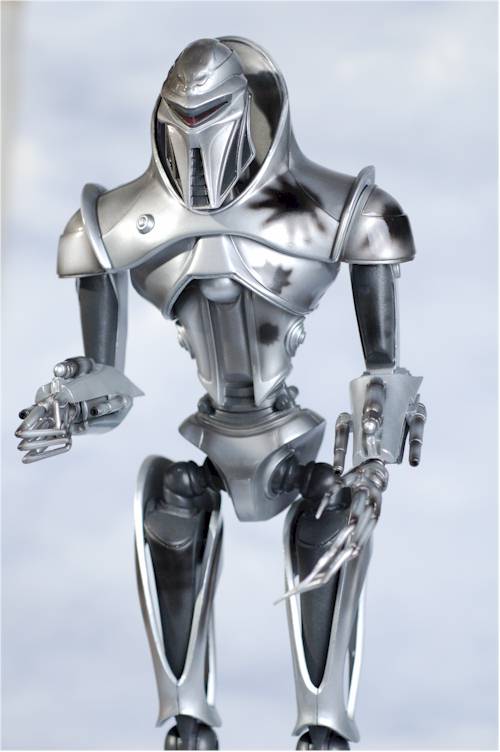
But the show has been so well written, so well acted, and so well directed, that all that criticism has melted away. Or at least most of it, since it’s simply not possible to make everyone happy. Majestic Studios originally had the license to do sixth scale figures based on the old show, and expanded that into the realm of the new. Their first release in this new series is the evil Cylon, in his basic form. Watchers of the new show know that these characters also come in humanoid versions, but here you have the full on robotic form.

If you have any questions or comments, drop me a line at mwc@mwctoys.com.

“Battlestar Galactica Cylon – regular and battle damaged”

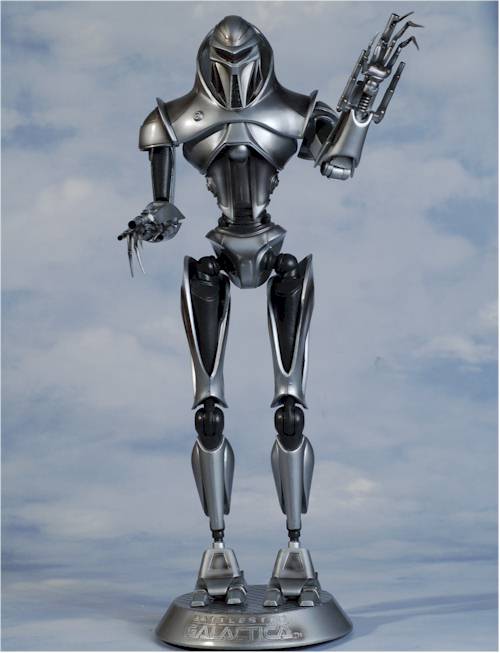
Majestic actually did a battle damaged version of the Cylon for the San Diego Comic Con this last summer. This version was limited to just 400 figures, and has several new sculpted parts including the damaged head. The regular version will see a normal wider release. I’ve shot both for the review, with differences noted. In this first photo, you see the regular version.

toybox_101006_5.jpg

Packaging – ***1/2
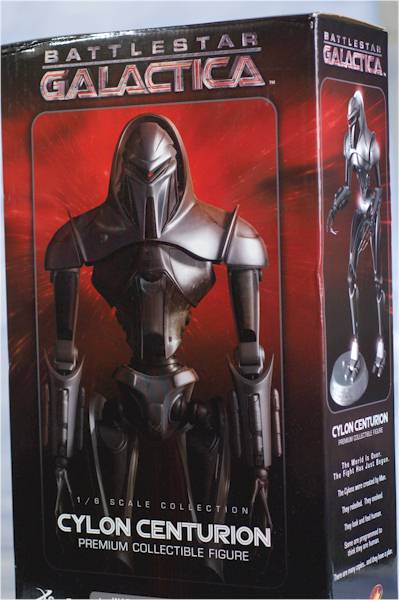
These are packed more like a statue or bust than action figure, and there’s a reason for that. The exterior box is attractive, but largely features photos of the figure itself rather than an actual Cylon for comparison. There’s minimal text, but enough for the average fan. Inside is a styrofoam insert, and the Cylon comes packaged without his hands or weapons. You place which ever set you prefer on him, once you have him out.

toybox_101006_2.jpg

Sculpt – ***1/2
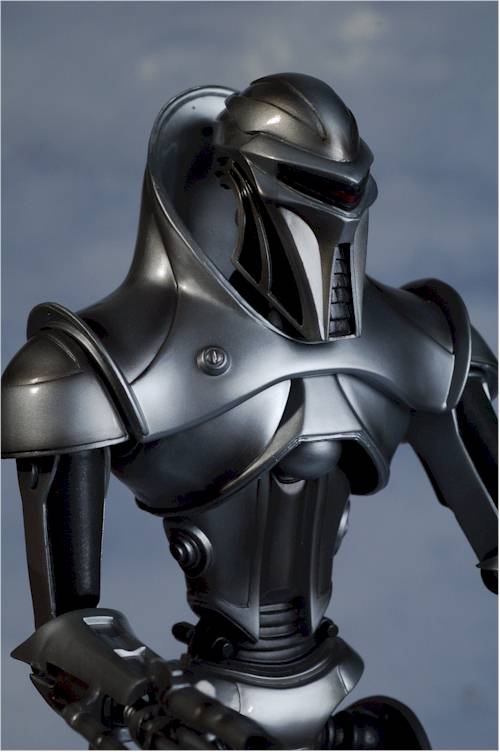
This figure is made from multiple materials, and one – poured polyresin – is somewhat unusual. Oh, there’s PVC and ABS as well, but we’re used to that. But the polyresin makes much of this figure feel more like a statue to the touch than a figure. It also makes him heavier, and is probably a reason for the decided lack of articulation.

Unlike the original Cylons, which looked suspicously like Stormtroopers, these guys harken back to a day when space travelers feared robotic monsters. While the designs are clearly up to date and modern, the concept of dangerous humanoid robots is so 50’s that it would make Gort jealous. The figure matches the show design exceptionally well, but the lack of articulation means you’re pretty much stuck with the pose he’s in. It might just be me, but if I’m going to get very little articulation, a little more dynamic sculpting goes a long way.

This is the regular sculpt:

toybox_101006_3a.jpg

And this would be the ‘battle damaged version’. Note the damage to the back of the head:

toybox_101006_3b.jpg

Of course, it’s not like these guys are goind Spongebob karate moves, and robots tend to be stand up straight kind of guys. You’ll be able to find some good arm poses, and the detailing and accuracy of the sculpt are all top notch.

Paint – ***1/2
The paint work on this figure is excellent, and while there’s a variety of materials used, you can’t tell it from the paint. Often different materials hold paint differently, creating different finishes and tones depending on how porous the material is or isn’t. Even worse is when all the pieces are painted a very obvious color, like the metallic silver here, that makes consistency even tougher.

There’s no problem here though, with a nice even color all around. It’s also consistent in thickness and coverage, and there’s great cuts between the handful of other colors. The battle damaged version has additional detail work, including some very realistic blast marks on the armored skin.

toybox_101006_4.jpg

There’s a feature to these figures that I can’t quite figure out though, and I’m not sure where to mention it – so I’ll mention it here. The ‘eyes’ are supposedly lenticular, so that when light hits them from different angles they’ll appear to light up, and the light would move across the eye piece. That sounds like an interesting concept, and if it worked it would certainly save on batteries. Unfortunately, try as I might, I couldn’t get it to work under any lighting conditions. If you figure out a way, please let me know.

Articulation – **
If you’re looking for super-poseable, then you’re looking in the wrong spot. These figures have only the most basic articulation. There are cut joints at the shoulders and hips (yes, while they might look like ball joints, those hips are cut joints only), simple pin elbows and knees, and pin wrists. The wrists can also turn, since they pop on and off the arms with pegs, but the sculpt of the forearms makes this a lot less useful than you’d think.

toybox_101006_1.jpg

The lack of articulation seems partly due to the materials used, which don’t appear to lend themselves well to articulation, and partly due to the design of the character himself. Still, this will be the one category that is the biggest disappointment for most fans, since the sculpted design lacks any dynamic feel.

Accessories – ***
Each figure comes with several accessories. These include an extra set of hands, and an extra set of weapons that attach to the forearms. Each figure also comes with a uniquely sculpted base. The exclusive version has the additional painted damage, along with some additionally sculpted ‘parts’ laying at his feet.

toybox_101006_6.jpg

The hands swap easily enough IF, and only IF, you’re paying attention. The pegs are designed to go in one way, but the material is such that you could ‘strip’ the pegs if you forced it in the wrong way. It’s also a good idea to take care popping the weapons on and off, and again, these go on in only one way.

Both bases are attractive, especially the battle damaged version, but it did seem like the pegs were a little too short. It’s still quite possible for the figure to tip over even when standing on the pegs, and considering the materials used, that would be as disasterous as tipping a statue or bust. Both figures stand fine on their own though, so using the bases isn’t really required. Be forewarned though that having them on the base doesn’t mean they won’t tip as easily as simply standing on their own.

toybox_101006_8.jpg

Fun Factor – *1/2
With a rather fragile body and hands, this is definitely not a figure for the kids. He’s much more statue than action figure, and is intended for basic posing and standing on the shelf. Even when you’re doing the basic posing part, be extremely careful!

Value – **
The going rate on the regular version seems to be around $60, or it will be once they come out. I don’t believe they’ve actually seen their release yet, as witnessed by a lack of ebay auctions. The battle damaged one is running around $130 on ebay, but that’s due to the low production run and exclusivity.

toybox_101006_7.jpg

I’ll assume you can pick up the regular around $60. At that price he’s a tad expensive, but not so much that you’ll feel abused. This is largely due to the use of the polyresin, which will give you the impression of a statue, much more than an action figure. And let’s face it, statues in this scale are rarely in this price range.

Overall – ***
The sculpts are solid, and the paint is excellent. If you’re looking for a straight display piece for your BG collection, you’ll be quite pleased with the quality. However, sixth scale collectors who are looking for something a little more dynamic may find themselves left wanted with the limited articulation.

Majestic has plans for other sixth scale figures from the new show, starting with Apollo, who should be released soon.

Scoring Recap –
Packaging – ***1/2
Sculpt – ***1/2
Paint – ***1/2
Articulation – **
Accessories – ***
Fun Factor – *1/2
Value – **
Overall – ***

Where to Buy –
Online options are your best bet:

Time and Space Toys is always a good option for BG related merchandise, including this figure. They have him listed at $60, but he’s currently on back order.

Related Links:
This isn’t the first Battlestar Galactica release from Majestic, and I reviewed the old style Cylon and Apollo awhile back. There’s also a guest review of the gold version of that Cylon, and Joyride did there own much smaller scale version as well.

October 9, 2006

Quick Stop Thingamabobs: 10/9/2006

Filed under: Columns,Thingamabobs — UncaScroogeMcD @ 5:43 am
thingamabobs.jpg

The web. It’s a big place, full of plenty of distractions ““ some funny, some informative, some ludicrous, some disturbing, some inane, some profound. Each and every weekday, we present links to a few of our favorite finds”¦

————————————————

  • Anthony Stewart Head informs Janet Weiss that she had better wise up. (Thingamabob)
  • I wonder if the infinite monkeys theory applies to pigeons, as well. (Thingamabob)
  • Classic kiddie Records. You know you want ’em. (Thingamabob)

Have a THINGAMABOB? Send it in!

Preachin’ from the Longbox – Winnah, Winnah, Chicken Dinner

Filed under: Columns,Preaching from the Longbox — UncaScroogeMcD @ 5:06 am
longbox.gif

This week’s sermon – “Winnah, Winnah, Chicken Diner”

October 9, 2006

In last month’s column, I challenged you loyal PftL readers (as well as those opportunistic whores that just like to win free stuff) to come up with a superhero team based on Marvel Universe characters-only. Listed below are the ones (in no particular order) that, for one reason or another, did not make the grade along with the usual insipid comments about each team from yours truly.

###

Gary from Minnesota goes for a self-described “second stringers” draft with the team living out of the Windy City, using Lila Cheney’s rock star money for backing and calling themselves “ShaodwFlight”:

Kitty Pride (Shadowcat) ““ The hardest person to come up with was a team leader. Most people who would make a good team leader are probably going to get snatched up right away (Captain America, Iron Man, Cyclops, Storm, Reed Richards, even Wasp). So I went with someone, who’s a little young, but has demonstrated leadership ability. She’s been trained by the best, she’s incredibly smart, proved her mettle, and did I mention she’s cute as a button? She helped form “Excalibur”, and she kept the team together despite some lackadaisical stories. But give her, her old blue costume with the mask. That was cool.

Emma Frost ““ You have a character who’s been around the block. She has incredible psi-powers, and she’s not afraid to get her hands dirty. Very good addition

Talisman (Daughter of Michael TwoYoungmen) ““ Elisabeth brings that sorcery vibe that every team needs. But don’t get her when she doesn’t have any emotions. Get her later on in the series. She’s a little more powerful, and she isn’t confined to Canada. Plus, that costume was hot.

Strong Guy ““ Hey the name implies everything. He’s uber strong, and he brings a much needed sense of levity to the group. Plus, the shades are hip. Trying my darndest to stay away from mutants for the last two team members.

Puck ““ Yeah, he’s short, and he can do cartwheels at people. But imagine if Strong Guy used him for a fastball special. Plus, he’s going to be the grounded guy. The guy that holds this team together. Not only that, but he doesn’t take up a lot of room when they’re traveling. Good for those people who need the leg room.

Tigra ““ You always need that one character who’s walking a little close to the edge. Greer Nelson fits that bill. Tigra is my sixth member. She can work in a team environment, and she’s got her teams back(so she might lose it at any moment). Having a supportive team leader (Shadowcat), and a really strong mentor (Puck), she’d be able to make it. Plus, she can smell your fear, and she looks darn great in that outfit.

PftL’s Take: Well, Gary, I liked the name of the team and for using Kitty as a team leader (a role that she held when leading Warren Ellis-produced X-Men). But it just seemed more like an offshoot of the X-Men universe. It not a bad team; just not all that different than what is out there now.

###

Here’s a team drafted by John in Florida with the moniker of “The Replacements” (sounds familiar):

Longshot (Leader) – Everybody’s favorite 3 fingered, lucky, X-Men wannabe would the leader for my team. He definitely has leadership skills, considering the rebellions against Mojo that he’s led several times, but he’s flawed too…mindwipes can do that to you. Plus, if Longshot is involved, Mojo works either as an enemy or an awkward Ally (Longshot leading his own super-team? RATINGS!)

Beast – No, this isn’t an X-Men thing. The fact of the matter is though is that Beast is simply brilliant. He’s one of the most gifted minds in the Marvel Universe, and with his wide areas of expertise, specifically with science and technology, he’d be a valuable asset to any team. Plus he’s a veteran of the superteam structure, (Being a member of various X-teams AND the Avengers). So I’m snatchin him up while the snatchin is good. He’s definitely 2nd in command and all-around Jack of All Trades material. Specifically, I’d prefer the Avengers era Beast with Blue fur but still mostly ape-like in appearance…I’m not diggin’ the cat thing.

Toxin (Patrick Mulligan) – The fact that he’s the offspring of Carnage will contribute to the overall bada$$ factor of the team. Toxin also has that wet-behind the ears protoge thing going on too as well as that deep angsty feeling of moral ambiguity and trying to control the inner beast that is the symbiote. Wolverine eat your heart out.

Nico Minoru (of the Runaways) – She’s young, she’s cynical, she’s magic. What’s not to like? Magic: when it’s on your side is never a bad thing and the “Staff of One’ is a neat little artifact. There might be some tension here, since she doesn’t really fit the classic “hero” archtype and is annoyed by people who do (check out Young Avengers and Runaways #2 if you need proof). But I think she could be persuaded by Longshot’s charm.

Echo – With photographic reflexes, Echo has the adaptation feature on her side. Plus as has been demonstrated in New Avengers, Echo has serious infiltration skills that could be put to use. Just supply her with lots and lots of file footage and she’s good to go.

Rom The Spaceknight – We have the token alien and backup tech head here. His nifty little tools and ability to stow things in a pocket dimension help, not to mention his super strength, invulnerability and big friggin’ lazer would make Rom a serious heavy hitter and clean up man.

PftL’s Take: John, I dug your inclusion of ROM (who never seems to get his proper respect for his Sci-Fi contributions to comics in the 80s/90s) and the attempt to turn Toxin into a force for good on this team. However, with the one-trick player that is Nico, the team does drop a little. And that drop is just enough to make a difference.

###

Dewey from the Quaker State gives his draft picks then explains his team’s name (This team is about stealth, with many different specialties here. I know the “undercover ops” superhero concept is getting a little stale, but this team is well-equipped to handle just about anything: espionage, supernatural threats, and scientific curiosities, in addition to any supervillain shenanigans. Note the motif for the majority of the team, and take another look at the team name. Where are the Wild Things? Right here baby.):

Black Widow (Natasha Romanov): The original Black Widow is our team leader. She has been a soldier, a spy, a superhero. Bonus points for being the hottest redhead in comics, and Trinity before there was anything called a “matrix.” (Just ask Bryan Hitch.) She has been on many teams, and is apparently worthy of being a “Mighty” Avenger when this whole Civil War shakes out. Natasha has been a valued compatriot of both Daredevil and Captain America. For her costume, there is no other choice but the full black spandex with gold gauntlets. Did I mention she is my favorite comic book character of all time?

The Falcon: Every team needs a quality flier, and with his newly updated wing system he is modern, and kick-ass. (Though I have a soft spot for the 70’s costume–heck, I had the action figure!) You’ve got surveillance, you’ve got air power, you’ve got a real “bird of prey.” There’s a reason why Captain America trusts him with his life. There can be no higher recommendation.

Diamondback: Let’s fulfill our “villain as a hero” quotient right here. And hey, look at that, she has ties to Captain America! Her story has gotten incredibly convoluted, but take the classic Gruenwald era character, and do a Geoff Johns-style reboot on her, and she is ready to take her place on this team.

The Lizard: OK, another “villain as a hero.” Curt Conners is a scientist, so he would lend knowledge to this team (every team needs that geek who can go all “CSI” for them. Or, if you want a little more old-school–Giles.) And when the chips are down, he can become the savage Lizard. Might be due for a little Peter David rewrite where Conners finds some way to merge his intellect with the Lizard–but not all the way. (Yeah, I had this action figure, too.)

Paladin: Sure, he’s got a goofy costume (or is it so out-there, it is actually cool?) But he’s a crack shot, and every team that does not have an archer should have a gunslinger. This one’s my guy.

Jennifer Kale: It is good to have a mystic on your team, and if you are a Steve Gerber fan, you can’t go wrong with Kale. Besides, the team is nicely balanced, and I dare you to find a hotter bunch than this one!

Team Mascot: Howard the Duck. No, I am not cheating by putting in a mascot. No, he is not a seventh member. Sigh. Whatever. He has been a survivor, battled all kinds of menaces martial and supernatural, and his origin is tied into the Nexus of All Realities. If you considered this a pitch, you might see where some of this is going for stories…

PftL’s Take: I liked the pick of Wendy the Good Little Witch (Jennifer Kale). And you’re right on Paladin’s costume. But this team lacks some brute strength and physical toughness. Gotta have someone who will just roll up their sleeves, barge in and mix it up with anyone. Outside of that, this team is a good one.

###

New Jersey’s own Adam J. offers his team named “The Pliskin Six”:

The Thing – One of Marvel’s iconic characters is sure to go in the first two rounds. I figure my team needs a tank, but one that is a little more dependable than the Hulk, or of better record than someone like Rhino. Also, this is a public team, so I can’t think of a better person to earn the public’s trust (BTW- I’m with Iron Man). The ever-loving blue eyed Thing will never leave a fallen comrade, is about as brave as anyone in the Marvel U, and is stronger than just about anyone. His years of experience working in a team atmosphere also make him a solid first rounder. Also has a catchphrase.

Iceman – Probably drafted a tad too high, but his popularity will more than likely have rushed him, and he’s someone I just need to have on my team. Ice sliding makes him the equivalent of a speedster. He also can covertly disable security systems with his sub zero temperatures should a mission call for it. His ability to see heat signatures also helps in stealth missions. Like Grimm, has mucho team experience. Most importantly though, he’s an Omega level mutant, which means almost unlimited power.

Exodus – A forgotten product of the 1990’s, Exodus is a solid sleeper pick at the third round. He’s near invulnerable, can fly, produce various psionic energies, and can even bring the dead back to life. He has shown himself capable of simultaneously:

1) Amplifying Genoshan mutates’ hatred of humans;
2) Crushing Genosha via a massive force field;
3) Immobilising (sic) Quicksilver, the Scarlet Witch, Crystal and Jean Grey in another force field;
4) Protecting himself from attacks; and,
5) Dealing out massive amounts of damage to both the X-Men and the Avengers. Bad Ass.

Multiple Man – One man army. Any and all physical contact creates a duplicate, so he really can’t be stopped. Near unlimited intelligence due to the fact that he frequently (sic) sends duplicates into the world to learn various skills he can reassimilate. Has worked for the government before, so he will be a welcome addition in the new, post Civil War Marvel.

Black Widow (Natasha Romanov)(Team Captain) – The woman’s a pro. I figure she’d fall this low to her lack of “powers” but there are few tactitians (sic), combat fighters, stealth, and beautiful characters in all of comics. She’s been a member of S.H.I.E.L.D for God knows how long, and was the right hand lady of Nick Fury for most of her tenure. Also, has ties with Iceman from their Champions Days together, has worked with a Jaime Madrox dupe in S.H.I.E.L.D., and worked with Grimm after the Secret War debacle. It’s her time to lead. Anytime you can get a team captain at #5 means that it’s a good pick. She also has Avengers ties to the last member of the team”¦

Mr. Immortal – So he’s a Great Lakes Avenger (or Great Lakes X-Man, or Great Lakes Champion, or whatever it is their called now). The dude can’t die. Ever. And he’s a homo-superior. What more could you want?

Exodus is the one wild card of this team. I’m unsure how well he would work not being the team letter. That’s part of the reason I stacked this team with so many mutants. Some similar genes may ease him into the team. Widow isn’t so headstrong and self absorbed where she’d be a “my way or the highway” type leader. She would assess everyone’s attributes and come up with the most rational plan available.

PftL’s Take: Adam, good pick with the Thing ““ not many people go for Ben Grimm when picking a team. However, Mr. Immortal is very similar to Nico of the Runaways as far as having one power and not a very solid one. And I would think that the eventual downfall of the team would be at the hands of Exodus. Here’s a choice selection from Marvel Universe’s bio on the guy:

“”¦Exodus has displayed a fragile psyche, as well as a fundamental disregard for the lives of regular humans”¦ Presumed to be one of the most powerful mutants on Earth, Exodus’ mental instability and lack of morals make him an unpredictable, extremely dangerous individual.”

Yikes, he has too much Mike Tyson in his character for my tastes.

###

Here’s J.A. from Connecticut with his team and subsequent justification (My concept is for a group of individuals who can work well together, but have versatile power sets that allow each member to play multiple roles as needed.):

Team Leader ““ The Multiple Man: Jamie Madrox ““ Why the leader? He’s cutting his teeth as a leader in the new X-Factor books, and seems to be doing well despite some personal insecurity. Why him in general? His powers are versatile, often under-estimated, and always used creatively. Jamie tends to fill a support role to other team mates in a fight, but his powers come in very handy when information gathering in the field.

Psylocke: Betsy Braddock (The British, Pre Ninja, armored X-men version) ““ Betsy has experience as the temporary leader of Excaliber. As such, she makes an excellent second in command. Her telepathy can provide vital information to teammates quickly, and while armored she is a capable support fighter.

The Invisible Woman: Sue Richards ““ Long established as a team player, I’d imagine Sue would get along even better when not taking orders from her husband while in the field. Her powers are an excellent blend of offensive and defensive, and she can fill either role in a pinch.

Speedball: Robert Baldwin ““ He’s personable and also a well established team player from his time with the New Warriors. Like Sue, his powers are both defensive and offensive, but more importantly they are unexpected by most super-villains.

Box: Richard Bochs ““ He’s intelligent enough to construct a robot, which would make him the brains of the team. While controlling his robot, he becomes the strong man of the group, and gains the supplemental powers of flight and various sensory equipment. I’ll take brains and brawn in one package any day.

Warlock: (New Mutants Era) ““ Warlock’s metamorphic powers by nature can adapt to numerous situations. I like the New Mutants version because he’s much more of an innocent (which will offset some of Madrox’s brooding) and (in my humble opinion) displays greater loyalty to his teammates.

PftL’s Take: The Roger Bochs pick was a deft one. But with the number of X-Men/Alpha Flight members on the team, the team suffers from a lack of an identity.

###

Corey T. from sunny FLA submits his team:

Mr. Fantastic (Team Leader): Going for consistency using the same first pick I did last year. It seems to me that, the arguably smartest man in the Marvel Universe should be the team leader. Not only is he a master strategist, but his ability to train other heroes in the use of their powers is unparalleled.

Doctor Strange: OK, it might be claim this is too powerful of a character or too big of name to be claiming for a second pick. But if anyone read one issue of any Defenders comics, it should be obvious that this man should never lead a team. But Strange isn’t just here for power, but more to give the team the necessary knowledge and resources to deal with magical threats. The one of the only weak spots in Reed Richards abilities.

Iceman: We got a glimpse of the true extent of Iceman’s powers when Emma Frost took over his body, but lately he’s been showing us even more.

Winter Soldier (Bucky): So, I can’t take Captain America. Alright, I’ll take the man’s backup. Sure, he might be a wild card due to mental issues, but there’s no denying his abilities.

Cloak: It was between a teleporter or a speedster and Marvel seems to have more of the former than the latter. As cool as Nightcrawler is, for the 5th pick it had to be Cloak. This is fine by me, though. He is a great mass teleporter, despite the discomfort of his passengers.

Victor Mancha: OK, so he just got shredded in the Young Avengers/Runaways Civil War Special, but that’s why a teenager is not a team leader. He got shredded due to arrogance. It’s already been shown how super hero obsessed he is. Amongst this crowd, I don’t think arrogance is going to be an issue. Not to mention, he has Reed Richards to point out that Shield has dealt with both Magneto and Polaris so they probably have weapons for super folks with magnetic control. Besides from trying to justify this pick despite the character recent injuries, he is also a creation of Ultron with the power one would expect Ultron to provide. On top of this, the potential of his magnetic powers, as well as his secondary abilities, have just begun to be tapped.

PftL’s Take: Ya know, I almost picked Cloak for my team so, of course, I dig that pick. The same goes for the doctor. As for the others, ehh. I’m just not feeling it, dog. Again, half of the team is X-Men derived. Two is okay but three is a bit too much.

###

Kasey from Utah goes for the classic old-school style with his team, aptly named “The Dudes In Red Tights”:

Leader ““ Daredevil. Despite the theme I thought it would be best to have at least one legitimate hero. Daredevil is the only member of the team who I actually know something about.

Red Guardian ““ Since I was looking for red tights, I found this guy first and was immediately intrigued and impressed. A communist Captain America for the Soviets. A close ally of Stalin. I figure now that the dream of communism has withered to a mere whisper in the Cuban coastal winds, this guy would be looking for work (something he wouldn’t have to do if communism were still popular). Bitter, disillusioned and desperate, Red Guardian could be the obligatory cynical naysayer of the Dudes In Red Tights team.

Hellion ““ The team needed mind powers and this guy fit the bill with his telekinesis. He also seems like a good candidate to go off on his own and get into trouble, something every team needs.

Crimson Crusader ““ CC is actually pretty damn powerful. Control gravity? Hells yeah! Unfortunately, he is powerless without his sister Pandora around. Too bad she doesn’t have red tights stretched over a manly package or she could’ve been on the team too. Alas, without her, he supplies the “˜Aquaman’ role on the team.

Rocket Racer ““ This is by far my favorite member of the team. A skateboard riding brother from the seventies. He doesn’t have super strength, or psychic ability or any of that crap, he shoots motherf***in’ rockets! Out of his wrists. And he rides a skateboard thing too. That is freakin’ badass. I envision Rocket Racer as the reliable backbone of the team who doesn’t need to upstage anybody else.

PftL’s Take: Kasey, there’s some good stuff here. But, as you mention in your write-up, Crimson Crusader is, essentially, useless unless his sis is backing him up; eerily similar to the Wonder Twins. And since there’s only five members, The Dudes in Red Tights are a little light in those tights.

###

Aaron from across the pond in Ireland sends in his my ideal team-up since I was about 12 (albeit with a few minor changes) with the team name of “The New York Knights”:

1) Daredevil (Matthew Murdock) – Not only has this character been consistently at the top of the “great reads” list for the last couple of years but he has also stayed very clear of super hero groups. A trait which while character driven, annoyed the hell out of me. I’ve always thought he would make a fantastic reluctant leader and with his strict vision for justice and morality has the back-bone to be a believable one. And also, less we forget his very cool outfit…

2) Luke Cage – Long time close friend of Daredevil and long time bad-ass also. It would be more than easy to believe Luke would follow DD into the gates of hell, if not just for loyalty but for the love of handing out some ass-whoopin. One of the only (to my mind) legitimately “street” characters in the Marvel Universe and finally getting his due on the Avengers run. His personality works great in a team environment as he’s just that little bit different from every other “hero”.

3) Iceman (Bobby Drake) – I’ll be honest, I have loved this boy from the day I was born. Remember the “Spiderman and Friends” TV series from the early 80s? My favourite show as a child. I’ve stayed loyal to him despite him being pretty much over-looked in x-men history. This is one of the originals folks! Fuck Cable, where’s Bobby Drake? He’s well adverse to team-environments (so much so that you can play 5 degrees of separation with him and his other team members far too easily), already New York based and with powers growing by the issue along with a new frosty demeanor (god I love puns) to go with it.

4) Archangel (Warren Worthington III) – A character who, when you look into his history, had been tormented from the word go. Never had an easy break as far as personal (and physical) life goes but was blessed with inheriting a fortune. He’s also an original x-man with Iceman who in recent years has been slightly forgotten The possible ‘cash’ behind the group or the teams ‘iron-man’, depending on how you want to look at it. Easy competition for leader of the group. Either way, an obviously solid addition to the team but also gives the advantage of having the wonderful payoff of having both an Angel and a Devil in the team 🙂

5) Hawkeye (Clint Barton) – Recently deceased, but when has that stopped a comic-book character before? I love the idea of having a non-super powered hero in a team. It always leaves room for jealousy and over-compensation. But it also adds an element of weaponry, something that is always forgotten about when it’s usually a big bruising punch-up. What kid doesn’t love cool gadgets? Hawkeye had the lot A huge amount of experience with the Avengers, but can he handle life without Cap and Stark? The token outsider to the group. That pointy mask has got to go though…

6) Black Cat (Felicia Hardy) – The “hot-piece-of-ass” in the group but don’t let looks deceive you, this girl can hold her own. She is often placed as the fun loving, reformed bad-girl in the Marvel Universe, but don’t forget folks, her decent into the costume world started because she was date-raped in college. Heavy stuff. A worthy counter-balance to Spiderman (and also her anchor to the group through his friendship to DD) she would be integral element to the team dynamic With her ability to “affect probability fields” aswell, she would add a nice bit of comic-book cheese if the writer saw fit. (Such a stupid power, but fantastically absurd at the same time)

PftL’s Take: Double A, this one was solid. However, the balance just seems off. I would actually expect to see this lineup in a Defenders-style comic. Not that it’s a bad thing but it’s somewhat bland.

###

Michael from our friends in the Great White North offers two groups. The first one is called “Hell Hath Nick Fury”:
1. Thor (Simonson era) – Thor provides both power and passion. I don’t believe there’s anyone in the MU that can realistically go toe-to-toe with him (with the exception of Odin, but let’s not go there). I also don’t believe there’s anyone in comicdom that can go toe-to-toe with him (Superman be damned).

2. Nick Fury (mid-90s) – The leader. He brings smarts, tactics, and gadgets. What more do you need?

3. Doctor Strange – Mystic and psychic power — a lot of mystic and psychic power. Welcome aboard, Doc.

4. Invisible Woman – Stealth and hotness. Both vital.

5. Blade – Sheer brutality on a day-to-day basis. Also, what if the team happens to run into vampires?

6. Speedball – Speed, balls, and comic relief.

PftL’s Take: Hey, it’s a shout-out pick for Blade, which is surprising since the movies did so well. Outside of that pick, the rest are decent; just too blah, I guess. And who would’ve thought that that irrepressible Speedball would get selected more than once? Not me, that’s for sure.

###

Michael also submitted the first all-villain group named “Doom and Gloom”:
1. Doctor Doom — Not the stupid movie version. He’s the leader. The kickass ruler of Latveria. One of the few villains that could get a team together and keep them together through brains, cash, and force of personality.

2. Juggernaut — The muscle. Nuff said.

3. Mystique — Shapeshifting is both cool and useful. She’s also got a wicked mean streak.

4. Scarlet Witch (Brotherhood) — Brings the psychic pain.

5. Deadpool — Because assassins are cool.

6. Quicksilver (Brotherhood) — Fills the need for speed. Also, it’s nice to keep siblings together.

PftL’s Take: Honestly, this team, outside of Deadpool, is the Brotherhood of Evil Mutants, plain and simple. It could’ve been better, really.

###

Jesse from The West Coast also sent two teams in for the contest. The first one is called “The All-New and Improved West Coast Defenders”:

#1 Captain America (leader) (setting: current) ““ My first pick, and leader, is Captain America. Captain America has led not only the Avengers, but often takes a leadership role when the MU is gathered against an overwhelming force (Secret Wars, the Infinity Gauntlet saga, and Operation Galactic Storm all come to mind). Guys like Thor and Hercules respect and follow his command. He takes the time to train and improve the members of his team, both as individuals and as a unit. Having Cap lead a team may be a clichéd, but it is so for a reason.

#2 Beta-Ray Bill (setting: current) ““ A warrior’s heart, a hammer with the powers of Mjolnir, and now stranded on Earth, Beta Ray Bill is my second pick for this team. Loyal and brave Bill is a hero that serves to strengthen any team. In the larger team dynamic Bill, fills the role of both the heavy hitter, and a defense against both mystic and cosmic foes.

#3 Clea Strange (setting: 70s/80s) ““ Heroes join together in order to face those threats that no single hero can withstand. In the MU, there are often strange visitors from distant dimensions who come to conqueror reality. Every team needs a mystic to face such opponents. With my third pick I have chosen Clea Strange. Every bit the accomplished mystic as her husband, but sadly often ignored and even unknown by current fans, Clea is both a warrior and a nurturer who will compliment and support this team both on and off the field.

#4 Beast (setting: early 90s) ““ My fourth pick is the one and only Hank McCoy. Blue, furry, and non-cat like, Hank McCoy. Granted everyone has a preference as to what Beast should look like. But I chose this era of his career not only for the way he looked, but the way he acted as well. I chose the version of Beast who would just as soon make a joke and cause trouble as bust out a 37 word sentence to answer if he wanted take-out for dinner that night. Every team needs a comedian to keep things light during tense situations. Hank has a brilliant mind, is a proven fighter, and as already mentioned will serve to keep the spirits of the team high.

#5 Franklin Richards (setting: early 90s) ““ Most readers know Franklin from his series of Calvin and Hobbes knock offs. However, there was a time when the first born of Marvel’s First Family, had power to spare. Any kid that can create entire dimensions (all be it a dimension where everyone has misshapen feet), would be a welcomed addition to any team. Obviously, his age and inexperience in the field serve as detractors to his inclusion on the team; however I believe that the tutelage and care of Clea would provide the guidance needed for Franklin to come in to his own as a hero. The watchful and nurturing eye of Clea would also help to elevate the doubts and concern that Sue would have in placing her child in such a dangerous situation.

#6 Mockingbird (setting 80s) (I am assuming since we are allowed to choose the era of our characters, we can choose an era from before they died (heck, if Bucky can make it back from the dead”¦) ) ““ Mrs. Barbara “Bobbi” Morse Barton aka Mockingbird is the last pick for my team. Since she is technically dead, I felt that she was safe to save for the last pick; however she is far from the weakest member of the team. Bobbi has been trained as a spy and in the art of hand to hand combatant. Both of these skills will be helpful to the All-New Defenders. She has served on teams in the past, and knows what it takes to work alongside others.

PftL’s Take: This team is solid from top to bottom, except for little Richards. I remember that he has some sort of god-level powers (just try to forget “Heroes Reborn”. I dare you). But for me, he nicks this team ever so slightly to knock from the top spot.

###

Comprised of mainly supporting characters is the genesis for the name of Jesse’s second team ““ “The 8 Page Back-Ups”:

This team consists of misfits, and heroes who are for one reason or another out of sync with the world in which they live. I found that looking for heroes that fit the “person out of time” mold, many came from the world of Captain America. I suppose that shouldn’t be a surprise. Choosing mostly supporting characters, lead to the creation of the team’s name. Each of these heroes have served in supporting roles in various places around the MU. Now is there time to shine as individuals and as a team.

#1 Nick Fury (leader) (setting: 70s and 80s) ““ The Nick Fury I have chosen to lead this team is the gruff yet lovable, Nick Fury of days gone by. With his ever present cigar, and his habit of calling those under him “Goldbricks”, Nick is a season veteran of both domestic and foreign wars. He knows when to push his team, and when to give them their space. He is comfortable staying behind to monitor and lead missions, but is willing and able to enter the fray and mix it up with the bad guys. Nick lives as a man who is way past his prime and should have long been forced into retirement due to failing health. However, thanks to regular doses of the Infinity Formula, he continues to fight the good fight. As a man out of time in his own right, he will be able to relate to the others on his team.

#2 Winter Solider (Bucky Barnes) (setting: current) ““ The Winter Solider is a highly trained spy, combatant, and sniper. Bucky has worked solo and in team settings. He fought in WWII, and is now only the physical age of a twenty-something. He is currently working with Fury, so we know that the two of them can work together. He is a perfect fit for this team.

#3 Spitfire (setting: current) ““ Jacqueline is trained at combat, has worked in team settings, and also can serve as the team’s speedster. Once again, she is a WWII alum who is currently in the body of a twenty-something. She has worked with both Bucky and Fury in the past. Both of these elements make her yet another perfect fit for the 8 Page Back-Ups.

#4 Lockjaw (setting: 80s) ““ There is not a bigger misfit in the MU. Part of a team deemed as “inhuman” with a base relegated to Earth’s moon, Lockjaw would fit nicely into a team of outcasts. Ok, so the above is stretching it a bit, and the current status quo is that Lockjaw is nothing but a big old dog, so why would I want him on the team? I choose to think of the characterization of Lockjaw that was given to us by the infamous John Bryne, the Lockjaw who could speak, but seldom chose to. I know there were objections to Lockjaw being that intelligent compared to the way he was treated by the Inhumans, but I never saw that as a problem. Sure they didn’t speak to him much, but he isn’t exactly a conversationalist. And if his dinner was served in a bowl away from the family, that doesn’t meant they were disrespecting Lockjaw. Rather they were giving him his dignity. His anatomy doesn’t allow him to sit at a table with the rest of the royal family, and no doubt having (again due to his physical make-up) to eat from a bowl is not a pleasant or dignified experience. Allowing him to do so away from everyone else actually bestows dignity on him. Lockjaw knows what it means to be an outcast that is why he has befriended Ben Grimm. I say we return him to that characterization of intelligent, noble, and yet silent. So now that he belongs on the team, can he aid in the field? I would think his strength coupled with his power of teleportation would come in handy, and more than fill this need.

#5 Doughboy (setting: late 80s/early 90s) ““ The Doughboy I have chosen for this team is the one that is rid of the Primis persona. He is simply a pliable creature ready to serve his current master. His loyalty and his shape shifting abilities would know doubt help the team in combat and on missions. Not to mention is there not a bigger outcast than someone who is basically a giant blob of barley sentiment play-dough.

#6 Valeria Richards (setting: 2027 – Again I am pushing “the choose the era” rule here) What I mean by 2027 (is that given the MU that is currently published and set in 2006) in 2027 Valeria will be roughly 22 years old. Plus we all know that at some point there will be another future story, or a way to age Valeria to adulthood, cause FF and time travel are like Pirates and Bluebeard.) ““ Valeria Richards (the current toddler and second child of Reed and Sue for those of you keeping track at home) all grown-up (prematurely matured and/or brought to the present from the past) is the final member of this team. Granted, she hasn’t shown any powers yet, but she no doubt possesses them. Just look at her parents. Speaking of possession, Valeria also has whatever latent powers that were put in her as she is the familiar spirit of Doctor Doom. In fact the betrayer in our midst (and controlled by Dr. Doom) is a great twist for any happy little family and team. Valeria much older than she should be and/or out of time, betrays the team, then its found out to be Doom all along, and the team works to have her feel accepted, and keep her on in the team. That is my sixth, and needlessly complicated final pick for my team the 8 Page Back-Ups.

PftL’s Take: I commend the Lockjaw pick since that creature is probably the coolest dog in all of comics ““ even ahead of Krypto. But, yeah, the Valeria pick is a leap since there has not been any documented (read scripted) history on her character as an adult. Plus, if you’re going to commit to a theme team of back page heroes, you really can’t justify someone who had his own title.

###

Well, who did win? Well, while the entry pool was considerably less than it was last year, this year was still hard to decide who the winner would be. After tossing and turning over it for a couple of days and making cases for all of the submissions, there was just one that caught my eye just a smidge more than the others.

So, congrats to JR from Parts Unknown and his winning entry:

Photon (Leader) ““ That’s right. Monica Rambeau. Why, you ask? Well, there’s plenty of reason. She used to lead the Avengers. She currently leads Nextwave, or whatever that weird Ellis team is called. (I wouldn’t know, I’m not reading that book.) She’s got a military background. She’s got a pretty cool looking costume. But most importantly: She’s probably one of the fastest characters in the Marvel Universe. At top speed, she’s moving at the speed of light. That’s to the sun and back in sixteen minutes. She can be pretty much anywhere on the planet before you can even think about calling her. Add in her leading experience and you’ve got an extremely valuable player.

Doc Sampson ““ Every team needs a strong guy, and Sampson’s traded blows with the Hulk. That’s a good recommendation. Also, he’s a doctor. I’m not sure in what anymore, but he is a doctor, and any kind of booksmarts comes in handy. Just give him his suit with the lightning bolt and something to keep his hair in place so he can grow it longer and we’ve got our tanker!

Karnak ““ This Inhuman’s underrated, in my opinion. If you use him right, he’s tactical perfection. The ability to find the weakest point in something and how to break it is painfully useful. Pair him up with Doc Sampson and have him tell the Doctor where to hit. It’s a match made in heaven! Plus, his connections with the Inhumans Royal Family don’t hurt.

Equinox, the Thermodynamic Man ““ I’d have trouble trying to think of a more obscure character. He popped up two or three times in Marvel Team-Up, if you’re interested. Basically, he’s got control over both fire and ice. It’s like having the Human Torch and Iceman in one crazy-go-nuts shell with horns for some reason! But for serious, he’s about as strong as Spider-Man (not awe-inspiring in the Marvel U, but it’s something) and has some elemental control. Sure, he’s a villain, but you can throw one of those Suicide Squad collars on him, or whatever the Marvel version is. He’s powerless now, but we’re allowed to futz with the time period, so let’s have him at the peak of his powers, in that issue of MTU with Yellowjacket.

Unus the Untouchable ““ Every team needs a mutant. Why not Unus? He’s an ex-con with nothing to lose, and force fields to project. The entire team runs into the battle, light beams flying, fire and ice going every which way, but they need a few seconds to observe the situation. Keep Unus close, within a tight enough proximity that he can cover everyone with a shield, and move as quickly as possible to where they need to be. He’s a powerful support member who can also assist in combat, via force field-shoving. Oh, and as for the time period I want for him: the not-dead one, and also the not-crazy one. Here’s hoping there’s some overlap.

Longshot ““ All right, we’ve got a leader who can turn into light. We’ve got two strong guys, one who can control half the elements. We’ve got a tactical genius. We’ve got shielding. Now, all we need is a little bit of luck. That’s where Longshot comes in. He can use his lucky powers to shove the forces of fate into the team’s hands. Plus, he’s a pretty good fighter and acrobat, so he can assist in combat without a problem.

PftL’s Take: As I looked over all of the picks, this one kept coming back to me. It’s a very solid and tough team. There are some questions ““ the capability of being team players by both of the villains being the obvious one. But having Photon as the leader was great and seeing guys like Doc Sampson (very underrated) and Karnak picked really filled out the team. If Ellis or Benids wrote a one-shot of this one, I would be the first in line.

###

Thanks to everyone who took the time to submit a team this year. It was really appreciated.

Well, I’m off the Longbox this week. Come back next week for the final edition of Preachin’ from the Longbox. Until then, don’t forget to keep you bags and boards together and your continuity straight.

-britt

Nocturnal Admissions: Movie Review, The Departed, Part 2

Filed under: Columns,Nocturnal Admissions — UncaScroogeMcD @ 1:19 am
nocturnalheader5.gif
Poster

Let’s state this up front. The Departed is Martin Scorsese’s best movie in a long time. Yes, it depends on how you define “best,” but for me it is his best since the terribly underrated Bringing Out the Dead, which is the last Scorsese movie that feels” like a Scorsese movie rather than some heartless Oscar whoring prestige production.

Violence

That being said, here are some qualifications. The middle drags. The final shoot out goes “a body too far” (explanation to follow). And I hated the rat on the rail in the last shot. What the hell did it mean? What does it mean? The film is also more straightforward than most Scorsese movies. And despite what Michael Ballhaus says, there is more violence in The Departed than in Infernal Affairs.Still, it is Scorsese’s “late masterpiece,” as they say in the quarterlies. And surprisingly, it is as good as the source film, 2002’s Infernal Affairs, though there are some key differences. Infernal Affairs may be more psychologically nuanced (the Matt Damon equivalent discovers that he likes being a cop), but The Departed sports a terrific cast, well used, an intelligent script, non-stop music; it is a Scorsese buff’s wet dream.

Leo

Yet there is a strange tone of detachment that hangs over the film. It’s that unfelt glossy bloat that afflicted Gangs of New York, supposedly a life long “dream project,” and The Aviator, which felt like a job for hire. Scorsese’s last explicit job for hire, Cape Fear, was an interesting psychological study beneath its suspense surface, but has more in common with The Departed than with Aviator.

Jack Nicholson

An increasingly important figure in Scorsese’s films, at least since Alice, is the unsubtle manifestation of pure irrational evil. This figure of evil, who marches through Scorsese’s films in the form of Keitel as Sport in Taxi Driver, Joe Pesci’s character in Casino, and Cutter Gangs of New York, probably has his roots in the director’s Catholicism, though external evil of this kind is not the focus or concern of the religion. Sometimes the “evil” is the central character’s divided self, such as Jake La Motta in Raging Bull, and even the shaver in the short film The Big Shave. Indeed, a tour of Scorsese’s filmography suggests that his strongest films highlight his interest in or exploration of this ominous figure and the weakest have no villain (Kundun, Aviator). An exception is Bill Cutter in Gangs. Despite Scorsese’s attention to detail, the film still feels (that is, assuming that we have all seen the ideal cut).

Matt

Yet, The Departed does go over some of the same terrain as Gangs of New York. Both are tales of a youth (Leonardo DiCaprio) going undercover to defeat a brazenly evil man who, to different degrees, knew his father. And both share an interest, a fascination, a revulsion even, for a figure of absolute evil. Nicholson’s Frank Costello is in line with Scorsese’s earlier portraits of callous gangsters who brook no dissension, be it Keitel’s uncle in Mean Streets, who insists that the epileptic Teresa is “sick in the head, or Paul Sorvino in Goodfellas. Nicholson’s addition to the template is a heightened level of scary wackiness. What’s interesting to contemplate about his character is why people love or obey him in the first place. His top aide, Mr. French (Ray Winstone), is loyal, and Damon’s character is devoted, but why? What do they get out of it, since Costello gets all the money and the girls. And despite his ferociousness, characters like DiCaprio’s, who seem to be in constant jeopardy, talk back at him. There is even an element of the Whitey Bulger case in that Costello, it turns out, is a protected FBI informant, which really pisses off Sullivan, who feels betrayed by this underhanded, behind the back self-insurance.

Silhouette

I was surprised by two things. One, its fidelity to the source film, and how dark some of the early shots were, in defiance of what Ballhaus said in his AC interview. There, you will recall, Ballhaus said that he complained that Infernal Affairs is too dark at times. Yet Ballhaus starts out his film, intentionally of course (to mask Nicholson’s age for scenes set 15 years earlier) with shots of the actor in dark silhouette.

Vera

In his script, William Monahan ( Kingdom of Heaven) makes two key changes. In Infernal Affairs, undercover cop Tony Leung sees a police psychiatrist who seems to know that he is an undercover cop, while gang mole Andy Lau marries an aspiring novelist, and whom he met (as seen in 2) when she was arrested for public drunkenness. In Monahan’s version, DiCaprio’s Billy Costigan and Damon’s Colin Sullivan “share” the same woman, psychiatrist Madolyn (Vera Farmiga, whom you all remember from the great Running Scared), which strikes me as a peculiarly American obsession or at least an obsession of movie makers. Second, Monahan changes Sullivan’s motivation. Lau finds that he likes being a cop, and part of the actions he takes at the end, including killing Sam, are designed to insure that he can continue to thrive as a cop.

But these are interesting variations on a great premise. And The Departed proves to be one of the few films released this year worth talking about at this length.

October 7, 2006

Comics in Context #149: Forty Years In Shadows

Filed under: Columns,Comics in Context — admin @ 2:45 am
comicsincontext4.jpg

darkshadows.jpgOnly last week in “The Fred Hembeck Show” #74, its namesake confessed what he considered his deep, dark and shameful secret: that he, Fred Hembeck, was a soap opera fan. In sharp contrast, from almost the very start of “Comics in Context” three years ago, I have proudly proclaimed my own undying devotion to one particular soap opera: that classic melding of the daytime serial with Gothic melodrama, Dark Shadows, whose leading character was a villain turned tragic hero, the vampire Barnabas Collins.

During the series’ original run, Dark Shadows became an enormous hit among young Baby Boomers, much like that later serial TV drama about vampires in a small town, Buffy the Vampire Slayer, did among young viewers in more recent years. During its original run Dark Shadows spawned two MGM movies, one of which, House of Dark Shadows (1970), will be shown on Turner Classic Movies the night of October 20. There were also Dark Shadows novels, a Dark Shadows newspaper comic strip, and Dark Shadows comic books, more than justifying the show’s suitability as a topic for my column.

Way back in “Comics in Context” #11 I wrote an appreciation of the show, and in #12 I wrote about the 2003 Dark Shadows Festival, one of the annual conventions that celebrate the series. It had been announced that this would be the last of the official Festivals, much to the distress of both fans and members of the show’s original cast. In fact, one of the leading cast members, Kathryn Leigh Scott, even publicly confronted Festival head Jim Pierson onstage over this issue. So the conventions continued, albeit under different names, like the “Dark Shadows Weekend” on which I reported in “Comics in Context” #50 in 2004. Last year’s convention was held in Los Angeles, and I did not attend, but this August the convention returned to New York to celebrate the fortieth anniversary of the original series, which ran from 1966 to 1971.

You might expect that these conventions would be attended almost entirely by aging Boomers who watched the show as children, and there are indeed a lot of us there. But, appropriately, Dark Shadows has proved to be The Show That Will Not Die. Several years after it went off the air in 1971, Dark Shadows returned in syndication, and it later found a home on various public television stations, and still later on the newly founded Sci-Fi Channel. As a result, new generations of viewers have had the opportunity to discover Dark Shadows for themselves.

You may have observed that many cable networks start out by running classic TV series from the 1950s and 1960s, which they can acquire inexpensively, but as the cable network grows more successful, it dumps them. The Sci-Fi Channel followed the same pattern (but its management has had the good taste to retain the original Twilight Zone and to run the new Doctor Who, so they should be forgiven).

But this has not spelled the end of Dark Shadows, either. At this year’s “Dark Shadows 40th Anniversary Celebration Weekend,” when speakers asked how many people in the audience were attending for the first time, an astoundingly large number of hands were raised. The reason is the revolution in video technology. MPI Home Video has issued the entire original series, first on VHS and now on DVD, and once a movie or television show is on DVD, its permanence is assured. (The short-lived 1991 revival of Dark Shadows, which had the misfortune of debuting the week that the first Gulf War began, also recently came out on DVD.) Moreover, as was noted onstage, it seems that people who watched DS when they were growing up are now using the DVDs to introduce the show to their children–and even grandchildren.

Here is an aspect of the DVD revolution that is worth further examination: its capacity for extending the shelf life of the popular culture of previous generations. For example, I’ve worried in this column about how Cartoon Network and Boomerang have considerably reduced showings of classic Warners cartoons. Will the superb Looney Tunes Golden Collection DVD sets succeed in introducing new generations to Bugs Bunny and company instead?

Earlier in this fortieth anniversary year for Dark Shadows, its creator, executive producer, and owner Dan Curtis, who directed its two movie spinoffs, passed away at the age of 78. Yet 2006 has also brought a rebirth for Dark Shadows in the form of new projects that serve as continuations of the original series. One is a new paperback novel from Tor Books, Dark Shadows: The Salem Branch, written by Lara Parker, who played the key role of the witch Angelique on the original series. The other is a new series of radio-style dramas on CD, produced by the British company Big Finish, which is best known for its long series of Doctor Who audio dramas featuring cast members from over the long history of that television series. Big Finish’s first two Dark Shadows CDs debuted at this year’s “40th Anniversary Celebration Weekend”; two more, including a Christmas-themed story, will be released in November.

With Dark Shadows: The Salem Branch, Lara Parker has now written two Dark Shadows novels, which simultaneously serve as prequels and sequels to the original television series. In Barnabas’s backstory, in the late 18th century he visited the West Indian island of Martinique, where he had an affair with Angelique, the servant of an emigre French aristocrat named Josette DuPres. However, Barnabas dumped Angelique in order to become engaged to the wealthier and more socially respectable Josette. Unknown to either Barnabas or Josette, Angelique had been taught magic, including voodoo, by her mother. In the television series’ classic 1795 flashback arc, Josette arrived in Collinsport for her wedding to Barnabas, accompanied by the seemingly loyal Angelique, who began secretly using magic to prevent their marriage. In time Angelique succeeded in persuading Barnabas to marry her instead, but after their wedding he discovered she was a witch. His love for Josette returned, and he shot Angelique, who, dying, cursed Barnabas to become a vampire.

Like actor Jonathan Frid as Barnabas, from the start Parker always endowed a character who could easily have been played as a one-dimensional villain with a sympathetic side, and the show’s writers responded. Angelique did not stay dead, but repeatedly returned through most of the series, often to take further vengeance on Barnabas. But, though it was mixed with hatred, the love she professed for Barnabas was real, as the series continued, she increasingly acted as his ally. In fact, in Angelique’s final appearances in the series, she lifted Barnabas’s curse and achieved redemption, only to be murdered by one of Barnabas’s enemies.

The title of Parker’s first novel, Angelique’s Descent, which is now out of print, carries a double meaning. The book is partially set in 1971, immediately after the end of the original television series. Now human once more, Barnabas finds Angelique’s 18th century diaries, which make up the heart of the novel. Through the diaries Parker fleshes out the Martinique backstory for Barnabas, Josette, and Angelique, depicting events that were never actually dramatized on the TV series, while showing them from Angelique’s viewpoint. Thus the readers get to learn Angelique’s “descent.” Her mother not only knew voodoo but was black (though since Angelique/Parker looks wholly Caucasian, this seems unlikely). Parker also reveals the identity of Angelique’s father, which will not only surprise Dark Shadows fans but makes such good sense thematically and dramatically that it should be part of the show’s official canon.

Through the diaries traces Angelique’s life from her childhood, when she is worshipped as a voodoo goddess, through her affair with Barnabas, presenting her not as a stereotypical scheming femme fatale but as an innocent who fell deeply in love for the first time and was indeed betrayed. The novel moves on to retell the familiar events of the 1795 arc from Angelique’s perspective, as her frustrated, unrequited passion for Barnabas led her down an increasingly immoral path, climaxing with the laying of her curse on Barnabas, whereby she sealed her own damnation. This is the other meaning of the title Angelique’s Descent.

My impression is that Dark Shadows fans generally prefer a more clearly evil Angelique, and, indeed, the two attempted revivals of the series for television portray the character as purely villainous. (Even so, Lysette Anthony’s sensual Angelique in the 1991 revival was perhaps its most memorable performance.)

But I’ve liked the resolution of Angelique’s story in 1971, including Barnabas’s anguished reaction to her death, ever since I first saw it, because there, towards the very end of the series, the writers performed the startling feat of turning the show upside down. Until then, it had seemed to be the story of how evil Angelique persecuted Barnabas, who remained steadfastly (or obsessively) in love with Josette–and with numerous ingenue characters who reminded him of her. The final Angelique episodes postulated that Barnabas had subconsciously been in love with Angelique all along but had refused to let himself admit him, thus inducing the longtime viewer to reconsider the entire series from a different perspective. Angelique’s Descent accomplishes a similar feat, reinterpreting the Barnabas-Angelique-Josette triangle at the heart of the series, without either excusing Angelique’s crimes or violating the spirit of the original show.

Parker’s second novel, Dark Shadows: The Salem Branch, concocts lemonade from the seeming lemons that the original series offered up in the fall of 1970. Dark Shadows‘ writers had traditionally been careful in maintaining its continuity in detail, but they became sloppy in the show’s final year. Having previously established that Angelique had grown up in Martinique in the late 18th century, in 1970 they devised a flashback sequence showing that Angelique was really Miranda Duval, a member of a witches’ coven headed by the warlock Judah Zachary in the late 17th century. Miranda had been persuaded by Barnabas’s ancestor, Amadeus Collins, to testify against Zachary in a trial that was obviously inspired by the actual Salem witch trials of the same period. (Perhaps the writers thought no one would notice the discrepancy, but in the age of home video, TV series can no longer get away with violating their own continuity.) Parker solves the continuity conundrum by establishing that Angelique was a reincarnation of Miranda.

If Miranda/Angelique had been reincarnated once, it could happen again. Angelique’s Descent concludes with an Angelique/Parker lookalike turning up in Collinsport. This woman and her troubled daughter become major characters in The Salem Branch, and Barnabas is understandably suspicious that Angelique has returned again; I will leave it to you to read the book and find out whether he is right.

The Miranda storyline enables Parker to engage in one of Dark Shadows‘ trademark tropes: a character traveling from the present into another time period. In this case, Barnabas finds himself transported to Miranda’s own time. It might have been more dramatically effective had Parker found a less passive role for Barnabas to play in the 17th century than that of witness. Presumably, however, Barnabas could not have been allowed to intervene in events enough to alter the established history of Dark Shadows characters.

What is most remarkable about The Salem Branch are Parker’s successful efforts at updating Dark Shadows without violating either its letter or its spirit. One obvious example is that the Angelique lookalike befriends a community of hippies who settle on the property she has purchased from the Collins family. At this year’s convention Parker admitted that she based this aspect of the book on her own countercultural experiences in the 1960s.

In order to maintain the proper Gothic atmosphere, the original Dark Shadows series, even when telling stories set in the then-present (1966-1971), downplayed any evidence of modernity. As cast member Nancy Barrett remarks in her cabaret show, the Collinses were wealthy, but (as far as we could tell) didn’t own a radio or a television set. Aside from the younger actresses’ miniskirts, the Sixties rarely made their presence felt onscreen in the original series.

But in Parker’s novel the hippies’ presence works. For one thing, the Sixties no longer connote the present but the past, approaching a half-century ago: the hippie sequences have themselves become period pieces, and thus more appropriate to Dark Shadows.

Also, one of the things that made Dark Shadows work was the contrast between the emotionally repressed world of the normal characters and the secret world of the vampires, werewolves and witches, who embodied those forbidden lusts and violent passions. There was not even a hint that ingenue characters like Maggie and Carolyn and Vicki slept with their boyfriends. Barnabas himself typically suffered in unconsummated love for characters like Josette; his compulsive vampiric attacks might represent his frustrated emotions uncontrollably bursting forth. So it is intriguing for Parker to juxtapose Barnabas and these decidedly uninhibited hippies and to examine his reactions to them. Parker thus challenges the inhibited Gothic milieu of Dark Shadows without overturning it.

Unsurprisingly, family patriarch Roger Collins is outraged by the newcomers. Come to think of it, Parker’s hippies are not unlike the gypsies who settled on Collins property in the original series’ 1897 story arc; that generation’s patriarch, Edward Collins, disdained them, too.

The time travel element permits Parker to pursue a narrative strategy similar to that of Angelique’s Descent: this time she retells the real history of the Salem witch trials, but from the perspective of a Miranda, a practitioner of witchcraft. At this year’s convention, Parker observed that in most stories about the trials, the alleged witches are innocent, but, she asked, what if there had been a real witch present?

In the original Dark Shadows series, all practitioners of witchcraft were in league with the devil. Parker takes a more contemporary and positive attitude towards witchcraft in her book. Judah Zachary remains a satanic presence, but Miranda’s magical abilities are not depicted as gifts of the devil, but as innate talents that can be used either for good or evil (as with witches Willow and Tara on Buffy). Parker is aware of contemporary Wiccans, as evidenced by a video shown at the convention in which she visits the real Salem. Her depiction of Miranda may also remind readers of mutants in Marvel’s X-Men: a young girl who discovers her unusual abilities, but must hide them for fear of persecution.

This approach is actually more in keeping with the spirit of the original Dark Shadows than one might at first think. Barnabas began in the show as a villain, but eventually evolved into the series’ hero, who utilized his vampiric abilities to protect the family against various threats. But if he was publicly exposed as a vampire, he knew he would become an outcast, and be hunted down and destroyed. Although the series established Angelique to be a servant of the Devil, as it went on, she repeatedly allied herself with the heroes against other evildoers (and therefore, presumably, against her supposed Master’s wishes). Witchhunters, like the members of the Trask family, were greater menaces on Dark Shadows than some of the supernatural beings they hounded. Dark Shadows and X-Men were products of the same decade, and I have long wondered about the seeming coincidence that the most notorious mutant hunters in X-Men also bear the last name of Trask.

What is most astonishing is The Salem Branch‘s depiction of vampirism. The original series depicted vampirism as a curse, which Barnabas longed to escape. But in Parker’s new novel, the cured Barnabas finds himself missing various aspects of being a vampire. As a vampire his senses were sharper, he had greater strength and physical grace, and he even could think more clearly. Now he can see his own reflection, but is distraught to find signs of aging. This surely reflects the author’s–and her readers’–own concerns about growing older. But I suspect it also indicates the influence of contemporary pop culture treatments of vampirism, such as Anne Rice’s novels and Joss Whedon’s Angel, which present vampires not as repulsive walking corpses but as superhuman immortals whose powers are enviable.

Again, Parker is actually being faithful to a subtext of the original series. Though Barnabas wanted to be human, during those periods of the show in which he was (temporarily) cured, he was far less effective against supernatural adversaries. The super-powers (for that is what they were) he possessed as a vampire came in handy. And clearly the audience preferred watching Barnabas as a vampire: when ratings declined, his curse would invariably return.

In each novel so far, Parker seems to find particular pleasure in writing dialogue for one of the original Dark Shadows characters. In Descent it was Roger, an irascible, old money New England WASP, who, as performed by the late Louis Edmonds, was reminiscent of movie characters played by George Sanders and Clifton Webb. The makers of the 1991 revival and the unsuccessful recent DS pilot for the WB Network clearly didn’t fathom this character type, but Parker gets it. In Salem Branch the standout is Carolyn, the Collins heiress, whom Nancy Barrett played as a young woman of wry intelligence and spirit who was frustrated by the ingenue role to which life (and the writers) had condemned her. Parker captures this, as well as justly depicting Carolyn as too spoiled to go out and get a real job, or go to college, or just leave town; after forty years of feminism, Carolyn’s insistence on living idly at home with mom no longer seems acceptable.

I am not sure what I feel about the ending of Salem Branch; perhaps I’ll have to reread it to clarify my opinion. I will say that Parker has an insightful take on the relationship between Barnabas and his closest ally, Dr. Julia Hoffman, the physician who succeeded in curing his vampirism. A career woman before the rise of feminism, Julia was written on the show as a middle-aged spinster, pathetically in love with Barnabas, who rarely seemed to notice. Following the lead of DS writer Sam Hall, Parker has Barnabas engaged to Julia, but Parker makes clear that Barnabas is acting from a sense of duty and gratitude to her, not out of any real passion. In the conclusion to Salem Branch, Parker shows just how far Julia’s self-sacrificing love for Barnabas would take her, and I hope she gets to write a third Shadows novel so we can see where Barnabas and Julia go from here.

The high point of the 2003 Dark Shadows Festival was the live performance of Return to Collinwood, a play written in the style of a radio drama by Jamison Selby, the son of David Selby, who played Quentin Collins in the original series. Enacted onstage by members of the original DS cast, Return to Collinwood showed what had happened to the show’s familiar characters in the early 21st century. Return was subsequently released on CD. Jamison Selby wrote a sequel, in which the ghost of Reverend Trask returns, for the 2004 convention.

Now the British company Big Finish Productions has obtained the rights to produce new Dark Shadows audio dramas into the year 2009. The first two CDs, The House of Despair and The Book of Temptation, were unveiled at this year’s “40th Anniversary Celebration Weekend.” Both feature four members of the original cast–David Selby as Quentin, Lara Parker as Angelique, Kathryn Leigh Scott as Maggie Evans, and John Karlen as Willie Loomis–as well as familiar examples of composer Robert Cobert’s music for the original series.

Listening to the first CD, at first I found the story meandering and worried that it diverged too far from the feel of the show. But as Quentin, returned from years of wandering, ventured into a mysteriously abandoned Collinwood, I was hooked. Dark Shadows has been shown on British television, and, listening to the CDs, I gained confidence that the people at Big Finish had a good grasp of the spirit of the original series.

I was even pleased by a detail that many might overlook: ominous birds roosting at the deserted Collinwood. Dark Shadows aficionados know that the show was a postmodern pastiche of reworkings of elements from past horror classics. Could the birds in House of Despair be a nod to director Alfred Hitchcock’s and novelist Daphne DuMaurier’s The Birds (1963)? The TV show did a homage to Hitchcock and DuMaurier’s Rebecca (1940) but never got around to this.

One element of the CDs definitely doesn’t work. On Big Finish’s “Dark Shadows Reborn” website (http://www.darkshadowsreborn.com/news001.htm) producer Stuart Manning says, “To preserve the soap opera tradition of the original series, each disc is split into three episodes, with a cliffhanger at the end of each episode.” But since each CD runs continuously for about an hour, there’s no point to this arbitrary division, and the recurring, seemingly purposeless use of Cobert’s opening theme music becomes increasingly annoying. (Cobert’s celebrated “Quentin’s Theme” and his jaunty background music for Collinsport’s tavern, the Blue Whale, make welcome appearances on the CDs, and I hope Big Finish uses still more of his Shadows score on future CDs. Just don’t wear out the opening theme’s welcome!)

What does work very well indeed are the performances by the four original Dark Shadows cast members, returning to familiar roles from their youth, but now bringing considerably more experience as actors to those parts. Scott’s portrayal of Maggie is especially interesting. Some of Scott’s best moments on the original show came when she displayed a strong will from behind the facade of the stereotypical ingenue victims she was assigned to play. The Big Finish writers depict Maggie as resentful and embittered by her harrowing past experiences with the Collins family, and Scott brings this off without losing the sense of the endearing heroine that won her fans in the first place. Interestingly, this jaded Maggie is reminiscent of the character’s first appearance on the show, when she was written as an irreverent waitress, like an Eve Arden role, warning the show’s original heroine Victoria Winters to steer clear of the Collinses.

Return to Collinwood and the Big Finish DS dramas faced the same dilemma. Many significant members of the original cast have passed away, and others are unavailable for other reasons. Most significantly, Jonathan Frid, who played Barnabas, went into semi-retirement in his native Canada in the early 1990s, and has not even attended one of the DS Festivals since then.

In the first of their DS CDs, The House of Despair, Big Finish comes up with a clever way of writing out most of the familiar characters while leaving the door open to their eventual return. Further, Big Finish bites the bullet and casts a new actor as Barnabas. Big Finish even comes up with a rationale within the story for Barnabas having a different voice. I won’t give away their explanation here, but it’s not surprising considering Big Finish’s experience with the Doctor Who mythos. The new actor is acceptable in the part, but he has a long way to go to match the Big Four from the original show. I don’t think I’m reacting simply out of nostalgia here. Karlen, Parker, Scott and Selby exude such authority and charismatic presence in these roles that it would be hard for most newcomers to measure up. The Book of Temptation isn’t as good as House of Despair, but admirably further explores the “new” Barnabas’s character.

With so many other characters having been written out, it is Barnabas, Quentin and Angelique, the three immortals, who take up residence in Collinwood in the Big Finish CDs. In the original show I had the impression that there were two communities: the “normal” people, who lived at the Collinwood mansion, and Barnabas and his allies, who were based at the Old House on the Collins estate, and who either secretly possessed supernatural abilities or guarded Barnabas’s secrets. Originally, Dark Shadows was about the “normals,” but it was the outsiders, like Barnabas and Quentin, who became the dominant characters. (This is indeed a 1960s show.) So it is appropriate that now this trio–a vampire, a werewolf and a witch–have finally taken possession of the main house.

But now don’t we have three different series of sequels to the original Dark Shadows: Lara Parker’s novels, Jamison Selby’s plays, and the Big Finish audio dramas?

On the aforementioned website Stuart Manning asserts that the Big Finish stories “take place between the end of the original series, and before Return to Collinwood. . . . We’ve deliberately avoided stating a specific timeframe, so that fans can decide a place for the new stories to take place. We could say they take place in 1975, 1982 or whenever, but I think that makes things less engaging. For us, these stories are happening now, in their own present, and they can be enjoyed more thoroughly if approached in that way.” That’s a fair approach. Parker’s novels are explicitly set in 1971, so the Big Finish CDs could take place afterwards.

It would be advisable if everybody working on Shadows sequels adheres to a consistent continuity. With some effort the Parker novels, Selby plays and Big Finish CDs can be made to fit together, although it looks as if Angelique’s reincarnation will have to die and be resurrected twice to fit the continuity of Return and House of Despair. (Well, for Angelique this is no big deal: she could compete with X-Men‘s Jean Grey for most deaths and resurrections.) Parker burned down the Old House in Descent but rebuilds and restores it in Salem Branch, which is a good thing, since Willie Loomis lives there in Return to Collinwood!

It’s strange that these sequels to the original Dark Shadows series are more successful creatively than Dan Curtis Productions’ own attempts to reboot it from the beginning. The 1991 revival lasted only two months and does not seem to have inspired enduring affection in DS fandom. Curtis tried again in 2004 with a pilot he and John Wells (of ER and The West Wing) produced for the WB Network. Dark Shadows was a forebear of Buffy and Angel; wouldn’t it have been appropriate if a revival become their successor on the WB? But the pilot, directed by P. J. Hogan, who also helmed the 2003 Peter Pan movie, bombed, and the WB lost interest in Dark Shadows.

The pilot was shown publicly for the first time at last year’s Dark Shadows convention in Los Angeles, and was shown again at this summer’s New York “Celebration Weekend.” I found the pilot an interesting variation on the events that have already been depicted onscreen three times (in the original series, House of Dark Shadows, and the 1991 revival), but as a friend observed, you can see why it wasn’t picked up.

The pilot opens with DS‘s traditional opening scene: Victoria Winters riding a train to Collinsport to begin her new job as the Collins family governess. But already the pilot gets things wrong. The new Vicki has short blonde hair, which makes her look too modern: her predecessors in the role had long, dark hair, which helped make them look the part of the heroine of a Gothic romance. As creator Dan Curtis stated, that’s what Dark Shadows is, so it’s also wrong when the new Vicki abruptly sees a grotesque living corpse appear on the train. The apparition turns out to be part of a dream, but Dark Shadows rarely dealt in such horrific sorts of shock effects. The train ride should instead set a quietly eerie mood as this isolated young woman travels into the unknown. But then, there is a nice touch: when she gets off the train in Collinsport, Vicki notices that her cell phone no longer works. That is right in keeping with the way the series avoided such tokens of contemporary times.

That opening sets the pattern for the rest of the pilot: there are interesting new ideas here and there, but also dreadful errors in tone, and overall the pilot fails to awaken the dramatic power that Shadows aficionados know, from previous versions, these familiar events hold. The early episodes of the 1991 revival were virtually scene-by-scene remakes of House of Dark Shadows; the new pilot does not fall into this trap, but does not find a different way to bring the same basic storyline to effectively dramatic life.

Since this pilot was intended for the WB, various principal cast members are (or at least look) younger than their counterparts in the original series. Blair Brown, as the family matriarch Elizabeth, looks and acts younger than Joan Bennett and Jean Simmons, both veterans of Hollywood’s Golden Age, did in the role in previous versions. But then Elizabeth, another old school WASP aristocrat, shouldn’t come off as vivacious and outgoing. As noted earlier, the pilot gets Roger wrong, though it gets Carolyn and Roger’s troubled son David right. Rather than the scruffy ne’er-do-well that John Karlen played on the original series, the pilot’s Willie Loomis seems more like a young, bespectacled slacker; that’s surprising at first, but it’s an interesting variation. What’s really strange is that Dr. Julia Hoffman is played by Kelly Hu, who portrayed Lady Deathstrike in the second X-Men movie. (As Dark Shadows aficionado Richard Howell pointed out, this makes her Doctor Hu.) Even apart from the fact that the name “Hoffman” doesn’t suggest an Asian-American background, casting the young and gorgeous Ms. Hu misses the point that Dr. Hoffman is supposed to be middle-aged, lonely, and rather drab. (Then again, one of the big surprises for me at this year’s convention came from the biographer of the late Grayson Hall, the original Julia, who said that Mike Nichols had originally intended to cast Hall as Mrs. Robinson in The Graduate!)

The 1960s and 1990s versions of Willie Loomis would repel most women, but since the 2004 pilot was for the WB, its more presentable Willie has a girlfriend, and together they make the fateful expedition to the Collins crypt, hunting the family’s legendary treasure, where the chained coffin imprisoning Barnabas is concealed in a secret room. Here too there are some interesting new touches. Instead of lying conscious within his coffin for nearly two centuries, this Barnabas is a decayed corpse, truly dead, who is inadvertedly resurrected by a drop of blood. In this version of the scene of Barnabas’s release, we finally see the treasure: a torrent of gold coins fall onto the floor. But the pilot muffs the pain point again. This Barnabas holds Willie down while killing his girlfriend. There’s too much going on at once: the scene misses the iconic simplicity of the original version, with Barnabas’s hand thrusting from the coffin and seizing Willie around the neck.

By following too closely the template of House of Dark Shadows, in which Barnabas is clearly a villain, the 1991 revival failed to make clear early enough that Barnabas is a reluctant vampire, tormented with guilt over his curse. To its credit, the pilot establishes this early on in a scene in which Barnabas cannot bring himself to bite the sleeping Vicki. (As in the 1991 revival, Vicki is the apparent reincarnation of Josette; this is a distinct improvement on the original series.)

Dan Curtis originally intended Barnabas to be a villain who would be killed off within several weeks, and so he cast Jonathan Frid, a middle-aged actor with a background playing Shakespearean roles like Richard III. For the revivals, Curtis and company knew that Barnabas was the star role and cast more conventional leading men. In the 2004 pilot Barnabas becomes a young hunk, played by Alec Newman, who starred in the Sci-Fi Channel’s recent remake of Dune. Newman didn’t make much of an impression on me, except in a lengthy scene, set in Josette’s room in the Old House, in which he recounts the story of Barnabas’s doomed relationship with Josette to Vicki. During the “Celebration Weekend” we were also shown screen tests for the 1991 series, including Ben Cross’s performance of this same scene. I hadn’t liked Cross’s portrayal back in 1991, but I was impressed with him here; perhaps I should take another look at the 1991 revival.

This points to the biggest problem with the attempted DS television revivals. The original Dark Shadows was a highly theatrical show, drawing its cast from the New York stage. It created drama and characterization through extended scenes that could have been enacted onstage. The scripts for pilot, and to a lesser extent the 1991 series, were constructed more cinematically, with scenes consisting of only brief dialogue exchanges. In contrast, the scene in Josette’s room stands out for giving its characters enough time to express their personalities, to establish a bond, to create the correct romantic mood, and to draw the audience in.

What made Frid’s Barnabas work was his Shakespearean background, which enabled him to make his character larger than life, iconic, nuanced, and even tragic rather than merely melodramatic. Newman’s Barnabas is none of this, but perhaps he could have been had the pilot given him more room to breathe before rushing onward to the next plot point.

Before the pilot was shown, convention head Jim Pierson, who has long worked for Dan Curtis Productions, warned the audience that “the last scene is not in the character of the Dark Shadows that Dan Curtis created.” It certainly wasn’t. Driving a car along a dark road, Vicki collides with Angelique, who is not killed, but maniacally roars at Vicki, who screams in response. Like I said, cheap shock effects. That last scene convinced me that we’re better off without this revival, although I wonder, now that Curtis is gone, whether any future attempt to resurrect Dark Shadows on television will have any real fidelity to the original.

I could write a lot about this year’s “Celebration Weekend,” but I have time only to mention a few things . For example, in the 1980s I was present at the Festival’s annual auction when a portrait of Angelique that was used on the original series went up for sale. In a suspenseful round of bidding, a friend of mine purchased it for nearly three thousand dollars. (I got to help him carry his prize home!) At this year’s auction the portrait of Barnabas from House of Dark Shadows sold for $13,000!

Autobiography took very different dramatic forms. Cast member Christopher Pennock performed a bravura reading of his latest comic book, turning his past and present into phantasmagorical black comedy. (I wonder why other comics authors don’t do dramatic readings of their work.)

Nancy Barrett further reworked her cabaret act, using both familiar and obscure songs to tell her life story, including her initial fears of pursuing her career, allusions to unhappy failed relationships with men, and finally achieving self-realization in later life. All this and tap dancing too. (“I don’t have to be a really good tap dancer,” she told us modestly, “just really loud.”

Broadway legend Donna McKechnie, a member of the original cast of A Chorus Line, made her first Dark Shadows convention appearance since 1981 (!), in order to promote her new autobiography Time Steps: My Musical Comedy Life. She read us the section about how she was written out of Shadows when she had to leave to start rehearsals for the original production of Company. In a reworking of the myth of Orpheus and Eurydice, her character and Quentin were attempting to escape from the underworld when she was buried beneath a sudden avalanche. McKechnie said she had not been warned that the stagehands were going to use “ten times” more “peat moss and Styrofoam rocks” than they had in rehearsal. She said she was “knocked down” and had peat moss “in my mouth, in my ears,” and then the lights went out: the whole crew had moved on to shoot the next scene, leaving her under all the peat moss and Styrofoam. “It seems funny now,” she told us, “but at the time it seemed an ungracious way to say goodbye.” And then we got to watch her infectious delight as she saw her death-by-avalanche replayed on the convention’s big screen.

McKechnie and Pennock weren’t the only authors there; almost every one of the original cast members who were present at the “Celebration Weekend” had recently written a book. (Nancy Barrett hadn’t, but she was selling a CD of her cabaret show instead.) I found this inspiring: these people were acting forty years ago and still find creative outlets, whether as performers or as writers; I hope as the decades pass I will continue to write books myself.

On the “Cast Reunion” panel actress Betsy Durkin told us, “I don’t think you’re ever too old to expand yourself and grow,” and was seconded by McKechnie. Lara Parker declared, “We have not stopped reinventing ourselves.” Kathryn Leigh Scott marveled, “And almost everyone up here has a book. That is extraordinary. I’m so proud of everyone.”

Then John Karlen, beloved by the fans for his irreverence, took the opposite view. “Fifty-one weeks a year I do nothing. And I wait, and I wait for this moment now.” (At this point, David Selby was bent over, breaking up with laughter.) Karlen continued, “At this stage of the game I’m smart enough to throw in the towel. I threw in the towel ten years old and I walk the beaches of California with an orange.” And that’s a reasonable option, too.

But the high point of this “40th Anniversary Celebration Weekend” came at the beginning of the annual “Cast Reunion” panel, when Jim Pierson surprised the audience and cast by taking a phone call. The voice of the man on the other end of the line came over the sound system: “This is Jon Frid speaking. Jonathan Frid,” he continued, as if none of us would realize who it is, finally adding, “Or Barney.” The audience, of course, exploded with joy: Frid, now in his early 80s, had not appeared at the Festivals in over a decade.

Frid mentioned his new hobby, using a digital video camera. “I know nothing about technology,” he told us, but said this might lead to a “whole new career for me, who knows?” To the audience’s affectionate amusement, Frid confessed that he hadn’t been sure that this phone call would go through because I “haven’t paid my bill. Bell Canada has been trying to reach me for weeks,” apparently through a recorded phone messages, but he “thought it was a commercial.”

Frid noted that so many of the original cast members have passed away, whereupon Pierson told him the names of all his former castmates who were there listening to him. Frid then assured us, “I feel I’m going to be living forever,” and the audience clapped and cheered. There were even shouts of “I love you.”

Later during the panel, Kathryn Leigh Scott told the audience “When I heard Jonathan’s voice, I had tears in my eyes.”

And that evening, before the showing of the 2004 pilot, we got to see an example of Frid’s work with his video camera: a short video in which he not only sent his greetings to us on the show’s fortieth anniversary but performed Shakespeare’s famous scene in which Richard III seduces Lady Anne beside the coffin of her husband, whom he had murdered. Frid played both parts, and, to my surprise, he poured his passion not into Richard , whom he has acknowledged as an influence on playing Barnabas, but into the anguished Lady Anne. There was the emotional fire that Jonathan Frid can still conjure at his best, a display of the acting prowess that young Boomers like myself famously rushed home from school each weekday to watch on Dark Shadows.

Kathryn Leigh Scott observed twice during this year’s “Celebration” that the same month that she had attended Dan Curtis’s funeral and memorial , “suddenly we’re in a studio all working together again” on the Big Finish audio dramas. “There is an ending and there is a beginning,” she told us, and “it is all quite amazing.”

ADDENDUM
I would be remiss if I did not direct readers’ attention to a comic book series that should interest Dark Shadows fans. Claypool Comics’ Deadbeats, written and drawn by Richard Howell, is another ongoing serial about a small New England town beset by vampires. Howell acknowledges Dark Shadows as one of his major inspirations in doing the series, though Deadbeats has a distinct creative identity of its own. Deadbeats is still available in comics shops, but it will be moving to weekly publication on the Internet in early 2007. Aficionados of vampire fiction should follow it there.

Copyright 2006 Peter Sanderson

October 6, 2006

Addicted To Bad: More Than Meets the DVD

Filed under: Addicted to Bad,Columns — UncaScroogeMcD @ 4:57 am

addictedtobad.jpg

Criterion LogoAs we strive to preserve the greatest films in cinematic history, we here at the Criterion Collection have to ask ourselves a lot of difficult questions. Would Kurosawa have removed that conspicuous hair from the lens in THE SEVEN SAMURAI, had he been able? What is the proper framing of the final battle in SPARTACUS? Is ARMAGEDDON and THE ROCK director Michael Bay functionally retarded?

In the end, we have to trust our instincts. Just like when it came time to select one film deserving of the Criterion treatment from all of the great releases of the late 1980s. Although the early 70s gets so much of the attention and praise, the late 80s actually gives that time a run for its money as one of the most daring and interesting periods of 20th century cinema. Just listen to some of the top-grossing movies of this era, and try to pick one that isn’t a bona fide classic: PLATOON. ALIENS. FATAL ATTRACTION. TOP GUN. Moviegoers at the time could pick from any of dozens of brilliant films like THE LAST EMPEROR, THE COLOR OF MONEY, THE PRINCESS BRIDE, THE KARATE KID PART II, THE GREAT MOUSE DETECTIVE, MEATBALLS III, SHANGHAI SURPRISE, PETER PORN, PSYCHO III, THROBBIN’ HOOD, DEATH NURSE, and, of course, Jon Cryer’s magnum opus HIDING OUT.

But those films, each a great success in their own way, don’t quite fit the Criterion bill. It takes a truly special film to warrant one of our definitive edition DVDs. We prefer to focus our attention on overlooked or neglected masterpieces, which is how we came to our latest release. This film was unjustly overlooked during its initial release, perhaps because it was a small, foreign-produced character piece up against blockbusters like Demi Moore’s ONE CRAZY SUMMER and the Blake Edwards-Ted Danson combo, A FINE MESS. The film, MOKUSHIROKU: MATRIX YO EIEN NI, tells the story of a lone soldier who inadvertently causes the brutal death of his army’s leader, which leads to a massive slaughter by enemy forces. Then, this soldier, in spite of being a whiny jackass with no practical leadership experience, somehow manages to guide his army to victory. He largely achieves this by opening a futuristic Chinese puzzle box.

Poster 2Also, it stars robots who can turn into cars.

Released in the United States as TRANSFORMERS: THE MOVIE, this film never achieved the widespread success that a work of this caliber deserves, perhaps because it was so far ahead of its time that audiences mistook it for an incomprehensible piece of crap masquerading as a 90-minute toy commercial. But that meant viewers missed career-defining performances by the “Unsolved Mysteries” guy, the BREAKFAST CLUB guy, and that one guy who talks really fast. And who could forget Orson Welles, in his final role, as a giant talking anus? Certainly not us, and we’ve tried.

The Criterion edition finally gives this visionary film the treatment it deserves. The three-disc set contains three versions of the film: the theatrical release with a new transfer personally overseen by a crack-smoking hobo, a rare director’s cut that features .5 seconds of extra footage, and a new, never-before-seen “tolerable” cut consisting of ten seconds of TRANSFORMERS followed by the entirety of John Huston’s THE MALTESE FALCON.

That’s not all! All-new special features include:

  • “Some Robots Have Breasts: The Arcee Story.”
  • Commentary by renowned film critic Rex Reed, who repeatedly begs the audio engineer to kill him.
  • An interview with legendary Internet personality “Wierd Al” Yankovich, who denies any involvement with the film.
  • Prime DeadLong-lost alternate takes of the infamous “S word” scene, featuring the “F word,” the “MF word,” the “HMFS” words, the “Q word,” and a particularly blue take featuring a five-minute string of obscenities that would make Lenny Bruce blush.
  • A behind-the-scenes documentary that dares to ask composer Vince DiCola why every single minute of the film is plastered with obnoxious, intrusive music.
  • Excerpts from the “60 Minutes” investigative report, “TRANSFORMERS: THE MOVIE – Why?”
  • A coupon for aspirin, to treat movie-related headaches.

And much, much more!

Yes, now you can experience the movie the way that director Nelson Shin intended it: alone, bored, and shunned by your friends. So get yours now… because you should never put off ruining another fond childhood memory until tomorrow.

Quick Stop Thingamabobs: 10/6/2006

Filed under: Columns,Thingamabobs — UncaScroogeMcD @ 4:26 am
thingamabobs.jpg

The web. It’s a big place, full of plenty of distractions ““ some funny, some informative, some ludicrous, some disturbing, some inane, some profound. Each and every weekday, we present links to a few of our favorite finds”¦

————————————————

  • Terry Gilliam tries a different method of marketing his new film, Tideland – as shot by a fan. Check back here at Quick Stop over the weekend for our “official” vid of the happening. (Thingamabob)
  • Tootie, say it ain’t so. Jo’s supposed to be the rebel – not you… You sweet, adorable, roller-skating moppet… (Thingamabob)
  • We all know that Dell products go downhill fast, but who knew that applied to their shipping boxes, too? (Thingamabob)

Have a THINGAMABOB? Send it in!

Trailer Park: Jackass, Kiddie Flicks and Free Stuff, yo.

Filed under: Columns,Trailer Park — admin @ 2:15 am

By Christopher Stipp

Archives? Right Here…

It’s nice to see a movie like JACKASS 2 do so well at the box office.

I am one not usually given to the examination of what numbers ultimately mean for what movie, only when do I think that the discussion of how bad the box office numbers are for this year and what that means to whether the sky is falling do I really give a fig one way or the other, but I am emboldended for the numbers on this movie because I think it represents something more than just men behaving badly.

People will pay to see the funny.

I look at the middling reviews for SCHOOL FOR SCOUNDRELS and compare it to the kind of money it made, for those wondering it didn’t do all that well, coming in behind two Ashton Kutcher flicks and said dudes who embrace homosocialism in a way unseen since the days of Shakespeare, and I feel good that people can pick crap out in a line-up and not show up for it. This isn’t to say that the collective isn’t wrong from time to time. In fact, I can honestly say that I feel good when I’m amazed when pap is allowed to stay atop the box office, anyone remember BRINGING DOWN THE HOUSE, but it’s nice when a movie like JACKASS can best the offerings of a Billy Bob and actually can claim to have reaped in more money than any other film in the top 10 with the exception of LITTLE MISS SUNSHINE.

It’s comforting to see that. You can’t always predict which way people are going to go from one weekend to the next, some talking heads would have you believe that predictive modeling is a science, I liken it to the kind of mo-tards that take up my time on newscasts who tell me what the weather is going to be from one day to the next only to have their “predictions” seem about as accurate as me taking a home pregancy test and have it tell me I’m positive.

There is no accuracy in this game. You can predict that some movies will open fairly large, some will open fairly well and some, when you start hearing the bad buzz, will be lucky to crack the top 25.

I know just looking at some who talk about the box office are amazed by the business that OPEN SEASON did and are at a loss to explain how it came in at number one last weekend. I don’t consider myself a Kreskin of any kind, nor am I playing Monday Morning Quarterback, but when you don’t really have anything you can punt your little anklebiters into for an hour and a half for many weeks and then a movie like this comes along I am loathe to say it but you can bet dollars to doughnuts that releasing OPEN SEASON into the waters was like tossing a saltine to a dying prisoner; it was just bound to be consumed rabidly by families.

Further, there is an excellent article written by the New York Times on the not-so-perfect state of animated adventures in the movieplex as of late. It’s informative as it is a cautionary tale about how one should never set the bar too high with kids. I mean, God almighty, I have a 3 year-old who vascillates somewhere picky and downright unagreeable. There’s a certain fiscal threshold where studios shouldn’t be risking any more lucre than they have to in order to ensure big returns. There’s a formula out there for kid flicks for a reason and it has everything to do with the fact that instead of the immovable object and the irresistable force at play you have the adult guardian’s wad-o-cash versus a child’s tantrum tossing begging.

So, it sucks that Kutcher can lay claim to the top two movies, just one more sign of the approaching apocalypse, but, damn, it feels good knowing people will help a movie like JACKASS 2 stay where it belongs. There isn’t much pleasure to be taken out of raw numbers from one week to the next but it’s just nice, however brief, to have a comeuppance.

That all said, I’m in the mood to give away some shit for no other reason than I feel like rewarding some lucky sod who can work a keyboard.

Halloween is coming upon us and I’d like to be the purveyor of good tidings for some person’s holiday of all things spooky and cavity-licious. There really isn’t any other reason why I am giving away a copy of the 25th Anniversary Edition of HALLOWEEN, Mick Garris’ QUICK SILVER HIGHWAY, Robert Hall’s LIGHTNING BUG and Dario Argento’s OPERA. These are sure to pep up any paltry party where horror is necessitated in mass quantities.

You lazy mo-fos don’t have to do anything else other than send in an email with CONTEST in the subject line. This contest is worth entering soley based on the HALLOWEEN DVD as it’s just has a really nice suite of extras that’s surely worth a free email.

Anyway, consider this contest open to whoever and whatever decides to email me at Christopher_Stipp@yahoo.com. Good luck to everyone who enters…

SLEEPING DOG LIE (2006)
Director: Bob Goldthwait
Cast:
Melinda Page Hamilton, Bryce Hamilton
Release: September 29, 2006 (Limited)
Synopsis:
An impulsive sexual encounter from her past haunts Amy, an otherwise seemingly normal young woman with a bright future and nice-guy fiancé. But her fiancé has suggested that the couple be completely honest and tell each other everything! When Amy finally relents, encouraged to tell the truth by her coworker and mother (neither of whom really knows what she has to disclose), and reveals her secret, all hell breaks loose.

View Trailer:
* Large (QuickTime)

Prognosis: Positive. Not really counting the Eddie Murphy LP (?!) I bought as a lad when all you could buy were cassettes and vinyl I remember purchasing Bob Goldthwait’s “Meat Bob” on tape and being absolutely mesmerized by the man’s comedy.

I don’t think a lot of people gave Bob the kind of credit he deserved for being wickedly sharp on deconstructing his own public persona and using it to great comedic effect. I still listen to the performance, it’s now on CD, and delight in listening to the kind of funny that gets to me even after all these years. SHAKES THE CLOWN certainly didn’t help his career any, and there was all that disappearing from the public for years, but I’m glad that he’s back to push more buttons even when he could again be pummeled back into obscurity.

I was ready to rail against this trailer, though.

How could you not want to smack people with the “shock and awe” that comes with having a movie that reveals one woman’s predilection for sex with dogs right from the get go?

I sat on my hands. I tried to understand what was at work by going nearly a third of the way through this without saying a Goddamn word about this chick’s propensity for humping canines.

Then I got it. You want people to pay to see this. Ah, yes. So, the first third of this trailer slowly builds people confidences in having them buy into what this woman’s whole deal is about talking honestly within the parameters of a relationship. Everyone would say “Hell yeah, reveal it all to the one you love” only to snap the rug with terrible strength right underneath their presuppositions.

And, to this trailer’s credit, we’re not really told exactly what went down between the dog and this woman. We’re not really shown, either. This is what makes a trailer about dog fucking so PG: you hint to the point of having people connect the dots on their own. Smart. Having an interloper listen in on the private conversation where this admission finally comes out adds a certain stress to what happens next in this couple’s courtship.

Now, while some dudes would have a problem with their girlfriends admitting a brief dalliance with bestiality I see this as one of the best fictions that one could ever drop two people into.

If I did have any issue at all with the trailer here it would be that at the end, at the very end, this film touts its entries into Sundance and Toronto. For a movie like this, and some know about how passionate I am about this thing, it’s downright egregious for Bobcat and Co. not to just come out and put this at the very beginning. This isn’t about pride or boasting or anything else like that but it is a very necessary element to marketing of a film that has to compete with every damn dollar out there. It deserves to pimp itself as a step above its peers and by putting it all the way at the end of the trailer it really does the film a disservice that could be fixed with a “Cut” and “Paste.”

A GUIDE TO RECOGNIZING YOUR SAINTS (2006)

Director: Dito Montiel
Cast: Robert Downey Jr., Shia LaBeouf, Chazz Palminteri, Dianne Wiest, Channing Tatumh
Release: September 29, 2006 (Limited)
Synopsis: Dito is a successful writer living in Los Angeles, who is summoned home to Astoria after a 15-year absence when his father becomes seriously ill. Memories of his youth come flooding back as he revisits the old neighborhood, attempts to rebuild a relationship with his father and encounters his ‘saints’–Dito’s few childhood friends who aren’t in prison or dead. As Dito finds himself whisked back into the youthful events that shaped him, an unforgettable cast of characters unfolds to the sweltering heat of summer 1986. These include Laurie, Dito’s childhood sweetheart; Mike O’Shea, a transplanted Scot with an Irish name who dreams of becoming a punk rock musician; Giuseppe, a reckless, destructive and possibly insane member of Dito’s street posse; and the unforgettable Antonio, Dito’s cocky and volatile best friend grappling with an abusive father.

View Trailer:
* Large (QuickTime)

Prognosis: I’m Interested. Is it manly to admit I’ve got Even Stevens at the top of my Season Pass list on the TiVo?

Perhaps. Perhaps not but I can tell you that there is really something about the abilities of Shia LaBeouf to take pap tween material and mold it into entertaining television. I’m not so sure I’ve seen how he can take adult material, though, and make something out of it. HOLES was good, CHARLIE’S ANGELS was, well, CHARLIE’S ANGELS, and his various other projects haven’t really put him on the map anywhere.

This, though, looks like it could define what he is truly capable of.

Now, while I am not really so sure that leading off the trailer with a pimp review from the New York Times, while it being awfully solid, is such a grand idea when people should at least be exposed to a sliver of footage I think that having Robert Downey Jr., a real sack of potential when he isn’t hitting the sauce or mainlining said sauce, voiceover the beginning moments actually pulls me in. The bass line is pumping, the camera delicately flashes on the multiple faces of those who Downey, ostensibly, grew up with on the street and there is an understanding, immediately, what we’re seeing.

Yes, it does have flashes of adolescent angst of someone who suffers, terribly, at the hands of hoods who love nothing more than to take a baseball bat to someone’s torso for no reason other than the bastardized notions of “face” and “cred” but I am sucked into Shia’s world. A white kid steeped heavily in a minority stew, the trailer effortlessly cuts through exposition and gets to the point: the kid wants to get the hell out of Dodge in a hurry.

“You want to go to Puerto Rico? Go uptown, there’s Puerto Ricans everywhere”¦”

The tenant of escape, of getting far away from the problems of urban life, gets summed up effortlessly with a gun blast and a cowering Shia in a shower stall. I get it and we are effortlessly a third of the way through things. With the quick drop that this movie won Best Director at Sundance, excellently stating why someone should care about a movie that hasn’t really been talked about in the mainstream media, this is as good a place as any to transition to Downey Jr. and his role in this movie.

The set-up of Chaz playing the role of the sick father and Robert’s eventual return to the “old neighborhood” isn’t spectacularly original but the montage at the end really sells this movie in terms of its understandability. I’m not confused as to what this movie is dealing with or what I should expect but I’m not so sure I am compelled to pay money to see it. I mean, Shia leaves the city, doesn’t come back, there’s a problem that pulls him back, he has to deal with the people who are still living within the confines of that area, there is a little tension between son and father because of it and, in the end, I guess it’s all going to be a philosophical treatise on the relationships we leave behind and then what happens when we try to reconnect with them.

Not particularly energizing my wallet out of my pants but it seems like a well-crafted flick.
THE QUEEN (2006)

Director: Stephen Frears
Cast: Helen Mirren, Michael Sheen, James Cromwell, Sylvia Syms
Release: October 10, 2006 (Limited)
Synopsis: “The Queen,” an intimate, revealing, often humourous portrait of the British Royal family immediately following the death of Princess Diana, stars Helen Mirren as Queen Elizabeth II, James Cromwell as Prince Phillip, and Michael Sheen as Tony Blair. The film is written by award-winner Peter Morgan and produced by Andy Harries, Christine Langan, and Tracey Seward, and executive produced by Francois Ivernel, Cameron McCracken, and Scott Rudin.

View Trailer:
* Large (QuickTime)

Prognosis: Negative. What is with our collective fascination of the royals?

I speak not of the crew that took their 1985 team to World Series victory over the Cardinals of St. Louis but of that other crew of characters that consist of wanton infidelity, blissful ignorance of the real world, pale skin and even worse teeth. I mean I was at the Queen’s Jubilee in 2001, right in the heart of London, where you could walk down the main thoroughfares of that city because all the roads were congested with human traffic. It was insane. I could best describe it to people here like it was Disneyland but without the rides and smiling rodents; it was resplendent with tchotchkeys of all varieties, overpriced amenities for those wanting a part of the action and parades like you wouldn’t believe, however.

I still couldn’t understand, though, what the deal is with the exaltation of a governmental body, superficial as it is, that would just as soon subjugate those that think these blue bloods have been ordained by God and I don’t get why I should care about this movie when we start off with the dramatization of Princess Diana’s death. Is this Primetime Live or a reason to spend my money on something worthwhile?

What’s kind of confusing to start things off is that we get the first see some Range Rovers just hanging out in the great wide expanse of English countryside. The same Rover-like cars are then shown driving away from a large manse that is without question in the possession of the old prune in question. Now, when we actually start our narrative the same cars are heading towards the mansion in the middle of the night. This really is a “what the fuck” moment where I question what one had to do with the other. The answer is nothing and it’s confusing to then put together what’s happening when we get real file footage of Princess Diana with some wag waking the Queen up from her pruney slumber to the news she’s dead.

I don’t know why but seeing James Cromwell come out of the Queen’s bedroom is funnier than anything I’ve seen in a long time. I almost expected to hear the theme to the Benny Hill show when he comes out of her highness’ bedroom, trying off his robe; probably in an effort to hide some late night wood.

“Will someone please save these people from themselves”¦”

Now, we’re shown that Diana is dead, the people have responded with their public displays of grief, but (collective gasp!) it’s stated that there is a story has yet to be told. I know it’s all very dramatic and serious but it doesn’t feel that way, it doesn’t have the sheen of a movie that cost some company a few million to make. Lifetime Network quality, sure, but when the main thrust of the trailer is trying to get my buy-in it does a woeful job of it because it’s operating at a macro level. There’s no intimacy with what is going to make this story so unique.

Further, by the time we are 2/3rds of the way through this all we have to show for it is that Di is dead, the Queen is acting like a miserable old twat and that the public is at a near frenzy because the shrew won’t make any public statement about the “tragedy.”

The trailer essentially exits on a whimper, the music feeling forced to be cut off because they are running too long, without so much as a single reason of why this deserves anyone’s attention beyond the sycophants who gladly eat up this governmental window dressing in tabloidal portions.

STRANGER THAN FICTION (2006)

Director: Marc Foster
Cast:
Will Ferrell, Maggie Gyllenhaal, Dustin Hoffman, Queen Latifah, Emma Thompson
Release: November 10, 2006
Synopsis: In STRANGER THAN FICTION, Will Ferrell plays Harold Crick, an IRS Agent whose world is turned upside-down when he begins to hear his life being chronicled by a narrator only he can hear. The Narrator, Kay Eiffel (Emma Thompson), a nearly forgotten author of tragic novels, is struggling to complete her latest and best book, unaware that her protagonist is alive and uncontrollably guided by her words. Fiction and reality collide when the bewildered and hilariously resistant Harold hears the Narrator say that events have been set in motion that will lead to his imminent death.

View Trailer:
* Large (QuickTime)

Prognosis: I think I’d like it but…the rest of America? Not so sure about that.

I am pretty sure that having Will Ferrell run around in his Fruit of the Looms asking for the divine help of Tom Cruise in any kind of situation is worth something. There’s got to be a dollar amount you can put on antics like that.

I am also pretty sure of what happens when you put Will in a serious movie like MELINDA AND MELINDA and WINTER PASSING: money stops flowing like virginal wine out of a spigot.

So, it’s with great difficulty that I’m saying that while having a marquee like Will is wunderbar, after seeing this trailer I am really eager to see this movie which can only spell doom if the studio is hoping for a financial windfall.

Firstly, though, it’s so splendid to just see Emma Thompson kick things off properly in this trailer. She’s been visually absent from films that all it takes is a simple prompting by Queen Latifah who I’m surprised to see as I thought her time is too taken up to tell me to “Gather ’round the good stuff” as it pertains to Pizza Hut pizzas.

The premise is quirky to begin with, don’t think the irony of having Tony Hale from Arrested Development pop up in this comedy is lost to me, but Emma’s voiceover jives with the idea that she is a writer who is working out her book, with the prescience of determining her character’s fate, and having it actually happen to a real man.

“I don’t know how to kill Harold Crick”

Almost like ALL OF ME but having tinges of something Charlie Kaufman would write the trailer effectively takes a pretty warped concept and makes it tangible. Will doesn’t seem to be operating from his usual slapsticky comfort zone and I am not sure if this is where people could start to become skittish.

In fact, I would assert that what we are shown of how this situation starts to take control of Will’s life is not that funny in a conventional sense, per se. He becomes wrapped up in this woman’s narrative and it is the story that is being told within the confines of his mind that starts a great “What If” that I don’t believe a lot of people will gravitate toward with their money.

The one segment of the trailer where Will does raise his voice in the way that he’s best known for doing it’s not done out of humor but of genuine frustration that he doesn’t know who or what is going on with him. I think it’s a stretch to assume that this is where the real funny lies but Will’s visit to Dustin Hoffman, a psychologist of sorts, who tells him to keep track of plot details to see if he’s living a comedy or drama is wicked funny.

This is where the trailer really gains momentum going forward to the end of this thing.

Harold begins to take charge of his situation, he studies the moments he hears in his head to see what’s going to happen to him and when we finally get to Emma’s pronouncement that Harold is now caught in a series of events that will lead to his demise it’s this statement, backed up with another Will Ferrell yell to the heavens, that makes you afraid of what comes next.

Will taking the lead in contacting the woman who he finally figures out is the person writing it all, communicating with her, wondering whether she will take him seriously or vise-versa, is one of the more strange and compelling “What if”s that’s been put out there in a while.

The Pretenders’ “Stop Your Sobbing” is a radical choice for a trailer background track but kudos for the person behind this decision. In a time when trailer music ranges from Top 40 to music that peaked on Casey Kasem’s radio show decades ago it’s nice to be challenged with unconventional musical selections.

October 5, 2006

Quick Stop Thingamabobs: 10/5/2006

Filed under: Columns,Thingamabobs — UncaScroogeMcD @ 7:33 am
thingamabobs.jpg

The web. It’s a big place, full of plenty of distractions ““ some funny, some informative, some ludicrous, some disturbing, some inane, some profound. Each and every weekday, we present links to a few of our favorite finds”¦

————————————————

  • How not to do the whole Diet Coke & Mentos thing. (Thingamabob)
  • Ernest Pintoff’s Oscar-winning animated short The Critic, featuring the voice of one Mel Brooks. (Thingamabob)
  • How about Virgil Widrich’s Fast Film? (Thingamabob)
  • That’s not nearly enough animation for today. Why don’t you also check out Johannes Nyholm’s Tale of Little Puppetboy, Chapter 1: A Lady Visitor? (Thingamabob)
  • Buy an oragami boulder for that special someone in your life. (Thingamabob)

Have a THINGAMABOB? Send it in!

October 4, 2006

Quick Stop Thingamabobs: 10/4/2006

Filed under: Columns,Thingamabobs — UncaScroogeMcD @ 6:26 am
thingamabobs.jpg

The web. It’s a big place, full of plenty of distractions ““ some funny, some informative, some ludicrous, some disturbing, some inane, some profound. Each and every weekday, we present links to a few of our favorite finds”¦

————————————————

  • Learn all about male restroom etiquette. (Thingamabob)
  • Classic Stephen Colbert. Remember when oil companies used to price gouge? I know, it’s hard to remember so long ago… (Thingamabob)
  • Learn how to win your own copy of the new QI book, signed by Stephen Fry. (Thingamabob)
  • Everything you could possibly want to (and should) know about the late, great Peter Cook. (Thingamabob)

Have a THINGAMABOB? Send it in!

October 3, 2006

Quick Stop Thingamabobs: 10/3/2006

Filed under: Columns,Thingamabobs — UncaScroogeMcD @ 3:46 am
thingamabobs.jpg

The web. It’s a big place, full of plenty of distractions ““ some funny, some informative, some ludicrous, some disturbing, some inane, some profound. Each and every weekday, we present links to a few of our favorite finds”¦

————————————————

  • Somewhere, I think John Belushi is quite happy with David Cross. (Thingamabob)
  • I find myself overly-fascinated by the Frequently Asked Questions at a site called “Mr. Breakfast.” And yes, I’m man enough to admit that I found it interesting to learn how to poach an egg. (Thingamabob)
  • Speaking of food, the Dr. Pepper bottler in Dublin, Texas, is the only Dr. Pepper bottler in the entire country that still uses pure cane sugar to create their soda – as opposed to the wretched high fructose corn syrup that soda companies replaced it with in the 70’s. The taste difference is amazing. Order some for yourself and see. (Thingamabob)

Have a THINGAMABOB? Send it in!

Nocturnal Admissions: Movie Review – Notes Toward a Review of The Departed

Filed under: Columns,Nocturnal Admissions — UncaScroogeMcD @ 3:06 am
nocturnalheader5.gif

I haven’t seen The Departed, and probably won’t till it opens (I’m banned from screenings of Warner Bros. movies), but I have been researching the film in depth. Here’s the why and how of it.

Why? Well, for one thing, it is the new fucking Martin Scorsese film, man, and that should be cause for celebration among all film students. And it is Scorsese where we like him best, in the mean streets among the thugs and victims of urban crime. Just as we all prefer Woody Allen’s earlier, funny movies, most of us merely tolerate Scorsese’s forays into Tibetan mysticism, Catholic mythology, and music history. Even better, The Departed is an American adaptation of a Hong Kong film that is masterly in its own right.

The how of it, in lieu of yet seeing the film, is to watch the trailer a hundred times, see the HBO making of, and read all the articles and interviews connected with The Departed. I haven’t caught up with the Jack Nicholson interview in Rolling Stone yet, but I’ve read just about everything else, in magazines ranging from Entertainment Weekly to American Cinematographer.

Infernal Affairs poster
Infernal poster two

More important, I’ve see the three films in the Infernal Affairs trilogy. I’d wanted to see them before the first one became a Scorsese remake project, but, you know, time is short and new films keep coming in the door. But this weekend I made the effort, and walked up the street to my neighborhood video shop, Movie Madness, rented the DVDs and then viewed the three films in a row. The second two films in the series were probably not strictly necessary, as I gather that Scorsese and his screenwriter William Monahan, concentrate on the first film, but you never know, and in any case, Infernal Affairs 2 is hailed as a good prequel, and some viewers think that the Godfather 2-ey Infernal Affairs 3 is the best of the lot.

They are indeed three terrific films, and if you haven’t seen them, at least do yourself the favor of seeing the first film, perhaps after seeing Scorsese’s version.

Good cop

Released in 2002, Infernal Affairs is written by Alan (Siu Fai) Mak and Felix Chong, and directed by Andrew Lau (Wai-Keung) and Mak, with Lau also pulling co-DP duties, although Christopher Doyle did the prep work on the film and shot part of it. And it’s not what you think. Viewers used to John Woo’s nonstop visual pyrotechnics and its influence on most HK films thereafter might be justified in assuming that Infernal Affairs is in that tradition, but it isn’t. IF is a scrupulously realistic crime drama. There are only one or two shoot outs, and they are conducted in a plausible fashion. Most of the film concentrates on the psychology of its protagonists, and confines its suspense to This is the kind of film wherein silence on the other end of a telephone line looms larger in IF‘s fearsome universe than bullets.

Have you ever seen a film that actually made you jealous? That was my reaction to Infernal Affairs. The premise is so clever, and has so much potential, surely almost all of it realized in the trilogy, that I sat there squirming in envy. But the film’s success is not based soley on the cleverness of the premise. Director Lau explores the mirror positions of his characters with cunning and wisdom. It’s the kind of film you think about for days afterwards, mentally revisiting the nuances and implications.

On the phone

Scorsese’s film sounds like an accurate account of the source. Stills from the film, the trailer, and a few early reviews suggest that key scenes from the HK version make their way into the new one. The broken cast, the meeting in the movie theater, the Our esteemed leader Kevin Smith, in his review of the film on Ebert’s show last night, even revealed that one of the best scenes in the HK version, when the two moles make their first contact via cel phones, has become one of the best scene sin Scorsese’s adaptation.

I’ve also been reading Black Mass: The True Story of the Unholy Alliance Between the FBI and the Irish Mob, by reporters Dick Lehr and Gerard O’Neill, their 2000 account of Boston crime king Whitey Bulger and his links to the FBI, as preparation for the film’s milieu. But that task has turned into a pleasure rather than prep work. It’s a great book of true crime, but I’m coming to realize that, although the movie is set in Boston, Jack Nicholson’s Frank Costello has only tangential connections to Bulger and his case. No for a cinematic recreation of Bulger and his environs one must turn to the Showtime series The Brotherhood.

Movie theater

The rash of promotional magazine articles has also filled in some details about this most anticipated of movies. Among them is the American Cinematographer interview with DP Michael Ballhaus. It’s a weird interview because Bauhaus admits to abhorring violence, and only consents to doing Scorsese’s films because, vaguely, “the way he plays those scenes tells you something about the characters.” Ballhaus is one of the few collaborators who will admit to having seen the source film (Scorsese and the screenwriter say they have avoided it) – and I wish he hadn’t. Everything he says about Infernal Affairs is wrong. Ballhaus says he enjoyed Lau’s movie, but adds that ” Infernal Affairs is a very fast-moving and stylish picture, but it has a very different style than The Departed. Marty’s version is much more character-driven, whereas the Chinese version [sic; it’s not a ‘version,’ it is the actual movie, of which ‘Marty’s’ is the version], while very good, doesn’t have the same depth. It was good for me to see Internal Affairs because it helped me learn what to do and not to do in our film. The original is lit very darkly in places and is rather mysterious, which is sometimes good. However, it’s occasionally a bit difficult to see the characters, and ti’s also primarily action-driven. Ours also has a lot of action, but we took a more American approach to the material.” To paraphrase Peter Gallagher in the great Malice, all due respect, Mr. Ballhaus, but knock it off. Everything you say is wrong. Infernal Affairs is well lit. If there are parts of the film so dark you can’t see the characters I’d like to know where they are. Does he mean the movie theater scene? And what does he mean by “mysterious”? What does that mean? On the subject of action, the reverse of what Ballhaus says is true. Infernal Affairs is character driven, not action driven. That is perfectly obvious. I suspect he saw Hard-Boiled and thought it was Infernal Affairs. How condescending of Ballhaus to say that viewing the source taught him what not to do. And what is this more “American” approach to the material”? What does that mean? Based on what American films in general do lately I would guess it means drain it of all interest and importance. It’s American movies that can’t develop characters of late, and it is HK films that have out-Hollywooded Hollywood when it comes to coherent, suspenseful, and amusing action. Infernal Affairs also showed that HK films have greater, not lesser, depth of character in their films. What a string of ridiculous, inaccurate, embarrassing, condescending, self-serving, and ignorant statements.

The interview with Scorsese in Entertainment Weekly also bothered me. Scorsese seemed disengaged. When reminded that he is using the Rolling Stones’s “Gimmee Shelter” yet again to kick off a film, lamely replied that, “I guess I’m repeating myself.”

But now that I think about it, the last several of Scorsese’s films have felt off, bloated New Hollywood films with good parts but an overall empty feel, even when the film is a lifelong dream project like Gangs of New York. Some of Scorsese’s best films are ones he’s had to be talked into doing, like Raging Bull. Does he not want to make films? Is he ambivalent these days? And why are his most recent films so much less like a “Scorsese film”? Is it the collaboration with DiCaprio? Is it the influence of the Weinsteins? Is Scorsese simply changing? Or am I not able to keep up with his work? Is it possible that Scorsese only has one great truly personal film in him, and he did it already, back in 1973, with all the rest the work of a metteur en scene?

I am hoping that all these doubts, questions, and fears will be put to rest with The Departed.

October 2, 2006

Quick Stop Thingamabobs: 10/2/2006

Filed under: Columns,Thingamabobs — UncaScroogeMcD @ 6:09 am
thingamabobs.jpg

The web. It’s a big place, full of plenty of distractions ““ some funny, some informative, some ludicrous, some disturbing, some inane, some profound. Each and every weekday, we present links to a few of our favorite finds”¦

————————————————

  • Relive the greatest Thanksgiving tragedy to ever grace the small screen. (Thingamabob)
  • This is our very first reader-submitted Thingamabob. You can blame him for this, after you regain the ability to achieve coherant thought. (Thingamabob)
  • Never, ever hire this guy for your kid’s birthday party. (Thingamabob)
  • Cyber-troubadour Jonathan Coulton has wrapped up his epic “Thing a Week” journey with #52. Go. Listen. Support a cyber-artist. (Thingamabob)
  • Sometimes, creativity should be feared. (Thingamabob)

Have a THINGAMABOB? Send it in!

Keneteph’s Korner: An Introduction

Filed under: Columns,Keneteph's Korner — UncaScroogeMcD @ 6:07 am
keneteph.gif

My Small Light in the Huge Askewniverse

Greetings Earthlings, the extraterrestrial Emcee has landed!  Some of you may know me from my music, the posts on the View Askew post board, or the cool shorts Mattt Potter has cut to some of my songs.  For those that don’t know me, hi-my name’s Thaahum (pronounced Thaa-Hoom-with a long ‘a’ sound), and I’m a writer and I rap once in a while too.  Don’t be alarmed though, it’s not the hip hop that’s played on most of your local radio stations, where all they talk about is how rich they are or how many chicks they committed various sex acts with.  Naw, my music actually has lyrics people can understand, and relate to (what a concept, music with a message)!

I gotta thank Kevin Smith for always supporting up and coming talent, no matter what their art form is.  I also have to thank the Editor-in-Chief, Mr. Ken Plume, for giving me the opportunity to have my own column on the site, “Keneteph’s Korner.”

So what can you expect in my part of the universe?  Well to be blunt – really good shit!  I’ll be featuring talented people in the entertainment field you normally wouldn’t hear about.  Sometimes you’ll have heard about them, but the articles will show a perspective on them the audience can gain something from.

The first article was on co-writer of the Occult Crimes Task Force (OCT) comic book, David Atchison.  He and actress Rosario Dawson both write the series.  I hope you guys enjoyed it.  This week I have a review on an urban poetry book called The Rebirth of Seeds by Renard E. Williams.

Some say I’m a pretty good writer, but you ask if I really got skills behind the mic?  You be the judge.  I leave you with a verse I did giving props to the crew I’m a fan of the most – Kevin Smith – Takin’ Out Sukkas.  Mattt Potter of View Askew recently cut a funny video to this song, which can be seen via the links below:

Quicktime – Large

YouTube

MySpace

Peace,
Thaahum
Keneteph Entertainment
www.keneteph.com

Party Favors: Howie’s Banker

Filed under: Columns,Joe Corey's Party Favors — UncaScroogeMcD @ 4:17 am
partyfavors1.jpg

HOLLYWOOD – Who is that mysterious shadow in the windows on the set of Deal or No Deal? Who makes the call to tell a contestant how much they can earn by just walking away? Who is the stranger that gloats when a sucker walks away with $5 instead of a million smackers?

Why it’s me!

I’m the banker. And I’ll be the banker until I have to return to my job as the guy who hands out MacArthur Genius Grants (that’s the reason I haven’t been given one).

People think it’s easy being the Banker on that show. All I have to do make a couple calls to Howie and read off preset figures. That’s only half my job. My other duty involves shaving Howie’s back between shows. It’s an ugly job, but I just love showbiz too much to give up on it.

The sad part is that my work is coming home with me. During my brother’s birthday, I offered him $20 to leave Aunt Mary’s card sealed and walk away from the cake. I offered a hooker at the Point $60 to leave her teeth in. I’m probably heading to the Monte Hall Rehab Center for People Who Just Can’t Stop Making a Deal.

KELLY LEAK IS BACK, BITCHES!

Is it’ f’n true? Did the big buzz of the Toronto Film Festival involve Jackie Earle Haley’s performance in Little Children? Is he really being fast tracked for a Best Supporting Actor Oscar? At least one good thing is going right in the universe.

After years of declaring Jackie Earle Haley the greatest troubled teen actor of his generation, he’s finally getting his due. The man who brought Kelly Leak to life in the Bad News Bears films, has grown up and still has the chops.

I have to pester my Oscar voting pals to make sure that Jackie is on their ballots. And if you have any, you better put Harvey Weinstein pressure on them. It’s all about Jackie this year. Forget Marty 2007 (although from the early word on The Departed, he might bag the trophy if Jack Nicholson and Brad Pitt can work the Hollywood voters and make them forget Marty as that little New Yawker who makes violent films), it’s all about Jackie Earle Haley.

I can already see Jackie’s name get called out, he rides up the steps on his motorbike, swigs down a beer, lights up a cigarette, clutches the trophy, points to heaven and say, “I got an Academy Award. Does that turn you on? Academy Award?”

How could Richard Linklater remake The Bad News Bears without begging for Jackie Earle Haley to be in the film? He should have played the owner of Hooters or a strip club. Linklater learned the power of Jackie Earle Haley since his version will not be beloved except by the same knuckleheads that think the new Rollerball is better than the James Caan version.

The Party Favors is rooting big time for Jackie Earle Haley and we promise to see Little Children when it opens in October – even if it doesn’t play at the Starlite Drive-In.

NOT GAY CLAY

The sad truth is that even if Clay Aiken was gay, he would only be the second most famous gay singer to emerge from Raleigh, North Carolina. Do you know who the most famous gay singer from this town is? Why it’s the Cowboy from the Village People. Yup. Randy Jones wasn’t from Texas. Although he went to the North Carolina School of the Arts in Winston-Salem, the home of Texas Pete hot sauce!

Clay really needs to do an entire record of Bob Mould songs. Enough with the showtunes that his menopausing Claymates already know. Let these women hum “Heartbreak a Stranger” and “Could You Be the One?”

SNOREBIZ SHOW

Why has Comedy Central signed up for another 13 episodes of David Spade’s Showbiz Show. He looked so bored in the last few episodes I caught while waiting for the tequila to wear off and The Daily Show to kick in. How can the folks at that channel want to endure more of Spade’s sleepwalking through his old jokes? And because of the nature of the show, there’s no real rerun action nor DVDs. What’s the point of making a cable show that can’t do those simple things? Think of how much action and cash Comedy Central has made off Chappelle Show. Although I’ve noticed that in the past few weeks the shelves are covered with the overpriced Lost Episodes. Expect to see it discounted for Thanksgiving – maybe even as freebie if you buy the other two boxsets?

They should have made a run at Joel McHale and the creative team behind The Soup on E!

Speaking of E!, isn’t it time for more rumors that Howard Stern wants to return his 30 minute show to the channel? Word is that Howard’s lack of profile outside of the pay radio and limited pay per view venues for his show has diminished his ability to sell the show. And by giving America a 30 minute sanitized version of the show, he’ll be able to attract people willing to pay to see the bisexual strippers without the bars blocking all the fun. It only makes business sense.

TURN THE PAGE

Why does Mary Harron take the most exciting of topics and sucks them dry of panache? First she does a film about Andy Warhol. And it’s about the woman who shot Andy. And it’s just hard to watch the nutty woman. Then she gets her hands on American Psycho. While I enjoy moments in that film (especially Christian Bale’s music reviews), it also lack that certain flare that elevates it to Trainspotting heights. And after 20 years of talking about it, she gets to bring Bettie Page’s story to the screen in The Notorious Bettie Page. And it just lacks the fun sleaze that this story deserves.

It’s so clinical and academic that it comes off as a Canadian production. Which oddly enough, Harron is. The film doesn’t breathe. It seems like a biopic that’s more concerned with connecting the dots than the journey of the line.

But I can’t completely trash the flick. Gretchen Moll finally lives up to her “next hot actress” hype from eight years ago. She wears those black bangs with authority. And does a great job recreating Page’s legendary poses. She looks stunning in the black and white view of Manhattan and vintage color scenes of Miami Beach. The film suffers when she’s not on the screen. Plus she looks good stripped down.

I’m happy I didn’t pay full price to see this at the cinema. It’s worth watching as a Netflix selection. This is a story that should have been a Cinemax After Dark experience. Damn shame Gregory Dark didn’t get to make it.

PBS PORN

I’m calling the FCC to complain about PBS’s recent Andy Warhol: A Documentary. While the images were rather conservative, I was exposed to way too much academic masturbation from critics. Each one had to spew a load of their genius jiz on the screen as they tried to explain Warhol’s work. This was worse then Janet Jackson’s nipple being shown during the D-Day landing in Saving Private Ryan. Filmmaker Ric Burns should be ashamed for letting these goofs jack off for so long. The sad part is that most of them were unloading blanks.

Maybe next time Ric can focus on the cinema of Peter North. At least he knows how to goo up the screen with a purpose.

HO HO WHORES

I’d like to remind retailers that you can not start advertising for Christmas until you have taken down your Halloween displays. Although you can sell egg nog while the Monster Cereals are still on the shelf. Nothing is better than a bowl of Frankenberry floating in egg nog. Mmmmmmmm.

AFFLECK CURSE CONTINUES

Ben Affleck is refusing to destroy the cursed baseball. He better do something this winter or the only present he’s giving Redsox Nation is another 80 plus years of waiting.

Nocturnal Admissions: DVD Review and Giveaway, Point Break: Special Edition

Filed under: Columns,Nocturnal Admissions — UncaScroogeMcD @ 4:11 am
nocturnalheader5.gif
Point Break box

I happen to have five DVDs of Point Break to give away, but more about that in a few ‘grafs. [As of 1:30 PM PST, the contest is closed, DKH]

Surfing

Point Break is, of course the surfin’ and bank robbin’ movie from 1991 starring Keanu Reeves, and directed by Kathryn Bigelow. It’s famous for many things. One is that it constitutes a woman directing a very male oriented action film. Another is that the film marked Reeves’s entry into the big Hollywood films, “betraying” his past roles as a sensitive and angst ridden teen or a hapless slacker type by becoming – what the fuck? – an FBI agent. Also, this is the film in which the bank robbers wear masks of former presidents. And another claim to fame is that one almost always says “Point Blank” instead of the real title.

Bigelow

But seeing the film again in its new special edition DVD release is a reminder that, despite its various small flaws, it’s a fun movie, with great surf footage. A weird blend of Big Wednesday and Dog Day Afternoon, it stars Reeves as, yes, Johnny Utah, a new agent assigned to the robbery division of the L.A. FBI. Teamed up with wizened old wild man FBI Agent Angelo Pappas, played by Gary Busey in just the way you would want, part of a large funny cast that includes John C. McGinley, James LeGros, Tom Sizemore, and of course Patrick Swayze as Bodhi, the philosophical extreme surfer-sky diver-bank robber.

Making of

One of the film’s flaws is Lori Petty as Utah’s surfing mentor, while he’s undercover looking for the bank robbers, since Utah and Pappas have determined, thanks to some pre-CSI ruminations, that the Ex-Presidents are surfers. I don’t know if Petty is miscast, or if it’s her character who is unpleasant or if it’s just Petty who is unappealing. In any case, PB is a great drive in movie, a little thin on substance and plot but rich in character actors, action, and simple drive in imperatives.

Deleted scene

This DVD supplants an earlier disc from 2002, whose only supplement was as a short making of featurette. This disc, the “pure adrenaline edition, has deleted scenes (eight very fuzzy video tapes adding about three additional minutes to the movie, made up mostly of quips and bits of dialogue), four making ofs (the 23-minute detailed retrospective making of “It’s Make Or Break,” in which almost everyone participates, the six minute “Ride The Wave” and five minute “Adrenaline Junkies,” both about surfing, and the six minute “On Location: Malibu,” in which two of the minor ex-Presidents revisit the sand), a stills gallery, and three trailers.

Point Break box

[As of 1:30 PM PST, the contest is closed, DKH] To get the a free Point Break DVD, be one of the first five people to write to dkholmcontests@mac.com. Please include your full mailing address. I won’t be able to write back to respondents other than the first five, so if you hear back from that email address, you have won.

September 29, 2006

Nocturnal Admissions: DVD Review, Brian Clemens’s Thriller

Filed under: Columns,Nocturnal Admissions — UncaScroogeMcD @ 8:29 pm
nocturnalheader5.gif
Brian Clemens

Brian Clemens is one of those many prolific British writers who toiled in radio, TV, and / or movies from the 1950s well into the present, but whose aesthetic roots hark back to the pulp magazines of the 1920s and 1930s. Seasoned professionals, they liked tight narratives, solid dialogue, and cunning twists. Others in his vast and varied fraternity include, at one end of the scale or the other, Dennis Potter, who wrote many original TV dramas including The Singing Detective, and Nigel Kneale, whose career ranges from The Quatermass Experiment (which inspired Hooper’s Lifeforce), to Halloween III: Season of the Witch (recently mimicked in Stay Alive). Clemens worked in movies and television simultaneously, penning such films as Hammer’s Dr. Jekyll and Sister Hyde, as well as See No Evil, Kronos and The Watcher in the Woods. For TV he was involved with Danger Man, and later The Professionals. But for spy fans, humor buffs, and fetishists alike, his crowning achievement is The Avengers, that show that agitated the febrile minds of adolescents through the 1960s.

Thriller title

Clemens is also the brains behind the series Thriller. Not to be confused with the NBC series with host Boris Karloff that aired from 1960 to 1962, Clemens’s Thriller is nevertheless also an anthology series of horror tales with a twist, but different from Twilight Zone and Alfred Hitchcock Presents in that all of the shows were either written or outlined by one person, Clemens. Made for ATV, it aired from 1973 to 197x and comprised some 42 tales. But what would be a burden for most writers with Clemens seem seemed to be a joyous, easy task. Ideas just seemed to pour out of him. As he says in introduction to one of his tales, “The Color of Blood,” when people ask him how he comes up with his ideas, he tells the story of visiting Europe for a conference and being picked up at the station by a young student. In the car, she asked him the same question, and he turned to her and said, “How do you know I’m Brian Clemens?”One doesn’t know the fate of that young girl, but we do know the fate of the reply: it got him to thinking and resulted in the story “Color of Blood,” in which a bank employee unwittingly picks up a serial killer at the train station. The story has even more twists, but they shan’t be spoiled here.

Thriller box

A&E has now released the first season (of six, lasting through 1976) of Thriller, in a four disc set that hit the street Tuesday, September 26 (for $79.95), and would make the perfect Hallowe’en gift for budding Hitchcocks or Harlan Ellisons. Thriller collects the 10 episodes of the first season, with the addition of three interviews, first with Clemens, discussing how he came up with the series, the next with director Shaun O’Riordan, who discusses the techniques of staged, videotaped episodic television, and the finally one with producer John Cooper. Packaging for the set is good, with a nice ghostly yellow logo, a horrific image on the cover, and the discs in individual flat packs. (Several of the shows were retitled and aired on ABC late at night.)

Each hour long episode (divided into three parts) begins with a quasi-comical Tales from the Crypt style intro by Clemens, followed by a few screens of text trivial about the ep, and then a video interview except in which Clemens discusses its genesis and trivial about the cast. The credit sequence to the show features a haunting, Herrmann-esque theme, composed by Laurie Johnson, the same man behind the catchy, memorable Avengers theme. The shows appear to be a blend of 16mm exteriors and videotaped interiors, but the interiors might be multicamera 16mms.

Robert Powell

The stories themselves are a blend of Hitchcockian (TV Hitchcock, that is) domestic crime and creepy tales of innocents stumbling into a dire enviroment. The first, “The Lady Killer,” concerns a Honeymoon Killers type story about a serial marrier and murderer (Robert Powell), whose partner is the divine Linda Thorson (sadly underrated and denigrated as Diana Rigg’s Avengers replacement all because of her haircut). This show sets the tone. The dialogue is sharp, but there is also a feeling that it is padded out to fill the hour; there are several sharp twists in the plot; and the setting is rural and quaint.

Judy Carne

The third ep, “Someone at the Top of the Stairs,” is about two students, Judy Carne and Donna Mills, who rent a small room only to learn, eventually, that the house, the very house itself, is a malevolent entity.

Certain themes recur. Clemens is obsessed with blindness. The condition has appeared in several of his other works. Here it figures in one of the best tales, about assassins who take over a school of the blind because it offers the best vantage to kill a visiting dignitary. Clemens, perhaps for budgetary reasons, is interested in the small, out of the way rural areas that might harbor evil. He is fascinated by the chronology of murder, as in the tale, “Murder in the Mind,” and “second wives,” especially those who suspect that something odd happened to the first one.

Clemens’s tales are clever, but also comforting. They take their time to establish settings, relationships, and potentialities. Thriller is right up the alley of those who relish tales of suspense in the Hitchcock Presents mode.

Quick Stop Thingamabobs: 9/29/2006

Filed under: Columns,Thingamabobs — UncaScroogeMcD @ 7:39 am
thingamabobs.jpg

The web. It’s a big place, full of plenty of distractions ““ some funny, some informative, some ludicrous, some disturbing, some inane, some profound. Each and every weekday, we present links to a few of our favorite finds”¦

————————————————

  • Have you experienced Zefrank’s The Show yet? You should. (Thingamabob)
  • Life is so very, very short – thank jebus it’s not lived like this. (Thingamabob)
  • Kangaroo fight! Kangaroo fight! Kangaroo fight! (Thingamabob)
  • If you’ve been living in the bowels of the earth, you can now see why everyone has called the final moments of Bob Newhart’s second sitcom, Newhart, one of the funniest moments in TV history. (Thingamabob)
  • I don’t know why, but I really and truly want one of these. (Thingamabob)

Have a THINGAMABOB? Send it in!

September 28, 2006

Trailer Park: Greg Grunberg Has Something In Mind Part 2

Filed under: Columns,Trailer Park — admin @ 11:56 pm

By Christopher Stipp

Archives? Right Here…

I swear I only had 2 glasses of wine at dinner last Saturday night.

It was a rare evening where I was able to relax a little bit with my wife and not have to worry about making sure there was room enough to squeeze in a high chair and, perhaps, whether the restaurant was equipped with Crayolas to keep the 3 year-old occupied.

No, this was an evening I shared with an old friend and his wife where I mentioned that I used his “situation” in passing with Greg Grunberg, the man of the hour in NBC’s HEROES.

“What situation is that,” he asked.

“Well, things were going along fine,” I said, “but he was talking about his son with epilepsy and somehow I told him I have a friend who came out of the shower one morning and all of a sudden you started to have a seizure.”

I knew he wouldn’t mind, he didn’t, but I told him that I talked about it because it illustrated the whole point about why it is that Greg does what he does: because epilepsy isn’t something that’s talked about in an open way. Greg mentions that epilipsy is the 2nd most common neurological disorder next to migranes but that it’s not really put out there in the public discourse sphere as one would share about the trials and tribulations of dealing with a migrane headache.

The moment between all of us at the table was a real honest one. Apart from my friend’s wife being the only person present who knew who Greg was, she knew him from his work to help raise awareness for epilepsy, the discussion dipped down into what medications my friend was on to keep his afflication at bay since it reared its head only a couple of years ago when he was well past 30. The discussion ranged from what caused his seizures, no one knows, the medication he’s been using to keep from having seizures, there’s a couple that make up his drug cocktail, and, perhaps, one of the most telling statements, that the seizures were actively trying to come back after he decided that his medication wasn’t really needed anymore.

There are few things that really don’t make for good dinner conversation but this did. It took an interview with the man who is trying to establish HEROES as a genuine gem in the arsenal of free television. From big budgets to big projects that he’s linked to in an effort to help his son Greg is a very occupied father. He talks openly about getting that life/work balance but it is his frankness, the honesty with which he talks, that made for an interview that was exciting to listen to while being actively engaged in it.

And while I know that most of the readers here have the kind of cabbage that is ear-marked for other things, like eating meals, it would behoove some of you out there with a beating heart to check out Greg’s involvement with the Pediatric Epilepsy Project and think about donating a a couple bucks by buying something in the celebrity store.

As well, check out Greg’s musical project called Band From TV, stocked well with luminaries from the small screen, which you can also see here, and just seems like something that could do well when played in the presence of those in the need for another spirited rendition of Mustang Sally with something else fueling it other than a karaoke machine and a case of Schlitz. And with Bob Guiney from THE BACHELOR as your lead singer does it really get any better than this? I think not, sirs.

We pick up where we left off, talking about the shooting schedule for HEROES.

And how’s the shooting schedule been like? Different cast, different director”¦

Yeah, it’s pretty much the same as it’s been, for me”¦I mean it’s heavier for me than it was on ALIAS. When I’m working, it depends. Like the episode I’m about to start is a big episode for my character so I’ll be working 6 or 7 of the 8 days it takes to shoot the episode. Usually I’m on an episode for 3 or 4 days and it’s not so bad.

Any adjustments you’ve had to make because of you being front and center and not just the background, character actor you’ve been”¦

No, not really. I enjoy that role. A lot. I really, really enjoy it.

You know, the playing field, like right now, is like me and Adrian and Milo and we have a lot of TV experience but all of that changes, just like it did on LOST. As soon as the show airs”¦everyone will have their favorite character. It’s like 8 shows in one, really. You follow Masi, which Masi will be the break-out character, everyone will love the character of Hiro, He’s unbelievable. He’s the only character in the pilot, at least, who is loving his ability and is relishing it. And people love that. That’s what I love watching it. As soon as the show gets up and running everyone is going to have their favorite character that they love.

For me, like I did these pilots where I starred, I was the main star of GRAND UNION and of THE CATCH. That’s where I want to be. I love doing that but I also love being part of a great ensemble like this.

I’m happy just working.

Just being employed.

(Laughs)

Yeah. Absolutely. And with good material! I’ve been really, really, really fortunate and I know it and I never take one script, one day, one part, anything for granted. I’m so lucky that I met Tim. We already working with each other and he’s absolutely all about the work”¦he has an incredible team. He’s been doing this for a long time so he’s like J.J. I mean, the crew? Incredible. We had the great crew coming from FELICITY and ALIAS, and a lot of these people stick together and J.J. likes to use the same people and Tim too. They know to make a show. They know how to”¦They don’t freak out if we’re running hours over in a day, we’ll make it up”¦He’s got an executive producer, Dennis Hammer, if you want to make a TV show, he’s the guy you want working with you. He’s just amazing.

There’s so much to worry about and so much that happens, making a show, and there’s so much money involved, but these guys are unfazed. They know how to do it, they’ve done it so much and even on a show that has a production budget that this has, they know they’re going to be able and bring it every week. And they do.

And how much of that is going into effects and the like?

They’ve got a lot of effects, a lot of really cool shots. This show balances that kind of visual candy and character development like no other show I’ve seen. LOST is a good example of that. This has many more special effects shots than LOST.

Yeah, I’ve seen people flying around”¦

Yes, exactly. There’s flying around”¦there’s Hayden, her character I love because she’s indestructible and that’s cool and they’ve got a lot of that going on but it gets expensive. It’s hard”¦You’ve got to plan ahead. They need lead time to be able and do those effects. I haven’t been disappointed at all. After the pilot I thought there could be no way, “How are they going to keep this up?” And they do it every week.

You seem to be able and strike a nice balance with both work and life, some people in your profession take this a little too seriously, but is there a temptation to delve too much into work and not paying attention to the periphery?

Um”¦I think there can be but I was really lucky in that my family, I started a family, my wife keeps me incredibly grounded, and I hate to use the word “grounded,” my head starts swelling, it’s not my personality but”¦you can get lost in all that stuff. The truth is that’s a job like anything else. I love what I do, I’m so lucky in that I don’t consider it work at all and I have had my family, we started a family and got married before I was ever acting on a regular basis. I had so many jobs and small businesses, crazy stuff just to keep the rent paid before I was fortunate enough to really call myself an actor, where I was just making a living acting”¦I can look back and know how lucky I am. I don’t take anything for granted.

Also, on ALIAS, working with Victor Garber and Ron Rifkin and Jen and Michael”¦We’ve all had our ups and downs, we’ve all been in the business for long enough that you go a year without having anything steady you kind of go, “Uh, man.” You look back and think, “How lucky was I to be on a TV show?” So, I don’t ever forget that. Again, I’m just so lucky to be a part of this and I think this has the potential to go for many years.

In between those slow times, I don’t purport to know how long you’ve had HEROES in the hopper, even with THE CATCH and GRAND UNION was there a period of time when nothing was catching or did you ever feel that, “I want to do something but nothing seems to be working right now?”

Yeah, I mean the last few years it’s been”¦Where I kind of compare every script that’s sent to me or scripts that I get a hold of I compare it to the quality of the stuff I’ve done and I want to keep that quality up. I know Keri Russell had that problem after FELICITY, every script you get you compare it to J.J. and it’s not fair to do that. I hopefully am versatile enough in the decision makers’ minds that they can use me for comedy and they can use me for this or that because I like to do it all but I’ve also started this band, this celebrity band”¦

I was just about to bring that up”¦

That’s what”¦I love balancing all that stuff. I’ve got this charity, my oldest son has epilepsy, he’s being treated at UCLA and they’ve got a foundation there that I’ve become a big part of called the Pediatric Epilepsy Project.

I’d like to know where has the latest Band From TV played to raise money.

We had a big event the first year and it’s so much work to have an event that people come to and have live music and arrange all that stuff it costs so much money to put the event on and you have to charge so much money so what I’ve done is that when I did HOUSE Hugh [Laurie] and I became good friends, James Denton and I have known each other because we’ve both been on ABC for a long time and James plays guitar, Hugh plays keyboards and I play the drums. I’ve been playing in a garage band for years and years and I decided to invite these guys to one of the rehearsals and, all of a sudden, Bonnie Summerville, through a mutual friend, Bonnie shows up and she has got the most incredible voice. Honestly, she’s an incredible singer. Hugh is incredible on the keyboards, I can hold my own on the drums, to watch James Denton play the guitar and sing a Garth Brooks tune is just fun. And we blow people away because they’re not expecting this. And the band I play with, and the guys that really back us up are really good musicians so suddenly we’ve got something that people really respond to.

TV Guide just paid us a couple hundred thousand dollars to play their post-Emmy party.

I just read about that”¦

It was amazing. Pink, she didn’t open for us but she played before us, then we played and then all that money, part of it goes to my charity, part of it goes to James’ and Hugh’s and Bonnie’s”¦And we’ve got Bob Guiney who’s the bachelor Bob, who couldn’t be more of a sweeter guy, who’s also got a great voice”¦so we’ve got this band now and we’re making a DVD and a CD, this place, Rehersals.com has backed us.

The St. Louis Rams asked us to play the national anthem and then the half-time show which is going to be crazy. I don’t know when or what game but we’ve been asked to do that, we’ve been asked to play”¦Schwarzenegger has this, the governor has this After School All Stars, which is a part of his physical education program for the public schools, they have a huge event coming up in Beverly Hills next month and he’s asked us to play that. There’s this meeting of the Middle East, and I don’t even know exactly what it is, but it’s like sort of a coalition of all the delegates from the Middle East showing we can get along”¦world musicians and we’ve been asked to play and sort of represent the Hollywood side of it. So, all these offers are coming in and hopefully the DVD, we’ve been shooting it, and CD, hopefully it’ll be huge. If we make a ton of money on it these charities will benefit so much.

I sent a check to PEP just yesterday and they called me back in tears. They couldn’t believe it. And, so, this is how I intend to raise money for them instead of putting on a big event.

What kind of tracks can we expect?

Right now, the first album is going to be called “Hogging All The Covers” and it’s just a bunch of cover songs. We play anything from “Shake Your Tail Feather” to “Mustang Sally”, you know, “Hard To Handle”, “Take Another Piece of My Heart””¦great songs..,””You’ve Really Got Me” by Van Halen and the set, our set, is so much fun and it’s like one song after another “Hit Me With Your Best Shot” like all these songs you love”¦And I’ve tried to keep control of the music, thankfully we’re all of the same mind set, which is that we’re familiar faces that people are comfortable with, let’s keep the music the same, you’re having a good time and you’re rocking out”¦

When we played this TV Guide party everyone was dancing and singing. We had a few rehearsals leading up to it that we invited the public down to and so it’s great seeing people having a great time and they’re happy to dole out, whatever, the 10 bucks just to come see us and it all goes to charities. It’s a lot of fun.

And Hollywood Hands. Is it still around?

That was the first fundraiser attempt and that raised a lot of money, like 300 grand, for UCLA and that was those guitars, hand painted guitars, and people can still go to CelebrityCars.com. We took that artwork and made the greeting cards out of them. So, people can go to Celebrity Cards, they can buy the greeting cards and that money goes to PEP.

There a few different ways that I am generating”¦if they can get a few different revenue streams going then they’ll be fine. It’s not like UCLA needs, of course if someone gave them 50 million dollars they would be happy, but they don’t need that much money. They need operating costs for their research and treatment and their staff”¦the hardest thing for them”¦they don’t work on billable hours. I call the doctor when Jake has a seizure. I call and I say, “What do I do? He just had a seizure. I gave him the medicine”¦” Then they talk me through it, they don’t bill me for that conversation. So, there’s so much time spent helping families who need help and they don’t make the money you expect them to make and they don’t drive the cars you expect these doctors to drive, they’re not making a lot of money at all. They really do need help. And then, the other charity that’s a benefit, Hugh Laurie’s charity, Save the Children, that’s an incredible charity. Jamie just helped Cure Autism Now with his money, The Coalition Against Domestic Violence is Bonnie’s. So, there’s some really important charities that we’re helping out and we get to be rock stars”¦

(Laughs)

I have a question about PEP, if you don’t mind”¦

No, not at all”¦

Is there, and I don’t want to say cure because I am deeply ignorant on the subject”¦

I think, through stem cell research, how they’ve helped with Parkinson’s patients, that, and I kind of pray this, I really do think Jake, my son who’s 10, will not have to deal with epilepsy for the majority of his life. This is what I am really hoping for. Years ago they didn’t have ways of going in and operating, even if it was localized, even if they could find it in the brain, but now they can. The medications”¦there’s a medication that Jake has that every single child with epilepsy should carry with them and every parent should carry with them, it’s called Diastat, it’s like his emergency medicine. And that, I know, stops seizures. I know it stops it. If he has a grand mal seizure, that will stop the seizure. He’s on a series of 6 medications. These medications weren’t available years ago so it’s one of those where, yeah, I think they’re moving a lot quicker, the FDA is allowing these drug companies to use these medications”¦Let’s say a medication was originally used to treat migraine headaches but it benefits epilepsy patients. They’re letting that crossover happen as long as they do the clinical trials. These scientists, these researchers, the doctors, they need our help. They need the research funds.

Epilepsy is not a glamorous disease. It’s not talked about as much as it should. People are embarrassed to talk about it and they shouldn’t be. The awareness”¦it’s the second most common neurological disorder behind migraine headaches.

It’s odd you say that because I have a friend who is in his early 30’s and, a couple of years ago, it was just an onset. He started to have seizures all of a sudden. No warning. He had his life flipped as he was prohibited from driving a motor vehicle for months following that. Eventually it waned but it was terrifying.

Was it grand mal seizures?

I”¦just don’t know. I wish I could say that I was inquisitive enough to really find out what happened but I felt kind of odd bringing it up if he wasn’t going to talk about it. I don’t know whether I felt uncomfortable talking about it or”¦

It’s amazing. The way I compare it”¦your brain has a lot of wiring that send messages, it’s like two lightning bolts have to meet, and in your brain and in my brain they meet all the time, messages are sent the way they should. Well, what happens if one lightening bolt is pointed up and the other one is pointed down? The brain just goes “Whoa!” and it starts shaking and the message is not going where it’s supposed to go. With Jake, luckily, he developed epilepsy at age 7, his brain was fully developed. But kids who get it, as infants, while their brain is still developing, you can see how it’s affected them. In their speech, in their learning”¦Jake has an incredible team at school working with him and we just encourage him to do everything that a normal kid would do but we just have to be right there. I mean, we have a pool and Jake swims, I’ve got to be right there with him. If you have a seizure when you’re swimming? You could drown, easily. But I can’t not let him swim, he loves to swim.

He’s on a restricted diet, Jake has an implant that stimulates his brain, we’re doing everything we possibly can to stop his seizures. Jake is a very difficult case to treat, but if you were to meet him you would never know he has epilepsy. You’d never know.

But a lot of people, like you say, don’t know what it is.

We just started school, grand mal seizure out on the yard in front of all the kids”¦and Jake is truly my hero because what happens is he has a seizure, we pick him up, we bring him home, and he says, “I want to go back to school. What are you doing? Let’s go back, I want to go back.”

(Laughs)

I’d want to stay at home”¦

If I had a seizure at work it would be like, “I’m staying at home for a few days.” It’s just the way we’ve been raising him and it’s just amazing. It’s amazing to see him like that. I thought that kids would make fun of him.
No. They don’t. They take his lead. It’s amazing. It’s like anything else”¦if you believe in yourself other people are going to believe that. You’re dictating how you want people to perceive you. He does”¦that’s the way he perceives himself.

We all have something to deal with. Everyone’s got something. This is his thing and take it or leave it, you know?

And do you draw strength from that?

For sure.

It puts everything into perspective. It really does. Everything else is just”¦it’s important in its own way, but, especially what I do, but how can I worry about a scene that I’m shooting when this, this is big stuff. This is the stuff of challenges that you’re faced with. I can do anything. Put me in front of 60,000 people, I’ll pull my pants down.

(Laughs)

It all doesn’t mean anything to me. When I see my son have the courage to go through what he’s going through”¦that’s real strength. That’s the real thing.

Comics in Context #148: Radio City Rowling

Filed under: Columns,Comics in Context — admin @ 11:55 pm
comicsincontext4.jpg

Merely eight days after my return from this year’s San Diego Comic Con, I attended an event that outdid any of the presentations in the convention’s Hall H, an occasion that the Con is unlikely ever to duplicate, and it was right here in my home base of New York City.

On August 2, 2006, I attended An Evening with Harry, Carrie and Garp at Radio City Music Hall. This was the second of two nights of readings, performed on behalf of charities, by three best-selling novelists. And just who in the literary world could pack a venue the size of Radio City Music Hall? There was John Irving, author of The World According to Garp, The Cider House Rules, and nine other novels. There was the organizer, Stephen King, the modern master of horror. I do not know how often Irving makes public appearances, but King has become a familiar face in New York, appearing at the New Yorker Festival and this season at Manhattan’s Symphony Space. But the third author lives in Britain, rarely makes public appearances and had not visited the United States in six years: J. K. Rowling, writer of the Harry Potter series. I never expected to see her in person, but I did at Radio City Music Hall that night.

The usually ubiquitous Beat was aghast that I succeeded in attending when she did not. I was surprised myself at how easy it was to get in: I merely stopped by a Ticketmaster outlet two nights before. But on the night I attended, the Music Hall did indeed look sold out, as far as I could tell.

King came up with the idea for the two “Evenings” were and invited Irving and Rowling to join him. King selected one of the charities that would benefit, the Haven Foundation, which aids writers and performing artists who are prevented from working by serious illness or injury. Rowling chose the other charity, Doctors Without Borders, a humanitarian organization that provides medical aid worldwide. At a press conference King said he hoped the two nights would raise a quarter of a million dollars for each charity.

I wondered how Rowling reacted to flying across the ocean to arrive in New York City in the midst of one of this summer’s unusually intense heat waves, with heat indexes of one hundred degrees or more during her stay. When I arrived at Radio City Music Hall in the early evening of August 2, the weather was reasonably endurable, and the building’s air conditioning quickly put me at ease.

The show began with a welcoming speech by actress Whoopi Goldberg, who got off to a bad start by making the common error of mispronouncing Rowling’s name. (It doesn’t rhyme with “howling,” though that might seem appropriate, but with “bowling.” Since this was the second night she had given the speech, you’d think someone might have corrected her beforehand.) Nonetheless, it was an entertaining speech, in which Goldberg declared that “These three writers are forces of nature equal to or greater than any of the supernatural events you can find in their books.” Goldberg commented that “somebody should have put them all together a long time ago. Because. . .if that little wimpy boy [Harry?] had asked that poor girl [definitely King’s Carrie] to the prom, it would have stopped a whole lot of crying.”

Goldberg noted the large contingents of fans for Irving, King, and Rowling who were present in the audience. “There are plenty of J. K. Rowling fans here tonight,” Goldberg said, “and I think I know why they’re screaming,” as indeed they were., “It’s because all of the Stephen King fans are whispering to them all of the ways that Harry could possibly die.” As for those King fans, Goldberg maintained that “we hardly ever get together because so many of us are angry loners.” (Neither angry nor alone, the audience appreciatively laughed.)

Goldberg introduced the next celebrity, who was in turn to introduce King. It was Tim Robbins, who played the lead in The Shawshank Redemption (1994), the film adaptation of King’s prison story, Appropriately, Robbins wore a striped shirt and pants that evoked prison garb. Among the celebrities making introductory speeches that night, Robbins was far and away the best, thanks to his running gag. Observing that the movie’s “title has been a source of confusion for its many fans,” Robbins proceeded to mispronounce it every time the name turned up in his speech, and each time more elaborately (e. g. “Shankshaw Redaction,” “Shinkshank Reduction“). You might think this would become tiresome, but the gag instead kept building in impact on the audience, and prevented Robbins’ speech from becoming mired in the expected tributes to King’s authorial prowess.

After each author was introduced, there was a brief overview of his or her life and work shown on the videoscreens hanging over the stage, including clips from films adapted from the author’s books. I noted that in King’s case there was no excerpt from perhaps the best known film adaptation of his work, Stanley Kubrick’s The Shining (1980), which King is on record as detesting.

Then each author would come out and read from a miniature set that was apparently designed to evoke his or her work. King got to sit on a replica of a backwoods back porch, although he soon became restless and moved about the stage.

The three authors exemplified the dress code that I witnessed at the Eisner awards at the San Diego Con: the women dress up, and the men dress down.
King represented one end of the evening’s fashion spectrum, wearing a blue sweatshirt, looking as casual as could be without slipping over into sloppiness.

King began by thanking the audience for their hearty applause. “I think all the muggles are home tonight watching TV. The real people are here.” Damn straight. Then he looked warily at the chair. “You don’t think this thing’s electrified, do you?”

King told us, “Well, so that was a really nice introduction, and people said very nice things, and now I think I’ll read a really gross story. Because it’s what I do. Hope you enjoyed your supper because you may not for long.”

King chose to read “The Revenge of Lardass Hogan” from his novella The Body, which was adapted into the movie Stand by Me (1986). “Revenge” is about a small town pie-eating contest for which which the title character prepares by drinking a bottle of castor oil. During the contest, once Hogan has devoured enough pie, he starts to throw up, inducing an epidemic of vomiting from everyone (and on everyone) present, ending in Hogan’s triumph: tying with his chief competitor.

King gave a bravura performance, at one point interrupting the story to exult, “I actually get paid for writing this stuff!” Listening to the tale, I realized that this was a comedic variation on the notorious prom scene from King’s Carrie: the protagonist uses his or her special talents to wreak grotesque havoc on a gathering of the community that have treated him or her as an underdog.

King was followed by actor Stanley Tucci, who gave a serious and perhaps too formal speech introducing John Irving. I had expected that the KIng and Rowling fans would overwhelmingly outnumber any Irving readers who had shown up, so I was surprised by the widespread, enthusiastic applause that greeted his entrance. Irving represented the middle of the evening’s fashion spectrum, in an open-necked shirt and white pants, seated in a comfy chair in a set with a lamp, old, bound volumes, and ornate fireplace, that suggested a prosperous man’s study.

Irving read a sequence from his novel A Prayer for Owen Meany, dealing with an annual Christmas pageant, for which the title character, an undersized schoolboy with a high-pitched voice, is usually sentenced to play an angel, ignominiously suspended above the stage; Owen, however, is determined to play the starring role, that of the infant Jesus, even though that role is assigned to actual babies.

This was definitely the best of the three readings. Like King’s story, Irving’s passage kept building in comedic impact as it proceeded. Moreover, Irving, who has been a wrestler as well as an author, assumed a falsetto voice for Owen’s dialogue, which added to the hilarity, being utterly incongruous with Irving’s physique. Irving even broke himself up a few times during the reader, much to the audience’s delight. Oh, and by the way, Irving’s reading also contained a reference to vomiting, the evening’s unexpected recurring motif.

The next introductory speech was made by Kathy Bates, who received a rousing welcome from the audience: the King fans know her as the star of the 1990 film adaptation of his book Misery. She had introduced King the night before; tonight she was there to introduce Rowling, who had been introduced on Tuesday by The Daily Show‘s Jon Stewart.

“Tonight,” Bates began, “our next author makes her much-anticipated return to the United States, the first visit in six years. And that’s why at this moment I feel like Ed Sullivan when he was about to introduce the Beatles. Some of you kids be sure to ask your parents what I’m talking about in the way home. The Beatles were in a band called Wings.” Well, actually, anyone who grew up after the 1970s isn’t going to get that joke, either. Time passes more quickly than we may like to think. Describing the passion for Rowling’s work as “Pottermania,” Baker went on to praise her books for fostering a new generation’s enthusiasm for reading “just when it seemed that technology had infiltrated every last aspect of our lives. . . .” Baker summed up, “With words on a page, J. K. Rowling lured kids away from the screens and into the quiet of their rooms and took them to places where Google does not go.”

Then there was a video overview of Rowling’s career, some of which was drawn from the BBC special Harry Potter and Me, which was repackaged in the United States as an episode of A & E’s Biography. The audience stirred when the onscreen Rowling showed the BBC interviewer the folder which contained the final chapter of the final Harry Potter book. When the face of Alan Rickman as Professor Snape flashed onto the screen, the audience applauded. Since I’ve always thought of Snape as the archetypal nasty teacher, this reaction surprised me. I had no idea he had so many supporters, and Rowling seemed taken aback by the audience’s response to him, too.

Then Rowling came onstage, displaying a fashion sense that decidedly showed up the men’s. With her long blonde hair, wearing a little black dress, and responding to the enormous applause with a brilliant smile, she cut a very striking figure onstage. Her set consisted of a large chair, resembling a throne, standing between a small table, atop which was a Japanese-style fan, and a tall lampstand, holding a candelabra-like arrangement of lights at the top. The scene evoked a British castle, perhaps Hogwarts itself.

Someone shouted out, “Don’t kill Harry!” “No pressure there,” said Rowling, sounding pressured indeed. “I feel slightly like I’m Herman’s Hermits having to go on after the Stones and the Beatles.” (My gosh, not only won’t kids in the audience get that reference, but Rowling herself is too young to remember Herman’s Hermits in their mid-1960s heyday!) The audience, the press, and even King and Irving may have considered Rowling to be the star of the show, but she seems to have considered the two veteran writers her superiors.

She continued, “My consolation is I have the most interesting shoes.” It turns out that she used the same line the night before, so the video cameramen were ready. An enormous close-up of Rowling’s feet appeared on the videoscreens, and she had on these high-heeled silver sandals with serpent-like straps. She was right to be pleased.

“I notice you like Snape,” Rowling observed in an amused tone. Then she said she would do a reading from the most recent of her books, last year’s Harry Potter and the Half-Blood Prince. (Those of you who have not read this book hereby receive a spoiler warning.) After that, she said, she would take some questions inasmuch as “in my experience my readers like me to answer questions and like me to hasten on to that part. . . .” In this particular sequence from the book, “Harry goes back in time and watches as Albus Dumbledore,” his mentor, “goes to inform another famous pupil of Hogwarts School of Witchcraft and Wizardry that he has a place at the school.” The audience cheered at her reference to Tom Riddle, who would become the Potter books’ archvillain, Lord Voldemort. “And you really shouldn’t be cheering that particular one,” she responded. “Snape I can kind of see. . . .”
(But only “kind of,” you’ll note.)

Rowling’s reading went decently enough, and she even successfully essayed a lower class voice for a female character. But King and Irving had selected pieces that were brilliant comedy set pieces, and gave them tour de force performances. Rowling’s selection instead dealt in a quietly ominous mood, and, since she only rarely makes public appearances, she is presumably less practiced at doing such performances of her work.

Upon concluding her reading, Rowling dryly remarked that “nobody told me the theme of the readings was to be vomit. So I could have done something with the puking pastilles, but. . .I didn’t know.” And then she turned to questions from the audience.

The first question came from a girl who identified herself as Christina, a thirteen-year-old from Staten Island. She wanted to know, “If you could bring one Harry Potter character to life, other than Harry, who would it be?”

“Personally,” Rowling began, “although it’s a really tricky one: Hagrid, if I could have anyone.” The audience applauded the choice of Harry’s gigantic friend. “Because I think. . .we’d all like a Hagrid in our life, liability though he often is. . . . It would be really great if I met a fundamentalist Christian,” Rowling said, clearly referring to those parties who claim the Harry Potter books advocate satanism, “to say, “˜Would you like to discuss the matter with Hagrid?'”

The next questioner was an eighteen-year-old New Yorker who pointed out that in the most recent Potter book, Harry’s “Aunt Petunia is said to be oddly flushed when Dumbledore announces that Harry will be returning only once more to Privet Drive,” where she lives. “Does this mean that Aunt Petunia harbors a hidden love or fondness for Harry and the connection he provides her to the wizarding world?”

“That’s an excellent question,” replied Rowling, perhaps playing for time while she mulled over her answer. “And like all the best and most penetrating questions, it’s difficult to answer. But I will say this. There is a little more to Aunt Petunia than meets the eye and you will find out what that is in Book Seven.” At this the audience clapped and roared in excitement. They were present when J. K. herself had granted that rarest of valuables: a hint about what happens in the next book! (But what I want to know is, did she name Harry’s Aunt Petunia after Ben Grimm’s Aunt Petunia in Fantastic Four?)

That small hint, though, had not sated the audience’s appetite to know more.
Questioner #3 was a boy from New Jersey who gave his age as nine, enthused over the Harry Potter books, and then dropped a bombshell. Bringing up Dumbledore, the boy asked, “Since he is the most powerful wizard of all time and Harry Potter is so loyal to him, how could he really be dead?” The audience applauded and cheered, but Rowling buried her head in her hands and groaned. This very private writer was now having to answer to her readers en masse–including a small child–for the apparent death of a beloved character. “I feel terrible,” she said. “The British writer Graham Greene once said that every writer had to have a chip of ice in their heart,” she began to explain, but then dismay took over. “Oh, no,” she said, “I think you may just have ruined my career.”

“I really can’t answer that question because the answer is in Book Seven, but you shouldn’t expect Dumbledore to do a Gandalf. Let me just put it that way,” she said. I now wonder if this nine-year-old would have understood this reference to the wizard of Lord of the Rings who literally undergoes the traditional mythic device of death and resurrection. I had myself wondered if Dumbledore would “do a Gandalf,” but now it seems not. “I’m sorry,” she told the boy. But Rowling wasn’t out of the woods on the Dumbledore matter yet.

The next in line were a boy and his father, and you might expect that the boy was going to ask the question, but you would be wrong: the father did all the talking, and looked strangely familiar. “Hello,” said the father, “We are Salman and Milan Rushdie,” whereupon the audience burst into applause for the famous author. Not so very long ago, Rushdie was marked for death by Muslim fanatics and could not possibly have appeared in a huge public venue like Radio City Music Hall.

“I’m not sure this is fair, Salman,” said Rowling, seriously. “I think you might be better at guessing plots than most.” Rushdie, indeed, writes children’s fantasy himself, such as Haroun and the Sea of Stories, and did a book on MGM’s The Wizard of Oz (1939) for the British Film Institute.

Following the precedent set by the previous questioners, the elder Rushdie stated, “We are nine and fifty-nine.” He explained, “And this is really Milan’s question and it’s kind of a follow-up to the previous one.”

“All right, okay,” conceded Rowling, unable to escape the trap.

“Until the events of Volume 6,” Rushdie began, “it was always made plain that Snape might have been an unlikable fellow, but he was essentially one of the good guys.” The audience audibly agreed.

“I can see this is the question you all really want answered,” observed Rowling, vastly outnumbered.

“Dumbledore himself had always vouched for him,” Rushdie pointed out, like a debater marshaling his evidence.

“Yes,” agreed Rowling.

“Now we are suddenly told that Snape is a villain and Dumbledore’s killer,” asserted Rushdie. “We cannot, or don’t want to believe this. Our theory is that Snape is, in fact, still a good guy.” The audience applauded, as if Rushdie were Snape’s attorney, mounting his defense. “From which it follows that Dumbledore can’t really be dead,” Rushdie argued, “and that the death is a ruse cooked up between Dumbledore and Snape to put Voldemort off his guard, so that when Harry and Voldemort come face to face, Harry may have more allies than he or Voldemort suspects.” (This thought had occurred to me, too, when I read the book.) “So,” Rushdie summed up, delivering his coup de grace, “is Snape good or bad? In our opinion everything follows from it,” presumably meaning that if Snape is good, then Dumbledore lives.

Rushdie had said all this in a perfectly reasonable tone, without raising his voice, but the audience was nonetheless aroused, reacting with laughter and applause. One account of the evening claims that Rowling “chuckled” but from my vantage point I detected no sign of this. She was on the spot.

Instead, she replied quite cautiously, “Well, Salman, your opinion, I would say, is. . .right.” His opinion about what? That Snape is a good guy? If so, I’m surprised that Harry Potter fans haven’t made a greater fuss about this revelation. Or was his opinion that “everything follows” from the answer to whether or not Snape is a good guy?

Rowling then asserted, “But I see that I need to be a little more explicit and say that Dumbledore is definitely dead.” Both apologetically and defensively, she noted that “I do know that there is an entire website out there [named] DumbledoreIsNot Dead.com, so I’d imagine they’re not pretty happy right now.” Concerned, Rowling continued, “But I think. . .all of you need to move through the five stages of grief, and I’m just helping you get past denial.” Perhaps due to nervousness, she added, “I can’t remember what’s next” in the five stages. “It may be anger so I think we should stop it here. Thank you,” she bid the Rushdies, and the audience applauded.

Perhaps it was a relief for her that the time had come in the program for her to bring King and Irving back onstage to join her in taking further questions. Then King introduced Soledad O’Brien of CNN’s American Morning, who acted as moderator. She explained that over 1,000 questions had been submitted (via e-mail from ticket holders), from which twelve had been chosen. “The lucky dozen” questioners had been seated close to the stage and hence to the microphones; four of them had been the questioners during Rowling’s solo segment.

This was clever. The organizers knew that there would be more questions for Rowling than for King and Irving, so she got to take four before the men joined her onstage. Moreover, it’s clear that someone had carefully selected the questions. Salman Rushdie didn’t get picked by sheer chance. There were neither stupid questions nor the sort of embarrassing social misfits one sees in San Diego question lines. The San Diego Con and other conventions could learn from this event’s example.

The first questioner, a man from Alabama, asked. “Mr. King, do the contents of your head ever just scare the crap out of you?”

“No,” replied King: “I pass the savings on to you.” After the audience’s laughter subsided, King went on, “I’ve said this before: there are people out there that pay a psychiatrist, you know, ninety dollars an hour, they only get a fifty minute hour, and those guys take all of August off and they go somewhere it’s cool.” (There was an obvious reference to our heat wave.) King continued, “I vent the same terrible feelings of fear and inadequacy and phobic reactions, and people pay me. It’s a great way to live, man,” King concluded to applause.

Next came a woman from Connecticut who asked John Irving if he would describe any other sources for “events or characters” in A Prayer for Owen Meany.

Irving replied that “I’m a very slow processor with those things that have affected me personally or emotionally. . . .If Owen Meany is, it’s fair to say. . .my Vietnam novel, it was written twenty years after the war. . . . And I wrote my most autobiographical novel about my childhood and my adolescence most recently, when I was already in my late 50s and early 60s. I work better by waiting,” he concluded. in other words, he gains perspective with the passage of time.

As for the origin of Owen Meany, Irving said that when he was “back in my home town” one Christmas he got together with “two or three friends that, in some cases, I hadn’t seen since they were eight or nine or ten years old,” and they started discussing their friends who had either died in Vietnam or who had “thoroughly altered the course of their lives” through the steps they took “not to go.”

One of his friends mentioned a name that Irving did not recognize. “They said to me, “˜Well, in Sunday school you used to pick him up by his ankles and shake him until all of the money fell out of his pants.’ And then I remembered this very little boy who was smaller than all of us. And we loved him but we liked to infuriate him because he had a voice like this,” Irving said, shifting back into Owen’s falsetto, “and we’d love to hear him get mad., He was so small that whenever you were around him you just had to pick him up, which he hated.”

Then, Irving related, “I said one of the stupidest things I’d ever said in my life. I said to my friends, “˜Oh, he couldn’t have gone to Vietnam. He’s too small,’ having last seen him at the age of eight. And one of my closest friends said, “˜You moron, he probably grew!'” After the audience stopped laughing, Irving went on, “I went home and thought, what if he didn’t grow?. . .And that became Owen Meany.”

As a victim of bullying myself as a child, I wondered about Irving’s claim that he “loved” this boy that, by his own admission, he and his friends would bully and manhandle. With time comes maturity and perspective, and Irving turned this unnamed boy into a sympathetic central figure in his book. But is there still an element of condescension and mockery in the way that Irving imitates Owen’s high-pitched voice? And did we in the audience share that attitude by laughing at that imitation?

The next question was from a librarian from Pennsylvania who began by telling Rowling, “thank you for attracting so many students and adults as well to reading.” (Now there is something a little disturbing. It’s well known that Rowling’s books have inspired kids to become readers, but one might have hoped that people would have picked up the reading habit by the time they became adults.) The librarian wanted to know what Rowling would be writing after the final Harry Potter book.

Perhaps previous questions had put Rowling on guard, because she began, “I thought you were going to attack me for Madam Pince, and I would like to apologize to you and any other librarians present here today.” She explained that “if they’d”–her heroes–“had a pleasant, helpful librarian, half my plots would be gone. Because the answer invariably is in a book but Hermione has to go and find it. If they’d had a good librarian, that would gave been that problem solved. So, sorry.” Gosh, this is becoming J. K. Rowling’s penance tour of New York.

Then Rowling said upon completing the last Potter novel, she may go back to working on a shorter book “for I think slightly younger children that’s half-written.” But that won’t be soon. “I think I’ll need a short mourning period, though. You have to allow me to get past Harry.”

A woman from Milwaukee said that her mother, who lives in Maine, says that King has been “a tremendous contributor to the community” in Bangor and that the townspeople treat him as “a regular Mainer,” and asked King how he “managed” to do this.

“I’m just a regular guy, that’s all,” King replied (unlikely as that may seem). King explained that “if [people] only see you on a stage at Radio City Music Hall. . .for one night you get to be a big deal, but I’ll tell you something. . . Saturday I’m going to be home and my wife’s going to be there and she’s going to say, “˜Walk the dog and empty the dishwasher.’ And immediately your feet go back on the floor where you are.”

King continued, “We’ve lived in Bangor since 1979, which means we have one other set of neighbors on the street who have lived there longer than we have, but they’re senile and they don’t remember us, so that almost doesn’t matter anymore.”

King observed, “So we’ve been around. People know us. They’ve gotten used to us.” He noted that “they say familiarity breeds contempt, and before it breeds contempt, it breeds neighborliness, and that’s the nice thing about living in a small town.”

He went on, “We live in a neighborhood. We have an ice cream parlor around one corner and a forest around the other corner. . .It’s like the village that you write about in the Harry Potter books,” King told Rowling, “and it’s like the towns that John writes about in a lot of the New England settings in his books, and it’s great.” So there is a link among these three writers that I had not previously considered: they share an affinity for chronicling small town life.

A man from New York wanted to know if Irving would like to write a sequel about any of his characters.

“That’s a good question,” Irving said. “I think I will never write a sequel for a very simple reason. I need to know the ending of my novel before I begin. Not just the ending but the tone of the voice of the ending. What’s happened of major emotional importance. Who the main characters are. Who even the major minor characters are. Where their paths cross. I make a kind of street map of the novel.” He summed up, “I’ve always written the last sentence first and I work my way back.” Hence, “it’s impossible for me to imagine that anything happens after the ending because the ending has meant so much to me that it’s where I begin.”

This is very different from the world of comics, where serial publication rules, and longrunning characters go from one storyline to the next for years, and even decades. In contrast, Irving’s books would be plot-driven rather than character-driven.

But then Irving added something even more intriguing. “On the other hand, here’s what’s comparable to a sequel, and it happens to me . . .unconsciously many times. Characters come back as other characters in subsequent novels. And I don’t even recognize their reincarnation while they’re emerging. It’s only when I finish a book that I realize, “˜Oh, this character is just another version of this character from a previous book.’

He gave examples: “the physical description of Owen Meany, who is first described as looking embryonic, not yet born, was a passage I lifted from the physical description of the orphan Fuzzy Stone. . .in The Cider House Rules. . .” Here’s another: “Why is it Dr. Larch in The Cider House Rules, Jenny Fields in The World According to Garp, and eventually Johnny Wheelwright, the narrator of A Prayer for Owen Meany, all decide that they’ll never have sex? You know, I don’t know a lot of people like that.” He concluded, “So those are the curses of my sequels.”

As a critic I’m well aware that there are thematic similarities among the works of any writer, and that a writer will tend to endow his protagonists, say, with similar character traits. Irving not only admits the latter, but has found a provocative image for describing the phenomenon. I always admire his acknowledgment of the role of his own subconscious in devising his characters.

A woman from Toronto (Are you noticing how far some people came to attend this event?) asked King, “what kind of scary stories keep you up at night? Maybe your own? Maybe another author’s?”

King said that “I think our idea of what scares us changes as we get older. As a young person, one of the scariest things I ever read was Lord of the Flies, because . . .the idea of those kids turning feral just scared the dickens out of me.”

“Sometimes you get surprised into fright. When I picked up the Harry Potter books, I was not prepared for the depth of some of the frightening passages in there. Frankly, I was surprised by how scary the Death Eaters were.”

“I scared Stephen King,” Rowling declared, beaming with pride.

“Don’t be proud of yourself,” King warned her, in (mock?) annoyance, but it was too late: Rowling was obviously delighted.

A woman from Indiana asked Irving if he ever gets “so involved in a character’s storyline that it affects your personal life?” Irving’s response further illuminated his previous answer about needing to distance himself from his past in order to write about it. In his most recent book, Until I Find You, “it was my childhood, my adolescence, and as much as I had thought I had waited long enough, and that I was old enough to deal with those things, I just remembered a lot of stuff that I would have been happier not to.”

Next was a girl from Pennsylvania, who asked Rowling, “what is the one question your fans have never asked you and should have?” The audience loved this, since it was an invitation for Rowling to spill the beans on some other secret of the Harry Potter saga, as Rowling well realized.

“Oh, God!” Rowling lamented. “How can I answer that? I can think of a couple of things that give away the ending of Book Seven. . . .Having got sixteen years down the line, I kind of feel that would throw it away.” Rowling would not take the bait: “I’m sorry.”

As ever, she tried to explain by way of apology. “You see, people think that it’s all so fixed in my head. It’s not that obsessively plotted out.” (Not like Irving’s books, then?) “For example, this afternoon I believe I changed my mind on the title of Book Seven.” (The audience was audibly aroused.) “Having been quite convinced that I had the title, I suddenly thought, “˜No, that would be better, wouldn’t it?’ in the shower just before coming out here. . . .

“But you know what,” she said, “I’m not going to tell you either version,” and the audience moaned in disappointment. Finally, Rowling had reached the end of her capacity for contrition, although she seemed more defensive than angry, as if asking for understanding from her six thousand pampered children arrayed before her. “Oh, come on! Now really! Have I not given you enough? I gave you Aunt Petunia. I told you Dumbledore is really–“ whereupon she drew her finger across her neck in a slashing motion. There’s the chip of ice.

But her goodhearted sense of guilt immediately returned. “So I am trying to give something to you. Anyway, I’m sorry. I suppose it’s that question. Everyone’s really pleased you asked that question. It’s me who’s let everyone down, not you. Sorry.” Perhaps in part to cheer Rowling up, the audience applauded.

To end the evening O’Brien addressed her own question to all three authors” “If you were to have dinner with any five characters from any of your books. . .who would you invite and why would they be on your list?”

“Any five characters from any of my books?” asked King. “Honey, I’m eating alone.”

“You could just invite all the dead ones and then they wouldn’t come,’ offered Irving. (Now, really, there are plenty of good, even heroic characters in King’s books, too!)

“I would eat with Harry, Hermione, and Ron,” King said. “And Owen. . . .I can think of other people’s characters I’d eat with. And I can think of other people’s characters I’d eat.”

Rowling went next: “Well, I’d take Harry, to apologize to him.” Contemplating further, she said, “I’d have to take Harry, Ron, and Hermione.” But then it became clear that she had fallen into another trap. “See, I know who’s actually dead.” Ah, so does this mean that Harry, Ron and Hermione all survive the end of Book Seven, as we all hope?

King urged Rowling to “Pretend you can take them anyway,” whether the characters are alive or dead. “Well, then I would definitely take Dumbledore,” Rowling said. People in the audience called Hagrid’s name, and Rowling acceded to their wishes: “I’d take Hagrid, yeah. And Owen because he wouldn’t take up much space.”

Irving put Dr. Larch, Owen, Patrick Wallingford from The Fourth Hand, on his guest list. He also listed three of his female characters, “Melanie, Hester, and Emma, who would probably burn the house down, but I’d be interested in meeting them.”

Then O’Brien thanked the authors and questioners, King thanked the audience on behalf of the two charities, and the festivities were over. As the lights went up, I discovered I was seated right near a side door that opened directly onto the sidewalk outside, so I was able to make a quick exit without being swallowed up by the thousands who were all leaving at once.

I’m not the only person who took a long time to write about the evening. On Sept. 13 in the diary on her official website (http://www.jkrowling.com/), Rowling started off by apologizing for not writing on it for so long (“Sorry, sorry, sorry, sorry, sorry.”) Despite her onstage trials, she declared that the shows with King and Irving “were so much fun” and “I would have happily done a third night. . .the crowds, both nights, could not have been more wonderful.” Likewise characteristically, she also “belatedly” came up with the question she had never been asked, and posted it elsewhere on her site (http://www.jkrowling.com/textonly/en/extrastuff_view.cfm?id=23). But Rowling doesn’t answer the question, because apparently it would indeed give away an important plot point.

People have rightly marveled that three authors could draw an audience that filled the vast Radio City Music Hall and that reacted as if they were rock stars. Only afterwards did I reflect that The Music Hall seats 6000 people, but the San Diego Con’s infamous Hall H holds 6500. Ah, but could any Comic-Con guest fill Hall H nearly twice over? That’s what Irving, King, and Rowling accomplished over two nights.

ADVERTISEMENTS FOR MYSELF
Only a week after the previous session of my lecture series, “1986: The Year That Changed Comics,” I’m doing another one, on Monday, October 2, at the Museum of Comic and Cartoon Art in New York (www.moccany.org), this time about Art Spiegelman’s Maus.

-Copyright 2006 Peter Sanderson

Nocturnal Admissions: DVD Review; The Texas Chainsaw Massacre with Gunnar Hansen interview

Filed under: Columns,Nocturnal Admissions — UncaScroogeMcD @ 11:50 pm
nocturnalheader5.gif

If you’re like me – that is, barely able to keep up with the new movies and DVDs, thus without the luxury to dip back into the past – than you probably haven’t seen The Texas Chainsaw Massacre in a long time. I know I haven’t. Therefore the film came as a renewed surprise. Not only was it even better than I remembered it, but the film is surprisingly, at least by today’s standards, minimal in its violence and gore. What TCSM does accomplish, however, and still effectively, is to create a mood, at atmosphere of unrelenting terror.

Chainsaw box

Joe Bob Briggs has probably written the definitive history-analysis of TCSM, reprinted and expanded for his book, Profoundly Disturbing, and there is at least one whole book, an oral history, dedicated to the film ( The Texas Chain Saw Massacre Companion, by Stefab Jaworzyn, from Titan books), and Robin Wood has explored its implications as far back as the early 1980s. All that I can do, on the occasion of the film’s reissued on DVD by Dark Sky Films in a two disc ultimate edition, restored and re-mastered according to the box (street date Tuesday, September 26, $29.95), is to explore some of its discreet effects.

Chainsaw gagged victim

Joe Bob points out that TCSM reverses the traditional trajectory of cautionary tales people watched in the first part of the century, in films such as Sunrise, i.e., that the country is pure and that the city is corrupt and destructive. Here, a band of teens take a trip into the country and are, mostly, destroyed by the corruption and isolation of the vast plains of Texas. Briggs might have added that in its way TCSM is a film soleil, that is, a horror noir like Val Lewton’s horror noirs, but set in the bright sunshine of the suddenly ominous great outdoors, with lawn mowers in the background and breezes rustling the hay and the wash drawing on a line. Very little of TCSM actually takes place in the dark, indeed even indoors. Cars, woods, country roads – these are the sites of most of TCSM‘s horrific events.

Not only is the film a horror soleil, but it is a comedy. As with Hitchcock’s Psycho, there are in jokes, perhaps put in place to relieve the tension of the set. But ultimately like horror films, or at least the best horror films, are really comedies, or, in the case of Frankenstein, tragi-comedies. In fact I might be willing to argue that the greatest horror film of all time is Abbott and Costello meet Frankenstein, because it so explicitly a balancing act between authentic humor and legitimate horror.

Chainsaw's Neal

In TCSM, the whole of the state is nuts. The film starts out with eerie noises (the film’s music and sound production is superb, one is delighted to be reminded), and a man is apparently creating a sculpture out of recently unearth human parts, the same incident reported on the news simultaneously. Soon we learn that the whole of Texas is crazy, and the film creates a mood that links the current events of the film with Charles Whitman and the JFK assassination. This is a state, in the film’s view, in which bored citizens start visiting graves when the desecration hits the news, turning the event into the occasion for a festival. The scuzzy man (Edwin Neal) who created the body part art gets into the teen’s van shortly thereafter and scares the heck out of them with his odd way of talking and his ritual worship of and fascination with blood (yet he is also strangely appealing to at least one of the passengers).

Chainsaw lawn

One of the best sequences of brooding suspense occurs when two of the kids make their way at last to the house of horror (in the past a neighbor of relatives of some of the kids). As they trod up through the yard to the house, they pass benign house hold items, yet a buzzing in the air is ominous, and The 2003 remake produced by Michael Bay got this part of the film just right.

The comedy elements of the film come into full view, as it were, behind closed doors, where the family is truly horrific, as well as unpredictable, and funny in their outrageous way, bickering as if they were a normal American family, and didn’t have bones and bodies and stuff corpses littering the rooms. The effect of the film lingers for hours, if not years, later, as Sally (Marilyn Burns) manages to escape but is reduced to a quivering heap, while the Chainsaw family is injured but still there. Tobe Hooper and his collaborators leave it there, stopping in media res as so many subsequent horror films were to do, hinting at sequels and letting the horror living beyond any false conclusions on the screen.

Dark Sky offers up this DVD of The Texas Chainsaw Massacre (the film’s fourth iteration in the medium) in a widescreen anamorphic, 1.78:1 frame taken from the original 16mm elements. The disc has subtitles in English and Spanish under English, Dolby Digital 5.1, Dolby Digital 2.0 Stereo, and English Dolby Digital 1.0 tracks.

Chainsaw Tobe Hooper

Disc one of the two disc set has several supplements, beginning with a new audio commentary by actors Marilyn Burns, Paul A. Partain, Allen Danziger, and art designer Robert A. Burns, which is moderated and highly informative (two of the participants later died). The disc also reprises an earlier commentary with director Tobe Hooper, cinematographer Daniel Pearl, and actor Gunnar Hansen. The supplements conclude with trailers, and TV and radio spots.Disc two includes the 73 minute documentary “Texas Chain Saw Massacre: The Shocking Truth” plus the 74 minute documentary “Flesh Wounds,” which would tell you all there is to know about the film were it not for the existence of a third making of doc out that not included on this box. In other extras, Gunnar Hansen takes the viewer on a tour of the Texas Chainsaw Massacre house, and the disc ends with deleted scenes and outtakes, a blooper reel, a stills gallery, and even outtakes from “The Shocking Truth,” which provide even more information.

Chainsaw Gunnar Hansen

I had the chance to interview Gunnar Hansen via email on the occasion of the film’s 32 anniversary release. Hansen, who was born in Iceland, is now a poet and editor living in Maine, with a sideline in acting and documentary making. Here are the results of the interview:

What is the role of the horror film in mass culture these days? And if that role has changed in 30 years, how has it altered?

These days horror films are big again, with bigger and bigger budgets, after a long period of decline. I don’t think that horror ever declined for real fans, but it certainly did for the general public. I think these cycles of interest are what horror has to suffer through. At the time Chainsaw came out, horror movies were pretty much moribund after a couple of brilliant flashes in the 1960s – Psycho and Night of the Living Dead. Chainsaw changed all that. Horror movies got interesting again. Then as the cycle came all the way around, most horror fillms started getting dull again. (Call me old fashioned, but Scream just doesn’t do it for me.). Now, finally, we seem to be in a strong revival, and once again horror films are back into the mass culture. What excites me about this is that their popularity means that maybe soon a new Tobe Hooper will come along and redefine horror again. It’s about time.

What do you think of the fact that the movie is both a cult hit among horror fans and a darling of high brow critics such as Robin Wood? It suggests that despite its roots in horror it has great universal appeal.

I’m glad to see that the movie holds up well for both ends of the critical spectrum. From a horror fan’s point of view, it delivers the goods – it is disturbing and scary and entertaining. At the same time, for the critic, it has resonance (as a critic might say). It can be seen as being about more than just the surface story, and it has enough substance (and technical niceties) to it that it bears up to close examination. It’s well constructed and compelling – and it is appealing on so many levels. Rex Reed called it the scariest movie he had ever seen. At the same time there were plenty of people who hated the movie. In 1977, Harper’s published an article called “The Pornography of Violence,” in which the writer called Chainsaw, “A vile little piece of sick crap with literally nothing to recommend it.” And this kind of attention, of course, only gave it more exposure and extended its audience. But it’s funny to me that so many high-brow critics now want to claim it as their own. I have read articles saying, in effect, “When Chainsaw came out, it was almost universally ignored. Only a few of us perceptive film theorists understood its depth.” Which of course is a load of road apples. The movie was a hit with the public from the first day; the high-brow film academics had to play catch-up.

Since you are masked throughout the movie, I imagine that few people “recognize” you on the street or within the biz. Has that been a help or a hindrance in your subsequent career?

I don’t think that the mask has meant much one way or another for my career. (It has, though, been a convenience, since I like not being recoginized on the street.) I never really intended to have a career as an actor. I tried out for the part of Leatherface because I was curious to learn about what it was like to work on a movie. Once the movie came out, I continued to pursue a writing career. The mask didn’t affect that. But, of course, Chainsaw‘s success meant I was getting offered new roles. I finally gave in, and in 1987 started working in films again. And, again, the mask didn’t matter. What mattered was that I had played in a very successful horror movie, and I was being offered horror roles. And that was just fine with me.

The cult flavor of Chain must have taken all of you by surprise. By this time, though, over 30 years later, do you wish the film would just go away?

Yes, Chainsaw‘s cult following really did surprise me. I had hoped that the movie would be successful enough that after a few years a few hard-core fans would remember it. I never imagined more for it. All these years later, though, I really don’t wish the movie would go away. I’m proud of it and my chance to be part of it. Its cult status has allowed me to act in other films and now and then attend a horror fan convention. And at the same time, I am able to do the other work I love – writing.

Who is your favorite poet? If there is only one. Or, rather, Who is your favorite poet right now?

Right now it’s probably Wallace Stevens. But there are others whose names have been popping up lately: Andrew Marvel, Donald Hall, Philip Larkin.

Who are some of your favorite writers in general?

Non-fiction writers: Bruce Chatwin, E.B. White, John McPhee. I don’t know whether I have favorite fiction writers, other than the obvious, Herman Melville. Some favorite novels include Par Lagerkvist’s The Sybil, Jerzy Kosinski’s Painted Bird, and Gabriel Marquez’s One Hundred Years of Solitude.

Which is worse: pretending to kill people with a chainsaw, or editing the copy of writers for publication?

Editing copy. At least bad copy does now and then make me dream of oiling-up the saw.

Once you got into it, what was one big thing about the movie business that took you by surprise?

I assume we’re talking about the movie business, rather than movie making. So often it seems to me that people in the business really don’t say what they mean. You either learn quickly to devine the meanings, or you spend a lot of time wondering what really got said at that last meeting. To slightly rephrase George Burns, “The secret to success in Hollywood is sincerity. Once you can fake that, you’ve got it made.”

Quick Stop Thingamabobs: 9/28/2006

Filed under: Columns,Thingamabobs — UncaScroogeMcD @ 6:02 am
thingamabobs.jpg

The web. It’s a big place, full of plenty of distractions ““ some funny, some informative, some ludicrous, some disturbing, some inane, some profound. Each and every weekday, we present links to a few of our favorite finds”¦

————————————————

  • I find bloopers delivered in a British accent to be doubly funny. (Thingamabob)
  • What in the hell is Mattel thinking? What exactly is the audience for this toy? I fear what lies behind the door this product is opening. (Thingamabob)
  • Screech. Sweet Jebus, please say this is some elaborate joke. Some horrible, horrible, horrible joke. Please. (Thingamabob)
  • I still don’t know what to make of the film behind this trailer, but I think I like what I’m seeing. (Thingamabob)
  • Vintage Beastie Boys, circa License To Ill. (Thingamabob)
  • I spent over an hour here. I’m not proud. Roger Wilco fans represent. (Thingamabob)

Have a THINGAMABOB? Send it in!

« Newer PostsOlder Posts »

Powered by WordPress