FRED Entertainment

November 11, 2006

Comics in Context #154: Master Class

Filed under: Columns,Comics in Context — admin @ 10:17 pm
comicsincontext4.jpg

On my first visit to the half of the “Masters of American Comics” exhibition that is at the Jewish Museum in Manhattan, I was accompanied by Ken Wong, the president of the Museum of Comic and Cartoon Art. At one point while we were there we encountered a lecturer giving a group a guided tour of the exhibit. Listening in, it soon became evident to Ken and myself that this woman was in over her head: she may have been knowledgeable about the usual sorts of drawing and painting that one finds in a museum, but not about the sequential art of comics. As they entered the section devoted to Robert Crumb’s work, she told her group. “I haven’t read up on Crumb.” Well, why not? Isn’t that the proper preparation for lecturing about him?

But more importantly, she was describing the artwork on display as single images, missing the point that the essence of comics is visual storytelling through a succession of images. (Of course, Ken and I were animatedly discussing the works on display, and afterwards Ken told me that he noticed that some of the other visitors to the exhibition were listening to us! Well, after all, we know what we’re talking about with regard to comics.)

“Masters of American Comics” undertakes the formidable task of persuading the world of art museum professionals and visitors that comics should be taken seriously as art. This exhibition therefore is meant to teach people a new way to see, to open their eyes to understanding and moire deeply appreciating an artform which they may well have previously underestimated. But the show offers little guidance to visitors, who run the risk of missing the point just as that tour guide did.

There is no audio guide tour for “Masters” at either the Jewish Museum or at the Newark Museum, where the first half of the exhibit is currently housed. At each museum there is a lengthy introductory wall text to the show as a whole, and wall texts that introduce each artist. Labels for the individual works restrict themselves to listing the artist, the means by which the work was created (pencil, or pen and ink, and the like), the source (where the work was originally printed), and the name of the lender. The labels do not identify the characters portrayed, not do they explain the storyline, of which the individual page or strip is an excerpt. More importantly, the labels do not direct the viewer’s attention to any particular aspect of the works; hence, the labels do not inform the viewer why the curators chose to include these particular examples of the artists’ work. And sometimes, as we shall see, the labels are wrong about what they do say.

Picking up where I left off last time in my travel through the Newark Museum’s half of “Masters,” proceeding chronologically through the history of the comic strip, I now come to the first of the Masters whom I have seen in person, the late Milton Caniff (1907-1988), creator of Terry and the Pirates and Steve Canyon. His introductory wall text correctly declares Caniff to be “one of the greatest storytellers ever to work in the comics medium.”

The wall text continues, “Caniff’s characters, in contrast to the predictable behavior of most adventure heroes, had multifaceted personalities. . . .” (This line comes from page 84 of co-curator John Carlin’s text for the Masters of American Comics catalogue, published by Yale University Press.) I think it was comics writer Don McGregor who once observed that Stan Lee did for superhero comic books what Caniff had done three decades earlier for the adventure comic strip. Each man wreaked a revolution through endowing the cardboard character types of adventure melodrama with multidimensional characterization.

But who are Caniff’s characters? Caniff did Terry and the Pirates from 1934 to 1946, and Steve Canyon‘s prime was in the late 1940s and 1950s. How many visitors to “Masters” who are under the age of sixty will know what the premise of Terry and the Pirates is, or will even know who Caniff’s most famous creation, the Dragon Lady, who appears in this show, is? Surely museum visitors could better appreciate the Terry and Canyon strips on display if they were given some background information about the series and their characters. There is a reason for the title of my column: comics should be placed in context. But the wall text provides no help in this regard, and Carlin’s text in the catalogue does little better.

On the other hand, journalist Pete Hamill’s essay about Caniff in the catalogue not only clearly explains who Canyon and Terry‘s main characters are, but also vividly conjures up the atmosphere of Terry at its height, with mystery, exoticism, danger, and romance. Hamill points to Caniff’s own comparison of his comic strips to the picaresque novels of past centuries: a series of adventures in which supporting characters appear, disappear, and then return, just as people we know may do in our own lives. (Cervantes’ Don Quixote and Henry Fielding’s Tom Jones are classic examples.) I especially like Hamill’s observation that Caniff’s “women were his finest creations, each distinct, all with sophisticated emotional lives, all exuding erotic possibilities” (p. 232). This is a matter that Carlin himself does not even address.

One of the Terry Sunday strips in the show (November 27, 1940, on pages 82 and 83 in the book), depicts Terry and another character, Dude Hennick, just after they have buried the latter’s girlfriend. This is an impressive work even if one does not know anything about the characters except what this particular Sunday reveals. Later in the book (p. 114) Carlin asserts that “Caniff’s art is compromised by his sentimental themes.” This is unfair. Similarly to the Dick Tracy funeral sequence I described last week, Caniff uses subtlety, indirection, and understatement to evade the traps of superficial, sentimental excess and to simultaneously convey deeper, dramatic emotion. Caniff distances the reader from potential bathos by repeatedly portraying Terry and Dude in long shot, and once even from far overhead. Caniff also repeatedly casts them into deep shadow. This particular Sunday strip is a prime example of what Hamill calls the “dense, impressionistic brushstrokes” (p. 232) to create what Carlin terms the use of “chiaroscuro” (p. 78), meaning the contrast between light and deep shadow. (Though this style, which Caniff’s friend Noel Sickles devised and Caniff perfected, is often called impressionistic, I prefer Carlin’s term, since Impressionism in painting signifies a bright color palette, and not the ominous black areas of Caniff’s artwork.) Even when Dude and Terry are depicted in closeup, Dude shows a stone-faced stoicism, while the younger Terry only subtly betrays his sorrow in his eyes and mouth. Significantly, Dude is in long shot when he looks at the grave for the last time, his emotions unreadable from the panel’s foreground.

In the catalogue Hamill explains that when Dude’s girlfriend, Raven Sherman, was “suddenly, brutally killed,” “her death was unprecedented in comic strips and set off an outbreak of grief among millions of readers.” To continue the analogy with Marvel, Raven’s death was comparable in dramatic impact to the death of Gwen Stacy in Amazing Spider-Man in 1973. Each woman’s death marked a revolution in adventure melodrama in its particular comics format. Readers expected that the romantic heroine, however much she was endangered, would always be rescued; the deaths of Raven in an adventure comic strip and of Gwen in a superhero comic book dashed those expectations. These stories put readers on notice that happy endings were no longer mandatory. They thus signaled a new level of realism and even demonstrated that adventure comics melodrama could achieve the level of tragedy. But someone previously unfamiliar with Caniff’s Terry would learn none of this from the “Masters” show.

Carlin called his section of his catalogue text about Caniff, “Milton Caniff–Master of Suspense,” giving the cartoonist the same title associated with Alfred Hitchcock. Indeed, in both a wall text in the show and in the catalogue (pgs. 84-85), Carlin writes that “Similar to filmmaker Alfred Hitchcock, Caniff took an already established medium and broadened its palette in a manner that significantly changed the way subsequent artists have worked. They both introduced depth of field, atmospheric lighting, and novel perspectives or camera angles to suggest dramatic points of view.” The second sentence overstates the case for Hitchcock: it’s true about Hitchcock’s camera angles, but he borrowed his “atmospheric lighting” from the German Expressionist films of the 1920s and 1930s, and the true cinematic innovators regarding depth of field were Orson Welles and Gregg Toland in Citizen Kane (1941). But Carlin’s basic point is correct: as he wrote earlier in the book (p. 78), Caniff “developed the vocabulary of realistic suspense to its classic form.”

Carlin also asserts that, like Hitchcock’s films in their influence on the French New Wave directors of the late 1950s and 1960s, Caniff’s work had a “delayed impact” on what Carlin calls “new wave” comics artists of the 1960s. Carlin claims that “Caniff inspired Harvey Kurtzman and Jack Kirby to create the comic books produced by EC and Marvel, which highlighted the new wave of comics art” (p. 85). This is misleading in numerous ways.

First, Carlin is linking Kurtzman and Kirby to the 1960s. But Kirby started in comics in the late 1930s, and co-created Captain America in 1941, when Caniff’s Terry was in its heyday, and Kurtzman did his innovative EC work in the 1950s, when Steve Canyon was still surging along. I agree that Kurtzman’s war comics and Kirby’s adventure comics show the influence of Caniff’s visual storytelling. Indeed, two daily Canyon strips in the show (August 21 and September 9, 1947, Masters p. 237) feature dynamically staged fight scenes that put me in mind of Kirby action scenes. But was Kurtzman consciously motivated to write his anti-war EC stories in response to Caniff’s gung-ho war sagas? How could Caniff’s work possibly bring about Kurtzman’s creation of MAD? Just how did the comparatively realistic Terry and Canyon inspire Kirby to create Marvel superhero comics? And didn’t Stan Lee have something to do with creating the Marvel superhero comics of the 1960s? In fact, didn’t Lee hire Kirby to collaborate with him on these books?

Another example in the show of the need for context is Caniff’s great Sunday Terry strip for December 29, 1946 (Masters p. 85), which The New York Times ran in its online “slideshow” accompanying art critic Michael Kimmelman’s rave review of “Masters”. Here Terry, the boy hero of the 1930s who has grown up into a military pilot, bids farewell to a woman named Jane, who is leaving for Australia. Except for its first panel, the last two tiers of the strip are free from dialogue. Jane walks away from Terry through the snows of winter (the season of endings), stops, rushes towards him, they embrace and kiss, and then, overwhelmed by emotion, she leaves once more. Caniff’s simple but powerful staging provides a superb lesson in visual storytelling that any viewer, whatever the extent of his or her background in comics, can easily comprehend. The sequence also demonstrates Caniff’s masterful dramatization of emotion. When Jane runs towards Terry, it is in an overhead long shot, distancing the viewer from the characters’ feelings. This makes the impact of the panel showing their passionate embrace, in medium close-up, more powerful. Then Caniff pulls back to a long shot: we can see that Jane has her hand to her face in a gesture of anguish, but we are too far away to see her facial expression. Thus Caniff dramatically evokes emotion, but lets it subside before he runs the risk of falling into sentimental excess. Terry is even further away in the long shot, so his emotions are unreadable. Though literally speaking the reader’s viewpoint is in front of Jane, and Terry is behind her, Caniff has figuratively placed us in Terry’s psychological position: she is leaving both Terry and the reader behind. Jane’s plane takes off, and Terry trudges off through the snow towards the sunset (or sunrise?), in a variation on a standard final shot for ending a film (notably in Chaplin’s work), as he passes a poster for a New Year’s Eve party reading “Ring Out the Old, Ring In the New.” But the mood cast by the farewell scene and by the shadows in the final panel is one of melancholy.

This Sunday strip is powerful just on the level of its literal meaning. But wouldn’t it deepen the museum viewer’s appreciation if he or she were informed by the label that this is also Caniff’s final Terry strip? Terry would be continued by other hands while Caniff went on to create Steve Canyon, a strip he would own. Hence this final Terry is as close as Caniff came to doing metafiction in this realistic strip: the emotion of Terry and Jane’s farewell also represents that of Caniff parting from the Terry strip.

Had the label for this 1946 Sunday strip stated that it was Caniff’s last Terry, perhaps the curators would not have mislabeled two 1947 Canyon dailies in the show as Terry strips. In one of them, Canyon is even called by name! (All Terry and Canyon strips are properly identified in the book.)

Museum visitors are on their own in studying Caniff’s more complex visual storytelling methods in a car chase sequence from the Terry dailies from November 25-30, 1940 (p. 80). But Carlin does a superb job of analyzing the sequence, panel by panel, in the catalogue. I found it rewarding to see what Caniff himself would probably have considered techniques of his craft now being described as the visual strategies of museum-worthy art.

My approach to this sequence is to analyze it in cinematic terms, studying Caniff’s “camera angles,” composition, and “editing” as he shifts from one “shot” to the next. It has been claimed that the “decompressed” storytelling in contemporary comic books is an attempt to make them cinematic. But what is more truly cinematic: the interminable talking heads sequences of current comic books, or Caniff’s mastery of dynamic action, shifts of visual perspective, and his equivalent of rapid editing?

Carlin describes Caniff’s “cinematic” methods, but he also points out design elements in the sequence. Carlin can go too far: he asserts that “The entire sequence is held together obliquely by a thread that runs through it in the form of the serpentine line” (p. 79). But he locates only four examples of this serpentine line in three strips out of the entire six. Moreover, how could the original readers perceive a continuing design element like this running through the sequence when they saw each strip printed a day apart from the next? The technique of a recurring design element makes more sense within the confines of a single installment. For example, in the November 28 strip Carlin points out a white stripe which appears along the bottom of each panel, and finally turns into a road in the final panel. Carlin contends that “The abstract diagonals of car forms, roads, rivers and streams give the strip a strong sense of design that created the suspenseful impact of the story’ (p. 79). I am not persuaded that such design elements created the suspense, rather than the aforementioned more cinematic methods, but they certainly contribute to the beauty of the sequence, and I’m grateful that Carlin points them out. By showing me how to see in as new way, the Masters book is doing its work.

Hamill states in his essay that Caniff’s work was “widely imitated by two generations of cartoonists” (p. 229), in other words, from the 1930s into the 1960s. Yet despite the fact that Caniff, as Carlin says, established the visual vocabulary for action-adventure comics, how aware of Caniff’s work have subsequent artists doing adventure comic books been? I rarely see comic book artists of the last thirty-five years listing Caniff as an influence. My impression is that the work of Alex Toth and Frank Robbins, artists who were unmistakably influenced by Caniff, are more appreciated by comics professionals than by the comics readership at large. (When Bruce Timm mentioned Toth as an influence on stage at this year’s San Diego Con, there was not one clap of recognition from the audience.) If post-1960s comic book artists are influenced by Caniff, it is usually indirectly, through his influence on Kirby, and even Kirby’s influence, once ubiquitous in superhero comics, has drastically diminished in recent years under the growing domination of “decompressed” storytelling and manga.

The saga of the American comic strip comes to a close at the Newark Museum with Charles M. Schulz (1922-2000), the creator of Peanuts. Of all the classic comic strips at the Newark Museum, many of which were quite famous in their heyday, Peanuts is the only one that maintains that level of popularity in the 21st century, thanks to continuing reprints in newspapers, reruns of the classic TV specials, and licensing ranging from greeting cards to Met Life commercials. (I expect that even Popeye is less well known to today’s kids than he was to Baby Boomers; like Looney Tunes, his animated cartoons have been exiled to appearing on Boomerang.)

Schulz’s introductory wall text at the Newark Museum proclaims him to be “the most influential cartoonist of the post-war era.” This is an overstatement, but if the Museum had limited the accolade to the world of American newspaper comic strips, it would unquestionably be true. (In the world of postwar American comic books, Jack Kirby would likely be “the most influential cartoonist.” And somehow I doubt that Schulz was “the most influential cartoonist” for manga; wouldn’t that honor go to Osamu Tezuka?)

In the Masters book Carlin asserts that “By the late 1940s the size and printing quality of newspaper comics diminished dramatically. . . “ (p. 86). This may be somewhat misleading: I can recall that in my early childhood Prince Valiant still took up a full page of a Sunday broadsheet newspaper. But it appears that from the beginning, Schulz labored under sharp restrictions on the size of Peanuts, and usually each daily consisted of four small panels. Carlin states that Schulz utilized the limitation to his advantage, becoming a “master of minimalism.” In his superb essay in the catalogue, Patrick O’Donnell, creator of the comic strip Mutts and a friend of Schulz, perceptively describes each four-panel Peanuts strip as a “graphic haiku” (p. 244).

An example of Peanuts in the show (Sunday, October 13, 1968), the catalogue (p. 245) and the online slideshow may even be Schulz’s joke about people who dislike a minimalist approach to art, including his comics. Linus is drawing a simple picture of a row of trees, but his sister Lucy declares, “That’s not art.” She insists on his adding more and more–a lake, a waterfall, a deer, and a multicolored sunset, making it sound like a vast Hudson River School canvas of the mid-19th century–and then shouts, “That’s art!” with such force that it literally turns Linus the Artist upside down.

In the book Carlin states that Schulz’s “visual minimalism was perfectly in keeping with the style of its times–shoebox skyscrapers, color-field painting, black-and-white TV, early rock “˜n’ roll, and frozen dinners” (p. 88). This seems to me a one-sided view of the 1950s and 1960s, when Peanuts originated and rose to its creative peak. These were also the time of Cinemascope movie epics and unprecedented postwar prosperity for the middle class, permitting them to buy big houses and cars in the suburbs: how does this relate to minimalism? In animation the 1950s were the heyday of the UPA Studio, which pioneered limited animation and preferred strong, stylized, often minimal visual design to attempts at detailed naturalism. In both regards UPA was reacting against the Disney studio. Wouldn’t it make more sense to compare Schulz’s minimalism (in both visual design and characters’ “movement”) to UPA’s? In his essay O’Donnell points out the influence that Segar and Herriman had on Schulz. Is it more likely that Schulz was part of a generational rebellion against the illustrative realism of comic strips by Hal Foster and Alex Raymond (who aren’t in the “Masters” show) and was attempting to recapture the “cartooniness” and simplicity of Krazy Kat and Popeye?

Carlin explains that “the minimalism that defines Peanuts forces its readers to focus on subtle nuances rather than broad actions or sharp transitions. . . . Everything is kept in the same minor key so that the simplest turn of a line can transform a character’s expression. . . “ (p. 88). O’Donnell compares Schulz’s work to Japanese poetry; through the use of the term “minor key,” Carlin likens it to music. Carlin goes on to observe that “by 1960 Schulz went even further by routinely drawing strips that repeated the same image in every panel, with subtle variations. . . .By maintaining the image from frame to frame, Schulz shifts our focus from action to the subtle inner psychology of his characters” (p. 88). (I wish that Carlin did not sometimes substitute the word “frame” for the correct term of “panel.”)

A Sunday strip from August 14, 1960, illustrates Carlin’s points. It presents Lucy, Charlie Brown, and Linus lying atop a small hill, looking upward at the clouds. (It’s a classic triangular composition.) As Linus describes how some clouds “look to me like the map of the British Honduras,” Charlie Brown raises his head with a deadpan expression, with two dots representing his eyes, that nonetheless subtly indicates his surprise and perhaps puzzlement at what Linus said. (This also may represent a subtle breaking of the fourth wall, since Charlie Brown is effectively looking out at the viewer, perhaps inviting our sympathy for his reaction, as Oliver Hardy used to do after Stan Laurel instigated yet another fine mess.) Charlie Brown puts his head back down in the succeeding panel, But in the next panel, when Linus claims he sees clouds resembling the stoning of St. Stephen and the Apostle Paul, Charlie Brown raises his head again, and this time Schulz drew curved lines next to his eyes, indicating that his surprise and bewilderment have sharply increased. But as Carlin said, this is “inner psychology”: Charlie Brown does not manifest these emotions in action or in dialogue. He turns his head when Lucy asks him what he sees in the clouds. Then, in the last panel, as if returning to the dominant key, Charlie Brown again places his head down, as he calmly delivers the punch line: “Well, I was going to say I saw a ducky and a horsie, but I changed my mind.”

This Sunday strip makes an interesting pairing with the previous Sunday strip I described, in which Lucy rejects the simplicity of Linus’s original drawing. But in the second Sunday I don’t get the sense that Schulz is ridiculing Linus’s imaginative interpretation of what he sees in the clouds. Rather, Schulz seems to me to be acknowledging that there can be more to something than a surface interpretation might indicate. Here Linus is again portrayed as an imaginative artist, who sees more and further than the everyman Charlie Brown.

Carlin states that Schulz’s repetition of the same image, with slight variations, “shifts our focus from action” to the characters; “inner psychology.” But one could see how, in less talented hands than Schulz’s, this stratagem could shift the readers’ attention from the visual aspect of the strip to the dialogue, and hence a strip could become a visually inert sequence of talking heads. It seems to me that in this Sunday strip about clouds, Schulz skillfully choreographs the “slight variations” in the image so that the reader focuses on them–on Charlie Brown’s changing head movements and subtly changing facial expression, and the psychological reactions they express–equally as much as on the dialogue. Looking around the room with Peanuts art at the Newark Museum, I was struck by how much Schulz actually has his characters move from panel to panel, in contrast with the conventional wisdom that he basically repeats the same image over and over.

I take issue with the book’s contention that Peanuts always remains in the same “minor key.” Look again at the Sunday in which Lucy critiques Linus’s drawing, in which Schulz quietly builds to the next to last panel, in which Lucy shouts “That’s art!” and Linus suddenly flips head over heels, as if hit by the force of an explosion. Now there’s an abrupt shift into a major key, before Schulz returns in the final panel to calm, as Lucy quietly delivers the anticlimactic punch line: “Sometimes it takes a layman to set these people straight.” Now that I’m writing this, it also reminds me of Caniff’s minimalist treatment of Terry and Jane’s intense emotions in the panels on either side of the panel in which their passions “explode” in their tight embrace.

Then there is a sequence in the Masters book from June 9-13, 1958 (p. 90), set during a baseball game, in which Charlie Brown ends up standing immobile, panel after panel, looking upward, waiting to catch a fly ball. Schulz moves to a close-up as Charlie Brown, with only a dot for an eye and no visible mouth, thinks to himself that if he catches the ball, his team will “win the championship, and I’ll be a hero!” Then in the next panel, he thinks, “If I miss it, I’ll be the goat!” and that curved line appears around his eye, indicating inner stress. In the following panel Charlie Brown tells himself, “I can hear it now. . . “˜Charlie, the goat, Brown!'” Here Schulz moves back to the medium close-up with which he began the daily, showing Violet and Lucy, the two women most likely to call Charlie Brown “the Goat,” and Schulz adds a line to Charlie Brown’s face that indicates a tightly clenched mouth, indicating his growing inner sense of impending disaster.

After this long build-up, the explosion has to take place: the emotions must be released. Inevitably, Charlie Brown, in keeping with his role as the archetypal loser, drops the ball. Lucy immediately bursts into wailing, Schroeder and a visibly upset Patty shout their dismay (in large, bold letters), and in panel three the entire team, their mouths wide open, joins Lucy in a chorus of wailing. There’s nothing minimal about this. Even when Schulz returns to relative calm in the last panel, in which he typically had team manager Charlie Brown understate his reaction in dialogue (“It depresses a manager to see his team cry. . . .”), Schulz drew Charlie Brown looking far more emotional than he did previously in this four strip sequence.

Speaking of E. C. Segar’s influence on Schulz in his essay, O’Donnell says that “Knowing that Popeye could meet Eugene the Jeep and Alice the Goon gave Schulz the freedom to make Snoopy a WWI flying ace” (p. 243). Looking at the Sunday, Feb. 13, 1966 strip in the catalogue (p. 241), in which World War I aerial ace Snoopy makes his way through the French countryside, I thought instead of two other Masters in the show: Winsor McCay and Frank King.

Supposedly, on a literal level, Snoopy is merely fantasizing his adventures as a World War I pilot. But his imagined world is visualized as real: Schulz shows us one of the abandoned trenches, complete with barbed wire, and a sign to Pont-a-Mousson. At one point Schulz shows us Snoopy’s familiar doghouse, which Snoopy, in the midst of his fantasy, calls “a small French farm house.” But once Snoopy goes inside, it really does seem to be a French farm house, with a table, lighted candle, and even a window! In other words, like Nemo entering Slumberland, or Skeezix entering the world of his daydreams, Snoopy is depicted as entering a fantasy world. This obviously is the forerunner of Calvin’s fantasy worlds in Bill Watterson’s Calvin and Hobbes. And the final panel of this Peanuts Sunday shows Snoopy asleep in bed, as if to make the connection with Little Nemo clear.

An even more explicit representative of the artist than Linus in Peanuts is Schroeder, Schulz’s boy virtuoso pianist. Schroeder might even be Schulz’s metaphor, conscious or unconscious, for the cartoonist as artist: Schroeder plays a child’s toy piano, but somehow he can get it to produce Beethoven’s masterworks.

Two strips that pair Schroeder and Snoopy, one from April 27, 1990 in the Newark Museum, and another from September 14, 1986 in the book (p. 93), show Schulz venturing into metacomics territory. In the 1990 strip Schroeder plays his piano, and, as usual, Schulz represents the music by means of upper and lower musical staffs bearing notes. We see the staffs again at Snoopy’s doghouse, where bones replace the notes. Just what is going on here? Does Schulz mean to suggest that Snoopy is imagining his own musical staffs, but that Snoopy is interested not in music but in his own appetite? Hence, Snoopy’s “art” is all about food. Or have the musical staffs somehow become physical objects, on which Snoopy can hang bones as if they were ornaments on a Christmas tree?

In the 1986 strip Snoopy is asleep atop Schroeder’s piano, as Schroeder plays his music, which again is represented by notes on musical staffs. Snoopy awakens and inadvertently places his head between the upper and lower staffs as he yawns. Snoopy then walks off, taking the staffs with him. Schroeder grabs the upper staff, and the lines connecting it to the lower staff stretch like rubber bands. Then Schroeder lets go, and the upper staff snaps back, knocking Snoopy down as the notes fly into the air. Snoopy hangs the notes (some of which are now bent) back on the staffs, which are now quite crooked, places it above the piano, and falls asleep once more, as Schroeder looks at it with a minimalist expression. perhaps denoting a placid sort of wonderment.

In this case the staffs and the notes seem not only to have become solid objects, but have also seemingly lost their original purpose of denoting music. (What would the severely dented notes and staff sound like? Yet Schroeder has stopped playing the piano, so presumably these “signs” have ceased denoting musical sounds.) Schroeder and Snoopy inhabit a world in which one of the visual signs of comics language–musical notes and staffs–are as “real” as they are. Presumably, then, at least in strip installments like these, Snoopy ands Schroeder know they themselves exist in a comic strip. This is a gag that could only be done in the comics medium. It’s as if the word balloons over their heads had physical reality for the comic strip characters, as, actually, sometimes happened in Walt Kelly’s Pogo. (Once Kelly’s turtle, Churchy La Femme, even went around shooting the balloons.)

With Peanuts the Newark Museum’s portion of “Masters” and the show’s history of comic strips come to an end. (Will Eisner’s Sunday Spirit sections not only started before the 1950 debut of Peanuts, but are really more like comic books than newspaper strips.) The implication is that Schulz was the last true “Master of American Comics” who worked in newspaper comic strips. “Masters” co-curator Brian Walker is aware of this implication and expressed his concern in an interview: “I think one of the biggest differences I have from the Spiegelman/Carlin canon is that I don’t really believe that newspaper comics died at some point or that they were completely eclipsed by what is going on now, beginning with underground comics. I still think there are cartoonists doing incredibly creative work in newspapers these days.”

But has there been anyone who started in newspaper comics after Schulz who matched him and many of the other Masters as an innovator in visual storytelling and design? I don’t know that there has been. Still, is it right to give museumgoers the impression that comic strips stopped being a creatively vital artform after the creation of Peanuts?

So, as you shall see next week, the Masters show moves on to the Jewish Museum, the history of American comic books, and even more questionable assumptions about the evolution of the comics medium.

ADVERTISEMENTS FOR MYSELF

Becker and Mayer has recently published Marvel Classic Heroes, a book written by myself, recounting the history of Captain America, the Hulk, Spider-Man, and Wolverine, which comes in a box including statuettes of the aforementioned heroes. Looks to me like the sort of thing that would make a good Christmas present!

My lecture series “1986: The Year That Changed Comics,” finally reaches the high point of that fateful year on Monday, November 13. That’s when I tackle the first six issues of Alan Moore and Dave Gibbons’ Watchmen, starting at 6:30 PM at New York City’s Museum of Comic and Cartoon Art.

Copyright 2006 Peter Sanderson

November 10, 2006

Trailer Park: A Tale of Two Movies or: What a Textbook Definition of Disparate Is.

Filed under: Columns,Trailer Park — admin @ 12:25 am

By Christopher Stipp

Archives? Right Here…

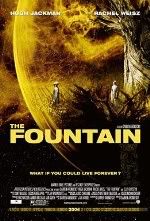
“Hey,” Joe said, an unusual call coming from my wife’s cousin who lives and studies here in Arizona, “There were some people handing out passes for a movie tonight. Have you ever heard of THE FOUNTAIN?”

Usually, when there are Sneak Previews that are promoted and pimped in the local paper, these free pass features are free for a reason; the movie obviously needs some word-of-mouth for it to come close to being profitable or it’s a crap film that needs someone, anyone, to go see it. It was odd, really odd, to hear Joe tell me that THE FOUNTAIN was about to be screened for a collegiate audience. This wasn’t a flick for the frat boys, I thought, and everything I’ve understood about this film, reading the graphic novel months ago, it just didn’t add up as to why Darren Aronofsky would debut a film of this caliber in the middle of the desert.

It’s not like I don’t have a little state pride, I do, kinda, sorta, not really, but when I saw RAISING ARIZONA as a child that’s what I thought Arizona was like: desolate, sparce and teeming with dudes who wear panty hose on their heads and stick up Circle Ks. I’ll have you know that I wasn’t too far off when I came here over a decade ago. The point here is that, yes, this city is like Las Vegas in that this town shouldn’t be here. It’s a dust bowl and nothing ever happens here that’s of note to anyone outside of this enclosed metropolis that’s damn near claustrophobic inducing with the mountains that are threatening to squeeze everyone like a STAR WARS dumpster set on “Crush.”

“It also says that,” Joe continued, “That there’s going to be a Q&A with the director following the movie.”

I don’t know if you’re a fan or not of Darren’s but when you hear this kind of information from someone the first impulse should be to tell the messenger to maim and/or run a blade through anyone who stands in the way of getting those passes.

I asked Joe to get one for me.

The events that follow between hanging up the phone and meeting Darren poolside at a local hotel for an-honest-to-goodness 10 exact minutes will be recounted later but this introduction today is aimed at doing only one thing: To help get the word out about a movie that not only deserves Oscar attention next year but to let you know that Darren honestly needs help in making this film resonate through the throngs of moviegoers that pay to see movies.

I don’t want to write a review for this movie because I really think that my interview will kind of touch here and there about what I felt after seeing the efforts of six years worth of dedication to a singular story but, suffice to say, I have to say that I already know how you should approach this film. I figured it out after leaving the theater.

You’ve got to allow yourself to be open.

This movie’s specific gravity is going to weigh you down. It needs you to be available, emotionally and spiritually, but even if you’re not it’s going to affect you in some way. I learned by watching this film that there is a reaction everyone has after seeing it. Darren mentions that there is a lot that’s left open to interpretation but there is a story here. There is nothing that can’t be explained after you see it. I was worried, initially, that there is three, different, stories happening at once but to quell those who have seen the wicked trailer I can tell you that there is only one story you need to know before going into the film: a wife is on the verge of death and she wants to try and put into words what her husband cannot emote and will not express. This film is more about Hugh and the wretchedness that is caused by fighting inevitability; what happens, as well, when the tympany is too loud in your head to just be quiet, sit still and find peace.

That’s all the film is but you can see how that might be a little hard to squeeze in the trailer.

This film is the best there is for 2006 and, dare I say it, the real benchmark for every film to follow with regard to what it means to lose a loved one. The movie is sad and it breaks your heart in two, it made me cry just a little, but, by the end, you are allowed to finally breathe in the comfort knowing our protagonist has found what he was searching for.

The movie shakes you, again, if you let it, and challenges basic notions of the heart and what it means to die in 21st century America where we believe that death is challengable, defeatable. There is so much present that in the film that it would be larcenous to point out a few moments that really show how Darren’s style has evolved since REQUIEM FOR A DREAM, it’s a misnomer if you see any review that says Darren’s style has “matured” instead of recognizing that these movies are just different from one another in every sense, but those elements that you come to expect from him are still present. The music is woven and wrapped around every moment perfectly, the performances are just solid and the way you are brought into a world you’ve never been to before but by the end you understand it completely is sheer craftsmanship. Hugh Jackman and Rachel Weisz give performances that feel completely devoid of any hubris and are nothing short of emotional believability.

Make no mistake, it’s a fool’s errand to think you can live forever but Darren has made a masterpiece out of a thought that tries to show you, really, what kind of an existence that would be for one person who can’t let go.

I’ve got the exceptionally short interview here for you next week but also know that I have another suprise up the sleeve inside this column and, hopefully, for some lucky readers of this site but like everything else worth waiting for you’ll have to come back next week and check it out.

THE FOUNTAIN opens in a week and a half on Wednesday, November 22nd.

And what would this column be worth if I didn’t mention BORAT? After trying to spread the good word of Borat Sagdiyev I am pleased, quite pleased, that Sacha Baron Cohen has shown the might of this movie’s power by absolutely destroying the competition with raking in nearly 30 million dollars. Not only that but something to keep in mind when looking at the raw totals is to also consider how many screens BORAT was playing on: 837. The 2nd place film? 3,458. Over 4 times fewer screens yet the film showed what I hoped would happen when it was released unto the world. No one could be more happier than Sacha who managed to score a huge payday for this outing and, I have to confess, I am happy too that I managed to interview Borat before the film’s opening; you can read all about that one-of-a-kind experience here. I could write on and on about this movie being able to live up to the hype, unlike many other filmic turds that have landed in the proverbial box office punch bowl but I just feel a certain amount of satisfaction of knowing that my comedic radar is still just as sharp as ever and that I didn’t run my mouth in supporting a film that completely sucked for nothing.
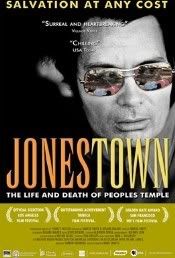
JONESTOWN: THE LIFE AND DEATH OF PEOPLES TEMPLE (2006)

Director: Stanley Nelson
Cast:
No one
Release: October 20, 2006 (Limited)
Synopsis:
On November 18, 1978, over 900 members of Peoples Temple died in the largest mass suicide/murder in history. What drew so many people across racial and class lines to the People’s Temple? How could a diverse group of 900 people be convinced to drink the poisoned Flavor Aid that caused their deaths?

View Trailer:
* Large (QuickTime)

Prognosis: Positive. I’m not one to draw much inspiration from song lyrics.

One tune, though, “Dogma” from KMFDM, has lingered with me for a long, long time. It goes, “The only reason you’re still alive is because someone has decided to let you live.”

The thing that I learned after watching the deplorable things our government exacted on the residents of the Branch Davidians in a movie called WACO: THE RULES OF ENGAGEMENT is that the government not only are the storytellers when it comes to explaining to the writers of history their own version what’s happened but that there isn’t a concerted effort to teach this kind of social studies inside the public educational system. I have never been exposed to a true explanation of what happened in Jamestown but it’s this kind of documentary filmmaking, exposing these tales to a little air and public scrutiny, that gets me all sorts of excited to finally feel I have a handle on all those “drink the Kool-Aid” jokes we’ve all heard in one context or another.

And this trailer begins, spooky as all fuck, with the sounds of distant church bells and a black scene with all the background information we need: “On November 18th, 1978 in Jonestown, Guyana, 909 members of the Peoples Temple died in what has been called the largest mass suicide in modern history.”

You’ve got my undivided attention.

We see slow-motion file footage of the people who ostensibly made up the rank and file of this “cult,” the voice-over of someone who we don’t see explaining that no one joins a cult, that they are people who are joining a movement and are trying to be with other individuals who they enjoy being around, and it’s disconcerting. You realize that all these vibrant people are going to be dead quite soon.

Next up is a brief look into what these people were subscribing to when they all decided Jim Jones was on the level: they felt he was someone who could bring positive change. It doesn’t feel religious as it does social. Society was rocking and rolling in a tumultuous cement mixer of polar issues and people looked to Jim for stability. Too bad that when we first see Jim you can immediately see those crazy eyes of his; I mean, they look bat shit crazy.

It breaks your heart when you listen to one of the interview subjects talk about what these people were escaping in modern America, racism being one, but when you see a pack of kids just happy to be kids in this hippie playground you can’t turn away from what’s coming.

This is when you see a photo of Jim Jones with his fingers on a stack of clear plastic cups.

The narration of our interview subject, on the verge of tears as he tells of the pain that still swirls around his heart, telling us that those who were followers of Jim were just “fucking slaughtered,” the beep being the one thing that’s added to his twice echoed sentiment, all you can do is stare at the photos of the dozens of dead people on the ground. Entire families just face first in the dirt. Dead.

Gripping stuff and this trailer just begs to be seen for no other reason than to try and see what it was that moved these people into complete obedience and acceptance of their collective fates.

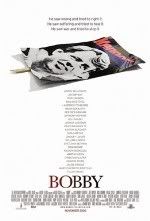
BOBBY (2006)

Director: Emilio Estevez
Cast: Harry Belafonte, Joy Bryant, Nick Cannon, Emilio Estevez, Laurence Fishburne
Release: November 17, 2006
Synopsis: Revisits the night Robert F. Kennedy was gunned down at the Ambassador Hotel in 1968. With an incredible ensemble cast portraying fictionalized characters from a cross-section of America, the film follows 22 individuals who are all at the hotel for different purposes but share the common thread of anticipating Kennedy’s arrival at the primary election night party.

View Trailer:
* Large (QuickTime)

Prognosis: Positive-ish. Now, memory escapes me on this one.

I think it was either Greg Speetzen or Doug Saam who I saw MEN AT WORK with when it was at the dollar theater in Barrington, IL. What I can remember, though, was that this movie was really a lot better than it has been credit for being. I still love to watch it for its golf clapping, for Keith David’s insane performance and, without spilling a single drop of irony when I say this, the man-on-man action on the children’s carousel was way hot.

I believe Emilio has learned a lot in the 16 years since his last major feature, discounting THE WAR AT HOME, and his experience really shines through in this trailer for a movie that I hadn’t really followed until now.

We start this trailer stoically with a really nice suite of music playing beneath a slow introduction of what is going on when we meet Sir Anthony Hopkins, explaining what it was like to be a doorman at the Ambassador hotel. It’s odd that this trailer doesn’t show its hand about the crux of what we’re all tuning in for, the assassination of Robert F. Kennedy, but we gingerly jump like checker pieces around a whole lot of players in this movie.

“June 4, 1968″

Seeing Emilio in that latter-day porno moustache, engaged in a game of bocce ball, makes me wonder about who he’s portraying, some kind of wag, some kind of stuffy playboy, but I forget about Mr. St. James when I see that Estevez splices in file footage of Bobby Kennedy into the mix of it all. It’s a bold, FORREST GUMP-ian move, but it’s so brief that it doesn’t feel disingenuous.

I hate to essentially say that this movie starts to delve into PULP FICTION territory with all the players in this thing, 22 people in total, and beside Hopkins, Estevez, Belafonte, Rodriguez, Slater and others spilling into the scenes it’s hard to get a firm grip on how this story is going to be told. 22 people is a LOT of storylines to keep in the air like a juggler’s balls, the film could live or die based on how well each person is allowed to be developed without giving short shrift to the film’s overall impact, but when I see Sharon Stone I briefly wonder if this could be a “re-imagining” of sorts with Sharon being the recipient of some bullets. It’s all for naught, however, as the tension slowly creeps its way into this thing.

The issues of Vietnam, civil rights, racial inequality and the sense that the world was at the precipice of something huge all get swirled nicely into the overall vibe but what’s really noteworthy here, and something that I can’t help but comment on, is the actual use of Bobby Kennedy’s speech as a way to define all the chaos of the moment that we’re watching.

Maybe that’s the point. Maybe having all these storylines and all these different motivations is the way Emilio is tying to illustrate what this assassination meant in a larger context; that it maybe wasn’t all about Bobby, perhaps. It was about the people living within the reality of what he represented.

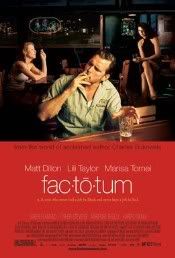
FACTOTUM (2006)

Director: Bent Hamer
Cast:
Matt Dillon, Lili Taylor, Marisa Tomei, Fisher Stevens, Didier Flamand
Release: August 18, 2006 (Limited)
Synopsis: Henry Chinaski (Dillon) considers himself a writer, and on occasion writes. Mostly he quests for the booze and women that sidetrack and seduce, rather than inspire greatness. When he falls for Jan (Taylor), the soulful connection fails to save either from their self-destructive ways, and the relationship totters between earnest connection and loathing.

View Trailer:
* Large (QuickTime)

Prognosis: Sure. MY BODYGUARD.

You watch a film like that and it encapsulates everything there is to know about Matt Dillon: he’s greasy, charismatic, threatening and possesses the kind of emotional tractor beam that prevents your gaze from pulling away. I’ve seen this flick more times across so many different periods in my life yet it still holds up thanks in large part to Dillon’s timelessness as a bully that we all have known at one time in our youth. Sure, the dingy city life that’s depicted in the movie has since been replaced with squeaky clean gentrification and a concerted effort to make suburban life, with all these white kids shooting up their high schools, seem a little bit more risqué than inner city existence but Matt Dillon keeps going on.

This movie looks like one of those parts that, while not as thrilling as him getting his ass kicked by Adam Baldwin, makes you cheer for a dude who has persevered as long as he has in an industry that has shorter shelf-life for their talent than a bowl of fruit salad.

To be honest I didn’t know what to expect from this movie but while I don’t think the trailer aspires to be anything greater than the sum of its parts I have to give praise here because this advertisement really feels like a small film all unto itself. The opening sequence is completely absurd. An apartment building is on fire, Matt steps into the hallway to find out what all the commotion is, gets barked at that it’s a blaze by a fireman and then proceeds to close the door and slips back in bed. How can you not like a guy like that as a protagonist? I’m not one to really suffer long sequences in a trailer but this works.

Quickly, we rip through the images of Dillon’s drinking problem. He drinks. A lot. We establish that this is all coming to us via the scribblings of Charles Bukowski, a man who had his own chemical issues as well, and then whip through a series of moments where it is implied that he is incapable of holding gainful employment and, surprise surprise, has a gambling problem.

Normally these things just add up to hackneyed storytelling but as I watch Matt I am transfixed by his innate ability to at once seem right at place sitting still at a bar, flushing his life away, and completely believable as someone who feels the motion in his fingers to write but just suffers from synaptic retardation; he just can’t get it together.

The accompanying quotes from the Post succinctly punctuate what we see on screen as Dillon just drifts back and forth on the screen with those who he is interacting with as it doesn’t seem like he’s acting, he appears to be occupying a person.

While this film looks like it has already come and gone the trailer is still a great example of what the sublime can be for those who want to be engaging, persuasive but not completely pushy.

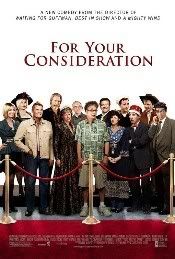
FOR YOUR CONSIDERATION (2006)


Director: Christopher Guest
Cast:
Ricky Gervais, Catherine O’Hara, Parker Posey, Harry Shearer, Eugene Levy, Bob Balaban, Jennifer Coolidge, Michael McKean, Fred Willard
Release: November 17, 2006 (Limited)
Synopsis: Christopher Guest turns the camera on Hollywood for his next film, “For Your Consideration.” The film focuses on the making of an independent movie and its cast who become victims of the dreaded awards buzz.

View Trailer:
* Large (QuickTime)

Prognosis: The Film Just HAS To Be Better, Right? I’ll reveal a little sliver of my psychoses that not many of you know.

Ahem, well, whenever I see Fred Willard in anything, be it television or film, I cannot get past that moment in my life when I first came upon this wickedly sharp master of the sly. It was in a little movie called SALEM’S LOT and he was getting his swerve on with the wife of a crazy bumpkin who suspected the woman was stepping out on him and nearly blew Fred’s head clean off before showing his hand, revealing the shotgun he had stuffed in Fred’s mouth was not loaded. It wasn’t the tension of that scene, how perfectly it was captured, no. It was that floozy and Fred’s matching silk tennis short ensemble that I think a) freaked me out a bit and b) made me question why a dude would let himself dress up in silky underwear like that. Since that moment in the 80’s when I saw that film I have never been able to see Fred without first seeing him in those silky ball huggers. Thank Lord Jebus that Fred has shown he is much better at comedy than he was with getting smoked by a 10 foot tall vampire and this film, FOR YOUR CONSIDERATION, looks like comes correct in ways that A MIGHTY WIND slightly fell short of being able to accomplish.

“And you know what they say about blind prostitutes”¦You really have to hand it to them.”

Catherine O’Hara shows her ability to assimilate any character she’s asked to inhabit as we’re introduced to her in all of her dumpy glory in this rather subdued opening for a movie that eschews flash and pomp with regard to how they’re selling this film; they completely depend on the actors to make the moments and, ah yes, Mr. silky short Willard knocks what looks like his first pitch straight into left field and over the fence. He’s just perfect as a dolt who doesn’t have a mean bone in his body and not a synapse that hasn’t been fried by a bad sense of humor.

I, unfortunately, can’t say the same about Eugene Levy who really does need to atone for his miserable turns in films, checks that he obviously needed in a bad way, since his precise wit sliced straight through his character’s malaise as a cuckolded husband in BEST IN SHOW. The joke we’re pitched from him is flat but the smiles pick up as Harry Shearer more than makes up for the lost moment in his portrayal as a wiener who is looking to make a serious comeback.

And, oh my, how far has Parker Posey come since her turn as ho-hum actress before landing in BEST IN SHOW, giving what I believe was a stand-out performance, and just coming correct as we see her overacting here in a film where she reveals to her mother that she’s a lesbian.

I am also buoyed here by Ricky Gervais, a man who deserves a turn to participate in this absurdness, who quite matter-of-factly suggests to a pack of filmmakers that they should tone down the level of “Jewish-ness” in their movie so “everyone can enjoy it.” He is so smooth when he delivers these lines that you damn well believe he means it with a straight face and without a drip of insincerity.

I can’t say that I am all that giggly when O’Hara tells John Michael Higgins about there being a rumor on the Internet which says she might be an Oscar contender and John responds blankly about what the Internet is. Personally, and I hate to be old school on this, but I have to say that I liked the moment in JAY AND SILENT BOB STRIKE BACK more when Ben Affleck has to explain what the Internet is to Jay. It’s an easy joke here and I’m not sure it really hit me the right way.

“In every actor there lives a tiger, a pig, an ass and a nightingale. You never know which one is going to show up.”

I like the ending to a degree in this trailer but I have to say that it’s really the riffing that’s inherent in the scenes themselves that will determine whether Guest has done it again. If there is enough Willard, Gervais and Higgins in this movie as the trailer suggests there might be then I think he has. While I think I set my expectations for this trailer awfully high, and to some degree I have to admit that it does disappoint a bit, what is funny is enough to get me out of the house to buy a ticket.

Quick Stop Thingamabobs: 11/10/2006

Filed under: Columns,Thingamabobs — UncaScroogeMcD @ 12:05 am
thingamabobs.jpg

The web. It’s a big place, full of plenty of distractions ““ some funny, some informative, some ludicrous, some disturbing, some inane, some profound. Each and every weekday, we present links to a few of our favorite finds”¦

————————————————

Have a THINGAMABOB? Send it in!

##

November 9, 2006

Music For The Masses: November 9th, 2006

Filed under: Columns,Music for the Masses — UncaScroogeMcD @ 2:40 am
musicmasses2.jpg

Hola, mi amigos!! Que pasa¿! Me? Why I’m happier than Reverend Ted Haggard with a mouthful of male prostitute. Seriously. And just like Rev. Haggard, I feel it safe to warn you that I’m about to come. . .to a realization that I have an addiction. No, not to cock. . .not that there’s anything wrong with that. You see, it’s just that I gave that up after leaving the Sig Eps (yeah, “brothers,” I got your “Elephant Walk” right here) and during the last couple of weeks, I’ve come to the realization that I absolutely LOVE. . .umm, political attack ads. I’m shooting straight with you here, people. With all of those half-baked accusations, exaggerations and out-right lies. . .shit, those commercials are like little, verbal, 30-second, no-holds-barred UFC cage matches. Light on substance, heavy on the slams. Or, for you EXTRA!! fans out there. . .30-second, commercial equivalents of Paul McCartney’s and “Hop-a-Long” Heather Mills’ divorce. Televised crack, I tell ya’!

m4m-macca-nov9

Wait a minute. . .after looking at this picture, I, too, now have one, “wooden leg.” Yes. . .I’m going to hell. If you laughed at that, I’ll save you a seat.

I love these little bits of nasty sooo much, I want to see more of “˜em. In fact, I want to see them so much, (and because I already miss them), I’ve actually decided to put Double A’s position as a “Rap Reviewer” up for vote just so you fine folks (oh, all right. . .myself included) can see a couple more of these attack ads. That’s right, Double A. . .guess you shouldn’t have made fun of my Afghan blanket collection. My Nanna knitted those, you fucker. Mmm hmmm. . .a pink, yellow and blue “binky” ain’t so funny now, is it?

m4m-bink-nov9

So anyway, as I was saying, the position of Rap Reviewer here at Music for the Masses is now, officially, up for grabs. That’s right, friends, I’m leaving the decision up to you. Here are your candidates. . .in one corner, weighing in at a bouncy 360 lbs., you have the incumbent, the man who finds the “rap” in “crap”, Double-“Wide” A. In the other corner. . .the challenger, weighing in at a meaty 98 lbs. and hailing from the “un-official” home of rap, Council Bluffs, IA; a candidate hand-picked by yours truly after I spotted him buying a 50 Cent CD at a local Tower “Gowing Out of Business Sale,” dressed in baggy, skater shorts, an Allen Iverson jersey and an all-white, NY Yankees hat with a straight brim. . .the “Crusher”. . .Jimmy “Hat” Rathmore. What do you say? Let’s get to know our candidates. How you ask? Why, the same way you most likely got to know YOUR local, political candidates. . .through good, old-fashioned, attack ads. Up first, Jimmy Rathmore. . .

FADE IN TO PICTURE OF A PARADE IN PROGRESS

m4m-parade-nov9

VOICE OVER (ISAAC HAYES): “Double A wants to rain on yo’ parade.”

CUT TO PICTURE OF WHEATIESâ„¢

m4m-dork-nov9

VOICE OVER (ISAAC HAYES): “Double A wants to shit in yo’ Wheatiesâ„¢”

CUT TO PICTURE OF A BIRTHDAY CAKE

m4m-cake-nov9

VOICE OVER (ISAAC HAYES): “Double A wants to take away yo’ Birf’day. . .

CUT TO A PICTURE OF A PUPPY AS SCREEN TURNS RED

m4m-puppies-nov9

VOICE OVER (ISAAC HAYES): “Double A likes to kick puppies.”

FADE TO A PICTURE OF JIMMY AND HOLD

m4m-jim-nov9

FADE IN MUSIC: “GANGSTA’S PARADISE”

VOICE OVER (ISAAC HAYES): “But NOT Jimmy Rathmore. . .he ain’t frontin’, playa’, like Double A. Double A don’t know shit about rap and you know what else? His momma’s a ho’. That’s right, Double A’s momma is such a ho’, they made her the dock in Dick Town. But not Jimmy’s. His momma is a real sweet piece o’ ass. In fact, I’m gonna hit that right after I finish readin’ his commercial here. Mmm hmm. . .Where was I? Oh yeah. . .Jimmy’s the real deal. He owns all 48 of Tu-Pac’s discs, you know, the ones released after his death? Yeah, that’s what I’m talkin’ about. 3 of his shirts are RocaWear®, his Adidas® are old school and he’s just workin’ at McDonald’s® until he can save up enough money to buy those turn-tables. Oh yeah. . .and his bling? Pure sterling silver, baby. That’s how Jimmy rolls. One more thing, children, unlike that punk-ass bitch Double A, Jimmy’s all about education. He’ll teach your kids how to flash a gang sign, hold a spray paint can when taggin’ and how to draw a sweet-ass pair of scissors. . .

FADE IN PICTURE

m4m-scissors-nov9

Fo’ keepin’ it bizzy up in the hizzy, the choice is clear. Tell Double A you don’t want none of that and vote Jimmy “Hat.”

CUT TO PICTURE OF JIMMY

m4m-jim2-nov9

VOICE OVER (JIMMY RATHMORE): “I’m Jimmy “Hat” Rathmore and I approved this message, bitch.”

And now, Double A’s ad. . .

FADE IN TO A SERENE IMAGE OF A MAJESTIC MOUNTAIN

m4m-mount-nov9

VOICE OVER (JAMES EARL JONES): In this climate of insecurity, it is nice to know that some things will never change. The sky will always be blue, Rosie O’Donnell will never be funny and Double A will continue to stand up for the little guys. Music for the Masses needs a consistent voice, one that has been down in the trenches, buying the shit that you shouldn’t. James Rathmore says that he knows rap. That he’s a “fan” of rap.

FADE TO BLACK

VOICE OVER (JAMES EARL JONES): Jimmy Rathmore says he knows rap?

CUT TO PICTURE OF MC HAMMER

m4m-hammer-nov9

VOICE OVER (JAMES EARL JONES): Fact! Rathmore owns all 6 of MC Hammer’s albums, including the rare, un-released album “Oh Hell, I’m Broke.” He also has the entire album “To the Extreme” by Vanilla Ice. . .memorized.

CUT TO PICTURE OF LOTION

m4m-lotion-nov9

VOICE OVER (JAMES EARL JONES): Fact! Rathmore thinks that N.W.A. stands for “Now With Aloe,” just like his favorite brand of lotion. Lotion that he uses to masturbate with because he’s too much of a punk bitch to get a girlfriend.

CUT TO PICTURE OF PUPPIES TINTED RED

m4m-puppies2-nov9

VOICE OVER (JAMES EARL JONES): Fact! While Double A has kicked his fair share of puppies in the past, at least he has never thought about having sex with one. Rathmore has. A lot.

CUT TO VIDEO OF THE FLAG WAVING IN THE WIND

m4m-flag-nov9

VOICE OVER (JAMES EARL JONES): If you elect James Rathmore to write your rap reviews, all you will ever get are reviews of the latest Eminem mixtape that he made for his friend “Smokey.” Also, if you elect Rathmore, he will come have sex with your dog. Double A wont. You can count on it.

CUT TO PICTURE OF DOUBLE A

m4m-fatty-nov9

VOICE OVER (DOUBLE A): What it is, bitches? This is Double A and I approved this ad.

There you have it, folks. Now, it’s up to you so. . .ROCK THE VOTE!!!! Just drop me an email, at the link below, and help support democracy by casting your vote for your favorite candidate.

But enough about all of that. It’s time now to check out some new music. In this edition of Music for the Masses, we take a look at the new one from the Who, Endless Wire, the music of Warren Miller’s new movie, Off the Grid, and we provide another chance for you aspiring artists out there to “Pimp Your Band.” Should be fun. So, what do you say? Let’s get to it, shall we??!!

m4m-who-nov9 Artist: The Who
Album:Endless Wire
Bastard Love Child of: The Who when all 4 members were alive and The Who now where only 2 of them are.
Best for: Realizing how much I miss John Entwhislte.

You know, I’m only half joking when I tell you that I fully expect to tune in to Dateline’s “To Catch a Predator” some night and see Chris Hansen asking Pete Townsend “So tell me, Pete. . .what are you doing here? What were you planning on doing with this 13-year old girl?” And, if this ever happens, I fully expect Pete to answer “I wanted to teach her how to work me whammy bar.” Then he’ll make a break for the front door and get tackled in the lawn by a couple of D.C.’s “fattest and finest.”

m4m-pred-nov9

For those of you scratching your head out there going “WTF, M.C.?” because you’re not “in the know,” a few years back, Townsend was charged with having kiddie-porn, “worm-burpin'” material on his personal computer. No. . .I’m not making that up. Granted, these charges were later dropped, but that shit sticks with you and I’ll be damned if every fucking (yes, fucking) time I hear the Who’s “Pinball Wizard,” I don’t change the lyrics to. . .”Ever since I was a young boy, I liked to play with balls. From Soho down to Brighton, I must have played them all.” And good lord, I haven’t even told you about one of the lyrics on this new disc. But we’ll get to that in a minute.

m4m-who2-nov9

Now, regardless of the validity of Townsend’s sexual appetites, I consider myself a pretty big fan of the Who’s music and I was really looking forward to getting my hands on this new one, Endless Wire. Their first disc of new material since 1982’s It’s Hard? Easy money, my friends. Easy money. Of course, as many of you know, with great anticipation can come great disappointment and after listening to this disc, I’m disappointed. Allow me to explain. If you are a hard core fan of the Who, you are going to love this album, even if it is, more or less, a glorified Pete Townsend solo disc along the lines of 1993’s Pyschoderelict, simply because it is a new disc. The fact that Daltry adds his gracefully aging voice to the proceedings makes it easier to swallow as a “Who disc,” but let’s not kid ourselves. This is not the same Who, deaths aside, that created enough quality material to prompt Syrius Satelite to give them their own channel and this is not the album that we’ve been waiting for. It’s not complete shit, and, again, it IS new Who for crying out loud, but this is Pete. . .pushing the envelope and experimenting. . .again. To paraphrase Michael’s line from The Godfather II, “You broke my heart, Pete. . .you broke my heart. Hey. . .wanna go fishing?”

And that brings us to the “casual” Who fan. They’re going to absolutely hate this disc. Know why? Because they’re going to grab this disc wanting to hear something familiar from this iconic band and aside from a tricked-up nod to the opening of “Baba O’Riley,” they ain’t gonna get it. What they ARE going to get is a hook-less song about religion, “Man in the Purple Dress,” a disjointed mini-opera (“Wire & Glass”) that is more unevenly spaced than the eyes of a Special Olympian and, due to the kiddie-porn allegations, one of the creepiest lyrical lines you’ll ever here. . .”Why can’t they see that life excites me/This boy ignites me” (“Trilby’s Piano”). *SHUDDER* Put it back in your pants, Pete. . .for fuck’s sake.

m4m-ent-nov9

I’m still holding out hope that, even without Entwhistle, we’ll get another classic Who disc, but sadly, this isn’t it. Unless you are a hard core, and I mean hard core, fan, save your money.

Rating: 2.5 out of 5

WARREN MILLER’S OFF THE GRID

There are a ton of reasons why it’s cool to live in Colorado but chief among them are that all of the women here look exactly like this. . .

m4m-cindy-nov9

. . .on your 21st birthday, the government sends you a giant block of cheese. . .

m4m-cheese-nov9

. . .and, most importantly, you learn to ski at a young age. . .

m4m-baby-nov9

I realize that for some of you out there, skiing is that thing that Sonny Bono was doing just prior to head-butting that tree, but for me and a shit-load of others here in Colorado, it’s a religion. . .sans all the alter boy “mouth hugging” and “butt-fiddling.” And if skiing is the religion, then without a doubt, Warren Miller is our favorite preacher. “Why’s that?” you ask. Well, you see, Warren Miller has been preaching the gospel of skiing and cranking out amazing ski films for the past 57 years and for those same 57 years, the faithful have gathered, just prior to the start of the ski season, to watch Warren’s latest opus and to get psyched up for hitting the slopes. For some, it’s the best part of the whole season and for good reason.

You see, aside from all of the amazing and breath-taking shots of people launching off of all kinds of crazy shit, Warren’s films feature, arguably, some of the coolest music you’ve never heard. Okay, maybe you’ve heard a couple of the tracks and some of the artists, but seriously, the guy has a knack for finding some obscure talent. And I mean, obscure. In fact, I couldn’t find squat on one of the main artists featured in Warren’s new film, Off The Grid, Boots Wallace. Too bad. . .good shit, Boots. But, that’s exactly why were here today. I realize that if you’re not a skier, your chances of checking out one of these films is slim to none and slim just left town, but there were some artists in this year’s film that are deserving of your attention. Some you’ve heard of, like Gomez and Imogen Heap, but others you more than likely have not. I highly recommend checking out the actual films, but, at the very least, check these tunes out and help out some under-appreciated artists. Who knows, maybe you’ll find some new favorites like I did with Big City Rock, Zero 7 and Gomez.

m4m-grid-nov9

In no particular order:

-Sweatshop Union’s “Baho Ang Titi Mo,” “Union Dues” and “Garbage Love Scenes/Cheesy Jingles” (www.myspace.com/sweatshopunion7)

-Scratch Track’s “Come One Come All” (www.myspace.com/scratchtrack)

-Tomorrow and Everyday After’s “Grudge” (www.teaarmy.com)

-Living Things’ “Bom Bom Bom” (www.myspace.com/livingthings)

-Simon Dawes’ “Have a Heart” (www.myspace.com/simondawes)

-Gomez’s “How We Operate” (www.myspace.com/gomez)

-Primal Scream’s “Country Girl” (www.myspace.com/primalscream)

-Wired All Wrong’s “Let Me Go,” “Medicate,” “Elevatin'”and “Fifteen Minutes” (www.myspace.com/wiredallwrong)

-Zero 7’s “The Pageant of the Bizarre” (www.myspace.com/zero7official)

– Bullets And Octane’s “Save Me Sorrow” (www.myspace.com/bulletsandoctane)

-Imogen Heap’s “Hide and Seek” (www.myspace.com/imogenheap)

-Big City Rock’s “Human” (www.myspace.com/bigcityrock)

m4m-cow-nov9

“Yippee ki aye, mother fucker!”

BAND OF THE WEEK!!!!

You know? In addition to MySpace being a GREAT place to meet a Dateline reporter. . .

m4m-chirs-nov9

it’s also a great place to check out some new and/or unsigned artists. To honor these individuals and their art, I thought it would be cool to feature a band here each time out, sans any remarks or comments from yours truly. Consider this your place to shine. If you want you or your band featured here, just drop me a line. Up this week. . .

m4m-pepper-nov9

Pepper Sands

Vancouver, BC

www.myspace.com/peppersands or www.peppersands.com

Band Members:

Citizen A: Bass and vocals

Adam: Drums and Percussion

Jay Slye: Guitar and Percussion

Derek MacDonald: Keyboards

Has Toured With: Concrete Blonde, 30 Seconds To Mars, I Mother Earth, Billy Talent, Sleater-Kinney and Swollen Members. . .amongst others.

Sounds Like: “Your wildest, wettest dreams”

CD Available? New Disc Available. . .”Forrest Strays”

Label: Universal Music Canada/Independent

What Others Are Saying: “For a major label debut, Pepper Sands self-titled record shines with the polish of the numerous veteran alternative rock acts that so obviously influence it. Seems like this Vancouver quartet has been carefully listening to most of modern rocks finest from the last decade. Lead-off track, “Win Big Lose More (Cherries Jubilee),” shows you what a Shirley Manson-fronted Foo Fighters would sound like, with its heavy riffs, poppy melodies and singer Citizen As girlie-but-ballsy vocals (think Avril Lavigne’s older sister!). Hints of Brit-pop will warm the hearts of still-grieving Lush fans on “Speak Too Soon,” while the shoe-gaze-y indie pop of “Myth” references everything that was cool about mid-90s alt-darlings, Velocity Girl. You’ve got to like a band that knows how to swap girl/boy vocals with ease and use them oh-so-sweetly when harmonizing. And get ready to dance on the super bop-y “Forever Wonder” that sounds like Neko Case singing lead for One Chord-era Sloan. Nice. Pepper Sands seem to have taken all the best parts of their favorite bands and put together a radio-friendly, catchy debut that surprises you and sticks in your head all day.” — Brian Pascual, Chartattack

m4m-pepper2-nov9

Message from the band: Looks are deceiving. And first impressions don’t always hold true. With their spunky black-white-and-red comic book cover art and short, tight, hyperactive tunes, Pepper Sands might give you the impression they’re a modern-day new wave group, updating the carefree magic of the Go-Go’s. The Vancouver quartet certainly come charging out of the gate with plenty of amped-up frustration and good time kicks. But somewhere in the middle of their debut album, the band that has opened for 54-40, Sleater-Kinney and Matthew Good slow down ever so slightly and begin opening up. The staccato pop bursts of “WIN BIG LOSE MORE (cherries jubilee)” or “Speak Too Soon” give way to the moodier introspection of “Myth,” “Touch Apart” and “Make No Mistake.” Singer Citizen A layers her vocals in lush echoes and even shuts down to a whisper. Guitarist Jay Slye rolls off the aggressive opening riffs and begins painting the night sky with ringing tones reminiscent of U2’s the Edge. Atmosphere adds depth and the lined images on the cover transform into full portraits. The acres of lyrics on the album’s insert, taking up literally every panel except the cover, express the views of a band hooked on love and forever trying to figure out a way past the inevitable pain. Except where a less literal band might stick with a few cloying phrases — and drill an obnoxious, overdone hook into your head — Pepper Sands opt to tell the story like an interior monologue where the brain must decide what thoughts to keep and which to discard. The effect is sometimes maddening, sometimes endearing, like that late night radio DJ who has had too much caffeine and proceeds to speak in circles through the endless night. You keep thinking you should turn it off and get your own head straight, but you keep wondering where it’s all going to end up. In Pepper Sands’ case, it adds up to a spirited pop debut that suggests the band is going to get much weirder as time goes on.

m4m-pepper3-nov9

Be sure to check them out!!!

Well, folks, that’s going to do it for me and the gang this week, so. . .until next time. . .keep wearing it proud and playing it loud.

Send your votes for a new rap reviewer, review copies, presents and assorted hate mail to:


M.C. Bell
P.O. Box 1222
Arvada, CO 80001

E-MAIL THE AUTHOR

Quick Stop Thingamabobs: 11/9/2006

Filed under: Columns,Thingamabobs — UncaScroogeMcD @ 12:05 am
thingamabobs.jpg

The web. It’s a big place, full of plenty of distractions ““ some funny, some informative, some ludicrous, some disturbing, some inane, some profound. Each and every weekday, we present links to a few of our favorite finds”¦

————————————————

  • What does a person’s face look like when they find out they’ve been pushed off the gravy train? (Thingamabob)

Have a THINGAMABOB? Send it in!

##

November 8, 2006

Quick Stop Thingamabobs: 11/8/2006

Filed under: Columns,Thingamabobs — UncaScroogeMcD @ 12:05 am
thingamabobs.jpg

The web. It’s a big place, full of plenty of distractions ““ some funny, some informative, some ludicrous, some disturbing, some inane, some profound. Each and every weekday, we present links to a few of our favorite finds”¦

————————————————

  • Faith Hill – “World’s Most Theatrically Obvious Sore Loser”… (Thingamabob)
  • Speaking of which, here’s the latest Kasper-Hauser comedy podcast… (Thingamabob)
  • Jim Henson & Kermit on What’s My Line?(Thingamabob)

Have a THINGAMABOB? Send it in!

##

November 7, 2006

Quick Stop Thingamabobs: 11/7/2006

Filed under: Columns,Thingamabobs — UncaScroogeMcD @ 12:15 am
thingamabobs.jpg

The web. It’s a big place, full of plenty of distractions ““ some funny, some informative, some ludicrous, some disturbing, some inane, some profound. Each and every weekday, we present links to a few of our favorite finds”¦

————————————————

  • The great Buster Keaton, and Speedy, shill for Alka-Seltzer. (Thingamabob)

Have a THINGAMABOB? Send it in!

##

Toy Box: Gremlins – The Originals!

Filed under: Columns,Toy Box — admin @ 12:10 am
toybox.jpg

As a kid, one of my favorite authors was Roald Dahl. Oh yes, he did that little book called Charlie and the Chocolate Factory, and as a fan of the book and movie (uh, the good one with Gene Wilder, thank you very much), you might think that was it. But no, the book that really turned me on to Mr. Dahl was James and the Giant Peach. But long before either of those books, or Matilda or The Witches, or any other piece of fiction penned by Roald Dahl, there were Gremlins.

His first children’s story was written in 1943, specifically for Walt Disney. It told the story of Gremlins, the little bastards that got into military aircraft and snafued it all up. That’s actually the origin of the term ‘gremlins’, first seen in British Air Force writings in the early 1940’s. Dahl took that idea and whipped up a tale of little creatures that wreak havoc, which was turned into animated characters by Warner Brothers several years later, and even ended up in a Bugs Bunny cartoon.

Dark Horse is reprinting the original book (just released last month), and are also releasing several different items in conjunction. Today I’m checking out one of three different PVC sets, called “Jamface”.

Gremlins – not so fuzzy!

Dark Horse is producing three boxed sets of PVC figures. The one I’m reviewing is refered to as “Jamface”, while the other two are “Gus” and “Rufus“. There’s also a larger vinyl set of Gus and Fifinella (which was the name used by Dahl for any female gremlin. Males were called ‘widgets’). On top of all that, Dark Horse will be using the characters in new stories as well!

toybox_110706_1.jpg

Packaging – ***1/2
It’s a nice sized box, with bold colors reminiscent of the era and the book. It shows off the figures pretty well, and it’s completely collector friendly – pop out those PVC’s and pop them back in later if you’d like. No twisties. Thank God!

The box will also store easily for the MIBBers, but won’t take up much shelf space if you want to display it that way.

toybox_110706_2.jpg

Sculpting – ***1/2
Gentle Giant was involved in the sculpts on these, and they did a very nice job. Each Gremlin looks very much like his comic counterpart, and they are posed in mischievious ways. In this set, one is using a hand drill, one is using a pick axe, and the third is scarring a surface with a nail. Just the kind of behavior you’d like your own children to emulate around the house.

toybox_110706_4.jpg

The bases all show sculpted signs of their work. The drill is leaving shards in it’s wake, scattered on the base, the pick ax is aimed at a roughly scratched “X” on the base, and the nail has gouged a fairly deep line. The proportions on the little buggers and their tools is good, and while they aren’t quite small enough to really be in scale with the DC Direct Bugs Bunny figures, they’ll look okay together.

If I have one complaint, it’s that the mold lines are a little too obvious in some spots. Of course, they might appear quite obvious in the photos, but keep in mind that the scale here is fairly small (under 4″ and that’s standing on the base), so in person they aren’t quite that easy to see.

toybox_110706_5.jpg

Paint – ***1/2
These are PVC’s, and as such you might not expect perfect paint. But you might be surprised by the quality here, with very little bleed, and good cuts between colors. And speaking of colors, there’s plenty of bright ones, but even these feel very much like the 40’s.

toybox_110706_7.jpg

Don’t get me wrong, there’s a little slop here and there. Some of the brighter colors aren’t quite as consistent as they could be, and the eyes have a smudge here and there. But in general, these are well above average for PVC’s. They’ve also added a nice touch using different finishes for differen areas, something you don’t see much in this format. For example, the markings on the back of the gloves and the edges of their masks are done in a glossy black, providing a nice contrast against the more matte colors on the suits. This is something you see more often in high end collectible, but it’s fairly rare at this price point.

toybox_110706_6.jpg

Articulation – Bupkis
Nope, these are PVC’s, not figures. This category won’t go against them in the overall, but I wanted to be sure I pointed it out, to avoid confusion.

Accessories – Bupkis
See above. As you should expect, there’s no accessories, and none of the tools are removable, and they don’t come off their bases. Again, this won’t effect my overall score, but I wanted to be clear.

toybox_110706_3.jpg

Fun Factor – ***
Contrary to popular belief, kids can have fun with unarticulated figures. I know I sure did, and I’ve seen my own kids do it as well. Those little imaginations are pretty active. Still, without joints these aren’t as much fun as they could be, and unless you’re 7 year old is into ancient cartoon characters that were created before you were, it’s unlikely they’ll have any idea who they are. Of course, cute designs are cute designs, no matter what decade, and kids will be attracted to the style and color.

toybox_110706_8.jpg

Value – **
These are a little more expensive than the usual PVC, even by today’s standards. It’s gotten common to pay $4 for a basic PVC figure in this scale (about 4″), but here you’re paying around $5 each. Pick these up for around $12 – $13, and you can add another half star to this category.

Overall – ***1/2
The paint and sculpt on these are top notch, and for me this time around, those categories have the greatest weight. While they are a touch more expensive than I’d like, I also have to take into consideration that these are pretty much going to be it for Gremlins merchandise, so it’s unlikely that beggars can be choosers. Fans of Dahl’s work are likely to be quite pleased that these are hitting along with the reprint, and I for one will be watching for the 7″ vinyl figures as well.

Where to Buy –
Your local comic shop should be getting these in soon – this is a bit of an early review, but you should see them within the next couple weeks. Ask your fine LCS employee, and I’m sure he (or she) will be happy to let you know if they have them on order.

Related Links –
There are some interesting conspiracy theories out there about Dahl and his role between the U.S. and Britain during the end of the war. Check out some info here. And, if you have the need to kill someone, you can always use the technique in his classic short story, Lamb to the Slaughter.

And if you prefer your Gremlins more modern, check out the review of the NECA action figures based on the film.

November 6, 2006

Quick Stop Thingamabobs: 11/6/2006

Filed under: Columns,Thingamabobs — UncaScroogeMcD @ 12:20 am
thingamabobs.jpg

The web. It’s a big place, full of plenty of distractions ““ some funny, some informative, some ludicrous, some disturbing, some inane, some profound. Each and every weekday, we present links to a few of our favorite finds”¦

————————————————

  • Watch the first 6 minutes of Tenacious D: The Pick of Destiny. (Thingamabob)
  • Hey, remember when Letterman was funny and surprising? I do. It looked like this… (Thingamabob)
  • It’s the Funtastic World of Hanna-Barbera! (Thingamabob)
  • More Sesame Street goodness. The golden an… (Thingamabob)

Have a THINGAMABOB? Send it in!

##

Party Favors: Hodgman’s Peace Chalk

Filed under: Columns,Joe Corey's Party Favors — UncaScroogeMcD @ 12:15 am
partyfavors1.jpg

CHARLOTTESVILLE, VA – ESPN has finally aired a real sport and I was part of it.

Thanks to my good friend Norm Chad having to attend a Tilt fan convention in Butte, Montana, the Sports Leader called me to be the color announcer for The Fifteen Annual Ookie Cookie Invitational.  This was my first entry into the world of high stakes professional action. Most of my career involved calling it as I saw it with a pack of amateurs in the back of a certain fast food restaurant as they added a little something special to the mayonnaise jar. But now the sport has moved up to the Zsa Zsa Arena at the Palms Hotel in Vegas. The Maloof brothers treated me, a distant relative, like a brother – the brother who didn’t have a grandfather smart enough to get in the beer business. They didn’t even mind when I kept quoting Killing of a Chinese Bookie to the pit bosses.

This was a transition year as the original sponsor, Keebler’s Town House crackers, was replaced by Nabisco’s Sociables. I didn’t mind the swap since the new cracker does describe the competition. It’s about being sociable even though it is heavily competitive. Ritz Top ‘Ems crackers were in the running, but lost out when Andy Griffith refused to give out the “Flock Cup” to the 2006 Champ. I wanted to pay tribute to Andy during the “winning” moment by saying, “Everything tastes better when it sits on a Ritz.” Damn it. I had already envisioned it as a viral video on Youtube.

Norm was amazing setting me up for the role. He told the bigwigs at ESPN that Ookie Cookie demands a true jerk off behind the microphone. Plus Gabe Kaplan passed since he had an Old Maid tourney in Reno. The ESPN suits were amazed at how I could say the word “strokin'” with so many infections. They were howling when I said, “Someone’s gonna lose an eye on that pop.” Plus they used my slogan, “The only difference between winners and losers is a matter of taste” on all the promos. Norm said it was going to be as big as his “they call him the Matador for the way he lures the young bulls into the ring” line. The suits promised me a guest host gig on PTI when the Cubs win the World Series.

Because of a non-disclosure agreement, I can’t tell you who won or repeat my witty commentary. Also I can’t tell any private interaction of what it’s like working with crack announcer Jerry Langerhold. He taught me a lot about the importance of a good back wax. And tips on how to tell if your hooker is pre-op. Although it was funny when one of the contestants arrived as Ernie with his own set of Keebler elves. Because of the sponsor change, they had to swap out their outfits. Luckily their back up uniforms were fireman outfits. The fans loved the Hose Squad.

So stay tuned to ESPN for the Ookie Cookie action this month. We’re airing after Dominos, Cross Country Lawn Darts and Synchronized Mulching.

I WON’T HURT HODGMAN

If John Hodgman comes to your local bookstore to sign copies of The Areas of My Expertise, show up early and prepare to be marveled. He’s hilarious even when he’s reading out of the book. He makes the hobo historical tales come alive. He’s better than most comedy shows and doesn’t force you to take a two drink minimum. He involves the audience in his show so don’t be shy. And if you bring children, be warned that he does use a little blue language. Although with his expert tone, it sounds less dirty and more like a Canadian reading a Penthouse Forum letter.

We spoke after the reading and discovered that he too was a childhood fan of The Creature Double Feature on channel 56 in Boston. Because of his recent fame playing “The P.C.” in the Apple ads, I asked about the legendary Timex-Sinclair. He laughed because he’d been thinking about the home computer that had barely enough memory to hold a recipe. Neither of us knew how many Timex-Sinclairs you’d have to hook up to get the power of a Mac G5. (The Timex-Sinclair had 2 KB of RAM.) We discussed his chapter on “How to Win a Fight” that dealt with attack ads. I mentioned my recent spat with Yahoo (the website that’s #1 amongst people that will destroy your family values) and how after it hit the web, Yahoo took a 10 percent stock dive. Coincidence? I think now. Hodgman signed my copy of his book, “Please don’t destroy me on the internet.” I agreed to the terms after he gave me a piece of hobo chalk. It’s nice to know that John Hodgman and myself have signed a non-destructive pact. And I won’t use his hobo chalk to damage his reputation.

Even though I’m a lifelong Mac user, I don’t mind considering John Hodgman as a PC pal. Hodgman is now on my list of “Five People I’d Take for Dinner to the French Laundry if The Food Channel Foots the Bill.” Sorry to bump you off the list, Liza.

THE HOSTEL DETECTIVE

I’m hooked on Showtime’s Dexter. Fellow Raleighite Michael C. Hall has proven that the best way to not be stereotyped as the gay funeral home director from Six Feet Under is to play a non-sexual serial killer working for the Miami police as their blood splatter expert.

Dexter is a unique character that would never make it on network TV. The NBC executives would change him so that instead of being a serial killer, he’d collect spoons from his travels across the country. Thankfully in the world of pay cable, he can be cold blooded as he tries to practice selective killing to feed his blood lust. It reminds me of the under appreciated John Landis’ flick Innocent Blood. If you enjoy seeing Sopranos cast members before they met Tony, get the DVD of Blood.

Dexter and his unflinching night and day jobs make the show extra addictive. You may even catch yourself playing a game of solving the homicide case while picking Dexter’s next victim. The show has a great balance of dry humor with wicked violence. It’s great that Showtime is willing to produce shows with edgy subjects instead of flooding us with shows about showbiz people.

I’m not going to compare the programming on Showtime vs. HBO. Since HBO has The Wire going on right now, it’s a dead tie in quality. But between Dexter, Sleeper Cell and Weeds (that features my fellow North Carolina School of the Arts alumni Mary Louise Parker), Showtime is putting on programs that make me forget about watching network TV. Hopefully this season of L Word remembers that some of us tune in to see a little less grieving and a lot more getting it on between the cast. More Mia Kirshner with less headcase action and more lip locking with Carmen.

Once again congratulations to Michael C. Hall who will now have old women ask him if he’s the guy who kills people instead works at the funeral home.

TRIVIA ABOUT ME

Did you know like myself another Raleigh resident that went on to study at the North Carolina School of the Arts is Randy Jones, the cowboy from the Village People? Do you know what it’s like to live in the shadow of the cowboy? Such a burden I don’t wish on my children.

COLLEGE FOOTBALL UPDATE

During my visit to the University of Virginia to see the Cavs play NC State, I was amazed to discover their new basketball arena is named after John Paul Jones. How sweet it is to know that the bassist of Led Zeppelin is finally getting his due after getting screwed out of the Plant-Page reunion. Also they had a building on campus named after The Gooch from Differ’nt Strokes. I was hoping to find out if the student health services was named after Juan Epstein’s Mother.

During the halftime show, the marching band played the themes to various ESPN shows. What the hell? Although they did impress me when halfway through they busted into “Kung Fu Fighting.” The flag girls dropped their poles and started to bust each other up.

You know your football team is having a bad season when the cheerleaders most popular chant is “Don’t! Suck!” And why is it that no matter where you sit in the stadium, your view will always be blocked by a dork with a cowbell? It’s the same way that at a fetish night event how no matter how empty the dungeon is, there will always be a tourist blocking your view of the St. Andrew’s cross action.

CHANGE YOUR STYLE

I’m watching Howard TV and wondering why Savannah Samson looks like a Brooke Hogan impersonator.  I’d consider getting his pay per view channel except they showed that Richard guy yanking down his shorts.

LONG DISTANCE BURGERS

Wendy’s is now setting up their drive thru lanes so you’re now speaking to someone in a remote call center that emails your order to the grill. Let me get this right, I can barely hear a dork less than 20 feet inside the restaurant. Now we have to worry about a person in a call center on the other coast screwing up my fries? And just wait till they outsource this to India. You want curry on that apple pie? The nice thought is that it allows the workers at Wendy’s to spend less time dealing with a customer and more time chatting amongst themselves.

FOX BACK IN THE BOX

Enough with taking the Fox pregame show on the road. The two weeks they were back in a Hollywood studio was better than their lame locations. Do I really need to see morons screaming and waving signs for an hour? And wasn’t it nice to have Jillian Barberie giving us the weather and Terry the business? What’s the point of Joe Buck hosting the show when they didn’t struggle without him? Keep him in the booth, Fox.

A good pre-game show deals with three things: Who is injured, what’s the weather and who talked trash to the press. I don’t need human interest. And ones with weather girls wearing heels as they waltz around the map get my attention first.

MALIBU HOLD UP

According to a guy named Cliff at BCI, they are striking a new transfer of Malibu High which is why the Starlite Drive-In Theater DVD with it and The Virgin Queen of St. Francis High has been delayed. They’ve done a better job at Rhino when it came to restoring these Crown International titles to their late night glory so I’ll be patient.

There’s still no real answer why Classic Media has decided to delay the general release of Godzilla Raids Again and Godzilla Vs. Mothra. They’re still offering it on their exclusive website, but not priced as cheap as Deepdiscountdvd had ’em. I was so hoping to have these titles for my tribute to WOR’s King Kong-Godzilla Turkey Day Monster Mash.

Speaking of Crown International, the trailer for Grindhouse is a tribute to films those guys put out over the decades. I’m already thinking about Grindhouse 2. The follow up needs to contain the greatest of grindhouse genres – hot chicks in jail! Maybe a film about a young girl going cross country. While on a bus layover, she gets into trouble with a local and gets sent off to a redneck work camp. Of course the work done at the camp is making moonshine, mixing up meth, mud wrestling and white slavery. Lot of sweat and BBQ sauce pouring off the screen. Can you sense the numerous shower scenes? QT, call my agent, Lenny Cripes. He’ll arrange the movie magic. The young girl in jail must be played by the Princess Diaries gal. She’s look extra pretty in the hothouse.

TWICE THE VICE

Rejoice for word has leaked out that after the devastating lameness that was the Miami Vice movie, Universal is putting out seasons three and four of the show. In March we shall be getting almost all the remaining pastel goodness. They better not tease us by keeping the final season in the vault beyond Christmas 2007. The saga must be available unbutchered by the syndication cleaver. The kids need to experience the magic of Philip Michael Thomas. And when’s his performance in Death Drug coming to DVD? Philip Michael Thomas should be the next 80s icon revived like Mr. T. Thank goodness Jamie Foxx didn’t steal his legacy.

GREEN ACRES

It’s time to throw more praise at chef Daniel Taylor at Raleigh’s Underground. He has made me a fan of collard greens. Twice now I’ve cleaned my plate of the leafy veggie that’s a southern treat. As a child growing up in all you can eat BBQ joints, collared were more of a dare than food. But now I’m a fan of them if Taylor mixes them up in his cream sauces or bacon broth. Mmmmmm.

Nocturnal Admissions: Book Review, Spy: The Funny Years

Filed under: Columns,Nocturnal Admissions — UncaScroogeMcD @ 12:10 am
nocturnalheader5.gif

I was reading the latest issue of Entertainment Weekly the other day and came to the week’s marriages, deals, and obits page called Monitor. Nicole Ritchie was dubbed “diminutive socialite”; affixed to the name of Snoop Dog was the prefix “serial airport nuisance.” This was straight, strict Spy magazine, circa 1988.

Spy is arguably the most influential magazine published in the second half of the 20th century. It’s 112 issues from 1986 to 1990, with only the first 81 considered to be part of the funny years were at the cutting edge of national magazine writing style, visual design, and aggressive A Spy listeditorial positions that made all other papers seem pallid by comparison and which made a mockery of unhip journalists at other publications who were prone to using fakely hip phrases such as “cutting edge.” It was a sad day in January of 1998 when the then new owners of Spy announced that the magazine was shutting down.

But those mournful readers weren’t going to miss Spy. It proceeded to pop up, as a tone, as a visual style, everywhere, in the New York Observer, then EW, then Vanity Fair, not to mention the Internet itself, from Gawker to The Smoking Gun, but which at its worst excesses has adopted the crudity of Spy‘s snark without its elegance.
I will admit to being obsessed with Spy during its lifetime. At the “alternative” newsweekly I worked at for a time I attempted to introduce Spy like elements (but so did others, which usually constituted embarrassing public record filings, a speciality of Spy). Though I loved stories such as the underground excursion into Bohemian Grove, and the media columns on Hollywood and the New York Times, my main focus was on The Spy List, its monthly blind item gossip column in the form of a puzzle. Often they were rather easy to figure, usually thanks to a fictional character whose well-known feature or action who provided the clue that defined the group into which all of the names were corralled, but not being in Manhattan some of them were at first baffling. Then when you finally pieced it together, the palpable, physical sense of satori was exquisite, orgasmic. Indeed, I became so obsessed with the Spy list that I first collected them into collated photocopied pages that I carried around with me to ponder over with friends in bars, and then second, even went so far as to try and write some of my own and submit them to the magazine. I reached the apotheosis of this obsession when, after mailing in my submissions, I actually got a call from someone at Spy. I don’t remember his name, and I am guessing that he was an intern, but on behalf of Spy he actually showed an interest in a couple of my Lists. I should have packed up and instantly moved to New York, but it is a good thing I didn’t, for shortly thereafter Spy was sold, and soon the Spy List was no longer a feature under the new regime. Still, I was about to ferret out a crucial bit of information from the caller. There was one lone Spy list that I was never able to figure out. I said, “Say, while I’ve got you on the telephone, let me ask you this. There is one list I’ve never been able to crack.” I read the first few items on the list. Spy‘s owners will be proud to know that the man did not really crack. He wouldn’t say explicitly what the list was about (and indeed the new book also maintains that the Spy list was an utterly random collection of names), but since I had gone to a lot of trouble on the magazine’s behalf, he must have taken pity on me and said, “Huh, well, it sounds like it’s probably a bunch of stuff in somebody’s office.” I put down the ‘phone and hauled out my list anthology. The intern-editor’s statement was all I need; the solution to the puzzle screamed in my face. I shall leave it to the reader to suss out what list I may have been talking about.
Spy book coverThough I could easily pull down and flip through my near complete collection of the magazine, it is still a delight to relive those days thanks to the publication of Spy: The Funny Years (Miramax Books, 304 pages, $39.95, ISBN 1 401 35239 1), a history of the magazine by its early insiders.

As one of my fellow Spy lovers complained, the only thing missing from the book is a disc or two with all 112 issues on it, akin to the complete run of The New Yorker you can buy for a hundred-plus dollars, but otherwise it takes you behind the scenes at what must have been the most exciting place to work in New York in the 1980s. I could have used a more organized approach to the anthology components of the book but I was grateful for the history tour. In fact, I may be the perfect reader for this book, as I could annotated it as I read along by pulling out of my files media mentioned in passing that measured Spy‘s impact. When primary author George Kalogerakis mentions that New York magazine launched an attack article, I was able to re-read it quickly. When he mentions that the Wall Street Journal ran a front page article bemoaning the cruelty of the magazine, I could pull it out of the same folder and enhance my reading pleasure.

Kalogerakis, with the help of co-founders Kurt Andersen and E. Graydon Carter through the agency of occasional footnotes, walks us through the history of the magazine as seen up close and personal. He paints the times that Spy was about to change, he tracks the influences Time-ese, Mencken, Private Eye), and in the most interesting chapter, to me anyway, describes the editorial process. What distinguished Spy was the fact that from its cover to its occasional index it came at you like a collective force. It had a house style, and was probably the most edited paper on the news rack. Though Kalogerakis reports some writers being at first angry at the editorial interference, they also ended up being embarrassed that they hadn’t written the story that good in the first place.

Spy issue cover

The greatest thing that Kalogerakis did in his youthful exuberance was keep a diary of his time at Spy, and it is a pity that he does not quote from it more extensively, though it is probably not publishable in the way that, say, a Saturday Night Live diary couldn’t be. His snapshots of the behind the scenes interplay, hijinks, and in general congenial atmosphere of creativity and risk-taking. I await eagerly a true successor to that most marvelous magazine.

November 3, 2006

10 Quick Questions: Borat

Filed under: Columns,Interviews,Trailer Park — UncaScroogeMcD @ 6:15 pm
10quickquestions.jpg

by Christopher Stipp

I wish those of you who are going to see BORAT this weekend, and are excited to be doing so after being seduced by the slew of advertisements that assaulted network television in the past weeks, could be doing so without knowing anything about this movie.

borat-01.jpgIf you saw this movie cold like I did, only having a general idea of the film but willing to stampede my fellow nerd cohorts to be at the screening at the San Diego Comic-Con almost 4 months ago, then I could honestly state that this movie would’ve clocked you like a sucker punch. As it stands, however, a lot of you are a warmed to the notion of what you’re getting into and the kind of material that’s present in the flick itself; I am woefully disappointed, as well, that many outlets deemed it fine to release images of The Running of The Jew, thereby spoiling the visual hilarity. That’s alright, though, as this movie still manages to raze any glass temples of those comedies you thought were the paragons of film humor. BORAT demolishes your crap taste in what you believed was funny and happily replaces it with the catchphrases you’ll be mouthing for weeks to come. Lord knows my 3-year old daughter loves to say “Hiiiigh-Fiiiive” and “Thaaaat’s Niccceee…” in a way that only a geek dad like me could be proud of.

That said, I am happy that after contacting Fox Online Publicity regarding really getting behind this film and doing everything I could in order to be a preacher for the religion that is BORAT finally was answered. Today. This morning. I knew if I just stayed with it, if I just showed how much of a fan I was for this crazy Kazakh after only one viewing, if I only mentioned that I could’ve pimped this film every week from July to November, that good things would come of it. I am glad at what I am now able to present to you.

No interview means more to me right now than being able to give the masses, the teeming thousands of you, an EXCLUSIVE look into the world of BORAT and get answers to a very special edition of “10 Quick Questions With…” to Quick Stop Entertainment. Ladies, gentlemen and everything else in-between, I present: Borat.

——————————————-

KEN PLUME: Do you have any comment at all about Bruno, an individual who has just scored a 42 million dollar paycheck from Universal, is going to be developing a movie based on a show that looks suspiciously close to what you do?

BORAT:

borat-02.jpg

KEN PLUME: And, a follow-up, how do you feel about Austrians in general?

BORAT:

borat-02.jpg

KEN PLUME: Your English is remarkably polished for a man that comes from a country where formal education doesn’t seem to be a priority. How did you get a grip on the basic Anglo particulars of the world outside of a totalitarian regime?

BORAT:

borat-02.jpg

KEN PLUME: Some people have leveled some pretty serious allegations that your quest across America has shown a lot of your subjects to be poor representations of Americans in general and that you purposely selected targets to get the greatest comedic reaction. How do respond to that?

BORAT:

borat-02.jpg

KEN PLUME: Looking at the movie now what do you think is the starkest realization you can make about what this film represents?

BORAT:

borat-02.jpg

KEN PLUME: What was like trying to convince Larry Charles to go along with you on this journey of yours and was there any hesitation on his part to get involved in this production?

BORAT:

borat-02.jpg

KEN PLUME: What kind of frustrations did you have to overcome in order to be able shoot the kind of film you wanted with the money you had and was there any give-and-take with managing your needs with the needs of the studio?

BORAT:

borat-02.jpg

KEN PLUME: Why do you think people, even I, are having a visceral reaction to this film’s material in general?

BORAT:

borat-02.jpg

KEN PLUME: I am amazed by the groundswell of interest this movie has garnered as the film’s release date has come closer but do you think that your job, as an artist, is to simply reflect what you see or was there a germ in your mind about what you suspected you’d find when you plotted this film’s progression from pre-production to post?

BORAT:

borat-02.jpg

KEN PLUME: Kazakhstan is situated right above Uzbekistan, the site for one of the bloodiest anti-government protests in Central Asia, hundreds of innocent people literally mowed down by government forces as the nation’s dictator, Islam Karimov, gave the directive to do so. Uzbekistan is enjoying the benefits of working with the United States by allowing detainees to be “interrogated” and “questioned,” and no doubt tortured, on Uzbek soil. Do you think Kazakhstan has the huevos to step up, do what’s right, one-up those Uzbekian lightweights and show them what oppression really means?

BORAT:

borat-02.jpg
##

We’d like to thank Fox Online Publicity for all of their help in setting up this interview.

##

Comics in Context #153: Top Drawers

Filed under: Columns,Comics in Context — admin @ 4:44 pm
comicsincontext4.jpg

That redoubtable comics news blogger, the Beat, regularly refers to “the comics-loving New York Times,” and that description is largely apt. Last year The New York Times Sunday Magazine inaugurated its new section “The Funny Pages,” including a weekly comic strip by a prominent alternative cartoonist, each of whom does a story that runs for several months: the first contributor was Chris Ware, who was followed by Jaime Hernandez, and currently by Seth. Though it would have seemed highly improbable even two years ago, Times readers are now accustomed to regularly seeing writer George Gene Gustines’ news reports on the superhero genre, in comics and other media.

cic2006-11-03.jpgBut then on October 30, 2006, the Times ran an article by television reporter Bill Carter with the headline “It Doesn’t Take a “˜Comic Book Nerd’ to Create a Superheroes Hit.”

I write my own titles for this column, but I have learned that generally in the world of magazines and newspapers, editors rather than writers devise the titles for articles. So perhaps, you might think, Carter and his subject, Tim Kring, the creator of the new NBC series Heroes, did not thus disparage the audience for comics. But you would be wrong. “”˜I was not a comic book nerd,’ Mr. Kring said,” according to Carter’s article. It’s just amazing that it has not occurred to Mr. Kring that it is not good public relations to disparage much of your core audience.

I suspect that I see a trend emerging. As the mainstream becomes more interested in comics and graphic novels, some of these newcomers to the medium will feel obligated to distance themselves from those of us who have known and appreciated comics as an artform all along. The newcomers will position themselves to appear as discerning observers with good taste; we will still be stereotyped as nerds and geeks.

Mr. Carter seems not to think highly of the comics audience, either. He writes that “With an audience of 14.3 million on Oct. 23, more than the comic-obsessed are watching now.” Would these be the television-obsessed, then? Or does Carter only consider aficionados of art forms he thinks are outside the mainstream to be obsessives?

Carter also asserts that “The world Mr. Kring comes from seems almost antithetical to the comic traditions. He was a religious-studies major who somehow turned that interest into a master’s degree in filmmaking.” So Kring has a background in mythology and in visual storytelling. That seems to me to be a proper foundation for writing superhero stories.

Of course there remain that large contingent of comics buffs who glory in being stereotyped as nerds and geeks. For example, on November 1, 2006, the venerable TV soap opera Guiding Light, with cooperation from Marvel, ran an episode in which one of the characters gained super-powers and became a costumed heroine called, of course, the Guiding Light. Marvel did a tie-in comics story, written by Jim McCann, who told the Times’ Gustines (October 31, 2006) about “writing the sound effects for Wolverine’s unleashing his claws and Spider-Man’s shooting his webs. He said, “˜I geeked out typing SNIKT and THWIP.'” This isn’t the most felicitously phrased statement to be immortalized in cyberspace, either.

The Guiding Light episode and the success of Heroes both demonstrate that a taste for the superhero fiction that originated in comics is not confined to some supposed subculture of social misfits. Carter quotes Kevin Reilly, the president of NBC Entertainment, as stating that in Heroes, “We have the only real hit of the fall, and it’s growing.” In the same article Kring says about comics that “the truth is that nowadays that world is so pervasive, especially when you have kids, that you go to movies in the summertime and that’s what you see.” This is becoming part of the mainstream in American entertainment.

How far does this cultural shift extend? The last time that I visited the Metropolitan Museum of Art, I stumbled across a new temporary exhibition titled “Series and Sequence: Modern Photographs from the Collection.” Each display in this exhibit consisted of a series of photographs that were taken by the same photographer and that were meant to be shown in a specific sequence. As the introductory wall text stated, these were “groupings that highlight serial progression and narrative sequence and thus go against the traditional authority and autonomy of the single image.” These “groupings” may not have been cartoon art. Only one of these series, a set of photos by Chris Burden, recording his encounter with a woman, actually told a story. Each photo in another series was accompanied by a sheet of paper with a typed description. Hence, this sequence combined words and pictures. But all of the series in this exhibition were indeed “sequential art,” to use Will Eisner’s term for describing comics.

I quite like the Metropolitan’s assertion that in these examples of sequential art “go against the traditional authority and autonomy of the single image,” by which the Museum presumably means the conventional paintings, drawings and photographs exhibited in museums. That is an intriguing approach to looking at comics.

Upstairs the Metropolitan’s galleries for drawings, the Museum was temporarily exhibiting illustrations from children’s books of the late 19th and early 20th centuries by artists including Maxfield Parrish, Howard Pyle, Arthur Rackham, and an artist whose work I hadn’t known, Peter Newell, the illustrator of a 1902 edition of Alice’s Adventures in Wonderland. Perhaps this was a response to the Dahesh Museum’s show of classic American illustration earlier this year (see “Comics in Context” #132). It may also be further evidence that the best of popular culture, given sufficient passage of time, becomes incorporated into the canon of high art.

The works by Newell, Pyle and Rackham were efforts at conveying a story through pictures. Looking over these displays, I found myself reflecting that the first great Master of American Comics, Winsor McCay was a contemporary of Newell and Pyle. Why shouldn’t McCay be exhibited at the Met, too? (Actually, I recall seeing a McCay collection in the Met’s book shop over a decade and a half ago.)

On this same visit to the Metropolitan, I looked through another new temporary exhibit, “Coaxing the Spirits to Dance: Art of the Papuan Gulf.”
One label stated regarding Papuan ritual dances that “During these performances, spirits entered the masks and possessed the dancers, allowing them to do remarkable things.” This is why I like museum exhibits of tribal masks and costumes. They serve as reminders that the masks and costumes of superheroes are modern counterparts to the masks and costumes of ancient tribal religions.

Sequential art. Illustrations for children’s books. Masks. Thirteen years ago the Met did a retrospective of drawings by Honore Daumier, the 19th century French illustrator and caricaturist. Three years ago the Met did a retrospective about Philip Guston, whose later paintings were quite cartoonlike, noted in its wall texts that Guston was influenced by George Herriman’s Krazy Kat, but failed to show any examples of Herriman’s work (see “Comics in Context” #20). I wonder how long it will take the Metropolitan to put together the puzzle pieces and do an exhibition about comics.

The bad old days are not so long ago. Take the case of Roy Lichtenstein, the late Pop artist who is best known for creating variations on comics panels. Back in “Comics in Context” #4, I recalled the Solomon R. Guggenheim’s 1993 Lichtenstein retrospective, whose introductory wall text commended him for appropriating images from sources that, it claimed, had no artistic value, including comics, and converting them into art.

Thanks to Colleen Doran’s blog (for Oct. 18, 2006) and an article in The Boston Globe, I learned about art teacher David Barsalou’s “Deconstructing Roy Lichtenstein” website. (It’s here, but I warn you, if you’re on dial-up, it’ll take a long, long time to load.) Barsalou has been tracking down the comic book and comic strip panels that Lichtenstein used for source material, and posts them next to reproductions of Lichtenstein’s work on his website. The results are eye-opening.

The Globe quotes Jack Cowart, the executive director of the Lichtenstein Foundation, as saying, “Barsalou is boring to us.” Here is yet another example of a person who does not comprehend how to talk to the news media. He comes off sounding like a stuffed shirt caricature of an academic who finds people outside his elite circle tedious. But Cowart does deign to respond: “Barsalou’s thesis notwithstanding, the panels were changed in scale, color, treatment, and in their implications. There is no exact copy.” That’s true, but to look at the Lichtensteins side by side with the original source material is to realize that Lichtenstein unmistakably copied the essential figure drawing and all or much of the composition of these works from the original comics. Much of the artistic vitality and power of Lichtenstein’s pictures comes directly from their sources in comics (including work by such important figures as Carl Barks, Joe Kubert and Russ Heath; I’ve even spotted a Lichtenstein that seems adapted from Jack Kirby). The Globe article points out that in the music world this would be called “sampling,” which, an intellectual property attorney quoted in the piece says, “is considered stealing.” I would add that in the comics world it’s called “swiping.” Cowart protests that “Nobody seemed to raise this issue way back when.” Ah, but now mainstream culture has started taking the comics medium seriously, and Lichtenstein is being found out. (Indeed, to my taste, certain Lichtensteins on Barsalou’s website are inferior to the original comics sources as artwork.)

Cowart also declares that “We are all in favor of having the drawers and writers receive as much credit as humanly possible.” The “drawers”? What, are they furniture or underwear? Can’t Cowart bring himself to call the people who drew and inked the original comics “artists”? And if the Lichtenstein Foundation is so concerned with crediting the “drawers” of the source material, why didn’t they already do what Barsalou is doing now?

Right now, the Whitney Museum of American Art is holding an exhibition called “Picasso and American Art,” demonstrating how Picasso’s work influenced many major American artists of the 20th century. There are Lichtenstein works in this show, hanging alongside the Picassos that inspired them. Hence viewers can see for themselves exactly what Lichtenstein took from Picasso and how he changed it to suit his own purposes. So here’s an idea for a retrospective: “Lichtenstein and American Comics.” Why not hang Lichtenstein paintings alongside reproductions of the comics he used as sources? The Museum of Modern Art’s “High and Low” show in the early 1990s paired some examples of Lichtensteins with comics, but I’m proposing using this compare-and-contrast scenario for an all-Lichtenstein show. Such an exhibition would ideally set viewers thinking about the artistic merits of the original comics as well.

Even as museums and galleries grow more interested in comics as the new century progresses, I wonder how much 21st century comics artwork will be available for eventual exhibition? In an October 22 entry on her blog, Colleen Doran reflects on how lettering, coloring, and even, increasingly, inking is done on computers now, and how publishers increasingly prefer artwork to be delivered via discs. “Since so many artists aren’t even really doing inks anymore – they are sketching their work and tweaking it in Photoshop – I wonder about the values of comic art,” she writes. “I’ve heard some collectors say they have trouble finding hand lettered art directly on the page, and classic comic art with lettering and inking, is becoming very attractive.” This echoes the warnings sounded on the “Brush Masters” panel I moderated at one of the Big Apple Conventions last year (see “Comics in Context” #132).

You can see original comics art. complete with inking and lettering, at the “Masters of American Comics” show that I have been covering for the last two weeks. Another of the virtues of this exhibition is that it never condescends to the comics medium, to the individual artists whose work is displayed, or to comics aficionados. (The sole exception is an essay by a contributing writer to the Masters of American Comics catalogue, as you shall see.)

The show is currently divided between the Jewish Museum in Manhattan and the Newark Museum in New Jersey. When I left off last week I was still making my way through the Newark Museum’s galleries, where work by classic comic strip artists is displayed.

The next Master in the show is Frank King (1883-1969), the creator of Gasoline Alley, which has been going through a critical rediscovery and reappraisal. In books about comics that I read decades ago, Gasoline Alley seemed most notable for defying the convention that comics characters never aged, or did so extremely slowly: King’s strip presented a community whose members aged in real time.

One claim that the “Masters” show makes for Gasoline Alley in a wall text is well over the top: “Gasoline Alley is the Our Town of the comics pages, and the family history that has unfolded in its panels for more than 80 years reads like the Great American Novel.” Most of the Gasoline Alley I’ve read was done after King’s death, and I only know King’s own work from individual Sundays and daily strips, not from entire story arcs. Nevertheless, I find the idea that King’s Gasoline Alley reads “like the Great American Novel” hard to swallow. Is it really on a level with the novels of, say, Nathaniel Hawthorne, Herman Melville, Mark Twain, Henry James, F. Scott Fitzgerald, Ernest Hemingway, or William Faulkner? Certainly none of the individual strips in the exhibit’s King section show any trace of that level of literary quality. Even the comparison to Thornton Wilder’s Our Town goes only so far, since the last act of Wilder’s drama, set in a graveyard among the spirits of the deceased, reveals the play’s deep and dark foundation of pessimism about the brevity of existence. From the examples on display, King’s Gasoline Alley seems genuinely sunny in comparison. (Similarly, Krazy Kat‘s desert setting reminds New York Times art critic Michael Kimmelman of Samuel Beckett in his October 13, 2006 “Masters” review, but Herriman’s work is free from Beckett’s underlying despair.)

“Masters” co-curator John Carlin more persuasively contends in the wall text and the catalogue that King “was one of the last newspaper artists to follow his [Winsor McCay’s] lead” (Masters p. 61). This is demonstrated by King’s early strip Bobby Make-Believe, which was obviously inspired by Little Nemo. In a 1918 Sunday page in “Masters” Bobby imagines himself ascending through the clouds, becoming gigantic and walking on the moon and Saturn’s rings, and even riding the tail of a comet, before returning to reality (p. 210).

I notice two major differences between this particular Sunday strip and Nemo. Nemo falls asleep and has dreams which are beyond his conscious control. In contrast, Bobby is daydreaming: he is consciously imagining what he sees. Nemo is repeatedly awed by the wonders he witnesses in Slumberland, and often terrified by them, causing him to awaken. In this installment, at least, Bobby, who seems to have a short attention span, is quickly bored by the marvels he conjures up for himself, as if he were a creative artist who did not value his own talents.

Although on weekdays Gasoline Alley dealt with homey realities of everyday life, “King’s Sunday pages,” Carlin states, are “filled with unexpected fantasy and visual inventiveness” (p. 61).

Some of the show’s Gasoline Alley Sundays follow the Nemo/Bobby pattern. In the Sunday, August 19, 1934 strip (p. 62) Skeezix, then a boy, observes the reflection of the sky in a lake, and then imagines himself entering this “upside-down world” and flying/swimming about among the clouds and birds flying upside down. In the Sunday, June 28, 1931 page (p. 219), Skeezix actually does dive into the lake, whereupon he imagines seeing fish as big as he is: has he shrunk or have the fish grown gigantic?

I am less impressed than the curators by two pages in which Skeezix’s adoptive “uncle,” Walt, takes him for “our annual walk among the autumn colors” (Sunday, November 4, 1928 and Sunday, October 20, 1929, pgs. 216-217). The colors on these two newspaper pages on display have faded with time, but studying the reproductions in the catalogue, I doubt that even when the pages were new, I would have found these pale yellows and dull oranges for autumn leaves appealing; I’ve seen far more vivid coloring done in comics even within the limitations of four-color printing.

More interesting to me is the return of the show’s “metafiction” theme. In the 1928 strip Skeezix, here not yet a teenager, talks about his hobby of painting, and Walt uses the example of the autumn leaves to teach Skeezix about color. “Nature is the best teacher of color,” he tells Skeezix; “See there–she uses the contrast of orange and blue for a startling picture.” But of course Walt and Skeezix are actually part of a picture themselves, drawn by King, and presumably colored by him as well. King is explaining his ideas about color and line to the reader through Walt’s lecture to Skeezix. In one panel, King even breaks the illusion of reality. Walt and Skeezix seem to be standing in a void, looking at islands floating in an orange sky. Look more carefully and you may detect that King intends that the islands are rising from a lake, and the sky (with a setting sun, as the final panel makes clear) and its reflection in the water both have an orange hue. But King did not draw a line dividing the water from the sky, so it looks as if Walt and Skeezix have entered some orange void, as if they were Doctor Strange traveling through one of Steve Ditko’s surreal dimensions.

Throughout this 1928 strip Walt speaks of Nature as the creator of the effects of color around them, as if Nature were a sentient being. Perhaps in referring to Nature, Walt and King actually mean God. King is the artist who created the world of Gasoline Alley and the natural vistas in this sunday strip, and God is the artist who created the real world, which King here presents as the highest work of art. Speaking of Nature (or God), Skeezix says in the last panel, “She paints better than I can,” presumably speaking on behalf of King.

In the 1929 Sunday, Walt looks about at the autumn colors and exclaims, with surprisingly stylized language for an everyday man, “Oh, that I were a poet and could put into words the thrill of these toasted avenues!” (Well, the word “toasted” doesn’t work.) He continues in the next panel, “I wish I was an artist so I could fix this fleeting splendor on a canvas!” But of course King is an artist and a writer (if not a poet) as well. But the point of this Sunday strip seems to be King’s confession, through Walt, of his inability–and perhaps that of any human–to fully capture the beauty of nature. Walt says, “If I could paint it, people would never believe it.”

In a November 30, 1930 Sunday page (p. 66) the leaves have almost all fallen from the trees, and Walt and Skeezix wander through a dark, ominous landscape that suggests the darkening days of late fall. Carlin asserts that the heavy dark lines King uses for the trees and ground in this Sunday “mimic woodcuts” (p 64). But he doesn’t mention that Walt actually says so at the start of the strip: “Here we are, Skeezix, in the style of the old woodcut pictures.” In other words, Walt and Skeezix are aware that they are cartoon characters, drawn into a comic strip! To my mind, the deep blacks and stylized drawing style of this sequence reminds me of Expressionism. I am particularly struck by the dark, overhanging clouds in one panel, which King represents as masses of disconnected black dots, surrounded by a white halo of light, against a dark sky consisting of black horizontal lines.

Two other Sunday strips in the show combine the Bobby Make-Believe daydream motif with this concept of Walt and Skeezix walking through a picture. In the May 10, 1931 Sunday (p. 60), Walt and Skeezix use a compass to draw circles, and King fills the backgrounds of the panels with complex patterns of concentric circles. Skeezix decides to “make an outdoor picture with a compass,” whereupon Walt and Skeezix walk into a version of the outside world with strong curved and circular shapes: round trees, a rainbow, undulating ground, enormous oval leaves, and finally a huge setting (or rising?) sun. The strip ends with Skeezix claiming, “I draw better circles than Nature does.” Skeezix can’t outdo Nature/God at color, but here King is pointing out that the perfect circle does not exist in nature, and hence is man’s creation.

In the November 2, 1930 Sunday (p. 67), Walt and Skeezix are looking at a modern painting when Skeezix decides they should enter the world of the picture. And so they do, wandering amidst an expressionistically distorted landscape, and finally encountering a monkey with a Cubist face. Walt dislikes what he calls “modernism” from the start, and Skeezix ends up agreeing, but presumably King is actually paying homage to modern painting by doing the day’s strip in this style. In the final panel Skeezix says, “That was an awful dream, Uncle Walt! Or was it a dream?” So is this a strip in the style of Bobby Make-Believe, in which Walt and Skeezix imagine this expressionistic world? Is this distorted world a modernist version of one of Nemo’s nightmares? Or is this another example of Walt and Skeezix knowing they are in a comic strip and traveling into drawings done in a different style?

What most seems to impress King’s latter-day admirers are the Sunday strips which consist of a single large background, like a beach, which King then divides up through a grid of panels. One or more characters might then wander from panel to panel across this otherwise static landscape. One example of this, a Sunday page from August 19, 1934, is not in the book, but is part of the online “slideshow” that accompanies Michael Kimmelman’s “Masters” review in The New York Times. Carlin observes in the book that “These pages are shown from an aerial perspective, similar to that found in many Japanese paintings and prints” (p. 64). So it seems that some American comics were influenced by Japanese art long before the current infatuation with manga. These King pages, with the panel grid superimposed over a single background, strike me as cinematic: it’s as if the “camera” pans from panel to panel, often following an “actor” as he makes his way through a setting.

The next Master is Chester Gould (1900-1985), creator of Dick Tracy, whose
title character Carlin calls “perhaps the best known and most iconographically potent comic character aside from Mickey Mouse” (p. 74). Even leaving aside the objection that Mickey began in animation, what about Superman? And do contemporary readers really know Tracy, whose strip’s glory days were over a half century ago, more than Charlie Brown?

But Carlin is correct in focusing on Gould’s skill in visual iconography: Dick Tracy is the literally square-jawed detective, a visual symbol of relentless righteousness and avenging justice, who is pitted against evil that takes the form of what Carlin calls “the best collection of grotesque villains ever assembled” (p. 74). (That last quotation could use a little tweaking: it’s definitely the best collection of grotesque villains created for a newspaper comic strip. Carlin does not mention Dick Tracy‘s obvious influence on Batman, whose hero was also square-jawed in the 1940s and 1950s, and whose rogues’ gallery may have been partly inspired by Tracy’s.) I admire Robert Storr’s observation in his essay in the catalogue that “in a fallen world such as the one Gould posited, primal abominations constantly reasserted their hold in ever viler forms” (p. 226). It is as if evil in Tracy’s world is like the mythical Hydra, with many heads–Flattop, Pruneface, and the rest of these monsters in bizarre human forms. Storr refers to Gould’s “urban eschatology” (p. 226), implying that Tracy is an avenging angel doing battle with these demonic figures who threaten to transform the city he protects into hell on Earth.

Carlin also correctly states that Gould’s “way with the contrast between black and white. . .closely paralleled film noir” (p. 74), whose heyday coincided with that of the Tracy strip. The look of American film noir was influenced by the German Expressionist films of the 1920s and 1930s, and in his review Michael Kimmelman quotes Art Spiegelman as calling Gould’s style “blueprint Expressionism.”

Gould could create astonishing effects: in a July 17, 1943 daily (p. 223) he places the menacing figure of Mrs. Pruneface in silhouette, streaked by slanted white lines representing the driving rain of the literal storm that has broken out about her.

The Times slideshow presents a Sunday page from August 4, 1957 (p. 71), which creates a mood of foreboding by casting a mountainside into deep shadow and a young woman with a gun into ominous silhouette. In the final panel Tracy is shot directly in the forehead (shown in enlarged version on pgs. 72-73). Gould walks the edge here: there is no blood or gore shown, but the bluntness and explicitness of the violence is still shocking. (And how Tracy survived this, I have no idea.)

These examples suit the reputation of Gould’s Dick Tracy. But the example of Gould’s work in the show (but, alas, not in the book) that most impressed me was a daily strip from March 27, 1952 that was set at a funeral. The first panel shows a cemetery behind a fence. In the second panel Tracy, a woman and another man, who are partly concealed (perhaps Tracy’s wife Tess and detective partner Sam) stand together on the left, facing off-panel, while a large tree dominates the right side. The third panel has a black silhouette (a tombstone?) to the left (paralleling the tree in the previous panel), and a tombstone, clearly shown, to the right, with figures of mourners in the background. The concluding panel shows the back of someone’s head–Tracy’s adopted son Junior, I think–with a word balloon, “I’ll always love you.”

This sequence makes such a sharp contrast with that panel of Tracy getting shot in the head. In that Sunday page Gould confronted us with the violence head on (so to speak). But in this funeral sequence Gould works through subtlety and indirection, focusing on objects–the tombstones, a tree, a fence–rather than on people. Whereas he could have shown us Junior Tracy’s face wracked by sorrow, perhaps even weeping, instead Gould shows us the back of his head. Instead of going in for the open show of emotion that we might expect, Gould avoids the traps of sentimentality and cliche, and mutes the emotional tone of the scene. In doing so, Gould instead captures the somber, even numb mood that so many mourners actually do experience at funerals, which, after all, take place after the initial shock of the loved one’s death. This is a brilliantly done sequence, and gave me new insight into Gould’s work, which is just what a museum retrospective for a familiar artist should accomplish.

Considering that Art Spiegelman pulled out of the show, we are now seven Masters down with eight more to go. To be continued next week.

ADVERTISEMENTS FOR MYSELF

On Monday, November 6 at 7:00 PM, contributing writers Tom De Falco, Dan Wallace and I will be doing a signing of DK’s new Marvel Encyclopedia at Barnes & Noble’s store in the Chelsea section of Manhattan (675 Sixth Avenue at 22nd Street). The Beat informs me that the Encyclopedia is on BookScan’s graphic novels best seller list (and it’s not even a graphic novel). Come one, come all!

You can find my report on the United Nations’ “Cartooning for Peace” seminar in the October 31, 2006 edition of Publishers Weekly‘s Comics Week.

Copyright 2006 Peter Sanderson

Trailer Park: Vote on Tuesday, kids. It’s the right thing to do and the tasty way to do it.

Filed under: Columns,Trailer Park — admin @ 12:15 am

By Christopher Stipp

Archives? Right Here…

Note bene: I just wanted to start off with a bit of a tease for next week. 2 nights ago I saw THE FOUNTAIN here in Tempe, Arizona. I don’t know how or why but I was additionally allowed 10 minutes with Darren Aronofsky the next morning at his hotel for a 1:1 right before he flew away. I’ll save all my comments until then but, suffice to say, THE FOUNTAIN has the ability to define what it is to live and what it is like to lose while breaking your heart with every frame that slips and glides by your eyes.

I’m keeping things real short this week because I really indulged in some storytelling last week as I replayed the events that led up to my appearance in this month’s Moving Pictures magazine. Did you all run out to get it? It’s got a picture of Lucy Liu on the cover so you can purchase it just for her if you want a real reason to get a magazine. I know there are a lot of people who could go either way with Lucy but color me a fan of hers just for that mouse-y pose she struck in CHARLIE’S ANGELS II for Sir John Cleese. Yummy.

Also, I wanted to do two things before sending you people on your collective way this weekend:

1. Go vote this Tuesday. A lot has been made of the apathy that so plagues this generation and I can’t say I don’t agree with how far down we are as a collective voting body on the list of people who actually give a fuck what happens to us as a nation but, please, for the love of all that’s holy, take some time on the way home from work, Lord knows many of us actually have jobs to tend to, and pull that lever. Or punch some chads or, as we do here in God’s country, Arizona, we’ve got to color in arrows. Yeah, we do, I’m not kidding. Democrat or Republican, show those buttheads who think that the Internet is made of tubes, courtesy of Ted Stevens (R-Alaska), and that Internet service providers deserve to charge you more for access based on a promise that tele-co’s would upgrade slow-ass copper wire with fiber optic lines, and have now since reneged on, that you don’t appreciate the liars that are in there now; you want liars in there of your own choosing.

2. Big ups to my man Rich N. who solicited me for a donation recently. Called the St. Baldrick’s Foundation this organizaion gives money to CureSearch National Childhood Cancer Foundation and it is dedicated to raising funds for childhood cancer research. Coming from a family with a fireman I always enjoy helping other first-responders whenever possible and, being a mick myself, I have a soft spot for anything that comes close to being affiliated with St. Patrick’s Day. Rich emailed a few people looking for donations as one of the goals for this charity results in not only money going to a good cause but the person drumming up the support and dinero has to shave their head when it’s all done. So, it was with a hearty laugh that I whipped out my AmEx and tossed a few bucks his way if for the delight and amusement of getting a photo weeks later with the attachment labeled “Rich_Shaved.jpg.” I admit that attachment scared me a bit with a name like that but here Rich is, bald and lovin’ life. I don’t speak New York-ian very well but I can say that’s “week’id ha-d-core.”

…SO GOES THE NATION (2006)

Director: James D. Stern, Adam Del Deo
Cast:
Paul Begala, Mary Beth Cahill, Thomas (Tad) Devine, Terry McAuliffe, Matthew Dowd
Release: October 4, 2006 (Limited)
Synopsis:
A documentary that examines America’s tumultuous electoral process through the eyes of diverse politicians, activists, and voters. The 2004 presidential election between George W. Bush and John Kerry provides the stage, showing how the voting public is manipulated by both parties’ leaders and their political marketing machines.

View Trailer:
* Large (QuickTime)

Prognosis: Just vote, you assholes. I mean, a lot of you out there don’t care you’re being cornholed by your elected officials but show a little spine, would ya please? Kinda yeah, kinda nah.

One of the most important things about having to sway people to see your movie is that when the intended audience are jamokes like me, who have zero clue about your feature, you’ve got to hook me within the first ten seconds or I start to wonder why I’m looking at boring trailers and I’m off to find free porn.

This trailer has some unique angles to work around but it’s hard to get over how exquisite the computer graphics are in the opening sequences, the Katie Couric’s voiceover letting me know that Ohio is too close to call, as does Wolf Blitzer, as the contentious topics of debate for the 2004 election scroll over the screen. That hooked me. I can get what’s going on and I feel fairly engaged as a casual onlooker.

But then I’m deflated like a hot balloon that’s been put in the freezer.

“We’ve got truth on our side.”

We get some digital video about how awesome it is that so many people came out and volunteered to come help the campaign of Kerry/Edwards. Of course, we all know how that went and I think we linger way too long on this lost cause that has been beaten like a dead whale in every sort of public forum. Yet, we’ve got the star of MY SCIENCE PROJECT, Fischer Stevens, crazy eyed Steve Buscemi, star of THE KARATE KID III, Hilary Swank, all to tell me what I already knew a couple years ago.

Yes, Michael Moore, if the majority of Americans did show up at the polls George W. Bush WOULD have been punted like a pigskin from the White House but, as you know, we didn’t do what a lot of blowhards said would happen this time.

“In the last 42 years, only two democrats have won the presidential election. Why?”

We’re halfway through this thing and NOW you want to pique my interest? You see it’s a little late to be saying the one sentence that grabs me by my eyeballs. And, worse yet, we linger far too long with getting to the point which is this: the Kerry/Edwards campaign weren’t as nearly as organized as Bush/Cheney with regard to planning and execution.

That’s it.

The campaigns of these two dudes were so diametrically opposed that it was Bush’s angle at getting people to vote for him, while Kerry tried to sway those who would be swayed instead of being methodical not emotional in their attack, that ultimately led to Kerry’s demise as a contender; and we great talking heads to tell us again and again, in this trailer, to tell us this fact.

So why do I need to see this movie in the theaters? And, to tell you the honest truth, there just isn’t one here. You’ve told me everything I need to ostensibly know about this movie and I am just as well to just wait until video in order for this flick to tell me why democrats lost an election to the republicans.

SURF’S UP (2007)


Director: Lisa Addario, Joe Syracuse
Cast: CJeff Bridges, Shia LaBeouf, Zooey Deschanel, James Woods, Jane Krakowski, Jon Heder, Mario Cantone, Brian Benben, Michael McKeana
Release: June 8, 2007
Synopsis: This animated mockumentary, based on the revelation that surfing was actually invented by penguins, will take audiences behind the scenes of the exciting Penguin World Surfing Championship.

View Trailer:
* Large (QuickTime)

Prognosis: Positive. I don’t care if this movie turns out to be a piece of SHARK TALE crap this is a solid trailer for a kids movie that I would want to see on my own.

It’s hard to deny the fact, the pure essential truth, that when you pitch a kids movie studio opens its wallet to a point because they know they can nearly be guaranteed of a certain amount because of the dearth of flicks in the marketplace. This explains a lot of scum in the marketplace and why straight-to-DVD “sequel” Disney flicks like BAMBI and LION KING do so damn well. This would even explain why a TOY STORY 3, no matter how shitty if Disney made it without Pixar, would’ve yielded a certain percentage just because of its cache with its youthful fan base. This movie, though, gets kudos from me because the makers could’ve slapped a milquetoast trailer on this thing and released it unto the world.

Instead, we get a thoughtful, creative trailer that some people put effort into with an eye towards really creating a voice. You can he-haw all you like but I appreciate having to stop for a moment and figure out what’s happening; this kind of risk is lost on a lot of people but penguins and surfing? What the fuck? Exactly.

“As soon as there was the first wave”¦there was the first surfer.”

The image of a penguin on a surfboard, etched like glyphs on a long deserted cave wall, papyrus and even a Japanese block print, first caught my cynical nature and I nearly dismissed what was happening. The voiceover is not ironic when it takes the lore of surfing and applies it to the animal kingdom, penguins, and if this wasn’t so absurd I would’ve dismissed that too.

The voiceovers feel so genuine as “old footage” of penguin pioneers in surfing, the piano suite twinkling in the background doing a superb job of keeping the conceit perfectly believable, and I actually had a great laugh as one enterprising penguin in archival black and white crashes his hybrid surfboard into a reef, the pieces scattering everywhere with the penguin’s fate in serious question.

“He lived so hard because he wasn’t afraid to live”¦he wasn’t afraid to die”

Big Z, the ostensible focus of this voiceover’s, this particular penguin’s, life seems to be the alpha surfer who we follow for a bit in this pseudo-docu trailer and I dare you to scoff at the clip where Z takes on a few story tall wave; it’s hard to tell where the animation starts and where photo-realism ends. It’s a wonderful blend to behold. We see how the young penguin who we’re going to be following was influenced and it’s as good of a backstory that most movies ever give us.

And then, blickety-bam, rock n’ roll is infused to this trailer, Red Hot Chili Peppers-like, and we see this little penguin just riding a wave in the same kind of cinematic blend that just shows how you don’t need to splash freakish amounts of color, a la SHARK TALE, MADAGASCAR, etc., to catch the attention of people who would otherwise pay to see your movie.

Finally, a reason to look forward to seeing a movie with the kids.

HOME OF THE BRAVE (2006)

Director: Irwin Winkler
Cast:
Samuel Jackson, Jessica Biel, Curtis “50 Cent” Jackson, Brian Presleyr
Release: December 15, 2006
Synopsis: The story of four American soldiers nearing the end of their tours of duty in Iraq. Shortly after learning their unit will soon return home, they are sent on one final humanitarian mission to bring medical supplies to a remote Iraqi village. The unit is ambushed and takes heavy losses. The surviving troops suffer both physical and psychological injuries.

View Trailer:
* Large (QuickTime)

Prognosis: You had me at hello and then you cheated on me. For those who may or may not know, I am a fan of Frontline on PBS.

I am not one to dwell, like some, on The History Channel where I can see Allied forces tear apart Nazis or pick apart issues that drove us as a nation into the Vietnam War. Just doesn’t hold my interest. Now, put these issues into a context that informs the here and now, something that I can get a handle on, and you’ve got my undivided attention. That said, I am innately interested, by default, for movies that want to render fictional moments against the backdrop of recent history. WORLD TRADE CENTER? Maudlin. UNITED 93? Moving. The key here is being unique with everything that goes into a production. The former wanted to Ron Howard things and the latter wanted to be honest. This movie, though, seems like it wants to be a little BLACK HAWK DOWN with a dash of COURAGE UNDER FIRE. Not a bad combo but the trailer is really solid.

I like, I really like, that we open with the establishment of location “70 miles south of Baghdad” and a haunting score that succinctly sets the tone for the kind of ominous portent of what’s to come. I enjoy the moment so much that I damn well ignore Fiddy Cenn’s presence. True, we might as well be hit with an obvious brick in the nuts when Jessica Biel and Co. start talking about going home, everyone else making plans about what they’re going to do when they get there but that’s forgivable when the second obvious brick finishes off my testes when a dude riding in a convoy essentially says he’s got a bad feeling about this; I’m just hopeful there is going to be a wicked firefight and that Fiddley Sent catches an RPG to the chest.

And just like that we get a bottleneck that is reminiscent of CLEAR AND PRESENT DANGER, although, to be fair, CLEAR was a little more dramatic than what seems to happen here. I mean, really, one rocket and it’s over? One? And to top it, Fliddy makes it through.

We don’t dwell, thankfully, on the fight, it’s not extended, and I’m impressed because this movie could have easily been sold on the conflict but we really get right into the thrust of the film’s center: the aftermath of war and what it does to people on the inside. And then, I’m dropped emotionally like a $2 hooker when we get Dave Matthews’ “The Space Between.”

Huh?

The music doesn’t really jive with the posttraumatic stress disorder angle that could’ve easily been more crafted rather than the pop effluence that is the undeniable stylings of Mr. Matthews being pumped like a spewing artery through my speakers. I can see where there is some promise of how these people all react to being in the line of fire and having to live with the things they went through in Iraq, violent behavior and despondency being great examples, but I feel that a lot of slo-mo hugging and disingenuous smiling that ends this trailer just smacks of Ron Howard-ness that doomed WORLD TRADE CENTER to mediocrity.

If Flippy Cien-t commits suicide, a very real product of this war that Frontline explored in honest detail, I might be inclined to actually pay to see this.

300 (2007)

Director: Zack Snyder
Cast:
Gerard Butler, Lena Headey, David Wenham, Vincent Regan, Rodrigo Santoro
Release: March 9, 2007
Synopsis: Based on the epic graphic novel by Frank Miller, 300 is a ferocious retelling of the ancient Battle of Thermopylae in which King Leonidas (Gerard Butler) and 300 Spartans fought to the death against Xerxes and his massive Persian army. Facing insurmountable odds, their valor and sacrifice inspire all of Greece to unite.

View Trailer:
* Large (QuickTime)

Prognosis: This’ll put hair on your chest…And balls. What an absolute coup.

You think to yourself that while you rocked the party hard with your re-imagining of DAWN OF THE DEAD you need to curry even more favor with the hopelessly virginal dweebs who don’t really know what to make of a work that, while sharply written, needs to attract a big chunk of audience and create a big buzz. Solution?

You bring a teaser trailer to Comic-Con that absolutely explodes with bombastic noise and testosterone, death, war, screaming, yelling and bare boobs that swish and sway in slow-motion. And then proceed to show it a few times within the time allotted to you.

Score.

Now, while the hooters are gone, did you really think they’d let them be unfurled unto the world in all their womanly glory, this trailer gnashes on silt and dirt while calling it sustenance; and, while it’s at it, it would like to start a fight with your mom.

There isn’t much in the way of a voiceover to couch what you’re seeing in the opening images, soldiers slowly falling off a sharp precipice, a kid squaring off a wolf that looks like it could be a hellspawn demon dog of Gozer from GHOSTBUSTERS and a randy looking monarch of some kind on his stately throne, but that’s alright. I’m being roped in and this is the way to do it.

“This”¦is”¦Sparta!”

I’m a Gerard Butler fan. Eff his work on DRACULA 2000, that wretched junk heap of a film, his talent really bled through the screen in DEAR FRANKIE. Here, as well, his charisma as a leading man demands your respect with the stoic bravado that mires so many other movies that have dudes reciting monologues that seem spoken just for the sake of speaking them in that manly intonation, your eyes rolling backward in its disingenuousness. No, here, his threats, his weapon at the ready, and that kick which just knocks down that fool in a well that Borat would well reserve for some Jews just lights a fire in me. It’s effective.

“Then we will fight in the shade.”

What’s more is the Nine Inch Nails suite that accompanies the other unrelated sequences here; it really captures the spirit of the movie in a way, I would posit, that trumps a lot of other “cast of thousands” productions. Things feel dirty, messy. The way they should be.

You can’t expect to try and wrangle the ladies in with this trailer and it’s really bold, and refreshing, to see a campaign just slice out that 50% of the potential audience and just represent the movie’s hard edge without regard to any superfluous romance or foo-foo hook to be everything to everyone.

Splendid.

Quick Stop Thingamabobs: 11/3/2006

Filed under: Columns,Thingamabobs — UncaScroogeMcD @ 12:05 am
thingamabobs.jpg

The web. It’s a big place, full of plenty of distractions ““ some funny, some informative, some ludicrous, some disturbing, some inane, some profound. Each and every weekday, we present links to a few of our favorite finds”¦

————————————————

  • The second episode of Sucks Less, with Kevin Smith. (Thingamabob)
  • It was only a matter of time before someone put 50 marbles in a blender… (Thingamabob)
  • More Sesame Street goodness. One! One more clip! Ah ah ah ah… (Thingamabob)
  • Nathan Lane is Nathan Detroit… Keep an eye out for J. Jonah Jameson. (Thingamabob)

Have a THINGAMABOB? Send it in!

##

November 2, 2006

Quick Stop Thingamabobs: 11/2/2006

Filed under: Columns,Thingamabobs — UncaScroogeMcD @ 12:05 am
thingamabobs.jpg

The web. It’s a big place, full of plenty of distractions ““ some funny, some informative, some ludicrous, some disturbing, some inane, some profound. Each and every weekday, we present links to a few of our favorite finds”¦

————————————————

  • Go check out what the boss has been up to. (Thingamabob)
  • Brer Rabbit sure knows how to pick a car… (Thingamabob)
  • More Sesame Street goodness, in the form of “Near & Far.” (Thingamabob)

Have a THINGAMABOB? Send it in!

##

November 1, 2006

Quick Stop Thingamabobs: 11/1/2006

Filed under: Columns,Thingamabobs — UncaScroogeMcD @ 12:05 am
thingamabobs.jpg

The web. It’s a big place, full of plenty of distractions ““ some funny, some informative, some ludicrous, some disturbing, some inane, some profound. Each and every weekday, we present links to a few of our favorite finds”¦

————————————————

  • The holiday may be officially over, but it’s still the great pumpkin, Charlie Brown! (Thingamabob)
  • Opus encounters the bitter, bitter kiwi… (Thingamabob)
  • I can’t help myself – here’s another Sesame Street classic. “Would ya like to buy an ‘O’?” (Thingamabob)

Have a THINGAMABOB? Send it in!

##

October 31, 2006

Toy Box: Nightmare Before Christmas Jack/Snowmobile Deluxe Set

Filed under: Columns,Toy Box — admin @ 12:10 am
toybox.jpg

Classics are rare. And holiday classics are even rarer, largely because so much of what is put out for the holidays – Halloween, Christmas, Thanksgiving, Easter – blows chunks like Nicole Ritchie after a five course meal. But occasionally there’s a gem, and occasionally that gem stands the test of time to become a classic.

Such is the fate of A Nightmare Before Christmas. When it was first released in 1993, it was not a huge hit at the box office. Part of this was due to marketing, because they weren’t quite sure how to sell it – was it a kid’s movie? An adult movie? Or something in between? And how do you sell something in between? Remember, this was before Toy Story and Pixar proved that a film could entertain both adults and kids at the same time.

Toys were made, and they went on clearance almost universally. But then the DVD hit the shelves, and kids were enthralled. Their parents were paying attention too, and those old toys suddenly dried up. The film is now a regular for the Halloween and Christmas season, which makes it fairly unique.

NECA picked up the toy license a few years ago, and began what will turn out to be the definitive line for the movie. They’ve produced 5 series of figures, several boxed sets, and a wide variety of other goodies as well. Tonight I’m covering the very latest in their releases, the Jack Skellington/Snowmobile deluxe set.

If you have any questions, drop me an email at mwc@mwctoys.com or visit my other site at Michael’s Review of the Week.

“Nightmare Before Christmas Jack/Snowmobile deluxe set”

Jack uses a couple different means of delivering ‘toys’. There’s the sleigh and reindeer created by Finklestein, but there’s also the small sleigh piled high with goodies that is pulled by his trusty snowmobile. That’s the set we get here, done up right with even an action feature.

toybox_103106_1.jpg

Packaging – ***
Look, it’s a box! The graphics are somewhat dull on this one, but it has the usual box advantages – easy to store for the MIBBers, very sturdy on the shelf, and a nice big window to see the figure and vehicle. On the downside, it is not collector friendly, and you’ll have to tear things up to get all the goodies out of the box.

toybox_103106_2.jpg

Sculpting – ***1/2
Both the vehicle and figure are really the focus of this set, so I’ll be discussing both in the main categories.

This is the same Jack we saw in series 1. He was a terrific figure then, so it’s no surprise that he’s still a terrific figure, even with the overall improvements in the industry over the last two years. The sculpt matches up with the source material extremely well, and they even managed to get plenty of articulation into a rather tough design.

toybox_103106_4.jpg

Now, there have been other statues and collectibles based on this particular scene, and in them Jack fits better into the snowmobile. But while he doesn’t look perfectly comfortable in there, I’m much happier that they went with an actual figure, in the proper scale, instead of creating some sort of hybrid designed to only work with the vehicle. And of course, there’s a nice rubber seat belt just to ensure he’s not going to fall out on any high speed turns.

Jack’s hand sculpts work fine with the steering wheel, and while they are twisted in placed inside the box, you can get rid of the ties and still keep his hands firmly on the wheel.

The sled looks terrific, and is pretty much in scale with the rest of the entire series. It includes the scratches down either side, and all the right detailing in the rivets and treads. The large bundle of packages is wrapped with a separate rubber rope, giving it a more realistix appearance than had it all been one piece. And the rubber rope attaching the sleigh to the snowmobile is removable, in case you want to change up the look. The bundle is also hollow, but made from a fairly thick rubber, so it doesn’t end up looking like a chew toy.

There are screws holding the snowmobile together, since it’s assembled from two halves, but they are not particularly distracting, nor do they ruin the lines of the sculpt.

Paint – ***
This score evens out the paint ops on the snowmobile/sleigh (great) with the work on Jack himself (not quite as great).

toybox_103106_3.jpg

The bright colors of the vehicle will contrast nicely with many of the darker tones of the rest of the series. Everything on the vehicle is clean and sharp, with nice cuts between colors and just the right amount of detail painting. I’m particularly happy with the shading and shadowing on the pile of toys, which makes it appear lumpier and larger than it really is.

Jack is good, but has a few issues. The white of his head isn’t as consistent and even in coverage and color as the first series version, and the general quality of his paint just seemed a step down from past releases. He’s not terrible, but more on par with mass market toys than the specialty market quality we’ve gotten accostumed to.

Articulation – ***1/2
The vehicle isn’t particularly articulated, although it does have small wheels on both the bottom of the snowmobile (which drive the pull back action) and on the bottom of the sleigh (which simply turn free). The treads themselves do not turn, but the steering wheel has some movement in it.

Jack has plenty of articulation to make up for it though. I gave the series 1 Jack four stars in this category, but this time around I’m having a little more trouble with gapping and weak joints, particularly at the bicep cuts. He has a great ball jointed neck with plenty of movement, ball jointed shoulders and hips, cut biceps and thighs, and pin knees, elbows and wrists. There’s also the joint at the chest where the coat mets the lower torso.

I believe he still has the two joints in the neck, one at the top and one at the bottom, but I couldn’t get the lower one to free up. I’ve broke enough of my stuff to avoid going wild with it, but the old freezer trick is in his future.

toybox_103106_6.jpg

Accessories – **1/2
While this is a more average score, I’m not counting either the figure or the vehicle as an accessory, but rather the main highlight. Therefore, while this category is still important, it won’t have as big of an effect on the final overall score.

There’s one accessory here, and it makes complete sense. It’s Jack’s goggles that he wore while driving the snowmobile. They are made from a hard plastic, and fit on over the top of his head. It took some work to get them in place, and keeping them there is a little tricky, but once you manage to find the sweet spot they look terrific.

toybox_103106_5.jpg

Action Feature – ***
The snowmobile is powered with a pull-back action. You know what I’m talking about – rest the vehicle on a hard surface, pull it backward to wind the gears, and let it go. In theory, it zips ahead full speed.

And the theory works pretty well here, although some times I had to fiddle with it just to get it started rolling. But as action features go, this one is innocous for the collector and fun for the kids, a great combination. The only downside for the collector is if you don’t quite get all the oompf out of the drive, until you place it back on the shelf, and zip! He runs down an entire town of figures.

Fun Factor – ***
Put the nifty action feature together with a very well sculpted and sturdy vehicle, and you get a solid toy for kids who are big fans. Of course, it will be predominately collectors buying this, but the few kids that do manage to get their hands on it will be happy.

Value – **1/2
At $24, about twice the price of a single figure, you’re getting a average value. Had I paid $20, or had there been a few more extra packages, another half star would have popped up in this category.

Things to Watch Out For –
Not much. If you’re picking them out on the shelf, look for the very best paint ops on Jack. When you’re playing around with him, remember that some of those joints are a tad fragile. And last but not least, make sure those gears are completely wound down before you place him on the shelf. He might be wearing his seat belt, but driving off a high shelf onto a hard floor is still going to leave a mark.

Overall – ***1/2
If you’re a fan of the movie, you really need to have this full line in your collection. Hey, it makes for a terrific Halloween or Christmas decoration too, and I’ve seen some amazing displays of the entire set put together with custom built versions of Halloweentown. Also, if you missed out on the first Jack, this is a great chance to add him to your display and get a great vehicle in the deal. Even if you aren’t picking up the entire series, this vehicle with Jack is large enough to make a nice display all it’s own.

Where to Buy –
Hot Topic and Spencers stores should get these in, and your online options include:

Amazing Toyz has him in stock for $24.

CornerStoreComics also has him in for $24. They also have the great Oogie Boogie set still available!

Related Links –
I’ve reviewed a lot of the Nightmare product produced by NECA so far…

– as I mentioned, there’s a guest review of the Lock, Shock and Barrel set, and my review of series 4.

– also recent was series 3, Jack/Oogie Boogie boxed set, and the 14″ Jack with multiple heads.

– the second series of figures, with Santa Jack, the Witches, Harlequinn Demon and Dr. Finklestein was one of my favorites.

– I also reviewed the first series of figures, with Jack, Sally, the Mayor and the Vampire.

Quick Stop Thingamabobs: 10/31/2006

Filed under: Columns,Thingamabobs — UncaScroogeMcD @ 12:05 am
thingamabobs.jpg

The web. It’s a big place, full of plenty of distractions ““ some funny, some informative, some ludicrous, some disturbing, some inane, some profound. Each and every weekday, we present links to a few of our favorite finds”¦

————————————————

  • Kaspar-Hauser has another special word from the law offices of Glinder & Glinder… (Thingamabob)
  • Diet Coke & Mentos – the madness continues… (Thingamabob)
  • Ever seen comic book legend Jack “The King” Kirby in the flesh? If not, rectify that now… (Thingamabob)
  • Continuing our celebration of the release of the (hopefully) first volume of Sesame Street: Old School on DVD, here’s another classic bit. “Through, through, through – he’ll get that train through!” (Thingamabob)

Have a THINGAMABOB? Send it in!

##

October 30, 2006

Nocturnal Admissions: Book Review, A Good Year: A Portrait of the Film

Filed under: Columns,Nocturnal Admissions — UncaScroogeMcD @ 12:10 am
nocturnalheader5.gif

I was surprised the other day to receive a copy of A Good Year: A Portrait of the Film (Newmarket Press, 304 pages, $13.95, ISBN 0.307.27775.5), not because it is unusual to receive books in the mail, but because I didn’t know that there was a movie called A Good Year coming out.

The film turns out to be Ridley Scott’s adaptation of a novel by Provencal specialist Peter Mayle. The book doesn’t contain the script, but rather what is advertised as excerpts from the script, which in fact turn out to be really no more than pull quotes from the movie.

Though I haven’t seen A Good Year I decided to review the book anyway. There is a simple reason for that. I wanted to see if a seemingly lighthearted Scott film would pull my heart strings.

I admit it. I’m a sap. There is something about love stories that can really get to me. There are several occasions where I have actually gotten weepy eyed over romantic comedies, and not even the movie version, but just the script. One was Nothing Hill, which I read in paperback book form before seeing the film. Another was the first version of what became The Wedding Planer, but was called Mary Me Jane when I read it. I actually got tears in my eyes as I read the thing. Unfortunately, that version was utterly changed, though the resultant film was a huge hit. Nevertheless, consequently I have determined that I am the perfect market research tool for romances. If even the written version can unleash the waterworks, there must be something in it.

Good Year cover

So I placed A Good Year: Portrait of the Film, with an introduction by Scott and Mayle, on the desk before me and studied it. The cover shows an image of star Russell Crowe, his face covered in dappled golden light, out of focus foliage behind him. Crowe is smiling, and looking down, and his white shirt suggests casualness. So we have something new, or at least newish, here – a happy Crowe rather than the brooding, brutal, brutish Crowe of tabloid stories and previous movies. The close up appears to emphasize the change, wagging its hands and jumping up and down to say, “New Crowe, new Crowe!”

I open the cover of the slightly oversized book, and see – another image of Crowe, one that looks almost exactly like the cover image, but looking left to right. It’s clear that the publicity for the film is built this sea change in Crowe’s persona.

The subsequent book is divided into three parts. The first section is the product of interviews with both Scott and Mayle, who, it turns out, were old friends, back when both were in advertising, and before Scott became a world famous movie director and Mayle bailed from that world and began writing novels and memoirs of his life in souther France. Although the book no where makes this clear, A Good Year turns out to be a remake of A Year in Provence, already adapted to the screen, as a TV mini-series, in 1993.

The bulk of the book tells the story of the film, copiously illustrated with color stills. The final section contains “making of” stuff that essentially reads like press kit material.

The middle section is the book has an interesting affect. It comes across like a kids’ storybook, amply illustrated, surrounded by a nice big typeface and lots of white around the text. Here the tale of the film is laid out. It concerns a London trader named Max Skinner, played by Crowe, who inherits a winery from his uncle (played by Albert Finney). Traveling to Provence to liquidate the estate, he ends up staying for several weeks, meeting an attractive local woman who runs a restaurant, and dealing with both the surviving land manager and the young American woman who turns out to be the uncle’s rightful heir.

The thrust of the film is that Skinner must change. He must drop the high pressure world of finance and investment gambling for the more lackadaisical but soul replenishing pace of country life. This change must come about, in classic screwball manner, though his ritual humiliation. The movie’s charge is to alert us to be patient, that Skinner will change, and grow to accept this new way of living.

The storybook got to me at two points. One was when Skinner, in an attempt to woo the restauranteur, says he will work one night when she happens to be short handed if she will have dinner with him. Later, when he comes back from London, he surprises her and says something that on the page sounded very romantic but could be laughable out loud if Crowe doesn’t manage to say it right. I expect that he will. But don’t try it at home. Both moments started the waterworks, and I thought that, despite what might be its flaws of low comedy and sentimentality, the film might just work. At least it did on paper.

As I was reading the storybook part, it occurred to me that this might be the best way to present scripts to actors (especially if the story about Jessica Simpson is true). It reads fast, hits all the high points, manages not to leave anything out (I assume), and is amply illustrated (there would surely be a way to PhotoShop a prospective actor into the director and production designer’s vision). Reading it takes about half as long to do as the film itself would last, and weaves its magic quickly, without all the impedimenta of classic screenplay formating.

By this point, I was curious: Who wrote this thing? No author is credited on the cover or the title page. But buried on the last page of the book where its credits are listed, the book’s editing is credited to Diana Landau, who is a movie book project manager at Newmarket Press. I assume than that she wrote the text. If so, she might like to consider a career in treatment writing for recalcitrant readers. Her work could effectively change the way movies are made.

Quick Stop Thingamabobs: 10/30/2006

Filed under: Columns,Thingamabobs — UncaScroogeMcD @ 12:05 am
thingamabobs.jpg

The web. It’s a big place, full of plenty of distractions ““ some funny, some informative, some ludicrous, some disturbing, some inane, some profound. Each and every weekday, we present links to a few of our favorite finds”¦

————————————————

  • Kaspar-Hauser has a special word from the law offices of Glinder & Glinder… (Thingamabob)
  • Shill that stone age grape drink, Fred… (Thingamabob)
  • Continuing our celebration of the release of the (hopefully) first volume of Sesame Street: Old School on DVD, here’s another classic bit. (Thingamabob)
  • Who’s Incapable Of Being A Millionaire? (Thingamabob)

Have a THINGAMABOB? Send it in!

##

October 27, 2006

Comics in Context #152: “Ott Krittik” At Work

Filed under: Columns,Comics in Context — admin @ 2:51 pm
comicsincontext4.jpg

According to a writer named Brian Braiker in Newsweek (Oct. 30, 2006), “There was nothing new in… exhibiting cartoons even back in 1974, when Mort Walker, the creator of cic2006-10-27.jpgBeetle Bailey, founded the Museum of Cartoon Art…. But to “˜establish a canon of… the most influential artists working in the medium’? That’s the mission of “˜Masters of American Comics,'” the landmark exhibition which I began reviewing last week.

Perhaps Braiker never visited the Museum of Cartoon Art (whose founder, Mort, not incidentally is the father of Brian Walker, co-curator of “Masters”) when it was still in Port Chester, but it had a “hall of fame” gallery which, in effect, was an attempt to establish a pantheon of the greatest artists in the cartoon art medium, including many of those honored by the “Masters” show.

One major difference is that the Museum of Cartoon Art (which is currently homeless), the Words and Pictures Museum (permanently closed) in Northampton, Massachusetts, San Francisco’s Cartoon Art Museum, and New York City’s Museum of Comic and Cartoon Art (both institutions still alive and kicking) all operated outside the mainstream establishment of art museums and art scholarship.

According to one of the Masters, Art Spiegelman, the show originated in his reaction to what he considered the condescending attitude towards comics that was taken by the Museum of Modern Art in its notorious 1980s exhibition “High and Low.” In 1992 he invited curators from the Metropolitan Museum of Art, the Museum of Modern Art, the Whitney Museum, the Library of Congress and other institutions to his studio to show them slides of the work of over twenty cartoonists and propose a museum exhibition that would treat comics seriously as an artform. Two years later, one of the attendees, Ann Philbin, on becoming head of the Hammer Museum in California, started work on what became the “Masters” show. The unspoken subtext of Spiegelman’s story is that obviously the representatives of the other museums were not sufficiently persuaded that comics were art. “I have all sorts of issues with the idea that a [Roy] Lichtenstein painting of a comic-book panel is art, but the original comic panel it draws on is not considered art,” Spiegelman said in the Nov. 28, 2005 issue of Time. (However, thanks to a recent donation of cartoon art, the Library of Congress is mounting its own show this fall.

So “Masters” is indeed groundbreaking. Spiegelman also said in that same issue of Time, “What comics are going through is like a civil rights movement,” says Spiegelman. “This museum show will help.” Braiker claims that “the idea of ivory-tower cred seems anathema to this most outré of outsider arts.” But comics are simply following the same path to cultural and scholarly respectability that other forms of popular culture have over the centuries. As critic Richard Corliss observed in his review of “Masters” for Time (Nov. 28, 2005), “Like Hitchcock thrillers and rock ‘n’ roll, comics are obeying the tidal pull of pop culture. What was once forbidden is now mainstream; what was once junk is now classic.”

But at the panel about the “Masters” show at this year’s San Diego Comic Con (see “Comics in Context” #145), the question was raised whether people might assume that the fifteen cartoonists saluted by the exhibition were the only ones who were worthy of being placed in this canon of great comics art. Brian Walker said, “I hope this group of fifteen isn’t set in stone.”

The “Masters” canon has already come under sharp criticism for excluding female cartoonists. That charge seems to me to derive more from political correctness than serious artistic considerations. What worries me is that I believe the selection of this canon of Masters implies a viewpoint on the evolution of the comics medium that unjustly eliminates the work of numerous comics professionals, male and female, from consideration, as I hope to show in future installments.

During its East Coast engagement, the first half of the “Masters” show is being held at the Newark Museum, and when I left off last week, I had begun a discussion of the work of the second Master in the show, Lyonel Feininger, creator of the early 20th century strips The Kin-der-Kids and Wee Willie Winkie’s World.

The introductory wall text for the Feininger section of the show states that “The flat color schemes and open spaces of his pages were inspired by his fascination with Japanese prints. . . .” Perhaps this is so, since many Western artists have been inspired by Japanese prints since Japan began trading with the West in the mid-19th century. But aren’t the “flat color schemes” also a necessity imposed by the four-color printing methods used by newspapers and formerly by comic books? As for the “open spaces,” they are present in certain panels of the Feininger comics on display, such as the broad triangular forms representing rooftops in a Kin-der-Kids from September 9, 1906 (page 188 in the Masters of American Comics book). But in other cases Feininger’s panels look crowded, or even a whole page, like “The Triumphant Departure of the Kids in the Family Bathtub” (The Kin-der-Kids, May 6, 1906, Masters p. 36). That’s not necessarily a bad thing, either: that page bursts with energy, as the Kids’ bathtub, a fleet of tugboats and an ocean liner all set sail, as an animate Statue of Liberty waves goodbye.

The Feininger page in the show that has the most “open space” is part of the
the online “slide show” accompanying New York Times art critic Michael Kimmelman’s review of “Masters”. On this April 29, 1906 Kin-der-Kids page (p. 186 in the catalogue) Feininger’s self-caricature stands on a slate-grey floor against a white void. He portrayed himself as a puppeteer, with the cast members of Kin-der-Kids dangling from strings. Here is another example of a theatrical metaphor in early comics, with the comic strip likened to a puppet show, controlled by an unseen figure behind the stage, and the further implication that the cartoonist is a performer, who acts through his “puppets,” the characters in the strip. Each of the puppets bears a tag identifying him, and so does the puppeteer himself, whose tag reads, “Your Uncle Feininger.” This might even imply that Feininger’s self-caricature is yet another puppet, a public image as a fatherly storyteller, created by the unseen artist.

I prefer the rambunctiousness of the Kin-der-Kids pages to the fairy tale milieu of Wee Willie Winkie’s World. As “Masters” co-curator John Carlin points out in the show’s catalogue, everything in Wee Willie Winkie’s World is alive and anthropomorphized. In a September 23, 2006 page (p. 38) enormous storm clouds with faces loom over a house, whose windows become terrified eyes. Here I am reminded of the “Pastoral Symphony” sequence in Walt Disney’s Fantasia (1940), which also has clouds with faces that blow gale-force winds, and in which Night is a goddess spreading her vast cloak across the sky. For my taste, though, Feininger’s stylized fantasy world in Wee Willie Winkie runs a poor second to Winsor McCay’s dream worlds in Little Nemo, which he presents in such persuasively detailed, concrete reality. I agree with Kimmelman in finding Feininger’s comics “a little lusterless sandwiched between Nemo and George Herriman’s great Krazy Kat.”

As usual, Carlin’s interest is in the cartoonist’s visual design for a page, emphasizing lines and shapes that can be regarded both as representational and as abstract elements. In the Sunday, September 16, 1906 Kin-der-Kids (p. 39), he contends that the waterspouts in the panels on the left side of the page form a “serpentine” line running from the bottom to the top of the page. I am more impressed with the waterspouts in the panels on the right side of the page, which seem to me to form a single funnel growing in size from the top of the page until it nearly fills the final panel.

In the Masters book Carlin asserts that “the run of Willie Winkie can be read as a prototypical graphic novel” (p. 40). Is it stretching the definition of “graphic novel” too far to refer to a series of Sunday comics pages this way? Later in the book, in his essay on Milton Caniff, journalist Pete Hamill reveals that “Caniff told me that he thought of the strip [Terry and the Pirates]–and his later creation, Steve Canyon–as a kind of picaresque novel, a form as old as Don Quixote“ (p. 232). Is a graphic novel necessarily a work of comics that is created specifically to be published in book form? It seems fair to me to consider Watchmen and V for Vendetta to be graphic novels, even though they were originally published in serialized “pamphlet” format. Moreover, following their original publication, new readers have experienced them as books, not as monthly comic magazines. So could Caniff’s Terry be considered a graphic novel, or each months-long story arc as an individual graphic novel?

Carlin justly praises the design of the show’s Krazy Kat Sunday page from Sept. 12, 1937 (p. 51). In the top left corner is a small panel featuring Ignatz Mouse, on his eternal quest to hurl bricks at Krazy Kat, determined that he will not be thwarted again by his nemesis Offissa Pupp: “He’ll not foil me, that Kop.” In the top right corner is a panel of the same size, with Offissa Pupp vowing “He’ll not fool me, that mouse.” But Ignatz, hiding in the base of a cactus plant in that same panel, already has. The rest of the page consists of a gigantic panel, stretching from the top middle to the bottom, and, as Carlin notes, dominated by the vertical column of the cactus, shown at its full height. It looks like an obelisk, or Washington’s Monument, in contrast with the flat ground below. Ignatz is triumphantly at the top, dropping the brick, as if he were Galileo experimenting with gravity, as the oblivious Krazy, who considers these bricks as love tokens, leans nonchalantly against the bottom of the tree, saying, “He’ll not fail me, that dollink.” In the catalogue (Kat-alogue?) Carlin states that the play of words with “foil,” “fool,” and “fail” is a pun; I see the parallelism in the three characters’ lines of dialogue as a kind of poetry.

And there along the bottom of the page is a row of footlights, as if this were taking place onstage. Carlin compares it to a “theatrical presentation.” I’d go farther: it’s as if Krazy, Ignatz, and Pupp were a team of comedians performing their vaudeville act for the audience: their inexhaustible variations on the gag in which Krazy gets clobbered. Standing center stage, with his/her (Krazy’s gender is uncertain) name at the top, Krazy is the star of the show. The towering cactus and the simple setting are like a stage set, with the night sky like a black backdrop.

Krazy, Ignatz and Pupp are therefore presented as actors playing roles in the comic strip. The same conceit underlies Friz Freleng’s 1940 animated short You Oughta Be in Pictures, in which Daffy Duck manipulates Porky Pig into confronting Looney Tunes producer Leon Schlesinger (shown in live action) and quitting, or, in more recent decades, Who Framed Roger Rabbit (1988) and Looney Tunes: Back in Action (2003), which purport that animated characters are actors working at Hollywood studios. The same basic idea recurred in comics when Li’l Abner would visit Al Capp, or Pogo characters would refer to their creator Walt Kelly, or the She-Hulk would complain to her unseen writer/artist John Byrne.

Hence, a further implication of this Krazy Kat Sunday is that the unseen Herriman is the writer/director, putting on a show for the audience reading their newspapers at home in the 1930s–or perusing a museum exhibit in 2006.

In reading comics, we ordinarily suspend our disbelief and pretend that static lines on paper are actually living, moving characters; hence, the panels become windows into their world. Herriman’s footlights subvert this convention: we’re no longer looking at characters in a real world but at actors on a stage. Herriman has reminded us that Krazy Kat is an artificial construction, and, of course, if we take a step further, we remind ourselves that Krazy Kat is really a drawing in a newspaper.

To continue the theatrical analogy, Carlin’s approach in the Masters book is Brechtian: he stands back from the story the comics tell, and even from their attempts to visually represent reality, and insists on regarding them as if they were abstract works comprised of line, shapes and (often) colors.

Kimmelman asserts that Krazy Kat’s desert setting anticipates the work of Samuel Beckett, presumably meaning the play Waiting for Godot. As Godot demonstrates, Beckett also loved slapstick humor and vaudeville-style comedy routines, and I suppose that Ignatz’s brick throwing is the way by which he, Krazy and Pupp pass the time in the strip’s desolate landscape. But there’s no sense of comedy staving off despair and emptiness in Krazy Kat as there is in Godot.

In his essay on Herriman in the catalogue, cultural critic Stanley Crouch points out that Krazy Kat‘s desert milieu was inspired by Monument Valley, the site where John Ford shot so many of his Westerns, and asserts that the desert is “especially American” because it is “the harsh landscape” for “brutal conflicts,” presumably meaning the wars with Indians (p. 197). That may be true for Ford, but I can’t swallow the idea that Krazy Kat alludes to violence worse than being hit by a brick which is as harmless in this strip as a custard pie. Monument Valley might also be the inspiration for the terrain in Chuck Jones’s Roadrunner cartoons. Maybe Jones and Herriman (whose Krazy Kat cast also includes a coyote) simply regarded the desert as the simplest of naturalistic settings. Despite the way that Herriman’s backgrounds shapeshift from panel to panel, their simplicity does not distract from the performances of his lead characters. Hence Herriman is practicing a sort of graphic minimalism, making him a forebear of Charles Schulz’s Peanuts.

What most interests me about the Krazy Kat strips in the “Masters” show is the “metacomics” theme that runs throughout the exhibition. In the Sunday page for June 11, 1939 (p. 48), Ignatz finds a brush and a bottle of ink, and sets about drawing a cartoon of himself. As Carlin notes, Ignatz is repeatedly depicted in Krazy Kat as an artist. So Herriman may be signaling his identification with this trickster character: he draws himself, or an aspect of himself, into the strip as Ignatz, just as Ignatz draws himself. Ignatz starts out by drawing a cartoon panel, but it seems that he is also drawing a canvas in thin air, thereby creating it. Moreover, as I said before, a comics panel is like a window into another world. So Ignatz, as artist, creates another reality, just as Herriman is the creator of the world of Krazy Kat. The characters and things that Ignatz draws onto this canvas appear in red ink, whereas the “real” world of Krazy Kat appears in conventional black outlines. This contrast further suggests that the world of Ignatz’s drawings is a distinctly separate level of reality.

Offissa Pupp stops by and acts as audience (and, in his role as law enforcer, potential censor?) for Ignatz’s art. The “cartoon” Ignatz that “real” Ignatz draws changes position from one of Herriman’s panels to the next. (It’s getting complicated here.) Is “real” Ignatz drawing a comic strip, and each new panel replaces the previous one? Or is Herriman suggesting that “real” Ignatz is creating an animated cartoon, whose characters move once they are drawn, as in Max and Dave Fleischer’s Out of the Inkwell series, to which “real” Ignatz’s ink bottle could be an allusion? Or are the Ignatz and Krazy that “real” Ignatz draws existing in an alternate reality?

“Real” Ignatz completes his cartoon, which shows “cartoon” Ignatz throwing a brick at Krazy. This seems to be “real” Ignatz’s foremost goal and pleasure in life, so perhaps Herriman is suggesting that artists draw what they desire, what makes them happy. As if feeling satisfied and fulfilled, “real” Ignatz starts walking away, while Offissa Pupp remains rooted to the spot, staring at the cartoon-within-a-cartoon.

In the next panel, as if he were Matisse responding to seeing a Picasso, Offissa Pupp reacts to Ignatz’s cartoon by drawing his own, titled “JAIL,” portraying Ignatz behind bars. This, of course, represents Pupp’s own foremost goal in life. But he is oblivious to what is happening behind him: “real” Ignatz is throwing a brick at Krazy, just as his counterpart did in the cartoon-within-a-cartoon. Thus life, in the Krazy Kat universe, mimics art.

So “real” Ignatz’s cartoon was actually a declaration of his intentions, which he then accomplished in “real” life. You could also read “real” Ignatz’s cartoon as a prophesy of the future, which comes to pass in the next panel. Likewise, Offissa Pupp is drawing what he intends to accomplish. This too is a look into the future, because what Krazy Kat reader doubts that “real” Ignatz will soon end up back in jail for this latest brick-throwing incident?

But you could also read this particularly Sunday strip as trickster Ignatz pulling a new con on Offissa Pupp. It’s like that standard Bugs Bunny gag in which Bugs tricks an adversary into mechanically repeating the same action over and over. Offissa Pupp becomes so fixated on “real” Ignatz’s drawing of himself clobbering Krazy that the hapless policeman preoccupies himself with punishing “cartoon” Ignatz by drawing “cartoon” Ignatz in jail. Having thus distracted Offissa Pupp, “real” Ignatz is free to clobber the “real” Krazy.

The con artist is a particularly American form of the trickster archetype, which reappears in the “Masters” show as E. C. Segar’s J. Wellington Wimpy, and also as Charles Schulz’s Lucy. In his essay in the catalogue, Mutts creator Patrick McDonnell points to Krazy Kat’s influence on Schulz (p. 243). Isn’t Lucy pulling the football away from Charlie Brown year after year Schulz’s possibly intentional version of Herriman’s endless variations on Ignatz’s brick tossing?

Along the bottom of this Sunday Krazy page runs a narrow panel that serves as an afterword to the main story. Krazy, Pupp, and Ignatz all watch a bird who is staring at a painting of a tree, as a big drop of saliva drops from his beak. “But he’s an “˜ott krittik,’ ain’t he?” asks Krazy. “Yes,” replies Pupp, “but he’s also a woodpecker.” Granted this epiphany, Ignatz responds, “ah-h.” Herriman may be making the point that an art critic’s personal psychology influences his response to a work of art. Or maybe this can even be seen as a reproach (over sixty years in advance) to Carlin’s approach to comics as “abstract” works: Herriman may be reminding readers not to ignore the representationalist aspect of the work.,

Next in the “Masters” show comes E. C. Segar, creator of Thimble Theatre Starring Popeye, whose very title continues the analogy between comics and theater.

Carlin’s discussion of Segar in the Masters book has its problems. Take for example his description of what he calls a “brilliant sight gag” in the genuinely great “Plunder Island” story arc in Thimble Theater‘s Sunday pages in 1934. In one installment Popeye hides in a barrel because his enemy, the Sea Hag, has ordered Wimpy to behead him. “Several weeks later,” in another Sunday page (July 1, 1934), Popeye plays dice with the Sea Hag to determine ownership of the treasure of Plunder Island; the Hag desperately wagers everything she has, even her clothes, and ends up wearing “the same-style wooden barrel that Popeye hid in weeks earlier” (p. 58). Well, Segar may have intended the irony, but I doubt that he expected it to get laughs from readers. A comedian doesn’t deliver a punch line several weeks after the set-up, which by then the audience has forgotten.

Likewise, Carlin claims that “Segar’s humor came straight out of Mark Twain, who also balanced exaggerated tall tales and a perfect ear for everyday speech with dark themes that undercut his laugh-out-loud stories” (p. 55). There are similarities, but I doubt there was a “straight out” connection. Twain’s “tall tales” went so far as to include time travel in A Connecticut Yankee in King Arthur’s Court, but in that novel he characteristically brings a subversively ironic treatment to the romance of Arthurian legend. Amidst all the comedy of Thimble Theatre, Segar created a genuine American hero of larger-than-life proportions in Popeye, a successor to the likes of Pecos Bill. I suspect that Segar used Popeye as a seafaring traveler to create a satirical version of the adventure stories of the 19th and early 20th centuries, complete with fantasy elements: hence not only searches for hidden treasure and Popeye’s famed quest to find his long-lost Pappy, but also mythical kingdoms (Spinachovia), magical animals (Eugene the Jeep), strange savages (the Goons), and even an evil witch (the Sea Hag).

More importantly, Segar deals in exaggeration in creating the personalities of his most significant characters, whereas Twain aimed for realism. One can imagine Tom Sawyer and Huckleberry Finn being real people in a real world, but Popeye, Wimpy and company are inescapably cartoons, not only in their caricatured physiques but in their characterizations. Robert Altman and Jules Feiffer’s live action Popeye movie (1980) did not work, and perhaps there was no way that it could.

Carlin correctly agrees with comics historian Bill Blackbeard’s recognition that Popeye is a proto-superhero. (In a Sunday October 11, 1936 strip in the show, and on page 54 in the book, Popeye lifts up an entire house, without the aid of spinach.) But then Carlin goes on, “At the same time Popeye is a much more complex and sympathetic character than the later superheroes, who tend to be somewhat stiff and colorless” (p. 58). How much “later”? Once Stan Lee and his colleagues revolutionized the superhero genre in the 1960s, this was unquestionably no longer true.

Feiffer’s own appreciation of Segar and Popeye in the Masters book is far more successful. Feiffer makes the case that Popeye is the heroic representation of the American spirit that remained “undaunted” by the Great Depression of the 1930s: “Popeye was the forgotten man: uneducated, unsophisticated, untamable” (p. 208). More surprisingly, whereas I always thought that Popeye’s distinctive way of talking reflected his lower class background and lack of formal education, Feiffer regards it as a sign of something else: “His mangled English pulsated with the vital spirit of immigrant America. . .” (p. 208). Best of all, Feiffer identifies Popeye’s true peers: Segar’s “Popeye stands with the best of his thirties competitors, who happened not to be comic strip characters but movie clowns: W. C. Fields and the Marx Brothers” (p. 208). They portrayed larger than life characters, too.

My main disagreement with Feiffer’s essay is with his blanket condemnation of Popeye’s entire history in animation, though Feiffer rightly praises the performances of voice actors Jack Mercer and Mae Questel as Popeye and Olive Oyl. Feiffer is also right about the uninspired Popeye cartoons produced by Paramount’s Famous Studios in the 1940s and 1950s, which smoothed over the rough edges that make Popeye’s personality interesting, devolving him into a postwar suburban bourgeois.

But I think Feiffer is unfair about the Max and Dave Fleischer Popeye cartoons of the 1930s, which keep the title character irascible and irreverent (especially through Mercer’s seemingly improvised asides). Feiffer disdains the formula that the Fleischers devised for Popeye: the Popeye-Olive-Bluto triangle, and the seemingly magical ability of spinach to boost the hero’s strength in time of need. But within the seven or eight minutes allotted to one of these animated cartoons, the Fleischers understandably couldn’t undertake one of Segar’s elaborate narratives (although they tried with the search for Pappy in the 1938 short Goonland).

I think it’s also worth exploring why the Fleischers’ formula proved so successful. If Popeye is indeed a hero born of the Great Depression, as Feiffer argues, then the key moment in the Fleischer cartoons, when Popeye declares “That’s all I kin stand, I can’t stands no more” (a forebear of Bugs Bunny’s “Of course you know this means war” and even Droopy’s “You know what? You got me mad.”), downs the spinach, and lets loose, dramatizes the urge of the forgotten man to fight back against everything that holds him down. Feiffer dismisses the cartoons’ spinach as “steroids”; I see it more as an objective correlative for Popeye’s will power, stimulating the burst of adrenaline he needs to win.

The best Fleischer Popeye cartoons don’t necessarily adhere to formula; take the cases of Goonland and The Jeep (1938), in which Bluto never appears. And even the better Fleischer cartoons that use the triangle can ring imaginative variations on the theme, just as Krazy Kat did with its own formula. For example, the Fleischers’ celebrated A Dream Walking (1934) is less about Popeye competing with Bluto for Olive than about the three of them rhythmically sleepwalking along a vertiginous network of girders in a skyscraper under construction, in a triumph of visual design John Carlin would appreciate.

This gives me the opportunity to mention two of the last cartoons I still haven’t written about that I saw at the Film Society of Lincoln Center’s 2005 retrospective of musical cartoons, “I Love to Singa” (see “Comics in Context” #100, #136 and many others in between). In the two color featurettes Popeye the Sailor Meets Sindbad the Sailor (1936) and Popeye the Sailor Meets Ali Baba’s Forty Thieves (1937) shown there, the Fleischers rework their formula by recasting Bluto as characters out of the Arabian Nights. Popeye becomes not only an explorer but an American venturing abroad to combat foreign enemies. Following the 9/11 attacks, the sight of Popeye taking on Arabian adversaries takes on new resonance. Significantly, Popeye’s final, triumphant battles against his foreign opponents are accompanied on the soundtracks by John Philip Sousa’s “Stars and Stripes Forever.” In these featurettes the Fleischers seem to be consciously portraying Popeye as a modern American mythic hero, who can stand up to and overcome morally corrupt mythic figures of older cultures. Sindbad even turns Popeye into a monster slayer, placing him in a tradition that goes back to Gilgamesh.

In the Masters book Carlin states that “Segar did not invent graphic comic strip conventions or experiment with them the way that Herriman and McCay did. Segar simply showed how rich and supple those conventions could be in terms of creating believable characters and stories. . .” (p. 56). In other words, in this case Carlin shifts from his usual emphasis on visual design to what I consider the true essence of the comics medium: visual storytelling.

Even so, I suspect that Carlin underrates Segar as visual innovator. Where would Robert Crumb be without Segar, whose drawing style clearly influenced his? In “Masters” I was pleased to see examples of Segar’s “topper” strip for the Sunday Thimble Theatres, Sappo, which began as a rather dull domestic comedy, but flared into life with the addition of science fiction elements courtesy of the aptly named Professor O. G. Wottasnozzle. Apart from his sizable snozzle, the Professor, bald with a long beard, could be a relative of Crumb’s Mr. Natural. The henpecked Sappo’s wife, who towers over him, could be a forerunner of Crumb’s own unusually large women. Segar’s standard face for extras in Thimble Theatre could be the visage of Crumb’s Flakey Foont.

Going through the Segar section of the exhibit, I was struck by the sheer dynamic force power of the shots of Popeye punching his opponents. These panels reminded me of the work of Jack Kirby, who was once an in-betweener at the Fleischer studios. In the Masters book you can find shots like this on pages 59, 204 and 205, but what most impressed me was a series of Sunday Thimble Theatre strips that are at the Newark Museum but not in the catalogue. Running from April 26 through May 24, 1931, they depict Popeye in a boxing match, full of such Kirbyesque power. The sequence also demonstrates Segar’s visual inventiveness. At one point Popeye is hit so hard he sails into the air, and we follow his flight through a series of panels, as if they were successive framers on a film strip, until he lands atop a spectator in the audience. In another panel Segar deploys multiple images of Popeye to indicate the speed and ferocity of his punches. Segar also portrays the audience as a sea of identical round heads, creating a near-abstract effect.

Some Popeye strips on display also echo earlier parts of the exhibit. An enormous drawing of Eugene the Jeep hovers atop the panel grid of the Sunday, August 9, 1936 Thimble Theatre page (p. 209) like the moon with the man’s face in the December 3, 1905 Little Nemo (p. 176). There’s also a Sunday Thimble Theatre from August 23, 1935 (p. 205), which I’ve discussed previously (in “Comics in Context” #63), in which, to test Popeye’s love for her, Olive masquerades as a man (not difficult, considering her build) and claims to be her own suitor. Enraged, Popeye clobbers her. Dazed but happy, Olive tells herself, “He loves me,” as if she were Krazy Kat right after being hit by a brick.

Like so many cartoon characters, Segar’s are far more resistant to physical injury than real people are. For example, Popeye withstands a hail of bullets in an April 7, 1932 daily strip (p. 206). Even so, the comedic sadism in this particular Sunday strip is startling. In a daily strip from August 21, 1935 on display (but not in the book), Popeye has become “dictipator” of a small country but is disappointed that “Me sheeps”–his subjects–“ain’t got no sense.” As you can see, unlike the animated Popeye, Segar’s Popeye, as Feiffer notes, is “untamable”: though a hero, he has a violent temper and even a will to power.

At the Newark Museum I overheard one woman, who was looking at the Herrimans, comment to her companion, “Is this really for kids? Look at the vocabulary?” There are plenty of people who haven’t yet gotten the memo that comics aren’t just for kids. As Spiegelman told Time, maybe this museum show will help. We will continue making our way through “Masters” in next week’s column.

ADVERTISEMENTS FOR MYSELF
It’s here at last! DK Publishing has released its Marvel Encyclopedia, for which I was a contributing writer. Profusely illustrated in full color, it’s the perfect Christmas gift for any Marvel aficionado. Not only will you enjoy reading it, but it is so large and massive that you could use it for weightlifting exercises! A treat for both the mind and the body!

Copyright 2006 Peter Sanderson

Quick Stop Thingamabobs: 10/27/2006

Filed under: Columns,Thingamabobs — UncaScroogeMcD @ 12:15 am
thingamabobs.jpg

The web. It’s a big place, full of plenty of distractions ““ some funny, some informative, some ludicrous, some disturbing, some inane, some profound. Each and every weekday, we present links to a few of our favorite finds”¦

————————————————

  • A rare color tour of the Fleischer animation studio. (Thingamabob)
  • When is a Full Metal Jacket only half full? (Thingamabob)
  • Continuing our celebration of the release of the (hopefully) first volume of Sesame Street: Old School on DVD, here’s another classic bit. (Thingamabob)

Have a THINGAMABOB? Send it in!

##

Trailer Park: How I Spent My Summer Vacation – My First (Paying) Writing Job

Filed under: Columns,Trailer Park — admin @ 12:10 am

By Christopher Stipp

Archives? Right Here…

The story really wasn’t worth telling at the time.

It was spring of this year and I wanted to be able and cover the Phoenix Film Festival for what was then Movie Poop Shoot. It was a festival that was peppered with some solid films, LA MUJER DE MI HERMANO and HARD CANDY, and some that will go without mention and have since been shown for the turkeys they are. It was an exciting time for me, personally, because, as some of you know, I am a bit of a misanthrope. I don’t “get it” when it comes to needless schmoozing with those who would otherwise not even make it on my cell phone list of people I’d like to spend more time with if given the chance. I have an actual day job that is so remote from what I live to do, writing, that it would be damn near embarassing to confess what brings in the real money. It follows, then, that I don’t have the oppulent lifestyle that is so romanticized in movies where writers are always dressed like hip, yet sloven, nomads who are in a constant need of a shave and are usually brooding about their work.

I don’t brood.

I like what I am able to do and if that means being happiest when I can focus on my own work and not worry about getting the greatest exclusives all the time then so be it. Josh Holloway, Robert Patrick and even the latest Andy Dick pieces mean a lot to me because I was the one who accepted the opportunity and, here’s the kicker, there is nothing in my mind about how many issues the piece will sell. There’s no money involved yet, when I think about it hard enough, I know that there are brick and mortar office jockeys, of which I am one, that will never be able to ensconse themselves in their passion and I realize I’m lucky. I’m one of the few but, the other edge to that Ginsu knife is that…I don’t get paid.

Fast forward to last spring during the Phoenix Film Festival when I catch wind that Moving Pictures Magazine, a publication that’s closer to a Film Comment than it is a Premiere, not only has a presence here in Scottsdale, my city, but that they’re having a party to celebrate their involvement at the PFF.

I needed to be at that party.

I don’t know why I felt a surge, an urge, a desire to make a play at trying to make this game of rochambeau come out in my favor for once. There was a lot of drivel being spilled within the pages of modern film magazines and I knew that over two years of slugging it out within the confines of Internet journalism, where I learned interviewing by doing, where I learned how to exact information without attributing, where I hit every single deadline without exception and where I made sure every single letter, note, comment, complaint, inquiry and even churned out some good pieces every now and then. I wanted to be paid for something. I wanted to prove that I could run with those who did this for a living and even do it better. I had to convince someone and when, like manna from heaven, I not only was given the date and place of the party by a representative of the magazine who was at opening night but they gave me the name of the person in charge who could help me break through to the other side.

I can’t go through all the reasons why I didn’t make it to that party until roughly 10 minutes before the party was set to break up or how I managed to finally find that same represntative from Moving Pictures magazine after wandering around the restaurant looking for someone, anyone to talk to but I did. I found the rep and without so much as thinking twice I asked about who I needed to talk to for freelance work. This woman, this kind, kind woman literally planted me in front of the end-all, be-all for this magazine’s opportunites and I made my pitch. Fast.

I don’t remember much anything about it but I do recall being very open, honest, smiling a lot, eager, I may have begged a bit but I’m not too sure, confident, name dropped like I was a waiter delivering ball bearings while standing on a paint shaker, and it ended with me, I think, sending her a note to express once more my interest. While I know she told me about the limited range of writing about trailers, the magazine is a lot more than just a glib mo-fo like myself talking about flicks through their marketing and I understood that, I know that my work on Poop Shoot and now Quick Stop is akin to having a dude on a paper writing obitiuaries until his opportunity comes; except, with me, my obituaries sometimes help to make a movie seem more alive or assist with putting the nails on the pine box in which the flick should take a permanent dirt nap.

And that was it for a little while. A long while.

I was checking my e-mail after finally coming down off a rather obnoxious afternoon at the San Diego Comic-Con in July when I noticed my contact’s name. The e-mail, very matter-of-factly, stated that if I was interested Moving Pictures wanted me to write a small blurb about the CASINO ROYALE trailer.

After a lot of back and forth with paperwork, suggestions, some uncertainty on my part and the nagging feeling that I would be smited by some diety should I publicly announce that I have 75 words appearing in print I decided to sit on the information. It wasn’t until I stood in front of a magazine kiosk at the Borders across the street from where I work when it really came home that I had finally done it. I bought all five copies there and when I took them out in that plastic bag there was an internal satisfaction that I don’t think could be expressed in words; those who can understand what it means to be someone devoted to the printed word, would.

So, I would like to take this opportunity to thank everyone out there, every reader who has helped to make a small comment here, a small high-five there, in making this possible. I wrote it, sure, but it wouldn’t have happened unless a guy like Chris Ryall saw something in me and let me run with whatever was in my head week after week. Certainly I also have to give thanks to my wife, Sherry who, while she has always been cool with me doing this column every damn week, is really the reason why I am able to take time out of my life every week to just give you people something to read. For her, I am eternitally grateful.

So, please, if it’s not too much to ask, go and get the magazine. Read the glory that is 75 words on page 17. Send the editor a message and tell them what you really think of this weasel’s ability to inspire so many rip-offs in other, lesser, publications like Entertainment Weekly. Or, if you’re just lazy, just check it out when you’re out and about inside a Barnes and Noble, Borders or even Blockbuster; it would be very meta for me to know someone from across the country was able to read my name in print. I’m even in the Contributing Writers section which just thrills me to no end even though most would just shrug and say, “whatever.”

And just to show you how the enduring positivity keeps on going, I decided to give you all out there the chance to enter into a contest where you could make a real dream come true for yourself….Peep the press release from Sony:

“INTERNSHIP CONTEST”

Eight Winners To Be Offered Once-In-A-Lifetime Career Opportunity With Gap Inc., The Hollywood Reporter, Morgan Stanley, NBC, the National Football League (NFL), PEOPLE Magazine, Playstation & Yahoo
Contest Winners to Attend Hollywood Premiere of Will Smith’s The Pursuit of Happyness


CULVER CITY, CA ““ October 19, 2006 ““ Columbia Pictures announced today it is partnering with eight of the world’s leading companies to offer The Pursuit of Happyness ‘Pursue It’ The Ultimate Internship Contest, in which contestants will compete for dream internships at Gap Inc., The Hollywood Reporter, Morgan Stanley, NBC, the National Football League (NFL), PEOPLE Magazine, PlayStation and Yahoo! In addition to the internship position, each winner also will win a trip to the Hollywood premiere of Columbia Pictures’ inspiring drama The Pursuit of Happyness, starring Will Smith, Thandie Newton and Jaden Christopher Syre Smith. Winners will have the opportunity to meet Smith and enjoy the gala evening with the film’s cast.Based on a true story, The Pursuit of Happyness stars Will Smith as Chris Gardner, a marginally employed salesman who finds himself with nowhere to go after he and his five-year-old son (Jaden Christopher Syre Smith) are evicted from their San Francisco apartment. When Gardner lands an internship at a prestigious brokerage firm, he and his son endure numerous hardships as he struggles to create a better life for the two of them. The Pursuit of Happyness is the story of one father’s inspiring love for his son and his determination and drive to improve their future. “Chris Gardner, the person I portray in The Pursuit of Happyness is a bright, talented guy who’s barely making ends meet until he gets an internship that enables him to pursue his dreams,” said star and producer Will Smith.

Steve Tisch, one of the film’s producers and a co-owner of the NFL’s New York Giants football team added: “America is the land of opportunity, but to succeed in the corporate world everyone needs that first break, that foot in the door. The winners of this contest will get a unique chance both to learn about how great companies work and to demonstrate their own creativity, energy and determination.”

From October 18, 2006 through October 30, 2006 contestants can visit the contest Web site www.sony.com/Pursue-It and choose the company at which they would like to intern. As part of the online application process, entrants will need to create a video of themselves, in which they share, in five minutes or less, their own personal motto or “words to live by” giving examples of how this philosophy makes them uniquely qualified to work at the company they have chosen.

The leading candidates’ videos for each internship as determined by a leading human resource specialist will be posted on the contest website. The public will then be invited to vote for the applicant they believe is best suited for each position. Officials at each of the eight companies will interview the top two finalists applying for their respective internships and select the ultimate winners.

Contestants are encouraged to learn as much as possible about the company for whose program they are applying and to tailor their video presentation accordingly. Each of the internship programs has its own eligibility requirements which are posted, along with complete contest rules, at [www.sony.com/Pursue-It]

THE BRIDGE (2006)

Director: Eric Steel
Cast:
Kevin Hines, Pat Hines, Carolyn Pressley, Dave Williams, Matt Rossi
Release: October 27, 2006
Synopsis:
MAY CONTAIN DISTURBING SUBJECT MATTER. More people choose to end their lives at the Golden Gate Bridge than anywhere else in the world. THE BRIDGE offers glimpses into the darkest, and possibly most impenetrable corners of the human mind. The fates of the 24 people who died at the Golden Gate Bridge in 2004 are linked together by a 4 second fall.

View Trailer:
* Large (QuickTime)

Prognosis: Positive. “MAY CONTAIN DISTURBING SUBJECT MATTER.”

I mean, really, how do you not click on the link after you see a disclaimer like this. It’s like seeing blinking lights that say “Danger!” “Warning!” in the middle of a black night that leads you right to the porno parlor you never knew existed until someone went out of their way to point it out to you.

I also heard about this movie based on the real intriguing fact that of those who have tried to jump to their deaths via the Golden Gate Bridge, and lived to tell about it, they all knew they wanted to end their miserable little existences going up to the bridge’s precipice, they all were sick of dealing with their own psychoses when they pushed off, they all wanted to die as they let go and they all knew they made a big, fucking mistake as soon as there was nothing to grab onto.

How do you not make a documentary about that?

The answer is “you do” and I couldn’t be more enraptured by the beginning of the trailer when you know, going in, that you’re a) going to be presented with “disturbing subject matter” and b) we are slowly let into what this movie is about.

The opening of the trailer is creepy. No question. You have a pretty simple sound bed but there is tension in that score. You can sense it.

Some kids are playing soccer, oblivious, right in view of this structure that has sent out the siren’s song to many who are afflicted by mental illness.

“People come here from all over the world.”

The simple piano suite, the shots from various places all over San Francisco with the Golden Gate somewhere in the shot and the absence of any hard narrative structure is killing me. It’s perhaps one of the best ways you can make a trailer say nothing, not incite my ire, and make me feel that I cannot look away from this thing.

Next, we get a woman’s voiceover. She tells us what kind of day it was without us really knowing why she’s recounting a singular moment when all seems to have been right with the world. That’s when we see video of someone starting to step over the railing and put their foot at the literal edge of the only thing standing between life and splat.

After that, another voiceover. This one comes from a guy who was doing some shooting of video when he sees, and we see, a dude hoisting himself over the railing.

You cannot look away. There is no way you can direct your eye off the screen.

“Is this a rare occurrence or does this happen often?”

What’s so compelling that after we hear that the Golden Gate is not only the San Francisco treat but it is the meal of choice for many, many people who think suicide is their only way out.

With that we see a wide shot of the bridge, completely still, the soft words of someone who has asked the question about the frequency of jumpers as we catch the “sploosh” of someone who let go of it all.

There’s something to subjects like this but the trailer not only sells the idea but it draws you in with enough scintillation to establish why this is a story worth telling and seeing.

HARSH TIMES (2005)

Director: David Ayer
Cast: Christian Bale, Freddy Rodriguez, Eva Longoria
Release: November 10, 2006 (Limited)
Synopsis: From the creator of TRAINING DAY comes HARSH TIMES, a gritty look at friendship, loyalty and ambition set on the extremely rough streets of south central Los Angeles. Jim Davis (Christian Bale) is an ex-Army Ranger recently discharged from the military, yet still haunted by nightmares of his former occupation. While seeking a position with the LAPD that will allow him to marry his Mexican girlfriend and bring her to the United States, Jim kills time chilling with his best friend, Mike (Freddy Rodriguez).

Mike is feeling the heat from his longtime girlfriend, Sylvia (Eva Longoria): either get a job or get out. But the love of a beautiful woman can’t compare to the bonds of friendship, and Jim and Mike are soon cruising the streets of South Central, slipping back into a deceitful life of drugs, violence and petty crime, just like when they were kids.

View Trailer:
* Large (QuickTime)

Prognosis: Negative. The problem here is that I feel like we’ve been here before.

I don’t want to seem like someone’s not entitled to retread the same theme but this film’s not breaking any new territory, at least it’s not being sold that way, as it’s trying to dip its fingers into my pocket.

One of the things that first piqued my interest in this film is Christian Bale, a man who has really heralded his presence in a major way in the last few years, but you almost feel let down here when Freddy Rodriguez and he are talking inside a car about what it’s like to “straight up” kill someone. The physicality of the shot, the frenetic vibe you feel as Bale gets into a bombastic moment that feels packaged, not honest, is a Cut and Paste from TRAINING DAY and I’m not so sure if that’s such a good thing. Rodriguez’ question to Bale about whether he enjoyed the killing just doesn’t seem like a hook that sells. It’s damn near comedic.

I’ll give praise for the choice of music that rides the bed of what’s presented, as we’re flooded with images of scantily clothed chicas and the voice that this is coming to us via the creator of TRAINING DAY, but that’s as far as I’m going because what’s really at issue here isn’t the shot of a lady’s swaggering ass that’s needlessly given up for no reason, but it’s the story that’s not being put out.

What the hell is the point?

We’re nearly a quarter of the way through this trailer and all I know about what this movie’s about is that Freddy Rodriguez calls out to one of his friends “What up dawg?”, I get an additional shot of Eva Longoria’s ass in her thong underwear while Bale and Rodriguez sip beers inside their car as they’re driving to hell knows where. I would be a fan of all this if someone would just let me in on what’s going on. Unfortunately, not a shred of plot is revealed. It’s all parlor tricks up to this point.

Now, at about the half-way point of this trailer, I won’t even bother you all with the extraneous mish-mash of sliced scenes that are piled on in an effort to make everything look cool and hip, and let’s not forget edgy, can’t forget edgy in an effort to take hold of that key demo to get young men into the theater, but from what I can cobble together like some Da Vinci code clue hunt I think Bale has some temper issues and he’s being scrutinized for something or another. Ah, yes, here it is, the fat guy on the couch who is barely in focus let’s us know the crux of the whole fucking movie: Bale’s wanted for a task force that’s going to Columbia to bust some heads. And that’s it. End of explanation.

It’s when we get this information that the movie moves from a TRAINING DAY type of film to one more like 25TH HOUR. These two dudes, Rodriguez and Bale are homies and they just have a little time left with one another before one of them gets shipped south. I don’t see why this was such a production to get this information but from seeing Bale and Freddie get into a whole lot of fisticuffs with strange people to Bale having flashbacks like no one’s business I am at a loss to feel whether this is really even worth

seeing. All this movie seems to be about by the end is boozing, shootin’, lootin’ and Christian doing a whole lot of demonic laughing.

This film doesn’t seem to have a point and I’m inclined to make one for it by saying that this flick looks like it would do well going straight to DVD.

CURSE OF THE GOLDEN FLOWER (2006)

Director: Yimou Zhang
Cast:
Jay Chou, Yun-Fat Chow, Li Gong, Qin Junjie, Man Lir
Release: December 22, 2006 (Limited)
Synopsis: The plot concerns the volatile balance of power between the King (Chow Yun Fat) and the Queen (Gong Li) and his three sons, which entails betrayal, deceit and passion, pitting the King against Queen and father against sons. The glorious canvas includes many of the creative team behind HERO and HOUSE OF FLYING DAGGERS.

View Trailer:
* Large (QuickTime)

Prognosis: Positive Donkey Punch to the Gooch. The majority of you, I know, have already seen HERO and HOUSE OF FLYING DAGGERS.

These movies represent, really, the result of what happens when you have a satchel full of ideas and the means to execute them on a grand scale. Yimou Zhang is not a household name here in the States, for reasons that are all too obvious, but this man has bought more than his share of goodwill for those of us with money to spend. His direction isn’t flawless but for as many times as international directors are talked about with glowing regards it’s an anomaly as to why Zhang isn’t more well-covered.

Everyone else’s loss, our gain.

In fact, I would go so far as to posit that if Zhang were put through the same treatment as Ang Lee or even John Woo there would be a clunker in there somewhere and I’m not sure I would be ready to see what the result would be.

This trailer, as sparse as it is, just explodes with the kind of flavor that is lacking in so many other previews that have the opportunity to let their production value do its speaking for it. The first element that helps to shape the message of this movie is its melodic opening. While, yes, Virginia, there are going to be some hardcore ass whupings coming down the pike but before we get there it’s a very quiet opening.

The yellow just bursts against the grey skies in the palace courtyard with the guards and peasants that are at the ready to serve the needs for the King, Chow Yun-Fat. Yun-Fat, by the way, did get the same kind of Woo/Lee-ization much to the detriment for those of us who really did want the man to become accepted in the mainstream, but, thankfully, here there are nearly no remnants of the education that he do doubt got with Marky Mark on the set of THE CORRUPTOR.

I am pleased to see that, quite economically, the cards employed here to establish who Yimou Zhang is to everyone else in attendance are done with great tact and swiftness. No matter if they did run long because it’s about this time when Yun-Fat is about to be put upon by a cadre of 10 mo-fos with swords. But, boo-yaa, 6 mo-fos on Yun-Fat’s security detail slip down from the ceiling, all wearing ninja black, no less, and it looks like some serious sword play is about to go down. The colors, as well, are just gorgeous; from the red and gold all around the palace hallway to the lavish costuming of those in the moment it all just makes you forget that no one’s saying a damn word.

We get more of the same, stoicism from Yun-Fat and demureness from Gong Li, but what’s important to note here is that the full-on fighting that takes place with palace guards and those who are no doubt trying to usurp the King’s power base looks just as enthralling as it did in DAGGERS and HERO.

The armies fighting, the grand battles between individuals and the thick plot that underlies it all seem to be Zhang’s suit and it doesn’t look like there is any slacking on his part. While there isn’t any indication of any true direction of how the story is supposed to go but Zhang’s attraction here is the attention to the grandiose and mystical. Both are executed with great zealousness.

October 26, 2006

Music For The Masses: October 26th, 2006

Filed under: Columns,Music for the Masses — UncaScroogeMcD @ 10:38 am
musicmasses2.jpg

Hello there, friends! Welcome back again!! How the hell are ya’? Me? Good lord… I’m more tickled right now than a D.C. page at a Mark Foley pool party. Okay… almost as tickled. But seriously… it really makes me giddy when I ask you fine folks for a little help and you jump all over the task like Madonna on a Malawi orphanage. Color me impressed, folks. Now, for those of you just tuning in, last time out I was having issues deciding on a kick ass Halloween costume so I decided to punt to you dear readers. And, in typical Music For The Masses fashion, I got EXACTLY what I asked for… and then some. BOY, AND HOW!!!! So, without further ado, I’m turning the spotlight on the winners of the Danny Elfman CD’s, in no particular order…

Dan L. from Burbank, CA, writes… and writes… and writes… : You could go easy and go as “Ask a Ninja”. That would be a trendy costume. I may do that, since I can do the voice pretty well and have the mannerisms down. If you want an easy costume, you could wear a big bow with a big gift tag that says TO: Women FROM: God. If that’s too cheesy for you or if you think you are the opposite of that, just change the tag to read, TO: The Women I don’t love FROM: God. It’s easy, doesn’t cost anything, and sometimes chicks think that kinda thing is clever and you get the hookups. Whatever…

m4m-dan-oct26

Or you could do what I did last year and go as a suicide bomber… but only if it’s a 90% Persian party. Which I did. Oh and I’m not Persian. I’m “Whitey McHonkey” pale. You see my buddy Al Queda (his name is Bobby, but hey, everyone needs a nickname) was hosting a costume party in the Hollywood Hills. He is Iranian but is the most “American” Iranian I’ve ever met. Anyway, he said that you couldn’t get into the party if you didn’t wear a costume. I’m not one for wearing costumes and I don’t like being forced to do anything. So I said fine, I’ll wear a costume. And, like I said, it was a party with about 150 people, 90% of which were Persian. And the pic above (I’m the one on the right) is what I wore. Needless to say I thought I was going to get stabbed, but that’s why I forced my friend to be one as well, in case I needed a human shield. It actually was a big hit at the party. The host’s mom came up and told me how she felt like she was back home. Crazy, right? And I lived to tell about it. Luckily, he isn’t having a party this year because the only way I could top what I wore last year is to come as Mohammad. And I kinda want to live past Halloween.

Holy shit, Dan. I’m sitting here right now thinking two things, three if you count a floundering joke involving the term “camel toe.” One, it must have been damn near impossible fitting that costume over your giant balls and two, who did you get to start your car for you when you left the party? BLAMO!!! Enjoy the CD, man. You more than earned it. Allahu Akbar!!

Christina Y., hailing from Aurora, CO and obviously confusing me for a member of MENSA, offers up two suggestions. The first, is to build a giant, 9′ 2″ fucking robot… yes, fucking…

m4m-robot

… with a little, motorized ant “driving” it…

m4m-robot1

… powered by a circuit board that would make an MIT graduate’s asshole pucker.

m4m-robot2

I greatly appreciate the vote of confidence here, Christina, but I couldn’t build this thing if I tried. If you’d have been paying closer attention, you’d know a couple of crucial things about me. First, I write the rough-draft of this column in crayon so I don’t hurt myself and second, my two most-favoritist things to do are playing “Sniff the Finger” and “Put Stuff On The Cat.”

m4m-cat-oct26

Good times… good times. Of course, Christina, you also recommended that I go as Elfman’s “Satan” character from the Forbidden Zone and that is ABSOLUTELY worthy of a CD, so… Enjoy!!

Jeff B. from Mesa, AZ, offers up a rather simple suggestion. “Go as a cock fighter,” he says. Interesting choice, Jeff. However, I will fully admit that I didn’t realize the enormity, length or girth of this idea until I opened the accompanying photo…

m4m-fight-oct26

That’s some funny shit, right there, Jeff. Good work. Very, umm… tasteful. Enjoy the CD.

Now, probably my favorite response is the one I received from Jim A. of Des Moines, IA. You see, Jim decided to completely ignore the whole point of this contest and just sent me his name, address and this picture…

m4m-dog-oct26

… which reminds me of a porno I picked up in the $6 bin at my local “Rub n’ Chub.” At any rate, enjoy the CD, Jim. I have no idea what the hell this has to do with anything, but what the hey. Oh, and Jim? I hear that if you take just a little peanut butter and slather it all over your… oh, who am I kidding? I’m sure you already know all this!! Have fun with Rover, there, tiger!! PETA will be contacting you shortly.

And last, but not least, is A.J. from Portland, OR, who writes… “Screw the fancy costumes, man. Pick yourself up a little kid’s Batman outfit. Trust me. . .the chicks will be all over you like old people on a buffet.”

m4m-bat-oct26

Speaking of being “all over the buffet” there A.J., considering that you have bigger tits than Anna Nicole, you may want to sit one out, know what I’m sayin’, playa’? I keed, I keed!! At any rate, considering that you look a HELL of a lot like Kevin Smith in Mallrats, you get a CD. “Fly, Fat Ass!! Fly!!!”

Well, there you have it, friends. And seriously, thanks to all of you who entered. Obviously, I can’t give you all a CD, but if you didn’t win, know this… I am reserving a special place in Heaven for each and every one of you who entered. Of course, the only seats I had left were “Obstructed View,” but what the hell… at least I’m not sticking you back by the shitters.

For the rest of you? Feel free to use any of these ideas for your Halloween costume this year. Me? Well, you see, this outpouring of creativity, or, in some cases, out-right thievery, has made me realize that I should just come up with my own costume idea, so… that’s EXACTLY what I did. Granted, dressing up as Spider-man is not the most “original” idea, but, I think you’ll agree, I was able to put my own “stamp” on it. .

m4m-spider

Pretty sweet, huh? I’m just praying it doesn’t get too cold on Halloween, otherwise, the “trick” will be on me and the only “treat” I’ll get is a frost-bitten “web-shooter.” BA DUMP BUMP!!!

But enough about all that, friends, for, even though it’s a REALLY slow time for new releases, we still have a few to check out including the new ones from Jeremy Enigk and Me First and the Gimme Gimmes. Also, we have a review from a pissed-off Record Store clerk and a chance for you aspiring artists out there to “Pimp Your Band.” Should be fun. So, what do you say? Let’s get to it, shall we??!!

m4m-je-oct26 Artist: Jeremy Enigk
Album: World Waits
Bastard Love Child of: Sunny Day Real Estate and and the sweet, angelic voice of a little baby Jesus.
Best for: Taking a contemplative moment to wonder, “Seriously. . .What WOULD Jesus do?”

m4m-enigk-oct26

The fact that Jeremy Enigk is NOT a household name is one of the great tragedies of our modern times. In fact, I’m pretty sure that it is one of the signs of the Apocalypse… right between the whole “raining frogs” thing and Paris Hilton’s popularity. Oh, by the way, speaking of Paris, I guess you can “hire” her for a $100,000 to host your New Year’s Eve party. Hmm… I wonder if a video tape of you and her having awkward, fumbling sex later that night is included? Either way, I recommend pocketing the cash and spending the evening with a 1X6 with a blonde wig stapled to the top. The conversation will be more lively, the night more fun and the sex… about the same… umm, from what I’ve seen. But I digress.

m4m-paris-oct26

Now, for the sake of those of you out there who have no frickin’, (yes, I just typed frickin’ in a vain attempt to “clean up my act”), clue as to who Jeremy Enigk is, let me briefly fill you in. He is the ethereal-voiced ex-lead singer of emo-core pioneers Sunny Day Real Estate (GREAT fucking band… yes, I just typed “fucking”… the attempt to clean up my act “didn’t take”), current lead singer of The Fire Theft (when he feels like it) and full-time, speakin’-in-tongues, rattlesnake-throwin’ Jesus freak. His favorite color is mauve, he has a Shitzu named Earl and he can break up a band faster than Yoko Ono. *Editor’s note: M.C. has no fucking clue what Jeremy’s favorite color is or if he even has a dog. He does, however, tend to break up his bands much like that evil harpy Yoko.*

m4m-tasty2

Jeremy also happens to possess one of the most uniquely impressive voices that I have ever heard and his last effort with Sunny Day Real Estate, The Rising Tide, with it’s swelling orchestration, impressive guitar work and, of course, Jeremy’s tremendous vocal range, is easily in my top 25 and, I would argue, a “must own” album. And many of those same elements, minus the meaty guitar work of phenom Dan Hoener, are present on this new solo album, World Waits. However, without Dan, the album never quite kicks out of the more mellow-melodic groove of Jeremy’s work with The Fire Theft. No, this is not a bad thing. In fact, as the tracks on this overly short disc progress, fans of Jeremy’s work and any of it’s various iterations will easily recognize elements from Sunny Day’s Rising Tide or Diary and The Fire Theft disc. And this really kicks ass. For you non-fans? Hmm… honestly, for the uninitiated, I could see Jeremy’s, whinny-at-times timbre irritating the holy hell out of you. I would recommend that you pick up The Rising Tide first to get acclimated to his sound (and because you should own it) and in a friendlier (read: more accessible) environment. However, if you’re feeling adventurous and want a superb disc from an under-appreciated artist, grab a copy of World Waits and let it grow on you like a cold sore on Albert Pujols lip (Thanks HDTV!!). You won’t be disappointed.

To check out the best songs on the disc, minus the spooky-as-hell “Damien Dreams,” hit Jeremy’s MySpace page… www.myspace.com/jeremyenigk.

Rating: 4.5 out of 5 (only because it’s too damn short)

doublea

m4m-gimme-oct26

Now before you get all discombobulated, I’ll clear one thing up for you, if you weren’t already in the know. Me First and the Gimme Gimmes is NOT a rap group. Nor are the Gimmes considered hip-hop. In fact, they are pretty far from the genre that I have been primarily getting over the last few months. See the Gimmes are a punk band, but more importantly they could be considered a “Super Punk” band. The band consists of members of other perennial punk bands like NoFX, Swinging Utters and Lagwagon. You can think of them as the Damn Yankees of a new generation. But of course instead of “The Nuge” and a 50 year old guy from Night Ranger, you get a bunch of punk dudes. I think that it’s a fair trade all around. Oh and did I mention that the Gimmes are strictly a cover band? No? Well, they are.

Back with a fifth studio album, Love Their Country, is a collection of County-type songs done up all punk like. Normally I would shy away from anything having to do with country music, but if Me First and the Gimme Gimmes are involved, I will at least give it a listen. Love Their Country is not the groups best effort, but it’s not bad either. With songs like the Eagles Desperado and the Dixie Chicks’ Goodbye Earl, the band covers songs ranging from pseudo country to straight up, shit kicking, bull sexing country. None of the songs are bad, but there are only a few, like Goodbye Earl and Sunday Morning Comedown (Johnny Cash) that really stand out.

m4m-gimme2-oct26

The biggest gripe I have with this album is the length. Clocking in at just over 25 minutes, this disc should have a lot more music. Of course this is quite common in the punk side of the business, and the rap side as well, but it still doesn’t mean that I have to like it. I mean if I’m going to pay for a CD, I’d like to get my money out of it. I don’t think 25 minutes quite justifies my 18 dollar expenditure. It would be like if (or more commonly when) I pay a stripper for a lap dance and she leaves her top on till half way through the song. I mean it’s just not right!

m4m-gimme3-oct26

Anyways, Love Their Country is a good album especially if you’re a fan of that crazy punk music. If you’re a straight up country fan, I think you’ll want to stay away. But then again I think that if Garth Brooks threw more “fucks” into his songs, I could see myself giving him more of a listen.

Rating:3 out of 5

REVIEWS BY


m4m-rob-oct26

Robb O.
“Dan’s New & Used CDeez” Employee

Man, I’m serious. You customers REALLY piss me off. Always coming up and asking, in your whiny, little voices “Do you have any Green Day? Do you have any AFI? Do you have any Panic! At the Disco?” Gahh!! Flavors of the day, people. Flavors of the day. All you pop music posers make me want to puke all down the front of my Shitz Londer and the Horror Babes T-shirt. I even told the owner, Dan, about how much you all suck and how little you know about good music, and that asshole wrote me up! Can you believe it? Probably a fucking Hinder fan. Seriously. All of you sheep wouldn’t know good music if it bit you on your pimpled, Lucky Jean-wearing asses. I cut my teeth on Springsteen, people. Ever heard of him? Now THAT’s music. Yeah. That’s right. Can’t make fun of him, can you? That’s why I kick-ass. How about Robert Johnson? That’s right, I know the blues, too. Uh huh. That’s why I rule and you drool. Ever heard of Beat Farmers? G Love and Special Sauce? Of course you haven’t. You suck. Seriously. From the giant, commercial tit. Just lapping up whatever the major labels throw at you. Damn! Wait till you leave the store, man. . .me and Steve are going to make sooo much fun of you, your ears are going to burn clean off.

m4m-sparta1

I’m not EVEN joking here… if one more person asks me about the new Sparta disc, I’m going to go postal. Seriously, idiots. Let Uncle Robb give you a little history lesson here since you suck. First, stupid jack-asses, I was into these guys way back when they were in At The Drive-In. Yeah. That’s right. Back when you were listening to Top-40 pabulum, I was into these guys. Hell, their first album came out right when I started here. Me and Steve were both like “Yeah! This is the shit!! This is so much better than all of that pop-crap, major label bullshit that our customers are always asking for! Yeah!!!” Of course, I don’t know why I’m even telling you this. I know you’ve never heard of them. But I have. That’s why you suck. Whatever. Let’s just suffice it to say that ATDI were the best thing to come out of San Diego since Rocket From the Crypt. Don’t worry. I know you’ve never heard of them either… because you suck. Like Sinatra said, “The money’s on the dresser.” No, I don’t know what that means, but screw you. I’m quoting Sinatra. You can’t do that.

m4m-sparta

Look, time for me to take you to school here… try to stay with me if your tiny brains are able. At The Drive-In basically redefined music for an entire generation of bands, much like Morphine. True “artistes” in every sense of the word. When they disbanded, the world, this Earth and certainly what we humans refer to as music, got a little bit more opaque. No, I don’t know what that means, but it doesn’t matter. Like Morrisey once said, “Girlfriend in a coma, I know. It’s serious.” Yeah… stings, huh?

So anyway, idiots, the two most responsible for At The Drive-In’s true direction and intensity, Cedric and Omar (you know the guys that were in DeFacto before At The Drive-In? Of course you don’t), they formed the Mars Volta back when you were still listening to Brittany Spears and Matchbox 20. That’s right. I could school you like this all day long. All day long, man. Well, at least until my shift ends at 8. I thought I was going to have to close tonight, but Dan called Rick, so I’m cool. But, hey… I think I’ve already proven that, you pop-loving mongoloids.

m4m-rere

You dummies still with me? Yeah, well, the other At The Drive-In guys, the more “mainstream” guys, formed the sellout, “wannabe” shame Sparta. But of course you DO know this. You suck. That’s why you keep asking me for this album. After all, your masters at MTV and bullshit radio told you too. Sheep. If you had ANY taste at all, you’d be asking me for Fugazi. Whatever. Like pearls before swine. No, I don’t know what that means, but whatever. You suck.

Consider yourself schooled and if you’ve learned nothing else today, I hope you at least learned that you suck. In fact, don’t even bother coming into this store anymore until you get some musical taste like I have. Your taste in music sucks even more than the new Sparta disc. And no, I haven’t even listened to it, but I don’t have too ““ Sparta sold out. After all, how can they be good when they’ve had their souls ground up in the corporate machine?

Rating: -1000 out of 5

* Editor’s notes:

At The Drive-In is actually from El Paso, Texas”¦ not San Diego.

Rob actually liked the new Sparta until Steve made fun of him. Steve liked it until somebody made fun of him.

The new Sparta disc is actually quite good and a musical and lyrical improvement over their last disc (Rating 3.5 out of 5).

Records store clerks don’t know shit about music and are generally dicks.*

BAND OF THE WEEK!!!!

You know? In addition to MySpace being a GREAT place to meet a Dateline reporter, it’s also a great place to check out some new and unsigned artists. To honor these individuals and their art, I thought it would be cool to feature a band here each time out, sans any remarks or comments from yours truly. Consider this your place to shine. If you want you or band featured here, just drop me a line. Up first…

THE TASTYDACTYLS

Austin, Texas

m4m-tasty

Website: www.myspace.com/thetastydactyls

Band Members:

Blake- Guitar/Vocals/Keys

Austun- Drums/Vocals/Train Whistle

Kyle- Keys/Synth/Samples

Big Blake- Rickenbacker Bass/Tamborine

Chelsey- Everything Else

Influences: Too numerous (and humorous) to list. Log on and see for yourself!

Sounds Like: “The Muppet Band re-mixed.”

CD Available? YES!!! Again, hit the web-site and check us out!!

Label: None… for now!

Message from the band: Big Blake- “The only thing I can tell you about us over and above what you can glean from our web-site is that we are a fun-loving group, a tremendous live act and that the three 19 year olds in the band all went to high school together. The original bass player “lost interest” AND, because they were practicing in my garage (guitarist has dated my daughter for almost 4 years), I chipped in, started popping the bass and helping with the song writing. In my humble opinion… that decision paid off in spades! Finally, we have a CD ready to ship to our adoring fans so… what are you waiting for?? Check us out!!”

m4m-tasty2

If you want your band featured here, shoot me an email at the link below!

Well, folks, that’s going to do it for me and the gang this week, sountil next timekeep wearing it proud and playing it loud.

Send pictures of stuff on your cat, review copies, presents and assorted hate mail to:


M.C. Bell
P.O. Box 1222
Arvada, CO 80001

E-MAIL THE AUTHOR

m4m-pumpkin

« Newer PostsOlder Posts »

Powered by WordPress