FRED Entertainment

January 19, 2007

Quick Stop Thingamabobs: 1/19/2006

Filed under: Columns,Thingamabobs — UncaScroogeMcD @ 1:53 am
thingamabobs.jpg

The web. It’s a big place, full of plenty of distractions ““ some funny, some informative, some ludicrous, some disturbing, some inane, some profound. Each and every weekday, we present links to a few of our favorite finds”¦

————————————————

  • Another of Derren Brown‘s wonderful tricks of the mind, this time with a hypnotized Robbie Williams… (Thingamabob)
  • View Zombie Redenbacher with your own eyes… (Thingamabob)
  • A little slice of Dave Gorman’s fantastic Googlewhack Adventure(Thingamabob)

Have a THINGAMABOB? Send it in!

##

January 18, 2007

QSE News: 1/18/2007

Filed under: Columns,News — UncaScroogeMcD @ 1:41 am
quickstopnews.jpg
line1.gif

Here are today’s top entertainment headlines:

  • qsnews.jpgGwyneth Paltrow is going to be starring in the new Iron Man movie alongside Robert Downey, Jr. Paltrow is set play a secretary to Downey’s character in the film. To prepare for the role and working with Downey, Paltrow has been spending time in methadone clinics and AA meetings.
  • According to reports coming out of England, Michael Jackson is trying to sell his infamous Neverland Ranch to David and Victoria Beckham. Although interested at first, the couple decided against it when they read the fine print of the contract that stated “Mr. Jackson will have complete access to Neverland Ranch and any children on the premises, whenever he wants.” Victoria also expressed hesitation because the whole place smelled like Bubbles.
  • Jennifer Aniston will be joining former Friends co-star Courtney Cox on the show Dirt. During the episode, Aniston and Cox will play rival tabloid magazine editors.  In related news, former Friends co-star Matt LeBlanc will take any acting job you can give him.  Please?
  • Country singer Keith Urban has completed his stint in rehab and is ready to get back on the road with a short run of shows scheduled in Europe. Although not on the itinerary, Urban plans on making a stop in Amsterdam which he said he may or may not come back from.
line1.gif

That’s all for today’s news, stay tuned to this channel for all the news that matters least but you still care about.

(Compiled by J. Allen)

##

Quick Stop Thingamabobs: 1/18/2006

Filed under: Columns,Thingamabobs — UncaScroogeMcD @ 12:09 am
thingamabobs.jpg

The web. It’s a big place, full of plenty of distractions ““ some funny, some informative, some ludicrous, some disturbing, some inane, some profound. Each and every weekday, we present links to a few of our favorite finds”¦

————————————————

  • Vic Reeves on QI, discussing proper astronomical pronunciation… (Thingamabob)
  • The Bonzo Dog Doo-Dah Band on New Faces in 1966… (Thingamabob)
  • And after seeing this rare promo, if Sgt. Pepper’s was a real band, it probably would have looked and sounded like The Bonzos… (Thingamabob)
  • And now, a walk through the Canyons of Your Mind… (Thingamabob)

Have a THINGAMABOB? Send it in!

##

January 17, 2007

QSE News: 1/17/2007

Filed under: Columns,News — UncaScroogeMcD @ 1:07 am
quickstopnews.jpg
line1.gif

Here are today’s top entertainment headlines:

  • qsnews.jpgFirst, the alternative rock group Arcade Fire will be headlining a show in a Canadian school cafeteria. When first approached, the band was hesitant to accept the show but quickly decided to do the gig when they found out it was pizza day.
  • Eddie Murphy has won a Golden Globe for his role in the musical Dreamgirls. According to friends and family, Murphy celebrated by spending a nice quite evening out on the town with a transvestite.
  • It looks as though TRL (which stands for Total Request Live) on MTV (which stands for Music Television) is nearing the end of its run and may soon be canceled. An MTV representative said “No one watches MTV for music. We haven’t shown a full music video since 1989. Today, shitty little 16-year-olds watch MTV to see other shitty little 16-year-olds treat each other like shit.”
  • The Sci-Fi Network has announced that it has given the green light to a new Flash Gordon series to begin airing in July.  The series will be a contemporary re-telling of the classic comic strip and radio show.  To keep the spirit of the original series and movie, producers will keep the homoeroticism intact allowing for a whole new generation of boys to be sexually confused by bare-chested men wrestling over a spike pit.
line1.gif

That’s all for today’s news, stay tuned to this channel for all the news that matters least but you still care about.

(Compiled by J. Allen)

##

Quick Stop Thingamabobs: 1/17/2006

Filed under: Columns,Thingamabobs — UncaScroogeMcD @ 12:57 am
thingamabobs.jpg

The web. It’s a big place, full of plenty of distractions ““ some funny, some informative, some ludicrous, some disturbing, some inane, some profound. Each and every weekday, we present links to a few of our favorite finds”¦

————————————————

  • More from Derren Brown’s wonderful tricks of the mind, “Invisible Man”… (Thingamabob)
  • A video which just goes to show that you can never be truly prepared to be a parent… (Thingamabob)
  • They have made a zombie out of Orville Redenbacher… Will no one stop them? (Thingamabob)
  • And here’s how the man should look… (Thingamabob)

Have a THINGAMABOB? Send it in!

##

January 16, 2007

Toy Box: General Grievous Mini-Bust

Filed under: Columns,Toy Box — admin @ 2:38 am
toybox.jpg

Nothing like a little ice storm to get in your way. For us here in Michigan, ice storms are pretty common in the late fall and early spring – but not in January, when we’re usually buried in snow and single digit temperatures. But with this freaky winter, and temperatures staying right around freezing, we’re getting some weird stuff.

So as the generator putters along outside, my laptop batteries all charged up, and my Internet connection live, I can still get my column together. Ain’t it amazing?

I’ve been collecting the Gentle Giant Star Wars busts since the beginning, but I haven’t covered a lot of them with reviews. I’ve been doing more recently though, and the last few releases have been truly outstanding. Let’s check out the latest – General Grievous.

If you have any questions or comments, drop me an email at mwc@mwctoys.com.

“General Grievous Mini-bust from Gentle Giant”

The good General, mostly machine with just enough flesh to be a problem, is definitely a master with the light saber. Generally, these sabers are taken from Jedi with extreme prejudice, so Grievous has earned his place as a big bad in the Star Wars universe.

toybox_011507_1.jpg

Packaging – ***
Okay, they tried. They really did. But this is one very fragile bust, so reports of breakage in the box have been pretty widespread. Mine was fine, but I had to be extremely careful getting it out to ensure I didn’t snap off a small wire or edge piece as I was extracating it.

toybox_011507_2.jpg

This box is huge too – at least twice the size of a regular Star Wars mini-bust box. That’s because he comes packed with the complex arms off to either side inside the foam tray, making the box much, much wider than usual. I am glad for the small window though, which shows off at least the intricate face.

There’s also the normal baseball card sized Certificate of Authenticity, and the edition number is printer there as well as on the bottom of the box. And if you’re curious, it’s an edition size of 7000, so shortages, at least to start, shouidn’t be an issue.

Sculpting/Design – ****
The one thing that always makes or breaks a bust or statue is the design – even a great sculpt can’t save a stupid or silly pose. Grievous created a particularly difficult situation, since the four long arms means the amount of space any particular pose might take up could get pretty out of hand. So what to do?

Gentle Giane went with a rather interesting pose, that I don’t recall as screen accurate, but which fits the character well AND takes care of the issue of space conservation. The two left and right arms are actually sculpted as one, joining at a single shoulder joint. The two back arms are posed behind him, each holding a saber taken from a fallen Jedi, one green and one blue. The forward left arm holds a blaster at face height, preparing to level it on an opponent, almost old west style, while the forward right arm is empty, clutching at empty air in anger…or anticipation of the battle.

toybox_011507_3.jpg

The sculpt is simply fantastic, and this is one of the most intricate and elaborate designs of the entire mini-bust series – and that’s a lot of busts. I was amazed at the small detail work as I was trying to get this guy out of the package in one piece. There are tiny wires, tubes and small pointed edges everywhere, and the weathering and damage added to his armor looks extremely realistic.

The difference between the fleshy eyes and outer metal skeleton is made apparant through different types of texturing, although in reality it’s all the same material. To go even further, they’ve used a very cool, translucent green resin for the inner flesh body, covering organs that can just barely be seen. It’s tough to get a good photo of this, but in person it’s quite striking.

toybox_011507_7.jpg

My only issue with the sculpt or design relates to how well the arms and sabers all fit together. There was a looseness in the fittings that is unusual for this line, and the two sabers don’t quite line up front to back or top to bottom with each other. It’s a fairly minor nit though, and one that doesn’t pull him down from the overall four star sculpt.

Paint – ***1/2
The paint is almost as impressive as the sculpt, with the best work running around the eyes. Weathering of the blaster, and the work on the saber hilts is also quite well done, and I’ve already mentioned the uber-cool translucent green resin that makes up the very interior of the body.

toybox_011507_4.jpg

The silver and black work on the tubing and wires is decent, but the work on the armor damage and weathering isn’t quite as nice as the rest of the work. It’s not a major problem though, and for the most part, this is an excellent paint job.

Value – ***1/2
I’m giving this guy a very high value rating, although he runs the standard $45 that most of the GG Star Wars busts do. However, with the complexity and attention to detail, this bust could have been priced much higher, and still warranted the green. For the money, this is one of the best mini-busts in the entire series.

toybox_011507_5.jpg

Overall – ****
Wow! Two four star reviews in one week – one for the Premium Format John Wayne from Sideshow, and now this new Gentle Giant mini-bust. I waffled around a little bit over this score, almost dropping it to ***1/2 largely because of the slightly loose and sloppy connections between at the shoulders and light sabers. But in the end, I didn’t think those minor problems were enough to pull down the score. This guy is fantastic, one of the best they’ve done, and with the recent Chewbacca and Darth Maul, both of which were just as amazing, Gentle Giant has really gotten the year off to a bang.

toybox_011507_6.jpg

Where to Buy –
Online is your best option, unless you have an LCS that carries them:

Alter Ego Comics has him in stock for $46.75.

CornerStoreComics.com has him in stock for $55.

Related Links –
I’ve been doing more of the Gentle Giant Star Wars busts lately:

– the most recent was Chewbacca and Darth Maul.

– and then there’s Qui-Gon, Palpatine, and Lando in his Skiff Disguise.

QSE News: 1/16/2007

Filed under: Columns,News — UncaScroogeMcD @ 2:34 am
quickstopnews.jpg
line1.gif

Here are today’s top entertainment headlines:

  • qsnews.jpgThe American fashion industry has released a list of recommendations aimed at promoting health among models. To ensure the list is understood by everyone in the fashion industry, it will be drawn in crayon and feature pictures of “bad things” (like heroin filled syringes) with big red lines through them and frownie faces next to them.
  • Starting this past weekend and continuing through March, producers of the Sci-Fi Channel’s Who Wants To Be A Superhero will be traveling around the country looking for new reality show hopefuls.  Contestants will be asked to dress up as a hero of their own creation and give a synopsis on their beliefs and virtues.  Much like the first season of the show, contestants will run around in spandex doing heroic deeds while the rest of America watches a different channel.
  • After a longer than expected break, HBO has announced that the critically acclaimed series, The Sopranos, will return for the second half of it’s final season on April 8th.  During the final nine episodes, viewers will see resolutions to a number of story lines.  To coincide with the premier, the State of New Jersey is planning on making the day a state-wide holiday.
  • American Idol survivor and country music superstar Carrie Underwood will be heading into the studio next month to work on her sophomore album. When Faith Hill heard the news she immediately through her hands up in the air and said “what the {EXPLATIVE]? {EXPLATIVE] that chick! I mean seriously you guys!” The moment was caught on video and will be available on YouTube later this afternoon.
  • Rapper and soccer aficionado The Game commented on David Beckham’s new American assignment by saying “I’d kick David Beckham’s ass on any given day.” The Game had to later retract the statement when he found out that soccer was a sport and not a term for cooking and/or smoking cocaine.
line1.gif

That’s all for today’s news, stay tuned to this channel for all the news that matters least but you still care about.

(Compiled by J. Allen)

##

January 15, 2007

Quick Stop Thingamabobs: 1/16/2006

Filed under: Columns,Thingamabobs — UncaScroogeMcD @ 11:55 pm
thingamabobs.jpg

The web. It’s a big place, full of plenty of distractions ““ some funny, some informative, some ludicrous, some disturbing, some inane, some profound. Each and every weekday, we present links to a few of our favorite finds”¦

————————————————

  • The amazing Brit mentalist Derren Brown freaks out a supermodel… (Thingamabob)
  • And then does a piece on subliminal influence… (Thingamabob)
  • The late Iwao Takamoto draws Fred Flintstone… (Thingamabob)

Have a THINGAMABOB? Send it in!

##

10 Quick Questions: Clint Mansell – You Just Have To Dig Deeper Sometimes

Filed under: 10 Quick Questions,Columns,Interviews,Trailer Park — admin @ 5:21 am
10quickquestions.jpg

by Christopher Stipp

One thing that has prevented me from straying into interviews with musicians is my ignorance of all things formal regarding the one art form I seem to have no trouble enjoying but little ability to comprehend.

After listening to composer Clint Mansell talk in an interview about music being a fluid process, much like writing, that’s based more on feeling what works and what doesn’t, not even necessarily focusing on measurements or note placements, you feel like there could be a deeper understanding of film composing beyond the idea that it’s nothing more than gathering dozens of people in a room; as such, you’ve got to make sure you have that one guy with the thick fuzzy drum sticks hovering over many timpani. Clint just seemed like someone who is meeting old school film music with a nouveau approach that it sorely needed.

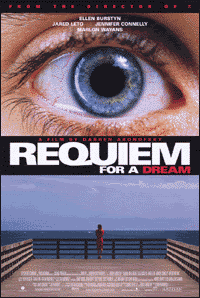
Just listen to the REQUIEM FOR A DREAM soundtrack. It bends your will in thinking this music is a note by note, blow-by-blow, audible journey that could only accompany Darren Aronofsky’s vision of descents into disintegration. It’s just as hardcore as the film and anyone who thinks otherwise doesn’t get what Clint does better than his more classically trained peers.

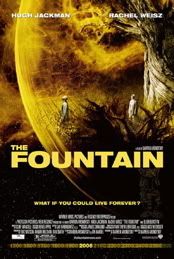
After receiving an award from the Chicago Film Critics Association recently for his work on THE FOUNTAIN, much respect has to go to The Kronos Quartet and Mogwai in the execution of Clint and Darren’s vision, he is also nominated for a Golden Globe that he way very well be picking up tonight should the stars, and Xibalba, be aligned in his favor.

Regardless, though, of whether he wins or loses I had the sense by the end of our conversation Clint honestly is a rare breed who believes in the work and in the process of work. There are far to may individuals who concern themselves with the quantity and profile of the jobs they take in his line of work, certainly he deserves to be one of those people should he want to tout his precision with PI or REQUIEM even THE FOUNTAIN and screw any notions of impropriety, but Clint makes you believe that there should be more collaborators out there who feel as close to other people as Clint does about working Darren. I wish other people were more kind about the professional relationships they keep but it’s nothing short of inspiring and emboldening to hear Clint talk about the real work that happens behind the screen in making two of the most complex and emotionally rewarding movies that have come out in the past decade.

To say that I’m disappointed with critics and viewers alike for their neglect of a film that had more heart than a comeback-kid who slaps on the gloves for “one more fight” would be a gross use of the word.

CHRISTOPHER STIPP: First of all, congratulations, on the Chicago Film Critics award.

CLINT MANSELL: Thank you very much. I am pleased that the film, the score, is getting some kind of recognition. I guess we were all kind of disappointed, really, with some of the reactions to the film. I don’t suppose”¦maybe we weren’t that surprised in retrospect.

It’s just nice, though, that the film got recognized.

STIPP: To give you an idea of where I’m coming from, I interviewed Darren the morning after I saw the film and mentioned that it was his directing and your score that genuinely elevated the movie from something great to something transcendent; it was the perfect marriage of both the audio and visual components. These two work in concert so well, Kronos Quartet and Mogwai deserving a heap of credit too, and I am curious to know, you coming from a pop, punk, electronic background, what bug bit you to get into film composing?

MANSELL: I think it’s a natural progression for me, really, as a writer. I mean I wrote my first song about twenty years and I think writing is like a muscle, if you exercise it”¦it will grow and you’ll get better at doing it. It will take you places.

I’m excited by music by other people’s music, it influences me, and makes me want to do better and takes me to different places when I listen to it. That is reflected in the music I want to write. When you get to work with someone like Darren, who I really connect with on an artistic level, as well as on a friendship level, but when he explains and tells me his ideas I feel like my possibilities are unlimited, you know? I can’t do whatever I want but if I can make it work within the context of the film, if we know it’s right, I can pretty much do what I want. The last thing Darren wants is something that sounds like a regular movie score.

And like you were saying about the visuals and music working in concert”¦the way Darren tells his stories are not”¦the regular, run of the mill, act one, act two, act three type of events, you know, he’s looking to do something different and challenging if only to himself. I don’t think he’s particularly going, “The world needs me.” He’s going “Well, if I am going to do something it’s got to be worthwhile and say something to me and challenge me” knowing that’s what he instills in all of his collaborators.

We’re not just here trying to get the best table at fucking Spago’s or something. We’re here trying to do something. We went out and did something that we felt was valuable and that’s the excitement of what we do and, also, the downside to that is when people don’t see it the way we see it; what doesn’t kill you makes you stronger, as they say, just move onwards and upwards.

STIPP: And you have the Golden Globes on Monday. I’m curious to know, on a personal level, how you look at these awards. Are they a popularity contest or is there something special to it all?

MANSELL: Well, who knows what the criteria is for these things. There’s a cynical way of looking at it and then there’s my view on it which is I’ve done something I’m really proud of with people I love and we did something that”¦for me, to get nominated or an award for this particular work I’ve done, given that the film wasn’t a critical success, wasn’t a box office success, it’s certainly not coming from a popularity contest point-of-view.

If I got this award for something like some other films I’ve done, like SAHARA, which I something I’m proud of as well, I did good work on those but maybe I’d look at it differently because they’re more straight-ahead kind of films. So, for me, to have been nominated and the work recognized, I take it as a fantastic form of credit for the work we all did on the film.

STIPP: Speaking to the point of how long this film took to come out can you talk about whether the ideas you had for this film’s score evolved as the project took its many turns? Did the score that’s in the movie end up being what you initially envisioned?

MANSELL: No, [the score] became something completely different”¦because the film changed so much; we started this right after REQUIEM FOR A DREAM. I mean, yes, I am very proud for what I did on REQUIEM FOR A DREAM but there is no way I could have written the music for THE FOUNTAIN that I have now written back then.

I mean I’ve done a lot of other work since then, some of it good, some of it pretty good, some of it has been shit”¦(laughs) It’s been a real learning experience; I’ve really exercised that creative muscle. And, also, because the film changed it became a much more intimate story on a much smaller scale.

When we started out it we knew it was going to be this epic”¦there were these big battle scenes”¦and everything happens for a reason. I think a movie, the way it was back then, it would’ve made the movie a different animal. I’m not saying that would have been better or worse I just personally think that everything that happened got us to a better place in the telling of the story. The scale got a lot smaller, it got a lot more intimate.

Eighteen months ago, during the editing process, we did the trailer, I wrote the trailer music for the first trailer, and that stuck more to the original guidelines of what we were thinking about; it was bigger, the music was bigger, the music was heavier, it was more epic. And that worked for the trailer because that’s the sort thing you want, you want it to leap off the screen, but when I took that music and then tried to cut it into the film just to try to see how it would work you could tell instantly that this was wrong. It was too big, it was too grand, it was too bombastic for the story we were now telling and that was when Kronos [Quartet] came back in again because I saw that I didn’t need a sixty piece orchestra, I just needed these four guys to do it.
STIPP: Was there a time when The Kronos Quartet wasn’t going to be involved at all?

MANSELL: I think, in our minds, we weren’t going to work with them because we didn’t think, REQUIEM worked so well, we just felt we weren’t going to top that. We thought maybe if we were lucky enough to make another two or three more pictures then we would go back to them but as the score developed and as it became more intimate and as I listened to bands like Mogwai, Godspeed You! Black Emperor and Sigur Ros it was sort of cinematic and orchestral but on a neo-classical level; it was a more modern approach to orchestrated music. And as I was blending the various elements it occurred to me to think about who would be the best in the world to play this and the answer is Kronos Quartet The answer is still the same, six years later. And although we hadn’t really been in touch with each other that much during that time, when I talked to David [Harrington] and the rest of Kronos it was weird”¦We had each gone off for six years and done different things but then when it was time to talk about THE FOUNTAIN we were all sort of converging on similar thoughts and when we showed them the movie and the music they got it instantly. It just seemed like the most organic thing. It was great.

STIPP: The first thing that I thought of when I listen to the lead track on the soundtrack “The Last Man” I am not only reminded of how exquisitely beautiful Kronos can be but it is also neo-classical in a way that makes me think that this is the kind of classical music which seems entirely appropriate to be played in a symphony hall as well as in a CD player.

MANSELL: Actually, Kronos is playing here on the 20th and they’re playing a suite from THE FOUNTAIN.

STIPP: Really?

MANSELL: Yeah, it’s pretty cool.

STIPP: It translates perfectly, And as I was preparing for this interview I went back and listened to REQUIEM, the REQUIEM FOR A DREAM remix CD and then THE FOUNTAIN. I am struck by the capturing of mood on both the original REQUIEM and FOUNTAIN scores. REQUIEM, when I listen to it, is just haunting. There is no other emotion running through that work. Is that part of your writing, that you want to evoke something specific?

MANSELL: I’d love to say that there was such disciplined and focused thoughts about it but I don’t really work like that.

My way of working is just absorbing the film, absorbing what Darren’s saying to me”¦I just have to get to a place of really letting go. Some of the best things I’ve written, for me, have come at times when I have no recollection of writing them, if you know what I mean. It’s not like some kind of “Ooooh” spiritual transfer or anything like that but things happen when I give into it. That’s the only way I can describe it and that takes a lot of exposure to the film, to the work, which is why I think I do my best work with Darren. Not only because he’s a great filmmaker and he does things that inspire and challenge me but also, as well, I spend the most time in his world when we’re working on something.

I mean six years of working on THE FOUNTAIN, obviously not working on it every day, but being able to take the time to”¦the research you can do over six years of different kinds of music that you can then filter through yourself to come up with something just kicks the shit out of getting on a film for six weeks, banging out some music and off you go. It’s a whole different thing and that’s the way it works for me.

I mean I’m not classically trained, my musical theory is nothing really to write home about”¦it’s all about gut instinct and reaction and thoughts and absorbing the work. To me, that’s the only way it can be. I’m sure lots of other people work differently”¦there comes a point when you know what you’re doing right or wrong but if I’m in sort of sync with the film it’s telling me that it’s rubbish what I’m doing or it’s telling me that it’s right.

STIPP: I was going to bring that up myself as you’ve said in one interview that, at one point, “the film just said “˜no.'” Is it organic, the process of getting to this point, or is it someone like Darren telling you that it just doesn’t fit?

MANSELL: I think that it’s a learning experience.

When you write for yourself in a band you can do anything you want. On a film, though, it’s somebody else you’re collaborating with and you’ve got to lose that preciousness, that preciousness you get when you do something yourself. The first few times when the other person says something like, “Nah, I don’t like it,” at least for me anyway, it plays on your insecurities and self-doubt. I’ve been very fortunate with Darren because we work so well together and it has never come to that point, it only seems to happen to me with other people”¦going away and doing other films for those six years was really helpful for me.

I did a film, KNOCKAROUND GUYS, with these two great guys, Brian Koppelman and David Levien, both directors, and it was the first film I got because of PI, REQUIEM hadn’t come out yet and they were big fans of PI, and I was writing material for them. It was going really well, had a good time doing it, but there was this one piece of music that I kept saying, “No, no, no, it’s great.” And in the end it was Brian who eventually said, “Look, I know what you think it’s doing but believe you me it’s not doing it.” It was there I learned that if you rewrite something it’s always better than what you had before.

You just have to dig deeper sometimes.

If I don’t write for a while, the first few things I write about is shit because I’m writing on a very superficial level at that point but my memory is reminding me of things I’ve done which is better than what I’m doing right now and I’ve got to work harder, dig deeper”¦and I’m not saying it’s easy, because there are still times when I think I’ve done something I thought was pretty good and someone will say, “No.” But now I have the learned memory that that says, “Ok, you can do better, it will be better. You’ve just got to work harder.” If it was easy, everyone would be doing it. You’ve just got to get in there and not be frightened.

STIPP: How do you get to that point where you just accept that not everything out of the gate you do will be brilliant or do you still get that twinge when someone disagrees with how you initially feel about something?

MANSELL: I think that twinge goes hand in hand with the ego that’s necessary to think that you’ve got something to say and contribute anyway. If I was constantly going to go “No, no no. I think you’re right. It is shit” I would never do anything. There’s some basic desire that you’ve got stuff to put out there so when you’ve done something, and you’ve worked hard at it, and you get connected to it”¦I think there’s times when you can’t see the forest for the trees if somebody criticizes it but without that care and that passion maybe you wouldn’t be able to rise to the challenge anyway. I mean, I don’t know, I’m possibly making excuses for my own immaturity but part of the character that I am helps me create the music I do. Is there is a certain negative side to that? Yeah, I mean we all want to evolve and grow but at the same time that’s part of the equation, it helps me to do it in the first place.

STIPP: Has it helped you get to a point in your relationship with Darren, that you have a comfortable back and forth openness?

MANSELL: It’s funny because I think we argued more on this film than any other.

STIPP: Really?

MANSELL: Yeah, I mean not in a bad way. The way the score is, when I was mocking it up in demo form, it didn’t come across like it does now. A lot of the stuff was done on piano, it wasn’t done with strings but then we got it to Kronos and their strings just brought it to life. The Mogwai elements, while written by me, they were sort of estimating a Mogwai-ishness if you like. And when you put together those disparate elements it takes a while for it to gel without it sounding, not hokey”¦but melodically and thematically we were just trying to get the right vibe. It’s hard work when you take two fantastic artists you’re effectively trying to replicate with a computer. It took a little time but I knew where I was trying to take it but Darren was having trouble envisioning it from what I was giving him at the time.

[SPOILER WARNING]

So what I did was I did the whole end part of the film, where the star explodes and [Hugh] accepts his death, we mocked it up and I sent it to Mogwai. They basically recorded it themselves on top of my string arrangements. So, suddenly, we had Mogwai playing the stuff for real and when Darren heard that he said, “I got it now.”

I could see it because I knew Mogwai were capable of but Darren’s obviously putting that trust in me to say, “Ok, show me.” I say that it’s very difficult to replicate an artist like Mogwai or Kronos in a computerized world but that all sort of dissipated when we heard it for real.

STIPP: I think there’s an enormous dependence on the score just because of the first ten to fifteen minutes being so vital in creating a moment.

MANSELL: Well, what we would do is that we were all in New York together for three months, Darren was editing across the hall, I was in the room opposite him, and every Friday we would watch a new cut of the film that they were working on all week, during the week they would give me the new edits and I would be re-working the music to those edits, writing new stuff, putting it in”¦And every Friday we would watch the film and go, “What’s working? What’s not working? Do we like this? Do we like that?” By doing that I think we really managed to get a groove between the edits and the music and the pace of the film and the growth of the film. It was pretty intense work but I think that really gave it its synchronicity.

STIPP: I know, as a writer, there’s some danger of not bring able to recreate that moment that started it all after you’ve spent so long on a piece. How did you stay fresh on that moment Darren explained what this movie was going to be about?

MANSELL: Well, I saw it evolving, going places.

Working with Darren it’s not like he’s constantly chipping away at the one thing that’s not making any difference. We don’t get bogged down in little things because they’re taken care of as we go along. I mean I have worked on films where that has been an absolute nightmare. Where they’re editing, re-editing it, to the point where it’s like a ten-thousand pound gorilla in the room that no one acknowledges”¦besides the fact that the film is shit you can cut this film any way you like and nothing is going to help it. But it’s not like that with Darren. I mean things move forward, ideas progress because his films are rich in ideas.

For me, there’s something new coming through that I need to address. I mean it’s questions like, “Have we made the link between this and that?” or “Between this scene and this scene?” We sit there with pens and colored paper, this color is this theme, that color is that theme, and we put it up against every scene in the film and judge the music accordingly. We constantly move things around, it’s like a gigantic jigsaw puzzle, and eventually you get to a place you think is right.

One thing I wanted to get back to, about arguing, one thing that needs to be understood is here is how we worked: the studio wasn’t really privy to my developments of the score, they’d ask for it, but Darren won’t temp his films with other people’s work. So, it’s a slow process. We had a lot of music to draw from but, still. So, his stress levels were ten times more than mine were.

STIPP: I know you’ve mentioned you don’t really read sheet music and Darren mentioned in passing with me that he was amazed at how precise Kronos was with regard to their knowledge of precise musical movements. Was there a language barrier between you and them?

MANSELL: There was a little bit on REQUIEM but not with THE FOUNTAIN because I was more advanced than when I did REQUIEM. We were more aware of the process so we could present a much more musical job to them, if you like. Like, on REQUIEM we had a couple of issues of just getting it in sync with what I was trying to do, I mean we managed to do it, but it was done in an almost non-musical way. But the experience I’ve had on so many other films really helped me present a more professional approach, professional job to them.

STIPP: I realize you don’t need me to say it but good luck, genuinely, Monday night at the Golden Globes.

MANSELL: Thank you.

##

Nocturnal Admissions: Thoughts on Children of Men and Apocalypto

Filed under: Columns,Nocturnal Admissions — UncaScroogeMcD @ 4:03 am
nocturnalheader5.gif

Dana Stevens at Slate has an interesting article finding linkages between Mike Judge’s Idiocracy and Alfonso Cuarón’s Children of Men.

Well, I happened to watch Children of Men again last night and I was suddenly struck by its resemblance to Apocalypto.

Children of Men pregnant

Consider this. Both are “journey” films. Both recount the actions of a man striving to save or rescue a pregnant woman. Both culminate in a hellish vision of a civilization in its death throes, charged with garish and even incomprehensible emblems of humanity reduced to an animal level. And both films end with images of a ship arriving, offering either hope or hints of further disaster.

Apocalypto pregnant

Any student of cinema knows that films bearing such similarities arriving at the same time is not unusual. There are broad coincidences, such as Volcano and Dante’s Peak arriving near simultaneously, and there are more subtle coincidences, such as a resemblances between Children of Men and Apocalypto (and Idiocracy). Meanwhile, The Nativity Story, most obviously, and Pan’s Labyrinth also concern themselves wholly or in part with the protection of an unborn child.

Children of Men street

Obviously it’s the zeitgeist. In this post 911, post Guantanamo world, we are affected every day by terror alerts, long lines at airports, and a general climate of suspiciousness, that leads to a fear of others and a terror of what unjust mishaps could happen to ourselves.

Apocalypto city

But both films also have a religious component, which many viewers are not going to find as part of their zeitgeist. It’s unclear how extensively Gibson’s retrogressive conservative Catholic sect rules his life but his films certainly traffic in suspicions about the fate of people or cities that get lost upon the true way (there is also a homoerotic undercurrent, too, that goes back to his first directorial effort, The Man Without a Face, way back in 1993, but that is a whole other column). Meanwhile, Children of Men is a form of nativity story, with several in jokes. The young mother pretends for a second that her birth is virgin, and, like Saint Francis, Clive Owen’s Theodore Faron attracts animals to his side. However, ultimately Cuarón’s film pulls its punches, unlike the much different source book, which is more allegorical and comes down harshly against such things as euthanasia and other “liberal” and unChristian policies. People running to the book after an enthusiastic experience with the movie may be startled by what they find there.

Children of Men war

In any case, there’s the coincidence between Children of Men and Apocalypto. I’m not sure of its full implications, but something is going on out there and even our filmmakers, who dwell in protected living quarters far from the rude hubbub of the street, are feeling it.

QSE News: 1/15/2007

Filed under: Columns,News — UncaScroogeMcD @ 3:59 am
quickstopnews.jpg
line1.gif

Here are today’s top entertainment headlines:

  • qsnews.jpgEven though it’s only been on for a couple seasons, the producers for the hit show Lost have started to discuss how the series will end. While not set in stone, the producers are leaning towards an ending that will include the Harlem Globetrotters coming by to have a pickup game with the island inhabitants.
  • News is coming out of Hollywood that Tom Cruise and Katie Holmes are frightened for their child’s safety.  The eccentric pair have rarely taken their nine-month-old daughter Suri out in public for fear that she will be a target of kidnappers.  Insiders say that this fear is completely irrational because Suri isn’t actually real.
  • Television network Bravo has signed singer and American Idol judge Paula Abdul for a new reality TV show called Hey Paula.  The series will follow Abdul as she works on various projects including TV, movies and cosmetics.  It is not clear if Abdul’s relationship with MC Skat Kat will be discussed during the show.
line1.gif

That’s all for today’s news, stay tuned to this channel for all the news that matters least but you still care about.

(Compiled by J. Allen)

##

Quick Stop Thingamabobs: 1/15/2006

Filed under: Columns,Thingamabobs — UncaScroogeMcD @ 12:05 am
thingamabobs.jpg

The web. It’s a big place, full of plenty of distractions ““ some funny, some informative, some ludicrous, some disturbing, some inane, some profound. Each and every weekday, we present links to a few of our favorite finds”¦

————————————————

  • This one is for Zak – Keifer vs. The Christmas Tree… (Thingamabob)

Have a THINGAMABOB? Send it in!

##

January 12, 2007

Comics in Context #160: Banks’ Holiday

Filed under: Columns,Comics in Context — admin @ 5:06 am
comicsincontext4.jpg

cic-20070112.jpgThe triumph of Neal Gabler’s voluminous, thorough and fascinating new biography, Walt Disney: The Triumph of the American Imagination (Alfred A. Knopf, 2006), is that it so fully humanizes a figure whom many of us previously knew either from his public image, as the benign, fatherly host of his weekly television series, or as the enigmatic and sometimes dictatorial executive of later books on animation.

In fact, there is one anecdote in Gabler’s vast tome that should allow any of us in the comics business to identify with DIsney. “Walt would recall an incident that happened on the back platform of the train when he first headed west to Los Angeles. He was making conversation with a man there who asked what Walt did. . . . “˜I make animated cartoons,” Walt told him, which was met with a steely disdain that Walt never forgot and that had led him to resolve that someday his cartoons would be afforded the same respect as live features” (p. 271).

As regular readers know, I’m associated on a volunteer basis with the Museum of Comic and Cartoon Art in New York City, and one of the perks of being a museum staffer, albeit unpaid, is that I receive free admission to other museums. So last month I visited a Manhattan art museum, which shall be nameless, and presented by MoCCA ID card at the admissions desk. The man behind the counter read the name of the museum and scrunched up his face into an expression of, yes, steely disdain for the idea of a museum dedicated to, of all things, cartoons. Thanks to Gabler’s book, I can now console myself with the knowledge that even Walt Disney had to experience this prejudice against the artform. (And to be fair, last year I showed my MoCCA ID card to a woman at the admissions counter for the Whitney Museum of American Art, and she not only burst into enthusiasm, but asked if she could bring her art students to visit the museum. So, yes, the cultural climate is changing, if not as widely as I might hope.)

Back in 2005 I wrote a number of columns about Lincoln Center’s retrospective of musical animated cartoons, and commented on how various people in animation were interested in the figure of the conductor (see “Comics in Context” #109 and 110). Mickey Mouse plays that role in The Band Concert (1935), among other cartoons, and as the Sorcerer’s Apprentice in Fantasia (1940), “conducts” the seas and the heavens as if they were orchestra members. Of course, at the end of that section of Fantasia, Mickey famously shakes hands with Leopold Stokowski, two conductors united. I suggested that Walt Disney, among others, regarded the conductor as a symbol of the filmmaker, directing the creation of a work of art.

How rewarding to learn from Gabler’s book that I was right on target with Disney! “Walt himself compared the cartoons to a symphony, with him as the conductor who took all the employees–the storymen, the animators, the composers and musicians, the voice artists, the ink and paint girls–and got them to “˜produce one whole thing which is beautiful'” (p. 210).

There is a great deal to say about Gabler’s biography of Disney, but this week I want to concentrate on the light it casts on a subject I wrote about a few weeks ago: Mary Poppins, in its incarnations as P. L. Travers’ original book, Walt Disney’s 1964 film adaptation, and the new stage musical on Broadway, based on both (see “Comics in Context” #158). Last time I concentrated on Ms. Poppins herself, but this time I’m turning to a character who is barely present in the original book, but who has the principal character arc in the movie and stage musical: Mr. George Banks, the father of Mary Poppins’ charges, Jane and Michael. As Variety theater critic David Rooney referred to Mr. Banks in his review of the Broadway version (Nov. 16, 2006) as “George whose sensitization is the story’s central journey.” In the course of the movie and play he changes from what writer Caitlan Flanagan called “a martinet banker” in her Dec. 19, 2005 New Yorker article about Travers, whose signature song in the stage version is “Precision and Order,” to an emotionally open and loving husband and father.

The Mr. Banks arc is the Disney studio’s invention. Travers’ original book is episodic: Mary Poppins takes the children on one adventure after another, until finally we reach the end of the book and she leaves. The redemption of Mr. Banks gives the story of the movie and stage musical an overall structure. Moreover, through developing the character of Mr. Banks, Walt Disney and his collaborators on this family movie gave the adults in the audience someone with whose problems they could identify.

It also solved another problem. As Flanagan explains, “The story of Mary Poppins depended on the premise that it was normal for a middle-class family to employ. . .a servant to raise the children. But to a large segment of Disney’s intended audience this idea would be bewildering or, at least, cold and unpalatable.”

Travers expressed surprise at the movie’s notion that Mr. Banks was a bad father. Flanagan quotes her as writing, “What wand was waved to turn Mr. Banks . . . . from an anxious, ever-loving father into a man who could cheerfully tear into pieces a poem that his children had written?” But Flanagan earlier related that Travers’ father died when she was ten, that her mother was irresponsible, and that as a girl Travers turned instead to her unmarried Aunt Ellie, who “bossed everyone around, but her fierceness disguised a kindness she would have been embarrassed to admit” and who was the obvious model for Mary Poppins. Moreover, Flanagan asserts that “the fate of children whose parents can’t take care of them – haunted her [Travers] for the rest of her life.”

Of Travers’ Mary Poppins books, I’ve only read the first, and it gives me the impression that Mr. and Mrs. Banks pay little attention to their children and are perfectly content to let Mary Poppins take the lion’s share of raising them. The children’s adventures with Mary Poppins thus become ventures into a secret world to which their parents are oblivious. So Walt Disney’s interpretation of Mr. Banks as a rather distant father seems reasonable to me. Richard Sherman, who with his brother Robert wrote the songs for the Mary Poppins movie, worked on its story with Walt Disney, and told Flanagan they realized, “You could make the father emotionally absent.” Hence, he told her, “We made it a story about a dysfunctional family,” Sherman said. “And in comes Mary Poppins – this necessary person – to heal them”

Gabler points out that Walt Disney had been considering doing a Mary Poppins movie since the 1940s, and when the movie finally was being made, “Walt was energized. . . .It had been years since Walt was so personally invested in a film. . . he obviously connected with the film in ways that he had not connected with the studio’s recent releases” (pgs. 598-599).

How did he connect? Gabler explains that Disney’s great early feature films, like Pinocchio (1940) and Dumbo (1941) are about children achieving maturity, taking on the “hallmarks of adulthood.” In contrast, he says, “Mary Poppins was a kind of reversion to childhood before responsibility, or, rather, a reaction to it. In a household that encouraged them to suppress their antic spirits and behave like adults, Poppins taught the children joy. . . If his earlier films had spoken to young Walt Disney’s need for empowerment, Poppins spoke to the older Walt Disney’s predicament as a corporate captain burdened with duties. . . ” (p. 599).

It makes sense that as he grew older, the films that Walt Disney considered personal projects would change. I observed a similar phenomenon with George Lucas’s Star Wars movies (see “Comics in Context” #86). The original Star Wars trilogy, made by a young man, who, when he started them in 1977, was still striving for success, were about empowerment; they also embodied a young man’s optimism. The later trilogy, made by an older, successful man, who has become “a corporate captain” like Disney, reflects disillusionment, shows a new concern with mortality, and even approaches tragedy; the “New Hope” is left to the next generation, represented by the births of Luke and Leia at the end of Revenge of the Sith (2005). In contrast, Disney holds on to his optimism in Mary Poppins: the true central character, Mr. Banks, emerges from disillusionment into spiritual regeneration.

Gabler asserts that Walt Disney “could certainly identify with Mr. Banks, the stodgy banker who has a child lurking inside him, and with Mary Poppins, the magical nanny who manages to emancipate that child” (p. 599). This is certainly true, and Gabler is particularly perceptive in recognizing that Disney could identify aspects of himself with more than one character in the story.

If Walt Disney, consciously or unconsciously, molded Travers’ Mary Poppins into his own spiritual autobiography of sorts, then there are further depths to be plumbed.

As many reviewers of Gabler’s book have remarked upon, Walt Disney was unconcerned with money except as a means for financing his future projects. But he was forced to become concerned about it. Astounding as it may seem to us today, when they are all nearly universally regarded as classics of America popular culture, Pinocchio, Fantasia (1940), and Bambi (1942) were all failures in their initial releases, and the Disney studio would have gone bankrupt if not for the film projects it undertook for the government during World War II. Moreover, as the Disney studio grew, it inevitably lost the sense of community it had in its earlier days, especially after the animators’ strike of 1941. Gabler describes Disney’s “transformation from a heedless entertainer to a cautious corporate leader” (p. 442) who “even looked different. The boyish young Walt Disney had dressed casually and flamboyantly,” but now “his suits were more likely to be solid blue or gray and conservatively cut. . .” (pgs. 441-2). One reason for all this, Gabler explains, was “the need to make films without also making mistakes. The studio couldn’t afford the risk.” Gabler maintains that Disney was growing more conservative anyway, in part “possibly” due to the fact that “he was in his mid-forties and no longer a reckless young visionary” (p. 442).

Mr. Banks, of course, by Travers’ own admission, is dedicated to making money: “Now, the City was a place where Mr. Banks went every day–except Sundays, of course, and Bank Holidays–and while he was there he sat on a large chair in front of a large desk and made money” (p. 4).

As his name suggests, the movie’s Mr. Banks’s ties his sense of identity to his job. In his book Gabler shows how bankers thwarted Disney’s dreams ands ambitions in the first decades of his studio. For example, after the strike, an executive of the studio’s creditor, the Bank of America, “concerned about what he saw as Walt’s profligacy,’ “ordered the studio to restrict itself to the production of shorts,” and moreover demanded “the creation of an “˜executive committee,’ including a bank representative” to govern the studio. “In effect, the studio was no longer Walt Disney’s fiefdom, He was now under the control of the businessmen” (p. 376). Did Disney the artist feel that by increasingly conforming to the demands of the corporate world, and indeed by making himself over into a conservative corporate executive, that he had joined the enemy’s side?

Whether motivated by the need to make money or by his artistic ambitions, Disney was quite a workaholic who had trouble tearing himself away from his own figurative desk. Gabler quotes animator Ward Kimball about a train trip he took with Disney: “No matter what you were talking about, he’d get back to this goddamn studio. . . .He wanted to talk about it. This was HIM. This was his SEX! This was EVERYTHING. . .The orgasms were all here” (p. 473).

It appears that Disney was indeed sublimating his libido into his work, at the expense of his family life. Gabler makes clear that Disney was emotionally distant from his wife, though he was quite close with his daughters. “But as much as he cherished his girls, and enjoyed spending time with them, there was something solitary about him when he wasn’t at the studio–something self-absorbed and distant” (p. 462). Gabler states that “Walt seemed to realize that he was hopelessly addicted to work at the expense of family and friends” (p. 282).

There, too, is a link between Walt Disney and the movie’s Mr. Banks, who, as Sherman observed, is “emotionally absent” from his family. The stage musical goes even further. As Ben Brantley put it in his Nov. 17, 2006 review of the stage version for The New York Times, “Mr. Banks. . .learns to stop recoiling when his wife tries to kiss him and to value quality time with the kids over making money.”

I also wonder if Disney, consciously or not, saw himself in Mr. Banks, not only in Disney’s relationship with his children, but in Disney’s relationship with his employees. Gabler perceives a paternal quality in Disney’s attitude towards the people who worked at the studio. At its best, in the 1930s, “if this was paternalism, it was paternalism in service of a higher principle. . . .He wanted an organization in which everyone would be selfless and happy” (p. 241). But Gabler also shows, especially as time went on, that Disney could be a martinet who terrified his employees. In Mr. Banks, before and after his transformation, perhaps we see Disney the distant, tyrannical “parent,” and Disney the benign, caring “father” to his staff.

Gabler also tell us that Disney “always loved to forge people into a happy unit” (p. 240). That’s what Mr. Banks does at the end of the movie, when he reconciles with his family and invites them to join him in his new pastime of flying a kite. Here too is one of the links between Walt Disney and the character of Mary Poppins. Even if he didn’t do it enough, Disney loved spending time with his daughters, and Mary Poppins takes the children on one magical adventure after another. At the movie’s end, Mr. Banks, the character who more clearly represents Disney himself, takes on Mary Poppins’ role of companion to his children, and so there is no more need for her, and she departs.

As a worker of magic, which often amazes and entertains the children, Mary Poppins can also be regarded as metaphorically representing the creative artist, making yet another connection between her and Disney himself. Bert is specifically identified in both Travers’ book and in the Disney movie as an artist, and one who creates a world within his painting with characters that come to life. So Bert effectively deals in animation, like Walt Disney himself.

I also wonder if Disney, consciously or not, saw himself reflected in Mary Poppins’ characteristic sternness. Gabler shows repeatedly that Walt Disney was a difficult man to know, had few friends, did not show emotional warmth towards his employees, and, indeed, intimidated his staff, and could be cruel to people. Yet Gabler also makes clear that Disney had this “paternal” side and, at least before the strike, took unusual steps to promote his employees’ welfare and happiness. So could Disney have identified with his version of Mary Poppins, who masks her genuine caring for the children behind her forbidding facade? (Even Travers notes, when Maia, the star that took human form, parts from Mary Poppins, that Jane and Michael “could see in Mary Poppins’ eyes something that, if she were anybody else but Mary Poppins, might have been described as tears. . . “ [p. 194].) Mary Poppins’ severe demeanor could be used to rationalize always treating children sternly and never betraying emotion. So it is a relief that Disney’s Mary Poppins film ultimately depicts the transformed Mr. Banks’s open affection for his wife and children as its ideal. Mary Poppins, hiding her true feelings beneath a stern manner, was a necessary transitional figure in the family’s evolution, and is sent on her way once their “dysfunction” is cured.

There is yet a fourth figure in the movie who may resemble a side of Disney and who is missing from the stage musical: the head of the bank, Mr. Dawes, Sr., an extraordinarily ancient man who can barely stand upright. (The closing credits reveal that Dick Van Dyke, who plays the young, spry Bart, doubles in the role of Mr. Dawes, Sr.. Van Dyke is unrecognizable beneath the banker’s old age makeup, and proved far better at altering his voice in this role than he was at adopting a Cockney accent for Bert. Surely I am far from the only person who, on first seeing the movie, did not realize that Van Dyke played the elder Dawes until the closing credits.) This is a man on the brink of death, who maintains his hold on the reins of power well past the time he should have passed them on to a new generation, namely Mr. Banks’s. Death thus symbolically rules the bank, whose vast emptiness might resemble a mausoleum.

Despite Mr. Banks’s loyalty to the bank, the elder Mr. Dawes and his hierarchy show no loyalty in turn to him. In the movie Mr. Banks falls from his masters’ favor through sheer accident. When Mr. Banks brings his children to the bank and encourages Michael to open an account, Michael, understandably cowed by his surroundings, vehemently refuses. A customer overhears, leaps to the conclusion that something must be wrong with the bank, and her panic spreads, causing a run on the bank. For adults in the early 1960s who remembered the 1920s and 1930s, this sequence would conjure up the fears they felt during the Great Depression. Significantly, Frank Capra made two films that dramatized a similar situation: in American Madness (1932), a rumor foments panic and a run on the protagonist’s bank, and in It’s a Wonderful Life (1946), there is another fear-driven run on George Bailey’s savings and loan. In each of these Capra movies, the hero’s friends loyally rally to his support and prevent him from going under. In the Mary Poppins movie Mr. Dawes, Sr. and the rest of the bank’s hierarchy blames Mr. Banks for the panic and decide to fire him, or, to continue the death analogy, to terminate his employment. (Mr. Banks accepts responsibility for his children’s actions, but of course, the children were not really to blame. It’s the nameless customers who really started the panic, but they cannot be identified, and Mr. Dawes, Sr. and company apparently need a scapegoat.)

In the movie, before returning to the bank to face the judgment of his superiors, Mr. Banks morosely ponders his imminent fate: to have his career cut short while he is in his “prime.” Again, this evokes memories of the Depression for Disney’s generation. For Disney himself it may have alluded to the times when his studio nearly went bankrupt, a fate that might have put an end to his career and artistic dreams. Pointedly, on his way to the bank, Mr. Banks passes by the Bird Woman who feeds the pigeons on the steps of St. Paul’s Cathedral (which is near the “City,” London’s banking district). Gabler reports that towards the end of his life, Disney would repeatedly summon the Sherman Brothers to play the song about the Bird Woman, “Feed the Birds,” for him. “Whether Walt related to the song because he related to the old woman’s loneliness, or whether in a life of grand gestures he appreciated her small one, or whether he recognized in her his own mortality, or whether the woman simply reminded him of his own mother, he never said. . . .But hearing the song, he would always cry” (p. 618). These all seem good explanations, and Gabler’s mention of mortality fits in with the idea of the bank as the realm of death.

The Bird Woman is also a rather pathetic figure of destitution, and therefore may represent to Mr. Banks the specter of what he fears lies in wait for him once he has been terminated. Moreover, she is an icon of charity, feeding the birds despite her own poverty. Now that Mr. Banks is on the brink of financial ruin, he is himself in need of charity, but seems to realize he will find none from his judges at the bank.

Despite Disney’s reputation for sugar-coating reality, it should be no surprise that his great films include moments of disturbing darkness, from the notorious death of Bambi’s mother to Mr. Banks’s descent into despair. Gabler quotes Disney as stating that “Life is composed of lights and shadows, and we would be untruthful, insincere, and saccharine if we tried to pretend there were no shadows” (p. 398).

Clearly Disney could identify with Mr. Banks as the potential victim of a bank, just as he had been in real life. But if Mary Poppins was in part a psychodrama for Disney, then Disney may well have been the oppressor as well as the victim. Consciously or not, perhaps Disney saw part of himself in Mr. Dawes, Sr. According to Gabler, even before the studio strike, but as pressures from the Bank of America grew on him, Disney “displayed no hint of sentiment when it came to newer employees, especially as his dream of utopia faded under the glare of economic realities. . . .Walt thought nothing of firing someone who had outlived his usefulness, calling it “˜weeding out marginal people,’ or getting rid of “˜deadwood'” (p. 353). After the strike, Gabler reports, “Beyond the fear he inspired, Walt now displayed a vindictiveness occasionally even bordering on cruelty. . .” (p. 379). How bad did it get? This bad: Gabler quotes the recently deceased Richard Fleischer (who was not only a director who worked for Disney but was the son of his former rival Max) as recalling Disney telling him, “every once in a while I just fire everybody, then I hire them back in a couple of weeks. That way they don’t get too complacent. It keeps them on their toes” (p. 540). Mr. Banks identified himself with the bank until the bank turned against him. Through the elder Mr. Dawes, did Disney consciously or subconsciously recognize that his insensitivity towards employees mirrored the Bank of America’s coldness towards him?

In the movie when Mr. Banks arrives at the bank to face his reckoning, he is subjected to a parody of the expulsion of a disgraced military officer: parts of his businessman’s “uniform,” such as his bowler hat and umbrella, are ritualistically ruined. It’s funny, but there is a dark edge to the scene; the man is being humiliated and symbolically reduced to nothing.

Thus expelled from a harsh adult world, the movie’s Mr. Banks abruptly, giddily reverts to a kind of childhood, babbling “Supercalifragilisticexpialidocious,” telling a bad joke, and otherwise recapping motifs from earlier scenes involving Mary Poppins. It reminds me of Scrooge’s happy hysteria on awakening on Christmas Day, or George Bailey’s own delirious euphoria, following their respective visions. Soon Mr. Banks is rushing back home to go flying a kite with his children.

Now that I have read Gabler’s book, Mr. Banks’s new enthusiasm for flying kites makes me think of Disney’s own passion for trains. Gabler tells how in the 1940s Disney’s artistic dreams were thwarted by a combination of factors, including the commercial failures of Pinocchio, Fantasia and Bambi; the strike that wrecked the studio’s sense of community; the financial constraints imposed on the studio by the bank; and even his sense that due to high costs and lack of sufficiently talented people, he could no longer make animated films that could equal his great work of the 1930s and early 1940s. Gabler reports that Disney’s wife Lillian “once claimed that after the war Walt had come close to another breakdown like the one he suffered in 1931, because he was working too hard, she said, though the better explanation was that he was depressed from his work showing so little result. . . ” (p. 465). Gabler aptly titles this chapter of his biography “Adrift.”

But then Disney became fascinated, even obsessed, with trains: models, miniatures, and full size versions. “The train, like the animation, was to be all-consuming,” Gabler writes, “his escape from the animations, as the animations had been intended as an escape from reality” (p. 467). The trains became a substitute for animation as the object of his creative energies: “He had an object on which to lavish his affection. He had the pleasure of doing work exactly as he wanted and an opportunity to exercise the control that he had lost” (p. 467). This in turn led to Disney’s building a new house for himself, “where he could lay track for the railroad that consumed him” (p. 474). “The new house was partly a project, something to hold Walt’s attention, partly a haven to replace the studio as the trains had replaced the animation, and partly a way to secure himself against the assaults of the world by retreating to his family” (p. 474). That’s what Mr. Banks does when he is expelled from the bank: he returns to his family, who, he now recognizes, will still accept him even when the business world does not. Mr. Banks’s kite parallels Disney’s train.

In his piece about Mary Poppins for The New York Times (Nov. 20, 2006), critic Edward Rothstein contends that the Mary Poppins movie “treated adulthood as if it should be another form of childhood. . . Life would be better if parents allowed themselves to dance like chimney sweeps and fly kites in the park. They shouldn’t just pay more attention to their children; they should become more like them.”

And here is Rothstein’s key observation: “The movie’s liberatory spirit is, of course, out of the heart of the 1960s.” Now that is startling. What we think of the free-spirited Sixties is really the late Sixties. The Mary Poppins movie was released in 1964, and conventional wisdom, then and now, regarded Disney as conservative in outlook. But Rothstein’s observation fits with Gabler’s argument that “though Walt Disney was made to seem conservative–had made himself seem conservative because it fit the cultural ethos of the time–in his films, at least, he may not have been so very conservative after all, nor the barrier against the new America that he was often purported to be” (p. 615). Gabler contends that Disney’s movies “were surprisingly modern in outlook and not quite as innocuous as even Walt had declared them to be. The rock-ribbed Republican. . .also suspected authority and often questioned it, hated money and its acquisition, was wary of materialism, detested affectation. . . and all of those values had found their way into his movies and quite possibly into the mind-set of the generation who had been weaned on them” (p. 614). In the late 1960s the idea of turning one’s back on the establishment, rejecting the pursuit of materialism, and “dropping out” of the 9-to-5 life had become familiar and trendy; the movie version of Mr. Banks had already done all of this in 1964.

Back on Dec. 5 in his blog, Neil Gaiman wrote, “And of course Mary Poppins is not — in the books — actually “˜practically perfect,’ although that’s her own opinion of herself. She’s conceited, dangerous, implacable and a force of nature. She teaches the Banks children nothing as banal as moral lessons, and I don’t believe that anybody is really emotionally transformed in the books, except for a handful of lucky people in the stories who are given the ability to run away from their lives or are set free from some kind of physical imprisonment (and that occurs more in the stories that Mary Poppins tells the children than in the stories themselves).” But those stories-within-stories supply thematic justification for Mr. Banks’s emotional transformation.

Reading the first Mary Poppins book, I was taken with Mary Poppins’ tale of “The Dancing Cow” (in Chapter 5), concerning a Red Cow who “was very respectable” and who “always behaved like a perfect lady” (Odyssey paperback edition pgs. 66-67) and devotes herself to raising a succession of children. In other words it appears that she exactly lives up to society’s conventional standards of behavior for women back when P. L. Travers wrote the book: be ladylike and a good mother, and aspire to nothing else. Travers informs us further about the Red Cow that “All her days were exactly the same” and that “she felt that she could ask for nothing better than for all her days to be alike until she came to the end of them” (p. 67). It seems like a living death by boredom.

However, Travers continues, “adventure. . .was stalking” the Red Cow (p. 67). One night, to the Red Cow’s own surprise, she “stood up suddenly and began to dance. She danced wildly and beautifully and in perfect time. . . .” The abruptness strikes me as being much like the movie’s Mr. Banks’ sudden shift from despair into childlike merriment. In each case pent-up emotions that they were not even aware of burst forth. Mr. Banks had previously thought that kite flying and words like “supercalifragilisticexpialidocious”: were silly, and the Red Cow tells herself, “I always thought dancing improper, but it can’t be since I myself am dancing. For I am a model cow.” And Mr. Banks, the proper businessman, similarly finds himself flying a kite.

Moreover, just as Mr. Banks’ new euphoria verges on a hysterical lack of self-control, the Red Cow discovers that she is now unable to stop dancing. That’s the result of having repressed their inner drives for so long. I suppose that P. L. Travers made her cow red in homage to Hans Christian Andersen’s tale of “The Red Shoes,” whose wearer likewise cannot stop dancing. (So this is The Red Hooves?) It might seem as if the Red Cow will meet as tragic an end as Andersen’s heroine: in continual motion, the Red Cow cannot sleep and can barely eat. Nevertheless, she confesses, “it’s rather a pleasant feeling. . .as if laughter were running up and down inside me” (p. 73). The source of the Cow’s problem is a bright fallen star that has gotten caught on one of her horns. (Once again, the laws of science prove to be hogwash in Mary Poppins’ world.) The local King advises the Red Cow to try dislodging the star by jumping over the moon, as in the nursery rhyme. The Red Cow protests, “I am a decent, respectable animal and have been taught from my infancy that jumping was no occupation for a lady” (p. 75). Nonetheless, she overcomes her inhibitions, makes the jump, and it works: the star falls off, her dancing ceases, and she returns to her responsibility, the Red Calf, and “soon began to live her life just exactly as she had lived it before” (p. 78).

And this doesn’t work. The Red Cow “began to feel uncomfortable and dissatisfied” and realizes that she misses dancing and “the happy feeling the star had given her” (p. 78). It gets worse: she loses her appetite, “her temper was atrocious. And she frequently burst into tears for no reason at all” (p. 78). (Reminds me of Disney’s own anger and depression.) Finally, the Red Cow embarks on a quest to find another fallen star. (If Victoria Page in the 1948 The Red Shoes movie begged, “Take off the Red Shoes,” the Red Cow wants their equivalent put back on.) But this happened “long ago” according to Mary Poppins (p. 66), and the Red Cow hasn’t found another fallen star yet.

This fable may reflect Travers’ own ambiguous feelings about discipline, responsibility and propriety on one hand, and emotional release and self-expression on the other. As in “The Red Shoes,” the pursuit of pleasure to excess is destructive, but one lesson one might take from the Red Cow’s story is that once you free yourself from inhibition to follow your inner voice, it’s a mistake to go back to repression. The Red Cow’s story also suggests that you cannot count on more than one such opportunity for emotional freedom.

Mr. Banks follows this principle by seizing the day at the movie’s and the musical’s endings, and I will have more to write about both Poppins and Disney next time.

ADVERTISEMENTS FOR MYSELF
There will be another Big Apple Con (http://www.bigapplecon.com/) at the Penn Plaza Pavilion (401 Seventh Ave. at 33rd St.) in Manhattan on Friday, January 19 and Saturday, January 20. I’ll be there on Saturday, when I’m scheduled to help interview Doom Patrol co-creator Arnold Drake and She-Hulk writer Dan Slott.

Copyright 2007 Peter Sanderson

Nocturnal Admissions: DVD Review Bandidas

Filed under: Columns,Nocturnal Admissions — UncaScroogeMcD @ 4:58 am
nocturnalheader5.gif

You’d think that you’d have heard of a film starring both Salma Hayek and Penelope Cruz. You’d think that Hollywood’s publicity mavens would be in high gear to make you know about it. Especially if the film was also produced by Luc Besson. You’d think that when the DVD of said film arrived in the mail unbidden that a critic might say, “Oh, yeah, I’ve been waiting to see this.” No, instead when Bandidas arrived in my mail box I had never heard of it, and upon researching it, wondered why.

Bandidas box

It turns out that Bandidas, essentially a European production, was released to theaters in America solely through the Cinema Latino theater chain, something else I’d never heard of (it’s so hard to keep up, not despite all the info radiating technology, but because of it). Instead, Bandidas became a Fox almost-directly-to-DVD release, hitting the streets on January 9th and retailing for $27.95. Is it worth the purchase?

Well, it depends on the box (which my disc lacked). If the cover art emphasizes that Hayek and Cruz have obvious fun with their roles and that the film is a mad western romp, perhaps yes.

Joining Hayek and Cruz is like putting Brando and Dean in the same picture. The two hottest latina actresses in the world, they could have only made this film hotter if they rounded up Jennifer Lopez, Eva Mendes, Rosario Dawson, and Roselyn Sanchez, in a Hispanic remake of Bad Girls.

The team

Along for the ride along are Steve Zahn as a ur-CSI criminalist (think Johnny Depp in Sleepy Hollow), the casual Sam Shepard as a shootist mentor who gives them lessons in bank robbing (think Robert Culp in Hannie Caulder), and Dwight Yoakam as the villain, attempting to channel Johnny Depp from Pirates but succeeding only in making himself an uncanny doppleganger of Clint Howard.If you’ve seen Louis Malle’s underrated Viva Maria (and aren’t all Malle’s films underrated?), you have a general idea of what Bandidas is all about. Basically, it creates a situation in which Hayak and Cruz start out as antagonists and end up partners in noble crime, especially after they take a page out of Butch Cassidy and the Sundance Kid by leaping off a cliff together. Cruz is Maria Alvare, a girl of the soil whose father is wounded in a land grab implemented by Yoakam’s Tyler Jackson. Hayek is the highly educated and sophisticated Sara Sandoval, whose father is poisoned by Jackson as part of the same conspiracy. Together the two women go on a bank robbing run to break the strangle hold of the American imperialists over the Mexican economy. Zahn is Quentin Cooke, the criminalist summoned to catch the two looters.

Dancing girls

Co-directered by Joachim Roenning and Espen Sandberg, their first feature, you’d also hardly know that this is a Luc Besson production. Only near the end, in a shoot out staged in a train car, do you get a hint of the visual creativity associated with Besson’s films and those of his subsidiaries (the scene uses some “bullet time”). Otherwise the film is straightforward western comedy, with a clean through line. It goes generally in the very direction you assume and want it to go. The best scene has Cruz and Hayek first meeting Zahn. Disguised as dancers they tie him to a bed and interrogate him, before deciding to use the helpless man as a kissing guinea pig, with Hayek leading the way for the supposedly innocent Cruz.

Penelope Cruz in Bandidas

There is an English Dolby Digital 5.1 audio track and a Spanish Dolby Digital 2.0 Surround track in which you can hear the girls in their native languages. Plus English and Spanish subtitles. Number one supplement on the disc is a commentary by Hayek and Cruz that is unrevelatory but is girlish and fun, followed by a shortish making of, “Burning up the Set with Salma and Penelope,” and concluded by the theatrical trailer. Bandidas comes in both a widescreen and full frame version on the same disc.

Trailer Park: The Best Trailers of 2006

Filed under: Columns,Trailer Park — admin @ 4:57 am

By Christopher Stipp

Archives? Right Here…

(So where the hell is the winner for the Darren Aronofsky signed FOUNTAIN poster contest? Good question and one that will be answered with a very special, after school edition, of the Trailer Park. Next Friday’s normal column will be supplanted with the entries that I received as Monday, this Monday, you can catch a fresh interview I did with Golden Globe nominated, and Chicago Film Critics award winning, composer Clint Mansell of THE FOUNTAIN, REQUIEM FOR A DREAM and PI fame. I would thank you for your consideration in this matter but I know we’re all adults here. Some with more pubes than others but adults nonetheless…)

Now, I’ve regaled you with numbers 10-6 and now it’s time to finish out this list and toss you some fresh reviews while I’m at it.

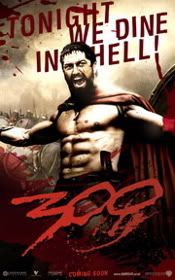
5. 300

Of all the panels that I wasn’t expecting much out of during the 2006 Comic-Con this was one I didn’t have any preconception of prior to the lights going out and having my brain put through an adrenaline blender.
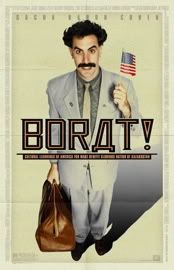
The Nine Inch Nails score does a lot to carry the action of this flick forward but, really, it’s the trailer’s ability to capture the raw masculinity that makes me, first, question my sexuality if for a brief moment when Gerard “DEAR FRANKIE” Butler kicks some sap down a very large well while being all bombastic and, secondly, it’s the ladies that were initially topless in the Comic-Con footage but appropriately dressed here that pulls me back into where I really belong: on the front lines of a battle where I wouldn’t mind swinging a battle ax or two.

There is so much to drink up as we barely, barely, get any sort of contextual basis for where the plot is going but I can honestly state that I don’t care that I don’t know what’s happening by the end of this thing. It’s the road to the destination that’s so engrossing here.

From hordes of armies that I can’t keep straight about who is a friendly and who is an aggressor I get the distinct impression that it’s every man for himself. It’s a long lost, and forgotten, piece of our natural history about how we’ve come to where we are today but what’s shown here seems like a demonic mix of the absurd and the very real.

I’ll be there with a heartily reinforced codpiece.

4. BORAT

I saw the trailer and knew what was coming just had to be good; the opening sequence was what really caught my attention. No voiceover, no quick cuts and no snappy soundtrack. In fact, this trailer eschews every modern hook to attract attention to itself and it’s this sticking to its uniqueness and knowing that is something different, refusing to sell itself any other way, that made me an interested suitor.
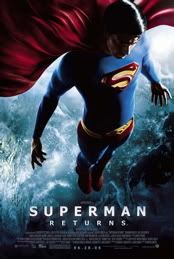
It’s Sacha’s admission “it’s nice” about his home country of Kazakhstan that really got me wondering what in hell I was watching. Was this a mockumentary? A comedy? Both or just some odd hybrid that made ALI G IN DA HOUSE so shitty? It’s the latter that scared me just enough to keep watching and try to gauge whether this was going to be something worth paying for.

His tour of his home, just a few seconds worth of the overall running time of this trailer, was what sold me immediately; it was what put this trailer on my top 5 of 2006 without ever seeing whether the movie lived up to the insanity. If you can’t see Sacha’s dedication to this character in that brief moment, his verbal cadence, his rhythm, the way he makes him genuine enough to believe he’s telling the truth, then you were probably a person deserving of the kind of treatment so many are now suing him for.

The ending, with him telling us that he’s planning on coming to America, was enough evil portent to tell me that this was the basis for what was, no doubt, going to be Sacha’s foray into American culture. He did it so well in his HBO series and, coupled with this trailer, it’s the promise that there was more to follow, leaving me wanting more, that made this trailer so spectacular.
Sometimes great movies can transcend our own lives in their own way, be it the ones that win awards or the ones that just mean more than any prize given to it.

3. THE FOUNTAIN

This film got me twice in the same place.

There is a moment in this film that is so brutal, so honest and so effective that I believe it’s downright deplorable the movie didn’t make it onto anyone’s Top of 2006 list.

The trailer was one of the best indicators that this film was not only to play Yahtzee! with your sensibilities but it was also going to reach. It was going to reach beyond what so many other films feel comfortable being corralled by and there isn’t anything standing between Darren’s promise of what will be and what is being sold.

Such a rare delicacy to have someone’s unfettered presentation about what a film is going to be about without there being any kind of sugar coating but it’s frightening that we’re given just that. A real peek into what we’re going to have served up to us.

If you can take the time to notice, as we transition from the 16th century to the 21st, there is a definite tonal shift that cleaves the two time periods perfectly. Even not knowing what was about to happen with this movie is irrelevant as the assumption that this was going to be a movie about the same guy, same woman, and spans hundreds of years, it would be perfectly correct and incorrect at the same time. The trailer doesn’t obfuscate even as we’re thrust into the year 2500. Even when I saw this trailer, and even the movie, you’re not sure what’s really happening until you get some context. The trailer, in retrospect, was being completely open and forthright; it wasn’t selling itself as being something it wasn’t.

You get the entire movie’s emotional weight packed right in there but, like a Rubik’s Cube, if you don’t know how it all fits together you’re just grasping at something that’s not there. This trailer rewards the newest viewer and even amazes those who have even seen the film.

Life and death have never been captured so effortlessly and with as much brevity than within these moments here.

2. SUPERMAN RETURNS

I can’t tell you how many piss poor reviews I read on this film.

The words flop have only been used more in an Orlando, Florida Waffle House than were used to pinpoint the correct word to sum up years worth of work Singer did on this epic flick. I can tell you that the bad word-of-mouth kept me away from the theater and that I didn’t catch it until it made its way on DVD. I can see why my hesitation served me well.

The trailer, though, definitely gets my vote for a film that had everything going for it and could not have been marketed any better,

There was the hint that this film was going to break down walls and pummel humanity with this envisioning of a new Superman, one that was going to bring the pain, bring the noise, bring back a mannequin style of acting not seen since that Jake Lloyd kid did a number on us from PHANTOM MENACE. But you never would’ve known the latter based on what’s here.

This film sings right from the beginning of this trailer, the second in the series that really bursts with pleasure, and it’s the hazy sequence where Spacey intrudes into the Fortress of Solitude and Supes snaps awake from his meditation where there was the indelible promise that there was going to be a fight here, a raison d’etre. Without making a smarmy remark about what we DID get, we put aside the usual accoutrements of getting more explosions stuffed in there and get a real serious look at the human side of this alien from another planet. With John Williams’ score underneath it all you, for once, felt this movie was going to marry the very serious with the very spectacular.

Who knew?

I mean, shit, the shredding of bullets on his chest, the ripping apart of a falling jetliner, the kinesthetic sense of physical weight as he stops himself on the ground, splitting it as he does so, this movie sold itself well as it could have for what we all ended up seeing on the screen.

There are so many things that could have been changed about the eventual version we got but no one can deny the superiority of this trailer.

1. SPIDER-MAN 3

Director: Sam Raimi
Cast:
Tobey Maguire, Kirsten Dunst, James Franco, Thomas Haden Church, Topher Grace, Bryce Dallas Howard, Dylan Baker, Elizabeth Banks
Release: May 4, 2007
Synopsis:
A strange black entity from another world bonds with Peter Parker and causes inner turmoil as he contends with new villains, temptations, and revenge.

View Trailer:
* Large (QuickTime)

Prognosis: Best There Was In 2006. Pardon me for a moment while I wipe this explosion of geek goo out of my underwear.

Sam Rami really knows what he’s doing with these films. Much like Peter Jackson and unlike Brett Ratner Sam realizes what makes these movies fill an economic and social niche at the multiplex. It would be easy, real easy, to write these films off as just fodder for a pyre that’s all too willing to use cultural hallmarks as burnable properties. Sam has had to tow a line that needs to be respectful of the mythos of Spider-Man while being accessible by throngs of people who want to be dazzled and entertained.

His style of storytelling and filmmaking for SPIDER-MAN 1 and 2 have set records because he unlocked the barrier for entry for folks who would otherwise see a dude in blue and red tights and say “Pass.” Respect for the material and for the dweebs who have spent their hard earned lunch money bridged the other 50% of the equation to make these movies more than just hits. There could have been big issues if Sony decided to pull a X3, like New Line has now done with Jackson and THE HOBBIT, because there is something to be said for films that bookend and possess a definitive voice. Things from the 1st film carried over into the 2nd and, obviously, now in this 3rd chapter we need resolution and if Sam didn’t keep to his vision it would have been like reading a book with the final chapter scrawled in by someone who wasn’t the original author; it would be disconcerting to say the least but Sam realizes this and he explodes right back into things.

What I like about this trailer the most, then, is that we come into this movie knowing there aren’t going to be the requisite gun battles and violence that is present in other films in mass quantities but this about the story and we get right into things without any needless exposition whatsoever.

Sure, there’s a hokey pro-Spidey party going on when we begin but, you know what, there’s no Macy Gray, and that unto itself is a good thing. Also, we get all the players’ shining mugs as if to say, “Yes, they’re all back and, hey, we got Topher Grace.” Oddly, there is no sign of Ms. Bryce Howard, which I am confounded by, but it’s not addressed, either in any fashion.

We get Pete trying to get his swerve on by laying his lady in his man-webbing, his voiceover letting us know he wants to get married. What’s great about this moment is that Pete’s next evolution of being Spider-Man lends itself quite nicely with the responsibilities of being a husband and it’s delicately addressed by Aunt May, the one constant that I’ve really enjoyed through the first two parts of these movies; she is the anchor that centers Pete and it is her moments that are especially inspiring as we go further on in these films.

“DANGER Particle Physics Test Facility KEEP OUT”

Okay, yes, that sign that Thomas Hayden Church passes by as he scales the fence as he tries to evade the cops is a bit obvious. I mean it’s really obvious. Have you ever seen a government facility keep its signage that gleaming white? Neither have I. But, as such, it does help the other people in the audience “get it” and the shot of Thomas losing his shit to that tri-beam is pretty fucking sweet. As is Spider-Man’s punch to his mid-section in mid-robbery only for Hayden to pump up that fist, with accompanying squishy sand sound, and knock the “˜Man right out of the getaway vehicle.

“Revenge is like a poison”¦”

The sound of the symbiote oozing its way onto Spider-Man’s body and the visual gooeyness of the Black Death is nothing short of brilliant. The contrast, the weight it seems to have, the sense that it has life, makes going to see this movie if only to witness what this is going to do all worth it. Can I get an amen?

I don’t know what to make of The Sandman as Bag Lady in the subway or the black McFly hair slick that Parker is sporting after his “infection” but I can only shrug and be consumed by the other, other sub-plot of Franco coming correct in his quest to avenge his father’s death. That looks like it’s not going to have a pleasing ending but, really, if we want to stay true to the reality of the first two films then it won’t be sugar-coated.

The quick cutting of all sorts of insane visual effects does a body good, namely mine, and while I can only wonder where Venom is or where Gwen Stacy fits into this picture (Um, isn’t this going to be a large part of the plot?) the trailer that we’re given is just a shot of adrenaline that’s been shoved past our chest plate and injected into the heart.

Consider this the first real shot heard across the world.

PRIMEVAL (2007)

Director: Michael Katleman
Cast:
Dominic Purcell, Orlando Jones, Brooke Langton, Jurgen Prochnow
Release: January 12, 2007
Synopsis:
In one of the most remote places on earth, a bloodthirsty serial killer has claimed over 300 victims, and is still at large to this day. Now, inspired by the true story of the world’s most prolific killer, comes PRIMEVAL, a nail-biting horror-thriller that follows an American news crew determined to capture this terrifying murderer alive. The danger begins as producer Tim Freeman (Purcell), cameraman Steven Johnson (Jones) and their rag-tag team set out on a journey up-river in search of their subject. But the deeper they probe into the mystery of this elusive assassin, the deadlier their trip becomes.

View Trailer:
* Large (QuickTime)

Prognosis: Worst There Is (So Far) In 2007 Lame.

What kind of world do we live in where this constitutes a respectable horror trailer?

Right, it doesn’t, because this one sucks high tit. It’s not so much the spooky skulls that are prominently displayed in this trailer, because there are, but it IS so much the wasting of my time as I wait for something, anything, cool to happen. There isn’t anything to really be stricken by as this thing rolls on and on and on without so much of a blood dripping corpse.

It pains me to say that the very beginning of this trailer may be the one reason why I’m not parting with my cash. The “Inspired by a True Story” is a respectable swing at the piñata which is my frontal lobe but it completely whiffs as we then open up onto a resplendent safari landscape. What the hell? Is this a movie of slasherific goodness or is this Sunday morning on the nature channel?

Unfortunately, I can’t appropriately answer that question because the tweet-tweet of the birds, fuckin’ rhinos, fuckin’ giraffes, fuckin’ gazelles and, ooooooo, a thunder clap.

“In one of the most remote locations on earth”¦”

Yeah, so is my Johnson because I’m married, you douche.

“Lives the world’s most prolific serial killer.”

Nope. You’re forgetting about McDonald’s and their sinister ingredients, to say nothing of their guerilla marketing tactics as they rope kids into their incestuous fold.

Oooo, again with the pseudo spookiness, but this time it’s the close up of a dirty skull.

“He has claimed over 300 victims.”

Lightweight.

“Looks like another mass grave”¦”

Um, have any of you read the history books about what Slobodan Milosevic perpetrated on the world stage? Tard.

I could just go on and on with the far-reaching statements and superlatives that are tossed out there like balls hoping to make it into Bozo’s Buckets but it doesn’t work. The creepy voodoo guy conducting a ritual of some sort is a little cool, I have to admit, but where does that move the story? What does any of this have to do with the plot? Absolutely nothing, friends.

In fact, as the trailer rolls on and on we aren’t allowed in anywhere close to knowing why any of us should pay to see this movie. There’s a lot of running through underbrush, we get a lot of ADD inspired quick clips and there’s even one of those dramatic pauses by Dominic Purcell that I am guessing is supposed to be “spooky.” It’s not, I’m bored and I am moving on to my cell bill; that’s a lot scarier than what may be in this movie.
.

QSE News: 1/12/2007

Filed under: Columns,News — UncaScroogeMcD @ 4:37 am
quickstopnews.jpg
line1.gif

Here are today’s top entertainment headlines:

  • qsnews.jpgHalle Berry, fresh off her role in the Oscar-baiting movie Things We Lost In the Fire, is pleading with fans to write letters to Fox Studio head, Tom Rothman, to “green light” a fourth X-Men film.  “Come on, people,” said Berry during an impromptu press conference.  “Momma needs a new pair shoes.  And a boat.  And another mansion.  And another car.  Oh, and another way to forget that I made Catwoman.”
  • An unidentified man is doing well after being stung by a scorpion during a flight from Miami, Florida to Toronto, Canada.  Airline officials, who are still investigating how the scorpion got on the plane, were exceedingly grateful that Samuel L. Jackson was there to “get those mother [EXPLETIVE DELETED] scorpions off of their mother [EXPLETIVE DELETED] plane.”
  • In a bit of sad news, actress Yvonne De Carlo has passed away.  De Carlo, best known as the vampiric Lilly Munster from the TV show The Munsters, was 84.  While many people are mourning De Carlo’s passing, true fans are holding out hope that De Carlo will return as coroners confirmed that “a wooden stake through the heart” was not the cause of death.
  • Tragedy struck Hollywood today as hundred’s of stars awoke at the crack of noon to find that the lavish “swag bags” they receive at various awards shows will not be given out this year.  One tearful star was heard to lament, “This is unbelievable!  They expect us to buy this stuff on our own? Yeah, right.  With what money?”
  • Actor and political activist Richard Gere has traveled to India in hopes of spreading AIDS awareness.  Gere and Bollywood actress Bipasha Basu spoke to a crowd of 15,000 sex workers in India, telling them that they should all be practicing safe sex.  We here at QSE News applaud Mr. Gere for making this trip, especially after he discovered that in India, gerbils are used as food or pets and not anal stimuli.
line1.gif

That’s all for today’s news, stay tuned to this channel for all the news that matters least but you still care about.

(Compiled by J. Allen)

##

Quick Stop Thingamabobs: 1/12/2006

Filed under: Columns,Thingamabobs — UncaScroogeMcD @ 4:32 am
thingamabobs.jpg

The web. It’s a big place, full of plenty of distractions ““ some funny, some informative, some ludicrous, some disturbing, some inane, some profound. Each and every weekday, we present links to a few of our favorite finds”¦

————————————————

  • If you’re going to run up a wall, make sure you can actually accomplish it… (Thingamabob)
  • Practical, real world displays of science are fun… (Thingamabob)
  • Patton Oswalt’s brilliant stab at master thespianism… (Thingamabob)

Have a THINGAMABOB? Send it in!

##

January 11, 2007

Music For The Masses: 1/11/07

Filed under: Columns,Music for the Masses — UncaScroogeMcD @ 2:00 am
musicmasses2.jpg

Welcome back, friends, to a new edition of Music for the Masses. This week, due to some slim pickings… we are keeping it a bit short. So… sit back and relax as we kick you in The Shins and hitchhike across the galaxy with Mos Def. Sound like fun? Sure hope so. Well, hey? What do you say we find out?

m4m-shins1-1-11-07

The Shins
Album: Wincing The Night Away
Sounds Like? Jeremy Enigk spanking a fat and naughty Brian Wilson for going off his meds… again.
You know? If I were James Mercer or Jesse Sandoval, co-founders of inde-rock darlings, The Shins, the first thing I would do each and every morning is to roll over and give Zach Braff a big, ol’ sloppy blow job. And no, I’m not talking about your everyday, run-of-the-mill, “let’s get this over quick because ‘Deal or No Deal’ starts in ten” kind of blow job either. I’m talking the “savor it like it’s the best steak dinner you’ve ever had” blow job replete with minimal raking of the teeth and a subtle grip. Kinda like you’re holding a baby bird in your hand and, umm, rhythmically choking it to death. . .as you lick it’s head.

m4m-braff-1-11-07

I mean, honestly… if you had a guy that was single-handedly responsible for the fact that people outside of Portland, OR know who in the hell you are, what WOULD you give him to show him “he’s special?” Umm hmm. See? Exactly my point. Granted Braff, the real Dr. McDreamy if you ask me, didn’t write the music, sing the songs or play any of the instruments on any of The Shins albums, but if Zach hadn’t put two of The Shins’ songs from Oh, Inverted World on the soundtrack to his “little indie” film, Garden State, in addition to having Natalie Portman’s character state the song “New Slang” would “change your life” (even though she KNEW damn well in that film that the song “Caring Is Creepy” is SOOOO much better), these guys would still be busing tables at IHOP.

m4m-amad-1-11-07
Dirty, dirty Amidala. . .

I can honestly say that I was not an overly big fan of The Shins going into this review, but after listening to the new album, Wincing The Night Away, I am completely blown away. This band, albeit in a mellow fashion, completely kicks ass. Who knew? I mean, besides Zach, of course. Now, I’m not exactly sure what I was expecting with this disc, but this sure-as-hell wasn’t it. Featuring some masterful work from singer/guitarist James Mercer, bassist Dave Hernandez, “trippy “keyboardist/guitarist Martin Crandall and drummer, Jesse Sandoval, The Shins appear to be hitting their “musical stride” here harder than Tom Sizemore hitting Heidi Fleiss and the seamless blending of elements from folk, country and pop into a quirky and melodic hybrid that I like to call “Fopoptry,” or, if you prefer, “Focuntop,” is sublime. Hey… I know those are not as “cool sounding” as “Benifer” or “Branjolina.” Whatever. Fuck off.

m4m-lifeguard-1-11-07

Good to see that Booger from “Revenge of the Nerds” is working again.

Some of this new material is far meatier and fuzzier (relatively speaking) than anything I recall hearing from this band in the past and that, my friends, is a great thing in balancing out the overall sound. I particularly enjoy the way that Mercer’s melodic vocals and note-perfect, guitar phrasing pull the songs on this disc together while never becoming boring, stale or over-used. The album is chock full of “special moments,” but my personal favorites are the Sunny Day Real Estate-inspired “Split Needles,” the Brian Wilson meets Pinback smoothness of “Turn On Me,” the deranged lullaby “Red Rabbit” and the very Beck-esque “Sea Legs.” If this is ANY indication of the music we have to look forward to in 2007, it’s going to be one hell of a year. Fantastic job, guys, on crafting the first “must buy” of the year.

Check out the new track, Phantom Limb, here!

m4m-hung5-1-11-07

Top Score!!! High Five!!!!

m4m-doublea-1-11-07

m4m-cup-1-11-07

Ahhh, I can remember it well. The year was 2006, the Carolina Hurricanes won the Stanley Cup, Pirates of the Caribbean 2 was ruling the box office and, more importantly, I was a fresh faced (read: pimple-riddled) kid trying to make my way in this crazy world. Ahhh, good times. It was also the year that I was introduced to the rapper known as Mos Def. I knew who Mos Def was, but I was afraid. Like a quivering accountant in a prison cell with Mike Tyson… or Gary Glitter. I had never heard anything by him. No, not Glitter… Def. Then out of the blue my brother comes home with the Mos Def/Talib Kweli collaboration Black Star. I was impressed and since that time I’ll fully admit that I am a huge Mos Def fan.

m4m-hitch-1-11-07

Now, since I heard Def’s last album, The New Danger, I’ve been waiting for the promised 2006 release of Tru3 Magic. Nope… no clue what that backward “3” means. You? Unfortunately, the disc kept getting pushed back. And pushed back. And pushed back… like Lou Diamond’s girlfriend against the trailer wall. Then, on December 29th, a Friday, the album was released to the world, even though most stores didn’t put it out till Tuesday, January 2nd. Assholes. Anyway, how do I put this… umm, the album was well worth the wait? Yeah… that’s it. I can honestly say that it is one of the best albums that kinda…  sorta… was supposed to come out last year. I dare say that it was the best rap album to come out in a long time, possibly even beating my old favorite The Return of Dr. Octgon.

m4m-mos-1-11-07

Bet his wallet says “Bad Mother Fucker.”

There are no bad songs on this disc. The beats are good, the raps are perfect. Everything about this album is on the money. If one were to twist my arm I would have to say that “Dollar Day” is the best of the best. Formerly released as a single called “Katrina Clap,” Def uses a reggae-esque vocal style over a great beat to make a really interesting song about a great tragedy. Other highlights on the album are “Crime & Medicine” and “Undenible.” Do yourself a favor and go buy this album. Unless you hate rap, then… wow… I wouldn’t recommend buying it.

m4m-flava5-1-11-07

Yeahhh. . .boooyyyy!!!!

Well, folks, there you have it for this week. Oh, hey, before I forget… here are the new music release for next week…

Artist Title Genre
SCHULZE, KLAUS TIMEWIND ELECTRONIC
SHAKEYFACE BICYCLE DAY BOOGALOO ELECTRONIC
TOLLIVER, CHARLES WITH LOVE NOT PROVIDED
CROWDED HOUSE FAREWELL TO THE WORLD NOT PROVIDED
ROSS, DIANA I LOVE YOU NOT PROVIDED
STRANGLERS, THE SUITE XVI (U.K.) NOT PROVIDED
PETROL PRESENTS DEPARTURE LOUNGE: CHILL NOT PROVIDED
ORRICO, STACIE BEAUTIFUL AWAKENING NOT PROVIDED
AMERICA HERE & NOW NOT PROVIDED
STARS OF TRACK & FIELD CENTURIES BEFORE LOVE & WAR NOT PROVIDED
ARRESTED DEVELOPMENT THE COLLECTION RAP
P3 PLAYALAND RAP
RZA, The AFRO SAMURAI – SOUNDTRACK RAP
REQUIM GOVERNMENT DENIES KNOWLEDGE ROCK
CATAMENIA ETERNAL WINTER’S PROPHECY ROCK
HOLY MOSES QUEEN OF SIAM ROCK
SLAMER NOWHERELAND ROCK
ZANDELLE VENGEANCE RISING ROCK
AGE OF NEMESIS TERRA INCOGNITA ROCK
ELIS GREIFSHIRE ROCK
FAIRYLAND THE FALL OF AN EMPIRE ROCK
BIF NAKED PURGE ROCK
MALICK, PETER FEAT. NORAH JONES NEW YORK CITY – DELUXE ROCK
PUPPINI SISTERS BETCHA BOTTOM DOLLAR ROCK
REA, CHRIS THE ROAD TO HELL & BACK ROCK

As always, shop wisely and when fishing for gold in the toilet… beware of turds.

Thanks again for tuning in, friends. We will see you next with a brand spanking-new installment of Music for the Masses. Until then, keep wearing it proud and playing it loud!!

Send your ideas for what to do with all of this fucking snow, assorted hate mail, presents and review copies to:

M.C. Bell
P.O. Box 1222
Arvada, CO 80001

Here’s what I’m doing with all of this fucking snow…

m4m-cold-1-11-07

E-MAIL THE AUTHOR |

Noctural Admissions: 2006 Season TV Roundup

Filed under: Columns,Nocturnal Admissions — UncaScroogeMcD @ 1:10 am
nocturnalheader5.gif

It’s mid season, with the returning shows emerging from winter hiatus and new shows introduced to replace the bloody remnants of the season’s early bright ideas. Since I have been watching a lot of TV lately, indeed too much, I might as well put all that exposure to good use, so here is my assessment of the 2006 – 2007 season at midpoint.

Smith title
Daybreak title

The first thing to assert is that thus far, all my favorite network prime time shows have already been canceled. Smith, Kidnapped, and Daybreak all bit the dust somewhere between three and six episodes. Smith was a visually stylish show about criminals with a cast of movie stars (Ray Liotta, Amy Smart, Virginia Madsen) doing great work. But you could tell from the beginning that Smith didn’t fit into the general CBS template of bland looking, methodical plan americain presentation and conservative subject matter. Fortunately the unaired eps along with synopses of the remaining plots were available on line. Same with Kidnapped, a very realistic show that attempted, like Smith, acquire a bit of the 24 shine. In essence, it was a TV version of Ransom, even down to the presence of Delroy Lindo. Again it was well cast, but it did seem to be treading a little bit of water by the time of its unaired post-cancelled eps. ABC’s Daybreak had the bright idea to do an unofficial remake of Groundhog Day as a cop show with hints of 24 and The X-Files (the film also starred Mitch Pileggi). In it, Taye Diggs is a cop re-living the same day repeatedly, one on which he is accused of killing a DA. On paper, the show sounds like a drag, a repetitious narrative that taxes patience, but in fact the makers brought a lot of imagination to would have been a deadly and stagnant program.

Dexter

Fortunately, there was still cable, and The Wire and BSG there to make up for the short-sightedness of either the mass of viewers or the decision-makers in the board rooms. Both cable shows were at the height of their powers and whetted the appetite for their next seasons, both due at different ends of this year. I don’t have cable, but greatly enjoyed the first season of Dexter, which excelled where for me most Showtime shows have fumbled. In the Battle of the Network Blondes, I favor Dexter‘s Julie Benz and Without a Trace‘s Montgomery over any of the others.

Meanwhile, back on primetime, Criminal Minds, a show I watched only because of Lola Glaudini, dropping her a few eps into its second season at the end of some convoluted Nixonian law and order subplot that, as usual in TV shows, intellectually wants you to side with law but which is secretly weighted toward vigilantism. Lola may be back, however, for a resolution of her plot line, if current teasers for the show are correct. Her character, Elle, pulled a Vic Mackey and murdered a serial rapist. I was disappointed at this turn of events, as it probably meant that Glaudini wanted off or was wanted off, the show (though her disastrous new bangy haircut is reason enough for banishment).

Also on CBS was the new show, Shark, which coasts on the star power of James Woods, and some of its cast, including Jeri Ryan. However, aside from them, it’s pretty conventional stuff, in the classic conservative CBS crime show manner, and most of the subsidiary cast members are rendered utterly unmemorable.

Shark has a character going from defense to prosecution, while the short-lived Justice had a guy going from prosecution to defense. Justice offered the gimmick of showing “what really happened” in the show’s last minute, but like most gimmicks, it would have been dropped eventually if the show had survived six airings.

I watched about 20 minutes of Jericho, but it didn’t grab me,it felt so conventional and soap operary. And I haven’t even watched Heroes yet, though all the episodes are saved up on my hard drive. Meanwhile, I’ve become a regular watcher of Without a Trace, not because it is a good show (it pulls that same dichotomy between moral and legal action), but because I love Poppy Montgomery’s mouth and because I like the fact that her character is named Sam(antha) Spade. Like Criminal Minds, the show had her shot recently and she tried to come back “too early.”

Suicide Girls

In the CSI realm, I still like “classic” Vegas CSI, am a bit repulsed by Miami, and am waiting for NY to take off (it’s tried to make itself hip by including the Suicide Girls). I wish that the producers would do something daring such as CSI: Vancouver, i.e., go to a wholly other jurisdiction where all the rules are different. Actually, in a way the show already exists, in the form of the excellent Canadian program DaVinci’s Inquest.

Ugly Betty

I don’t watch the rest of CBS’s female-oriented dramas ( Ghost Whisperer, Numbers, or for that matter, NBC’s Medium), nor its reality based shows. Over at ABC I watch Boston Legal (reviewed earlier under its box set), and Lost (treading water). I never even had a chance to follow The Nine or Six Degrees before they were canceled, and I just recently did a marathon of Ugly Betty, a good show that has something of a divided soul: Betty’s home life is realistic, but her work life is farcical (like the telenovelas that her dad watches). With luck I’ll catch up with Grey’s Anatomy and Desperate Housewives later on DVD, which is my preferred way to watch those shows.

At Fox, I follow House (which tells the exact same story every week), Prison Break (which is starting to wear me out), the X-Files-like Vanished before it was canceled (though it wasn’t very good), Bones (against my better judgment), and The Simpsons.

30 Rock

Over at NBC, I’m following Studio 60 on the Sunset Strip without really liking it much, along with 30 Rock which I greatly prefer. By way of comparison, note how they both mocked the ambush pederasty shows on NBC, but 30 Rock integrated them into the narrative while Studio simply did a funny skit. Again, Studio is already treading water (while presenting the occasional powerful moment), while 30 Rock has some sharp wit and Alec Baldwin. Fey’s portrayal of a conflicted modern urban woman is, I fear, terribly underrated, if it is “rated” at all. I’ve only seen a few hours of Friday Night Lights, and while I like the coach and his wife, haven’t found myself addicted, and don’t really like where the show appears to be going. Of the Laws and Order, I prefer the Sherlock Holmesian CI, which has lost its way terribly, never watch SVU, and only the classic L&O when I am home on Fridays, though I like the addition of Milena Govich. I never watch NBC’s game shows or news shows, and Thursday is all about four good comedy shows in a row.

Office cutie

Finally, I’ve been catching Gilmore Girls and Veronica Mars when I can. It’s my understanding that Gilmore was much, much better in earlier seasons, and Mars is continuing its downward spiral, with an obviously bright Veronica trapped in what appears to be a community college, and clashing with her dreadful boyfriend an parodies of college extremists. The show just doesn’t have the layers or nuances of its first season.

I’m obviously watching way too much tube (or plasma screen). I just wish I were getting paid for it. But this immersion into network television has been building for years, not just with me, but with many of my friends. It seemed to have started way back in 1999 with the appearance of The Sopranos on HBO. Suddenly snobbish movie buffs found themselves making appointments with television, something they hadn’t done since they were kids. Having raised the bar, HBO inspired other networks to keep up, and in a spotty fashion, they have.

But it is also clear that as good as TV is these days, it is still a medium in crisis. It doesn’t know what to do. When it tries to push the edge of the envelope (hate that phrase) it’s shot down; meanwhile it is rewarded for airing shows like NCIS that are like every other show. Meanwhile, people are TIVOing and Bittorrenting shows and so the networks have no way to really know who is watching their shows. And it is obvious that anyone who can, be it via iTunes or other downloads, avoids seeing commercials as soon as they can. Worse, the networks are still locked into the 22 to 24 episode season, when it is obvious that the strength of HBO shows is that they play to fit, they exist as a cycle of episodes only to the extent of their internal narrative logic. HBO writers, I imagine (though I could be wrong), don’t tire out as fast. Thus The Wire has stayed strong for four seasons, which Veronica Mars seemed tuckered out in its second season. We are on the cusp of many, many radical changes in the nature of programing and consumption, in formats that have changed more in the last eight years than in all of the previous 80.

Boston Legal

QSE News: 1/11/2007

Filed under: Columns,News — UncaScroogeMcD @ 12:47 am
quickstopnews.jpg
line1.gif

Here are today’s top entertainment headlines:

  • qsnews.jpgRock star Gary Glitter may be released from a Vietnamese prison sooner than expected.  Glitter, who was convicted of molesting two Vietnamese girls, was originally sentenced to three years in prison but may be released as early as May for “good behavior.” Glitter gives credit for his rapid rehabilitation to his new-found friend and mentor, Michael Jackson.  “Michael has been there for me with love and understanding… and, umm, some helpful tips on how not to get caught again.”
  • Apparently, not everyone loves Paris and Britney as much as we do here at QSE News.  Mr. Blackwell, the self-proclaimed “celebrity fashion police chief” gave the dynamic duo the top spot on his 47th annual “Worst Dressed” list.  When pressed for comment on why he chose “P” and “B” as his worst dressed, Mr. Blackwell stated that, to him at least, a “vagina is not a fashion accessory to be worn out in the open like a broach.”
  • Bindi Irwin, the eight-year-old daughter of the late “Crocodile Hunter” Steve Irwin, is set this week to kick off her own TV show, Bindi, Jungle Girl.  The show, which will premiere later this year, will honor Steve Irwin’s memory as each week, Bindi will find a new and creative way to kill a stingray.
  • The man behind Buffy The Vampire Slayer is coming back for more. Joss Whedon will revisit his most famous creation in a new series of comic books. When the news broke, mothers across the country said “great, now my 31-year-old son will never leave the bathroom.”
  • In celebrity love news, Oscar winning actress Hilary Swank has once again found love.  Swank, who divorced ctor Chad Lowe last year, is said to be “totally in love” with her new mystery man.  Those close to Swank reveal that the pair met while Swank was reading for the role of The Joker in the new Batman movie.
line1.gif

That’s all for today’s news, stay tuned to this channel for all the news that matters least but you still care about.

(Compiled by J. Allen)

##

Quick Stop Thingamabobs: 1/11/2006

Filed under: Columns,Thingamabobs — UncaScroogeMcD @ 12:05 am
thingamabobs.jpg

The web. It’s a big place, full of plenty of distractions ““ some funny, some informative, some ludicrous, some disturbing, some inane, some profound. Each and every weekday, we present links to a few of our favorite finds”¦

————————————————

  • What’s a day without a little Senor Wences? (Thingamabob)
  • Mark Wilson & Nani Darnell performing “The Metamorphosis”… (Thingamabob)
  • Louis CK’s segment of Comic Relief 2006, uncut… (Thingamabob)

Have a THINGAMABOB? Send it in!

##

January 10, 2007

QSE News: 1/10/2007

Filed under: Columns,News — UncaScroogeMcD @ 2:52 am
quickstopnews.jpg
line1.gif

Here are today’s top entertainment headlines:

  • qsnews.jpgAs if a public quarrel with heavyweight Rosie O’Donnell wasn’t enough, Donald Trump is now facing a lawsuit by a former Apprentice applicant.  Richard Hewitt, 49, is suing Trump claiming that the show discriminates against older contestants.  When asked for comment, Trump claimed that only the most qualified contestants are chosen to appear on the show”¦ as long as they are not “fat, anti-Asian lesbians.”
  • The King of All Media has added a substantial amount to the royal coffers.  Reports indicate that Sirius paid top-jock Howard Stern $83 Million in cold, hard stock options after he single-handedly raised the number of subscribers from approximately 600,000 to just over 6 million in just under 3 years.  When asked what he planned on doing with the money, an unnamed Stern staffer replied that Howard didn’t want to be outdone by Oprah’s “audience gift-giving” and was going to “buy a Sybian masturbation machine for all the women in his audience and a lap dance at Scores for all the men.  Baba Booey.”
  • In celebrity wedding news, actor Alan Cumming has married his long time boyfriend, Grant Shaffer, in a civil ceremony in England.  Cumming, perhaps best known to Americans as Nightcrawler from film X2: X-Men United, has stated publicly that the honeymoon will be romantic and “include a whole hell of a lot of ‘BAMF-ing.'”
  • In a sad bit of news, famed Scooby-Doo cartoonist and director of the 1973 classic Charlotte’s Web, Iwao Takamoto, passed away Monday night at the age of 81.  When asked for comment on the passing, a mournful Scooby Doo replied “Rat is rearry, rearry rucking rad.”
  • Actress Suzanne Sommers’s mansion was one of four devoured by a wild-fire that swept through Mel Gibson’s kingdom of Malibu late Monday night.  Authorities are unclear of the cause of the blaze, but the investigation is focusing on the “massive friction” generated by one of Sommers’s fat neighbors using a Thigh Master.
line1.gif

That’s all for today’s news, stay tuned to this channel for all the news that matters least but you still care about.

(Compiled by J. Allen)

##

Quick Stop Thingamabobs: 1/10/2006

Filed under: Columns,Thingamabobs — UncaScroogeMcD @ 2:24 am
thingamabobs.jpg

The web. It’s a big place, full of plenty of distractions ““ some funny, some informative, some ludicrous, some disturbing, some inane, some profound. Each and every weekday, we present links to a few of our favorite finds”¦

————————————————

  • The opening of the 1950’s Warner Bros. pilot Philbert, which mixed animation and live action… (Thingamabob)
  • Kasper Hauser discuss the horrible affliction known as “Male Camel Toe”… (Thingamabob)
  • Add this to the long list of beer party tricks… (Thingamabob)
  • The Sound of Young America‘s Marc Maron archive… (Thingamabob)
  • Dylan Moran’s brilliant bit about kid’s parties… (Thingamabob)

Have a THINGAMABOB? Send it in!

##

January 9, 2007

Marvel Legends – It’s a Hasbro World Now

Filed under: Columns,Toy Box — admin @ 12:31 am
toybox.jpg

It’s not the War in Iraq, or global warming, or even the current status of Britney Spears’ panties, but when Toybiz lost the iicense to produce Marvel action figures last year to Hasbro, it was big news. It was if you were a action figure collector anyway, especially if you were into Marvel Legends.

Marvel Legends was a flagship line for Toybiz, and will most likely go down in history as their finest hour. They did good work elsewhere, no doubt, but with ML they not only produced great figures, they broke ground. And they did it all over 15 waves, several boxed sets, and countless variants.

Hasbro announced that the line would continue – and fans had mixed emotions. Sort of like when your mother-in-law drives your new Lexus off a cliff. They wanted their ML’s…but would they be the same?

The first wave is hitting shelves now, and includes Banshee, Hercules, Emma Frost, Planet Hulk, X-men 3 movie Beast, and Ultimate Iron Man. I have yet to find dear Emma, but tonight I’m covering three of the six – Banshee, Hercules and Beast. If you pick up the full set of six, you also get another Build A Figure (BAF) in the form of Annihulus. I’ll cover the other three over at MROTW once I manage to hunt down the old frosty chick.

Marvel Legends wave 1 – Rise of the Hasbro

The entire wave is sort of an oddball assortment. You have the X-men 3 Beast, designed to fit in with the other older movie figures, and not really with any other ML’s; you have Banshee, a second rate character we’ve probably gotten enough figures of already; and you’ve got Hercules, a goody design in the comics that looks more Gold Key than Marvel. But you can only fault Hasbro so much for the character selection – after 15 waves, they just might be running out of truly interesting characters to make.

toybox_010807_1.jpg
toybox_010807_3.jpg
toybox_010807_4.jpg

By the way, there’s a running change on Annihilus. As you can see above, in the first version he has pink on the arms, torso and upper legs. In the newer version, he has purple instead of pink. Keep an eye out for the two different colors, so you don’t get stuck with a half and half Annihilus!

Packaging – ***1/2
Toybiz had always used clamshells for the line, so the first thing you’ll notice on the peg is the switch back to a bubble/cardback type packaging. Of course, this isn’t as sturdy as the clamshells, but you won’t lose a finger opening it up.

toybox_010807_2.jpg

The artwork on the package is terrific, with some nice small comic artwork shots along the right side, and details about the BAF on the left outer edge of the bubble. Each of the cardbacks is personalized front and back to the character, with a short bio and further artwork on the reverse. These aren’t going to be particularly easy for the MOCers to store, but they are extremely attractive, especially for mass market packaging. Score one for Hasbro.

Sculpting – Hercules, Beast ***1/2; Banshee ***
One of the things that set the old ML’s apart was USUALLY better sculpts than other mass market lines. Now, note that I say ‘usually’, as there are some atrocious examples of Toybiz Marvel Legends, especially when it came to female characters. But in general, the sculpts were top notch, if not quite specialty market level.

toybox_010807_9.jpg

Thankfully, I think Hasbro is trying to keep up with the game. Of these three, Hercules is actually my favorite, although I think the quality of the work is most evident with Beast. The expression on Hercules is a little more goofy than I remember from the old Champions comic book series, but the level of detail in the face sculpt is quite impressive. The body is a little less detailed, but the costume is quite accurate, and small details like the flow of the ‘skirt’ and the rivets on the leggings are very good. He’s a good size too, standing at about 7 1/4 inches tall and fitting in well with past ML’s.

toybox_010807_10.jpg

The Beast face sculpt is really the best of the bunch, and is perhaps the BEST movie character sculpt from any of the X-men lines. It’s tough to tell in photos, since the overall dark blue tends to make seeing detail difficult, but there’s a ton in this sculpt, right down to the fur texturing. His one big issue is scale, and he’s much smaller than other ML figures, standing only 6 inches tall. The issue is a catch 22 for Hasbro. The X-men movie lines WERE smaller than Marvel Legends, so to make this figure fit in properly with the older lines, they had to shrink him down. However, they’re selling him in the ML wave, with an Annihilus BAF piece, so that there will be many folks who buy him that don’t have the older X-men series. Had they made him big enough to fit in with the ML’s, collectors of the X-men lines would have been mad. Making him small will piss off some of the ML collectors. Like I said, a catch 22.

toybox_010807_8.jpg

Banshee is my least favorite, not due to quality of the sculpt, but choice of expression. Yea, I know, that’s his gig, what with the yelling and all, but it still ends up looking dopey. The amount of detail in the hair, eyebrows and mouth is great, even with the sub par paint apps. He stands about 6 inches tall, making him fit in fairly well with the rest of the ML world.

He has an odd issue with a seam at the side of his neck that’s worth noting as well. It’s actually the seam that runs all the way up his torso, and it’s more noticable in close ups than in person. His angled, long neck doesn’t help the general appearance either, and the hand sculpts just exaggerate the weird overall appearance.

In general, seams seem to be a bigger issue for Hasbro than they were for Toybiz. There’s visible seams on all the figures, and even a long ‘burr’ down the front of Beast’s thigh. It was easy enough to remove, but does indicate that the manufacturing QC on these needs to be improved slightly. However, Toybiz had their fair share of manufacturing issues over the life of the ML line, and considering this is Hasbro’s first shot, you have to give them a little leeway. I’m calling this category a draw.

Paint – Beast ***; Banshee **1/2; Hercules **
Ah, but you know there had to be at least one category where Hasbro was not quite there yet. And if you’re looking for that category, then paint is it.

toybox_010807_5.jpg

Most of the pieces are cast in the actual color, rather than painted. This is most evident on Banshee, where the majority of the green and yellow is simplly cast, or the predominate blue and black colors of the Beast. It does give the figure a slightly cheaper appearance than being painted. On the plus side, there’s no issues with joints wearing off the paint over time.

What paint ops are here are less complex. There’s some bleed, but in general the masking is good, and small details are clean and consistent. The paint work that is here is pretty much on par with solid mass market quality.

toybox_010807_11.jpg

Well, most of them anyway. They did try to do this weird wash on Hercules body, but I didn’t see any of them that it was actually consistent on. It ended up looking like he tried to use a really cheap fake sun tan lotion, and missed large sections of his torso and arms.

toybox_010807_12.jpg

The Beast also has an added dark wash on some areas of his fur, especially the front of his arms and the lower half of his torso. It’s not quite as disconcerting as Hercules funky orange torso, but it is further proof that Hasbro has a ways to go before they are getting the paint ops down. This one goes to Toybiz.

Articulation – ****
Many folks were concerned about the articulation once Hasbro took over. My concerns are completely gone. They’ve kept the majority of the original articulation, and improved it.

toybox_010807_7.jpg

They’ve gone with the pin neck joints, similar to the ones Toybiz used. I would have like ball joints of course, but I can live with this style.

All of the figures have ball jointed shoulders and hips, double jointed knees and elbows, pin wrists, pin and rocker ankles, cut waist and pin chest joints. The only major joint that’s missing is the finger articulation, which I can do without for most 6″ scale figures. Beast also has the half foot pin joint, but it’s missing on Banshee and Hercules. That’s another one of those joints that I can probably do without, although once you get good, tight hips and knees, it becomes much more useful.

Banshee also has cut forearms at the top of the gloves, and cut calves at the top of the boots, showing that Hasbro is willing to add even more articulation when it works with the sculpt. Another nice touch in combining sculpt and articulation is the design of the short rubber coat on the Beast. Obviously, this coat could easily completely restrict the ball joints, but Hasbro went out of their way to design it in such a way that there is almost no restriction at all. The material is soft enough to move with the arm, and there are slits in the jacket at the arm pits to allow the ball joint to move through it’s full range of movement.

All of these joints have an excellent range of movement, and all are very tight and sturdy. They’ve used clicky joints throughout almost the entire figure, which I didn’t see in the recent Hasbro Ghost Rider figures. Unlike many of the Toybiz joints, especially knees and hips, none of these joints are floppy or loose, and I have absolutely no trouble getting the figures to hold great poses for long periods. The quality of the pins they’ve used is also quite good, and the figures have a much more solid, sturdy feel to them.

toybox_010807_6.jpg

This improved joint quality is also very noticable in the chest articulation. This is a joint that has been largely useless in the past, since it wouldn’t stay in any position other than dead center most of the time. All three of these figures can hold poses tilted well back or well foreward, and I have a new appreciation for the handiness of this particular point of articulation.

Only time will tell if the joints can manage to stay tight, but the improvements in the range of movement and quality are a blessing. Even without the finger joints, I’m giving this one to Hasbro.

Accessories – Hercules ***; Banshee, Beast **1/2
The accessory count has dropped, if for no other reason than the lack of a comic with each figure. Unfortunately, there’s generally fewer additional accessories as well.

Each figure does come with one or two pieces of the BAF, Annihilus. Once I find Emma and actually get him all together – she has his right arm and leg – I’ll have some photos, but he stands slightly larger than any of the rest of the wave at about ??? inches tall. Of the entire series, he has the best sculpt, and is the most interesting character. I suspect we’ll see quite a few Emmas, Beasts and Banshees sold just to complete the cool BAF.

The Beast and Banshee don’t have any other accessories other than the BAF pieces. Beast comes with the left arm and leg, and Banshee has the large right wing. Hercules has the other wing, and these are quite big and made from a soft, rubbery material.

Hercules does get a little extra score for having his sceptre, and you can remove his sash if you’d like. Banshee has removable ‘wings’, made from a very nice, high quality material, that have small pegs to attach to the arms, torso and legs. While these are technically an accessory I suppose, I think he’s a rather plain and uninteresting character without them. And since he will have that screaming expression for all of eternity on your shelf, he really needs them to make the expression work.

Generally speaking, Toybiz gave us more accessories than this, so here’s a category for them.

Fun Factor – Hercules, Beast ****; Banshee ***
Kids are going to enjoy the sturdy articulation and good sculpting, while being less effected by the paint ops than you or I. Still, Banshee is likely to leave them a little cold with his exaggerated expression.

toybox_010807_13.jpg

Value – ***
Hasbro has raised the price on these to ten bucks a pop, up from around $8 each from Toybiz. They dropped the comics, but kept the BAF. These are still an above average value on the current mass market, largely due to the cost of all that articulation, but they’ve dropped in value from the Toybiz days. Score one for Toybiz.

toybox_010807_14.jpg

Things to Watch Out For –
Ah, it’s the same old same old – paint. Even though there’s not a lot here, you’ll still want to pick out the best examples on the peg, especially when it comes to Hercules. Find one with less orange wash, and you’ll be happier.

Overall – Hercules, Beast ***; Banshee **1/2
If you’re keeping score, that’s Paint, Accessories and Value going to Toybiz, with Packaging, Articulation going to Hasbro, and Sculpting and Fun Factor currently a wash. If I were to compare this wave against the very best of the Toybix ML’s, then Toybiz would win. Compare to the very worst, and Hasbro wins. In reality, this wave comes off just as good as an average Toybiz wave, which tends to tell me that Hasbro is certainly doing just as well and that any fears that these would be a huge drop off from past waves are now unfounded.

toybox_010807_15.jpg

For me, the most important note is around the sculpting and articulation. Of this entire wave, the only real dog in sculpt is Emma, and to be completely fair, the majority of Toybiz females were pretty damn ugly too. The sculpting looks solid, and will hopefully only improve over time, along with the quality of the paint. More importantly, the articulation is excellent, and I’m really happy to see the improvements in this area. Now they just need to improve the hand sculpt moving forward, if they are going to skip the finger articulation.

I’ll be covering Planet Hulk and Ultimate Iron Man (both of which you see in some of the comparison photos above) as soon as I manage to find Emma, but until then, let me say that both are at the top of the wave, and Planet Hulk might just pull ***1/2 stars. Hercules would have, if not for the funky failed tanning experiment.

Where to Buy –
Mass market retailers should get these in, but without any important variants, going online might be your fastest route:

CornerStoreComics has them in stock, with the exception of Emma, for individual sale at $12 each. They do have Emma if you buy the set of six for $70.

Killer Toys has the singles for around $12 each, or the full set for $59, but I’m not sure if they have them in stock yet.

Amazing Toyz has the full set of 6 in stock for $70.

– and if you’re in the U.K., Forbidden Planet has them for about 10 pounds each.

Related Links:
I’ve had plenty of Marvel Legends reviews:

– in the 12″ Icons line, there’s Spider-man and Beast, Wolverine and Venom.

– The Face Offs series 1 (with Hulk/Leader in one review and the other two sets in another) and series 2 both had guest reviews.

– there’s the guest review of the Fearsome Foes of Spider-man boxed set, Urban Legends box set, X-men Legends boxed set, and the Fantastic Four boxed set, along with my review of the Monsters boxed set.

– The previous Sentinel BAF was guest reviewed.

– then there’s the various series reviews, including the Wal-mart series, series 13, series 12, series 9 (including Galactus), series 8 Captain Marvel and Doc Ock, series 7 Vision, series 6 Juggernaut, Wolverine and Deadpool, series 5 Blade, Nick Fury, Sabertooth and Colossus, along with series 5 Red Skull, Silver Surfer and Mr. Fantastic, series 4 Goliath, Punisher, Beast, Gambit, and Elektra, series 3 Daredevil and then the rest of the series, series 2 Thing and Namor, and finally, from three and a half years ago, the series 1 review.

Noctural Admissions: Movie News, Kim Morgan and ClickStar

Filed under: Columns,Nocturnal Admissions — UncaScroogeMcD @ 12:25 am
nocturnalheader5.gif

One of our QuickStopEntertainment colleagues has a new job.

Kim Morgan

If you are a fan of Kim Morgan‘s work from her old MoviePoopShoot columns (Morgan hasn’t yet been active at Quickstop) or from her own blog Sunset Gun, or even from her news blog at MSN Movie Filter, you’ll want to follow her work over at ClickStar, where she is also a writer and editorial consultant.

What the hell is ClickStar, you may wonder? Your wonderment is not surprising. ClickStar is the multimillion dollar investment in home movie downloading that no one has ever heard of. Launched last month in a cloud of silence, the service bears the faces of Morgan Freeman, Peter Bogdanovich, and Danny DeVito, who make the site unique by offering commentary in the form of video interviews before you watch the movie (I’m guessing about this because, as a Mac user, I am banned from ClickStar).The company is backed by Revelations Entertainment, which Freeman co-owns, and Intel Corporation, and has agreements with Sony, Universal, and Warner to offer downloads of portions of their catalogs. ClickStar also boasts the ambition to allow downloads of new movies, such as the Freeman starer 10 Items or Less, which was released on ClickStar and in the theaters in an experiment similar to Mark Cuban’s burst Bubble.

ClickStar appears to be a great idea that has been terribly implemented and marketed. Starting with its name, ClickStar, one of those nonsense internet techno names that mean nothing (especially since you don’t actually click on anything with a tuner as the illustration on the home page suggests), all the way up to its goulash of conflicting website names, and its virtual anonymity among pundits. But things got worse when it went live. The site’s user forum, which Mac users can access in a limited fashion, contains complaints by eager customers who can’t figure out how to download movies (Steve Jobs would never have allowed the site to be this complex) or who are overcharged while getting nothing. Click? Yeah, right.

Baby Doll

One bright spot in the hash is Morgan’s ClickStar blog. So far Morgan has written a general introduction to herself and subsequent posts on Bringing Up Baby and films based on plays by Tennessee Williams. Morgan is enthusiastic and movie mad and informed, and like the late Pauline Kael is very good on stars and star personae. The site has several bloggers, but Morgan’s blog thus far is the best. Morgan makes you eager to see the movies she talks about (which are then downloadable from ClickStar), unlike one of the other bloggers, who spends most of her webspace ridiculously listing movies she hasn’t seen, rather than celebrating ones that she has, certainly missing the whole point of the blog.

You may not be able to figure out how to actually purchase any ClickStar movies yet, but you can at least enjoy Morgan’s enthusiastic film criticism.

« Newer PostsOlder Posts »

Powered by WordPress