FRED Entertainment

February 21, 2008

Party Favors: Stone Cold

Filed under: Columns,Joe Corey's Party Favors — UncaScroogeMcD @ 1:31 am

partyfavors1.jpg

partyfavors2008-02-21-01.jpgWACO, TEXAS – The gruff voice on the other end of the phone is unmistakable. Stone Cold Steve Austin is ready to talk.

He’s pumped up at the release of The Legacy of Stone Cold Steve Austin, a 3 DVD set with 9 hours of his time in and around the ring. It’s an amazing reverse Samson transformation as his popularity grows as his hair disappears.

Because of time limitations and he’s f’n Stone Cold, the interview was done as part of a conference call with other writers. We’re limited to asking two questions, but can listen into dozens of Stone Cold’s answers. This is what it must be like to hang with the Buddha if he wore knee braces while in repose.

The first Party Favors question: How do you feel when a fan says you inspired him to give his boss the finger and throw a beer at the guy?

“I’ve never got that,” Stone Cold said. Turns out most of his fans say he inspired them to do positive things in their life.

The second question: What does Stone Cold do to keep his shaved head looking so good?

“I’ll go three to five days and let if get scruffy if I don’t have any meetings. When it comes time to shave, I always go with the grain. I use shaving cream and those Bic disposable razors. I don’t use a fancy razor. I can get a couple shaves out of one and toss it away. Go with the grain, my friend. Go with the grain,” the wise grappler said.

He did reveal later in the talk that he has an ashy complexion. He douses himself with water before appearing on Monday Night Raw to look good for the camera. He hated wrestlers that oiled themselves up since it was hard to get a good grip on them.

The following are answers he gave other reporters. The question of Stone Cold’s legacy comes up and the man with the leather vest and ripped jeans is quick to describe how he views himself.

“These days when I do an appearance for WWE, it’s a light hearted affair. Cut a cute promo, slap a couple beers together and give somebody a Stone Cold Stunner. That’s not what I want to be remembered for. I want to be remembered as the guy who brought home a gray area into a black and white business of good and bad. Here was a bad guy that everybody ended up loving. I never said I was a good guy and transformed into the biggest babyface in the business. I’m a guy who stood for something…who knows what he stood for other than Steve Austin. He did a lot of things that should have been construed as heel-like, but for some reason, the way society was going, the people ended up loving that guy. I want to be remembered as that guy, not the guy who goes out there and does that light hearted stuff these days.”

Later another writer asks what Stone Cold thinks when he hears the crowd go nuts. “When you hear that explosion and you know that’s the result of the 10 years in the WWE that you busted your ass and did everything you could to entertain those people. That means getting beat up, stitched up, cut up to the nth degree and making everything 120 percent real that’s the result of all that hard work. But for me and the limited capacity that I come back for, I feel like I’m ripping the people off. I know can cut a slick promo, but I can’t be the old Stone Cold.”

This however does not mean that he’s tempted to make a full fledged comeback. He’s asked what it would take to make him go beyond the cute promos.

“If really needed the money, I’d probably go back,” Stone Cold said. “Thankfully I’ve been very, very conservative with my money. I don’t spend my money. I’ve invested it wisely. I love the business. I’ve always loved the business. But I don’t miss it. I’ve got fond memories when I think about that stuff, but I’ve been out long enough.”

While Legacy has plenty of matches from across his career, Stone Cold pointed out that many of his great matches have previously been released on DVD. “It was a good try. There’s really too much for three DVDs to cover. Because we’ve put out so many other DVDs in the past, they didn’t use a lot of that footage, so there’s a lot of holes. You kind of have to have all of them. And there really could have been more extras and commentary. But if you have the other DVDs, this does a good job of filling in the gaps,” Stone Cold said.

One of the highlights of Legacy is seeing the moment when Steve gained his X Factor and became a sensation with the crowds. He won King of the Ring in 1996 and proclaimed Austin 3:16 for the first time. During the interview, he disclosed that he only got that break because Triple H was suspended for taking part in the farewell at Madison Square Garden for the trio that defected to the WCW. After years of being a middle card performer, he was at the top of the food chain with the perfect persona.

His advice for up and coming wrestlers searching for their X Factor: “Don’t pretend to be anything. When I turned into Stone Cold Steve Austin, I just let it all hang out. That’s just me turned up to 10.” What gets him is watching young wrestlers who don’t believe the role forced on them by promoters. He can sense that their hearts and souls aren’t in their performances. And their brains can’t even fake reading the speeches from the WWE’s writers.

When the subject comes up about Shark Boy impersonating Stone Cold on TNA, the original isn’t miffed. “If a guy is able to make a living off a Stone Cold rip-off or spoof, more power to him,” Stone Cold said.

What wrestlers he wished he could have battled; Stone Cold listed, “Randy ‘Macho Man’ Savage, Andre the Giant, Harley Race, Jack Brisco and Dusty Rhodes.” Judging from Stone Cold’s ECW promo about his time on WCW (featured on Legacy), the Dusty match would have been good and bloody.

Who is the best wrestler in Stone Cold’s eyes? “Nature Boy Ric Flair is my favorite pro wrestler in the history of the business. Ric Flair has the ability to go out there with an opponent of any talent level and have a five star match,” Stone Cold declared. He said that Hulk Hogan was more showbizzy.

While Stone Cold plans on being at Wrestlemania as a spectator, his career is now focused on acting. He did well in Adam Sandler’s Longest Yard remake and took a starring role in The Condemned. He is slated to appear in two action films in the near future. But he wouldn’t mind getting involved in TV. He mentioned a desire to host a hunting show. Could Versus revive the American Sportsman? I want to see Stone Cold put the stunner on moose.

At the end of the talk, a writer asked Stone Cold that since Chuck Norris was supporting Mike Huckabee, who was he backing for president. “John McCain,” Steve declared. Does this means we’ll be treated to a GOP debate with Walker, Texas Ranger mixing blows with the Texas Rattlesnake?

UNCLE AL RETURNS!

Fans of the original Comedy Channel have fond memories of Night After Night with Allan Havey. Since those days, Havey has done plenty of other shows including Fox’s Free Ride and a great guest appearance on Curb Your Enthusiasm. He also made Brandy cry on Punk’d. Now he’s finally adapting his great nightclub routine about being Uncle Al into a TV show. But instead of being stuck in development hell, Havey’s workshopping Life Lessons with Uncle Al on Youtube.

The premise is an adaptation of Family Affair except without rich Uncle Bill with his lavish Manhattan apartment and Mr. French. These orphaned kids are stuck with Uncle Al. He’s a scam artist and a hustler who has no business being allowed near kids. But he sees moving in with the kids as a perfect chance to keep up his irresponsible ways. It’s a perfect role for Havey.

Two episodes stand out as my favorites. Part 3 has Uncle Al explain to his nephew that he needs to rethink his college education dreams.

Part 9 has the teenage niece confide her sex life with Uncle Al. He gives a response that is not Dr. Phil approved.

It’s great to see Havey and his group use Youtube to expose their undiluted vision before the network suits decimate the concept with their notes. By the time a show like Life Lessons with Uncle Al gets on the TV, they’ll water it down until it becomes the second coming of Uncle Buck: The Series .

PAINT OF GREATNESS

My cousin Bill Gormley went over to the National Portrait Gallery in Washington D.C. to absorb the greatest art exhibit since King Tut. The triple portrait of Stephen Colbert really was hanging up near the bathrooms in the building.

partyfavors2008-02-21-02.jpg

Bill reported that the area around the Colbert was packed with admirers. There were more people trying to get a view of TV’s favorite pundit than in the rest of the gallery. The guards had to keep making paths for the people who actually did have to use the bathroom.

The painting will remain on display until April 1. After that, the National Portrait Gallery will return to obscurity.

COME CLEAN SIMON

Is American Idol shaping up to be the biggest rigged contest on TV since the 21 scandal? The premise of the show is that hundreds of thousands of aspiring singers spend days camped out in football stadiums for that longshot chance to become the next Clay Aiken if Paula, Randy and Simon give them a ticket to Hollywood.

This season has pretty much tossed that myth out the window. American Idol is as “real” as The Hills. While producer Simon Fuller gives us tons of short bio clips about these “unknowns,” the internet is buzzing that he’s packed his show with ringers. Here’s a quick rundown of stuff Fuller has hidden from viewers:

David Archuleta won the junior singer category of ‘Star Search’ in 2003. Joanne Borgella won Mo’Nique’s Fat Chance in 2005. Robbie Carrico was a member of Boyz N Girlz United and dated Britney Spears in 1999. Jason Castro starred as the love interest in the MTV series Cheyenne. David Cook released a solo album, Analog Heart, but it’s no longer for sale at payplay. Kristy Lee Cook was signed by Arista and managed by Britney Spears’ production company. Amy Davis was on 2007’s Nashville Star. Michael Johns fronted a band, The Rising, which was signed to Maverick. Alexandria Lushington performed at the Apollo Theater and competed on Star Search. Syesha Mercado appeared on ABC’s The One: Making a Music Star. Brooke White released an album, Songs From the Attic, in 2005 and opened for Phil Vassar on tour. Jason Yeager was a finalist on the first season of Making the Band.

Was there really an open contestant search or did Fuller cast this season from other reality shows? This is like a VH1 sub-Surreal Life. It’s a miracle he didn’t find a Baldwin brother to be in the final 24. Did these people really audition or were they flown by Fuller to the various locations to look real?

I don’t want to deny any of these people a second chance at stardom, but Fuller needs to come clean. Quit trying to fool the viewers into thinking that these kids have never performed under pressure. One girl performed at the Apollo Theater. Think that crowd is harder to please than Paula? A kid won Star Search, but Fuller wants us to think that an empty stage in Hollywood is overwhelming to him?

The queen of the ringers is the Irish tattooed diva who now goes by Carly Smithson. In 2001 she was Carly Hennessy and released a record, Ultimate High, for MCA. Don’t remember it? The bean counters at MCA do. The label burned $2 million on the album. It sold under 400 copies. What’s very interesting is reports have Randy Jackson working on the project since he was the head of A&R at MCA before getting the fat bucks from American Idol. Dog, that sounds pretty pitchy to me. Fuller wants us to think that she’s this simple Irish girl married to a tattoo faced guy. We’re supposed to feel bad that she lost her big chance in season 5 when she was denied a visa to be on the show. Carly has already had $2 million worth of a shot at stardom. Hasn’t she lived the dream of being a pop star? She even had the same songwriter as Kelly Clarkson and Clay Aiken on the album that cost more than Fleetwood Mac’s Tusk.

If Congress can force football and baseball to swear on the Bible, it’s time those under the Dome to haul Simon Fuller and demand real answers. Where’s Sen. Kennedy demanding to know how Ryan Seacrest can promise viewers “Fresh, untapped talent” and then give us Carly? I don’t know the rules of game shows are in England, but in America we have a very simple one: contestants can’t have a previous relationship with employees of the show. Carly was signed to MCA during Randy Jackson’s tenure. He knows her from those days. If you had a business relationship or friendship with one of the stars on Hollywood Squares, you weren’t allowed to play. If you worked for Alex Trebek on High Rollers, you aren’t allowed to be a contestant on Jeopardy. For Randy to vote on an act that was signed to his label during his tenure at MCA is unethical and must be against the laws that govern TV gameshows.

If this is true, American Idol is a game show fraud. Of course don’t expect to see the FCC and Congress nail the show. Why? Cause Rupert Murdoch owns those D.C. bitches. Maybe next season Randy will have his kids win the show.

DVDs FOR RUNNERS

The writer’s strike is over, but that’s no excuse to give up enjoying DVDs instead of broadcast tripe.

The Fugitive: Season One, Volume 2 continues Dr. Richard Kimble’s search for the one-armed killer. Lt Philip Gerard was given the thankless task of hunting down Kimble. He has slowly come around to thinking that Kimble is innocent of killing his wife, but he can’t let the guy go free. He’s got to bring Kimble in to at least face justice a second time. Like all great TV shows of the ’60s, Bruce Dern appears in “Come Watch Me Die.” Telly Savalas plays a Reno hotel operator in “Where the Action Is.” Did his hotel accepted the Players Club Gold Card? Claude Akins kidnaps a rich man’s son in “Never Stop Running.” Barry Morse, who played Gerard, recently passed away. He did have a thankless role being assigned to bring most innocent man on TV to the electric chair. This second half of the first season keeps the good stories coming.

George of the Jungle: The Complete Series brings together all 17 of the original cartoons along with Tom Slick and Super Chicken. This was the prize of Jay Ward’s animation career. Instead of using the Mexican paint factory, Ward was given the budget to use the animators who did his Cap’n Crunch commercials. George is an extraordinarily dumb apeman. His favorite gorilla is the brains of the operation. Tom Slick is Dudley Do-Right with wheels instead of horse. Super Chicken is great since he gets his amazing powers from mixing up cocktails. Now that’s a Saturday morning cartoon worthy of adult viewing. They also have the original pilot as a bonus feature. Can Classic Media please now come out with the final set of Rocky and Bullwinkle adventures?

The Equalizer: Season One is proving to be a hardcore laugh around the house. How did Edward Woodward keep a straight face during his fight scenes? This is beautiful ’80s cheese. He’s a retired superspy who has put a personal ad in the paper offering his services to help out people. Each week he kicks another loser’s ass as penance for all the sins he’s done around the world as a spook. Don’t watch this without a gin and tonic.

REDRAW DREW

Drew Carey has been hosting The Price Is Right for a few months so it’s time to give him an evaluation. No need to jump on a guy in the first week as he attempts to find his spots on the floor. Now that Drew knows his way around the Bob Barker soundstage, he deserves a critique.

The verdict: He’s extraordinarily the wrong man for the thin microphone. He is not a game show animal even though he’s hosted three of them. He’s perfunctory at best. He’s pathetic at worse. He has only one expression that covers his face. He has only one tone to his voice. He’s the definition of one note. Half of the games just crumble away towards the end as he stumbles to wrap things up. He has zero ability to build suspense. He won’t let contestants sweat.

He needs to understand that he doesn’t have to give away every prize. The simple fact is that when the announcer calls their name, a contestant has already been made a winner. The cars and the living room sets are gravy. The audience at home won’t feel cheated if people lose. This is The Price Is Right and not Extreme Makeover: Home Edition. Drew needs to tease the animals. He doesn’t need to be extra cruel to them like a DMV employee. They act like Drew’s going to give them the trip to Las Vegas either way. If Drew needs a role model, think of Gene Wilder as Willy Wonka.

Even after all these weeks, Carey seems like he’s been rushed in as a substitute host rather than anointed the new host. Is his name on the dressing room door written in masking tape? Having the folks say, “Alakazam” before exposing the winning price isn’t cutting it, Drew. Don’t leave it up to luck. Make these people fear that it’s their choice to win or go head to the Showcase Showdown as the first spinner. Play upon their fears that their friends steered them wrong. Or they’ve been shopping in the wrong stores. Don’t be their best friend. Be the host of the show!

Drew’s inability to register any expression on his face besides his goofy grin also hurts the show. He might have made millions with those birth control glasses and buzz cut, but they’re doing too much of the heavy work. A husky guy wearing a Drew Carey mask can do Drew’s job.

The also need to get him out of black suits. Since the show isn’t in HD, he nearly blots out half the screen when he turns. He’s a walking black hole. Go bright! This is a game show, not a funeral service. Make Drew look like he’s really having fun on the show. Quit shopping in the Alfred Hitchcock section of Botany 500. The suits worked on Barker because he was an old man. Stick Drew in freakish sports jackets that makes people stare at the patterns. Dare to flaunt design.

Drew also needs to interact more with the women formerly known as Barker’s Beauties. Who are these women? Or is this an order from his fiancée that he needs to quit staring at their racks as they show off a diamond necklace?

Drew Carey needs to understand that at this point The Price Is Right survives in spite of him. He needs to bring more game to the show instead of just sleepwalking through the hour.

PG-13 TUDORS

Scarlett Johansson and Natalie Portman promoting The Other Boleyn Girl is pretty funny. Three times I’ve heard reporters try to describe this twisted romance about the ladies of Henry VIII. They mention Desperate Housewives, Dynasty and a few other shows, but none dare utter Showtime’s The Tudors. Why not speak the obvious comparison? Am I to believe the producers of NBC’s Today Show only have access to HBO?

Does uber-producer Scott Rudin force the media interviewing the Boleyn girls to sign an agreement to not cross-promote that other show that dares to give a steamy interpretation of the sultry English monarch? Does he think that nobody will compare Eric Bana to John Rhys Meyers? Who looks better on the throne: The Hulk or Elvis?

While the trailer looks juicy with plenty of dorsal nudity and lips on neck action, The Other Boleyn Girl racked up a quaint PG-13. This means neither Scarlett or Natalie is going to equal the carnal Boleyn performance of Natalie Dormer on The Tudors. That woman knows how to make her King think he’s worthy of running a religion since she gives good worship. If Scarlett and Natalie approached the role like Dormer, plenty of guys would be buying season tickets to the film.

Fans of The Tudors that skipped English history might want to avoid The Other Boleyn Girl until the relationship between Henry VIII and Boleyn sisters is resolved on the TV series. Will Scott Rudin use that blurb on the New York Times ad. Perhaps he should have a big “SPOILER ALERT!” before the opening credits?

Quick Stop Thingamabobs: 2/21/2008

Filed under: Columns,Thingamabobs — UncaScroogeMcD @ 12:47 am

thingamabobs.jpg

The web. It’s a big place, full of plenty of distractions ““ some funny, some informative, some ludicrous, some disturbing, some inane, some profound. Each and every weekday, we present links to a few of our favorite finds”¦

————————————————

February 20, 2008

Toy Box: Toy Fair 2008

Filed under: Columns,Toy Box — admin @ 1:02 am

toybox.jpg

It’s that time of year once again when the toy companies gather in New York to show off their upcoming 2008 lines to retailers and press. I’m not attending this year due to family plans that conflict, and family always comes first of course. But I thought I’d do the readers a favor and compile some of the ‘best’ news out of the show. Of course, it depends on how you define ‘best’.

If you’d like even more toy and collectible info and coverage, check out my regular review site at Michael’s Review of the Week. So let’s talk a look at what some of my favorite companies are planning for 2008…

Sideshow Collectibles

Sideshow is not attending Toy Fair this year either. That’s not too much of a surprise, since they don’t depend too much on retailers selling their product, opting to sell it themselves. With that kind of business plan, and with their fans attending shows like SDCC to see their product, the cost of something like Toy Fair is hard to justify.

But they are doing their own version of Toy Fair at their site. They’ve announced several new products, including a second John Wayne Premium Format figure and a Zombie Babysitter in their Dead line, but the first big news was the 12″ Gandalf. Of course, there’s an Sideshow Exclusive Edition, as well as the non-exclusive version. This is big news for sixth scale LOTR collectors, since this gets them one figure closer to having the complete Fellowship (c’mon, Gimli, Merry and Pippen!), but the $90 price tag has some folks reeling.

What I’ve been waiting for is their Indiana Jones announcements. They started out with a shot of their 12″ Indy (on this month’s Tomart’s cover), and today the exclusive and regular versions of the first figure went up for pre-order. Wow! Okay, so we’ll see if the head sculpt turns out in the final production version, but you have to admit that the costume, new body (they’re calling it the “Prometheus”) and TON of accessories are fantastic. There’s a bunch of swappable hands, both gloved and bare, two versions of the whip (one for the belt, one to pose in action), two guns, TWO HEADS (one wearing a sculpted on hat, one without), a separate hat for him to hold, the idol, the bag of sand…and the list goes on. This is going to be Sideshow’s flagship line for ’08.

In the Star Wars sixth scale world, they also made a big announcement – their first armored figure! It will be Obi-Wan Kenobi in Clone Trooper armor, and the Priority Pre-Order starts at 10am PST on February 22nd. The pre-production figure looks terrific, and the armor looks very similar to Medicom’s earlier work. But the headsculpt is fantastic, and looks to continue their current 2008 level of quality.

They announced several new lines, including 12″ figures based on G.I. Joe Real American Hero, statues and dioramas around Jurassic Park, and one more that will be announced tomorrow.

Hasbro

Speaking of Indiana Jones, the other company that will be raping my wallet this year is Hasbro. My son (who is seven) has fallen in love with Indiana Jones, and I couldn’t be happier. I’ll be splurging on all the toys for him and me, spending mad green on Hasbro’s toy offerings. And they are going all out with the license, with everything from 3 3/4″ and 12″ figures, to Mighty Muggs, Mr. Potato Head, Titanium series vehicles….they’re pulling out all the stops on this one.

Hasbro has put up their own website for Indy toys, but Cool Toy Review has done a bang up job covering them at Toy Fair. There are 3 3/4″ figures of course, including some nifty deluxe sets and vehicles, and an interesting 12″ series as well. My son is going to love the Adventure Heroes too, done in the same style as Star Wars Galactic Heroes.

The buzz is also going around a mail in promotion that Hasbro will have as well. Send in 4 POPs and get the special mail away item, and there are mail away items in each of the three main lines. So you can get a scaled Ark for the 12″ line, a ‘mystery figure’ from the 3 3/4″ line, and an Indy with white horse from the Adventure Heroes.

Hasbro added some more Marvel Legends news as well, but I gotta tell you…I’m losing the love. However, if you’d like to see more info on the ML stuff, I suggest checking out the coverage at Action Figure Insider.

And how can I not mention Star Wars? For some terrific coverage and photos, head over to RebelScum. For me, the animated Clone Wars figures might just suck me back into the 3 3/4″ world after years of avoiding it.

NECA

NECA has been hitting me up with their Pirates of the Caribbean, Harry Potter and Cult Classics lines. It looks like they’ll be getting plenty more of my money in ’08. Figures.com has some great coverage of their stuff, and I’ll be linking to them for photos.

The first line that interests me is the Harry Potter series, of course. They’re adding figures of characters like Lucious Malfoy, Bellatrix Lestrange, the Weasley twins, and Mad Eye Moody to their 7″ line, and all of them look terrific. There also doing what they are refering to as 7″ dioramas, adding a small backdrop to several key characters in the 7″ scale.

The are continuing the Cult Classics line with some very strong additions, including Beetlejuice, Megan from the Exorcist, and several others.

Most folks will be very excited about their Teenage Mutant Ninja Turtles series, based on the original comic book appearance, but I’m more interested in what they do with the Princess Bride. So far only Wesley has been shown, but other figures have been discussed as well. They also surprised folks with the license to do Arnie Conan figures.

Mezco

Mezco has been getting a ton of press in recent weeks for their announcement of the 7″ series of Heroes action figures. We might have to wait til next fall for new shows, but at least we’ll get some nifty figures to go with them. The Fwoosh has some nice coverage up, including figures from waves 2 and 3. Characters like Nathan, Elle, Linderman, Niki and others will be getting their plastic representation.

This also looks to be the year for 3 3/4″ figures, with not just the aforementioned Star Wars and Indiana Jones, but a ton of other licenses going this scale. Heroes is one of those, as is another Mezco line, Hellboy 2. While they will also be doing the figures for the second film in scale with the original film, they are adding a 3 3/4″ line to the mix. Again, check the Fwoosh for some great photos.

The big new license for them is The Spirit, a film based on the old comic book hero. There wasn’t much for them to show yet, but expectations are high.

Mattel

One of the oddest things this year is that the big two – Mattel and Hasbro – who make mass market toys are the ones that will be getting most of my money this year, rather than the smalle companies making the more expensive specialty market stuff. Let’s check out Toy News International’s coverage of Mattel.

The most interesting announcement for me was the new 3 3/4″ DC line called DC Universe Infinite Heroes. Toy News International has some nice shots of what was on display, but they will have added articulation since these are early prorotype sculpts. I know I’ll be picking up this whole series, along with the DCUC figures. They had Wonder Woman and Cyborg on display from that series, and they are looking great.

Mattel is doing figures for The Dark Knight as well, and you can see some photos of their display here. I have higher hopes for this movie line, but I’m remaining cautious.

The DC Super Friends line continues, and includes a nifty Joker, and Mattel is expanding the ‘kids’ DC theme with their Imaginext series, including a cool Batcave!

In other movie lines, they’re doing Speed Racer as well, but I’m more interested in their Kung Fu Panda line. I like the promos for this movie so far (and the funny movie intro bit they’re doing to tell you to turn off your cell phones, etc.), and the toys look terrific.

Mattel will have more coverage today, as that’s when they will do their big Internet press coverage, or ‘Nerd Herd’. Check the various sites I have listed at the end for even more interesting news, especially around The Batman.

Gentle Giant

Gentle Giant is hitting the Lucas Film licenses hard, of course, including Indiana Jones and Star Wars. For some great coverage on the Star Wars statues, busts, etc. hit RebelScum. And the biggest news is that Rebelscum will have their own exclusive mini-bust this year – Lt. Rinz! He’ll even talk, saying “You rebel scum!”. How cool is that?

GG had the already announced HP busts on display, but it didn’t look like anything we haven’t already seen, from what I can tell. We’ve seen most of the LOTR stuff already too, and I don’t have too high of hopes for either of these lines seeing the end of ’08.

The Indy bust and statues have already been announced, and nothing new was added that I’ve seen. But the ‘desk accessories’ look like sixth scale goodies that you could use with your figures…except the rumor is that these will be exclusives, blind boxed, and a royal pain in the ass. Worst news of Toy Fair.

And if you’d like to see more pretty pictures of GG’s stuff, hit Millionaire Playboy, where they have some great coverage as well.

DC Direct

Let’s head back over to Action Figure Insider to check out some of the DCD releases.

Of course, they had a ton of stuff to show in all formats, but some things really stood out for me. Last year they announced a 1:1 Batman bust, and they’re following that up with a very interesting 1:1 Joker. Definitely creepy.

In their quarter scale line, they’ve added Wonder Woman, and in the prop replicas there’s a very cool Superman cape. I’m a big fan of their Batman Black and White statues, and the Frank Miller version looks terrific, and they’re reissuing the 13″ Green Lantern with some upgrades. I was a little disappointed there were no other 13″ announcements for the year, but I’m sure we’ll see more this summer. Series like Justice, Teen Titans, Secret Files (which look terrific!), Green Lantern, and Smallville keep cranking along, with new series like Showcase, All Star Batman and New Gods hitting.

Like I said, Action Figure Insider has some terrific photos of these and all the DC Direct offerings.

Diamond Select Toys

Now we’ll stop by several spots to check out the DST offerings. Cool Toy Review has a good coverage of their Star Trek offerings, but I have to say that none of it blew me away. Perhaps that’s because I’d hoped for some Playmates Toys news on the movie line, which is pushed back to 09 now.

Perhaps the most unique news from DST was their die cast 1/12 (6″) scale Power Loader from Aliens! It’s actually a Medicom product, but DST is distributing in the US. It ain’t cheap at a $125 SRP, but it looks pretty sweet. Action Figure Insider has some photos.

They are really doing up the mini-mates this year, with licenses like Desperately Seeking Susan, Silence of the Lambs, Platoon, Star Trek, Battlestar Galactica (modern and classic), 24, For a Few Dollars More, and others. And of course, they’ll be doing up the BSG and Stargate action figure lines with a several more waves each. Unfortunately though, they don’t have plans to solicit past wave 8 for the DC mini-mates, so you best start the petitions!

But the biggest news is that DST is moving into the 18″ scale, with mixed media figures that are ARTICULATED! Supposedly 21 points, and they are supposedly keeping the price at $75. They’re releasing big figures for Star Trek, Star Wars and Indiana Jones. Will they be giving Sideshow a run for their money?

Mcfarlane Toys

Mcfarlane hasn’t been to a Toy Fair in awhile, but they went back to attending this year. Most of their stuff, like Halo, Spawn 33 and 34, Legend of the Bladehunters, and Warriors of the Zodiac have already been shown at their site, but some of the sites I have listed at the end have additional photos of the figures for your enjoyment.

Lego

My son is a huge Lego fan, and I have to admit that their Star Wars, Batman and Indiana Jones stuff has been terrific so far. They have plenty more planned for this year, and Millionaire Playboy has up some great coverage of their booth.

The Other Guys

There are several smaller companies that had some interesting product and announcements. One of those is Amok Time Toys, who used to be a retailer, but is getting into the manufacturing gig for 2008. They’ve taking over some of the old Majestic Toy lines, like the 12″ Lost In Space (Yes!), as well as doing some new 12″ and 7″ monster figures, like The Day the Earth Stood Still, The Night of the Living Dead. But the coolest is their “Monsters HD” series that has all kinds of cool old B movie beasties. Check out this page at Figures.com for some photos of what’s to come!

Another smaller company with some cool looking goodies is Unimax. These guys are behind the Forces of Valor military sets and 3 3/4″ figures at your local Target, and now they are branching into ancient warriors. The line is called Ages in Action, and has some real potential!

My Key Take Aways

There are several interesting trends this year. First, it’s clear that everyone is hitting the 3 3/4″ format. With Star Wars, Indiana Jones, Prince Caspian, Hellboy 2, Heroes, both Marvel and DC, it looks like this format is going to be booming. Of course, the introduction of this scale came in the late 70’s, as the price of oil drove toy manufacturers to use less product, so it’s not a surprsie to see it again. It also means we should see more vehicles and playsets than usual this year.

Oil prices don’t seem to be slowing down the larger scales though. Sixth scale will be booming this year, with Sideshow, Hasbro, DC Direct, Amok Time, and of course Hot Toys and Medicom cranking out the stuff. Even Gentle Giant and Diamond Select will be doing more 12″ in ’08.

And the quarter scale seems to be making a comeback. Sideshow never left of course, making their Premium Format 18″ figures the ones to beat, but now DST is coming in with Star Trek and others, going the articulated route, while DC Direct, Mezco and NECA will add be doing figures in that scale.

While there’s clearly less specialty market product than in past years, what is being shown is extremely high quality. Even the mass market boys have upped the ante in terms of quality, and this should be an excellent year for the collector…and the kid.

Where to Go Now

I’d suggest that you do some serious perusing of the Toy Fair Coverage at the following sites. They all have lots of photos and plenty of additional information:

Action Figure Insider
Cool Toy Review
Figures.com
Fwoosh.com
Millionaire Playboy
RebelScum
Toy News International

You can also pre-order many of the goodies that were shown at these retailers:

Alter Ego Comics
Amazing Toyz
Andrew’s Toyz
Circle Red
Clark Toys
CornerStoreComics
Dark Shadow Collectibles
Fireside Collectibles
Time and Space Toys
Urban-Collector

Quick Stop Thingamabobs: 2/20/2008

Filed under: Columns,Thingamabobs — UncaScroogeMcD @ 12:47 am

thingamabobs.jpg

The web. It’s a big place, full of plenty of distractions ““ some funny, some informative, some ludicrous, some disturbing, some inane, some profound. Each and every weekday, we present links to a few of our favorite finds”¦

————————————————

  • Lee Mack – Live At The Apollo, Part 1… (Thingamabob)

February 19, 2008

Comics in Context #214: The Essential Steve Gerber

Filed under: Columns,Comics in Context — admin @ 2:11 am

comicsincontext4.jpg

cic2008219-01.jpgLong, long ago, I attempted to persuade my high school English teacher that comics could be a means of serious artistic expression, just like prose fiction or film. She looked at me with disbelief, for this was the 1970s, and in those pre-Internet days, I knew no one who thought that comics could be serious literature. But I was certain that they could, and I brought evidence to my high school teacher to prove my case. Exhibit One was a Man-Thing story written by Steve Gerber, who passed away last week after a lengthy illness.

According to one school of thought, the 1970s was a dreadful decade for Marvel. It is true that in the 1970s most of Marvel’s top tier titles, such as Fantastic Four and Amazing Spider-Man, ran well-intentioned but second or third-rate imitations of Stan Lee’s superhero sagas of the 1960s. But if you knew where to look, the 1970s was an extraordinary innovative period in Marvel history. Away from the flagship titles, a new wave of young writers, their imaginations fired by the great comics of the Silver Age, were taking Marvel and the comic book medium in new directions, putting the stamp of their own creative personalities on genres from superheroes to sword and sorcery to horror and more. There were Roy Thomas’s Conan the Barbarian, Steve Englehart’s Avengers, Captain America and Doctor Strange, Doug Moench’s Master Of Kung Fu, Jim Starlin’s Captain Marvel and Warlock, Don McGregor’s Black Panther and Killraven, Marv Wolfman’s Tomb of Dracula, and the resurrected series that would transform the industry: Len Wein, Dave Cockrum, Chris Claremont and John Byrne’s “new” X-Men.

Of all of the 1970s new wave writers, perhaps Steve Gerber had the most distinctly individual voice. Gerber continued working in comics on and off over the decades, and was writing a new series about DC’s Doctor Fate at the time of his death. But his groundbreaking, most influential work was in the 1970s, when he wrote an eclectic assortment of series for Marvel, including Defenders, Guardians of the Galaxy, Tales of the Zombie, and his co-creation, Omega the Unknown.

Gerber did not create Marvel’s swamp monster, the Man-Thing, but it was he who made the series memorable. Anyone who has subsequently worked on the character has labored in Gerber’s shadow. It was a horror series, but the nature of its title character, a creature lacking human intelligence, gave Gerber the opportunity to shift its focus to the human characters who wandered into the Man-Thing. More than any other mainstream comics series of its day, Gerber’s Man-Thing focused on psychological drama, and not just on individual character studies but on portraits of American society in the 1970s. Other Marvel “new wave” writers gave personal touches and viewpoints to genre stories, but Gerber’s best work of the period was so personal as to verge on the autobiographical, however fictionalized.

Marvel has collected Gerber’s early Man-Thing work in Essential Man-Thing Vol. 1. Looking through this thick paperback, you will see Gerber’s rapid development as a comics writer. By the time the Man-Thing series spun out of Adventure into Fear into a comic book of its own, Gerber had become a master of comics storytelling. This week I am examining two of these tales, which I believe to be enduring classics.

Let’s begin with the two-parter, “Night of the Laughing Dead” and “And When I Died!” from Man-Thing Vol. 1 #5 (May 1974) and 6 (June 1974), drawn by the foremost Man-Thing artist, Mike Ploog, and inked by Frank Chiaramonte.

In the opening pages Man-Thing rises from the waters of the swamp, as if from the subconscious mind, and trudges forward. Gerber’s narration recounts that this monster was once a human scientist, Ted Sallis, whose one little experiment went awry.”

Like Bruce Banner, Sallis was working on a military project, heedless of its potentially destructive consequences: in Sallis’s case, he was working on: recreating the “super-soldier” formula, to create a race of superhuman soldiers for the government. (I wonder what Gerber thought of Marvel’s Civil War, which led to the U. S. government coercing superheroes into its service.) Just as Banner’s gamma bomb turned him into the Hulk, a monstrous embodiment of destructive power, Sallis’s experimental formula transformed him into a nearly mindless swamp creature, a distorted caricature of a superhuman.

Through his Faustian bargain, Sallis forfeited his prized intellect. The Man-Thing is a being of physical power but only primitive consciousness. Gerber was particularly interested in this theme of the disconnect between the mind and the body in contemporary humankind.

Further, as Gerber’s narration informs us, “as if to compensate for all it stole from you, the swamp gave you back an ability mankind lost in its infancy. . .that of psychic empathy.” The Man-Thing is a creature governed by emotions: he senses and even shares the feelings of others and responds to them. Reduced to a minimal level of intellect, the Man-Thing ironically has greater comprehension of the emotions of others than normal human beings do, a kind of empathy that the human Ted Sallis sorely lacked. Gerber’s narrator tells the Man-Thing, “You can feel what others feel. . .You can understand those feelings. . .And the mote of humanness left within you can act on that understanding.”

As the narration tells us this, we see instead another figure trudging forward: a circus clown, who looks utterly miserable. Gerber seems to be suggesting that the Man-Thing will be capable of understanding this clown. Moreover, perhaps Gerber meant for us to identify the Man-Thing with the clown, both pitiable figures walking through the swamp, and both, as we shall see, brought to the bottommost point of human existence. This swamp, “the festering marshland,” as Gerber puts it, is a visual metaphor for a world of despair.

Of course, the image of the weeping clown is a familiar archetype from I Pagliacci and so many other works. But Gerber, as we shall seem went beyond cliché in his handling of the archetype. For one thing, he surprises the reader by having the clown, merely a page after his entrance, commit suicide.

His counterpart in misery, the Man-Thing, is the only creature who hears and responds to the gunshot. As the creature stares at the corpse, Gerber’s narration concisely and affectingly contemplates how much killing there is in the world, for a variety of reasons, “even, incredibly, for. . . pleasure.” The Man-Thing becomes the clown’s sole mourner. Dimly recalling the ritual of funeral, the creature lifts up the clown’s corpse, in Ploog’s macabre variation on the Pieta, and seeks a place to bury him.

No longer capable of reading, the Man-Thing is mystified by the clown’s suicide note: “Laughter is dead, futility!” This may seem at first a cliche. But, again, Gerber moves beyond the obvious. Another of his themes is whether art–not just comedy–offers a means of transcending the sorrows of existence.

The scene shifts to Richard Rory, Gerber’s semi-autobiographical character, and his friend Ruth Hart, who are being hassled by a motel clerk. Reading this scene now is a reminder that society did not always accept the idea of unmarried couples rooming together. There’s another reason that the clerk objects to Rory, whom he sneeringly calls “Joe College.” Rory complains, “I hate people who make “˜education’ sound like a dirty word.” Gerber’s comics did not indulge in the anti-intellectualism of American pop culture.

Soon Rory encounters a circus owner named Garvey, who brutally strikes down a high wire performer named Ayla Prentiss when she insists they go looking for their missing clown. Rory goes to her defense, but this is not a superhero story, and his heroic moment is short-lived: another circus performer, a strongman named Tragg, overpowers him. Ayla accompanies Rory and Hart and tries to persuade them to help her find “my clown,” whose name is Darrel Daniel. “I loved Darrel. . but I betrayed him,” she confesses, and as a result “He stopped laughing. . .stopped living. . .just wanted to die. . . .”

Then Darrel’s spirit, still in clown costume and make-up, appears, first to Ayla, Rory and Hart, and then to Garvey and Tragg, causing the latter two to crash their truck as the spectral clown watches “gleefully.” So here are more familiar archetypes: the vengeful ghost and the scary clown, most famously embodied in comics by the Joker, merged into a single figure.

But Gerber develops the figure of Darrel yet further. As part one of this story ends, the clown’s spirit appears before the cast of characters–Rory, Prentiss, Hart, Tragg, the Man-Thing, too, and Garvey, who joins them in the following issue–and proclaims, as if he is now the circus’s ringmaster, that “we’re going to have a little show, my friends! And you–all of you–are going to be the actors! We’re going to play out the story of my life–and death–with the swamp as our stage–and my soul at the mercy of the critics!”

There are so many tales of ghosts who remain on Earth because of traumatic events in their mortal lives, which they reenact over and over as spirits. Here Gerber combined this idea with the Shakespearean concept of the world as a stage and ourselves as players upon it.

But Gerber goes still further, for at this point his story takes on a metafictional dimension. As a clown, Darrel is a kind of artist, and here he becomes a playwright and director as well, staging the story of his life. It is implied that every man is the author of his life, that each of our lives are works in progress, completed with our deaths, when our lives are judged by any higher powers that may exist. Thus through Darrel’s “play,” Gerber presented a variation on the idea of judgment after death.

When a person dies, his or her fellow human beings look back upon the life of the deceased and judge its value; indeed, this is what we are doing right now in reading and contributing to appreciations of Steve Gerber upon his passing. But even during our lives, we are continually being judged by the people around us. What sort of public impression do we make? How truthfully does it reflect our inner selves?

Furthermore, Darrel the clown is like the author of any work of art that contains personal, even autobiographical themes, and thus, certainly like Steve Gerber himself. The artist creates his work of art out of his ideas, emotions, and elements of his or her own life, and then presents them to the public, to the world at large, his audience and the critics.

It’s interesting that Gerber, then a full time comics writer, should put such emphasis in critics in this story, since back in the 1970s mainstream critics did not write reviews of comics; the only comics “critics” were writing for comic book letter columns (like myself) and early fanzines. But of course, in a sense, everyone in the audience is a critic, who decides whether what he or she sees is good or bad. When the artist creates a work with such personal meaning to him and presents it to the audience, he or she is not only offering the work up for judgment, but himself or herself as well.

So the play of Darrel the clown is a powerful dramatic metaphor, indeed. It begins in the following issue, in which Darrel announces that his “set” will be the circus. Life as a mad circus is another familiar trope, and Gerber would use it again in his final storyline for the original run of Howard the Duck, casting Howard as a clown who fights back against his oppressors.

Darrel explicitly casts the Man-Thing as a visual metaphor: “You, Man-Thing, shall portray my inner demon–the force within me that laced my laughter with bitter tears–and drove me to self-destruction.” The narrator observes that though the Man-Thing cannot comprehend language, “the swamp beast seems to nod.” The Man-Thing comprehends emotions, you see, and feels repelled by evil. Therefore, it is significant that he sides with Darrel, signaling that the clown is not the villain he might seem to readers at this point.

Darrel then transforms his other “actors” into figures from his childhood. Ruth explains that they’re not just playing these characters: “we’re actually going to be these people from Darrel’s past!” As I observed earlier, in ghost stories the specters are often obsessed with repeating events from their past. I am reminded of how in Dark Shadows ghosts sought to mesmerize mortals into thinking themselves to be people from the ghosts’ own mortal lives. Gerber just makes the role-playing metaphor explicit.

Darrel casts Rory in the role of the clown’s boyhood self. Since Rory is considered Gerber’s stand-in, this may suggest that Darrel, too, is to some degree an autobiographical figure, emotionally and psychologically.

Through the clown’s casting of other roles, Gerber makes an acute psychological observation: relationships that one has an adult can mirror those he or she had as a child. Hence Darrel casts the brutal Tragg as “the bully who was my bane in youth,” and Garvey, his cruel boss at the circus, as his insensitive father. Perhaps the real point is that Darrel, consciously or not, perceives Garvey, whom he blames for his suicide, as another father figure who failed him.

In “Act I” of the clown’s play, Darrel the child hints that he wants to go to the circus. His father Milo forbids it and insists on forcing Darrel into a way of life that the boy finds anathema: constantly working to become rich. Milo condemns the circus as “dirty,” “foolishness,” and “fit for animals only.” Since we know that Darrel grew up to be a circus performer, Milo is condemning his son’s creative ambitions. Milo is bent in forcing Darrel into an identity, a role in life, that is not true to the boy’s nature. If the father succeeded in imposing his will on Darrel, he would stifle the boy’s spirit. “I’m not allowed to have fun,” Darrel the boy tells his father. Later, afflicted with self-doubt, the boy wonders, “Nobody else is laughin’–why should I be able to?”

One of Gerber’s recurring themes is his rebellion against society’s attempts to compel everyone into a sterile, soul-destroying conformity. Like many who grew up in the 1960s, Gerber opposed the American mindset that prized monetary success as a measure of personal worth. The boy Darrell bitterly tells his father, “All you know how to do is count your money!”

Darrel becomes so estranged from his father that, as a teenager, he laughs at Milo’s funeral. A psychiatrist diagnoses Darrel as “a tortured soul. obviously in turmoil over a multiplicity of moral and emotional crises.” But, the shrink adds, “this is America–1951! That makes you normal!” Darrel’s sense of alienation thus becomes a malaise afflicting postwar conformist American society.

Darrel reached a turning point in his life on “the day after Robert Kennedy was shot–the day I went looking for a circus.” In 1974 Gerber did not have to explain to his readers that this was the third of the political assassinations of the 1960s–the murders of John Kennedy and Martin Luther King–that shocked and disillusioned Americans. At this low point Darrel embraced his vocation: “I had at last decided what I wanted what I thought the world needed most”–to make people laugh again.

In real life, after working unhappily in advertising, Gerber figuratively joined the circus by moving to New York and becoming a comic book writer, back in the days when mainstream American culture accorded no respect to the comic book medium.

Darrel succeeded for a time in his chosen artform. He won an appreciative audience, perhaps symbolized by the love of his fellow performer Ayla. “It made me feel good about myself for the first time,” the clown declares.

But then Darrel learned that his supposed benefactor, Garvey was coldly exploiting him (You can’t buy laughter,” asserts the clown), and worse, came to believe that Ayla merely pretended to love him on Garvey’s orders. You would expect that this would drive Darrel to despair. But look at the specific form that despair takes: it affects his vision of the world, and therefore his art. “I changed my act–made it evil!” recalls Darrel, to such a degree that Ayla says that it was “frightening the customers.”

In the end, Darrel says, “The act was scaring me, too–showing me a part of myself I hated.” Art had been his salvation; now it was destroying him. “The laughter in me was dead,” which is what his father had wanted. Unable to accept life without laughter or love, the clown killed himself.

Darrel’s ghost had already characterized this play of his life as a “tragedy.” But the three mysterious, hooded critics do not agree. They now cast off their robes and stand revealed as representatives of heaven, hell, “and the realm between.” Speaking as if they were drama (or comics?) critics, they “judge your [Darrel’s] drama –your life–a moral and artistic failure,” accusing him of not showing “sufficient motivation” for his suicide. Claiming he is “neither a good man nor bad” they sentence him to “oblivion.” By coincidence or not, this is reminiscent of the Button-Molder’s scene in Henrik Ibsen’s 1867 play Peer Gynt. Since Peer, too, is adjudged to be worthy neither of heaven nor hell, the unearthly Button Molder decrees that his soul will be melted down like other flawed goods. Although Ibsen leaves Peer’s ultimate fate uncertain, what may save him is the redemptive love of a woman named Solveig.

How does one truly judge the success of a dramatic work of art? Though Brecht might disagree, isn’t one measure the degree to which the audience members identify with the lead character and see themselves reflected in his or her personality? And doesn’t an actor attempt to comprehend the psyche of the character he or she plays? Gerber’s surrogate, Richard Rory, not only portrayed Darrel in his play but “became” Darrel. Moreover, Rory was in a sense an audience member as well, watching the play take place around him. Now he protests the “critics'” decision: “I lived his life! I can vouch for him! His soul doesn’t deserve to perish!”

Moreover, Darrel’s play is still going on: the Man-Thing, still playing his part, “still acting as Darrel’s inner demon,” battles the three “critics.” The Man-Thing has an advantage to playing a part: the narrator informs us that his “empathic nature enabled him, for a time, to become [Darrel’s] soul.” Moreover, the Man-Thing has specifically become Darrel’s “inner demon,” his spirit of rebellion against repression, fighting back against this unjust judgment. The Man-Thing is also an audience member for Darrel’s play; the narrator says that Darrel’s soul “touched” the Man-Thing, as if it were a touching performance.

Characteristically, Gerber, in his narration, dismisses the three unearthly “critics” as “bureaucrats,” as if even the management of the hereafter has become yet another system unresponsive to individuals’ needs.

It it would be a shallow superhero comics cliche if it were the Man-Thing’s sheer brute force that saved Darrel. Instead, as in Peer Gynt, possible redemption comes through a woman’s love for the protagonist. But Gerber’s Ayla is not a moral paragon like Ibsen’s Solveig. Ayla confesses not only her love for Darrel but also her guilt for lacking “the courage to defy Garvey” and to admit her love to Darrel. Remember, she remained silent when Garvey claimed she only pretended to love Darrel, not realizing the clown was eavesdropping; had she told Garvey then and there that she did love Darrel, he would not have fallen into his downward spiral. Now Ayla offers to sacrifice her own soul to the “critics” in exchange for Darrel’s. This is enough to placate the critics, and the judge from heaven signals that Darrel has been redeemed. The clown’s autobiographical drama succeeded by touching the heart of the key member of its audience, Ayla. (And this ending, in which a woman’s sacrifice, motivated by love, saves the seemingly damned hero, reminds me of Richard Wagner’s The Flying Dutchman.)

Gerber’s narration leaves the other witnesses to Darrel’s play–and the readers–with a chilling warning: “to wonder what sort of drama they will be able to stage when each meets his own circle of critics.” Each of us is the playwright/director of his or her own life.

As Ploog shows the Man-Thing submerging back into the waters of the swamp, Ayla delivers the story’s final lines, memorializing Darrel by asserting “That a man who can inspire laughter. . .and joy. . .is the holiest man of all.” That’s rather over the top, but Gerber’s belief in the importance of laughter and joy is surely the motivating force behind his most celebrated comics series, a comedy about a talking waterfowl.

Gerber reworked and reexamined themes from the clown storyline in a later story with a memorable title: “Song-Cry of the Living Dead Man,” with art by John Buscema and Klaus Janson, from Man-Thing Vol. 1#12 (December 1974).

Sensing “the dull, muted agony of a mind in torment,” the Man-Thing is drawn to an abandoned insane asylum, where he sees “a lone man, pale and wan,” unshaven, writing by candlelight, “living on beans and canned meat. . .rarely sleeping, rarely leaving this one tiny room.” It is an archetypal image of the lonely life of the writer, although this one is particularly, self-destructively driven by his inner demons.

This man is named Brian Lazarus, whose Biblical last name suggests that this will be a story of spiritual death and resurrection. But at this point in the story, there is no glimmer of hope.

Darrel the clown’s art turned so “evil” that it frightened even himself. Lazarus is struggling to express himself through his writing, but he is unable to achieve control over his art; “It’s no good–its not right,” he soliloquizes. “No matter how I try, the words just won’t say what I want them to. Or maybe they do–and I just can’t tell anymore!” But Lazarus feels he must continue to try, because writing is his means of defense against a growing pain. “The hurt is afraid of truth,” he declares.

There enters a well-dressed man, who might be a servant, since he has come to escort Lazarus to “them,” yet he calls Lazarus “Brian” and exudes a sinister authority. Lazarus resigns himself to meeting with “them,” and his guide significantly says, “you know you can’t escape them. You don’t even want to, deep down–or you’d never have brought them with you.”

Then the Man-Thing sees Lazarus beset by a horde of figures–all everyday people, but with wild expressions on their faces, tearing at Brian’s clothes, as his head tilts back, eyes bulging in terror, mouth agape in a silent scream. Brian’s agony is no longer “dull” or “muted.” And what do these human vultures want? They demand that Lazarus pay his bills, pay the rent, or pay a parking ticket. This is the constant barrage of the everyday demands of living in contemporary American capitalist society, the necessity to earn and pay out money for the necessities of life, and they are driving Brian Lazarus insane, “each demanding a bit of soul or flesh.”

Watching, dimly recalling his former human existence, the empathic Man-Thing recognizes that “he has had the same experience, felt the same way Brian Lazarus feels now.” Seeking to aid Lazarus, the Man-Thing seizes one of Brian’s assailants, only to see the figure literally fade into nothingness.

Brian Lazarus is a creative artist who not only suffers from emotional and psychological turmoil but who has lost control of his art. So his creative imagination instead produces these apparitions that embody the demands of society and torment him. Even his well-dressed guide was a figment of his imagination, which has turned against Brian, the creator himself.

As an empath, the Man-Thing is capable of perceiving Brian’s hallucinations. Indeed, since the Man-Thing recalls somehow once having the same experience and emotions, Gerber is establishing Lazarus as a kind of double or counterpart to the Man-Thing. Perhaps, by extension, Gerber is suggesting that everyone feels some of Lazarus’s anguish and fear of the the burdens of everyday existence in modern times. But most of us don’t react in the extreme way that Brian Lazarus does. We must probe more deeply for the source of his madness, as the story proceeds to do.

The hallucinatory assailants vanish, and, after his initial fright, Lazarus strangely accepts the silent Man-Thing as his confidant (but inasmuch as they are counterparts of one another, this seems right). Lazarus speaks of the work he is writing, his “Song-Cry,” and, again significantly, acknowledges his responsibility for the torments he is suffering. “I had to explain how iI let the hurt get me,” Brian tells the Man-Thing. As an artist, and like Darrel, Lazarus seeks an audience for his art–even if it’s only one person–who will understand what he wants to express: “somebody who’d listen without asking for something. . . if I just got the words down. . . they’d find their way to someone. . . .” (Why, it’s rather like those of us who write blogs and columns on the Internet, hoping that our ideal readers will find them.)

Gerber then segues to the familiar figure of Richard Rory, with his new friend Sybil Mills. This sequence reminds the reader that Rory too is connected with the arts: he is a disc jockey, selecting rock music to play for his own audience of listeners, and he promises to dedicate a song to Sybil. But though he kissed Sybil goodbye, she has no intention of pursuing a relationship with Rory: “I make it a practice not to involve myself too deeply with anyone–ever.” Sybil distances herself from her own emotions.

Thus, when she sees Lazarus staggering along the street in the driving rain, Sybil’s initial reaction is to keep her distance. But when Sybil realizes “he is on the verge of collapse,” her better nature prevails, and she “rushes to his side” and “guides him to her quarters.” So now Brian has a new guide who is neither imaginary nor sinister.

Lazarus the writer has led such an isolated life that all he initially says he wants from Sybil is to hear somebody’s voice.” But it soon becomes clear he needs to talk, and to talk to someone who (unlike Man-Thing) can talk with him.

What Brian begins talking about is his love of art, in this case. music. (Notice that Brian calls the text he us writing his “song-cry.” Remember, too, that Gerber earlier reminded his readers about Rory’s connection with music.) “I used to love music–more than anything else,” Brian tells Sybil. “I used to say that anybody that didn’t like music was dead.”

Although Sybil earlier was unresponsive to Rory’s offer of a song, this time a shared love of music forges a closer connection between Sybil and Brian. “I like music, too. Very much,” Sybil tells Lazarus, adding, “I’m a dancer.” Indeed, she spends the whole story wearing her dancer’s leotard. Dance and music are important parts of Sybil’s identity. Like Brian. she too is a creative artist.

It seems that the first symptom of Brian’s growing psychological anguish was losing his ability to appreciate art. He tells Sybil that one day, significantly, upon coming home from his job, he started playing the Beatles’ Rubber Soul, “and it just sounded like noise to me. Ugly, ugly, ugly noise. That’s when I knew. . .I was dying.” Art–his ability to appreciate it and his ability to create it–is at of the core of Brian’s identity, too. But he is losing his capacity to perceive the beauty, the order, and the literal and figurative harmony in art.

The problem was that his alienation from the rest of life has hampered his artistic capabilities. “My whole life. . .became one gigantic, impenetrable wall of noise.” It’s not just the demands that his boss and others out on him. Lazarus tells Sybil that “the lies were the worst. . .by far.” Before he worked for Marvel. Steve Gerber was an advertising copywriter, and so is Brian Lazarus. Brian took the road that Darrel forsook: the path to riches in the business world. But for Brian that meant lying about the destructive product he was paid to sell, even though an artist’s duty is to tell the truth. “I was on my way to being a very rich liar,” Lazarus confesses, before he “ran out screaming.”

Then comes Brian Lazarus’s manifesto, the “Song-Cry of the Living Dead Man” itself, which Gerber presents as a text piece, accompanied by Buscema and Janson’s somewhat surreal illustrations (including one of Brian with an arrow through his skull, crying out in agony, like the later Steve Martin gag, but played for horror). This was not the only time that Gerber experimented with the comic book format like this, introducing text passages in the midst of a sequential art narrative, mixing his media.

The point of the “Song-Cry’ is that the pursuit of money in the rat race in the business world destroys the author’s identity as an artist, turning him into “a living dead man,” a corporate zombie. “Sleep, synapses. The world has no use for you today. Or ever,” Lazarus writes, as if his career of telling “lies” for profit has rendered him as mindless as the Man-Thing. “Kill your mind!” Lazarus exclaims in his “Song-Cry.” He writes that he has become “a crumb in the loaf of industry, makin’ life without identity, on the river island of eternity,” suggesting the insignificance of such a life when weighed on a cosmic scale.

Brian’s “Song-Cry” is like Darrel’s play: a deeply personal work of art through which its creator reaches out, seeking understanding from his audience. “There was no one to tell, no one who wanted to listen. No one who could really understand,” laments Lazarus. He asks Sybil (though he is also looking out towards us, the readers), “What about you? Do you understand?” Sybil admits that she doesn’t, “but that doesn’t mean I won’t try. . .or listen,” as she takes Brian’s hand. His “Song-Cry” has succeeded in moving Sybil, his audience of one: “You touched something in me. . .that I wasn’t even sure was there. I think. . . care about you.” Brian’s “Song-Cry” has awakened emotions in Sybil that she formerly tried to suppress.

The late Ingmar Bergman made a film, Hour of the Wolf (1968), about an artist who was going mad and who hallucinated seeing various tormentors. By the film’s end, the artist’s wife, because she cares for him so deeply, has begun to see his hallucinations as well. The same thing happens here. On the brink of overcoming his insanity, Lazarus suffers an abrupt relapse, and this time Sybil sees the phantasms as well, and the demonic apparitions attack them both.

Again suffering psychic pain through his empathic power, the Man-Thing returns to combat the apparitions, only to recognize that “the phantasms are not the enemy. His assailant is Brian!” This reminds me of Number Six’s discovery in the surreal last episode of The Prisoner, in which he finally confronts his mysterious nemesis Number One. Of course the apparitions embodying Brian’s fears spring from his own psyche. The fact that he is a writer with a creative imagination presumably enables them to take such vivid form.

But these phantasms and the terrors they represent are not beyond Lazarus’s control: the well-dressed man said that Brian did not want to escape them.

As the Man-Thing battled the phantasms, “thought-bursts” erupted in Lazarus’s mind. One was “To survive among them. . .you must become them. . . .To survive, you must die.” Lazarus considers himself the “living dead man”: he has figuratively “died.” It was really his true identity as artist, as individual, as a person with a capacity for love, who “died.” Another of the “˜thought-bursts” makes another allusion to the Beatles: “You can’t be the Walrus if they want you to be the system. They are I!!” That is the point at which the Man-Thing turned to attack Brian. Lazarus had persuaded himself that he had to become part of the “system” to survive in life, rather than remain true to himself. The phantasms are really Brian punishing himself for his decision.

Brian needs a psychic shock to break free of his inner demons. and he receives it when Sybil risks her life to shield him from the Man-Thing’s wrath. Suddenly Brian is concerned for someone other than himself. Earlier Lazarus wrote that he thought he had become “like a burned-out machine. . .a dead computer.” Thus Gerber returned to his theme of the mind disconnected from emotion. Lazarus certainly feels terror and despair, but not empathy (the Man-Thing’s specialty) or love for others, until Sybil is nearly killed before his eyes.

Lazarus tells Sybil, “You should’ve let him hit me. I’m already dead.” But Sybil tells him he’s wrong: “You feel–you care. Dead men can’t do that!” Sybil is Lazarus’s counterpart: she would not allow herself to empathize or love, either. “I wasn’t sure I could care that much. . .even about you,” she tells Brian, but by risking her life for him, “now I know I can.”

It is the recognition that someone cares deeply about him, and, surely, Brian’s own response towards her, that resurrects Gerber’s Lazarus from his “living dead” state. The narration tells us that “Brian’s attackers vanish, along with the madness that gave them life.” People don’t overcome insanity so quickly in real life, of course, but in the context of this tale, this exorcism of Brian’s inner demons seems right.

It is appropriate that Steve Gerber did comics for DC’s Vertigo line later in his career, because the best Marvel horror series of the 1970s, and Gerber’s Man-Thing most of all, foreshadowed the sophisticated, character-driven approach that Alan Moore’s Swamp Thing, Neil Gaiman’s Sandman, and other Vertigo series would take to supernatural fantasy in the 1980s and 1990s. (You can see Neil credit Steve’s work as an inspiration here) Even so, there was nothing else in the 1970s like Steve Gerber’s psychologically acute, intimately personal, powerfully emotional work in comics, and there is nothing else quite like it today.

But that’s not what Steve Gerber will be best remembered for. Steve Gerber was also unequaled in modern American mainstream comic books as a master satirist, as we shall see next week when we will turn to his most iconic creation, Howard the Duck.

Copyright 2008 Peter Sanderson

The Greatest Movie Blog Of All Time: Part III

Filed under: Columns,The Greatest Movie Blog of All Time — UncaScroogeMcD @ 1:24 am

greatestmovieblog.jpg

Part III

Sorry for the delay. Um, my dog ate my blog.

Where I have been? I’ve been at the movies, naturally. I caught a screening of “National Treasure: Book of Secrets”, the sequel to “National Treasure” (in case you were not aware). Nicolas Cage is back as Benjamin Franklin Gates, along with his nerdy sidekick Riley Poole, on a mission to clear the Gates family name (an ancestor has been implicated in the Lincoln assassination “¦ an investigation one would’ve thought had been long over) and in the process finds the lost City of Gold. Yes, that’s a lot. Too much, you might ask? You would be asking the right question.

The key to finding the lost City of Gold (and clearing the family name – never forget that) is the President’s Book of Secrets, which as legend has it contains every secret our nation has and is for the President’s eyes only. Much like the first film Gates and company rely on a ridiculous amount of historical knowledge and even more ridiculous technology to fumble through the somewhat corny plot. The movie tries to do everything the first one did, only it comes off as stale and predictable (which the first one really wasn’t).

Of course there’s a lot of winking to the previous film. For example, at the end of “National Treaure” Riley drives off in a Ferrari, which was a throwaway joke at best. In the sequel, it’s a full-blown running gag.

Sequels are a great idea on paper. Who doesn’t want to see our heroes in more adventures? Studios like sequels because they feature built-in audiences and mark the beginning of possibly lucrative franchises. But they’re a tricky game. Every film ever made should at least be fresh, and sequels will always be compared to the previous film. Sequels almost always follow a very popular film so expectations are high. Naturally it may seem smart to just take what worked in the first film and do that again, sometimes doing exactly that again which is, in my opinion, the worst thing a sequel can do. The two Back to the Future sequels did this ad nauseum, much to their detriment. Better to let the characters grow naturally in a new story than be anchored by the last one. Of course, that doesn’t always work either. Neither Indiana Jones film is as great as Raiders of The Lost Ark and even The Godfather Part II (which some consider the best sequel ever) isn’t quite as good as the originator. But at least those are good films that stand on their own. Nodding to previous films is so lame and tired. We’ve seen that movie, show us something new.

Indiana Jones Trailer

Speaking of sequels, John McClane and John Rambo have made comebacks so why not Indiana Jones, right? In Hollywood, everything old is new again I suppose so why not dust off the ol’ fedora and trot out Henry Jones Jr for another run at fortune and glory? I’m an Indiana Jones freak and “Raiders of the Lost Ark” is one of my favorite films of all time so naturally when I heard there would be a fourth Indiana Jones movie I thought, “Harrison Ford is 65 years old but so what? It’s god damn Indiana Jones!” And then I saw the trailer and I started to get worried.

Much like the James Bond series, the Indiana Jones movies were great at transporting us to exotic locales as Indiana puts his fear of snakes aside in the interest of bare-knuckled archeology. And then we get this trailer where there’s an exciting car chase “¦ in a warehouse. Yes, I realize it very well may be the warehouse which was the final resting place of the Ark of the Covenant, but so what? Yes, there are teases of an ancient temple in a jungle (and some bad green-screen work of a car chase in said jungle). And some of the humor is still there (though a lot of it seems to be of the aforementioned “wink wink, remember the old films?” variety), so it didn’t get me excited as I had hoped it would.

indy4.jpg

After last summer’s horrible run of sequels (admitted obvious exception: Bruce Willis bringing John McClane back strong in “Live Free or Die Hard”), my pessimism is at an all-time high. And I have to be honest, the teaser for “Indiana Jones and The Kingdom of the Crystal Skull” did not get me jonesing.

Fool’s Gold

Here’s a movie that I hope never gets a sequel. Matthew McConaughey plays Finn, a fun-loving underwater treasure hunter who has severe problems with both responsibility and keeping his shirt on. He’s recently divorced from Tess (played by the very cute Kate Hudson), who left him most likely because of his problem with responsibility and not because he couldn’t seem to keep his shirt on. Finn enlists the help of billionaire Nigel Honeycutt and his nails-on-a-chalkboard-annoying spoiled brat daughter Gemma to fund a hunt for the Queen’s Dowry, a legendary treasure lost over 300 years ago. Unfortunately, said treasure is trapped off the coast of an island owned by a rap mogul named (and I’m not making this up) Bigg Bunny. Despite owning his own Bahamian island, Bigg Bunny can’t seem to let the thug lifestyle so he becomes the defacto heavy, refusing to let someone pull treasure off the coast of his island.

This is a really dopey movie that suffers from what I consider the “filmmaking vacation” syndrome. See, sometimes when movies go to vacation-friendly destinations like the Bahamas (as is the case here), it looks like everyone had a great time making the film but never put a whole lot into actually making a good film. The Farrelly Brothers’ remake of “The Heartbreak Kid” from last year suffers from the same problem. The obvious side effect is you wish you were at these locations, just not with these characters (and certainly not in the movie theater you’re stuck in).

foolsgold.jpg

“You left your shirt WHERE?”

I like all the actors from this movie. I just don’t like them IN this movie. And Donald Sutherland looks regretful that he’s even in the movie, with a “they told me this would be fun” look about him in just about every scene. Almost every character is a stereotype, from the surfer-dude-like Finn to the two gay chefs and the Paris Hilton-esque Gemma. Even Ray Winstone shows up as a crusty old treasure hunter who taught Finn everything he knows (and is now his greatest rival). And yes, you may think, “Didn’t I already see this movie when it was titled “˜Into The Blue’?” Trust me, “Into The Blue” is “The Godfather” compared to this movie.

In The Shadow of the Moon

Ah, salvation.

Just when you thought you knew everything about the Apollo missions from Ron Howard and Tom Hanks along comes “In The Shadow of The Moon”, a new documentary (“presented” by Ron Howard) about the Apollo missions featuring new interviews with 10 Apollo astronauts and newly uncovered archive footage. This is amazing stuff.

shadowmoon.jpg

“You’ll believe man can fly.”

The astronauts who orbited and landed on the moon are the only people to have ever gazed upon the earth in its entirety with their own eyes. Imagine that. Imagine seeing the whole of everything you’ve known before in what looks like a small marble in a black sea. And the Apollo missions may have been the last time our country did something that made the rest of the world stand up in awe of our achievement.

Each of the 10 astronauts interviewed bring an amazing perspective on the events nearly 40 years later. Michael Collins stands out in particular with his humor and good-natured “aw shucks” fondness for the historic event he was a part of. You’ll laugh, you’ll cheer, you may cry. It’s a brilliant film and out on DVD now.

Roy Scheider

royscheider.jpg

Venerable, salty actor Roy Scheider died last week and I would be remiss if I didn’t mention it. Obviously his best known character was as Chief Martin Brody in Jaws, a man with a crippling fear of the water who moves his family out to Amity Island so his kids wouldn’t be brought up in the crime-riddled streets of New York. His character was not without faults (using a tumbler for a wine glass, for example, showed more than just a lack of etiquette) but bound by duty he was going to get that shark.

I never knew much of Roy Scheider personally, but I suspect he was a lot like that. I’ve always enjoyed his work from “The French Connection” to “Jaws” to “The Rainmaker” to “RKO 281″. He never seemed to lose the sense of play as an actor and that translated to the screen. IMDB.com lists this quote in his biography (unattributed): “The important thing is to do good work, no matter what medium you do it in.” That’s sage advice. He was an icon and he’ll be missed.

Coming up”¦

Later in the week I’ll offer up my Oscar predictions. Take them as you will, I’ve rarely won an office pool.

Brett Deacon does not, in fact, own a dog

Quick Stop Thingamabobs: 2/19/2008

Filed under: Columns,Thingamabobs — UncaScroogeMcD @ 1:18 am

thingamabobs.jpg

The web. It’s a big place, full of plenty of distractions ““ some funny, some informative, some ludicrous, some disturbing, some inane, some profound. Each and every weekday, we present links to a few of our favorite finds”¦

————————————————

  • Michael McIntyre & Rufus Hound with Richard & Judy, Part 1… (Thingamabob)
  • Michael McIntyre at the Comedy Store, Part 1… (Thingamabob)

February 18, 2008

Win DEATH AT A FUNERAL on DVD!

Filed under: Contests — UncaScroogeMcD @ 4:04 am

We’re giving away, in conjunction with BBC Home Entertainment, five (5) copies of DEATH AT A FUNERAL on DVD.

Contest ends at midnight EST on Monday, February 25th.

CLOSED! THANKS FOR ENTERING!

Official Rules

No member of Quick Stop Entertainment or their immediate families may enter.

No Purchase necessary to win.

Must be 18 years of age or older to enter.

One entry per day, per person.

All submitted entries must be received by 11:59pm EST on Monday, February 25th.

The winner must allow 4-6 weeks after notification of win to receive the product.

Quick Stop Thingamabobs: 2/18/2008

Filed under: Columns,Thingamabobs — UncaScroogeMcD @ 3:55 am

thingamabobs.jpg

The web. It’s a big place, full of plenty of distractions ““ some funny, some informative, some ludicrous, some disturbing, some inane, some profound. Each and every weekday, we present links to a few of our favorite finds”¦

————————————————

February 15, 2008

Trailer Park: Needing Some Of That Indiana Jones – Visual Spoilers Ahead

Filed under: Columns,Trailer Park — admin @ 12:15 am

By Christopher Stipp

Archives? Right Here…

I’m awesome. I wrote a book. It’s got little to do with movies. Download and read “Thank You, Goodnight” right HERE for free.

I was thinking about the debate about all information wanting to be free, inherently, and how that translates to the modern machines of the motion picture trying to do all it can to prevent piracy.

Studio 360, a bitchin’ ass radio program you can find near the low end of every person’s radio dial on your NPR station, as well as brilliant, recently did a story on Media Defender, a respectable corporation that sought to infiltrate the Internet sharing culture. Through a series of uploading false files and trying to frustrate normal consumers into capitulation to actually go out there and buy films the business model looked like it was doing a brilliant job of trying to plug the leaking dike.

Leave it to a young pubescent hacker with a lot of technical computer skillz and an inquisitive nature to crack open that company’s operations, along with getting the drop on some rather sensitive information with regard to operating costs, salaries, social security numbers, etc… Long story short, and I would push you all to look at the story at Portfolio’s article by Wired’s Daniel Roth on this whole situation to get a better grasp on what this war on piracy is really trying to do to those who would try to plump up their movie collection by downloading some torrents. (As an aside, if anything I want takes longer than 10 minutes to get it’s just worth it for me to go buy/rent/legally get it. But that’s just me…)

That said, though, I am wondering what the Cease and Desist letters going out to Action Figure Insider and MovieWeb for publishing the following pictures is a bit odd to me. These aren’t trade secrets for one. Those at Movie Web credit a scooper who gave them the following picture (and I swear to all that’s holy to the 1st Amendment if a C&D letter makes it my way I’ll post the screen shot from Google’s Image search result for this story) and subsequently took the image down by request of the studio. Does request mean threat or does request mean quid pro quo for doing so? It’s an interesting quandary in the land of whether Bloggers are afforded the same rights as regular journalists who find themselves in possession of newsworthy information.
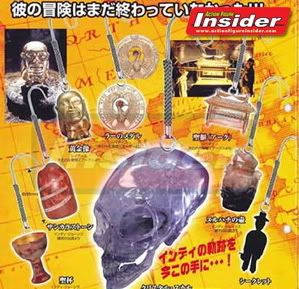
The second part of this story revolves around Action Figure Insider this month who put up a neat flier, check it, and accompanied it with the following information, “Takara Neduke, makers of necklaces and trinkets, has released a picture of their upcoming 1.5 inch mini PVC figures of props, relics and treasures from Indiana Jones movie series.” So, it was Takara’s mistake for putting it out there for people to look at yet Paramount, again, only requests for the images to be taken down. Whether it’s a tersely worded missive or some sort of legal push to have it taken down I am at a loss as to why any site would allow it to be pushed around for publishing information that is factual, correct and only makes Paramount look like the bully.

The only thing I can square in my own head is that there was an offer of some kind for these webmasters to take their information down. I can’t believe any law office worth its slimy salt would send an injunction against BlowHardDaily.com for publishing pictures that have already become part of the public domain (Again, just try to amend my right to discuss this story, with pictorial goodness), thanks Google Archive!, and, just like the story that led things off what it means to the overall picture of real threats to Hollywood’s content delivery stranglehold.

So, what is stopping from an entertainment journalist from reporting on the requests for Paramount to have these pictures taken down or from writing a story on this bit of news for a mainstream publication, with picture goodness as well? I’m not sure but it just feels like yet another reason why New Media is having a rough time trying to be respected like Old Media.

FORGETTING SARAH MARSHALL (2008)

Director: Nicholas Stoller
Cast: Jason Segal, Kristen Bell, Mila Kunis, Kristen Wiig, Bill Hader, Jonah Hill, Paul Rudd
Release: April 18, 2008
Synopsis: Struggling musician Peter Bretter (Jason Segel, Knocked Up, How I Met Your Mother) has spent six years idolizing his girlfriend, television star Sarah Marshall (Kristen Bell, Veronica Mars). He’s the guy left holding her purse in paparazzi photos and accidentally omitted from acceptance award speeches. But his world is rocked when she dumps him and Peter finds himself alone. After an unsuccessful bout of womanizing and an on-the-job nervous breakdown, he sees that not having Sarah may just ruin his life.

To clear his head, Peter takes an impulsive trip to Oahu, where he is confronted by his worst nightmare: his ex and her tragically hip new British-rocker boyfriend, Aldous (Russell Brand), are sharing his hotel. But as he torments himself with the reality of Sarah’s new life, he finds relief in a flirtation with Rachel (Mila Kunis), a beautiful resort employee whose laid-back approach tempts him to rejoin the world. He also finds relief in several hundred embarrassing, fruity cocktails.

View Trailer:
* Large (QuickTime)

Prognosis: Negative. Swing and a miss.

I never saw Veronica Mars and I still can’t account for the amount of gushing many young pre- and post-pubescents hoist upon the shrine of Kristen Bell. Sure, she was cute as a button and sassy like a firecracker in her role on Heroes but I didn’t immediately want to see her taking on anything and everything she could star in so I could get more of her. It looks like in this case, as was her role in Heroes, she plays the role of the punch line instead of the starring role she was accustomed to playing whilst on the WB/UPN.

That said, I am a little more warm to the thought of Jason Segel who’s best scene to date with me was his conjunctivitis moment in KNOCKED-UP; it was a refreshing, yet hilariously poignant, moment of an Everyman. He has that quality and it was that very sameness, Seth Rogan and Jonah Hill had it as well, that sent dudes and ladies alike to the mass box office it eventually claimed. His appearance here in the opening sequence not only made me scratch my head as did the Heigl/Rogan pair-up (Everyone still talks about whether that hook-up could ever have happened. The consensus being not a chance in hell.) but the nudity, the absence of his clothing as Bell tries to let him go at least gets my attention.

I like the absurdity of the moment and I can appreciate the needs of the producers getting in the cards in-between, telling us that this is being brought to you by the dudes who gave us 40-YEAR-OLD VIRGIN and KNOCKED-UP, one of those things that people need to be told time and time and time again, but it starts to slowly recede from its funniness as we make our way deeper into the story.

Although it doesn’t immediately lose its steam, I like the crying on the part of Segel after he fires a load into a one-night stand and his insistence that he might have an STD because of it, him making the admission in a pediatrician’s office. I thought that there is no way this could be anything less than a good time at the movies but something happens here. He goes to Hawaii to get away from it all only to have his ex staying in the same hotel.

It’s almost like I can hear “Let the wackiness ensue!” and I’m not sure I want to listen.

Then we get”¦Kenny Loggins? The CADDYSHACK song? Huh? Whose idea was this to insert this golden oldie in a trailer that it has no business in?

Besides that we’ve got Segel playing the part of the dumpee in all those awkward moments, the running into the new guy, the avoiding each other and the ever popular Hollywood-ization of relationships: What happens when you find someone new and your ex finds out only to want you back like a buttered piece of sizzling Kobe beef?

Let the wackiness continue!

We’ve got Hill involved in some kind of weird subplot that completely derails the main thrust of this film which, I believe, is all about Segel trying to move past the relationship he had with Bell and into the new one with an even hotter chick than what he had before. Bell, true to Hollywood form, shows an irrational interest in the new relationship Segel is having with his new, saucy looking interest (Shit, if only I had as good of luck like this whenever some shrew dumped me”¦) and Hill’s subplot is shoehorned further into the film’s trailer.

It’s almost as awkward as the moment when two ex’s meet for the first time after a break-up.

Toss in the real wretched ending to this trailer, a little blow job joke tossed in with some reference to a pearl necklace, with it all feeling rather contrived and false and you’ve got yourself one crap looking movie that will probably do as well as THE HEARTBREAK KID.

I really wish I could be more positive about this film but as it ends with Loggins’ shrill cackle I can’t be anything but turned off by the prospect of this awfully constructed trailer and sub-par looking film.

SEMI-PRO (2008)

Director: Kent Alterman
Cast: Will Ferrell, Woody Harrelson, Andre Benjamin, Will Arnett, Rob Corddry, Jackie Earle Haley
Release:
February 28, 2008
Synopsis: Will Ferrell stars in Semi-Pro, an outrageous comedy set in 1976 against the backdrop of the maverick ABA – a fast-paced, wild and crazy basketball league that rivaled the NBA and made a name for itself with innovations like the three-point shot and slam dunk contest. Ferrell plays Jackie Moon, a one-hit wonder who used the profits from the success of his chart-topping song “Love Me Sexy” to achieve his dream of owning a basketball team. But Moon’s franchise, the Flint Michigan Tropics, is the worst team in the league and in danger of folding when the ABA announces its plans to merge with the NBA. If they want to survive, Jackie and the Tropics must now do the seemingly impossible – win. Semi-Pro co-stars Woody Harrelson (Anger Management, White Men Can’t Jump), Andre Benjamin (Four Brothers, music group Outkast), Maura Tierney, Will Arnett (Blades of Glory, “Arrested Development”), Andy Richter, Rob Corddry, DeRay Davis, Josh Braaten, Jay Phillips, and Jackie Earle Haley. The film is written by Scot Armstrong (Old School), directed by Kent Alterman, produced by Jimmy Miller, and will be released on February 29, 2008.

View Trailer:
* Large (Flash)

Prognosis: Positive. I had a boss once who was a major league pitcher.

The stories he had shared with us regarding the mind blowingly funny shit that happened on the road was worth every miserable day I spent at that place. He would tell us of times when he would be in the locker room before a big game and one of the players would have shots lined up for every player to take on their way out onto the field. That, if you’re interested in knowing, there is a ballpark out there which has two entrances: one for the players’ wives and another one for the same players’ girlfriends.

That’s why you’ve got to love this red band trailer.

Where else but in Europe and the rest of the civilized world can you hear a little bad language, a little salacious innuendo and pretty much everything that the Bush administration would love for you not to be able to view. I’m kind of torn on the idea of using the red band trailer as a way to seem like you’re really “on the edge” but this is a film that kind of could go either way, an element of all of Will Ferrell’s movies. However, it’s inclusion here is really a testament to other elements that I think play well when taken as a whole.

As we open on a poker game where Will talks about there not being a rule against playing drunk and the ensuing back and forth between the straight man of the joke was really good. What’s more is that as the always good CADDYSHACK classical ditty, “Waltz of the Flowers”, plays in the background we’re thrusted into a talk about a little oral satisfaction which gets a rousing swell of support from fellow players.

It’s enough that this trailer genuinely pushes the boundaries of what’s acceptable in our marketing here in the US of A but I am beyond giddy at the exchange Will has with one woman about whether he’s ever been to an orgy and the subsequent exchange he has with a referee where he tells him to wrap his referee lips around his member and that he’ll kill his family. A priest, no less.

Ferrell’s drop kick of the game ball and an announcer’s calm comment about a member of the audience going home with said ball just adds a little extra funny to the moment which I appreciate. So many times we’re forced to just see quick clips with no context but this trailer takes the risk of staying with the movie for a little bit, letting us feel what this movie is going to be and it pays off well.

Like I mentioned, the red band usage can sometimes be a little pernicious for a film that genuinely isn’t that good, thinking that a little swearing will sell the film to scads of fans. However, here, it pays off because the swearing isn’t the hook, it’s the funny that sells itself.

February 14, 2008

Weekend Shopping Guide 2/15/08: Satellite Of Love

Filed under: Shopping Guides — UncaScroogeMcD @ 11:30 pm

weekendshopping.jpg

The weekend’s here. You’ve just been paid, and it’s burning a hole in your pocket. What’s a pop culture geek to do? In hopes of steering you in the right direction to blow some of that hard-earned cash, it’s time for the Quick Stop Weekend Shopping Guide – your spotlight on the things you didn’t even know you wanted…

Very quickly after the release of the 10th Mystery Science Theater 3000 collection, the box set was pulled due to a rights tangle over the inclusion of the film Godzilla vs. Megalon. It’s been over a year since the set was pulled from circulation, but a corrected edition is now available – one which swaps out Godzilla for the previously unavailable Giant Gila Monster in the appropriately retitled Mystery Science Theater Collection: Volume 10.2 (Rhino, Not Rated, DVD-$59.95 SRP). As an added incentive, the new disc also features a reunion of Joel Hodgson, Trace Beaulieu, and Frank Conniff reprising their roles of Joel Robinson, Dr. Forrester, and TV’s Frank (plus the ‘bots, Crow and Tom, with Frank assuming the role of Tom) for a brand spanking new host segment explaining about the Godzilla mix-up and how to “dispose” of that old disc. The guys are in fine form, and further proves that, save for the machinations of certain parties, MST could still return.

blankguide.gif

Just in time for Oscar season, Warners has delivered the awkwardly titled Warner Bros. Home Entertainment Academy Awards Animation Collection (Warner Bros., Not Rated, DVD-$44.98SRP). Despite that mouthful, this is a must-have compilation of 15 Academy Award-winning cartoons from the Warner/MGM library, plus an additional 26 nominees that bring in selections from the Fleischer Popeye and Superman series. The 3-disc set also features audio commentaries on select cartoons, an hour-long documentary Drawn For Glory: Animation’s Triumph At The Oscars, and the Bugs Bunny short What’s Cookin’, Doc?.

blankguide.gif

As much as the writing and direction, what made the Chuck Jones cartoons at Warner Bros. so memorable – including classics like What’s Opera, Doc?, Rabbit Seasoning, Duck Dodgers, Duck Amuck, and dozens more – are the incredible backgrounds created by designer Maurice Noble. Finally getting the appreciative tome he so richly deserves, Stepping Into The Picture: Cartoon Designer Maurice Noble (University of Mississippi Press, $20.00 SRP) is a wonderful look at the life and work of an incredible artist.

blankguide.gif

If leaving behind his acting career means we’ll get more flicks in the vein of his fine freshman effort Gone Baby Gone (Miramax, Rated R, DVD-$ SRP), I’d be happy if Ben Affleck never acted again. The film – about a pair of private detectives (Casey Affleck & Michelle Monaghan) hired to investigate the mysterious disappearance of a young girl that leads them both down the rabbit hole – is a real corker. Bonus materials include an audio commentary, deleted scenes, an extended ending, and a pair of behind-the-scenes featurettes.

blankguide.gif

If you’re still jonesing for more Harvey Birdman, your only – and best – option is to get yourself a Wii and a copy of Harvey Birdman: Attorney At Law (Capcom, $39.99 SRP). Essentially a Harvey version of Capcom’s other legal eagle videogame, Phoenix Wright: Ace Attorney, this one features newly written content within the Birdman universe, featuring all of the characters you love with the original voice cast intact (minus Stephen Colbert, who – it seems – is now too good for cartoon roles). It’s a fun little game experience, and it’s nice to revisit the characters again. Do I smell sequel?

blankguide.gif

One of the nice things about the dumping of massive amounts of shows on DVD is that I’m able to re-watch – sometimes 20 years later – shows that I dug during their original network runs, but haven’t seen since. I’ve been looking forward to the release of each additional season of Family Ties (Paramount, Not Rated, DVD-$29.99 SRP) – the third season of which is now available. It’s still a great show, and time has not dulled the writing or performances any. As far as bonus materials go, the inclusion of a gag reel is much-appreciated… Hopefully Paramount will begin to loosen the reins on special features for their other TV releases in the future (Hello, Cheers!).

blankguide.gif

With only one viewing under my belt, I think I feel the same way about writer/director John Tuturro’s Romance & Cigarettes (Sony, Rated R, DVD-$24.96 SRP) as I felt after seeing the Coen Brother’s Big Lebowski for the first time – I know there’s probably a great film in there, but it just didn’t click. With Lebowski, it took a few viewings for that “click” to come. Any film that takes the risk to make a musical in this day and age – like some kind of gritty version of the Blues Brothers, with just as great a cast (including James Gandolfini, Susan Sarandon, Kate Winslet, Mary-Louise Parker, Aida Tuturro, and Christopher Walken) – is worth a second look. Bonus features include an audio commentary, an introduction, deleted scenes, and a behind-the-scenes featurette.

blankguide.gif

The Beatrix Potter Collection (BBC, Not Rated, DVD-$29.98 SRP) brings together 9 animated versions of Potter’s classic children’s tales – The Tale Of Peter Rabbit and Benjamin Bunny, The Tale Of The Flopsy Bunnies and Mrs. Tittlemouse, The Tale Of Tom Kitten and Jemima Puddle-duck, The Tale Of Mrs. Tiggy-Winkle and Mr. Jeremy Fisher, The Tale Of Mr. Tod: The Further Adventures Of Peter Rabbit and Benjamin Bunny, The Tale Of Two Bad Mice and Johnny Town-Mouse, The Tale Of Pigling Bland, The Tale Of Samuel Whiskers or The Roly Poly Pudding, and The Tailor Of Gloucester.

blankguide.gif

Criminy, has it already been a quarter of a century since Michael Jackson’s Thriller (Sony Legacy, $19.98 SRP)? Considering that we’re getting a 2-disc 25th anniversary edition, I guess that much time has passed. Completely remastered, the album itself features an excerpt from Vincent Price’s recording session, 5 new collaborations (with will.i.am, Akon, Fergie, & Kanye West) and an unreleased track from the original sessions (“For All Time”). The second disc is a DVD featuring the videos for “Thriller”, “Beat It”, and “Billie Jean”, as well as Jackson’s performance of “Billie Jean” from Motown 25: Yesterday, Today, and Forever.

blankguide.gif

I admit it – I was a fan of Perfect Strangers (Warner Bros., Not Rated, DVD-$29.98 SRP). Like an 80’s mash up of The Odd Couple and the country mouse, the fish out of water interactions of Chicago-dwelling Larry Appleton (Mark Linn-Baker) and his cousin from the tiny Greek island of Mypos, Balki Bartokomous (Bronson Pinchot), made for some pleasant, affable slapstick. The first 2 seasons are now available in a 4-disc box set, so commence the dance of joy!

blankguide.gif

Round out the first season of Route 66 with volume 2 (Infinity, Not Rated, DVD-$29.98 SRP), which contains the final 15 episodes of the first trip down America’s road. The 4-disc set also contains original TV commercials and filmographies.

blankguide.gif

If you take the whole rat angle out of Ratatouille and focus on the love between two chefs (Catherine Zeta-Jones & Aaron Eckhart) and throw in a kid (Abigail Breslin), you’ve basically got No Reservations (Warner Bros., Rated PG, DVD-$28.98 SRP), a charming enough romantic comedy that never quite falls flat, but certainly isn’t a soufflé. As far as bonus features go, there’s an episode of Food Network’s Unwrapped.

blankguide.gif

One of the more well-made shows of the 80’s is finally arriving on DVD, starring Edward Woodward as private detective Robert McCall – aka The Equalizer (Universal, Not Rated, DVD-$49.98 SRP). The 5-disc set features all 22 first season episodes, plus an audio commentary with show creator Michael Sloan, and a bonus season 2 episode (“Beyond Control”).

blankguide.gif

The eighth season of Dallas (Warner Bros., Not Rated, DVD-$39.98 SRP) is when the series began its spiral into the bizarre and surreal – most notably in the big finale, which would eventually lead to a certain well-known shower scene. The 5-disc set features all 24 episodes, plus a featurette on the season’s new costume design.

blankguide.gif

As much as they’d like it to be, HBO’s Tell Me You Love Me (HBO, Not Rated, DVD-$69.98 SRP) is no replacement for its quickly vanishing glory days of series like The Sopranos, Oz, and Deadwood. In fact, it’s mainly an outlet for softcore porn made profoundly uncomfortable and boring courtesy of its sex therapist and the couples in need drama that plays like Dream On minus the funny. The 4-disc set features all 10 episodes, plus a quartet of audio commentaries.

blankguide.gif

The second volume of the Joan Crawford Collection (Warner Bros., Not Rated, DVD-$49.98 SRP) delivers 5 flicks from the actress’s impressive catalogue at Warners – this time including Sadie McKee, Flamingo Road, Strange Cargo, A Woman’s Face, and Torch Song – all of which are just as impressively restored to an almost better-than-new luster. Bonus materials include a trio of newly-produced featurettes (“Crawford At Warners”, “Gable & Crawford”, & “Tough Baby: Torch Song”), vintage shorts, cartoons, radio shows, and Torch Song recording sessions.

blankguide.gif

If for nothing else, We Own The Night (Sony, Rated R, DVD-$28.95 SRP) would be worth a spin for the cast – Joaquin Phoenix, Mark Wahlberg, and Robert Duvall. That it’s actually a pretty good flick is a relief, as it’s never pleasant when a cast like that is shoved into a turkey. The film revolves around prodigal son Bobby Green (Phoenix), who turns his back on his family’s law enforcement tradition as a nightclub owner who turns a blind eye to the drug trade occurring in his Brooklyn club. His past rears its head when his brother and father (Wahlberg & Duvall) crack down on the club, forcing Bobby to choose which side of the law he’s on. Bonus features include an audio commentary and a trio of behind-the-scenes featurettes. The Blu-Ray edition ($38.96 SRP) features an identical list of bonus materials.

blankguide.gif

Imagine a schlockier Roger Corman, and you have a pretty good bead on the producorial career of Morty Fineman (Jerry Stiller). After decades of producing fare such as Twelve Angry Men And A Baby and The Heart Is A Strong Muscle, Morty’s in the financial tank, and it’s up to his daughter to try and help him raise the money to make his latest flick – Ms. Kevorkian. The Independent (Allumination Filmworks, Rated R, DVD-$14.98 SRP) is a faux documentary featuring interviews with Morty’s celeb friends and clips of his infamous films, and is a smart, well-written picture worth a spin.

blankguide.gif

Want a great soundtrack to pick up? Get yourself a copy of Honeydripper (Rhino, $18.98 SRP), from the John Sayles flick, which features a toe-tappin’ selection of tracks from the eponymous early 50’s juke joint, both new and vintage.

blankguide.gif

All these years later, The Wiz (Universal, Rated G, DVD-$19.98 SRP) is just as bizarre an enterprise as it always was. The fully remastered special edition sports a brand new retrospective featurette and the theatrical trailer, plus an 8-track soundtrack CD.

blankguide.gif

So there you have it… my humble suggestions for what to watch, listen to, play with, or waste money on this coming weekend. See ya next week…

-Ken Plume

##

Win FATHER TED: THE DEFINITIVE COLLECTION on DVD!

Filed under: Contests — UncaScroogeMcD @ 10:28 pm

We’re giving away, in conjunction with BBC Home Entertainment, five (5) copies of FATHER TED: THE DEFINITIVE COLLECTION on DVD.

Contest ends at midnight EST on Friday, February 22nd.

CLOSED! THANKS FOR ENTERING!

No member of Quick Stop Entertainment or their immediate families may enter.

No Purchase necessary to win.

Must be 18 years of age or older to enter.

One entry per day, per person.

All submitted entries must be received by 11:59pm EST on Friday, February 22nd.

The winner must allow 4-6 weeks after notification of win to receive the product.

Win GONE BABY GONE on DVD!

Filed under: Contests — UncaScroogeMcD @ 12:01 am

We’re giving away, in conjunction with Miramax Home Entertainment, five (5) copies of GONE BABY GONE on DVD.

Contest ends at midnight EST on Wednesday, February 20th.

CLOSED! THANKS FOR ENTERING!

Official Rules

No member of Quick Stop Entertainment or their immediate families may enter.

No Purchase necessary to win.

Must be 18 years of age or older to enter.

One entry per day, per person.

All submitted entries must be received by 11:59pm EST on Wednesday, February 20th.

The winner must allow 4-6 weeks after notification of win to receive the product.

February 12, 2008

Cabin Fever #11: Therapize Our Speech

Filed under: Cabin Fever — UncaScroogeMcD @ 6:29 pm

cabinfeverheader.png

Oh no! Just when you thought it was safe to hang out at the Quick Stop…

cabin.jpgCabin Fever (hosted by the twisted souls Brian Fitzpatrick and Aaron Poole) is the result of having too much time on your hands and access to your local community radio station.

Over the course of an hour, they manage to trawl the depths of good taste, plus throw some music in. How much more could you want from a podcast?… Quality? Oh… we didn’t think of that.

Enjoy! And we hope our cross Atlantic friends can understand the Irish accent 😉

Hugs and Kisses,
Aaron P. + Rev. Fitzy

linesm.gif

CABIN FEVER #11: Therapize Our Speech – This week, the boys are joined in the studio by Ian Cooke (part-time soap opera actor, full time friend of ours). We have news of belly-button-cocaine smugglers, cousins doing it in the road, and a lot of bragging that people are actually listening to us now. Most of it is quite good, except Aaron loses the ability to talk with words that are real and making sure that he’s playing the song he’s talking about. Good times. You get music from Cheapskate, Blue Sun, The Bluetones, and a special submission of a possible Cabin Fever theme tune. Hope you enjoy!

[CONTENT WARNING]: Explicit contents! We say every naughty word you can think of. You have been warned!

DOWNLOAD: (right click to save)
Episode #11 (MP3 format)

[audio:http://traffic.libsyn.com/cabinfever/cabin_fever_11.mp3]

SUBSCRIBE
Subscribe to this Podcast via iTunes

Got something to say? E-mail Aaron & Brian at the Cabin Fever mailbag.

line.gif

CLICK HERE FOR THE CABIN FEVER ARCHIVES

line.gif

##

Win FEAST OF LOVE on DVD!

Filed under: Contests — UncaScroogeMcD @ 5:59 pm

We’re giving away, in conjunction with MGM Home Entertainment, five (5) copies of FEAST OF LOVE on DVD.

Contest ends at midnight EST on Tuesday, February 19th.

CLOSED! THANKS FOR ENTERING!

Official Rules

No member of Quick Stop Entertainment or their immediate families may enter.

No Purchase necessary to win.

Must be 18 years of age or older to enter.

All submitted entries must be received by 11:59pm EST on Tuesday, February 19th.

The winner must allow 4-6 weeks after notification of win to receive the product.

Toy Box: Transformers Grimlock Mini-bust

Filed under: Columns,Toy Box — admin @ 5:45 pm

toybox.jpg

The Transformers film might not have been high cinema, but it sure did make the bucks. Not only that, but Hasbro’s Transformers line of toys has been one of the very, very few hit toy lines based on a movie in the past decade. But if you’re looking for something a bit more than toys, and perhaps a bit more old school that the Michael Bay interpretation, you should check out some of the cool busts and statues currently on the market.

One of those is the Action Figure Express exclusive mini-bust of Grimlock. The bust was sculpted by Art Asylum and produced by Diamond Select Toys, and at 6″ fits in nicely not only with their other Transformer mini-busts (of which there are quite a few), but with some of the past busts done by other companies as well.

Grimlock is a limited edition of 600 mini-busts, and runs around $50. If you have any questions or comments, drop me a line at mwc@mwctoys.com, or visit my website Michael’s Review of the Week. Now on to the review!

The War Within Grimlock exclusive mini-bust

toybox_020508_1.jpg

This version of Grimlock is based on the comic book series “The War Within”, published back in 2002. These comics were grittier than the old show, with a more ‘adult’ feel. The writer, Simon Furman, now works for IDW Publishing who hold the rights for Transformer comics, so the rumor (and it’s just a rumor) is that we might see the series continue.

Packaging – ***
On the plus side, the packages keep the busts quite safe, they’ve used the nice, sturdy styrofoam for the interior trays, and there’s a great Certificate of Authenticty that comes in the box. On the negative side, there’s no windo, so you’ll be flying blind til you get him home.

toybox_020508_2.jpg

Sculpting – ***
Grimlock sports a reasonable amount of detail, very typical of this style of mini-bust. He’ll fit in nicely with the rest of the gang if you’ve been picking these up over time, and he’s relatively realistic. Or as realistic as a Transformer can be.

toybox_020508_4.jpg

One of the keys to a robot sculpt like this is a sharpness to the lines and angles. Robots aren’t soft and round – they have hard edges, better to slice you up. Sometimes it’s hard to get that metallic sharp appearance in a material like resin, but they’ve done a decent job.

Paint – ***
The paint work is fairly clean, although not outstanding. Grimlock is a character with a nice, broad pallette, which makes him a visually interesting guy on the shelf. Most of the cut lines are clean between these colors, and there’s very little slop. Some of the silver was a bit inconsistent in the coverage, but it was a minor issue, as were the few areas where the colors bleed into each other.

toybox_020508_3.jpg

Design – ***
Grimlock is ready for battle, looking like he just walked off the pages of the comic. The War Within Grimlock (and actually, Grimlock in general) is a character that likes hand to hand battle, and prefers using his Energon sword. Here, he’s preparing to take your head off with it, a fitting pose for the character.

toybox_020508_6.jpg

Value – **1/2
Bust prices have crept up about $5 – $10 over the last year, going from the old $40 – $45 to $45 – $50. Sad as that is, I can’t say it’s surprising considering the current economy. And at that price, this guy is a pretty average value.

Things to Watch Out For –
Be careful attaching the left arm and the ‘wings’ on his back. Both of these fit with metal posts inserted into the resin body, and it is very easy to break the resin if you don’t take your time.

Overall – ***
For fans of the license, this is a solid contender. He fits in well with most of the rest of the busts, even with him being done in the slightly different War Within style. If you’re a big fan of Transformers, I recommend giving him a look.

Where to Buy –
He was an Action Figure Express exclusive, but they may already be sold out. You can do an ebay search with MyAuctionLinks as well.

Comics in Context #213: Your Obedient Serpent

Filed under: Columns,Comics in Context — admin @ 5:43 pm

comicsincontext4.jpg

cic20080212-01.jpgIn last week’s column I embarked on a mission: to track down animated cartoons that had made an impression on me when I was in grade school, but which I hadn’t seen since, and watch them again through adult eyes. I wanted to see how many of them I could find on the Internet, and what other animated cartoons of note might be there as well.

My quest proved to be more successful than I’d imagined. I found a lot of vintage cartoons that I recalled as mediocre or worse, and which lived down to my memories: King Leonardo and Friends, Linus the Lionhearted, Silly Sidney and Deputy Dawg and more. But there were also plenty that proved to be true classics.

Although I’ve seen many of the 1940s Superman animated cartoons as an adult, somehow I never caught up with the one I found perhaps most memorable from my childhood, in which Superman battles a gigantic tyrannosaur. But now I’ve found it: it’s called The Arctic Giant, produced by the Fleischer Studios, directed by Dave Fleischer, and released by Paramount in 1942.

Like the other Fleischer Superman cartoons, The Arctic Giant is remarkable for its dramatic lighting, “camera” angles and visual compositions and its sheer energy and momentum. The superhero genre was only four years old in 1942, yet the Fleischer studio caught its spirit perfectly. But what I didn’t expect from The Arctic Giant were the little touches that the Fleischer team added to the cartoon.

A prologue sequence recounts how the colossal dinosaur was found frozen in the Arctic and was transported south in a freighter with similarly colossal refrigeration facilities. A new wing is built for the “Museum of Natural Science” in Superman’s home city specifically to exhibit the frozen creature. The cartoon never names this city, but the museum’s main building is clearly the actual American Museum of Natural History in New York City, with its towers that make the 77th St. facade look like a storybook castle. The Fleischer Studios were originally located in New York, so perhaps they thought of Superman as based there, too.

There’s not much dialogue in the Fleischer Superman cartoons, but the few words pay off in this one. Assigned by The Daily Planet editor to cover the dinosaur exhibit, Lois stops by Clark Kent’s desk to kid him that he’s so timid the sight of the monster would make him faint. This may be condescending, but it seems more witty than cruel, and Clark, once Lois has left, seems amused by it. It’s the sort of repartee I’d expect from the Lois of the 1990s Superman animated series; how interesting to see that the Fleischers had already caught the Lois and Clark relationship so well a half century earlier.

Of course, the dinosaur is not dead but in suspended animation, and, of course, he wakes up. Lois interviews a workman at the museum who sets down an oil can, which accidentally topples into machinery, cutting off the refrigeration that keeps the dinosaur comatose. In this high tech present, I’ve had enough experience with equipment that malfunctions because one little thing unexpectedly went wrong, so it seemed just right to me that to little falling oil can would end up releasing the monster.

When I first got to the real American Museum of Natural History, I think I was slightly disappointed with the size of the dinosaur skeletons. Big as a real tyrannosaur is, it still fits within a room on the museum’s fourth floor, whereas in my childhood, pop culture tended to make a dinosaur at least as tall as the entire museum. So the awakened “Arctic Giant” is far bigger than a real tyrannosaur: his foot is so big that he simultaneously steps on and flattens two police cars. Marauding through the city, this tyrannosaur looks like he is the size of Godzilla, and that’s pretty amazing, considering that The Arctic Giant came out twelve years before the first Godzilla movie (1954)!

Watching Arctic Giant, I wondered, if Godzilla wasn’t the Fleischers’ model for their “Arctic Giant,” could it have been King Kong? That makes sense: they are both gigantic monsters that stalk through a major city; like the dinosaur, Kong too was transported to New York by boat; Kong and the “Arctic Giant” both wreck an elevated subway line. And, of course, the dinosaur also menaces a young woman: at one point the tyrannosaur scoops Lois up in his mouth!

Superman goes to the city’s–and Lois’s–rescue, and there is a striking sequence in which Superman leaps to the tops of a succession of skyscrapers. Even though Superman streaks across the sky in the opening credits, this cartoon was definitely made before it was decided that Superman could fly. On the other hand, on the cover of Action Comics #1 Superman raises a car above his head; by Arctic Giant his strength has grown tremendously. The monster demolished the museum wing in escaping, and in order to rescue Lois, Superman lifts enormous chunks of rubble that dwarf him in size. This looks astounding to me in 2008; what must it have looked like to audiences in 1942, long before the recent rise of CGI, back when the superhero genre was still brand new?

Upon rescuing her from the rubble, Superman warns Lois to stay out of danger, but once he’s gone, she says she’s not giving up on this story. She doesn’t seem foolhardy, as she often does in these cartoons, but rather dedicated to her job. She isn’t the least bit shaken after her close encounter with the dinosaur, and that seems appropriate for Superman’s leading lady, and should have strongly impressed audiences in this pre-feminist period: she wasn’t continually screaming like Fay Wray did at Kong.

The Arctic Giant mostly seems to take place in New York City, but the marauding monster soon crashes his way through a dam as big as Hoover Dam, flooding what seems to be a country setting with small houses. Superman topples a mammoth mass of rock to seal the gap in the dam. Then the monster is back in the city, wrecking a bridge that looks very much like one of New York’s (with Superman lifting an entire span, with trucks and cars on top, back into place!) and finally stalking towards what could be Yankee Stadium. This is where the dinosaur scoops Lois up in his mouth, and Superman has to go in after her. It’s not quite the “belly of the beast” in Joseph Campbell’s phrase, but close enough to fit the archetype. Once Superman rescues her (again), Lois again shows nerves of steel, whereas you or I, after spending time in a dinosaur’s maw, might be in the verge of nervous collapse; after Superman again cautions her, she even jokingly addresses him as “milord.” She kids Clark Kent abut fainting, but this Lois seems incapable of doing the same.

I recalled Superman killing the tyrannosaur in Arctic Giant and my disapproving: kids, after all, love dinosaurs. On seeing the cartoon again, I am pleased to say my memory was wrong. Superman topples the dinosaur, and there’s a Daily Planet front page with a photograph that seems at first glance to show the tyrannosaur lying prone, but this time I saw the headlines saying that Superman “subdued” the creature, what is now in the “park zoo” (Central Park? Bronx Park?). So it seems that the Fleischers anticipated Jurassic Park here.

And so the cartoon ends with Lois and Clark at the Planet, with Lois sitting on Clark’s desk, showing off her legs (the Fleischer team clearly regarding her as a sex symbol for the adults in the audience), and Clark doing what was a trademark of these Superman cartoons, breaking the fourth wall by giving a wink to the audience. The Arctic Giant lasts only a little over eight minutes, but it has thrills, spectacle, humor, sex appeal, and a “meta” touch at the end. What more could one want?

More than once, upon hearing volunteers at the Museum of Comic and Cartoon Art ask visitors to become MoCCA members that they ought to play the musical question from Max and Dave Fleischer’s Bimbo’s Initiation (1931): “Wanna be a member? Wanna be a member?”

I don’t recall seeing Bimbo’s Initiation as a child, but it certainly and deservedly turned up in Fleischer retrospectives I saw in the 1980s, and it’s about as different from the Fleischers’ Arctic Giant as can be.

“Bimbo” is certainly an odd name for a male anthropomorphic dog, who is now best known for his supporting roles in Betty Boop cartoons. In this cartoon, however, Bimbo is the lead and Betty the supporting cast member. Not only that, but this is one of her earliest appearances, when she was supposed to be a dog, not a human. She looks like the familiar later version, except for her doglike ears.

Watching Bimbo’s Initiation again on YouTube, I decided to apply the Joseph Campbell approach to this infamous cartoon. Walking along a city street, Bimbo tumbles down a manhole, thus inadvertently crossing a Campbellian threshold and descending into an underworld. This might also be an allusion to Alice falling down the rabbit hole into Wonderland. Bimbo, however, finds himself in a sort of hell.

Bimbo lands in the subterranean headquarters of a strangely garbed secret society, who chant in deep male voices, “Wanna be a member? Wanna be a member?” “No!” protests Bimbo. But their invitation is a Campbellian “call to adventure,” and according to Campbell’s monomyth, denying the call always leads to dire consequences. So Bimbo finds himself in a series of seeming death traps, often involving sharp, phallic blades, one of which comes to life and tries to bite him. If the dangers weren’t treated in a somewhat comedic manner, this could easily be a horror story.

As the cartoon’s title indicates, Bimbo is being put through an initiation ritual by this secret society. Presumably these traps are intended as a test of manhood. But whenever the society members return to pose their musical question, “Wanna be a member?” Bimbo persists in refusing to join, and yet more danger ensues.

Midway through the cartoon, the dog-eared Betty Boop appears and beckons to Bimbo. This time Bimbo, sexually aroused, happily accepts the invitation and he follows Betty through a doorway only to lose her and be subjected to yet more traps. Ultimately Bimbo is confronted once more by the leader of the secret society, who poses his question “Wanna be a member?” yet again. Bimbo still refuses, until the leader unmasks, revealing “himself” to be Betty. Now Bimbo definitely wants to be a member, the other secret society members reveal themselves to be Betty lookalikes, and the cartoon ends with Bimbo and Betty dancing hand in hand, while the Boop lookalikes provide a backup chorus line. The subterranean hell has become a romantic heaven.

So, if Bimbo is being initiated into masculinity, he refuses as long as he perceives it as requiring submission to alpha males upon threat of violence. Achieving adult masculinity becomes much more appealing to Bimbo when he comes to see it as the means for making a sexual connection with Betty. (So perhaps the word “member” in this cartoon is also a sexual allusion.) At the cartoon’s end Bimbo has passed the initiation, but instead of participating in power games with other males, he instead wins the hand of the leading lady.

Long before I read my first DC superhero comic, I was a staunch fan of another DC Comics title, The Fox and the Crow, a funny animal series which had an impressively successful run from 1951 to 1968. Although I was pleased to see the Fox and Crow turn up in cameos in the first issue of DC’s new revival of Captain Carrot, DC didn’t own these characters. Not until the 1980s, when I read Of Mice and Magic, Leonard Maltin’s pioneering history of animation during the Hollywood studio system years, did I learn that the Fox and Crow first appeared in Fox and Grapes, a 1941 cartoon directed by Frank Tashlin, who later and briefly made memorable cartoons for Warners. Tashlin would go on to direct live action comedies starring Bob Hope and Jerry Lewis (who, coincidentally, also starred in DC Comics series in the 1950s and 1960s).

Despite all the classic cartoon retrospectives I’ve attended over the decades, Fox and Grapes never turned up and remained a mystery to me. But now YouTube has finally given me the chance to see it, and it is surprising from start to finish.

Surprise #1: The Fox and the Crow are unmistakably voiced by none other than supreme Warners voice artist Mel Blanc!

Surprise #2: Maybe this shouldn’t have been so surprising, since I remembered from the comics that the Crow’s first name was Crawford and the Fox’s first name was, of all things, Fauntleroy, as in Little Lord Fauntleroy. When the Fox makes his entrance in Fox and Grapes, he is skipping along a bridge, virtually dancing, wearing a straw hat and enormous bow tie, whistling or singing “la la la” to the tune of a Strauss waltz, his rear end swinging back and forth. Later, Blanc elaborately rolls his “r’s” when the Fox speaks of grapes. Could it be that Tashlin intended the Fox to be gay? (In that same year, 1941, Disney released The Reluctant Dragon, whose title character also seems to be as stereotypically gay.)

Reportedly, Chuck Jones credited Fox and Grapes as a major inspiration for his Roadrunner series, which began in 1948. I expected to find some vague similarities. But now that I’ve finally seen this cartoon, my Surprise #3 is how astonishingly close Fox and Grapes is to the Roadrunners.

First, there’s the Fox’s obsessiveness, which is arguably greater than Wile E. Coyote’s. The premise of the cartoon is that the Crow is trying to get hold of the Fox’s picnic lunch, and learns from the fable of the fox and the crow in “Eslops Fables” that foxes love grapes. (There’s a “meta” dimension to this cartoon.) So, the Crow hangs a bunch if grapes from a branch high on a tree, and offers to exchange them for the Fox’s picnic food. The Fox refuses to trade and says he will simply jump up and seize the grapes. This leads to a long series of blackout gags in which the Fox tries over and over to reach the grapes and fails every time. Like his fellow canine predator, Wile E. Coyote, the Fox will not give up. But unlike Jones’s Coyote, the Fox already has lots of food right there, and, in fact, had already consumed plenty before he even saw the grapes. The Fox isn’t motivated by hunger; he’s simply after a particular delicacy, and yet despite continual failures, he won’t cut his losses and be satisfied with the food he already has. The Fox and Coyote are both obsessive compulsives, and they both suffer from hubris and overreaching.

Still more surprisingly, many of the gags in Fox and Grapes will be familiar to any Roadrunner aficionados. The Fox repeatedly ends up falling from great heights. At one point the impact literally flattens him, compressing him as if he were an accordion. As with the Coyote, most of the Fox’s failures come from overlooking the one little thing that could go wrong with his plans. At another point, the Fox stands on one end of a kind of teeter-totter, strains to lift an enormous rock, and then, with great effort, hurls it into the air. His intention is that the rock will hit the other end of the seesaw, catapulting him upward towards the grapes. Instead, of course, the rock falls directly back down, crushing the Fox beneath. How often have we seen variations in that gag in Roadrunner cartoons?

Fox and Grapes isn’t just an inspiration for the Roadrunner series; it’s virtually a blueprint! But Chuck Jones and writer Michael Maltese elaborated on this basic structure in numerous ways, turning the Roadrunner series into something conceptually superior to the Tashlin cartoon, and even more profound, as I will explain in some future column.

Who was the first superhero I ever saw on television? I can’t be sure. Was it Superman in the Fleischer cartoons, or Mighty Mouse? Or was it Tom Terrific? He was the title character of a Terrytoons series created by Gene Deitch that ran for years on CBS’s Captain Kangaroo show, back when CBS programmed for children on weekday mornings rather than try to compete with the Today show (here and here).

Tom arguably qualifies as a superhero by the standards established by Peter Coogan in his book Superhero: The Secret Origin of a Genre (See “Comics in Context” #162). First of all, he has super-powers: he wears a “thinking cap” that not only augments his intellect but also enables him to transform into anything. Distinctively shaped like a funnel, the thinking cap also acts as a symbol of his superheroic identity, as much as the chevron or insignia on the typical superhero’s costume. Of course, he also has a mission, to do good.

On the Internet I found a complete five-episode Tom Terrific serial. Alas, it does not feature Tom’s archnemesis, Crabby Appleton, whom I haven’t seen in decades, but instead substitutes a worthy opponent who seems newly relevant in the wake of the popularity of the Pirates of the Caribbean movies: the piratical Captain Kidney Bean.

The Tom Terrific cartoons turned their miniscule budget to heir stylistic advantage. The characters an backgrounds are simple line drawings, devoid of color: in fact, you can even see the background lines through the characters. But I suspect that graphic simplicity was appealing to very small children, as was Tom’s strikingly visual shapeshifting power.

Like so many superheroes, Tom has a sidekick: his case, his talking pet, whom he calls “Mighty Manfred the Wonder Dog,” Tom insists that Manfred is as heroic as himself, but as surely even the youngest viewers could tell, Manfred is actually sleepy, stupid and virtually immobile. This may be a clever satire on the way that many pet owners project personality traits onto their pets that the animals don’t actually have.

Seeing Tom Terrific now, I wondered, is it possible that Deitch and his colleagues named “Mighty Manfred” after the title character of Lord Byron’s 1816-1817 romantic poem Manfred? If so, Deitch and his writers were amusing themselves in this instance, knowing that the full irony of Mighty Manfred’s name would never be grasped by their target audience.

Though little kids would understand that Tom is mistaken about his dog’s heroic qualities, perhaps they would not realize that the cartoons also poke understated fun at their boy hero’s innocence about the world in general. The “Captain Kidney Bean” serial makes it clear that its pirate villain is considerably nastier than its naive hero realizes. In this regard Tom Terrific reminds me of the Batman TV show later in the 1960s. In both cases this is a joke that grows old quickly. Tom Terrific was aimed at very young children, and has little to sustain adult interest.

But I am impressed on the cartoons’ emphasis on Tom using his “thinking cap” to think his way out of dilemmas rather than resorting to violence. How often do kids’ cartoons make being smart seem cool?

The vintage cartoons that proved to be better than I had remembered were from Bob Clampett’s legendary Beany and Cecil series. I expect that one reason is that, like Jay Ward’s The Bullwinkle Show, made during the same period of late 1950s and early 1960s, Beany and Cecil worked on two levels: these series had colorful characters and plenty of slapstick action that would appeal to the target audience of little children, but also simultaneously aimed verbal humor and satire at an older audience. Significantly, both Beany and Cecil and Bullwinkle ran on prime time television before settling into Saturday morning berths. The smarter children would pick up enough of that upper level of humor to recognize that Beany and Cecil and Bullwinkle didn’t condescend to them, but instead respected their intelligence and even initiated them into appreciating more sophisticated kinds of wit.

Beany and Cecil are, respectively, a young boy who wears a beany cap, which, in the cartoons, enables him to fly, and his best friend, a “seasick sea serpent.” (That new movie, The Water Horse, has hit upon a similar pairing.) They travel the world with Beany’s “Uncle Captain,” Horatio Huffenpuff, an amusingly ineffectual and cowardly father figure, in his ship, the Leakin’ Lena, and frequently run afoul of perennial nemesis Dishonest John.

The animated Beany and Cecil was a follow-up to Clampett’s more child-oriented Time for Beany, a puppet show on local television in Los Angeles. There are examples of this show on the Web, too, such as Episode 241 from 1951, which I found disappointing. lacking the energy and sharp verbal wit of the later cartoon series. Even so, this installment finds the regular cast of characters in Hollywood, where the villainous Dishonest John persuades Cecil to get himself some publicity by jumping of the roof of a building–and Cecil does! It’s a kids’ puppet show, so Cecil survives, but nonetheless gets badly banged up. The publicity stunt works, and a producer hires Cecil to be in a movie–and wants him to jump off another building. Thus a startling dose of adult cynicism about show business turns up in what is supposedly just an innocuous show for children.

Maybe the sign that Clampett ultimately wasn’t interested in doing a show just for small children is his treatment of Beany. Tom Terrific is also a young boy, but he’s the dominant character in his cartoons. In contrast, Beany is a blank, registering little personality beyond his characteristic smile, which sometimes seems as if it is as permanently affixed as Jack Nicholson’s Joker’s. It’s as if Clampett decided that since the audience is primarily made up of kids, there has to be a kid on the show for them to identify with. But really, was wearing a beany cap EVER cool?

One of the main reasons that Boomers loved this show was Beany’s unlikely costar, Cecil, the Seasick Sea Serpent. Think about it: Cecil is actually a gigantic snake! It seems to me that Clampett and the other writers set themselves a formidable task in having to do cartoon scripts about a major character who could only pick things up with his mouth!

But rather than being creepy, Cecil is wholly lovable. Watching these cartoons online, I realized that Cecil had much the same appeal as Ben Grimm, the Thing in Fantastic Four. Both of them, when in combat, are superhumanly powerful, courageous, and nearly unstoppable. (The Thing shouts, “It’s clobberin’ time,” while Cecil’s battle cry is “I’m comin’, Beany boy!”) But both of them also work superbly as comedy characters. They have similar personalities: hot-tempered but loyally devoted to their friends, prone to insecurity and embarrassment, with a ready sense of humor. (Ben mutters, “What a revoltin’ development this is,” while Cecil, faced with a similar situation, simply exclaims, “What the heck!”) Cecil’s voice would sound just as appropriate coming from the Thing.

The other true star of these cartoons is Dishonest John, familiarly known as D. J.. Dressed all in black, with a mustache long enough that he could twirl it, were he so inclined, Dishonest John looks like an updated version of a villain from a silent movie melodrama (and, indeed, an ominously tinkling piano theme accompanies his entrances). Sometimes the cartoons give D. J. a specific motive for his villainy in that particular adventure, like getting filthy rich. But it eventually becomes apparent that his real motivation is his sheer joy in nasty mischief. Although Clampett probably didn’t realize it, D. J. is a descendant of the “vice” figures of medieval drama, who were both evildoers and comedians, who often spoke directly to the audience. So does D. J., who seems well aware that he is in a cartoon. His trademark line (“Nya ha ha”) demonstrates that no one is more amused by his evil antics than he is.

Once I saw which Beany and Cecil cartoons were available on YouTube, I went straight to “Super Cecil,” Clampett’s comedic venture into the superhero genre. Cecil has sent away for a mail order superhero costume, which he dons to become “Super Cecil.” He doesn’t gain any super-powers in the process, but perhaps Clampett was here acknowledging that Cecil often plays a role like a superhero in these cartoons, overpowering the bad guys with his colossal strength.

Determined to outdo Cecil, Dishonest John switches to his own costumed identity, the Bilious Beetle–and his costume enables him to fly! The insect-themed name and the use of Rimsky-Korsakov’s “Flight of the Bumblebee” as the Bilious Beetle’s theme music suggest that Clampett was alluding to the Green Hornet. But it wasn’t until years after “Super Cecil” that the Batman TV show of the mid-1960s firmly impressed the concept of the costumed super-villain on the minds of the general public. I’m impressed that Clampett was thus parodying super-villains years earlier.

The Bilious Beetle tricks Super Cecil into thinking he’s kidnapped Beany, the perennial abductee in these cartoons, but actually D. J. is using a hand puppet in Beany’s image. This is a “meta” joke for anyone who knows that Beany and Cecil originated as a puppet show (as is the fact that the cartoons never show the end of Cecil’s tail, as if he were still a hand puppet). I suspect it may also be Clampett’s comment on how empty Beany was as a character. The cartoon didn’t even need the “real” Beany to lure Cecil into action. D. J.’s Beany puppet is no more than a Hitchcockian MacGuffin, a plot device of no inherent worth!

There are plenty of visual gags as the Bilious Beetle leads Super Cecil on a merry chase, giving the cartoon strong comic momentum. But it struck me that whereas in Clampett’s cartoons for Warner Brothers, the slapstick would have been the main source of laughs, in this cartoon the comedy principally comes from the personalities of D. J. and Cecil. First D. J. is wittily triumphant, while Cecil is repeatedly frustrated, setting up the cartoon’s payoff in which Cecil turns the tables on his adversary, culminating in a great gag in which Cecil unleashes a swarm of actual “bilious beetles” on their costumed namesake, whom they regard in a way I will not disclose here: go see the cartoon yourselves.

The title of “The Phantom of the Horse Opera“ evokes Lon Chaney, but he’s actually a Western outlaw who has the power of invisibility. (Coincidentally, he thus resembles Marvel Comics’ Western version of Ghost Rider, now known as the Phantom Rider.) When the Phantom first appears in this cartoon, he does indeed seem menacing, until Clampett undercuts the ominous tone by having him speak: he sounds like the 1940s comedian Jerry Colonna. Nowadays Colonna’s most enduring work is probably his vocal performance as the March Hare in Disney’s Alice in Wonderland (1951). Watching “Phantom” on YouTube, I wasn’t at first sure whom the Phantom was imitating, (The cartoon’s final gag makes it clear by revealing the Phantom’s face as a Colonna caricature.) Beany and Cecil cartoons continually engage in such references to the pop culture of their day. But I find that this cartoon captures Colonna’s comic persona so well that even if you’ve never heard of Colonna, you should still find the Phantom’s dialogue funny.

Since Cecil is so enormous, how can human-sized adversaries get the better of him? In “Phantom” the answer comes in the cartoon’s high point, a well constructed comedy set piece in which the Phantom, step by step ruins Cecil’s lunch, spraying him with ketchup, smearing his face with mustard, and dousing him with pepper to make him sneeze, bewildering the sea serpent, who can’t see his invisible tormentor.

Inevitably, the Phantom kidnaps Beany, who just as predictably calls, “Help, Cecil, help!”, but even the Phantom seems exasperated with Cecil’s one-dimensional co-star: “Who writes your dialogue, kid?”

The cartoon climaxes when the Phantom’s “invisible paint” turns Cecil invisible, too, and he has a knock-down, drag-out battle with the Phantom that literally shakes the landscape around them. Breaking the fourth wall, Cecil briefly pauses to tell the audience this is “the greatest fight ever filmed” but “it’s too bad you can’t see it.” I wonder if Clampett and company are joking here that their budget wouldn’t allow them to actually show such a fight, or maybe that the television censors wouldn’t let them show anything this violent.

Better still is “The Wildman of Wildsville“, whose title character is a beatnik artist presented as if he were a “wild man” living in the jungle. This is a topical reference to the Beat movement of the 1950s, and yet, again, Clampett and company make the character so vividly funny that the cartoon has not dated.

The cartoon opens with Captain Huffenpuff presenting one of his typically pun-filled maps. He intends to capture the “ferocious wild man” on the “Hungry I-land,” a reference to the “hungry i,” a famous San Francisco night club of the time. Among the locations on the map are “Mort Soil”–an allusion to political satirist Mort Sahl, who performed at the hungry i–and the “Lenny Spruce.” Wait a minute! A cartoon that was shown to children on Saturday mornings in the 1960s actually made a not-so-veiled reference to Lenny Bruce!?! What the heck!! And that’s not all: later on the Wildman refers to Oscar Wilde!

Once the Captain and company arrive on the island, the backgrounds begin evoking the Abstract Expressionist art of the period. To my astonishment, some of these backgrounds even imitated the “drip” paintings of Jackson Pollack! Which children in the 1960s could possibly have recognized that? And yet Clampett and company put it in, laying a surprise for any adult who knew Pollack’s work and saw their cartoon.

The Captain, Beany and Cecil are out to capture the Wildman, as if he were a wild animal. Clampett and his collaborators are thus satirizing the way that mainstream culture regards people on the radical avant-garde as if they were part of an alien culture, potentially dangerous. The mainstream wants to tame these radical innovators. But in Clampett’s cartoon, it’s the Wildman who wins, just as so many once-controversial artistic movements end up being accepted into mainstream culture (like, say, taking the comics medium seriously). Using his paint, he endows Cecil, Beany and the Captain with berets, dark glasses, and goatees. As Cecil wisely observes, “If you can’t beatnik “˜em, join “˜em,” and the cartoon ends with the nouveau-Beat Beany, Cecil and Captain dancing along with the Wildman to a jazz beat. They’ve gone “wild,” too.

In 1988, four years after Bob Clampett’s death, The New Adventures of Beany and Cecil arrived on television, only to vanish after five episodes. It came and went so fast I don’t think I even knew about it at the time. But one of the delights of MoCCA’s 2006 “Saturday Morning” retrospective was a looseleaf notebook of photocopies of Bruce Timm’s storyboards for one of the new cartoons, “The Courtship of Cecilia,” written by Quick Stop contributor Paul Dini! Now I’ve found this cartoon on YouTube as well (in two parts: here and here). In Clampett’s own “Cecil Meets Cecilia,” Dishonest John disguised himself as a “she-serpent” to humiliate Cecil, and the real Cecilia only showed up at the end. The new cartoon builds upon the original’s premise, by having Cecil alternatively interact with the real Cecilia and with D. J. as the phony Cecilia, thoroughly confusing our serpentine hero. The new cartoon also follows Clampett’s lead in concocting awesomely awful puns (D. J. laments, “Cecil’s singing is giving me a haddock. I wish I was hard of herring.”), metafictional gags (D. J. exults, “I love being a cartoon bad guy–nya ha ha!”), and surreal visual metaphors. Describing what it feels like to be in love, Cecil says he feels “burning hot,” whereupon his face melts and feels as if he is “coming apart,” at which point his body shatters into fragments. This is pretty good! It’s too bad the series didn’t last, apparently in large part due to network interference.

Looking over these old cartoons over the last two weeks, it seems to me that many of those I remember most strongly were the ones that didn’t conform to the conventional notion of what Saturday morning animation should be like. They were wilder and subversive in some way. Matt Groening cites Bullwinkle as an influence on The Simpsons (see “Comics in Context” #8: “San Diego 2003: Day Three: Gaiman, Groening and Bradbury”), so perhaps today’s prime time animation is the true heir of the subversive classics of Saturday mornings of the 1960s.

Copyright 2008 Peter Sanderson

February 11, 2008

Quick Stop Thingamabobs: 2/11/2008

Filed under: Columns,Thingamabobs — UncaScroogeMcD @ 12:01 am

thingamabobs.jpg

The web. It’s a big place, full of plenty of distractions ““ some funny, some informative, some ludicrous, some disturbing, some inane, some profound. Each and every weekday, we present links to a few of our favorite finds”¦

————————————————

  • The Pythons in one of their more uncomfortable appearances… (Thingamabob)
  • The rarely seen opening to the also rarely seen The Good Guys(Thingamabob)

February 8, 2008

Game On! 2-8-2008: A Hero’s Paradise

Filed under: Game On! — admin @ 5:39 pm

gameon.jpg

Not but one month into the New Year, and we’re already seeing some quality releases in gaming. That suits me just fine. It keeps me busy and off the streets, where I may hurt myself. Instead, I while away the hours online smashing fake cars into each other. I have to remember to obey the speed laws once I get up to get Taco Bell in the middle of a gaming run though”¦

JUST ANOTHER DAY IN PARADISE

Burnout Paradise 1And never is that more true than playing BURNOUT PARADISE, out now on PS3 and Xbox 360. From the wide and wild expanses of Paradise City, one can cover a lot of ground (and insurance claims) from going from the game world to the real world in quick succession.

That may be because PARADISE’s world is so real in itself. This time around, developer Criterion has crafted a fully open city, where all the events are open from the start. No qualifying races, no tests”¦just jump in and burnout. All you do is pull up to ANY traffic signal, hit both the gas and brake at the same time, and you’re launched into any number of events that could conceivably take you from one end of the city to the next. And Paradise City is BIG too”¦from Downtown and Palm Bay, to the Wind Farm up in Silver Lake and White Mountain, from the Observatory to the Country Club, Paradise City’s roads are far and wide”¦and full of crashes.

Yes, the series staple is here in all its hi-def glory. The crashes have never looked better, been more realistic physically and”¦man, if there were real people driving these cars, EVERYONE would be fucking dead. Rest assured, however, there’s no human carnage here”¦just CARnage (oh god did I just type that?). The camera will often zoom in through your mangled door to show that yes, no one is driving. Gee, a city FULL of automobiles that move, react to traffic, and speed around on their own. It’s like the characters from Disney/Pixar’s CARS”¦but everyone’s drunk.

The freedom to explore Paradise City is the game’s biggest draw, but it’s also the city’s open world feel that leads to one of it’s more bigger let downs. As I said, you can start a race at any intersection. Fail it, however, and there’s no “restart race” in the main menu. If you want to give it another try, you have to drive back to the start. After missing a turn at 250 mph and going off a jump into traffic going the opposite direction (due to the map’s illogical choice of not repositioning itself once you change direction and the compasses tiny-ness) you may not want to. Sure, this is a hindrance, but it keeps with the open world sandbox Criterion strove so hard to create. It’s fine with me, actually, because even if I do fail a race, there’s another event right at the next intersection.

Burnout Paradise 2

Gone also is the series fan favorite Crash Mode. Instead of the complex and fun puzzles of trying to smash as many cars as possible in the limited time, you now can trigger “Showtime” at any street. This sends your car into a roll and you must maneuver it into traffic to gain more boost, which helps you nudge your car along even more. Buses offer multipliers, but there’s really not as much skill needed here as there was in past Crash modes. Again, with the open world though, fitting in separate Crash Modes would have taken the player out of the open world and into one of those pesky menu driven options they’ve been so careful to avoid here.

Even online is handled with a minimum of fuss. Just hit right on the d-pad to bring up your friends list, send an invite, or just “freeburn” online. There are 350 separate challenges online that you can compete in with friends, as well as the normal “smash into each other like a bunch of drunken idiots” kind of fun too. The more folks take you out (or you take out), the more mugshots and “smugshots” you can send back and forth with the Xbox Live vision or Playstation Eye camera peripherals. If they score a takedown on you, you can send back the hatred by flipping them off or exposing your junk. Ain’t technology grand?

Honestly though, there’s so much to love about PARADISE I can’t put it all into one small review. From finding all the billboards, super jumps and smash gates (which each net you a new car once you locate them all), to the individual burning routes (one for each car), to the new Marked Man events (where you speed to a destination while trying to not be taken out)”¦there’s endless fun. And the game let’s you take it all on at your own pace. Don’t want to do any races? Fine”¦just tool around the city and locate all the car parks and drive-thrus, which give you boost (gas stations), fix your car (repair stations) paint you up, or even allow you to switch your rides (junkyards).

While PARADISE isn’t perfect, it’s a bold step in a new direction, and after getting used to the way things are set up, it’s almost guaranteed you’ll have fun. Even if it’s not right away, once you set up in your own pace, it’s a wild ride. Maybe next time they’ll include auto restarts on the races though”¦until then, I’m enjoying the hell out of this one.

One Gamer’s Opinion:
kickass.jpg

WE CAN BE HEROES

NMH1For Travis Touchdown, being a hero means taking out the Top Ten Assassin’s ranked above him by any means necessary. And by “any mean”, we mean savagely and with as much blood as possible. In NO MORE HEROES for the Wii, you take this video game loving, anime-shirt wearing otaku out on crazy adventures for blood, money and pussy”¦and yes, that’s right, I said it’s on THE WII.

In a desperate attempt to get into the panties of the head of the United Assassin’s Association, Travis takes on all comers with his light sab..er”¦I mean, BEAM KATANA. By holding the Wii-mote high or low, Travis will change his battle stance. Pressing the A button slashes at your foes, and after enough landed hits, a “death blow” icon appears on screen, telling you which way to swing the wii-mote to lop off the head, slice your foe in two, etc”¦all with the requisite fountain of blood a la KILL BILL. It’s this simple style of control that makes this title work, gameplay wise, as most other titles with a sword would have you swinging until your arms fell off. This adds a bit more precision, and is one of the finer points in this already stellar game.

What you’ll notice FIRST, however, is the game is heavy on the style. Directed by Suda 51, the genius crackpot mind behind KILLER 7, this game wears its comedy on its sleeve and doesn’t even take itself seriously. The menus are strictly 8-bit homage’s, the hero loves wrestling videos and plays with his cat in his downtime”¦and you save your game by taking a crap. Yeah”¦this is my kind of game.

NMH2

Travis gets the money for the entry fee to attack each member of the UAA by doing odd jobs around town, such as gathering coconuts, moving laws and the like. You can also take on more shady work, like killing a bunch of henchmen in a certain time, or assassinating other targets not immediately on the Top Ten. These are all located around town, and while the game has the illusion of an open world sandbox, getting around isn’t easy. Or fun, for that matter.

Travis’ bike is the culprit here. It’s handles like driving a rock, and turning makes you want to punch a puppy. Plus, the game really ISN’T open”¦you can’t just walk into any building, just the ones selected for each job/mission. Still, I suppose it adds a bit more interactivity than just “click” and you’re there.

Back to the combat, though”¦this really is where the game shines. Graphically, the game has a anime feel with just tons of over the top gore”¦nothing horrific, just goofy blood fountains. As you slash away, you build up credits in a slot machine, and getting 3 of a kind rewards you with new attacks, such as a stock pile of explosives that clear the room, or the one hit kill ability”¦and all have crazy names like “Raspberry Chocolate Cake” or some such stuff.

It’s hard to describe a game like NO MORE HEROES”¦just as it was to pug down KILLER 7. Granted, this game has a bit more substance to go with the style”¦ something KILLER 7 only could cover one of (and that being the style, naturally). The control with the battles is great, but on the bike is a hassle. It’s no visual stunner, but it is unique and fun. Groundbreaking no”¦ but it’s a game that deserves to be played”¦if only to be seen so one could believe. Just because I love it doesn’t mean you will”¦ not unless you have a sick sense of humor like me.

One Gamer’s Opinion:
kickass.jpg

I’ll be back again soon. On deck are reviews of DEVIL MAY CRY 4, as well as”¦ um”¦ KARAOKE REVOLUTION: AMERICAN IDOL ENCORE. So, yeah”¦ look for that one soon.

THE GAME ON! RATING SYSTEM


gameonratingscomplete.jpg

Ratings From Greatest to Least:

Kick Ass, Right On, Okay, Eh, and Stinker (aka CRAPTACULAR)

Comics & Comics: Is This Thing On? Part 1

Filed under: Columns,Comics and Comics — admin @ 2:08 am

comicsoncomicsheader.jpg

Is this thing on?

Howdy inter-webbers. I’m Matt Cohen”¦ And I dig comics. Always have. In my twenty-three years on this spinning mud-ball we call Earth, I have read a lot of comic books. Like”¦ a lot. Most Friday nights, when other kids my age could be found out running amok all over town, chances are I’d be huddled up in my bedroom, a stack of comics on the floor, a package of Dunkaroos in my hand and a Ghostbusters movie on the TV (I was really popular, in case you were wondering). Comics have grown with me, and I, in turn, have grown with them. They have, scarily enough, made me the man child I am today. And, I think its about time I gave back. Unfortunately (for you), the only thing I have to offer is my years of obsessive comic book knowledge, coupled with my own strange little slant on life. I hope what I have to say, is what you want to hear. If not, can you at least lie to me, to protect my very fragile ego?

If 2007 will be remembered as anything it will be as the year of the return to blockbuster event comic books. Both of the big two pumped out at least three different company spanning epics that lasted for months, and spun off into a seemingly endless (and possibly needless) amount of one shots and mini’s released each week, much to the dismay of Wednesday warriors the world over. Though the books sold like hotcakes, most fans were not thrilled with the final products. Not to say all the comics were disappointing. It was just that after so much hype and anticipation, it was very difficult to reach fans expectations. D.C seemed to fare a bit better then Marvel, who caught a tremendous amount of flak for the anti-climatic endings of both their Civil War and World War Hulk series. And even though Sinestro Corps, D.C’s answer to the intergalactic epic was a very enjoyable read, I think most of these events will be remembered as mediocre and way over hyped, at best. As far as the non event titles, each company put out a plethora of brand new minis, revamps and one shots. Some hit, some missed wide. 2007 also marked the return of a bizarre stable of characters at both companies. It was odd, and oddly great to read the comic book misadventures of Slap Stick, Howard The Duck, Captain Carrot, Rocket Raccoon, and Ambush Bug again. Not much of this matters now though, because 2007 is gone, and the show rolls on, but before we burn too much asphalt, lets take a peek at what we read in the year that was.

So, with that, lets make like bakers, and roll (I bet you didn’t see that coming) into 2007

ComicsandComics-20708-DCLOGO.jpg

Infinite Crisis (Infinite Variants): After Brad Meltzer’s brilliant “Identity Crisis” the writers of the follow-up series had some big shoes to fill into. In a decisive move to clean up the Multiverse continuity once and for all, Geoff Johns and the boys launched head first into a fairly basic series, when compared to the book it was following. Mired in plot holes and random explanations (the punch heard round the worlds), what was promised to be the event to end all events, quickly became a confusing exercise in continuity destruction. I don’t know about most fans, but it seems like to clear up the Multiverse “problems” the company had been facing for years, DC first made it more confusing then it ever had been. Most casual readers were immediately lost, and even the more die hard fans found the Crisis hard to follow. Yes, the ending did simplify the multiverse situation in many ways, but it also led readers to ask themselves if they would’ve rather had the multiverse done away with entirely. I think many would’ve preferred the latter. The event that kicked off all DC events in 07 may be remembered as the run that made DC reader friendly again. Or, it will be known as the turning point into a new era of confusion and seemingly random explanations. Only time will tell.

ComicsandComics-20708-MRMIND.jpg52 (X $3.50): In what will go down as one of the more ambitious (and financially fruitful) ideas in recent years, DC decided it was time to bring back the much loved and sometime lauded, weekly series. With a writing staff compiled by some of DC’s most talented, and most popular artists, and a storyline full of b listers and characters yet to get their time in the spotlight, 52 was a gamble, both artistically and financially. What really made this series stand out from the rest of the other events this year, was its emphasis on characters, which historically have been relegated to sidekicks, or in a rogue capacity. Readers got the chance to know characters that went unnoticed for years and many fans found themselves with new favorites due to this, such as Steel, Sobek (my personal fave) Black Adam, and the late great Ralph Dibny. . With any series that runs 52 issues, pacing will always become a problem, as it was for 52, time and again. With a book released every week, it’s hard to solidify a tone for the work, and with 52, this unfortunately proved to be one of the series biggest downfalls. Individually the issues are all right, but read together as one work 52 comes of disjointed and extremely scattered. (Mr. Mind equals comic book greatness, though, so two kudos for that DC… The most evil villian in the DC universe… is a be-spectacled caterpillar. And they said stoners can’t write comics.)

Countdown (to the next event): Could DC catch lightning twice in the same bottle. After the tremendous sales of 52, of course another weekly was a logical choice from the company. Unfortunately, the new series lacks what made 52 so much fun. Primarily, the characters. With the focus of Countdown on a rag tag group of Multiverse dodgers (Jason Todd, Kyle Rainer and Donna Troy) most other characters are left in the way side, especially Forerunner, the character created exclusively for Countdown. Whereas 52 was made of sub stories that fit together in an overall scheme, Countdown’s sole purpose it seems, was to rediscover Ray Palmer (formally The Atom,). So much time is spent searching for Ray Palmer, so many near misses and close calls, that by the time he’s actually found, I couldn’t really care less and I doubt other readers were very excited by it either. Another interesting idea that never seemed to pan out was Jimmy Olsen’s “Action Man” storyline. After Olsen spent so many years on the sideline though, it doesn’t matter what kind of powers you give him, he still comes off as goofy and incompetent as ever. Marvel seems to be continuing this trend with long time also ran, Rick Jones, taking on the mantle of Hulk (Red Hulk). If Snapper Carr becomes a hero I may quit. Apart from the Trickster/Piper subplot, which was immensely entertaining, all in all a pretty forgettable series that led to a mind-numbing amount of spin offs each week. With the nature of these events, many fans felt the need to purchase all tie in books, as to really get a complete look at the story. With Final Countdown looming near, DC better raise the stakes and focus more on “important” characters and plot lines, lest leave fans with another lackluster event. (Oh, and if Kamandi is not involved somehow, Dan Didio and Paul Levitz will be hearing from my lawyer”¦ Well, Id have to get a lawyer first, but as soon as that was done, believe you me, DC’s gonna be in a world of hurt).

Sinestro Corps (Green Lanterns 2: Blackest Night Bugaloo): 3 words”¦ 3 little words single handedly made me interested in all things Lantern again. “Lethal Force Activated”. And with that, the war to end all wars had begun, as had the best event of the year. As of recent times, the GL books had grown stagnant in my opinion. There were just too many lanterns, not enough action and not enough cohesiveness between issues and series. Sinestro Corps did away with all that. Raise the stakes, throw in every Lantern we’ve ever seen and raise the body count level to one rarely seen in mainstream comic books. It was a recipe for success. Sinestro Corps managed to make its namesake, Sinestro, one of the most feared and prominent baddies in comics again, a position he had not held for a long time. Fan favorites like Kilowag and Mogo were present, and enjoyed, as always, but another one of Sinestro Corps great qualities is that it also managed to bring new life to what has been a pretty stagnant GL four (Jordan, Rayner, Stewart, Gardner), in particular John Stewart, who finally seems to have come into his own, and displaced the stigma of being a fourth rate lantern, or as many critics have asserted “The token Black Lantern”. Possibly the most exciting thing to come out of the series, is the hint that comic fans will soon see Alan Moore’s fateful prophecy, “Blackest Night” become a reality. There is no better time to be a Lantern fan then right now, and if fans have dropped any GL titles recently, I suggest they remedy that situation immediately, lest miss out on the all the fun.

ComicsandComics-20708-sinestro.jpg
Sinestro’s ultimate S+M fantasy, finally becomes a reality

Best of the Rest

Detective Comics: QSE’s very own Paul Dini finally got a chance to write an ongoing series this year, and hits a home run first time up at bat. The fully contained, one issue archs, allow Dini to worry less about continuity and cannon, and more about content and fun. Striking art by Wayne Kramer also helps to keep the book fresh. If the current issue doesn’t strike your fancy, fans know that in only four weeks, they’ll be introduced to a brand new adventure, one that can be read, enjoyed, and in a rare but I think important aspect of comics, forgotten. These are stories that will never lose their appeal, regardless of the current state of Bat Affairs.

Booster Gold: Skeets is, in my not so humble opinion, the greatest sidekick in comic history. Lets just get that out of the way. I would’ve fully supported a Skeets title, and most likely, it would’ve wound up here anyway, so the inclusion (and reintroduction) of Booster Gold, back into the DC universe, was just icing on the cake. All jokes aside, this series is fantastic. In each issue, Geoff Johns and Jeff Katz bring Booster and Co. to another famous story in DC lore, everything from “Killing Joke” to “Identity Crisis” – something the Countdown spin off “Search for Ray Palmer” tried to do as well, but couldn’t measure up to in quality. With the series restarting at #0 with the reintroduction of “Blue and Gold” (a brilliant idea), I think this will be a book to read for a very long time.

Honorable Mentions: Shadowpact, Shazam and the Monster Society of Evil, Salvation Run, Infinite Halloween Special

ComicsandComics-20708-Marvellogo.jpg

Civil War (Or Tony Stark is an A-Hole): Who’s side were you on? But more importantly, did any side really win? What was billed as Marvels biggest event since Secret Wars, turned out to be the main even of what was already an event filled summer. Cap vs. Iron Man. Hero vs. Hero. The Marvel universe as we knew it was going to be torn apart. Starting with the Stanford explosion and continuing into almost every mainstream Marvel title available. With after effects as far reaching as Civil War’s were, I think it’d be better to break down my feelings into positive and negative.

——————————————————–

PRO

The Creation of Penance: Speedball (Robbie Williams) has quickly become an awesome, psychotic, deadly new character, an archetype Marvel seems to be able to get right more then its competitors. With obvious shades of the albino Opus Dei member, Silas, from “The Da Vinci Code”, Robbie Wilson, former New Outlaw and current Thunderbolt, would never be the same. And I personally, am glad for that. Penance is currently one of the most “hardcore” characters in the Marvel arsenal. Even on the Thunderbolts, a team assembled of madmen and killers, Penance’s predilection for pain and torment make him stand out from the rest. This is definitely a character to watch in the near future.

comicsandComics-20708-Penance.jpg
Sure, sure, we know… You cut to feel. Crazy emo kids.

Bucky Reborn: Who would’ve thought Cap’s diminutive sidekick would be one of the most vicious and frankly, badass characters the Marvel Universe has seen in a long time. Remove all former traces of his previous life, add in some guns and knives, factor in some post resurrection craziness, and you’ve got the new Bucky Barnes (or Captain America, if you will). If anyone is more appropriate to take over the mantle of the New Cap, the Captain for the modern age we live in, then I cant think of him or her. Yes, its a bit of a trade off, seeing as Steve Rogers had to die, for this new version of Bucky to exist, and yes, in the scheme of things there will always only be one true Cap, but I think this current Bucky is breathing new life into what had become a stagnant Marvel Universe. Now, with the shield en tow, Bucky stands high above the Marvel heap, and I think its a fitting place for him to be.

CON

The Death of Steve Rogers: Did we really need this? Time and time again, the big “Deaths” have been more about comic sales then creative integrity. Most famously, Superman Doomdsay, left fans disappointed and feeling more like walking dollar signs than loyal readers. This time up was Marvel heavy hitter Steve Rogers, the figurehead of all things Marvel. Steve had for years, been the most cookie cutter hero in comics, and unfortunately for this reason, (just like in early 90’s Super books) became extremely boring to read about. That all changed in the past few years, with Ed Brubaker’s great run on Captain America. For the first time in decades, Steve was cool again. So what did the higher ups at Marvel decide to do? I think we all know”¦. And none of us cared. As stated above, the one positive thing to come from Steve’s death is Bucky’s ascension to hero, but even that is not enough to make this death a memorable plot point, as opposed to a marketing stunt.

The Mighty Avengers: Dare I say, the most unlikable hero team in comic book history. I don’t know if every fan is as low on all things Stark related right now as I am, but his new team certainly doesn’t help that negative image. With the exception of Carol Danvers, who is always a likable character, there’s honestly not one compelling or fan friendly member of the group. Ares, in particular, makes me cringe every time he appears on-panel. I once was a great fan of Bendis, but I think overextending himself has really begun to catch up with him. And the thought bubbles, though pretty clever in concept, are extremely confusing, poorly executed, and detract from the reading experience in my opinion. This book, along with the Initiative titles, are unfortunately, the mediocre fallout of Civil War’s mediocre resolution.

——————————————————–

World War Hulk (Green Gamma Guy Goes Gaga): Puny humans shoot Hulk into Space”¦ Hulk fight war.. Hulk become king. Hulk fall in love, have family. Puny Humans blow up Hulks planet. Hulk Pissed. Marvel had launched into its big follow-up to Civil War. And part of World War Hulks ultimate failure may be due to its close proximity in release to Civil War. After months of “blockbuster” events books, World War Hulk couldn’t raise the stakes in terms of scope or scale. It’s like the sequel rule. Most follow-ups should elevate and heighten. World War Hulk is almost a watered down version of Civil War, in terms of stakes and company wide ramifications. I think Marvel readers were tired of this; “All or Nothing” attitude this summer, and it shows when you ask fans what they thought of World War Hulk. Most will echo the same sentiment. Over-hyped, under-developed, and mostly disappointing. Continuing this trend, Marvel has relaunched their seminal goon, this time, with Red skin. This color change doesn’t fool me, and I doubt it fools the rest of the fans. New color does not equal new direction for the series. This isn’t the early nineties. You cant wow em’ with holo-foil or a die-cut cover anymore, and a marketing stunt like green to red isn’t gonna do much either. On the plus side though, WWH did lead to The Incredible Herc, which I’m enjoying quite a bit. So, swings and roundabouts, folks.

comicsandComics-20708-Miek.jpg
“Miek wishes Miek was in The Exterminators…”

Annihilation (Big Trouble in Outer Space): With the exception of Nova and Drax, I was extremely bored by this series. Starting with a ridiculous and non threatening bad guy and going downhill from there, Marvels attempt to bring fans back to their cosmic stable of books, failed pretty miserably overall. This series had too many spin-offs each week, too many characters and almost no direct relation to the rest of the goings on in the Marvel Universe. With the stakes this low, and sales to match, Annihilation will be looked on as the mini event that couldn’t. A truly forgettable series.

Best of the Rest

Nova: Richard Ryder is a pimp. A few fans have known this for years, but it wasn’t until Nova’s re-launch did readers rediscover everyone’s favorite space cop with an attitude. Stricken with the deadly Worldmind virus, Ryder finds himself alone (with the exception of WorldMind, Marvel’s answer to Skeets), ravaged by a virus he cannot control, and basically free floating in deep outer space. Through this adversity, Ryder has “found himself” and the self that he found, just happens to be a colossal badass. This is the one Marvel book set in space that really connects with me. I could care less about Star Lord, and I personally thought Annihilation was more then enough, and don’t feel the need to read the current “Conquest” storyline. Nova, however, is a book I really enjoy reading each month.It doesn’t matter that it plays like a sidepiece to the rest of the Marvel comics, because the book itself is great in a standalone nature. I hope an inevitable staff change doesn’t alter the current course this book is running on, because its honestly one of the Marvel comics I enjoy reading the most.

X-Factor: In what may be Peter David’s finest work in years, the folks of X-Factor Investigations, have become cool again. With film noir plotting, and beautiful artwork by, Madrox and the gang has been brought to the forefront of the Marvel Universe once again, and it’s a role many fans are glad to have them in. Since its conception in, the various X-Factor teams have never really found their role amongst the other heavy hitters. Always more of an X-Men B team then anything else. With this run David has managed to include the X-Factor in the big events, without them losing their individual voice and team personality. I think this is a title that will remain strong for a while to come. Add it to your pull list. I know stuff”¦.

Honorable Mentions: NextWave:Agents of H.A.T.E, Marvel Zombies, X-Men First Class, ______ & Deadpool, Franklin Richards: Son of a Genius, The Dark Tower:The Gunslinger Born

comicsandComics-20708-nextwave.jpg
NextWave: The most fun someone can legally have with a crayon.

Indie Report: A look at the best books the “Other” guys had to offer

Mike Mignola: Mignola took a side seat this year, mostly staying in a co writing capacity, but that doesn’t mean the house that Mike built wasn’t churning out great books every month. “Darkness Falls” Hellboy’s first foray into comics in about three years, was a very good read, which helped to expound on Hellboy’s intriguing mythology. Duncan Fegredo took over the reigns of art, the first time someone but Mike has drawn HB on the run, and his work is similar enough to Mignola’s, and yet spectacular in its own right. On the B.P.R.D front, Guy Davis and Jon Arcudi keep putting out great stuff, particularly building Ape Sapiens back story, which timing couldn’t work out better for, since Abe is getting his first solo mini next month. Lobster Johnson’s first solo mini was great as well, very Mignola, very 20’s, very visual, very fitting for the man with the claw.

The Goon: Eric Powell’s zombie noir masterpiece was back in full effect this year. The Goon, with all his lack of flair and flavor, has quickly solidified himself as one of the best and most interesting characters in comicdom. Goon doest need powers, or flashy weapons. Hes got his fists and Frankie, which is enough for him. This, month after month, is one of the down right funniest books published by any company. Powell has nailed a style of humor for this comic, and it’s truly a pleasure to be able to read a book that knows so well what it is trying to be. Particularly the arc “Chinatown” was a fantastic read this year; in fact, the trade outsold single Goon issues by far. Dark Horse is the undisputed leader for gritty, funny, different, non-super books, and The Goon is a great running mate to President Hellboy.

comicsandComics-20708-TheGoon.jpg
Mickey Rourke, keep your work calendar clear (As if that was difficult to do).

Usagi Yojimbo: Stan Sakai’s samurai road story is in its 23rd year of publication (same as your not so humble columnist) and shows no signs of getting stale. Usagi is a fairly straightforward book, something refreshing in the age of crisis and crossover. Usagi Yojimbo, is, and always will be, a samurai comic. Actually, it may be the only mainstream comic book to ever pick a genre and stick with it over decades. Usagi has never strayed into crossovers (unless you count Space Usagi on the TMNT cartoon, which was ten kinds of awesome), never “put down his sword and picked up a gun”. In a world of anti-heroes, Usagi may be the most pure and noble character in comics. With twenty years plus of back-story to draw on, every issue of Usagi feels like revisiting old friends. I can’t help but smile when I see Gen, or Spot, or (my personal late, favorite) Zato-Oinko. This book feels like a loyal pal, who never lets you down, and stops by for a visit about once a month. Who would’ve thought a comic book about a samurai rabbit and his various animal pals, would last two decades and make Stan Sakai comic book royalty? I think Sakai san may have had an idea. And the world of comic fans are richer for it.

The Exterminators: Where the hell did this book come from? And what did I do before I found it? I love this freaking comic. Simon Oliver’s gross-out epic is in its second year of publication, and the books have only been getting better and more bizarre. This title is more MAX, then any MAX imprint book could ever hope to be. This one isn’t for kids. This is adult storytelling at its best. Vertigo has proven itself to be the premier imprint for cutting edge “dangerous” storytelling, and Exterminators sits pretty at the top of that illustrious heap. The tales of the boys at “Bug Bee Gone” are funny, disgusting, and eerily disturbing sometimes. Exterminators is not a superhero book, or a book like any other comic fans have read. . Since its inception, Exterminators has stuck to an ongoing arch that draws fans deeper into the mythology each month and with art work by Tony Moore, which rivals his early Walking Dead art, this is a book that will remain “Must Read” until the fine folks at Vertigo decide (insanely) to stop publishing it.

Honorable Mentions: The Mice Templar, Archenemies, Craig and Todd’s The Perhapnauts, Groo: Hell on Earth

And last, but certainly not least,

OVERALL COMIC BOOK OF THE YEAR

Visual drum roll please”¦”¦”¦.

Comicsandcomics-20608-Fables.jpg

Fables: Bill Willingham, I bow down to you sir. Every single issue of this book so far has been near perfect. The book is genius, the art, the writing, and the entire experience. Fables, is a rare piece of art, something that comes along only a few times in ones life. A work, where every single component comes together seamlessly, to create a comic book that is more then any superhero book can possibly offer these days. With the creation of Bigby Wolf and gang, Willingham has brought to life characters and stories that will stay in the popular consciousness for a long time to come. Read in single issues, or solely in trades, I cannot think of a more enriching and down right brilliant comic book as Fables. Willingham takes a page out of Alan Moore’s (the single greatest comic book writer of all time, in my not so humble opinion) playbook, and populates his book with characters from literature and popular culture, an act that immediately draws fans to certain characters, ones they’ve known and enjoyed since they were children. There is no getting to know you period with Fables. Willigham builds on our imagination and memories, and it never feels false or put upon for a moment. This is the logical path for these characters. What would our favorite fairy tale folks do if confronted with the modern world? Willingham answers this question each issue, and then some. The only continuity a fan might have to worry themselves about, is if they’re caught up on all their childhood fairy tales. No prior comic book knowledge required. And this is the reason I think Fables is such a great introductory read to non-Comic fans. Its not threatening, not “geek” inclusive like some other books, just a purely enjoyable, timeless read. Fables is simply, one of the greatest comic books ever written, and if you haven’t experienced it yet, its time to.Now, on to the glitz and glamor that makes comic books what they are,

First Annual Paper Cut Awards: Awarding excellence in comics since this sentence was typed
———————————————————-

Best comic (Ongoing):Fables
Runner Up: Detective Comics

Best comic (Mini or Cancelled): NextWave: Agents of H.A.T.E
Runner Up: Shazam and the Monster Society of Evil

Best graphic novel: League of Extraordinary Gentlemen: Black Dossier
Runner Up: Heroes:Volume One

Best writer
: Bill Willingham (Fables, Jack of Fables, Shadowpact)
Runner Up: Brian K. Vaughan (Dr. Strange: The Oath, Ex Machina, Y The last man)

Best artist
: Andy Kubert (Batman)
Runner Up: Jae Lee (Dark Tower: The Gunslinger Born)

Best event: Sinestro Corps
Runner Up: 52

Best one shot: DCU Infinite Halloween Special
Runner Up: Deadpool/Great Lakes Initiative Summer Fun Spectacular

Best new character: Penance (Thunderbolts)
Runner Up: Warpath (X-Force)

Best comic book merchandise
: Bigby Wolf and Snow White statue (D.C Direct)
Runner Up: Sinestro Corps T-Shirt (Graphitti Designs)

comicsandComics-20708-sinestroshirt.jpg
“In blackest day, in brightest night, in a soft, durable cotton weave…”

Lifetime achievement award: Peter David (X-Factor, Dark Tower: The Gunslinger Born)

——————————————————————-

Well, thats it for funny books. Check back next week for Part 2 of “Is This Thing On?” when I take a look back at the year in Comedy… All the people and shows that made you laugh, cry, and then laugh while crying. (I bet that second Comics in the title of this column is beginning to make more sense now).

So keep it tuned. And, as always,

“Keep em’ bagged and boarded.”

Matt Cohen is currently writing “Kara Zor-El Cohen” in magic marker all over his spiral notebooks.

Weekend Shopping Guide 2/8/08: Two-Gun Mickey

Filed under: Shopping Guides — UncaScroogeMcD @ 1:30 am

weekendshopping.jpg

The weekend’s here. You’ve just been paid, and it’s burning a hole in your pocket. What’s a pop culture geek to do? In hopes of steering you in the right direction to blow some of that hard-earned cash, it’s time for the Quick Stop Weekend Shopping Guide – your spotlight on the things you didn’t even know you wanted…

Even though I’ve read the entire story in its original run, I admit to waiting eagerly for the release of each new volume of Scholastic’s re-release of Jeff Smith’s Bone just to see it all in glorious color. We’re now down to the home stretch in the 9-volume series with the release of Volume 7: Ghost Circles (Graphix, Softcover-$9.99 SRP, Hardcover-$19.99 SRP). The story is heating up as the return of the evil Lord of the Locusts is imminent, and the Valley has been devastated by “ghost circles”. Will the Bone cousins and Thorn be able to save the valley? Check it out!

blankguide.gif

Dave Gorman has found other Dave Gormans, lived his life by the astrology page for a month, and went on a Googlewhack adventure. This time, though, he’s decided to tackle the United States – and see if it’s possible to cross the land of the free without stopping at a single chain restaurant, gas station, or hotel. Is it possible to make such a long journey while only patronizing Mom & Pop businesses? That’s the challenge Gorman faces in America Unchained (Channel 4, Not Rated, DVD-£19.99 SRP). Will he make it? Pick up the DVD and find out. Trust me – it’s worth it, if only for how engaging and thought-provoking Gorman makes it.

blankguide.gif

As calculated as it is, there’s still no denying the ability of Tom Hanks and Meg Ryan to ingratiate themselves to a wary audience in You’ve Got Mail (Warner Bros., Rated PG, DVD-$19.98 SRP). The newly remastered special edition features 2 new featurettes (now with Hanks and Ryan participation), an audio commentary, the HBO First Look special, an interactive New York map, a Carole King music video, and more.

blankguide.gif

Not content to turn in one stellar performance last year, Casey Affleck pulled off a twofer with his role as the titular coward in the historical drama The Assassination of Jesse James By The Coward Robert Ford (Warner Bros., Rated R, DVD-$27.98 SRP). Brad Pitt essays the role of James in a flick that never quite seems to gel, but features performances that make the whole affair worth seeing. I must ask, though, wither the bonus features?

blankguide.gif

They’ve been absent from the shelves for a few months due to printing problems, but the latest issues of both Uncle Scrooge and Walt Disney’s Comics & Stories ($7.99 SRP each) – issues 371 & 686, respectively. Both are worth snagging, but extra recommendation goes for Scrooge, which reprints the Carl Barks classic Scrooge vs. The Beagle Boys tale “How Green Was My Lettuce”.

blankguide.gif

Not since the golden age of television has a radio show made the successful transition to television, but such is the rare case with Ira Glass’s This American Life (Paramount, Not Rated, DVD-$19.99 SRP). Consider it a post-modern travelogue, as Glass travels the country finding ordinary folks and stories that are then brought together under a series of themes throughout the season. This set features all 6 first season episodes, plus audio commentary, and is currently a Borders store exclusive. Give it a spin.

blankguide.gif

It’s become almost cliché now – a Jodie Foster flick that casts her as an almost masculine action hero fiercely defending herself against a world out to get her and the ones she loves. In The Brave One (Warner Bros., Rated R, DVD-$28.98 SRP), that formula is slightly warped as Foster stars as talk radio host Erica Bain, who – after her fiancé is murdered and she nearly loses her own life – sets off on a path of vengeance against those responsible. As a thriller, it’s entertaining enough, though by no means a classic in the genre – really, you see it just to watch Foster do her stuff. Bonus features include additional scenes and a behind-the-scenes featurette.

blankguide.gif

Everything old is new again, which means it’s time for another edition of the modern comedy classic Groundhog Day (Sony, Rated PG, DVD-$19.94 SRP). The film is exactly as you remember it (funny, natch), but the bonus features this go round include an audio commentary from director Harold Ramis, an interview with Ramis, a retrospective documentary, deleted scenes, and a spotlight on groundhogs.

blankguide.gif

Billy Wilder’s The Apartment (MGM/UA, Not Rated, DVD-$19.98 SRP) gets a much-deserved special edition – complementing a very nice restoration. Bonus features include an audio commentary from producer and film historian Bruce Block, a documentary, and a spotlight on Jack Lemmon.

blankguide.gif

As an interviewer myself, I’m always keen to dive into how other interviewers tackle a subject, which is why I always love reading the series of tomes collecting interviews with various personalities that the University of Mississippi Press puts together. Their latest trio of must-haves are Stan Lee: Conversations, Akira Kurosawa: Interviews & Art Spiegelman: Conversations (University of Mississippi Press, $20.00 SRP each). If you’ve yet to pick up one of the many volumes they offer, there’s no time like the present.

blankguide.gif

The epitome of the Brit “kitchen-sink realism” school of realism, This Sporting Life (Criterion, Not Rated, DVD-$39.95 SRP) gets the deluxe treatment from the fine folks at Criterion. The 2-disc edition sports a new high definition transfer, an audio commentary, interviews, documentaries, short films, the theatrical trailer, and more. Director Lindsay Anderson brings forth one of Richard Harris’s finest performances as a miner turned rugby player in bleak Yorkshire.

blankguide.gif

Inspiration for numerous jokes and references, the tale of a young American sentenced to a Turkish jail for attempting to smuggle hash out of the country, director Alan Parker’s Midnight Express (Sony, Rated R, DVD-$19.94 SRP) get s a new special edition featuring an audio commentary with Parker, a trio of retrospective featurettes, a photo gallery, and a copy of Parker’s personal production journal.

blankguide.gif

It’s not quite The Kids In The Hall, but there is plenty of humor to be found in The Whitest Kids U’ Know (IFC, Not Rated, DVD-$26.95 SRP), IFC’s new sketch comedy show. The 2-disc set features the complete 10 episode premiere season, plus commentaries, a WKUK featurette, and a sneak peek at season 2.

blankguide.gif

We’re now fully into the “every flick getting a special edition” territory when it comes to Disney’s animated films, and the latest to get the treatment is the marginal Aristocats (Walt Disney, Not Rated, DVD-$29.99 SRP), which features a Wonderful World of Disney excerpt (“The Great Cat Family”), a spotlight in the Sherman Brothers’ tunes for the film, a deleted scene, and a scrapbook.

blankguide.gif

In the wake of 9/11, it seemed a no-brainer that there’d be a show like Third Watch (Warner Bros., Not Rated, DVD-$59.98 SRP), which follows the police, fire, and paramedic services of New York that work the third shift. The complete first season set features all 22 episodes, plus a retrospective featurette and a gag reel.

blankguide.gif

The new 25th anniversary edition of that cross-dressing comedy classic Tootsie (Sony, Rated PG, DVD-$19.94 SRP) – in addition to a new transfer – have managed to coax Dustin Hoffman and director Sydney Pollack into participating in a brand new retrospective featurette, which joins original screen test footage and deleted scenes in rounding out the new whiz bangery.

blankguide.gif

Long before his big-screen success, Clive Owen starred as scheming rogue Derek “Dex” Love in the Brit series Chancer (Acorn, Not Rated, DVD-$39.99 SRP), the second series of which is now available. The 2-disc set features all 7 episodes, but sadly not a single bonus feature. At least the show itself is still as fresh and well-crafted as I remember it being.

blankguide.gif

Cate Blanchett returns to the film role that launched her career in Elizabeth: The Golden Age (Universal, Rated PG-13, DVD-$29.98 SRP), which finds the virgin queen in full control of the burgeoning British Empire leading towards the showdown with the Spanish Armada that would launch the titular golden age. Unfortunately, it’s a case of diminishing returns, as the film doesn’t quite live up to its predecessor even though the actors – including the returning Geoffrey Rush and Clive Owen – bring their A-game. Bonus features include a quartet of behind-the-scenes featurettes, and more.

blankguide.gif

Giving Warner Bros. and Paramount a run for their money, the Weinstein Brothers’ Genius Products has waded into the cinema classics on DVD field with their new “Miriam Collection” imprint, named after their mother. The first release is a 2-disc collector’s edition set of Charlton Heston and Sophia Loren’s El Cid (Genius, Not Rated, DVD-$39.95 SRP), sporting an audio commentary, vintage radio interviews, newly-produced making-of and retrospective featurettes, still galleries, and a trailer gallery. In addition, the set also includes a reproduction of both the original 1961 souvenir program and the El Cid comic book adaptation.

blankguide.gif

If it’s a film with even a modicum of class about it, Criterion has given it a special edition. Add Swedish filmmaker Alf Sjoberg’s Miss Julie (Criterion, Not Rated, DVD-$39.95 SRP) to the list, as they’ve bestowed a sparkling restoration upon it, as well as a documentary, interviews, a video essay, the theatrical trailer, and a booklet of essays about the film.

blankguide.gif

Harm and Mac are reunited in the fifth season of JAG (Paramount, Not Rated, DVD-$64.99 SRP) when Harm makes his return to the JAG office. The 7-disc set features all 25 episodes, plus a gag reel.

blankguide.gif

For all we know about British sitcoms, American knowledge of Canadian sitcoms is virtually nonexistent. If you want a solid introduction into overcoming that ignorance, try the complete collection of Slings & Arrows (Acorn, Not Rated, DVD-$59.99 SRP), about an incredibly dysfunctional Shakespearean theatre troop, starring Paul Gross, Mrk McKinney, Don McKellar, Stephen Ouimette, and Martha Burns. It’s offbeat and funny, and this box set features all 3 seasons, plus bonus features including interviews, deleted/extended scenes, featurettes, on-set footage, bloopers, and more.

blankguide.gif

Cut that hair, fix that hare lip, and a little rhinoplasty, and Vincent wouldn’t have to live in the sewers. Since he’s so adverse to a little nip/tuck, we get Beauty & The Beast (Paramount, Not Rated, DVD-$50.99 SRP) – where Vincent (Ron Perlman) fell in ridiculously romantic love with the beautiful Catherine (Linda Hamilton). This love comes to an end with the third and final season – the 3-disc set of which features the last 11 episodes of a love that could only be destroyed by an apathetic network… and a too small, though dedicated, fanbase.

blankguide.gif

It’s another round of accidents and casualties in the fourth season of the 70’s classic Emergency! (Universal, Not Rated, DVD-$39.98 SRP). The 5-disc set features all 22 rife with danger episodes, but there’s not a single bonus feature to be found.

blankguide.gif

Cartoon Network’s animated Legion Of Superheroes hits its 2nd volume (Warner Bros., Not Rated, DVD-$14.98 SRP), featuring another quartet of episodes that will inevitably be collected in a full season set – so consider this release geared towards those in need of instant gratification.

blankguide.gif

I’ve long been singing the praises of Medicom’s series of Vinyl Collectible Doll’s featuring the Disney characters from their old school pictures. Sadly, Medicom is a Japanese company, and the import costs for these buggers has always been ridiculously prohibitive. Enter knight in shining armor Sideshow Collectibles, who now have a US distribution deal with Medicom – and I’m beyond delighted. In addition to the stunning Tinkerbell ($44.99 SRP) you see below, they’ve also got both Mickey and Minnie Mouse as they appeared in the black & white Two-Gun Mickey ($37.99 SRP each). Look at those sculpts! The VCDs average between 6-8″, and they’re well worth snagging as quickly as you can.

weekendpicks200828-26.jpg

So there you have it… my humble suggestions for what to watch, listen to, play with, or waste money on this coming weekend. See ya next week…

-Ken Plume

##

Win Jeff Smith’s BONE: GHOST CIRCLES!

Filed under: Contests — UncaScroogeMcD @ 12:40 am

We’re giving away, in conjunction with Scholastic and Graphix, five (5) softcover copies and one (1) hardcover copy of Jeff Smith’s BONE: VOLUME 7 – GHOST CIRCLES.

Contest ends at midnight EST on Friday, February 15th.

CLOSED! THANKS FOR ENTERING!

Official Rules

No member of Quick Stop Entertainment or their immediate families may enter.

No Purchase necessary to win.

Must be 18 years of age or older to enter.

All submitted entries must be received by 11:59pm EST on Friday, February 15th.

The winner must allow 4-6 weeks after notification of win to receive the product.

Quick Stop Thingamabobs: 2/8/2008

Filed under: Columns,Thingamabobs — UncaScroogeMcD @ 12:01 am

thingamabobs.jpg

The web. It’s a big place, full of plenty of distractions ““ some funny, some informative, some ludicrous, some disturbing, some inane, some profound. Each and every weekday, we present links to a few of our favorite finds”¦

————————————————

  • Ah, what the hell – It’s Fraggle Friday…(Thingamabob)

February 7, 2008

Quick Stop Thingamabobs: 2/7/2008

Filed under: Columns,Thingamabobs — UncaScroogeMcD @ 12:01 am

thingamabobs.jpg

The web. It’s a big place, full of plenty of distractions ““ some funny, some informative, some ludicrous, some disturbing, some inane, some profound. Each and every weekday, we present links to a few of our favorite finds”¦

————————————————

February 6, 2008

QUICK STOP EXCLUSIVE: First Teaser Image From Terry Gilliam’s THE IMAGINARIUM OF DOCTOR PARNASSUS!

Filed under: Articles — UncaScroogeMcD @ 4:13 pm

parnassusheader.jpg

Terry Gilliam

Yesterday, we reported that Terry Gilliam’s The Imaginarium of Doctor Parnassus was – contrary to various reports and erroneous information on iMDB – still moving forward, with Heath Ledger’s performance still intact.

We also announced the launch of the official Doctor Parnassus website at www.doctorparnassus.com. Unfortunately, we’ve been told that the massive influx of traffic crashed the site, so they’re moving it to a larger server. To hold fans over, Quick Stop has been given an exclusive teaser image from the film… Well, to be more accurate, we’ve been given half an image.

If you’re interested to see what the rest of the image holds, be sure to check the official website at www.doctorparnassus.com this weekend for the full unveiling…

quickstopparnass.jpg
Click to Embiggen

« Newer PostsOlder Posts »

Powered by WordPress