FRED Entertainment

November 16, 2007

Trailer Park: Tony Dovolani

Filed under: Columns,Interviews,Trailer Park — admin @ 8:02 pm

By Christopher Stipp

Archives? Right Here”¦

Instead of manning-up and actually going the emotionally hard route of being outrightly rejected by publishers, I’m rejecting them first and allowing you to give my entire book a preview, let you read the whole thing or, if you like, download the whole damn thing at no cost. Download and read my first book “Thank You, Goodnight” for FREE.

I don’t know what it is about the show.

I will admit that it’s one of those things I simply can’t control, be it the phases of the moon this year or the fact that Tom Bergeron is one of the better television hosts out there, but I can honestly say that the enjoyment I derive from the program is partly due to my four-year-old’s manic transformation when the show is supposed to come on. Thanks to TiVo I can now lord that saved program over her little toddler head but, like Life cereal, dad likes it too. Her exuberance in wanting to see this show (driving me crazy with every day that passes after the Tuesday Results show, asking when the show is coming back on. “Monday! Get that through your non-English reading brain…”)

I believe this reality show trumps many others in its class from the standpoint that it’s not enough to just be a celebrity and be part of the show, they actually have to do something, they have to earn their keep. Will this program change collective perspectives of our Middle Eastern policy or will it raise the bar for television production? No, but that’s not the point and that’s certainly not why this program is the 2nd and 7th program most widely watched by those in America last week, its consistent performance in the ratings only being matched by their creative celebrity choices.

It’s a juggernaut of a show and when approached to interview one of the show’s dancers, Tony Dovolani, I took it as an opportunity to try and get a true insider’s take about why this show works as well as it does. Tony actually got his limelight start on the big screen with his turn in 2004’s SHALL WE DANCE and has since performed in over 50 episodes of Dancing With The Stars.

From being born in Kosovo, Serbia, Tony worked his love for dance into a professional career since arriving in America decades ago and has won his share of World Rhythm championships to demonstrate his prowess as an accomplished performer. His partner, Jane Seymour, suddenly coming down sick with food poisoning to the heartbreaking loss of her mother did not stop the duo from overcoming near elimination a couple of times and the two continued to battle it out on the floor before being leaving the competition almost two weeks ago. Tony took a brief respite from his schedule prior to that to give me an idea of what he’s been up against and tries to explain why America can’t stop watching this program.

When I spoke to Tony he had been spared yet another week of being booted off and was beginning a fresh week anew with getting himself back into the competition. I commented on how everyone was nearly expecting his exodus.
DOVOLANI: It’s been crazy. The amazing thing about it was that I was not expecting it. When it happened I was so stunned. I think everybody in the whole world could see how stunned I was.

CS: I think everyone was. I don’t think anyone was expecting that but how has it been for you this season? How’s the experience been this year?

DOVOLANI: The good thing about it is that it is a feel good show and everybody enjoys it. Dancing is a very interesting thing. God works in mysterious ways and sends joyful things to people who need it the most. And in this case, obviously Jane, a little dancing in their lives and the trauma that has gone on this season. Dancing has been such an escape for her…such a joy”¦something she has always wanted to do but never gotten to it. I just think this is the right thing for her to go through.

CS: She has absolutely been through a lot since it started ““ food poisoning, her mother…
DOVOLANI: Yes, the food poisoning and then Marie passed out in front of her ““ it just seems like it just keeps going. You know things come in three’s and hopefully this is the last and everyone can just enjoy the competition.

CS: And I watch the program. I have to tell you I have a wife and daughter who hooked on this show and I cannot explain why.

DOVOLANI: The funniest story that I tell everybody, is that I was in Las Vegas and this guy who’s about 6 foot 8, about 350 lbs…full of tattoos, and he walks up to me and I’m just like thinking he’s going to just get into a fight with me, I was just scared shitless, and he goes, “Are you Tony?” And I said, “Yes.” And he goes, “I gotta tell you, you guys are just awesome.” And I’m going, “What???” Our audience is so wide ““ A to Z as you call it. It’s an amazing thing. Dancing has taken this country by storm.

CS: You have obviously danced for a long time. You love, you breathe it but what is it that people seem to be attracted to? What is it that made this show so popular? And why can’t I turn away?

DOVOLANI: It’s amazing ““ I’ve watched Fred Astaire and Ginger Rogers movies a thousand times. And I was so disappointed to see that when I came to the United States the legacy that has gone on for 50 years, since the 1920’s, through the 70’s and 80’s had died out because people stopped watching it. But realistically speaking dancing is the only type of program that everyone can watch together ““ kids everybody can watch together. And right now, I call it the second baby boomers, they want convenience. Something they can watch as a family everybody wants to be with the family and everyone can be in the living room and this is the only program that can entertain everyone.

CS: I absolutely agree with you and as proof I have a 4 year old girl who loves to watch this show.

DOVOLANI: Because she can dress up in costume.

CS: That’s it! That’s what she does. She mimics. She is front of the television and she dances around. It’s bizarre.

DOVOLANI: It’s truly amazing.

CS: But you are absolutely right, I can watch this show with her and I know what’s coming around each corner and when everyone reads off the scores she reads the numbers with the kind of zeal I don’t usually see in her around eight at night.

DOVOLANI: Exactly. It’s funny because it’s not just about success…it teaches kids everything from A to Z. Because a lot of times we are surrounded by “You have to succeed.” No, you have to find the positive even in the failure. When celebrities get kicked off, they always talk about how wonderful of an experience this was. They don’t talk about negative. There is nothing negative in life. Don’t talk negative then you will feel negative. You are supposed to enjoy the new experience and that’s what this show is about. About enjoying every single thing you get to do, every character you get to play, it’s fun. And that’s what the essence of this show is. It’s having a good time. Being a child again.

CS: And how is it when you get to work with somebody ““ I know you’ve done this for a few seasons ““ when you have somebody Day 1 to where they eventually go through the process of learning, moving, do you see a transformation in the celebrities themselves?

DOVOLANI: Oh, absolutely. Day 1 is like teaching them the alphabet. And then by week 2 they are starting to put some things together and seeing them much happier and then by week 4 when they do their first dance it’s almost like they are in class giving their first recital and they are talking about it. Do you know what I mean? They work really hard and, at the end of the season, what’s amazing about this is that whoever is left they start looking like dancers. They start acting like dancers. They walk around like dancers. It’s truly amazing the transformation in such a short amount of time. You have to understand they put a lot of hours in, but at the same time the fact that they embrace it and all of a sudden become dancers, it’s truly amazing.

CS: When you start working with someone, what is the core of those you teach should understand first and foremost about any preconceived thought about dancing in general?

DOVOLANI: Dancing is a sport. This is the part that people don’t realize. Dancing is a sport. It takes physical ability, it takes adrenaline, it takes so much. I remember one year Emmit Smith and Jerry Rice, they said that some of these things were harder to do that playing football. Because this is something that you use muscles you’ve never used before in your life. And all of a sudden”¦.that’s why the body changes so much because you use parts you don’t normally use in everyday life. And it works in such a way that you really don’t feel it until you look in the mirror and 4 weeks later you say, “What’s happened to my body?” Because it changed so quickly. It’s not because they are dieting because they aren’t. They are actually eating more than before because they are putting so many hours in and dancing stretches the muscles and elongates and so on. All of a sudden they feel completely different. And it’s funny, Jane said to me the other day, since her operation on her back, and even before, she was never really able to just get off the bed. And now, she bounces off the bed. “I get up and all my muscles just feel youthful again. ” It’s really amazing.

CS: So, you just explained that dancing is a sport and when I was preparing for the interview I just happen to catch Extra last night and I saw something to the effect that you gave Carrie Ann a rule book with regard to dancing rules? I took it as a joke…

DOVOLANI: Oh, Carrie Ann and I are good friends and we joke with each other all the time. Whether there was a lift or not it doesn’t matter. She called me on it and it becomes a debate. The thing is we joke with each. I gave her the real rule book but it was not anything other than joking. She is an incredible person, a knowledgeable person and I have nothing but the utmost respect for her. And as a friend, she is a great friend. And some people took it out of context and twisted my words and made it seem that we had a problem with each other. Which we don’t.

CS: I didn’t think so. But what really struck me was that there actually is a rule book for dancing. Can you talk a little bit about that rule book? In baseball, basketball, football, there are rules and such but dance?

DOVOLANI: There is a body ““ as in skating there is a National Dance Council of America (NDCA) and when you belong to the NDCA there are rules and regulations that you abide by to compete in events. That’s where you get your rankings. That’s where I won my World Championships and so on. You have to have rules of certain things ““ there are too many for me to list but it has rules for lifts, it has rules for what the content of your dance should be and so on. Basically it gives you a guideline that you should not break. It needs to have a certain amount of element in there ““ just like skating. Pretty much it’s just like the skating system. So I think people are surprised that there’s this secret society of dancers and it’s worldwide and all connected.

CS: Yeah, it’s global. It’s not just America. I think back to when I got married…my wife made me go to a Fred Astaire Dance Studio where I had to learn our first dance. It was choreographed and I thought it was a throwback to a bygone era but there were people there learning to dance themselves. I had never been in a situation like that.

DOVOLANI: Fred Astaire Dance Studios have been around for over 60 years. And what’s amazing about them is that they have the system to be able to teach anybody how to dance. And that’s a beautiful thing. That’s why I call it a secret society because they have been able to exist under the radar. Many people who get married know that they have to learn to dance. This is something that is a part of our culture. Part of our etiquette. It is what identifies America, I think. It’s the icons like Fred Astaire or Gene Kelly that is in our history and connects us to World War II or even World War I. During those times it connected us with dance. It is just our culture. It’s about dance.

CS: One thing you can help shed some like on is one of the connections I’ve drawn is that my teacher was from an Eastern Bloc country ““ what is it about the international appeal of dance? It seems to appeal to people overseas and they come here and it’s something that is prevalent in many studios I’ve been in.

DOVOLANI: The one thing about that is that I call dance the universal language. It doesn’t matter what color you are, doesn’t matter what nationality you are, what part of the continent you are, it connects everybody. You can have somebody from China, from Japan, from Russia, the United States or vise versa and we immediately have something in common. Because as human beings we need to have something in common. And dance is something that can unite everybody. It is probably the most joyful thing that anybody can ever do and I feel that our country and everybody needs that more around them. That’s why dancing has become this craze all over the world. It connects people. It connects everyone. It doesn’t matter age, color, race”¦.doesn’t matter. Connects everyone.

CS: You got your start a long time ago ““ 15-16 years ago. What appealed to you to pick it up?DOVOLANI: When I was a kid, I did folk dancing when I was three years old and when I came to the United States when I was 15 I was working for Fred Astaire Studios because I watched Fred Astaire as a kid growing up and I was in America and I went looking for a Fred Astaire Studio because that is where the best dancing was. And luckily for me in the state of Connecticut there was studio and I went there and immediately fell in love and I knew it was what I was meant to do. At 16 years old they hired me as a teacher which was quite an undertaking for me but something that I so thoroughly enjoyed that I just couldn’t imagine me not doing it. So now that I’ve found the connection of how to make a living at it, I just love going to work now.

CS: When did you realize that you could do it and support yourself?

DOVOLANI: For me it was right when I walked in because they could tell I was hungry for it and had a little talent for it and all that because of my dance background they thought they could mold me into a ball dancer. They showed me all the opportunities that ball dancing has. The Fred Astaire Dance Studios is a franchise. It has a way of being able to teach you, not only how to dance but how to support yourself through dance and that way you can dance for the rest of your life. Because dancing – in Europe when you are a dancer you are an artist. Here people that I’ve come across when I was younger would say “What do you do?” And I would say, “I dance.” And they would say, “No, how to you make a living?” And I would say, “I dance.” “No, how to you make money?” “I dance.” It’s hard for people to understand that, just like in anything else, in any business, dancing has become a dance-sport business. It involves dancing, it involves sport, it also involves business. Because, as you know, there is more and more demand for it and the teachers are getting to be able to teach just like tennis, or ice skating and so on. And it has become one of those crazes that everybody wants to be a part of.

CS: And how did you get hooked-up with doing it on television?

DOVOLANI: I did a movie with Jennifer Lopez and Richard Gere where I was also cast as a slick willy which was a mean guy but I trained for that movie for 9 months and I was also the current World Rhythm Champion so they really came after me and interviewed me to see if I would be the right candidate and they told me that my credentials I was the top teacher in the United States for three years in a row, they were like, “OK, we want this guy.” So, they went after me and they were hard to shake off.

CS: So, you say you are also a teacher ““ what makes a good student? Some of these people who come on the show are obviously immediately pegged as going out the first or second round”¦.like I’m thinking Jerry Springer”¦these people who are bereft of any talent when it comes to dance, what do you need to make somebody a dancer? Is it as basic as just listening skills?

DOVOLANI: Just someone who wants it. If these celebrities have desire…When desire meets opportunity and they work with the professionals we have on this show that’s all it takes to be a success. Even if they get kicked out the first show, they always learn something. I’ve been doing this for 18 years and I have yet to find anybody who cannot learn how to dance. So as long as they have the desire and they can walk ““ you’ll learn how to dance.
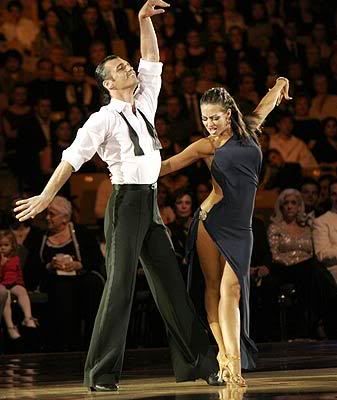
CS: When I watch the show and see the cut scenes and watch the celebrities doing their routines and watching them failing and getting back up and doing it again ““ weekly ““ how many hours are celebrities (other than last night I heard someone only put 6 hours into it) whereas others worked all week on it.

DOVOLANI: Jane and I put in 5-6 hours a day. Sometimes it has to do with a person’s ability. They need that many hours, some people don’t. It’s hard for someone to make the assumption that just because you put in the hours you are going to get the result. It’s the quality of hours that you put in. Some people need it ““ others don’t. As long as you go out there and perform to the best of your ability and give your mind and your body a chance to perform it properly, you’ll get the reward. But as far as rehearsing, these guys are going nuts – you got people who rehearse 250 hours so far to 180 hr. to 120 hrs. but it’s really amazing what they can accomplish regardless of the amount of hours they put in.

CS: What is it about the dancing”¦I read a quote that ballroom dancing is all about the women ““ framing a picture, as it were. What, on an artistic level, when that celebrity hits the floor what should they be exuding?

DOVOLANI: I feel it is the relationship. The man has to be the man. The woman has to be the woman and actually the man has to frame the woman, exactly. The man needs to be the strong part of the relationship or the man leads the woman across and shows her off. In any relationship…we know, the man is the man and the woman is the woman and dancing is just a reflection of that. And all this junk that the cha-cha is a man’s dance, the rumba is a woman’s dance, the swing is a together dance and on and on…it goes back and forth. There are parts where the man is highlighted and parts where the woman is highlighted but overall the man should always be the frame and the woman always be the picture because the woman is prettier. So you want to showcase her.

CS: When you are finished with the season, do you go back to competing or anything along those lines?

DOVOLANI: I just recently retired from competition. But what I’m going to do, is I’m the dance director of the Fred Astaire Dance Studios studio and I go around the country making sure the quality of the dance is up to par.

CS: Are you always going to stay with the show?

DOVOLANI: The show is amazing and if given the opportunity I would stay with the show. I love what I do and as long as I have the chance to do it I would keep doing it. It’s something…you never know. Obstacles come in the way but I don’t foresee that.

CS: What is it when people are watching, I know my own daughter actually talks about the show with great regard, what are you hoping that people are getting out of it? In the beginning it was sort of a farce just to watch the celebrities but now it’s become a real competition.

DOVOLANI: I hope people can escape from whatever trials and tribulations they have in life. I hope people get to enjoy for however long we have out there, the journey we have and the fact that we are sharing it with the country. And hopefully they are sitting there with their kids and joined together as families to get to share time together.

CS: It’s a great show and I don’t understand why I’m so hooked on it or why I just can’t stop watching it.

[Laughs]

DOVOLANI: Thank you.

Weekend Shopping Guide 11/16/07: It’s About Nothing

Filed under: Shopping Guides — UncaScroogeMcD @ 12:02 am

weekendshopping.jpg

The weekend’s here. You’ve just been paid, and it’s burning a hole in your pocket. What’s a pop culture geek to do? In hopes of steering you in the right direction to blow some of that hard-earned cash, it’s time for the Quick Stop Weekend Shopping Guide – your spotlight on the things you didn’t even know you wanted…

To say that the finale of the 9th season of Seinfeld (Sony, Not Rated, DVD-$49.95 SRP) – and of the series itself – was a highly controversial note to end on is an understatement. In fact, I’d goes as far to say that the disappointment and ill feelings it generated would not be exceeded until the Sopranos ended in its own infamous way. Regardless of how you feel about the end, the season itself was a pretty high note, and the DVD set wraps things up with the established plethora of extras, including commentaries, deleted scenes, featurettes, and more.

blankguide.gif

Let’s just all forget the disappointment that was Ocean’s 12… You know, the one that left a bad taste in everyone’s mouth. Luckily, Ocean’s Thirteen (Warner Bros., Rated PG-13, DVD-$28.98 SRP) is a worthy sequel to the frothy heist fun of Ocean’s 11, reuniting all the major players – plus new additions Al Pacino and Ellen Barkin – as Danny Ocean’s band of merry misfits are pitted against Pacino’s double-crossing Vegas kingpin. Bonus features include a tour of the casino, a look at Vegas design sense, and deleted scenes.

blankguide.gif

The Disney Afternoon releases have been slow in coming, but we’ve finally got the penultimate volumes of two beloved series with the third volume of DuckTales and the second volume of Tale Spin (Walt Disney, Not Rated, DVD-$34.99 SRP each). Unfortunately, Disney continues to give us lackluster transfers and zero bonus features. Talk about mistreatment!

blankguide.gif

I don’t know why Paramount is still flogging the abominable colorized version of It’s a Wonderful Life (Paramount, Not Rated, DVD-$24.99 SRP), but at least the new 2-disc edition has the sense to also include the remastered black & white original. Bonus features include a making-of, a tribute to Frank Capra, and the theatrical trailer.

blankguide.gif

Raymond Burr’s square-shouldered defense attorney returns in the second volume of Perry Mason: Season 2 (Paramount, Not Rated, DVD-$38.99 SRP). The 4-disc set features the final batch of 15 episodes to wrap up the legal eagle’s sophomore outing.

blankguide.gif

Another chapter in the cinematic saga of Tolkien’s epic closes with the release of Return Of The King: The Complete Recordings (Reprise, $74.98 SRP). The 4-disc set features the entirety of Howard Shore’s score, which is sure to be a hit with humans and Hobbits alike.

blankguide.gif

Halloween has just passed, but I still think there’s enough of a residual groove to dig on Midnight Movies: From The Margin To The Mainstream (Starz, Not Rated, DVD-$19.98 SRP). As you might expect, the documentary focuses on the flicks that achieved cult status on the big screen, long after the blockbusters had vacated the screen for the day and the giddy lunatics ruled the night with films like Rocky Horror, Night Of The Living Dead, Pink Flamingos, Eraserhead, and more.

blankguide.gif

I’m not entirely sure why we have another (the fourth!) edition of The Princess Bride (MGM/UA, Not Rated, DVD-$19.98 SRP) so soon after the “definitive” 2-disc edition, but I guess there’s always more money to be made. I don’t think the trio of new featurettes is worth the quadruple dipping, but if you’re tight on cash and can’t afford the 2-disc version, this might be a nice alternative, just for the recently improved picture quality they both share.

blankguide.gif

So there you have it… my humble suggestions for what to watch, listen to, play with, or waste money on this coming weekend. See ya next week…

-Ken Plume

##

Quick Stop Thingamabobs: 11/16/2007

Filed under: Columns,Thingamabobs — UncaScroogeMcD @ 12:01 am

thingamabobs.jpg

The web. It’s a big place, full of plenty of distractions ““ some funny, some informative, some ludicrous, some disturbing, some inane, some profound. Each and every weekday, we present links to a few of our favorite finds”¦

————————————————

  • Would I Lie To You episode 4, Part 1… (Thingamabob)
  • Rich Hall Live At The Apollo, Part 1… (Thingamabob)

November 15, 2007

Quick Stop Thingamabobs: 11/15/2007

Filed under: Columns,Thingamabobs — UncaScroogeMcD @ 12:01 am

thingamabobs.jpg

The web. It’s a big place, full of plenty of distractions ““ some funny, some informative, some ludicrous, some disturbing, some inane, some profound. Each and every weekday, we present links to a few of our favorite finds”¦

————————————————

  • Would I Lie To You episode 3, Part 1… (Thingamabob)

November 14, 2007

Quick Stop Thingamabobs: 11/14/2007

Filed under: Columns,Thingamabobs — UncaScroogeMcD @ 12:01 am

thingamabobs.jpg

The web. It’s a big place, full of plenty of distractions ““ some funny, some informative, some ludicrous, some disturbing, some inane, some profound. Each and every weekday, we present links to a few of our favorite finds”¦

————————————————

  • Here’s another one of those Brit panel shows that any comedy fan should check out – Would I Lie To You. This is episode 2, Part 1… (Thingamabob)
  • Dara O’Briain on controlling children… (Thingamabob)

November 13, 2007

Toy Box: Back to the Future, in mini-mate style!

Filed under: Columns,Toy Box — admin @ 4:47 am

toybox.jpg

If you’ve been collecting any form of toy over the last decade, you know all about mini-mates. Born out of the mini-figure boom of a few years back, the figures produced by Art Asylum were an instant hit. The Marvel figures were clearly the most popular, but the style was applied to all kinds of licenses.

Diamond Select took over the mini-mate line last year, and are now producing not only the Marvel and DC characters, but some truly unique and unusual licenses. One of those is the classic Back to the future. This set includes Marty McFly, Biff, Doc Brown and Lorraine McFly, and is hitting your LCS and online stores now.

Back to the Future mini-mates!

With all the time travel shows on right now – between Journeyman, and Hiro on Heroes, and even Lost, where time might be a question – you have to admit that while BTTF wasn’t exactly great science fiction, it was at least entertaining. If you’re looking for the more sci-fi version, I suggest Primer. But there’s no Marty McFly in that flick!

toybox_111307_1.jpg

Packaging – ***
All four figures come packed together on a bubble/cardback style of package. The graphics are decent, and the size is good (no wasted space!), but you won’t get all hot and bothered over it.

toybox_111307_2.jpg

Sculpting – ***
The mini-mates aren’t exactly the most specificly sculpted figures – they’re pretty basic, even by basic standards. And yet, somehow, they managed to get these pretty recognizable. It’s partly due to the hair sculpts, which are particularly unique, but also for some of the clothing. Marty is so recognizable as Marty because of the red down vest, and Doc Brown has that wild funky hair.

toybox_111307_3.jpg

As usual, you can swap the various body parts if you’d like, but with a character specific series like this I don’t know that it’s all that important. Of the set of four, Biff is the least recognizable, followed by Lorraine, but there’s no doubt about Marty and Doc Brown.

Paint – ***1/2
The quality of the paint ops are always critical for the mini-mates, due to the simplistic sculpts. Much of the recognizable look of the figures depends on the quality of the paint work, particularly the tampo painting of the faces. Fortunately, the work here is generally great. There’s a little slop, but it’s so minor that it’s not going to be an issue for any but the most anal.

toybox_111307_4.jpg

There’s quite a bit more detail here than usual as well. Biff actually mirrors the usual work, with the face having the most detail, and just some basic details on the clothing. However, the other three figures here have much more detail, from the pattern on Marty and Doc’s shirts, to the cool giraffe on Lorraine’s skirt.

Articulation – ***
These are very articulated for small mini-figures, but I’ve never been completely thrilled with the actual mobility of the joints.

toybox_111307_5.jpg

Each of the figures has a ball jointed neck, ball jointed shoulders and hips, pin jointed elbows and knees, and cut joints at the wrists, ankles and waist. That’s quite a bit for a figure that stands about 3″ tall. However, most of the joints are a bit limited in their range of movement.

toybox_111307_6.jpg

The best part of these joints is that most of them – like the shoulders, hips, wrists, waist and ankles – allow for the body parts to pop off and be swapped around. I’m not sure that it works particularly well with this license, but it’s always a nifty idea. All the figures stand up great on their own too, which is always important.

Accessories – Marty, Doc Brown **1/2; the rest Bupkis
While the hands on the mini-mates can certainly work with accessories, there are often very few included with the figures. That’s the case with Biff and Lorraine, but Marty and Doc Brown both have one addition.

toybox_111307_7.jpg

Doc Brown comes with his funky invention/hat, which is actually attached to a whole new head. That’s a nice touch, since he can have a different expression entirely. But it’s still not quite as cool as Marty’s included skateboard, which he can stand on with the help of a post on the board and a hole in his foot. And yes, the wheels turn.

Fun Factor – ****
Yep, they’re plenty of fun. These are the kind of figures that you can put on your desk at work, and you’ll see people actually playing with them while they talk to you. It’s just a natural thing!

toybox_111307_8.jpg

Value – ***
One of the problems with mini-mates has often been price, but you can pick up this full set of 4 for around $12 – $13 if you’re careful. That’s a good deal on the current specialty market, especially for something this…unique.

Things to Watch Out For –
Not a thing. They’re sturdy, can handle play, and have little issue with paint consistency.

toybox_111307_9.jpg

Overall – ***
Okay, I’m not sure how many of these little guys they can really sell – is BTTF really a license that can sell anything, let alone mini-figures? – but at least they gave it a good shot. If they don’t sell well, it won’t be because they aren’t well done, but rather that the license just doesn’t have the appeal they thought.

Where to Buy –
Online retailers include:

Alter Ego Comics has the set for $12.74.

Quick Stop Thingamabobs: 11/13/2007

Filed under: Columns,Thingamabobs — UncaScroogeMcD @ 4:05 am

thingamabobs.jpg

The web. It’s a big place, full of plenty of distractions ““ some funny, some informative, some ludicrous, some disturbing, some inane, some profound. Each and every weekday, we present links to a few of our favorite finds”¦

————————————————

  • Today is a special edition of “Thingamabobs”, as we show our solidarity with the Writer’s Guild as they fught the good fight. Speaking of that good fight, here’s a clip which nicely demonstrates how little water the studios’ claim that there’s no moey in the internet is… (Thingamabob)
  • Moonlighting addresses the Writer’s Strike of ’88… (Thingamabob)

November 12, 2007

SModcast 37

Filed under: SModcast — UncaScroogeMcD @ 5:12 am

newhead2.jpg

SModcast is the meandering palaver of a pair of dudes whose voices are so dull, they don’t deserve to be on the radio (and, hence, aren’t). Kevin Smith and Scott Mosier are SModcast.

The best thing about SModcast? It don’t cost nothing.

line.gif

SModcast 37: In A Row? –

Our heroes go jumbo-length in celebration of an anniversary, using the time to explore a body-snatching scenario and the decision to pod or die, learn the boundaries of a hug, marvel at the cunning of a trapped deer, and plumb the depths of general ignorance.

[CONTENT WARNING] SModcast features harsh language and even harsher notions of propriety. Listener discretion is advised.

DOWNLOAD: (right click to save)
SModcast 37 (MP3 format) – 95.80 MB

[display_podcast]

SUBSCRIBE
Subscribe to this Podcast via iTunes
Subscribe to this Podcast via FeedBurner

Wanna add your two cents? Spend it here, in the SModcast mailbag.

line.gif

CLICK HERE FOR THE SMODCAST ARCHIVES

line.gif

##

Comics in Context #202: Stung

Filed under: Columns,Comics in Context — admin @ 1:54 am

comicsincontext4.jpg

cic2007-11-12.jpgOver the last few weeks I have been examining Danny Fingeroth’s new book, Disguised as Clark Kent, which examines how the superhero genre reflects the Jewish-American background of many of the genre’s founders. As a lapsed Catholic, I have no trouble spotting the religious imagery in say, fellow Catholic Frank Miller’s Daredevil: Born Again, but I can use the help of Fingeroth’s book in understanding how Jewish-American culture influenced the work of Stan Lee (who wrote the book’s introduction), for example.

A measure of Fingeroth’s success is that he has opened my eyes to looking for such influences even in works outside the scope of his book, which is devoted to the superhero genre. For example, the Jewish Museum in Manhattan, which was hosting half of the “Masters of American Comics” exhibit last year at this time, is now presenting “From the New Yorker to Shrek: The Art of William Steig,” marking the centennial of his birth. One of Fingeroth’s themes is that being Jewish in American society confers an “outsider’s” perspective. It is therefore illuminating to consider Shrek, both in Steig’s book and in the movies, as a representative of the minority group member as outsider. In Steig’s book, Shrek embodies an adamant refusal to conform to mainstream society’s norms: it is a fable that takes a defiantly comedic stand against assimilation (see “Comics in Context” #186: “Le Petit Chef”).

Then there’s the new computer-animated film about anthropomorphic bees, Bee Movie, whose auteur is unmistakably comedian and television icon Jerry Seinfeld. Various reviewers have mentioned the exchange of dialogue that obviously signals that Seinfeld’s bees are, in part, metaphors for Jewish-Americans. On an expedition outside the hive, protagonist Barry B. Benson (voiced by Seinfeld) meets Vanessa Bloome (voiced by Renee Zellweger), a kindly human with a symbolic last name: she is the flower to his pollinating bee. (She even owns a flower shop.) On a literal level, though, they start a platonic romance. (Computer-animated films have had varying levels of success in depicting humans. DreamWorks Animation has succeeded in making Vanessa look appealingly pretty and even sexy.) Back in the hive Barry’s mother asks, “Was she beeish?” and Barry states that his new friend isn’t a “wasp.”

A delightful surprises in Fingeroth’s book is his discovery of parallels to Jewish-American culture in what initially seems a highly unlikely source: Marvel’s Thor, which is about the gods of Norse–and Germanic–culture. Back in the 1960s, series creators Stan Lee and Jack Kirby devised a longrunning subplot in which Thor had fallen in love with the mortal woman Jane Foster, despite the opposition of his father Odin, monarch of the gods.

When I interviewed him for Publishers Weekly‘s Comics Week, Fingeroth told me, “Immigrant families are often concerned that their children will marry within the group. Jews, with their small numbers, are famous for this concern. So when I reread the Thor stories about Odin forbidding Thor to “˜intermarry’ with mortal Jane Foster, it just seemed plain to me that this was reflective of the conflicts that Stan Lee and Jack Kirby. . .had to have experienced in their own lives and families.”

Fingeroth also points out in his book that the initially forbidden romance between Johnny Storm of the Fantastic Four and Crystal. who belongs to a different racial community, the Inhumans, similarly reflects this conflict. (Of course, this theme isn’t restricted to Jewish-American creators: William Shakespeare’s Romeo and Juliet find themselves in similar situation.)

So, then, Barry’s leaving the hive to explore the outside world is like someone moving beyond his ethnic community to investigate the majority culture. Barry’s platonic romance with Vanessa is a metaphor for a Jewish-American man falling in love with a Gentile woman.

But, although the mainstream reviews I’ve read take no notice, the Jewish-American themes extend much further than this in Bee Movie. Barry discovers that humans are “stealing” honey from the bee population. This is a metaphor for the majority culture’s exploitation of the labor of a minority group. It’s not surprising to find this as a subject of an animated film for families. But, startlingly, Seinfeld and his collaborators go further.

Bee Movie establishes that humans harvest honey from hives in what the dialogue calls “work camps” for bees. Of the mainstream critics whose Bee Movie reviews I read, only Rex Reed in The New York Observer came close to finding the buried subtext, referring to “a honey farm that is like a Nazi work camp staffed by slaves”. The movie shows us that before the humans remove the honey, they gas the bees. We see smoke get released and watch the bees collapse. It’s not lethal, but, considering that the Vanessa subplot has already likened bees to Jews, the metaphorical implications should be obvious.

Horrified by the exploitation of the bees, Barry fights back by initiating a class action suit against the human race. During the trial the racial subtext becomes more explicit. The opposing lawyer is a caricature of the stereotype of the racist Southerner, who openly argues against granting bees “equal rights” and publicly exposes the relationship between Barry and Vanessa to foment bigoted reactions. In the trial sequence Seinfeld and company appear to be likening bees to African-Americans as well, as Barry refers to the bees as the humans’ “slaves.” The climactic point of the trial comes when Barry produces a “bee smoker” in court, which gets triggered: in full view of everyone present, bees in the audience are gassed and collapse. even in the context of a “funny animal” movie, it struck me as startling, even somewhat shocking. For a moment Bee Movie had become Maus.

Do you think I’m reading too much into this? In his review in The Onion (Nov. 8-14, 2007) film critic Nathan Rubin missed the Holocaust imagery but nonetheless observed, “Yet the darkness endemic to Seinfeld [the TV series] manifests in some satisfying, unexpected twists” such as “a loopy dream sequence that ends tragically”. He’s referring to a strange sequence in which Barry dreams of Vanessa attempting to fly, as he does, but in a one-woman aircraft which crashes in flames. Watching this I wondered why this sequence was in the movie, since Vanessa is in no danger in the story. But Rubin may be right that there is a dark undercurrent beneath Bee Movie‘s bright, shiny surface.

Moreover, Seinfeld told PBS’s Charlie Rose (on the latter’s show on November 5, 2007) that he was surprised that children liked Bee Movie so much because he had principally aimed it at adults. He told Roger Ebert, “To be honest. . .I wrote it for adults”. It seems strange that he would think that there was a large enough adult audience for what is basically a funny animal animated film to make Bee Movie a commercial success, but this does indicate that Seinfeld wasn’t averse to dealing with “adult” subjects in the film.

Despite its ambitions, I still found Bee Movie disappointing. Seinfeld and his co-writers labored for over two and a half years on the screenplay, but to my mind the story still seems deeply flawed.

The initial premise is that Barry is a young bee who, having just finished bee college is expected to commit to a job in the hive, which is depicted as a company town run by a corporation called Honex: we are told that once he makes his choice, he will never be able to switch to another job, he will never get a day off, and he will literally work until he drops dead. A Honex orientation guide cheerfully declares, “You’ve worked your whole lives so you can work your whole lives.” Barry rebels at this prospect, as well he should.

Brad Bird’s great animated film Ratatouille starts with a somewhat similar premise: the protagonist, Remy the rat, is pressured to conform to the lifestyle of the rest of his species, which is basically to eat garbage for the rest of their lives. (Again see “Comics in Context” #186: “Le Petit Chef”). But Remy has a driving passion to eat and create fine foods, and he envisions a different, better life for himself, which he successfully achieves.

In contrast, Barry has no ambition or dream he pursues from the start of his movie. Moreover, Bee Movie and Seinfeld himself seem to have contradictory feelings about Barry’s future in the hive. Seinfeld told Entertainment Weekly that “I love utopian societies, which is what they [bees] live in — it seemed like a very ’60s corporate environment to me, where people believed in the company, and government, and society. I love that. To me, utopia is an old Jack Lemmon movie. Growing up, I thought that would be the ultimate life, to have a convertible and work in an office in Manhattan”. Somehow I think that writer/director Billy Wilder would not have considered Jack Lemmon’s character’s corporate life in his film The Apartment (1960) as utopian.

Even though Barry is tempted by the life of a “pollen jock,” one of the macho bees who flies out of the hive to gather honey (a task actually performed by female bees in real life, by the way), he still balks at making any choice that would commit him for the rest of his life.

But this storyline takes a back seat to Barry’s evolving relationship with Vanessa. In speaking to her and thereby initiating the relationship, Barry says he is violating the rules of bee society. Metaphorically, Barry is breaking a taboo about close association with people outside his community. Now you might think that the Barry-Vanessa storyline, with its strong subtext, would become the main plotline of the movie. But no, except for the very brief uproar at the trial over it, and the occasional fits of anger from Vanessa’s human boyfriend, Barry and Vanessa’s relationship doesn’t hold onto center stage. It’s as if Barry had picked up a sidekick to provide him with moral support for the next half of the movie. It’s as if after the balcony scene Romeo and Juliet took off to star in an entirely different play.

So if Bee Movie isn’t really about finding an alternative career or finding love outside your community, maybe it’s about an oppressed people (the bees) revolting against their oppressors (the humans). Here I must issue the requisite spoiler warning: if you don’t want to learn about the last act of the film, skip the next fourteen paragraphs.

Barry triumphs in court, the bees are legally granted possession of all their honey, and this turns out to be disastrous. With all the honey they could want, the bees stop pollinating flowering plants, apparently all over the world. From her apartment overlooking Central Park (And just how can the owner of a one-woman flower shop afford this?), Vanessa shows Barry that all of the plants there are dying. As she explains, this will destroy the entire ecosystem of Earth: if flowering plants die, there’ll be no food, and animals and the human race will perish as well. (Yes, it’s another end of the world movie.) The only flowering plants left alive, she informs him, are the roses that were saved for the Tournament of Roses Parade in Pasadena, California.

All right, let’s stop here. Is the movie suggesting that Barry was wrong to sue the human race, and that humans should have continued to exploit, enslave and gas the bees? (By the way, in real life, “Centuries of selective breeding by humans has created honey bees that produce far more honey than the colony needs.”).

Once Barry won the lawsuit, wouldn’t humans have negotiated with the bees to obtain some of their honey? People don’t just use honey for food; it also has medicinal benefits. Since Seinfeld and company have portrayed a bee society that has its own tiny automobiles and television shows, among other trappings of human-style civilization, surely some sort of trade agreement could have been worked out, wherein the bees would exchange honey with the humans for consumer goods. So why would honey production grind to a halt? Besides, even though honey has a long shelf life, wouldn’t the bees eventually have to replenish their stores?

Wouldn’t lots of human beings–and Seinfeld’s intelligent bees as well–have realized, as early as the trial, that if the bees stopped pollinating plants, ecological catastrophe would strike? Wouldn’t scientists have realized this before it got to the point that all the plants in Central Park were dead? Wouldn’t the human and talking bees have reached some sort of agreement to start pollinating plants again long before this point? And if plants all over the world were dying, why would humanity only save the roses for the Tournament of Roses Parade!?! Isn’t food–like wheat–more important?

Does Seinfeld mean to suggest that the bee community (metaphorically representing a minority group) is so lazy that none of them would want to continue working after they won the lawsuit? Considering that he and his co-writers had established that bee society was perfectly happy never taking any time off in their entire lives, wouldn’t retirement be anathema to most of them?

And just how stupid is Barry, the protagonist, that he didn’t notice the ecological catastrophe until it was nearly too late to reverse it? If this movie was aimed at adults, then it has to deal with the kind of logical questions that adults would ask.

Once Barry sees the light, does he first try to persuade the rest of the bees in his local hive that they have to start pollinating again? No, instead he and Vanessa embark in a scheme to steal a truckload of roses from the Tournament of Roses Parade and fly it to New York City. When the plane is in danger of crashing, the rest of Barry’s hive goes to his rescue, and only then does he fill them in on his master plan.

And so the bees use the pollen from the stolen roses to restore the plant life of Manhattan to health. Meanwhile, I found myself thinking, wouldn’t it have been easier if Barry had organized the bees that live in California to use the pollen from all the roses in Pasadena to pollinate plants out there, first? And since presumably there are talking bees out in California too, wouldn’t they have already figured this out? If Earth’s entire ecosystem is in danger, why is it important to start the repollination process in New York City? Okay, granted, as a New Yorker myself, I can sympathize with Mr. Seinfeld’s Manhattan-centric world view, but in this case it’s still wrong.

So, with Story Arc #4 resolved, Bee Movie moves into its happy ending, in which Barry not only runs a law office in the back of Vanessa’s flower shop, but also has become a member of the “pollen jocks.” This brings the movie full circle back to Story Arc #1, but the movie seems to have lost sight of that storyline’s initial point. What about not wanting to be stuck in the same job for the rest of hs life? What about never getting time off or working toll one drops dead? Barry does have his new legal career, but he doesn’t seem enthused about it, and tell the “pollen jocks” that he couldn’t wait to get out of the office.

I suppose that Bee Movie could be interpreted as a fable about a youth who rebels against the ways of his community, but then learns to value them when the community is endangered (by the humans’ oppression), and ultimately rejoins the community. That interpretation would certainly have resonance for the members of a minority group within a larger society. But to me, Bee Movie ends up seeming like a parable about giving up one’s dreams and settling for the status quo.

In Entertainment Weekly Owen Gleiberman writes, “It’s also a fable for our 24/7 worker-bee age. We’re used to animated films like Ratatouille that salute those who don’t go with the flow, but Bee Movie takes a paradoxically fresher tack. In this movie, the power of the individual turns out to be overrated. It’s the system that’s precious, and if that message sounds a tad…reactionary, Bee Movie finds a touching beauty in it. Who’d have guessed that Jerry Seinfeld, the maestro of nothing, would spearhead a fairy tale about the inspiring glory of punching the clock?”
I’d put it differently. Who’d have guessed that Jerry Seinfeld, who did not pursue a conventional career, like that of a lawyer or doctor, but instead followed his muse into the realm of stand-up comedy, and triumphantly beat the odds, co-creating a masterwork of television comedy and becoming fabulously wealthy as a result, would spearhead a fairy tale about punching the clock? He told Charlie Rose in that November 5 show that he is still motivated by the quest to unearth “nuggets of comedy.” Seinfeld’s life is more like Ratatouille, and yet he told Roger Ebert that “I was myself on the TV show and I am in this too, except if I were born as a bee, this is what I would be like”. Really?

I’ve been following my muse into middle age. I may not be rich, but I’m proud of my growing body of work, and think I would have been bored and felt unfulfilled had I not pursued ny fascination with comics and cartoon art, a subject that mainstream culture is finally beginning to take seriously. At the end of Ratatouille, Remy loses his chance at great commercial success, but he continues to pursue his art, and thus the film comes to its satisfyingly happy conclusion. Given a choice between Bee Movie and Ratatouille as a fable for my life, I unhesitatingly choose the latter.

Oh, yes, and at the end of Bee Movie it trns out that cows talk, too, and one of them complains to lawyer Barry that humans exploit them for their milk. Perhaps this is a can of worms that Seinfeld and the other writers should have left unopened, since humans don’t just milk cattle. So would Barry B. Benson put folks like J. Wellington Wimpy and myself on trial for eating hamburgers?

Let’s return to my chapter by chapter survey of Danny Fingeroth’s Disguised as Clark Kent. Fingeroth is good at evaluating and explaining away mistaken pieces of conventional wisdom on his subject. For example, he notes that the second syllable of the Kryptonian names for Superman–Kal-El–and his father –Jor-El–sound “like one of the Hebrew names for God” (Fingeroth, Disguised as Clark Kent, p. 45). Fingeroth points out that Superman’s co-creator Jerry Siegel is on record as revealing that “Jor-El” is simply a shortened version of his own full name, Jerome Siegel. But Fingeroth acknowledges that “it’s quite possible” that Siegel and artist Joe Shuster’s “memories of childhood Hebrew school lessons” could have “inspired” these Kryptonian names (Fingeroth p. 45). Here we should remind ourselves of one of Fingeroth’s guiding principles in writing this book: the power of the subconscious on the creative mind. Isn’t it possible that while Siegel consciously believed that he named Jor-El after himself, that the name sounded right to him because it subconsciously reminded him of a Hebrew name for God? We can never know for certain, but we should recognize the possibility.

As I argued last week, examining the work of the original creators of the superhero genre may show us whether and how its contemporary practitioners have strayed from the essential elements of the superhero concept.

For example, at one point Fingeroth speculates about Siegel and Shuster’s intentions in creating Superman: “they would have their creation embody the best of the Good Immigrant qualities. “˜Everyone says all Jews care about is money? Well, look at this: we’ve invented the most powerful man in the history of the world–and he still insists on having a day job at The Daily Planet. He is selfless and, by extension, so are we.’ He’s a tzaddik, literally “˜righteous man’ in Hebrew” (Fingeroth p. 47).

The early Superman treated criminals brutally at times, but the character quickly developed a strict moral code of behavior, truly becoming a “righteous man,” as Fingeroth says. In recent years, however, there was Marvel’s X-Statix team, mutant superheroes who were motivated primarily by seeking fame and fortune. More importantly, the “grim and gritty” trend in superhero comics that began in the 1980s and continues through the present day has brought the superhero who is quite willing to kill. Is such a character truly an archetypal “righteous man,” or is he morally compromised? The “goddamn Batman” of Frank Miller’s current All Star Batman and Robin takes a sadistic pleasure in injuring his criminal opponents (see “Comics in Context” #119; “Bats and Spats” and “Comics in Context” #178: “The Whole World Is Watching”). For the genre to progress creatively, the characterizations of superheroes must be portrayed with more complexity and sophistication. But writers must beware of diluting and subverting the superhero concept and genre in the process.

Speaking of Batman, Fingeroth references Rabbi Simcha Weinstein’s hypothesis that Batman’s origin was inspired by Kristallnacht, the 1938 anti-Jewish pogrom in Germany. As Fingeroth puts it, “Like the Jews in Europe, Bruce Wayne and his family thought they had all they needed to be insulated from the vagaries of life. Yet, like the Jews of Europe, it was all taken away from them in an instant” (Fingeroth p. 56). It’s certainly possible that this provided the inspiration for Batman’s origin.

But who created Batman’s origin? Was it Bob Kane, whom DC Comics officially credits as Batman’s creator, or Bill Finger, who, like Kane, was Jewish, and who co-created most of the original Batman mythos, or even Gardner Fox, who wrote some of the earliest Batman stories? My guess is that it was Finger, who generated most of the concepts for the early Batman, right down to the name Bruce Wayne and major elements of Batman’s costume design. Moreover, Finger’s body of comics work has a darker edge than Fox’s. In his great Silver Age work, Fox never approaches the bleak, haunting quality of the origin story in Detective Comics #33.

Then again, as Fingeroth demonstrates, Batman co-creator Bob Kane went to great lengths to conceal his Jewish background; reading this, it seems to me that Kane may even have been in a state of denial. Since, in the early days of Batman, Finger and Fox worked for him, why would Kane approve the origin story if he thought it was a parable about the plight of European Jews?

Fingeroth also wonders if Joe Chill’s shooting of Bruce Wayne’s parents was inspired by the murder of Jerry Siegel’s father. This is possible, too. Then again it appears that Kane lifted the scene of the murder of Thomas Wayne directly from a 1938 “Big Little Book” called Gang Busters in Action, illustrated by Henry Vallely. So maybe Kane wasn’t copying reality, but another artist.

But here I believe that Fingeroth comes close to a simpler answer to the question. Why couldn’t the story of Batman’s origin simply be a response to the widespread urban crime of Depression-era America? It was the lawlessness of that period that similarly inspired Dick Tracy and the classic gangster movies of the 1930s. The simple concept of a mugger appearing, seemingly at random, and gunning down a prosperous couple is a perfect image of the dangers of a lawless urban environment. It could equally well be an iconic image of the big city in the 1970s, which, not coincidentally, is the decade when the Batman returned to his late 1930s roots as a grim, avenging figure in the comics.

Following the lead of comics historian Gerard Jones, Fingeroth argues that Joe Simon and Jack Kirby’s creation Steve Rogers a. k. a. Captain America was “a kind of surrogate Jew” (Fingeroth, p. 58). “If Steve Rogers was blond, well, there are blond Jews. . . . “˜Rogers’ could have been a fake name, too. So, maybe despite all outward appearances, an argument could be made for Captain America as some sort of Jewish-inflected character, the “˜weary, old-country survivor reborn as the new fighting Jew,’ as interpreted by Gerard Jones” (Fingeroth, p. 60).

I think that Fingeroth may be pushing this point further than is justified. But he’s on target when he writes that “Perhaps the most “˜Jewish’ thing about Captain America’s stories is the concerted attempt by the creative staff to make every story universal” (Fingeroth p. 59). Since Simon and Kirby intended Captain America to be a symbol of America, then it made sense that they would cast him as a member of the largest ethnic group in the country in that time before multiculturalism: in other words, as a white Anglo-Saxon Protestant.

But yes, it’s true that the earliest Captain America stories reflect Simon and Kirby’s Jewish background. On the cover of Captain America Comics #1 the title character punches Adolf Hitler in the jaw. Though Fingeroth doesn’t, it should be noted that the first issue was cover-dated March 1941, nine months before America’s entry into World War II. Back then there was considerable isolationist sentiment against becoming involved in the war, and so Simon and Kirby’s open opposition to Hitler was rather daring.

Fingeroth is also correct to point out that the creator of Captain America’s “super-soldier serum” was “Professor Reinstein,” whom Simon and Kirby obviously based on the Jewish scientific genius Albert Einstein. Hence, the subtext is clear when, in the origin story, a Nazi agent guns down the Jewish Reinstein, and Captain America then avenges Reinstein’s death.

It’s surprising that Fingeroth doesn’t do more with his observation that the “super-soldier serum” transforms Steve Rogers into “a one-of-a-kind, perfect, Aryan-looking specimen of humanity” (Fingeroth p. 58). Ironically, Captain America physically matches the Nazis’ idealized vision of a member of the Aryan “master race.”

Were Simon and Kirby conscious of the irony? Decades later, the late Marvel writer Mark Gruenwald seemed to be, when he transferred the consciousness of Captain America’s Nazi archfoe, the Red Skull, into a cloned copy of the Captain’s own body: thus the Red Skull became Captain America’s literal evil twin.

Whether consciously or not, Simon and Kirby had turned the Nazis’ image of the Aryan superman to their own purposes. Captain America was not fighting for the dominance of a master race, but for the freedom of a democratic society in which immigrants from other ethnic groups could find refuge from fascist tyranny.

Fingeroth perceptively points to Reinstein’s declaration that Captain America will be “one of America’s saviors” and comments that “the metaphor system at work here is as much Christian as Jewish” (Fingeroth p. 58). So Captain America is a Christ figure, but couldn’t he also be viewed as a Messiah? And since Professor Reinstein remodels the once frail Steve Rogers into a physically perfect soldier, to go out and combat tyranny, couldn’t Captain America also be seen as a variation on a golem? I’ll let you ponder all of this until I continue my review of Dressed as Clark Kent next week.

ADVERTISEMENTS FOR MYSELF AND OTHERS

I will be interviewing Tim Sale, the artist who has frequenty collaborated with writer Jeph Loeb (on Batman: The Long Halloween, Daredevil: Yellow and Hulk: Gray, among other projects) and who does artwork for the television series Heroes, on Saturday, November 17 onstage at the Big Apple Con‘s annual “National” convention. The convention runs from Friday afternoon, November 16 through Sunday, November 18 at the Penn Plaza Pavilion at 33rd Street and Seventh Avenue in Manhattan.

Writer/artist Richard Howell has moved his Claypool Comics series about vampires, Deadbeats, to the Internet, and recently reintroduced a character named Edwin, who first appeared in Richard’s indie comic Portia Prinz of the Glamazons. Take a look at strips 79, 80, and 81 and see if you can figure out what they have in common with “Comics in Context.” Here’s a hint: in strip 81 Edwin delivers one of the best worded defenses of continuity I’ve ever read.

And I am pleased to welcome Fred Hembeck back to Quick Stop Entertainment, where he has resumed work on “The Fred Hembeck Show” with episode 101.

Copyright 2007 Peter Sanderson

Quick Stop Thingamabobs: 11/12/2007

Filed under: Columns,Thingamabobs — UncaScroogeMcD @ 12:01 am

thingamabobs.jpg

The web. It’s a big place, full of plenty of distractions ““ some funny, some informative, some ludicrous, some disturbing, some inane, some profound. Each and every weekday, we present links to a few of our favorite finds”¦

————————————————

November 11, 2007

Cabin Fever #07: Maginificent Seven

Filed under: Cabin Fever — UncaScroogeMcD @ 1:59 pm

cabinfeverheader.png

Oh no! Just when you thought it was safe to hang out at the Quick Stop…

cabin.jpgCabin Fever (hosted by the twisted souls Brian Fitzpatrick and Aaron Poole) is the result of having too much time on your hands and access to your local community radio station.

Over the course of an hour, they manage to trawl the depths of good taste, plus throw some music in. How much more could you want from a podcast?… Quality? Oh… we didn’t think of that.

Enjoy! And we hope our cross Atlantic friends can understand the Irish accent 😉

Hugs and Kisses,
Aaron P. + Rev. Fitzy

linesm.gif

CABIN FEVER #07: Maginificent Seven – Kinda… We had a back log of stupid news from around the world due to our recent tardiness. So this show is a little longer than usual (or it probably should be). Hark, as we talk about drop-kicking kittens, downloading sheep, and dogs shooting people. An hour long episode of Cabin Fever? Listen at your own risk!

[CONTENT WARNING]: Explicit contents! We say every naughty word you can think of. You have been warned!

DOWNLOAD: (right click to save)
Episode #07 (MP3 format)

[audio:http://traffic.libsyn.com/cabinfever/cabin_fever_07.mp3]

SUBSCRIBE
Subscribe to this Podcast via iTunes

Got something to say? E-mail Aaron & Brian at the Cabin Fever mailbag.

line.gif

CLICK HERE FOR THE CABIN FEVER ARCHIVES

line.gif

##

Game On! 11-11-2007: Time Enough Alone

Filed under: Game On! — admin @ 5:47 am

gameon.jpg

We’re getting deep into the months of holiday releases, kids. New titles are springing up literally by the hundreds each week, and who’s there to help you keep track of you holiday dollar? That’s right”¦me, baby. This week we’re going to take a look at some of the more recent releases across ALL the consoles, from Xbox 360 and PS3, the Wii and PS2, to the handhelds of DS and PSP. There’s a lot to cover, so let’s get into it.

TIME IS ON MY SIDE, YES IT IS

timeshift.jpgFor a game that’s been done and redone so many times before its release, TIMESHIFT has finally hits shelves, and unless you knew of its delays, doesn’t show it too much. Out now for Xbox 360 and PC, and due on PS3 next month, the game (originally due a few years ago on the ORIGINAL Xbox) has gone from a handsome hero voiced by Dennis Quaid to a faceless, voiceless anybody in a super suit. However, the game that surrounds said hero is actually more interesting than it started out to be, and that’s thanks to a suped up graphics engine, and a better handle on how to utilize the titular time shifting powers.

After an experiment gone wrong, both Dr. Adrian Krone and yourself are shipped backwards in time thanks to the suits you wear; his being the alpha and yours the beta-versions of the experimental SSAM software”¦which, in a nutshell, basically lets you stop, slow and reverse small chunks of time. While he went back a bit before you and used the suit he developed to conquer a period in history, you move forward to stop him, as only a scientist in a crazy suit can: by shooting up a lot of shit. Thanks to the suit, you can use the environment to your advantage too. You can bypass electrified water by freezing time and walking across it or shooting a barrel off a tower, jumping on it, reversing time, and riding it back UP to the top to gain a high vantage point”¦all done with the suit.

While the SSAM system in your suit may hold the player’s hand a good deal of the time as to when to use what time power the player also has the freedom to act however they wish in any given situation. Simply tapping the button executes whatever SSAM suggests, holding it brings up the 3 functions to allow you to choose the time power you feel best suits the task at hand. Unfortunately, most of the “puzzles” you’re tasked with aren’t that mind-bending. Walking on water as mentioned happens a bit to frequently, and using the time freeze to stop a grate you just cranked open from dropping occurs a few as well”¦and that’s about the extent of them.

Still, the freedom to use whatever power whenever does open up areas you may not have realized, but it does take a certain amount of imagination. Anyone can stop time, take an enemies weapon, and tag them with a sticky grenade, only to unfreeze it, watch them panic and go boom. Still others may not use the power when a lone enemy drops into your path unexpectedly, to suddenly reverse time and have them not even realize you were there as you walk past, saving on ammo. It’s these kinds of choices that really let players think outside the box when it comes to an FPS.

timeshift2.jpg

Sadly, when it comes down to the meat of it, however, it’s just another run of the mill shooter. Enemy AI isn’t the best, as most will stand out in the open as you shoot them (time frozen or not). The environments aren’t that different than any other FPS (there’s a sewer level, there’s a warehouse level, yawn), and while the weapons are cool enough, they’re a tad unbalanced as far as firepower in certain ones, and with the AI so drab, you won’t get much thrill out of them. That, toppled with the basic “stop the bad guy” storyline, TIMESHIFT has taken a good idea, and tagged it onto a mediocre shooter. Plus, and I mean this seriously, if you’re fighting with the resistance, but you JUST dropped in from nowhere, why does NO ONE question who you are? I mean, I know this has gone through several different writings but WOW”¦

Graphically, the game can have some really nice touches, like stopping time in the rain, or an exceptionally large explosion you’re dodging, but at others, like the backgrounds, can run into the territories of drabness. The audio is also only passable, with weapons not given the right amount of “oomph” needed to have a satisfying kick. Multiplayer at least saves the game from total mediocrity, as the time elements are smartly put into use here as “Chrono Grenades”; separate bubbles of time you can throw and place you adversaries into to seriously fuck them up. Plus, somehow, the weapons balance issue seems resolved here. Good times indeed.

All in all, TIMESHIFT isn’t a total wash. The time elements really ARE the main draw of the game, and a careful imagination can really warrant some pretty awesome effects and displays of coolness. It’s just too bad they’re found within such an average shooter.

One Gamer’s Opinion:

lib2_1.jpg

QUICKSHOTS

MANHUNT 2

manhunt2_1.jpgFor a game that’s steeped in controversy, for once, it’s kind of backfired on Rockstar Games. MANHUNT 2, out now for PS2, PSP and Wii, originally got the dreaded AO rating from the ESRB. After some careful edits, the game was re-evaluated and given the M rating”¦but at the cost of what makes the game enjoyable to most; the brutality of the killings. Here, the story of Leo Kasper and Daniel Lamb has them slaying all those who get in their way as they try to escape the trappings of an experiment gone wrong, but no one knows HOW they kill. Every execution is just SLIGHTLY out of the camera’s view, and effects like shake and blur are done to such an extreme that identification is practically nil. Add to that is the Wii version’s motion guides in the top left corner of each kill, and you’re unable to watch the action at ALL. Which, sadly, is the only reason people play this series. The plot in this one isn’t as engaging (no video game version of THE MOST DANGEROUS GAME this time around) which only makes the game seem to want to be shocking, but has that looming censorship over head. There’s rumors that the PSP and PS2 version can be hacked to remove the kill filters, but that still wouldn’t seem to make the game any more playable. Still, for some general craziness, it does have some merit, as the environments, and especially the enemies, are even more fucked up than before. If you’re sadistic enough (and no, not in THAT way) you just might enjoy the pain of MANHUNT 2.

manhunt2_2.jpg

One Gamer’s Opinion:

lib2_1.jpg

VIRTUA FIGHTER 5

vf5_1.jpgThe VF series is the bastard child of the fighting game genre, and it doesn’t deserve that. It may not have the unique characters of TEKKEN, or the reversals and “bump mapping” of the DOA series, but what it does have is one of the deepest fighting engines found in games today. Sure, button mashing can get you through the matches, but if you take the time, you can find that all of the fighters have a deep move set, with combos and crunchers that take weeks to master. That, fueled with the game’s quest mode, will have fighters customizing their avatars with new costumes and accessories, then taking them online to the smoothest lag free smackdowns around. The game looks amazing, plays amazing, and is one of the best one-on-one fighting experiences since”¦well, since VIRTUA FIGHTER 4: EVOLUTION. A definite buy.

vf5_2.jpg

One Gamer’s Opinion:
kickass.jpg

FINAL FANTASY TACTICS and FRONT MISSION

fft1.jpgSquare-Enix likes handheld systems. They also like their old games. Both of these are to our benefit, as two of their greatest strategy games have found their way to the PSP and DS. FINAL FANTASY TACTICS: WAR OF THE LIONS is just as good as you remember on PSOne, but now includes gorgeous cut scenes, new job classes, and some stellar multiplayer options. All the tactical strategizing is back, and while the game can be a bit unforgiving in areas, that shouldn’t stop tactics fans from picking this up, even if you’ve blazed through it before.

fft2.jpg

frontmission.jpgFRONT MISSION, on DS, takes the little-seen SNES title and ads touch screen control to customize your mechs and battle it out pseudo RTS style, with multiplayer options galore. The story of post-apocalypse “wanzer” mechs will find it’s bigger audience here, and the game is a perfect fit for quick battles on the go, alone or with friends, though the single player does take a bit to get moving. Once it sets trough, however, its deep customization will take hold and not let up. Both are solid re-releases that first timers and long time fans will want to grab.

frontmission2.jpg

One Gamer’s Opinion (for both):

lib2_1.jpg

CRAPTACULAR GAME OF THE WEEK

kengo1.jpgI know it’s been out for a while, but something must be said about KENGO: LEGEND OF THE 9, and that something is this: who bothered, and why? The game is broken from start to finish, and if anyone has picked up the box they must immediately cleanse their hands, lest the game infect them. A sloppy story mode (rehashed from different POVS for each character), a broken fighting engine (two attack types that EVERYONE blocks) and graphics that look like FIRST GEN Xbox should make this game suffer the same fate as the game’s protagonists; a quick death due to shoddy hit detection and blocking. Yeesh.

kengo2.jpg

One Gamer’s Opinion:

gameon5.jpg

Well, after those quick hits, I think we’re done for the week. Big stuff on the horizon, though”¦ keep your peepers peeled.


THE GAME ON! RATING SYSTEM


gameonratingscomplete.jpg

Ratings From Greatest to Least:

Kick Ass, Right On, Okay, Eh, and Stinker (aka CRAPTACULAR)

November 10, 2007

Scrubs Blog: My Aching Back

Filed under: Production Blogs,Quickcasts,Scrubs Blog,Video — UncaScroogeMcD @ 3:41 am

scrubsheader.jpg


VIDEO BLOG #96: “My Aching Back” ““
This week we’ve got a look behind the scenes at an elaborate bit of make-up and special effects from episode 7×03, “My Inconvenient Truth”.

line3.gif

scrubs2007-11-09.jpg

Download Scrubs Video Blog #96:

Large (560 x 420 – QuickTime – 56.45 MB)
Small (320 x 240 – QuickTime – 24.62 MB)

##


November 9, 2007

Party Favors: Block-Balled

Filed under: Columns,Joe Corey's Party Favors — UncaScroogeMcD @ 3:57 am

partyfavors1.jpg

DALLAS – James W. Keyes is no longer on my Christmas card list. What did the CEO and Chairman of Blockbuster do? Let’s take a look at what he said during his little webcasted third quarter earnings report:

“A second move was to modify the offerings under our Total Access program to provide better value for by-mail only customers while also capturing greater returns from those seeking unlimited access,” said Keyes. “This was a conscious effort to prune the tree and in other words, we were willing to walk away from some of our subscribers, those at the far end of the usage scale who are not willing to pay a higher price for unlimited free exchanges.

One of those customers in fact was quoted in Newsweek saying, “in the nine months since I joined Total Access,” he said, “over 200 titles have been mailed to me. That is 200 titles that I returned to the store and got a freebie off of. It worked out to about 36 cents per DVD which means they lost a fortune on me just on postage fees.”

“Well, when we read that we challenged his math a bit; it is not exactly correct but he does certainly raise a good point. And the net result of the quarter, after our changes, was in fact a decline of about 500,000 subscribers, some of whom were in that category and whom we were happy to see move to the competition.”

In case you’re wondering, that was my quote from the Newsweek Online article. Thanks for trash talking me to the money. First off, Mr. Keyes, give me proper credit if you’re going to use my quote. My name was attached to the article. You didn’t have to do any real research. It’s called respect. Are you afraid to say my name, Mr. Keyes? Are you Shaq refusing to say Kobe’s name to the press?

My math deserves to be challenged. During the 8 months that I paid for Blockbuster’s Total Access, they shipped me 234 DVDs. And I exchanged them at the nearby brick and mortar store for new titles that rented for $4.25 a pop. So I paid Blockbuster $144 to be part of their club and borrowed 468 DVDs. I ended up paying 31 cents per DVD. Was Blockbuster paying less than 31 cents to mail me each DVD? And 31 cents to get it back? I also denied the cash register at my Blockbuster $994.50 when I walked out with my freebie DVDs. That doesn’t include the monthly free rental coupons and free rentals for Netflix envelopes. Throw those in deals and I made off with over a grand in “savings.” I never once paid for a rental.

I also never paid a late fee. I took advantage of their “No Late Fees” grace period. Those new rentals sat on my coffeetable for at least a week. I denied my local store 2 additional rentals when these titles were fresh and hot. That’s at least another $1,000 that didn’t work its way into Keyes’ Christmas bonus math. For my $144, Blockbuster paid for 468 stamps and was denied at least $2,000 in revenues. How many people not in my “category” were needed to balance me out in the books?

I’m curious about the “correct numbers” in Keyes’ math. How close was I to the accounting truth? He won’t confess since their special postage rate is a trade secret. No need to waste the facts on a former subscriber. But don’t tell me I’m wrong if you won’t confess what’s right.

It must burn Keyes that I’m the first customer to walk away from Blockbuster with the advantage. Millions of customers before me stormed away in a huff over an unexpected late fee that destroyed their children’s college fund. I could have sent a kid to Harvard on my Blockbuster savings. I’m speaking of Harvard Community College in Lower Botswatastan. Two grand doesn’t go far in the Ivy League. If you look at the brick and mortar register scoreboard, it was me “renting” 234 DVDs while the Blockbuster store collected ZILCH from my wallet. 234 to 0. Bill Belichick is disgusted that I at the lopsided score. How does the reverse burn feel, CEO Keyes?

Our final days as customer and CEO were pretty nasty. Keyes wants to act like I cheaped out and quit. He ignores the fact that with nearly two weeks left on my monthly payment, he froze my account. It took a threat of a class action lawsuit to get Blockbuster to give me my remaining two weeks of rentals. He was way too eager to kick me out of his little club. He didn’t want me to pay a little more. He wanted me banned for life.

About a week ago, I contemplated rejoining Blockbuster Total Access so I could nab the summer movies when they finally arrive on DVD. Thanks to Keyes acting like a jerk towards me, I won’t give him my business. Is this how you’re supposed to treat a customer? Who taught this guy business ethics? Did he skip the manners lecture? Does Keyes not understand that I’m his customer and he needs to treat me with respect and courtesy. Maybe he needs to take one of those customer service sensitivity courses? He should at least learn not talk while his mouth is full of his ass.

He might not like the fact that I rented 468 DVDs, but his company set the rules. He’s the one that signed off on commercials telling me all the marvelous things I can do with Blockbuster Online’s Total Access. I took full advantage of the deal. And now CEO Keyes wants me to look like the bad guy? Don’t take the conversation into that court, Keyes. Don’t make me look like a bad customer. You’re a lousy CEO, Keyes. You advertised an all you can eat buffet and threw a sissy fit when I went back for seconds. I beat you at your game and now you’ve taken your ball and ran home crying to momma like a little baby. Now you want to look tough around your toadies. Look at the scoreboard. You owe me a trophy for the pounding I gave your marketing team.

As far as Netflix goes, I never quit them because I sensed Total Access wouldn’t last. Reed Hastings hasn’t talked crap about me during his earnings report. Hopefully CEO Keyes can survive the holidays without finding my Seasons Greetings in his mailbox. Although if he approves another genius idea like Total Access, he’ll be found enjoying turkey at the rescue mission sharing a table with the brains behind New Coke, Analog HD and the XFL.

DVD-MANIA

With the writer’s strike in full swing, my normal late night TV viewing has been altered. Luckily there’s a ton of DVDs piling up on the coffeetable to hold back my Colbert withdrawals.

Ratatouille shows that Pixar has once again kicked Disney’s ass when it comes to feature animation. This is such a heartwarming story about a little rat who discovers he has a knack for French cooking. After watching it, I had to hit the Underground for Chef Daniel Taylor’s tempting sweet breads. Peter O’Toole needs to do more animated voice work. He was the perfect tone for the food critic. If I ever found a rat cooking in my kitchen, I’m still going to beat it to death with a frying pan. Ratatouille is my favorite film of the year.

When I have memories of turning on the TV in the 1970s, do you know what show appears on the fuzzy antenna attached tube in my mind? Why it’s Love American Style. This anthology series allowed sitcom actors to assume roles outside of their iconic characters. It was like The Love Boat without all the nautical nonsense. Love American Style, Season One, Volume One reunites the passion with the original hour long version of the show. In the last four decades, the show has been syndicated in 30 minute cuts. The three DVD set has the first dozen episodes which aired in 1969. They also restored the original Cowsills’ version of the theme song.

The DVD transfers look stunning when compared to the syndicated prints used Retro TV Network. On “Love and the Advice-Givers” Tina Louise’s red hair sizzles on the shiny disc. It looks mucky brown on RTN.

“Love and the Roommate” features Ted Bessell and his impeccable hair. Donald from That Girl finally dumps Ann Marie and hooks up with a Southern stewardess. He gets extra randy when he puts a move on her roommate, also a flight attendant. But since this is broadcast TV, Bessell can’t pull off the flying threesome. He plots to have his best buddy, played by John Beck (Moonpie from Rollerball, seduce his Dixie chick and leave the roommate in his direct flight path. Between Bessell and Beck, there’s enough studs to hang a mantelpiece.

“Love and the Modern Wife” has Bob Crane doing his greatest acting performance ever. How are we supposed to believe that he can’t score at a singles’ bar? Anyone who saw Autofocus knows that no lady ever escaped Col. Hogan’s stalag of lust. “Love and the Hustler” gives us the amazing trio of Flip Wilson, Eddie Anderson (Rochester from The Jack Benny Show) and Mantan Morland. Flip’s an out of control pool hustler who has to impress his new lady. Mantan is his usual brilliant self. Love American Style is a must for pop culture fiends.

If you’re looking for a holiday gift for the law student wrapping up their final semester, please deliberate over Perry Mason, Season 2, Volume 2 . I’ve grown addicted to watching this classic legal series on DVD. The new digital transfers are rich with the details flowing from the black and white frames. It’s like watching the show for the first time. If you’re a law student, Perry Mason is a good reference when it comes to the Bar Exam. After reading the question, ask yourself, “What would Perry Mason do?” And then eliminate that answer. In each episode Perry does something that should get him disbarred. How did Hamilton Burger keep getting re-elected district attorney since Perry burned his ass each week? Wouldn’t this be a great mudslinging point for his opponent? Or were other lawyers so fearful of getting their cases torched by Perry that they decided the job wasn’t worth it? My favorite episode from the second half of the sophomore season is “The Case of the Dubious Bridegroom.” Perry gets to tackle the subject of accidental bigamy.

CORRECTIONS & TIPS

Here’s a tip for young journalists: Don’t trust rock musicians when you meet them at Hooter’s around midnight. First off, Leif Garrett was kidding when he said he had an autobiography due out in 2008. His people told me he has no such book in the works.

Also Ian Mitchell was not part of the Bay City Rollers when they made their Saturday morning show with the Kroffts. Why did he answer my questions about working with H.R. Pufnstuf? I bet the Vito sisters would have known this fact. Why did Leif and Ian have to tell me stories?

Although here’s a story that our waitress Mandy told us. One night this guy comes in and sits in her section. He opens his wallet and pulls out ten $100 bills. “At the end of my meal,” he tells her, “You’re either going to go out with me on a date or I’m going to tip you a thousand dollars.” She thought he was lying, but he kept the money on the table. Mandy kept talking to him as only a Hooter’s waitress can. When he asked for a check, she asked for the date and sacrificed the money. Her thinking was that if he’s willing to blow a grand on a tip; he’s got to know how to treat a woman right.

Turns out he was lackluster as a dater although she went out with him a few times to make sure it was true. She got pissed off when he pulled the same $1,000 tip stunt at a crosstown Hooter’s during lunch before they were supposed to go out for dinner. Those Hooter’s waitresses like to talk.

If she had to do it again; Mandy would take the cash. If you ever wondered what’s the difference between a stripper and a Hooter’s waitress, it is this: A stripper always goes for the money.

NO ROYALTY

There will be no more talk here about the short guy in purple and heels from Minnesota since he promises to slap me with a court order. We’re not even allowed to use the color purple on this page since he owns the color. Although rumor has it that Donnie Osmond will be suing him for joint custody.

GEORGE PAID FOR THE SWARM

When will Hollywood stars stick it to Time-Warner for TMZ? How can you make a deal with a studio that unleashes their horde of video crews on Hollywood every night hoping to see you screw up? Does George Clooney understand that his Ocean’s 11 profits fund that greaseball stalking him outside your favorite watering hole? Will George and the TMZ cameramen share a table at the company Christmas party?

DOG BARKS

Why exactly is America shocked that Dog the Bounty Hunter uses racist language? Did I miss the memo that somehow the guy who dresses as if he’s an extra in Escape From New York is a model citizen? The guy is an ex-con and he spends his days hunting down criminals. Of course he’s not going to have the highest opinion of humanity.

The funny part of this meltdown is that he told his son exactly what to do with an audiotape of him dropping the N Bombs as if Michael Richards was auditioning for the Samuel L. Jackson role in The Quentin Tarantino Story. And for that he deserves to have his show yanked off A&E. The “E” is for Education and if you aren’t smart enough to stay out of the scandal sheets, you need to get off the channel.

It’s not like he quit his dayjob for showbiz. It’s back to keeping the scum off the sidewalks of Honolulu for Dog. Or are all the bail jumpers sent over from central casting? Was it all a made for TV fraud?

What it’ll take for Gene Simmons to get tossed into the vault? Confirmation of the rumor that Gene and Shannon Tweed were secretly married a decade ago? Or exposing that Gene has been faithful to her since they met? Could Gene’s notorious Polaroid collection be borrowed from the ghost of Bob Crane?

We all know that nothing can stop Criss Angel since his Mindfreak stunts have been exposed on Youtube and nobody cares. If Criss Angel was a real magician, shouldn’t he have a live stage show? Instead he does TV magic which features tons of cut aways and edits. Penn and Teller hit the stage and prove their slight of hand every night. The greatest trick Angel ever pulled was the invisible wife while he was getting kissy face with Cameron Diaz. I heard reports that when the cameras aren’t rolling, Criss’ accent disappears and he sounds like Edwin Newman.

Can someone explain why VH1 hasn’t yanked Hogan Knows Best? The son nearly killed a guy in a car wreck. He gets charged with reckless driving and drinking. The Hogan family issued a craptacular press release that declared among other things, “The tragedy to both families is compounded by the fact that unfortunately John was not wearing his seatbelt. Thankfully, Nick was wearing his.” Wow, it takes balls to blame the victim. One should always wear a seatbelt when the driver is drunk and driving like a maniac. Nice to know we live in an entertainment world where if you use naughty language, you’re banished from the boob tube. But if you put a man into a coma; your regular broadcast schedule will not be interrupted.

SING TO MY NUTS

MTV’s broadcasting of Legally Blonde: The Musical from Broadway disappointed me. While the singing and dancing was fun, the big moment from the movie wasn’t given a show stopping moment. Where was the song when the scummy Professor Callahan puts the moves on Elle Woods?

I was waiting for Callahan to lock the office door and break into a warm melody reminding Elle that “You gotta go down if you want to make it to top. There’s no glass ceiling between your head and my crotch! You’re going to do things that won’t feel right. Let’s start now so you won’t be tight.” Also there should be the lines: “I’m not old enough to be your father, but I’ll make you call me daddy.” “The jury in my pants is hung!” “I gotta cross examine all over your torts!” Imagine Callahan strutting around the stage to excite Elle with his thrusts. When Elle slaps him, you’ll swear he just blew his load.

We need a great Broadway song about sexual harassment. Pervs need theme music, too.

A SECOND TAKE?

The trio of girls from The Hills hosted the MTV broadcast of Legally Blonde. They kept giving this look to the side of the camera as if to say, “You want us to make an effort?” Is this part of their disguise to make us think they are somehow “real” and not actors playing roles on a scripted MTV series? Remember when MTV personalities had so much enthusiasm that we wanted them to shut up?

WRAP THEM UP

Why is every reality star that I despise shown decorating Macy’s for Christmas? Are they trying to completely alienate a consumer base that doesn’t want to contribute to the ego worship of Donald Trump, Jessica Simpson, Sean Combs and Kimora Lee Simmons?

How come Gene Hackman doesn’t have his own line of pants? I’d trust a pair of Hack’s Slacks for being comfortable and well fitting.

HELLISH

Who is this Diablo Cody and why must she walk the SWG strike line in Lolita glasses?

Weekend Shopping Guide 11/9/07: Remy’s Opus

Filed under: Shopping Guides — UncaScroogeMcD @ 3:47 am

weekendshopping.jpg

The weekend’s here. You’ve just been paid, and it’s burning a hole in your pocket. What’s a pop culture geek to do? In hopes of steering you in the right direction to blow some of that hard-earned cash, it’s time for the Quick Stop Weekend Shopping Guide – your spotlight on the things you didn’t even know you wanted…

I’m not quite sure what all the hubub was about regarding the star of Pixar’s latest cartoon opus, Ratatouille (Walt Disney, Rated G, DVD-$29.99 SRP). Some seemed to think that it was a massive risk to do a story about a rat who has aspirations to be a master chef, and that somehow the sight of this loveably designed (some would say Muppety) rat – Remy – in a kitchen environment would be a turn-off to audiences. Those people are fools. Director Brad Bird took Jan Pinkava’s unique idea and crafted an exciting, beautiful, and funny flick that proudly upholds Pixar’s winning streak. Bonus features include a brand new short (Remy & Emile in Your Friend The Rat), deleted scenes, a behind-the-scenes featurette, and the theatrical short Lifted. Sadly, there’s no audio commentary.

blankguide.gif

If you’re still in the mood for more Pixar this holiday season, then you’ll probably want to pick up the Pixar Short Films Collection (Walt Disney, Not Rated, DVD-$29.99 SRP). As its title clearly indicates, it’s a collection of all the shorts that Pixar has produced to date – The Adventures of Andre & Wally B, Luxo Jr., Red’s Dream, Tin Toy, Knick Knack, Geri’s Game, For The Birds, Mike’s New Car, Boundin’, Jack-Jack Attack, One Man Band, Mater And The Ghostlight, and Lifted – plus audio commentaries, a featurette on the history of Pixar’s shorts program, and more.

blankguide.gif

Why is it that The Daily Show got a multi-disc DVD set, but The Colbert Report gets only a single disc Best Of (Paramount, Not Rated, DVD-$19.99 SRP)? The 2+ hours of Colbertian genius should have been 10 – no, 20+ – hours of features including “The Word”, “Better Know A District”, “Cooking With Feminists”, and the infamous “Green Screen Challenge” (won by Quick Stop’s own Bonnie Rose). Maybe we’ll get a massive box set when Stephen wins the presidency.

blankguide.gif

For years, the Bloom County holiday special Opus N’ Bill: A Wish For Wings That Work (Universal, Not Rated, DVD-$14.98 SRP) – the animated adaptation of Berke Breathed’s first children’s book – was a bit of an albatross. A one-off run and 15 years of being little more than a rarity with only a half-hearted VHS release, it’s gotten a remastering for DVD just in time for the holidays, and I urge you to

blankguide.gif

Another year, another deluxe edition of the Looney Tunes Golden Collection (Warner Bros., Not Rated, DVD-$ SRP). Volume Five is jam-packed with dozens of classic Warner Bros., cartoons, uncut and fully remastered, plus audio commentaries documentaries, featurettes, and more. These can’t come out fast enough.

blankguide.gif

It’s inevitable, in this day and age, that just about every title will be revisited and granted a new, “improved” special edition DVD. Sometimes, they’re even worth it. Such is the case with Roman Polanski and Robert Towne’s Chinatown (Paramount, Rated R, DVD-$14.99 SRP), which sports a brand new transfer, four retrospective featurettes, and the theatrical trailer. Also getting the treatment is the Jack Nicholson-directed sequel The Two Jakes (Paramount, Rated R, DVD-$14.99 SRP), featuring a conversation with Nicholson about the film, and the theatrical trailer.

blankguide.gif

After stumbling in the second season of its relaunch, the third season of Doctor Who (BBC Not Rated, DVD-$99.98 SRP) benefited immensely from the introduction of a brand new companion, Martha Jones, and a big bad that allowed for a much spiffier finale than last year’s awkward Dalek vs. Cyberman whizaroo. The 6-disc set features all 13 episodes, plus audio commentaries, featurettes, and more.

blankguide.gif

If classic Who is more your cup of tea, then you’ll want to pick up the Peter Davison-starring Doctor Who: The Arc Of Infinity and Time-Flight (BBC, Not Rated, DVD-$24.98 SRP each). Both releases feature the now-regular array of commentaries, featurettes, promos, and more.

blankguide.gif

Warner Bros. Marches forward with their wonderful line of signature collection catalog spotlights, this time with Burt Lancaster: The Signature Collection (Warner Bros., Not Rated, DVD-$49.98 SRP). The 5-disc set features The Flame and the Arrow Jim Thorpe All-American, His Majesty O’Keefe, South Sea Woman, and Executive Action. Also available is the 6 film Barbara Stanwyck: The Signature Collection (Warner Bros., Not Rated, DVD-$49.98 SRP), containing Annie Oakley, East Side, West Side, My Reputation, Executive Suite, Jeopardy, and To Please a Lady. As has become blissfully routine, Warners has loaded the disc with a nice array of bonus features, including commentaries, cartoons, shorts, and more.

blankguide.gif

While many dismissed Fahrenheit 911 as a heavy-handed polemic, it’s much harder to find fault with Michael Moore’s latest, Sicko (Genius, Rated PG-13, DVD-$29.95 SRP). Maybe that’s because his condemnation of the broken American health care system crosses political divides. Anyone who walks away from this piece without even a tinge of outrage must have a cold, cold heart. Bonus features include additional interviews and featurettes, a music video, and the theatrical trailer.

blankguide.gif

Find out why, 40 years on, the band is alright – courtesy of the documentary Amazing Journey: The Story of The Who (Universal, Not Rated, DVD-$29.98 SRP), which tells their story in their own words, with tons of rare footage and performances thrown into the mix. The 2-disc set also features a multi-part documentary on the musical virtuosity each member brought the band.

blankguide.gif

As a space buff, I really do wish I could have seen Magnificent Desolation: Walking On The Moon (HBO, Not Rated, DVD-$19.98 SRP) in its intended IMAX – if just for the stunning NASA lunar footage. But watching it on a nice HD is the next best thing, and this documentary is a delight.

blankguide.gif

While I bide my time waiting for another live disc from They Might Be Giants, Barenaked Ladies has been kind enough to make the wait less painful by dropping a live release of their own Barenaked Ladies: Talk To The Hand – Live In Michigan (Shout! Factory, $19.98 SRP), which also comes packaged with a bonus concert DVD. Sweet.

blankguide.gif

Available individually in the past, Chuck Jones fans can now get the whole lot of his independent animation specials – Rikki-Tikki-Tavi, The White Seal, Mowgli’s Brothers, Yankee Doodle Cricket, A Cricket In Times Square, & A Very Merry Cricket – in the Chuck Jones Collection (Lionsgate, Not Rated, DVD-$14.98 SRP).

blankguide.gif

I Now Pronounce You Chuck And Larry (Universal, Rated PG-13, DVD-$29.98SRP) is very similar to Big Daddy – both are Adam Sandler flicks with a good deal of heart behind the low-rent humor. In a nutshell, the flick stars Sandler and Kevin James as a pair of firefighter buddies named Chuck and Larry – after saving his life in a fire, Chuck owes Larry big time… And Larry decides to call in the favor when he needs to make sure his pension coverage extends to his children by asking Chuck to pose as his domestic partner. Hilarity ensues. Bonus features include deleted scenes, behind-the-scenes featurettes, outtakes, and more.

blankguide.gif

Fly away with the complete fifth season of Wings (Paramount, Not Rated, DVD-$38.99 SRP) – that amiable NBC sitcom that was always funny and goofy in that harmless sort of way that was later epitomized by Just Shoot Me. The 4-disc set features all 24 episodes.

blankguide.gif

Put the cork in another TV-on-DVD release, with the arrival of the eighth and final season of guilty pleasure Full House (Warner Bros., Not Rated, DVD-$ SRP). Delight again in the naive innocence of tiny Mary-Kate and Ashley, who are completely unaware of what perils the future holds.

blankguide.gif

So there you have it… my humble suggestions for what to watch, listen to, play with, or waste money on this coming weekend. See ya next week…

-Ken Plume

##

QSE News: Week In Review – 11/9/2007

Filed under: Columns,News — UncaScroogeMcD @ 2:15 am

quickstopnews.jpg

line1.gif

Here are today’s top entertainment headlines:

  • qsnews.jpg
  • Hollywood writers are on strike. So yeah… that means us too. We are on strike because we want fair pay (or just pay) and it has nothing to do with the fact that we are lazy and can barely be considered writers anyway…

Note: QSE News Producers have hired scab writers to complete the rest of this week’s new stories.

  • Shela LaBoof, the guy from that Transfarmers movie waz totally busted by the cops for being all drunk n shit in a drug store. That guy is stupid yo!
  • The white strips have made some more songs and a new video for ppeps to check if they want to but its not up yet. Those white stips are stupid! Yo!
  • That fat guy Meatloaf has canceleled his tour in Europe cus hes all sick.  Meatloaf is sick yo!
  • The mans gone all crazy n shit and is kicking Michael Jackson out of his crib. Michael Jackson is crazy yo! LOL! And hes stoopid!
  • Prince is all treatin his fans like shit n shit cus now he wont let them put pictures of him on their sites. That’s whack yo! Prince just needs to chill.
  • A bunch of people one awards at the CMA show. I didn’t watch it cus country music is lame yo!

line1.gif

That’s all for today’s news, stay tuned to this channel for all the news that matters least but you still care about.

(Compiled by J. Allen)

##

Quick Stop Thingamabobs: 11/9/2007

Filed under: Columns,Thingamabobs — UncaScroogeMcD @ 12:01 am

thingamabobs.jpg

The web. It’s a big place, full of plenty of distractions ““ some funny, some informative, some ludicrous, some disturbing, some inane, some profound. Each and every weekday, we present links to a few of our favorite finds”¦

————————————————

November 8, 2007

The Fred Hembeck Show: Episode 101 – Penile Delusions

Filed under: The Fred Hembeck Show — UncaScroogeMcD @ 4:56 am

fredhembeckheader.jpg

hembeck2007-11-08-011.gif

hembeck2007-11-08-02.gif

hembeck2007-11-08-03.gif

hembeck2007-11-08-04.gif

hembeck2007-11-08-05.gif

hembeck2007-11-08-06.gif

hembeck2007-11-08-07.gif

hembeck2007-11-08-08.gif

hembeck2007-11-08-09.gif

hembeck2007-11-08-101.gif

hembeck2007-11-08-11.gif

hembeck2007-11-08-12.gif

hembeck2007-11-08-13.gif

hembeck2007-11-08-14.gif

hembeck2007-11-08-15.gif

hembeck2007-11-08-16.gif

…And so ends tonight’s performance!

Hope you folks enjoyed this, the 101st – and long-delayed – episode of “The Fred Hembeck Show”! We went on an extended hiatus the past several months, mostly so as to cobble together a little something called The Nearly Complete Essential Hembeck Archives Omnibus, a massive 900 plus page collection of my past work (even including several episodes of this very feature!), arriving in bookstores nationwide February ’08, courtesy of the fine folks at Image!

I’ll say no more, as you can read all about it simply by following this link on over to the info page I’ve installed on my home site, Hembeck.com (and don’t forget to peek in on my Fred Sez blog from time to time as well!).

Now that that’s done (for the most part, anyway), I’m happy to be back here putting on “The Show” for you, my Quick Stop audience. Sadly, I’m afraid that the days of this being a weekly feature are now in the past, but I do hope to favor you with whatever nutty notions leak out of my noggin on – at the very least – a semi-regular basis!

So, see you next time – WHENEVER that may be!!

Copyright 2007 Fred Hembeck

Quick Stop Thingamabobs: 11/8/2007

Filed under: Columns,Thingamabobs — UncaScroogeMcD @ 2:48 am

thingamabobs.jpg

The web. It’s a big place, full of plenty of distractions ““ some funny, some informative, some ludicrous, some disturbing, some inane, some profound. Each and every weekday, we present links to a few of our favorite finds”¦

————————————————

  • Mitchell & Webb on the farming racket, Part 1… (Thingamabob)
  • And finally, a very, very bad waiter… (Thingamabob)

November 6, 2007

Win the Simpsons Game!

Filed under: Contests — widge @ 5:16 am

In conjunction with EA, we’re giving away a copy of the brand new SIMPSONS GAME for the Nintendo Wii. Homer, Marge, Bart, and Lisa use exciting, all-new powers to save the world from rising chaos. To help the Simpsons, gamers at home must journey through all of Springfield (as well as vast worlds beyond!), vanquish an amazing array of villains, and fight their way through parodies of multiple popular games.

You can visit the game’s official site at www.ea.com/simpsons – but be sure to enter the contest first!

All you have to do to enter is fill out the entry form below”¦ Contest ends at midnight EST on Monday, November 12th.

Official Rules

No member of Quick Stop Entertainment or their immediate families may enter.

No Purchase necessary to win.

Must be 18 years of age or older to enter.

All submitted entries must be received by 11:59pm EST on Monday, November 12th.

The winner must allow 4-6 weeks after announcement of win to receive the product.

Quick Stop Thingamabobs: 11/6/2007

Filed under: Columns,Thingamabobs — UncaScroogeMcD @ 4:05 am

thingamabobs.jpg

The web. It’s a big place, full of plenty of distractions ““ some funny, some informative, some ludicrous, some disturbing, some inane, some profound. Each and every weekday, we present links to a few of our favorite finds”¦

————————————————

  • And finally, Kermit and Linda Ronstadt… (Thingamabob)

November 5, 2007

SModcast 36

Filed under: SModcast — UncaScroogeMcD @ 10:10 am

newhead2.jpg

SModcast is the meandering palaver of a pair of dudes whose voices are so dull, they don’t deserve to be on the radio (and, hence, aren’t). Kevin Smith and Scott Mosier are SModcast.

The best thing about SModcast? It don’t cost nothing.

line.gif

SModcast 36: I’ll Stop the World and Melt with Mewes –

In which a pair of relics from mid-90’s pop culture talk about getting old and boring, examine the conditions under which sexual congress with the breathing challenged might be acceptable, discuss the alternative brances of a family tree, and take “Paper or plastic?”to a whole new level.

[CONTENT WARNING] SModcast features harsh language and even harsher notions of propriety. Listener discretion is advised.

DOWNLOAD: (right click to save)
SModcast 36 (MP3 format) – 48.20 MB

[display_podcast]

SUBSCRIBE
Subscribe to this Podcast via iTunes
Subscribe to this Podcast via FeedBurner

Wanna add your two cents? Spend it here, in the SModcast mailbag.

line.gif

CLICK HERE FOR THE SMODCAST ARCHIVES

line.gif

##

Comics in Context #201: Secret Lives

Filed under: Columns,Comics in Context — admin @ 12:02 am

comicsincontext4.jpg

cic2007-11-05.jpgLast week I began my commentary on Danny Fingeroth’s new book Disguised as Clark Kent: Jews, Comics, and the Creation of the Superhero. The book demonstrates that Fingeroth, a former editor and writer at Marvel Comics, has realized two principles that, in my experience, most mainstream superhero comics editors and writers don’t grasp.
One is that the superhero genre works through metaphor. For example, Superman was sent from his home planet of Krypton through outer space to Earth, where he was raised as an American by Jonathan and Martha Kent. This can be read as a metaphor for the immigrant experience; it also parallels the Biblical tale of the infancy of Moses, who was born of Jewish parents, was cast adrift for his own safety, and was found and raised by Egyptians.

The second principle is related to the first. This is that stories may have meanings that their authors did not consciously intend. When I interviewed Fingeroth for Publishers Weekly‘s online newsletter Comics Week, I asked him, “Were any of the Jewish comics creators of the Golden and Silver Ages consciously aware of putting themes that specifically reflected their ethnic background in their work?”

Fingeroth, who is himself Jewish, replied, “I don’t think so. I think they were, if anything, trying to divest their work of any such content and make it as “˜all-American’ as possible. But the human mind is a strange and wonderful thing, and years later we can look at the work and tease out all sorts of below the surface meanings that weren’t intended to be there.”

The In his book Fingeroth asserts that “there are and were–for the most part unconscious and subconscious–true Jewish content, meaning, and themes in various seminal superhero works.” (Fingeroth, p. 19). He recognizes that such “content,” reflecting the Jewish-American experience, is present even if the authors deny its presence. “There was nothing overt or conscious about this, of course,” Fingeroth writes about such “Jewish content”: “Even creators who do not share [Will] Eisner’s disavowal of Jewish intent have only come to see it in retrospect” (Fingeroth, p. 18).

Fingeroth declares that “the creation of the superhero seems to have been more than a function of happenstance. The creation of a legion of special beings, self-appointed to protect the weak, innocent, and victimized a a time when fascism was dominating the European continent from which the creators of the heroes hailed, seems like a task that Jews were uniquely positioned to take on” (Fingeroth, p. 17).

Jerry Siegel stated that the Nazi persecution of Jews was one of his motivations for co-creating Superman, although he also points to the economic devastation of the Great Depression, which affected Americans of all ethnic backgrounds: “being unemployed and worried during the depression and knowing hopelessness and fear. Hearing and reading of the oppression and slaughter of helpless, oppressed Jews in Nazi Germany. . .I had the great urge to help . . . help the downtrodden masses, somehow. How could I help them when I could barely help myself? Superman was the answer” (Fingeroth p. 41). However, since Siegel wrote that in 1975, perhaps this is a case of a Jewish-American creator coming “to see it in retrospect.”

Another Hewish comics creastor of note, Neil Gaiman, told Fingeroth that “Jews had been culturally and for so long the underdog that dreams of wish-fulfillment and dreams of power crystallized into superheroes. . . .the oppressed have their stories and fantasies. Those in power don’t need fantasies” (Fingeroth pgs. 143-144).

Fingeroth maintains that, whether Jewish or not, “immigrants have an outsider’s view of a society and so understand it, in many ways, more clearly than someone born into that society” (Fingeroth p. 23). In my interview with Fingeroth, he stated “that the Jewish and other immigrants, as outsiders, were able to see what was important to the majority society, then distill those values and ideas and reflect them back through the vehicle of popular culture.”

The problem here, I suggest, is that the founding fathers of the Golden and Silver Ages of superhero comics were the children of immigrants, not immigrants themselves. Right now America is going through another great period of immigration, with New York City once again as one of its centers. Looking through my New York City neighborhood, I see Asian and Latino immigrant families all around me. What I notice is that the immigrants’ children, who were born and raised in this country, seem thoroughly Americanized. I assume that the superhero genre’s founders, who grew up within American culture, would not have had the same perspective on it as their immigrant parents would have had.

Nonetheless, second and third generation Jewish-Americans would still have felt themselves to be outsiders to some extent since they did not follow the same religion as the majority of Americans. Moreover, anti-Semitism was more overt and widespread in America in the 1930s than today. In his introduction to Fingeroth’s book, Stan Lee writes that he encountered “very little” bigotry in his life, but states that “I certainly had read, heard and known about the prejudice so many Jewish people faced”; significantly, Lee says, “I was very lucky” to have experienced so little of it (Fingeroth p. 10).

Jules Feiffer grew up reading the superhero comics of the Golden Age of the 1940s and began his own career in comics at the Golden Age’s close as Will Eisner’s assistant on The Spirit. Fingeroth quotes Feiffer’s observation that “Superman was the ultimate assimilationalist fantasy” (Fingeroth p. 24). As noted, Superman was an immigrant from another world who was raised out in the countryside, the traditional cradle of American values, to be an American himself. He even acquired a WASP-sounding name, Clark Kent. Feiffer goes on to say that “The mild manners and glasses that signified a class of nerdy Clark Kents was [sic], in no way, our real truth. Underneath the schmucky facade, there lived Men of Steel!” The “fantasy,” then, is that Superman the Kryptonian, who represents Jewish-Americans’ true ethnicity, is not only vital, powerful and downright cool, but that he is also hailed as a hero by the majority culture. (However, as Fingeroth points out later in the book, it was not until 1948 that Superman himself first discovered he was from Krypton. In the 1930s and 1940s the general populace in Superman comics had no idea he was an alien!)

I wonder if Clark represents another side of the “ultimate assimilationalist fantasy” for a minority group: being able to blend into mainstream society so perfectly that one’s true background–one’s inner identity–is undetectable. Part of the fantasy is that all you have to do is put on the glasses, adopt the proper set of “mild manners,” wear the same business suit as everyone else, and not draw attention to yourself, and voila! The disguise–and the assimilation– are complete!

As Fingeroth observes, “It’s the traditional immigrant attitude of keeping a low profile, not standing out. To stand out is to be a target, and who needs that?” (Fingeroth, p. 25).

Later, Fingeroth states that “Oddly, or perhaps not so oddly, it was the desire to escape from the Jewish past that in many ways led to the creation of the superhero” (Fingeroth p. 34). He points out that “For the Jewish immigrant families like those from which Siegel and [Superman co-creator Joe] Shuster came, the dual identity was more than a convenience. When your history tells you that you can be murdered because of who your parents happened to be, the freedom provided by being able to blend into the mainstream culture is essential to survival” (Fingeroth p. 49).

Last week I showed how John Byrne subtly but sharply revised the treatment of Superman’s dual identity in The Man of Steel (1986). In the traditional view, Clark Kent is the “facade,” as Feiffer puts it, and people cannot see through to his true self, which is Superman. In The Man of Steel Superman is the public persona, and people cannot see through it to his true self, which is Clark Kent.

In justifying Superman’s dual identity in Man of Steel, Byrne appears to be using as his model the celebrity seeking privacy, rather than the immigrant assimilating in order to escape becoming the target of prejudice. But in both the traditional approach to Superman’s dual identity and Byrne’s, there is the sense that the secret identity is protection against a palpable threat. In The Man of Steel Clark Kent adopts his public persona of Superman after he is mobbed by a grateful public after publicly using his powers to save a space plane from crashing. As I noted last week, Clark tells his foster parents that “They were all over me! Like wild animals. Like maggots. Clawing. Pulling. Screaming at me” and confesses to feeling “fear” (Byrne, The Man of Steel #1, p. 28) He describes a physical threat that seems not unlike that posed by a mob of bigots attacking a member of a minority group.

Despite recasting Superman/Clark as a beleaguered celebrity, Byrne still seems to have realized, consciously or not, that the motivating force behind adopting a secret identity is fear of persecution.

Fingeroth recognizes that “To modern sensibilities, that unquestioning need for a disguise flies in the face of, if nothing else, our current ideal of the whole, integrated, non-hypocritical, complete human” (Fingeroth p. 35).

In recent years superhero comics have become more lax in their treatment of the secret identity motif. Think of all the superheroes who have been “outed” or have “outed” themselves lately, including such major figures as Spider-Man, Daredevil, Iron Man and the X-Men. As Fingeroth says, this may reflect a contemporary idealization of the “integrated” human personality. It surely also reflects an American society that has become more tolerant towards racial and ethnic differences than it was in the 1930s and 1940s. Today’s superhero writers grew up in a very different circumstances than the founders of the genre did.

There is also the more recent phenomenon of “identity politics.” The Jewish members of the superhero genre’s founding generation tended to play down their Jewish identities, in many cases even to the extent of adopting new names, in order to fit into a Christian-dominated society. (In his book Fingeroth examines how Batman co-creator Bob Kane continued to conceal his Jewish background as late as 1989 in his autobiography.) As Fingeroth points out in his book’s later chapters, starting with the Baby Boom generation, comics creators such as Howard Chaykin and Peter David are not only open about their Jewish background but even explicitly portray comics characters, like Dominic Fortune and Doc Samson, as Jewish. Fingeroth’s Disguised as Clark Kent and other books on the same subject, including Michael Chabon’s novel The Amazing Adventures of Kavalier and Clay, are efforts by Jewish-American writers to openly claim the superhero genre as a product of Jewish-American culture. Indeed, nowadays, at least some immigrant groups seek to retain elements of their native culture while settling into American society.

Marvel’s original version of X-Factor may have marked a turning point. This series’ original premise was that the original members of the X-Men posed as humans who hunted down mutants. In actuality, the original X-Men would then train the mutants they found not only how to manage the use of their powers but also to “pass” as ordinary non-mutant humans. Indeed, the original X-Men had “passed” as humans in their civilian identities from the beginning of the original X-Men comic book. But comics fans objected to this premise, recognizing that “mutants” at Marvel were metaphors for members of minority groups, and contending that it was immoral to insist that they hide their true group identities. X-Factor‘s second writer, Louise Simonson, reached the sane conclusion, created a storyline showing that X-Factor’s public stance that mutants were dangerous played into the hands of bigots, and finally had X-Factor publicly renounce it.

Years later in New X-Men, writer Grant Morrison took the next step by “outing” Professor Charles Xavier as a mutant, and thus exposing his Xavier Institute as a school for mutants (see “Comics in Context” #28: “Adapt and Assimilate”). Morrison portrayed this turn of events as a blessing in disguise, enabling the X-Men to openly campaign on behalf of mutant rights.

Since X-Men is about a team of superheroes who represent a minority group, rather than about an individual superhero, Morrison may have been correct in disposing of secret identities in this case. Having Xavier go public may well have been a necessary move in keeping X-Men relevant to 21st century America’s multicultural society.

But as I wrote last week, contemporary writers in the superhero genre may be making mistakes by downplaying or ignoring elements that were inspired by the Jewish-American culture of many of the genre’s founders.

The secret identity trope did not originate with Superman; the Scarlet Pimpernel and Zorro, among others, had used it earlier. But it’s clear that the secret identity motif had particular resonance, even if unconscious, for Jewish-Americans. As Fingeroth indicates, such elements of the superhero genre that reflected Jewish concerns also proved to have great appeal to the wider audience. Feiffer’s quotation goes on to state that “America cloned itself into a country made up of millions of Clark Kents. and day after day, you could hear them muttering to themselves, I’m not really like this. If they only knew my true identity” (Fingeroth p. 24).

Fingeroth concludes, “The concept that in a modern technological society we all had inner Supermen and Superwomen yearning to be revealed was an idea that the world was waiting for even if it didn’t know it” (Fingeroth, p. 42). This society still exists. In a modern nation that encompasses millions of people, in which each of us may seem to be only a cog in the capitalist system’s wheels, in which the power of technology dwarfs that of the individual, the superhero makes sense as a fantasy by which the individual can assert himself and achieve recognition.

Fingeroth argues that “The Siegel-Shuster Superman concept was in its way the diametric opposite of the contemporary [meaning the 1930s and 1940s] fascist and communist solutions to the modern dilemma of finding meaning and identity in mass society. As expressed through Superman, the self was not to be subsumed to the collective” (Fingeroth p. 42). Nietzche didn’t believe that his ubermensch should “be subsumed to the collective,” either, and, of course, the German fascists adapted the ubermensch concept to their ideology. Nonetheless, I think that Fingeroth makes a good point that the American superhero stood for the potential value of the individual in a period when people sought solutions in ideologies that led to totalitarian systems that would crush individual liberty. “The primacy of the individual was what so many immigrants, including Eastern European Jews, came to America to partake of and conribute to” (Fingeroth p. 43).

But I think that the secret identity would have an appeal in a society of any size. You don’t have to be Jewish or a member of a minority group to identify with Clark Kent; all you need is to feel that other people don’t fully understand the real you, and that is probably a universal sentiment. Fingeroth writes of “the fantasy that having a second self touches in all of us. We all want to think there is greatness in ourselves that the world cannot see, or that we cannot allow it to see, that the facades we display in everyday life are just that–masks that society forces us to wear” (Fingeroth, p. 49).

As I have written many times in the past, the duality of human nature, whether it is between one’s “good” and “evil” sides, or between one’s public and private selves, is one of the dominant themes of the superhero genre.

The dual identity also serves as a metaphor for everyman as he is (the “civilian identity,” like Peter Parker) and everyman’s potential to become a success, to achieve his dreams, to become a “hero” (the superhero, like Spider-Man).

Moreover, the dual identity represents the necessary duality in the superhero, who is at once demigod (or demigoddess) and man (or woman). As Dr. Peter Coogan shows in his book Superhero: The Secret Origin of the Genre, the “science-fiction supermen” before Siegel and Shuster’s creation were often threats to society (see “Comics in Context” #165: “The Supervillain Defined”). The concept of Nietzche’s ubermensch, the superman “beyond good and evil,” was easily twisted by the Nazis to their own purposes. Because the American superhero is grounded in humanity through his “civilian” persona, he is our benefactor, rather than a potential tyrant: he is one of us. (Coogan notes that the secret identity is a “customary” element of the superhero genre. See “Comics in Context” #162: “The Superhero Defined.”)

Looking at Silver Age superhero comics, the contemporary reader might be surprised to see how many “normal” people appear in their pages. For example, Stan Lee and Jack Kirby loved to show their thunder god Thor interacting with ordinary folks on the streets of Manhattan. This is in part because Lee and Kirby must have recognized the necessity that their superheroes must be part of the society that they defend. The secret “civilian” identity makes the superhero into a member of that society.

In contrast, nowadays, not only have secret identities fallen out of fashion, but it often seems that virtually everyone in a contemporary superhero comic is a costumed character. This is the situation that Mark Waid and Alex Ross critiqued in Kingdom Come, which depicts a world in which there are too many superheroes, and they fall to fighting among themselves. Back in a 1996 interview for Westfield Comics, Ross said, “I would criticize modern superheroes as being little more than gangs fighting gangs. When they’re removed into their own environments that are all these techno-babble, Kirby-derived playgrounds and you’ve got characters upon characters and not one person looks like they live in the real world, after a while it feels like another planet.” When the Westfield interviewer suggested that “It’s the contrast between real life and the life they lead, in other words, that is the source of what’s interesting about them,” Ross responded, “Yeah, because ultimately, as far as I’m concerned, once you remove them to their own environment, where it’s just a land of superheroes, then it’s literally become as boring as real life [laughter].”

As my regular readers know, I dislike DC’s Identity Crisis and Marvel’s Civil War. But I recognize that each represents a backlash to the fashion of disposing of secret identities and separating superheroes from the rest of society.

In Identity Crisis writer Brad Meltzer directs readers’ attention back to the impetus for adopting dual identities: fear of persecution. He shows that when superheroes publicly reveal their dual identities, they expose their loved ones–“ordinary” people–to attack.

Civil War pulls in different directions at once. By having Spider-Man and Iron Man publicly reveal their secret identities, Civil War actually separates them from the rest of society, since they can no longer lead normal lives within it. (Spider-Man‘s current “One More Day” storyline makes the negative consequences clear.) On the other hand, the climax of Civil War comes when a group of ordinary citizens emerge from seemingly out of nowhere and restrain Captain America from further assaulting Iron Man. These citizens claim that Captain America has lost sight of what the people want, which is greater government supervision of superheroes. I disagree with the idea that Captain America was wrong to fight for individual freedom in Civil War. Yet it is appropriate that the “ordinary” people on the street, who were so visible in Silver Age Marvel Comics, should reemerge to remind the superheroes, who were behaving like what Ross called “gangs fighting gangs,” of their duty towards them.

The psychological appeal of the dual/secret identity should be more evident in this age of the Internet, in which people masquerade behind screen names and adopt alternate personas in virtual worlds like Second Life.

I’m writing this only a few days after Halloween, which is society’s annual celebration of alternate identities. At the annual Halloween parties at the Museum of Comic and Cartoon Art (MoCCA), “ordinary” people dress as costumed superheroes, thus expressing more assertive, liberated sides of their personalities for an evening. This year, at the party and outdoors on Halloween, I saw examples of that contemporary Halloween trend in which adult women dress in a more erotically charged manner than they would ordinarily attempt.

It is wearisome to see newspaper or television reports on San Diego’s Comic Con that give the impression that everyone there is in costume, rather than the one percent or less who actually are. But New York Times film critic Manohla Dargis, who attended this year’s San Diego Comic Con, has the right perspective on Comic-Con cosplay (July 28, 2007). “Every day we wake up to navigate through a faceless, inhuman, Made-in-China existence,” she wrote, with a certain political incorrectness, but “events like Comic-Con. . . give men, women and children of all ages permission to dress up and act out.” Like Halloween, Comic Con suspends the normal rules of society, enabling people to outwardly assume different identities. Dargis described Comic-Con as a place “where people can give physical form to the passions that the rest of the year remain safely hidden from the cruel world.” (So what happens at Comic-Con stays at Comic-Con?)

Yes, this happens at fantasy and science fiction cons, too. But the superhero genre, which originated in comics, is the area of pop culture that is most identified with the concept of alternate identities. Writers and editors of the superhero genre should be wary of departing from one of the major factors in the genre’s psychological appeal.

New Yorker dance critic Joan Acocella recently wrote that “Art is personal; it makes people think about their secret lives” (Nov. 5, 2007). Intelligently handled, the superhero genre can deal with exactly that: the “secret lives” of the characters, the writers, and the readers. This, Acocella is saying, lies at the heart of art.

Turning to the creation of the superhero genre, Fingeroth observes that “There are the legends surrounding the golem, and surely these were part of the superhero mix” (Fingeroth p. 33), noting further that Michael Chabon deals extensively with the golem in Kavalier and Clay. In Jewish folklore a golem is a superhuman being created from clay (as in the name of Kavalier’s partner?), soil or mud by a holy man (thereby paralleling God’s creation of Adam) to serve him. Golems are of low intelligence and are potentially dangerous. In the most celebrated golem story, Rabbi Judah Loew creates a golem to protect the Jews of Prague from persecution; the golem eventually begins attacking and killing people, and the rabbi deactivates him. Fingeroth asserts that the golem legend was “riffed on in Frankenstein,” meaning the 1931 movie, though he doesn’t demonstrate a direct connection. I see that Mary Shelley’s Frankenstein novel was first published in 1818, whereas the story of Rabbi Loew’s golem first appeared in print in 1847. In any case, the two tales parallel each other.

I wonder how much the golem legend really is applicable to the superhero genre. Although the “science-fiction supermen” (like Frankenstein’s monster) that preceded Siegel and Shuster’s Superman could be dangerous, like the golem, the American superhero isn’t a threat to the public at large. I suppose that one could say that Siegel and Shuster, in creating Superman, were comparable to the holy men of legend creating a golem to combat evil and protect the innocent, albeit in a fictional world. But within the context of the stories, the superhero is usually neither unintelligent nor a servant of a master who created him. Perhaps one could say that the typical superhero is his own golem, creating a heroic identity for himself in which he goes out to perform good deeds.

In fact, it seems to me that the early superhero who is most like a golem may be Wonder Woman, whose creator, William Moulton Marston, wasn’t Jewish. Wonder Woman originated as the figure of a child, molded from clay by the Amazon queen Hippolyta, and endowed with life by the Olympian gods. But was Marston thinking of the golem, or of the creation of Adam? Considering the role of Greek mythology in the Wonder Woman mythos, Marston may have been thinking of the story that Prometheus created the first human beings out of clay. (It suddenly strikes me that in Jack Kirby’s The Eternals, the Forgotten One, a benefactor of humanity who was punished by Zuras, may in part be based on Prometheus.)

Fingeroth contends that “there’s little evidence of [Carl] Burgos’s Jewish roots” in his stories about his creation, the original Human Torch (Fingeroth p. 65). But the original Torch’s origin (in Marvel Comics #1, 1939) certainly parallels the golem legend: a modern version of the wise man of legend, a scientist named Professor Horton, creates an android with superhuman powers, which breaks free and goes on a rampage before finally settling into his career as a superhero.

In writing about Jerry Siegel, Fingeroth reveals something that had escaped my notice before this: that Siegel’s immigrant father, Mitchell (born Michel) Siegel, died during a robbery of his store, either from being shot or from a heart attack. Fingeroth correctly argues that the loss of his father gave Jerry Siegel strong psychological impetus to create a fictional superhero. Oddly, Fingeroth overlooks the fact that Siegel wrote not one but two deaths of father figures into the pre-Byrne Superman legend: Jor-El dies in saving his son from the destruction of Krypton, and Clark Kent’s foster father makes a deathbed speech instructing Clark to use his powers to benefit humanity.

At the MoCCA Halloween party, I was taken aside and asked my expert opinion: is Superman like Moses or Jesus? I gave the same answer that Fingeroth does in his book: Superman has parallels to both. Fingeroth says that “Moses is viewed by some theological thinkers as a precursor to Jesus, both figures having been sent as babies to save their people and change the world” (Fingeroth p. 44).

Here I can draw upon my background as a Catholic. Not just “some theological thinkers,” but also the whole Catholic Church finds many parallels in the Old Testament to the life of Jesus, and interprets them as precursors to Christ. Hence, for example, Jonah’s stay in the belly of the whale for three days foreshadows Christ’s death and subsequent resurrection on the third day.

What’s really going on is that Biblical figures like Moses and Jonah and even Jesus are following archetypal mythical patterns, and it should be no surprise that Superman, a figure from modern “mythology,” likewise parallels elements of the lives of Moses and Jesus.

Next week I will further explore the ideas in Danny Fingeroth’s Disguised as Clark Kent, which should be a key book for students of the superhero genre.

ADVERTISEMENTS FOR MYSELF

Titan Books has just published Steve Saffel’s lavishly illustrated coffee table book Spider-Man: The Icon, which covers the web-slinger’s history in comics, movies, television, records, toys, and every other relevant form of media and merchandising. You can read my interview with him for Publishers Weekly‘s Comics Week here.

Copyright 2007 Peter Sanderson

Quick Stop Thingamabobs: 11/5/2007

Filed under: Columns,Thingamabobs — UncaScroogeMcD @ 12:01 am

thingamabobs.jpg

The web. It’s a big place, full of plenty of distractions ““ some funny, some informative, some ludicrous, some disturbing, some inane, some profound. Each and every weekday, we present links to a few of our favorite finds”¦

————————————————

  • Last week’s Black Books marathon left me wanting to share at least one more episode – and so I will. Here’s the second series premiere, Part 1… (Thingamabob)
  • Bill Bailey on the influence of Cockney music… (Thingamabob)

November 2, 2007

Trailer Park: This Page Intentionally Left Blank

Filed under: Columns,Trailer Park — admin @ 12:59 pm

By Christopher Stipp

Archives? Right Here”¦

Instead of manning-up and actually going the emotionally hard route of being outrightly rejected by publishers, I’m rejecting them first and allowing you to give my entire book a preview, let you read the whole thing or, if you like, download the whole damn thing at no cost. Download and read my first book “Thank You, Goodnight” for FREE.

With the kind of week I had I still managed to muster a little something new.

This is about the only thing worth talking about in the last seven days:

Go Sox…

WRISTCUTTERS (2007)

Director: Goran Dukic
Cast:
Patrick Fugit, Shannyn Sossamon, Shea Whigham, Tom Waits,
Leslie Bibb
Release: November 2nd, 2007
Synopsis:
Zia (Patrick Fugit), distraught over breaking up with his girlfriend, decides to end it all. Unfor- tunately, he discovers there is no real ending, only a run-down afterlife that is strikingly similar to his old one, just a bit worse. Discovering that his ex-girlfriend has also “offed” herself , he sets out on a road trip, with his Russian rocker friend, to find her. Their journey takes them through an absurd purgatory where they discover that being dead doesn’t mean you have to stop livin’.

View Trailer:
* Medium (QuickTime)

Prognosis: Really Positive. One of the things I really enjoy about trailers like this is that there’s a voice that someone found and went with it.

I can think if all the ways in which someone could have taken an amalgam of scenes and turned this into an arty, obtuse trailer that I would immediately eschew in all its indulgence but you don’t get that here. This is a trailer that actually sustains itself on an interesting premise and tosses in enough weirdness that genuinely triggers interest and curiosity.

I didn’t know quite what they were thinking with the title of the film, it’s awful, but when we enter this film’s universe we’re greeted with a breathy beat box as a soundtrack and a thin understanding as to why the young up and comer, now older and not so visible, Patrick Fugit is cleaning his place up before collapsing on the bathroom floor in a pool of his own blood; the dust bunny was an excellent detail.

The premise is played quite well, slightly subdued, and when we see that this is a world inhabited by other people who have died as well and that it looks like earth, only a little different, it’s where all the interesting things start happening to Sir Fugit.

We get introduced to the best friend, every movie needs one, and then are told that the girl who Patrick killed himself over”¦also killed herself shortly after he did. So, what are you going to do? Have a road trip in the underworld!

You get the requisite giddy music to go along with the adventure that’s about to take place, as all the exciting things happen on the road, you get the mysterious (but hot, of course) wild card, played by Shannyn Sossamon, and you’re all set.

What I really dig, though, about this trailer is that even though everything to this point was a little hackneyed with regard to the set up it is after the establishment of all this when it steps above the common. You’ve got an interesting mix of people and premise when Tom Waits of all people get involved.

The movie seems less about the destination, of course, but the journey along the way deals with life as it used to be in order to define where these people are now. To say nothing, as well, about Will Arnett’s presence in this movie; dressed in white, playing the part of what seems like king, seeing Fugit and company stuck in some latter-day jail it’s bizarre and I love it.

I dig the cheap joke at the end and the music that rides this trailer out but I think what’s important to see is that this seems like a flick that wants to take the road trip genre and give it a fresh twist. It’ll be interesting to see whether these people can.

« Newer PostsOlder Posts »

Powered by WordPress