FRED Entertainment

June 15, 2007

10 Quick Questions: Jim Mahfood

Filed under: 10 Quick Questions,Columns,Interviews,Trailer Park — admin @ 12:27 am

10quickquestions.jpg

by Christopher Stipp

Archives? Right Here…

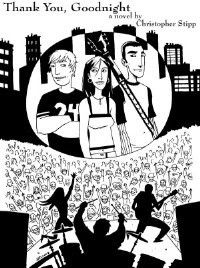
Note Bene: I have decided that instead of putting off and putting off and putting off my vow to somehow market my first novel I would let people download and read it for free. Give it a preview, read the whole thing or, if you like what you see, send me some kind words or an order for the actual book. Download and read my first book “Thank You, Goodnight” for FREE. [With a cover drawn by Jim Mahfood]

I hated history.

Really, I was homogeneously unable to follow the whole ethos of “those who cannot remember the past somethin’ somethin’ or another” but there was one of only a few things that has always stayed with me since 7th grade World History class: the de’ Medicis.

While I’ll keep the Cliff’s Notes version here brief it is important for the reading of this interview to see that the actions of a once powerful family that lived and reigned around Florence, Italy, around the 13th century and ruled well into the 15th, helped to flood Renaissance art into the streets of that boot-shaped land. They were well-known for a lot of artistic sponsorships, money was no issue for an artist with a whim and a financial need, and it’s something that I’ve always hoped to young talents within the comic book industry, with Mahfood being a recipient of some kind to help keep the man’s art churning out into the world.
You see eggheads get the MacArthur “Genius” grant, a free $500,000 to keep on keepin’ on with your artistic bad ass self, but you never see it bestowed on artisans who choose to toil in the folk art of comic books. I’ve always equated those who possess the ability to transcend the mundane and static into something that can resonate with the human spirit with those who possess a tuning fork for the souls of the rest of us but, unfortunately, bigger eggheads with even bigger checkbooks deem otherwise.

So, that brings us to Jim. An accomplished comic book artist and writer who has a penchant for the askew and whose work is infused with the kind of black and white punch that’s usually reserved for those who have thousands of colors within their artistic quill. His work is funny. It can make you laugh with the absurdity that it sometimes espouses but when Mahfood suggests that more cool people get together to help offset all the straight-lace, right-wingers who seem to be repopulating at bunny-like proportions there is a thin line of truth in the sentiment that you cannot deny.

His work can get political. A weekly contributor to Phoenix’s New Times magazine Jim can take a hot-button topic, peel it back, and get to the quick about what’s really at issue in the community on any given day. He hits more than he misses and, even when he does, it’s just comforting to know that the man who pioneered Smoke Dog and Zombie Kid can still rock the political mic more consistently than the constituents who suppose their elected overlords are doing everything “in their best interest.”

The man who took pity on a lowly novelist who needed a great cover and didn’t want anyone else to create it but him, Jim Mahfood was a class act who laid it out and helped me put a tight cover to my first book. There’s a lot to be said about fanboys but there’s something else entirely to owning mass quantities of one person’s work and just hoping that there could be something you could do someday to say thanks. In a way, being able to interview Jim last year during Comic-Con was a way for me to delve deeper into the reasons why I dig the man’s work so much and, as I hope you see, there’s a real sense of humor, of perspective and drive that hopefully ensures he’s the premiere black and white funkmaster of the comic book scene.

Sure, he can keep going on his own but isn’t there a wealthy family out there that can help this man save the world, one live art event at a time?
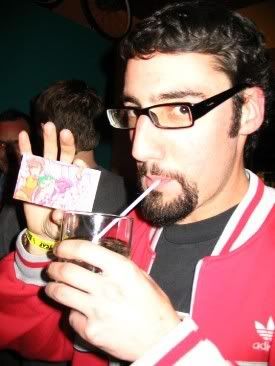
CHRISTOPHER STIPP: How many “˜Cons does this make for you?

JIM MAHFOOD: Probably”¦ Probably over a lot. A lot of “˜Cons. 50 or so”¦ I’ve been doing them for about almost 10 years. I do about 5 to 6 a year. It’s starting to wear, the wear and tear is getting to me. I mean, they’re great, San Diego is great but”¦5 days? 5 days is way too long. The other shows, like Chicago, are 3 days and that’s cool; see everybody, you’re in you’re out, you make your money but this is a little obnoxious. However, it’s only once a year so”¦
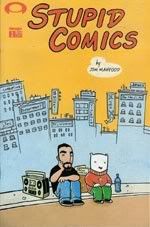
STIPP: But you’re on the front lines selling your own stuff. There’s a little bit of excitement, I could be way wrong, but you’re the one who’s written and drawn your work and here you are, selling to the public. Like the modern day DJ who’s selling their mix CDs out of the back of their trunk. Is that the way you want to keep it or do you have designs of someday hooking up with a big corporation like a DC or Marvel and have a cush gig just sitting at well-manicured tables for an hour or so just signing things?

MAHFOOD: Well, they don’t have the balls to do anything fun or cool or interesting, I think. Their stuff is OK but I’ve just been on my own, doing my own thing because I have complete control over it; I get to write it, draw it, design it, the way I want and I’ve always been attracted to art and music that’s been driven by one single person.

Like, my favorite musicians and DJs are the guys who write, produce and perform their own music and my favorite artists are the guys who have their own distinct stamp or style like, for example, Crumb or Mignola or Scott Morse. And I think that’s what’s selling this stuff, like the things that they do, what I do, is almost like a brand. The style is the brand. “Oh, I recognize your style,” that’s the kind of thing people say. They aren’t like, “Oh, your Spider-Man is cool.” What they’re saying is, “I like what *you* do.” “I like your vision, your writing, etc”¦” And that’s reflective of my own tastes and personality and sensibility. Certain people are attracted to that and some aren’t but that’s just the kind of art that I’m attracted to: people who have a voice and have something to say.


Unique. Uniqueness is key. Like I will never be the greatest artist of all time, the best storyteller or have the best layouts but that doesn’t matter to me. What matters is being unique. Just being an individual and not drawing like anyone else is what matters. That’s what I’m trying to do.

STIPP: Who are your peers that you look toward for inspiration?

MAHFOOD: Definitely my whole crew of buddies that I do art with like Scott Morse, Dave Crosland, Mike Huddleston, Jose Garibaldi“¦I grew up loving Ninja Turtles when it first came out, it was so different. Crumb stuff, the Hernandez Brothers, Jamie Hewlett who did Tank Girl and all the Gorillaz artwork, just guys who their own unique thing that they alone do.

I’ve never really been into mainstream superhero artists not because those that are working on them are bad artists”¦it just doesn’t strike me. I like things that make you go, “Wow, that’s different.”

STIPP: How are you evolving as an artist? I just finished your Classic 40oz. One thing I noticed about your work years ago was how sharp the artwork was. Not just in the ephemeral sense but, quite literally, the drawings had a tight attention to detail. And now, when you look at your work there is a looseness, a roundish feel, to what you’re doing. Is that something you’re consciously thinking about?
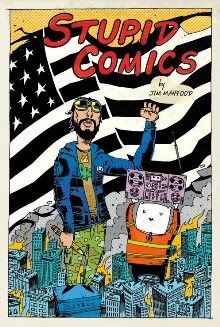
MAHFOOD: Yeah, but it’s also something that unconsciously evolves on its own, too. The more you do it, you hope, the better you get and things start to work themselves out but, yeah, I definitely consciously started going”¦going from portraiture kinds of things to straight up Peanuts style. Where the drawings of me and my friends have round heads and little arms and little legs because I think it looks funnier, for one, and also I don’t take myself seriously enough to do realistic portrait work of me and my friends; it would be too weird.

So, I went and depicted them as these cute little cartoon characters, kind of like as buffoons. It’s cartoony and it’s supposed to be funny. And that’s one of the main things about my work, I am a huge fan of comedy and humor and I try to put comedy and humor into everything I do. I don’t think I could ever do a serious, hardcore detective book or a serious western”¦I mean it’s cool, it’s interesting, but, for me, I just don’t take myself, in my heart, seriously enough to do those sorts of things. I just like humor. I like to make people smile or chuckle. The world is depressing enough as it is but with my art I want people to be, “Oh, that’s interesting”¦It’s funny”¦It has something to say.”

STIPP: On that same token, I like what you’re doing with the weekly space you’re being given every week in the Phoenix New Times. It’s very political in a way; whatever issue is brewing within Phoenix’s border that week you somehow spin it into something amusing or thought-provoking.
MAHFOOD: Yeah, totally.

The weekly is more of an exercise because, since it’s a weekly, I have to throw out an idea every week”¦the idea and the art are done really quickly. I spend about an hour on them. I do them”¦right before they’re due and it’s more like an exercise of, “Here’s something that’s going on and here’s me commenting on it.” It’s literally supposed to be read within five seconds. The art isn’t that detailed because they don’t print them that big and the people who happen to land on that Letters page just glance through it and it’s just gotten to the point that instead of drawing intricate word balloons and lots of dialogue it’s simply five panels and, “Ah, yeah, funny.”

If you look at these things from the beginning there’s like 10 panels, whole lots of word balloons, it’s all very heavy diatribes but now, for me, it’s a looser idea of, “Let’s put out 10 ideas instead of one really detailed, convoluted, idea.” And there’s so much to comment on nowadays.

STIPP: How do you keep up with what’s happening in Phoenix if you don’t really live there anymore?

MAHFOOD: I live in LA and do the local Phoenix weekly, yeah. I just go to the Phoenix New Times.com and just read up on Phoenix news. I’m also good friends with the editor there and she will sometimes just hit me up like, “Would you mind, you should consider having your comic be about this hot topic right now.” She’ll send me the info, I’ll read it and I’ll comment about it.

It’s not heavily researched at all. It’s just me reacting to it. It’s like, here’s this fucked up story about the Phoenix cops and here’s me reacting to it. But it’s cool, man, because it was really challenging in the beginning but now I’m getting used to it and I really enjoy having a weekly because it keeps me on my toes. I’ve never done one before and every week it’s a new idea that gets put out there. Like, if one of them isn’t funny, or it doesn’t work very well, it doesn’t matter because I’ll have another chance next week. So, it’s almost like a safety net because every week I don’t have to blow people’s minds because the next week I can compensate for it”¦.Which”¦.may be a very bad way of looking at it.

(Laughs)

STIPP: Are you finding some political satisfaction in taking a stance every week for the people to interpret?

MAHFOOD: Oh yeah. I’ve always wanted to do that. I’ve always been a huge fan since I was a little kid of political satire in a cartoon-y format. Huge fan of Mad Magazine, Cracked, Saturday Night Live, HUGE fan of Bloom County the comic strip…Opus, Bill the Cat”¦huge fan of all that stuff.

The thing is”¦I’m not that smart or that politically savvy. I don’t watch CNN. I don’t really read the paper but I have an overall idea of all the crazy shit that’s going on and I feel like I am able to comment about it because it’s me writing, drawing and doing it all. People might think I’m crazy or they might agree with me so either way”¦It’s something I really enjoy. I couldn’t imagine doing art and not having a comment on the world and society we live in.

Like, in art school, in illustration class, we had to do shit like paint a shampoo bottle, photo realistically. Exercises like that always drove me crazy because I knew I would never use that in my artistic life. I just could never imagine being just an illustrator”¦illustrating cars or something. For me, it’s always been like, “There has to be a message in it”¦there has to be substance in it”¦there has to be more than just this surface bullshit.” There has to be some substance to it. There has to be something that draws people in and I think that might be one of the selling points to my art: the fan base that I have seem to be interested in the overall picture of, “I dig your art”¦but I also kind of dig the ideas and the humor and the writing”¦I kind of dig your whole vibe.” And, so, that’s what I’ve tried to establish. These are my books, this is my world and it’s not based on anything else.

It’s my funky version of the world.

STIPP: Do you ever question yourself?

MAHFOOD: Oh yeah. All the time. I sometimes think I’m just a huge hack. But something will happen where I do a piece, I’ll do a live art thing or a Stupid Comic and it’ll kind of gel and I’ll look at it the next day and go, “Oh, I’m kind of happy with that.”

The other thing, too, is, looking back, which I hate to do, I hate anything I’ve done that’s over a year old, when I look back at my old stuff the only good thing about doing that is that it lets me know I’ve evolved and that I’m better now. Because I really am trying to evolve the art style, the drawing, and trying to push it, trying to push the design, the compositions of it, just by hanging out with guys, real bad asses, like Scott and Mike Huddleston. If you’re an artist and you surround yourself with guys who are better than you, you just learn and absorb from them. You borrow from them. Like, I used to hang out at Scott’s studio when he lived there in LA. I would just go there and see what he was working on, watch him work, and borrow and absorb what he was doing. Not steal it, take it and apply it to my style and do it differently. It’s like if you’re a DJ and you sample. Don’t just lift and sample the most obvious drum beat”¦go dig into the weird, obscure shit. Take it and make it into something really exciting.

STIPP: What is it about music that seems to be infused within your artwork?

MAHFOOD: Just like the attitude and the feeling of the music. I get a really specific feeling and attitude feeling towards things like hip-hop and hip-hop culture and funk and jazz. It has a particular rhythm and vibe that it gives off to me. I was around it ever since I was a kid. Like my mom raised us on records. She was always playing records like Michael Jackson, Earth, Wind and Fire and also like rock n’ roll, Neil Diamond and Queen”¦it’s just always been”¦I’ve always just sat in my room and drawn and listened to music. I never really watched TV and drew, I’ve never had talk radio on”¦I’ve just always out on music as a kid, locked myself in my room, and drew. And it became a soundtrack to what I was drawing. If I was angry, or doing something aggressive, I’d put on punk rock or if I was doing something more inspired I’d put on hip-hop. Music always has intrigued and fascinated me. So, I’ve tried to develop a visual style that conveys my reaction to music and”¦it might work and it might not work.

And the live art, the live art is a literal reaction to music because we are literally painting and drawing what we’re feeling while the music is going on, loud as fuck, pumping through our bodies, our eardrums, like when Scott and I paint live we don’t talk about what we’re going to do, we don’t plan it out. We just go up and we do it. It just comes out, it’s like an exorcism”¦and it’s like this subconscious, crazy shit just comes out and when a piece is done sometimes you step back and it’s like, “Whoa. Wait. Where did that come from?” But it just came out. It is what it is.

It’s like improvisational jazz. You know, when Miles Davis would just get up there and just play. And freestyle.

STIPP: How do you see yourself progressing as an artist? When you look at yourself, what is driving you day-after-day?

MAHFOOD: Well, I always want to do comics in some form or another, and I always will, but I would love to be able and take the live art thing on an international tour. Get a bunch of artists, get a bunch of DJs, get it sponsored by, like, a shoe company or a marker company or some hip company and literally take it around the world and do comic book stores, signings during the days, and then live art in clubs at night.

It would be a dream for me. So, it’s starting to catch on and blow up and it’s, hopefully, leading to that. It may take a little while to get sponsors but I already have like artists and DJs all ready to go. It’s just organizing it and figuring out how to do it.

QSE News: 6/15/2007

Filed under: Columns,News — UncaScroogeMcD @ 12:15 am

quickstopnews.jpg

line1.gif

Here are today’s top entertainment headlines:

  • qsnews.jpgTroubled pop star Britney Spears has reached out to her fans, asking them to help pick the title of her next album.  On her webpage, Spears has posted several titles – including Dignity and Integrity, and the joke OMG is Like Lindsay Lohan Like OK Like? Not surprising after recent events, the leading vote getter is the title Curtains Finally Match the Carpet.
  • Filmmaker Steven Spielberg has announced that he will support Hillary Clinton as she tries to become the next president of the United States.  We here at QSE News would like to commend Mr. Spielberg on making a brave choice, but we are a little concerned over his use of the phrase “the only Bush I trust in my own.”

line1.gif

That’s all for today’s news, stay tuned to this channel for all the news that matters least but you still care about.

(Compiled by J. Allen)

##

Quick Stop Thingamabobs: 6/15/2007

Filed under: Columns,Thingamabobs — UncaScroogeMcD @ 12:13 am

thingamabobs.jpg

The web. It’s a big place, full of plenty of distractions ““ some funny, some informative, some ludicrous, some disturbing, some inane, some profound. Each and every weekday, we present links to a few of our favorite finds”¦

————————————————

  • Our own Kevin Smith is the featured guest on the latest podcast from Sideshow Collectibles… (Thingamabob)

Have a THINGAMABOB? Send it in!

##

June 14, 2007

Contest: Rocky & Bullwinkle Present – “Father’s Day, AGAIN?”

Filed under: Contests — widge @ 3:25 am


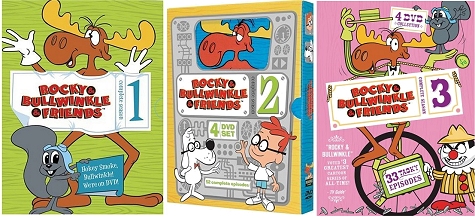
In conjunction with Classic Media, Quick Stop is celebrating Father’s Day by giving away not one, not two, but THREE complete sets of the first three seasons of ROCKY & BULLWINKLE & FRIENDS on DVD. You don’t have to be a graduate of Wossamatta U to know you want in on this…

All you have to do is fill out the entry form below, and hope we pull your name out of the hat”¦

Contest ends at midnight EST on Monday, June 18th.

Enter the contest!
Email:
First name:
Last name:
Street Address:
Address Line 2 (if needed):
City:
State/Province/Whatever:
Zip Code/Postal Code:
Country:
Birth Month:
Birth Day:
Birth Year:

Official Rules

No member of Quick Stop Entertainment or their immediate families may enter.

No Purchase necessary to win.

Must be 18 years of age or older to enter.

All submitted entries must be received by 11:59pm EST on Monday, June 18th.

The winner must allow 4-6 weeks after announcement of win to receive the product.

Party Favors: Corin Nemec & More

Filed under: Columns,Interviews,Joe Corey's Party Favors — UncaScroogeMcD @ 1:53 am

partyfavors1.jpg

nemec-01.jpgCHICAGO – Parker Lewis can scare the shit out of you.

It’s a chilling title performance from Corin Nemec in Chicago Massacre: Richard Speck. Nemec delivers the kind of homicidal action that makes me wonder why he wasn’t cast as either Dick or Perry in the numerous Truman Capote films.

Corin called the Party Favors to discuss going from a child actor traumatized on the set of Webster to the maniac that killed eight student nurses in Chicago on July 14, 1966. What did Corin do to get Speck’s stare?

“The stare?” Corin replied. “The stare that was coming from the character was a product of just finding the beingness of the character. Growing up in the South (Corin was born in Arkansas), there’s a different beingness in the South. It’s a much slower kind of place. When I read the script and realized it was more of a character study than a horror/slasher film, that excited me. Then I Wikipedia-ed him. And I was like, cool, I know exactly who this guy is. It was really just a matter of working with director, Mike Phiffer on finding the correct beats and moments to climax. And then relaxing into being that Southern guy again.”

Toward the end of Speck’s life, he made a videotape showing his party life behind bars. The movie features Corin as the transformed felon. How long did Corin study the tape to nail the nuances?

nemec-02.jpg“I intentionally didn’t want to see it,” Corin said. “Mike said we don’t want to recreate it. We were just going to do our own version of what that was. Anything and everything we said in there, except for the one famous line, ‘If they only knew how much fun I was having, they’d turn me loose,’ was all improv. I certainly wasn’t interested in mimicking the guy.”

The centerpiece of the film is Speck’s gruesome attack on the student nurses. The scene took up most of the production. They spent three days – which is nothing for a Chris Tucker vehicle.

“This was a small independent film and we only had 11 days to shoot it. We made a film that can stand up against a lot of films coming out in theaters right now. We got a full length feature with no holes in the storyline.”

Speck took hours beating, raping and finally stabbing the student nurses to death. It’s an intense part of the film.

“The rape scene is the most disturbing in the film,” Corin said. “Outside of that, the rest of it is fairly palatable when you’re talking about genre specific. The fact that its based on a true story deepens the emotional impact of what you’re seeing. if you’re watching a movie like Saw, it’s not nearly as disturbing because you know its not real.”

How exactly can an actor like Corin, so known for playing nice guys in film and TV show, get into the role of Speck? And how did he get out of this mindset?

“I studied with Manu Tupou, He had his own theater company called the American Repertory Company. He was in the Actor’s Studio when Marilyn Monroe was there. What he taught was his own Method, which was creating the character as it was scripted,” Corin said. “Living the life of the character as the beats and moments suggested in the material. Then finding whatever new and original beats and moments come out of that by working with the director and living the life of the character organically in the moment. As it’s scripted, this is what the character does – not me. That’s how I separate myself from that. I don’t use the Method. I’m not going into my own past to create a psychological condition that would drive me as an actor to create that moment. When you can embrace the life of the character and the environment and the scene that’s taking place, the rest happens naturally if your instrument is tuned.

One role you shouldn’t be seeing Corin taking is himself on VH1’s Celebreality programming.

“I’ve been approached to do some of these VH1 things like I Love the 80s and Where Are They Now. I refuse to do it ’cause you can imdb.com me and see where I am. I’m a working actor,” Corin said. “Just cause I was on a hit show in the 90s and I got an Emmy nomination when I was 15 for I Know My First Name First Name Is Steven, doesn’t mean I stopped the process of being an artist. I was raised by artists and I was raised to be an artist. When the show ended, I went back into theater and started studying at the American Repertory Company and continued doing films, mini-series, independent features, television pilots, guest spots and on and on and on over the next 12 years. Now I’m actively writing, producing my own films as well as starring in them.”

Besides starring in Chicago Massacre, Corin came on board as an Associate Producer. Hen wants to make sure he takes roles that don’t typecast his talents.

“Doing a film like Richard Speck, as an artist, is along the lines of what my spine is. I want to do stuff that is original, deep, moving, shocking, that as an actor is challenging. On the flip side, to have another film like High Hopes, with David Faustino and Jason Mewes, which is a total comedy, that film is just as detailed in terms of character development as Richard Speck, but it’s a comedy. it’s exciting for me to have both of these films coming out one after the other.

“At 13 years old when I saw that I could make $9,500 a week, it was like, ‘Great!’ That’s when I went for money over art. When I finished my run on Webster, I chose to never make that move ever again. Because I have kids and bills to pay, I have made films that I might not normally do, but what I learned from Manu was that it doesn’t matter what the project is. It matters what you bring to it as an artist. No matter what the storyline is, whether it be as silly as SS Doomtroopers or Mansquito or things I’ve done from SciFi Channel, which were a lot of fun, I’m going to bring to that, everything that I have to offer as an artist.”

Corin is in the process of making his own movie for the SciFi Channel. Getting back to his early days on Webster, I pondered what sort of football tips did Alex Karras give a young Corin. Did they throw the pigskin around between takes?

“No. Absolutely not,” Corin said. Turns out that real-life married couple Alex Karras and Susan Clark, were going through a rough patch and playing a happy couple on TV took its toll. “They had to stop working in front of a live studio audience because of the terrible fights and arguments that would happen on the set.” Corin was shocked at the cuss words that were thrown around the set. He holds very few fond memories of the gig. “I didn’t enjoy the half hour multi-camera format. I didn’t enjoy the style of writing. It was forced,” Corin said.

The producers of Parker Lewis Can’t Lose wanted to cast Corin after seeing him in the pilot of What’s Alan Watching? that was produced by Eddie Murphy.

“When Parker Lewis got the green light at Fox, I had just finished a huge $48 million feature film called Solar Crisis with Jack Palance, Peter Boyle and Charlton Heston. I was one of the lead actors in it. I thought that was going to be my film career. I thought that was the way to go,” Corin said. “When Parker Lewis was offered to me, I turned it down a total of six times before I finally sat down with them and they told me they weren’t doing multi-camera. It was going to be shot like the feature film Three O’Clock High. After that meeting, I was in. We did the show and it was great.”

The show lasted three seasons on Fox and has enjoyed a long syndication life across the Atlantic. “I’m more famous in Europe than I am here,” Corin said. According to some reports, Corin is approaching Hoff levels in Prague. For those fans of Parker Lewis Can’t Lewis, there is sad DVD news.

“I was actually working with Shout! Factory to license the rights from Sony for the DVD set,” Corin said. Sony wasn’t willing to license the rights because the didn’t want to share the profit. My excitement was to be able to work with Shout! Factory and be hands on making the extras and be the actual guy to interview the producers, the writers and the cast members. We couldn’t get the nod from Sony so now we’re in a holding pattern.”

Parker Lewis came out the same season that Ferris Bueller’s Day Off was adapted as a series. Small screen Ferris died after 13 episodes. While TV critics at the time called Parker a knock-off of the series, Corin knows better.

“They created the concept of Parker Lewis before Ferris Bueller ever came out in theaters,” Corin said. “A lot of people don’t realize that Parker Lewis wasn’t because of Ferris Bueller.”

With High Hopes on the release horizon, I asked about working with Master Thespian Jason Mewes.

“Having the opportunity to work with him in a buddy film with David Faustino is just perfect. When people see the movie, they’ll see that the relationship seems very real and believable and not forced at all. It’s a kind of a slice of life film. It’s not really your general approach to the marijuana mayhem comedies. You’re watching these guys struggling to get ahead and they come across a million dollars in government weed which they decide to sell to make their own independent film. Jay is the slacker who doesn’t do anything. I’m a struggling actor. David’s a struggling writer. Together we come up with this great plan.”

The film features numerous cameos including Andy Dick, Edward Furlong, Edward Bunker, Danny Trejo, Robert Rodriguez, Ted Raimi and for WCW fans – Diamond Dallas Page.

This isn’t the first dope comedy on Corin’s resume. “I did another one with David Faustino called Killer Bud.” There’s a lot of people hoping this twosome complete the trilogy.

Chicago Massacre: Richard Speck is out on DVD from Lionsgate. High Hopes will also be coming out on DVD from Lionsgate.

WHERE’S ALBERT

After my report from the Full Frame Documentary Film Festival, a few people wrote to ask why Albert Maysles was missing. The Party Favors wrote Albert. Turns out that he’s doing well and being kept extra busy on various projects so that he didn’t have the time to visit Durham. He’s also become the toast of Broadway with Grey Gardens being up for nearly a dozen Tony Awards and winning Best Actress and Best Featured Actress in a Musical. Who knew that the movie he and his brother David made would dominate the Great White Way?

According to rumors, producers are developing the Maysles brothers biggest hit for the 2009 season. Gimme Shelter will be presented in “Beat Around.” During the recreated Rolling Stones performance at Altamont, the actors playing the Hells Angels will come out into the seats and attack audience members with pool cues. You’ll remember to turn off your cellphone after your wife gets stomped into the carpet by Sonny and his crew. Like Will Rogers’ Follies, each show will feature a celebrity playing almost assassin Meredith Hunter. With the excess of reality show stars that want to remain in showbiz, they’ll beg to be the one to attempt to shoot Mick Jagger. What’s a molar to claim a legit stage credit? Imagine that, in one week, we can eliminate the entire cast of Real World: Newark.

The only problem right now is lining up enough hospital beds to treat the audience after each show.

GREATEST COMPETITION SHOW EVER

All bow down and worship at the intense insanity that is Ninja Warrior on G4. It’s MXC for the hardcore desiring a serious obstacle course. A hundred people attempt to tackle these courses that test the skills that only a great ninja warrior can accomplish. Why do the Japanese come up with kick ass gameshows while we’re stuck watching people open suitcases?

Normally this is where I’d blast G4 for running a show that has nothing to do with video games, like The Man Show. But Ninja Warrior is a live action video game. These guys are pretty much performing Pitfall and Super Mario Brothers as they race across the swampy course. I’m hooked.

CARBON NONSENSE

Here’s a little environmental conservation tip that you never hear from Leonardo DiCapio: Instead of wasting gas driving to a movie theater to see his new blockbuster, wait for it to appear on TV. Don’t buy the DVD. Producing DVDs involves mining of metal and the evils of plastic. Plus think of all the fuel used to ship that little box to the store or your post office box. Just wait for it to appear on HBO. And if you have a pedal generator to run your TV set, that would be best, so you are making your own electricity.

BLAH-VO

Every so often, I get bugged that my local cable company refuses to carry Bravo. Normally when they’re hyping a new reality show. But then I visit someone with a dish and get so deflated at their programming. During Memorial Day weekend, I clicked onto the channel in the evening. Instead of interesting and freakish programming, they were running Waterworld. Why the hell should I make a scene to get this channel? I’m better off just waiting for the DVDs of their original programming to get listed on Netflix.

Why is Twin Peaks on Universal’s Chiller channel when it’s got enough cops and FBI agents in the cast to be put on Sleuth?

ICED TRUTH

For the longest time, I swore Tony Sinclair of Tanqueray Gin fame was the DJ on the Ellen DeGeneres Show. He seemed like the kinda guy who could give Ellen a case of happy feet. Was I wrong. Not that I bet money or caused a bar fight based on this misconception. But damn it, how can it be that Tony Sinclair is a creature completely conceived on Madison Avenue? Who thought he’d be like Steven, the Dell Dude? Tony is played by actor Rodney Mason – who doesn’t have too many major credits to his name. He hasn’t even appeared as a witness on a Law and Order or CSI. Hopefully that will all change with The Case of the Missing Limes.

QSE News: 6/14/2007

Filed under: Columns,News — UncaScroogeMcD @ 1:11 am

quickstopnews.jpg

line1.gif

Here are today’s top entertainment headlines:

  • qsnews.jpgAs a sign of the pending apocalypse, the band Good Charlotte is joining forces with Justin Timberlake for a tour this summer. Kicking off on August 6 in Memphis and adequately named the “Not A Hair There” tour, the show promises to bring a level of “suck-itude” to the stage that hasn’t been seen since in years.  Fortunately, both acts have promised to play “only the hits,” ensuring that the show will be no longer than half an hour and will not force their collective fan base to miss nappy time.
  • Korn frontman, Jonathan Davis, is writing an opera. Yeah, you read that correctly. An opera. There is no joke associated with this news item as it itself is a joke. Seriously… as hard as we try, there’s just some shit you can’t make up. Some days it all just stops making sense.

line1.gif

That’s all for today’s news, stay tuned to this channel for all the news that matters least but you still care about.

(Compiled by J. Allen)

##

Quick Stop Thingamabobs: 6/14/2007

Filed under: Columns,Thingamabobs — UncaScroogeMcD @ 12:41 am

thingamabobs.jpg

The web. It’s a big place, full of plenty of distractions ““ some funny, some informative, some ludicrous, some disturbing, some inane, some profound. Each and every weekday, we present links to a few of our favorite finds”¦

————————————————

  • RIP, Mr. Wizard. I’ll never pass a supermarket without thinking of your science… (Thingamabob)
  • How about The Wedding Singer, Broadway style?… (Thingamabob)

Have a THINGAMABOB? Send it in!

##

June 13, 2007

QSE News: 6/13/2007

Filed under: Columns,News — UncaScroogeMcD @ 1:36 am

quickstopnews.jpg

line1.gif

Here are today’s top entertainment headlines:

  • qsnews.jpgThe recently crowned Miss Universe, Riyo Mori, has auditioned for a role on the hit TV show Heroes. It is not known exactly what part Mori would be playing, but series creator Tim Kring did mention that “she will be the love interest for one of the existing characters on the show.” Kring continued by saying “if (Mori) gets the part, her super power will be the ability to suck a golf ball through a 30 foot hose.”
  • The band Cat Power has won this year’s Shortlist Music Prize. Cat Power’s album, The Greatest, was chosen as this year’s winner by other musicians including Sufjan Stevens, Wayne Coyne, KT Tunstall and some dude from Panic! At the Disco. Cat Power won despite a strong entry from Kevin Federline.
  • And finally, in sad news, Don Herbert, better known as TV’s original Mr. Wizard, has died at the age of 89.  From 1951 ““ 1964 Herbert taught kids all over the country simple science experiments that they could do in their own homes. Herbert died on Tuesday doing what he loved to do… using science while banging hookers.

line1.gif

That’s all for today’s news, stay tuned to this channel for all the news that matters least but you still care about.

(Compiled by J. Allen)

##

Quick Stop Thingamabobs: 6/13/2007

Filed under: Columns,Thingamabobs — UncaScroogeMcD @ 12:01 am

thingamabobs.jpg

The web. It’s a big place, full of plenty of distractions ““ some funny, some informative, some ludicrous, some disturbing, some inane, some profound. Each and every weekday, we present links to a few of our favorite finds”¦

————————————————

  • It’s a Mads vs. the SOL swing choir competition… (Thingamabob)

Have a THINGAMABOB? Send it in!

##

June 12, 2007

Toy Box: VOTC Bossk

Filed under: Columns,Toy Box — admin @ 1:24 am

toybox.jpg

Last week, we checked out the mini-bust for one Star Wars bounty hunter, Zuckuss. We have ourselves a theme going here, with another review of a Star Wars bounty hunter this week. This time it’s Bossk, and it’s his new Vintage Original Trilogy Collection (VOTC) version just hitting stores.

The first series of VOTC figures was part of the 2006 Galactic Hunt. If you bought the full series, you could send in for a George Lucas figure. Big whoop. If you pick up this second series, you get a much cooler mail away. Buy all six figures (or any combination of six figures), place the gold stickers inside each package on the redemption form, and send it in. Hasbro will send you back a set of the six metal coins for these VOTC figures, plus a seventh Toy Fair exclusive coin, all in a nifty box! I’m tempted to pick up the other five figures just to snag the coin set, which is the perfect example of an excellent mail away offer.

You can find these guys at regular retailers right now for a whopping $12 each. Target is where I picked mine up, but you can snag them online as well if need be.

VOTC Bossk

toybox_061207_1.jpg

Packaging – ****
If you love vintage figures, you’re going to love this packaging. There’s an outer clamshell designed to keep the interior vintage style package safe and sound. This outer clamshell is heat sealed unfortunately, which means you’ll have to cut it open and not be able to reuse it.

toybox_061207_2.jpg

Inside is a terrific vintage style bubble/cardback. Anyone who has fond memories of picking the original line up off the pegs will enjoy the flashback these provide.

toybox_061207_2b.jpg

Inside the package is the small gold sticker and redemption certificate, both inside a small plastic bag and taped to the clamshell. Remember to pull these out before you toss the packaging.

Sculpting – ****
On occasion, I hear from collectors that complain that I’m too hard on sixth scale figures, busts and statues for the sculpt. That it’s difficult to capture detail and appearance at that small of a scale. But if that’s true, how is it possible for Hasbro to manage to do this amazing of a sculpt at this tiny scale? This figure is just under 4″ tall, yet has excellent skin texture and scaling.

toybox_061207_3.jpg

The figure has several outfit pieces that are separate pieces and added later. The suit straps are done in a softer material, and hang fairly well on his body. His hands are sculpted to hold the gun, and he stands great on his own as well.

All the VOTC figures have been above average, but Bossk is clearly one of the nicest of the series. For fans of this particular bounty hunter, he’s the perfect version.

Paint – ***1/2
The paint isn’t *quite* as strong as the sculpt, but it’s still strong. There’s a nice wash on some of the outfit, along with a good use of paint to bring out the details in the skin and face.

toybox_061207_4.jpg

The teeth aren’t quite perfect, and there’s a little bit of slop. But considering how small the scale is, it’s still a tremendously impressive job.

Articulation – ****
This is the most impressive set of joints in this scale I’ve seen, using what they’ve learned with some previous figures and engineering all the joints to work extremely well.

toybox_061207_5.jpg

There’s a ball jointed neck that tilts and turns extremely well. There’s ball jointed shoulders, cut forearms, and the pin/socket elbows that allow both forward and backward motion along with turning 360 degrees.

The knees work the same way, with a very good range of movement. The ankles are pin joints, and there’s a great ball joint at the chest. Finally, he has the usual T hips, but the uniform straps would reduce the usefulness of any sort of ball joint here.

That’s some truly impressive articulation, and the fact that all the joints work extremely well is icing on the joint cake.

Accessories – ***
Bossk comes with one accessory, his blaster. It fits nicely in his sculpted hands, and he can hold it in one or both. The strap that holds it around his shoulders is formed into a rather large loop, and it’s somewhat stiff plastic so that it doesn’t easily conform to his body. It looks much better in his hands, and that’s the way most folks will display him.

toybox_061207_6.jpg

Fun Factor – ****
This figure practically defines fun. Excellent sculpt and paint, with terrific articulation, all in a sturdy package that won’t break easily under normal play. What could make it better? This guy is an alien! He practically screams “play with me”.

Value – *1/2
Unfortunately, the one category that hurts this figure is Value. At $12, he’s definitely overpriced. Eight bucks I can see, and even ten wouldn’t be terrible, but at twelve it might be hard to convince folks to pick him up, especially after most of the first wave ended up on clearance.

toybox_061207_7.jpg

Things to Watch Out For:
Nothing with the figure, but don’t forget to snag the small gold sticker and redemption certificate from inside the bubble before you toss out the packaging.

Overall – ***1/2
This was *almost* a four star figure. Had the price been more in line with the regular line, he would have easily gotten four stars. With the amazing sculpt and great paint and articulation, this is easily the finest version of Bossk we’ve ever gotten, and one of the nicest figures in the whole line up.

But at $12, you really are paying a huge premium. Even at eight bucks, I’d give this guy the full score, but at this high of a price tag there’s no way I can do it and still sleep at night. Okay, I’d still sleep just fine, but you get the idea.

Where to Buy –
You can find these guys at Target stores, but for a terrific online option for all things Star Wars, check out Andrew’s Toyz.

Related Links –
The latest reviews of the smaller figures I’ve done include the 30th Anniversary Galactic Marine, Lava Miner, concept Stormtrooper, and Airborne Trooper; Hem Dazon; Foul Moudama; and the Firespeeder Pilot.

Monkey Talk with Paul Dini: Stuffed Animal Stand-Up with Rashy #1

Filed under: Monkey Talk,Quickcasts,Video — UncaScroogeMcD @ 1:21 am

monkeytalkheader.jpg

-By Paul Dini & Rashy

Paul Dini’s “Monkey Talk” (co-hosted by his irrepressible sock monkey son, Rashy) returns with Rashy’s attempt to break into the dog-eat-dog world of Stuffed Animal Stand-Up. Be sure to check out Rashy’s official site at LittleRashy.com

monkeytalk2007-06-12.jpg

DOWNLOAD:
Large
(560 x 420 – QuickTime – 9.89 MB)
Small (320 x 240 – QuickTime – 4.32 MB)

##

QSE News: 6/12/2007

Filed under: Columns,News — UncaScroogeMcD @ 1:02 am

quickstopnews.jpg

line1.gif

Here are today’s top entertainment headlines:

  • qsnews.jpgGus Van Sant has been attached to direct a film adaptation of Tom Wolfe’s book The Electric Kool-Aid Acid Test. The book, which is a true account of a cross country trip by author Ken Kesey, focuses on extreme drug use.  At this time no actors have actually been cast, but producers are expected to give the Kool-Aid Man a minor cameo appearance.
  • It has been announced that Director Tim Story, whose Fantastic Four: Rise of the Silver Surfer opens this week, will direct a movie based on another comic book, The Losers.  Story has said that the movie will stick closely to the comic book and will be about a rag-tag group of betrayed soldiers, and not comic book fans.
  • It appears Kate Moss is looking for a fight with singer Amy Winehouse. Moss allegedly had Winehouse’s husband thrown out of a VIP tent at the recent Isle of Wight festival. Responding to the slight against her and her husband, Winehouse has proposed a challenge to Moss to settle the rift before it gets worse ““ the first one to shoot 50 kilograms of junk into their eye socket wins.

line1.gif

That’s all for today’s news, stay tuned to this channel for all the news that matters least but you still care about.

(Compiled by J. Allen)

##

Quick Stop Thingamabobs: 6/12/2007

Filed under: Columns,Thingamabobs — UncaScroogeMcD @ 12:59 am

thingamabobs.jpg

The web. It’s a big place, full of plenty of distractions ““ some funny, some informative, some ludicrous, some disturbing, some inane, some profound. Each and every weekday, we present links to a few of our favorite finds”¦

————————————————

  • Penn & Teller explain sleight of hand.. (Thingamabob)

Have a THINGAMABOB? Send it in!

##

June 11, 2007

SModcast 15

Filed under: SModcast — UncaScroogeMcD @ 12:27 am

newhead2.jpg

SModcast is the meandering palaver of a pair of dudes whose voices are so dull, they don’t deserve to be on the radio (and, hence, aren’t). Kevin Smith and Scott Mosier are SModcast.

The best thing about SModcast? It don’t cost nothing.

line.gif

SModcast 15: The Pretty-Good Worker –

In which things go back to normal and our heroes discuss the passing of a bear-like legend, ruminate on the emotional and physical perils of pet ownership, confess to being cat people, fret over Weiners hunting weiners, become the Jolie of dog adoption, and incur the wrath of all right-thinking and decent people by spending nearly an hour trying to figure out whether Helen Keller was truly impaired or just party to an elaborate ruse.

[CONTENT WARNING] SModcast features harsh language and even harsher notions of propriety. Listener discretion is advised.

DOWNLOAD: (right click to save)
SModcast 15 (MP3 format) – 52.15 MB

[display_podcast]

SUBSCRIBE
Subscribe to this Podcast via iTunes
Subscribe to this Podcast via FeedBurner

Wanna add your two cents? Spend it here, in the SModcast mailbag.

line.gif

CLICK HERE FOR THE SMODCAST ARCHIVES

line.gif

##

Nocturnal Admissions: DVD Review WR: Mysteries of the Organism, Sweet Movie

Filed under: Columns,Nocturnal Admissions — UncaScroogeMcD @ 12:23 am

nocturnalheader5.gif

Box covers

WR: Mysteries of the Organism is one of the greatest films ever made, but yet is largely forgotten and never makes Best Of lists. Even during its short, intense phase of art house popularity in 1971, it suffered mispronunciation, most people reading the title as “Mysteries of the Orgasm,” a not inappropriate confusion, as it turns out, given the film’s subject matter, which is in part psychoanalyst Wilhelm Reich’s concern with freeing human energy through fruitful sexual climaxes. An image from the film even made it as the cover image for Amos Vogel’s Film as a Subversive Art, but that was it (and even the book is out of print). Like his Hungarian counterpart, Miklós Jancsó, director of such now forgotten masterpieces as The Red and the White, Makavejev is a man without a country or a legacy. Now thanks to the Criterion Collection, which has released Both WR and its companion feature Sweet Movie (CC Nos. 389 and 390, respectively), viewers can enjoy the continual relevance of the film to contemporary times and revel in director Dusan Makavejev’s knack for finding the most exotic Balkan women on the planet, already made evidence in his earlier features Love Affair; or The Case of the Missing Switchboard Operator and Man is Not a Bird.

Milina military style

WR tells two stories in one film, or is two movies as one, a kind of intellectual Grindhouse. The first is a playful documentary of film essay on the life and thought of Reich, who was hounded by the U S government and died in prison in the mid 1950s. Scenes from this movie alternate with episodes from a fiction comedy about a Yugoslavian communist girl (Milena Dravic) having trouble reconciling her belief in the party with her sexuality. The documentary contrasts such things as fictional enactments of Stalin in Soviet cinema with Nancy Godfrey, the woman who made plaster casts of rock star penises.

WR team

It’s a very funny movie and also a time capsule of concerns raging at the height of the hippie and protest movements in the West. In the Reich part, Tuli Kupferberg, ex member of the Fugs, marches up the boulevard and in front of Lincoln Center as a demented soldier offering a form of street theater that is linked to Reich’s ideas that militarism and in turn fascism are the result of blocked sexual energy. Makavejev makes hay with the contrast between the European intellectuals who trucked into Reich’s campus in upstate Maine and the local yokels who comment on his odd behavior from the perspective of their bedrock simplicity, including the town sherif’s deputy who is also the town barber, who describes the odd manner in which Reich liked to have his hair styled (the strands rising up, toward heaven). Today’s sensibility might note that Reich, like all Freudians, was, consciously or not, a snake oil specialist with a bogus philosophy, but in the abstract his ideas are more congenial than Less a “talking cure,” Reich’s approach was more a screaming cure, finding its apotheosis years later in the practice of Arthur Janov.

Milina and skater

Dravic’s story is ostensibly funny but has a tragic core. She is a well meaning sad sack, yearning for sex, but she is not as lucky as her apartment mate (the delightful non-pro Jagoda Kaloper, who has real sex on screen with kittenish abandon, perhaps the perfect living argument for Reich’s ideals). She ends up with a State hero, a blonde haired championship ice skater who, instead of having sex with her, cuts off her head with the blade of his skate in a fustian of repressed rage and sexuality, afterwards wandering a deranged landscape with bloody hands where he finds a lone horse, a symbol of the free spirit he just silenced. One could write a whole essay about stray horses in modern movies.

Dusan today

WR comes in a window boxed full frame (1.33) transfer wit two sound options, mono 1.0 in all Serbo-Croatian, or English with Serbo-Croatian, plus optional English subtitles. For supplementary material, there is a commentary track pieced together from Raymond Durgnat’s BFI monograph on the movie, the late critic’s words read by Daniel Stewart. Durgnat’s book may have single handedly revived interest in the film. There are also two interviews with Makavejev, the first a half hour interview for Danish television, the second one from 2006 and conducted by Peter Cowie for the disc. Also included is a short self portrait, Hole in the Soul (1994), made for Scottish BBC, which features such curious scenes as Makavejev, a director, disallowed from shooting footage in the lobby of the Director’s Guild. The is also a four minute feature concerning a revised version of WR that Makavejev made exclusively for the BBC, which gave the director a chance to rethink aspects of the film. Finally there is a 16-page booklet insert with cast and crew, transfer information, chapter titles, and a long essay by Jonathan Rosenbaum, plus a booklet promoting Criterion’s noir films.

Carole Laure in chocolate

What egg yokes are to WR, chocolate is to Sweet Movie, which continues an exploration of the themes of sensuality and repression. This film, too, tells two heavily symbolic stories, one about Anna Prucnal as a prostitute living on a ship on which she cruises through Amsterdam, this tale blending themes of death and revolution. The second concerns the Candide-style (or Candy or Barbarella style) odyssey of a young woman, played by French Canadian actress Carole Laure, and ends up with the so called Actionist commune (to the real horror of Laure). It’s difficult to reconcile Makavejev’s concern with sexual freedom with the way Laure’s character is treated, little more than an impersonal piece of human debris carted from one extreme and unpleasant situation to another.

Boat prostitute

Aspects of Sweet Movie hark back to key films in cinema history, including Jean Vigo’s L’atalanta, and anticipates some aspects of Lars Von Trier. But in the end it is a much more chaotic film than WR, and its international cast and settings detach Makavejev from his roots, that is, Yugoslavia, where his anger and humor fueled his art. Sweet Movie is too often garish and adolescent, whereas his earlier films were sensual, keyed to textures and fabrics, and with a less oblique operating principle. The role of John Vernon, for example, as a millionaire industrialist, is only one in a succession of cartoon figures.

Sweet Movie comes in a widescreen transfer (1.66, enhanced), with a mono 1.0 – French – English track. For supplements, there is a short segment of Anna Prucnal singing a song used in the film on a French TV show, who reveals that one of the consequences of her appearance in the film was that she was banned from Poland for seven years. And there is another interview with Makavejev by Peter Cowie, plus one with Dina Iordanova, a film scholar who explains the background and meaning of the movie. Inside the box, there is a 16-page booklet insert with cast and crew, transfer information, chapter titles, and essays by Stanley Cavell and David Sterritt, plus the booklet promoting Criterion’s noir films. Both WR and Sweet Movie hit the street on June 19, and retail for $39.95 and $29.95.

QSE News: 6/11/2007

Filed under: Columns,News — UncaScroogeMcD @ 12:20 am

quickstopnews.jpg

line1.gif

Here are today’s top entertainment headlines:

  • qsnews.jpgThe film Ocean’s Thirteen was number one at the box office this past weekend. The film is the third in the continuing adventures of Danny Ocean, played by George Clooney.  The success of the film surprised many as it is actually a good, well made movie ““ the likes of which have not been well received by the American public.
  • In continued movie news, the horror sequel Hostel: Part II made only $8.8 million on its opening weekend. Experts are trumpeting the end of the resurgent horror genre as several of the more recent horror films have failed to live up to expectations. The experts are saying this despite the success of Shrek 3, the most horrifying movie ever made.
  • It has been announced that the movie Fletch Won has a new director and star.  After many years in development, the movie will now feature Dawson’s Creek alum Joshua Jackson as the title character and will be directed by Steve Pink.  Producers of the film settled on Jackson to star in the role after their first choice, Richard Simmons, was deemed too old for the role.

line1.gif

That’s all for today’s news, stay tuned to this channel for all the news that matters least but you still care about.

(Compiled by J. Allen)

##

Quick Stop Thingamabobs: 6/11/2007

Filed under: Columns,Thingamabobs — UncaScroogeMcD @ 12:16 am

thingamabobs.jpg

The web. It’s a big place, full of plenty of distractions ““ some funny, some informative, some ludicrous, some disturbing, some inane, some profound. Each and every weekday, we present links to a few of our favorite finds”¦

————————————————

  • What does Batman do with a bomb that isn’t Batman & Robin?… (Thingamabob)
  • Skinheads from Maine, courtesy of The Dana Carvey Show(Thingamabob)
  • I could care less for sports, but I do make exceptions for videos like these… (Thingamabob)

Have a THINGAMABOB? Send it in!

##

June 8, 2007

Keneteph’s Corner: My Favorite Things “Cali” – Stix In The Mix Productions

Filed under: Columns,Keneteph's Korner — UncaScroogeMcD @ 4:11 pm

keneteph.gif

keneteph2007-06-08-01.jpgStaying in northern Cali, I have to talk about indie HipHop producer “Stix.” He’s a classically trained pianist who KNOWS HipHop, and KNOWS how a HipHop track should sound. Because of his trained ear, many indie and mainstream artists alike go to him for production on their projects. Bay Area artists such as Too Short, B-Legit, and Keak da Sneak, have graced their vocals on Stix’s tracks.

The 31-year-old single father was classically trained at eight years old, and has been making Hip Hop beats since 13. This applied background gives him a wide range of tracks for any fans’ or artists’ tastes, from underground, mainstream, soulful, Hyphy, gangster or conscious. Stix took some time out to answer questions, giving us more info on his style.

THAAHUM: What is your opinion of the HipHop beats that are out today?

STIX: I think the beats are sounding better today than they’ve ever sounded. Hip hop keeps getting more versatile, from beats like Timberland’s to the chopped & screwed sound to the hyphy movement, there’s a lot more choices nowadays. That’s why hip hop’s bigger than ever. I think the lyrics were deeper in the old school, definitely sent a better message, but we’re talking about beats here.

THAAHUM: What style of tracks do you like to make?

STIX: The kind that get radio play.

THAAHUM: Who are your influences?

STIX: I’m influenced by the current sound. My job is to make hot production, so I have to be aware of trends and give the artists I work with the best shot at getting radio play. I can’t let my sound get dated – that’s when producers start showing their age.

THAAHUM: As far as producing goes, what are your long term goals and ambitions?

STIX: In 10 years I’ll still be in the studio. I know hip hop isn’t going anywhere. That’s the good thing about producing – you could be 60 and no one’s going to care, as long as the beat is hot.

THAAHUM: Where do you draw your inspiration from?

STIX: Sometimes I’ll hear something totally new and inventive on the radio and that’ll inspire me. Sometimes inspiration comes out of nowhere. It’s hard to pinpoint.

THAAHUM: What type of equipment do you like to use, and why?

STIX: When it comes to sounds, the sky’s the limit. I have a phantom, a motif, an ASR sampler, a Roland 8080, a trinity, and a Mo Phatt (these are all keyboards). Sounds are where it’s at. From the kick to the snare to the synth. You got to have the right sounds in hip hop.

THAAHUM: What makes your style different from other producers?

STIX: I think I have a different perspective from some producers because music didn’t start with making beats for me. I’ve been playing piano since I was eight. I’m still influenced by Chopin, Beethoven, Brahms & others. They had some gangsta azz music.

THAAHUM: Many hip hop fans only like tracks where sampling or live instrumentation is used. What do you say to folks who prefer sampling over using keyboards? Is one better than the other?

STIX: Sampling is good, but keyboards can still capture good sounds. Technology is getting better where keyboard sounds are sounding more authentic. Piano sounds on a keyboard sound just like a real piano. It is like using CGI for movies – just enough can enhance the film, but too much can make the film look too fake.

For more information and to check out sample tracks go to www.stixinthemix.com, and www.myspace.com/stixinthemix

keneteph2007-06-08-02.jpg

-Copyright 2007 Keneteph Entertainment

Comics in Context #180: Tribute At Tribeca

Filed under: Columns,Comics in Context — admin @ 4:23 am

comicsincontext4.jpg

cic2007-06-08-01.jpgIn the brief sample of their documentary Will Eisner: Portrait of a Sequential Artist that director Andrew D. Cooke and writer Jon B. Cooke showed at comics-related events when it was still a work in progress, there was a clip from Orson Welles’ Citizen Kane (1941)–the panning shot of the exterior of Susan Alexander Kane’s night club–to make a case for its influence on Eisner’s work in comics. As I began recounting last time, I attended the world premiere of the completed documentary at Manhattan’s Tribeca Film Festival on April 26 (but not actually in Tribeca; the theater was in the East Village). That Kane clip was the only part that I remembered from the work-in-progress sampler, so the Cooke brothers had obviously considerably revised even that partial early draft of their film.

When I left off last time I was covering the film’s lengthy treatment of the question of Ebony, the Spirit’s young African-American sidekick. Jules Feiffer, who was Eisner’s assistant on The Spirit in the late 1940s and early 1950s, found Ebony a “stereotype,” Eisner says that, in the context of the culture of that time, it “never occurred to me” that “I was violating black sensibilities,” and Art Spiegelman points out that as The Spirit continued, Eisner portrayed African-Americans in a non-stereotypical manner. This seems to me a balanced approach to the issue that explains Eisner’s attitude in the 1940s, albeit not getting him off the hook, and shows him learning from his mistakes.

This is part of a deservedly long section of the film that serves as an appreciation of The Spirit, complete with a cameo by Stan Lee declaring he was “blown away” by the series’ celebrated splash pages. Feiffer hails The Spirit as “full of imagination,” “full of life,” with “urban energy,” and contends that the Spirit was a “Jewish hero disguised as Irish.” A bearded Frank Miller turns up to point out that The Spirit combined “great realism” with “cartoony characters” such as Commissioner Dolan. (I wonder if and how Miller will manage to duplicate that combination in his forthcoming Spirit movie.)

Suddenly Adolf Hitler appears in the film, to the accompaniment of Beethoven’s Ninth Symphony, in the fashion of Stanley Kubrick’s A Clockwork Orange (1971). After the film shows us that Eisner satirized Hitler in The Spirit before the United States entered World War II, we are informed that Eisner was drafted. The movie explains that at that time everyone was “patriotic” and “eager” to join the army; this is an attitude that audiences will find unfamiliar, considering the current Iraq conflict and memories of the Vietnam War. Then there is the unexpected sight of soldier Will Eisner holding a gun, at Fort Dix, I think. But Eisner was soon making comics, not war: Eisner recounts how he started doing comics explaining equipment maintenance to soldiers. He even ended up being transferred to the Pentagon.

Following the war, Eisner returned to The Spirit, and Miller comments that the “handcuffs came off”: Miller states that Eisner’s Spirit stories were “movies on paper,” and comments that “perhaps only [Milton] Caniff”–Eisner’s hero–“could compete.” (In recent years when people tell me that today’s “decompressed storytelling” in comics is “cinematic,” I always respond that Eisner’s Spirit is an example of truly cinematic comics. Now I can quote Miller in support of my case.) Onscreen Eisner asserts that the movies of the 1930s and 1940s had an “impact” on people’s “reading habits,” by which I expect that he meant that the films accustomed them to visual storytelling. Here is where the Citizen Kane clip appears, and Miller states that Welles’ influence on Eisner is unquestionable. (Certainly, The Spirit and Kane have much in common, but I wish the documentary had footage of Eisner himself acknowledging the influence.) The resemblance of The Spirit to the film noir of the period is also mentioned. Was Eisner consciously influenced by those movies? Or were Eisner and the noir filmmakers simply responding to the same influences from German expressionism in film and theater from the 1920s and 1930s?

Miller returns to describe and praise Eisner’s various femme fatales in The Spirit: this may foreshadow an emphasize on these characters in Miller’s Spirit movie. Providing a feminist take on the same characters, Trina Robbins appears in the documentary to contend that their “shady pasts” actually “made them stronger.”

Then the late Kurt Vonnegut comes onto the screen and asserts that Eisner made a “radical” change by introducing “genuine agony” into the comics pages: he “showed pain, real pain.” I don’t know that Eisner should be credited as the first cartoonist to do this. His hero Milton Caniff had already broken the conventions of comic strips by killing off heroine Raven Sherman in Terry and the Pirates, an act with an impact comparable to that of the death of Gwen Stacy decades later in Marvel comics. Certainly much of the violence in Chester Gould’s Dick Tracy, in which death was hardly unknown, looked as if it really hurt. The Cookes accompany Vonnegut’s statement with a series of images of the Spirit bleeding from his mouth, showing pain. Perhaps a better phrasing would be that Eisner gave the Spirit a vulnerability that was unexpected in comics heroes. He was no invulnerable Superman, nor was he like Tracy, capable of being hurt but nonetheless unstoppable. These onscreen images of the Spirit show him not only physically but emotionally affected by pain, as people would be in real life: he is both iconic hero and vulnerable everyman.

Spiegelman’s remark that in later stories “the Spirit became almost a walk-on in the lives of people in the city” leads to Eisner’s onscreen comments about his “favorite story,” “The Story of Gerhard Shnobble,” which I quoted several weeks ago (see “Comics in Context” #176). It is a fable about a little man, rejected by his employers, who discovers he has a unique talent that gives him joy: he can literally fly. But while soaring through the air, he is inadvertently shot down during a battle between the Spirit and some crooks, none of whom saw him fly; indeed, nobody did but the readers (see “Comics in Context” #68). In the film Eisner explains that “Shnobble” is about “people who go through life, do great things, have moments of glory no one knows about.” We can therefore regard Shnobble as a secular patron saint of the creative artist who never receives the public recognition his work deserves, and I previously speculated that in the 1940s Eisner might have regarded himself in that category. Now I wonder if, consciously or not, Eisner might also have been thinking of his father, an artist whose career was unsuccessful, in creating Shnobble.

Then comes an excerpt from Eisner’s “Shop Talk” interview with artist Neal Adams, who points out that virtually no one entered the comic book business in the late 1950s and early 1960s; Eisner comments that it was a “dead time.” This may amaze younger viewers of the film, inasmuch as so many publishers are now delving into graphic novels, but the film explains why.

Comics (and mystery novel) writer Max Allan Collins appears onscreen and asserts that the comics “market” “adjusted” itself to “GIs” who were reading comics, leading to “new genres” in comics. That’s a point I’d never seen made before, and it certainly helps explain why the superhero genre faded after World War II, and EC’s horror, crime, science fiction, and war comics, presumably appealing to a somewhat older audience, arose.

Since the public regarded comic books as fare for children, these edgier comics led to controversy. Miller returns onscreen to refer to the foremost opponent of comic books in the 1950s, whose “name,” he remarks, is “not worth mentioning.” (There’s a pun there, placed intentionally or not.) The movie immediately puts Dr. Fredric Wertham’s name and visage onscreen, earning a laugh from the audience. There follows the familiar clip of EC publisher William Gaines testifying before Congress, contending that attempting to explain the appeal of his comics is like trying to explain “the sublimity of love to a frigid old maid.” This is a dependable laugh line whenever I see it used in a documentary, and the Tribeca audience loudly responded, though, of course, Congress was not amused at the time.

In response to the furor, the comics industry established its “Comics Code,” which comics historian Gerard Jones says onscreen “drove almost all readers over the age of twelve out” of comic books. The late Gil Kane reappears to recall that as a result there was “less work” in comics, and that “no one new came into” the business, bringing this segment of the documentary full circle.

The Spirit came to an end in the early 1950s, too, but for different reasons. Eisner claims onscreen that the cost of newsprint was “skyrocketing,” making the Spirit mini-comic books in Sunday newspapers too expensive. Feiffer states that Eisner had “lost interest” in The Spirit, and the filmmakers reinforce that point by inserting an interview clip in which Eisner states that “My main thing is innovation.” Hence he would soon leave The Spirit and newspaper comics for a new project that would occupy the next two decades of his career.

Moving chronologically, the film next introduces Eisner’s wife Ann, whom he married in 1950, and who even briefly takes over the narration at this point. Explaining her taste in men, she observes that so many people become “lawyers” or “doctors,” or “businessmen,” which she finds “boring”; Eisner the cartoonist, she states, was “not boring.”

Once again I have reason to admire this documentary’s clever segues and juxtapositions, since now we see Eisner and Feiffer together onscreen at a 1997 event held to commemorate Eisner’s eightieth birthday. In the clip Feiffer declares that he has no interest in the period that Eisner devoted to the U. S. Army’s P.S. The Preventative Maintenance Monthly, which used comics for educational purposes, or, as Feiffer puts it, “this boring stuff.” (Well, I like the initials in the title.)

In the film Denis Kitchen points out that P. S. had a circulation greater than that of the average comic book. (When Eisner died, a few obituaries I read placed more emphasis on P. S. than on The Spirit, presumably because the former had the far larger audience in its day; The Spirit was actually carried by relatively few papers.) Ann Eisner returns to comment that she didn’t understand how her husband could explain preventative maintenance of army equipment in P. S. since “Will couldn’t repair anything himself,” a gag that works even if it isn’t that surprising.

But though Eisner worked on P. S. for twenty-one years, the filmmakers understandably don’t seem to find much interest in it and pass over this period quickly. Although the film does not say so, the P. S. period seems to represent Eisner the businessman taking precedence over Eisner the creative artist. If Eisner’s interest was in “innovation,” how much was he innovating by the end of his two decades on P. S.?

The film does show Feiffer stating that it “pained me” that after Eisner ended The Spirit it was as if “The Spirit never happened.” In other words, The Spirit was forgotten over the years that Eisner was working for the military. I believe Feiffer is right. When I was growing up, I would read books about the history of newspaper comics from my local library, and they never mentioned The Spirit. Was it because so few papers had carried it, or because it was more like a comic book than a conventional comic strip?

It was because the series had been forgotten, Feiffer says in the film, that he wrote about The Spirit in his 1965 landmark book The Great Comic Book Heroes (see “Comics in Context” #26). (That, indeed, is where I first learned about The Spirit, although I would not see any more of it until Warren Publishing began its Spirit reprint magazine in 1974. And thus, strange as it may seem today, treasures of comics art once disappeared entirely from sight.)

Eisner amusingly remarks in the film that seeing his Spirit work back in print gave him “second thoughts about being a “fershtukiner businessman.” In different clips Eisner, Kitchen, and Spiegelman recount the story of Eisner’s visit to Phil Seuling’s 1972 New York comics convention, which proved to be a turning point in Eisner’s life, and by extension a turning point in the history of American comics. Their accounts serve as reminders of the gaping generation gap that emerged in the late 1960s and early 1970s, wider than any generational shift since. Spiegelman recalls Eisner at the con as a “guy in a suit,” obviously implying he looked out of place; the bald Eisner jokes on camera that “I never trusted anybody with a lot of hair,” which is what Kitchen and many other underground cartoonists had back then. (Nonetheless, we see in a photo from the time that Eisner had a mustache, so he wasn’t utterly immune to fashions of the period.)

At this comics convention Eisner received his first exposure to underground comics, and, we are informed, picked up a comic by S. Clay Wilson. known for his explicit treatment of sex and violence, first. Though they were later to become friends, it seems that Eisner and Spiegelman quarreled over the wilson comic: Spiegelman says on camera that he got “very defensive” and this initial encounter with Eisner “didn’t go very well.” But Kitchen sent Eisner a package of other undergrounds, and Eisner wrote back that he “loved” them. In the film Eisner says that he found the underground comics “revolutionary.” We are informed that Eisner then sold part of his educational comics company so that he “could now afford to spend a whole year” doing the kind of comics he wanted.

Ann Eisner returns onscreen to say there was a “risk” in her husband’s turning away from what he earlier called in the film the “industrial usage of comics,” but that they said “what the heck.” Will Eisner on camera likens this point in his career to the 1940s, when he took a big risk by starting The Spirit. Eisner was in his early fifties when he attended that 1972 convention. As I’ve commented in the past (“Comics in Context” #81), Eisner proved that creativity in comics is not the sole possession of the young, that the middle-aged can build upon their accumulated experience and wisdom to take further creative leaps, and that it is entirely possible to have a “third act” in one’s creative career. By pioneering the American graphic novel in his “third act,” Eisner arguably had greater influence on the history of American comics than he had had even with the medium’s own equivalent of Citizen Kane, The Spirit.

This account of how Eisner changed the course of his career in midlife and ended up changing the course of the American comics artform as well parallels the familiar story of how Stan Lee, a decade earlier, was on the verge of quitting the comics business but instead founded the Marvel revolution (see “Comics in Context” #15-16). In Stan Lee’s case, he seems to have been going through what we would now call a midlife crisis as a result of creative frustration. Come to think of it, according to Neal Gabler’s biography, Walt Disney also seems to have gone through a midlife crisis for similar reasons: thwarted in his ambitions to produce further animated features that could artistically equal his first ones, Disney instead found a new creative outlet in Disneyland (see “Comics in Context” #160161). I wonder if Eisner’s change of career course in the 1970s was also influenced by a kind of midlife crisis. Creative frustration may have been a cause: how fulfilling were P. S. and his other “industrial” comics after over two decades? And maybe another cause was personal loss.

Perhaps the most remarkable part of the Cookes’ documentary is Eisner’s onscreen comments about the real life basis for the title story of his first “graphic novel,” A Contract with God (see “Comics in Context” #69), which concerns a rabbi’s reaction to the death of his young daughter. Not until the final years of his life did Eisner speak to interviewers about the death of his own daughter from leukemia when she was sixteen, as he did for Bob Andelman’s biography Will Eisner: A Spirited Life (http://aspiritedlife.com/) and this documentary. In the film Eisner says that before doing A Contract with God he and his wife “had just gone through years of tragic events that made me question God’s contract with me.” Eisner says he had been “in a rage over it” and did not speak to anyone about his daughter’s death.

What is interesting psychologically about this is that in the film Eisner admits that “in hindsight” his daughter’s death “probably had an influence on the book,” but that he did not realize this when he was working on Contract. The influence seems so obvious–both Eisner and the protagonist of Contract lost beloved daughters–yet Eisner at the time was oblivious to it. In the last installment of this column, I wrote about how a creative artist may not consciously be aware of the meaning of his own work. Here is a perfect example. Not only did Eisner not speak to anyone about his daughter’s death for years, but it seems that he also subconsciously blocked off his own realization that the daughter of Contract‘s protagonist represented his own. To what extent did Eisner recognize that the protagonist was partly an autobiographical portrait? In my own review of Contract, I pointed out that the rabbi in Contract forsakes his calling and becomes a businessman, just as Eisner stopped the pursuit of innovative comics in The Spirit to become a businessman doing “industrial” comics for two decades.

Contract is also a reworking, probably unconscious, of the Biblical story of Abraham and Isaac, but in Contract God does not ultimately spare the life of the father’s beloved child. But like the Biblical story, Contract is the story of a test: how does the father react? Contract‘s protagonist fails in his attempted return to his religious faith; Eisner, on the other hand, succeeded in returning to his muse through Contract.

In the film Eisner recalls how he tried to persuade New York publishers to publish A Contract with God, but “none of them got it.” As the years pass, this anecdote will surely become an archetypal tale of the blindness of the cultural establishment to the new artform being birthed in front of them.
Eisner never shows anger in the film’s interview excerpts: he seems to have reached peace of mind, whether about his daughter’s death or obstacles in his career. The rejections of Contract had become the subject of humor for him. He recalls onscreen that, seeking to describe Contract to a man at Bantam Books, he dubbed it a “graphic novel.” “You know this is still a comic,” Eisner reports the man replying.

The Cookes’ documentary implies that A Contract with God, first published in October 1978, was the first graphic novel, and that Eisner originated the term in that encounter with the Bantam representative. It seems that Eisner thought he had invented the phrase, but it was actually coined back in 1964 by comics enthusiast Richard Kyle in 1964. The phrase “graphic novel” appeared in 1972 on the cover of DC Comics’ The Sinister House of Secret Love #2 and that term, or “graphic album” was used by various other works preceding Contract. Moreover, Contract the book is a collection of short stories in comics form, including the title tale, not a single “novel.” The graphic novel form goes back to the works of Swiss cartoonist Rodolphe Topffer in the early 19th century.

So the documentary is misleading about the origin of the graphic novel, but it is nonetheless correct in creating the impression that Eisner was the foremost pioneer of the contemporary American graphic novel, in that Contract and his subsequent “graphic novels” demonstrated that comics could deal with serious themes, be aimed at an adult audience, and be successfully published in book form. Even if Eisner did not originate the term, his use of the phrase gave it the momentum that has resulted, nearly thirty years later, in its widespread acceptance by the cultural mainstream.

The power of names should not be underestimated. “Comics” suggested “funnybooks,” humor for children. in popularizing the term “graphic novel,” Eisner was offering a viable alternative name for comics in book form, which made them sound more sophisticated and artistically ambitious. That change in name helped enable people to overcome the stereotypes associated with the word “comics.”

As far as I know, Eisner did originate the term “sequential art” as an alternative to “comics” as the name of the artform. In naming their documentary Will Eisner: Portrait of a Sequential Artist, the Cookes are continuing his work in “rebranding” the medium. If the documentary gets sufficient exposure, perhaps the mainstream culture will adopt this phrase as well.

What I especially admired in the film’s treatment of Contract was that, in showing the sequence in which the protagonist weeps over his daughter’s death and then defiantly challenges God, the movie’s jazz score disappears. There is no spoken narration, either. The abrupt silence, as the audience studies the sequence onscreen, after having heard Eisner speak about his own daughter’s death, has a powerful dramatic impact.

The documentary then shows a number of clips of other comics professionals speaking about the importance of Contract to the history of comics. Neil Gaiman, for example, says that when Contract was published, “suddenly the people who were writing Supergirl had nothing to say to me anymore.” A number of interview clips, such as Gaiman’s, were shot at a San Diego Comic Con. Years ago, I co-wrote a documentary titled Super Heroes that was shown on the Learning Channel, and some of the filming was done at the 1998 San Diego Con, but the constant background noise rendered most of it unusable; so I admire the fact that the Cookes somehow solved the problem.

In the Cookes’ film Frank Miller says that Contract showed “for the first time” that “what I did” was not restricted to publication in “periodicals”: instead, comics could be published in book form “that would sit on a shelf, forever.”

As I stated above, Eisner’s use of the terms “graphic novel” and “sequential art” made the artform known as “comics” or “the funnies” seem more serious and sophisticated, more adult than juvenile. Similarly, the publication of Contract in bound book format was a statement that comics need not be ephemeral. The culture was used to seeing comics in newspapers, destined to be discarded, or in traditional “pamphlet”-style comic books, which seemed equally disposable. It’s because comics are now widely available in hardcover or paperback book formats that conventional bookstores now stock them and that libraries carry them. Just like DVDs for film, the book format has provided an impetus for reprinting classic comics of the past, making them available to new generations. As Miller observed, books collecting comics can be easily and compactly stored on bookshelves. An interest in comics no longer requires long boxes and Mylar bags and turning over a room of one’s house to the collection. I suspect that, before the rise of trade paperbacks and graphic novels, many comics aficionados might have wearied of collecting comics simply because they took up so much space. Moreover, if a book of comics can reside on a bookshelf next to a book of prose, there is an implication that one medium is as good as the other.

So, ultimately, Contract was just as important for the format in which it was published and for the name Eisner gave that format, as it was for demonstrating that comics could deal with serious moral, psychological, and even religious issues.

In the movie Art Spiegelman notes that he was already working on Maus (see “Comics in Context” #64) when Contract came out. This suggests an intriguing alternative history: if Eisner had not done Contract, would it have been Spiegelman who got the credit for creating the first contemporary graphic novel dealing with serious subject matter?

The final section of the movie shows how Eisner inspired generations of comics professionals, with Brian Azzarello, Peter Bagge, Kyle Baker, Peter Kuper, Scott McCloud, and Adrian Tomine praising him on camera. (Notice that it’s mostly pros primarily associated with alternative comics in this segment; I wish more “mainstream” pros had been included.) There’s also a clip of Eisner behaving with appealing modesty at the Eisner Awards ceremony at the 2004 San Diego Con. This is the kind of biographical film that will make you wish you had known its subject personally.

Spiegelman returns as narrator at the close, stating that through Eisner’s example “comics has entered the hall of the Muses with the other arts.” Well, great work is great work, whether or not it has been recognized as such, and there were great cartoonists before Eisner; perhaps it’s more appropriate to say that through Eisner’s efforts, there is now far more widespread awareness that comics belongs in the hall of the Muses. And the screening ended with loud, sustained applause greeting the credit for the director. (The Thursday and Saturday screenings must have inspired good word ofd mouth, since the Big Apple Con’s Allan Rosenberg informs me that the final screening, on a Sunday morning, attracted many comics professionals.)

I used to say that another film that I co-wrote, Sex, Lies and Superheroes, was the best documentary on comics that you’ve never seen. But now, far and away, that description belongs to Will Eisner: Portrait of a Sequential Artist. It didn’t have a distributor at the time of its premiere, but I hope that it finds one, or that somehow the Cookes can release it on DVD. (And wouldn’t it make a great special feature for the DVD of Miller’s forthcoming Spirit movie?) And if the Cookes are looking for their next documentary subject, I have one word: Kirby.

ADVERTISEMENTS FOR OTHER PEOPLE

The mainstream media are covering comics on a regular basis, and I’ve now been interviewed about cartoon and comics art by the BBC, CBS, and MSNBC.
So I’ve begun to wonder: will I ever turn up in the newspaper of record, The New York Times? Technically, I have, since my name was listed last fall in a Barnes & Noble ad for doing a signing of DK Publishing’s Marvel Encyclopedia. But what I’m hoping for is to be mentioned–or even interviewed–in an actual Times newspaper article. Mind you, there are plenty of comics pros whom the Times has not seen fit to write about until it runs their obituaries, from Jack Kirby and Gil Kane to Dave Cockrum and Marshall Rogers. It would be nice if the Times ran my name while I am still alive to see it.

It turns out that I am not the first Quick Stop contributor (apart, of course, from Mr. Smith himself) to get his name in the Times. On May 26 Paul Dini, co-auteur of Quick Stop’s video feature “Monkey Talk“, turned up in Times comics specialist George Gene Gustines’ article about how the comics industry is beginning to adopt the “show runner” concept from television. (You can find the article and accompanying photos here, although you probably won’t be able to access it unless you’re a Times Select subscriber).

Whereas in filmmaking the director is God, writers dominate the making of television series. The head writer or head writers also act as “show runners” who not only supervise the other writers, but the production of the series. Hence Joss Whedon was the show runner on Buffy the Vampire Slayer, and Damon Lindehof and Carlton Cuse are the show runners on Lost, a series on which Paul used to work. It makes sense that Whedon is now the show runner (or, as he puts it, “executive producer”), on Dark Horse’s new Buffy comics series, which I enjoy and may write about later this year. Scott Rosenberg, head of Platinum Studios, has consciously adopted the “show runner” term, referring to the people in charge of producing comics as “comic runners.”

Just as he was a story editor on animated series like the 1990s Batman, Paul Dini is now the story editor on DC’s weekly series Countdown. He told Gustines, “Each week I go over the beats of the upcoming issue with the editor and the writers.” Not only is he the head writer, in charge of the series’ overall outline, but he also reviews scripts by other writers on the series.

I’m not certain how this role differs from that of a hands-on comics editor who effectively co-plots the stories, as the late Julius Schwartz did, or who considerably rewrites scripts, as Stan Lee used to do. This also reminds me of the old, supposedly obsolete writer-editor system at DC and Marvel in the 1970s and 1980s, wherein “star” writers edited their own series. So if the story editor supervises the creative aspect of the story, does that leave the just-plain editor to just deal with mundane managerial tasks? In the 1980s DC and Marvel both eventually got rid of writer-editors so that the in-house editors could exert full creative authority over the books. Maybe the “comic runner” is yet another example of my Rubber Band Theory of Comics, whereby ideas that the comics companies declare dead forever inevitably bounce back, given sufficient time (see “Comics in Context” #75). The Hollywood terminology may be a new disguise for an old way of creating comics.

cic2007-06-08-02.jpgWell, Paul certainly deserves recognition in the pages of The New York Times. The paper not only quoted Paul, but ran a photograph of him. And his wife and “Monkey Talk” co-conspirator Misty Lee is in the picture, which is rather sweet. And the monkeys are in the picture, too.

Wait a minute! I can easily accept the fact that Paul and Misty got into the Times before I did. But Rashy!?! I’ve been beaten to immortality in the Times by Paul’s talking monkey Rashy?!? (Rashy beat Fred Hembeck, too!) This is further proof that there is a God, and He has a really ironic sense of humor concerning my life. Or that He likes “Monkey Talk.”

Ah, well, you should go watch “Monkey Talk” and listen to Paul and Misty’s podcasts at their website (http://dinicartoons.com/). And you should also follow this link to Paul’s blog, where on June 2 he write about the closing of the Warners Animation building, the latest sign that what he rightly describes as a “Silver Age” of Hollywood animation (including Disney features like The Lion King to Warners animated series of the late 1980s and 1990s) has come to an end after nearly twenty years. (Warners Animation survives in another building, but, it seems, in reduced form.) Paul blames “studio cement-heads” who junked 2D animation, thinking 3D computer animation was the “key to riches” and who meddled in the creation of stories. He also points to an overabundance of cheap animated series driving out the better crafted, most expensive series: “if more kids are watching Pokemon, the business edict is clear–buy more Pokemon.” And how often have I told you that Pikachu is really Cthulhu in disguise, sucking out the brains of unwary young viewers?

Paul points out that this Silver Age of animation was “largely guided by creators who had grown up on the legacy of Classic Disney, Warner Bros., Tex Avery and pre-1965 Hanna-Barbera.” Well, then, maybe a new generation will arise that is similarly inspired by these classic works. Or maybe not. On the subject of the classic Warners animated shorts, Paul wrote on his blog on May 7 that “It’s a damn shame they don’t run those cartoons on TV any more.” This is an overstatement: it’s the post-1948 Warners theatrical cartoons that are off the air, but that’s bad enough. He continues, “Each Christmas several cartoonists I know do free character sketches at a holiday event for underprivileged children. Every year fewer and fewer kids ask for the classic Warner characters. Last year one of the artists was warming up by doing a sketch of Bugs Bunny and none of the kids knew who he was.” Damn.

I’m sorry I was unable to complete this column by my regular deadline last week: on the day I had set aside to write it, I suddenly learned that DC Comics was holding a memorial for Dave Cockrum that very afternoon, and felt I should attend. I will be writing about the memorial in weeks to come.

Copyright 2007 Peter Sanderson

Weekend Shopping Guide 6/8/07: Gentlemen’s Wager

Filed under: Shopping Guides — UncaScroogeMcD @ 3:43 am

weekendshopping.jpg

The weekend’s here. You’ve just been paid, and it’s burning a hole in your pocket. What’s a pop culture geek to do? In hopes of steering you in the right direction to blow some of that hard-earned cash, it’s time for the Quick Stop Weekend Shopping Guide – your spotlight on the things you didn’t even know you wanted…

The 80’s were a brilliant golden age of movie comedies unlike any before or since – well, in my view, anyway. And no, I’m in no way denigrating comedies prior to or after that, but there was a special brand of comedy plied in the 80’s, and two of the best films of that era were Trading Places and Coming To America (Paramount, Rated R, DVD-$14.99 SRP each) – both directed by John Landis, and both starring Eddie Murphy. Best of all, these two films have gotten the special edition treatment, featuring newly-remastered prints, retrospective featurettes, vintage featurettes, trailers, and more. Now where’s my special edition of Spies Like Us? And yes, I’m serious…

blankguide.gif

It’s been a long gap since the last Seinfeld set (one can presume that it might have been delayed to let the Richards matter fade a bit), but we can finally dig into the seventh volume, featuring the penultimate 8th season (Sony, Not Rated, DVD-$49.95 SRP). This was the season of “Yadda Yadda” and “Bizarro Jerry,” plus the season following the departure of co-creator Larry David. In addition to all 22 episodes, the exceptionally high amount of bonus material has been maintained, with commentaries, bloopers, behind-the-scenes featurettes and interviews, deleted scenes, “Sein-imation” scenes, and a documentary on the production of season 5 (“Jerry Seinfeld: Submarine Captain”).

blankguide.gif

Finally, the crimefighting Colt Severs – the unknown stuntman – is on DVD. The hay that he winds up in may be only hay, but this Lee Majors vehicle The Fall Guy (Fox, Not Rated, DVD-$59.98 SRP) was a childhood favorite, most of it due to the legendary theme song (sung by Majors himself). The 6-disc set features all 22 first season episodes, plus a retrospective featurette. I can’t tell you how pathetically thrilled I am that there is actually a featurette that focuses solely on the theme song.

blankguide.gif

How many of you remember that on April 9, 2000, George Clooney produced a live version of the Cold War nuclear meltdown film Fail Safe (Warner Bros., Not Rated, DVD-$19.98 SRP)? Presented in two separate performances on the East and west coast, it was a star-studded tour de force that gave a wonderful (and black & white!) slice of what the golden age of television might have been like, and after long being available overseas, you can finally get a copy of the program in the US.

blankguide.gif

The second season of Mission: Impossible (Paramount, Not Rated, DVD-$49.99 SRP) arrives on DVD, featuring the new head of IMF, the legendary Jim Phelps (Peter Graves). The 7-disc set features 25 missions guaranteed to self-destruct after viewing… well, maybe not, but you still get the crackerjack team of Cinnamon Carter, Rollin Hand, and Willie Armitage (Martin Landau, Barbara Bain, and Greg Morris) doing the impossible.

blankguide.gif

The BBC have taken the storyline that featured the transition from the Tom Baker to the Peter Davison Doctor Who – precipitated by the nefarious machinations of the Master – and collected them in one easy 3-disc box set under the title Doctor Who: New Beginnings (BBC, Not Rated, DVD-$49.98 SRP). The storylines featured in the set are “The Keeper Of Traken,” “Logopolis” (Baker’s swan song), and “Castrovalva.” As usual, the discs are packed with bonus materials, including audio commentary, interviews, documentaries, BBC news reports, trailers, deleted scenes, and much more.

blankguide.gif

Though the two sequels took a flaming nosedive in quality and story, there’s no denying that the Matrix trilogy was a visual feast of special effects whoa-wizardry. That visual flair makes them perfect fodder for showing off the a/v punch of high definition, which for me is the real reason to pick up the 4-disc Ultimate Matrix box-set in HD-DVD (Warner Bros., Rated R, HD-DVD-$119.99 SRP). This set is nearly identical in bonus content to the standard DVD Ultimate collection, so the real selling point is the absolutely stunning quality of the visuals themselves. Like I said, this is one of those reference discs you’ll pop in just to show off to your friends.

blankguide.gif

If you want a look at how snazzy a classic flick would look in high definition, then try the newly-released HD-DVD upgrade of Casablanca (Warner Bros., Not Rated, HD-DVD- $28.99 SRP) and prepare to be duly impressed. As far as bonus materials are concerned, it’s loaded with the exact same complement as the standard release – meaning a ton of quality stuff – but the real draw is the picture itself.

blankguide.gif

Kudos to Toho and Classic Media for another great pair of remastered Godzilla flicks – Invasion of Astro-Monster and Ghidorah The Three-Headed Monster (Classic Media, Not Rated, DVD-$19.99 SRP). As with the previous special editions, both the original Japanese and American versions are presented, uncut, with audio commentaries and trailers.

blankguide.gif

Although it didn’t arrive in time to make into the pre-Memorial Day guide, I did spend a fair chunk of the recent holiday digging through the wartime treasures found in the second volume of Warner’s World War II Collection (Warner Bros., Not Rated, DVD-$59.98 SRP). The 6 films featured in the set are Air Force, Command Decision, Hell To Eternity, The Hill, 36 Hours, and Thirty Seconds Over Tokyo. Not content to just release the flicks themselves, Warner’s has also loaded the discs with WWII-era shorts, classic cartoons, and vintage trailers.

blankguide.gif

Also post-Memorial Day was a trio of new 2-disc special editions of Fox wartime classics – Von Ryan’s Express, Twelve O’Clock High, and The Sand Pebbles (Fox, Not Rated, DVD-$19.98 SRP each). Bonus materials include audio commentaries, retrospective documentaries, new and vintage interviews & behind-the-scenes featurettes, trailers, and more.

blankguide.gif

Courtesy of a new US distribution deal with Fremantle Media, a pair of long-running British dramas are getting their US DVD debut with the release of the complete first seasons of both The Bill and The Sweeney (BCI, Not Rated, DVD-$34.98 SRP each). For American viewers, the best way to explain them is that The Sweeney is like a grittier Starsky & Hutch, and The Bill is like a Brit Hill Street Blues. Both sets are packed with bonus features, including commentaries, featurettes, galleries, and more.

blankguide.gif

The fearless Officers Jon and Ponch and their oh-so-very-80’s tales of the motorcycle-mounted California Highway Patrol are now at your digital beck-and-call with the complete first season of ChiPs (Warner Bros., Not Rated, DVD-$39.98 SRP). The 6-disc set features all 22 episodes, plus trivia from Erik Estrada, and a spotlight on him, as well. Whither Larry Wilcox?

blankguide.gif

Even though some may cry foul based on who owns the site these words appear on, I legitimately did enjoy the largely lightweight dramatic romantic comedy (dromedy?) Catch & Release (Columbia Pictures, Rated PG-13, DVD-$28.95 SRP), which stars Jennifer Garner as a woman recovering from the sudden death of her fiancé who moves in with his best friends (one of which is played by Mr. Kevin Smith, yes, and another is Quick Stop’s own Sam Jaeger). They all attempt to cheer her up, but it’s the standoffish one (Timothy Olyphant) that, wouldn’t you know it, she becomes romantically drawn to. Typical. Bonus features include a pair of audio commentaries (one of which is writer/director Susannah Grant and, yes, Mr. Smith).

blankguide.gif

Unlike the sad “lost episodes” of Chappelle’s Show that Comedy Central released last year, as far as money-making exploitation goes, at least the single-disc Best of Chappelle’s Show (Paramount, Not Rated, DVD-$19.99 SRP) does actually contain some of the show’s best material – everything from the blind white supremacist Clayton Bigsby to Rick James.

blankguide.gif

There’s nothing quite like the dulcet tones of Jim Backus coming from that near-sighted senior citizen, Mr. Magoo, and you can now purchase the complete collection of all 26 full shows (130 cartoons) from the 60’s television adventures of The Mr. Magoo Show (Classic Media, Not Rated, DVD-$26.95 SRP). The 4-disc set is completely remastered, and also contains a reprint of a vintage 1963 Magoo comic.

blankguide.gif

By all accounts, Ocean’s Thirteen has recovered from the mediocre fumble that was Ocean’s 12, but not having seen the flick, the only thing I can comment on is the soundtrack album of the David Holmes score (Warner Sunset, $18.98 SRP)… which is quite good. Great, even. I hope the film is, too.

blankguide.gif

Considering his bad luck when it comes to keeping quality shows on the air, congrats to Denis Leary for the ongoing success of Rescue Me, which is about to enter its fourth season. The complete third season (Sony, Not Rated, DVD-$49.95 SRP) is now out on DVD, picking up after the devastating events that wrapped up season 2, and left the 62 Truck crew reeling. If you haven’t experienced the show yet, snap up all 3 seasons post haste. The 4-disc set features all 13 episodes, plus 5 featurettes, a location tour, deleted scenes, behind-the-scenes clips, a blooper reel, and a Rescue Me comedy short.

blankguide.gif

The madcap misadventures of the prisoners of Germany’s most inept Stalag return for one last run of adventures in the sixth and final season of Hogan’s Heroes (Paramount, Not Rated, DVD-$38.99 SRP). Th 4-disc set features all 24 episodes of Colonel Klink-thwarting escape attempts, but sadly no real resolution. “Nussing” indeed.

blankguide.gif

The second Dean Martin & Jerry Lewis Collection (Paramount, Not Rated, DVD-$29.99 SRP) features 5 of the latter flicks made by the duo before their less-than-amicable split. Fully restored, the 3-disc set presents Pardners, Hollywood Or Bust, Living It Up, You’re Never Too Young, and Artists and Models.

blankguide.gif

You know that Warner Bros. is serious about dusting out every corner of the Hanna-Barbera library when you get the complete first season of their early 70’s sitcom Wait Till Your Father Gets Home (Warner Bros., Not Rated, DVD-$44.98 SRP). Like an animated precursor to King of the Hill with more than a passing influence from All In The Family, starring Tom Bosley as blue collar everyman Harry Boyle, who’s culturally adrift in the Age of Aquarius. The 4-disc set features all 24 episodes, plus a retrospective featurette.

blankguide.gif

Is it wrong that I didn’t know that USA’s Dead Zone was still on the air? Well, it is, and the complete fifth season is now on DVD (Lionsgate, Not Rated, DVD-$34.98 SRP). The 3-disc set features all 11 episodes, plus a pair of behind-the-scenes featurettes, deleted scenes, and four audio commentaries.

blankguide.gif

Shake your groove thang to a brand new special edition of Priscilla, Queen of the Desert (MGM/UA, Not Rated, DVD-$19.98 SRP), the Aussie drag comedy which has steadily become a member of that exclusive pantheon of films that have become bona fide cult classics. Bonus features include an audio commentary, a retrospective featurette, deleted scenes, outtakes, the original theatrical trailer, and more.

blankguide.gif

The CW need not bother trying to do an anachronistic, teenybopper soap version of the Robin Hood legend, because the BBC has beat them to it. Think I’m being too harsh? Check out the complete first season of their Robin Hood (BBC, Not Rated, DVD-$79.98 SRP) and see what I mean, as it’s simply too sickeningly slick for words. The 5-disc set features all 13 episodes, plus commentaries, behind-the-scenes featurettes, and character profiles.

blankguide.gif

So there you have it… my humble suggestions for what to watch, listen to, play with, or waste money on this coming weekend. See ya next week…

-Ken Plume

##

Trailer Park: The Nerd Stompin’ Hootananny, or San Diego Comic-Con 2007

Filed under: Columns,Trailer Park — admin @ 1:23 am

By Christopher Stipp

Archives? Right Here…

Inspired by those wacky geeks over at TWIT I have decided that instead of putting off and putting off and putting off my vow to somehow market my first book I would let people download and read it for free. Give it a preview, read the whole thing or, if you like what you see, send me some kind words or money for the actual book. Download and read my first book “Thank You, Goodnight” for FREE.

It’s springtime and it’s the time of the year when young men’s thoughts turn to the sightings of young adults dressed up like obscure Japanese anime characters, weighted down by scads of props and accouterments that even Mr. T would have to agree is a bit too much.

For a few reasons I bring this up:

1) I managed to book my hotel room damn near 8 months ago and have finally secured lodgings that will allow me to have a few and not have to worry about driving to the Motel 6 miles away because it was the only place left that charged less than a 100 spot for a night. It’s a great feeling to finally buck that procrastination monkey off my back for once; it’ll be even better around one a.m. after I’ve been drinking and realize I need to sleep before spending another nine hours chasing my tail in hopes of seeing everything that the convention has to offer.

2) I realize that those who have been see the Comic-Con as a thing you can do once and never do again, plus you get those people who kind of eschew the experience after they’ve done it year after year. Let me say this: ’07 marks my 4th straight year going to the Con. I’m still looking forward to it because not only do I live for my routines in life when I can establish them but I feel that it’s been a different monster every year. From my first one when I had the opportunity to talk to Breehn Burns who made one of the best faux trailers you’ll ever see, met Josh Holloway from Lost, and did a nice write up, thank you very much, for number two and then, for number three, had the chance to see BORAT months before it ever dropped. plus sat in with herr editor Ken Plume when he conducted absolutely hilarious interviews with members of HOT FUZZ, Edgar Wright and Nick Frost, and RENO 911!: MIAMI, Thomas Lennon and Ben Garant. I just don’t know, maybe it’s brain damage or being too dumb to know otherwise but it’s these little moments that make the excursion all worth it.

3) Building on a bit of what I had to say in number 2, I finally have something lined up weeks prior to me ever having to do anything to set it up. For those who enjoy the perks of writing for a known publication that publicists line up knocking at your door just hoping you’ll spill a little e-ink on their client this will come as no surprise to you: some of us, even though we can kinda sorta draw a link between us and Kevin Smith when we’re having to cold call prospective interview subjects, have to play the see-and-wait game with plebes who couldn’t care that I would be better for the person of the hour that they have to wrangle for the day because I wouldn’t start off the interview with, “If you could be an action figure…” or some sort of nonsense that passes for mainstream journalism. The words pathetic don’t come close to describing my pain when I see who I am passed over in lieu of. But, whatever, right? This is a time to play Johnny Hustle and, damn, I just love cold calling.

4) The shit for sale! Every year I raid Jim Mahfood’s booth and buy whatever the guy is selling. This is the real reason why the Con will always be fresh: it’s a time to connect, if you’re in harmony with it, with those who are creating great art. It’s not like you’re meeting the Dali Lama but if you’re plunking down any kind of coinage for comics this is the time when it’s nice, I think, to just let these artists and writers know you’re reading and appreciating their work. They obviously don’t do it for the fat check, some of them do, but it’s nice to be in the center for all of that.

5) Two words: Haunted Memories. Best money I ever spent at the Con, no joke. This and the Watchmen TPB I finally picked up last year.

Really, I could go on, and believe me I will, but when some things finally fell into place this week I just couldn’t believe how giddy I was just thinking about walking all day and running around like a chicken. From getting the chance to see what’s coming out next summer in ’08 to sitting in on forums about what’s up with my favorite geeky indulgence it’s just nice to be as old as me and genuinely look forward to wallowing in my own nerdiness.
Life is filled with enough things I don’t look forward to and this is one of the last vestiges of my youth that really is a good time. You’ve just got to get in the right frame of mind. Except, those kids in the anime costumes have got to go. For reals.

JOSHUA (2007)

Director: George Ratliff
Cast:
Sam Rockwell, Vera Farmiga, Celia Weston, Dallas Roberts, Michael McKean
Release: July 6, 2007
Synopsis:
The tale of Brad (Sam Rockwell) and Abby (Vera Farmiga) Cairn, perfect Manhattan parents in a perfect Manhattan apartment whose perfect life begins to crack after the birth of their second child Lily. Shortly after Lily arrives home, a dark side of prodigy son Joshua slowly begins to reveal itself.

View Trailer:
* Medium (QuickTime)

Prognosis: Left Me Not Wanting More. I felt the nails on the chalkboard simply from that baby monitor in the beginning of the trailer.

Some of you basement dwellers will never know the pleasure of actually fornicating, impregnating and then having your bride pop out a nugget with ten fingers and toes but for those of you who have managed that feat will know the pleasure of listening to every cry and bleat for ever loving God that your child can muster through a shitty ass piece of $29.99 intercom technology.

I felt the pain of what that’s like and thankfully we’re not given some hokey voiceover explaining that to us as we open up onto things.

Yes, the opening sequence feels a little on the light side with regard to figuring out what the hell is happening on the screen, the wife looking like an uglified, malnourished Frances McDormand, even as the creepy boy who understands what this new kid means inside the household.

As well, the piano sequence that continues things, with this way-too-smart for his own good little boy lets his dad know that his father is not required to love him by any means is slightly awkward and feels a little false.

What’s great is Sam’s boss who cuts right through all the sentimentality of the new arrival, cuts right to the quick as he brings us all back to reality, and when you see the dead dog on the kitchen floor there is all sorts of giggles from this side of the fence. Now we’re talking entertainment”¦

The strange twist here is that the kid then becomes the Damien of the film’s focus. He starts killing his classroom’s pets, he exhibits the kind of creepiness that I would immediately take as a sign to take the kid back to whence it came but offering to be able and throw a rock at an old person for five dollars just made me laugh. It was really so absurd that I couldn’t help but feel it was more funny than it was scary.

And when the kid is staring in front of a television that has nothing on it but snow? I mean, when Carol Anne did it in POLTERGEIST that was because her parents were too fucking cheap to buy cable for the kids but here? Come on, it’s the 2000’s and the only people that should be without basic cable should be pedophiles and those who make Mike and Ike candies.

As we continue forth the parents are parents are completely caught unawares of what their demon brood is preparing to do, namely killing their youngest daughter, HOWEVER the remaining moments of the trailer are surprisingly suspenseful as we all wonder whether the kid is going to take the stroller and push his sister to her death.

I think the trailer, on the whole, is a sparse affair. It should be applauded for not using any voiceovers to try and amp up what’s not there but we’ve seen multiple films about kids who become killers and killers who might be kids, none with any great degree of success. This is why I wouldn’t pay to see the film. It might, though, be a reason why releasing the film in theaters and on television at the same time would be a good thing.

WAR (2007)

Director: Phillip G. Atwell
Cast: Jet Li, Jason Statham, Devon Aoki, Luis Guzman, Nadine Velazquez Release: September 14, 2007
Synopsis: After his partner Tom Lone (Terry Chen) and family are killed apparently by the infamous and elusive assassin Rogue (Jet Li), FBI agent Jack Crawford (Jason Statham) becomes obsessed with revenge as his world unravels into a vortex of guilt and betrayal. Rogue eventually resurfaces to settle a score of his own, igniting a bloody crime war between Asian mob rivals Chang (John Lone) of the Triad’s and Yakuza boss Shiro (Ryo Ishibashi). When Jack and Rogue finally come face to face, the ultimate truth of their pasts will be revealed. Used to be titled ROGUE.

View Trailer:
* Large (Flash)

Prognosis: Yikes. Sometimes you just need to downshift your brain.

After trying to wrap your head around what the Bush administration is doing to people within our own country or thinking of how we’ve gotten our collective selves into a quagmire in Iraq with no possible endgame to finish things right, there are movies like this that speak to the Suspension of Disbelief theory better than any textbook example ever could.

Quite ostensibly, you’ve got the intro. Hot cars pull up in front of some nameless bar with lots of hot chicks with body paint bumping and writhing to the sounds of whatever; who cares about equal rights when you’ve got body paint, right?

Oooo”¦intrigue. You’ve got some gangland style executions going on, again, without any context about the who’s, the why’s, the how’s and what-does-this-all-mean theorizing. I’m ok with all of this.

Then the voiceover starts and even I can’t help but start laughing.

See if you can follow me on this, the trailer basically lays it out better than any blueprint of how to make a circle ever could: in some way or fashion there’s this Asian gang that has enjoyed freedom, I guess, to do whatever the hell they want because they have some kind of “truce” with the police. Yeah, I see where this is going too”¦

Someone gets shot dead on the good guy side, whatever that means, and then Voiceover Guy chimes in with, “A renegade FBI agent.” This is about where I lose my shit. I mean, yes, I love these kinds of films but if you’re not even going to make an effort to make some kind of original B.S. then, really, why should I?

You look at a film like UNLEASHED and even a film like CRANK and you can see what I’m talking about. There’s originality there, obviously not Oscar award winning originality, but as this trailer progresses we’re just going through the motions.

We’re dished up some crappy hip-hop/techno track as Jet punches and kicks his way through bad guys, Jason punches and kicks his way through equally as bad bad guys in his pseudo Kung-Fu style.

There’s some jumping through windows that looks terribly choreographed, some Asian guys fighting in three piece suits (a staple of any good martial arts movies in the 80’s starring Van Damme, Brandon Lee or Dolph Lundgren), lots of fancy cars and motorcycles being a part of action sequences, more three piece Asian fighting dudes and, hell, to finish it off, we even get a ninja. A fucking ninja.

Look, I enjoy these kinds of movies if they’re done right but this trailer speaks to someone who I used to be as a little man of 13: someone who wanted stuff to blow up, for there to be a wafer-thin plot and to leave me feeling utterly stupid by the end.

I’m older now and this kind of idiocy just doesn’t sit well with me anymore and this trailer honestly feels like it should have been left back in the 80’s where it belongs.


THE BOSS OF IT ALL (2007)

Director: Lars Von Trier
Cast:
Jens Albinus, Peter Gantzler, Thor Fridriksson, Benedikt Erlingsson, Iben Hjejle
Release: May 23, 2007 (Limited)
Synopsis: The owner of an Information Technology firm wants to sell his business for profit. The trouble is that when he started his firm he invented a nonexistent company president to hide behind when unpopular steps needed to be taken. When potential purchasers insist on negotiating with the “Boss” face to face the owner has to hire a failed actor to play the part. The actor suddenly discovers he is a pawn in a game that tests his (lack of) moral fiber.

View Trailer:
* Large (QuickTime)

Prognosis: Negative. I despise superlatives.

Ok, I don’t really despise them because I employ them every now and again but when they’re used in film advertising I really take umbrage with the connotations of making such statements. Case in point is the trailer for this film and is a textbook case as to why it’s just not a turn-on when you’re being asked to pay money to see a film that someone’s directed.

What’s more, or what’s truly confounding, is in the first few seconds of this film we’re treated to a reflection of Von Trier in a pane of glass as he navigates a camera on a crane. I get that he was behind the whole Dogme 95 movement but what are we, as an audience, supposed to make of Lars breaking the virtual 4th wall in exposing himself, his movie, as nothing more than a play put to film? An overt fiction where, I guess, we’re not supposed to believe the story in which he’s trying to sell us. He obviously doesn’t mind be credited in the trailer as the man who directed the film, breaking commandment number 10 of his own visionary plan for cinema, but it’s a little odd if nothing else.

We’re tossed the “most controversial director” moniker like it’s supposed to make me sip a little faster from my latte because I’m about to hit with something really controversial but, the fact of the matter is, the joke that this movie is really only an “office comedy” only serves to make this trailer lumber forward with only a vague sense of what this all is supposed to be about.

What we see is some guy who looks like Treat Williams introducing a dude who could easily pass for Daniel Craig’s body double to a pack of people in a boardroom. I get the guy is supposed to be an actor only playing the part of a boss but what are we to make of the brown shit he applies to his forehead like he’s someone who’s forgot that a) he’s a dude and b) that you’ve now established this character as some kind of whack job no matter how good the excuse is.

Further on we get it, almost nauseatingly so with as many references to how ruthless this guy is, that the imaginary boss is reviled to the point of physical violence. The guy gets beaten up, for Christ sakes.

I try desperately to look for some kind of narrative that will jive with what’s supposed to be at issue here, that some mark was brought in to take the heat off the real boss who has been driving a pack of yuppies into a sense of submission and violent tendencies or that this all part of some more elaborate experiment of some kind, but there is a glimmer that there is more underneath all the seething hatred.

I can’t imagine anyone would stay at a position like this considering what these people are going through, at least what we’re shown they’re going through, but the trailer is an utter failure in proving any thesis greater than whoever cut this thing deserves the same type of vile violence that seems to be visited upon the blonde actor who is just looking for a paycheck.

I could be wrong but the trailer doesn’t make it any easier on any of us in getting some kind of straight answer as why I should spend anything more than my time just moving on to another movie than can explain itself better than this.

HE WAS A QUIET MAN (2007)

Director(s): Frank A. Cappello
Cast: Christian Slater, Elisha Cuthbert, William H. Macy, Sascha Knopf, Jamison Jones
Release: Coming Soon
Synopsis: He seemed like such a nice guy”¦He pretty much kept to himself”¦An office worker inadvertently becomes a hero after he saves a woman’s life.

View Trailer:
* Large (QuickTime)

Prognosis: Positive; This Is Why I Love Trailers. Unless you’re one of the few who can actually do it I am going to go on a limb and say that there are a lot of brilliant people who contribute to the Internet but have to slug it out in an office where clichés come to life every single morning.

The office genre, thankfully, still has room for growth and this looks like a shockingly excellent addition to it. Not everything that goes on in an everyday office has to be funny, most people who know can affirm that it can be downright miserable without an ounce of humor to be found, and Christian Slater just blazes right off the screen.

The voiceover is a curious one. It is a woman’s voice who essentially proposes a question of whether if you knew the outcome of a situation, a high stress one, while were you were in it, would you do something different. The question is a simple one but it works well with what’s happening on the screen. Slater is holding a pistol and even though we don’t know why or what’s happening.

Slater has shed his clean and well-shaven appearance, it was really KUFFS that best embodied this sense of cool style and Leon Rippy earns high marks for allowing Slater to eclipse what could have been an Oscar worthy performance, and has instead opted for old guy glasses, a wicked bad Members Only jacket and a loaded gun.

Kudos as well go out to the trailer makers for taking a large block of trailer time and giving us an extended moment after a maniac shoots up his office. Slater going ape shit on his own and capping the guy before he can fire back was completely unexpected.

They have my attention.

The places where this film goes from here is rather interesting. The screen gives us quick comments like “what if you could make a difference” and other such what ifs but it’s Slater’s geeky response in feeling uncomfortably ill at ease makes me want to know more as a viewer; exactly the kind of thing, you see, a good trailer should do.

He looks like he gets the kind of job and life all of us dream of in a business setting, of becoming the boss, having some modicum of power, and seeing William Macy act along Slater just elevates the production that much further in my own mind as a consumer.

This is also something I have been missing in the creation of modern trailers, a good soundtrack. It’s the Bloc Party’s “This Modern Love” which just launches and thrusts the action of this thing forward better than most any other trailer in the past couple months; it fits, for one, the movement of those on the screen and, second, it makes everything feel fresh.

And, what’s more, when the song switches to Keane’s “Bad Dream” I find myself getting those prickly little goose bumps as we go further, not getting a real definitive explanation of what we’re watching but getting a feel, a real feel, for the film’s ethos on how these two people, Slater and Elisha, come together and what happens when they do.

The animated hummingbird, the shot of the office building blowing up, the two of them dancing with one another in some kind of dreamscape and the vagueness of what these two mean in the grand scope of this film easily put this trailer in my Top Ten for 2007.

QSE News: 6/8/2007

Filed under: Columns,News — UncaScroogeMcD @ 12:43 am

quickstopnews.jpg

line1.gif

Here are today’s top entertainment headlines:

  • qsnews.jpgA Canadian author has brought suit against NBC Universal and writer/director Judd Apatow, claiming that they stole her idea for the movie Knocked Up.  In the suit, Rebecca Eckler claims that there are several similarities between her book, also called Knocked Up, and the film.  We here at QSE throw our support behind Apatow and NBC in fighting this money hungry wench.  We know that Hollywood only produces completely original material and no one in the industry would stoop so low as to steal an idea from a book.
  • Tom DeSanto, producer for the X-Men films and the upcoming Transformers movie, has announced that he has secured the rights to the online video game City of Heroes.  City of Heroes is a Massively Multiplayer Online Role Playing Game where players design their own costumed alter egos.  At this time it is unclear if any female characters in the movie will actually be played by females, or if they will be played by males pretending to be females.
  • All things must end, and now Bob Barker has taped his last episode of The Price is Right. Barker was the sole host of game show for the last 35 years. Those of you that have not spayed or neutered your pets… watch out. Bob is a crazy sonofabitch and will come after you. After all, he warned you for 35 years.

line1.gif

That’s all for today’s news, stay tuned to this channel for all the news that matters least but you still care about.

(Compiled by J. Allen)

##

Quick Stop Thingamabobs: 6/8/2007

Filed under: Columns,Thingamabobs — UncaScroogeMcD @ 12:13 am

thingamabobs.jpg

The web. It’s a big place, full of plenty of distractions ““ some funny, some informative, some ludicrous, some disturbing, some inane, some profound. Each and every weekday, we present links to a few of our favorite finds”¦

————————————————

  • One day, you may never need to plug anything in… (Thingamabob)
  • Never doubt the creepy ingenuity of a Transformers fan… (Thingamabob)

Have a THINGAMABOB? Send it in!

##

June 7, 2007

Ken P. D. Snyde-Cast #27: Didgeridon’t

Filed under: Ken P.D. Snydecast — UncaScroogeMcD @ 4:17 am

snydecast-header.png

snydecast-logo2.png

Adult Swim’s Dana Snyder and FRED’s Ken Plume set out to have a literate conversation between two pals, but inevitably devolve into a verbal, and funny, free-for-all full of bickering, infighting, and the special kind of male bonding that comes from conflict expressed through the podcast medium.

Actor/comedian/raconteur Dana Snyder, you’re certainly aware, is Aqua Teen Hunger Force’s Master Shake, Squidbillies‘ Granny, Minoriteam’s Dr. Wang, and The Venture Bros.‘ Alchemist. Available for weddings and bar mitzvahs (bat availability pending), you can keep tabs on him via his website, www.eyeofthesnyder.com.

Ken Plume is the editor-in-chief here at FRED. He is a friend of Dana’s, as well as his arch-nemesis.

VISIT THE SNYDECAST EXPERIENCE

linesm.gif

KEN P.D. SNYDECAST #27: Didgeridon’t – [adult swim]’s Dana Snyder and Ken Plume’s weekly chat podcast returns, as Ken & Dana return from an extended walkabout for a very special Australian edition of the Snydecast that was presumed lost to the ages, but has been rescued and is presented here. Listen as Ken & Dana revel in the discovery of a supposedly real group of fans Down Under, and Ken makes a pact with Dana that proves to be disastrously one-sided…

[CONTENT WARNING]: This podcast may contain some foul language and horribly off-color jokes. Don’t say we didn’t warn you.

DOWNLOAD: (right click to save)
Episode #27 (MP3 format)

[audio:http://traffic.libsyn.com/snydecast/ken_p_d_snyde_cast-27.mp3]

SUBSCRIBE
Subscribe to this Podcast via iTunes

Got something to say? E-mail Dana & Ken at the Snydecast mailbag.

line.gif

CLICK HERE FOR THE SNYDECAST ARCHIVES

line.gif

##

Quick Stop Exclusive: Pics from HOT ROD

Filed under: Articles — admin @ 2:20 am

hotrod-top.jpg

Amateur stuntman Rod Kimble (ANDY SAMBERG) has a problem ““ his step-father Frank (IAN MCSHANE) is a jerk. Frank picks on Rod, tosses him around like a rag doll in their weekly sparring sessions, and definitely doesn’t respect him, much less his stunts. But when Frank falls ill, it’s up to Rod to stage the jump of his life in order to save his step-father. The plan: Jump 15 buses, raise the money for Frank’s heart operation, and then… kick his ass.

Usually when you do these things it’s the synopsis that gets shafted. People just want the goodies without giving the proper shrift to the context. What’s absolutely bizarre and humorous is that this isn’t just a movie about some dope having to prove something to the world – this is a movie about a dope having it in for someone so relentlessly that he’s going to prove something to the world… and then kick the ass of the person who he’s trying to help.

Nice setup, even better teaser trailer, and a quite nice Isla Fisher means a lot towards creating goodwill for a guy like me who stopped believing in the power of Saturday Night Live but who has come back aboard with every occasional flirt with comedic greatness (Who out there doesn’t know some verse of “Lazy Sunday” or at least likes Justin Timberlake a smidge more for his help on “Dick in a Box”?).

HOT ROD’s Internet promotion is just as creative as Samberg is proving himself to be. If you head over to the faux site created by Rod’s brother, Kevin, you’ll be treaded to a nice Web 1.0 version of what these film characters are all about. What’s really good is if you head over to the VIDEOS section of the site; it’s five minutes really well spent. Or, if absurdity isn’t your bag, simply head over to the film’s official site and enjoy all the slickness that m0dern computer coding has to offer.

Besides all this, the movie stars two of the better comedic players out there, Will Arnett and Bill Hader.

HOT ROD opens everywhere August 3rd.

P.s. – I dig Hader’s red shirt below. Reminds me of another bike movie that was a real hallmark in my youth: RAD. That one also starred Talia Shire, and the shirts in that movie read “Rad Racing”. Coincidence? I think not, but the nostalgia is too delightful to ignore.

Christopher Stipp

« Newer PostsOlder Posts »

Powered by WordPress