FRED Entertainment

July 24, 2006

Widge Goes Off #5: I Dared to Explore the Unknown Emptiness…of My Wallet!

Filed under: Widge Goes Off — widge @ 4:17 am
widgegoesoff.jpg

widgepic.jpgWelcome back. Thank you for returning once again to my little janitor’s closet of the net. Let’s get down to business, shall we?

[CONTENT WARNING] This podcast contains foul language and has caused ferrets to spontaneously combust. Which is never a bad thing.

DOWNLOAD: mp3 Format (31.7 MBs)

Oh, and here’s the article I mention in the podcast. Read it.

That’s right, kids, that means it’s time for another session of Monday Morning Box Office Quarterbacking. Make sure you follow along at Box Office Mojo.

Pirates continues to surprise. I mean, I thought it was a decent movie: but $320 million decent? Je-sus. Anyway, I figured with all the various pics opening this weekend we would have seen it drop to maybe #2, but nope, it stood strong and still brought in $8K a cinema on average. Damn.

Monster House opens in second place, which against the Johnny Depp Cash Machine is about the best you can do, apparently. Little CG family entertainment never hurt anybody…we suppose.

Lady in the Water, interestingly enough, is the lowest opening M. Night’s had for a wide opening film. I guess he pissed more people off with The Village than he had at first anticipated. And really, the commercials for the film were terrible. I don’t know what they were thinking. The interviews and summaries all make it out like a dark fairy tale, while the commercials just went “Ooooh, M. Night = spooky! SPOOKY! DO YOU HEAR US YELLING SPOOKY?”

You, Me and Dupree drops only forty percent in its second weekend, which is pretty impressive considering, well, it’s a dumb comedy and also look at what all it was up against.

Little Man drops around fifty percent in its second weekend, also impressive considering that it’s a really dumb comedy. But it doesn’t matter, this is one of those things that will have a rental life like you wouldn’t believe. For better or for worse.

Clerks 2 is probably the only film this year that will become profitable after its first three days of being in cinemas. Which is sad, but true. Sad for the other films, mind you. And this thing will have killer DVD sales on top of whatever it makes. And as I make mention of in the podcast, it’s probably the first film where the sequel tripled, in its first weekend, the box office take of its predecessor.

My Super Ex-Girlfriend…this was a bit of a surprise, honestly. Only $8M and in seventh place? It had Uma Thurman plus a Wilson brother–what could have gone wrong? Maybe it struck a little too close to home for a lot of guys. I dunno. I still think the bit with the shark was classic, though.

Superman Returns. Well, the character hasn’t been this weak since Grant Morrison started writing him. Just pathetic.

And lastly, Devil and Cars are both on their way out.

Join us next time for when we’ll be talking about either the triumph or crashing of Michael Mann and what will probably be the crashing of Ant Bully.

Special thanks to Exit Mindbomb for letting me use “Godzilla Will Rule You” from their album Happy Accident for my new WGO music. Check them out on MySpace here and I tried to link up as many songs as I could here.

Widgett Walls is the chief cook and bottle washer for Needcoffee.com. He’s also the author of Mystics on the Road to Vanishing Point and Magnificent Desolation. His personal blog is at OneTusk.com, which he updates when he feels like it. He lives and works in Atlanta, Georgia. He hardly ever sleeps.

Film Flam Flummox: The Lady Drowns

Filed under: Film Flam Flummox — UncaScroogeMcD @ 4:15 am


filmflamflummoxbanner.jpg


July 21, 2006

Why the Lady Drowns 

Lady in the WaterIt would be easy to glibly dismiss M. Night Shyamalan’s LADY IN THE WATER as an epic trainwreck–and, indeed, it is. So let’s get all of that out of the way: it’s one of the most astonishing, embarrassing, misbegotten misfires from a name brand director in recent memory. While it’s undoubtedly fun to hurl the invective at a work that truly deserves the abuse (and does this film ever ask–nay, beg for it), what is truly striking is that maybe, just maybe, this fantastical tale could have worked on screen. It’s just that Shyamalan makes just about every conceivable wrong move along the way from basic conception to execution.

The basic idea is this: a sea nymph, called a “narf” (Bryce Dallas Howard), arrives in the pool of a Philadelphia apartment building on a mission to inspire a writer who will change the world. With the help of the building’s superintendent Cleveland Heep (Paul Giamatti) and just about all the other tenants, the narf–named (flaming, sledgehammer symbolism alert!) “Story”–attempts to find her “vessel” and then return safely to her aquatic home of “The Blue World” without being harmed by the dangerous wolf-like creatures called “scrunts.”

Now, it would be easy to dismiss this basic idea, which reportedly comes from a bedtime story Shyamalan made up on-the-fly for his young daughters, as incredibly silly. But then that doesn’t mean it couldn’t have been adapted from the screen effectively, particularly with the originally intended target audience in mind: children. After all, who would be most willing to let the paper-preposterous mythology of narfs and scrunts wash over them at face value? But Shyamalan misses the boat by not only bypassing the kid audience or even the family audience but by aiming this heap of hokum squarely at adults. It’s perhaps a noble intention to try to make an adult audience appreciate and embrace the innocent wonder of a fairy tale, but to do so would require that ever-so-tricky balance known as magic realism–and when the former quality isn’t exactly magical and the latter is hardly convincing, trouble is afoot.

Giamatti deserves special credit for doing his damndest to deliver a real performance here, but his authenticity in bringing to life the anguished, stuttering schlub that is Cleveland works against whatever spell Shyamalan tries to conjure. Cleveland, not unlike Mel Gibson’s character in the director’s 2002 Signs, has withdrawn from most of the world after a tragedy shattered his faith. Why, then, does he instantly buy into Story and her increasingly convoluted Blue World rules and mythology? Even better, why does practically everybody else in the building instantly go with it without question as well? Maybe Shyamalan intended this giant leap to read as a metaphor about how every grown-up is eager and ready to find something greater in which to believe in their mundane existence, but such a theme is clumsily conveyed at best, downright stupid at worst.

It also doesn’t help that the magic of this would-be magic realist world isn’t the slightest bit alluring, which would’ve gone a long way toward explaining why everyone in the building is immediately drawn in. Story, with her perpetually limp locks, zombie-pale skin, equally frozen visage, and droning voice to match is quite simply an incredible drag all around–she’s rather creepy to look at, and the purple prose that’s solemnly whispered out of her mouth is more likely to strike bone-chillng fear than foster exuberant creative inspiration. The feeling she is said to inspire, akin to “pins and needles” as the audience is told, doesn’t exactly sound like a sensation that would lead anyone, much less a Chosen One (more on this doozy a little later), to craft a world- and history-changing magnum opus of art and thought. As if it weren’t already difficult enough to go with the flow, according to Shyamalan’s script the narf mythology derives from a Korean bedtime story–and so the bulk of the heavy, neverending exposition comes via tedious and often downright insulting scenes of a heavily-accented, skanky Korean party girl tenant (Cindy Cheung) translating her non-English-speaking mother’s explanations in rough, rather offensive “Me So Horny”-level pidgin English. The talk of narfs and The Blue World are already difficult to take when delivered straight; how can we possibly take it the slightest bit seriously or have even a twinge of investment when the pertinent information is given by stereotype joke characters? Worse still, just when one thinks they have everything with the narfs and the scrunts straight, then Shyamalan introduces new wrinkles and rules to the mythology; I’m not going to even go into what the “tartutic” and “The Great Eatlon” are, or how the interpretation of cereal box images (!) comes into play. (Actually, I’m still trying to figure out how that one came about myself.) The neverending web of new convolutions–needless ones, no less, as ultimately it’s still simply about trying to send the narf back home–betray what is by stated conception a kid-friendly fairy tale bedtime story. The reality may be that Shyamalan made up his bedtime tale as it went along when he first told it to his kids, but there’s no good reason why a film derived from it should feel like it is.

But no one dare question the story Shyamalan tries to tell and how he chooses to tell it, and that such smug, self-justification finds its way into the very narrative of Lady in the Water is what finally pushes the film from already overstuffed, undercooked mess to a landmark of catastrophic indulgence. The writer whose über-profound musings will go on to inspire future world leaders and form the impetus to large-scale global sociopolitical change is played by none other than the writer-director himself. His character–no less than the third lead behind Giamatti and Howard–may not bear his own name, but he might as well, as there’s no excuse to cast himself in such a large role (after all, talented South Asian actors who would’ve nailed this part with far more expression and empathy, such as a Saif Ali Khan or an Abhishek Bachchan, were just a phone call away) other than to make his statement blatantly clear: M. Night Shyamalan is the Vessel of Story. Doubt that at your peril–lest you meet the same fate as Farber (Bob Balaban), a fussy film and book critic whose ceaselessly cynical ways lead him to being at the wrong place at the wrong time with a scrunt. The character and Balaban’s rather hilarious performance are probably the most amusing aspects of the film, but in the end one realizes that he really doesn’t have much purpose in the grand scheme–other than to be proven “wrong” and pay dearly for it.

Perhaps the saddest part of Lady in the Water is that Shyamalan is definitely a talented filmmaker. Even in some of his heretofore lesser efforts there are moments of technical brilliance; for example, the nailbiting basement/flashlight scene in Signs and a key character’s plot-pivoting stabbing in The Village. If the latter film’s disastrous final third was his leap off of the cliff, then the whole of Lady in the Water signifies his plunge off of the deep end. I would love to see Shyamalan work a writing collaborator who would help hone and enhance his admittedly imaginative ideas while streamlining the indulgences–or better yet, apply his craft and technique to someone else’s screenplay. But then again, what the hell do I know–I’m a lowly scrunt-bait critic deigning to question the very Vessel of Story.

Truth in Titling

Monster HouseSnakes on a Plane isn’t the only summer movie to lay it all out there in plain sight–there is also the motion-capture animated feature MONSTER HOUSE, which is centers a house that is… a monster. After setting up the premise–after the neighborhood grump (Steve Buscemi) passes, young across-the-street neighbor DJ (Mitchel Musso) notices that his now-vacated home has developed a literal hunger for pets and people that dare disturb it–director Gil Kenan lets his imagination run wild with it without (attention Story Vessel Shyamalan!) weaving unwieldy complications. The animation may be more traditionally CG-looking and as life-like (and, hence for some, not as creepy) as producer Robert Zemeckis’s previous motion-capture-animation effort The Polar Express, but the more fanciful look works, particularly in the case of the title object itself, which Kenan and his design team have managed to turn into a believably living and highly menacing creature while still maintaining its distinct house qualities: its tongue is a rug; its uvula is a hanging light fixture, etc. Anyone looking for Pixar-level (that is, pre-Cars) characterization may be disappointed, but when it comes to killer visuals, some witty one-liners, and genuine thrills (some of which may be too intense for the youngest set–the PG rating is rather deserved), Kenan delivers the freaky/funny goods for audiences of all ages.

My Perfectly Okay Ex-Girlfriend

My Super Ex-GirlfriendWith last year’s Sky High and now MY SUPER EX-GIRLFRIEND, it seems the new annual trend is to graft the superhero angle onto a tried-and-true non-action genre. While not as sharp and clever as last summer’s witty take on the high school teen flick, Ivan Reitman’s superpowered variation on the romantic comedy is good for some light amusements, largely due to Uma Thurman’s game performance as Jenny Johnson/G-Girl, whose confident superheroic exterior hides a needy, clingy, hopelessly neurotic secret identity–in whom one Matt Saunders (Luke Wilson, giving good exasperated smirk) takes a soon-to-be-regrettable interest. The effects, costuming, and hero moniker (“G-Girl”? Might as well call her “Narf Girl”) aren’t exactly the most super, but when Reitman, Thurman, Wilson, and writer Don Payne are able to pull off twisting the original 1978 Superman‘s iconic “Can You Read My Mind?” sequence into a hilariously paranoid nightmare of emasculation, they are at least getting the most important job done: delivering a breezy timepass entertainment with a little hint of bite.

Swamped by ShadowsShadowboxerWith producing efforts such as Monster’s Ball and The Woodsman, Lee Daniels has built his career on not playing it safe, and he continues on that path with his directorial debut, SHADOWBOXER. Filled with bloody violence, graphic sex and nudity, drug use, color- and age-blind couplings, there’s a lot going on in this story of a hitman (Cuba Gooding Jr.), his cancer-stricken partner/lover/mother figure (Helen Mirren), and the mark (Vanessa Ferlito) they end up protecting from the husband (Stephen Dorff) who ordered the hit. But for all the mayhem, plot twists, and taboo-smashing, the film fails to resonate due in large part to Gooding’s opaque central performance as the laconic Mikey; his character is a man of few words by design, but Gooding does nothing beneath the stoicism that would enable the viewer to connect with Mikey’s rather rich emotional arc. Other peformances are more effective, particularly Mirren’s nuanced yet palpably anguished work; and unlike a lot of producers-turned-directors, Daniels has a confident, creative visual style (aided in no small part by cinematographer M. David Mullen). The raw materials for a gutsy, gritty, fearless, fascinating thriller are here, but the end result amounts to some intriguing individual parts and not a satisfying, cohesive whole.
At the Video Store

It’s a shame that Warner Bros. appeared to have no clue how to properly sell Chris Robinson’s ATL (Warner Home Video), as evidenced by their ad campaign and the early media coverage of the film. Early press fixated on roller skating, which is part of the film but hardly the focus; the trailers and TV spots suggested violent urban ghetto flick, but the grit and darker shades are not the main concern. Ultimately, this is one of those teen coming-of-age films, and with the eventful time stretch comes the good and the bad, the light and the dark; and with the different characters come the divergent life directions, be it the legit or the criminal, the modest to the extravagant; and with its setting–Atlanta–all the local flavor specific to life there. It’s not exactly something that can boiled down to an easy sell, but then that’s also part of its appeal and charm. Tip “T.I.” Harris acquits himself well in his big acting debut, and the rest of the eager young ensemble (including Jackie Long, Al Daniels, Evan Ross, and Lauren London) deliver. The DVD includes deleted scenes, a T.I. music video, and a “Director’s Journey” documentary.

SHE’S THE MAN (DreamWorks Home Entertainment) could easily be dismissed as another light teen comedy, and worse yet one of those Shakespeare-“inspired” teen comedies (here, Twelfth Night), but it works far better than it has any right to be, thanks to that comic dynamo Amanda Bynes, here playing a girl who goes undercover as her brother to play soccer at his boarding school (yes, it’s a stretch). Attractive in a real girl way (read: she actually eats!), and more than game to go the extra mile for a laugh, she fills a zany niche not occupied by any of her young actress brethren, and I look forward to see her further work on the big screen now that her sitcom has ended its run. The DVD includes commentary by Bynes, director Andy Fickman, and other cast and crew members; deleted scenes; a gag reel; and a making-of featurette.

Next Time…

…more reviews, including Miami Vice. As always, for additional reviews from past and present (including Clerks II) and more, check out my home site, TheMovieReport.com.


Spook’d #87: Extreme Lair Makeover – Media Room Madness

Filed under: Spook'd — UncaScroogeMcD @ 2:15 am

by Jeffery Stevenson and Seth Damoose with colors by Anthony Lee

Larger sized comic | ARCHIVES | OLDER ARCHIVES

Spook'd #87: Extreme Lair Makeover - Media Room Madness

To see Spook’d host Alastor’s blogging silliness and more fun Spook’d stuff,visit the Spook’d Web site!

Check out the preview to the Image comic Jeff writes…

E-MAIL WRITER | ABOUT JEFF | ABOUT SETH | SPOOK’D BLOG | SPOOK’D FORUM | ARCHIVES | OLDER ARCHIVES

Disclaimer: All material in Spook’d is fictitious and intended solely for the purpose of entertainment. Names are fabricated and any similarity to real people or places is purely coincidental except in those cases where public figures are being satirized.

July 22, 2006

Ken P. D. Snyde-Cast #13: The Logo Fiasco-rama

Filed under: Ken P.D. Snydecast — UncaScroogeMcD @ 3:11 pm

snydecast-header.png

snydecast-logo2.png

Adult Swim’s Dana Snyder and FRED’s Ken Plume set out to have a literate conversation between two pals, but inevitably devolve into a verbal, and funny, free-for-all full of bickering, infighting, and the special kind of male bonding that comes from conflict expressed through the podcast medium.

Actor/comedian/raconteur Dana Snyder, you’re certainly aware, is Aqua Teen Hunger Force’s Master Shake, Squidbillies‘ Granny, Minoriteam’s Dr. Wang, and The Venture Bros.‘ Alchemist. Available for weddings and bar mitzvahs (bat availability pending), you can keep tabs on him via his website, www.eyeofthesnyder.com.

Ken Plume is the editor-in-chief here at FRED. He is a friend of Dana’s, as well as his arch-nemesis.

VISIT THE SNYDECAST EXPERIENCE

linesm.gif

KEN P.D. SNYDECAST #13: The Logo Fiasco-rama – Dana & Ken assemble a virtual (yet real) cornucopia of [adult swim] luminaries to judge the seemingly never, yet mercifully ending logo contest, with a guest list that includes The Venture Bros.’ Jackson Pubick and Doc Hammer, Aqua Teen‘s Ned Hastings, Home Movies and Lucy, Daughter of the Devil‘s Loren Bouchard, writer extraordinaire Brian Studler, and the beautiful Jennifer Stephens, direct from [as] headquarters. It’s a real mess, but fun. Really. Trust us. You’ll find a cheat sheet of all the logo entries below.

[CONTENT WARNING]: This podcast may contain some foul language and horribly off-color jokes. Don’t say we didn’t warn you.

DOWNLOAD: (right click to save)
Episode #13 (MP3 format)

[audio:http://traffic.libsyn.com/snydecast/ken_p_d_snyde_cast-13.mp3]

SUBSCRIBE
Subscribe to this Podcast via iTunes

Got something to say? E-mail Dana & Ken at the Snydecast mailbag.

line.gif

CLICK HERE FOR THE SNYDECAST ARCHIVES

line.gif

##

July 21, 2006

Scrubs Blog: Week 32 ““ Summer Idol

Filed under: Quickcast Commentaries,Scrubs Blog — UncaScroogeMcD @ 4:53 am


scrubsheader2.jpg
            

It may be summer hiatus, but we roll out the next in a series of exclusive episode commentaries to hold you over the long wait for Season 6″¦

BLOG-COMMENTARY #7: Episode 5×21 – “My Fallen Idol” –
Writer Bill Callahan and editors Rick Blue & John Michel drop a commentary, just for you. All you have to do is download the mp3 file below, cue up the episode on your TIVO, VHS, DVD, or computer, then hit play on the commentary (or you can download the free Sharecrow DVD player, which allows you to sync up commentaries on your computer). Hope you dig it”¦

scrubs-20060721-01.jpg

DOWNLOAD:
mp3 Format (19.5 MBs)


Noctural Admissions: Movies, My Super Ex-Girlfriend

Filed under: Nocturnal Admissions — UncaScroogeMcD @ 4:52 am
nocturnalheader10.gif
Watchmen

There is a funny passage in Alan Moore and Dave Gibbon’s Watchmen. It’s in Chapter One, and it’s when everyman Hollis Mason (The Night Owl) and the neurotic, combative Laurel Juspeczyk (Silk Spectre) go out to dinner. In word balloons, the pair discuss part of the attraction of being a superhero was the costumery. “Why did we dress up like that,” she asks. “The Keene Act was the best thing that ever happened to us.” It’s clear from Hollis’s reaction that he doesn’t share Laurel’s views on superhero costumery.

Uman in costume

The passage hints at the fetishistic lure of fighter costumes, that at root the comic’s adventure story exists to offer an excuse to draw and view women in tight leather and thighboots.

Super poster

And that is exactly what is wrong with My Super Ex Girl Friend. Here, director Ivan Reitman and costume designer Laura Jean Shannon ( Elf) had a marvelous opportunity to turn on every comic book nerd in the world (and increase their film’s revenues). They had at their disposal one of the most beautiful women in the world. She is about two heads taller than most everyone else in the film, and she’s got a gene pool to die for (there is a statue of her mother back in the homeland). And how do they dress her up? Like a Swedish schoolmarm’s idea of a super heroine. Shannon could have done it: several years earlier she made Lena Olin hotter than hot in Romeo is Bleeding in heels and stockings.

Uma pointing

Of course, there are some scenes when Jenny Johnson (Thurman) is in “disguise” as a workaday Manhattan girl with a job in an art gallery and a prim way of warding off strange men on the subway. There it makes sense that she should have buttons up to her neck, lace collars, and a generally sexless exterior.

But when the clothes come off, underneath should be – a super hot superhero costume. I’m talking tight go go boots, shiny leggings or stockings, flexible lycra, a form fitting top that pushes her bosom up enough to distract even the most stolid robber. She should move through the air and stride down the street with domineering authority. Her costume should have the iconic necessity of Lara Croft’s. When G-Girl first appears in combat at the start of the film, she looks like someone out of a Pat Benatar music video with half-stockings and high heeled shoes rather than authority-inducing boots, far from the mode of a superheroine.
But that is the diffence. My Super Ex Girlfriend is not a superhero comedy. It is a romantic comedy with a superheroine in it.

Super team

To that end, it follows the lite New York romantic comedy. It begins with the corniest of New York movie openings, an arial view of the city with a sprightly if unmemorable soft jazz tune behind it. Then we’re in the midst of a crime, with jewel thieves thwarted by the mysteriously named G-Girl. And then we are plunged into the subway, where Matt Saunders (Luke Wilson), a designer, is on his way to work, when he tries to pick up Jenny. From then on it is all love, love, love, with Matt a forgettable nebbish who manages to find himself looking down on the needy, neurotic Jenny.

Super Faris

The real love of his life is co-worker Hannah Lewis (Anna Faris), but she dates a handsome underwear model. And Matt’s best friend is Vaughn (Rainn Wilson, of TV’s The Office), i.e., that type of best friend in youth comedies such as EuroTrip who is really a nemesis with all his arrogance and bad advice. Before the film is a trailer for John Tucker Must Die. In it is the 100th iteration of a scene also replicated in Super. There, an experienced girl teaches a nerd girl to kiss; here, Vaughn gives Matt advice on how to break up with Jenny, even holding his hand. The fact that his character is named Vaughn may be a vague salute to Vince Vaughn.

Matt dates Jenny, and then learns that she is the mysterious G-Girl. He has great sex with Jenny, and even meets her supervillain nemesis, Professor Bedlam, aka Barry (Eddie Izzard). But in the end, he really loves Hannah. Well, try to break up with someone whose PMS is even of superhuman proportions.

Land shark

All this being said, in the end, despite inconsistently erotic apparel for Thurman, Super ends up being enjoyable in its modest way. The plot is reasonably well structured, if predictable (I knew the ultimate pair offs as soon as a certain flashback started; in fact, I would have delayed that part of the flashback until the last 15 minutes), and laugh out loud funny more times than not (of special note is the “land shark” sequence). In spirit is is probably more like Galaxy Quest, a gentle ribbing of comic book fantasies by people who aren’t all that familiar with the subject, but just enough to score a few points.

Eye beams

Thurman is very, very good in what is in reality a second lead. The pressure off her, she seems to flower. What’s funny is that in the background are actresses who are presented as much sexier than her. The character whom Vaughn is constantly trying to pick up, a bartender, is played by Margaret Anne Florence in what appears to be her first movie, and she is a total fox. And even the girl who plays teenaged Jenny (Tara Thompson) is “sexier” than Thurman. It’s nice to have them in the film, but for the sake of narrative tension the sexual emphasis should be on Thurman in costume.

Essentially, Super is a cartoon comedy, with some wised up elements. But I also like the cartoony special effects. They had speed. In the best special effects, especially when a superhero is throwing something big, like a truck, the object rarely move with the speed you’d expect. They are weighted, possibly because the animators want you to see and appreciate their handywork, even in defiance of physics. Here, such as during a catfight at the end, the effects move like lightning, as they should. Also, I really enjoyed Luke Wilson, who here acquires a sort of early Jack Nicholson every manquality, mixed with a Jack Lemmon nebbish. His closeups in the R-rating skirting sex scenes, with a powerful super girlfriend scraping the floorboards with the bed thanks to the power of her thrusts, are hilarious (and will put certain oldies in the audience in mind of  Wonder Warthog).

Super deleted

By the way, it’s clear that there was a scene deleted from the movie. When G-Girl rescues Matt from the Statue of Liberty, there is an obvious opportunity for a dialogue between them in a nearby park (this is before he knows who she really is), but we don’t see it, even though there are many photos on the ‘net taken of Uma in the park that day. Expect that scene to pop up on the DVD.

Comics in Context #138: Lasseter, Come Home

Filed under: Comics in Context — admin @ 4:48 am


comicsincontext3.jpg

cic-20060721-011.jpgReading animation historian Charles Solomon’s article about Cars director John Lasseter in The New York Times (Jan. 25, 2006), I discovered an unexpected connection between Lasseter’s childhood and my own. Solomon reported that Lasseter told him that “his love affair with cartoons began when he saw Disney’s The Sword in the Stone as a boy.” I too was fascinated with this 1963 animated film when I saw it in my early childhood. In those days before home video, I still managed to see this movie repeatedly. The Sword in the Stone is not generally considered one of Walt Disney’s noteworthy films, but perhaps I–and Lasseter–first encountered it at just the right age for it to spark our interests in the cartoon medium. Perhaps in my case I was subconsciously responding to its mythic elements: it is the tale of King Arthur’s boyhood, with wizards good and evil (Merlin and Madam Mim) and magical transformations aplenty. (Another early 1960s Disney film had a considerable effect on my fellow columnist Fred Hembeck, namely 1961’s The Parent Trap, but that’s another story.)Lasseter recounted the story of his career to editor Brent Schlender in a recent issue of Fortune magazine, and I as struck by the parallels between his story and life in the comics industry as I have witnessed it over the decades.As a boy Lasseter loved animation, but more than most children do. Animation became his vocation, and he especially loved the classic Disney animated films. This parallels the way that so many comics professionals are enthralled and inspired by the comics they read as kids, and long to work for Marvel or DC. Lasseter told Fortune that he wrote letters to the Disney studio saying that he wanted to become an animator, and studio representatives write back, advising him to study art. This reminds me of young aspiring comics artists sending samples in to Marvel or Dc’s submissions editor, hoping to find an opportunity to break into the business. Even future stars of the medium, such as Todd McFarlane, have gone through this early phase in their careers (see “Comics in Context” #124).The Disney studio was encouraging Lasseter, and eventually sent him a letter telling him about the Character Animation Program the studio was starting at the California Institute of Arts film school. Lasseter became a member of the very first class. “I finally realized that I wasn’t the only one with this geeky love for animation. We could come out of the closet now,” Lasseter told Fortune.

Thanks to comics specialty shops, conventions and the Internet, as well as the medium’s improving public image, being a comics fan is not necessarily the lonely hobby it once was. But I can recall, after having been mocked in high school for liking comics, the sense of community I felt after moving to New York and starting to meet people of my generation who still took comics seriously.

Not only that, but my new friends and acquaintances were writing, drawing, or editing comics themselves. Some of them would even become leading figures in the artform. So, too, Lasseter, a future giant of animation, found himself in the same Cal Arts animation class as Brad Bird (of The Incredibles) and Tim Burton (of Corpse Bride, not to mention the 1989 live action Batman film).

Like budding comics artists who were taught by Will Eisner or Harvey Kurtzman at the School for Visual Arts, or by Joe Kubert at his own school, Lasseter and his classmates were being taught by animators from Disney’s Golden Age. Lasseter explained, “not only were they teaching us great skills, but we were hearing their stories of working with Walt Disney. Walt and these guys took animation from its infancy and created the art form that we know, and now these guys were handing the information to us, this group of unbelievably excited kids.  During his summer breaks from Cal Arts, Lasseter worked at Disneyland, rising from sweeper to one of the guides who delivers the traditional joke-laden spiel on the Jungle Cruise. It seems like a more colorful equivalent to rising from intern to assistant editor at Marvel or DC.It was during his summer break in 1977 that Lasseter saw the original Star Wars on its opening weekend, which he called “another key thing that made me who I am.” He explained in Fortune that “When Walt Disney was making his films he trusted his instincts and made films for himself, but they appealed to everybody, not just kids.” You may recall that Stan Lee made his creative breakthrough when his wife encouraged him to write comics that not simply kids but he himself would want to read: the result was Fantastic Four #1 and the rest of his classic work of the 1960s. Looking around the theater, Lasseter saw both young and old, both adults and children, enjoying Star Wars. That’s an important observation: even as early as 1977, science fiction, when done as entertainingly as George Lucas did Star Wars, had become mainstream entertainment, not just a niche. The examples of the classic Disney films and Star Wars persuaded Lasseter that animation could appeal to “the broadest possible audience.”How does this relate to comics? Whether or not he intended it at the outset, through the Marvel revolution of the 1960s Stan Lee extended the audience for comic books beyond small children to teens, college students, and even adults. Superhero movies such as Sam Raimi’s Spider-Man movies and Bird’s The Incredibles not only reflect their directors’ personal visions but are also crafted to appeal to wide demographics. The question is whether the comic books of the early 21st century, especially the “mainstream” titles from Marvel and DC, are reaching out to this wide potential audience, or have fallen into the trap of appealing only to a small niche.On graduating in 1979, this first class of Cal Arts animation students “all were about to achieve our dream of working for Disney,” Lasseter recalled. “But,” he continued, “what we found when we got there was a crushing disappointment: The animation studio wasn’t being run by these great Disney artists like our teachers at Cal Arts, but by lesser artists and businesspeople who rose through attrition as the grand old men retired.” Thus Lasseter discovered in animation what I have observed in comics, or in other artistic enterprises. The creative individuals who are responsible for the company’s early, groundbreaking successes eventually leave, due to age, or to follow other pursuits. They are often succeeded by company men who are out to maintain the status quo and boost profits, and who lack their predecessors’ creative imagination.

As their later successes would demonstrate, Lasseter and at least some of his contemporaries were indeed the true successors to Walt Disney and his collaborators. But in 1979 and the early 1980s, their efforts to shake the Disney company out of its creative lethargy succeeded only in alienating the Powers That Be.

In 1982 Lasseter was fired up by the possibilities he saw upon watching Disney’s live action adventure movie Tron, one of the first films to utilize the new CGI technology. (1982 was the year that I attended my first San Diego Comic Con, and one night while we were there, the late Mark Gruenwald, other Marvel employees and I went to a drive-in to watch the newly opened Tron. Yes, there were still drive-ins back then, though not many.) Lasseter wanted to use computers in animation, and pitched a version of Thomas Disch’s The Brave Little Toaster. “I’ve always loved animating inanimate objects, and this story had a lot of that,” Lasseter said in Fortune, so it would seem that the 30 second Toaster test clip (with hand-drawn characters but CGI backgrounds) that he worked up was the forebear of 2005’s Cars. (Or was it a thirty-second test clip adapting Maurice Sendak’s Where the Wild Things Are, as Charles Solomon contends in the New York Times piece?)

Lasseter was a visionary, but as the maxim goes, a prophet does not receive honor in his own country, which Disney was for him. In the process of pushing for this innovative project he had inadvertently alienated his superior, and so Lasseter was done in by office politics. Once Toaster was turned down, Lasseter was let go. (Eventually The Brave Little Toaster was made as a hand-drawn animated film outside the Disney studio and was released in 1987.)

“So, yeah, I was fired,” Lasseter said in Fortune. “But you have to understand. . .this was my identity. The only thing I’d ever wanted to do was work for Disney. I was so excited, and pushing, and I didn’t play the political game. I was devastated.” I can understand this. I’ve seen the reactions of comics professionals who, after years of prosperity in their chosen artform, abruptly find themselves out of work, often for no reason better than that a new regime has come to power. What happens to your sense of identity when your success suddenly comes to an end, your position in the business falls away, and your dreams seem to have reached a dead end? Fortune quotes Lasseter’s fellow Pixar director Andrew Stanton as saying, “He knows what it’s like to be reminded that you’re a subordinate, that you’re inferior, that you’re replaceable, and that it’s not about you.”

I’ve enjoyed watching how some of my friends in the comics business, whom I thought had been badly treated by one or more of the major companies, eventually achieved such success that they became major players at the Big Two. Lasseter followed a similar route. Unable to break through the Disney bureaucracy, Lasseter went over to Lucasfilm, the company founded by another filmmaker who had had a great influence on him. Even for Toaster, Lasseter hadn’t even considered using computers to animate characters, but his friends at Lucasfilm suggested he try it. “So that’s how I came to direct what turned out to be the very first character-animation cartoon done with a computer.”

And this led to a revolution in computer animation. I am again reminded of how, in a period when DC Comics had seemingly permanent dominance in the comics industry, Stan Lee, on the verge of quitting the medium, instead came up with the revolution that transformed his fortunes, Marvel’s, and the whole American comics business’s. Lucasfilm’s computer division became the independent company Pixar.

There are many cases of comics professionals who make their names in independent comics, and then go on to become stars at the Big Two, Marvel and DC. Similarly, Lasseter and his Pixar colleagues became increasingly successful in their independent operation, and eventually made a deal with Disney to do their first–actually, the world’s first–entirely computer-animated feature film, Toy Story.

At this joint in Lasseter’s tale I find a quotation that was quite revealing about corporate Disney’s mindset circa 1991. “What was interesting is that Disney kept pushing us to make the characters more edgy. That was the word that they kept using. We soon realized this was was not a movie we wanted to make–the characters were so Ôedgy’ they had become unlikable. The characters were yelling, they were cynical, they were always making fun of everybody, and I hated it.”

So, readers, does that description make you too think of the state of characterization at Marvel and DC here in the early 21st century?

Lasseter claims that “the Disney people” thought “we didn’t know what we were doing.” But Lasseter and Pixar stuck to their guns, and Toy Story, expressing their own creative vision, was an enormous success. “That taught us a big lesson,” Lasseter told Fortune. “From that point on, we trusted our instinct to make the movie we wanted to make. And that is when I started really giving our own people creative ownership over things, because I trusted their judgment more than the people at Disney.”

Solomon stated about Lasseter in the Times that “Much like the late Walt Disney, his trademarks are well-told, broadly appealing stories, technological advances, interesting characters and a quality that has been conspicuously absent from many recent American films: heart.” And if I had to sum up in one word what has been conspicuously absent from many (most?) recent Marvel and DC comics, now I know which word to choose. Not the mawkish sentimentality we sometimes get, but genuine heart. It’s the wisdom of Solomon indeed; thank you.

As it turned out, from the mid-1980s onward Pixar’s computer animated features outdid Disney’s own new animated features both commercially and creatively. The Emperor’s New Groove (2000) was a comedic delight, Lilo and Stitch (2002) was entertaining and commercially successful, and Brother Bear (2003) had an intriguing mythic subtext (see “Comics in Context” #19). But Atlantis: the Lost Empire (2001), Treasure Planet (2002), and Home on the Range (2004) (see “Comics in Context” #41) were disasters. Disney’s Tarzan in 1999 (see “Comics in Context” #133) was its last animated feature that looks destined to take a rightful place among its classics. Disney Animation was in sharp decline.

In another archetypal example of corporate thickheadedness, Disney–and other major studios–decided that the problem wasn’t, say, a lack of “heart” in the films, but the fact that they were hand-drawn. Ignoring the considerable popularity of such contemporary hand-drawn animation as Mr. Hembeck’s beloved SpongeBob (who, it has been said, is a bigger icon to today’s kids than Mickey Mouse himself) and the anime that has taken over much of Cartoon Network, Disney (and DreamWorks Animation, et al) decided that kids only want to see computer animation.

And so Disney deep-sixed its own hand-drawn animation operations in a classic example of shortsighted corporate thinking. Did it never occur to anyone at Disney that maybe they should just put all the traditional animation equipment in storage since someday company executives might want to do hand-drawn animation again?

I suppose not. This reminds me of the opening of Marvel’s big 2006 event series Civil War, in which the New Warriors get blown up. Wasn’t it only a decade ago that New Warriors was one of Marvel’s high profile titles? Does it ever occur to whatever editorial administration is current at DC or Marvel that just because they think a longrunning character is disposable doesn’t mean that someone might not come along who has a great idea for using the character. (Here’s an example: after thirty years of commercial failure, now Jack Kirby’s Eternals are hot because Neil Gaiman wanted to write them.) Doesn’t it occur to anyone that maybe killing off Namorita, a brainchild of Sub-Mariner creator Bill Everett, along with the other New warriors might not be a good idea? That someday someone might do a successful Sub-Mariner series and want to use her, as John Byrne did in the 1990s?

So Disney decided to switch to doing only computer animated films, and the result was last year’s Chicken Little (see “Comics in Context” #110), after which the company’s new leadership realized that the sky really was falling on Disney animation. Under former Disney head Michael Eisner, Disney had failed to renew its agreement to distribute (and own) Pixar’s feature films.

Following Eisner’s overthrow, his successor Robert Iger forged the deal whereby Disney not only bought Pixar but put Lasseter in charge of animation at both studios. Fortune editor Brent Schlender asserted in his article that “For Iger, the deal is a bet-the-house gamble to save Disney animation from creative oblivion.”

It had become clear that Lasseter and Pixar had become the true successor to Walt Disney and his colleagues in animation. Finally corporate Disney’s own failures in animation forced them to realize it, too. So now Lasseter and Pixar are Disney: they have taken over.

In the Fortune piece Dick Cook, chairman of Walt Disney Studios, describes the atmosphere when he introduced Lasseter to the Disney animators after the deal was announced: “It was almost like a homecoming.” Having once been fired from Disney Animation, Lasseter returns in triumph as its new leader. Schlender compares the turn of events to a “storybook” plot, in which “Protagonist follows his heart, perseveres, gets the happy ending. ”

It’s as if this were a version of the tale of the Prodigal Son, in which it was the father, not the son, who was in the wrong.

In his Times profile, Solomon even quotes an animator as saying, “To a lot of animators, John is kind of a King Arthur figure who represents the classic storytelling Disney was known for when Walt was alive,” This man is alluding to the legend that someday King Arthur will return when his country needs him again (as comics aficionados know from Mike W. Barr and Brian Bolland’s Camelot 3000). Can Lasseter live up to this sort of expectation that he is Walt reincarnated? Even Walt Disney had his commercial failures, but did not have to face executives who would take his creative freedom away from him.

Thomas Wolfe famously wrote that you can’t go home again. Whether and how long Lasseter can retain creative freedom within Disney’s corporate environment remains to be seen. But for now, Lasseter has come home.

And where’s the parallel with comics here? Disney Animation, for now, once more has a visionary in charge who many hope will be able to revive the spirit, energy and imagination of classic Disney animation. Marvel and DC each also need such a visionary to guide them, but haven’t found one yet.

DRIVE WEST, YOUNG CAR

In his New Yorker review (June 19, 2006) Anthony Lane sneered that the makers of Cars “set half of it in the landscape of Stagecoach and pitch it squarely at the kind of ten-year-old male who locks himself in the bathroom and devours his dad’s copy of Mustang Monthly.” Thus Lane characterizes not only the audience that likes Cars but also Lasseter and his collaborators on the movie, who make no secret of their fascination with automobiles, as immature boys who masturbate over machines.

At least in the course of insulting all these people, Lane stumbled over an important point. The fictional setting of Cars, Radiator Springs, with its desert vistas and immense rock formations, is an obvious allusion to the real Monument Valley, the setting of director John Ford’s Stagecoach (1939) and others among his classic Westerns. One of the great, recurring themes of the Western film, from Ford’s The Man Who Shot Liberty Valance (1962) to Sam Peckinpah’s The Wild Bunch (1969) to George Roy Hill’s and William Goldman’s Butch Cassidy and the Sundance Kid (1969) (which also starred Paul Newman) is the inevitable passage of time, in which people who once had an important place find themselves left behind, outmoded, as the world changes around them. The West becomes a metaphor for all of America, and the changes in the West metaphors for the changes in American society over the generations. Each of these films asks what has been lost in the course of this necessary evolution over time.

There are other movies that are not set in the West but which likewise pursue this theme, often founded upon technological change as a plot device, like Harold Lloyd’s Speedy (1928), about the last horse-drawn trolley in New york city, and Buster Keaton’s Steamboat Bill, Jr. (1928) (both films, perhaps significantly, made at the end of the silent movie era, after which their stars’ careers went into decline), and Orson Welles’s film of Booth Tarkington’s novel The Magnificent Ambersons (1942), in which the fall of an aristocratic upper class parallels the rise of the automobile.

But the West seems to provide the primary metaphor in films for a changing

America. Hence, the primary character in Lasseter’s Toy Story is a cowboy hero, Woody, who must contend with changing times as personified by science fiction hero Buzz Lightyear. If the Western genre was the dominant source of mythic adventure in American popular culture for the first half of the 20th century, it has been supplanted by fantasy and science fiction in the last half of the century, and into the present, as the grosses for films ranging from Star Wars to The Lord of the Rings demonstrate.

Another significant archetypal concept is that of the lost paradise. Even the Star Wars movies, imitating fairy tales, are set “a long time ago in a galaxy far, far away.” The traditional Western gives the impression of being set in a simpler, more innocent time, when heroes standing up for good could defeat villains; in Westerns about changing times, such clear cut moral triumphs seem less possible as modernity arrives.

In movies from Hollywood’s Golden Age, such as Meet Me in St. Louis (1944), the turn of the century–the 1890s and early 1900s, which the older members of the audience could still remember–becomes a simpler, more innocent period, that is necessarily lost but still the subject of wistful nostalgia. In Walt Disney’s oeuvre, you can see the same nostalgic idealization of this period in Lady and the Tramp (1955) and Mary Poppins (1964), and, of course, in Main Street at Disneyland and Walt Disney World’s Magic Kingdom.

On television The Twilight Zone repeatedly extolled the virtues of turn-of-the-century small town America, but showed that recapturing this lost past was impossible (as in “No Time like the Past”) or even that this preference for the past over the present amounted to a death wish (“A Stop at Willoughby”).

Of course, The original Twilight Zone was produced in the late 1950s and early 1960s, which creator Rod Serling and his writers clearly did not regard as a golden age while they were living through it. However, for the Baby Boom generation, the 1950s seems to have taken over the role of the 1890s and early 1900s. Like the period preceding World War I, the 1950s is perceived as a period of sexual repression compared to today’s more liberated times. But the 1950s has also come to represent this period of lost innocence, perhaps because it is the time of the Boomers’ early childhood, and doubtless because it precedes the crises and tumult that the Boomers have subsequently witnessed, from the Cuban Missile Crisis and President Kennedy’s assassination onwards. Lisa Schwarzbaum was quite perceptive in commenting that Cars crossed Lost Horizon with the television series Happy Days, which was set in an idealized 1950s. Even the seemingly dark portrayal of the 1950s, in George Clooney’s film Good Night, and Good Luck (2005) actually depicts a seemingly simpler time in which heroes (Edward R. Murrow) could defeat villains (Joseph McCarthy).

Animation historian Michael Barrier wrote, “There is sentimentality aplenty in Cars. Lasseter was born in 1957, too late to remember the days the film rhapsodizes aboutÑthe days when people went for a drive, in long-gone makes like the Hudson Hornet, instead of just driving to get someplace. We are always most nostalgic about what we are too young to have experienced firsthand. (The film’s Žminence grise, “Doc Hudson,” won his trophy races in 1951-53, a few years before Lasseter was born.)” This doesn’t really matter. The idealized 1950s of Cars and Toy Story is no more or less real than the idealized turn of the century of Meet Me in St. Louis or the idealized Old West of classic Westerns. It is a fantasy about virtues and values that are deemed to be insufficiently present in the present day.

Walt Disney himself set this fantasy world at the turn of the century. He even seemed to recognize it as a fantasy. Disneyphiles know that the buildings on Main Street have smaller dimensions than their real life equivalents would be, in order to give theme park visitors the subliminal impression of a child’s perception of this world of the past. Main Street is the gateway to Disneyland’s other, more explicit realms celebrating American and European myths: children’s fairy tales (Fantasyland), the Old West (Frontierland), the unexplored areas of the globe (Adventureland), and a science-fictional future (Tomorrowland). The implication is that Main Street’s America is a fantasy, too.

The main street in Lasseter’s 1950s town of Radiator Springs is his equivalent of Walt Disney’s Main Street. Since they were born generations apart, Disney and Lasseter set their idealized towns in different time periods. Neither Disney’s 1890s nor Lasseter’s 1950s are real, but they represent values that were real to their creators.

Roger Ebert rightly observed in his review that Cars “has a little something profound lurking around the edges. In this case, it’s a sense of loss.” (June 9, 2006). Like so many films dealing with the West, Cars projects that sense of loss onto the changing world around its characters. But the real sense of loss is within the characters and the audience themselves: their sense that they are missing something in their lives.

THE TURNING POINT

Cars seems to have hit a nerve with various of its reviewers. Anthony Lane refers to Cars‘ thesis that there’s more to life than winning races, and observes that “if you quoted it to an actual Nascar driver he would laugh heartily and leave tire marks on the back of your head.” David Edelstein of New York Magazine refers to that same maxim and asks, “Are you yawning yet?” Auteurist film critics look to find the director’s personality expressed through his film. Some reviewers just don’t want to see Lasseter’s personality in a movie, it seems. Referring to Lasseter’s reputation of being a nice man, Edelstein even contends that “niceness can be a drag on an

animator’s antic spirit.” Manohla Dargis in The New York Times wrote that “both in its ingratiating vibe and bland execution, Cars is nothing if not totally, disappointingly new-age Disney” (June 9, 2006, http://movies2.nytimes.com/2006/06/09/movies/09cars.html). She has seemingly decided that, even though Cars was finished months before Disney bought Pixar, the movie demonstrates that Pixar is in danger of selling its creative soul: “here’s hoping that as this onetime scrapper becomes increasingly entrenched and establishment, it keeps its geeks-and-freaks flag flying.”

Other writers have observed that in its opening weekend Cars did not equal the amount of money that Pixar’s Finding Nemo and The Incredibles earned in their initial weekends, and that hence Wall Street and Hollywood will consider Cars a disappointment. (But hasn’t it done extremely well considering how many other animated films, trying to compete with Pixar’s past success, have already been released this year?) Disney and Pixar have to contend with the reality of such financial expectations. In the long run, I wonder if this will matter, since I expect Cars will join the list of Pixar’s evergreen classics, continuing to make money through DVDs and merchandising when most of this year’s competing animated films will fade from memory.

I keep thinking of the irony that Cars is being judged as to whether it won the “race” of topping previous Pixar releases’ opening weekends, when that sort of thinking is just what the movie opposes. The movie contends that the “journey” in life is more important than coming in first. By extension, Cars‘ quality as a film is what ultimately matters most, and will ensure its success in the long run.

Cars has an astonishingly unusual climax for a Hollywood film. The protagonist, Lightning McQueen, could win the big race. But then his amoral rival Chick Hicks knocks another car, the King, a respected veteran, off the track, severely damaging him. McQueen stops just short of the finish line, consciously refusing to win the race. He then goes back and helps the King, pushing him over the finish line, so that the King can end his last race with dignity. The onlookers in the grandstands are moved by McQueen’s act of self-sacrifice and deference to his elder. Hicks easily wins the race, but soon discovers that his victory is meaningless; the audience within the film has turned against him.

(I can think of a parallel in another racing movie: in Blake Edwards’ underrated 1965 epic comedy The Great Race, the hero, played by Tony Curtis, likewise stops just short of the finish line to prove his love to the heroine, played by Natalie Wood. The villain, Professor Fate, played by Jack Lemmon, thus easily wins, but when he realizes that the Curtis character let him win, explodes in anger at the emptiness of his triumph.)

The audience within the movie recognizes that McQueen is the real hero of the race, and a major racing sponsor offers McQueen a highly profitable deal. Seeing this I thought: ah, here is McQueen getting his reward. But Lasseter and company surprised me: McQueen turns the deal down, instead choosing loyalty to the declasse sponsors who had supported him from the beginning.

It’s thus little surprise that in America’s highly competitive society, some reviewers reject Cars‘ stance towards conventional ideas of success.

In interviews Lasseter has repeatedly stated that Cars was largely inspired by an event in his own life, when his wife persuaded him to take a break from his intensive responsibilities at Pixar. So Lasseter and his family went on a two-month-long road trip. “When I came back from the trip, I was closer to my family than ever and I reattached to what was important in life.”

“Suddenly, I knew what the film needed to be about,” he said. “I discovered that the journey in life is the reward. Our lead car, Lightning McQueen, is focused on being the fastest. He doesn’t care about anything except winning the championship. He was the perfect character to be forced to slow down, the way I had on my motor home trip.” (http://jimhillmedia.com/blogs/leo_n_holzer/archive/2006/06/23/3334.aspx)

Cars is ultimately about this kind of turning point that I have observed in numerous people’s lives: when they realize that pursuing conventional forms of success like wealth and fame and position aren’t enough for them, when they decide to move away from the big city, or to settle down, marry, and raise a family, or to follow their dreams before it is too late, or to reconnect with friends and relatives they had lost touch with. This is a surprisingly adult theme for a family animated film, but perhaps today’s children, whose schedules are famously booked solid in and out of school, can empathize.You don’t have to be hitting middle age to reach this point. I have a friend who isn’t even thirty yet, but got fed up with the rat race, moved to the country, and found a house for herself. Perhaps the reviewers who feel Cars doesn’t have enough emotional resonance haven’t reached this point in their lives. Perhaps someday they’ll discover that Cars is a wiser film than they had realized.Copyright 2006 Peter Sanderson

Melonpool Quickcast #5: Sam Takes Long Beach

Filed under: Melonpool Quickcast — admin @ 4:47 am
melonpool1.gif

-By Steve Troop

Based on Steve Troop’s classic webcomic of the same name, the Melonpool Quickcast features puppet versions of Troop’s alien cast, who are desperately trying to make heads or tails out of Earth culture.

Sam T. Dogg explores everything the Long Beach California has to offer… at least as far as he’s concerned…

Don’t forget to comment on this and other Melonpool quickcasts over at the official Melonpool Quickcast Forum!

melonpool-20060721-01.jpg

Melonpool Quickcast #5: Sam takes Long Beach:

  • Large (560 x 420 – QuickTime – 31MB)
  • Small (320 x 240 – QuickTime – 14MB)

Trailer Park: And You Are?

Filed under: Trailer Park — admin @ 4:46 am

By Christopher Stipp

Archives? Right Here…

I’ll admit it.

I’m an easy going sort of person. I like to go with the flow and work fairly hard to do things I’m interested in. I like to think I have passion and drive but I’m just not feeling it this week with most of the people who I have come in contact with (or have been ignored by).

As Comic-Con rolls closer I have been all about trying to secure things for the site and for you, those 4 people who tune in on a weekly basis to read what I write. I’d like to think I could get people to spend a few moments with me 1:1 and pimp their wares but judging by the rejection letters that have been flowing into my email box you would have thought I was a 6th year high school senior trying to wedge my way into M.I.T., Stanford and/or Howard (straight representin’, yo…).

And that’s fine.

I’ve also come into possession of a pretty nifty item: a full season, behind-the-scenes, not supposed to have it, breakdown of Stan Lee’s new show Who Wants To Be A Superhero? I can’t say where I purloined the information as I didn’t purloin it at all; it was freely given to be, I will have you know, by someone last year as something that would make good reading becuase the network they intended on making the show did not. Lo and behold…the show not only is being made but it is starting in the next couple of weeks. 

Now, the amusing part of this story is that I didn’t really think it fit here. I thought that some other person could use it for themselves. Someone who talks about pop television or superhero type things. I actually tried giving this stuff away to someone else but, becuase they didn’t return the email(s), I assumed they either thought no one would be interested in it, they were too caught up in their own mystique as Internets writers to acknowledge the email or the guys were too busy having arguments about who is really going to win Marvel’s Civil War saga. So, just click on the link here and read to your heart’s content. I hope someone out there gives a rats ass. I did. The show looks to be TiVo worthy.

Regardless of all of the negativity I’ve been feeling this week leading up to what should be a real good weekend for a lot of people, I even offered to drive some mo-fos to Kevin’s CLERKS II showing/Q&A session that will be happening a few times on Saturday at a local San Diego theater as I want to try and right this mental flaming plane of mine that’s in distress, I give you a little something to read while the rest of us nerds, geeks, wastoids, dweebies, bloods, what have you, get our collective sweat-on inside the convention hall this weekend. If you’re going to be around at a panel somewhere I’d like to know and even though I know I won’t get a single email (that damn negativity again) holla at me at Christopher_Stipp@yahoo.com 

I would’ve posted a panel by panel breakdown of where I’m going to be this weekend but apart from the Sony Pictures panel, the Warner Brothers panel, Kevin’s Q&A, Adult Swim panel and The Animation Show panel I think it’s going to be a free-for-all this year with doing whatever I’m feeling up to. I was caught up in doing so many movie roundtables that I think I forgot there was a convention going on. 

Who knows who I might end up talking with but I think I’ve come to embrace Joel’s RISKY BUSINESS attitude of just saying “what the fuck” and just going with whatever flow comes by. I do believe that’s going to be my attitude this weekend. It sucks that it’s too late for me to be able and put that on a shirt…. 


TEXAS CHAINSAW MASSACRE: THE BEGINNING (2006)

Director: Jonathan Liebesman
Cast:
Jordana Brewster, Andrew Bryniarski, R. Lee Emery
Release: October 4, 2006
Synopsis: The origins of the legendary horror character Leatherface will finally be revealed in the TEXAS CHAINSAW MASSACRE: THE BEGINNING. The film, which is set years before the original Texas Chainsaw Massacre movie, stars Jordana Brewster and is being directed by Jonathan Liebesman.

View Trailer:
* Large (QuickTime) (Note: This trailer is only available for viewing between the hours of 10 pm and 4 am. What a gimmick, I tell ya…)

Prognosis: Positive. I was a huge fan, still am, huge fan of TEXAS CHAINSAW MASSACRE PART II.

That movie I must have watched over and over again just because it was creepy, scary and hilarious as all hell. You could not have matched the insane originality of the first movie but the sequel, the one from the 80’s, showed what you could do if you had someone who had an original vision and let loose.

The TEXAS CHAINSAW from a couple years ago? Wonderful. This trailer is good insofar that you get that same kind of dirtiness under your eyes just from watching what’s happening on the screen that there is absolutely no need for a thick voiceover or some dope to try and stir some pot that’s not really cookin’, you know?

We’re given one of the best introductions to a trailer that I’ve seen all year. One woman is singing “Mockingbird” to an obviously distressed woman who we can’t see. Taken for a tour of some backwoods Texas town, and having driven through that state I can say that is one state where I could think of a few places where I would not want to end up getting a flat tire, the song keeps going as the other woman is sniffling. Those in the know, those that have clicked on this trailer, know exactly what’s happening but we’re not given the goods so easily.

The crying from the prey of this film gets to a high point where the camera, after panning back on the woman who begs to know why this old lady is planning on getting wiggidy wiggidy wacko on her ass, jumps away to a slew of quick cuts. These images include Leatherface, only briefly, as a compendium of other violent tools and quirks of these psychos’ lives are all shown.

Then the teenagers come in.

These kids, all looking like sweet meat, I mean it pains me to know that these children are going to be eviscerated in this flick but this trailer is rock solid as it cuts through all sorts of chase by quickly bringing us to the flashpoint of how we get from them, looking pretty in their open Jeep, to upside down and vulnerable.

Not only is expediency the name of this game we move from their Jeep being flipped, to being shown that one is mistakenly left behind in an attempt to have an element of heroics being added to this horror pie, to the other three kids being tarried away with by the other members of the crazy family who we will no doubt take delight in as new and creative ways to kill people will be made known.

It’s nice, in a way to see that Tobe Hooper is involved in making this movie. So many other films which pass as spooky horror, the FINAL DESTINATION’s of the world included, are just flat and pale compared to what’s possible when you can literally cut loose.

This trailer is absolutely gorgeous to watch if for no other reason than this promo has a vision of what it wants to be, eschews the popular methods to promote what’s here, and uses only the film’s vibe to convey all of what’s needed in order to feel that this movie will not be a casual, visual experience.

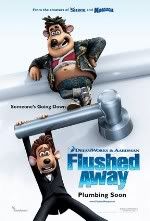
FLUSHED AWAY (2006)

Director: Sam Fell, David Bowers
Cast: Kate Winslet, Hugh Jackman, Ian McKellen, Andy Serkis, Bill Nighy, Simon Callow, Shane Richie, Geoffrey Palmer, Jean Reno, Douglas Weston
Release: November 3, 2006
Synopsis: Roddy is a decidedly upper-crust “society rat” who makes his home in a posh Kensington flat, complete with two hamster butlers named Gilbert and Sullivan. When a common sewer rat named Syd comes spewing out of the sink and decides he’s hit the jackpot, Roddy schemes to rid himself of the pest by luring him into the “whirlpool.” Syd may be an ignorant slob, but he’s no fool, so it is Roddy who winds up being flushed away into the bustling sewer world of Ratropolis. There Roddy meets Rita, an enterprising scavenger who works the sewers in her faithful boat, the Jammy Dodger. Roddy immediately wants out, or rather, up; Rita wants to be paid for her trouble; and, speaking of trouble, the villainous Toad – who royally despises all rodents – wants them iced”¦literally. The Toad dispatches his two hapless hench-rats, Spike and Whitey, to get the job done. When they fail, the Toad has no choice but to send to France for his cousin – that dreaded mercenary, Le Frog.

View Trailer:
* Large (QuickTime)

Prognosis: Negative. I’m just not feeling this.

I don’t know why I have such an aversion to this trailer but I don’t have a great affinity for rodents, not really endearing themselves to great connotations in the mind, and the trailer doesn’t grab your attention. It sort of meanders, plods and expects to just ease its way into establishing the premise but that’s not really good when it’s kids you want to hook. Sure, you’re going to get these little rugrats to come out en masse but if you can generate enough buzz what studio wouldn’t want more to come out and be repeat viewers?

When we begin I’m at a loss to really feel excited. Sure, Dreamworks put out that crap flick MADAGASCAR, did great guns with WALLACE AND GROMIT, put out tripe in SHARKTALE, has done well for itself with OVER THE HEDGE but for all the great animated films they’ve put out they’ve been accompanied by solid trailers; they excite when they should, they get in get out and get on with it and they leave you thinking that even though you’re an adult you would like to see that.

I don’t get that here.

I am confounded as to why we start so damn slow. Yes, we have to establish that this rodent gets the rule of the roost but when I am rapping my fingers a third a way into this preview because I am wondering why I’m watching a rat play polo, have a bath and dress himself in a tuxedo that’s not a good thing.

What is a good thing, though, that I can say is when Syd, the dirty mischief maker of the rat-a-tat-tat duo, appears I am pleased because this where we get the first notion that this is a movie for kids: we get some spirited belching. A lot of belching. A lot. Not only do we get sound effects but we get a green puff of belch with every booming punch into the sound field.

The toilet humor keeps going, the very things that kids and adults can agree upon, with our uppity rat trying to flush Syd down the pipes under the rouse of the Porcelain God being a fandangled Jacuzzi of sorts and ends up in a place called, appropriately enough, Ratropolis.

One of the things that confound me is that this is supposed to be a trailer, not a teaser. The crux of what seems to be my biggest complaint of all is that our well-to-do rat ends up coming down into this place that looks like a mash-up of Times Square and Piccadilly Circus but we don’t get any context of this new land. This rat even lands in the “vehicle” of who, ostensibly, is a girl rat who will probably be some kind of love interest but no one says anything for the rest of the trailer.

There has got to be more here but I cannot explain why we’re not shown more than we are. Yes, this film is not coming out until the end of this year but I’ve been teased better than I’ve been trailer-ed in this advertisement.

HUMAN RESIDUE (2007)

Director: Chris Bouchard
Cast: Rachael Blyth, Ben Anderson, Adrian Webster, Kate Cox
Release: May, 2007
Synopsis: Seven volunteers all signed up for the same temporal isolation program. They live with being sealed inside an underground bunker for a period of three and a half weeks. While they were under something went terribly wrong. When the experiment ended, nobody came to let them out. When they break out of their temporary home they find the surrounding facility deserted. The huge sprawling concrete facility is devoid of human life. What could have caused such a catastrophe? Is there something else out there? Even if they escape with their lives, what awaits them beyond the grounds of the facility?

View Trailer:
* Large (QuickTime)

Prognosis: Positive. Concept trailer.

What do you do when you’re really independent and need people to help finance your vision but you don’t feel like half-assing it by shooting what you can afford?

You shoot a concept trailer.

I really can only admit to seeing two concept trailers with this being the second. It’s an interesting thing when you think of it but I think the idea of making one makes absolute sense, absolutely. You want people to help pony up bread to let you make a movie but words and exciting hand motions, understandably, can only do so much. Storyboarding, as well, doesn’t really get the idea across as you could have Gary Larson at the helm or a graduate from the Rob Liefeld School for Drawing Good asleep at the switch. A concept trailer like this, though, conveys the vibe, style and tenor of what this movie could be. To be perfectly honest, if this film is as good as the tension that’s conveyed in the two and a half minutes that’s compiled here then let me pop my checkbook out and bounce a few bucks.

“Awake and strengthen what remains and is on the point of death”

The trailer starts spinning as soon as it starts. With good reason it should as well for if you’re looking for someone’s dough you better not waste any time making the case as to why I should part with mine. You’ve got tense strings playing, dank and dark locations evoking something quite strange. What looks like blood stained floorboards come in and out of view. A small, darkened crawlway underneath a set of concrete steps makes me think of Stephen King’s IT. Some clanging chains of a long since forgotten place evokes the kind of solitude only reserved for very bad things.

We see feet in a forest. They walk quickly and we then are treated to a nice looking lady, also a plus for those looking to get financing, who is obviously not enchanted with the idea of crawling around a concrete building all alone.

We meet up with three other people, of equal good looking-ness, who watch a very black building burn from all sorts of places. Plumes of smoke billow and we’re left to wonder what is happening.

“There’s nobody else”¦”
We’re not given any much more in the way of details but the slow meting of information does this trailer more good than bad as it’s all about the tease. The tease of why these people are, ostensibly, the last people existing after something sinister has happened to them is great.

We see these people running away from something we can’t see, something we’re not allowed to know (they need more money, most likely, to show you that part”¦).

The music gets all sorts of jittery, the camera banks sharply, the cuts get quicker, we gleam the baddies that are looking to put the big hurt on these people, we get more running and I find my interest is completely locked in to what’s going on.

“When the experiment ended”¦Nobody came to let them out”¦”

One of the primary things, that I can see, about what makes a concept trailer and a trailer for a film that has already been shot so similar is that both of them are used as leverages to garner interest and to set themselves apart from other competing works. This film may not have been shot yet but you’d never know based on what’s here.

This movie can’t come quick enough.

BORAT (2006)

Director: Larry Charles
Cast: Sacha Baron Cohen
Release: November 3, 3006
Synopsis: Sacha Baron Cohen – star of HBO’s hit comedy “Da Ali G Show,” takes his outrageous Kazakstani reporter character Borat to the big screen. In this hilariously offensive movie, Borat travels from his primitive home in Kazakhstan to the U.S. to make a documentary. On his cross-country road-trip, Borat meets real people in real situations.

View Trailer:
* Large (QuickTime)

Prognosis: Deliciously Positive. When I saw the trailer for TALLADEGA NIGHTS it incensed me that, the first time out, there wasn’t any screen time given to Will Ferrell’s French nemesis played by Sacha Baron Cohen. It wasn’t so much that Sacha wasn’t represented well, it was that he wasn’t given any time to do anything. I know it is a “Will Ferrell” vehicle but give the guy some traction to help out the flick, you know? It’s really good that the time has come, though, to give Sacha his own “vehicle” and I can say with a high degree of accuracy that I am more interested in seeing what happens to Borat than I am to Ricky Bobby.

So, right off the bat, when you see a trailer like this you’re struck by two and a half things:

1. You’re not shown an inch of footage beyond the extended scene here.

2. It’s ballsy not to show more because this is what people are going to base their initial opinions on when the movie actually arrives.

2 ½. It perfectly encapsulates what makes Borat such a funny ass character so it really negates points 1 and 2.

I will readily admit that I am a Da Ali G Show fan. Some people have said they “don’t get it” and I will own up that I was the same way until I randomly caught a segment with one of his other characters, Bruno, voice of Austrian youth TV and sly usurper of the insipid, false idols of fashion. The show, at times, is about more than just the fun he has at other’s ignorance and when, in the second season, Borat, Kazakhstan’s sixth most famous man, went and played a song for real rednecks entitled “In My Country There Is Problem” where the chorus regales the audience to “Throw the Jew down the well.” The delight that the real people took in this character’s dead-on measurement of what would appeal to this segment of Americana is at once amazing and frightening. That’s what I hope comes out of this movie and we get a good amount of Sacha Baron Cohen’s brand of comedy through his Borat character here.

I appreciate how the trailer begins in much the same way as the segment does when it plays on HBO: we’re given a scratchy video which, ostensibly, marks the imprint of Kazakhstan’s state run video service along with the wretchedly composed theme music.

We are greeted by a walking Borat, beset on both sides by children of his dank, poor, distant, impoverished village from where he greets us with that shit-eating smile that instantly disarms you. One doesn’t know to either question why he looks so happy or just delight in the fact that he seems to be blissfully ignorant of his surroundings.

He tells us, while standing in front of either a trash heap or his home, I believe it’s both, of his favorite hobbies: ping pong and disco dancing. The former is shown to us in stark Technicolor with Borat standing for an awkwardly long time at one end of the table as he dons bright shorts that are really way too short to cover the goods and the latter is shown to us as a pack of dudes in the middle of the street, during the day, doing something that I don’t think Deney Terrio or Adrian Zmed would’ve let on Dance Fever.

He also mentions sunbathing and, for the lack of my ability to describe what Sacha looks like in a day-glo green plum smuggler that was really meant for a woman, you’ll just have to trust in me that it should elicit some kind of sharp reaction to anyone who sees what it looks like.

We’re let into his house and, again, trash heap or living quarters you can make the call. The delight he has in letting us see his state of the art VCR and stereo system that “plays cassettes” while passing the sneezing farm animal in his living room is amusing, to say nothing of the long kiss he indulges in with Natalia. She is number 4 prostitute in all of Kazakhstan and just happens to be his sister.

And, lastly, when he lets his village know he is off to America, just taking sheer delight in proclaiming it, he gets in a car to ostensibly go to the airport. I should’ve known that the car that looks like it was being driven by a kid, it is, actually was being pulled along by a horse. Sometimes you just never quite know what will make you laugh when you’ve never seen something like it before and I can state for the record that I thought that was a great visual gag.
It’s hard to know what jives and what doesn’t when it comes to comedy, so much of it is a subjective judgement even though I know I’m right when I say that Strangers With Candy is just pure crap, but when a trailer like this comes along and without showing any real footage is able to make me laugh my шарыs (that’s “balls” in Russian for the Eastern European impaired) off is deserving of my money when I am able to freely give it up.


Game On! 7-20-2006

Filed under: Game On! — admin @ 4:45 am

gameon.jpg

So, this week I didn’t really get much to review as far as games go. What little i did receive, i received kind of late into the week, and thus never got a chance to accurately review. So, next week, you have a few reviews of games (and actually, some DVDs too) to look forward to, but as for this week…

Well, i figured i’d take a moment to talk about the impending Console Wars. As i’m sure most of you out there who read my column know, there are not one but TWO systems coming out this holiday season. The Playstation 3 is due out on November 17th, and the Nintendo Revo…erm, i mean the Nintendo Wii is due out before Thanksgiving. Both systems are offering something new as far as the “next generation” of gaming is concerned, but each has vastly different ideas of what exactly that might be.

The Playstation 3 is taking steps, as of this May’s E3, to distance itself from being “just” a video game system. Now that consumers have been hit with the extraordinary sticker shock of the system’s price, Sony Playstation creator Ken Kutaragi claims that the system is in actuality a “computer” rather than a gaming system. Sure, this sounds good on paper, but let’s be honest here, you’re just trying to save your ass from further explanation as to why your new system is $600. Sure, if they didn’t include the Blu-ray technology it would probably cost around $300 less, but that’s neither here nor there. Most folks out there don’t want to spend six hundred clams on a game system…no matter HOW hardcore they are. Plus, it seems that the delays in the system’s release haven’t been for any one real reason other than they seem to be trying to see what the competition is doing. For example, Ninendo’s controller has movement sensitivity, so what does Sony do? They add gyros to the controller, offering “six directions of movement…all without external sensors”…an obvious dig at Nintendo’s neccessary reflective strips to pick up signals from it’s “Wii-mote”. They also returned to the old controller style, after most who saw the old “batarang” style controller threw up in thier cornflakes. Finally, they seemed to be lying in wait to see how Xbox 360 would fair…would thier launch be a good one, what kind of graphics would be available…and would thier HD-DVD drive be used for games or JUST HD-DVDs, considering HD-DVD is the nearest competition to Sony’s Blu-Ray format.

And now that we mention it…since Blu-ray is such a new technology, the price of games is going to increase as well. Most who bothered to lay down the coin for the Xbox 360 recognize the ten dollar increase from $50 to $60 for their new next gen games, but rumor has it that for the PS3, game prices could range from $50 to $100 for individual titles. Why? Because it’s so costly to make a Blu-ray disc, apparently. Sure, it has amazing storage power, and most games that are often multiple discs could be contained on one Blu-ray disc, but the price increase it just another thing to draw folks back from investing in the system.

The final straw to break the camel’s back here? For me most of all, it’s about games. So far from what I’ve seen, there is very little coming to PS3 that impresses me. Sure, METAL GEAR SOLID 4 has me sporting some major nerd wood, but beyond that, there’s very little to get my motor purring. The graphics output from the system, while impressive, doesn’t seem to me to be much difference between what we can now see on Xbox 360. And now that developers and publishers are trying to shy away from console exclusive titles, both PS3 and 360 will have the same games on either console. In fact, as it stands, of the 25 or so launch titles for the PS3, only five are actually exclusive, and they’re first party Sony produced and published titles (and aren’t really all that impressive…I mean, who’s really clamoring for GENJI 2?). We won’t see a decent game for the system until roughly February or March when Sony’s HEAVENY SWORD or Ubisoft’s ASSASSIN’S CREED drop (though, once again from the rumor mill, AC may not be PS3 exclusive for much longer anyway). It’s these reasons that has me doubting that i’ll be picking up the system this November, and possibly just waiting on it entirely until both A) I have the scratch to drop on the system and B) that there’s something worth playing on it…that i can’t get anywhere else. MGS4, I’m looking your way.

So, that leaves us with the Nintendo Revolution. Now, I know i’m not the first to say this, but I have to put it out there in my column. I hate the name WII. In fact, I refuse to even CALL it the Wii. It looks like they misspelled Wifi. It sounds…well…Wii-tarded. I can just see the ad campaign coming now… “What are you off to do today Jake?” “I’m going home to play with my Wii!”. Parents will be sure to pick it up after they hear that.

And get this…in the press release that Nintendo issued to reveal the name, they said they chose it (and that bizarre spelling) because it’s pronounced “We” no matter what language you speak. Sure, unless you’re American. No, i’m not saying it’s pronounced something differently in America it’s just…well, let’s admit it. Many Americans…we’re not the sharpest peanut in the turd. I’ve worked retail. I’ve met them. I know there’s going to be every third parent coming up to request a new Nintendo “Why”. It’s going to happen, and I’m going to be unable to stop myself from pointing and laughing.

Still, from the two systems due this year, the REVOLUTION (remember, I refuse to reffer to it by it’s other name) has me the most excited. It’s not just the prospect of the new ZELDA game…it’s how we’ll PLAY that ZELDA game. The controller scheme from the Revolution version of the game (released on the same day as the Gamecube version..as well as the Revolution system itself) includes the ability to shoot arrows with the controllers, fish by actually casting a line, and thrusting your sword around. For once, beyond DDR, games may actually be a workout! Not to mention that the graphics are a great improvement over the standard Gamecube.

But as I’ve said before, it’s not even about graphics for Nintendo. There’s no interest with them to compete with the big boys this time around. For the Big N, “next gen” means playing video games in a new way. Graphics can get shinier, but that’s no innovation. The first innovation was from different colored dots on the Atari’s and Commodors to more sprites and 8-bit and 16-bit graphics. Then the move from 2D to 3D. Now…we just have HD 3D? Nintendo says nay. Next innovation should be to truly make games interactive…and the Revolution is just that.

Sure, they have the games to back it up, too. Each title that’s been announced for the system has me excited. SUPER MARIO GALAXY, SUPER SMASH BROS. BRAWL, RED STEEL, TONY HAWK’S DOWNHILL JAM, PROJECT H.A.M.M.E.R., EXCITE TRUCK…I’m thrilled to peices to see and play these. Plus, the Virtual Console, where you’ll be able to download NES, SNES, N64, Sega Genesis and Turbo Grafix 16 games, as well as being backwards compatible to the Gamecube discs? Sign me up this November for one of these. The rumored $250 price tag certainly helps too.

Sure, these are just my opinions, but i’m sure i make sense to some of you out there. Why don’t you drop me a line and let me know what YOU think, dear gamers, of the upcoming systems? Hit me up at RandomHajileSN@aol.com and share your opinions.

Then next week, i’ll try to post them…along with the normal review crap. ‘Til then, friends…

Film Flam Flummox: 7/21/2006

Filed under: Film Flam Flummox — UncaScroogeMcD @ 4:43 am


filmflamflummoxbanner.jpg


July 14, 2006

My Life Truly Is Only Worth an $85 Boost Mobile Phone

It was a Clerks-worthy moment–there I was, putting in my regular hours at my friend’s wireless phone store when I have to deal with a scary, dirty vagrant-looking couple (a dude with a dirty, scraggly beard and skin damage from the sun; his rather scary “woman”–his word–who’s bald, tattooed, and was the biggest instigator) giving me death threats for refusing to replace a stolen $85 Boost Mobile phone–which by virtue of its brand and pre-paid nature, is not insured. While I would normally dismiss such nonsense as the ravings of crazy people, after an incident this past week, I couldn’t help but think that there was a kernel of accuracy in that price appraisal of my life. The efforts of an independent publicist trying to secure my review coverage of a major release this week were thwarted when a representative of the distributor firmly balked that I do not review. And so there it is: going on 17 years of continuous writing, being among the very first to do all of whatever it is I do on the ‘Net (since ’95)–all of that instantly, completely dismissed out of hand, as this whole time I was deluding myself into thinking I was reviewing. So who am I, then, to object when a psychotic values a pre-paid cellular phone over my life, as what I’ve spent more than half of it doing is not what I believed it was?

And so goes the ongoing delusion that is my life’s “work”…


Be Free of Dupree

You, Me and DupreeThe most pressing thought I had while walking out of YOU, ME AND DUPREE was how much money a friend received for the prominent use of two hit singles he’d written–not exactly what I’m sure directing duo Joe and Anthony Russo had in mind with this lazy Owen Wilson comedy. Not that the top billed star shows any signs of sluggishness; Wilson’s work as the Dupree of the title is the only real sign of life in this predictable tale of a slacker who becomes an increasingly unwelcome houseguest to his best friend (Matt Dillon) and new bride (Kate Hudson). The typical privacy invasion and crude mayhem ensues, as does the inevitable, improbable turning of the tide when obnoxiousness somehow starts to endear Dupree to others. Wilson’s innate, unassuming sweetness make that latter point somewhat easier to swallow, but what makes the film as a whole less so is that the Russo brothers obviously just let Wilson to his own devices to do his usual thing and hope that all the other assembled elements somehow stick. They don’t–the trio of Wilson, Dillon, and Hudson exhibit very little chemistry in every pairing permutation; and the subplot of Dillon constantly being belittled by Hudson’s father/his boss (Michael Douglas) seems like it was an A-plot in an unrelated script that somehow got shoved in. And that reflects the central problem: the film is remarkably forced–ironic, considering it’s a starring vehicle for an actor whose most defining quality is his laid-back, unaffected demeanor.


Dead Man Sailing

filmflamflummox-july7-deadmanschest.jpgExpectations for the first PIRATES OF THE CARIBBEAN film, 2003’s The Curse of the, were understandably low–after all, its dubious source material was a theme park ride, of all things–but director Gore Verbinski and scripters Ted Elliott and Terry Rossio managed to come up with an entertaining, if overlong, throwback swashbuckler whose most distinct innovation was its old-fashioned style. Distinctly fashion-forward, on the other hand, was the film’s ultimate ace in the hole: Johnny Depp’s indelibly eccentric work as rogue pirate Captain Jack Sparrow, which made the film an even more jovial jaunt than it otherwise would have been.

Depp’s Capt. Jack hasn’t mellowed his madness the slightest bit in DEAD MAN’S CHEST, the second of a now-planned trilogy, and while his performance still gives this film the film a kooky kick all its own, there is none of that out-of-left-field shock element attached to it; audiences are now not only expecting but looking forward to more wacky Jackie. But Verbinski and the returning Elliott and Rossio find other ways to surprise. Not that there isn’t plenty of what audiences want and expect; the trio of Jack, dashing hero Will Turner (Orlando Bloom), and plucky heroine Elizabeth Swann (Keira Knightley) again take to the seas for another adventure, this time to search for the “dead man’s chest” of the title, which contains the beating heart of the legendary ruler of the sea Davy Jones (Bill Nighy), to whom Jack owes a blood debt. Along the way, there’s all manner of swashbuckling swordfighting that one comes to expect in–once again–a somewhat bloated two-hour-plus run time.

Verbinski finds giddy new ways of staging the mayhem, though, and an antic Looney Tunes sensibility amps up the two key action set pieces to even greater crowd-pleasing levels. But he doesn’t rest on his popularity-proven laurels; with the character of Davy Jones, Verbinski and his visual effects team break startling new ground. Jones and the crew of his otherworldly ship The Flying Dutchman bear all the ravages of years of undersea damnation–that is, acquiring certain aquatic qualities–and the CG “makeup” done to bring the likes Jones’s tentacled, squid-like head to life defies words much like Depp’s performance in the first film. While computer generated, the effects are remarkably tactile, the most meticulous digital approximation of practical FX to date. But considering such razzle dazzle is expected from big budget blockbuster follow-ups, the most surprising trick up Verbinski and the writers’ sleeve is that this is not a typical sequel rehash but an actual attempt at making a continuation of a larger story, with the film opening with events fully in progress and closing with not only loose narrative ends still dangling but characters at more precarious points in a less predictable overall arc–not exactly what one ever expected from a series of films that is, after all, based on a theme park attraction. But for whatever unusual ambitions, Dead Man’s Chest, like its predecessor, also doesn’t lose sight of those just-for-fun origins; while Verbinski still could stand to employ some tighter editing, it’s the rollicking ride that keeps the audience coming back for more–and will keep them coming back for more when At World’s End concludes the trilogy next summer.

Sights Unseen

Marlon Wayans, Shawn Wayans, and director Keenen Ivory Wayans offer up another lowbrow, high-concept comedy with LITTLE MAN, in which a vertically challenged criminal (Marlon) disguises himself as the new adopted son to an unsuspecting wannabe dad (Shawn).

At the Video Store

The utterly unnecessary sequel BASIC INSTINCT 2 (Sony Pictures Home Entertainment) could have justified its existence if it were the laugh-a-second, sleazy camp-a-thon that its opening scene suggests. Alas, Sharon Stone’s desperate attempt to recapture her former glory as femme fatale Catherine Tramell is one huge bore, with her vain vamping actually taking a back seat to charisma vacuum David Morrissey, who dominates the screen time as a London shrink who gets caught up in Catherine’s seductive games. Both the R-rated theatrical cut and unrated extended cut are available on separate DVD editions, with the latter including deleted scenes, a behind-the-scenes featurette, and commentary by director Michael Caton-Jones.

Pierce Brosnan’s funny, fearless, image-effacing turn as a burned-out hitman is easily the best reason to catch Richard Shepard’s dark comedy THE MATADOR (The Weinstein Company/Genius Products), which also features nice work by an equally well-cast Greg Kinnear as the straight-laced businessman who becomes his unlikely buddy. What begins as something edgy and quirky grows gradually more conventional as it goes along, ultimately succumbing to the Hollywood warm-‘n-fuzzy. The DVD includes commentary by Shepard, Brosnan, and Kinnear; deleted and extended scenes; and a making-of featurette.

The French mystery thriller CACHÉ (Hidden) (Sony Pictures Home Entertainment) ultimately may not offer the conventional genre satisfactions–its central question is never given a clear, cut-and-dried resolution and explanation, for instance–but so masterful is Michael Haneke’s direction that the film’s captivating overall spell is a richer reward than any blatant answer. Daniel Auteuil and Juliette Binoche play a married couple with child whose seemingly happy and peaceful existence is upended when increasingly intrusive videotapes show up on their doorstep and help unearth the long-held secrets and insecurities. Dense, deliberately paced, yet suspenseful and genuinely involving, as Auteuil and Binoche’s performances lending piercing intimacy to Haneke’s tightly-wound, visually inventive proceedings. The DVD includes two half-hour documentaries, one on the making on the film, and another an interview with Haneke on the film.

Next Time…

…more reviews, including Lady in the Water. As always, for additional reviews and more, check out my home site, TheMovieReport.com .


Noctural Admissions: DVD, Road House Deluxe Edition and Road House 2

Filed under: Nocturnal Admissions — UncaScroogeMcD @ 4:42 am


nocturnalheader9.gif
Pain don't hurt

Consider these two opposed statements. 

“Pain don’t hurt.”

“Kinda hurts, don’t it.”

Both are uttered in Road House, at opposite ends of the narrative. The first is spoken by Dalton (Patrick Swayze) as he is about to be sewn up by Dr. Elizabeth Clay (Kelly Lynch). The second sentence is uttered by Dalton’s mentor, Wade Garrett (Sam Elliott), who has come on the scene late in the day to help Dalton out of a jam.


Kinda hurts


Dalton is a “cooler,” a lead bouncer in a club. He’s been lured by Frank Tilghman (Kevin Tighe), owner of Double Deuce, to clean up his night club, located near Jasper, Missouri. What Tilghman fails to mention, however, is that more is wrong in the town than just some hooligans who get drunk and break out in fights. It’s is like one of those western towns where corruiption is allowed to flourish because it is more profitable, the citizens are mere pawns in the financial grip of the .

The DD is one of many victims of town gang lord Brad Wesley (Ben Gazzara), who used to date the local doctor (Lynch), who is herself the niece of the local car parts shop owner (Elvis acolyte Red West). Dalton soon learns that not only does he have to clean up the bar, he has to clean up the whole damn town, and to that end he eventually summons his best friend Wade Garrett (Elliott).

Road House deluxe boxI guess if you were a responsible film reviewer you’d have to say that Road House is a junky movie. But as the years go by, and its reputation on cable TV, video, and now DVD mounts (the film turned into a real cash cow for MGM), one can give into one’s inner feelings and admit, as Lynch does on the new DVD, that Road House is a really great drive in movie. I am proud to admit, however, that when the film was first released, and I was working at a local “alternative” weekly, I gave the film one of the rare rave reviews it received in the country. Road House was originally released in May of 1989, putting a capper on what Lynch refers to on the new DVD as a bad decade, and made a respectable amount of money. The film originally came out on DVD in February of 2002, and fans everywhere were disappointed that the film did not receive the DVD respect it deserved: yak tracks, makings of, and so forth. MGM, or its remnant shell of a company, has rectified that mistake, with its new Deluxe Edition, published on June 8th, 2006 for $1995, in conjunction with a negligible but entertaining straight-to-video sequel, Road House 2. 

So, does pain hurt, or doesn’t it? Well, it depends on the attitude. If you are zen philosopher like Dalton, no (or if you are trying to impress a hot doctor, no). If you are Garrett, yes it does, because you have dispensed it to highly deserving victims, and you don’t have time to philosophize about it while in the heat of action.

Road House is the great post-Hawks Hawksian movie. It’s about men who live by a code. It is post Hawksian because the men talk about the code, and also because, in a more highly urban modern society, the men are more transient. In a quintessential Hawks movie, the pattern of the narrative is that the characters do something exciting, retired to their home base – a camp fire, a sherif’s office, a pilot’s bar – plan the next move or relax, then set out to do something else exciting, retire to the base and reflect again, then set out for another adventure, and so forth. This alternating rhythm creates a soothing and reassuring affect for a typical Hawks film, the stability beneath the chaos that the characters are fighting. The films aren’t essays on violence. Violence is a fact of their lives, and the characters simply deal with it. In the self-conscious 1980s and beyond, you have to have a philosophy about violence, because half your battles are going to be with people who oppose resorting to it.

Dalton is “the best damn cooler in the business,” and in case you didn’t know it, in the 1980s bar bouncers, like bike messengers (Quicksilver) and arm wrestlers (Over the Top), had a cult around them, Road House is here to tell you so. Everyone is in awe of Dalton, whose reputation precedes him. And he is presented as the perfect man. He can stitch his own wounds and change his own tires. Everyone likes him, from the farmer he rents a room from to the patrons of the club he helps “cool.” He performs tai chi in the dawn light and reads Jim Harrison in his off hours (Swayze has a wonderful actorial moment when his attention is pulled from the book to the pool orgy raging across the pond from his room. He has to drag his eyes from a page, a gesture one sees in real life all the time, but which I’ve never seen in a movie before).

There are many things to love about Road House. One enjoyable component is an impossibly blonde Kelly Lynch as the foxy ER doctor. Another is venerable sage Sam Elliott as a weathered bar bouncer. And until the film descends into a messy last sequence straight out of a Phil Karlson film, Road House is an enjoyable revenge genre story with a despicable villain or two with remarkably clever dialogue, credited to screenwriters David Lee Henry and Hilary Henkin. Dalton explains that “Nobody ever wins a fight,” and Garrett works in as a bouncer in a bar whose patrons are so dumb that the bathroom “has a sign hanging over the urinal that says, ‘Don’t eat the big white mint.'” And this film may be the first instance in the history of American culture in which the phrase “It’s my way or the highway” was uttered.

Road House was made back in the day when films rated R actually had nudity and violence in them. But the film’s roots stretch back much further, to redneck noirs such as Thunder Road and Phil Karlson’s The Phenix City Story, and his later revenge fantasies Walking Tall and Framed, tales of a lone man who must clean up a town (themselves premises that hark back to western clichés) or best a racketeer. In this film, Gazarra has Jackie Treehorn status, lazily controlling the town with an oddball gang of misfits. It’s not entirely clear how Wesley manages to hold such sway over the citizens, but one thing is sure: villains have never before cackled with sadistic pleasure over their misdeeds as they do in Road House. And it is nice to see a villain who actually enjoys his villainy and the hedonistic fruits of his labors.

Patrick Swayze is the embodiment of the fact that in movies dancers make the best movie fighters. Think back on how lovely Elvis looked when he was engaged in a brawl, or how smooth and elegant Brando, who moves like a dancer, appears when he is punching some scum-sucking pig. Think of all the West Side Story gang members. That’s what’s missing from modern action movies, the sense of violence as a ballet rather than the definitive blowing up of snarling villains.

Road House comes in a fine widescreen transfer (2.35:1, enhanced) and numerous sound options (DD English Surround, French Surround, Spanish mono, with English, French, and Spanish subtitles).


Kelly Lynch


All the extras are fun. “On the Road House” (that title doesn’t make sense to me) is a retrospective making of in which you come to realize how hilarious Kelly Lynch happens to be, but also get a survey of the film’s impact on its makers. “What Would Dalton Do?” is a group interview with a bunch of bouncers, and the film also has a celebratory text only Trivia Track, that serves as a continual reminder of the worse cultural excesses of the 1980s. There are two commentary tracks. The first is by director Rowdy Herrington, which is highly informative. The second is my favorite kind of track, one provided by people who, though not associated with the film, happen to love it. Such tracks are few and far between. In this case, the yakkers are Kevin Smith and Scott Mosier, who know the film in and out. Perhaps the best part of their track is when they wonder out loud why guys like fight films especially when, as these two admit, they’ve never really even been in a fight of consequence nor ever want to.

Road House trivia


These extras are fun, but in addition I would like to have heard from the screenwriters, if they happen to have been available. Otherwise it’s great stuff.

Road House 2 boxThere is also a sneak peak at Road House 2: Last Call (though it is called only Road House 2 on the print itself). On its own disc, which hit the street July 11 for $24.95, 2 is an enjoyable attempt to recapture some of the glory of the first film, with the now dead Dalton’s son (we learn that Dalton was his last name and that his first was James) Shane Tanner (Johnathon Schaech, who also wrote the script; and yes, his name has both a “j” and an “n”) returning to his home town to help his mentor (Will Patton) out or a jam. The story borrows elements from movies such as Lethal Weapon 2 as well as the first Road House, but the villains are not as comical or ruthless as in the original, and there are no zeitgeist defining lines of dialogue.

Finally, on the Road House disc there are also trailers for the James Bond Ultimate collection, Population 436, and Freedomland. For the original Road House theatrical trailer (1:55), hold on to the previous DVD.


July 20, 2006

Noctural Admissions: DVD, An Early Frost

Filed under: Nocturnal Admissions — UncaScroogeMcD @ 2:43 am


nocturnalheader8.gif

Of perhaps only historical interest,  An Early Frost, made in 1985, comes out of that Hallmark school of filmmaking, which strives to make you feel good about yourself despite the quotidian trials of life, and out of that American tendency of cultural elites to instruct their inferiors: this is how we must act in the face of the AIDS crisis. As a Emmy winning TV movie that was heralded as the first film to openly deal with AIDS it must be saluted for its bravery; but as an instruction manual it is out of date. 

An Early Frost title

It is one of the strategies of the film to sprinkle the cast with cinematic nobility in the form of old Warner Bros. star Sylvia Sidney, as the family matriarch, and Ben Gazzara and Gena Rowlands as the parents of the AIDS victim, even though their roots are in the tough New York school of acting and the harsh documentary naturalism of John Cassavetes’s films, whose uncompromising aesthetic An Early Frost‘s reassuring palliatives stand opposed to in nearly every way. Aidan Quinn as the handsome son is very good in the role but one wonders if his casting had more to do with his preternatural and exploitable thinness, like Steve Buscemi’s in the competing AIDS-crisis movie  Parting Glances (1986). Gazzara and Rowlands add an actorial heft in a film that in many ways avoids too much drama, not to mention the outward trappings of gayness. The film lacks a kiss (of any persuasion) much less a trip to a gay bar or a telltale tube of Vaseline near the bed-stand. It’s the most prophylactic gay movie, in all ways, since  Never Too Young to Die (1986).

An Early Frost first aired on NBC on November 11th, 1985, and was produced and written by Ron Cowen and Daniel Lipman, who later went on to do the American version of  Queer as Folk. Their work has the olive brach quality of the talents behind films such as  Making Love and  Claire of the Moon, seeking to minimize the differences between gay and straight culture for the edification of the straight half. Earlier explorations of gay culture such as  Boys in the Band, by vocalizing inner tensions uninhibitedly, ceded half the battle for acceptance to the “enemy.”  Curiously, though, An Early Frost subscribes to some of the most retrograde psychoanalytic views of homosexuality’s basis. Nick Pierson (Gazzara) is a successful businessman, running a lumber company with firm generosity. His wife Katherine brings the art to the household, teaching legions of small town American boys how to play the piano. The script suggests throughout that Nick is the tough but distant patriarch and Katherine the smothering, babying queer-maker. Their son Michael is manufactured from the nexus of their opposing developmental philosophies. Yet later, Michael’s boyfriend Peter (D. W. Moffett, Michael Douglas’s aide in  Traffic) argues on Michael’s behalf to the unaccepting Nick that Michael can’t help being what he is. This runs counter to the notion, inscribed in the film, that with a little familiar rejiggering, Michael might not have been gay. This reliance on psychoanalytic voodoo unintentionally opens the way to expensive sessions with somnambulant shrinks and summer vacations at a Christian conversion camp.

Aidan Quinn

The film follows the template of previous slow death TV movies such as  Brian’s Song, with the added garnishes that determined all subsequent AIDS-themed movies, such as the references to bloodwork, group sessions, the battle between anger and acceptance. In fact, it is interesting to see how similar the film is to  Philadelphia, in that Michael has just made partner in a law firm, though with  Frost stopping way short of the lawsuit plot. Instead,  Frost is about gentle acceptance. For all its earnestness and didacticism, the film is still heartbreaking in its near-final shot of Michael smilingly telling his parents that he loves them – both of them – through the window of a taxi (the mirror image of an opening scene when life was good), as he is about to be driven off, presumably to die.

An Early Frost also stars  John Glover, Terry O’Quinn as a sympathetic doctor, and Bill Paxton as Michael’s brother-in-law. QuickStopEntertainment was provided with a screener disc that was not street ready. It had the trailer, and the film sans chapter breaks, but no menu, no “Living with AIDS” documentary, and no commentary track featuring Quinn and writers Ron Cowen and Daniel Lipman. Wolfe Video’s An Early Frost hits the street on July 18, 2006, and retails for $19.95.


Take Me Home Blog #1 – I promise not to write about wiping my ass

Filed under: Production Blogs,Take Me Home Blog — UncaScroogeMcD @ 2:28 am

takemehome-july18-celebritysamI’m Sam Jaeger, and this brand-spankin’ new blog is dedicated to our film-in-the-works, “Take Me Home”. I’ll describe the film soon, but for now I want to focus on my list of promises to you all; a list of what you can expect in the coming months. So without further adieu, or ado, or add-you:

Promise #1: I PROMISE NOT TO WRITE ABOUT WIPING MY ASS. Pretty much as it reads. Your time is precious, as is mine. If I had more acclaim as an actor, more notoriety (such as Kevin Smith, or Angelina Jolie, or Hightower from the Police Academy Films), there would be more of an interest in me wiping my own ass. But I am no celebrity, despite my mother’s opinion, and so I will keep to more intriguing subject matter. (author’s note: said author is aware that the subject of wiping his ass has been mentioned three times already…now four, and would appreciate you not pointing this lapse out to him. He is, afterall, an actor. Actors are easily bruised.)

Promise #2: I PROMISE TO RESPECT YOU EVEN AFTER I’VE HAD MY WAY WITH YOU. My friends can attest to this, especially the ones I’ve slept with. My hope is that you’ll feel a part of this whole process… what it is that makes filmmaking such a confounding and remarkable phenomenon. It does no good to keep you out of the loop. We’re making an indie film on a very tight budget here. No Paramount Exec is going to come in and curb our discussions. The Department of Homeland Security is another matter.

Promise #3: I PROMISE TO EVENTUALLY SHUT UP. I’m not the only swabby on this deck, and I’d like you to hear some different perspectives on how this movie is coming along. In the coming weeks, you’ll be hearing from our producer Michael Hobert. A little insight: in addition to being our dutiful producer, Mike also plays Zach Braff’s intern “Lonny” on “Scrubs”. He’ll be popping in every once in a while to vent about all the crazy people he gets to deal with (the director being one of them).

Promise #4: I PROMISE NOT TO WASTE YOUR TIME. Only you can do that. But, if you DO decide to waste your time, we hope you’ll choose to waste it with us. Who knows? You may get inspired to make your own film, and not only waste your time, but your hard-earned money! Sound too good to be true?! READ ON! As of today, we are awaiting a sum of money from investors. If this falls through, we’re going to make this movie with, yes indeed, our own income! Great idea, yes? “Sure,” you might say, “but isn’t that what destroyed Charlie Chaplin?” Yes it was! And if we can be counted among such greats as Chaplin, well then, haven’t we succeeded in our own way?

Promise #5: I PROMISE TO EXAMINE AMERICA’S DELETERIOUS CONNECTION TO FILM AND THE REFUSAL TO ACCEPT ITS POST-ATOMIC SOCIAL EVOLUTION. Pretty much as it reads.

And finally,

Promise #6: I PROMISE NOT TO WRITE ABOUT PARIS HILTON. This is not a gossip blog, got that? There will no star-gazing here, Paris! Take your crook-necked gaze elsewhere! We’re too damn busy making a movie! (author’s note: author is aware that Paris Hilton has been mentioned twice…now three times, much like the subject of wiping his own ass [now five]. He appreciates your understanding in this matter.)

Coming soon: Just WHAT IS this movie about, anyway?


The Fred Hembeck Show: Episode 66 – This Man, This Stan

Filed under: The Fred Hembeck Show — UncaScroogeMcD @ 2:21 am

fredhembeckheader.jpg

With the annual San Diego Con currently in session, I thought this might be a good time to dip into the expansive Fred Sez files for my very own little convention tale – albeit an East Coast based one. Enjoy.

Odin help me, but I have absolutely ADORED this crazy painting of Marvel mogul, Stan Lee, from the very first moment I laid my poor li’l ol’ eyes on it!!

hembeck-20060719-01.jpg

That would’ve been way back at one of those small, monthly mini-cons the late Phil Seuling regularly held in New York City during the seventies, most probably ’74 or ’75. This FOOM issue, sporting the piece as its cover, came out in late ’76, but I clearly recall having had Arnold Sawyer’s masterpiece proudly hanging on my walls for a considerable amount of time already by then. And, believe it or not, I STILL do!

Yup, along with Neal Adams’ magnificent theatrical poster for the legendary sci-fi extravaganza, WARP, this remains my most beloved piece of wall art, and as I was loading up the VCR downstairs last night, it happened to catch my eye, prompting me to think back to our very first encounter. And I also remembered that not everyone shares my exceedingly high opinion of the piece. Far from it – and, as it turned out, THAT was readily apparent right from day one…

Like I said, when I first saw it from across a crowded dealers room, I made a bee-line to the table selling it and almost immediately forked over the cash that would allow me to take home with me my very own copy of this – yes! – Pop Art Masterpiece! Hey, what’s not to like? Combined with a very skillfully done likeness of lovable ol’ Smilin’ Stan is the cleverly colorful integration of nearly a dozen of his most famous creations – AND Howard the Duck. Hey, it was the seventies, after all, and Gerber’s fowl was getting all the publicity, so it makes a certain sort of sense that his diminutive hat was included in the mix. As for the rest of ’em, I’ll bet you can all easily name each and every one of them – meaning, of course, you’ve – uh huh – spent far too much time reading @#%$ing comic books!?! Hey, join the club…

Over the ensuing years, I’d always sooner or later ask any folks who’d visit whichever room currently housed this poster just what they thought of it. The results, I’m sad to say, generally weren’t pretty. Most seemed to find it either garish, creepy, a mish-mash, or just plain ugly – and these sentiments emanated from comics fanatics and non-fans alike! Luckily, since painter Sawyer wasn’t actually involved in the comics biz, but was instead a long-time neighbor of Stan’s who did this piece to express his admiration for the Man ( AND to pocket a few bucks as well!! Hey, artists gotta eat too, y’know!…), he didn’t have to endure the slings and arrows of fourteen-year old experts. Well, not usually…

Y’see, the poor guy wasn’t immune to ALL criticism. Flash back with me one last time to that long-ago mini-con. I hadn’t started up my cartooning as of yet, so I was just another nameless fan wandering endlessly through the aisles. On maybe my 17th time circling the dealer’s room, I again found myself near the table where I’d earlier bought my rolled-up treasure. I noticed that now, sitting behind the table with its original proprietor was none other than Howard Chaykin. Well, folks, I already was a big fan of Howie’s by that point, enjoying not only his stylish artwork, but his highly individualistic approach to scripting as well. And, whenever it snuck in, his bitingly sarcastic sense of humor, too. (I subsequently met Howie on several occasions in later years, and am pleased – and somewhat relieved – to report that, yes, he was always indeed a swell guy to me! Fact is, I continue to enjoy his efforts right up to this very day – but, anecdote-wise, that’s neither here nor there….)

Back to our story, then. As I hovered around the area, hoping to overhear some memorable bon mots from one of my favorite pros, a pair of teenage boys sauntered along, eventually stopping in front of the table in question, and looked up at the poster plastered across the wall behind the sales till. They considered it for a few seconds, and then one turned to the other and muttered, “That’s just about the ugliest thing I’ve EVER seen!..”

Our man Howie apparently caught enough of this exchange to cause him to lean forward, and request that our junior art-critic repeat his assessment.

“I said, that’s gotta be the ugliest thing I’ve ever seen.”

“Well, don’t tell me, ” Chaykin said, a sly smile starting to play across his face as he pointed to the fellow sitting over in the next chair, “Tell him – HE’S the one who painted it, after all!”

At which point, our roving critic virtually shrunk to Ant-Man-like proportions, his skin turning redder than that of the Vision’s. I’m not all too sure Arnold himself was all that comfortable either, but it WAS a funny exchange, in a sort of nasty, Chaykinesque manner.

Proving once again, ALWAYS be careful what you say when you’re out in public – you just never know when Howie might be listening!

Visit Hembeck.com or send a personal message via this link.

Copyright 2006 Fred Hembeck

Music For The Masses: July 20th, 2006

Filed under: Music for the Masses — UncaScroogeMcD @ 2:20 am


musicmasses1.jpg

Why howdy, friends! Welcome back to another edition of Music for the Masses. . .where all the cool people hang. So I hear. And, of course, by “cool people” I am referring to all my “homies” (Good lord, I’ve been hanging out with Double A too much) who be hittin’ this years Comic Con in beautiful San Diego, California. . .home to a gorgeous, temperate climate, sun-kissed beaches and umm. . .the Padres. But you know what I love most about San Diego? It’s just minutes north of Tijuana, Mexico. . .home of the “donkey show,” illicit underage drinking and the $5, back-alley hand job. In fact, that famous sign adorning the highways of southern California is actually a picture of a man, running from his wife and kid after she found out he went to Tijuana for a good old-fashioned, Mescal-fueled worm burpin’. Bet you didn’t know that. 

m4m-july20-sign

Seriously, friends, I can’t wait to hit that convention floor with 180,000 of my closest friends. Good lord, I can almost smell it now. In fact, I’m so excited, I have already pre-planned my “attack,” and I have a loooong list of “must see” events. For instance, in the upstairs concourse restroom at Noon on Wednesday, I hope to catch the Star Wars “Crossing “˜Sabres” exhibit. . .

m4m-july20-troopers

“You show me your blaster and I’ll show you mine.”Â 

Thursday morning there is a panel starring the main man himself, Darth Vader, that I ABSOLUTELY will not miss. According to the description, Vader is going to be covering topics ranging from conquering your own universe, crushing the throats of your underlings without really even trying and, most importantly, how to become the “Emperor’s favorite.” Here’s a hint: it takes an iron fist. . .and, apparently, an accommodating mouth. . .


m4m-july20-jeff

“Watch your mouth, kid, or you’ll find yourself floating home!”

However, I am most looking forward to the once-in-a-lifetime event that drops Friday night. In fact, this is THE event, the payoff, if you will “Why?” you ask. “What could possibly be sooo cool to stand out amongst all the other cool things?” Simple. I plan on being front row for this guy when he hits the stage to sing hits like “Blue Suede Shoes,” “In the Ghetto” and “Caught in a Trap”. . .


m4m-july20-kling

Question: How did the “Kling” here end up with Michael Jackson’s nose?

. . .in fucking Klingon. Good stuff. And I’ll be honest with you, friends. . .if I catch the Klingon Elvis show, I can die happy. . .alone and without ever knowing the touch of a “real” woman, but happy.

So, as you can probably guess, I have some packing and additional planning to get done. As a result, we are going to keep it short this week with a couple of quick looks at some new releases from Muse and the solo disc from Radiohead’s Thom Yorke. And also, as a gift to you folks who can’t make it out to the convention this week, I have compiled the official list of must-have, Comic-related songs so you can play along at home. What do you say, huh? Let’s get to it!!

m4m-july20-muse Artist: Muse
Album: Black Holes and Revelations
Bastard Love Child of: Radiohead and Queen.
Best for: Discovering your own, personal muse. I found mine sitting at the end of a bar wearing a tube top, some acid-wash jeans and a “hicky.”
m4m-july20-museband

Black Holes and Revelations, huh? Here’s a revelation for ya’. . .before I picked up this album, completely at random, I had never heard of Muse. Not one song. Didn’t even know what type of music they played. Sure, I could have checked them out on any number of on-line music services, but where’s the excitement in that? I prefer to grab the bull by the balls. . .with my teeth, so to speak. But hey, that’s what I’m here for, people. . .to take bullets for you. Luckily, I didn’t have to on this album because it kicks ass. In fact, I have to say, I’m all over Muse like bad tattoos on Travis Barker.

Seriously, I dig the hell out of this disc. Each and every song stands out from the last and each is driven perfectly by the powerful voice of lead singer Matthew Bellamy. For instance, on the first single, the electronica-heavy “Supermassive Black Holes,” Bellamy hits notes that a pair of properly descended testicles just can’t produce. Then, just to prove that statement wrong, Bellamy drops into a throaty, Jeff Buckley impersonation on “Take a Bow.” Sneaky bastard.

The disc features a ton of electronic elements and quirky instrumention, all handled admirably by Bellamy, drummer Dominic Howard and bassist Chris Wolstenhome, but don’t get the wrong idea here. This is not an electronica album (see below). In fact, even though that first single reminds me of a shopping trip to Abercrombie & Fitch (the roomy shorts allow “the boys” a nice bit of breathing room, thank you very much), the album is largely guitar driven with that one track designed, with tongue firmly in check, to freak the shit out of long time fans. No other track on the disc is remotely like it.

If you are looking for an experimental, yet highly listenable and enjoyable album that will run the gamut from moody Depeche Mode (“Map of the Problematique”) to Bends-era Radiohead (“Soldiers Poem”) to classic Queen (“Knights of Cydonia”), check this one out. Top shelf, folks.

Rating: 4 out of 5

m4m-july20-eraser Artist: Thom Yorke
Album: The Eraser
Bastard Love Child of: Kid A and David Gray.
Best for: Realizing that Thom should stick to using his computer STRICTLY for it’s intended purpose. . .surfing porn.
m4m-july20-thom

The Eraser sounds like what Radiohead would sound like if they didn’t use guitars…Wait a minute. . .Never mind.

We might as well get this out of the way now. . .if you grab this disc thinking that you’re getting a new opus from Radiohead, HOLY SHIT are you in for a surprise. I’m talking a big surprise here, on par with opening a present from your grandma where you’re expecting to find the usual $5 check, but all she did was just shit in the box. Man, did my 7th birthday suck! Nope. The Eraser is not Radiohead. What The Eraser is is glitchy, scratchy, moody, EXTREMELY low-key electronica. Plain and simple. Think David Gray by way of Syd Barrett (RIP, baby).

However, that being said, fans of the band can take solace in the fact that some things never change. For instance, Yorke is still reed thin. . .like Kate Moss with a dick. Seriously. Same bra size and everything. He’s also as anxiety-ridden and morose as ever, coming across as a man that has resigned himself to being married. . .err, I mean, miserable. Sorry, Freudian slip. And the scary thing here is that he actually seems to be enjoying the hell out of it. Oh, and lyrically? Typical Thom. If you can make sense out of them, well. . .you did too much acid in college. Personally? Understood them perfectly.

Right from the get-go, The Eraser grabs you and whisks you to an “Alice in Wonderland”- type place where everyone has glow-sticks and drinks a lot of water. Many of the songs (especially the stand out tracks “Black Swan” and “And It Rained All Night”) on the short, little disc (9 tracks, 41 minutes) deal with crumbling relationships and loss, with the two, notable exception being “Atoms For Peace” which decries the “many lies” of the war in Iraq and “The Clock,” which addresses the threat of global warming. I know what you’re thinking, people, and the answer is yes, this album should TOTALLY be a part of your next party mix.

As challenging as The Eraser is, it is an enjoyable album, just not in your classic, toe-tapping, sing-along, verse/chorus/verse sense.   This is a mood piece, pure and simple. If you dig the mood (THINK:  the title track to Kid A), you will enjoy this disc a ton. Otherwise, I’d recommend you skip this puppy.

Rating:  3.5 out of 5

THE SONGS OF COMIC CON. . .


m4m-july20-aqua

Putting the final nail in the coffin of that whole “Is Aquaman gay?” thing. . .

 In honor of my first Comic Con, I thought it would be fun to compile a list of my favorite superhero-related tunes. And, of course, by “fun” I mean provide you with a list of songs to openly mock and deride. Now, keep in mind, friends, this is by no means a complete list and for the sake of fairness, I took Elfman and Williams out of the running. I also excluded Queen’s “Flash” because. . .well, it has nothing to do with a fucking superhero. Science fiction, sure. . .but that’s a whole other list, Paco. Look. . .we can argue about it later, OK?  So, with all that in mind, I present to you the Music for the Masses Top 10 Superhero-Releated Song list:

  1. Wonder Boy ““ Tenacious D. . .anytime the “D” is involved. . .they get the number one spot.  “What powers?” you ask.  “I don’t know. . .how “˜bout the power of flight.   That do anything for you?”
  2. Ironman ““ Black Sabbath. . .”Now the time is here for Ironman to spread fear.”Â  Pretty sure this song has nothing to do with Tony Stark, but what the hell. . .Sabbath takes the “number 2″ spot.
  3. Resignation Superman ““ Big Head Todd and the Monsters. . .A rocking song from an underated guitarist and an excellent band.  Plus, he’s called Big Head and that makes me giggle.
  4. Superman’s Song ““ Crash Test Dummies. . .I always liked the Crash Test Dummies, although I will freely admit that they walk a fine line between “cool” and “annoying as hell.”
  5. Spiderman ““ The Ramones. . .You know why I love the Ramones?   Their songs remind me of sex. . .fast, furious and usually over in under 2 minutes.  This is their version of the original, Saturday morning cartoon theme.  Good stuff.
  6. Particle Man ““ They Might Be Giants. . .Along with a brand new stereo, Flood was the first CD I ever purchased (Before that, it was ALL cassettes).  Thank you, Student Loans!!
  7. Greatest American Hero ““ Joey Scarbury. . .Yeah, I’m sure you’re thinking that I’m a total fruit for putting this song in the list, but I’ll bet you money that if you’re over 30. . .you know EVERY fucking word.
  8. Kryptonite ““ 3 Doors Down. . .Again, throwing this pop/rock song on the list is probably making your sack pucker, but screw it.  It’s a catchy song and guess what. . .it’s about Superman.
  9. Ice Cream Man ““ Van Halen. . .Okay. . .I think I just jumped the shark here. . .
  10. Stop Talking About Comic Books or I’ll Kill You ““ Ookla the Mok. . .A funny as hell song by a band named after a character on Thundarr the Barbarian.  What more do you need?

Honorable mention:  Save Me ““ Remy Zero. . .The song that plays over the title sequence in Smallville.  Sure, this song kinda breaks my own rules, but it reminds me of Kristen Kruek and THAT is good thing.

There you have it, folks, and please note that NO WHERE on that list is Bonnie Tyler’s “Holding Out For A Hero.” You’re welcome. Now, by no means do I think this is a complete list and I’m sure some of you out there could add a few. So please, feel free to drop me a line at the email below and let me know what I missed.

Well, friends, the fun meter is pegged and it is time for me to bid adieu. But, before I go, in all seriousness, I really am looking forward to the festivities out San Diego. I think it’s going to be a kick in the ass and as far as the panels/events that I will ACTUALLY be attending, they are, in no particular order:

-Battlestar Galactica panel
-Kevin Smith
-Brisco County Jr. panel
-Adult Swim 2 for 1  
-Saturday TV Funhouse with Triumph
-A couple of the IDW Publishing panels
-Richard Kelly’s Southland Tales
-And, of course, Snakes on a Mother Fucking Plane.
 

By no means is this a complete list, but definitely the things that caught my eye the first time through the schedule.

So, until next time, friends, keep wearing it proud and playing it loud.

Send your Comic Con pictures, review copies, presents and assorted hate mail to:

M.C. Bell
P.O. Box 1222
Arvada, CO 80001

Feel free to email me at mark.bell@mci.com!

m4m-july20-leia

What a coincidence. . .she looks like Leia. . .I look like Jabba.

July 19, 2006

Clerks 2 InAction Short #5

Filed under: Clerks 2 InAction Shorts — UncaScroogeMcD @ 4:53 pm
clerksinaction.jpg

The countdown is on to the premiere of Clerks 2 (July 21st, natch) and we’ve got a special series of cyber-nuggets to keep you amped, featuring the plastic alter-egos of everyone’s favorite cast of characters (including a certain writer/director who shall remain nameless).

EPISODE #5: “General Master Shake” – The flick hits Friday, people, so here’s your marchin’ orders.

Download here:

clerksinactionepisode05.jpg

CHECK OUT EPISODE #1: Click Here

CHECK OUT EPISODE #2: Click Here

CHECK OUT EPISODE #3: Click Here

CHECK OUT EPISODE #4: Click Here

Clerks 2 InAction is brought to you by Kevin Smith, Jeff Anderson, Brian O’Halloran, Jason Mewes, Ken Plume, and Zak Knutson & Joey Figueroa of Chop Shop Entertainment. Want to make Randal and Dante obey your every whim? Click here.

Noctural Admissions: DVDs, Wilders Some Like it Hot and Stalag 17

Filed under: Nocturnal Admissions — UncaScroogeMcD @ 11:24 am
nocturnalheader3.gif

Some Like it Hot boxSome Like it Hot breaks all the comedy rules. For one thing it is too long. Whereas most comedies are 90 minutes or less, Hot goes on for over two hours. The first 15 minutes or more is all back story and set up. The film’s real star, Marilyn Monroe, isn’t introduced until 25 minutes in. It quotes a lot of other movies, from Billy Wilder’s own Seven Year Itch and Sunset Boulevard to A Night at the Opera. Much of the film isn’t even comedy. It’s crime story, with murders, gangsters, revenge, and machine guns. And it’s amazing what this film got away with for its time. Look for the line, “Do you pluck?”

Some Like it Hot, Billy Wilder and I. A. L. Diamond’s highly esteemed hit from 1959 about two ’20s era Chicago jazz musicians (Tony Curtis and Jack Lemmon) seeking to escape the mob by joining a girl’s jazz band in disguise, began life as a 1935 French film directed by Richard Pottier called Fanfare D’Amour, itself remade in Germany in 1951 as Fanfaren Der Liebe. Wilder remembered it, and pitched the premise first to his writing partner, I.A.L. Diamond, and then to his new movie producing partners, the Mirisch brothers (precursors of sorts, to the Weinsteins), who released movies through United Artists. Some Like it Hot became the second film from the Mirisch Company, and the first in a long string of hits for them by Wilder, who was still fleeing Paramount after a dispute with management over the distribution of Stalag 17.


Marilyn Monroe


This ur-Hot was going to star Frank Sinatra, Mitzi Gaynor, and Tony Curtis. When Sinatra stood up Wilder for a luncheon date the director remember a good young funny actor he saw in another movie, named Jack Lemmon, and when Monroe called to tell Wilder she wanted to work with him again, Gaynor was out. (Some have said that Danny Kaye and Bob Hope were also under consideration, even Jerry Lewis, and that Anthony Perkins auditioned for the role.)

Once finished it was a hit, but over the years gained an even greater reputation as the top comedy ever, resting at No. 14 on the AFI’s best movies ever list and No. 1 on its comedy list, followed by another cross-dressing comedy, Tootsie. It has been mimicked in shows such as Bosom Buddies and the Sister Act movies, and remade a few times, most recently unofficially as Connie and Carla, experiencing a sex change of its own. Like several other of Wilder’s films, it was converted into a stage musical, in this case Sugar. Now it has emerged for the third time on DVD (this disc supersedes a dual release in May 2001, one a special edition, neither enhanced for wide screen TVs).

The first thing to be say about the new Some Like it Hot (MGM, 1959, 122 minutes, black and white, two single sided dual-layered disc, 1.66:1 (enhanced), DD stereo in English, DD 5.1, mono, original audio, and mono in French, with English and French subtitles, audio commentary track with Paul Diamond (son of Izzy), Babaloo Mandel and Lowell Ganz, and including oral history quotes from Lemmon and Curtis, plus on the second disc a new making of, “The Legacy of Some Like it Hot,” and carried over the the previous special edition, “Nostalgic Look Back,” with Tony Curtis interviewed in the Formosa by Leonard Maltin, Memories from the Sweet Sues,:” a “Virtual Hall of Memories, the original pressbook, and he trailer, animated musical menu with 22-chapter scene selection, eight page insert, post cards, dual keep case in a cardboard sheath, $24.95, released on Tuesday, July 18, 2006) is that it bears a better transfer than its predecessor. Though not perfect, it is anamorphic. Released in tandem with Wilder’s birthday, which is June 22th, and which was “celebrated” last month on TMC, the two-disc set adds a few more extras over the previous release, and though it doesn’t increase our understanding of the film (scholars are mostly left out of the extras even though several have written good books about Wilder in recent years) it’s good to have the new transfer.


Some Like it Hot book cover


For more in depth appreciation of the film, one can turn to Some Like it Hot – the book. (Some Like it Hot, edited and annotated by Ann Castle and Dan Aulier, Taschen Books, 2001, $200 hardback, 384 pages, ISBN 3-8228-6056-5).

This Taschen book of Wilder and Diamond’s highly esteemed script comes covered in Banana yellow faux suede with red lettering and is stored in an orange box. It weighs about 11 pounds, and is shaped like a CinemaScope screen. And it is also at least the third time that the Wilder-Diamond script has been published.

There was a Signet paperback in 1959, and Premiere magazine published the script as part of a short-lived publishing venture in 1994. Do we need another iteration of Wilder and Diamond’s brilliant screenplay, especially one offered as an expensive coffee table book?

Editor Dan Aulier has an answer for that: “It’s one of the best screenplay’s I’ve ever read.” Aulier, who had already done two books on Hitchcock and who was approached by publisher Benedikt Taschen not long after Aulier published his book on Vertigo, took a year and a half to complete the volume. One of the main reasons, he says, was meeting Wilder. Admitting to some nervousness in facing the sharp-tongued director, the editor says that nevertheless that “was the principle reason for doing the book. Who would turn down a chance to talk with Billy Wilder – and to do so for eight weeks?”


I.A.L. Diamond


Production on Some Like it Hot, the film, began before the screenplay was done. Yet the finished movie doesn’t show any sign of incompletion or evidence of being rushed; the film’s climax is a natural extension of the beginning. Aulier accounts for that by citing “the extraordinary professionalism of both Wilder and Diamond.” On the DVD, Diamond is presented as saying that he and Wilder usually began shooting a film before the script was finished, though that didn’t mean that they didn’t know what was going to happen. The rest was just “paperwork.”

Aulier and co-editor Ann Castle, a Paris-based artist, have done a sumptuous job. Even though the volume sits as comfortably in the lap as an airplane wing, it is certainly the most supplement rich version of the script ever published. With its interviews with then-still-living participants, its array of ad slicks, posters, articles in fan magazines, publicity photos, on-set snaps, and frame enlargements, the book comes with a lot of material that augments the DVD. In fact, all that’s missing from the book is the DVD.

It’s hard to imagine who’s going to be able to read it, though. It’s doubtful that citizens will be able to check the bulky book out of a library. And with a prohibitive price tag of $200 dollars, it’s not likely to find its way to Christmas celebrations or birthday parties. Publisher Benedikt Taschen himself doesn’t even seem to care if the book recoups its expenses. In a charmingly clumsy afterward, he writes, “If it doesn’t sell, we will have great gifts to give for years to come.” This is unfortunate, because from its campy cover to its attached Billy Wilder caricature bookmark, Taschen’s Some Like it Hot is a treat.

Taschen is the prolific German photography and art book publishing house with a sideline in fetish erotica. Lately, however, it seems to have strayed into movie book publishing. Dr. Jurgen Muller’s Movies of the 90s inaugurated a whole slew of film books, that have evolved into director career summaries.


Billy Wilder


Aulier’s book contains the complete screenplay of Some Like it Hot in facsimile form, dated November 12, 1958; interviews with Wilder, Jack Lemmon, and others; reproduced pages from the script’s first draft; the Billy Wilder bookmark, along with an illustrated Wilder filmography; an international survey of posters and lobby cards; and most interesting of all, a facsimile of Marilyn Monroe’s small prompt book, with her annotations, which recently sold at auction for $60 thousand dollars, presented here in the form of a pull out booklet tucked into the volume’s inside back cover.

Taschen is basically an art publisher, and the real raison d’être appears to be the 600-plus frame enlargements from the film. They are beautiful. Great attention has been lavish on the background of the film’s production and on the presentation of the frame enlargements in tandem with the pages from the script. The only problem with the book is that it doesn’t seem to have been made to actually be read.

At the time of publication, Aulier offered no hints as to whether Taschen would tackle another script with similar intensity, but noted that there are several movies that might qualify. “Maybe Vertigo. Citizen Kane. The films of Bunuel and Cocteau lend themselves to this kind of treatment, too.” In 2005, Taschen followed up the Wilder book with a career survey of Kubrick’s art, with material from the Kubrick archives.

On the DVD, most of the holdovers are from the previous special edition disc. The new stuff includes the edited audio commentary track, with host Paul Diamond (who says he insulted Monroe as a young tyke on the set by calling her a fat lady; Monroe was pregnant before the shooting began,but lost the baby toward the end of the shoot). He surpervises recorded oral history comments by Lemmon and Curtis, and chitchat by Lowell Ganz and Babaloo Mandel. The two writers are appropriately appreciative of the film, but say wrongly that it has no theme or meaning. They are good on practical comedy aspects, such as pointing out that when they change into women, Curtis holds back and Lemmon goes nuts, the reverse of their “male” identities. They also maintain that this long movie only has three acts (even Diamond says that in his archival footage) when it most clearly has the more classic four act structure. At 1:35:02, the screenwriters announce, “The third act begins.” No, in reality it is the 4th act.

Stalag 17 boxLike most of Wilder’s films regardless of whom he wrote them with, Hot is about a louse who changes. Here the louse is Curtis’s Joe, a womanizing and gambling con man who uses everyone, including Jerry, who is more or less in love with him (to him Joe is “some kind of terrific”). In the tradition of Hollywood, Joe changes his ways when he falls in love with the incredibly forgiving Sugar (Monroe), and they go off together in the end. But for a louse who doesn‘t change, turn to the also recently double dipped Stalag 17 (Paramount, 1953, 120 minutes, black and white, one single sided dualred layered disc, full frame, DD restored mono in English, mono French, with English subtitles, commentary by actors Richard Erdman and Gil Stratton and co-playwright Donald Bevan, “Stalag 17: From Reality to Screen,” “The Real Heroes of Stalag XVIIB,” photo gallery, 14-chapter scene selection, keep case, $19.95, released on Tuesday, March 21, 2006). William Holden is the louse here, Sefton, a POW who traffics in whatever the market will bear. He is obviously feeding off the needs of his fellow soldiers, but has no regrets and even a cogent justification. Based on a popular stage play, Stalag 17 is mostly static and talky, but when the film returns to the main plot about who is betraying the soldiers it is precise and executed admirably. Sefton ends up acting heroically but for a louse’s reasons. He remains true to himself to the end.

William Holden

This disc supersedes a bare bones platter from 1999 with some restoration work and more extras. From the yak track we learn that comic actors Robert Strauss and Harvey Lembeck hated each other and caused some disharmony on the set. An attempt to replace Lembeck with Cy Howard before production proved a failure. The retrospective making of features writer-director Nicholas Meyer, and Wilder biographers Bob Thomas and Ed Sikov.

Brat-halla #137: Norse Force – Cleanliness…

Filed under: Brat-Halla — UncaScroogeMcD @ 7:00 am

by Jeffery Stevenson and Seth Damoose with colors by Anthony Lee

Larger Comic Version | ARCHIVES | OLDER ARCHIVES

Brat-halla #137: Norse Force - Cleanliness...

* Episode #57 can be found here.

For extras, visit the Brat-halla Web site!

Check out the preview to the Image comic Jeff writes…

E-MAIL WRITER | ABOUT JEFF | ABOUT SETH | BRAT-HALLA BLOG | BRAT-HALLA FORUM | ARCHIVES | OLDER ARCHIVES

July 18, 2006

DVD Late Show: Masters, Slavegirls and… Superheroes?

Filed under: DVD Late Show — UncaScroogeMcD @ 4:11 pm

dvdlateshow.jpg

July 18, 2006

Hey ““ I actually managed to find time to watch a couple MASTERS OF HORROR discs! I still have quite a few episodes of the series on my desk, and am looking forward to watching and reviewing them, but here’s my take on the ones I’ve seen so far”¦

Just in case you don’t know what the hell I’m talking about here ““ the big event for fright film fans in 2005 was the debut of an original Showtime anthology series created by filmmaker Mick Garris (SLEEPWALKERS) called MASTERS OF HORROR. The premise was simple: take a dozen or so of the most acclaimed directors of modern horror films and have them each direct a one-hour mini-feature, with no restrictions or network censorship. The resulting series was ““ as is probably inevitable with anthologies ““ something of a mixed bag.

Anchor Bay (their parent company, IDT Entertainment, co-produced the series) has chosen to release each episode separately rather than the whole bunch in a season set, which some consumers have expressed dissatisfaction with. But as the individual releases allow the company to really load down each disc with episode-specific bonus features, I really don’t see what those people are bitching about. Besides, this way, if there are episodes in the series you didn’t like, you don’t have to buy them.

dvdls-july18-home.jpg

This past week, I watched probably the most controversial episode of the series, MASTERS OF HORROR: JOE DANTE ““ HOMECOMING (2005), from the director of THE HOWLING and GREMLINS. Not so much a horror film as a heavy-handed and one-sided political diatribe in zombie movie drag, one’s appreciation of the film depends entirely on what side of the political fence you stand on.

The plot is simple: on a cable TV talk show, one of the President’s top political advisors publicly wishes that all the soldiers who have died in the current Middle East conflict could come back to life, and tell America that they feel they’ve died in a just and righteous cause. A few days later, a shipment of G.I. corpses do indeed burst from their flag-draped coffins, but they’re not quite as supportive of the administration’s military policies as the President and his advisors might like! Before long, there’s hundreds of shambling “veterans” walking the streets, impossible to hide from the public and impossible to ignore. Oh, and it’s election time”¦.

Technically, the hour-long movie is very well made. The zombie soldiers are effectively realized by KNB Effects, and cinematographer Attila Szalay shoots a slick-looking little feature on a tight schedule and budget, with some very imaginative set-ups and evocative lighting. The performances are exceptionally good, especially Dante regular Robert Picardo, who does a savage Karl Rove impression. The script by Sam Hamm (BATMAN) is sharp if one-sided, and Dante’s direction is, as usual, polished, well paced and fraught with in-jokes and homage (various gravestones in the film bear the names of other directors of “zombie” films, for example).

But it’s not much of a horror film. Sure it’s got zombies, but in the context of this particular story, they’re only a menace to the current administration. As Picardo’s character laments at one point, “Why don’t they eat a brain or tear somebody’s throat out…?”

If you happen to be of Hamm and Dante’s political persuasion, you’ll probably enjoy the satire. If you’re not, well, it’s just going to play silly or offensive. And, if you’re somewhere in the middle”¦ well, there’s nothing really there for you at all.

HOMECOMING gets an utterly flawless presentation on DVD, with a razor sharp 1.77:1 anamorphic widescreen transfer and a crystal clear Dolby Digital 5.1 audio mix. (A 2.0 Dolby stereo track is also included).

Anchor Bay has, as noted above, heavily loaded these discs with quality bonus material. HOMECOMING includes a very candid on-screen interview with director Dante, wherein he makes no bones about his intentions nor his political beliefs. He knows it’s not really a horror film, either, and that’s to his credit. There’s a career-retrospective featurette that includes interviews with various people who’ve worked with Dante -““ including Kevin McCarthy, Dee Stone, Cory Feldman, Ricardo ““ and that was quite enjoyable. There are on-screen interview segments with HOMECOMING stars Jon Tenney, Thea Gill and Picardo, a behind-the-scenes montage, a featurette on the writing of the script, audio commentary by screenwriter Hamm, a Joe Dante text bio, and trailers for the rest of the MASTERS OF HORROR episodes.

My favorite feature was an excerpt from an 80’s public access cable show hosted by MASTERS creator Mick Garris, in which he interviewed Dante, Barbara Steele and Kevin McCarthy about the making of Dante’s early B-movie hit, PIRANHA!

Interestingly, Anchor bay has, for no reason I can discern, deviated from the standard MASTERS OF HORROR packaging with HOMECOMING, with a different front cover treatment and omitting Dante’s name from the spine. Curious.

Obviously, I can’t make a blanket recommendation for this DVD one way or the other. Whether or not you’d be interested in picking it up ““ even for a rental ““ depends on your own political beliefs. As for the disc itself, it’s an another excellent presentation from Anchor Bay.

dvdls-july18-incident.jpg

Fortunately, MASTERS OF HORROR: DON COSCARELLI ““ INCIDENT ON AND OFF A MOUNTAIN ROAD (2005) is nowhere near as difficult to review.

Based on a short story by Joe Lansdale, Coscarelli’s (PHANTASM, BUBBA HO-TEP) entry was the first in the series to air, and is a remarkably atmospheric, gory and suspenseful 70’s styled thriller, and possibly the scariest thing he’s ever directed.

The plot is classically simple horror fare: When Ellen (attractive Bree Turner) survives a car accident on an isolated mountain road, she encounters a hulking man-monster called Moonface (John DeSantis, BLOODSUCKERS) who is intent on capturing, torturing and crucifying her. Using skills taught her by her obsessive, survivalist husband, Ellen refuses to be a victim, and fights back.

There’s a bit more to it than that, but to say more might give away some of the episode’s many surprises.

Beautifully shot, edited and acted ““ with a particularly great performance by Coscarelli’s PHANTASM “Tall Man,” Angus Scrimm ““ INCIDENT is a taut, troubling 51 minutes, and my favorite in the series so far.

As usual, Anchor Bay provides a pristine1.77:1 anamorphic widescreen transfer and a robust Dolby Digital 5.1 audio mix. (A 2.0 Dolby stereo track is also included). And also like usual, the disc is loaded with 3 hours or so of bonus features. There’s the usual slew of featurettes, with the requisite cast and director interviews, behind-the-scenes montage and career retrospective. There are two audio commentary tracks ““ one with Coscarelli and screenwriter Stephan Romano, the other with Coscarelli and author Joe Lansdale. The bonus material is rounded out with a still gallery, MASTERS OF HORROR trailers, a Don Coscarelli text bio, and a DVD-ROM screensaver.

Highly recommended.

dvdls-july18-gwendoline.jpg

A new DVD label called Severin Films recently released on Region 1 disc one of my favorite late-night cable flicks of the Eighties ““ THE PERILS OF GWENDOLINE IN THE LAND OF THE YIK YAK ““ in its original, uncut European form, as GWENDOLINE ““ UNRATED DIRECTOR’S CUT (1984)… and a welcome disc it is.

Based on a popular European comic strip, GWENDOLINE begins when our naïve, virginal heroine (Tawny Kitaen, WITCHBOARD) is smuggled into China in a wooden crate. Soon she meets up with her friend Beth (French cutie Zabou) and is rescued from salacious slavers by a square-jawed, rogue adventurer named Willard (Brent Huff, ARMED RESPONSE, 9 DEATHS OF THE NINJA). Gwendoline’s searching for her missing father, who was last seen hunting for a rare butterfly in the Land of the Yik Yak, and she enlists the handsome soldier of fortune to help her. In the course of their dangerous quest, the intrepid trio encounters vicious pirates, fake crocodiles, giant snakes, and ravenous cannibals (among other traditional pulp story perils), before eventually coming to a lost city of whip-wielding amazon women ““ nearly all of them topless (and most of them bald)!

Let’s just end our synopsis there, for while the story continues on, with tricky death traps and sordid situations aplenty, it’s those topless amazons that make this movie the Late Show classic that it is. Outside of an ambitious porno or a vintage “nudist” flick ““ or maybe SHOWGIRLS ““ you’re unlikely to ever see more pairs of attractive bare breasts on display in a single movie than in the last quarter or so of GWENDOLINE. Additionally, the only things those amazons do wear is sexy, skimpy leather outfits straight out of a high-priced S&M boutique.

Directed by Euro-erotic filmmaker Just Jaeckin (EMMANUELLE, THE STORY OF O), GWENDOLINE is an entertaining mix of Saturday matinee high adventure, comedy and fetishistic erotic fantasy. And if that doesn’t pique your interest, then you’re reading the wrong column!

Severin Films’ DVD presents the movie in a flawless 2.35:1 anamorphic widescreen transfer, with beautifully rendered colors and a crisp, clear image. Four audio options are included: 5.1 Stereo English and French and 2.0 Mono English and French. The 5.1 English is probably the preferable mix, as Kitaen and Huff delivered their lines in English, while the rest of the cast spoke their own native languages.

Obviously produced with the full cooperation of director Just Jaeckin, Severin Films’ uncut special edition includes a video interview and a full-length audio commentary with the notorious director. The interview covers Jaeckin’s introduction to the European comic strip and how he worked to bring it to the screen, while the audio commentary is more technical, covering all aspects of the making of the film, including the stunning set design, the challenges of the exotic locations, and working with the various cast members.

Other features include a very rare vintage audio interview with cartoonist John Willie (creator of the Gwendoline comic strip) conducted for the Kinsey Institute in 1962! In addition, there’s a still gallery made up of nude photos of Tawny Kitaen from the French magazine Lui, which were shot by Jaeckin to promote the film. The disc also includes both the American and European trailers. The American trailer sells the film as a low-rent Indiana Jones-styled flick, while the European trailer is more moody and emphasizes the erotic content and kinky imagery.

By the way, Severin also offers the R-rated American theatrical version on a separate disc. Unfortunately, I’m not sure exactly what the differences are between the two versions, as it’s been years since I last watched the old American cut. Personally, I wish they’d included both in a two-disc set, just because I have fond memories of watching the U.S. version so many times on cable and VHS (I like the American poster art and title better, too).

Obviously, I love this film. After reading the description above, I’m pretty sure you’ll know whether it’s something you’d like or not, so if it sounds like your kind of escapism, pick it up. You won’t be disappointed.

dvdls-july18-ultraman.jpg

From BCI/Eclipse comes a completely different kind of escapism: Eiji Tsuburaya’s ULTRAMAN ““ SERIES ONE, VOLUME ONE (1966/67), featuring the earliest episodes of the fantastic sci-fi adventure/monster mash that has been a pop culture phenomenon in Japan for four decades, complete with a multitude of sequel series, feature films, and countless merchandising tie-ins. And it all started with these twenty fun-filled episodes.

Hayata (Susumu Kurobe), an officer of the international Science Patrol, is chasing a couple of UFOs when his jet is destroyed in a collision with one of the extraterrestrial spacecraft. As it turns out, the saucer is piloted by a friendly, silver and crimson alien from M78 Nebula who is in pursuit of Bemular, an evil, criminal monster. The alien from M78 Nebula saves the injured Hayata by transferring his own life force to the human and giving him a Beta Capsule -““ a device that, when activated, will give Hayata the alien’s super powers (and appearance) and make him fifty feet tall.

Over the next 20 episodes, Hayata and the Science Patrol tirelessly battle a seemingly unending invasion of giant, alien monsters bent on the conquest or destruction of the Earth. Every episode follows the same basic formula: the Science Patrol is faced with a new monster that they simply cannot defeat with the weapons at their disposal. When all looks lost, Hayata becomes Ultraman and saves the day by wrestling the behemoth into submission.

ULTRAMAN was created by legendary Japanese special effects artist Eiji Tsuburaya at the height of the kajiu phenomenon in Japan. Tsuburaya had supervised and designed the effects shots for all of Toho’s original Godzilla films, and while ULTRAMAN had a budget vastly smaller than those widescreen kaiju epics, Tsuburaya’s crew shows the same ingenuity and attention to detail in ULTRAMAN’s countless effects scenes that they had demonstrated on the features. The episodes are all action-packed, with terrific, old school miniature effects and an endless parade of impressively insane monster suits (including, in one episode, a thinly disguised Godzilla!).

BCI presents ULTRAMAN SERIES ONE, VOLUME ONE in its original, 1.33:1 full frame aspect ratio. The transfer is quite good, with bright, vivid colors and only minimal print damage. Black levels are rock solid, and details are sharp throughout. There are no noticeable problems with compression, artifacts or edge enhancement. This set comes with Japanese and English audio tracks, presented in Dolby Digital mono. The Japanese language is preferable, as it is free of any hiss or distortion and dialogue is crisp and clear. The English dubbed track has some distinct background hiss and other occasional defects. Optional English subtitles have been included.

BCI/Eclipse’s extras include the U.S. opening credits and an extensive kajiu (Monster) encyclopedia detailing all the monsters that appear in the series. There’s also an interview with American voice actors Peter Fernandez, Corrine and Earl Hammond, the U.S. credits sequence with its catchy theme song, and a booklet with liner notes on Eiji Tsuburaya and the ULTRAMAN series, and an episode synopsis for all the episodes included with this set.

For kaiju fans, kids who enjoy TV shows like POWER RANGERS, or adults looking for unsophisticated, nostalgic entertainment, ULTRAMAN, SERIES ONE is highly recommended. And, conveniently enough, it streets today!

Next time, I’ll be taking a look at the DVD legacy of the late mystery author Mickey Spillane, who passed away this week at age 88. I knew Mickey slightly, having worked with him on a comic book project back in the Nineties, and I wanted to pay tribute to a man I greatly admire. We’ll be looking at some Stacy Keach Mike Hammer TV shows, a bunch of DVDs by Spillane admirer Max Allan Collins, and the Mick himself in his few starring movie roles. I hope you’ll make a point of checking it out next Tuesday.

Before I wrap up this column, I’d like to call your attention to the Special Contest going on over at the official DVD Late Show website. Courtesy of Buena Vista Home Video, I have five copies each of the latest instant exploitation classics from Executive Producer and drive-in demigod Roger Corman ““ ASPHALT WARS and SCORPIUS GIGANTUS, starring Jeff Fahey ““ to give away free to a handful of lucky DVD Late Show readers!

Go to the DVD Late Show site for contest details. Note: this is not a Quick-Stop sponsored contest. It’s strictly between you, Disney, and me baby! Also, every review I’ve written for this column is archived at www.dvdlateshow.com, now searchable both by publication date and by title. There’s bonus reviews by pals of mine, and a couple of other features, too. So why not head over when you’re finished here, enter the contest, and browse around for a while?

Comments about this column or DVD-related questions? Feel free to contact me at dvdlateshow@atomicpulp.com.

Toy Box: Hot Toys Batman Begins

Filed under: Toy Box — admin @ 1:23 am


toybox2.jpg

Along with all the other awards and honors that Batman Begins garnered, it gets the dubious honor of being the film with the most expensive 12″ versions of its lead character, ever.  Yep, no fewer than five different companies have produced figures based on the Christian Bale Batman. 

Of course, Mattel did their version.  The 13″ Action Cape Batman is one of the coolest for the price, but it’s not an expensive version.  Then DC Direct did theirs, and fans started to spend some cash, usually around $70.  Not to be out done, Medicom came in with the most expensive version to date, costing as much as $200.

Two more companies are coming to the party late, hitting the mid-range of the expensive stuff.  Takara has theirs coming out within the next month, and Hot Toys has just released their version, which I’m reviewing tonight.  Both of these can be had in the $125 – $150 range, depending on where (and when) you buy.

Once the Takara is out, I’ll do a full rundown of all five figures together – a huge, mega-comparison of the pros and cons.  Until then, let’s take a look at the Hot Toys version and see where it stacks up.

If you have any questions, comments, or suggestions, you can always reach me at mwc@mwctoys.com. If you enjoy this review, take a minute to check out my other site at Michael’s Review of the Week, and let me know what you think. Now on to the review!

“Hot Toys Batman Begins”


toybox_071806_1.jpg


Packaging – ****
It’s not quite Sideshow perfection, but Hot Toys does a pretty nice job with their packaging as well.  Here, they start with an outer slip cover, complete with bright, shiny eye catching bats and an slightly embossed photo of the man himself on the front.  Take that off the main box, and you get more photos on a standard five panel box.


toybox_071806_2.jpg


The packaging is completely collector friendly, with no need to damage anything in taking him out.  There’s no assembly here, unlike some Hot Toys products, and the plastic tray is designed to hold him and all his goodies in place without twisties or bands.

The only downside, is that unlike the recent exceptional Sideshow Star Wars packaging, this box sports zero background information or text.  With all that real estate to work with, something would have been nice.  On the upside, since these are very limited (only 1100), there is a certificate of authenticity included.  If you’re going to do a limited, numbered run though, you should print the edition number on the box, not just on the COA.


toybox_071806_9.jpg


Sculpting – ***1/2
Hot Toys did a very nice job capturing the Bale Batman, making it look enough like him to know they tried, and yet making it enough like a generic person to make the cowl actually work the way it’s supposed to.  Remember, you’re not supposed to recognize who this is – otherwise wearing the mask would be bit foolish.


toybox_071806_3.jpg


The head sculpt has nice, sharp, crisp lines, and is made from a solid material that holds detail well.  He has a neutral expression, befitting a man who shows little emotion.

I’ll get into the sculpt of the armor in the Outfit section, but suffice to say that it looks stupendous.  The main hands that he comes pacaged with are sculpted into fists, a squidge small proportionally speaking, but not too bad.  Better that they are a squidge small, than the oven mitts we’ve seen on some other versions.

And speaking of proportions, the head is just about the right size, considering the mask.  Any normal human wearing a mask over a normally proportioned head is going to end up with one that’s slightly big on his frame, but here the difference is just about right.

My only real issue is that the cowl sits up pretty high on the shoulders, leaving a gap.  This is a problem for the appearance of the figure, BUT is important to the articulation of the neck.  It’s a catch-22, because you want him to look as good as possible, but he can’t look as good as possible without the nifty ball jointed neck and its range of movement.  While the gap hurts his look a little, it makes up for this by giving you much more realistic poses.


toybox_071806_10.jpg


Paint – ***
Most of the figure – including what I can see of the underlying body – is cast in the black plastic, but that doesn’t mean there still aren’t paint ops here.

The most obvious are the eyes and lower face, both of which are extremely clean and well done.  He does lose a little for the lipstick appearance, a common problem for male 12″ figures, but at least it was applied well.


toybox_071806_4.jpg


One of the nice features of the armor is the different finishes used, matte for the rubberized body suit with a semi-gloss appearance on some sections, such as the bat symbol or gauntlets.  These different finishes give the otherwise monotonous color scheme a little more visual punch.

Articulation – ***
Hot Toys base bodies are always highly articulated, and that’s the case here as well.  He’s got joints in his joints – only problem is, the armored suit makes much of that a moot point.  The rubberized outfit, with the tight fitting rubber body suit underneath, makes some of the joints (especially the legs) difficult to move.


toybox_071806_5.jpg


However, you can still get a fair share of poses out of this guy, due in large part to the ball jointed neck, and tight arm joints.  While the rubber suit can restrict movement, the elbow and shoulder joints are tight enough to stay in position, even fighting against the clothes.

This is not a bulky body though, not even as bulky as the chest might imply.  When you handle him, you’ll find out that the chest piece has air between it and the actually body, and depending on what you do with the chest and waist joints, it can cause issues in some poses.

None of the hands are articulated, but that’s absolutely fine by me.  There’s a nice assortment to allow for the basics plus a couple unique poses, and finger articulation tends to be a good idea that executes badly.

Outfit – ***1/2
Clearly the single most important aspect of this figure is the outfit.  Hot Toys has done an excellent job capturing the style and design of the Begins costume, shrunk down in scale.

The armor is made from a soft rubber, but not so soft that it appears unrealistic.  Underneath is a rubberized body suit that fits extremely tight, and meshes well with the outer armor.  There’s some excellent sculpting work, and he certainly matches the source material as well as any version to date.


toybox_071806_7.jpg


Two aspects of his costume really stand out – the cape and the belt.  The cape is HUGE, much like the Medicom version, and drapes out nicely from his body.  It’s made from a very high quality material, and permanently attached to the shoulders.  It does not interfere with the head/neck articulation.

The belt has the most sculpt detail of any piece, and I believe it’s also removable.  The package implies it is, but I couldn’t quite figure out how to get it unhooked, and I wasn’t going to break it just for giggles.  There’s a place on the left side for the batarangs, and various other tubes and gadgets are sculpted and permanently attached to the belt.

The big negative for me with the outfit is the gauntlets.  They are very tight to the forearms, which is good, but they are also sculpted to work with the hands in only one direction.  Getting the spikes to line up on the forearm where you want them, and getting the hands in the pose that looks good, can be quite the puzzle at times.

Is the costume fully removable?  I doubt it.  The inner body suit is probably stitched to the body, and to get this tight of a fit and look usually requires a permanent attachment.

Accessories – ***1/2
Where does he get those wonderful toys?  One of Batman’s assets is all the nifty gadgets, so there’s never any excuse for a Batman toy without toys of his own.  This version comes with his grappling gun, two batarangs, gas bomb, and five additional hands.


toybox_071806_6.jpg


The hands are all well sculpted, and designed to work well with certain accessories.  There’s a left hand to hold the bomb, a right hand to hold the gun, two open ‘knife’ hands, and a right hand in the traditional two fingered point.  The hands attach to relatively short posts in the wrists, quite close to the palm.  The big problem is that they fall off whenever you try to move them, because the hands ride inside the gauntlets quite deeply.  While this is another of those visual pluses, it does mean that the usually useful Hot Toys wrists joints are rendered moot.

The batarangs are identical, and can snap on his utility belt.  In some versions of this character by other companies, the gun can attach to the back of the belt, but not this time around.  And while the bomb is tiny (and easy to lose), it has a terrific sculpt and paint job.

Fun Factor – ***
If you have a kid on your list that needs a sixth scale Batman figure from the movie, then hunt down an Action Cape Batman.  He’ll be happy, your wallet will be happy, and some eight year old kid won’t grab the cape of a Hot Toys version and start swinging it over his head like a dead cat.

But if you’re looking to pick up a very cool version for a slightly older kid, one who is a huge fan and will treat this little guy with moderate respect, then the Hot Toys version might be just what you’re looking for.  And if you’re looking to pick up something for me for Christmas, real estate and cash work equally well.

Value – **
I’m grading this at the original cost of $120.  At this point however, you’re unlikely to find one even at that price.

You are getting excellent quality here, but there are still a few nits. Around $100 is about the right average price for this figure, and below that you’d start seeing real ‘value’.  At the $120, or more likely $140, that you’re actually paying, it’s not a terrific buy.

Still, keep in mind that this is a very limited figure, another factor in driving up the price.  With only 1100 produced, the per unit cost was bound to be expensive, and that passes on to you in the retail price.  Of course, with that few produced, it’s unlikely that you couldn’t sell this figure later if you were unhappy with it, at your cost or higher.

Things to Watch Out For –
Not much.  If you do try taking off that belt, I’d be extra careful, and keep an eye on those batarangs as well.  They can fall out of the belt when you aren’t looking, and the cat would just love to scurry off with one.


toybox_071806_8.jpg


Overall – ***1/2
With all these different versions out there, especially at such high prices, the big question is which is the best.  At this point, if I could only have one, I’d go with the Hot Toys version.  I really like this head sculpt, the costume looks great, and while keeping the hands attached is an issue, he’s still well above either the DC Direct or Medicom offerings.

There’s still the Takara version to be evaluated though, and based on past history, I have a suspicion that their’s will be the one to beat.  Once I have that one in my hands – probably sometime in the next 2 or 3 weeks tops – I’ll do an individual review of it, and a full comparison review of all four.

Where to Buy –
That’s kind of tough right now – with only 1100 produced, he’s in short supply.  Most places did pre-orders on him, and are now out of stock.  Sad to say that Ebay is probably your best bet right now, where you can find a few still around for $140 BINs.  I suspect that won’t last long though!

Related Links –
I have no shortage of Batman reviews, but let’s just stick with the versions particular to this film:

– there’s the under $20 Action Cape version, the $200 Medicom version, and the $70 DC Direct version.

– and if you’re looking for something more in the toy line,  there’s the Microman version, the Collector Edition, and the Battle Gear version.

– oh, and if you prefer your Bats big, there’s always the three foot version.


July 17, 2006

Spook’d #86: Extreme Lair Makeover – Gotcha

Filed under: Spook'd — UncaScroogeMcD @ 6:26 am

by Jeffery Stevenson and Seth Damoose with colors by Anthony Lee

Larger sized comic

Spook'd #86: Extreme Lair Makeover - Gotcha

To see Spook’d host Alastor’s blogging silliness and more fun Spook’d stuff,visit the Spook’d Web site!

Check out the preview to…

E-MAIL WRITER | ABOUT JEFF | ABOUT SETH | SPOOK’D BLOG | SPOOK’D FORUM | ARCHIVES | OLDER ARCHIVES

Disclaimer: All material in Spook’d is fictitious and intended solely for the purpose of entertainment. Names are fabricated and any similarity to real people or places is purely coincidental except in those cases where public figures are being satirized.

Clerks 2 InAction Short #4

Filed under: Clerks 2 InAction Shorts — UncaScroogeMcD @ 1:42 am
clerksinaction.jpg

The countdown is on to the premiere of Clerks 2 (July 21st, natch) and we’ve got a special series of cyber-nuggets to keep you amped, featuring the plastic alter-egos of everyone’s favorite cast of characters (including a certain writer/director who shall remain nameless).

EPISODE #4: “The Friendly Skies” – Sometimes, it’s better to just take a train.

Download here:

clerksinactionepisode04.jpg

CHECK OUT EPISODE #1: Click Here

CHECK OUT EPISODE #2: Click Here

CHECK OUT EPISODE #3: Click Here

Clerks 2 InAction is brought to you by Kevin Smith, Jeff Anderson, Brian O’Halloran, Jason Mewes, Ken Plume, and Zak Knutson & Joey Figueroa of Chop Shop Entertainment. Want to make Randal and Dante obey your every whim? Click here.

A Night Out: Clerks II Hits Hollywood

Filed under: Articles,Film Flam Flummox — UncaScroogeMcD @ 12:12 am
A Night Out
-By Michael Dequina

July 14, 2006

Clerks II premiere ticket
“I’m not supposed to be here today…”

That oft-quoted line from the original Clerks seems like an especially cheap, if not downright cheesy and tired, way to start off this article, but it applied all too appropriately to my experience at the big Hollywood premiere of Clerks II at the ArcLight Cinerama Dome on Tuesday, July 11. I found out about the event at just about the last possible minute, and as such Kevin Smith, his trusty assistant Gail Stanley, nor longtime reader and Clerks star Brian O’Halloran were able to help me out as all of their allotted tickets had long been used up. After I had resigned myself to not being able to attend, earlier in the day at the film’s press junket I found an unlikely savior: Jeff Anderson. While I had seen the portrayer of “evil incarnate” (as O’Halloran’s Dante Hicks calls him in Clerks II) Randal Graves in person at a number of View Askew-related events over the years, I had never actually formally met him prior to the roundtables. But after overhearing O’Halloran’s disappointment at my projected non-attendance, Anderson quickly offered me a couple of tickets he could spare due to a guest cancellation. Thank Alanis for Jeff Anderson.

Twelve years have passed since the original Clerks was released, and the changes that have occurred during that dozen-year span became readily apparent upon arrival at the Dome a full ninety minutes before the scheduled 7:30pm start time. A number of fans and autograph hounds had already been waiting in the fan pit along the curb on Sunset Boulevard, bearing signs and posters and various memorabilia; hordes of still photographers and television media were waiting in line to get into their carpet-side positions. While those may not be unusual sights at any movie premiere gala, it is still a bit of a kick to see that typical hype circus surround this film, a still-modestly-budgeted, fairly low-star-wattage sequel to a micro-budget, black-and-white indie talk fest. It’s disappointing that the main marquee (trumpeting the Dome’s current regular tenant, A Scanner Darkly) was not adjusted to sport the Clerks II logo — or better yet, the poster images of Dante, Randal, and Jay and Silent Bob — to make the irony complete.

nightout-clerks2-01.jpg

But this being “View Askew,” while this event easily was the most typically “Hollywood” of the Kevin Smith premiere events I have attended (1999’s Dogma event and 2001’s Jay and Silent Bob Strike Back bash) in terms of location, size, and flair, there was a little twist. The quickly-filled Dome lobby was convincing visual evidence of the overbooked guest list, but the crowd was not heavily filled with famewhoring C- and D-listers who snagged a ticket hook-up by way of aggressive publicists; most of the faces were that of less-recognizable crew, cast, View Askew staffers, and friends. As trippy as it was to witness a sequel to Clerks to get a glitzy event treatment, it was fitting and refreshing to see that the capacity audience was no parade of party-hopping Us Weekly glamazons.

Thus this grandiose affair also had the air of a family one. The recognizable faces on hand were largely confined to the principal cast–O’Halloran, Anderson, Smith, Jason Mewes (Jay), Rosario Dawson (Becky), Jennifer Schwalbach (Emma), and Trevor Fehrman (Elias)–and the smaller supporting and cameo players: Jason Lee, Earthquake, Kevin Weisman, Zak Knutson, Jake Richardson, and young Harley Quinn Smith. Askew film alumni Eliza Dushku, Ali Larter, and Dwight Ewell were also spotted on hand, as well as a few familiar to the Askew faithful: Stanley, Bryan Johnson, Brian Lynch, and webmaster extraordinaire Ming Chen. Just prior to showtime (which was the premiere-standard 20-25 minutes later than the scheduled start), Smith made his customary introductory remarks, but he was decidedly less verbose than usual–perhaps due to the fact that he had spent the whole earlier part of the day giving interviews. Instead of a long speech, he called up the main cast members to join him at the front of the theatre to get their due applause — again adding to the family atmosphere to the event.

nightout-clerks2-02.jpg

However, when the film was over and the scene shifted a few blocks up Vine Street for the afterparty at Avalon, such an atmosphere disappeared, and Askew-ed Hollywood made way for typical Hollywood. The Dogma and Jay and Bob afterparties forewent the usual tack of taking place at a trendy club spot (the former at the restaurant Dominick’s; the latter at a converted parking lot), but despite some effort to bring some specialized flavor to the event — still shots of New Jersey and various residents continuously flashed on a large screen; bartenders and waiters wearing Mooby’s employee garb — it felt more like a typical club scene than a premiere afterevent, much less a View Askew one. Some more random faces started to show up (including Cuba Gooding Jr.), and while Dawson, Mewes, and Lee’s assigned, dance floor-close tables were fairly open (and dancin’ Dawson made herself very accessible to anyone), party organizers placed the other talent tables literally behind that proverbial velvet rope, with a security guard controlling — or, more appropriately, restricting — access to Smith’s booth. But perhaps the most Hollywood of all was how the food (mini burgers served in those cardboard Chinese food boxes) was made available only to those at those VIP tables. No open buffet or anything for the regular folk; they were left to starve and pay a cool four bucks a pop for a mere bottle of water. It truly has been twelve long years since that modest little do-it-yourself movie first started a buzz.

Special thanks to Jeff Anderson, Kevin Smith, Gail Stanley, The Weinstein Company, and MGM.


The previous Thursday evening, July 6, I made a quick stop (yes, bad pun) by Jay and Silent Bob’s Secret Stash West to check out the Richard Kelly and Kevin Smith Southland Tales/Clerks II signing event. Since Mr. Big Boss Smith gets his fair share of coverage on this (see above) and his veritable network of sites, I thought I’d give Mr. Kelly his due moment in the spotlight as he unleashes his smooth “chin-up” look for my camera:    

filmflamflummox-july7-richard.jpg

Special thanks to Richard Kelly, Kevin Smith, and Jay and Silent Bob’s Secret Stash.

E-mail A Night Out

Take Me Home Blog #0 – Clerks II Premiere – Or, How I Learned to Stop Worrying and Love Kevin Smith

Filed under: Articles,Production Blogs,Take Me Home Blog — UncaScroogeMcD @ 12:03 am
jaeger.jpg

Hi All. My name is Sam Jaeger, and I’ll be posting a blog here on QSE about my upcoming film, Take Me Home.

“How did I luck into this,” you may ask yourself. “Who the hell does Sam Jaeger think he is,” you may quip. “Who the hell IS Sam Jaeger,” you may ultimately wonder. Pertinent questions indeed, all of which I will answer with this: I am the Sonuvabitch who gets to play Kevin Smith’s best friend in the upcoming flick Catch & Release.

Now, as you all may know, Kevin Smith is a method actor. And as such, he was adamant about becoming friends with me in order to flesh out his character. Being an actor myself, I had no choice but to comply. Thus, a great friendship was born. (Quite frankly, we hate each other with an unebbing passion, but are too committed to these characters to pull ourselves away from the “cinematic friendship” we’ve created. To further this irony, I’ve been given this blog from Kevin and Monsieur Ken Plume to rap with you all about my own film, Take Me Home. But before I do: a prologue…)

It’s Tuesday, July 11th, 2006. Another summer day comes to an end in Los Angeles, as we carefully gift-wrap our smog for neighboring Pasadena. But this evening in the City of Angels, something special is underway: the Clerks II Premiere! My lovely fiancee and I made our way to the theater in style. “The Style”, by the way, being “on foot”.

If you haven’t been to a premeire in LA, I highly recommend it. There are thousands of people dressed to look like they’re famous, looking at you to see if YOU’RE famous, deciding you’re not, and looking for people markedly more famous than you. I have no idea who these people are, but they seem to be at every premeire, regardless of whose film it happens to be. Not even a View Askew Production is safe from the aimless souls who appear at these festivities. My theory? They live under the cinemas…

But more on that later! All you give a crap about is the damn movie (and rightly so). And sadly, all I can tell you is this: you guys won’t be disappointed. No, this isn’t an Ain’t It Cool News review of Attack of the Clones; this is my honest to God opine. But what I want to mention to y’all has more to do with the Master of Ceremonies, KS. This is his show, and as such, he was quick to point out how excited he was to have his crew there. This may seem like nothing, but when you’re not a key crew member or a star here in Hollywood, you are often invited to a seperate showing. One without the key crew members or the stars. Often held in dungeons or tunnels beneath the city.

BUT, not this premiere! This is a View Askew Premiere. And here we like to have our crew members mingling with our stars and our hoards of people dressed to LOOK like stars. And this is what I dig about Kevin: he don’t forget the little people. Why? Because he knows WE’RE ALL LITTLE PEOPLE. The star of the movie, the director, the AD, the P.A., the P.A.’s P.A… we’re all a part of this weird experience called moviemaking. And THAT is exactly what this blog is about… it’s about making a movie from the ground up.

In the next few months, you’re going to see how our “Little Movie That Could” makes it off the ground. From the horribly vexing months of pre-production, through the shoot itself, and well into the editing process. Who knows? Maybe some day we’ll be at the premiere of Take Me Home, standing in a throng of people who look like famous people, happy to be among them as they stare and disregard us.

Got to dream the dream, right?

-Sam Jaeger


« Newer PostsOlder Posts »

Powered by WordPress