Author: admin

  • Trailer Park: The Nerd Stompin’ Hootananny, or San Diego Comic-Con 2007

    By Christopher Stipp

    Archives? Right Here…

    Inspired by those wacky geeks over at TWIT I have decided that instead of putting off and putting off and putting off my vow to somehow market my first book I would let people download and read it for free. Give it a preview, read the whole thing or, if you like what you see, send me some kind words or money for the actual book. Download and read my first book “Thank You, Goodnight” for FREE.

    It’s springtime and it’s the time of the year when young men’s thoughts turn to the sightings of young adults dressed up like obscure Japanese anime characters, weighted down by scads of props and accouterments that even Mr. T would have to agree is a bit too much.

    For a few reasons I bring this up:

    1) I managed to book my hotel room damn near 8 months ago and have finally secured lodgings that will allow me to have a few and not have to worry about driving to the Motel 6 miles away because it was the only place left that charged less than a 100 spot for a night. It’s a great feeling to finally buck that procrastination monkey off my back for once; it’ll be even better around one a.m. after I’ve been drinking and realize I need to sleep before spending another nine hours chasing my tail in hopes of seeing everything that the convention has to offer.

    2) I realize that those who have been see the Comic-Con as a thing you can do once and never do again, plus you get those people who kind of eschew the experience after they’ve done it year after year. Let me say this: ’07 marks my 4th straight year going to the Con. I’m still looking forward to it because not only do I live for my routines in life when I can establish them but I feel that it’s been a different monster every year. From my first one when I had the opportunity to talk to Breehn Burns who made one of the best faux trailers you’ll ever see, met Josh Holloway from Lost, and did a nice write up, thank you very much, for number two and then, for number three, had the chance to see BORAT months before it ever dropped. plus sat in with herr editor Ken Plume when he conducted absolutely hilarious interviews with members of HOT FUZZ, Edgar Wright and Nick Frost, and RENO 911!: MIAMI, Thomas Lennon and Ben Garant. I just don’t know, maybe it’s brain damage or being too dumb to know otherwise but it’s these little moments that make the excursion all worth it.

    3) Building on a bit of what I had to say in number 2, I finally have something lined up weeks prior to me ever having to do anything to set it up. For those who enjoy the perks of writing for a known publication that publicists line up knocking at your door just hoping you’ll spill a little e-ink on their client this will come as no surprise to you: some of us, even though we can kinda sorta draw a link between us and Kevin Smith when we’re having to cold call prospective interview subjects, have to play the see-and-wait game with plebes who couldn’t care that I would be better for the person of the hour that they have to wrangle for the day because I wouldn’t start off the interview with, “If you could be an action figure…” or some sort of nonsense that passes for mainstream journalism. The words pathetic don’t come close to describing my pain when I see who I am passed over in lieu of. But, whatever, right? This is a time to play Johnny Hustle and, damn, I just love cold calling.

    4) The shit for sale! Every year I raid Jim Mahfood’s booth and buy whatever the guy is selling. This is the real reason why the Con will always be fresh: it’s a time to connect, if you’re in harmony with it, with those who are creating great art. It’s not like you’re meeting the Dali Lama but if you’re plunking down any kind of coinage for comics this is the time when it’s nice, I think, to just let these artists and writers know you’re reading and appreciating their work. They obviously don’t do it for the fat check, some of them do, but it’s nice to be in the center for all of that.

    5) Two words: Haunted Memories. Best money I ever spent at the Con, no joke. This and the Watchmen TPB I finally picked up last year.

    Really, I could go on, and believe me I will, but when some things finally fell into place this week I just couldn’t believe how giddy I was just thinking about walking all day and running around like a chicken. From getting the chance to see what’s coming out next summer in ’08 to sitting in on forums about what’s up with my favorite geeky indulgence it’s just nice to be as old as me and genuinely look forward to wallowing in my own nerdiness.

    Life is filled with enough things I don’t look forward to and this is one of the last vestiges of my youth that really is a good time. You’ve just got to get in the right frame of mind. Except, those kids in the anime costumes have got to go. For reals.

    JOSHUA (2007)
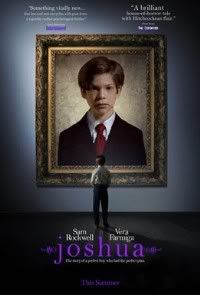
    Director: George Ratliff
    Cast:
    Sam Rockwell, Vera Farmiga, Celia Weston, Dallas Roberts, Michael McKean
    Release: July 6, 2007
    Synopsis:
    The tale of Brad (Sam Rockwell) and Abby (Vera Farmiga) Cairn, perfect Manhattan parents in a perfect Manhattan apartment whose perfect life begins to crack after the birth of their second child Lily. Shortly after Lily arrives home, a dark side of prodigy son Joshua slowly begins to reveal itself.

    View Trailer:
    * Medium (QuickTime)

    Prognosis: Left Me Not Wanting More. I felt the nails on the chalkboard simply from that baby monitor in the beginning of the trailer.

    Some of you basement dwellers will never know the pleasure of actually fornicating, impregnating and then having your bride pop out a nugget with ten fingers and toes but for those of you who have managed that feat will know the pleasure of listening to every cry and bleat for ever loving God that your child can muster through a shitty ass piece of $29.99 intercom technology.

    I felt the pain of what that’s like and thankfully we’re not given some hokey voiceover explaining that to us as we open up onto things.

    Yes, the opening sequence feels a little on the light side with regard to figuring out what the hell is happening on the screen, the wife looking like an uglified, malnourished Frances McDormand, even as the creepy boy who understands what this new kid means inside the household.

    As well, the piano sequence that continues things, with this way-too-smart for his own good little boy lets his dad know that his father is not required to love him by any means is slightly awkward and feels a little false.

    What’s great is Sam’s boss who cuts right through all the sentimentality of the new arrival, cuts right to the quick as he brings us all back to reality, and when you see the dead dog on the kitchen floor there is all sorts of giggles from this side of the fence. Now we’re talking entertainment”¦

    The strange twist here is that the kid then becomes the Damien of the film’s focus. He starts killing his classroom’s pets, he exhibits the kind of creepiness that I would immediately take as a sign to take the kid back to whence it came but offering to be able and throw a rock at an old person for five dollars just made me laugh. It was really so absurd that I couldn’t help but feel it was more funny than it was scary.

    And when the kid is staring in front of a television that has nothing on it but snow? I mean, when Carol Anne did it in POLTERGEIST that was because her parents were too fucking cheap to buy cable for the kids but here? Come on, it’s the 2000’s and the only people that should be without basic cable should be pedophiles and those who make Mike and Ike candies.

    As we continue forth the parents are parents are completely caught unawares of what their demon brood is preparing to do, namely killing their youngest daughter, HOWEVER the remaining moments of the trailer are surprisingly suspenseful as we all wonder whether the kid is going to take the stroller and push his sister to her death.

    I think the trailer, on the whole, is a sparse affair. It should be applauded for not using any voiceovers to try and amp up what’s not there but we’ve seen multiple films about kids who become killers and killers who might be kids, none with any great degree of success. This is why I wouldn’t pay to see the film. It might, though, be a reason why releasing the film in theaters and on television at the same time would be a good thing.

    WAR (2007)

    Director: Phillip G. Atwell
    Cast: Jet Li, Jason Statham, Devon Aoki, Luis Guzman, Nadine Velazquez Release: September 14, 2007
    Synopsis: After his partner Tom Lone (Terry Chen) and family are killed apparently by the infamous and elusive assassin Rogue (Jet Li), FBI agent Jack Crawford (Jason Statham) becomes obsessed with revenge as his world unravels into a vortex of guilt and betrayal. Rogue eventually resurfaces to settle a score of his own, igniting a bloody crime war between Asian mob rivals Chang (John Lone) of the Triad’s and Yakuza boss Shiro (Ryo Ishibashi). When Jack and Rogue finally come face to face, the ultimate truth of their pasts will be revealed. Used to be titled ROGUE.

    View Trailer:
    * Large (Flash)

    Prognosis: Yikes. Sometimes you just need to downshift your brain.

    After trying to wrap your head around what the Bush administration is doing to people within our own country or thinking of how we’ve gotten our collective selves into a quagmire in Iraq with no possible endgame to finish things right, there are movies like this that speak to the Suspension of Disbelief theory better than any textbook example ever could.

    Quite ostensibly, you’ve got the intro. Hot cars pull up in front of some nameless bar with lots of hot chicks with body paint bumping and writhing to the sounds of whatever; who cares about equal rights when you’ve got body paint, right?

    Oooo”¦intrigue. You’ve got some gangland style executions going on, again, without any context about the who’s, the why’s, the how’s and what-does-this-all-mean theorizing. I’m ok with all of this.

    Then the voiceover starts and even I can’t help but start laughing.

    See if you can follow me on this, the trailer basically lays it out better than any blueprint of how to make a circle ever could: in some way or fashion there’s this Asian gang that has enjoyed freedom, I guess, to do whatever the hell they want because they have some kind of “truce” with the police. Yeah, I see where this is going too”¦

    Someone gets shot dead on the good guy side, whatever that means, and then Voiceover Guy chimes in with, “A renegade FBI agent.” This is about where I lose my shit. I mean, yes, I love these kinds of films but if you’re not even going to make an effort to make some kind of original B.S. then, really, why should I?

    You look at a film like UNLEASHED and even a film like CRANK and you can see what I’m talking about. There’s originality there, obviously not Oscar award winning originality, but as this trailer progresses we’re just going through the motions.

    We’re dished up some crappy hip-hop/techno track as Jet punches and kicks his way through bad guys, Jason punches and kicks his way through equally as bad bad guys in his pseudo Kung-Fu style.

    There’s some jumping through windows that looks terribly choreographed, some Asian guys fighting in three piece suits (a staple of any good martial arts movies in the 80’s starring Van Damme, Brandon Lee or Dolph Lundgren), lots of fancy cars and motorcycles being a part of action sequences, more three piece Asian fighting dudes and, hell, to finish it off, we even get a ninja. A fucking ninja.

    Look, I enjoy these kinds of movies if they’re done right but this trailer speaks to someone who I used to be as a little man of 13: someone who wanted stuff to blow up, for there to be a wafer-thin plot and to leave me feeling utterly stupid by the end.

    I’m older now and this kind of idiocy just doesn’t sit well with me anymore and this trailer honestly feels like it should have been left back in the 80’s where it belongs.
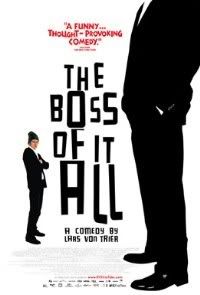

    THE BOSS OF IT ALL (2007)

    Director: Lars Von Trier
    Cast:
    Jens Albinus, Peter Gantzler, Thor Fridriksson, Benedikt Erlingsson, Iben Hjejle
    Release: May 23, 2007 (Limited)
    Synopsis: The owner of an Information Technology firm wants to sell his business for profit. The trouble is that when he started his firm he invented a nonexistent company president to hide behind when unpopular steps needed to be taken. When potential purchasers insist on negotiating with the “Boss” face to face the owner has to hire a failed actor to play the part. The actor suddenly discovers he is a pawn in a game that tests his (lack of) moral fiber.

    View Trailer:
    * Large (QuickTime)

    Prognosis: Negative. I despise superlatives.

    Ok, I don’t really despise them because I employ them every now and again but when they’re used in film advertising I really take umbrage with the connotations of making such statements. Case in point is the trailer for this film and is a textbook case as to why it’s just not a turn-on when you’re being asked to pay money to see a film that someone’s directed.

    What’s more, or what’s truly confounding, is in the first few seconds of this film we’re treated to a reflection of Von Trier in a pane of glass as he navigates a camera on a crane. I get that he was behind the whole Dogme 95 movement but what are we, as an audience, supposed to make of Lars breaking the virtual 4th wall in exposing himself, his movie, as nothing more than a play put to film? An overt fiction where, I guess, we’re not supposed to believe the story in which he’s trying to sell us. He obviously doesn’t mind be credited in the trailer as the man who directed the film, breaking commandment number 10 of his own visionary plan for cinema, but it’s a little odd if nothing else.

    We’re tossed the “most controversial director” moniker like it’s supposed to make me sip a little faster from my latte because I’m about to hit with something really controversial but, the fact of the matter is, the joke that this movie is really only an “office comedy” only serves to make this trailer lumber forward with only a vague sense of what this all is supposed to be about.

    What we see is some guy who looks like Treat Williams introducing a dude who could easily pass for Daniel Craig’s body double to a pack of people in a boardroom. I get the guy is supposed to be an actor only playing the part of a boss but what are we to make of the brown shit he applies to his forehead like he’s someone who’s forgot that a) he’s a dude and b) that you’ve now established this character as some kind of whack job no matter how good the excuse is.

    Further on we get it, almost nauseatingly so with as many references to how ruthless this guy is, that the imaginary boss is reviled to the point of physical violence. The guy gets beaten up, for Christ sakes.

    I try desperately to look for some kind of narrative that will jive with what’s supposed to be at issue here, that some mark was brought in to take the heat off the real boss who has been driving a pack of yuppies into a sense of submission and violent tendencies or that this all part of some more elaborate experiment of some kind, but there is a glimmer that there is more underneath all the seething hatred.

    I can’t imagine anyone would stay at a position like this considering what these people are going through, at least what we’re shown they’re going through, but the trailer is an utter failure in proving any thesis greater than whoever cut this thing deserves the same type of vile violence that seems to be visited upon the blonde actor who is just looking for a paycheck.

    I could be wrong but the trailer doesn’t make it any easier on any of us in getting some kind of straight answer as why I should spend anything more than my time just moving on to another movie than can explain itself better than this.
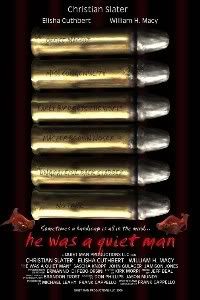
    HE WAS A QUIET MAN (2007)

    Director(s): Frank A. Cappello
    Cast: Christian Slater, Elisha Cuthbert, William H. Macy, Sascha Knopf, Jamison Jones
    Release: Coming Soon
    Synopsis: He seemed like such a nice guy”¦He pretty much kept to himself”¦An office worker inadvertently becomes a hero after he saves a woman’s life.

    View Trailer:
    * Large (QuickTime)

    Prognosis: Positive; This Is Why I Love Trailers. Unless you’re one of the few who can actually do it I am going to go on a limb and say that there are a lot of brilliant people who contribute to the Internet but have to slug it out in an office where clichés come to life every single morning.

    The office genre, thankfully, still has room for growth and this looks like a shockingly excellent addition to it. Not everything that goes on in an everyday office has to be funny, most people who know can affirm that it can be downright miserable without an ounce of humor to be found, and Christian Slater just blazes right off the screen.

    The voiceover is a curious one. It is a woman’s voice who essentially proposes a question of whether if you knew the outcome of a situation, a high stress one, while were you were in it, would you do something different. The question is a simple one but it works well with what’s happening on the screen. Slater is holding a pistol and even though we don’t know why or what’s happening.

    Slater has shed his clean and well-shaven appearance, it was really KUFFS that best embodied this sense of cool style and Leon Rippy earns high marks for allowing Slater to eclipse what could have been an Oscar worthy performance, and has instead opted for old guy glasses, a wicked bad Members Only jacket and a loaded gun.

    Kudos as well go out to the trailer makers for taking a large block of trailer time and giving us an extended moment after a maniac shoots up his office. Slater going ape shit on his own and capping the guy before he can fire back was completely unexpected.

    They have my attention.

    The places where this film goes from here is rather interesting. The screen gives us quick comments like “what if you could make a difference” and other such what ifs but it’s Slater’s geeky response in feeling uncomfortably ill at ease makes me want to know more as a viewer; exactly the kind of thing, you see, a good trailer should do.

    He looks like he gets the kind of job and life all of us dream of in a business setting, of becoming the boss, having some modicum of power, and seeing William Macy act along Slater just elevates the production that much further in my own mind as a consumer.

    This is also something I have been missing in the creation of modern trailers, a good soundtrack. It’s the Bloc Party’s “This Modern Love” which just launches and thrusts the action of this thing forward better than most any other trailer in the past couple months; it fits, for one, the movement of those on the screen and, second, it makes everything feel fresh.

    And, what’s more, when the song switches to Keane’s “Bad Dream” I find myself getting those prickly little goose bumps as we go further, not getting a real definitive explanation of what we’re watching but getting a feel, a real feel, for the film’s ethos on how these two people, Slater and Elisha, come together and what happens when they do.

    The animated hummingbird, the shot of the office building blowing up, the two of them dancing with one another in some kind of dreamscape and the vagueness of what these two mean in the grand scope of this film easily put this trailer in my Top Ten for 2007.

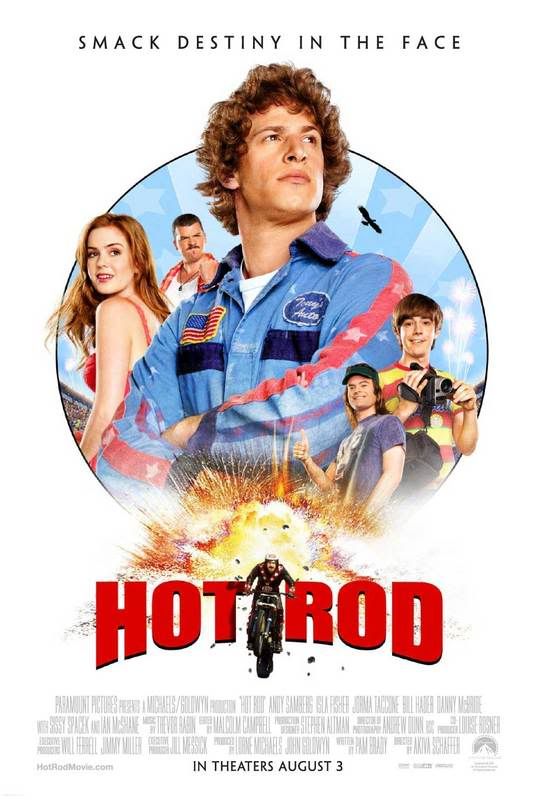
  • Quick Stop Exclusive: Pics from HOT ROD

    hotrod-top.jpg

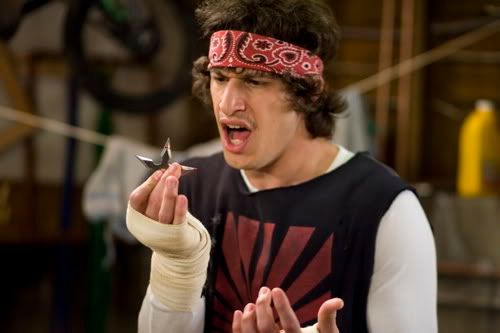
    Amateur stuntman Rod Kimble (ANDY SAMBERG) has a problem ““ his step-father Frank (IAN MCSHANE) is a jerk. Frank picks on Rod, tosses him around like a rag doll in their weekly sparring sessions, and definitely doesn’t respect him, much less his stunts. But when Frank falls ill, it’s up to Rod to stage the jump of his life in order to save his step-father. The plan: Jump 15 buses, raise the money for Frank’s heart operation, and then… kick his ass.

    Usually when you do these things it’s the synopsis that gets shafted. People just want the goodies without giving the proper shrift to the context. What’s absolutely bizarre and humorous is that this isn’t just a movie about some dope having to prove something to the world – this is a movie about a dope having it in for someone so relentlessly that he’s going to prove something to the world… and then kick the ass of the person who he’s trying to help.

    Nice setup, even better teaser trailer, and a quite nice Isla Fisher means a lot towards creating goodwill for a guy like me who stopped believing in the power of Saturday Night Live but who has come back aboard with every occasional flirt with comedic greatness (Who out there doesn’t know some verse of “Lazy Sunday” or at least likes Justin Timberlake a smidge more for his help on “Dick in a Box”?).

    HOT ROD’s Internet promotion is just as creative as Samberg is proving himself to be. If you head over to the faux site created by Rod’s brother, Kevin, you’ll be treaded to a nice Web 1.0 version of what these film characters are all about. What’s really good is if you head over to the VIDEOS section of the site; it’s five minutes really well spent. Or, if absurdity isn’t your bag, simply head over to the film’s official site and enjoy all the slickness that m0dern computer coding has to offer.

    Besides all this, the movie stars two of the better comedic players out there, Will Arnett and Bill Hader.

    HOT ROD opens everywhere August 3rd.

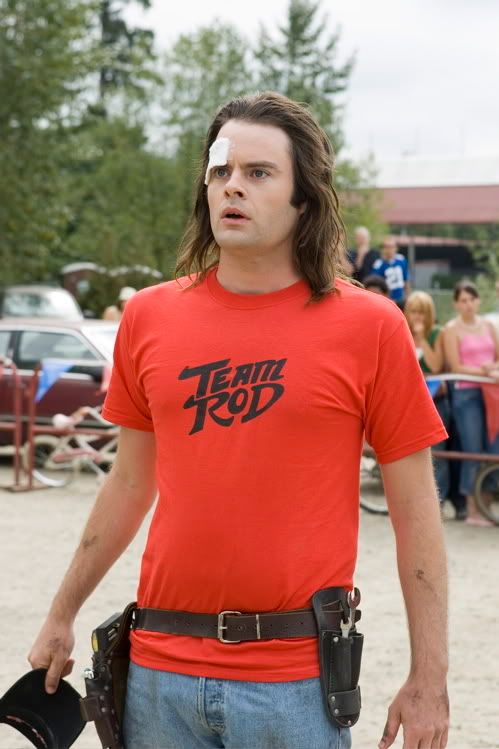
    P.s. – I dig Hader’s red shirt below. Reminds me of another bike movie that was a real hallmark in my youth: RAD. That one also starred Talia Shire, and the shirts in that movie read “Rad Racing”. Coincidence? I think not, but the nostalgia is too delightful to ignore.

    Christopher Stipp

  • Toy Box: Zuckuss mini-bust

    toybox.jpg

    There are bad ass bounty hunters (Boba Fett) and ridiculous bounty hunters (Dog). And someplace in between, there’s Zuckuss.

    Originally from the plant Gand, he looks an awful lot like the original Fly from the 1958 film, and is really one of the less original designs from Empire Strikes Back. But we all know how much kids love a good bounty hunter, and even without any lines in the film, his action figures have always been popular.

    Gentle Giant has just added him to their extremely extensive line of mini-busts, with a limited edition release of 5000. You can pick up Zuckuss for around $45, and I have some excellent suggestions of online retailers at the end of the review.

    “Zuckuss mini-bust”

    Did you know Zuckuss was played by a woman? Neither did I. I guess you really do learn something new every day, whether you wanted to learn it or not.

    toybox_060507_1.jpg

    Packaging – ***
    When Gentle Giant uses the window boxes, they make me happy. I like to be able to see the bust before I open it. Of course, this really only helps if you’re buying in person at a store, but it’s better than nothing. The graphics are dull as dishwater, with the same angular black and gray design that we’ve seen on the Medicom sixth scale boxes. It’s consistent, but still consistently dull.

    toybox_060507_2.jpg

    Sculpting – ****
    When Gentle Giant does it right, they do it oh so right. Zuckuss looks amazing, with a very detailed sculpt all around. They’ve even added some light texturing to the robe, something missing from most of their Star Wars busts.

    toybox_060507_3.jpg

    The head and body proportions do seem a little off to me, with the head being a bit bigger in proportion to the body than I remember in the film. It’s not so much that the head is too large, but rather that the body is too small. I seem to recall an on screen character that looked more like a fly that’s been hitting the twinkies way too hard. This Zuckuss is a tad more trim and slim, which is probably causing the discrepency.

    The eyes are particularly well done, with a lot of depth and sharpness to the cuts. There’s a distinct difference in the texture and style of the character’s flesh and the clothing and equipment, adding a nice realism to the bust.

    Paint – ***1/2
    Another very strong area, although there are a couple minor issues here and there. One of the nice features of a oddball character like Zuckuss is the wider range of colors, and all of them are quite bright and clean, giving him more pizzazz than you’d expect.

    toybox_060507_4.jpg

    There’s a little slop here and there, but it’s minor enough that I suspect most folks won’t mind. The robes are also a tad more glossy than I like, but this is more a personal preference than a serious quality issue. Finally, the bronze pieces of the costume are a little inconsistent in coverage and thickness, but that’s fairly common with this type of metallic color.

    Design – ***1/2
    Zuckuss is holding his blaster pointed to his left, while he looks over his right shoulder. The pose and design are extremely strong, with enough dynamic feel to make him interesting without making him silly.

    toybox_060507_5.jpg

    I really like the large ‘rope twist’ black wire on his back, which looks quite realistic but is actually polyresin as well. The bronze pieces of his costume also add a nice touch, and this is one of the cleaner designs of the series.

    Value – **1/2
    He’s running the same $40 – $45 as the rest of the line, but lacks any special features that would boost his value above average. you won’t mind spending the money though, so this category is really a wash.

    Things to Watch Out For –
    Not much. From what I’ve seen, the paint seems pretty consistent for this line, so you should be good to go. And short of dropping him on a concrete floor, you should have no issues with breakage.

    toybox_060507_6.jpg

    Overall – ***1/2
    Zuckuss is another strong offering in the Star Wars mini-bust series. Unfortunately, Gentle Giant continues to pump out far too many exclusives in this line, making it harder and harder for their fans to get the busts they want. I haven’t actually counted them up yet, but I honestly believe that they’ll be doing MORE exclusives in the Star Wars line up than regular releases this year, and there’s really no excuse for that.

    But if you’re like me, you’ll be trying to get the busts you want for your collection, playing right into their hands. I suppose we get exactly what we deserve.

    Where to Buy –
    I recommend any of these online options:

    Hero Hunt has an excellent price at just $40, and he’s in stock.

    Fireside Collectibles has him at an excellent price – $40 – but he doesn’t appear to be in stock yet. You might want to give them a call to see when he’ll ship.

    Andrew’s Toyz carries all kinds of great Star Wars merchandise, and has Zuckuss on pre-order at just $41.

    Dark Shadow Collectibles has him at just $42.

    Alter Ego Comics has him for $42.50.

    Amazing Toyz and CornerStoreComics have him in stock at $44.

    – and for the U.K. readers, Forbidden Planet has him for 29 pounds.

    Related Links –
    Other Star Wars mini-busts I’ve covered include Chewbacca and Darth Maul, Jedi Luke, Qui-Gon Jinn, Palpatine and Skiff Lando.

  • Trailer Park: Roman Polanski is still a wanted fugitive in the U.S. for raping a 13 year-old girl but who cares, right?

    By Christopher Stipp

    Archives? Right Here…

    Inspired by those wacky geeks over at TWIT I have decided that instead of putting off and putting off and putting off my vow to somehow market my first book I would let people download and read it for free. Give it a preview, read the whole thing or, if you like what you see, send me some kind words or money for the actual book. Download and read my first book “Thank You, Goodnight” for FREE.

    There’s a lot I like to read about movies.

    I usually skip the fluff in favor of the harder news that a lot of sites out there push out, commenting on the stories from an angle that contextualizes events, happenings.

    On one of my perusing journeys I came across an article that decried the lunkheadedness of many reporters out there who are aching to serve entertainment outlets with vapid and shallow filling that will play well to Ma and Pa Kettle in Bumwad, Tennessee.
    I’ve been there, believe me. I don’t know how these people managed to get a paid position with an organization that thinks asking actors or directors meaningless questions about their personal lives or proclivities with them being loosely based on the fictional product they’re out hocking but it’s embarrassing to be in the same room with said actor or director when they get a question that feels written by a third grader. They get that look on their face where you instantly know that a) they’re going to be nice and answer it and b) are making a mental note to never make small talk with the wag in the future.

    One such event happened during a Cannes interview with directors David Cronenberg, Atom Egoyan, Wong Kar Wai, Jane Campion, Gus Van Sant, Taskeshi Kitano and Roman Polanski all gathered for an ol’ fashioned press conference. I’ll save you the fluffery and get right to the quick: Roman Polanski had enough of the softballs he has being given. He had enough at one point and said:

    “This is a rare and unique opportunity to see a gathering of such important directors and it’s a shame to have such poor questions,” Polanski said pointedly.

    He then left the stage in a huff and didn’t come back. He had enough of the press’ lame questioning and went about his day. On the one hand, I think he did the right thing but, on the other, CHUD’s own Devin Faraci chimed in with the opinion that, “How much banality should a great talent have to endure to sell his product?” True enough. It’s a point, and essay, worth taken. However, it doesn’t make it right in the grand scheme of things if ever there was a grand scheme.

    Months earlier, Faraci stepped further into the Polanski issue by stating that, “there are people who will never again watch a Polanski film because of the statutory rape he committed years ago. But does Polanski as rapist diminish Polanski as filmmakers? Of course not”¦ unless Polanski was a filmmaker whose whole oeuvre was based on the sanctity and beauty of youth and innocence.”

    This view couldn’t be filled with more ignorance even if he was the original template for Plato’s allegory for those stages of mental cognition in The Republic. Based on Faraci’s logic, then, it should follow then you should be able to enjoy his award-winning film, THE PIANO, without ever bringing the issue of the whole drugging and rape thing of a young girl into an honest critique of the man’s film.

    I believe, and would posit, that a man like Polanski still deserves the kind of ire that we, as a society, place on those who would harm young children. If you can separate the two notions in your own head and justify being able to say “Yeah, he’s a rapist but, boy, he is a great filmmaker!” I’m sure there are scores of adults who have to live with the scars of physical abuse from when they were children and, I am willing to bet my left nut, I’m positive they don’t take issues like this lightly and I’m sure they don’t think there’s ever a statute of limitations on rape.

    To look at something, and hold something, like a movie above all else is a case study in myopia. For those who have children, for those who have sisters, I’m pretty positive none of them are apologists for a filmmaker who has yet to answer to a crime which he actively avoids to this day. Use all the excuses to defend the man but, at the end of the day, there will always be a woman who I’m sure never would patronize a Polanski film, nor support it due to the vile things that monster has wrought.

    In case you’d like to read more about the kind grandiose filmmaker Polanski is, as every student of film should understand the backgrounds of those who produce world-class art, here is a snippet of the man’s life circa 1977 from Wikipedia:

    In 1977 Polanski, 43, became embroiled in a scandal involving 13-year-old Samantha Geimer. It ultimately led to Polanski’s guilty plea to the charge of unlawful sexual intercourse with a minor.[1]

    According to Geimer, Polanski asked Geimer’s mother if he could photograph the girl for the French edition of Vogue. Her mother allowed a private photo shoot. According to Geimer in a 2003 interview, “Everything was going fine; then he asked me to change, well, in front of him.” She added, “It didn’t feel right, and I didn’t want to go back to the second shoot.”

    However, subsequent to the first photo shoot, she agreed to a second session, which took place on March 10, 1977, in the Mulholland area of Los Angeles, near Jack Nicholson‘s estate. “We did photos with me drinking champagne,” Geimer says. “Toward the end it got a little scary, and I realized he had other intentions and I knew I was not where I should be. I just didn’t quite know how to get myself out of there.” Geimer alleged that Polanski sexually assaulted her after giving her a combination of champagne and quaaludes. In the 2003 interview, Geimer says she resisted. “I said no several times, and then, well, gave up on that,” she says.[2]

    Polanski was initially charged[3] with rape by use of drugs, perversion, sodomy, lewd and lascivious act upon a child under 14, and furnishing a controlled substance (methaqualone) to a minor, but these charges were dismissed under the terms of his plea bargain, and he pleaded guilty to the lesser charge of engaging in unlawful sexual intercourse with a minor.[4]

    Now, who wouldn’t be lined up to see his next film?

    LICENSE TO WED (2007)

    Director: Ken Kwapis
    Cast:
    Robin Williams, Mandy Moore, John Krasinski, Christine Taylor, Eric Christian Olsen
    Release: July 3, 2007
    Synopsis:
    LICENSE TO WED follows newly engaged Ben Murphy (John Krasinski) and his fiancée, Sadie Jones (Mandy Moore), who has always dreamed of getting married in a traditional wedding at her family church. The problem is St. Augustine’s only has one wedding slot available in the next two years, and its charismatic pastor, Reverend Frank (Robin Williams), won’t bless Ben and Sadie’s union until they pass his patented, foolproof marriage-prep course. Through outrageous classes, outlandish homework assignments and some pious manipulation, Ben and Sadie are about to find out if they really have what it takes to make it to the altar”¦ and live happily ever after.

    View Trailer:
    * Medium (QuickTime)

    Prognosis: Negative. “I have feelings of homosexuality that cause me some concern”¦”

    I’m literally just trying to recall from the moment when I was faced with a questionnaire from my church with dozens of questions about anything and everything regarding my personal life but it wasn’t until I hit the aforementioned “homosexual” question that I realized there are some strange things afoot inside the church.

    I think it’s why I gravitated so well towards this trailer.

    It, as well, has everything to do with Robin Williams’ subdued performance; he’s not screaming, riffing endlessly or posturing for the benefit of no one but himself. It’s, also, the instant sense of goofiness that you sense with John Krasinski and Mandy Moore.

    When, in the beginning, one of those retractable line strips comes undone unexpectedly the ensuing wackiness is slapstick that Middle America would love dearly. You realize quickly that this is not a film which will linger with you after you see it. This is the Carls Jr., the Sourdough Jack, the McDLT, if you will, of the summer.

    However, there are lots redeeming the production.

    You’ve got John who is just a charming addition on the screen. You can keep your McConaughey’s, your Hugh Grant’s, because there is something truly delightful about having someone who looks like an Everyman and acts like someone you could take an interest in.

    “Ben, what do you do”¦besides little Sadie?”

    Williams also shines as he establishes his character as someone who is even tempered and has an even mood. His demeanor just sparkles as he explains to Moore and Krasinski about Marriage Preparation. You can feel the friction building and even Moore, who genuinely dazzled during her time on ENTOURAGE adds to the mediocre laughs that are sure to ensue when William’s breaks free of his cloistered chains and indulges us all in a little exorcism humor.

    It’s hard to be truly positive about a trailer that doesn’t look like it’s something I’m going to be paying for but even though the camera work looks like it’s going to be as basic as anything auteur, and master of making sure everyone uses X3 as a litmus that usually starts with “Yeah, but was it X3 bad?”, Brett Ratner has put on film, this comedy has something about it as there is still a glimmer that it could be a great rental when it comes out around Thanksgiving.

    A MIGHTY HEART (2007)

    Director: Michael Winterbottom
    Cast: Angelina Jolie, Dan Futterman, Archie Panjabi
    Release: June 22, 2007
    Synopsis: On January 23, 2002, Mariane Pearl’s world changed forever. Her husband Daniel, South Asia bureau chief for the Wall Street Journal, was researching a story on shoe bomber Richard Reid. The story drew them to Karachi where a go-between had promised access to an elusive source. As Danny left for the meeting, he told Mariane he might be late for dinner. He never returned.

    In the face of death, Danny’s spirit of defiance and his unflinching belief in the power of journalism led Mariane to write about his disappearance, the intense effort to find him and his eventual murder in her memoir A Mighty Heart: The Brave Life and Death of My Husband Danny Pearl. Six months pregnant when the ordeal began, she was carrying a son that Danny hoped to name Adam. She wrote the book to introduce Adam to the father he would never meet. Transcending religion, race and nationality, Mariane’s courageous desire to rise above the bitterness and hatred that continues to plague this post 9/11 world, serves as the purest expression of the joy of life she and Danny shared.

    View Trailer:
    * Large (QuickTime)

    Prognosis: Negative. Ok, let’s get the obvious out of the way.

    Regardless of your feelings about Jolie’s constant appearance in the news for adopting/having/keeping children from all over the world despite plucking one from our own adoption system which is just pathetic considering how we publicly dry-hump the idea of abstinence yet have one of the highest teen pregnancy rates in the world, regardless of how Mariane Pearl has handled the subsequent events following her husband’s untimely death and regardless of your feelings about the creepiness that is Angelina and her media machine, this looks like a fairly spiffy film.

    Ah, who am I trying to kid? I can’t look at Jolie without being reminded how many times that woman has been staring back at me while I’m trying to read the wife’s US Weekly when I’ve been droppin’ a grumpy in the can.

    For all intents and purposes, though, there is a good amount that’s done right in this trailer that deserves a mention. I do appreciate that we’re given a fair introduction into the life of Daniel, a guy who looks like he’s completely wet behind the ears of life, and the scene that we’re given is allowed to happen organically without any impedance of a graphic or voiceover.

    Jolie looks like she spent too long at the spray tanner.

    South Asia bureau chief for the Wall Street Journal. That’s what Jolie, in a hamfisted accent that I think no one’s really going to believe this side of Madonna’s or Paltrow’s faux English linguistics, tells us about Daniel’s job. Not to mention that this is going to go down in Pakistan, not really a good place for an American to be in 2002.

    So, we move on and before we even get into the meat of what’s happening here Jolie says that the two of them flew to Pakistan the day after 9/11. I don’t know what world you live in but, again, there are a lot of red flags that a) should have been waved in front of their face about what the climate was and b) regardless of your position as a journalist you can’t help but feel, after hearing those words out of Jolie’s badly accented lips, that this was a losing proposition.

    Then we’ve got the moment where Daniel disappears forever. According to the trailer we see that he wants one more interview. He gets into a cab and starts driving, and driving, and driving before he says, looking scared, “Are we far?” Um, yeah, at what point does chasing a story and being in love with the idea of being a journalist preclude the notion of preserving one’s life? You can’t watch this trailer and not feel some sense that there was something really amiss with the way things went down.

    “I don’t think this is the business of a journalist”

    From the moment he’s captured the music score gets faster, to create the sense that everyone’s running out of time in finding the man, but the trailer doesn’t really convey the kind of urgency that I would expect to compel me to want to see the movie. While I understand that that everyone, almost everyone, there are some people who can’t list the last three presidents of America, knows how the story ends I can’t believe that a tagline that this movie represents, “the story you haven’t heard.”

    Umm”¦pretty sure I have, Sparky. Apart from the situational details and the summary of events as explained by his own paper anything else are just the private moments of Mrs. Pearl which are open for interpretation and misrepresentation.

    Apart from the usual trappings of a cat-and-mouse movie and the events as they unfolded, a lot of which I would deconstruct here, there is a moment, at the end of this trailer, something really concerns me. Jolie, again in that wretched accent, breaks the 4th wall of this film by saying out loud that this movie is for his son. Is this Angelina talking or is this his widow? And why have there at all? The emotional buy-in, obviously, but it is gauche in ways I can’t begin to describe.

    Is this a film or a documentary? If it’s the former then it makes Angelina’s comments seriously out of place and disgraceful. If it’s the latter then why isn’t his wife playing the part of his wife and why aren’t we just saving the cost of whatever it took to pay Angelina to do this movie (I’m sure it wasn’t done for free) and getting a documentary crew in there to do the work for us?

    It’s all very strange but I am sure as Angelina graces more tabloid covers leading up to this film’s release we’ll get a clearer picture of how this film was handled.

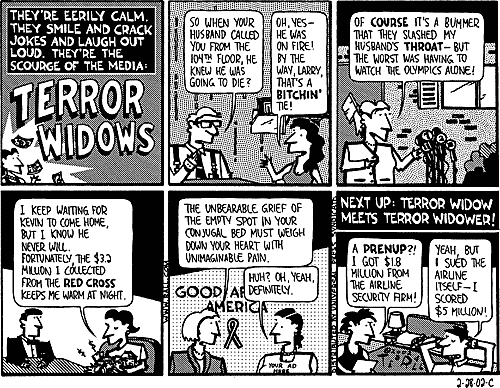
    Interesting side note: Ted Rall, someone who is the embodiment of brutal and insightful honesty in a time of censure, had this to say about the proliferation of outspoken widows in this insidious and un-winnable “war on civil liberties”:

    Let’s see. Ted Olsen, one of the three “terror widows” in my (in) famous comic from 2002, appeared on “Larry King” a week after his wife’s death to promote Bush’s war on terror(TM), aka neo-fascist agitprop. Mariane Pearl made repeated appearances on cable news stations to promote her two books. So did the “Let’s Roll” (R) widow. (She also sold a book, and filed for a trademark on the term “Let’s roll.”) Of course, I was demonized by Coulter’s right-wing fellow travelers for criticizing these people for the (strange) way they chose to mourn their losses. Psychotic self-hating African-American pol Alan Keyes called for me to be censored, jailed and shot to death, not necessarily in that order. My, how things have changed.

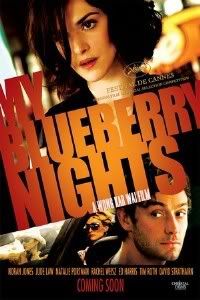
    MY BLUEBERRY NIGHTS (2007)

    Director: Wong Kar Wai
    Cast:
    Norah Jones, Jude Law, Rachel Weisz, Natalie Portman, David Strathairn
    Release: TBA
    Synopsis: MY BLUEBERRY NIGHTS is the new film from one of the world’s most sought-after directors, Wong Kar Wai. It’s a magnificent love story starring multi-Grammy award winner Norah Jones in her movie debut along with a “A-list” cast of Academy Award winners and nominees including Jude Law, David Strathairn, Rachel Weisz and Natalie Portman.

    Norah Jones plays a sensual, alluring young woman who sets out on an unforgettable journey of discovery in pursuit of true love. In heartbreakingly beautiful locations and classic Route 66 atmospheric diners, Wong Kar Wai’s captivating heroine encounters a series of enigmatic characters that help her on her quest.

    Set against New York’s magical cityscape and the stunning vistas of America’s legendary Route 66, the celebrated director’s first English language picture embraces his signature elegance and originality that made “Happy Together,” “In the Mood for Love” and “2046” must-see movies all around the world..

    View Trailer:
    * Large (Flash)

    Prognosis: Negative. Nigel Tufnel: It’s part of a trilogy, a musical trilogy, I’m working on in D minor which is the saddest of all keys, I find. People weep instantly when they hear it, and I don’t know why.

    Here’s something that gets me when I think about the currency of trailer advertising:

    Does a filmmaker’s previous films have any kind of “goodwill value” inherently attached to it? For example, and about as rudimentary as I can explain it, if you make an excellent film does it follow, then, that the trailer that heralds your next feature get a pass in a way? I would argue that, yes, there is some kind of extra credit given to that trailer.

    While I was one of a few who pointed out, long before the movie opened, that the My Chemical Emo Romance haircut of Peter Parker that has, ostensibly, sunk the replay factor SPIDER-MAN 3, regardless of how well it fits in the pure sense of the film, there were a lot of people who never brought this up and socked some people upside the head when it finally was there staring them back from the big screen. It’s these things that are worrisome.

    Worrisome, as well, is how 2046 was just a movie that had ambition but failed to deliver anything resonant as a filmgoer. So, too, then, we have a flick, MY BLUEBERRY NIGHTS, that stars a guy who loves to not only play a dong-sticking cheater but plays one in real life and a girl who can capture my attention whilst behind the ivories but is completely untested as an actress.

    Goodwill? Good God, what hast thou wrought? Nothing memorable, I can tell you that.

    Let’s start at this statement: the opening is absolutely wonderful. Artfully framed and sticky with the kind of musical arrangement that emotes sadness and loneliness. Regardless that she’s a singer, Jones is just standing there in her thigh highs looking forlorn.

    And then she opens her mouth.

    It was absolutely rough to see the following images, feeling more like a lesson in music video acting, of Norah wiping away her tears, damn near staring at the same window she wishes she could be behind like a dazed stalker.

    Enter, stage left, Jude Law. I don’t know what his deal is. Honestly. I think he works in the same restaurant with Jones, I’m not sure, the trailer is a bit muddled about this, and at one point him and his disastrous looking head of a hair (Seriously, is it a weave? A piece?) help each other to shout into a telephone with great aplomb. I don’t get it the point of it and we’re not let in on it.

    What follows afterward are two, distinct, conversations. However, what’s not revealed is what these people are talking about! You’ve got Norah talking about some people finding different people and then an awkwardly set up moment between Law and Jones that not only feels sleazy but plays out like I’m watching Keanu Reeves and Paula Abdul circa 1990 in her awful, cankerous beast known as her “Rush Rush” video. Ghastly, any which way you slice it.

    PARIS, JE T’AIME (2007)

    Director(s): Gus Van Sant, Joel Coen, Alexander Payne, Olivier Assayas, Frederic Auburtin, Gérard Depardieu, Christoffer Boe, Gurinder Chadha, Sylvain Chomet, Ethan Coen, Isabel Coixet, Wes Craven, Christopher Doyle, Vincenzo Natali
    Cast: Steve Buscemi, Juliette Binoche, Maggie Gyllenhaal, Elijah Wood, Gena Rowlands, Emily Mortimer, Miranda Richardson, Rufus Sewell, Willem Dafoe, Natalie Portman, Gerard Depardieu, Bob Hoskins, Nick Nolte
    Release: May 4, 2007 (Limited), Coming Soon
    Synopsis: Eighteen different directors and a slew of indie actors come together for PARIS, JE T’AIME, a cinematic homage to the City of Light. Each director presents his or her own short story set in a different Parisian quarter, each one featuring a different cast of characters. The pieces vary in length, with some of them striving to tell a fully developed tale–no matter how simple the plot–while others are more abstract, content to rely on sparse dialogue and vivid imagery. With directors such as Gus Van Sant, Alexander Payne, Wes Craven, and the Coen brothers participating, the tales are as varied and oddball as one might expect. Maggie Gyllenhaal plays a lonely actress with a fondness for her hash dealer. Elijah Wood encounters a seductive vampire on a moonlit street. Steve Buscemi is a flustered tourist. Natalie Portman falls for a deaf Frenchmen. Each tale is markedly unique, and specific to the quirky style of its director, and the film is a veritable Who’s Who for indie buffs. The end product is a bit uneven, with some of the narratives sparkling and others starting strong, then falling flat. But in the moments when it succeeds, the movie can feel mysterious and magical, evoking the romance and longing the city is famous for.

    View Trailer:
    * Large (QuickTime)

    Prognosis: Positive. Sometimes, just sometimes, an original thought can start something special.

    You watch something and think that the gimmick is just that, a gimmick, and if you try and there’s no way the finished product can support itself beyond that. FOUR ROOMS proved that very well with the multiple-director germ that spawned a film that was ½ good while the other half could have been pitched into a river, tossing and twisting inside a gunny sack. This trailer, though, just exudes that je ne sais quoi (I apologize for that) which really does and should surprise.

    One of the very first things that catch your eye is Natalie Portman. Sitting, perched near a window, the belfry ringing in the background, the screen goes black and the pronouncement is made: “From 18 of the most acclaimed international directors”¦” The first thought for many could be “How is this possible?” but for me it’s “Who was able to coordinate all those schedules?” Beyond that, the list is populated with handfuls of people who I know and, quite naturally, those who I am not familiar with. It’s a veritable who’s who of the directorial arts but before you question how the brothers Cohen made the list alongside Wes Craven were thrust into the narratives.

    Now, from a marketing standpoint there’s obviously an issue with selling a story to the public when you’re talking about a movie that’s a literary equivalent to a short story collection. The angle you have to take, and the one you’re really left with, is selling the styles. Selling the chance to find out why Steve Buscemi looks so forlorn, why Rufus Sewell actually looks like a leading man for once and why Willem Dafoe is on a horse in the middle of an urban jungle.

    There’s some simplicity in the musical score that is the only, singular thread that is connecting the reasons why you would want to toss down some scratch to see the picture. I am compelled by Bob Hoskins’ performance in a strip club and the odd pairing of a man who stands behind a pane of smoky glass only to have a fist shatter it as he stands perfectly still as it happens.

    “Every glance”¦Every kiss”

    The perfection that is this trailer is its simplicity. We’re no better understanding why the flirtatious looks between a man and woman are so compelling but as the trailer builds to a steady crescendo we’re given the reasons why there is enough reason to see this film: it’s an ode to new love, old love and the kind of love we all can connect with as human beings. It’s a bit corny, yes, but that’s exactly what modern cinema has been missing for a little while.

    Elijah Wood’s story looks creepier than fuck, I actually feel positive to a cleaner looking Nick Nolte strolling with his maiden and the individual signatures from all the other directors involved, mashed up with one another, works so effectively that I dare say there is some reason to believe in the power of the short-story angle which doesn’t feel like an excuse to have all sorts of directors toss a bunch of slop against a wall to see what sticks; in fact, I would posit that what’s given here at the end of the trailer is a case for the ethos that love can be a good, solid reason to make a movie where you really could find a gem or two within the body of the work.

  • Toy Box: South Park Series 5 – Damian/Cartman

    toybox.jpg

    I have been pretty quiet the last couple weeks. Why? Well, it’s called the great toy drought of ’07. With the collectibles market collapsing in on itself, retailers disappearing regularly, and manufacturers going belly up left and right, product has been a tad scarce lately.

    But finally I have something worth talking about – the fifth series of South Park figures from Mezco. There are four new figures to add to the ever growing legion of South Park residents, and here at QSE I’m covering Damian, son of Satan who’s an average kid otherwise, and Hippie Exterminator Cartman, doing his best to rid the world of the unclean, long haired types. Over at MROTW, I’m covering the other two in the set: Mephesto and Tweak.

    South Park 5 – Hippie Exterminator Cartman and Damian

    Damian fits in nicely with the rest of the kids, and if you have to get another Cartman variant, one that’s dressed up like a Ghostbuster ain’t a bad choice.

    toybox_052907_1a.jpg

    toybox_052907_1b.jpg

    Packaging – ***
    For those who have been picking up the line all along, there’s nothing new here. The usual South Park text and graphics right from the show, with some basic photos on the back of the interior card. The clamshell has the show name embossed on the left side, which is a nice touch, but the packages remain very oversized, making the contents seem smaller and less impressive.

    toybox_052907_2.jpg

    Sculpting – ***1/2
    Both Damian and Cartman sport nice sculpts, with wild hair and properly scaled bodies. Obviously, there’s not going to be a lot of detail here, but as I’ve said plenty of times before, that doesn’t mean you can’t screw it up. Check out my reviews of the Mirage attempt (at the end of the review) at South Park to see what I’m talking about.

    toybox_052907_3a.jpg

    The key to capturing these is getting the proportions right – head to body, arms to body, legs to body. Get these proportions off, and you’ll have figures that sorta kinda look like the characters, but something is missing…you might not even be able to put your finger on it, but you’ll know something is wrong. Thanksfully, the proportions here are very good, with really no issues.

    toybox_052907_3b.jpg

    Scale is good as well, with Damian fitting in at about the same size as the other kids, and Cartman his usual fat ass self. Cartman also has the advantage of having some additional sculpt details with his outfit, including some pouches and straps. These all are very well done, and make him one of the cooler Cartman variants.

    Damian’s standard left hand has a small flame coming off the finger, while Cartman’s right hand is sculpted to hold either of his accessories. That’s a much appreciated touch, since as I mentioned in the other review, Tweak can’t even hold his included coffee cup.

    Paint – Cartman ***1/2; Damian ***
    Both of these are actually better paint-wise than most of the figures in series 4. I didn’t have any eyeball issues this time, and there were far fewer stray marks or mistakes. Damian still has some consistency issues with the black body, with some shiny patches here and there.

    toybox_052907_4a.jpg

    Cartman again has the advantage here, because he has alot more detail in the outfit. There are additional colors and small details on the belt, pouches and straps, including zippers and buttons.

    toybox_052907_4b.jpg

    Both faces look terrific as well, and I went with the serious mean looking closed mouth on both. They also can be had with open mouth expressions, but I don’t really see either of these characters yelling.

    Articulation – ***
    Both of these figures lose a little articulation over some past figures, but they have the one thing I love the most…articulated eyebrows. Damian adds his ball jointed neck, cut shoulders and cut waist. His left arm has a cut wrist as well, since the hand is swappable. It’s not a lot, but the neck and eyebrows give a lot of cool posing possibilities.

    toybox_052907_6.jpg

    Cartman also has the poseable eyebrows, ball jointed neck, cut shoulders and cut waist. He does not have cut wrists, and that’s too bad, because that would have really helped with posing the left hand holding the accessories.

    Accessories – ***
    Both of these figures seem pretty well outfitted, especially Cartman. Damian comes with two extra arms, both with the small thumbs sticking out. He also has an extra left hand to replace the ‘flame’ hand if you’d prefer. But his coolest accessory is his included demon, made from a thin but very sturdy plastic that attaches tightly to the flame base. The red eyes look terrific, and the translucent plastic gives him a smokey appearance.

    toybox_052907_5a.jpg

    Cartman comes with his flashlight, but it doesn’t have any sort of lens or color on the face, and no detail on the body. It looks like a large bolt more than a flashlight. At least he can carry it in his right hand.

    He also has his very cool fire extinguisher, perfect for extinguishing those hippies It attaches to his back, and the nozzle can be take off and put in his right hand. There’s an included foam attachment that makes it look like it’s being fired, and it fits neatly in the nozzle. Finally, the small top on the extinguisher can turn so that you can get things lined up perfectly on his back.

    toybox_052907_5b.jpg

    Fun Factor – ***
    They aren’t technically toys for kids, but they could work that way. Most of the joints are pretty sturdy, and they could take a pretty good beating. Even if an arm does pop off, it pops back on easy enough in most cases. While these are designed as pop culture collectibles, they haven’t lost sight of their roots as action figures.

    Value – **1/2
    You can expect to pay around $12 or $13 each for these, the current going rate for most specialty market action figures. Cartman and Damian have some decent accessories, so they make an average rating at this price point.

    Things to Watch Out For –
    If you’re picking them off the peg, of course you’ll want to watch those paint ops. And don’t forget that each one comes in at least two facial expressions – open and closed mouths. Each person is going to prefer one over the other, so choose wisely.

    Overall – Cartman ***1/2; Damian ***
    While I like Mephesto as well, Cartman is probably my favorite of this set. I’m glad I got Damian and Tweak, but that’s largely because they round out the kids. Mephesto (and the included Kevin) are good B list characters, but this variant on Cartman really looks cool on the shelf, especially when he’s firing the extinguisher. I wasn’t a big fan of this episode, but that doesn’t make him less visually appealing for me.

    toybox_052907_7.jpg

    Where to Buy –
    Hot Topic is supposed to have these in, but if your store is like mine, it isn’t happening. Online options include:

    Amazing Toyz only has them in stock in sets of four for $45 at this point.

    CornerStoreComics has the sets at $45 as well, but has some singles for $11 – $13 depending on the character.

    YouBuyNow has pre-orders up for the next series (Nurse Gollum, Mr. Slave, Starvin’ Marvin and Ming Lee Cartman) for just $13 each.

    Circle Red doesn’t have series 5 listed, but if you’re looking for series 4 they have a good price at all four figures for $35.

    Related Links –
    I’ve had a fair share of reviews so far:
    – I reviewed series 1 of course, which has the very cool Cartman figure, along with series 2, series 3, and series 4.

    – and let’s not forget that – Mirage did series 1, series 2 (I reviewed Towelie separately), and series 3 of their figures before packing it in. They also did an exclusive Mr. Hanky.

  • Comics in Context #179: Pride and Prejudice

    comicsincontext4.jpg

    cic2007-05-25.jpgThere is a school of thought that any publicity is good publicity. I suppose that Marvel considers the furor over the recent demise of Captain America (see “Comics in Context” #168) to be good publicity if it boosted sales of the comics. But just what kind of lasting impression did that leave in the world beyond comics speculators? If people believe that Captain America really has been killed off, then it would seem to them that Marvel has destroyed an iconic figure representing the finest in the American spirit. If people believe that Captain America isn’t really dead, or will be resurrected, then it would seem to them that Marvel is exploiting and trampling upon said American icon as a publicity stunt to make big bucks. Why would a company that cares about its public image want to create either impression?

    Last week Marvel got still more publicity of questionable value when the mainstream media discovered Sideshow Collectibles’ rather sexist statuette of Spider-Man’s leading lady Mary Jane Watson as a sexually submissive laundress. Not only was I interviewed about this figurine on MSNBC (see last week’s column), but former Spider-Man comics editor Danny Fingeroth showed up five times on the network to talk about the controversy (as you can see on YouTube here).

    Comics artist Adam Hughes has posted his design for the statue on his website, and I find the original drawing considerably less objectionable, prettier, and even charming. Perhaps it was the people at Sideshow who pushed the design over the edge of taste. (And just who designed the rear of the statue?)

    Even so, Hughes seems not to get why it was regarded as sexist and offensive, and this is part of the problem. “Mary Jane is a bit of a bimbo,” he explains, blaming the victim, adding that “Well, she’s bending over. Pin-up girls do that.” It’s as if male artists had nothing to do with creating the pin-up girl image. “But by that argument ““ if we take bending over to be a sign of sexual availability, every woman who bends over to pick up something should be chastised.” And just how many such women show off their thongs as they do so? Using some inappropriate hyperbole, Hughes asserts that “I think the whole “˜sexual availability’ claim comes from trying to back up the argument that this is the most awful thing to hit mankind since the Holocaust”. Here is a perfect example of someone who finds himself in a hole and unfortunately reacts by digging himself in even more deeply.

    Hughes asks, “is it really a sexist or misogynistic act if it wasn’t intended that way on the part of the people doing it? . . .are you seeing something that’s either not there, or that the artist never intended to be there?” First, this demonstrates a lack of understanding of human psychology. Certainly, a person can be subconsciously sexist or misogynistic. Certainly people can consciously hold prejudiced opinions without being aware they are prejudiced: they consider their opinions to be correct. D. W. Griffith was reportedly surprised that his film Birth of a Nation (1915) was attacked as racist, though today that is the unanimous opinion of cinema scholars. There’s that song in the musical Avenue Q, “Everybody’s a Little Bit Racist.”

    Moreover, even if Hughes did not consciously or unconsciously have sexist intentions, that does not mean that people who interpret the statue as sexist are wrong. Certainly artwork can be interpreted in ways of which the artist was not consciously aware. A Freudian interpretation of Oedipus Rex is not invalid simply because Sophocles died centuries before Freud devised the term “Oedipus complex.” If an interpretation fits the artwork, it is justified whether or not the creator agrees with it. This is a basic principle of criticism, long accepted in academia, and comics writers and artists had best wake up and take notice. (Not surprisingly, Neil Gaiman recognizes this principle, as can be seen from his introduction to The Sandman Papers, Fantagraphics’ 2006 anthology of academic essays about his work.)

    But the Mary Jane maquette, as I suggested last week, is relatively tame compared to what just turned up in the comics shops. Years ago, back when I was first mulling over doing a column on the Internet, I considered doing a segment called “Atrocity of the Week.” Maybe I shouldn’t have dismissed the idea, since, lo and behold, less than a week after I wrote about the MJ statue, Quick Stop editor Ken Plume e-mailed me about this: the cover of Marvel’s new issue of Heroes for Hire, appropriately #13. It appears that the ladies in bondage, with necklines cut so low that in two cases they approach the navel, are the Black Cat and the detective team of Misty Knight and Colleen Wing, all formerly presented as empowered, independent heroines. Drawn in manga-influenced style, they’re virtually unrecognizable, and Misty looks less like the African-American she’s supposed to be than a well tanned Caucasian. But the biggest problem is those tentacles feeling them up.

    Researching this week’s column has expanded my knowledge of Japanese cartoon culture, though not in a way I would have preferred. It seems that the Heroes for Hire cover evokes the style and content of hentai manga, a term used outside Japan for Japanese comics dealing in explicit sexual or pornographic content. It turns out that so many Japanese comics deal in “tentacle rape” that this subgenre merits its own Wikipedia entry, which informs us that “Tentacle rape is a concept found in some horror hentai titles, where various tentacled creatures (usually fictional monsters) rape or otherwise penetrate women (or, less commonly, men). Much of the genre also consists of humiliation and bondage fetishes, since the victim typically is restrained by the appendages.” That suggests that the point of this cover is to take three of Marvel’s empowered, independent heroines and humiliate them.

    Even the great Japanese artist Hokusai did a “tentacle rape” woodcut, “The Dream of the Fisherman’s Wife” (1820), as shown in the aforementioned Wikipedia entry, a considerably superior work of art, as well as further evidence that great artists are not necessarily beyind reproach (see Wagner, Richard).

    And it turns out that the Heroes for Hire cover was done by a female Japanese artist, Sana Takeda, and that fact is a forceful reminder that being a member of a group that is the target of prejudice does not necessarily make one enlightened about prejudice.

    But you don’t have to know this background in Japanese culture to be appalled by this cover. All you have to have is a sufficient grasp of Freudian psychology to recognize tentacles as phallic symbols. And can that milky white fluid splattered atop one of the Black Cat’s breasts be what I think it is?

    Probably the mainstream media will take no notice of this cover, since people who don’t read Marvel comics are unaware of the three characters depicted. But what if superhero comics continue down this path, and sooner or later produce an equally, or even more offensive cover or a story about a character that the mainstream media knows–and that they notice?

    I wonder if this is another sign that contemporary superhero comics are overreaching in their pursuit of the sensationalistic, to try to get a charge out of its shrunken, jaded niche audience. I worry that superhero comics are in a decadent phase, marked by the continual killing of longtime characters, and the distortion and demeaning of others, and that not even the reconstructionalist writers can pull the genre out of its descent. Is this Heroes for Hire cover the kind of work of which those of us who value the comics medium can be proud?

    So let’s turn instead to a recent event that did do comics proud. On April 26, the night after my trip to Geppi’s Entertainment Museum (see “Comics in Context” #176177), I attended the world premiere of a new documentary about one of the artform’s greatest creators, Will Eisner: Portrait of a Sequential Artist, at New York City’s Tribeca Film Festival. Eisner was one of the founding fathers of modern American comic books, the creator of one of its masterpieces, The Spirit, and the pioneer of the contemporary American graphic novel (see “Comics in Context” #6, 25, 64, 68, 69).

    Tribeca, which is short for a “triangle below Canal Street,” is a section of lower Manhattan near the site of the World Trade Center. Robert De Niro and his business partner, producer Jane Rosenthal, founded the festival in 2002, in part to help revitalize lower Manhattan following the September 11, 2001 attacks.

    In May, 2003, shortly before I started “Comics in Context,” the second Tribeca Film Festival included a panel, which I attended, called “The Return of the Superhero,” dealing with the new wave of superhero movies. The panelists were Mark Steven Johnson, the writer/director of the Daredevil movie, and since then, this year’s Ghost Rider flick; Alan Cumming, who played Nightcrawler in X2: X-Men United, which premiered that month; and Kevin Misher, a producer who was developing a Sub-Mariner movie (which seems to have sunk from sight).

    It occurs to me that I haven’t written about the Ghost Rider movie yet. Even if Nicolas Cage doesn’t look like the young, blond Johnny Blaze, I think the idea of Cage as a middle-aged Blaze with an Elvis Presley vibe. The visual concept of this demonic motorcyclist with a flaming skull for a head is undeniably powerful, and, as an updated version of Faust, Ghost Rider has great story potential. But it has gone untapped: I agree with Peter B. Gillis’s observation that Ghost Rider was never a great comics series, even despite Mike Ploog’s memorable art in the early stories. Although I can tell from the Tribeca panel that Mark Steven Johnson’s heart is in the right place in his respect for Marvel series, the execution of his movies doesn’t match his good intentions. The Ghost Rider movie is just an empty series of action sequences, devoid of wit or true human interest, not really worth writing about for more than a paragraph. Casting Easy Rider‘s Peter Fonda as Mephisto was clever, but I couldn’t care about Ghost Rider battling another devil, Blackheart, on behalf of Fonda’s not-quite-as-bad devil. As an update of Faust, Ghost Rider the comic and the movie both should be better than they ever have been. At the end, Blaze defiantly declares that Mephisto may possess Blaze’s soul but not his spirit. But if you don’t understand that they’re the same thing, you don’t get what Faust is about. I exited the Ghost Rider screening, wondering how low the reputation of Marvel movies would be were it not for Sam Raimi’s great Spider-Man trilogy.

    But back to the “Return of the Superhero” panel. Of course, there are more comics writers, artists and editors in the New York City area than anywhere else in the nation. Constantine Valhouli, the indie filmmaker with whom I collaborated on the documentary Sex, Lies and Superheroes, offered to put the Tribeca Festival’s panel programmers in touch with comics professionals we had interviewed for the movie. But the Festival wasn’t interested. Presumably they felt that people who wrote and drew the superhero comics on which the movies were based had no relevance to a panel about said movies. Considering that one of the people on Constantine’s list of contacts was Frank Miller, soon to become a formidable filmmaker himself, this seems even more ironic.

    A great deal has changed in only four years. Now the Tribeca Film Festival was showing a movie about the life of a comics professional, filled with interviews with other comics pros. This was the glorious end of a long, long road for the filmmakers, director/producer Andrew D. Cooke, and its writer/producer, his brother Jon B. Cooke, the editor of Comic Book Artist, an invaluable magazine that serves as a continuing oral history of American comics. They had been working on this movie made for five years, showing a twenty minute sample of their work-in-progress at comics conventions, as they searched for the additional financing they needed to complete it. It is their and our good fortune that they were able to conduct extensive interviews with Will Eisner before he passed away in early January of last year. You may recall that Jon B. Cooke showed the sample of his documentary at Eisner’s memorial (see “Comics in Context” #80). Finally, teamed with the film’s editor and executive producer Kris Schackman and Montilla Pictures, they had completed the film, roughly a year after the memorial.

    The Tribeca Film Festival scheduled four showings of the Eisner film, and initially, I tried to get a ticket for the second one, on Saturday evening April 28, after learning that Eisner’s widow Ann would attend. A number of comics professionals who appear in the documentary–Jules Feiffer, Jerry Robinson, and Art Spiegelman–also attended the Saturday screening. But that one was sold out, so I went with my second choice, the world premiere, on the evening of April 26.

    The Tribeca Film Festival has grown so large in five years that this premiere wasn’t in Tribeca, but further north, at the AMC Village VII multiplex on Third Avenue and 11th Street, in the East Village. The showing was in one of the multiplex’s smaller screening rooms, and though it was well attended, and I was surprised to see that there were still plenty of empty seats. I assumed that since thousands of people attend the New York Comic-Con, surely all of the Eisner documentary showings would be sold out, but no.

    Moreover, I got the sense that the people at this initial screening weren’t a crowd of comics buffs, either. During the opening credits, the audience broke into applause when they saw the credit for “Schackman Films,” executive producer Kris Schackman’s company, so his friends must have attended en masse. I expected there might be applause for at least some of the notable figures of the world of comics when they first appeared on screen, but no. There was, however, a gasp from one member of the audience when an unexpected interviewee first turned up in the film: novelist Kurt Vonnegut, who had died on April 11. Will Eisner: Portrait of a Sequential Artist presumably is his final public appearance.

    Nor did I spot any comics professionals in the audience, aside from Jon Cooke, who greeted me before the movie started, and Randolph Hoppe of the Jack Kirby Museum (http://www.jackkirbymuseum.org/), with whom I chatted after the film had ended. Not even the legendarily ubiquitous Beat had come!
    There still seems to be far too little serious interest in the study of comics, whether it takes the form of classes in critical appreciation of the medium, museum exhibitions, or documentaries such as this one.

    So, then, I told myself, that meant I was part of a small group who can say in years to come that they were fortunate enough to attend the world premiere of a film whose reputation will surely grow as the serious appreciation of the comics artform continues to rise.

    The program began with an introduction by a man named Aaron (I didn’t catch his last name), one of the people who selects the films to be shown at the Tribeca festival, who told us how much this film had surprised him. He was not a comics aficionado, but as amazed to learn from the movie about Eisner, “someone I never knew was so important,” who had participated in “creating a whole new artform.”

    This is an indication of how effective the Cookes’ documentary is. It’s not just for people in the comics subculture who are already familiar with Will Eisner’s life and achievements. It caught the interest of someone who know nothing about them, and who, indeed, would have had to wade through many other documentaries in the course of helping to select the films for the festival. This one stood out.

    In the question and answer session after the screening, Jon Cooke told us that “Previously Kris”–the executive producer–“didn’t know who Will Eisner is.” Kris Schackman then explained that he had “always liked comics,” but that working on this documentary was an “eye-opening experience.” He said that he “spent a year working on it,” during which time he “fell in love with his [Eisner’s] work” and “the whole artform.”

    And if I’m correct that the audience on Thursday evening was more of a film buff crowd than a comics crowd, it worked for them too: they were quietly attentive through the entire film. This is a movie that can make converts to comics as an artform.

    Let’s shift back to Aaron’s opening remarks: he then introduced Andrew Cooke, who was greeted with cheers and applause. Cooke explained that the “process” of making the movie had taken “five years.” Not only was tonight’s showing the “world premiere,” he told us, but “no one has seen the film in this form except Kris Schackman and myself.” (Not even Jon?) In fact, in the question and answer session, we were told that the Cookes had only done the interview with Jules Feiffer–who started his extraordinary career as Eisner’s assistant on The Spirit–“four or five weeks ago”! So I really was present at a special occasion.

    Then the film began, and after the opening credits, there was vintage black and white footage of Manhattan–Fifth Avenue, Times Square–and then of a newsstand with comic books. An offscreen narrator, who turned out to be Art Spiegelman, explains that comic books were originally intended to entertain kids. There was a “notion,” he continued, that “kids are. . .stupid adults,” so “most comics were junk.” But it as Eisner, he went on, who pioneered comics as a “bona fide means of self-expression.”

    we first hear the film’s score, jazz music played by a group that Kris Schackman’s father had assembled; it sounded appropriate playing under images from The Spirit and footage of early 20th century New York.

    Next came a surprise: the voice of Jack Kirby, who passed away over a decade ago. The movie makes use of the interviews that Eisner taped in the 1980s with various peers in comics, including Kirby, Milton Caniff, and Harvey Kurtzman, all now deceased, as well as the still active Neal Adams. I read the interviews when they first appeared decades ago in The Will Eisner Quarterly and The Spirit Magazine, and Dark Horse has since published them in the book Shop Talk, but it is an unexpected pleasure to hear the voices of these giants in this movie.

    Many other major figures in comics appear on-camera, including Eisner contemporaries such as Jules Feiffer, Joe Kubert, Jerry Robinson, and the late Gil Kane; leading creators of contemporary comics including Frank Miller and Art Spiegelman; Eisner’s friend and longtime publisher and agent Denis Kitchen; Michael Chabon, author of The Amazing Adventures of Kavalier and Clay, his novel about comics’ Golden Age; and comics historian Gerard Jones.

    The film’s most important interviewee, however, is Eisner himself, who appears throughout, as the movie progresses chronologically through the story of his life. Eisner comes across as open, articulate, intelligent, good-humored, warm and friendly. If he had a dark side, it never appears in this film. I expect that audiences for the movie, even those who don’t know his comics work, will find him immediately likable. He is the perfect ambassador for the comics medium.

    Eisner’s story starts with his birth in 1917, and here was another surprise; a nude baby photograph of the Great Man. That certainly set a tone of intimacy, and indeed, the film is about Eisner’s personal life as well as his career in comics. It’s an appealing strategy to follow, humanizing its portrait of its subject.

    It was also a surprise to see silent film footage of Eisner’s father and mother. But much of the story of Eisner’s youth and early career in comics is illustrated onscreen by selections from two of his autobiographical graphic novels, To the Heart of the Storm (1991) and The Dreamer (1986), in which Will, his parents, and other real life figures appear in thinly fictionalized form. I’ve lectured on both books at the Museum of Comic and Cartoon Art (www.moccany.org), so it was like seeing old friends appear on the big screen. For example, Eisner, on the soundtrack, recounts the tale of how bullies taunted his brother for his Jewish-sounding first name, and how Eisner slugged one of them only to be beaten up. Meanwhile, the screen shows a succession of images from Eisner’s fictionalized depiction of the incident in To the Heart of the Storm. When Eisner, on camera, delivers the punch line, telling his brother, “From now on your name is Pete,” not only does he laugh himself, but so did the audience. He had already won them over, this early in the film.

    The Cookes have good eyes for selecting artwork. Eisner’s characters can sometimes seem over the top in their broad, emotional gestures and expressions, but throughout the film the Cookes chose more subtly effectve work which can stand being blown up to the size of a movie screen. At one point they even employ some animation to a Dreamer sequence, which works well.

    The documentary simply and accurately describes the arc of Eisner’s career, so that even filmgoers who are unfamiliar with comics history should be able not only to follow his life story but to understand the significance of his innovations in the medium.

    But a movie like this should ideally work on two levels: stating the basics for newcomers, while providing illuminating nuggets of information and insight for people like myself who are already familiar with Eisner’s work and career. This documentary succeeds on both levels.

    For example, it was interesting to me to hear Eisner say that he considered going into the theater as a career, until his mother stopped him. People compare the “cinematic” style of The Spirit to film noir, but what about examining its theatricality, through the lighting, the staging, and the “performances” of its cast of characters? When Eisner talks about the artists who influenced him, he names illustrators Dean Cornwall and J. C. Leyendecker (see “Comics in Context” #132). This is followed by a segment that follows Eisner in the International Museum of Cartoon Art in Boca Raton in 1997, before it closed, in which he points to an original Krazy Kat by George Herriman, declaring that the strip was “influential on me.” I wonder how, or was it simply the fact that Herriman constantly experimented with the conventions of the artform? Among other strips he singles out are Richard Outcault’s Yellow Kid; the early, now nearly forgotten adventure strip, Lyman Young’s Tim Tyler’s Luck; Bud Fisher’s Mutt and Jeff, and E. C. Segar’s Popeye. (Did Commissioner Dolan get his enormous chin from Popeye?)

    Joe Kubert then appears to assert that Milton Caniff (Terry and the Pirates), Alex Raymond (Flash Gordon), and Hal Foster (Prince Valiant) were “saints in our business” who were “admired by every guy in comics.” That sets me wondering how many contemporary comic book artists know their work at all.

    The movie then shifts back to Eisner, who declares Caniff to have been a “tremendous influence” on him, with his “ability to stage his stories so you could follow it.” (Note that “stage” is a theatrical term.) Eisner praises Caniff’s “high degree of drama” and how Caniff utilized “shadows [to] increase a sense of threat.” The “film noir“ look of The Spirit would thus actually be Eisner’s evolution of Caniff’s use of chiaroscuro. Later on in the film, Eisner is quoted as saying that his goal with The Spirit was to be “as good as Caniff.”

    A little later Denis Kitchen incisively exposes the hypocrisy of newspaper people who looked down on comics. He points out that the Sunday newspapers were actually wrapped in the comics section. This is true: I remember this from my childhood. When my family and I left church on Sunday morning, we’d pick up the Sunday newspaper from a dealer on the sidewalk outside, and each one on sale had the comics section on the outside. When you looked at the Sunday Boston Herald Traveler, the first thing you saw was not the headlines, but Peanuts. “Comics sold the papers,” Kitchen triumphantly declares. Now those were the days, and a testament to the powerful role that newspaper comics then played in American popular culture.

    Yes, I was having a good time watching this film, and to think that I was there, and the allegedly omnipresent chronicler of comics culture, the Beat, was not! Wait, what’s this? It was a clip onscreen from the 2004 San Diego Con, with Eisner recounting a story from his early days in comics. And there, to his right, is the Beat, gazing worshipfully at the Great Man, with her name clearly visible on a placard in front. She’s not at the movie; she’s IN the movie! How does she do it?

    Within the documentary there are sequences that might be considered sidebars: short investigations of subjects relating to Eisner’s career. Art Spiegelman introduces the topic of the important role of Jewish creators in the early comic book industry (a subject on which Danny Fingeroth is even now writing a book). Kubert points out that comic books were considered a “gutter profession” in the 1930s and 1940s; today’s graphic novel enthusiasts may find that hard to believe. Chabon quotes Eisner saying that Jews would “gravitate” to comics, because they could get work there. (The implication is that bigotry barred them from other professions.) Feiffer comments that the comic book heroes these Jewish creators concocted had WASPy names: they “assimilated themselves on the comics page.” Gerard Jones widens the scope of the topic, observing that Jewish creators played important roles in movies and popular songs, as well as comics, in this period: that they contributed to American pop culture as a whole.

    A little while later, Jones notes that many of the early creators in comic books “were just storytellers,” who were not adept in business, and were exploited by the publishers. In contrast, Eisner proved to be a master of both fields. Onscreen, Spiegelman phrases it cleverly: Eisner, he says, made a “great cocktail” out of his parents’ disparate ambitions: his father’s dream to be an artist, and his mother’s emphasis on making money.

    Once the documentary gets to The Spirit, another sidebar emerges: Ebony, the Spirit’s African-American sidekick, who was drawn and dialogued in a stereotypically caricatured manner. The movie goes to considerable lengths to put this character in the context of the times. We are shown onscreen that Eisner’s hero Caniff also used racial caricatures. exemplified by Connie, the Chinese sidekick in Terry and the Pirates. The movie includes an excerpt from the truly dreadful movie Check and Double Check (1930), featuring the popular radio characters Amos and Andy, played in blackface by their white creators. Eisner explains that the “whole culture accepted Amos and Andy” back in the 1940s and that it “never occurred to me I was violating black sensibilities.” And you should be able to see here what relevance this passage of the film has on the controversy over the Mary Jane statuette. Here is an example of the sort of unconscious prejudice that I mentioned earlier.

    The film returns to the subject of Ebony a little later, when it gets to the point that Feiffer began working with Eisner. Spiegelman comments that Ebony made Feiffer “irritable.” Feiffer explains that he was of a “different generation” than Eisner and was “more interested in civil rights” and more liberal politically than Eisner. Acknowledging that he “had great affection for Will,” Feiffer does not condemn Eisner’s use of Ebony. Feiffer says he didn’t think the treatment of Ebony was “racist”; he thought the treatment of Ebony was “dumb.”

    Maybe that’s the lesson we should apply to the MJ statuette and the Heroes for Hire cover: their creators weren’t necessarily being consciously sexist, they were just being too “dumb” to understand the implications of their work.

    Come back next week for the rest of my review of Will Eisner: Portrait of a Sequential Artist and my report on my adventures at another Tribeca Film Festival event: the American premiere of Spider-Man 3.

    ADVERTISEMENTS FOR OTHER PEOPLE
    Heidi MacDonald, the Beat herself, has been writing a thoughtful series of essays on the Mary Jane and Heroes for Hire controversies and the larger subject of sexism in comics. You can find them over at the following addresses:
    http://pwbeat.publishersweekly.com/blog/2007/05/17/night-of-the-feminazis-pt-1/
    http://pwbeat.publishersweekly.com/blog/2007/05/18/but-the-little-girls-understand/#comments
    http://pwbeat.publishersweekly.com/blog/2007/05/21/2563/#comments
    http://pwbeat.publishersweekly.com/blog/2007/05/22/and-the-tits-just-keep-coming/

    Copyright 2007 Peter Sanderson

  • Trailer Park: Your Estimated Wait Time Is…

    By Christopher Stipp

    Archives? Right Here…

    Inspired by those wacky geeks over at TWIT I have decided that instead of putting off and putting off and putting off my vow to somehow market my first book I would let people download and read it for free. Give it a preview, read the whole thing or, if you like what you see, send me some kind words or money for the actual book. Download and read my first book “Thank You, Goodnight” for FREE.

    There’s nothing that really rocked my world this week except the new album from WILCO. And, on the subject of Wilco, therein lies why I’m just not feeling it this week.

    I put in a request to interview someone, anyone, from the band. Lately I’ve been doing this a lot, putting in requests for all sorts of things, people, acts, oddities but it’s been the oddest thing, trying to get someone to respond to an interview request as of late. I might as well have the bubonic plague of the conversational arts if the numbers of e-mails that ever come back is any indication.

    I’m of the mind that writing for as long as I have for the site, and doing the kind of entertainment journalism (and don’t let anyone try and convince you otherwise that any of what’s done regarding film is anything less than cream puff journalism. I know reporters who cover city hall and taking about the cleavage you can peep from Jessica Biel in the newest catastrophe by Adam Sandler is hardly elevating in any sort of way.) I’ve done, I thought, should translate into some kind of cred.

    It didn’t. It doesn’t.

    What I know is that I can’t even get Derrek Lee to talk about his part for a film called CHASING OCTOBER without getting snowjobbed by the dude’s publicist for the film who promised everything short of a guaranteed interview. It’s what I wanted, of course, but the fun part of this gig, and partly the most frustrating, is that I’m not paid to chase these snake oil salesman until they relent. It’s rather freeing in a way to know that I’ll cast a net out there when the mood strikes and, sometimes, I’ll get lucky. Read here: Darren Aronofsky, Tanya Donelly, even Andy Dick was an amazing time.

    The difference between everyone else and me, I guess, is that I don’t really care at the end of the day. I’m trying to bring good material to those handful of people who read this but getting the Heisman by publicists who would be better off to slit their own wrists than perpetuate the perennial “I’m too much of a pussy” facade of ignoring e-mails or dodging phone calls than to man-up and say they’re not interested in allowing their client-of-the-moment to chat with me.

    Maybe they’re right. Maybe they are the great soothsayers who can tell when someone’s Bush League or when they have bazillons of hits on their site to warrant a one-on-one. Again, it’s fun in an antagonistic way to see this play out again and again only from the perspective that a) I don’t really care when you get right down to it; I’m trying to do a good job for you, the teeming dozens, but this is just the result of what happens when you’re dialing for dollars. And b) I just know someone will eventually say yes to something and then it makes the hustling all worthwhile. It may be someone you have never heard of but it’s my job here to tell you why you should.

    It’s nice to be thrown a famous bone every once in a while but sometimes this just feels like a real job, a grind almost. Let’s see what happens with that request I put in for Wilco. It’s probably nothing but it just might be something.

    I’m here, and will stay here, because I’m always thinking it’s going to be the latter.

    CAPTIVITY (2007)

    Director: Roland Joffe
    Cast:
    Elisha Cuthbert, Daniel Gillies, Pruitt Taylor Vince, Michael Harney, Laz Alonso
    Release: June 22, 2007
    Synopsis:
    Top cover girl and fashion model, Jennifer Tree has it all – beauty, fame, money and power. Her face appears on covers of hundreds of magazines. At the top of her game, Jennifer is America’s sweetheart. She is loved and adored and sought after. Everyone wants her. But someone out there has been watching and waiting. Someone wants her in the worst way. Out alone at a charity event in Soho, Jennifer is drugged and taken. Held captive in a cell, Jennifer is subjected to a series of terrifying, life-threatening tortures that could only be conceived by a twisted, sadistic mind.

    View Trailer:
    * Medium (Flash)

    Prognosis: Negative. What I really don’t like in movie promotions is when, and if, a movie causes a stir prior to opening, during release or even after it has shuffled off this mortal coil to the video stands I think it’s gauche to make the thrust of your campaign a series of pull-quotes or superlatives.

    You see, what’s going to bring me to the theater and what brings a 16 year-old to the theater is different but it’s revealing to me as a moviegoer as to the quality of company that the studio decides to employ for its publicity when they have to resort to the tagline: The Movie They Didn’t Want You To See.

    Didn’t want me to see? Who? The people who complained about the real shitty billboards that depicted a caged woman as a device to drum up some attention? Pardon me for saying it but it’s one thing to be complimented about your ability to take a crap film and make me believe that it’s the next Oscar contender but it’s an entirely different story when you’re just plain lazy about your film’s promotion. And this trailer speaks to its laziness in rather overt ways.

    Elisha Cuthbert, the Canuck who deserves a lot better than what she received in promotion for her turn in GIRL NEXT DOOR, only gets glimpsed at with a jiggly, shaky camcorder; it seems whenever you have a perv who likes to hunt prey with a video camera you’ve got to make sure it’s on the fritz all the time. The weirdo in question plays with her leg for a bit while she’s unconscious.

    Don’t know what any of the creepy fondling means and I surely don’t know what the gun, egg timer (I use mine to make sure I undercook my cookies. The recipe calls for 10 minutes but I like my cookies a little on the under-baked end and so I set it for 6.), a blazing stove top burner and the pack of people standing over someone’s body, could be Elisha, like some CSI procedural.

    “The movie so intense it was punished”

    How you punish a movie? Do you bend it over and give it a few lashings? I’m not really clear about how the metaphorical wall can be broken like that but some dude in a suit made the trailer guy keep it in there for some warped, twisted reason. I like the SAW movies because I know what they’re trying to be and it was sold as such, without any hesitation. The media campaign was creative in their explanation but this movie, controversial as they’re saying it is, but here there isn’t anything else but gorillas beating on their chest making a lot of noise.

    Yeah, you have a car battery being drained of its acid, it’s going to be used for some nefarious purpose, but what does it mean to the girl that’s being held captive? I have no clue because we’re not let in on what’s going on. And, yeah, filling this chick’s cage with a large amount of sand in the hopes of burying her alive is a novel concept but why was she chosen and how does she fit into the overall scheme of things.

    The answer to all these questions is simple: it’s because the studio doesn’t have anything worth putting out there for you to chew on. The film is a saccharine substitute for other, better, serial killer genre pictures. Smoke and mirrors doesn’t begin to describe this publicity campaign.

    HAIRSPRAY (2007)

    Director: Adam Shankman
    Cast: John Travolta, Michelle Pfeiffer, Christopher Walken, Amanda Bynes, James Marsden, Queen Latifah
    Release: July 20, 2007
    Synopsis: Sixteen years after the release of the original film, New Line Cinema is bringing a feature film adaptation of the Tony award-winning Broadway production HAIRSPRAY. Featuring new and original material based on John Waters’ 1988 cult classic about star-struck teenagers on a local Baltimore dance show, the comedy features a remarkable collection of talent including John Travolta, Queen Latifah, Christopher Walken, Amanda Bynes, Allison Janney, Brittany Snow, Zac Efron, Elijah Kelley, producers Craig Zadan and Neil Meron (Chicago), and director Adam Shankman (Bringing Down The House). The new screenplay for Hairspray was written by Leslie Dixon (Freaky Friday, Outrageous Fortune).

    View Trailer:
    * Large (QuickTime)

    Prognosis: Nega-Positive. Three things, right off the bat, about this trailer:

    1) Remember Iggy Pop? Guy used to stand for all that was punk and cool and hip and cutting edge before there was even an edge to cut? Yeah, “Lust For Life” has been co-opted by Royal Caribbean, I some a lot of the Boomers the ad is directed toward haven’t really listened to the song all the way through. In much the same way, and I know John Waters penned the screenplay, I can’t help but feel the teeth have been removed from the razor sharp dog that was the original HAIRSPRAY. The trailer gives off the scent of homogenous milk, if that makes any sense.

    2) The pervasiveness and positive reception of a show like UGLY BETTY can only help a movie about an unpopular fat girl who is just looking to accentuate and be herself in a judgmental society; these themes have never been more at the forefront of the American zeitgeist and, for the moment, this may help the film.

    3) John Travolta is scary as fuck in drag.

    It’s hard to really define what has attracted to me to this trailer. Perhaps it’s reason number three above but I’m of the belief that any preview that has a good beat that you can dance to is worthy of a few moments. The opening sequence, sans the stale and stalwart voiceover that just grates on the nerves, sets things up fairly nicely. You’ve got the period, the time, the place and the people all tossed out within the first ten seconds.

    You’re bounced, in a nice way, from what our protagonist holds fairly close to what is really at issue with the young lady. We may not know, there are some of us who have never seen the original, exactly is so interesting about a chubby girl and her desire to be on that era’s CLUB MTV but it works. It works for me.

    If you can look past Travolta as he unsuccessfully tries to channel Divine’s oddness or Queen Latifah’s route, cookie cutter performance that doesn’t ever seem to change no matter what vehicle she’s placed in, there is really something that simmers on the screen as Michelle Pfeiffer just helps to move things along.

    You leave things just sensing this could be a more satisfying than DREAMGIRLS if for no other reason than you have nearly a dozen people all contributing toward the common goal of making a classic film a little more palatable to a wider audience, just like any good co-opting campaign.

    HOT ROD (2007)

    Director: Akiva Schaffer
    Cast:
    Andy Samberg, Isla Fisher, Jorma Taccone, Bill Hader, Sissy Spacek, Ian McShanez
    Release: August 3, 2007
    Synopsis: Self-proclaimed stuntman Rod Taylor is preparing for the jump of his life. Rod plans to clear fifteen buses in an attempt to raise money for his abusive stepfather Frank’s life-saving heart operation. He’ll land the jump, get Frank better, and then fight him, hard.

    View Trailer:
    * Large (QuickTime)

    Prognosis: Positive. Before Red Vines were crazy delicious and before Justin Timberlake actually found his way into my heart with his Dick In A Box song, Andy Samberg was just a name to me.

    Saturday Night Live was just this limping horse that needed to be put down and turned into glue and my interest in the sketch comedy show that just seems be a staging area for people to come and then go to do something better was at a nadir. I think that Jimmy Fallon was a joke, not a jokester, and Tina Fey, no matter what you might think, was a pandering comedienne who delighted in laughing at her own material on Weekend Update and is only better now because she doesn’t guffaw at her writing on 30 ROCK.

    When Samberg appeared on the scene, though, I found my TiVoed episodes taking a little bit longer to get through. The kid was, and is, humorous. He may not be establishing a new way to deliver the funny funny but he does have an original voice that is a delight to listen to when it has something good to say.

    This trailer got my attention.

    From the get-go the framing of the opening scene is just good. You’ve got this suburban neighborhood that seems about as boring as any manufactured housing development for Yuppies can be. The composition just elicits smiles.

    Samberg’s personally made yellow cape looks like a yellow flag that was spray pained with his name just moments before and as he cranks his moped, the diminutive stature of the bike itself is another piece of the whole moment, asking whether the jump ramp we’re all familiar with as kids has been reinforced. As the word “No” gets uttered, Samberg shrugging it off and going full-force towards his destiny.

    As his body is flung from his bike, he tumbles forward and completely eats it on the downslide. It’s fucking hilarious. CGI, special effects, I’m not sure how they captured the moment but it was good. You’ve got no choice from here but to keep watching.

    We get to know who Rod is by being introduced to his sad little life. He looks like a low-rent daredevil and the kind of camera shots and odd characters that we glimpse make this a wonderful teaser trailer.

    I don’t think I have any handle on what’s really happening in this movie but that’s irrelevant to the way this film is being marketed.

    TRANSFORMERS (2007)

    Director: Michael Bay
    Cast: Shia LaBeouf, Tyrese Gibson, Josh Duhamel, Anthony Anderson, Rachael Taylor, Megan Fox, John Turturro, Jon Voight
    Release: July 4, 2007
    Synopsis: Whereas the Earth is the home of a variety of organic-based lifeforms, the planet of Cybertron is the homeworld of a race of robots which have the ability to transform into other mechanisms, with each Transformer having its own unique disguise. The Transformers are divided into two separate camps: the good and just Autobots, who are led by Optimus Prime (whose disguise is a red 18-wheel semi truck); and the evil Decepticons, who are led by Megatron (who transforms into a gun; there’s a good deal of size-shifting involved with Megatron as well). With fuel supplies (called Energon Cubes) on Cybertron running low, both forces travel through space looking for a new source, which leads them to Earth, which from their perspective in rich in the minerals and chemicals they need. Disguising themselves as cars, airplanes, boats, etc. easily recognizable to humans, the Transformers engage in a secret war for control of Earth’s bountiful natural resources.

    View Trailer:
    * Large (QuickTime)

    Prognosis: Positive. Forget everything I said.

    No, strike that, forget what I portended for the future of THE TRANSFORMERS movie if the teaser trailer were any indication of what was to come.

    I admit and still believe that the teaser trailer where the little robotic machine that’s traversing some alien soil that subsequently gets crushed, the very first look we got as viewers for how Bay was handling the property, is just awful. It’s shoddily done and looks like it was an assignment given to some 8th grade video and tech students at George Washington P.S. #138.

    This, however, is great. A solidly built trailer that promises everything that the summer can be: loud, hot and fun. It seems so simple but this is the first trailer for a tent film that has actually stoked a sense of “gotta see it” in my inner child.

    First, hats off for a) not using a voiceover and b) actually contextualizing Shia’s character. What could have been a moment to show things ripping apart or getting crushed under some machine’s metal foot we get that Shia is a normal kid. The sneaky reveal that he’s ending up with a car off Bernie Mac’s used car lot and not the Porche dealership they pull into is cute. Audiences will eat that kind of thing up. The Autobot decal on the horn is a real nice touch. I could have done without Bernie’s declarations that “the car picks the driver” and, I can’t believe it was said, “there’s a mystical bond between man and machine” as, besides feeling false, it shoehorns us into what follows.

    Mere quibbles as what comes after, the car taking off in the middle of the night as Shia looks on, the quiet, thunderous arrival of other machines into our atmosphere is simply dazzling. It’s impressive to see the money shots we’re given.

    In an era where it’s en vogue to deny anything and everything, to see the machines collide into the ground, a ballpark and then to see Bumblebee transform in front of us, to look at the detail put into the cars’ anatomy, is nothing short of amazing.

    Again, yes, the whole army trope of “Gentleman, what you’re about to see is”¦” is so tired and lame and boring and a lazy device for any writer worth his margarita salt there is a sense of danger and impending doom when you see Megatron standing there, lifeless.

    Two things while I’m thinking of it:

    1. If that indeed is Starscream hopping up in the air, transforming into a jet plane and taking off is unreal. The physics actually feel applied. If you see how fluid a lot of effects make ordinary objects look like, a little too fluid, see SUPERMAN RETURNS for this, you can only be bowled over to see things given weight, made to seem like gravity applies.

    2. The Optimus Prime transformation. I know there are lot of Gen Xers out there who eschew the series and say that the animation really wasn’t great to begin with and that it was one big marketing gimmick, etc”¦ I can say I agree but to see that diesel truck come alive it just awakens the 6th grader in me.

    For a trailer to do that and for the orgy of violence we’re given at the end there is just something in me that hopes this isn’t a trailer like PEARL HARBOR that promised an epic but gave us a crap love story; the geek backlash would be far less forgiving.

  • Comics in Context #178: The Whole World Is Watching

    comicsincontext4.jpg

    cic20070521-01.jpgA little over four hours before I began writing this week’s column on Thursday afternoon, May 18, I was on television. Yesterday afternoon I got a phone call from a member of the staff at MSNBC asking if I would we willing to be interviewed about the notorious new Comiquette statue of Mary Jane Watson, Spider-Man’s leading lady. So, early this afternoon I was picked up by a car service that MSNBC sent, and taken to a midtown Manhattan studio.
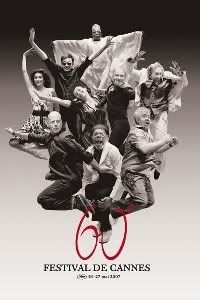

    This is a different sort of experience than you might expect. MSNBC is actually located in Secaucus, New Jersey. A young woman ushered me into a tiny room where I sat on a chair in front of a background photo of New York City. An earpiece was affixed to my right ear, so I could hear both the live MSNBC news telecast and the producers, who were presumably out in Secaucus. A woman came in and quickly applied makeup, mostly under my eyes. (I was impressed, since I didn’t get any makeup when I was interviewed by CBS! See “Comics in Context” #73.) I was facing a small TV monitor, and was asked if I wanted in turned on, so I could see Alex, the anchorwoman who would be interviewing me (whom you can see here). But I decided against it, which was probably a good choice, since I was not supposed to look at the monitor, but into the camera. There was no cameraman in the room, but I knew that the red light meant that it was on.

    This wasn’t the first time I had been gone to a studio to be interviewed by remote control. I once spent an hour in a soundproof room in Manhattan being interviewed over a headset by a man from the BBC who was across the ocean in Britain. At least time I got to see several real people, the helpful young women who got me seated, applied my makeup and brought me a soft drink!

    Readers of this column may be amazed that I can speak about comics in sound bites when it is required of me. Actually, I’m rather surprised by this myself.

    In case you haven’t seen this statuette of Mary Jane, take a look on this website, and you’ll better understand why it raised such controversy (such as here). It was produced by Sideshow Collectibles, whose products I generally admire, on license from Marvel, and designed by comics artist Adam Hughes, who is well known in comics circles for his skill at portraying beautiful women.

    Since the panel in which she was introduced over forty (!) years ago, Mary Jane has long been depicted in the comics as a sexy knockout. BUt this maquette pushes the sexuality just far enough to fall over the line separating tastefulness from tawdriness. She’s bent over, wearing a low cut top revealing a veritable canyon of cleavage. Her jeans ride so low that her thong underwear is visible, and there’s a hole in the seat of her jeans, as well. Her smile can be interpreted as a come hither look. The overall effect is to create the appearance of sexual submissiveness. She’s shown washing Peter Parker’s Spider-Man costume, and I can see that Hughes and Sideshow might have considered this a clever gag. I can also see the argument that the maquette implies that Mary Jane’s proper place is washing her husband’s dirty laundry, whereas in both the comics and the movies MJ has always been independent, pursuing a career in modeling and acting.

    My interviewer observed that Marvel claims that the MJ maquette is being sold only to adult collectors, and not to children. The price alone demonstrates that: Sideshow is charging $124.99 each, and the entire limited edition of nine hundred has already sold out, and it hasn’t even started shipping yet. I pointed out that the comics market has primarily consisted of adults for quite some time now.

    At the end of my segment, the interviewer asserted that comics sales were in decline, and asked me if I thought that Marvel had “sexed up” Mary Jane in order to push the sales up. I detected an edge in her voice when she asked me this, which I interpreted as anger at Marvel for exploiting the character this way for profit. I responded that I didn’t think that the MJ maquette would have any effect on the comics sales, and that this statuette would primarily be sold to people who had already been reading Spider-Man comics for twenty years. (I could have said “horny aging fanboys,” but I restrained myself.) I sensed that my interviewer may have been disappointed in this answer.

    Earlier, she had asked me whether I thought that Marvel had anticipated the adverse reaction the maquette has received. I replied that I thought that Marvel would have been surprised. I didn’t have the time or opportunity to go into this, but comics aficionados should realize that this Mary Jane statuette is not all that different from business as usual in the male-dominated world of superhero comics. Collectors have long prized what they euphemistically call “Good Girl Art” in the comics. Female outfits bordering on the lurid go back as far as Phantom Lady’s costume back in the Golden Age of the 1940s. Wikipedia correctly defines the “Good Girl Art” of the 1940s and 1950s as “a style of comic art depicting voluptuous female characters in provocative situations and pin-up poses that contributed to widespread criticism of the medium’s effect on children” (http://en.wikipedia.org/wiki/Phantom_Lady). In the 1980s and 1990s, as Wikipedia chronicles, there was the trend in comics featuring “Bad Girl Art,” whose heroines, such as Lady Death and Witchblade, wore even less than their “Good Girl Art” predecessors. This Wikipedia entry pretentiously likens “the original “˜Image Comics’ house style” to Mannerism, a 16th century style of painting that featured elongated anatomy. I find little or no aesthetic appeal in the distorted human figures perpetrated by so many artists working in “The original “˜Image Comics’ house style.” In particular, the basketball-sized breasts with which so many male comics artists have been endowing women since the late 1980s have more to do with immature male fantasies than with serious portraiture.

    In other words, the Mary Jane maquette is arguably rather tame in comparison with many lurid illustrations of women in comics history. So why did this statuette inspire such a furor?

    I suggested in the MSNBC interview that one reason is that comics in the early 21st century attract a larger female readership than they had even ten years ago. I can tell just by looking at the audience at an event at the Museum of Comic or Cartoon Art (www.moccany.org), or at its roster of volunteers, or scanning the crowd at the New York and San Diego Comic-Cons. It’s the growth of alternative comics and graphic novels and the manga explosion that has brought many of them in. Of course many of them will perceive and object to the sexist implications of that MJ maquette.

    Moreover, this is the age of the Internet, and, as I’ve said before, you never know who or how many people may read what you post there. I was a little surprised that some of the people at MSNBC I spoke with had read some of the same comments about the MJ statue on the Net that I had.

    And here we come to another factor behind the furor: the mainstream media is paying attention. Ten years ago MSNBC probably wouldn’t have done a story like this, and most of the American public probably wouldn’t have recognized the name “Mary Jane Watson” (and this, despite her presence in the Spider-Man newspaper strip). But the mainstream media’s interest in comics has rapidly grown, even in the short time since I began writing this column in 2004, so much so that it is no longer much of a surprise to see, say, the profile of cartoonist Tony Millionaire in the Arts and Leisure section of last Sunday’s New York Times (May 13, 2007).

    And then there are the enormously popular Spider-Man movies. Whatever you may think of the 1960s Batman TV show, one thing that it accomplished was to familiarize the American public with so many of the primary elements of the Batman mythos: Alfred, Commissioner Gordon, the Batcave, the Batmobile, the Joker, the Penguin, the Riddler, the Catwoman. Before his movies, the American public beyond comic book fans had heard of Spider-Man, but now they know about Aunt May, the Green Goblin, J. Jonah Jameson, and yes, about Mary Jane Watson. By now, after three movies, she had become an iconic figure to the worldwide moviegoing public. Consider how importance the romance between Peter Parker and Mary Jane is in the three movies, and how prominently she is featured in much of the movie advertising (and, for example, the cover of the Spider-Man 2 DVD).

    In interviewing me, the MSNBC anchorwoman referred to Mary Jane as the “girl next door” that Marvel had “sexed up” in the maquette. The interviewer noted that Mary Jane had been portrayed as a character with strong sex appeal since her debut in the comics, and asked if I thought the statue updated that quality for our time. I replied that I thought the statue went beyond that, crossing the line of taste (for the reasons I’ve noted above).

    But her phrase “girl next door” is significant. John Romita, Sr., who first drew Mary Jane’s face (in Amazing Spider-Man #42, November, 1966–Steve Ditko had earlier given readers a look at her figure) has stated on many occasions that he was inspired by the young Ann-Margret in drawing her. Watch the movies Bye Bye Birdie (1963) and Viva Las Vegas (1964) and you’ll see what he must have been aiming for: a young woman who can be vividly, openly sexy without coming off as tacky or promiscuous. Stan Lee gave her an enchanting, captivating party girl persona, and it was later writers who drew out the more serious side of her personality. Just last week former Spider-Man editor Jim Salicrup and I were discussing Gerry Conway’s underrated graphic novel Spider-Man: Parallel Lives (1989), in which he persuasively demonstrated that MJ’s sexily extroverted public persona was a facade for her serious side, her means of escaping the emotional pain of her family life, just as Peter Parker escaped his own unhappiness through the assumed identity of the wisecracking Spider-Man.

    Sam Raimi’s Spider-Man movies not only dispense with Spider-Man’s ability as a comedian, but also with Mary Jane as life of the party, thus eliminating important parts of their characterizations from the comics. I will return to this subject when I review Spider-Man 3 in the near future. I feel that I’m only seeing half of Mary Jane–that serious side, capable of sorrow–when I see her in the movies. Referring to Kirsten Dunst’s performance as Mary Jane in his review of Spider-Man 3 (May 4, 2007), New York Times critic Manohla Dargis wrote, “this wispy, sad-eyed beauty turns into Melancholy Girl, able to melt hearts in a single glance.”

    In thus simplifying Mary Jane’s personality for the movies, Raimi has turned her into a more conventional leading lady, but one which he and Dunst make affectingly real. She is the “girl next door,” both literally and figuratively. I see that Wikipedia also has an entry on this phrase, stating that “The prototype of the girl next door is often invoked in American contexts to indicate wholesome, unassuming, or “average” femininity. . . .To fall in love with the “girl next door” is an archetype of romantic fiction and a key plot element. . . .She is the sweet girl he [the male protagonist] sees every day, a really great friend, or the perfect girl to bring home to his parents. She is often a virgin.” The entry even lists Kirsten Dunst’s Mary Jane as its first example of this archetype. (In Stan Lee’s 1960s Spider-Man stories, it was Gwen Stacy who conformed to the “girl next door” image, not Mary Jane.)

    At this point much more of the public at large, not just in America but around the world, knows Raimi and Dunst’s version of Mary Jane, rather than Lee and Romita’s from the 1960s. Doubtlessly many moviegoers, male and female, project their idealized image of what a heroine should be onto the films’ Mary Jane. So it’s no wonder that the folks at MSNBC felt a sharp disconnect between their image of MJ from the movies and the fanboy fantasy version presented by the Sideshow statuette. As the Wikipedia entry puts it, the “girl next door” is “contrasted with other stereotypes such as tomboy, valley girl, and slut.”

    Marvel contends that the MJ maquette is intended only for adult collectors, and children won’t even see it. Ah, but this is the age of the Internet, and not only will children find a picture of the statue, but so did MSNBC and other members of the news media. With Spider-Man 3 so much in the news lately, the mainstream media would be more on the lookout for news like this than they might be normally.

    And that makes me wonder what might have happened if the notorious Spider-Man: The Other comics saga, in which Spidey’s eye is gouged out (and subsequently grows back), had seen print closer to the release of one of the Spider-Man movies (see “Comics in Context” #118). What would the mainstream media have thought of this, had it come to their attention? Or what about the more recent Spider-Man: Reign miniseries, which my colleague Fred Hembeck found particularly appalling? In this tale of an alternate future, Mary Jane has died of cancer, her body grotesquely ravaged, induced by Peter Parker’s radioactive semen!

    I believe that both storylines grossly violate the spirit of the Lee/Ditko/Romita Spider-Man concept, but within the subculture of the comic book audience, these storylines were commercial successes. But just how could Marvel have explained them to the mainstream news media, which think of Spider-Man in terms of Stan’s own stories and the Raimi movies? I suspect that such a media spotlight would expose the way that the Grim and Gritty movement has so severely distorted the superhero genre over the last two decades.

    Now we should be wondering what is the next time bomb that will go off in comics about superheroes that the mainstream media know about?

    How about this: writer Frank Miller and artist Jim Lee’s All Star Batman and Robin #5, which just hit the comic book shops? It seems like such a long time since I last wrote about this series, way back in “Comics in Context” #119 (which I had titled “Bats and Spats,” since it also covered Carl Barks’s Uncle Scrooge, but IGN changed it), and indeed, it’s been over a year (!) since the last issue.

    But the issue 5 starts off with a bang, as a severely pissed off Wonder Woman marches down a Metropolis street, mentally fulminating that “It stinks of men,” and she means literally, and ordering a harmless-looking male passerby, “Out of my way, sperm bank.” So, you know that meretricious stereotype about man-hating feminists? This first page seems to agree with it.

    It gets worse. Several pages later, Wonder Woman is castigating the Man of Steel: “You call yourself a Superman? Kow-towing to these ants? Dropping to your knees before these earthbound, ephemeral humans?”

    Now Miller has Superman remind us that this is a Wonder Woman who has newly arrived in “man’s world” from the Amazons’ island: “Settle down, Diana. You’re new to this world.” The All Star Batman series is set in the past, back when Batman first recruited Dick Grayson to be the original Robin.

    But many of you will recall Miller’s The Dark Knight Strikes Again (see “Comics in Context” #30, 31, 34), set in the future, in which Superman declares, “Ma. Pa. You were wrong. . . . I am not one of them. I am not human.” He continues, “And I am no man’s servant. I am no man’s slave. I will not be ruled by the laws of men.” We last see Superman in Dark Knight Strikes Again hovering above the Earth with Lara, his daughter by Wonder Woman, as he ominously asks, “What exactly shall we do with our planet, Lara?” In Miller’s continuity, the Superman of All Star Batman will end up agreeing with Wonder Woman: he will become Miller’s superpowered version of Friedrich Nietzche’s ubermensch, unrestrained by conventional human morality.

    Continuing her harangue in All Star Batman and Robin #5, Wonder Woman tells Superman that the “rules” he follows instruct him to “mince about.” Oh, look, she’s invoking an insulting gay stereotype, just like Leonidas in Miller’s 300 dismissing the Athenians as “boy-lovers” (see “Comics in Context” #175).

    Wonder Woman also tells Superman he will “prostrate yourself before whatever vermin their stupid elections prop up as the “˜authorities.’” So Wonder Woman is contemptuous of democracy and, by extension, of the law. But disdain for the law doesn’t seem to be a sin in All Star Batman. A page before, Green Lantern was arguing that the Batman isn’t all that bad: “He’s got no respect for the law. And, yeah, maybe he’s a little unhinged. But that’s no reason to run off half-cocked” after him. What harm could there be in a somewhat insane vigilante defying the law?

    Wonder Woman has a different approach to the matter of Batman: “We kill him, we chop off his head and plant it on a stake and present it to your “˜authorities’ as their first gift from the Justice League.” You see, as far as Wonder Woman is concerned, the Justice League shouldn’t serve humanity, but as their superiors, may deign to present them with gifts. (Hey, it’s Wonder Woman as Salome!)

    I concede that there has always been a seeming contradiction in the Wonder Woman concept: she is the princess of a warrior race, and she engages in physical combat against evildoers, and yet she has traditionally been depicted as the enemy of warmongers and an advocate of peace. Yet this latter side of Wonder Woman is essential to the character. Rather than despising men, Wonder Woman traditionally journeyed to “man’s world” because she loved the series’ original leading man, Steve Trevor. The bloodthirsty Wonder Woman whom Jim Lee draws in this issue of All Star Batman and Robin may look like Wonder Woman, but I doubt that her creator William Moulton Marston would recognize her from the script.

    Do you recall that notorious sequence in Civil War: Frontline #11 in which a reporter named Sally Floyd tells off Captain America for defending the cause of individual freedom in Marvel’s Civil War, and he just sits there and takes it, rather than acting in character and mounting a stirring defense of freedom (see “Comics in Context” #168)? That suggests that the writer was on Sally’s side. Similarly here in All Star Batman, though Superman roars his outrage at Wonder Woman, Miller does not allow him to make a reasoned defense of his position. Indeed, Superman’s declaration that “This is my world. These are my people. These are my rules.” may suggest that he is already subconsciously embracing the ubermensch outlook of superiority to humanity. Superman also thunders that if “you commit murder on my land,” perhaps implying that Earth is his personal possession, “you’ll pay for it with your own precious Amazon blood.” Remember Superman’s traditional oath against killing? He certainly doesn’t remember it here.

    Turn to the next page, and you’ll see that all this rage and bloodthirstiness on Superman and Wonder Woman’s parts covers over their intense sexual passion for each other, which suddenly bursts forth. (Lois who?) When George Lucas had Han Solo and Princess Leia continually quarreling, oblivious to their love for each other, I suspect he intended the viewers to think they were behaving immaturely. On the other hand, in this scene between Superman and Wonder Woman, we can see the shadows of two other characters Miller portrayed as both antagonists and lovers, Daredevil and Elektra.

    As for Wonder Woman’s intention of beheading Batman, who is it that still beheads their alleged enemies in real life here in the early 21st century? Isn’t it some of the so-called “Islamo-fascists”? Wonder Woman advocates decapitation, rants against democracy, and insists that Superman act like as an ubermensch, above human law. MIller’s Wonder Woman is heading down a dangerous path, and, in Dark Knight Strikes Again, takes Superman with her. Dr. Marston created Wonder Woman to be the adversary of Nazism, not as a sympathizer.

    Then Batman himself, or “the goddamn Batman,” as he calls himself yet again, shows up in this fifth issue, laughing to frighten criminals, as if he were Steve Ditko’s Creeper. There’s a reason why, even back in the 1940s when Dick Sprang regularly drew a happily grinning Batman, that he didn’t launch into maniacal jags of laughter. That’s what his enemy and opposite, the Joker does.

    And the Joker has the sadistic sort of personality that gets off on inflicting harm on people. Well, the All Star version of Batman not only has the Joker’s laugh, but he has a streak of sadism, too. Miller’s original The Dark Knight Returns had already suggested that Batman takes pleasure in hurting criminals, but in All Star Miller makes this much more explicit and ups the ante considerably.

    Batman comes across two man who are apparently about to rape, mutilate, and possibly kill a woman. Batman injures one assailant’s arm so badly he can no longer feel his hand. Then Batman grimly informs him, “It’s called a compound fracture, rapist. It’ll never heal. Not right it won’t. You’ll remember me every time the air goes wet and cold. Arthritis, punk. It’ll hurt like hell.” Batman seems to take satisfaction in this.

    Next Batman turns his attention back to the other assailant, striking him seven times, each with a “Krunch” sound that suggests shattering bones. The woman watches, and then breaks into a smile, as if she is sexually turned on by the sight of such brutality. It wasn’t many pages before that the thought of violence impelled Superman and Wonder Woman into each other’s arms. There’s a pattern here. The first assailant, whose injured arm is bent backwards (!), asks the woman he had tried to victimize for help. She does something we can’t quite see to him with her foot, probably kicking him in the balls. (It’s the return of the genital injury motif from Sin City!) “Good girl,” Batman tells this adult woman, simultaneously commending her initiation into sadism and engaging in sexist condescension.

    Batman also instructs her not to call an ambulance for these guys. “These creeps will survive,” he tells her, “but I want them to suffer pain that’ll last a lifetime.” You see, even if these guys reform, they’ll still be in pain for the rest of their lives. “I love you,” responds the woman, enthralled.

    By coincidence, on the same day that I picked up All Star Batman and Robin #5 at my favorite Manhattan comics shop, Cosmic Comics at 10 East 23rd Street, I also purchased Astro City: The Dark Age, Book Two #3, by writer Kurt Busiek and artist Brent Anderson. Busiek is one of the principal writers of what he calls the “reconstructionist” school in superhero comics, and which I have dubbed the “Neo-Silver” movement. The Dark Age is Busiek’s critique of the comics of the 1970s and the origins of the “Grim and Gritty” aesthetic that ate away at the idealism of the comics of the Silver Age of the 1960s.

    It makes Kurt uncomfortable when I point out similarities between his Astro City characters and other established superheroes, but they are inevitable, since he is devising his own variations on the character archetypes of the superhero genre.

    In this latest issue Busiek includes a team of costumed urban vigilantes, Street Angel and the female Black Velvet, who remind me in part (but only in part, Kurt), of Daredevil and Elektra. Black Velvet turns out to be a killer, and Street Angel intends to turn her into the police. She then asks him how the two of them are different.

    “I don’t kill,” he replies.

    “Oh?” she asks. “How many have you left lying in alleyways these past two years, skull fractured, lung punctured? How many internal injuries? Did they all get medical attention? Did they all live? Did they?“

    Street Angel is horrified by this, having never considered it before. His first reaction is to think that somehow she corrupted him, but Street Angel pointedly asks, “Did you ever think maybe–you just liked it?” And I thought of that scene with Batman and the would-be rapists.

    Batman’s brutality fits into an aspect of the zeitgeist of early 21st century America: the concept that any cruelty directed against the Bad Guys is justified. In popular culture that leads to the frequent use of torture by the supposed Good Guys in the television series 24: usually they don’t have any moral qualms or hesitation about it. In real life, of course, this mindset led to the Abu Ghraib scandals.

    Am I wrong in sensing that the majority of American public opinion is against the use of torture? As entertaining as I have found 24 in the past (This season it’s clearly running out of steam!) , I wonder if the national sensibility is shifting, whether the time will come that the series is regarded as something of a dated embarrassment, specifically because it condones torture.

    Towards the end of the issue there is a vignette in which MIller and Lee show a bare-chested, surprisingly muscular Alfred the butler working out. (Is no one in contemporary superhero comics allowed to have an average build?) Alfred describes how, after she and her husband were fatally shot by the mugger, the last thing that Martha Wayne saw before she died was the look in her young son Bruce’s eyes: she metaphorically “saw him become a demon.”

    Unless Miller means for us to think that Alfred witnessed this double murder (and if he did, why wasn’t he shot, too?), then Alfred must be imagining what happened. It seems as if Mrs. Wayne’s murder was horrifying enough without her witnessing her formerly innocent son’s dreadful psychological transformation, as well.

    On balance, though, I approve of this reminiscence, and I wonder if Miller intended it as a response to the movie Batman Begins (see “Comics in Context” #89). In that film Bruce Wayne grows up lacking any vocation beyond shooting his parents’ killer, Joe Chill; it is Bruce’s friend Rachel, and later Henri Ducard, who direct his energies into becoming a crimefighter. However, I think that the idea that Bruce Wayne, from childhood on, was determined to avenge his parents’ death by warring on all criminals, is an important component of the Batman myth. Here Miller captures that transformation of innocent child to dedicated avenger in words, just as Alex Ross did it in a single picture in JLA: Secret Origins (see “Comics in Context” #29).

    Miller has Alfred worry that Bruce Wayne suffers from “hubris” and may have gone “mad.” Readers may wonder if Miller intends us to regard Batman as going overboard, and if Miller intends that Batman will moderate his behavior over the course of the All Star series. Maybe. But is the All Star Batman really that different from the Batman of Miller’s Dark Knight books? The All Star version seems more explicit about his attitude towards violence against criminals. On the other hand, the Dark Knight Batman seems more caring towards his own new Robin, Carrie Kelly. We shall see.

    In this All Star issue Alfred regards young Dick Grayson as an “innocent young boy” and thinks, “I pray this child will survive this,” namely his tutelage by Batman. But the issue concludes with Grayson picking up a broadaxe and saying, “Cool.” Just how innocent is he? And we know from The Dark Knight Strikes Again that he will end up as a serial killer.

    All Star Batman and Robin is not part of DC’s canonical mainstream continuity. Miller has stated that he considers it to be part of an alternative continuity that leads to his two Dark Knight series. (It seems that Miller’s Batman: Year One belongs to both continuities.) Still, All Star Batman and Robin is putting forth rather disturbing portrayals of Batman, Superman and Wonder Woman. The mainstream media probably will not take any notice.

    But now I’m worried about what will happen when Miller finishes his Holy Terror, Batman series, pitting his version of Batman against Al Qaeda. This is the kind of story hook that will guarantee attention from the mainstream media. What will the mainstream media–and the general public–think? There have already been reviews of the 300 movie that accuse it of homophobia and even fascist tendencies (here, for example).

    I’m not saying I fear there’ll be censorship or bookburnings of comics, as in the 1950s: I think the mainstream media have by now gotten the message that comic books now have an adult audience.

    The lesson of the brouhaha or the Mary Jane figurine is that comics is no longer a niche artform, the interest of a small subculture, off the radar screen of mainstream culture. The press, the literary world, academia, and the general public are all paying much more attention to comics now. Through the reports on the Mary Jane maquette, the news media exposed a sexism which much of the comics industry and readership tolerated, if they were even aware of it. The bloggers’ panel at the New York Comic-Con (see “Comics in Context” #167) pointed out that comics industry representatives now have to be more careful in their public statements, because the mainstream press may pick them up. (This is one reason why I am so appalled by the nonsensical statements made by certain comics industry executives.)

    The bright spotlight of the mainstream media will bring flaws to light that may have remained concealed in the darkness of comics’ niche subculture. It’s like your mom telling you to wear clean underwear when you go out: you never know what will happen, and what may be revealed.

    ADVERTISEMENTS FOR OTHER PEOPLE
    I recently mentioned the passing of comics artist Tom Artis. You can read his longtime collaborator Peter B. Gillis’s reflections on his funeral here. Artis’s family is now in severe financial straits, as reported here. You can read about Colleen Doran’s commendable effort to help, as well as finding out how you too can assist the family, here.

    Copyright 2007 Peter Sanderson

  • Trailer Park: U2 at Cannes; “This movie was shot in 3B – three beers – and it looks good, eh?”

    By Christopher Stipp

    Archives? Right Here…

    Inspired by those wacky geeks over at TWIT I have decided that instead of putting off and putting off and putting off my vow to somehow market my first book I would let people download and read it for free. Give it a preview, read the whole thing or, if you like what you see, send me some kind words or money for the actual book. Download and read my first book “Thank You, Goodnight” for FREE.

    Quick shout out this week and then you’ll be free to ignore the rest of the column.

    One of the biggest drags about living in this personal wasteland of hell on earth, known as Arizona, where you could not only be savaged by roaming rattlesnakes or impaled by any number of succulents that not only steal and store whatever water was intended for my consumption but you also run the risk, as happened to a friend of mine who lives here, get stung by scorpions that see your bed as a cool nest in which to lie in wait for you to fall asleep, forever haunting your ability to relax even under your own covers. Son a bitch walked around his bedroom with a black light for weeks following, just hoping to catch one of those venomous bastards and beat it with the business end of his Hush Puppies.

    No, one of the biggest drags was that I wasn’t here when U2 recorded their hallmark concert film, RATTLE AND HUM.

    The concert film never really took a toehold in American cinemas but with the success of this film and then a popular entry like Madonna’s TRUTH OR DARE you would have thought someone could have monetized this genre into something profitable like the scads of crap kids films that can be made on the cheap and then only really having to pull in the band’s estimated fan base.

    In recent years there has been a smattering of corporations trying to make this a success once more, Regal Entertainment Group offering the turd-in-the-mediocre-punchbowl opportunity to see Matchbox Twenty perform live to all of their adoring pre-menstruating female fans and then you had even them testing out what would happen if you gave people the chance to see Prince shake his ambiguously sexual groove thing in the comfort of their own movie house. Even with Aerosmith getting into the act there still wasn’t the same vibe as when the boys from Ireland rattled some cages for the people of Sun Devil Stadium and only charged them $5, a far cry from the embarrassingly ridiculous amount of money I spent to see them during their recent tour.

    One of the great things about U2, though, was their ability to see that people enjoyed tossing them the extra cash to get a copy of their show on video, now on DVD. They’ve always padded the concert films with a little something extra and for all the talk about them being more of a brand than a band, all valid concerns, they’ve wanted to feed the fan frenzy with the bread and circuses that they know will sell. Hot off the heels of their latest DVD venture, VERTIGO 05 LIVE, the boys are bringing something to Cannes this year and I can’t help but feel like this project just helps to push things forward in capturing an experience that has long eluded filmmakers’ grasps in being faithful adapters.

    For my money U2 3D would be far and away one of the best films that is being screened there out-of-competition. Yeah, you have what hopefully will be one the best reasons to feel good about cream puff cinema, OCEAN’S THIRTEEN, and one that will also hopefully be the death knell for many of the unscrupulous bastards out there working in the health care industry, Michael Moore’s SICKO, but having the chance to mainline some of that same adrenaline you reserve for a good rock concert (and I realize that there are lots and lots and lots of U2 haters out there for one reason or another, in which case, get your own blog and talk about it) and seeing whether this experiment actually delivers is enough for me to actually pay attention to some of the talk that comes out of there in the coming days.

    For more on what this film is about, here is part of the press release:

    “NY-based editorial powerhouse Bluerock announces the 2007 Cannes Film Festival presentation of the film, “U2 3D,” billed as the first live-action concert film shot entirely in 3D and starring the renowned Grammy-winning band, U2. The 55-minute preview is intended to garner buzz for the upcoming full-length feature, and will screen at midnight on May 19th at the Palais des Festivals. Bluerock’s Olivier Wicki edited both the preview and the full-length versions of the film in 2D and it was then put through the 3D process. The film is the latest in a long-standing collaboration between Bluerock and U2’s Bono.

    Bluerock President Ethel Rubinstein praises the film, “Bono and the band set the bar for dynamic performance, and Olivier Wicki used his creative and technical genius to ensure the film portrayed every bit of their awesome talent. We were honored to be chosen as a creative partner.”

    “U2 3D” documents U2’s wildly successful “Vertigo” World tour. Armed with 3D glasses, viewers will now have the opportunity to see U2 in a concert atmosphere without enduring sweaty crowds and high ticket prices. The full-length version of “U2 3D,” featuring 15 songs drawn from over 700 hours of footage, will debut in the fall of 2007. The film was directed by Catherine Owens and Mark Pellington and produced by 3ality Digital, Los Angeles.”

    There is very little I still find enjoyable that I enjoyed throughout high school and U2 is certainly worthy enough of the cred they’re trying to hold onto.

    Check the trailer for U2 3D right here.
    GOOD LUCK CHUCK (2007)

    Director: Mark Helfrich
    Cast:
    Jessica Alba, Dane Cook, Dan Fogler
    Release: August 24, 2007
    Synopsis:
    It all started when Charlie Kagan was ten years old. Breaking the cardinal rules of spin-the-bottle, Charlie refused to lip-lock with a demented Goth girl ““ and she put a hex on him. Now, twenty-five years later, Charlie (Dane Cook) is a successful dentist”¦and still cursed. While his plastic surgeon best friend, Stu (Dan Fogler), pursues as many of his patients as possible, Charlie can’t seem to find the right girl. Even worse, he discovers at an ex-girlfriend’s wedding that every woman he’s ever slept with has found true love ““ with the next guy after him. Before he knows it, Charlie’s reputation as a “good luck charm” has women ““ from sexy strangers to his overweight receptionist ““ lining up for a quickie. But a life filled with all sex and no love has Charlie lonelier than ever ““ that is, until he meets Cam (Jessica Alba). An accident-prone penguin specialist, Cam is as hard-to-get as she is beautiful. But when a genuine romance develops, Charlie realizes he’s got to find a way to break his good-luck curse”¦before the girl of his dreams winds up with the next guy she meets..

    View Trailer:
    * Large (QuickTime)

    Prognosis: Negative. Just Wicked Awful. A pitch meeting, one afternoon. Two men in shirts that are rolled up from their wrists to their elbows. The office of someone with access to a large checkbook.

    “Hear us out!”

    “Yeah, hear us out!”

    “An amazing comedy!”

    “Amazing”¦”

    “You’ve got a guy”¦”

    “One guy”¦”

    “Who, every time he sleeps with someone”¦”

    “Like sex, not really sleeping you see”¦”

    “They just happen to find their real true love after they do it and dump the guy who they slept with.”

    “Just had sex with, not sleeping.”

    “It’s like a cross between WEST SIDE STORY, AMERICAN BEAUTY and UP THE CREEK.”

    Sold.

    So, I can’t really tell with any degree of accuracy how the pitch meeting actually went for this film but I can say with some degree of possibility that it was the premise, not the script, that was put out there at first and everything else was built around that What-If nugget.

    Dane Cook could really have parlayed his juggernaut success with his second album and crafted a entry into motion pictures that could have further penetrated the American zeitgeist with his own self-made vehicle but it’s kind of telling that, so far, all we’ve been allowed to see of his filmic greatness has been in EMPLOYEE OF THE MONTH and now a movie where his dong is supposed to be the lighting rod of divinity for any woman to find their true happiness after he’s worked that cooter for all it’s worth.

    The mechanics of the trailer are a bit jarring, though.

    When we open, and when we don’t really get that his wang has been infused with some kind of mystery ability, it’s probably some kind of STD that hasn’t been identified but hey it’s not my movie, we’re at a wedding and the bride thanks Cook for being her lucky charm. We’re not sure what that’s supposed to mean and it’s not until some old looking lady, I’m kind of shocked they couldn’t find someone a little easier on the eyes, attacks Cook in his parked car, rips her shirt off and explains the whole plot to us. “Ah,” we’re supposed to collectively sigh, “his dork helps women find their true, albeit at the expense of his own happiness and sense of purpose in the world, love!” How funny!

    Cue Scorpions’ “Rock You Like A Hurricane”

    Cook goes on a f*ck spree with tons of women. Wow, this spell he has is really awesome. 120 messages on his voice mail, all from chicks wanting to spread their peanut butter sandwiches open wide for his man-jelly! This is totally my dream! Never mind that real overt homosexual male voice on his VM that says, in a way that some might consider real stereotypical, and damn near insulting, “Thissss is Bob. Juusssth hear me oooouuut”¦”

    Ooo, and then Jessica Alba walks into his life. What savage irony! The one woman who he would want to probably have a relationship with, and who are we kidding, this would be an excellent addition to the Hit-It and Quit-It club, he’s going to destroy it if he sticks it in her! Oh, noes.

    Besides, and I think someone felt like going after another group of people that’s easily insulted, when Cook tries to stave off having actual sex with Alba and puts his curse to the test even though I thought all his other conquests were supposed to be proof of his ability, we’re subjected to an overdrawn clip of Dane preparing to be mounted by a woman who’s large enough that I guess social decorum gets lost after a certain poundage.

    For those keeping score, Alba gets down to her skivvies twice, and remember that’s as close any of you geeks will ever see because she will never ever release the hounds for you to look at. It’s all a bit like 40 DAYS AND 40 NIGHTS tossed in with a real skeevy sidekick who just grates on the senses by the end of this thing.

    It’s all a bit jumbled feels slapped together with a bucket of paste and spit.

    HARRY POTTER AND THE ORDER OF THE PHOENIX (2007)

    Director: David Yates
    Cast: Daniel Radcliffe, Rupert Grint, Emma Watson, Jason Isaacs Release: July 13, 2007
    Synopsis: In HARRY POTTER AND THE ORDER OF THE PHOENIX, Harry returns for his fifth year of study at Hogwarts and discovers that much of the wizarding community has been denied the truth about the teenager’s recent encounter with the evil Lord Voldemort. Fearing that Hogwarts’ venerable Headmaster, Albus Dumbledore, is lying about Voldemort’s return in order to undermine his power and take his job, the Minister for Magic, Cornelius Fudge, appoints a new Defense Against the Dark Arts teacher to keep watch over Dumbledore and the Hogwarts students.

    But Professor Dolores Umbridge’s Ministry-approved course of defensive magic leaves the young wizards woefully unprepared to defend themselves against the dark forces threatening them and the entire wizarding community, so at the prompting of his friends Hermione and Ron, Harry takes matters into his own hands. Meeting secretly with a small group of students who name themselves “Dumbledore’s Army,” Harry teaches them how to defend themselves against the Dark Arts, preparing the courageous young wizards for the extraordinary battle that lies ahead…

    View Trailer:
    * Large (QuickTime)

    Prognosis: Yeah, It’ll Do. You’re either a reader or you’re not.

    I’m one of the latter if for the simple reason that I have scads and scads of more pressing pieces of fiction, and comic books, to consume. Maybe some day I will finally be able to see what has caused such a stir within the collective zeitgeist of this world’s young’uns but, for now, I’m only concerned with how this film presents itself.

    And, for another installment, the trailer is remarkable.

    Who cares that I don’t really get what’s going on here. I applaud the marketers, and trailer maker, for forgoing some lame half-assed attempt to try and fit years of history into the first few moments of the trailer.

    No, instead we get a strange and eerie introduction that lets us know that this is, thankfully, not the land that Chris Columbus built. Maturity seems to reign here and the inclusion of a ghastly looking spirit that seems hell bent on acquiring Harry for some nefarious purpose. What’s more is the use of dark hues to further illustrate that this is not really a jaunty trip into Oz but, rather, another silly movie that will integrate some awfully heady material into the mix.

    Yes, it’s amusing that we’re given the Eragon, flying dragon shot, it’s enough to give you a wicked case of déjà vu, and that the Grand Wizard or whatever the hell these people call themselves without accidentally stepping into KKK territory, but there’s a real attempt to balance the dark and light with an even hand. It works insofar that we see what we’re dealing with in this movie is not so much Harry, Harry, Harry but that there are still other people that inhabit this world.

    From boys riding witches brooms to Hans Gruber whacking some young lad with a book in a really silly manner to a real thunderous crescendo of young wizards coming together to fight what seems to be an upcoming battle between”¦other”¦wizards”¦that”¦seem to exist in this world as well.

    It’s all very silly and, by the end, the use of modern day machine guns and bullets are exchanged for archaic latin-like spell casting and X-Men Jubilee style fireworks that I am to assume really are supposed to be shocking in some manner. It’s dark, yes. It’s foreboding, sure. Is it really as heart-thumping as these actors posture it is? Not so much. I do believe that what we have here is something that will really speak to the core audience in ways that I can imagine a lot of people felt when X-MEN or SPIDER-MAN was done right. Since I can’t fault any kid who found Harry on their way through adolescence I can say though, for me, the ADD style in which we’re shoved through series after series of special effects is a little too much for my taste.

    Maybe if I read the book it would be but, for now, this is all quite just another addition to young boys and girls playing around with special effects.

    THE BOURNE ULTIMATUM (2007)

    Director: Paul Greengrass
    Cast:
    Matt Damon, Julia Stiles, Joan Allen, David Strathairn, Scott Glenn, Paddy Considine, Edgar Ramirez
    Release: August 3, 2007
    Synopsis: All he wanted was to disappear. Instead, Jason Bourne is now hunted by the people who made him what he is. Having lost his memory and the one person he loved, he is undeterred by the barrage of bullets and a new generation of highly-trained killers. Bourne has only one objective: to go back to the beginning and find out who he was.

    Now, in the new chapter of this espionage series, Bourne will hunt down his past in order to find a future. He must travel from Moscow, Paris, Madrid and London to Tangier and New York City as he continues his quest to find the real Jason Bourne–all the while trying to outmaneuver the scores of cops, federal officers and Interpol agents with him in their crosshairs.

    View Trailer:
    * Large (QuickTime)

    Prognosis: Fu$k Yeah! Doug Liman is a man among men.

    What some people would write off as needless popcorn flicks I would call indispensable. To have action movies that further the case as to why it’s so pretty so see shit blow up, why it’s exciting to watch dudes get their trachea strangled with phone cord and why car chases that end in spectacular collisions, as Martha Stewart would say, is a good thing this series is even better than appreciators of the films would have you believe.

    Action is Liman’s wheelhouse and for him to have not only hand delivered some of the most remarkable action sequences (Who didn’t yell “Fuck yeah!” as Matt Damon rode a dead body down the center of an open staircase, getting off a gunshot to a man’s forehead that could only happen in Hollywood?) in recent years. Even in the case of MR. AND MRS. SMITH, if you can just look beyond the 4th wall of craziness that surrounds Jolie like the vaporized plague, you have a film that you can watch over and over and over again and find something there to like. I do and, even though I don’t boast about it, I even give props to Liman for finding and creating the kind of chemistry that woeful matchups on the screen have a hard time bottling. However, with the addition of Paul Greengrass, the man who added his films as to things you shouldn’t experience if you get motion sickness easily, I wonder if these films will be less relevant under the power of another man.

    I’m going to emphatically say no for the very reasons that his other films did so well as narratives: they feel real in ways that a static camera shot can’t capture. Greengrass is able to harness the thought that if you’re watching an event unravel before your real eyes you’re not especially going to be focused on any one thing for too long. You’re going to drift a little bit and it’s that drifting effect that lends itself, oddly, to this film’s power in a way that’s captivating.

    Now, while I really dig it, I really do, when we seem Damon’s silhouette against the backdrop of a very snowy street, the sense that something bad is going to happen very quickly is communicated loud and clear without a single word or voiceover. The problem, then, is the copious flashbacks to the other films.

    Yes, they’re great and add a lot of context and this is a teaser trailer after all and it’s way too early to get a substantial bead of everything because you want to whet people’s interest, et al, I would argue that the flashbacks are kind of a puss way out to those of us who stayed awake for the first two films.

    Yes, “His memory erased.” Yes, (gack) “His loved one murdered.” Yeah, I get it, moron, “His past stolen.” All just very unimportant and needless for fans of this franchise.

    It’s not until the nicely done statement that Damon is going to find the people that did all this to his life where I get the goose bumps that just seal the moment that Damon, to me, is really the kind of action star that many people easily overlook; the kid is just threatening in ways that Leonardo couldn’t pull off in THE DEPARTED. Damon does look like he’s capable of bad things.

    Boom, some cars crash into each other, Damon does some hand-to-hand, and then uses a book (!) to crush the windpipe of some asshole, Joan Allen is back to deliver the kind of quarterbacking that I hope gets her killed in the end, we even get a treat of Damon doing some wheelies through some real tight quarters on a dirt bike and then, as a little treat, we get Damon’s stunt double jumping from a building into the window of another just across the way. Good, good stuff.

    And the best part? It all feels very verite in ways that other directors only wish they could capture, if for the only reason that it gives the moment on the screen more weight. Now, the average action movie consumer could perhaps be blind to all these elements but I’m feeling respected as a donator to these kinds of productions and that means something.

    DAY NIGHT DAY NIGHT (2007)

    Director: Julia Loktev
    Cast: Luisa Williams, Josh P. Weinstein, Gareth Saxe, Nyambi Nyambi, Frank Dattolo
    Release: May 11, 2007 (Limited), Coming Soon Near You
    Synopsis: A 19-year-old girl prepares to become a suicide bomber in Times Square. She speaks with no accent; it’s impossible to pinpoint her ethnicity. We never learn why she made her decision – she has made it already. We don’t know whom she represents, what she believes in – we only know she believes it absolutely.

    View Trailer:
    * Large (QuickTime)

    Prognosis: Very Positive. Inches away from giving up on this trailer, I was.

    Sometimes it’s all about art for art sake and, while that’s fine for some French, impressionistic work that bleeds pomposity, this trailer scales it back and justifies its artistic feel. It’s in the justification and that’s what makes this movie noteworthy. When I saw YOU CAN COUNT ON ME it felt like it drifted more to the side of artistic imagination than it did reality but the subject matter here is made relevant by what many will be dealing with as Baby Boomers creep toward old age. COUNT ON ME didn’t really inform as it did just ramble. There seems to be a real point here.

    One of the best things the trailer does here in order to disarm any notion that the film will be a fetid affair of hardcore seriousness is the exchange Hoffman and Linney have regarding the entire theme of the movie without saying it outright; comparing the seriousness of the situation with their ailing father to Bush’s color-coded threat warning system is just funny. It’s amusing and it contextualizes the nature and relationship this brother and sister have with one another. The graphics that display Hoffman and Linney’s name, with the aforementioned color bars, is a nice touch.

    And, big ups for the brief and almost blink-you-missed-it graphic that states the movie was at the Sundance Film Festival; the red color matte behind the Sundance graphic takes the joke one step further and it was appreciated.

    The siblings meet. They’ve been away from one another for quite some time, Hoffman makes a self-deprecating comment about his own weight, and the sense of place we’re brought into, where geezers get to ride the streets in their golf carts, feels genuine.

    The ailing father that brought these kids together feels like he’s serving a perfunctory role, because it’s all about Linney and Hoffman, but the situation they find themselves in is where the real magic starts to brew. The cheeky music that plays behind Philip’s suggestion they stick pop in a nursing home, and Linney’s reaction to the comment, feels smooth and funny at the same time.

    Eventually, the nursing home is the option that’s going to have to be the right one and the two trying to connect, like fingers of opposite hands coming together, is less absurd than it is illuminating. I like these people and they’re likeable.

    The moment where the two of them play a game of indoor tennis? It lasts all of three seconds but it’s a succinct, telling piece of comedic drama that what follows, their reticence in actually sticking pop in a nursing home, he thinking it’s a hotel, just feels genuine.

    In this age of fractured families, ripped apart by ever increasing numbers of divorce, it’s a curious thing to see how those who have drifted apart deal with having to come back together. It has sold itself well.

  • Game On! 5-16-2007: Handhelds and Downloads

    gameon.jpg

    Welcome again, gaming friends. Another week, another batch of new downloadable titles for your console goodness. This week on the Virtual Console, we have three of the greatest ninja games ever made”¦NINJA GAIDEN for the NES, the lesser known (but still quite good) NINJA SPIRIT for the Turbografix 16 and”¦PAC-MAN for the NES? Okay, two out of three ninjas ain’t bad. Today, on XBLA we got two games, AEGIS WINGS, a side scrolling shooter made by Microsoft Interns and offered for free, as well as SOLTRIO SOLITAIRE a solitaire game with”¦multiplayer? Yeah”¦that’s strange, but true.

    Also, as far as updates are concerned, CRACKDOWN received a giant mess of them, included in two download packs. More missions, a cheat mode, new races, weapons, and vehicles, more achievements”¦that’s what DLC should be. However, sadly for those who bought the game just for the HALO 3 beta, it seems there’s a bit longer of a wait, since there’s a need for a patch”¦already. Should be up by tonight though.

    So what else do we have for you this week? Handheld games anyone?

    LOST IN BOREDOM 2

    lib2_1.jpg

    You wouldn’t think that being stranded on a desert island, searching for food, meeting another survivor and sharing your adventures and rations with them and fighting for survival would be so”¦tedious. And yet, LOST IN BLUE 2 does just that. Much like it’s previous title, this sequel makes survival mundane, and tasks like gathering food and building fires”¦well, just as boring as they sound.

    lib2_2.jpg

    The main problem with this game is that you really don’t have enough time to do the really cool stuff, like explore the island, or converse with your counterpart (a character of the opposite sex as whichever you choose at the outset of the game). Most of the time is spent trying to fend off hunger (which comes ever three seconds) or fighting spiders and crocodiles. Sure, the cooking and food making mini games are”¦well, not entertaining, but something to do, but after 15 minutes, three days had passed and that was ALL I had done. I can’t run through the island for 12 feet before getting thirsty. Are these the most out of shape survivors ever or what?

    The worst part is that even after time, things don’t shape up. There’s no direction for the game, no semblance of what you should do. How do you get rescued? CAN you get rescued? How the hell can you get to stave off hunger for more than five minutes? For those that endured the first game and were looking for improvements to hit the sequel, sadly”¦we’re still waiting.

    One Gamer’s Opinion:

    lib2_1.jpg


    CALL ON THE ROAD

    codrtv.jpgLove World War II first person shooters, but just wish you could play them on the road? Well, wish no longer, as the mother series of them all makes it’s way to PSP with CALL OF DUTY: ROADS TO VICTORY. Taking the familiar format from the previous entries in the series and scaling it down for the PSP, things move fairly smoothly as you take on the role of three different Allied soldiers; American, Canadian and British.

    While the PSP’s control format makes FPS’ a bit difficult for the handheld (yes, we know”¦there’s no second analog stick) the scheme is actually set up quite well. There’s a helpful lock on feature when aiming down the scope, and battles are quick and frantic enough that playing on the go in short bursts is simple and fun. Plus, the mission structure is just as familiar as the home versions are, so enjoyment is pretty much guaranteed.

    Well, ok, NOTHING is guaranteed. If you haven’t been able to enjoy an FPS on PSP before, this will probably be a hard sell. Still, I have to say, as difficult as it is to translate the genre to this system, this one certainly moves and plays well enough that one actually can not just struggle though but actually WANT to continue and finish an FPS that uses face buttons to aim. Sure, the lock-on helps, but the ease with which one aims, shoots, runs, ducks and fights through the war torn streets of foreign lands really makes for an exciting and more importantly fun title. Plus, and best of all, players can actually customize the controls to fit their playing styles.

    call-of-duty-roads-to-victory_repelling-the-attack.jpg

    If you’re hankering for some portable WWII excitement, this is the one to go for. Quick and easy to pick up, fun to play, looks great, sounds great”¦what more do you need?

    I mean, y’know”¦OTHER than a second analog stick.

    One Gamer’s Opinion:

    lib2_1.jpg

    I WILL SURVIVE IN MY MACH 5

    mach.jpgModified Air Combat Heroes sounds like a weird acronym, but since planes fly at mach speeds, then M.A.C.H. seems to fit”¦sort of. Under the idea that unmanned ships will save lives, these no jobless pilots take their ships to the black market where they”¦well, fight and race each other. Sure, that sounds good for a game.

    Honestly, the plot takes a backseat. This title is about two things: being the fastest, and being the deadliest. It’s not just about crossing the finish line, it’s doing it one piece as you gun down every plane in your way. While the shooting and racing genre isn’t new, it’s nice to see it in the skies as opposed to on the streets.

    What sets this title apart however, isn’t the planes, but how you can customize them. Outfitting your ship with whichever guns, paint apps and the like is up to you, and the modifications you get down the road are truly something to behold. However, this comes at a price”¦

    mach2.jpg

    Frankly, after a few missions and upgrades, the game looses any and all challenge it had. Once you get a good enough plane and weapons, you have a bit of unfair advantage against your opponents. Wireless multiplayer keeps that a tiny bit fresh, as living opponents are always more fun to play than AI controlled ones (so says the game’s “plot”) but even then, the few courses and arenas they offer here won’t squeeze enough fun for more than a few goes. And while the game looks good, there sadly is also no real sense of speed. You may be going mach 5, but it could be 5 mph for all we know.

    Still, it’s not all bad, as the first few levels a fun and unique enough for starter. Sadly, the game looses about as much momentum as it’s graphics fail to showcase”¦it’s fun for a bit, but once you upgrade your planes, it just goes down for the count.

    One Gamer’s Opinion:

    lib2_1.jpg

    Stay tuned, new podcast should be up soon, kids.

    THE GAME ON! RATING SYSTEM


    gameonratingscomplete.jpg

    Ratings From Greatest to Least:

    Kick Ass, Right On, Okay, Eh, and Stinker (aka CRAPTACULAR)

  • Comics in Context #177: The Collector’s Eye

    comicsincontext4.jpg

    cic2007-05-07.jpgWhen I left off last week, I was being dazzled by the vast array of vintage comic books on display at Geppi’s Entertainment Museum (http://www.geppismuseum.com/), which opened last fall at the former Camden Station building in Baltimore, Maryland. Hundreds and hundreds of comic books from the Golden Age of the 1930s and 1940s to nearly the present day lined the walls of the gallery titled “A Story in Four Colors,” as you can see in this photo of just a sampling. There were also an enormous array of Big Little Books and a selection of pulp magazines, including The Shadow and The Spider.

    But there was even more than just the actual comics and pulps on display beneath glass. For example, on a video monitor a documentary about the history of EC Comics was playing, presumably the same one that was a subject of a panel at the 2005 San Diego Con (see “Comics in Context” #95). Nearby were original copies of the legendary ECs themselves, and beyond them, high on a wall, the original artwork for various EC covers, including a stunning comics cover by Harvey Kurtzman.

    At one end of the hall were a series of screens on which the very first Superman story from Action Comics #1 (1938) was projected, a few pages at a time. In front of the screens were two kiosks with touch screens, which enable the visitor to electronically page through this story, or Stan Lee and Jack Kirby’s Fantastic Four #1 (1961), or Lee and Ditko’s first Spider-Man story from Amazing Fantasy #15 (1962), or Carl Barks’s “Donald Duck Finds Pirate Gold,” from Four Color #9 (1942). First one touches the screen to select one of the comics, and then, through additional touching, cause the onscreen book to open and its pages to turn, through simple, appealing animation. This was entertaining, and I found myself wishing that there were a lot more selections in the kiosks, and, probably impracticably, that the museum people had scanned the backup stories for these comics as well. (Fantastic Four #1, which had no backups, was the only complete issue, but, of course, most visitors would probably not care about, say, the other features in Action #1.) While I was playing with the kiosks, the first Batman story, “The Case of the Chemical Syndicate” from Detective Comics #27 (1939) and the first Spider-Man story appeared on the big screens behind them.

    As much fun as I had with these electronic toys, afterwards I wondered how much the museum visitor with little knowledge of comics history would get out of them. He or she might figure out that the stories on the screens are the debuts of Superman, Batman, the Fantastic Four and Spider-Man, and the latter two have credits for Lee, Kirby and Ditko. But no information is supplied about who these men are, or what made these stories so revolutionary in their time. Nor is there any information about Superman’s co-creators Jerry Siegel and Joe Shuster and their struggle to get their innovative strip published, or about Bob Kane and his long unacknowledged co-creator of Batman, Bill Finger (see “Comics in Context” #94).

    In the case of Barks’s “Pirate Gold,” I recalled that this was one of his earliest comics stories, but it wasn’t until after returning home and researching it on the Net, that I discovered that (1) this was the first Donald Duck comics story produced by American publication, (2) it was Barks’s first work in Disney comics, following his stint as a story man for Disney animation, (3) the story was not written by Barks, but adapted by a writer named Bob Karp from a script for an animated cartoon that was never made, and (4) Barks only drew half the story, while his former Disney writing partner Jack Hannah drew the rest. Now, I’m pretty knowledgeable about comics, but all this came as news to me.

    But of course I already knew who Carl Barks was, and his importance to Donald Duck’s history, and, indeed, to the comics medium (see “Comics in Context” #114). How many typical visitors to this museum have even heard of Carl Barks, whose comics work went uncredited for decades?

    Furthermore, although the “Four Colors” room’s introductory wall text asserts the significance of comics as an artform, what the visitor principally sees in this gallery are the outside of comic books: their covers. Each cover is a single image, however iconic it may be, whereas the essence of comics is a succession of images that tell a story. Apart from some original artwork near the room’s entrance, only the screens and kiosks provide examples of comics storytelling in operation.

    But all one need do is to step out into the main hall of the museum to find some brilliant examples of classic newspaper comic strips. To enter this splendid hallway with its high ceiling is like stepping back in time to the Victorian period when Camden Station was built. Artworks have been hung from waist level right up almost to the ceiling, in the fashion of art galleries and museums in the 19th century. But here the objects d’art range from an Alex Ross color print of the Justice League, with his trademark combination of realism and idealization, to a huge Joe Shuster drawing of Superman signed by Siegel and Shuster. There are an enormous 1933 RKO King Kong poster (in German, I think) and an original 1956 “half-sheet” for the movie Forbidden Planet, as well as lobby cards going all the way back to one featuring Mary Pickford from the silent movie era. Here is a page of Bob Kane’s 1930s funny animal series Peter Pupp, as well as a Joe Kubert page from the Viking Prince tale “Curse of the Dragon’s Moon” (from Brave and the Bold #24, 1959). There’s a genuinely amazing piece by Wally Wood entitled “Comic Strip Christmas Party,” with a multitude of interacting famous comic strip characters, drawn of the styles of their creators (apparently from MAD #68 in 1962). And down at one end of the hallway, instead of the Greek or Roman heroic statue one might expect in a Victorian museum, stands instead a statue of a modern hero, Superman.

    cic2007-05-11-01.jpg

    Then there’s animation art from the Golden Age of the Hollywood Cartoon. Amazingly, there’s a whole series of cels over backgrounds from the Max Fleischer Popeye cartoon Let’s You and Him Fight (1934): Popeye gets kicked in the chin by a mule, Popeye eats spinach, and the setting of his latest boxing match, “Yank’Em Stadium“. Here is the Wicked Queen from Disney’s Snow White and the Seven Dwarfs (1937), holding the box in which Snow White’s heart is to be placed, and her alter ego, the Old Witch, holding her own trademark, the poisoned apple. Nearby an underwater Jiminy Cricket tips his hat to a passing fish in a cel and background from Disney’s Pinocchio (1940), while another pairs the evil puppeteer Stromboli with Foulfellow, the con artist fox. Two other cel-and-background combinations aren’t properly identified, but this Mickey Mouse in bandleader’s uniform and long-billed Donald with a flute are obviously from the classic 1935 cartoon The Band Concert (see “Comics in Context” #110).

    As for the original art for comic strips on view, here we see museum founder Steve Geppi’s collector’s eye at its best. My favorites in this main hall are two extraordinary Sunday pages by Hal Foster that persuaded me to rate this master even higher in my estimation. I usually think of Foster as creating formal, stately, handsomely drawn tableaus. But this 1933 Tarzan page, titled “The Woman and the Ape,” is a masterpiece of kinetic power, as Tarzan plunges and swoops among the tree trips, wresting a princess from the clutches of a great ape (probably it is no coincidence that this appeared the same year as the premiere of King Kong), only to confront a roaring lion in a climactic close-up.

    Elsewhere along the hallway is a Prince Valiant page from August 2, 1953, in which Foster demonstrates his prowess at visual characterization. Here Valiant confronts Rory McColm, the king of Ireland. Foster communicates the king’s arrogance through a subtly imperious, condescending look. Then, with equal skill, Foster uses a different, more openly expressive approach to convey Valiant’s reaction: he bares his gritted teeth in anger, a surprising sight from this archetypically noble prince, alerting the reader as to just how evil Valiant considers his foe.

    There are examples of Walt Kelly’s Pogo in different spots in the museum. I was especially pleased to find a 1960s Sunday page I remembered from my childhood: Albert the alligator, wearing a scoutmaster’s hat, and his troop of scouts, consisting of a single bug, are lost in the woods until in the final panel they see what Albert calls “Civilization!”: Beauregard Houn’Dog, moving to what seems to be a rock beat, with his transistor radio to one ear (the mid-20th century version of an iPod), as a commercial blares forth: “No ifs, no ands, no butts, no, no!/No cigarettes, no tobacco!” (This, children, is not just an example of Kelly as a master of nonsense poetry, but a cutting parody of contemporary cigarette commercials that attempted to delude the unwary into believing that some cigarettes were actually safe to smoke.)

    There’s an unusual Peanuts strip from May 18, 1953, back in the early days before Charles Schulz had fully molded Charlie Brown’s personality into its now familiar form (see “Comics in Context” #66): after Charlie Brown typically blunders in a baseball game, Schroeder pointedly asks him if he’d mind going home, and Charlie Brown angrily roars back, “Yes, I would!”

    A late example of Harold Gray’s Little Orphan Annie from the late 1960s features an intriguing character about whom I’d like to find out more; in one panel he seems to be a giant, but he has a philosophical bent, and calls himself Mr. Alpha Omega, after the Greek letters denoting the beginning and end: he tells Annie, “It’s what happens between these two terminals that’s important.” Considering that Gray died in 1968, Alpha Omega seems to be his response to facing mortality.

    Examples of Al Capp’s Li’l Abner in display provide looks at two fabulous animal species he created. A 1948 strip showcases the Shmoo, the all-purpose animal that satisfies virtually all human needs (especially if it is killed and eaten): “There’s good Shmoos tonight,” the strip declares, burlesquing a 1940s catchphrase. A strip from the following year features the Kigmy, who relieves human tensions and aggressions by allowing itself to be kicked: in another parody of cigarettte commercials, the strip refers to “the kick that refreshes.” I wonder what contemporary animal rights activists would think about these two races of critters that exist to be humanity’s slaves.

    And there are many more strips here of note. There’s one of Chester Gould’s Dick Tracy Sunday pages from 1943, in which a grotesquely disfigured woman shows the captive Tracy a locket bearing the visage of her deceased husband, one of his archfoes, and introduces herself as “Mrs. Pruneface.” (More original art from this storyline appeared in the “Masters of American Comics” show, as described in “Comics in Context” #153. And yes, I know, Max Allan Collins resurrected Pruneface decades later.) In a George Herriman’s Krazy Kat from Sunday, March 25, 1934, a solar eclipse seems to thwart Ignatz Mouse’s umpteenth effort to clobber Krazy with a brick, until the darkness is unexpectedly–and prettily–illuminated by a swarm of fireflies. In an E. C. Segar daily Thimble Theatre from 1936, Olive Oyl tests Eugene the Jeep’s oracular powers by repeatedly asking him if she is beautiful, to no response. Finally, exasperated, she demands, “Am I ugly?” and Eugene’s tail shoots straight up, his gesture denoting “yes,” as Popeye reacts with his barking laugh. And there is a gorgeous Sunday March 15, 1936 page by the great Alex Raymond, pairing his Jungle Jim strip, featuring a character called Bat-Woman (!), with a classic Flash Gordon featuring Flash, the archvillain Ming the Merciless, and leading lady Dale using MIng’s “paralyzo ray” against his underlings.

    There are examples of Winsor McCay’s work in both the main hallway and the “Extra! Extra!” exhibit room. A 1906 Little Sammy Sneeze finds the little menace in the water at the seashore, as a nearby pair of adult swimmers dread his inevitable nasal assault. But the sneeze proves anticlimactic and disappointing; what’s remarkable here is McCay’s depiction of a wave which cascades over the swimmers yet is sufficiently transparent that we can still see them. Elsewhere, in a Dream of the Rarebit Fiend, another beachgoer wears a life preserver so large that he looks like an immense balloon; unsurprisingly, then, when a wave dashes him against the shore, it explodes. At the start of an astonishing 1909 Little Nemo, Doctor Pill already feels somewhat disoriented, having lost his hat. Matters quickly grow worse, as the characters find themselves standing on an immense face, with giant eyes. Then they are standing upon some enormous creature’s feet. Was McCay anticipating or commenting upon the movie close-up, which was developed around this period? Finally, McCay’s “camera” pulls back to a long shot, and we see that the eyes and feet belong to a creature resembling a flying dragon, which the various characters try to identify. (One calls it a “pusillanimous,” perhaps projecting his own reaction to the beast.)

    However, my favorite McCay in the Geppi Museum is one of his editorial cartoons, hanging in the main hallway. A tremendous storm with billowing thunderclouds, lightning, and towering, crashing waves, rages about the Statue of Liberty. Yet the Statue stands firm, its torch alight, as if untouched by the storm, and looking somehow both melancholy and determined. McCay labeled the storm clouds “Futile Attacks,” and the Statue “Liberty of the Press”.

    cic2007-05-11-03.jpg

    From this grand corridor you can enter any of a series of rooms which trace the history of American pop culture collectibles, dividing it into a different set of “ages” than the history of comic books.

    The first of these rooms, “Pioneer Spirit 1776-1894,” actually starts even earlier with the only privately owned copy of the May 9, 1754 Pennsylvania Gazette with Benjamin Franklin’s famous editorial cartoon “Join, or Die” (see “Comics in Context” #159). The room includes conventional playthings such as dolls and marbles. However, the stars of this gallery are the Brownies, created in illustrated children’s books by artist Palmer Cox (1840-1924). As a lengthy wall text satisfactorily explains to people like myself who knew nothing about them, the Brownies were the first cartoon characters to spin off commercially successful licensed products, such as these bowling pins.

    The title of the next gallery, “Extra! Extra! 1895-1927″ refers to the competition between turn of the last century newspaper moguls Joseph Pulitzer and William Randolph Hearts which led to the first flowering of the American newspaper comic strip. The McCay strips are here, as is an autographed photograph of comics pioneer Richard Outcault and an array of merchandise based on his comics characters the Yellow Kid and Buster Brown. There’s even a cartoon in which Buster Brown tells off Theodore Roosevelt (circa 1904).

    But what particularly enchanted me was the merchandise on display that was based on a character most of you have never heard of: Uncle Wiggily, a rabbit who was a gentleman, but still a trickster (like the later Bugs Bunny), who starred in illustrated children’s books written by Howard Roger Garis (1873-1962) in the 1910s and 1920s. No, no, I’m not that old: when I was a child and I visited my grandmother, I used to read Uncle Wiggily books at her home. (It’s like how members of my generation show Bugs Bunny DVDs to their offspring.) And here in the museum were an Uncle Wiggily crayon box from 1923, an Uncle Wiggily mug from 1924, and all sorts of Wiggily memorabilia I had never known existed. My sole disappointment was that I was hoping for a look after all these years at his archvillain, the dreaded Skillery-Skallery Alligator, who, if memory serves, was determined to “nibble Uncle Wiggily’s ears!”

    The title of the next gallery, “When Heroes Unite 1928-1945,” surely alludes both to American soldiers in World War II and to the birth of the superhero genre. To look around this room is to recognize that the period of the Great Depression and World War II gave rise to some of the most important and enduring iconic characters in American popular culture.

    The centerpiece of this room is a display of Mickey Mouse merchandise from the 1930s, including plush dolls, a toy circus train, a radio, and even underwear. There are also charming Walt Disney studio Christmas cards featuring Mickey from 1930 (in which Mickey merrily plays the piano out in the snow, oblivious to a huge snowball looming above him) and 1931 (with Mickey caroling). Other characters are represented by toy figures as well, ranging from Horace Horsecollar and Clarabelle Cow to the “Dance of the Hours” cast from Fantasia (1940). My favorite was the matador from Ferdinand the Bull (1938), a caricature of the young Walt Disney himself.

    To look at all the early Superman merchandise on display is to realize how rapidly after his 1938 debut that the Man of Steel became an American icon; here are Superman buttons from 1939 through 1945, a Superman belt from 1940, a Superman hair brush from the 40s, and more. Popeye was no slouch in licensing, either: the museum has Popeye soap, a Jeep doll, and even Popeye Sunshine biscuits (but not spinach!).

    Collectibles featuring other pop icons of the period turn up as well, some that you definitely know, such as coloring books based on the 1939 films of The Wizard of Oz and Gone with the Wind, and Little Orphan Annie decoder badges, and some that have been fading into obscurity, like statuettes of the radio characters Amos and Andy. There’s a toy of ventriloquist Edgar Bergen’s dummy Charlie McCarthy sitting in his car, and a doll of Bergen’s other famed dummy, Mortimer Snerd. And again I wondered how many visitors would know who they were.

    The next gallery, “America Tunes In 1946-1960,” brings us to the start of television and the childhood of most of the Baby Boomers. As soon as you enter the room, you’ll see Howdy Doody puppets atop a series of TV screens showing not only Howdy’s show, but also The Honeymooners‘ “Chef of the Future” episode (“Better Living through TV,” 1955), Lucille Ball’s drunken encounter with “vitameatavegemin” on I Love Lucy (“Lucy Does a TV Commercial,” 1952), Hopalong Cassidy, and comedian Milton Berle interacting with, of all people, Ronald Reagan.

    The Sixties get their own room, “Revolution 1961-1970,” but it’s not politics, rock music or fashion that dominates this gallery. Instead, on entering, you will face an imposing statue of the Batman, flanked on one side by the bright red Batphone from the 1960s TV series, and on the other by the bust of Shakespeare that concealed the device for opening the study wall to the Batpoles.

    cic2007-05-11-02.jpg

    It was “A New Heroic Age,” according to a wall text, the time of comics Silver Age, and there is Merry Marvel Marching Society memorabilia on exhibit, as well as the March 11, 1966 issue of Life magazine with Adam West as Batman on the cover. (Hey, I owned a copy of that myself! And remind me to tell you sometime how Jim Salicrup introduced me to Adam West last year.)

    It was also the decade of the superspy, who was being marketed to both adults and kids: among the exhibits are a Get Smart lunch box from 1966 and Milton Bradley’s John Drake Secret Agent game featuring a good likeness of Patrick McGoohan. In contrast the rather repellent Honey West doll from 1965 on display comes nowhere close to the luminous looks of Anne Francis in the title role of this early feminist detective TV series.

    Elsewhere in this gallery is another issue of Life, from August 28, 1964, featuring the Beatles on the cover. A copy of their Magical Mystery Tour album hangs on a wall above a toy version of the Yellow Submarine from the 1968 animated film of that same name. There are copies of The Monkees comics (and little did I know this was a prophetic sight, as you shall learn next week), along with a Woodstock festival poster from 1969.

    The name of the next section, “Expanding Universe 1971-1990,” suggests to me how science fiction and fantasy grew from niche cults to genres with mass audiences over these years. My favorite piece in this room was an original “3-sheet” poster for Star Wars (1977), which was both memorably iconic and blatantly deceptive. There’s Luke baring part of his chest, while Princess Leia stands seductively, hand on hip, displaying both cleavage and long, bare legs: the poster was way sexier than the movie! I also wonder about the horizontal ray of light that intersects Luke’s raised lightsaber, creating a luminescent cross, suggesting Christian imagery.

    The chronological survey ends with a section called “Going Global & Special Edition.” Here in a room at the end of the hallway was a small exhibit on African-Americans in comics, ranging from the usual suspects (Jack Kirby’s Black Panther, Will Eisner’s Ebony) to the unexpected (a Gasoline Alley Big Little Book called Skeezix in Africa, about which I’d like to know more).

    I should think that the main problem with providing more information about the exhibits at the Geppi Museum is that there are so many of them. There is only room for the brief descriptions in the labels.

    This reminds me of the newly opened Roman galleries at the Metropolitan Museum of Art, which I mentioned in critiquing the 300 movie (see “Comics in Context” #175). On a mezzanine level above the sculpture court is a long gallery containing “The Greek and Roman Study Collection,” an enormous assemblage of roughly 3500 numbered but otherwise unlabeled artworks. But the Metropolitan has installed several touch screen kiosks in the gallery that enable the visitor to access information about each item on display. This is the sort of system that the Geppi Museum could use, but it may be prohibitively expensive. Why pay for something that, at this point, not many people would use?

    If you get the impression that I pretty much had the museum all to myself during my visit, well, I pretty much did. There were as many staff members present as visitors when I was there. Of course it was a Wednesday afternoon in April, when most potential visitors are at work or school, although Baltimore’s magnificent National Aquarium (www.aqua.org), which I visited later that afternoon, was far from deserted.

    Reportedly, attendance levels for the Geppi Museum have been well below initial estimates. My initial reaction to this was that there isn’t sufficiently widespread interest in the museum’s niche subjects, the histories of comics and pop culture collectibles. But the Sports Legends museum on the first floor likewise suffers from low attendance.

    The problem is blamed on the two museums’ location in Camden Station, next to the Baltimore Orioles’ stadium at Camden Yards. It is said that the Orioles’ attendance has been declining recently, and that few people pass through the stadium are outside the baseball season. Moreover, Camden Station is across the street from the Baltimore Convention Center, a number of hotels are being built nearby, and pedestrians allegedly avoid walking by the construction sites.

    On my visit, however, there was no construction blocking my path. More importantly, my overwhelming impression was how close so many of Baltimore’s major attractions were to each other. One might think that museums that were directly across the street from a major convention center, and within short walking distance from the nearby major hotels, would attract plenty of tourists. When I left the Geppi Museum, it took me only ten to fifteen minutes to walk roughly six blocks from Camden Station to Baltimore’s Inner Harbor, the center of the city’s tourist activity. Walking from the Geppi Museum to the Inner Harbor’s National Aquarium was no different from going from one museum to another on the Mall in Washington, D. C.. And there’s a light rail stop directly across the street from Camden Station!

    I just don’t understand why the Geppi Museum is so allegedly inaccessible. Is it that New York is a walking city, and I’m simply more used to foot travel?

    The more knowledge about pop culture history that you bring to the Geppi Museum, the more you will get out of it. But even if you don’t know who, say, Uncle Wiggily is, the Geppi Museum covers so many subjects–superheroes, dolls, Disney cartoons, Star Wars, the Beatles, classic television shows–that you are bound to find something here that will not only interest but fascinate you. For anyone who grew up in the 20th century, no matter what your age, it is a treasure trove of memories. As for the subjects the museum covers that you are unfamiliar with, perhaps the toys and memorabilia on display will whet your interest so you’ll want to go home, get online, and look up their background. And then you can go back to the Geppi Museum and take another look.

    I traversed parts of five different states over two and a half hours to get to Geppi’s Entertainment Museum, and not only did I have no trouble finding it, but I felt my visit was well worth the time and expense. I advise any of you with a serious interest in the history of American comics, who can get down to Baltimore and back within a day, to make the trip to Geppi’s; you won’t regret it. In fact, you should make it an overnight trip and see much more of this historic city while you’re at it.

    ADVERTISEMENTS FOR OTHER PEOPLE
    After it had been dropped by Diamond, writer/artist Richard Howell has resurrected his vampire series Deadbeats at Claypool Comics’ recently revamped website (www.claypoolcomics.com). By going here, you can start with the first online installment. New segments are posted each Monday, Wednesday, and Friday.

    Copyright 2007 Peter Sanderson

  • Trailer Park: Spider-Man 3, A Lesson In Convenience

    By Christopher Stipp

    Archives? Right Here…

    Inspired by those wacky geeks over at TWIT I have decided that instead of putting off and putting off and putting off my vow to somehow market my first book I would let people download and read it for free. Give it a preview, read the whole thing or, if you like what you see, send me some kind words or money for the actual book. Download and read my first book “Thank You, Goodnight” for FREE.

    You’re wrong. All of you.

    Yes, it wasn’t superb. Yes, there wasn’t enough Venom and there could be a case as to why there were too many cooks in the kitchen. Yes, the script suffered a case of Michael Chabon-less-ness and we paid for it in the form of needless scenes of Peter constantly crying, at one point I wondered if I had stepped into the Lifetime Network version of the film, but, BUT, you cannot take away from the fact that Sam Raimi created a two-plus hour film with enough going on that you feel an abundance of things could happen at any moment.

    One gripe could be that Harry shifts allegiances more times than a Frenchman during a war or that MJ gives up far too easily on the man who has seen her through so much and that Venom is a mere flicker when he could, and should, have been one of the only focal points in this film, however, what should razzle-dazzle is the multiple storylines that were in constant motion throughout this picture. You had Sandman’s backstory, Brock’s ascension, MJ’s will-she or won’t-she struggle with how Harry gets her all tingly to Peter’s wrestling with what that black symbiote was doing to him. There was a lot to nosh on, yes, but Raimi conducts himself well enough that you forget about a lot of the film’s faults because there is a coherent narrative within all the battling and brusing.

    Peter’s jive talking disco moment? Hilarious in ways that instantly wiped the concern I had that the eyeliner he sported just moments ago wasn’t an indication that this was going to become SPIDER-MAN 3: CURSE OF THE EMO. Topher Grace? One of the best parts of the film; the man embodied raw ambition if there ever was one. In every way Topher was perfectly set up when Peter stripped the black goo (an appalling push-to-the-back of the classroom plot device that was left to languish for far too long without anything done with it until it was way to convenient) but, again, there was too little done with the savage once he became a reality. And what a lame, in every sense of the word, bitch fight between Venom and Sandman? It lasted all of a few seconds, making me wonder if this was supposed to be like schoolboys on the playground who realize it hurts to have an actual fistfight.

    One of the things that I believe, though, is that the film doesn’t suffer from its own largess. It doesn’t really suffer, period. What the issue is, though, is that the plot contrivances which are used just feel, well, comic-book-y; it’s all far too convenient for a lot of the things that happen. There are things that had to happen in order to carry things forward and many of them, MJ’s odd forced confession on the bridge that never gets “taken back” or smoothed over when she is finally able to do so and, again, so much bawling.

    Seriously, I never knew superheroes could cry so much. Shit, even Wolverine and even Cyclops carried off the death of a hot piece of ass with much more stoicism than we were given. I mean, I get it. Bad things happen, you’ve got to show some some emotion and there has to be the sense that Peter is the moral compass of the whole film but come on.

    Aside from all of this, though, you’ve got a movie that is a lot better than people are giving it credit for. I told one of my buddies, Amir, on the way out of the theater that I would absolutely give that film four stars out of five for what it gave me: a star for keeping me entertained for so long, a star for making Venom so damn creepy, a star for Bruce Campbell’s wicked cameo that steals the show and a full star for balancing everyone involved in the telling of a story that eventually limps across the finish line.

    The one star it doesn’t get, though, is for its emotional heft. For the reasons that part 1 and 2 resonate with me even now is the same reason why part 3 collapses with its words. The film’s Teflon. You forget it just as soon as you see it but don’t mistake that for a bad film. There are plenty of films that do a worse job than this one did and, at the end of the day, the movie is everything that a summer film should be: breezy, loud, exciting, fun and completely forgettable. We just got greedy after two excellently written installments. This movie just happened to cash in its syllables for some sizzle on the screen. No matter what you think, though, this is everything that this movie could be. That, to me, is what a lot of people are having a hard time accepting.

    Not me, though. I’m feeling like indulging in some more of what tasted like a cream puff but satiated me completely.

    SUPERBAD (2007)

    Director: Greg Mottola
    Cast:
    Jonah Hill, Michael Cera, Bill Hader, Seth Rogen, Emma Stone, Martha Macisaac
    Release: August 17, 2007
    Synopsis:
    SUPERBAD follows a pair of co-dependent high school seniors, Seth (Hill) and Evan (Cera), as they close the chapter on their socially challenged high school years. Invited to the graduation party of the year by their crushes Jules (Emma Stone) and Becca (Martha Macisaac), the guys must outwit jealous boyfriends, unruly partygoers and a couple of very bored cops, Bill Hader and Seth Rogen, in order to get the girls and become the social giants they always wanted to be.

    View Trailer:
    * Large (QuickTime)

    Prognosis: Negative. Some people are down on David Spade.

    “Who killed Jesus Christ?”

    “The Jews!”

    Yeah, Spade seems like the kind of squirrelly little sack of annoyance that you’d like to put a boot up of but he did have his moment in PCU where he shined brightly and the moment where he had to answer a litany of questions just to get into his clubhouse was the first thing I thought of when I had to enter my name, birthday and zip code no less than five different ways just to watch this stupid thing. And it is stupid.

    To get what I mean I am used to seeing Red Band trailers that were obviously blue in every sort of way, be it for language or the showing of some lady’s mammaries, and deserved a little heads-up notification just in case some wayward wanderer stumbled upon it but this isn’t even Red. It’s a green trailer, just like any other I would have to watch.

    This ordeal pissed me off enough to rant and take up the deconstruction space here just to rail against this ostentatious grab at making unsuspecting dweeb think he’s about to see the Holy Grail of all naughty trailers. At least TEXAS CHAINSAW MASSACRE tossed in a little blood.

    Now, when I was finally granted entrée into this trailer’s world, thinking that was a lot of work just to see a movie based on an Internet cartoon, but I guess this something else entirely. It was apparent that the low-hanging jigglies of some MILF in training is about as risqué as we’re going to get. Even though it nearly feels like a George Michael interlude for Arrested Development, go ahead and try and tell me that you can’t see the similarity, the odd set-up with George going off to college is a neither really funny or very interesting. It’s weak.

    As well, the proclamation that this movie is coming to us via the brain trust that banked TALLADEGA NIGHTS and THE 40 YEAR-OLD VIRGIN doesn’t quite fit, either. You usually want to have that card to go by after something funny happens. As it stands, things are just out of place and I have yet to even realize where the plot is going.

    Thankfully, I’m not helped at all by anything that comes after.

    In an effort to be as obsequious and as obtuse as possible the trailer goes on to explain absolutely nothing. We’ve got George Michael lying to some high school girl about his drunken escapades in order to seem “cool”, a trope that has been there and done it in so many more appealing ways. Even the pedestrian fake id/outrageous fake identity joke, made infamous by WEIRD SCIENCE, REVENGE OF THE NERDS 2 and even (allow me to make the sign of the cross) VEGAS VACATION’s Papa Giorgio did better than the long, unnecessary, unfunny and, ultimately, bad segue for Seth Rogen’s awful jew joke that doesn’t make me want to see the film.

    The rest? Well, it’s more of the same tired, old and busted jokes that made AMERICAN PIE a one hit wonder and a straight-to-DVD pariah. If there is something original to be said about this film is that George Michael’s accidental boob punch of some young girl was actually funny. If there was more of that going on in the film I was hard pressed to be able and find it.

    FAY GRIM (2007)

    Director: Hal Hartley
    Cast: Parker Posey, Jeff Goldblum, James Urbaniak
    Release: May 18, 2007 (Theatrical), May 22, 2007 (DVD)
    Synopsis: A ten-years-later continuation of Hal Hartley’s “Henry Fool”, where Fay Grim (Posey) is coerced by a CIA agent (Goldblum) to try and locate notebooks that belonged to her fugitive ex-husband (Ryan). Published in them is information that could compromises the security of the U.S., causing Fay to first head to Paris to fetch them…

    View Trailer:
    * Large (QuickTime)

    Prognosis: Caught In The Middle Of The DMZ. Kooky.

    In some ways, Parker Posey has developed some rather interesting, here meaning odd, choices when it comes to choosing movie roles.

    She’s been an irresistible presence when she’s been in movie roles like PARTY GIRL and BEST IN SHOW but, like a dog that’s just been shown a card trick as it crooks its head in trying to decipher exactly what its seen, her roles in BLADE 3, SCREAM 3, JOSIE AND THE PUSSYCATS and even SUPERMAN RETURNS makes trying to contextualize her aims in film a real head scratcher. However, you can’t take away her talent when it’s shining like a cop’s blazing Mag-Lite and that’s what comes across in this trailer.

    Immediately we’ve got some good information to go off of: she’s a mother and she has a son that is causing her nothing but pain. She has a mysterious husband that has done the kind of work to attract the attention of the CIA, namely Brundle Fly.

    It’s a little hippity-dippity as you try and piece together the odd bits of how strange these people’s lives are when you account for the whole but it’s Posey’s projected sense of innocence and naivety that’s the real attraction here. But what’s happening here is all prelude to the exact midway point where some of these discordant threads start wrapping themselves into the main plot: Parker is caught up in some sort of esprionage where she is severely ignorant of what’s happening.

    She’s jumpy as all get out, the plucky soundtrack works wonderfully to convey the Benny Hill-ness of what would happen if Jamie Lee Curtis’ role in TRUE LIES was actually tasked with a real mission prior to getting cornered and nearly schtupped in Chet’s double-wide; she’s a dolt in sheep’s clothing.

    A positive nod goes to briefly attaching some kind words from Paper Magazine to at least assuage any layperson’s indifference as to whether this should even rate as a rental later on this year. James Urbaniak is used sparingly but it’s odd that his presence barely warrants any kind of context than what we’re given: he’s a dude that is caught up in this all.

    What I like about the trailer is that while it doesn’t blow off anyone’s doors by any means it, nonetheless, establishes who Parker is, what the crisis is, how Brundle Fly is incorporated to what’s happening and, by the end, a strange sense that this movie is not your average Cat and Mouse, international thriller.

    This is comedy infused with a hint of seriousness and the fact that this movie is being pimped as being available for you to check out from the comfort of your living room on May 18, the day when you can also see it in theaters, makes this a smashing good ad as to what I could spend my weekend doing: hauling ass to the cinema or pushing a button my remote. To have these choices it just entices me further to check it out.

    YEAR OF THE DOG (2007)

    Director: Mike White
    Cast:
    Molly Shannon, Regina King, Peter Sarsgaard, John C. Reilly, Laura Dern
    Release: Hopefully it’s already come and gone from American cineplexes Synopsis: Peggy (Shannon) is a happy-go-lucky secretary – a great friend, employee, and sister who lives alone with her beloved dog. But when Pencil unexpectedly dies, Peggy must embark on a journey of personal transformation that is hilarious, poignant and heartbreaking. YEAR OF THE DOG marks the directorial debut for Mike White who has written Chuck & Buck, The Good Girl and School of Rock.

    View Trailer:
    * Large (QuickTime)

    Prognosis: Euthanize It. Here’s a grand idea: Make a trailer that’s bland enough to be mistaken for a piece of stale Wonder Bread, sap anything interesting from it and then make people want to pay to see it.

    This one’s downright awful.

    I think that if you’re trying to boast that you’re one of the creative powerhouses behind CHUCK AND BUCK (a jolly comedy that’s dipped in pure pitch) and SCHOOL OF ROCK (a not so jolly comedy that’s pure retch) having Molly Shannon take up the first quarter or so running time of this movie just bawling her eyes out, the kind you don’t know whether to laugh at or feel sorry for, isn’t the wisest of business angles to take.

    I mean, we have a great idea that she’s torn up over the loss of her dog, Laura Dern makes a lame attempt at capturing that real absurdist parental cliché, and John C. Reilly uses the word “bitch” in a way that infuses the moment with a little levity but the point of the first half of this trailer is to feel bad and miserable for Molly’s loss; it’s not funny, it’s not really interesting and by the time we really get going with what the point of this is all about I’m damn near ready to shove a pair of scissors in my eyes.

    “Even retarded, crippled people get married.”

    It’s about here when Regina King steps aboard this crazy train with all the thunder of a 9-volt battery on the tongue. I’m sure there is some reason why Molly needs to be consoled in this time of misery but I think this trailer misses the larger point: we all know deeply corroded people who, instead of seeking human companionship, use pets to fill their void. I’m not saying they’re any less loony than the rest of humanity but when you get your Christmas cards from these people, usually it’s them all alone with their depressed quadrupeds who’ve been made to wear a Santa hat or some kind of nonsense, it’s enough to make you wonder how else they fill their lives.

    Peter Sarsgaard pops up to play the part of an equally odd pet owner and, of course, zaniness blooms between the two of them when they finally find each other. I would think, after Peter popped in there would be some kind of amplification of comedic or thoughtful talent but, instead, this plotline sort of just meanders by us.

    There is no hook, no marketing angle to really grab a hold of; no, we’re given a lot of drawn out scenes that may very well work to the film’s narrative advantage within the context of the entire picture but when we’re trying to connect the story with the impulse to buy this trailer lacks in various ways.

    One moment, in particular, sums up what happens when Peter and Molly come together as one: Peter admits to sleeping with his dog in bed and that he lets us know he relates more with pets than he does with people. Newsflash to anyone who cares: individuals like this do exist and none of them are nearly as charming as Molly and Peter exude or pretend to be. If I wanted to relive this story in real life I’ll just walk down the hall to Betty, in accounting, whose desk is slathered with photos of her and her Pomeranian and save myself the ten bucks.

    THE SAVAGES (2007)

    Director: Tamara Jenkins
    Cast: Philip Seymour Hoffman, Laura Linney, Philip Bosco
    Release: September 7, 2007
    Synopsis: The last thing the two Savage siblings ever wanted to do was look back on their undeniably dysfunctional family legacy. Wendy (Linney) is a self medicating struggling East Village playwright, AKA a temp who spends her days applying for grants and stealing office supplies, dating her very married neighbor. Jon (Hoffman) is an obsessive compulsive college professor writing obscure books on even more obscure subjects in Buffalo who still can’t commit to his girlfriend after four years even though her cooking brings him tears of joy.

    Then, out of the blue, comes the call that changes everything ““ the call that informs them that the father they have long feared and avoided, Lenny Savage (Bosco), has lost his marbles. And there is no one to help him but his kids. Now, as they put the middle of their already arrested lives on hold, Wendy and Jon are forced to live together under one roof for the first time since childhood, soon rediscovering the eccentricities that drove each other crazy. Faced with complete upheaval and the ultimate sibling rivalry battle over how to handle their father’s final days, they are forced to face the past and finally start to realize what adulthood, family and, most surprisingly, each other are really about.

    View Trailer:
    * Large (QuickTime)

    Prognosis: It Made My Weekend. Inches away from giving up on this trailer, I was.

    Sometimes it’s all about art for art sake and, while that’s fine for some French, impressionistic work that bleeds pomposity, this trailer scales it back and justifies its artistic feel. It’s in the justification and that’s what makes this movie noteworthy. When I saw YOU CAN COUNT ON ME it felt like it drifted more to the side of artistic imagination than it did reality but the subject matter here is made relevant by what many will be dealing with as Baby Boomers creep toward old age. COUNT ON ME didn’t really inform as it did just ramble. There seems to be a real point here.

    One of the best things the trailer does here in order to disarm any notion that the film will be a fetid affair of hardcore seriousness is the exchange Hoffman and Linney have regarding the entire theme of the movie without saying it outright; comparing the seriousness of the situation with their ailing father to Bush’s color-coded threat warning system is just funny. It’s amusing and it contextualizes the nature and relationship this brother and sister have with one another. The graphics that display Hoffman and Linney’s name, with the aforementioned color bars, is a nice touch.

    And, big ups for the brief and almost blink-you-missed-it graphic that states the movie was at the Sundance Film Festival; the red color matte behind the Sundance graphic takes the joke one step further and it was appreciated.

    The siblings meet. They’ve been away from one another for quite some time, Hoffman makes a self-deprecating comment about his own weight, and the sense of place we’re brought into, where geezers get to ride the streets in their golf carts, feels genuine.

    The ailing father that brought these kids together feels like he’s serving a perfunctory role, because it’s all about Linney and Hoffman, but the situation they find themselves in is where the real magic starts to brew. The cheeky music that plays behind Philip’s suggestion they stick pop in a nursing home, and Linney’s reaction to the comment, feels smooth and funny at the same time.

    Eventually, the nursing home is the option that’s going to have to be the right one and the two trying to connect, like fingers of opposite hands coming together, is less absurd than it is illuminating. I like these people and they’re likeable.

    The moment where the two of them play a game of indoor tennis? It lasts all of three seconds but it’s a succinct, telling piece of comedic drama that what follows, their reticence in actually sticking pop in a nursing home, he thinking it’s a hotel, just feels genuine.

    In this age of fractured families, ripped apart by ever increasing numbers of divorce, it’s a curious thing to see how those who have drifted apart deal with having to come back together. It has sold itself well.

  • Game On! 5-9-2007: Where Have I Been?

    gameon.jpg

    God lord, how long has it been since I actually WROTE a review column? This “filming a podcast once a month” thing has made me actually LAZIER than before. Shit, better get crackin’, I suppose”¦

    Okay”¦let’s see”¦whadda we got this time around”¦

    OH! New downloads on both Wii Virtual Console and Xbox Live Arcade!

    On Monday, for the VC, three new (old) games went up. MIGHTY BOMB JACK for the original NES, FINAL FIGHT for SNES, and ORDYNE, a side scrolling shooter for the Turbografix 16. Out of the three, my favorite is probably FINAL FIGHT, though this is a port of the SNES version, remember. If you’re looking for the full (i.e. arcade accurate) version of the game (which includes female enemy characters taken out of the SNES version as being “sexist”, as well as a third selectable playable character, “Guy”) check out CAPCOM’S CLASSICS COLLECTION Vol. 1 on Ps2 and Xbox.

    As for XBLA, we got DOUBLE DRAGON today. This version features 2-player co-op over Xbox Live, original and “updated” graphics, a newly mastered (and somewhat re-recorded) soundtrack, and best of all, it’s only five bucks! It’s money better spent than on, say, the feature film of the game starring Robert Patrick and Alyssa Milano.

    Also released today was Xbox Live’s spring update for the 360. New features for the update include, most notably, a separate blade in the dashboard specifically for marketplace, as well as smaller features such as specific achievement updates and game recognition. For example, if you have a copy of CRACKDOWN in your system (and you don’t have it set to “auto play”) instead of it saying “play disc” on the tray icon, it will now display the name of the game. Highlight the icon, and it will give you a list of stats for that game, such as how many achievements you have for it. Also, as I mentioned before, the update includes specific achievement details, so now when you get an achievement in a game, you won’t have to pause the action and slide the guide bar over in mid play. You can see just what that achievement is now, as the little blip icon spells out what it was and how many gamer score points you got”¦not just “Achievement Unlocked” anymore. Finally, the system update also allows for text messaging for both Xbox Live users and Windows Messager users as well. Both can now communicate with each other over either IP, either using the Xbox’s clunky dashboard keyboard, or the new QWERTY keyboard controller attachment to be released latter this month.

    Now”¦as for actual reviews”¦well, that’s for another time, perhaps. There’s some PSP and Xbox 360 titles you should know about”¦plus, there’s the new SPIDER-MAN 3 games”¦but we’ll get to those later in the week.

  • Toy Box: Tohru Honda Mini-Bust

    toybox.jpg

    At this point, you’d think I was a Fruits Basket expert. About two months ago, I reviewed the Kyo Sohma statues from Southern Island right here at QSE. Then,

    Tonight I’m covering Southern Island’s first mini-bust under the license. This one is of the main character herself, Tohru Honda. You can find it at a number of online retailers for around $40.

    Tohru Honda mini-bust

    Fruits Basket is one of those shows (and corresponding manga) about a young school girl (Tohru Honda) who’s an outsider, never quite fitting in. She ends up working for a family, the Sohma’s, who are definitely outsiders themselves. Each of the Sohma’s are possessed by the animals of the Chinese Zodiac, along with one extra – the cat. The theme of this show is the loneliness and pain when you’re not part of the crowd, a universal condition certainly but one that’s all the more poignant in Japan, where the population is so dense.

    toybox_050807_1.jpg

    Southern Island has also produced a statue of Tohru in the 6″ statue line, but this is the first of their mini-busts of any of the Fruits Basket characters. Tohru is a limited edition of 2000.

    Packaging – ***
    The bust comes in the standard window box, with a solid foam insert to protect it. The window is a big plus if you are lucky enough to see these on the shelf of your LCS, since they allow you to see what you’re buying before plunking down the cash. Unlike the statues though, there’s no Skybox playing card included this time.

    toybox_050807_2.jpg

    Also, there’s no marking on the box as to what number the included bust is in the limited edition, which is a bit unusual.

    Sculpting – ***1/2
    While anime characters tend to be quite basic, the sculpt here does everything it can to add detail and depth the the simple character design. The hair has a nice dynamic flow to it, with some of that dynamic movement translated into the clothing as well. There’s sculpted edges on the eyes, and the mouth isn’t merely painted on, but sculpted into the face.

    toybox_050807_3.jpg

    The bust is a tad small if you’re comparing it to other industry standards. Most (but not all) ‘mini-busts’ run in the 6″ range, while this one is closer to 4″ tall. It’s made of a very sturd polyresin, so it won’t break easily under normal handling, but still has the heft and feel of quality that you expect. And while the bust is a bit small overall, the internal proportions (head to body, hands to head, etc) are quite good.

    Paint – ***
    The majority of the paint work – especially the large areas – is very clean and consistent, with good coverage and an even finish. Southern Island picked attractive colors that match up with the appropriate look for the character (unlike Hasbro, who still seem to think Venom is purple), and key areas, like the eyes and mouth have clean edges and cuts. One question I had was in the choice of black for her hair color. It tends to be shown as more of a brown in the show, but that may simply be a liberty of the need for shading and highlighting.

    Not every spot exhibits the same level of quality though, especially the thinner, finer lines in the costume. There’s a little slop here, and some bleed between the blue and the white, pulling the score down a bit.

    Design – ***
    Tohru is an upbeat, generally happy and optimistic character, and that general attitude is translated nicely into the general design. She’s happy, she’s animated (literally), and it all is clearly expressed in the overall look.

    toybox_050807_4.jpg

    My favorite touch is the edition of the rat and cat on either side of her body. Unlike the Sohma’s, Tohru has no animal counterpart to spice up her collectible. But rather than simply leave out that aspect, Southern Island decided to add the two characters who are most diametrically opposed on the show – the cat (Kyo Sohma) and the rat (Yuki Sohma). This adds quite a bit of visual punch to the bust and was a very smart move.

    Value – **
    Most current mini-busts run in the $40 – $45 range. This has been the average price point for a number of years now, and somehow most of the bust manufacturers have staved off the effects of inflation. The Tohru bust follows the price point, but it’s definitely smaller than the usual mini-bust on the market. It’s not a terrible value, but you are getting a little less for your dollar.

    Things to Watch Out For –
    If you’re picking her off the shelf, check those paint ops. Otherwise, you should be good to go.

    Overall – ***
    Fans of the Fruits Basket show don’t have a lot of high quality collectibles to choose from right now, so they are likely to be quite pleased with the work being done by Southern Island. This mini-bust does a nice job of capturing the look and character of Tohru, and is hopefully just the start of a full set of mini-busts.

    toybox_050807_5.jpg

    Where to Buy –
    You have a couple online options:

    Southern Island carries them themselves, for the srp of $40 each.

    Circle Red has all the statues at $34 each, but hasn’t listed the mini-bust yet.

    Entertainment Earth has her listed at $45.

    Related Links –
    As I said earlier, I reviewed the Kyo Sohma statues and the Shigure Sohma statue earlier. These are all being produced by Southern Island.

  • Comics in Context #176: Birthday In Baltimore

    comicsincontext4.jpg

    cic2007-05-07.jpgLongtime readers know that I typically celebrate my birthday by going to see a Broadway show, including Monty Python’s Spamalot in 2005 (see “Comics in Context” #82) and Disney’s Tarzan in 2006. They may also recall that I spent the Friday after Thanksgiving last year making a day trip to see the “Cartoon America” at the Library of Congress in Washington D.C. (see “Comics in Context” #157 and 159).

    That went so well that instead of seeing a play, this year I decided to go down to Baltimore on my birthday, a city I’d visited once before, in 1996. (The round trip train fare costs less than a pair of Broadway orchestra seats these days.) The principal reason for making the trip was to see Geppi’s Entertainment Museum, a showcase for pop culture collectibles, including comics, founded by Steve Geppi, the owner of Diamond Comics Distributors, the last significant English language comics distribution company standing. I hadn’t been one of the lucky people who were invited to the grand opening last fall, but I’d been waiting for the right opportunity to go ever since. And here it was, on a pleasantly warm and sunny day in the Northeast, following a few days in the 80s (highly unusual for April), and, before that, weeks of lingering winter cold.

    I find train travel relaxing, and it spares me the hassles of dealing with taxi drivers and airport security. It proved remarkably easy to get from New York City down to Geppi’s Museum. After a two and a half hour journey from New York’s Penn Station, Amtrak train pulled into Baltimore’s own Penn Station, whose waiting room, with its beautiful stained glass skylights, was the first of many striking examples of local architecture I would see on this whirlwind trip. At this Penn Station I got aboard a light rail shuttle to a transfer point, where I chatted with a fellow passenger. (This, by the way, was a reminder of Baltimore’s friendly atmosphere. On my previous trip there, I was startled that total strangers would say hello to me on the street. This never happens in New York City, or Boston or Washington or even San Diego, for that matter.) Then I boarded the main light rail train and got off at the Convention Center stop, which is directly across the street from the Geppi Museum. I keep reading that the Geppi Museum is out of the way, but quite clearly it isn’t.

    The Geppi Museum is housed in Camden Station, a magnificent Italianate brick building with a soaring tower, which stands next to Baltimore’s famous baseball stadium, Oriole Park at Camden Yards. The central section of Camden Station was opened in 1852, and Abraham Lincoln visited the building on four occasions; the rest of the original building, including the tower, was completed in 1867. This was the terminal for the Baltimore and Ohio Railroad, which continued to use Camden Station until 1971, by which time it was the oldest train terminal still in operation in a major American city. In the 1990s the building was restored to look as it had in 1867. In 2005 Sports Legends, a museum about the history of sports in Baltimore (the birthplace of Babe Ruth), opened on the first floor; Geppi’s Entertainment Museum opened the following year.

    Entering through what I took to be the front of the building, I asked the folks at the Sports Legends admission desk where the Geppi Museum was, and was informed that its entrance is actually on the opposite side of the building. (Well, that seems appropriate: jocks and comics fans have separate entrances.) So I crossed to the other side of the lobby and ascended a staircase, past a handsome collection of vintage posters.

    Then I found myself in the entrance hall for the Museum proper, whose walls were covered with even more impressive posters, my favorite being an enormous one for a Charlie Chaplin silent feature. Alongside one wall is a flatscreen TV monitor continuously running an introductory video narrated by Mr. Geppi himself, welcoming guests.

    Here I was greeted by the museum’s curator, Dr. Arnold Blumberg. We had talked by phone in the past, but had never actually met until this year’s New york Comic Con. Knowing exactly what I most wanted to see, Dr. Blumberg escorted me into the museum’s largest gallery, the room titled “A Story in Four Colors.” He can doubtless attest to my reaction on entering this room, which must have involved bulging eyes and a dropping jaw.

    Right in front of the room’s entrance stood a vitrine, a case with a glass top, holding beautifully preserved copies of Action Comics #1 (1938), the debut of Superman, complete with co-creator Joe Shuster’s iconic cover drawing of the Man of Steel lifting an automobile; Action Comics #2, which, though it now seems odd, does not have Superman on the cover; Adventure Comics #40 (1938), with the first appearance of DC’s original version of the Sandman, drawn on the cover by Creig Flessel; Adventure Comics #48 (1940), with the debut of the original Hourman; All-American Comics #16 (1940), in which the original Green Lantern first appeared; All-Star Comics #3 (1940), the initial saga of the Justice Society of America, the leading superhero team of the Golden Age of Comics of the 1940s; and two first issues that need no further description, Batman #1 (1940) and Captain America Comics #1 (1941).

    I have seen Golden Age comic books before, and even own a few, and I have even seen copies of some of these particular landmark issues before. But to see them all together, all at once, is astonishing. And beyond the vitrine, there was a long wall lined with shelves, each filled with still more landmark issues of vintage comics. It was a treasure house! I was peering into the comics collector’s equivalent of Scrooge McDuck’s money bin, at the mother lode of this artform’s history, preserved within a single room!

    Dr. Blumberg and I conversed for a while, comparing notes on our experiences teaching courses in comic books as literature, and discussing the obstacles and opportunities in persuading the culture at large that they should study comics just as people do with novels, plays and films. Eventually Dr. Blumberg had to leave for a scheduled meting, and as I faced the door to bid him goodbye, my eye was caught by a comic exhibited along another wall: Detective Comics #1 (1937), whose cover, drawn by Vin Sullivan, featured the face of the villainous Chin Lung, a ripoff of Dr. Fu Manchu! I ended up spending probably an entire hour in this room.

    A wall text begins by quoting one of the Founding Fathers of modern comics, Will Eisner: “In the beginning, God made comics. . . .” Eisner was joking, but the quotation wittily sets the stage for the wall text’s version of the argument, familiar to comics scholars, that the comics artform has forebears going back to the prehistoric paintings on cave walls.

    My friend and former comics editor Meloney Crawford Chadwick once pointed out to me a major reason why the mainstream culture still regarded comics with disdain. (This may seem a long time ago, but it was only in the 1990s that she told me this.) She observed that small children are considered to have grown more mature when they turn from reading illustrated storybooks to reading books with no pictures. Hence, comics enthusiasts are suspected of suffering from arrested intellectual development. The Geppi Museum wall text makes a similar point–“Although many people believe that reading words alone–prose lit–is a sign of intellectual maturity, the fact is that humans are a visual species. . . .”–and cites such early examples of sequential art (communication through a series of pictures) as the medieval Bayeux Tapestry.

    The wall texts also explain Dr. Blumberg’s and the Overstreet Price Guide‘s division of comics history into nine different “ages,” expanding upon comics fandom’s traditional concepts of the “Golden Age” of the late 1930s and 1940s, in which the superhero genre was created, and the “Silver Age” of the late 1950s and 1960s, in which superhero comics were resurrected (see “Comics in Context” #58). First there is the “Pioneer Age” (1500-1828), during which many of the elements of comics–word balloons, stories told in sequential panels–were being developed. It was during the “Victorian Age” (1828-1883) that Switzerland’s Rodophe Topffer created the earliest graphic novels. Next comes the “Platinum Age” (1883-1938) when the history of the American newspaper comic strip begins with such pioneers as Richard Outcault (The Yellow Kid, Buster Brown), many strips are reprinted in comic book format, and by the end of the period American comic books begin to feature original material. The “Golden Age” begins with the debut of Superman in 1938, leading to the explosive creation of scores of classic superheroes over the next several years. Superheroes faded from popularity in the second half of the 1940s and the Overstreet Guide characterizes 1946-1955 as the “Atom Age”: this appropriately gives the heyday of EC’s horror, science fiction, war and humor comics their own “age” in between the first and second superhero-dominated “ages.” The superhero genre was reborn in the “Silver Age” (1956-1970) starting with the introduction of a reconceived Flash in Showcase #4 (1956), followed by Stan Lee’s Marvel revolution of the 1960s. This is followed by the “Bronze Age” (1970-1984), the “Copper Age” (1984-1992, my own period of activity at the Big Two comics companies of DC and Marvel), and the current “Modern Age,” specified as beginning in 1992.

    In our conversation Dr. Blumberg and I agreed that these divisions into “ages” are subject to critical reevaluation, and that it is difficult to perceive which “age” is currently going on around us. Thinking further about the subject, I suspect that Overstreet’s “Modern Age” should be broken in two, and that various factors, such as the ascension of Bill Jemas and Joe Quesada at Marvel, the great expansion of the graphic novel and comics trade paperback market, accelerated mainstream acceptance, the manga revolution, and the increasing importance of alternative comics make the early 21st century landscape of American comics very different from that of the 1990s.

    Overstreet’s division of “ages” applies to American comic books, not to comics worldwide, or even to American comic strips, and the “Golden,” “Silver,” “Bronze” and “Copper” Age titles traditionally apply to superhero comic books. (It is an appealing idea that the “Silver Age” was also the first age of underground comix.) The dominance of manga in the American comics market, and the high profile that alternative graphic novels now have in the culture surely show that superhero comics can no longer be the primary standard for defining American comics history.

    So the Geppi Museum’s system of Nine Ages of comics may require modification, but it is still quite useful. Moreover, it is striking that this division into nine ages has moved from the pages of a collector’s price guide into the context of a museum. Just as Dr. Peter Coogan’s book Superhero: The Secret History of a Genre, serves as a first major attempt at defining the superhero genre, the Nine Ages provide a helpful tool for academic analysis of the history of American comics.

    It’s also striking to see that nearly a hundred percent of the objets d’art in this room are actual comic books. There is original comic book art, too: the cover artwork for various EC comics, as well as the original art for covers of the Overstreet Price Guides, by such notables as Alex Ross and Joe Kubert. In the case of the latter, the covers portray comics characters, but the guides, of course, are not actual comics. The vast majority of what is displayed in this room are actual printed copies of comic books. I was surprised that last year’s “Masters of American Comics” show at the Jewish and Newark Museums, which mostly displayed original artwork, included so many printed copies of comic books and newspaper comics pages. But of course this was a means of exhibiting work for which the originals are unavailable, such as Lyonel Feininger’s comic strips and Jack Kirby’s “Galactus trilogy.” When Ken Wong and I co-curated “Stan Lee: A Retrospective” at the Museum of Comic and Cartoon Art, we similarly used photocopies of original artwork and even pages from reprint editions of 1960s comics when we could not obtain an actual original art page we would have liked to include. But in the case of both these museum shows, the main drawing card is the original art. At the Geppi, the printed comic book, the collectible, is the center of attention.

    This reminds me of the question that New York Times art critic Michael Kimmelman asked about “Masters of American Comics”: “The show includes one of Mr. [Will] Eisner’s drawings for a “˜splash,’ or title, page of his Spirit strip, and the printed version of it, each of which has its own aura, and raises the issue central to comic art: What is an original?”. After all, it was the printed version that Eisner meant for his audience to see; the original drawing was arguably just a tool in the creation of that printed page.

    Back during the infamous comics speculator “boom” of the late 1980s and early 1990s, the conventional “wisdom,” and I use that term ironically, was that various collectible comics would be worth big money someday. Now we begin to see that vintage comic books are potential museum pieces. Once I got to the Silver Age section of the “Story in Four Colors” gallery, I saw comic books on display that I have copies of in my own collection. It is now conceivable that I could exhibit forty-year-old comics that I own in a gallery at some point. Art museums court fine art collectors in the hope they will bequeath their paintings to them. I foresee the day when museum curators and librarians court comics aficionados with massive collections, like, say, Fred Hembeck, to donate them to their institutions. Imagine: the Fred Hembeck Collection at the New York Public Library. You may think I’m kidding. The New York Public Library holds an enormous collection of Charles Addams’ original cartoons (see “Comics in Context” #72) and has recently begun collecting comic books. Isn’t it possible that in decades to come they would be happy to acquire a major collection of comic books from the last half of the twentieth century?

    Around the corner from the introductory wall text for the “Four Colors” room are examples of comics from the 19th and early 20th centuries, including Buster Brown, leading up to the aforementioned Detective Comics #1 from the close of the Platinum Age.

    The vitrine with Action Comics #1 which I saw when I first entered the room marks the beginning of the Golden Age. Walking to the opposite side of the vitrine, I found even more landmark issues of that period: Captain Marvel Adventures #1 (1941); Detective Comics #27 (1939), with the first appearance of the Batman; Detective Comics #28 (1939), which, like Action #2, fails to feature its new star on the cover; Detective Comics #38 (1940), with the debut of Robin the Boy Wonder; Famous Funnies #1 (1934), said to be the first “true” comic book, published in the format that became standard for the industry; Flash Comics #1 (1940), and (if I remember correctly) Dell Comics’ Four Color (second series) #9 (1942) featuring “Donald Duck Finds Pirate Gold,” with artwork by Carl Barks, launching his long career in Disney comics, and his writing partner at the Disney studio, Jack Hannah.

    To my right was a walk with shelves packed with Big Little Books, tiny (3″ by 4 1/2″) but thick illustrated books, published starting in 1932, many of which featured popular comic strip and animated cartoon characters of their time.

    There were still more Golden Age comics in a case, including Marvel Comics #1 (1939), introducing the original Human Torch and featuring the Sub-Mariner, the first comic book from the company, Timely Comics, that would evolve into modern day Marvel; More Fun Comics #53 (1940) with the debut of the Spectre; and New York World’s Fair Comics #2 (1940), featuring Superman, Batman and Robin on its cover (the first time Superman and Batman were shown together) standing in front of the architectural symbols of the 1939-1940 World’s Fair, the Trylon and Perisphere.

    The Golden Age collection continued in a bank of shelves along the wall, including Four Color (first series) #16 (1941), in which “Mickey Mouse Outwits the Phantom Blot,” his supervillain nemesis, as drawn by Floyd Gottfredson; Patsy Walker #1 (1945) with its delightful cover portrait of its heroine, seated with her legs in the air, and Daredevil Battles Hitler (1941), starring the first costumed superhero to bear that name (DD, not Adolf!). I was especially pleased to see Superman #14 (1942), with its artist Fred Ray’s iconic patriotic cover image of Superman standing with an American bald eagle on his arm: I had seen the original art for this cover at “Superheroes: Good and Evil in American Comics,” an exhibit curated by Jerry Robinson at the Jewish Museum last fall.

    In the case of long rows of shelves such as these, I can only mention a handful of the comics I saw on display. There were many, many more, each bearing significance in the history of comics.

    Next came an enormous set of shelves showcasing comics from the Silver Age, including Showcase #4 (1956) which inaugurated that period by successfully introducing a reconceived version of the Flash, one of DC’s leading Golden Age superheroes.

    Mort Weisinger’s editorial reign over the Silver Age Superman family of comics was represented by such examples as Superman’s Girlfriend Lois Lane #1 (1958) with its pre-feminist title; Adventure Comics #247 (1958), which introduced the Legion of Super-Heroes; and Action Comics #252 (1959), featuring the debut of Supergirl.

    Here too were the Superman comics in which President John F. Kennedy played a significant role: Action Comics #309, which was cover-dated 1964, but, by an ominous coincidence, went on sale the month of his assassination, and Superman #170 (1964), with the tribute story “Superman’s Mission for President Kennedy,” written by Batman co-creator Bill Finger and E. Nelson Bridwell. But the reason I remember issue #170 is its cover story, one of the weirdest of the Weisinger era, “If Lex Luthor Were Superman’s Father,” written by the Man of Steel’s co-creator Jerry Siegel, in which Luthor travels back in time to Krypton and nearly marries Superman’s future mother Lara!

    DC’s most important and innovative Silver Age editor was the late Julius Schwartz (see “Comics in Context” #32), the man who started the Silver Age going with the new Flash. Among the comics on exhibit that represent his contributions are Brave and the Bold #28 (1960), the first appearance of the Justice League., memorably pitting them against the gargantuan alien starfish Starro the Conqueror, and Justice League of America #1 (1960). Here too was one of the first comics in the exhibit that I also own a copy of: Justice League of America #21 (1963), titled “Crisis on Earth-One,” inaugurating the celebrated team-ups of the Justice League with their forebears, the Justice Society. Similarly, the collection included Green Lantern #1 (1960), starring Schwartz’s Silver Age version of the character, and Green Lantern #40 (1965) in which the Golden Age and Silver Age Green Lanterns first teamed up. There too was Detective Comics #359 (1966), in which Schwartz introduced the new version of Batgirl, Barbara Gordon, who would go on to co-star in the 1960s TV series. Also on display were two comics in which Schwartz revived two Golden Age Batman villains: the Riddler in Batman #171 (1965) and the Scarecrow in issue 189 (1967). I was pleased to find Hawkman #1 (1964) and one of the 1966 Showcase issues in which Schwartz resurrected the Spectre, all with extraordinary cover art by Murphy Anderson.

    Speaking of Showcase, it was fun to find here unexpectedly Showcase #43 (1963), DC Comics’ adaptation of the first James Bond movie, Doctor No. It now seems strange that DC never did another Bond adaptation or an ongoing James Bond comics series, though certainly back then they would have had to clean it up considerably for young readers.

    There were plenty of landmark Silver Age Marvel comics on exhibit as well. Among them was Amazing Fantasy #15 (1962) the first appearance and origin of Spider-Man, by Stan Lee and Steve Ditko; Lee and Jack Kirby’s The Incredible Hulk #1 (1962), with old Greenskin in his original gray color; Lee and Kirby’s X-Men #1 (1963), the initial appearance of Thor in Journey into Mystery #83 (1962), Iron Man’s debut in his clunky gray armor in Tales of Suspense #39 (1963) and his sleek red and gold battle armor in Iron Man #1 (1968), testifying to how rapidly Marvel’s look evolved in the 1960s; plus Jim Steranko’s Nick Fury, Agent of SHIELD #1 (1968). Here too was the return of Golden Age great Captain America in Lee and Kirby’s Avengers #4 (1964).

    The great comics of the 1960s inspired a new wave of young comics writers and artists who sought to build on the Silver Age’s foundation and push the creative envelope in new directions. Thus began the Bronze Age, and among the scores of comics on display in this section is Green Lantern #76 (1970), in which writer Denny O’Neil and artist Neal Adams, under Julius Schwartz’s editorial aegis, shook up the superhero genre by introducing realistic social and issues. In another comic on exhibit from the same year, Conan the Barbarian #1, writer Roy Thomas and artist Barry Windsor-Smith expand mainstream comics’ reach into the realm of sword and sorcery, a genre that is decidedly not for the small children who were once comic books’ principal audience. Another sign that the audience was becoming older was the debut of that ruthless vigilante, the Punisher in Amazing Spider-Man #129 (1974), also on display.

    With a relaxation of the Comics Code, DC and Marvel ventured into the horror genre, as the museum shows with Marvel’s Ghost Rider #1 (1973) and DC’s The Demon #1 (1972), one of the 1970s projects with which Golden and Silver Age veteran Jack Kirby became an innovator in yet a third age of comics. Nearby is DC’s House of Secrets #92 (1971), in which Len Wein and Bernie Wrightson introduced Swamp Thing, and Wrightson immortalized the young Louise Simonson by portraying her on the cover as the story’s heroine.

    Here too is the cult classic from Charlton Comics, E-Man #1 (1973), blending humor and superheroics. Elsewhere in this section, you can see the following classic issues. Artist Mike Kaluta unveiled his definitive visual take on the title character of The Shadow #1 (1973). Julius Schwartz turned his prowess at updating classic superheroes to Superman himself with the famous “Kryptonite No More!” story in Superman #233 (1971). Schwartz turned to co-creator C. C. Beck to help revive the long dormant original Captain Marvel in Shazam #1 (1973), with the right touch of whimsy that no one has recaptured until Jeff Smith’s current series. Stan Lee briefly returned to comic books with the origin story in The Savage She-Hulk #1 (1980).

    Through several Bronze Age comics on exhibit, you can follow the radical shift turn in fortune for the X-Men series, which had been canceled at the close of the Silver Age. First, you’ll see Wolverine’s debut as a guest star in The Incredible Hulk #181 (1974). The following year, Wolverine joined Storm, Nightcrawler and other new mutant heroes in Len Wein and Dave Cockrum’s relaunch of the series in Giant-Size X-Men #1. Keep looking through the Bronze Age section and you’ll find Chris Claremont and John Byrne’s classic Uncanny X-Men #137 (1980), with the death of Phoenix.

    You’ll also find Daredevil #168 (1981), in which Frank Miller not only began writing the series as well as drawing it, but also introduced Elektra to the world. The Bronze Age concluded as Walter Simonson launched his run on Thor, the best since Lee and Kirby, with the creation of Beta Ray Bill in Thor #337 (1983), also on display.

    When I look over my notes on particular issues I singled out from the Bronze Age displays, I am struck by how many of them contain the seeds of the major changes we are currently witnessing in the comics artform, and business. There are few graphic novels on exhibit at the Geppi Museum, but the Bronze Age section holds three of major historical importance. There’s Will Eisner’s A Contract with God (1978), the first modern graphic novel, the forebear of all that followed. Here too is the pioneering independent comics company Eclipse’s first graphic novel, Sabre (also in 1978!), by Don McGregor and Paul Gulacy, and Marvel’s first venture into the new format, Jim Starlin’s memorable and gratifyingly adult 1982 Death of Captain Marvel (about Marvel’s version of the character, not to be confused with the Golden Age original in Shazam). The Big Two were clearly watching and adopting innovations from the new alternative comics companies that were popping up. Also on exhibit are Dave Sim’s pioneering indie comic Cerebus the Aardvark #1 (1977), Howard Chaykin’s political and sexual satire American Flagg #1 (1983) from First Comics, and the first issue of DC’s first limited series produced specifically for the new, growing direct sales comics market, Mike W. Barr and Brian Bolland’s Arthurian science fiction epic Camelot 3000 (1982).

    At the far right end of the long wall with the Golden, Silver, and Bronze Age displays are the issues in exhibit from the Copper Age. Among them are Jim Shooter’s Marvel Super Heroes Secret Wars #1 (1984), which launched the reign of the company-wide crossover blockbuster limited series, which still plagues us today with the likes of Infinite Crisis and Civil War. In retrospect Marvel’s flagship series may have jumped the shark with Amazing Spider-Man Annual #21 (1987), also on display. (Good heavens, Peter Parker and Mary Jane have been married for twenty years!) The Copper Age is also the age of the Grim and the Gritty, as evidenced by the exhibited copies of Batman #428 (1988), with the brutal murder of the second Robin, Jason Todd, and the even more ghastly demise of Supergirl in Crisis on Infinite Earths #7 (1985). (Both deaths have recently been undone, but they were real enough for nearly two decades.) But among the Copper Age comics on the shelves are enduring classics, including Alan Moore’s Miracleman (1985), Frank Miller’s Batman: The Dark Knight Returns #1 (1986), John Byrne’s The Man of Steel #1 (1986), Moore and Dave Gibbons’ Watchmen #1 (1986), Moore and Bolland’s Batman: The Killing Joke (1988). From the vantage point of 2007, the mid-1980s now look to me like the high point of the evolution of the superhero genre in comics, which has subsequently slid into a dead end of Grim and Gritty shock effects and shark jumping.

    There ae two doors leading from the museum’s main hallway. I entered through one, near the copy of Detective Comics #1, and I exited through the other, near the wall display of representative first issues of the Modern Age. I am surprised that the museum devotes little attention to graphic novels, underground comix and alternative comics, but Dan Clowes’ Ghost World #1 (2002) was on display in this section. I also found first issues of some recent favorites of mine: Kurt Busiek and Alex Ross’s Marvels #1 (1994), Mark Waid and Ross’s Kingdom Come #1 (1996), Buffy the Vampire Slayer #1 (1998), and Alan Moore and Kevin O’Neill’s League of Extraordinary Gentlemen #1 (1999).

    So, to modify one of British comedienne Catherine Tate’s catchphrases: “Was I dazzled?” Oh, yes, indeed. It was as if the whole history of American mainstream comics had taken concrete form around me, flooding me with memories.

    But, of course, I’m already an authority on comics history: I could put all these comics in context. Beneath each of the comics in these immense cases there is a line on the shelf explaining its significance, such as the first appearance of the Legion of Super Heroes. But what if you are like that young comics fan I encountered in San Diego last summer who had never heard of the Legion, whose most classic period, after all, was forty years ago? What if you are a casual visitor to the Geppi Museum, who may have seen some of the recent superhero movies, but knows little about comic books themselves? What would you then make of these hundreds upon hundreds of comics exhibited in this comprehensive gallery? These are questions I will explore further in my next installment.

    ADVERTISEMENTS FOR MYSELF

    You can read Dr. Arnold Blumberg’s erudite report on our recent encounter and conversation in his column at the Geppi’s Entertainment Museum website.

    ADVERTISEMENTS FOR OTHER PEOPLE

    In the course of the new documentary Will Eisner: Portrait of a Sequential Artist, Mr. Eisner discusses what he calls his “favorite story” from The Spirit, “The Story of Gerhard Shnobble” (see “Comics in Context” #68), about a little man who had the talent to fly, although he died without anyone ever seeing him doing it. Eisner observes that this is about “people who go through life, do great things, have moments of glory no one knows about.”

    Watching the documentary I realized, of course, “Gerhard Shnobble” is a parable about the creative artist whose talents go unrecognized by the world at large. Surely Eisner must have identified with Shnobble, back in the days not so long ago when comics were still regarded as a “gutter” medium.

    Lately I’ve been writing about comics artists who made a great impact on the medium in the 1970s, but who had unjustly fallen from popularity by the time of their recent deaths. What is even sadder is the case of a creative artist of remarkable talent who, for one reason or another, never received the career or the level of recognition that he deserved. Such a man is Tom Artis, a comics artist whom I only met once, but whose work I admired, and who passed away this week. I recommend that you read his friend and collaborator Peter Gillis’s tribute to him, and then take a look at Artis’s work for yourself by doing a search on the Internet. Not enough people paid attention, but Tom Artis flew.

    Copyright 2007 Peter Sanderson

  • Trailer Park Interview: Missy Peregrym

    By Christopher Stipp

    Archives? Right Here…

    One thing that struck me after I hung up the phone with HEROES’ Missy Peregrym is that she simply talks and thinks like someone who has better things to do than shoot the breeze about NBC’s greatest ratings superpowerhouse since MISFITS OF SCIENCE. Missy is just pleased to be working and didn’t show any signs of contemplating what the show means to her career or life right in this moment.

    She has more pressing issues on her mind.

    From eschewing the typical cookie cutter Actress label and all that entails to really opening up about what it is to be a woman in America, nevermind the fact that one of the unspoken rules of Women’s Fight Club in Hollywood is that you never let on that some of the images and affectations you’re expected to portray in any given role might drive some young lasses to develop an eating disorder.

    What is clear, though, is that besides our mutual disdain and revulsion towards television shows like THE BACHELOR, which should be exterminated, not euthanized, Missy is not an evil shapeshifting mind bender in real life but what she is, though, is a woman who is deserving of the kind of accolades you would bestow on someone who does indeed possess a modicum of power and simply chooses to take the road that is not beset with hordes of Yes-Men and ass-kissers.

    Missy just wants to live a life that’s free of scrutiny over what she chooses from her closet and free to think that while being on HEROES is a gift it’s what you give back, and what you’re willing to believe in, that makes life worth enjoying. She’s honest, direct and deeply insightful and is everything you wish more people in her line of work could be. From raising awareness to the plight of young women to eloquently iterating how it is that dysmorphia runs rampant through those who sup at the fountain of Cosmo Missy, quite simply, is the kind of woman you would hope every daughter could turn out to be. Makes you wonder whether she does possess something special in her DNA.

    CHRISTOPHER STIPP: So, how are you doing?

    MISSY PEREGRYM: I’ve been doing really good.

    It’s beautiful in LA”¦it’s starting to get warm”¦I’m done filming”¦I don’t know what I’m doing with my life again”¦

    (Laughs)

    You know, the usual.

    STIPP: Well then let me find out, tell me, how HEROES all came about. How long did it take for you to go from interested to having the part itself?

    PEREGRYM: It all happened within two weeks. I auditioned”¦I auditioned on a Thursday or Friday, thought I did absolutely terrible, and I left feeling like, “Forget it. This sucks because this is a great show I want to be a part of but I blew it and I’ll just have to get over it.”

    And then they called back. They said they wanted to see me again and it was between me and another girl and they wanted me back that following Monday. So, after that I think it was like three days and I found out. It was great. Even then we didn’t know how it was going to work out because we had to get my working papers in order as well.

    STIPP: That’s right, you’re from up north.

    PEREGRYM: Yeah”¦I’m an immigrant.

    (Laughs)

    STIPP: And had you been living in LA prior to that?
    PEREGRYM: Oh yeah. I’ve been in LA ever since I came to train before filming STICK IT, I’ve been right here.

    So, I’ve been staying here and I’ve had working papers but it’s only specific to which studio I’m working with at the time. Just because I have working papers, though, it doesn’t mean I can work every production. It’s tough because I’ve lost jobs over it.

    STIPP: Really?

    PEREGRYM: Yeah, there are things I can’t go out for because there’s not enough time to get them done. Recently, there was a pilot”¦it happens all the time.

    STIPP: It must be an odd thing to contend with.

    PEREGRYM: Yeah, it is. It’s incredibly frustrating but it’s so incredibly expensive to get your green card as well and it takes a long time. Eventually that’s really what I have to do and I should be putting in an application but I’m a procrastinator.

    STIPP: Can’t you circumvent the whole thing by getting married in this country?

    PEREGRYM: Yes, I think, but I don’t know how that all works. I think it’s still difficult but I believe if I get married here I have to stay here and can’t go back home for six months or I can go home but”¦it’s all just really confusing. I looked into it and I was proposing to people on the street. No one said yes.

    (Laughs)

    So, it didn’t work out that well.

    STIPP: Has HEROES worked out a little better? How has filming been for you?

    PEREGRYM: It’s been a lot of fun. Sometimes it’s tough because my character”¦I don’t get to do a lot of the stuff. I mean, my scenes, the way they’re written, are amazing. Now, sometimes it’s frustrating because I can’t act them out because everyone else is acting my part and I just pop up at the end and say, “Ha-ha.” So, believe me, it was great to be a part of it”¦I love the show so much and I love my character and I hope I’ll get to do a little more but it’s been a blast and I never thought I could love playing evil so much.
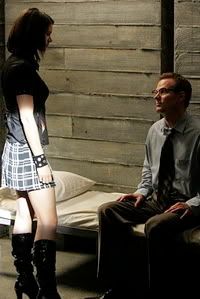
    STIPP: I know you’re billed as a Guest Star”¦

    PEREGRYM: You know, I don’t know what they’re planning for next season. The idea is that I’m coming back but nothing is contractually binding me to that.

    STIPP: Since you’re saying that you don’t get to do much are you on the set a long time out of the shooting day or do you hang out to watch the production as it happens?

    PEREGRYM: Well, no, not really. I’ll be around for my scenes. I have to be around for the entire scene whether or not if I’m in it but when you’re on set, you’re on set for 12 hours and that’s for your stuff. So, even though the camera time isn’t a whole lot it’s the process that takes a lot of time. And it’s important that I’m there as they’re there for my stuff because we both have to kind of interact. We have to do the same things and copy each other from the time that I morph to the time that it’s me. It’s fun, though. I think it’s a fun role for everyone else to play to because they get to step out of their character too and play it a little cheekier than usual”¦except for Ali Larter’s character because she’s already got that going on.

    STIPP: Are you able to prospect for new jobs or is HEROES taking all of your time?

    PEREGRYM: No, it doesn’t take a lot of my time. When it comes to the dates it’s really great”¦the only thing is because there is so much that’s going on, and since they’re really committed to making this the best show, they like to keep you around. They don’t like you leaving town. They like to keep you close. If a shot doesn’t work out or if they don’t complete their day, which happens a lot”¦why? Because it’s a tough show to film”¦That’s frustrating. Sometimes. Sometimes. But, other than that, it’s so easy and I’m really blessed to be a part of that.

    It’s really difficult for those that are the stars of the show because they’re in it all the time and they’re the ones filming 12 hours a day and it’s so tiring but I don’t have to go through any of that. So”¦I kind of scored the best job there.

    (Laughs)

    STIPP: Now, to bring up a point, weeks and weeks ago when you were contemplating entering the fray with this show did you have an idea for how widespread the viewership for HEROES had become? The fanaticism of it all?

    PEREGRYM: When I joined, I knew it was a hit, I knew it was doing really well. But, I don’t think I really understood because I don’t watch a lot of TV. The shows I was a part of LIFE AS WE KNOW IT, shows like that, things I was proud of, they did OK but it’s pretty incredible to be part of a show that’s taking off as much as it is.

    What I’m proud of, really, is that everyone works so hard. The cast and crew are so nice. You just want the best for everyone that’s a part of the project. The actors really put in 100% all of the time and the writing is just genius. Every episode is interesting and I cannot even remember what is going on. I watched last night’s episode [.07%]. I had no idea what I was doing! I couldn’t remember anything because the show moves so fast. But the reason why the show is doing so well is because everyone involved is just so dedicated and creative and works hard.

    STIPP: Is there extensive writing that’s done on the fly or is the script the script?

    PEREGRYM: Yeah. They’re always changes. They’re always rewriting it, all the time. You’ll get the first draft the week before you go to shoot and then you’ll get 500 different colors of all the changes they make. And that’s good because once you’re there to film it, that’s it.

    STIPP: This must also be the first time since you’ve been a part of something so big. Are you being recognized yet by geeks or fanboys of the show?

    PEREGRYM: I really get recognized everywhere else but LA. They leave you alone out here which is great but it’s weird when I do leave I almost forget that I’ve done things and girls will come up to me and I’ll be, “Oh, yeah, I did do that movie”¦” But it’s cool because I have the best fans in the world.

    STIPP: Really? Come on”¦

    PEREGRYM: I have the cutest little girls coming up to me.

    And you know, I thought about it, the only real comic books I read growing up were Archie comics. Like, I was a dork but I was never into that whole Sci-Fi thing, I didn’t watch a lot of TV but the one show that I really did watch was (Laughs)”¦Star Trek: The Next Generation. Every night, 7 o’clock, after dinner, with my family.

    STIPP: No”¦

    PEREGRYM: Yes!

    It makes me laugh because I totally forgot about it until a couple of days ago. I’m down with Worf!

    STIPP: Were you also down with Wesley Crusher, Wil Wheaton?

    PEREGRYM: Yup! And it was only the Next Generation.

    STIPP: What else, then, are you doing with your time while you’re here? Are you spending your summer doing anything in particular?

    PEREGRYM: Well, nothing is confirmed, as of yet but filming for HEROES starts back up at the end of June. There’s not much time to do anything unless it starts right now.

    It’s probably the effects work that’s contributing to that timeline; they are just unbelievable, to be able to do that week in and week out.

    Incredible. They do such a job with it. It’s impressive.

    STIPP: How are they able to churn through all the work that goes into it?

    PEREGRYM: They have two crews, really, to be able and handle it. You can’t even call it 1st and 2nd unit. They have two units that are filming simultaneously because there is so much to do and everything takes a long time. It just takes an extra amount of time.

    STIPP: So, what’s the lead-time then? From shooting a scene to when it airs”¦let’s take last night’s episode”¦nice boots and skirt combo, by the way”¦

    PEREGRYM: Oh my God!

    STIPP: I don’t and wouldn’t comment on something like that but it was obvious”¦and that was at the moment when I was telling my wife about who I was interviewing, obviously she doesn’t watch the show, and she had no clue but when you morphed back and you’re standing there”¦

    PEREGRYM: That’s funny because”¦my character”¦I don’t have to commit to a lot of things. They can adapt me however they want. It’s funny because the wardrobe started out very different than that. And then, on the day of shooting, they’re like”¦we just improvised the outfit. I got a little confused. I was like, “Whoa! I’m kind of getting confused about my character. What’s going on with her? How old is she?” You kind of just have to go with the flow.

    But to get back to when I shot it? Probably a month and a half”¦and not even that because I’m including the production break in-between that”¦when they weren’t airing any new episodes?

    STIPP: Right.

    I’m not looking for scoop, so let me preface the question like that, but without saying anything specific do you think the creators know where they want to go with the series? I’m just thinking of LOST where there’s a real sense that not even they know what’s happening on the island.

    PEREGRYM: I think they have an idea of where they want to go with the characters but realize they don’t tell us very much at all”¦and when I entered they had so many other storylines going”¦and I don’t think they have a lot of time to focus on me when they have all these other things to tie up. I don’t feel my character has alliances with anybody and”¦I can tell you that I honestly have no idea what’s in store with my character.

    Did that answer the question?

    STIPP: Yeah, it did. I just see things from the angle that there are even more balls, characters, that have now entered the fray and, with the exception of a few quality kills, no one substantial has really exited.

    PEREGRYM: And I think that’s why it’s complicated for the writers as well. I really commend them for being able to control that because I think it’s difficult to have intertwining storylines with old characters and new characters while making everything coordinate and make sense. I think it’s tough to do.

    I also believe that what makes the show so enticing is that you never know who’s for good and who’s for bad, What makes the show interesting is that all the people have the capability to do good and bad things based on life experiences or temptations or normal human instincts. And it’s whether you’re going to step-up or back down, whatever the case calls for, and I think that’s what they want to do; they want to take something that’s comic book-y but keep it realistic so that people can relate to it. It’s interesting and it’s cool and it has all these effects of people with superpowers”¦but these people have some very personal, relatable issues that are happening which I think are very basic.

    STIPP: It toes that line between nerdiness and drama”¦You’ve got a girl who’s adopted, you’ve got another who has daddy issues”¦

    PEREGRYM: I think the writers are very good at doing that, keeping the foundation of the show rooted between those two things.

    STIPP: Your parents live in Canada, right? Are they able to see your performance up there?

    PEREGRYM: Yeah they do. Do you know they get it on Sunday night? They get it a day before it gets released here.

    STIPP: I didn’t know that”¦.

    PEREGRYM: Yup. My mom called me and said, “I saw you on HEROES” and I said, “What are you talking about? How did you see that?” “Oh, it’s on Sunday nights”¦” It makes no sense to me. I can’t imagine that whoever is in programming is OK with that because people can blog and say things on the Internet and spoil things for Monday night but I guess it’s not a huge problem. I thought for sure, at first, my mom watched the wrong show but she said, “Well, are you doing other things I don’t know about that are entitled HEROES?”

    STIPP: Does she appreciate your work on the show?

    PEREGRYM: Yeah. Both of my parents are incredibly supportive. I try to go back home as much as possible, get away from LA because it’s good for me”¦It’s nice that I have my family and friends to go to.

    LA can be a wicked place”¦

    You see that kind of thing a lot…I understand why…I can see how that happens but I know LA lives by different rules and standards compared to anywhere else I’ve ever been. I feel more comfortable anywhere else other than here. I just think it’s easy to get caught up in that whether you want to or not.

    I mean I had an issue with the way people thought of me as an actress and everything that goes with that. I hated the stereotypes I was getting”¦and I hated telling people that’s what I did”¦and then with publicity, how you can get caught up with what I’m wearing now. As a result I don’t do a lot of publicity events and I eventually realized I had gone to the absolute extreme so now I have relented a little but there’s so little control over anything here. What you audition for and the jobs you get, that’s based on everyone else’s decision. Sometimes you feel like you’ve just got to let go and trust that things are going to work out.

    And I’m not really speaking from personal experience but I’ve seen it as something I don’t ever really want to be a part of. It’s hard. The power of influence here is crazy, which can be a good thing, but I think it’s really tough to stand up for really good things here because that’s not what sells.

    STIPP: How do you keep from being sucked into that? Is it just the support system that you have around you?

    PEREGRYM: I think it’s perspective. It starts with you. What your priorities are”¦your morals and values and what you stand for. I think, with me, I am really careful about the work that I do and there’s not a lot of stuff that I love but my passion and my heart is for young girls.

    I want young women to respect themselves. I want them to eat food, for God sakes, but I want them to take care of themselves. I want to inspire athleticism within young women”¦ for them to take care of their bodies and it all starts with how you think of yourself.

    For me it’s about being focused on where I want to go and who I am as a person and everything else will fall as it should. But it’s frustrating. It’s definitely hard sometimes. I have my good days and I have my bad days. I live by the ocean and whenever I have a really crazy day I just go to the beach and that pretty much takes care of it.

    STIPP: And I see what you mean. As someone now who is personally invested in how messages come across to young women, being the father of two girls, I can’t imagine how it must feel to be bombarded with mixed messages by how a woman should act and be.

    PEREGRYM: I am so thankful for my parents, I love them for it, because it wasn’t like I had a lot of issues growing up, which I think a lot of them do now, looking at the magazines”¦how you’ve got to be skinny, so skinny”¦all the focus on the superficial”¦it doesn’t matter. It’s not going to help you grow as a person. It doesn’t help you build character and everything that magazines are talking about now will be irrelevant in five minutes; it’s not about developing as a woman, it’s about looking like one.

    (Laughs)

    My dad had three girls.

    STIPP: Oh my”¦

    PEREGRYM: I have two other sisters and we’re all very close. I’ll be 25 in June. So, it’ll be 25, 24 and 22. So”¦good luck. You will be stressed, I can promise you that.

    STIPP: Well, no worries. I’ve already started an elopement fund.

    PEREGRYM: And I think the reason why I have the standards that I do, especially in finding a companion, a man, I want in my life, a lot of that has to do with how my father was with my mom. He was strict but he loved my mom like crazy and I know all the things he put down in front of us as boundaries were to protect us. And, yeah, I hated it. A lot of the things, he wasn’t going to let me date until I was 16. It was like, “I’m not getting married. Let me have a boyfriend!” “It’s so unnecessary to have a boyfriend at that age,” he would say. Now that I do have one it’s very, very important to me that my parents approve of the person that I’m dating because I believe that they know what’s good for me. They know what it’s going to take to have a strong marriage and they’re going to see that I’m respected and loved and taken care of.

    I think it’s important for girls to love and respect themselves and be excited to grow into everything that they are and I think that for them to do that it’s hard because the messages are so construed. I would hope girls try and see what’s really important. I think that when you respect yourself, and you’re happy with yourself, you raise a higher standard for yourself. And when you do that you allow strong people who also believe those things into your life and it’s about quality of life.

    Everyone I know is, “If it’s fun, then just do it.” Yeah, it’s permissible but not everything that’s fun is good for you. It’s about women and girls actually caring what they really instead of being told what they want. Figuring those things out will help you meet better men and it’ll hopefully lead to you having better families, better children, it just goes from there. It’s a chain link really.

    ##

  • Toy Box: Thinkway SPIDER-MAN 3 Room Guards

    toybox.jpg

    Yep, this is the week. You know what I’m talking about. That is unless you’re from another planet, and living there under a rock all alone. Or you’re a woman.

    That’s right, this is the week for Spider-man 3. This is also the week that begins a MASSIVE summer movie season, with major blockbusters hitting every weekend from now through August 10th. The sheer number of major films hitting this year is staggering, and we’ll have Spider-man 3, Shrek 3 and POTC 3 all in theaters for Memorial Day weekend. That’s some heaving hitters!

    We’ve been getting hit with Spider-man product for several months now in anticipation of the film, but if you’re like me, you’ve been less than impressed. I’m not a card carrying Hasbro hater, but even I have to admit that they’ve pretty much screwed the pooch on their offering. But thanks to a guest review on my site last week by Big Guido, I have found some very cool TOYS (please note the emphasis on the term TOYS) for the film.

    Back a few years ago, when Toy Story first hit, a company called Thinkway Toys made one of the coolest toys we’d seen in years – the talking Buzz Lightyear. It was a huge hit that year for Christmas, and became one of those legendary releases. Now, Thinkway is back with some more cool goodies this time for the new Spider-man film. They’ve made three ‘room guards’: a Spider-man, Sandman, and Goblin. I picked up the Spidey and Goblin for today’s review.

    Spider-man 3 Room Guards

    While these are technically motion sense room guardians, they are also very cool action figures. If you’re looking for something for your kids to have fun with based on the movie, these might just be what you’ve been waiting for.

    toybox_050107_1a.jpg

    toybox_050107_1b.jpg

    Packaging – **
    The external box is the usual mass market contrivance. It has a j-hook hanger on top, but can sit on a shelf as a box as well. At least sort of. The box has a slightly curved top and bottom, making it tough for it to actually stay standing on one end. There’s also all the usual twisties, and I think the package weighs an extra pound just from the million ties holding him in place. And it’s definitely not collector friendly, since you’ll pretty much destroy things getting him out.

    toybox_050107_2a.jpg

    There’s also a little weirdness going on here. Both figures have pegs screwed onto the bottom of their feet. These pegs can attach to the bases, and that’s what the instructions imply. That means the figure would stand about a quarter inch up off the base, and can’t really stand on flat ground without the base. Ain’t that weird?

    toybox_050107_2b.jpg

    Actually, it probably makes sense. I’m betting that Hasbro wasn’t interested in Thinkway – or anyone else – competing with them for ‘action figures’, so when they got the license to do these room guards, they had to come up with something that would make the figures less ‘action’, more room guard. Screw a couple posts on their feet that attach only to the room guard, and you have a solution.

    toybox_050107_2c.jpg

    However, all you need is a Philips screwdriver, and you’re good to go. In fact, there’s an alternate hole on the bottom of the character’s feet that also fits the pegs on the base, so even once you’ve removed the posts, they can STILL stand on the base. And viola – now they’re really action figures too!

    Sculpt – ***
    It’s important at this point in our discussion to keep that term TOYS clearly in your head. If you’re looking for collectible action figures of a high quality that are designed to look life-like and make women swoon, then you’re looking in the wrong spot. But if you’re looking for some cool, fun toys that both collectors and kids can enjoy, these are an excellent choice.

    toybox_050107_3a.jpg

    Both figures stand about 8 inches tall, which makes them a tad too small for other sixth scale lines, and much too big for most other 6 – 7″ lines. These really only fit in with other figures in the room guard series, but with three out already – and rumored plans for at least a Venom as well – you can make a reasonable movie set up.

    Spidey has the webbing and insignia sculpted on, giving him some texture and dimension. The proportions are good if not perfect, and he’s made from a very lightweight plastic, making it possible for him to hold some pretty difficult positions. Even though he’s lightweight, I didn’t find any joints that felt weak or easy to break.

    toybox_050107_3b.jpg

    This Goblin is the new version, more thrasher than villain I suppose, but if you don’t mind the design he looks pretty good. There’s a ton of detail work on the backpack, but I was disappointed that the weapons are permanently attached, and not removable or usuable.

    Again, his proportions are good, but he has some huge honkin’ feet. They are more anime or vinyl toy style, and did seem a bit out of place. Still, it means he can stand extremely well in a number of awkward poses, so that’s a plus.

    Paint – ***
    These are classic mass market paint jobs. Most of the large pieces of plastic are cast in the color they need to be, with smaller areas painted on. The paint work is fairly clean, but consistentcy is focus, not the highest possible quality.

    toybox_050107_4a.jpg

    The small, silver webbing on Spider-man is a bit sloppy, but not quite as much as I expected from a toy of this style. There’s also some poor cuts on the Goblin between colors, but none of it is terrible, and none of it is bad enough to interfere with the purpose of these figures – to be fun.

    toybox_050107_4b.jpg

    Articulation – ***1/2
    One of the strong suits of these guys is the articulation, which is surprising for something that’s supposed to just stand there and yell at you for coming in the room.

    toybox_050107_5a.jpg

    Both have neck joints similar to Marvel Legends, where the peg/disk allows the head to tilt forward and backward (quite a bit in Spidey’s case), and turn side to side. I had to really twist hard to break Goblin’s neck free (painted stuck), but once I did it worked well. It didn’t quite have the range of movement that Spider-man’s has due to the slightly more confining sculpt, but it was still decent.

    Both have ball jointed shoulders, jointed on both sides, that work quite well, and ball jointed hips that are designed to allow the leg to move all the way forward and out to the side. However, because of the butt sculpt, the legs don’t go backward very far.

    Both also have double jointed knees and elbows, and cut joints at the waist, thighs and ankles. The wrists have a cut joint for turning, along with a pin joint so it can move forward and back, and the middle two fingers on both hands have a pin joint so he can take the traditional ‘web shooting’ pose. The ankles also have a pin joint, and a rocker joint as well, plus the mid-foot has a pin joint. Finally, there’s a chest joint that allows a good range of movement, and holds positions pretty well.

    toybox_050107_5b.jpg

    That’s a LOT of articulation for a toy that theoritically didn’t need it. Perhaps Thinkway knew Hasbro was dropping the ball on the ‘action’ in action figure? Or maybe they’re just smart when it comes to making fun toys.

    Accessories – ***
    The only accessories are the room guard bases, which house the electronics. Both are done in the same rock style, although they are cast in different colors. Press the button on the top, and it plays a random line. Press it quickly twice, and the motion sensor activates, playing a line when any intruder is spotted. I’d tell you how to deactivate it, but since I’ve replaced my Brink’s system with a number of these placed strategically around the house, I don’t think it would be a good idea.

    toybox_050107_6a.jpg

    Both figures have a number of cute sayings, intended to scare off any intruders. Or at least amuse your kids.

    toybox_050107_6b.jpg

    Neither of the bases are using the actual actor’s voice, but rather some poor slub who happened to be hanging around the sound booth that day. Both figures attach to the base easily with the pegs removed, or you can just pose them in the same general vicinity.

    Fun Factor – ****
    While the sculpt and paint might not be ideal, these do make for really fun toys. They take poses extremely well, have tight, sturdy joints, and are a nice scale for small hands. I just wish there were more figures in scale with these that kids could play with.

    toybox_050107_7a.jpg

    Value – **1/2
    At around $17 – $20, you’re paying a pretty good chunk of change for the room guard feature. If you’re buying them just for action figures, that’s a bit hard to swallow, but don’t over look the many fun uses for the room guards. Maybe you don’t have kids that want them, but you can always take them to work and place them in strategic locations.

    toybox_050107_7b.jpg

    Things to Watch Out For –
    I suspect that mass market consistency will make these all about the same, with no real perfection but no real issues either.

    Overall – ***
    These aren’t going to wow your fellow geeks with their life-like appearance. They’re toys, and they are meant for kids to have use in having fun. But there’s plenty of us out there that still collect toys, because we love what the represent. Sure, perfect pop culture collectibles are nice too, but we shouldn’t forget that great toys are cool as well. And that’s what these guys are – great toys.

    If the pricing had been $15 or less, I would have given these guys another half star. As it is, I plan on picking up the Sandman for my son as well, and having some fun with him re-enacting scenes from the film, and making up a few new ones of our own.

    toybox_050107_8.jpg

    Where to Buy –
    Target has the best price I’ve seen at about $17 each. You can find them at most major retailers, however.

    Related Links –
    As I mentioned Big Guido did a guest review of the Spidey last week, and I reviewed some of the smaller Hasbro figures a couple weeks or so ago.

  • Comics in Context #175: My Dinner In Hell

    comicsincontext4.jpg

    cic2007-04-27.jpgAt the beginning of director Zack Snyder’s film adaptation of Frank Miller’s graphic novel 300, we are told that that if the Spartans of ancient Greece decided that a newborn infant was physically unfit to grow up to be a warrior, they would throw him to his death. The baby we see onscreen doesn’t meet such a fate, but we do get to see a mound of infant skulls.
    This sight leads me to contemplate my own beginnings. I was born prematurely, spent some time in an incubator, and suffered from eczema as an infant. While no one would ever mistake me for a warrior, I’ve led a healthy life and have never spent a night in a hospital since my infancy. But watching this scene in 300 makes me realize: if I had been born in Sparta in the 5th century B. C., I would have been killed like all the other “unfit” newborns.

    I don’t find this to be a propitious opening for a movie.

    Both the 300 graphic novel and the movie recount the story of the Battle of Thermopylae (translated as the “Hot Gates”) in 480 B. C., wherein King Leonidas of Sparta and three hundred soldiers sacrificed their lives in combat against the massively larger army of the Persian emperor Xerxes. But although Leonidas’s forces lost the battle, they inflicted surprisingly large losses on the Persian army.

    Moreover, the Three Hundred’s brave resistance at Thermopylae became an inspirational story, as Miller shows in 300 through his emphasis on the role of Dilios, the soldier turned storyteller. Before the climactic battle, Miller’s Leonidas observes that Dilios has “a talent unlike any other Spartan.” Though Leonidas and Miller do not spell it out, it is that Dilios is a storyteller, a creative artist, in effect. Leonidas commands Dilios to “make every Greek know what happened here. You’ll have a grand tale to tell. A tale of victory.” Dilios appears in 300‘s framing sequence in his role as storyteller, and most of Miller’s 300 is thus presented as the “grand tale” that Dilios tells to all of Greece, and to generations yet unborn.

    This reminds me of the end of Shakespeare’s Hamlet, in which the dying title character prevents his friend Horatio from committing suicide, and instructs him to live on and to tell Hamlet’s story; immediately after Hamlet’s death, we see Horatio begin his task, telling what happened to the newly arrived prince Fortinbras. There’s a similar idea at work in the end of the Lerner and Loewe musical Camelot, in which King Arthur, just prior to his final battle, knights a young boy and imposers a different sort of quest upon him: to leave the battlefield and devote his life to spreading the legend of Camelot.

    The saga of Thermopylae was not only conveyed through succeeding centuries by historians but also through references by poets including Lord Byron, Emily Dickinson, and T. S. Eliot. Miller surely identifies with the warrior king Leonidas. Though he looks considerably younger in the movie, the 300 graphic novel establishes that Leonidas is in his fifties. Hence, he is yet another of Miller’s middle-aged heroes facing his last battle, like the Batman of The Dark Knight Returns and Hartigan in Sin City: That Yellow Bastard. But surely Miller also identifies with Dilios, since they are both artists telling the “grand tale” of the Three Hundred.

    My question is just how well 300 succeeds in communicating the heroic spirit of the Thermopylae saga. Through the way in which they present their story, do Miller and Snyder distort the inspirational message they seek to convey? How justifiable is their idealization of the Spartans of 300, who, among other things, practice infanticide? I admired the graphic novel, though I never felt the affinity for it that I have to Miller’s 1980s work. The movie, however, through dramatizing and amplifying them, made me more aware of the troubling aspects of the book.

    For example, take the infanticide business. In the graphic novel, this is dealt with in two tiny panels in Chapter Three. “We are born. We are inspected,” reads Dilios’s narration for a small panel showing a newborn who is mostly concealed from our sight by two enormous adult hands. Just what are those hands doing to the infant’s eyes? Is that blood? And why use the word “inspected,” as if human babies were livestock? Then, in the next panel, the narrator tells us, “If we are small or puny or sickly or misshapen, we are discarded.” We see the silhouetted figure of a man, standing on a silhouetted cliff, dropping a silhouetted baby from it. The small size of the panel deemphasizes the scene’s dramatic importance; the silhouettes prevent us from seeing clearly what is happening; and the word “discarded,” as George Orwell would point out, suggests that nothing more is happening than tossing out the trash. But what is really going on is the murder of a baby.

    In the movie Zack Snyder can’t vary the size of the “panels,” and so the image of the adult “inspecting” the baby atop the precipice fills the screen. Not surprisingly, Snyder did not show the baby being dropped, but we see the remains of those who were killed before him.

    I am reminded of 24, a television series which I otherwise enjoy, but which has reversed what I had thought was an immutable principle of entertainment. In stories it is the Bad Guys who torture. Indeed, in the most recent episode (April 21) of the commendable new Robin Hood series on BBC America, Robin’s servant Much is horrified that Robin intends to torture his foe, the traitor Sir Guy of Gisborne, and Robin does not go through with it. I presume that the series’ writers and producers had the Abu Ghraib torture scandal in mind, but I wonder if they were also thinking of 24, in which hero Jack Bauer tortures people without hesitation. In 300 the Good Guys kill babies, and there is no hint in either the movie or the graphic novel that this sullies the Spartans’ heroic reputation.

    Actually, Wikipedia states that the babies “were abandoned on the slopes of Mt. Taygetos to die”. The 300 book actually makes matters worse by showing an adult actively killing a baby by dropping him off the cliff!

    Miller has stated in numerous interviews that he was inspired to create 300 by seeing a movie about the Battle of Thermopylae called The 300 Spartans (1962) when he was a boy. That was the last movie version of the “grand tale” until 300, nearly a half century later. Obviously, the “grand tale” had faded from American consciousness in the interim.

    Indeed, my understanding is that in the later decades of the last century, interest in ancient Greece and Rome declined in American schools, but it was still going strong when I was growing up. There were casts of the Elgin Marbles, the frieze from the Parthenon, on the interior walls of the prep school I attended; I wish I had appreciated them more at the time. What I did love since childhood were John Singer Sargent’s murals of gods, heroes and even monsters from Greek mythology above the grand staircase at Boston’s Museum of Fine Arts: they fired my childhood interest in mythology, which would lead to my lifelong fascination with deciphering the mythic archetypes in comics. And it was in grade school that I first learned about the two great rival city-states of ancient Greece: Sparta and Athens. Right from the start, I felt an affinity for the intellectual Athenians and didn’t much care for the warlike Spartans.

    As I’ve been observing for the last few weeks in this column, fashions shift over time, and perhaps now in the early 21st century American interest in
    classical culture is resurging. There was HBO and the BBC’s recent Rome television series, for one thing. (The 300 movie, I suspect, is less a sign of renewed interest in Greek history than of the growing cultural influence of the graphic novel.)

    Back in 1949, a director of the Metropolitan Museum of Art decided to convert its Roman court into a restaurant, thereby halving the space available for displaying the museum’s collection of ancient Greek and Roman art. This month the Metropolitan reopened the newly renovated Roman Court, transformed into a spacious sunlit showcase for Roman statuary. Turn immediately to the left as you enter, and you will find a bust of Herodotus, the “Father of History” (3480-430/420 B. C.), the Greek author who is the original source for 300‘s saga of the Battle of Thermopylae.

    In 2001 the Onassis Cultural Center, which presents temporary exhibitions of ancient Greek art, opened in midtown Manhattan. Its current show, running though May 12, is, appropriately for this column, “Athens-Sparta,” which compares and contrasts the two city-states through artwork from both city-states. There is a large marble statue of a hoplite, or Greek soldier, who is said to be Leonidas himself, and the exhibit includes arrowheads and spearheads that were found in the battleground of Thermopylae.

    But the opening wall text in the exhibit reminded me just why, even as a child, I preferred Athens to Sparta. Noting Sparta’s “strict training of its citizens,” the text states that Sparta’s “primary concern” was “the creation and maintenance of a mighty military force.” In contrast, Athens, was “imbued with a progressive worldview that promoted the individual” and “took a totally different direction that led to major intellectual and artistic achievements as well as to the unique phenomenon of the Athenian democracy, making the city the most important cultural center in the Hellenic world until the Roman Age.”

    The wall texts in the Metropolitan’s new Greek galleries trace the cultural history of Athens, depicting the reign of Pericles in the 5th century B.C. as a Golden Age that produced extraordinary achievements in philosophy, democratic government, architecture, sculpture, science, philosophy, and literature. These wall texts ignore Sparta.

    The Onassis Cultural Center’s show seeks to correct the imbalance by presenting works of art from Sparta. But, according to one of the show’s wall texts, “”From the mid-sixth century B.C. this burgeoning of the arts began to wane. . .The adverse domestic situation that had begun to take shape, with the gradual decline in the economy and trade, led to Sparta’s alienation from the rest of the world and to the dwindling of interest in the arts.” That “dwindling” strikes me as less ominous than Sparta’s “alienation from the rest of the world,” which seems an unhealthy attitude to have.

    It also occurs to me that choosing between Sparta and Athens may be something like the red state/blue state split in contemporary American politics. The Onassis show does characterize the militaristic Sparta as “conservative and restrained” in a wall text, whereas Athens, presumably liberal by contrast, was the birthplace of democracy.

    Considering my childhood affinity for ancient Athens, the leading cultural center of its time, it makes sense that I ended up spending most of my life in New York City, the cultural capital of the United States, and perhaps the world, filled with museums, theaters, publishers and educational institutions.

    Athens was also the birthplace of drama, home in the fifth century B.C. to the first great authors of tragedy, Aeschylus, Sophocles and Euripides, and the first great comic playwright, Aristophanes. With my own lifelong passion for storytelling in a variety of forms–novels, plays, movies, and, yes, comics–it’s no wonder that I regard Athens as a cultural Camelot of the ancient world. Why, wouldn’t anyone who loves storytelling feel the same way?

    On the basis of 300, apparently not. Here’s Leonidas talking to the Persian messenger early in the 300 graphic novel: “Rumor has it that the Athenians have already turned you down, and if those boy-lovers found that kind of nerve. . . .” So here’s the Athenian civilization dismissed with a homophobic jibe.

    It also turns out to be hypocritical on the part of the fictionalized Leonidas, although you wouldn’t know this from either the graphic novel or the movie.
    Referring to 300‘s seeming characterization of Xerxes as gay, academic Ephraim Lytle of the University of Toronto comments, “This is ironic given that pederasty was an obligatory part of a Spartan’s education. This was a frequent target of Athenian comedy, wherein the verb “˜to Spartanize’ meant “˜to bugger.’”. Not only that, but according to Wikipedia, “In antiquity it was thought that a youth was expected to find himself an older lover, and that pederasty, a social practice common throughout most of Greece, was especially so in Sparta, where the ephors fined any eligible man who did not have chaste relationships with youths”.

    As for heterosexuality in Sparta, by law each Spartan man had to marry a woman when he was twenty. According to the aforementioned Wikipedia entry, the wedding ceremony “consisted of the intended bride being abducted with simulated violence.” Doesn’t seem very loving, does it? But wait, there’s more. Wikipedia continues, “After the wedding night the husband remained living in his barracks and would have no further contact with his wife except for the purpose of procreation.” (Actually, as a lapsed Catholic, I’d have to say this isn’t that different from the Church’s traditional position on marital sex.) And what effect might that have on the psychological well-being of any straight young Spartan? No wonder they sublimated their libidos into the violence of warfare.

    By the way, while the Onassis show acknowledges the “Spartan supremacy on land,” the Athenians were no slouches, despite their lack of a militaristic culture. The main villain in 300 is the Persian ruler Xerxes, whose father, Darius, did indeed intend “to create a worldwide empire,” according to the Onassis wall texts, which further state that Darius’s army “marched onto Marathon, where, despite being outnumbered four to one, Greek troops led by the Athenian general Miltiades achieved a remarkable victory over the Persians” in 490 B. C.. Lytle points out that while the Spartans were facing Xerxes’ troops at Thermopylae ten years later, “a vastly outnumbered fleet led by Athenians was holding off the Persians in the straits adjacent to Thermopylae, “ In the 300 graphic novel Miller has Dilios acknowledge that “In the waters of Salamis, Athenian seafaring mastery led the united Greek navy to shatter the Persian armada.”

    But look how Dilios describes the Athenians’ triumph at Marathon in the 300 book. “Armored men, Athenians, with their leather skirts and lovingly sculpted breastplates. What a pretty pack they must have been! Athenians. Amateurs. Foppish, frilly citizen soldiers. . . . and still they drove the Persians back to the sea and away!. . .How can we fail–against foes so fearful of combat they’d show their backside to Athenians?”

    How many things are wrong with this? Rather than commend the Athenians for their courage and battle prowess in defeating the Persians, Dilios disparages them by “feminizing” their image, as if he were some bigoted adolescent saying, “They are SO gay!” (Of course, in contrast to the Athenians in “skirts,” the Spartan soldiers of 300 walk around virtually naked, but we’ll get to that later.)

    Of course, if the Persians are supposedly such cowards that even the allegedly incompetent and girly Athenians could put them to flight, then the Battle of Thermopylae is really not such a big deal, right?

    There’s something more subtle that I find disturbing, as well. In 300 Dilios and Leonidas speak condescendingly about the “citizen soldiers” from other Greek city-states, whom Dilios calls “amateurs.” When Leonidas encounters the Arcadian army in 300, he asks various Arcadians what their professions are. There is a sculptor, a blacksmith, and as baker, all creative artists of one sort or another. Leonidas and Dilios, however, prefer the Spartans’ full time professional army: “You see, old friend,” Leonidas says, “I brought more soldiers than you did.”

    My father fought in World War II. He was an engineer, not a professional soldier. The vast majority of American soldiers in World War II were ordinary people who were drafted or who enlisted out of patriotism, not career soldiers, and yet they won the war. Amazing, eh? In fact, movies about World War II, those made during the war and right up through Steven Spielberg’s Saving Private Ryan (1998), celebrate the courage and endurance and skill of these “citizen soldiers”; you may recall that Tom Hanks’ character in Ryan was a schoolteacher in civilian life. In fact, this celebration of the “citizen soldier” seemed to be a celebration of the democratic spirit of America.

    But 300 turns this ideal upside down. “Citizen soldiers” may be “brave,” as Dilios acknowledges, but 300 argues that they should leave the real fighting to the pros.

    So, thus far 300 has badmouthed my dad’s wartime service and thrown me over a cliff. This is not looking good.

    Well, what if I had been born in ancient Sparta and I hadn’t immediately been thrown over the cliff? According to the graphic novel, in Dilius’s words, “we are starved, driven to steal, and fight and kill. We are tested, tossed into the wild, left to pit our wits and will against nature’s fury. By rod and lash, we are punished, trained to show no pain.”

    It seems that this is more or less true. According to Wikipedia Spartan boys started their compulsory military training, called agoge, at the age of seven (!), which “consisted for the most part in physical exercises, such as dancing, gymnastics, and ball-games.” That doesn’t seem so bad, but consider this. The kids also had to run what was called the gauntlet: “They would have to run around a group of older children, who would flog them continually with whips, sometimes to death.” And I thought the bullying I endured in grade school was bad. So had I not been thrown over the cliff, this is where I’d get killed.

    Following the agoge “a select few young men were arranged into groups, and were sent off into the countryside with nothing, and were expected to survive on wits and cunning” and, yes, were expected to steal. Professor Lytle states that Spartan boys “were indeed toughened by beatings and dispatched into the countryside, forced to walk shoeless in winter and sleep uncovered on the ground.”

    So, from the age of seven, all Spartan boys are set on the same mandatory career path, and they remained full time soldiers until they were thirty. There doesn’t seem to have been the opportunity for someone like myself to become a scholar or a writer. If Frank Miller had been born in ancient Sparta, presumably he wouldn’t have been able to become an artist.

    But wait! If all the men are soldiers, then who performs all the other jobs in Sparta? It’s not the women, who, even though they had more freedom than the women of other Greek city-states, were still confined to managing the home. Citizens made their money from their land, which was farmed by the helots, a class that Wikipedia compares to medieval serfs, who made up ninety percent of the Spartan population. Not only did helots have no civil rights, but according to Professor Lytle, the initiation rite for young Spartan soldiers consisted of “murdering unarmed helots.” Lytle dryly observes that “By living off estates worked by helots, the Spartans could afford to be professional soldiers, although really they had no choice: securing a brutal apartheid state is a full-time job. . . .” Before the Fifth Century B.C. Sparta pursued what the Onassis show calls an “expansionist foreign policy”: the helots were descendants of the other Greeks they conquered.

    So, in the graphic novel Leonidas says on the eve of the Battle of Thermopylae that “Come tomorrow, we light a fire that will burn in the hearts of free men for all the centuries yet to be.” Miller’s Leonidas is well aware that he is the impelling force behind the “grand tale.” But just how free are the people of Sparta? They may not be under foreign domination, but ninety percent of the people living in Sparta are effectively slaves. Spartan male citizens are forced to become part of the military machine. And how much freedom did those abandoned infants experience?

    Wikipedia states, ” From the earliest days of the Spartan citizen, the claim on his life by the state was absolute and strictly enforced.” Isn’t this the kind of overbearing government, restricting individual freedom, that Miller presents as the enemy in Batman: The Dark Knight Returns, The Dark Knight Strikes Again (see “Comics in Context” #30-31, 34), Elektra: Assassin, Sin City, and the Martha Washington books?

    Notice that right after Leonidas makes that speech about “the hearts of free men,” one of his subjects says, “We’re with you, sir, to the death,” and Leonidas replies, “I didn’t ask. Leave democracy to the Athenians, boy.” So much for liberty.

    I shouldn’t go further without dealing with some unfinished business. I never did complete my discussion of the neo-noir movie Frank Miller’s Sin City and the graphic novels on which it is based (see “Comics in Context” #78-79, 83), and I should at least wrap up the storyline about Marv, The Hard Goodbye. Perhaps it’s just as well that I waited, because some things I’ve written about in subsequent columns have added to my understanding of Sin City, and that in turn helps illuminate the meanings of 300.

    In The Hard Goodbye the brutish Marv is trying to find out who is responsible for the murder of Goldie, the one woman he says ever showed him kindness, and to avenge her. (Actually, Marv’s mother, his female parole officer, and his fried Nancy the stripper all like him, too; what Marv, who is grotesquely ugly, means is that Goldie is the only one who would have sex with him.) I left off just before Goldie seemingly returns from the dead to try to kill Marv, repeatedly hitting him with her car.

    This isn’t Goldie resurrected, but her twin sister Wendy, who soon finds out that Marv didn’t kill Goldie and becomes his ally. It was clever of Miller to introduce Wendy, because she serves several important purposes. First, when she first appears, and is trying to kill Marv, she represents Marv’s own sense of guilt over Goldie’s death. When he discovered she was dead, he blamed himself for having lain there obliviously drunk and asleep next to her when the murderer struck. The male protagonists of the Sin City movie are driven by a kind of chivalry: they regard it as their duty to protect women, even though the women in some cases are quite capable of defending themselves. It’s possible that in beating up, torturing and killing various antagonists in his quest to avenge Goldie’s murder, Marv is displacing his own sense of guilt onto the various members of this conspiracy. In punishing them, he feels less guilty. Then again, perhaps his sense of guilt is on reason why it’s appropriate that Marv ends up in the electric chair: he subconsciously may feel that he must be punished, too.

    Second, Wendy’s role in the story underlines the extent to which Marv’s Goldie is not so much the real person as a figment of his imagination. At first Marv thinks that Wendy is Goldie, and even after he learns the truth, he continues to confuse one for the other. In a sense Wendy is no more Marv’s Goldie than the real Goldie was. The Goldie he is in love with, whom he seeks to avenge, is his image of the ideal woman, which he projects onto the real Goldie. Even as he learns Goldie’s true motivations, and that she wasn’t in love with him, he keeps saying that it doesn’t matter: he is still loyal to the death to his idealized conception of Goldie, and he won’t let facts get in the way.

    When Wendy visits Marv on death row just before his execution, he thinks again that she is Goldie. And at this point, symbolically she is: Wendy is expressing the gratitude to Marv that presumably Goldie would have felt had she lived.

    Recently watching the Sin City movie again on television, I connected it with my long commentary on Dr. Peter Coogan’s book Superhero: The Secret Origin of a Genre (see “Comics in Context” #162-166). (See, I warned you that this book would keep popping up in my column.) Coogan pointed out that superhero stories fit into the literary mode that the late Northrop Frye designated in his book, Anatomy of Criticism, as “romance.” By that term Frye meant a story of extraordinary adventure in which the protagonist is “superior in degree to other men and to his environment,” but is still a human being, who “moves in a world in which the ordinary laws of nature are slightly suspended.”

    This explains some of the improbable things in Miller’s Sin City comics, which seem even more improbable on the movie screen. Wendy repeatedly hits Marv with her car, yet he suffers no serious injury, and is barely slowed down. Ultimately Marv is sentenced to the electric chair, but not only survives the first electrocution, but is able to mock his captors: it takes two to kill him.

    But if you perceive Marv as a hero of “romance” who is somehow “superior in degree to other men” and the world around him, and who exists in a world “in which the ordinary laws of nature are slightly suspended,” it makes sense. Sin City sends mixed signals, since the setting, the urban underworld, is what Frye would consider a “low mimetic” milieu, in which we would not expect blatant elements of fantasy. Nor do we expect the characters of film noir to be stronger or more resistant to injury than normal people. But although Marv is not a character in the superhero genre, he is to some degree superhuman, and in my earlier review I compared him to the Hulk, both physically and temperamentally.

    Since Sin City is a Frye-style romance, that also explains the odd science-fiction element: in That Yellow Bastard Hartigan shoots off Roark, Junior’s hand and genitals, but unusual treatments somehow enable him to grow them back! This may also explain certain characters’ resistance to bullets. Hartigan can sever Roark Junior’s hand and genitals with a single gunshot apiece, yet in the same scene Hartigan is shot repeatedly, without losing any body parts, and, despite his heart trouble, manages to survive. This is why the serial killer in The Hard Goodbye, who looks like an ordinary preppie, displays strength, agility and speed on the verge of impossibility.

    There are also elements of Frye-style romance in 300, especially the movie. As I reported in this column, at last year’s San Diego Con, Miller “pointed out that sometimes Snyder changed the speed of the cameras to make the Spartans look “˜superhuman’ during the fighting” (see “Comics in Context” #146). In the movie one of the principal Spartans is impaled by a spear and nonetheless manages to keep on slaying enemies until he finally dies: he too is “superhuman.”

    In that Robin Hood episode I mentioned, Much does not want his master, Robin, to lower himself to the moral level of the bad guys by torturing Gisborne. In The Hard Goodbye Marv not only kills people but tortures antagonists in the course of his quest for vengeance. Marv even cuts off the arms and legs of the cannibalistic serial killer in Hard Goodbye and lets a dog eat him. Hartigan tears off the Yellow Bastard’s new genitals with his bare hand and then kills the Bastard by beating his head to a literal pulp. However awful their antagonists’ actions, surely Marv and Hartigan have gone beyond the bounds of moral justification in taking their revenge.

    Marv ends up being killed in the electric chair, and Hartigan commits suicide. I wondered whether Miller gave them these fates as an acknowledgment that Marv and Hartigan had each gone too far, and had to suffer punishment themselves. They were both like the classic hero whose violence ensures the safety of society, but for that very reason cannot be a part of it: that’s why Alan Moore’s V effectively commits suicide, leaving Evey to guide a new, freer British society.

    Is this the subtext of Miller’s 300? Are we meant to be horrified by the Spartans’ militaristic society? Are they sacrificing themselves, like V, in order to assure the rise of a better world, of which they could never be part? Does Miller mean us to deconstruct 300 in this way? Or does he mean for us to accept his heroic portrait of the Spartans at face value, warts and all, offering no moral condemnation of those warts? Are we meant to excuse Marv’s and Hartigan’s violent excesses, as well? We shall look into this further in the near future.

    ADVERTISEMENTS FOR MYSELF
    This spring Art Spiegelman has been an artist-in-residence at my alma mater, Columbia University. For the latest edition of Publishers Weekly’s Comics Week, I wrote a report on a lecture that Spiegelman recently delivered on campus.

    And congratulations to fellow Quick Stop columnist Fred Hembeck, whose column will celebrate its hundredth anniversary within the coming week!

    Copyright 2007 Peter Sanderson

  • Trailer Park: Jamie Kennedy: Man, Myth, Examinator of Societial Underbelly

    By Christopher Stipp

    Archives? Right Here…

    One of the nicest things I am able to do as a person who has a weekly column devoted to trailers is expose you all out there in the cyberiffic ephemera to some of the best and worst in movie advertising.

    This week’s column is unique in that I have two trailers to give you that gives you two different opinions on the phenomena that is Jamie Kennedy.

    On the one hand I am not in any way a fan of The Jamie Kennedy Experiment. I saw the program as a shallow attempt to blend his style of comedy, his need to dress up and portray a gaggle of imaginary characters and set it all against a Candid Camera-like backdrop. I didn’t find it amusing. I didn’t see anything particularly brilliant about his humor and the roles he chose in mainstream film only really solidified the theory that he was, essentially, a vanilla alternative to Jim Carrey.

    From there it was a roller coaster of film choices that swung back and forth from good to downright terrible. For every ROMEO + JULIET (he was absolutely fabulous) there was a MALIBU’S MOST WANTED waiting right around the corner. It was unfathomable to me that the guy could do great great work but then make a choice like SON OF THE MASK and it just makes you scratch your head and wonder just what is going on in that man’s mind. He’s obviously not above doing some projects because they have a modicum of ridiculousness in them or even above doing something that’s obviously terrible but the thing is, and here’s the rub, he’s hard to dismiss.

    Kennedy has the kind of talent that eeks out every now and then but with a movie like KICKIN’ IT OLD SKOOL you just have to throw your hands up in the air and just forget everything you’ve ever thought, dismiss all the goodwill you’ve ever slid his way and just seethe with the kind of hate usually reserved for the sneaky bastards that steal food from the your company’s break room refrigerator, especially if the wife packed an extra pudding pop in your lunch.

    The thing, though, is that the same weekend I saw SKOOL I also happened to catch his new documentary HECKLER and it blew my sensibilities away. The guy just rages with brilliance as he confronts the act of heckling and what it means to entertainers and public figures. You, honestly, can watch Kennedy sitting on a couch with a critic that has pummeled him, mercilessly, for his previous work that is, perhaps, worthy of such derision but it feels prickly when you see him confronting the critic and trying to make sense of the depth to which he was pushed asunder. It’s fascinating.

    I’ll save the play-by-play for below but I’m curious what you think out there about Jamie Kennedy: Smart comedian or schizophrenic actor? I honestly believe the guy has to evoke some kind of reaction, one way or the other, from his audience so I welcome your thoughts on this or the trailers below.

    But, before you do that, check out the extended Raiders video that’s used in Kennedy’s HECKLER trailer. I’m still laughing my ass off.

    DIGGERS (2007)

    Director: Katherine Dieckmann
    Cast:
    Ken Marino, Maura Tierney, Paul Rudd, Ron Eldard
    Release: April 27, 2007
    Synopsis:
    A coming-of-age story about four working-class friends growing up in Long Island, New York, as clam diggers. Their fathers were clam diggers as well as their grandfathers before them.

    View Trailer:
    * Large (QuickTime)

    Prognosis: Positive. This movie is an odd duck but it’s for all the right reasons.

    First, what many will probably notice about the film is that its release date, DVD release date, and the date on which it’s going to be available through your television is roughly only ten days between one another. BUBBLE, that see it and forget it film from Steven Soderbergh, kind of petered out to a slow-burn was due to its ambiguous and rather freakazoid premise as a film. Some saw that mass release on all formats as a bad portent for this kind of releasing but I would argue that the reason it didn’t do so well was because it wasn’t the kind of film you would want to rush out and buy, that you would want to rush, period, to see.

    I’m not sure if this movie is The One, something that would really be a good test for how well it will do across all formats, but it’s got Paul Rudd and Maura Tierney and even Ken Marino, one of those quiet killers of comedy, who leads off the trailer with admonishing the use of the word “funeral” with his kids and, instead, couches the request to get his children interested in seeing a corpse as, “Want to see a dead body?” Huzzahs and excitement abound.

    The fact that you have all this comedic talent behind the film and then, from Ken, we switch into Serious gear by setting things up ever briefly isn’t as jarring as it could be. You have the death of a patriarch but there is a sense, initially through casual talk between Rudd, Ken and Maura, that this all about capturing a moment. From the frank discussion about the truth of irony, funny, to the very real problems that this maritime family goes through after the one they depended on has left them is rather compelling.

    Another reason that this trailer stands out from the pack is that there is a loaded cast that could do well in a movie like 40 YEAR-OLD VIRGIN or WET HOT AMERICAN SUMMER but there’s hardly any of that here. This is a real examination of what a family goes through when the support system is gone: Ken has issues with his career, Rudd has problems with finding his place in life and Maura has problems with finding love.

    None of this is funny.

    However, we don’t really care because these people handle all these issues with their senses of humor and that’s what’s different about this production. Ken sums up what makes this an interesting experiment in whether anyone would buy, see or push a button on their remote to see this movie: his kid wants to see JAWS, Ken doesn’t think it would be a good thing, Ken goes on to explain away the ending with the kind of parental force that is at the same time funny and real.

    I hope it’s not a failed experiment.

    KICKIN’ IT OLD SKOOL (2007)

    Director: Harvey Glazer
    Cast: Jamie Kennedy, Miguel A. Nunez, Maria Menounos, Michael Rosenbaum, Bobby Lee
    Release: April 27, 2007
    Synopsis: In 1986, a freak break dancing accident put Justin Schumacher in a coma. Now, 20 years later, he (Jamie Kennedy) is waking up to a new world and discovering that the more things change, the more he’s stayed the same. With the girl of his dreams (Maria Menounos) engaged to marry his grade-school nemesis (Michael Rosenbaum), and his parents drowning in the debt of his medical costs, Justin must rally his former squad, bust a move, and win back the girl of his dreams.

    View Trailer:
    * Large (QuickTime)

    Prognosis: Wicked Negative. This your bush?

    I think that Jamie Kennedy is amusing. I think he’s really done well for himself and has established a fairly solid history for what his legacy will be when he finally passes on. I just am of the belief, however, that his comedy is middle of the road and doesn’t really do anything to further what those have come before him have done to try and push the boundaries of what can be funny.

    It’s not meant to be a slam against what he does because, all things being equal, he’s a solid 6.5 on a 10-point scale. He’s not breaking any new ground or cutting a path through a thicket of land no one’s ever seen before but when you look at this trailer that’s exactly the kind of thing you should be thinking by the time it’s over.

    It’s like BIG meets 13 GOING ON 30. Not the greatest way to walk into a pitch meeting, it wouldn’t open my wallet, but someone did and the trailer plays Color-By-Numbers. The bland voiceover tells us everything we need to know about this movie by the time we hit the 15-second mark and kudos to them. I can’t really hold anything against the intro because it does a solid job with setting up his life, his love interest, the situation of him being in a coma for 20 years following a break dancing move and the fact that Christopher McDonald is just a solid supporting actor in comedies.

    The problem, then, is the plot of this movie. Whereas you have trailers that try and snowball you into thinking they’re something that they’re not this movie actually puts itself out there and kind of reveals all the goods. From the go-to gag of exposing an ignoramus to the powers of Internet porn, to the dropping of any 80’s nostalgia (Star Search, He-Man, arcades, et al) in order to make the situational comedy more “gettable” by your average Gen Xer, the demo this movie is obviously and overtly aimed at.

    From the preposterous setup that there just happens to be a dance-off that just happens to award lots of money and just happens to be close enough where two old rivals, played with about as much nuance as an atom bomb going off in the middle of Nagasaki. It’s lazy storytelling would be far worse to me if this trailer just didn’t succeed in doing everything that it needed to do in order to be effective.

    See, it’s not my place to point out the effectiveness of Vivica A. Fox’s bitch slap that’s funnier than shit but, rather, it’s my duty to explain that, as a trailer, it did everything it needed to do. It’s hard to rail against something that I sure as hell won’t spend any scratch on, and would try my hardest to keep any others from doing so either, because this trailer doesn’t hide what it is. It’s pleased as piss to just put it on display and let people bask in its milquetoast mushiness.

    If ever there was a trailer that exemplified a C+ student, you need not look any futher.

    HECKLER (2007)

    Director: Michael Addis
    Cast:
    Louie Anderson, Dave Attel, Vince August, David Cross, Mike Ditka, Craig Ferguson, Tom Green, Jamie Kennedy, Jewel Kilcher, Bill Maher, Howie Mandel, Patton Oswalt, Joe Rogan, Rob Zombie
    Release: Coming Soon
    Synopsis: HECKLER is a comedic feature documentary exploring the increasingly critical world we live in. After starring in a film that was critically bashed, Jamie Kennedy takes on hecklers and critics and ask some interesting questions of people such as George Lucas, Bill Maher, Mike Ditka, Rob Zombie, Howie Mandel and many more. This fast moving, hilarious documentary pulls no punches as you see an uncensored look at just how nasty and mean the fight is between those in the spotlight and those in the dark.

    View Trailer:
    * Large (Flash)

    Prognosis: Wildly Positive. I am, really, an old school comedy lover.

    One of the best Kids in the Hall sketches has Bruce McCulloch and Mark McKinney as two of the most slimy, unscrupulous salesmen. They’re hawking a product called Poreef, a meat blend consisting of beef and pork, and are trying to unload it on a pack of easily sold sheep who are looking for a deal at their supermarket. One of the customers, an old woman, interrupts the sales pitch. Bruce, annoyed, fires back with, “Ma’am, do I come to your job and jump up and down at the end of the bed?” Realize, as well, that it took a moment the first time I heard it for me to understand that even though this was scripted sketch comedy it was still very funny.

    As such, this is Jamie Kennedy’s bush right here. Make no mistake about the starkness of what this documentary deals with, the business of dealing with those who want to interject their own brand of humor to a working comedian’s office, and the trailer really impresses.

    What’s so notable is that it opens up right in the middle of what the film is about with no context other than Jamie is making a documentary about something. The heckle that’s tossed out first is actually quite good, and one I’ve thought about Jamie for quite some time, only for him to soothingly take the heckler to task for his interruption.

    We churn through a few comedians and their thoughts on the subject, Joe Rogan, who ought to win some kind of medal for this coup d’etat of massive proportions, steps in with a succinct appraisal of the situation, David Cross slips in with a quick comment but it’s really the heckle by a Raiders fan after a Texas Tech football game that’s interwoven between shots of Mike Ditka (?) and other comedians’ feelings on the matter that gets a laugh out of me.

    Jamie is absolutely right to explore this social custom that seems to pervade many different avenues, not just stand-up comedy, but it’s the trailer’s frankness and inclusion of how Jamie himself deals with moments where lesser people might find themselves shaken off their game but, for him, it’s just another part of the career.

    That’s where Michael Richards’ career-screeching screed comes in.

    Things get a little spicier. A comedian is shown getting punched in the face by an audience member who rushes the stage. Dave Attell weighs in on why all comedians should retaliate against hecklers with violence of their own. Some guitar wielding comedian distributes some of his own brand of Whoop Ass to an unfortunate loudmouth and, again, Jamie switches gears.

    The trailer contextualizes the final 1/3 of what we see here in that Jamie invites his critics into his movie to openly berate him about the roles he’s chosen to play and for them to be brutally honest about what they think of his work. It’s astonishing to watch if for no other reason than that anyone else, I would assume, in his position would just collect the paycheck and move right along. Some of these critics have real prickly things to say to his face. It’s great to watch simply for the thrill of seeing how this fits into his overall thrust of the film. And it does it seamlessly.

    From other comedians to Jamie turning things back around on the critics he invited to share some screen time with him as they discuss the reviews they wrote about him this trailer easily has found a welcome spot in one of the best previews I’ve seen this year.

    SEVERANCE (2007)

    Director: Christopher Smith
    Cast: Danny Dyer, Laura Harris, Tim McInnerny, Toby Stephens, Claudie Blakleye
    Release: May 18, 2007
    Synopsis: Working nine to five is a real killer, but teambuilding holidays can sometimes be even worse. A coach lurches out of the hustle and bustle of Budapest and heads towards the mountainous border. Aboard are seven employees of the international weapons manufacturer Palisade Defence, global suppliers of innovative weaponry for the past 75 war- torn years. The lucky group are being treated to a team-building weekend at the company’s newly built luxury spa lodge by their president, George Cinders.

    View Trailer:
    * Large (QuickTime)

    Prognosis: Positive. I didn’t know whether to laugh or be afraid, very afraid. And that’s kind of nice.

    What makes SHAUN OF THE DEAD so interesting as a vehicle for film study is its blend of comedy and horror. Now, mind you, I wouldn’t say that SHAUN has the kind of horror blend that you would have seen in FRIDAY THE 13TH PART 2, really the best one of the bunch, and that it’s more comedy than it is horror, but there was a real dedication on everyone’s part to not minimize either one of those blends.

    That’s what I’m hoping is being done here.

    For those who have ever been on a business retreat for those touchy-feely, granola chewing managerial types that think by stealing away for the weekend is any way for people to come closer together it is a nightmare of the oddest proportions. It kind of feels like you’re still “on the clock” but your attire and office scenery is just slightly askew; rather, it’s like a netherworld that denies you any sense of real comfort.

    This trailer solidly blasts through the front gate and sets it all up for anyone who has never been on one of these business getaways some idea of what’s supposed to be done on them. Except, of course, you get the manager’s idea of what it’s to be but it’s the underlings who always try and find a way to undermine the entire experience. And that’s what you have here. The voiceover is a bit too Yankee for my liking, this after all an English film, and the choice of music for the background is quite discordant from what’s happening on the screen but you are, however, introduced to the colorful blend of co-workers on this trip. Keep your eye out for the Unexpected Perks guy. Lucky sod, he is.

    Then Survival pops up on the screen.

    Without so much as a warning we’re thrusted into this new world of kill or be killed. I was a bit confused, still am, about whether some people IN the company are out to kill each other or whether these are forest people just out to kill those AT the company. Regardless, and points are going to be deducted for having to make me think of what the right answer is, the flourish of a flame thrower, an RPG that goes rogue and a bus that flips onto its side after a wicked correction on the road is sweet enough to put me back in my place.

    What follows from here is just a wetworks and attrition of the greatest degree. People seem to be devolving right in front of us, others are killing people in their shirts and neckties and, curiously enough, we aren’t allowed in on the secret of who provoked and is sustaining the campaign of death on these people.

    Sometimes it’s better not knowing and in the case of this trailer it’s a lot like knowing when the company’s going under: not knowing when it’s coming can be a lot more entertaining.

  • Toy Box: Hagrid & Mad Eye Moody mini-busts

    toybox.jpg

    Harry Potter kicks ass. Really. The books might not be grammatically, syntactically, or structurally the finest pieces of fiction ever produced by humans, but they’re damn fun to read. Ms. Rowlings snagged on a formula that works, and not the least important aspect of this formula is how the books grow in complexity and darken in tone as they move forward, just as her young readers age.

    While all the films haven’t been quite as good, they’ve done an admirable job telling the story in that medium. The international trailer is out for Order of the Phoenix, and it looks fantastic. Anticipation is certainly running high for this film, and with other major blockbusters hitting this summer like Spidey and Jack Sparrow, this is likely to be a record setting box office year.

    Gentle Giant began making their line of Harry Potter busts about a 18 months ago, and they’ve given us some good, and some amazing. The latest release is just hitting, and includes lovable but huge Hagrid, and much smaller and a whole lot less lovable Mad Eye Moody. Retail on these is around $45, just like the rest of the series.

    Gentle Giant Hagrid/Mad Eye Moody Busts

    toybox_042407_6.jpg

    If you’ve been buying these from the start, you’re collection is starting to round out pretty nicely. These two make busts twelve and thirteen (or thirteen and fourteen, if you count the convention exclusive repainted Sirius), with all the major characters (Harry, Hermione, Ron, Dumbledore, Snape, and Hagrid) having a bust, along with a few secondary characters (Sirius, Dementor, Deatheaters, Moody) and some visually interesting C string characters (Nearly Headless Nick, Dobby) to round it out. Next up is Voldemort and the Riddle gravesite (should be out in the next month), with an older Harry, Cho Chang, and Malfoy all hitting this summer.

    And for those interested in numbers, both of these are limited editions (of course), with 2000 made of Hagrid, and 1750 made of Moody. These are small edition sizes, especially considering the overall popularity of the line so far.

    Packaging – ***
    Both come in the standard Potter boxes, with window – a big plus! The box for Hagrid is also huge, at least twice as wide as the regular boxes due to his expanded girth and separate hands. They include the nifty little baseball card sized Certificates of Authenticity as well.

    toybox_042407_5.jpg

    Sculpting – ****
    It can be tricky at times to pull Sculpt and Paint apart. The final result depends on both so heavily, and one can effect the other so much, that seeing where one ends and the other starts is quite the trick.

    I think that’s going to be an issue for these two, and Hagrid in particular. Underneath the face and hair paint is a fantastic sculpt, capturing the facial contours and proportions of the character extremely well. There’s also some very nice texturing in the clothing, a complaint on some other Gentle Giant busts, and the small detail work is top notch. The only issue I have with the sculpt itself is the scale, and that’s a fairly minor nit. Hagrid is a huge character on screen, and while this bust is much larger than usual (there’s probably twice the polystone here over the usual adult bust), he’s still not as big as he really should be to be in scale with the rest of the line. However, I fully understand the need for Gentle Giant to try to keep this bust in the same price range as the rest of the series, and to do so required cutting back a bit on the size.

    toybox_042407_1a.jpg

    Moody is also an excellent sculpt. There’s something in there that’s not quite as dead on accurate for me – perhaps the face is a little thinner than I expected – but I’m not sure that’s so much the sculpt as the paint. He has some wonderful work on the mad eye, and the facial scarring (especially on the right cheek) is really, really impressive. His outfit is also quite detailed, and while there isn’t quite as much texturing as with Hagrid, he does sport more than the usual GG bust.

    toybox_042407_1b.jpg

    Both of these sculpts are near the top of the series, capturing the characaters extremely well. But I suspect that the next category causes them a couple issues when it comes to convincing everyone of that fact.

    Paint – ***
    Don’t get me wrong – the paint work here isn’t awful. In fact, most of it is extremely clean, especially the work done on their costumes. There’s even some excellent weathering added to Moody’s outer coat that looks terrific. Ah, but the faces…

    toybox_042407_2a.jpg

    Hagrid’s sculpt is held back a bit by the paint work on his face. The edge of the hair line, where the face and mane meet, is the biggest problem. It’s tough to get that line to be realistic, and companies have tried lots of tricks. In the end, it is the one spot that detracts from the realism of the sculpt the most, making it all the more obvious that this is a painted bust, not a real person.

    His skin tone is a bit wonky as well, with a little too much variation. He has sort of an odd tan thing going on, and the mottling hurts the realism as well.

    toybox_042407_2b.jpg

    Moody is another tough one to pull off. The scarring is pretty good, and the uninjured eye looks great. The hair and skin colors are a little too close together though, and blondes are always tough to do right. The paint work on his hands is a little gloppy and thick, but my biggest issue is that the pupil and iris of his fake eye are a squidge too small. Just a little is obvious even in this scale, and the smaller size makes the eye less bizarre and scary looking.

    Design – ***1/2
    Hagrid has the advantage over Moody – he’s been in the films since the very beginning. The choices for design for him are far greater, but Moody fights back by having one Hell of a bizarre appearance.

    toybox_042407_3a.jpg

    Fans of the films will recognize Hagrid from the first film, as he takes Ron, Hermione, Harry and Malfoy into the woods to search for the killer of the unicorns. Hagrid took with him the lantern and the cross bow, both being carried by him at this point. His hands are removable, carrying the bow in his right and the lantern in his left. The sculpt is dynamic without being over done, and matches extremely well with the scene from the film.

    The big plus here is that the lamp actually lights up! Push a small button on the bottom, and viola – let there be light! It glows with a soft blue light, and looks terrific in a darkened room. Adding in this clearly more expensive detail on a bust that’s already much larger than the others was something I hadn’t expected them to pull off.

    toybox_042407_4.jpg

    Moody isn’t quite as classic (at least I can’t pick out this exact screen moment from memory), but the pose works well. He’s leaning on his wooden walking stick, staring off center from his body. While the general pose isn’t too dynamic, his funky eye actually moves within the patch, and can be posed staring in any direction! That’s a huge plus, and quite a nice addition to the basic bust design.

    toybox_042407_3b.jpg

    Value – Moody ***; Hagrid ***1/2
    Retail on these is $50, the same as previous releases. However, you’ll find them at most places around $45, and some (with links below) even have them as cheap as $40. Generally, at $45 I’d give a regular release **1/2 stars in this category. But with these two guys, you’re getting some extras. Moody has his cool moving eye, and moving parts is something you don’t generally get in a mini-bust. And Hagrid isn’t just huge compared to the other busts, but he has a very effective light up feature, all for the same price as the much smaller and less complex busts like Hermione. Now that’s a value!

    Things to Watch Out For –
    Obviously, you’ll want to take your time inserting the hands on Hagrid. The pegs are made from resin as well, and can be broken or chipped if you’re careless. Once they’re on though, they stay on, and I’ve leave them that way. If you’re handling the bust though, don’t forget that they ARE a separate piece and can fall off. That would be very bad.

    Moody has some minor issues with his eye. Moving it can be tough, especially if it gets too far over to one side. The slightly elevated pupil can stick a bit on the edge. Take your time with it, as scratching it is a distinct possibility. Again, I got it in a place I liked it and left it there once I was done with the photos.

    Overall – ***1/2
    I have tons of mini-busts in my collection for every conceivable license from companies like Palisades, and Sideshow, and Bowen, and Diamond Select, and many others. Very rarely am I a completist in any of them, and even the Gentle Giant Star Wars line, which I have *almost* all of, I feel no real compunction to complete.

    But the Harry Potter line has been extremely well handled so far, with generally excellent sculpts for what is predominately a human based license. It’s always easier to do monsters than it is to do real people, and yet GG has shown that they can do amazing work with this series. This is one series that I’ll be doing my damndest to complete, and I suggest that if you are interested in these, you pick them up sooner rather than later. Very few of the previous releases are still available, and I’m betting Hagrid ends up being a tough one to find very shortly.

    Scoring Recap –
    Packaging – ***
    Sculpt – ****
    Paint – ***
    Design – ***1/2
    Value – Moody ***; Hagrid ***1/2
    Overall – ***1/2

    Where to Buy –
    Lots of online options:

    Fireside Collectibles has them for just $40 each.

    Alter Ego Comics has them both for $42.50.

    CornerStoreComics has them for $43 each.

    Andrew’s Toyz also has them in, at $45 each.

    Related Links –
    I have a fair share of Harry reviews:

    – there are my reviews of the other Gentle Giant busts including Ron and Hermione, Snape and Dumbledore, Dobby and the Dementor, and both Deatheaters and Nearly Headless Nick, and I have a guest review of Harry and Sirius.

    – don’t forget the new action figures from NECA!

  • Comics in Context #174: Hat Trick

    comicsincontext4.jpg

    cic2007-04-23.jpgOver the last few weeks I’ve been writing about the fate of the creative artist, in both real life and in animated films, who takes a new, innovative path only to suffer rejection and failure. Last week I also referred tp essayist Paul Graham’s characterization of the innovator’s new ideas as “heresies,” as far as the conventional wisdom of the time is concerned. But with the passage of time, the truly talented creative artist receives the recognition he deserves, and his “heresy” is accepted as truth.

    DIsney’s latest computer-animated film, director Stephen Robinson’s Meet the Robinsons, provides new variations on these theme. Along the way, the film propounds a “heretical” notion of its own: that failure is good.

    The protagonist of the film is a twelve-year-old orphan named Lewis who has a talent for technology, but whose inventions keep malfunctioning. Transported into the future, Lewis meets the title characters, the Robinson family. When another of his inventions goes awry, Lewis believes he has failed again. But the Robinsons celebrate his failure, acting as if it were his birthday. They explain to the bewildered boy that failure is good, because it enables us to learn from our mistakes.

    The Walt Disney Company recently purchased Pixar, the studio that has created so many successful computer-animated features over the last twenty years (See “Comics in Context” #120), and made Pixar’s John Lasseter the chief creative officer of Walt Disney Animation. So this sequence made me think of another Pixar animated film, writer-director Brad Bird’s The Incredibles (See “Comics in Context” #62), which takes a very different point of view.

    As you may recall, Bob Parr, alias the superhero Mr. Incredible, complains that “They keep finding new ways to celebrate mediocrity” in contemporary society. When public opinion forces the government to prevent super-powered individuals from using their powers as superheroes, The Incredibles presents this as an indictment of society for allegedly refusing to allow talented individuals to excel. Bob and Helen Parr’s son Dash says to his mother, “Dad says our powers make us special.” Falling back on society’s conventional wisdom in the film, she replies, “Everyone’s special, Dash,” whereupon he retorts, “Which is another way of saying that nobody is.” Indeed, the ultimate scheme of the movie’s villain, Syndrome, is to make it possible for everyone to gain super-powers, because, he says, if everybody is super, then nobody is.

    In an article titled, “Take a Bow, Loser, the Spotlight’s Yours,” in the April 8, 2007 issue of The New York Times, drama critic Charles Isherwood contends that there is a “new mood abroad in America. A country renowned–for good or ill–as the land that enshrined success as a prize to be cherished above all others has lately evinced a sneaky fascination with failure. “ Among other examples in current popular culture, Isherwood points to last year’s indie film success Little Miss Sunshine, stating that “the ethos of the movie argues that winning isn’t really anything. Better to be a happy misfit, like the rest of the family, than a soulless success. . . .”

    That, in fact, sounds like the philosophy of Pixar’s 2006 release, Lasseter’s own Cars (see “Comics in Context” #137-138). Its protagonist, Lightning McQueen, is no “loser,” but ultimately chooses the virtues of empathy that he has discovered over his ambitions for “soulless” success. He sacrifices his chance of winning the big race in order to aid an older, injured competitor. McQueen becomes part of a community of outsiders, just as the misfit Lewis finds happiness when he is accepted by the Robinsons, who are a clan of outright eccentrics who are also a warmly loving family.

    I see from Googling that I’m not the only person who saw a similarity between the Robinsons and the similarly happy, caring family of nonconformists in the 1936 stage comedy You Can’t Take It with You by George S Kaufman and Moss Hart, which was adapted into a 1938 film directed by Frank Capra. According to an interview with director Stephen Anderson published in The Los Angeles Times on March 26, 2007, the analogy is intentional. Anderson said that William Joyce, who wrote the book A Day with Wilbur Robinson, on which the new animated film is based, told him “You have to watch this movie. It was a huge influence on me in creating the family in the book.” As a result, Anderson told the interviewer, “Several times throughout the process, as we were trying to crack this family and come up with moments for them and how Lewis would interact with them, I would pop in the movie and use it as an inspiration.” He continued, “I love how accepting and free they [the family in the Capra film] are. “˜Freedom’ is the word to describe that family and [the Robinsons]. There is no normal. There is no abnormal. It’s whatever makes you happy.”

    According to the play and film of You Can’t Take It with You, Grandpa Sycamore, the head of this extended family, one day decided to quit his job. Except for the heroine Alice, no one among the Sycamore family and their live-in friends has a conventional career, and they obviously don’t have much money, though they somehow have enough for leading a simple lifestyle. The play and film thus clearly define two alternatives: the pursuit of “soulless” success and the decision to achieve happiness by “failing” to seek such success. (Presumably Alice and her boyfriend follow a path between the two extremes.)

    Cars and Meet the Robinsons don’t make the dividing line so sharp. They contend that one need not singlemindedly pursue “success as a prize to be cherished above all” in order to achieve a more profound and emotionally rewarding sort of success. Lasseter said in an interview that in Cars “the message is not that life in the fast lane is bad, it just needs to be in balance. . . . If you don’t have friends and family for the sake of a career, when you’re a success you have no one to share it with. It’s much more satisfying to have people around you to share in your successes, and to help you through your difficult times. That’s what life’s about.”

    McQueen’s act of charity during the climactic race actually makes him more popular with the onscreen audience than the actual, amoral winner. His new friends in the community of Radiator Springs are examples of talented individuals who have fallen from current fashion, like certain real life creative individuals whom I have mentioned over the last few weeks. Once McQueen, a current racing star, directs public attention to Radiator Springs, the enduring values of that community are again recognized, and the little town prospers once again.

    Meet the Robinsons deals not with the talented individual whom the world has forgotten, but with the brilliant innovator whom the world has not yet recognized. Let’s go through the screening I saw step by step, and along the way I will show you how Meet the Robinsons develops this theme.

    I saw a screening of the version of Meet the Robinsons in “Disney Digital 3-D,” which struck me as looking far more impressive than it had with Disney’s previous computer-animated release Chicken Little (see “Comics in Context” #110). Following the inevitable irritating series of onscreen commercials and trailers, we were alerted onscreen to don our 3-D glasses. Then there was a short, amusing sequence in which Carl, the Robinsons’ robot, welcomes the audience and demonstrates 3-D effects, as he abruptly seemingly moves from the flat screen right towards our faces, justly earning delighted vocal reactions from the kids in the audience.

    But before the feature began, we got to see Working for Peanuts, a 3-D Donald Duck cartoon that was released in 1953 during the original fad for 3-D movies. The 3-D effect here is interesting, but hardly convincing. Everything still looks flat, but it’s as if the characters and the backgrounds are on separate planes, one in front of the other. In contrast, in the computer-animated main feature, everyone and everything possesses a convincing sense of three-dimensional volume. The 3-D version of hand-drawn animation emphasizes the flatness of the drawings and hence underlines the unreality of the cartoon. The 3-D version of computer animation gives the figures and objects and backgrounds onscreen a heightened sense of reality, so that it’s easier to suspend one’s disbelief.

    My favorite 3-D effect in Meet the Robinsons came at the very beginning, in a scene set during a driving rainstorm: it was as if the rain was falling not just in the world of the film but around me, as well.

    Working for Peanuts is nominally a Donald Duck cartoon, but he’s really only the fourth most important character in it. It’s really about chipmunks Chip “˜n’ Dale trying to steal peanuts from a elephant in the care of zookeeper Donald. In this cartoon Donald must be on Prozac or something, since though he gets characteristically annoyed, he never launches into one of his famous all-out temper tantrums, which are highlights of his earlier vehicles. (John Byrne has described Donald as Disney’s Hulk.)

    Maybe Donald seems so tame because this is one of the Disney studio’s animated shorts from the 1950s, when they usually seemed low key in comparison to the Warners and MGM cartoons of the period. Donald, who at his animated best embodies this irrepressible splenetic force, has been relegated to a supporting role in his own cartoon. This cartoon represents the Disney studio of Walt’s time in a more easygoing, less ambitious middle age. There are good gags here and there, but the cartoon is more charming than funny, and it comes to a stop rather than building to a proper ending.

    On the other hand, I was impressed by how good even such a mediocre cartoon from Walt Disney’s lifetime looked. The character designs were appealing, the animation was pleasing, the colors were bright and cheerful, and I found myself thinking that this minor Disney product looked so much better than most recent animation I see. The standards of Disney animation were so high that even a disappointing cartoon like this one now seems like a minor gem from a lost Golden Age.

    Those audiences who attended the non-3-D screenings of Meet the Robinsons got to see a different introductory cartoon instead, Boat Builders (1938), a genuine classic from the true Golden Age of the DIsney animated shorts, teaming Mickey Mouse, Donald Duck and Goofy.

    According to a December 3, 2006 article in The New York Times by animation historian Charles Solomon, Pixar’s John Lasseter, now that he is in charge of Disney animation, was the driving force in instituting a new series of animated shorts at Disney as a training ground for rising talents, just as CGI shorts have served at Pixar. So the shorts accompanying Meet the Robinsons presumably are to accustom audiences to looking forward to the new animated short subjects yet to come.

    It seems to me that the shorts accompanying Robinsons serve other purposes as well. For one thing, they’re fighting back against the new conventional wisdom that contemporary audiences only want to see computer-animation on the big screen, not traditional hand-drawn animation.
    Now here’s a prime example of important works of art–the great hand-drawn animated films from Disney and other studios–that have currently, unjustifiably, fallen from fashion!

    Further, the shorts shown before Meet the Robinsons serve to introduce a new generation of kids to classic Disney characters. Meet the Robinsons began with a new logo for Disney animation, which incorporated a clip from the first Mickey Mouse cartoon, Steamboat Willie (1928). My pleasure in seeing this tribute was suddenly interrupted by a kid’s voice from the audience yelling, “Who’s that?” Luckily, another child responded almost immediately, and nearly as loudly, “Mickey Mouse.” I know that the Disney Channel has the new Mickey Mouse Clubhouse for preschoolers and that its sister network Toon Disney features Mickey in the clever and entertaining House of Mouse animated series. Still, this little incident served as a reminder that even iconic cartoon characters have to be exposed to new audiences. Let’s not let them fall from fashion just because the new generation doesn’t know about them!

    It’s also important to keep the classic Disney cartoon shorts in public view. Certainly I’m grateful that so many of them are available on DVD for aficionados. But when the Disney Channel started, these shorts were prominently featured, notably through the Mouseterpiece Theater series, wherein George Plimpton introduced them. That was an intriguing gimmick, since it was simultaneously parodying Alistair Cooke’s introductions for PBS’s Masterpiece Theatre, while simultaneously making the point that these cartoons are indeed classics that are worthy of formal showcases. I continue to be amazed that nowadays neither the Disney Channel nor Toon Disney finds time to show the classics, not even as a late night show. So I’m grateful that Mr. Lasseter and company have released two of the classic shorts from the vaults to be shown with a new animated feature.

    I’m even more surprised that at present Looney Tunes and Merrie Melodies made from 1948 on aren’t being shown anywhere on television. This is something that I never thought would happen. Turner Broadcasting owns most of the pre-1948 shorts, while Warner Brothers retains ownership of the later shorts, including most of the best work of directors Chuck Jones, Friz Freleng, and Robert McKimson. After Time Warner bought Turner Broadcasting, Turner’s Cartoon Network would show Warners theatrical animated shorts from both sides of the dividing line, but, after the commercial disappointment of Looney Tunes: Back in Action, the Warners theatrical cartoons were all banished to the less widely seen Boomerang digital network. And now, even though Boomerang is owned by Time Warner, it still had to license use of the post-1947 cartoons and let the license lapse (see here for explanation) . And yes, I have all the Looney Tunes Golden Collection DVDs, I appreciate that Warner Home Video includes cartoons as special features on DVDs of films made during Hollywood’s Golden Age, and I know about the new Looney Tunes website, but I still find it astounding that, after so many decades, so many Warners cartoons are no longer on television. Maybe Warner Brothers should follow Disney’s lead and pair classic shorts with new animated releases. Warners’ Happy Feet could have been accompanied by 8 Ball Bunny, a 1950 Chuck Jones cartoon with its own show biz penguin (which turns out to be the cleverly chosen bonus feature on the March of the Penguins DVD).

    Now, as for Meet the Robinsons itself, in the dark, moody opening scene in the rain, an unidentified woman leaves the infant Lewis on the steps of an orphanage.

    Sometimes I will see a critic figuratively throw up his hands in the course of a review of a story, exasperated that the supposed cliche of the hero as orphan is being used yet again. It’s not a cliche; it’s an archetypal situation, and there are good reasons why we see it used everywhere from the works of Charles Dickens to the Harry Potter novels to the origin of Batman.

    For one thing, the orphan’s situation symbolizes that of all of us once we emerge from the protection of our parents in our childhood and have to strike out into the world on our own. There is a longing for lost security and a sense of aloneness, coupled with an awareness of the necessity for taking responsibility for our own lives.

    Second, orphanhood connects to the individual’s quest for his identity, whether in Oedipus Rex or H. M. S. Pinafore or the origin of Superman. The protagonist searches for his past, in the hope that learning who his parents are and where he came from will define his role in life.

    It turns out that in the case of Meet the Robinsons, orphanhood is a literally autobiographical element; director Stephen Anderson is himself an orphan.

    When Lewis has grown to the age of twelve, he has proved to be brilliant in science, and is continually inventing new devices, most or all of which, it seems, do not work. Moreover, the film makes the point that he is long overdue for being adopted, and that, since he is on the verge of turning into a teenager, if he isn’t adopted soon, he probably never will be. (Since he’s on the verge of adolescence, Lewis is about to leave childhood behind, and start on the path to self-reliant adulthood; this, therefore, is the proper place for this contemporary fable to begin.)

    But it seems that Lewis keeps being rejected by potential foster parents. We are shown how one interview with prospective parents goes awry. This couple is put off by the intense fervor with which Lewis describes his latest invention, and then the machine spectacularly malfunctions, creating a mess that infuriates the would-be adoptive parents.

    In this sequence the film teeters on the brink of labeling Lewis as an obsessive nerd or geek, but it never crosses that line. Lewis remains a sympathetic figure, and the prospective parents come off as narrow-minded, unpleasant, and even anti-intellectual.

    Though he is an inventor, Lewis can be regarded as a creative artist, following his muse, attempting to turn his imagination into reality. Computer animation involves both art and technology, so Lewis’s vocation is appropriate to the film. He’s also the artist as lonely, struggling innovative, who so far meets with only rejection and incomprehension. The world rejects his work, just as sets of potential parents keep rejecting him as a person.

    One of his few friends is a fellow orphan nicknamed Goob, who likewise has never been adopted. Goob’s interests lie in baseball rather than science, but he seems rather sullen, joyless, and unimaginative. But the fact that Lewis and Goob are presented as roommates should alert the perceptive viewer that they may metaphorically represent two sides of the same person.

    Focused on his past, Lewis invents a “memory scanner” device in the hope that he can use it to learn his mother’s identity. Lewis exhibits his invention at a science fair, where it is sabotaged by a mysterious villain known as the Bowler Hat Guy, whose hat is a sentient, sinister robot known as DOR-15 (alias “Doris”). Thus another of Lewis’s inventions causes a disaster, and the Bowler Hat Guy makes off with the memory scanner.

    Another enigmatic stranger, a boy named Wilbur Robinson, shows up with a time machine. Lewis, still focused on the past, wants to use the time vehicle to go into the past to learn who his mother is, but instead they crash land in Wilbur’s own time period, decades into the future. There Lewis meets Wilbur’s large, eccentric family, the futuristic counterparts of Kaufman and Hart’s Depression-era Sycamores.

    I found the first third of the film more expository than entertaining, and found my attention wandering during the start of the second third, set in this future three decades hence. On a second viewing I may find myself more interested in this section, which introduces us to the idiosyncratic members of the Robinson family.

    But on this viewing I did like the bright, sunny, retro-futuristic look of this future world, whose buildings are designed in the “Streamline Moderne” style of the 1930s. According to Wikipedia, this is “a late branch of the Art Deco style. Its architectural style emphasized curving forms, long horizontal lines, and sometimes nautical elements (such as railings and porthole windows).” (That makes me wonder if that the giant porthole-like windows at the San Diego Convention center, home of Comic-Con International, may be references to the Streamline Moderne style.) According to my research, Streamline Moderne was a style used for the fantasy architecture in MGM’s The Wizard of Oz (1939) and, coincidentally or not, another Frank Capra movie, Lost Horizon (1937).

    It doesn’t really make sense that the architecture of the Robinsons’ world would have so completely changed in merely three decades. Look around any American city and you’ll see buildings from many different decades coexisting. My own neighborhood is a historic district, with apartment buildings designed in imitation of the Tudor style, and even an Art Deco building. Similarly, the Robinsons wear clothes that are wildly different in style from those of the present day. Radical shifts in fashion can take place–compare women’s clothing in the 1890s to what they wore in the 1920s–but the extreme change in style posited by Robinsons seems unlikely.
    Recently visiting my alma mater, Columbia University, I again observed that, apart from the cell phones and laptops, the students there look and dress just like they did in the 1970s.

    But the thorough changes in clothing and architectural styles is actually essential to the theme of the film, as you shall see.

    My attention revived when the Bowler Hat Guy and his nasty hat turned up in this future world to send a ferocious tyrannosaur from the Cretaceous Period after Lewis. Just as the BHG proves to be more of a pathetic incompetent than the master villain he seeks to be, the tyrannosaur turns out to be more charming than dangerous, and quickly turns into the Robinsons’ tail-wagging pet. Thus the family succeeds in incorporating another outsider into their charmed circle.

    The head of the family is strangely absent, but the family takes to Lewis, and Mrs. Robinson offers to adopt him. When it is revealed that Lewis is from the past, however, she withdraws the offer, presumably because she now sees the big plot twist coming. (And if you don’t want to know about it, this is your spoiler warning, and come back after you’ve seen the movie.) Distraught and angry by yet another rejection, Lewis joins forces with the Bowler Hat Guy, who, as I suggested earlier, represents his dark side.

    It is in the film’s final third when the movie finally comes to life for me. The long set-ups in the earlier part of the film finally pay off handsomely. I could see the Big Plot Twist coming: Lewis is actually the missing Mr. Robinson as a child, and the Robinsons are his future family. But I was caught off guard by the second Big Twist: the Bowler Hat Guy is Lewis’s sullen roommate Goob as an adult.

    It turns out that by falling asleep at the wrong moment during a baseball game, Goob failed to catch a ball, dooming his team to defeat. Goob was paralyzed by his sense of failure, was never adopted, and led an empty life, putting the blame on Lewis for keeping him awake the night before the big game. So as an adult, he became the Bowler Hat Guy and went back in time to get revenge on his former roommate. The bowler hat itself, DOR-15, turns out to be one of Lewis’s inventions, which the adult Goob stole.

    Like Lewis, Goob is fixated on the past, but Goob has taken this to obsessional extremes. Goob is tormented by his sense of failure, but is unwilling to take responsibility for it, and instead displaces the guilt onto his former roommate. You could easily interpret Lewis’s own fixation with learning about his mother as rooted in his own sense of failure and inadequacy: surely he wonders why he was abandoned. Was it somehow his fault? The fact that Goob’s primary weapon, the robotic bowler hat, is Lewis’s invention is a further symbolic link between them.

    The BHG imprisons Lewis in the future; the side of Lewis’s personality, which the BHG represents, is now dominant. That side may not be so much the dark side as the weak side. The true villain is the robotic hat. The BHG goes back in time to the present day, Lewis’s own time, in order to forge a deal to mass produce the robot hats. As a result, in the future, the Robinson family’s time, the hats, following the familiar Frankenstein scenario, are taking over the world. Everyone who wears one of the robotic bowlers is mentally controlled by it. (This seems to be an archetypal science fiction scenario, like the Mad Hatter with his mind-control devices in Batman: The Animated Series, and the mind-control variations on iPods in the new Doctor Who series’ revamped origin of the Cybermen.) The mind control exerted by the hats seems to me symbolic of the way that Goob’s obsession with the past and with revenge dominated his own psyche. It’s as if the hat is usurping the role of the well-balanced human mind.

    In this altered future, the bright, beautiful world of the Robinsons is altered into a dark, nightmarish dystopia. Reviewers have likened the plot to the Back to the Future film trilogy, but if we pursue the Frank Capra analogy, it’s like the metamorphosis of Bedford Falls into Pottersville in It’s a Wonderful Life (1946).

    Lewis escapes captivity (his good side symbolically reemerging from domination by his anger and self-pity), and uses the time machine to travel back to the present. In a clever bit, Lewis alters history simply by declaring that he will never invent DOR-15, whereupon the evil bowler hat simply dematerializes from existence. Lewis takes the BHG (now hatless and symbolically free from DOR-15’s influence) back to the future, where they witness the dark dystopia’s transformation back into the Robinsons’ sunny utopia. The BHG repents, and later in the movie, Lewis changes the BHG’s own history by waking Goob up during the fateful baseball game, enabling him to catch the ball. The treatment of Goob/BHG shows the generosity of this movie, which ultimately has no human villains: Goob is granted redemption.

    In the future Lewis meets his older self, a successful scientist and inventor. Young Lewis may be an orphan, but the adult Lewis, who is actually named Cornelius, is the central figure in his large family. Rather than seek our a lost parent, he has created a family of his own. Moreover, through his inventions, he has greatly changed the world in which he lives. That’s why it’s symbolically important that the world of the Robinsons looks so different from the present day. Cornelius has not only made a family for himself, but he has also reshaped his world. (Young Lewis has done so too, by banishing the dystopian alternate timeline and reinstating the Robinsons’ future.)

    This is a metaphor for how every individual creates his own life through his actions. Lewis/Cornelius did so productively, benefiting the whole world. Goob/BHG took a different route, first turning his life empty through inaction and obsession with the past, and then having a destructive influence on the world through seeking vengeance.

    But also the world of the adult Cornelius represents the ultimate triumph of the creative visionary. Whereas Lewis as a boy was not taken seriously as an inventor, three decades later, the adult Cornelius has won recognition and success, and, indeed, he has remade the world according to his vision. That is a metaphor for how innovative “heretical”: thinking can eventually overcome opposition and become recognized as truth.

    Wilbur (who is now revealed to be the adult Cornelius’s son) takes Lewis back in the time machine to that rainy scene from the opening of the film, and Lewis is tempted to tap his mother on the shoulder, learn who she really is, and perhaps even somehow change his own history. But Lewis resists the temptation, and history proceeds as before.

    This is an intriguing decision by the filmmakers. In other works of fiction it is both important and right that the orphaned protagonist discover his heritage. Harry Potter learns the truth about his parents, and thus goes from being an abused orphan to becoming a heroic magician. The revelation of the identity of Oliver Twist’s parents gives him a new identity as the wealthy Mr. Brownlow’s adopted son.

    It reminds me of the end of John Byrne’s 1986 The Man of Steel miniseries, which rebooted and reinterpreted the Superman mythos. Whereas the Silver Age Superman could recall his childhood on Krypton through his “super-memory,” Byrne’s revised version could not. In the final issue of The Man of Steel Superman was confronted by an image of his father, Jor-El, which downloaded information about his Kryptonian origins into his mind. Yet on the final page, Superman, though grateful to have solved the mystery of his origin, asserts that it has changed nothing. He has lived his life on Earth, his foster parents were Earthlings, and he considers himself not an alien but an Earthman. Many have stated that the Superman myth is in part about the immigrant experience. In this regard Byrne’s version was sharply different from the Silver Age Superman, who longed nostalgically for his native world.

    Byrne’s Superman is very much like Lewis in Meet the Robinsons. Both of them have made the decision that their past doesn’t matter; what matters is their present and future, which they are creating for themselves.

    Just as Lewis revisited the scene of Goob’s failure and made it turn out right, he then returns to the science fair, and this time his memory scanner works. That’s because there’s no Bowler Hat Guy to sabotage it this time around. Perhaps it’s also symbolically because Lewis himself is no longer fixated on his past; maybe the destruction his inventions caused reflected the psychologically destructive impact of his own fixation. Now that Lewis is looking ahead to the future that he visited, his invention works.

    Moreover, his triumph at the science fair sets dominoes falling that he and we know will lead to that future. Lewis is adopted by the science fair judge and her husband, who he realizes are the grandparents in the future Robinson family. (Actually, everyone in the audience should have recognized the raucous white-haired grandmother as the science fair judge long before.) And a girl at the science fair turns out to be the future Mrs. Robinson.

    Just as Robinsons opened with a clip from Walt Disney’s Steamboat Willie, it closes with a quotation from Walt himself, “Around here, however, we don’t look backwards for very long. We keep moving forward, opening up new doors and doing new things”¦ and curiosity keeps leading us down new paths.” This connects the philosophy of Robinsons to that of Walt Disney himself. Goob remained stuck in a rut, obsessed with past failure; once he overcame his own fixation with the past, Lewis moved ahead as an inventor of “new things.” Possibly it is also a signal from Lasseter as to his hopes for the future of Disney Animation. The quotation also underlines once more that Meet the Robinsons is about the life and goals of the creative artist, whether he is a child prodigy inventor or the founder of a great animation studio.

    And isn’t Walt Disney a prime example of a creative visionary who, despite early setbacks, literally transformed the world? Steamboat Willie premiered within the memories of people who are still alive, and yet I think it is difficult for those of us who belong to younger generations to imagine what American popular culture would be like had there been no Walt Disney.

    The next Pixar animated feature, arriving this summer, is director Brad Bird’s Ratatouille. In the same interview that I quoted from earlier, John Lasseter describes the new film thus: “It is about a rat that wants to be a fine chef in a top French restaurant in Paris. It is a wonderful story about following your passions when all the world is against you. A rat to a kitchen is death; a kitchen to a rat is death.” In other words, Ratatouille follows Happy Feet and Meet The Robinsons in exploring the theme of the creative artist who pursues his muse in the face of universal opposition. When I review Ratatouille this summer, I’ll be returning to this theme as well.

    ADVERTISEMENTS FOR SOMEONE ELSE
    Since upgrading my Internet connection to broadband, I’ve found the explosion of online video more frustrating than pleasurable. Sometimes I get only the sound, other times the sound and picture are out of synch, and in many cases I can’t get the video link to work, period.

    But meanwhile I’ve found videos that work perfectly right here at Quick Stop: comics and animation writer Paul Dini’s Monkey Talk, chronicling his interspecies Oedipal conflicts with his anthropoid son Rashy, a classic trickster. After an absence of several months, he’s posted new ones here at Quick Stop, and they just keep getting funnier. I recommend that you take a look.

    Copyright 2007 Peter Sanderson

  • Trailer Park: Does The Suit Sling One’s Knackers With Cool Comfort or Painful Pressure?

    By Christopher Stipp

    Archives? Right Here…

    1. Quick note: American audiences have been given the go-ahead in the quest for figuring out what exactly is going on in SPIDER-MAN 3. What I find curious, and this was the subject of a long afternoon lunch I had with a fellow geek on this issue, is what movies can you name that had multiple story lines and still successfully managed to serve the overall ethos of what the film aimed to do? We couldn’t really come up with anything that would assuage the thought that you could really have one movie per villain/story arc and how much are the odds stacked against a film, Raimi or not, that has to open and close, start and finish, and deal with so much on the personal levels of all involved?

    There’s simply no question that this is going to be a thrill ride. That much is certain. However, and this is a big however, how do you serve all these threads without minimizing anyone’s involvement to the movie? It’s not tempering a nerd’s hunger like mine to find out but after you see the film’s last and final trailer of what supposes to be Raimi and Co.’s last film together, although there are a few more zeros that could make anyone’s bad back a little more nimble, there just isn’t any way to try and grasp exactly what the focal point is of the film.

    The devil is in the details; let’s hope that it’s there on the screen.

    2. I usually don’t run these sort of things in this space but I received this and thought some of you out there would enjoy this press release. To be honest, I am a wicked huge fan of videos like this. I mean, seriously, just click this link and watch it. Watch it. But one of the things that I would find most compelling on sites that rely on 3rd party content, when you’re trying to wade through the R-Kelly, lip-syncing 13 year-olds or young men trying to act out “It’s Peanut Butter Jelly Time” in various forms of dress, are perhaps the more meaningful ways in which user-generated content seeks to say something instead of being something. I can’t say with any degree of certainty whether this site below will be able to be the next gen in what could perhaps be the next evolution but it did catch my eye and I wanted to pass it along for your perusal.

    DUO TAKE REALITY TO ANOTHER REALM WITH LAUNCH OF

    YOURTRUMANSHOW

    New Portal Goes Live In April Bringing Real Life Stories to the Web

    San Francisco, CA April 12, 2007 Italian businessmen Arturo Artom and Luca Ferrero have found the perfect name for their new portal based biographical video blog. YOUR TRUMAN SHOW. The site, which goes live in April, will put real life on line, hosting original stories and vignettes following people’s lives and allow viewers to interact with the content, rating those stories they watch. It’s a unique twist in content development for user-generated sites as YOUR TRUMAN SHOW is not reliant on third party copyrighted material to help perpetuate its audience, but solely on the creativity of its own users within the internet community.

    The massive engine required to handle the interactive content ambitions of YOUR TRUMAN SHOW will be based in San Francisco , where it was designed by founder Luca Ferrero and his technical team.

    Arturo Artom, who raised the initial capital funding from both ltaly and the U.S, is rewarded as one among the most innovative Italian entrepreneurs. A pioneer in the new generation telecom business, in the early ’90s he was the first in Italy to challenge the teclo monopolist. Artom also founded Netsystem, which is now the European leader in the ADSL via satellite technology, and, recently, launched a new intelligent lighting system company, Muvis, that quickly became an international case study.

    In the wake of recent lawsuits by media giants against other sites in the same vein, YOUR TRUMAN SHOW was determined to find a way to bring people together for the user experience that new generations are craving. Gen X and Gen Y audiences are now the driving force within the internet space and are consumption ambitious. The original “real” content in YOUR TRUMAN SHOW will offer audiences a way to connect and network, as well as relate to situations that may be applicable in their own lives. It will contain everything from stories about a recent job loss to a couple in crisis to the shy guy in search of the right woman and the first portal to allow video bloggers to tell their experiences on line.

    YOUR TRUMAN SHOW founders Artom and Ferrero stated, “People today are entranced by what happens in other people’s lives and reality television has become a phenomenon. Equally, the internet has provided a means to reach millions, sharing personal stories, pictures, communications, home-made videos and user-generated content. The idea behind our site is simple in that it links communities together globally, providing a glimpse into people’s lives and the chance to interact with that material on a personal level. It’s almost like a permanent “Big Brother” composed of thousands of little brothers”. Participants and viewers will engage in the interactive site, voting for their favorite video blog and developing stories based on others experiences. The potential to spin the most popular and interesting into other delivery platforms is enormous as content remains king, whether on television or as theatrical motion pictures.

    Negotiations are currently in place with a media company to lock such deals in place.

    After I read this, I got curious.

    I’m painfully sick of those who plant their demo reel on YouTube, Lonely Girl 15 springs to mind awfully quick, and asked what this site was going to do to set itself apart from all the other video sharing locations that are springing up like Starbucks all over the Internet.

    This was the response regarding what Your Truman Show.com really is:

    Basically this website is YouTube meets a host like MySpace. As you know, on YouTube one can watch different videos, rate them using a 5 star system and make comments, but it’s not a blog-centric site. MySpace is great because you can post videos and have links that go to your blog page/sites if you have one ““ but it’s not a universal platform for everyone to participate in ““ its only for invited friends.

    Your Truman Show is YouTube with a video-blog platform which doesn’t exist anywhere else on such a large scale. The creator, Arturo Artom is aiming to bring 1 million lives together in 1 single environment. As you can see from the attachments, YTS has a very unique rating system, that rates not just the videos themselves, but people’s actual lives ““ from the dramatic, to the comedic, romantic, interesting etc”¦

    Arturo compares YTS with other websites that you search for best hotels, best restaurants etc by looking at someone’s comments & reviews on the website”¦well YTS is similar in that it will have reviews and comments on people’s lives but also be the point of reference for all video-bloggers on the net.

    YTS has numerous possibilities of outreach to millions of unique users. Any person can put their lives up for display, be rated, possibly highlighted, moved to the homepage where their unique life/story could be used as a powerful marketing tool, possibly for fame, or a job, anything.

    Consider me hooked on the idea. I think reality, true reality, and, yes, I do realize what happens when you turn life’s lens in on itself. It’s kind of a watched pot never boils kind of thing. However, as with any endeavor you really are sorting the wheat from the chaff anyhow. If you get some shining stars in there then I think a more personal, less nut shot oriented, site like this stands a chance to be something more than it is.

    MR. WOODCOCK (2007)

    Director: Craig Gillespie
    Cast:
    Seann William Scott, Billy Bob Thornton, Susan Sarandon, Ethan Suplee, Amy Poehler, Emily Wagner, Evan Helmuth
    Release: October 26, 2007
    Synopsis:
    Seann William Scott stars as John Farley, a self-help author who returns to his hometown only to discover that his mother (Sarandon) has fallen in love with his old high school nemesis, Mr. Woodcock (Thornton) ““ the gruff, no-nonsense gym teacher who had put him through years of mental and physical humiliation. Determined to prevent history from repeating itself, John sets out to stop his mother from marrying the man who had made life miserable for him and his classmates.

    View Trailer:
    * Large (QuickTime)

    Prognosis: Negative. Billy.

    Billy, Billy, Billy. Billy Bob. Bill-a-rino.

    What is up with these choices of yours? Did you buy a Twister set at Kay-B-Toys, throw away the petroleum-based game pad, keep the fun dial and just start putting absurd “acting” choices based on what big ticket item you want to buy with the paycheck you’re going to get alongside winner ideas like THE ASTRO-NOT-GONNA-SEE-IT-ANYWAY FARMER? Is it really that simple to figure out the calculus of your methodical madness?

    I think it is.

    You see, when you open up into a movie like this, Bill is just trying to channel that R. Lee Ermey spirit in which no one, really, has ever been able to co-opt in a way that rivals the original. It’s almost painful to watch Thornton just play the part of the sadistic gym coach. He should have learned THAT role from the masterful artist who perfected that one, a man he just acted alongside in FARMER, Marshall Bell, when he donned that leather outfit in NIGHTMARE ON ELM STREET 2; scary shit all the way around, people.

    Anyway, we get it. Thornton is a mean dude and Seann William Scott is the victim in this viscous circle only to, ta-da, be well-adjusted years later only to, ta-da, confront those same moments when we finds out, ta-da, Thornton is about to be his new step dad.

    I wanted to try and actually find something amusing about how obnoxiously well-paid someone got for writing this pile of warm dung but it wasn’t until Billy Bob plundered the Matt Dillon funniness of THERE’S SOMETHING ABOUT MARY when he ranted about “retards” that really made me feel like high-fiving that blood rocking hipster. I mean I wish I could chose to do a flick where all I had to do was be an asshole and get paid for it but since I don’t have the ability to just call-in a few weeks of work, or be asked to participate in a scene where I get to beat Scott up with a bat and then give an off-the-wall, not to mention devoid of anything remotely amusing, answer as to why I did it, I just have to stand in awe of the man’s intelligence in figuring this whole game out.

    Ethan Suplee, last seen rocking my face off in THE FOUNTAIN, Sean William Scott and Amy Poehler, a woman who was great in the Upright Citizens Brigade but lost some of that bite with SNL, all make great cases why they’re good to look at in a movie like this but I can’t find a single reason, apart from the treadmill gag, I preferred the hotness of that Gillette ad with the lady eating it or the Jackass crew setting the standard for anything involving pain and exercise equipment .

    As it stands, this film doesn’t look like anything remotely resembling a comedy for me and I sure don’t want to assist Billy in financing that new yacht that, if WILD HOGS is any indication, the rest of you will.

    DAY WATCH (2007)

    Director: Timur Bekmambetov
    Cast: Konstantin Khabensky, Vladimir Menshov, Valery Zolotukhin, Maria Poroshina, Galina Tunina, Victor Verzhbitsky, Dima Martynov
    Release: June 1, 2007
    Synopsis: Featuring the cinematic vision of cutting-edge Director/Writer Timur Bekmambetov, DAY WATCH (DNEVNOI DOZOR) is the next installment in the best-selling sci-fi novels of Sergei Lukyanenko. When the previous installment, NIGHT WATCH (NOCHNOI DOZOR), was released in its native Russia in July 2004, it became an instant smash hit breaking all film gross records in post-Soviet history. A dazzling mix of state-of-the-art visual effects, amazing action sequences, and nail-biting horror set in contemporary Moscow, DAY WATCH (DNEVNOI DOZOR) revolves around the conflict and balance maintained between the forces of light and darkness — the result of a medieval truce between the opposing sides..

    View Trailer:
    * Large (QuickTime)

    Prognosis: Positive. Horses going through brick walls?

    Hell yeah.

    I am not really a fan of equines, I think they’re just big dogs that people with too much money think are great to keep as pets, but when used in the correct action sequences they are pretty to look at. INDIANA JONES, LORD OF THE RINGS, 300, the list could be populated with good uses of these Great Danes with hooves. The beginning of this trailer gets my attention, and throttles it for all its worth, for incorporating them into the bullshit story of the forces of light and dark and blah blah blah.

    You can’t help but admire the composition of the snowy landscape as we all walk into this world without any real knowledge of what we’re looking at. The blizzard-like fury blowing against the lone Alamo evokes desolation but the voiceover that we’re privy to helps to bring us all up to the correct speed.

    Regardless of what this story is really dealing with, I haven’t a clue who is the warrior of light or dark here and could really care less, it’s the Asian horse jockey who runs straight into the fortress armed with ninjas that really turn up the amplitude.

    People getting knocked in the face, guys laying down their enemies with samurai swords in slow-mo, the all out battle royale that cumulates into the transition to contemporary Russia is rather smooth. I still don’t know what’s really what but it’s nice to look at.

    Absurdity follows, in such a big way, when dudes are running through subway trains, faces are falling off, people are recoiling through doors after getting some shoe leather in their chest and then, without so much as an explanation, some bearded Viking guy shows up in full chain mail and starts whipping around a broad blade. What the fuck?

    Now, about at this point we get that it’s all about some piece of white chalk. I don’t know what this chalk is supposed to do but, who cares, when you have guys leaping into mini-mall directories only to disappear and then emerge in basements. You’ve got guys walking through barren wastelands, you got a guy with glowing red eyes and enough special effects to make you wonder if this movie cost more than the GDP of the country that seems to enjoy killing its critics in the media.

    I don’t care what your response is to this trailer but you have to, just have to, give it up to the effect and moment where the guy stops a bus with his body; the physics of it just seem perfect as does the wicked awesome power slide of the car that spins out on the vertical face of a building.

    Превосходно!

    I NOW PRONOUNCE YOU CHUCK & LARRY (2007)

    Director: Dennis Dugan
    Cast:
    Adam Sandler, Kevin James, Jessica Biel, Ving Rhames, Steve Buscemi, Dan Aykroyd
    Release: July 20, 2007
    Synopsis: Adam Sandler (Click) and Kevin James (Hitch) team as two straight guys who stumble down the aisle with the best of intentions in I Now Pronounce You Chuck and Larry. Chuck Levine (Sandler) and Larry Valentine (James) are the pride of their fire station: two guy’s guys always side-by-side and willing to do anything for each other. Salt-of-the-earth widower Larry wants just one thing: to protect his family. His buddy Chuck also wants one thing: to enjoy the single life. Grateful Chuck owes Larry for saving his life in a fire, and Larry calls in that favor big time when civic red tape prevents him from naming his own two kids as his life insurance beneficiaries. All that Chuck has to do is claim to be Larry’s domestic partner on some city forms. Easy. Nobody will ever know.

    But when an overzealous, spot-checking bureaucrat becomes suspicious, the new couple’s arrangement becomes a citywide issue and goes from confidential to front-page news. Forced to improvise as love-struck newlyweds, Chuck and Larry must now fumble through a hilarious charade of domestic bliss under one roof. After surviving their mandatory honeymoon and dodging the threat of exposure, the well-intentioned con men discover that sticking together in your time of need is what truly makes a family.

    View Trailer:
    * Large (QuickTime)

    Prognosis: Negative. Here’s an actual novel idea: Why not create a movie that would deal with a gay man who actually has to act like a straight man and exist in a straight world?

    You know, you could actually objectify straight men and the rampant homophobia and feelings about the gay community as one of their own tries to integrate himself for some flimsy reason? I would want to see that movie but, for some reason, I can’t imagine that a=]n hour and a half of homophobic jokes and set-ups could be worth any bit of my time.

    I can’t help but feel insulted right off the bat by the overtly racist representation of an Asian by Rob Schneider. I know it’s a joke but why do we have to have the Charlie Chan wannabe as the officiant for the gay wedding between Sandler and James? I can’t explain it but it’s distracting to the point of bothersome.

    At the point where the two are to kiss, and this of course being a comedy, we get Sandler smacking James because, you know, kissing him would probably be “faggy.” And, really, I would be fine with that. I don’t hold myself up as some moral authority but it’s just gauche in every way.

    Also, when we establish that this marriage is a sham just to take advantage of the pension system of the city’s fire department it’s just insulting to reiterate the point, again, just in case the folks in Peoria didn’t catch it a few seconds prior. But this is par for this Frisbee golf course, I guess, when some representative of the city drops by to talk about their domestic partnership and causes James to completely and totally lose his shit while on a ladder and physically causes him to lose all motor functions, tumbling down to the ground, Griswold CHRISTMAS VACTION style. Slapstick this isn’t.

    Oh, and then we get Jessica Biel. This marriage was supposed to be so important to these two idiots that the trailer has them thrown into a tizzy when we see her bend over to get a file, her butt on full display, and Sandler is barely able to contain his heterosexuality because, ya know, whenever hotness bends over you gots to lose all self-control, right?

    What follows is a lot of nonsense. I guess it’s supposed to make me want to see the movie, you’ve got a kid who mispronounces “homosexual” (How cute!), James tangles with a perfectly wrapped love doll (Whoa! How amusing!), and then you have the real touching moment where things get serious when Sandler just can’t leave his libido at the door as he tries to sex up Biel (Oh noes! They’ll get caught!).

    Not to worry, though, as things get oh so funny again as Sandler is so idiotic, can you believe this, that he mistakes James’ boxers for a pillow case! John Candy would be proud that you could recreate the fat man’s undergarments joke in such a new way.

    But, the best part of this trailer? Jessica Biel in her B&P, all wet, mincing around and her big jigglies just begging to be squished and motor boated. I think I replayed this moment a few times to see Biel in what some heterosexual geeks would label all her QuickTime gloriousness.

    The way this movie leaves me, though, with the faux fight between Sandler and James, which I take it is supposed to be a real fight but somehow their gay fakery bleeds into their trying to be straight but their fight sounds like a fight between two gay men which, I suppose, if you think about it, is supposed to be all sorts of funny n’ shit. It’s just a lame attempt at humor and it is just not amusing.

    Biel’s boobs, though, are well worth waiting to look at.

    HALLOWEEN (2007)

    Director: Rob Zombie
    Cast: Malcolm McDowell, Tyler Mane, Sheri Moon Zombie, William Forsythe, Ken Foree, Danielle Harris, Adrienne Barbeau, Clint Howard, Courtney Gains, Daryl Sabara, Brad Dourif, Udo Kier, Kristina Klebel, Daeg Faerch, Pat Skipper, Dee Wallace Stone
    Release: August 31, 2007
    Synopsis: Rob Zombie’s vision of this film is an entirely new take on the legend and will satisfy fans of the classic “Halloween” legacy while beginning a new chapter in the Michael Myers saga. This new movie will not only appeal to horror fans, but to a wider movie-going audience as well. It will not be a copycat of any prior films in the “Halloween” franchise.

    View Trailer:
    * Large (QuickTime)

    Prognosis: Think Of It As A Work In Progress.

    Note Bene: For reasons that string back to the MPAA’s long arm of the not-so-lawful they have removed the trailer from Yahoo! Movies for its strong content. Even though the proverbial and perennial Internet has made every argument about a cat in a bag being let out moot, the link here goes to YouTube where you can still enjoy what Rob’s intended. However, one weird fact remains: if the MPAA gave the green rubber stamp at the beginning of this trailer, it obviously deemed it innocuous enough to only Green Band it and not slap it with a Red one, then what the f is the big mo-funkin’ deal? Talk about the movie CAPTIVITY all you like and their lame billboard campaign but that still doesn’t excuse one organization’s inability to properly manage itself, causing others to have to buckle at their whim. Lame asses.

    I would posit that the reason why so many late 90’s horror movies failed to be perennial bellwethers, apart from the crap writing, the crap acting and the real crap directing, is the use of modern techniques and technology.

    To illustrate the point you can go right ahead and take a look at films like FINAL DESTINATION or I KNOW WHAT YOU DID LAST SUMMER, even the sinisterly bad H20, and see the modernity of modern cinema making the environments look like contemporary movie sets, the players look like they’re fresh from the latest Abercrombie and Fitch ad campaign and, worst of all, no real dedication to enhancing the scare factor beyond just superficial thrills.

    HOSTEL, SAW and those who have seen a huge resurgence in the last few years have done well because they’re everything that the former films were not: gritty, scary and there was a dependence on solid storytelling, the spooky/fireside kind of storytelling, that has elevated the genre. Rob Zombie’s entry, the man who surprised a lot of people with the DEVIL’S REJECTS, has an especially good flavor as you get settled into his interpretation of Myers’ world.

    While I do appreciate the playful eeriness of having the MGM logo and Dimension Films logo all moldy green, having the trailer appear to look like some decaying home movie, I am not all that thrilled with the voiceover that seems like a lazy attempt to contextualize what we’re seeing instead of having the film do it on its own.

    It’s disappointing as well because we’re given some really creative clips, again, the home movie motif, against the backdrop of Michael’s initial rampage. And the rampage! Homeboy is shown slyly taking out a big ass pig sticker and then moves on to the gunmetal Louisville. His sister doesn’t know what’s coming and I’m fairly surprised we’re shown as much as we are. Wicked awesome.

    I didn’t know Michael had such a lovely long blonde mane but I do like the catch-it-or-miss-it superimpose of what will eventually be his trademark pale mask but the set-up is absolutely perfect. It’s in, out and on its way to something else.

    Now, what’s confusing about what follows after this is that, save for the fact that I know the answer because I’ve been reading about it, as a casual viewer I’m not sure if this movie is supposed to be a retelling of the first movie or if this is a different story altogether.

    It doesn’t help that Voiceover Guy is yapping in my ear as the quick clips that we’re given are about as discordant as you could get. Someone is getting chased down the street, Meyers is carrying some dead body like it’s a noble prize, some lass gets yanked out from the passenger side of a car, Myers peeps some unsuspecting, nude lady and, to end it all, I have to admit I liked the quiet moment that’s broken up by some screaming woman (what is it with our collective delight in killing the ladies?) who tries to get away from Michael only to be pulled back into the house, door slamming shut behind them.

    Good start but there is real room for improvement with regard to enhancing the scare factor.

  • Game On! 4-18-2007: At Home In The Arcade…

    gameon.jpg

    This week we’re seeing a decent number of downloads for both the Wii Virtual Console and Xbox Live Arcade. Yesterday, gamers got the original PUNCH OUT! (sans Mike Tyson) from the NES (500 Wii Points), VIRTUA FIGHTER 2 (the 16 bit Genesis version, not the 32 bit Saturn one, 800 Wii Points), and BONK’S REVENGE, the TurboGrafx16 sequel to BONK’S ADVENTURE (600 Wii Points). While PUNCH OUT! is the obvious best of the three, VIRTUA FIGHTER 2 has it’s crazy 16 bit charm. BONK’S REVENGE doesn’t really hold up as well as I remember (but then again, neighter did BONK’S ADVENTURE) but it’s nice to see that there has been a consistant outpour of titles on Nintendo’s newest system.

    Xbox, however, hasn’t had as much consistancy which is why this week comes as such a surprise. Not only are we getting the classic Konami shooter GYRUSS for 400 Microsoft points tomorrow, but we’re getting a brand new title as well. 3D ULTRA MINIGOLF ADVENTURES may have the longest generic title EVER, but actually offers a good many courses, all for 800 Microsoft points. Two XBLA games in one day is certainly an achievement for the service, whose Xbox Live Arcade Wednesdays have been about as regular as…well, as my columns.

    konamiarcade.jpg

    Speaking of arcade games, Konami just released 15 classic games on the DS under the simple title KONAMI CLASSIC SERIES: ARCADE HITS. Included on the cartridge are familiar classics as GRADIUS, SCRAMBLE, TIME PILOT, TRACK & FIELD, RUSH ‘N ATTACK, and my favorite CONTRA, as well as more obscure title as POOYAN, CIRCUS CHARLIE, HORROR MAZE, ROC ‘N ROPE, and more.The great thing about the cartridge is that they present the games as full arcade emulations, even supporting the original aspect ratio of some of the games (such as CONTRA’s longer screen)…but playing with the DS flipped on it’s side to enjoy these games takes some getting used to. Still, the full arcade versions of 15 titles is excellent, with some of the best emulation I’ve seen for a handheld in quite some time.

    For the purists and completists, there’s even a full gallery of Japanese and American cabinet artwork, as well as music selections from each of the 15 games. To top it all off, each game features wireless download play for multiplayer gamesharing, as well as for folks who each have the game to compete wirelessly with each other, to see who can get the top scores.

    Since most arcades are now a thing of the past, it’s nice to see that we can get some of the old classics to enjoy in the privacy of our own homes… or on the go.

    Cause, frankly… I’ll never be able to afford one of those old cabinets. Damnit.

    ONE GAMER’S OPINION:
    righton.jpg

    THE GAME ON! RATING SYSTEM


    gameonratingscomplete.jpg

    Ratings From Greatest to Least:

    Kick Ass, Right On, Okay, Eh, and Stinker (aka CRAPTACULAR)


  • Comics in Context #173: Happy Heresies

    comicsincontext4.jpg

    cic2007-04-16.jpgLast week I wrote about Dave Cockrum and Marshall Rogers, both of whom recently passed away, and whose innovative work as comics artists in the 1970s had considerable impact on the superhero genre. But tastes shifted, and neither artist was considered “hot” in the last few decades. Will their reputations continue to fade? Are the people paying tribute to their work doing so merely out of nostalgia? Or, as time passes, bringing new perspectives, will their work prove to be enduring classics, that survive the shifting tides of fashion?
    Recently I read online a 2004 piece by the essayist Paul Graham titled “What You Can’t Say“. He starts out by asking, “Have you ever seen an old photo of yourself and been embarrassed at the way you looked? Did we actually dress like that? We did. And we had no idea how silly we looked.” That’s because fashions change, and what seems stylish in one decade may well look ridiculous in the next. Graham moves from this example of fashion in clothing to the subject of “moral fashions” and fashions in ideas, which both can prove just as ephemeral and wrong. I find that I can apply much of what he says about shifting fashion to the world of the creative arts as well.

    Graham contends that “In every period, people believed things that were just ridiculous, and believed them so strongly that you would have gotten in terrible trouble for saying otherwise.”

    I saw a couple of comics pros at this year’s New York Comic-Con who were superstars a little over a decade ago. They would have been mobbed at a con in the 1990s, but at this 2007 con they attracted relatively little notice. They had proved to be no more than creatures of the popular fashions in comics of that time, and their work lacked the true artistry that would make it vital and relevant to a new century. Why, collecting multiple copies of their work back in the 1990s now seems ridiculous.

    But, Graham warns, we must not assume that the present day is more enlightened than the past. “It would be a remarkable coincidence if ours were the first era to get everything just right.” Graham finds that “It’s tantalizing we believe things that people in the future will find ridiculous.” Watchmen and The Dark Knight Returns are still popular twenty years after they were published, and it looks likely that they are becoming true classics. Which of the “hot” comics of 2007 will still matter in 2027?

    Graham asserts that it is difficult to see beyond the conventional thinking of one’s own time, and identify which notions will prove in time to be transient fashions. “Indeed, the arrival of new fashions makes old fashions easy to see, because they seem so ridiculous by contrast.”

    Graham is trying to identify ideas that may be unfashionable now, but which will eventually be accepted as truth. His first question, then, is “Do you have any opinions that you would be reluctant to express in front of a group of your peers?” He acknowledges, “OK, it may be heretical (or whatever modern equivalent), but might it also be true?”

    I’ve got a splendid example, with which other Baby Boomers can identify. I kept on reading comic books after the age at which one was supposed to give them up. Not only did I like them, but by college I believed that in the hands of the better writers and artists they were vehicles for serious artistic expression. But the world at large did not agree, and I felt uncomfortable about reading comics in public places, or letting people know I read them.

    Graham would sympathize, since he writes that “The most important thing is to be able to think what you want, not to say what you want. . . . . Inside your head, anything is allowed. . . .But, as in a secret society, nothing that happens within the building should be told to outsiders.” So I kept believing in the creative worth of comics, even if I felt I had to keep it to myself. While attending university in New York, I finally got to make friends who were comics pros or comics fans, and they became my “secret society.”

    Once my classmates in graduate school and I were attending an end-of-term party at a professor’s house, and my friends decided to embarrass me by revealing my fascination with comics to the professor. Their prank backfired, because the professor turned out to have been a passionate comics fan when he was growing up, started reminiscing about the Sub-Mariner, and told me that as a boy he once owned a copy of Action Comics #1!

    In retrospect I see this incident as a sign of things to come. It turned out that the “secret society” was far vaster than I imagined. The result is that now, in the 21st century, suddenly we’ve passed the tipping point, and people stopped keeping their appreciation of comics to themselves. For most of my life the conventional wisdom was that comics were junk for kids, and it was a “heresy” that comics could be taken seriously as art. Time is proving the “heresy” right.

    Moreover, comics and their creators are following a path that other artforms and their creators have trod in the past. In the April, 2007 issue of Harper’s Magazine, British Shakespeare scholar Jonathan Bate writes an essay “The Mirror of Life.” He begins by relating that “. . .in the spring of 1616, [Francis] Beaumont and Shakespeare died within a few weeks of each other. Beaumont became the first dramatist to be honored with burial in the national shrine of Westminster Abbey. . . .Shakespeare was laid to rest in the provincial obscurity of his native Stratford-on-Avon. That same year , Ben Jonson became the first English dramatist to publish a collected edition of his own plays written for the public stage. He was much mocked for his presumption in doing so, especially under the title of Works, suggestive of an edition of a classical author such as Virgil or Horace” (Harper’s, April 2007, p. 37).

    Here Bate reinforces two of the points I’ve been making here. First, he shows that at the time of their deaths, Beaumont, who often collaborated with John Fletcher, was considered a superior playwright to Shakespeare. But, of course, there is no Royal Beaumont and Fletcher Company nowadays; indeed, today only people who studied English Renaissance drama at university, like Mr. Bate and myself, have any idea who Beaumont and Fletcher were. “We now think of Shakespeare as a unique genius, the embodiment of the very idea of artistic genius,” Bate continues, “but in his own time, though widely admired, he was but one of as constellation of theatrical stars. How is it, then, that when we reach the eighteenth and nineteenth centuries, Shakespeare’s fame has outstripped that of all his peers?” (p. 37). Bate’s essay shows that as the centuries passed, Shakespeare’s work proved to transcend passing fashions. Although Shakespeare addressed the issues of his own time, his plays dealt with themes and personalities which remain vital and relevant to each succeeding generation. Once again, time proves to be the test of artistic merit.

    Second, it continues to astonish me that in the early 17th century Ben Jonson was “much mocked for his presumption” in publishing a collection of his plays, thus treating them as works of literature like the ancient classics. Plays were popular culture, and it was a “heresy” at that time to think of them as high art. Hence it would have been as much a “heresy” in the early 1600s to consider Shakespeare’s plays to be art as it was in the late 1900s to declare that comics were an artform.

    Here’s yet another example: recently I went to New York’s City Center to see the “Encores!” revival of Face the Music, a 1932 musical with songs by Irving Berlin and a book by Moss Hart. But Face the Music had not been performed for nearly seventy-five years, in part because neither a full copy of the score nor a definitive version of the book existed. Playwright David Ives explains in the program book that this show “bespeaks an era when there were 90 Broadway theaters, all hopping, and shows went up and down like billboards in Paramus. . . .When shows closed, books got tossed and musicians left their scores in the pit.” In other words, the pop culture of the time was taken for granted, and, Ives continues, “What this means is that nobody thought about preserving Face the Music for posterity.” But time has proved Hart and Berlin to be major figures of the history of the American theater, and so “Encores!” undertook a major research to reconstruct a performing edition of this “lost” show.

    Bate asserts that it was the passionate advocacy of Shakespeare’s works by subsequent writers and actors, like John Milton and David Garrick, that caused his reputation to climb with the succeeding centuries. Bate also points out that the publication of the “folio” editions of Shakespeare’s plays further extended his influence by making his work more accessible.

    How does this relate to the world of comics? For one thing, the 21st century has brought explosive growth in reprint editions of classic works of the past. Now, rather than poring through back issue bins and sending a fortune, a newcomer to comics can easily, inexpensively acquire copies of the classic work of the past, including Marshall Rogers’ Batman and Dave Cockrum’s X-Men. It would have been “heretical” to carry comic books in public libraries only a decade ago, but now you can even read these classics for free in a well-stocked graphic novel section of a neighborhood library. This will bring about a major change in the comics readership. Older work and its creators will be less likely to fall into obscurity; readers will be able to judge contemporary comics in the context of the medium’s classics.

    Further, I believe it is the duty of a critic to separate the wheat from the ephemeral chaff, to identify work of lasting artistic value and praise its creators, whether it–and they–are popular today or not. Graham declares that, “To see fashion in your own time, though, requires a conscious effort. Without time to give you distance, you have to create distance yourself. Instead of being part of the mob, stand as far away from it as you can and watch what it’s doing. And pay especially close attention whenever an idea is being suppressed.” Or when a major creator is undeservedly ignored.

    So what if much of today’s audience–and today’s comics editors and publishers–don’t sufficiently appreciate the work of Dave Cockrum and Marshall Rogers? My considered opinion is that Cockrum’s and Rogers’ work will be rediscovered by the comics scholars and connoisseurs of the future, and that they will be remembered and their work appreciated long after the taste of many of today’s “flavors of the month” have faded away. Time will tell.

    Another way to examine the careers of Cockrum and Rogers is to consider how much they changed the field in which they chose to work. As I wrote last week, according to inker Terry Austin, the powers at DC Comics originally castigated Rogers’ artwork until he made his enormous impact with fandom on his mid-1970s Batman stories with Englehart. Around that same time, according to DC president Paul Levitz on a panel at the New York Comic-Con, Cockrum, serving his muse, was putting far more creative effort into his artwork than various veteran artists. On the same panel Cockrum’s X-Men collaborator Chris Claremont pointed out that before Cockrum, superhero artists did not pay attention to costuming characters in such a way as to express their individual personalities. To use Graham’s term, Rogers and Cockrum were innovators whose “heresies” eventually won recognition and acclaim from both the critics and the audience of the superhero genre.

    In fact, their impact has extended beyond comics onto television and film: Cockrum’s co-creations Colossus, Nightcrawler, Storm, and Mystique have all appeared in the X-Men movies and animated TV series, and Rogers’ 1970s collaboration with Steve Englehart on Batman paved the way for the serious treatment of the character in the 1990s animated TV series and the live action Batman films from 1980 onward. I was amazed and gratified to see that Time magazine not only gave Rogers an obituary, but ran a considerable sampling of his Batman artwork.

    Cockrum and Rogers thus each had visible impact on American popular culture. I was thinking of them recently while watching three animated films, which share a common theme: how a creative figure, whose efforts at first meet with disdain and rejection, can ultimately change the world.

    Warner Home Video has just released on DVD director George Miller’s computer-animated Happy Feet, which won the Academy Award for Best Animated Feature earlier this year. Someone at Warner Home Video had the inspired idea of including a classic Warner Brothers cartoon on a similar theme as a special feature on the DVD. This is the 1936 hand-drawn animated short I Love to Singa, directed by the great Tex Avery (see “Comics in Context” #100-101), with Chuck Jones credited as one of its animators.

    Long, long ago in the dim, dark days before home video, film reviewer and animation historian Leonard Maltin, aided and abetted by future “Cartoon Brew”-master Jerry Beck, used to teach a course on animation at the New School in Greenwich Village. Though nominally a course, there were no examinations or term papers. Basically, people such as myself and a number of my friends would pay a reasonable fee to attend eight weekly sessions in which Maltin would show us classic Hollywood cartoons, many of which we could not otherwise see, or at least not until Greg Ford’s “Cartoonal Knowledge” festival came around again in the summer at the Thalia (the legendary revival theater on the Upper West Side). Actually, Maltin’s most popular session each semester was “Sex, Violence and Racism” night, in which he’d show cartoons that still don’t make it onto official home videos (such as Bob Clampett’s infamous 1943 Coal Black and de Sebben Dwarfs). Maltin served less as an academic than as a well-informed master of ceremonies, introducing and giving the background for each of the well-chosen animated gems on the evening’s program. (Then one semester the course was abruptly canceled at the last minute; Maltin had abandoned us for the siren song of Hollywood to appear regularly on Entertainment Tonight.)

    Anyway, I recall that Maltin was bewildered by his audience’s–uh, I mean, students’–fervent love for I Love to Singa, a cartoon that he didn’t consider to be particularly special. But I believe I understand the reasons for it, and it’s interesting that this cartoon still produces such a strong response, since it is so heavily indebted to the fashions of its own time.

    First, I Love to Singa is a parody of Warner Brothers’ first “talkie,” the groundbreaking 1927 film The Jazz Singer, starring Al Jolson. The young owl who is the cartoon’s protagonist is even named “Owl Jolson.” Made nine years before, The Jazz Singer would still be remembered by adult audiences of 1936; this is even evidence that Warners–or at least Avery–was aiming cartoons at adult viewers as well as children. Jolson was still popular at the time, and it turns out that the song “I Love to Singa,” around which the cartoon was created, was written by Harold Arlen and E. Y. “Yip” Harburg (the composer and lyricist for MGM’s The Wizard of Oz!), for Jolson and others to perform in a live action movie of that same year, The Singing Kid.

    In The Jazz Singer the protagonist Jakie is the son of a cantor at a Manhattan synagogue. When thirteen-year-old Jakie starts singing jazz songs in public, his father is enraged, saying, “I’ll teach him better than to debase the voice God gave him!” Jakie’s mother protests, “But Papa–our boy, he does not think like we do.” Papa is not convinced and actually beats Jakie, who leaves home, and grows up to become a professional jazz singer, now known as Jack, played by Jolson.

    Avery’s I Love to Singa omits explicit references to The Jazz Singer‘s central characters’ ethnicity, although the European accent that voice actor Billy Bletcher gave Papa Owl may be a hint. But notice how that quotation from the father in Jazz Singer relates to Graham’s reference to new ideas as “heresies.” The father in Jazz Singer fairly clearly condemns Jakie’s enthusiasm for this newfangled jazz music as sinful, in defiance of God’s will. The mother, on the other hand, seems to realize that Jakie’s “heretical” thinking is merely a result of his belonging to a different generation, that “does not think like we do.”

    I Love to Singa doesn’t use the religious analogy, and doesn’t emphasize the generation gap either. In the opening of the cartoon Papa and Mama Owl’s eggs hatch, and the first three young owls emerge singing or playing classical music, of which Papa, a music teacher, approves. The fourth egg hatches to produce our hero, Owl Jolson, who launches into the title song. Infuriated, denouncing his son as a “jazz singer” (just as the father does in the Jolson movie), Papa Owl throws young Owl out of his home.

    Since the other three young owls all share Papa’s taste in music, the cartoon isn’t necessarily pointing to a generational difference as the problem. Instead, Owl is presented as the advocate and practitioner of a kind of music that is new, untraditional, and even innovative in this time period. And at the start of the cartoon this makes him a solitary outcast.

    Then Owl enters an amateur talent competition on a radio show presided over by host and judge “Jack Bunny,” a rabbit. Here again Avery is satirizing popular culture of that particular time. “Jack Bunny’s” name is an obvious reference to radio comedian Jack Benny, whom the Warners animation seemed to love (as most clearly demonstrated by the real Benny’s appearance in Robert McKimson’s 1959 cartoon The Mouse That Jack Built). But the amateur competition, this rabbit’s sour demeanor, and his rapid dismissal of blatantly incompetent contestants all suggest Avery is really parodying Major Bowes’ Amateur Hour, which is referenced in the title song’s lyrics, and was a Depression-era counterpart to today’s American Idol.

    Young Owl performs on the show and is an instant sensation. Hence, this cartoon is also about the difference between high culture, represented by Papa Owl and his classical music-playing offspring, and popular culture, represented by the jazz singing Owl. Young Owl is the creative artist whose new style of work is considered “heretical” by the cultural establishment, and who seems isolated at first, but who eventually finds a wide audience among the general public.

    Walt Disney addressed the same topic in his “Silly Symphony” cartoon Music Land (see “Comics in Context” #136), which had come out the year before Avery’s cartoon. But Music Land , I Love to Singa, and The Jazz Singer each resolve the conflict between the old and the new differently.

    At the climax of The Jazz Singer, Jack has to decide between starring in a Broadway musical on opening night, or substituting as cantor for his dying father. Despite being warned that if he skips opening night, his career in show business will be ruined, Jack becomes the substitute cantor. The film’s coda reveals that Jack became a successful “jazz singer” anyway. But The Jazz Singer ultimately is a variation on the tale of the Prodigal Son, and in the moment of crisis he chooses the old over the new.

    Music Land takes Romeo and Juliet as its basis, instead, and gives it a happy ending. The literal war between the rival kingdoms of music is resolved through the marriage of the prince of jazz to the princess of classical music. High culture and pop culture thus coexist peaceably as equals.

    In I Love to Singa Papa Owl and the rest of the family hear young Owl singing on the radio and rush to Jack Bunny’s studio. Upon seeing them, Owl unhappily shifts into a dreary rendition of “Drink to Me Only with Thine Eyes,” but Papa Owl and the family encourage him to continue singing his jazz tune instead. Now it seems that Papa’s change of heart came about not because he suddenly learned to appreciate jazz, but because his son is on the verge of winning a trophy, presumably representing fame and fortune. Owl goes back to singing “I Love to Singa,” Mr. Bunny presents him with the winner’s trophy, and the cartoon ends with the entire Owl family singing and even dancing along with the prize-winning son.

    In other words, I Love To Singa concludes with complete victory for Owl Jolson, the lone, pioneering creative artist who has remade his world: he was once an outcast, but by the cartoon’s end, everyone is literally dancing to his tune.

    The topical references in the cartoon–to Al Jolson, The Jazz Singer, Jack Benny, and Major Bowes, and Papa’s mention of violinist Jascha Heifitz–have all dated, and it is questionable how much they mean, if anything, to contemporary audiences. But the thematic heart of this cartoon enables it to transcend its own time, and to appeal to audiences who were born long after it was made.

    Happy Feet likewise centers on a clash between two schools of art, with a lone innovator who is initially shunned by the cultural establishment. I’m lucky that I saw the 2005 documentary March of the Penguins first, since Happy Feet based its fantastical story on actual facts about the habits of Emperor penguins. For example, in real life penguins recognize each other by each bird’s distinctively individual cry. Happy Feet turns this into the notion that each penguin, chick or adult, has his or her own “heartsong,” which expresses his or her personality. So each penguin is effectively a creative artist, devising a song which is his or her means of self-expression.

    The movie’s protagonist Mumble, however, is a dreadful singer, and expresses himself instead through tap dancing. Mumble has invented dancing (as far as his community is concerned), and the rest of the Emperor penguins, including his own father, Memphis, are horrified and repulsed by it. Their religious leader, a penguin called Noah, condemns Mumble’s dancing as sinful. This may well be a reference to the 1984 movie Footloose, with its minister villain who condemned dancing, but it also echoes The Jazz Singer and ties in to Graham’s comparison of the unpopular, innovative idea to heresy. (I find it interesting that the reviews I’ve read of Happy Feet all miss the fact that every religious opinion expressed by the penguins in the film is obviously false: a penguin enclosure at a zoo is nor “penguin heaven,” the oracle Lovelace is an impostor, and so forth. Is this the first animated family film that presets religion as a delusion?)

    Perhaps even worse, Mumble’s father and the penguin community attribute Mumble’s dancing to the fact that Memphis dropped Mumble’s egg before it hatched. Hence, the penguin community regard Mumble’s new art form, dancing, as the result of alleged brain damage! Creative artists with new ideas may be called crazy, but the penguins go further, thinking of Mumble as effectively retarded!

    And so Mumble becomes the artist as outcast. But over the course of the movie he gains more acceptance, first from a band of Adelie penguins, a different species, who speak with Latino accents. This put me in mind of Disney’s Dumbo (1941), about another shunned misfit, who is considered a freak, the title character, a baby elephant with enormous ears: his talent for flying is encouraged by a group of crows with African-American voices. In both cases, members of a different ethnic community are portrayed as more open to new ideas than the establishment of the protagonist’s own community. In Dumbo‘s case the crows clearly respond through sympathy with a fellow outcast. On the other hand, Happy Feet never makes clear why the Adelie penguins, “The Amigos,” whose species has its own community, don’t share the Emperor’s apparently innate revulsion towards Mumble’s dancing. Later in the film younger penguins, of Mumble’s own generation, start admiring his dancing, while Noah and the elders still condemn it. So why did the younger penguins, who hadn’t liked the dancing earlier in the film, change their minds?

    By the end of the film (and at this point I issue a spoiler warning for those who haven’t seen it), dancing has become necessary for the penguins’ survival. The movie establishes that the penguins are suffering from a shortage of food, caused by fishing by humans. Investigating, Mumble is captured and placed on exhibit at a zoo, where he won the interest and hearts of humans through his tap dancing. Released back into the Antarctic wild, Mumble induces the whole Emperor penguin community to dance in front of what they consider the “alien” invaders–human scientists. The world of humans is so impressed by the penguins’ dancing, which presumably indicates they aren’t just dumb birds, that the United Nations takes steps to ensure their survival.

    The internal logic of Happy Feet‘s story has sizable holes. In any animated film with talking animals, we have to accept the notion that animals have human-level intelligence and their own language, which we moviegoers hear as English even if the humans in the film can’t understand it. (A scene in the zoo makes clear that humans can’t understand the penguin language, and hear it only as squawking.) Until the end of Happy Feet most of the penguins have never seen human beings; there are a few who have encountered them and consider humans to be aliens from another world. So if the penguins are supposed to be ignorant of human society, why do the moviemakers give them such famous songs to sing, even “Heartbreak Hotel” and “My Way”? Not only is Mumble’s father voiced by Hugh Jackman as an Elvis Presley soundalike, but he’s named Memphis, as if the penguins, isolated in Antarctica, would have known about either Memphis, Tennessee or Memphis, Egypt! All of this is asking for a lot more suspension of disbelief than I’m used to giving.

    As for the movie’s climax, why is dancing necessary to save the penguins? Even if the humans can’t understand penguin language, if they heard them singing, couldn’t the humans tell that they were making music? And wouldn’t the humans recognize the melodies of, say, the songs by Prince that the filmmakers give the penguins?

    But, once again, the main thrust of the movie’s story is the innovative creative artist’s journey from lone outcast to widely recognized success, remaking the culture in the process. Owl Jolson set his entire family dancing to his tune at the end of I Love to Singa and became a success on local radio. Mumble goes much further, getting his entire community to dance along with him, playing to a worldwide audience, and altering the history of his community for the better. Mumble is the artist as savior, literally bringing a new lease on life to his culture. His “heretical” art supplants his culture’s old religion.

    Happy Feet encountered considerable controversy since it employed “motion capture” technology, comparable to that used in The Polar Express (see “Comics in Context” #66) and the new King Kong (See “Comics in Context” #121) with live human dancers in creating the penguins’ dance movements. I don’t have the expertise to judge how much of the characters’ movements in Happy Feet may have been taken directly from motion capture and how much were the result of conventional computer animation. But penguins aren’t built like people, so I should think that animators had to do considerable modification of the motion capture data to make it look right for penguins.

    Now that I’ve finally seen Happy Feet, it’s not surprising to me that it won the Academy Award, considering the joyousness of its musical sequences, the sheer visual spectacle of its Antarctic landscapes, and a theme that Hollywood, filled with creative artists who went there seeking success, would identify with. By the same logic, they would be less likely to identify with Pixar’s Cars (see “Comics in Context” #137-138), which was about getting out of the rat race (or auto race) to success, and learning to value life’s other virtues. But I still think that Cars was a more profound and affecting movie, and should have won.

    The latest Disney animated feature, Meet the Robinsons, has a young protagonist whose talents lies in science and invention, not in singing or dancing. Yet it too follows the same basic theme as I Love to Singa and Happy Feet, as we shall see next week.

    ADVERTISEMENTS FOR SOMEONE ELSE

    Instead of plugging myself this week, I wish to turn readers’ attention to one of my fellow Quick Stop columnists’ latest episode of The Fred Hembeck Show. Discover how Fred, the herald of SpongeBob SquarePants was finally rewarded for his faith by a phone call from Tom Kenny, the mortal incarnation–and voice–of the Absorbent One!

    Here’s a real life equivalent of the same pattern followed by Owl Jolson and Mumble. Fred was far ahead of many of us in preaching the virtues of SpongeBob, and now, as he points out in his column, the rest of the world has caught up with him!

    I also want to compliment Fred on the brand new cartoons he has been doing lately for his Quick Stop column. And there are only two weeks to go until The Fred Hembeck Show hits its hundredth anniversary!

    Copyright 2007 Peter Sanderson

  • Trailer Park: Just Spit It Out

    By Christopher Stipp

    Archives? Right Here…

    I still can’t get over Danny Glover’s mumble-mouthed performance in THE SHOOTER.

    I mean, really, didn’t anyone feel like the Miracle Ear lady when they leaned over to their significant other in asking, “What the hell did he just say?” It really did seem like Danny poured a whole Val-U pack of rainbow Skittles into his mouth just prior to shooting any scene he was in.

    And no one is saying, or reporting, on what has to be the worst case of annunciation ever captured on screen; for all I know, SHOOTER was actually some kind of training film for those afflicted with fricative or glottal issues in their throat. From the near spittle that was just yearning to be let loose on the faces Danny was aimed at to the saliva you were just hoping he would swallow, like he was keeping it in his mouth for as long as he could as a bet, there is no denying that this linguistic problem came and went without so much as a peep from anyone else.

    It’s also not like I have an issue with those who have to try a little harder with getting their words out properly and clearly. I still am a big fan of Ed Begley Jr’s work as Stan Sitwell on Arrested Development and who would argue with the tonal delight in listening to Wallace Shawn in THE PRINCESS BRIDE as he debates a debate, or as his turn as a goofy dinosaur in TOY STORY, but, really, when you have to compare Sergeant Murtaugh to that chick wearing braces in 40 YEAR-OLD VIRGIN right before she goes down on Steve Carell there’s a problem.

    Someone should have waited until Glover was finished with his Invisalign treatment. I really appreciated Marky Mark’s turn as G.I. Joe action hero like everyone else but, really, if I can have one wish for the DVD it would be for Danny’s lines to be accompanied with subtitles.

    SUNSHINE (2007)

    Director: Danny Boyle
    Cast:
    Rose Byrne, Cliff Curtis, Chris Evans, Troy Garity, Cillian Murphy, Hiroyuki Sanada, Benedict Wong, Michelle Yeoh
    Release: September 14, 2007
    Synopsis:
    Fifty years from now, the sun is dying, and mankind is dying with it. Our last hope: a spaceship and a crew of eight men and women. They carry a device which will breathe new life into the star. But deep into their voyage, out of radio contact with Earth, their mission is starting to unravel. There is an accident, a fatal mistake, and a distress beacon from a spaceship that disappeared seven years earlier. Soon the crew is fighting not only for their lives, but their sanity.

    View Trailer:
    * Large (QuickTime)

    Prognosis: Positive. You just cannot go awry when you use that signature Clint Mansell ditty.

    I wasn’t so sure of what to expect out of Cillian Murphy when I saw his deflated member, the junk just exposed to the elements like an abandoned outhouse, in 28 DAYS LATER but the kid displayed the kind of range you need in a zombie movie, a skill that did not go unnoticed to Christopher Nolan who thought he would be perfect as the Scarecrow in BATMAN BEGINS. The guy is a silent killer on the screen. Even Chris Evans, who could have easily vaporized in the ether of teenage fare, a la Freddie Prinze Jr., but who is battling against his type; it’s impressive. Even I wasn’t that impressed with his early work but if there was one thing you could take away from THE FANTASTIC FOUR was how well he played off what he was given. That’s what’s so bold about the choice in minimizing everyone’s presence in this trailer.

    It’s not so much odd as it is a pleasant change from what should have been the obvious way to market this movie right out of the gate. I assume as we get closer we will see a return to form, we’ll get more exposition and a more focused demographic pitch, but this is a curious example of what can be possible when you lean on the soundtrack to help out what’s on the screen.

    We get a static shot of the sun, this orb of burning yellow gas the only thing we have to focus on, and, behind this, Cillian’s voiceover that just lays out everything about this movie. Everything. He states his name, how many people are going to help reignite the sun (with no regard to explaining to you how this all came to be), what his mission is and all the while we watch ourselves get closer and closer to the sun. There’s something innately intimate in all of this.

    The spaceship they’re riding in is spectacularly rendered against the sun’s majestic presence on the screen. I can’t speak for anyone else but it seems imposing, claustrophobic almost, when you’re given some silence to soak in the premise of what these people are about to do.

    And that’s when the music kicks in.

    Boyle’s credit for helming TRAINSPOTTING and 28 DAYS LATER is well warranted here and it’s diminutive font and script isn’t imposing or pushy.

    Flash to the crew who are plotting their course along with some strange stop-motion, bullet time, clips that tease just enough without being too confusing. Again, the sun’s largess is visually communicated very well to the point that when shit goes south, it’s ability to the one of the most heinous villains without so much as having a personality is what stays with you. Boyle had to create absolute destruction but also had to make the experience relevant to those of us watching it. When paint is bubbling, people are drowning, when fireballs are shooting off, and Clint’s score is reaching its zenith, you can’t help but be completely stoked in at least being curious to know what the hell is happening to these people. Yeah, and the person slamming their body against what looks like an airlock, Evans crying like a puss and the people sliding down a vertical cube?

    Absolutely Riveting. And not one word spoken in between Cillian’s voice over.

    RATATOUILLE (2007)

    Director: Brad Bird, Jan Pinkava
    Release: June 29, 2007
    Synopsis: In the new animated-adventure, RATATOUILLE, a rat named Remy dreams of becoming a great French chef despite his family’s wishes and the obvious problem of being a rat in a decidedly rodent-phobic profession. When fate places Remy in the sewers of Paris, he finds himself ideally situated beneath a restaurant made famous by his culinary hero, Auguste Gusteau. Despite the apparent dangers of being an unlikely – and certainly unwanted – visitor in the kitchen of a fine French restaurant, Remy’s passion for cooking soon sets into motion a hilarious and exciting rat race that turns the culinary world of Paris upside down.

    View Trailer:
    * Large (QuickTime)

    Prognosis: Negative. Anyone who puts CARS in their top three Pixar films of all time is either a liar or works as the Attorney General for President Bush. Take your pick.

    The movie suffered from not only some pacing problems but the content itself was a little divergent, I would posit, from what kids could grasp onto and infuse with their own experiences. TOY STORY, MONSTERS INC., THE INCREDIBLES, all of these kid-relatable, garnered so much market share because it really embraced a wide spectrum. CARS not only boosted their look from an old cartoon that ran decades ago but the story wasn’t as kid friendly as Pixar’s other forays into animation. And that’s why HAPPY FEET sadly thrashed its ass at the Academy Awards.

    With RATATOUILLE, though, I am a little torn because there are some of the same kind of non-kid elements that may have some resonance with adults but, as the trailer opens, when you have Parisian accordions playing, the Eiffel Tower clearly on display, and some wag wheeling out the cheese cart, and explaining various varieties of fromage, I’m not sure you’re hooking the kids who need to show up in order to make this a mega hit.

    It’s damn near a third of the way into this thing before you get some of the slapstickiness kids gravitate toward like teen boys do to boobs. A third of the way is simply unacceptable if anyone at Pixar with half a working knowledge of children’s attention spans is behind this trailer.

    But, for argument’s sake, let’s assume that this was someone’s grand design. That the first third is for adults and that the other two are really the ones that are going to hook the kids; everyone loves Tom and Jerry, right? And who the hell wouldn’t mind seeing Mickey get his in a restaurant?

    Well, it really doesn’t get better.

    You get the rat trying to steal away with the cheese and then we transition to a freeze-frame. Patton Oswalt announces his position as the titular rodent and when we come out of the moment we’re in the sewer getting a feel for what seems to be the pitch that greenlit this production.

    Apart from the stark realization that we’re not being whisked to a different place in our collective mind’s eyes, it feels like an extended sidekick edition of King of Queens, I can’t say where the brilliance is or what’s the big fucking deal. First of all, Patton doesn’t fit. I like his work as a comedian but it’s jarring to witness. Secondly, you’ve got a rat talking about eating food. There’s no hook to be seen, no obvious angle that has been taken. Thirdly, when you look at this trailer you can’t help but feel an impending sense that if you are of the belief that there are no more original ideas in the world this just cements the idea.

    There is one good thing, though, that comes out of the trailer that I feel deserves a mention:

    Patton’s brother, friend, acquaintance, whoever, and gets a moment to talk. The bit about being able to suppress one’s gag reflex if you’re eating garbage and that a whole new world of food possibilities opens up as a result? Funny. About the only thing that was in this preview.

    NEXT (2007)

    Director: Lee Tamahori
    Cast:
    Nicolas Cage, Julianne Moore, Jessica Biel, Thomas Kretschmann, Tory Kittles, Peter Falk
    Release: April 27, 2007
    Synopsis: Las Vegas showroom magician Cris Johnson has a secret which is a gift and a curse which torments him: he can see a few minutes into the future. Sick of the examinations he underwent as a child and the interest of the government and medical establishment in his power, he lies low under an assumed name in Vegas, performing cheap tricks and living off small-time gambling “winnings.” But when a terrorist group threatens to detonate a nuclear device in Los Angeles, government agent Callie Ferris must use all her wiles to capture Cris and convince him to help her stop the cataclysm.

    View Trailer:
    * Large (QuickTime)

    Prognosis: Negative. This is just bad; there isn’t any other way to describe it, I do apologize.

    If I could put it another way it’s like seeing someone try their hardest in the Special Olympics knowing full well that no matter how much effort they’re putting into running the 50 meter dash in less than five minutes there just isn’t anything in their biological potential that could take on a true athlete”¦or a 3rd grader.

    Nic Cage is that Special Olympian.

    He so much wants to be an action star but that bean pole frame of his and that hairline, which is threatening to recede like an Ethiopian lake to the back of his skull, is going to prevent him from being perceived as an action hero. I could be slightly remiss in dismissing the man’s competency, and the opening sequences, cribbing from CLOCKWORK ORANGE and the nuclear “˜asplosion sequence from T-2, kind of give me the inflated hope that will quickly be popped like a pinpricked, swollen testicle sack.

    Julianne Moore slides in to ask what evil portent Nic is able to see, I guess he has some ability to foresee the future, whoa, but Nic musters his best Action Hero ® voice in saying some bullshit about, “Blah, blah, blah, you can’t stop my hotness, blah, blah, blah.” I don’t know, you don’t know, no one does, about what’s happening in these first few moments. It’s disjointed.

    In what has to be the most unoriginal plot in the history of fast-paced thrillers we’re treated to a long, lame, lackluster and limp sequence in which we’re explained to, again, like we’re 2nd graders on a field trip to the Hostess factory to see how bread is made, that Nic is able to see into the future but, gasp!, he can manipulate the present.

    Fast forward to a rather uninspired directorial moment between Nic and his newest hotness, Jessica Biel, wherein we hear, again, about the man’s powers to portend what’s on the horizon around him only, shed a tear, he can’t see the future with his lady friend. I guess this is where we’re supposed to feel sorry for him but, oddly, I don’t. In fact, my attention is drawn to the dude in the wheelchair, in one flashback, or flash-forward, who suddenly explodes into a million pieces with the bomb squad on hand to witness it.

    From here we get some transition to tell us that this movie is being written by the same guy who penned MINORITY REPORT; from the look of things I would say that he wrote this while his skull was attached to a paint shaker because I can’t see anything that would tell me this was the same person.

    We also get Nic playing the part of Multiple Man from X-3 and this is just an excuse, really, to say that you all need to look at that hairpiece he’s rockin’ because it is a few strands away from being a full-on mullet.

    Ooo! You need to pay attention to when a sniper takes a shot at Nic and he ends up dodging the bullet and when he artfully gets on a knee to prevent himself from getting crushed by a car. You would have thought he went to the Keanu Reeves MATRIX School for Proper Bullet and Shrapnel Avoidance. It’s close to being the funniest thing I’ve seen yet this year.

    This movie looks bad from any angle. And even I don’t need to pull a Ms. Cleo to look into the future to see what’s on the horizon for this film.

    28 WEEKS LATER (2007)

    Director: Juan Carlos Fresnadillo
    Cast: Robert Carlyle, Rose Byrne, Jeremy Renner, Harold Perrineau, Catherine McCormack, Imogen Poots, Idris Elba, Mackintosh Muggleton
    Release: May 11, 2007
    Synopsis: Six months after the rage virus has annihilated the British Isles, the US Army declares that the war against infection has been won, and that the reconstruction of the country can begin. In the first wave of returning refugees, a family is reunited — but one of them unwittingly carries a terrible secret. The virus is not yet dead, and this time, it is more dangerous than ever.

    View Trailer:
    * Large (QuickTime)

    Prognosis: Positive. One of my very first writing gigs was for William Rainey Harper College.

    It was a school newspaper and there wasn’t much I could do in the way of major features but I did have the chance to interview horror extraordinaire and lecturer David J. Skal about some of the ways horror films have evolved. One insight he had about the 50’s and 60’s is that the advent of the big headed alien in many genre pictures were really a function and a response to the ever increasing amount of information that people were experiencing; the physical reflected the zeitgeist. You can see these tropes playing themselves out especially well in George Romero’s work DAWN OF THE DEAD, the physicality of the indoor mall representing a larger theme of Americana and where consumerism was heading or it’s updated simulacrum DAWN OF THE DEAD where the zombies have a quickened pace. The latter really had people’s panties in a twist and I would argue that the notion of the fast moving zombie is really a reflection of how quick and instantaneous things have gotten over the past couple decades.

    This is why 28 WEEKS LATER looks to rock your face off until it drips off the bone.

    Now that we’ve got this argument out of the way the rest should be easy to swallow and why this trailer builds up so smoothly and satisfyingly.

    The music’s perfect, no question; it’s tense, you can’t help but to feel uneasy as it plays out. The wide scenes evoke an uneasy peace even as you see trainloads of people pouring back into the city that was the basis for Cillian Murphy’s dong-bearing hell hole. The sniper’s view doesn’t help much but it’s wonderfully played for what it’s worth. The absence of Voiceover Guy is what keeps this from heading into awfulness.

    A factoid that one of the re-populators, Andy, is the youngest settler seems odd if wasn’t revealed on purpose. The shot of burning bodies, the wholesale sterilization of people in HAZMAT outfits and the jiggling camera works real well here for reasons that other trailers that do this fail to evoke anything: you know something wicked this way comes.

    The chunky guitar playing in the background, evoking something on the scale of a Nine Inch Nails instrumental, as Robert Carlyle, the toughest midget this side of Tom Cruise, is an excellent choice as a father who is dealing with taking care of his son in a wasteland of death, just sets up what’s coming like a coach putting a leather orb on a tee-ball stand for a 300lb home run hitter.

    “Execute Code Red”

    Now, I’m a fan of 1985’s RETURN OF THE LIVING DEAD, huge fan, and I appreciate the idea of its ending where modernity met zombie eradication: nuke “˜em. Here, though, it looks like things are going to get wicked violent with para-military folks going up against fast moving targets with zero prejudice.

    The air horn going off, the music working its way into a crescendo, the pandemonium of a group of people who know exactly what’s coming, their immanent demise, and a nameless guy who puts out the order to “kill everyone.” Pandemonium reigns supreme and there is hardly any dependence on showing the zombies in any kind of glory; it’s all about the victims and it’s damn effective.

    The napalm-like strike through the city, Carlyle running as fast as he can in what appears to be a greener than green meadow, and would be quite peaceful if he wasn’t being chased by violent corpses bent on chewing his flesh,

    I’m already there and ready.