Author: admin

  • Rocky Horror Picture Show 3-D Poster

    toybox.jpg

    I attended college (the first time) from 1979 until 1983. Those of us that went to high school and college during the late 70’s and early 80’s got to see the birth of many modern concepts, including the concept of a ‘cult film’. It was during this period that being bad became good, and the worse, the better. But to label all cult films as bad would be incorrect – some just speak to us in a unique voice.

    That’s where I’d put the father of all cult films, the Rocky Horror Picture Show. I remember going to the film in the late seventies, as it’s cult status was just starting to build. This was when you could still take in toilet paper, hot dogs and water guns, and theater owners were still surprised when members of the crowd rushed up to the screen during Susan Sarandon’s song. People went over and over again, not for the film alone (which is actually a pretty damn funny movie on it’s own), but for the crowd activities.

    Rocky Horror Picture Show 3-D Poster

    Mcfarlane Toys has added the classic iconic ‘lips’ poster to its series of 3-D movie posters. While this particular poster isn’t quite as complex as some others (I can’t wait to see how well they do with Robocop), it is certainly an image that is almost as famous as the film itself.

    review_rphs_4.jpg

    Packaging – **1/2
    The posters have been coming in slightly different packages, depending on the image. For example, the Nightmare On Elm Street package had a full plastic window over the front of the poster, protecting the fingers of Freddy’s hand. This time, there’s no window, just an exterior box around the shadow box of the poster. It protects the edges, but leaves the image itself open to touching. Somehow, that seems appropriate, if not particularly safe.

    review_rphs_2.jpg

    Sculpting – ***1/2
    Obviously, this is NOT a particularly complex poster to create. There’s a set of lips, and some words. Fortunately, both are done quite nicely.

    review_rphs_1.jpg

    The lips are very impressive. The skin texture is excellent, and done in combination with the paint, is extremely life-like and realistic. The lettering is held out from the back of the shadow box with solid metal pegs, and have a bloody, drippy texture. Scale is good between the lettering and the rest of the poster, and it does look just like the original, white border and all. I’m particularly happy with the ones that use this shadow box treatment, rather than those (like the aforementioned NMOES) that are missing it.

    Paint – ***
    A great paint job was essential in capturing the very real appearance of the lips and teeth on the original poster. In that regard, they did an excellent job. The highlights and shadows are painted with such a convincing look that from more than a few inches away, you’ll swear they’re real. What you see in the photo is NOT due to my lighting, but rather due to the paint work on the lips, and it matches the look of the poster almost perfectly.

    review_rphs_3.jpg

    Unfortunately, the general mechanical quality of the paint work doesn’t live up to the design. There’s red slopped down on the teeth, and the masking just isn’t as clean as you’d expect. From a slight distance the poster looks amazingly real, but on closer inspection the quality issues become more apparent.

    Value – ***
    At twenty bucks, you’re getting a solid value. These are large enough (around 13″ tall and 3″ deep or so…) that the stand out nicely on the wall, and make for an excellent media room or home theater decoration. This is one of those rare pop culture collectibles that’s cheap AND you’d be willing to have your in-laws see it.

    Things to Watch Out For –
    Pick out the one with the best paint ops, and pay particular attention to the work around the teeth.

    review_rphs_5.jpg

    Overall – ***1/2
    This isn’t my favorite of the overall line of posters, but it’s certainly a worthy buy. If you’re a huge fan of the film (and there are an awful lot of you still out there), then this is one of the better reasonably priced collectibles available, at least until Sideshow does a line of sixth scale figures (or a premium format Frank-N-Furter!).

    Where to Buy –
    There are plenty of online options:

    Killer Toys has it available for $18.

    – for the U.K. readers, Forbidden Planet has it for 20 pounds.

    CornerStoreComics has him listed at $20.

    Related Links –
    I’ve reviewed several of the past 3-D posters, including Jaws and Friday the 13th, and Nightmare on Elm Street.

  • Melonpool Quickcast #23: Goin’ Down to Puppetown

    melonpool2.gif

    -By Steve Troop

    Based on Steve Troop’s classic webcomic of the same name, the Melonpool Quickcast features puppet versions of Troop’s alien cast, who are desperately trying to make heads or tails out of Earth culture.

    MelonpoolQuickcast23_04062007.jpg

    This week Mayberry and Roberta tour Puppetown Productions in Hollywood, CA. Now, what would a couple of aliens possibly learn at a studio that builds puppets? Watch for puppet versions of Beck and Carl Malone from Crank Yankers!

    Don’t forget to comment on this and other Melonpool Quickcasts over at the official Melonpool Forum!

    Melonpool Quickcast #23: Goin’ Down to Puppetown:

    Large (560 x 420 – QuickTime – 35.08 MB)
    Small (320 x 240 – QuickTime – 15.69 MB)
      ##
  • Comics in Context #172: Nightcrawler’s Other Self

    comicsincontext4.jpg

    SUNDAY, FEB. 25, 2 PM

    cic2007-04-06.jpgI was sitting in Room 1E16 of the Javits Center, waiting for the start of the last panel I would attend at this year’s New York Comic-Con, “Dave Cockrum Remembered.” Cockrum is best known as a fan favorite artist on DC’s Legion of Super-Heroes in the 1970s, and as the co-creator of the “new” X-Men, who debuted in Giant-Size X-Men #1 back in 1975. For that landmark issue, Cockrum and writer Len Wein jointly created three of the X-Men’s most prominent members, Colossus, Nightcrawler, and Storm, all of whom were derived from drawings in Cockrum’s legendarily voluminous sketchbooks. Cockrum, whom I interviewed decades ago for Fantagraphics’ X-Men Companion, was one of the foremost superhero comics artists of the 1970s and early 1980s. But a new generation of readers and editors seemed oblivious to his considerable talents. Worse, Cockrum became seriously ill with pneumonia and diabetes, and he finally passed away last November.

    There were four speakers on the panel. First was the moderator, Clifford Meth, Cockrum’s longtime friend. In 2004 Meth edited a tribute book, filled with contributions from other comics artists and writers, to raise money to pay for Cockrum’s medical care. Aardwolf Publishing has just republished the book in hardcover form as The Uncanny Dave Cockrum, with additional artwork by Cockrum and other comics professionals. During Cockrum’s lifetime Meth also successfully negotiated a deal with Marvel whereby Cockrum would receive royalties for the members of the X-Men he co-created.

    Also on the panel were three of Cockrum’s collaborators on X-Men: writer Chris Claremont, editor Louise Simonson, and inker Joe Rubinstein. Present as well was Paul Levitz, president and publisher of DC Comics, who is also renowned for his work on the Legion of Super-Heroes. (During the panel Levitz pointed out that his run on the Legion followed Cockrum’s, but that they did collaborate on a short story in Legion #300.)

    Following his appearance at last year’s New York Comic-Con, Claremont had health problems of his own, and had vanished from public view for months. However, he looked hale, hearty, and energetic as a participant on the Cockrum panel.

    Starting the panel, Meth said he would “open with a joke,” which proved to be a grim one. He recalled visiting Cockrum in the hospital three years ago. Cockrum had tubes in his throat and arms, in such a bad state that he was being fed through his rectum. On this occasion, Meth said, Cockrum felt “antsy” and told the nurse he “needs a cup of coffee.” The nurse warned Cockrum about it, but Cockrum said, “I don’t care.” So the nurse poured some coffee through the aforementioned orifice, and Cockrum screamed. “Was it too hot?” asked the nurse. Cockrum replied, “Too sweet.”

    And that said a lot about Cockrum’s personality. Meth then told the audience that Cockrum had been released from the hospital, but that “we lost Dave” at the end of November. Meth brought up the tribute book and said that there “wasn’t a single person in the industry who didn’t want to participate in the tribute while Dave was alive.”

    Louise Simonson praised Cockrum as “really good-natured.” With her taste for the concise, she explained simply that he was “a really good guy. That’s it.”

    Claremont reminisced that when “You sat down” with Cockrum and “started talking ideas, you never knew where they would lead you,” or “where he would inspire you to go with it.”

    In the “early days, working on X-Men“ in the 1970s, Claremont said, “We wanted to do aliens.” X-Men was a book about mutants, but “Why not? If we could imagine it, let’s do it. Suddenly he would come in with design sketches for spaceships based on bugs” and “beetles,” referring to the Shi’ar spacecraft that you can see in X-Men (first series) #97 (1976) and subsequent issues. Then Claremont recalled the “race of evolved dinosaurs” they had come up with for “two issues of Ms. Marvel“ (#20 and 21 in 1978) and expressed his “frustration” that they could “never take” the idea further because the “book got canceled.”

    “With Dave it was a never-ending delight,” Claremont said, “every time you explored imagination with him.” You “left wishing other people could see with those eyes,” and there could be “more books, more opportunity” to work with him. But, Claremont added, sounding a recurring theme for this panel, “how transitory the creative turned out to be.” He was talking about how his periods of collaboration with Cockrum inevitably came to an end, for one reason or another, but one could not help but think of the end of a creative artist’s life, as well.

    Paul Levitz told the audience that it was “important to put it in context,” and that the “time when Chris did his X-Men work with Dave” and “when Dave did his Legion work” was a “period when the heart of the comic industry was set up” so that people would “not to do more than necessary to get your paycheck”: there were “no royalties” and “no shares” in the profits for freelancers. Levitz recalled an old joke: “They pretend to pay us, we pretend to work.”

    Then Levitz stated that “from his first moment as an artist in the field” Cockrum was “not only generous in spirit but had a generosity of creativity to his readers.” Cockrum “would labor for hours recostuming a Legionnaire,” and designed “modern costumes for each Legionnaire,” most of whom had been created twenty years earlier. If it was decided “let’s do aliens,” Levitz said, Cockrum would “come back with an entire universe of aliens sketched out.” According to Levitz, the “old pros of the period” wouldn’t do such a thing, and would say, “they’re not paying me to do this,” while the “young pros breaking in generally didn’t have the skill yet.” Cockrum, Levitz continued, was “one of the first” whose attitude was “Screw the deal. I’ve got to give this everything I’ve got.”

    Joking that the panel’s unanimity of opinion might be getting “monotonous,” Joe Rubinstein agreed that “Dave was a really nice guy.” But Rubinstein found his own variation on the theme, telling us that “Dave was childlike.” with regard to working in comics, “he loved it, he loved it. If you paid him he’d like it better.” If Cockrum hadn’t been employed in the comics industry, Rubinstein contended, “he would’ve worked in a shoe store [or] a bookstore, and go home and draw the Blackhawks.” Rubinstein summed up, “His work was filled with joy.”

    Thanks to the way the comics industry ran in the 1970s, Cockrum did not receive a cut of the money Marvel made from characters he had co-created.
    The panel turned to the subject of the settlement that Meth negotiated with Marvel for Cockrum. “Without the money,” Meth asserted, Cockrum “wouldn’t get out of the hospital.” However, Cockrum was “happy” with the settlement he finally received, and was “absolutely thrilled” that on of his artistic heroes, “Will Eisner contributed” to the benefit tribute book. “He was always a fan. He created things he wanted to look at.”

    Claremont stated that Cockrum had “a tremendous work ethic. When you ask for a character to be designed now, and to an extent then,” he continued, you will “get a sketch, maybe two sketches.” But there is no time to do more, “you take what you can get,” because the “book’s got to go to press.” In contrast, Claremont told the audience, “When Dave and I say down and decided we were going to redesign Phoenix”–by which Claremont probably meant devising the Phoenix identity and costume for X-Men cast member Jean Grey– “he did 50 designs”: there were “a couple of dozen specific visualizations,” and the rest were variations on those. Claremont praised Cockrum for “a wealth of creativity, a wealth of commitment, a wealth of craft.”

    Claremont worked with Cockrum on X-Men in the initial years of its revival in the 1970s, then John Byrne came in as penciler and co-plotter, and Cockrum returned in the early 1980s after Byrne departed the series. Claremont declared that the “X-Men‘s success” lay in the fact that for the revival’s “first eight years” it was the “product of two men” (along with himself): Dave Cockrum and John Byrne. Claremont asserted that this was “a commitment of creativity that very few books, especially today, have.” Again, he told us that you “don’t realize how wonderful an experience” it is “until it’s not there.”

    Cockrum left X-Men the second time to try his hand at writing and drawing his own creator-owned project, The Futurians. It’s “not a bad thing to try to make something that you own,” observed Louise Simonson. But The Futurians wasn’t as commercially successful as he might have hoped.

    Claremont revealed that “one of the things that knocked me over as a reader, reading Legion of Super-Heroes, was the marriage of Duo Damsel and Bouncing Boy.” Claremont continued, “Way back then we were used to seeing the superheroes in costume or they wore an [everyday] suit. There was very rarely a sense of individuality” to what a character wore out of costume “that extended beyond being a superhero.” But for this 30th century wedding in Legion, “Dave designed the clothes for everybody and they were different.” In other words, each character’s clothes expressed his or her individual personality. “It wasn’t like they all went to the same futuristic tuxedo shop. They [the clothes] were consistent with character, culture and the future. And they were cool.”

    Similarly, “In X-Men if Storm was going out to the opera, she wore a gown that was unique to an African in America.” Claremont didn’t mention this, but it was Cockrum who not only designed Wolverine’s highly distinctive unmasked face, but also his characteristic Western style of dressing when he is out of costume. “The costuming, the look of characters defined by. . .who they were as people,” Claremont said, was not only a “revolutionary. . .concept” but “It became an inspiration.” According to Claremont, Cockrum’s attitude was “I love the characters; let’s just have fun.”

    Paul Levitz recalled that in the 1970s Cockrum and his friends “were frustrated with the comics industry of the time.” Returning to the subject of the Legion wedding, Levitz again established a context: “This was the last. . . year or two before original art began being returned to the artist.” The highlight of the wedding story was a “double-page spread.” Levitz said that “Dave put his heart and soul into this scene” and “must have done an army of sketches.” Cockrum even drew the scene on the larger sized pages that had been used in the 1960s so that he “could pour the detail in.” Moreover, Cockrum spent his own money on photostats in that pre-computer era, and “probably paid half his page rate”–which was low by today’s standards–“just to do the page right.” In exchange, Cockrum “thought he’d get to keep the page,” but, of course, the “company wouldn’t let him.” That was “one of the reasons he left Legion and went to Marvel to do X-Men.” That was “right at the cusp moment,” Levitz commented, when there was a sense “boiling up in the community” that artists had a right to get their original art back. And indeed Cockrum did finally get that double-page spread back years later.

    Rubinstein reminisced about inking Cockrum’s second run of X-Men and his Nightcrawler miniseries in the 1980s. “Dave wasn’t a penciler or writer,” Rubinstein asserted; “he was a comic book creator.” Nightcrawler was Cockrum’s personal favorite of the X-Men, and he turned him into an updated version of the swashbuckler heroes of another era. “Nightcrawler turned into Errol Flynn for a while,” remarked Rubinstein.

    That reminded Claremont of another highlight of Cockrum’s career, “Kitty’s Fairy Tale” in Uncanny X-Men #153 (1982), in which the series’ familiar characters took on new guises, like Kitty Pryde as what Claremont called “a runaway pirate,” and Wolverine resembled Looney Tunes‘ Tasmanian Devil. Claremont described Cockrum’s work on the story thus: “Each page is “˜Can you top this?’”

    Claremont continued, “With Dave there was a sense there was nothing you couldn’t ask for, and he’d make you plotz with delight.” For example, “You ask for a starship that’s fifty miles long, and he gives you one that’s made of a fish, and it works!” (This is a reference to the Acanti, the “˜space whales” introduced in Uncanny X-Men #156 in 1982.)

    Claremont revealed that he felt obliged to get his script “up to that level,” to match Cockrum’s creative achievement, and then the following month “he’d top you again.” Claremont explained that “You want to be on his level,” as Cockrum kept “raising the bar.” Claremont then confessed that “It was so much fun that you didn’t notice” how special this collaboration was “until it was gone.” and Cockrum had left the series. Then, Claremont said, “There’s this hole in your page.”

    But then why is it that a man of such great talent as Dave Cockrum had trouble getting work in the comics industry after the 1980s, and fell into obscurity in the current comics marketplace?

    “All of us see it, particularly these days” Louise Simonson said carefully, presumably referring to veteran comics professionals of the 1970s and 1980s like Cockrum and herself. She explained, “Editorial people have forces that drive them,” one of which is “market forces.” Hence, “they’re looking for the bright new thing.” From their point of view, “Dave was an old, tarnished object, not a bright, shiny one,” and he “faded into obscurity.”

    Clifford Meth noted that “for twelve years ” Cockrum “could only get work from small publishing companies.” (One of these was Claypool Comics, for which Cockrum drew Soulsearchers & Company for nearly three years, in what appears to have been his last regular assignment. Claypool editor Richard Howell was not asked to speak on the panel, but you can find his tribute to Cockrum on the inside back cover of Soulsearchers #82, its final issue, currently on sale. So for a time Soulsearchers was written by Peter David, drawn by Dave Cockrum, and had covers drawn by Amanda Conner, all acclaimed comics professionals, and yet it was still ignored by most of the comics industry and readership!)

    Meth said that Cockrum would look for work by making phone calls to editors. One highly placed person at one of these companies “hurt” Cockrum by telling him, “Your work is just too stodgy.” Meth said that “He felt largely ignored at that point in his career.” He “would get work but not regular work.”

    Louise Simonson noted that “Dave was also very slow.” He could do “zillions of sketches,” but when it came to doing “actual comics pages,” he was “not fast.”

    But his creativity remained high. Meth said that one day Cockrum sent him “five redesigns” of Marvel’s character Quicksilver; he ended up “putting them on eBay.”

    So why didn’t someone at a comics company realize how valuable it would be to have Cockrum regularly designing costumes and characters and starships and such for them? On the panel Louise Simonson suggested that Cockrum should have been doing character designs for animation, but Meth responded that Cockrum “was too sweet a guy to work in that environment,” implying it was dog-eat-dog.

    Claremont again extolled Cockrum’s talents, stating that “as a writer toy could present anything” to Cockrum, “whether it was a castle in Scotland full of leprechauns”–this is actually a reference to the Banshee’s leprechaun-infested castle in Ireland in X-Men (first series) #102–“or an alien invasion, and he would do it. . .and find a way to make it work and make it better. That is rare in any era of the industry.”

    Cockrum “made the characters” into the readers’ “friends,” Claremont said, “people the readers wanted to see every four weeks,” whose lives they relate to.

    So, apparently, did Cockrum: Meth told the audience that when Cockrum saw the X-Men movie, “he cried” because he was so “happy to see his characters on film.”

    Claremont recalled that when the “new” X-Men began, Jean Grey and other members of the original team left the series. But then Claremont and Cockrum brought her back for a guest appearance, and when Claremont saw how Cockrum drew her this time, he said “She’s hot! Why did we write her out of the book? Can we bring her back, please?” And thus, Claremont asserted, began the road that “led to Phoenix and Dark Phoenix.”

    As for another character in the series, Meth told us that “Dave often commented that Nightcrawler was his alter ego.” And it seems it was Nightcrawler who prevailed in Meth’s negotiations with Marvel. The Marvel lawyers maintained that Nightcrawler had been created under a work-for-hire agreement. But then, Meth told us, he revealed that Cockrum had published the “exact” design he used for Nightcrawler in a fanzine before Giant-Size X-Men #1! Now wouldn’t you like to have seen the Marvel lawyers’ faces when they first heard that? In what Meth called the “unprecedented deal” that was worked out, Cockrum’s widow Paty will continue to receive royalties for Nightcrawler and other Cockrum co-creations for the rest of her life.

    And there is still more work by Dave Cockrum still to be seen; Joe Rubinstein announced on the panel that he is inking an unpublished Futurians story that Cockrum did.

    Towards the end of the panel, Chris Claremont delivered a thought-provoking eulogy to Cockrum. “You always keep thinking that there’s more time,” he told us, saying that he assumed he would work with Dave Cockrum again. “The reality is we are finite, as much as we like to imagine ourselves being like our characters, who are not.” Cockrum’s passing, he stated, was “a reminder to cherish people and talents while they exist,” and “not to be in a position of talking about what should have been but [what] was.” Dave Cockrum created “what may not be as large a body of work as others’,” Claremont declared, but it “will last and bring credit to him long after many of us have moved on.”

    Concluding the panel, Paul Levitz commended the Hero Initiative, the organization that offers financial aid and medical care to veteran comics creators in need. Levitz then told the audience that there was “something else” that was within “your power” to do, and that was to help in what he called the “emotional protection of the old creators.” He told us that if you see any of them at a convention, you “don’t have to commission a sketch,” but you should at least “spend a minute with them, [and] tell them how much you like their work.” Levitz noted that many of the older creators worked in anonymity and “frankly didn’t know anyone gave a damn.” Hence, he continued, meeting their fans at conventions has provided “some of the best moments of their lives” and that “in most cases that’s more important than economic health.”

    Then Levitz observed that “comics people generally not smart about their economic health” whereupon Claremont burst into loud laughter at the truth of this observation. (Why, it was as if they were talking about me!) Levitz joked that “I’m the last guy Hero Initiative has to worry about. I’ve gone over to the Dark Side.” But he made the point that comics fans should show their appreciation not just to the Golden and Silver Age pros, but also to younger comics writers and artists who, for whatever reason, are, in his words, “not the flavor of the month.” Though he did not say so, obviously Dave Cockrum would have been in that category.

    As if to exemplify what Paul Levitz had said about the elders of the comics profession, shortly after the convention ended, Arnold Drake, the co-creator of Deadman and Doom Patrol, passed away. Drake was one of the people whom I had been scheduled to interview on the convention’s “Classic Age of Comics” panel. That assignment fell through, and now I would never have my chance to interview him.

    SUNDAY, FEB. 25, 3 PM:

    Following the Cockrum panel I made a last stop on the main convention floor, which has seemed pleasantly, relatively quiet on Sunday morning but was again jam packed in the afternoon. High overhead still floated the malevolent elder god Cthulhu in his guise as a balloon of Pikachu, draining America’s youth of their life energies and taste in cartoon art. Then, below him, I saw a horrifying sight: a small, child-size Pikachu standing on the floor beneath him (her?), posing for passers-by. To adapt W. B. Yeats’ celebrated line, what rough beast slouches towards the Javits Center to be born? It’s Pikachu, Jr., that’s who. It was time for me to escape, and spend the evening at home writing up convention reports for Publishers Weekly’s Comics Week.

    And so ends my coverage of this year’s New York Comic-Con, but not my discussion of the issues raised by the Cockrum memorial panel. The way that significant creative artists fall victim to the changing tides of taste and fashion and the marketplace deserves further examination. The Dave Cockrum panel reminds me of another panel discussion I recently heard about another important comics artist of the mid-1970s who passed away in the month following the convention. This was Marshall Rogers, whom I mentioned last week, whose work ranged from Don McGregor’s Detectives, Inc. to Chris Claremont’s Daughters of the Dragon to his many collaborations with Steve Englehart, including Batman, Silver Surfer, Mister Miracle, and his alternative strips for the early independent comics publisher Eclipse, Captain Quick and a Foozle, Coyote, and Scorpio Rose.

    In Comic Zone’s Internet radio tribute to Marshall Rogers, his contemporary, inker Terry Austin, talked about how when they were breaking into the comics business, certain unnamed people in authority at DC Comics would castigate both them and their work. According to these people in power. Marshall and Terry were doing their art all wrong. The Comic Zone interviewer sounds clearly astonished by this. How could anyone not recognize the talents of Marshall Rogers and Terry Austin?

    That’s the fate of innovators. There is an Old Guard who rejects the new, perhaps because the Old Guard’s tastes are different, perhaps because they are overly set in their ways, perhaps their artistic vision is too limited to see the potential of the new work that is right before their eyes. Once the innovators have made their mark, the Old Guard’s attitude looks ridiculous.

    And so, once Steve Englehart, Marshall Rogers and Terry Austin’s collaboration on Batman appeared in Detective Comics in the mid-1970s, discerning members of the comics readership hailed it as an instant classic. I should know; I was one of them. Their Batman work was so influential that it served as an inspiration for the Batman movie that producer Michael Uslan was developing for Warner Brothers.

    But a decade later it was Frank Miller’s The Dark Knight Returns that was considered the most influential treatment of Batman. As I pointed out last week, it took over a quarter of a century for DC Comics to reunite the Englehart, Rogers and Austin team for Batman: Dark Detective. Uslan briefly, loyally mentions the Englehart-Rogers Batman on the special edition DVD of the 1989 Batman movie, but otherwise the DVD’s special features ignore it.

    Neither Rogers not Austin were as much in demand recently as they had been in the late 1970s and 1980s. Peter Gillis observes in his blog’s tribute to Rogers that “deserved the fame he got and didn’t deserve the waning of that fame.” (Look further down on Gillis’s blog, and you will find his moving tribute to Cockrum.) Yet both the original Englehart/Rogers/Austin Batman and the new Dark Detective remain great, and will surely be recognized as classics ten, twenty or fifty years hence.

    There’s the period when a creator hasn’t yet become fashionable, then he has his time in the spotlight, which may seem as if it will be permanent, but then the fashions change, and he may fall from favor, even though the quality of his work may not have changed. This is what happened to Cockrum.

    It happens to others as well. Lately I’ve been reading Walt Disney and Europe, written by Robert Allan, and published in 1999 by the Indiana University Press. I picked up a remaindered copy at the New York Is Book Country street fair some years back, and I’ve never seen a copy anywhere else. That’s too bad, because this is an excellent study of how Walt Disney and his artists were influenced by European art, literature and music in creating their animated films. This book is the obvious basis for much of the “Once upon a Time” Disney art exhibition that is currently in Montreal (see “Comics in Context” #161).

    In this book Allan writes about Kay Nielsen, a Danish artist whom Disney appointed as art director for the “Night on Bald Mountain” and “Ave Maria” sequences in Fantasia (1940). (The only important film I saw at Lincoln Center’s 2005 festival of musical cartoons that I haven’t yet written about was Fantasia. Maybe someday!) According to Allan, “after the second world war Nielsen returned to Denmark, endeavoring to obtain work again as book illustrator or stage designer, but without success; his style was too rigidly locked into the precise art mould which had originally brought him fame. It was too soon for a revival of interest. He returned to California where he died destitute in 1957. His wife Ulla died a year later. Forty years later his original artwork was fetching tens of thousands of dollars at auction.” (Walt Disney and Europe p. 163).

    Here’s the pattern again: Nielsen became famous for his work, but fashions changed, and his work did not change with it, and he died in poverty. But consider Allan’s brief line: “It was too soon for a revival of interest.” If art has enduring value, then the “revival of interest” will come. Art which lasts transcends fashion and becomes classic.

    Nielsen and his wife were unlucky in that they did not live to see this happen to his work. Their fate reminds me of the famous case of Vincent Van Gogh, who was recognized as a brilliant artist during his lifetime by fellow artistic giants such as Monet and Toulouse-Lautrec. Even so, it is said that Van Gogh only sold one painting during his lifetime (and used the paintings to pay the rent or other bills).

    Jack Kirby was lionized by comics fans in the 1960s, but in the 1970s, as I’ve said before, I’d hear comics pros refer to him as “Jack the Hack.” But his skill as an artist hadn’t changed, and luckily for him, the pendulum swung back quickly, and he was hailed by comics pros and fans alike as a living icon in the 1980s. Had Kirby lived twelve years longer he would have seen his artwork hang in museums as part of the “Masters of American Comics” exhibition.

    Time is a determining factor of greatness. Work that conforms to the passing fashions of the day may achieve great popularity in its time, but unless it rises above fashion, it will be forgotten as the decades pass. Great work may fall from fashion for a time, but its lasting merits will be rediscovered by new generations. Great work speaks not just to its own time, but to all time, as I shall attempt to illustrate in next week’s column.

    ADVERTISEMENTS FOR MYSELF

    I have just written a review of Fantagraphics’ collection The Comic Strip Art of Lyonel Feininger, a pioneering early 20th century cartoonist, for Publishers Weekly’s Comics Week. Ad you may be interested in seeing what my Comics Week editor says about “Comics in Context” over at the Beat.

    Copyright 2007 Peter Sanderson

  • Trailer Park: SPIDER-MAN 3’s International Appeal and Reveal

    By Christopher Stipp

    Archives? Right Here…

    It’s like we can’t be trusted.

    I was going to hold my tongue about all this until you made your way down below and beheld the sight of Venom and Co. swinging face first into your lives in the latest SPIDER-MAN 3 trailer. However, I just couldn’t shake the drifting thought about why Sony has sought fit to release this “International” trailer with oodles of the very thing you know every geek and his imaginary girlfriend who lives in Canada wants to see: Venom.

    I make mention of it below in the column but, really, when you see this version of the trailer it seems like the whole storyline has shifted focus. It’s rare to see such a departure in what is accentuated and what is not, Uncle Ben’s murderer, The Sandman, barely even rates a mention in the international trailer whereas, in the domestic one, Ben’s killer is afforded the weight of the entire feature with nary a mention of that tough man in black.

    Surely this isn’t a GODZILLA issue; the tease that everyone wants but are denied until opening day to behold the craptacular behemoth that would sink its way back into the ocean with nary a whimper. The studio has released not only the transformation of Topher Grace into the destructive black beast but you get a look at the moves he has in mid-air and even a vampire-like smile, jagged canines and all, that is really a sight to behold. It was enough for me to even pause the damn trailer and wonder at the top shelf make-up job they did to get Grace moved over from pretty boy to downright creepy.

    And, really, the crux of the issue is that this version of the trailer isn’t Sony’s latest entry into what American kids are getting amped up to see as they watch their twenty or so minutes of Coming Attractions before their Spring features. You’ve got to be a nerd like me and actually visit a site that is based in the UK and only then can you see this thing. The international audiences are rolling into this version with a plethora of dangers that the American trailer barely scratched. For the record, and in fairness in reporting, neither trailer deals with how Gwen Stacy factors into the mix. She will in a great way but there isn’t anything to really go off of. However, the international trailer tosses in a heaping helping of the many directions that this film is going to but why is the average American, at this stage of the game, only being led to believe that this is a film that deals with a black suit that gives Spider-Man new powers, the struggle he is going to have with Harry and the fight he’s going to have with Sandman by film’s end? (My honest opinion is that Haden Church is going to serve a near perfunctory role if this film is going to be juggling no less than seven major plot points but he may not. Perhaps he and Venom are going to be a super bad tag team with Harry eventually siding with Peter in a battle royale the likes of which have never been seen before! Probably not.)

    As well, the wrong answer of “Maybe the studio just wasn’t quite ready with the effects to be put into the domestic trailer prior to its release” isn’t even accurate if any geek worth his table salt saw the workprint of the trailer where Venom was actually excised from its final cut. Hell, even that may have been deliberate but it doesn’t change the fact that limeys and everyone else in the not-so-free world is getting a pimp looking trailer while we’re left with Sand city and a partial air battle between Harry and Peter.

    Back in black never looked so damn good.

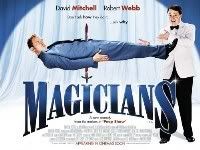
    MAGICIANS (2007)

    Director: Andrew O’Connor
    Cast:
    Robert Webb, David Mitchell, Juliet Stevenson, Peter Capaldi
    Release: May 18, 2007 (UK…Damn Limeys)
    Synopsis:
    From the team behind the hit UK TV series Peep Show comes this high concept comedy film about a magic double act who fall out when one is involved in an accident with a guillotine. The story follows the rivalry between the magician’s years later as they enter a major magic competition.

    View Trailer:
    * Large (QuickTime)

    Prognosis: Positive. Loved it.

    After enduring the debate of what was better, THE ILLUSIONIST or THE PRESTIGE (It was PRESTIGE, by the way, in case you really would like to know), I knew the world could handle just one more movie dealing in the black arts. Too bad for me, though, that I would have to jaunt over to merry old England in order to be able and see it.

    It’s moments like this that I wish some money grubbing exec-u-tard would come up with a way to capitalize on global distribution of films; I’m available for such a position if anyone cares to create the position for me. At the moment, though, all I can do is appreciate the marketing campaign for this film that looks and feels like a splendid time at the talkies.

    “In the world”¦”

    I would usually turn tail as soon as these words are spoken as, come on, am I really to believe that some dime store magicians really have a lock on the global art of making coins disappear before my eyes? No, but I erred on the side on irony as we make our way through the entertaining lives of two guys who are supposed to be partners, which makes their getting along at the beginning all the more foreboding for what’s to come, only to howl when these men committed the truest rendering of The Marie Antoinette as they lopped off their female assistant’s melon”¦accidentally.

    We simply blaze through the rest of the exposition, the only real gripe I have is that we whip at an unbelievable pace through it all, when we come to where the crux of the action will take place: a magic-off, as it were.

    These guys suck and it’s their pathetic natures that make this film appear so appealing; if you were to do a movie starring Gob, the hapless magician of Arrested Development, it would be far and away a fun film if only because you have a guy who believes he’s great when, in fact, it’s only his tenuous grasp on this notion that keeps him from packing it all in. And you get that with this trailer. As one dude comes up with a trick to be buried up to his neck in sand, assistants who are quite unstable, having the occasional reminder that your partner was the one who pulled the rope that beheaded your previous assistant and an old fart that has a trick where he makes lit cigarettes disappear by extinguishing them using his tongue.

    “Shot my wand?”

    “Kiss my ass.”

    Using Electric Six’s “Gay Bar” as the frenetic musical backdrop for what these two protagonists are going through as they battle one another for supremacy on a scale that only they would care about is pitch perfect. The world doesn’t care, but these guys have the kind of heart that can be amusing, like Gob desperately trying to make a coin trick work. The comment that one of them makes to a woman who agrees to be his assistant when she says that lighting can’t strike twice and counters with, “Well, technically, it can”¦”

    This is the kind of film I’d like to see when those in the UK get a chance to do so as well.

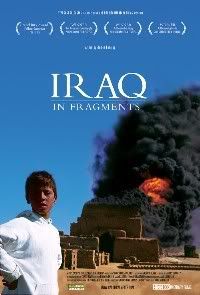
    IRAQ IN FRAGMENTS (2007)

    Director: James Longley
    Release: Coming Soon In Limited Release
    Synopsis: Iraq in Fragments illuminates post-war Iraq in three acts, building a picture of a country pulled in different directions by religion and ethnicity. Filmed in verité style with no scripted narration, the film explores the lives of ordinary Iraqis to illustrate and give background to larger trends in Iraqi society.

    View Trailer:
    * Large (QuickTime)

    Prognosis: Positive. Before we delve into this trailer, do me a favor and just give a passing glance at this news story right here: http://abcnews.go.com/International/wireStory?id=2922669

    I’ll wait.

    Now, keeping in mind that our same armed forces are preventing the wholesale detailing of what’s going on over in Iraq, check to see how many newspaper bureaus in America are keeping representatives over there on a 24/7 schedule, along with the reports from fellow journalists over there about what free speech means to guys in APCs with machine guns, and you get a pretty good starting point about how much you think you know of what’s going on within the boundaries of that volatile nation.

    “The future of Iraq will be in three pieces”¦”

    Talk about having Kurt Russell take a chair and sit on your windpipe to get your attention (Any TANGO AND CASH fans in the house?), this trailer opens with chaos only to compose itself ever briefly where we get a real weathered looking man giving us his opinion about where his country is going from where it is today.

    We linger just long enough to see the awards this film garnered from the Sundance Film Festival, to say nothing of its Academy Award nomination, providing an excellent pivot point to establish its credibility with an audience.

    What makes this trailer at least “feel” different from all the other trailers that have dealt with this Godforsaken war, lest you believe God is genuinely helping us in this effort at which point I’ll pray for YOUR soul, is that we’re not given a lot of explosive action to latch onto. Instead, and this is almost as terrifying, the tense string arrangement that plays underneath men and children going about their daily lives, an Iraqi policeman directing traffic in the open (I’m on edge as I think a bomb is going to go off at any moment) and an unseen man looks like he’s talking about resisting the very same occupiers that are just there to do their jobs and get home to their families.

    It’s riveting.

    “The movie is a quiet revelation.”

    Yes. That’s exactly the kind of vibe this movie puts out. We seem to be following a young boy around the streets of some city, some place, but we also get views of people cheering in the streets with their flags held high, there seems to be some kind of meeting which no doubt concerns their future in Iraq, some masked men start beating one of their own and, by the end, you have zero idea why you’ve been as captivated as you have been.

    Not a shot gets fired, not one bomb goes off, not one voiceover tells me why I should go spend my money on this movie. The visuals stand alone and it’s within these non-narrated pictures that I am able to just concentrate that these Iraqis are all just people, trying to do a job and make it home to their families.

    DISTURBIA (2007)

    Director: D.J. Caruso
    Cast:
    Shia LaBeouf, David Morse, Sarah Roemer, Carrie-Anne Moss
    Release: April 13, 2007
    Synopsis: After his father’s death, Kale (Shia LaBeouf) becomes sullen, withdrawn, and troubled – so much so that he finds himself under a court-ordered sentence of house arrest. His mother, Julie (Carrie-Anne Moss), works night and day to support herself and her son, only to be met with indifference and lethargy. The walls of his house begin to close in on Kale. He becomes a voyeur as his interests turn outside the windows of his suburban home towards those of his neighbors, one of which Kale begins to suspect is a serial killer. But, are his suspicions merely the product of cabin fever and his overactive imagination?

    View Trailer:
    * Large (QuickTime)

    Prognosis: Negative. I know I’ve made much of my “respek knuckles” admiration for Even Stevens.

    This happy-happy feeling carries over to this trailer as I see that Shia Labeouf is not only making excellent strides to wiggle free of his child star image but with a movie like this you can’t help but at least feel that he’s at least not going to be seen at the local Midas dealership, installing mufflers singing, “Truuust the Miiidas touch.”

    That said, however, I can go on and on about how many movies this flick is cribbing from in one way or another. From AMERICAN BEAUTY, GIRL NEXT DOOR, FRIGHT NIGHT, MEN AT WORK and REAR WINDOW there seems be a menudo soup-like dropping of all these things to make a full-length movie. I’m not so sure it works.

    From the outset we get the clue that Shia did something to be placed on house arrest; it’s a pretty nice arrest, as well, because the suburban street he lives on seems awfully detached from any other suburban street I’ve ever lived on. This, I take it, is the point to making the absurd come to life, we’re in the land of make-believe.

    “All Kale has is the window”¦”

    So, Shia, pimpin’ out his ankle bracelet with a totally rad stickers, a skull and flames (Oooh!), decides to entertain himself by lecherously peeping into the lives of his neighbors. By the way, want to know when you’re living in the land of Not Real? You have a svelte honey sunbathing next door and another thin cutie who takes off her clothes in from of open windows. The closest thing I’ve come to that is a view into a house where my Midwest neighbors, who I think didn’t believe in the notion of moderation and exercise, motored down heaps of food every night. I didn’t even want there to be an open window anywhere near my field of vision.

    But, Shia hit the lottery with all the cheatin’ and whorin’ on his block, and when he gets spied on by someone he was trying to watch the girl obviously sees no problem with coming on over, by herself, and taking part in the life of a human viewfinder. And, yeah, she’s good looking too.

    So, fast forward through all this crap that the girl actually strikes up a relationship with this pervert, again, why couldn’t I have lived on this block, and we come up to a murder. See, when you’re a voyeur you are bound to look upon something that is usually reserved for dark rooms in basements and kill zones that comprise of crawl spaces in the attic. No, this shit goes down for the whole block to see in rather bright fluorescent lighting.

    We then speed things up by Shia playing the part of Chicken Little, no one believing him (Oh noes!) about what he’s spied with his eyes, and motor right into everyone becoming a potential next victim for this guy who then takes out Shia’s buddy and lady friend.

    Not even the quick clips at the end can make up for what appears to be a very crap story. I can’t even swallow the premise, much less wrap my head around what I am supposed to believe happens when a serial killer lives across the street and no one believes a witness who’s seen everything go down.

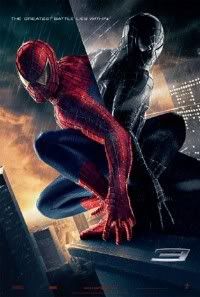
    SPIDER-MAN 3 (2007)

    Director: Sam Raimi
    Cast: Tobey Maguire, Kirsten Dunst, James Franco, Thomas Haden Church, Topher Grace, Bryce Dallas Howard, Dylan Baker, Elizabeth Banks
    Release: May 4, 2007
    Synopsis: A lot of shi# goes down and that’s all you really need to know. Maybe we’ll even find out what happens to all that black and white webbing that’s stuck to the sides of buildings.
    View Trailer:
    * Large (QuickTime)

    Prognosis: Positive. This is an interesting case study of how domestic and international audiences are treated differently. It’s a wonder why this business is so bass ackwards and seeing this just makes one wonder why we’re not given the goods that every other market around the world where English isn’t even the primary language. It’s not about xenophobia, it’s about geeky jollies and our domestic denial of it from the studio.

    The opening sequence is extended here where we’re actually allowed to linger a bit and get emotionally attached to Mary Jane and Peter; yeah it’s fake but, I’ll tell you what, that few moments between this pair makes all the difference. The love between these two is wonderfully established and it serves Gwen Stacy’s presence as a real threat later on. The domestic trailer simply glosses over all this pivotal pairing.

    Um yeah, and when Peter confides in Aunt May that he’s going to ask Mary Jane to marry him we get a deeper sense of context for the ring that she gives him and he later loses in the air battle between him and Harry. The American trailer just shows us the ring wistfully as if were any other piece of jewelry. It’s not a coincidence that the moment we see the ring now it has more weight. Double kudos for the scene, silence, scene, silence editing for the moments of action between the two of them. Quite effective.

    And the air battle! Those little green orbs that are to kill Peter and his quick comedic quip? In seconds we’re in the thick of what’s at stake for both of these men. Domestic trailer? Had all the power of a squirrel fart.

    The symbiote’s liquid take-over of Spider-Man’s suit is much better represented here, certainly is a lot more fun watch as it makes its way all over his body, as even the moments where Peter questions its origins, with Dr. Connors’ summation of the black goo, that it amplifies aggression and that it likes Peter, is shockingly sharp and informative and puts to shame the trailer that I thought was the Alpha Beta of trailers just months ago.

    The moment where the trailer REALLY kicks up to an 11 is where Peter stares into a mirror only to be met with the blink-and-you’ll-miss-it sinister visage of a howling Venom. It’s angry, it’s vicious and only gets better when he finally tries to get rid of the thing on his body. As Topher Grace not only realizes that Parker is the dark colored Spidey and a drip of Vengance Personified starts to engulf our real favorite actor to come out of That 70’s Show it is the full-blown display of Venom’s rage that gets my Godzilla bucking vote of Best Reveal for 2007. It’s phenomenally evocative and much better than the Sandman storyline in the domestic trailer that now feels awfully secondary to this threat. Oh, and Topher’s “Hey, Parker” as he briefly reveals his humanity, his vampire-colored eyes and teeth, body builder physique and all? Just sweet icing.

    There’s more at stake here and even MJ’s admission about what it’s going to take to keep them together as a couple just humanizes this comic book movie even further. It’s the grounding of the most far-flung characters that has ever been stuffed into one picture (you got Sandman, Harry’s Goblin incarnation, Peter’s struggle with the black suit AND Venom) that should make this movie the one sequel to SPIDER-MAN 2 that could actually surpass the legend of the previous entries.

    As to why this isn’t the trailer that we Americans are getting in order to get ready for what’s coming and why, as a studio, you would hold back on what you’re giving the domestic market is beyond my ken. I’m damn near insulted at what we were given weeks ago compared to this.

    Regardless, THIS is the trailer that’s getting me in the mood to revisit my 5 year-old inner child.

  • Toy Box: Medicom Clonetrooper/Shadow Stormtrooper

    toybox.jpg

    The Star Wars universe was just too big for any one company to handle (or so I assume George thought), and so the license has been shared over the last couple years between Sideshow and Medicom. Originally, Medicom figures were being marketed outside of the U.S., but the differences go deeper than that. While Sideshow has stuck with producing entirely none armored figures in their sixth scale series, leaving these for Medicom to handle. Just to add to the confusion, Sideshow also distributes for Medicom in the U.S. now

    The two most recent Medicom figures to hit the streets are the Shadow Stormtrooper, and the Clonetrooper. Everybody knows what a clonetrooper is of course, but what in the name of all things holy is a ‘shadow’ trooper? Ah, that would be something from the old comic strips of the late 70’s, and they’ve also been known as ‘blackhole’ troopers. They’ve never made an appearance in any film, but you can’t argue with how cool the all black armor looks. I haven’t seen any 501st wearing this outfit yet, but I’m betting there will be plenty at SDCC this year.

    Medicom figures aren’t cheap, and the fact that they are imported only makes things worse. You can expect to pay around $100 – $150 each for these guys, depending on the dealer.

    Medicom Clonetrooper/Shadow Stormtrooper

    Medicom already released a regular Stormtrooper last year, which I reviewed awhile back. They’ve focused largely on armored characters, like Darth Vader and the troopers, but also did a Jedi Luke early on. Jango and Boba Fett will be hitting this year as well.

    toybox_040307_1.jpg

    Packaging – ***1/2
    Medicom makes boxes that excel in two ways – they’re very collector friendly, and they’re very compact. Collector friendly is the ability to take the figure out of the packaging, pose it around, display it for awhile, and then later return it to its box, without ever damaging it. Medicom does that beautifully, and there’s nothing you’ll need to rip, tear or even untie in freeing these guys from their little prisons.

    The boxes are also quite compact, wasting as little space as possible. This is great for MIBers of course, and will save on storage space. It’s also great for the environment, as any card carrying tree hugger could tell you. Medicom hasn’t always been conservative in this area (just check out their Darth Vader for a huge, wasteful box), so it’s nice to see the change.

    toybox_040307_2.jpg

    Sculpting – ***1/2
    If you own a regular Medicom Stormtrooper, then you own a Shadow trooper…just a really pale one.

    The big difference here is the black armor of course, and the overall sculpt has the same pluses – and minuses – as the regular version. He’s a little short to be displayed with the Sideshow figures, but he fits in nicely with the previously released Vader. The hands are too small, but the rest of the scale and proportions on the body and helmet look very film accurate. The sculpt work on the cool armor is top notch, and it doesn’t restrict the ability to use all the excellent articulation underneath.

    toybox_040307_3.jpg

    The Clonetrooper is a big taller, and is actually big enough to fit in with some of the Sideshow figures. He’s only got about a half inch on the Stormtrooper, but it makes a huge difference in how he looks with the Sideshow stuff. He’s still a smidge short, but it’s not as big of an issue.

    toybox_040307_4.jpg

    Unfortunately, his armor does get in the way of his articulation big time. The armor looks good, but he isn’t going to be able to take any extreme poses. It’s those elbow and knee pads, don’t you know. I bet they were mighty uncomfortable for the actors to wear, too. If actors had actually worn any of it.

    The helmet is also a smidge small for the body. For the helmet to be this small, he’d have to have one serious pinhead under there. It doesn’t look too bad for the average collector, but the more anal collectors are sure to notice the proportion issue.

    Paint – ***1/2
    Both figures exhibit extremely clean paint jobs, but of the pair I prefer the white Clonetrooper. The small detail work on the Shadow Trooper is great, including the eyes and grill of the helmet. But the shiney black appears slightly less consistent across the larger plastic pieces, making it a bit more toy like in appearance. The Clonetrooper may have issues in the other categories, but he takes this one by the smallest edge for me.

    toybox_040307_5.jpg

    It also helps that all his small detail spots are perfect as well. They work on the black areas of the armor is quite impressive, considering how easily it would be to have overspray or stray marks if the masking isn’t done perfectly.

    toybox_040307_6.jpg

    Articulation – Shadow ***1/2; Clonetrooper **1/2
    The armor these guys wear is always going to restrict them somewhat, but the Shadow trooper, like his earlier white cousin, still manages to pose extremely well. He has all the joints you expect in a 12″ figure, and the Medicom body has made that step up to the next level, where the body ‘hangs’ in very natural ways.

    toybox_040307_7.jpg

    The Clonetrooper doesn’t quite have the same posing ability. It’s not because the underlying body is inferior, but rather that the armor is so restrictive around the elbows and knees, that he can only take very stiff arm and leg poses. It’s a bit unfortunate, because expectations have been set so high by the stormtroopers.

    toybox_040307_8.jpg

    Accessories – ***
    Neither figure is packed to the gills with extras, but they have enough items to give you some display options.

    Both figures come with the clear plastic Medicom display stands, and while these are attractive enough for displaying, you’ll be happy to know that neither are really necessary. You should be able to get these guys to stand for long periods in very convincing, life-like poses.

    The also both come with extra hands. The Shadow comes with the same two as the regular Stormtrooper – blaster right hand, thumbs up left hand. The hands swap easily enough and are very sturdy, but they also have the same problem that the all white version has – they are way too small. This poor guy better hope the old rumor about hand size isn’t true.

    The Shadow comes with two hands as well: one is the blaster holding right hand, while the other is a slightly different open left hand. It’s nice to see they just didn’t use the same poses as the standard Stormtrooper. Again, while the hands are too small, at least they swap easily and are unlikely to break in the process.

    Finally, both figures come with their blasters. The old school blaster that comes with the Shadow trooper fits nicely in his leather holster, but it does seem a bit undersized to me. The older design (yet newer looking) blaster that comes with the Clonetrooper is larger, more rifle-like, and has an excellent sculpt. He has no holster to carry it, but it’s not the kind of thing you could toss in a holster anyway.

    toybox_040307_9.jpg

    Outfit – Shadow ****; Clonetrooper ***1/2
    I’ve already mentioned quite a bit about the armor – the sculpting, paint and fit. But it’s worth mentioning again that these suits really do look quite amazing.

    The Shadow Trooper has the same outfit as the white trooper of course, although his underlying body suit seems slightly lighter in color. This may only be a matter of perception though, since his is next to the much blacker armor, while his brethren has his next to the very white armor.

    His suit under the armor is that same sort of rubbery material that we’ve seen with the other trooper, but the Clonetrooper went in a new direction. His suit is more like a standard stretch material, with an interesting light pattern of lighter and darker black stripes. It looks fine, although I’m not sure that it’s actually screen accurate. From more than a couple inches away you won’t even notice though, making it somewhat moot.

    Fun Factor – ***
    Both figures are very sturdy, with tight joints and solid construction. Kids COULD play with these, if you were insane, or you’d hit the lottery.

    Value – **1/2
    Ah, these are mighty sweet troopers. But you’re not getting any break for your cash though, and these are certainly selling for well above average. The plastic armor is going to drive up the cost over figures like Ghost Rider or X-men 3 Wolverine, but these are still slightly over what feels right. Get one at $120 and you’ll feel pretty good about it – down around $100 and you can add another half star to this score.

    Things to Watch Out For –
    Not much of anything. These are well built, nicely designed, and quite sturdy considering the cost. You might want to take some care with the soft leather holster on the Shadow trooper, but there’s no obvious issues you need to be aware of.

    toybox_040307_10.jpg

    Overall – Shadow ***1/2; Clonetrooper ***
    It should be no real surprise that the Shadow version of the Stormtrooper scores as well as the very cool regular version. He’s a little short to be displayed with other 12″ scale figures, but he looks terrific with the Medicom figures. Oh, he has those itty bitty hands, and the blaster is a bit small, but these are minor complaints on what is otherwise a fantastic figure. Whether you prefer your troopers black or white is a personal decision.

    Ah, but the Clonetrooper version isn’t quite as cool. The armor really limits the articulation, which makes is so much more difficult to get those natural, realistic poses. He’s stiffer, and a bit clunkier appearing, so while he’s good, he doesn’t quite hit the same level of trooper cool.

    Still, these are the Medicom troopers are the best ever produced in sixth scale, making them awfully tough for the diehard collector to pass up.

    Where to Buy –
    ShopStarWars.com has these in at $130 each, but you may be able to find a better deal through ebay or one of the other smaller online stores that import Medicom products.

    Related Links –
    Other Medicom Star Wars reviews include:

    – guest reviews of the VCD Yoda and Boba Fett.

    – guest reviews of the ROTS Vader, Jedi Luke, and this very Trooper.

    – and my review of their first release Darth Vader, along with the regular Stormtrooper.

  • Comics in Context #171: New York 2007 – Bullpen Bulletins

    comicsincontext4.jpg

    SATURDAY, FEB. 24, 4:16 PM
    cic2007-03-30-01.jpg There I was in Room 1E12/13 at the Jacob Javits Convention Center, waiting for the next panel at the New York Comic-Con to start: “NYCC’s Behind the Panels: The 60s Marvel Bullpen.” The panel was supposed to have begun at 4 PM, but for fifteen minutes I’ve been watching people milling about on the right side of the hall.

    Finally, at 4:16 PM Stan Lee himself, Marvel’s editor in chief and head writer in the 1960s, took charge and commanded that the panel begin.

    Moderator Adam McGovern of TwoMorrows Publishing introduced what he called a “very distinguished panel” comprised of members of the Marvel “Bullpen” of the 1960s, “a critical mass that changed comics history.”

    First McGovern introduced Marvel senior editor Ralph Macchio, whom he called a “link from the first Marvel Age to the present.” Well, that was actually a bit of a stretch. Ralph started at Marvel in 1976, when Stan Lee was still based in the New York offices, but in the role of publisher, having ceded the post of editor in chief back in 1972. So Ralph wasn’t part of Marvel’s Silver Age revolution of the 1960s; during that decade he was a fan reading Marvel comics just like other Boomers who later became comics pros. He was one of the first Boomers to join Marvel editorial, and now he’s virtually their Last Boomer standing.

    Next McGovern introduced the great inker of Jack Kirby’s Fantastic Four art, Joe Sinnott. Stan pointed to Sinnott, and the audience applauded. Then McGovern presented Gene Colan, the Silver Age artist of Daredevil, Iron Man, Sub-Mariner and more, sitting down at the end of the table, and there was tumultuous applause. McGovern praised Colan as “the painterly genius” and “master of moods.” McGovern then turned to Stan’s secretary in the Sixties, “Fabulous” Flo Steinberg, who endures at Marvel as a part-time proofreader. Stan, sitting between Flo and Joe, pointed to her and applause burst forth once more.

    Finally, McGovern said, there was “a man who needs no introduction.”

    “They always say that!” exclaimed Stan the Showman, enacting his comedic public persona. “For once just give me an introduction!”

    After complying with Mr. Lee’s request, McGovern attempted to open a discussion about working at Marvel in the 1960s, and noted that Colan had come to the company “from other places.”

    “Makes you sound very mysterious, Gene,” commented Lee. “‘Came from other places,’” Stan repeated ominously.

    But Colan’s ability to respond was handicapped by his lack of a microphone down at his end of the long table. Ever practical, Stan solved the dilemma by giving Ms. Steinberg’s microphone to Colan. “You have nothing to say anyway,” Stan assured Flo. Then Mr. Lee advised the audience to pay attention to Colan: “When this guy talks, the world listens.”

    Colan explained to the audience that he thought comics would be a “great place to be,” and that he was “very influenced by film” in drawing comics. “I don’t know where I’d be if not for Stan,” Colan said.

    “Probably rich and famous,” speculated Mr. Lee.

    Stan wasn’t being serious, but Colan was. “Other people couldn’t see what I could do,” Colan continued. “Stan could,” he told us, and “gave me my break.” The audience was very still, intently listening to Colan’s quiet voice.

    “See,” Stan commented, “the big thing is, we got “˜im because he worked cheap.”

    Taking this in stride, Colan told us, “Stan always reminded me of Jack Lemmon.”

    “He always compares me to dead people!” Stan exclaimed in mock protest.

    “I told him that when he”–meaning Lemmon–“was alive,” Colan informed the audience, explaining that Stan had the same “energy” that one sees in Lemmon’s performances.

    As if waving Colan’s compliments aside, Lee declared, “Joe Sinnott’s dying here,” thinking that “they’ll never get to me.” But then Lee went on to extol the cinematic aspect of Colan’s artwork. “Every strip he drew was a storyboard,” Lee said, meaning that it looked like a shot-by-shot breakdown for a film. “He viewed all of his artwork as if it was a movie.”

    But Stan did not stay serious for long. “Joe Sinnott, on the other hand,” he continued, is “a man of little talent and great charm.” Lest anyone take that at face value, Lee quickly added that Sinnott was a “great inker” and “also a great penciler,” but, shifting back into facetiousness, “we didn’t tell anyone because Kirby would get jealous.”

    Sinnott also made his gratitude to Lee plain, telling the audience “I’ve been working for Stan for fifty-three years.” (It would be more precise to say that Sinnott has worked for Marvel all those years, but Stan Lee was either editor or publisher for most of that time.) Sinnott told us that he once worked in the cement industry and “if not for Stan, I’d still be there.”

    Once again, Lee resorted to what seems to be one of his favorite lines: “What they don’t realize is these people worked cheap.”

    “Don’t believe that,” Sinnott instructed the audience. Then Sinnott began, “You could almost expect when Stan was going to give you a raise. . . .”

    Before Sinnott could expose him as a generous man, Stan hurriedly changed the subject and turned to Ralph. “We’ve got a Johnny-come-lately” on the panel, Stan said, claiming that Ralph was just “out of his teens” and yet had ended up “on an old-timers’ panel.”

    Ralph told Stan he had actually started at Marvel in the 1970s, taking Mr. Lee somewhat aback. Then Ralph started reminiscing about the days when Lee was still based in Marvel’s New York offices, and took obvious pleasure in recounting a time when he heard Lee sharply criticizing a certain Marvel writer/editor of that time.

    “This is great for me,” Stan said happily, “because I have no memory!” He told us “I’m learning” things about his own past just by being there.

    Then Ralph too voiced his gratitude to Stan, recalling how Lee “would call me into the office, and since I was the new kid. . . He would sit down on the couch with me like there was no one else in the world and for twenty minutes he’d show me” how to do “word balloon placement.” Macchio summed up, “There was energy there working with Stan that you couldn’t deny.”

    “He was the only guy who would listen,” explained Stan. “He was the new kid.”

    Then Mr. Lee turned to Ms. Steinberg. “It’s Flo’s turn. I have no idea what she’s doing here.” Then, referring to times past, he added, “I don’t know what you were doing there.”

    Flo, however, can see right through Stan’s act. “Working at Marvel was SUPER,” she told the audience, audibly putting the word in capital letters. As for Stan, she assured us, “He was a joker, too.”

    “She means the villain,” noted Stan.

    As for the differences between Marvel Then and Marvel Now, Flo wisely observed that in the 1960s Marvel “wasn’t the corporate place it is now,” and that it “had a greater sense d’estime,” slipping into French.

    “She was Fabulous Flo,” Lee said. “What were you, Ralph?”

    “Reliable Ralph,” Macchio responded.

    “We could’ve gotten you something better than that,” Stan responded.

    Turning back to the subject of Flo, Lee told us that “we thought at first Flo was putting on an act.” He recalled that once she was all upset, and it turned out that it was because the office had run out of staples. “You can’t find anyone like that! She cared!”

    Joe Sinnott added that it was a pleasure dealing with Flo over the phone: she “had the sweetest voice when she called.”

    “You were never mean,” Lee told Flo onstage, setting her up for another gag. “You were wrong often, but never mean.”

    On the other hand, Stan claimed “I was scared of Gene.” More precisely, “If I wanted to make a correction, I was scared to criticize Gene, because he took it so seriously:  ‘Do you mean a hand has to have five fingers?’”

    Commenting on the way the panelists were interacting, moderator McGovern remarked, “It was a family then and a family today.”

    Shortly afterwards, Flo mentioned “little MMMS,” the company’s in-house fan club in the 1960s, the Merry Marvel Marching Society.

    “Small MMMS!?” retorted Stan, as if insulted. Referring to the club’s theme music, he maintained, “It was a great song.”

    “Every morning before work we’d sing,” Flo told the audience, being something of a joker herself.

    “You think we forgot?” asked Stan, who then, as he had on his panel the previous day, launched into singing the Merry Marvel Marching Society anthem. The audience clapped along, merrily and marvelously. Then, when Stan finished, he apologized, “Excuse me, I should have stood up when I sung it.”

    Then Lee was asked about the time that the great Italian film director Federico Fellini (8 1/2, La Dolce Vita) dropped by the Marvel offices in the 1960s. According to Stan, his receptionist told him, “Stan, there’s a Fred Felony to see you.”

    “Nobody ever visited me,” Lee told us. “I’d see anybody.”

    When Lee saw Fellini, “All of a sudden I recognized him.” Fellini wasn’t alone: “he had four other associates with him,” Stan said. Moreover, “They were in descending order of height,” with Fellini, in the lead, as the “tallest.” Stan continued, “And they were all in black raincoats.” Fellini had his over his shoulder. Though Lee did not say so, this was clearly a Felliniesque sight. “I have no idea what he wanted. He had a thick accent,” explained Lee. “But apparently he was a fan. I wanted to talk about him, but there was no way I could communicate with him!”

    The moderator asked Lee, “Didn’t you work with famous film directors?’

    “Oh, yes,” joked Lee. “They wouldn’t make a movie without me.”

    Actually, Lee did work with one famous foreign filmmaker back then: Alain Resnais, a member of the French New Wave, and the director of Hiroshima, Mon Amour (1959) and Last Year at Marienbad (1961). If you’ve seen either film you will find it hard to believe that Lee and Resnais have much in common aesthetically. But, as Lee told us, “Alain Resnais wanted me to write his first English language movie.” Moreover, “He said he had read Spider-Man for years.” Lee explained, “I wasn’t going to say no. It was very flattering.”

    So Stan, who was then inexperienced in movies, wrote a screenplay, and, he told us, “it wasn’t very good”: “it was 120 pages filled with dialogue.” Still, a producer was interested, but wanted the dialogue pruned down. Stan said he would have been willing to do it, but “My idiot friend Alain said, “˜Stan will not cut a word of it.’”

    And so Lee and Resnais never sold the project. “If that nut had let me cut it, I might be someone famous!” lamented Lee.

    Then the moderator inquired how the comics business had changed since the old days. “The most gratifying thing,” Ralph Macchio responded, “is to see it [Marvel] penetrate popular culture.” He explained, “The things we enjoyed when we were kids are now billion-dollar franchises, and that’s due to Stan.”

    As he had done at his Friday panel, Lee again shared credit with the artists he worked with. “Believe me, Marvel is not a one-man show.” Then he added, “Oh, maybe I was the greatest.”

    In that sweet voice Joe Sinnott had so commended, Flo Steinberg quietly observed, “Stan was always very modest.”

    Then Lee praised two of those 1960s artists who were right there with him, Colan and Sinnott. “They have style,” Lee said. “That’s not easy to achieve. You may not like it when you see it, but you recognize it.”

    Lee continued, “Flo, on the other hand, doesn’t write, doesn’t draw. What is it you’re doing here?” But soon thereafter, with a touch of hyperbole, Stan acknowledged Flo’s secretarial prowess: “She practically ran the company!”

    Flo, who is indeed a modest, self-deprecating person, said she felt “humble.”

    “A quality I will never understand,” commented Stan.

    Called upon to reminisce, Flo said she would “try to think of a funny story.”

    “You’ve never thought of one all these years,” Stan replied. “Why start now?”

    So Ralph told a story that demonstrated what Flo meant to comics fans in the 1960s. He recalled that as a kid he was puzzled over Thor’s inability to smash a goblet with his hammer in a Tales of Asgard story. “I was determined to find the answer. So I called up Marvel and talked to Flo, who told me that in Asgard, everything was enchanted,” so that’s why Thor’s enchanted hammer couldn’t smash the enchanted goblet. “I was totally satisfied,” declared Ralph, who was easily pleased back then.

    Having listened to all this, Stan the Man pronounced his judgment: “Ralph is obviously a survivor. The thing is, nobody knows what he does.” On these two points, Stan Lee, Marvel’s All-Knowing All-Father, is absolutely correct.

    On numerous occasions other comics pros have asked me about just these subjects. What does Ralph do? I have no idea. Why is Ralph still at Marvel? Beats the heck out of me. And yet he survives and prospers, invulnerable to all the upheavals and downsizings that claimed so many of his contemporaries. It’s like the way that Inspector Clouseau escapes all those assassination attempts through seeming strokes of sheer luck. Maybe it’s because he and Stan share the same birthday.

    Years ago Ralph used to be nicknamed “K. D.” for “Kiss of Death,” inasmuch as during his long, seemingly interminable apprenticeship as an assistant editor, every one of the editors he worked for got canned. Then Ralph finally got promoted to editor, and since then, virtually everyone of his generation at Marvel got canned. It’s as if he’s safe at the eye of the hurricane, which wipes out everyone around him. It reminds me of I, Claudius. (I don’t have time or space to explain the reference to those of you whose idea of serious literature extends no further than The Dark Tower; look it up.) All we have to do to end the war on terror is to get Ralph a job with Osama bin Laden, maybe as editor of Ultimate Jihad. Within a few years, Ralph would be the only person left in Al Qaeda.

    Inspired by Ralph’s anecdote about Thor’s hammer, Stan commenced a brief lecture. “People don’t realize how scientific Marvel is,” he began.

    “Superman has no visible means of propulsion,” Stan pointed out. “Even a bird flaps his wings.” So how does Superman manage to fly?

    In contrast, Stan continued, at Marvel “we want to be scientifically accurate.” He wanted Thor to be able to fly, so “We gave him the enchanted hammer Mjolnir,” Stan said, pronouncing the name carefully.

    Stan instructed us to observe how “authentic and scientific” Marvel was in explaining how Thor could fly. Thor’s hammer, he pointed out, has a strap that fits around the thunder god’s wrist. So “Thor whips the hammer” around above his head, building up momentum, and then hurls it into the air. And because the strap is attached to Thor’s wrist, the hammer pulls Thor up into the air as well.

    “Nobody can say that isn’t scientifically sound,” proclaimed Mr. Lee. And then, quietly, he added, “That’s just a small example of the difference between DC and Marvel.”

    This was Stan the Showman with the audience in the palm of his hand. Of course Stan’ explanation of how Thor can actually fly is utter nonsense. We know it, but Stan also knows it, he knows we know it, and we know he knows we know it! As he said on Friday, part of Marvel’s appeal was that it was like an inside joke that we all shared. And Stan’s explanation, scientifically unsound though it may be, still has more surface credibility than Superman just going “Up, up and away!”

    And Stan basically won the war with DC Comics decades ago, and DC adopted the innovations Stan had pioneered at Marvel. But the good-humored pleasure that Stan takes in poking fun at DC the way he used to back in the Sixties is infectious, and the audience just ate it up.

    When the moderator asked for questions from the audience, the first questioner surely spoke for everyone there. Referring to another groundbreaking team of the 1960s, he said, “We’re not going to get a chance to meet the Beatles”–not all of them, anyway–“or thank them.” So then he thanked the people on stage for their contributions to comics.

    There was a little boy in the question line who asked that classic fan question, “Who’s stronger–Thor or the Hulk?” I suspect this lad had been prompted by an adult Marvel fan.

    Stan turned the question over to Gene Colan, “and he’s not going to give you a hastily considered answer.”

    Colan responded rather philosophically, “Whoever thinks he’s stronger is stronger.”

    Impressed, Stan commented, “You know, Sophocles couldn’t have given a better answer.” I think Stan meant Socrates, but at least here’s proof that Frank Miller isn’t the only comics pro who knows classic Greek literature. (Oh, all right, there’s Roy Thomas and Eric Shanower, too.)

    Nonetheless, Stan delivered his own judgment in favor of Thor, because “Thor’s a god.”

    Then the small boy asked if he could have Stan autograph his T-shirt. The Man assented, and the boy went up on stage. “And he’ll remember this moment for at least another hour,” Stan noted.

    Signing away, Stan worried aloud that “I’ll ruin your short, your mother’s going to kill me, and I’ll give you my lawyer’s address.” There you have it: the Master had turned the signing of a T-shirt into a three-act drama, with suspense, symbolic death and rebirth, and a happy ending.

    The tyke’s less than fifteen minutes of stardom completed, Stan sent the lad on his way, bidding him, “Don’t let the fame go to your head!”

    And the panel turned to another question, about how to “revitalize characters.”

    Stan passed the buck to Joe Sinnott: “Joe is so desperate to answer that question.”

    “I wasn’t even listening,” replied Sinnott.

    “That’s what he used to say when I gave him instructions,” commented Stan. And so the Bullpen panel memorably went.

    cic2007-03-30-02.jpg

    SATURDAY, FEB. 23, 5:30 PM

    Originally I was supposed to do a signing for Marvel Encyclopedia and X-Men: The Ultimate Guide at the DK Publishing booth at mid-afternoon on Saturday, and moderate a Golden and Silver Age panel at 5 PM. Then, on Friday, I was asked to moderate the “80s Superhero Renaissance” panel at 2 PM instead. So, with the blessings of the good people at DK, I rearranged my schedule. And if you’ve been reading my con reports you know that I ended up being the only panel member on stage for a half hour because the organizers forgot to tell the other panelists to show up!

    So now I was doing my DK signing at an off-peak time, from 5:30 to 7 PM Saturday evening, when presumably people are heading out to dinner. Not only that, but the convention had assigned DK a space towards the back of the hall, away from the main routes of customer traffic. Still, I was kept busy enough when I started this signing session.

    I’ve found I quite enjoy doing signings: not only do I get to feel like a minor celebrity for a little while, but it’s also relaxing in comparison to moderating panels, reporting or them, or just trying to get through a crowded convention floor.

    I also enjoy the company at the DK booths, which, apart from a gent or two, are invariably entirely staffed by friendly, charming and attractive ladies. It’s sort of like John Byrne’s LexCorp in his Superman books, but benign.

    When you’re sitting at a booth, the rest of the convention tends to pass by before you. So, for example, former Marvelites Glenn Herdling (see “Comics in Context” #150) and Steve Geiger stopped by, and we got to chat about that perennial topic, Marvel Then and Marvel Now.

    Despite the wintry temperatures outdoors, the convention floor had been so crowded all afternoon that it was getting downright hot. This, however, was a perfect temperature for Princess Leia, who walked past wearing her slave girl costume from Return of the Jedi, brightening my day. Soon afterwards a spectacular Dark Phoenix wandered past in the opposite direction. It’s as if I was seated at the crossroads of the multiverse.

    Speaking of the Princess, you may recall that last summer at the DK booth in San Diego, I discovered that I was sitting right behind Carrie Fisher, who was in the next booth. This time in New York when I turned around, it was animator Bill Plympton who was sitting in the booth behind me.

    When my allotted time at the DK booth ended at 7 PM, I stopped by Artist’s Aerie (so dubbed by the Beat due to its lofty location) once more, but not getting enough sleep the last few nights was catching up with me, so I decided against trying to enlist any dinner companions. After all, I had one more day of the convention to go.

    cic2007-03-30-03.jpg

    SUNDAY, FEB. 25, 11 AM

    And there I was, back at the DK booth on Sunday morning for another scheduled signing. It was another off-peak time, and the convention floor was relatively and rewardingly uncrowded. Nonetheless I signed and sold the last remaining copy of Marvel Encyclopedia at the DK booth during this morning session. I also got to see a resplendently costumed Darth Vader stride menacingly by: it’s a good thing he showed up on a different day than Princess Leia.

    By the way, when I’m signing books I try to make sure that the ink has sufficiently dried before I close the book. I wouldn’t want the recipient to get the book home and discover the signature has smudged.

    SUNDAY FEB. 25, 12 PM

    Ascending the escalator on my way up to Artists’ Aerie, I look around myself at the interior architecture of the Jacob Javits Convention Center. Just being in the San Diego Convention Center lifts my spirits: it is a marvel of postmodern architecture, designed by Canadian architect Arthur Erickson to evoke the ships in the nearby harbor, with the building’s triangular fiberglass “sails,” and enormous circular windows resembling portholes. Even on the main convention floor, despite the lack of windows, the hall somehow seems open and bright. In sharp contrast, the Javits Center’s network of crisscrossing steel beams seems to me grim, dark, unlovely and oppressive.

    cic2007-03-30-04.jpg

    Last year the New York Comic-Con took place during the controversy over the Danish cartoonists who had drawn cartoons about the prophet Muhammed. A vocal supporter of the embattled Danish cartoonists, writer and artist Colleen Doran, who was attending the Con, offered to give one of her sketches to anyone who brought her something having to do with Denmark, and to donate a dollar per person to the Comic Book Legal Defense Fund. So I brought her a Danish pastry (see “Comics in Context” #123). This year when I stopped by her table in Artists’ Aerie, she offered me some delicious Danish cookies. I had the feeling of a circle being completed.

    I also went over to say hello to artist Amanda Conner and Claypool Comics editor Richard Howell. Amanda drew all the covers for the Claypool series Soulsearchers and Company (see “Comics in Context” #38), but she and Richard had not seen each other for many years, corresponding instead by telephone. But now, just before the final issue of Soulsearchers was to come out, Amanda and Richard found themselves sitting alongside each other in Artist’s Aerie. I picked up a copy of Amanda Conner’s Book of $#!* You May Have Never Seen! #1, a showcase of the wit, sexiness, and visual charm of Amanda’s art.

    She also inscribed something on the cover of the copy she gave me, but once I had transported it home in an enormous Dark Horse bag I had found, it had smudged so much as to be indecipherable. Damn! I fell into the very trap I usually try to avoid!

    Towards 2 PM I ventured back to the lower level with the meeting rooms to attend my final panel of the convention, a tribute to the recently deceased comics artist Dave Cockrum.

    Exactly a month after the convention weekend, another major comics artist who first made his mark in the 1970s, Marshall Rogers, passed away on Saturday, March 24.

    If I were asked to select my favorite run of issues from the entire comic book history of Batman, it would be the six issues of Detective Comics, #471-476, from 1977 and 1978, written by Steve Englehart, drawn by Rogers, and inked by Terry Austin (see “Comics in Context” #84). Although they were recognized as instant classics by discerning comics aficionados of the time, it was not until nearly thirty years later that DC Comics commissioned Englehart, Rogers and Austin to create a sequel. I hoped that their new stories would live up to the high standards set by their original run on Detective, but was that hoping too much? No: the 2005 Batman: Dark Detective miniseries was another triumph (see “Comics in Context” #84, 87-88, 90, 93, 104). Englehart and Rogers already had a further sequel in mind, and I was enthusiastically looking forward to it. And now it won’t happen.

    With the mainstream media’s new, more welcoming attitude towards comics as an artform, obituaries for Rogers have been appearing in numerous newspapers, including the March 29 New York Times. I am becoming annoyed by the fact that there have been so many important figures in American comic book history–not just Cockrum and Rogers, but even Jack Kirby, Gil Kane and Alex Toth–of whom the Times took no notice until after they were dead. The Times, the “newspaper of record,” has a great deal to catch up on in covering the comics artform and its history.

    I did not know Marshall Rogers well, but I spoke with him in person or by telephone several times over the decades, including conducting an interview with him, Englehart and Austin at the Museum of Comic and Cartoon Art two years ago. Marshall was always friendly, and always a pleasure to speak to.

    It has often been said that Marshall’s Joker was something of a self-portrait, but in person Marshall’s smile was always warm and benevolent.

    You should all read Fred Hembeck’s affecting tribute to Marshall in the March 27 entry on his blog, and listen to Englehart, Austin, writer Roger Stern and inker Joe Rubinstein reminisce about Rogers on the March 28 “Comic Zone” Internet radio show. Then write to Marvel Comics to ask them to collect the Roger Stern/Marshall Rogers run on Doctor Strange, long overdue for reprinting, into a new trade paperback.

    It is sad when any person dies at a relatively young age. But when a creative artist dies, all of the potential work that he or she could have created perishes as well. I will return to this subject next week, when I wind up my convention coverage with my report on “Dave Cockrum Remembered.”

    ADVERTISEMENTS FOR MYSELF

    I shouldn’t do a column about Stan Lee’s appearance at the New York Comic-Con without again recommending that you all go see the survey of his career which I co-curated, “Stan Lee: A Retrospective,” now running at the Museum of Comic and Cartoon Art in Manhattan’s SoHo.

    As I’ve mentioned in the past (see “Comics in Context” #58), comics–and even the graphic novel–were invented not in America but by a Swiss scholar, artist and satirist named Rodolphe Topffer in the early 18th century. You can read my article about the first English language compilation of his work, Rodolphe Topffer: The Complete Comic Strips, in the latest edition of Publishers Weekly‘s online newsletter Comics Week.

    Copyright 2007 Peter Sanderson

  • 10 Quick Questions: Eren Cannata

    10quickquestions.jpg

    by Christopher Stipp

    Archives? Right Here…

    It’s when you hear artists as they’re evolving as musicians that you really respect the talent it takes to be successful in this business. And make no mistake about the nature of this beast: it’s a business.

    You need to show how you can be an economical investment for any of the major labels to pay attention to your skills. You can be the greatest show on earth during a festival like SXSW, and you can be the talk of the town, but if you’re not marketable to some necktie wearing stiffs in the back room of some boardroom you can just take your pachouli and go somewhere else.

    Eren Cannata’s dedication to his music is one thing but when you listen to how he has found a way to exist without the help of the big label infrastructure that has made good bands sell their creative soul to the material devil he’s an amazingly sharp man who is equally precise when it comes to delivering on the melodic goods.

    Eren’s music travels a route that many can relate to but so few have put so well without sounding trite, maudalin or saccharine sweet. His album, Blame It On The City, is his first major release and one that defies convention if you’re taste has been steeped in the false and theatric nihilism of My Chemical Romance or any other number of emo bands that should really be big boys about making their way through the world; suck it up, stop whining and if things are really that bad then get a job and call me when you realize life isn’t supposed to be wine and roses.

    I caught up with Eren just days after the release of his full-length album.

    CHRISTOPHER STIPP: You had an in-store concert appearance recently, didn’t you?

    EREN CANNATA: Yes, the Virgin Megastore in Union Square, New York City. It was a huge performance for us and a milestone for my career, my life. It was a bit surreal, too. There were tons of people there and it was so much fun and for the first time my CD is everywhere, they even had it in the New Release bin, the whole bit was pretty exciting.

    STIPP: I would ask if that’s the biggest crowd you’ve played for prior to the release of this album but I’m sure you’ve played for bigger”¦

    CANNATA: Yeah, it definitely wasn’t the biggest venue I’ve ever played because I grew up on the road with my dad who was a saxophonist for Billy Joel and The Beach Boys, I was a tour kid, and, at times, all of us would come out and play with the band on the biggest of shows. So, I’m working my way up to that! One day it’ll be my show.

    STIPP: When did this all happen?

    CANNATA: Well, I was born in 85 and I went out with the Beach Boys in the 90s, because that’s what he was doing around then, and it was just a blast. I got real close with Carl Wilson, who has since passed away since then, and I got very close to him but it was one of those experiences I remember at all times and taught me a lot about music.

    STIPP: What was one of the biggest things you took away from it?

    CANNATA: Well, Carl Wilson taught me how to warm up my voice. Simple as that. I was one of the only kids allowed in his dressing room at the time, I don’t know why, my dad says it was because every one else was a little more annoying than me, but I would go back there and say “This is how you warm up”¦This is what we do”¦These are my guitars”¦” They also taught me about harmony and how to blend and how to be good to each other on the road and how to write good music. Even if they didn’t personally show me, osmosis picked it up and I’m trying to apply it to my own music making process.

    But I took a lot away from it all even though I was simply enjoying myself at the time, just trying to be an annoying little kid.

    STIPP: How did your experience, then, shape how you thought about in which direction you wanted to take your own sound?

    CANNATA: The Beach Boys and Billy Joel”¦the songwriting, alone, is amazing to me. Pet Sounds was revolutionary in how it was recorded and written. Billy’s The Stranger”¦they’re true songsters. They have ideas and concepts that”¦let’s say about “love.” Everybody talks about love but how are you going talk about love and make it popular, again, and make it something that’s new, fresh and catchy and a lovely piece of art too? So, through them, I’ve shaped my sound”¦find that hook, find that difference, find that harmony part in your vocal that people have done before but you’re saying with your flair and your attitude and that you’re making your own. And that’s something I’ve taken away that’s been invaluable.

    STIPP: How does that influence your writing?

    CANNATA: Sometimes people will ask, “What’s your passion about the whole thing? Is it performing? Is it playing guitar?” But, really, the thing that I am first and the thing that I love the most, and would never give up in a million years for anything, is writing music. I love writing and listening to great music. That’s where my heat lies, that’s how it’s shaped. I like to start with that.

    If my song doesn’t sound good with me and an acoustic guitar in my hand or me and a piano or just me singing a capella”¦if it doesn’t have any meaning or significance when I do any of those then I don’t believe there’s any grounds for me to put it on an album. That’s why I’m so excited about the album because all those songs mean something to me and they say something. They all can be played acoustically.

    I was at the University of Maryland and playing for the students there, 600 some odd tickets were sold, and I did the entire show acoustically. It was great and everyone had a really good time. It really shows the bare bones of what I love to do.

    STIPP: Especially on a song like “Part of Me” I thought about how the sound of that song represented of what I could compare it to from my own musical experiences. It finally came to me that listening to that song was like hearing the genesis of a band like Toad the Wet Sprocket; a real focus on instrumentation, introspection and a sound that any college kid in the early 90’s could gravitate toward.

    CANNATA: Absolutely. And that’s what I want to come out of my music; I want to be as specific enough and say exactly how I feel but yet when people listen to it I hope they can say something like, “Yeah. I’ve been there.” Something that can capture the audience like that as they listen.

    STIPP: Who do you admire that’s out there, then, contemporarily speaking, that’s playing right now and speaking to what you’re trying to accomplish with your music?

    CANNATA: I think John Mayer. He’s got something magical about him. Not because of his first or second album but because of the way he’s trying to depart from his usual self. I read in an interview about him he said, “I’m more comfortable with a guitar in my hand than a microphone in front of me.” He’s a great songwriter, he’s a decent singer but he really plays guitar and he was able to tell his record label, “I am going in this direction. You need to trust me.” And, personally, I really enjoy that; he’s taking the bull by the horns and doing it like that.

    That being said, though, it’s not my most favorite of things I’ve ever heard. People that I admire right now? I listen to old stuff. Things like Tower of Power and I still listen to Billy Joel and The Beach Boys. Right now I am completely hooked on the new Beatles “Love” album. I’m completely hooked on that.

    STIPP: And, at this point, John can pretty much call the shots. When you were recording Blame It On The City was there any give and take with what you wanted and what those in charge wanted?

    CANNATA: Here’s the brilliant part about that”¦my father has a recording studio here in Glen Cove, Long Island and it was basically that when my dad was on the road with Billy my mom wouldn’t let my dad spend his money on fancy cars or boats or anything. So, she said, “Buy something that will give back”¦something that you can do and love it for the rest of your life.” So, they put a studio together and since I’m an only child I am totally indebted to my parents for that. Being that it was here, my dad produced my album and it was a lovely thing where all the comments that were made were in my best interest. It was like “How do you feel?”, “What do think you should do?”, “What do you think sounds good with this?” That’s why it worked out real well.

    We also didn’t have a label hanging over our head telling us what to do and so we started our own indie label, Brown Dog Records, my father and I and an attorney. It’s great. We signed up with Icon Distribution and they got it into stores for us. And, so, the people we answer to is my father and an attorney that is completely in love with the project. If we think we should do something, we do it. If we don’t want to do it, we don’t do it and no one tells us otherwise. It’s one of the most lucky situations we’ve fell into and it’s certainly one of the most lucky things that have happened in my life so far. Being able to have an album in stores and doing it the way I want to do it, by choosing the pictures we want with the CD and not the ones that people would negate or try to airbrush”¦

    STIPP: Is that a trap where you see some performers fall into?

    CANNATA: A lot of musicians want it so bad that they’re willing to compromise integrity for it”¦which is tough. If I didn’t have this position I might be compromising my integrity too. I want it that bad as well. It’s a dirty game but you’ve got to play by the rules and break some rules at the same time.

    STIPP: Speaking of distribution”¦With music companies growing ever more conglomeratized how difficult is it to get your music”¦

    CANNATA: Distribution is extremely hard. A) A good distribution deal, in itself, is a hard thing to get and B) some distributors will simply release an album online and say, “Here it is”¦It’s released.” It’s tough but we’re excited because we have a distribution company that believes in us. Just being able to have someone like Josh Kelly, someone who I listen to while I was writing my album, and for us to be on the same roster of distributors is pretty cool.

    STIPP: Have you had to be more of a business person than someone who wouldn’t have to be”¦

    CANNATA: Yeah, it’s kind of interesting. I never thought I would but when I discovered that I was going to have to wear a few hats, it’s what I had to do. We had to make sure we hired a really good team, a small team but effective, who could push it because we want people to buy it and we want people to listen to it. We know that there are some people who will listen to it and be opinionated about it but, you know what, we think it’s good and if they like it, they like it.

    STIPP: You’re going to be touring behind this, right?

    CANNATA: We’re probably going to be doing 20 shows in the next month, just by myself, just doing acoustic things, just promoting it out there, doing a lot of college towns and things like that. But a lot of that stuff is up in the air. We’re booking shows 1 by 1 and getting ourselves on the road.

    I’m so damn excited to get out there and show everyone every song that I’ve ever written from the beginning of time”¦I’m very comfortable on stage. It’s an exciting moment for me and I can’t wait to share this with everyone.

    STIPP: Going back to the recording of the album, I’m curious, did there ever come a time when you felt like you were overproducing a song? You can hear it in how some artists just add layer after layer”¦

    CANNATA: Of course. There’s one song on the album that my father and I did not produce, “Part of Me” in fact, and the one thing we worried about was that it was done too many times. We sort of have this concept in the studio”¦everything you lay down, make sure it sounds amazing. Don’t say, “We’ll come back to it.” And that’s just good producing, that’s not over producing. And when you when you over produce something it’s when you keep putting more and more on top of what was there; it gets cluttered. Because here, in the studio, we have the liberty of being able to burn CDs after we’re done every day and we’ll be able to be honest with each other. I might say, “Dad”¦Didn’t really need those background parts,” and he’ll be in a position to be able and say, “Yeah, I agree with you. Take “˜em out.” And we’ll be done just like that. We have a good checks and balances system here.

    STIPP: But what happens when you come to a crossroad where you disagree? Are you, ultimately, the president, C.E.O.?

    CANNATA: We’re very democratic, diplomatic about it all but if, let’s say, an engineer feels real strongly about something we know something’s wrong because they work with us. These people who are the engineers have been engineers for my dad for 20 years. They learned how we work and a lot of those people who’ve worked here have gone on to be Grammy award winning mixers and engineers themselves. So, their opinions are very valuable to us. If they’re strongly feeling something we take that into consideration. At the end of the day, yeah, we’ll make the decision but, in the back of our mind, we might be thinking, “You know what? They might be right about this so let’s see how we can rework it to make it perfect without making it sound too homogenized and over produced.”

    STIPP: In your writing, what comes first: melody or the lyrics?

    CANNATA: For me, sometimes, the music comes first or the lyrics come first. It’s always different. But the most successful way, I’ve found, is if I sit down and everything comes out at the same time. “Blame It On The City” came out all at once. It was a streaming thought. Front to back. I didn’t even start with the chorus. Every song, to me, the reason why I would consider a good song for the album has a story like that.

    STIPP: And something that I appreciate is the way these moments, these songs, seem honest. It seems like a decision you have to make as an artist as well.

    CANNATA: Absolutely. You’ve got to find your true integrity in it and that’s what I really enjoy about what I do. It is believable because it is true. It’s those normal little stories of things that have happened to me and I’ve turned them into something interesting just by phrasing them into a way I think they should be phrased.

    STIPP: Your sound seems reminiscent, like I’ve stated, of the college rock that seemed to be so prevalent in the early 90’s; minimal production, thick sound. Has anyone else commented on what this music appears indicative of to them?

    CANNATA: There’s a lot of younger fans that I have and what I get from them is that this music is something completely different than what they’ve been exposed to and, from the older fans, a lot of people have said I have an old soul. I get that a lot. I average those two together and think that the music speaks to something that my older fans were listening to when they were the age of my younger fans.

    STIPP: My last question, if you don’t mind offering some thoughts on the subject, is when I was reading your bio it said you really began your musical career with cover tunes, something that really helps with all those things necessary to being a good musician. What do you make of those guys who never move beyond that, those dudes who will forever play 25 cent draft and well drinks, damned to jam forever, singing back-to-back ditties like “Sister Christian” and “Panama”?

    CANNATA: I find that a lot when I come back home.

    Home for me is Long Island, New York and I find that when I come back home and I see all my old friends, they’re the ones at the bar playing those things and they’ll say, “This is life. Why would I ever want to leave here?”

    But that’s what it is. It’s like that movie, GARDEN STATE. There are some but I feel like it’s almost a little too foolish to pigeonhole yourself to just do cover songs like that and try to make that your life.

    At the Virgin in-store I did one. I did Jimi Hendrix’ “Fire” with Max Weinberg from Bruce Springsteen and Conan O’Brien”¦he came up and played with us.

    STIPP: Really?

    CANNATA: We rocked it out. I put down my guitar and ran around on stage. It was fantastic and everyone had a really good time. It was the cherry on top of a completely original set. We played a great set, people were so in tune with the signing of the album”¦and we see Max there and we were, “Yo, Max. Come on, come on up.” I brought the horn section up and we played it with horns and made it something really unique that people could enjoy.

    STIPP: Eren, thank you so much for making time for me. I hope the album does very, very well.

    CANNATA: Thank you, absolutely.

  • Game On! 3-28-2007

    gameon.jpg

    Alright, kids. Seeing as I get hundreds of information e-mails and news clips in the ol’ inbox, it’s time GAME ON! expanded a bit. So, every so often, I’ll be dropping in with some tidbits and bites of good things to come. So, here’s the first of many news columns, to add to the additional review columns I’ll be doing on a “when I get them” basis, rather than my usual “weekly or bi-weekly” basis…which actually means I’ll be doing MORE columns, not less.

    simxbox360elitesystem003.jpgFirst and foremost, Microsoft has offically announced it’s next version of the Xbox 360. Called the “Elite” (to go along with it’s “Core” and “Premium” versions), this one sports an all black finish, black controller, black headset, and other such darkers accessories. As far as features you actually give a shit about, the system includes a much larger 120 gig hard drive, as well as HDMI support. Sadly, there is no incluusion of the HD DVD player with the Elite model, so it’s not Microsoft’s direct answer to the 60 gig version of the PS3, but at a much thinner price of $479.99 retail, it’s still themore reasonable deal. Due out on April 29th, the system will hit stores with most locations of specialty retailers (ie, Gamestop, EB Games) NOT taking preorders. Still, most should have plenty in supply, as well as the sleek black accessories separately. Most importantly, however, is that larger hard drive. So that folks who bought the previous Premium version don’t get screwed (or rather, screwed too much) the hard drive will be sold separately for $179.99. While the price may seem a bit steep for folks who’ve priced similarly sized PC hard drives, it DOES include a transfer pack that will allow folks to transfer their saves from their original hard drive to the new one.

    In a move that just about everyone should have seen coming, CAPCOM announced last week that their next gen DEVIL MAY CRY sequel will NOT be a Sony exclusive after all, stating that the game will be hitting Xbox 360 and PC as well, all on the same launch day. The subtitle? SONY’S SODOMY (well…ok, not really, but it may as well be). In similar news, NAMCO has announced that it’s next entry in the ACE COMBAT series (formerly only on Sony systems) will only be available for Xbox 360. The game will come in two formats: the stand alone game, and with a flight stick.

    The online streaming game site GAMETAP has just added a slew of new titles, including a bevy of Strategy games as part of their GameTap Thursday’s including Myth IIâ„¢: Soulblighter, Sid Meier’s Alpha Centauri, X-Com: UFO Defense, Myth III, Civilization III Gold Edition, Command & Conquer, Homeworld I and II, Heroes of Might and Magic I, II and III, and Empire Earth. Also, their exclusive MYST URU: ONLINE has now been expanded in worlds for the PC version, and they’ve added a MAC version as well.

    marvelUA.jpgAnd finally, Activision has announced that they’re adding 8 new heroes (and villains) to the already huge line up of their acclaimed title MARVEL: ULTIMATE ALLIANCE for Xbox 360. The expansion packs feature eight new playable characters: The Incredible Hulk, Magneto, Hawkeye, Sabretooth, Doctor Doom, Cyclops, Nightcrawler and Venom, each complete with new signature powers, skins, dialog, conversations and achievement points. The download will be available in April via the Xbox Live Marketplace online gaming service and will be released in three packs. The Hero Pack and Villain Pack will each be 500 Microsoft points ($6.25) and the Combined Hero and Villain Pack will be 800 Microsoft points ($10). Heroes and Villains gamer pic packs will also be available for 80 Microsoft points each ($1).

    That’s it for now… stay tuned for more this week, including reviews, and the next video podcast.

  • Comics in Context #170: Miller’s Next Move

    comicsincontext4.jpg

    SATURDAY, FEB. 24, 3 PM

    cic2007-03-23.jpgThe 2007 New York Comic-Con reportedly received 40,000 attendees over three days; San Diego’s Comic-Con International declares that last year it had ” 114,000 individual attendees. . . (not counting the 9,000 or so exhibitors and their staff!)”. The New York con now seems to be acknowledged as being the nation’s second biggest comics convention, yet look at the gap in attendance.

    I wonder what percentage of the San Diego attendees come not for the comics but for the movie and television preview presentations, and the chance to see their starts in person. In contrast, the New York Comic-Con, despite ventures into anime and gaming, remains almost entirely a comic book convention. I expect that there will be a greater Hollywood presence in years to come, especially since when the New York con moves to April next year, it will present such an obvious opportunity to promote summer blockbuster movies. (But still, I was surprised that there was no promotion for the 300 movie at the New York con, even though it opened merely two weeks later, whereas San Francisco’s WonderCon, the week after the New York con, got its own preview screening.)

    But New York-based producer Michael Uslan has beaten most of the rest of Hollywood to the New York Comic-Con. He hosted the panel previewing the forthcoming film adaptation of Will Eisner’s The Spirit, which is being written and will be directed by comics great Frank Miller.

    Opening the presentation, Uslan told the audience that “If you’ve ever been to San Diego,” meaning the Comic-Con, “One of the headlines” the con gets “is “˜Hollywood Invades San Diego.’” This panel, he told us, “is the case of “˜New York Invades New York.’” Uslan explained that Spirit co-producer F. J. DeSanto, who was also on the panel, was from Manhattan, two of their associates on the film were from Long Island and Westchester County, respectively, and Miller himself was a Manhattanite. “Me, I’m a Jersey boy,” Uslan informed us. “We are based here.”

    Moreover, Uslan continued, “This con is special to me.” He told us that he had gone to the “New York Comicon” back in July, 1964, that was indeed the “first comic-con” This is long before I ever attended a comics convention in New York City. Uslan recalled that this first convention was in a “fleabag hotel” called the “Broadway Central” that had “drunks in the hallway,” and that the hotel “collapsed a year later.”

    At this point Uslan noticed a member of comic books’ generation of founding fathers in the audience. “One of the all-time great legends in the comics industry has graced us with his presence,” Uslan said, introducing Jerry Robinson, who worked with artist Bob Kane and writer Bill Finger on Batman #1 (see “Comics in Context” #141). Considering Robinson’s efforts to get Finger recognition as co-creator of Batman (see “Comics in Context” #94), it was appropriate that Uslan then reminisced that at this first comics con, when “I was thirteen,” “I met Bill Finger.” Another great comics writer, Otto Binder, was a “friend of mine,” Uslan explained, and he had “a beer with him and Bill Finger.” I don’t know that I approve of these Golden Age giants allowing a thirteen-year-old to drink alcohol, but otherwise this is an enviable experience for anyone with an appreciation of American comic book history.

    As fir their present project, Uslan said that “ten or eleven years ago Ben Melniker and I got the [movie] rights to The Spirit.” Uslan told us “I promised and swore to Will Eisner that nobody was going to touch this project if they didn’t get it, if we couldn’t do it the right way. And I’ve held to that promise.”

    Of course, Hollywood being Hollywood, lots of people in the movie business didn’t get what The Spirit is about. “It’s painful,” Uslan said, telling us that “We have had many lucrative deals put in front of us that we’ve turned down over the years.” That’s because “We have dealt with people in Hollywood who have said, “˜Great, you want to do a Spirit movie?’” but then added, “Let’s get him out of his suit and tie” and put him in a costume and give him “super-powers.” They would even propose “make him die” so that he could “come back as a ghost,” whereupon Uslan said he replied “That’s a great idea and we can call it The Spectre or Deadman,” referring to two established DC superheroes who really are ghosts.

    Meanwhile, Uslan continued, over the years he would consult with Eisner about The Spirit. “Thank God I had an opportunity over those years to spend a lot of time with Will to ask him questions, to get him involved, so that we know what he had in mind, we know what he was thinking about this, what his preferences were or weren’t.”

    Then Uslan introduced the other panelists. “One of the important members of the team,” he said, was Denis Kitchen, who was “Will’s friend,” publisher and agent. Next Uslan introduced co-producer F. J. DeSanto, who in turn read an e-mail from Frank Miller, who had been scheduled to appear on the panel.

    Miller’s e-mail began with a bit of philosophy: “Sometimes life really sucks.” Miller explained that “I slipped on a patch of black ice on a Manhattan sidewalk, smashed my left hip to bits and have spent the last bunch of weeks undergoing medical procedures and losing out on all these chances to tell everybody how much fun I’m having writing Will Eisner’s The Spirit.” MIller then cautioned, “Don’t go expecting a nostalgic tongue-in-cheek romp here. Remember. . .how scary Eisner got whenever he chose to. Remember, remember how he broke your heart with the story of Sand Serif,” whom Miller has credited as his inspiration for Elektra in Daredevil. “So expect some hairpin turns, some dead end, back alley madness of the wet kind. Get set, we’re on our way to some dark places.”

    (As terrible as this injury sounds, Miller was nonetheless able to attend the premiere of the 300 movie in Los Angeles (at Grauman’s Chinese Theater, no less) less than two weeks later, though he was using a cane. See the photo here.

    Then the panelists showed the “teaser poster” that Miller had created for The Spirit movie, showing Eisner’s character, looking formidable and grim, his sleeves rolled up, standing amidst darkness. The whole poster was in black and white, with the Spirit’s suit rendered as black and white lines, except for the brilliant red of his tie and of the logo “Will Eisner’s The Spirit.” In short, it looked like a melding of Eisner’s Spirit with Miller’s Sin City. Across the top were two lines in quotation marks: “Down these mean streets a man must come. A hero born, murdered, and born again.” That reminds me of the title of Miller’s Daredevil: Born Again storyline (1986), with its Christian imagery, as well as the title of Martin Scorsese’s Mean Streets (1973) and Raymond Chandler’s description of the fictional detective in his 1945 essay “The Simple Art of Murder” (http://en.wikiquote.org/wiki/Raymond_Chandler). The emphasis on the Spirit’s figurative death and resurrection reminds me of my debate with Dr. Peter Coogan, author of Superhero: The Secret Origin of a Genre, as to whether or not the Spirit is a superhero (see “Comics in Context” #163 and 165).

    Uslan said that he and Miller “ran into each other again” at Will Eisner’s memorial service in New York City. (Regular readers will recall that I was there, too, and reported on Uslan’s speech. In fact, Uslan said there that whenever he saw a film by “Alfred Hitchcock, Frank Capra, Orson Welles, and now Frank Miller, I’ll think of Will Eisner.” See “Comics in Context” #80-81.) Miller and Robert Rodriguez’s movie “Sin City had come out a week or two before that, and I said, “˜You know, Frank. . .I’m trying to make comic books into movies and what you’ve done is you’ve made a movie into a comic book.” Uslan had long been planning to do a Spirit movie, but he said at the memorial he told Miller, “For the first time I can really. . .see The Spirit being done, using this Sin City technology.” Uslan told the audience he asked Miller to write and direct The Spirit movie, but at first Miller didn’t think he could do justice to Eisner’s work.

    Uslan continued, “But after thinking about this for some time he came back and said, “˜I can’t let anyone else do it. I’ve got to do it.’” Uslan assured the audience that “the Spirit is safe with Frank,” and that even now “Frank is very busy writing the final draft of the movie.”

    Denis Kitchen observed that “The Spirit movie is something I don’t think Will ever expected to really happen, because over the years, many people optioned it, and for may reasons, [it] wasn’t an easy thing to translate. Many people had it and it just never got done right.”

    Moreover, Kitchen said, “Will also, unlike many other people in the world, did not want to direct and wasn’t particularly intrigued by the idea of comics becoming movies, because most of them he felt didn’t do justice to the original source. If you read Will’s serious works, you know he felt that comics should be an art in its own right and he didn’t like the implied superiority of film, because it was a more lucrative field to be in.” You, like myself, may wonder, then, why he even bothered to sell movie rights to The Spirit. Later during the panel Kitchen recalled Eisner’s comment on a notoriously dreadful TV-movie version of The Spirit: “It made my toes curl.”

    However, Kitchen stated, referring to Miller, that “Will would be very pleased to know that his friend and someone he respected is going to take this and mold it into another medium.” Kitchen voiced his approval of the Sin City movie and added, “I knew Frank was thinking right when he told me he was clipping out panels of Will’s Spirit and taping them on his wall and doing in-betweening.”

    What Kitchen was describing was Miller’s method of storyboarding the movie. Walt Disney and his animation studio pioneered storyboarding, which means plotting out a movie as if it were a long comics story. “in-betweening” is also an animation term, meaning filling in the movement between two separate poses of the character.

    DeSanto explained MIller’s process: “When we first started talking about the movie and ideas started to pour out of Frank’s head, he would xerox Will’s graphic novels”–presumably DeSanto actually meant Eisner’s Spirit stories, perhaps as collected in DC’s Archives editions–“and start cutting and pasting them into some sort of order. That’s how he mapped out the initial film. I was having lunch with him about six months ago and all of a sudden he had a pile of papers on his lap and he said, “˜Okay, here’s the movie.’”

    Later during the panel, Uslan put it this way: “The storyboards are by Will Eisner with an assist by Frank Miller.” While the film’s story is “not a specific story we’ve seen” in Eisner’s Spirit canon, Uslan explained, “you will recognize sequences” from classic Eisner Spirit stories in the film.

    Recently I have been having a discussion via e-mail with comics writer Peter Gillis as to whether “decompressed” storytelling in contemporary comics is more “cinematic” than Eisner’s Spirit; he votes for the former, while I vote for the latter. (As Scott McCloud explains in Understanding Comics, time works differently in comics and movies, and I feel that “decompressed” storytelling in Western-style comics moves at a deadening pace.) Miller’s comics storytelling is closer to the Eisner mode, and the Sin City movie testifies to the cinematic nature of Miller’s comics work. I certainly hope that these Spirit storyboards will be published if someday there will be an “art of The Spirit movie” book.

    So what will the story of the movie be like? DeSanto said “It’s not an origin story. When you meet the Spirit, he is the Spirit.” And how much will the film look as if Will Eisner drew it? For one thing, DeSanto said that “We’ll be incorporating the logo into the background,” thus imitating Eisner’s trademark technique in his Spirit splash pages. “With the technology they made Sin City and 300 with, we’re at a really neat point in filmmaking where we can make that world as Eisneresque as possible.”

    Will there be familiar Eisner characters aside from the Spirit himself in the movie? DeSanto said that “we’re going to see some of the femme fatales.”

    Then Uslan cautioned that “We’re not going to do the whimsical Spirit stories [in the movie]. We’re not going to do Rat-Tat the Machine Gun or Gerhard Shnobble” (see “Comics in Context” #68). Uslan continued, “However, that doesn’t mean that when we move to some animation projects that we won’t necessarily cover that then.” It seemed Uslan had revealed something he had not intended, for he quickly added, “But that’s a story I’m not allowed to talk about now.”

    But as for characters who will be in the movie, Uslan said, “We’ve got Commissioner Dolan, and believe me, you’ll understand why he is so different from Commissioner Gordon [in Batman]. Ellen Dolan will be there. Sand Saref and that magnificent romantic triangle will be there.” Later on during the panel Uslan advised the audience to “check out some of the Octopus stories” as preparation for seeing the movie, so it would seem that the Spirit’s archenemy is also in the film.

    Will the movie be set back in the 1940s, when most of Eisner’s Spirit stories were first published? Uslan recounted that he asked Eisner, “‘Should this be set in the 40s? Should this be set in the 50s? Should this be set today?’ He was kind of shocked at my question and said, “˜I never wrote The Spirit in a nostalgic sense. Whenever I write it and drew it, I was always doing something that was relevant at the time. He was in the 40s in the 40s. When I was doing it in the 50s it was the 50s. When I did it in the 60s, it was the 60s. There’s no reason this shouldn’t be contemporary or at least timeless.’”

    Hence, Uslan continued, “That’s what Frank is going to go for here. There’s going to be a timeless feel to this, The only thing I can throw back to you is what Tim Burton did in our first Batman picture, where a lot of people, if you asked them, weren’t absolutely sure if that movie took place in the past, present or future, or some kind of mix thereof.” For example, in that 1989 film, reporter Alexander Knox, in his fedora (the Spirit wears one, too) and trench coat, looks as if he were from the 1940s, whereas Vicki Vale wears a minidress in one sequence.

    Although Uslan and company are based in New York, they have partnered with a Hollywood company, Odd Lot Productions, to produce The Spirit movie. Uslan assured the audience that Odd Lot understood and appreciated The Spirit and the comics medium. He said that when he told Deborah Del Prete, one of the heads of Odd Lot, that he was attempting to make a movie of “the greatest comic in seventy years,” she exclaimed, “Oh my God, it’s The Spirit!” Not only is Del Prete a “comics fan,” Uslan told us, she is a “Legion [of Super-Heroes] completist.” (Well, that certainly makes her One of Us, perhaps more so than many of Us!) Uslan made the point that the film is being “independently financed,” perhaps in order to assure us that there would be no creative interference from a major studio.

    Then Uslan started taking questions from the audience. The first questioner started out by saying that writer/artist Darwyn Cooke’s new Spirit comic book series for DC “is my first experience of The Spirit.” That surprised me, but on reflection, I realized it shouldn’t have. I read my first Spirit story decades ago, but in recent years The Spirit had only been in print in DC’s hardcover Archives volumes. I would have assigned Spirit stories to attendees of my lectures, but I didn’t want to compel them to buy a fifty dollar book. Last year DC finally published a Best of the Spirit paperback collection, which should be good news for anyone teaching a course in the history of comics.

    This new Spirit fan pointed out that the tone of Cooke’s Spirit stories is considerably lighter than that of Miller’s Sin City. DeSanto responded that the “basis of the film is the very early Eisner work.” The story of Sand Saref, he said, provides “the tone” of the movie. It “will have that noir feel.”

    The next question was about the “ideal cast” for The Spirit movie. Denis Kitchen repeated the well known information that years ago, when the actor was closer to the right age, Eisner had “wanted James Garner to play the Spirit.” Kitchen said that Eisner had “really no more” casting suggestions “since then.” At another point during the panel we had been told that Miller already has some casting ideas in mind.

    Uslan said that the actor who portrays the Spirit “has to be a little scary. . . have a sense of humor. . .be able to win all these femme fatales,” and “take a lot of punishment.”

    Adapting the celebrated line of Eisner’s foremost femme fatale, P’Gell, Uslan told us, “I think if Frank was here, he’d say, “˜My name is Frank and this is not a movie for little boys.’”

    (I just saw the Sin City movie again recently. Please, Frank, don’t have the Spirit castrate anybody onscreen!)

    Moving to a bigger topic, Uslan declared, “I believe we are now in a Golden Age of comic book moviemaking.” He told us he had been in the movie business for thirty years, but in recent years there has been a “sea change” in how Hollywood regards comics.

    First, Uslan stated that years ago many people in Hollywood had no respect for comics. But now, he asserted, there were people in positions of power who grew up reading the comics of Stan Lee and DC editor Julie Schwartz.

    Second, he continued, people in Hollywood “finally understood” that comic books are not just about superheroes, that the interest in comics “is not [just] a trend,” and that “comics are an ongoing source of great stories and characters.”

    Third, Uslan declared, if you “look at successful comics-based movies” and “take out those based on sixty-year-old franchises”– like Batman and Superman, and he should have also mentioned those based on fortysomething -year-old franchises like Spider-Man and X-Men–then you see that they were based on comics that sold only “ten thousand” copies like Men in Black and Road to Perdition. In other words, even obscure comics properties can give rise to successful movies.

    Uslan declared that he and his colleagues were producing The Spirit movie “independently.” This, it seems, gives them the creative freedom to be faithful to the source material. He continued, “So we’ll never ignore sixty years of the history of a character just to create something out of whole cloth.” Uslan maintained, “We get to respect the creators, the characters, and the material.” Would that every producer of a comics-based movie would take that pledge and mean it!

    Uslan then mentioned one other important new “element” in making comic book-based movies: “the technology,” meaning CGI, which he said now allows moviemakers to do the Silver Surfer and Green Lantern onscreen. “This also makes this the Golden Age of comic book movies,” he concluded.

    Uslan then said his “guess” was that The Spirit movie would go into production before Sin City 2. “We’re moving like lightning. We really are.” (On the other hand, Frank Miller subsequently announced that he and Sin City 2 co-director Robert Rodriguez “intend to go into prep sometime in the next six weeks, and we’re hoping on shooting by June.”

    Then Uslan did something one doesn’t often hear from a movie producer: with obvious heartfelt sincerity, he voiced his sheer happiness in realizing his boyhood dream he had as One of Us. “I am so lucky in life,” he told us. “I’m working with what I loved since I was three years old,” meaning comics, and on his “favorite characters.” Moreover, he continued, he got to work with “geniuses” like Frank Miller, Sam Raimi (director of the Spider-Man movies), and Chris Nolan (director of Batman Begins).

    Raimi? The person I missed seeing last summer in San Diego? What’s this about?

    But first the panelists answered another question as to whether a familiar member of Eisner’s Spirit cast would turn up in the movie: the Spirit’s young African-American sidekick Ebony, who notoriously looks and speaks like a racist stereotype, something even Eisner acknowledged in his introduction to his last graphic novel, Fagin the Jew (see “Comics in Context” #25).

    “No Ebony,” declared DeSanto. Uslan added that “It was Frank’s choice,” repeating Miller’s line that “Creatively everyone has a bad day. That was Will’s bad day.”

    Uslan went on that he believed Miller’s main reason for not using Ebony “was less about the controversial nature of the character than it was the story doesn’t lend itself to a little kid being involved in the action.” Miller, he said, had created “too dark and violent and adult [a] world” to be “endangering a child.” (But what about the boy Dick Grayson in Miller’s All-Star Batman and Robin? Well, I suppose Grayson is already a trained athlete, whereas Eisner’s Ebony is not.)

    Yet another fan in the question-and-answer line revealed that he had been introduced to The Spirit through Darwyn Cooke’s new comic, and that he was “not very acquainted with Eisner’s Spirit.” I wonder just how many readers are like this. It’s a good thing that DC is finally publishing Spirit stories, new and old, in easily affordable formats. This is when Uslan recommended that he “check out” some of the Octopus stories as preparation for seeing the movie.

    The next question was whether The Spirit movie will get “a hard R [rating] like Sin City.” Uslan said “I can’t say” but “guesses” it will get “a hard PG-13.” (I guess that means no onscreen castration, thank God.) Here Uslan made the point that Miller “knows it’s Eisner’s stuff, so Eisner’s sense of humor is going to be there.”

    I hope so. With all of the panel’s emphasis on how The Spirit movie will be dark and frightening, and devoid of “whimsy,” and with the examples of the Sin City and 300 movies to consider, and even All-Star Batman and Robin (see “Comics in Context” #119, which was titled “Bats and Spats” before IGN changed it), I worry that Miller’s interpretation of The Spirit will be too one-sided, emphasizing the dark film noir aspect of Eisner’s creation but omitting its humor, essential optimism, and humane, ah, spirit.

    The panel drew to a close with news about subjects other than The Spirit movie. For example, Denis Kitchen assured us that “Virtually everything Will did will be back in print if it isn’t already” from a number of different publishers.

    Uslan told the audience that he was “making great progress” with developing a Shazam movie, about the original Captain Marvel, at New Line Cinema, where, he said, “everybody gets it.” Not only did Uslan know Otto Binder, the Captain’s principal writer in the Golden Age, but he also had a “correspondence as a kid with C. C. Beck,” the artist who co-created the character.

    Uslan reminded us that the “first gig I got writing comic books” was on The Shadow for DC. “I knew Walter Gibson,” the principal author of The Shadow pulp novels, Uslan told us, and “talked with him at length.” (Obviously knowing Michael Uslan would do wonders in playing a game of Six Degrees of Separation!) Now Uslan is developing a Shadow movie that Sam Raimi will direct. (Aha!) The “story’s been cracked,” Uslan reported, adding that they had found its “tone.” Interestingly, Uslan would not answer whether the movie is set in the 1930s or the 1940s, when the Shadow pulp novels and radio series were originally done. (It’s also interesting that another Shadow movie is in the works so soon after the 1994 version bombed. Could it be that Raimi and Uslan are changing the time period to make their film different from the last one?)

    Finally, Uslan announced that the Montclair Art Museum, in Montclair, New Jersey, would be holding an exhibit on superhero comics that will open on July 14. Indeed, there was a full-page ad for the show, “Reflecting Culture: The Evolution of American Comic Book Superheroes,” on page 11 of the New York Comic-Con program book.

    Uslan emphasized that the Montclair museum show would be an exhibit of “comic book art.” I interpreted this as a possible veiled reference to the “Masters of American Comics” museum exhibition, half of which showcased comic strip artwork (see “Comics in Context” #151-156).

    Uslan said that he is “really involved” in the Montclair show. Indeed, according to an interview with Uslan in the Asbury Park Press, it will draw from his own collection of comic books and original comics art.

    Uslan stated that the Montclair show will examine superhero comics “from three points of view”: First, that “comic books are a true American artform,” second, that comic books present a “modern mythology,” with superheroes as contemporary counterparts of the gods, and third, that comic books reflect changes in American culture.

    Uslan also stressed that Montclair was only a “half-hour train ride” from Manhattan. You may recall that one reason that Art Spiegelman pulled his artwork out of the New York area version of “Masters” was that he disapproved of the fact that the show was divided between the Jewish Museum in Manhattan and the Newark Museum in New Jersey. As he pointed out, it is exceedingly difficult to persuade New Yorkers to trek out to the wilds of New Jersey, and my long, complicated trip out to the Newark Museum and back demonstrated why.

    Well, good luck to the Montclair Art Museum in attracting visitors from Manhattan. Luckily, I’ve got a friend who lives near Montclair and is willing to put me up overnight, so I will be reporting on this show after it opens.

    SATURDAY FEB. 24, 4 PM

    Although I was told that the New York Comic-Con cleared each meeting room following each panel, this is not actually true, and I kept my seat in Room 1E12/13 after The Spirit movie panel in order to see the next event in the same room: “NYCC’s Behind the Panels: The 60s Marvel Bullpen.”

    Unlike at the San Diego Con, with its mammoth crowds, it is easier to encounter friends and acquaintances at the New York Comic-Con. So it was that while I was sitting in Room 1E12/13 I got to chat with Tom McLean, who writes the “Bags and Boards“ blog on comics for Variety and my old friend Scott Lobdell, one of Marvel’s most prolific writers of the 1990s, who asked me to assure my readers that he was “still alive.”

    This panel was supposed to start at four, but it didn’t commence at 4, or 4:05 or even 4:10 PM. It’s not that no one had told the panelists to show up, as with my panel earlier in the day. There, over to the right of the meeting room, Jerry Robinson was clapping Stan Lee on the shoulder. And then I saw Stan Lee talking with “Fabulous” Flo Steinberg, his legendary secretary from the 1960s, and bussing her on the cheek.

    Flo was here!? Very friendly but also very modest by nature, Flo always downplays the importance of her role at Marvel during its Silver Age, almost ever gives interviews, and never accepts invitations to be a guest at comics conventions. For her to show up here is highly unusual. Could it be that she’s on the panel, too?

    It was now 4:15 PM and the panel still hasn’t started. And in the present, I’ve run out of space for this week’s column. You’ll have to wait till next time to learn about the onstage reunion of Stan, Flo, and the great Silver Age artists Gene Colan and Joe Sinnott.

    ADVERTISEMENTS FOR MYSELF

    Editor Ken Plume has advised me that he’s finally making progress in transferring the columns that I did for IGN over to the “Comics in Context” archive page here at Quick Stop. There’s also a new, simpler way to access my archive page: just go to asitecalledfred.com/comicsincontext/.

    Copyright 2007 Peter Sanderson

  • Melonpool Quickcast #22: Alien Fresh Jerky

    melonpool2.gif

    -By Steve Troop

    That’s right! The Melonpool Quickcast has returned! Based on Steve Troop’s classic webcomic of the same name, the Melonpool Quickcast features puppet versions of Troop’s alien cast, who are desperately trying to make heads or tails out of Earth culture.

    Melonpool Quickcast 22

    Mayberry and Roberta happen upon a familiar-looking store on their way to Las Vegas: an Alien Beef Jerky shop!

    Don’t forget to comment on this and other Melonpool Quickcasts over at the official Melonpool Quickcast Forum!

    Melonpool Quickcast #22: Alien Fresh Jerky:

    Large (560 x 420 – QuickTime – 23.1 MB)
    Small (320 x 240 – QuickTime – 10 MB)
      ##
  • Trailer Park: When Can I Guest Star On Ebert and Roeper?

    By Christopher Stipp

    Archives? Right Here…

    Quick note: Want to help me out this week? Go on over to Gather.com where I posted the first chapter of my book, Thank You, Goodnight, in the hopes I can win the First Chapters prize from Simon and Schuster. You’d be doing me a huge solid if I can at least make it to the final rounds and since I’ve never really pimped my book in this space I hope this could be the beginning of something really good or it could mean my writing really sucks and I deserve the mantle of writing a column named Trailer Park. Anyway, thanks for reading… http://www.gather.com/viewArticle.jsp?articleId=281474976932701

    I mean, really, who puts caraway seeds in their Irish Soda Bread?

    For a few moments I thought I had been poisoned by my local Jewish deli, I even thought this was payback for something or another a mick relative of mine might have done, but I found out, after I investigated various recipes that actually accepted this form of larcenous bakery. I was all set to complain to the highest courts at the Hague, maybe even get that Saddam judge, but in my noshing as I looked at the trailer for WILD TIGERS I HAVE KNOWN there was a sense this might be the worst trailer I’ve ever had to write something about. I know I should hyperlink to the film’s site but I’m protesting that practice because I had my sensibilities so scarred by the kind of pretension that warrants an ass kicking. A deep, throbbing pummeling that should only stop when I say it’s time. Feel free to gaze upon the greatness of this movie’s trailer but I’m on a hunger strike until next Friday.

    I know this is should be reserved for my own wheelhouse when I think about the different sources I tap into to get inspired by film, never minding that I’ve seen so many infinitesimally engaging critics on Ebert and Roeper and am wondering when I am going to get my shot to have a chaw session with good old Richard, I have to resort to listen to how others are thinking about what’s new on my iPod.

    I love Podcasts but have yet to get into a real good rhythm with someone who is producing a quality show much like the good people at TWIT who make being a techie a thing of sonic beauty. I thought for sure that the fellows at CHUD could make a ‘cast that deserves consistent praise, Lord knows their written coverage is some of the most extensive out there, but it’s just not fun to listen to. You’ve got a band of dudes who seem to pop copious amounts of Dramamine prior to getting on the mic and the tangents are too many to make it a worthwhile download.

    It wasn’t until I heard the fellows over at FirstShowing.net doing their HypeCast, an honest gathering of some guys who love film and spend a good amount of time delving into topics that are otherwise just the subject of written columns. The discourse isn’t as professional as you would expect for such a nicely recorded, and weekly, addition to the online film community but for my money, and it’s free, it’s good enough that it deserves some cross-website promotion and attention for being a much welcomed voice in a community that should be more populated with the voices of thirtysomethings who eschew mainstream fare but are still hankering for B-movies that we’ve all celebrated in our youth but have yet to be released on DVD. My suggestions, fellas? HEARTBEEPS with Bernadette Peters, Christopher Guest and Andy Kaufman (I will never forget the strangeness of it all…and the fact that I just learned it does indeed exist on DVD) and GOING APE with Danny Devito, Tony Danza and Arrested Development’s Jessica Walter.

    Criticism exists beyond the mainstream and some people are proving that you’ve got to just D.I.Y. if you want to be listened to.

    SNOW CAKE (2007)

    Director: Marc Evans
    Cast:
    Alan Rickman, Sigourney Weaver, Carrie-Anne Moss
    Release: April 25, 2007
    Synopsis:
    Alex Hughes, recently freed from prison, begrudgingly picks up a vivacious 19-year-old hitchhiker, Vivienne, while driving through Ontario. When the car is hit by a truck on the outskirts of her home town, Vivienne dies instantly. Shocked and stranded in snowbound Wawa, Alex is drawn to seek out Vivienne’s mother, to talk to her in person about the fate of her daughter.

    View Trailer:
    * Large (QuickTime)

    Prognosis: Like A Glass Of Warm Milk…Or Soy…Whatever You Put On Your Wheaties. Riveting, absolutely.

    Every since seeing the trailer for THE BOURNE SUPREMACY I am always in the mood to stay with a trailer if they give up a little somethin’ somethin’ in their presentation that gets my attention. Here, it works and I am glad to see it’s done where I never expected it to come out.

    It’s hard not to just be cynical about the moments that lead up to the early payoff in this trailer but it’s an earned combination of having a girl who looks like a grown-up version of Jordan Cochran, nee Michelle Meyrink, from REAL GENIUS, bowl cut and all and Mr. Hans Gruber himself as a man who wants the girl to exit the vehicle just as soon as he’s had enough of the hitchhiker.

    It’s an odd thing, the orchestrated moment we’re given. These two seem to have an amiable time talking and I’m lulled into the thought that this flick is going to take a left turn into bondage/serial killer territory. And I begin to meditate on how brilliant it is that Alan Rickman was tapped to be this sick, twisted dude, Lord knows how well he infused Gruber with that megalomaniacal sense of entitlement and then, blam, the car is slammed into by an 18 wheeler.

    I’m actually taken aback.

    Swiftly, we’re shown the notable festivals where this movie has played, we get a nice classical suite and we get Alan, hat in hand, having to deliver the news to the girl’s mother. The response isn’t what I would have expected but I think that’s the point. Sigourney Weaver, who just amazes with every choice she makes, shows the flash that makes her the silent killer many actresses could only hope to become.

    Afflicted with autism but loaded for bear as this mother and Alan, who really becomes the anchor to the emotional heft that needs to be acknowledged in order for this piece to be effective, equally shows why he can subsist within the action and kid genre with no problem at all.

    It’s nice to have small pull-quotes regarding Rickman’s abilities in this film and I have to give it up to the editorial staff in not giving too much away about where the core of this movie really is while making it every bit as engaging with the single “Just Looking” by The Stereophonics playing underneath it all.

    I don’t think that to make light of Weaver’s autism is the real comedic hook that the trailer makes it seem to be but you have what appears to be a very tight story between a few people with not much in the way of an explanation of how these pegs fit into holes.

    THE PRISONER OR: HOW I PLANNED TO KILL TONY BLAIR (2007)

    Director: Michael Tucker
    Release: March 23, 2007
    Synopsis: In an absurd comedy of errors, a freedom-loving Iraqi journalist is mistaken as Tony Blair’s would-be assassin and sent to Abu Ghraib Prison where he discovers the true meaning of liberation.

    View Trailer:
    * Large (QuickTime)

    Prognosis: Positive. Geez, these things are just flooding the market on a weekly basis.

    It’s like, declare a war, have things go really, really bad, increase global unrest, stir, stick in an Ez-Bake for 10-20 and, viola, instant bad coverage for a situation that everyone agrees with somehow, someway, devolve into mass civil war, the likes of which not even Marvel can keep up with covering.

    What sets this movie apart, though, is its use of creativity to set the story up in order to get my attention. It used to be that you had a movie like GUNNER PALACE, a lone voice, but with all of these movies you’ve got to hustle for market share. This trailer really does it well and it blasts right out of the gate with its opening.

    “One day you have a life”¦”

    You’ve got some surf style music, an odd choice but effective, against the backdrop of our prisoner in question. He explains who he is as we get the sunblocked slathered butt cheeks of some nameless woman as we take in a day at the beach. The man explains to us he was born in Baghdad, a nice hand-drawn picture of the place pops up, and lets us know how many brothers and sisters he has. We see home videos of these people and when the jaunty surf sounds stop, the pictures are supplanted with George Bush’s opening shot about his invasion of Iraq, we get soldiers streaming into the streets of this guy’s country.

    When you listen to the man’s account that these soldiers were like Rambo or Indiana Jones (with accompanying photo renderings) to him, having hope that these men were going to be real liberators, things change again to the Army going door-to-door, kicking the hell out of any gate that isn’t opened when they come a’calling; it’s just like Cops but they’re no mullets and no toothless ladies bawling that their meth-addled abusers are being hauled off to be arraigned in front of a judge on grounds of domestic violence. The issue here, though, and the trailer should rattle what’s left out of anyone’s emotional core for this war, is that there is no judge these men are going to go before and plead their cases to. These guys are off to Abu Ghraib and they might as well be entering a DMZ of hopelessness and lawlessness.

    “We weren’t prison guards”¦and it was obvious.”

    What’s also telling in this trailer is the back and forth between the man who sits before the camera and relates the torture he had to endure at the hands of our troops and the troops who administered it, no doubt, under the direction of their superiors. Without making value judgments we sidestep any finger pointing but we do get a verbal parry of what happened to one man and what happens when you put guys who have zero clue about what they’re doing in charge of a place like Abu Ghraib.

    And I think this is what makes the material that much more compelling; when you have someone who is well-versed in language and is able to render events into prose that your average “prisoner,” and I say this lightly because who knows how many more like this man are being detained for doing nothing more than being in the ultimate wrong place at the wrong time, just would not be able and communicate to those who might listen.

    WILD TIGERS I HAVE KNOWN (2007)

    Director: Cam Archer
    Cast:
    Malcolm Stumpf, Patrick White, Max Paradise, Fairuza Balk, Kim Dickensi
    Release: Now Playing…Unfortunately
    Synopsis: Logan is a soft spoken and lonely 13 year old boy with a crush. Unlike his equally lonely friend Joey, who obsesses over the sexual exploits of the popular boys, Logan is fixated on the boys themselves, particularly Rodeo Walker. Rodeo is the only one of the group of cool kids who shows any friendliness towards Logan, in other words, he doesn’t go out of his way to make Logan’s life miserable. As they strike up a mismatched friendship, Logan’s infatuation with Rodeo inspires him to create a new persona named Leah. Leah and Rodeo grow close through whispered late night phone calls, and when Leah agrees to meet Rodeo face to face it is Logan who must finally prove that he can ask for what he so achingly wants.

    View Trailer:
    * Large (QuickTime)

    Prognosis: Burn This Film At The Stake. I hate pretension.

    It’s a Nazi kind of hate, really. One gets told something with a snotty air and, depending on your world view, you either realize very quickly that you’re being talked down to and deal with it or, the correct response everyone should have, you go to your car, pop the trunk, take out the Louisville Slugger and go to town until they say something that you can understand, namely “Uncle.”

    I have such animosity for this trailer that I can’t help but feel that if I took an informal poll of everyone who watches the first minute of this thing, and tried to gage how fast your money was leaving your wallet to be able and see this thing, I would have a percentage that would be damn near zero. And, the thing is, it didn’t have to be this way.

    I don’t know who was in charge of making this trailer but when I watched this thing open up with a kid, standing all alone in a room filled with balloons and the sound of a fire alarm, I thought, “Bitchin! This like Pearl Jam’s “Jeremy” video! Kid probably went all ape shit and killed everyone with an uzi or an AK or Glock or a TEC-9 or some kind of automatic machine gun with enough ammo to put down an entire prom procession. I was foaming at the violent, American mouth I have.

    And then we get creepy European voice over guy.

    Essentially, and I completely understand if none of you ever sit through this whole thing, this proper, accented fellow matter-of-factly states that, “Warning, the movie which you are about to see is an account of several days”¦fantastic and unreal in their nature”¦” I’m caught off-guard at first. I think this is a joke or that we’re leading into something tangible. No, we plunge into this dude’s narrative where we’re exposed to how this movie is about a middle schooler that has a story so overwhelmingly profound that it will be “ferociously locked in your mind for years to come” The fuck?

    It gets better.

    Not only is the screen cluttered with credits and places where this film has played but the snippets of film we get of this brooding young man seem ripped from the latest CK ad campaign. These snippets of a story, and who knows if there really is one, is art for art sake and implies no vicissitude to whatever any of us may have associated with what middle school is like. Yeah, the masturbation scene is a bit much as well; it’s gratuitous on an exploitative level. It’s sick.

    And let’s get to all the kudos that flash on the screen. Yes, this is probably a really profound movie but when you basically have just one shot throughout this entire trailer, a young boy who is obviously grappling with his own homosexuality and cross-dressing leanings, which consists of him sneering like a little whiny bitch it’s hard to feel like I would want to shell out money just feel like slapping the protagonist around for a while. This kid may be very likable but we can’t gleam that from the trailer!

    When I see a trailer I want eye candy. I want to be seduced into the wiles of artistry that an entire studio helped to make. Instead I am bombarded with arrogance, pomposity and no reason why I need to see this in the theater.

    The director has a movie I wish I could see AMERICAN FAME PT. 1: DROWNING RIVER PHOENIX, I could riff for an hour of how I wish that Carl guy from SNEAKERS and that kid from THE EXPLORERS never went the route of drug abuse, but this film is about as abhorrent in audio and video slop as I have ever consumed.

    PAPRIKA (2007)

    Director: Satoshi Kon
    Cast: Megumi Hayashibara, Toru Emori, Katsunosuke Hori, Toru Furuyas
    Release: May 25, 2007
    Synopsis: 29 year old Dr. Atsuko Chiba is an attractive but modest Japanese research psychotherapist whose work is on the cutting edge of her field. Her alter-ego is a stunning and fearless 18 year old “dream detective,” code named PAPRIKA, who can enter into people’s dreams and synchronize with their unconscious to help uncover the source of their anxiety or neurosis.
    View Trailer:
    * Large (QuickTime)

    Prognosis: Positive. Crazy.

    I would suggest a nice, deep, long bong hit (of tobacco of course, unless you live in California and have an “herbal prescription” to ease the pain of day to day stress) before partaking of this trailer.

    I never am quite sure of what I am about to get into when I see a list of movie titles only to start clicking away, skipping some after only a few seconds, but when I am able to stop what I am doing and take in what I’m watching then I know there’s something to it and this is no different. Now, while I’m really dead set against to those saccharine soundtracks to Japanese anime movies and programs, you see throngs of geeks lining up to purchase the OST of various productions at any comic book convention, the ditty here isn’t so bad. It’s not “Good Luck” by Basement Jaxx from the APPLESEED trailer but this ephemeral number will do just fine.

    The other thing you need to keep in mind is that, unless you read the synopsis of what this film is about, there isn’t any way you’re coming out of the experience knowing which side is up. I was intrigued, initially, simply BECAUSE I was just presented with the film without any context. When we were all babies we learned by observing and intuiting. As you watch a woman walk into a strange, strange garden you can just feel your mind trying to make sense of it.

    Get a little further into the trailer.

    Shattered glass, strange cityscapes and nightmares we’ve all had, the sensation of running without being able to get anywhere, of falling, of flying of bending reality in odd, yet physical, ways make for just enough room in the part of your brain for making sense of the absurd.

    “Evidence that Japanese animators are reaching for the moon, while most of their American counterparts remain stuck in the kiddie sandbox.”

    Damn, I’ve never seen a bitch slap happen inside a trailer but since there’s a first time for everything I can say that most anyone’s objection to this would be overruled on the account that the New York Times is right.

    A dude rips himself open only to reveal thousands of blue butterflies, a giant Stay-Puft marshmallow woman terrorizes a Japanese city, wreaking havoc and delivering destruction, J. Jonah Jameson authorizes a full-scale military assault on said woman and, at the very end, we’re clued in that a single woman named Paprika is like a NIGHTMARE ON ELM STREET 3: DREAM WARRIORS kind of lady. It looks like she goes into dreamscapes but, to do what, I have no idea; although, the answer is enough to make me want to pay to find out.

    Brilliant mix of music and animation.

  • Toy Box: Plo Koon Mini-Bust

    toybox.jpg

    When you make a list of all the best Jedi, Mr. Koon probably doesn’t ran in the top 5. Unless you’re his mom. But he was considered an ass kicker even amongst other Jedi, and there’s no doubt he has one Hell of a cool alien appearance. He’s a Kel Dor, and has to wear protective goggles and breather whenever he’s in oxygen rich atmospheres, which in the world of Star Wars is pretty much all the time.

    Gentle Giant has finally added him to their Star Wars mini-bust series, in a limited edition run of 4500. Yea, I know – that’s not too limited, but he might just be a cool enough bust to sell through. Expect to pay around $45 for him, and he’s available now.

    Gentle Giant Plo Koon mini-bust

    toybox_032007_1.jpg

    Packaging – ***
    These use the new dull 30th anniversary colors of gray and black – did I mention that these were dull? However, there’s some good points. There’s a nice window that allows you to see the bust, which is always a plus for me. Also, there’s the usual GG baseball card style Certificate of Authenticity. And of course, the interior foam is designed to keep Plo and his saber nice and safe. So while it’s not perfect, it’s better than average.

    toybox_032007_2.jpg

    Sculpting – ****
    The sculpt is extremely well done, with some wonderful skin texture and amazing small detail work on the breather and claws. The robe itself doesn’t have any texturing, which some fans may end up not liking, but it is consistent with other GG mini-busts.

    toybox_032007_5.jpg

    While he’s not quite as impressive as Chewbacca, he certainly ranks up there with Maul and some of the Jedi released previously. Because he has such an interesting face and skin texture, they could get more detail and style in this bust than a more boring human, and they took advantage of it.

    If you haven’t picked these up before, they stand around 6″ tall, and they are close to sixth scale from the waist up. Close, but they are a smidge small when compared to something like the Sideshow Star Wars line.

    Paint – ***1/2
    The paint doesn’t quite rank up there with the sculpt, but it’s still well above average. I was actually a little worried when I saw him through the window of the box, because the paint looked too washed out. However, once I had him out of the box, I was much more impressed.

    toybox_032007_4.jpg

    They used a wash to pull out the cool sculpt of the freaky skin and head, and did some amazing paint work on the finger nails. There’s also a nice range of colors here, both light and dark, that adds some nice pop to the shelf.

    All the paint is well applied of course, with clean cuts between colors and no slop whatsoever.

    Design – ****
    These mini-busts can be tough to design. Jedi’s are men of action, especially Plo Koon, who felt that justice was best served violent. But with only half a body, how do you manage to pull of the perfect pose? This bust answers that question. They did a perfect job with the pose of the arms, head and even the flow of the hood on the back of his robes. This is the best Plo Koon we’ve ever gotten (although the Sideshow 12″ version may end up giving him a run for his money), and fans should be very happy.

    toybox_032007_6.jpg

    Value – ***
    Most mini-busts run around $40 to $45 these days, and GG sets the bar for quality in sculpt and paint. Usually. This mini-bust is an excellent example of GG at their best, and as such, gets a better than average value rating.

    Things to Watch Out For –
    I had a bit of an issue getting the saber together. It’s a very tight fit, which is a good thing due to the angle that he’s holding it at, but you’ll want to use a slow twisting movement to get it to fit the first time.

    Overall – ***1/2
    This is a great looking bust, and will fit in perfectly with the rest of the series. Of course, only the regular buyers of the GG Star Wars mini-busts is going to pick this guy up – seriously, how many Plo Koon only fans are there? All three of you can write me and complain, but the rest of us know he ain’t no Boba Fett.

    Where to Buy –
    Online is your best bet, unless your LCS gets these in regularly. Options include:

    Alter Ego Comics has him at $42.49.

    Dark Shadow Collectibles has him in stock at $40.

    Amazing Toyz has him in stock for $43.99.

    CornerStoreComics has him as well for $43.99.

    Hero Hunt has him in at $44.99.

    – and for the U.K. readers, there’s always Forbidden Planet, who has him for 32.99 pounds.

    Related Links –
    I’ve covered a fair share of GG Star Wars busts and statues:

    – the most recent was the excellent Chewbie and Darth Maul, the poor Qui-Gon, Palpatine, and Lando in Skiff Disguise.

  • Game On! 3-17-2007: THIS is Sparta…

    gameon.jpg

    So THIS is Sparta. Blood, guts, gore, battles, and violence. Greece was a turbulent place full of myths and legends”¦and with that kind of mythology comes movies, comic books and, of course, video games. This week we’re taking a look at two such games (one of which is based on a movie that’s based on a comic book”¦that’s based on a movie about a legend). Get ready for some hardcore gore, this is just about as violent as it gets.

    OH GOD YOU DEVIL

    gowII.jpgIn 2005, Sony released one of its most epic, violent and storied games ever. Now, two years later we finally get a sequel to that tale of revenge and betrayal, and we come to find that there’s more of the same”¦and that’s not a bad thing at all. GOD OF WAR II is bigger, badder, and has more revenge and betrayal in it than you can shake a Barbarian Hammer at.

    When last we saw Kratos, the Ghost of Sparta, he had killed Ares and become the new God of War. Now, full of power and a thirst for blood, he leads his Spartan armies to lay waste to the other cities of Greece. The Gods don’t take too kindly to this, and Zeus tricks Kratos into giving up his godly powers. Betrayed, Kratos seeks vengeance upon all the Gods of Olympus (but mainly Zeus), and is aided by the mother of the world, Gaia, to bring down the son of Kronos once and for all.

    To say that the game is riddled with mythology is a bit of an understatement. All the familiar characters from High School Mythology Class make an appearance, from Theseus and the Steeds of Time, to the Sister of Fate and their threads, to Icarus, who flew too close to the sun on wax wings”¦and Kratos encounters them all”¦in his own unique fashion.

    gowII2.jpg

    The gameplay remains mostly the same from the previous title. Kratos uses his Athena Swords to hack, slash, gut, eviscerate and disembowel everything in his path. As he kills, red orbs are collected and used to upgrade his weapons and gain new combo attacks and powers. He also gains new weapons as he quests, such as a giant Barbarian Hammer, a mystic bow, and the Golden Fleece (used to project attacks back at his foes). All the while, the level design shines as the most innovative and epic looking stages not seen in a game since”¦well, since the last God of War.

    The timed button sequences have returned as well, where once Kratos has taken a foes life down to a certain point, hitting the circle button triggers a sequence where the player must match button commands on screen in order to take down the enemy once and for all. This time around they seem more intuitive, and definitely a bit more graphic than before. You haven’t lived until you’ve pulled a Cyclops’ eye right out of its foul head.

    If there was one complaint I would have with the game, however, is that while everything seems familiar, yet improved in most aspects, the one area that needed refreshing was the enemy character designs. Many foes from the last game are back, and although there are a few new ones, this is one area where I’d like to have seen a whole slew of new baddies, not just an occasional one or two. Still, what’s there is viscous and violent, and there’s plenty of gore to go around.

    gowII3.jpg

    It’s impossible to talk enough about this game, but this review needs to end somewhere. Let me just leave it to say that if you enjoyed the first game, the second will strengthen your love for the series. While the motive for revenge isn’t as strong as the last time, and there nearly aren’t enough plot twists and reveals as last time, there is still much to be had. A great story, great gameplay and overall great game are here just waiting for you to quest for them.

    One Gamer’s Opinion:
    kickass.jpg

    GLORY BOUND”¦BUT NOT THERE YET

    300mtg.jpgIn the movie 300, the King of Sparta leads his 300 “bodyguards” against an invasion from Xerxes, the God-King and his army of over one hundred thousand strong. Based on the Frank Miller graphic novel, the film has a lush visual style and a graphic nature that lends itself well to the ideal of a video game. Unfortunately, the game we get, 300: MARCH TO GLORY for the PSP, doesn’t quite live up to the standards set by the graphic novel and film.

    When watching the film, many sequences will remind viewers of such games as PRINCE OF PERSIA and to a small extent GOD OF WAR. However, the game itself is nothing more than a pale hack and slash effort with some mild innovation. While the visual look of the game mirrors the graphic novel well, the style of the film isn’t captured nearly as well here, and those looking for an extension of the film might be a tad disappointed.

    The story follows the film in the same way, beginning at the Hot Gates and fighting the Persians in the nook of the craggy rocks, but all this entails is slashing with your sword, a few shield bashes, and that’s it. There are a few moments when the enemy’s arrows “blot out the sun” and by holding down the L and R buttons, you can tuck tail underneath your shield for shelter, but these are few and far between. There are even a few phalanx sequences, where your army pushes ahead with spears and shields to stop the advance of enemy forces (and Elephants) but something about each gameplay missions feels incomplete.

    300mtg2.jpg

    Maybe it’s the lack of a jump button. In the film, you see Spartans leaping and slashing, attacking with wild abandon and finesse”¦in the game, you just hack, slash, block, repeat. Sure, some sequences from the film are repeated in game graphics”¦but you don’t really control those.

    It’s not a horrible game, mind you”¦just a horribly repetitive one. Had the developers taken just a little more time with it (rather than, oh, trying to make a buck with a tie-in) we could have gotten a game on the same level as the film. What we’re left with, however, is just a reminder that we’d rather watch the movie.

    One Gamer’s Opinion:
    ok.jpg

    Well kids, that’s it for this week. The new releases are starting to pick up again, so the next few weeks should have some good news and reviews for you. See you next time.

    THE GAME ON! RATING SYSTEM


    gameonratingscomplete.jpg

    Ratings From Greatest to Least:

    Kick Ass, Right On, Okay, Eh, and Stinker (aka CRAPTACULAR)

  • Comics in Context #169: New York 2007 – The King Of Creation

    comicsincontext4.jpg

    SATURDAY, FEB. 24, 10 AM

    cic2007-03-17.jpgPleased at the success of the opening reception for “Stan Lee: A Retrospective” at the Museum of Comic and Cartoon Art, I remained there until the party finally broke up around 1:30 in the morning. That meant that eight hours later I was trudging from Penn Station to the Javits Center for the second day of this year’s New York Comic-Con. I’d already been keeping late hours that week putting finishing touches on the wall texts for the exhibit, and now I was definitely falling well into sleep debt.

    Still, I was better off than the folks standing out in the February chill in the long, long line waiting to get in. It was about 10:10 AM when I arrived, and the con had been officially open for ten minutes, and yet the line was so lengthy that I could not see where it ended. Lucky for me I had my all-powerful press badge, so I could walk right in. Inside the Special Events Hall, the panel “Slayer Tales with Xander, Kendra and Drusilla” was already in progress. The auditorium seemed half empty, not surprisingly, with so many people still stuck outside on line.

    “Slayer Tales” marked the tenth anniversary of the debut of the Buffy the Vampire Slayer television series, and there was even a birthday cake. Ten years already!? But the panel’s title turned out to be a misnomer: Nicholas Brendon, who played Xander, one of the leading characters, didn’t make it, either because he was stuck in traffic, or due to illness, according to different reports. (Brendon did show up to sign autographs later, and reportedly was clearly somewhat ill.) The other actors who showed up were all minor players on the series, including Bianca Lawson, who portrayed the short-lived African slayer Kendra, Larry Bagby, Dennis Christopher, James Leary, and Jonathan Woodward.

    The exception was Juliet Landau, who memorably portrayed the recurring vampiress villainess Drusilla. Wearing large glasses, with her hair pulled back, and speaking in an open, friendly American accent, Landau was unrecognizable as the half-mad, British Dru. She recalled that once she was doing a “press thing in England” and the interviewer was “floored” to discover “I was American.”

    Of all the panelists Landau made the most interesting comments. When a fan inquired about whether the actors could improvise dialogue, Landau explained that they could not change the dialogue, but they had considerable freedom of interpretation. “If I feel like dancing on the table” or “rolling on the floor,” she said, she could do it. Landau said that early on she had a “creative meeting” in which she was confused by the seeming contradictions in Buffy creator Joss Whedon’s description of Drusilla as both “childlike” and “sexual” and as both “sweet” and “innocent” yet “diabolical,” but that she eventually got a handle on playing these dualities in the character. “It was really collaborative,” Landau said, “but the words were strictly the words.” The “growls” and “giggles” that she put in, she added, were “not scripted.”

    Another fan informed Landau that “my eight-year-old daughter does Drusilla impressions.” “Oh, no!” exclaimed Landau.

    Of course, inevitably, Landau was asked to do Drusilla’s voice, and though she cautioned that she hadn’t done it in a long time, Landau shifted with apparent ease into Drusilla’s eerily sing-song British accent, and then shifted back to herself, smiling, as the audience applauded.

    SATURDAY, FEB. 24, 11 AM

    On that morning, outside the Special Events Hall, I saw two celebrities showing off their legs. The first was Hayden Panetierre, who plays the super-powered cheerleader on the NBC series Heroes. She was a vision of beauty with her blonde hair, minidress and boots, as she was escorted past the Special Events Hall by security. (See for yourself. Here’s a photo of Ms. Panetierre talking with comics writer Peter David in the Con’s green room).

    Yesterday I had seen a Silent Bob impersonator, but later this morning I saw Quick Stop’s lord and master, Kevin Smith himself, in his trademark long black coat, shorts, and sneakers outside the Special Events Hall. Didn’t he get cold outside? (But I commend Ms. Panetierre’s decision to sacrifice her personal comfort for the sake of aesthetics.)

    Between admiring Ms. Panetierre and sighting the Quick Stop’s founder, I made my way over to the Javits Center food court, which opened at 11 Am, and devoured an early lunch, knowing I wouldn’t get another break for eating until 7 PM. At one point I looked up and saw my favorite member of the Flash’s Rogues Gallery, the Mirror Master, walking over to the food court. Well, I’ve never seen him at a comics con before. He passed by a table where Supergirl was having lunch. She didn’t seem to notice the notorious super-villain; well, I guess she was off duty. This was one of three Supergirls I would see this weekend, as if she were Triplicate Girl as well. The mainstream media would have you believe that virtually everyone at a comics con is in costume, and this is far from true. But I rather enjoy seeing a familiar costumed character nonchalantly pass by at these conventions.

    SATURDAY, FEB. 24, 12 PM

    Studying the program book I noticed that tickets were required for the next panel I intended to attend, “MARVEL: Stephen King’s Dark Tower–The Gunslinger Born,” which would start in an hour. But how would I get a ticket? Returning to the lobby area just outside the Special Events Hall, I saw there was already a long line snaking back and forth, waiting to enter for the King panel. I asked one person in line when the con had begun giving out tickets; he replied, somewhat contemptuously, “Eight A. M.” Two hours before the convention opened!? Considering how long the line was to get in shortly after 10 AM, just how long did people have to wait out in the cold to get tickets for the King panel?

    I soon located one of the red-shirted volunteers who was in charge of distributing tickets for the King panel, showed him my all-powerful press badge, explained my connection with Publishers Weekly, and after consulting with other parties, he gave me a pass for the panel. Although I joke about the Red Shirts at the New York and San Diego Cons, he was gratifyingly helpful, and explained to me that the meeting rooms were cleared at the conclusion of each panel. The Red Shirt was quite surprised when I told him about the “camping” phenomenon that the San Diego Con encourages in its largest auditorium, the humongous Hall H. Not only are no tickets necessary to attend the movie preview panels in Hall H, but many, many conventioneers settle into Hall H on Saturday morning and never leave till the final panel of the day concludes. That’s why I never got into the Spider-Man 3 panel at last year’s San Diego Con (see “Comics in Context” #146).

    I wonder if, as attendance continues to mount at the San Diego Con, whether its organizers will also have to issue tickets for certain Hall H presentations (as they already do for events such as the Masquerade) and clear the hall afterwards. But I expect that if tickets are given out a full two hours before the Con opens for the day, I still won’t be able to get into these panels. (The San Diego Con doesn’t make exceptions for press people trying to get into Hall H.)

    SATURDAY, FEB. 24, 1 PM

    The large audience in the Special Events Hall broke into applause as the creative team for Marvel’s Dark Tower comic walked onto the stage. There was Stephen King’s research assistant Robin Furth, who plots the comic, and who turns out to be an attractive, smiling woman with long blonde hair (as you can see here). There were also the comic’s scripter Peter David, illustrator Jae Lee, colorist Richard Isanove, letterer Chris Eliopolous, and editor Ralph Macchio.

    “There’s Joe!” exclaimed a guy who was sitting near me and who was ecstatic at seeing Mr. Quesada, Marvel’s editor in chief. But there was one person still missing, King himself, whom Quesada proceeded to introduce as “one of the greatest authors and creators in the last fifty years, maybe ever!”

    Now wait a minute. I haven’t read widely in horror prose fiction, and, for all I know, Clive Barker, for example, may be a superior writer to Stephen King. But I’m very fond of The Shining and The Stand, so I have no trouble accepting the idea that King may be the greatest contemporary writer of horror fiction. But “one of the greatest authors and creators in the last fifty years, maybe ever”? Maybe not.

    Where to begin? Well, I could start at the top: is Stephen King in the same league as Shakespeare? Or perhaps I could start listing authors who are greater than King in roughly chronological order: say, Homer, Aeschylus, Sophocles, Euripides, Aristophanes, Plato, Aristotle, and so on. It’s a lengthy list.

    Or I could refer to the celebrated Yale scholar Professor Harold Bloom, who recently listed his “five most important books” in Newsweek: the complete works of Shakespeare, Chaucer’s The Canterbury Tales, Dante’s Divine Comedy, Cervantes’ Don Quixote, and Homer’s Iliad. Why, how strange that Professor Bloom did not mention Mr. King!

    There are all sorts of ways to come at the question of who’s a greater writer than Stephen King. For example, I could refer to the title of last week’s “Comics in Context,” which I took from Walt Whitman: he’s a better writer than King, too.

    And I should think that Mr. King would agree that all the people I’ve named are superior to himself. Years ago I saw the British playwright Tom Stoppard being interviewed onstage at Columbia University. The interviewer started comparing Stoppard to Shakespeare, and Stoppard clearly looked embarrassed, presumably because Stoppard, one of the leading contemporary playwrights, surely realized he was still nowhere near being a match for the Bard.

    And hey, Quesada referred to King as “one of the greatest authors and creators. . .maybe ever,” so that takes in creators of any form of art. So is Mr. King superior to Ingmar Bergman, or to Leonardo da Vinci, or to Wolfgang Amadeus Mozart? Or to the Creator of the heavens and earth? This is fun.

    But, you may be saying, I shouldn’t make too much of Mr. Quesada’s remark as signifying Marvel’s limitations in appreciating literature. Oh, look, here in the second issue of Marvel’s Dark Tower comic is a house ad for the company’s new Marvel Illustrated line, comics adaptation of what the ad calls “literature’s greatest stories.” First up: The Man in the Iron Mask. It’s as if I wasted my time studying James Joyce’s Ulysses in school instead of the oeuvre of Alexandre Dumas. (And shouldn’t Marvel be adapting The Three Musketeers before its sequel?)

    “I’ve been saying ad nauseum,” Quesada continued, “that being able to publish The Dark Tower is a coming out party for the comic book industry.” In his six years as editor in chief, Quesada said, his goal has been “reaching out into the mainstream.” Publishing The Dark Tower comic, Quesada declared, demonstrates that “We’re a very serious art form and one to be reckoned with.”

    And here I thought that Art Spiegelman’s Maus winning a Pulitzer Prize in 1992 had proved comics could be a “very serious art form.” Or maybe when Time Magazine named Alan Moore and Dave Gibbons’ Watchmen as one of the hundred greatest novels published between 1923 (when Time started publication) and 2005 (when the list was made). (Mr. King isn’t on this list, either.) Or Alison Bechtel’s autobiographical graphic novel (graphic autobiography?) Fun Home being named as one of the New York Times’ “100 Notable Books” of 2006? Or the success of the “Masters of American Comics” traveling museum exhibition (see “Comics in Context” #151-156)? Or the widespread appreciation of comics professionals such as Robert Crumb, Chris Ware, Neil Gaiman, Scott McCloud, Harvey Pekar, and Will Eisner in the worlds of academia, museums and the mainstream media in recent years.

    Certainly King is now a mainstream writer, and not simply read by a niche audience. But would the literary world consider comics to be a “very serious” artform simply because there is now a comic book based on King’s work? Quesada is probably unaware of the controversy that erupted in the literary world when King received a Lifetime Achievement Award at the National Book Awards in 2003. I think that King deserved the award, but it’s important to realize that many people in the literary community did not.

    So thus I am reminded once again why I’ve always felt somewhat out of place in the world of comics, whose study I regard as my life’s work, but where I remain on the periphery. I’m a man with three Ivy League degrees in English literature who works in a field in which the major publishers couldn’t care less about my academic background. We just don’t think alike.

    The literary world is quickly learning to take comics seriously; the real question is when the comics industry itself will recognize what it truly means to be a serious artform.

    And let’s appreciate Stephen King for his genuine achievements in popular culture, without indulging in unfounded hyperbole.

    Finally Stephen King came onstage, and the audience gave him a standing ovation, cheering more loudly than the audience did yesterday for Stan Lee. Once again, people crowded down front, flashing their cameras in the panelists’ faces. Quesada told them “Thank you” over and over, as an obvious hint to sit down, but these amateur paparazzi kept on flashing. Unlike yesterday during the Stan Lee panel, this time convention staffers cleared the space in front of the stage.

    And you know how I keep joking in my convention reports that the Red Shirts seem like fascist stormtroopers? The con actually stationed people in Star Wars stormtrooper costumes in front of the King panel dais as guards! Over the weekend I would continue to see Star Wars stormtroopers actually acting as Con security. (If they unmasked, would they all turn out to be clones?)

    When I saw King at Radio City Music Hall last year (See “Comics in Context” #148), he was giving a performance, acting the role of the scruffy, macabre prankster, who delighted in scaring and grossing out his audience. At the New York Comic-Con he was more serious and subdued, but still in character.

    The first question was from an audience member who said he hadn’t read The Dark Tower novels and wondered if the comics contained any “spoilers.”
    “Spoilers!” King retorted. “There are no spoilers!” King continued. “You might as well say “˜I’m never watch The Wizard of Oz again because I know how it comes out!” Summing up his opinion of Marvel’s Dark Tower, King declared, “The comic book just kicks ass.”

    Another audience member asked if Peter David was “intimidated” by working on a comics adaptation of “a serious book that’s reached this many people.” (Here we go again. What makes Stephen King’s Dark Tower any more or less “serious” than Peter David’s Hulk?) David replied that “What’s intimidating is it’s a book that’s going to one particular person,” indicating King. David said that King “goes over everything.”

    Another audience member asked KIng, “If I donate one hundred dollars to your favorite charity, will you autograph my copy of The Dark Tower?”

    King quietly replied, “No,” to appreciative audience laughter,

    A questioner asked about the theme of the final novel in The Dark Tower series. King explained, “if there’s an overall theme to The Dark Tower, it’s one of evolution. You don’t get what you want immediately. . . .Sometimes you don’t get it right the first time or the second time or the fiftieth time. There has to be an evolutionary process.”

    Then, observing that there were Harry Potter fans in the audience, King said that “when you do a long body of work. . . .when you get to the end, you’re going to piss off a lot of fans. They are pissed off because it’s over,” or because it ended differently than “whatever they had built up in their minds.”

    Peter David interjected that he “thought the ultimate theme of the books” was the futility of “obsession, and how it turns back on itself.”

    After Quesada made another of his respectful references to “Mr. King,” King threatened, “If you keep calling me Mr. King, I’m going to kick your ass.” Peter David suggested “your lordship” as an alternative mode of address. (I see that the New York Comic-Con program book’s biography of King, on page 10, refers to him as “Stephen Edwin King.” Edwin? What kind of novels would you expect from a writer who called himself “Edwin King”? Now there’s an alternate reality to contemplate.)

    Another audience member asked if King had planned certain events in The Dark Tower saga in advance, but King said no, explaining that “The story tells itself in a sense, and it’s your job to stand back and let it be what it is.” King compared it to a “hunk of granite,” saying you “know there’s a guy” in there. (Although King did not credit him, this is a paraphrase of a famous statement by Michelangelo about sculpting. See http://en.wikipedia.org/wiki/Michelangelo)

    The other panelists were asked what it was like to sit on a convention panel with Stephen King. “His lordship?” asked Quesada, who replied that years ago at the San Diego Comic-Con he was asked “what’s the Holy Grail in comics?” Quesada told us he replied, “To work with Stephen King.”

    Then King was asked if he was interested in working on any Marvel characters. “I never say never to anything,” King replied. He observed that he had written his novel Firestarter about a character, Charlie McGee, who could mentally set fires. “I’ve done the Torch, what’s the point?”

    Asked about what comics he had read in the past, KIng named Neil Gaiman’s Sandman, Alan Moore’s V for Vendetta, and Garth Ennis’s Preacher, as well as Spider-Man.

    King then addressed why he had so long refused to permit adaptations of his Dark Tower series of novels. “This is my life’s work,” he explained, stating that he had started it when he was twenty and finished it in his fifties. “So it’s very important to me,” and until recently, he had “said no to everybody” who asked to turn it into a movie.

    “But when the chance came to do The Dark Tower as a comic book, I thought this was the best of all possible worlds. This [the characters?] will look the way they’re supposed to look. And when they brought in Jae Lee and Peter David, I just thought, “˜This is as good as it gets.’ If you guys have ever seen some of the movies that have been made from Marvel comic books. . .a lot of times the books are better than the movies.”

    Now there may be a Dark Tower movie as well, made by J. J. Abrams and Damon Lindehof, co-creators of the television series Lost. “I trust these guys,” King told us. “And they said, “˜How much do you want for an option?’ And I said, “˜nineteen dollars.’ And that’s what they paid me and that’s where it is.” (The significance of the number nineteen here is as mysterious to me as that of those cursed numbers on Lost.)

    Towards the end King was asked if when he was writing a character, he ever imagined he ever imagined the character looked like a specific actor. “I never see them,” he replied, suggesting they were “behind my eyes. Maybe if they looked in a mirror I would see them.” Here King seemed to be moving toward the notion that all of his characters are actually parts of himself.

    And, oh yes, King said that just before the panel, he and the panelists had been discussing possibly doing a Marvel adaptation of The Stand!

    SATURDAY FEB. 24, 2 PM

    Weeks before the New York Comic-Con, I had been asked to moderate a panel titled “NYCC’s Behind the Panels: The Classic Age of Comics,” which had a stellar lineup of giants of the Golden and Silver Ages, including Murphy Anderson (Hawkman, The Spectre), Arnold Drake (Deadman, Doom Patrol), Irwin Hasen (Wildcat, Green Lantern), Carmine Infantino (The Flash, Adam Strange, Batman), and Jerry Robinson (Batman). I eagerly accepted, but then, a week before the Con, noticed that its online schedule didn’t list me as moderator, or Anderson, Infantino and Robinson as panelists. I contacted the con organizers, and was told that they had lost my contact information, and had reassigned the role of moderator. (This is especially too bad because I missed my opportunity to interview Arnold Drake, who died shortly after the convention.)

    However, on Friday I was asked to moderate a Saturday afternoon panel called “NYCC’s Behind the Panels: The 80s Superhero Renaissance” featuring Brian Bolland (Batman: The Killing Joke), Bill Sienkiewicz (Moon Knight, The New Mutants, Elektra: Assassin), Walter Simonson (Thor), and Rick Veitch (The One). After rearranging my Saturday schedule, I again eagerly accepted.

    And so, on Saturday at 2 PM, I took my position behind the lectern in Room 1E14, before a large audience, and waited for the panelists to show up.

    After a few minutes I informed the audience that I was simply holding the start of the panel until the artists arrived.

    Several more minutes passed. I told the admirably patient audience that I had had experiences at the Big Apple Con when I was supposed to interview a guest who never turned up for the panel, but this was the first time that I had four–count “˜em, four–absentees!

    I introduced myself to the audience, giving many of my credits, and was quite surprised when they applauded my mention of co-authoring DK Publishing’s recent Marvel Encyclopedia. At 2:10 PM I asked for, and got, a volunteer to go up to Artists’ Aerie and find the missing artists. Then, having conducted that year-long series of lectures, “1986: The Year That Changed Comics” at the Museum of Comic and Cartoon Art, I improvised a lecture about superhero comics in the 1980s on the spot. I also answered questions from the audience. One person wanted to know what I thought of Marvel’s Civil War, I denounced it, enumerating many of its faults, and a good portion of the audience applauded its approval, again to my surprise.

    I succeeded in holding the audience’s attention until, finally, at 2:30 PM, my volunteer arrived with Walter Simonson, who explained that no one had told him that he was supposed to be doing a panel. I subsequently learned that this was not an unusual happenstance at this year’s New York Comic-Con, and, in fact, some panels had to be canceled because the panelists didn’t show up. Keep in mind that it’s not just that these comics pros weren’t told that they were scheduled to do panels; presumably, this means the Con organizers hadn’t even asked them if they would do these panels!

    Walter Simonson is a brilliantly entertaining raconteur. I asked him only two questions, and he filled the remaining half hour by himself; all I had to do was sit back and enjoy. Without his realizing it, much of what Walter said confirmed what I had been telling the audience about the comics of the 1980s during the first half hour! In the 1980s Walter, Howard Chaykin, Frank Miller, and James Sherman worked together in a Manhattan studio under the name “the Upstarts.” Walter concluded his talk with a dynamite anecdote about how one day he went to a videogame arcade near the studio, racked up an extraordinarily high score, and turned around to see the other people in the arcade looking at him in awe. And that, I told the audience, concluding the panel, is an example of a real life superhero of the 1980s. Thanks again for coming to my rescue at the Con, Walter!

    SATURDAY, FEB. 24, 3 PM

    Then I headed next door to Room 1E12/13 for “Will Eisner’s THE SPIRIT Movie Spotlight.” Last summer at the San Diego Con I had to miss the panel previewing the forthcoming Spirit movie because I was doing signings at the same time. This time I wasn’t about to miss it.

    It turned out to be an occasion for nostalgia. The moderator of the panel was Michael Uslan, one of the executive producers of the live action Batman movies, who was also one of the producers of the projected Spirit film. I recall that decades ago I saw Uslan speak at a comics convention in New York City, talking about his intent to make a Batman feature film. This movie, Uslan assured the audience, would treat the character seriously, and he cited as inspirations the Batman comics stories by Denny O’Neil and Neal Adams, and the six-parter in Detective Comics by Steve Englehart and Marshall Rogers (see “Comics in Context” #84). Many years later, there was Uslan’s name in the credits of Tim Burton’s 1989 Batman movie, an enduring classic that did so much to wipe the stigma of “camp” off Batman in the public imagination.

    When I heard Uslan speak at that long-ago New York convention, I hoped that his dream of doing a serious Batman movie would come true, but I doubt that I felt certain that it would happen. In the case of The Spirit movie, I am confident that it will indeed come to pass.

    After all, just look at the huge grosses piled up by Warner Brothers’ movie adaptation of the graphic novel 300 in its opening weekend: seventy million dollars, twice what the film industry had expected. In its March 12, 2007 article on 300‘s success (“Surprise! Spartans Assault Box Office”), The New York Times showed that, despite its major recent advances in appreciating comics, it still doesn’t entirely Get It. Reporter Michael Cieply wrote, “The movie defied the odds in that it had no star bigger than the Scottish actor Gerard Butler (The Phantom of the Opera), Mr. [Dan] Fellman [Warners’ president of theatrical distribution] said, it was made by the relatively untested director Zack Snyder (Dawn of the Dead), and it carried the added handicap of an R rating.”

    The real “star” of 300 is Frank Miller, the writer and artist of the 300 graphic novel, whose popularity with moviegoers was “tested” and proved by the success of the Sin City movie, which was, like the 300 film, based in story and in visual design on his work in comics (see “Comics in Context” #78, 79, 83). And Miller is the director and writer of this Spirit movie in the works, about which I will say much more next week.

    ADVERTISEMENTS FOR MYSELF
    Prodded by yours truly, former Marvel comics writer Peter B. Gillis, who used to work on Captain America, has posted his reflections on the character’s apparent demise on his blog, under the title “The Assassination of Captain America as an Extreme Downhill Skateboard Race“. In the course of the piece you’ll see his brilliant analysis of the essence of Captain America as a character, which makes him different from other major superheroes. You’ll see some further observations by myself about Cap in the “Comments” section, as well, and I will have more to say on the subject in future installments of this column.

    Copyright 2007 Peter Sanderson

  • Trailer Park: 300 vs. Revenge of the Nerds and How Your Votes Can Help Me Win A Prize

    By Christopher Stipp

    Archives? Right Here…

    Quick note: Want to help me out this week? Go on over to Gather.com where I posted the first chapter of my book, Thank You, Goodnight, in the hopes I can win the First Chapters prize from Simon and Schuster. You’d be doing me a huge solid if I can at least make it to the final rounds and since I’ve never really pimped my book in this space I hope this could be the beginning of something really good or it could mean my writing really sucks and I deserve the mantle of writing a column named Trailer Park. Anyway, thanks for reading… http://www.gather.com/viewArticle.jsp?articleId=281474976932701
    Do you consider yourself a geek?

    I ask only because there have been moments in the last week that seem to perfectly illustrate the idea of gripping that lingua franca of oddballs and about how some push it away as far as possible.

    When you opened your newspaper, or clicked your way through Digg, on Monday morning the one piece of information which should be old news by now is 300’s triumphant take at the box office over the weekend. It’s success was never in doubt, just how much it was going to pull in was up to debate. I believe even the most aggressive pundits were short a few million in thinking how many people were going to show up to watch a bunch of dudes get all homosocial with one another and then go out to slaughter other humans. The story behind the story here is not so much its financial take but the way in which this movie moved from obscurity to full-on hype by the film’s release.

    It honestly started back in July of last year when Gerard Butler, Zack Snyder and the rest of the 300 crew showed up to try and create some momentum for the movie. What should have been a Meet-N-Greet turned into a love fest and it was all thanks to the bright lad at WB who thought, “Let’s create the kind of preview that will leave people talking.”

    That was all that had to be thought up in order for this movie to have snowballed into the juggernaut it is today.

    Where a lot of people, and by people I mean media hacks who want to lump every marketing campaign that uses the Internet as a means, not as an end, see viral marketing as a failed experiment that ended with the SNAKES ON A PLANE fiasco I can categorically state that the reason why SOAP failed was because it depended on GODZILLA-like ambiguity of its product.

    There wasn’t any way that those behind 300 did a little shuffle with their feet as the leached out just enough money shots, had those behind the film come out to embrace it and then followed-up with just small bursts of awareness campaigns that kept the movie in front of you, just not in front of every website and blog that would accept the marketing funds of a studio just hoping for a #1 bow.

    So, what does this all have to do with REVENGE OF THE NERDS. Apart from the seemingly disparate time in which they were created and the kind of subject matter inherent in them, these movies show the power of support, support of the public variety.

    I can understand that there are some actors that believe that participating isn’t their bag and that the movie should be all that’s important when it comes to the finished product but the funny thing about the Special Panty Raid Edition of NERDS has Curtis Armstrong, Robert Carradine, Timothy Busfield and the movie’s director all providing a commentary track for the new DVD. Noticeably absent is ER’s Anthony Edwards who, depending on what really happened, passed on the chance to put his personal stamp on a film that has really defined the nerd experience in the early 80’s for a lot of people who grew up on this film. I can understand that Anthony just wants to forget this movie was what helped establish what would eventually become his empire but it’s just disconcerting that Edwards would eschew this, being the one real hold-out from a cast that involves dudes who have went on to star in an Academy Award winning movie, a successful syndicated television show, an acclaimed television series that will forever provide a sweet royalty check and a director who, well, he made that one movie with Burt Lancaster and Kirk Douglas that I didn’t think completely sucked.

    A movie of this comedic resonance deserved a Special Edition if for the only reason that as long as you thought something was funny about it years ago the movie still holds up as something that shouldn’t be ashamed of, but embraced for what it is. It’s great, real great, to see there were some of the pivotal people for NERDS that thought that, as puerile as it may be, it is what it is and so toss the geeks what they really want.
    oint is, you have to admire guys who put on capes, acted in front of blue screens, brought a comic book to life and have no compunction about being proud for a movie that speaks to a large segment of the male population. You don’t have to shout from the mountain about every piece of work you do but it’s petty in a Sean Penn “I never want to talk about FAST TIMES AT RIDGEMONT HIGH” sort of way that’s just glaring to witness. Whenever you take a check from someone you have to internalize it somehow, you obviously thought that trading your time for money was OK, and it was just plain great to see the men of this film just ignore the trappings that go along with what some think makes acceptable work of an actor and what does not.

    And from the Department That Has No Bearing On Films, The Innocence Mission, a band I would gladly slay a few hippies for if they asked nicely, has a new album that came out this week. If you’re into acts like The Sundays and have been aching for music to have in the background while you watch rain falling you could not do better than these stalwarts of musicianship. As a favor to me, buy it and get mellow. Look for an interview to follow shortly so familiarize yourselves.

    SHOOTER (2007)

    Director: Antoine Fuqua
    Cast:
    Mark Wahlberg, Michael Peña, Danny Glover, Kate Mara, Elias Koteas, Rhona Mitra, Rade Sherbedgia, Ned Beatty
    Release: March 23, 2007
    Synopsis:
    SHOOTER is an action-packed thriller starring Mark Wahlberg as Bob Lee Swagger, a former Marine Corps sniper who leaves the military after a mission goes bad. After he is reluctantly pressed back into service, Swagger is double-crossed again. With two bullets in him and the subject of a nationwide manhunt, Swagger begins his revenge, which will take down the most powerful people in the country.

    View Trailer:
    * Large (QuickTime)

    Prognosis: Nah. A couple of things:

    1. Good for Marky Mark. I really liked him in that middle-of-the-road Oscar contender, THE DEPARTED, let’s be fair that Marty’s re-make wasn’t as good as GOODFELLAS or CASINO, perhaps the AVIATOR, and call it for what it was: passable. What I think that THE DEPARTED did teach me, however, besides the fact that a lot of people bought into cherub-faced Leonardo’s “toughness” was that Marky Mark is really good at this joke called acting or he just has enough charisma that carry him though whatever part he’s given.

    2. This movie represents even more responsibility for the pop hip-hopper in a major film. Yes, he had THE ITALIAN JOB but, really, Charlize and the rest of the ensemble was really what helped pull that movie through the box office like a juggernaut.

    That said, then, I like the way this movie looks.

    I do, however, have some worries that I don’t really need to be at the theater in time when it starts because we’re given all the information we need about this movie in one long introduction. Por ejemplo, when we open up to Marky’s world he’s in the backwoods, evidenced in movies like COMMANDO and CLIFFHANGER the forest is the one refuge where a strong leading man can go for solace or to “regroup” before slugging it out once more for life, liberty and guns, and of course there is something there about why he’s so reclusive. He drinks Bud, most definitely listens to Toby Keith, likes to pump-n-dump with the ladies who obviously dig this kind of guy and, of course, the government wants him for one..,more”¦mission. (By the way, that the hell is up with that Fu-Manchu whispy crap on the boy’s face? Whiskers? Hair? Last night’s conquest?)

    So, after we see that Mark can shoot from a mile away with a pimp-ass CGI weapon, that the president is in danger, that he’s one of the “only ones” who could help find this miscreant and, hold the phone, it’s a set-up!

    People, I know you’re all, for the most part, smart individuals. Can anyone inform me why I wouldn’t want to just come into this movie a good 20-30 minutes late? We’re almost at the half-way point of this thing yet I know everything I need to get me through this movie without missing a beat.

    “I didn’t start it but I am going to see it through.”

    This is the BOURNE IDENTITY without insane car chases or exotic locales. I was hoping for a plot twist that didn’t involve a conspiracy where we have people saying how awesome Marky was in his past life as a soldier and that “OMFG! STFU dats pure PWNage lol!!111!!” when Marky gets his cammo all smeared over his face as he comes back for retribution.

    I guess the added element Marky’s girl being snatched away from him is fairly original as the sniper hunt near the end of the trailer looks nifty but is it worth a full admission at the theater? Seeing how after I paid to see SNIPER with Tom Beringer and Billy Zane I felt like I had possibly invested in a flick that was marginally worse than THE JERKY BOYS I am not about to get excited at the prospect for a movie that only looks bigger with regard to budget.

    THE HILLS HAVE EYES 2 (2007)

    Director: Martin Weisz
    Cast: Jessica Stroup, Reshad Strik, Michael McMillian, Daniella Alonso, Lee Thompson Young, Ben Crowley, Eric Edelstein, Michael Bailey Smith
    Release: March 23, 2007
    Synopsis: The sequel to the 2006 horror re-make THE HILLS HAVE EYES which grossed over $41 million at the domestic box office, is written by horror legend Wes Craven and Jonathan Craven and will be directed by Martin Weisz. The storyline follows a group of young National Guard trainees who are attacked by mutants during a training mission in the New Mexico desert.

    View Trailer:
    * Large (QuickTime)

    Prognosis: All Sorts Of Positive. First of all, don’t apologize.

    This kind of entertainment needs to only do two things for it to be successful enough, in my book, to qualify as a success:

    1. Exceed it’s budget with the amount it takes in at the box office and home video sales.
    1. Be violent, gory, toss in a little T&A if possible and be devoid of anything resembling a plot or logical thinking.

    These are the reasons why everyone who hated the first one will love the second and, if it’s successful like the SAW franchise has been, a third or a fourth.

    Too many people will look at movies like this and write it off but I say that this trailer is the reason why it’s going to do well enough. It’s vaguely creepy, the story is set up wonderfully and we get juuuuust enough of a tease to satiate your desire to peep the mutants who live in the hills. Never mind that these freaks managed to move on from where they were in the first movie, we got an emotional buy-in with a child saying hello to her mother via cell phone. With this, we’re put on the hook as it contextualizes the people who inhabit this film. We actually care about one of them at least and it’s not even five seconds into this thing.

    We’re given an explanation of why this military-style squad possesses cell technology in the first place “National Guard Training.” Perfect thinking. It’s plausible, reasonable and we get our geographic bearings with two complete thoughts.

    Further contextualization reveals that this location ALSO, like our first installment (How very convenient), was the site for nuclear testing; anyone look into the likelihood that there really could be crazed mutants walking the earth with all the people going to the “atomic testing” card that has set up so many films, comics, books, etc”¦, in the past? Geez.

    So, these “troops” roll into a deserted base where one of our potential victims says, “Where is everybody?” At this stage in the game wouldn’t it be wise to either radio back to HQ or get the fuck out of there, pronto? Again, here I go, with the logic. I have to stop that. Right, trust in the fact that common sense will lose out to sheer stupidity of our characters.

    “Last year”¦The lucky ones died first”¦On March 23″¦The lucky ones die fast. “

    The above tagline doesn’t get any more perfect than that. Whoever thought that up deserves their double-mocha, soy, frappuccino on the marketing company’s dime all next week. It’s perfectly aimed at that core 17-25 demo.

    Mixed in with all this marketing goodness, and it is good, we get slivers of what the mutants look like; an eye here, some movement here behind a lady who, in my estimation, might be taking a dump (Look for yourself and report back”¦), a body shot and an eerie score all make for some good build-ups.

    The various quick shots of our invaders, the promise of heavy firefights with government issued artillery, some choice looks at what might happen to a few of the captured and some unexplained splatter all are excellent choices for a trailer that knows what it is and what it needs to do. The tongue lick at the every end? Every bit of brilliant.

    TRADE (2007)

    Director: Marco Kreuzpaintner
    Cast:
    Kevin Kline, Cesar Ramos Ceballos, Alicja Bachleda-Curus, Paulina Gaitani
    Release: April 13, 2007
    Synopsis: Adriana (Paulina Gaitan) is a 13-year-old girl from Mexico City whose kidnapping by sex traffickers sets in motion a desperate mission by her 17-year-old brother, Jorge (Cesar Ramos), to save her. Trapped and terrified by an underground network of international thugs who earn millions exploiting their human cargo, Adriana’s only friend and protector throughout her ordeal is Veronica (Alicja Bachleda), a young Polish woman tricked into the trade by the same criminal gang. As Jorge dodges immigration officers and incredible obstacles to track the girls’ abductors, he meets Ray (Kevin Kline), a Texas cop whose own family loss to sex trafficking leads him to become an ally in the boy’s quest.

    View Trailer:
    * Large (QuickTime)

    Prognosis: Il Est Excellent. I apologize for going down such a low-brow road but from the New Jersey mouth of Carl in Aqua Teen Hunger Force, “That’s friggin’ awesome.”

    I saw a riveting, compelling, and every other shocking ““ing you can stick at the end of some verbs, documentary about the sex trade. It only scratched the thin surface of how people are traded, duped and then become prisoners against their will but this movie looks like a nice representation about the drama of what happens when these women are promised one thing only to land themselves in a quagmire of violence and deceit. So, herein lies the issue: How do you make a trailer that not only coveys this but also ties back to something that Ma and Pa Kettle can understand and relate to back in Bumwad, U.S.A.?

    You juxtapose, of course.

    I really like, I really do, the image of the densely populated terrain, mountainous, in some country that doesn’t look familiar to me. I’m distant from it but see what happens when we then look at the image of some suburban landscape with all these houses that look alike (I’m deep in the heart of one myself). Large foreign capital, large domestic capital. Little baby in far off land, little baby with domestic mama. Some transference starts to happen but there needs to be more in order for this compare/contrast thing to work.

    “Every year more than 1 million people are trafficked across international borders…”

    And, pop, we get it. We see a woman who has obviously traveled to some country in the hopes of something, we’re not led to know what it is, but she’s violently taken somewhere. Again, we don’t know.

    “”¦Against their will.”

    Little girl on a bike. She rides and is then kidnapped. Kevin Kline, so good to see him in something that doesn’t involve buffoonery, holds a flashlight but we don’t know what he’s looking for. The utter silence and lack of story could kill lesser flicks but it’s working like a champ here.

    We’re given a little something: Kevin is on the hunt for his daughter. A kid, in search of his younger sister. What’s driving a lot of this is the beautiful cinematography and music that doesn’t play too much into our sympathies but rides the moment we’re in like surfers on a crystal wave. These two men, on a mission, juxtapose with the women who have been taken from their lives and put into a situation where there seems be a little aggravated battery and a whole lot of isolation.

    And then, from out of nowhere, the music just takes over and it’s blisteringly sweet to listen to as we see Kline, this brother, his sister and Kline’s daughter struggle physically with what’s happening around them. Emotions are just ebbing and flowing and, oddly, none of this feels maudlin or saccharine.
    By the end of this thing it’s hard to realize that this is the kind of thing that happens every single day on this planet without any of us realizing it and this trailer captures that panicking feeling if you found out it happened to someone in your own blood line.

    GRINDHOUSE (2007)

    Director: Robert Rodriguez, Quentin Tarantino
    Cast: DEATH PROOF: Kurt Russell, Zoe Bell, Rosario Dawson, Vanessa Ferlito, Jordan Ladd, Rose McGowan, Michael Bacall, Eli Roth, Sydney Tamiia Poitier, Marley Shelton, Tracie Thoms, Mary Elizabeth Winstead, Omar Doom PLANET TERROR: Freddy Rodriguez, Rose McGowan, Josh Brolin, Naveen Andrews, Marley Shelton, Michael Biehn, Stacy Ferguson, Jeff Fahey, Michael Parks
    Release: April 6, 2007
    Synopsis: Grindhouse ““ noun ““ A downtown movie theater – in disrepair since its glory days as a movie palace of the ’30s and ’40s – known for “grinding out” non-stop double-bill programs of B-movies.

    From groundbreaking directors Quentin Tarantino and Robert Rodriguez comes the ultimate film experience: a double-bill of thrillers that will recall both filmmakers’ favorite exploitation films. “Grindhouse” will be presented as one full-length feature comprised of two individual films helmed separately by each director. Tarantino’s film, “Death Proof,” is a rip-roaring slasher flick where the killer pursues his victims with a car rather than a knife, while Rodriguez’s film explores an alien world eerily familiar to ours in “Planet Terror.” Welcome to the Grindhouse – it’ll tear you in two.

    View Trailer:
    * Large (QuickTime)

    Prognosis: Positive. So, I’m riding along in a car with a new business acquaintance, Amir.

    The topic of discussion touches upon Comic-Con and, before letting it known how big of an inward Geek I am, gauging whether divulging the information would be cannon fodder for an uncomfortable hazing with fellow co-workers back at the office, Amir is down with the whole scene. He’s never been to San Diego and wanted to know what the big appeal was in going. I was at a loss to try and put it into words that could wrap around its largess and indescribably strange, and face-meltingly insane, vibe.

    But I did relay what happened when Robert Rodriquez and Quentin Tarantino took the stage last year and introduced PLANET TERROR and DEATH PROOF to the world. The footage that Robert showed just lit the place on fire. Apart from Robert’s insistence that NO ONE even think about doing any kind of recording at all, the moment kind of encapsulated what the Con can be if you want to market right. 300 proved what advance word could do and I would expect nothing less of this production as well.

    The problem, though, with marketing this movie by trailer is that you need to beat people into understanding what you’re trying to do with this project. Simply put, it’s two movies, fake trailers and a whole lot of exploitation done out of ironic love for the genre of grindhouse film. Now say that three times fast in a trailer. Somehow, though, that’s exactly what happens when you’re exposed to the marketing campaign right from the beginning.

    The trailer lays it right out for all of you out there who are still a little shaky about whether grindhouse is the name of the film that they’re showing or unsure about whether you’re getting one film directed by two different people. Yes, if you’re reading this you’re more than 99% ahead of everyone else in America but look at it from a layperson’s point-of-view. Out of focus camera work, visual cues, narration that takes all of eight seconds to explain everything and the kind of straight off the street vibe that’s unmistakable.

    You get Danny Trejo kicking all sorts of ass, money shots galore, Rose McGowan in all her celluloid dissolving glory sexing it up for the rest of us, and an honest-to-God helpful narrator who is thumping us over the head that these are two, separate films.

    Cue Robert’s flick with a 30pt font “FIRST” and have it explained to Ma and Pa Kettle. Done. Toss in some Apple-infused graphics that give the whole sequence a dated look, skim over the plot and tease the audience with just enough T&A and unexplained violent confrontations. Done. Oh, and be sure to keep that one sweet sequence of Rose using her prosthetic leg in a ferocious gun battle. The fan boys love that.

    Cue Quentin. The challenge here is getting me to stop thinking about guns and guts. I’m not so sure it’s helpful putting Quentin’s last because there’s a lot of talking in this preview and I ain’t keen on so much jibba jabba when I’m postulating why I’m not seeing even more explosions or violence. Yeah, the car crashes are cool and I am pleased as all hell that Kurt “Jack Burton” Russell is in here but I feel kind of limp, sartorially speaking, in that this movie doesn’t feel like an exploitative, derivative homage to wanton sex and violence.

    I’ll still see the flicks, no doubt, but I’m already wondering whether I’m going to be more wooed by one or the other.

  • Comics in Context #168: O Captain! My Captain!

    comicsincontext4.jpg

    cic2007-03-09-01.jpgSo I woke up on Wednesday, March 7, and I saw that in addition to Tuesday’s Arctic temperatures, so low that weathermen warned that if you expose any bare flesh outside, you risked getting frostbite, that the sidewalks were buried in snow, and it was still falling. I again thought how lucky the New York Comic-Con organizers were that this didn’t happen during the weekend of the con. I wondered if I’d have trouble getting to a concert in Manhattan that night. Well, I thought, probably nothing worse would happen today.

    And then I turned on my computer and learned that Captain America was dead.

    The New York Daily News had just broken the story that morning, and not even The Beat or The Comics Reporter had it yet, but there are already pages of outraged posts at the John Byrne Forum, and it had been reported by CNN, among many other mainstream media outlets. Cap was apparently assassinated by a sniper in Captain America #25, which went on sale that very day (March 7).

    Now I realize that this could be some elaborate fake-out. The mainstream media, unaware of how death in the superhero genre usually resembles a revolving door, fell hard for DC’s “Death of Superman” over a decade ago, and, of course, DC was not about to keep this iconic character dead.

    Just as DC came up with four substitute Supermen to hold the fort until the real Superman returned, there will doubtless be one or more “new” Captain Americas. As Ron Hogan points out over at Galley Cat, this isn’t the first time Marvel has done that, and I can supply the details. Stan Lee (who wrote Cap longer than anyone else has) did it briefly in Tales of Suspense #96 in the 1960s; Steve Englehart had a kid named Roscoe take over as Captain America in the 1970s, and Mark Gruenwald had the “Super-Patriot” (now known as the U. S. Agent) become the new Cap in the 1980s. We’re overdue for another “new Cap” storyline. The difference is that each time in the past, Steve Rogers, the original Captain America, retired voluntarily from his costumed role before inevitably reassuming it later in the storyline.

    Significantly, according to the Daily News, “Joe Quesada, 43, Marvel Entertainment’s editor in chief, said he wouldn’t rule out the shield-throwing champion’s eventual return.” In The New York Times (March 8, 2007) George Gene Gustines quotes Marvel publisher Dan Buckley saying about Cap, “He’s very dead right now.” Gustines also quotes some fans who don’t believe that the Captain is dead and terms their reactions “cynical,” but considering these statements from Marvel execs, isn’t their cynicism justified?

    It turns out that in another comic currently on sale, Civil War: The Initiative #1, Ms. Marvel claims that Captain America is still alive. An official Marvel statement suggests that she may be mistaken or lying. Or is this an editorial mistake that lets the proverbial cat out of the bag?

    On the other hand, ever since the demise of the Silver Age Flash in Crisis on Infinite Earths, readers have been all too aware that the Big Two superhero companies are perfectly willing to kill off superheroes for real and put some new character in as a permanent replacement. (Now it seems that the Silver Age Flash may finally return, but it took over twenty years!)

    All of the previous “substitute Cap” stories have had the theme that Steve Rogers is irreplaceable as the true Captain America. My guess is that Marvel will indeed bring Rogers back as Cap. But I hope this isn’t just wishful thinking on my part. Gustines quotes another fan as saying “I’m fairly sure killing Cap with a movie in development (plus a possible Avengers flick on the way as well) would not be very sensible. So, I shall wait and see,” and praises him as “media-savvy.” And do we know for a fact that the Captain America in these movies is the original version from the 1940s?

    The aforementioned Marvel official statement declares that “Captain America will continue to be published despite the very real death of Steve Rogers,” and concludes, “So, yes, Captain America, Steve Rogers, is dead.” Considering the miracles that are possible in the superhero genre, Rogers could still be truly “dead” and come back to life. But here Marvel seems to be hinting that they will create a new Captain America, one that they consider more relevant to the 21st century. It’s possible that Marvel might someday resurrect Rogers but not allow him to take back the role of Captain America from this newcomer.

    The end of Civil War, in which Captain America decides he is wrong for fighting for the freedom of his fellow superheroes, and an already infamous Civil War: Frontline sequence in which a woman self-righteously denounces the Captain for knowing nothing about America since he doesn’t waste time on YouTube (Say what? I would think Cap keeps himself rather busy continually saving the lives of this woman and other Americans over the course of his career. This woman’s attitude smacks of ageism. This suggests that 21st century Marvel regards the original Captain as a dated character. “”˜He hasn’t been living in the modern world and the world does move,” says Marvel Editor-in-Chief Joe Quesada.” in the CNN report.

    And here I think of Captain America as representing American ideals, which have endured for over two hundred years, just as I believe Lee, Englehart, and Gruenwald did. Just reading the better Captain America stories from the last four decades, such as theirs, demonstrates how the character consistently adapts to changing times. I’d feel better if CNN and the Daily News had quoted Marvel representatives as extolling the greatness of the original Captain America rather than seeing Marvel, in and out of the stories, badmouthing the character as irrelevant to 21st century America.

    If Marvel was intent on killing off Captain America, why couldn’t the company have given him a heroic demise, like the one that Stan Lee and John Romita, Sr. gave Captain George Stacy in Amazing Spider-Man #90 (1970) or the one that Chris Claremont and John Byrne gave Phoenix in Uncanny X-Men #137 (1980). Even Mar-Vell’s demise from cancer in Jim Starlin’s The Death of Captain Marvel (1982) showed more courage and dignity than the ignominious killing of Captain America, arrested and handcuffed as a criminal for his role in Civil War.

    Here are some quotations from the Daily News and CNN reports that struck me as telling.

    “”˜What happens with the costume? And what happens to the characters that are friends and enemies of Cap?’ Quesada said with a smile. “˜You’re going to have to read the books to find out.’” (CNN)

    “”˜I was shocked. I was not expecting it,’ said Gerry Gladston, co-owner of Midtown Comics in Manhattan. “˜I’d rather they didn’t kill him–but it’s going to mean great sales.’” (Daily News)

    And here’s the sad one, from the Daily News: “”˜It’s a hell of a time for him to go. We really need him now,’ said co-creator Joe Simon, 93, after being informed of his brainchild’s death.” If this is all a fake-out to boost sales, I hope that somebody told Mr. Simon that’s all it is.

    I will have much more to say about Civil War, though not until after finishing my coverage of this year’s New York Comic-Con, and probably my review of the 300 movie. And yes, I will buy and read Captain America #25 (if I still can find a copy at cover price), so Marvel’s sales stunt has worked. But I’m doing it out of a sense of duty as a comics historian. I feel no pleasure at the prospect of seeing Marvel kill off the embodiment of the American spirit, even if his demise proves to be only temporary. Marvel quickly undid the gouging out of Spider-Man’s eye (see “Comics in Context” #113), but that didn’t alter my distaste for that storyline. And if the rumor I heard during the New York Comic-Con proves to be true, even greater horrors await in the Marvel Universe.

    It was only a year ago that New York Comic-Con audience, including myself, was happily photographing Joe Simon posing with an attendee dressed as Captain America (see “Comics in Context” #125). What questions might have been raised at panels at this year’s New York Comic-Con had we known what would happen to Captain America less than two weeks later?

    For that matter, how has the spirit of Marvel, and of the superhero genre, changed since their Silver Age forty-some years ago? This year’s New York Comic-Con offered attendees the chance to judge for themselves by listening to the man who launched what he called the Marvel Age of Comics. And keep in mind, I record quotations to the best of my ability; I don’t make any of them up.

    FRIDAY FEB. 23, 6:30 PM

    cic2007-03-09-02.jpgThe panel in the Javits Center’s Special Events Hall was titled “Stan Lee: An American Icon,” and indeed he is. Roy Thomas, Stan’s protégé in the 1960s who succeeded him as editor in chief, was supposed to interview him onstage, but had to cancel his trip to New York at the last minute.

    Roy’s replacement introduced himself to the audience: “I’m Joe Quesada of Marvel Comics, and let me say, I’m lucky to have a job.”

    Quesada reminisced about how when he was a boy, he didn’t read comics but his father learned about Stan Lee’s groundbreaking anti-drug storyline in Amazing Spider-Man #96-98 (1971). Quesada’s father encouraged him to read these issues and, Quesada told us, “I really got hooked.” Quesada continued, “What my father didn’t realize was that he was starting a whole other addiction,” that he said ultimately cost more than cocaine.

    In keeping with the “icon” theme, Quesada placed the Marvel Age’s founding father among some heavy company. “He is Elvis, he is the Beatles, he’s Bill Clinton,” declared Quesada, introducing Stan Lee to the vast audience.

    But Stan was not there. To fill time, Quesada started reminiscing about being on stage with Lee and Kevin Smith a while back, and then Stan came down the aisle, waving to the crowd. Everyone stood and applauded, even the little kids seated in front of me, and there was loud cheering. “I wasn’t late!” Stan explained; “I was waiting for them to call me!”

    Much as he clearly loves public adulation, perhaps there’s a part of Stan Lee that feels it’s a wee bit excessive. “You mean,” he asked Quesada, “I’ve come over here to answer questions for these people, who know more about us than we do?” Stan turned to the audience, and asked good-naturedly, “Don’t you guys have anything better to do?”

    One thing that a lot of these guys were doing was massing in front of the stage, several rows deep, to take flash photographs of Stan the Man. THis is something that the convention organizers should have anticipated, but didn’t. Lee may indeed have been concerned, but he characteristically masked it with humor. “They’ve left us alone!” No security!” with “all these hostile people!” he exclaimed in mock panic. “I’m scared!” The audience laughed, as he surely intended.

    “Do you feel the love in the room?” Quesada asked him.

    Finally the cavalry arrived, and Stan was relieved. “Oh, security,” he observed, and then warned the audience, “You better watch out. We got a guy in a red shirt here!”

    Quesada asked him about his long career at Marvel. “Before I came up with the Fantastic Four,” Lee replied, “the comic book industry was a cultural wasteland.” That’s really not much of an exaggeration, but Lee nonetheless apologized for his characteristic hyperbole. “You have to forgive me. It’s been a tough day. I refuse to be serious.”

    Then Lee continued his familiar story of what seems to have been a creative midlife crisis, and the turning point both in his career and the history of comics. Lee said that “The great thing about it”–comics–“was working with the greatest artists and writers.” But, referring to Martin Goodman without naming him, Lee explained that “Unfortunately our publisher thought comics were read by little kids or illiterate adults.” Lee claimed his unnamed publisher even decreed that he could not use words of more than three syllables. Dissatisfied with these restrictions, “Finally I was ready to quit.” Then he added, self-deprecatingly, “I make slow decisions. I was 40 years old when I said that.” (Actually, he was 39, which is close enough.) But “Then I did The Fantastic Four and everything changed.” Lee told us that he even used words of more than three syllables in the comics!

    “I think at that point the books said Atlas Publications,” Stan recalled. Actually, Goodman’s line of comics had dropped the title “Atlas,” and if you look at the cover of Fantastic Four #1 or The Incredible Hulk #1, you’ll see no company name listed. But Stan’s real point was that he thought the company needed a catchier, more memorable title, “so I came up with Marvel.” (Though he didn’t mention it, this appropriately came from the title of the company’s first superhero comic, Marvel Comics #1, published in 1939.) This name, Stan pointed out, lent itself to slogans like “Make Mine Marvel!” and “the Marvel Age of Comics.” “You see how corny I am,” he confided to the crowd.

    Even though Lee has done work for DC in recent years, it is clear that feelings linger from the old days, when Marvel’s rival so thoroughly dominated the comics market. Stan told the audience that back in the 1960s DC “called itself National Comics.” Observing Marvel’s success since it took on its new name, Lee continued, National “decided to change their name,” too. So, he said, they “hired a professional name change company,” which “labored for weeks” to come up with just the right new name. And, after all this herculean labor, Stan told us, “they came up with DC.” And Stan was and remains unimpressed. “Make Mine DC!? My God!”

    Quesada told Lee that “One thing that got me hooked” on Marvel Comics, “besides the great stories was the sense of community,” and Quesada talked about what he called “this magnificent world of artists and writer” that Stan dubbed the Marvel Bullpen. Ah, yes, the sense of community at Marvel. I remember that from my time there in the 1980s and early 1990s, before most of my friends and I all got bounced.

    Lee then praised Quesada and “every idea this guy comes up with,” especially Civil War to tumultuous applause. Quesada demurred, saying that Civil War wasn’t his idea. Lee retorted that “The great thing about being editor in chief us you can take credit for everything! I’ve been doing it for years!”

    Then, more seriously, Lee said, “I get so much credit,” but that “a lot of it should go to Jack Kirby, Steve Ditko, John Romita, John Buscema,” and he added other names from Marvel’s Silver Age as the audience applauded.

    Then Lee explained that “You can draw a script in a hundred different ways,” but success in visual storytelling “depends on where you put a closeup, where you put a long shot.” Stan continued, “A guy like Kirby could not draw a dull panel.” Lee said that his artists were “like the finest directors” in movies. “If it wasn’t for these talented artists, I wouldn’t be sitting here getting these nice things said [to me] by Joe Quesada.”

    Quesada ventured, “There has to be a ringmaster.”

    Knowing a straight line when he heard one, Lee replied, “Of course, it’s all due to me,” and the audience burst into laughter.

    The crowd got it. When Stan Lee appears in public, there are actually two Stans on view. One is his over-the-top public persona, and the audience recognized he was doing it ironically, as a self-created comedy character, mocking his own ego, and they loved it. Then, every so often, Stan lets the mask slip, and you see a more serious, generous Stan Lee, as when he graciously praised his many collaborators. And the audience loved this Stan, as well.

    As I wrote last week, I missed seeing Stephen Colbert at the con earlier that day. Colbert has created for himself a brilliantly funny public persona, trusting his audience to understand and appreciate his masterful use of irony. And Stan Lee has done much the same thing, and like Colbert, devised a comic persona that has won him a loyal and enthusiastic following.

    Quesada asked Lee to explain how he went about collaboration.

    “When I first thought of Spider-Man,” Lee began, ” I wanted Jack Kirby to do it.” Stan said he told Kirby, “I wanted a teenager with the power of a spider who can climb up walls. And I said, “˜But, Jack, don’t make him look like Captain America. You know how you like to draw these heroic guys with big muscles. I want him to be just this little, wimpy kid, just like anybody.’” So Kirby drew the character, “and it looked like a young Captain America,” Stan told us. “I thought Steve Ditko had the kind of style that might be better.” So it was Ditko who drew the kind of Spider-Man that Lee was looking for. “That’s how important the art style is.”

    With regard to working with Ditko, Stan told us, “With Spider-Man I did the first plot by myself, [and] probably the second plot. Then Steve Ditko made suggestions,” Lee continued. “Probably by the twentieth issue he was doing the plotting.”

    This Lee was explaining how the “Marvel method” of creating stories worked, and how he could give a story his personal style even if someone else had plotted it. “When I wrote the copy,” he said, meaning the dialogue and captions, “I could give it the style.” Indeed, Lee revealed that he enjoyed having the artists do plotting: “It made it more fun for me,” he said, because “the pages would be a surprise.” Then “I would change it,” meaning the story, “in the writing.”

    In “Stan Lee: A Retrospective,” the show I co-curated at the Museum of Comic and Cartoon Art, we have a good example of this. We have a page from Fantastic Four Annual #3, in which, according to the notes he made in the border, Kirby intended that Doctor Doom was raging because the Thing had crushed his hands in a previous story. In his dialogue Lee altered Doom’s motivation, having him instead seethe with fury over his previous defeats by Reed Richards. This more clearly motivates Doom’s attempt in the annual to wreck Richards’ wedding to Susan Storm.

    Turning to his work with Kirby, Lee asserted that “I came up with Galactus,” but when Kirby sent him the pages for Fantastic Four #48, “All of a sudden I see a naked nut on a surfboard, and I said “What’s that?’” This was, of course, the character we now know as the Silver Surfer. “Jack said, “˜Well, I figure anybody as powerful as Galactus… he ought to have a herald who goes ahead of him….’” Stan added, “And to Jack it was just a throwaway character.””

    Lee perceived, “There was a certain nobility to” the Surfer. “Jack drew him in such a way that he looked like the goodest [sic] person who ever lived, and I tried to write him that way.” Lee confessed, “I sort of fell in love with the character.” Lee said he then had the Surfer appear in further issues, and came to think of him as his character. “I sort of feel the Silver Surfer is mine because Jack just tossed it away.”

    Lee declared he was engaged in a “real collaborative process” with such artists and that “I didn’t know what they were going to bring me.” He added, “Because I was doing all the writing, I could keep the style consistent.”

    Lee then explained that “you want to write a story in such a way that you’re talking to the reader.” Working on “Stan Lee: A Retrospective,” I realized just how important Stan’s narration is. Nowadays, narration and captions have fallen out of favor in superhero comic books, except when a character is narrating his own adventure. But Stan used captions, not in the guise of an anonymous, omniscient narrator, but as the voice of the storyteller, who spoke in Stan’s distinctive manner, reaching out to the readers, creating a bond of community with them.

    Returning to the subject of working with Ditko, Stan revealed, “I think Steve made up the idea of Spider-Man shooting webs.” Lee maintained, “I wanted him crawling walls, [and] super-strong. I came up with the web-shooters idea.”

    It turns out that Ditko claimed in a 1965 interview that he himself came up with the “web gimmick on wrist.” But in a 1988 interview an artist named Eric Stanton, who shared a studio with Ditko in the 1960s, claimed, “I think I added the business about the webs coming out of his hands“.

    Who’s right? In 1962, when Lee and Ditko created Spider-Man, neither of them imagined how successful the character would become. So how likely was either one to remember precisely who came up with what? And now, forty-five years later, memories may have blurred even further. What impresses me is that Stan gave Ditko credit for the idea of Spider-Man shooting webs; who came up with the idea of the actual web-shooter devices seems less important (and, after all, both the Spider-Man movies and comics have now disposed of them as nonessential).

    Taken with Lee’s description of how his collaborations worked, Quesada observed, it’s “like [the] jazz composition idea.” “Yeah,” Stan enthusiastically agreed, “like riffs.”

    Next Quesada asked who was responsible for the “soap opera quality” and “cliffhangers” in Marvel stories.

    Stan replied quietly, “It was me.” Then he explained, with undisguised practicality, “It’s a lot easier to take one plot and keep it going for a lot of issues.” Moreover, “and in those days I was writing all the stories! So it made it easier for me.” Then, in a confidential manner, Stan advised the audience, “I’m going to give you a real philosophical theory you can keep with you the rest of your life. You will find that some of the most creative decisions in life are made because of laziness and selfishness.” The audience laughed, and Quesada commented, “That’s good.”

    Next Quesada asked if Lee had had any idea that the characters he co-created would become as successful as they have.

    “If someone said you’ll be at a convention talking to people with nothing better to do, at in a million years,” replied Stan. “We were hoping the books would sell, so we wouldn’t lose our jobs and could pay the rent. If someone said you’ll be talking at conventions to people with nothing better to do, and that Tobey Maguire and Nic Cage and Robert Downey Jr. would be starring in movies based on what we were doing. . . .we would’ve said, “˜You’re drunk! No way!’”

    “Did you think you’d do better than DC?” Quesada inquired.

    “Oh, yes!” answered Stan. “I read DC books. There was no way they could compete with us!” And the audience laughed.

    More seriously, Lee explained, “I felt they were in the wrong track. For example, in the Batman books most if the stories were detective stories. There was never any personal problem in Batman’s life. . . .We were concentrating on how can Spider-Man get enough money to pay for Aunt May.”

    Lee explained that he and his collaborators “would try to get into the personal life of these characters, and I knew that that was better.”

    It seems so obvious how Marvel in the 1960s differed from DC, but by Stan’s account, DC just couldn’t figure it out. Lee said, “We hoped they would never discover” what made Marvel comics sell. He told us that he had sources at DC, just as they did at Marvel, so he heard what they were up to.

    “They wondered when our books started to outsell theirs,” Lee said. “They decided it was because you [Marvel] use more dialogue on your covers. I said next month, no dialogue on covers.” And of course, he continued, Marvel still outsold them. “They had another meeting,” Lee recounted, at which they decided “Marvel uses more red on their covers,” so when Stan heard this, he decreed that Marvel wouldn’t use red on the next month’s covers, and Marvel still sold better. This “went on and on,” Stan stated, “and I liked it that way!”

    But what would Stan Lee have liked to do if he hadn’t been a success in comics?

    Considering Stan’s skill as a public performer, it should not come as a surprise that, as he told us, “When I was young I wanted to be an actor.” In fact, as a teenager during the Great Depression. Lee was a member of the Federal Theatre Project, sponsored by the government’s Works Projects Administration (WPA). “I was on the stage. Orson Welles was a member, too. But he was in another locale.” However, Lee told us, “It didn’t pay anything. Comics paid more.” Stan concluded, “I should’ve stayed in it. I could’ve been Brad Pitt!”

    Of course now Stan found himself a stage performing for an audience. He told us, “You don’t know what a good feeling this is. You’re a captive audience. I can say anything! My wife won’t even listen to me.”

    Here’s something else that isn’t as surprising as it may first seem: Stan Lee also wanted to work in advertising. “I treated all of Marvel Comics like a big ad campaign,” he told the audience, and mentioned how he came up with “catchphrases” for Marvel like “‘Nuff said!” and “Excelsior!”

    But, Stan claimed, if he hadn’t been in comics, “I would’ve starved.” He “wanted to write the Great American Novel,” he wanted to be an actor, and he wanted to be in advertising, but he conceded that each of these “wouldn’t have worked.”

    Returning to the subject of comics, Stan spoke about his relationship with Marvel readers at a time when the world did not take comic books seriously: “We had an inside joke that no one else understood.”

    So it seemed appropriate that Lee and Quesada started serenading the audience with the theme song for Marvel’s 1960s official fan club, the Merry Marvel Marching Society, whose very name is a joke. The audience, in the palm of Stan’s hand, applauded enthusiastically. Stan wrote the song, and Quesada complimented him, “Those are darn good lyrics.”

    But Stan can do more than write jingles. He then told us that he once write a poem, titled “God Woke.” (In fact, there is a copy of the poem on display in “Stan Lee: A Retrospective,” and it will be published later this year in the book Stan Lee: Conversations, from the University Press of Mississippi.) “Someone read it,” Stan continued, and “believe it or not, we’re working on a major motion picture based on “˜God Woke.”’

    FRIDAY FEB. 23, 8:30 PM

    Stan mentioned this at the opening of “Stan Lee: A Retrospective” later that night, and he seems genuinely astonished and delighted about that “God Woke” may become a movie. Here’s something else that years ago he could never have imagined happening.

    The opening was a great success and, I’m happy to say, one of the highlights of my life in comics. All of us present excitedly watched as Stan went through the show, frequently surprised and, it seems, genuinely thrilled at the many original art pages and artifacts we had found from his lengthy career. He was excited when I showed him the copy of “God Woke” in our exhibit. We also had a copy of Esquire from the 1960s that had a feature article about Marvel on display on the bottom shelf of a display case. Stan actually lay down on the floor to get a better look, but we need not have worried, because the Man got back on his feet without difficulty.

    Several veterans of 20th century Marvel were present, including Danny Fingeroth, Steve Saffel, Jim Salicrup and myself. It was disappointing that present day Marvel chose not to send a representative to the opening. But I felt the museum was alive and suffused with the true spirit of Marvel Comics on this memorable night.

    Would that all of us could live to see the kind of success and appreciation that Stan Lee has deservedly received after his long, groundbreaking career. Perhaps the manga invasion of the last several years still would have happened, but I doubt that there would be an American comics industry today if not for the revolution Stan Lee spearheaded in the 1960s. He is Marvel’s true Captain, still going strong, still an inspiration. His familiar personal motto is “Excelsior!”, a Latin word meaning “higher” or “Ever upward!” and that encapsulates the classic Marvel spirit, something we still need today.

    ADVERTISEMENTS FOR MYSELF

    Recently Marvel has sent me two handsome new reprint volumes: a new hardcover edition of Neil Gaiman’s Marvel 1602, for which I wrote an introduction, and the massive and expensive Daredevil Omnibus Vol. 1, a compilation of Frank Miller’s early work with the character, including an interview that I did with Miller and his collaborator Klaus Janson back in 1981. I also wrote the 1980s Official Handbook of the Marvel Universe entries on the Kingpin (definitely: I remember discussing it with Frank before I wrote it) and Elektra (probably: it reads like my work) that are included in the back of the book!

    Of course I also hope any of you passing through New York City between now and July will visit “Stan Lee: A Retrospective” at the Museum of Comic and Cartoon Art (www.moccany.org)!

    Copyright 2007 Peter Sanderson

  • Trailer Park: Premiere Magazine is Dead. Long Live Premiere.

    By Christopher Stipp

    Archives? Right Here…

    We begin today with a quotation:

    My ashes, as the phoenix, may bring forth
    A bird that will revenge upon you all:
    And in that hope I throw mine eyes to heaven,
    Scorning whate’er you can afflict me with.
    3 Henry VI (1.4.35-8)

    For those who need a little more context this essentially says, “Ha-Ha.”

    Not just a Nelson “Ha-Ha” but a hearty Bob and Doug McKenzie, blow a couple of bullets from your nose, kind of “Ha-Ha.”

    I normally don’t take too much satisfaction in pointing out the demise of a periodical that I bought on a consistent basis and enjoyed the hell out of for simply the level of respect given to the medium.

    I can’t stand, and if you’ve digested the various magazines devoted to movie making and the business of film you know where I’m coming from, when pundits who have too much time and too readily an access to a thesaurus want to appear to have the linguistic arsenal to deconstruct a movie while championing obsequious movies that neither you nor I will ever the time, or temperament, to watch.

    But, really, I have a bad case of schadenfreude and it filled me with utter delight to see that Premiere magazine is no longer printing any more issues.

    Sure, this story would be different if certain things never happened but they did and there isn’t anything that can change that the very same man who wrote me this note is now in the unemployment line.

    Dear Mr. Stipp:As the editor in chief of Premiere, I was completely unaware of any conversations you may have had with Jessica Letkemann. Our Trailer Stash online feature grew out of Tom Roston’s “Notes From The Dream Factory” column in Premiere’s Jan/Feb 2007 issue about movie trailers. The editorial department thought it would be a good idea to extend the concept to premiere.com, and so Trailer Stash was born. As a former freelancer, I sympathize with how you feel, but I can assure you that none of us on the magazine side of Premiere had any idea that you were doing this sort of column or that you had talked to premiere.com about it.

    I hope we can work together in the future.

    All the best,
    Peter Herbst
    Editor-in-Chief, Premiere

    But, in the end, even a legal boilerplate response to my inquiries as to why I believed something so lame like a trailer column could be boosted like a pack of Chicklets in a 7-11 wouldn’t prevent the progress of karma.

    It is, however, a hollow victory because, like I mentioned, I actually bought the magazine. I loved the balance it struck between film criticism and puffy journalism; I mean, really, a Day In The Life of an Extra? I’m not pointing fingers as to what could have went wrong for these fine, upstanding people but any story that wants to sing a swan song for the little engine that couldn’t only need to look over their shoulder and see how magazines like Empire in the UK are managing to increase their market share while evolving with their audience.

    In fact, one of the contributing issues about why this once mighty mag has taken it on the chin is its inability to adapt to the marketplace. I know, for some, the talk of how to monetize a property is about as exciting as watching an episode of The Simple Life but take a look at one publication, Advertising Age, had to say about the harbingers of doom that led to this moment:

    Premiere’s paid circulation has declined slowly over the years, from an average of 616,089 in 1995 to 492,498 in the second half of last year, according to Harrington Associates and the Audit Bureau of Circulations. Even more ominous, Premiere sold 24.7% fewer ad pages in 2006 than it did the year before, according to the Publishers Information Bureau.

    I know, as a salesperson, having to go out and hustle ad space isn’t easy, especially when you can’t show an advertiser a return-on-investment figure that would make it appealing to them to open up their checkbook. They never really messed with the formula that got them to where they would eventually die on their feet and, I would posit, that’s exactly what’s wrong with traditional “old media” types nowadays.

    You can’t just expect for people to be satiated with getting all their awesome, super cool information in a monthly digest. It’s simply not as relevant as the Internet, certainly not as fast, and that’s what’s killing me when I see geezers think that to stay true to what worked in the past will always work in the future. Premiere had no significant web presence in the way of exclusive material, no outreach online to other web entities, a site that looked like it was crafted by a 2nd year computer science major and a shocking disdain to incorporate any of these things as a last ditch effort to save what was left of their publishing shell.

    Since I’m not the one walking to Premiere’s HQ with a stogie in my mouth, walking into a well-lit office, surrounded by neophyte sycophants who tell me that every idea is a great idea I can’t say what was going on in the last throes of this magazine’s life. I do know, though, that stubbornness to take an excellent brand that most would kill for to the next level is appalling and, in the end, they self-destructed their print publication with the kind of panache that’s usually reserved for the “thump-thump” of a fast moving squirrel that’s eaten by the underside of some Firestones that are strapped onto an H3. For that, huzzah, good fellows, you’ve done well in not figuring out how to stay afloat and viable.

    It’s hard for me not to care about the great pieces that came out of Premiere’s camp but it’s easy, real easy, not to just a laugh a little on the inside based on the buckets of vitriol I have for the poor way they choose to do business. They would do well in seeing this as a new opportunity and a chance to embrace the ways to be inventive on the Internet, without cribbing too much from those who have been here longer and possess a little more class.
    KNOCKED UP (2007)

    Director: Judd Apatow
    Cast:
    Katherine Heigl, Seth Rogen, Paul Rudd, Leslie Mann, Jason Segel
    Release: June 1, 2007
    Synopsis:
    Allison Scott (Heigl) is an up-and-coming entertainment journalist whose 24-year-old life is on the fast track. But it gets seriously derailed when a drunken one-nighter with slacker Ben Stone (Rogen) results in an unwanted pregnancy. Faced with the prospect of going it alone or getting to know the baby’s father, Allison decides to give the lovable doof a chance.

    An overgrown kid who has no desire to settle down, Ben learns that he has a big decision to make with his kid’s mom-to-be: will he hit the road or stay in the picture? Courting a woman you’ve just Knocked Up, however, proves to be a little difficult when the two try their hands at dating. As they discover more about one another, it becomes painfully obvious that they’re not the soul mates they’d hoped they might be.

    View Trailer:
    * Large (QuickTime)

    Prognosis: Negative; I Am Not Drinking The Populist Kool-Aid On This. This could either be an unmitigated disaster or this could be the one comedy you could actually con your old lady into seeing.

    One of the biggest issues, though, I had with this trailer is that by the end of this thing you’re not quite sure of whether this is going to be filled with the same raucous and raunchy comedy we all came to know and love from THE 40 YEAR OLD VIRGIN or if this is going to be VIRGIN-lite; however, I’m feeling it’s more of the latter.

    The opening of this trailer is mediocre and kind of vanilla. I’m not so much taking contention with the pacing, we’re whisked right into Katherine Heigl’s place in this movie, we’re led to believe that Allison (or Alison with one “L” as IMDB and the trailer seem a bit conflicted about what was written on her fictitious birth certificate) is some homely PA who is getting her chance to be in front of the camera. Before we have any other idea of who the hell this chick is or why we should try and comprehend what’s going on we go over to the much more interesting Ben character who is knocking out some homey into a dank pool and getting his swerve on as a pathetic looking bachelor with no future. Harold Ramis’ presence doesn’t really provide anything more than just extra context with the idea that Ben is a gimp with no prospects in life.

    This is where we all can see everything that’s about to happen and, thus, rendering the first fifteen or so minutes of this movie essentially pointless; David Mamet had some things to say about filmmaking where you could walk into a film way after it’s started and still get what’s going on and it wasn’t complimentary. 40 YEAR OLD VIRGIN excelled because right from the word “go” Carell was inordinately interesting and pathetic. Let’s hope that the same is the case here.

    What’s more alarming is that the moment we get to sample from the film where we’re given an extended scene is where Ben’s friend hits on Allison’s friend who happens to be married. It’s excruciating because you’re expecting something funny to come out of this, obviously it was put there for a reason, but the big “pay-off” just hangs there like a stale fart.

    “Eight Weeks Later”

    And this is still not funny! Everything that’s come out of Ben’s mouth isn’t amusing, his one-night-stand turned impregnated lady isn’t interesting, and this whole set-up is taking way too long. I actually suffer from the shakes in the sheer terror that this flick is going to be a turkey, that it’s not as quick with the funny as its predecessor.

    It’s not until we get ¾’s of the way through things where I wish I had a CUT AND PASTE option for myself. It’s here, only here, where we actually begin not to laugh but to actually feel like we’re given an actual movie to be sold on. I don’t why in God’s sacred name we’re given a Traveling Wilburys ditty, it’s kind of disconcerting in an Odd Choice sort of way, but Seth’s actions from this point actually pump life into what could-be for this movie. Treating his girlfriend’s children like pets when he plays with them? Funny. Paul Rudd’s distillation of what marriage is actually like? A little fetid with all that we know marriage is not but it’s still amusing. Katherine’s meltdown in the delivery room? Um, I think we all agree that we’ve seen this before and it was funny the first few dozen times we’ve been exposed to the joke.

    “”¦And how grown-ups are born.”

    And the Voice-Over Guy? Completely cheesy in every way and acts like a harbinger of how un-VIRGIN this movie looks like it’s going to be. Buyer beware.

    THE KINGDOM (2007)

    Director: Peter Berg
    Cast: Jamie Foxx, Chris Cooper, Jennifer Garner, Jason Bateman, Jeremy Piven, Danny Huston, Richard Jenkins
    Release: April 20, 2007
    Synopsis: Foxx stars as whip-smart FBI Special Agent Ronald Fleury, who has just received the assignment of his career: assemble an elite team (played by Jennifer Garner, Chris Cooper and Jason Bateman) and go to Riyadh to hunt down and capture the terrorist mastermind behind a deadly attack on Americans working in Saudi Arabia. The feds have only one week to infiltrate and cripple a cell bent on jihad to western society.

    No training could prepare Fleury and his team for the disorienting culture shock they face once inside this scorching foreign land–a byzantine maze of profiteering politicians and storefront terrorists. Bound by handlers who refuse to play ball with the U.S., the agents quickly find the local law enforcement more hindrance than help and soon grow uncertain of anybody’s allegiance.

    But when a sympathetic Saudi police captain helps them navigate Riyadh politics and investigate the true cause of the attack, Fleury finds an unexpected comrade-in-arms. In their lightning fast attempt to crack the case, the partners’ search leads them straight to the killers’ front door. Now in a fight for their own lives, two teams on opposite sides of the war on terror won’t stop until justice is found in The Kingdom.

    View Trailer:
    * Large (QuickTime)

    Prognosis: Positive. Don’t be fooled, Americans, THE KINGDOM was filmed right here in Phoenix.

    I find this bit amusing and I can’t figure out why. There have been other locations that have doubled as something else but the fact that they’ve passing off the Middle East for a freeway I travel almost every day just makes me laugh a lit on the inside. For a little bit of realism, check this out and let the truth run free.

    We open up to people playing a rousing game of softball as we’re told it’s the Western Housing Compound, Kingdom of Saudi Arabia. Again, it’s not. It’s Arizona. In fact, a lot of these places look oddly familiar to me.

    So, as a whole lot of people are playing the game we get some gunshots and then even a drive-by mixing things up, and I think you could easily mistake this red herring for an assassination as I think it was done to probably to help the visitors feel like they were back in LA. Anyway, they go with the whole assassin thing, detonating a large explosive device, it’s a pretty sweet looking explosion too, done in broad daylight so you can really make out the grey plumes and orange punch of flame, and we get a really awkward exchange between Jamie Foxx and his on-screen kid. The young’n says he’s not one of the bad guys and the kid retorts that he isn’t either. Ok, so what? Were we to assume that Foxx is some kind of lethal dude but it’s OK to help kill other people so long as your sanctioned by the Gub-Ment of the US of A? The message is a but muddled there.

    Props for the trailer just quickly whipping through the introductions of Jason Bateman (Good for him getting so much more work), Jennifer Garner and Chris Cooper; we’re given a taste and that’s all that’s needed at this point.

    “It’s a bit like Mars.” This is a line that Cooper has as we’re into the thick of this murder investigation that’s being headed by these government employees when he describes what it’s like in Saudi Arabia and all I have to say is wow. He not only nailed SA but AZ as well; you do not even realize.

    Things kick up an even greater notch as we get that instrumental music, a lot of drums banging and the tempo is just like an accelerator pedal pushed down to the floor, with expediency being the order of the day here. It seems that there is a lot of politicking here, let’s hope this doesn’t become another solid, but real slow on the action, SYRIANA which could happen. The one saving grace is that Peter Berg is behind the wheel so there is some hope here.

    We get more music, more action here and there, and the next thing you know we’re back in Arizona with these guys driving on my freeway; sorry, it just takes me completely out of the moment. However, I am really digging on where we’re going. It seems this Cat and Mouse movie wants to live up to the idea of moving forward and being smart about it as well. You just sense it. Even as we get a shoulder fired RPG, coming out of a wicked attack scene, I am completely on board for this ride.

    Oh yeah, a car flips over near the very end of this thing. I think I passed that mile marker a few times last week on my way back from work in Scottsdale.

    I THINK I LOVE MY WIFE (2007)

    Director: Chris Rock
    Cast:
    Chris Rock, Kerry Washington, Gina Torres, Steve Buscemi
    Release: March 16, 2007
    Synopsis: I THINK I LOVE MY WIFE, written, directed by and starring Chris Rock, is a sophisticated comedy about marriage and the lure of a new love. Nikki (Kerry Washington) is the exciting free spirit who makes Richard’s (Chris Rock) daydreams come true while Richard’s wife Brenda (Gina Torres) is so preoccupied with her own career and raising their two children that she has little time for her husband.

    View Trailer:
    * Large (QuickTime)

    Prognosis: Awful. At the beginning I’m on-board for all the usual trappings of a comedy; somehow, sometimes, I wonder if there is just any other way to open a 1st person movie without having to resort to Voiceover Guy or narration from our protagonist. Que sera sera.

    So, we get Rock explaining how awesome his life is. He chats up his wife of seven years. This actually helps us kind of understand what this movie is going to explore. The woman isn’t a shrew, isn’t looking to rip his wang off at any opportunity and doesn’t seem like the kind of gal looking to cuckold him. So, what’s the big reveal?

    They’re bored with each other.

    So, how do we proceed from here? It’s disconcerting that the trailer makers go to En Vogue’s old-school “My Lovin’” as it kind of feels like it was done for ethic and not esthetic sakes. I guess turnabout is still fair play but, people, the song is really old and I’ve taken contention with this trick on more than one occasion. However, we press on with the idea of how to make a 7-year itch go away without it seeming like a stupid, vapid insult to our collective intelligence.

    We take two steps back with the trailer when Rock proposes to buy his wife some suggestive undergarments only for her to grab the granny panties in typical form. Simple question, if his marriage was so awesome then why did he say it was at the beginning if his wife doesn’t want anything to do with sex? It’s rhetorical but logistically valid I think considering how everything starts.

    Now, Rock meets an old friend in the process of purchasing the panties in question and the friend not only is still hot but flashes him a nice smile and her soon-to-be-purchased see-through thongs. No, nothing could come out of that, right?

    Right. Rock asks us all, like we’re in the pitch meeting with him, What would it be like to be single again? (Gasps everywhere) The problem with this question and, consequently, this trailer is that we switch allegiances. Not a good thing if you want me to follow what you’re saying.

    At first Rock seems like he’s the protagonist with the problem that needs working out, he’s living in a pressure cooker of a life that seems long gone from his days as a bachelor, but then he becomes the possible cheater, thereby, switching any good will we have for him and his family to his wife who, possibly, shows her love throughout the film. This ancillary storyline about this past friend fucking up the works with her hotness and flirtiness just serves to confuse. And if you don’t believe this theory just listen to the slow soul soundtrack that plays behind his wife as she’s near tears wondering where in hell her husband is at and tell me there isn’t something happening.

    The premise seems like almost perfunctory to the larger issue of what to do about staleness in a marriage. That you can’t look and fantasize about other ladies seems to be, somewhat, at the crux of this but it’s all very scattered and, I posit, the message is lost somewhere in this trailer.

    OCEANS THIRTEEN (2007)

    Director: Steven Soderbergh
    Cast: George Clooney, Matt Damon, Brad Pitt, Ellen Barkin, Al Pacino, Casey Affleck, Scott Caan, Don Cheadle, Andy Garcia, Elliott Gould, Bernie Mac, Carl Reiner
    Release: June 13, 2007
    Synopsis: In the new sequel to Ocean’s Eleven and Ocean’s Twelve, the cast is reunited with director Steven Soderbergh and producer Jerry Weintraub. Joining the cast for the new adventure are Al Pacino and Ellen Barkin.

    View Trailer:
    * Large (QuickTime)

    Prognosis: Love It. I absolutely hate it, and I realize that in an era where Hitler exterminated millions of people in the name of his own insanity that hate is strong word not to be used flippantly, but I hate it when I have to endure a long, wordy, opening for a trailer.

    It doesn’t help me understand the movie, I feel it’s lazy and self-indulgent of the trailer makers to do it and I am loathe to even try and figure out what in the hell I’m listening to when I don’t understand the context.

    I love this long, wordy opening.

    Since I’m familiar with this OCEAN’S franchise, as are a lot of you, we kind of all “get” what Pacino, who looks back to form in some regard here, is saying as we open on a large, sweeping vista of Vegas (Best city in the world for Boozin’ and Losin’, IMHO), is saying as he describes the kind of hurt he wants to put on Danny Ocean and crew. We don’t need to know much but because we know he’s talking to Clooney and because we all know what kind of a rabbit turd OCEANS 12 was so we know it couldn’t get worse than that I am willing to say that Clooney really shines as well with his witty retort back to Al.

    Now, since this is teaser, the name of this game is time and I feel that the teaser takes a bit of a misstep when, in the scene following the first one, we have George kind of hint at what this job is going to be as Brad Pitt gives his one of his own “O” faces.

    I do like, however, the sweeping montage of disguises that our guys are going to don this time out. While it’s not riveting or engaging it certainly makes for a smile when you can see Don Cheadle as the closest thing I’ll see to a black Elvis this year.

    I’m glad that Casey Affleck and Scott Caan are back for reasons that should be clear when you watch the first entry into the series; they are really the pivotal goofballs that make watching OCEAN’S 11 more than just a casual comedy. They’re weird, we’re not given a shred of back-story, yet they’re just amusing to look at.

    The other thing that makes this teaser note-worthy is its ending with Andy Garcia. I didn’t know what to make of him standing in front of the mirror, looking all pimp, with Clooney asking if he’s ready, to do what we have no idea but who gives a fuck, and as soon as Garcia says he was born ready it is Clooney’s eye-rolling that seals the deal for me. It’s subtle, funny and makes me eager to see what this job will entail.

  • Toy Box: Fruits Basket Kyo Sohma Statues

    toybox.jpg

    While it’s true that most Japanese anime somehow manages to involve school girls, it’s not what you think. Really. Okay, maybe a little.

    Fruits Basket is one of those shows (and corresponding manga) about a young school girl (Tohru Honda) who’s an outsider, never quite fitting in. She ends up working for a family, the Sohma’s, who are definitely outsiders themselves. Each of the Sohma’s are possessed by the animals of the Chinese Zodiac, along with one extra – the cat. The theme of this show is the loneliness and pain when you’re not part of the crowd, a universal condition certainly but one that’s all the more poignant in Japan, where the population is so dense. And before you write me complaining that I just made a rude comment on the intelligence of the Japanese, I meant dense as in ‘crowded’.

    Southern Island, in concert with Funanimation, is producing a series of small statues based on the license. The first release is Kyo Sohma in two paint schemes, both reviewed here today. They also have plans to release Tohru Honda (the main character), Shigure Sohma, and Yuki Sohma. These will retail for about $40 each, and all available now.

    Kyo Sohma – Fruits Basket

    Kyo is possessed by the spirit of the cat. This was the one animal not included in the Chinese Zodiac, and he blames the rat, who has possesed Yuki. As you might imagine, that makes Kyo and Yuki enemies, and makes for interesting family holidays.

    toybox_030607_1.jpg

    The regular version of Kyo is a limited edition of 2000. The repaint is intended as an FYE store exclusive, and is liimited to 3000. I think this is the first time I’ve seen an exclusive with a higher run than the regular release.

    Packaging – ***
    I like my statue and bust boxes to have windows, so you can check out the actual product before you buy it. Thankfully, that’s what you get here, even if the window isn’t huge. The graphics on the box are attractive, with some basic stats on Kyo on the back. There’s no mention of the edition size or the actual statue’s number on the box though, so you’ll be playing a crap shoot if the numbering is important to you.

    Each figure also comes with a free Fruits Basket playing card from the folks at Score.

    Sculpting – ***1/2
    They’ve done a pretty nice job capturing the anime appearance of Kyo, with a slight build and reverse Bart Simpson hair style. Small details like the wrist band are nicely sculpted, as our the pockets on the pants and even the shoelaces. While the anime style tends to be fairly minimalistic when it comes to detail, these statues capture a reasonable amount. One of my favorite touches on the sculpt is the hair, which is so thick in front as to appear like a separate piece, but which flows into the overall head sculpt in back to be almost smooth with the neck.

    toybox_030607_2.jpg

    The cat is a tad off, at least to my eye. This is the cat spirit of Kyo of course, but the proportions seem a bit different than the cartoon. I’ve only seen a couple episodes though, and it’s been awhile, so I may be misjudging. Still, it’s off enough to detract slightly for me.

    toybox_030607_4.jpg

    The bases are plain with no sculpt details at all. This plain appearance works fine considering the license, and lends a nice visual consistency to the entire set.

    The biggest surprise will be the size, since these statues are fairly small at just 5.5 inches tall for just the figure sans base. Even with the small size, the body and head proportions are well done.

    Paint – ***1/2
    The majority of the paint work mirrors the quality of the sculpt, with the right amount of small detail work for the anime style. Broad colors, like the pants or jacket, are consistent and even, and the cuts between colors are generally sharp and clean.

    toybox_030607_3.jpg

    Just like with the sculpt, the cat is a bit wonky for me. The eyes are smaller than I expected, although the details on the ears and eyes are extremely clean.

    The difference between the FYE exclusive and the regular edition is purely paint. In the photos, the darker colors are the standard, while the lighter colors are the regular edition.

    Design – ***
    Both the human Kyo and the cat are done in relatively relaxed poses, although the fisted left hand of Kyo tends to imply he’s not a happy camper. While the basic designs work fine, they lack that extra oompf of personality that would have put them over the top.

    toybox_030607_5.jpg

    Value – **
    These are relatively small statues, and have a fair large edition size combined. At $40 to $50, you’re going to feel a bit underwhelmed by the size, but I suspect serious Fruits Basket fans will overlook the cost.

    Things to Watch Out For –
    Not much. The quality is quite good on the paint, and what you see in the photos is likely to be what you see when you open your box.

    toybox_030607_6.jpg

    Overall – ***
    These are very nice statues, and some of the nicest licensed product I’ve seen for the show so far. However, at $40 – $50 you’re paying a pretty good premium, even at the low production run of just 2000 of the regular and 3000 of the FYE exclusive.

    Where to Buy –
    Southern Island still has them for sale, but I believe they are already sold out through them. Entertainment Earth has them listed on pre-order, but are charging $50 each.

  • Comics in Context #167: New York 2007 – Blogs, Bone, and Billy

    comicsincontext4.jpg

    cic2007-03-02.jpgIn this age of the Internet, you can find reports on events at major comics conventions within twenty-four hours of when they took place. Certain parties, such as the Beat, like to kid me for still writing about the San Diego Con weeks after it ended. But I like to think of myself as providing a service for those who you who did not, and perhaps could not, attend these major conventions, who want a sense of what it was like to be there, and who want to immerse themselves in detailed reports on panels of lasting interest. If you want to find out what the panelists said at the DC and Marvel panels about next month’s hot superhero titles, you can easily find that elsewhere. And that kind of news has a very limited shelf life. But if, say, you want to know what it was like to see and hear Stan Lee address audiences at this year’s New York Comic-Con, you will find it in my column’s reports. And this is a topic that people will still find interesting weeks, months, and years from now.

    Checking around the Net for reports on the New York Comic-Con, I found many reports on Stephen King’s appearance promoting Marvel’s comics adaptation of his novel series, The Dark Tower. (Last year, when I reported on King’s appearance at Radio City Music Hall [in “Comics in Context” #148], some of you might have wondered what connection he has to comics. Now you know.) But I also discovered that other panels I attended, despite the importance of their subjects, received little or no coverage. So you are going to find information in my New York Comic-Con reports that you will have seen nowhere else. (But yes, I went to the King panel, too.)

    Scheduling a major comics convention in New York for February is playing with fire, or, more precisely, snow. After a startlingly mild January, in which the temperature reached 72 degrees on “Twelfth Night,” January 6, the two weeks preceding this year’s New York Comic-Con (which was held from Friday, February 23 through Sunday, February 25) brought frigid temperatures and a major snowstorm. Another snowstorm struck the night of February 25, hours after the convention ended, although it did not prove to be as heavy as had been predicted. Through sheer luck, the convention took place during a stretch of sunny and relatively milder weather. Except when an occasional gust blew, the long walk from Penn Station to the Jacob Javits Convention Center did not feel like moving through an Arctic wind tunnel, as it did last year.

    But if the con continued to be held in February, sooner or later it would coincide with a Northeast blizzard. Next year, the New York Comic-Con moves to April 18 through 20, thereby escaping the threat of this meteorological Sword of Damocles.

    So, yes, the cold was bearable this year, as long as you didn’t have to spend too much time out in it. But on Saturday and Sunday mornings I arrived at the Javits Center to find a long, long line of attendees who stood outside, exposed to winds off the nearby Hudson River. Reportedly, those who got in line at 10 AM on Saturday, when the convention opened for the day, didn’t get in till noon. Keep in mind that Saturday was sold out in advance, so all the people waiting outside that morning already had tickets.

    THURSDAY 11 AM
    Luckily, I didn’t have to join this shivering throng, since I was the grateful possessor of an all-powerful press badge. In fact, for me the convention really started on Thursday morning, when I went to the Javits Center for a meeting of the writers for Publishers Weekly‘s online newsletter Comics Week, who would be reporting on the con.

    cic2007-03-02-02.jpg

    This is the only time all year that virtually the entire Comics Week crew gets together; there aren’t even as many of us at the San Diego Con, it seems. (I’d recommend that we all have a part after the New York Con, but we’re all too busy writing and editing articles for Tuesday’s edition of Comics Week.)

    Presiding over this annual assemblage was Comics Week editor in chief Calvin Reid and his second in command, Heidi MacDonald, the Beat in person, who looked quite stylish, having let her hair flow over her shoulders, and wearing a patterned skirt and boots. Also in attendance were contributors such as manga maven Kai-Ming Cha; Laurel Maury of The New Yorker website; Tom McLean, who writes the “Bags and Boards” blog on the comics business for Variety (http://weblogs.variety.com/bags_and_boards/); and Salon comics critic Douglas Wolk (http://dir.salon.com/topics/douglas_wolk/index.html?ti=1), among others. Under Calvin’s guidance we once again figuratively fused into a great journalistic Uni-Mind, much like in Jack Kirby’s Eternals.

    Last year Comics Week was still quite new, and not as yet well known. This year, though, it was rewarding to hear Calvin tell us how much Comics Week‘s impact had grown; he even quoted one major comics blogger as saying that Comics Week was the equivalent of The New York Times for comics!

    Speaking of the Times, this year, as it did last year, the New York Comic-Con shared the Javits Center with the annual New York Times Travel Show. Last year the Times had the main floor of the Convention Center while the Comic-Con was crammed into the much smaller lower floor. This year the Con and the Travel Show changed places: this time we were the main event!

    This year the New York Comic-Con’s organizers, Reed Exhibitions, also avoided repeating 2006’s catastrophic blunder, when they grossly oversold the number of tickets, resulting in New York City fire marshals shutting down admission to the convention on Saturday: no one could get in, even if they had advance tickets, were comics professionals, or even exhibitors who had temporarily left their booths (see “Comics in Context” #123). This year there was no such problem, and Saturday-only admission tickets were sold out before the convention even began. This meant that on Saturday there were no longer any casual, drop-in customers. Bess Braswell of DK Publishing remarked to me that the New York Con audience seemed different last year. She suggested that last year many people had come to see the sheer “spectacle,” as she put it. I expect that year’s attendees, since they had to plan coming in advance, were much more seriously committed to comics.

    After the Comics Week planning session ended, I headed off to the Museum of Comic and Cartoon Art (www.moccany.org) to work on editing the labels (or “story cards,” as MoCCA calls them) which I had written for “Stan Lee: A Retrospective.” For two last minute additions to the show, I ended up writing the final cards Thursday night, the night before the exhibition had its grand opening.

    FRIDAY 2 PM
    I returned to the Javits Center on Friday afternoon, and my first stop was at the Show Office, where the head of programming, Mark Dressler, asked me if I would moderate a Saturday afternoon panel titled “NYCC’s Behind the Panels: The 80s Superhero Renaissance,” featuring Brian Bolland (Batman: The Killing Joke), Bill Sienkiewicz (Elektra: Assassin), Walter Simonson (Thor), and Rick Veitch (The One). This fit me perfectly as the man who recently gave the lecture serties “1986: The Year that Changed Comics” at the Museum of Comic and Cartoon Art. After rearranging the time of a signing I was scheduled to do for DK Publishing, I was happy to say yes.

    FRIDAY 2:30 PM
    My next stop was the panel “Comics Bloggers: Rewriting the Rules of Tastemaking and Trade Influence,” which was already in progress. The moderator was the omnipresent Beat, whose blog is one of the most widely read in the field of comics, and she was joined by Johanna Draper Carlson of “Comics Worth Reading” (http://comicsworthreading.com/), Chris Butcher of “Comics 212″ (http://comics212.net/), and Ron Hogan, who writes about comics for the book industry blog “Galley Cat” (http://www.mediabistro.com/galleycat/).

    I read “The Beat” regularly and have visited “Comics Worth Reading” in the past, but I confess that I’d never known about these other two blogs before this panel. And though the Beat certainly knows about me, I suspect the other three bloggers don’t know about “Comics in Context” either.

    Loyal regular readers may even be wondering, hey, why weren’t you invited to be on this panel? Well, I don’t consider “Comics in Context” to be a blog. Webster’s New Millennium Dictionary of English defines a blog as “an online diary; a personal chronological log of thoughts published on a Web page,” and notes that it is “typically updated daily.” Instead, “Comics in Context” is “updated” once a week. Those who claim that “Comics in Context” installments run too long are mistakenly applying the “blog” model to my work. I consider “Comics in Context” to be a weekly column, the online equivalent of one of the review columns which appears in weekly publications like The New Yorker and The New York Observer. Nonetheless, much of what the panelists said about comics blogs could also apply to my online column.

    One of the panel’s major points was that with the rapidly increasing mainstream acceptance of the comics medium, comics blogs are suddenly being read by people beyond traditional comics fandom. The Beat explained that within the mainstream book community, there “were people who were fans [of comics] all along,” but “now it’s cool to admit it.” Moreover, there are also “now people who are discovering it [comics] because it is the cool thing.” Later in the panel, Butcher held that it used to be that “anyone who works in comics” either “loves comics,” “loves the industry” or “stumbled into it”; “now,” he claimed, “people are getting interested in comics because they know it’ll be profitable.”

    Hogan pointed out that there are “hundreds of thousands of readers out there who aren’t like us” and “didn’t know that Neil Gaiman wrote comic books” before he wrote his novels and screenplays. I’d go further, and say that Neil Gaiman is still far from being a household name (For example, do your parents know who he is?), and that you have to explain who he is to any readers who aren’t longtime comics or fantasy novel aficionados. Hogan warned comics bloggers against becoming mired in what he termed “fan isolation.”

    In fact, Hogan’s own blogging is evidence that people beyond traditional comics fandom are paying attention to comics news: “Galley Cat” is aimed at the entire publishing world, not the comics subculture. As Hogan told the audience later during the panel, “I’m not really writing for a comics audience.” He explained that when he does a story about comics, it must be something that will “appeal to a mainstream audience.” Hogan joked that when he recently mentioned a certain obscure and absurd Wonder Woman villain in his blog, “I had to contextualize Egg Fu for my audience.”

    Johanna Draper Carlson agreed that the audience for comics blogs was becoming “more diverse.” Chris Butcher said that “the biggest thing” he did in his blog “in the last year or two” was to “add more context.” It was a “huge change,” he asserted, in moving from writing something “really inside” for his comics fan audience to realizing that there are “a lot of people who aren’t hard core comics fans who are reading this.” Indeed, Butcher said that “more and more” he is contacted by members of the press and magazine writers with questions on subjects he has written about.

    The Beat said that she was trying “to be more sensitive” to the needs of wider readership. Later, she noted that “I’ve become “˜more influential’”–drawing invisible quotation marks in the air–because her blog is now carried by Publishers Weekly.

    Right from the start of my column in 2003, I’ve sought to make it accessible and comprehensible for anyone with little or no background in the subjects I address. That’s one reason why it’s called “Comics in Context,” so I’m pleased to see these bloggers likewise recognize the duty they have to their readers to “contextualize.”

    Representatives of the comics industry now have to be more careful about what they say to the comics press. Butcher warned that “now not just the comics industry,” but the “whole publishing industry knows what you say” in a major comics blog. He referred to Bill Jemas and the controversial “things he said in public” only several years ago, when he was the head of publishing at Marvel. Now, Butcher averred, “he wouldn’t get away with” them.

    The writers of blogs have to be careful, too. Hogan said that he would ask himself, “Is what I’m writing reasonably critical or veering into bitchiness?”
    The Beat maintained, “I don’t write anything I wouldn’t say to someone’s face.”

    Johanna Draper Carlson disagreed, asserting that she would “phrase” a criticism of a creator’s work differently in her blog than she would in conversation with the creator. Hogan concurred, declaring that “I’m not going to tell [Marvel editor in chief] Joe Quesada that Civil War completely sucked and it fell apart at the end,” which Hogan actually believes (adding that he had hoped in vain that the story “would be told coherently”).

    Reconsidering, the Beat said that if “sometimes you will write something that’d get you punched in the face” by someone you know, “maybe you shouldn’t be that person’s friend.” But this suggests that a critic should only have friends in the business whose work he or she likes. Yet, as Carlson observed, “your opinion is not yourself; your book is not yourself.” Aesthetic differences shouldn’t get in the way of friendship.

    The philosophy that I follow is that my duty as a critic is to critique the work, not the person who did the work. It should be possible to review a work of art without dealing in personal invective.

    I’m also always aware not only that anyone could read anything I write on the Internet, but also that whatever I write there could potentially exist somewhere on the Net forever. (Isn’t that right, graduate students of the future?)

    An audience member asked the panelists which blogs they read. The Beat mentioned the new ComicMix (http://www.comicmix.com/), but I was startled that otherwise the panelists did not mention any of the comics-related blogs I regularly visit. Not Mark Evanier’s “News from Me” (http://www.newsfromme.com), which until this point I had assumed was widely popular. Not even Neil Gaiman’s “Journal” (http://www.neilgaiman.com/journal/), which seemingly rivals his own fiction in popularity!

    However, the Beat and the panelists seem to have focused their panel on blogs that deal in daily news and reviews. (So why didn’t they mention
    Tom Spurgeon’s excellent “The Comics Reporter” [http://www.comicsreporter.com/]?). I find consulting one comics news blog, the Beat’s, usually sufficient for my purposes. Otherwise I enjoy blogs that provide entertaining personal perspectives on a variety of topics, not limited to comics, such as Colleen Doran’s (http://www.adistantsoil.com/blog/); Patricia Mulvihill’s (http://trishm.blogspot.com/); Peter Gillis’s, which is the most thought-provoking and superbly written blog that I know, whether dealing with comics or not (http://homepage.mac.com/petergillis/iblog/index.html); and, of course, Fearless Fred Hembeck’s (http://www.hembeck.com/FredSez.htm), which provides the same good humor as his column here at Quick Stop. I also regularly stop by Jerry Beck and Amid Amidi’s “Cartoon Brew” (http://www.cartoonbrew.com/) which is to animation news what the Beat is to comics.

    Towards the end of the panel, a member of the audience asked the panelists a simple question, “Why do you blog?” “Because I can’t not blog,” replied Johanna Draper Carlson, who added that her work online “makes me a better writer, a better thinker.” her answer applies to me, too; I could stop writing this weekly column, but it means so much to me, and helps me develop my ideas about comics so effectively, that I would prefer not to.

    The Beat told the audience, “I think I was born to blog.” Soon I imagined her armed with an electric guitar, performing this new variation on Bruce Springsteen’s “Born to Run,” leading the bloggers in this, their new anthem.

    3:30 PM
    The panels are held on the Javits Center’s first level, which is below street level. Now I ascended to the Convention’s main floor, which was Level 3.

    I was immediately greeted by sights reminiscent of the San Diego Con: volunteers and security people in bright red shirts, demanding to see admission badges. Even more ominous than the Red Shirts was the sight of the elder god Cthulhu, hovering above the convention floor, just as he does in San Diego. Oh, yes, I know he looks like a gigantic smiling Pikachu from Pokemon, but I am not deceived. He lurks in full view, poised to suck the brains out of unsuspecting convention goers. And why he is starting greedily over at the Marvel booths? (That’s right, folks! In sharp contrast to the San Diego Con, there was a large Marvel ara on the convention floor, right inside one of its two main entrances.)

    Immediately outside the entrance to this hall was a familiar sight from last year’s New York Comic-Con: “Car Toon,” the automobile decorated with drawings of characters from the whole history of comic books, comic strips and animation (see “Comics in Context” #125). Posing for photographers in front of the vehicle was DC’s Power Girl, busty, blonde and smiling. Nearby I saw Silent Bob, backwards cap and all, although this was a mere doppelganger, and not the True Master of the Quick Stop.

    cic2007-03-02-03.jpg

    On Friday until 4 PM only comics professionals, retailers, exhibitors, and press are allowed into the convention, and there were plenty of us: the hall was already crowded, but pleasantly so. Once the general public was let in, near-gridlock would develop here and there on the main floor.

    In fact, near 4:30 PM, there was already a line waiting to go up the escalator to Artist’s Alley, which the Beat aptly renamed Artist’s Aerie, up on the fourth floor. On the way up to the Aerie, congoers passed by advertising for the Seven, a new project co-developed by Jim Shooter, and billed as “the greatest superhero team of all time.” In other words, it’s allegedly better than the Fantastic Four, the X-Men, the Justice League or the Incredibles. Even without seeing a Seven story, I find this hard to believe, but this won’t be the only case of hyperbole I’ll encounter at this year’s con.

    If you walked all the way through Artist’s Aerie, you would find yourself in an enormous gaming area. Not interested, I turned back, failing to see that there were autograph booths along the sides of this gaming hall, to the left of its entrance. Thus, alas, I missed the opportunity to glimpse, in person, my hero Stephen Colbert, who was signing autographs at the from 4:30 to 5:15 PM on Friday, to promote Oni Press’s Stephen Colbert’s Tek Jansen, the comics mini-series based on his lookalike sci-fi hero. And why shouldn’t Dr. Colbert attend the New York Comic-Con? Is he not The Real Captain America?

    Damn! I missed my chance to see an uniquely talented man who has devised a brilliantly comedic public persona for himself, and is a master of satiric irony. Would there be anyone else at the Comic-Con who matches that description? Yes, as you shall see.

    The Javits Center is not only a long, cold walk from Penn Station, but also from any restaurants, and I hadn’t had lunch yet. Luckily, I reminded myself, there is an enormous food court on Level 1. I headed down there only to discover that, despite the presence of two major conventions, the Food Court wasn’t open. So I trekked back up to Level 3, where I was able to buy a sandwich, apple, and fruit juice for twice what they would cost at my local deli.

    5:30 PM
    The star of the next panel, “Jeff Smith Spotlight,” introduced himself to the audience: “I’m Jeff.”

    “Hi, Jeff!” the audience enthusiastically called back, before breaking into applause for the writer, artist and creator of the comedy/fantasy/adventure comic book series Bone, who is currently providing his take on the original Captain Marvel in DC Comics’ Shazam!: The Monster Society of Evil limited series.

    Looking around Room 1E15, where Jeff Smith was speaking, presented an unusual sight for a comics convention. There were kids here! And I don’t mean teenagers. I mean there were a goodly number of small children, members of the demographic that was once the traditional audience for comic books. In a time when Marvel shows us Spider-Man’s eye being gouged out (in a canonical story) and Mary Jane grotesquely dying thanks to Spidey’s radioactive semen (in the alternate reality of Spider-Man: Reign #3), and DC’s Blue Beetle gets his brains blown out on-panel, Jeff Smith has performed the miracle of creating in Bone an entertaining comic for all ages that is not only an acclaimed work of art but a commercial hit.

    Smith’s presentation consisted principally of a slide show via the newfangled technology of PowerPoint, pairing “images that inspired me” in the real world with their counterparts in Bone.

    Most of the natural landscapes in Bone were inspired by Old Man’s Cave Park, near Smith’s home in Columbus, Ohio. In one direction, he told us, are the “nearby foothills of Appalachia,” with their “rolling hills.” Turn south, he told us, and you will find “waterfalls” and “cliffs.” Old Man’s Cave itself, after which Smith titled Book 6 of Bone, is “more like a huge overhanging, a huge ledge,’ as he showed us in a photograph projected onscreen.

    As for the kingdom of Atheia in the last third of Bone, Smith said he didn’t want to do the “European kind of kingdom” that you see in Snow White. “I decided to make it something Eastern,” Smith told us. “So I went to Katmandu.” Describing the photos he was showing us, Smith said Katmandu was “like Atlantis,” in that it was “a place that used to be powerful” and “a great kingdom” that “has fallen down a bit in recent times.”

    Stating that “Bone takes place in a medieval time,” Smith then showed us a medieval European painting of people separating wheat from chaff; he said he wanted to be accurate in showing how such things were done at that stage of history.

    Smith next showed a slide of a “prayer stone” with the eyes of the Buddha, and amusingly showed how he had adapted it into the face of Bone‘s Red Dragon.

    Why was he showing us all of this? “When you’re drawing a comic,” Smith explained, “it really helps to look at stuff and make things real.”

    This portion of his presentation wound up with a photograph of “the Standing Stones of Stenness” in the Orkney Islands off the coast of Scotland.
    Smith spoke of “the quiet and the peace of that ancientness.” He continued, “You feel that kind of mystery,” which is “why you want to tell stories in the first place.”

    For the second part of his visual presentation, Smith gave us a preview of the second issue of his Shazam series, which went on sale the following Wednesday. First, Smith explained the historical significance of its hero, the original Captain Marvel. Oddly, though, Smith referred to him as Shazam, which is actually the name of the elderly wizard in the series. By speaking Shazam’s name, young orphan Billy Batson magically transforms into the super-powerful Captain Marvel. (DC calls its Captain Marvel series Shazam in order to avoid violating Marvel Comics’ trademark.)

    Each of the letters in Shazam’s name stands for a classical god or hero (or, in the case of S, the Jewish king Solomon), who represents a particular attribute. Smith tried to remember all of them, as the audience shouted out these he had forgotten. (“Zeus!” Smith exclaimed. “How could you forget Zeus?”)

    Smith explained that in the 1940s “Shazam“ “outsold Superman“ and even “outsold Mickey Mouse,” and was the “most popular comic” ever, but had never since recaptured that level of popularity.

    In the second issue of Smith’s Shazam series, Billy finds Mary, the sister he didn’t know he had. “I’m no Neil Gaiman,” Smith said, alluding to the Sandman author’s renowned expertise at performing his own work, “but I’m going to try to do a reading.” Actually, Smith proved to be quite good at it.

    Reading his own dialogue aloud as he projected comics pages onscreen, Smith recounted how Billy, searching for his sister, visits a circus featuring “The Great Carlini and his world-famous Monster Society of Evil!!” The ringmaster’s name is a homage to DC editor Mike Carlin, but Mike’s cameo role does not last long, as he is gobbled up by talking alligators. (“The monsters have eaten the Great Carlini!”) This doesn’t come off as horrific, but as the stuff of traditional fairy tales. LIke the witch in “Hansel and Gretel,” the alligators hunger for “Tender, juicy children!”

    One of the alligators seizes little Mary Batson, but Billy turns into Captain Marvel and rescues her. Coming to his aid is Smith’s revamped version of another classic character from the original Captain Marvel series, Mr. Tawky Tawny, the talking tiger.

    LIstening to the audience’s reaction, I could see how well Smith captures the spirit of classic children’s literature. As Captain Marvel battles the alligators, the adults at the circus flee for their lives. “All the adults just give up on the children,” Smith observed, and the real audience laughed knowingly. Smith’s voracious but cowardly alligators (“We’ve lost! Quick! Eat the children!”) likewise earned appreciative laughter from both adults and children.

    Smith left us with a cliffhanger, as Captain Marvel sights an enormous humanoid figure, its head literally in the clouds. Unprompted, audience members reacted with BIlly Batson’s favorite expression, “Holy moley!” And with the PowerPoint presentation finished, the audience applauded.

    Smith then took questions from the audience, mostly from kids. The first of these kids started out, “I’m not sure of you remember any of the Bone books,” to audience amusement. The questioner wanted to know which volume of Bone was Smith’s favorite; Smith said Book #4, which turned out to be the kid’s favorite as well.

    A thirteen-year-old wanted to know if there would be a Bone movie. “If you won’t let them change it and make it bad, you can’t make a movie,” Smith replied. Stating that he used to run an animation studio in Columbus, Smith conceded that “It could be done if I did it myself, but it’d be so much work.” He then reassured the questioner, “Don’t give up hope. It may happen someday.”

    Discussing his relationship with Scholastic, the publishers of the color version of Bone, Smith said that “someone” at the company “was worried” about beer being served in a tavern in Bone, and “wanted to change it.” Smith didn’t, and “to Scholastic’s credit it was not a problem.”

    Here Smith revealed that “I didn’t originally write it [Bone] for children. I wrote it for everyone.” He said that he likes works such as Huckleberry Finn and Star Wars which “start out as adventures” and “become more sophisticated.” Smith declared that “It’s parents and teachers who made it [Bone] a children’s book, not me.”

    In any event, Smith said, he pointed out that the “good characters” in Bone don’t drink beer. The beer stayed in Bone, and Smith also noted that there’s beer, called “butterbeer,” in the Harry Potter books (which Scholastic also publishes in America).

    Smith originally did Bone in black and white, but Scholastic wanted to redo it in color. Smith said that Scholastic had hired Art Spiegelman and his wife Francoise Mouly as consultants, and that “Art thought Bone should be in color.” Smith continued, “I resisted it at first.” He explained that “I spent a long time learning how to draw comics in black and white.” Smith told us, “I drew dawn in black and white. Do you know how hard that is?”

    Smith also noted the irony that Spiegelman’s most famous work, Maus, is in black and white. But Spiegelman told him, “Bone is about life and it should be in color.” What finally convinced Smith, he informed us, was when Spiegelman told him, “It won’t be done until it’s in color.”

    “I had a lot of concerns about doing it in color,” Smith concluded, “but in the end I’m really pleased with it.”

    An eight-year-old in the back of the room asked, “How did you get the idea for Bone?”

    Smith replied that “I was five or six when I was drawing different characters.’” One of them, “with his mouth open, looked like an old telephone receiver.” Smith therefore “called him Fone Bone” and “never stopped drawing him.” Fone Bone, he told us, “became a friend.”

    Another questioner wondered, “Why do Smiley and Phoney”–the other Bone cousins–“wear clothes and Fone Bone doesn’t?”

    “You’d probably have to ask my analyst,” replied Smith, who then said it was simply the “tradition” of funny animal stories according to which Donald Duck wears a shirt and no pants, and Mickey Mouse wears pants but often no shirt. Smith hypothesized that it seems talking animals must wear “just a piece of clothing” so we know this isn’t a realistic “nature” story.

    Smith told the audience that he wanted his readers to “focus” on “character” and “the story,” not on how the book is drawn. This reminded me of Scott McCloud’s Making Comics, in which one of his four categories of comics artists is the Animists, who are devoted to “putting craft entirely in the service of its subject,” so that “the teller of the story all but vanishes in the telling” (see “Comics in Context” #156).

    Asked what he would be doing after Shazam, Smith answered that he would be “working on an independent project,” whose title he would announce “at the end of this year or next year.”

    At the end of the panel an audience member recalled Smith’s previous statement that he had regarded Fone Bone as his childhood friend. The questioner insightfully asked if ending the Bone series was “like losing a friend.”

    Smith replied that his “wife would say yes,” and that he would say “possibly.” But Smith “doesn’t think so,” and asserted he “had a great time” working on the comic. He admitted he “had trouble ending it, not because I didn’t want to, but because I wanted to end it right.”

    Then he concluded, “and I can go visit Fone Bone anytime.”

    ADVERTISEMENTS FOR MYSELF
    On Monday March 5 at 6:30 PM I will be giving a lecture at the Museum of Comic and Cartoon Art in New York City in connection with its current show “Stan Lee: a Retrospective.” My subject will be the height of Stan Lee’s collaboration with Jack Kirby on “the Galactus trilogy,” “This Man, This Monster,” and other mid-1960s classics you can find in Essential Fantastic Four Vol. 3.

    You can find my Comics Week reports on Stan Lee and Stephen King’s appearances at the New York Comic-Con here. For further details about their panels, please come back here next week.

    Copyright 2007 Peter Sanderson

  • 10 Quick Questions: Brandi Engel

    10quickquestions.jpg

    By Christopher Stipp

    Archives? Right Here…

    This year we’re already listening to stories about how this could be the first time we get a woman to run for the White House. This year we’ve talked about how this is the first Super Bowl with two black head coaches. These events are just white noise around the fact that no one is talking about: these are all simply Americans who are now afforded an equal playing field that those who came before them had to hoe with their blood, sweat and sacrifice. To ascribe any more importance to the continual struggle we all face in our lives is to forget that there are far more important people who deserve the right to be singled out and BELIEVE IN ME deserves that honor. This is more than just a movie about women’s basketball, it’s a snapshot of how we went from irate and indignant when it came to equal rights for women in the 60’s to indifferent in the era of the WNBA.

    Never mind segregation, women and their place in organized sports was also just another way that a specific and directed patriarchal societal bubble, because there are still pockets of them in existence today whether we care to admit it or not, defined what women should be doing with their free time.

    No one bothered to ask the women what they wanted and in this film, directed by Robert Collector and starring Jeffrey Donovan as a coach who wants nothing more than to lead a band of boys, only to be saddled with a gaggle of girls who have the drive to want it more than their XY counterparts, you get the story of a man’s definition of what a woman is. By film’s end you see a unique evolution in the man the girls call “Coach” as he sees what everyone else should have known all along: Women deserve to be treated just as savagely on the court as their male counterparts and, if necessary, they can mix it up on the court just as well.

    As such, these women are not fragile, even though some of their lives are depressingly fractured, and this film showcases the intrinsic toughness of these players as it’s seen through the eyes of one coach who has to struggle with getting over his own inability to see through a sex barrier that, again, is still appallingly present in more than just a handful of men.

    The film’s use of place, Oklahoma in the 1960’s, and cinematography are effective enough to tell the story with accuracy and attention to detail. There is no snappy soundtrack, there is no schmaltzy ending that plagues so many other sports narratives and has single-handedly killed the form, there are no bombastic, self-serving, grandiose monologues where we’re led away from feeling like this is game and, instead, feels like a battle cry for war. Additionally, no, this movie will not change your world view but what it will do, however, is ask you to see where women were so many years ago and how, through fighting and struggling, the reason why you’ve come to enjoy Title IX benefits is because it all goes back to the ladies who had to blaze a path where there wasn’t one.

    The story moves quick, we’re not left to meander through meaningless plot lines and what we get is a tightly controlled script that does what it needs to do and gets out when it should. What we get, then, is a movie that simply pays homage to a very real moment in our nation’s time line without it ever feeling pushy or false.

    In an age when I wish we all could just see each other as Americans, instead of separate tribes in need of constant back-patting and fluffing by those who think they’re doing us all a favor by pointing out the apparent inequities that we’re all big enough to see for ourselves, this movie just warms you to the marrow when you see how many different ways one man could have walked away from a perceivably bad situation at a very bad time and in a very bad place for it to happen but, instead, just shuts everyone up and allows a team of women to play the same game their male brethren play while accomplishing what the boys could not: winning a championship.

    I had the honor of talking to one of the young women who portrays Candy Brown, a pivotal player in the team’s cohesion, and her name is Brandi Engel. She’s a woman who has nary anything else ascribed to her resume and, as such, I took the chance to inquire about her career as an actress in Hollywood, what this film meant to her and where she plans to go from here.

    BELIEVE IN ME opens in select cities on March 9th.

    CHRISTOPHER STIPP: Now, you have, almost literally, come out of nowhere to star in this new movie BELIEVE IN ME. One of the first questions I had about the film when I did a little research on it was that wasn’t it supposed to come out last year?

    BRANDI ENGEL:
    Yes, I was surprised it took so long because I’m not really familiar with the post-production of movies, considering this is my first one, but I’m just thrilled that this movie is making it into theaters. People were saying [about whether it was going to play theatrically], “Well, we’re not sure”¦”

    I know it made the rounds at festivals and it did fairly well and won a couple of awards but no one was sure about what was going to happen to it. But, FINALLY, it’s going to come out in theaters on March 9th.

    STIPP: It’s in limited release but do you know which cities?

    ENGEL: On the website, BelieveInMeMovie.com, they list all the cities but I know that, actually, they’re all big basketball cities.

    STIPP: The movie was set in Oklahoma, right?

    ENGEL: Yes, but we filmed in New Mexico.

    STIPP: I heard that but why the odd difference in location?

    ENGEL: I’m not sure exactly why but since it takes place in the 60’s and where we filmed, in small towns around Albuquerque, for example we filmed a lot in a town called Clovis, and it looked exactly like the period in which this story takes place.

    STIPP: The movie captures that sense of place really well. It’s not ostentatiously thrown in there for effect but it melds the flavor of the time with the story in a nice way. I can see why they decided to film around those parts, as well. I’ve driven through a lot of New Mexico and some parts really are trapped in a time warp. How long did you shoot?

    ENGEL: The shoot was about three months.

    STIPP: When I watched the film I noticed you were on crutches for a long time. Did the person you portrayed really suffer that long with that injury?

    ENGEL: It’s actually a crazy story, about me on crutches”¦Yes, I get hurt in the script but I actually got hurt, for real, while filming the movie. We were filming this basketball scene, I was going for a layup, and I landed on one of the opposing team’s, one of the girl’s, shoes and my ankle just gave out.

    So, I got a pretty good sprain. It was my first sprain and they always say that the first sprain is always the worst. So, yeah, it was like, “Oh, great. Perfect.” This just had to be a basketball movie. So I was, sort of, out of commission for the rest of the film but I really lucked out because I was supposed to be on crutches anyway. So, in the end, they just had to rework some of the schedule to give me some time to heal”¦just give me some time to heal before we filmed some of the running scenes. But I was always taped and when we were filming my foot was in a bucket of ice to try and get the swelling down.

    STIPP: Well, considering your injury, did any of the pivotal moments in the telling of this team’s story have to be tweaked to accommodate what happened to you?

    ENGEL: Well, there were scenes that I should have been in but they just didn’t show me because of what happened. They were on a time schedule and had to get it done. And, you know, I just loved being there. It was my first film and I’m sure anyone else who did their first film just enjoyed every minute of it.

    STIPP: Tell me about that. From what little I can read about what you did before all this happened you went to LA for what should have been a seven day jaunt turned into three weeks.

    ENGEL: Well, in Pittsburgh, I had a solid theater background. Musical theater, actually. I’ve been singing, dancing and acting for as long as I can remember. So anytime when someone would come and offer a workshop, like an acting workshop, I’d attend. This guy, John Homa, the acting coach for General Hospital, came back several times to offer his workshop and got to know me a bit. He told me that there was something different about me and asked whether I’d ever thought to go out to LA and pursing a career. I thought, my parents would kill me.. “Hey I’m going to Hollywood. Bye!”

    No one in my family is in the arts. They’re all business people. It has always been, “Get your education”, “Get your education”, “Get your education.” So, what I told John was that, “As much as I’d love to and as much as I have it in me”¦I don’t know if that’s a good idea.” He ended up calling my parents and said, “Look, just come out for a week. I can show you around, see how it is, I can take you on set for General Hospital”¦” And this is all right before I went to college. At this time I already had my roommate, we had already picked out bedding”¦I was going to school.

    But, while I was in LA, I got introduced to this manager somehow and, even after I explained that I was leaving in a few days, for the fun of it, she gave me this cold read for some project and I read it. She said, “Oh my gosh. Wait, don’t go anywhere. Don’t move. They’re casting for this movie, BELIEVE IN ME. I think you’d be good for this part. Here, read the part.” And here I was saying, “Uhhhh, OK.” It was a whirlwind. I connected with the part. The script was just wonderful and it was such an uplifting story.

    So, I went in, auditioned, went to the callbacks and the last callback was a basketball tryout, got the film, filmed it and decided to go back to college. I had a scholarship at Duquesne University in Pittsburgh and they could only hold my scholarship for so long. So, I had to go, put that into place and just get started with that. So, now I’m back and the movie is finally coming out.

    STIPP: Are you still in school?

    ENGEL: I’m taking this semester online.

    I have an agent who said that if I could get my classes online I should come out for pilot season”¦Because I figure if I forget about the acting thing and go back to school I would forget about all of this and move on. I mean, everyone wants to be an actress and I can’t stop thinking about it and I just have it in me to do it. I love it.

    STIPP: Are you working on anything right now? Anything coming up?

    ENGEL: Right now, no. I’ve only actually been in Los Angeles for two weeks so I’m just kind of getting acclimated. I’ve been to some meetings and some auditions but nothing big yet.

    STIPP: One of the items I read about your biography was that someone tried to steer you away from doing serial soaps, they called it “bad acting” and that you don’t want to get pigeon holed in that genre. I know a lot of A-list actors who came through the soap system and I’m curious to know if you felt”¦

    ENGEL: I don’t think soaps are a form of bad acting, at all. I was told, and I’m still really new at everything, you have to be careful in the way you start your career because it’s easy to get typecasted. I mean I hear different things, of course, because, you’re right, there are all these other actors who have become successful, but some people have told me, “It’s not right you.”

    STIPP: So, where’s your focus? School, acting?

    ENGEL: I definitely, no matter what, want to finish my degree. But, if something big does come up, and I am thankful that Duquesne is willing to work with me, I am willing to take the work if it’s offered to me.

    STIPP: BELIEVE IN ME kind of challenges the genre of the sports film, bucking the kind of trend that you see in movies like REMEMBER THE TITANS or GLORY ROAD, in that the material is treated with reverence and not exploited for that sort of big orchestra moment where the “final game” is where the entire of the focus of the film rests. Did the way they were going to shoot this movie, how they were planning on telling this story, opposed to the “Disney Treatment,” as it were, come across in the script? Did its unique angle immediately jump off the page?

    ENGEL: Yes, absolutely. And what really surprised me was that the coach in the film, Jeffery Donovan, he did a fantastic job and he did a nice job in explaining that this was more than just a basketball movie. And what really made us realize, and appreciate, what we were doing was when we met the real team that this movie is based on. We met the real coach, Jim Keith and his wife and all the girls who he influenced and coached, and it really hit home for me. And, when I met the woman who I was playing in the movie, just talking with her about how this man changed her whole life made me see how it paved the way for women’s sports and where they are today.

    We were also very much alike. We did this one interview with everybody and we ended up wearing the same thing to the interview. When I met her, when I first met her, we wore the same thing, black pants, a white shirt and a black cardigan. It was a little spooky. And, talking with her, this all was more than just a basketball movie. As well, in the movie when the coach and his wife talk about adoption it hit home for me because my family adopted my brother from Russia. That was an amazing experience and I think that this film helps to also support the idea of adoption.

    STIPP: And what the real coach feel about the legacy he’s left for those who have come after him in the realm of women’s sports?

    ENGEL: Every scene we did he seemed to have tears in his eyes. You could tell that he definitely wanted this story to be told and he was so supportive and the stories he told us were just”¦he was just full of thankfulness.

    I feel like we did this movie for him.

    ##

  • Toybox: 3D Posters – Nightmare on Elm Street

    toybox.jpg

    When Mcfarlane Toys announced their 3D posters, I was not impressed. They’d already started doing 3D album covers, and these were small, overpriced, and underwhelming. On top of that, other companies had already forayed into the world of 3D posters, and the results had been fairly weak.

    But with the release of their Jaws and Friday the 13th posters, my opinion changed. First, they were much larger than I expected, running around 8.5″ wide and 12 – 13″ tall. Second, they managed to capture the best elements of the original posters in unique ways, making them more visually appealing than the originals in some ways. And third, at twenty bucks and the larger size, they weren’t a bad deal.

    Since those two, they’ve released several others, including the uber-cool Alien poster (it even lights up!) and the nice Rocky Horror ‘lips’ poster. I’ve been sticking with the horror related ones, and recently bought the Nightmare On Elm Street.

    Nightmare on Elm Street 3D poster

    While the original poster doesn’t have quite the visual impact of, say, Alien or RHPS, it is still a solid piece of poster art. In exectuting this one, Mcfarlane diverged a bit from the previous style. Does it still work? Let’s see…

    toybox_022707_1.jpg

    Packaging – **
    The packaging on past posters hasn’t been terrible, but has always been fairly basic. That’s alright though, especially if you give the box a huge window and let the poster itself do most of the selling. Once again, that’s the case.

    Unfortunately, this box fails in a critical test. The window is right against the blades of the fingers, especially the ‘twinkle’ that’s been sculpted and attached in plastic on the end of the index finger. This is almost center in the window as well, where the box provides the least amount of support. Any hits against the front of the window, even light ones or extended pressure, can damage the ‘twinkle’ or the blades. Pay attention to this when picking yours out to ensure there’s no damage.

    toybox_022707_2.jpg

    Sculpting – ***
    Like previous 3D posters released by McToys, this one has excellent sculpte details. The finely textured hair, the sinewy fingers of the hand, the rotted flesh of Freddy’s nightmare face…all are done with a deft hand for small detail work. They’ve also managed to pull of the ‘3D’ work extremely well, sculpting in relief about 80% of the actual poster art. The only parts not sculpted are the top section above Freddy’s eyes, and the lowest section showing the small credits.

    toybox_022707_3.jpg

    The best thing about this poster is the way they handled the nifty star of light that glints off Freddy’s index finger. They did this in a translucent white plastic, and the look really works much better than I had anticipated.

    The poster itself had one major failing – the dopey expression on Nancy’s face. I always assumed she was sleeping with her eyes open – very open – and that’s why it seemed so much like a mannequin, even in the original poster. That’s also true here, and even more obvious in three dimensions. The bizarrely wide eyes with lax expression make the expression very unnatural. Like I said, I’m assuming that’s because she’s really a asleep, and you can’t really fault this representation of the poster for it, because the poster itself was identical.

    Another flaw that existed in the original but is much more noticeable here is the thumb. Again, it’s just a little stub, which is true in the original work. But when you pull it out from the page like this, it becomes all that much more obvious and odd looking.

    But if those two areas were my only complaints, this sculpt would have easily gotten another half star. The reason it didn’t isn’t because of the quality of the sculpt, but rather the changes to the basic design. The previous posters were encased in ‘boxes’, with four sides, which gave them a) more depth and b) more of a poster feel. This one lacks the outside box, which also makes the poster itself much thinner than the previous ones. This means that to stand it on a desk or table, they had to include the little feet. While this new look isn’t terrible, I prefer the original shadowbox design.

    Paint – ***
    The paint work is fairly good across the entire poster, with some really excellent work on both sets of eyes. Mcfarlane exhibits they’re usual capabilities with the consistent skin tones and garish exposed flesh, and when they’re necessary, they have very clean cuts between colors.

    toybox_022707_4.jpg

    There is one glaringly odd looking spot, right above Freddy’s left eye, where it looks like the white of the eye is actually on the flat section of poster, although the entire eye is in 3D below. This odd spot should have been filled in with color, and it’s surprisingly noticeable in person.

    My only other complaint is that some of the highlights in the hair are too light, clearly where too much paint was rubbed off. They were going for three levels of color – natural dark, slightly lighter streaks, and very light streaks. It was an admirable attempt, but the lightest streaks ended up looking like mistakes or damage rather than streaks.

    There’s one other item worth mentioning, but I didn’t factor it into my score, because the jury is still out on whether I like it or not. There is one section of text on the poster that actually follows the flow of the sculpted poster, rather than laying flat. That would be the name of the director, Wes Craven. This text actually flows with the rippling bed sheets, and I’m not sure if I prefer that, or one of the other options. They could have sculpted a section inset into the covers to paint it on flat, or they could have raised the letters above the covers (like they did the movie name) so that while they were raised, they were still flat from left to right. Like I said, I’m not sure which I prefer, but I thought I’d point it out to you so you’ll never be able to look at the poster again and not see it.

    toybox_022707_5.jpg

    Accessories – *
    Okay, so there aren’t really any accessories as we generally think of them, and there really shouldn’t be any. That means this category won’t mean much come Overall score time. But I did want to mention the small feet that come with the poster. These attach to the bottom so it can stand on a table or desk. It’s best to insert the front of these into the bottom of the poster first, then snap them into place toward the back. They work alright, although they’re a bit tough to get off once they’re on.

    toybox_022707_6.jpg

    Value – ***
    At around $20, these are actually a pretty good price. These will look good even in high end home theaters, and yet are cheap enough for a dorm room budget. In the distant future, when we all have flying cars and I’ve finally remodeled my basement, I plan on hanging them on the wall myself.

    Things to Watch Out For –
    Not much. Be sure to inspect the hand in case of any damage on the peg, but other than that you should be riding high.

    toybox_022707_7.jpg

    Overall – ***
    I’m not as enthralled with this poster as I am with the previous three I’ve picked up – Jaws, Alien and Friday the 13th. This is largely due to the change in style, which doesn’t do much for me. Interestingly enough, from early production photos it looks like upcoming releases (like Rocky and Robocop) go back to the shadowbox design.

    toybox_022707_8.jpg

    This is a line that I’ll be picking up hit and miss, selecting those posters that translate the best or fit a general theme. I suspect that will be true for most buyers, and if you’re a huge fan of these films, I suggest taking a close look at them. Several of these also fit in well as backdrops to various sixth scale figures, and adding this poster to your Sideshow Freddy and Furnace diorama will really spice it up.

    Where to buy –
    Your local comic shop may have these in, but online is your most consistent opportunity:

    Dark Figures has the Alien, Friday the 13th and Jaws posters available for $25 each. They haven’t listed the NOES one yet.

    Entertainment Earth has them listed in stock at $25 each, with preorders up for the next three in the series.

    – for the U.K. readers, Forbidden Planet is sell them for about 20 pounds each.

    Clark Toys is always a good source for all things Mcfarlane, but don’t have this particular poster in. However, they have pre-order pricing up for a number of upcoming posters at just $18 each!

    Amazing Toyz and CornerStoreComics have this guy in stock for just $20, with some of the earlier posters on sale even cheaper!

    Related Links:
    There’s my reviews of the Jaws and Friday the 13th posters from last year.

  • Game On! 2-24-2007: Where’s The Podcast?

    gameon.jpg

    Ok, so due to some editing problems, the video podcast will be up NEXT weekend. This weekend, we’re bringing you just your typical normal written review. Plus, it’ll be a good weekend to begin the podcast with, right? New month, new format. Yeah, planned it JUST like that”¦

    However, since most of the cool reviews are in the podcast”¦this week all I had left was one game”¦

    RIDERS ON THE STORM

    ghostrider1.jpgSo, as is typical with a movie’s release into theaters, there’s always the video game tie-in, made in the hopes that fans of the license will snatch it up in order to recreate or extend their movie going experience. This time out, it’s GHOST RIDER, out for PS2 and PSP, based on the film that’s based on a comic book. And just like the film, it’s only mildly entertaining with occasional parts of really bad.

    Once again the developers see to it that they extend the experience of the game past what the film offers, and thanks to comic scribes Garth Ennis and Jimmy Palmiotti we get a tale set somewhat after the events of the film. Johnny Blaze, who becomes Ghost Rider whenever the blood of innocence is spilled, is tasked by Mephisto to stop Blackheart once again from trying to kick-start the apocalypse. What this means in terms of gameplay is that you’ll be bashing a lot of minor demons and other weird looking thugs in a manor reminiscent of GOD OF WAR. Only, you know”¦not as good.

    GR uses his chains much like Kratos uses his”¦the whip and pummel baddies in a frenzy of flourish and combos. Sadly, GR doesn’t have quite as many combos at his disposal, and his attacks can become repetitious quickly. What’s more, as you attack, you build up a combo meter, much like the one found in DEVIL MAY CRY 3, used in order to unlock larger attacks and special moves like shotgun blasts and large scale blasts of power.

    ghostrider2.jpg

    While this sounds fine and dandy, the meter usually serves no real purpose unless you come up against a demon that has on a “shield” ““ one that can only be broken by reaching the right level in your combo meter. This is an especially lame way of extending gameplay, and usually as you’re building the meter to break the shield, you can be attacked from behind by another baddy and are forced to start all over again.

    Then there’re the driving levels. Like a game of ROAD RASH but with little steering control, you whip down courses and attack whoever opposes you. Here, however, the baddies are much weaker than before, as you blast them out of your way on the course with your hellshot, or whip the mobile ones to the left and right of you with your chains. There are a few cool moments when you have to jump over or slide under things”¦but really, how cool can that continue to be after the first time you do it?

    ghostrider3.jpg

    Like the movie, the game has its moments, but overall, isn’t that great. It tries (unsuccessfully) to ape the styles of more popular games, but doesn’t quite reach the grace or fun of those titles. If you’re a fan of the character, there’s some joy to find in the unlockable extras, but the game itself will leave you wanting more, as many of the character’s better foes are ill represented here. For everyone else, it’s a day’s rental.

    One Gamer’s Opinion:
    eh.jpg

    Next week is the premiere of the video podcast for “Game On!”, featuring reviews of Wii titles, a few DS games, and an interview with Bethesda Softworks about their upcoming PS3 version of OBLIVION and its PC and Xbox 360 expansion, SHIVERING ISLES. Tune in next time!

    THE GAME ON! RATING SYSTEM


    gameonratingscomplete.jpg

    Ratings From Greatest to Least:

    Kick Ass, Right On, Okay, Eh, and Stinker (aka CRAPTACULAR)

  • Comics in Context #166: Megahero Vs. Megavillain

    comicsincontext4.jpg

    cic2007-02-23-01.jpgWhen I left off last week I was going through Dr. Peter Coogan’s definition of the supervillain in his book Superhero: The Secret Origin of a Genre (MonkeyBrain Press, 2006), which should be a basic text for superhero genre studies, and discussing a major “supervillain” in contemporary pop culture whom he had left out: Dr. Hannibal Lecter.

    Even leaving aside the thousands of supervillains created for comic books, it’s inevitable that Coogan’s book couldn’t mention all the interesting candidates for supervillainy in high and pop culture.

    For example, how about the Queen of the Night in Mozart’s 1791 opera The Magic Flute? Aren’t her showpiece arias, full of coloratura fireworks, the musical equivalent of what Coogan (and The Incredibles) calls the supervillain’s proclivity for monologuing? Iago’s “Credo” in Verdi’s Otello (1887), an operatic adaptation of Shakespeare’s play, is an even clearer example.

    In his early German films director Fritz Lang pioneered the use of the “supervillain” in cinema through such characters as Dr. Mabuse (beginning with Dr. Mabuse der Spieler in 1922), the mad scientist Rotwang in Metropolis (1927), whose title was the source of the name of Superman’s home city, and the Bondian mastermind Haghi in Spione (Spies, 1928). All three characters were played by Rudolf Klein-Rogge, the movies’ first specialist in “supervillainy.”

    There are even candidates for supervillain status in the world of animated comedy. Consider the Hooded Claw, the dual-identitied masked archvillain of Hanna-Barbera’s The Perils of Penelope Pitstop (1969-1971), who loves monologuing (in the unmistakable voice of Paul Lynde) about his latest insanely elaborate death trap for the title heroine. Another characteristic that Coogan attributes to supervillains is mania, and who better exemplifies it than a certain Warners Animation mouse who fanatically persists in his grandiose ambitions in spite of continual failures:

    PINKY: What are we going to do tonight, Brain?

    THE BRAIN: The same thing we do every night, Pinky: try to take over the world!

    Dr. Coogan found three criteria for identifying a superhero: mission, power, and identity, and these are also three of his seven criteria for supervillains.

    “Power is central to [the] definition of supervillain,” Coogan writes; “if a malign individual has only the strength, wit, and other resources available to normal human beings, they [sic] are mere villains. If the resources and abilities of the police are sufficient to counter a villain’s schemes, he is just a bad guy. But if a villain transcends those abilities and holds mastery of so many resources that even major world government are working against the odds when they try to stop him, then he is a supervillain, particularly if those resources are matched to a vision that goes beyond mere avarice–if they [sic] have an ego-soaked or ego-driven mania or vision, some great project to accomplish, especially if this project is socially transformative but will have to be forced upon an unwilling populace and especially if it involves mass murder or massive numbers of deaths, or if the project can be viewed–in a sick and twisted way–as art. Therefore, mission and power as the two important defining elements of supervillainy” (Superhero, pgs. 95-96).

    There are some major problems with this thesis. First, there are many, many characters who are unquestionably supervillains, but whose goals go no further than robbing banks and killing the superheroes who keep foiling their schemes. Think of the Penguin, the Riddler, Two-Face, the Vulture, Captain Cold, the Mirror Master, and Captain Boomerang, among so many others.

    Second, there are many supervillans, such as Doctor Doom, that even “major world governments” would have trouble stopping. Jim Starlin’s Thanos succeeded in wiping out half the population of the universe in The Infinity Gauntlet (1990). If Jack Kirby’s Darkseid got hold of the anti-life equation, he could enslave the entire population of the universe. But if the United States government sent the entire might of its armed forces to capture the Riddler or the Vulture, those criminals wouldn’t have a chance. But, as noted, the Riddler and Vulture operate on a smaller scale than Doctor Doom or Thanos: the former two are basically costumed thieves. But they are supervillains because their wiliness and skills enable them to defy the legal authorities who likewise operate on this smaller scale: the city police. It takes superheroes–Batman and Spider-Man–to capture the Riddler and the Vulture. Once again, context counts.

    But even if “the resources and abilities of the police” prove to be insufficient “to counter a villain’s schemes,” that still doesn’t necessarily make him a supervillain. Isn’t a premise of a typical Sherlock Holmes story that the police, represented by Inspector Lestrade, are too unimaginative to solve the crime, and that only Holmes has the genius to find and capture the culprit? In fact, isn’t it a common theme of the mystery genre that the principal villain is too smart for the police, and that only Hercule Poirot, Philip Marlowe, or whoever the detective hero is, can outwit him? Lieutenant Columbo is a member of the police force, but he is invariably the only policeman who notices the telltale clues and identifies the true murderer.

    Moreover, in the television series 24, even though our “major world government” has an efficient, highly capable Counter-Terrorist Unit, the show creates the impression that only one man, Jack Bauer, can stop the terrorist masterminds. Are these masterminds, even when they tote around suitcase nukes, supervillains? Or are they simply more ordinary villains who have managed to procure weapons of mass destruction? The main villains on 24 lack the outsized personalities that more likely candidates for the role of supervillain, such as Dr. Lecter and Captain Nemo, possess.

    Speaking of these two, they fit the “power” requirement, too. Captain Nemo poses a threat to the world’s navies with his Nautilus. Dr. Lecter’s extraordinary intelligence enables him to outwit most lawmen, with rare exceptions such as Will Graham, the hero of Red Dragon, and Clarice Starling, the heroine of Silence of the Lambs and Hannibal. (Significantly, Graham is an F. B. I. profiler, who attempts to capture serial killers by thinking as they do, and Starling in Silence is studying profiling.)

    Coogan’s final criterion for supervillainy is identity. But, Coogan states, “in the reverse of the superhero[‘s case], identity is the weakest element of the definition of the supervillain and is not necessary but typical. It is a necessary aspect of inverted-superhero supervillains since they wear costumes and have codenames.” For example, Oswald Chesterfield Cobblepot is the Penguin. However, “Unlike superheroes, they often do not maintain secret identities. . . .They often give up their normal lives, deciding to live purely within the super-world. They have abandoned the things that tie them to mundane existence and cut themselves off from normal life. Just as the secret identity helps the superhero retain ties to the larger society he protects, so does the villain”˜s abandonment of the ordinary identity magnify his selfishness and disconnect from the larger society he attacks” (p. 96).

    “Captain Nemo” is an assumed name: Nemo has abandoned his true identity, which, we learn in Jules Verne’s Mysterious Island (1874), is Prince Dakkar, the son of an Indian rajah. He has indeed “cut” himself “off from normal life” and severed his “ties to the larger society.” The Disney Leagues movie makes evident his contempt for his visitors from the surface world, except for Professor Aronnax, whom he regards as intellectually capable of understanding and appreciating him.

    Dr. Lecter does not have a codename, but he is given a nickname, “Hannibal the Cannibal.” Lecter does not willingly abandon society: he is extracted from it and incarcerated when his crimes are exposed. Hence in the first two novels in which he appears, Red Dragon and The Silence of the Lambs, Lecter is a prisoner. After escaping in Silence, Lecter has adopted a dual identity in the next novel, Hannibal, and has reintegrated himself into civilized society as art historian Dr. Fell. But again, he is exposed and forced to abandon his role in society. But in that novel’s ending (which is very different from the film adaptation’s), he has apparently reestablished himself in society in Buenos Aires, presumably under yet another assumed identity.

    Nevertheless, the salient point is that all three books primarily present Dr. Lecter as an outsider. Indeed, as a prisoner, Lecter abandons the social graces he must have possessed as a member of society and adopts a monstrous persona to terrify and intimidate most members of “the larger society” who deal with him.

    The Joker has separated himself from “the larger society” of which he was once a part, as the possible origin that Alan Moore gave him in Batman: The Killing Joke (1988) shows. It’s a mistake to attempt to give the Joker a “real name,” as Tim Burton’s Batman movie (1989) did, since the lack of a “civilian identity” distances the Joker even further from “the larger society” that he attacks.

    In Alan Moore and Dave Gibbons’ Watchmen (1986-1987), Ozymandias purports to be a superhero, seeking to save the world, yet his actions cast him in the role of supervillain. Towards the end of the series, Ozymandias literally separates himself from society by retreating to his Antarctic base, Karnak. (This base is obviously partly inspired by Superman and Doc Savage’s arctic Fortresses of Solitude, but neither Superman nor Savage stay full time at their bases, whereas in Watchmen, once Ozymandias goes there, significantly we never see him leave.)

    Nowadays, the notion of giving a superhero a secret, “civilian” identity has fallen out of fashion with various comics editors and writers. Note that Coogan emphasizes the importance of the secret identity in helping him “retain ties to the larger society he protects”; indeed, the “civilian identity” keeps the superhero in touch with his own humanity. This is why Superman must continue his alternate life as Clark Kent. It is the supervillain who typically cuts himself off from “the larger society.” So, when Marvel has Spider-Man publicly reveal his Peter Parker identity in Civil War, and live with his wife and aunt at Avengers headquarters, it should be clear that the company is moving its flagship character in the wrong direction.

    Coogan contends that the supervillain can be found in genres other than the superhero genre, and that the supervillain even predates the creation of the first superhero, Superman. It’s true that there are many examples of larger-than-life, even fantastical villains, whom Coogan would class as supervillains, pitted against heroes who, however extraordinary, do not qualify as superheroes. Thus Sir Denis Nayland Smith, who is not a superhero, is the nemesis of the great supervillain Dr. Fu Manchu.

    In the classic British television series The Avengers (see “Comics in Context” #52-53), John Steed and Mrs. Emma Peel, who are secret agents, not superheroes, sometimes contended against super-powerful adversaries, such as the Cybernaut robots (whose creator, Dr. Clement Armstrong, was clearly a Mad Scientist), and the Positive Negative Man, who fired lethal electrical discharges from his finger, rather like Spider-Man’s enemy Electro. In one episode, “The Winged Avenger” (1967), the title character is an actual costumed supervillain, a cartoonist impersonating his own fictional superhero, whose weapons are his razor-sharp claws, which also allow him to scale walls. (And this is seven years before the creation of Wolverine!)

    In The X-Files F. B. I. agents Mulder and Scully, who fit the detective archetype, regularly combatted supervillains. Many of the latter had actual super-powers, such as the shapeshifting, nearly invulnerable alien Bounty Hunter.

    The show’s archvillain is known by a codename: the Cigarette-Smoking Man. The significance of that name is made clear by another alias he is sometimes given: Cancer Man. Cigarettes cause cancer, which is a cause of death, marking the CSM as a figure of death. His real name, like the Joker’s, is a mystery. (The series eventually gave him the name “C. G. B. Spender” but suggests this is one alias among many others.). Though the CSM is a high government official, in his personal life he lives alone, cut off from “the larger society.” Indeed, his covert operations likewise isolate him from society at large. He has no super-powers, but he commands vast resources in the U. S. government and armed forces (making him an Enemy Commander), as well as advanced technology. The CSM also shares the supervillainous trait of returning time and again from apparent death. He has a sense of mission, and justifies his crimes by claiming they are for the ultimate goal of staving off an impending alien invasion. The CSM even has a few psychological “wounds.” He was estranged from his lover, Mulder’s mother (and by the end of the series it was evident that the CSM was Mulder’s real father). If the episode “Musings of a Cigarette-Smoking Man” (1996) is to be believed, he is a failed writer of fiction, a particularly unusual sort of “wound.”

    If James West, the hero of the television series The Wild Wild West (1965-1969) was conceived by his creator Michael Garrison as “James Bond on horseback,” then his archnemesis, Dr. Miguelito Loveless, was the show’s version of a Bondian supervillain. Set in the 1870s, The Wild Wild West was a fusion of the Western with the Bondian superspy genre with science fiction.

    Coogan lists five categories of supervillain, and Dr. Loveless fits three. Primarily, he is a Mad Scientist, a genius who invented radio and television a century early, as shown in his debut episode, “The Night the Wizard Shook the Earth” (1965), whose title perceptively links the Mad Scientist with the evil sorcerers of earlier literature. In the series’ second season, Loveless proved able to create scientific marvels that lay beyond the reach of even early 21st century science. For example, in “The Night of the Surreal McCoy” (1967), he opens portals into pocket alternate realities through paintings. (Hey, that’s like Bert’s sidewalk painting in Mary Poppins! See “Comics in Context” #158.) Dr. Loveless is also a Criminal Mastermind, and in another episode, “The Night of the Bogus Bandits” (1967), he leads a private army, making him an Enemy Commander. (In that episode he even wears a military-style uniform.)

    Dr. Loveless is fond of monologuing. In fact, there’s an amusing sequence in “The Night of the Raven” (1966) in which West and his fellow agent Artemus Gordon feign lack of interest in Loveless’s latest scheme in order to provoke him into delivering a monologue, telling them all about it, demanding their recognition of his achievement. (These last three episodes will be released on DVD on March 20 in The Wild Wild West Vol. 2.)

    Loveless has a strong sense of mission. He commits his terrorist attacks on the California state government (in his debut episode) as part of his plan to take over the southern part of the state and transform it into a utopia for children. Later, in “The Night of the Murderous Spring” (1966), Loveless has extended the scope of his mission to the entire planet: he intends to wipe out the human race in order to return the planet to a pristine natural state.

    Like other supervillains, Dr. Loveless sees himself as an artist, and, indeed, a high point of his appearances comes when he performs a song. He has a sense of theatricality: he deceives West by impersonating his own supposed uncle in “The Night Dr. Loveless Died” (1967) and heads his own circus in “The Night of Miguelito’s Revenge” (1968). (Of course, supercriminals typically devise elaborate schemes of revenge against their heroic nemeses rather than, say, simply shooting them dead. Such convoluted plots are the expressions of the villains’ sinister creative imaginations, and hence, their equivalent of works of art.)

    Loveless also has very strong “wounds.” He claims to be the rightful owner of Southern California, and that the U. S. government has usurped it. More importantly, he is a dwarf, whose condition causes him continual pain, and he sees himself not only as a target of prejudice but as the victim of a cruel universe.

    Loveless’s sense of humor and joy in manipulating West also mark him as a trickster. Many supervillains, such as the Joker, are malevolent tricksters, while various superheroes, such as Spider-Man, with his snappy patter, act as tricksters against their adversaries. If Coogan’s Superhero ever has a sequel, it would behoove him to explore this subject. (I’ve written extensively about the trickster archetype in my analysis of Neil Gaiman’s novel Anansi Boys in “Comics in Context” #105-108.)

    And then there’s Count Petofi in the 1897 sequence of Dark Shadows (originally telecast in 1969; see “Comics in Context” #11), who not only has tremendous magical powers (making him an Evil Sorcerer, the counterpart of the Mad Scientist), but has a “wound” that is both physical and psychological: he hates and fears the gypsies for severing his hand. Petofi too regards himself as an artist, and was repeatedly shown happily studying musical scores while silently “conducting” them with his hand. More to the point, his master scheme involved his commissioning of a painting–a portrait of Quentin Collins–which he endowed with magical powers. (Later, Petofi considered the idea of using paintings to magically create an army, thereby making him an Enemy Commander.) Petofi is also an actor, playing the false identity of British aristocrat Victor Fenn-Gibbon when he first appears on the series, and later (thanks to switching bodies) impersonating Quentin Collins.

    In writing about the supervillain as Criminal Mastermind, Coogan describes Sherlock Holmes’s archfoe Professor Moriarty, whom Arthur Conan Doyle introduced in “The Final Problem” (1893).

    Notice the methods that Doyle utilizes to present Moriarty as figuratively more than human, larger than life. The Batman is figuratively superhuman in that he presents himself as if he were a bat in human form: a “bat man.” Likewise Professor Moriarty is metaphorically an animal in human form. In “The Final Problem” Sherlock Holmes tells Dr. Watson that Moriarty “sits motionless, like a spider in the centre of its web,” controlling his criminal empire. In falling down the Reichenbach Falls, Moriarty “clawed the air with both his hands,” according to Holmes in “The Adventure of the Empty House” (1903), as if Moriarty had claws like a bird or beast of some sort. Describing his first meeting with Moriarty in “The Final Problem,” Holmes tells Watson “his face protrudes forward and is forever slowly oscillating from side to side in a curiously reptilian fashion.”

    So Moriarty is also metaphorically a reptile, like a serpent, a traditional symbol of Satan. That would make sense, since Holmes calls Moriarty “the organizer of half that is evil and of nearly all that is undetected in this great city,” as if he were indeed Satan. Holmes also states that Moriarty “had hereditary tendencies of the most diabolical kind.” Holmes does not mean that Moriarty is literally a demon, but through his choice of words, Conan Doyle plants that metaphor in the readers’ minds.

    Doyle, through Holmes, goes even further, describing Moriarty as if he were not truly human, but some force of pure evil. Holmes tells Watson that “For years past I have continually been conscious of some power behind the malefactor, some deep organizing power which forever stands in the way of the law, and throws its shield over the wrong-doer. Again and again in cases of the most varying sorts — forgery cases, robberies, murders — I have felt the presence of this force, “ Eventually Holmes discovered that this unseen “power,” this “force,” was Moriarty, working through his many criminal agents. “But the central power which uses the agent is never caught — never so much as suspected.”

    But the conceptual heart of Professor Moriarty lies in this statement by Holmes in “The Final Problem”: “You know my powers, my dear Watson, and yet at the end of three months I was forced to confess that I had at last met an antagonist who was my intellectual equal.” Moriarty is Holmes’s equal; he is Holmes’ evil opposite; he is symbolically Holmes’s evil twin. Years ago I even saw a play in London, The Secret of Sherlock Holmes (1988), by Jeremy Paul, which postulated (Spoiler Alert! Skip to the next paragraph!) that Moriarty was Holmes, who suffered from multiple personality disorder.

    So Holmes and Moriarty are equals but opposites. How, then, can Moriarty be a “supervillain” when Holmes, by Coogan’s definition, is not a “superhero”?

    Or what about the Master, the archvillain of Doctor Who? He fits Coogan’s definition of supervillain, and, indeed, I wrote the Master’s entry for Visible Ink’s The Supervillain Book. The Doctor has certain superpowers, notably his ability to “regenerate” his body when he is on the brink of death (that is, when a new actor takes over the role). But Coogan would surely define the Doctor as a science fiction hero, not a “superhero” (one word). Yet the point of the Master is that he and the Doctor are both Time Lords, possessing the same abilities. The Master is the Doctor’s equal and opposite. But the Master is a “supervillain,” according to Coogan, who might classify the Doctor as a “super hero” (two words), his term for heroes with “extraordinary abilities” who do not qualify as heroes of the superhero genre.

    But as I wrote in last week’s column, I believe that it’s confusing to have to distinguish between “super hero” (two words) and “superhero” (one word), when they sound alike in spoken conversation. Besides, most people will assume the terms mean the same thing (as Marvel and DC do).

    Moreover, in his book Coogan establishes that the superhero is the protagonist of the superhero genre. That logically suggests that the supervillain should be defined as the principal kind of antagonist in the superhero genre. (Obviously, superheroes fight other sorts of villains as well: Batman and Spider-Man regularly combat ordinary muggers and bank robbers.) I believe it will lead to confusion to categorize characters outside the superhero genre as supervillains.

    Coogan precisely defies the superhero, and explains why characters like the Phantom, the Shadow, Buffy, Luke Skywalker and others don’t fit his definition. By doing so, Coogan enables us to comprehend more clearly what sets the superhero apart from other kinds of adventure heroes.

    I believe that by including in the supervillain category characters as far removed from the superhero genre as Beowulf‘s Grendel and the Satan of Milton’s Paradise Lost, Coogan may be making the same error as those who would include, say, Beowulf himself under the heading of superheroes.

    Coogan correctly perceives traits that are common to the sort of villains that he designates as “supervillains,” whether or not they operate in the superhero genre. But couldn’t he just as easily have found characteristics that link the “super heroes” (two words) of different genres? For example, don’t Spider-Man, Buffy, Luke Skywalker, and Harry Potter have many things in common. (For one thing, they’re all effectively orphans, though Buffy loses her mother in the course of her series, and her father not through his death but through his neglect of her.)

    Coogan makes reference to the work of the late literary critic Northrup Frye, the author of Anatomy of Criticism (1957), who wrote about he called the “mode” of “romance,” by which he meant stories of extraordinary adventure. According to Frye the hero of romance is “superior in degree to other men and to his environment” and “moves in a world in which the ordinary laws of nature are slightly suspended.” Coogan states that his “super heroes” (two words) fit Frye’s description of the heroes of romance; superheroes (one word) would, as well. I have coined the term “megaheroes” to refer to such heroes of romance, of which the “superheroes” (one word) of the superhero genre constitute a subset.

    Though Frye (as far as I know) did not address this subject, the romance mode would also include the villain of romance who is “superior in degree to other men and to his environment” and “move in a world in which the ordinary laws of nature are slightly suspended.” I believe that such a larger-than-life villain can also appear outside the romance mode. Iago, for example, is a character in a Shakespearean tragedy; Hannibal Lecter first appeared in what seemed to be realistic “low mimetic” crime thrillers. However, the presence of such extraordinary villains indicates that Othello and The Silence of the Lambs actually contain elements of romance, as Frye used the word. Coogan refers to these villains of romance as “supervillains.”

    I propose that the villain of romance should be called the “megavillain.” The supervillain would then be defined as the principal kind of antagonist in the superhero genre. Hence, supervillains constitute a subset of the category of megavillains. Beowulf‘s Grendel, Shakespeare’s Richard III and Iago, Milton’s Satan, the Queen of the Night, Professor Moriarty, Dracula, Dr. Fu Manchu, Goldfinger, Dr. Loveless, Dr. Lecter, Dr. Mabuse, Darth Vader, Lord Voldemort, the Cigarette-Smoking Man, the Hooded Claw, Magica de Spell (from Uncle Scrooge), Maleficent (from Disney’s Sleeping Beauty), the Master (from Doctor Who), and the Brain (from Pinky and the Brain) are all megavillains. Doctor Doom and the Joker are megavillains who are also supervillains, since they operate in the superhero genre. And the Winged Avenger is a Displaced Supervillain, who finds himself transplanted into another genre.

    Of the five types of “supervillains” that he identifies, Coogan asserts that only the “Inverted-Superhero Supervillain” (basically, the costumed supervillain), is specific to the superhero genre. Coogan also writes about the “gravitational pull” of a genre, and I find it instructive to study the “gravitational pull” of the superhero genre on the comics villains whom he lists as examples of the other four types of “supervillains.”

    As an example of the Monster, Coogan names the Lizard from Spider-Man. Yet the Lizard should also qualify as an “Inverted-Superhero Supervillain.” He has a dual identity, like his nemesis Spider-Man, but whereas Peter Parker merely dons a costume to become a metaphorical “spider man,” Dr. Curt Connors literally transforms into a reptile to become the Lizard.

    “In superhero comics,” Coogan writes, “the two foremost enemy commanders are Dr. Doom and the Red Skull” (p. 66).

    Doctor Doom, of course, wears a full costume, including an armored battlesuit that endows him with superhuman abilities. The subtext of his relationship with his principal nemesis, Reed Richards, is that Doom is Reed’s equal (or near-equal) and opposite: he is like Reed gone wrong, an extraordinary genius who seeks to dominate humanity.

    As he was originally portrayed, as a terrorist with a death’s-head mask, the Red Skull could easily have been a villain out of the pulps. But notice that when Stan Lee and Jack Kirby first brought the Red Skull from the 1940s into the modern age of superheroes, they considerably upgraded his power and ambitions. In possession of the virtually unlimited power of the Cosmic Cube, the Red Skull was no longer Hitler’s underling, but dreamed of conquering the world and even the universe (see Tales of Suspense #79-81, 1966). In the hands of certain gifted writers, the depiction of the Red Skull shifted to that of an “inverted” version of his superhero nemesis, Captain America. Indeed, Roger Stern established that the American government devised the costumed persona of Captain America as a response to the Red Skull, Nazi Germany’s iconic figure of terror (Captain America #255, March 1981). Mark Gruenwald literalized this analogy, by establishing that the Red Skull’s consciousness had been transferred into a body cloned from Captain America: he was literally his evil twin (Captain America #350, February 1989)!

    As for the Criminal Mastermind, look at the history of such characters in Spider-Man. The BIg Man and the Crime-Master wore masks concealing their faces and had codenames and secret identities. Built like a sumo wrestler, the Kingpin is strong enough to stand up to the super-powered Spider-Man in combat, and wields advanced weaponry (the disintegrator gun in his cane). Silvermane started out as an elderly gangster and was converted into a superhuman cyborg. And the Green Goblin is unquestionably a costumed “inverted-superhero” supervillain.

    The category of the Mad Scientist presents more difficulty. A definition of the superhero as a hero with super-powers cannot work because it excludes Batman, the second most important protagonist of the superhero genre. Similarly, any definition of the supervillain must include Lex Luthor, who has no super-powers, codename, dual identity, or (usually) distinctive costume.

    Significantly, the most prominent non-costumed mad scientists in the superhero genre–bald men, sometimes with thick glasses, most of them in lab coats–come from the earliest days of superhero comics: the Ultra-Humanite and Lex Luthor in Superman, Dr. Sivana in Captain Marvel, and Professor Hugo Strange in Batman. It shouldn’t be surprising that in these early years, in which the superhero was a brand new creation, that superhero comics were still using the pulp-style Mad Scientist as a principal villain. Significantly, with the debut of comics’ first costumed supervillain, the Joker, in Batman #1 (1940), he immediately supplanted Professor Strange as Batman’s leading villain.

    As the superhero genre evolved, the new Mad Scientists who were created in the genre usually became inverted-superhero supervillains as well. Doctor Doom is an evil scientific genius like Lex Luthor, but Stan Lee and Jack Kirby presented him in full costume from the beginning. (Note that in his 1986 Squadron Supreme series, Mark Gruenwald took Emil Burbank, the Squadron’s Luthor counterpart, and converted him into the armored Master Menace, a variation on Doctor Doom.) Another Marvel villain, the Wizard, started out as a plainclothes Mad Scientist, but eventually adopted a costume, a more elaborate codename {“Wingless Wizard”), and a specialty super-power (his antigravity discs). Gardner Fox’s Justice League villains Professor Amos Fortune and Doctor Destiny likewise began as plainclothes Mad Scientists and ended up in costumes. When Steve Englehart revived Professor Hugo Strange in the 1970s, he turned him into a metaphorical shapeshifter, who masqueraded as Bruce Wayne and, memorably, as Batman in costume (see “Comics in Context” #84). Even in the Golden Age, Dr. Sivana and his two nasty kids, Sivana Jr. and Georgia, were presented as the “Sivana Family,” an inverted, evil counterpart to the superheroic Marvel Family. The Ultra-Humanite became a kind of shapeshifter in the Golden Age by transplanting his brain into a woman’s body, and in the 1970s became a true superhuman, in the body of an ape.

    Lex Luthor has consistently remained one of the foremost villains of the superhero genre since his introduction. The gravitational pull of the genre has affected him, too: In the “Powerstone” storyline in the 1940s Luthor temporarily acquired superhuman strength, and there have been periods over the decades in which Luthor has been depicted in costume (as in the Justice League Unlimited animated series). But typically he lacks costume, codename, dual identity, and super-powers.

    Ultimately, there are two reasons that make Luthor, Sivana, and Professor Strange not just megavillains but true supervillains.

    First, they control resources, primarily those of advanced science, that enable them to rival or even surpass the power of their superhero adversaries. (As seen in Matt Wagner’s recent reworking of the original Hugo Strange stories, Batman and The Monster Men, Professor Strange’s foremost achievement was the transformation of ordinary people into super-strong giants.)

    Second, Luthor, Sivana, and Strange focus their criminal efforts on battling their respective superhero nemeses. Coogan argued that Shang-Chi became a superhero when he swerved as a member of a superhero team. I contend that this “gravitational” effect works with Luthor, Sivana, and Strange as well. All three could be villains in pulp novels outside the superhero genre. But their exclusive, longrunning connection to the superhero opponents establishes them as supervillains.

    I have much more to say about Peter Coogan’s Superhero book, but other topics await. Be assured that I will be referring to the book often in future columns. It should become a basic text for study of the superhero genre, and you should all go get yourselves copies. Then perhaps all of us who write about superheroes will share a common definition of just what a superhero is.

    Or maybe not. Denny O’Neil wrote a highly appreciative introduction to Coogan’s book. But in his new blog at ComicMix, O’Neil referred to “all superheroes, from Gilgamesh on”. No! Denny, please go back and reread Peter Coogan’s Chapter 5!

    ADVERTISEMENTS FOR MYSELF
    This very weekend, from Friday, February 23 through Sunday the 25th, I am appearing at the second New York Comic Con at Manhattan’s Javits Center. I am doing signings of the Marvel Encyclopedia and The Ultimate Guide to the X-Men at the DK Publishing booth on Saturday from 2 to 3 PM and on Sunday from 11 AM t 12:30 PM.

    Most importantly, “Stan Lee: A Retrospective” is now open at the Museum of Comic and Cartoon Art (www.moccany.org) in Manhattan. Museum president Ken Wong and I jointly curated the show, which features original comics artwork from the 1960s and rare collectibles, and which will run through July 3. Next week I hope to tell you about our opening night reception, featuring a visit from Stan the Man himself!

    Copyright 2007 Peter Sanderson

  • Trailer Park: Luc Besson Still Directs? For Reals?

    By Christopher Stipp

    Archives? Right Here…

    One of the things I like about the Internet is that I am able to reach people who I would otherwise never get to talk to or meet. Discussing movies, in my physical space, limits me to a very focused number of individuals who already share my taste in film. Those who don’t share my opinion, and this one goes out to my sister and my brother-in-law who abhorred BRING IT ON when I mentioned it would make a great rental, and who can now suck-it because I still know I’m right, regardless of their dry white toast taste in movies, are rare. Discourse with regard to movies is hard to come by unless you’re a webmaster for a blog and even then you’re doomed to an existence of shouting into a hole where other voices are clamoring to find out why Britney Spears has left yet another rehab facility. Having a voice is only as good as those hearing it.

    That’s why I love to run Viewer Mail.

    Every person has a story and for every opinion I have I like it when someone wants to mix it up. However, one of the biggest pitfalls I see on other sites where those with differing ideas are treated with a bit of amusement and ridicule. I understand that not everyone with a web page went to school and missed the lesson about rhetorical strategies and that the most important part of learning is listening. Like the site implies, Quick Stop, I am open for business and if you don’t see something here to your liking write in and let me know about it. It’s nice to get schooled every once in a while and that brings us up to the following piece of e-mail I received. Have an opinion, people, and sack-up when the mood strikes. So, if you have a thought, disagreement, JOB OFFER (I work fairly cheap) let me know. atr0018@unt.edu wrote in and had this to say:

    I would like to comment on one of your Trailer Park articles, particularly the review of the trailer for Superman Returns in the “top trailers of 2006.” I understand that people travel in different circles and therefore hear different opinions but, I must say you seem to have exaggerated the reaction to this film in your article. I hate to see a movie’s reputation become clouded just b/c of a few internet bloggers blowing this or that out of proportion and misinterpreting a supposed “consensus” in the media. You really sure you read that many “piss poor reviews?” I dont know what you’ve read but over at RottenTomatoes Returns has a 76% tomatometer. Not too shabby if you ask me. Not only that but the film, while not a uber-blockbuster as expected, had decent legs at the boxoffice (similar to Batman Begins, a film that you probably would have referred to as a big hit b/c that’s what the media decided it was). These legs mean it couldnt have been received that badly. My own personal experience found more ppl who liked SR than the highest grossing movie of the year, Dead Man’s Chest. Sure, these articles of yours cater to a certain movie-geek (and therefore to an extent comic-book geek) crowd who have been the ones harping on this film for simply straying from the source material and not living out their “vision” of what it should have been. But there are also common moviegoers who read this, and that is why it is my belief that maybe you should do a little more research into a movie’s media “consensus” instead of simply writing based on how you read the vibe that the movie-geek community gives off. You wrote part of this article as if Superman Returns is one of the biggest flops of all time, when in fact it is far from it. It got decent reviews from critics and recouped most of its budget at the box office. In fact, there’s even a sequel on the way.

    I, in turn, wrote back the following:

    Anonymous, (I would formally recognize you by first name but I think you would take umbrage with me if I wrote “Dear atr0018”)

    Thank you for your note.

    I think you’re close in saying that I exaggerated the national consensus with the film. Where I think your and my blue and red electrical wires are crossing is that I was speaking wholly from the fanboy P.O.V. and the fact that, at the box office, the yields from this movie didn’t justify the amounts that were spent on it. In fact, just after a few weeks after the movie came out, and the financial projections were all but final, Singer was at Comic-Con to talk about the film and even he conceded that the film wasn’t the success he hoped it would be. (I’ll be honest, I would send you the audio of that discussion but I have yet to get to it. There’s an interview I still have to run from that time which may see the light of day in March. I suck, I know that.)

    I also am taking the side of Ebert who put it best when he said the movie was, “a glum, lackluster movie in which even the big effects sequences seem dutiful instead of exhilarating.” I get that. I understand exactly what he’s saying. After I played it and watched it again on my home theater system it reinforced the diametric differences between what the trailer promised and what the movie delivered. It was a good movie. It was a solid movie BUT it just wasn’t what Superman SHOULD have been. There should have been more POW where there was deep introspection.

    Also, look at the box office figures. Straight from Box Office Mojo the movie cost $270 to make (Lord knows the advertising and marketing budget wasn’t cheap, either) and only raked in 200 at the domestic box office. Sure, the foreign markets helped to make up the difference but if I’m a multi-national corporation I don’t see a movie that is limping to break even as a successful tent pole picture. It’s not a failure, either, but it’s hovering in that quasi-limbo arena of success or stinkbomb. So, I agree that it had “decent” legs but they weren’t the kind of legs that I am sure Warner’s were hoping for.

    And no, I wouldn’t have rated Batman Begins as high as I did, I loved that film, plus it got trailer props for last year’s list because it had a strong trailer that represented the movie well and not because it was “a film that you probably would have referred to as a big hit b/c that’s what the media decided it was.” Come on, now, play nice. The movie did as well as it did because it crushed the previous incarnations completely and totally; it deserved its success on its own merit. My opinion came in a long time before the movie ever came out so there’s no way I could have played favorites based on media bias, it’s the kind of position I’m in. I said the trailer for The Queen sucked and look how well that movie has done. I said the trailer for Superman Returns looked great when I reviewed 2 different trailers *before* its release so it sucks for me when I have to end up eating crow by admitting that I was fooled by the trailer.

    And, you’re right, a sequel IS on the way and, you know what the best part of that is? Singer has established everything he needed to in the first installment to pave the way for a more “popcorn” film, like X-2 was, for the sequel.

    I really appreciate your note. I hope this letter doesn’t come off snarky or anything less than trying to trade information back to you…even though you didn’t even sign your name like the coward philistine you probably are! It’s not often anyone writes in so I dug being able to write back….

    See? I didn’t threaten to punch him in the cock for being an asshole in disagreeing with the way I chose to interpret things, I took it as an opportunity to actually have a conversation of sorts.

    Regardless of what’s going on everyone has a unique view and I don’t know how to address the very audience I’m writing to unless you speak up.

    Enjoy the weekend and apropos of absolutely NOTHING but my own shameless self-indulgence in the sport, and for the life of me I can’t explain that for every cinephile who enjoyed MAJOR LEAGUE, with a MEN AT AT WORK Charlie Sheen gearing-up for his brother’s greatest filmic achievement and who would’ve thought all these years later it would be Dennis Haysbert, aka Pedro Cerrano, who would be the real star of that flick, hates to even think about real baseball, I’m fully engorged that Spring Training for The Chicago Cubs, straight representin’ yo, has finally started. There is a world beyond the silver screen and it is the hope that this team finishes a few notches above last place that keeps me coming back year after year.
    LUCKY YOU (2007)

    Director: Curtis Hanson
    Cast:
    Eric Bana, Drew Barrymore, Robert Duvall, Debra Messing
    Release: May 4, 2007
    Synopsis:
    In Lucky You, a professional poker player (Eric Bana) gets a lesson in life from a struggling singer (Drew Barrymore) as he collides with his estranged father (Robert Duvall) at the World Series of Poker in Las Vegas.

    View Trailer:
    * Large (QuickTime)

    Prognosis: Negative. When will this collective fascination of Texas Hold’em just die as I believe the fifteen-minute expiration has long since passed.

    I say this because, one, I can’t play and, two, this movie feels like a knee-jerk reaction to the populist fervor that has built-up around every Tom, Dick and Harry looking to cash-in on the moment.

    I will, note, however, that this movie seems perfect in every sense of the word with regard to thinking about movies that will make perfect rentals come the summer when dudes are inexorably trapped in the aisles of their local Blockbuster and trying, desperately so, to find a film that won’t incite domestic violence.

    That said, this trailer plays every moment by the numbers, even giving us the Idiot’s Guide opening of how to play the card game whilst Barrymore and Bana are tableside in a casino; this is the oddest combination, Vegas cool with a cotton candy presentation.

    I like and appreciate that the trailer makers here went with a soundtrack that is completely devoid of any Gwen Stefani love jangle, any K.T. Tunstall estrogen infused jingle and actually manages to walk the line of staying right in the background as we try to get our footing for why we’re following these two people. It seems, at the start, that this is just a story of a guy who likes to gamble and the woman who digs that in someone with a lot of potential as a mate. I’m not sure this is exactly where you should drop that this love fest is being directed by the guy who did 8 MILE and L.A. CONFIDENTIAL as we really haven’t seen anything that would warrant proclaiming it so but that’s just me.

    “I could’ve played it safe”¦that’s not who I am.”

    Never mind the fact that Duvall comes into this trailer way too late but that there’s a palatable feeling this seems to be a movie not about one dude’s struggle to get a grip on his life but that Duvall is going to be schooling his absent son about the finer points of living one’s life with a lady. Bana makes the above quote and I feel the blood reeling from my retinas as I cannot believe The Hulk has went all squishy for a paycheck.

    Cue crying Barrymore, set things up to have their eventual dénouement at where else but the World Series of Poker, have events set in motion where Bana will (GASP!) have to probably choose between his love for the cards and his heterosexual need for some of that crazy Drew action.

    Ooo, and I almost didn’t stick around until the end of the trailer, but it seems that not only is it the last table at the WSOP but that Duvall and Bana are the LAST people at that table. Hence, making the choice of what to do at the end all the more Hollywood-ish; it makes me sick that some wag got his mortgage paid writing this crap.

    I just saved every single one of you $10 and an excruciating night at the movies.

    LITTLE CHILDREN (2007)

    Director: Todd Field
    Cast: Kate Winslet, Jennifer Connelly, Patrick Wilson, Noah Emmerich
    Release: Now Playing
    Synopsis: Loosely based on the acclaimed Tom Perrotta novel of the same name, LITTLE CHILDREN centers on a group of young marrieds, whose lives intersect on the playgrounds, town pools and streets of their small community in surprising and potentially dangerous ways.

    View Trailer:
    * Large (QuickTime)

    Prognosis: Positive. Much like an author who I would admire enough to follow for a few works because I enjoy their voice (Charles Baxter, Ted Rall anyone?) Todd Field is a surprising addition to those whose work I choose to take an interest in if for no other reason than he has more acting credits to his name than he does directing jobs.

    I mean, Drippy? Aqua Teen Hunger Force, Drippy? Yes, one and the same and it’s amazing that he captured the claustrophobic lives of a couple who find their own lives closing in on them with IN THE BEDROOM. If that film doesn’t rock your parental core then there isn’t anything out there that will. The mood, the emotional weight and depth of the characters played by Tom Wilkinson and Sissy Spacek are well represented with sharp acuity and, to top it all off, we get Tom Cruise’s cousin getting the kind of send-off I wish would happen to a lot of people who slip through the justice system’s fingers.

    With this trailer we get a lot of what I loved about IN THE BEDROOM compressed into this damn-near wordless, music-less, voice-over-less representation of lust, betrayal and family gatherings.

    As things open I’m not sure if I’m watching a movie or an advertisement for the latest and greatest in genital herpes protection. I’m quickly able to downshift the smartass after a lone train’s approach sufficiently smothers the Good Morning America tableau with Connelly and Wilson playing people who obviously would like nothing more than bash one another’s temples with wooden meat tenderizers.

    And, please, if you haven’t already figured out that as Wilson lets that glistening water drag slowly down his well-defined spinal column as he extricates his soggy, albeit tight, ass from the community piss pool, myself I find it never looks that sexy when I drain water down my leg from the pockets inside my board shorts because it looks like I’m urinating on myself, that Winslet is imagining anything short of hot monkey love you need to go back to school. Seriously.

    With great earnestness I say that the moments that follow where, unless you’re an unfeeling troll, Wilson is with his kids, putting on that happy daddy face, and Winslet talks about her needs as a woman I can absolutely sense the pain and misery that is about to roll right though these people’s lives in ways, I believe, would rival FATAL ATTRACTION, a movie that was forgone in its conclusion because of the craziness of its antagonist.

    Huge fan of whatever woman fills the red swimsuit. Huge fan. Don’t know who it is and I don’t care. No additional comments here, just wanted to make that known.

    There’s also a lot to be said about the ending for this trailer where bells are ringing, the train that’s lingered there for a while in the soundscape is now “passing” by on the tracks, the anguish that’s on full-display, all of it. I am thankful that I don’t really understand what is happening. There’s just wonderful composition of the moments that were chosen here to be included.

    See, I oftentimes am amazed by the money shots that are used by any number of trailer makers when they decide a preview. Most of the time I am completely complicit in advocating a trailer to have just a disconnected ending when it comes to action films. This doesn’t translate well to dramatic pieces but this trailer here, though, managed to have great shots while being able to string them together with great passion while imbuing it all with an elevated sense of dread.

    There’s no way this movie could have slid so far underneath the radar but it has and I hope the Oscar nod helps to get people out there in seeing whether this movie can manage to do what the trailer is selling.

    ZODIAC (2007)

    Director: David Fincher
    Cast:
    Jake Gyllenhaal, Mark Ruffalo, Robert Downey Jr., Anthony Edwards
    Release: March 2, 2007
    Synopsis: Based on the actual case files of one of the most intriguing unsolved crimes in the nation’s history. As a serial killer terrifies the San Francisco Bay Area and taunts police with his ciphers and letters, investigators in four jurisdictions search for the murderer.

    View Trailer:
    * Large (QuickTime)

    Prognosis: Positive. Okay, come on, who is on the Robert Downey Jr. bandwagon?

    Does his shit not stink that much where everyone who considers themselves a fan of film forgive all his indiscretions? Yeah, I’m in that camp.

    Somehow it’s easier to look beyond drug abuse than it is if this guy was convicted of diddling 15 year-olds, his face pasted on network TV as he’s busted by Chris Hanson and Dateline NBC.

    I also happen to be a wagon bander when it comes to David Fincher. Yes, PANIC ROOM was a little absurd but you can’t take away the precision that Fincher possesses when it comes to composing a shot. He’s special and there’s no way I would trade one Fincher flick for a handful of Chris Columbus’. What’s so great, then, about this trailer is that we finally are allowed to get a small taste, an effervescent smell of what is to come out of THE ZODIAC.

    I absolutely love the beginning of this thing. You’ve got a majestic cityscape, the 4th of July, with fireworks all bursting in air, and you’ve got the pop-pop-pop of gunshots. People fall to their death inside their cars as the unseen assailant slowly walks away from his crime. It’s beautiful to look at as you realize this just FEELS like an important entry into Fincher’s oeuvre.

    I know it would be easy to take umbrage with the heavy-handed rolling out of facts with regard to this movie’s plot, Jake G. walking into the San Fran Chronicle as someone reads herr Zodicac’s letter to the editor, confessing to the killings of a couple of teens.

    The obsequious tone of the letter, eager to please with the information of who he killed but not enough to say why or who he actually is. You can actually feel the tension through the moments that follow. Even though I cannot claim to be eager at wanting to see more of Chloe Sevigny’s morose mug, it’s Jake that really pulls the weight here.

    Also, and this is important to note, The Zodiac himself is wonderfully positioned here. You get a great sense for the kind of confusing terror he inflicted on the people of San Francisco; the paranoia, for one, is a great place to start and you get a palatable dollop here.

    What’s more is that as we get further and further into this Jake becomes a small, yet important piece into the kind of devilry this killer possessed and how the ciphers he passed along to the papers were, in effect, notes that may or may not have been blatant pleas for someone to stop what he felt compelled to do.

    The small facts of this case, the sketches of what the killer looked like, the admission that there were no usable fingerprints, the ballistics, every little portion of this case is couched to us in a way that fascinates and doesn’t bore.

    “Killing is his compulsion, it is in his blood”¦”

    The funk-tastic soundtrack, the eeriness of how deep Jake gets with this case and how involved in it he becomes is all cause for rejoicing because this looks like a film that hopefully sees Fincher doing what he has done best: put you in a moment that feels tense, is tense, and make you believe that you’re hip deep in it.

    It can’t be worse than PANIC ROOM, right?

    ANGEL-A (2007)

    Director: Luc Besson
    Cast:
    Jamel Debbouze, Rie Rasmussen, Olivier Claverie, Gilbert Melki, Kate Nauta, Serge Riaboukine
    Release: May 25, 2007
    Synopsis: A man meets a woman in Paris”¦ Down-on-his-luck petty criminal Andre (Jamel Debbouze) has reached the end of his rope. Irreversibly in debt to a local gangster, with no one to turn to, his only solution is to plunge himself into the Seine. Just as he is perched to do so, a fellow bridge-jumper beats him to the water. Diving in, he saves Angela (Rie Rasmussen), a beautiful, statuesque and mysterious woman. As they pull themselves out the water, the two form a bond and venture into the streets of Paris determined to get Andre out of the hole he has found himself in. As Andre will find out, not all debts are financial, and sometimes the solutions to life¹s problems are found in the unlikeliest of places. Is Angela simply repaying Andre for his kindness, or are there other forces at work beyond his comprehension?

    View Trailer:
    * Large (QuickTime)

    Prognosis: Loved Every Moment. Two things about this trailer:

    1) Since it is directed by Luc Besson it gives me the chance to stump for one of his best directorial outings well before Gary “EEEEEVEERYONE!” Oldman’s performance in THE PROFESSIONAL: THE BIG BLUE. Amazing, amazing movie with a delicate score.

    2) This looks like a return to good filmmaking for the man who punched me twice without asking with THE FIFTH ELEMENT, the worst film, next to THE JERKY BOYS, ever made.

    This opening’s smoky, jazzy feel is undeniable. It’s like everyone involved is caught in molasses, with our protagonist calling out to God and asking Him if this is what He wants as he contemplates throwing himself off a bridge.

    Beat, two beats, slowly pan over to a woman with mascara running down her face as she makes the leap before he has a chance to say “STOP.” Cymbal crash, beat, beat, beat. The woman has extricated herself from the drink and holds a lit cigarette in her hand, forget about the fact she’s drenched and how could she light a match when”¦she just looks like a woman who you’d like to treat poorly for a night. This woman makes smoking look like not such a bad thing. Nice.

    Beat, beat, beat guitar slide. Not since Madonna used an air dryer to blow-dry her pits (and I really hate those things because your hands are all wet when you have to touch that metal thing and so you think that other dudes have pushed it as well and their hands were probably dirty and so you feel like your hands are still dirty even as you stand there twisting your palms over again and again) has being dried off by an appliance looked so sexy. It’s hot and not just in a Paris “Spunk Sponge” Hilton sort of way. She’s intriguing.

    I love the way the cards explaining who Luc Besson is come sliding in; they’re slick looking, it’s not ostentatious and they are riding the same cool wave our players are.

    “You have until midnight”

    Things just get going from here as we find our protagonist hanging over the edge of the Eiffel Tower. What’s amazing is that we don’t know what this guy did or needs to do by midnight but he has our sympathy. He could be completely rotten, and we may wish for his demise when we actually see the film, but this trailer is brilliant and garnering emotional support for the man.

    Now, the moment when Angela is spreading her legs in a way that Sharon Stone only wish she could have done well? That’s when I am on board for this train. I don’t know how this fits into the narrative but the moment here in the trailer is spot-on as we glide away from here and get a better understanding of how Angela is going to help our threatened man from getting whacked. The shot of her head as the shot is layered with it seemingly attached to a headless statue of, ta-da, an angel is a nice touch.

    These two share a few moments together as they make their way through this landscape, sharing a few laughs, getting stopped by thugs with machine guns, but you’ve got to catch this one moment in the trailer where they kiss. It feels so right but Angela’s eyes flash up at us and it looks like those vampire eyes so reminiscent in films right before they devour their prey. I so do not know what to make of this and why it looks so macabre but I’d be lying if I didn’t say it would be pretty sweet if she did take a nip out of his jugular.

    So many unanswered questions about this film remain at the end of this thing but I am delighted that’s the case because this movie looks ripe for viewing completely cold; the trailer does just enough to sketch the outline and now all that’s left is to see how it all fills in.

    Wonderful trailer.

  • Toy Box: Jabba’s Throne

    toybox.jpg

    Jabba the Hutt is one bad mamma jamma. Oh, Lucas tried to ruin the character by adding in that ridiculous scene at the hanger, turning him briefly into a whiny bitch, willing to leg that poor white trash Solo step on his tail without repercussion. But some of us can still remember him fondly as the disgusting, bloated, stinky and dangerous crime lord.

    While Jabba didn’t have all that much screen time, he was the center piece of two of the best loved sequences in all the films, first when Luke arrives to speak with him and then goes on to battle the Rancor, and then again on the barge in the sequence that spelled doom for so many, including Jabba and Fett. These two sequences produced so many unforgettable scenes – dancing slave girls, the terrific Rancor, Han in carbonite and Leia in her brass bra… and Jabba was at the center of it all.

    Therefore it’s no surprise that he’s been a regular in the action figure and statue world. Now Sideshow is releasing a huge sixth scale version of both The Hutt and his impressive throne (or dais). I’m going to review Jabba and his throne separately, because that’s how you buy them from Sideshow, and you might – for some bizarre reason – only want one or the other. I’ll be covering the throne here at QSE, with my review of Jabba going up later today at MROTW.

    Jabba’s Throne”

    Jabba’s Throne was sold as a regular release, but in the U.S. was available only through Sideshow’s website. The edition size is 4200, and the cost was $199.

    toybox_022007_1.jpg

    Packaging – ***
    The throne comes in a large box – a very large box. There’s some very simple photos on the exterior of the prototype version, with a little text. There’s the edition number on the base, but although this is a ‘Sideshow site exclusive’, there’s no exclusive sticker on the front. The base is packed quite safely inside, but getting it out isn’t as huge a nightmare as say, the Premium Format Mummy.

    toybox_022007_2.jpg

    Sculpting – ****
    The throne is made out of polystone, with some metal, rubber and other goodies thrown in for fun. The website estimates the weight at 20 lbs, which is probably a bit more than it actually is, but it’s damn close. This is one big, honkin’ display. It is about 17″ deep and 29″ wide, with plenty of room to fit Jabba, Salacious Crumb, and even Bib Fortuna. The actual throne is about 13″ tall if you measure up to the height of the hooka bowl.

    toybox_022007_4.jpg

    I’ve learned through years of reviewing figures that it’s almost impossible to give someone a feel for how large the truly large collectibles are. No matter what you photograph them with, including people, it doesn’t really impress the sheer volume they take up. That’s what this throne (and the companion Jabba) are like. Until you have this thing in your hands, you won’t be able to process just how big it really is.

    But I’ll tell you anyway – it’s huge. This is a centerpiece of the collection sort of thing, the type of item that would look great in a museum and even better in your home theater.

    The throne sports a beautiful sculpt. The rocky lower base has perfect texturing, giving the appearance of actual stone blocks with grout lines in between. The single eyed gargoyle serpents around the front (six in all) have the texture and appearance of metal, and have real metal rings in their mouths. The rail behind the base is more smooth than the base, but has enough texture to appear as carved stone. On top of the rail, hidden by the hooka from anyone standing in front of Jabba, is the small control panel that can open the trap door to the Rancor. There are actually a couple buttons – perhaps one of them releases the hounds.

    toybox_022007_7.jpg

    The hooka and bowl have the most intricate of the small details, but these are a tad softer than I had expected. It looks like the original prototype sculpt was quite intricate, but that some of this detail was lost in the manufacturing process. The hooka bowl on top is a hard plastic, with the clear ‘food’ bowl underneath. There’s a couple little tasty treats down inside the nasty looking liquid in this bowl as well.

    The hooka pipe is connected to the bowl with a PVC tube. It is quite sturdy, and is less likely to wear or break than cheaper alternatives. That also means that it is tough to straighten it out though, once folded up inside the box. It will take some time for it to return to a more relaxed look.

    I do wish that they had some sort of added hook for the pipe itself to attach. If Jabba isn’t holding it, you end up hooking it on the bowl itself in a makeshift way, and while it might not be movie accurate, adding a place to attach it would have made the diorama more attractive.

    You will be putting this diorama together of course. The base has two holes for the large steel pegs on the railing, and the hooka attachs to the rail with a magnet set inside an indentation. While that’s it for assembly, you’ll probably find yourself dealing with the metal hoops quite a bit. These can fall out of the mouths or get turned at odd angles within the teeth fairly easily. To move or replace them, find the small break in the metal hoop and use that to put the hoop over the teeth. Put it over the back teeth on one side then turn the hoop until the space is on the other side and put it over those back teeth. Obviously, take some care to avoide damaging the fangs.

    Paint – ***1/2
    For such a large scale item, there isn’t a huge number of colors, or even a large number of small paint details. Most things are pretty broadly decorated, but it’s the subtle variations in individual colors and the shading of different areas that makes the throne so realistic in appearance.

    toybox_022007_3.jpg

    The paint application is clean and even, with almost no slop – at least none that’s unintentional. The gold on the hooka bowl is a little too bright and untarnished for my tastes, making the hooka look a tad more toy-ish than I expected, but it’s a pretty minor annoyance. Adding a light inside the hooka would have been great, and would have definitely justified the two hundred buck price tag.

    toybox_022007_6.jpg

    Articulation – Bupkis
    There’s no real moving parts on this set. Oh, I suppose you could say the hooka pipe moves, but that’s not a point of articulation. Still, I had no expectation that anything would move, so this score will have no effect on my overall.

    Accessories – ***
    The set comes with a nice group of accessories, although I think folks will wish that some of the additional creatures that had been sold separately were actually included.

    toybox_022007_5.jpg

    The diorama comes with two sculpted resin pillows, that look as uncomfortable as they sound; a plate of goodies for Mr. Hutt; and a leather (and it’s real leather) ‘drape’ that can be placed anywhere you like, although most of the time it’s under Jabba’s big ass, keeping him soft and secure.

    The pillow sculpts and paint work is fine, but not outstanding. Neither look too convincingly like actual pillows, although I don’t know how you could have pulled off the mangy, nasty, stained look going with the real thing. The bronze plate of food looks good, and is nicely scaled to the rest of the environment. The throw rug is made from a nice, high quality leather, but is much, much less ragged and beaten than the prototype version. There’s a feeble attempt to rough it up, and a couple holes are punched on one edge, but this is clearly a brand new throw rug that Jabba just picked up at the local Ikea.

    All the best goodies for this diorama have been sold separately in two different creature packs through Sideshow. The Salacious Crumb pack included Salacious of course, along with a Goul, Wortt, Sand Skitter and Veractyl, and the Buboicullaar pack includes Bubo, a couple Womp rats and a rock wart. Several of these creatures would be right at home on Jabba’s throne, but you’ll need to shell out the extra cash to outfit it right.

    Fun Factor – ***
    This is clearly not a kid’s toy, but that doesn’t mean the kid in you won’t have some fun with it. It’s a ‘set up it and look at it’ sort of fun, but adults find the oddest things entertaining. The ooh’s and ahh’s from your Star Wars fan friends will be their own sort of fun.

    Value – **1/2
    At $200, the throne isn’t cheap. But considering the size and detail, along with a decent assortment of extras, it’s priced about right. At around $150 it would have been an easy three stars. The big issue here really isn’t the cost of the throne, it’s the cost of the complete package. I do think it was a good idea to split Jabba and the throne up for purchasing, because there will be folks that decide getting Jabba by himself is good enough. I don’t know anyone though that will be picking up just the throne, so in reality you’re looking at another $120 for the big guy.

    Things to Watch Out For –
    Be very careful with those metal hoops. You don’t want your poor gargoyles to be missing teeth.

    Overall – ***1/2
    This is a truly impressive throne for a truly disgusting character. It has a few minor issues, but this is a diorama that is very much a ‘center of the collection’ type item. Add in Bib, Jedi Luke, and Salacious Crumb, along with the upcoming Boussh Leia and Buboicullaar, and you’ll have a diorama that will rival almost anything in the collections of even the big boys.

    toybox_022007_8.jpg

    Scoring Recap –
    Packaging – ***
    Sculpt – ****
    Paint – ***1/2
    Articulation – Bupkis
    Accessories – ***
    Fun Factor – ***
    Value – **1/2
    Overall – ***1/2

    Where to Buy –
    Sideshow’s the spot – click here to head over and get on the wait list. You have other options for the regular release of Jabba as well:

    Dark Figures is the only dealer I know that has the throne available outside of Sideshow. Technically, this is a Sideshow site exclusive, but Dark Figures has them listed at the full $199 as well.

    CornerStoreComics has him at $101.99.

    Alter Ego Comics also has him fro 101.99

    – as does Amazing Toyz, who has just gotten him in stock.

    – if you’re in the U.K., you can find this throne at Forbidden Planet for 140 pounds, or the Jabba for 70.

    – the Salacious figure to go with the throne is just $28 right now on sale over at Dark Shadow Collectibles.

    Related Links –
    I’ve reviewed a ton of Star Wars 12″ figures, the the ones that go most specifically with this set are Bib Fortuna and Jedi Luke.