Author: admin

  • Hot Rod Fred Flintstone


    toybox1.jpg

    I’m a big fan of cartoon lines.  Simpsons, Invader Zim, Ren and Stimpy…Hell, I even have Cow and Chicken stuff.  Everyone always talks about the likenesses on real people, and how tough it is to do, but the simple lines and easy designs of some of our best loved cartoons are just as difficult to do in three dimensions as any human likeness. 

    Humans are already in three dimension.  They also don’t vary in scale and proportion just because they turned to one side or the other, and they don’t vary based on the individual animator working on them that day.  Perhaps most important, they don’t have a ‘style guide’ that must be followed, even when it hasn’t been accurate in a decade.

    The classic Hanna-Barbera cartoons spanned many decades and many classics, from the Flintstones to Yogi Bear.  Mcfarlane Toys picked up the license last year, and has just released their first series of figures, including two Tom and Jerry sets, a Fred Flintstone, Quick Draw McGraw, and Hong Kong Phooey.  I reviewed this wave earlier this week over at MROTW, and today I’m covering the deluxe boxed set based on that old Bedrock madman himself.


    toybox_081506_1.jpg


     This set is called Fred Flintstone in his Cruiser, although I think the name:

    “Hot Rod Fred Flintstone”

    is more befitting.  Or maybe Rat Fink meets Fred Flintstone.  Rat Flintstone?  Fred Flintfink?  You get my point.

    Packaging – ***
    This deluxe set, like most Mcfarlane deluxe sets, comes in a box with a large window.  The set is laid out in the interior tray for maximum display potential for the MIBers, and has some nice character specific graphics and text.  I also like the light colors and kid-centric pallette. 


    toybox_081506_2.jpg


    One of the advantages of boxes over cardback/bubble packaging is that it is usually more collector friendly, allowing you to remove the figure and set without destroying the packaging.  That’s not the case here, and you’ll be tossing this box as soon as you’ve freed him.

    Sculpting – **1/2
    When I was a kid, I loved Fred Flintstone.  The predecessor to cartoon dads like Homer Simpson and Peter Griffen, he bumbled his way through the stone age.  He definitely wasn’t a complex guy, and there were certain things he did – and didn’t do.

    The deluxe boxed set depicts Fred drag racing in some sort of hot rod.  As I mentioned earlier, it has a prehistoric Rat Fink look to it, and unlike his regular car which was ‘motorized’ with Fred’s own feet, it has an engine of sorts.  More on that later.


    toybox_081506_3.jpg


    The sculpt is decent in terms of general detail, scale and quality.  These figures are probably supposed to be in the same 4″ scale as the recent Simpsons sets from Mcfarlane, and that works out pretty well with the Quick Draw and Phooey, but Fred does tend to be a bit on the tall side when placed with the others.  That is, if you could place him with the others.  Fred is permenantly attached to the seat of his hot rod.  He does have a full body however.

    There’s as much small detail work as you could get into a cartoon figure, including some terrific stone texturing on the wheels and car itself.  My issue with this sculpt is not one of technical quality, but rather aesthetic appeal.

    You see, this isn’t the Fred I remember.  I’m betting at some point in some later version of Fred, he actually drove a hot rod.  Perhaps it even looked like this.  But this isn’t an iconic look for Fred, something people will instantly recognize.  It’s like having your first Homer Simpson figure dressed up like Ganesh – sure, it happened, and you’d recognize Homer, but fans would be left wondering ‘huh?’.  That’s my major problem here.

    The deluxe boxed set in the second series will have Fred in his traditional car with the family at the drive-in, betting the ribs delivered, right out of the old opening sequence.  It will also have an individual Fred figure with Dino, hopefully also from the opening sequence.  These are classic moments, and I’m betting I’ll be much happier with those two.  Your dinosaur mileage may vary.

    BTW, why is the little pterodactyl tied on the antenna (an early version of Sirius radio?), and why does he have a cigar in his mouth?  I don’t remember any pterodactyl’s smoking cigars…did Fred have a pet pterodactyl in the later cartoons?  We may never have the answers to life’s most perplexing questions.

    Paint – ***1/2
    The paint ops on all the figures and this set are excellent, with only the barest amount of slop and bleed between colors.  These figures sport a much wider range of colors than the usual Mcfarlane figure, and the quality is up to their normal standards.


    toybox_081506_4.jpg


    There’s a little gloppiness in the skin tone in some spots, and some of the tougher colors have issues at the cuts between them, but these are all very, very minor.  I’m particularly impressed by the stone wash, and how well it worked on the car’s body, although there are a few issues with consistency between various parts (hood, body, interior of engine).

    Articulation – *
    The only ‘articulation’ on this set is the front hood, which opens to reveal the true source of power  a small green dinosaur with the usual white tusk on his nose.  It’s a nice feature, and works fine.


    toybox_081506_5.jpg


    You could say the rear wheels are articulated, since they do turn, but that’s more of the action feature and I’ll cover that in the later section.

    Accessories – **
    There are no traditional accessories with this set, although the car can detach from the base itself, and the antenna is a separate piece.  The detailing on both of these is terrific, especially the base, where the grass and dirt detail is amazing.

    Action Feature – **1/2
    Mcfarlane decided to add pseudo action features to all the figures in this line up so far.  The deluxe boxed set has ‘wheelie poppin’ action, which means that the rear tires can lock into three positions up off the ground.  There’s no real ‘action’ since you have to lift the car off the ground with your hand and pose it in a new spot, so it’s more of a display option than an action feature.


    toybox_081506_7.jpg


    The biggest issue with this feature is that Fred is sculpted to only look good in one mode – all the way up.  When the car is flat on the ground, he’s staring down at the hood, and with no articulation or ability to move him in his seat, he looks pretty silly.  That makes what appears to be an interesting display option not really much of an option at all.

    Fun Factor – **1/2
    This isn’t really designed as traditional ‘toy’, but it could hold up to most play.  Kids who are lucky enough to get Boomerang from their local cable company, or kids who watch way too many Fruit Pebbles commercials, will at least recognize Fred, and kids always love cars, right?  Obviously, that’s the conventional wisdom.

    Value – ***
    One thing that all Mcfarlane figures are – at least so far – is a great value.  For around $22, you’re getting a technically well sculpted, well painted, decent sized diorama type item.  That’s a solid value in a market where a twenty is getting you less and less with every release.


    toybox_081506_8.jpg


    Things to Watch Out for –
    Not much.  In fact, there’s little change of damaging anything in putting the few parts together, and little chance of having problems with the action feature.

    Overall – **1/2
    If you look at these photos and think this is one great looking design for Fred, than you’re overall score is going to be much higher than mine.  I wasn’t expecting much in terms of accessories, articulation or even the goofy action feature, so my overall is based largely on paint and sculpt.  Because this is not an iconic look for Fred, and because it is their first attempt at him, I was disappointed in the design.  If you’re not, then this score will easily jump up another full star for you.

    The best thing about this set for me is the apparant quality, especially in the paint.  The Simpsons line has been a bit of a disappointment in that regard, but the higher quality paint here means that the more traditional Flintstones set in the second series, and other characters like Yogi Bear and Captain Caveman, are more likely to be exceptional.

    Scoring Recap:
    Packaging – ***
    Sculpt – **1/2
    Paint – ***1/2
    Articulation – *
    Accessories – **
    Action Feature – **1/2
    Fun Factor – **1/2
    Value – ***
    Overall – **1/2

    Where to Buy –
    These are hitting Toys R Us stores, if you’re looking for a brick and mortar retailer.  Online options include:

    Clark Toys has the deluxe set for $20, and the regular figures for $12 each OR if you’re buying the set, they have the best deal at just $50 for the full set of 5!

    Amazing Toyz has the singles at $12, the boxed set at $22, and the set of 5 for $55.

    CornerStoreComics also has the singles at $12, the set for $55, and the boxed set is at $23. You can also get all five and the boxed set for $75.

    Killer Toys doesn’t have this regular series listed yet, but they do have the boxed set of Fred in the dragster for $23.

    Related Links:
    I reviewed the full series of wave 1 earlier this week.


  • Comics in Context #141: San Diego 2006 – Mr. Robinson’s Neighborhood


    comicsincontext1.jpg

    The following events took place on Thursday, July 20 between 11:OO AM and 7:00 PM. 

    Discussing fellow columnist Fred Hembeck some months back, Quick Stop editor Ken Plume asked me, “What would it take to get him to go to San Diego?” Well, perhaps if I dazzle Fred sufficiently with my account of the wonders to be found at the San Diego Con, I can persuade him to undertake the pilgrimage that seems mandatory for all American comics enthusiasts.

    Another reason that Fred should go is the opportunity to do something neither he nor I have ever done: meet Ken Plume face to face. As far as we know, he is merely a disembodied voice on the telephone. Last year Ken and I managed to miss each other, but surely at this year’s con we could not fail to meet. (Could we?)

    THURSDAY 11:00 AM
    When I left off my account of this year’s Comic-Con last week, I was attending the U. S. Postal Service’s First Day Issue ceremony for the new set of DC Comics superheroes stamps. I made an early exit in order to take in a panel that was running simultaneously: the opening session of the Comic Arts Conference (CAC), the academic conference on comics that is held every year at the San Diego Con, and, as it did last year, set up residence in Room 7B.

    The Conference showcases serious scholarly explorations of the comics artform. But this first panel was only serious inasmuch as the speakers maintained straight faces while keeping their tongues firmly in their cheeks.

    This panel was “Myths for the Modern Age,” featuring contributing writers to a recent anthology of essays, Myths for the Modern Age: Philip Jose Farmer’s Wold Newton Universe, published by Monkeybrain Press.

    Farmer, a renowned science fiction novelist, wrote two purported biographies, Tarzan Alive and Doc Savage: His Apocalyptic Life, which alleged that these characters are real people, whose lives and exploits were fictionalized by Edgar Rice Burroughs, Lester Dent, and other writers. (Thus, for example, Farmer claimed that pulp novel hero Doc Savage, one of the forebears of the superhero genre, was actually a man named Dr. James Clarke Wildman, Jr.) Moreover, Farmer contended that long ago radioactive meteorites landed at a spot in Britain called Wold Newton, and that various pregnant women passing nearby were exposed to this radiation. As a result, the children of these women and their descendants possessed heightened physical and intellectual abilities. Tarzan and Doc Savage are members of the “Wold Newton” family, as are Sherlock Holmes and numerous other characters from classic adventure fiction of the 19th and 20th centuries.

    I recall reading at least part of Tarzan Alive decades ago, but never encountered anyone else who mentioned it. So I was surprised some years ago to discover that, once again, something that I considered a private pleasure in growing up is shared today by many others. The writers of Myths for the Modern Age are carrying on and elaborating upon Farmer’s Wold Newton mythos, and this CAC panel dealt with its applications to comics characters. Hence, one paper presented at the panel hypothesized that Modesty Blaise was Tarzan’s daughter; another argued that Vampirella was the same character as Lady Rawhide from recent Zorro comics.

    When I arrived at the panel, writer Win Eckert was presenting his paper, which attempted to reconcile the seemingly contradictory accounts of Doc Savage’s later career from Farmer’s book (in which Savage retired in 1950 and had a daughter) and from DC Comics’ Doc Savage comics of the late 1980s (in which Savage instead married a Mayan princess and fathered a son, though Farmer denied that either event took place).

    Eckert alleged that earlier in 2006 an anonymous party had sent him news reports by one Adelaide Johnston Lupin, who is the daughter of the gentleman thief Arsene Lupin and the aunt of anime adventurer Lupin III. Based on this purported evidence, Eckert concocted an incredible theory that he nonetheless contended was the only way to reconcile these two contradictory histories. According to Eckert, at one point Doc Savage had traveled back in time. Therefore, for forty years Doc Savage (who ages at a different rate than normal humans) was leading two parallel but different lives on Earth, and thus both Farmer and DC were right.

    Now, obviously, Farmer and DC were each devising a different version of Doc Savage’s career following the classic pulp novels of the 1930s and 1940s. The reader should regard each version as an alternate possibility. If the reader insists that one version should be canonical, than he should judge each on its literary merits and on its fidelity to the work of Doc Savage’s creator Lester Dent. It is easy to regard Eckert’s convoluted effort to reconcile such disparate accounts of a fictional character’s life as merely silly.

    But I nonetheless sympathize with what Eckert was doing, even if he took it to an extreme. The Wold Newtonian scholars know full well that Doc Savage and the rest are fictional characters, but they are engaging in an entertaining intellectual exercise. They pretend that the characters are real, and try to demonstrate that, beneath a fictionalized facade, the stories about them are true. Thus it becomes an intellectual challenge to reconcile seeming contradictions, and even to find links among various celebrated fictional characters created by different authors.

    The impulse behind the Wold Newton scholars seems much like that behind Alan Moore’s League of Extraordinary Gentleman: to chronicle an alternative history in which all these classic characters of popular literature co-exist and interrelate (see “Comics in Context” #22-23).

    Eckert was followed at the podium by Peter Coogan, one of CAC’s chairmen, who dropped the pose of utter seriousness in presenting “Principles of Wold Newtonry,” an explication of Wold Newtonian methodology. Coogan pointed out that Wold Newtonry is based on what Sherlock Holmes aficionados call “the Game”: their pretense that Holmes was a real person and their efforts to explain away contradictions within Arthur Conan Doyle’s stories about him,

    Among the guiding principles of Wold Newtonry that Coogan identified was the Principle of Physical Resemblance, which underlay a previous speaker’s theory that Modesty Blaise was Tarzan’s daughter. Another was the Principle of Unverifiable Evidence, as exemplified by Ms. Lupin’s newspaper stories. Eckert claims to have clippings of these stories, but, as Coogan observed, “you can’t find them.”

    My affinity for Wold Newtonry should not surprise anyone since I was engaged in a similar endeavor. In working on the original versions of The Official Handbook of the Marvel Universe in the 1980s, its creator and editor, Mark Gruenwald and I operated from a similar assumption: writing as if the Marvel Universe were real. We too found ourselves resolving apparent contradictions in Marvel stories and filling gaps in past Marvel history. And much of the appeal of the Marvel Universe lies in the concept of an entire alternate cosmos in which so many favorite characters coexist and interact.

    THURSDAY 11:30 AM
    Once Wold Newtonry was out of the way, the Comic Arts Conference moved on to more serious matters with Session #2: “The Great Leap: Adapting Comics into Film.” I stayed to hear the initial two presentations.

    The first was by Kate McClancy of Duke University, who this year joined Peter Coogan and Randy Duncan in co-chairing CAC. As I did in my lengthy review of the comics and film versions of Alan Moore’s V for Vendetta earlier this year (see “Comics in Context” #126-131), McClancy disputed the conventional critical opinion that the movie is a faithful adaptation of the comics. In her presentation, “Should Governments Be Afraid of Their People?: Fascism in V for Vendetta,” she argued that whereas in the comics, Moore contended that each of us must make his or her own decisions, “the film tells us we must rely on a superhero to save us.” Hence, McClancy asserted, the film “actually enforces fascist implications” in the story. That explains the radical change that the Wachowskis made in the film’s ending, wherein the people of London all don “V” masks and costumes: they are idealizing a strong, iconic leader figure, as fascists do, rather than “take responsibility themselves.”

    Agreeing with Moore’s contention that the film reflects an “American liberal fantasy,” McClancy pointed out that Moore’s V not only destroys the entire fascist government, but goes after the church and the media as well, whereas the movie V is content merely to bring about “peaceful regime change.”

    McClancy also criticized the movie for overly humanizing V, through such means including displaying his burn scars and having him fall in love with Evey, whereas Moore’s V claims to be “an idea,” rather than “a man of flesh and blood,” and his emotional calm reinforces that impression.

    (McClancy also asserted that there is no proof of the original V’s gender, and noted that it has been speculated that V is actually Valerie, the woman he claims inspired “him.” Well, the Larkhill sequences certainly indicate that V is male, but then again, can we be certain that the male escapee was V? Hmm.)

    McClancy was followed by Richard A. Becker of CSU Northridge, who contended that the makers of movie and television adaptations of superhero series suffer from “a lack of conviction” in the genre. Hence, for example, there were never any supervillains in the live action Hulk TV show, and the X-Men movies refuse to put the characters into colorful costumes. Becker asserted that film makers were afraid that audiences would not suspend their disbelief enough to accept the many fantasy elements of the superhero genre, and yet he pointed out that audiences are willing to accept “Oz, Middle-Earth, and the Star Wars universe.” Becker summed up his presentation by stating that “all fiction” involves a “threshold of disbelief,” but that what is most important is that the audience “must accept” a story “on an emotional level, in their gut.” In comparison to this emotional reality, he said, “it doesn’t matter how many rivets are on Iron Man’s armor.”

    THURSDAY 12:00 PM
    Once again I left a panel early, this time to get some lunch, or, more precisely brunch, at one of the Convention Center’s fast food counters (not as bad or as overpriced as some claim) and to do some exploring of the main floor of the convention before I appeared on the DK panel at 2 PM.

    The convention already appeared crowded, yet it was only Thursday, a day when most adults could not attend unless they took a day off from work. (Do I need to explain that the vast majority of Comic Con attendees are adults, and not school-age kids?) Comic-Con sage Mark Evanier, who has attended each San Diego Con from its very beginnings in 1970 (presumably when the nearby Gaslamp Quarter really was lit by gaslamps), observed on his blog (www.newsfromme.com) that “Thursday afternoon could have passed for Friday.” If Thursday at Comic-Con is the new Friday, and Friday is the new Saturday, then could anyone imagine the horrors of congestion that awaited us on the real Saturday?

    I managed to covere a great deal of the convention main floor on Thursday, and explored much of the rest (with difficulty) on Sunday. The immense DC Comics booth area and the somewhat smaller Dark Horse section were easy to locate. As for the question that those of you who have read my past Comic-Con reports are about to ask, yes, I was informed that there was a Marvel booth at the Con, or, rather, a Marvel/Activision booth, but I never found it, and I was searching for it!

    One Comic-Con landmark that was hard to miss was the unearthly, unspeakable menace of H. P. Lovecraft’s elder god Cthulhu, which hovered above the heads of unsuspecting convention attendees, and was once again disguised as a giant version of Pikachu from Pokemon. Don’t these fans realize that the reason that Cthulhu/Pikachu wears that blissed-out smile is that he is just about to suck out their brains? Can anyone stop his march to world domination?

    Consider Pikachu’s latest triumph. Perusing the current schedule for Boomerang, Cartoon Network’s sister cable network, to which it has banished 20th century animation, I cannot find classic Looney Tunes except for most episodes of the revived anthology series Toon Heads. But Boomerang is now doing hour-long blocks of Pokemon. Could any of us have imagined a day would come when there was no Bugs Bunny show on daily television? Does it even make sense that Warners would drop such a valuable property from its TV networks, especially from a channel that doesn’t have commercials and hence presumably need not cater to current fads? Grateful as I am for the 1990s Batman episodes on Boomerang, will the network eventually become so crammed with retired series from Kids WB and Cartoon Network that Warner/Turner will have to found yet another new network for classic theatrical cartoons? Or should TCM just expand its Cartoon Alley schedule? Or is Warners’ current attitude, “Let “˜em eat DVDs”? (And will a new generation buy Looney Tunes DVDs if they haven’t seen samples of the cartoons on television?)

    Damn! If only Pikachu/Cthulhu could meet the fate he so richly deserves! Little did I know on Thursday that before Comic-Con ended, I would see justice served.

    By sheer chance I encountered my longtime friend (and former comics pro) Meloney Crawford Chadwick as I made my way through the crowded aisles. We talked animatedly, and discussed getting together on Sunday afternoon, as we had the last two times I attended Comic-Con. We didn’t set a specific time or place to meet ln Sunday, but she told me how to get in touch with her.

    And this was a mistake that I make every year at Comic-Con since the new century began. It was merely by luck that I met Meloney on Thursday, and it would be a matter of luck if I saw her again at this Con. Always set a specific time and place to meet. I again quite the wisdom of Mark Evanier, who rhetorically asked on his blog, “Why is it I couldn’t locate the ten or twelve people with whom I had to talk business but I couldn’t take twelve steps without running into Len Wein?” In my case, it was Danny Fingeroth.

    I also found the DK booth, where I had the pleasure of meeting two people from DK Publishing’s London office, who would be sharing the panel with me: senior designer Robert Perry and DK Licensing publisher Alex Allan, who, despite the misleading name (or, rather, I was just too unimaginative to recognize an alternate possibility), proved to be a blonde woman.

    THURSDAY 2:00 PM
    It was also a pleasure to see former Marvel editor in chief Tom De Falco again. We are two of the many writers of DK’s forthcoming Marvel Encyclopedia, which goes on sale in October. I don’t think either of us had any idea what we would say on the DK panel in Room 1B, but thanks to our improvisatory skills it went quite well. We even discovered that we had different stories about the origin of The Official Handbook of the Marvel Universe: I think it came from former editor on chief Jim Shooter’s notion of doing a book of “specifications” of Marvel superheroes’ powers, and Tom thinks it came from Shooter’s suggestion that Mark Gruenwald turn his style guide sheets on Marvel characters into a book. But as I pointed out, both stories could be true. Alex Allan said that the Handbook was indeed a partial inspiration for the DK Marvel Encyclopedia, so I’m still working on the Gruenwald legacy. During the panel I also surprised Alex by praising DK’s art and travel books, which I had been buying long before I did any work for them.

    The panel had a good audience, some of whom came up to speak to me afterwards. This was how I got to meet Stuart Vandal, one of the writers of Marvel’s current Handbooks, who had journeyed to Comic-Con all the way from the United Kingdom (thereby putting the reclusive Mr. Hembeck to shame!). As we left, Tom and I got to talk to an old friend, comics writer Marv Wolfman, who was arriving to sit on the next panel. And once I was outside the panel room, I encountered Ben Jackendorf, the cameraman for Constantine Valhouli’s Sex, Lies and Superheroes, the documentary I worked on several years ago, who had since moved to Los Angeles. There may have been over a hundred thousand people at this convention, but sometimes the gods of Comic-Con arrange welcome surprises.

    THURSDAY 3:30 PM
    Gina Misiroglu, the co-editor of The Supervillain Book, and I had set a time and place to meet (in front of Pro Registration) before we left for Comic-Con, so we had no trouble finding each other. Since we a relatively quiet spot to talk, I escorted her to a quiet restaurant with a picturesque view that Meloney has shown me which is only a short walk from the Convention Center, and yet it appears to remain a secret to over ninety-nine percent of Con attendees. (No, I’m not going to tell you where it is.) There we discussed Gina’s idea for her next book, which I would help write if we find a publisher for it. (No, I’m not going to tell you what it is.) And I finally told Gina my idea for yet another book that she and I could co-edit and co-write, which she loved. (And I’m certainly not going to tell you what this is!) (Gina was also excited about my airborne encounter with Annette: “Did you ask her out?”)

    This meeting with Gina worked out fine, but I missed the big Publishers Weekly meeting that was also held that afternoon. I knew there was going to be one, but as of the time I left my apartment on Wednesday I still hadn’t been e-mailed the time or place; the e-mail wasn’t sent out until Thursday, when it was too late for me to see it. The meeting was at 5 PM, which, according to the Beat’s e-mail, was “after the Grant Morrison/[Deepak] Chopra thing that everyone seems to be going to.” (Well, not “everyone”: I am not a particular fan of Morrison’s work or New Age blather.)

    Too bad, since the e-mail continued, “We’ll be going over assignments, party invites, and other stuff.” Hey, you mean PW could have gotten me into some of these exclusive parties? Not only that, but I could have gotten my press badge, which PW editor Calvin Reid had picked up. (Couldn’t he have left it at Registration for me?) But Calvin and Heidi had already been swallowed up by the Comic-Con crowd, and I would not see either of them for quite some time to come. Sometimes the gods of Comic-Con are determined to keep people apart.

    THURSDAY 5:30 PM
    For me Comic-Con would not be complete without dropping in, at least once, on the con-within-a-con hosted by Mark Evanier, who moderates panels, primarily about animation and the Golden and Silver Ages of Comics, throughout the convention. For any comics fan with a sense of history (say, like Fred Hembeck), simply following Mark from panel to panel –twelve in four days this year–and staying clear of the crushing masses on the main convention floor, would make for a perfectly satisfying Comic-Con experience.

    If you follow Mark’s blog, you know that he recently underwent surgery for weight reduction, which has had astonishing results. On July 30 he posted on his blog, “I’ve lost 65 pounds in 65 days. I used to eat steaks that weighed that much.” At this rate, I expect that at next year’s Comic-Con we will see the Incredible Shrinking Mark wielding a sharp needle to fend off a predatory housecat. If DC’s new Atom series doesn’t work out, I know where they can find a new contender for the role.

    The next panel in EvanierFest was “Spotlight on Jerry Robinson,” the Golden Age Batman artist, editorial cartoonist, and comics historian, held in Room 8.

    Before it began, I asked Mark if he had seen our mutual friend Ken Plume. Mark looked at me somewhat severely and said no, but advised me to seek out Ken’s friend, voice actor Billy West. I would not realize the full import of this counsel until later, as you shall see in ensuing installments.

    Because I was on the DK Publishing panel, I wasn’t able to attend the Evanier panel that was held simultaneously, “Batman: The Golden/Silver Age,” on which Robinson had appeared. Perhaps that is one reason why Evanier did not ask Robinson much about Batman on his “Spotlight” panel. Another, even better reason, is that there has been considerably more to Robinson’s lengthy career.

    Evanier began by observing to Robinson that Batman comprised perhaps “five percent of your career” but that’s “probably what you’re asked most about at cons.” Robinson agreed, “That’s true,” but he added that “It doesn’t bother me.” He added that “I wish maybe they asked more about” his career as an editorial cartoonist, which lasted for thirty-two years. But, Robinson said, reminiscing about Batman “lets me relive my youth.”

    Evanier said that “I didn’t realize for a long time that the Jerry Robinson of Batman is the same [person] as Jerry Robinson the editorial cartoonist” because their “styles are so different.” To illustrate Robinson’s versatility, Evanier projected a retrospective of selections of Robinson’s work on a screen: I know that the presentation was done via computer, but the end result was effectively a slide show.

    Early on were some classic Batman covers from the 1940s, including one from Detective Comics #70, showing Batman underwater, attempting to rescue Robin, who was trapped inside a bathysphere and, from his expression, clearly running out of air. Robinson explained that this “never happened in a story,” but that he “liked the shape” of the bathysphere. He came up with the visual idea, and “just did it” and showed it to DC editor/art director Whitney Ellsworth, who bought it.

    Later there was Flubs and Fluffs, a Sunday comic strip that Robinson did for “seventeen, eighteen years,” in which he drew cartoons based on funny things that children had actually said in classrooms, such as “An autobiography is the life of an automobile.” We were shown a cartoon illustrating the line “In the Civil War, the Southern States receded from the Union”: Robinson’s illustration showed Confederate soldiers at sea, with one dryly observing, “I think we receded too far.”

    Robinson said that Flubs and Fluffs received “up to 1500 letters per week,” and he was “told it got more mail than the President of the United States.”

    Robinson also said that some lines were submitted to the strip that were too “off color” for them to use, giving as an example, “Magellan circumcised the world three times.”

    Beginning in 1961 Robinson did a daily series of editorial cartoons called Still Life, in which inanimate objects commented on current events. In one that we were shown, the Presidential seal states that “The President [Richard Nixon] is in conference with his most trusted advisor. He’s alone.” Still Life was succeeded by a more conventional editorial cartoon series, Life with Robinson, in which people appeared.

    Robinson told the audience that as a result of his cartoons he was invited by President Lyndon Johnson down to his ranch, and to the White house by Presidents Johnson and Carter. Robinson said that Richard Nixon “once asked for an original,” but this was “early on,” before Robinson “started criticizing him heavily.”

    Since these editorial cartoons were syndicated to numerous papers, Robinson said this gave him “freedom.” He said he “was as harsh as I needed to be” in his commentary. “At times” he “lost papers” due to what he said in the cartoons, but thanks to syndication he could “lose a paper” but “not lose your job.”

    How cutting were his cartoons? Here’s an exchange from a Still Life, presumably from the Vietnam era, that we were shown that seems relevant today: a cannon asks, “What’s a limited war?” and is told, “That’s one where the casualties don’t exceed the birth rate.”

    Robinson also spent years doing “Theatre Life with Robinson” for Playbill, the program given out at Broadway shows. As something of a counterpart to the late Al Hirschfeld, Robinson would draw illustrations of performers on Broadway shows. (Evanier mentioned that he had once sat for Hirschfeld, and was surprised that he “drew me without looking at the page” once!) Robinson would sit in the audience during a show to do sketches, but he would also go backstage. Evanier showed various examples of “Theatre Life,” such as a striking portrait of Duke Ellington amidst a montage of performers from the Ellington revue Sophisticated Ladies and the original cast of the musical Nine. Commenting on portraits of MGM musical stars Ann Miller and Mickey Rooney from their Broadway show Sugar Babies, Robinson had interesting insights into performers’ public and private selves.

    Miller, Robinson said, “posed for me in her dressing room,” which was full of “big stuffed lions.” This affectation, it turned out, was not a reference to the MGM lion; Miller was a believer in reincarnation, and claimed she lived in Egypt circa 300 B. C.. She “told me about some of her funnier lives” in what he termed “a high. sweet voice” until she was interrupted by a phone call to her agent, whereupon Robinson imitated Miller shifting into a loud, angry voice. Then, when the call was over, he told us, Miller shifted “back to the sweet voice” as if nothing had happened.

    Rooney, he said, was “frenetic, couldn’t sit still” until Robinson offered him the Napoleon-style hat he wears in the picture. He “held [his] grin for almost a minute once he put the hat on,” Robinson said, long enough for him to make the sketch.

    And there were many more examples from Robinson’s wide ranging career in cartooning, which makes most contemporary comics artists’ careers look rather narrow. From a book about the Civil War (America’s, not Marvel’s), there was Robinson’s fine portrait of Abraham Lincoln, which he said he “tried to do in the engraved style of the 1860s.” There was art from children’s books, and a cover that Robinson did for a book called Moon Trip. (Here Evanier interjected that he once asked Jack Kirby about the moon landing, and Kirby told him, “I’ve been there already.”) There were pages from comic book stories he had drawn in the Western and crime genres. There were sketches he had done on his travels to such places as Florence and Prague. We were shown pictures of a caricatured eagle and bear, representing the United States and the Soviet Union, that Robinson had done as co-art director for an animated film called Stereotypes. We were also shown the cover for Robinson’s early 1970s book, Comics: An Illustrated History of Comic Strip Art, which Dark Horse will be republishing, probably next year.

    The subject of the recent protests against the cartoons of Mohammed drawn by Danish artists came up. Robinson said that the Cartoonists and Artists Syndicate, which he had founded to represent foreign cartoonists in the United States, represented two of those Danish cartoonists.

    This led to Robinson’s recounting of how in the 1970s Jules Feiffer called him to tell him about “a cartoonist imprisoned and tortured in Uruguay,” which then had “one of the worst fascist regimes.” Robinson said this cartoonist was a “prisoner of conscience” who “only opposed the government in his art.” Robinson set about publicizing this man’s case. “It took three years,” Robinson told us, but finally, through the help of Senator Paul Tsongas and other U. S. senators, the cartoonist “was released six months before his term was up.”

    “Most such prisoners,” Robinson continued, have “no one outside to help, so they lose hope” and “commit suicide” or die by other means. Robinson stated that this cartoonist’s wife told him that “Knowing that American artists were working to get him out kept him alive.”

    Perhaps inevitably, the panel ultimately returned to Robinson’s reminiscences about his early days in comic books. Mark Evanier asked Robinson to retell the celebrated story of how he, the late George Roussos, and several other artists turned out a whole sixty-four page comic book over a long weekend, starting on a Thursday night in 1941. If they didn’t have the comic done by Monday morning, publisher Charles Biro would have lost the allotment of paper he needed to print it. The artists rented a vacant apartment to work in, but on that Saturday night the city was hit by “one of the biggest blizzards in New York history.” Robinson told us they “had to dig our way out of the doorway.” One of the artists, Bernie Klein, “went out to forage for food,” and returned with a dozen eggs and a can of beans. But they had “no way to cook them,” Robinson recalled, until they started to “break off tiles out of the bathroom” to construct an improvised hot plate.

    The artists all created new characters for this book, and Robinson’s contribution was a superhero named London, It was “just before we got into the war,” Robinson told us, the city of London was being “bombed by the Nazis” and “the fate of Western civilization” was at stake. Robinson’s new superhero embodied the British resistance to tyranny. A caption in Robinson’s London story read, “As he is London, the living, breathing reality to prove London can take it!”

    Also perhaps inevitably, a questioner from the audience asked Robinson how he came up with his most famous creation, the Joker. Robinson was a student at Columbia University (like myself!) when he was first working on Batman. “I was studying literature,” he told us, and “I knew every great hero has an antagonist,” like “David and Goliath” or “Sherlock Holmes and Professor Moriarty.” Hence, Robinson said, he wanted to come up with a villain “with some dimension.”

    Robinson was specifically influenced by the fact that, he said, his brother and mother “were champion bridge players. I played too, but not as well.” So he “searched a deck of cards” and found the “classic image” of the Joker.

    Robinson pointed out that in the first Joker stories they “didn’t explain his white face.” (Or, for that matter, the Joker’s green hair and blood-red lips.) He “felt it was more intriguing not to explain it.” Robinson is aware that later it was established that the Joker’s hair and skin were permanently dyed by chemical wastes, but he contends that “once you know he fell in a vat, it’s not bizarre.” In a period when comics fans demand explanations for everything, Jerry Robinson thus advocates the appealing intrigue of unsolved mysteries.

    A dweller of the Northeast like Mr. Hembeck or myself can see Jerry Robinson speak at New York City conventions, but it took a trip to California to hear him drawn out on these many other interesting facets of his career.

    Is this enough to persuade Fred to go to San Diego? Or does he need more? If you and he come back next week, you’ll learn still more about Comic-Con ’06.

    ADVERTISEMENTS FOR MYSELF
    I’ve written yet another review column for Publishers Weekly‘s online newsletter Comics Week, and you can find the article here.

    Copyright 2006 Peter Sanderson


  • Trailer Park: Frankly, I’m Partial To Kill Bill’s Snakework.

    By Christopher Stipp

    Archives? Right Here…

    It’s been a long road from HOMEWARD BOUND II: LOST IN SAN FRANCISO (Did anyone bother to check the chop suey?) David Ellis has cultivated a career out of stunting before he turned his attention to directing films.

    While much has been written, and written, and written about SNAKES ON A PLANE I thought to add a novel, or lo-fi, approach to disseminating what was said at the press roundtable I sat at for S.O.A.P’s promotional campaign during the San Diego Comic-Con a few weeks ago.

    Sure, you could read all about the process of what this absurd flick has done to the viral marketing community but that would take a lot of work on my part. In fact, it would take more time for me to transcribe this audio than it would for you to sit down, watch the movie, and then deal with the shame for having seen it. I didn’t feel like doing that but not for the sheer laziness that you might think. Yes, a little laziness, as you’re going to get Sam Jackson’s audio next week and I don’t even want to transcribe that but I think a movie like S.O.A.P exists solely for the fleeting moment that it’s going to have at the box office. It will go just as fast as it came and the audio here just snaps right through the energy involved in making this film. It’s all about the fun and no one understands this better than Sam, David and everyone else who made the film. Kenan Thompson, on the other hand, had a different kind of energy altogether, probably fueled by herbal supplementation, and you can listen to that next week.

    It’s all about the cheap thrill, the flimsy and filthy excuse to have nudity and full-on profanity, and why try to gussy that up with exacting penmanship and accurate reporting? This isn’t the New York Times, this isn’t something that lends itself to careful introspection. This is SNAKES ON A PLANE and why mess with something that is going to make you feel dirty for having seen it? That’s why I’m not going to mess with it and offer something that no one else has offered (Finally! A not-so-exclusive but kinda is because I was so smart to do this and think of a good way of selling it to you and no one else was bright enough to do it and how sad is it that I need to end this sentence with an exclamation mark to make sure I accentuate my greatness!): the actual interview.

    Now, I would disclaim the audio quality but, eff it, I could understand David and snake wrangler Jules Sylvester just fine so if you can’t understand the questions the answers sure as hell come in loud and clear for your listening enjoyment. And while David is a pretty impassioned fellow it’s really Jules who was just a treat to listen to. The guy is a reptile fan and he’s just as happy about his profession as much as I was dreading of having to sit through 20 minutes with him. He made a fan out of me and I hope the audio gives you a glimmer about why that’s the case. Both of these guys made for some good audio and I hope you all remember who’s the lazy asshole who wanted to write a real column this week and not get hate mail for supplanting it with some transcriptions that you all would just peruse anyway.

    You’re welcome.

    Roundtable interview with David Ellis (MP3 Format)

    Roundtable interview with Jules Sylvester (MP3 Format)

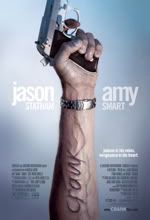
    CRANK (2006)

    Director: Mark Neveldine, Brian Taylor
    Cast:
    Jason Statham, Amy Smart, Efren Ramirez, Dwight Yoakam
    Release: September 1, 2006
    Synopsis: A hit man (Statham) learns that a poison injected into his body will kill him if his heart rate drops slows a certain point. Now he must exact his revenge on the people who injected him before he takes his last breath.

    View Trailer:
    * Large (QuickTime)

    Prognosis: Can’t Wait Until It Comes To Netflix. This movie looks absurd, bestial, groan-worthy and worth my money when it comes out on DVD.

    After I churned through this trailer I honestly thought this could be mistaken for TRANSPORTER 3. It’s got Statham click-clacking around in his romper stompers, just looking to skull anyone who bothers to enter his walking path, you’ve got guns sliding around and shots going off in every which direction and, what every testosterone-fueled young man wants to see: hot ladies accompanying Jason as he ass-kicks.

    This really should be a negative review for a movie that will disappear from people’s collective consciousness but I just can’t deny that I love the way this trailer understands its audience, first of all, and is honest with itself in knowing that it’s better to just go whole hog than it is to try and put a dress on the pig and call it something else.

    “My name is Chev Chelios and today’s the day that I die”¦”

    When we all meet up with Statham we’re immediately thrust into how this movie is going to end. Pure and simple, this is great. Most storytellers would frown on such a reveal but now we as an audience can feel we have something invested in this guy knowing that he’s going to flat line by the end. Oh, and the gorilla/alpha male look he’s giving the camera, looking all surly, is a machismo move that will no doubt get the ladies from who appreciate this kind of Neanderthal behavior all tingly and bothered.

    “I’ve been poisoned with some kind of Chinese synthetic”¦”

    Um, so, we next get Jason telling his “doctor” that he’s been drugged with some kind of voodoo medicine and, without explaining what in the hell is going on, or what the context is of the situation, we are rushed into a pack of quick cuts of Jason screaming and pounding as herr doctor let’s us all know that his adrenaline levels are crapping out and that he’s, “gonna die!”

    Cue the Euro trash techno, hurry in the requisite action helicopter that means nothing to any of us, have him repeat the macho walk thing again, reveal some hotness with Amy Smart looking all beleaguered and then have Jason reappear in a dressing gown inside a hospital. Huh? Why is he in the hospital if he’s got one hour to live, as we’re told? Don’t know, couldn’t tell you, but I can say that this gives the filmmakers a great reason to have Jason get defibrillated while brandishing a nine millimeter on the resulting shockwave that sends him backward. Cute.

    There’s a whole lot more ass kicking with Jason kicking down doors, him getting angry a whole lot, pausing ever so briefly to have a tender moment with his lady, breaking shit up with his car in a BLUES BROTHERS inside the mall kind of moment while adding in just one more moment of Jason walking with that swagger that only he could pull off.

    The trailer ends rather abruptly but, really, who cares? I don’t. This is a trailer for a movie that has an endless supply of one liners and such a worldwide marketability quotient that I almost can’t wait to be able and see it when it comes to my video store.

    THE GREAT NEW WONDERFUL (2006)

    Director: Danny Leiner
    Cast: Olympia Dukakis, Jim Gaffigan, Judy Greer, Maggie Gyllenhaal
    Tom McCarthy
    Release: June 23, 2006 (New York)
    Synopsis: “The Great New Wonderful” is populated by people you know: New Yorkers you see on the elevator, in the supermarket, at the gym. Without a trace of sentimentality, director Danny Leiner, a Brooklynnative, and his extraordinary cast paints five portraits of life in this city a year after the attacks of 9/11.

    View Trailer:
    * Large (QuickTime)

    Prognosis: Positive. Get off your self-important ass and rent JUDY BERLIN.

    This was a movie I actually caught in the theater and couldn’t have been more taken at how well this movie, quiet as it was, spoke its artistic message. I’m a fan of Edie Falco and, not just because of her, but the movie was good because it showed how a solid ensemble can work together to all fit equally in a filmic puzzle.

    That’s why I am really hopeful for a movie like this. You don’t see a lot of these kinds of films where, instead of an Altman kind of narrative, you have people slowly unraveling, as it would be in your everyday life; multiple people with layers of issues. This is the kind of film that can either be boosted by those involved or dragged down, as was the case with Madonna’s performance in FOUR ROOMS, by a singular, soft effort.

    The trailer opens intriguingly enough.

    It’s stated that it is September 11″¦2002. I’m feeling the city used for this movie’s backdrop is New York and it’s a curious selection; not so much for the location but why one year, exactly, after the terrorist attacks? Hmm, I’ve got nothin’.

    You’ve got Jim Gaffigan and Tony Shalob (Really, one funny guy and the other, an enigma in the search for why this guy keeps winning awards for his show Monk) sharing a moment in a corporate break room. It’s an odd exchange but the two of them are well enough equipped that the resulting conversation, one that we really aren’t privy to, definitely produces a smile. It’s weirdly amusing.

    Next scene, some woman in a hot pink panties (Really, is there any other kind? I think not.) tells her beau that it’s been twenty-two days since the two have done it. I know the hot wife/distant husband trope is about as fresh as a bucket of egg yolks that have been allowed to ferment in a pile of old tires behind an abandoned gas shack in Winslow, Arizona on a delightful 113 degree August morning but she’s still a hot lady in a pair of pink panties so consider me interested in this story, sight unseen.

    Olympia Dukakis is some old coot who is trapped in a loveless marriage as she, no doubt, finds herself with nearly both feet in the grave. I’m sure it’s good but I’m not really engaged with the story for all the reasons above, minus the pink panties.

    Maggie Gyllenhaal’s despondency is not just pleasurable but it’s appropriate when she mentions that it all stems from her needing an undefined job. We don’t know what this job is but seeing her vacant expressions is enough to establish her position in this movie.

    Steven Colbert, an odd duck if ever there was one, pops up in an authoritative capacity trying to dole out a little school justice as it pertains to a troubled little dude. What’s really at stake here? Ah, that’s right, we’re not privy to any defining information.

    Olympia starts to get her swerve on with a guy who no doubt has a wrinkly sack so I am very appreciative of the trailer makers who quickly set the tension in motion and get the hell out of there.

    Interestingly, these stories start to congeal like a rather spirited Paint n Swirl project. The lines aren’t really clearly defined with how these people relate with one another but the extended moment when a lot of these people are caught on an elevator that loses its lights and then stops briefly gives me pause. I don’t quite understand what this elevator moment is supposed to mean but I do know that I am unable to look away from what happens next.

    “Rebuilding is a process”

    This trailer gets a positive if for no other reason than I have nothing firm to go off of with regard to the aims of this story but I am absolutely taken with how well the tease functions here. It looks like a solidly interesting premise but, like I said, it all comes down to whether each story can be as good as the others. Even if one fails it, unfairly, I know, taints the rest of the experience.

    RUNNING WITH SCISSORS (2006)

    Director: Ryan Murphy
    Cast: Annette Bening, Gwyneth Paltrow, Jill Clayburgh, Brian Cox, Joseph Fiennes, Evan Rachel Wood, Alec Baldwin, Vanessa Redgrave
    Release: October 20, 2006
    Synopsis: An adult man looks back on his childhood with his bipolar and self-centered mother.

    View Trailer:
    * Large (QuickTime)

    Prognosis: Next. Can’t there be any good non-fiction literature made today that doesn’t have an exquisitely twisted family at the center of it all?

    I mean, I know it’s cool to just come from a completely fucked up family where the father has a predilection for rubbing Crisco on his nether regions right before going out for a nightly streaking or a mother that might as well be a walking Rush Limbaugh pharmacy with the amount of uppers and downers she’s been able to extort from hapless medical professionals? No, if you want to be taken seriously as a writer. When in doubt, mine your personal pain for profit.

    Burroughs has. And, you know what? Good for him because if the opening scenes really happened in his life I am guessing we’re in store for a rather uppity exploration of middle-class twits who have a better handle on their own inner pain than they are with dealing with their family, interacting normally with their children and with really trying hard to decimate any semblance of what average humans do.

    We’re introduced to Burroughs as a very young child as he polishes his coins in front of his father, played here by Alec Baldwin. The moment, to be sure, is trying to capture both the child’s odd behavior and Alec’s aloofness as someone who questions his own contribution to a kid that really doesn’t act like one. It’s an odd way to start a trailer, though, and I am not sure of what I really think: is it artifice dressed up in pretentious clothing or is there something else afoot? I’m unable to answer that question as the freak show goes on tour and lands in the head of Annette Bening, a fruity artiste who has grand designs of superstardom that clashes with Alec’s more grounded thoughts about having to put in an honest days work every day.

    These values clash in a therapy session where our screen doctor suggests daily therapy for five hours at a time. It’s nuty, to be sure, but Annette is all over it with Alec chiming in with the reality of the situation. This part was amusing to me.

    This is, unfortunately, the last time where amusing will be used in this article as the next moment for this film has Alec walking out on Annette, a woman who seems on the verge of a complete mental breakdown. Therapy only solidifies the family as ground zero notion but where the movie should have been about the mother doing what she can to take care of her child she decides to pawn him off to the therapist in an adoptive kind of situation.

    Now, I guess since the movie actually happened this way in real life everyone deserves to do whatever they want in explaining Burrough’s own Mr. Toad’s Wild Ride but it just feels false as a story. I don’t have a lot invested in what we’re being whisked away from and to through this trailer but where some people might be shocked at this development, having to shack up with an eccentric (of course! All writers encounter eccentric characters never nut jobs who needed to have the NYPD break out some plunger justice on this cat.)

    The home is a relatively safe one, where weirdoes also live with him, where drugs are as available as mama’s Skittle dish, The addition of Paltrow and Wood as the sexy young wards of the crazy old coot is a hapless attempt to try and infuse some pop and sizzle into this thing but I can’t see what this movie’s trajectory actually is.

    Are we to believe that Burroughs had wonderful moments here or that he found love here or that he relishes in the oddity that is this family knowing that he’s going to be able and go on tour some day after he’s older and better able to handle a pen and pencil?

    I don’t know what to think but there is the feeling of pretension that coats the whole trailer in a sappy gunk that I could not wait to scrub off with a viewing of the trailer for Frank Miller’s 300.

    THE PRESTIGE (2006)

    Director: Christopher Nolan
    Cast:
    Hugh Jackman, Christian Bale, David Bowie, Scarlett Johansson, Michael Caine, Piper Perabo
    Release: October 20, 2006
    Synopsis: From the time that they first met as young magicians on the rise, Robert Angier (Jackman) and Alfred Borden (Bale) were competitors. However, their friendly competition evolves into a bitter rivalry making them fierce enemies-for-life and consequently jeopardizing the lives of everyone around them. Full of twists and turns, THE PRESTIGE is set against the backdrop of turn-of-the-century London, the exceptional cast includes two-time Oscar® winner Michael Caine, Scarlett Johansson and David Bowie.

    View Trailer:
    * Large (QuickTime)

    Prognosis: Sorta Positive. It’s ARMAGEDDON versus DEEP IMPACT all over again, I speak here of the Ed Norton/Paul Giamatti vehicle THE ILLUSIONIST that’s competing for the affections of movie going magis, but it really isn’t a battle between wits, it’s twits. I mean it’s not like this is a mano a mano between Doug Henning and Blackstone but this is something more than just a Deluxe 24 Pack of Tricks to Amaze Friends and Quadriplegics.

    This is something more than dueling movies; Christopher Nolan has given us BATMAN RETURNS part 2 without using the masks.

    As soon as you look at the opening sequence, Bale asking his proper and pale looking female companion to shoot him with a pistol, you don’t know whether Batman is trying out a new Gregorian vest for late Victorian nights on the town or if this something else entirely. I obviously know it’s the latter but there’s a BATMAN carryover here and it’s unmistakable.

    It’s odd that the next scene is Hugh Jackman’s voiceover as a woman gets lowered down into a tank of water, him saying something about showing a trick that no one has ever seen before, but when we see his face, and he’s talking, he’s holding a disappearing birdcage. I guess this audience hasn’t yet been exposed to Tweety and Sylvester; that cat can make that bird disappear into his maw more times than even I can fathom. The moment is choppy.

    And then we get Scarlett Johansson, doing her best English accent as she comforts Hugh’s magically delicious ego.

    Bale and Jackman, we take it, are pals. They’re the kind of pals, even, that can share each other’s indentured help that, here, takes the form of Michael Caine. To someone who has seen BATMAN and then this it is hard not to see the same kind of cinematography represented. It’s not a bad thing, good thing, or otherwise but it’s curiously satisfying as I can think of a few Joel Schumacher flicks that do the same thing, aesthetically speaking, but to a much worse degree. It’s just an odd sensation to look at something that feels like an extension of another.

    Things kick up to eleven when, in a rather confusing muddle of cockney and visual quick cuts, Bale performs a trick that seems to utilize the same kind of special effect-ness that TANGO AND CASH did when they had Robert Z’Dar fall in that unfortunate way into the electric cabling, thus allowing Sylvester Stallone to make a clean getaway. That’s pretty much what happens here.

    Jackman seems genuinely blown away by the illusion.

    The awe turns, obviously, into obsession and we’re all treated to the triad of a magician’s act. It’s a cheeky way to give us a basic understanding of what makes a good magic trick but there seems to be a lot more brewing beneath the surfaces of Bale and Jackman but the trailer just wants to feel like a glossy ad. I understand the need to have these two main characters trade furtive glances with one another but we’re not treated to something genuine about these men.

    No, instead we get Caine voicing over a series of unrelated scenes that realty need to do more than just be an assortment of chocolates in a heart-shaped box. Yes, it’s great to taste these things but, seriously, the last third of this trailer is just a spooge of nonsense. I’m excited to see this movie only because I know what it was about before but the trailer needs to be more focused lest Doug Henning gets the upper hand on this one.


  • Melonpool Quickcast #8: A Tale of Three Cartoonists

    melonpool1.gif

    -By Steve Troop

    Based on Steve Troop’s classic webcomic of the same name, the Melonpool Quickcast features puppet versions of Troop’s alien cast, who are desperately trying to make heads or tails out of Earth culture.

    Mayberry and Scott

    Mayberry chats with Eisner Award winners Scott Kurtz (“PVP“, “Truth, Justin, and the American Way“) and Doug TenNapel (“Iron West“, “Earthworm Jim“), as well as Internet staple Stephen Notley (“Bob the Angry Flower“) in another round of interviews at the San Diego Comic-Con. Now, aren’t you sorry that you weren’t there?

    Check out the Nightgig Gigcast featuring behind-the-scenes info as well as about the future of these Quickcasts!

    Don’t forget to comment on this and other Melonpool Quickcasts over at the official Melonpool Quickcast Forum!

    Melonpool Quickcast #8: A Tale of Three Cartoonists:

    • Large (560 x 420 – QuickTime – 20 MB)
    • Small (320 x 240 – QuickTime – 10 MB)

  • Toy Box: The I.W.G. – Sasquatch


    toybox.jpg

    Every year at SDCC I always see something new, something I haven’t noticed before.  This year, it was the I.W.G. – Insurgents Wilderness Gruppo.  This line of nifty activist animals is brought to you by Rocket World, a small independent company run by Patrick Ma.  The basic concept is that aliens, called the Astral Overseers, infect the planet with a retrovirus that makes certain animals self aware.  These sentient animals begin a resistance movement against the poachers and polluters that are ruining their world, often using the very tools of those they battle. 

    I picked up Sasquatch at their booth.  He’s the subject of the review tonight, but I also included a shot of the Yeti in my SDCC coverage, and their website has TONS of info and the ability to order product direct. 

    If you have any questions or comments, drop me an email at mwc@mwctoys.com, and if you like the reviews, check out my other site, Michael’s Review of the Week.

    The I.W.G. – Sasquatch

     As I mentioned, I picked up Sasquatch.  He’s a guy, but he was lucky enough to find a Yeti of the female persuasion, and they’ve since fallen in love.  It was an Internet dating thing.  Amazing how successful that can be.


    toybox_080806_1.jpg


    Packaging – ***
    The package is pretty basic, with simple graphics and a clean design.  It’s pretty sturdy, so there’s little chance of damage to the figure, and it’s also quite collector friendly.  There’s a couple twisties, but no need to damage the package just to remove the fuzzy guy.


    toybox_080806_2.jpg


    Sculpting – ***1/2
    These are one of those cute designs, and like many other vinyl products, will speak to some people, while others have no idea what the hell it’s about.

    These really caught my eye, with a neat design and great style.  They were sort of like those old Applause stuffed animals, with Uzi’s and hand grenades.  Cute but deadly!

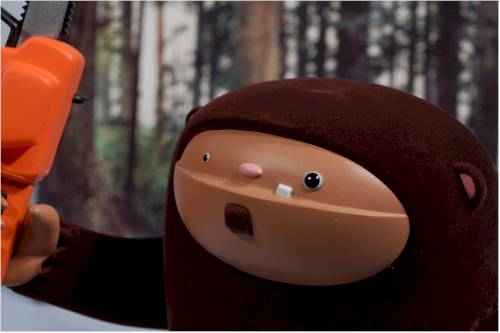
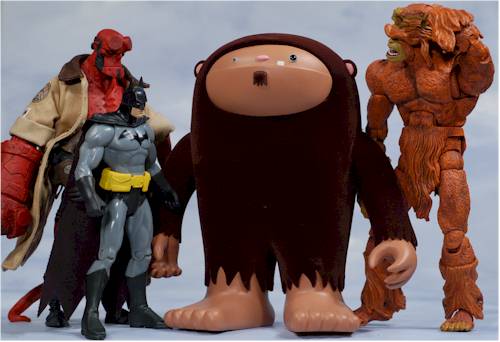
    The Sasquatch has an interesting design, although he doesn’t stray too far from what you’d expect.  Big feet, big body, with a cool flocking of hair over the majority of the figure.  Only the hands, face and feet are bare vinyl.


    toybox_080806_5.jpg


    Yes, this is a rotocast figure, and yes, one eye is bigger than the other.  But that’s part of his charm! Or at least that’s what the Yeti thinks. He also has a groovy little soul patch, also flocked.

    He stands just under 8 inches tall, and is larger than the majority of other animals in the I.W.G., which makes sense. His hands are sculpted to hold the weapons, or to actually hold hands with his main squeeze, the Yeti.

    Paint – ***1/2
    The paint ops are extremely clean and neat, although they are very basic.  There’s not a lot of detail in the design, but there’s at least three or four unique colors here, and there’s no major slop on any area.


    toybox_080806_3.jpg


    I had some issues with the flocking rubbing off around one shoulder (which I’ll mention in more detail in the Things to Watch Out For section), but the flocking itself is very tight and very even and consistent.  It’s a great touch, and adds quite a bit to the overall appearance of the figure.

    Articulation – **
    Even though he’s a vinyl figure, he has some articulation, and it’s about as much as the design allows for.


    toybox_080806_4.jpg


    There’s cut shoulders, wrists and ankles.  That’s not a ton, but it’s enough to raise his weapon in a threatening manner, and hold hands with the love of his life.

    Accessories – **1/2
    He comes with a slightly cartoony chain saw, big enough to make Thomas Hewitt happy.  It fits well in his hands, although the limited articulation means that it can’t be held in both hands at the same time.

    Value – **
    Like many of the ‘designer’ toys, Sassie is pretty damn expensive.  I coughed up $45 for him at SDCC, but two factors keep it from getting a lower value score.  First, the flocking really is extremely well done. Second, it’s a limited edition of only 500 figures, and at that small of a production run, I’m much less surprised by the price.


    toybox_080806_7.jpg


    Fun Factor – ***
    While not really intended as ‘toys’, these are in fact pretty cool for kids.  They’re quite sturdy, and while the flocking would take a beating in regular play, kids that like cute, adorable killing machines will find these right up their alley.

    Things to Watch Out For - 
    The flocking is pretty cool, but I did have quite a big hunk rub off at the left shoulder joint when I turned the arm.  The movement of the arm tore off a hunk all the way around, so be extremely careful when you are first using the arms. 


    toybox_080806_6.jpg


    Overall – ***
    A high price holds these back from an extremely high score, but they are certainly a solid designer toy.  Like most art, you’re either going to think the design is cool, or it’s not going to speak to you at all.  It’s unlikely that there will be much middle ground, but that’s common with all art, and is further proof that figures like these have successful made the jump.

    Scoring Recap –
    Packaging – ***
    Sculpting – ***1/2
    Paint – ***1/2
    Articulation – **
    Accessories – **
    Value – **
    Fun Factor – ***
    Overall – ***

    Where to Buy –
    The Rocket World website has some of the animals up for sale, along with some suggestions for retailers.


  • Game On! 8-4-2006


    gameon.jpg

    Hello dear friends and gamers, and welcome to another week of reviews here at Game On! Before we continue with our normal variety of game reviews, I’d like to point out that this week; we also have a few DVDs reviewed in this column as well. While it’s not my usual forte, I managed to get a hold of a few sets that were recently released and was asked to critique them, and so I have. Not to worry though, there’s games here too”¦as well as DVDs based on games. So, let’s get right down to business. First things first though”¦games based on movies (before vice versa occurs).

    IT’S A VERY, VERY, VERY FINE HOUSE

    monster.jpgAs with most summer movies, there’s always the video game tie-in, especially if the film is an animated feature ““ it makes more sense for the kids to be able to play through their favorite sequences in the film they just saw. There’s going to be quite a few of these such titles that I’ll be reviewing in the coming weeks, but the first for now is MONSTER HOUSE, out now for PS2, Gamecube, GBA and DS.

    As far as movie tie-ins go, this one is pretty standard fare. Take on the role of one of the three main characters in the flick through a series of levels that recreate the story and scenes from the film. In the console version, that means taking control of DJ, Chowder and Jenny at different times, as they get split up at the beginning of the game. As you progress with one character, it unlocks pathways for the rest (though still very linear in its execution). The console version is set up like a typical third person shooter, with an over the shoulder camera view. Here, the characters can lock-on to enemies and blast them with their water pistols, or with a special attack unique to each character (DJ’s camera flash to stun foes, Jenny’s slingshot, or Chowder’s water bombs).

    As you progress through levels, you collect the normal variety of knick-knacks and doodads that are rampant throughout most every game based on an animated feature. Here, it’s toy monkeys, which unlock art in the gallery, or tokens for the arcade so you can play “Thou Art Dead”; a CASTLEVANIA clone from the movie that’s actually almost more fun that the main game itself.

    monster2.jpg

    On the handheld side, things are decidedly different. For GBA, we switch to a super-deformed top-down view with a wholly different animation style. Also, you can control all three kids at once, switching with them at will with the left shoulder button. Gameplay also changes a bit, as you travel through the whole of the house together, collecting items and eventually finding your way to the heart of the creature to destroy it.The Ds version is even more drastically different. Here, you choose one of the three kids and enter a room on the map. Each room must be cleared before advancing to the next, then eventually to the next floor of the house. Control is done with either the d-pad or the face buttons, and shooting is done with the touch-screen; holding the stylus in the direction of your foes and keeping it pressed uses your weapons rapid-fire mode, while tapping it uses just a single shot.

    While the handheld versions both offer a unique take on the game, with their top down views and unique controls, the console version will offer the best experience for fans of the film who want to recreate the theatrical experience. It’s not a great game by any means, but it’s a well done tie-in at least, that those who watched the film and enjoyed it will enjoy as well.

    One Gamer’s Opinion:
    righton.jpg

    WE ALL HAVE OUR VICES”¦

    miamipsp.jpgI have to be honest, when I first saw that there was going to be a game based on the new MIAMI VICE movie, and that it was going to be exclusively for the PSP, I was worried it was going to suck. Usually licenses based on summer blockbusters don’t quite offer the same kind of thrills we see on the screen, and especially if it’s going to be a handheld offering, things are usually dulled down a great deal. However, I was pleasantly surprised with MIAMI VICE: THE GAME once I actually booted it up and started playing.

    What is presented before me is actually a rather competent third person shooter, one that would likely be found on any home console. Featuring an over-the-shoulder camera view, not unlike RESIDENT EVIL 4, you take on the guise of either undercover vice agents Crockett or Tubbs as you make your way through various levels of thugs and drug runners. Controls are simple and easy to execute, and the targeting system is easy to navigate. The game features a simplified cover system, where your character can hide behind just about anything in any given room for shielding against the hail of gunfire from every baddy you meet.

    miamipsp2.jpg

    The game’s action is split up by a variety of mini games and side missions as you finish each level. Depending on what goals you complete in the level, you can confiscate drugs to unlock trade with drug dealers (in order to gain a street reputation undercover), or get a FlashRAM to hack that will unlock weapons upgrades or the locations of drug barons. These hacking missions are done a bit weirdly, as you pilot this little triangle around cyber space, letting of an electromagnetic charge to disintegrate these rotating cubes flying around. Every cube you destroy releases a circle of data. Collect all the data circles to complete that hack phase. Get hit by the “enemy fire” of the data cube’s defense systems and you loose a data circle. It sounds all rather complex, but it’s actually a cool little mini game, once you get the hang of it.There are also boat missions to break up the monotony of the straight shooting levels, though these are actually MORE monotonous. Since the weapons auto target, you just drive along and shoot, taking down everything in you path and picking up all the drugs left floating in the water behind the smoking remains of your enemies’ boats.

    As you progress through the main levels, you gain a reputation on the streets depending on what weapons you use or how you’re outfitted. While some weapons offer better accuracy and firing rates, they have a lower reputation score than if you just go in with a pistol. Likewise, if you’re wearing body armor, you’ll be protected, but you gain more of a reputation if you go into battle wearing only your paisley suit. It’s a neat little system that pays off big once you try to infiltrate a drug barons’ hideout to make off with their stash.

    Still, the game isn’t perfect. The voicework is pretty terrible, as neither of the actors playing the leads even TRIES to sound like Collin Farrell or Jamie Foxx, and much of the voicework of the bad guys is recycled and repeated so often it’s annoying. Also, some of the targeting is off in places”¦where you’ll think you have a good headshot, you’ll end up hitting the guy two or three more times than you should to bring them down. Likewise, the bad guys often use cover like you do, but run stupidly out in the open to get a clean shot off, leaving the vulnerable almost every time. Still, these are fairly minor offenses.

    It’s not a great game by any means, but it is certainly better than I even expected it to be. It’s a fun shooter, though it doesn’t really do anything new for the genre. Still, it’s well made for a handheld game of its type, and certainly takes the single analog stick into consideration when playing. I never had to fumble with the camera once”¦which for me, is usually a big issue. There’s even a decent two player co-op mode, though both players will need a copy of the game. It may not make you want to catch the movie, but at least you’ll enjoy playing it while it lasts.

    One Gamer’s Opinion:
    righton.jpg

    OUT OF JUICE

    juicedpsp.jpgFor our one non-licensed game this week, we’re taking a look at JUICED: ELIMINATOR for the PSP. In what is little more than a port of last year’s console title with a few minor upgrades, ELIMINATOR continues the series’ foray into all things street racing, and still manages to bring along that odd cell phone bit.

    As I said, if you’ve played the console version, not much has changed here. You still can race players, either controlled by the computer or a friend wirelessly, and race for pink slips of the cars. There’re also a few new challenge missions, which help to familiarize you with the PSP’s analog nub controls, as well as hone your skills behind the wheel. There’s also plenty of customization here, though not nearly as much as the former version of the game.

    juicedpsp2.jpg

    Still, what is here, while nice, is a bit bland. There still doesn’t quite seem to be the sense of speed one needs, and that was a problem in the console version as well. Also, while the car models are nice, there’s little detail (though that could be attributed to it being the handheld version). Load times are fairly decent though, so that’s not much of an issue as with most racing titles on the PSP. And, as I said, there’s still that factor of choosing which cell phone you want to be contacted on for races. It’s just seems so”¦unnecessary.All in all, though, it’s a fairly competent racer, and that actually seems to be its problem. There’s not much to complain about here, but there’s also not a whole lot to like. As a whole, the game is just pretty average, and while that’s not really bad per se, it certainly doesn’t spark any real interest either.

    One Gamer’s Opinion:
    ok.jpg

    DVD REVIEW: STREET FIGHTER II: THE ANIMATED MOVIE ““ UNCUT, UNCENSORED, UNLEASHED

    sf2mboxart.jpgFor our first DVD review this week, we’re taking a quick look at the re-release of the STREET FIGHTER II animated movie. Released back in the game’s heyday, the film was cut a bit when it reached the US shores (as happens with much of the dubbed anime we receive). Now for the first time in the US we get the overseas cuts of the film featuring more fighting, longer more violent sequences, and, of course, Chun Li in the shower. Yes, this was actually what was listed on the press release for the DVD.

    Containing two different dubs of the film, this new DVD features the original Japanese language cut of the film, as well as the UK cut, featuring soundtrack by the industrial band KMFDM (a quite different sound than the Seattle Grunge laden US soundtrack). Both versions are practically identical, and include all (or near as I could tell) of the deleted scenes missing from the originally released US version.

    These include a prolonged fight between Sagat and Ryu in the film’s opening, a brief shot of Akuma in the background of one fight, the extended final battle with Bison, and the aforementioned shower scene with Chun Li, which extends into a rather brutal battle with Vega. For STREET FIGHTER fans, this movie has some fantastic fights, and is only strengthened by the fact that they are now available uncut.

    sf2chunli.jpg

    Still, the makers of the movie took some liberties with the character’s backgrounds. When watching this film versus the STREET FIGHTER ALPHA films (which, according to Capcom, the ALPHA series takes place BEFORE the regular SF games) each film contradicts the next, with Ken and Ryu knowing each other at different times and encountering and re-encountering the same characters as if they’ve just met for the first time. Still, as a stand-alone film, it does quite well.

    sf2sagat.jpg

    Lord knows this flick is tons better than the live action garbage they produced with Jean Claude Van Damme. It’s about as close as we’ll ever get to the truest form of a video game movie, and sadly, it’s only just animated. Still, beggars can’t be choosers, and we’ll gladly take what we can get, so long as they all match the quality as this one.

    DVD REVIEW: BLOODRAYNE DIRECTOR’S CUT

    bloodrayneboxart.jpgSadly, that usually isn’t the case with films based on video games, and one of the worst cases of a director just not getting it is Uwe Boll, scourge of the cinematic game fan. Dr. Boll usually fills his films (if you can call them that) with over excessive amounts of violence and sex, seemingly giving no regard to script of substance, thinking that these things are “cool” so gamers should like them automatically.

    I’m serious. I actually heard him say that in an interview once. He was wondering why gamers don’t like his films and remarked “I put all these cool things in there, like fighting, blood and boobs. What more do they want?” Oh, I don’t know”¦maybe an adherence to the characters and storylines of the games, perhaps some decent filmmaking and scripts?

    That said, BLOODRAYNE is Dr. Boll’s least sucky film to date. That isn’t to say it isn’t total shit, which it is, but it’s less shitty than HOUSE OF THE DEAD and ALONE IN THE DARK. Featuring the strangest casting for any of his films (Ben Kingsly’s mortgage must be murder) you begin to wonder who owed who a poker debt. Kristanna Loken is horrible miscast in the title role of Rayne ““ she looks the part at least but sadly cannot act it. Her screams as she experiences her first vampiric kills are mild wails at best. Similarly, Michael Madsen looks at though he’s phoning in his role”¦and this is Michael Madsen we’re talking about. Don’t even get me started on whatever the fuck Meat Loaf is doing”¦

    Still, for once, the script can’t be blamed. Written by Guinevere Turner (GO FISH and AMERICAN PSYCHO”¦and the name basis for Joey Lauren Adams’ character in MALLRATS) it actually follows the character’s back-story rather well. Birthed by the unholy union between a vampire a human, Rayne is a cross breed who spends her life taking out the vampires and heading to kill the head bloodsucker”¦who also happens to be her daddy. Sadly, the casts’ horrendous acting keeps you from enjoying the story, or any of the fight scenes.

    The problem with Uwe’s direction is that”¦well, he really doesn’t have any. He just sits the camera there, throws some blood on someone and calls cut. It’s not for trying, though. Michelle Rodriguez, securing her role as the go-to video game chick (RESIDENT EVIL, this, and a voiceover in the game HALO 2) actually is putting forth some effort and isn’t bad”¦for Michelle Rodriguez. Likewise, most of the actors are doing well with what little they’re given, though Uwe doesn’t really allow them to play much (which is probably why Michael Madsen”¦no, wait. Nevermind. He’s always like that).

    bloodraynedvd2.jpg

    The fault of this film’s demise lies pretty much on its star, sadly. Had she been given better direction (or, maybe been someone else) she could have done better with the role. As it stands, she just wades through the shots, grimacing so subtly you wonder what the fuss is all about, like Rayne has a splinter and is only slightly miffed about it, then goes and breaks a guys’ neck. Her screams wouldn’t elicit a chill in a frozen popsicle, and they seem almost laughable here as she pathetically emotes some pain that we’re not even sure she’s experiencing. It worked fine for her as the TERMINATRIX in T3, but sadly just falls short here. At least she looks good in the costume.

    Still, if Uwe Boll had actually paid attention to the game, he would have seen that she was a poor choice. Also, he probably wouldn’t have shot the fight sequences so poorly”¦though maybe that has to do with his direction. His actors barely seem trained for sword fighting, and Rayne with her special arm blades uses them with slow effect, making everything look like a paltry dress rehearsal. Even those who manage a flourish seem like they’re being careful to NOT hit their opponent.

    Alas, we have a few more offerings from Uwe, as his IN THE NAME OF THE KING: A DUNGEON SIEGE TALE is due out soon, as well as his upcoming film based on the PC shooter POSTAL. Thank Hideo he doesn’t have the rights to METAL GEAR SOLID though”¦the street would run red with his blood. Much like the “director’s cut” of this film, which remains EXACTLY the same as the theatrical version, but with a carnage montage at the end. Oooh, well done, Doctor.

    DVD REVIEW: THE INCREDIBLE HULK: SEASON ONE

    hulkboxart.jpgSome of you may know that I’m a big comic book geek, so it should come as no surprise to you that I’m reviewing this DVD set. Sure, it really has no place in a video game column, but that’s neither here nor there. They sent it to me, I feel obligated to review it. As the longest running series based on a comic book, THE INCREDIBLE HULK is a triumph in the science fiction/superhero genre, mainly due to the fact that it doesn’t really adhere to the source material, but rather tackles the human side of the character in a way that has barely been seen before or since, with a few exceptions (SMALLVILLE being the most recent).

    Tackling what makes the Hulk a unique character, writer/producer Kenneth Johnson (“The Six Million Dollar Man”, “V”, “The Bionic Woman”) brought us pathos and a great character study in the guise of a science fiction TV show. Bill Bixby as Dr. David Banner provided the human side of the Jekyll and Hyde story, with Lou Ferigno as the green beast alter ego. Both capturing the truest essence of the characters not yet seen again in any other iterations of the comic on screens big or small.

    The DVD set includes the two hour TV movie “The Incredible Hulk” that introduces the characters, the two hour pilot episode proper “A Death in the Family”, the 10 episodes from season one, and a sneak preview episode from season two, “Stop The Presses”, as well as audio commentary on the intro movie by Johnson.

    This commentary is a fascinating listen as Johnson, a true television legend, recounts just about every aspect of the shoot as though he shot the thing the day before he recorded the commentary. In actuality, the commentary was recorded for the single disc DVD of the “Incredible Hulk” movie, with the two part episode “Married” on the b-side, released just before the big screen Ang Lee HULK film in 2003 (which Johnson makes numerous reference to as “upcoming”). Still, even though it’s recycled, it’s chock full of good info on the show, such as why he changed the name of the character from Bruce to David (not because the studio though the name sounded “gay” as the rumor goes, but rather than Johnson hated the alliteration of “Bruce Banner”). He also reveals that actor Richard Kiel (“Jaws” from the James Bond films) was originally cast as the Hulk, and even points out the one shot that remains of the footage that was shot with him that was used in the episode. Johnson is such a pool of knowledge that I would have liked his commentary on every episode, but sadly that just isn’t that case.

    hulkdvd2.jpg

    What made this series work, and what makes it still hold up today, is that it truly is a character study. What happens to a man who can’t control his own anger when he must try to control the anger of others, or help others who are hurt by anger and misdeeds? It’s a wandering soul story of a man searching for his own deliverance as he aids other on similar paths, never finding his own salvation.The transfer of these episodes hold up fairly well here, and the colors don’t look saturated as can be the case with most old shows. Hopefully, the next four seasons will look just as god, and feature a bit more extras than just one audio commentary, and an episode from the series following season.

    And with that, we bring our crazy column to a close, dear friends. Tune in ext week with”¦well, actually more of the same as I review more games based on movies (ANT BULLY, BARNYARD) and a movie about games”¦or rather Gamers in a film called”¦well, GAMERS. Until then”¦

  • Melonpool Quickcast #7: The Search for Routh

    melonpool1.gif

    -By Steve Troop

    Based on Steve Troop’s classic webcomic of the same name, the Melonpool Quickcast features puppet versions of Troop’s alien cast, who are desperately trying to make heads or tails out of Earth culture.

    Ralph and Mayberry reflect on San Diego Comic-Con and Ralph’s quest to meet the star of “Superman Returns.”

    Don’t forget to comment on this and other Melonpool quickcasts over at the official Melonpool Quickcast Forum!

    melonpool-20060804-01.jpg

    Melonpool Quickcast #7: The Search For Routh:

    • Large (560 x 420 – QuickTime – 20 MB)
    • Small (320 x 240 – QuickTime – 10 MB)

  • Reflections on Comic-Con 2006 or: Why M.C. Bell Isn’t as Big of a Weasel as Some Would Think But Who Still Otherwise Looks Like Fred Gwynne from The Munsters.

    By Christopher Stipp

    Archives? Right Here…

    I liked SNEAKERS as a film. It was whimsy, light but has something to it that I just cannot rail against in any capacity. I think that the “too many secrets” idea is one that had real resonance for a number of reasons just beyond the movie itself. This kind of notion, that there is a machine that can obtain whatever it wants from wherever it goes and that information is power depending on who owns it, fits in perfectly for how my Comic-Con of 2006 experience ultimately left me feeling.

    You’ve no doubt seen all the up-the-minute, some literally up-to-the-second, coverage that happened on the floor in the convention halls. In the press section where I sat for many of the great panels on parade I could hear, in the quiet moments between really awkward questions, requests (“Can I give you a hug?” directed at the talent for 300 was, perhaps, the most painful) and pauses from geeks who just couldn’t get it together for their few seconds in the literal spotlight, I heard the click-clacks of live blogging.

    A lot of that content went to sites that shall remain nameless. I would hope and suggest, though, that many of these very same authors figure out that Strunk & White is not just a new television show on the FX network and that one of the greatest assets to people who do nothing but write real emotional screeds look into the eyes of proper sentence construction and learn how to use their newfound abilities to liveblog in a way that’s meaningful. That said, some of the other information that went to a little known site called the Risky Biz Blog from the very kind, polite and lethally literate contributors of The Hollywood Reporter. 

    While I was sitting in my very unforgiving, very uncomfortable metal ass hammock I was able to pull up a lot of sites on my little iBook and was amazed at the difference between what two different perspectives can bring to the absolute same story. One was well-written, concise and brought some context to the subject matter that presupposed, for a moment, some people needed a little background while some other suffered from the kind of erratic reporting that I would expect out of a 12 year-old girl who’s trying to push a day’s worth of emotional trauma in middle school into a 10 second blast. It then should follow, then, as to which outlet, take a wild, Hitchcockian stab, enjoyed the most exclusive “OMFG! Dood! wOOt!” access while there.

    I had went into all my roundtables with the idea that maybe, perhaps, quite possibly, I’d have enough juice to at least bring you one uninterrupted conversation that didn’t include one outlet’s constant question of the 2 different SPIDER-MAN 3 panels and one GHOST RIDER panel about whether, if you, like, could, you know, have a crossover movie with, like, another comic book universe what would it be, but I just resigned myself to Quick Stop’s place in the social order of things and just enjoyed the ride. On my own, and the many different ways I begged like a jonsin’ junkie, I ended up with nothing. Mr. Ken Plume, our esteemed EIC here, did a bang-up job of landing 1:1 time with the guys of HOT FUZZ and BALLS OF FURY while inviting me along, graciously, to enjoy the solitude of the Omni Hotel on a Sunday morning with some of the funniest men that are working in entertainment today.

    It was nice. Thinking about who got what and why my many calls went unreturned (A lowbrow commentary on the subject? Just a dick move.) does nothing in the grand scheme of it all. 

    I just look back at what 2006 yielded me for this site and while it’s easy to chalk it up to a bust, apart from the nerds I crushed and mauled getting a ticket to see BORAT, but there was some great roundtable moments that didn’t include socially retarded questioning from people who obviously had nothing else to offer a conversation but their ignorance.

    Believe it or not I enjoyed the living hell out of the SNAKES ON A PLANE panel. It was 4 separate “interviews” of about 5-6 journalists (if you could call us that) at 4 separate tables, with the talent rotating like some grown-up version of musical chairs, and I really had an enjoyable time talking with the film’s snake wrangler, a proposition I know doesn’t sound all that great but believe you me it was, Sam Jackson, who summed up his reason for making this movie perfectly and understands its complete absurdness as a vehicle with alarming clarity, the director and then Kenan Thompson who, donning a pair of sunglasses that Jackie O. would’ve thought were too damn big, seemed “somewhere else” during the conversation and was loose enough to essentially state what seems like the ending for the film without so much of an “oops.” Solid panel all the way around.

    There was Bryan Singer’s SUPERMAN RETURNS panel which was noticeably thin on people from the media but it looked like he was almost at the end of his emotional rope with regard to talking about this film. He appeared worn and in need for some long rest. It spoke well of him that he was able to be present for this after-the-fact kind of get-together and while it didn’t yield any great kernels of misgivings he might have about the final cut that’s out there my offer of $5 to anyone who would ask a question about the not so great showing at the box office by dollars and critics went unanswered. Damn.

    The GHOST RIDER panel was just swamped with geeks. Really. It was Noah’s Ark and we all wanted on that ship. Everyone vied for a chance to speak to Nic Cage/Mendes/Johnson about this long delayed production but it led right into the panel that everyone was there for: SPIDER-MAN 3. Now, while I intrinsically high-fived myself for being able to wedge in a question to Kirsten and Tobey in the cacophony of other journos yelling out requests like this was a press conference to discuss how a new cancer pill, available only in an anal suppository, has cured everyone who’s taken it, it should come as a surprise to some that it was really Thomas Hayden Church who was the real belle of the ball. The man is simply amusing, charming and seems like a guy who could give a colorful interview if he were to be plopped down in the hot seat for an hour. He was perhaps one of the only other actors there at the Con who just appeared to be pleased to be there; others looked like they were in a constant state of discomfort.

    The panel for 300, while not as intimate as the roundtables, sticks out in my mind as one of the most fascinating gems I wasn’t expecting to enjoy. Gerard Butler is simply easy to listen to as he was one of the few actors that came out and was one of the other kind of people that really just rode the rocket ship of a Comic-Con audience for all that it was worth. He’s another lost opportunity that could have been and I am torn as to whether I would have traded in a 1:1 for the chance of seeing the special trailer of footage that they did during the panel. It really does look like an intense film and I cannot get some of the imagery out of my skull, the slo-mo boobie jiggle that was flashed during one moment in the reel could have some adolescent reason why.

    Alas, after watching all the copious coverage on other, more up-to-the-moment, sites I was left thinking that there isn’t really any point to physically transcribing any of the panels that I saw up-close; you already know what was said and done and described in ways only the geek obsessed could have brought to life.

    I am, though, going to make the MP3’s of the roundtables available.

    Where else can you listen to muffled questions and louder than hell responses from rooms that have poor acoustics? Nowhere, that’s where! It’s my bit to try a) at least bring something unique to the Comic-Con coverage you’ve no doubt grown sick of b) keep from getting not-quite-but-sort-of-hate mail like I did last year from people who got bent when I ran a few panel interviews in leiu of my weekly column on trailer talk and c) do you know how long it takes to transcribe audio? It’s a bitch.

    I will, much to the delight of many, running at least one 1:1 in its full transcribed glory and that would be the time I spent with Jim Mahfood, soul funk artiste extraordinaire. He’s a guy who has been producing some of the best comic art in the past decade, in my own estimation and I know I’m right, and I didn’t leave his booth until I plopped down some serious coin to make sure I voted with my dollars to support good art. Telling these people who make funny books that their work is fresh, original and means something to you fills a very private void us comic collectors have. When the person in question seems genuinely appreciative of the comment it’s a nice feeling to know that you’re helping to further the cause of creativity.

    I went there with a pretty rank attitude because of being shut-out of so many opportunities that others got afforded but since I was able to hang with Mr. Plume who put a lot of this into perspective for me (Thank you, sir…) and Mr. Bell who shared how hated he was with the message board community on this site, but really deserves it because he is such a prick, I had a more satisfying experience than I was expecting. There’s so much more to add but as I roll out some of these MP3’s it will bring a lot more of this into context. P.s. – Bell was so extremely kind and happy to be there, it was his first Con, that you couldn’t help but feel good that this shared experience was with people you would’ve never otherwise known or met had it not been for Al Gore’s Internets.

    I’M REED FISH (2006)

    Director: Zackary Adler
    Cast:
    Jay Baruchel, Alexis Bledel, Schuyler Fisk, Victor Rasuk, DJ Qualls, A.J. Cook, Katey Sagal, Chris Parnell
    Release: June, 2006 (Newport International Film Festival)
    Synopsis: A drama focused on three residents of the same small town: a radio DJ (Baruchel), a convenience store owner (Qualls), and the local beauty (Bledel).

    View Trailer:
    * Large (Flash)

    Prognosis: Positive. I like this trailer.

    It’s sweet in a way.

    It seems like it’s from one of those movies that reminds you of how while it’s important to have your wheelhouse stocked with movie knowledge that encompasses the real vital films that are part of common discourse it’s also important to have flicks like these around to remind you that it’s not all about how many people know about the film; sometimes it’s just good to have something to say and to be able and render it on the screen.

    I feel cozy, in a way, when I watch this thing if for no other reason than I am quite appreciative of not being visually assaulted to “buy into” this film’s premise. This is a sale made on what’s present in the movie and it’s a rarity to even find a trailer that would risk potential viewers by not trying to latch on my jugular and shake me into submission to see this movie.

    To wit, this movie starts off, launches, right into things with Jay Baruchel. For those that may be unfamiliar with the man he was the one that just radiated that “Kick My Ass For No Good Reason”¦Please” vibe in Undeclared, the short-lived series on Fox, but he shines right away, right out of the gate. The trailer just eases us gingerly, like it’s a hot tub and we’re all dudes grabbing our junk as we settle in slowly so as to not scald the twig and berries, and I like it. Reed Fish is a dude in a very small town who has an even smaller radio show. He’s getting married in three weeks, has a funny ass friend who is very unhinged and there’s an element of possible danger to all of this in the beautiful vessel delivered unto us with the name of Schuyler Fisk; she’s hot and she appears to be able and deliver a lot of Van Dammage. The jaunty soundtrack is quite complimentary to all of this, unobtrusive and transparent, and as I look at the running time I see that all of this has been in done in 48 seconds.

    Most trailers can’t get this far in as much time.

    To boot, and this is neither here, there or anywhere, the trailer progresses without any nod to the players in this thing. Even though we’re only really talking about Katey Sagal, Chris Parnell, Alexis Bledel and DJ Qualls this is a lot of talent wafting in and out of scenes with nary a card proclaiming these people anywhere to be seen. Risky but it works here. It’s like being allowed to walk down Times Square without the noise or interference.

    Cue musical interlude by Schuyler Fisk. Of all the times I’m scouring IMDB or some other site to track down the tunes that are played in a trailer I cannot recall a moment when a player in the film itself has been the basis for the action that follows. Sure, there was DUETS but, please, let’s keep this discussion framed around actors and not twits who suddenly develop English accents after marrying emo rockers.

    This trailer is succinct, attractive and it pulls you into its tractor beam with its charm. I wish I could recommend this film for viewing but that’s the nature of being an indie: you just don’t know where it’s going to pop up.

    THE LAST KISS (2006)

    Director: Tony Goldwyn
    Cast: Zach Braff, Jacinda Barrett, Casey Affleck, Michael Weston, Eric Christian Olsen, Rachel Bilson, Blythe Danner, Tom Wilkinson, Lauren Lee Smith, Marley Shelton
    Release: September 15, 2006
    Synopsis: THE LAST KISS is a contemporary comedy-drama about life, love, infidelity, forgiveness, marriage, friendship”¦and coming to grips with turning 30.

    View Trailer:
    * Large (QuickTime)

    Prognosis: Negative.

    I never quite got what it meant to be a eunuch, literature abounding in the idea of castrated boys and men, until I saw the trailer for this movie.

    I feel nothing.

    Not a spark, not a tingle, not a flash of something inspiring. I’m not sure why this is as I am a pretty solid Braff fan from his stints on Scrubs and even for the wickedly powerful GARDEN STATE. The latter of which had a wonderful trailer that made my top ten list for 2004 (it ranked number 3) but I don’t know why the initial moments of this trailer is just painful to watch.

    I like the idea of a dude coming to terms with his life as he turns 30, the trailer just leading off with this notion as Zach narrates his own reflection, but it doesn’t work. The camera coming in close to Zach as his voice rolls in is just, for lack of a better adjective, hokey. It’s almost like he’s trying out to be a part of Country Time lemonade’s newest campaign as he sits, reflective, in his little suit, slightly disheveled, and is about to start talking about how many days there are left in the season for him to be able and take a slow bike ride in the hills of the country.

    I get that this is trying to set up a poignant piece about how people age, the benchmark here being a guy turning 30, but CLERKS II is almost about popping that notion open as well but it isn’t as gloomy as this to say nothing of Jacinda “MTV in the heezie” Barrett who tries again to play that role of love companion as best she can; you’ve got to love the staying power of models turned actresses.

    We’re slowly dragged, like forgotten, leashed dogs on a rear bumper, and I’m trying to identify with something about this film only to be disappointed with hearing that Zach’s character feels trapped by his age that there “are no more surprises” left for him in his life and he’s so bummed by the fact he has a hot girlfriend and pretty nice situation. Then, as if on cue by a screenwriter who needed to add some kind of turmoil into the mix to make something interesting, Rachel Bilson’s doe eyes present themselves to Zach’s.

    Let the unraveling commence!

    “From the writer of MILLION DOLLAR BABY and co-writer of CRASH”

    Okay. I know some people thought these were both earth shattering movies that deserved their Academy Awards but, please, let’s be honest here. The former was a good movie that had a plot device thrown at it from out of nowhere and had some real issues of believability to it. The latter was also pretty good but it’s concerns for larger social maladies were ill conceived and didn’t really have anything original to say. That said, yes, the card here proclaiming where this new movie has sprung is not only necessary but I am glad people will be able and know what they’re going to be getting when they go see this movie.

    The musical cue here Snow Patrol’s righteous “Chocolate” is played behind all the quick clips that somehow bring a more kinetic quality to the picture and I am utterly thankful. The morose tone and beat of the film up until this moment really is like a more flaccid GARDEN STATE trailer redux. With the uptempo emo pop song you’re finally seeing what this film could have tricked me into thinking.

    The last moments are fleeting, packed with more punch than everything that has come before and I am just floored that this movie does a commendable job with finishing what it started but, try as it does, it’s like trying to grab a piece of soap when your hands are covered in oil. It just doesn’t happen.

    AMERICA: FREEDOM TO FASCISM (2006)

    Director: Aaron Russo
    Cast: Sheldon Cohen, Ron Paul, Phil Hart, Peter DeFazio, Katherine Albrecht
    Release: July 28, 2006
    Synopsis: Determined to find the law that requires American citizens to pay income tax, producer Aaron Russo (“The Rose,” “Trading Places”) set out on a journey to find the evidence. Neither left, nor right-wing this startling examination of government exposes the systematic erosion of civil liberties in America since 1913.

    View Trailer:
    * Large (QuickTime)

    Prognosis: As Chuck said from CAN’T BUY ME LOVE, “Chilling.” Don’t know. Just don’t know.

    One thing that I realize, the more I grow older, is that I am much more keen on how I am being screwed over by “The Man,” that nebulous glob of government which takes my money and then expects me to go along with every law and public stance it takes. The other thing that’s harder to swallow, though, is knowing that no matter how loud I scream at those who make the laws is that they don’t care. No governmental official has ever been turned on their heels by any petition drive, a phone call to their office or an email into their HQ. Instead of just thinking that my voice doesn’t count, which it almost doesn’t in a state that loves its guns and portly republican representatives, I like to champion the works of people who want to raise awareness and shame those who would otherwise ignore us.

    While not a completely destructive film this trailer does look like something worth watching.

    “I went on a quest to find out whether there was a law requiring Americans to pay an income tax”¦”

    Right out of the chute we go from what seems like a quest to get information on income tax to hippies and average joes getting their collective asses kicked with a constitutional scholar telling us about government using force on its own people in order to further its own political agenda. We even get George W. Bush letting us know that civil liberties are important to him while a title card, right next to him, quotes him in November 2005 saying that, “The constitution is just a goddamn piece of paper.”

    Huh?

    We get another scholar to tell us that what The Man is selling us in Washington with regard to Americanism is closer to the kind of communism that we were fighting over there in Vietnam and Nazism of Adolf Hitler with images of Americans who have been physically brutalized by its own police forces (again, these could be the dirty hippies who cause all those problems at the G-8 meetings and Winchell’s when those raspberry glazed are all gone). The propaganda that’s being used by this filmmaker is topnotch stuff. They really make a great effort to go right for the jugular with the kind of message they’re trying to create. Although, I have no idea what any of this has to do with income tax.

    Next we get a republican, a balanced viewpoint, talking about the national ID card that all of us will have to carry with us by May 2008. I can’t vouch for the film’s claim that this is the case but, again, all good propaganda jumps on an emotional trigger and sticks with it. Kudos to these people.

    We get some talking head speaking about how it doesn’t really make a difference who you vote for in an election, someone else talking about how easily it would be to rig a voting machine and, finally, some talk about this dam income tax thing.

    No, it seems, there really isn’t a law requiring me to pay it but, like the flick says, dudes with guns will show up and strip me of my freedom if I don’t. To wit, more and more people come on the screen to talk about all these crazy things that are coming down the pike under the guise of big brother wanting to track my every move but it just seems jumbled up in what the initial aims of the trailer were in the first place.

    Everyone deserves a voice but this trailer is all sorts of crazy in that it can’t focus on a main thesis and then build everything around that. As it stands, there are a lot of sensationalist ideas and images but nothing really cohesive to tie it all together.

    THE SCIENCE OF SLEEP (2006)

    Director: Michel Gondry
    Cast:
    Gael Garcia Bernal, Charlotte Gainsbourg, Alain Chabat
    Release: September 15, 2006
    Synopsis: A man held captive by the people in his dreams tries to wake himself up and take control of his own imaginings.

    View Trailer:
    * Large (QuickTime)

    Prognosis: Delightfully Positive. Fellini was full of himself.

    John Waters makes self-indulgent projects that do nothing to inform the human condition.

    Michel Gondry’s high-falutin style marries vision, oddity and emotionality in a none-too-easy package to understand but its rewards when you finally get it are immeasurable. That said, this trailer’s all sorts of fucked up.

    “Uno, dos, tres, cuatro”¦”

    The moment opens up cleanly with a heavy influence of weird. I think that we’re in the sleeping mind of Bernal and every indication of weirdness makes me believe such is the case. The scene is crisp, well-lit and the pseudo talk show that is going on in his mind tells us what goes into making dreams. The moment is drenched in the kind of accepted bon mot-tery that is entirely indicative of Gondry’s style as a filmmaker.

    Gael wakes up.

    The scratchy recording that plays beneath the creatively thought out cards in-between the actual video is actually pretty soothing; whereas most of the time I am on edge because I know I’m being sold on a movie Gondry’s trailers for his last two films have disarmed me in a way where I am just satiated to just watch the thing and not think too much about it.

    Stephane likes a girl names Stephanie. Now, as the trailer lets us know, Stephane has a hard time distinguishing real life from his dream life. Obviously, this presents the kind of problem that not even Harry T. Anderson could solve in 30 minutes when that old bag held the courtroom hostage with a grenade because she couldn’t tell the difference between television and real life on Night Court. Of course, in that respect, all that was used was a VCR to help Harry get the point across but Michel seems to be utilizing visual cues that rival any surrealist movement in his arsenal of ideas.

    The set pieces, though, are visually lush. They kind of vacillate between absurd and beautiful while being completely understandable.

    These two Stephs seem to come together but repel one another in a tragic sort of way but you can honestly feel the chemistry between them. While even though Stephane is quite obviously a loon in need of a large quantity of psychotropic medication, as he at one point rams his pretty neighbor’s door with his head, you can sense that he has it enough together to keep himself fed, dressed and productive in society. Yeah, the trailer makes him out to be a little odd but there’s sympathy for him.

    As the trailer comes closer to its end, his love interest finding her way into his mental talk show by way of his obsession, I am transfixed by the latest employer to use a unique ditty in setting the tone for the rest of the piece. The song is “Your Heart is an Empty Room” by Death Cab for Cutie and just watching what’s happening here is agonizing to know that things might not end well. I wouldn’t expect less from Gondry.


  • Comics in Context #140: San Diego 2006 – Stamp of Approval


    comicsincontext.jpg


    Comic-Con International, more familiarly known as the San Diego Comic Con, is the Mecca of American comics aficionados. Every North American comics enthusiast should make the pilgrimage at least once. The 2006 Comic-Con International is the seventeenth San Diego Con that I’ve attended in the last twenty-five years; the Con marked its thirty-seventh anniversary this year.

    But then there are some people who resist the San Diego Con’s siren call, such as my fellow Quick Stop columnist Fred Hembeck, who has never been there once. How can this be? Have you ever had the feeling, when you finally visit a distant place that you’ve long read about, or seen on television or in the movies, say, like Paris or the Grand Canyon, that by gosh, this place really does exist. Perhaps, deep down inside, Fred doesn’t quite believe that something as reputedly fantastic as the San Diego Con (or, I suppose, southern California) actually could be real.

    For the benefit of Mr. Hembeck, and of all of you who couldn’t get there this year, for this and the next several weeks I will be reporting in detail on my experiences at the San Diego Con, as I did last year and in 2003.

    At any given point while the Con is open, there are so many panels or other events taking place, that no two attendees, unless they travel together in lockstep, could possibly have the same experience there. I attended several high profile panels and events, some of which had an audience comprising thousands of people, as well as panels which attracted only several dozen attendees.

    Last year Mr. Hembeck’s endurance seemed somewhat strained when my Con reports ran into their fifth and sixth week. I doubt that this year my reports will take up quite so many pages, inasmuch as I’ve never worked at a San Diego Con as much as I did at this one. All of my journeys to the San Diego Con have been business trips, but I spent most of my time attending panels, and, in the early years, company and convention parties. In 2003 my reason for going to San Diego was the showing of Constantine Valhouli’s documentary Sex, Lies and Superheroes, which I co-wrote and executive produced, at the San Diego Con’s Film Festival. Last year I appeared on a panel at the Comic Arts Conference, an academic conference held during the Con, to promote The Supervillain Book, which I and others had been writing. My expenses were picked up by the Big Apple Conventions, which sent me to scout for possible guests. This year half my expenses, including my hotel accommodations and plane flight, were being picked up by DK Publishing, for whom I wrote The Ultimate Guide to the X-Men, now in its third, expanded edition, and collaborated on the forthcoming Marvel Encyclopedia, which comes out in October. I was scheduled to appear on DK’s panel and to do two signings at their booth. I also appeared on another Comic Arts Conference panel on behalf of The Supervillain Book and ended up doing a signing for it. The book officially comes out this fall, but we had advance copies to sell at the Con. I was also scheduled for a business meeting with The Supervillain Book‘s editor, Gina Misiroglu, to discuss ideas for possible follow-up books. Moreover, while I was planning to write up the panels I attended for this column, which I do for free, I was hoping to do some reporting for Publishers Weekly, for which I would get paid.

    Perhaps one of the factors that discourages Fred from going to the Con is the sheer difficulty involved. It has become a very expensive proposition in recent years, with hotels charging hundreds of dollars per night. And that’s if you can find a hotel room. Last year 100,000 people attended Comic-Con; according to early estimates, there were 125,000 people there this year. Rooms at the principal hotels get snapped up months in advance, and plane seats vanish quickly too. Much as I always enjoy the Con, I’ve decided that nowadays I should only go if I have a specific project to promote (as with Constantine’s movie) and if someone will pick up a major part of my expenses, as DK did this year.

    But, inevitably, with so much going on at the Con, when I’m doing a signing or appearing on a panel myself, I can’t attend another panel that’s going on simultaneously that I would dearly love to see. So my coverage of the Con this year shouldn’t be as long as it has been in the past, simply because I wasn’t able to attend as many panels.

    I hope that my detailed coverage of what I did see at the Con will convey to those of you who didn’t attend some sense of what it was like to be there, and perhaps even excite some of you into making the pilgrimage yourselves.

    Concerned as I am about testing Mr. Hembeck’s patience with my long reports, this year I am borrowing a device from one of our favorite television series to enliven my coverage: the digital clock from 24. I will keep you informed as to exactly when these events started and stopped, and whenever you see the time listed, you and Fred can chant along with 24‘s ominous clock music: KA-CHUNK! KA-CHUNK! KA-CHUNK!

    Fred may have further good reason to shy away from trips to San Diego. Based on past experiences, I have formulated a rule that no major trip can take place without something going wrong. For example, years ago when I took a trip to Rome, despite the fact that I was on a nonstop flight from New York City to Rome, the airline still succeeded in losing my luggage. I told the tour guide what happened, and she breezily informed me that I’d never see it again. The next day, on returning from sightseeing, my bag was waiting for me in my room. So a seeming miracle occurred, befitting the vacation in which I visited the Vatican, as well as confirmation of my rule about travel.

    Last year, as regular readers of this column may recall, on my trip out to San Diego I had to change planes in Dallas, but the first plane (of course) arrived late, and I was stuck in the Dallas/Fort Worth Airport for five hours, reading The Lion, the Witch, and the Wardrobe while awaiting the next plane, and thereby missing all the Thursday panels I wanted to see. But far more annoying were my dealings with Kinko’s in trying to get the business cards my redoubtable editor Ken Plume had advised me I should have.

    For this year’s San Diego trip my rule went into overdrive. Fred, prepare to have all your fears about long-distance travel confirmed.

    And Kinko’s was only a minor factor this time around. My old business cards, you see, listed this column’s old web address, over at IGN. But now I’ve moved to Quick Stop, rendering the old cards obsolete. Determined to avoid Kinko’s, I made the long walk to the neighborhood Staples, where an attractive young woman at the printing counter, who told me that it would take seven to fourteen days to print the cards. (Considering that she seemed to have nothing to do, why couldn’t she print them now?) The trip was less than a week away, so I was forced to try Kinko’s again. This time on their first version of my new cards, Kinko’s managed to spell my name “Petre.” (I take it from what I heard other people in line say, that I am far from the only person who has problems with Kinko’s.)

    I know better than to trust Kinko’s, but it is really disturbing when you think you can count on a trusted friend on a major matter, only to have the rug pulled out from under you. In June I made contact with a good friend with whom I’d lost contact the previous fall. But it was if no time had passed as we animatedly talked on the telephone. Since she had done a great job in making my travel arrangements for last year’s Comic-Con, I asked her if she’d do it again this year, and I would send her a check. She agreed, and on our second phone conversation, a week later, she was busily reading to me a list of inexpensive plane fares and assuring me that she could find something even cheaper. I asked her to call me back in a few days when she completed her search.

    Then she stopped answering her phone and e-mails. For weeks. In imitation of my hero, Stephen Colbert, I have put her on my “On Notice” list.

    By now it was early July, and, well aware of the difficulties in booking planes and rooms for the San Diego Con, I was getting worried, and starting sending out e-mail calls for assistance. And miracles occurred again. Only moments after I mentioned my dilemma in an e-mail to her, the Beat, that living nexus of all comic industry realities, phoned me to offer a solution. She put me in touch with her friend Frank, who was in contact with a young nanny named Daniela, who was trying to sell two U. S. Airways/American West vouchers she had gotten after being bumped from a flight. Frank was also heading to the San Diego Con. But U. S. Airways informed Daniela that in order to transfer her vouchers to us, all of us would have to come down to the airport. Since I’m a freelancer, my schedule is malleable, but Frank’s and Daniela’s were not, so all of us headed down to Kennedy Airport (a thirty dollar cab ride for me) one evening. I arrived first, shortly after 8 PM, and discovered something that Dani the Nanny had not been told: the U. S. Airways ticket counter was already closed for the night! So we all had to get up at the crack of dawn the next morning to head down to Kennedy Airport yet again so Frank could get into Manhattan by 9 AM. Thus time everything went smoothly: I would fly out on Wednesday, the day before the Con’s official start, arriving around 10:30 PM, and would fly back the following Monday night. Since I finds it difficult to sleep on planes, I’m not fond of redeye flights, but this would give me a day in San Diego after the Con. It seems pointless to me to fly all the way out to San Diego, with its brilliant sunshine, gorgeous sights, and nearly perfect weather, and then spend the whole time inside the Convention Center. I feel my San Diego trips are not complete until I spend at least an afternoon out of doors.

    More miracles followed. Bess Braswell of DK e-mailed me that they had already booked a room for me at the Doubletree Club (without telling me). Peter Coogan, one of the chairmen of the Comic Arts Conference, alerted me that another CAC attendee, Patrick Jagoda, was looking for a fourth person with whom to split a room (that cost over $300 a night total!), at the Coronado Island Marriott Resort. So now I had a choice of places to stay, and spent days mulling over which offer to accept. There was a water taxi that crossed the bay between the Coronado Island Marriott and the San Diego Marriott, which stands directly beside the San Diego Convention Center. I liked the idea of starting each day by riding a ferry across the bay, but the water taxi didn’t run at night, so I’d have to take a more expensive cab (a land taxi?) back each night. According to its website, the Doubletree Club was only “minutes” from a trolley that ran directly to the Convention Center. I was leaning towards the Doubletree, until I phoned the hotel, and discovered that the trolley was a five minute DRIVE from the hotel, across a highway! And even with DK picking up half the tab, the Doubletree would still cost me about twice as much as the Coronado Island Marriott. So I accepted Patrick’s offer. (Of course anyplace within easy walking distance of the Convention Center would have been booked solid months ago.)

    And there were other problems. Publishers Weekly wanted me to bring a laptop computer to the Con so I could write articles out there and e-mail them to my editors Sunday night, in time for the Tuesday edition of their online newsletter Comics Week. But I discovered that the decade-old laptop was incompatible with recent versions of AOL. I figured out that I could still transfer the articles to the Beat’s laptop via Zip drives; Peter Coogan even offered to give me one, and the Beat approved of the solution. It meant lugging another shoulder bag, with the laptop, on the trip, but, hey, it’d be worth it if I get paid for the PW reports.

    Then on the day before the trip, my watch stopped. I had the foresight to have a backup. At this point Fred Hembeck is reading this and vowing he will never venture any further from home than Disney World. And I haven’t even mentioned airport security yet. Without waiting to be asked, I put my bags, the laptop, jacket and shoes through the X-ray machine, though I thought the security people were a wee impatient in expecting people to redress hurriedly. (I understand that this summer security is particularly concerned about the possible danger of serpents on an aircraft.)

    What else could go wrong? Actually, not much on the trip out. First I took a flight from New York City to Philadelphia (only thirty minutes; hardly seems worth going by plane!), and then boarded the America West flight for San Diego itself.

    I spent part of the journey reading the new novel from Tor, Dark Shadows: The Salem Branch, by Lara Parker, who played Angelique on the original Dark Shadows television series. The book is quite good, and I will be discussing it in a future “Comics in Context.”

    What made the flight even more enjoyable was the other passenger in my row. Years ago I found myself seated next to graphic novelist Kyle Baker on a flight (to Chicago for its con, I think), and he observed to me, “Did you ever notice that you never get seated next to an attractive woman on a flight?” (Certainly not that one, since I was sitting next to Kyle.) This year’s flight to San Diego proved the Baker Hypothesis to be wrong. Separated from me by a single empty seat was an attractive young German woman named Annette, who had flown all the way from Munich, changing planes in Philadelphia on her long trek to visit friends in San Diego. Between one or two hours into the flight, she did something I don’t expect from fellow airline passengers: she smiled and started a conversation with me, and apart from an understandable break she took to take a nap, we talked animatedly for the rest of the flight. I even sought to reassure her when she was frightened by some particularly nasty turbulence that shook the plane for five to ten minutes. She was intelligent, vivacious, nearly perfect in speaking English, and quite pretty. This was her first trip to California, and I advised her on various sights she should see not only in San Diego, but in Los Angeles and San Francisco. She mentioned that her friends would have to work during the week, so I offered to show her around San Diego on Monday before my return flight. She seemed open to the offer. Did she turn up on Monday? That’s right: this year’s San Diego report will have an element of suspense. (Fred is already on the edge of his seat!)

    So, my many thanks to Heidi, Frank, Dani, Peter, Patrick, Bess, Rachel, Greg, and Zon for their part in making my expedition to this year’s Comic-Con possible. And to Annette for making the flight out so pleasant.

    Thanks to various delays on the flights, I arrived in San Diego not around 10:30 PM but closer to midnight; in fact, the airport was about to shut down for the night. Which means it was now–
    COMIC-CON DAY ONE

    The following events take place Thursday between 12:00 AM and 11:30 AM. (KA-CHUNK! KA-CHUNK! KA-CHUNK!)

    As I explained to Annette, landing in San Diego after dark is always disappointing: you can’t see the palm trees, or the skyline, or the brilliant blue sky. Airports all look alike, and outside is darkness. I found a shuttle, which is less expensive than a taxi, and rode across a bridge over the bay to Coronado Island, and the Coronado Island Marriott Resort. Luckily, my three new roommates, Patrick, Greg, and Zon, young academics, were all still up. Patrick and Greg had claimed the two real beds, and I got a rollaway bed, which proved comfortable enough. (Zon got the floor. Being the eldest of the group, I decided not to feel guilty about getting a bed. Seniority can be a good thing.)

    Through e-mail Patrick and I had agreed that I would pay him in cash for my share of the room, and then he would pay the hotel. So now I offered to give him the money, but he’d changed his mind. He arranged it so that there were four separate accounts, and each of us would pay the hotel directly for his share. This made sense at the time. But we had overthought the situation, and had laid the seeds of trouble to come. (Still more suspense.)

    DAY ONE 8:00 AM
    I may have been the oldest of the four CAC roommates, but I was consistently the first one to wake up, managing to perform my morning ablutions before the others could compete for bathroom time.

    9:30 AM
    As I had hoped, the morning ferry voyages justified my choice of the Coronado Island Marriott. My friend Meloney Crawford Chadwick had advised me that Hotel Circle, the location of the Doubletree Club, was the middle of nowhere. But here, we emerged into the hazy sunlight, crossed the swimming pool area (which seemed surprisingly bare and unmemorable in daylight), and strode out onto a pier extending into the bay. There you could look back at the island, or across the sparkling waters to the San Diego coastline, with the long bridge to Coronado Island to the right. Directly across from us was the San Diego Convention Center, with its sail-like structure, as if the building were a larger version of the many boats docked at the marina outside the Center. To its left were the two curved towers of the San Diego Marriott, and far to the Center’s right were enormous battleships at San Diego’s famed naval base.

    The ferry is tiny; twenty passengers would be a crowd, and the open window areas make one feel even closer to the surrounding waters. The trip between the two Marriotts lasts no more than ten minutes, and this morning the waters were soothingly calm. It is a marvelous way to begin the morning.

    9:45 AM
    Contrary to earlier rumors, the line at Professional Registration was short and moved quickly. Once I got to one of the booths, my wait slowed down considerably. DK, CAC and PW had each registered me for 2006, and I know from 2003 that thanks to my many visits to the Con, my name is in their computers. But the two guys on duty at this booth were unable to find my name in their system. This, one of them decided, was my fault. The older-looking, bearded one began lecturing me that I should never let anyone register for me, and that I should always do it myself. Then a young woman came by, pressed a key on the younger guy’s computer, thereby immediately bringing up my name, smiled, and walked off.

    9:50 AM
    With only ten muinutes to go to the official start of the Con, I saw numerous people entering the doors to the main floor. Wearing my professional’s badge, I tried to go in, too, but was shooed away by one of the red-shirted minions of the unfortunately named “Elite” security force that patrolled the Con. He smugly told me to wait with everyone else. Puzzled that pro badges seemed effectively meaningless, I made my way upstairs, to the Sails Pavilion, where I saw hordes of fans lined up in zig-zag formation, waiting to be allowed onto the main convention floor. Unwilling to be regimented, I milled about and finally make my way into Room 5AB, where a surprisingly large crowd, leaving few empty seats, and an astonishing number of video cameramen (including the ubiquitous Mike Catron, king of comics convention video), were awaiting the first panel of the Convention.

    10:30 AM-11:30 AM
    This event was billed as “DC Comics Legacy: U. S. Postal Service First Day Stamp Issue.” As it would be explained to us, the U. S. Postal Service holds a ceremony marking the issuing of each new set of commemorative stamps. Today the Postal Service was officially releasing its new set of twenty stamps featuring ten DC Comics super heroes, including Superman, Batman, Wonder Woman, the Flash, Green Lantern, Hawkman, Supergirl, Green Arrow, Aquaman, and Plastic Man. (How come Plastic Man, who originated at Quality Comics, not DC, made it and the more famous Captain Marvel, who originated at Fawcett, didn’t? If not for the references to him in HBO’s Entourage, would Aquaman have made this list? Didn’t Entourage pick him as a joke because he is such a minor character?) Even better, each image is taken from classic comic book artwork. Each character is represented by a stamp bearing a close-up of his likeness, and by a vintage cover. For example, a Green Lantern stamp bears an image of Hal Jordan, the Silver Age Green Lantern, from a cover by Neal Adams. The stamps would only be available that day in San Diego: in fact, the Postal Service had set up a special outlet right at the Convention Center. The stamps went on sale the next day around the country, and the Museum of Comic and Cartoon Art (MoCCA) hosted another ceremony for the stamps the following week in New York City.

    The first speaker was Dave Failor, the Executive Director of Stamp Services for the U. S. Postal Service. He told us that he ordinarily “works inside the Beltway” but that “my job today is to come to Comic-Con.”

    Failor said that there had been a “wonderful debate in the office” over how popular the stamps would be. He said they knew the stamps would be popular with comics collectors, and then asked how many people in the audience were comics collectors. Well, duh, this is the San Diego Comic Con: virtually everyone raised his hand. But then he asked how many in the audience were stamp collectors, and I was surprised at the large number of raised hands.

    Explaining First Day Issue ceremonies to those of us who were attending one for the first time (like me), Failor said that the Postal Service “always selects one city” where the stamps would be exclusively available to be postmarked that first day of release. He said San Diego was “one of my favorite cities” and “a great fun city to come to,” a sentiment with which I certainly agree.

    Then he introduced Jerry Sanders, the Mayor of San Diego. I never expected the city’s mayor to show up. Years ago, my friend Meloney went to one of Europe’s largest comics conventions, the Angouleme Festival in France, where she attended a dinner where the Mayor of Angouleme was present. When she told me about this years ago, I took it as a sign of how much more respect that comics receive as an artform in Europe.

    And now, in 2006, the Mayor of San Diego appeared at the opening event of the San Diego Comic Con. This probably has much more to do with the economic impact on the city’s restaurants, hotels, and more from over a hundred thousand people attending the Con than with official recognition of the artistic merit of comics. Still, the Mayor’s appearance was an impressive gesture.

    The Mayor began by saying that he “grew up on DC and Marvel comics.” (I suppose once upon a time that if a politician said that, he would be seen as having been a particularly dumb child.) He told us that he gave “a suitcase full of comics” to his nephew three years ago, whereupon the audience collectively went “awwww.” (They sounded sad, as if the mayor had enacted that archetypal moment in the lives of older fans, in which someone, usually a parent, gives away old comics, oblivious to their worth.) The Mayor called San Diego “America’s finest city,” as you would expect him to say, but went on to declare that “We are really happy to have Comic-Con here.” He also stated that “I can’t think of a more fitting subject for a postage stamp series” than super heroes. (Um, how about American Presidents?)

    The Mayor observed that Paul Levitz, DC’s president and publisher, who was seated onstage, started his comics career thirty-three years ago. The Mayor said that he himself had started out in the police thirty-three years ago, and “we just went in different directions,” causing Levitz to break into a big grin.

    “Please enjoy our city,” the Mayor concluded. “We welcome you with open arms.”

    Next up was David Glanzer, the Director of Public Relations and Marketing for Comic-Con International, who said that the U. S. Postal Service and DC Comics had chosen Comic-Con as the site of this event. Glanzer said this “proves comic art has reached a new era of appreciation.”

    Then Paul Levitz and many people connected with the U. S. Postal Service who were present were introduced from the stage.

    The next major speaker was the U. S. Postal Service’s Judicial Officer William Campbell. We were informed in his introduction that “Bill was a comic collector as a child,” and his speech made it clear that yes, indeed, he is One of Us. Campbell began by welcoming the “comic collectors” in the audience and urging us to “give yourself a big hand.”

    Commendably, Campbell then said that at this event “first we celebrate. . . fantastic artists” and “creative storytellers” who brought about a “new kind of heroes” in “the greatest comics industry in the world.”

    Next, Campbell said, we “celebrate the heroes themselves,” whom he described as “great characters and role models,” who also “had weaknesses and doubts.” (I suppose that actually applies more to Marvel’s classic heroes than DC’s, but DC has given its flagship heroes more complex personalities since Marvel’s Silver Age revolution.)

    Finally, Campbell perceptively stated that today “we celebrate a moment of time most of us shared. . .when characters in comic books were our friends,” when “their battles were our battles,” and “their values” shaped “our ideas of right and wrong.”

    Campbell pointed out that these were the “first stamps ever to commemorate superheroes.” Then a curtain at the back of the stage was dropped, revealing large reproductions of the entire set of DC superhero stamps. Paul Levitz, the mayor, and various Postal Service bigwigs posed with the giant stamps for the photographers.

    Then it came time for Paul Levitz to make his speech. (Earlier Campbell had referred to him as “President Levitz”: I’d never heard him called that before, but it fits.) Whereas the Mayor and the Postal Service officials wore suits, Levitz was more casually dressed, with neither jacket nor tie. This initially struck me as unusual, but I would learn the wisdom of Mr. Levitz’s fashion choice later in the week, as you shall see.

    Levitz began by saying that “The first day of the San Diego Comic Con is generally the best day in the comics business” because “we” get “to see our fans, “to touch them,” and to get “recharged.”

    Levitz also said this was a “terrific day to honor” both the “characters” and their “creators,” whereupon he proceeded to introduce, in alphabetical order, a number of the people whose creations and artwork were represented on the stamps, and who were seated in the audience. The roll call included Neal Adams, who stood, turned, and beamed at the enthusiastically applauding audience; Silver Age inker Joe Giella; Flash and Batman artist Carmine Infantino; the blonde Elizabeth Kane, representing her late husband, Batman co-creator Bob Kane; the dark-haired Lisa Kirby, daughter of Jack; comics artist Adam Kubert, representing his father, Silver Age Hawkman artist Joe Kubert; latter-day Batman and Superman artist Jim Lee; Edgar May, a lawyer representing the family of Wonder Woman co-creator William Moulton Marston; Golden and Silver Age Batman artist Sheldon Moldoff; George Perez, looking very happy; Jack Kirby’s frequent inker Mike Royer, who wore a big Western hat which he tipped to the crowd; and frequent Jim Lee inker Scott Williams. Though he was not mentioned from the stage, I also noticed the Golden Age Batman artist Jerry Robinson in attendance. (But not till I started writing this week’s column did I realize that no one from the family of Jerry Siegel, Superman’s co-creator, seemed to be there.)

    Levitz pointed out that today was “an important moment” for the early comics “artists who couldn’t sign their work” and who “received no recognition” at the time. He stated that many early comics artists were the children of “immigrants who made their art speak for their [new] country.”

    Levitz also spoke of spending “hours of discussdion” to select the “right set of stamps and images,” and joked that “It beats the hell out of real work!”

    The First Issue Day ceremony was still not finished, but I left early so as to catch the last part of the first Comic Arts conference panel of the Con. It was a little after 11 AM, but to find out what I saw next, you’ll have to wait for next week’s installment.

    ADVERTISEMENTS FOR MYSELF

    I’m scheduled to do one lecture per month in my series “1986: The Year That Changed Comics,” at New York City’s Museum of Comic and Cartoon Art (MoCCA). But as it turns out, there is only a week between my last lecture, on July 31 about Frank Miller and Bill Sienkiewicz’s Elektra: Assassin, and the next one, on Monday, August 7.

    This will indeed be a special event. I will be giving a talk about the 1986 Squadron Supreme limited series, written by the late Mark Gruenwald. But this is only part of an evening designed as a tribute to Mark, who passed away ten years ago this month. Mark’s widow Catherine will be there, bringing with her something she only recently discovered: a eulogy that Mark had written for himself! Mark’s daughter Sara will also attend, as well as various colleagues of Mark’s from the world of comics, and a number of the current writers for Mark’s creation, The Official Handbook of the Marvel Universe. It starts at 6:30 PM and it’s free! I’m hoping to write about it in a future column, but if you’re in the New York area, please come experience the event yourself.

    -Copyright 2006 Peter Sanderson

  • Toy Box: Family Guy Herbert – SDCC 2006 Exclusive

    toybox4.jpg

    You know, it just seems like there are so few exclusives at SDCC these days.  Really, what’s a guy supposed to do if he wants to spend some money? 

    Obviously, I’m kidding. There are more exclusives at SDCC than hookers at a Charlie Sheen bachalor party. Even the smallest company has them, and often there are several from the larger companies.  Many of these are highly sought after, at least during and immediately after the convention, but are they really worth it?  I’ll be doing a number of reviews over the next month on some of the most interesting.

    I’m starting tonight with the Family Guy Herbert from Mezco.  If you’re not a regular watcher of the show, you may not remember Herbert.  He’s the old man who often has rather inappropriate thoughts about Chris, leering at him whenever he delivers his newspaper.  With Herbert’s perverted and illegal sexual desires, it’s not surprising that he hasn’t been featured in any of the regularly released waves, even if he is a fan favorite.  Mezco made a smart move using the convention exclusive route to get this guy out to us, and hardcore fans will be pleased.

    Herbert cost $20 at the show, but that wasn’t the only way to get him.  You could order him in advance of the show at either the Club Mez site, or the Mezco Direct site, and now that the con is complete, you can order him there again.

    Family Guy Herbert – SDCC 2006 Exclusive


    toybox_080106_1.jpg


    Packaging – ***
    The package is designed for the convention, with a convention exclusive sticker on the front and a photo of the two Family Guy exclusives – Herbert and the giant evil monkey – on the back.  Otherwise, it matches the normal Family Guy packaging, which looks decent and does the job.


    toybox_080106_2.jpg


    Sculpting – ***1/2
    The sculpting work is solid here, and some aspects are four stars.  Still, the work on his head is slightly off, although putting my finger on it exactly is tough.  First, it seems a tad large for the body, moreso than on the cartoon.  Several of the features seem slightly off proportional as well, particularly the nose.  This is one of the tough characters for them to tackle on the show though, since there’s more ‘character’ in his face than others.  The sculpt is a little rough around the front of the chin, but still looks quite a bit like the old geezer.

    The body sculpt is fine, although lacking in some of the weird lines of the show. It’s straight up from heel to hump, instead of having a bit of a bend at the waist.  The hand sculpts are terrific, allowing you to use the accessories and have some interesting poses.

    While the head and body aren’t perfect, they’d be solid three star work at least on their own.  But one single feature pushed this guy up another half star for me – the hairs.  You see, poor old Herbert still has six or seven hairs sticking out of the top of his head from two different location.  Instead of trying to paint these, or use some sort of sculpted material, they used a stiff nylon (or that’s what it appears to be).  That means he has these nifty little stiff gray hairs poking out of the top of his head.  They’re almost impossible to see in photos, but in person they look terrific.  Excellent!

    Oh, and unlike the cartoon Herbert, the action figure Herbert can stand fine on his own without the walker.


    toybox_080106_4.jpg


    Paint – ***
    If you own other Mezco Family Guy figures, you know pretty much what to expect with the line.  Things are relatively clean, but there’s some bleed between colors, and the cuts aren’t always clean.  Herbert also suffers from a bit of blush on the cheeks, throwing off the consistency of his skin tone. It’s solid work, but not quite up to the same level of quality we’ve seen on other Mezco lines.


    toybox_080106_6.jpg


    Articulation – ***
    Herbie has more articulation than the standard Family Guy figure, due in part to the design of the character.

    See, he has this long skinny neck on the show, something most of the characters do not.  This allowed Mezco to include a ball jointed neck, up at the top, just below the head.  It works great, and fits the character’s attitude well.  Of course, you know how I feel about ball jointed necks.

    He also has cut shoulders, cut elbows, cut wrists and a cut waist.  That gives him very good arm articulation for a cartoon character, and he can pose well with the walker, popsicle and newspaper.  Considering the design of the body and legs of the character, there wasn’t much addiitional articulation they could add there anyway.


    toybox_080106_3.jpg


    Accessories – ***1/2
    Herbert comes with some terrific unique (no re-use!) accessories, that are very specific to his character.  There’s Jessie, his dog who has lost the use of his back legs, and drags himself around by the front.  Jasper’s sculpt is excellent, and he’s even articulated at the neck!  Obviously, he stands great on his own.  Or lays.  Or half lays.  You know what I mean.

    There’s also Herbert’s walker, and if fits nicely in his sculpted right hand.  He can also rest on it with his left hand, so either position works great.  It takes a little work positioning the arms and hands just right, but you can also have all four feet of the walker flat on the ground with it in position in his right hand.

    Chris delivers the newspaper to Herbert, so it’s fitting that he also has a rolled up paper.  This can fit in his left hand, but it takes a little finesse.

    Finally, he has a popsicle, a treat he’s used to tempt poor Chris with on more than one occasion.  This one appears to be grape.  While the pre-production photos showed this in his left hand, that sculpt was altered to the more interesting version you see here.  He can still hold the sweet treat in his right hand, however.


    toybox_080106_5.jpg


    Fun Factor – **1/2
    I’m not exactly sure this is a figure I’d give my kids to play with.  Even if I did, I have a tough time imagining a scenario in which he’d be useful.  Kids aren’t generally interested in wrinkled up old men, even when those wrinkled up old men might be a little too interested in them, like Herbert here.

    However, he’s a great addition for any friend you might have that loves the show, and is a great figure for the desk at work.

    Value – **
    Twenty bucks – ouch.  People who are accostumed to paying $10 – $12 for a regular release figure might have a bit of a tough time with the price tag, but it’s not too unusual for a con exclusive.  $15 actually seems closer to right to me, at least for an average value score, but even at $20 you won’t feel too bad.  Unlike many exclusives that are nothing more than repaints, Herbert is a unique character with a unique set of accessories.

    Things to watch out for –
    Not a thing.  No worries here!


    toybox_080106_7.jpg

    Overall – ***
    At $20, Herbert is a pretty expensive figure.  As an exclusive though, he’s a great choice, and as always with exclusives, his production numbers will be pretty low.

    Casual fans aren’t going to care a whole lot about him, but hard core fans and collectors won’t want to miss out.  He is certainly a unique character, and you can even put him on the shelf with a few Michael Jackson dolls, and start your own special sub-category of action figures.

    Where to Buy –
    You can pick him up on ebay of course, but Mezco Direct is taking orders for the figures they have remaining after the con.

    Related Links –
    I’ve got plenty of Family Guy reviews to choose from:

    – my last review covered wave 5, including the Greased Up Deaf Guy! 

    – they recently released the series 1.5 family boxed set so you can have the whole family.

    – Here’s my reviews of wave 1, wave 2, wave 3 and wave 4.

    – also, I reviewed both the Peter and Lois two pack, and the Peter and Chicken two pack.

    – Finally, there’s the review of the large talking Stewie.


  • Trailer Park: High Five…

    By Christopher Stipp

    Archives? Right Here…

    It was a testament to how bad I needed to see this movie.

    When I reviewed the trailer for BORAT last week the day the review went live I was in sweating in San Diego at the Comic-Con, sitting in the sprawling, and overly expansive, hall H. The SNAKES ON A PLANE roundtable interviews had just let out just a few minutes prior and on my way into the heart of geek darkness that held so many thousands of us to see what 20th Century Fox was going to be offering in the coming months I was handed a button. It was a large button that had a picture on it: Sacha Baren Cohen, as Borat, holding a small American flag. I was caught unaware and completely forgot that BORAT was a film that Fox was distributing but it was a nearly instantaneous knee-jerk reaction to the reception of the button as I asked whether, at 2:03 p.m., the panel that began at 12:45 and was only supposed to run until 2:15 had made any mention of the man who I’ve come to know through Da Ali G Show. It was the nicest “No” I was going to hear all weekend. Further, it was kismet, and almost felt like everyone was waiting for me to arrive, that when I took my seat the moderator of the studio’s panel started in about Sacha.

    The space erupted in cheers as he was introduced to the stage. When he ended up emerging from the ladies bathroom, and not from the hermetically sealed backstage that kept the steerage well away from the talent, in full character, donning his trademark suit, thick moustache and awkward smile, the masses ate up this bread and circus. His exaggerated attempts to take the stage, pratfalls and all, amused those entertained by such a thing but it wasn’t until Sacha gave his thumbs up and introduced two clips from the film that he really had a well-deserved stranglehold on the audience.

    The clips contained such outrageous content and triggered an inordinate amount of howls and laughs from those assembled to witness an ample amount of male nudity that when the lights came up it was already a given this was a movie that needed to be seen to be believed. The moderator satiated that need quick enough by declaring that anyone, anyone at all, who wanted to see the movie had to do nothing more than make their way out of the panel, up to the crosswalks of the convention hall’s front door, cross an already congested strip of traffic, make their way over a pair of trolley tracks, wade their way through an already thick sea of humanity moving in the opposite direction, get to Borat’s “ice cream truck” and claim their free pass to see the movie that night.

    Without straying into hyperbole it was honestly a Running of the Nerds moment that rivaled anything Pamplona has ever witnessed, or take credit for, in their streets. Geeks made a break for it in every which direction. The smell of a free movie ticket drove some of these socially addled gimps to feats of bravery as they tried to jaywalk or employ any other means to get around the automotive and human traffic that stood in their way of getting into this screening. There was yelling, scurrying, jumping, pushing, evading, sliding and diving, twisting and turning of dozens. It was scary, dangerous to be sure, hilarious to have been able to behold and completely out-of-control.

    I was right there with them.

    Thanks to whatever exercise plan I’ve been keeping to the past 13 years I was able to best most of the competition that was half my age but here I was, an adult of 31 years, participating in a free-for-all that I should have known better to even try or even cared about.

    “Well, if I’m not on a list or formally invited there is no way I’m debasing myself like some chimp,” I should’ve thought.

    But I didn’t care. I wanted and got a ticket and I was going to see this film. I am ultimately glad I did and have explained the initial way I came into seeing this movie as I have because I can categorically state that BORAT was, without question, a movie that has finally, after all these years since STRANGE BREW, defined what it takes to keep me laughing for the entire length of a filmic production.

    To state it more succinctly, BORAT is one of the best comedies to have been made in the past few years. It is completely offensive in every way possible, it uses race and ethnicity to further humor that no one has ever dared try to get away with in an amusing context and it is completely unique beast that finally can call itself art; there is no way you can look at this film and not feel completely attached to its aims or diabolically opposed to how it executes its vision. Films don’t posses this kind of edge anymore, before edgy became a catch-all for mediocrity disguised a few ribald bon mots here or there, and its charms took me completely and satisfyingly. Sure, you can sit through this movie and not find a single thing worth laughing at on the screen; that’s just the nature of comedy. But, any person who opens themselves up, and gives themselves into, Borat’s world, his donat, can see that this is a movie worth every gypsy dollar when it emerges in November.

    What was especially telling about the movie’s potential as a full-length vehicle was evident in that the movie opens just as the trailer did. The mere fact that the trailer was a solid sell to an audience as an amusing ad was an accomplishment but the opening sequences, extended even further, honestly set the tone and pace for the rest of the film. Just as the opening sequences established the crux and flow of the film evem before we were 10 minutes into the movie is a testament to BORAT’s rapid fire storytelling; you get in, establish only what you need to, cut out any extraneous exposition, get on with whatever gag you initially had in mind for the scene, and get the hell out. You could feel the expediency and you are thankful for it.

    This film is ambitious because you can sense that this is a movie where you weren’t going to linger in any one place, something that hampers a lot of comedies in modern cinema. In a television show you are not afforded the luxury of meandering or winding your way to a limp punchline. BORAT understands this notion from the word “Go” and doesn’t relent. Perhaps one of the best examples of keeping immediacy with the audience’s attention spans, or lack of one, is when Sacha explains what it is that he enjoys about his village. The visual gags of “disco dancing” represented with a circle of grown men in the daylight hours, outside, and in full dress is still as funny as it was in the trailer. The other activities represented are also just as effective at setting a comedic tone. Nothing, however, could compare anyone to being introduced to an event that’s quite popular with the people he lives with in Kazakhstan: The Running of the Jew. Apart from knowing what’s coming as soon as this event is uttered, a throng of Borat’s countrymen blazing a trail as quickly as possible, what could prepare someone for the visual representation of a grotesquely oversized head, colored green, hideously shapen in a way that looks like a stand-in for the Green Goblin’s next appearance on film, donning stereotypical accoutrements of Borat’s natural born enemies? Nothing. Absolutely nothing and as you’re wiping the tears from your face, the scene pushing things even further with the inclusion of the town’s children doing something so heinous I am almost at a loss to describe it, you’re simultaneously ashamed at yourself for going along with it but you have to congratulate Sacha for executing an idea that he found intrinsically amusing, no matter how some would initially react to it, hoping we would too.

    And the audience loved it.

    By the third or fourth time when you find yourself reacting to some of the events on the screen getting that, apart from the wafer thin conceit about Borat’s escapades across America to get to Pamela Anderson, one has to give credit to Sacha for being able to carry this one-dimensional character for the entire length of the movie without it ever seeming tedious. Borat’s initial encounters with people who believe they are trying to teach him new and exciting activities to bring back to his homeland works as well here as it did on the television show. When Borat wants to buy a car that is a real “pussy magnet,” as he’s come to hear the idiomatic expression, the salesperson that helps him, or tires to, reveals that small amount of honesty that most people wouldn’t imagine ever revealing in front of a large audience; it’s the ability to get at people’s openness, and to push hard when need be on someone’s sense of decorum, that takes BORAT a level above just being a spin-off from a television show.

    The oft discussed rodeo moment, one where Borat does his best to get a crowd on his side completely and then, just as quickly, gets them completely repulsed in a manner of moments is amusing but it’s really the conversation he has with a gentleman beforehand that’s really telling and should have garnerned more attention. When telling Borat of the things he should do in order to blend in with other Americans, commenting that he should shave his black moustache so he doesn’t look like the kind of guy who Americans are fighting in Iraq, was fairly interesting but when this older gentleman lets his unfounded concerns about the amount of explosives Borat could be mistaken for carrying on his person should be decide to keep the facial hair simply confirms what many of us in this country already should know: we’re a nation that’s kind of comfortable with our deep-seeded prejudices and don’t really care sharing them when we think no one’s listening. And just when you think you’ve seen it all you get man on man nude wrestling in a hotel room with Borat getting a tea bagging in the process.

    There has been the criticism, by one reviewer, that at times you don’t know what feels like there’s acting and where there feels like there is real interaction between the participants on the screen. I agree wholeheartedly but I also completely disagree. I think that BORAT vibrates the line between what kind of reality the cameras are catching and what is obviously set-up. Yes, of course, it causes some temporal confusion about what’s really what but who really cares when Larry Charles has an excellent eye and rhythm about how long you can allow people to gaze at an image before they start question it’s validity. Did I question whether or not that bear was going to eat the children who came running up to the ice cream truck expecting frozen treats? No (and it’ll make sense later, I promise.). Did I think to myself of what to really make of the accuracy or validity of the big payoff at the end of the film where you can’t believe if Borat is or isn’t doing what you think he is? No (and I swear even harder that it’ll make sense later).

    This is a movie driven by expectations and by surprises within the context of what the plot is trying to accomplish. You could put forth the argument that there really isn’t any hard plot here but that’s neither here nor there when you’re watching Sacha work his comedic techniques without anyone being the wiser. Razor sharp when it comes to manipulation and intuition, finding opportunities within seconds and knowing when it’s time to really lay on those he’s squeezing for comedic juice Sacha Baron Cohen, and Borat, is absolutely dangerous. Borat isn’t looking to bring lessons of cultural teachings from America to his home country. I would submit that he’s fine with who he is, is never going to change, and is more than happy to show Americans for who they ultimately are. For better or, for the people who believe that Iraq should be turned into a glass parking lot, worse.

    A NIGHT AT THE MUSEUM (2006)

    Director: Shawn Levy
    Cast: Ben Stiller, Carla Gugino, Robin Williams, Owen Wilson, Paul Rudd, Ricky Gervais, Ernest Borgnine, Mickey Rooney, Dick Van Dyke, Bill Cobbs
    Release: December 22, 2006
    Synopsis: A bumbling security guard at the Museum of Natural History accidentally lets loose an ancient curse that causes the animals and insects on display to come to life and wreak havoc.

    View Trailer:
    * Large (Windows Media)

    Prognosis: Negative. Take your pick: pre-packaged Adam Sandler or pre-packaged Ben Stiller.

    Ben, while I champion his show on Fox on being one of the most egregious firings of all time by a network, has been slipping a little. From the really so-so performance in STARSKY AND HUTCH, to his pretty bad turn in DODGEBALL, to his pretty limp voice work in MADAGASCAR I am still holding out for an acting performance to lift him out of that pit of half-assedness.

    I’m not so sure this is it.

    As we open on things I am not quite sure if I am coming into a trailer or choir practice as the shot of the Museum of National History where Ben walks into is alive with the sound of two dozen voices lilting away in my ears even before we get word one from Stiller; and, to think of it, it’s not like it’s a very good one as he drops a lead-filled joke regarding a re-creation of Teddy Roosevelt on a horse with him being our 4th president. 26th is the right answer but, man, was that supposed to be funny or is Ben playing someone who is infected with slight mental retardation?

    Anyway, we come to meet Dick Van Dyke and Mickey Rooney, Hollywood not being able to do a damn thing with regard to trying make these guys look like they don’t already have one foot in the grave with the other one thinking about making the jump. Don’t know why that was the casting decision but, alas, we are taken on the obligatory tour of the museum along with Ben as we take a look at all the things which are no doubt going to come alive at some point in the evening.

    I especially like Van Dyke’s warning not to let anything out of the museum. I would think, at that point, a nice conversation should’ve taken place between employer and employee about what kind of freaky action goes down when the sun does. Nope, of course it doesn’t, but no matter. Ben is on the case.

    And what a case it is as the first order of business is finding that the T-Rex is noticeably absent from its place in the museum. It’s off getting a drink of water from the fountain. Ben flips out, drops the flashlight he was using to investigate things with, and provokes the dino into a JURASSIC PARK rage.

    It’s then when the juice becomes loose and all sorts of wacky and zany things start happening. Not so much with regard to the exhibits coming to life, you already knew that, but the last third of this trailer is exclusively devoted to showing us all the talent that is in this movie. From Owen Wilson to Carla Gugino, Ricky Gervais and Robin Williams this is a star-studded affair that is really geared to selling the families out there who like their Christ laden holidays filled with guest stars, seeing how holiday variety shows have gone the way of the Chesterfield Cigarette Radio Hour.

    Myself? A lot of goofiness without a real compelling reason to care about anyone here. This isn’t a trailer looking to sell. This is a trailer looking to get people to buy on the basis on a little flash.

  • Melonpool Quickcast #6: Meeting “Johnny Depp”

    melonpool1.gif

    -By Steve Troop

    Based on Steve Troop’s classic webcomic of the same name, the Melonpool Quickcast features puppet versions of Troop’s alien cast, who are desperately trying to make heads or tails out of Earth culture.

    Haunted by the claims he made in Melonpool Quickcast #4, Ralph Zinobop interviews Captain Jack Sparrow… or does he?

    Don’t forget to comment on this and other Melonpool quickcasts over at the official Melonpool Quickcast Forum!

    melonpool-20060728-01.jpg

    Melonpool Quickcast #6: Meeting “Johnny Depp”:

    • Large (560 x 420 – QuickTime – 18 MB)
    • Small (320 x 240 – QuickTime – 8 MB)

  • Comics in Context #139: Superman Returns Twice


    comicsincontext2.jpg


    cic-20060721-01.jpgI really wanted to like Bryan Singer’s new film Superman Returns much more than I did. Yet I was bothered by the very first publicity photo I saw from the film, which turned out to be a sign of the movie’s overall tone. Why was Superman’s cape brown? The traditional reds on Superman’s costume have turned much darker and browner in the new movie. Superman is meant to wear bright colors, matching the spirit of hope he embodies; it’s character like Batman who wear dark colors. Brown is drab and dreary. And Superman Returns is darker and drearier than it should be.

    That’s a surprise, since Singer so admires Richard Donner’s original Superman movie from 1978. Now here’s a case of art finally receiving its proper recognition in the course of time. Donner was fired from Superman II (1981), much of which was reshot by director Richard Lester, who did not share Donner’s mythic vision of the character. This led to Lester’s Superman III (1983), an unfunny comedy built around Richard Pryor, and the utterly disastrous Superman IV: The Quest for Peace (1987). But as the years passed, the reputation of Donner’s Superman grew, and fans even managed to piece together an unofficial cut of Superman II, which reincorporated much of Donner’s footage (see “Comics in Context” #90). And now, over a quarter of a century later, Bryan Singer has not only designed Superman Returns as a homage to Donner’s film, but made clear that it is a sequel to Superman II, thereby deleting Superman III and IV from continuity, This does not stop Warners from selling DVDs of III and IV, but Warners is also issuing an official DVD of the Donner cut of Superman II. It seems that sometimes the good guys do indeed win. at least in the world of film history.

    Singer follows the letter of Donner’s Superman in terms of continuity, but what I wonder is, does he truly capture the celebratory spirit of that epic adventure film?

    Superman Returns’ opening premise is that Superman has been gone from Earth for five years: after Earth scientists determined the location of Krypton, Superman went there via spaceship to see for himself. Of course, he found out what we all know: it had been blown to bits.

    I see why Singer and his writers came up with this five year gap. For one thing, metaphorically it stands for the far longer gap in time between Superman II and the new movie. Time in the Superman movies seems not much different than time in the comics. Thanks to recasting, the characters look no older, but now they’re in a world with cell phones, personal computers, and flat screen TVs. (I am now sounding a spoiler alert.)

    The five year gap also makes possible the existence of the four-year-old son of Superman and Lois, conceived during their tryst in Superman II. When I first read that Lois would have a young son–born out of wedlock–and a boyfriend in the new Superman movie, I was amazed. Just how much influence over the movies does DC have? Didn’t DC protest? For that matter, wasn’t there any Warners executive who said, maybe a movie aimed at family audiences shouldn’t condone illegitimate births? Or have social mores really changed that much? Somehow, on seeing the movie and realizing that the kid is Superman’s child, it bothers me less. Perhaps it’s that the situation is handled so matter-of-factly.

    But the Superman that we know from the comics and even from the Donner movie would never have left Earth for five years. Isn’t one of the points of the Donner movie that Superman made a mistake in giving up his super-powers in order to have a relationship (okay–to be blunt, to have sex) with Lois? Once Superman gives up his powers, the three Phantom Zone villains wreak havoc and nearly take over the world. In Superman II‘s closing moments Superman promises he will never abandon his role as Earth’s guardian again. And yet, according to Superman Returns, that’s just what he did.

    Moreover, we are to believe that people started forgetting about superman during his long absence. All right then, what’s happened on Earth in the last five years? Among other things, there have been the 9/11 attacks, the tsunami disaster, and Hurricane Katrina. When such catastrophes struck, wouldn’t people wish that Superman were around to help? Would Superman, after being absent from Earth for five years, ever forgive himself for not being here to cope with these catastrophes? As a wise man has said, with great power must come great responsibility.

    While paying homage to Donner’s film in so many ways, Singer’s Superman actually veers very far away from it. Maybe that shouldn’t be surprising. I was recently interviewed by Newsweek’s radio show about Superman Returns, and I was asked how it resembled Singer’s X-Men movies. My answer was that Singer’s Superman, like the X-Men, is an outsider, whose origin and powers separate him from the “normal” human race. Why would Superman spend five years looking for Krypton if he thought of Earth as his home? Singer’s Superman recalls his father Jor-El (in quotes from Marlon Brando in Donner’s movie) instructing him that he can never truly be one of them–the people of Earth. Singer’s movie seems to argue that Superman can never have a relationship with Lois, even though she is the mother of his son. She has moved on, and has a new, human boyfriend. (The boyfriend is played by James Marsden, who was Scott Summers, alias Cyclops, in the X-Men movies. In those movies the romance between Scott and Jean Grey falls flat dramatically, but Marsden’s appealing, sensitive performance in Superman Returns suggests that he and Singer could have treated the Scott-Jean relationship much differently.) Like dateless Clark Kent, Superman must remain alone.

    Really? It’s true that Superman II, in both the Donner and Lester versions, contends that Superman cannot have both his superhero career and a life with Lois. It’s like those old pre-feminist movies in which women could not have both a career and marriage, like The Red Shoes (1948). (So this is The Red Boots?)

    Yet in the comics Clark and Lois have been married for years now. Singer’s Superman reminded me of how much John Byrne turned the traditional idea of Superman upside down in The Man of Steel (1986). Byrne’s contention was that Clark is more “real” than Superman, that Superman, having been raised on Earth since infancy, considers himself an Earthman. If Superman is an immigrant, then he is thoroughly assimilated. In the comics, Clark’s marriage to Lois is a sign that Superman considers himself part of normal human society. Note too that Smallville takes Man of Steel even further: not only does Smallville’s Clark consider himself first and foremost a member of human society, but he is suspicious and resentful of Jor-El and other Kryptonians.

    (By the way, notice that on his return to Earth in Singer’s film, Superman’s first major feat is to rescue a plane that is not only carrying Lois but also a space shuttle. Could this be a homage to the “space plane” rescue in Byrne’s Man of Steel #1. That would be appropriate since Man of Steel and Superman Returns are both “relaunches” of Superman. Similarly, I suspect that Superman’s near-demise in Superman Returns may be inspired by the famous “Death of Superman” storyline in the 1990s comics.)

    Donner’s Superman movies now strike me as dated in its contention that Superman and Lois must remain apart. Other Superman stories have now demonstrated that their romance is far from “impossible.”

    In fact, I even wonder if Donner’s movies really support the notion of Superman as alienated outsider. There’s the emphasis on Clark’s childhood and adolescence: it was Donner’s Superman that first established that Smallville was in Kansas, and that Clark is a product of the American midwest and traditional heartland values. (By casting Eva Marie Saint as Ma Kent and recycling some of Marlon Brando’s dialogue as Jor-El, Singer has not only reunited the leads of On the Waterfront in a new movie, but made them the hero’s father and mother figure.) There is nothing alien or alienated about Christopher Reeve’s sunny portrayal of Superman as all-American idealist. Reeve’s Superman even memorably carries a flag in one of the final scenes of Superman II. He’s not only one of us, he’s specifically an American. And isn’t the point of the ending of Donner’s first Superman that Superman rejects Jor-El’s thesis of not “interfering” in the lives of Earth people? By extension, doesn’t that mean that Superman no longer regards himself as separate from them, as Jor-El claimed he was?

    The triangle in Superman Returns is like that of a screwball comedy, like His Girl Friday (1940), which., appropriately enough, has a reporter as female lead. There’s the hero, the Cary Grant part; there’s the Rosalind Russell part of the woman who used to be involved with the hero, and would be a perfect match for him, but instead has gotten romantically involved with someone else; and then there is the somebody else, who is nice but bland, the Ralph Bellamy part, as here played by James Marsden. And the rules of drama decree that Cary ends up with Roz. But Superman Returns ends with the triangle unchanged: Lois is still with the Marsden character, and Superman will merely watch over his son from afar. No wonder this denouement feels unsatisfactory.

    Then again, I found it hard to care much for Brandon Routh’s Superman or Kate Bosworth’s Lois. They’re okay, and Routh is good at recapturing some of Christopher Reeve’s characterization of Clark. But Routh and Bosworth aren’t memorable, and that’s a big problem when audiences can see Tom Welling and Erica Durante give more vivid portrayals of Clark and Lois every week on Smallville, or hear Tim Daly and Dana Delany act the same roles to perfection every night on Boomerang’s animated Superman. Others have commented on how little dialogue Singer’s film gives Superman/Clark and Lois; Kevin Spacey’s Luthor, in contrast, gets plenty. Is it that Routh and Bosworth weren’t good enough to do more dialogue, or did the movie simply deny them the opportunity?

    It’s fun to see Jack Larson, who played Jimmy Olsen on the 1950s Superman TV show, as a bartender, complete with Jimmy’s bow tie, in the new movie. That show’s Lois, Noel Neill, is 85 in real life (though to judge from a photo in The New York Times, looks amazingly good), but it’s disturbing that the film casts her in a deathbed scene.

    What I liked the best about Superman Returns was the thing I liked least about Donner’s original Superman: the way Lex Luthor is portrayed. My editor Ken Plume and I disagree about Gene Hackman’s Luthor in the first movie. Ken makes the point that this half-comedic version of Luthor represents a necessary transition from the camp super-villainy of the 1960s Batman TV show to super-villainy treated more seriously. I will agree with Ken that beneath the bad wigs and execrable fashion sense (bad even for the 1970s), Hackman does have moments when he conveys a palpable sense of evil and menace. And yes, his aides Miss Teschmacher and, especially, Otis are considerably goofier than he is, although being the straight man to their buffoonery doesn’t make him look more sinister.

    But Superman was released in 1978, the year after the original Star Wars, which demonstrated the dramatic impact of a villain who is played entirely seriously, as Darth Vader was. Vader became an icon of evil in popular culture. Significantly, nobody copied the Superman movies’ comedy version of Luthor: not the comics, not Lois and Clark, not the 1990s animated series, and not Smallville. Everyone working on Superman seemed to realize that the movies had gotten Luthor wrong. The somber, imperious menace conveyed by the Luthor of the 1990s animated series, as voiced by Clancy Brown, gets Superman’s greatest nemesis right.

    This brings me to the subject of the new animated TV movie, Superman: Brainiac Attacks, which recently premiered on Cartoon Network before being released on DVD. I had been looking forward to this, too: it had been announced that Tim Daly and Dana Delany were returning to voice Superman and Lois, and the promotional art featured the familiar Bruce Timm designs from the 1990s series. So imagine my shock when I watched the movie and discovered this was a case of a wolf in Timm’s clothing, or, rather, designs.
    It turned out that people from The Batman, the drastically inferior successor to the 1990s Batman animated series, were behind this TV-movie.
    The writer has said in an interview that Superman: Brainiac Attacks was not meant to be in continuity with the 1990s Superman animated show. But if it’s in the same visual style, with the same two lead voice actors, shouldn’t we expect it to be in continuity? But no, though in Justice League Unlimited, which followed the continuity of the other 1990s DC animated show, Luthor had lost control of Lexcorp and had vanished from Earth, here he is back in his office, without explanation. And whereas in the previous animated series it was Luthor who made contact with Brainiac on the latter’s first visit to Earth, and Luthor had been attempting to resurrect Brainiac, according to the TV movie, they’d never met before. It would not have been hard to make the Luthor/Brainiac continuity of the TV movie conform to the previous series.

    Even worse, Clancy Brown and Corey Burton were not brought back as the voices of Luthor and Brainiac. Luthor is instead portrayed as a goofball far worse than the Luthor of the Donner movies. I suspect the heavy hand of a Warners corporate decree at work, declaring that from now on Luthor must be a jerk. As for Brainiac, the sinister computer intelligence, he has developed an uncharacteristic tendency to chuckle. In contrast to the imaginative, well-crafted, character-driven storylines of the 1990s Superman series, Brainiac Attacks just turns Brainiac, the ultimate cerebral menace, into a gigantic robot monster, who lumbers about wreaking destruction, and then lumbers some more.

    And then there’s Brainiac Attacks’ version of the Phantom Zone, which Superman can fly into and out of at will. But isn’t that ignoring the whole point of the Phantom Zone, which is that it is virtually inescapable (as Clark found out in the last season finale of Smallville)?

    Enough about this disaster. Before I embarked on this tangent, I was about to say that I very much liked Kevin Spacey’s depiction of Luthor in Superman Returns. Spacey’s made a specialty of portraying villains that are larger than life yet credibly dangerous, from the first role that won him fame, on the TV series Wiseguy, through Bryan Singer’s The Usual Suspects (1995). It has been reported that Spacey himself insisted on toning down the sillier side of the movies’ Luthor. Certainly it helps that this Luthor displays his trademark baldness (we see the bad wigs, but Spacey’s Luthor almost never wears them), and that he dresses in a far more imposing manner. One might think that a genius like Luthor would prefer a girlfriend with brains, but, no, Donner tradition decrees that he be given a new beautiful bubblehead in the person of Kitty Kowalski, who lacks Miss Teschmacher’s partly redeeming vivacity. Thankfully, Spacey’s Luthor’s henchmen aren’t buffoons like Otis.

    But what’s most important is Spacey’s manner as Luthor. He still makes jokes and phrases things humorously. But whereas Hackman’s Luthor
    came off as a vulgar clown, a used car salesman wielding nuclear missiles, Spacey’s Luthor is much more persuasively a criminal mastermind, whose surface repartee masks sinister depths. When Spacey’s Luthor cracks a joke, it comes off as a sardonic witticism. And when Spacey’s Luthor confronts Superman, he is pure menace.

    From one perspective, Luthor’s schemes in the Singer and Donner films, which amount to killing millions of people in the service of a far-fetched real estate deal, are ludicrous. But I now realize that Donner’s movie contained the seeds of the Luthor of Man of Steel, the 1990s animated series, and Smallville: the businessman who is insensitive to the welfare of the public.

    The third act, with Superman’s struggles over Luthor’s new continent, and his subsequent near death, move at a leaden pace. This sequence also makes no sense.

    Earlier, Luthor returned to the Fortress of Solitude, where the crystal-computerized (?) version of Jor-El told him all about the attributes of Kryptonian crystals, First, why did Superman leave the Fortress unprotected, when Luthor knows about it? (In Donner’s cut of Superman II, Superman destroys the Fortress, probably for that reason.) Wouldn’t Jor-El have designed the Fortress so that intruding Earthmen couldn’t activate it?
    And why doesn’t the movie do something with the fact that the crystal-Jor-El mistakenly addresses Luthor as “my son,” thereby setting up Luthor metaphorically as Superman’s evil brother, even as an Anti-Christ, if you accept the idea of Superman as Christ figure?

    So, Luthor tells us that he got the crystals to duplicate the properties of Kryptonite, and then he uses them to create an entire greenish continent. So shouldn’t Superman grow weak and fall down dead as soon as he flies over the Kryptonite continent? But instead he flies down, though he loses enough of his powers so that Luthor can deck him. Luthor impales him with a dagger-like Kryptonite crystal. Lois later removes most of the Kryptonite crystal, but a small chunk remains in Superman’s body. Superman is nevertheless able to lift the entire continent–which, remember, duplicates the properties of Kryptonite–into outer space. Yes, he collapses and nearly dies afterwards, but that feat should have been utterly impossible! And why didn’t the movie do more with the symbolism of Luthor raising a continent that is a negative version of Kryptonian geography?

    In contrast, Superman’s encounter with Kryptonite in the first movie is relatively brief. But Superman Returns draws out his agonies. And when Superman recovers, the celebration is muted. We see Martha Kent, his foster mother, in the crowd waiting outside the hospital for news. Where is the joyous reunion scene between mother and foster son?

    Remember the traditional finale of the previous Superman movies, with Christopher Reeve flying high above the Earth in space, then breaking the fourth wall by catching sight of us and giving us a big, winning grin, as he soars off? (It’s a more spectacular version of the memorable end of some of the Max Fleischer Superman cartoons, in which Clark winks at the audience.) Singer attempts to duplicate this shot at the end of Superman Returns, but Brandon Routh’s Man of Steel merely looks impassionately forward rather than giving us the smile we expect. It’s a dreary ending to a drab and dark movie. As John Williams’ Superman march sounded during the closing credits, reminding me of all the energy and joyousness in the Richard Donner for which he wrote it, I realized just how much Singer had missed the target.

    SUPERMAN RETURNS TO 1960

    After years of wondering whether I could fit various examples of DC’s fifty dollar Archives reprint volumes into my budget, and usually deciding no, I was pleased when DC finally started its inexpensively priced Showcase series instead, each offering five hundred pages of reprints in trade paperback form.

    In time for the release of Superman Returns, DC has issues Showcase Presents Superman, Volume 2, collecting Silver Age tales from Action Comics and Superman from 1959 through 1961. This was a period of explosive creativity in the seven Superman-related titles edited by the late Mort Weisinger. In many aspects these stories fall far short of the standards of sophistication that readers expect from superhero comics today. But forty-five years ago the audience for comic books was primarily small children, and Weisinger was successfully targeting that market. Editor Julius Schwartz seemed to be aiming at intelligent teenagers as well, and in 1961 Stan Lee would start the revolution in superhero comics that would retain many of his readers into adulthood. But Schwartz and Lee were unusual in pushing the envelope in the early Silver Age.

    I first encountered many of the stories in this Showcase volume as reprints in annuals when I was a boy, when my tastes were not yet developed enough to be bothered by the awkwardness in the dialogue or the logical holes in the plots. But i was dazzled by the imagination in these comics, and enthralled by the surprising emotional resonance in the best of Weisinger’s stories. Rereading old favorites in this collection, I still find much to admire amidst the dated dross.

    The thing I like best about this Showcase volume is the credits. Although Lee and to a lesser degree Schwartz informed readers who write and drew the stories, again this was unusual at the time. Now, finally, I know who it was who wrote these tales which proved so memorable to me in my childhood, demonstrating to me some of the potential of the superhero genre.

    Here in this volume, for example, is “The Old Man of Metropolis” from Action Comics #270 (November 1960), a story I described in one of the earliest installments of this column (see “Comics in Context” #4). The great Curt Swan drew it, bringing out its psychological drama with sensitivity and quiet, but subtly devastating emotional power, and now I know that it was written by the prolific Otto Binder.

    Reading it now, it is all too clear that when Clark Kent settles down for a nap, what happens over the main body of the story is a dream, or rather, a nightmare. Clark/Superman finds himself transported into the future, where he has become an elderly man, who has lost all his super-powers. Binder thus masterfully uses the iconic image of Superman, the ultimate icon of strength, power and virility, to dramatize the physical deterioration of old age. Superman spends most of the story in costume, serving to continually remind us of his youth, yet now his hair is turning white, his face is wrinkled, his build is good for an old man but hardly what it was, and he is even forced to wear glasses not as a disguise but in order to see.

    What I didn’t notice as a boy is the motivation for Superman’s nightmare about old age: he reads an essay that Supergirl, who hasn’t yet begun her public career, has written envisioning her own heroic career as Superwoman “when my cousin Superman reaches old [age].” The teenage Supergirl looks forward to this time, but the dream shows that Superman himself has subconscious fears that he will physically decline with age as an ordinary mortal does. Moreover, Binder is suggesting that though Superman acts like a father towards his young cousin, protecting and teaching her, he subconsciously fears that she will supplant him when she grows up, as indeed she does in the dream.

    One may not expect to find subtlety in a Weisinger-era Superman story, yet here it is. Rereading the story in Showcase for the first time in decades, I was particularly impressed by the scenes between Superwoman and the aged Superman. She never acts with blatant cruelty towards her elder cousin. But, through Binder’s understated dialogue, and Swan’s superb command of facial expressions and body language, Superwoman’s essential insensitivity towards her cousin becomes clear. She folds her arms in impatience towards him, as if controlling her anger towards a misbehaving child. They have reversed their former surrogate parent-child relationship. Later, it turns out that she has even supplanted Clark as a reporter at The Daily Planet. In this guise, she gives him a beaming smile, like a mother trying to make up to her son for being angry. But there’s a certain condescension to her attempts at kindness. She tells him she will restore his fame by writing articles about him, but as she photographs the sad old man changing from Clark into Superman, readers should suspect that she is also exploiting him for her journalistic career. And look at the uncaring expression Swan put on her face as the elderly Superman makes his exit: she has now lost interest in her surrogate father figure.

    It’s now part of comics legend that Weisinger used to ask the kids at the barber shop what they wanted to see in the comics. Why would children want to see a story about Superman in old age? I suspect that from time to time writers like Binder used the opportunities they had as comics writers to smuggle thorough themes that concerned them personally. Binder and Swan did such an amazing job with “The Old Man of Metropolis” that even as a boy, when old age and death seemed so far off in the future I need not think about them, it made a lasting impression on me. Perhaps even children have subconscious fears of mortality that this story played upon.

    This Showcase volume’s great revelation for me is how often the name of Jerry Siegel, Superman’s co-creator, turns up credited as writer of the stories. So much of what has been written about the work Jerry Siegel and Superman’s other creator, artist Joe Shuster, confines itself to the stories they did in the late 1930s and early 1940s. But here is Siegel, two decades or more after Superman first appeared in comics, still exploring the possibilities of his great creation and further extending the character’s mythos.

    When I first saw Siegel’s and Swan’s “The Two Faces of Superman,” from Superman #137 (May 1960), it was reprinted in a Superman Annual and labeled “an imaginary story,” the designation that Weisinger gave to stories that diverged from official continuity, exploring other directions that the characters’ lives could have taken. They were the predecessors of Marvel’s later What If and DC’s Elseworlds. I see from the reprint in Showcase, however, that “Two Faces” was originally called merely an “untold” story. As unusual as the events it recounts may be, they were still meant to be part of canonical continuity.

    As its title suggests, Siegel’s “The Two Faces of Superman” is a variation on that perennial theme of superhero comics: the evil twin. Duality itself is a major theme of the genre, as in Siegel’s hero’s dual roles of Superman and Clark Kent, of Kryptonian alien and American citizen. In DC’s new coffee table book Superman Cover to Cover, Alvin Schwartz, the writer who conceived of Bizarro, reveals that he consciously intended Bizarro to represent Superman’s Jungian shadow, his dark side. But Bizarro has been presented as childlike or (dare I say it?) mentally retarded, prone to uncontrolled tantrums but somehow still innocent, much like the traditional 1960s version of the Hulk. He represents the immature child within the adult’s subconscious.

    Super-Menace, the villainous version of Superman in Siegel’s “Two Faces,” is more definitely the evil side of Superman’s personality given physical form as a separate entity. The premise of Siegel’s story is that during its journey from Krypton to Earth, the rocket carrying the infant Superman struck an alien space ship. (Considering the inconceivable vastness of outer space, how likely is such a collision? And if the infant Superman’s rocket was slightly deflected by the alien vessel, wouldn’t that have knocked it off course? So does that mean that Jor-El did not intend the rocket to land in Smallville? These are questions we might ask about this story nowadays, but they are irrelevant to the purpose of Siegel’s dark fairy tale.) The collision activates a device that creates a duplicate of the Kryptonian rocket and the baby inside. Both rockets land on Earth, where the duplicate Superbaby is found and raised by gangster “˜Wolf” Derek and his wife Bonnie.

    As a boy it never registered on me that the characters in Superboy stories were wearing old-fashioned clothing. Rereading “Two Faces” now I was startled to realize that Swan puts Bonnie the moll in a 1920s flapper outfit. Even though this story was published at the start of the 1960s, since Superman had debuted in 1938, he was still being portrayed as having been a toddler in the early 1920s. (Actually, by this logic, I suppose that baby Kal-El really should have landed on Earth in the late 1910s!) I recall that when Weisinger retired at the end of the 1960s, DC announced in its comics that the time period of Superboy’s adventures was now going to be considerably updated.

    The opening caption of the story announces it as a “three-part novel.” Actually, it took up the entire issue, and that is as long as comic book stories got back then. This was a special event, and Siegel’s story has an epic feel, not only spanning settings ranging from Krypton to deep space to Earth, but spanning time, covering the entire length of Superman’s life, from Superbaby to Superboy to adult. From the standpoint of 2006, isn’t it interesting to see Weisinger use of the word “novel” to describe a self-contained comics story of unusual length? In “Two Faces” and other “novel”-length Weisinger stories, we see forebears of today’s graphic novel concept.

    Throughout this story Siegel follows the parallels between the life of Superman, from infancy into adulthood, and the life of his literal evil twin over the same period.

    There’s a great deal that just doesn’t work by today’s standards. It’s hard enough to believe that Ma and Pa Kent could control a super-powered baby; that’s why, starting with John Byrne’s The Man of Steel, recent versions of the Superman legend have him develop his super-powers after infancy, slowly from childhood through adolescence. How could this gangster and his wife control their super-powerful baby, especially when they actively encourage him to be destructive? Jonathan and Martha Kent did such a good job raising young Clark that he became an obedient, well-behaved Superboy. Wouldn’t his teenage evil counterpart have gone through a period of rebelling against his parents? Maybe we can accept the name of “Super-Menace” for Superman’s evil counterpart as an adult, but “Super-Brat” and “Super-Bully” just sound kitschy as names paralleling “Superbaby” and “Superboy.” And since Superboy was operating publicly in costume in his teens, in the Weisinger-era continuity, why did “Wolf” and Bonnie keep their own super-powered kid under wraps until well until adulthood? In the final chapter, there’s the silver-haired Wolf and Bonnie, who could have had their “Super-Bully” even take over the world for them years before.

    These questions didn’t bother me when I first read the story as a boy. As i said, this is a dark fairy tale, and follows a fairy tale’s logic. The mythic power of this story lies in Siegel’s paralleling the life of Superman and the life of his evil counterpart through the decades, through three phases of their lives. Though Weisinger and Siegel surely didn’t think in these terms, one could read “Two Faces” as a metaphor for how the dark side of Superman–his own Dark Phoenix–grew from infancy hidden within the hero’s subconscious, gathering strength to finally emerge in adulthood. In the final chapter Superman’s shadow self finally bursts forth, to challenge Superman’s conscious personality–his Jungian ego–for supremacy. Significantly, even as a teenager, “Super-Bully” tried to frame Superboy for wrongdoing, as if the unconscious shadow self was attempting to corrupt the conscious personality.

    There’s also some nice intentional comedy in the story, as with Wolf and Bonnie’s pride in watching their adopted son’s first crimes. “His first safe!” marvels Wolf. “Gosh, it almost makes me feel sentimental!”

    Remaining in concealment (and metaphorically, in the subconscious), Super-Bully/Super-Menace grows envious of Superboy/Superman’s life, and wants to take his place. In the final chapter Super-Menace, using his superhuman hearing, discovered that Wolf and Bonnie only pretended to show him parental love; they actually regarded him as a “freak” whom they were out to exploit. “I hate Superman for having had loving foster parents! I’ll kill him!”

    When Super-Menace and Superman finally meet, Superman shows him that he isn’t even “real”: Super-Menace is merely “an unearthly force manifested in human form.” You could read this as meaning that Super-Menace doesn’t represent Superman’s true personality, but is merely a formerly buried aspect of his subconscious.

    Or, again, though Weisinger and Siegel probably did not consciously think this through, it is noteworthy that Super-Menace has no secret identity, no human identity like Clark Kent that has become a part of society. What they clearly did realize is that Super-Menace has no emotional foundation in parental love. The “love” that Wolf and Bonnie showed him was no more real than his physical body. Hence Super-Menace has no real core to his being: he is a hollow version of Superman. He has also never truly become an adult; he is still effectively an orphaned, unloved baby. Sobbing like a child, the enraged Super-Menace defies Superman: “I hate your human body! I hate all the things that you are that I can never be! I’ve got to destroy you!”

    On the point of murdering Superman (his good self), Super-Menace (the shadow self) realizes that his rage is misdirected, and that his entire life was a waste. In realizing this, he has finally achieved a sort of psychological maturity. He confronts Wolf and Bonnie, and accuses them, “My life could have been a blessing, but you, with your rotten cunning, twisted it into . . .something terrible.” Super-Menace then commits suicide, destroying his evil foster parents in the process.

    It may be unrealistic to have Super-Menace completely reverse the direction of his life upon learning his parents hated him. But, remember, this is a story that follows the logic of a child’s fable. Consider how much importance the memory of his parents–both his Kryptonian ones and the Kents–have had on Superman, molding this man who could have become humanity’s greatest enemy into its greatest hero, the champion of life. Wolf and Bonnie warped Super-Menace’s mind just as Jonathan and Martha Kent guided the formation of Superman’s personality. Super-Menace’s sense of self is as strongly tied to his foster parents as Superman’s is to the Kents. So there is a poetic justice and logic that learning the harsh truth about his foster parents would lead to Super-Menace’s self-destruction. What would happen to Batman and Spider-Man were they to discover that Thomas Wayne and Uncle Ben had really been criminals?

    You surely know about Krypto the Super-Dog and perhaps about the other Super-Pets from Silver Age Superman comics, but have you ever heard of the nasty Kryptonian super-animal? It’s the “Flame Dragon from Krypton” introduced in the story of the same name by Jerry Siegel and artist Wayne Boring, first published in Superman #142 (January 1961), and reprinted in this Showcase. I first saw this story as a reprint in the very first superhero comic I ever read: World’s Finest #142 (by coincidence, the same number), whose cover story was the eerie, even tragic saga of the nobody who briefly became the all-powerful villain, the Composite Superman. I’ve always liked the Flame Dragon, and now I realize one of the reasons why. Perhaps Weisinger and Siegel merely intended to appeal to kids’ fascination with movie monsters. After all, this was the same time that Stan Lee and Jack Kirby gave us their own dragon, Fin Fang Foom, as well as other monsters in the years just before Fantastic Four #1. Hence, the Flame Dragon was the counterpart to Godzilla, just as the better known Titano was Superman’s version of King Kong, complete with the giant ape’s fondness for a beautiful human woman. But pitting Superman against the Flame Dragon also makes him a modern version of the monster slayers, and especially the dragon slayers of mythology, like St. George and Siegfried.

    What seems odd about this story is that its finale is not the defeat of the Flame Dragon, which takes place two pages before the end, but yet another of Superman’s schemes to deceive Lois into thinking he is not really Clark Kent. This time Superman puts on a show for Lois with the aid of Batman and Supergirl, who masquerade as a doctor and nurse. So is it that Clark Kent is afraid Lois will prove he is Superman? Or is the unspoken subtext that Superman fears that Lois will find out that he is really the much more mundane Clark Kent in his everyday life?

    The Flame Dragon is another example of Weisinger and Siegel’s efforts to depict Krypton as a world of marvels. It turns out that Siegel is credited as writer for the map of Krypton at the end of this Showcase volume, which features such natural wonders as the Fire Falls, the Jewel Mountain, the Scarlet Jungle, the Rainbow Canyon, and the Gold Volcano. Looking at this map is like looking at a map of Oz, with all of its fictional wonders.

    As portrayed in the Superman movies and in Byrne’s Man of Steel, Krypton is a forbidding place. Smallville and recent comics depict the Kryptonians as an imperialistic people, bent on conquest. But for Weisinger and Siegel, Krypton was a lost paradise.

    This theme is the basis of the best known tale in this Showcase collection, “Superman’s Return to Krypton” written by Siegel and drawn by Boring, and originally published in Superman #141 (November 1960). By accident, Superman finds himself cast back in time and marooned on Krypton shortly before the marriage of his parents, Jor-El and Lara. Calling himself by his Kryptonian name of Kal-El, Superman becomes Jor-El’s friend and assistant, without revealing their true relationship, and helps Jor-El in his efforts to save the Kryptonian people from the catastrophe he foresees. Superman also falls in love with the beautiful Kryptonian actress Lyla Lerrol. (According to Weisinger’s tradition, each of the women Superman loves has two “L’s” in her name. Weisinger did not explain why Lex Luthor also has a double “L.”)

    Siegel tries, but he just cannot make the romance between Superman and Lyla touching. And what about Lois? Well, Superman doesn’t think he will ever see her again, but Siegel also suggests that Lois may be somewhat superficial. Superman thinks, “Lois loved me because i was Superman, but Lyla loves me for. . . myself! I’m just an ordinary mortal!”

    Certainly this story is founded on the fantasy that one could be reunited with his deceased parents, as Superman is here. But i think that this tale works best as an expression of longing for the past, for a lost paradise that one can never truly regain.

    Weisinger insisted in his stories that though Superman could travel through time, it was impossible for him to alter the past. There is one memorable tale in which Superboy goes back in time and attempts to prevent the assassination of Abraham Lincoln, only to be paralyzed by Red Kryptonite wielded by a time-traveling Luthor, who is unaware that this is the night of Lincoln’s murder. In “Superman’s Return to Krypton,” Superman hopes that he can prevent Krypton’s destruction, yet step by step he watches history take its inevitable course. He gives himself over to hs romance with Lyla, knowing that they are both doomed. As it turns out, another accident (and one which isn’t at all credible) spares Superman’s life, but, like Ishmael at the end of Moby Dick, he is the sole survivor who must watch as everyone else perishes. Weisinger’s and Siegel’s vision of the inevitability of time is a tragic one, and hence it is surprising to find it in a children’s story.

    Much has been made of Siegel’s and Shuster’s Jewish-American background, as the children of immigrants. The fact that Kryptonian names like “Kal-El” seem to have Hebrew roots suggests that Weisinger and Siegel may have been conscious of Jewish themes in the Superman legend. Thus in “Superman’s Return to Krypton,” Krypton may be a metaphor for the Old Country, the home of Siegel’s ancestors: Europe before the World Wars and the Holocaust, another lost paradise, at least in the memories of those who left, that was doomed to destruction.

    It’s too bad that Richard Donner’s Superman movie made Krypton look like such an austere, barren place, instead of the paradise of Siegel’s imagination. Otherwise, wouldn’t “Superman’s Return to Krypton” make the basis of a potentially great movie?

    Copyright 2006 Peter Sanderson

  • Toy Box: The Best… and Worst… of SDCC 2006

    toybox3.jpg

    Top Ten Best…and Worst…of the San Diego Comic Con, 2006

    Top Ten Best…and Worst…of the San Diego Comic Con, 2006 

    Ah, another year gone by, another SDCC passed.  Once again this year I made my annual pilgramage to San Diego to hang with my geek brethren, and to partake in the orgy of pop culture.  And as always, I’m exhausted.

    I’m doing general coverage of the various new toys over at my regular site, but here I’d like to chat a bit about what made this year’s con stand out amongst the many years, both good and bad.  Because you can never have the good without the bad – that’d just be boring.


    sdcc2006_2.jpg


    I’ll throw out my lists, and let’s compare notes:

    Number 10 on the good side:  The lottery system for con exclusives.  Ah, no more running nut cases, trampling small children in their path to get an exclusive, or ridiculously long lines of exclusive-craving fanboy zombies, desperate to get that repainted figure of a third rate character.  Now you just pick up a ticket at most booths, and wait for the drawing.  While this practice started several years ago, it’s now almost universal, and makes life a lot easier.  To go along with this, I’d like to commend companies like Sideshow, Mezco and Gentle Giant who allowed you to pre-order your convention exclusives in advance, and pick them up at the show (or in some cases, have them shipped to you).

    Number 10 on the bad:  But those convention exclusives can still be tricky to get, and I’m betting everyone has one exclusive on their list of ‘bad’ from the show, one exclusive that no matter how they tried, they just couldn’t get it.  For me, it was the LEGO Batman set, and it now goes on my list of stuff to watch for on ebay in the coming months.

    Let’s here it for 9, 9 on the good:  There were some truly amazing costumes this year, and I’m always impressed by the folks that not only take the time and energy to create them, but put themselves out there for public display and, in some cases, dehydration from sweating.  Don’t get me wrong – I wouldn’t want to be them.  But I have to admire the work a really great costume takes, and the pair required to wear it in front of thousands of people.  That, or the complete lack of self awareness.


    sdcc2006_costumes_7.jpg


    Ah, but what about 9 on the bad:  That goes to the costumes as well.  Or more accurately, the goofy little half assed costumes.  Did you think that you’d look silly dressed up like a Klingon, in full costume and makeup, but a pair of diddy boppers and a raccoon tail on your ass was somehow ‘cool’?  Look, if you’re going to do a costume, do it right – go all out.  You look just as silly in pair of cat ears, and you lack committment.

    There’s 8 for the force:  Futurama is back!  Woo-hoo!  It’s about time someone picked up this license again, although I think that the announcement on the continuation of the show (Comedy Central has ordered new episodes) certainly helped get it back on the pegs.  Toynami will be producing a line of figures in scale with the old MAC stuff.  Add to that the tremendously cool line ups that Mezco has planned for their cartoon lines, Family Guy and South Park, and you have a great looking year for fans of action figures based on more adult animated comedies.


    sdcc2006_mezco_southpark_3.jpg


    And 8 for the dark side:  The price of food and drink at the convention.  Ouch.  Oh, I know, what do I expect.  But you still have to admit that when you pay $2.50 for a bottle of water and more for a bottle of pop, or $2.50 for a chocolate chip cookie just so you don’t pass out from starvation on the convention floor, your wallet cries a little.  Not the wailing it does anytime you get close to the Sideshow or Master Replicas booth, but just a little cry, the kind that breaks your heart.

    My number 7 wearing a white hat:  Two words – Ray Guns.  Actually, that’s what Weta is calling the line.  They are producing prop replica-like ray guns, with a very retro sci-fi appearance and style, but they aren’t really prop replicas, because they aren’t based on any particular license.  These are new designs, created specifically for the line up, and they looked terrific.  I’ve been bugging folks for ages now to do a line of replicas of famous B movie weapons, but this idea might even be better.

    And my number 7 wearing a black hat: Companies that hold stuff to put out on certain days of the con.  They might put 90% of their stuff out on preview night, but hold back stuff til Friday or Saturday.  Why is that annoying?  Because it ignores that there are people who have one day tickets earlier in the week that would like to see everything, and it ignores that people with multiple day tickets may not be able to make it past the booth a second or third time.  There’s no point either – put out your stuff on Wednesday, all of it.

    The big  6 spot goes to: Creativity.  There was plenty of it this year in the smaller companies, and that’s what it’s going to take to keep the specialty market industry alive.  Not all of it spoke to me personally, but that doesn’t mean it won’t find an audience.  And not being mainstream and being for everyone is part of what truly creative products are all about.  Two are worth mentioning – the first is the Smart Bombs from Creatus Maximus.  The designs are based on Fat Boy and Little Man, the two bombs dropped on Japan to end WWII.  But they have little brains sculpted inside the top, and the outer casings are decorated in elaborite satirical ways.  They had convention exclusives featuring a pair of Star Wars look alikes, and a couple based on some famous DC characters – I bet you can tell which ones from the photo below.


    sdcc2006_cm_2.jpg


    Another company that impressed me was Rocket World.  They are doing a line of vinyl-like figures called I.W.G.  These guys are various animals, mostly those on the endangered species list, that have become sentient with the help of some aliens, and are now armed and fighting back against the evil humans that have done them harm.  The character designs were terrific, part of the proceeds goes to help various wildlife organizations, and this was a line that really caught my eye.  These types of creative lines would never see the front of a peg if we only had the large companies, and they are a great indication of the importance of the specialty market.  I broke down and bought a Sasquatch – the Yeti (see below) and Sasquatch have joined up with their animal friends in the battle.


    sdcc2006_igw_1.jpg


    And of course, his evil twin number 6:  Redundancy.  Perhaps that’s not the best word to describe it, but there was an awful lot of ‘sameness’ from the past year.  There were many lines at many companies that were also at SDCC last year, and haven’t yet been released.  On top of that, what was new was generally a continuation of already existing lines, with very little in the way of new lines being produced on new licenses.  That’s definitely unfortunate, and doesn’t bode well for the next few years.

    The panels provide number 5 on the cool side:  As with every year, there are plenty of nifty panels.  I enjoyed many, including Family Guy, Simpsons, Bones, Lost and Sony.  But my favorite was the panel on Veronica Mars, a show I just recently started to watch.  It just finished up it’s second season, and after many folks had recommended it, I decided to pick up the first season DVD and try it out.  My wife and I are now both hooked, and I’m doing what I can to spread the word.  The panel was made up of several of the key actors, including Kristen Bell, who plays Veronica.  She was as sweet and bright in person as she is on the show, and the panel did a great job of selling me on the new season.  If you want to see a witty, well written show with great character development, give it a chance.

    Ah, and but the panels also managed to give us a number 5 on the minus side:  Hmmm, this is Quick Stop Entertainment, and our own Kevin Smith was scheduled for a panel on Saturday afternoon.  Unfortunately, traffic destroyed the best laid plans of mice and Silent Bob, and he had to cancel very late.  He did manage to make it down later in the day, and I believe they moved the schedule around to accomodate, but there were still an awful lot of bummed out fans.

    Number 4 goes to an actual toy, rather than a collectible: Sigma 6.  And more specifically, the new vehicles for the Sigma 6 2.5″ figure line.  These vehicles have tremendous play value, with all kinds of cool action features, that allow the vehicles to interact not just with the figures, but with the other vehicles in the line.  Hasbro continues to impress me with their work on the latest incarnation of the classic G.I. Joe.

    And no, the photo below isn’t the 2.5″ line, but rather the 8″ line – but I liked the photo.


    sdcc2006_hasbro_sigma6_11.jpg


    Here’s a weird one for number 4, but a lot of people I know think it’s a bummer: Time.  There’s just not enough, and yet, by the time Sunday comes rolling around, you’re definitely ready to be done.  It’s impossible to see everything in 4.5 days, including all the panels.  Saturday is a seething mass of geeks, so if you can only make it one day, do NOT pick Saturday.  The best panels are on Saturday though, making it tough for a short visit.  Even those of us that stay the entire time can’t see everything and do everything, and this year I never made a single full pass through the dealer areas.  And yet, while I have this lack of time a negative, I’m always more than ready to call it quits by Sunday.

    For the number 3 good slot, we have another Star Wars item: Gentle Giant’s Slave Leia statue.  One of the most realistic statues in the Star Wars universe I’ve ever seen, it’s also every drooling fanboys dream.  I have some additional photos here, just to show you how, uh, amazing it is.  It blows away every other version we’ve ever seen, and makes the Kotobukiya version look silly in comparison.  Now, let’s just hope it makes it to the shelf.


    sdcc2006_gg_sw_12.jpg


    Bad number 3 is one that there really isn’t anyone you can blame, nor is there much you can do: Crowds.  This year’s show is sure to break the attendance records of the previoius years, and Wednesday’s preview night was insane.  The tremendous success of the show is actually becoming one of it’s problems, which is a problem most of us would like to have.  It will be interesting to see if the continued growth leads to any changes…

    The number 2 on the good list is a general shout out to the amazing likenesses I saw.  It’s clear that sculpting and paint have become number one across the board, and every company is rising to the challenge.  From Mcfarlane, who showed their Lost line, to Gentle Giant with the Harry Potter and Lord of the Rings busts, and even on to newcomers like Kaching, who had some amazing sixth scale Bruce Lee figures, the ability to capture a likeness has become required, but demonstrated.


    sdcc2006_kaching_2.jpg


    My bad number 2 is another that you can’t do much about, but that doesn’t make it any better:  The weather.  Damn it was hot this year.  Oh, not as bad as LA, where I stopped off for a couple days before heading down to the show.  When you’re sweating while you’re taking a shower, you know it’s hot.  No, it wasn’t that bad, and the convention folks were great about cranking up the AC, especially on Friday and Saturday.  But the elevator at my hotel was obviously some sort of portal to a Lovecratian Hell dimension, and the ride up and down 22 floors was better than a half hour in the sauna.

    But for number 1, let’s switch them up, with bad going first: Traffic.  Hey, we all hate it, but it seems to be getting worse and worse every year.  Now, of course this directly relates to number 2, the huge attendance, but it’s more than that.  You can’t blame someone for lots of people being there – that’s the whole point.  If the place wasn’t going to be packed, you wouldn’t get the huge number of stars, directors, writers and producers coming down from LA to give us all the info.  But the traffic snarls seemed far, far worse this year, and this is something that the city will need to deal with.  It’s not just the amount of traffic, but how it’s dealt with, especially the shuttle buses that are so critical to so many coming in from hotels in the surrounding blocks.  If it takes 45 minutes to an hour just to get a mile to the convention, it’s going to hurt the reputation of both the show and the city.  And yes, there are ways to alleviate and plan for that traffic.

    We switched them up, because it’s always good to end on a high note, or in this case, the number 1 of my top ten bests: Last year, Sideshow stole the show by announcing the Star Wars sixth scale license.  Since then, they’ve produced three terrific 12″ figures, with many more already pre-ordered.

    Not to be outdone, they stole the show again this year.  And again, they managed to do it with the Star Wars license.  Oh, the full scale Yoda was cool, and the Buffy fans were mighty pleased to see Giles.  But the sixth scale Jabba the Hutt, along with his full throne base, was the number one for me.  Not only will this make a truly amazing museum quality display when added to the Boush Leia, Jedi Luke and Bib Fortuna, but the price was amazing as well.  Just $120 for Jabba?  What’s he made out of, paper mache?  Oh sure, the throne is another couple bills, but it’s a huge hunk of gorgeous polystone, so I’m not surprised.  This is going to be one of the best sixth scale items Sideshow releases in the Star Wars license – and perhaps in anything they ever do.  Can you tell I have my hopes up?


    sdcc2006_sideshow_sw_12.jpg


    Now you’ll have to excuse me, as I have to get my hotel reservations set up for next year.


  • Comics in Context #138: Lasseter, Come Home


    comicsincontext3.jpg

    cic-20060721-011.jpgReading animation historian Charles Solomon’s article about Cars director John Lasseter in The New York Times (Jan. 25, 2006), I discovered an unexpected connection between Lasseter’s childhood and my own. Solomon reported that Lasseter told him that “his love affair with cartoons began when he saw Disney’s The Sword in the Stone as a boy.” I too was fascinated with this 1963 animated film when I saw it in my early childhood. In those days before home video, I still managed to see this movie repeatedly. The Sword in the Stone is not generally considered one of Walt Disney’s noteworthy films, but perhaps I–and Lasseter–first encountered it at just the right age for it to spark our interests in the cartoon medium. Perhaps in my case I was subconsciously responding to its mythic elements: it is the tale of King Arthur’s boyhood, with wizards good and evil (Merlin and Madam Mim) and magical transformations aplenty. (Another early 1960s Disney film had a considerable effect on my fellow columnist Fred Hembeck, namely 1961’s The Parent Trap, but that’s another story.)Lasseter recounted the story of his career to editor Brent Schlender in a recent issue of Fortune magazine, and I as struck by the parallels between his story and life in the comics industry as I have witnessed it over the decades.As a boy Lasseter loved animation, but more than most children do. Animation became his vocation, and he especially loved the classic Disney animated films. This parallels the way that so many comics professionals are enthralled and inspired by the comics they read as kids, and long to work for Marvel or DC. Lasseter told Fortune that he wrote letters to the Disney studio saying that he wanted to become an animator, and studio representatives write back, advising him to study art. This reminds me of young aspiring comics artists sending samples in to Marvel or Dc’s submissions editor, hoping to find an opportunity to break into the business. Even future stars of the medium, such as Todd McFarlane, have gone through this early phase in their careers (see “Comics in Context” #124).The Disney studio was encouraging Lasseter, and eventually sent him a letter telling him about the Character Animation Program the studio was starting at the California Institute of Arts film school. Lasseter became a member of the very first class. “I finally realized that I wasn’t the only one with this geeky love for animation. We could come out of the closet now,” Lasseter told Fortune.

    Thanks to comics specialty shops, conventions and the Internet, as well as the medium’s improving public image, being a comics fan is not necessarily the lonely hobby it once was. But I can recall, after having been mocked in high school for liking comics, the sense of community I felt after moving to New York and starting to meet people of my generation who still took comics seriously.

    Not only that, but my new friends and acquaintances were writing, drawing, or editing comics themselves. Some of them would even become leading figures in the artform. So, too, Lasseter, a future giant of animation, found himself in the same Cal Arts animation class as Brad Bird (of The Incredibles) and Tim Burton (of Corpse Bride, not to mention the 1989 live action Batman film).

    Like budding comics artists who were taught by Will Eisner or Harvey Kurtzman at the School for Visual Arts, or by Joe Kubert at his own school, Lasseter and his classmates were being taught by animators from Disney’s Golden Age. Lasseter explained, “not only were they teaching us great skills, but we were hearing their stories of working with Walt Disney. Walt and these guys took animation from its infancy and created the art form that we know, and now these guys were handing the information to us, this group of unbelievably excited kids.  During his summer breaks from Cal Arts, Lasseter worked at Disneyland, rising from sweeper to one of the guides who delivers the traditional joke-laden spiel on the Jungle Cruise. It seems like a more colorful equivalent to rising from intern to assistant editor at Marvel or DC.It was during his summer break in 1977 that Lasseter saw the original Star Wars on its opening weekend, which he called “another key thing that made me who I am.” He explained in Fortune that “When Walt Disney was making his films he trusted his instincts and made films for himself, but they appealed to everybody, not just kids.” You may recall that Stan Lee made his creative breakthrough when his wife encouraged him to write comics that not simply kids but he himself would want to read: the result was Fantastic Four #1 and the rest of his classic work of the 1960s. Looking around the theater, Lasseter saw both young and old, both adults and children, enjoying Star Wars. That’s an important observation: even as early as 1977, science fiction, when done as entertainingly as George Lucas did Star Wars, had become mainstream entertainment, not just a niche. The examples of the classic Disney films and Star Wars persuaded Lasseter that animation could appeal to “the broadest possible audience.”How does this relate to comics? Whether or not he intended it at the outset, through the Marvel revolution of the 1960s Stan Lee extended the audience for comic books beyond small children to teens, college students, and even adults. Superhero movies such as Sam Raimi’s Spider-Man movies and Bird’s The Incredibles not only reflect their directors’ personal visions but are also crafted to appeal to wide demographics. The question is whether the comic books of the early 21st century, especially the “mainstream” titles from Marvel and DC, are reaching out to this wide potential audience, or have fallen into the trap of appealing only to a small niche.On graduating in 1979, this first class of Cal Arts animation students “all were about to achieve our dream of working for Disney,” Lasseter recalled. “But,” he continued, “what we found when we got there was a crushing disappointment: The animation studio wasn’t being run by these great Disney artists like our teachers at Cal Arts, but by lesser artists and businesspeople who rose through attrition as the grand old men retired.” Thus Lasseter discovered in animation what I have observed in comics, or in other artistic enterprises. The creative individuals who are responsible for the company’s early, groundbreaking successes eventually leave, due to age, or to follow other pursuits. They are often succeeded by company men who are out to maintain the status quo and boost profits, and who lack their predecessors’ creative imagination.

    As their later successes would demonstrate, Lasseter and at least some of his contemporaries were indeed the true successors to Walt Disney and his collaborators. But in 1979 and the early 1980s, their efforts to shake the Disney company out of its creative lethargy succeeded only in alienating the Powers That Be.

    In 1982 Lasseter was fired up by the possibilities he saw upon watching Disney’s live action adventure movie Tron, one of the first films to utilize the new CGI technology. (1982 was the year that I attended my first San Diego Comic Con, and one night while we were there, the late Mark Gruenwald, other Marvel employees and I went to a drive-in to watch the newly opened Tron. Yes, there were still drive-ins back then, though not many.) Lasseter wanted to use computers in animation, and pitched a version of Thomas Disch’s The Brave Little Toaster. “I’ve always loved animating inanimate objects, and this story had a lot of that,” Lasseter said in Fortune, so it would seem that the 30 second Toaster test clip (with hand-drawn characters but CGI backgrounds) that he worked up was the forebear of 2005’s Cars. (Or was it a thirty-second test clip adapting Maurice Sendak’s Where the Wild Things Are, as Charles Solomon contends in the New York Times piece?)

    Lasseter was a visionary, but as the maxim goes, a prophet does not receive honor in his own country, which Disney was for him. In the process of pushing for this innovative project he had inadvertently alienated his superior, and so Lasseter was done in by office politics. Once Toaster was turned down, Lasseter was let go. (Eventually The Brave Little Toaster was made as a hand-drawn animated film outside the Disney studio and was released in 1987.)

    “So, yeah, I was fired,” Lasseter said in Fortune. “But you have to understand. . .this was my identity. The only thing I’d ever wanted to do was work for Disney. I was so excited, and pushing, and I didn’t play the political game. I was devastated.” I can understand this. I’ve seen the reactions of comics professionals who, after years of prosperity in their chosen artform, abruptly find themselves out of work, often for no reason better than that a new regime has come to power. What happens to your sense of identity when your success suddenly comes to an end, your position in the business falls away, and your dreams seem to have reached a dead end? Fortune quotes Lasseter’s fellow Pixar director Andrew Stanton as saying, “He knows what it’s like to be reminded that you’re a subordinate, that you’re inferior, that you’re replaceable, and that it’s not about you.”

    I’ve enjoyed watching how some of my friends in the comics business, whom I thought had been badly treated by one or more of the major companies, eventually achieved such success that they became major players at the Big Two. Lasseter followed a similar route. Unable to break through the Disney bureaucracy, Lasseter went over to Lucasfilm, the company founded by another filmmaker who had had a great influence on him. Even for Toaster, Lasseter hadn’t even considered using computers to animate characters, but his friends at Lucasfilm suggested he try it. “So that’s how I came to direct what turned out to be the very first character-animation cartoon done with a computer.”

    And this led to a revolution in computer animation. I am again reminded of how, in a period when DC Comics had seemingly permanent dominance in the comics industry, Stan Lee, on the verge of quitting the medium, instead came up with the revolution that transformed his fortunes, Marvel’s, and the whole American comics business’s. Lucasfilm’s computer division became the independent company Pixar.

    There are many cases of comics professionals who make their names in independent comics, and then go on to become stars at the Big Two, Marvel and DC. Similarly, Lasseter and his Pixar colleagues became increasingly successful in their independent operation, and eventually made a deal with Disney to do their first–actually, the world’s first–entirely computer-animated feature film, Toy Story.

    At this joint in Lasseter’s tale I find a quotation that was quite revealing about corporate Disney’s mindset circa 1991. “What was interesting is that Disney kept pushing us to make the characters more edgy. That was the word that they kept using. We soon realized this was was not a movie we wanted to make–the characters were so Ôedgy’ they had become unlikable. The characters were yelling, they were cynical, they were always making fun of everybody, and I hated it.”

    So, readers, does that description make you too think of the state of characterization at Marvel and DC here in the early 21st century?

    Lasseter claims that “the Disney people” thought “we didn’t know what we were doing.” But Lasseter and Pixar stuck to their guns, and Toy Story, expressing their own creative vision, was an enormous success. “That taught us a big lesson,” Lasseter told Fortune. “From that point on, we trusted our instinct to make the movie we wanted to make. And that is when I started really giving our own people creative ownership over things, because I trusted their judgment more than the people at Disney.”

    Solomon stated about Lasseter in the Times that “Much like the late Walt Disney, his trademarks are well-told, broadly appealing stories, technological advances, interesting characters and a quality that has been conspicuously absent from many recent American films: heart.” And if I had to sum up in one word what has been conspicuously absent from many (most?) recent Marvel and DC comics, now I know which word to choose. Not the mawkish sentimentality we sometimes get, but genuine heart. It’s the wisdom of Solomon indeed; thank you.

    As it turned out, from the mid-1980s onward Pixar’s computer animated features outdid Disney’s own new animated features both commercially and creatively. The Emperor’s New Groove (2000) was a comedic delight, Lilo and Stitch (2002) was entertaining and commercially successful, and Brother Bear (2003) had an intriguing mythic subtext (see “Comics in Context” #19). But Atlantis: the Lost Empire (2001), Treasure Planet (2002), and Home on the Range (2004) (see “Comics in Context” #41) were disasters. Disney’s Tarzan in 1999 (see “Comics in Context” #133) was its last animated feature that looks destined to take a rightful place among its classics. Disney Animation was in sharp decline.

    In another archetypal example of corporate thickheadedness, Disney–and other major studios–decided that the problem wasn’t, say, a lack of “heart” in the films, but the fact that they were hand-drawn. Ignoring the considerable popularity of such contemporary hand-drawn animation as Mr. Hembeck’s beloved SpongeBob (who, it has been said, is a bigger icon to today’s kids than Mickey Mouse himself) and the anime that has taken over much of Cartoon Network, Disney (and DreamWorks Animation, et al) decided that kids only want to see computer animation.

    And so Disney deep-sixed its own hand-drawn animation operations in a classic example of shortsighted corporate thinking. Did it never occur to anyone at Disney that maybe they should just put all the traditional animation equipment in storage since someday company executives might want to do hand-drawn animation again?

    I suppose not. This reminds me of the opening of Marvel’s big 2006 event series Civil War, in which the New Warriors get blown up. Wasn’t it only a decade ago that New Warriors was one of Marvel’s high profile titles? Does it ever occur to whatever editorial administration is current at DC or Marvel that just because they think a longrunning character is disposable doesn’t mean that someone might not come along who has a great idea for using the character. (Here’s an example: after thirty years of commercial failure, now Jack Kirby’s Eternals are hot because Neil Gaiman wanted to write them.) Doesn’t it occur to anyone that maybe killing off Namorita, a brainchild of Sub-Mariner creator Bill Everett, along with the other New warriors might not be a good idea? That someday someone might do a successful Sub-Mariner series and want to use her, as John Byrne did in the 1990s?

    So Disney decided to switch to doing only computer animated films, and the result was last year’s Chicken Little (see “Comics in Context” #110), after which the company’s new leadership realized that the sky really was falling on Disney animation. Under former Disney head Michael Eisner, Disney had failed to renew its agreement to distribute (and own) Pixar’s feature films.

    Following Eisner’s overthrow, his successor Robert Iger forged the deal whereby Disney not only bought Pixar but put Lasseter in charge of animation at both studios. Fortune editor Brent Schlender asserted in his article that “For Iger, the deal is a bet-the-house gamble to save Disney animation from creative oblivion.”

    It had become clear that Lasseter and Pixar had become the true successor to Walt Disney and his colleagues in animation. Finally corporate Disney’s own failures in animation forced them to realize it, too. So now Lasseter and Pixar are Disney: they have taken over.

    In the Fortune piece Dick Cook, chairman of Walt Disney Studios, describes the atmosphere when he introduced Lasseter to the Disney animators after the deal was announced: “It was almost like a homecoming.” Having once been fired from Disney Animation, Lasseter returns in triumph as its new leader. Schlender compares the turn of events to a “storybook” plot, in which “Protagonist follows his heart, perseveres, gets the happy ending. ”

    It’s as if this were a version of the tale of the Prodigal Son, in which it was the father, not the son, who was in the wrong.

    In his Times profile, Solomon even quotes an animator as saying, “To a lot of animators, John is kind of a King Arthur figure who represents the classic storytelling Disney was known for when Walt was alive,” This man is alluding to the legend that someday King Arthur will return when his country needs him again (as comics aficionados know from Mike W. Barr and Brian Bolland’s Camelot 3000). Can Lasseter live up to this sort of expectation that he is Walt reincarnated? Even Walt Disney had his commercial failures, but did not have to face executives who would take his creative freedom away from him.

    Thomas Wolfe famously wrote that you can’t go home again. Whether and how long Lasseter can retain creative freedom within Disney’s corporate environment remains to be seen. But for now, Lasseter has come home.

    And where’s the parallel with comics here? Disney Animation, for now, once more has a visionary in charge who many hope will be able to revive the spirit, energy and imagination of classic Disney animation. Marvel and DC each also need such a visionary to guide them, but haven’t found one yet.

    DRIVE WEST, YOUNG CAR

    In his New Yorker review (June 19, 2006) Anthony Lane sneered that the makers of Cars “set half of it in the landscape of Stagecoach and pitch it squarely at the kind of ten-year-old male who locks himself in the bathroom and devours his dad’s copy of Mustang Monthly.” Thus Lane characterizes not only the audience that likes Cars but also Lasseter and his collaborators on the movie, who make no secret of their fascination with automobiles, as immature boys who masturbate over machines.

    At least in the course of insulting all these people, Lane stumbled over an important point. The fictional setting of Cars, Radiator Springs, with its desert vistas and immense rock formations, is an obvious allusion to the real Monument Valley, the setting of director John Ford’s Stagecoach (1939) and others among his classic Westerns. One of the great, recurring themes of the Western film, from Ford’s The Man Who Shot Liberty Valance (1962) to Sam Peckinpah’s The Wild Bunch (1969) to George Roy Hill’s and William Goldman’s Butch Cassidy and the Sundance Kid (1969) (which also starred Paul Newman) is the inevitable passage of time, in which people who once had an important place find themselves left behind, outmoded, as the world changes around them. The West becomes a metaphor for all of America, and the changes in the West metaphors for the changes in American society over the generations. Each of these films asks what has been lost in the course of this necessary evolution over time.

    There are other movies that are not set in the West but which likewise pursue this theme, often founded upon technological change as a plot device, like Harold Lloyd’s Speedy (1928), about the last horse-drawn trolley in New york city, and Buster Keaton’s Steamboat Bill, Jr. (1928) (both films, perhaps significantly, made at the end of the silent movie era, after which their stars’ careers went into decline), and Orson Welles’s film of Booth Tarkington’s novel The Magnificent Ambersons (1942), in which the fall of an aristocratic upper class parallels the rise of the automobile.

    But the West seems to provide the primary metaphor in films for a changing

    America. Hence, the primary character in Lasseter’s Toy Story is a cowboy hero, Woody, who must contend with changing times as personified by science fiction hero Buzz Lightyear. If the Western genre was the dominant source of mythic adventure in American popular culture for the first half of the 20th century, it has been supplanted by fantasy and science fiction in the last half of the century, and into the present, as the grosses for films ranging from Star Wars to The Lord of the Rings demonstrate.

    Another significant archetypal concept is that of the lost paradise. Even the Star Wars movies, imitating fairy tales, are set “a long time ago in a galaxy far, far away.” The traditional Western gives the impression of being set in a simpler, more innocent time, when heroes standing up for good could defeat villains; in Westerns about changing times, such clear cut moral triumphs seem less possible as modernity arrives.

    In movies from Hollywood’s Golden Age, such as Meet Me in St. Louis (1944), the turn of the century–the 1890s and early 1900s, which the older members of the audience could still remember–becomes a simpler, more innocent period, that is necessarily lost but still the subject of wistful nostalgia. In Walt Disney’s oeuvre, you can see the same nostalgic idealization of this period in Lady and the Tramp (1955) and Mary Poppins (1964), and, of course, in Main Street at Disneyland and Walt Disney World’s Magic Kingdom.

    On television The Twilight Zone repeatedly extolled the virtues of turn-of-the-century small town America, but showed that recapturing this lost past was impossible (as in “No Time like the Past”) or even that this preference for the past over the present amounted to a death wish (“A Stop at Willoughby”).

    Of course, The original Twilight Zone was produced in the late 1950s and early 1960s, which creator Rod Serling and his writers clearly did not regard as a golden age while they were living through it. However, for the Baby Boom generation, the 1950s seems to have taken over the role of the 1890s and early 1900s. Like the period preceding World War I, the 1950s is perceived as a period of sexual repression compared to today’s more liberated times. But the 1950s has also come to represent this period of lost innocence, perhaps because it is the time of the Boomers’ early childhood, and doubtless because it precedes the crises and tumult that the Boomers have subsequently witnessed, from the Cuban Missile Crisis and President Kennedy’s assassination onwards. Lisa Schwarzbaum was quite perceptive in commenting that Cars crossed Lost Horizon with the television series Happy Days, which was set in an idealized 1950s. Even the seemingly dark portrayal of the 1950s, in George Clooney’s film Good Night, and Good Luck (2005) actually depicts a seemingly simpler time in which heroes (Edward R. Murrow) could defeat villains (Joseph McCarthy).

    Animation historian Michael Barrier wrote, “There is sentimentality aplenty in Cars. Lasseter was born in 1957, too late to remember the days the film rhapsodizes aboutÑthe days when people went for a drive, in long-gone makes like the Hudson Hornet, instead of just driving to get someplace. We are always most nostalgic about what we are too young to have experienced firsthand. (The film’s Žminence grise, “Doc Hudson,” won his trophy races in 1951-53, a few years before Lasseter was born.)” This doesn’t really matter. The idealized 1950s of Cars and Toy Story is no more or less real than the idealized turn of the century of Meet Me in St. Louis or the idealized Old West of classic Westerns. It is a fantasy about virtues and values that are deemed to be insufficiently present in the present day.

    Walt Disney himself set this fantasy world at the turn of the century. He even seemed to recognize it as a fantasy. Disneyphiles know that the buildings on Main Street have smaller dimensions than their real life equivalents would be, in order to give theme park visitors the subliminal impression of a child’s perception of this world of the past. Main Street is the gateway to Disneyland’s other, more explicit realms celebrating American and European myths: children’s fairy tales (Fantasyland), the Old West (Frontierland), the unexplored areas of the globe (Adventureland), and a science-fictional future (Tomorrowland). The implication is that Main Street’s America is a fantasy, too.

    The main street in Lasseter’s 1950s town of Radiator Springs is his equivalent of Walt Disney’s Main Street. Since they were born generations apart, Disney and Lasseter set their idealized towns in different time periods. Neither Disney’s 1890s nor Lasseter’s 1950s are real, but they represent values that were real to their creators.

    Roger Ebert rightly observed in his review that Cars “has a little something profound lurking around the edges. In this case, it’s a sense of loss.” (June 9, 2006). Like so many films dealing with the West, Cars projects that sense of loss onto the changing world around its characters. But the real sense of loss is within the characters and the audience themselves: their sense that they are missing something in their lives.

    THE TURNING POINT

    Cars seems to have hit a nerve with various of its reviewers. Anthony Lane refers to Cars‘ thesis that there’s more to life than winning races, and observes that “if you quoted it to an actual Nascar driver he would laugh heartily and leave tire marks on the back of your head.” David Edelstein of New York Magazine refers to that same maxim and asks, “Are you yawning yet?” Auteurist film critics look to find the director’s personality expressed through his film. Some reviewers just don’t want to see Lasseter’s personality in a movie, it seems. Referring to Lasseter’s reputation of being a nice man, Edelstein even contends that “niceness can be a drag on an

    animator’s antic spirit.” Manohla Dargis in The New York Times wrote that “both in its ingratiating vibe and bland execution, Cars is nothing if not totally, disappointingly new-age Disney” (June 9, 2006, http://movies2.nytimes.com/2006/06/09/movies/09cars.html). She has seemingly decided that, even though Cars was finished months before Disney bought Pixar, the movie demonstrates that Pixar is in danger of selling its creative soul: “here’s hoping that as this onetime scrapper becomes increasingly entrenched and establishment, it keeps its geeks-and-freaks flag flying.”

    Other writers have observed that in its opening weekend Cars did not equal the amount of money that Pixar’s Finding Nemo and The Incredibles earned in their initial weekends, and that hence Wall Street and Hollywood will consider Cars a disappointment. (But hasn’t it done extremely well considering how many other animated films, trying to compete with Pixar’s past success, have already been released this year?) Disney and Pixar have to contend with the reality of such financial expectations. In the long run, I wonder if this will matter, since I expect Cars will join the list of Pixar’s evergreen classics, continuing to make money through DVDs and merchandising when most of this year’s competing animated films will fade from memory.

    I keep thinking of the irony that Cars is being judged as to whether it won the “race” of topping previous Pixar releases’ opening weekends, when that sort of thinking is just what the movie opposes. The movie contends that the “journey” in life is more important than coming in first. By extension, Cars‘ quality as a film is what ultimately matters most, and will ensure its success in the long run.

    Cars has an astonishingly unusual climax for a Hollywood film. The protagonist, Lightning McQueen, could win the big race. But then his amoral rival Chick Hicks knocks another car, the King, a respected veteran, off the track, severely damaging him. McQueen stops just short of the finish line, consciously refusing to win the race. He then goes back and helps the King, pushing him over the finish line, so that the King can end his last race with dignity. The onlookers in the grandstands are moved by McQueen’s act of self-sacrifice and deference to his elder. Hicks easily wins the race, but soon discovers that his victory is meaningless; the audience within the film has turned against him.

    (I can think of a parallel in another racing movie: in Blake Edwards’ underrated 1965 epic comedy The Great Race, the hero, played by Tony Curtis, likewise stops just short of the finish line to prove his love to the heroine, played by Natalie Wood. The villain, Professor Fate, played by Jack Lemmon, thus easily wins, but when he realizes that the Curtis character let him win, explodes in anger at the emptiness of his triumph.)

    The audience within the movie recognizes that McQueen is the real hero of the race, and a major racing sponsor offers McQueen a highly profitable deal. Seeing this I thought: ah, here is McQueen getting his reward. But Lasseter and company surprised me: McQueen turns the deal down, instead choosing loyalty to the declasse sponsors who had supported him from the beginning.

    It’s thus little surprise that in America’s highly competitive society, some reviewers reject Cars‘ stance towards conventional ideas of success.

    In interviews Lasseter has repeatedly stated that Cars was largely inspired by an event in his own life, when his wife persuaded him to take a break from his intensive responsibilities at Pixar. So Lasseter and his family went on a two-month-long road trip. “When I came back from the trip, I was closer to my family than ever and I reattached to what was important in life.”

    “Suddenly, I knew what the film needed to be about,” he said. “I discovered that the journey in life is the reward. Our lead car, Lightning McQueen, is focused on being the fastest. He doesn’t care about anything except winning the championship. He was the perfect character to be forced to slow down, the way I had on my motor home trip.” (http://jimhillmedia.com/blogs/leo_n_holzer/archive/2006/06/23/3334.aspx)

    Cars is ultimately about this kind of turning point that I have observed in numerous people’s lives: when they realize that pursuing conventional forms of success like wealth and fame and position aren’t enough for them, when they decide to move away from the big city, or to settle down, marry, and raise a family, or to follow their dreams before it is too late, or to reconnect with friends and relatives they had lost touch with. This is a surprisingly adult theme for a family animated film, but perhaps today’s children, whose schedules are famously booked solid in and out of school, can empathize.You don’t have to be hitting middle age to reach this point. I have a friend who isn’t even thirty yet, but got fed up with the rat race, moved to the country, and found a house for herself. Perhaps the reviewers who feel Cars doesn’t have enough emotional resonance haven’t reached this point in their lives. Perhaps someday they’ll discover that Cars is a wiser film than they had realized.Copyright 2006 Peter Sanderson

  • Melonpool Quickcast #5: Sam Takes Long Beach

    melonpool1.gif

    -By Steve Troop

    Based on Steve Troop’s classic webcomic of the same name, the Melonpool Quickcast features puppet versions of Troop’s alien cast, who are desperately trying to make heads or tails out of Earth culture.

    Sam T. Dogg explores everything the Long Beach California has to offer… at least as far as he’s concerned…

    Don’t forget to comment on this and other Melonpool quickcasts over at the official Melonpool Quickcast Forum!

    melonpool-20060721-01.jpg

    Melonpool Quickcast #5: Sam takes Long Beach:

    • Large (560 x 420 – QuickTime – 31MB)
    • Small (320 x 240 – QuickTime – 14MB)
  • Trailer Park: And You Are?

    By Christopher Stipp

    Archives? Right Here…

    I’ll admit it.

    I’m an easy going sort of person. I like to go with the flow and work fairly hard to do things I’m interested in. I like to think I have passion and drive but I’m just not feeling it this week with most of the people who I have come in contact with (or have been ignored by).

    As Comic-Con rolls closer I have been all about trying to secure things for the site and for you, those 4 people who tune in on a weekly basis to read what I write. I’d like to think I could get people to spend a few moments with me 1:1 and pimp their wares but judging by the rejection letters that have been flowing into my email box you would have thought I was a 6th year high school senior trying to wedge my way into M.I.T., Stanford and/or Howard (straight representin’, yo…).

    And that’s fine.

    I’ve also come into possession of a pretty nifty item: a full season, behind-the-scenes, not supposed to have it, breakdown of Stan Lee’s new show Who Wants To Be A Superhero? I can’t say where I purloined the information as I didn’t purloin it at all; it was freely given to be, I will have you know, by someone last year as something that would make good reading becuase the network they intended on making the show did not. Lo and behold…the show not only is being made but it is starting in the next couple of weeks. 

    Now, the amusing part of this story is that I didn’t really think it fit here. I thought that some other person could use it for themselves. Someone who talks about pop television or superhero type things. I actually tried giving this stuff away to someone else but, becuase they didn’t return the email(s), I assumed they either thought no one would be interested in it, they were too caught up in their own mystique as Internets writers to acknowledge the email or the guys were too busy having arguments about who is really going to win Marvel’s Civil War saga. So, just click on the link here and read to your heart’s content. I hope someone out there gives a rats ass. I did. The show looks to be TiVo worthy.

    Regardless of all of the negativity I’ve been feeling this week leading up to what should be a real good weekend for a lot of people, I even offered to drive some mo-fos to Kevin’s CLERKS II showing/Q&A session that will be happening a few times on Saturday at a local San Diego theater as I want to try and right this mental flaming plane of mine that’s in distress, I give you a little something to read while the rest of us nerds, geeks, wastoids, dweebies, bloods, what have you, get our collective sweat-on inside the convention hall this weekend. If you’re going to be around at a panel somewhere I’d like to know and even though I know I won’t get a single email (that damn negativity again) holla at me at Christopher_Stipp@yahoo.com 

    I would’ve posted a panel by panel breakdown of where I’m going to be this weekend but apart from the Sony Pictures panel, the Warner Brothers panel, Kevin’s Q&A, Adult Swim panel and The Animation Show panel I think it’s going to be a free-for-all this year with doing whatever I’m feeling up to. I was caught up in doing so many movie roundtables that I think I forgot there was a convention going on. 

    Who knows who I might end up talking with but I think I’ve come to embrace Joel’s RISKY BUSINESS attitude of just saying “what the fuck” and just going with whatever flow comes by. I do believe that’s going to be my attitude this weekend. It sucks that it’s too late for me to be able and put that on a shirt…. 


    TEXAS CHAINSAW MASSACRE: THE BEGINNING (2006)

    Director: Jonathan Liebesman
    Cast:
    Jordana Brewster, Andrew Bryniarski, R. Lee Emery
    Release: October 4, 2006
    Synopsis: The origins of the legendary horror character Leatherface will finally be revealed in the TEXAS CHAINSAW MASSACRE: THE BEGINNING. The film, which is set years before the original Texas Chainsaw Massacre movie, stars Jordana Brewster and is being directed by Jonathan Liebesman.

    View Trailer:
    * Large (QuickTime) (Note: This trailer is only available for viewing between the hours of 10 pm and 4 am. What a gimmick, I tell ya…)

    Prognosis: Positive. I was a huge fan, still am, huge fan of TEXAS CHAINSAW MASSACRE PART II.

    That movie I must have watched over and over again just because it was creepy, scary and hilarious as all hell. You could not have matched the insane originality of the first movie but the sequel, the one from the 80’s, showed what you could do if you had someone who had an original vision and let loose.

    The TEXAS CHAINSAW from a couple years ago? Wonderful. This trailer is good insofar that you get that same kind of dirtiness under your eyes just from watching what’s happening on the screen that there is absolutely no need for a thick voiceover or some dope to try and stir some pot that’s not really cookin’, you know?

    We’re given one of the best introductions to a trailer that I’ve seen all year. One woman is singing “Mockingbird” to an obviously distressed woman who we can’t see. Taken for a tour of some backwoods Texas town, and having driven through that state I can say that is one state where I could think of a few places where I would not want to end up getting a flat tire, the song keeps going as the other woman is sniffling. Those in the know, those that have clicked on this trailer, know exactly what’s happening but we’re not given the goods so easily.

    The crying from the prey of this film gets to a high point where the camera, after panning back on the woman who begs to know why this old lady is planning on getting wiggidy wiggidy wacko on her ass, jumps away to a slew of quick cuts. These images include Leatherface, only briefly, as a compendium of other violent tools and quirks of these psychos’ lives are all shown.

    Then the teenagers come in.

    These kids, all looking like sweet meat, I mean it pains me to know that these children are going to be eviscerated in this flick but this trailer is rock solid as it cuts through all sorts of chase by quickly bringing us to the flashpoint of how we get from them, looking pretty in their open Jeep, to upside down and vulnerable.

    Not only is expediency the name of this game we move from their Jeep being flipped, to being shown that one is mistakenly left behind in an attempt to have an element of heroics being added to this horror pie, to the other three kids being tarried away with by the other members of the crazy family who we will no doubt take delight in as new and creative ways to kill people will be made known.

    It’s nice, in a way to see that Tobe Hooper is involved in making this movie. So many other films which pass as spooky horror, the FINAL DESTINATION’s of the world included, are just flat and pale compared to what’s possible when you can literally cut loose.

    This trailer is absolutely gorgeous to watch if for no other reason than this promo has a vision of what it wants to be, eschews the popular methods to promote what’s here, and uses only the film’s vibe to convey all of what’s needed in order to feel that this movie will not be a casual, visual experience.

    FLUSHED AWAY (2006)

    Director: Sam Fell, David Bowers
    Cast: Kate Winslet, Hugh Jackman, Ian McKellen, Andy Serkis, Bill Nighy, Simon Callow, Shane Richie, Geoffrey Palmer, Jean Reno, Douglas Weston
    Release: November 3, 2006
    Synopsis: Roddy is a decidedly upper-crust “society rat” who makes his home in a posh Kensington flat, complete with two hamster butlers named Gilbert and Sullivan. When a common sewer rat named Syd comes spewing out of the sink and decides he’s hit the jackpot, Roddy schemes to rid himself of the pest by luring him into the “whirlpool.” Syd may be an ignorant slob, but he’s no fool, so it is Roddy who winds up being flushed away into the bustling sewer world of Ratropolis. There Roddy meets Rita, an enterprising scavenger who works the sewers in her faithful boat, the Jammy Dodger. Roddy immediately wants out, or rather, up; Rita wants to be paid for her trouble; and, speaking of trouble, the villainous Toad – who royally despises all rodents – wants them iced”¦literally. The Toad dispatches his two hapless hench-rats, Spike and Whitey, to get the job done. When they fail, the Toad has no choice but to send to France for his cousin – that dreaded mercenary, Le Frog.

    View Trailer:
    * Large (QuickTime)

    Prognosis: Negative. I’m just not feeling this.

    I don’t know why I have such an aversion to this trailer but I don’t have a great affinity for rodents, not really endearing themselves to great connotations in the mind, and the trailer doesn’t grab your attention. It sort of meanders, plods and expects to just ease its way into establishing the premise but that’s not really good when it’s kids you want to hook. Sure, you’re going to get these little rugrats to come out en masse but if you can generate enough buzz what studio wouldn’t want more to come out and be repeat viewers?

    When we begin I’m at a loss to really feel excited. Sure, Dreamworks put out that crap flick MADAGASCAR, did great guns with WALLACE AND GROMIT, put out tripe in SHARKTALE, has done well for itself with OVER THE HEDGE but for all the great animated films they’ve put out they’ve been accompanied by solid trailers; they excite when they should, they get in get out and get on with it and they leave you thinking that even though you’re an adult you would like to see that.

    I don’t get that here.

    I am confounded as to why we start so damn slow. Yes, we have to establish that this rodent gets the rule of the roost but when I am rapping my fingers a third a way into this preview because I am wondering why I’m watching a rat play polo, have a bath and dress himself in a tuxedo that’s not a good thing.

    What is a good thing, though, that I can say is when Syd, the dirty mischief maker of the rat-a-tat-tat duo, appears I am pleased because this where we get the first notion that this is a movie for kids: we get some spirited belching. A lot of belching. A lot. Not only do we get sound effects but we get a green puff of belch with every booming punch into the sound field.

    The toilet humor keeps going, the very things that kids and adults can agree upon, with our uppity rat trying to flush Syd down the pipes under the rouse of the Porcelain God being a fandangled Jacuzzi of sorts and ends up in a place called, appropriately enough, Ratropolis.

    One of the things that confound me is that this is supposed to be a trailer, not a teaser. The crux of what seems to be my biggest complaint of all is that our well-to-do rat ends up coming down into this place that looks like a mash-up of Times Square and Piccadilly Circus but we don’t get any context of this new land. This rat even lands in the “vehicle” of who, ostensibly, is a girl rat who will probably be some kind of love interest but no one says anything for the rest of the trailer.

    There has got to be more here but I cannot explain why we’re not shown more than we are. Yes, this film is not coming out until the end of this year but I’ve been teased better than I’ve been trailer-ed in this advertisement.

    HUMAN RESIDUE (2007)

    Director: Chris Bouchard
    Cast: Rachael Blyth, Ben Anderson, Adrian Webster, Kate Cox
    Release: May, 2007
    Synopsis: Seven volunteers all signed up for the same temporal isolation program. They live with being sealed inside an underground bunker for a period of three and a half weeks. While they were under something went terribly wrong. When the experiment ended, nobody came to let them out. When they break out of their temporary home they find the surrounding facility deserted. The huge sprawling concrete facility is devoid of human life. What could have caused such a catastrophe? Is there something else out there? Even if they escape with their lives, what awaits them beyond the grounds of the facility?

    View Trailer:
    * Large (QuickTime)

    Prognosis: Positive. Concept trailer.

    What do you do when you’re really independent and need people to help finance your vision but you don’t feel like half-assing it by shooting what you can afford?

    You shoot a concept trailer.

    I really can only admit to seeing two concept trailers with this being the second. It’s an interesting thing when you think of it but I think the idea of making one makes absolute sense, absolutely. You want people to help pony up bread to let you make a movie but words and exciting hand motions, understandably, can only do so much. Storyboarding, as well, doesn’t really get the idea across as you could have Gary Larson at the helm or a graduate from the Rob Liefeld School for Drawing Good asleep at the switch. A concept trailer like this, though, conveys the vibe, style and tenor of what this movie could be. To be perfectly honest, if this film is as good as the tension that’s conveyed in the two and a half minutes that’s compiled here then let me pop my checkbook out and bounce a few bucks.

    “Awake and strengthen what remains and is on the point of death”

    The trailer starts spinning as soon as it starts. With good reason it should as well for if you’re looking for someone’s dough you better not waste any time making the case as to why I should part with mine. You’ve got tense strings playing, dank and dark locations evoking something quite strange. What looks like blood stained floorboards come in and out of view. A small, darkened crawlway underneath a set of concrete steps makes me think of Stephen King’s IT. Some clanging chains of a long since forgotten place evokes the kind of solitude only reserved for very bad things.

    We see feet in a forest. They walk quickly and we then are treated to a nice looking lady, also a plus for those looking to get financing, who is obviously not enchanted with the idea of crawling around a concrete building all alone.

    We meet up with three other people, of equal good looking-ness, who watch a very black building burn from all sorts of places. Plumes of smoke billow and we’re left to wonder what is happening.

    “There’s nobody else”¦”
    We’re not given any much more in the way of details but the slow meting of information does this trailer more good than bad as it’s all about the tease. The tease of why these people are, ostensibly, the last people existing after something sinister has happened to them is great.

    We see these people running away from something we can’t see, something we’re not allowed to know (they need more money, most likely, to show you that part”¦).

    The music gets all sorts of jittery, the camera banks sharply, the cuts get quicker, we gleam the baddies that are looking to put the big hurt on these people, we get more running and I find my interest is completely locked in to what’s going on.

    “When the experiment ended”¦Nobody came to let them out”¦”

    One of the primary things, that I can see, about what makes a concept trailer and a trailer for a film that has already been shot so similar is that both of them are used as leverages to garner interest and to set themselves apart from other competing works. This film may not have been shot yet but you’d never know based on what’s here.

    This movie can’t come quick enough.

    BORAT (2006)

    Director: Larry Charles
    Cast: Sacha Baron Cohen
    Release: November 3, 3006
    Synopsis: Sacha Baron Cohen – star of HBO’s hit comedy “Da Ali G Show,” takes his outrageous Kazakstani reporter character Borat to the big screen. In this hilariously offensive movie, Borat travels from his primitive home in Kazakhstan to the U.S. to make a documentary. On his cross-country road-trip, Borat meets real people in real situations.

    View Trailer:
    * Large (QuickTime)

    Prognosis: Deliciously Positive. When I saw the trailer for TALLADEGA NIGHTS it incensed me that, the first time out, there wasn’t any screen time given to Will Ferrell’s French nemesis played by Sacha Baron Cohen. It wasn’t so much that Sacha wasn’t represented well, it was that he wasn’t given any time to do anything. I know it is a “Will Ferrell” vehicle but give the guy some traction to help out the flick, you know? It’s really good that the time has come, though, to give Sacha his own “vehicle” and I can say with a high degree of accuracy that I am more interested in seeing what happens to Borat than I am to Ricky Bobby.

    So, right off the bat, when you see a trailer like this you’re struck by two and a half things:

    1. You’re not shown an inch of footage beyond the extended scene here.

    2. It’s ballsy not to show more because this is what people are going to base their initial opinions on when the movie actually arrives.

    2 ½. It perfectly encapsulates what makes Borat such a funny ass character so it really negates points 1 and 2.

    I will readily admit that I am a Da Ali G Show fan. Some people have said they “don’t get it” and I will own up that I was the same way until I randomly caught a segment with one of his other characters, Bruno, voice of Austrian youth TV and sly usurper of the insipid, false idols of fashion. The show, at times, is about more than just the fun he has at other’s ignorance and when, in the second season, Borat, Kazakhstan’s sixth most famous man, went and played a song for real rednecks entitled “In My Country There Is Problem” where the chorus regales the audience to “Throw the Jew down the well.” The delight that the real people took in this character’s dead-on measurement of what would appeal to this segment of Americana is at once amazing and frightening. That’s what I hope comes out of this movie and we get a good amount of Sacha Baron Cohen’s brand of comedy through his Borat character here.

    I appreciate how the trailer begins in much the same way as the segment does when it plays on HBO: we’re given a scratchy video which, ostensibly, marks the imprint of Kazakhstan’s state run video service along with the wretchedly composed theme music.

    We are greeted by a walking Borat, beset on both sides by children of his dank, poor, distant, impoverished village from where he greets us with that shit-eating smile that instantly disarms you. One doesn’t know to either question why he looks so happy or just delight in the fact that he seems to be blissfully ignorant of his surroundings.

    He tells us, while standing in front of either a trash heap or his home, I believe it’s both, of his favorite hobbies: ping pong and disco dancing. The former is shown to us in stark Technicolor with Borat standing for an awkwardly long time at one end of the table as he dons bright shorts that are really way too short to cover the goods and the latter is shown to us as a pack of dudes in the middle of the street, during the day, doing something that I don’t think Deney Terrio or Adrian Zmed would’ve let on Dance Fever.

    He also mentions sunbathing and, for the lack of my ability to describe what Sacha looks like in a day-glo green plum smuggler that was really meant for a woman, you’ll just have to trust in me that it should elicit some kind of sharp reaction to anyone who sees what it looks like.

    We’re let into his house and, again, trash heap or living quarters you can make the call. The delight he has in letting us see his state of the art VCR and stereo system that “plays cassettes” while passing the sneezing farm animal in his living room is amusing, to say nothing of the long kiss he indulges in with Natalia. She is number 4 prostitute in all of Kazakhstan and just happens to be his sister.

    And, lastly, when he lets his village know he is off to America, just taking sheer delight in proclaiming it, he gets in a car to ostensibly go to the airport. I should’ve known that the car that looks like it was being driven by a kid, it is, actually was being pulled along by a horse. Sometimes you just never quite know what will make you laugh when you’ve never seen something like it before and I can state for the record that I thought that was a great visual gag.
    It’s hard to know what jives and what doesn’t when it comes to comedy, so much of it is a subjective judgement even though I know I’m right when I say that Strangers With Candy is just pure crap, but when a trailer like this comes along and without showing any real footage is able to make me laugh my шарыs (that’s “balls” in Russian for the Eastern European impaired) off is deserving of my money when I am able to freely give it up.


  • Game On! 7-20-2006

    gameon.jpg

    So, this week I didn’t really get much to review as far as games go. What little i did receive, i received kind of late into the week, and thus never got a chance to accurately review. So, next week, you have a few reviews of games (and actually, some DVDs too) to look forward to, but as for this week…

    Well, i figured i’d take a moment to talk about the impending Console Wars. As i’m sure most of you out there who read my column know, there are not one but TWO systems coming out this holiday season. The Playstation 3 is due out on November 17th, and the Nintendo Revo…erm, i mean the Nintendo Wii is due out before Thanksgiving. Both systems are offering something new as far as the “next generation” of gaming is concerned, but each has vastly different ideas of what exactly that might be.

    The Playstation 3 is taking steps, as of this May’s E3, to distance itself from being “just” a video game system. Now that consumers have been hit with the extraordinary sticker shock of the system’s price, Sony Playstation creator Ken Kutaragi claims that the system is in actuality a “computer” rather than a gaming system. Sure, this sounds good on paper, but let’s be honest here, you’re just trying to save your ass from further explanation as to why your new system is $600. Sure, if they didn’t include the Blu-ray technology it would probably cost around $300 less, but that’s neither here nor there. Most folks out there don’t want to spend six hundred clams on a game system…no matter HOW hardcore they are. Plus, it seems that the delays in the system’s release haven’t been for any one real reason other than they seem to be trying to see what the competition is doing. For example, Ninendo’s controller has movement sensitivity, so what does Sony do? They add gyros to the controller, offering “six directions of movement…all without external sensors”…an obvious dig at Nintendo’s neccessary reflective strips to pick up signals from it’s “Wii-mote”. They also returned to the old controller style, after most who saw the old “batarang” style controller threw up in thier cornflakes. Finally, they seemed to be lying in wait to see how Xbox 360 would fair…would thier launch be a good one, what kind of graphics would be available…and would thier HD-DVD drive be used for games or JUST HD-DVDs, considering HD-DVD is the nearest competition to Sony’s Blu-Ray format.

    And now that we mention it…since Blu-ray is such a new technology, the price of games is going to increase as well. Most who bothered to lay down the coin for the Xbox 360 recognize the ten dollar increase from $50 to $60 for their new next gen games, but rumor has it that for the PS3, game prices could range from $50 to $100 for individual titles. Why? Because it’s so costly to make a Blu-ray disc, apparently. Sure, it has amazing storage power, and most games that are often multiple discs could be contained on one Blu-ray disc, but the price increase it just another thing to draw folks back from investing in the system.

    The final straw to break the camel’s back here? For me most of all, it’s about games. So far from what I’ve seen, there is very little coming to PS3 that impresses me. Sure, METAL GEAR SOLID 4 has me sporting some major nerd wood, but beyond that, there’s very little to get my motor purring. The graphics output from the system, while impressive, doesn’t seem to me to be much difference between what we can now see on Xbox 360. And now that developers and publishers are trying to shy away from console exclusive titles, both PS3 and 360 will have the same games on either console. In fact, as it stands, of the 25 or so launch titles for the PS3, only five are actually exclusive, and they’re first party Sony produced and published titles (and aren’t really all that impressive…I mean, who’s really clamoring for GENJI 2?). We won’t see a decent game for the system until roughly February or March when Sony’s HEAVENY SWORD or Ubisoft’s ASSASSIN’S CREED drop (though, once again from the rumor mill, AC may not be PS3 exclusive for much longer anyway). It’s these reasons that has me doubting that i’ll be picking up the system this November, and possibly just waiting on it entirely until both A) I have the scratch to drop on the system and B) that there’s something worth playing on it…that i can’t get anywhere else. MGS4, I’m looking your way.

    So, that leaves us with the Nintendo Revolution. Now, I know i’m not the first to say this, but I have to put it out there in my column. I hate the name WII. In fact, I refuse to even CALL it the Wii. It looks like they misspelled Wifi. It sounds…well…Wii-tarded. I can just see the ad campaign coming now… “What are you off to do today Jake?” “I’m going home to play with my Wii!”. Parents will be sure to pick it up after they hear that.

    And get this…in the press release that Nintendo issued to reveal the name, they said they chose it (and that bizarre spelling) because it’s pronounced “We” no matter what language you speak. Sure, unless you’re American. No, i’m not saying it’s pronounced something differently in America it’s just…well, let’s admit it. Many Americans…we’re not the sharpest peanut in the turd. I’ve worked retail. I’ve met them. I know there’s going to be every third parent coming up to request a new Nintendo “Why”. It’s going to happen, and I’m going to be unable to stop myself from pointing and laughing.

    Still, from the two systems due this year, the REVOLUTION (remember, I refuse to reffer to it by it’s other name) has me the most excited. It’s not just the prospect of the new ZELDA game…it’s how we’ll PLAY that ZELDA game. The controller scheme from the Revolution version of the game (released on the same day as the Gamecube version..as well as the Revolution system itself) includes the ability to shoot arrows with the controllers, fish by actually casting a line, and thrusting your sword around. For once, beyond DDR, games may actually be a workout! Not to mention that the graphics are a great improvement over the standard Gamecube.

    But as I’ve said before, it’s not even about graphics for Nintendo. There’s no interest with them to compete with the big boys this time around. For the Big N, “next gen” means playing video games in a new way. Graphics can get shinier, but that’s no innovation. The first innovation was from different colored dots on the Atari’s and Commodors to more sprites and 8-bit and 16-bit graphics. Then the move from 2D to 3D. Now…we just have HD 3D? Nintendo says nay. Next innovation should be to truly make games interactive…and the Revolution is just that.

    Sure, they have the games to back it up, too. Each title that’s been announced for the system has me excited. SUPER MARIO GALAXY, SUPER SMASH BROS. BRAWL, RED STEEL, TONY HAWK’S DOWNHILL JAM, PROJECT H.A.M.M.E.R., EXCITE TRUCK…I’m thrilled to peices to see and play these. Plus, the Virtual Console, where you’ll be able to download NES, SNES, N64, Sega Genesis and Turbo Grafix 16 games, as well as being backwards compatible to the Gamecube discs? Sign me up this November for one of these. The rumored $250 price tag certainly helps too.

    Sure, these are just my opinions, but i’m sure i make sense to some of you out there. Why don’t you drop me a line and let me know what YOU think, dear gamers, of the upcoming systems? Hit me up at RandomHajileSN@aol.com and share your opinions.

    Then next week, i’ll try to post them…along with the normal review crap. ‘Til then, friends…

  • Toy Box: Hot Toys Batman Begins


    toybox2.jpg

    Along with all the other awards and honors that Batman Begins garnered, it gets the dubious honor of being the film with the most expensive 12″ versions of its lead character, ever.  Yep, no fewer than five different companies have produced figures based on the Christian Bale Batman. 

    Of course, Mattel did their version.  The 13″ Action Cape Batman is one of the coolest for the price, but it’s not an expensive version.  Then DC Direct did theirs, and fans started to spend some cash, usually around $70.  Not to be out done, Medicom came in with the most expensive version to date, costing as much as $200.

    Two more companies are coming to the party late, hitting the mid-range of the expensive stuff.  Takara has theirs coming out within the next month, and Hot Toys has just released their version, which I’m reviewing tonight.  Both of these can be had in the $125 – $150 range, depending on where (and when) you buy.

    Once the Takara is out, I’ll do a full rundown of all five figures together – a huge, mega-comparison of the pros and cons.  Until then, let’s take a look at the Hot Toys version and see where it stacks up.

    If you have any questions, comments, or suggestions, you can always reach me at mwc@mwctoys.com. If you enjoy this review, take a minute to check out my other site at Michael’s Review of the Week, and let me know what you think. Now on to the review!

    “Hot Toys Batman Begins”


    toybox_071806_1.jpg


    Packaging – ****
    It’s not quite Sideshow perfection, but Hot Toys does a pretty nice job with their packaging as well.  Here, they start with an outer slip cover, complete with bright, shiny eye catching bats and an slightly embossed photo of the man himself on the front.  Take that off the main box, and you get more photos on a standard five panel box.


    toybox_071806_2.jpg


    The packaging is completely collector friendly, with no need to damage anything in taking him out.  There’s no assembly here, unlike some Hot Toys products, and the plastic tray is designed to hold him and all his goodies in place without twisties or bands.

    The only downside, is that unlike the recent exceptional Sideshow Star Wars packaging, this box sports zero background information or text.  With all that real estate to work with, something would have been nice.  On the upside, since these are very limited (only 1100), there is a certificate of authenticity included.  If you’re going to do a limited, numbered run though, you should print the edition number on the box, not just on the COA.


    toybox_071806_9.jpg


    Sculpting – ***1/2
    Hot Toys did a very nice job capturing the Bale Batman, making it look enough like him to know they tried, and yet making it enough like a generic person to make the cowl actually work the way it’s supposed to.  Remember, you’re not supposed to recognize who this is – otherwise wearing the mask would be bit foolish.


    toybox_071806_3.jpg


    The head sculpt has nice, sharp, crisp lines, and is made from a solid material that holds detail well.  He has a neutral expression, befitting a man who shows little emotion.

    I’ll get into the sculpt of the armor in the Outfit section, but suffice to say that it looks stupendous.  The main hands that he comes pacaged with are sculpted into fists, a squidge small proportionally speaking, but not too bad.  Better that they are a squidge small, than the oven mitts we’ve seen on some other versions.

    And speaking of proportions, the head is just about the right size, considering the mask.  Any normal human wearing a mask over a normally proportioned head is going to end up with one that’s slightly big on his frame, but here the difference is just about right.

    My only real issue is that the cowl sits up pretty high on the shoulders, leaving a gap.  This is a problem for the appearance of the figure, BUT is important to the articulation of the neck.  It’s a catch-22, because you want him to look as good as possible, but he can’t look as good as possible without the nifty ball jointed neck and its range of movement.  While the gap hurts his look a little, it makes up for this by giving you much more realistic poses.


    toybox_071806_10.jpg


    Paint – ***
    Most of the figure – including what I can see of the underlying body – is cast in the black plastic, but that doesn’t mean there still aren’t paint ops here.

    The most obvious are the eyes and lower face, both of which are extremely clean and well done.  He does lose a little for the lipstick appearance, a common problem for male 12″ figures, but at least it was applied well.


    toybox_071806_4.jpg


    One of the nice features of the armor is the different finishes used, matte for the rubberized body suit with a semi-gloss appearance on some sections, such as the bat symbol or gauntlets.  These different finishes give the otherwise monotonous color scheme a little more visual punch.

    Articulation – ***
    Hot Toys base bodies are always highly articulated, and that’s the case here as well.  He’s got joints in his joints – only problem is, the armored suit makes much of that a moot point.  The rubberized outfit, with the tight fitting rubber body suit underneath, makes some of the joints (especially the legs) difficult to move.


    toybox_071806_5.jpg


    However, you can still get a fair share of poses out of this guy, due in large part to the ball jointed neck, and tight arm joints.  While the rubber suit can restrict movement, the elbow and shoulder joints are tight enough to stay in position, even fighting against the clothes.

    This is not a bulky body though, not even as bulky as the chest might imply.  When you handle him, you’ll find out that the chest piece has air between it and the actually body, and depending on what you do with the chest and waist joints, it can cause issues in some poses.

    None of the hands are articulated, but that’s absolutely fine by me.  There’s a nice assortment to allow for the basics plus a couple unique poses, and finger articulation tends to be a good idea that executes badly.

    Outfit – ***1/2
    Clearly the single most important aspect of this figure is the outfit.  Hot Toys has done an excellent job capturing the style and design of the Begins costume, shrunk down in scale.

    The armor is made from a soft rubber, but not so soft that it appears unrealistic.  Underneath is a rubberized body suit that fits extremely tight, and meshes well with the outer armor.  There’s some excellent sculpting work, and he certainly matches the source material as well as any version to date.


    toybox_071806_7.jpg


    Two aspects of his costume really stand out – the cape and the belt.  The cape is HUGE, much like the Medicom version, and drapes out nicely from his body.  It’s made from a very high quality material, and permanently attached to the shoulders.  It does not interfere with the head/neck articulation.

    The belt has the most sculpt detail of any piece, and I believe it’s also removable.  The package implies it is, but I couldn’t quite figure out how to get it unhooked, and I wasn’t going to break it just for giggles.  There’s a place on the left side for the batarangs, and various other tubes and gadgets are sculpted and permanently attached to the belt.

    The big negative for me with the outfit is the gauntlets.  They are very tight to the forearms, which is good, but they are also sculpted to work with the hands in only one direction.  Getting the spikes to line up on the forearm where you want them, and getting the hands in the pose that looks good, can be quite the puzzle at times.

    Is the costume fully removable?  I doubt it.  The inner body suit is probably stitched to the body, and to get this tight of a fit and look usually requires a permanent attachment.

    Accessories – ***1/2
    Where does he get those wonderful toys?  One of Batman’s assets is all the nifty gadgets, so there’s never any excuse for a Batman toy without toys of his own.  This version comes with his grappling gun, two batarangs, gas bomb, and five additional hands.


    toybox_071806_6.jpg


    The hands are all well sculpted, and designed to work well with certain accessories.  There’s a left hand to hold the bomb, a right hand to hold the gun, two open ‘knife’ hands, and a right hand in the traditional two fingered point.  The hands attach to relatively short posts in the wrists, quite close to the palm.  The big problem is that they fall off whenever you try to move them, because the hands ride inside the gauntlets quite deeply.  While this is another of those visual pluses, it does mean that the usually useful Hot Toys wrists joints are rendered moot.

    The batarangs are identical, and can snap on his utility belt.  In some versions of this character by other companies, the gun can attach to the back of the belt, but not this time around.  And while the bomb is tiny (and easy to lose), it has a terrific sculpt and paint job.

    Fun Factor – ***
    If you have a kid on your list that needs a sixth scale Batman figure from the movie, then hunt down an Action Cape Batman.  He’ll be happy, your wallet will be happy, and some eight year old kid won’t grab the cape of a Hot Toys version and start swinging it over his head like a dead cat.

    But if you’re looking to pick up a very cool version for a slightly older kid, one who is a huge fan and will treat this little guy with moderate respect, then the Hot Toys version might be just what you’re looking for.  And if you’re looking to pick up something for me for Christmas, real estate and cash work equally well.

    Value – **
    I’m grading this at the original cost of $120.  At this point however, you’re unlikely to find one even at that price.

    You are getting excellent quality here, but there are still a few nits. Around $100 is about the right average price for this figure, and below that you’d start seeing real ‘value’.  At the $120, or more likely $140, that you’re actually paying, it’s not a terrific buy.

    Still, keep in mind that this is a very limited figure, another factor in driving up the price.  With only 1100 produced, the per unit cost was bound to be expensive, and that passes on to you in the retail price.  Of course, with that few produced, it’s unlikely that you couldn’t sell this figure later if you were unhappy with it, at your cost or higher.

    Things to Watch Out For –
    Not much.  If you do try taking off that belt, I’d be extra careful, and keep an eye on those batarangs as well.  They can fall out of the belt when you aren’t looking, and the cat would just love to scurry off with one.


    toybox_071806_8.jpg


    Overall – ***1/2
    With all these different versions out there, especially at such high prices, the big question is which is the best.  At this point, if I could only have one, I’d go with the Hot Toys version.  I really like this head sculpt, the costume looks great, and while keeping the hands attached is an issue, he’s still well above either the DC Direct or Medicom offerings.

    There’s still the Takara version to be evaluated though, and based on past history, I have a suspicion that their’s will be the one to beat.  Once I have that one in my hands – probably sometime in the next 2 or 3 weeks tops – I’ll do an individual review of it, and a full comparison review of all four.

    Where to Buy –
    That’s kind of tough right now – with only 1100 produced, he’s in short supply.  Most places did pre-orders on him, and are now out of stock.  Sad to say that Ebay is probably your best bet right now, where you can find a few still around for $140 BINs.  I suspect that won’t last long though!

    Related Links –
    I have no shortage of Batman reviews, but let’s just stick with the versions particular to this film:

    – there’s the under $20 Action Cape version, the $200 Medicom version, and the $70 DC Direct version.

    – and if you’re looking for something more in the toy line,  there’s the Microman version, the Collector Edition, and the Battle Gear version.

    – oh, and if you prefer your Bats big, there’s always the three foot version.


  • Game On! 7-14-2006

    gameon.jpg

    Hello again friends, and welcome to a slightly late edition of this week’s GAME ON! This week, it’s all for the 360 as we look at a few new titles to grace the next-gen console, as well as an announcement about some classics scheduled to hit the Xbox Live Arcade, beginning this week. First things first, however, so let’s get to the reviews.

    G-WHIZZ

    overg.jpgFlight simulators are as common place in gaming as it gets. Flight sims for consoles however aren’t as prevalent as they are for PC. Still, when one comes along, it hits that niche market that craves a little speed and the sensation of soaring through the clouds, engaging in dogfights and sweeping across the countryside in giant metal beasts with wings. OVER G FIGHTERS attempts to answer the call with some realistic style gameplay and customization, but eventually falls flat.

    The game strives for realisim in every effort, from modern day planes and jets, to flight controls and realistic weapon loadouts for each mission. However, this realistic approach to the planes may not be thebest when engaging in a game of this kind. My first and main complaint with this game is that there really doesn’t seem to be a sense of speed when flying. This is where the game pushes the realisim envelope a bit too far. Sure, you may not see the ground sweeping by at a fast clip when you’re really up in a jet fighter, but just because it’s a accurate representation of flight, doesn’t make it all that FUN. Sadly, that can be said for a lot of elements of OVER G.

    While the combat is passable and the controls are responsive, anothe rfault lies within the game’s targetting system. With most flight sims, when you change direction, your targetting reticule moves with you, aiming as you fly. Here, the reticule seems a bit…well, floaty, as it sways and sweeps across your field of vision. Lining up shots is a hassle, and getting enemy fighters in your sights takes a lot of patience. What’s more, with every bank and turn, it’s hard to fly STRAIGHT, as your jet will either drift up or down as you adjust your course.

    Sure, there’s a decent amount of customization found here. Before each mission, you can adjust your weapon loadouts to your specific likings, and as you progress, you unlock more and more powerful jets to fly. And while the flight takes some getting used to, the online dogfights are decent enough for players to warrant a passing look. The single player missions, however, are a tedious affair, only useful for getting used to the controls and unlocking more fighters. The missions tend to be a bit repetative, and ground forces that you are to attack or protect are virtually invisible. Often, you won’t know what’s been attacking you until it’s too late, and you’ll have to start the mission all over again, as missiles from the ground pummel you time and time again.

    The worst of it all, though, is that the game really doesn’t even qualify as a “next-gen” title. The jets look alight, but the backgrounds are bland and undetailed, and the details in the enemy fighters are minimal at best. The few story elements are done through static drawings for characters with paltry voice work. There are a few cutscenes that depict the mission layout, but these are usually skip worthy as well.

    While it may not give you as much vertigo as BLAZING ANGELS does with it’s lock-on camera, you’ll still find yourself fighting with the targetting reticule as you attempt to line up just about anything in your sights. There are three views to choose from, but all react just the same with the same floaty target. The online dogfights save the title from being a complete washout, but the fact that the jets can only be unlocked through the single player missions keep this from being anything but a weekend rental.

    One Gamer’s Opinion:
    eh.jpg


    PREY

    preybox.jpgLast week i checked out the singleplayer demo for PREY, and enjoyed it more than i thought i would. This week, the full game has been released, and my opinion hasn’t changed much from that initial demo review. There’s plenty to like about PREY, and after playing through the single player and “multiprey” options, FPS fans may agree with me.


    What i expressed last week still holds true; PREY is a cool FPS that strays from the norm through it’s use of gravity defying manuvers such as walk walks and buttons in rooms that change the orientation of your surroundings, portals that move your character through levels of the ship and more. The weapon selection is unique and varied, and again unlike the majority of shooters out there, such as the leech gun, which syphons energy from different stations on the ship for different types of ammo output, from plasma charges, freeze beam, lighting rails and such. Each weapon has a primary and secondary attack fuction that vary the style in which you shoot as well.

    prey.jpg

    The other main draw is the “spiritwalk” when Tommy leaves his body and move around in his etherial form to unlock impasses or manuver past forcefields and puzzles. While a bit gimmicky, it’s still a nice change over the normal FPS fodder. Also of note is the “deathwalk”. In PREY, you never really die. When your health is depleted, you’re transported to the spirit world where you must fight and gather souls to return to the land of the living, bringing you back to the point where you left off. This eliminates the need for backtracking and redoing sections of the game that you’ve done before and have to repeat due to a death reload.The multiplayer aspects here are a ton of fun too, and though they don’t offer a huge amount of options (just Deathmatch and Team Deathmatch are available) the variety of the weapons and levels found here certainly spice things up. You can fully use the wall paths and gravity defying devices found around each level, opening up playing field that most FPS’ ignore…the sky is literally the limit here.

    The game is fun, no doubt about it here. And with the furious and UNREAL type gameplay found in the “Multiprey” section of the game, there’s certainly something different that FPS fans can enjoy until the bigger guns of HALO and GEARS OF WAR come along. It’s unique, it’s fresh, and it’s nice to see something taking a risk by trying something different…and having it work on all levels.

    One Gamer’s Opinion:
    kickass.jpg


    XBOX LIVE ARCADE

    This week, Xbox Marketplace began “Xbox Live Arcade Wednesdays” by releasing FROGGER for download in the arcade. Every Wednesday for the next month, they’ll be offering a new arcade title, which is nice since we haven’t seen anything at all since the super-addictive UNO back in May. Next week it’s a new title called CLONING CLYDE, followed by GALAGA on July 26th, STREET FIGHTER II’ HYPER FIGHTING EDITION on August 2nd, and finally PAC-MAN on August 9th. I’m most excited about STREET FIGHTER II, as i’ve been waiting for that one since they announced it back in February. Now all we need is for Konami to finish up the Live Arcade version of CONTRA, and I can die happy. Hit me up online for some Co-Op or VS games, my gamer tag is “Insane Ian B”.

    And that’s all for this week, kids. Tune in next week as we look at more reviews and news, including some PSP titles such as JUICED ELIMINATOR. Until then, Game On!

  • Trailer Park: Why yes… I Will Be At Comic-Con Next Week

    By Christopher Stipp

    Archives? Right Here…

    A lot of times I get people inquiring about a certain song that plays in a trailer.

    It’s, perhaps, the one thing I get the most when people check out one of these things online. I am always happy to assist when I can as providing these kinds of answers is always nice to know people are reading.

    Then, of course, there are people like Mark D. who took contention with my assertion from a column I did in January 2005 that goofed on coach Mike Ditka’s choice of sunglasses in the trailer for KICKING AND SCREAMING. I tossed out the idea that Da Coach was sporting BluBlockers, an innocuous goof that I thought lived and died in one week’s time. Nope. Mark just recently went on a week’s long journey to find out exactly what kind of eyewear Ditka wore and didn’t stop until he got proof positive confirmation of it.

    Sometimes it’s the songs in trailers that get stuck in your head, be it Keane’s song “Somewhere Only We Know” in THE LAKE HOUSE, James Blunt’s ditty “Wisemen” for TRUST THE MAN but sometimes it can be a passing image and Mark D. receives a No-Prize this week for showing that obessive/compulsive behaviors know no boundaries.

    Also, to those who are going next week to the Comic-Con in San Diego next week: shoot me a note to let me know you’re going. It’s the one time out of the year when I actually get out of the house and get some sun so it’d be nice to see some of you ‘Shooters, or ‘Stoppers while I’m there trolling to see what I can buy and ostensibly make a good enough case to my wife about why I really do deserve to have a 1:1 scale replica of the Green Goblin’s head next to my pillow on my night stand.

    Now, in other, more enviornmental news, I had the chance to watch the documentary WHO KILLED THE ELECTRIC CAR? which was kindly punted my way from the nice people at Sony Pictures Classics and anyone within West Coast ear shot this week was treated to a short, yet amusingly poignant, interview with Chris Paine, director and writer of the film, on the Adam Carolla radio show.

    Now even though most listening to Adam and Chris talk about the oddity that was GM’s EV1 electric vehicle leasing program, ostensibly to see how people would respond to this new brand of automobile, was peppered with jokes it was at the same time appaling to know that GM was folding under the pressure of outside influences, namely the oil companies, and never allowed those who leased these prototypes to ever have ownership of them.

    They were all taken back, in perfect working condition, and “recycled”; crushed into pieces. Thus, this is only really the surface of what’s contained in this film by Paine.

    Now, all things being equal there is no divorcing the fact that Paine, himself, was an owner of one these cars and making this movie seems like a catharsis or a call to arms of some kind. Those seeing the former will no doubt see the overwrought funeral scene in the beginning of this movie, where the EV1 is quite literally mourned and eulogized in a cemetary as some hippie cum granola head grandstanding that not even Air America would be able and spin in their favor. Heap onto this that Martin “tree hugger” Sheen is narrating this thing and already the film’s motives can be called into question.

    However, the bulk of the movie’s weight, it’s importance is embedded with things that are not of the filmmaker’s making: GM’s awful response to why the EV1 was really taken off the road, numerous events that call into question who really is in charge of this country’s legislature and chilling reminders that conspiracies are not just for those people who like to rock a tin foil hat once in a while.

    We are all beholden to an economic system that is based on oil, oil interests and the money that can buy every single person in Washington if given the opportunity and there isn’t anything, not you, you or you will be able to change the way things are. That, I feel, is the most sobering message in this film and one that, while there are minute things we all as a populace could do if so inclined, I think is important to keep fresh in people’s minds.

    The film is so much more than the sum of its parts, from its dead-on use of interview material to its personal ancecodes of those who drove the vehicles and champion the experience of driving the cars while also skewering GM’s assertion that since there wasn’t a lot of interest in these cars it made perfect sense to kill the prototype project; there was, in fact, a waiting list of over 5,000 people waiting for these cars and, despite GM’s claim that only 50 of these 5,000 ever took GM up on a lease, every single car that was offered up by GM was taken by a willing customer.
    This is a movie that should be required viewing for anyone who wants to see how we, as a country, can come to the point of where we’re paying over $3.00 a gallon worth of gasoline for cars that are actually getting worse gas mileage than their ancestoral brethren from decades ago. It boggles the mind and this movie should be seen as a first shot across the bow of monied interests that will continure to do whatever it wants with the funds it has at its disposal. WHO KILLED THE ELECTRIC CAR? is now out in theaters.

    THE PUFFY CHAIR (2006)

    Director: Jay Duplass
    Cast: Mark Duplass, Kathryn Aselton, Rhett Wilkins, Julie Fischer, Bari Hyman
    Release: June 2, 2006
    Synopsis: Josh has failed at being a NYC indie rocker. Josh has failed at being a booking agent. Josh’s life is pretty much in the toilet. When he tries to figure out where it all went wrong he comes up with an idea that would be a small, yet life changing victory. He decides to purchase a 1985 Lazy Boy on eBay and deliver it cross-country.

    View Trailer:
    * Large (QuickTime)

    Prognosis: Positive. Please.

    If anyone has ever cared about asking me the question “What’s the best way to start a trailer?” you can simply hop in your modified Honda hooptie CRX with the glass packs, Calvin pissing on a Ford logo, muffler that looks like it shoot russet potatoes and watch the opening to this one.

    There is nothing mysterious about some of the more keener ways to get people’s attention but, at the absolute minimum, you should take the advice that dropping someone into the crux of what the whole movie is going to revolve around is a good idea.

    What could be better than bringing people into a conversation where we don’t know the person talking, what they’re all about or why he’s talking about a puffy chair? I like this because we’re not subjected to half-cocked voiceovers trying to make sense of the plot for us instead of the actors, whose job it is to make me believe in the story, doing it for us; and that’s what we’re given here: dude buys a chair that reminds him of his youth, is going on a road trip to deliver it to his father and, by the way, this movie was a Sundance Selection and a winner at the SXSW festival.

    Bing.

    Everything I need to know about what this movie is going to do is put out for me to judge, a rather bold movie when you consider the amount of deceit that goes into a lot of trailers, and since it was so refreshing to me as a viewer I am pleased to give this movie more of a chance than I give others.

    It’s funny that our protagonist, who really hasn’t been clearly defined yet, apes John Cusack’s boom box over the head shtick, something I am surprised hasn’t been done more in a co-opting culture such as ours, as he convinces his really cute lady friend to go with him on this road trip. We meet up with the dude’s other friend, a hippy Jack Johnson type, who expresses interest in inserting himself into this adventure and I think it adds a little extra element of curiosity that things shift in this direction.

    A positive review from The Daily Mirror always helps; it’s brief, to the point, and disappears swiftly.

    A jolt suddenly passes through me as we’re exposed to our main man cavorting and running around in his tighty-whiteys.

    Quick love note from Variety is nice.

    Our dude and his lady share a special moment at the dinner table and, I swear, like art imitating life it is disrupted by the guy’s insistence on taking a phone call from one of his “bros.” The accompanying violent outburst from his girlfriend is really unexpected.

    The quick clips that come after this show us that our man is capable of rage all his own with his mouth, his hands and the way his lays into the car horn for a really long time. I am not sure of how to follow the plot further after things start to disintegrate with all these people, the hippie trying to be the calming force within the eye of these hurricanes, but the plot here inexplicably fascinates me.

    “You want me to be this dude that I am not!”

    Girl loves boy, wants to marry boy, boy pushes girl away but there is something real there that deserves closer examination. By the time the trailer ends my interested is not only whetted but I am genuinely concerned to know where things will go with not only these people but what the chair really has to do with everything else.

    LITTLE MAN (2006)

    Director: Michael Cuesta
    Cast: Marlon Wayans, Shawn Wayans, Tracy Morgan
    Release: July 5, 2006
    Synopsis: A wannabe dad (Shawn Wayans) mistakes a vertically challenged criminal on the lam (Marlon Wayans) as his newly adopted son.

    View Trailer:
    * Large (QuickTime)

    Prognosis: Negative. So, on my way to see ICE AGE 2 with the fam I saw the lobby display for LITTLE MAN. I’m no expert and I don’t purport to know such things but the line on the standee proclaiming this new film is from the same dudes who brought us WHITE CHICKS is not one I would choose to use willingly, publicly.

    I had the sharp misfortune of watching a part of WHITE CHICKS and I am positive you do not want people to know you’re the masterminds behind that movie. Absolutely positive.

    Keenen Ivory Wayans, a true comedic talent who brought us I’M GONNA GIT YOU SUCKA and In Living Color when it didn’t suck so much, is the guy behind the directorial lens and I don’t see any mention of this guy’s work which is a little disappointing. That said, though, this movie disturbs me a little.

    When we start out the Voiceover Guy talks about a world of crime and for some reason I guess the phrase “world of crime” means being shown a static shot of a prison cell. I don’t know what one has to do with the other but it’s odd. Next, we get Marlon Wayans, a really solid actor when placed into a film like REQUIEM FOR A DREAM, starring in a weird amalgam of a kid and midget. I don’t think I can overstate that it looks weird, really weird.

    Tracy Morgan comes in to help play the straight man in the beginning of this trailer as Morgan helps to boost a car that already has a Denver Boot attached to it. Ha ha, very funny, I know, but Marlon tries to play up this whole ruse as best he can, him being this mutant midget of sorts. I’m not sure if we’re supposed to be freaked out by this or that we’re supposed to take it at face value but when Tracy and Marlon go into a jewelry store to boost a diamond, with Marlon being transported via a duffel bag, I’m not sure whether to be insulted that we’re supposed to believe this or think it’s hilarious that this is going on.

    I’m honestly torn because some part of me is laughing on the inside while another part of me is glued to the screen as I try to figure out why this looks so freaky.

    Long story very short, the guys have to recover the very same diamond Marlon stole just a few moments ago as Marlon ditched it in some woman’s bag. Sooooo”¦Marlon is placed in a basket and pretends to be a baby to infiltrate the household.

    I’m still reeling as I try and come to terms with my sense of humor on this one. Supposing that this is the accepted norm I am at least comforted by comedian Fred Stoller’s comments that the kid is adorable in a, “National Geographic sort of way.”

    The trailer, for the most part, hits the notes that it has to in order to sell this as a goofy comedy: you’ve got physical humor as you have Shawn and Marlon drinking warm milk only to discover it’s breast milk; you’ve got the obligatory nut shot when Marlon swings for the fences during a game of Wiffle Ball; you’ve got about as close as you’re going to get with a fart joke as there is a struggle to apply a rectal thermometer to Marlon; and there’s the whole wife/mistaken identity situation that has been done before in other flicks and has been rehashed here for our pleasure.

    I don’t think I am as willing to break bad on this flick as I am absolutely positive that I’m not going to see it. It doesn’t look like my kind of funny but, for some, this might be just the right thing for people come July. These people being, of course, those who thought that WHITE CHICKS wasn’t a complete disaster that begged the question, “What in the hell did I just allow my eyes to witness?”

    THE HOLIDAY (2006)

    Director: Nancy Meyers
    Cast: Cameron Diaz, Kate Winslet, Jude Law, Jack Black
    Release: December 8, 2006
    Synopsis: Two women troubled with guy-problems (Diaz, Winslet) swap homes in each other’s countries, where they each meet a local guy and fall in love.

    View Trailer:
    * Large (QuickTime)

    Prognosis: Negative. Seriously. Burn this film before others are infected.

    Tripe, crap, bollocks and everything other adjective one can find to describe something savagely mediocre is, perhaps, the most succinct way of stating how I feel about this trailer.

    Right off the bat I’ll start with the one kudo: “Cold Hands, Warm Heart” by Brandon Bensen is misappropriated at the mid-way point to give this trailer a jingly jangly kind of soundtrack and, since I’m a fan of the song, I am alternatively disappointed we’re given nothing but lameness to set the music to.

    Now, I’ve given stellar comments about romantic comedies but, I believe, the reason why this one falls short is that from the very beginning we’re not given much to really grab onto that’s fresh or original.

    To wit: we start with Kate Winslet speaking in rapid Olde English about being the pin pump cushion for a random man interested in just stealing some poon while, essentially, being engaged to another woman. Oh, poor Kate.

    Next moment? Cameron Diaz confronts Edward Burns about being unfaithful. Ed admits that he has. Cameron punches Ed in the face. Oh, poor Cameron.

    We’re a quarter way through the trailer and I am scratching my eyes for something interesting. I get Brandon’s musical interlude, and I get excited, but all I get for my troubles is a plot about some fake international program where you AGREE to trade your home, car, everything, to someone from another country. It’s amazingly insane that we get Cameron’s “inner dialogue” in full audio about stating the What-if premise right out in the open. For those who know a thing or two about comedy the essential What-If element is always implied but I don’t think it’s never been so forced, so out in the open as when Cameron’s fake misery sets up her eventual “trade” with Kate’s place in cold England for Christmas. This moment in the trailer really is representative of everything that’s wretched about poorly made romantic comedies.

    All is not lost, however, as Cameron, in all her ignorance, wears her finest leathers and high heels in the wackiest FUNNY FARM-kind of moment: she’s unprepared to deal with the shocking conditions of snow, ice and a driveway that’s at least a mile long all the while lugging a suitcase and valise, wackily, through it all. It’s inane and for anyone here that finds this moment amusing, you must be part of the female demographic this movie is obviously pandering to.

    “From Nancy Meyers”¦The director of SOMETHING’S GOTTA GIVE and WHAT WOMEN WANT”

    Nancy, do you realize I had to see both of these movies? Forced to see these movies. You know what I found out about what gives and what chicks really want? Softball plots, dialogue dripping with enough estrogen for me to grow a pair of hooters like Bob from FIGHT CLUB and situations so skewed towards the improbable that the flicks should be reassigned to the Science Fiction section of my local video superstore.

    Now, we progress further. Initially we get the vibe that Cameron is so done with dudes but, we come to find out, as soon as Jude Law comes into the picture, literally, he’s essentially panty peeler for the Englishman.

    The trailer boggles the mind as, when Jack Black comes into Kate Winslet’s world, we shift violently to her, sorta, getting her groove on with the other chubby member of Tenacious D. I don’t know whether I don’t believe Jack’s ability to help carry the notion of being an attractive enough dude for ladies to woo Kate or if his pseudo-intellectualism that’s throwing me off. I also know that his place in this film couldn’t have been more glossed over in a hurry. Is he or isn’t he a love interest? I’m not given enough to go on.

    It’s no matter, though, because I couldn’t be more eager for this movie to come and go out of the movie theaters. Pure saccharine awfulness.

    SPIDER-MAN 3 (2007)

    Director: Sam Raimi
    Cast: Tobey Maguire, Kirsten Dunst, James Franco, Thomas Haden Church, Topher Grace, Bryce Dallas Howard, Dylan Baker, Elizabeth Banks
    Release: May 4, 2007
    Synopsis: A specimen from the moon gives Spider-man new powers and a black suit, while Spider-man must battle the second Green Goblin, Sandman, Venom, and other dangers.

    View Trailer:
    * Large (QuickTime)

    Prognosis: Positive.

    By the time the first installment of SPIDER-MAN was released I was deeply enmeshed in that film’s marketing campaign.

    From the initial teaser, that was all but removed from the collective conscience because of the events of 9/11 from the use of the twin towers, to the full trailer that drove home every notion that Rami got it right that campaign synergized everything about that movie succinctly and perfectly.

    Now I’m given this. I’ve been given this and I don’t know what to make of it.

    Initially, though, this piece acts just as it should for a teaser: you’ve got barely a whiff of the concoction that is the final film, it’s more about words than it is images or clips and you’ve got a heavy handed score to back it all up.

    The first ¼ of this trailer is just fine. You’ve got that wicked font that has been this franchise’s hallmark, personally I would’ve gone with Wingding 10pt, we’re led on an electronic rendering of Spidey’s costume which brings up a curious point: wouldn’t it have been that much more exciting to even have this very same sequence done with the real costume? Jeez, you could’ve put Verne Troyer in it and had the same number of close-ups with the end result being a bang, pow, eye-grabber.

    Oh well, we plod on”¦

    And then you give it to me, nearly halfway through the trailer you give me the goods and it is splendiferous. The black costume, the score behind it, the gloomy/rainy environment? Perfect in every way. This is the kind of cock tease that gets fanboys and nerds scurrying home to their basement lairs inside their parents’ homes just to start chatting away about what comic arc this story is going to be told from. Personally, I liked Bendis’ recent foray into how Parker could’ve been used as a test experiment which ultimately leads to the black suit and I am also partially fond of McFarlane’s take waaay back in the 90’s as I think, from a aesthetic standpoint, lord knows it wasn’t because of his dedication to accuracy from a physiological stance, seems like he was taking lessons at times from the Liefeld School of How to Draw Good. But see what happens? This kind of nerd postulation starts to happen and that’s a great thing to be able and do simply by the introduction of a black painted suit.

    Well done.

    I mean even as Spider-Man drops from a wicked height, his body positioning, his arms, his hands, all speak to the character that really hasn’t been given its due honors as a formidable element to the Parker universe. And, this too, makes my pants fit a little snugger.

    James Franco, Topher Grace (who deserves more props than his mildly retarded cast member, Ashton Kutcher, as the real reason That 70’s Show was a solid show), Kirsten Dunst all make their obligatory face cameos which help to move this teaser along quicker than really it should; this is a good thing as, usually, you don’t even a fraction of what’s given so I feel blessed.

    The eye candy explodes from every which direction: you get the Sandman doing his thing, you see how the symbiote attaches itself to Spider-Man’s costume, Thomas Hayen Church’s visage pops up, along with the Green Goblin version 2.0 and then a screeching “Huh?” with Parker’s alter-ego looking like he got his hair cut at Adolf Hitler’s Salon and Nail Barn. I mean I get it but it just looks like an obvious move to show how the evil alter-ego is making its way into Tobey’s life.


  • Melonpool Quickcast #4: Getting Ready for Comic-Con

    melonpool1.gif

    -By Steve Troop

    Based on Steve Troop’s classic webcomic of the same name, the Melonpool Quickcast features puppet versions of Troop’s alien cast, who are desperately trying to make heads or tails out of Earth culture.

    Ralph and Mayberry attend to some last-minute details before San Diego Comic-Con International July 20-23. See you at Booth #1330!

    melonpool-20060714-01.jpg

    Melonpool Quickcast #3: Ralph Strikes Back!:

    • Large (560 x 420 – QuickTime – 20MB)
    • Small (320 x 240 – QuickTime – 22MB)

  • Toy Box: Crispy Anakin/Darth Vader Mini-Bust


    toybox1.jpg


    Gentle Giant has done many things, but few of them have had the legs and the overall quality of their first big hit, the Star Wars mini-busts.  These high quality busts have been the bedrock on which GG has built their organization (well, and that little scanning technology thing), and the line continues to be one of their best sellers.

    When it comes to exclusives, GG often goes the same route as other companies – simple repaints or basic redecos.  Tonight I’ll look at one of their most recent exclusives, the “Darth Vader Anakin Reveal” mini-bust, or as I prefer to think of him, crispy Anakin.

    You’ve never actually seen this particular version on screen exactly like this, but that’s a minor detail.  Here you get the Vader body, with the burnt, scarred head of Anakin Skywalker as seen in Episode 3, clearly visible.

    This is an Entertainment Earth Exclusive, and runs $50.  That’s pretty much the going rate these days for any of the GG busts.  It is limited to a 5000 piece production run, but fear not, for that’s not particularly limited when it comes to these busts.

    If you have any questions, comments, or suggestions, you can always reach me at mwc@mwctoys.com. If you enjoy this review, take a minute to check out my other site at Michael’s Review of the Week, and let me know what you think. Now on to the review!

    Crispy Anakin mini-bust


    toybox_071106_1.jpg


    Packaging – ***1/2
    Gentle Giant packaging usually allows you to see the bust before you buy.  That’s always a big plus in my book, especially with high end items.  The boxes are also designed with extremely sturdy interior styrofoam packaging that keeps things nice and safe, and I’ve heard of very few problems with breakage on any GG bust.

    GG also includes a Certificate of Authenticity with each bust, although these have gotten tinier as time has gone by.  Eventually, I assume they’ll be postage stamp sized.  They do have the edition number on them, as does the exterior of the box, in case what number you get is important to you.


    toybox_071106_2.jpg


    Sculpting – ***1/2
    Another great job by Gentle Giant.  That scanning technology can sometimes be a crutch, and can sometimes be used to produce very realistic looking zombie versions of famous characters.  Other times, it can be used to speed up the start of the sculpting process, and allow the artist to take over to produce an exceptional final product.  The latter is the case here, thankfully.


    toybox_071106_3.jpg


    You have to feel for Anakin seeing his appearance.  He’s been badly burned, almost beyond recognition.   The scarring is extremely well detailed, both on the front and back of the head.  The head might appear a little small at first, but remember, for the mask to be the right size, the head must be closer to this in size.


    toybox_071106_7.jpg


    The body of the bust, the Vader section below the neck, isn’t new to the line. This is the same sculpted body as the earlier released Revenge of the Sith Darth Vader.  It’s a nice sculpt to be sure, but collectors that already have him in the display may be hesitant to fork up another fifty bucks.

    Paint – ****
    I’ve mentioned this many, many times, but it’s always worth repeating – a great sculpt can be ruined by poor paint, and great paint can bring a mediocre sculpt way up the scale.  In this case, the excellent sculpt is even improved on with the application of paint.


    toybox_071106_4.jpg


    There’s a nice gradiation in the colors of the burnt skin, making it appear very realistic and lifelike.  The head is slightly shiny, with a bit of a gloss finish, but that just seems right for this type of heavily damaged flesh.

    The paint ops on the body of the bust are the high quality work you’d expect, considering what we’ve seen with the rest of the line.  There’s no slop, no bleed, and the colors are well cut.  There’s also a nice use of different finishes – from gloss to matte – to imply different materials.

    Design/Quality – ***
    The use of the previous Vader body does cause some minor issues with the overall appearance and design of the figure.  The lightsaber is held up in front of his face, not a huge deal when he’s masked, but when his face is actually the focus, it is a bit of an issue.  Thankfully, the saber blade is removable, so it can be placed out of the way, but then the position seems a bit odd.  It’s not likely that Vader would hold his hilt in both hands in front of his body quite this way if it wasn’t already lit.


    toybox_071106_6.jpg


    That nit aside, the quality and design are solid.  They did a nice job working with what they had to create a decent exclusive version.

    Value – **
    Ah, but here’s the rub.  This bust is a full priced bust, and even then some.  At $50, he at full SRP, and generally you can get the regular release busts $8 or so cheaper than that from most dealers.  Everything from the neck down is a reuse, and at 5000 busts he’s not limited in the least.  It’s going to be tough to justify the price tag, and I suspect lots of folks will be waiting to see if these go on sale or are cheaper on Ebay.

    Overall – ***
    I’m very happy with the head sculpt and paint work.  However, the fact that 80% of this bust comes from another bust, and the odd pose of the hands/saber, hurt the overall score.  At this price, and at a run of 5000, the value really isn’t there.

    Still, I’m happy I picked one up.  I’m a sort of completist with the mini-busts (I’m missing the impossible to get Christmas gift releases), and this one will add to the Episode 1 – 3 display.  If you’ve already bought the regular ROTS Vader, you may be less inclined to pick this up, but if you passed on that one, this one gives you all that and more.


    toybox_071106_8.jpg


    Where to Buy:
    Since this is an exclusive, your first bet is at the Entertainment Earth website, where he’s $50.

    Related Links:
    In the statue and bust realm of Gentle Giant, I’ve covered several areas:

    – there’s the Star Wars line of mini-busts, including the recent Emperor and Lando. Also in Star Wars, I reviewed the Biker Scout statue, and I ran a guest review of the Darth Vader statue

    – under the Harry Potter line, I’ve reviewed the Hungarian Horntail statue, the Snape/Dumbledore set and the Dobby/Dementor set.


  • Melonpool Quickcast #3: Ralph Strikes Back!

    melonpool1.gif

    -By Steve Troop

    Based on Steve Troop’s classic webcomic of the same name, the Melonpool Quickcast features puppet versions of Troop’s alien cast, who are desperately trying to make heads or tails out of Earth culture.

    In a flashback from the 2002 San Diego Comic-Con, Ralph Zinobop interviews some rather familiar-looking Star Wars fans…

    melonpool-20060707-01.jpg

    Melonpool Quickcast #3: Ralph Strikes Back!:

    • Large (560 x 420 – QuickTime – 25MB)
    • Small (320 x 240 – QuickTime – 10MB)
    • YouTube

  • Trailer Park: Your Friendly Neighborhood ‘Geek’… ‘Fanboy’


    By Christopher Stipp

    Archives? Right Here…

    What a difference two weeks can make here at the Trailer Park.

    A couple of weeks ago I was name-dropped and put in The Hollywood Reporter’s coverage of The 35th annual Key Art Awards. It was such a delightful and satisfying thing to be recognized in one’s chosen field of media expertise that I was asked to judge the trailer competition alongside notables as, “the Reporter’s Kirk Honeycutt and Anne Thompson, the Los Angeles Times’ Kenneth Turan, Entertainment Weekly’s Owen Gleiberman and Lisa Schwarzbaum, the Washington Post’s Desson Thomson, AdWeek’s Gregory Solman,” and, “the Associated Press’ Gary Gentile.” It’s one of those little things in life where if you do something because you love and have passion for it there is something intrinsically validating about an external nod of affirmation to keep on doing what you believe you can do well. I’m here because I can’t imagine not writing something new every week of my life and because I want to see this site to become more than just a footnote in the vast history of the Internets. There is talent here brimming from all sides and it feels good to know that the site gets recognized along with me. I’m not a huge believer in all that corporate claptrap about no one being more important than the whole but I believe it here. So suck it, haters.

    Along with that mention from the Reporter I was interviewed for a good 15-20 minutes last week with a reporter from The Washington Post on an article they were creating about movie trailers in general. (Yes, you have to register to read it but try this “authentic” NAME and PASSWORD: bill7000@msn.com, Password: bill) It was an excellent talk about movie trailers in general and, really, marked the first time I’ve ever discussed what I’ve done with someone at any great length. Most times at cocktail parties I just drop my day job and leave it at that because I’ve learned that watching movie trailers doesn’t really translate well to long, enriching conversation when you have to explain the ins and outs of deconstructing these little things. It’s only really interesting to me, I assume, so I try to bring it up only when pressed by other people to bring it up. I am disappointed, though, that I was reduced to a fraction of what I told the reporter if for the only reason that I had an epiphany while talking to her and came to the conclusion that watching trailers is still a very solitary experience. You can see the amount of traffic QuickTime gets from people looking at the new trailers that come out but where’s the dialogue? Where’s the break-down of what’s to come? The trailer for SPIDER-MAN 3 looks insanely good, even though it starts out a bit rocky, but where, besides message boards, are there people whittling these things down to their essence?

    Nowhere is the correct answer.

    Nowhere but here and it isn’t so much that I am happily boasting, I’m not, but I would visit *other* sites if someone else were to do it if they were examining these things critically. I’d like more peers in this segment of entertainment. I was a huge fan of literary criticism when I was going for my master’s if for the only reason than, as a consumer, you’re free to make any assertion you want about anything as long as you can back up what you’re saying. You think “Othello” is really a parable of homosocial relations between men? Fine, but prove your point (and big ups to Eve Kosofsky who made me see Shakespeare in a completely different context). And I’ve since learned that since not everyone wants this, and that everyone here merely wants to be entertained before going on to Fark.com or Digg.com, I like to couch everything I say with a mellow bent on things.

    It makes me proud that I am a “31-year-old self-declared “˜fanboy’ and “˜geek’ from Arizona” because there’s an honest representation of why trailers matter. These things matter and, as readers, you matter. So many people say this is the best part of going to the movies and they are. I’m just glad to be one of the only people out here talking about them every week for your personal amusement. So a compliment for me is a compliment for you. Huzzah.

    That said, let me now rip a new a-hole through prose to the buttfaces who were giving me jive for ordering some Child sized popcorn at the local theather. If any of you have had the same resistance I am sure you can relate to what I would like to put on fancy paper, put in a parchment envelope and sealed with a waxy clasp to the person in charge of these young’uns who are no doubt just doing what they’ve been told.

    “To whom it may concern,

    While I understand the need to up sell me when I visit your lobby to get myself some treats, as the talking popcorn admonished me to do in ONE CRAZY SUMMER, right before George Calamari does that funny thing where he scares Hoops McCann, do you have a clue that as a grown man I know what I’m getting myself into when I ask for something?

    To wit, I visited your Harkins Scottsdale 101 location on two different occasions in the past week. Once was to see MISSION: IMPOSSIBLE 3 (Yeah, I know. Cruise is batshit crazy but the din was impossible to deny from those who saw it and gave it a favorable mention) and the other was to see THE BREAK-UP (Yeah, I know. But, seriously, the wife really wanted to see this movie and I made it a point to make sure we saw this on the first opportunity we had as I am a huge John Michael Higgins fan and he was just spectacular. Now I look like a champ, I got what I wanted and now it’s my pick when we’re allowed to leave the sanitarium which is my household.). I went to your amply stocked snack Valhalla and ordered a Child sized popcorn. While taking in your other menu choices (A dill pickle on a stick? Who the hell is ordering this that warranted a vendor to help you stock a vat of dill pickles on sticks?) I was asked by your just-older-than-Malaysian-child-labor employee working my order the following question:

    “˜Are you sure that’s going to be enough?’

    I was taken aback. I don’t think I was shocked more than I was a little reflective on the suggestion that maybe I hadn’t properly thought out what I might be able to pound down my gullet. I’ve never had someone question my ability to consume and, having an athletic build, maybe I looked a little emaciated and this hourly liege was just offering their professional opinion; Lord knows these kids nowadays can consume pure food poundage faster than the money being spent in Iraq on a daily basis.

    And then it struck me as they started to tell me that I could make a much larger selection of popcorn for just”¦.

    “˜No. I want the Child size, thank you.’

    I don’t know why I added the thank you. I shouldn’t have if for the only reason than when I visited the same location, seven days later, and ordered it again because I found the portion size to be just perfect, I was given the same response by a girl who could barely get the sales pitch out due to the impedance of her rubber banded braces. I really, and honestly, should’ve called “shenanigans” on this bull-shiat tactic that you’re teaching these kids but I didn’t. I know it’s just something you’re doing because the snack bar is the one place where, like our modern rock stars and their $45 dollar t-shirts being sold across at mega arenas, you see profits. These kids are just unwitting pawns of your crap training scheme. Do you have sales material that explains that these kids should question the tolerance of people who order popcorn or fountain drinks? Do the people who order the biggest size in both these categories get serviced with a smile and “Will do!” chop-chop-iness? Have you thought about whether you’re partly to blame about why Americans are seeing their waistlines burgeon to alarming sizes?

    As a sales guy myself, I can respect the fact you want to make more. You want to stay in business and up selling is all a part of the game we all know about when we go into the theater. However, don’t question my tolerance for the amount of popcorn I want and whether it’s going to be satisfactory to satiate my appetite. It’s just one more excuse why people might not be so hot to come to the theaters. If you’re not giving them sticker shock at the ticket booth then being harassed at the treat counter isn’t doing you any favors when thinking about the diminishing window between theatrical and home video release dates.

    Now, I’m not about to make some threatening claim about not patronizing your establishment as you’re, really, the only drug dealer in town who can give me what I want the most but I am letting you know that I know that we all know what’s going on behind that counter of yours. I might start using my college ID from ten years ago to get a discount as recompense for my trouble but my beef isn’t with the studios. If you don’t want people buying the Child size then stop selling it next to your pickles on sticks.

    I mean, good God, man, who are buying pickles on sticks as a snack to eat while watching a movie? I can’t think of one viewing for ABOVE THE LAW where the Vlasic stork and Steven Segal seemed like a pairing made in heaven.

    Sincerely,

    Christopher Stipp”
    Yeah, it’s been a roller coaster of a couple weeks…

    MY SUPER EX-GIRLFRIEND (2006)

    Director: Ivan Reitman
    Cast: Uma Thurman, Luke Wilson, Anna Faris, Rainn Wilson
    Release: July 21, 2006
    Synopsis: When a regular guy (Luke Wilson) dumps a superhero (Uma Thurman) because of her neediness, she uses her powers to make his life a living hell.

    View Trailer:
    * Large (QuickTime)

    Prognosis: Why God…Why hast thou forsaken me? I’m not a huge fan of the American-ized The Office series on NBC.

    It has nothing to do with my fondness for the UK version but, I feel, the series tries too hard to be amusing and it only feels like a forced display of how this little company of chimpanzees can fling their poo amusingly at the camera. That said, I am a fan of Rainn Wilson.

    “Ooo”¦Check that out”¦Uptight librarian on the outside, ready to rumble on the inside.”

    The trailer opens great, I’ll give it that much. Rainn does his dependable duties as the second banana by peeping Uma Thurman on a subway, makes his above comment and, oddly, we’re allowed to proceed to the next portion of this movie’s introduction without so much as a practiced voiceover from some kind of “wacky” perspective.

    Luke, who really is an actor that seems to believe there are no small parts and is grossly underrated, does his best to impress Uma and, color me amused that she has the ability to be funny, shoots our man down ingloriously when he tries to nonchalantly pick her up for a date.

    One of the problems I stumbled over, though, is I don’t know how we get from Uma being this cold, standoffish woman when he tries to ask her out to there being an extended scene here where the two of them are going at like crazed mules on Spanish Fly. She, of course, has super powers and rips off Luke’s clothes with savage aplomb.

    There is some awkwardness in trying to get from her blowing him off, to the two of them doing it, to Luke navigating himself through a series of odd moments where Uma plays the part of the needy, psychotic girlfriend.

    I just don’t get it. There’s no flow through any of these scenes. I’m all sorts of turned around and I don’t understand if it’s Luke that’s the rube, Uma the one who deserves to be dumped or if the two of them are somehow to blame for there being such an ill fit with regard to the relationship. I’m pretty sure it’s Uma who is to blame but, the trailer being so muddled, I can’t say for sure and that’s a problem when you’re trying to create some real regard for your characters that you hope people want to know more about and get to know. This trailer is having a personality disorder.

    This when we get a useless tirade, a real time waster, from Rainn about how to break up with his lady friend which only drags my attention down with it. After the eventual “break up” happens it is now time for Uma to unleash her superpowers for us to witness.

    I’m not sure if it’s the awkwardness of the trailer up to this point or if it’s an indication of something more serious to do with the movie but the displays of her abilities are kind of old and busted. We see her zipping around really fast, we see her using her super strength to do really bad things to Luke’s car, using her crazy vision to flash fry the fish in Luke’s tank (I think) and we get it all set to the modern sounds of Fine Young Cannibal’s “She Drives Me Crazy” (Awesome choice there, Trailer Maker! What was the runner-up “Girl You Know It’s True” by Milli Vanilli?).

    Wanda Sykes is here to add to the racial tension of the movie as is her want in most everything she does, we get some really really bad effects of Uma tossing a shark into Luke’s bedroom as he’s trying to woo some young woman and, to end it, we have the two of them sharing a meal with Uma saying that she knew they’d be back to together and that’s why she didn’t kill him. Huh? I thought everyone determined she was some crazy broad who deserved to get punted yet Luke still goes back to her by the end?

    This trailer is confusing, lame and does so many other things wrong that it should be sent back to the plant for some Quality Control testing. Where’s a thick slab of Kryptonite that could smother this thing when you need it”¦

    WORLD TRADE CENTER (2006)

    Director: Oliver Stone
    Cast: Nicolas Cage, Michael Peña, Maria Bello, Maggie Gyllenhaal
    Release: August 11, 2006
    Synopsis: Director Oliver Stone tells the true story of the heroic survival and rescue of two Port Authority policemen ““ John McLoughlin and Will Jimeno ““ who were trapped in the rubble of the World Trade Center on September 11, 2001, after they went in to help people escape. The film also follows their families as they try to find out what happened to them, as well as the rescuers who found them in the debris field and pulled them out. Their story shows how the best in people rose above the tragic events of that day.

    View Trailer:
    * Large (QuickTime)

    Prognosis: Negative. I was sitting in grade school, math class, when one of the octogenarians who passed for a comprehensive disseminator of information to our nation’s youth busted into our discussion of fractions to say the Challenger had blown up.

    Without the Internets in 1986 I had no way of really contextualizing what that moment meant until I went home and had it replayed for me later that day. Fast forward to 2001 and I was just getting into my lat routine in the very tiny country club workout room when the singular television in this 20′ x 20′ space filled with the announcement that some “˜tard had flown his tiny prop plane into the WTC. The news chopper CNN was using showed the image and, honestly, on television, it didn’t look bad. Economies of scale, I guess. It wasn’t until a few more minutes before the scope of what happened was realized: I watched the fast moving second plane slam into the side of the other WTC.

    Is it too soon? Do we really need this movie? Can you really make an honest movie that doesn’t feel fabricated or false?

    All these questions are valid but I think this is really a matter of whether this movie can be made well. If you can be respectful of the material, more power to Oliver and Co. The trailer gets some of the things right while, I think, in some areas plays too heavy on the schmaltz.

    The opening is damn near requisite: you’ve got to have everyone waking up to a Folgers morning, everything crisp and in place. You’ve got the WTC delicately shown in the way way back in a shot of the New York skyline, you’ve got Nic Cage kissing his wife (Schmaltzy Moment # 1) while it’s still dark out, in their bed. I don’t about the rest of you married dudes but I usually don’t get a smiling wife first thing in the morning when I leave for work; I usually have to slide out of my bed like a ninja so I don’t wake her and am usually pushed away for a kiss in the morning because of my dragon breath.

    I like that the voiceover for roll call at the NYPD is Nic doing his best to affect an accent that seems trapped between Brooklyn and The Jerky Boys. Kudos to the use of a fast moving shadow and the sound of a jet plane to establish the effect of how many would’ve come by the experience of what happened this day; the ZOOLANDER billboard in the background of one of the shots is oddly memorable.

    We’ve already got the drama cranked up to a Lifetime Television level when Nic really pushes the moment as he and another popo are on their way to the WTC, Nic saying, “We’re prepared for everything (dramatic pause) Not this (another dramatic pause) not for something this size”¦There’s no plan”¦”

    The violins are threatening to turn this trailer into something else besides a promotion for a movie and as Nic, at ground zero, asks for volunteers to go evacuate people the moment seems stuck as no one wants to volunteer and you’ve got a real cheesy thing happening when one guy does it and declares that he’ll do so and then another. Seems fabricated, not really in the realm of verisimilitude.

    Cue Nic and a slo-mo moment as he yells “Run!” in that sort of John Rambo lip thing where it tries to be full of impact but looks like someone’s trying hard to evoke emotion out of me.

    You’ve got Maria Bello sniffing the sheets of where her husband once slept (SM #2), you’ve got slo-mo of a mother hugging her daughter (SM #3) , you’ve got one of the trapped popo’s involved in a flashback with Maggie Gyllenhall as he’s spooning her and then as he’s writing I [heart] U on a piece of scrap paper (SM #4) and, again, what is being sold? Is it the idea of a dramatic piece or is it a truthful rendering of the events that transpired? I’m not quite sure but the marketing is all over the place on this and the tag line that “The world saw evil that day”¦Two men saw something else” is enough to make me scratch my head like an ape, wondering what in the hell they’re talking about.

    If I was the teacher I would give it back and ask Oliver to work on it some more and give it back to me by next Monday because, as it stands, this is just not a very compelling trailer.

    YOU, ME AND DUPREE(2006)

    Director: Anthony Russo, Joe Russo
    Cast: Owen Wilson, Matt Dillon, Kate Hudson, Michael Douglas
    Release: July 14, 2006
    Synopsis: The story of a newlywed couple (Hudson, Dillon) whose relationship problems boil over when the groom’s unemployed best man, Dupree (Wilson), moves in with them for a brief period and seems to have no intention of leaving.

    View Trailer:
    * Large (QuickTime)

    Prognosis: Positive. So, I can relate to this.

    Having a tenuous grasp on a job is just commonplace here where I live in the Southwest. Not only do I have to contend that since I live in a state that says either myself or my employer can terminate employment at any time for any reason (“Did I wear too much Aqua Velva today?” “Is the color of my Swatch watch going to be the beginning of the end for me?) I had a boss who once called me at home after the birth of my second child not only asking where I was but, after calling in to reiterate what was common knowledge, was given a lecture that even though my newborn was fragile his business interests were fragile and if I wanted a job I would recognize that. I didn’t stay there much longer. It is this reason that I can see why Owen “The Buttercup Stallion” Wilson would find himself in such a dire situation after being canned to attend Matt Dillion’s wedding. I don’t think I’d fall that fast, that quick, but this looks like a fun slip n’ slide ride at the theater.

    The trailer, initially, goes through the motions of setting up the premise of the flick. Voiceover Guy does his due diligence in really hamming it up when we see the lush Hawaiian setting that is Matt Dillion and Kate “Overreact To Act” Hudson’s nuptials. You’ve got the word “perfect” tossed around here, there and everywhere before you almost feel you want to shout “I got it already!” before it moves on to establishing how Owen fits into this “perfect” situation.

    Now, I wasn’t that plussed with STARSKY AND HUTCH and was marginally satisfied with his performance in THE WEDDING CRASHERS (It was really Vince’s movie to steal) so I am hopeful when Owen recounts what has happened to him since being canned for going to his buddy’s wedding. His protest to Dillion when asked if he’s living in his car is comedically rendered when he says he has a 10 speed and then gets hit by a car.

    I think it’s important to state, however, that after we’re rushed to the moment when Hudson is told that Wilson is going to move into their house for a few nights, knowing full well that this wouldn’t be a movie if it were just for a few nights, it is Wilson’s holding of a mounted moose head as he thanks her which I think is a nice, humorous touch.

    It is Wilson’s movie, though, as Dillion seems to just be the straight man in this vehicle and the gags keep coming when Owen barges into the room where a love is about to be made, sending Kate barreling onto the floor in surprise as Owen chants that the toilet downstairs is “on the fritz” and then follows that up with opening the bathroom door whilst on the bowl saying, “We’re going to need some matches.”

    And, the capper, involves Wilson placing a tie on the doorknob of Dillion’s house as Kate, incredulous, ignores it and lets herself in the front door only to scream, leave, and then announce, “That butter dish was a wedding gift, Carl.”

    It’s not as wild as Dillion’s THERE’S SOMETHING ABOUT MARY and it feels little more tame than MEET THE PARENTS but I think this movie will do well with the middle-of-the-road audience and, I would assert, means some nice profits to come.

    FAST FOOD NATION (2006)

    Director: Richard Linklater
    Cast: Patricia Arquette, Bobby Cannavale, Luis Guzman, Ethan Hawke, Ashley Johnson, Greg Kinnear, Avril Lavigne, Esai Morales, Lou Taylor Pucci, Ana Claudia Talancon, Wilmer Valderrama
    Release: Fall 2006
    Synopsis: A dramatic feature based on material from the incendiary novel “Fast Food Nation,” a no-holds-barred exploration of the fast food industry that ultimately revealed the dark side of the “All American Meal.”

    View Trailer:

    * Large (Flash)

    Prognosis: Positive. Fecal coloforms?

    I read this book and have to tell those who have not that not only does this look into fast food consumer culture provoke an especially appropriate debate but it is a whole lot of funny to know that vegans who would only eat the fries were really eating slices of potato fried in beef tallow.

    One of the other things about this book is that is tries to be as nonfiction as possible. Whereas SUPER SIZE ME really mixed in fact with slanted science this book tries to be even handed. However, why would Linklater turn this decent examination into fast food into a drama? It confounds as it confuses when you try and reason the thought process on this one. Even the trailer sheds the serious tone of the book somewhat and it nearly feels like a sanitized version of what Schlosser tried to bring home.

    “Millions of families”¦Millions of immigrants.”

    The initial shots of this trailer play out in a nearly disconnected, rushed showing of the book’s main points. We, as Americans, love to consume our burgers and fries while we are blissfully ignorant of our local yokel immigrant population quietly braving the sinister conditions of meat processing plants so you can have it your way.

    Does the trailer get this message across? No, you’ve got some Soccer Mom serving slop to their kiddies while some immigrant is flashed some money to, no doubt, be yet another casualty of the underpaid underclass who take jobs in processing plants because no American in their right red, white and blue hearts would have anything to do with these places. Yet, here we are, the trailer just glossing over these things in lieu for some teenagers dropping a frozen patty on the ground only to put it back on the grill. Thanks for visual. If this was 1984 and you were the first person to make light of this it would be amusing but like all sub-par comedies before this flick we’ve all been desensitized, I posit, to the notion that when crap hits the floor there is a full-on 10 Second Rule in full effect. Nice try, though.

    And then, of course, we have to get the greedy bastards in corporate, played deftly by a pack of aging white men that is always a spot-on stereotype, dumbasses, commenting on how they’re really sticking it to their consumers by knowing how much allowable fecal coliform is in their product; I had a biology teacher, come to think of it, who discussed this very issue, a one Randy Shietzelt, a genuinely smart cat who I still admire, discuss how much you can have in a given body of water before it becomes dangerous to even wade through. It’s nice to know this trailer tosses out common knowledge like a discussion of coliform, I’m sure there are heads nodding all over this great land when they hear this portion of the trailer.

    If it sounds like I’m being tough on this piece of advertising, I’m glad. This book is a serious indictment of an entire industry, which goes beyond the bush league histrionics of Morgan Spurlock and his documentary, but I am genuinely pleased by how this thing ends. We’ve got Greg Kinnear, playing one of the evil corporate suits who will no doubt be playing the part of the rube who will be the filter through which some of the book material be flowing, standing in a lab and tasting a small stick. The stick has a liquid on it which mimics the taste of real food. One of the biggest of these flavor savor companies, International Flavours and Fragrances, right off the New Jersey Turnpike, adjusts the taste on a hellacious number of things you stick in your mouth and consume. I really like how Kinnear is amazed, as you should be, that this mere liquid disguises itself into anything you desire.

    I’m not convinced that this movie has done a service to the book by making it into a pseudo drama but I am hoping, at the very least, this once again raises awareness of how your corporate overlords are taking care of you as a consumer of their products. This trailer needs more focus on the reality and less on the dramatics.

    Â