
 It’s little wonder that watching films on DVD at home grows more popular as the theatergoing experience becomes ever more annoying. Now there’s an irritating series of onscreen commercials (Wasn’t the lack of commercials one of the advantages movies had over TV?), which eventually gives way to an parade of trailers, most of which work to reassure me that I don’t want to see the forthcoming movies in question.Â
But the trailers preceding the new Pixar computer animated feature Cars served a very useful purpose. There were a total of five, count “˜em, five trailers for future computer animated films. First came the promos for Open Season, Barnyard, and The Ant Bully, each of which made its movie look ugly, frenetic, and utterly unfunny. And what’s with the cows in Barnyard? My fellow columnist Fred Hembeck refuses to accept the notion of talking animals, apart from Barksian ducks and superstar sponges. I take a more liberal stance, but cows that have both udders and male voices exceed even my capacity for suspension of disbelief. Just what were these moviemakers thinking? Next came the trailer for Disney’s Meet the Robinsons, which was visually stylish and striking. Finally, there was a trailer for the next Pixar feature, Brad Bird’s Ratatouille, which not only looked good but was bursting with energy.
In short, this succession of trailers served as a reminder that Pixar’s films are far and away superior to the many wannabe CGI animated movies that have proliferated in imitation. It’s also a reminder of why the Disney company not only recently bought Pixar, but also put John Lasseter, the head of Pixar and director of Toy Story and Cars, in charge of Disney animation as well.
Cars depicts a world in which sentient, talking automobiles fill the roles taken by human beings in the real world. There are no actual humans or even animals to be seen: other motor vehicles act like cows, and tiny, winged Volkswagen “bugs” act like flies. New York Times film critic Manohla Dargis chooses to find this eerie, decrying “the story’s underlying creepiness, which comes down to the fact that there’s nothing alive here: nada, zip. “ (June 9, 2006). But as I discussed in last week’s column, follows an old animation tradition of creating a community of non-human creatures in order to comment upon human behavior. Pixar’s superb character animators bring ‘ cars vividly to life. Dargis insists that “the film can’t help but bring to mind James Cameron’s dystopic masterpiece, , which hinges on the violent war of the machine world on its human masters. . . . Mr. Lasseter has done Mr. Cameron one better: instead of blowing the living world into smithereens, these machines have just gassed it with carbon monoxide.” So, if Dargis read Carl Barks’s , would she imagine some sort of combination and Holocaust scenario in which intelligent ducks had exterminated and supplanted humanity?Dargis and New Yorker critic Anthony Lane also attack Cars on the grounds of political correctness. Dargis contends that “An animated fable about happy cars might have made sense before gas hit three bucks a gallon.” Lane thunders that “With the price of oil gurgling upward, and even the President conceding that the nation’s fuel consumption could use a trim, Pixar has produced a hymn to the ecstasy of driving” (June 19, 2006). Did either of these critics stop to think that it takes years to create a computer animated feature film, and that when they worked on Cars (which originally was scheduled for release in 2005), Lasseter and his cohorts could not have predicted the price of gas or the content of presidential speeches in the summer of 2006? And do such real life concerns matter in Lasseter’s fable? If Dargis and Lane saw a Tom and Jerry cartoon, would they complain that we shouldn’t root for the mouse because mice are actually disease-carrying vermin?
As Dargis and Lane demonstrate, it would be a mistake to examine the premise of Cars too closely. How could a race of sentient cars originate? In other words, who built them? Before I saw the movie, I wondered how the Pixar people could get around the fact that the characters of Cars have no hands. One might wonder how they constructed the buildings, the roads, the television cameras, and the spare automobile parts we see in the film. But none of this matters, any more than one should wonder how talking bipedal mice that are several feet tall evolved in a Mickey Mouse cartoon.
The less literal minded viewers of Cars, which is to say, virtually all of them, will automatically accept the animation storytelling convention that the talking cars are humans in all but outward form. In effect, Cars is set in a fictional alternate reality in which, somehow, a society of cars evolved in ways that parallel human society. One simply accepts the premise of Cars and then marvels at how entertainingly Lasseter and company have designed their alternate reality.
Even Fred Hembeck has personally assured me that, presuming Pixar handled the premise with sufficient artistry, he would have no problem with the concept of talking automobiles in Cars. He has a more sensible attitude towards the subject than these film critics of The New York Times and The New Yorker. As we shall see, movie reviewers in mainstream media have taken some other odd approaches to critiquing Cars.
I hereby issue a Spoiler Alert, since I am about to summarize the story of the film. Lightning McQueen (voiced by Owen Wilson, and obviously named after actor Steve McQueen, who had a passion for racing) is a young race car who is driven (so to speak) wholly by ambition and egotism. On the way to his next big race in Los Angeles, McQueen finds himself stuck in Radiator Springs, a small desert town that prospered in the 1950s, but has been in decline ever since the building of a superhighway diverted traffic away from it. Having thoughtlessly caused damage to the town’s main street, McQueen is sentenced to remain there until he finishes repaving the road.
At first McQueen bridles at being forced to perform this penance. But as his stay in Radiator Springs continues, his attitude changes.
This formerly self-centered loner gets a new best friend, in the form of a tow truck named Mater (voiced by the comedian known as Larry the Cable Guy). Mater explains that his name is a pun on “tomato”: he is a tow truck, so he’s called Mater. (So much for my initial reaction on first seeing this character’s name months ago, without knowing what he looked like, or that he was male. Having taken a course in Latin at Harvard decades ago, I knew that “mater” was Latin for “mother.” I suppose this is further proof of the decline of the classics in American literature.) Through his warmth and friendliness towards McQueen (who does not initially deserve it), Mater sets an example for the egocentric race car. Mater also proves to be a mentor of sorts, showing McQueen how to loosen up and have fun (as in a cow-tipping scene featuring the bovine local vehicles that substitute for cattle).
McQueen also gains a more serious mentor, “Doc” Hudson, who is voiced by Paul Newman, another actor who has raced cars both onscreen and offscreen, and who, moreover, first achieved stardom in the 1950s, a significant decade in the world of this film, as well as the last full decade of Hollywood’s (and the Walt Disney animation studio’s) Golden Age. “Doc” is an example of the stern mentor/father figure who initially imposes harsh discipline on the protagonist for his own good. Other examples range from the tough sergeants of military movies to the senseis of Kill Bill and Batman Beyond, who at first force the heroes to act as lowly servants. It is “Doc” Hudson who confines McQueen to Radiator Springs and sentences him to pave the road, a task which at first appears Sisyphean.
McQueen also finds true love in Radiator Springs, in the form of Sally, a Porsche (voiced by Pixar veteran voice actress Bonnie Hunt), who, significantly, is also originally from the big city. She has already made a transition in life similar to the one McQueen is undergoing: she grew dissatisfied with her stressful life as a high-powered lawyer in the city, and found contentment as a member of this small town community. Sally too becomes a teacher to McQueen, introducing him not only to love, but to the splendors of the natural world surrounding the town.
On his website animation historian Michael Barrier pointed out a seeming contradiction: “The two characters admiring the barren landscape are not only computer-generated but are themselves machines – a bright-red race car and a gleaming Porsche, cars that can think and talk. A film synthetic in every detail is admonishing us to relish the natural world.” (http:// michaelbarrier.com) It may seem odd that a movie whose cast is comprised of machines should be a hymn to nature, but then again, the cars are not really more alien to the natural world than the urbanized humans they represent.
At the beginning of the film, psyching himself up for a major race, McQueen egotistically tells himself, “I am speed.” In Radiator Springs he learns to change his whole value system: the singleminded pursuit of success is no longer as important to him as love and friendship and responsibility towards others. Initially McQueen was like an overgrown infant, who believes that the world exists only to serve his own desires; his stay in Radiator Springs shows him the necessity of reaching out beyond his own ego. “Doc” Hudson initially forces McQueen to slow down by draining his fuel tank so he cannot leave the town. As the story progresses McQueen comes to voluntarily choose to slow down and smell the roses.
Another of the criticisms leveled against Cars is that the film itself is too slow. Online reviewer James Berardinelli wrote, “The flaws in Cars relate to how younger viewers will see the film – it’s a little too long and a little too slow. While adults may not mind sitting through “˜filler,’ children, with their notoriously short attention spans, may become restless.” I often suspect that when an adult claims to imagine children’s reactions, he is actually voicing his own. So it is here: Berardinelli soon comes right out and states that “there are times when the pace is sluggish….”
I disagree. Having read such reviews before seeing the movie, I was pleasantly surprised to discover that Cars consists of a steady progression of dramatically effective incidents, with no dead spots. The audience with whom I saw the movie was full of family groups, and it is true that the small children became noisier during longer dialogue scenes between McQueen and Sally. But that would be true of pre-pubescent children’s reactions to any romantic interludes in a movie. Another of the surprises in Cars is that it is the first Pixar feature that has a genuine love story, and that it works so well. That’s especially impressive in that the animators and character designers could not do all that much to make Sally, who is, after all, a car, look like an attractive female human. But, aided greatly by Hunt’s voice, Sally becomes an effective romantic lead, nonetheless. (Do female viewers feel that McQueen comes off as an attractive male lead, I wonder?) I wouldn’t want to sacrifice this love story just because small kids might briefly lose interest.
Besides, the children never became bored: once the comedy or action resumed, they were once again rapt with attention. Moreover, if the romantic subplot is aimed more at adults, watching Cars with a family audience made me aware of how effectively the character of Mater is aimed at those same small children. Mater comes across as a 21st century version of Goofy in the guise of an anthropomorphic tow truck: children loudly and gleefully responded to his antics. Mater is really an overgrown child himself, playful, innocently trusting, and attempting to bond with McQueen as if he were a little brother looking for a big brother to admire.
Plenty happens in the course of McQueen’s stay in Radiator Springs, but these character-driven scenes are quiet and low-key compared with the car race which opens the film. At first we see the racing cars as merely blurs, as if Lasseter is already signaling the audience that these cars are moving too fast for the human eye to comfortably take in. Perhaps inspired by car race films like John Frankenheimer’s Grand Prix (1966) or maybe even the chariot race in Ben-Hur (1959), this rapidly-paced, dynamically directed sequence evokes the experiences both of watching a NASCAR race and being a participant in it. The audience in the stands consists of hundreds upon hundreds of anthropomorphic cars: this makes it immediately clear to the viewers that this is a world where cars fill the roles that people have in our own. The high velocities of the racers and the countless cars in the stands combine to create an epic feel for this opening scene.
Lasseter and Pixar have accomplished something daring with Cars‘ story structure here. According to Joseph Campbell’s “Hero’s Journey” pattern for stories, the protagonist starts out in a lowly position in the mundane, everyday world, and then crosses into an enchanted realm of adventure, where he finds the treasure with which he can redeem society, and then crosses back into the everyday world. In Cars‘ variation on this theme, McQueen starts out as a star performer in a world of adventure, that of professional racing, only to cross into the seemingly prosaic confines of Radiator Springs, where he is reduced to the role of prisoner and forced laborer.
Early on McQueen refers to Radiator Springs as “hillbilly hell.” It’s actually more like purgatory for him, in which he must expiate his past sins to achieve redemption. In Joseph Campbell’s terms, McQueen has figuratively descended into the underworld. But that’s only true from McQueen’s initial point of view. As McQueen falls in love with Sally, makes friends with the cars of Radiator Springs, and learns to appreciate the beauty of the natural world around him, his perspective on this “hillbilly hell” changes. It instead becomes the enchanted realm of Campbell’s “hero’s journey.” McQueen’s real adventure becomes his psychological transformation in Radiator Springs.
Â

McQueen and the movie’s audience come to regard the thrills of the opening racing sequence, and its participants’ pursuit of fame and fortune, as empty in comparison with the more humane values they discover in Radiator Springs. Hence, when McQueen returns to the urban racing world in the movie’s third act, his perspective on it soon alters. He comes to feel out of place there, at least until he takes a more humane approach to the competition.Â
Another of the charges that critics make against Cars is that it recycles a hoary, cliched plot from previous movies: that of the guy from the big city who undergoes a change of personality when he stays in a small town. The supposed source that these reviewers keep invoking is the movie Doc Hollywood. That set me wondering: if this basic plot is so familiar, shouldn’t there be a lot of other movies that use it? Can’t these reviewers think of several other examples besides Doc Hollywood?
I’ve only seen part of Doc Hollywood on television, but I’ve seen nearly three thousand movies (not counting animated shorts) in the course of my life. If Cars has such an overused plot, then surely I must have seen plenty of other movies with similar stories.
But no, there haven’t been that many. I can easily cite films in which the man from the big city does not learn his lesson in the small town, whether played for comedy, in George S. Kaufman and Moss Hart’s The Man Who Came to Dinner (1942), or as a thriller, in Alfred Hitchcock and Thornton Wilder’s Shadow of a Doubt (1943). In David Mamet’s State and Main (2000) a movie company comes to shoot in a small New England town: the screenwriter is changed by falling in love with a local, but the rest of the moviemakers remain mired in their character flaws. Leo McCarey’s Ruggles of Red Gap (1935) transplants the title character, a British butler, to a small town in the western United States, but this story is more about Ruggles’ discovery of a classless society (compared to the United Kingdom) than about the pleasures of small town life. Two musicals which moved from Broadway to the big screen clearly follow the model of the urban man who learns about community, responsibility and love when he finds himself in a provincial milieu: the Gershwins’ Girl Crazy (1943) and Meredith Willson’s The Music Man (1962).
But then there is Frank Capra’s film adaptation of James Hilton’s novel Lost Horizon (1937), in which Western city dwellers are marooned in the hidden, peaceful Himalayan realm of Shangri-La. Entertainment Weekly critic Lisa Schwarzbaum seems to have noticed the parallel, too: in her review of Cars she wrote of its setting, “imaginary, iconic Radiator Springs Ñ a dusty Shangri-La out of Happy Days“ (June 13, 2006). Although they are initially anxious to get back to Western civilization, most of the travelers who are brought to Shangri-La in Capra’s movie end up renouncing the rat race of the outside world and embracing their new lives as members of the community of this earthly paradise.
This movie, released two years before the outbreak of World War II, explicitly presents Shangri-La as a sanctuary in which the best of human civilization will be preserved while the rest of the world is at war. You may have noticed in the previous paragraph how many of those movies about small town life came out during the wartime years of the early 1940s. Whether or not this was Lasseter’s intention, is Cars another sort of post-9/11 movie, presenting small-town community life as an idealized escape from the stresses of an urban world menaced by terrorism?
(Comics enthusiasts should note that Capra’s Lost Horizon appears to have been an influence on Stan Lee and Steve Ditko’s Doctor Strange: the Ancient One may have been inspired by Lost Horizon‘s High Lama, and, as drawn by Ditko, Strange even looked like the film’s star, Ronald Colman, complete with the latter’s trademark mustache.)
Lost Horizon presents a Western idealized version of Asian philosophy. There may be an actual Asian influence on from the films of Lasseter’s friend and hero, Japanese animation director Hayao Miyazaki. Earlier this year Lasseter even co-hosted a retrospective of Miyazaki’s films on Turner Classic Movies.Among them was Only Yesterday (1991), directed by Isai Takahata and produced by Miyazaki, in which a young woman, who has been leading her life and career in the big city, returns to the countryside where she grew up, reevaluates her life, and falls in love with a farmer, whose life and work are connected to the world of nature.
Another was Spirited Away (2001), directed and written by Miyazaki, in which the protagonist, a self-centered little girl, is forced to labor in a bathhouse used by monstrous beings of the spirit world; in the course of her servitude, she learns to take responsibility, and to care for and help others, and bonds with a potential love interest. How different is this heroine’s penance in cleaning up in the spirits’ bathhouse from the lowly labors of Cars’ protagonist Lightning McQueen, who is sentenced to pave a road that he earlier ruined?
Miyazaki’s films famously advocate harmony between man and the natural world. In his introductions to TCM’s Miyazaki retrospective, Lasseter commended Miyazaki’s ability to create sequences in which the action slows, and the audience is invited to admire the beauty onscreen. Surely the treatment of the natural world, and specifically McQueen and Sally’s excursion through the countryside surrounding Radiator Springs, represent Lasseter’s attempts to translate Miyazakian themes into an American setting. How interesting that movie reviewers praise Miyazaki’s contemplative style (perhaps because his films are foreign) but find Lasseter to be “sluggish” and sentimental when he tries something similar.
Strangely, Lasseter and Pixar have been accused by critics of hypocrisy in Cars. David Ansen in Newsweek (June 12, 2006) wrote that “In this nostalgic paean to small towns, the villain is the high-tech interstate that put a wedge between us and nature. The irony is that this elegy for the antique comes from the computerized company that has relegated hand-drawn animation to the dustbin. If anyone knows that the old ways are not always the best, it’s the folks who have boldly taken animation into the 21st century.”
Critic Anthony Lane made the same point In The New Yorker with more corrosive irony: “Along came the Interstate, apparently, and ruined everything. Just like that darned Internet, I guess, or that superhighway stuff, or those dumb movies they make with computers nowadays. Oh yes.”
In his review in New York Magazine, David Edelstein recognized that Lasseter’s nostalgia is not a recent development: “Like the Toy Story films, Cars is a state-of-the-computer-art plea on behalf of outmoded, wholesome fifties technology, with a dash of Zen by way of George Lucas.”
Lest we forget: in Lasseter’s first feature film, Toy Story (1995), Woody, the old-fashioned cowboy doll (voiced by Tom Hanks), worries that he has been replaced in his young owner’s affections by the new space hero action figure Buzz Lightyear (voiced by Tim Allen). Initially, Woody and Buzz are rivals, perhaps even enemies. But Toy Story turns out to be a buddy movie, and Woody and Buzz become allies and best friends. Moreover, the boy who owns them loves both toys, so Woody’s fear that he had been rendered obsolete proves to be baseless.
Toy Story 2 (1999), directed by Lasseter and Lee Unkrich, takes a different approach to the idea of being outdated. This film explicitly establishes Woody as a toy that was created in the 1950s, when a “Woody” character starred on his own television show. (Perhaps Lasseter was thinking of the iconic 1950s TV puppet Howdy Doody, who was supposed to be a cowboy.) Take note that this is the same decade that is idealized in . In this movie Woody is tempted by the idea of joining dolls of other cast members from the television show, including cowgirl Jessie, in a community of collectibles. Instead of being played with by kids, Woody and company would simply remain untouched, in pristine condition, in the collection of an adult who conforms to the obese, overage fanboy stereotype familiar from Comic Book Guy on . Lasseter rejects this option, too, and Woody returns to his boy owner’s community of toys, bringing his horse and Jessie with him.Â
It is said that for the projected Toy Story 3, the conclusion of his trilogy, Lasseter has in mind a “happier ever after” denouement for his toy characters. Since, the boy who owns Woody and Buzz would eventually outgrow them, this planned ending would presumably explain how they don’t end up in a junk heap. It will be intriguing to see what Lasseter comes up with.
You can even find the nostalgia theme in the animated feature film that Lasseter and Andrew Stanton jointly directed, A Bug’s Life (1998), about talking insects. Here it is an old-fashioned troupe of carnival performers who aid the ant hero, Flik, in defeating the militaristic forces of the marauding grasshoppers.
No critic whose review of Cars I’ve read indicates that he or she attended the Museum of Modern Art’s recent exhibition marking Pixar’s twentieth anniversary (see “Comics in Context” #120). In wall texts, an exhibition brochure, the audio guide, and video, its MoMA curators and Lasseter himself made clear that the show was intended “to dispel the notion that computer animation is a genre dominated by technology.” Rather, the exhibition demonstrated that Pixar’s creators used the same methods in developing ideas for their films as the practitioners of traditional hand-drawn animation had for decades. The show centered on Pixar’s concept drawings and paintings, sculptures of characters, and storyboards, which would be done by hand.
Thus, whether in his feature films or in a MoMA exhibit, Lasseter continually deals with the theme of reconciling the past with the changing present. He is the great pioneer of computer animation, and yet he is careful to show that he is building on the foundation established by traditional hand-drawn animation, and to argue that hand-drawn animation remains a viable artform and should not be abandoned.
Did no film critic notice the thematic similarities between Cars and another movie that was released on the same day (June 9th), A Prairie Home Companion, directed by Robert Altman and written by Garrison Keillor, based on his celebrated radio show? The latter movie is also a tale of passing times and obsolete technology. We are informed at the outset that Keillor’s Prairie Home Companion, the country music radio show within the movie, is a half century behind the times: radio variety shows of its sort disappeared fifty years ago. (Once again: the 1950s.) In the movie Keillor refuses to publicly acknowledge that this is his final broadcast, and the singers and musicians give a vivid, entertaining performance. But nonetheless an executive from the corporation who has bought the radio station that owns the show has arrived to shut it down. A beautiful and charming blonde lady in white, who turns out to be an angel of Death, takes care of the executive, but fate cannot be altered, and the corporation still shuts down the radio show. (I have long wondered about the fact that Garrison Keillor and Neil Gaiman both live in the Twin Cities area. Now I see that Gaiman’s Death character is moonlighting for Keillor, thinking that without her Goth look no one will recognize her.)
A major difference between Altman’s film and Cars is that the cinematic version of the Prairie Home Companion show is doomed because it cannot find a way to survive in a changing world, in which radio variety shows have otherwise long been extinct. (In real life, of course, A Prairie Home Companion is a great success on public radio, in no danger of ending unless Keillor himself decides to stop. Altman’s Companion within the movie is an old-fashioned country music show, whereas in the real Companion, Keillor’s humorous monologues and comedy sketches endow the show with a gentle sense of irony. The real Companion is really a postmodern take on that kind of old-fashioned radio show, thereby managing to keep the genre relevant to contemporary sensibilities. Oddly, Altman’s film does not include any reference to Keillor’s famous fictional hometown of Lake Wobegon, which is his version of the idealized small town, that is somehow unaffected by changing times, that Lasseter’s Radiator Springs also represents.)
On the other hand, Lasseter’s movies find ways in which the past and present can coexist in harmony, just as the MoMA exhibit showed how the methods of traditional animation have been adapted to the creation of 21st century computer animated movies. Woody and Buzz become best friends, and their owner keeps them both, even though one is old-fashioned and the other is futuristic.
Similarly, in Cars Lasseter does not truly choose between the contemporary world and the idealized 1950s world of Radiator Springs. Instead, he shows how these two worlds join together, to their mutual benefit.
Having been a champion race car in the early 1950s, “Doc” Hudson was cast aside by his bosses as time went on, in an example of ageism that is all too familiar in real life. Understandably embittered, he retreated to Radiator Springs, where he kept his heroic past a secret from the community. It is important that not only does the wise old “Doc” Hudson induce a change in the young McQueen’s personality, but McQueen likewise changes “Doc.” In the movie’s third act, when McQueen returns to racing in Los Angeles, “Doc” unexpectedly journeys there to act as his coach. Other Radiator Springs citizens join him on the trip, and prove themselves effective as McQueen’s support crew, demonstrating that these country cars can make a contribution in the contemporary urban world.
Following the race, McQueen uses his fame to make the larger world aware of Radiator Springs. Once more the town finds itself with plenty of customers: the town is revitalized by the visitors’ presence, and the visitors purchase the wares of the town’s residents: the new and the old benefit from one another. (The brief vignettes showing the town’s new prosperity during the closing credits also remind me of the Miyazaki movies, which present similar closing montages further extending the story during their final credits.)
And if hand-drawn “2-D” animation has been consigned to the “dustbin,” that’s the fault of short-sighted corporate executives; it was not Lasseter’s intention. In Richard Corliss’s recent article about Cars for Time (May 14, 2006), Lasseter, now in charge of Disney animation, stated, “Of all studios that should be doing 2-D animation, it should be Disney. . .We haven’t said anything publicly, but I can guarantee you that we’re thinking about it.” Because I believe in it.”
Indeed, according to a report at Laughing Place, a website about all things Disney, the writer-director team of Ron Clements and Jon Musker (The Little Mermaid, Aladdin, and the greatly underrated Hercules) have begun developing an animated film called The Frog Princess. “Musker and Clements have elected to produce their project in the traditional hand-drawn approach, and Lasseter is 100% behind that choice!” although whether it will be approved for production remains to be seen.
Corliss gets the point of Lasseter’s theme of reconciling past and present, describing Cars as “Existing both in turbo-charged today and the gentler ’50s, straddling the realms of Pixar styling and old Disney heart. . .”
Corliss asks, “But if high-tech Lightning McQueen could find his destiny in retro Radiator Springs, why can’t Lasseter find a way to turn yesterday into tomorrow at Disney?”
There is yet another classic tradition in American film that finds new expression in Cars, but to learn about that, you’ll have to return here for next week’s column.
Copyright 2006 Peter Sanderson
Â


 Check out the preview to the Image comic Jeff writes…
 In conjunction with the nationwide release of the big screen version of Strangers With Candy, we’ve got a new contest for ya.
 Â
  You want a chance to win the long sold-out 12″ Jedi Luke Skywalker figure from Sideshow Collectibles? Â


 With the 4th season of Reno 911 premiering on Comedy Central, the 3rd season hitting your local DVD emporium, and a major motion picture on the way in the form of Reno 911: Miami, we got a chance to have a nice long chat with the man behind one of Reno’s finest, Carlos Alazraqui, who plays Deputy James Garcia.
 ALAZRAQUI: Standup comedy, yeah. And then in ’92, I was living in San Francisco from ’87 to ’94. In ’92, there was a local audition for a little project called Rocko’s Modern Life. Joe Murray and Nick Jennings, now both working solid in the cartoon industry. I auditioned for Rocko’s Modern Life and got it.
 Check out the preview to…



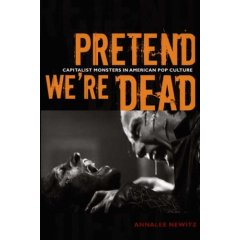 And if there is one vein of publishing that has proved to be the most fruitful, it is in genre and especially horror. FAB Press is doing a fantastic job, as are Reynolds and Hearn and numerous other independent presses. But mostly it’s been academic and university presses that have exploded in a wealth of books on horror films and other genres.


 The first issue of Paul Dini’s run on the (thankfully) revamped Detective Comics (DC, $2.95) hit shelves this week, and you gotta run to your local comic shop and snatch it up, then hunt down Paul at Comic-Con in just a little over a week and get him to sign it. Or just stare at him from across a room, wondering why so few have such a brilliant handle on the Dark Knight like Paul does. You may also recall that Mr. Dini and his sock monkey son Rashy do their own talk show here at Quick Stop, “Monkey Talk”. You should really check that out, too. Hint. Hint.
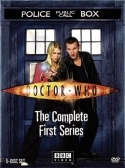 When most creative people view the re-launch of a venerable franchise as a 1,2,3 process of simply wiping out what came before and starting from scratch, it takes a delicate hand – and an often harrowing leap of faith – to decide to revitalize a franchise while still keeping its previous continuity intact. It’s rare that such an endeavor proves successful, but just such a creative miracle was achieved by Russell T. Davies, executive producer the rejuvenated Doctor Who (BBC, Not Rated, DVD-$99.98 SRP). Re-launched last year on the BBC to critical praise and fan approval, the Doctor’s adventures pulled in huge audiences of both old and new fans of all ages, proving that you don’t always have to throw the proverbial baby out with the bathwater. Starring Christopher Eccleston as the time traveling Doctor (the ninth in a line that’s included the legendary Tom Baker, Jon Pertwee, Patrick Troughton, Sylvester McCoy, Colin Baker, Peter Davison, William Hartnell, and Paul McGann) and Billie Piper as faithful and feisty companion Rose Tyler, it’s amazing how well it all pulled together. The 5-disc complete first season set features all 13 episodes, plus audio commentaries and behind-the-scenes featurettes.
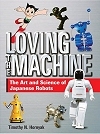 With a title like Loving the Machine: The Art and Science of Japanese Robots (Kodansha America, $26.95 SRP), how could I not crack this book open as soon as I laid eyes on it? Thankfully, its contents live up to the title, featuring everything from Astroboy to assembly line mechanical arms dueling with lightsabers at a trade show.
 Tom DeFalco returns with another in his fascinating Comics Creators On… series, this time focusing on the writers and artists behind the long history of those mighty mutants, the X-Men (Titan Books, $17.95 SRP). Interviewees include Stan Lee, John Byrne, Chris Claremont, Alan Davis, Grant Morrison, Louise Simonson, Dave Cockrum, and more.
 Hans Zimmer’s scores too often veer into sonic wallpaper for me, but I was duly impressed by his score for Pirates of the Caribbean: Dead Man’s Chest (Walt Disney Records, $18.98 SRP), a rousing, swashbuckling affair that captivated me from start to finish. Stunning, I know.
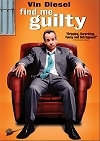 It took a film like Find Me Guilty (Fox, Rated R, DVD-$27.98 SRP) to remember that, when he tries and he has a solid director and script behind him, Vin Diesel can actually act. Here he plays Jackie Dee DiNorscio, a real life gangster who refused to rat out the Luccehese crime family and instead opted to defend himself – in what turned out to be one of the most surreal trials of al time. Wisecracking and affable, DiNorscio turned the court upside down, and Diesel delivers a memorable performance bringing it to cinematic life. The DVD features a conversation with director Sidney Lumet, TV spots, and the theatrical trailer.
 Jack Kirby’s epic Fourth World gets the spotlight in the latest tabloid-sized issue (#46) of the Jack Kirby Collector (Twomorrows, $9.95 SRP), packed with original pencil sketches, rare pages, and so much more cool stuff that upholds Twomorrows rep as the best comics history torchbearer publishing today.
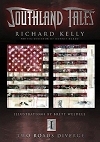 Also worth checking out is the first volume in the 3-volume arc of graphic novels acting as a prequel to director Richard Kelly’s Southland Tales, Two Roads Diverge (Graphitti Designs, $12.95 SRP). The film itself will comprise the final three volumes of the saga, so pick up a copy and get started on a most unique journey.
 Farrah Fawcett had departed (save for a guest appearance), and you could tell that it was the beginning of the end for those femmes of the mission impossible set, Charlie’s Angels (Sony, Not Rated, DVD-$49.95 SRP). The 6-disc third season set contains all 24 episodes – one of which features a guest turn from Scatman Crothers. Scatman Crothers plusses anything he graces.

 One of the reasons I started doing “Comics in Context” was to criticize critics. As the mainstream media grew more interested in comics and cartoon art in recent years, various film critics and other writers would make assertions about the subject that were condescending, prejudiced, or outright wrong. Â
One of the reasons I started doing “Comics in Context” was to criticize critics. As the mainstream media grew more interested in comics and cartoon art in recent years, various film critics and other writers would make assertions about the subject that were condescending, prejudiced, or outright wrong.  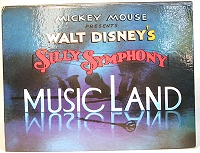 The first “Silly Symphony” in the Lincoln Center program, Musicland (1935), provides a perfect parallel to Cars. Musicland depicts a world, or at least a pair of islands, where humans and animals do not exist: the Island of Symphony and the Isle of Jazz, separated by the Sea of Discord. Every character in Musicland is an anthropomorphic musical instrument. The Queen of Symphony and her daughter are violins. The King of the Isle of Jazz is a saxophone, caricatured to resemble Paul Whiteman, a famous orchestra leader of the time who conducted jazz; the King’s son is also a sax. Musicland necessarily goes further than Cars, not only giving its characters eyes and mouths, but also hands and feet (so they can move). On the other hand, Musicland has no dialogue: its characters speak in musical sounds. The princess sounds like a violin, and she even moves to classical music.
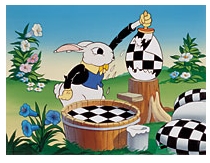 The next cartoon on the bill was Funny Little Bunnies (1934), which isn’t a minor masterpiece like Musicland, but isn’t as infantile as its title suggests, either. This time the Disney studio imagined an entire community of rabbits who work in a sort of factory outdoors (in an Impressionist-like forest) where they prepare the eggs and chocolates for children’s Easter baskets. It’s as if there were not one Easter Bunny, but many, acting as a counterpart to Santa’s elves.  Like Mickey’s band in The Band Concert (see “Comics in Context” #109), the Easter egg “factory” could even be an analogue to Disney’s own animation studio, which also creates artistic products for children.Â
The next cartoon on the bill was Funny Little Bunnies (1934), which isn’t a minor masterpiece like Musicland, but isn’t as infantile as its title suggests, either. This time the Disney studio imagined an entire community of rabbits who work in a sort of factory outdoors (in an Impressionist-like forest) where they prepare the eggs and chocolates for children’s Easter baskets. It’s as if there were not one Easter Bunny, but many, acting as a counterpart to Santa’s elves.  Like Mickey’s band in The Band Concert (see “Comics in Context” #109), the Easter egg “factory” could even be an analogue to Disney’s own animation studio, which also creates artistic products for children. 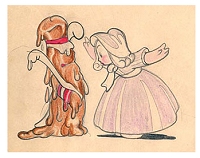 In the next cartoon, The Cookie Carnival (1935), the Disney studio again created a civilization in which the inanimate become animate. Just as Cars begins with an auto race held in a stadium packed with thousands of sentient cars, The Cookie Carnival opens with a marching band of cookies leading a parade straight towards the “camera,” set in “Cookietown.” (This anticipates the parades that are a daily feature at the Disney theme parks.)
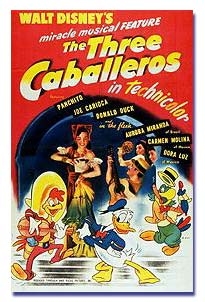
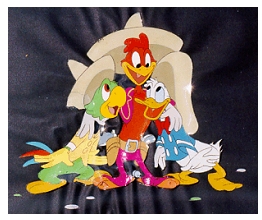 First up was a segment from The Three Caballeros (1945). Asked by the federal government to foster awareness of the United States’s allies to the South, Disney produced both this film and Saludos Amigos (1943), both of which consist of loosely connected vignettes about Latin America. These films also seem to have taken advantage of a growing popular interest in Latin music in 1940s America (hence the Hollywood career of Carmen Miranda, whose sister turns up in Caballeros). Â
First up was a segment from The Three Caballeros (1945). Asked by the federal government to foster awareness of the United States’s allies to the South, Disney produced both this film and Saludos Amigos (1943), both of which consist of loosely connected vignettes about Latin America. These films also seem to have taken advantage of a growing popular interest in Latin music in 1940s America (hence the Hollywood career of Carmen Miranda, whose sister turns up in Caballeros).   Yet then Donald, the supposedly three-dimensional duck, merges seamlessly with the “flat” soundtrack, reminding us (if we bother to think about it after laughing) that Donald, being a cartoon character, is just as “flat” an image as the soundtrack clearly is. After all, they are both drawings.
 Now the program returned to “Silly Symphonies” and the 1930s, with Cock o’the Walk (1935), which, as the title indicates, is about chickens and sex.Â
Now the program returned to “Silly Symphonies” and the 1930s, with Cock o’the Walk (1935), which, as the title indicates, is about chickens and sex.  The next cartoon, Who Killed Cock Robin (1935), features a society comprised entirely of birds. This short uses the familiar nursery rhyme for building a musical satirizing the legal system. The jury sings, “We don’t know who is guilty so/We’re going to hang ’em all.” One might compare this to the trial scenes in the Marx Brothers’ Duck Soup (1933) or the Gershwins’ Of Thee I Sing (1931), but I suspect that the ultimate source is the Gilbert and Sullivan canon of comic operettas, specifically Trial by Jury. Like Musicland, Cock Robin shows how much American culture has changed. How familiar are today’s audiences with the Gilbert and Sullivan style?
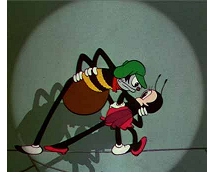 One of the forerunners of Pixar and Lasseter’s A Bug’s Life (1998) is the Disney masterpiece Woodland Café (1937). Here is another one of Ford’s “self-enclosed communities of cartoon beings,” this one consisting entirely of insects and other “bugs,” such as a spider.Â
One of the forerunners of Pixar and Lasseter’s A Bug’s Life (1998) is the Disney masterpiece Woodland Café (1937). Here is another one of Ford’s “self-enclosed communities of cartoon beings,” this one consisting entirely of insects and other “bugs,” such as a spider.  The program again jumped ahead a decade to A Jazz Interlude Featuring Benny Goodman & Orchestra: All the Cats Join In, subtitled, “A cariCature,” a sequence directed by Jack Kinney from the Disney feature Make Mine Music (1946).Â
The program again jumped ahead a decade to A Jazz Interlude Featuring Benny Goodman & Orchestra: All the Cats Join In, subtitled, “A cariCature,” a sequence directed by Jack Kinney from the Disney feature Make Mine Music (1946).  The program then went back in time to the decidedly unhip Wynken, Blynken & Nod (1938), based on a children’s poem about three children sailing in a giant shoe through a dreamworld. The kids try to catch fish, which appear as glowing stars. Space is visualized as waterlike, and the moon is shown, as if in soft focus. An enormous cloud with a human face blows at the shoe/ship, and eventually the children tumble from their ship.
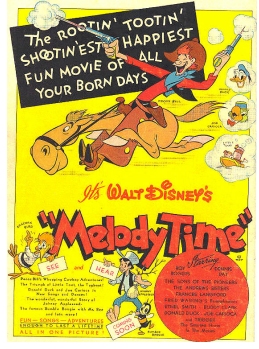 Then the program swerved back to Disney’s pop surrealism of the 1940s, with Bumble Boogie, directed by Jack Kinney for the feature Melody Time (1948), and set to a “boogie” arrangement of Rimsky-Korsakov’s “Flight of the Bumblebee” that spotlights the piano.  An animated brush creates the protagonist, a bumblebee, before our eyes. Again here’s the duality: the bee is presented to us both as a character and as a drawing. This prepares us for the wild transformations to come, as piano keys turn into flowers, and horns, and butterflies, and menace the hapless bee, all to the racing rhythm of the music, winning a big round of applause from the audience.Â
Then the program swerved back to Disney’s pop surrealism of the 1940s, with Bumble Boogie, directed by Jack Kinney for the feature Melody Time (1948), and set to a “boogie” arrangement of Rimsky-Korsakov’s “Flight of the Bumblebee” that spotlights the piano.  An animated brush creates the protagonist, a bumblebee, before our eyes. Again here’s the duality: the bee is presented to us both as a character and as a drawing. This prepares us for the wild transformations to come, as piano keys turn into flowers, and horns, and butterflies, and menace the hapless bee, all to the racing rhythm of the music, winning a big round of applause from the audience. 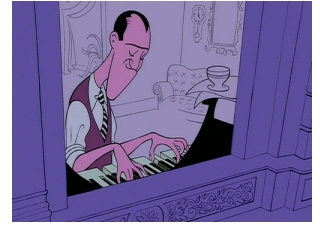 Beyond these four principals, the segment shows us many, many more city residents in passing. We glimpse individuals briefly, such as a milkman and his horse, making their early morning rounds, and a tired, bored waitress. To the rapid, bustling rhythms of Gershwin’s music, large numbers of people burst out from a hotel (named “The Goldberg”) or rush in and out of a subway station. The drummer rushes to work; the little girl is taken from lesson to lesson; the wife drags her reluctant husband along. Amidst the crowds and tumultuous movement of the big city, all four principal characters find themselves ironically isolated and unfulfilled.
 As I do every July 4th, I spent part of the afternoon, 129 minutes to be exact, watching Mr. Smith Goes to Washington. It strikes me as the perfect patriotic note to strike. And it includes the whole scale in its confrontation of back home idealism with big city cynicism. You can believe in Mr. Smith while laughing along with the wised up reporters and political operatives who use or observe him. Director Frank Capra pushes the buttons so well that I never fail to cry,especially at the parts that are the most treacly, such as when Smith first visits the Lincoln Memorial and watches a little kid read the Gerrysburg Address as an elderly African-American (old enough to remember the Civil War?) comes up and takes off his hat.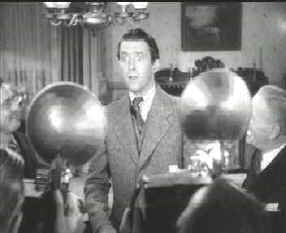


 Sometime in the mid-1960s, Forest J. Ackerman, the editor of Famous Monsters of Filmland, indirectly introduced two of his readers, both aspiring horror filmmakers, to one another. David Allen ran an ad in FM asking to hear from anyone out there interested in stop motion animation. Dennis Muren, living not far away from the home base of FM in the San Gabriel Valley, responded. The two boys visited, became friends, and later collaborated on a low budget film, working under the lowest of low budgets, a mere $6000 dollars, back when $6000 dollars was a lot of money.


 Disc two features a video interview with Muren, and an edited assembly of interview segments with of the actors from the show, Bonner, Hewitt, and James Duron. “Monstrous Origins” includes outtakes, deleted scenes (include a pool-side party scene that features a vixen worthy of Russ Meyer), and some monster test footage. Zorgon: The H-Bomb Beast from Hell, from 1972, is a silent eight and a half minute short film with some of the same people who worked on Equinox, plus Rick Baker. “David Allen Appreciation” is a section of the disc that contains The Magic Treasure, an early animated fairy tale by Allen, which comes with a textual history, and Allen’s King Kong homage Volkswagen commercial, plus test footage. “Equiphemera” gathers together an exhaustive gallery of stills, on set shots, promotional material, and so forth, under the headings, Origins of *The Equinox, On Location, Designing the Demonic: Special Effects, Publicity and Promotion, Beyond the Barrier, David Allen’s Kong, and Buried **Treasure. The final grouping, “Trailer and Radio Spots,” contains one 1970 trailer and two radio ads.


 Check out the preview to the Image comic Jeff writes…


